EP4067067A1 - Metal architectured plate with tactile warmth and elasticity and manufacturing method therefor - Google Patents
Metal architectured plate with tactile warmth and elasticity and manufacturing method therefor Download PDFInfo
- Publication number
- EP4067067A1 EP4067067A1 EP20891491.1A EP20891491A EP4067067A1 EP 4067067 A1 EP4067067 A1 EP 4067067A1 EP 20891491 A EP20891491 A EP 20891491A EP 4067067 A1 EP4067067 A1 EP 4067067A1
- Authority
- EP
- European Patent Office
- Prior art keywords
- tactile
- warmth
- elasticity
- senses
- metal
- Prior art date
- Legal status (The legal status is an assumption and is not a legal conclusion. Google has not performed a legal analysis and makes no representation as to the accuracy of the status listed.)
- Withdrawn
Links
Images









Classifications
-
- B—PERFORMING OPERATIONS; TRANSPORTING
- B32—LAYERED PRODUCTS
- B32B—LAYERED PRODUCTS, i.e. PRODUCTS BUILT-UP OF STRATA OF FLAT OR NON-FLAT, e.g. CELLULAR OR HONEYCOMB, FORM
- B32B3/00—Layered products comprising a layer with external or internal discontinuities or unevennesses, or a layer of non-planar shape; Layered products comprising a layer having particular features of form
- B32B3/26—Layered products comprising a layer with external or internal discontinuities or unevennesses, or a layer of non-planar shape; Layered products comprising a layer having particular features of form characterised by a particular shape of the outline of the cross-section of a continuous layer; characterised by a layer with cavities or internal voids ; characterised by an apertured layer
- B32B3/30—Layered products comprising a layer with external or internal discontinuities or unevennesses, or a layer of non-planar shape; Layered products comprising a layer having particular features of form characterised by a particular shape of the outline of the cross-section of a continuous layer; characterised by a layer with cavities or internal voids ; characterised by an apertured layer characterised by a layer formed with recesses or projections, e.g. hollows, grooves, protuberances, ribs
-
- B—PERFORMING OPERATIONS; TRANSPORTING
- B32—LAYERED PRODUCTS
- B32B—LAYERED PRODUCTS, i.e. PRODUCTS BUILT-UP OF STRATA OF FLAT OR NON-FLAT, e.g. CELLULAR OR HONEYCOMB, FORM
- B32B15/00—Layered products comprising a layer of metal
- B32B15/01—Layered products comprising a layer of metal all layers being exclusively metallic
-
- B—PERFORMING OPERATIONS; TRANSPORTING
- B32—LAYERED PRODUCTS
- B32B—LAYERED PRODUCTS, i.e. PRODUCTS BUILT-UP OF STRATA OF FLAT OR NON-FLAT, e.g. CELLULAR OR HONEYCOMB, FORM
- B32B3/00—Layered products comprising a layer with external or internal discontinuities or unevennesses, or a layer of non-planar shape; Layered products comprising a layer having particular features of form
- B32B3/26—Layered products comprising a layer with external or internal discontinuities or unevennesses, or a layer of non-planar shape; Layered products comprising a layer having particular features of form characterised by a particular shape of the outline of the cross-section of a continuous layer; characterised by a layer with cavities or internal voids ; characterised by an apertured layer
- B32B3/263—Layered products comprising a layer with external or internal discontinuities or unevennesses, or a layer of non-planar shape; Layered products comprising a layer having particular features of form characterised by a particular shape of the outline of the cross-section of a continuous layer; characterised by a layer with cavities or internal voids ; characterised by an apertured layer characterised by a layer having non-uniform thickness
-
- B—PERFORMING OPERATIONS; TRANSPORTING
- B32—LAYERED PRODUCTS
- B32B—LAYERED PRODUCTS, i.e. PRODUCTS BUILT-UP OF STRATA OF FLAT OR NON-FLAT, e.g. CELLULAR OR HONEYCOMB, FORM
- B32B37/00—Methods or apparatus for laminating, e.g. by curing or by ultrasonic bonding
- B32B37/10—Methods or apparatus for laminating, e.g. by curing or by ultrasonic bonding characterised by the pressing technique, e.g. using action of vacuum or fluid pressure
-
- E—FIXED CONSTRUCTIONS
- E04—BUILDING
- E04C—STRUCTURAL ELEMENTS; BUILDING MATERIALS
- E04C2/00—Building elements of relatively thin form for the construction of parts of buildings, e.g. sheet materials, slabs, or panels
- E04C2/02—Building elements of relatively thin form for the construction of parts of buildings, e.g. sheet materials, slabs, or panels characterised by specified materials
- E04C2/08—Building elements of relatively thin form for the construction of parts of buildings, e.g. sheet materials, slabs, or panels characterised by specified materials of metal, e.g. sheet metal
-
- B—PERFORMING OPERATIONS; TRANSPORTING
- B32—LAYERED PRODUCTS
- B32B—LAYERED PRODUCTS, i.e. PRODUCTS BUILT-UP OF STRATA OF FLAT OR NON-FLAT, e.g. CELLULAR OR HONEYCOMB, FORM
- B32B15/00—Layered products comprising a layer of metal
- B32B15/18—Layered products comprising a layer of metal comprising iron or steel
-
- B—PERFORMING OPERATIONS; TRANSPORTING
- B32—LAYERED PRODUCTS
- B32B—LAYERED PRODUCTS, i.e. PRODUCTS BUILT-UP OF STRATA OF FLAT OR NON-FLAT, e.g. CELLULAR OR HONEYCOMB, FORM
- B32B15/00—Layered products comprising a layer of metal
- B32B15/20—Layered products comprising a layer of metal comprising aluminium or copper
-
- B—PERFORMING OPERATIONS; TRANSPORTING
- B32—LAYERED PRODUCTS
- B32B—LAYERED PRODUCTS, i.e. PRODUCTS BUILT-UP OF STRATA OF FLAT OR NON-FLAT, e.g. CELLULAR OR HONEYCOMB, FORM
- B32B2307/00—Properties of the layers or laminate
- B32B2307/30—Properties of the layers or laminate having particular thermal properties
- B32B2307/302—Conductive
-
- B—PERFORMING OPERATIONS; TRANSPORTING
- B32—LAYERED PRODUCTS
- B32B—LAYERED PRODUCTS, i.e. PRODUCTS BUILT-UP OF STRATA OF FLAT OR NON-FLAT, e.g. CELLULAR OR HONEYCOMB, FORM
- B32B2307/00—Properties of the layers or laminate
- B32B2307/50—Properties of the layers or laminate having particular mechanical properties
- B32B2307/51—Elastic
-
- B—PERFORMING OPERATIONS; TRANSPORTING
- B32—LAYERED PRODUCTS
- B32B—LAYERED PRODUCTS, i.e. PRODUCTS BUILT-UP OF STRATA OF FLAT OR NON-FLAT, e.g. CELLULAR OR HONEYCOMB, FORM
- B32B2307/00—Properties of the layers or laminate
- B32B2307/50—Properties of the layers or laminate having particular mechanical properties
- B32B2307/54—Yield strength; Tensile strength
-
- B—PERFORMING OPERATIONS; TRANSPORTING
- B32—LAYERED PRODUCTS
- B32B—LAYERED PRODUCTS, i.e. PRODUCTS BUILT-UP OF STRATA OF FLAT OR NON-FLAT, e.g. CELLULAR OR HONEYCOMB, FORM
- B32B2307/00—Properties of the layers or laminate
- B32B2307/70—Other properties
- B32B2307/732—Dimensional properties
-
- E—FIXED CONSTRUCTIONS
- E04—BUILDING
- E04C—STRUCTURAL ELEMENTS; BUILDING MATERIALS
- E04C2/00—Building elements of relatively thin form for the construction of parts of buildings, e.g. sheet materials, slabs, or panels
- E04C2002/005—Appearance of panels
Definitions
- the present disclosure relates to metal laminates with senses of tactile warmth and elasticity and, more particularly, to a metal architectured plate with senses of tactile warmth and elasticity, which is manufactured by performing architecturing on a metal material to have a structure that gives human-friendly senses of tactile warmth and elasticity by reproducing the microstructure and textural characteristics of natural matters (e.g., wood).
- natural matters e.g., wood
- advanced materials refer to materials that compensate for defects of existing materials and improve advantages of those materials with manufacturing technologies or processing technologies developed based on existing materials or new materials or that have new characteristics that have not existed up to now.
- metal materials have an advantage of providing products with an elegant aesthetic sense or a sense of luster and having high durability.
- metal materials of the prior art have a disadvantage that they are heavy in comparison to aluminum, plastic, and fiber glass reinforce plastic (FRP) due to their high specific weight and they give a cold sense of touch without giving a sense of stability to people like foam, cork, rubber, wood, or leather.
- FRP fiber glass reinforce plastic
- metal materials realizing such sensitivity in the prior art are limited to products showing a visual effect related to colors, so developing a metal material that can realize senses of touch such as senses of tactile warmth and elasticity that give a sense of stability to people is insufficient.
- An objective of the present disclosure is to provide a metal architectured plate with senses of tactile warmth and elasticity, the metal architectured plate being able to solve the problem that metal materials of the prior art cannot provide senses of touch such as senses of tactile warmth and elasticity which give a sense of stability to people even though they have several advantages such as high ductility and strength, an excellent energy absorption ratio, etc., and being able to realize non-cold metal and a soft sense of touch depending on necessities of consumer, and a method of manufacturing the metal architectured plate.
- Another objective of the present disclosure is to provide a metal architectured plate with senses of tactile warmth and elasticity, the metal architectured plate having structural stability and high durability and having a sense of stability by reproducing the microstructure and textural characteristics of natural matters, particularly, wood.
- an embodiment of the present disclosure provides a metal architectured plate with senses of tactile warmth and elasticity.
- the metal architectured plate with senses of tactile warmth and elasticity is configured by stacking sheet-like metal architectured materials having micro-thickness with senses of tactile warmth and elasticity, the metal architectured materials including base microchannels formed with regular intervals; and microchannels with senses of tactile warmth and elasticity formed to protrude between the base microchannels, such that the base microchannels and the microchannels with senses of tactile warmth and elasticity form channels with senses of tactile warmth and elasticity, which are spaces for allowing control of thermal conductivity and an elastic modulus.
- the thickness of the metal architectured material with senses of tactile warmth and elasticity may be 3 pm to 100 ⁇ m.
- the ratio of the width of the microchannel with senses of tactile warmth and elasticity and the width of the base microchannel may be 1:10 to 10:1.
- the microchannel with senses of tactile warmth and elasticity may include: a pair of slopes protruding at a predetermined contact angle from ends of each side of the base microchannel; and a ridge connecting ends of the pair of slopes that are opposite to the ends connected to the base microchannel.
- the width of the base microchannel may be 5 ⁇ m to 5000 ⁇ m.
- the width of the ridge may be 1 ⁇ m to 4000 ⁇ m.
- the contact angle may be an angle made by the slope and the ridge or the base microchannel and may be 0° to 90°.
- the metal architectured materials with senses of tactile warmth and elasticity may be stacked such that the ridge of the microchannel with senses of tactile warmth and elasticity of one metal architectured material with senses of tactile warmth and elasticity is in contact with the bottom of the base microchannel of another metal architectured material with senses of tactile warmth and elasticity to form the channel with senses of tactile warmth and elasticity.
- a first metal architectured material with senses of tactile warmth and elasticity in which the ratio of the width of the microchannel with senses of tactile warmth and elasticity and the width of the base microchannel is 1:2n-1 (n is an integer of 1 or more), and a second metal architectured material with senses of tactile warmth and elasticity in which the ratio of the width of the microchannel with senses of tactile warmth and elasticity and the width of the base microchannel is 1:2n (n is an integer of 1 or more) may be alternately stacked.
- another embodiment of the present disclosure provides a metal architectured plate with senses of tactile warmth and elasticity.
- the metal architectured plate with senses of tactile warmth and elasticity is configured by stacking sheet-like metal architectured materials having micro-thickness with senses of tactile warmth and elasticity to form channels with senses of tactile warmth and elasticity, which are spaces for allowing control of thermal conductivity and a sense of tactile warmth.
- the metal architectured materials with senses of tactile warmth and elasticity may include: a plurality of base microchannels formed with regular intervals; and a plurality of first microchannels with senses of tactile warmth and elasticity that are formed to protrude between the base microchannels.
- the first microchannel with senses of tactile warmth and elasticity is formed in a stepped shape including a second microchannel with senses of tactile warmth and elasticity protruding from the first microchannel with senses of tactile warmth and elasticity and having a width smaller than that of the first microchannel with senses of tactile warmth and elasticity.
- the metal architectured materials with senses of tactile warmth and elasticity are stacked such that the first microchannels with senses of tactile warmth and elasticity are spaced apart so as not to overlap each other.
- the metal architectured materials with senses of tactile warmth and elasticity may have a plurality of microchannels with senses of tactile warmth and elasticity sequentially repeatedly protrude from the second microchannel with senses of tactile warmth and elasticity to be formed in a stepped shape in the same way that the second microchannel with senses of tactile warmth and elasticity protrudes from the first microchannel with senses of tactile warmth and elasticity.
- the first microchannel with senses of tactile warmth and elasticity may include: a pair of first slopes protruding at a predetermined contact angle from ends of each side of the base microchannel; and a first ridge connecting ends of the pair of first slopes that are opposite to the ends connected to the base microchannel.
- the second microchannel with senses of tactile warmth and elasticity may include: a pair of second slopes protruding at a predetermined contact angle from the first ridge; and a second ridge connecting ends of the pair of slopes that are opposite to the ends connected to the first ridge.
- the metal architectured materials with senses of tactile warmth and elasticity may be stacked such that the second ridge of one metal architectured material with senses of tactile warmth and elasticity is in contact with the bottom of the base microchannel of another metal architectured material with senses of tactile warmth and elasticity to form the channel with senses of tactile warmth and elasticity.
- the thickness of the metal architectured material with senses of tactile warmth and elasticity may be 10 pm to 100 ⁇ m.
- the thermal conductivity of the metal architectured plate with senses of tactile warmth and elasticity having the above configuration of the present disclosure may be 0.05 W/m ⁇ K to 10 W/m ⁇ K.
- the elastic modulus of the metal architectured plate with senses of tactile warmth and elasticity may be 0.1 MPa to 10 GPa.
- another embodiment of the present disclosure provides a method of manufacturing a metal architectured plate with senses of tactile warmth and elasticity.
- the method of manufacturing a metal architectured plate with senses of tactile warmth and elasticity comprises: manufacturing sheet-like metal architectured materials having micro-thickness with senses of tactile warmth and elasticity, wherein the metal architectured materials include base microchannels formed with regular intervals and microchannels with senses of tactile warmth and elasticity formed to protrude between the base microchannels; stacking the metal architectured materials with senses of tactile warmth and elasticity such that the base microchannels and the microchannels with senses of tactile warmth and elasticity form channels with senses of tactile warmth and elasticity that are spaces for allowing control of thermal conductivity; and attaching the stacked metal architectured materials with senses of tactile warmth and elasticity together through pressing.
- the microchannel with senses of tactile warmth and elasticity in the manufacturing of metal architectured materials with senses of tactile warmth and elasticity may be manufactured such that metal architectured materials include: a pair of slopes protruding at a predetermined contact angle from ends of each side of the base microchannel; and a ridge connecting ends of the pair of slopes that are opposite to the ends connected to the base microchannel.
- the step of attaching the stacked metal architectured materials with senses of tactile warmth and elasticity together through pressing may be performed by means of a spacer having a target thickness of the metal architectured plate with senses of tactile warmth and elasticity.
- a metal architectured plate with senses of tactile warmth and elasticity that is structurally stable because it has a regular internal pore structure by precisely reproducing the microstructures and textural characteristics of natural matters such as foam, cork, rubber, wood, and leather and enables to control thermal conductivity and an elastic modulus by controlling the textural structures, thereby realizing senses of touch such as human-friendly senses of tactile warmth and elasticity like natural matters, and a method of manufacturing the metal architectured plate.
- effects of the present invention are not limited to the effects as described above, and the effects include all effects that can be inferred from the configuration of the present disclosure described in the following specification or claims.
- a metal architectured plate with senses of tactile warmth and elasticity of the present disclosure is configured by stacking sheet-like metal architectured materials having micro-thickness with senses of tactile warmth and elasticity, which include base microchannels formed with regular intervals; and microchannels with senses of tactile warmth and elasticity formed to protrude between the base microchannels, such that the base microchannels and the microchannels with senses of tactile warmth and elasticity form channels with senses of tactile warmth and elasticity, which are spaces for allowing control of thermal conductivity and an elastic modulus.
- 'architectured' is a term generally used in architecture and means that truss structures are stacked by forming frames or structures in triangular net shapes using straight members.
- terms 'lamina', 'laminate', etc. are usually used in the technique of stacking thin metal sheets, but as a different structure is used in the sheet of the present disclosure, the architectural term 'architectured' is used herein.
- metal materials of the prior art have the disadvantage that even though they are useful as the surface materials of various interior and exterior materials, they are heavy in comparison to natural matter materials, give a cold sense of touch to users, and cannot give human-friendly senses of tactile warmth and elasticity like natural matter materials, so improvement is needed.
- the present disclosure has been derived to solve the problem that it is difficult to apply tactile warmth and elasticity that are human-friendly senses of touch to the metal materials having rigidity and ductility in the prior art, and an objective of the present disclosure is to provide a metal material that uses existing metal, but is light and warm and can give tactile warmth and elasticity that are human-friendly senses of touch.
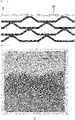
- FIG. 1 is a view comparing (a) the microstructure and texture of a natural matter (wood) that are motives of the structural characteristic of a metal sheet of the present disclosure with (b) a picture of a cross-section of the metal sheet of the present disclosure to be described below.
- the present disclosure has been derived to solve the problem that it is difficult to apply tactile warmth and elasticity that are human-friendly senses of touch to the metal materials having rigidity and ductility in the prior art on the basis of the microstructure and textural characteristics of natural matters, particularly, wood, and it is possible to provide metal that uses existing metal, but is light in comparison to existing metal and can make people feel friendly senses of touch such as tactile warmth and elasticity by employing a new manufacturing technique.
- the present disclosure can provide a metal architectured plate with senses of tactile warmth and elasticity that uses existing metal but can attract various sensitivities of human through the soft sense of touch and the tactile warmth of leather and the visual sense of stability from the pattern of wood materials while keeping the advantages of metal by changing designs of patterns and shapes and adjusting spacings, thickness, etc. between shapes, and that is a new material more excellent than complex materials or new macromolecular materials that are rising as advanced materials at present.
- a metal architectured plate with senses of tactile warmth and elasticity according to an embodiment of the present disclosure is described.
- FIG. 2 is a view schematically showing the structure of a metal architectured plate 1 with senses of tactile warmth and elasticity according to an embodiment of the present disclosure.
- FIG. 3 is a view schematically showing the structure of a metal architectured material 10 with senses of tactile warmth and elasticity according to an embodiment of the present disclosure.
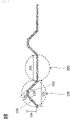
- a metal architectured plate 1 with senses of tactile warmth and elasticity may be configured such that sheet-like metal architectured materials 10 having micro-thickness with senses of tactile warmth and elasticity are stacked to form channels 300 with senses of tactile warmth and elasticity that are spaces for allowing control of thermal conductivity and a sense of tactile elasticity.
- the metal architectured material 10 with senses of tactile warmth and elasticity may include: a plurality of base microchannels 200 formed with regular intervals; and a plurality of microchannels 100 with senses of tactile warmth and elasticity that are formed to protrude between the base microchannels.
- the metal architectured material 10 with senses of tactile warmth and elasticity may be manufactured by pressing a foil made of metal or an alloy such as aluminum, copper, steel, stainless steel, and Invar (Nib-Fe alloy) and having a thickness of 3 pm to 100 pm using a mold having the shapes of the base microchannels 200 and the microchannels 100 with senses of tactile warmth and elasticity.
- the base microchannels 200 and the microchannels 100 with senses of tactile warmth and elasticity may be formed in the transverse or longitudinal direction of the metal architectured material 10 with senses of tactile warmth and elasticity.
- the ratio of the width 101 of the microchannel 100 with senses of tactile warmth and elasticity and the width 201 of the base microchannel 200 may be 1:10 to 10:1. More preferably, the ratio of the width 101 of the microchannel 100 with senses of tactile warmth and elasticity and the width 201 of the base microchannel 200 may be 1:10 to 1:1.
- the microchannel 100 with senses of tactile warmth and elasticity may include: a pair of slopes 104 protruding at a predetermined contact angle from ends of each side of the base microchannel 200; and a ridge 102 connecting ends of the pair of slopes 104 that are opposite to the ends connected to the base microchannel 200.
- the width 101 of the microchannel 100 with senses of tactile warmth and elasticity may be 5 pm to 5000 ⁇ m.
- the width 201 of the base microchannel 200 may be 5 ⁇ m to 5000 ⁇ m in accordance with the ratio of the width 101 of the microchannel 100 with senses of tactile warmth and elasticity and the width 201 of the base microchannel 200.
- the width 103 of the ridge 102 may be 1 ⁇ m to 4000 ⁇ m.
- the contact angle 105 which is an angle made by the slope 104 and the ridge 102 or the base microchannel 200, may be 0° to 90°.
- the metal architectured plate 1 with senses of tactile warmth and elasticity may be characterized in that one metal architectured material 10 with senses of tactile warmth and elasticity is stacked such that the ridge 102 of the microchannel 100 with senses of tactile warmth and elasticity is in contact with the bottom of the base microchannel 200 of another metal architectured material 10 with senses of tactile warmth and elasticity to form the channel 300 with senses of tactile warmth and elasticity.
- the thermal conductivity of the metal architectured plate 1 with senses of tactile warmth and elasticity formed by stacking the metal architectured materials 10 with senses of tactile warmth and elasticity having the above configuration may be 0.05 W/m ⁇ K to 10 W/m ⁇ K.
- the thermal conductivity of the metal architectured plate 1 with senses of tactile warmth and elasticity is y and the ratio of the width 101 of the microchannel 100 with senses of tactile warmth and elasticity and the width 201 of the base microchannel 200 is x
- the thermal conductivity of the metal architectured plate 1 with senses of tactile warmth and elasticity manufactured as described above corresponds to a value similar to the thermal conductivity value of natural matter materials such as some kinds of rubber or leather, or wood. Accordingly, it is confirmed that the metal sheet of the present disclosure can provide human-friendly senses of tactile warmth similar to natural matters while using metal materials.
- a metal architectured plate 1 with senses of tactile warmth and elasticity according to another embodiment of the present disclosure is described.
- FIG. 4 is a view schematically showing a metal architectured plate 1 with senses of tactile warmth and elasticity according to another embodiment of the present disclosure.
- a metal architectured plate 1 with senses of tactile warmth and elasticity may be configured such that sheet-like metal architectured materials 10 having micro-thickness with senses of tactile warmth and elasticity are stacked to form channels 300 with senses of tactile warmth and elasticity that are spaces for allowing control of thermal conductivity and a sense of tactile elasticity.
- the metal architectured plate with senses of tactile warmth and elasticity may include: a plurality of base microchannels 200 formed with regular intervals; and a plurality of microchannels 100 with senses of tactile warmth and elasticity that are formed to protrude between the base microchannels.
- the metal architectured plate 1 with senses of tactile warmth and elasticity may be characterized in that the metal architectured materials 10 with senses of tactile warmth and elasticity are configured by alternately staking a first metal architectured material 11 with senses of tactile warmth and elasticity in which the ratio of the width of the microchannel 100 with senses of tactile warmth and elasticity and the width of the base microchannel 200 is 1:2n-1 (n is an integer of 1 or more), and a second metal architectured material 12 with senses of tactile warmth and elasticity in which the ratio of the width of the microchannel with senses of tactile warmth and elasticity and the width of the base microchannel is 1:2n (n is an integer of 1 or more).
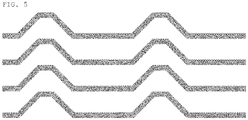
- FIG. 5 is a view schematically showing the structure of a metal sheet in which micro-channels with senses of tactile warmth and elasticity are stacked in parallel to each other.
- microchannels with senses of tactile warmth and elasticity are stacked in parallel without being separated from each other as shown in FIG. 5 , the microchannels with senses of tactile warmth and elasticity overlap each other, so channels with senses of tactile warmth and elasticity that are spaces imparting tactile warmth and elasticity of the present disclosure are not formed, whereby the effect of human-friendly senses of touch such as tactile warmth and elasticity cannot be achieved.
- the metal architectured materials 10 with senses of tactile warmth and elasticity in which the ratios of the microchannel 100 with senses of tactile warmth and elasticity and the width of the base microchannel are 1:2n-1 and 1:2n, respectively, are alternately stacked such that the microchannels 100 with senses of tactile warmth and elasticity are not parallel to each other and spaced apart from each other, whereby it is possible to form a shape having a pore structure like the microstructures of natural matters without overlapping when they are stacked.
- the metal architectured material 10 with senses of tactile warmth and elasticity may be manufactured by applying electroforming on a foil made of metal or an alloy such as aluminum, copper, steel, stainless steel, and invar (Nib-Fe alloy) and having a thickness of 10 ⁇ m to 100 ⁇ m using a mold having the shapes of the base microchannels and the microchannels with senses of tactile warmth and elasticity.
- a foil made of metal or an alloy such as aluminum, copper, steel, stainless steel, and invar (Nib-Fe alloy) and having a thickness of 10 ⁇ m to 100 ⁇ m using a mold having the shapes of the base microchannels and the microchannels with senses of tactile warmth and elasticity.
- the base microchannels 200 and the microchannels 100 with senses of tactile warmth and elasticity are formed in the transverse or longitudinal direction of the metal architectured material 10 with senses of tactile warmth and elasticity.
- the metal architectured material 10 with senses of tactile warmth and elasticity is the same as the metal architectured material 10 with senses of tactile warmth and elasticity of the embodiment described above, so it is described with reference to FIG. 3 .
- the width 101 of the microchannels 100 with senses of tactile warmth and elasticity may be 1 ⁇ m to 1,000 ⁇ m.
- the width 201 of the base microchannels 200 may have a size such that the ratio to the width 101 of the microchannel 100 with senses of tactile warmth and elasticity is 1:2n-1 or 1:2n (n is an integer of 1 or more), as described above.
- the width 103 of the ridge 102 may have a value smaller than or equal to the width 101 of the microchannel 100 with senses of tactile warmth and elasticity, in more detail, may be 1 ⁇ m to 1,000 ⁇ m.
- the contact angle 105 which is an angle made by the slope 104 and the ridge 102 or the base microchannel 200, may be 0° to 90°, more preferably, 5° to 85°.
- the metal architectured materials 10 with senses of tactile warmth and elasticity may be stacked into a sheet using a stacking of soldering to improve porosity and flexibility of the stacked structure.
- the thermal conductivity of the metal architectured plate 1 with senses of tactile warmth and elasticity which has the configuration described above may be 0.05 W/m ⁇ K to 5 W/m ⁇ K.
- the thermal conductivity value may be similar to the thermal conductivity value of natural matter materials such as some kinds of rubber or leather, or wood. Accordingly, it can be confirmed that the metal sheet of the present disclosure can provide human-friendly senses of tactile warmth similar to natural matters while using a metal material.
- the elastic modulus of the metal architectured plate 1 with senses of tactile warmth and elasticity which has the configuration described above may be 0.1 MPa or 10 GPa.
- the elastic modulus value is about 1/50 of that of solid metals. Accordingly, it can be confirmed that the metal sheet of the present disclosure can provide human-friendly senses of tactile elasticity similar to natural matters while using a metal material.
- a metal sheet that can realize senses of touch such as human-friendly senses of tactile warmth and elasticity like natural matters because it is possible to precisely reproduce the microstructures and textural characteristics of natural matters by virtue of configurational characteristics as described above, enabling to have a regular internal pore structure and to control thermal conductivity and elastic modulus by controlling the textural structure as described above.
- a metal architectured plate with senses of tactile warmth and elasticity according to another embodiment of the present disclosure is described.
- FIG. 6 is a view schematically showing the structure of a metal architectured plate 2 with senses of tactile warmth and elasticity according to another embodiment of the present disclosure.
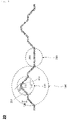
- FIGS. 7 and 8 are views schematically showing the structure of a metal architectured material 20 with senses of tactile warmth and elasticity of the present disclosure.
- a metal architectured plate 2 with senses of tactile warmth and elasticity may be configured such that sheet-like metal architectured materials 20 having micro-thickness with senses of tactile warmth and elasticity are stacked to form channels 300 with senses of tactile warmth and elasticity that are spaces for allowing control of thermal conductivity and a sense of tactile elasticity.
- the metal architectured material 20 with senses of tactile warmth and elasticity may include: a plurality of base microchannels 200 formed with regular intervals; and a plurality of first microchannels 100 with senses of tactile warmth and elasticity that are formed to protrude between the base microchannels.
- the first microchannel 100 with senses of tactile warmth and elasticity is formed in a stepped shape including a second microchannel 110 with senses of tactile warmth and elasticity protruding from the first microchannel 100 with senses of tactile warmth and elasticity and having a width smaller than the first microchannel with senses of tactile warmth and elasticity.
- the metal architectured materials 20 with senses of tactile warmth and elasticity may be stacked such that the first microchannels 100 with senses of tactile warmth and elasticity are spaced apart so as not to overlap each other.
- the first microchannels 100 with senses of tactile warmth and elasticity are stacked in parallel without being separated from each other, they overlap each other, so the channels 300 with senses of tactile warmth and elasticity that are spaces imparting tactile warmth and elasticity are not formed, whereby it is impossible to provide the effect of human-friendly senses of touch such as tactile warmth and elasticity.
- the first microchannels 100 with senses of tactile warmth and elasticity are stacked not in parallel but spaced apart from each other, as in the present disclosure, whereby it is possible to form a shape having a pore structure like the microstructures of natural matters without overlapping when they are stacked.
- a stepped shape is formed such that the second microchannel 110 with senses of tactile warmth and elasticity having a width 111 smaller than the width 101 of the first micro channel 100 with senses of tactile warmth and elasticity to protrude from the first microchannel 100 with senses of tactile warmth and elasticity, there are portions not fixed when stacked, so it is possible to control tactile elasticity including increasing an elastic deformation amount.
- the metal architectured materials 20 with senses of tactile warmth and elasticity are formed such that a plurality of microchannels with senses of tactile warmth and elasticity (not shown) repeatedly protrude in the same way that the second microchannel 110 with senses of tactile warmth and elasticity protrudes from the first microchannel 100 with senses of tactile warmth and elasticity, whereby it is possible to adjust an elastic deformation amount to have desired tactile elasticity.
- the metal architectured material 20 with senses of tactile warmth and elasticity may be manufactured by applying electroforming on a foil made of metal or an alloy such as aluminum, copper, steel, stainless steel, and invar (Nib-Fe alloy) and having a thickness of 10 ⁇ m to 100 ⁇ m using a mold having the shapes of the base microchannels and the microchannels with senses of tactile warmth and elasticity.
- a foil made of metal or an alloy such as aluminum, copper, steel, stainless steel, and invar (Nib-Fe alloy) and having a thickness of 10 ⁇ m to 100 ⁇ m using a mold having the shapes of the base microchannels and the microchannels with senses of tactile warmth and elasticity.
- the base microchannels 200 and the microchannels 100 with senses of tactile warmth and elasticity are formed in the transverse or longitudinal direction of the metal architectured material 20 with senses of tactile warmth and elasticity.
- the first microchannel 100 with senses of tactile warmth and elasticity of the metal architectured material 20 with senses of tactile warmth and elasticity may include: a pair of first slopes 104 protruding at a predetermined contact angle 105 from ends of each side of the base microchannel 200; and a first ridge 102 connecting ends of the pair of slopes 104 that are opposite to the ends connected to the base microchannel 200.
- the second microchannel 110 with senses of tactile warmth and elasticity may include: a pair of second slopes 114 protruding at a predetermined contact angle 115 from the first ridge 102; and a second ridge 112 connecting ends of the pair of second slopes 104 that are opposite to the ends connected to the first ridge 112.
- the metal architectured material 20 with senses of tactile warmth and elasticity may have a plurality of microchannels with senses of tactile warmth and elasticity including a third microchannel with senses of tactile warmth and elasticity and a fourth microchannel with senses of tactile warmth and elasticity sequentially protrude in the same way that the second microchannel with senses of tactile warmth and elasticity protrudes from the first microchannel with senses of tactile warmth and elasticity to be formed in a stepped shape.
- the metal architectured materials 20 with senses of tactile warmth and elasticity formed in stepped shapes are stacked such that the second ridge 112 of one metal architectured material 20 with senses of tactile warmth and elasticity is in contact with the bottom of the base microchannels 200 of another metal architectured material 20 with senses of tactile warmth and elasticity, whereby the microchannels 100 with senses of tactile warmth and elasticity are stacked not in parallel but spaced apart from each other to form the channel 300 with senses of tactile warmth and elasticity. Accordingly, it is possible to form a pore structure like the microstructures of natural matters without overlapping when stacking, and it is possible to control tactile elasticity by adjusting an elastic deformation amount.
- the width 103 of the first ridge 102 and the width 113 of the second ridge 112 may be independently 1,000 ⁇ m or less.
- the first contact angle 105 may be the angle made by the first slope 104 and the first ridge 102 or the base microchannel 200.
- the second contact angle 115 may be the angle made by the second slope 114 and the second ridge 112 or the first ridge 102.
- the first contact angle 105 and the second contact angle 115 may be independently 0° to 90°.
- the metal architectured materials 20 with senses of tactile warmth and elasticity may be stacked into a sheet using a stacking of soldering to improve porosity and flexibility of the stacked structure.
- the thickness of the metal architectured material with senses of tactile warmth and elasticity may be 10 ⁇ m to 100 ⁇ m.
- the thermal conductivity of the metal architectured plate 2 with senses of tactile warmth and elasticity which has the configuration described above may be 0.05 W/m ⁇ K to 5 W/m ⁇ K.
- the thermal conductivity value corresponds to a value similar to the thermal conductivity value of natural matter materials such as some kinds of rubber or leather, or wood. Accordingly, it can be confirmed that the present disclosure can provide human-friendly senses of tactile warmth similar to natural matters while using a metal material.
- the elastic modulus of the metal architectured plate 2 with senses of tactile warmth and elasticity which has the configuration described above may be 0.1 Mpa or 10 Gpa.
- the elastic modulus value corresponds to a relatively small value in comparison to solid metals and corresponds to a value similar to the elastic modulus values of natural matter materials such as wood or leather. Accordingly, it can be confirmed that the present disclosure can provide human-friendly senses of tactile elasticity similar to natural matters while using a metal material.
- FIG. 9 is a view schematically showing a metal architectured plate 3 with senses of tactile warmth and elasticity according to another embodiment of the present disclosure.
- the metal architectured plate 3 with senses of tactile warmth and elasticity may be formed by further stacking a sheet-like metal sheet material 30 not having a microchannel with senses of tactile warmth and elasticity and a base microchannel on the metal architectured plate with senses of tactile warmth and elasticity according to an embodiment of the present disclosure for use of the metal architectured plate with senses of tactile warmth and elasticity.
- FIG. 10 is a picture of the metal architectured plate with senses of tactile warmth and elasticity according to an embodiment of the present disclosure.
- a metal sheet that can realize senses of touch such as human-friendly senses of tactile warmth and elasticity like natural matters because it is possible to precisely reproduce the microstructures and textural characteristics of natural matters by virtue of configurational characteristics as described above, enabling to have a regular internal pore structure and to control thermal conductivity and elastic modulus by controlling the textural structure as described above.
- a method of manufacturing a metal architectured plate with senses of tactile warmth and elasticity according to another embodiment of the present disclosure is described.
- FIG. 11 is a view schematically showing a method of manufacturing a metal architectured plate with senses of tactile warmth and elasticity according to another embodiment of the present disclosure.
- the method of manufacturing a metal architectured plate with senses of tactile warmth and elasticity of the present disclosure may include: a step S10 of manufacturing sheet-like metal architectured materials having micro-thickness with senses of tactile warmth and elasticity and which include base microchannels formed with regular intervals and microchannels with senses of tactile warmth and elasticity formed to protrude between the base microchannels; a step S20 of stacking the metal architectured materials with senses of tactile warmth and elasticity such that the base microchannels and the microchannels with senses of tactile warmth and elasticity form channels with senses of tactile warmth and elasticity that are spaces for allowing control of thermal conductivity; and a step S30 of attaching the stacked metal architectured materials with senses of tactile warmth and elasticity together through pressing.
- the thermal conductivity of the metal architectured plate with senses of tactile warmth and elasticity is y and the ratio of the width of the microchannel with senses of tactile warmth and elasticity and the width of the base microchannel is x
- the step S10 of manufacturing metal architectured materials with senses of tactile warmth and elasticity may be a step of manufacturing the metal architectured material with senses of tactile warmth and elasticity such that the thermal conductivity of a manufactured metal architectured plate with senses of tactile warmth and elasticity becomes 0.05 W/m ⁇ K to 10 W/m ⁇ K by controlling the ratio of the width of the microchannel with senses of tactile warmth and elasticity and the width of the base microchannel.
- the microchannel with senses of tactile warmth and elasticity in the step S10 of manufacturing metal architectured materials with senses of tactile warmth and elasticity is manufactured to include: a pair of slopes protruding at a predetermined contact angle from ends of each side of the base microchannel; and a ridge connecting ends of the pair of slopes that are opposite to the ends connected to the base microchannel.
- the step S20 of stacking the metal architectured materials with senses of tactile warmth and elasticity is a step of stacking the metal architectured materials with senses of tactile warmth and elasticity such that the ridge of the microchannel with senses of tactile warmth and elasticity of one metal architectured material with senses of tactile warmth and elasticity is in contact with the bottom of the base microchannel of another metal architectured material with senses of tactile warmth and elasticity.
- the ridges are positioned at the center of bottom of the base microchannels.
- FIG. 12 is view schematically showing a pressing process in the step S30 of attaching the stacked metal architectured materials with senses of tactile warmth and elasticity of the present disclosure through pressing.
- the step S30 of attaching the stacked metal architectured materials with senses of tactile warmth and elasticity through pressing is performed by means of a spacer 40 having a target thickness of the metal architectured plate 1 with senses of tactile warmth and elasticity.
- the metal architectured plate 1 with senses of tactile warmth and elasticity is manufactured by, as described above, stacking the metal architectured materials 10 with senses of tactile warmth and elasticity to correspond to the thickness of the metal architectured plate 1 with senses of tactile warmth and elasticity to be manufactured, disposing a pair of spacers 40 having a height corresponding to the target thickness of the metal architectured plate 1 with senses of tactile warmth and elasticity to be manufactured, and then performing hot pressing.
- the stacked metal architectured materials 10 with senses of tactile warmth and elasticity do not receive excessive pressure by the spacers 40, so microchannels with senses of tactile warmth and elasticity can be formed in uniform shapes.
- channels with senses of tactile warmth and elasticity are formed in uniform shapes by virtue of the configurational features described above, there is an effect that it is possible to provide a method of manufacturing a metal architectured plate with senses of tactile warmth and elasticity which enables mass production by manufacturing the metal architectured plate with senses of tactile warmth and elasticity to have constant physical properties and allow for control of the thermal conductivity and a sense of elasticity of the sheet as necessary.
- FIG. 13 is a table showing equivalent thermal conductivity according to the stacking thickness and the ratio of the width of the microchannel with senses of tactile warmth and elasticity and the width of the base microchannel in the metal architectured plate with senses of tactile warmth and elasticity according to an embodiment of the present disclosure.
- metal architectured plates with senses of tactile warmth and elasticity which have thicknesses of 50 ⁇ m, 40 ⁇ m, and 30 ⁇ m, respectively, and in which the ratios of the width of the microchannels with senses of tactile warmth and elasticity and the width of the base microchannels are 1:1, 1:2, and 1:4, respectively, were manufactured and then thermal conductivity was measured. It was found out, as the result of measurement, that the thermal conductivity had a maximum value of 1.261 W/m ⁇ K and a minimum value of 0.111 W/m ⁇ K, so it possible to provide an effect of tactile warmth using metal.
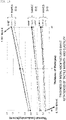
- FIG. 14 is a graph showing change in thermal conductivity according to the thickness of the metal architectured plate with senses of tactile warmth and elasticity according to an embodiment of the present disclosure.
- metal architectured sheets with senses of tactile warmth and elasticity were manufactured in a shape A, a shape B, and a shape C by stacking metal architectured materials with senses of tactile warmth and elasticity in which the ratios of the width of the microchannels with senses of tactile warmth and elasticity and the width of base microchannels are 1:1, 1:2, and 1:4, respectively, and thermal conductivity according to thickness change was measured when added metal architectured materials with senses of tactile warmth and elasticity were 0 sheet, 1 sheet, and 2 sheets for each of the shape A, the shape B, and the shape C. As the result of measurement, it was found out that the thermal conductivity of the metal architectured plates with senses of tactile warmth and elasticity had a linear relationship with the thickness.
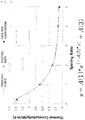
- FIG. 15 is a graph showing change in thermal conductivity according to the ratio of the width of the microchannel with senses of tactile warmth and elasticity and the width of the base microchannel in the metal architectured plate with senses of tactile warmth and elasticity according to an embodiment of the present disclosure.
- thermal conductivities of metal architectured plates with senses of tactile warmth and elasticity which have thicknesses of 50 ⁇ m, 40 ⁇ m, and 30 ⁇ m, respectively, and in which the ratios of the width of the microchannel with senses of tactile warmth and elasticity and the width of the base microchannel are different were measured.
- FIG. 16 is a graph showing derivation of a thermal conductivity equation according to the ratio of the width of the microchannel with senses of tactile warmth and elasticity and the width of the base microchannel in the metal architectured plate with senses of tactile warmth and elasticity according to an embodiment of the present disclosure.
- the metal architectured plate with senses of tactile warmth and elasticity may be manufactured to have desired thermal conductivity by adjusting the ratio of the width of the microchannel with senses of tactile warmth and elasticity and the width of the base microchannel.
- FIG. 17 is a view showing an example of other materials corresponding to tactile warmth according to the thermal conductivity of the metal architectured plate with senses of tactile warmth and elasticity according to an embodiment of the present disclosure.
- (a) of FIG. 17 is a table showing the ratio of thermal conductivity of other materials and a metal architectured plate with senses of tactile warmth and elasticity of the present disclosure, and (b) of FIG.
- 17 is a table showing thermal conductivity (spacing ratio of 1, 2, and 3, initial data) measured for each thicknesses of the metal architectured materials with senses of tactile warmth and elasticity constituting the metal architectured plate with senses of tactile warmth and elasticity and number of stacks and thermal conductivity (spacing ratio of 0.2 and 5, data for verification of a function) derived using the thermal conductivity derivation equation.
- the metal architectured plates with senses of tactile warmth and elasticity could be manufactured to have the tactile warmth of materials such as wood, cotton, leather, rubber, glass, rock, or the like.
- metal architectured plates with senses of tactile warmth and elasticity were manufactured and used in tests as in the following manufacturing examples and comparative examples.
- the metal architectured plate with senses of tactile warmth and elasticity according to an embodiment of the present disclosure was manufactured.
- the metal architectured material with senses of tactile warmth and elasticity was manufactured such that the ratio of the width of the microchannel with senses of tactile warmth and elasticity and the width of the base microchannel became 1:4 using electroforming
- the metal architectured materials with senses of tactile warmth and elasticity manufactured as described above were stacked in six layers using soldering and a sheet member was stacked on the uppermost layer and the lowermost layer, whereby a metal architectured plate with senses of tactile warmth and elasticity was completed.
- a metal architectured plate with senses of tactile warmth and elasticity was manufactured in the same way as the manufacturing example 1 except that the metal architectured materials with senses of tactile warmth and elasticity were stacked in five layers.
- a metal architectured plate with senses of tactile warmth and elasticity was manufactured in the same way as the manufacturing example 1 except that the ratio of the width of the microchannel with senses of tactile warmth and elasticity and the width of the base microchannel was 1:1.
- the thermal conductivity of the metal architectured plates with senses of tactile warmth and elasticity manufactured in the manufacturing example and the comparative example was measured.
- FIG. 18 is a table showing cross-sectional structures and measured thermal conductivity of metal architectured plates with senses of tactile warmth and elasticity manufactured in accordance with the manufacturing example and the comparative example of the present disclosure.
- the metal architectured plate with senses of tactile warmth and elasticity could have thermal conductively close to those of natural matters by adjusting the ratio of widths of a microchannel with senses of tactile warmth and elasticity and a base microchannel in accordance with an embodiment of the present disclosure.
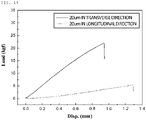
- the elastic modulus of the metal architectured plate with senses of tactile warmth and elasticity manufactured in the manufacturing example 2 was measured.
- FIG. 19 is a graph showing tension test results by direction of a metal architectured plate with senses of tactile warmth and elasticity manufactured in accordance with the manufacturing example 2 of the present disclosure.
- the elastic modulus of the metal architectured plate with senses of tactile warmth and elasticity was low as 0.48 Mpa that was about 1/500,000 of solid metals not having a channel. That is, it could be seen that it was possible to control an elastic modulus by manufacturing and stacking metal architectured materials with senses of tactile warmth and elasticity by controlling various factors, such as the ratio of the widths of the metal architectured plate with senses of tactile warmth and elasticity of the present disclosure, the width of the ridge, and the contact angle, and accordingly, the metal architectured plate with senses of tactile warmth and elasticity could be manufactured to have desired tactile warmth close to those of natural matters.
Landscapes
- Engineering & Computer Science (AREA)
- Architecture (AREA)
- Physics & Mathematics (AREA)
- Fluid Mechanics (AREA)
- Civil Engineering (AREA)
- Structural Engineering (AREA)
- Laminated Bodies (AREA)
Abstract
Description
- The present disclosure relates to metal laminates with senses of tactile warmth and elasticity and, more particularly, to a metal architectured plate with senses of tactile warmth and elasticity, which is manufactured by performing architecturing on a metal material to have a structure that gives human-friendly senses of tactile warmth and elasticity by reproducing the microstructure and textural characteristics of natural matters (e.g., wood).
- In general, advanced materials refer to materials that compensate for defects of existing materials and improve advantages of those materials with manufacturing technologies or processing technologies developed based on existing materials or new materials or that have new characteristics that have not existed up to now.
- Recently, research for developing such advanced materials has been actively conducting. Among others, a study of metal materials that are used in various ways as the surface materials of not only the exterior materials of IT • electronic products or the interior/exterior materials of motor vehicles but also the interior/exterior materials for construction • interior construction has been actively conducting.
- Such metal materials have an advantage of providing products with an elegant aesthetic sense or a sense of luster and having high durability. However, metal materials of the prior art have a disadvantage that they are heavy in comparison to aluminum, plastic, and fiber glass reinforce plastic (FRP) due to their high specific weight and they give a cold sense of touch without giving a sense of stability to people like foam, cork, rubber, wood, or leather.
- In order to solve the problems as described above, a study of developing advanced metal materials realizing sensitivity that gives a sense of stability to people has been actively conducting recently.
- However, metal materials realizing such sensitivity in the prior art are limited to products showing a visual effect related to colors, so developing a metal material that can realize senses of touch such as senses of tactile warmth and elasticity that give a sense of stability to people is insufficient.
- To this end, there was a technique intended to use the advantages of ductility and rigidity of metals for fiber, etc. by applying the technique of attaching a net structure to a raw carbon fiber in close contact state to reinforce the strength of a carbon fiber in the field of carbon fiber reinforce plastic (CFRP). See,
Korean registered patent No. 10-1961103 - Further, there were several attempts to provide a sense of touch by forming a pore structure in a metal material. However, the techniques of the prior art have problems in that such metal materials have low durability, limitative use, and difficulty in mass production because their physical properties are not uniform due to non-uniform pore structure and structural problems.
- Accordingly, it is increasingly required to develop a metal architectured plate with senses of tactile warmth and elasticity and an architecturing method that can improve a structure to have ductility and strength, which are advantages of metal, and have senses of tactile warmth and elasticity that are human-friendly senses of touch.
- An objective of the present disclosure is to provide a metal architectured plate with senses of tactile warmth and elasticity, the metal architectured plate being able to solve the problem that metal materials of the prior art cannot provide senses of touch such as senses of tactile warmth and elasticity which give a sense of stability to people even though they have several advantages such as high ductility and strength, an excellent energy absorption ratio, etc., and being able to realize non-cold metal and a soft sense of touch depending on necessities of consumer, and a method of manufacturing the metal architectured plate.
- Another objective of the present disclosure is to provide a metal architectured plate with senses of tactile warmth and elasticity, the metal architectured plate having structural stability and high durability and having a sense of stability by reproducing the microstructure and textural characteristics of natural matters, particularly, wood.
- The objectives to implement in the present disclosure are not limited to the technical problems described above, and other objectives that are not stated herein will be clearly understood by those skilled in the art from the following descriptions.
- In order to achieve the objectives, an embodiment of the present disclosure provides a metal architectured plate with senses of tactile warmth and elasticity.
- In an embodiment of the present disclosure, the metal architectured plate with senses of tactile warmth and elasticity is configured by stacking sheet-like metal architectured materials having micro-thickness with senses of tactile warmth and elasticity, the metal architectured materials including base microchannels formed with regular intervals; and microchannels with senses of tactile warmth and elasticity formed to protrude between the base microchannels, such that the base microchannels and the microchannels with senses of tactile warmth and elasticity form channels with senses of tactile warmth and elasticity, which are spaces for allowing control of thermal conductivity and an elastic modulus.
- The thickness of the metal architectured material with senses of tactile warmth and elasticity may be 3 pm to 100 µm.
- The ratio of the width of the microchannel with senses of tactile warmth and elasticity and the width of the base microchannel may be 1:10 to 10:1.
- The microchannel with senses of tactile warmth and elasticity may include: a pair of slopes protruding at a predetermined contact angle from ends of each side of the base microchannel; and a ridge connecting ends of the pair of slopes that are opposite to the ends connected to the base microchannel.
- The width of the base microchannel may be 5 µm to 5000 µm.
- The width of the ridge may be 1 µm to 4000 µm.
- The contact angle may be an angle made by the slope and the ridge or the base microchannel and may be 0° to 90°.
- In the metal architectured plate with senses of tactile warmth and elasticity, the metal architectured materials with senses of tactile warmth and elasticity may be stacked such that the ridge of the microchannel with senses of tactile warmth and elasticity of one metal architectured material with senses of tactile warmth and elasticity is in contact with the bottom of the base microchannel of another metal architectured material with senses of tactile warmth and elasticity to form the channel with senses of tactile warmth and elasticity.
- A first metal architectured material with senses of tactile warmth and elasticity in which the ratio of the width of the microchannel with senses of tactile warmth and elasticity and the width of the base microchannel is 1:2n-1 (n is an integer of 1 or more), and a second metal architectured material with senses of tactile warmth and elasticity in which the ratio of the width of the microchannel with senses of tactile warmth and elasticity and the width of the base microchannel is 1:2n (n is an integer of 1 or more) may be alternately stacked.
- In order to achieve the objectives, another embodiment of the present disclosure provides a metal architectured plate with senses of tactile warmth and elasticity.
- In an embodiment of the present disclosure, the metal architectured plate with senses of tactile warmth and elasticity is configured by stacking sheet-like metal architectured materials having micro-thickness with senses of tactile warmth and elasticity to form channels with senses of tactile warmth and elasticity, which are spaces for allowing control of thermal conductivity and a sense of tactile warmth.
- The metal architectured materials with senses of tactile warmth and elasticity may include: a plurality of base microchannels formed with regular intervals; and a plurality of first microchannels with senses of tactile warmth and elasticity that are formed to protrude between the base microchannels.
- The first microchannel with senses of tactile warmth and elasticity is formed in a stepped shape including a second microchannel with senses of tactile warmth and elasticity protruding from the first microchannel with senses of tactile warmth and elasticity and having a width smaller than that of the first microchannel with senses of tactile warmth and elasticity.
- The metal architectured materials with senses of tactile warmth and elasticity are stacked such that the first microchannels with senses of tactile warmth and elasticity are spaced apart so as not to overlap each other.
- The metal architectured materials with senses of tactile warmth and elasticity may have a plurality of microchannels with senses of tactile warmth and elasticity sequentially repeatedly protrude from the second microchannel with senses of tactile warmth and elasticity to be formed in a stepped shape in the same way that the second microchannel with senses of tactile warmth and elasticity protrudes from the first microchannel with senses of tactile warmth and elasticity.
- The first microchannel with senses of tactile warmth and elasticity may include: a pair of first slopes protruding at a predetermined contact angle from ends of each side of the base microchannel; and a first ridge connecting ends of the pair of first slopes that are opposite to the ends connected to the base microchannel.
- The second microchannel with senses of tactile warmth and elasticity may include: a pair of second slopes protruding at a predetermined contact angle from the first ridge; and a second ridge connecting ends of the pair of slopes that are opposite to the ends connected to the first ridge.
- The metal architectured materials with senses of tactile warmth and elasticity may be stacked such that the second ridge of one metal architectured material with senses of tactile warmth and elasticity is in contact with the bottom of the base microchannel of another metal architectured material with senses of tactile warmth and elasticity to form the channel with senses of tactile warmth and elasticity.
- The thickness of the metal architectured material with senses of tactile warmth and elasticity may be 10 pm to 100 µm.
- The thermal conductivity of the metal architectured plate with senses of tactile warmth and elasticity having the above configuration of the present disclosure may be 0.05 W/m·K to 10 W/m·K.
- The elastic modulus of the metal architectured plate with senses of tactile warmth and elasticity may be 0.1 MPa to 10 GPa.
- In order to achieve the objectives, another embodiment of the present disclosure provides a method of manufacturing a metal architectured plate with senses of tactile warmth and elasticity.
- In an embodiment of the present disclosure, the method of manufacturing a metal architectured plate with senses of tactile warmth and elasticity comprises: manufacturing sheet-like metal architectured materials having micro-thickness with senses of tactile warmth and elasticity, wherein the metal architectured materials include base microchannels formed with regular intervals and microchannels with senses of tactile warmth and elasticity formed to protrude between the base microchannels; stacking the metal architectured materials with senses of tactile warmth and elasticity such that the base microchannels and the microchannels with senses of tactile warmth and elasticity form channels with senses of tactile warmth and elasticity that are spaces for allowing control of thermal conductivity; and attaching the stacked metal architectured materials with senses of tactile warmth and elasticity together through pressing.
- The microchannel with senses of tactile warmth and elasticity in the manufacturing of metal architectured materials with senses of tactile warmth and elasticity may be manufactured such that metal architectured materials include: a pair of slopes protruding at a predetermined contact angle from ends of each side of the base microchannel; and a ridge connecting ends of the pair of slopes that are opposite to the ends connected to the base microchannel.
- The step of attaching the stacked metal architectured materials with senses of tactile warmth and elasticity together through pressing may be performed by means of a spacer having a target thickness of the metal architectured plate with senses of tactile warmth and elasticity.
- According to the present disclosure, it is possible to provide a metal architectured plate with senses of tactile warmth and elasticity that is structurally stable because it has a regular internal pore structure by precisely reproducing the microstructures and textural characteristics of natural matters such as foam, cork, rubber, wood, and leather and enables to control thermal conductivity and an elastic modulus by controlling the textural structures, thereby realizing senses of touch such as human-friendly senses of tactile warmth and elasticity like natural matters, and a method of manufacturing the metal architectured plate.
- It should be noted that effects of the present invention are not limited to the effects as described above, and the effects include all effects that can be inferred from the configuration of the present disclosure described in the following specification or claims.
-
-
FIG. 1 is a view comparing (a) the microstructure and texture of a natural matter (wood) that are motives of the structural characteristic of a metal sheet of the present disclosure with (b) a picture of a cross-section of the metal sheet of the present disclosure to be described below. -
FIG. 2 is a view schematically showing the structure of a metal architecturedplate 1 with senses of tactile warmth and elasticity according to an embodiment of the present disclosure. -
FIG. 3 is a view schematically showing the structure of a metal architecturedmaterial 10 with senses of tactile warmth and elasticity according to an embodiment of the present disclosure. -
FIG. 4 is a view schematically showing a metal architecturedplate 1 with senses of tactile warmth and elasticity according to another embodiment of the present disclosure. -
FIG. 5 is a view schematically showing the structure of a metal sheet in which microchannels with senses of tactile warmth and elasticity are stacked in parallel to each other. -
FIG. 6 is a view schematically showing the structure of a metal architecturedplate 2 with senses of tactile warmth and elasticity according to another embodiment of the present disclosure. -
FIG. 7 is a view schematically showing the structure of a metal architecturedmaterial 20 with senses of tactile warmth and elasticity of the present disclosure. -
FIG. 8 is a view schematically showing the structure of the metal architecturedmaterial 20 with senses of tactile warmth and elasticity of the present disclosure. -
FIG. 9 is a view schematically showing a metal architecturedplate 3 with senses of tactile warmth and elasticity according to another embodiment of the present disclosure. -
FIG. 10 is a picture of the metal architectured plate with senses of tactile warmth and elasticity according to an embodiment of the present disclosure. -
FIG. 11 is a view schematically showing a method of manufacturing a metal architectured plate with senses of tactile warmth and elasticity according to another embodiment of the present disclosure. -
FIG. 12 is view schematically showing a pressing process in step S30 of pressing a stacked member of metal architectured materials with senses of tactile warmth and elasticity of the present disclosure. -
FIG. 13 is a table showing equivalent thermal conductivity according to the stacking thickness and the ratio of the width of the microchannel with senses of tactile warmth and elasticity and the width of the base microchannel in the metal architectured plate with senses of tactile warmth and elasticity according to an embodiment of the present disclosure. -
FIG. 14 is a graph showing change in thermal conductivity according to the thickness of the metal architectured plate with senses of tactile warmth and elasticity according to an embodiment of the present disclosure. -
FIG. 15 is a graph showing change in thermal conductivity according to the ratio of the width of the microchannel with senses of tactile warmth and elasticity and the width of the base microchannel in the metal architectured plate with senses of tactile warmth and elasticity according to an embodiment of the present disclosure. -
FIG. 16 is a graph showing derivation of a thermal conductivity equation according to the ratio of the width of the microchannel with senses of tactile warmth and elasticity and the width of the base microchannel in the metal architectured plate with senses of tactile warmth and elasticity according to an embodiment of the present disclosure. -
FIG. 17 is a view showing an example of other materials corresponding to tactile warmth according to the thermal conductivity of the metal architectured plate with senses of tactile warmth and elasticity according to an embodiment of the present disclosure. -
FIG. 18 is a table showing a cross-sectional structure and measured thermal conductivity of a metal architectured plate with senses of tactile warmth and elasticity of the present disclosure. -
FIG. 19 is a graph showing tension test results by direction of a metal architectured plate with senses of tactile warmth and elasticity of the present disclosure. - A metal architectured plate with senses of tactile warmth and elasticity of the present disclosure is configured by stacking sheet-like metal architectured materials having micro-thickness with senses of tactile warmth and elasticity, which include base microchannels formed with regular intervals; and microchannels with senses of tactile warmth and elasticity formed to protrude between the base microchannels, such that the base microchannels and the microchannels with senses of tactile warmth and elasticity form channels with senses of tactile warmth and elasticity, which are spaces for allowing control of thermal conductivity and an elastic modulus.
- Hereinafter, the present disclosure is described with reference to the accompanying drawings. However, the present disclosure may be modified in various different ways and is not limited to the embodiments described herein. Further, in the accompanying drawings, components irrelevant to the description will be omitted in order to clearly describe the present disclosure, and similar reference numerals will be used to describe similar components throughout the specification.
- Throughout the specification, when an element is referred to as being "connected with (coupled to, combined with, in contact with)" another element, it may be "directly connected" to the other element and may also be "indirectly connected" to the other element with another element intervening therebetween. Further, unless explicitly described otherwise, "comprising" any components will be understood to imply the inclusion of other components rather than the exclusion of any other components.
- Terms used in the present disclosure are used only in order to describe specific exemplary embodiments rather than limiting the present disclosure. Singular forms are intended to include plural forms unless the context clearly indicates otherwise. It will be further understood that the terms "comprising" or "having" used in this specification specify the presence of stated features, numerals, steps, operations, components, parts, or a combination thereof, but do not preclude the presence or addition of one or more other features, numerals, steps, operations, components, parts, or a combination thereof.
- The term 'architectured' used herein to describe the present disclosure means stacking of metal materials with senses of tactile warmth and elasticity.
- In general, 'architectured' is a term generally used in architecture and means that truss structures are stacked by forming frames or structures in triangular net shapes using straight members. In general, terms 'lamina', 'laminate', etc. are usually used in the technique of stacking thin metal sheets, but as a different structure is used in the sheet of the present disclosure, the architectural term 'architectured' is used herein.
- As described above, metal materials of the prior art have the disadvantage that even though they are useful as the surface materials of various interior and exterior materials, they are heavy in comparison to natural matter materials, give a cold sense of touch to users, and cannot give human-friendly senses of tactile warmth and elasticity like natural matter materials, so improvement is needed.
- Accordingly, the present disclosure has been derived to solve the problem that it is difficult to apply tactile warmth and elasticity that are human-friendly senses of touch to the metal materials having rigidity and ductility in the prior art, and an objective of the present disclosure is to provide a metal material that uses existing metal, but is light and warm and can give tactile warmth and elasticity that are human-friendly senses of touch.
- Hereinafter, embodiments of the present disclosure are described in detail with reference to the accompanying drawings.
-
FIG. 1 is a view comparing (a) the microstructure and texture of a natural matter (wood) that are motives of the structural characteristic of a metal sheet of the present disclosure with (b) a picture of a cross-section of the metal sheet of the present disclosure to be described below. - Referring to
FIG. 1 , it can be seen that the present disclosure has been derived to solve the problem that it is difficult to apply tactile warmth and elasticity that are human-friendly senses of touch to the metal materials having rigidity and ductility in the prior art on the basis of the microstructure and textural characteristics of natural matters, particularly, wood, and it is possible to provide metal that uses existing metal, but is light in comparison to existing metal and can make people feel friendly senses of touch such as tactile warmth and elasticity by employing a new manufacturing technique. - That is, it can be seen that the present disclosure can provide a metal architectured plate with senses of tactile warmth and elasticity that uses existing metal but can attract various sensitivities of human through the soft sense of touch and the tactile warmth of leather and the visual sense of stability from the pattern of wood materials while keeping the advantages of metal by changing designs of patterns and shapes and adjusting spacings, thickness, etc. between shapes, and that is a new material more excellent than complex materials or new macromolecular materials that are rising as advanced materials at present.
- A metal architectured plate with senses of tactile warmth and elasticity according to an embodiment of the present disclosure is described.
-
FIG. 2 is a view schematically showing the structure of a metalarchitectured plate 1 with senses of tactile warmth and elasticity according to an embodiment of the present disclosure. -
FIG. 3 is a view schematically showing the structure of a metal architecturedmaterial 10 with senses of tactile warmth and elasticity according to an embodiment of the present disclosure. - Referring to
FIGS. 2 and3 , a metalarchitectured plate 1 with senses of tactile warmth and elasticity according to an embodiment of the present disclosure may be configured such that sheet-like metal architecturedmaterials 10 having micro-thickness with senses of tactile warmth and elasticity are stacked to formchannels 300 with senses of tactile warmth and elasticity that are spaces for allowing control of thermal conductivity and a sense of tactile elasticity. - The metal
architectured material 10 with senses of tactile warmth and elasticity may include: a plurality ofbase microchannels 200 formed with regular intervals; and a plurality ofmicrochannels 100 with senses of tactile warmth and elasticity that are formed to protrude between the base microchannels. - The metal
architectured material 10 with senses of tactile warmth and elasticity may be manufactured by pressing a foil made of metal or an alloy such as aluminum, copper, steel, stainless steel, and Invar (Nib-Fe alloy) and having a thickness of 3 pm to 100 pm using a mold having the shapes of the base microchannels 200 and themicrochannels 100 with senses of tactile warmth and elasticity. - The base microchannels 200 and the
microchannels 100 with senses of tactile warmth and elasticity may be formed in the transverse or longitudinal direction of the metal architecturedmaterial 10 with senses of tactile warmth and elasticity. - The ratio of the
width 101 of themicrochannel 100 with senses of tactile warmth and elasticity and thewidth 201 of thebase microchannel 200 may be 1:10 to 10:1. More preferably, the ratio of thewidth 101 of themicrochannel 100 with senses of tactile warmth and elasticity and thewidth 201 of thebase microchannel 200 may be 1:10 to 1:1. - The
microchannel 100 with senses of tactile warmth and elasticity may include: a pair ofslopes 104 protruding at a predetermined contact angle from ends of each side of thebase microchannel 200; and aridge 102 connecting ends of the pair ofslopes 104 that are opposite to the ends connected to thebase microchannel 200. - The
width 101 of themicrochannel 100 with senses of tactile warmth and elasticity may be 5 pm to 5000 µm. - The
width 201 of thebase microchannel 200 may be 5 µm to 5000 µm in accordance with the ratio of thewidth 101 of themicrochannel 100 with senses of tactile warmth and elasticity and thewidth 201 of thebase microchannel 200. - The
width 103 of theridge 102 may be 1 µm to 4000 µm. - The
contact angle 105, which is an angle made by theslope 104 and theridge 102 or thebase microchannel 200, may be 0° to 90°. - The metal
architectured plate 1 with senses of tactile warmth and elasticity, as shown inFIG. 2 , may be characterized in that one metalarchitectured material 10 with senses of tactile warmth and elasticity is stacked such that theridge 102 of themicrochannel 100 with senses of tactile warmth and elasticity is in contact with the bottom of thebase microchannel 200 of another metal architecturedmaterial 10 with senses of tactile warmth and elasticity to form thechannel 300 with senses of tactile warmth and elasticity. - The thermal conductivity of the metal
architectured plate 1 with senses of tactile warmth and elasticity formed by stacking the metal architecturedmaterials 10 with senses of tactile warmth and elasticity having the above configuration may be 0.05 W/m·K to 10 W/m·K. When the thermal conductivity of the metalarchitectured plate 1 with senses of tactile warmth and elasticity is y and the ratio of thewidth 101 of themicrochannel 100 with senses of tactile warmth and elasticity and thewidth 201 of thebase microchannel 200 is x, the thermal conductivity of the metalarchitectured plate 1 with senses of tactile warmth and elasticity may be designed using y=A(l)e-A(2) + A(3) and Table 1 showing coefficients of an equation for deriving the thermal conductivity.[Table 1] Thickness Additional stacking A(l) A(2) A(3) 50 0 3.046 1.104 0.251 1 2.859 1.068 0.194 2 2.951 1.058 0.217 40 0 2.356 1.074 0.165 1 2.182 1.082 0.142 2 2.214 1.001 0.139 30 0 1.675 1.073 0.111 1 1.605 1.119 0.097 2 1.689 1.084 0.112 - The thermal conductivity of the metal
architectured plate 1 with senses of tactile warmth and elasticity manufactured as described above corresponds to a value similar to the thermal conductivity value of natural matter materials such as some kinds of rubber or leather, or wood. Accordingly, it is confirmed that the metal sheet of the present disclosure can provide human-friendly senses of tactile warmth similar to natural matters while using metal materials. - A metal
architectured plate 1 with senses of tactile warmth and elasticity according to another embodiment of the present disclosure is described. -
FIG. 4 is a view schematically showing a metalarchitectured plate 1 with senses of tactile warmth and elasticity according to another embodiment of the present disclosure. - Referring to
FIG. 4 , a metalarchitectured plate 1 with senses of tactile warmth and elasticity according to an embodiment of the present disclosure may be configured such that sheet-like metal architecturedmaterials 10 having micro-thickness with senses of tactile warmth and elasticity are stacked to formchannels 300 with senses of tactile warmth and elasticity that are spaces for allowing control of thermal conductivity and a sense of tactile elasticity. - The metal architectured plate with senses of tactile warmth and elasticity may include: a plurality of
base microchannels 200 formed with regular intervals; and a plurality ofmicrochannels 100 with senses of tactile warmth and elasticity that are formed to protrude between the base microchannels. - The metal
architectured plate 1 with senses of tactile warmth and elasticity may be characterized in that the metal architecturedmaterials 10 with senses of tactile warmth and elasticity are configured by alternately staking a first metal architecturedmaterial 11 with senses of tactile warmth and elasticity in which the ratio of the width of themicrochannel 100 with senses of tactile warmth and elasticity and the width of thebase microchannel 200 is 1:2n-1 (n is an integer of 1 or more), and a second metal architecturedmaterial 12 with senses of tactile warmth and elasticity in which the ratio of the width of the microchannel with senses of tactile warmth and elasticity and the width of the base microchannel is 1:2n (n is an integer of 1 or more). -
FIG. 5 is a view schematically showing the structure of a metal sheet in which micro-channels with senses of tactile warmth and elasticity are stacked in parallel to each other. - Referring to
FIG. 5 , when microchannels with senses of tactile warmth and elasticity are stacked in parallel without being separated from each other as shown inFIG. 5 , the microchannels with senses of tactile warmth and elasticity overlap each other, so channels with senses of tactile warmth and elasticity that are spaces imparting tactile warmth and elasticity of the present disclosure are not formed, whereby the effect of human-friendly senses of touch such as tactile warmth and elasticity cannot be achieved. - Accordingly, the metal architectured
materials 10 with senses of tactile warmth and elasticity in which the ratios of themicrochannel 100 with senses of tactile warmth and elasticity and the width of the base microchannel are 1:2n-1 and 1:2n, respectively, are alternately stacked such that themicrochannels 100 with senses of tactile warmth and elasticity are not parallel to each other and spaced apart from each other, whereby it is possible to form a shape having a pore structure like the microstructures of natural matters without overlapping when they are stacked. - The metal
architectured material 10 with senses of tactile warmth and elasticity may be manufactured by applying electroforming on a foil made of metal or an alloy such as aluminum, copper, steel, stainless steel, and invar (Nib-Fe alloy) and having a thickness of 10 µm to 100 µm using a mold having the shapes of the base microchannels and the microchannels with senses of tactile warmth and elasticity. - The base microchannels 200 and the
microchannels 100 with senses of tactile warmth and elasticity are formed in the transverse or longitudinal direction of the metal architecturedmaterial 10 with senses of tactile warmth and elasticity. - The metal
architectured material 10 with senses of tactile warmth and elasticity is the same as the metal architecturedmaterial 10 with senses of tactile warmth and elasticity of the embodiment described above, so it is described with reference toFIG. 3 . - Referring to
FIG. 3 , thewidth 101 of themicrochannels 100 with senses of tactile warmth and elasticity may be 1 µm to 1,000 µm. - The
width 201 of the base microchannels 200 may have a size such that the ratio to thewidth 101 of themicrochannel 100 with senses of tactile warmth and elasticity is 1:2n-1 or 1:2n (n is an integer of 1 or more), as described above. - The
width 103 of theridge 102 may have a value smaller than or equal to thewidth 101 of themicrochannel 100 with senses of tactile warmth and elasticity, in more detail, may be 1 µm to 1,000 µm. - The
contact angle 105, which is an angle made by theslope 104 and theridge 102 or thebase microchannel 200, may be 0° to 90°, more preferably, 5° to 85°. - The metal architectured
materials 10 with senses of tactile warmth and elasticity may be stacked into a sheet using a stacking of soldering to improve porosity and flexibility of the stacked structure. - The thermal conductivity of the metal
architectured plate 1 with senses of tactile warmth and elasticity which has the configuration described above may be 0.05 W/m·K to 5 W/m·K. - The thermal conductivity value may be similar to the thermal conductivity value of natural matter materials such as some kinds of rubber or leather, or wood. Accordingly, it can be confirmed that the metal sheet of the present disclosure can provide human-friendly senses of tactile warmth similar to natural matters while using a metal material.
- The elastic modulus of the metal
architectured plate 1 with senses of tactile warmth and elasticity which has the configuration described above may be 0.1 MPa or 10 GPa. - The elastic modulus value is about 1/50 of that of solid metals. Accordingly, it can be confirmed that the metal sheet of the present disclosure can provide human-friendly senses of tactile elasticity similar to natural matters while using a metal material.
- According to an embodiment of the present disclosure, there is an effect that it is possible to provide a metal sheet that can realize senses of touch such as human-friendly senses of tactile warmth and elasticity like natural matters because it is possible to precisely reproduce the microstructures and textural characteristics of natural matters by virtue of configurational characteristics as described above, enabling to have a regular internal pore structure and to control thermal conductivity and elastic modulus by controlling the textural structure as described above.
- A metal architectured plate with senses of tactile warmth and elasticity according to another embodiment of the present disclosure is described.
-
FIG. 6 is a view schematically showing the structure of a metalarchitectured plate 2 with senses of tactile warmth and elasticity according to another embodiment of the present disclosure. -
FIGS. 7 and8 are views schematically showing the structure of a metal architecturedmaterial 20 with senses of tactile warmth and elasticity of the present disclosure. - Referring to
FIGS. 6 to 8 , a metalarchitectured plate 2 with senses of tactile warmth and elasticity according to an embodiment of the present disclosure may be configured such that sheet-like metal architecturedmaterials 20 having micro-thickness with senses of tactile warmth and elasticity are stacked to formchannels 300 with senses of tactile warmth and elasticity that are spaces for allowing control of thermal conductivity and a sense of tactile elasticity. - The metal
architectured material 20 with senses of tactile warmth and elasticity may include: a plurality ofbase microchannels 200 formed with regular intervals; and a plurality offirst microchannels 100 with senses of tactile warmth and elasticity that are formed to protrude between the base microchannels. - The
first microchannel 100 with senses of tactile warmth and elasticity is formed in a stepped shape including asecond microchannel 110 with senses of tactile warmth and elasticity protruding from thefirst microchannel 100 with senses of tactile warmth and elasticity and having a width smaller than the first microchannel with senses of tactile warmth and elasticity. - In this configuration, the metal architectured
materials 20 with senses of tactile warmth and elasticity may be stacked such that thefirst microchannels 100 with senses of tactile warmth and elasticity are spaced apart so as not to overlap each other. - As described above, when the
first microchannels 100 with senses of tactile warmth and elasticity are stacked in parallel without being separated from each other, they overlap each other, so thechannels 300 with senses of tactile warmth and elasticity that are spaces imparting tactile warmth and elasticity are not formed, whereby it is impossible to provide the effect of human-friendly senses of touch such as tactile warmth and elasticity. - Accordingly, the
first microchannels 100 with senses of tactile warmth and elasticity are stacked not in parallel but spaced apart from each other, as in the present disclosure, whereby it is possible to form a shape having a pore structure like the microstructures of natural matters without overlapping when they are stacked. - Further, as described above, since a stepped shape is formed such that the
second microchannel 110 with senses of tactile warmth and elasticity having awidth 111 smaller than thewidth 101 of the firstmicro channel 100 with senses of tactile warmth and elasticity to protrude from thefirst microchannel 100 with senses of tactile warmth and elasticity, there are portions not fixed when stacked, so it is possible to control tactile elasticity including increasing an elastic deformation amount. - The metal architectured
materials 20 with senses of tactile warmth and elasticity are formed such that a plurality of microchannels with senses of tactile warmth and elasticity (not shown) repeatedly protrude in the same way that thesecond microchannel 110 with senses of tactile warmth and elasticity protrudes from thefirst microchannel 100 with senses of tactile warmth and elasticity, whereby it is possible to adjust an elastic deformation amount to have desired tactile elasticity. - The metal
architectured material 20 with senses of tactile warmth and elasticity may be manufactured by applying electroforming on a foil made of metal or an alloy such as aluminum, copper, steel, stainless steel, and invar (Nib-Fe alloy) and having a thickness of 10 µm to 100 µm using a mold having the shapes of the base microchannels and the microchannels with senses of tactile warmth and elasticity. - The base microchannels 200 and the
microchannels 100 with senses of tactile warmth and elasticity are formed in the transverse or longitudinal direction of the metal architecturedmaterial 20 with senses of tactile warmth and elasticity. - Referring to
FIGS. 7 and8 , thefirst microchannel 100 with senses of tactile warmth and elasticity of the metal architecturedmaterial 20 with senses of tactile warmth and elasticity may include: a pair offirst slopes 104 protruding at apredetermined contact angle 105 from ends of each side of thebase microchannel 200; and afirst ridge 102 connecting ends of the pair ofslopes 104 that are opposite to the ends connected to thebase microchannel 200. - Further, the
second microchannel 110 with senses of tactile warmth and elasticity may include: a pair ofsecond slopes 114 protruding at apredetermined contact angle 115 from thefirst ridge 102; and asecond ridge 112 connecting ends of the pair ofsecond slopes 104 that are opposite to the ends connected to thefirst ridge 112. - The metal
architectured material 20 with senses of tactile warmth and elasticity may have a plurality of microchannels with senses of tactile warmth and elasticity including a third microchannel with senses of tactile warmth and elasticity and a fourth microchannel with senses of tactile warmth and elasticity sequentially protrude in the same way that the second microchannel with senses of tactile warmth and elasticity protrudes from the first microchannel with senses of tactile warmth and elasticity to be formed in a stepped shape. - The metal architectured
materials 20 with senses of tactile warmth and elasticity formed in stepped shapes are stacked such that thesecond ridge 112 of one metalarchitectured material 20 with senses of tactile warmth and elasticity is in contact with the bottom of the base microchannels 200 of another metal architecturedmaterial 20 with senses of tactile warmth and elasticity, whereby themicrochannels 100 with senses of tactile warmth and elasticity are stacked not in parallel but spaced apart from each other to form thechannel 300 with senses of tactile warmth and elasticity. Accordingly, it is possible to form a pore structure like the microstructures of natural matters without overlapping when stacking, and it is possible to control tactile elasticity by adjusting an elastic deformation amount. - The
width 103 of thefirst ridge 102 and thewidth 113 of thesecond ridge 112 may be independently 1,000 µm or less. - The
first contact angle 105 may be the angle made by thefirst slope 104 and thefirst ridge 102 or thebase microchannel 200. - The
second contact angle 115 may be the angle made by thesecond slope 114 and thesecond ridge 112 or thefirst ridge 102. - The
first contact angle 105 and thesecond contact angle 115 may be independently 0° to 90°. - The metal architectured
materials 20 with senses of tactile warmth and elasticity may be stacked into a sheet using a stacking of soldering to improve porosity and flexibility of the stacked structure. - The thickness of the metal architectured material with senses of tactile warmth and elasticity may be 10 µm to 100 µm.
- The thermal conductivity of the metal
architectured plate 2 with senses of tactile warmth and elasticity which has the configuration described above may be 0.05 W/m·K to 5 W/m·K. - The thermal conductivity value corresponds to a value similar to the thermal conductivity value of natural matter materials such as some kinds of rubber or leather, or wood. Accordingly, it can be confirmed that the present disclosure can provide human-friendly senses of tactile warmth similar to natural matters while using a metal material.
- The elastic modulus of the metal
architectured plate 2 with senses of tactile warmth and elasticity which has the configuration described above may be 0.1 Mpa or 10 Gpa. - The elastic modulus value corresponds to a relatively small value in comparison to solid metals and corresponds to a value similar to the elastic modulus values of natural matter materials such as wood or leather. Accordingly, it can be confirmed that the present disclosure can provide human-friendly senses of tactile elasticity similar to natural matters while using a metal material.
-
FIG. 9 is a view schematically showing a metalarchitectured plate 3 with senses of tactile warmth and elasticity according to another embodiment of the present disclosure. - Referring to
FIG. 9 , the metalarchitectured plate 3 with senses of tactile warmth and elasticity according to another embodiment of the present disclosure may be formed by further stacking a sheet-likemetal sheet material 30 not having a microchannel with senses of tactile warmth and elasticity and a base microchannel on the metal architectured plate with senses of tactile warmth and elasticity according to an embodiment of the present disclosure for use of the metal architectured plate with senses of tactile warmth and elasticity. -
FIG. 10 is a picture of the metal architectured plate with senses of tactile warmth and elasticity according to an embodiment of the present disclosure. - According to an embodiment of the present disclosure, there is an effect that it is possible to provide a metal sheet that can realize senses of touch such as human-friendly senses of tactile warmth and elasticity like natural matters because it is possible to precisely reproduce the microstructures and textural characteristics of natural matters by virtue of configurational characteristics as described above, enabling to have a regular internal pore structure and to control thermal conductivity and elastic modulus by controlling the textural structure as described above.
- A method of manufacturing a metal architectured plate with senses of tactile warmth and elasticity according to another embodiment of the present disclosure is described.
-
FIG. 11 is a view schematically showing a method of manufacturing a metal architectured plate with senses of tactile warmth and elasticity according to another embodiment of the present disclosure. - The method of manufacturing a metal architectured plate with senses of tactile warmth and elasticity of the present disclosure may include: a step S10 of manufacturing sheet-like metal architectured materials having micro-thickness with senses of tactile warmth and elasticity and which include base microchannels formed with regular intervals and microchannels with senses of tactile warmth and elasticity formed to protrude between the base microchannels; a step S20 of stacking the metal architectured materials with senses of tactile warmth and elasticity such that the base microchannels and the microchannels with senses of tactile warmth and elasticity form channels with senses of tactile warmth and elasticity that are spaces for allowing control of thermal conductivity; and a step S30 of attaching the stacked metal architectured materials with senses of tactile warmth and elasticity together through pressing.
- In the step S10 of manufacturing metal architectured materials with senses of tactile warmth and elasticity, when the thermal conductivity of the metal architectured plate with senses of tactile warmth and elasticity is y and the ratio of the width of the microchannel with senses of tactile warmth and elasticity and the width of the base microchannel is x, the thermal conductivity of the metal
architectured plate 1 with senses of tactile warmth and elasticity is derived by y= A(l)e-A(2)x + A(3), in accordance with the thickness of the metal architectured material with senses of tactile warmth and elasticity, and the coefficients are obtained from the above Table 1. - The step S10 of manufacturing metal architectured materials with senses of tactile warmth and elasticity may be a step of manufacturing the metal architectured material with senses of tactile warmth and elasticity such that the thermal conductivity of a manufactured metal architectured plate with senses of tactile warmth and elasticity becomes 0.05 W/m·K to 10 W/m·K by controlling the ratio of the width of the microchannel with senses of tactile warmth and elasticity and the width of the base microchannel. For example, from Table 1, the coefficients of the equation for deriving the thermal conductivity of the metal architectured plate with senses of tactile warmth and elasticity when the thickness of the metal architectured material with senses of tactile warmth and elasticity is 30 µm and there is no additional stacking are A(l)=1.675, A(l)=1.073, and A(3)=0.111, respectively, and in this case, the thermal conductivity of the metal architectured plate with senses of tactile warmth and elasticity may be set by y= 1.675e-1.073x + 0.111.
- The microchannel with senses of tactile warmth and elasticity in the step S10 of manufacturing metal architectured materials with senses of tactile warmth and elasticity is manufactured to include: a pair of slopes protruding at a predetermined contact angle from ends of each side of the base microchannel; and a ridge connecting ends of the pair of slopes that are opposite to the ends connected to the base microchannel.
- The step S20 of stacking the metal architectured materials with senses of tactile warmth and elasticity is a step of stacking the metal architectured materials with senses of tactile warmth and elasticity such that the ridge of the microchannel with senses of tactile warmth and elasticity of one metal architectured material with senses of tactile warmth and elasticity is in contact with the bottom of the base microchannel of another metal architectured material with senses of tactile warmth and elasticity. In this case, it is preferable that the ridges are positioned at the center of bottom of the base microchannels.
-
FIG. 12 is view schematically showing a pressing process in the step S30 of attaching the stacked metal architectured materials with senses of tactile warmth and elasticity of the present disclosure through pressing. - The step S30 of attaching the stacked metal architectured materials with senses of tactile warmth and elasticity through pressing is performed by means of a
spacer 40 having a target thickness of the metalarchitectured plate 1 with senses of tactile warmth and elasticity. - The metal
architectured plate 1 with senses of tactile warmth and elasticity is manufactured by, as described above, stacking the metal architecturedmaterials 10 with senses of tactile warmth and elasticity to correspond to the thickness of the metalarchitectured plate 1 with senses of tactile warmth and elasticity to be manufactured, disposing a pair ofspacers 40 having a height corresponding to the target thickness of the metalarchitectured plate 1 with senses of tactile warmth and elasticity to be manufactured, and then performing hot pressing. The stacked metal architecturedmaterials 10 with senses of tactile warmth and elasticity do not receive excessive pressure by thespacers 40, so microchannels with senses of tactile warmth and elasticity can be formed in uniform shapes. - According to an embodiment of the present disclosure, since channels with senses of tactile warmth and elasticity are formed in uniform shapes by virtue of the configurational features described above, there is an effect that it is possible to provide a method of manufacturing a metal architectured plate with senses of tactile warmth and elasticity which enables mass production by manufacturing the metal architectured plate with senses of tactile warmth and elasticity to have constant physical properties and allow for control of the thermal conductivity and a sense of elasticity of the sheet as necessary.
-
FIG. 13 is a table showing equivalent thermal conductivity according to the stacking thickness and the ratio of the width of the microchannel with senses of tactile warmth and elasticity and the width of the base microchannel in the metal architectured plate with senses of tactile warmth and elasticity according to an embodiment of the present disclosure. - As in
FIG. 13 , metal architectured plates with senses of tactile warmth and elasticity which have thicknesses of 50 µm, 40 µm, and 30 µm, respectively, and in which the ratios of the width of the microchannels with senses of tactile warmth and elasticity and the width of the base microchannels are 1:1, 1:2, and 1:4, respectively, were manufactured and then thermal conductivity was measured. It was found out, as the result of measurement, that the thermal conductivity had a maximum value of 1.261 W/m·K and a minimum value of 0.111 W/m·K, so it possible to provide an effect of tactile warmth using metal. -
FIG. 14 is a graph showing change in thermal conductivity according to the thickness of the metal architectured plate with senses of tactile warmth and elasticity according to an embodiment of the present disclosure. - In the case of
FIG. 14 , metal architectured sheets with senses of tactile warmth and elasticity were manufactured in a shape A, a shape B, and a shape C by stacking metal architectured materials with senses of tactile warmth and elasticity in which the ratios of the width of the microchannels with senses of tactile warmth and elasticity and the width of base microchannels are 1:1, 1:2, and 1:4, respectively, and thermal conductivity according to thickness change was measured when added metal architectured materials with senses of tactile warmth and elasticity were 0 sheet, 1 sheet, and 2 sheets for each of the shape A, the shape B, and the shape C. As the result of measurement, it was found out that the thermal conductivity of the metal architectured plates with senses of tactile warmth and elasticity had a linear relationship with the thickness. -
FIG. 15 is a graph showing change in thermal conductivity according to the ratio of the width of the microchannel with senses of tactile warmth and elasticity and the width of the base microchannel in the metal architectured plate with senses of tactile warmth and elasticity according to an embodiment of the present disclosure. - As in
FIG. 15 , thermal conductivities of metal architectured plates with senses of tactile warmth and elasticity which have thicknesses of 50 µm, 40 µm, and 30 µm, respectively, and in which the ratios of the width of the microchannel with senses of tactile warmth and elasticity and the width of the base microchannel are different were measured. - As the result of measurement, it was observed that the higher the ratio of the width of the microchannel with senses of tactile warmth and elasticity and the width of the base microchannel, the lower the thermal conductivity, so the effect of tactile warmth could be further provided.
-
FIG. 16 is a graph showing derivation of a thermal conductivity equation according to the ratio of the width of the microchannel with senses of tactile warmth and elasticity and the width of the base microchannel in the metal architectured plate with senses of tactile warmth and elasticity according to an embodiment of the present disclosure. - As in
FIG. 16 , the metal architectured plate with senses of tactile warmth and elasticity according to an embodiment of the present disclosure may be manufactured to have desired thermal conductivity by adjusting the ratio of the width of the microchannel with senses of tactile warmth and elasticity and the width of the base microchannel. - In this case, assuming that the thermal conductivity of the metal architectured plate with senses of tactile warmth and elasticity was y, the ratio of the width of the microchannel with senses of tactile warmth and elasticity and the width of the base microchannel was x, and a general equation was y= A(l)e-A(2)x + A(3), coefficients could be determined though tests of manufacturing metal architectured plates with senses of tactile warmth and elasticity with the ratio of the width of the microchannel with senses of tactile warmth and elasticity and the width of the base microchannel changed and of repeatedly measuring the thermal conductivity. The coefficients can be determined through Table 1.
-
FIG. 17 is a view showing an example of other materials corresponding to tactile warmth according to the thermal conductivity of the metal architectured plate with senses of tactile warmth and elasticity according to an embodiment of the present disclosure.
(a) ofFIG. 17 is a table showing the ratio of thermal conductivity of other materials and a metal architectured plate with senses of tactile warmth and elasticity of the present disclosure, and (b) ofFIG. 17 is a table showing thermal conductivity (spacing ratio of 1, 2, and 3, initial data) measured for each thicknesses of the metal architectured materials with senses of tactile warmth and elasticity constituting the metal architectured plate with senses of tactile warmth and elasticity and number of stacks and thermal conductivity (spacing ratio of 0.2 and 5, data for verification of a function) derived using the thermal conductivity derivation equation. - As in
FIG. 17 , the metal architectured plates with senses of tactile warmth and elasticity according to an embodiment of the present disclosure could be manufactured to have the tactile warmth of materials such as wood, cotton, leather, rubber, glass, rock, or the like. - In order to perform a test of controlling tactile warmth and elasticity of a metal architectured plate with senses of tactile warmth and elasticity of the present disclosure, metal architectured plates with senses of tactile warmth and elasticity were manufactured and used in tests as in the following manufacturing examples and comparative examples.
- The metal architectured plate with senses of tactile warmth and elasticity according to an embodiment of the present disclosure was manufactured.
- In order to manufacture the metal architectured plate with senses of tactile warmth and elasticity, a metal architectured material with senses of tactile warmth and elasticity was manufactured first.
- The metal architectured material with senses of tactile warmth and elasticity was manufactured such that the ratio of the width of the microchannel with senses of tactile warmth and elasticity and the width of the base microchannel became 1:4 using electroforming
- The metal architectured materials with senses of tactile warmth and elasticity manufactured as described above were stacked in six layers using soldering and a sheet member was stacked on the uppermost layer and the lowermost layer, whereby a metal architectured plate with senses of tactile warmth and elasticity was completed.
- A metal architectured plate with senses of tactile warmth and elasticity was manufactured in the same way as the manufacturing example 1 except that the metal architectured materials with senses of tactile warmth and elasticity were stacked in five layers.
- A metal architectured plate with senses of tactile warmth and elasticity was manufactured in the same way as the manufacturing example 1 except that the ratio of the width of the microchannel with senses of tactile warmth and elasticity and the width of the base microchannel was 1:1.
- A test of checking the tactile warmth of the metal architectured plates with senses of tactile warmth and elasticity manufactured in the manufacturing example 1 and the comparative example was performed.
- To this end, the thermal conductivity of the metal architectured plates with senses of tactile warmth and elasticity manufactured in the manufacturing example and the comparative example was measured.
-
FIG. 18 is a table showing cross-sectional structures and measured thermal conductivity of metal architectured plates with senses of tactile warmth and elasticity manufactured in accordance with the manufacturing example and the comparative example of the present disclosure. - Referring to
FIG. 18 , it could be seen that it is possible to control such that the metal architectured plate with senses of tactile warmth and elasticity could have thermal conductively close to those of natural matters by adjusting the ratio of widths of a microchannel with senses of tactile warmth and elasticity and a base microchannel in accordance with an embodiment of the present disclosure. - A test of checking the tactile elasticity of the metal architectured plate with senses of tactile warmth and elasticity manufactured in the manufacturing example 2 was performed.
- To this end, the elastic modulus of the metal architectured plate with senses of tactile warmth and elasticity manufactured in the manufacturing example 2 was measured.
-
FIG. 19 is a graph showing tension test results by direction of a metal architectured plate with senses of tactile warmth and elasticity manufactured in accordance with the manufacturing example 2 of the present disclosure. - Referring to
FIG. 19 , it could be seen that the elastic modulus of the metal architectured plate with senses of tactile warmth and elasticity according to an embodiment of the present disclosure was low as 0.48 Mpa that was about 1/500,000 of solid metals not having a channel. That is, it could be seen that it was possible to control an elastic modulus by manufacturing and stacking metal architectured materials with senses of tactile warmth and elasticity by controlling various factors, such as the ratio of the widths of the metal architectured plate with senses of tactile warmth and elasticity of the present disclosure, the width of the ridge, and the contact angle, and accordingly, the metal architectured plate with senses of tactile warmth and elasticity could be manufactured to have desired tactile warmth close to those of natural matters. - The above description is provided as an exemplary embodiment of the present disclosure, and it should be understood that the present disclosure may be easily modified in other various ways without changing the spirit or the necessary features of the present disclosure by those skilled in the art. Therefore, the embodiments described above are only examples and should not be construed as being limitative in all respects. For example, the components described as single parts may be divided and the components described as separate parts may be integrated.
- The scope of the present disclosure is defined by the following claims, and all of changes and modifications obtained from the meaning and range of claims and equivalent concepts should be construed as being included in the scope of the present disclosure.
-
- 1, 2, 3: Metal architectured plate with senses of tactile warmth and elasticity
- 10: Metal architectured material with senses of tactile warmth and elasticity
- 11: First metal architectured material with senses of tactile warmth and elasticity
- 12: Second metal architectured material with senses of tactile warmth and elasticity
- 20: Metal architectured material with senses of tactile warmth and elasticity
- 30: Metal sheet material
- 40: Spacer
- 100: Microchannel with senses of tactile warmth and elasticity
- 101: Width of microchannel with senses of tactile warmth and elasticity
- 102: Ridge
- 103: Width of ridge
- 104: Slope
- 105: Contact angle
- 106: Height
- 110: Second microchannel with senses of tactile warmth and elasticity
- 111: Width of second microchannel with senses of tactile warmth and elasticity
- 112: Second ridge
- 113: Width of second ridge
- 114: Second slope
- 115: Second contact angle
- 116: Second height
- 200: Base microchannel
- 201: Width of base microchannel
- 300: Channel with senses of tactile warmth and elasticity
Claims (20)
- A metal architectured plate with senses of tactile warmth and elasticity, the metal architectured plate configured by stacking sheet-like metal architectured materials having micro-thickness with senses of tactile warmth and elasticity, the metal architectured materials including base microchannels formed with regular intervals; and microchannels with senses of tactile warmth and elasticity formed to protrude between the base microchannels, such that the base microchannels and the microchannels with senses of tactile warmth and elasticity form channels with senses of tactile warmth and elasticity, which are spaces for allowing control of thermal conductivity and an elastic modulus.
- The metal architectured plate of claim 1, wherein the thickness of the metal architectured material with senses of tactile warmth and elasticity is 3 µm to 100 µm.
- The metal architectured plate of claim 1, wherein the ratio of the width of the microchannel with senses of tactile warmth and elasticity and the width of the base microchannel is 1:10 to 10:1.
- The metal architectured plate of claim 1, wherein the microchannel with senses of tactile warmth and elasticity includes:a pair of slopes protruding at a predetermined contact angle from ends of each side of the base microchannel; anda ridge connecting ends of the pair of slopes that are opposite to the ends connected to the base microchannel.
- The metal architectured plate of claim 4, wherein the width of the base microchannel is 5 µm to 5000 µm.
- The metal architectured plate of claim 4, wherein the width of the ridge is 1 µm to 4000 µm.
- The metal architectured plate of claim 4, wherein the contact angle is an angle made by the slope and the ridge or the base microchannel and is 0° to 90°.
- The metal architectured plate of claim 4, wherein the metal architectured materials with senses of tactile warmth and elasticity are stacked such that the ridge of the microchannel with senses of tactile warmth and elasticity of one metal architectured material with senses of tactile warmth and elasticity is in contact with the bottom of the base microchannel of another metal architectured material with senses of tactile warmth and elasticity to form the channel with senses of tactile warmth and elasticity.
- The metal architectured plate of claim 1, wherein a first metal architectured material with senses of tactile warmth and elasticity in which the ratio of the width of the microchannel with senses of tactile warmth and elasticity and the width of the base microchannel is 1:2n-1 (n is an integer of 1 or more) and a second metal architectured material with senses of tactile warmth and elasticity in which the ratio of the width of the microchannel with senses of tactile warmth and elasticity and the width of the base microchannel is 1:2n (n is an integer of 1 or more) are alternately stacked.
- A metal architectured plate with senses of tactile warmth and elasticity, the metal architectured plate configured by stacking metal architectured materials having micro-thickness with senses of tactile warmth and elasticity to form channels with senses of tactile warmth and elasticity, which are spaces for allowing control of thermal conductivity and a sense of tactile warmth,wherein the metal architectured material with senses of tactile warmth and elasticity includes: a plurality of base microchannels formed with regular intervals; and a plurality of first microchannels with senses of tactile warmth and elasticity that are formed to protrude between the base microchannels,the first microchannel with senses of tactile warmth and elasticity is formed in a stepped shape including a second microchannel with senses of tactile warmth and elasticity protruding from the first microchannel with senses of tactile warmth and elasticity and having a width smaller than that of the first microchannel with senses of tactile warmth and elasticity, andthe metal architectured materials with senses of tactile warmth and elasticity are stacked such that the first microchannels with senses of tactile warmth and elasticity are spaced apart so as not to overlap each other.
- The metal architectured plate of claim 10, wherein the metal architectured materials with senses of tactile warmth and elasticity have a plurality of microchannels with senses of tactile warmth and elasticity sequentially repeatedly protrude from the second microchannel with senses of tactile warmth and elasticity to be formed in a stepped shape in the same way that the second microchannel with senses of tactile warmth and elasticity protrudes from the first microchannel with senses of tactile warmth and elasticity.
- The metal architectured plate of claim 10, wherein the first microchannel with senses of tactile warmth and elasticity includes:a pair of first slopes protruding at a predetermined contact angle from ends of each side of the base microchannel; anda first ridge connecting ends of the pair of first slopes that are opposite to the ends connected to the base microchannel.
- The metal architectured plate of claim 10, wherein the second microchannel with senses of tactile warmth and elasticity includes:a pair of second slopes protruding at a predetermined contact angle from the first ridge; anda second ridge connecting ends of the pair of second slopes that are opposite to the ends connected to the first ridge.
- The metal architectured plate of claim 13, wherein the metal architectured materials with senses of tactile warmth and elasticity are stacked such that the second ridge of one metal architectured material with senses of tactile warmth and elasticity is in contact with the bottom of the base microchannel of another metal architectured material with senses of tactile warmth and elasticity to form the channel with senses of tactile warmth and elasticity.
- The metal architectured plate of claim 10, wherein the thickness of the metal architectured material with senses of tactile warmth and elasticity is 10 µm to 100 µm.
- The metal architectured plate of claim 1, wherein thermal conductivity is 0.05 W/m·K to 10 W/m·K.
- The metal architectured plate of claim 1, wherein the elastic modulus is 0.1 Mpa to 10 Gpa.
- A method of manufacturing a metal architectured plate with senses of tactile warmth and elasticity, the method comprising:manufacturing sheet-like metal architectured materials having micro-thickness with senses of tactile warmth and elasticity, wherein the metal architectured materials include base microchannels formed with regular intervals and microchannels with senses of tactile warmth and elasticity formed to protrude between the base microchannels;stacking the metal architectured materials with senses of tactile warmth and elasticity such that the base microchannels and the microchannels with senses of tactile warmth and elasticity form channels with senses of tactile warmth and elasticity that are spaces for allowing control of thermal conductivity; andattaching the stacked metal architectured materials with senses of tactile warmth and elasticity together through pressing.
- The method of claim 18, wherein the microchannel with senses of tactile warmth and elasticity in the step of manufacturing metal architectured materials with senses of tactile warmth and elasticity is manufactured such that the metal architectured materials include: a pair of slopes protruding at a predetermined contact angle from ends of each side of the base microchannel; and a ridge connecting ends of the pair of slopes that are opposite to the ends connected to the base microchannel.
- The method of claim 18, wherein the step of attaching the stacked metal architectured materials with senses of tactile warmth and elasticity together through pressing is performed by means of a spacer having a target thickness of the metal architectured plate with senses of tactile warmth and elasticity.
Applications Claiming Priority (3)
| Application Number | Priority Date | Filing Date | Title |
|---|---|---|---|
| KR1020190155127A KR102366949B1 (en) | 2019-11-28 | 2019-11-28 | Warm metal architecturing sheet and manufacturing method thereof |
| KR1020200129785A KR102415426B1 (en) | 2020-10-08 | 2020-10-08 | Warm and elastic metal architecturing sheet |
| PCT/KR2020/017186 WO2021107718A1 (en) | 2019-11-28 | 2020-11-27 | Metal architectured plate with tactile warmth and elasticity and manufacturing method therefor |
Publications (2)
| Publication Number | Publication Date |
|---|---|
| EP4067067A1 true EP4067067A1 (en) | 2022-10-05 |
| EP4067067A4 EP4067067A4 (en) | 2023-12-27 |
Family
ID=76129939
Family Applications (1)
| Application Number | Title | Priority Date | Filing Date |
|---|---|---|---|
| EP20891491.1A Withdrawn EP4067067A4 (en) | 2019-11-28 | 2020-11-27 | ARCHITECTURAL METAL PLATE HAVING SENSIBLE HEAT AND ELASTICITY AND METHOD FOR PRODUCING SAME |
Country Status (3)
| Country | Link |
|---|---|
| US (1) | US12441078B2 (en) |
| EP (1) | EP4067067A4 (en) |
| WO (1) | WO2021107718A1 (en) |
Family Cites Families (9)
| Publication number | Priority date | Publication date | Assignee | Title |
|---|---|---|---|---|
| ATE94811T1 (en) * | 1990-01-22 | 1993-10-15 | Atd Corp | PILLOW-LIKE STRUCTURE WITH HEAT CONDUCTION ZONES AND THERMAL INSULATION ZONES AND DEFORMABLE LAMINATE. |
| AU3609595A (en) * | 1994-09-26 | 1996-04-19 | Emitec Gesellschaft Fur Emissionstechnologie Mbh | Microstructures in an intersecting arrangement |
| JPH09220486A (en) * | 1996-02-13 | 1997-08-26 | Usui Internatl Ind Co Ltd | Metal honeycomb |
| JP4330972B2 (en) * | 2003-10-20 | 2009-09-16 | 昭和飛行機工業株式会社 | Honeycomb panel and manufacturing method thereof |
| DE20319319U1 (en) * | 2003-12-12 | 2005-04-28 | Carcoustics Tech Center Gmbh | Sound absorbing heat shield |
| US20070243408A1 (en) * | 2005-11-22 | 2007-10-18 | Straza George C P | Formed core sandwich structure and method and system for making same |
| WO2014055991A1 (en) * | 2012-10-05 | 2014-04-10 | Leonard Michael R | Layered insulation system |
| KR20150034393A (en) * | 2013-09-26 | 2015-04-03 | 김진관 | Reflective heat insulating material having improved insulating perfomance |
| KR101961103B1 (en) | 2017-06-12 | 2019-03-25 | 석성균 | Carbon riber and mesh structure tight processing carbon fiber prepreg and manufacturing method of the same |
-
2020
- 2020-11-27 EP EP20891491.1A patent/EP4067067A4/en not_active Withdrawn
- 2020-11-27 US US17/780,854 patent/US12441078B2/en active Active
- 2020-11-27 WO PCT/KR2020/017186 patent/WO2021107718A1/en not_active Ceased
Also Published As
| Publication number | Publication date |
|---|---|
| US20230001666A1 (en) | 2023-01-05 |
| US12441078B2 (en) | 2025-10-14 |
| EP4067067A4 (en) | 2023-12-27 |
| WO2021107718A1 (en) | 2021-06-03 |
Similar Documents
| Publication | Publication Date | Title |
|---|---|---|
| Bertoldi et al. | Negative Poisson's ratio behavior induced by an elastic instability | |
| EP2391494A2 (en) | Optical films with internally conformable layers and method of making the films | |
| EP4067067A1 (en) | Metal architectured plate with tactile warmth and elasticity and manufacturing method therefor | |
| TWI521754B (en) | A ferroelectret multi-layer composite and a process for the production of a ferroelectret multi-layer composite with parallel tubular channels | |
| CN114013156A (en) | Novel aluminum foil composite paper manufacturing process | |
| Attard et al. | Sandwich column buckling–A hyperelastic formulation | |
| WO2021095303A1 (en) | Core material and structure | |
| RU2382854C1 (en) | Sandwich-panel with honeycomb filler | |
| JP2003053867A (en) | Laminate having composite unevenness, method for producing the same, method for producing mold and method for molding molded article | |
| EP3632644A1 (en) | Hot-press cushion material and manufacturing method therefor | |
| KR102415426B1 (en) | Warm and elastic metal architecturing sheet | |
| KR102366949B1 (en) | Warm metal architecturing sheet and manufacturing method thereof | |
| EP1598168B1 (en) | Method and device for the manufacture of a three-dimensional structure | |
| AT12285U1 (en) | MULTILAYER BODIES COMPRISING A SUBSTRATE AND A PLASTIC SURFACE | |
| US20080026199A1 (en) | Advertising sheet | |
| KR20240000020A (en) | Rollable display device and method for manufacturing panel rear cover thereof | |
| JP2000073605A (en) | Viscoelastic wall | |
| EP2756951A1 (en) | Continuous production process for polytetrafluoroethylene functional film for electro-mechanical energy conversion | |
| JPH11277650A (en) | Method of manufacturing honeycomb core filled with foam | |
| KR102858918B1 (en) | Aluminum composite panel | |
| EP1338903A3 (en) | Method of producing member with periodical structure finer than wavelength and optical element formed of the member | |
| KR102129683B1 (en) | Evaluation method of binding force between metal material and metal base laminated on metal base by cladding 3d printing | |
| JPH10245214A (en) | Formed body of swelling graphite and its production | |
| JP4148595B2 (en) | Laminated rubber structure, method for producing laminated rubber structure, and jig used in the method | |
| Chuda-Kowalska et al. | Sensitivity analysis of behavior of sandwich plate with PU foam core with respect to boundary conditions and material model |
Legal Events
| Date | Code | Title | Description |
|---|---|---|---|
| STAA | Information on the status of an ep patent application or granted ep patent |
Free format text: STATUS: THE INTERNATIONAL PUBLICATION HAS BEEN MADE |
|
| PUAI | Public reference made under article 153(3) epc to a published international application that has entered the european phase |
Free format text: ORIGINAL CODE: 0009012 |
|
| STAA | Information on the status of an ep patent application or granted ep patent |
Free format text: STATUS: REQUEST FOR EXAMINATION WAS MADE |
|
| 17P | Request for examination filed |
Effective date: 20220527 |
|
| AK | Designated contracting states |
Kind code of ref document: A1 Designated state(s): AL AT BE BG CH CY CZ DE DK EE ES FI FR GB GR HR HU IE IS IT LI LT LU LV MC MK MT NL NO PL PT RO RS SE SI SK SM TR |
|
| DAV | Request for validation of the european patent (deleted) | ||
| DAX | Request for extension of the european patent (deleted) | ||
| REG | Reference to a national code |
Ref country code: DE Ref legal event code: R079 Free format text: PREVIOUS MAIN CLASS: B32B0007027000 Ipc: B32B0015010000 |
|
| A4 | Supplementary search report drawn up and despatched |
Effective date: 20231123 |
|
| RIC1 | Information provided on ipc code assigned before grant |
Ipc: E04C 2/00 20060101ALN20231117BHEP Ipc: E04C 2/08 20060101ALI20231117BHEP Ipc: B32B 15/01 20060101AFI20231117BHEP |
|
| STAA | Information on the status of an ep patent application or granted ep patent |
Free format text: STATUS: THE APPLICATION HAS BEEN WITHDRAWN |
|
| 18W | Application withdrawn |
Effective date: 20251029 |