EP4066749A1 - Soft apparatus for opening eyelids and method therefor - Google Patents
Soft apparatus for opening eyelids and method therefor Download PDFInfo
- Publication number
- EP4066749A1 EP4066749A1 EP21710176.5A EP21710176A EP4066749A1 EP 4066749 A1 EP4066749 A1 EP 4066749A1 EP 21710176 A EP21710176 A EP 21710176A EP 4066749 A1 EP4066749 A1 EP 4066749A1
- Authority
- EP
- European Patent Office
- Prior art keywords
- soft
- eyelid
- bodied
- effector
- real
- Prior art date
- Legal status (The legal status is an assumption and is not a legal conclusion. Google has not performed a legal analysis and makes no representation as to the accuracy of the status listed.)
- Granted
Links
Images



Classifications
-
- A—HUMAN NECESSITIES
- A61—MEDICAL OR VETERINARY SCIENCE; HYGIENE
- A61B—DIAGNOSIS; SURGERY; IDENTIFICATION
- A61B34/00—Computer-aided surgery; Manipulators or robots specially adapted for use in surgery
- A61B34/30—Surgical robots
-
- A—HUMAN NECESSITIES
- A61—MEDICAL OR VETERINARY SCIENCE; HYGIENE
- A61B—DIAGNOSIS; SURGERY; IDENTIFICATION
- A61B3/00—Apparatus for testing the eyes; Instruments for examining the eyes
- A61B3/10—Objective types, i.e. instruments for examining the eyes independent of the patients' perceptions or reactions
- A61B3/14—Arrangements specially adapted for eye photography
-
- A—HUMAN NECESSITIES
- A61—MEDICAL OR VETERINARY SCIENCE; HYGIENE
- A61B—DIAGNOSIS; SURGERY; IDENTIFICATION
- A61B34/00—Computer-aided surgery; Manipulators or robots specially adapted for use in surgery
- A61B34/30—Surgical robots
- A61B34/32—Surgical robots operating autonomously
-
- A—HUMAN NECESSITIES
- A61—MEDICAL OR VETERINARY SCIENCE; HYGIENE
- A61B—DIAGNOSIS; SURGERY; IDENTIFICATION
- A61B90/00—Instruments, implements or accessories specially adapted for surgery or diagnosis and not covered by any of the groups A61B1/00 - A61B50/00, e.g. for luxation treatment or for protecting wound edges
- A61B90/36—Image-producing devices or illumination devices not otherwise provided for
- A61B90/361—Image-producing devices, e.g. surgical cameras
-
- A—HUMAN NECESSITIES
- A61—MEDICAL OR VETERINARY SCIENCE; HYGIENE
- A61F—FILTERS IMPLANTABLE INTO BLOOD VESSELS; PROSTHESES; DEVICES PROVIDING PATENCY TO, OR PREVENTING COLLAPSING OF, TUBULAR STRUCTURES OF THE BODY, e.g. STENTS; ORTHOPAEDIC, NURSING OR CONTRACEPTIVE DEVICES; FOMENTATION; TREATMENT OR PROTECTION OF EYES OR EARS; BANDAGES, DRESSINGS OR ABSORBENT PADS; FIRST-AID KITS
- A61F9/00—Methods or devices for treatment of the eyes; Devices for putting in contact-lenses; Devices to correct squinting; Apparatus to guide the blind; Protective devices for the eyes, carried on the body or in the hand
- A61F9/007—Methods or devices for eye surgery
-
- A—HUMAN NECESSITIES
- A61—MEDICAL OR VETERINARY SCIENCE; HYGIENE
- A61G—TRANSPORT, PERSONAL CONVEYANCES, OR ACCOMMODATION SPECIALLY ADAPTED FOR PATIENTS OR DISABLED PERSONS; OPERATING TABLES OR CHAIRS; CHAIRS FOR DENTISTRY; FUNERAL DEVICES
- A61G5/00—Chairs or personal conveyances specially adapted for patients or disabled persons, e.g. wheelchairs
- A61G5/10—Parts, details or accessories
- A61G5/12—Rests specially adapted therefor, e.g. for the head or the feet
- A61G5/121—Rests specially adapted therefor, e.g. for the head or the feet for head or neck
-
- A—HUMAN NECESSITIES
- A61—MEDICAL OR VETERINARY SCIENCE; HYGIENE
- A61B—DIAGNOSIS; SURGERY; IDENTIFICATION
- A61B17/00—Surgical instruments, devices or methods
- A61B17/02—Surgical instruments, devices or methods for holding wounds open, e.g. retractors; Tractors
- A61B17/0231—Surgical instruments, devices or methods for holding wounds open, e.g. retractors; Tractors for eye surgery
-
- A—HUMAN NECESSITIES
- A61—MEDICAL OR VETERINARY SCIENCE; HYGIENE
- A61B—DIAGNOSIS; SURGERY; IDENTIFICATION
- A61B17/00—Surgical instruments, devices or methods
- A61B2017/00017—Electrical control of surgical instruments
- A61B2017/00022—Sensing or detecting at the treatment site
- A61B2017/00057—Light
-
- A—HUMAN NECESSITIES
- A61—MEDICAL OR VETERINARY SCIENCE; HYGIENE
- A61B—DIAGNOSIS; SURGERY; IDENTIFICATION
- A61B17/00—Surgical instruments, devices or methods
- A61B17/0057—Implements for plugging an opening in the wall of a hollow or tubular organ, e.g. for sealing a vessel puncture or closing a cardiac septal defect
- A61B2017/00575—Implements for plugging an opening in the wall of a hollow or tubular organ, e.g. for sealing a vessel puncture or closing a cardiac septal defect for closure at remote site, e.g. closing atrial septum defects
- A61B2017/00592—Elastic or resilient implements
-
- A—HUMAN NECESSITIES
- A61—MEDICAL OR VETERINARY SCIENCE; HYGIENE
- A61B—DIAGNOSIS; SURGERY; IDENTIFICATION
- A61B34/00—Computer-aided surgery; Manipulators or robots specially adapted for use in surgery
- A61B34/20—Surgical navigation systems; Devices for tracking or guiding surgical instruments, e.g. for frameless stereotaxis
- A61B2034/2046—Tracking techniques
- A61B2034/2065—Tracking using image or pattern recognition
-
- A—HUMAN NECESSITIES
- A61—MEDICAL OR VETERINARY SCIENCE; HYGIENE
- A61B—DIAGNOSIS; SURGERY; IDENTIFICATION
- A61B90/00—Instruments, implements or accessories specially adapted for surgery or diagnosis and not covered by any of the groups A61B1/00 - A61B50/00, e.g. for luxation treatment or for protecting wound edges
- A61B90/06—Measuring instruments not otherwise provided for
- A61B2090/064—Measuring instruments not otherwise provided for for measuring force, pressure or mechanical tension
-
- A—HUMAN NECESSITIES
- A61—MEDICAL OR VETERINARY SCIENCE; HYGIENE
- A61B—DIAGNOSIS; SURGERY; IDENTIFICATION
- A61B90/00—Instruments, implements or accessories specially adapted for surgery or diagnosis and not covered by any of the groups A61B1/00 - A61B50/00, e.g. for luxation treatment or for protecting wound edges
- A61B90/36—Image-producing devices or illumination devices not otherwise provided for
- A61B2090/364—Correlation of different images or relation of image positions in respect to the body
-
- A—HUMAN NECESSITIES
- A61—MEDICAL OR VETERINARY SCIENCE; HYGIENE
- A61B—DIAGNOSIS; SURGERY; IDENTIFICATION
- A61B90/00—Instruments, implements or accessories specially adapted for surgery or diagnosis and not covered by any of the groups A61B1/00 - A61B50/00, e.g. for luxation treatment or for protecting wound edges
- A61B90/36—Image-producing devices or illumination devices not otherwise provided for
- A61B2090/364—Correlation of different images or relation of image positions in respect to the body
- A61B2090/367—Correlation of different images or relation of image positions in respect to the body creating a 3D dataset from 2D images using position information
-
- A—HUMAN NECESSITIES
- A61—MEDICAL OR VETERINARY SCIENCE; HYGIENE
- A61B—DIAGNOSIS; SURGERY; IDENTIFICATION
- A61B90/00—Instruments, implements or accessories specially adapted for surgery or diagnosis and not covered by any of the groups A61B1/00 - A61B50/00, e.g. for luxation treatment or for protecting wound edges
- A61B90/36—Image-producing devices or illumination devices not otherwise provided for
- A61B90/37—Surgical systems with images on a monitor during operation
- A61B2090/371—Surgical systems with images on a monitor during operation with simultaneous use of two cameras
-
- A—HUMAN NECESSITIES
- A61—MEDICAL OR VETERINARY SCIENCE; HYGIENE
- A61F—FILTERS IMPLANTABLE INTO BLOOD VESSELS; PROSTHESES; DEVICES PROVIDING PATENCY TO, OR PREVENTING COLLAPSING OF, TUBULAR STRUCTURES OF THE BODY, e.g. STENTS; ORTHOPAEDIC, NURSING OR CONTRACEPTIVE DEVICES; FOMENTATION; TREATMENT OR PROTECTION OF EYES OR EARS; BANDAGES, DRESSINGS OR ABSORBENT PADS; FIRST-AID KITS
- A61F9/00—Methods or devices for treatment of the eyes; Devices for putting in contact-lenses; Devices to correct squinting; Apparatus to guide the blind; Protective devices for the eyes, carried on the body or in the hand
- A61F2009/0035—Devices for immobilising a patient's head with respect to the instrument
-
- A—HUMAN NECESSITIES
- A61—MEDICAL OR VETERINARY SCIENCE; HYGIENE
- A61F—FILTERS IMPLANTABLE INTO BLOOD VESSELS; PROSTHESES; DEVICES PROVIDING PATENCY TO, OR PREVENTING COLLAPSING OF, TUBULAR STRUCTURES OF THE BODY, e.g. STENTS; ORTHOPAEDIC, NURSING OR CONTRACEPTIVE DEVICES; FOMENTATION; TREATMENT OR PROTECTION OF EYES OR EARS; BANDAGES, DRESSINGS OR ABSORBENT PADS; FIRST-AID KITS
- A61F9/00—Methods or devices for treatment of the eyes; Devices for putting in contact-lenses; Devices to correct squinting; Apparatus to guide the blind; Protective devices for the eyes, carried on the body or in the hand
- A61F2009/0035—Devices for immobilising a patient's head with respect to the instrument
- A61F2009/0043—Devices for immobilising a patient's head with respect to the instrument by supporting the instrument on the patient's head, e.g. head bands
- A61F2009/0052—Devices for immobilising a patient's head with respect to the instrument by supporting the instrument on the patient's head, e.g. head bands the instrument being supported on the patient's eye
Definitions
- the present disclosure relates to the field of medical instrument technology, and more particularly, to a soft-bodied apparatus and a method for opening an eyelid.
- eyes need to be cleaned and disinfected before ophthalmologic operation.
- upper and lower eyelids need to be opened first to fully expose lacrimal passages, conjunctival sac and other parts for cleaning.
- clinically medical staff mainly uses fingers to open the eyelids of patients to clean parts in the eyes.
- the patent application CN201710253440.1 discloses an eye opening device for opening an upper eyelid and a lower eyelid. An operator can use this device to open the upper and lower eyelids of himself/herself or others.
- the patent application CN201780043837.6 discloses a device for cleaning an eye, which specifically includes a container and a locator.
- the patent application CN201711199743.6 discloses a comfortable ophthalmic eye washer.
- the existing auxiliary instruments and equipment for eye cleaning require the operator to directly open the upper and lower eyelids with the help of fingers or instruments, and there is no technical solution for automatically opening eyelids.
- An objective of the present disclosure is to overcome the above-mentioned defects of the existing technologies by providing a soft-bodied apparatus and a method for opening an eyelid, which can recognize and locate eyelids of patients in real time by using visual sensors, and then can automatically open the eyelids of the patients using robots based on the positioning information.
- a soft-bodied apparatus for opening an eyelid.
- the apparatus includes: a head support module, a real-time eyelid positioning module, a robot end-effector real-time positioning module, and an automatic eyelid opening operation module.
- the head support module is configured to support a head of a user.
- the real-time eyelid positioning module is configured to recognize and locate real-time poses of upper and lower eyelids of the user in real time.
- the robot end-effector real-time positioning module is configured to reconstruct a real-time shape and a pose of a robot soft-bodied end-effector.
- the automatic eyelid opening operation module includes a robot body and a robot control system.
- the robot body is provided with a multi-axis rigid body mechanical arm and a soft-bodied end-effector.
- the robot control system takes the real-time poses of the upper and lower eyelids of the user as a motion target, and takes the real-time shape and the pose of the soft-bodied end-effector as feedback information to control motion of the robot body to complete an action of automatically opening the eyelid of the user.
- a method for opening an eyelid using the above apparatus includes:
- the present disclosure has the advantage that as compared with manual operation, patients' eyelids can be opened quickly and accurately, burden of ophthalmologists and treatment costs can be effectively reduced, efficiency of ophthalmological treatment can be improved, and probability of cross infection can be reduced for both doctors and patients.
- a soft-bodied apparatus for opening an eyelid provided by the present disclosure includes a head support module 110 (also referred to as a head support component), a real-time eyelid positioning module 120, a robot end-effector real-time positioning module 130, and an automatic eyelid opening operation module 140.
- the head support module 110 is configured to support a head of a patient to prevent the head of the patient from substantially moving during eye washing.
- the real-time eyelid positioning module 120 is configured to recognize and position poses of upper and lower eyelids of the patient in real time using multiocular visual information.
- the robot end-effector real-time positioning module 130 is configured to reconstruct a shape and a pose of a soft-bodied robot end-effector in real time using the multiocular visual information.
- the automatic eyelid opening operation module 140 includes a robot body and a robot control system.
- the robot body includes a multi-axis rigid body mechanical arm and a soft-bodied end-effector.
- the robot control system takes the real-time pose of the eyelid of the patient as a motion target, and takes the real-time shape and pose information of the soft-bodied end-effector as feedback information to control motion of the robot body to complete the action of automatically opening the eyelid of the patient.
- the head support module supports and fixes the head of the patient through an underjaw support plate and a forehead rest, to prevent the head of the patient from substantially moving during eye washing.
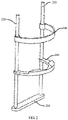
- the head support module includes two side support members 210 and 220, the underjaw support plate 240, the forehead rest 230, and a base 250.
- Two ends of the underjaw support plate 240 are attached to the two side support members 210 and 220 respectively, and the underjaw support plate 240 is configured to surround the neck of the user to provide support for the underjaw of the user.
- the forehead rest 230 is also attached to the two side support members 210 and 220 and is configured to surround the head of the patient to fix the head.
- the base 250 is combined with the two side support members 210 and 220 to form an integrated framework of the head support module.
- the head support module may have various different shapes of integrated frameworks.
- shapes of the head support module include roughly square, rectangle, trapezoid, etc., or other regular or irregular polygonal shapes.
- the real-time eyelid positioning module 120 uses a visual detection method to detect the pose of the eyelid in real time, and an overall solution is as shown in FIG. 3 .
- a camera is inevitably blocked in the process of eye cleaning.
- a plurality of cameras are arranged to photograph images of the eyelid from different angles.
- a target detection algorithm such as YOLO v3, etc.
- the pose of the eyelid is obtained by calculating according to a relative location between the eye and the eyelid and the shape of the eyelid, etc.
- a three-dimensional pose of a target eyelid is obtained by calculating by using a principle of multiocular stereo vision in combination with a camera calibration parameter, wherein the three-dimensional pose is configured for indicating the location and the direction of the eyelid.
- the camera calibration parameter includes an intrinsic parameter of each camera and extrinsic parameters of different cameras, and the camera calibration parameter may be obtained by using methods such as a Zhang Zhengyou's calibration method.
- each of the cameras synchronously and dynamically collects images, to implement the real-time positioning of the eyelid.
- the robot end-effector real-time positioning module 130 is configured to position a soft-bodied robot end-effector in real time to ensure accuracy and safety of the operation of the soft-bodied robot in the process of automatically opening the eyelid.
- a multiocular vision solution similar to the eyelid positioning method is still used.
- a contour of the soft-bodied robot end-effector is extracted for an image obtained by each of the cameras by using, for example, a threshold segmentation method based on color features.
- a pose and a three-dimensional shape of the soft-bodied robot end-effector may be obtained by using a principle of multiocular stereo vision in combination with a camera calibration parameter, to implement the positioning of the end-effector.
- the camera calibration parameter includes an intrinsic parameter of each camera and extrinsic parameters of different cameras, and the camera calibration parameter may be obtained by using methods such as a Zhang Zhengyou's calibration method.
- each of the cameras synchronously and dynamically collects images, to implement the real-time positioning of the soft-bodied end-effector.
- a marker with obvious color or shape features may be pasted onto the end-effector, such that the contour of the end-effector may be determined by extracting features of the marker.
- the automatic eyelid opening operation module 140 includes a robot body and a robot control system.
- the robot body is composed of a multi-axis rigid body mechanical arm and a soft-bodied end-effector arranged at an end of the multi-axis rigid body mechanical arm.
- the multi-axis rigid body mechanical arm may be fixedly mounted on a treatment couch, a treatment chair or a movable platform.
- the soft-bodied end-effector is prepared from a flexible soft-bodied deformable material fitting to an eyelid structure, and is controlled by, for example, pneumatic drive to move. Further, a flexible force sensor is integrated on the soft-bodied end-effector to feed back force information of the soft-bodied end-effector in real time.
- the robot body by controlling the motion of the multi-axis rigid body mechanical arm, the robot body can be ensured to move to the location of the target eyelid as quickly as possible. Accuracy of eyelid opening and comfort of the patient can be ensured by arranging the soft-bodied end-effector at the end of the mechanical arm and combining with the pneumatic drive. Furthermore, by means of the flexible force sensor arranged on the soft-bodied end-effector and in combination with feedback of the force information, the robot control system can timely and accurately adjust the force and the angle of the operation on the eyelid, to provide maximum comfort for the patient and ensure operation safety under the premise of quickly completing the operation of eyelid opening.
- the end-effector is configured to be fit for simulating the operation of opening the eyelid with a finger.
- the end-effector is provided with a flexible finger-like protrusion and a tooth-like protrusion, and the eyelid is opened by controlling the engagement time, the turning angle, and the turning force of the finger-like protrusion and the tooth-like protrusion.
- the turning angle and the turning speed in this method are easy to accurately control, such that a probability of damaging an eyeball is reduced, work efficiency is improved, and pain of the patient is decreased.
- the end-effector is provided with an arc-shaped eyelid opener connected to a rotating shaft. By controlling rotation of the rotating shaft, the eyelid opener is driven to perform the operation of eyelid opening.
- FIG. 5 is an overall flow diagram of completing an eyelid opening operation by controlling the robot body by the robot control system.
- the control system takes the patient's eyelid real-time pose extracted by the real-time eyelid positioning module as an operation target, takes the pose and the shape of the soft-bodied end-effector and force information of the soft-bodied end-effector as feedback signals, and obtains motion parameters of the robot based on motion planning and control algorithms. These motion parameters are configured for limiting the motion of the robot body.
- a drive in the control system takes the motion parameters of the robot as input, and drives the robot to move by controlling underlying mechanisms such as a motor and a pneumatic valve in the robot body.
- visual sensors used in the real-time eyelid positioning module and the robot end-effector real-time positioning module may be depth cameras or RGB-D cameras (color-depth cameras), etc.
- the extraction of the real-time location of the eyelid, the extraction of the contour of the end-effector, and calibration of a multiocular camera may also be implemented by using other image processing algorithms.
- the robot control system in the present disclosure may be a system, a method, and/or a computer program product.
- the computer program product may include a computer readable storage medium having computer readable program instructions thereon for causing a processor to carry out aspects of the present disclosure.
- the computer readable storage medium may be a tangible device that can retain and store instructions for use by an instruction execution device.
- the computer readable storage medium may be, for example, but is not limited to, an electronic storage device, a magnetic storage device, an optical storage device, an electromagnetic storage device, a semiconductor storage device, or any suitable combination of the foregoing.
- the computer readable storage medium include the following: a portable computer diskette, a hard disk, a random access memory (RAM), a read-only memory (ROM), an erasable programmable read-only memory (EPROM or Flash memory), a static random access memory (SRAM), a portable compact disc read-only memory (CD-ROM), a digital versatile disk (DVD), a memory stick, a floppy disk, a mechanically encoded device such as punch-cards or raised structures in a groove having instructions recorded thereon, and any suitable combination of the foregoing.
- RAM random access memory
- ROM read-only memory
- EPROM or Flash memory erasable programmable read-only memory
- SRAM static random access memory
- CD-ROM compact disc read-only memory
- DVD digital versatile disk
- memory stick a floppy disk
- a mechanically encoded device such as punch-cards or raised structures in a groove having instructions recorded thereon
- the computer readable storage medium is not to be construed as being transitory signals per se, such as radio waves or other freely propagating electromagnetic waves, electromagnetic waves propagating through a waveguide or other transmission media (e.g., light pulses passing through a fiber-optic cable), or electrical signals transmitted through a wire.
- Computer readable program instructions described herein can be downloaded to respective computing/processing devices from a computer readable storage medium or to an external computer or external storage device via a network, for example, the Internet, a local area network, a wide area network and/or a wireless network.
- the network may include copper transmission cables, optical fiber transmission, wireless transmission, routers, firewalls, switches, gateway computers and/or edge servers.
- a network adapter card or network interface in each computing/processing device receives computer readable program instructions from the network and forwards the computer readable program instructions for storage in a computer readable storage medium within the respective computing/processing device.
- the computer program instructions for carrying out operations of the present disclosure may be assembler instructions, instruction-set-architecture (ISA) instructions, machine instructions, machine dependent instructions, microcode, firmware instructions, state-setting data, or either source code or object code written in any combination of one or more programming languages, including an object-oriented programming language such as Smalltalk, C++, Python or the like, and conventional procedural programming languages, such as the "C" programming language or similar programming languages.
- the computer readable program instructions may execute entirely on the user's computer, partly on the user's computer, as a stand-alone software package, partly on the user's computer and partly on a remote computer or entirely on the remote computer or server.
- the remote computer may be coupled to the user's computer through any type of network, including a local area network (LAN) or a wide area network (WAN), or may be coupled to an external computer (for example, through the Internet using an Internet Service Provider).
- electronic circuitry including, for example, programmable logic circuitry, field-programmable gate arrays (FPGA), or programmable logic arrays (PLA) may execute the computer readable program instructions by utilizing state information of the computer readable program instructions to personalize the electronic circuitry, in order to perform aspects of the present disclosure.
- These computer readable program instructions may be provided to a processor of a general purpose computer, special purpose computer, or other programmable data processing apparatus to produce a machine, such that these instructions, which execute via the processor of the computer or other programmable data processing apparatus, create means for implementing the functions/acts specified in one or more blocks in the flowcharts and/or block diagrams.
- These computer readable program instructions may also be stored in a computer readable storage medium that can direct a computer, a programmable data processing apparatus, and/or other devices to function in a particular manner, such that the computer readable medium having instructions stored therein includes an article of manufacture including instructions which implement aspects of the function/act specified in one or more blocks in the flowcharts and/or block diagrams.
- the computer readable program instructions may also be loaded onto a computer, other programmable data processing apparatus, or other device to cause a series of operational steps to be performed on the computer, other programmable apparatus or other device to produce a computer implemented process, such that the instructions which execute on the computer, other programmable apparatus, or other device implement the functions/acts specified in one or more blocks in the flowcharts and/or block diagrams.
- each block in the flowcharts or block diagrams may represent a module, a program segment, or a portion of instructions, which includes one or more executable instructions for implementing the specified logical function(s).
- the functions denoted by the blocks may occur in a sequence different from the sequences shown in the accompanying drawings. For example, two blocks shown in succession may, in fact, be executed substantially concurrently, or the blocks may sometimes be executed in a reverse sequence, depending upon the functions involved.
- each block in the block diagrams and/or flowcharts and/or a combination of the blocks in the block diagrams and/or flowcharts may be implemented by a special-purpose hardware-based system executing specific functions or acts, or by a combination of a special-purpose hardware and computer instructions. It is well known to those skilled in the art that implementations by means of hardware, implementations by means of software and implementations by means of software in combination with hardware are equivalent.
Landscapes
- Health & Medical Sciences (AREA)
- Life Sciences & Earth Sciences (AREA)
- Surgery (AREA)
- Engineering & Computer Science (AREA)
- Animal Behavior & Ethology (AREA)
- General Health & Medical Sciences (AREA)
- Veterinary Medicine (AREA)
- Public Health (AREA)
- Biomedical Technology (AREA)
- Heart & Thoracic Surgery (AREA)
- Nuclear Medicine, Radiotherapy & Molecular Imaging (AREA)
- Molecular Biology (AREA)
- Medical Informatics (AREA)
- Ophthalmology & Optometry (AREA)
- Robotics (AREA)
- Vascular Medicine (AREA)
- Oral & Maxillofacial Surgery (AREA)
- Pathology (AREA)
- Otolaryngology (AREA)
- Physics & Mathematics (AREA)
- Biophysics (AREA)
- Manipulator (AREA)
Abstract
Description
- This application is the national stage entry of International Application No.
PCT/CN2021/075521, filed on February 5, 2021 - The present disclosure relates to the field of medical instrument technology, and more particularly, to a soft-bodied apparatus and a method for opening an eyelid.
- To prevent postoperative infection, eyes need to be cleaned and disinfected before ophthalmologic operation. In the process of eye cleaning before routine ophthalmologic operation, upper and lower eyelids need to be opened first to fully expose lacrimal passages, conjunctival sac and other parts for cleaning. At present, clinically medical staff mainly uses fingers to open the eyelids of patients to clean parts in the eyes.
- In the existing technologies, there are some auxiliary instruments and equipment for eye cleaning. For example, the patent application
CN201710253440.1 CN201780043837.6 CN201711199743.6 - An objective of the present disclosure is to overcome the above-mentioned defects of the existing technologies by providing a soft-bodied apparatus and a method for opening an eyelid, which can recognize and locate eyelids of patients in real time by using visual sensors, and then can automatically open the eyelids of the patients using robots based on the positioning information.
- According to a first aspect of the present disclosure, there is provided a soft-bodied apparatus for opening an eyelid. The apparatus includes: a head support module, a real-time eyelid positioning module, a robot end-effector real-time positioning module, and an automatic eyelid opening operation module. The head support module is configured to support a head of a user. The real-time eyelid positioning module is configured to recognize and locate real-time poses of upper and lower eyelids of the user in real time. The robot end-effector real-time positioning module is configured to reconstruct a real-time shape and a pose of a robot soft-bodied end-effector. The automatic eyelid opening operation module includes a robot body and a robot control system. The robot body is provided with a multi-axis rigid body mechanical arm and a soft-bodied end-effector. The robot control system takes the real-time poses of the upper and lower eyelids of the user as a motion target, and takes the real-time shape and the pose of the soft-bodied end-effector as feedback information to control motion of the robot body to complete an action of automatically opening the eyelid of the user.
- According to a second aspect of the present disclosure, there is provided a method for opening an eyelid using the above apparatus. This method includes:
- recognizing and positioning real-time poses of upper and lower eyelids of the user in real time;
- obtaining a real-time shape and a pose of the soft-bodied end-effector; and
- taking the real-time poses of the upper and lower eyelids of the user as a motion target, and taking the real-time shape and the pose of the soft-bodied end-effector as feedback information to control motion of the robot body to complete an action of automatically opening the eyelid of the user.
- Compared with the existing technologies, the present disclosure has the advantage that as compared with manual operation, patients' eyelids can be opened quickly and accurately, burden of ophthalmologists and treatment costs can be effectively reduced, efficiency of ophthalmological treatment can be improved, and probability of cross infection can be reduced for both doctors and patients.
- Other features and advantages of the present disclosure will become apparent from the following detailed description of exemplary embodiments of the present disclosure with reference to accompanying drawings.
- The accompanying drawings herein are incorporated in and constitute a part of this specification, illustrate embodiments of the present disclosure and, together with the specification, serve to explain the principles of the present disclosure.
-
FIG. 1 is a schematic diagram showing an application scenario of a soft-bodied apparatus for opening an eyelid according to one embodiment of the present disclosure; -
FIG. 2 is a schematic structural diagram of a head support module according to one embodiment of the present disclosure; -
FIG. 3 is a schematic diagram showing an overall process of eyelid positioning according to one embodiment of the present disclosure. -
FIG. 4 is a schematic diagram showing an overall process of soft-bodied end-effector positioning according to one embodiment of the present disclosure; and -
FIG. 5 is an overall flow diagram of implementing an eyelid opening operation using a robot control system according to one embodiment of the present disclosure. - Various exemplary embodiments of the present disclosure will now be described in detail with reference to the accompanying drawings. It is to be noted that the relative arrangement, numerical expressions, and numerical values of the components and steps set forth in these embodiments do not limit the scope of the present disclosure unless otherwise specifically stated.
- The following description of at least one exemplary embodiment is actually merely illustrative, and in no way serves as any limitation on the present disclosure and application or use thereof.
- Technologies, methods and equipment known to those of ordinary skill in the related art may not be discussed in detail, but where appropriate, the technologies, methods and equipment should be considered as part of the specification.
- In all examples shown and discussed herein, any specific values should be interpreted as merely exemplary and not limiting. Therefore, other examples of the exemplary embodiment may have different values.
- It is to be noted that similar reference numerals and letters indicate similar items in the following accompanying drawings. Therefore, once an item is defined in one drawing, there is no need to discuss this item further in subsequent drawings.
- With reference to
FIG. 1 , a soft-bodied apparatus for opening an eyelid provided by the present disclosure includes a head support module 110 (also referred to as a head support component), a real-timeeyelid positioning module 120, a robot end-effector real-time positioning module 130, and an automatic eyelidopening operation module 140. - The
head support module 110 is configured to support a head of a patient to prevent the head of the patient from substantially moving during eye washing. - The real-time
eyelid positioning module 120 is configured to recognize and position poses of upper and lower eyelids of the patient in real time using multiocular visual information. - The robot end-effector real-
time positioning module 130 is configured to reconstruct a shape and a pose of a soft-bodied robot end-effector in real time using the multiocular visual information. - The automatic eyelid
opening operation module 140 includes a robot body and a robot control system. The robot body includes a multi-axis rigid body mechanical arm and a soft-bodied end-effector. The robot control system takes the real-time pose of the eyelid of the patient as a motion target, and takes the real-time shape and pose information of the soft-bodied end-effector as feedback information to control motion of the robot body to complete the action of automatically opening the eyelid of the patient. - Specifically, the head support module supports and fixes the head of the patient through an underjaw support plate and a forehead rest, to prevent the head of the patient from substantially moving during eye washing. As shown in
FIG. 2 , the head support module includes twoside support members underjaw support plate 240, theforehead rest 230, and abase 250. Two ends of theunderjaw support plate 240 are attached to the twoside support members underjaw support plate 240 is configured to surround the neck of the user to provide support for the underjaw of the user. Theforehead rest 230 is also attached to the twoside support members base 250 is combined with the twoside support members - It is to be noted that the head support module may have various different shapes of integrated frameworks. For example, shapes of the head support module include roughly square, rectangle, trapezoid, etc., or other regular or irregular polygonal shapes.
- The real-time
eyelid positioning module 120 uses a visual detection method to detect the pose of the eyelid in real time, and an overall solution is as shown inFIG. 3 . A camera is inevitably blocked in the process of eye cleaning. Preferably, based on multiocular vision principles, a plurality of cameras are arranged to photograph images of the eyelid from different angles. For the images obtained by each of the cameras, a target detection algorithm (such as YOLO v3, etc.) is employed to extract a location of an eye of the patient, and then the pose of the eyelid is obtained by calculating according to a relative location between the eye and the eyelid and the shape of the eyelid, etc. For example, after the location of the same eyelid is obtained from the images photographed by more than two cameras, a three-dimensional pose of a target eyelid is obtained by calculating by using a principle of multiocular stereo vision in combination with a camera calibration parameter, wherein the three-dimensional pose is configured for indicating the location and the direction of the eyelid. The camera calibration parameter includes an intrinsic parameter of each camera and extrinsic parameters of different cameras, and the camera calibration parameter may be obtained by using methods such as a Zhang Zhengyou's calibration method. In the above process, each of the cameras synchronously and dynamically collects images, to implement the real-time positioning of the eyelid. - The robot end-effector real-
time positioning module 130 is configured to position a soft-bodied robot end-effector in real time to ensure accuracy and safety of the operation of the soft-bodied robot in the process of automatically opening the eyelid. As shown inFIG. 4 , a multiocular vision solution similar to the eyelid positioning method is still used. A contour of the soft-bodied robot end-effector is extracted for an image obtained by each of the cameras by using, for example, a threshold segmentation method based on color features. Next, a pose and a three-dimensional shape of the soft-bodied robot end-effector may be obtained by using a principle of multiocular stereo vision in combination with a camera calibration parameter, to implement the positioning of the end-effector. The camera calibration parameter includes an intrinsic parameter of each camera and extrinsic parameters of different cameras, and the camera calibration parameter may be obtained by using methods such as a Zhang Zhengyou's calibration method. In the above process, each of the cameras synchronously and dynamically collects images, to implement the real-time positioning of the soft-bodied end-effector. - In one embodiment, to extract the contour of the robot end-effector, a marker with obvious color or shape features may be pasted onto the end-effector, such that the contour of the end-effector may be determined by extracting features of the marker.
- The automatic eyelid
opening operation module 140 includes a robot body and a robot control system. The robot body is composed of a multi-axis rigid body mechanical arm and a soft-bodied end-effector arranged at an end of the multi-axis rigid body mechanical arm. The multi-axis rigid body mechanical arm may be fixedly mounted on a treatment couch, a treatment chair or a movable platform. The soft-bodied end-effector is prepared from a flexible soft-bodied deformable material fitting to an eyelid structure, and is controlled by, for example, pneumatic drive to move. Further, a flexible force sensor is integrated on the soft-bodied end-effector to feed back force information of the soft-bodied end-effector in real time. - In the embodiments of the present disclosure, by controlling the motion of the multi-axis rigid body mechanical arm, the robot body can be ensured to move to the location of the target eyelid as quickly as possible. Accuracy of eyelid opening and comfort of the patient can be ensured by arranging the soft-bodied end-effector at the end of the mechanical arm and combining with the pneumatic drive. Furthermore, by means of the flexible force sensor arranged on the soft-bodied end-effector and in combination with feedback of the force information, the robot control system can timely and accurately adjust the force and the angle of the operation on the eyelid, to provide maximum comfort for the patient and ensure operation safety under the premise of quickly completing the operation of eyelid opening.
- In one embodiment, the end-effector is configured to be fit for simulating the operation of opening the eyelid with a finger. For example, the end-effector is provided with a flexible finger-like protrusion and a tooth-like protrusion, and the eyelid is opened by controlling the engagement time, the turning angle, and the turning force of the finger-like protrusion and the tooth-like protrusion. The turning angle and the turning speed in this method are easy to accurately control, such that a probability of damaging an eyeball is reduced, work efficiency is improved, and pain of the patient is decreased. For another example, the end-effector is provided with an arc-shaped eyelid opener connected to a rotating shaft. By controlling rotation of the rotating shaft, the eyelid opener is driven to perform the operation of eyelid opening.
-
FIG. 5 is an overall flow diagram of completing an eyelid opening operation by controlling the robot body by the robot control system. Specifically, the control system takes the patient's eyelid real-time pose extracted by the real-time eyelid positioning module as an operation target, takes the pose and the shape of the soft-bodied end-effector and force information of the soft-bodied end-effector as feedback signals, and obtains motion parameters of the robot based on motion planning and control algorithms. These motion parameters are configured for limiting the motion of the robot body. Finally, a drive in the control system takes the motion parameters of the robot as input, and drives the robot to move by controlling underlying mechanisms such as a motor and a pneumatic valve in the robot body. - It is to be understood that to control the robot for completing the task of eyelid opening as required, it is required to determine a relative positional relationship between the robot and external environment, especially the location and the pose of the robot end-effector. If a configuration of one robot has been determined, geometric information and joint information of constituent parts of this robot are known. Therefore, a desired operation may be achieved by controlling the robot after obtaining the pose of the robot end-effector with respect to a reference coordinate system. A specific process of driving the robot to move is omitted herein.
- It is to be noted that those skilled in the art may make appropriate changes and modifications to the above-mentioned embodiments without departing from the spirit and scope of the present disclosure. For example, visual sensors used in the real-time eyelid positioning module and the robot end-effector real-time positioning module may be depth cameras or RGB-D cameras (color-depth cameras), etc. The extraction of the real-time location of the eyelid, the extraction of the contour of the end-effector, and calibration of a multiocular camera may also be implemented by using other image processing algorithms.
- The robot control system in the present disclosure may be a system, a method, and/or a computer program product. The computer program product may include a computer readable storage medium having computer readable program instructions thereon for causing a processor to carry out aspects of the present disclosure.
- The computer readable storage medium may be a tangible device that can retain and store instructions for use by an instruction execution device. The computer readable storage medium may be, for example, but is not limited to, an electronic storage device, a magnetic storage device, an optical storage device, an electromagnetic storage device, a semiconductor storage device, or any suitable combination of the foregoing. More specific examples (a non-exhaustive list) of the computer readable storage medium include the following: a portable computer diskette, a hard disk, a random access memory (RAM), a read-only memory (ROM), an erasable programmable read-only memory (EPROM or Flash memory), a static random access memory (SRAM), a portable compact disc read-only memory (CD-ROM), a digital versatile disk (DVD), a memory stick, a floppy disk, a mechanically encoded device such as punch-cards or raised structures in a groove having instructions recorded thereon, and any suitable combination of the foregoing. The computer readable storage medium, as used herein, is not to be construed as being transitory signals per se, such as radio waves or other freely propagating electromagnetic waves, electromagnetic waves propagating through a waveguide or other transmission media (e.g., light pulses passing through a fiber-optic cable), or electrical signals transmitted through a wire.
- Computer readable program instructions described herein can be downloaded to respective computing/processing devices from a computer readable storage medium or to an external computer or external storage device via a network, for example, the Internet, a local area network, a wide area network and/or a wireless network. The network may include copper transmission cables, optical fiber transmission, wireless transmission, routers, firewalls, switches, gateway computers and/or edge servers. A network adapter card or network interface in each computing/processing device receives computer readable program instructions from the network and forwards the computer readable program instructions for storage in a computer readable storage medium within the respective computing/processing device.
- The computer program instructions for carrying out operations of the present disclosure may be assembler instructions, instruction-set-architecture (ISA) instructions, machine instructions, machine dependent instructions, microcode, firmware instructions, state-setting data, or either source code or object code written in any combination of one or more programming languages, including an object-oriented programming language such as Smalltalk, C++, Python or the like, and conventional procedural programming languages, such as the "C" programming language or similar programming languages. The computer readable program instructions may execute entirely on the user's computer, partly on the user's computer, as a stand-alone software package, partly on the user's computer and partly on a remote computer or entirely on the remote computer or server. In a scenario involved with the remote computer, the remote computer may be coupled to the user's computer through any type of network, including a local area network (LAN) or a wide area network (WAN), or may be coupled to an external computer (for example, through the Internet using an Internet Service Provider). In some embodiments, electronic circuitry including, for example, programmable logic circuitry, field-programmable gate arrays (FPGA), or programmable logic arrays (PLA) may execute the computer readable program instructions by utilizing state information of the computer readable program instructions to personalize the electronic circuitry, in order to perform aspects of the present disclosure.
- Aspects of the present disclosure are described with reference to flowcharts and/or block diagrams according to the method, apparatus (system) and a computer program product of the embodiments of the present disclosure. It is to be understood that each block of the flowcharts and/or block diagrams, and combinations of blocks in the flowcharts and/or block diagrams, can be implemented by the computer readable program instructions.
- These computer readable program instructions may be provided to a processor of a general purpose computer, special purpose computer, or other programmable data processing apparatus to produce a machine, such that these instructions, which execute via the processor of the computer or other programmable data processing apparatus, create means for implementing the functions/acts specified in one or more blocks in the flowcharts and/or block diagrams. These computer readable program instructions may also be stored in a computer readable storage medium that can direct a computer, a programmable data processing apparatus, and/or other devices to function in a particular manner, such that the computer readable medium having instructions stored therein includes an article of manufacture including instructions which implement aspects of the function/act specified in one or more blocks in the flowcharts and/or block diagrams.
- The computer readable program instructions may also be loaded onto a computer, other programmable data processing apparatus, or other device to cause a series of operational steps to be performed on the computer, other programmable apparatus or other device to produce a computer implemented process, such that the instructions which execute on the computer, other programmable apparatus, or other device implement the functions/acts specified in one or more blocks in the flowcharts and/or block diagrams.
- The flowcharts and block diagrams in the accompanying drawings illustrate architectures, functions and operations of possible implementations of systems, methods, and computer program products according to a plurality of embodiments of the present disclosure. In this regard, each block in the flowcharts or block diagrams may represent a module, a program segment, or a portion of instructions, which includes one or more executable instructions for implementing the specified logical function(s). In some alternative implementations, the functions denoted by the blocks may occur in a sequence different from the sequences shown in the accompanying drawings. For example, two blocks shown in succession may, in fact, be executed substantially concurrently, or the blocks may sometimes be executed in a reverse sequence, depending upon the functions involved. It is also to be noted that each block in the block diagrams and/or flowcharts and/or a combination of the blocks in the block diagrams and/or flowcharts may be implemented by a special-purpose hardware-based system executing specific functions or acts, or by a combination of a special-purpose hardware and computer instructions. It is well known to those skilled in the art that implementations by means of hardware, implementations by means of software and implementations by means of software in combination with hardware are equivalent.
- The descriptions of the various embodiments of the present disclosure have been presented above for purposes of illustration, but are not intended to be exhaustive or limited to the embodiments disclosed. Therefore, it is apparent to an ordinary skilled person in the art that modifications and variations could be made without departing from the scope and spirit of the embodiments. The terminology used herein is chosen to best explain the principles of the embodiments, the practical application or technical improvement over technologies found in the marketplace, or to enable others of ordinary skill in the art to understand the embodiments disclosed herein. The scope of the present disclosure is limited by the appended claims.
Claims (10)
- A soft-bodied apparatus for opening an eyelid, comprising: a head support module, a real-time eyelid positioning module, a robot end-effector real-time positioning module, and an automatic eyelid opening operation module, wherein: the head support module is configured to support the head of a user; the real-time eyelid positioning module is configured to recognize and locate real-time poses of upper and lower eyelids of the user in real time; the robot end-effector real-time positioning module is configured to reconstruct a real-time shape and a pose of a robot soft-bodied end-effector; the automatic eyelid opening operation module comprises a robot body and a robot control system; wherein the robot body is provided with a multi-axis rigid body mechanical arm and a soft-bodied end-effector, and the robot control system takes the real-time poses of the upper and lower eyelids of the user as a motion target, and takes the real-time shape and the pose of the soft-bodied end-effector as feedback information to control motion of the robot body to complete an action of automatically opening the eyelid of the user.
- The soft-bodied apparatus for opening an eyelid according to claim 1, wherein the head support module comprises two side support members, an underjaw support plate, a forehead rest, and a base; wherein the underjaw support plate is attached to the two side support members and is configured to surround a neck to provide support for the underjaw, the forehead rest is attached to the two side support members and is configured to securely surround the head to maintain the head in a desired pose, and the base is combined with the two side support members to form an integrated framework for supporting the head.
- The soft-bodied apparatus for opening an eyelid according to claim 1, wherein the real-time eyelid positioning module is configured to:obtain the user's eye images photographed by a plurality of cameras from different angles to extract location information of a corresponding eye respectively;calculate to obtain location information of the eyelid by using a relative location between the eye and the eyelid and a shape of the eyelid; andcalculate to obtain, for the location information of the same eyelid obtained by the plurality of cameras, a three-dimensional pose of a target eyelid by using a principle of multiocular stereo vision in combination with a camera calibration parameter, wherein the three-dimensional pose is configured for limiting a location and a direction of the eyelid.
- The soft-bodied apparatus for opening an eyelid according to claim 1, wherein the robot end-effector real-time positioning module is configured to:obtain soft-bodied end-effector images photographed by a plurality of cameras from different angles;segment a contour of the soft-bodied end-effector for an image obtained by each of the plurality of cameras by using a contour of the end-effector and a distinction threshold of a color feature of a surrounding area; andobtain, for the contour of the soft-bodied end-effector obtained by the plurality of cameras, a pose and a three-dimensional shape of the soft-bodied end-effector by using a principle of multiocular stereo vision in combination with a camera calibration parameter, to implement positioning of the soft-bodied end-effector.
- The soft-bodied apparatus for opening an eyelid according to claim 3 or 4, wherein the camera calibration parameter comprises an intrinsic parameter of each camera and extrinsic parameters of different cameras.
- The soft-bodied apparatus for opening an eyelid according to claim 1, wherein the multi-axis rigid body mechanical arm is configured to be fixedly mounted on a treatment couch, a treatment chair or a movable platform, and the soft-bodied end-effector is prepared from a flexible soft-bodied deformable material fitting to an eyelid structure and is arranged at an end of the multi-axis rigid body mechanical arm, and the soft-bodied end-effector is controlled by pneumatic drive to implement the eyelid opening action.
- The soft-bodied apparatus for opening an eyelid according to claim 6, wherein a flexible force sensor is integrated on the soft-bodied end-effector to feed back, in real time, force information of the soft-bodied end-effector to the robot control system, such that the robot control system adjusts the operating force of the soft-bodied end-effector according to the force information.
- The soft-bodied apparatus for opening an eyelid according to claim 4, wherein the soft-bodied end-effector is provided with a marker, and the contour of the soft-bodied end-effector is determined by extracting a feature of the marker.
- A method for opening an eyelid based on the soft-bodied apparatus according to any one of claims 1-8, comprising:recognizing and positioning real-time poses of upper and lower eyelids of the user in real time;obtaining a real-time shape and a pose of the soft-bodied end-effector; andtaking the real-time poses of the upper and lower eyelids of the user as a motion target, and taking the real-time shape and the pose of the soft-bodied end-effector as feedback information to control the motion of the robot body to complete the action of automatically opening the eyelid of the user.
- A computer readable storage medium, storing a computer program, wherein when being executed by a processor, the program implements steps of the method according to claim 9.
Applications Claiming Priority (1)
| Application Number | Priority Date | Filing Date | Title |
|---|---|---|---|
| PCT/CN2021/075521 WO2022165753A1 (en) | 2021-02-05 | 2021-02-05 | Soft apparatus for opening eyelids and method therefor |
Publications (3)
| Publication Number | Publication Date |
|---|---|
| EP4066749A1 true EP4066749A1 (en) | 2022-10-05 |
| EP4066749A4 EP4066749A4 (en) | 2022-11-30 |
| EP4066749B1 EP4066749B1 (en) | 2024-08-14 |
Family
ID=82740789
Family Applications (1)
| Application Number | Title | Priority Date | Filing Date |
|---|---|---|---|
| EP21710176.5A Active EP4066749B1 (en) | 2021-02-05 | 2021-02-05 | Soft apparatus for opening eyelids and method therefor |
Country Status (3)
| Country | Link |
|---|---|
| US (1) | US12121229B2 (en) |
| EP (1) | EP4066749B1 (en) |
| WO (1) | WO2022165753A1 (en) |
Cited By (1)
| Publication number | Priority date | Publication date | Assignee | Title |
|---|---|---|---|---|
| US20230100638A1 (en) * | 2021-02-05 | 2023-03-30 | Shenzhen Institutes Of Advanced Technology Chinese Academy Of Sciences | Soft-bodied apparatus and method for opening eyelid |
Families Citing this family (1)
| Publication number | Priority date | Publication date | Assignee | Title |
|---|---|---|---|---|
| EP4727478A1 (en) * | 2023-06-13 | 2026-04-22 | Alcon Inc. | Robotic ocular needle delivery device |
Family Cites Families (135)
| Publication number | Priority date | Publication date | Assignee | Title |
|---|---|---|---|---|
| US4604787A (en) * | 1984-08-15 | 1986-08-12 | Transamerica Delaval Inc. | Tool changer for manipulator arm |
| US5054906A (en) * | 1986-01-17 | 1991-10-08 | Brimfield Precision, Inc. | Indirectly illuminating ophthalmological speculum |
| US4733802A (en) * | 1986-11-05 | 1988-03-29 | Sheldon Gerald M | Eye drop dispensing system |
| US5133702A (en) * | 1987-11-06 | 1992-07-28 | O.P.T.I.C. | Ocular treatment apparatus |
| US4981479A (en) * | 1987-11-06 | 1991-01-01 | Py Daniel C | Ocular treatment apparatus |
| US5064420A (en) * | 1990-11-16 | 1991-11-12 | Kc Medical Industries Corporation | Eyelid opener |
| US5566406A (en) * | 1995-05-26 | 1996-10-22 | Fendall Company | Self-contained emergency eye wash station |
| WO2001049183A1 (en) * | 2000-01-03 | 2001-07-12 | Johns Hopkins University | Intraoperative microsurgical ultrasonic device and methods |
| US6591160B2 (en) * | 2000-12-04 | 2003-07-08 | Asyst Technologies, Inc. | Self teaching robot |
| US7168746B2 (en) * | 2001-05-02 | 2007-01-30 | Medical Instill Technologies, Inc. | Apparatus for applying and removing contact lenses and related method |
| CA2445977C (en) * | 2001-05-02 | 2011-11-01 | Medical Instill Technologies, Inc. | Contact lens applicator and cartridge used in connection therewith |
| US7206753B2 (en) * | 2001-05-04 | 2007-04-17 | Axxon Robotics, Llc | Methods for facilitating a retail environment |
| AU2002217459B2 (en) * | 2001-06-21 | 2007-08-09 | Hoya Healthcare Corporation | Holder of contact lens for vitreous body operation, and holding part and connection part of contact lens for vitreous body operation |
| JP3987001B2 (en) * | 2002-05-14 | 2007-10-03 | 日本電信電話株式会社 | Data signal quality evaluation method and apparatus by high speed sampling |
| GB0313475D0 (en) * | 2003-06-11 | 2003-07-16 | Montford University De | Contact lens manipulation and cleaning apparatus |
| US7092175B2 (en) * | 2003-11-17 | 2006-08-15 | Medical Instill Technologies, Inc. | Contact lens transfer device and associated method |
| US20050269113A1 (en) * | 2004-06-03 | 2005-12-08 | Plessala Erne Jr | Furrow cleaner apparatus |
| US7344544B2 (en) * | 2005-03-28 | 2008-03-18 | Cardica, Inc. | Vascular closure system |
| JP4456029B2 (en) * | 2005-03-29 | 2010-04-28 | 大日本印刷株式会社 | 3D information restoration device for rotating body |
| US7896602B2 (en) * | 2006-06-09 | 2011-03-01 | Lutz Rebstock | Workpiece stocker with circular configuration |
| WO2007143859A1 (en) * | 2006-06-14 | 2007-12-21 | Macdonald Dettwiler & Associates Inc. | Surgical manipulator with right-angle pulley drive mechanisms |
| US8249695B2 (en) * | 2006-09-29 | 2012-08-21 | Tearscience, Inc. | Meibomian gland imaging |
| EP2080494B1 (en) * | 2006-11-06 | 2018-04-11 | Kurume University | Eyelids opening device with drape |
| EP2231277B1 (en) * | 2007-12-23 | 2017-08-30 | Carl Zeiss Meditec, Inc. | Devices for detecting, controlling, and predicting radiation delivery |
| DE202009007205U1 (en) * | 2009-05-19 | 2009-10-15 | Plum A/S | eyewash |
| US20110092925A1 (en) * | 2009-10-21 | 2011-04-21 | Voss Leslie A | Liquid dispensing with blink detection |
| EP2347749A1 (en) * | 2010-01-22 | 2011-07-27 | Innovaider ApS | Handheld apparatus for eye-washing |
| JP2011200943A (en) * | 2010-03-24 | 2011-10-13 | Canon Inc | Force control robot |
| JP5685027B2 (en) * | 2010-09-07 | 2015-03-18 | キヤノン株式会社 | Information processing apparatus, object gripping system, robot system, information processing method, object gripping method, and program |
| WO2012088471A1 (en) * | 2010-12-22 | 2012-06-28 | Veebot, Llc | Systems and methods for autonomous intravenous needle insertion |
| US9026247B2 (en) * | 2011-03-30 | 2015-05-05 | University of Washington through its Center for Communication | Motion and video capture for tracking and evaluating robotic surgery and associated systems and methods |
| US8942828B1 (en) * | 2011-04-13 | 2015-01-27 | Stuart Schecter, LLC | Minimally invasive cardiovascular support system with true haptic coupling |
| US9492113B2 (en) * | 2011-07-15 | 2016-11-15 | Boston Scientific Scimed, Inc. | Systems and methods for monitoring organ activity |
| WO2013052852A1 (en) * | 2011-10-07 | 2013-04-11 | Boston Scientific Scimed, Inc. | Methods and systems for detection and thermal treatment of lower urinary tract conditions |
| WO2013052848A1 (en) * | 2011-10-07 | 2013-04-11 | Boston Scientific Scimed, Inc. | Methods for detection and thermal treatment of lower urinary tract conditions |
| US9489753B1 (en) * | 2016-07-19 | 2016-11-08 | Eyedeal Scanning, Llc | Reconstruction of three dimensional model of an object from surface or slice scans compensating for motion blur |
| JP5949242B2 (en) * | 2012-07-11 | 2016-07-06 | セイコーエプソン株式会社 | Robot system, robot, robot control apparatus, robot control method, and robot control program |
| US9624911B1 (en) * | 2012-10-26 | 2017-04-18 | Sunfolding, Llc | Fluidic solar actuator |
| EP2925249A4 (en) * | 2012-11-29 | 2016-12-07 | Olympus Corp | Instrument, manipulator system, and control method of instrument |
| KR101506932B1 (en) * | 2013-07-29 | 2015-04-07 | 한국과학기술연구원 | Tube insertion device having an end effector capable of adjustment of direction |
| JP6053701B2 (en) * | 2013-10-22 | 2016-12-27 | オリンパス株式会社 | Manipulator system control method and manipulator system |
| US9668916B2 (en) * | 2013-11-04 | 2017-06-06 | Vance M. Thompson | Conjunctival cover and methods therefor |
| US10245052B2 (en) * | 2013-11-27 | 2019-04-02 | Boston Scientific Scimed, Inc. | Systems, devices, and methods for tissue extraction |
| US9775512B1 (en) * | 2014-03-19 | 2017-10-03 | Christopher W. Tyler | Binocular eye tracking from video frame sequences |
| CA2942758A1 (en) * | 2014-03-19 | 2015-09-24 | Craig L. Hershoff | Eye contact lens insertion and removal apparatus |
| US9986908B2 (en) * | 2014-06-23 | 2018-06-05 | Visunex Medical Systems Co. Ltd. | Mechanical features of an eye imaging apparatus |
| US9616569B2 (en) * | 2015-01-22 | 2017-04-11 | GM Global Technology Operations LLC | Method for calibrating an articulated end effector employing a remote digital camera |
| USRE49930E1 (en) * | 2015-03-26 | 2024-04-23 | Universidade De Coimbra | Methods and systems for computer-aided surgery using intra-operative video acquired by a free moving camera |
| US20190142677A1 (en) * | 2015-06-18 | 2019-05-16 | Eyedetec Medical, Inc. | Cloud-based ophthalmic eyelid treatment monitoring system and methods of the same |
| US9691165B2 (en) * | 2015-07-24 | 2017-06-27 | Disney Enterprises, Inc. | Detailed spatio-temporal reconstruction of eyelids |
| JP2017038681A (en) * | 2015-08-18 | 2017-02-23 | 富士ゼロックス株式会社 | Optical measuring device and light irradiation / receiving method |
| US20200261155A1 (en) * | 2015-12-30 | 2020-08-20 | Koninklijke Philips N.V. | Image based robot guidance |
| US10597275B2 (en) * | 2016-04-07 | 2020-03-24 | Soft Robotics, Inc. | Soft robotic actuators for positioning, packaging, and assembling |
| EP3235476B1 (en) | 2016-04-18 | 2022-01-19 | Plum Safety ApS | Eye opening device |
| US11141229B2 (en) * | 2016-06-03 | 2021-10-12 | Rubicon Spine Llc | Dynamic feedback end effector |
| US10413371B2 (en) * | 2016-06-03 | 2019-09-17 | Rubicon Spine, LLC | Dynamic feedback end effector |
| CN109843231A (en) | 2016-06-06 | 2019-06-04 | 奥利弗兰登国际有限公司 | It opens one's eyes device |
| US10413373B2 (en) * | 2016-08-16 | 2019-09-17 | Ethicon, Llc | Robotic visualization and collision avoidance |
| WO2018035263A1 (en) * | 2016-08-17 | 2018-02-22 | Dishcraft Robotics, Inc. | Fixture manipulation systems and methods |
| US20180116497A1 (en) * | 2016-10-30 | 2018-05-03 | Kimberly Patterson | Infant Eye Opening Apparatus |
| CN106580547A (en) * | 2016-12-27 | 2017-04-26 | 苏州科技城医院 | Eyelid opening device with cleaning stent |
| JP6823502B2 (en) * | 2017-03-03 | 2021-02-03 | 株式会社キーエンス | Robot setting device, robot setting method, robot setting program, computer-readable recording medium, and recording equipment |
| JP6889574B2 (en) * | 2017-03-03 | 2021-06-18 | 株式会社キーエンス | Robot setting device, robot setting method, robot setting program, computer-readable recording medium, and recording equipment |
| US10817722B1 (en) * | 2017-03-20 | 2020-10-27 | Cross Match Technologies, Inc. | System for presentation attack detection in an iris or face scanner |
| JP7130927B2 (en) * | 2017-08-31 | 2022-09-06 | セイコーエプソン株式会社 | Controller and robot system |
| CN107753272B (en) | 2017-11-26 | 2021-07-13 | 邹高任 | Comfortable eyewash machine for ophthalmology |
| US11266511B1 (en) * | 2018-04-11 | 2022-03-08 | Douglas George Hughes | Minimally invasive use of robotic appendage for surgery |
| IL259550B (en) * | 2018-05-23 | 2021-09-30 | Alexander Barash | Apparatus for eye treatment |
| IL259549B (en) * | 2018-05-23 | 2021-07-29 | Alexander Barash | Apparatus for opening and holding eyelids open |
| US11642165B2 (en) * | 2018-06-29 | 2023-05-09 | Biosense Webster (Israel) Ltd. | Catheter with mechanically expandable element having flex circuit |
| US12569295B2 (en) * | 2018-08-03 | 2026-03-10 | Biosense Webster (Israel) Ltd. Israel | Unipolar reference electrode for electrophysiology mapping catheter |
| DE102018124595B4 (en) * | 2018-10-05 | 2022-02-17 | Carl Zeiss Industrielle Messtechnik Gmbh | Device for detecting a position and attitude of an end effector of a robot |
| CN109431452B (en) * | 2018-10-25 | 2021-08-13 | 武汉目明乐视健康科技有限公司 | Unmanned eye health screening instrument |
| US12310661B2 (en) * | 2019-01-29 | 2025-05-27 | Duke University | Systems and methods for imaging a target feature of a subject based on tracked positions of the subject and the target feature |
| US11419616B2 (en) * | 2019-03-22 | 2022-08-23 | Globus Medical, Inc. | System for neuronavigation registration and robotic trajectory guidance, robotic surgery, and related methods and devices |
| EP3945994B1 (en) * | 2019-03-27 | 2024-10-23 | Alcon Inc. | System and method of utilizing one or more images of an eye in medical procedures |
| CN113939851A (en) * | 2019-04-10 | 2022-01-14 | 目察科技股份有限公司 | Method and system for estimating eye-related geometrical parameters of a user |
| WO2020214135A1 (en) * | 2019-04-14 | 2020-10-22 | Gorden Marcus Van | Ocular medication delivery apparatus |
| EP3958804B1 (en) * | 2019-04-22 | 2025-08-20 | Sixth Sense IP Pty Ltd | A lens applicator |
| US20200345357A1 (en) * | 2019-04-30 | 2020-11-05 | Ethicon Llc | Intelligent firing associated with a surgical instrument |
| US11432816B2 (en) * | 2019-04-30 | 2022-09-06 | Cilag Gmbh International | Articulation pin for a surgical instrument |
| US11426251B2 (en) * | 2019-04-30 | 2022-08-30 | Cilag Gmbh International | Articulation directional lights on a surgical instrument |
| US20200345356A1 (en) * | 2019-04-30 | 2020-11-05 | Ethicon Llc | Intelligent firing associated with a surgical instrument |
| US20200345359A1 (en) * | 2019-04-30 | 2020-11-05 | Ethicon Llc | Tissue stop for a surgical instrument |
| US11648009B2 (en) * | 2019-04-30 | 2023-05-16 | Cilag Gmbh International | Rotatable jaw tip for a surgical instrument |
| CN110956067B (en) * | 2019-05-26 | 2022-05-17 | 魔门塔(苏州)科技有限公司 | Method and device for constructing human eyelid curve |
| US11547468B2 (en) * | 2019-06-27 | 2023-01-10 | Cilag Gmbh International | Robotic surgical system with safety and cooperative sensing control |
| US20220257298A1 (en) * | 2019-07-09 | 2022-08-18 | Arrinex, Inc. | Devices and Methods for Treating Ear, Nose, and Throat Afflictions |
| US20210015550A1 (en) * | 2019-07-17 | 2021-01-21 | Biosense Webster (Israel) Ltd. | Catheter for endovascular sympathetic denervation of spasmed intracranial arteries |
| US11540878B2 (en) * | 2019-07-17 | 2023-01-03 | Biosense Webster (Israel) Ltd. | Blooming leaflet catheter with high density electrode array |
| CN211484709U (en) * | 2019-07-31 | 2020-09-15 | 吉林市爱尔眼科医院有限公司 | Medical ophthalmology eye speculum |
| US11666404B2 (en) * | 2019-08-28 | 2023-06-06 | Cilag Gmbh International | Articulating including antagonistic controls for articulation and calibration |
| US12178500B2 (en) * | 2019-09-03 | 2024-12-31 | Biosense Webster (Israel) Ltd. | Mapping catheter with flex panel electrode assembly |
| US20210077184A1 (en) * | 2019-09-16 | 2021-03-18 | Biosense Webster (Israel) Ltd. | Catheter with thin-film electrodes on expandable membrane |
| US12426945B2 (en) * | 2019-09-18 | 2025-09-30 | Biosense Webster (Israel) Ltd. | Catheter with thin-film electrodes on expandable mechanical structure |
| US20210085386A1 (en) * | 2019-09-20 | 2021-03-25 | Biosense Webster (Israel) Ltd. | Catheter instrument with three pull wires |
| JP7223930B2 (en) * | 2019-10-11 | 2023-02-17 | パナソニックIpマネジメント株式会社 | End effector and end effector controller |
| US20210121231A1 (en) * | 2019-10-23 | 2021-04-29 | Biosense Webster (Israel) Ltd. | Cardiac mapping catheter with square-spaced electrodes |
| MX2022006311A (en) * | 2019-11-27 | 2022-06-22 | 3M Innovative Properties Company | Dual mounting for automated repair systems. |
| CN217138100U (en) * | 2019-12-23 | 2022-08-09 | 自动矢量化股份有限公司 | Device for controlling eyelid movement and system for controlling eyelid movement |
| US11464581B2 (en) * | 2020-01-28 | 2022-10-11 | Globus Medical, Inc. | Pose measurement chaining for extended reality surgical navigation in visible and near infrared spectrums |
| US11382699B2 (en) * | 2020-02-10 | 2022-07-12 | Globus Medical Inc. | Extended reality visualization of optical tool tracking volume for computer assisted navigation in surgery |
| CN111166472B (en) * | 2020-02-27 | 2020-11-06 | 连云港市第一人民医院 | A robotic arm for ophthalmic surgery training |
| US11904458B2 (en) * | 2020-03-09 | 2024-02-20 | Onward Robotics, Inc. | End effector for mobile robot configured for tool changeout and breakaway |
| CN111671502B (en) * | 2020-04-17 | 2023-06-13 | 长春理工大学 | Needle holder for smart guidance in percutaneous minimally invasive surgery |
| CN111481294B (en) * | 2020-04-26 | 2021-04-09 | 四川大学华西医院 | An automatic injection robot system and automatic injection method |
| US20210339399A1 (en) * | 2020-04-29 | 2021-11-04 | Cobalt Robotics Inc. | Mobile robot for elevator interactions |
| CN111588469B (en) * | 2020-05-18 | 2021-02-02 | 四川大学华西医院 | Ophthalmic robot end effector guidance and positioning system |
| US11813033B2 (en) * | 2020-06-22 | 2023-11-14 | Michael Campagna | Medical imaging compatible radiolucent actuation of translation rotation articulation circumduction joint |
| CN216365091U (en) * | 2020-06-26 | 2022-04-26 | 自动矢量化股份有限公司 | Speculum |
| WO2022013978A1 (en) * | 2020-07-15 | 2022-01-20 | ヤマハ発動機株式会社 | End effector |
| EP4087516B1 (en) * | 2020-07-28 | 2024-04-10 | Forsight Robotics Ltd. | Robotic system for microsurgical procedures |
| US11534259B2 (en) * | 2020-10-29 | 2022-12-27 | Cilag Gmbh International | Surgical instrument comprising an articulation indicator |
| US11517390B2 (en) * | 2020-10-29 | 2022-12-06 | Cilag Gmbh International | Surgical instrument comprising a limited travel switch |
| US20220133303A1 (en) * | 2020-10-29 | 2022-05-05 | Ethicon Llc | Surgical instrument comprising sealable interface |
| US11896217B2 (en) * | 2020-10-29 | 2024-02-13 | Cilag Gmbh International | Surgical instrument comprising an articulation lock |
| US11617577B2 (en) * | 2020-10-29 | 2023-04-04 | Cilag Gmbh International | Surgical instrument comprising a sensor configured to sense whether an articulation drive of the surgical instrument is actuatable |
| US12053175B2 (en) * | 2020-10-29 | 2024-08-06 | Cilag Gmbh International | Surgical instrument comprising a stowed closure actuator stop |
| US11931025B2 (en) * | 2020-10-29 | 2024-03-19 | Cilag Gmbh International | Surgical instrument comprising a releasable closure drive lock |
| US11779330B2 (en) * | 2020-10-29 | 2023-10-10 | Cilag Gmbh International | Surgical instrument comprising a jaw alignment system |
| US11452526B2 (en) * | 2020-10-29 | 2022-09-27 | Cilag Gmbh International | Surgical instrument comprising a staged voltage regulation start-up system |
| US11717289B2 (en) * | 2020-10-29 | 2023-08-08 | Cilag Gmbh International | Surgical instrument comprising an indicator which indicates that an articulation drive is actuatable |
| CN112971877B (en) * | 2021-02-05 | 2022-05-27 | 中国科学院深圳先进技术研究院 | Soft body device and method for eyelid opening |
| EP4066749B1 (en) * | 2021-02-05 | 2024-08-14 | Shenzhen Institutes of Advanced Technology Chinese Academy of Sciences | Soft apparatus for opening eyelids and method therefor |
| US20220346781A1 (en) * | 2021-04-30 | 2022-11-03 | Cilag Gmbh International | Staple cartridge comprising staple drivers and stability supports |
| US11944295B2 (en) * | 2021-04-30 | 2024-04-02 | Cilag Gmbh International | Surgical instrument comprising end effector with longitudinal sealing step |
| US20220346784A1 (en) * | 2021-04-30 | 2022-11-03 | Cilag Gmbh International | Surgical instrument comprising a closure bar and a firing bar |
| CA3219543A1 (en) * | 2021-05-17 | 2022-11-24 | Cobionix Corporation | Proximity sensing autonomous robotic systems and apparatus |
| WO2022254335A1 (en) * | 2021-06-01 | 2022-12-08 | Forsight Robotics Ltd. | Kinematic structures and sterile drapes for robotic microsurgical procedures |
| US20220395275A1 (en) * | 2021-06-11 | 2022-12-15 | Covidien Lp | Surgical fastening instrument |
| WO2023035007A1 (en) * | 2021-09-06 | 2023-03-09 | Kickback Space Inc. | Image analysis and gaze redirection using characteristics of the eye |
| US20230146178A1 (en) * | 2021-11-11 | 2023-05-11 | Kickback Space Inc. | Attention based audio adjustment in virtual environments |
| CN115533900B (en) * | 2022-09-29 | 2024-11-19 | 河北工业大学 | A robot vibration suppression method based on impedance compensation predictive control |
| US20240138905A1 (en) * | 2022-10-27 | 2024-05-02 | Biosense Webster (Israel) Ltd. | Irrigation tubing with regulated fluid emission |
| US12377557B2 (en) * | 2023-01-14 | 2025-08-05 | Sarcos Corp. | Robotic article handling end effector with capture device having a compliant material |
-
2021
- 2021-02-05 EP EP21710176.5A patent/EP4066749B1/en active Active
- 2021-02-05 US US17/277,301 patent/US12121229B2/en active Active
- 2021-02-05 WO PCT/CN2021/075521 patent/WO2022165753A1/en not_active Ceased
Cited By (2)
| Publication number | Priority date | Publication date | Assignee | Title |
|---|---|---|---|---|
| US20230100638A1 (en) * | 2021-02-05 | 2023-03-30 | Shenzhen Institutes Of Advanced Technology Chinese Academy Of Sciences | Soft-bodied apparatus and method for opening eyelid |
| US12121229B2 (en) * | 2021-02-05 | 2024-10-22 | Shenzhen Institutes Of Advanced Technology Chinese Academy Of Sciences | Soft-bodied apparatus and method for opening eyelid |
Also Published As
| Publication number | Publication date |
|---|---|
| US12121229B2 (en) | 2024-10-22 |
| US20230100638A1 (en) | 2023-03-30 |
| WO2022165753A1 (en) | 2022-08-11 |
| EP4066749A4 (en) | 2022-11-30 |
| EP4066749B1 (en) | 2024-08-14 |
Similar Documents
| Publication | Publication Date | Title |
|---|---|---|
| US10888389B2 (en) | Systems and methods for arbitrary viewpoint robotic manipulation and robotic surgical assistance | |
| EP4087516B1 (en) | Robotic system for microsurgical procedures | |
| Yu et al. | Design, calibration and preliminary testing of a robotic telemanipulator for OCT guided retinal surgery | |
| AU2012301512C1 (en) | Imaging-based guidance system for ophthalmic docking using a location-orientation analysis | |
| US12121229B2 (en) | Soft-bodied apparatus and method for opening eyelid | |
| CN116549216A (en) | OCT-based vitreous injection data processing method and robot, equipment and medium | |
| US20230240779A1 (en) | Force feedback for robotic microsurgical procedures | |
| CN111588469B (en) | Ophthalmic robot end effector guidance and positioning system | |
| WO2019222228A1 (en) | System and method for automated image-guided robotic intraocular surgery | |
| US20240307132A1 (en) | Virtual tools for microsurgical procedures | |
| Zhou et al. | Needle localization for robot-assisted subretinal injection based on deep learning | |
| US20250288203A1 (en) | Contactless tonometer and measurement techniques for use with surgical tools | |
| US20260047901A1 (en) | Control component for robotic microsurgical procedures | |
| CN112971877B (en) | Soft body device and method for eyelid opening | |
| CN120882384A (en) | Engagement of microsurgical robotic systems | |
| CN118948203B (en) | Robot-assisted tracking alignment method and device for ophthalmic optical coherence tomography | |
| US20250072986A1 (en) | Orienting image for robotic surgery | |
| Yang et al. | EyeLS: Shadow-Guided Instrument Landing System for Intraocular Target Approaching in Robotic Eye Surgery | |
| Becker | Vision-based control of a handheld micromanipulator for robot-assisted retinal surgery | |
| Routray | Towards retinal membrane peeling with a handheld robotic instrument | |
| WO2025229483A1 (en) | Augmented images for facilitating ophthalmic surgery | |
| Zhou et al. | Needle Localization for Robotic Subretinal Injection based on Deep Learning, to be appear. | |
| CN121843674A (en) | Ophthalmic surgical robot | |
| CN121622296A (en) | A control method for a multimodal sensing oral suction system | |
| CN117047766A (en) | Sampling robot |
Legal Events
| Date | Code | Title | Description |
|---|---|---|---|
| STAA | Information on the status of an ep patent application or granted ep patent |
Free format text: STATUS: UNKNOWN |
|
| STAA | Information on the status of an ep patent application or granted ep patent |
Free format text: STATUS: THE INTERNATIONAL PUBLICATION HAS BEEN MADE |
|
| PUAI | Public reference made under article 153(3) epc to a published international application that has entered the european phase |
Free format text: ORIGINAL CODE: 0009012 |
|
| STAA | Information on the status of an ep patent application or granted ep patent |
Free format text: STATUS: REQUEST FOR EXAMINATION WAS MADE |
|
| 17P | Request for examination filed |
Effective date: 20210316 |
|
| AK | Designated contracting states |
Kind code of ref document: A1 Designated state(s): AL AT BE BG CH CY CZ DE DK EE ES FI FR GB GR HR HU IE IS IT LI LT LU LV MC MK MT NL NO PL PT RO RS SE SI SK SM TR |
|
| A4 | Supplementary search report drawn up and despatched |
Effective date: 20221103 |
|
| RIC1 | Information provided on ipc code assigned before grant |
Ipc: A61B 34/30 20160101ALI20221027BHEP Ipc: A61B 34/32 20160101ALI20221027BHEP Ipc: A61H 35/02 20060101ALI20221027BHEP Ipc: A61B 17/02 20060101AFI20221027BHEP |
|
| GRAP | Despatch of communication of intention to grant a patent |
Free format text: ORIGINAL CODE: EPIDOSNIGR1 |
|
| STAA | Information on the status of an ep patent application or granted ep patent |
Free format text: STATUS: GRANT OF PATENT IS INTENDED |
|
| DAV | Request for validation of the european patent (deleted) | ||
| DAX | Request for extension of the european patent (deleted) | ||
| INTG | Intention to grant announced |
Effective date: 20240322 |
|
| GRAS | Grant fee paid |
Free format text: ORIGINAL CODE: EPIDOSNIGR3 |
|
| GRAA | (expected) grant |
Free format text: ORIGINAL CODE: 0009210 |
|
| STAA | Information on the status of an ep patent application or granted ep patent |
Free format text: STATUS: THE PATENT HAS BEEN GRANTED |
|
| AK | Designated contracting states |
Kind code of ref document: B1 Designated state(s): AL AT BE BG CH CY CZ DE DK EE ES FI FR GB GR HR HU IE IS IT LI LT LU LV MC MK MT NL NO PL PT RO RS SE SI SK SM TR |
|
| REG | Reference to a national code |
Ref country code: GB Ref legal event code: FG4D |
|
| REG | Reference to a national code |
Ref country code: CH Ref legal event code: EP |
|
| REG | Reference to a national code |
Ref country code: DE Ref legal event code: R096 Ref document number: 602021017204 Country of ref document: DE |
|
| REG | Reference to a national code |
Ref country code: IE Ref legal event code: FG4D |
|
| REG | Reference to a national code |
Ref country code: LT Ref legal event code: MG9D |
|
| REG | Reference to a national code |
Ref country code: NL Ref legal event code: MP Effective date: 20240814 |
|
| PG25 | Lapsed in a contracting state [announced via postgrant information from national office to epo] |
Ref country code: NO Free format text: LAPSE BECAUSE OF FAILURE TO SUBMIT A TRANSLATION OF THE DESCRIPTION OR TO PAY THE FEE WITHIN THE PRESCRIBED TIME-LIMIT Effective date: 20241114 |
|
| REG | Reference to a national code |
Ref country code: AT Ref legal event code: MK05 Ref document number: 1712535 Country of ref document: AT Kind code of ref document: T Effective date: 20240814 |
|
| PG25 | Lapsed in a contracting state [announced via postgrant information from national office to epo] |
Ref country code: NL Free format text: LAPSE BECAUSE OF FAILURE TO SUBMIT A TRANSLATION OF THE DESCRIPTION OR TO PAY THE FEE WITHIN THE PRESCRIBED TIME-LIMIT Effective date: 20240814 Ref country code: FI Free format text: LAPSE BECAUSE OF FAILURE TO SUBMIT A TRANSLATION OF THE DESCRIPTION OR TO PAY THE FEE WITHIN THE PRESCRIBED TIME-LIMIT Effective date: 20240814 Ref country code: GR Free format text: LAPSE BECAUSE OF FAILURE TO SUBMIT A TRANSLATION OF THE DESCRIPTION OR TO PAY THE FEE WITHIN THE PRESCRIBED TIME-LIMIT Effective date: 20241115 Ref country code: PL Free format text: LAPSE BECAUSE OF FAILURE TO SUBMIT A TRANSLATION OF THE DESCRIPTION OR TO PAY THE FEE WITHIN THE PRESCRIBED TIME-LIMIT Effective date: 20240814 Ref country code: PT Free format text: LAPSE BECAUSE OF FAILURE TO SUBMIT A TRANSLATION OF THE DESCRIPTION OR TO PAY THE FEE WITHIN THE PRESCRIBED TIME-LIMIT Effective date: 20241216 |
|
| PG25 | Lapsed in a contracting state [announced via postgrant information from national office to epo] |
Ref country code: BG Free format text: LAPSE BECAUSE OF FAILURE TO SUBMIT A TRANSLATION OF THE DESCRIPTION OR TO PAY THE FEE WITHIN THE PRESCRIBED TIME-LIMIT Effective date: 20240814 |
|
| PG25 | Lapsed in a contracting state [announced via postgrant information from national office to epo] |
Ref country code: LV Free format text: LAPSE BECAUSE OF FAILURE TO SUBMIT A TRANSLATION OF THE DESCRIPTION OR TO PAY THE FEE WITHIN THE PRESCRIBED TIME-LIMIT Effective date: 20240814 |
|
| PG25 | Lapsed in a contracting state [announced via postgrant information from national office to epo] |
Ref country code: AT Free format text: LAPSE BECAUSE OF FAILURE TO SUBMIT A TRANSLATION OF THE DESCRIPTION OR TO PAY THE FEE WITHIN THE PRESCRIBED TIME-LIMIT Effective date: 20240814 Ref country code: IS Free format text: LAPSE BECAUSE OF FAILURE TO SUBMIT A TRANSLATION OF THE DESCRIPTION OR TO PAY THE FEE WITHIN THE PRESCRIBED TIME-LIMIT Effective date: 20241214 |
|
| PG25 | Lapsed in a contracting state [announced via postgrant information from national office to epo] |
Ref country code: HR Free format text: LAPSE BECAUSE OF FAILURE TO SUBMIT A TRANSLATION OF THE DESCRIPTION OR TO PAY THE FEE WITHIN THE PRESCRIBED TIME-LIMIT Effective date: 20240814 |
|
| PG25 | Lapsed in a contracting state [announced via postgrant information from national office to epo] |
Ref country code: RS Free format text: LAPSE BECAUSE OF FAILURE TO SUBMIT A TRANSLATION OF THE DESCRIPTION OR TO PAY THE FEE WITHIN THE PRESCRIBED TIME-LIMIT Effective date: 20241114 Ref country code: ES Free format text: LAPSE BECAUSE OF FAILURE TO SUBMIT A TRANSLATION OF THE DESCRIPTION OR TO PAY THE FEE WITHIN THE PRESCRIBED TIME-LIMIT Effective date: 20240814 |
|
| PG25 | Lapsed in a contracting state [announced via postgrant information from national office to epo] |
Ref country code: RS Free format text: LAPSE BECAUSE OF FAILURE TO SUBMIT A TRANSLATION OF THE DESCRIPTION OR TO PAY THE FEE WITHIN THE PRESCRIBED TIME-LIMIT Effective date: 20241114 Ref country code: PT Free format text: LAPSE BECAUSE OF FAILURE TO SUBMIT A TRANSLATION OF THE DESCRIPTION OR TO PAY THE FEE WITHIN THE PRESCRIBED TIME-LIMIT Effective date: 20241216 Ref country code: PL Free format text: LAPSE BECAUSE OF FAILURE TO SUBMIT A TRANSLATION OF THE DESCRIPTION OR TO PAY THE FEE WITHIN THE PRESCRIBED TIME-LIMIT Effective date: 20240814 Ref country code: NO Free format text: LAPSE BECAUSE OF FAILURE TO SUBMIT A TRANSLATION OF THE DESCRIPTION OR TO PAY THE FEE WITHIN THE PRESCRIBED TIME-LIMIT Effective date: 20241114 Ref country code: NL Free format text: LAPSE BECAUSE OF FAILURE TO SUBMIT A TRANSLATION OF THE DESCRIPTION OR TO PAY THE FEE WITHIN THE PRESCRIBED TIME-LIMIT Effective date: 20240814 Ref country code: LV Free format text: LAPSE BECAUSE OF FAILURE TO SUBMIT A TRANSLATION OF THE DESCRIPTION OR TO PAY THE FEE WITHIN THE PRESCRIBED TIME-LIMIT Effective date: 20240814 Ref country code: IS Free format text: LAPSE BECAUSE OF FAILURE TO SUBMIT A TRANSLATION OF THE DESCRIPTION OR TO PAY THE FEE WITHIN THE PRESCRIBED TIME-LIMIT Effective date: 20241214 Ref country code: HR Free format text: LAPSE BECAUSE OF FAILURE TO SUBMIT A TRANSLATION OF THE DESCRIPTION OR TO PAY THE FEE WITHIN THE PRESCRIBED TIME-LIMIT Effective date: 20240814 Ref country code: GR Free format text: LAPSE BECAUSE OF FAILURE TO SUBMIT A TRANSLATION OF THE DESCRIPTION OR TO PAY THE FEE WITHIN THE PRESCRIBED TIME-LIMIT Effective date: 20241115 Ref country code: FI Free format text: LAPSE BECAUSE OF FAILURE TO SUBMIT A TRANSLATION OF THE DESCRIPTION OR TO PAY THE FEE WITHIN THE PRESCRIBED TIME-LIMIT Effective date: 20240814 Ref country code: ES Free format text: LAPSE BECAUSE OF FAILURE TO SUBMIT A TRANSLATION OF THE DESCRIPTION OR TO PAY THE FEE WITHIN THE PRESCRIBED TIME-LIMIT Effective date: 20240814 Ref country code: BG Free format text: LAPSE BECAUSE OF FAILURE TO SUBMIT A TRANSLATION OF THE DESCRIPTION OR TO PAY THE FEE WITHIN THE PRESCRIBED TIME-LIMIT Effective date: 20240814 Ref country code: AT Free format text: LAPSE BECAUSE OF FAILURE TO SUBMIT A TRANSLATION OF THE DESCRIPTION OR TO PAY THE FEE WITHIN THE PRESCRIBED TIME-LIMIT Effective date: 20240814 |
|
| PG25 | Lapsed in a contracting state [announced via postgrant information from national office to epo] |
Ref country code: DK Free format text: LAPSE BECAUSE OF FAILURE TO SUBMIT A TRANSLATION OF THE DESCRIPTION OR TO PAY THE FEE WITHIN THE PRESCRIBED TIME-LIMIT Effective date: 20240814 Ref country code: SM Free format text: LAPSE BECAUSE OF FAILURE TO SUBMIT A TRANSLATION OF THE DESCRIPTION OR TO PAY THE FEE WITHIN THE PRESCRIBED TIME-LIMIT Effective date: 20240814 Ref country code: RO Free format text: LAPSE BECAUSE OF FAILURE TO SUBMIT A TRANSLATION OF THE DESCRIPTION OR TO PAY THE FEE WITHIN THE PRESCRIBED TIME-LIMIT Effective date: 20240814 |
|
| PG25 | Lapsed in a contracting state [announced via postgrant information from national office to epo] |
Ref country code: EE Free format text: LAPSE BECAUSE OF FAILURE TO SUBMIT A TRANSLATION OF THE DESCRIPTION OR TO PAY THE FEE WITHIN THE PRESCRIBED TIME-LIMIT Effective date: 20240814 |
|
| PG25 | Lapsed in a contracting state [announced via postgrant information from national office to epo] |
Ref country code: CZ Free format text: LAPSE BECAUSE OF FAILURE TO SUBMIT A TRANSLATION OF THE DESCRIPTION OR TO PAY THE FEE WITHIN THE PRESCRIBED TIME-LIMIT Effective date: 20240814 |
|
| PG25 | Lapsed in a contracting state [announced via postgrant information from national office to epo] |
Ref country code: SK Free format text: LAPSE BECAUSE OF FAILURE TO SUBMIT A TRANSLATION OF THE DESCRIPTION OR TO PAY THE FEE WITHIN THE PRESCRIBED TIME-LIMIT Effective date: 20240814 Ref country code: IT Free format text: LAPSE BECAUSE OF FAILURE TO SUBMIT A TRANSLATION OF THE DESCRIPTION OR TO PAY THE FEE WITHIN THE PRESCRIBED TIME-LIMIT Effective date: 20240814 |
|
| REG | Reference to a national code |
Ref country code: DE Ref legal event code: R097 Ref document number: 602021017204 Country of ref document: DE |
|
| PLBE | No opposition filed within time limit |
Free format text: ORIGINAL CODE: 0009261 |
|
| STAA | Information on the status of an ep patent application or granted ep patent |
Free format text: STATUS: NO OPPOSITION FILED WITHIN TIME LIMIT |
|
| 26N | No opposition filed |
Effective date: 20250515 |
|
| PG25 | Lapsed in a contracting state [announced via postgrant information from national office to epo] |
Ref country code: SE Free format text: LAPSE BECAUSE OF FAILURE TO SUBMIT A TRANSLATION OF THE DESCRIPTION OR TO PAY THE FEE WITHIN THE PRESCRIBED TIME-LIMIT Effective date: 20240814 |
|
| PG25 | Lapsed in a contracting state [announced via postgrant information from national office to epo] |
Ref country code: MC Free format text: LAPSE BECAUSE OF FAILURE TO SUBMIT A TRANSLATION OF THE DESCRIPTION OR TO PAY THE FEE WITHIN THE PRESCRIBED TIME-LIMIT Effective date: 20240814 |
|
| REG | Reference to a national code |
Ref country code: CH Ref legal event code: PL |
|
| PG25 | Lapsed in a contracting state [announced via postgrant information from national office to epo] |
Ref country code: LU Free format text: LAPSE BECAUSE OF NON-PAYMENT OF DUE FEES Effective date: 20250205 |
|
| PG25 | Lapsed in a contracting state [announced via postgrant information from national office to epo] |
Ref country code: CH Free format text: LAPSE BECAUSE OF NON-PAYMENT OF DUE FEES Effective date: 20250228 |
|
| GBPC | Gb: european patent ceased through non-payment of renewal fee |
Effective date: 20250205 |
|
| REG | Reference to a national code |
Ref country code: BE Ref legal event code: MM Effective date: 20250228 |
|
| PG25 | Lapsed in a contracting state [announced via postgrant information from national office to epo] |
Ref country code: GB Free format text: LAPSE BECAUSE OF NON-PAYMENT OF DUE FEES Effective date: 20250205 |
|
| PG25 | Lapsed in a contracting state [announced via postgrant information from national office to epo] |
Ref country code: BE Free format text: LAPSE BECAUSE OF NON-PAYMENT OF DUE FEES Effective date: 20250228 |
|
| PG25 | Lapsed in a contracting state [announced via postgrant information from national office to epo] |
Ref country code: IE Free format text: LAPSE BECAUSE OF NON-PAYMENT OF DUE FEES Effective date: 20250205 |
|
| PGFP | Annual fee paid to national office [announced via postgrant information from national office to epo] |
Ref country code: DE Payment date: 20260226 Year of fee payment: 6 |
|
| PGFP | Annual fee paid to national office [announced via postgrant information from national office to epo] |
Ref country code: FR Payment date: 20260211 Year of fee payment: 6 |