EP4065553B1 - Novel compound, preparation method thereof, and use thereof - Google Patents
Novel compound, preparation method thereof, and use thereof Download PDFInfo
- Publication number
- EP4065553B1 EP4065553B1 EP21741012.5A EP21741012A EP4065553B1 EP 4065553 B1 EP4065553 B1 EP 4065553B1 EP 21741012 A EP21741012 A EP 21741012A EP 4065553 B1 EP4065553 B1 EP 4065553B1
- Authority
- EP
- European Patent Office
- Prior art keywords
- propyl
- benzenesulfonamide
- chloro
- indol
- propoxy
- Prior art date
- Legal status (The legal status is an assumption and is not a legal conclusion. Google has not performed a legal analysis and makes no representation as to the accuracy of the status listed.)
- Active
Links
Classifications
-
- C—CHEMISTRY; METALLURGY
- C07—ORGANIC CHEMISTRY
- C07C—ACYCLIC OR CARBOCYCLIC COMPOUNDS
- C07C311/00—Amides of sulfonic acids, i.e. compounds having singly-bound oxygen atoms of sulfo groups replaced by nitrogen atoms, not being part of nitro or nitroso groups
- C07C311/22—Sulfonamides, the carbon skeleton of the acid part being further substituted by singly-bound oxygen atoms
- C07C311/29—Sulfonamides, the carbon skeleton of the acid part being further substituted by singly-bound oxygen atoms having the sulfur atom of at least one of the sulfonamide groups bound to a carbon atom of a six-membered aromatic ring
-
- A—HUMAN NECESSITIES
- A23—FOODS OR FOODSTUFFS; TREATMENT THEREOF, NOT COVERED BY OTHER CLASSES
- A23L—FOODS, FOODSTUFFS OR NON-ALCOHOLIC BEVERAGES, NOT OTHERWISE PROVIDED FOR; PREPARATION OR TREATMENT THEREOF
- A23L33/00—Modifying nutritive qualities of foods; Dietetic products; Preparation or treatment thereof
- A23L33/10—Modifying nutritive qualities of foods; Dietetic products; Preparation or treatment thereof using additives
-
- A—HUMAN NECESSITIES
- A61—MEDICAL OR VETERINARY SCIENCE; HYGIENE
- A61P—SPECIFIC THERAPEUTIC ACTIVITY OF CHEMICAL COMPOUNDS OR MEDICINAL PREPARATIONS
- A61P29/00—Non-central analgesic, antipyretic or antiinflammatory agents, e.g. antirheumatic agents; Non-steroidal antiinflammatory drugs [NSAID]
-
- A—HUMAN NECESSITIES
- A61—MEDICAL OR VETERINARY SCIENCE; HYGIENE
- A61P—SPECIFIC THERAPEUTIC ACTIVITY OF CHEMICAL COMPOUNDS OR MEDICINAL PREPARATIONS
- A61P3/00—Drugs for disorders of the metabolism
-
- A—HUMAN NECESSITIES
- A61—MEDICAL OR VETERINARY SCIENCE; HYGIENE
- A61P—SPECIFIC THERAPEUTIC ACTIVITY OF CHEMICAL COMPOUNDS OR MEDICINAL PREPARATIONS
- A61P35/00—Antineoplastic agents
-
- C—CHEMISTRY; METALLURGY
- C07—ORGANIC CHEMISTRY
- C07D—HETEROCYCLIC COMPOUNDS
- C07D207/00—Heterocyclic compounds containing five-membered rings not condensed with other rings, with one nitrogen atom as the only ring hetero atom
- C07D207/02—Heterocyclic compounds containing five-membered rings not condensed with other rings, with one nitrogen atom as the only ring hetero atom with only hydrogen or carbon atoms directly attached to the ring nitrogen atom
- C07D207/18—Heterocyclic compounds containing five-membered rings not condensed with other rings, with one nitrogen atom as the only ring hetero atom with only hydrogen or carbon atoms directly attached to the ring nitrogen atom having one double bond between ring members or between a ring member and a non-ring member
- C07D207/22—Heterocyclic compounds containing five-membered rings not condensed with other rings, with one nitrogen atom as the only ring hetero atom with only hydrogen or carbon atoms directly attached to the ring nitrogen atom having one double bond between ring members or between a ring member and a non-ring member with hetero atoms or with carbon atoms having three bonds to hetero atoms with at the most one bond to halogen, e.g. ester or nitrile radicals, directly attached to ring carbon atoms
- C07D207/24—Oxygen or sulfur atoms
- C07D207/26—2-Pyrrolidones
- C07D207/263—2-Pyrrolidones with only hydrogen atoms or radicals containing only hydrogen and carbon atoms directly attached to other ring carbon atoms
- C07D207/27—2-Pyrrolidones with only hydrogen atoms or radicals containing only hydrogen and carbon atoms directly attached to other ring carbon atoms with substituted hydrocarbon radicals directly attached to the ring nitrogen atom
-
- C—CHEMISTRY; METALLURGY
- C07—ORGANIC CHEMISTRY
- C07D—HETEROCYCLIC COMPOUNDS
- C07D209/00—Heterocyclic compounds containing five-membered rings, condensed with other rings, with one nitrogen atom as the only ring hetero atom
- C07D209/02—Heterocyclic compounds containing five-membered rings, condensed with other rings, with one nitrogen atom as the only ring hetero atom condensed with one carbocyclic ring
- C07D209/04—Indoles; Hydrogenated indoles
- C07D209/08—Indoles; Hydrogenated indoles with only hydrogen atoms or radicals containing only hydrogen and carbon atoms, directly attached to carbon atoms of the hetero ring
-
- C—CHEMISTRY; METALLURGY
- C07—ORGANIC CHEMISTRY
- C07D—HETEROCYCLIC COMPOUNDS
- C07D209/00—Heterocyclic compounds containing five-membered rings, condensed with other rings, with one nitrogen atom as the only ring hetero atom
- C07D209/02—Heterocyclic compounds containing five-membered rings, condensed with other rings, with one nitrogen atom as the only ring hetero atom condensed with one carbocyclic ring
- C07D209/04—Indoles; Hydrogenated indoles
- C07D209/10—Indoles; Hydrogenated indoles with substituted hydrocarbon radicals attached to carbon atoms of the hetero ring
- C07D209/14—Radicals substituted by nitrogen atoms, not forming part of a nitro radical
-
- C—CHEMISTRY; METALLURGY
- C07—ORGANIC CHEMISTRY
- C07D—HETEROCYCLIC COMPOUNDS
- C07D209/00—Heterocyclic compounds containing five-membered rings, condensed with other rings, with one nitrogen atom as the only ring hetero atom
- C07D209/02—Heterocyclic compounds containing five-membered rings, condensed with other rings, with one nitrogen atom as the only ring hetero atom condensed with one carbocyclic ring
- C07D209/04—Indoles; Hydrogenated indoles
- C07D209/10—Indoles; Hydrogenated indoles with substituted hydrocarbon radicals attached to carbon atoms of the hetero ring
- C07D209/14—Radicals substituted by nitrogen atoms, not forming part of a nitro radical
- C07D209/16—Tryptamines
-
- C—CHEMISTRY; METALLURGY
- C07—ORGANIC CHEMISTRY
- C07D—HETEROCYCLIC COMPOUNDS
- C07D209/00—Heterocyclic compounds containing five-membered rings, condensed with other rings, with one nitrogen atom as the only ring hetero atom
- C07D209/56—Ring systems containing three or more rings
- C07D209/80—[b, c]- or [b, d]-condensed
- C07D209/82—Carbazoles; Hydrogenated carbazoles
- C07D209/86—Carbazoles; Hydrogenated carbazoles with only hydrogen atoms, hydrocarbon or substituted hydrocarbon radicals, directly attached to carbon atoms of the ring system
-
- C—CHEMISTRY; METALLURGY
- C07—ORGANIC CHEMISTRY
- C07D—HETEROCYCLIC COMPOUNDS
- C07D209/00—Heterocyclic compounds containing five-membered rings, condensed with other rings, with one nitrogen atom as the only ring hetero atom
- C07D209/56—Ring systems containing three or more rings
- C07D209/80—[b, c]- or [b, d]-condensed
- C07D209/82—Carbazoles; Hydrogenated carbazoles
- C07D209/88—Carbazoles; Hydrogenated carbazoles with hetero atoms or with carbon atoms having three bonds to hetero atoms with at the most one bond to halogen, e.g. ester or nitrile radicals, directly attached to carbon atoms of the ring system
-
- C—CHEMISTRY; METALLURGY
- C07—ORGANIC CHEMISTRY
- C07D—HETEROCYCLIC COMPOUNDS
- C07D211/00—Heterocyclic compounds containing hydrogenated pyridine rings, not condensed with other rings
- C07D211/04—Heterocyclic compounds containing hydrogenated pyridine rings, not condensed with other rings with only hydrogen or carbon atoms directly attached to the ring nitrogen atom
- C07D211/06—Heterocyclic compounds containing hydrogenated pyridine rings, not condensed with other rings with only hydrogen or carbon atoms directly attached to the ring nitrogen atom having no double bonds between ring members or between ring members and non-ring members
- C07D211/08—Heterocyclic compounds containing hydrogenated pyridine rings, not condensed with other rings with only hydrogen or carbon atoms directly attached to the ring nitrogen atom having no double bonds between ring members or between ring members and non-ring members with hydrocarbon or substituted hydrocarbon radicals directly attached to ring carbon atoms
- C07D211/10—Heterocyclic compounds containing hydrogenated pyridine rings, not condensed with other rings with only hydrogen or carbon atoms directly attached to the ring nitrogen atom having no double bonds between ring members or between ring members and non-ring members with hydrocarbon or substituted hydrocarbon radicals directly attached to ring carbon atoms with radicals containing only carbon and hydrogen atoms attached to ring carbon atoms
-
- C—CHEMISTRY; METALLURGY
- C07—ORGANIC CHEMISTRY
- C07D—HETEROCYCLIC COMPOUNDS
- C07D213/00—Heterocyclic compounds containing six-membered rings, not condensed with other rings, with one nitrogen atom as the only ring hetero atom and three or more double bonds between ring members or between ring members and non-ring members
- C07D213/02—Heterocyclic compounds containing six-membered rings, not condensed with other rings, with one nitrogen atom as the only ring hetero atom and three or more double bonds between ring members or between ring members and non-ring members having three double bonds between ring members or between ring members and non-ring members
- C07D213/04—Heterocyclic compounds containing six-membered rings, not condensed with other rings, with one nitrogen atom as the only ring hetero atom and three or more double bonds between ring members or between ring members and non-ring members having three double bonds between ring members or between ring members and non-ring members having no bond between the ring nitrogen atom and a non-ring member or having only hydrogen or carbon atoms directly attached to the ring nitrogen atom
- C07D213/24—Heterocyclic compounds containing six-membered rings, not condensed with other rings, with one nitrogen atom as the only ring hetero atom and three or more double bonds between ring members or between ring members and non-ring members having three double bonds between ring members or between ring members and non-ring members having no bond between the ring nitrogen atom and a non-ring member or having only hydrogen or carbon atoms directly attached to the ring nitrogen atom with substituted hydrocarbon radicals attached to ring carbon atoms
- C07D213/36—Radicals substituted by singly-bound nitrogen atoms
- C07D213/42—Radicals substituted by singly-bound nitrogen atoms having hetero atoms attached to the substituent nitrogen atom
-
- C—CHEMISTRY; METALLURGY
- C07—ORGANIC CHEMISTRY
- C07D—HETEROCYCLIC COMPOUNDS
- C07D231/00—Heterocyclic compounds containing 1,2-diazole or hydrogenated 1,2-diazole rings
- C07D231/54—Heterocyclic compounds containing 1,2-diazole or hydrogenated 1,2-diazole rings condensed with carbocyclic rings or ring systems
- C07D231/56—Benzopyrazoles; Hydrogenated benzopyrazoles
-
- C—CHEMISTRY; METALLURGY
- C07—ORGANIC CHEMISTRY
- C07D—HETEROCYCLIC COMPOUNDS
- C07D235/00—Heterocyclic compounds containing 1,3-diazole or hydrogenated 1,3-diazole rings, condensed with other rings
- C07D235/02—Heterocyclic compounds containing 1,3-diazole or hydrogenated 1,3-diazole rings, condensed with other rings condensed with carbocyclic rings or ring systems
- C07D235/04—Benzimidazoles; Hydrogenated benzimidazoles
- C07D235/06—Benzimidazoles; Hydrogenated benzimidazoles with only hydrogen atoms, hydrocarbon or substituted hydrocarbon radicals, directly attached in position 2
-
- C—CHEMISTRY; METALLURGY
- C07—ORGANIC CHEMISTRY
- C07D—HETEROCYCLIC COMPOUNDS
- C07D235/00—Heterocyclic compounds containing 1,3-diazole or hydrogenated 1,3-diazole rings, condensed with other rings
- C07D235/02—Heterocyclic compounds containing 1,3-diazole or hydrogenated 1,3-diazole rings, condensed with other rings condensed with carbocyclic rings or ring systems
- C07D235/04—Benzimidazoles; Hydrogenated benzimidazoles
- C07D235/06—Benzimidazoles; Hydrogenated benzimidazoles with only hydrogen atoms, hydrocarbon or substituted hydrocarbon radicals, directly attached in position 2
- C07D235/14—Radicals substituted by nitrogen atoms
-
- C—CHEMISTRY; METALLURGY
- C07—ORGANIC CHEMISTRY
- C07D—HETEROCYCLIC COMPOUNDS
- C07D295/00—Heterocyclic compounds containing polymethylene-imine rings with at least five ring members, 3-azabicyclo [3.2.2] nonane, piperazine, morpholine or thiomorpholine rings, having only hydrogen atoms directly attached to the ring carbon atoms
- C07D295/04—Heterocyclic compounds containing polymethylene-imine rings with at least five ring members, 3-azabicyclo [3.2.2] nonane, piperazine, morpholine or thiomorpholine rings, having only hydrogen atoms directly attached to the ring carbon atoms with substituted hydrocarbon radicals attached to ring nitrogen atoms
- C07D295/12—Heterocyclic compounds containing polymethylene-imine rings with at least five ring members, 3-azabicyclo [3.2.2] nonane, piperazine, morpholine or thiomorpholine rings, having only hydrogen atoms directly attached to the ring carbon atoms with substituted hydrocarbon radicals attached to ring nitrogen atoms substituted by singly or doubly bound nitrogen atoms
-
- C—CHEMISTRY; METALLURGY
- C07—ORGANIC CHEMISTRY
- C07D—HETEROCYCLIC COMPOUNDS
- C07D295/00—Heterocyclic compounds containing polymethylene-imine rings with at least five ring members, 3-azabicyclo [3.2.2] nonane, piperazine, morpholine or thiomorpholine rings, having only hydrogen atoms directly attached to the ring carbon atoms
- C07D295/04—Heterocyclic compounds containing polymethylene-imine rings with at least five ring members, 3-azabicyclo [3.2.2] nonane, piperazine, morpholine or thiomorpholine rings, having only hydrogen atoms directly attached to the ring carbon atoms with substituted hydrocarbon radicals attached to ring nitrogen atoms
- C07D295/12—Heterocyclic compounds containing polymethylene-imine rings with at least five ring members, 3-azabicyclo [3.2.2] nonane, piperazine, morpholine or thiomorpholine rings, having only hydrogen atoms directly attached to the ring carbon atoms with substituted hydrocarbon radicals attached to ring nitrogen atoms substituted by singly or doubly bound nitrogen atoms
- C07D295/135—Heterocyclic compounds containing polymethylene-imine rings with at least five ring members, 3-azabicyclo [3.2.2] nonane, piperazine, morpholine or thiomorpholine rings, having only hydrogen atoms directly attached to the ring carbon atoms with substituted hydrocarbon radicals attached to ring nitrogen atoms substituted by singly or doubly bound nitrogen atoms with the ring nitrogen atoms and the substituent nitrogen atoms separated by carbocyclic rings or by carbon chains interrupted by carbocyclic rings
-
- C—CHEMISTRY; METALLURGY
- C07—ORGANIC CHEMISTRY
- C07D—HETEROCYCLIC COMPOUNDS
- C07D295/00—Heterocyclic compounds containing polymethylene-imine rings with at least five ring members, 3-azabicyclo [3.2.2] nonane, piperazine, morpholine or thiomorpholine rings, having only hydrogen atoms directly attached to the ring carbon atoms
- C07D295/04—Heterocyclic compounds containing polymethylene-imine rings with at least five ring members, 3-azabicyclo [3.2.2] nonane, piperazine, morpholine or thiomorpholine rings, having only hydrogen atoms directly attached to the ring carbon atoms with substituted hydrocarbon radicals attached to ring nitrogen atoms
- C07D295/14—Heterocyclic compounds containing polymethylene-imine rings with at least five ring members, 3-azabicyclo [3.2.2] nonane, piperazine, morpholine or thiomorpholine rings, having only hydrogen atoms directly attached to the ring carbon atoms with substituted hydrocarbon radicals attached to ring nitrogen atoms substituted by carbon atoms having three bonds to hetero atoms with at the most one bond to halogen, e.g. ester or nitrile radicals
-
- C—CHEMISTRY; METALLURGY
- C07—ORGANIC CHEMISTRY
- C07D—HETEROCYCLIC COMPOUNDS
- C07D401/00—Heterocyclic compounds containing two or more hetero rings, having nitrogen atoms as the only ring hetero atoms, at least one ring being a six-membered ring with only one nitrogen atom
- C07D401/02—Heterocyclic compounds containing two or more hetero rings, having nitrogen atoms as the only ring hetero atoms, at least one ring being a six-membered ring with only one nitrogen atom containing two hetero rings
- C07D401/04—Heterocyclic compounds containing two or more hetero rings, having nitrogen atoms as the only ring hetero atoms, at least one ring being a six-membered ring with only one nitrogen atom containing two hetero rings directly linked by a ring-member-to-ring-member bond
-
- C—CHEMISTRY; METALLURGY
- C07—ORGANIC CHEMISTRY
- C07D—HETEROCYCLIC COMPOUNDS
- C07D401/00—Heterocyclic compounds containing two or more hetero rings, having nitrogen atoms as the only ring hetero atoms, at least one ring being a six-membered ring with only one nitrogen atom
- C07D401/02—Heterocyclic compounds containing two or more hetero rings, having nitrogen atoms as the only ring hetero atoms, at least one ring being a six-membered ring with only one nitrogen atom containing two hetero rings
- C07D401/12—Heterocyclic compounds containing two or more hetero rings, having nitrogen atoms as the only ring hetero atoms, at least one ring being a six-membered ring with only one nitrogen atom containing two hetero rings linked by a chain containing hetero atoms as chain links
-
- C—CHEMISTRY; METALLURGY
- C07—ORGANIC CHEMISTRY
- C07D—HETEROCYCLIC COMPOUNDS
- C07D401/00—Heterocyclic compounds containing two or more hetero rings, having nitrogen atoms as the only ring hetero atoms, at least one ring being a six-membered ring with only one nitrogen atom
- C07D401/14—Heterocyclic compounds containing two or more hetero rings, having nitrogen atoms as the only ring hetero atoms, at least one ring being a six-membered ring with only one nitrogen atom containing three or more hetero rings
-
- C—CHEMISTRY; METALLURGY
- C07—ORGANIC CHEMISTRY
- C07D—HETEROCYCLIC COMPOUNDS
- C07D403/00—Heterocyclic compounds containing two or more hetero rings, having nitrogen atoms as the only ring hetero atoms, not provided for by group C07D401/00
- C07D403/02—Heterocyclic compounds containing two or more hetero rings, having nitrogen atoms as the only ring hetero atoms, not provided for by group C07D401/00 containing two hetero rings
- C07D403/12—Heterocyclic compounds containing two or more hetero rings, having nitrogen atoms as the only ring hetero atoms, not provided for by group C07D401/00 containing two hetero rings linked by a chain containing hetero atoms as chain links
-
- C—CHEMISTRY; METALLURGY
- C07—ORGANIC CHEMISTRY
- C07D—HETEROCYCLIC COMPOUNDS
- C07D417/00—Heterocyclic compounds containing two or more hetero rings, at least one ring having nitrogen and sulfur atoms as the only ring hetero atoms, not provided for by group C07D415/00
- C07D417/02—Heterocyclic compounds containing two or more hetero rings, at least one ring having nitrogen and sulfur atoms as the only ring hetero atoms, not provided for by group C07D415/00 containing two hetero rings
- C07D417/12—Heterocyclic compounds containing two or more hetero rings, at least one ring having nitrogen and sulfur atoms as the only ring hetero atoms, not provided for by group C07D415/00 containing two hetero rings linked by a chain containing hetero atoms as chain links
-
- C—CHEMISTRY; METALLURGY
- C07—ORGANIC CHEMISTRY
- C07D—HETEROCYCLIC COMPOUNDS
- C07D471/00—Heterocyclic compounds containing nitrogen atoms as the only ring hetero atoms in the condensed system, at least one ring being a six-membered ring with one nitrogen atom, not provided for by groups C07D451/00 - C07D463/00
- C07D471/02—Heterocyclic compounds containing nitrogen atoms as the only ring hetero atoms in the condensed system, at least one ring being a six-membered ring with one nitrogen atom, not provided for by groups C07D451/00 - C07D463/00 in which the condensed system contains two hetero rings
- C07D471/04—Ortho-condensed systems
-
- C—CHEMISTRY; METALLURGY
- C07—ORGANIC CHEMISTRY
- C07C—ACYCLIC OR CARBOCYCLIC COMPOUNDS
- C07C2601/00—Systems containing only non-condensed rings
- C07C2601/12—Systems containing only non-condensed rings with a six-membered ring
- C07C2601/14—The ring being saturated
Definitions
- the present invention relates to a pharmaceutical composition for the prevention or treatment of cancer, inflammatory disease or metabolic disease, particularly to a pharmaceutical composition comprising a compound that inhibits Pin1 (Peptidyl-prolyl cis-trans isomerase NIMA-interacting 1) as an active ingredient for the prevention or treatment of cancer, inflammatory disease or metabolic disease.
- a pharmaceutical composition comprising a compound that inhibits Pin1 (Peptidyl-prolyl cis-trans isomerase NIMA-interacting 1) as an active ingredient for the prevention or treatment of cancer, inflammatory disease or metabolic disease.
- Pin1 (Peptidyl-prolyl cis-trans isomerase NIMA-interacting 1), a proryl isomerase, is an enzyme that catalyzes the cis/trans isomerization of a proline residue amide by binding to the phosphorylated Ser/Thr-Pro site ( Lu, et al. Science 1999, 283(5406):1325-8 ).
- Ser/Thr-Pro site phosphorylated Ser/Thr-Pro site
- the Pin1 enzyme is known to be involved in the onset and progression of inflammatory disease, metabolic disease and cancer.
- the Pin1 enzyme activates 56 oncogenes involved in oncogenesis such as beta-catenin, AKT, AR, CyclinD1, Plk, NF-kB, Stat3, Myc, c-Jun, c-Fos, c-Myb, Raf-1, HIF-1, Nanog, Notch1, Oct4, etc., and inhibits the activity of 26 tumor suppressor genes such as ATR, Bax, Btk, FADD, Fbw7, PML, etc., thereby inducing cancer metastasis and cancer angiogenesis in the overall cancer development mechanism.
- oncogenes involved in oncogenesis such as beta-catenin, AKT, AR, CyclinD1, Plk, NF-kB, Stat3, Myc, c-Jun, c-Fos, c-Myb, Raf-1, HIF-1, Nanog, Notch1, Oct4, etc.
- Pin1 protein As a target for the development of cancer diagnostic reagents, prognostic factors, and useful new anticancer agents ( Nature reviews Cancer 2016, 16:463-478 ; Cell Death and Disease 2018, 9:883 ).
- Pin1 is known to be highly expressed in various types of cancer, such as colon cancer, cervical cancer, breast cancer, lung cancer, pancreatic cancer, stomach cancer, liver cancer, etc.
- transgenic mice overexpressing Pin1 exhibit a cancer-causing phenotype.
- mitotic arrest and apoptosis can be induced, and stem cell properties of cancer can be suppressed in cancer cells knocked down Pin1 using a specific inhibitor or siRNA.
- the Pin1 enzyme has a function of inducing self-renewal, metastasis and tumor formation of breast cancer stem cells.
- Pin1 When Pin1 is overexpressed, human breast epithelial cells differentiate into pseudo-stem cells, and epithelial to mesenchymal transition occurs. In other words, when cancer cells grow invasively and metastasize, in order to break the adhesion with surrounding cells and move through blood vessels or lymphatic vessels, the bond between cells is loosened, the skeleton of cells changes, and motility is acquired. Pin1 enzyme is known as an important factor in self-renewal of stem cells, which maintains the stability of Nanog, Oct4, and Myc proteins.
- Pin1 is involved in many mechanisms in the living body as described above, it is known that Pin1 knockout mice grow well without major problems. Therefore, it is expected that the inhibition of Pin1 will not have a significant effect on the human body.
- Pin1 can help in the treatment of Alzheimer's disease in the brain, there are reports that it acts inversely in Parkinson's disease, and there are many parts that have not been identified yet.
- Pin1 plays a very important role in the occurrence of cancer as a whole, and inhibiting it in areas other than the brain is very useful for effective and safe treatment of cancer.
- WO2006034390 provides inhibitors of 15-LO, pharmaceutical compositions containing such inhibitors and methods for treating diseases related to the 15-LO cascade using such compounds and compositions.
- KR20170110017 relates to a pharmaceutical composition for the treatment of cancer or asthma containing a benzenesulfonamide derivative, an optical isomer thereof, or a pharmaceutically acceptable compound thereof as an active ingredient. Since the possible salt has an excellent effect of inhibiting the activity of Pin1 isomerase as well as cell proliferation of cancer cell lines, it can be usefully used as a pharmaceutical composition for the prevention or treatment of cancer or chronic inflammatory diseases (asthma, etc.) related thereto.
- WO2018178384 relates to a compound of formula (I): A-B-D-E (I) or a pharmaceutically acceptable salt, solvate or polymorph thereof, including all tautomers and stereoisomers thereof, wherein: A is selected from monocyclic and bicyclic heteroaryl, which may independently substituted by alkyl or amino; B is selected from alkyl, heteroalkyl, alkyl-amino, aryl, heteroaryl, cycloalkyl, heterocyclyl and alkylene, wherein said groups may independently be substituted by alkyl; D is selected from aryl-amino, heteroaryl-amino, cycloalkyl-amino, heterocyclyl, heterocyclyl-amino, urea, thioamide, thiourea, sulfonamide, sulfoximine and sulfamoyl, wherein said aryl, heteroaryl, cycloalkyl and heterocyclyl groups may independently
- the compounds of formula (I) are inhibitors of glutaminyl cyclase (QC, EC 2.3.2.5). QC catalyzes the intramolecular cyclization of N-terminal glutamine residues into pyroglutamic acid (5-oxo-prolyl, pGlu*) under liberation of ammonia and the intramolecular cyclization of N- terminal glutamate residues into pyroglutamic acid under liberation of water.
- Aromatase inhibitors have been used as first-line drugs in the treatment of estrogen-dependent breast cancer in postmenopausal women.Thus, the present inventors performed pharmaceutical chemical synthesis and biological and pharmacological evaluation of the synthesized compounds to discover the compounds that inhibit the activity of Pin1. Through this, the present inventors discovered the compounds showing excellent anticancer effect by strongly inhibiting Pin1, and completed the present invention. In addition, it is believed that the compounds of the present invention can be used as therapeutic agents for the diseases based on the role of Pin1 in inflammatory and metabolic diseases.
- It is another object of the present invention to provide a pharmaceutical composition comprising the compound, the stereoisomer thereof or the pharmaceutically acceptable salt thereof as an active ingredient for the prevention or treatment of cancer, inflammatory disease or metabolic disease.
- It is another object of the present invention to provide a health functional food composition comprising the compound, the stereoisomer thereof or the pharmaceutically acceptable salt thereof as an active ingredient for the prevention or amelioration of cancer, inflammatory disease or metabolic disease.
- the present invention provides a compound defined in claim 1, a stereoisomer thereof or a pharmaceutically acceptable salt thereof:
- the present invention provides a pharmaceutical composition comprising the compound defined in claim 1, the stereoisomer thereof or the pharmaceutically acceptable salt thereof as an active ingredient for the prevention or treatment of cancer, inflammatory disease or metabolic disease.
- the present invention provides a health functional food composition
- a health functional food composition comprising the compound defined in claim 1, the stereoisomer thereof or the pharmaceutically acceptable salt thereof as an active ingredient for the prevention or amelioration of cancer, inflammatory disease or metabolic disease.
- the present invention provides a method for preventing or treating cancer, inflammatory disease or metabolic disease comprising a step of administering the pharmaceutical composition or the health functional food composition comprising the compound defined in claim 1 or the pharmaceutically acceptable salt thereof as an active ingredient to a subject in need thereof.
- the present invention provides a use of the pharmaceutical composition or the health functional food composition comprising the compound defined in claim 1 or the pharmaceutically acceptable salt thereof as an active ingredient in the prevention or treatment of cancer, inflammatory disease or metabolic disease.
- novel compound according to the present invention exhibits excellent inhibitory activity against Pin1
- a pharmaceutical composition comprising the compound as an active ingredient can be effectively used in the prevention or treatment of cancer, inflammatory disease or metabolic disease.
- the compound defined by claim 1 of the present invention can be used as a form of a pharmaceutically acceptable salt, in which the salt is preferably acid addition salt formed by pharmaceutically acceptable free acids.
- the acid addition salt herein can be obtained from inorganic acids such as hydrochloric acid, nitric acid, phosphoric acid, sulfuric acid, hydrobromic acid, hydroiodic acid, nitrous acid, and phosphorous acid; non-toxic organic acids such as aliphatic mono/dicarboxylate, phenyl-substituted alkanoate, hydroxy alkanoate, alkandioate, aromatic acids, and aliphatic/aromatic sulfonic acids; or organic acids such as acetic acid, benzoic acid, citric acid, lactic acid, maleic acid, gluconic acid, methanesulfonic acid, 4-toluenesulfonic acid, tartaric acid, and fumaric acid.
- inorganic acids such as hydrochloric acid, nitric
- the pharmaceutically non-toxic salts are exemplified by sulfate, pyrosulfate, bisulfate, sulphite, bisulphite, nitrate, phosphate, monohydrogen phosphate, dihydrogen phosphate, metaphosphate, pyrophosphate, chloride, bromide, iodide, fluoride, acetate, propionate, decanoate, caprylate, acrylate, formate, isobutylate, caprate, heptanoate, propiolate, oxalate, malonate, succinate, suberate, cabacate, fumarate, maliate, butyne-1,4-dioate, hexane-1,6-dioate, benzoate, chlorobenzoate, methylbenzoate, dinitrobenzoate, hydroxybenzoate, methoxybenzoate, phthalate, terephthalate, benzenesulfonate, tolu
- the acid addition salt according to the present invention can be prepared by the conventional method known to those in the art.
- the derivative defined in claim 1 is dissolved in an organic solvent such as methanol, ethanol, acetone, dichloromethane, and acetonitrile, to which organic acid or inorganic acid is added to induce precipitation.
- the precipitate is filtered and dried to give the salt.
- the solvent and the excessive acid are distillated under reduced pressure, and dried to give the salt.
- the precipitate is crystallized in an organic solvent to give the same.
- a pharmaceutically acceptable metal salt can be prepared by using a base.
- Alkali metal or alkali earth metal salt is obtained by the following processes: dissolving the compound in excessive alkali metal hydroxide or alkali earth metal hydroxide solution; filtering non-soluble compound salt; evaporating the remaining solution and drying thereof.
- the metal salt is preferably prepared in the pharmaceutically suitable form of sodium, potassium, or calcium salt.
- the corresponding silver salt is prepared by the reaction of alkali metal or alkali earth metal salt with proper silver salt (ex; silver nitrate).
- the present invention includes not only the compound defined by claim 1 and the pharmaceutically acceptable salt thereof, but also solvates, isomers, hydrates, etc., which may be prepared therefrom.
- isomer refers to a compound of the present invention or a salt thereof having the same chemical formula or molecular formula, but structurally or sterically different.
- isomer includes structural isomers such as tautomers, R or S isomers having asymmetric carbon center, stereoisomers such as geometric isomers (trans, cis), and optical isomers. Stereoisomers and mixtures thereof are also included within the scope of the present invention.
- the compound defined by claim 1 of the present invention can be prepared according to the preparation method shown in the following example, but this is only an example, and is not limited thereto, and each preparation step can be performed using a method well known to those in the art.
- the preparation methods disclosed in the Examples 1 to 190 below illustrate the present invention, but the present invention is not limited thereto.
- the present invention provides a pharmaceutical composition
- a pharmaceutical composition comprising a compound defined by claim 1, a stereoisomer thereof or a pharmaceutically acceptable salt thereof as an active ingredient for the prevention or treatment of cancer, inflammatory disease or metabolic disease.
- the compound defined by claim 1 according to the present invention, a stereoisomer thereof or a pharmaceutically acceptable salt thereof can inhibit Pin1 (Peptidyl-prolyl cis-trans isomerase NIMA-interacting 1).
- Pin1 a proryl isomerase, is an enzyme that catalyzes the cis/trans isomerization of a proline residue amide by binding to the phosphorylated Ser/Thr-Pro site. According to studies to date, Pin1 is known to be involved in the onset and progression of inflammatory disease, metabolic disease and cancer.
- Pin1 activates 56 oncogenes involved in oncogenesis and inhibits the activity of 26 tumor suppressor genes, thereby inducing cancer metastasis and cancer angiogenesis in the overall cancer development mechanism.
- drugs that affect Pin1 expression or activity can be used as a therapeutic agent for cancer, inflammatory disease or metabolic disease such as diabetes.
- the compound defined by claim 1 according to the present invention, the stereoisomer thereof or the pharmaceutically acceptable salt thereof can be effectively used as a pharmaceutical composition for preventing or treating cancer, inflammatory disease or metabolic disease, or a health functional food for preventing or ameliorating cancer, inflammatory disease or metabolic disease comprising the same as an active ingredient.
- the cancer can be at least one selected from the group consisting of pseudomyxoma, intrahepatic cholangiocarcinoma, hepatoblastoma, liver cancer, thyroid cancer, colon cancer, testicular cancer, myelodysplastic syndrome, glioblastoma, oral cancer, lip cancer, mycosis fungoides, acute myelogenous leukemia, acute lymphocytic leukemia, basal cell cancer, ovarian epithelial carcinoma, ovarian germ cell carcinoma, male breast cancer, brain cancer, pituitary adenoma, multiple myeloma, gallbladder cancer, biliary tract cancer, colorectal cancer, chronic myelogenous leukemia, chronic lymphocytic leukemia, retinoblastoma, choroidal melanoma, ampullar of vater cancer, bladder cancer, peritoneal cancer, parathyroid cancer, adrenal cancer, nasal cavity cancer, non-small cell lung cancer, tongue cancer, astrocyto
- the inflammatory disease can be at least one selected from the group consisting of arthritis, encephalomyelitis, meningitis, peritonitis, osteomyelitis, encephalitis, ankylosing spondylitis, vasculitis, uveitis, ileitis, atherosclerosis, myositis, leukocyte damage, inflammatory bowel disease, ulcerative colitis, retinal detachment, retinitis pigmentosa, macular degeneration, pancreatitis, atopic dermatitis, gout, vasculitis, non-alcoholic steatohepatitis, primary sclerosing cholangitis, nephritis, intraperitoneal disease, sepsis, systemic inflammatory reaction syndrome, myocardial infarction, allergic disease, asthma, atopic dermatitis, Wegener's granulomatosis, pulmonary sarcoidosis, Behcet's disease, chronic obstructive pulmonary disease and period
- the metabolic disease can be at least one selected from the group consisting of obesity, diabetes, hypertension, hyperlipidemia, hypercholesterolosis, arteriosclerosis, fatty liver, gout, stroke and heart disease.
- the present invention provides a health functional food comprising a compound defined by claim 1, a stereoisomer thereof or a pharmaceutically acceptable salt thereof as an active ingredient for the prevention or amelioration of cancer, inflammatory disease or metabolic disease.
- prevention used in the present invention refers to any action that suppresses or delays the onset of a neurological disorder by administering the pharmaceutical composition according to the present invention to a subject.
- treatment refers to any action to improve or benefit the symptoms of a neurological disorder by administering the pharmaceutical composition according to the present invention to a subject.
- composition of the present invention when used as a medicament, the pharmaceutical composition comprising the compound defined by claim 1, the stereoisomer thereof or the pharmaceutically acceptable salt thereof as an active ingredient can be formulated and administered in various oral or parenteral forms as follows upon clinical administration, but not always limited thereto.
- the formulations for oral administration are exemplified by tablets, pills, hard/soft capsules, solutions, suspensions, emulsions, syrups, granules, elixirs, and troches, etc.
- These formulations can include diluents (for example, lactose, dextrose, sucrose, mannitol, sorbitol, cellulose, and/or glycine) and lubricants (for example, silica, talc, stearate and its magnesium or calcium salt, and/or polyethylene glycol) in addition to the active ingredient.
- Tablets can include binding agents such as magnesium aluminum silicate, starch paste, gelatin, methylcellulose, sodium carboxymethylcellulose and/or polyvinylpyrolidone, and if necessary disintegrating agents such as starch, agarose, alginic acid or its sodium salt or azeotropic mixtures and/or absorbents, coloring agents, flavours, and sweeteners can be additionally included thereto.
- binding agents such as magnesium aluminum silicate, starch paste, gelatin, methylcellulose, sodium carboxymethylcellulose and/or polyvinylpyrolidone
- disintegrating agents such as starch, agarose, alginic acid or its sodium salt or azeotropic mixtures and/or absorbents, coloring agents, flavours, and sweeteners can be additionally included thereto.
- the compound defined by claim 1 When the compound defined by claim 1, its stereoisomer , or its pharmaceutically acceptable salt is used as a pharmaceutical composition for the prevention or treatment of cancer, inflammatory disease or metabolic disease, it can be administered as an individual therapeutic agent or can be used in combination with other therapeutic agents in use.
- composition comprising the compound defined by claim 1 or the pharmaceutically acceptable salt thereof as an active ingredient can be administered by parenterally and the parenteral administration includes subcutaneous injection, intravenous injection, intramuscular injection, or intrathoracic injection.
- the stereoisomer thereof or the pharmaceutically acceptable salt thereof is mixed with a stabilizer or a buffering agent in water to produce a solution or a suspension, which is then formulated as ampoules or vials.
- the composition herein can be sterilized and additionally contains preservatives, stabilizers, wettable powders or emulsifiers, salts and/or buffers for the regulation of osmotic pressure, and other therapeutically useful materials, and the composition can be formulated according to the conventional methods such as dispersion and gelation.
- the dosage of the pharmaceutical composition comprising the compound defined by claim 1 as an active ingredient to the human body can be determined according to formulation method, age, weight, gender, administration method, health condition, and severity of disease.
- the preferable dosage of the composition of the present invention is 0.001 - 1000 mg/kg per day, which can be administered orally or parenterally several times a day or preferably 1 - 3 times per day according to the judgment of a doctor or a pharmacist.
- the pharmaceutical composition of the present invention can be used as a single formulation.
- the pharmaceutical composition of the present invention can also be prepared and used as a combined formulation further including one or more other therapeutic agents.
- the present invention provides a compound for use in a method for treating cancer, inflammatory disease or metabolic disease comprising a step of administering the pharmaceutical composition to a subject in need thereof.
- the pharmaceutical composition refers to a pharmaceutical composition for the prevention or treatment of cancer, inflammatory disease or metabolic disease, comprising the compound defined in claim 1, the isomer thereof or the pharmaceutically acceptable salt thereof as an active ingredient.
- the present invention provides the pharmaceutical composition or the health functional food composition comprising the compound defined by claim 1, the stereoisomer thereof or the pharmaceutically acceptable salt thereof as an active ingredient for use in the prevention or treatment of cancer, inflammatory disease or metabolic disease.
- Phenol (600 mg, 6.38 mmol), 4-(3-hydroxypropyl) morpholine (1.11 g, 7.65 mmol) and triphenylphosphine (2.5 g, 9.56 mmol) were dissolved in tetrahydrofuran (16 ml) at 0°C, to which diethyl azodicarboxylate solution (DEAD) (4.34 ml, 9.56 mmol) was added dropwise, followed by stirring at room temperature for 12 hours in nitrogen atmosphere. Upon completion of the reaction, the solvent was removed under reduced pressure.
- DEAD diethyl azodicarboxylate solution
- reaction mixture was extracted with dichloromethane, and the organic layer was washed sequentially with water and brine, dried over anhydrous sodium sulfate, and then the solvent was removed under reduced pressure. Then, the reaction mixture was separated and purified by MPLC to give 4-(3-phenoxypropyl)morpholine (1.41 g, 100%, transparent oil).
- Step 3 Preparation of N-(3-(1H-indole-3-yl)propyl)-4-(3-(4-methylpiperazine-1-yl)propoxy)benzenesulfonamide
- N-(3-(1H-indole-3-yl)propyl)-4-(3-bromopropoxy)benzenesulfonamide (175 mg, 0.388 mmol) prepared in step 2 above was dissolved in ethanol (1.5 ml), to which 1-methylpiperazine (0.172 ml, 1.551 mmol) and potassium carbonate (K 2 CO 3 ) (80 mg, 0.582 mmol) were added dropwise, followed by stirring at 70°C for 12 hours.
- the reaction mixture was extracted with dichloromethane, and the organic layer was washed sequentially with water and brine, dried over anhydrous sodium sulfate, and then the solvent was removed under reduced pressure. Then, the reaction mixture was separated and purified by MPLC to give a target compound (66 mg, 36%, white solid).
- Example 56 The compound of Example 56 was prepared in a similar manner to the method described in Example 31.
- Example 60 The compound of Example 60 was prepared in a similar manner to the method described in Example 30.
- Example 61 The compound of Example 61 was prepared in a similar manner to the method described in Example 31.
- Step 1 Preparation of (2S,6R)-tert-butyl 4-(3-(4-(N-(3-(5-fluoro-1H-indole-3-yl)propyl)sulfamoyl)phenoxy)propyl)-2,6-dimethylpiperazine-1-carboxylate
- Step 2 Preparation of 4-(3-((3S,5R)-3,5-dimethylpiperazine-1-yl)propoxy)-N-(3-(5-fluoro-1H-indole-3-yl)propyl) benzenesulfonamide
- reaction mixture was extracted with ethyl acetate, and neutralized using a supersaturated sodium carbonate aqueous solution.
- the organic layer was washed sequentially with water and brine, dried over anhydrous sodium sulfate, and the solvent was removed under reduced pressure. Then, the reaction mixture was separated and purified by MPLC to give a target compound (5.2 mg, 7%, white solid).
- Step 1 Preparation of tert-butyl(1-(3-(4-(N-(3-(5-chloro-1H-indole-3-yl)propyl)sulfamoyl)phenoxy)propyl)azetidine-3-yl)(methyl)carbamate
- Step 2 Preparation of N-(3-(5-chloro-1H-indole-3-yl)propyl)-4-(3-(3-(methylamino)azetidine-1-yl)propoxy)benzenesulfonamide
- reaction mixture was extracted with ethyl acetate, and neutralized using a supersaturated sodium carbonate aqueous solution.
- the organic layer was washed sequentially with water and brine, dried over anhydrous sodium sulfate, and the solvent was removed under reduced pressure. Then, the reaction mixture was separated and purified by MPLC to give a target compound (7 mg, 22%, yellow solid).
- Example 78 The compound of Example 78 was prepared in a similar manner to the method described in Example 31.
- Step 1 Preparation of tert-butyl-4-(3-((5-bromopyridine-2-yl)oxy)propylpiperazine-1-carboxylate
- Step 2 Preparation of tert-butyl 4-(3-((5-((4-methoxybenzyl)thio)pyridine-2-yl)oxy)propyl)piperazine-1-carboxylate
- Step 3 Preparation of tert-butyl 4-(3-((5-(chlorosulfonyl)pyridine-2-yl)oxy)propyl)piperazine-1-carboxylate
- Step 4 Preparation of tert-butyl 4-(3-((5-(N-(3-(5-chloro-1H-indole-3-yl)propyl)sulfamoyl)pyridine-2-yl)oxy)propyl)piperazine-1-carboxylate
- Step 5 Preparation of N-(3-(5-chloro-1H-indole-3-yl)propyl)-6-(3-(piperazine-1-yl)propoxy)pyridine-3-sulfonamide
- a target compound (100 mg, 46%, white solid) was obtained in a similar manner to the method described in step 2 of Example 31 using 3-(1H-indole-3-yl)cyclohexane-1-amine (105 mg, 0.491 mmol) prepared in step 2 above and 4-(3-bromopropoxy) benzenesulfonyl chloride (140 mg, 0.446 mmol) obtained in a similar manner to the method described in step 2 of Example 31.
- Step 4 Preparation of N-(3-(1H-indole-3-yl)cyclohexyl)-4-(3-(4-methylpiperazine-1-yl)propoxy)benzenesulfonamide
- a target compound (21.6 mg, 69% yield) was obtained as a white solid in a similar manner to the method described in step 3 of Example 31 using N-(3-(1H-indole-3-yl)cyclohexyl)-4-(3-bromopropoxy)benzenesulfonamide (30 mg, 0.061 mmol) prepared in step 3 above and 1-methylpiperazine (24.5 mg, 0.244 mmol).
- Step 3 Preparation of 4-(3-bromopropoxy)-N-(3-(5-chloro-1H-indole-3-yl)propyl)naphthalene-1-sulfonamide
- a target compound was prepared in a similar manner to the method described in step 2 of Example 31.
- Step 4 Preparation of N-(3-(5-chloro-1H-indole-3-yl)propyl)-4-(3-(4-methylpiperazine-1-yl)propoxy)naphthalene-1-sulfonamide
- a target compound was prepared in a similar manner to the method described in step 3 of Example 31.
- Example 87 The compound of Example 87 was prepared in a similar manner to the method described in Example 31.
- Step 1 Preparation of tert-butyl-4-(3-oxopropyl)piperidine-1-carboxylate
- a target compound was prepared in a similar manner to the method described in step 2 of Example 31.
- step 2 The compound (0.72 g, 1.840 mmol) prepared in step 2 above was dissolved in ethyl acetate (12 ml), to which tin (II) chloride and dihydrate (4.15 g, 18.40 mmol) were added, followed by heating at 60°C for 5 hours. Upon completion of the reaction, ammonia water was added to the reaction solution to make the pH 5, and sodium carbonate was added to make the pH 7. The reaction solution was filtered with celite, and the filtrate was concentrated under reduced pressure, which was used in the next step without further purification.
- Step 4 Preparation of tert-butyl 4-(3-((4-(N-(3-(5-chloro-1H-indole-3-yl)propyl)sulfamoyl)phenyl)amino)propyl)piperidine-1-carboxylate
- Step 5 Preparation of N-(3-(5-chloro-1H-indole-3-yl)propyl)-4-((3-(piperidine-4-yl)propyl)amino)benzenesulfonamide
- a target compound was prepared in a similar manner to the method described in step 5 of Example 79.
- a target compound (1.4 g, 96%, white solid) was obtained in a similar manner to the method described in step 1 of Example 31 using (4-bromobutyl)benzene (1.0 g, 4.69 mmol) and chlorosulfonic acid (0.936 ml, 14.1 mmol).
- Step 2 Preparation of 4-(4-bromobutyl)-N-(3-(5-chloro-1H-indole-3-yl)propyl)benzenesulfonylamide
- Step 3 Preparation of N-(3-(5-chloro-1H-indole-3-yl)propyl)-4-(4-(piperidine-1-yl)butyl)benzenesulfonamide
- a target compound (16 mg, 53%, white solid) was obtained in a similar manner to the method described in step 3 of Example 31 using 4-(4-bromobutyl)-N-(3-(5-chloro-1H-indole-3-yl)propyl)benzenesulfonylamide (30 mg, 0.062 mmol) prepared in step 2 above, piperidine (15.9 mg, 0.186 mmol) and potassium carbonate (12.9 mg, 0.093 mmol).
- Example 91 The compound of Example 91 was prepared in a similar manner to the method described in Example 90.
- Step 2 Preparation of N-(3-(5-chloro-1H-indole-3-yl)propyl)-4-(3-(1-methylpiperidine-4-yl)propoxy)benzenesulfonamide
- step 1 The compound (0.05 g, 0.137 mmol) prepared in step 1 above was dissolved in tetrahydrofuran (1.5 ml) under nitrogen gas at 0°C, to which 3-(1-methylpiperidine-4-yl)propane-1-ol (0.026 g, 0.164 mmol), PPh 3 (0.054 g, 0.206 mmol) and DEAD (0.093 ml, 0.206 mmol) were added, followed by stirring for 1 hour. Upon completion of the reaction, the reaction mixture was diluted with dichloromethane, and washed with water and brine.
- the compound (0.035 g, 0.061 mmol) prepared in a similar manner to the method described in Example 92 was dissolved in dichloromethane (2 ml), to which trifluoroacetic acid (1 ml, 12.98 mmol) was added, followed by stirring at room temperature for 1 hour. Upon completion of the reaction, the reaction solution was concentrated under reduced pressure, purified by Prep HPLC, and neutralized by adding a sodium hydrogen carbonate aqueous solution to give a target compound (0.01 g, 37%, white solid).
- Example 94 The compound of Example 94 was prepared in a similar manner to the method described in Example 93.
- Example 95 The compounds of Examples 95 and 96 were prepared in a similar manner to the method described in Example 94.
- Example 97 The compound of Example 97 was prepared in a similar manner to the method described in Example 31.
- the compound (0.05 g, 0.136 mmol) prepared in a similar manner to the method described in step 2 of Example 47 was dissolved in dimethylformamide (1 ml), to which 3-(4-methylpiperazine-1-yl)propane-1-amine (0.043 g, 0.273 mmol) and potassium carbonate (0.021 g, 0.150 mmol) were added, followed by stirring at 100°C for 3 days.
- the reaction solution was concentrated under reduced pressure, purified by Prep HPLC, and neutralized by adding a sodium hydrogen carbonate aqueous solution to give a target compound (0.01 g, 16%, white solid).
- Step 1 Preparation of tert-Butyl 4-(but-3-en-1-yl)piperidine-1-carboxylate
- Methyltriphenylphosphonium bromide (1.184 g, 3.32 mmol) was dissolved in anhydrous tetrahydrofuran (2 ml), to which lithium bistrimethylsilylamide (3.32 ml, 3.32 mmol) was slowly added at 0°C.
- lithium bistrimethylsilylamide (3.32 ml, 3.32 mmol) was slowly added at 0°C.
- tert-butyl 4-(3-oxopropyl)piperidine-1-carboxylate (0.4 g, 1.66 mmol) prepared in step 1 of Example 88 in anhydrous tetrahydrofuran (2 ml), which was slowly added dropwise thereto at 0°C. The mixture was stirred at 0°C for 30 minutes, and then stirred at room temperature for 20 hours.
- Step 2 Preparation of tert-butyl 4-(4-(4-(N-(3-(5-chloro-1H-indole-3-yl)propyl)sulfamoyl)phenyl)butyl)piperidine-1-carboxylate
- Step 3 Preparation of N-(3-(5-chloro-1H-indole-3-yl)propyl)-4-(4-(piperidine-4-yl)butyl)benzenesulfonamide
- Examples 100 to 102 were prepared in a similar manner to the method described in Example 31.
- step 1 The compound (5 g, 19.31 mmol) prepared in step 1 above was dissolved in dichloromethane (38 ml), to which chlorosulfonic acid (5.13 ml, 77 mmol) was added, followed by stirring at room temperature for 1 hour. Upon completion of the reaction, the reaction mixture was diluted with dichloromethane and neutralized with a sodium carbonate aqueous solution at 0°C. The residue of the organic layer was dried over anhydrous sodium sulfate, filtered and concentrated, which was used in the next step without further purification.
- Step 3 Preparation of 4-(3-bromopropoxy)-N-(3-(5-chloro-1H-indole-3-yl)propyl)-3-fluorobenzenesulfonamide
- Step 4 Preparation of N-(3-(5-chloro-1H-indole-3-yl)propyl)-3-fluoro-4-(3-(4-methylpiperazine-1-yl)propoxy)benzenesulfonamide
- the compound (0.05 g, 0.099 mmol) prepared in step 3 above was dissolved in ethanol (1 ml), to which potassium carbonate (0.021 g, 0.149 mmol) and 1-methylpiperazine (0.020 g, 0.198 mmol) were added, followed by stirring at 70°C for 16 hours.
- the reaction mixture was diluted with dichloromethane, and washed with water and brine.
- the residue of the organic layer was dried over anhydrous sodium sulfate, filtered and concentrated, purified by Prep HPLC, and then neutralized by adding a sodium hydrogen carbonate aqueous solution to give a target compound (0.011 g, 22%, white solid).
- Example 104 The compounds of Examples 104 to 106 were prepared in a similar manner to the method described in Example 103.
- a target compound (15 mg, 72%) was obtained as a pale yellow solid in a similar manner to the method described in step 4 of Example 99 using tert-butyl 4-(3-(4-(N-(3-(5-chloro-1H-indole-3-yl)propyl)sulfamoyl)phenoxy)propyl)-2-methylpiperazine-1-carboxylate (25 mg, 0.041 mmol) obtained in a similar manner to the method described in Example 31 and trifluoroacetic acid (1 ml, 13.1 mmol).
- Example 112 The compound of Example 112 was prepared in a similar manner to the method described in Example 90.
- the compound (0.0142 g, 0.024 mmol) prepared in a similar manner to the method described in Example 98 was dissolved in dichloromethane (2 ml), to which trifluoroacetic acid (1 ml, 12.98 mmol) was added, followed by stirring at room temperature for 1 hour. Upon completion of the reaction, the reaction solution was concentrated under reduced pressure, purified by Prep HPLC, and neutralized by adding a sodium hydrogen carbonate aqueous solution to give a target compound (0.005 g, 50%, white solid).
- Example 114 The compound of Example 114 was prepared in a similar manner to the method described in Example 98.
- Example 115 The compound of Example 115 was prepared in a similar manner to the method described in steps 1 to 3 of Example 99.
- Step 4 Preparation of 4-((1-(bromomethyl)cyclopropyl)methoxy)-N-(3-(5-chloro-1H-indole-3-yl)propyl)benzenesulfonamide
- a target compound (45 mg, 48%, yellow solid) was obtained in a similar manner to the method described in step 2 of Example 92 using (1-(bromomethyl)cyclopropyl)methanol (30 mg, 0.182 mmol) prepared in step 3 above, N-(3-(5-chloro-1H-indole-3-yl)propyl)-4-hydroxybenzenesulfonamide (66 mg, 0.182 mmol), triphenylphosphine (72 mg, 0.273 mmol), and diethyl azodicarboxylate (0.124 ml, 0.273 mmol).
- Step 5 Preparation of N-(3-(5-chloro-1H-indole-3-yl)propyl)-4-((1-((4-methylpiperazine-1-yl)methyl)cyclopropyl)methoxy)benzenesulfonamide
- a target compound (12.3 mg, 59%, yellow solid) was obtained in a similar manner to the method described in step 3 of Example 31 using 4-((1-(bromomethyl)cyclopropyl)methoxy)-N-(3-(5-chloro-1H-indole-3-yl)propyl)benzenesulfonamide (20 mg, 0.039 mmol) prepared in step 4 above, 1-methylpiperazine (0.013 ml, 0.117 mmol), and potassium carbonate (8.1 mg, 0.059 mmol).
- Example 117 The compound of Example 117 was prepared in a similar manner to the method described in Example 116.
- Step 3 Preparation of 4-(3-bromophenoxy)-N-(3-(5-chloro-1H-indole-3-yl)propyl)benzenesulfonamide
- a target compound (170 mg, 76%, yellow solid) was obtained in a similar manner to the method described in step 2 of Example 90 using 4-(3-bromophenoxy)benzenesulfonyl chloride (150 mg, 0.432 mmol) prepared in step 2 above, 3-(5-chloro-1H-indole-3-yl)propane-1-amine (90 mg, 0.432 mmol), and triethylamine (0.090 ml, 0.647 mmol).
- Step 4 Preparation of N-(3-(5-chloro-1H-indole-3-yl)propyl)-4-(3-(4-methylpiperazine-1-yl)phenoxy)benzenesulfonamide
- the reaction mixture was cooled down to room temperature, filtered and concentrated with celite, and purified by prep HPLC.
- the obtained trifluoroacetate compound was neutralized by adding a supersaturated sodium hydrogencarbonate aqueous solution, and extracted with a 10% methanol/dichloromethane solution. The organic layer was dried over anhydrous sodium sulfate, filtered, and then concentrated under reduced pressure to give a target compound (6.5 mg, 53%, white solid).
- Example 119 The compound of Example 119 was prepared in a similar manner to the method described in steps 1 to 3 of Example 118.
- Example 120 The compounds of Examples 120 to 122 were prepared in a similar manner to the method described in Example 118.
- reaction solution was filtered with celite, and washed with ethyl acetate and dichloromethane.
- the filtrate was concentrated under reduced pressure, purified by Prep HPLC, and neutralized by adding a sodium hydrogen carbonate aqueous solution to give a target compound (0.023 g, 37%, yellow solid).
- Phenol (100 mg, 1.06 mmol) was dissolved in N-methyl-2-pyrrolidinone (2 ml), to which cesium carbonate (173 mg, 0.531 mmol), 1,3-dibromo-5-fluorobenzene (0.201 ml, 1.59 mmol), TMHDA (0.057 ml, 0.266 mmol) and CuCl (52.6 mg, 0.531 mmol) were added at room temperature. The reaction mixture was degassed at room temperature using a nitrogen balloon, followed by stirring for 20 minutes. The reaction mixture was gradually heated and stirred at 120°C for 16 hours.
- reaction mixture Upon completion of the reaction, the reaction mixture was cooled down to room temperature, filtered with celite, extracted with ethyl acetate, and concentrated under reduced pressure. The obtained reaction mixture was purified by MPLC to give a target compound (220 mg, 63%, yellow solid).
- a target compound (274 mg, 100%, yellow solid) was obtained in a similar manner to the method described in step 1 of Example 118 using 1,3-dibromo-5-phenoxybenzene (220 mg, 0.671 mmol) prepared in step 1 above, and chlorosulfonic acid (0.049 ml, 0.738 mmol).
- a target compound (230 mg, 80%, yellow solid) was obtained in a similar manner to the method described in step 2 of Example 118 using 4-(3,5-dibromophenoxy)benzenesulfonic acid (274 mg, 0.671 mmol) prepared in step 2 above, and thionyl chloride (4 ml, 55.1 mmol).
- Step 4 Preparation of N-(3-(5-chloro-1H-indole-3-yl)propyl)-4-(3,5-dibromophenoxy)benzenesulfonamide
- a target compound (300 mg, 93%, white solid) was obtained in a similar manner to the method described in step 2 of Example 90 using 4-(3,5-dibromophenoxy)benzenesulfonyl chloride (230 mg, 0.539 mmol) prepared in step 3 above, 3-(5-chloro-1H-indole-3-yl)propane-1-amine (118 mg, 0.566 mmol), and triethylamine (0.113 ml, 0.809 mmol).
- Step 5 Preparation of 4-(3,5-bis(4-methylpiperazine-1-yl)phenoxy)-N-(3-(5-chloro-1H-indole-3-yl)propyl)benzenesulfonamide
- a target compound (5 mg, 9%, yellow solid) was obtained in a similar manner to the method described in step 4 of Example 118 using N-(3-(5-chloro-1H-indole-3-yl)propyl)-4-(3,5-dibromophenoxy)benzenesulfonamide (50 mg, 0.084 mmol) prepared in step 4 above, 1-methylpiperazine (0.037 ml, 0.334 mmol), potassium tert-butoxide (37.5 mg, 0.334 mmol), and Pd(t-Bu 3 P) 2 (8.54 mg, 0.017 mmol).
- Example 135 The compounds of Examples 135 and 136 were prepared in a similar manner to the method described in Example 118.
- Example 137 The compound of Example 137 was prepared in a similar manner to the method described in Example 138.
- a target compound (0.45 g, 32%, transparent oil) was obtained in a similar manner to the method described in step 1 of Example 130 using phenol (0.5 g, 5.31 mmol), cesium carbonate (0.866 g, 2.66 mmol), 1-bromo-3,5-difluorobenzene (1.54 g, 7.97 mmol), TMHDA (0.284 ml, 1.33 mmol) and CuCl (0.263 mg, 2.66 mmol).
- a target compound (0.44 g, 71%, yellow oil) was obtained in a similar manner to the method described in step 1 of Example 31 using 1-bromo-3-fluoro-5-phenoxybenzene (0.45 g, 1.685 mmol) prepared in step 1 above and chlorosulfonic acid (0.123 ml, 1.853 mmol).
- Step 3 Preparation of 4-(3-bromo5-fluorophenoxy)-N-(3-(5-chloro-1H-indole-3-yl)propyl)benzenesulfonamide
- a target compound (300 mg, 93%, yellow solid) was obtained in a similar manner to the method described in step 2 of Example 90 using 4-(3-bromo-5-fluorophenoxy)benzene-1-sulfonyl chloride (200 mg, 0.547 mmol) prepared in step 2 above, 3-(5-chloro-1H-indole-3-yl))propane-1-amine (115 mg, 0.553 mmol) and triethylamine (0.114 ml, 0.821 mmol).
- Step 4 Preparation of 4-(3-bromo-5-(4-methylpiperazine-1-yl)phenoxy)-N-(3-(5-chloro-1H-indole-3-yl)propyl)benzenesulfonamide
- the extracted organic layer was dried over anhydrous sodium sulfate, filtered, concentrated under reduced pressure, and purified by prep HPLC.
- the obtained trifluoroacetate compound was neutralized by adding a supersaturated sodium hydrogen carbonate aqueous solution, followed by extraction with a 10% methanol/dichloromethane solution.
- the extracted organic layer was dried over anhydrous sodium sulfate, filtered, and then concentrated under reduced pressure to give a target compound (6.2 mg, 22%, ivory solid).
- Example 145 The compound of Example 145 was prepared in a similar manner to the method described in Example 92.
- a target compound was prepared in a similar manner to the method described in step 2 of Example 31.
- Step 2 Preparation of tert-butyl 4-(3-((5-(N-(3-(5-chloro-1H-indole-3-yl)propyl)sulfamoyl)thiazol-2-yl)amino)propyl)piperazine-1-carboxylate
- Step 3 Preparation of N-(3-(5-chloro-1H-indole-3-yl)propyl)-2-((3-(piperazine-1-yl)propyl)amino)thiazole-5-sulfonamide
- a target compound (30 mg, 97%, pale yellow solid) was obtained in a similar manner to the method described in step 3 of Example 99.
- Step 2 Preparation of 4-(3-bromopropoxy)-N-(3-(5-chloro-2-methyl-1H-indole-3-yl)propyl)benzenesulfonamide
- Step 3 Preparation of N-(3-(5-chloro-2-methyl-1H-indole-3-yl)propyl)-4-(3-(4-methylpiperazine-1-yl)propoxy)benzenesulfonamide
- a target compound (19.8 mg, 64%, pale yellow solid) was obtained in a similar manner to the method described in step 3 of Example 31.
- a target compound was prepared in a similar manner to the method described in step 2 of Example 31.
- Step 3 Preparation of N-(2-((5-chloro-1H-indole-3-yl)methyl)phenyl)-4-(3-(4-methylpiperazine-1-yl)propoxy) benzenesulfonamide
- a target compound (13.2 mg, 64%, pale yellow solid) was obtained in a similar manner to the method described in Example 148.
- Example 150 The compound of Example 150 was prepared in a similar manner to the method described in Example 149.
- Step 3 Preparation of 4-(3-bromopropoxy)-N-(4-(5-chloro-1H-indole-3-yl)butane-2-yl)benzenesulfonamide
- a target compound was prepared in a similar manner to the method described in step 2 of Example 31.
- Step 4 Preparation of N-(2-((5-chloro-1H-indole-3-yl)methyl)phenyl)-4-(3-(4-methylpiperazine-1-yl)propoxy)benzenesulfonamide
- a target compound (16 mg, 77%, white solid) was prepared in a similar manner to the method described in Example 149.
- Example 152 The compound of Example 152 was prepared in a similar manner to the method described in Example 151.
- the compound (0.31 g, 1.231 mmol) prepared in step 1 above was dissolved in dichloromethane (2 ml), to which carbon tetrabromide (0.49 g, 1.477 mmol) and triphenylphosphine (0.38 g, 1.477 mmol) were added at 0°C.
- the reaction mixture was stirred for 30 minutes and then stirred at room temperature for 4 hours.
- the reaction solution was concentrated under reduced pressure, and then purified by MPLC to give a target compound (0.29 g, 77%).
- step 2 The compound (0.99 g, 3.25 mmol) prepared in step 2 above was dissolved in dimethylformamide (11 ml), to which sodium azide (1.05 g, 16.24 mmol) was added, followed by stirring at room temperature for 4 hours. Upon completion of the reaction, the reaction mixture was diluted with ethyl acetate and washed with water and brine. The residue of the organic layer was dried over anhydrous sodium sulfate, filtered and concentrated, and then purified by MPLC to give a target compound (0.54 g, 62%).
- the compound (0.1 g, 0.358 mmol) prepared in step 3 above was dissolved in tetrahydrofuran (3 ml) and water (0.2 ml), to which triphenylphosphine (0.47 g, 1.791 mmol) was added, followed by stirring at room temperature for 16 hours. Upon completion of the reaction, the reaction mixture was diluted with dichloromethane and washed with water and brine. The residue of the organic layer was dried over anhydrous sodium sulfate, filtered and concentrated, and then purified by MPLC to give a target compound (0.075 g, 83%).
- Step 5 Preparation of N-(3-(5-bromo-1H-indole-3-yl)propyl)-4-(3-bromopropoxy)benzenesulfonamide
- the compound (0.094 g, 0.299 mmol) prepared in step 1 of Example 31 was dissolved in dichloromethane (1 ml), to which the compound (0.075 g, 0.299 mmol) prepared in step 4 above and potassium carbonate (0.124 g, 0.896 mmol) were added, followed by stirring at room temperature for 1 hour. Upon completion of the reaction, the reaction mixture was diluted with dichloromethane and washed with water and brine. The residue of the organic layer was dried over anhydrous sodium sulfate, filtered and concentrated, and then purified by MPLC to give a target compound (0.12 g, 80%).
- Step 6 Preparation of N-(3-(5-bromo-1H-indole-3-yl)propyl)-4-(3-(piperazine-1-yl)propoxy)benzenesulfonamide
- the compound (0.06 g, 0.113 mmol) prepared in step 5 above was dissolved in ethanol (1.5 ml), to which potassium carbonate (0.031 g, 0.226 mmol) and piperazine (0.02 g, 0.339 mmol) were added, followed by stirring at 70°C for 16 hours.
- the reaction solution was concentrated under reduced pressure, diluted with dichloromethane, and washed with water and brine.
- the residue of the organic layer was dried over anhydrous sodium sulfate, filtered and concentrated, purified by Prep HPLC, and neutralized by adding a sodium hydrogen carbonate aqueous solution to give a target compound (0.032 g, 53%, yellow solid).
- Examples 154 to 156 were prepared in a similar manner to the method described in Example 153.
- Example 157 The compound of Example 157 was prepared in a similar manner to the method described in Example 147.
- Example 160 The compounds of Examples 160 and 161 were prepared in a similar manner to the method described in Example 148.
- Examples 162 and 163 were prepared in a similar manner to the method described in Example 31.
- Example 166 The compound of Example 166 was prepared in a similar manner to the method described in Example 148.
- Step 4 Preparation of 4-(-bromopropoxy)-N-(3-(5-chloro-1H-indazole-3-yl)propyl)benzenesulfonamide
- a target compound (75 mg, 18%, white solid) was prepared in a similar manner to the method described in step 2 of Example 31.
- Step 5 Preparation of N-(3-(5-chloro-1H-indazole-3-yl)propyl)-4-(3-(4-methylpiperazine-1-yl)propoxy)benzenesulfonamide
- a target compound (13.3 mg, 85%, pale yellow solid) was prepared in a similar manner to the method described in Example 148.
- Step 1 Preparation of (R)-N-(3-(5-chloro-1H-indole-3-yl)propyl)-4-(oxirane-2-ylmethoxy)benzenesulfonamide
- Step 2 Preparation of (R)-N-(3-(5-chloro-1H-indole-3-yl)propyl)-4-(2-hydroxy-3-(4-methylpiperazine-1-yl)propoxy)benzenesulfonamide
- the compound (0.083 g, 0.198 mmol) prepared in step 1 above was dissolved in acetone (1 ml), to which 1-methylpiperazine (0.19 g, 1.981 mmol) and potassium carbonate (0.274 g, 1.981 mmol) were added, followed by stirring at 80°C for 16 hours.
- the reaction mixture was diluted with dichloromethane and washed with water and brine.
- the residue of the organic layer was dried over anhydrous sodium sulfate, filtered and concentrated, purified by Prep HPLC, and neutralized by adding a sodium hydrogen carbonate aqueous solution to give a target compound (0.030 g, 30%, yellow solid).
- Example 172 The compounds of Examples 172 to 174 were prepared in a similar manner to the method described in Example 171.
- Example 175 The compounds of Examples 175 and 176 were prepared in a similar manner to the method described in Example 148.
- Step 1 Preparation of 4-(3-bromopropoxy)-N-(3-(5-chloro-1H-indazole-3-yl)propyl)benzenesulfonamide
- a target compound was obtained in a similar manner to the method described in step 2 of Example 31 using (6-chloro-2,3,4,9-tetrahydro-1H-carbazole-3-yl)methanamine prepared in a similar manner to the method described in the reference literature [ WO2006/89053 ].
- Step 2 Preparation of N-((6-chloro-2,3,4,9-tetrahydro-1H-carbazole-3-yl)methyl) 4-(3-(4-methylpiperazine-1-yl)propoxy)benzenesulfonamide
- a target compound (6.3 mg, 20%, pale yellow solid) was obtained in a similar manner to the method described in Example 148.
- Example 178 The compound of Example 178 was prepared in a similar manner to the method described in Example 177.
- Example 179 The compounds of Examples 179 and 180 were prepared in a similar manner to the method described in Example 85.
- Step 1 Preparation of N-(2-(2-(5-chloro-1H-indole-3-yl)propane-2-yl)phenyl)-4-methylbenzenesulfonamide
- N-(2-(2-(5-chloro-1H-indole-3-yl)propane-2-yl)phenyl)-4-methylbenzenesulfonamide (0.540 g, 1.23 mmol) prepared in step 1 above was dissolved in sulfuric acid (6 mL), followed by stirring at room temperature for 40 minutes. After the reaction was terminated by adding ice to the reaction product, 2 N sodium hydroxide aqueous solution was added dropwise to neutralize. The reaction mixture was extracted with ethyl acetate, dried over anhydrous magnesium sulfate, and filtered. The filtrate was concentrated under reduced pressure, and then separated and purified by MPLC to give a target compound (0.175 g, 50%, pale yellow solid).
- Step 3 Preparation of 4-(3-bromopropoxy)-N-(2-(2-(5-chloro-1H-indole-3-yl)propane-2-yl)phenyl)benzenesulfonamide
- a target compound was obtained in a similar manner to the method described in step 2 of Example 31.
- Step 4 Preparation of N-(2-(2-(5-chloro-1H-indole-3-yl)propane-2-yl)phenyl)-4-(3-(4-methylpiperazine-1-yl)propoxy)benzenesulfonamide
- a target compound (17.2 mg, 33%, pale yellow solid) was obtained in a similar manner to the method described in Example 148.
- Example 182 The compound of Example 182 was prepared in a similar manner to the method described in Example 181.
- a target compound (18.5 mg, 60%, white solid) was obtained in a similar manner to the method described in Example 148 using 4-(3-bromopropyl)-N-(3-(5-chloro-1H-indole-3-yl)propyl)benzenesulfonamide prepared in a similar manner to the method described in steps 1 and 2 of Example 90.
- Example 186 The compound of Example 186 was prepared in a similar manner to the method described in Example 185.
- the enzyme activity of Pin1 protein was measured using a sensolyte Green Pin1 assay kit of Anaspec.
- the substrate was diluted in a buffer at a ratio of 1:100 to prepare a concentration of 1 ⁇ M, and the protein was diluted in a buffer at a ratio of 1:20 to prepare a concentration of 50 ⁇ g/ml.
- a developing solution was prepared by diluting thereof in a buffer at a ratio of 1:100.
- the compound prepared in each example was diluted with DMSO and prepared at a concentration of 100 ⁇ M, 10 ⁇ M, 1 ⁇ M or 0.1 ⁇ M using a buffer. After sequentially adding 10 ⁇ l of the compound prepared in each Example diluted to four concentrations according to the above method, 10 ⁇ l of Pin1 protein, and 30 ⁇ l of the developing solution to each well of a black 96-well plate, 50 ⁇ l of the substrate was finally added. Finally, 50 ⁇ l of the substrate was added to each well of the plate, and the enzyme reaction was carried out after shaking the plate for 10 seconds.
- Example Pin1 inhibition Example Pin1 inhibition
- Example Pin1 inhibition 128 B 66 A 129 B 130 A 131 B 132 B 70 A 133 A 71 C 134 A 72 C 135 B 73 C 136 B 74 B 137 A 75 A 138 A 76 B 139 B 77 A 140 A 78 B 141 A 79 A 142 B 80 B 81 B 82 B 145 A 83 A 146 A 84 B 147 A 148 A 86 A 149 A 87 A 150 A 88 A 151 A 152 A 90 A 153 A 91 A 154 A 92 A 155 B 93 A 94 B 157 B 95 B 158 A 96 B 159 A 97 B 160 A 98 A 161 A 99 A 162 B 100 A 163 B 101 A 164 A 102 A 165 A 103 A 166 A 104 A 167 A 105 A 168 A 106 A 169 A 107 A 170 A 108 A 171 A 109 A 172 A 110 B 173 A 111 B 100
- MDA-MB-231 cells were cultured in a 5% CO 2 incubator at 37°C using RPMI medium supplemented with 10% FBS and 1% penicillin/streptomycin.
- the cells were washed with PBS once a day, and then replaced with a new medium.
- the cells grown at the density of at least 90% 1 day before the experiment were detached using trypsin/EDTA, and then plated at the density of 100,000 per well in a 6-well plate.
- the compound prepared in each example was treated at a concentration of 10 ⁇ M, and DMSO was treated at a concentration of 0.1% of the total as the control, followed by incubation for 72 hours. After 72 hours, the cells were washed twice with PBS, collected by scraping, and centrifuged at 13,000 rpm for 3 minutes to remove all the supernatant and only cells were taken.
- RIPA buffer (containing 1X protease inhibitor and phosphatase inhibitor) was added to the prepared cells (80 ⁇ l/well), and the plate was shaken once every 5 minutes to disrupt the cells for a total of 15 minutes. The disrupted cells were centrifuged at 13,000 rpm for 15 minutes to collect only the supernatant protein. The obtained protein was quantified using a BCA protein quantification kit (Pierece, MA, USA), and a total of 10 ⁇ g of the protein was used for Western blotting.
- the protein sample was isolated by 10% SDS-PAGE, and transferred to a PVDF membrane.
- Anti-human cycline D1 antibody (Cell signal) and anti-Vinculin antibody were bound to the protein sample, and the expression of the protein was measured by using an ECL reagent and LAS4000 equipment.
- the measurement results were quantified and generalized using Imaged. The results are shown in Table 3 below by dividing the grades A to D according to the amount of the protein compared to the DMSO-treated control group.
- Example MBA-MB-231 Example MBA-MB-231
- Example MBA-MB-231 66 A 92 A 70 A 93 A 75 A 98 A 77 A 99 A 78 A 103 B 79 A 104 D 80 B 105 D 81 A 106 C 56 B 82 D 118 C 83 A 121 A 86 D 123 D 59 B 88 C 90 B 61 A 91 A * 0 ⁇ A ⁇ 35%, 35% ⁇ B ⁇ 50%, 50% ⁇ C ⁇ 70%, 70% ⁇ D ⁇ 100%.
- MCF7 cells (breast cancer cells) were plated in a 96-well plate at the density of 3000 viable cells per well, and cultured in DMEM/High glucose medium supplemented with 10% FBS and 1% penicillin/streptomycin.
- Example 71, 76, 80, 84, 92, 99, 100 or 119 were treated with the compound of Example 71, 76, 80, 84, 92, 99, 100 or 119, followed by culture for 3 days.
- Cell viability was evaluated by Cell-titer Glo (Promega, WC, USA), and luciferase activity was detected using a Tecan plate reader (Biocompare, USA).
- MCF7-SP cells breast cancer stem cells
- the cancer stem cell medium is composed of the neurobasal medium supplemented with 20 ng/ml of bFGF, 10 ng/ml of EGF, 2.5 ng/ml of amphotericin B, HEPES, Glutamax and B27.
- the cells were treated with the compound of Example 71, 76, 80, 84, 92, 99, 100 or 119, followed by culture for 8 days.
- the medium containing the compound was added thereto once again on the 4th day.
- Sphere cell viability was evaluated by Cell-titer Glo (Promega, WC, USA), and luciferase activity was detected using a Tecan plate reader (Biocompare, USA).
- A2780 cells (ovarian cancer cells) were plated in a 96-well plate at the density of 3000 viable cells per well, and cultured in RPMI-1640 medium supplemented with 10% FBS and 1% penicillin/streptomycin.
- the cells were treated with the compound of Examples 70 to 142, followed by culture for 3 days.
- Cell viability was evaluated by Cell-titer Glo (Promega, WC, USA), and luciferase activity was detected using a Tecan plate reader (Biocompare, USA).
- A2780-SP cells (ovarian cancer stem cells) were plated in an Ultra-Low Attachment round bottom 96-well plate (corning) at the density of 1,500 viable cells per well, and cultured in cancer stem cell medium.
- the cancer stem cell medium is composed of the neurobasal medium supplemented with 20 ng/ml of bFGF, 10 ng/ml of EGF, 2.5 ng/ml of amphotericin B, HEPES, Glutamax and B27.
- the MCF7 cell concentration was less than 10 ⁇ M when the compound of Example 70, 75, 83, 91, 99 or 118 was treated, and the MCF7-SP cell concentration was less than 10 ⁇ M when the compound of Example 70, 83, 91, 99 or 118 was treated.
- the A2780 cell concentration was less than 10 ⁇ M when the compound of Example 56, 59, 61, 66, 70, 75, 83, 93, 98, 99, 100, 106, 108, 109, 121, 123, 124, 130, 153, 154, 164, 165, 167, 169, 170, 173, 175, 176, 177 or 178 was treated, and the concentration was less than 1 ⁇ M when the compound of Example 56, 59, 61, 66, 70, 79, 83, 88, 90, 91, 92, 93, 99, 100, 103, 104, 105, 106, 108, 109, 110, 111, 112, 115, 118, 121, 134, 150, 151, 152, 153, 154, 157, 158, 159, 161, 164, 165, 167, 168, 169, 170, 171, 172, 173, 174, 175, 176,
Landscapes
- Chemical & Material Sciences (AREA)
- Organic Chemistry (AREA)
- Health & Medical Sciences (AREA)
- Life Sciences & Earth Sciences (AREA)
- Chemical Kinetics & Catalysis (AREA)
- Public Health (AREA)
- Veterinary Medicine (AREA)
- General Health & Medical Sciences (AREA)
- Animal Behavior & Ethology (AREA)
- General Chemical & Material Sciences (AREA)
- Medicinal Chemistry (AREA)
- Nuclear Medicine, Radiotherapy & Molecular Imaging (AREA)
- Pharmacology & Pharmacy (AREA)
- Engineering & Computer Science (AREA)
- Food Science & Technology (AREA)
- Rheumatology (AREA)
- Nutrition Science (AREA)
- Mycology (AREA)
- Bioinformatics & Cheminformatics (AREA)
- Diabetes (AREA)
- Hematology (AREA)
- Obesity (AREA)
- Pain & Pain Management (AREA)
- Polymers & Plastics (AREA)
- Pharmaceuticals Containing Other Organic And Inorganic Compounds (AREA)
- Acyclic And Carbocyclic Compounds In Medicinal Compositions (AREA)
- Organic Low-Molecular-Weight Compounds And Preparation Thereof (AREA)
- Coloring Foods And Improving Nutritive Qualities (AREA)
- Plural Heterocyclic Compounds (AREA)
- Nitrogen Condensed Heterocyclic Rings (AREA)
- Pyridine Compounds (AREA)
Description
- The present invention relates to a pharmaceutical composition for the prevention or treatment of cancer, inflammatory disease or metabolic disease, particularly to a pharmaceutical composition comprising a compound that inhibits Pin1 (Peptidyl-prolyl cis-trans isomerase NIMA-interacting 1) as an active ingredient for the prevention or treatment of cancer, inflammatory disease or metabolic disease.
- Pin1 (Peptidyl-prolyl cis-trans isomerase NIMA-interacting 1), a proryl isomerase, is an enzyme that catalyzes the cis/trans isomerization of a proline residue amide by binding to the phosphorylated Ser/Thr-Pro site (Lu, et al. Science 1999, 283(5406):1325-8). During the intracellular signaling process, serine (Ser), threonine (Thr) and tyrosine (Tyr) residues of proteins are phosphorylated. After this phosphorylation, Pin1 changes the structure of various proteins through the cis/trans isomerization of a proline residue amide, allowing these proteins to start their functions in the cell.
- According to studies to date, the Pin1 enzyme is known to be involved in the onset and progression of inflammatory disease, metabolic disease and cancer. In particular, it has been reported that the Pin1 enzyme activates 56 oncogenes involved in oncogenesis such as beta-catenin, AKT, AR, CyclinD1, Plk, NF-kB, Stat3, Myc, c-Jun, c-Fos, c-Myb, Raf-1, HIF-1, Nanog, Notch1, Oct4, etc., and inhibits the activity of 26 tumor suppressor genes such as ATR, Bax, Btk, FADD, Fbw7, PML, etc., thereby inducing cancer metastasis and cancer angiogenesis in the overall cancer development mechanism. Therefore, a lot of research is being conducted on Pin1 protein as a target for the development of cancer diagnostic reagents, prognostic factors, and useful new anticancer agents (Nature reviews Cancer 2016, 16:463-478; Cell Death and Disease 2018, 9:883).
- As reported through the studies on surgically excised samples, Pin1 is known to be highly expressed in various types of cancer, such as colon cancer, cervical cancer, breast cancer, lung cancer, pancreatic cancer, stomach cancer, liver cancer, etc. In fact, it has been reported that transgenic mice overexpressing Pin1 exhibit a cancer-causing phenotype. In addition, it is known that mitotic arrest and apoptosis can be induced, and stem cell properties of cancer can be suppressed in cancer cells knocked down Pin1 using a specific inhibitor or siRNA. In particular, the Pin1 enzyme has a function of inducing self-renewal, metastasis and tumor formation of breast cancer stem cells.
- When Pin1 is overexpressed, human breast epithelial cells differentiate into pseudo-stem cells, and epithelial to mesenchymal transition occurs. In other words, when cancer cells grow invasively and metastasize, in order to break the adhesion with surrounding cells and move through blood vessels or lymphatic vessels, the bond between cells is loosened, the skeleton of cells changes, and motility is acquired. Pin1 enzyme is known as an important factor in self-renewal of stem cells, which maintains the stability of Nanog, Oct4, and Myc proteins.
- Although Pin1 is involved in many mechanisms in the living body as described above, it is known that Pin1 knockout mice grow well without major problems. Therefore, it is expected that the inhibition of Pin1 will not have a significant effect on the human body. However, while there are reports that Pin1 can help in the treatment of Alzheimer's disease in the brain, there are reports that it acts inversely in Parkinson's disease, and there are many parts that have not been identified yet. In conclusion, Pin1 plays a very important role in the occurrence of cancer as a whole, and inhibiting it in areas other than the brain is very useful for effective and safe treatment of cancer.
- In addition, it has been reported that when Pin1 is inhibited or Pin1 gene expression is knocked down, the productions of prostaglandin E2 and nitric oxide stimulated by lipopolysaccharide (LPS) and nicotine are weakened, and the expressions of cyclooxygenase-2 (COX-2) and inducible nitric oxide synthase (iNOS) are also weakened, resulting in an anti-inflammatory effect (Journal of Dental Research, 2015, 94(2):371-380). It is well known that when Pin1 is attached to CRTC2, the production of CBP-CRTC2-CREB complex that promotes gluconeogenesis is inhibited, so that CRTC2 can be regulated according to the expression level of Pin1 and thus may be involved in the regulation of glucose metabolism (J. Biol. Chem., 2010, 285(43):33018-27). Therefore, drugs that affect Pin1 expression or activity can be used as a therapeutic agent for inflammatory disease or metabolic disease such as diabetes.
-
WO2006034390 provides inhibitors of 15-LO, pharmaceutical compositions containing such inhibitors and methods for treating diseases related to the 15-LO cascade using such compounds and compositions. -
KR20170110017 -
WO2018178384 relates to a compound of formula (I): A-B-D-E (I) or a pharmaceutically acceptable salt, solvate or polymorph thereof, including all tautomers and stereoisomers thereof, wherein: A is selected from monocyclic and bicyclic heteroaryl, which may independently substituted by alkyl or amino; B is selected from alkyl, heteroalkyl, alkyl-amino, aryl, heteroaryl, cycloalkyl, heterocyclyl and alkylene, wherein said groups may independently be substituted by alkyl; D is selected from aryl-amino, heteroaryl-amino, cycloalkyl-amino, heterocyclyl, heterocyclyl-amino, urea, thioamide, thiourea, sulfonamide, sulfoximine and sulfamoyl, wherein said aryl, heteroaryl, cycloalkyl and heterocyclyl groups may independently be substituted; and E is selected from aryl, heteroaryl, cycloalkyl, heterocyclyl, wherein said aryl, heteroaryl, cycloalkyl and heterocyclyl groups may independently be substituted. The compounds of formula (I) are inhibitors of glutaminyl cyclase (QC, EC 2.3.2.5). QC catalyzes the intramolecular cyclization of N-terminal glutamine residues into pyroglutamic acid (5-oxo-prolyl, pGlu*) under liberation of ammonia and the intramolecular cyclization of N- terminal glutamate residues into pyroglutamic acid under liberation of water. - In an article by Caporuscio F, Rastelli G, Imbriano C, Del Rio A. Structure-based design of potent aromatase inhibitors by high-throughput docking. J Med Chem. 2011 Jun 23;54(12):4006-17. doi: 10.1021/jm2000689. Epub 2011 May 23. PMID: 21604760, it is mentioned that Cytochrome P450 aromatase catalyzes the conversion of androgen substrates into estrogens. Aromatase inhibitors (AIs) have been used as first-line drugs in the treatment of estrogen-dependent breast cancer in postmenopausal women.Thus, the present inventors performed pharmaceutical chemical synthesis and biological and pharmacological evaluation of the synthesized compounds to discover the compounds that inhibit the activity of Pin1. Through this, the present inventors discovered the compounds showing excellent anticancer effect by strongly inhibiting Pin1, and completed the present invention. In addition, it is believed that the compounds of the present invention can be used as therapeutic agents for the diseases based on the role of Pin1 in inflammatory and metabolic diseases.
- It is an object of the present invention to provide a novel compound that inhibits Pin1 (Peptidyl-prolyl cis-trans isomerase NIMA-interacting 1), a stereoisomer thereof or a pharmaceutically acceptable salt thereof, as claimed in claim 1.
- It is another object of the present invention to provide a pharmaceutical composition comprising the compound, the stereoisomer thereof or the pharmaceutically acceptable salt thereof as an active ingredient for the prevention or treatment of cancer, inflammatory disease or metabolic disease.
- It is another object of the present invention to provide a health functional food composition comprising the compound, the stereoisomer thereof or the pharmaceutically acceptable salt thereof as an active ingredient for the prevention or amelioration of cancer, inflammatory disease or metabolic disease.
- To achieve the above objects, the present invention provides a compound defined in claim 1, a stereoisomer thereof or a pharmaceutically acceptable salt thereof:
In another aspect of the present invention, the present invention provides a pharmaceutical composition comprising the compound defined in claim 1, the stereoisomer thereof or the pharmaceutically acceptable salt thereof as an active ingredient for the prevention or treatment of cancer, inflammatory disease or metabolic disease. - In another aspect of the present invention, the present invention provides a health functional food composition comprising the compound defined in claim 1, the stereoisomer thereof or the pharmaceutically acceptable salt thereof as an active ingredient for the prevention or amelioration of cancer, inflammatory disease or metabolic disease.
- In another aspect of the present invention, the present invention provides a method for preventing or treating cancer, inflammatory disease or metabolic disease comprising a step of administering the pharmaceutical composition or the health functional food composition comprising the compound defined in claim 1 or the pharmaceutically acceptable salt thereof as an active ingredient to a subject in need thereof.
- In another aspect of the present invention, the present invention provides a use of the pharmaceutical composition or the health functional food composition comprising the compound defined in claim 1 or the pharmaceutically acceptable salt thereof as an active ingredient in the prevention or treatment of cancer, inflammatory disease or metabolic disease.
- Since the novel compound according to the present invention exhibits excellent inhibitory activity against Pin1, a pharmaceutical composition comprising the compound as an active ingredient can be effectively used in the prevention or treatment of cancer, inflammatory disease or metabolic disease.
- Hereinafter, the present invention is described in detail.
- The compound, the stereoisomer thereof or the pharmaceutically acceptable salt thereof according to claim 1, wherein the compound defined in claim 1 is selected from the group consisting of the following compounds:
- <56> N-(3-(5-fluoro-1H-indol-3-yl)propyl)-4-(3-(4-methylpiperazin-1-yl)propoxy)benzenesulfonamide;
- <59> N-(3-(5-fluoro-1H-indol-3-yl)propyl)-4-(3-(1-methylpiperidin-4-yl)propoxy)benzenesulfonamide;
- <61> N-(3-(5-fluoro-1H-indol-3-yl)propyl)-4-(3-(piperazin-1-yl)propoxy)benzenesulfonamide;
- <63> 4-(3-(4-ethylpiperazin-1-yl)propoxy)-N-(3-(5-fluoro-1H-indol-3-yl)propyl)benzenesulfonamide;
- <66> N-(3-(5-chloro-1H-indol-3-yl)propyl)-4-(3-(4-methylpiperazin-1-yl)propoxy)benzenesulfonamide;
- <70> N-(3-(5-chloro-1H-indol-3-yl)propyl)-4-(3-(piperazin-1-yl)propoxy)benzenesulfonamide;
- <71> 5-fluoro-3-(1-((4-(3-(4-methylpiperazin-1-yl)propoxy)phenyl)sulfonyl)piperidin-4-yl)-1H-indole;
- <72> 4-(3-((3S,5R)-3,5-dimethylpiperazin-1-yl)propoxy)-N-(3-(5-fluoro-1H-indol-3-yl)propyl)benzenesulfonamide;
- <73> N-(3-(5-fluoro-1H-indol-3-yl)propyl)-4-(3-(4-isobutyrylpiperazin-1-yl)propoxy)benzenesulfonamide;
- <74> N-(3-(5-fluoro-1H-indol-3-yl)propyl)-4-(3-(4-(2,2,2-trifluoroethyl)piperazin-1-yl)propoxy)benzenesulfonamide;
- <75> N-(3-(5-chloro-1H-indol-3-yl)propyl)-4-(3-(4-hydroxypiperidin-1-yl)propoxy)benzenesulfonamide;
- <76> N-(3-(5-chloro-1H-indol-3-yl)propyl)-4-(3-(4-(2,2,2-trifluoroethyl)piperazin-1-yl)propoxy)benzenesulfonamide;
- <77> N-(3-(5-chloro-1H-indol-3-yl)propyl)-4-(3-(3-(methylamino)azetidin-1-yl)propoxy)benzenesulfonamide;
- <78> N-(3-(5-chloro-1H-indol-3-yl)propyl)-4-(3-(4-chloropiperidin-1-yl)propoxy)benzenesulfonamide;
- <79> N-(3-(5-chloro-1H-indol-3-yl)propyl)-6-(3-(piperazin-1-yl)propoxy)pyridin-3-sulfonamide;
- <80> N-(3-(5-chloro-1H-indol-3-yl)propyl)-4-(3-(4-fluoropiperidin-1-yl)propoxy)benzenesulfonamide;
- <81> N-(3-(5-chloro-1H-indol-3-yl)propyl)-4-(3-(4-(trifluoromethyl)piperidin-1-yl)propoxy)benzenesulfonamide;
- <82> N-(3-(5-chloro-1H-indol-3-yl)propyl)-4-(3-(4,4-difluoropiperidin-1-yl)propoxy)benzenesulfonamide;
- <83> N-(3-(5-chloro-1H-indol-3-yl)propyl)-4-(3-(4-methyl-1,4-diazepan-1-yl)propoxy)benzenesulfonamide;
- <84> N-(3-(5-fluoro-1H-indol-3-yl)propyl)-4-(3-(piperidin-1-yl)propoxy)benzenesulfonamide;
- <86> N-(3-(5-chloro-1H-indol-3-yl)propyl)-4-(3-(4-methylpiperazin-1-yl)propoxy)naphthalene-1-sulfonamide;
- <87> N-(3-(5-chloro-1H-indol-3-yl)propyl)-4-(3-(piperidin-1-yl)propoxy)benzenesulfonamide;
- <88> N-(3-(5-chloro-1H-indol-3-yl)propyl)-4-((3-(piperidin-4-yl)propyl)amino)benzenesulfonamide;
- <90> N-(3-(5-chloro-1H-indol-3-yl)propyl)-4-(4-(piperidin-1-yl)butyl)benzenesulfonamide;
- <91> N-(3-(5-chloro-1H-indol-3-yl)propyl)-4-(4-(piperazin-1-yl)butyl)benzenesulfonamide;
- <92> N-(3-(5-chloro-1H-indol-3-yl)propyl)-4-(3-(1-methylpiperidin-4-yl)propoxy)benzenesulfonamide;
- <93> N-(3-(5-chloro-1H-indol-3-yl)propyl)-4-(3-(piperidin-4-yl)propoxy)benzenesulfonamide;
- <94> N-(3-(5-chloro-1H-indol-3-yl)propyl)-3-(3-(piperidin-4-yl)propoxy)benzenesulfonamide;
- <95> N-(3-(5-chloro-1H-indol-3-yl)propyl)-3-(3-(piperidin-1-yl)propoxy)benzenesulfonamide;
- <96> N-(3-(5-chloro-1H-indol-3-yl)propyl)-3-(3-(piperazin-l-yl)propoxy)benzenesulfonamide;
- <97> N-(3-(5-fluoro-1H-indol-3-yl)propyl)-4-(3-(piperidin-4-yl)propoxy)benzenesulfonamide;
- <98> N-(3-(5-chloro-1H-indol-3-yl)propyl)-4-((3-(4-methylpiperazin-1-yl)propyl)amino)benzenesulfonamide;
- <99> N-(3-(5-chloro-1H-indol-3-yl)propyl)-4-(4-(piperidin-4-yl)butyl)benzenesulfonamide;
- <100> N-(3-(5-chloro-1H-indol-3-yl)propyl)-4-(3-(pyrrolidin-1-yl)propoxy)benzenesulfonamide;
- <101> 4-(3-(azepan-1-yl)propoxy)-N-(3-(5-chloro-1H-indol-3-yl)propyl)benzenesulfonamide;
- <102> 4-(3-(1,4-diazepan-1-yl)propoxy)-N-(3-(5-chloro-1H-indol-3-yl)propyl)benzenesulfonamide;
- <103> N-(3-(5-chloro-1H-indol-3-yl)propyl)-3-fluoro-4-(3-(4-methylpiperazin-1-yl)propoxy)benzenesulfonamide;
- <104> N-(3-(5-chloro-1H-indol-3-yl)propyl)-3-fluoro-4-(3-(piperazin-1-yl)propoxy)benzenesulfonamide;
- <105> N-(3-(5-chloro-1H-indol-3-yl)propyl)-3-fluoro-4-(3-(4-hydroxypiperidin-1-yl)propoxy)benzenesulfonamide;
- <106> 4-(3-(1,4-diazepan-1-yl)propoxy)-N-(3-(5-chloro-1H-indol-3-yl)propyl)-3-fluorobenzenesulfonamide;
- <107> N-(3-(5-chloro-1H-indol-3-yl)propyl)-4-(3-(3-methylpiperazin-1-yl)propoxy)benzenesulfonamide;
- <108> (R)-N-(3-(5-chloro-1H-indol-3-yl)propyl)-4-(3-(3-methylpiperazin-1-yl)propoxy)benzenesulfonamide;
- <109> (S)-N-(3-(5-chloro-1H-indol-3-yl)propyl)-4-(3-(3-methylpiperazin-1-yl)propoxy)benzenesulfonamide;
- <110> N-(3-(5-chloro-1H-indol-3-yl)propyl)-4-(3-((3S,5R)-3,5-dimethylpiperazin-1-yl)propoxy)benzenesulfonamide;
- <111> (S)-N-(3-(5-chloro-1H-indol-3-yl)propyl)-4-(3-(3,4-dimethylpiperazin-1-yl)propoxy)benzenesulfonamide;
- <112> N-(3-(5-chloro-1H-indol-3-yl)propyl)-4-(4-(4-methylpiperazin-1-yl)butyl)benzenesulfonamide;
- <113> N-(3-(5-chloro-1H-indol-3-yl)propyl)-4-((3-(piperazin-1-yl)propyl)amino)benzenesulfonamide;
- <114> N-(3-(5-chloro-1H-indol-3-yl)propyl)-4-((3-(piperidin-1-yl)propyl)amino)benzenesulfonamide;
- <115> N-(3-(5-chloro-1H-indol-3-yl)propyl)-4-(4-(1-methylpiperidin-4-yl)butyl)benzenesulfonamide;
- <116> N-(3-(5-chloro-1H-indol-3-yl)propyl)-4-((1-((4-methylpiperazin-1-yl)methyl)cyclopropyl)methoxy)benzenesulfonamide;
- <117> N-(3-(5-chloro-1H-indol-3-yl)propyl)-4-((1-(piperazin-1-ylmethyl)cyclopropyl)methoxy)benzenesulfonamide:
- <118> N-(3-(5-chloro-1H-indol-3-yl)propyl)-4-(3-(4-methylpiperazin-1-yl)phenoxy)benzenesulfonamide;
- <119> 4-(3-bromophenoxy)-N-(3-(5-chloro-1H-indol-3-yl)propyl)benzenesulfonamide;
- <120> N-(3-(5-chloro-1H-indol-3-yl)propyl)-4-(3-(piperidin-1-yl)phenoxy)benzenesulfonamide;
- <121> N-(3-(5-chloro-1H-indol-3-yl)propyl)-4-(3-(piperazin-1-yl)phenoxy)benzenesulfonamide;
- <122> N-(3-(5-chloro-1H-indol-3-yl)propyl)-4-(3-(4-methyl-1,4-diazepan-1-yl)phenoxy)benzenesulfonamide;
- <123> N-(3-(5-chloro-1H-indol-3-yl)propyl)-4-((3-(4-methylpiperazin-1-yl)phenyl)amino)benzenesulfonamide;
- <124> N-(3-(5-chloro-1H-indol-3-yl)propyl)-4-((3-(piperazin-1-yl)phenyl)amino)benzenesulfonamide;
- <125> N-(3-(5-chloro-1H-indol-3-yl)propyl)-4-((4-(4-methylpiperazin-1-yl)pyrimidin-2-yl)amino)benzenesulfonamide;
- <126> N-(3-(5-chloro-1H-indol-3-yl)propyl)-4-((3-morpholinophenyl)amino)benzenesulfonamide;
- <127> N-(3-(5-chloro-1H-indol-3-yl)propyl)-4-((4-(piperazin-1-yl)pyrimidin-2-yl)amino)benzenesulfonamide;
- <128> N-(3-(5-chloro-1H-indol-3-yl)propyl)-4-(3-morpholinophenoxy)benzenesulfonamide;
- <129> 4-(3-(1,4-diazepan-1-yl)phenoxy)-N-(3-(5-chloro-1H-indol-3-yl)propyl)benzenesulfonamide;
- <130> 4-(3,5-bis(4-methylpiperazin-1-yl)phenoxy)-N-(3-(5-chloro-1H-indol-3-yl)propyl)benzenesulfonamide;
- <131> N-(3-(5-chloro-1H-indol-3-yl)propyl)-4-((6-(4-methylpiperazin-1-yl)pyridin-2-yl)amino)benzenesulfonamide;
- <132> N-(3-(5-chloro-1H-indol-3-yl)propyl)-4-((6-(piperazin-1-yl)pyridin-2-yl)amino)benzenesulfonamide;
- <133> N-(3-(5-chloro-1H-indol-3-yl)propyl)-4-((4-(4-methylpiperazin-1-yl)pyridin-2-yl)amino)benzenesulfonamide;
- <134> N-(3-(5-chloro-1H-indol-3-yl)propyl)-4-((4-(piperazin-1-yl)pyridin-2-yl)amino)benzenesulfonamide;
- <135> N-(3-(5-chloro-1H-indol-3-yl)propyl)-4-(3-(pyrrolidin-1-yl)phenoxy)benzenesulfonamide;
- <136> N-(3-(5-chloro-1H-indol-3-yl)propyl)-4-(3-(4-hydroxypiperidin-1-yl)phenoxy)benzenesulfonamide;
- <137> N-(3-(5-chloro-1H-indol-3-yl)propyl)-4-(3-fluoro-5-(4-methylpiperazin-1-yl)phenoxy)benzenesulfonamide;
- <138> 4-(3-bromo-5-(4-methylpiperazin-1-yl)phenoxy)-N-(3-(5-chloro-1H-indol-3-yl)propyl)benzenesulfonamide;
- <139> N-(3-(5-chloro-1H-indol-3-yl)propyl)-4-((3-(4-hydroxypiperidin-1-yl)phenyl)amino)benzenesulfonamide;
- <140> N-(3-(5-chloro-1H-indol-3-yl)propyl)-4-((6-chloro-4-(4-methylpiperazin-1-yl)pyridin-2-yl)amino)benzenesulfonamide;
- <141> 4-((4,6-bis(4-methylpiperazin-1-yl)pyridin-2-yl)amino)-N-(3-(5-chloro-1H-indol-3-yl)propyl)benzenesulfonamide:
- <142> N-(3-(5-chloro-1H-indol-3-yl)propyl)-4-((4-(4-methylpiperazin-1-yl)phenyl)amino)benzenesulfonamide;
- <145> N-(3-(5-chloro-1H-indol-3-yl)propyl)-4-(3-(methylsulfonyl)propoxy)benzenesulfonamide;
- <146> N-(3-(5-chloro-1H-indol-3-yl)propyl)-2-((3-(piperazin-1-yl)propyl)amino)thiazole-5-sulfonamide;
- <147> N-(3-(5-chloro-2-methyl-1H-indol-3-yl)propyl)-4-(3-(4-methylpiperazin-1-yl)propoxy)benzenesulfonamide;
- <148> 4-(4-(1H-imidazol-1-yl)butyl)-N-(3-(5-chloro-1H-indol-3-yl)propyl)benzenesulfonamide;
- <149> N-(2-((5-chloro-1H-indol-3-yl)methyl)phenyl)-4-(3-(4-methylpiperazin-1-yl)propoxy)benzenesulfonamide;
- <150> N-(2-((5-chloro-1H-indol-3-yl)methyl)phenyl)-4-(3-(piperazin-1-yl)propoxy)benzenesulfonamide;
- <151> N-(4-(5-chloro-1H-indol-3-yl)butan-2-yl)-4-(3-(4-methylpiperazin-1-yl)propoxy)benzenesulfonamide;
- <152> N-(4-(5-chloro-1H-indol-3-yl)butan-2-yl)-4-(3-(piperazin-1-yl)propoxy)benzenesulfonamide;
- <153> N-(3-(5-bromo-1H-indol-3-yl)propyl)-4-(3-(piperazin-1-yl)propoxy)benzenesulfonamide;
- <154> N-(3-(5-bromo-1H-indol-3-yl)propyl)-4-(3-(4-methylpiperazin-1-yl)propoxy)benzenesulfonamide;
- <157> N-(3-(5-chloro-2-methyl-1H-indol-3-yl)propyl)-4-(3-(piperazin-1-yl)propoxy)benzenesulfonamide;
- <158> N-(2-(5-chloro-1H-indol-3-yl)ethyl)-4-(3-(4-methylpiperazin-1-yl)propoxy)benzenesulfonamide;
- <159> N-(2-(5-chloro-1H-indol-3-yl)ethyl)-4-(3-(piperazin-1-yl)propoxy)benzenesulfonamide;
- <160> 4-(3-(1H-1,2,4-triazol-1-yl)propoxy)-N-(3-(5-chloro-1H-indol-3-yl)propyl)benzenesulfonamide;
- <161> N-(3-(5-chloro-1H-indol-3-yl)propyl)-4-(3-(2-methyl-1H-imidazol-1-yl)propoxy)benzenesulfonamide;
- <162> N-(3-(5-chloro-1H-indol-3-yl)propyl)-4-(3-(4-methyl-3-oxopiperazin-1-yl)propoxy)benzenesulfonamide;
- <163> N-(3-(5-chloro-1H-indol-3-yl)propyl)-4-(3-(3-oxopiperazin-1-yl)propoxy)benzenesulfonamide;
- <164> N-(3-(5,7-dichloro-1H-indol-3-yl)propyl)-4-(3-(piperazin-1-yl)propoxy)benzenesulfonamide;
- <165> N-(3-(5,7-dichloro-1H-indol-3-yl)propyl)-4-(3-(4-methylpiperazin-1-yl)propoxy)benzenesulfonamide;
- <166> N-(3-(5-chloro-1H-indol-3-yl)propyl)-4-(3-(4,5-dichloro-1H-imidazol-1-yl)propoxy)benzenesulfonamide;
- <167> N-(3-(5-chloro-1H-indazol-3-yl)propyl)-4-(3-(4-methylpiperazin-1-yl)propoxy)benzenesulfonamide;
- <168> N-(3-(5-chloro-1H-indazol-3-yl)propyl)-4-(3-(piperazin-1-yl)propoxy)benzenesulfonamide;
- <169> N-(3-(5-chloro-1H-pyrrolo[2,3-b]pyridin-3-yl)propyl)-4-(3-(4-methylpiperazin-1-yl)propoxy)benzenesulfonamide;
- <170> N-(3-(5-chloro-1H-pyrrolo[2,3-b]pyridin-3-yl)propyl)-4-(3-(piperazin-1-yl)propoxy)benzenesulfonamide;
- <171> (R)-N-(3-(5-chloro-1H-indol-3-yl)propyl)-4-(2-hydroxy-3-(4-methylpiperazin-1-yl)propoxy)benzenesulfonamide;
- <172> (R)-N-(3-(5-chloro-1H-indol-3-yl)propyl)-4-(2-hydroxy-3-(piperazin-1-yl)propoxy)benzenesulfonamide;
- <173> (S)-N-(3-(5-chloro-1H-indol-3-yl)propyl)-4-(2-hydroxy-3-(4-methylpiperazin-1-yl)propoxy)benzenesulfonamide;
- <174> (S)-N-(3-(5-chloro-1H-indol-3-yl)propyl)-4-(2-hydroxy-3-(piperazin-1-yl)propoxy)benzenesulfonamide;
- <175> N-(3-(5-chloro-1H-indol-3-yl)propyl)-4-(3-(4,5-dimethyl-1H-imidazol-1-yl)propoxy)benzenesulfonamide;
- <176> N-(3-(5-chloro-1H-indol-3-yl)propyl)-4-(3-(2,4,5-trimethyl-1H-imidazol-1-yl)propoxy)benzenesulfonamide;
- <177> N-((6-chloro-2,3,4,9-tetrahydro-1H-carbazol-3-yl)methyl)-4-(3-(4-methylpiperazin-1-yl)propoxy)benzenesulfonamide;
- <178> N-((6-chloro-2,3,4,9-tetrahydro-1H-carbazol-3-yl)methyl)-4-(3-(piperazin-1-yl)propoxy)benzenesulfonamide;
- <179> N-(3-(5-chloro-1H-indol-3-yl)cyclohexyl)-4-(3-(4-methylpiperazin-1-yl)propoxy)benzenesulfonamide;
- <180> N-(3-(5-chloro-1H-indol-3-yl)cyclohexyl)-4-(3-(piperazin-1-yl)propoxy)benzenesulfonamide;
- <181> N-(2-(2-(5-chloro-1H-indol-3-yl)propan-2-yl)phenyl)-4-(3-(4-methylpiperazin-1-yl)propoxy)benzenesulfonamide;
- <182> N-(2-(2-(5-chloro-1H-indol-3-yl)propan-2-yl)phenyl)-4-(3-(piperazin-1-yl)propoxy)benzenesulfonamide;
- <183> N-(3-(5,6-dichloro-1H-indol-3-yl)propyl)-4-(3-(piperazin-1-yl)propoxy)benzenesulfonamide;
- <184> N-(3-(5,6-dichloro-1H-indol-3-yl)propyl)-4-(3-(4-methylpiperazin-1-yl)propoxy)benzenesulfonamide;
- <185> N-(3-(5-chloro-1H-indol-3-yl)propyl)-4-(3-(pyridin-4-yloxy)propyl)benzenesulfonamide;
- <186> N-(3-(5-chloro-1H-indol-3-yl)propyl)-4-(3-(4-methylpiperazin-1-yl)propyl)benzenesulfonamide;
- <187> N-((6-fluoro-2,3,4,9-tetrahydro-1H-carbazol-3-yl)methyl)-4-(3-(4-methylpiperazin-1-yl)propoxy)benzenesulfonamide;
- <188> N-((6-fluoro-2,3,4,9-tetrahydro-1H-carbazol-3-yl)methyl)-4-(3-(piperazin-1-yl)propoxy)benzenesulfonamide;
- <189> 4-(3-(4-methylpiperazin-1-yl)propoxy)-N-((2,3,4,9-tetrahydro-1H-carbazol-3-yl)methyl)benzenesulfonamide;
- <190> 4-(3-(piperazin-1-yl)propoxy)-N-((2,3,4,9-tetrahydro-1H-carbazol-3-yl)methyl)benzenesulfonamide.
- The compound defined by claim 1 of the present invention can be used as a form of a pharmaceutically acceptable salt, in which the salt is preferably acid addition salt formed by pharmaceutically acceptable free acids. The acid addition salt herein can be obtained from inorganic acids such as hydrochloric acid, nitric acid, phosphoric acid, sulfuric acid, hydrobromic acid, hydroiodic acid, nitrous acid, and phosphorous acid; non-toxic organic acids such as aliphatic mono/dicarboxylate, phenyl-substituted alkanoate, hydroxy alkanoate, alkandioate, aromatic acids, and aliphatic/aromatic sulfonic acids; or organic acids such as acetic acid, benzoic acid, citric acid, lactic acid, maleic acid, gluconic acid, methanesulfonic acid, 4-toluenesulfonic acid, tartaric acid, and fumaric acid. The pharmaceutically non-toxic salts are exemplified by sulfate, pyrosulfate, bisulfate, sulphite, bisulphite, nitrate, phosphate, monohydrogen phosphate, dihydrogen phosphate, metaphosphate, pyrophosphate, chloride, bromide, iodide, fluoride, acetate, propionate, decanoate, caprylate, acrylate, formate, isobutylate, caprate, heptanoate, propiolate, oxalate, malonate, succinate, suberate, cabacate, fumarate, maliate, butyne-1,4-dioate, hexane-1,6-dioate, benzoate, chlorobenzoate, methylbenzoate, dinitrobenzoate, hydroxybenzoate, methoxybenzoate, phthalate, terephthalate, benzenesulfonate, toluenesulfonate, chlorobenzenesulfonate, xylenesulfonate, phenylacetate, phenylpropionate, phenylbutylate, citrate, lactate, hydroxybutylate, glycolate, malate, tartrate, methanesulfonate, propanesulfonate, naphthalene-1-sulfonate, naphthalene-2-sulfonate, and mandelate.
- The acid addition salt according to the present invention can be prepared by the conventional method known to those in the art. For example, the derivative defined in claim 1 is dissolved in an organic solvent such as methanol, ethanol, acetone, dichloromethane, and acetonitrile, to which organic acid or inorganic acid is added to induce precipitation. Then, the precipitate is filtered and dried to give the salt. Or the solvent and the excessive acid are distillated under reduced pressure, and dried to give the salt. Or the precipitate is crystallized in an organic solvent to give the same.
- A pharmaceutically acceptable metal salt can be prepared by using a base. Alkali metal or alkali earth metal salt is obtained by the following processes: dissolving the compound in excessive alkali metal hydroxide or alkali earth metal hydroxide solution; filtering non-soluble compound salt; evaporating the remaining solution and drying thereof. At this time, the metal salt is preferably prepared in the pharmaceutically suitable form of sodium, potassium, or calcium salt. And the corresponding silver salt is prepared by the reaction of alkali metal or alkali earth metal salt with proper silver salt (ex; silver nitrate).
- Furthermore, the present invention includes not only the compound defined by claim 1 and the pharmaceutically acceptable salt thereof, but also solvates, isomers, hydrates, etc., which may be prepared therefrom.
- The term "isomer" refers to a compound of the present invention or a salt thereof having the same chemical formula or molecular formula, but structurally or sterically different. Such isomer includes structural isomers such as tautomers, R or S isomers having asymmetric carbon center, stereoisomers such as geometric isomers (trans, cis), and optical isomers. Stereoisomers and mixtures thereof are also included within the scope of the present invention.
- The compound defined by claim 1 of the present invention can be prepared according to the preparation method shown in the following example, but this is only an example, and is not limited thereto, and each preparation step can be performed using a method well known to those in the art.
the preparation methods disclosed in the Examples 1 to 190 below illustrate the present invention, but the present invention is not limited thereto. - In another aspect of the present invention, the present invention provides a pharmaceutical composition comprising a compound defined by claim 1, a stereoisomer thereof or a pharmaceutically acceptable salt thereof as an active ingredient for the prevention or treatment of cancer, inflammatory disease or metabolic disease.
- The compound defined by claim 1 according to the present invention, a stereoisomer thereof or a pharmaceutically acceptable salt thereof can inhibit Pin1 (Peptidyl-prolyl cis-trans isomerase NIMA-interacting 1).
- Pin1, a proryl isomerase, is an enzyme that catalyzes the cis/trans isomerization of a proline residue amide by binding to the phosphorylated Ser/Thr-Pro site. According to studies to date, Pin1 is known to be involved in the onset and progression of inflammatory disease, metabolic disease and cancer.
- In particular, it has been reported that Pin1 activates 56 oncogenes involved in oncogenesis and inhibits the activity of 26 tumor suppressor genes, thereby inducing cancer metastasis and cancer angiogenesis in the overall cancer development mechanism.
- In addition, it has been reported that when Pin1 is inhibited or Pin1 gene expression is knocked down, the productions of prostaglandin E2 and nitric oxide stimulated by lipopolysaccharide (LPS) and nicotine are weakened, and the expressions of cyclooxygenase-2 (COX-2) and inducible nitric oxide synthase (iNOS) are also weakened, resulting in an anti-inflammatory effect.
- It is well known that when Pin1 is attached to CRTC2, the production of CBP-CRTC2-CREB complex that promotes gluconeogenesis is inhibited, so that CRTC2 can be regulated according to the expression level of Pin1 and thus may be involved in the regulation of glucose metabolism.
- Therefore, drugs that affect Pin1 expression or activity can be used as a therapeutic agent for cancer, inflammatory disease or metabolic disease such as diabetes.
- Thus, the compound defined by claim 1 according to the present invention, the stereoisomer thereof or the pharmaceutically acceptable salt thereof can be effectively used as a pharmaceutical composition for preventing or treating cancer, inflammatory disease or metabolic disease, or a health functional food for preventing or ameliorating cancer, inflammatory disease or metabolic disease comprising the same as an active ingredient.
- The cancer can be at least one selected from the group consisting of pseudomyxoma, intrahepatic cholangiocarcinoma, hepatoblastoma, liver cancer, thyroid cancer, colon cancer, testicular cancer, myelodysplastic syndrome, glioblastoma, oral cancer, lip cancer, mycosis fungoides, acute myelogenous leukemia, acute lymphocytic leukemia, basal cell cancer, ovarian epithelial carcinoma, ovarian germ cell carcinoma, male breast cancer, brain cancer, pituitary adenoma, multiple myeloma, gallbladder cancer, biliary tract cancer, colorectal cancer, chronic myelogenous leukemia, chronic lymphocytic leukemia, retinoblastoma, choroidal melanoma, ampullar of vater cancer, bladder cancer, peritoneal cancer, parathyroid cancer, adrenal cancer, nasal cavity cancer, non-small cell lung cancer, tongue cancer, astrocytoma, small cell lung cancer, pediatric brain cancer, pediatric lymphoma, pediatric leukemia, small intestine cancer, meningioma, esophageal cancer, glioma, renal cancer, kidney cancer, heart Cancer, duodenal cancer, malignant soft tissue cancer, malignant bone cancer, malignant lymphoma, malignant mesothelioma, malignant melanoma, eye cancer, vulvar cancer, ureteral cancer, urethral cancer, primary site unknown cancer, gastric lymphoma, gastric cancer, gastric carcinoma, gastrointestinal interstitial cancer , Wilms cancer, breast cancer, sarcoma, penile cancer, pharyngeal cancer, pregnancy villous disease, cervical cancer, endometrial cancer, uterine sarcoma, prostate cancer, metastatic bone cancer, metastatic brain cancer, mediastinal cancer, rectal cancer, rectal carcinoid tumor, vaginal cancer, spinal cord cancer, vestibular schwannoma, pancreatic cancer, salivary gland cancer, Kaposi's sarcoma, Paget's disease, tonsil cancer, squamous cell carcinoma, lung adenocarcinoma, lung cancer, lung squamous cell carcinoma, skin cancer, anal cancer, rhabdomyosarcoma, laryngeal cancer, pleural cancer, blood cancer and thymus cancer.
- The inflammatory disease can be at least one selected from the group consisting of arthritis, encephalomyelitis, meningitis, peritonitis, osteomyelitis, encephalitis, ankylosing spondylitis, vasculitis, uveitis, ileitis, atherosclerosis, myositis, leukocyte damage, inflammatory bowel disease, ulcerative colitis, retinal detachment, retinitis pigmentosa, macular degeneration, pancreatitis, atopic dermatitis, gout, vasculitis, non-alcoholic steatohepatitis, primary sclerosing cholangitis, nephritis, intraperitoneal disease, sepsis, systemic inflammatory reaction syndrome, myocardial infarction, allergic disease, asthma, atopic dermatitis, Wegener's granulomatosis, pulmonary sarcoidosis, Behcet's disease, chronic obstructive pulmonary disease and periodontitis.
- The metabolic disease can be at least one selected from the group consisting of obesity, diabetes, hypertension, hyperlipidemia, hypercholesterolosis, arteriosclerosis, fatty liver, gout, stroke and heart disease.
- In another aspect of the present invention, the present invention provides a health functional food comprising a compound defined by claim 1, a stereoisomer thereof or a pharmaceutically acceptable salt thereof as an active ingredient for the prevention or amelioration of cancer, inflammatory disease or metabolic disease.
- The term "prevention" used in the present invention refers to any action that suppresses or delays the onset of a neurological disorder by administering the pharmaceutical composition according to the present invention to a subject.
- The term "treatment" used in the present invention refers to any action to improve or benefit the symptoms of a neurological disorder by administering the pharmaceutical composition according to the present invention to a subject.
- When the composition of the present invention is used as a medicament, the pharmaceutical composition comprising the compound defined by claim 1, the stereoisomer thereof or the pharmaceutically acceptable salt thereof as an active ingredient can be formulated and administered in various oral or parenteral forms as follows upon clinical administration, but not always limited thereto.
- The formulations for oral administration are exemplified by tablets, pills, hard/soft capsules, solutions, suspensions, emulsions, syrups, granules, elixirs, and troches, etc. These formulations can include diluents (for example, lactose, dextrose, sucrose, mannitol, sorbitol, cellulose, and/or glycine) and lubricants (for example, silica, talc, stearate and its magnesium or calcium salt, and/or polyethylene glycol) in addition to the active ingredient. Tablets can include binding agents such as magnesium aluminum silicate, starch paste, gelatin, methylcellulose, sodium carboxymethylcellulose and/or polyvinylpyrolidone, and if necessary disintegrating agents such as starch, agarose, alginic acid or its sodium salt or azeotropic mixtures and/or absorbents, coloring agents, flavours, and sweeteners can be additionally included thereto.
- When the compound defined by claim 1, its stereoisomer , or its pharmaceutically acceptable salt is used as a pharmaceutical composition for the prevention or treatment of cancer, inflammatory disease or metabolic disease, it can be administered as an individual therapeutic agent or can be used in combination with other therapeutic agents in use.
- The pharmaceutical composition comprising the compound defined by claim 1 or the pharmaceutically acceptable salt thereof as an active ingredient can be administered by parenterally and the parenteral administration includes subcutaneous injection, intravenous injection, intramuscular injection, or intrathoracic injection.
- To prepare the compound defined by claim 1, the stereoisomer thereof or the pharmaceutically acceptable salt thereof as a formulation for parenteral administration, the compound defined by claim 1, the stereoisomer thereof or the pharmaceutically acceptable salt thereof is mixed with a stabilizer or a buffering agent in water to produce a solution or a suspension, which is then formulated as ampoules or vials. The composition herein can be sterilized and additionally contains preservatives, stabilizers, wettable powders or emulsifiers, salts and/or buffers for the regulation of osmotic pressure, and other therapeutically useful materials, and the composition can be formulated according to the conventional methods such as dispersion and gelation.
- The dosage of the pharmaceutical composition comprising the compound defined by claim 1 as an active ingredient to the human body can be determined according to formulation method, age, weight, gender, administration method, health condition, and severity of disease. The preferable dosage of the composition of the present invention is 0.001 - 1000 mg/kg per day, which can be administered orally or parenterally several times a day or preferably 1 - 3 times per day according to the judgment of a doctor or a pharmacist.
- The pharmaceutical composition of the present invention can be used as a single formulation. The pharmaceutical composition of the present invention can also be prepared and used as a combined formulation further including one or more other therapeutic agents.
- In another aspect of the present invention, the present invention provides a compound for use in a method for treating cancer, inflammatory disease or metabolic disease comprising a step of administering the pharmaceutical composition to a subject in need thereof. The pharmaceutical composition refers to a pharmaceutical composition for the prevention or treatment of cancer, inflammatory disease or metabolic disease, comprising the compound defined in claim 1, the isomer thereof or the pharmaceutically acceptable salt thereof as an active ingredient.
- In another aspect of the present invention, the present invention provides the pharmaceutical composition or the health functional food composition comprising the compound defined by claim 1, the stereoisomer thereof or the pharmaceutically acceptable salt thereof as an active ingredient for use in the prevention or treatment of cancer, inflammatory disease or metabolic disease.
- Hereinafter, the present invention will be described in detail by the following examples and experimental examples.
- However, the following examples and experimental examples are only for illustrating the present invention, and the contents of the present invention are not limited thereto.
-

-
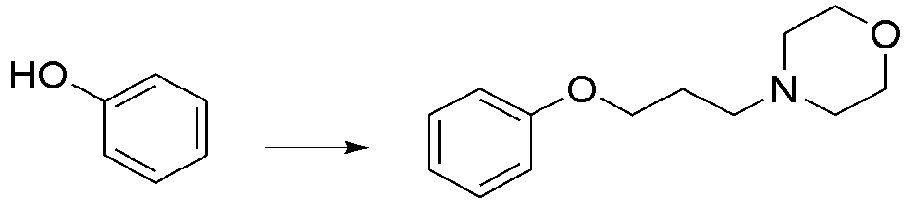
- Phenol (600 mg, 6.38 mmol), 4-(3-hydroxypropyl) morpholine (1.11 g, 7.65 mmol) and triphenylphosphine (2.5 g, 9.56 mmol) were dissolved in tetrahydrofuran (16 ml) at 0°C, to which diethyl azodicarboxylate solution (DEAD) (4.34 ml, 9.56 mmol) was added dropwise, followed by stirring at room temperature for 12 hours in nitrogen atmosphere. Upon completion of the reaction, the solvent was removed under reduced pressure. The reaction mixture was extracted with dichloromethane, and the organic layer was washed sequentially with water and brine, dried over anhydrous sodium sulfate, and then the solvent was removed under reduced pressure. Then, the reaction mixture was separated and purified by MPLC to give 4-(3-phenoxypropyl)morpholine (1.41 g, 100%, transparent oil).
-

- 4-(3-Phenoxypropyl)morpholine (1.41 g, 6.38 mmol) prepared in step 1 above was dissolved in dichloromethane (12 ml), to which chlorosulfonic acid (1.69 ml, 25.5 mmol) was added at 0°C, followed by stirring at room temperature for 3 hours. Upon completion of the reaction, ice was added thereto. The reaction mixture was extracted with dichloromethane, and neutralized using a supersaturated sodium carbonate aqueous solution. The organic layer was washed sequentially with water and brine, dried over anhydrous sodium sulfate, and then the solvent was removed under reduced pressure. As a result, 4-(3-morpholinopropoxy)benzene-1-sulfonyl chloride (2.22 g, 67%, yellow solid) was obtained without further purification.
-

- 4-(3-Morpholinopropoxy)benzene-1-sulfonyl chloride (150 mg, 0.469 mmol) prepared in step 2 above was dissolved in dichloromethane (1.5 ml), to which 3-(1H-indole-3-yl)propane-1-amine (245 mg, 1.407 mmol) and potassium carbonate (194 mg, 1.407 mmol) were added dropwise, followed by stirring at room temperature for 1 hour. Upon completion of the reaction, the reaction mixture was extracted with dichloromethane, and the organic layer was washed sequentially with water and brine, dried over anhydrous sodium sulfate, and then the solvent was removed under reduced pressure. Then, the reaction mixture was separated and purified by MPLC to give a target compound (10.6 mg, 5%, yellow solid).
-

-

- (3-Bromopropoxy)benzene (1 g, 4.65 mmol) was dissolved in dichloromethane (15 ml), to which chlorosulfonic acid (1.236 ml, 18.60 mmol) was added dropwise at 0°C, followed by stirring at room temperature for 1 hour. Upon completion of the reaction, ice was added thereto. The reaction mixture was extracted with dichloromethane, and neutralized using a supersaturated sodium carbonate aqueous solution. The organic layer was washed sequentially with water and brine, dried over anhydrous sodium sulfate, and then the solvent was removed under reduced pressure. As a result, 4-(3-bromopropoxy)benzene-1-sulfonyl chloride (1.1 g, 38%, yellow solid) was obtained without further purification.
-

- 4-(3-Bromopropoxy)benzene-1-sulfonyl chloride (538 mg, 1.716 mmol) prepared in step 1 above was dissolved in dichloromethane (5 ml), to which 3-(1H-indole-3-yl)propane-1-amine (897 mg, 5.15 mmol) and potassium carbonate (K2CO3) (711 mg, 5.15 mmol) were added dropwise, followed by stirring at room temperature for 1 hour. Upon completion of the reaction, the reaction mixture was extracted with dichloromethane, and the organic layer was washed sequentially with water and brine, dried over anhydrous sodium sulfate, and then the solvent was removed under reduced pressure. Then, the reaction mixture was separated and purified by MPLC to give N-(3-(1H-indole-3-yl)propyl)-4-(3-bromopropoxy)benzenesulfonamide (230 mg, 29%, white solid).
-

- N-(3-(1H-indole-3-yl)propyl)-4-(3-bromopropoxy)benzenesulfonamide (175 mg, 0.388 mmol) prepared in step 2 above was dissolved in ethanol (1.5 ml), to which 1-methylpiperazine (0.172 ml, 1.551 mmol) and potassium carbonate (K2CO3) (80 mg, 0.582 mmol) were added dropwise, followed by stirring at 70°C for 12 hours. Upon completion of the reaction, the reaction mixture was extracted with dichloromethane, and the organic layer was washed sequentially with water and brine, dried over anhydrous sodium sulfate, and then the solvent was removed under reduced pressure. Then, the reaction mixture was separated and purified by MPLC to give a target compound (66 mg, 36%, white solid).
- The compound of Example 56 was prepared in a similar manner to the method described in Example 31.
- The compound of Example 60 was prepared in a similar manner to the method described in Example 30.
- The compound of Example 61 was prepared in a similar manner to the method described in Example 31.
- The compounds of Examples 63 to 71 were prepared in a similar manner to the method described in Example 31.
-

- (2S,6R)-tert-butyl 4-(3-(4-(N-(3-(5-fluoro-1H-indole-3-yl)propyl)sulfamoyl)phenoxy)propyl)-2,6-dimethylpiperazine-1-carboxylate was prepared in a similar manner to the method described in Example 31.
-

- (2S,6R)-tert-butyl 4-(3-(4-(N-(3-(5-fluoro-1H-indole-3-yl)propyl)sulfamoyl)phenoxy)propyl)-2,6-dimethylpiperazine-1-carboxylate (80 mg, 0.133 mmol) prepared in step 1 above was dissolved in dichloromethane (1 ml), to which trifluoroacetic acid (0.2 ml, 2.65 mmol) was added at room temperature, followed by stirring at room temperature for 3 hours. Upon completion of the reaction, ice was added thereto. The reaction mixture was extracted with ethyl acetate, and neutralized using a supersaturated sodium carbonate aqueous solution. The organic layer was washed sequentially with water and brine, dried over anhydrous sodium sulfate, and the solvent was removed under reduced pressure. Then, the reaction mixture was separated and purified by MPLC to give a target compound (5.2 mg, 7%, white solid).
- The compounds of Examples 73 to 76 were prepared in a similar manner to the method described in Example 31.
-

- Tert-butyl(1-(3-(4-(N-(3-(5-chloro-1H-indole-3-yl) propyl)sulfamoyl)phenoxy)propyl)azetidine-3-yl(methyl)carbamate was prepared in a similar manner to the method described in Example 31.
-

- Tert-butyl(1-(3-(4-(N-(3-(5-chloro-1H-indole-3-yl)propyl)sulfamoyl)phenoxy)propyl)azetidine-3-yl)(methyl)carbamate (38 mg, 0.064 mmol) was dissolved in dichloromethane (0.5 ml) using tert-butylazetidine-3-yl(methyl)carbamate prepared in step 1 above, to which trifluoroacetic acid (0.2 ml, 2.61 mmol) was added dropwise at room temperature, followed by stirring at room temperature for 2 hours. Upon completion of the reaction, ice was added thereto. The reaction mixture was extracted with ethyl acetate, and neutralized using a supersaturated sodium carbonate aqueous solution. The organic layer was washed sequentially with water and brine, dried over anhydrous sodium sulfate, and the solvent was removed under reduced pressure. Then, the reaction mixture was separated and purified by MPLC to give a target compound (7 mg, 22%, yellow solid).
- The compound of Example 78 was prepared in a similar manner to the method described in Example 31.
-

-

- 5-Bromo-2-fluoropyridine (0.326 ml, 2.84 mmol) was dissolved in DMF (12 ml), to which sodium hydride 60% wt (0.159 g, 3.98 mmol) was added dropwise at 0°C, followed by stirring for 5 minutes. Tert-butyl-4-(3-hydroxypropyl)piperazine-1-carboxylate was added dropwise thereto, followed by stirring at 70°C for 6 hours. Upon completion of the reaction, ice was added thereto. The reaction mixture was extracted with dichloromethane, and neutralized using a supersaturated sodium carbonate aqueous solution. The organic layer was washed sequentially with water and brine, dried over anhydrous sodium sulfate, and the solvent was removed under reduced pressure. As a result, tert-butyl-4-(3-((5-bromopyridine-2-yl)oxy)propylpiperazine-1-carboxylate (1.35 g, 110%) was obtained without further purification.
-

- Tert-butyl-4-(3-((5-bromopyridine-2-yl)oxy)propyl piperazine-1-carboxylate (0.52 g, 1.3 mmol) prepared in step 1 above was dissolved in 1.4-dioxane (12 ml), to which (4-methoxyphenyl)methanethiol (0.199 ml, 1.23 mmol) and N-ethyl-N-isopropylpropane-2-amine (0.681 ml, 3.90 mmol) were added dropwise, followed by reaction for 5 minutes in nitrogen atmosphere. Pd2(dba)3 (9.91 mg, 0.032 mmol), Xantphos (0.038 g, 0.065 mmol) and tert-butyl-4-(3-hydroxypropyl)piperazine-1-carboxylate were added dropwise thereto, followed by reaction at 150°C for 30 minutes in a Biotage microwave. Upon completion of the reaction, the reaction mixture was extracted with dichloromethane, and neutralized using a supersaturated sodium carbonate aqueous solution. The organic layer was washed sequentially with water and brine, dried over anhydrous sodium sulfate, and the solvent was removed under reduced pressure. As a result, tert-butyl 4-(3-((5-((4-methoxybenzyl)thio)pyridine-2-yl)oxy)propyl)piperazine-1-carboxylate (0.51 g, 51.8%) was obtained without further purification.
-

- Tert-butyl 4-(3-((5-((4-methoxybenzyl)thio)pyridin-2-yl)oxy)propyl)piperazine-1-carboxylate (0.469 g , 0.99 mmol) prepared in step 2 above was dissolved in acetic acid (8 ml) and water (2 ml), to which N-chlorosuccinimide (0.529 g, 3.96 mmol) was added dropwise, followed by reaction at room temperature for 1 hour. Upon completion of the reaction, the reaction mixture was extracted with dichloromethane, and neutralized using a supersaturated sodium carbonate aqueous solution. The organic layer was washed sequentially with water and brine, dried over anhydrous sodium sulfate, and the solvent was removed under reduced pressure. As a result, tert-butyl 4-(3-((5-(chlorosulfonyl)pyridine-2-yl)oxy)propyl)piperazine-1-carboxylate (0.25 g, 60%) was obtained without further purification.
-

- Tert-butyl 4-(3-((5-(chlorosulfonyl)pyridine-2-yl)oxy)propyl)piperazine-1-carboxylate (0.1 g, 0.238 mmol) prepared in step 3 above was dissolved in DMF (2 ml), to which 3-(5-chloro-1H-indole-3-yl)propane-1-amine (0.055 g, 0.262 mmol) and potassium carbonate (0.066 g, 0.476 mmol) were added dropwise, followed by stirring at room temperature for 2 hours. Upon completion of the reaction, the reaction mixture was extracted with dichloromethane, and neutralized using a supersaturated sodium carbonate aqueous solution. The organic layer was washed sequentially with water and brine, dried over anhydrous sodium sulfate, and the solvent was removed under reduced pressure. Then, the reaction mixture was separated and purified by Prep TLC to give tert-butyl 4-(3-((5-(N-(3-(5-chloro-1H-indole-3-yl)propyl)sulfamoyl)pyridine-2-yl)oxy)propyl)piperazine-1-carboxylate (18 mg, 12.8%).
-

- 4-(3-((5-(N-(3-(5-chloro-1H-indole-3-yl)propyl) sulfamoyl)pyridine-2-yl)oxy)propyl)piperazine-1-carboxylate (18 mg, 0.034 mmol) prepared in step 4 above was dissolved in tetrahydrofuran (1 ml), to which trifluoroacetic acid (0.5 ml, 6.49 mmol) was added dropwise at room temperature, followed by stirring at room temperature for 2 hours. Upon completion of the reaction, ice was added thereto. The reaction mixture was extracted with ethyl acetate, and neutralized using a supersaturated sodium carbonate aqueous solution. The organic layer was washed sequentially with water and brine, dried over anhydrous sodium sulfate, and then the solvent was removed under reduced pressure. Then, the reaction mixture was separated and purified by Prep TLC to give a target compound (4.5 mg, 30%).
- The compounds of Examples 80 to 84 were prepared in a similar manner to the method described in Example 31.
-

-

- 1H-indole (1 g, 8.54 mmol) and cyclohex-2-enone (1.64 g, 17.1 mmol) were dissolved in CH3CN (30 ml), to which Sc(OTf)3 (0.42 g, 0.854 mmol) was added, followed by stirring at 30°C for 3 hours in N2 atmosphere. Upon completion of the reaction, the reaction solution was concentrated under reduced pressure and purified by Prep HPLC to give a target compound (805 mg, 44%).
-

- 3-(1H-indole-3-yl)cyclohexane-1-one (800 mg, 3.75 mmol) prepared in step 1 above was dissolved in dichloroethane (10 ml) and acetic acid (0.5 ml), to which ammonium acetate (8.67 g, 113 mmol) was added at room temperature, followed by stirring for 2 hours. Then, sodium triacetoxyborohydride (3.18 g, 15.0 mmol) was added thereto at room temperature, followed by stirring for 5 hours. Upon completion of the reaction, the reaction mixture obtained by concentrating the mixture under reduced pressure was separated and purified by MPLC to give a target compound (250 mg, 31%, yellow solid).
-

- A target compound (100 mg, 46%, white solid) was obtained in a similar manner to the method described in step 2 of Example 31 using 3-(1H-indole-3-yl)cyclohexane-1-amine (105 mg, 0.491 mmol) prepared in step 2 above and 4-(3-bromopropoxy) benzenesulfonyl chloride (140 mg, 0.446 mmol) obtained in a similar manner to the method described in step 2 of Example 31.
-

- A target compound (21.6 mg, 69% yield) was obtained as a white solid in a similar manner to the method described in step 3 of Example 31 using N-(3-(1H-indole-3-yl)cyclohexyl)-4-(3-bromopropoxy)benzenesulfonamide (30 mg, 0.061 mmol) prepared in step 3 above and 1-methylpiperazine (24.5 mg, 0.244 mmol).
-

-

- 4-Hydroxynaphthalene-1-sulfonate, sodium (I) salt (0.3 g, 1.218 mmol) was dissolved in ethanol (2.5 ml), to which 1,3-dibromopropane (0.211 ml, 2.071 mmol), tetrabutyl ammonium sulfate (0.033 g, 0.097 mmol) and potassium hydroxide aqueous solution (1.56 ml, 1.218 mmol) were added, followed by heating to reflux for 3 hours. Upon completion of the reaction, the reaction solution was concentrated under reduced pressure, dissolved in ethanol again, and concentrated again. After hot methanol was added to the reaction solution, the insoluble material was filtered, and the filtrate was concentrated. The resulting solid was washed with dichloromethane and filtered to give a target compound (0.4 g, 99%, white solid).
-

- Thionyl chloride (0.286 ml, 3.92 mmol) and dimethylformamide (1.91 µl) were added to the compound (0.2 g, 0.545 mmol) prepared in step 1 above, followed by heating to reflux for 4 hours. Upon completion of the reaction, the temperature was lowered to room temperature, and the reaction mixture was diluted with ethyl acetate, and washed with water and brine. The organic layer residue was dried over anhydrous sodium sulfate, filtered and concentrated, and used in the next step without further purification.
-

- A target compound was prepared in a similar manner to the method described in step 2 of Example 31.
-

- A target compound was prepared in a similar manner to the method described in step 3 of Example 31.
- The compound of Example 87 was prepared in a similar manner to the method described in Example 31.
-

-

- Tert-butyl-4-(3-hydroxypropyl)piperidine-1-carboxylate (0.3 g, 1.233 mmol) was dissolved in dichloromethane (6 ml), to which Dess-Martin Periodinane (0.680 g, 1.603 mmol) was added at 0°C, followed by stirring at room temperature for 4 hours. Upon completion of the reaction, the reaction solution was filtered, and the filtrate was washed with a sodium hydrogen carbonate aqueous solution and brine. The organic layer residue was dried over anhydrous sodium sulfate, filtered and concentrated. The concentrate was purified by MPLC to give a target compound (0.24 g, 79%, transparent oil).
-

- A target compound was prepared in a similar manner to the method described in step 2 of Example 31.
-

- The compound (0.72 g, 1.840 mmol) prepared in step 2 above was dissolved in ethyl acetate (12 ml), to which tin (II) chloride and dihydrate (4.15 g, 18.40 mmol) were added, followed by heating at 60°C for 5 hours. Upon completion of the reaction, ammonia water was added to the reaction solution to make the pH 5, and sodium carbonate was added to make the pH 7. The reaction solution was filtered with celite, and the filtrate was concentrated under reduced pressure, which was used in the next step without further purification.
-

- The compound (0.05 g, 0.137 mmol) prepared in step 3 above was dissolved in dichloroethane (1 ml), to which the compound (0.046 g, 0.192 mmol) prepared in step 1 above and acetic acid (0.024 ml, 0.412 mmol) were added, followed by stirring at room temperature for 1 hour. Sodium triacetoxyborohydride (0.087 g, 0.412 mmol) was added thereto, followed by stirring at room temperature for 1 hour. Upon completion of the reaction, the reaction mixture was diluted with dichloromethane and washed with water and brine. The residue of the organic layer was dried over anhydrous sodium sulfate, filtered and concentrated, purified by Prep HPLC, and neutralized by adding a sodium hydrogen carbonate aqueous solution to give a target compound (0.017g, 5%, yellow solid).
-

- A target compound was prepared in a similar manner to the method described in step 5 of Example 79.
-

-

- A target compound (1.4 g, 96%, white solid) was obtained in a similar manner to the method described in step 1 of Example 31 using (4-bromobutyl)benzene (1.0 g, 4.69 mmol) and chlorosulfonic acid (0.936 ml, 14.1 mmol).
-

- 4-(4-Bromobutyl)benzene-1-sulfonyl chloride (300 mg, 0.963 mmol) prepared in step 1 above was dissolved in dichloromethane (5 ml), to which 3-(5-chloro-1H-indole-3-yl)propane-1-amine (211 mg, 1.01 mmol) and triethylamine (0.268 ml, 1.93 mmol) were added at room temperature, followed by stirring for 3 hours. Upon completion of the reaction, the mixture was concentrated under reduced pressure and purified by MPLC to give a target compound (330 mg, 71%, white solid).
-

- A target compound (16 mg, 53%, white solid) was obtained in a similar manner to the method described in step 3 of Example 31 using 4-(4-bromobutyl)-N-(3-(5-chloro-1H-indole-3-yl)propyl)benzenesulfonylamide (30 mg, 0.062 mmol) prepared in step 2 above, piperidine (15.9 mg, 0.186 mmol) and potassium carbonate (12.9 mg, 0.093 mmol).
- The compound of Example 91 was prepared in a similar manner to the method described in Example 90.
-

-

- 4-Hydroxybenzene-1-sulfonyl chloride (0.5 g, 2.60 mmol) was dissolved in dichloromethane (8.7 ml), to which 3-(5-chloro-1H-indole-3-yl)propane-1-amine (0.596 g, 2.86 mmol) and triethylamine (0.724 ml, 5.19 mmol) were added, followed by stirring at room temperature for 3 hours. Upon completion of the reaction, the reaction mixture was diluted with ethyl acetate and washed with water and brine. The residue of the organic layer was dried over anhydrous sodium sulfate, filtered and concentrated, and then purified by MPLC to give a target compound (0.19 g, 21%, white solid).
-

- The compound (0.05 g, 0.137 mmol) prepared in step 1 above was dissolved in tetrahydrofuran (1.5 ml) under nitrogen gas at 0°C, to which 3-(1-methylpiperidine-4-yl)propane-1-ol (0.026 g, 0.164 mmol), PPh3 (0.054 g, 0.206 mmol) and DEAD (0.093 ml, 0.206 mmol) were added, followed by stirring for 1 hour. Upon completion of the reaction, the reaction mixture was diluted with dichloromethane, and washed with water and brine. The residue of the organic layer was dried over anhydrous sodium sulfate, filtered and concentrated, purified by Prep HPLC, and neutralized by adding a sodium hydrogen carbonate aqueous solution to give a target compound (0.004 g, 7%, white solid).
-


- The compound (0.035 g, 0.061 mmol) prepared in a similar manner to the method described in Example 92 was dissolved in dichloromethane (2 ml), to which trifluoroacetic acid (1 ml, 12.98 mmol) was added, followed by stirring at room temperature for 1 hour. Upon completion of the reaction, the reaction solution was concentrated under reduced pressure, purified by Prep HPLC, and neutralized by adding a sodium hydrogen carbonate aqueous solution to give a target compound (0.01 g, 37%, white solid).
- The compound of Example 94 was prepared in a similar manner to the method described in Example 93.
- The compounds of Examples 95 and 96 were prepared in a similar manner to the method described in Example 94.
- The compound of Example 97 was prepared in a similar manner to the method described in Example 31.
-


- The compound (0.05 g, 0.136 mmol) prepared in a similar manner to the method described in step 2 of Example 47 was dissolved in dimethylformamide (1 ml), to which 3-(4-methylpiperazine-1-yl)propane-1-amine (0.043 g, 0.273 mmol) and potassium carbonate (0.021 g, 0.150 mmol) were added, followed by stirring at 100°C for 3 days. Upon completion of the reaction, the reaction solution was concentrated under reduced pressure, purified by Prep HPLC, and neutralized by adding a sodium hydrogen carbonate aqueous solution to give a target compound (0.01 g, 16%, white solid).
-

-

- Methyltriphenylphosphonium bromide (1.184 g, 3.32 mmol) was dissolved in anhydrous tetrahydrofuran (2 ml), to which lithium bistrimethylsilylamide (3.32 ml, 3.32 mmol) was slowly added at 0°C. After dissolving tert-butyl 4-(3-oxopropyl)piperidine-1-carboxylate (0.4 g, 1.66 mmol) prepared in step 1 of Example 88 in anhydrous tetrahydrofuran (2 ml), which was slowly added dropwise thereto at 0°C. The mixture was stirred at 0°C for 30 minutes, and then stirred at room temperature for 20 hours. Upon completion of the reaction, the reaction mixture was concentrated under reduced pressure, washed with brine, and extracted with ethyl acetate. The extracted organic layer was dried over anhydrous sodium sulfate, filtered, concentrated under reduced pressure, and purified by MPLC to give a target compound (0.2 g, 50%, transparent oil).
-

- Tert-butyl 4-(but-3-en-1-yl)piperidine-1-carboxylate (50 mg, 0.209 mmol) prepared in step 2 above was dissolved in anhydrous tetrahydrofuran (1.5 ml), to which 9-borabicyclo[3.3.1]nonane (0.796 ml, 0.398 mmol) was added at room temperature. The reaction mixture was gradually heated and stirred under reflux for 1 hour. Upon completion of the reaction, the reaction mixture was cooled down to room temperature and concentrated under reduced pressure. The obtained residue was dissolved in 1,4-dioxane (1.5 ml), to which 4-bromo-N-(3-(5-chloro-1H-indole-3)-yl)propyl)benzenesulfonamide (85 mg, 0.199 mmol) prepared in a similar manner to the method described in step 2 of Example 90 and 1 M sodium carbonate aqueous solution (0.597 ml, 0.597 mmol) were added. Pd(PPh3)4 (23 mg, 0.02 mmol) was added to the reaction mixture, and the mixture was gradually heated and stirred at 90°C for 3 hours. Upon completion of the reaction, the reaction mixture was cooled down to room temperature, filtered with celite, concentrated under reduced pressure, and purified by prep HPLC to give a target compound (15 mg, 13%, yellow solid).
-

- Tert-butyl 4-(4-(4-(N-(3-(5-chloro-1H-indole-3-yl)propyl)sulfamoyl)phenyl)butyl)piperidine-1-carboxylate (15 mg, 0.013 mmol) prepared in step 2 above was dissolved in dichloromethane (2 ml), to which trifluoroacetic acid (1 ml, 13.1 mmol) was added at room temperature, followed by stirring for 1 hour. Upon completion of the reaction, the residue obtained by concentrating the mixture was neutralized with a supersaturated sodium hydrogen carbonate aqueous solution, and then extracted with ethyl acetate. The extracted organic layer was washed with distilled water, dried over anhydrous sodium sulfate, filtered, and then concentrated under reduced pressure to give a target compound (5 mg, 56%, white solid).
- The compounds of Examples 100 to 102 were prepared in a similar manner to the method described in Example 31.
-

-

- 2-Fluorophenol (5 g, 44.6 mmol) was dissolved in acetonitrile (74 ml), to which 1,3-dibromopropane (90 g, 446 mmol) and potassium carbonate (6.16 g, 44.6 mmol) were added, followed by stirring at 80°C for 16 hours. Upon completion of the reaction, the reaction solution was filtered, concentrated under reduced pressure, which was used in the next step without further purification.
-

- The compound (5 g, 19.31 mmol) prepared in step 1 above was dissolved in dichloromethane (38 ml), to which chlorosulfonic acid (5.13 ml, 77 mmol) was added, followed by stirring at room temperature for 1 hour. Upon completion of the reaction, the reaction mixture was diluted with dichloromethane and neutralized with a sodium carbonate aqueous solution at 0°C. The residue of the organic layer was dried over anhydrous sodium sulfate, filtered and concentrated, which was used in the next step without further purification.
-

- The compound (1 g, 3.02 mmol) prepared in step 2 above was dissolved in dichloromethane (6 ml), to which 3-(5-chloro-1H-indole-3-yl)propane-1-amine (0.818 g, 3.92 mmol) and potassium carbonate (0.542 g, 3.92 mmol) were added, followed by stirring at room temperature for 3 hours. Upon completion of the reaction, the reaction mixture was diluted with dichloromethane, and washed with water and brine. The residue of the organic layer was dried over anhydrous sodium sulfate, filtered and concentrated, and then purified by MPLC to give a target compound (1.1 g, 77%, white solid).
-

- The compound (0.05 g, 0.099 mmol) prepared in step 3 above was dissolved in ethanol (1 ml), to which potassium carbonate (0.021 g, 0.149 mmol) and 1-methylpiperazine (0.020 g, 0.198 mmol) were added, followed by stirring at 70°C for 16 hours. Upon completion of the reaction, the reaction mixture was diluted with dichloromethane, and washed with water and brine. The residue of the organic layer was dried over anhydrous sodium sulfate, filtered and concentrated, purified by Prep HPLC, and then neutralized by adding a sodium hydrogen carbonate aqueous solution to give a target compound (0.011 g, 22%, white solid).
- The compounds of Examples 104 to 106 were prepared in a similar manner to the method described in Example 103.
-


- A target compound (15 mg, 72%) was obtained as a pale yellow solid in a similar manner to the method described in step 4 of Example 99 using tert-butyl 4-(3-(4-(N-(3-(5-chloro-1H-indole-3-yl)propyl)sulfamoyl)phenoxy)propyl)-2-methylpiperazine-1-carboxylate (25 mg, 0.041 mmol) obtained in a similar manner to the method described in Example 31 and trifluoroacetic acid (1 ml, 13.1 mmol).
- The compounds of Examples 108 to 111 were prepared in a similar manner to the method described in Example 107.
- The compound of Example 112 was prepared in a similar manner to the method described in Example 90.
-


- The compound (0.0142 g, 0.024 mmol) prepared in a similar manner to the method described in Example 98 was dissolved in dichloromethane (2 ml), to which trifluoroacetic acid (1 ml, 12.98 mmol) was added, followed by stirring at room temperature for 1 hour. Upon completion of the reaction, the reaction solution was concentrated under reduced pressure, purified by Prep HPLC, and neutralized by adding a sodium hydrogen carbonate aqueous solution to give a target compound (0.005 g, 50%, white solid).
- The compound of Example 114 was prepared in a similar manner to the method described in Example 98.
- The compound of Example 115 was prepared in a similar manner to the method described in steps 1 to 3 of Example 99.
-

-

- Cyclopropane-1,1-diyldimethanol (5 g, 49.0 mmol) was dissolved in dichloromethane (130mL), to which imidazole (5 g, 73.4 mmol) and tertbutyldimethylsilyl chloride (7.75 g, 51.4 mmol) was added. The reaction mixture was stirred at 0°C for 30 minutes, and then stirred at room temperature for 16 hours. Upon completion of the reaction, the reaction mixture was neutralized with a supersaturated sodium hydrogen carbonate aqueous solution, and extracted with ethyl acetate. The extracted organic layer was washed with distilled water, dried over anhydrous sodium sulfate, filtered, and then concentrated under reduced pressure. The reaction mixture was purified by MPLC to give a target compound (4.7 g, 44%, transparent oil).
-

- (1-(((Tert-butyldimethylsilyl)oxy)methyl)cyclopropyl)methanol (1.1 g, 5.08 mmol) prepared in step 1 above was dissolved in dichloromethane (10 ml), to which carbon tetrabromide (1.85 g, 5.59 mmol) and triphenylphosphine (1.47 g, 5.59 mmol) were added. The reaction mixture was stirred at 0°C for 30 minutes, and then stirred at room temperature for 16 hours. Upon completion of the reaction, the reaction mixture was concentrated under reduced pressure, and purified by MPLC to give a target compound (1 g, 70%, transparent oil).
-

- ((1-(Bromomethyl)cyclopropyl)methoxy)(tert-butyl)dimethylsilane (1 g, 3.58 mmol) prepared in step 2 above was dissolved in acetic acid/tetrahydrofuran/distilled water (12 ml/4 ml/4 ml), followed by stirring at room temperature for 3 hours. Upon completion of the reaction, the reaction mixture was neutralized with a supersaturated sodium hydrogen carbonate aqueous solution and extracted with ethyl acetate. The extracted organic layer was washed with distilled water, dried over anhydrous sodium sulfate, filtered, and then concentrated under reduced pressure. The obtained reaction mixture was purified by MPLC to give a target compound (0.3 g, 51%, yellow oil).
-

- A target compound (45 mg, 48%, yellow solid) was obtained in a similar manner to the method described in step 2 of Example 92 using (1-(bromomethyl)cyclopropyl)methanol (30 mg, 0.182 mmol) prepared in step 3 above, N-(3-(5-chloro-1H-indole-3-yl)propyl)-4-hydroxybenzenesulfonamide (66 mg, 0.182 mmol), triphenylphosphine (72 mg, 0.273 mmol), and diethyl azodicarboxylate (0.124 ml, 0.273 mmol).
-

- A target compound (12.3 mg, 59%, yellow solid) was obtained in a similar manner to the method described in step 3 of Example 31 using 4-((1-(bromomethyl)cyclopropyl)methoxy)-N-(3-(5-chloro-1H-indole-3-yl)propyl)benzenesulfonamide (20 mg, 0.039 mmol) prepared in step 4 above, 1-methylpiperazine (0.013 ml, 0.117 mmol), and potassium carbonate (8.1 mg, 0.059 mmol).
- The compound of Example 117 was prepared in a similar manner to the method described in Example 116.
-

-

- 1-Bromo-3-phenoxybenzene (300 mg, 1.20 mmol) was dissolved in dichloromethane, to which chlorosulfonic acid (0.088 ml, 1.33 mmol) was slowly added at 0°C. The reaction mixture was stirred at 0°C for 30 minutes, and then stirred at room temperature for 3 hours. Upon completion of the reaction, the reaction mixture was concentrated under reduced pressure to give a target compound (395 mg, 100%, yellow oil).
-

- 4-(3-Bromophenoxy)benzenesulfonic acid (395 mg, 1.20 mmol) prepared in step 1 above was dissolved in SnCl2·H2O (3ml, 41.4 mmol) at 0°C, followed by stirring. Then, two drops of diformamide were added thereto at 0°C, and the reaction mixture was gradually heated and stirred under reflux for 2 hours. Upon completion of the reaction, the reaction mixture was cooled down to room temperature, concentrated under reduced pressure, and purified by MPLC to give a target compound (380 mg, 91%, yellow oil).
-

- A target compound (170 mg, 76%, yellow solid) was obtained in a similar manner to the method described in step 2 of Example 90 using 4-(3-bromophenoxy)benzenesulfonyl chloride (150 mg, 0.432 mmol) prepared in step 2 above, 3-(5-chloro-1H-indole-3-yl)propane-1-amine (90 mg, 0.432 mmol), and triethylamine (0.090 ml, 0.647 mmol).
-

- 4-(3-Bromophenoxy)-N-(3-(5-chloro-1H-indole-3-yl)propyl)benzenesulfonamide (90 mg, 0.173 mmol) prepared in step 3 above was dissolved in 1,4-dioxane (1.5 ml), to which t-BuOK (29.1 mg, 0.260 mmol) and 1-methylpiperazine (0.03 ml, 0.260 mmol) were added at room temperature. The reaction mixture was heated at 70°C and stirred, and degassed for 5 minutes using a nitrogen balloon, to which Pd(t-Bu3P)2 (8 mg, 0.016 mmol) was added, followed by reflux stirring for 3 hours. Upon completion of the reaction, the reaction mixture was cooled down to room temperature, filtered and concentrated with celite, and purified by prep HPLC. The obtained trifluoroacetate compound was neutralized by adding a supersaturated sodium hydrogencarbonate aqueous solution, and extracted with a 10% methanol/dichloromethane solution. The organic layer was dried over anhydrous sodium sulfate, filtered, and then concentrated under reduced pressure to give a target compound (6.5 mg, 53%, white solid).
- The compound of Example 119 was prepared in a similar manner to the method described in steps 1 to 3 of Example 118.
- The compounds of Examples 120 to 122 were prepared in a similar manner to the method described in Example 118.
-


- The compound (0.05 g, 0.117 mmol) prepared in a similar manner to the method described in step 2 of Example 47 was dissolved in 2-butanol (1.5 ml), to which 3-(4-methylpiperazine-1-yl)aniline (0.02 g, 0.117 mmol) and potassium carbonate (0.08 g, 0.584 mmol) were added, followed by degassing for 1 minute. Then, Pd2(dba)3 (0.01 g, 0.012 mmol) and Xphos (0.005 g, 0.012 mmol) were added thereto at 80°C, followed by stirring at 100°C for 1 hour. Upon completion of the reaction, the reaction solution was filtered with celite, and washed with ethyl acetate and dichloromethane. The filtrate was concentrated under reduced pressure, purified by Prep HPLC, and neutralized by adding a sodium hydrogen carbonate aqueous solution to give a target compound (0.023 g, 37%, yellow solid).
- The compounds of Examples 124 to 127 were prepared in a similar manner to the method described in Example 123.
- The compounds of Examples 128 and 129 were prepared in a similar manner to the method described in Example 119.
-

-

- Phenol (100 mg, 1.06 mmol) was dissolved in N-methyl-2-pyrrolidinone (2 ml), to which cesium carbonate (173 mg, 0.531 mmol), 1,3-dibromo-5-fluorobenzene (0.201 ml, 1.59 mmol), TMHDA (0.057 ml, 0.266 mmol) and CuCl (52.6 mg, 0.531 mmol) were added at room temperature. The reaction mixture was degassed at room temperature using a nitrogen balloon, followed by stirring for 20 minutes. The reaction mixture was gradually heated and stirred at 120°C for 16 hours. Upon completion of the reaction, the reaction mixture was cooled down to room temperature, filtered with celite, extracted with ethyl acetate, and concentrated under reduced pressure. The obtained reaction mixture was purified by MPLC to give a target compound (220 mg, 63%, yellow solid).
-

- A target compound (274 mg, 100%, yellow solid) was obtained in a similar manner to the method described in step 1 of Example 118 using 1,3-dibromo-5-phenoxybenzene (220 mg, 0.671 mmol) prepared in step 1 above, and chlorosulfonic acid (0.049 ml, 0.738 mmol).
-

- A target compound (230 mg, 80%, yellow solid) was obtained in a similar manner to the method described in step 2 of Example 118 using 4-(3,5-dibromophenoxy)benzenesulfonic acid (274 mg, 0.671 mmol) prepared in step 2 above, and thionyl chloride (4 ml, 55.1 mmol).
-

- A target compound (300 mg, 93%, white solid) was obtained in a similar manner to the method described in step 2 of Example 90 using 4-(3,5-dibromophenoxy)benzenesulfonyl chloride (230 mg, 0.539 mmol) prepared in step 3 above, 3-(5-chloro-1H-indole-3-yl)propane-1-amine (118 mg, 0.566 mmol), and triethylamine (0.113 ml, 0.809 mmol).
-

- A target compound (5 mg, 9%, yellow solid) was obtained in a similar manner to the method described in step 4 of Example 118 using N-(3-(5-chloro-1H-indole-3-yl)propyl)-4-(3,5-dibromophenoxy)benzenesulfonamide (50 mg, 0.084 mmol) prepared in step 4 above, 1-methylpiperazine (0.037 ml, 0.334 mmol), potassium tert-butoxide (37.5 mg, 0.334 mmol), and Pd(t-Bu3P)2 (8.54 mg, 0.017 mmol).
- The compounds of Examples 131 to 134 were prepared in a similar manner to the method described in Example 123.
- The compounds of Examples 135 and 136 were prepared in a similar manner to the method described in Example 118.
- The compound of Example 137 was prepared in a similar manner to the method described in Example 138.
-

-

- A target compound (0.45 g, 32%, transparent oil) was obtained in a similar manner to the method described in step 1 of Example 130 using phenol (0.5 g, 5.31 mmol), cesium carbonate (0.866 g, 2.66 mmol), 1-bromo-3,5-difluorobenzene (1.54 g, 7.97 mmol), TMHDA (0.284 ml, 1.33 mmol) and CuCl (0.263 mg, 2.66 mmol).
-

- A target compound (0.44 g, 71%, yellow oil) was obtained in a similar manner to the method described in step 1 of Example 31 using 1-bromo-3-fluoro-5-phenoxybenzene (0.45 g, 1.685 mmol) prepared in step 1 above and chlorosulfonic acid (0.123 ml, 1.853 mmol).
-

- A target compound (300 mg, 93%, yellow solid) was obtained in a similar manner to the method described in step 2 of Example 90 using 4-(3-bromo-5-fluorophenoxy)benzene-1-sulfonyl chloride (200 mg, 0.547 mmol) prepared in step 2 above, 3-(5-chloro-1H-indole-3-yl))propane-1-amine (115 mg, 0.553 mmol) and triethylamine (0.114 ml, 0.821 mmol).
-

- 4-(3-Bromo-5-fluorophenoxy)-N-(3-(5-chloro-1H-indole-3-yl)propyl)benzenesulfonamide (30 mg, 0.056 mmol) prepared in step 3 above was dissolved in dimethyl sulfoxide (1 ml), to which 1-methylpiperazine (0.025 ml, 0.223 mmol) and potassium carbonate (30.8 mg, 0.223 mmol) were added at room temperature. Then, the reaction mixture was heated at 120°C, and stirred for 16 hours. Upon completion of the reaction, the mixture was cooled down to room temperature, washed with distilled water and brine, and extracted with ethyl acetate. The extracted organic layer was dried over anhydrous sodium sulfate, filtered, concentrated under reduced pressure, and purified by prep HPLC. The obtained trifluoroacetate compound was neutralized by adding a supersaturated sodium hydrogen carbonate aqueous solution, followed by extraction with a 10% methanol/dichloromethane solution. The extracted organic layer was dried over anhydrous sodium sulfate, filtered, and then concentrated under reduced pressure to give a target compound (6.2 mg, 22%, ivory solid).
- The compounds of Examples 139 to 142 were prepared in a similar manner to the method described in Example 123.
- The compound of Example 145 was prepared in a similar manner to the method described in Example 92.
-

-

- A target compound was prepared in a similar manner to the method described in step 2 of Example 31.
-

- 2-Chloro-N-(3-(5-chloro-1H-indole-3-yl)propyl) thiazole-5-sulfonamide (30 mg, 0.077 mmol) prepared in step 1 above was dissolved in dimethylformamide, to which tert-butyl 4-(3-aminopropyl)piperazine-1-carboxylate (28 mg, 0.115 mmol) and DIPEA (0.022 mL, 0.154 mmol) were added. The reaction mixture was stirred at room temperature for 2 hours. Upon completion of the reaction, the solvent was removed under reduced pressure, and then the reaction mixture was separated and purified by MPLC to give a target compound (37 mg, 81%, yellow solid).
-

- A target compound (30 mg, 97%, pale yellow solid) was obtained in a similar manner to the method described in step 3 of Example 99.
-

-

- Chlorophenyl hydrazine (1.40 g, 9.81 mmol) and 6-chlorohexene-2-one (1.10 g, 8.17 mmol) were dissolved in ethanol (30 ml), followed by reflux stirring for 20 hours. Upon completion of the reaction, the mixture was cooled down to room temperature, and the solvent was removed under reduced pressure to give 3-(5-chloro-2-methyl-1H-indole-3-yl)propane-1-amine hydrochloride (2.114 g, quantitative, pale yellow solid).
-

- 3-(5-Chloro-2-methyl-1H-indole-3-yl)propane-1-amine hydrochloride (0.413 g, 1.59 mmol) prepared in step 1 above was dissolved in ethylenechloride (6 ml), to which triethylamine (0.444 ml, 3.19 mmol) was added dropwise, followed by stirring for 5 minutes. 4-(3-Bromopropoxy)benzene-1-sulfonyl chloride (0.200 g, 0.638 mmol) was added dropwise thereto, followed by stirring at room temperature for 1 hour. Water was added dropwise thereto to terminate the reaction, followed by extraction with dichloromethane. The extracted organic layer was dried over anhydrous sodium sulfate and filtered, and the solvent was removed under reduced pressure. Then, the mixture was separated and purified by MPLC to give a target compound (177 mg, 56%, brown solid).
-

- A target compound (19.8 mg, 64%, pale yellow solid) was obtained in a similar manner to the method described in step 3 of Example 31.
-


- 4-(4-Bromobutyl)-N-(3-(5-chloro-1H-indole-3-yl)propyl)benzenesulfonylamide (30 mg, 0.062 mmol) prepared in step 2 of Example 90 was dissolved in acetonitrile, to which potassium carbonate (25.7 mg, 0.186 mmol) and 1H-imidazole (8.44 mg, 0.124 mmol) were added at room temperature, followed by stirring at 60°C for 4 hours. Upon completion of the reaction, the mixture was filtered with celite. The filtrate was concentrated under reduced pressure, and then separated and purified by MPLC to give a target compound (13 mg, 45%, white solid).
-

-

- 5-Chloro-1H-indole (1 g, 6.60 mmol) and (2-aminophenyl)methanol (0.812 g, 6.60 mmol) were dissolved in 1,2-dichloroethane (20 mL), to which trifluoroacetic acid (0.151 mL, 1.979 mmol) was added at room temperature, followed by stirring at 50°C for 16 hours. After cooling the mixture to room temperature, a supersaturated sodium carbonate aqueous solution was added dropwise to terminate the reaction, followed by extraction with ethyl acetate. The extracted organic layer was dried over anhydrous sodium sulfate, filtered, and then separated and purified by MPLC to give a target compound (0.55 g, 33%, yellow solid).
-

- A target compound was prepared in a similar manner to the method described in step 2 of Example 31.
-

- A target compound (13.2 mg, 64%, pale yellow solid) was obtained in a similar manner to the method described in Example 148.
- The compound of Example 150 was prepared in a similar manner to the method described in Example 149.
-

-

- 5-Chloro-1H-indole (1 g, 6.60 mmol) was dissolved in distilled water (20 mL), to which 3-butene-2-one (1.387 g, 19.79 mmol) and trifluoromethanesulfonic acid (10 mg, 0.066 mmol) were added at room temperature. The reaction mixture was stirred at room temperature for 16 hours. Upon completion of the reaction, the mixture was washed with a supersaturated sodium carbonate aqueous solution, and then extracted with ethyl acetate. The extracted organic layer was dried over anhydrous sodium sulfate, filtered, and then separated and purified by MPLC to give a target compound (0.64 g, 44%, pale yellow solid).
-

- 4-((5-Chloro-1H-indole-3-yl)butane-2-one (200 mg, 0.902 mmol) prepared in step 1 above was dissolved in methanol (8 mL), to which ammonium acetate (695 mg, 9.02 mmol) and sodium cyanoborohydride (283 mg, 4.51 mmol) were added at room temperature. The reaction mixture was stirred at room temperature for 16 hours. Upon completion of the reaction, the mixture was washed with a supersaturated sodium carbonate aqueous solution, and then extracted with ethyl acetate. The extracted organic layer was dried over anhydrous sodium sulfate, filtered, and separated and purified by MPLC to give a target compound (0.2 g, 100%, pale yellow oil).
-

- A target compound was prepared in a similar manner to the method described in step 2 of Example 31.
-

- A target compound (16 mg, 77%, white solid) was prepared in a similar manner to the method described in Example 149.
- The compound of Example 152 was prepared in a similar manner to the method described in Example 151.
-

-

- (4-Bromophenyl)hydrazine hydrochloride (1 g, 4.47 mmol) was dissolved in acetonitrile (10 ml), to which 4% sulfuric acid aqueous solution (10 ml) was added. 3,4-Dihydro-2H-pyran (0.40 ml, 4.47 mmol) was slowly added thereto at 100°C for 2 minutes, followed by stirring at 100°C for 2 hours. Upon completion of the reaction, the reaction mixture was diluted with ethyl acetate and washed with water and brine. The residue of the organic layer was dried over anhydrous sodium sulfate, filtered and concentrated, and then purified by MPLC to give a target compound (0.61 g, 54%).
-

- The compound (0.31 g, 1.231 mmol) prepared in step 1 above was dissolved in dichloromethane (2 ml), to which carbon tetrabromide (0.49 g, 1.477 mmol) and triphenylphosphine (0.38 g, 1.477 mmol) were added at 0°C. The reaction mixture was stirred for 30 minutes and then stirred at room temperature for 4 hours. Upon completion of the reaction, the reaction solution was concentrated under reduced pressure, and then purified by MPLC to give a target compound (0.29 g, 77%).
-

- The compound (0.99 g, 3.25 mmol) prepared in step 2 above was dissolved in dimethylformamide (11 ml), to which sodium azide (1.05 g, 16.24 mmol) was added, followed by stirring at room temperature for 4 hours. Upon completion of the reaction, the reaction mixture was diluted with ethyl acetate and washed with water and brine. The residue of the organic layer was dried over anhydrous sodium sulfate, filtered and concentrated, and then purified by MPLC to give a target compound (0.54 g, 62%).
-

- The compound (0.1 g, 0.358 mmol) prepared in step 3 above was dissolved in tetrahydrofuran (3 ml) and water (0.2 ml), to which triphenylphosphine (0.47 g, 1.791 mmol) was added, followed by stirring at room temperature for 16 hours. Upon completion of the reaction, the reaction mixture was diluted with dichloromethane and washed with water and brine. The residue of the organic layer was dried over anhydrous sodium sulfate, filtered and concentrated, and then purified by MPLC to give a target compound (0.075 g, 83%).
-

- The compound (0.094 g, 0.299 mmol) prepared in step 1 of Example 31 was dissolved in dichloromethane (1 ml), to which the compound (0.075 g, 0.299 mmol) prepared in step 4 above and potassium carbonate (0.124 g, 0.896 mmol) were added, followed by stirring at room temperature for 1 hour. Upon completion of the reaction, the reaction mixture was diluted with dichloromethane and washed with water and brine. The residue of the organic layer was dried over anhydrous sodium sulfate, filtered and concentrated, and then purified by MPLC to give a target compound (0.12 g, 80%).
-

- The compound (0.06 g, 0.113 mmol) prepared in step 5 above was dissolved in ethanol (1.5 ml), to which potassium carbonate (0.031 g, 0.226 mmol) and piperazine (0.02 g, 0.339 mmol) were added, followed by stirring at 70°C for 16 hours. Upon completion of the reaction, the reaction solution was concentrated under reduced pressure, diluted with dichloromethane, and washed with water and brine. The residue of the organic layer was dried over anhydrous sodium sulfate, filtered and concentrated, purified by Prep HPLC, and neutralized by adding a sodium hydrogen carbonate aqueous solution to give a target compound (0.032 g, 53%, yellow solid).
- The compounds of Examples 154 to 156 were prepared in a similar manner to the method described in Example 153.
- The compound of Example 157 was prepared in a similar manner to the method described in Example 147.
- The compounds of Examples 158 and 159 were prepared in a similar manner to the method described in Example 31.
- The compounds of Examples 160 and 161 were prepared in a similar manner to the method described in Example 148.
- The compounds of Examples 162 and 163 were prepared in a similar manner to the method described in Example 31.
- The compounds of Examples 164 and 165 were prepared in a similar manner to the method described in Example 153.
- The compound of Example 166 was prepared in a similar manner to the method described in Example 148.
-
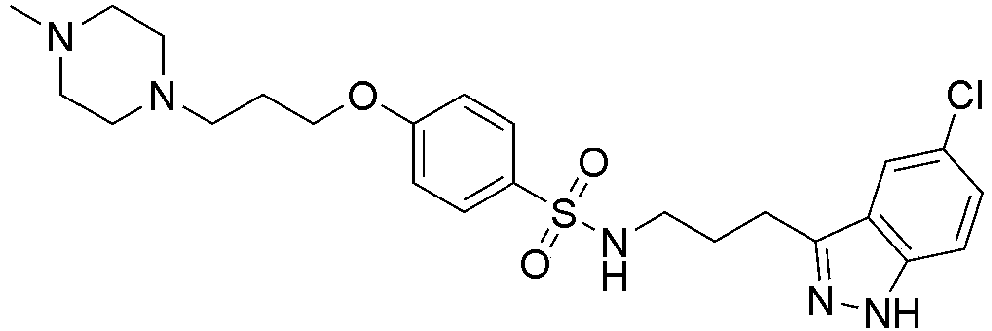
-

- 2-Bromoacetonitrile (1.328 mL, 19.06 mmol) was dissolved in dichloromethane (80 mL), to which triphenylphosphine (5 g, 19.06 mmol) was added at room temperature, followed by stirring for 6 hours. Upon completion of the reaction, the mixture was washed with diethyl ether without further purification to give a target compound (7 g, 96%, white solid).
-

- (Cyanomethyl)triphenylphosphonium (3.17 g, 8.31 mmol) prepared in step 1 above was dissolved in anhydrous tetrahydrofuran (10 mL), to which sodium tert-butoxide (0.8 g, 8.31 mmol) was added at -78°C, followed by stirring for 30 minutes. 5-Chloro-1H-indazole-3-carbaldehyde (1.0 g, 5.44 mmol) was dissolved in anhydrous tetrahydrofuran at -78°C, which was added thereto. The temperature of the reaction mixture was slowly raised to room temperature, followed by stirring for 1 hour. Upon completion of the reaction, the mixture was washed with a supersaturated ammonium chloride aqueous solution and extracted with ethyl acetate. The extracted organic layer was dried over anhydrous sodium sulfate, filtered, and then separated and purified by MPLC to give a target compound (0.3 g, 27%, pale yellow solid).
-

- (E)-3-(5-chloro-1H-indazole-3-yl)acrylonitrile (300 mg, 1.473 mmol) prepared in step 2 above was dissolved in ether (5 mL), to which LAH (168 mg, 4.42 mmol) was added at -78°C. The temperature of the reaction mixture was slowly raised to room temperature, followed by stirring for 2 hours. The reaction was terminated by additional addition of LAH (112 mg, 2.95 mmol). Upon completion of the reaction, the mixture was filtered with celite. The filtrate was concentrated under reduced pressure, and then separated and purified by MPLC to give a target compound (200 mg, 65%, yellow oil).
-

- A target compound (75 mg, 18%, white solid) was prepared in a similar manner to the method described in step 2 of Example 31.
-

- A target compound (13.3 mg, 85%, pale yellow solid) was prepared in a similar manner to the method described in Example 148.
- The compounds of Examples 168 to 170 were prepared in a similar manner to the method described in Example 167.
-

-

- The compound (0.41 g, 1.026 mmol) prepared in step 1 of Example 92 was dissolved in dimethylformamide (3.4 ml), to which (R)-2-(chloromethyl)oxirane (0.095 g, 1.026 mmol) and potassium carbonate (0.21 g, 1.539 mmol) were added, followed by stirring at 60°C for 16 hours. Upon completion of the reaction, the reaction mixture was diluted with dichloromethane and washed with water and brine. The residue of the organic layer was dried over anhydrous sodium sulfate, filtered and concentrated, and then purified by MPLC to give a target compound (0.16 g, 37%).
-

- The compound (0.083 g, 0.198 mmol) prepared in step 1 above was dissolved in acetone (1 ml), to which 1-methylpiperazine (0.19 g, 1.981 mmol) and potassium carbonate (0.274 g, 1.981 mmol) were added, followed by stirring at 80°C for 16 hours. Upon completion of the reaction, the reaction mixture was diluted with dichloromethane and washed with water and brine. The residue of the organic layer was dried over anhydrous sodium sulfate, filtered and concentrated, purified by Prep HPLC, and neutralized by adding a sodium hydrogen carbonate aqueous solution to give a target compound (0.030 g, 30%, yellow solid).
- The compounds of Examples 172 to 174 were prepared in a similar manner to the method described in Example 171.
- The compounds of Examples 175 and 176 were prepared in a similar manner to the method described in Example 148.
-

-

- A target compound was obtained in a similar manner to the method described in step 2 of Example 31 using (6-chloro-2,3,4,9-tetrahydro-1H-carbazole-3-yl)methanamine prepared in a similar manner to the method described in the reference literature [
WO2006/89053 -

- A target compound (6.3 mg, 20%, pale yellow solid) was obtained in a similar manner to the method described in Example 148.
- The compound of Example 178 was prepared in a similar manner to the method described in Example 177.
- The compounds of Examples 179 and 180 were prepared in a similar manner to the method described in Example 85.
-

-

- 5-Chloro-1H-indole (0.400 g, 5.28 mmol) and N-(2-(2-hydroxypropane-2-yl)phenyl)-4-methylbenzenesulfonamide (0.967 g, 3.17 mmol) were dissolved in 1,2-dichloroethane (40 ml), to which PdCl2·(CH3CN)2 (0.0340 g, 0.132 mmol) was added, followed by stirring for 3 hours in nitrogen atmosphere. Upon completion of the reaction, the reaction mixture was cooled down to room temperature, the solvent was removed under reduced pressure, and separated and purified by MPLC to give a target compound (1.02 g, 88%, white solid).
-

- N-(2-(2-(5-chloro-1H-indole-3-yl)propane-2-yl)phenyl)-4-methylbenzenesulfonamide (0.540 g, 1.23 mmol) prepared in step 1 above was dissolved in sulfuric acid (6 mL), followed by stirring at room temperature for 40 minutes. After the reaction was terminated by adding ice to the reaction product, 2 N sodium hydroxide aqueous solution was added dropwise to neutralize. The reaction mixture was extracted with ethyl acetate, dried over anhydrous magnesium sulfate, and filtered. The filtrate was concentrated under reduced pressure, and then separated and purified by MPLC to give a target compound (0.175 g, 50%, pale yellow solid).
-

- A target compound was obtained in a similar manner to the method described in step 2 of Example 31.
-

- A target compound (17.2 mg, 33%, pale yellow solid) was obtained in a similar manner to the method described in Example 148.
- The compound of Example 182 was prepared in a similar manner to the method described in Example 181.
- The compounds of Examples 183 and 184 were prepared in a similar manner to the method described in Example 153.
-


- A target compound (18.5 mg, 60%, white solid) was obtained in a similar manner to the method described in Example 148 using 4-(3-bromopropyl)-N-(3-(5-chloro-1H-indole-3-yl)propyl)benzenesulfonamide prepared in a similar manner to the method described in steps 1 and 2 of Example 90.
- The compound of Example 186 was prepared in a similar manner to the method described in Example 185.
- The compounds of Examples 187 to 190 were prepared in a similar manner to the method described in Example 177.
- Compound names, structural formulas and analysis results of 1H NMR and MS of the compounds of Examples 1 to 190 are summarized in Table 1 below.

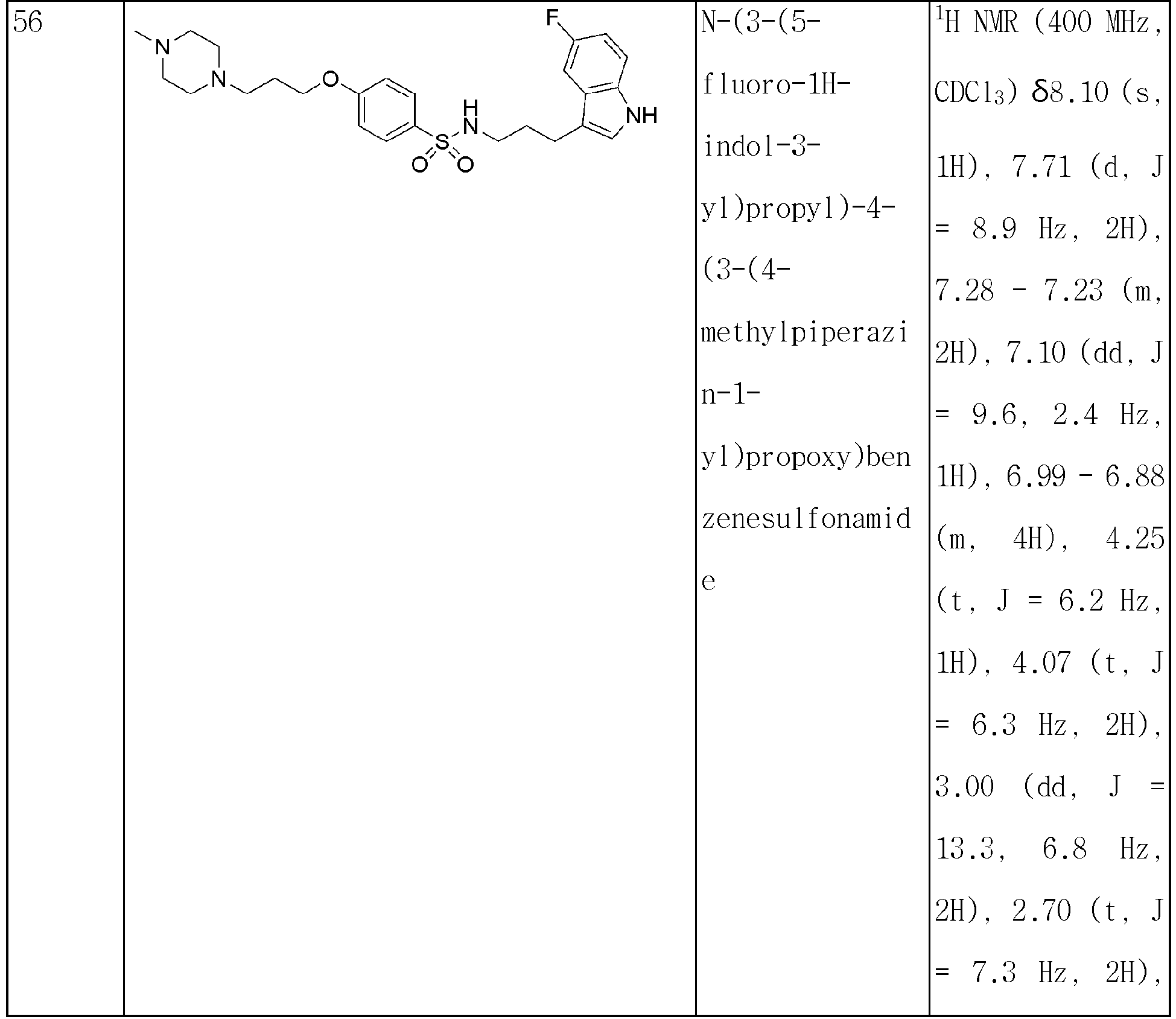


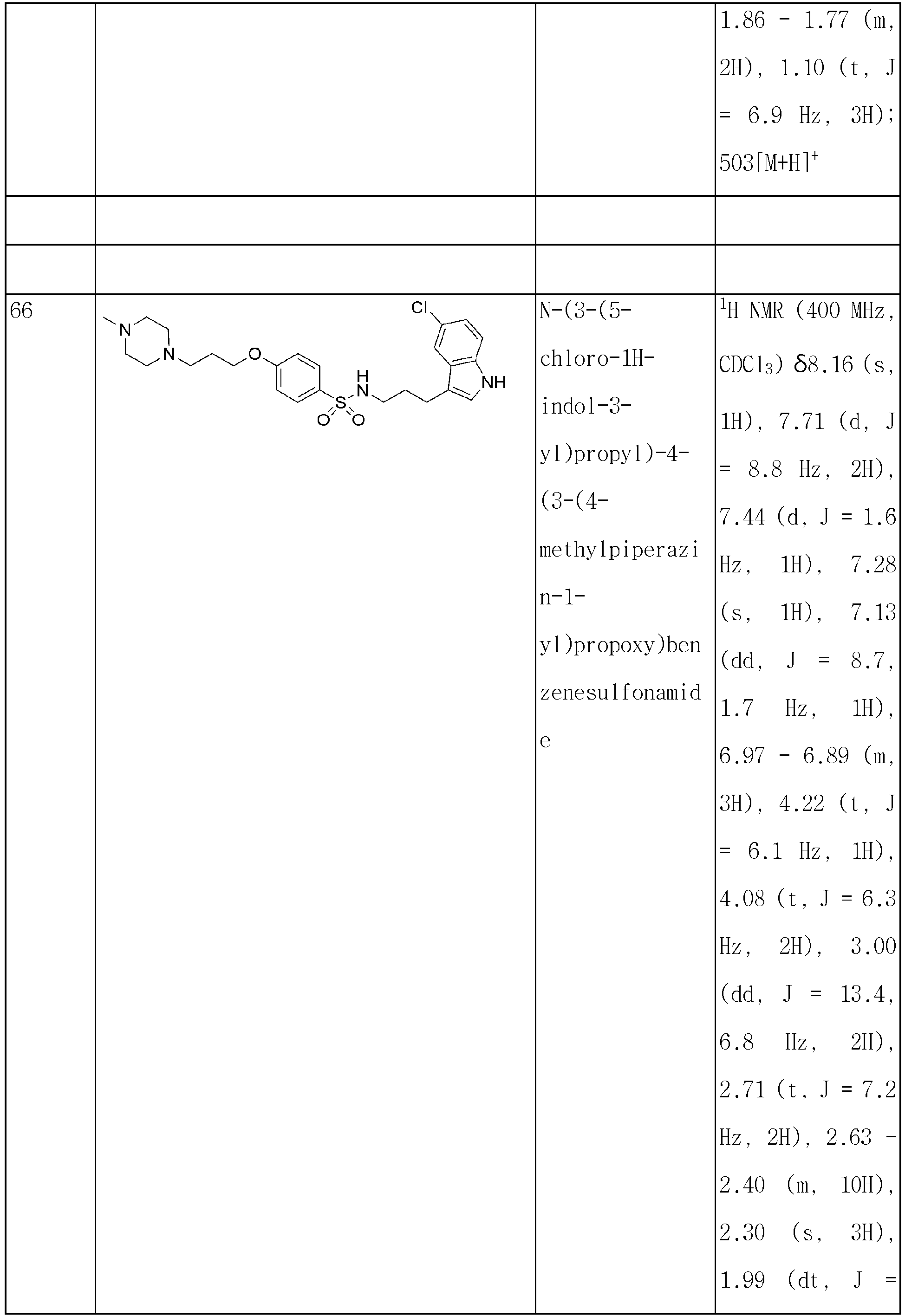


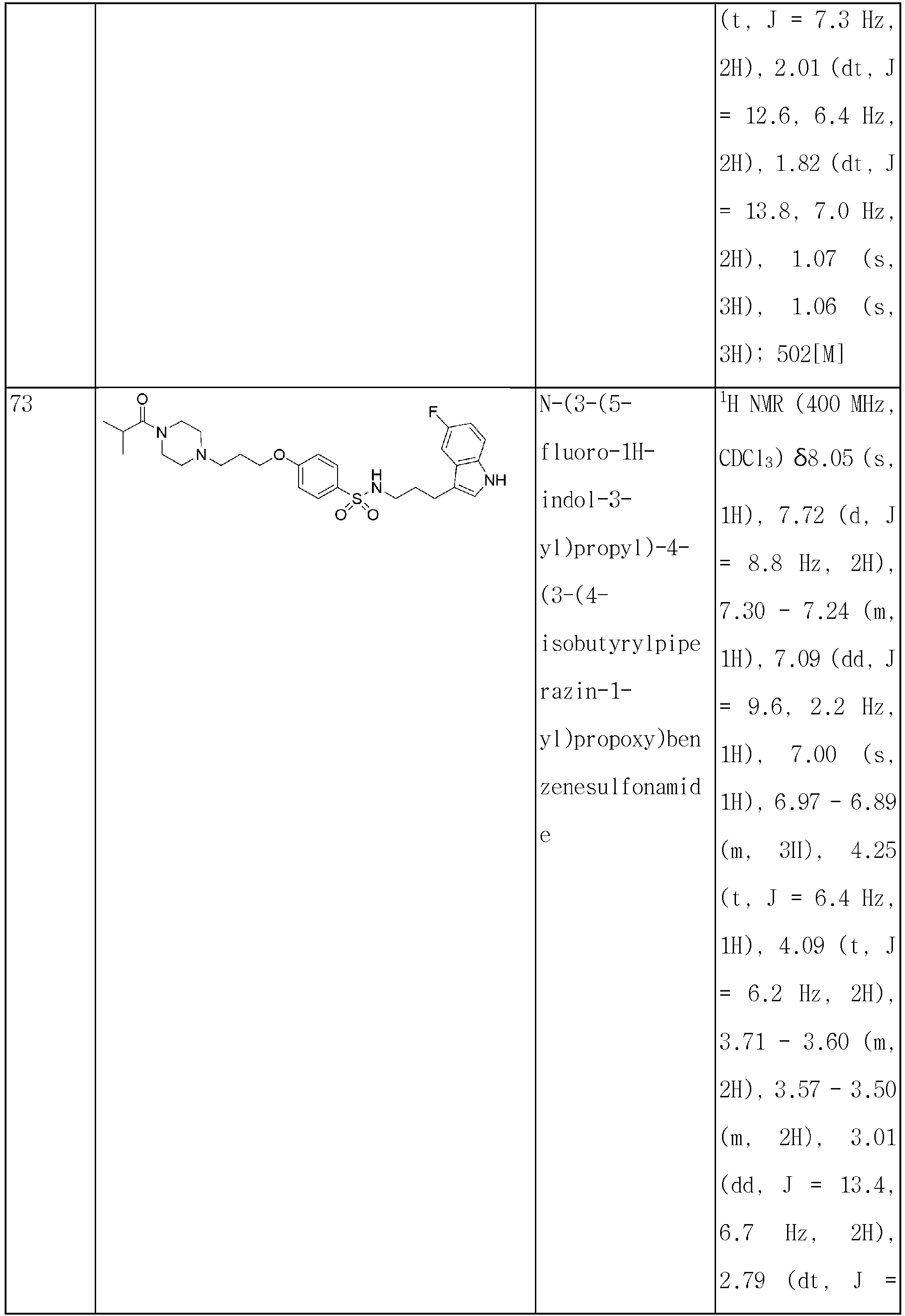


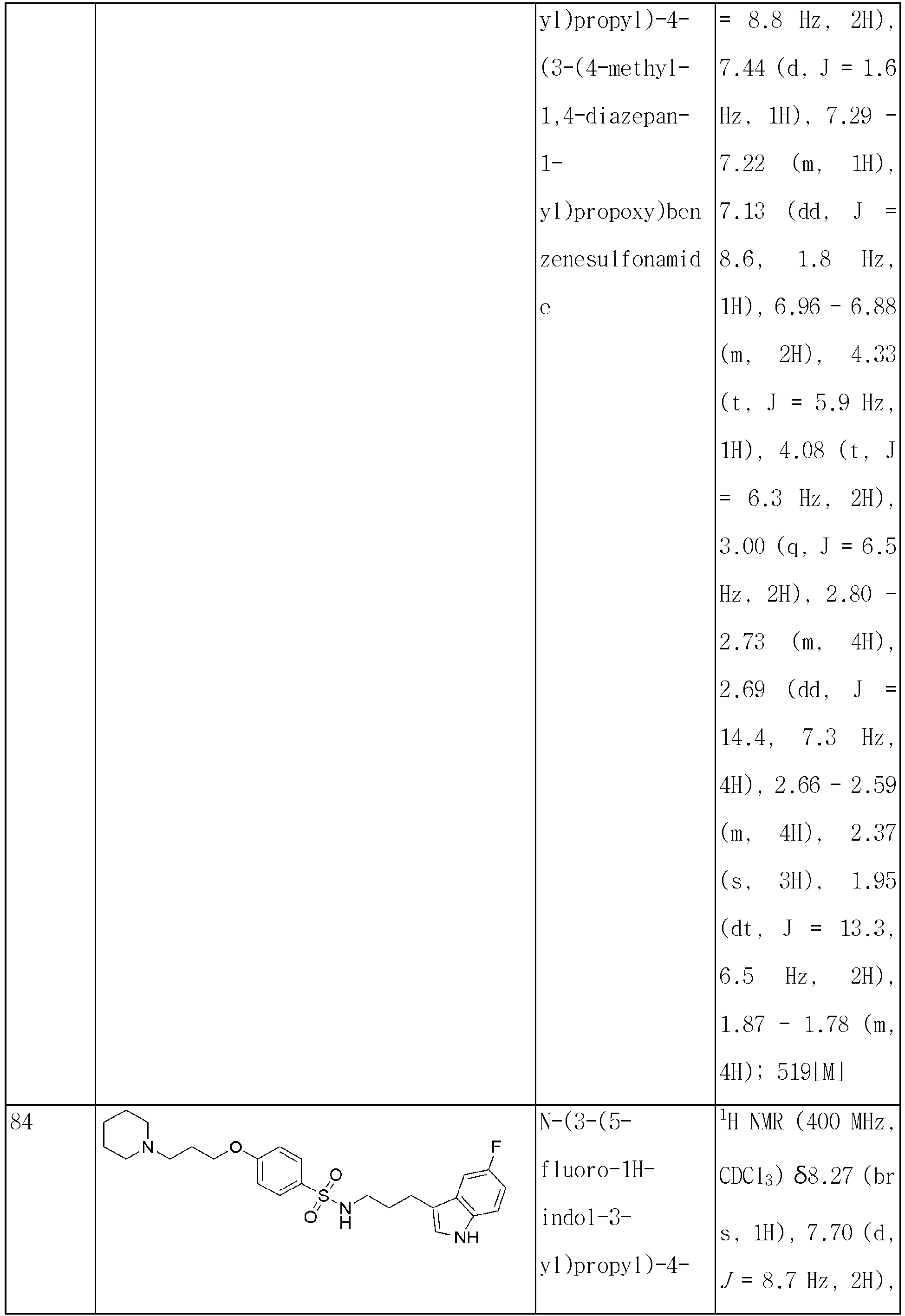


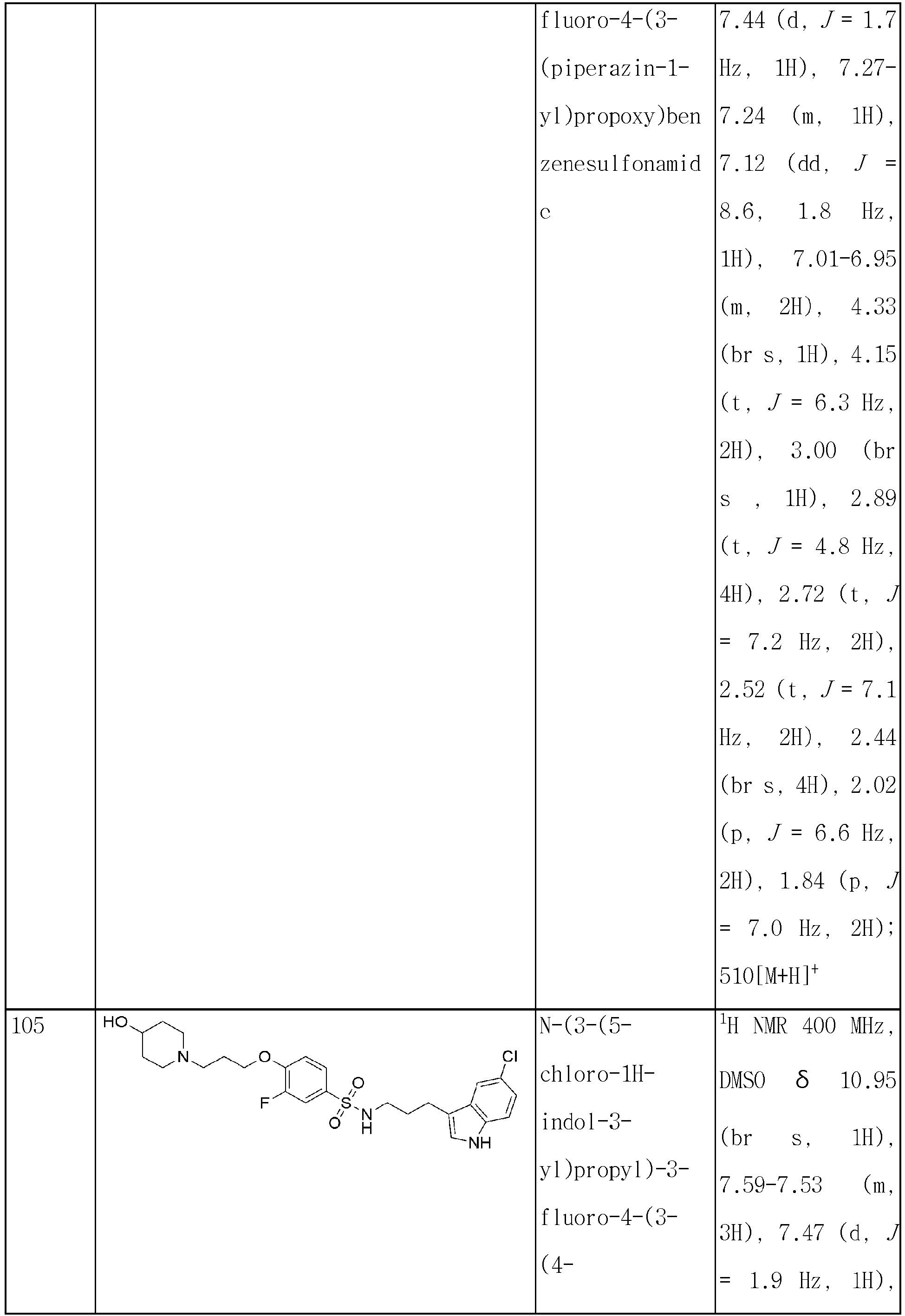


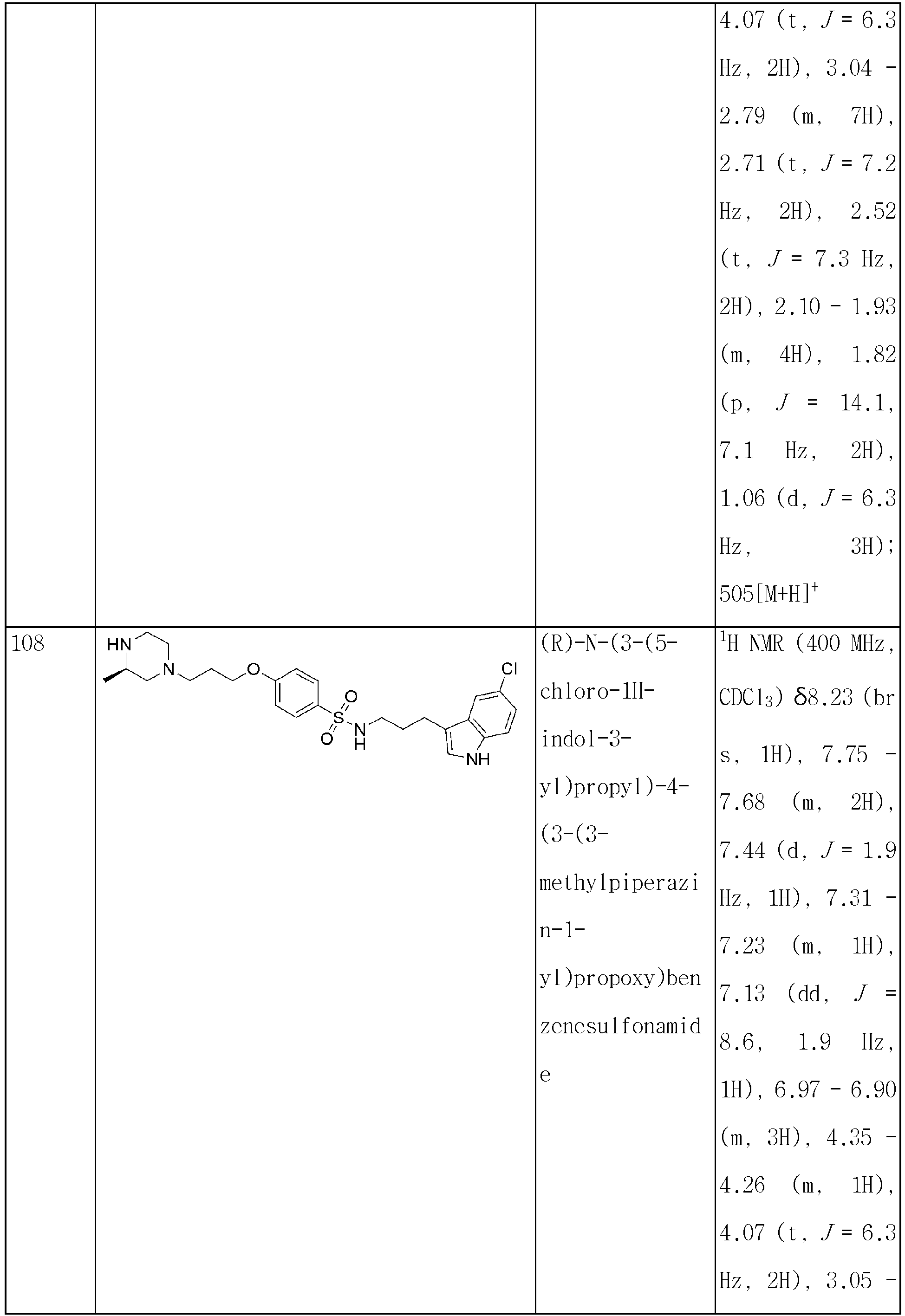


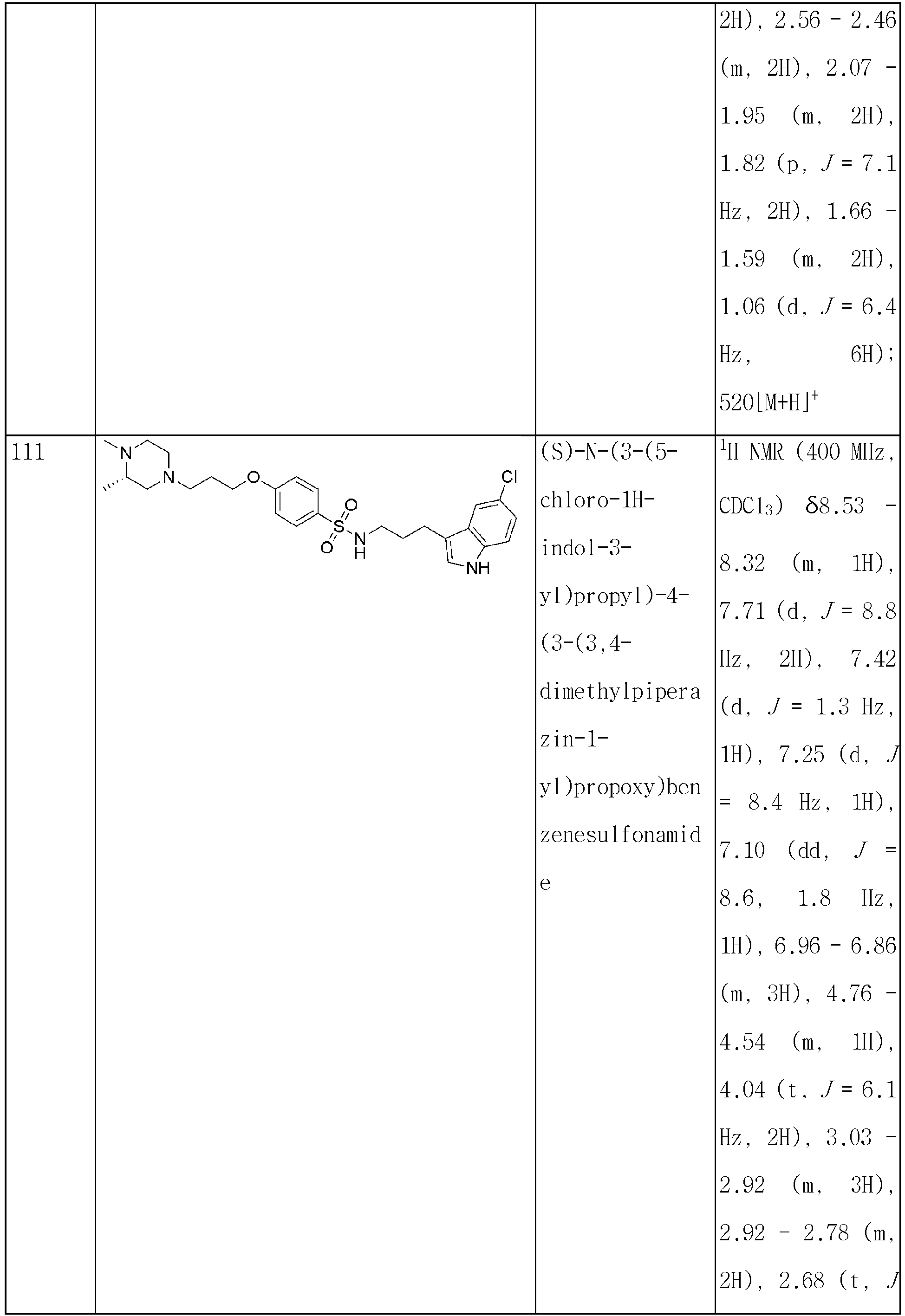


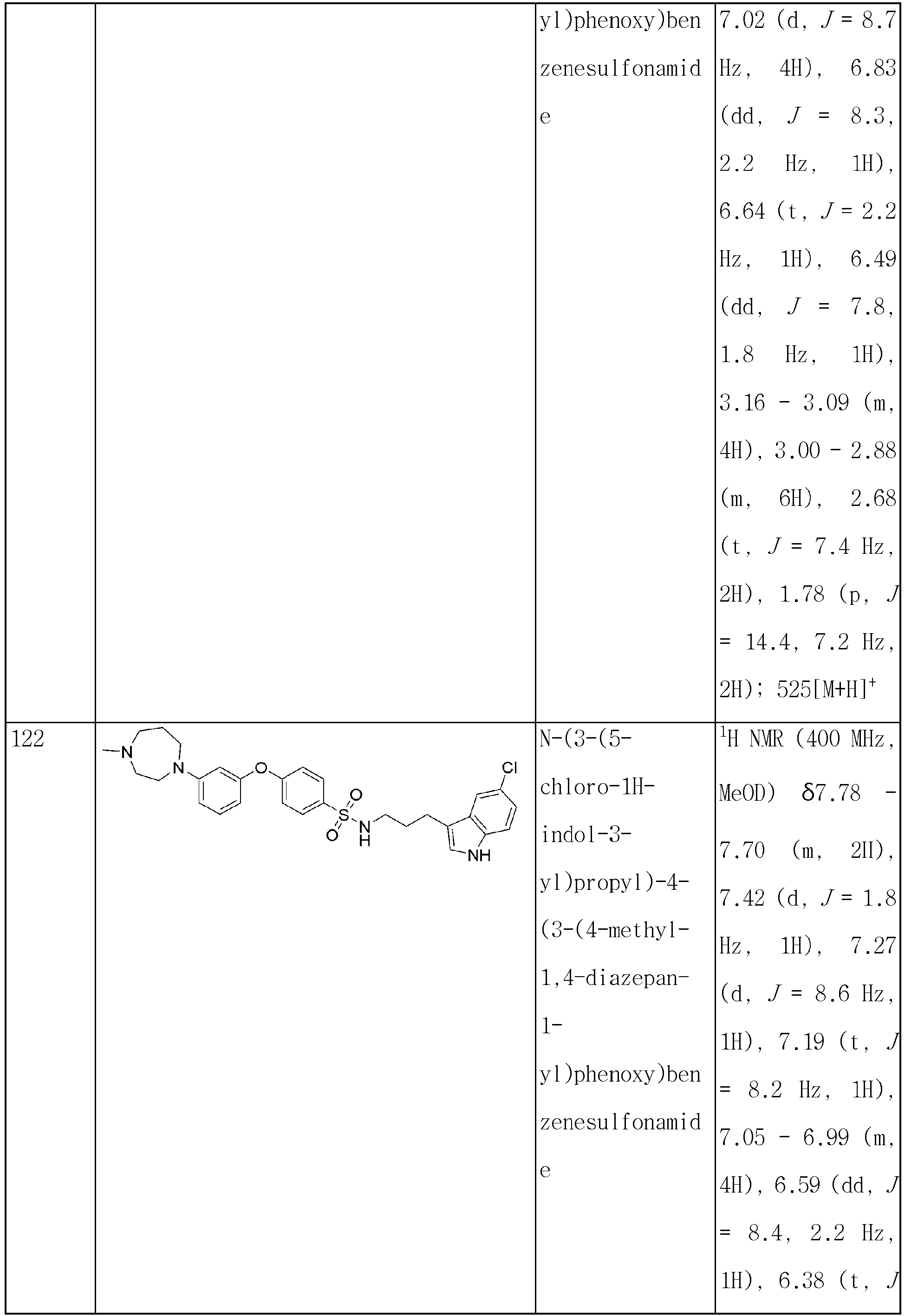


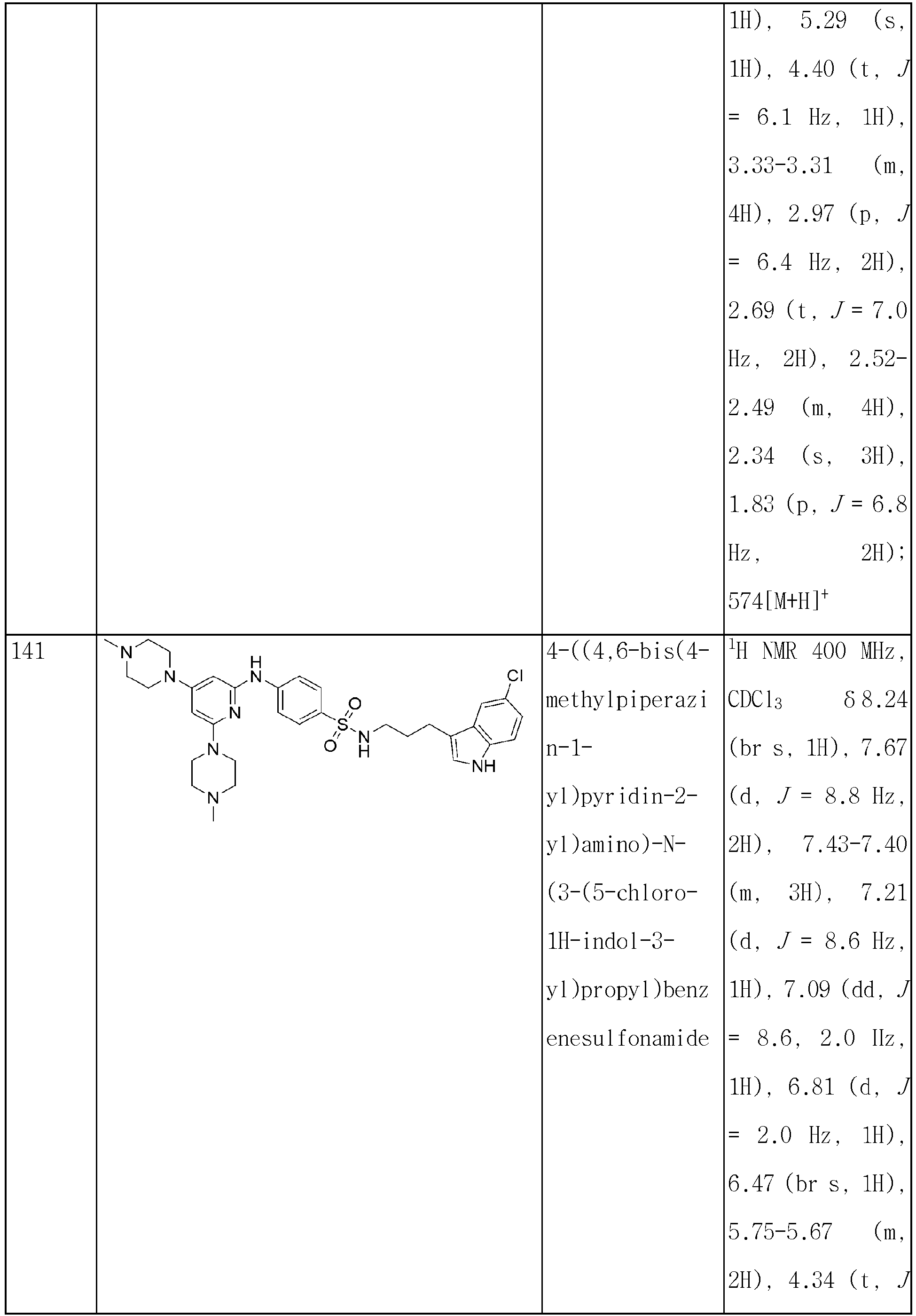


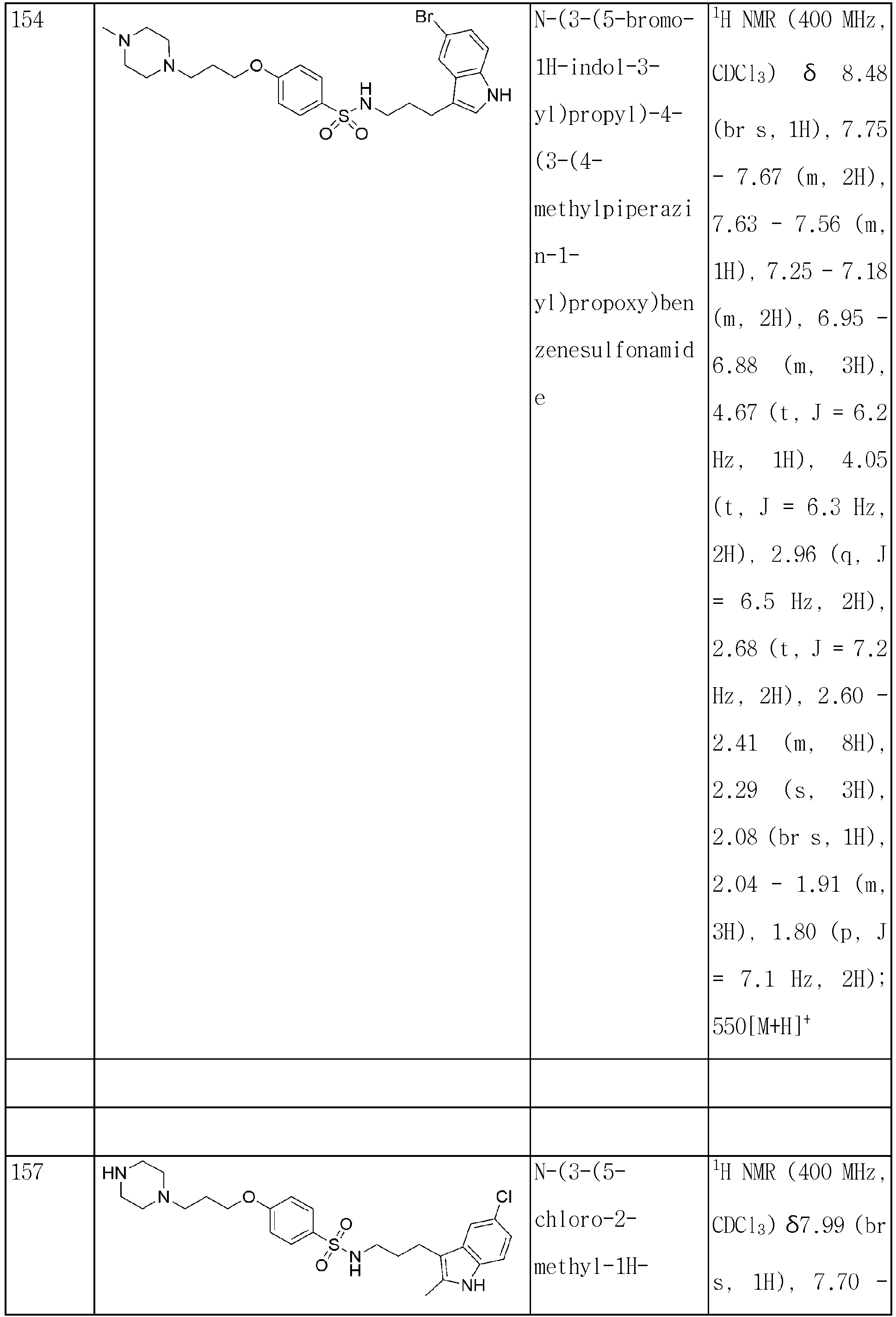


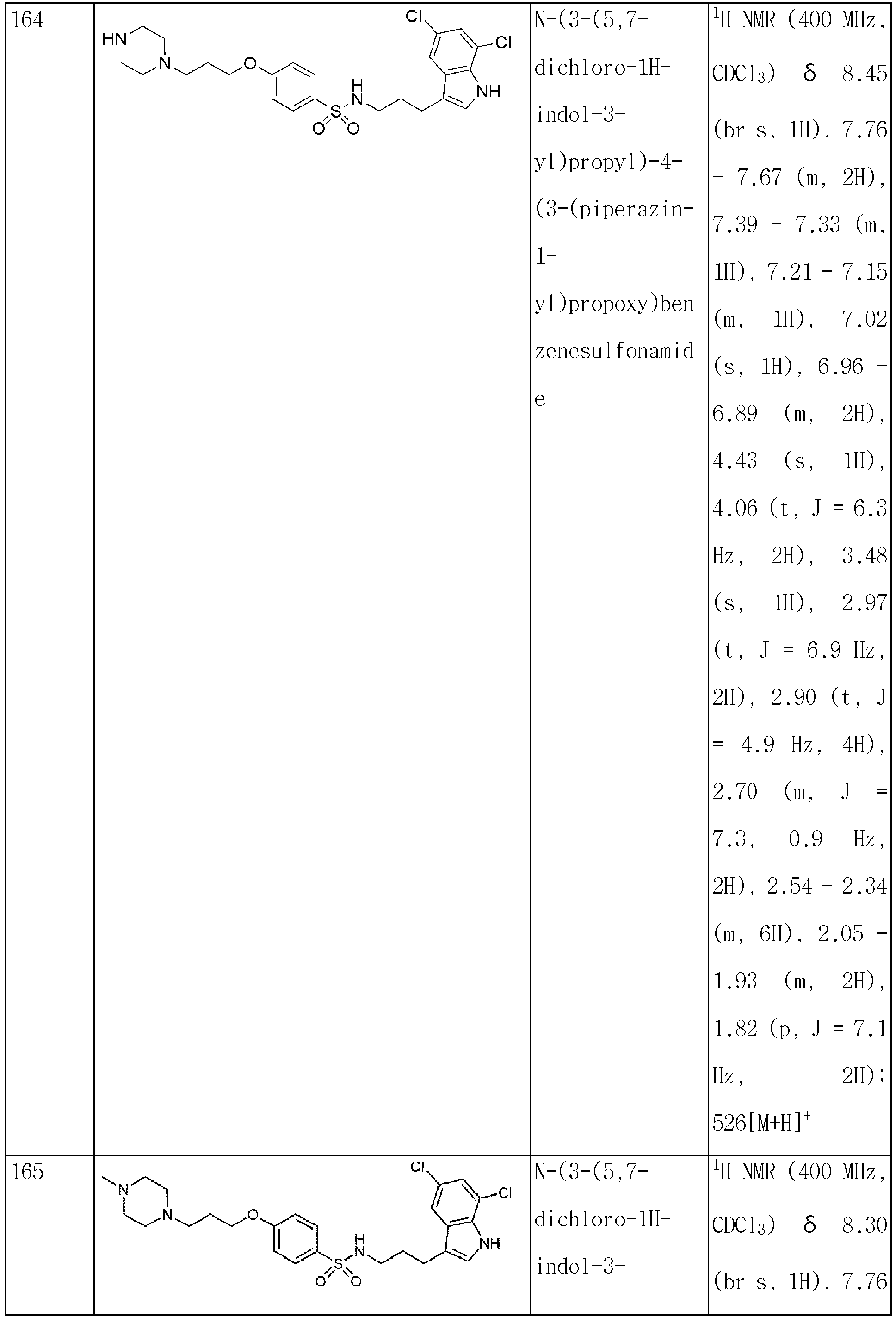


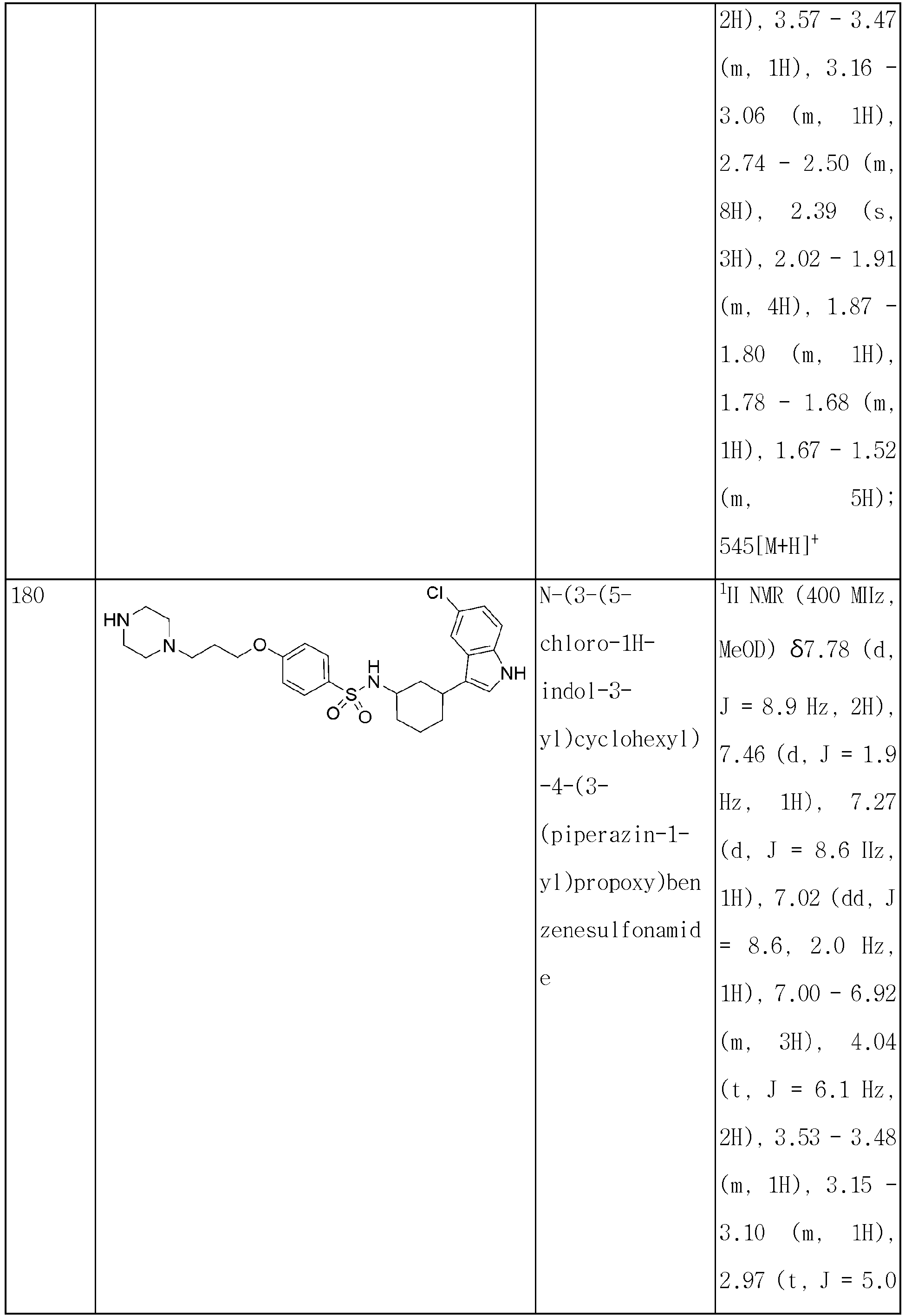


-
- Device name: Shimadzu LCMS-2020
- Column: ACE Excel2 C18, 75x2.1 mm
- Moving phase: acetonitrile/H2O + 0.1% TFA
- Flow rate: 0.5 mL/min
- UV detector: 254 nm
-
- Device name: CombiFlash®Rf+
- UV detector: 254 nm
-
- Device name: Gilson GX-281, 321 pump, UV/VIS-155
- Column: Luna® 10 vM C18 (2) 100 Å, 250x21.2 mm
- Moving phase: acetonitrile/0.1% TFA H2O
- Flow rate: 18 mL/min
- UV detector: 254 nm
- Device name: Bruker Avance (400 MHz)
- In order to evaluate the Pin1 enzyme inhibitory activity of the compound defined in claim 1 according to the present invention, the following experiment was performed, and the results are shown in Table 2 below.
- The enzyme activity of Pin1 protein was measured using a sensolyte Green Pin1 assay kit of Anaspec. The substrate was diluted in a buffer at a ratio of 1:100 to prepare a concentration of 1 µM, and the protein was diluted in a buffer at a ratio of 1:20 to prepare a concentration of 50 µg/ml. In addition, a developing solution was prepared by diluting thereof in a buffer at a ratio of 1:100.
- The compound prepared in each example was diluted with DMSO and prepared at a concentration of 100 µM, 10 µM, 1 µM or 0.1 µM using a buffer. After sequentially adding 10 µl of the compound prepared in each Example diluted to four concentrations according to the above method, 10 µl of Pin1 protein, and 30 µl of the developing solution to each well of a black 96-well plate, 50 µl of the substrate was finally added. Finally, 50 µl of the substrate was added to each well of the plate, and the enzyme reaction was carried out after shaking the plate for 10 seconds.
- Then, the plate was incubated for 2 hours at room temperature in an environment without light, and the fluorescence values at 490 nm/520 nm wavelength were measured using a device of Synergy Neo (Tecan). The results are shown in Table 2 below by dividing the grades of A to D for each concentration (µM) at which the Pin1 enzyme activity is inhibited.
[Table 2] Example Pin1 inhibition Example Pin1 inhibition Example Pin1 inhibition 128 B 66 A 129 B 130 A 131 B 132 B 70 A 133 A 71 C 134 A 72 C 135 B 73 C 136 B 74 B 137 A 75 A 138 A 76 B 139 B 77 A 140 A 78 B 141 A 79 A 142 B 80 B 81 B 82 B 145 A 83 A 146 A 84 B 147 A 148 A 86 A 149 A 87 A 150 A 88 A 151 A 152 A 90 A 153 A 91 A 154 A 92 A 155 B 93 A 94 B 157 B 95 B 158 A 96 B 159 A 97 B 160 A 98 A 161 A 99 A 162 B 100 A 163 B 101 A 164 A 102 A 165 A 103 A 166 A 104 A 167 A 105 A 168 A 106 A 169 A 107 A 170 A 108 A 171 A 109 A 172 A 110 B 173 A 111 B 174 A 112 A 175 A 113 A 176 A 114 A 177 A 115 A 178 A 116 A 179 B 117 A 180 B 118 A 181 B 119 B 182 B 56 A 120 B 183 A 121 A 184 A 122 B 185 A 59 B 123 A 186 A 60 B 124 A 187 A 61 A 125 A 188 A 126 B 189 A 63 B 127 A 190 A 128 B * A < 1 µM, 1 µM < B < 10 µM, 10 µM < C < 100 µM, 100 µM < D. - As shown in Table 2, it was confirmed that when the compound of Example 56, 61, 66, 70, 75, 77, 79, 83, 86, 87, 88, 90, 91, 92, 93, 98, 99, 100, 101, 102, 103, 104, 105, 106, 107, 108, 109, 112, 113, 114, 115, 116, 117, 118, 121, 123, 124, 125, 127, 130, 133, 134, 137, 138, 140, 141, 145, 146, 147, 148, 149, 150, 151, 152, 153, 154, 158, 159, 160, 161, 164, 165, 166, 167, 168, 169, 170, 171, 172, 173, 174, 175, 176, 177, 178, 183, 184, 185, 186, 187, 188, 189 or 190 was treated, Pin1 inhibitory activity was exhibited at the concentration of less than 1 µM.
- The above results indicate that the compounds of Examples of the present invention are excellent in inhibiting the Pin1 enzyme, and therefore, it can be seen that the benzenesulfonamide derivative compound according to the present invention can be effectively used as a pharmaceutical composition for preventing or treating cancer.
- In order to confirm the ability of the compound defined by claim 1 according to the present invention to inhibit the protein expression of MDA-MB 231 triple negative breast cancer cell line, the following experiment was performed, and the results are shown in Table 3 below.
- MDA-MB-231 cells were cultured in a 5% CO2 incubator at 37°C using RPMI medium supplemented with 10% FBS and 1% penicillin/streptomycin.
- The cells were washed with PBS once a day, and then replaced with a new medium. The cells grown at the density of at least 90% 1 day before the experiment were detached using trypsin/EDTA, and then plated at the density of 100,000 per well in a 6-well plate.
- On the next day of culture, the compound prepared in each example was treated at a concentration of 10 µM, and DMSO was treated at a concentration of 0.1% of the total as the control, followed by incubation for 72 hours. After 72 hours, the cells were washed twice with PBS, collected by scraping, and centrifuged at 13,000 rpm for 3 minutes to remove all the supernatant and only cells were taken.
- RIPA buffer (containing 1X protease inhibitor and phosphatase inhibitor) was added to the prepared cells (80 µl/well), and the plate was shaken once every 5 minutes to disrupt the cells for a total of 15 minutes. The disrupted cells were centrifuged at 13,000 rpm for 15 minutes to collect only the supernatant protein. The obtained protein was quantified using a BCA protein quantification kit (Pierece, MA, USA), and a total of 10 µg of the protein was used for Western blotting.
- The protein sample was isolated by 10% SDS-PAGE, and transferred to a PVDF membrane. Anti-human cycline D1 antibody (Cell signal) and anti-Vinculin antibody were bound to the protein sample, and the expression of the protein was measured by using an ECL reagent and LAS4000 equipment. The measurement results were quantified and generalized using Imaged. The results are shown in Table 3 below by dividing the grades A to D according to the amount of the protein compared to the DMSO-treated control group.
[Table 3] Example MBA-MB-231 Example MBA-MB-231 Example MBA-MB-231 66 A 92 A 70 A 93 A 75 A 98 A 77 A 99 A 78 A 103 B 79 A 104 D 80 B 105 D 81 A 106 C 56 B 82 D 118 C 83 A 121 A 86 D 123 D 59 B 88 C 90 B 61 A 91 A * 0 < A < 35%, 35% < B < 50%, 50% < C < 70%, 70% < D < 100%. - As shown in Table 3, when the compound of Example 61, 66, 70, 75, 77, 78, 79, 81, 83, 91, 92, 93, 98, 99 or 121 was treated, the expression level of MDA-MB 231 triple-negative breast cancer cell line protein was found to be less than 35% compared to the DMSO-treated control group.
- The above results indicate that the compounds of Examples of the present invention have excellent ability to inhibit the expression of MDA-MB 231 triple negative breast cancer cell line protein, and therefore, it can be seen that the benzenesulfonamide derivative compound according to the present invention can be effectively used as a pharmaceutical composition for preventing or treating cancer.
- In order to confirm the inhibitory effect of the compound defined in claim 1 according to the present invention on the growth of MCF7, MCF7-SP, A2780 or A2780-SP cells, the following experiment was performed, and the results are shown in Tables 4 and 5 below.
- MCF7 cells (breast cancer cells) were plated in a 96-well plate at the density of 3000 viable cells per well, and cultured in DMEM/High glucose medium supplemented with 10% FBS and 1% penicillin/streptomycin.
- On the next day of culture, the cells were treated with the compound of Example 71, 76, 80, 84, 92, 99, 100 or 119, followed by culture for 3 days. Cell viability was evaluated by Cell-titer Glo (Promega, WC, USA), and luciferase activity was detected using a Tecan plate reader (Biocompare, USA).
- On the other hand, MCF7-SP cells (breast cancer stem cells) were plated in an Ultra-Low Attachment round bottom 96-well plate (corning) at the density of 1,500 viable cells per well, and cultured in cancer stem cell medium. The cancer stem cell medium is composed of the neurobasal medium supplemented with 20 ng/ml of bFGF, 10 ng/ml of EGF, 2.5 ng/ml of amphotericin B, HEPES, Glutamax and B27.
- On the next day of culture, the cells were treated with the compound of Example 71, 76, 80, 84, 92, 99, 100 or 119, followed by culture for 8 days. The medium containing the compound was added thereto once again on the 4th day. Sphere cell viability was evaluated by Cell-titer Glo (Promega, WC, USA), and luciferase activity was detected using a Tecan plate reader (Biocompare, USA).
- In addition, A2780 cells (ovarian cancer cells) were plated in a 96-well plate at the density of 3000 viable cells per well, and cultured in RPMI-1640 medium supplemented with 10% FBS and 1% penicillin/streptomycin.
- On the next day of culture, the cells were treated with the compound of Examples 70 to 142, followed by culture for 3 days. Cell viability was evaluated by Cell-titer Glo (Promega, WC, USA), and luciferase activity was detected using a Tecan plate reader (Biocompare, USA).
- On the other hand, A2780-SP cells (ovarian cancer stem cells) were plated in an Ultra-Low Attachment round bottom 96-well plate (corning) at the density of 1,500 viable cells per well, and cultured in cancer stem cell medium. The cancer stem cell medium is composed of the neurobasal medium supplemented with 20 ng/ml of bFGF, 10 ng/ml of EGF, 2.5 ng/ml of amphotericin B, HEPES, Glutamax and B27.
- On the next day of culture, the cells were treated with the compound of Examples 70 to 142, followed by culture for 8 days. The medium containing the compound was added thereto once again on the 4th day. Sphere cell viability was evaluated by Cell-titer Glo (Promega, WC, USA), and luciferase activity was detected using a Tecan plate reader (Biocompare, USA).
[Table 4] Example MCF7 MCF7-SP 70 B B 75 B C 79 C C 83 B B 91 B B 98 C C 99 B B 118 B B * A < 1 µM, 1 µM < B < 10 µM, 10 µM < C. [Table 5] Examp le A2780 A2780-SP Exampl e A2780 A2780-SP Example A2780 A2780-SP 56 B A 114 - B 158 C A 59 B A 115 - A 159 C A 61 B A 117 - B 160 C C 66 B A 118 C A 161 C A 70 B A 121 B A 164 B A 75 B B 123 B B 165 B A 77 C B 124 B B 166 C B 79 C A 125 C B 167 B A 83 B A 127 C B 168 C A 88 C A 130 B B 169 B A 90 C A 133 C B 170 B A 91 C A 134 C A 171 C A 92 C A 137 C B 172 C A 93 B A 138 C B 173 B A 95 C B 140 - B 174 C A 98 B B 141 - B 175 B A 99 B A 176 B A 100 B A 145 C C 177 B A 103 C A 146 C B 178 B A 104 C A 147 C C 183 C A 105 C A 148 C B 184 C A 106 B A 149 C C 185 C C 108 B A 150 C A 186 C A 109 B A 151 C A 187 C A 110 C A 152 C A 188 C A 111 C A 153 B A 189 C A 112 C A 154 B A 190 C A 113 B 157 C A * A < 1 µM, 1 µM < B < 10 µM, 10 µM < C, -: not tested. - As shown in Table 4, the MCF7 cell concentration was less than 10 µM when the compound of Example 70, 75, 83, 91, 99 or 118 was treated, and the MCF7-SP cell concentration was less than 10 µM when the compound of Example 70, 83, 91, 99 or 118 was treated.
- As shown in Table 5, the A2780 cell concentration was less than 10 µM when the compound of Example 56, 59, 61, 66, 70, 75, 83, 93, 98, 99, 100, 106, 108, 109, 121, 123, 124, 130, 153, 154, 164, 165, 167, 169, 170, 173, 175, 176, 177 or 178 was treated, and the concentration was less than 1 µM when the compound of Example 56, 59, 61, 66, 70, 79, 83, 88, 90, 91, 92, 93, 99, 100, 103, 104, 105, 106, 108, 109, 110, 111, 112, 115, 118, 121, 134, 150, 151, 152, 153, 154, 157, 158, 159, 161, 164, 165, 167, 168, 169, 170, 171, 172, 173, 174, 175, 176, 177, 178, 183, 184, 186, 187, 188, 189 or 190 was treated.
- The above results indicate that the compounds of Examples of the present invention have excellent inhibitory effect on the growth of MCF7, MCF7-SP, A2780 or A2780-SP cells, and therefore, it can be seen that the benzenesulfonamide derivative compound according to the present invention can be effectively used as a pharmaceutical composition for preventing or treating cancer.
Claims (7)
- A compound, the stereoisomer thereof or the pharmaceutically acceptable salt thereof, wherein the compound is selected from the group consisting of the following compounds:<56> N-(3-(5-fluoro-1H-indol-3-yl)propyl)-4-(3-(4-methylpiperazin-1- yl)propoxy)benzenesulfonamide;<59> N-(3-(5-fluoro-1H-indol-3-yl)propyl)-4-(3-(1-methylpiperidin-4-yl)propoxy)benzenesulfonamide;<61 > N-(3-(5-fluoro-1H-indol-3-yl)propyl)-4-(3-(piperazin-1-yl)propoxy)benzenesulfonamide;<63> 4-(3-(4-ethylpiperazin-1-yl)propoxy)-N-(3-(5-fluoro-1H-indol-3-yl)propyl)benzenesulfonamide;<66> N-(3-(5-chloro-1H-indol-3-yl)propyl)-4-(3-(4-methylpiperazin-1-yl)propoxy)benzenesulfonamide;<70> N-(3-(5-chloro-1H-indol-3-yl)propyl)-4-(3-(piperazin-1-yl)propoxy)benzenesulfonamide;<71> 5-fluoro-3-(1-((4-(3-(4-methylpiperazin-1-yl)propoxy)phenyl)sulfonyl)piperidin-4-yl)-1H-indole;<72> 4-(3-((3S,5R)-3,5-dimethylpiperazin-1-yl)propoxy)-N-(3-(5-fluoro-1H-indol-3-yl)propyl)benzenesulfonamide;<73> N-(3-(5-fluoro-1H-indol-3-yl)propyl)-4-(3-(4-isobutyrylpiperazin-1-yl)propoxy)benzenesulfonamide;<74> N-(3-(5-fluoro-1H-indol-3-yl)propyl)-4-(3-(4-(2,2,2-trifluoroethyl)piperazin-1-yl)propoxy)benzenesulfonamide;<75> N-(3-(5-chloro-1H-indol-3-yl)propyl)-4-(3-(4-hydroxypiperidin-1-yl)propoxy)benzenesulfonamide;<76> N-(3-(5-chloro-1H-indol-3-yl)propyl)-4-(3-(4-(2,2,2-trifluoroethyl)piperazin-1-yl)propoxy)benzenesulfonam ide;<77> N-(3-(5-chloro-1H-indol-3-yl)propyl)-4-(3-(3-(methylamino)azetidin-1-yl)propoxy)benzenesulfonamide;<78> N-(3-(5-chloro-1H-indol-3-yl)propyl)-4-(3-(4-chloropiperidin-1-yl)propoxy)benzenesulfonamide;<79> N-(3-(5-chloro-1H-indol-3-yl)propyl)-6-(3-(piperazin-1-yl)propoxy)pyridin-3-sulfonamide;<80> N-(3-(5-chloro-1H-indol-3-yl)propyl)-4-(3-(4-fluoropiperidin-1-yl)propoxy)benzenesulfonamide;<81 > N-(3-(5-chloro-1H-indol-3-yl)propyl)-4-(3-(4-(trifluoromethyl)piperidin-1-yl)propoxy)benzenesulfonamide;<82> N-(3-(5-chloro-1H-indol-3-yl)propyl)-4-(3-(4,4-difluoropiperidin-1-yl)propoxy)benzenesulfonamide;<83> N-(3-(5-chloro-1H-indol-3-yl)propyl)-4-(3-(4-methyl-1,4-diazepan-1-yl)propoxy)benzenesulfonamide;<84> N-(3-(5-fluoro-1H-indol-3-yl)propyl)-4-(3-(piperidin-1-yl)propoxy)benzenesulfonamide;<86> N-(3-(5-chloro-1H-indol-3-yl)propyl)-4-(3-(4-methylpiperazin-1- yl)propoxy)naphthalene-1-sulfonamide;<87> N-(3-(5-chloro-1H-indol-3-yl)propyl)-4-(3-(piperidin-1-yl)propoxy)benzenesulfonamide;<88> N-(3-(5-chloro-1H-indol-3-yl)propyl)-4-((3-(piperidin-4-yl)propyl)amino)benzenesulfonamide;<90> N-(3-(5-chloro-1H-indol-3-yl)propyl)-4-(4-(piperidin-1-yl)butyl)benzenesulfonamide;<91 > N-(3-(5-chloro-1H-indol-3-yl)propyl)-4-(4-(piperazin-1-yl)butyl)benzenesulfonamide;<92> N-(3-(5-chloro-1H-indol-3-yl)propyl)-4-(3-(1-methylpiperidin-4-yl)propoxy)benzenesulfonamide;<93> N-(3-(5-chloro-1H-indol-3-yl)propyl)-4-(3-(piperidin-4-yl)propoxy)benzenesulfonamide;<94> N-(3-(5-chloro-1H-indol-3-yl)propyl)-3-(3-(piperidin-4-yl)propoxy)benzenesulfonamide;<95> N-(3-(5-chloro-1H-indol-3-yl)propyl)-3-(3-(piperidin-1-yl)propoxy)benzenesulfonamide;<96> N-(3-(5-chloro-1H-indol-3-yl)propyl)-3-(3-(piperazin-1-yl)propoxy)benzenesulfonamide;<97> N-(3-(5-fluoro-1H-indol-3-yl)propyl)-4-(3-(piperidin-4-yl)propoxy)benzenesulfonamide;<98> N-(3-(5-chloro-1H-indol-3-yl)propyl)-4-((3-(4-methylpiperazin-1- yl)propyl)amino)benzenesulfonamide;<99> N-(3-(5-chloro-1H-indol-3-yl)propyl)-4-(4-(piperidin-4-yl)butyl)benzenesulfonamide;<100> N-(3-(5-chloro-1H-indol-3-yl)propyl)-4-(3-(pyrrolidin-1-yl)propoxy)benzenesulfonamide;<101> 4-(3-(azepan-1-yl)propoxy)-N-(3-(5-chloro-1H-indol-3-yl)propyl)benzenesulfonamide;<102> 4-(3-(1,4-diazepan-1-yl)propoxy)-N-(3-(5-chloro-1H-indol-3-yl)propyl)benzenesulfonamide;<103> N-(3-(5-chloro-1H-indol-3-yl)propyl)-3-fluoro-4-(3-(4-methylpiperazin-1-yl)propoxy)benzenesulfonamide;<104> N-(3-(5-chloro-1H-indol-3-yl)propyl)-3-fluoro-4-(3-(piperazin-1-yl)propoxy)benzenesulfonamide;<105> N-(3-(5-chloro-1H-indol-3-yl)propyl)-3-fluoro-4-(3-(4-hydroxypiperidin-1-yl)propoxy)benzenesulfonamide;<106> 4-(3-(1,4-diazepan-1-yl)propoxy)-N-(3-(5-chloro-1H-indol-3-yl)propyl)-3-fluorobenzenesulfonamide;<107> N-(3-(5-chloro-1H-indol-3-yl)propyl)-4-(3-(3-methylpiperazin-1-yl)propoxy)benzenesulfonamide;<108> (R)-N-(3-(5-chloro-1H-indol-3-yl)propyl)-4-(3-(3-methylpiperazin-1-yl)propoxy)benzenesulfonamide;<109> (S)-N-(3-(5-chloro-1H-indol-3-yl)propyl)-4-(3-(3-methylpiperazin-1-yl)propoxy)benzenesulfonamide;<110> N-(3-(5-chloro-1H-indol-3-yl)propyl)-4-(3-((3S,5R)-3,5-dimethylpiperazin-1-yl)propoxy)benzenesulfonam ide;<111> (S)-N-(3-(5-chloro-1H-indol-3-yl)propyl)-4-(3-(3,4-dimethylpiperazin-1-yl)propoxy)benzenesulfonamide;<112> N-(3-(5-chloro-1H-indol-3-yl)propyl)-4-(4-(4-methylpiperazin-1-yl)butyl)benzenesulfonamide;<113> N-(3-(5-chloro-1H-indol-3-yl)propyl)-4-((3-(piperazin-1-yl)propyl)amino)benzenesulfonamide;<114> N-(3-(5-chloro-1H-indol-3-yl)propyl)-4-((3-(piperidin-1-yl)propyl)amino)benzenesulfonamide;<115> N-(3-(5-chloro-1H-indol-3-yl)propyl)-4-(4-(1-methylpiperidin-4-yl)butyl)benzenesulfonamide;<116> N-(3-(5-chloro-1H-indol-3-yl)propyl)-4-((1-((4-methylpiperazin-1-yl)methyl)cyclopropyl)methoxy)benzenesulfonamide;<117> N-(3-(5-chloro-1H-indol-3-yl)propyl)-4-((1-(piperazin-1-ylmethyl)cyclopropyl)methoxy)benzenesulfonamide;<118> N-(3-(5-chloro-1H-indol-3-yl)propyl)-4-(3-(4-methylpiperazin-1-yl)phenoxy)benzenesulfonamide;<119> 4-(3-bromophenoxy)-N-(3-(5-chloro-1H-indol-3-yl)propyl)benzenesulfonamide;<120> N-(3-(5-chloro-1H-indol-3-yl)propyl)-4-(3-(piperidin-1-yl)phenoxy)benzenesulfonamide;<121> N-(3-(5-chloro-1H-indol-3-yl)propyl)-4-(3-(piperazin-1-yl)phenoxy)benzenesulfonamide;<122> N-(3-(5-chloro-1H-indol-3-yl)propyl)-4-(3-(4-methyl-1,4-diazepan-1-yl)phenoxy)benzenesulfonamide;<123> N-(3-(5-chloro-1H-indol-3-yl)propyl)-4-((3-(4-methylpiperazin-1- yl)phenyl)amino)benzenesulfonamide;<124> N-(3-(5-chloro-1H-indol-3-yl)propyl)-4-((3-(piperazin-1-yl)phenyl)amino)benzenesulfonamide;<125> N-(3-(5-chloro-1H-indol-3-yl)propyl)-4-((4-(4-methylpiperazin-1-yl)pyrimidin-2-yl)amino)benzenesulfonamide;<126> N-(3-(5-chloro-1H-indol-3-yl)propyl)-4-((3-morpholinophenyl)amino)benzenesulfonamide;<127> N-(3-(5-chloro-1H-indol-3-yl)propyl)-4-((4-(piperazin-1-yl)pyrimidin-2-yl)amino)benzenesulfonamide;<128> N-(3-(5-chloro-1H-indol-3-yl)propyl)-4-(3-morpholinophenoxy)benzenesulfonamide;<129> 4-(3-(1,4-diazepan-1-yl)phenoxy)-N-(3-(5-chloro-1H-indol-3-yl)propyl)benzenesulfonamide;<130> 4-(3,5-bis(4-methylpiperazin-1-yl)phenoxy)-N-(3-(5-chloro-1H-indol-3-yl)propyl)benzenesulfonamide;<131> N-(3-(5-chloro-1H-indol-3-yl)propyl)-4-((6-(4-methylpiperazin-1-yl)pyridin-2-yl)amino)benzenesulfonamide;<132> N-(3-(5-chloro-1H-indol-3-yl)propyl)-4-((6-(piperazin-1-yl)pyridin-2-yl)amino)benzenesulfonamide;<133> N-(3-(5-chloro-1H-indol-3-yl)propyl)-4-((4-(4-methylpiperazin-1-yl)pyridin-2-yl)amino)benzenesulfonamide;<134> N-(3-(5-chloro-1H-indol-3-yl)propyl)-4-((4-(piperazin-1-yl)pyridin-2-yl)amino)benzenesulfonamide;<135> N-(3-(5-chloro-1H-indol-3-yl)propyl)-4-(3-(pyrrolidin-1-yl)phenoxy)benzenesulfonamide;<136> N-(3-(5-chloro-1H-indol-3-yl)propyl)-4-(3-(4-hydroxypiperidin-1-yl)phenoxy)benzenesulfonamide;<137> N-(3-(5-chloro-1H-indol-3-yl)propyl)-4-(3-fluoro-5-(4-methylpiperazin-1-yl)phenoxy)benzenesulfonamide;<138> 4-(3-bromo-5-(4-methylpiperazin-1-yl)phenoxy)-N-(3-(5-chloro-1H-indol-3-yl)propyl)benzenesulfonamide;<139> N-(3-(5-chloro-1H-indol-3-yl)propyl)-4-((3-(4-hydroxypiperidin-1-yl)phenyl)amino)benzenesulfonamide;<140> N-(3-(5-chloro-1H-indol-3-yl)propyl)-4-((6-chloro-4-(4-methylpiperazin-1-yl)pyridin-2-yl)amino)benzenesulfonamide;<141> 4-((4,6-bis(4-methylpiperazin-1-yl)pyridin-2-yl)amino)-N-(3-(5-chloro-1H-indol-3-yl)propyl)benzenesulfonamide;<142> N-(3-(5-chloro-1H-indol-3-yl)propyl)-4-((4-(4-methylpiperazin-1-yl)phenyl)amino)benzenesulfonamide;<145> N-(3-(5-chloro-1H-indol-3-yl)propyl)-4-(3-(methylsulfonyl)propoxy)benzenesulfonamide;<146> N-(3-(5-chloro-1H-indol-3-yl)propyl)-2-((3-(piperazin-1-yl)propyl)amino)thiazole-5-sulfonamide;<147> N-(3-(5-chloro-2-methyl-1H-indol-3-yl)propyl)-4-(3-(4-methylpiperazin-1-yl)propoxy)benzenesulfonamide;<148> 4-(4-(1H-imidazol-1-yl)butyl)-N-(3-(5-chloro-1H-indol-3-yl)propyl)benzenesulfonamide;<149> N-(2-((5-chloro-1H-indol-3-yl)methyl)phenyl)-4-(3-(4-methylpiperazin-1- yl)propoxy)benzenesulfonamide;<150> N-(2-((5-chloro-1H-indol-3-yl)methyl)phenyl)-4-(3-(piperazin-1-yl)propoxy)benzenesulfonamide;<151 > N-(4-(5-chloro-1H-indol-3-yl)butan-2-yl)-4-(3-(4-methylpiperazin-1-yl)propoxy)benzenesulfonamide;<152> N-(4-(5-chloro-1H-indol-3-yl)butan-2-yl)-4-(3-(piperazin-1-yl)propoxy)benzenesulfonamide;<153> N-(3-(5-bromo-1H-indol-3-yl)propyl)-4-(3-(piperazin-1-yl)propoxy)benzenesulfonamide;<154> N-(3-(5-bromo-1H-indol-3-yl)propyl)-4-(3-(4-methylpiperazin-1-yl)propoxy)benzenesulfonamide;<157> N-(3-(5-chloro-2-methyl-1H-indol-3-yl)propyl)-4-(3-(piperazin-1-yl)propoxy)benzenesulfonamide;<158> N-(2-(5-chloro-1H-indol-3-yl)ethyl)-4-(3-(4-methylpiperazin-1-yl)propoxy)benzenesulfonamide;<159> N-(2-(5-chloro-1H-indol-3-yl)ethyl)-4-(3-(piperazin-1-yl)propoxy)benzenesulfonamide;<160> 4-(3-(1H-1,2,4-triazol-1-yl)propoxy)-N-(3-(5-chloro-1H-indol-3-yl)propyl)benzenesulfonamide;<161> N-(3-(5-chloro-1H-indol-3-yl)propyl)-4-(3-(2-methyl-1H-imidazol-1-yl)propoxy)benzenesulfonamide;<162> N-(3-(5-chloro-1H-indol-3-yl)propyl)-4-(3-(4-methyl-3-oxopiperazin-1-yl)propoxy)benzenesulfonamide;<163> N-(3-(5-chloro-1H-indol-3-yl)propyl)-4-(3-(3-oxopiperazin-1-yl)propoxy)benzenesulfonamide;<164> N-(3-(5,7-dichloro-1H-indol-3-yl)propyl)-4-(3-(piperazin-1-yl)propoxy)benzenesulfonamide;<165> N-(3-(5,7-dichloro-1H-indol-3-yl)propyl)-4-(3-(4-methylpiperazin-1-yl)propoxy)benzenesulfonamide;<166> N-(3-(5-chloro-1H-indol-3-yl)propyl)-4-(3-(4,5-dichloro-1H-imidazol-1-yl)propoxy)benzenesulfonamide;<167> N-(3-(5-chloro-1H-indazol-3-yl)propyl)-4-(3-(4-methylpiperazin-1-yl)propoxy)benzenesulfonamide;<168> N-(3-(5-chloro-1H-indazol-3-yl)propyl)-4-(3-(piperazin-1-yl)propoxy)benzenesulfonamide;<169> N-(3-(5-chloro-1H-pyrrolo[2,3-b]pyridin-3-yl)propyl)-4-(3-(4-methylpiperazin-1-yl)propoxy)benzenesulfonamide;<170> N-(3-(5-chloro-1H-pyrrolo[2,3-b]pyridin-3-yl)propyl)-4-(3-(piperazin-1-yl)propoxy)benzenesulfonamide;<171> (R)-N-(3-(5-chloro-1H-indol-3-yl)propyl)-4-(2-hydroxy-3-(4-methylpiperazin-1-yl)propoxy)benzenesulfonamide;<172> (R)-N-(3-(5-chloro-1H-indol-3-yl)propyl)-4-(2-hydroxy-3-(piperazin-1-yl)propoxy)benzenesulfonamide;<173> (S)-N-(3-(5-chloro-1H-indol-3-yl)propyl)-4-(2-hydroxy-3-(4-methylpiperazin-1-yl)propoxy)benzenesulfonamide;<174> (S)-N-(3-(5-chloro-1H-indol-3-yl)propyl)-4-(2-hydroxy-3-(piperazin-1-yl)propoxy)benzenesulfonamide;<175> N-(3-(5-chloro-1H-indol-3-yl)propyl)-4-(3-(4,5-dimethyl-1H-imidazol-1-yl)propoxy)benzenesulfonamide;<176> N-(3-(5-chloro-1H-indol-3-yl)propyl)-4-(3-(2,4,5-trimethyl-1H-imidazol-1-yl)propoxy)benzenesulfonamide;<177> N-((6-chloro-2,3,4,9-tetrahydro-1H-carbazol-3-yl)methyl)-4-(3-(4-methylpiperazin-1-yl)propoxy)benzenesulfonamide;<178> N-((6-chloro-2,3,4,9-tetrahydro-1H-carbazol-3-yl)methyl)-4-(3-(piperazin-1-yl)propoxy)benzenesulfonamide;<179> N-(3-(5-chloro-1H-indol-3-yl)cyclohexyl)-4-(3-(4-methylpiperazin-1-yl)propoxy)benzenesulfonamide;<180> N-(3-(5-chloro-1H-indol-3-yl)cyclohexyl)-4-(3-(piperazin-1-yl)propoxy)benzenesulfonamide;<181> N-(2-(2-(5-chloro-1H-indol-3-yl)propan-2-yl)phenyl)-4-(3-(4-methylpiperazin-1-yl)propoxy)benzenesulfonamide;<182> N-(2-(2-(5-chloro-1H-indol-3-yl)propan-2-yl)phenyl)-4-(3-(piperazin-1-yl)propoxy)benzenesulfonamide;<183> N-(3-(5,6-dichloro-1H-indol-3-yl)propyl)-4-(3-(piperazin-1-yl)propoxy)benzenesulfonamide;<184> N-(3-(5,6-dichloro-1H-indol-3-yl)propyl)-4-(3-(4-methylpiperazin-1-yl)propoxy)benzenesulfonamide;<185> N-(3-(5-chloro-1H-indol-3-yl)propyl)-4-(3-(pyridin-4-yloxy)propyl)benzenesulfonamide;<186> N-(3-(5-chloro-1H-indol-3-yl)propyl)-4-(3-(4-methylpiperazin-1-yl)propyl)benzenesulfonamide;<187> N-((6-fluoro-2,3,4,9-tetrahydro-1H-carbazol-3-yl)methyl)-4-(3-(4-methylpiperazin-1-yl)propoxy)benzenesulfonamide;<188> N-((6-fluoro-2,3,4,9-tetrahydro-1H-carbazol-3-yl)methyl)-4-(3-(piperazin-1-yl)propoxy)benzenesulfonamide;<189> 4-(3-(4-methylpiperazin-1-yl)propoxy)-N-((2,3,4,9-tetrahydro-1H-carbazol-3-yl)methyl)benzenesulfonamide;<190> 4-(3-(piperazin-1-yl)propoxy)-N-((2,3,4,9-tetrahydro-1H-carbazol-3-yl)methyl)benzenesulfonamide.
- A pharmaceutical composition comprising the compound of claim 1, a stereoisomer thereof or a pharmaceutically acceptable salt thereof as an active ingredient for use in the prevention or treatment of cancer, inflammatory disease or metabolic disease.
- The pharmaceutical composition for use according to claim 2, wherein the compound inhibits Pin1 (Peptidyl-prolyl cis-trans isomerase NIMA-interacting 1).
- The pharmaceutical composition for use according to claim 2, wherein the cancer is at least one selected from the group consisting of pseudomyxoma, intrahepatic cholangiocarcinoma, hepatoblastoma, liver cancer, thyroid cancer, colon cancer, testicular cancer, myelodysplastic syndrome, glioblastoma, oral cancer, lip cancer, mycosis fungoides, acute myelogenous leukemia, acute lymphocytic leukemia, basal cell cancer, ovarian epithelial carcinoma, ovarian germ cell carcinoma, male breast cancer, brain cancer, pituitary adenoma, multiple myeloma, gallbladder cancer, biliary tract cancer, colorectal cancer, chronic myelogenous leukemia, chronic lymphocytic leukemia, retinoblastoma, choroidal melanoma, ampullar of vater cancer, bladder cancer, peritoneal cancer, parathyroid cancer, adrenal cancer, nasal cavity cancer, non-small cell lung cancer, tongue cancer, astrocytoma, small cell lung cancer, pediatric brain cancer, pediatric lymphoma, pediatric leukemia, small intestine cancer, meningioma, esophageal cancer, glioma, renal cancer, kidney cancer, heart Cancer, duodenal cancer, malignant soft tissue cancer, malignant bone cancer, malignant lymphoma, malignant mesothelioma, malignant melanoma, eye cancer, vulvar cancer, ureteral cancer, urethral cancer, primary site unknown cancer, gastric lymphoma, gastric cancer, gastric carcinoma, gastrointestinal interstitial cancer , Wilms cancer, breast cancer, sarcoma, penile cancer, pharyngeal cancer, pregnancy villous disease, cervical cancer, endometrial cancer, uterine sarcoma, prostate cancer, metastatic bone cancer, metastatic brain cancer, mediastinal cancer, rectal cancer, rectal carcinoid tumor, vaginal cancer, spinal cord cancer, vestibular schwannoma, pancreatic cancer, salivary gland cancer, Kaposi's sarcoma, Paget's disease, tonsil cancer, squamous cell carcinoma, lung adenocarcinoma, lung cancer, lung squamous cell carcinoma, skin cancer, anal cancer, rhabdomyosarcoma, laryngeal cancer, pleural cancer, blood cancer and thymus cancer.
- The pharmaceutical composition for use according to claim 2, wherein the inflammatory disease is at least one selected from the group consisting of arthritis, encephalomyelitis, meningitis, peritonitis, osteomyelitis, encephalitis, ankylosing spondylitis, vasculitis, uveitis, ileitis, atherosclerosis, myositis, leukocyte damage, inflammatory bowel disease, ulcerative colitis, retinal detachment, retinitis pigmentosa, macular degeneration, pancreatitis, atopic dermatitis, gout, vasculitis, non-alcoholic steatohepatitis, primary sclerosing cholangitis, nephritis, intraperitoneal disease, sepsis, systemic inflammatory reaction syndrome, myocardial infarction, allergic disease, asthma, atopic dermatitis, Wegener's granulomatosis, pulmonary sarcoidosis, Behcet's disease, chronic obstructive pulmonary disease and periodontitis.
- The pharmaceutical composition for use according to claim 2, wherein the metabolic disease is at least one selected from the group consisting of obesity, diabetes, hypertension, hyperlipidemia, hypercholesterolosis, arteriosclerosis, fatty liver, gout, stroke and heart disease.
- A health functional food comprising a compound of claim 1, an stereoisomer thereof or a pharmaceutically acceptable salt thereof as an active ingredient for use in the prevention or amelioration of cancer, inflammatory disease or metabolic disease.
Applications Claiming Priority (3)
| Application Number | Priority Date | Filing Date | Title |
|---|---|---|---|
| KR20200006739 | 2020-01-17 | ||
| KR1020200174237A KR102433502B1 (en) | 2020-01-17 | 2020-12-14 | Novel compound, preparation method thereof, and use thereof |
| PCT/KR2021/000614 WO2021145729A1 (en) | 2020-01-17 | 2021-01-15 | Novel compound, preparation method thereof, and use thereof |
Publications (4)
| Publication Number | Publication Date |
|---|---|
| EP4065553A1 EP4065553A1 (en) | 2022-10-05 |
| EP4065553A4 EP4065553A4 (en) | 2023-06-14 |
| EP4065553C0 EP4065553C0 (en) | 2025-01-29 |
| EP4065553B1 true EP4065553B1 (en) | 2025-01-29 |
Family
ID=76864786
Family Applications (1)
| Application Number | Title | Priority Date | Filing Date |
|---|---|---|---|
| EP21741012.5A Active EP4065553B1 (en) | 2020-01-17 | 2021-01-15 | Novel compound, preparation method thereof, and use thereof |
Country Status (9)
| Country | Link |
|---|---|
| US (1) | US12583818B2 (en) |
| EP (1) | EP4065553B1 (en) |
| JP (3) | JP2023510220A (en) |
| CN (1) | CN114981241B (en) |
| AU (1) | AU2021208943B2 (en) |
| CA (1) | CA3163310A1 (en) |
| ES (1) | ES3010543T3 (en) |
| MX (1) | MX2022008334A (en) |
| WO (1) | WO2021145729A1 (en) |
Families Citing this family (3)
| Publication number | Priority date | Publication date | Assignee | Title |
|---|---|---|---|---|
| GB202106873D0 (en) | 2021-05-13 | 2021-06-30 | Univ Bath | Compounds |
| JP2026503434A (en) * | 2023-01-19 | 2026-01-29 | シャンハイ シェンディ ファーマシューティカル カンパニー リミテッド | Tyrosinase-mediated site-specific protein coupling and uses thereof |
| CN118047699A (en) * | 2024-02-18 | 2024-05-17 | 武威广达科技有限公司 | A kind of preparation method of 4-isopropoxybenzenesulfonyl chloride |
Family Cites Families (13)
| Publication number | Priority date | Publication date | Assignee | Title |
|---|---|---|---|---|
| IL128661A (en) | 1996-08-28 | 2001-10-31 | Procter & Gamble | 1,3-diheterocyclic metalloprotease inhibitors and pharmaceutical compositions comprising them |
| PL376301A1 (en) | 2002-10-24 | 2005-12-27 | Sterix Limited | Inhibitors of 11-beta-hydroxy steroid dehydrogenase type 1 and type 2 |
| US7754755B2 (en) | 2004-09-23 | 2010-07-13 | Bristol-Myers Squibb Company | Inhibitors of 15-lipoxygenase |
| WO2006040646A1 (en) * | 2004-10-14 | 2006-04-20 | Pfizer, Inc. | Benzimidazole or indole amides as inhibitors of pin1 |
| CN101120002A (en) | 2005-02-17 | 2008-02-06 | 惠氏公司 | Cycloalkyl-fused indole, benzothiophene, benzofuran and indene derivatives |
| DK2395004T3 (en) * | 2005-06-22 | 2016-03-21 | Plexxikon Inc | Pyrrolo [2,3-b] pyridine derivatives as protein kinase inhibitors |
| EP1909910A1 (en) | 2005-08-04 | 2008-04-16 | Sirtris Pharmaceuticals, Inc. | Benzimidazole derivatives as sirtuin modulators |
| US7855289B2 (en) | 2005-08-04 | 2010-12-21 | Sirtris Pharmaceuticals, Inc. | Sirtuin modulating compounds |
| JP2013532688A (en) | 2010-07-26 | 2013-08-19 | ブリストル−マイヤーズ スクイブ カンパニー | Sulfonamide compounds useful as CYP17 inhibitors |
| KR20170110017A (en) | 2016-03-22 | 2017-10-10 | 재단법인 대구경북첨단의료산업진흥재단 | Benzenesulfonamide derivatives, preparation method thereof, and pharmaceutical composition for use in treating cancer and asthma |
| GB201705263D0 (en) * | 2017-03-31 | 2017-05-17 | Probiodrug Ag | Novel inhibitors |
| EP3680232B1 (en) | 2017-08-07 | 2024-12-11 | Amenis Biosciences, Inc. | Novel anthranilic acid-based compound, and pin1 inhibitor, therapeutic agent for inflammatory diseases and therapeutic agent for cancer that use the same |
| WO2019099703A1 (en) | 2017-11-16 | 2019-05-23 | Sidecar Therapeutics, Inc. | Apoptosis signal-regulating kinase 1 (ask 1) inhibitor compounds |
-
2021
- 2021-01-15 MX MX2022008334A patent/MX2022008334A/en unknown
- 2021-01-15 AU AU2021208943A patent/AU2021208943B2/en active Active
- 2021-01-15 US US17/788,440 patent/US12583818B2/en active Active
- 2021-01-15 JP JP2022540872A patent/JP2023510220A/en active Pending
- 2021-01-15 CA CA3163310A patent/CA3163310A1/en active Pending
- 2021-01-15 WO PCT/KR2021/000614 patent/WO2021145729A1/en not_active Ceased
- 2021-01-15 CN CN202180007965.1A patent/CN114981241B/en active Active
- 2021-01-15 ES ES21741012T patent/ES3010543T3/en active Active
- 2021-01-15 EP EP21741012.5A patent/EP4065553B1/en active Active
-
2024
- 2024-06-11 JP JP2024094069A patent/JP2024116293A/en active Pending
-
2025
- 2025-06-03 JP JP2025092745A patent/JP2025128234A/en active Pending
Also Published As
| Publication number | Publication date |
|---|---|
| CN114981241A (en) | 2022-08-30 |
| EP4065553A4 (en) | 2023-06-14 |
| JP2024116293A (en) | 2024-08-27 |
| US12583818B2 (en) | 2026-03-24 |
| BR112022012758A2 (en) | 2022-09-06 |
| EP4065553A1 (en) | 2022-10-05 |
| EP4065553C0 (en) | 2025-01-29 |
| MX2022008334A (en) | 2022-08-04 |
| CN114981241B (en) | 2024-11-19 |
| AU2021208943A2 (en) | 2022-07-14 |
| WO2021145729A1 (en) | 2021-07-22 |
| JP2025128234A (en) | 2025-09-02 |
| CA3163310A1 (en) | 2021-07-22 |
| AU2021208943A1 (en) | 2022-06-30 |
| AU2021208943B2 (en) | 2023-10-05 |
| US20230142654A1 (en) | 2023-05-11 |
| JP2023510220A (en) | 2023-03-13 |
| ES3010543T3 (en) | 2025-04-03 |
Similar Documents
| Publication | Publication Date | Title |
|---|---|---|
| US8377938B2 (en) | Phenoxypyridine derivative salts and crystals thereof, and process for preparing the same | |
| EP1557168B1 (en) | Biarylurea Derivatives | |
| JP5220414B2 (en) | Sulfonamide compounds | |
| JP5313125B2 (en) | Sulfonamide derivatives | |
| CN104936951B (en) | Benzimidizole derivatives as kinase inhibitor | |
| EP2287155A1 (en) | Acylthiourea compound or salt thereof, and use of the compound or the salt | |
| KR20070094754A (en) | 5-carboxamido substituted thiazole derivatives that interact with ion channels, particularly ion channels from the VIII family | |
| KR20070092297A (en) | 화합물 4 compounds with ion channel activity | |
| EP3786157A1 (en) | Phenyl triazole mll1-wdr5 protein-protein interaction inhibitor | |
| US20090233960A1 (en) | Kinase Inhibitors | |
| CN102712601A (en) | A compound, a process for its preparation, a pharmaceutical composition, use of a compound, a method for modulating or regulating serine/threonine kinases and a serine/threonine kinases modulating agent | |
| US11219625B2 (en) | Inhibitors of N-linked glycosylation and methods using same | |
| JP2024116293A (en) | Novel compounds, their preparation and use | |
| EP3193606B1 (en) | Isoxazole carboxamides as irreversible smyd inhibitors | |
| KR20180132664A (en) | URAINE COMPOUND, METHOD FOR PRODUCING THE SAME, AND MEDICAL USE THEREOF | |
| WO2008001883A1 (en) | α-AMINO ACID DERIVATIVE AND PHARMACEUTICAL COMPRISING THE SAME AS ACTIVE INGREDIENT | |
| CN105732616A (en) | Pyrrolopyridine compounds containing biaryl amide structure, preparation method and applications thereof | |
| EP4005572A1 (en) | Benzamide derivative, preparation method therefor, and pharmaceutical composition comprising same as active ingredient for prevention or treatment of cancer | |
| BR112022012758B1 (en) | COMPOUND OR PHARMACEUTICALLY ACCEPTABLE SALT THEREOF, METHOD OF PREPARATION AND USE OF SAID COMPOUND, PHARMACEUTICAL COMPOSITION AND HEALTHY FUNCTIONAL FOOD | |
| CN104177342B (en) | The indoles and naphthalene ketone derivant and its medical usage of heterocyclic radical substitution | |
| KR102433502B1 (en) | Novel compound, preparation method thereof, and use thereof | |
| RU2814103C1 (en) | New compound, method of its preparation and use | |
| TW202043240A (en) | Amino acid compound | |
| HK1124310A (en) | Sulfonamide compound | |
| HK1139686A (en) | Sulfonamide derivative |
Legal Events
| Date | Code | Title | Description |
|---|---|---|---|
| STAA | Information on the status of an ep patent application or granted ep patent |
Free format text: STATUS: THE INTERNATIONAL PUBLICATION HAS BEEN MADE |
|
| PUAI | Public reference made under article 153(3) epc to a published international application that has entered the european phase |
Free format text: ORIGINAL CODE: 0009012 |
|
| STAA | Information on the status of an ep patent application or granted ep patent |
Free format text: STATUS: REQUEST FOR EXAMINATION WAS MADE |
|
| 17P | Request for examination filed |
Effective date: 20220630 |
|
| AK | Designated contracting states |
Kind code of ref document: A1 Designated state(s): AL AT BE BG CH CY CZ DE DK EE ES FI FR GB GR HR HU IE IS IT LI LT LU LV MC MK MT NL NO PL PT RO RS SE SI SK SM TR |
|
| DAV | Request for validation of the european patent (deleted) | ||
| DAX | Request for extension of the european patent (deleted) | ||
| REG | Reference to a national code |
Ref country code: DE Free format text: PREVIOUS MAIN CLASS: C07C0311160000 Ipc: C07C0311290000 Ref country code: DE Ref legal event code: R079 Ref document number: 602021025437 Country of ref document: DE Free format text: PREVIOUS MAIN CLASS: C07C0311160000 Ipc: C07C0311290000 |
|
| A4 | Supplementary search report drawn up and despatched |
Effective date: 20230512 |
|
| RIC1 | Information provided on ipc code assigned before grant |
Ipc: C07D 401/04 20060101ALI20230508BHEP Ipc: C07D 295/135 20060101ALI20230508BHEP Ipc: C07D 403/12 20060101ALI20230508BHEP Ipc: C07D 417/12 20060101ALI20230508BHEP Ipc: C07D 471/04 20060101ALI20230508BHEP Ipc: C07D 235/06 20060101ALI20230508BHEP Ipc: C07D 231/56 20060101ALI20230508BHEP Ipc: C07D 213/42 20060101ALI20230508BHEP Ipc: C07D 211/10 20060101ALI20230508BHEP Ipc: C07D 209/08 20060101ALI20230508BHEP Ipc: C07D 207/27 20060101ALI20230508BHEP Ipc: A23L 33/10 20160101ALI20230508BHEP Ipc: A61P 3/00 20060101ALI20230508BHEP Ipc: A61P 29/00 20060101ALI20230508BHEP Ipc: A61P 35/00 20060101ALI20230508BHEP Ipc: A61K 31/18 20060101ALI20230508BHEP Ipc: C07C 311/29 20060101AFI20230508BHEP |
|
| STAA | Information on the status of an ep patent application or granted ep patent |
Free format text: STATUS: EXAMINATION IS IN PROGRESS |
|
| 17Q | First examination report despatched |
Effective date: 20231206 |
|
| GRAP | Despatch of communication of intention to grant a patent |
Free format text: ORIGINAL CODE: EPIDOSNIGR1 |
|
| STAA | Information on the status of an ep patent application or granted ep patent |
Free format text: STATUS: GRANT OF PATENT IS INTENDED |
|
| INTG | Intention to grant announced |
Effective date: 20240916 |
|
| GRAS | Grant fee paid |
Free format text: ORIGINAL CODE: EPIDOSNIGR3 |
|
| GRAA | (expected) grant |
Free format text: ORIGINAL CODE: 0009210 |
|
| STAA | Information on the status of an ep patent application or granted ep patent |
Free format text: STATUS: THE PATENT HAS BEEN GRANTED |
|
| AK | Designated contracting states |
Kind code of ref document: B1 Designated state(s): AL AT BE BG CH CY CZ DE DK EE ES FI FR GB GR HR HU IE IS IT LI LT LU LV MC MK MT NL NO PL PT RO RS SE SI SK SM TR |
|
| REG | Reference to a national code |
Ref country code: GB Ref legal event code: FG4D |
|
| REG | Reference to a national code |
Ref country code: CH Ref legal event code: EP |
|
| REG | Reference to a national code |
Ref country code: DE Ref legal event code: R096 Ref document number: 602021025437 Country of ref document: DE |
|
| REG | Reference to a national code |
Ref country code: IE Ref legal event code: FG4D |
|
| U01 | Request for unitary effect filed |
Effective date: 20250129 |
|
| U07 | Unitary effect registered |
Designated state(s): AT BE BG DE DK EE FI FR IT LT LU LV MT NL PT RO SE SI Effective date: 20250205 |
|
| PG25 | Lapsed in a contracting state [announced via postgrant information from national office to epo] |
Ref country code: RS Free format text: LAPSE BECAUSE OF FAILURE TO SUBMIT A TRANSLATION OF THE DESCRIPTION OR TO PAY THE FEE WITHIN THE PRESCRIBED TIME-LIMIT Effective date: 20250429 |
|
| PG25 | Lapsed in a contracting state [announced via postgrant information from national office to epo] |
Ref country code: PL Free format text: LAPSE BECAUSE OF FAILURE TO SUBMIT A TRANSLATION OF THE DESCRIPTION OR TO PAY THE FEE WITHIN THE PRESCRIBED TIME-LIMIT Effective date: 20250129 |
|
| PG25 | Lapsed in a contracting state [announced via postgrant information from national office to epo] |
Ref country code: NO Free format text: LAPSE BECAUSE OF FAILURE TO SUBMIT A TRANSLATION OF THE DESCRIPTION OR TO PAY THE FEE WITHIN THE PRESCRIBED TIME-LIMIT Effective date: 20250429 Ref country code: IS Free format text: LAPSE BECAUSE OF FAILURE TO SUBMIT A TRANSLATION OF THE DESCRIPTION OR TO PAY THE FEE WITHIN THE PRESCRIBED TIME-LIMIT Effective date: 20250529 |
|
| PG25 | Lapsed in a contracting state [announced via postgrant information from national office to epo] |
Ref country code: HR Free format text: LAPSE BECAUSE OF FAILURE TO SUBMIT A TRANSLATION OF THE DESCRIPTION OR TO PAY THE FEE WITHIN THE PRESCRIBED TIME-LIMIT Effective date: 20250129 |
|
| PG25 | Lapsed in a contracting state [announced via postgrant information from national office to epo] |
Ref country code: GR Free format text: LAPSE BECAUSE OF FAILURE TO SUBMIT A TRANSLATION OF THE DESCRIPTION OR TO PAY THE FEE WITHIN THE PRESCRIBED TIME-LIMIT Effective date: 20250430 |
|
| PG25 | Lapsed in a contracting state [announced via postgrant information from national office to epo] |
Ref country code: SM Free format text: LAPSE BECAUSE OF FAILURE TO SUBMIT A TRANSLATION OF THE DESCRIPTION OR TO PAY THE FEE WITHIN THE PRESCRIBED TIME-LIMIT Effective date: 20250129 |
|
| PG25 | Lapsed in a contracting state [announced via postgrant information from national office to epo] |
Ref country code: CZ Free format text: LAPSE BECAUSE OF FAILURE TO SUBMIT A TRANSLATION OF THE DESCRIPTION OR TO PAY THE FEE WITHIN THE PRESCRIBED TIME-LIMIT Effective date: 20250129 |
|
| PG25 | Lapsed in a contracting state [announced via postgrant information from national office to epo] |
Ref country code: SK Free format text: LAPSE BECAUSE OF FAILURE TO SUBMIT A TRANSLATION OF THE DESCRIPTION OR TO PAY THE FEE WITHIN THE PRESCRIBED TIME-LIMIT Effective date: 20250129 |
|
| PLBE | No opposition filed within time limit |
Free format text: ORIGINAL CODE: 0009261 |
|
| STAA | Information on the status of an ep patent application or granted ep patent |
Free format text: STATUS: NO OPPOSITION FILED WITHIN TIME LIMIT |
|
| REG | Reference to a national code |
Ref country code: CH Ref legal event code: L10 Free format text: ST27 STATUS EVENT CODE: U-0-0-L10-L00 (AS PROVIDED BY THE NATIONAL OFFICE) Effective date: 20251210 |
|
| 26N | No opposition filed |
Effective date: 20251030 |
|
| PGFP | Annual fee paid to national office [announced via postgrant information from national office to epo] |
Ref country code: GB Payment date: 20251218 Year of fee payment: 6 |
|
| U20 | Renewal fee for the european patent with unitary effect paid |
Year of fee payment: 6 Effective date: 20251218 |
|
| REG | Reference to a national code |
Ref country code: CH Ref legal event code: U11 Free format text: ST27 STATUS EVENT CODE: U-0-0-U10-U11 (AS PROVIDED BY THE NATIONAL OFFICE) Effective date: 20260201 |
|
| PGFP | Annual fee paid to national office [announced via postgrant information from national office to epo] |
Ref country code: ES Payment date: 20260209 Year of fee payment: 6 |
|
| PGFP | Annual fee paid to national office [announced via postgrant information from national office to epo] |
Ref country code: CH Payment date: 20260201 Year of fee payment: 6 |