EP4065438B1 - Methods, apparatuses, systems and computer program products for estimating road condition information - Google Patents
Methods, apparatuses, systems and computer program products for estimating road condition information Download PDFInfo
- Publication number
- EP4065438B1 EP4065438B1 EP20816458.2A EP20816458A EP4065438B1 EP 4065438 B1 EP4065438 B1 EP 4065438B1 EP 20816458 A EP20816458 A EP 20816458A EP 4065438 B1 EP4065438 B1 EP 4065438B1
- Authority
- EP
- European Patent Office
- Prior art keywords
- road condition
- condition information
- vehicle
- information
- individualization
- Prior art date
- Legal status (The legal status is an assumption and is not a legal conclusion. Google has not performed a legal analysis and makes no representation as to the accuracy of the status listed.)
- Active
Links
Images



Classifications
-
- B—PERFORMING OPERATIONS; TRANSPORTING
- B60—VEHICLES IN GENERAL
- B60T—VEHICLE BRAKE CONTROL SYSTEMS OR PARTS THEREOF; BRAKE CONTROL SYSTEMS OR PARTS THEREOF, IN GENERAL; ARRANGEMENT OF BRAKING ELEMENTS ON VEHICLES IN GENERAL; PORTABLE DEVICES FOR PREVENTING UNWANTED MOVEMENT OF VEHICLES; VEHICLE MODIFICATIONS TO FACILITATE COOLING OF BRAKES
- B60T8/00—Arrangements for adjusting wheel-braking force to meet varying vehicular or ground-surface conditions, e.g. limiting or varying distribution of braking force
- B60T8/17—Using electrical or electronic regulation means to control braking
- B60T8/172—Determining control parameters used in the regulation, e.g. by calculations involving measured or detected parameters
-
- B—PERFORMING OPERATIONS; TRANSPORTING
- B60—VEHICLES IN GENERAL
- B60W—CONJOINT CONTROL OF VEHICLE SUB-UNITS OF DIFFERENT TYPE OR DIFFERENT FUNCTION; CONTROL SYSTEMS SPECIALLY ADAPTED FOR HYBRID VEHICLES; ROAD VEHICLE DRIVE CONTROL SYSTEMS FOR PURPOSES NOT RELATED TO THE CONTROL OF A PARTICULAR SUB-UNIT
- B60W40/00—Estimation or calculation of non-directly measurable driving parameters for road vehicle drive control systems not related to the control of a particular sub unit, e.g. by using mathematical models
- B60W40/02—Estimation or calculation of non-directly measurable driving parameters for road vehicle drive control systems not related to the control of a particular sub unit, e.g. by using mathematical models related to ambient conditions
- B60W40/06—Road conditions
-
- G—PHYSICS
- G08—SIGNALLING
- G08G—TRAFFIC CONTROL SYSTEMS
- G08G1/00—Traffic control systems for road vehicles
- G08G1/09—Arrangements for giving variable traffic instructions
- G08G1/0962—Arrangements for giving variable traffic instructions having an indicator mounted inside the vehicle, e.g. giving voice messages
- G08G1/0967—Systems involving transmission of highway information, e.g. weather, speed limits
- G08G1/096708—Systems involving transmission of highway information, e.g. weather, speed limits where the received information might be used to generate an automatic action on the vehicle control
-
- B—PERFORMING OPERATIONS; TRANSPORTING
- B60—VEHICLES IN GENERAL
- B60T—VEHICLE BRAKE CONTROL SYSTEMS OR PARTS THEREOF; BRAKE CONTROL SYSTEMS OR PARTS THEREOF, IN GENERAL; ARRANGEMENT OF BRAKING ELEMENTS ON VEHICLES IN GENERAL; PORTABLE DEVICES FOR PREVENTING UNWANTED MOVEMENT OF VEHICLES; VEHICLE MODIFICATIONS TO FACILITATE COOLING OF BRAKES
- B60T2210/00—Detection or estimation of road or environment conditions; Detection or estimation of road shapes
- B60T2210/10—Detection or estimation of road conditions
- B60T2210/12—Friction
-
- B—PERFORMING OPERATIONS; TRANSPORTING
- B60—VEHICLES IN GENERAL
- B60W—CONJOINT CONTROL OF VEHICLE SUB-UNITS OF DIFFERENT TYPE OR DIFFERENT FUNCTION; CONTROL SYSTEMS SPECIALLY ADAPTED FOR HYBRID VEHICLES; ROAD VEHICLE DRIVE CONTROL SYSTEMS FOR PURPOSES NOT RELATED TO THE CONTROL OF A PARTICULAR SUB-UNIT
- B60W2555/00—Input parameters relating to exterior conditions, not covered by groups B60W2552/00, B60W2554/00
- B60W2555/20—Ambient conditions, e.g. wind or rain
-
- B—PERFORMING OPERATIONS; TRANSPORTING
- B60—VEHICLES IN GENERAL
- B60W—CONJOINT CONTROL OF VEHICLE SUB-UNITS OF DIFFERENT TYPE OR DIFFERENT FUNCTION; CONTROL SYSTEMS SPECIALLY ADAPTED FOR HYBRID VEHICLES; ROAD VEHICLE DRIVE CONTROL SYSTEMS FOR PURPOSES NOT RELATED TO THE CONTROL OF A PARTICULAR SUB-UNIT
- B60W2556/00—Input parameters relating to data
- B60W2556/45—External transmission of data to or from the vehicle
Definitions
- the present invention generally relates to estimating road condition information for a vehicle.
- measured road condition information may be sent from vehicles to other vehicles, to (centralized or decentralized) infrastructure, such as an internet-based cloud system managing a road condition map, and vice versa.
- a vehicle with summer tires may experience a particular road segment as slippery and transmit the corresponding information to other vehicles - although these other vehicles may be equipped with winter tires and thereby not experience the road as (so) slippery.
- the friction value communicated to a further vehicle may not be appropriate for that vehicle in case that vehicle is running on summer tires.
- Differences in vehicle characteristics may lead to communication of road conditions, which significantly differ from the road conditions as actually experienced by or applicable for a specific vehicle. Such differences may lead to hampered safety, as illustrated by the above contrast between summer and winter tires, e.g. if a vehicle with summer tires assumes high friction on an actually snowy road.
- US 2015/166072 A1 relates to systems and methods for predicting weather performance for a vehicle and discloses subject-matter according to the preamble of claim 1.
- a method of estimating individualized road condition information for a specific vehicle is disclosed.
- the method comprises receiving generic road condition information, which is indicative of at least one condition of a road segment.
- the generic road condition information may be indicative of the condition for a "generic" vehicle.
- the road condition information include one or more of the following: friction potential values, road weather condition information, road roughness information, pothole information, speedbump information.
- the method further comprises receiving individualization information, which is representative of an estimating method to be performed on the generic road condition information to obtain individualized road condition information for the specific vehicle.
- the individualization information comprise the following: a mathematical function, a set of one or more parameters, an algorithm, a program code, a neural network, a look-up table.
- an algorithm may deterministically lay down how to compensate for individual differences between the generic vehicle and the specific vehicle.
- a neural network may have been trained (using historical empirical data sets) to output individualized road condition data based on an input of generic road condition data and of individualization information.
- the parameters may describe the scaling behavior of the road condition in dependence of the difference between generic vehicle and specific vehicle.
- the method further comprises estimating individualized road condition information for the vehicle, wherein the estimating method represented by the received individualization information is applied to the received generic road condition information to obtain individualized road condition information. This allows to compensate for any differences between the "generic" vehicle and the specific vehicle and thereby obtain a more appropriate estimate of the road conditions as experienced by the specific vehicle.
- the estimating method may be configured to take one or more individualization properties as input variable.
- the method may further comprise inputting at least one of the individualization properties into the estimating method to obtain individualized road condition information as output in dependency of the input variables.
- the individualization properties may comprise vehicle characteristics.
- vehicle characteristics include one or more of the following: number of wheels, number of wheels driven, number of steerable wheels, manufacturer, engine type, nominal power. This allows to compensate for static differences between vehicles, which lead to differences in the effect of road conditions on these various vehicles. For instance, a sports car may be more prone to changes in friction than a truck.
- the individualization properties may comprise detected vehicle sensor data.
- detected vehicle sensor data include one or more of the following: tire pressure, tire temperature, tire stiffness, wheel slip, ambient temperature, axle height, suspension pressure, suspension height, tire type (e.g. manually entered via a human-machine-interface; deduced from a tire classification algorithm or estimated based on other sensor signals), estimated friction potential (e.g.
- the method may further comprise (a) determining one or more individualization properties, which are indicative of the vehicle behavior of the vehicle, and (b) inputting the determined individualization properties as input variables to the estimating method to obtain the individualized road condition information.
- the determining of individualization properties may comprise making actual measurements using vehicle sensors. For instance, a tire temperature may be measured (directly or indirectly) using adequate sensors.
- the determining of individualization properties may comprise retrieving this information from a vehicle-internal registry. For instance, the field comprising manufacturer information may be checked to determine the manufacturer.
- the method may further include (e.g. after the estimating of individualized road condition information) measuring individual road condition information at the vehicle on the particular road segment.
- the individual road condition information are indicative of the at least one condition of the road segment for the vehicle.
- the method may further include transmitting the measured individual road condition information to a server. This allows to further build the road condition map and/or to better refine the individualization information.
- the method further comprises comparing the measured individual road condition information with the estimated individualized road condition information.
- This comparing may occur at the vehicle or at the server. This allows to identify whether the individualization has provided a good estimate or not. In case the comparing shows good agreement, the individualization information may be considered reliable. In case the comparing shows reduced agreement, this allows to identify the source of the discrepancy, e.g. by statistics over a plurality of vehicles. For instance, a discrepancy may be due to a change in road conditions, such as a change in actual road friction due to recent snowfall. In such case, the generic road condition information may be updated. Alternatively, a discrepancy may be due to an over- or under-compensation in the individualization. For instance, the effect of tire temperature on friction may have been overestimated (or underestimated). In such case, the individualization information may be updated.
- the method further comprises updating the individualization information (or the estimating method) based on the measured individual road condition information. Again, the updating may occur at the vehicle or at the server. This allows to further refine the individualization properties and build a system which is capable of dynamic self-correction.
- the method may further comprise (a) transmitting the measured individual road condition information to a server, and (b) transmitting the outcome of the comparing and/or of the updating to a server. This allows for efficient management of generic road condition data.
- the transmission of the outcome may occur separately from the transmission of the measured individual road condition information. This allows to reduce privacy concerns, by avoiding to transmit location data together with data allowing to identify a specific vehicle.
- the method may further comprise outputting the individualized road condition information.
- the individualized road condition information may be outputted to an autonomous driving system, a vehicle control system, and/or a driver assistance system, of the vehicle. This allows to adapt the driving behavior of the vehicle in accordance with the individualized road condition information and thereby increase safety.
- the method may further comprise (a) generating generic road condition information and generating individualization information, and (b) transmitting the generated generic road condition information and generated individualization information, from a server to the vehicle. This allows for a decentralized individualization at the vehicle.
- a computer program product which includes program code configured to, when executed in a computing device, to carry out the steps of a method according to the first aspect.
- an apparatus for estimating individualized road condition information for a specific vehicle comprises a communication interface and a processing unit.
- the communication interface is for receiving generic road condition information and for receiving individualization information.
- the generic road condition information is indicative of at least one condition of a road segment, e.g. for a "generic" vehicle.
- the individualization information is representative of an estimating method to be performed on the generic road condition information to obtain individualized road condition information for the specific vehicle.
- the processing unit is communicatively coupled with the communication interface and configured to estimate individualized road condition information for the vehicle, wherein the estimating method (represented by the received individualization information) is applied to the received generic road condition information to obtain individualized road condition information.
- the processing unit is further configured to carry out the method steps of a method according to the first aspect.
- a system for estimating individualized road condition information for a vehicle comprises an apparatus according the third aspect and further comprises at least one of a sensor, a bus interface and/or a server.
- the sensor may be for estimating one or more individualization properties, in particular of vehicle sensor data. This allows for taking into account dynamic changes in ambient conditions and thereby a more complete picture of the individualization.
- the bus interface may be configured to output the individualized road condition information to a vehicle bus of the vehicle. This allows for efficiently making use of the obtained data and for a seamless integration of the teaching according to the present disclosure into existing vehicle systems.
- the server may be configured to generate the generic road condition information and to transmit it to the vehicle, and configured to generate the individualization information and to transmit it to the vehicle.
- system may comprise storage means, configured to store the generic road condition information and/or the individualization information.
- the present invention also relates to methods, systems and computer program products for building a map of road conditions.
- individual road condition information is received.
- the individual road condition information is indicative of a road condition as perceived by a specific vehicle.
- one or more individualization properties are received for that vehicle.
- generic road condition data may be estimated, indicative of the road condition for a (hypothetical) generic vehicle. This allows to reduce the effect of the vehicle-specific errors.
- the process compensates for the vehicle-specific portion of the measurement of road condition (i.e. carries out the individualization "in reverse", i.e. a generalization). This compensation may be carried out at the vehicle or at a server.
- a map of generic road condition data may be constructed.
- the transmission of road condition information from each of the plurality of vehicles may occur separately from the transmission of individualization properties. This allows to reduce privacy concerns in case a specific vehicle were to be identifiable by its individualization information and the individual road condition information were to include location information.
- Fig. 1 schematically illustrates a situation with roads and vehicles, in which situation methods, apparatuses or systems according to embodiments may be used.
- a first vehicle 10 and a second vehicle 11 are travelling on roads.
- both vehicles 10, 11 are approaching a first road segment 12 at a location a. Subsequently, they will approach a second road segment 13 at a location b.
- Both vehicles are in communication with an apparatus 15 according to the present disclosure.
- the apparatus 15 is a central server, which is linked with both vehicles 10, 11 via a wireless communication link via the internet 14.
- the teaching of the present disclosure may be implemented at various points of such a system.
- the apparatus 15 is centrally located, at a location remote to the vehicles and roads.
- the teaching is exemplarily illustrated with a focus on such central implementation.
- the functionality of a server may be implemented in decentralized cloud infrastructure.
- the apparatus 15 may be located at a vehicle, such as vehicle 10.
- the vehicles 10, 11 are may be linked directly by virtue of a car-to-car communications link.
- some functionality of the teaching may be implemented at a server, whereas some functionality may be implemented at the vehicle(s).
- the apparatus 15 is configured to provide individualized road condition information for each vehicle 10, 11.
- the apparatus may be configured to provide individualized friction potential estimates for each vehicle 10, 11.
- Estimated friction potential is a measure for the slipperiness of a particular road segment, such as first road segment 12.
- the apparatus 15 makes use of generic road condition information and of individualization information.
- the generic road condition information may be generic friction potential data for the first road segment 12.
- Such generic friction potential data may be based on a statistic processing of friction data collected by previously passing vehicles on the first road segment.
- the generic friction potential data may be based on meteorological models, configured to estimate local road conditions. In this sense, the generic friction potential data may be thought of as being indicative of the condition for a "generic" vehicle - irrespective of whether such generic vehicle physically exists or not.
- the generic vehicle may for instance be thought of as the statistical mean of the previously passing vehicles.
- the generic vehicle may have defined characteristics. For example, it may be defined as (inter alia) having winter tires and having a certain tire temperature (e.g. 20°C).
- the statistical processing of empirical data from previously passing vehicles may comprise adjusting the actually measured values of the previously passing vehicles to compensate for differences to the assumed generic vehicle (such as compensating for the presence of summer tires and/or any difference in tire temperature).
- the generic vehicle may be thought of as having winter tires at a tire temperature of 20°C.
- the generic friction potential data is indicative of at least one condition (e.g. slipperiness as indicated by friction potential) of the first road segment 12, for a generic vehicle.
- the generic friction potential data may not be a good estimate for the individual vehicle, such as first vehicle 10.
- first vehicle 10 may be travelling with summer tires at a tire temperature of 10°C and thereby differ significantly from the generic vehicle.
- the presently disclosed teaching provides for solutions to individualize the road friction data for first vehicle 10, such that the individualized road friction data may be used by first vehicle 10 and provide a more appropriate estimate than the "generic" data.
- the generic friction potential data may be a somewhat more appropriate estimate for the second vehicle 11, which may be travelling with winter tires at a tire temperature of 22°C and thus be relatively similar to the assumed generic vehicle.
- the individualization of generic friction potential data may involve smaller compensations, e.g. only for a small difference in tire temperature.
- friction potential is taken as an example.
- the description of the condition of first road segment 12 may comprise other or further information, such as information about the current weather, information about road roughness, information about potholes or speedbumps, etc.
- the apparatus 15 also makes use of individualization information, in addition to the generic road condition information.
- the individualization information is representative of an estimating method to be performed on the generic road condition information to obtain individualized road condition information for the specific vehicle, as will be described in further detail with reference to the following figures.
- the individualization information may describe the dependency of the road condition on vehicle properties or vehicle sensor data. For instance, it may describe how friction potential scales with tire temperature and/or how it depends on tire type.
- the apparatus 15 estimates individualized friction potential data for the first vehicle 10 for the first road segment 12.
- the estimating method represented by the received individualization information is applied to the received generic road condition information (generic friction potential data) to obtain individualized road condition information (individualized friction potential data).
- the individualized friction potential data may then be transmitted to that specific vehicle, e.g. first vehicle 10.
- the vehicle may make use of this individualized information upon approaching the first road segment 12, e.g. to adapt a vehicle control system accordingly.
- the individualized friction potential data may be forwarded via a vehicle bus interface to an ABS braking module in order to adjust the ABS braking parameters in view of the individualized friction potential data.
- the individualized friction data may also be used advantageously in an autonomous driving situation.
- the above-described process may then be repeated for another road segment, e.g. second road segment 13 at a second location b.
- the individualization may also occur at the vehicle.
- both the individualization information and the generic road condition information may be transmitted from the server to the respective vehicle.
- Fig. 2 illustrates a box diagram of a system 20 with an apparatus 24.
- apparatus 24 may be an implementation of the apparatus 15 shown schematically in Fig. 1 .
- the system 20 comprises a database 21, holding generic road condition data.
- the database comprises a number of database entries 22, which link generic friction potential values to corresponding location data.
- the database 21 holds a first entry, which indicates a first generic friction potential ⁇ gen,a for the first road segment at location a of Fig. 1 .
- the database holds 21 a second entry, which indicates a second generic friction potential ⁇ gen,b for the second road segment at location b.
- the database 21 may thus be visualized as a map of generic road condition data, which holds a generic friction value for each (or at least some) locations.
- the system 20 comprises individualization information 23.
- the individualization information 23 is representative of an estimating method to be performed on the generic road condition information to obtain individualized road condition information for a specific vehicle.
- the individualization information is represented by a mathematical function, which expresses individual friction potential ⁇ indiv as a function of generic friction data ⁇ gen and as a function of a set of individualization properties, as will be detailed further below with reference to Fig. 4 .
- an illustrative example of a set of individualization properties may comprise tire type (e.g. summer or winter tires) and tire temperature.
- individualization information comprise set of one or more parameters, an algorithm, a program code, a neural network, a look-up table.
- the individualization information allows to estimate individualized road condition information based on generic road condition information.
- both the individualization information 23 and the database 21 with entries 22 on generic road condition data may be stored on a storage means (not shown) of system 20.
- the system 20 comprises apparatus 24 for estimating the individualized road condition information for a specific vehicle.
- the apparatus 24 comprises a communication interface 25 and a processing unit 26.
- the communication interface 25 is for receiving generic road condition information from database 21 and for receiving the individualization information 23.
- the reception of generic road condition information comprises at least the generic road condition information (e.g. generic road condition data at location a, ⁇ gen,a ).
- it may further comprise receiving the corresponding location data (e.g. location a).
- the communication interface 25 receives one of the database entries 22 of database 21.
- the receiving may relate to the entire database or at least portions thereof.
- the processing unit 26 is communicatively coupled with the communication interface 25 and configured to estimate individualized road condition information for the vehicle, wherein the estimating method (represented by the received individualization information) is applied to the received generic road condition information to obtain individualized road condition information.
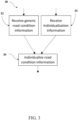
- Fig. 3 illustrates a flow diagram of an embodiment of a method 30 for estimating individualized road condition information for a specific vehicle.
- the method 30 comprises receiving 32 generic road condition information.
- the generic road condition information is indicative of at least one condition of a road segment.
- examples of generic road condition information include one or more of the following: friction potential values, road weather condition information, road roughness information, pothole information, speedbump information.
- the method 30 further comprises receiving 34 individualization information.
- the individualization information is representative of an estimating method to be performed on the generic road condition information to obtain individualized road condition information for the specific vehicle.
- Non-limiting examples of the individualization information comprise the following: a mathematical function, a set of one or more parameters, an algorithm, a program code, a neural network, a look-up table.
- the method 30 further comprises estimating 36 individualized road condition information for the vehicle.
- the estimating method represented by the received individualization information is applied to the received generic road condition information to obtain individualized road condition information.
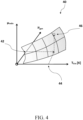
- Fig. 4 schematically illustrates a graph 40 representing individualization information according to an embodiment.
- the individualization information is representative of an estimating method to be performed on the generic road condition information to obtain individualized road condition information.
- the graph is the visual representation of a relationship, which expresses individual friction potential ⁇ indiv as a function of generic friction data ⁇ gen and as a function of tire temperature as an exemplary individualization property.
- the graph 40 yields the corresponding individualized friction potential 46.
- the individualization information may be given as a numerical relationship (shaded surface in graph 40), as depicted in Fig. 4 .
- individualization information represented by graph 40 is similar to the individualization information 23 described above with reference to Fig. 2 .
- the mathematical function may take more than one individualization property as input variable (e.g. a set of individualization properties).
- input variable e.g. a set of individualization properties
- graph 40 a three-dimensional representation as graph 40 is possible for one input variable.
- the graph 40 is shown for the example of continuous distributions or spectra of input variables (tire temperature and friction potential may take any value from an interval).
- the input and/or output variables may be discrete.
- the mathematical function may take tire type (e.g. summer or winter tire) as a further input variable.
- tire type e.g. summer or winter tire
- an additional (negative) offset may be added in the estimation of the individualized friction potential (assuming that the generic friction potential has been determined for winter tires).
- FIG. 5 schematically illustrates use of an apparatus 55 in a situation similar to the situation sketched in Fig. 1 .
- a first vehicle 50 and a second vehicle 51 are approaching a first road segment 52.
- the system has a generic friction potential at first road segment 52 with a value of 1.1. However, this estimate is only valid for a "generic" vehicle with winter tires at a tire temperature of 20°C, whereas the first vehicle 50 is travelling with summer tires at a tire temperature of 10°C. The second vehicle 51 is travelling with winter tires at a tire temperature of 22°C.
- the apparatus 55 is communicatively coupled to storage means 56 comprising a database with entries on generic friction data, similar to the arrangement of Fig. 2 .
- the storage means 56 further comprises the individualization information, e.g. mathematical function 23 of Fig. 2 or a graph in accordance with Fig. 4 .
- the apparatus 55 receives the generic friction data and the individualization information to estimate individualized friction data, similar to the method described with reference to Fig. 3 .
- the individualized friction data may then be transmitted from the apparatus 55 to the respective vehicle. For instance, apparatus 55 may transmit an individualized friction estimate having a value of 0.9 to first vehicle 50 for location 52. Further, apparatus 55 may transmit an individualized friction estimate having a value of 1.1 to second vehicle 51 for location 52.
- the apparatus 55 is located at a location remote to the vehicles and roads. In line therewith, the apparatus 55 may be implemented as a server or a cloud infrastructure. In other examples, not shown, the apparatus 55 may be located at a vehicle, such as first vehicle 50. In such cases, the storage means 56 transmits the generic friction data and the individualization information to the vehicles, such as first vehicle 50. At first vehicle 50, apparatus 55 is then capable of generating the individualized friction estimate locally, e.g. as having a value of 0.9 in the example of first vehicle 50.
- the (actual) individual road condition information may be measured at that vehicle.
- the actual friction potential may be measured in the course of an ABS event or may be estimated by processing other sensor data, such as a wheel speed sensor of vehicle 50.
- the individual road condition information are then indicative of the condition of the road segment as perceived by the vehicle 50.
- These measured individual road condition information may then be transmitted to apparatus 55 and be compared (at the apparatus 55, irrespective of whether the apparatus 55 is located centrally or at a vehicle) with the previously estimated individualized road condition information.
- the outcome of this comparison allows to update the individualization information.
- the presently disclosed teaching allows to transmit the outcome of this comparison separately from the transmission of the measured individual road condition information or separately from any privacy-sensitive data such as location information or information allowing to identify a particular vehicle.
- the discrepancy between the estimate and the actual measurement allows to update the individualization information based on the measured individual road condition information: For instance, first vehicle 50 may show a discrepancy between the estimate and the actual measurement whereas second vehicle 51 may indicate good agreement.
- the comparison may reveal that the tire temperature effect on individualized friction data had been overestimated (in case the actual individual road condition information of the first vehicle deviates from the estimated individualized road condition information and is in fact closer to the generic road condition information) or underestimated (in case the actual individual road condition information deviates from the estimated individualized road condition information and is in fact further away from the generic road condition information).
- the temperature dependence in the individualization information may be adjusted, e.g. by changing the corresponding tuning parameters, which is representative of the temperature dependence. This adjustment of individualization parameters may be particularly advantageous by taking into account statistical analysis from a plurality of vehicles.
Landscapes
- Engineering & Computer Science (AREA)
- Physics & Mathematics (AREA)
- Transportation (AREA)
- Mechanical Engineering (AREA)
- Automation & Control Theory (AREA)
- Mathematical Physics (AREA)
- Life Sciences & Earth Sciences (AREA)
- Atmospheric Sciences (AREA)
- General Physics & Mathematics (AREA)
- Traffic Control Systems (AREA)
Description
- The present invention generally relates to estimating road condition information for a vehicle.
- In modern vehicles, a wide variety of information is measured or received, collected and processed for further use. For instance, dynamic or static information on road conditions (e.g. friction potential, presence of speedbumps etc.) may be collected by vehicle sensors and may be used to adapt vehicle behavior accordingly. For instance, in the case of a slippery road (low friction potential), the parameters for a potential ABS braking may be adapted accordingly.
- With the rise of connected driving, this information is no longer restricted to an isolated vehicle: Instead, measured road condition information may be sent from vehicles to other vehicles, to (centralized or decentralized) infrastructure, such as an internet-based cloud system managing a road condition map, and vice versa.
- With the exchange of road condition information, however, difficulties may arise in processing and understanding the data correctly: As an illustrative example, a vehicle with summer tires may experience a particular road segment as slippery and transmit the corresponding information to other vehicles - although these other vehicles may be equipped with winter tires and thereby not experience the road as (so) slippery. Conversely, considering a road condition map in the cloud has been built with data from vehicles with winter tires, the friction value communicated to a further vehicle may not be appropriate for that vehicle in case that vehicle is running on summer tires.
- In other words: Differences in vehicle characteristics may lead to communication of road conditions, which significantly differ from the road conditions as actually experienced by or applicable for a specific vehicle. Such differences may lead to hampered safety, as illustrated by the above contrast between summer and winter tires, e.g. if a vehicle with summer tires assumes high friction on an actually snowy road.
- As can be seen from these examples, a common problem in data processing of road condition information is the effect of the individual vehicle.
US 2015/166072 A1 relates to systems and methods for predicting weather performance for a vehicle and discloses subject-matter according to the preamble ofclaim 1. - Further examples of road condition estimation are disclosed in
documents DE 10 2018 202933 A1 ,US 2019/001988 A1 andUS 2019/047575 A1 . - Therefore, it is of great interest to provide individualized road condition information.
- Therefore, it is an object of the present invention to provide enhanced solutions for an estimation of individualized road condition information for a vehicle.
- Methods, apparatuses, systems and computer program products are disclosed, to overcome at least partially the shortcomings of the type mentioned above and others.
- In a first aspect, a method of estimating individualized road condition information for a specific vehicle is disclosed.
- The method comprises receiving generic road condition information, which is indicative of at least one condition of a road segment. For instance, the generic road condition information may be indicative of the condition for a "generic" vehicle. Non-limiting examples of the road condition information include one or more of the following: friction potential values, road weather condition information, road roughness information, pothole information, speedbump information.
- The method further comprises receiving individualization information, which is representative of an estimating method to be performed on the generic road condition information to obtain individualized road condition information for the specific vehicle. Non-limiting examples of the individualization information comprise the following: a mathematical function, a set of one or more parameters, an algorithm, a program code, a neural network, a look-up table. For instance, an algorithm may deterministically lay down how to compensate for individual differences between the generic vehicle and the specific vehicle. Alternatively, a neural network may have been trained (using historical empirical data sets) to output individualized road condition data based on an input of generic road condition data and of individualization information. In the case of individualization information in the form of parameters, the parameters may describe the scaling behavior of the road condition in dependence of the difference between generic vehicle and specific vehicle.
- The method further comprises estimating individualized road condition information for the vehicle, wherein the estimating method represented by the received individualization information is applied to the received generic road condition information to obtain individualized road condition information. This allows to compensate for any differences between the "generic" vehicle and the specific vehicle and thereby obtain a more appropriate estimate of the road conditions as experienced by the specific vehicle.
- For instance, in some embodiments, the estimating method may be configured to take one or more individualization properties as input variable. In such cases, the method may further comprise inputting at least one of the individualization properties into the estimating method to obtain individualized road condition information as output in dependency of the input variables.
- In particular, the individualization properties may comprise vehicle characteristics. Examples of vehicle characteristics include one or more of the following: number of wheels, number of wheels driven, number of steerable wheels, manufacturer, engine type, nominal power. This allows to compensate for static differences between vehicles, which lead to differences in the effect of road conditions on these various vehicles. For instance, a sports car may be more prone to changes in friction than a truck.
- Additionally, or alternatively, the individualization properties may comprise detected vehicle sensor data. Examples of detected vehicle sensor data include one or more of the following: tire pressure, tire temperature, tire stiffness, wheel slip, ambient temperature, axle height, suspension pressure, suspension height, tire type (e.g. manually entered via a human-machine-interface; deduced from a tire classification algorithm or estimated based on other sensor signals), estimated friction potential (e.g. based on micro-slip, or from an ABS braking, or from a TCS event), normalized traction force on the wheel, friction related value, torque applied on the wheel, longitudinal acceleration, lateral acceleration, vertical acceleration, brake pressure, yaw rate, vehicle speed, wheel speed, steering wheel angle, wheel angle, wiper speed, ambient humidity, air pressure, rain sensor data, brightness, radar data, camera data, laser data. This allows to compensate for dynamic differences in ambient conditions, which may lead to differences in the effect of road conditions under the specific ambient conditions. For instance, a road condition such as friction potential typically shows a dependence on tire temperature.
- In some embodiments, the method may further comprise (a) determining one or more individualization properties, which are indicative of the vehicle behavior of the vehicle, and (b) inputting the determined individualization properties as input variables to the estimating method to obtain the individualized road condition information. For instance, in the case of detected vehicle sensor data being part of the individualization properties, the determining of individualization properties may comprise making actual measurements using vehicle sensors. For instance, a tire temperature may be measured (directly or indirectly) using adequate sensors. Additionally, or alternatively, in the case of vehicle characteristics being part of the individualization properties, the determining of individualization properties may comprise retrieving this information from a vehicle-internal registry. For instance, the field comprising manufacturer information may be checked to determine the manufacturer.
- In some embodiments, the method may further include (e.g. after the estimating of individualized road condition information) measuring individual road condition information at the vehicle on the particular road segment. The individual road condition information are indicative of the at least one condition of the road segment for the vehicle. In such cases, the method may further include transmitting the measured individual road condition information to a server. This allows to further build the road condition map and/or to better refine the individualization information.
- According to the invention the method further comprises comparing the measured individual road condition information with the estimated individualized road condition information. This comparing may occur at the vehicle or at the server. This allows to identify whether the individualization has provided a good estimate or not. In case the comparing shows good agreement, the individualization information may be considered reliable. In case the comparing shows reduced agreement, this allows to identify the source of the discrepancy, e.g. by statistics over a plurality of vehicles. For instance, a discrepancy may be due to a change in road conditions, such as a change in actual road friction due to recent snowfall. In such case, the generic road condition information may be updated. Alternatively, a discrepancy may be due to an over- or under-compensation in the individualization. For instance, the effect of tire temperature on friction may have been overestimated (or underestimated). In such case, the individualization information may be updated.
- These two types of deviation are identifiable by statistics: If essentially all vehicles signal a discrepancy (e.g. friction lower/higher than expected), then the generic road condition data may be updated. If only a subset of vehicles (e.g. all vehicles with low tire temperature) signal such discrepancy, the individualization information may be updated (for that subset of vehicles, i.e. for low tire temperature).
- According to the invention the method further comprises updating the individualization information (or the estimating method) based on the measured individual road condition information. Again, the updating may occur at the vehicle or at the server. This allows to further refine the individualization properties and build a system which is capable of dynamic self-correction.
- In some embodiments, the method may further comprise (a) transmitting the measured individual road condition information to a server, and (b) transmitting the outcome of the comparing and/or of the updating to a server. This allows for efficient management of generic road condition data.
- In particular, the transmission of the outcome may occur separately from the transmission of the measured individual road condition information. This allows to reduce privacy concerns, by avoiding to transmit location data together with data allowing to identify a specific vehicle.
- In some embodiments, the method may further comprise outputting the individualized road condition information. The individualized road condition information may be outputted to an autonomous driving system, a vehicle control system, and/or a driver assistance system, of the vehicle. This allows to adapt the driving behavior of the vehicle in accordance with the individualized road condition information and thereby increase safety.
- In some embodiments, the method may further comprise (a) generating generic road condition information and generating individualization information, and (b) transmitting the generated generic road condition information and generated individualization information, from a server to the vehicle. This allows for a decentralized individualization at the vehicle.
- In a second aspect, a computer program product is provided, which includes program code configured to, when executed in a computing device, to carry out the steps of a method according to the first aspect.
- In a third aspect, an apparatus for estimating individualized road condition information for a specific vehicle is provided. The apparatus comprises a communication interface and a processing unit. The communication interface is for receiving generic road condition information and for receiving individualization information. The generic road condition information is indicative of at least one condition of a road segment, e.g. for a "generic" vehicle. The individualization information is representative of an estimating method to be performed on the generic road condition information to obtain individualized road condition information for the specific vehicle.
- The processing unit is communicatively coupled with the communication interface and configured to estimate individualized road condition information for the vehicle, wherein the estimating method (represented by the received individualization information) is applied to the received generic road condition information to obtain individualized road condition information.
- In some embodiments of the apparatus, the processing unit is further configured to carry out the method steps of a method according to the first aspect.
- In a fourth aspect, a system for estimating individualized road condition information for a vehicle is provided. The system comprises an apparatus according the third aspect and further comprises at least one of a sensor, a bus interface and/or a server.
- The sensor may be for estimating one or more individualization properties, in particular of vehicle sensor data. This allows for taking into account dynamic changes in ambient conditions and thereby a more complete picture of the individualization.
- The bus interface may be configured to output the individualized road condition information to a vehicle bus of the vehicle. This allows for efficiently making use of the obtained data and for a seamless integration of the teaching according to the present disclosure into existing vehicle systems.
- The server may be configured to generate the generic road condition information and to transmit it to the vehicle, and configured to generate the individualization information and to transmit it to the vehicle.
- Further, the system may comprise storage means, configured to store the generic road condition information and/or the individualization information.
- In a further aspect, the present invention also relates to methods, systems and computer program products for building a map of road conditions. To this end, individual road condition information is received. The individual road condition information is indicative of a road condition as perceived by a specific vehicle. Further, one or more individualization properties are received for that vehicle. Based on the received individual road condition information and the individualization properties, generic road condition data may be estimated, indicative of the road condition for a (hypothetical) generic vehicle. This allows to reduce the effect of the vehicle-specific errors. In other words, the process compensates for the vehicle-specific portion of the measurement of road condition (i.e. carries out the individualization "in reverse", i.e. a generalization). This compensation may be carried out at the vehicle or at a server. Based on generic road condition data from a plurality of vehicles, a map of generic road condition data may be constructed.
- In case the compensation is carried out at the server, the transmission of road condition information from each of the plurality of vehicles may occur separately from the transmission of individualization properties. This allows to reduce privacy concerns in case a specific vehicle were to be identifiable by its individualization information and the individual road condition information were to include location information.
- The following detailed description refers to the appended drawings, wherein:
- Fig. 1
- schematically illustrates a situation with roads and vehicles, in which situation methods, apparatuses or systems according to embodiments may be used.
- Fig. 2
- illustrates a box diagram of a system with an apparatus according to an embodiment.
- Fig. 3
- illustrates a flow diagram of a method according to embodiments.
- Fig. 4
- schematically illustrates a graph representing individualization information according to an embodiment.
- Fig. 5
- schematically illustrates use of an apparatus according to embodiments.
-
Fig. 1 schematically illustrates a situation with roads and vehicles, in which situation methods, apparatuses or systems according to embodiments may be used. - A
first vehicle 10 and asecond vehicle 11 are travelling on roads. In particular, bothvehicles first road segment 12 at a location a. Subsequently, they will approach asecond road segment 13 at a location b. - Both vehicles are in communication with an
apparatus 15 according to the present disclosure. In particular, in the example shown, theapparatus 15 is a central server, which is linked with bothvehicles internet 14. - Generally, the teaching of the present disclosure may be implemented at various points of such a system. In the example shown, the
apparatus 15 is centrally located, at a location remote to the vehicles and roads. With reference to the Figures, the teaching is exemplarily illustrated with a focus on such central implementation. In other examples, the functionality of a server may be implemented in decentralized cloud infrastructure. - In other embodiments, the
apparatus 15 may be located at a vehicle, such asvehicle 10. In such cases, thevehicles - Returning to
Fig. 1 , theapparatus 15 is configured to provide individualized road condition information for eachvehicle - For instance, the apparatus may be configured to provide individualized friction potential estimates for each
vehicle first road segment 12. - To this end, the
apparatus 15 makes use of generic road condition information and of individualization information. In the example shown, the generic road condition information may be generic friction potential data for thefirst road segment 12. Such generic friction potential data may be based on a statistic processing of friction data collected by previously passing vehicles on the first road segment. Additionally, or alternatively, the generic friction potential data may be based on meteorological models, configured to estimate local road conditions. In this sense, the generic friction potential data may be thought of as being indicative of the condition for a "generic" vehicle - irrespective of whether such generic vehicle physically exists or not. - In the example of a statistical data collection, the generic vehicle may for instance be thought of as the statistical mean of the previously passing vehicles. Alternatively, the generic vehicle may have defined characteristics. For example, it may be defined as (inter alia) having winter tires and having a certain tire temperature (e.g. 20°C). In such a case, the statistical processing of empirical data from previously passing vehicles may comprise adjusting the actually measured values of the previously passing vehicles to compensate for differences to the assumed generic vehicle (such as compensating for the presence of summer tires and/or any difference in tire temperature). For illustration purposes, in the case of
Fig. 1 , the generic vehicle may be thought of as having winter tires at a tire temperature of 20°C. - In any case, the generic friction potential data is indicative of at least one condition (e.g. slipperiness as indicated by friction potential) of the
first road segment 12, for a generic vehicle. However, the generic friction potential data may not be a good estimate for the individual vehicle, such asfirst vehicle 10. For instance,first vehicle 10 may be travelling with summer tires at a tire temperature of 10°C and thereby differ significantly from the generic vehicle. The presently disclosed teaching provides for solutions to individualize the road friction data forfirst vehicle 10, such that the individualized road friction data may be used byfirst vehicle 10 and provide a more appropriate estimate than the "generic" data. - At the same time, the generic friction potential data may be a somewhat more appropriate estimate for the
second vehicle 11, which may be travelling with winter tires at a tire temperature of 22°C and thus be relatively similar to the assumed generic vehicle. In this case, the individualization of generic friction potential data may involve smaller compensations, e.g. only for a small difference in tire temperature. - For illustration purposes, friction potential is taken as an example. However, the description of the condition of
first road segment 12 may comprise other or further information, such as information about the current weather, information about road roughness, information about potholes or speedbumps, etc. - As mentioned above, the
apparatus 15 also makes use of individualization information, in addition to the generic road condition information. The individualization information is representative of an estimating method to be performed on the generic road condition information to obtain individualized road condition information for the specific vehicle, as will be described in further detail with reference to the following figures. The individualization information may describe the dependency of the road condition on vehicle properties or vehicle sensor data. For instance, it may describe how friction potential scales with tire temperature and/or how it depends on tire type. - Based on the individualization information and the generic friction potential data, the
apparatus 15 estimates individualized friction potential data for thefirst vehicle 10 for thefirst road segment 12. In this process, the estimating method represented by the received individualization information is applied to the received generic road condition information (generic friction potential data) to obtain individualized road condition information (individualized friction potential data). - The individualized friction potential data may then be transmitted to that specific vehicle, e.g.
first vehicle 10. The vehicle may make use of this individualized information upon approaching thefirst road segment 12, e.g. to adapt a vehicle control system accordingly. As an illustrative example, the individualized friction potential data may be forwarded via a vehicle bus interface to an ABS braking module in order to adjust the ABS braking parameters in view of the individualized friction potential data. The individualized friction data may also be used advantageously in an autonomous driving situation. - The above-described process may then be repeated for another road segment, e.g.
second road segment 13 at a second location b. - In other examples, not shown, the individualization may also occur at the vehicle. For instance, both the individualization information and the generic road condition information may be transmitted from the server to the respective vehicle.
-
Fig. 2 illustrates a box diagram of asystem 20 with anapparatus 24. In particular,apparatus 24 may be an implementation of theapparatus 15 shown schematically inFig. 1 . - The
system 20 comprises adatabase 21, holding generic road condition data. In the example shown, the database comprises a number ofdatabase entries 22, which link generic friction potential values to corresponding location data. For instance, thedatabase 21 holds a first entry, which indicates a first generic friction potential µgen,a for the first road segment at location a ofFig. 1 . Further, the database holds 21 a second entry, which indicates a second generic friction potential µgen,b for the second road segment at location b. Thedatabase 21 may thus be visualized as a map of generic road condition data, which holds a generic friction value for each (or at least some) locations. - Further, the
system 20 comprisesindividualization information 23. Theindividualization information 23 is representative of an estimating method to be performed on the generic road condition information to obtain individualized road condition information for a specific vehicle. In the example shown, the individualization information is represented by a mathematical function, which expresses individual friction potential µindiv as a function of generic friction data µgen and as a function of a set of individualization properties, as will be detailed further below with reference toFig. 4 . As mentioned above, an illustrative example of a set of individualization properties may comprise tire type (e.g. summer or winter tires) and tire temperature. - Other examples of individualization information, not shown, comprise set of one or more parameters, an algorithm, a program code, a neural network, a look-up table. In any case, the individualization information allows to estimate individualized road condition information based on generic road condition information.
- For instance, both the
individualization information 23 and thedatabase 21 withentries 22 on generic road condition data may be stored on a storage means (not shown) ofsystem 20. - Further, the
system 20 comprisesapparatus 24 for estimating the individualized road condition information for a specific vehicle. Theapparatus 24 comprises acommunication interface 25 and aprocessing unit 26. Thecommunication interface 25 is for receiving generic road condition information fromdatabase 21 and for receiving theindividualization information 23. The reception of generic road condition information comprises at least the generic road condition information (e.g. generic road condition data at location a, µgen,a). Optionally, it may further comprise receiving the corresponding location data (e.g. location a). In the latter case, thecommunication interface 25 receives one of thedatabase entries 22 ofdatabase 21. In still further examples, the receiving may relate to the entire database or at least portions thereof. - The
processing unit 26 is communicatively coupled with thecommunication interface 25 and configured to estimate individualized road condition information for the vehicle, wherein the estimating method (represented by the received individualization information) is applied to the received generic road condition information to obtain individualized road condition information. -
Fig. 3 illustrates a flow diagram of an embodiment of amethod 30 for estimating individualized road condition information for a specific vehicle. - The
method 30 comprises receiving 32 generic road condition information. The generic road condition information is indicative of at least one condition of a road segment. As mentioned above, examples of generic road condition information include one or more of the following: friction potential values, road weather condition information, road roughness information, pothole information, speedbump information. - The
method 30 further comprises receiving 34 individualization information. The individualization information is representative of an estimating method to be performed on the generic road condition information to obtain individualized road condition information for the specific vehicle. Non-limiting examples of the individualization information comprise the following: a mathematical function, a set of one or more parameters, an algorithm, a program code, a neural network, a look-up table. - The
method 30 further comprises estimating 36 individualized road condition information for the vehicle. To this end, the estimating method represented by the received individualization information is applied to the received generic road condition information to obtain individualized road condition information. -
Fig. 4 schematically illustrates agraph 40 representing individualization information according to an embodiment. The individualization information is representative of an estimating method to be performed on the generic road condition information to obtain individualized road condition information. The graph is the visual representation of a relationship, which expresses individual friction potential µindiv as a function of generic friction data µgen and as a function of tire temperature as an exemplary individualization property. - For any given
generic friction value 42 and giventire temperature 44, thegraph 40 yields the corresponding individualized friction potential 46. - The individualization information may be given as a numerical relationship (shaded surface in graph 40), as depicted in
Fig. 4 . In other examples, the relationship may be expressed mathematically by parameters, such as a function definition in the shape of µind= A*(Ttire-B)*µgen, wherein A and B represent tuning parameters, e.g. B representing the (assumed) tire temperature of a (hypothetical) generic vehicle, and A representing a scaling parameter of the tire temperature dependence of friction potentials. - In this respect, individualization information represented by
graph 40 is similar to theindividualization information 23 described above with reference toFig. 2 . - In other embodiments, not shown in
Fig. 4 , the mathematical function may take more than one individualization property as input variable (e.g. a set of individualization properties). However, for illustration purposes, a three-dimensional representation asgraph 40 is possible for one input variable. - Further, the
graph 40 is shown for the example of continuous distributions or spectra of input variables (tire temperature and friction potential may take any value from an interval). However, in other examples, the input and/or output variables may be discrete. - For instance, in other embodiments, not shown in
Fig. 4 , the mathematical function may take tire type (e.g. summer or winter tire) as a further input variable. In the case of a summer tire, an additional (negative) offset may be added in the estimation of the individualized friction potential (assuming that the generic friction potential has been determined for winter tires). -
Fig. 5 schematically illustrates use of anapparatus 55 in a situation similar to the situation sketched inFig. 1 . Afirst vehicle 50 and asecond vehicle 51 are approaching afirst road segment 52. - The system has a generic friction potential at
first road segment 52 with a value of 1.1. However, this estimate is only valid for a "generic" vehicle with winter tires at a tire temperature of 20°C, whereas thefirst vehicle 50 is travelling with summer tires at a tire temperature of 10°C. Thesecond vehicle 51 is travelling with winter tires at a tire temperature of 22°C. - To compensate for these differences between the generic vehicle and the actual properties of the first and
second vehicles Figs. 2-4 may be applied:
Theapparatus 55 is communicatively coupled to storage means 56 comprising a database with entries on generic friction data, similar to the arrangement ofFig. 2 . The storage means 56 further comprises the individualization information, e.g.mathematical function 23 ofFig. 2 or a graph in accordance withFig. 4 . - The
apparatus 55 receives the generic friction data and the individualization information to estimate individualized friction data, similar to the method described with reference toFig. 3 . - The individualized friction data may then be transmitted from the
apparatus 55 to the respective vehicle. For instance,apparatus 55 may transmit an individualized friction estimate having a value of 0.9 tofirst vehicle 50 forlocation 52. Further,apparatus 55 may transmit an individualized friction estimate having a value of 1.1 tosecond vehicle 51 forlocation 52. - In the example shown, the
apparatus 55 is located at a location remote to the vehicles and roads. In line therewith, theapparatus 55 may be implemented as a server or a cloud infrastructure. In other examples, not shown, theapparatus 55 may be located at a vehicle, such asfirst vehicle 50. In such cases, the storage means 56 transmits the generic friction data and the individualization information to the vehicles, such asfirst vehicle 50. Atfirst vehicle 50,apparatus 55 is then capable of generating the individualized friction estimate locally, e.g. as having a value of 0.9 in the example offirst vehicle 50. - Returning to the central arrangement of
Fig. 5 , once one of the vehicles (e.g. first vehicle 50) reaches theroad segment 52, the (actual) individual road condition information may be measured at that vehicle. For instance, the actual friction potential may be measured in the course of an ABS event or may be estimated by processing other sensor data, such as a wheel speed sensor ofvehicle 50. The individual road condition information are then indicative of the condition of the road segment as perceived by thevehicle 50. - These measured individual road condition information (not shown in
Fig. 5 ) may then be transmitted toapparatus 55 and be compared (at theapparatus 55, irrespective of whether theapparatus 55 is located centrally or at a vehicle) with the previously estimated individualized road condition information. The outcome of this comparison allows to update the individualization information. In particular, the presently disclosed teaching allows to transmit the outcome of this comparison separately from the transmission of the measured individual road condition information or separately from any privacy-sensitive data such as location information or information allowing to identify a particular vehicle. In short, the discrepancy between the estimate and the actual measurement allows to update the individualization information based on the measured individual road condition information:
For instance,first vehicle 50 may show a discrepancy between the estimate and the actual measurement whereassecond vehicle 51 may indicate good agreement. Thus, the comparison may reveal that the tire temperature effect on individualized friction data had been overestimated (in case the actual individual road condition information of the first vehicle deviates from the estimated individualized road condition information and is in fact closer to the generic road condition information) or underestimated (in case the actual individual road condition information deviates from the estimated individualized road condition information and is in fact further away from the generic road condition information). As a result, the temperature dependence in the individualization information may be adjusted, e.g. by changing the corresponding tuning parameters, which is representative of the temperature dependence. This adjustment of individualization parameters may be particularly advantageous by taking into account statistical analysis from a plurality of vehicles.
Claims (15)
- Method (30) of estimating individualized road condition information for a specific vehicle, the method comprising- receiving (32) generic road condition information, which is indicative of at least one condition of a road segment;- receiving (34) individualization information, which is representative of an estimating method to be performed on the generic road condition information to obtain individualized road condition information for the specific vehicle,- estimating (36) individualized road condition information for the vehicle, wherein the estimating method is applied to the received generic road condition information to obtain individualized road condition information,characterized in that
the method further comprises, after the estimating:- measuring, at the vehicle, individual road condition information indicative of the at least one condition of the road segment for the vehicle;- comparing the measured individual road condition information with the estimated individualized road condition information; and- updating the individualization information and/or the estimating method based on the comparison. - Method according to the preceding claim, wherein- the estimating method is configured to take one or more individualization properties as input variable, and- the method further comprising inputting at least one of the individualization properties into the estimating method to obtain individualized road condition information as output in dependency of the input variables.
- Method according to the preceding claim, wherein the individualization properties comprise vehicle characteristics, in particular one or more of the following: number of wheels, number of wheels driven, number of steerable wheels, manufacturer, engine type, nominal power.
- Method according to claim 2 or 3, wherein the individualization properties comprise detected vehicle sensor data, in particular one or more of the following:
tire pressure, tire temperature, tire stiffness, wheel slip, ambient temperature, axle height, suspension pressure, suspension height, tire type, estimated friction potential, normalized traction force on the wheel, friction related value, torque applied on the wheel, longitudinal acceleration, lateral acceleration, vertical acceleration, brake pressure, yaw rate, vehicle speed, wheel speed, steering wheel angle, wheel angle, wiper speed, ambient humidity, air pressure, rain sensor data, brightness, radar data, camera data, laser data. - Method according to claim 2, 3 or 4, wherein the method further comprises- determining one or more individualization properties, which are indicative of the vehicle behavior of the vehicle, and- inputting the determined individualization properties as input variable to the estimating method to obtain the individualized road condition information.
- Method according to one of the preceding claims, wherein the method further includes:- transmitting the measured individual road condition information to a server.
- Method according to one of the preceding claims, the method further comprising:- transmitting the measured individual road condition information to a server, and- transmitting the outcome of the comparing and/or of the updating to the server.
- Method according to the preceding claim, wherein the transmission of the outcome occurs separately from the transmission of the measured individual road condition information.
- Method according to one of the preceding claims, wherein- the road condition information includes one or more of the following: friction potential values, road weather condition information, road roughness information, pothole information, speedbump information, and/or- the individualization information comprises at least one of the following: a mathematical function, a set of one or more parameters, an algorithm, a program code, a neural network, a look-up table.
- Method according to one of the preceding claims, wherein the method further comprises outputting the individualized road condition information to an autonomous driving system, a vehicle control system, and/or a driver assistance system, of the vehicle.
- Method according to one of the preceding claims, wherein the method further comprises, before the receiving:- generating generic road condition information and generating individualization information, and- transmitting the generated generic road condition information and generated individualization information, from a server to the vehicle.
- Computer program product including program code configured to, when executed in a computing device, to carry out the steps of a method of one of the preceding claims.
- Apparatus (24) for estimating individualized road condition information for a specific vehicle, comprising:- a communication interface (25) for-- receiving generic road condition information, which is indicative of at least one condition of a road segment; and-- receiving individualization information, which is representative of an estimating method to be performed on the generic road condition information to obtain individualized road condition information for the specific vehicle;- a processing unit (26), the processing unit beingcharacterized in that-- communicatively coupled with the communication interface and-- configured to estimate individualized road condition information for the vehicle, wherein the estimating method is applied to the received generic road condition information to obtain individualized road condition information,
the processing unit is further configured to:- measure individual road condition information indicative of the at least one condition of the road segment for the vehicle;- compare the measured individual road condition information with the estimated individualized road condition information; and- update the individualization information and/or the estimating method based on the comparison. - Apparatus according to the preceding claim, wherein the processing unit is further configured to carry out the method steps of one of claims 2-11.
- A system (20) for estimating individualized road condition information for a vehicle, comprising an apparatus according to claim 13 or 14 and further comprising:- a sensor for estimating one or more individualization properties, and/or- a bus interface configured to output the individualized road condition information to a vehicle bus of the vehicle, and/or- a server, the server being configured to generate the generic road condition information and to transmit it to the vehicle, and the server being configured to generate the individualization information and to transmit it to the vehicle.
Applications Claiming Priority (2)
| Application Number | Priority Date | Filing Date | Title |
|---|---|---|---|
| DE102019132258 | 2019-11-28 | ||
| PCT/EP2020/083676 WO2021105388A1 (en) | 2019-11-28 | 2020-11-27 | Methods, apparatuses, systems and computer program products for estimating road condition information |
Publications (2)
| Publication Number | Publication Date |
|---|---|
| EP4065438A1 EP4065438A1 (en) | 2022-10-05 |
| EP4065438B1 true EP4065438B1 (en) | 2025-01-01 |
Family
ID=73646333
Family Applications (1)
| Application Number | Title | Priority Date | Filing Date |
|---|---|---|---|
| EP20816458.2A Active EP4065438B1 (en) | 2019-11-28 | 2020-11-27 | Methods, apparatuses, systems and computer program products for estimating road condition information |
Country Status (5)
| Country | Link |
|---|---|
| US (1) | US12420801B2 (en) |
| EP (1) | EP4065438B1 (en) |
| CN (1) | CN114765975B (en) |
| ES (1) | ES3013284T3 (en) |
| WO (1) | WO2021105388A1 (en) |
Families Citing this family (1)
| Publication number | Priority date | Publication date | Assignee | Title |
|---|---|---|---|---|
| KR102408654B1 (en) * | 2020-09-16 | 2022-06-15 | 포티투닷 주식회사 | Traffic Flow Statistics Data Generation Method Using Vehicle Wiper Motion Information, Method of Calculating Estimated Time of Arrival Using Traffic Flow Statistics Data Generated Using Vehicle Wiper Operation Information and Management Server Used Therein |
Family Cites Families (17)
| Publication number | Priority date | Publication date | Assignee | Title |
|---|---|---|---|---|
| US6173231B1 (en) * | 2000-01-31 | 2001-01-09 | Navigation Technologies Corp. | Method and system for collecting data concerning thermal properties of roads for a geographic database and use thereof in a vehicle safety system |
| US9207323B2 (en) * | 2013-04-11 | 2015-12-08 | Google Inc. | Methods and systems for detecting weather conditions including wet surfaces using vehicle onboard sensors |
| US9187099B2 (en) * | 2013-10-17 | 2015-11-17 | Richard M. Powers | Systems and methods for predicting weather performance for a vehicle |
| CN104933856B (en) * | 2014-03-17 | 2017-08-25 | 径卫视觉科技(上海)有限公司 | Road conditions real-time evaluation system and method |
| JP6392623B2 (en) * | 2014-10-06 | 2018-09-19 | 株式会社ブリヂストン | Road surface classification system |
| DE102015216483A1 (en) * | 2015-01-29 | 2016-08-04 | Robert Bosch Gmbh | Method for operating a coefficient of friction database and coefficient of friction database |
| WO2017102086A1 (en) * | 2015-12-18 | 2017-06-22 | Nira Dynamics Ab | Tire stiffness estimation and road friction estimation |
| RU2629875C1 (en) * | 2016-04-04 | 2017-09-04 | Общество С Ограниченной Ответственностью "Яндекс" | Methods and systems for predicting driving conditions |
| US10696227B2 (en) * | 2017-01-12 | 2020-06-30 | Mobileye Vision Technologies Ltd. | Determining a road surface characteristic |
| JP6572264B2 (en) * | 2017-06-28 | 2019-09-04 | 株式会社Subaru | Vehicle road friction coefficient estimation apparatus and vehicle road friction coefficient estimation method |
| DE102017214032A1 (en) * | 2017-08-11 | 2019-02-14 | Robert Bosch Gmbh | A method for determining a coefficient of friction for a contact between a tire of a vehicle and a road and method for controlling a vehicle function of a vehicle |
| DE102018202933A1 (en) * | 2018-02-27 | 2019-08-29 | Robert Bosch Gmbh | A method for providing a correction parameter for correcting input values for friction coefficient estimation for a vehicle and method for correcting input values for friction coefficient estimation for a vehicle and method for controlling a vehicle |
| US11592566B2 (en) * | 2019-08-15 | 2023-02-28 | Volvo Car Corporation | Vehicle systems and methods utilizing LIDAR data for road condition estimation |
| DE102018132157B3 (en) * | 2018-12-13 | 2020-06-18 | Nira Dynamics Ab | Tire stiffness estimation and road friction estimation |
| CN110060473A (en) * | 2019-04-10 | 2019-07-26 | 吉利汽车研究院(宁波)有限公司 | A kind of road condition detection system and road conditions detection method based on car networking |
| DE102019135751B4 (en) * | 2019-12-23 | 2024-11-14 | Nira Dynamics Ab | Methods, devices, systems and computer program products for estimating a road surface temperature |
| US20230245509A1 (en) * | 2022-01-28 | 2023-08-03 | Murray Armstrong | Safety system and method for motor vehicles |
-
2020
- 2020-11-27 US US17/779,775 patent/US12420801B2/en active Active
- 2020-11-27 EP EP20816458.2A patent/EP4065438B1/en active Active
- 2020-11-27 CN CN202080083120.6A patent/CN114765975B/en active Active
- 2020-11-27 WO PCT/EP2020/083676 patent/WO2021105388A1/en not_active Ceased
- 2020-11-27 ES ES20816458T patent/ES3013284T3/en active Active
Also Published As
| Publication number | Publication date |
|---|---|
| EP4065438A1 (en) | 2022-10-05 |
| WO2021105388A1 (en) | 2021-06-03 |
| US12420801B2 (en) | 2025-09-23 |
| CN114765975B (en) | 2026-03-13 |
| ES3013284T3 (en) | 2025-04-11 |
| US20230010647A1 (en) | 2023-01-12 |
| CN114765975A (en) | 2022-07-19 |
Similar Documents
| Publication | Publication Date | Title |
|---|---|---|
| CN109219547B (en) | Method for estimating a probability distribution of a maximum coefficient of friction at a current and/or future waypoint of a vehicle | |
| US20170357669A1 (en) | Method for operating a coefficient of friction database, and coefficient of friction database | |
| US12157455B2 (en) | Tire stiffness estimation and road friction estimation | |
| CN107993453B (en) | A method for calculating safe vehicle speed in curves based on vehicle-road coordination | |
| US11650133B2 (en) | Tire stiffness estimation and road friction estimation | |
| US10576985B2 (en) | Method and device for operating a driver assistance system, and driver assistance system | |
| US11535259B2 (en) | Method for determining a friction coefficient for a contact between a tire of a vehicle and a roadway, and method for controlling a vehicle function of a vehicle | |
| US20230256778A1 (en) | Vehicle tire localization system and method using temperature rise data | |
| DE102018101123A1 (en) | Learning procedure for long-term brake corner specific torque variations | |
| GB2552011B (en) | A controller for a vehicle system | |
| EP4065438B1 (en) | Methods, apparatuses, systems and computer program products for estimating road condition information | |
| EP4197821B1 (en) | Tire stiffness estimation system and method | |
| US11872850B2 (en) | System and method for tire vertical load prediction | |
| CN110884497A (en) | Method and system for providing friction coefficient information of a traffic zone segment | |
| WO2019074478A1 (en) | Autonomous safety systems and methods for vehicles | |
| US20240152835A1 (en) | Order quantity calculation apparatus and order quantity calculation system | |
| EP4442528A1 (en) | Computer-implemented tire deterioration estimating method and data processing system | |
| CN116262403B (en) | Tire stiffness estimation system | |
| CN113165658A (en) | Method, device, computer program and computer program product for operating a vehicle, and vehicle | |
| DE102025131902A1 (en) | TIRE WEAR ESTIMATE |
Legal Events
| Date | Code | Title | Description |
|---|---|---|---|
| STAA | Information on the status of an ep patent application or granted ep patent |
Free format text: STATUS: UNKNOWN |
|
| STAA | Information on the status of an ep patent application or granted ep patent |
Free format text: STATUS: THE INTERNATIONAL PUBLICATION HAS BEEN MADE |
|
| PUAI | Public reference made under article 153(3) epc to a published international application that has entered the european phase |
Free format text: ORIGINAL CODE: 0009012 |
|
| STAA | Information on the status of an ep patent application or granted ep patent |
Free format text: STATUS: REQUEST FOR EXAMINATION WAS MADE |
|
| 17P | Request for examination filed |
Effective date: 20220622 |
|
| AK | Designated contracting states |
Kind code of ref document: A1 Designated state(s): AL AT BE BG CH CY CZ DE DK EE ES FI FR GB GR HR HU IE IS IT LI LT LU LV MC MK MT NL NO PL PT RO RS SE SI SK SM TR |
|
| DAV | Request for validation of the european patent (deleted) | ||
| DAX | Request for extension of the european patent (deleted) | ||
| GRAP | Despatch of communication of intention to grant a patent |
Free format text: ORIGINAL CODE: EPIDOSNIGR1 |
|
| STAA | Information on the status of an ep patent application or granted ep patent |
Free format text: STATUS: GRANT OF PATENT IS INTENDED |
|
| INTG | Intention to grant announced |
Effective date: 20240730 |
|
| GRAS | Grant fee paid |
Free format text: ORIGINAL CODE: EPIDOSNIGR3 |
|
| GRAA | (expected) grant |
Free format text: ORIGINAL CODE: 0009210 |
|
| STAA | Information on the status of an ep patent application or granted ep patent |
Free format text: STATUS: THE PATENT HAS BEEN GRANTED |
|
| AK | Designated contracting states |
Kind code of ref document: B1 Designated state(s): AL AT BE BG CH CY CZ DE DK EE ES FI FR GB GR HR HU IE IS IT LI LT LU LV MC MK MT NL NO PL PT RO RS SE SI SK SM TR |
|
| REG | Reference to a national code |
Ref country code: GB Ref legal event code: FG4D |
|
| REG | Reference to a national code |
Ref country code: CH Ref legal event code: EP |
|
| REG | Reference to a national code |
Ref country code: DE Ref legal event code: R096 Ref document number: 602020044179 Country of ref document: DE |
|
| REG | Reference to a national code |
Ref country code: IE Ref legal event code: FG4D |
|
| REG | Reference to a national code |
Ref country code: ES Ref legal event code: FG2A Ref document number: 3013284 Country of ref document: ES Kind code of ref document: T3 Effective date: 20250411 |
|
| REG | Reference to a national code |
Ref country code: LT Ref legal event code: MG9D |
|
| REG | Reference to a national code |
Ref country code: NL Ref legal event code: MP Effective date: 20250101 |
|
| REG | Reference to a national code |
Ref country code: AT Ref legal event code: MK05 Ref document number: 1755947 Country of ref document: AT Kind code of ref document: T Effective date: 20250101 |
|
| PG25 | Lapsed in a contracting state [announced via postgrant information from national office to epo] |
Ref country code: NL Free format text: LAPSE BECAUSE OF FAILURE TO SUBMIT A TRANSLATION OF THE DESCRIPTION OR TO PAY THE FEE WITHIN THE PRESCRIBED TIME-LIMIT Effective date: 20250101 |
|
| PG25 | Lapsed in a contracting state [announced via postgrant information from national office to epo] |
Ref country code: FI Free format text: LAPSE BECAUSE OF FAILURE TO SUBMIT A TRANSLATION OF THE DESCRIPTION OR TO PAY THE FEE WITHIN THE PRESCRIBED TIME-LIMIT Effective date: 20250101 |
|
| PG25 | Lapsed in a contracting state [announced via postgrant information from national office to epo] |
Ref country code: PL Free format text: LAPSE BECAUSE OF FAILURE TO SUBMIT A TRANSLATION OF THE DESCRIPTION OR TO PAY THE FEE WITHIN THE PRESCRIBED TIME-LIMIT Effective date: 20250101 |
|
| PG25 | Lapsed in a contracting state [announced via postgrant information from national office to epo] |
Ref country code: NO Free format text: LAPSE BECAUSE OF FAILURE TO SUBMIT A TRANSLATION OF THE DESCRIPTION OR TO PAY THE FEE WITHIN THE PRESCRIBED TIME-LIMIT Effective date: 20250401 Ref country code: IS Free format text: LAPSE BECAUSE OF FAILURE TO SUBMIT A TRANSLATION OF THE DESCRIPTION OR TO PAY THE FEE WITHIN THE PRESCRIBED TIME-LIMIT Effective date: 20250501 |
|
| PG25 | Lapsed in a contracting state [announced via postgrant information from national office to epo] |
Ref country code: HR Free format text: LAPSE BECAUSE OF FAILURE TO SUBMIT A TRANSLATION OF THE DESCRIPTION OR TO PAY THE FEE WITHIN THE PRESCRIBED TIME-LIMIT Effective date: 20250101 |
|
| PG25 | Lapsed in a contracting state [announced via postgrant information from national office to epo] |
Ref country code: PT Free format text: LAPSE BECAUSE OF FAILURE TO SUBMIT A TRANSLATION OF THE DESCRIPTION OR TO PAY THE FEE WITHIN THE PRESCRIBED TIME-LIMIT Effective date: 20250502 Ref country code: LV Free format text: LAPSE BECAUSE OF FAILURE TO SUBMIT A TRANSLATION OF THE DESCRIPTION OR TO PAY THE FEE WITHIN THE PRESCRIBED TIME-LIMIT Effective date: 20250101 |
|
| PG25 | Lapsed in a contracting state [announced via postgrant information from national office to epo] |
Ref country code: GR Free format text: LAPSE BECAUSE OF FAILURE TO SUBMIT A TRANSLATION OF THE DESCRIPTION OR TO PAY THE FEE WITHIN THE PRESCRIBED TIME-LIMIT Effective date: 20250402 Ref country code: BG Free format text: LAPSE BECAUSE OF FAILURE TO SUBMIT A TRANSLATION OF THE DESCRIPTION OR TO PAY THE FEE WITHIN THE PRESCRIBED TIME-LIMIT Effective date: 20250101 |
|
| PG25 | Lapsed in a contracting state [announced via postgrant information from national office to epo] |
Ref country code: AT Free format text: LAPSE BECAUSE OF FAILURE TO SUBMIT A TRANSLATION OF THE DESCRIPTION OR TO PAY THE FEE WITHIN THE PRESCRIBED TIME-LIMIT Effective date: 20250101 |
|
| PG25 | Lapsed in a contracting state [announced via postgrant information from national office to epo] |
Ref country code: CZ Free format text: LAPSE BECAUSE OF FAILURE TO SUBMIT A TRANSLATION OF THE DESCRIPTION OR TO PAY THE FEE WITHIN THE PRESCRIBED TIME-LIMIT Effective date: 20250101 |
|
| PG25 | Lapsed in a contracting state [announced via postgrant information from national office to epo] |
Ref country code: SE Free format text: LAPSE BECAUSE OF FAILURE TO SUBMIT A TRANSLATION OF THE DESCRIPTION OR TO PAY THE FEE WITHIN THE PRESCRIBED TIME-LIMIT Effective date: 20250101 |
|
| REG | Reference to a national code |
Ref country code: DE Ref legal event code: R097 Ref document number: 602020044179 Country of ref document: DE |
|
| PG25 | Lapsed in a contracting state [announced via postgrant information from national office to epo] |
Ref country code: SM Free format text: LAPSE BECAUSE OF FAILURE TO SUBMIT A TRANSLATION OF THE DESCRIPTION OR TO PAY THE FEE WITHIN THE PRESCRIBED TIME-LIMIT Effective date: 20250101 |
|
| PG25 | Lapsed in a contracting state [announced via postgrant information from national office to epo] |
Ref country code: DK Free format text: LAPSE BECAUSE OF FAILURE TO SUBMIT A TRANSLATION OF THE DESCRIPTION OR TO PAY THE FEE WITHIN THE PRESCRIBED TIME-LIMIT Effective date: 20250101 |
|
| PG25 | Lapsed in a contracting state [announced via postgrant information from national office to epo] |
Ref country code: IT Free format text: LAPSE BECAUSE OF FAILURE TO SUBMIT A TRANSLATION OF THE DESCRIPTION OR TO PAY THE FEE WITHIN THE PRESCRIBED TIME-LIMIT Effective date: 20250101 |
|
| PG25 | Lapsed in a contracting state [announced via postgrant information from national office to epo] |
Ref country code: EE Free format text: LAPSE BECAUSE OF FAILURE TO SUBMIT A TRANSLATION OF THE DESCRIPTION OR TO PAY THE FEE WITHIN THE PRESCRIBED TIME-LIMIT Effective date: 20250101 |
|
| PG25 | Lapsed in a contracting state [announced via postgrant information from national office to epo] |
Ref country code: RO Free format text: LAPSE BECAUSE OF FAILURE TO SUBMIT A TRANSLATION OF THE DESCRIPTION OR TO PAY THE FEE WITHIN THE PRESCRIBED TIME-LIMIT Effective date: 20250101 |
|
| PG25 | Lapsed in a contracting state [announced via postgrant information from national office to epo] |
Ref country code: SK Free format text: LAPSE BECAUSE OF FAILURE TO SUBMIT A TRANSLATION OF THE DESCRIPTION OR TO PAY THE FEE WITHIN THE PRESCRIBED TIME-LIMIT Effective date: 20250101 |
|
| PLBE | No opposition filed within time limit |
Free format text: ORIGINAL CODE: 0009261 |
|
| STAA | Information on the status of an ep patent application or granted ep patent |
Free format text: STATUS: NO OPPOSITION FILED WITHIN TIME LIMIT |
|
| 26N | No opposition filed |
Effective date: 20251002 |
|
| PGFP | Annual fee paid to national office [announced via postgrant information from national office to epo] |
Ref country code: DE Payment date: 20251118 Year of fee payment: 6 |
|
| PGFP | Annual fee paid to national office [announced via postgrant information from national office to epo] |
Ref country code: GB Payment date: 20251120 Year of fee payment: 6 |
|
| PGFP | Annual fee paid to national office [announced via postgrant information from national office to epo] |
Ref country code: FR Payment date: 20251125 Year of fee payment: 6 |
|
| PGFP | Annual fee paid to national office [announced via postgrant information from national office to epo] |
Ref country code: ES Payment date: 20251216 Year of fee payment: 6 |