EP4065400B1 - Leak detection system - Google Patents
Leak detection system Download PDFInfo
- Publication number
- EP4065400B1 EP4065400B1 EP20811671.5A EP20811671A EP4065400B1 EP 4065400 B1 EP4065400 B1 EP 4065400B1 EP 20811671 A EP20811671 A EP 20811671A EP 4065400 B1 EP4065400 B1 EP 4065400B1
- Authority
- EP
- European Patent Office
- Prior art keywords
- pressure
- fuel system
- filler pipe
- venting line
- leak
- Prior art date
- Legal status (The legal status is an assumption and is not a legal conclusion. Google has not performed a legal analysis and makes no representation as to the accuracy of the status listed.)
- Active
Links
Images

Classifications
-
- B—PERFORMING OPERATIONS; TRANSPORTING
- B60—VEHICLES IN GENERAL
- B60K—ARRANGEMENT OR MOUNTING OF PROPULSION UNITS OR OF TRANSMISSIONS IN VEHICLES; ARRANGEMENT OR MOUNTING OF PLURAL DIVERSE PRIME-MOVERS IN VEHICLES; AUXILIARY DRIVES FOR VEHICLES; INSTRUMENTATION OR DASHBOARDS FOR VEHICLES; ARRANGEMENTS IN CONNECTION WITH COOLING, AIR INTAKE, GAS EXHAUST OR FUEL SUPPLY OF PROPULSION UNITS IN VEHICLES
- B60K15/00—Arrangement in connection with fuel supply of combustion engines or other fuel consuming energy converters, e.g. fuel cells; Mounting or construction of fuel tanks
- B60K15/03—Fuel tanks
-
- G—PHYSICS
- G01—MEASURING; TESTING
- G01M—TESTING STATIC OR DYNAMIC BALANCE OF MACHINES OR STRUCTURES; TESTING OF STRUCTURES OR APPARATUS, NOT OTHERWISE PROVIDED FOR
- G01M3/00—Investigating fluid-tightness of structures
- G01M3/02—Investigating fluid-tightness of structures by using fluid or vacuum
- G01M3/025—Details with respect to the testing of engines or engine parts
-
- B—PERFORMING OPERATIONS; TRANSPORTING
- B60—VEHICLES IN GENERAL
- B60K—ARRANGEMENT OR MOUNTING OF PROPULSION UNITS OR OF TRANSMISSIONS IN VEHICLES; ARRANGEMENT OR MOUNTING OF PLURAL DIVERSE PRIME-MOVERS IN VEHICLES; AUXILIARY DRIVES FOR VEHICLES; INSTRUMENTATION OR DASHBOARDS FOR VEHICLES; ARRANGEMENTS IN CONNECTION WITH COOLING, AIR INTAKE, GAS EXHAUST OR FUEL SUPPLY OF PROPULSION UNITS IN VEHICLES
- B60K15/00—Arrangement in connection with fuel supply of combustion engines or other fuel consuming energy converters, e.g. fuel cells; Mounting or construction of fuel tanks
- B60K15/03—Fuel tanks
- B60K15/035—Fuel tanks characterised by venting means
- B60K15/03504—Fuel tanks characterised by venting means adapted to avoid loss of fuel or fuel vapour, e.g. with vapour recovery systems
-
- G—PHYSICS
- G01—MEASURING; TESTING
- G01L—MEASURING FORCE, STRESS, TORQUE, WORK, MECHANICAL POWER, MECHANICAL EFFICIENCY, OR FLUID PRESSURE
- G01L27/00—Testing or calibrating of apparatus for measuring fluid pressure
- G01L27/007—Malfunction diagnosis, i.e. diagnosing a sensor defect
-
- G—PHYSICS
- G01—MEASURING; TESTING
- G01M—TESTING STATIC OR DYNAMIC BALANCE OF MACHINES OR STRUCTURES; TESTING OF STRUCTURES OR APPARATUS, NOT OTHERWISE PROVIDED FOR
- G01M3/00—Investigating fluid-tightness of structures
- G01M3/02—Investigating fluid-tightness of structures by using fluid or vacuum
- G01M3/26—Investigating fluid-tightness of structures by using fluid or vacuum by measuring rate of loss or gain of fluid, e.g. by pressure-responsive devices, by flow detectors
- G01M3/32—Investigating fluid-tightness of structures by using fluid or vacuum by measuring rate of loss or gain of fluid, e.g. by pressure-responsive devices, by flow detectors for containers, e.g. radiators
- G01M3/3236—Investigating fluid-tightness of structures by using fluid or vacuum by measuring rate of loss or gain of fluid, e.g. by pressure-responsive devices, by flow detectors for containers, e.g. radiators by monitoring the interior space of the containers
- G01M3/3263—Investigating fluid-tightness of structures by using fluid or vacuum by measuring rate of loss or gain of fluid, e.g. by pressure-responsive devices, by flow detectors for containers, e.g. radiators by monitoring the interior space of the containers using a differential pressure detector
-
- B—PERFORMING OPERATIONS; TRANSPORTING
- B60—VEHICLES IN GENERAL
- B60K—ARRANGEMENT OR MOUNTING OF PROPULSION UNITS OR OF TRANSMISSIONS IN VEHICLES; ARRANGEMENT OR MOUNTING OF PLURAL DIVERSE PRIME-MOVERS IN VEHICLES; AUXILIARY DRIVES FOR VEHICLES; INSTRUMENTATION OR DASHBOARDS FOR VEHICLES; ARRANGEMENTS IN CONNECTION WITH COOLING, AIR INTAKE, GAS EXHAUST OR FUEL SUPPLY OF PROPULSION UNITS IN VEHICLES
- B60K15/00—Arrangement in connection with fuel supply of combustion engines or other fuel consuming energy converters, e.g. fuel cells; Mounting or construction of fuel tanks
- B60K15/03—Fuel tanks
- B60K2015/0321—Fuel tanks characterised by special sensors, the mounting thereof
-
- B—PERFORMING OPERATIONS; TRANSPORTING
- B60—VEHICLES IN GENERAL
- B60K—ARRANGEMENT OR MOUNTING OF PROPULSION UNITS OR OF TRANSMISSIONS IN VEHICLES; ARRANGEMENT OR MOUNTING OF PLURAL DIVERSE PRIME-MOVERS IN VEHICLES; AUXILIARY DRIVES FOR VEHICLES; INSTRUMENTATION OR DASHBOARDS FOR VEHICLES; ARRANGEMENTS IN CONNECTION WITH COOLING, AIR INTAKE, GAS EXHAUST OR FUEL SUPPLY OF PROPULSION UNITS IN VEHICLES
- B60K15/00—Arrangement in connection with fuel supply of combustion engines or other fuel consuming energy converters, e.g. fuel cells; Mounting or construction of fuel tanks
- B60K15/03—Fuel tanks
- B60K2015/03328—Arrangements or special measures related to fuel tanks or fuel handling
- B60K2015/03375—Arrangements or special measures related to fuel tanks or fuel handling to improve security
-
- B—PERFORMING OPERATIONS; TRANSPORTING
- B60—VEHICLES IN GENERAL
- B60K—ARRANGEMENT OR MOUNTING OF PROPULSION UNITS OR OF TRANSMISSIONS IN VEHICLES; ARRANGEMENT OR MOUNTING OF PLURAL DIVERSE PRIME-MOVERS IN VEHICLES; AUXILIARY DRIVES FOR VEHICLES; INSTRUMENTATION OR DASHBOARDS FOR VEHICLES; ARRANGEMENTS IN CONNECTION WITH COOLING, AIR INTAKE, GAS EXHAUST OR FUEL SUPPLY OF PROPULSION UNITS IN VEHICLES
- B60K15/00—Arrangement in connection with fuel supply of combustion engines or other fuel consuming energy converters, e.g. fuel cells; Mounting or construction of fuel tanks
- B60K15/03—Fuel tanks
- B60K15/035—Fuel tanks characterised by venting means
- B60K2015/03523—Arrangements of the venting tube
- B60K2015/03538—Arrangements of the venting tube the venting tube being connected with the filler tube
-
- B—PERFORMING OPERATIONS; TRANSPORTING
- B60—VEHICLES IN GENERAL
- B60K—ARRANGEMENT OR MOUNTING OF PROPULSION UNITS OR OF TRANSMISSIONS IN VEHICLES; ARRANGEMENT OR MOUNTING OF PLURAL DIVERSE PRIME-MOVERS IN VEHICLES; AUXILIARY DRIVES FOR VEHICLES; INSTRUMENTATION OR DASHBOARDS FOR VEHICLES; ARRANGEMENTS IN CONNECTION WITH COOLING, AIR INTAKE, GAS EXHAUST OR FUEL SUPPLY OF PROPULSION UNITS IN VEHICLES
- B60K15/00—Arrangement in connection with fuel supply of combustion engines or other fuel consuming energy converters, e.g. fuel cells; Mounting or construction of fuel tanks
- B60K15/03—Fuel tanks
- B60K15/035—Fuel tanks characterised by venting means
- B60K2015/03542—Mounting of the venting means
- B60K2015/03552—Mounting of the venting means the venting means are integrated into the fuel filler pipe
-
- B—PERFORMING OPERATIONS; TRANSPORTING
- B60—VEHICLES IN GENERAL
- B60Y—INDEXING SCHEME RELATING TO ASPECTS CROSS-CUTTING VEHICLE TECHNOLOGY
- B60Y2400/00—Special features of vehicle units
- B60Y2400/10—Energy storage devices
-
- B—PERFORMING OPERATIONS; TRANSPORTING
- B60—VEHICLES IN GENERAL
- B60Y—INDEXING SCHEME RELATING TO ASPECTS CROSS-CUTTING VEHICLE TECHNOLOGY
- B60Y2400/00—Special features of vehicle units
- B60Y2400/30—Sensors
- B60Y2400/302—Temperature sensors
-
- B—PERFORMING OPERATIONS; TRANSPORTING
- B60—VEHICLES IN GENERAL
- B60Y—INDEXING SCHEME RELATING TO ASPECTS CROSS-CUTTING VEHICLE TECHNOLOGY
- B60Y2400/00—Special features of vehicle units
- B60Y2400/30—Sensors
- B60Y2400/306—Pressure sensors
Definitions
- the invention relates to a sealed fuel system for a vehicle comprising a leak detection device.
- the invention further relates to a method for detecting a leak in a sealed fuel system of a vehicle and a method for detecting a malfunctioning of a pressure sensor in a sealed fuel system for a vehicle.
- leak detection systems are required to detect a leak in the complete evaporative emission system of a sealed fuel system, which includes any component internally exposed to fuel vapor. More specifically leak detection systems, which are able to detect and find small leaks within a sealed fuel system and signal the vehicle owner to take the vehicle for repair of the system, in order to reduce the amount of volatile organic compounds present in the environment.
- the leak detection systems and methods in the market work in two basic ways. The first is a method that induces pressure or vacuum in the interior of the sealed fuel system components via a mechanical pump, said method is called "active leak detection method".
- documents JP 2015/096710 A and JP 2015/096711 A both disclose a fuel system for a vehicle, wherein two pressure sensors are provided in order to detect an abnormality of one pressure sensor
- document US 2015/158378 A1 discloses a method and a system for a plug-in hybrid electric vehicle, wherein a pressure sensor is coupled to a fuel tank
- document US 2015/019066 A1 discloses a method for a vehicle with an engine, wherein a pressure sensor is coupled to a fuel tank.
- the leak detection device permits the use of venting line having a sump shape in a sealed fuel system, which leads to a simplified assembly procedure of the fuel system in the vehicle during the production line. Furthermore, additional holes drilled in the vehicle frame to pass the venting line are unnecessary which can add weight due to additional reinforcement pieces to counteract decreases in stiffness from the resulting holes. Finally, two pressure sensors enables to detect a leak if vehicle-operating condition can create unconnected vapor volumes in the fuel system, said unconnected volumes being the vapor dome of the tank and the top of the filler pipe or the vapor dome of the tank and the top of the venting line.
- the filler pipe is usually connected at the bottom of the fuel tank and in most situations; the fuel in the tank will fill the connection between them. Additionally the sealing means has a normally closed position.
- the role of the venting line is to ensure a secondary connection, but the vapor disconnection will come from liquid fuel in the sump between the two volumes. The liquid can ingress inside the sump due to dynamic vehicle conditions during driving or due to slow filling of the venting line if the vehicle is parked in an inclined configuration.
- sealed fuel system we intend to mean that the openings of the fuel system are normally closed.
- controller we intend to mean an electronic control unit (ECU).
- the first pressure sensor is mounted in the vapor dome of the fuel tank.
- the second pressure sensor is located in the venting line above the highest possible liquid level that could be present in the venting line or is located in the filler pipe above the highest possible liquid level that could be present in said filler pipe.
- the second pressure sensor is located in the venting line between the sump and the top of the filler pipe, above the highest possible liquid level that could be present in the venting line.
- the sealing means is an Inlet Check Valve.
- the Inlet Check Valve is a one-way check valve that is a sealing valve that allows creating a seal between the fuel tank and the filler pipe for preventing pressure built in the fuel tank from being transferred into the filler pipe.
- the temperature sensor is mounted in the vapor dome of the fuel tank.
- the sealed fuel system for a vehicle according to the invention is such that the part of the venting line forming a sump has a shape selected from the group consisting of a U-shape, a V-shape and a J-shape, preferably the part of the venting line forming a sump has a J-shape.
- the different shapes of the sump permits a higher fuel systems adaptability to different vehicle architectures.
- the J-shape is preferred to improve refueling performance.
- the venting line connecting the filler pipe to the tank has a higher length on the filler pipe side than on tank side.
- the highest point of the filler pipe is generally higher than the highest point of the tank relative to a horizontal ground (highest in the Z direction once installed in the vehicle); it reduces fuel going out of the filler pipe at the end of a refueling event.
- the method is provided for detecting a leak in a sealed fuel system of a vehicle as defined above.
- the method for detecting a leak in a sealed fuel system of a vehicle comprising a fuel tank, a filler pipe, a venting line for recirculating fuel vapors from the tank to the filler pipe, wherein a part of the venting line forms a sump, is such that said method comprising at least the steps of:
- the method for detecting a leak in a sealed fuel system of a vehicle permits to obtain reliable results even if the vapor dome of the fuel tank and the top of the filler pipe or the top of the venting line are not in direct communication.
- direct communication we intend to mean that there is a continuous gas flow in the venting line and no or a very small quantity of liquid that does not block the gas flow is present.
- the method according to the invention is exhaustive in covering all vehicle life situations that can produce different situation inside the fuel system: situations where the pressure evolves similarly or differently in the vapor dome of the fuel tank and in the top of the venting line or the top of the filler pipe.
- the predetermined time points for measuring the pressure in the vapor dome of the fuel tank are preferably 0.5, 2, 3, 6, 8, 10, 12 and 24 hours after the vehicle is key-off.
- the method for detecting a leak in a sealed fuel system of a vehicle according to the invention is such that the step c) and d) comprise the steps of:
- the method permits to detect a leak in the case of the pressures in the vapor dome of the tank and in the top of the filler pipe or in the top of the venting line evolve similarly.
- the principle of the method relies on the pressure and the temperature evolution in the vapor dome to detect a leak in the system.
- evolution we intend to mean that there are several measurements of the couple pressure/temperature catching the change in temperature and pressure.
- the algorithm shows that the relation between pressure and temperature can be predicted as disclosed in document EP 3 409 936 A1 . If the pressure difference is lower than Th1, it means that possibly there is no liquid in the venting line connecting the tank to the filler pipe. In such a case, the analysis can rely only on one pressure sensor, which reduces the needs in term of accuracy on the second sensor, thus reducing its cost. The electrical consumption can also be reduced, as the second sensor can be unpowered for ulterior pressure measurements.
- steps c) and d) comprise the steps of:
- the method permits to detect a leak in the case of the pressures in the vapor dome of the tank and in the top of the filler pipe or in the top of the venting line evolve differently (the difference between the two pressures is higher than Th1). In such a case, there is possibly liquid in the venting line connecting the vapor dome of the fuel tank and the top of the filler pipe. As there is a doubt on the presence of liquid in the venting line sump or the presence of a leak, the method has advanced steps to avoid falsely predicting a leak.
- this step of the method allows the disabling of the algorithm and thus reduce electrical consumption of the control unit.
- the method compares the pressure in the filler pipe to Th4. In this case, a lower value than the threshold indicates that a full or partial gas connection does not lead to a pressure equilibrium between the two volumes so there is a leak in the system on the filler pipe side.
- the method for detecting a leak in a sealed fuel system of a vehicle according to the invention is such that the first threshold Th1 is defined taking into account the precision and the accuracy of the two pressure sensors.
- Th1 is the maximum difference acceptable between the two sensors when they are measuring the same actual pressure. This threshold cumulates the precision and the accuracy of the two sensors plus a safety margin.
- the margin is comprised in the range of 1 to 10 mbar, preferably in the range from 1 to 5 mbar.
- the individual accuracy and precision of a sensor can be technologically reduced, but it increases the cost of the sensor. There is thus a compromise to be made between the cost and the efficiency of the sensor.
- a preferred sensor would have a precision between 1 to 5 mbar, preferably equal 2 mbar, and an accuracy between 0,5 to 3 mbar, preferably equal to 1 mbar. Therefore, Th1 would be comprised between 4 mbar and 26 mbar, preferably comprised between 5 and 10 mbar.
- the method for detecting a leak in a sealed fuel system of a vehicle according to the invention is such that the second threshold Th2 is chosen in the range of 5 mbar and 35 mbar and the temperature threshold Th5 is chosen between 1°C and 5°C, preferably between 2°C and 3°C.
- the method for detecting a leak in a sealed fuel system of a vehicle according to the invention is such that the third threshold (Th3) is adapted to the potential maximum hydraulic pressure of the liquid in the sump part of the venting line in function of the sign of the value of the pressure in the fuel tank vapor dome.
- the third threshold Th3 is the pressure needed to push or aspire the liquid from the sump.
- the pressure in the fuel tank vapor dome is higher than the pressure in the filler pipe, the liquid in the venting line will be pushed in the filler pipe.
- Th3 is the hydraulic pressure equivalent to the sump volume when all the liquid is in the highest length of the connecting line (of J) and the liquid density. This value is directly driven by the design of the vehicle. A common value for instance could be 40 mbar.
- Th3 is the hydraulic pressure equivalent to the liquid density and the volume between the lowest level of the sump and the top of the tank height. This value is directly driven by the design of the vehicle. A common value for instance could be 20 mbar.
- the adjustment of Th3 to the fact that the liquid in the sump will be pushed or aspired regarding the pressure difference allows reducing the pressure needed in the tank. It further allows taking a quicker decision and thus reducing electrical consumption and increasing the occurrence of the decision.
- the method for detecting a leak in a sealed fuel system of a vehicle according to the invention is such that the fourth threshold Th4 is defined relatively to the sensor accuracy and precision of the pressure sensor located in the venting line above the highest possible liquid level that could be present in the venting line or located in the filler pipe above the highest possible liquid level that could be present in said filler pipe.
- the method for detecting a leak in a sealed fuel system of a vehicle according to the invention is such that the third and the fourth threshold Th3, Th4 are augmented by temperature evolution between two predetermined time points when said evolution is greater than the temperature threshold Th5.
- the readjustment of the third threshold and the fourth threshold based on the temperature evolution in the fuel tank vapor dome, Th3 and Th4 allows quicker decisions, reduces electrical consumption and increases the occurrence of the decision.
- the method for detecting a leak in a sealed fuel system of a vehicle is such that said method is started with the temperature evolution measured by a temperature sensor is higher than the temperature threshold Th5.
- the method for detecting a malfunctioning of a pressure sensor in a sealed fuel system for a vehicle comprises at least the steps of:
- the predetermined time points for measuring the pressure in the vapor dome of the fuel tank are preferably 0.5, 2, 3, 6, 8, 10, 12 and 24 hours after the vehicle is key-off.
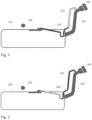
- Figure 1 shows a sealed fuel system for a vehicle comprising a leak detection device according to the prior art, the fuel systems comprising a fuel tank 101, with a filler pipe 102, a venting line 103, used to provide vapor communication between the head of the filler pipe 102 and the fuel tank 101, in order to be able detect a leak at the head 104 of said filler pipe 102 primarily induced by the improper replacement of the fuel cap 104.
- a first pressure sensor 105 on the fuel tank 101 to measure the internal pressure and determine whether or not a leak exists.
- the figure illustrates also the fact that liquid fuel 106 could be present in the venting line 103 by spilling over from either the refueling process or the tank itself.
- FIG. 2 shows a sealed fuel system for a vehicle comprising a leak detection device according to the prior art, wherein a fuel cap 204 is improperly placed on the head of a fuel filler pipe 202 of the fuel tank 201 and there is liquid fuel 206 in a venting line 203.
- an internal tank pressure can be achieved that is higher than the threshold pressure defined to ensure the leak integrity of the fuel system due to the hydrostatic pressure the fluid 206 applies on the fuel tank.
- the pressure value measured by a first pressure sensor 205 can falsely indicate that the entire fuel system 201, 202, 203 and205 is leak tight.
Landscapes
- Engineering & Computer Science (AREA)
- Chemical & Material Sciences (AREA)
- Life Sciences & Earth Sciences (AREA)
- Sustainable Development (AREA)
- Sustainable Energy (AREA)
- Combustion & Propulsion (AREA)
- Transportation (AREA)
- Mechanical Engineering (AREA)
- Physics & Mathematics (AREA)
- General Physics & Mathematics (AREA)
- Health & Medical Sciences (AREA)
- Analytical Chemistry (AREA)
- Biomedical Technology (AREA)
- Cooling, Air Intake And Gas Exhaust, And Fuel Tank Arrangements In Propulsion Units (AREA)
- Supplying Secondary Fuel Or The Like To Fuel, Air Or Fuel-Air Mixtures (AREA)
- Examining Or Testing Airtightness (AREA)
Description
- The invention relates to a sealed fuel system for a vehicle comprising a leak detection device. The invention further relates to a method for detecting a leak in a sealed fuel system of a vehicle and a method for detecting a malfunctioning of a pressure sensor in a sealed fuel system for a vehicle.
- Current leak detection systems are required to detect a leak in the complete evaporative emission system of a sealed fuel system, which includes any component internally exposed to fuel vapor. More specifically leak detection systems, which are able to detect and find small leaks within a sealed fuel system and signal the vehicle owner to take the vehicle for repair of the system, in order to reduce the amount of volatile organic compounds present in the environment. Typically, the leak detection systems and methods in the market work in two basic ways. The first is a method that induces pressure or vacuum in the interior of the sealed fuel system components via a mechanical pump, said method is called "active leak detection method". The second is a method that relies on the evolution of temperature to build pressure inside the fuel tank based on the principle of the ideal gas law that relates a change in temperature in a sealed fuel system to a change in pressure in said system as a function of the amount of temperature change and the gas properties of the gaseous mixture inside the tank, said method is called "passive leak detection method". The second method presents the advantage of being much less costly and requires significantly less power consumption while a vehicle is off however it generally generates less pressure and/or vacuum than a system using a pump. Specifically in the prior art there exists solutions in which temperature is measured in addition to pressure inside the fuel vapor dome in order to related the two basic ways and determine whether there is a leak present. For example if there is 3 degrees temperature evolution, it is deemed that there should indeed be measurable pressure evolution inside the tank provided there is not a leak. Nevertheless, those systems and methods to detect a leak require a good communication of the vapor phase between all parts of the sealed fuel system.
- For example: documents
JP 2015/096710 A JP 2015/096711 A US 2015/158378 A1 discloses a method and a system for a plug-in hybrid electric vehicle, wherein a pressure sensor is coupled to a fuel tank; and documentUS 2015/019066 A1 discloses a method for a vehicle with an engine, wherein a pressure sensor is coupled to a fuel tank. - Unfortunately, it is impossible for the existing leak detection devices and methods to perform a leak detection in a fuel system having a venting line that geometrically creates an isolated low point or a sump. Liquid fuel may be present in the sump and blocks the vapor circulation inducing a risk that a leak as big as a missing filler cap would never be detected if the venting line going to the filler pipe to provide vapor communication is blocked.
- There is thus a need to improve the existing leak detection devices and methods for detecting a leak in a sealed fuel system having a venting line forming a sump that is more accurate than prior art techniques but also methods for detecting a malfunctioning of a pressure sensor in a sealed fuel system of a vehicle and finally a need of fuels systems which are easy to manage from a leak detection perspective.
- It is a first object of the invention to provide a sealed fuel system for a vehicle comprising a leak detection device, said sealed fuel system being easy to manage from a leak detection perspective and easy to install in the vehicle frame.
- According to a first embodiment of the invention, the sealed fuel system for a vehicle comprising a fuel tank, a filler pipe, a venting line for recirculating fuel vapors from the tank to the filler pipe and a leak detection device, wherein the leak detection device comprises:
- a first pressure sensor provided to measure the pressure in the vapor dome of the fuel tank,
- a second pressure sensor, and
- a controller,
- the filler pipe has a sealing means located near the fuel tank,
- a part of the venting line forms a sump, and
- the second pressure sensor is provided to measure the pressure in the venting line above the highest possible liquid level that could be present in the venting line or to measure the pressure in the filler pipe above the highest possible liquid level that could be present in said filler pipe.
- Advantageously, the leak detection device according to the invention permits the use of venting line having a sump shape in a sealed fuel system, which leads to a simplified assembly procedure of the fuel system in the vehicle during the production line. Furthermore, additional holes drilled in the vehicle frame to pass the venting line are unnecessary which can add weight due to additional reinforcement pieces to counteract decreases in stiffness from the resulting holes. Finally, two pressure sensors enables to detect a leak if vehicle-operating condition can create unconnected vapor volumes in the fuel system, said unconnected volumes being the vapor dome of the tank and the top of the filler pipe or the vapor dome of the tank and the top of the venting line. For optimized filling performance, usually the filler pipe is usually connected at the bottom of the fuel tank and in most situations; the fuel in the tank will fill the connection between them. Additionally the sealing means has a normally closed position. The role of the venting line is to ensure a secondary connection, but the vapor disconnection will come from liquid fuel in the sump between the two volumes. The liquid can ingress inside the sump due to dynamic vehicle conditions during driving or due to slow filling of the venting line if the vehicle is parked in an inclined configuration. By the expression "sealed fuel system", we intend to mean that the openings of the fuel system are normally closed. By the term "controller", we intend to mean an electronic control unit (ECU).
- According to a preferred embodiment, the first pressure sensor is mounted in the vapor dome of the fuel tank.
- According to a preferred embodiment, the second pressure sensor is located in the venting line above the highest possible liquid level that could be present in the venting line or is located in the filler pipe above the highest possible liquid level that could be present in said filler pipe.
- According to a preferred embodiment, the second pressure sensor is located in the venting line between the sump and the top of the filler pipe, above the highest possible liquid level that could be present in the venting line.
- According to a preferred embodiment, the sealing means is an Inlet Check Valve. In an example, the Inlet Check Valve is a one-way check valve that is a sealing valve that allows creating a seal between the fuel tank and the filler pipe for preventing pressure built in the fuel tank from being transferred into the filler pipe.
- According to a preferred embodiment, the leak detection device comprises a temperature sensor provided to measure the temperature in the vapor dome of the fuel tank.
- The presence of the temperature sensor enables the increase of the conditions where the leak detection can be performed by reducing the thresholds for detection. Through the ability to measure the temperature inside the vapor dome of the fuel tank, a better prediction of the resulting pressure change between two measurement time points through the use of pressure/temperature relationships. Furthermore, by placing the temperature sensor in the vapor dome of the tank it is likely that the temperature change is lower than the temperature change in the filler pipe, meaning it gives a conservative indirect measurement of the temperature inside the filler pipe. Like this, a filler pipe threshold pressure Th3 can also be lowered. This is especially advantageous as there is direct relation of the performance of a passive leak detection system to a threshold pressure required Th2.
- According to a preferred embodiment, the temperature sensor is mounted in the vapor dome of the fuel tank.
- According to a preferred embodiment, the sealed fuel system for a vehicle according to the invention, is such that the part of the venting line forming a sump has a shape selected from the group consisting of a U-shape, a V-shape and a J-shape, preferably the part of the venting line forming a sump has a J-shape.
- The different shapes of the sump permits a higher fuel systems adaptability to different vehicle architectures. The J-shape is preferred to improve refueling performance. The venting line connecting the filler pipe to the tank has a higher length on the filler pipe side than on tank side. The highest point of the filler pipe is generally higher than the highest point of the tank relative to a horizontal ground (highest in the Z direction once installed in the vehicle); it reduces fuel going out of the filler pipe at the end of a refueling event.
- It is a second object of the invention to provide a method for detecting a leak in a sealed fuel system of a vehicle, said sealed fuel system having a venting line having a sump shape.
- According to a preferred embodiment of the invention, the method is provided for detecting a leak in a sealed fuel system of a vehicle as defined above.
- According to a preferred embodiment of the invention, the method for detecting a leak in a sealed fuel system of a vehicle comprising a fuel tank, a filler pipe, a venting line for recirculating fuel vapors from the tank to the filler pipe, wherein a part of the venting line forms a sump, is such that said method comprising at least the steps of:
- a) measuring and storing the pressure P1, and if needed the temperature, in the vapor dome of a tank of the fuel tank at predetermined time points;
- b) measuring the pressure P2 in the filler pipe of the fuel system or in the venting line of the fuel system above the highest possible liquid level that could be present in the venting line or in the filler pipe at predetermined time points;
- c) comparing the pressure value P1 in the vapor dome of a tank of the fuel tank and the pressure value P2 in the filler pipe of the fuel system or in the venting line of the fuel system above the highest possible liquid level at the same pre-determined time point that could be present in the venting line or in the filler pipe;
- d) detecting a leak using the result obtained on step c).
- The method for detecting a leak in a sealed fuel system of a vehicle according to the invention permits to obtain reliable results even if the vapor dome of the fuel tank and the top of the filler pipe or the top of the venting line are not in direct communication. By "direct communication", we intend to mean that there is a continuous gas flow in the venting line and no or a very small quantity of liquid that does not block the gas flow is present. Moreover, the method according to the invention is exhaustive in covering all vehicle life situations that can produce different situation inside the fuel system: situations where the pressure evolves similarly or differently in the vapor dome of the fuel tank and in the top of the venting line or the top of the filler pipe. These situations can be generated by the drive condition of the vehicle (whether the environment of the fuel system is hot or not), by the positioning of the vehicle during the parking (inside, outside, in direct sunlight, in shadow completely or partially) and by other environmental elements during the parking phase (wind convection around the fuel tank, external temperature evolution, etc.). The predetermined time points for measuring the pressure in the vapor dome of the fuel tank are preferably 0.5, 2, 3, 6, 8, 10, 12 and 24 hours after the vehicle is key-off.
- According to a preferred embodiment, the method for detecting a leak in a sealed fuel system of a vehicle according to the invention is such that the step c) and d) comprise the steps of:
- e) comparing the absolute value of the difference between the two measured pressures P1, P2 to a first threshold Th1;
- f) if the absolute value of the difference is lower than the first threshold Th1, comparing temperatures and pressures in the vapor dome of the fuel tank measured at the predetermined time points;
- g) if the difference of the temperatures measured at a first time and at a second later time is higher than a temperature threshold Th5, Calculating a pressure Ppredicted expected in the fuel system at the second time, on the basis of the temperatures evolution measured between the first time and at the second time and the pressure obtained at the first time, and a coefficient that represents the natural evolution of pressure in the fuel system over time;
- h) detecting a leak by comparing the calculated expected pressure and the pressure obtained at the second time to at least one predetermined second threshold Th2.
- The method permits to detect a leak in the case of the pressures in the vapor dome of the tank and in the top of the filler pipe or in the top of the venting line evolve similarly. The principle of the method relies on the pressure and the temperature evolution in the vapor dome to detect a leak in the system. By evolution, we intend to mean that there are several measurements of the couple pressure/temperature catching the change in temperature and pressure. In the state of the art, the algorithm shows that the relation between pressure and temperature can be predicted as disclosed in
document EP 3 409 936 A1 . If the pressure difference is lower than Th1, it means that possibly there is no liquid in the venting line connecting the tank to the filler pipe. In such a case, the analysis can rely only on one pressure sensor, which reduces the needs in term of accuracy on the second sensor, thus reducing its cost. The electrical consumption can also be reduced, as the second sensor can be unpowered for ulterior pressure measurements. - According to a preferred embodiment, which is an alternative to the previous one, the method for detecting a leak in a sealed fuel system of a vehicle according to the invention, wherein steps c) and d) comprise the steps of:
- i) comparing the absolute value of the difference between the two measured pressures P1, P2 to the first threshold Th1;
- j) if the absolute value of the difference is higher than the first threshold Th1, comparing the absolute value of the pressure in the vapor dome of a tank of the fuel system P1 to a third threshold Th3 and comparing the absolute value of the pressure in the filler pipe of the fuel system P2 or in the venting line of the fuel system P2 above the highest possible liquid level that could be present in the venting line or in the filler pipe to a fourth threshold Th4;
- k) if the absolute value of the pressure in the vapor dome of a tank of the fuel system P1 is lower than the third threshold Th3, concluding to the impossibility to detect a leak;
- l) if the absolute value of the pressure in the filler pipe of the fuel system P2 or in the venting line of the fuel system P2 above the highest possible liquid level that could be present in the venting line or in the filler pipe is higher than a fourth threshold Th4 concluding the system is leak tight;
- m) if the absolute value of the pressure in the filler pipe of the fuel system P2 or in the venting line of the fuel system P2 above the highest possible liquid level that could be present in the venting line or in the filler pipe is lower than the fourth threshold concluding the system has a leak.
- The method permits to detect a leak in the case of the pressures in the vapor dome of the tank and in the top of the filler pipe or in the top of the venting line evolve differently (the difference between the two pressures is higher than Th1). In such a case, there is possibly liquid in the venting line connecting the vapor dome of the fuel tank and the top of the filler pipe. As there is a doubt on the presence of liquid in the venting line sump or the presence of a leak, the method has advanced steps to avoid falsely predicting a leak. The presence of the liquid in the venting line can be assessed with the pressure in the vapor dome of the fuel tank, if the absolute pressure is higher than Th3, the gas pressure would have been able to push (in case of a positive relative pressure) or to aspire (in case of a negative relative pressure) the liquid from the venting line to the filler pipe or into the tank. In this case, a full or partial gas connection between the vapor dome of the fuel tank and the filler pipe can be considered. By "a full connection", we intend to mean that all the liquid in the line has been pushed or aspired in the filler pipe or the fuel tank. In case of a partial gas connection, we intend to mean that some bubbles can go through the liquid between the tank and the filler pipe. If the pressure criteria is not met, this step of the method allows the disabling of the algorithm and thus reduce electrical consumption of the control unit. In the case of the pressure in the tank is higher than Th3, the method compares the pressure in the filler pipe to Th4. In this case, a lower value than the threshold indicates that a full or partial gas connection does not lead to a pressure equilibrium between the two volumes so there is a leak in the system on the filler pipe side.
- According to a preferred embodiment, the method for detecting a leak in a sealed fuel system of a vehicle according to the invention is such that the first threshold Th1 is defined taking into account the precision and the accuracy of the two pressure sensors.
- Th1 is the maximum difference acceptable between the two sensors when they are measuring the same actual pressure. This threshold cumulates the precision and the accuracy of the two sensors plus a safety margin. The margin is comprised in the range of 1 to 10 mbar, preferably in the range from 1 to 5 mbar. The individual accuracy and precision of a sensor can be technologically reduced, but it increases the cost of the sensor. There is thus a compromise to be made between the cost and the efficiency of the sensor. A preferred sensor would have a precision between 1 to 5 mbar, preferably equal 2 mbar, and an accuracy between 0,5 to 3 mbar, preferably equal to 1 mbar. Therefore, Th1 would be comprised between 4 mbar and 26 mbar, preferably comprised between 5 and 10 mbar.
- According to a preferred embodiment, the method for detecting a leak in a sealed fuel system of a vehicle according to the invention is such that the second threshold Th2 is chosen in the range of 5 mbar and 35 mbar and the temperature threshold Th5 is chosen between 1°C and 5°C, preferably between 2°C and 3°C.
- According to a preferred embodiment, the method for detecting a leak in a sealed fuel system of a vehicle according to the invention is such that the third threshold (Th3) is adapted to the potential maximum hydraulic pressure of the liquid in the sump part of the venting line in function of the sign of the value of the pressure in the fuel tank vapor dome.
- The third threshold Th3 is the pressure needed to push or aspire the liquid from the sump. In case the pressure in the fuel tank vapor dome is higher than the pressure in the filler pipe, the liquid in the venting line will be pushed in the filler pipe. In case of the venting line has a J-shape with the top of the filler pipe higher than the top of the tank, Th3 is the hydraulic pressure equivalent to the sump volume when all the liquid is in the highest length of the connecting line (of J) and the liquid density. This value is directly driven by the design of the vehicle. A common value for instance could be 40 mbar. In case of the pressure in the fuel tank vapor dome is lower than the pressure in the filler pipe (for instance in case of relative vacuum with regard to the ambient pressure outside of the fuel system), the liquid in the venting line will be aspired in the fuel tank. In the case of the connecting line has a J-shape with the top of the filler pipe higher than the top of the tank, Th3 is the hydraulic pressure equivalent to the liquid density and the volume between the lowest level of the sump and the top of the tank height. This value is directly driven by the design of the vehicle. A common value for instance could be 20 mbar. The adjustment of Th3 to the fact that the liquid in the sump will be pushed or aspired regarding the pressure difference allows reducing the pressure needed in the tank. It further allows taking a quicker decision and thus reducing electrical consumption and increasing the occurrence of the decision.
- According to a preferred embodiment, the method for detecting a leak in a sealed fuel system of a vehicle according to the invention is such that the fourth threshold Th4 is defined relatively to the sensor accuracy and precision of the pressure sensor located in the venting line above the highest possible liquid level that could be present in the venting line or located in the filler pipe above the highest possible liquid level that could be present in said filler pipe.
- The fourth threshold Th4 is the minimal detectable pressure that can be maintained by the fuel system if a leak is not present. For pressures lower than this threshold, a situation where a leak is present cannot be distinguished from a situation where no leak is present due to the volatile nature of the fuel. This value takes into account sensor accuracy and precision plus a safety margin. The margin is between 1 to 10 mbar, preferably 1 to 5 mbar. A preferred sensor would have a precision between 1 to 5 mbar, preferably 2 mbar and an accuracy between 0,5 to 3 mbar preferably 1 mbar. Therefore, Th4 preferred value would be 10 mbar.
- According to a preferred embodiment, the method for detecting a leak in a sealed fuel system of a vehicle according to the invention is such that the third and the fourth threshold Th3, Th4 are augmented by temperature evolution between two predetermined time points when said evolution is greater than the temperature threshold Th5.
- The readjustment of the third threshold and the fourth threshold based on the temperature evolution in the fuel tank vapor dome, Th3 and Th4 allows quicker decisions, reduces electrical consumption and increases the occurrence of the decision.
- According to a preferred embodiment, the method for detecting a leak in a sealed fuel system of a vehicle according to the invention, is such that said method is started with the temperature evolution measured by a temperature sensor is higher than the temperature threshold Th5.
- It is a third object of the invention to provide a method for detecting a malfunctioning of a pressure sensor in a sealed fuel system for a vehicle as defined above.
- According to a preferred embodiment of the invention, the method for detecting a malfunctioning of a pressure sensor in a sealed fuel system for a vehicle comprises at least the steps of:
- measuring the pressure P1 in the vapor dome of a tank of the fuel tank at predetermined time points;
- measuring the pressure P2 in the filler pipe of the fuel system or in the venting line of the fuel system above the highest possible liquid level that could be present in the venting line or in the filler pipe at predetermined time points;
- comparing the pressure value P1 in the vapor dome of a tank of the fuel tank and the pressure value P2 in the filler pipe of the fuel system or in the venting line of the fuel system above the highest possible liquid level at the same predetermined time points that could be present in the venting line or in the filler pipe;
- detecting the malfunctioning of a pressure sensor.
- The predetermined time points for measuring the pressure in the vapor dome of the fuel tank are preferably 0.5, 2, 3, 6, 8, 10, 12 and 24 hours after the vehicle is key-off.
- The embodiments of the present invention are shown on the following figures.
-
Figure 1 illustrates a leak detection device according to the prior art installed on a sealed fuel system of a vehicle a venting line for recirculating fuel vapors from the tank to the filler pipe wherein a part of the venting line forms a sump; -
Figure 2 shows a leak detection device according to the prior art installed on a sealed fuel system of a vehicle a venting line for recirculating fuel vapors from the tank to the filler pipe wherein a part of the venting line forms a sump; -
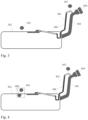
Figure 3 illustrates a leak detection device according to the invention installed on a sealed fuel system of a vehicle a venting line for recirculating fuel vapors from the tank to the filler pipe wherein a part of the venting line forms a sump; -
Figure 4 discloses a leak detection device according to the invention installed on a sealed fuel system of a vehicle a venting line for recirculating fuel vapors from the tank to the filler pipe wherein a part of the venting line forms a sump; -
Figure 5 shows a chart presenting the method for detecting a leak in a sealed fuel system of a vehicle comprising a venting line for recirculating fuel vapors from the tank to the filler pipe wherein a part of the venting line forms a sump. -
Figure 1 shows a sealed fuel system for a vehicle comprising a leak detection device according to the prior art, the fuel systems comprising afuel tank 101, with afiller pipe 102, aventing line 103, used to provide vapor communication between the head of thefiller pipe 102 and thefuel tank 101, in order to be able detect a leak at thehead 104 of saidfiller pipe 102 primarily induced by the improper replacement of thefuel cap 104. Onfigure 1 , there also exists afirst pressure sensor 105 on thefuel tank 101 to measure the internal pressure and determine whether or not a leak exists. The figure illustrates also the fact thatliquid fuel 106 could be present in theventing line 103 by spilling over from either the refueling process or the tank itself. -
Figure 2 shows a sealed fuel system for a vehicle comprising a leak detection device according to the prior art, wherein afuel cap 204 is improperly placed on the head of afuel filler pipe 202 of thefuel tank 201 and there isliquid fuel 206 in aventing line 203. As a result, an internal tank pressure can be achieved that is higher than the threshold pressure defined to ensure the leak integrity of the fuel system due to the hydrostatic pressure the fluid 206 applies on the fuel tank. As a result, the pressure value measured by afirst pressure sensor 205 can falsely indicate that theentire fuel system -
Figure 3 represents an embodiment of a leak detection device according to the invention, wherein afuel cap 304 is improperly placed on the head of afuel filler pipe 302 and there isliquid fuel 306 in aventing line 303 of afuel tank 301, and in which asecond pressure sensor 307 is implemented in theventing line 303, preferably at a point higher than the highest possible liquid level in theventing line 303. In this embodiment, an absence of pressure will be detected in theventing line 303 and thefiller pipe 302, which can be reliably used as criteria to detect a leak, regardless of theliquid fuel 306 inside theventing line 303. By the combination of a first pressure sensor on thefuel tank 305, and thesecond pressure sensor 307 on theventing line 303 of the leak detection device according to the invention, thecomplete fuel system filler pipe 302 has a sealing means, for example, an Inlet Check Valve (not showed), located near thefuel tank 301. In a preferred embodiment, the Inlet Check Valve is a one-way check valve that is a sealing valve that allows creating a seal between thefuel tank 301 and thefiller pipe 302 for preventing pressure built in thefuel tank 301 from being transferred into thefiller pipe 302. -
Figure 4 represents a preferred embodiment of a leak detection device according to the invention, wherein afuel cap 404 is improperly placed on the head of afuel filler pipe 402 and there isliquid fuel 406 in aventing line 403 of afuel tank 401, and in which asecond pressure sensor 407 is implemented in theventing line 403, preferably at a point higher than the highest possible liquid level in the venting line 403.In this embodiment, atemperature sensor 408 is integrated into afirst pressure sensor 405 in order to more accurately determine whether there was enough temperature change within thefuel tank 401 to build sufficient pressure to determine whether there is a leak in the system or not. Thistemperature sensor 408 combined with thefirst pressure sensor 405 in thetank 401 and thesecond pressure sensor 407 on theventing line 403 represents the ideal system for accurately and consistently detecting a leak in the fuel system. A controller (not shown) controls the operations of the leak detection device. Thefiller pipe 402 has a sealing means, for example, an Inlet Check Valve (not showed), located near thefuel tank 401. In a preferred embodiment, the Inlet Check Valve is a one-way check valve that is a sealing valve that allows creating a seal between thefuel tank 401 and thefiller pipe 402 for preventing pressure built in thefuel tank 401 from being transferred into thefiller pipe 402. -
Figure 5 represents an embodiment of the method for detecting the leak as well as the integrity of the two pressure sensors comprising the steps of the method, wherein A illustrates the steps a) and b) of the method for detecting a leak in a sealed fuel system of a vehicle, B and C illustrates the steps c) and d) of the method for detecting a leak in a sealed fuel system of a vehicle. More precisely, B illustrates the steps e) of the method for detecting a leak in a sealed fuel system of a vehicle, furthermore B illustrates the steps i), j), k), l) and m) of the method for detecting a leak in a sealed fuel system of a vehicle, and C illustrates the steps f), g) and h) of the method for detecting a leak in a sealed fuel system of a vehicle. For example, as illustrated by B, steps e) and i) form a single comparison step. -
- 101:
- fuel tank
- 102:
- filler pipe
- 103:
- venting line
- 104:
- fuel cap
- 105:
- first pressure sensor
- 106:
- liquid fuel
- 201:
- fuel tank
- 202:
- filler pipe
- 203:
- venting line
- 204:
- fuel cap
- 205:
- first pressure sensor
- 206:
- liquid fuel
- 301:
- fuel tank
- 302:
- filler pipe
- 303:
- venting line
- 304:
- fuel cap
- 305:
- first pressure sensor
- 306:
- liquid fuel
- 307:
- second pressure sensor
- 401:
- fuel tank
- 402:
- filler pipe
- 403:
- venting line
- 404:
- fuel cap
- 405:
- first pressure sensor
- 406:
- liquid fuel
- 407:
- second pressure sensor
- 408:
- temperature sensor
- A: steps a) and b) of the method for detecting a leak in a sealed fuel system of a vehicle
- B: steps e), i), j), k), l) and m) of the method for detecting a leak in a sealed fuel system of a vehicle
- C: steps f), g) and h) of the method for detecting a leak in a sealed fuel system of a vehicle
Claims (14)
- A sealed fuel system for a vehicle comprising a fuel tank (301, 401), a filler pipe (302, 402), a venting line (303, 403) for recirculating fuel vapors from the tank (301, 401) to the filler pipe (302, 402) and a leak detection device, wherein the leak detection device comprises:- a first pressure sensor (305, 405) provided to measure the pressure in the vapor dome of the fuel tank (301, 401),- a second pressure sensor (307, 407), and- a controller,- the filler pipe has a sealing means located near the fuel tank,the sealed fuel system being characterized in that:- a part of the venting line (303, 403) forms a sump, and- the second pressure sensor (307, 407) is provided to measure the pressure in the venting line (303, 403) above the highest possible liquid (306, 406) level that could be present in the venting line (303, 403) or to measure the pressure in the filler pipe (302, 402) above the highest possible liquid (306, 406) level that could be present in said filler pipe (302, 402).
- The sealed fuel system for a vehicle according to claim 1, wherein the sealing means is an Inlet Check Valve.
- The sealed fuel system for a vehicle according to any one of the claims 1 to 2, wherein the leak detection device comprising a temperature sensor (408) provided to measure the temperature in the vapor dome of the fuel tank (301, 401).
- The sealed fuel system for a vehicle according to any one of the claims 1 to 3, wherein the part of the venting line (303, 403) forming a sump has a shape selected from the group consisting of a U-shape, a V-shape and a J-shape, preferably the part of the venting line forming a sump has a J-shape.
- A method for detecting a leak in a sealed fuel system of a vehicle comprising a fuel tank (301, 401), a filler pipe (302, 402), a venting line (303, 403) for recirculating fuel vapors from the tank (301, 401) to the filler pipe (302, 402), wherein a part of the venting line (303, 403) forms a sump, wherein said method comprising at least the steps of:a) measuring and storing the pressure (P1), and if needed the temperature, in the vapor dome of a tank of the fuel tank (301, 401) at predetermined time points;b) measuring the pressure (P2) in the filler pipe (302, 402) of the fuel system or in the venting line (303, 403) of the fuel system above the highest possible liquid level that could be present in the venting line (303, 403) or in the filler pipe (302, 402) at predetermined time points;c) comparing the pressure value (P1) in the vapor dome of a tank of the fuel tank (301, 401) and the pressure value (P2) in the filler pipe (302, 402) of the fuel system or in the venting line (303, 403) of the fuel system above the highest possible liquid level at the same predetermined time point that could be present in the venting line (303, 403) or in the filler pipe (302, 402);d) detecting a leak using the result obtained on step c).
- The method for detecting a leak in a sealed fuel system of a vehicle according to claim 5, wherein steps c) and d) comprise the steps of:e) comparing the absolute value of the difference between the two measured pressures (P1, P2) to a first threshold (Th1);f) if the absolute value of the difference is lower than the first threshold (Th1), comparing temperatures and pressures in the vapor dome of the fuel tank (301, 401) measured at the predetermined time points;g) if the difference of the temperatures measured at the first time and at the second later time is higher than a temperature threshold (Th5), calculating a pressure (Ppredicted) expected in the fuel system at the second time, on the basis of the temperature evolution measured between the first time and the second time and the pressure obtained at the first time, and a coefficient that represents the natural evolution of pressure in the fuel system over time;h) detecting a leak by comparing the calculated expected pressure and the pressure obtained at the second time to at least one predetermined second threshold (Th2).
- The method for detecting a leak in a sealed fuel system of a vehicle according to any one of the claims 5 to 6, wherein step c) and d) comprise the steps of:i) comparing the absolute value of the difference between the two measured pressures (P1, P2) to the first threshold (Th1);j) if the absolute value of the difference is higher than the first threshold (Th1), comparing the absolute value of the pressure (P1) in the vapor dome of a tank (301, 401) of the fuel system to a third threshold (Th3) and comparing the absolute value of the pressure (P2) in the filler pipe (302, 402) of the fuel system or in the venting line (303, 403) of the fuel system above the highest possible liquid level that could be present in the venting line (303, 403) or in the filler pipe (302, 402) to a fourth threshold (Th4);k) if the absolute value of the pressure (P1) in the vapor dome of a tank (301, 401) of the fuel system is lower than the third threshold (Th3), concluding to the impossibility to detect a leak;l) if the absolute value of the pressure (P2) in the filler pipe (302, 402) of the fuel system or in the venting line (303, 403) of the fuel system above the highest possible liquid level that could be present in the venting line (303, 403) or in the filler pipe (302, 402) is higher than a fourth threshold (Th4) concluding the system is leak tight;m) if the absolute value of the pressure (P2) in the filler pipe (302, 402) of the fuel system or in the venting line (303, 403) of the fuel system above the highest possible liquid level that could be present in the venting line (303, 403) or in the filler pipe (302, 402) is lower than the fourth threshold concluding the system has a leak.
- The method for detecting a leak in a sealed fuel system of a vehicle according to any one of the claims 6 to 7, wherein the first threshold (Th1) is defined taking into account the precision and the accuracy of the two pressure sensors.
- The method for detecting a leak in a sealed fuel system of a vehicle according to claim 6, wherein the second threshold (Th2) is chosen in the range of 5 mbar and 35 mbar and the temperature threshold (Th5) is chosen between 1°C and 5°C, preferably between 2°C and 3°C.
- The method for detecting a leak in a sealed fuel system of a vehicle according to claim 7, wherein the third threshold (Th3) is adapted to the potential maximum hydraulic pressure of the liquid in the sump part of the venting line (303, 403) in function of the sign of the value of the pressure on the vapor dome.
- The method for detecting a leak in a sealed fuel system of a vehicle according to claim 7, wherein the fourth threshold (Th4) is defined relatively to the sensor accuracy and precision of the pressure sensor located in the venting line (303, 403) above the highest possible liquid level that could be present in the venting line (303, 403) or located in the filler pipe (302, 402) above the highest possible liquid level that could be present in said filler pipe (302, 402).
- The method for detecting a leak in a sealed fuel system of a vehicle according to any one of the claims 7, 8, 10 and 11, wherein the third and the fourth threshold (Th3, Th4) are augmented by temperature evolution between two predetermined time points when said evolution is greater than the temperature threshold (Th5).
- The method for detecting a leak in a sealed fuel system of a vehicle according to any one of the claims 6 to 8, wherein said method is started with the temperature evolution measured by a temperature sensor is higher than the temperature threshold (Th5).
- A method for detecting a malfunctioning of a pressure sensor in a sealed fuel system for a vehicle according to any one of claims 1 to 4, wherein said method comprising at least the steps of:• measuring the pressure (P1) in the vapor dome of a tank of the fuel tank (301, 401) at predetermined time points;• measuring the pressure (P2) in the filler pipe (302, 402) of the fuel system or in the venting line (303, 403) of the fuel system above the highest possible liquid level that could be present in the venting line (303, 403) or in the filler pipe (302, 402) at predetermined time points;• comparing the pressure value (P1) in the vapor dome of a tank of the fuel tank (301, 401) and the pressure value (P2) in the filler pipe (302, 402) of the fuel system or in the venting line (303, 403) of the fuel system above the highest possible liquid level that could be present in the venting line (303, 403) or in the filler pipe (302, 402);• detecting the malfunctioning of a pressure sensor.
Applications Claiming Priority (2)
| Application Number | Priority Date | Filing Date | Title |
|---|---|---|---|
| EP19212718 | 2019-11-29 | ||
| PCT/EP2020/083834 WO2021105493A1 (en) | 2019-11-29 | 2020-11-30 | Leak detection system |
Publications (3)
| Publication Number | Publication Date |
|---|---|
| EP4065400A1 EP4065400A1 (en) | 2022-10-05 |
| EP4065400B1 true EP4065400B1 (en) | 2025-07-02 |
| EP4065400B8 EP4065400B8 (en) | 2025-08-06 |
Family
ID=68762492
Family Applications (1)
| Application Number | Title | Priority Date | Filing Date |
|---|---|---|---|
| EP20811671.5A Active EP4065400B8 (en) | 2019-11-29 | 2020-11-30 | Leak detection system |
Country Status (6)
| Country | Link |
|---|---|
| US (1) | US12140503B2 (en) |
| EP (1) | EP4065400B8 (en) |
| JP (1) | JP7568718B2 (en) |
| KR (1) | KR102834625B1 (en) |
| CN (1) | CN114502405A (en) |
| WO (1) | WO2021105493A1 (en) |
Families Citing this family (2)
| Publication number | Priority date | Publication date | Assignee | Title |
|---|---|---|---|---|
| US20220200070A1 (en) * | 2020-12-23 | 2022-06-23 | Brunswick Corporation | Marine battery with water ingress and shock detection |
| CN116576910B (en) * | 2023-04-10 | 2025-10-03 | 宁波格劳博智能工业有限公司 | An intelligent instrument system based on Internet of Things modules and online monitoring |
Family Cites Families (15)
| Publication number | Priority date | Publication date | Assignee | Title |
|---|---|---|---|---|
| DE4427688C2 (en) * | 1994-08-04 | 1998-07-23 | Siemens Ag | Method for checking the functionality of a tank ventilation system for a motor vehicle |
| JP2001165006A (en) * | 1999-12-10 | 2001-06-19 | Toyota Motor Corp | Abnormality diagnosis device for evaporative fuel processing system |
| JP4441498B2 (en) * | 2006-02-24 | 2010-03-31 | 本田技研工業株式会社 | Fuel tank system |
| JP5573467B2 (en) * | 2010-08-04 | 2014-08-20 | トヨタ自動車株式会社 | Fuel supply system leak detection method and fuel supply system leak diagnosis device |
| US8746215B2 (en) * | 2011-12-02 | 2014-06-10 | Continental Automotive Systems, Inc. | Sample tube structure for automotive fuel tank leak detection |
| US9255553B2 (en) | 2013-07-10 | 2016-02-09 | Ford Global Technologies, Llc | Leak detection for canister purge valve |
| JP6269929B2 (en) * | 2013-11-15 | 2018-01-31 | 三菱自動車工業株式会社 | Vehicle fuel system |
| JP6183605B2 (en) * | 2013-11-15 | 2017-08-23 | 三菱自動車工業株式会社 | Vehicle fuel system |
| US9145051B2 (en) | 2013-12-09 | 2015-09-29 | Ford Global Technologies, Llc | Systems and methods for managing bleed emissions in plug-in hybrid electric vehicles |
| DE102014009634A1 (en) * | 2014-06-27 | 2015-12-31 | Audi Ag | Fuel tank with an activated carbon filter and method for displaying the fuel level in the fuel tank with signal suppression at a critical negative pressure during the regeneration of the activated carbon filter |
| US9745907B2 (en) * | 2015-01-27 | 2017-08-29 | Ford Global Technologies, Llc | Systems and methods for inferring fuel vapor canister loading rate |
| DE102015221536A1 (en) * | 2015-11-03 | 2017-05-04 | Volkswagen Aktiengesellschaft | Device and method for tank leak diagnosis |
| CN107542598B (en) * | 2016-06-28 | 2019-07-26 | 长城汽车股份有限公司 | High pressure fuel vapo(u)rization system and its control method, vehicle |
| EP3409936A1 (en) | 2017-05-31 | 2018-12-05 | Plastic Omnium Advanced Innovation and Research | Method and system for determining a leak present in a pressurized fuel system |
| CN110095228A (en) * | 2019-05-29 | 2019-08-06 | 深圳市康士柏实业有限公司 | For the detection of fuel evaporation checkout and diagnosis equipment and the test macro and test method of measurement and calibration |
-
2020
- 2020-11-30 JP JP2022522051A patent/JP7568718B2/en active Active
- 2020-11-30 CN CN202080070959.6A patent/CN114502405A/en active Pending
- 2020-11-30 EP EP20811671.5A patent/EP4065400B8/en active Active
- 2020-11-30 WO PCT/EP2020/083834 patent/WO2021105493A1/en not_active Ceased
- 2020-11-30 US US17/780,386 patent/US12140503B2/en active Active
- 2020-11-30 KR KR1020227016962A patent/KR102834625B1/en active Active
Also Published As
| Publication number | Publication date |
|---|---|
| US20230008799A1 (en) | 2023-01-12 |
| KR20220106971A (en) | 2022-08-01 |
| EP4065400B8 (en) | 2025-08-06 |
| WO2021105493A1 (en) | 2021-06-03 |
| EP4065400A1 (en) | 2022-10-05 |
| KR102834625B1 (en) | 2025-07-15 |
| CN114502405A (en) | 2022-05-13 |
| JP2023503799A (en) | 2023-02-01 |
| US12140503B2 (en) | 2024-11-12 |
| JP7568718B2 (en) | 2024-10-16 |
Similar Documents
| Publication | Publication Date | Title |
|---|---|---|
| US12140503B2 (en) | Leak detection system | |
| CN108407607B (en) | Novel electric control fuel system | |
| CN110044556A (en) | A kind of detection device and detection method of vehicle fuel oil evaporation system sealing | |
| US20110315127A1 (en) | Low purge flow vehicle diagnostic tool | |
| US20100098130A1 (en) | High-pressure tank temperature detection system and high-pressure tank system | |
| US5572981A (en) | Method for monitoring the functional capability of a tank venting system for a motor vehicle | |
| US20150075267A1 (en) | Fuel tank pressure sensor rationality test for a phev | |
| GB2354331A (en) | Fuel system leak detection | |
| CN102442204A (en) | Large leak diagnostic tool for sealed fuel system in vehicle | |
| CN111608823B (en) | Method for detecting opening delay of carbon canister valve and leakage of oil tank and leakage detection device | |
| CN110112443B (en) | Hydrogenation fault diagnosis method for fuel cell hydrogen system | |
| US20130118456A1 (en) | Optimization of tank venting of a fuel tank | |
| EP2333290B1 (en) | Method and system to detect a leak in a vehicle fuel tank | |
| US20120060936A1 (en) | Method for preventing pressure in vessels from dropping below minimum allowable pressure | |
| JP5573467B2 (en) | Fuel supply system leak detection method and fuel supply system leak diagnosis device | |
| CN207790317U (en) | A kind of new-type electric control fuel system | |
| US6829555B2 (en) | Method and arrangement for monitoring the emissions during operation of a supply vessel for supplying a volatile medium including a fuel supply tank of a motor vehicle | |
| US6216674B1 (en) | Fuel system vapor integrity testing with temperature compensation | |
| US11118958B2 (en) | System for determining a filling level in a fuel tank | |
| US12241592B2 (en) | Arrangement for a cryogenic system | |
| EP2151565B1 (en) | Injector protection control method, and common rail fuel injection control device | |
| US10428766B2 (en) | Apparatus and method for filling LPG vehicle with LPG | |
| US20130312495A1 (en) | Method and system for quickly detecting an absence of a leak in a fuel system | |
| KR101952717B1 (en) | Method and apparatus for preventing fault of fuel cap open detection by fuel level modeling | |
| KR200310213Y1 (en) | Vent valve test device |
Legal Events
| Date | Code | Title | Description |
|---|---|---|---|
| STAA | Information on the status of an ep patent application or granted ep patent |
Free format text: STATUS: UNKNOWN |
|
| STAA | Information on the status of an ep patent application or granted ep patent |
Free format text: STATUS: THE INTERNATIONAL PUBLICATION HAS BEEN MADE |
|
| PUAI | Public reference made under article 153(3) epc to a published international application that has entered the european phase |
Free format text: ORIGINAL CODE: 0009012 |
|
| STAA | Information on the status of an ep patent application or granted ep patent |
Free format text: STATUS: REQUEST FOR EXAMINATION WAS MADE |
|
| 17P | Request for examination filed |
Effective date: 20220627 |
|
| AK | Designated contracting states |
Kind code of ref document: A1 Designated state(s): AL AT BE BG CH CY CZ DE DK EE ES FI FR GB GR HR HU IE IS IT LI LT LU LV MC MK MT NL NO PL PT RO RS SE SI SK SM TR |
|
| DAV | Request for validation of the european patent (deleted) | ||
| DAX | Request for extension of the european patent (deleted) | ||
| P01 | Opt-out of the competence of the unified patent court (upc) registered |
Effective date: 20230515 |
|
| GRAP | Despatch of communication of intention to grant a patent |
Free format text: ORIGINAL CODE: EPIDOSNIGR1 |
|
| STAA | Information on the status of an ep patent application or granted ep patent |
Free format text: STATUS: GRANT OF PATENT IS INTENDED |
|
| INTG | Intention to grant announced |
Effective date: 20250327 |
|
| GRAS | Grant fee paid |
Free format text: ORIGINAL CODE: EPIDOSNIGR3 |
|
| GRAA | (expected) grant |
Free format text: ORIGINAL CODE: 0009210 |
|
| STAA | Information on the status of an ep patent application or granted ep patent |
Free format text: STATUS: THE PATENT HAS BEEN GRANTED |
|
| GRAT | Correction requested after decision to grant or after decision to maintain patent in amended form |
Free format text: ORIGINAL CODE: EPIDOSNCDEC |
|
| REG | Reference to a national code |
Ref country code: DE Ref legal event code: R081 Ref document number: 602020053916 Country of ref document: DE Owner name: OPMOBILITY C-POWER BELGIUM RESEARCH, BE Free format text: FORMER OWNER: PLASTIC OMNIUM ADVANCED INNOVATION AND RESEARCH, BRUXELLES, BE |
|
| AK | Designated contracting states |
Kind code of ref document: B1 Designated state(s): AL AT BE BG CH CY CZ DE DK EE ES FI FR GB GR HR HU IE IS IT LI LT LU LV MC MK MT NL NO PL PT RO RS SE SI SK SM TR |
|
| REG | Reference to a national code |
Ref country code: GB Ref legal event code: FG4D |
|
| REG | Reference to a national code |
Ref country code: CH Ref legal event code: EP Ref country code: CH Ref legal event code: PK Free format text: BERICHTIGUNG B8 |
|
| RAP4 | Party data changed (patent owner data changed or rights of a patent transferred) |
Owner name: OPMOBILITY C-POWER BELGIUM RESEARCH |
|
| REG | Reference to a national code |
Ref country code: DE Ref legal event code: R096 Ref document number: 602020053916 Country of ref document: DE |
|
| REG | Reference to a national code |
Ref country code: IE Ref legal event code: FG4D |
|
| REG | Reference to a national code |
Ref country code: NL Ref legal event code: MP Effective date: 20250702 |
|
| PG25 | Lapsed in a contracting state [announced via postgrant information from national office to epo] |
Ref country code: PT Free format text: LAPSE BECAUSE OF FAILURE TO SUBMIT A TRANSLATION OF THE DESCRIPTION OR TO PAY THE FEE WITHIN THE PRESCRIBED TIME-LIMIT Effective date: 20251103 |
|
| PG25 | Lapsed in a contracting state [announced via postgrant information from national office to epo] |
Ref country code: NL Free format text: LAPSE BECAUSE OF FAILURE TO SUBMIT A TRANSLATION OF THE DESCRIPTION OR TO PAY THE FEE WITHIN THE PRESCRIBED TIME-LIMIT Effective date: 20250702 |
|
| REG | Reference to a national code |
Ref country code: AT Ref legal event code: MK05 Ref document number: 1808871 Country of ref document: AT Kind code of ref document: T Effective date: 20250702 |
|
| PG25 | Lapsed in a contracting state [announced via postgrant information from national office to epo] |
Ref country code: IS Free format text: LAPSE BECAUSE OF FAILURE TO SUBMIT A TRANSLATION OF THE DESCRIPTION OR TO PAY THE FEE WITHIN THE PRESCRIBED TIME-LIMIT Effective date: 20251102 |
|
| PG25 | Lapsed in a contracting state [announced via postgrant information from national office to epo] |
Ref country code: NO Free format text: LAPSE BECAUSE OF FAILURE TO SUBMIT A TRANSLATION OF THE DESCRIPTION OR TO PAY THE FEE WITHIN THE PRESCRIBED TIME-LIMIT Effective date: 20251002 |
|
| REG | Reference to a national code |
Ref country code: LT Ref legal event code: MG9D |
|
| PG25 | Lapsed in a contracting state [announced via postgrant information from national office to epo] |
Ref country code: AT Free format text: LAPSE BECAUSE OF FAILURE TO SUBMIT A TRANSLATION OF THE DESCRIPTION OR TO PAY THE FEE WITHIN THE PRESCRIBED TIME-LIMIT Effective date: 20250702 |
|
| PG25 | Lapsed in a contracting state [announced via postgrant information from national office to epo] |
Ref country code: FI Free format text: LAPSE BECAUSE OF FAILURE TO SUBMIT A TRANSLATION OF THE DESCRIPTION OR TO PAY THE FEE WITHIN THE PRESCRIBED TIME-LIMIT Effective date: 20250702 |
|
| PG25 | Lapsed in a contracting state [announced via postgrant information from national office to epo] |
Ref country code: HR Free format text: LAPSE BECAUSE OF FAILURE TO SUBMIT A TRANSLATION OF THE DESCRIPTION OR TO PAY THE FEE WITHIN THE PRESCRIBED TIME-LIMIT Effective date: 20250702 |
|
| PG25 | Lapsed in a contracting state [announced via postgrant information from national office to epo] |
Ref country code: GR Free format text: LAPSE BECAUSE OF FAILURE TO SUBMIT A TRANSLATION OF THE DESCRIPTION OR TO PAY THE FEE WITHIN THE PRESCRIBED TIME-LIMIT Effective date: 20251003 |
|
| PG25 | Lapsed in a contracting state [announced via postgrant information from national office to epo] |
Ref country code: CZ Free format text: LAPSE BECAUSE OF FAILURE TO SUBMIT A TRANSLATION OF THE DESCRIPTION OR TO PAY THE FEE WITHIN THE PRESCRIBED TIME-LIMIT Effective date: 20250702 Ref country code: SE Free format text: LAPSE BECAUSE OF FAILURE TO SUBMIT A TRANSLATION OF THE DESCRIPTION OR TO PAY THE FEE WITHIN THE PRESCRIBED TIME-LIMIT Effective date: 20250702 |
|
| PG25 | Lapsed in a contracting state [announced via postgrant information from national office to epo] |
Ref country code: LV Free format text: LAPSE BECAUSE OF FAILURE TO SUBMIT A TRANSLATION OF THE DESCRIPTION OR TO PAY THE FEE WITHIN THE PRESCRIBED TIME-LIMIT Effective date: 20250702 |
|
| PG25 | Lapsed in a contracting state [announced via postgrant information from national office to epo] |
Ref country code: PL Free format text: LAPSE BECAUSE OF FAILURE TO SUBMIT A TRANSLATION OF THE DESCRIPTION OR TO PAY THE FEE WITHIN THE PRESCRIBED TIME-LIMIT Effective date: 20250702 Ref country code: BG Free format text: LAPSE BECAUSE OF FAILURE TO SUBMIT A TRANSLATION OF THE DESCRIPTION OR TO PAY THE FEE WITHIN THE PRESCRIBED TIME-LIMIT Effective date: 20250702 |
|
| PG25 | Lapsed in a contracting state [announced via postgrant information from national office to epo] |
Ref country code: RS Free format text: LAPSE BECAUSE OF FAILURE TO SUBMIT A TRANSLATION OF THE DESCRIPTION OR TO PAY THE FEE WITHIN THE PRESCRIBED TIME-LIMIT Effective date: 20251002 |
|
| PG25 | Lapsed in a contracting state [announced via postgrant information from national office to epo] |
Ref country code: ES Free format text: LAPSE BECAUSE OF FAILURE TO SUBMIT A TRANSLATION OF THE DESCRIPTION OR TO PAY THE FEE WITHIN THE PRESCRIBED TIME-LIMIT Effective date: 20250702 |
|
| PG25 | Lapsed in a contracting state [announced via postgrant information from national office to epo] |
Ref country code: RO Free format text: LAPSE BECAUSE OF FAILURE TO SUBMIT A TRANSLATION OF THE DESCRIPTION OR TO PAY THE FEE WITHIN THE PRESCRIBED TIME-LIMIT Effective date: 20250702 |
|
| PG25 | Lapsed in a contracting state [announced via postgrant information from national office to epo] |
Ref country code: SM Free format text: LAPSE BECAUSE OF FAILURE TO SUBMIT A TRANSLATION OF THE DESCRIPTION OR TO PAY THE FEE WITHIN THE PRESCRIBED TIME-LIMIT Effective date: 20250702 |
|
| PG25 | Lapsed in a contracting state [announced via postgrant information from national office to epo] |
Ref country code: DK Free format text: LAPSE BECAUSE OF FAILURE TO SUBMIT A TRANSLATION OF THE DESCRIPTION OR TO PAY THE FEE WITHIN THE PRESCRIBED TIME-LIMIT Effective date: 20250702 |
|
| PG25 | Lapsed in a contracting state [announced via postgrant information from national office to epo] |
Ref country code: IT Free format text: LAPSE BECAUSE OF FAILURE TO SUBMIT A TRANSLATION OF THE DESCRIPTION OR TO PAY THE FEE WITHIN THE PRESCRIBED TIME-LIMIT Effective date: 20250702 |
|
| PG25 | Lapsed in a contracting state [announced via postgrant information from national office to epo] |
Ref country code: SK Free format text: LAPSE BECAUSE OF FAILURE TO SUBMIT A TRANSLATION OF THE DESCRIPTION OR TO PAY THE FEE WITHIN THE PRESCRIBED TIME-LIMIT Effective date: 20250702 |
|
| PLBE | No opposition filed within time limit |
Free format text: ORIGINAL CODE: 0009261 |
|
| STAA | Information on the status of an ep patent application or granted ep patent |
Free format text: STATUS: NO OPPOSITION FILED WITHIN TIME LIMIT |