EP4064278A2 - Dynamic domain-adapted automatic speech recognition system - Google Patents
Dynamic domain-adapted automatic speech recognition system Download PDFInfo
- Publication number
- EP4064278A2 EP4064278A2 EP22164531.0A EP22164531A EP4064278A2 EP 4064278 A2 EP4064278 A2 EP 4064278A2 EP 22164531 A EP22164531 A EP 22164531A EP 4064278 A2 EP4064278 A2 EP 4064278A2
- Authority
- EP
- European Patent Office
- Prior art keywords
- candidate
- fuzzy
- entity
- phoneme
- grapheme
- Prior art date
- Legal status (The legal status is an assumption and is not a legal conclusion. Google has not performed a legal analysis and makes no representation as to the accuracy of the status listed.)
- Pending
Links
Images





Classifications
-
- G—PHYSICS
- G10—MUSICAL INSTRUMENTS; ACOUSTICS
- G10L—SPEECH ANALYSIS TECHNIQUES OR SPEECH SYNTHESIS; SPEECH RECOGNITION; SPEECH OR VOICE PROCESSING TECHNIQUES; SPEECH OR AUDIO CODING OR DECODING
- G10L15/00—Speech recognition
- G10L15/08—Speech classification or search
- G10L15/18—Speech classification or search using natural language modelling
- G10L15/183—Speech classification or search using natural language modelling using context dependencies, e.g. language models
- G10L15/187—Phonemic context, e.g. pronunciation rules, phonotactical constraints or phoneme n-grams
-
- G—PHYSICS
- G06—COMPUTING OR CALCULATING; COUNTING
- G06F—ELECTRIC DIGITAL DATA PROCESSING
- G06F40/00—Handling natural language data
- G06F40/20—Natural language analysis
- G06F40/205—Parsing
-
- G—PHYSICS
- G06—COMPUTING OR CALCULATING; COUNTING
- G06F—ELECTRIC DIGITAL DATA PROCESSING
- G06F40/00—Handling natural language data
- G06F40/20—Natural language analysis
- G06F40/279—Recognition of textual entities
- G06F40/289—Phrasal analysis, e.g. finite state techniques or chunking
- G06F40/295—Named entity recognition
-
- G—PHYSICS
- G10—MUSICAL INSTRUMENTS; ACOUSTICS
- G10L—SPEECH ANALYSIS TECHNIQUES OR SPEECH SYNTHESIS; SPEECH RECOGNITION; SPEECH OR VOICE PROCESSING TECHNIQUES; SPEECH OR AUDIO CODING OR DECODING
- G10L15/00—Speech recognition
- G10L15/08—Speech classification or search
- G10L15/18—Speech classification or search using natural language modelling
- G10L15/1822—Parsing for meaning understanding
-
- G—PHYSICS
- G10—MUSICAL INSTRUMENTS; ACOUSTICS
- G10L—SPEECH ANALYSIS TECHNIQUES OR SPEECH SYNTHESIS; SPEECH RECOGNITION; SPEECH OR VOICE PROCESSING TECHNIQUES; SPEECH OR AUDIO CODING OR DECODING
- G10L15/00—Speech recognition
- G10L15/22—Procedures used during a speech recognition process, e.g. man-machine dialogue
-
- G—PHYSICS
- G10—MUSICAL INSTRUMENTS; ACOUSTICS
- G10L—SPEECH ANALYSIS TECHNIQUES OR SPEECH SYNTHESIS; SPEECH RECOGNITION; SPEECH OR VOICE PROCESSING TECHNIQUES; SPEECH OR AUDIO CODING OR DECODING
- G10L25/00—Speech or voice analysis techniques not restricted to a single one of groups G10L15/00 - G10L21/00
- G10L25/27—Speech or voice analysis techniques not restricted to a single one of groups G10L15/00 - G10L21/00 characterised by the analysis technique
- G10L25/33—Speech or voice analysis techniques not restricted to a single one of groups G10L15/00 - G10L21/00 characterised by the analysis technique using fuzzy logic
-
- G—PHYSICS
- G10—MUSICAL INSTRUMENTS; ACOUSTICS
- G10L—SPEECH ANALYSIS TECHNIQUES OR SPEECH SYNTHESIS; SPEECH RECOGNITION; SPEECH OR VOICE PROCESSING TECHNIQUES; SPEECH OR AUDIO CODING OR DECODING
- G10L15/00—Speech recognition
- G10L15/06—Creation of reference templates; Training of speech recognition systems, e.g. adaptation to the characteristics of the speaker's voice
- G10L15/065—Adaptation
-
- G—PHYSICS
- G10—MUSICAL INSTRUMENTS; ACOUSTICS
- G10L—SPEECH ANALYSIS TECHNIQUES OR SPEECH SYNTHESIS; SPEECH RECOGNITION; SPEECH OR VOICE PROCESSING TECHNIQUES; SPEECH OR AUDIO CODING OR DECODING
- G10L15/00—Speech recognition
- G10L15/26—Speech to text systems
-
- G—PHYSICS
- G10—MUSICAL INSTRUMENTS; ACOUSTICS
- G10L—SPEECH ANALYSIS TECHNIQUES OR SPEECH SYNTHESIS; SPEECH RECOGNITION; SPEECH OR VOICE PROCESSING TECHNIQUES; SPEECH OR AUDIO CODING OR DECODING
- G10L15/00—Speech recognition
- G10L15/22—Procedures used during a speech recognition process, e.g. man-machine dialogue
- G10L2015/223—Execution procedure of a spoken command
Definitions
- This disclosure is generally directed to improvements to conventional automatic speech recognition systems, and specifically, adapting such systems to improve their accuracy and performance in the real-time domains, such as but not limited to an entertainment domain.
- ASR Automatic Speech Recognition
- Static domains are those where the entities (i.e., the words or phrasing) to be recognized generally stay the same from when the ASR was trained, such as weather commands (e.g., "What's the weather today") or application commands (e.g., "Text Sarah”; “I'll be home in 10 minutes”).
- weather commands e.g., "What's the weather today”
- application commands e.g., "Text Sarah”; “I'll be home in 10 minutes”
- Dynamic domains present a challenge.
- dynamic domains are constantly evolving because these domains involve the introduction of new words, unique words, and unexpected pronunciations.
- Dynamic domains have constant and rapid release cycles and also can include live content (e.g., user-generated content) for which an ASR system cannot be trained before implementation.
- live content e.g., user-generated content
- One example of a dynamic content domain is the entertainment domain which includes media content from popular culture where new content may be created and uploaded on a daily, even hourly, basis. Proliferation of user-upload sites where users and entertainment companies alike may upload video content has democratized the creation process for media content.
- the fast-paced released cycle of such content means that the content and its associated audio data are an on-going reflection of popular culture's ever evolving parlance and slang. Because they are trained and preconfigured prior to implementation, conventional ASR systems have difficulty with dynamic content domains where the new entertainment entities can involve these new pronunciations. Domain mismatch occurs when conventional ASR systems process speech inputs that require searching entities in dynamic domains. Speech recognition capability in dynamic domains are therefore hampered by conventional ASR systems.
- an example system includes a domain adapted audio command processing module having an automatic speech recognition engine to process voice queries within a dynamic domain.
- the domain adapted audio command processing module may perform steps for processing the voice query and generating domain-specific fuzzy candidates that potentially match with the content being requested by the voice query.
- the domain adapted audio command processing module may receive the voice query that includes an action and requested media content.
- the requested media content may be within the entertainment domain such as television, movies, or music.
- the domain adapted audio command processing module may further generate a textual representation, or transcription, of the voice query. This transcription may be performed using the automatic speech recognition engine implemented within the domain adapted audio command processing module.
- the domain adapted audio command processing module may further parse the transcription to identify command components within the transcription.
- Examples of a command component include an entity, an intent of the voice query, and an action to be performed on the media content.
- the entity command component may represent the best guess by the automatic speech engine as to the requested media content within the voice query. If there is a domain mismatch, the entity command component will be an imperfect match to the requested media content.
- the domain adapted audio command processing module attempts to identify the requested media content from the voice query using the entity command component (which may not match the requested media content). To do so, the domain adapted audio command processing module may identity the entity command component within the transcription and convert the identified entity into one or more phonetic representations of the entity. Examples of a phonetic representation include grapheme, a phoneme, and an N-gram. Based on the phonetic representations, the domain adapted audio command processing module may then generate a fuzzy candidate list comprising a plurality of fuzzy candidates. Fuzzy candidates represent potential matches to the media content; the matching may be based on using at least one phonetic representation and the entity to identify fuzzy candidates with similar phonetic representations.
- the fuzzy candidates represent domain-specific candidates associated with the voice query and that are based on the most current entities available. And after identifying a list of fuzzy candidates, the domain adapted audio command processing module may then rank candidates in the fuzzy candidate list to form a ranked fuzzy candidate list which may include a highest ranked fuzzy candidate.
- ASR automatic speech recognition
- This adaptation involves the use of multiple ASR modules, including a second level module that is tailored to handle dynamic domain voice queries and provide domain-specific candidates in response to a voice query involving content in dynamic domains.
- voice queries may require retrieving content in dynamic domains such as the entertainment domain that encompasses new media content from movies, songs, television shows, etc., as well as from user-generated content sites.
- dynamic domains such as the entertainment domain that encompasses new media content from movies, songs, television shows, etc.
- a user may submit voice queries for a movie titled "NOMADLAND” or for a kids show called "PAW PATROL.”
- These titles are not conventional words or phrases; they are unique and novel as most titles are with respect to media content.
- a conventional ASR system would likely produce a domain mismatch when attempting to process a voice query involving these titles (e.g., "Play NOMADLAND” or "Search for PAW PATROL episodes").
- the disclosure herein describes dynamic domain adaptation for ASR embodiments for more accurately processing voice queries that involve content in dynamic domains such an entertainment domain involving ever changing media content.
- the result is a novel two level ASR system that involves, at the first level, an ASR engine for performing a translation of a voice query and, at the second level, a candidate generator that is linked to a domain-specific entity index that can be continuously updated in real-time with new entities.
- Such an implementation allows for new entities to be included as part of the ASR processing without having to re-train the ASR engine or large amounts of domain data.
- the domain-specific entity index may be configured to store textual information associated with new entities such as their phonetic representation and other relevant metadata (e.g., content type, information source, grapheme information, 3-gram information, and popularity score).
- relevant metadata e.g., content type, information source, grapheme information, 3-gram information, and popularity score.
- the two level ASR system may be implemented in a voice input device (also called voice responsive device or audio responsive device) that includes a microphone capable of receiving speech.
- a voice input device include a remote control device or a media device.
- a remote control device may be implemented as a dedicated remote control device with physical buttons or a mobile device with an installed software application providing remote control functionality to the mobile device.
- a media device may be any device that has media streaming capability such as a standalone media device that externally connects to a display device or a display device that has an integrated media device. Examples of a standalone media device include a media streaming player and a sound bar.
- various embodiments of this disclosure may be implemented using and/or may be part of a multimedia environment 100 shown in FIG. 1 . It is noted, however, that multimedia environment 100 is provided solely for illustrative purposes, and is not limiting. Embodiments of this disclosure may be implemented using and/or may be part of environments different from and/or in addition to the multimedia environment 100, as will be appreciated by persons skilled in the relevant art(s) based on the teachings contained herein.
- voice responsive devices not just those related to entertainment systems such as multimedia environment 100.
- voice responsive devices include digital assistants, smart phones and tablets, appliances, automobiles and other vehicles, and Internet of Things (IOT) devices, to name just some examples.
- IOT Internet of Things
- multimedia environment 100 may be directed a system for processing audio commands involving streaming media.
- this disclosure is applicable to any type of media (instead of or in addition to streaming media), as well as any mechanism, means, protocol, method and/or process for distributing media where audio commands may be processed in order to request media.
- the multimedia environment 100 may include one or more media systems 104.
- a media system 104 could represent a family room, a kitchen, a backyard, a home theater, a school classroom, a library, a car, a boat, a bus, a plane, a movie theater, a stadium, an auditorium, a park, a bar, a restaurant, or any other location or space where it is desired to receive and play streaming content.
- User(s) 102 may operate with the media system 104 to select and consume media content by, for example, providing audio commands to request media content.
- Each media system 104 may include one or more media devices 106 each coupled to one or more display devices 108. It is noted that terms such as “coupled,” “connected to,” “attached,” “linked,” “combined” and similar terms may refer to physical, electrical, magnetic, logical, etc., connections, unless otherwise specified herein.
- Media device 106 may be a streaming media device, DVD or BLU-RAY device, audio/video playback device, a sound bar, cable box, and/or digital video recording device, to name just a few examples.
- Display device 108 may be a monitor, television (TV), computer, smart phone, tablet, wearable (such as a watch or glasses), appliance, internet of things (IoT) device, and/or projector, to name just a few examples.
- media device 106 can be a part of, integrated with, operatively coupled to, and/or connected to its respective display device 108.
- Each media device 106 may be configured to communicate with network 118 via a communication device 114.
- the communication device 114 may include, for example, a cable modem or satellite TV transceiver.
- the media device 106 may communicate with the communication device 114 over a link 116, wherein the link 116 may include wireless (such as WiFi) and/or wired connections.
- the network 118 can include, without limitation, wired and/or wireless intranet, extranet, Internet, cellular, Bluetooth, infrared, and/or any other short range, long range, local, regional, global communications mechanism, means, approach, protocol and/or network, as well as any combination(s) thereof.
- Media system 104 may include a remote control 110.
- the remote control 110 can be any component, part, apparatus and/or method for controlling the media device 106 and/or display device 108, such as a remote control, a tablet, laptop computer, smartphone, wearable, on-screen controls, integrated control buttons, audio controls, or any combination thereof, to name just a few examples.
- the remote control 110 wirelessly communicates with the media device 106 and/or display device 108 using cellular, Bluetooth, infrared, etc., or any combination thereof.
- the remote control 110 may be integrated into media device 106 or display device 108.
- the remote control 110 may include a microphone 112, which is further described below.
- Any device in media system 104 may be capable of receiving and processing audio commands from user(s) 102. Such devices may be referred to herein as audio or voice responsive devices, and/or voice input devices.
- any one of media device 106, display device 108, or remote control 110 may include a domain adapted audio command processing module 130 that receives audio commands requesting media content, processes the audio commands, and performs actions for retrieving and providing the requested media content to media system 104.
- microphone 112 may also be integrated into media device 106 or display device 108, thereby enabling media device 106 or display device 108 to receive audio commands directly from user 102. Additional components and operations of domain adapted audio command processing module 130 are described further below with regard to FIGS. 2-5 below. While domain adapted audio command processing module 130 may be implemented in each device in media system 104, in practice, domain adapted audio command processing modules 130 may also be implemented as a single module within one of media device 106, display device 108, and/or remote control 110.
- the multimedia environment 100 may include a plurality of content servers 120 (also called content providers or sources). Although only one content server 120 is shown in FIG. 1 , in practice the multimedia environment 100 may include any number of content servers 120. Each content server 120 may be configured to communicate with network 118.
- Each content server 120 may store content 122 and metadata 124.
- Content 122 may include any combination of music, videos, movies, TV programs, multimedia, images, still pictures, text, graphics, gaming applications, advertisements, programming content, public service content, government content, local community content, software, and/or any other content or data objects in electronic form.
- metadata 124 comprises data about content 122.
- metadata 124 may include associated or ancillary information indicating or related to writer, director, producer, composer, artist, actor, summary, chapters, production, history, year, trailers, alternate versions, related content, applications, and/or any other information pertaining or relating to the content 122.
- Metadata 124 may also or alternatively include links to any such information pertaining or relating to the content 122.
- Metadata 124 may also or alternatively include one or more indexes of content 122, such as but not limited to a trick mode index.
- the multimedia environment 100 may include one or more system servers 126.
- the system servers 126 may operate to support the media devices 106 from the cloud. It is noted that the structural and functional aspects of the system servers 126 may wholly or partially exist in the same or different ones of the system servers 126.
- the media devices 106 may exist in thousands or millions of media systems 104. Accordingly, the media devices 106 may lend themselves to crowdsourcing embodiments and, thus, the system servers 126 may include one or more crowdsource servers 128.
- the crowdsource server(s) 128 may identify similarities and overlaps between closed captioning requests issued by different users 102 watching a particular movie. Based on such information, the crowdsource server(s) 128 may determine that turning closed captioning on may enhance users' viewing experience at particular portions of the movie (for example, when the soundtrack of the movie is difficult to hear), and turning closed captioning off may enhance users' viewing experience at other portions of the movie (for example, when displaying closed captioning obstructs critical visual aspects of the movie). Accordingly, the crowdsource server(s) 128 may operate to cause closed captioning to be automatically turned on and/or off during future streaming sessions of the movie.
- the system servers 126 may also include a domain adapted audio command processing module 130.
- FIG. 1 depicts domain adapted audio command processing module 130 implemented in media device 106, display device 108, remote control 110, and system server 126, respectively.
- domain adapted audio command processing modules 130 may be implemented as a single module within just one of media device 106, display device 108, remote control 110, or system server 126, or in a distributed manner as shown in FIG. 1 .
- the remote control 110 may include a microphone 112.
- the microphone 112 may receive spoken audio data from users 102 (as well as other sources, such as the display device 108).
- the media device 106 may be audio responsive, and the audio data may represent audio commands (e.g., "Play a movie,” “search for a movie") from the user 102 to control the media device 106 as well as other components in the media system 104, such as the display device 108.
- the audio data received by the microphone 112 in the remote control 110 is processed by the device in which the domain adapted audio command processing module 130 is implemented (e.g., media device 106, display device 108, remote control 110, and/or system server 126).
- the device in which the domain adapted audio command processing module 130 is implemented e.g., media device 106, display device 108, remote control 110, and/or system server 126.
- audio data may be received by the media device 106 from remote control 110.
- the transfer of audio data may occur over a wireless link between remote control 110 and media device 106.
- voice command functionality is integrated within display device 108, display device 108 may receive the audio data directly from user 102.
- the domain adapted audio command processing module 130 that receives the audio data may operate to process and analyze the received audio data to recognize the user 102's audio command.
- the domain adapted audio command processing module 130 may then perform an action associated with the audio command such as identifying potential candidates associated with the requested media content, forming a system command for retrieving the requested media content, or displaying the requested media content on the display device 108.
- system servers 126 may also include the domain adapted audio command processing module 130.
- media device 106 may transfer audio data to the system servers 126 for processing using the domain adapted audio command processing module 130 in the system servers 126.
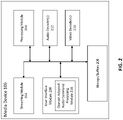
- FIG. 2 illustrates a block diagram of an example media device 106, according to some embodiments.
- Media device 106 may include a streaming module 202, processing module 204, storage/buffers 208, and user interface module 206.
- the user interface module 206 may include the domain adapted audio command processing module 216.
- the media device 108 may also include one or more audio decoders 212 and one or more video decoders 214.
- Each audio decoder 212 may be configured to decode audio of one or more audio formats, such as but not limited to AAC, HE-AAC, AC3 (Dolby Digital), EAC3 (Dolby Digital Plus), WMA, WAV, PCM, MP3, OGG GSM, FLAC, AU, AIFF, and/or VOX, to name just some examples.
- each video decoder 214 may be configured to decode video of one or more video formats, such as but not limited to MP4 (mp4, m4a, m4v, f4v, f4a, m4b, m4r, f4b, mov), 3GP (3gp, 3gp2, 3g2, 3gpp, 3gpp2), OGG (ogg, oga, ogv, ogx), WMV (wmv, wma, asf), WEBM, FLV, AVI, QuickTime, HDV, MXF (OP1a, OP-Atom), MPEG-TS, MPEG-2 PS, MPEG-2 TS, WAV, Broadcast WAV, LXF, GXF, and/or VOB, to name just some examples.
- MP4 mp4, m4a, m4v, f4v, f4a, m4b, m4r, f4b, mov
- 3GP 3gp, 3g
- Each video decoder 214 may include one or more video codecs, such as but not limited to H.263, H.264, HEV, MPEG1, MPEG2, MPEG-TS, MPEG-4, Theora, 3GP, DV, DVCPRO, DVCPRO, DVCProHD, IMX, XDCAM HD, XDCAM HD422, and/or XDCAM EX, to name just some examples.
- video codecs such as but not limited to H.263, H.264, HEV, MPEG1, MPEG2, MPEG-TS, MPEG-4, Theora, 3GP, DV, DVCPRO, DVCPRO, DVCProHD, IMX, XDCAM HD, XDCAM HD422, and/or XDCAM EX, to name just some examples.
- the user 102 may interact with the media device 106 via, for example, the remote control 110.
- remote control 110 may be implemented separately from media device 106 or integrated within media device 106.
- the user 102 may use the remote control 110 to verbally interact with the user interface module 206 of the media device 106 to select content, such as a movie, TV show, music, book, application, game, etc.
- the streaming module 202 of the media device 106 may request the selected content from the content server(s) 120 over the network 118.
- the content server(s) 120 may transmit the requested content to the streaming module 202.
- the media device 106 may transmit the received content to the display device 108 for playback to the user 102.
- the streaming module 202 may transmit the content to the display device 108 in real time or near real time as it receives such content from the content server(s) 120.
- the media device 106 may store the content received from content server(s) 120 in storage/buffers 208 for later playback on display device 108.
- the domain adapted audio command processing module 130 may be implemented within any device of media system 104 and may be configured to process audio data received from user 102.
- the domain adapted audio command processing module 130 supports processing audio commands in the context of dynamic content domains and provides faster and more accurate translations of audio commands that involve media content in these domains.
- the domain adapted audio command processing module 130 may utilize a domain entity index, which provides information about more current entities (i.e., entities that an ASR engine would not recognize).
- the domain entity index may be implemented separately from an ASR engine and may be continuously updated with information about new entities (e.g., content titles) including their phonetic representations from dynamic domains.
- the domain entity index indexes the entities with the phonetic representations. This index allows for faster processing of audio commands because phonetic forms may be quickly searched to identity potentially relevant entities.
- This continuous updating of the domain entity index is in contrast to conventional systems utilizing a pre-trained ASR engine. In order to update the ASR engine, large amounts of additional domain data is needed to retrain the ASR engine. Because the domain entity index operates based on phonetic forms, new media content can be quickly indexed and ready for searching even for newly available content.
- the index may be continuously updated with new entities and their phonetic forms so that the index is able to provide accurate transcriptions of more current entities than conventional ASR engines.
- Sources of these entities may come from recently released content (e.g., live events such as a presidential debate), user-upload sites where new content is uploaded on a daily basis, or other online resources for media content such as WIKIPEDIA or INTERNET MOVIE DATABASE (IMDB).
- IMDB INTERNET MOVIE DATABASE
- FIG. 3 illustrates an example block diagram of domain adapted audio processing module 130, according to some embodiments.
- Domain adapted audio processing module 130 may include an ASR engine 306, named entity recognition component 308, grapheme-phoneme converter 310, domain entities index 312, fuzzy candidate generator 314, ranker 316, any other suitable hardware, software, device, or structure, or any combination thereof.
- domain adapted audio processing module 130 may operate in an ingestion and run-time mode.
- the ingestion mode may include operations when not processing a voice query, and may involve components grapheme-phoneme converter 310 and domain entities index 312 for processing entities received from entertain domain entity source(s) 304 (i.e., ingesting new entities).
- Entities is used to refer to specific content of media content such as a specific movie, song, or television show, etc., and may be associated with different types of metadata such as movie titles, music titles, actor names, music artists, titles of media content including user-generated content, and popular phrases (e.g., lyrics from songs, dialogue from movies), just to name a few examples.
- domain adapted audio processing module 130 may include an ASR engine 306 configured to receive voice query 302 which, depending on where device domain adapted audio processing module 130 is implemented, may be provided by another device within media system 104 or directly from user 102.
- ASR engine 306 may be implemented as a pre-trained ASR system that has been trained on public domain data available at the time of training.
- ASR engine 306 may be an "off-the-shelf' engine that has not been modified, or has not received any additional training.
- ASR engine 306 may translate voice query 302 into a transcription or text format of the voice query.
- voice query 302 includes an audio command for retrieving media content.
- the transcription provided by ASR engine 306 may not accurately reflect the media content requested by the voice query 302 but may nonetheless accurately reflect the phonetic form of the requested media content. For example, in response to a voice query "Play PAW PATROL,” ASR engine 306 may transcribe the audio command as “Play Pop Patrol.” As another example, ASR engine 306 may transcribe the audio command "Play THE DARK KNIGHT RISES” as "Play The Dark Night Rises.” These errors are examples of domain mismatch where the transcription may be an accurate phonetic representation of the voice query but not of the actually requested media content. Such errors by the ASR engine 306 are addressed by downstream components in domain adapted audio processing module 130. Importantly, the transcription provided by ASR engine 306 does not need to be an accurate reflection of the requested media content.
- Named entity recognition (NER) component 308 is configured to receive the transcription from ASR engine 306.
- the transcription is a textual representation of command components that form the audio command. Examples of command components including an intent, an action, and an entity.
- command components including an intent, an action, and an entity.
- the voice query 302 includes the audio command "Play PAW PATROL” and the resulting transcription is "Play Pop Patrol”
- the action command component of the transcription is the "Play” action
- the entity command component is "Pop Patrol”
- the intent component is a "video request.”
- NER 308 parses the transcription and performs recognition of the constituent command components within the transcription.
- the intent command component identifies the purpose of voice query 302 such as requesting media content; the action command component identifies the action to be performed on the requested media content; and the entity identifies the media content on which the action is to be performed.
- NER 308 identifies these command components - intent, action, and entity - and provides the entity as a token (text format) to grapheme-phoneme converter 310.
- An entity may refer to the media content and the token refers to a textual form of the media content.
- a token is therefore merely an underspecified text and/or an erroneous ASR transcription and one goal of the present disclosure is to link the text form (i.e., token) to a corresponding media content (i.e., entity).
- the "PAW PATROL” in example audio command "Play PAW PATROL” represents a token.
- the token is linked to a corresponding entity, "Paw Patrol,” with a type "TV Show.”
- tokens are derived from transcriptions while entities are derived from sources (e.g., Wikidata) of known entities in the entertainment domain.
- Grapheme-phoneme converter 310 receives the entity, identifies the language of the entity (e.g., English), and performs a language-specific conversion process which involves converting the text format of the entity into phonetic forms.
- Phonetic forms include the phoneme of the entity and are used to search for a matching entity in the database. There are different known kinds of phonetic forms: New York State Identification and Intelligence System (“NYSIIS”) and International Phonetic Alphabet ("IPA").
- the phoneme represents the phonetic pronunciation of the entity (e.g., "pap " for the IPA form and "P PATRAL” for the NYSIIS phonetic form).
- NYSIIS is a lossy phonetic form that provides an approximation of the entity and allows for a faster method for determining a predetermined number (e.g., 100) of relevant entity candidates from a database of millions of entity candidates.
- IPA is a precise phonetic algorithm that may be utilized to calculate phonetic-edit-distance.
- other orthographic forms may be used to improve the ranking.
- these other orthographic forms include such as the grapheme of the entity, the N-gram of the entity, and a popularity score of the entity.
- the grapheme represents the text (spelling) of the entity (e.g., "PAW PATROL”).
- the N-gram represents a N-letter sequence of letters of the entity; for example, a 3-gram of "PAW PATROL” represents a 3-letter sequence of letters (e.g., "paw,” “aw_,” “w_p,” “_pa,” “pat,” “atr,” “tro,” and “rol”).
- the popularity score represents a value indicating the popularity of the entity with respect to other entities within media system (e.g., reflects which entities are requested or have been viewed more often than other entities).
- the entities with their phonetic forms are stored as an entry within domain entities index 312 and, if responding to voice query, may be provided to fuzzy candidate generator 314 for further processing.
- the receipt and processing of voice queries (such as voice query 302) by the domain adapted processing module 130 may be considered a run-time process.
- communication between grapheme-phoneme converter 310 and entertainment domain entity source(s) 304 may occur during the ingestion process.
- Communication between grapheme-phoneme converter 310 and entertainment domain entity source(s) 304 may occur continuously (e.g., in the background) such that new entities are provided to grapheme-phoneme converter 310, and subsequently to domain entities index 312, on a continuous basis.
- Examples of entertainment domain entity source(s) 304 include user-upload sites or other media content resources such as WIKIDATA or INTERNET MOVIE DATABASE (IMDB) that are constantly updated with new media content as they are released. Information may be retrieved from these sources through an automated means such as with a website crawler.
- communication between grapheme-phoneme converter 310 and entertainment domain entity source(s) 304 may occur as part of a push process where new media content entities are continuously pushed to grapheme-phoneme converter 310 as new entities are discovered.
- domain adapted audio processing module 130 may pull new media content entities from entertainment domain entity source(s) 304 on an intermittent or scheduled basis.
- Domain entities index 312 receives entities and their phonetic forms from grapheme-phoneme converter 310 and stores them as indexed entries so that the entries can be easily searched.
- Grapheme-phoneme converter 310 continuously updates domain entities index 312 when grapheme-phoneme converter 310 receives new entities from entertainment domain entity source(s) 304 as part of the ingestion process. These operations of the ingestion process allow new entities to be continuously stored in domain entities index 312 independently of training the ASR engine 306, and allow those entries to be made available for fuzzy candidate generator 314 to generate domain specific candidates when responding to voice query 302.
- domain adapted audio processing module 130 provides advantages over a conventional ASR system that would rely only on an off-the-shelf ASR engine such as ASR engine 306.
- ASR engine 306 By continuously updating entries and their associated phonetic forms in the domain entities index, the entries are available, in real-time, for responding to voice queries and domain adapted audio processing module 130 can generate candidates that are more relevant to voice query 302 in the entertainment domain.
- Domain adapted audio processing module 130 can quickly adapt to new terminology or potentially confusing content titles ("The Dark Night Rises” vs "THE DARK KNIGHT RISES").
- use of a continuously updated index obviates the need to retrain the ASR engine.
- domains entity index 312 is that domain adapted audio processing module 130 may be quickly modified for different languages (language portability) because only phonetic forms of entries are required as opposed to large amounts of language specific training data for building or customizing the language specific speech model.
- Fuzzy candidate generator 314 is responsible for generating domain specific candidates in response to voice query 302.
- the candidates generated by fuzzy candidate generator 314 may be considered fuzzy candidates because the candidates may not exactly match the entity representing the media content identified in the voice query. This is especially true when there is a domain mismatch in the transcription provided by ASR engine 306 such as with "The Dark Night Rises” compared with the actual audio command for "THE DARK KNIGHT RISES.” In this example, there is no media content titled "The Dark Night Rises" so any suggested candidates would not perfectly match this token; accordingly, such candidates would be considered fuzzy candidates.
- Fuzzy candidate generator 314 receives a token identifying the requested entity and its corresponding phonetic forms from grapheme-phoneme converter 310, and performs a search of the domain entities index 312 to retrieve candidates that are similar phonetically to the token.
- the search performed by fuzzy candidate generator 314 includes at least one of a grapheme search, a phoneme search, and an N-gram (e.g., 3-gram) search.
- the search includes all three searches - grapheme search, a phoneme search, and an N-gram - and fuzzy candidate generator 314 concatenates candidates generated by each search to populate a fuzzy candidate list.
- the grapheme search includes a text spelling match based on matching the spelling of the token (e.g., "Pop Patrol") to graphemes in the domain entities index 312.
- the phoneme search includes a phonetic matching based on pronunciation where a phoneme of the token (e.g., "pap ”) matches phonemes in the domain entities index 312.
- the N-gram search is a combined grapheme-phoneme match based on matching the N-gram (e.g., "pop pat atr tro rol”) to N-grams in the domain entities index 312; N-gram search may be considered a combination of the grapheme and phoneme matching of the token.
- Component of fuzzy candidate generator 314 are discussed in further detail for FIG. 4 .
- the phoneme search utilizes both a lossy and a precise phonetic form to determine a matching entity.
- An advantage of both types of phonetic forms is that it increases efficiency of fuzzy candidate generator 314 at run-time.
- a lossy phonetic form reduces the number of potential candidates (e.g., millions) to a predetermined number (e.g., 100) while the precise phonetic form further reduces the predetermined number of candidates to the most relevant candidates (e.g., the top 3 or 5 candidates).
- fuzzy candidate generator 314 may first employ a lossy phonetic form (e.g., NYSIIS) to determine a number of relevant entity candidates.
- a lossy phonetic form e.g., NYSIIS
- fuzzy candidate generator 314 may utilize the precise phonetic algorithm (e.g., IPA) to calculate phonetic-edit-distance to rank the candidates that were generated using the lossy phonetic form.
- the candidates with the smallest phonetic edit distance may be considered to be the most relevant.
- Fuzzy candidate generator 314 may index all phonetic and orthographic forms in domain entities index 312.
- Ranker 316 ranks the fuzzy candidate list generated by fuzzy candidate generator 314 to provide a ranked candidate list identifying domain adapted transcriptions associated with the voice query.
- the fuzzy candidate list represents a reduced set of candidates pulled from the domain entities index 312 and allows ranker 316 to perform its operations at run-time because only a small set of candidates (as opposed to the full amount of candidates from domain entities index 312) need to be processed and matched with the token.
- Ranker 316 may consider a number of different factors when ranking the candidates provided by fuzzy candidate generator 314 including but not limited to phonetic edit distance, match count, longest common sequence, nospace overlap, and popularity.
- the ranking of each candidate may be based on one or more of each of these factors.
- each factor is assigned a numerical value to indicate candidates that provide a better match in each of the factors.
- phonetic edit distance may be represented by a numerical value that indicates the similarity between the phonemes of the token and of the candidate entity.
- the transcription token is "hobs and shaw” (phonetic form “habz ⁇ nd ") and the entity is "Hobbs and Shaw” (phonetic form “habz ⁇ nd ")
- the phonetic edit distance between the token and the entity is 0 since both have identical phonetic forms.
- the text edit distance between them is 1 since a "b" is missing from token.
- the popularity of each candidate may also be retrieved from domain entities index 312.
- the numerical value associated with popularity may indicate the frequency that the candidate (e.g., media content) was played, requested, or otherwise involved in an action within multimedia environment 100.
- the popularity of an entity could refer to the number of streams by the thousands or millions of media systems 104 within multimedia environment 100. Accordingly, a higher value for popularity may indicate a higher number of streams within multimedia environment 100.
- the numerical value for the match count factor may indicate how many matching-strategies - grapheme spelling, grapheme n-gram, phoneme - indicate that the potential candidate is a quality match. For example, if all three matching-strategies indicate a quality match, then the value for the match count factor is "3."
- the numerical value for the longest common sequence may be based on the grapheme search and indicates the longest common sequence of matching text between the candidate and the token. For example, for the candidates "PAW PATROL” and “PAW PATROL toy play,” the numerical values are the same since they both share the same text “Patrol” with the token “Pop Patrol.”
- the numerical value for nospace overlap may indicate the similarity scores between token and entities if spaces were removed.”
- a "melissa fent” token may match “maleficent” real world entity if a space is removed from the token “melissa fent,” resulting in “melissafent.”
- a "melissa fent” token in response to an audio command requesting "maleficent” occurs with conventional ASR systems because off-the-shelf ASR does not understand have insight into the entertainment domain and may randomly inject spaces in the transcription.
- a conventional ASR may consider "maleficient" to be a person's name and adds a space after "Melissa.”
- Ranker 316 may then provide the top ranked candidate within the ranked fuzzy candidate list or a certain number of the top ranked candidates to an appropriate device for retrieval (e.g., content server 120), display (e.g., display device 108), or additional processing (e.g., media device 106).
- the certain number of the top ranked candidates may be provided for display on display device 108 to allow for user 102 to select the appropriate candidate.
- the top ranked candidate in the ranked fuzzy candidate list may be automatically retrieved (e.g., from content server 120) and played (e.g., by media device 106).
- content server 120 may identify all streaming services that provide the top ranked candidate and generate a new list that displays the top ranked candidate along with the streaming services, and provide that to display device 108 for display.
- FIG. 4 is a block diagram of a fuzzy candidate generator 314, according to some embodiments.
- Fuzzy candidate generator 314 may include receiver 402, grapheme search component 404, N-gram search component 406, phoneme search component 408, and candidate generator 410.
- Receiver 402 receives the identified token and the phonetic forms from grapheme-phoneme converter 310, and initiates at least one search (and up to all three searches) from the grapheme search, the N-gram search, and the phoneme search. Receiver 402 routes the appropriate token and phonetic information respective components for each search.
- receiver 402 routes the token and its grapheme to grapheme search component 404.
- Grapheme search component 404 communicates with domain entities index 312 to search for graphemes that match the grapheme of the token.
- grapheme search component 404 performs a search for the grapheme "Pop Patrol" (i.e., the grapheme of the token identified in the transcription provided by ASR engine 306) in domain entities index 312.
- the grapheme search may produce domain specific candidates based on the grapheme such as "Paw Patrol" and "American Pop.”
- the grapheme search component 404 performs a fuzzy match of the grapheme of the token with the grapheme candidates from domain entities index 312.
- N-gram search component 406 may be implemented based on the number of letters to be searched.
- n-gram search component 406 may be implemented as a 3-gram search component that searches for 3-grams associated with the token.
- N-gram search component 406 communicates with domain entities index 312 to search for n-grams that match the n-gram of the token. For example, n-gram search component 406 performs a search for the 3-gram "pop pat atr tro rol" (i.e., the 3-gram of the token identified in the transcription provided by ASR engine 306) in domain entities index 312.
- the n-gram search component 406 may then provide domain specific candidates based on the n-gram such as "PAW PATROL" and "patrol.” In an embodiment, the n-gram search component 406 performs a fuzzy match of the n-gram of the token with the n-gram candidates from domain entities index 312.
- Phoneme search component 408 communicates with domain entities index 312 to search for phonemes that match the phoneme of the token. For example, phoneme search component 408 performs a search for the phoneme of the token identified in the transcription provided by ASR engine 306, e.g., "pap " (a precise phonetic form) and/or "P PATRAL” (a lossy phonetic form) in domain entities index 312. The phoneme may produce domain specific candidates based on the phoneme such as “PAW PATROL” and "Paw Patrol toy play.”
- Candidate generator 410 may then concatenate the candidates provided by one or all of the searches provided by the grapheme search component 404, the N-gram search component 406, and the phoneme search component 408 to form a fuzzy candidate list that includes candidates from at least one of the grapheme search, the N-gram search, and the phoneme search.
- the fuzzy candidate list includes at least one candidate from all three searches.
- Candidate generator 410 may then provide the fuzzy candidate list to a ranker, such as ranker 316 for further ranking.
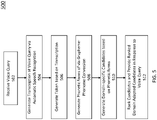
- FIG. 5 is a flowchart for a method 500 for processing speech input using a domain adapted audio command processing module, according to some embodiments.
- Method 500 can be performed by processing logic that can include hardware (e.g., circuitry, dedicated logic, programmable logic, microcode, etc.), software (e.g., instructions executing on a processing device), or a combination thereof. It is to be appreciated that not all steps may be needed to perform the disclosure provided herein. Further, some of the steps may be performed simultaneously, or in a different order than shown in FIG. 5 , as will be understood by a person of ordinary skill in the art. Method 500 shall be described with reference to FIGS. 1-4 . However, method 500 is not limited to those example embodiments.
- Method 500 relates to the run-time process for processing voice queries as they are received.
- the domain adapted audio command processing module 130 receives a voice query from a user.
- Domain adapted audio command processing module 130 may be implemented in any user device, such as media device 106, display device 108, and remote control 110.
- the voice query may represent a request to retrieve media content such as a movie, music, or television show.
- the domain adapted audio command processing module 130 generates a transcription of the voice query.
- the transcription may be generated using automatic speech recognition (ASR) engine 306.
- ASR automatic speech recognition
- the transcription is a textual representation of the voice query including all of the components in the query such as the requested media content and the action to be performed on the requested media content.
- the textual representation of the requested media content is an imperfect match (i.e., domain mismatch) to the requested media content. In other words, the textual representation may not exactly match the media content in the voice query.
- a voice query may be "Play PAW PATROL” where "PAW PATROL" represents the requested media content; the textual representation of the requested media content provided by the ASR engine 306 may be "Pop Patrol.”
- ASR engine 306 may provide a textual representation that is phonetically similar to, but not an accurate representation, of the requested media content.
- the domain adapted audio command processing module 130 may generate, based on the transcription, a token representing each media content being requested in the voice query.
- the voice query may include more than one entity (e.g., "Play PAW PATROL directed by Karl Bunker") and there is one transcribed token for each entity.
- identifying entity tokens may include parsing the transcription to identify one or more command components within the transcription where a command component may include an entity that identifies the requested media content, an identified intent of the voice query, and an identified action to be performed on the requested media content. The identified intent may be determined based on the combination of the entity and the identified action.
- a transcription for a voice query for "Play PAW PATROL” may include the "Play” action and the "Pop Patrol" entity.
- domain audio command processing module 130 may identify that the intent of the voice query is a request for media content (i.e., the content is being requested so that it may be played). Based on the command components identified in the transcription, domain adapted processing module 130 may then generate a token corresponding to the entity. The token may be in a text form.
- the domain adapted audio command processing module 130 may generate phonetic forms of the tokens via a grapheme-phoneme conversion process. In an embodiment, this step may include converting the token into a phonetic representation of the entity. Examples of the phonetic representation were discussed above with respect to FIGS. 3 and 4 and include the grapheme of the token, the phoneme of the token, and the N-gram of the token.
- the domain adapted audio command processing module 130 may generate domain specific candidates based on the phonetic forms and provide the candidates in a fuzzy candidate list.
- the fuzzy candidate list may include fuzzy candidates that represent potential matches to the media content identified by the entity.
- a goal of the domain adapted audio command processing module 130 is to identify the requested media content in the voice query using what could be an imperfect match represented by the entity in the transcription of the voice query. Accordingly, one of the fuzzy candidates may be an imperfect match to the entity but a perfect match for the requested media content in the voice query.
- the matching between the fuzzy candidates and the entity is based on the phonetic representation, including one of the grapheme of the token, the phoneme of the token, and the N-gram of the token, and the token itself.
- generating the domain specific candidates may include at least one a grapheme search, a phoneme search, and an N-gram search.
- the grapheme search may be based on the grapheme of the token that is used to identify at least one fuzzy grapheme candidate in domain entities index 312.
- the identification of the fuzzy grapheme candidate may be based on a spelling comparison between the grapheme of the token and the spelling of the fuzzy grapheme candidates within the domain entities index.
- At least one of the fuzzy candidates in the fuzzy candidate list may include one fuzzy grapheme candidate.
- the spelling comparison may include using the grapheme of the token to search for a grapheme candidate in domain entities index 312 and identifying the grapheme candidate as a fuzzy grapheme candidate if there is a fuzzy match between a spelling of the grapheme to a spelling of the grapheme candidate.
- This identification may involve retrieving, from an entry in domain entities index 312, the spelling of the grapheme candidate.
- the domain entities index 312 may be updated to include an entry associated with the grapheme candidate by populating the entry with the spelling of the grapheme candidate. This update of the domain entities index 312 occurs independently of ASR engine 306 that allows for the domain entities index 312 to updated more quickly and does not require retraining of ASR engine 306.
- the domain entities index 312 may include a number of entries, including the entry, associated with a plurality of grapheme candidates and the domain entity index may be updated on a continuous basis with new entries as they are received.
- the phoneme search may include searching the domain entities index 312 based on the phoneme of the token to identify a fuzzy phoneme match based on a phonetic comparison between the phoneme of the token and the fuzzy phoneme candidate. At least one of the fuzzy candidates in the fuzzy candidate list may include one fuzzy phoneme candidate.
- the phonetic comparison may involve using the phoneme of the token to search for a phoneme candidate in domain entities index 312 and identifying the phoneme candidate as the fuzzy phone candidate based on a phonetic matching between the phoneme of the token and the phoneme candidate by, for example, retrieving the phoneme candidate from the entry.
- the domain entity index may include an entry associated with the phoneme candidate and may be updated by populating the entry with the phoneme candidate independently of the automatic speech recognition engine.
- the N-gram search may include searching the domain entities index 312 based on the N-gram of the token to identify a fuzzy N-gram match based on an N-gram comparison between the token and the fuzzy N-gram candidate. At least one of the fuzzy candidates further may include the fuzzy N-gram match.
- the N-gram comparison may involve using the N-gram of the token to search for an N-gram candidate in the domain entity index and identifying the N-gram candidate as the fuzzy N-gram candidate based on matching the N-gram of the token to an N-gram of the N-gram candidate.
- the domain entities index 312 may include an entry associated with the phoneme candidate and performing the search may include retrieving, from the entry, the N-gram of the N-gram candidate.
- domain adapted audio command processing module 130 may rank the candidates in the fuzzy candidate list to form a ranked fuzzy candidate list including a highest ranked fuzzy candidate corresponding to a best potential match for the media content.
- One or more of the highest ranked candidates in ranked fuzzy candidate list may then be provided in response to the voice query. This may include performing an action associated with the highest ranked fuzzy candidate.
- ranking the candidate may include ranking the fuzzy grapheme match, the fuzzy N-gram match, and the fuzzy phoneme match in the fuzzy candidate list to form a ranked candidate list.
- the highest ranked fuzzy candidate in the ranked candidate list corresponds to the best potential match for the media content requested by the voice query and that is represented by the token.
- the highest ranked fuzzy candidate may be determined based on any number of ranking criteria including at least one of a phonetic edit distance, a popularity score, a match count, a longest common sequence score, and a nospace overlap score, as discussed above.
- Providing the ranked domain adapted candidates may include performing an action such as displaying the fuzzy candidates on display device 108 and waiting for a user selection from a user device (e.g., remote control 110, media device 106). Additional actions may occur after display of the fuzzy candidates including receiving a selection of the highest ranked fuzzy candidate from the user device, retrieving the highest ranked fuzzy candidate from a database (e.g., content server 120), and sending the ranked fuzzy list including the highest ranked fuzzy candidate to media device 106.
- a user device e.g., remote control 110, media device 106. Additional actions may occur after display of the fuzzy candidates including receiving a selection of the highest ranked fuzzy candidate from the user device, retrieving the highest ranked fuzzy candidate from a database (e.g., content server 120), and sending the ranked fuzzy list including the highest ranked fuzzy candidate to media device 106.
- FIG. 6 is a flowchart illustrating a process for updating a domain entities index, according to some embodiments.
- Method 600 can be performed by processing logic that can include hardware (e.g., circuitry, dedicated logic, programmable logic, microcode, etc.), software (e.g., instructions executing on a processing device), or a combination thereof. It is to be appreciated that not all steps may be needed to perform the disclosure provided herein. Further, some of the steps may be performed simultaneously, or in a different order than shown in FIG. 6 , as will be understood by a person of ordinary skill in the art. Method 600 shall be described with reference to FIGS. 1-4 . However, method 600 is not limited to those example embodiments.
- Method 600 relates to the ingestion process for populating domain entities index 312 with new entities as they are received from entertainment domain entity source(s) 304.
- domain adapted audio command processing module 130 may collect entertainment domain entities.
- collection may be a push process where entertainment domain entity source(s) 304 automatically pushes new entities on a continuous or scheduled basis.
- collection may be a pull process where domain adapted audio command processing module 130 submits requests to entertainment domain entity source(s) 304 to provide updated entities.
- domain adapted audio command processing module 130 provides the new entities to grapheme-phoneme converter 310 for conversion of the entities into phonetic forms.
- domain adapted audio command processing module 130 stores the entities along with phonetic forms in domain entities index 312 as index entries to facilitate searching and retrieval of information during run-time such as by fuzzy candidate generator 314 when generating fuzzy candidates in response to a voice query.
- Computer system 700 can be any computer or computing device capable of performing the functions described herein.
- the media device 106 may be implemented using combinations or sub-combinations of computer system 700.
- one or more computer systems 700 may be used to implement any of the embodiments discussed herein, as well as combinations and sub-combinations thereof.
- Computer system 700 includes one or more processors (also called central processing units, or CPUs), such as processor 704.
- processors also called central processing units, or CPUs
- Communications infrastructure 706 e.g., a bus
- processor 704 can be a graphics processing unit (GPU).
- a GPU may be a processor that is a specialized electronic circuit designed to process mathematically intensive applications.
- the GPU can have a parallel structure that is efficient for parallel processing of large blocks of data, such as mathematically intensive data common to computer graphics applications, images, videos, etc.
- Computer system 700 also includes user input/output device(s) 703, such as monitors, keyboards, pointing devices, etc., that communicate with communications infrastructure 706 through user input/output interface(s) 702.
- user input/output device(s) 703 such as monitors, keyboards, pointing devices, etc.
- Computer system 700 also includes main memory 708 (e.g., a primary memory or storage device), such as random access memory (RAM).
- Main memory 708 can include one or more levels of cache.
- Main memory 708 may have stored therein control logic (i.e., computer software) and/or data.
- Computer system 700 can also include one or more secondary storage devices or memories such as secondary memory 710.
- Secondary memory 710 can include, for example, hard disk drive 712, removable storage drive 714 (e.g., a removable storage device), or both.
- Removable storage drive 714 can be a floppy disk drive, a magnetic tape drive, a compact disk drive, an optical storage device, tape backup device, and/or any other storage device/drive.
- Removable storage drive 714 can interact with removable storage unit 718.
- Removable storage unit 718 includes a computer usable or readable storage device having stored thereon computer software (e.g., control logic) and/or data.
- Removable storage unit 718 can be a floppy disk, magnetic tape, compact disk, DVD, optical storage disk, and/ any other computer data storage device.
- Removable storage drive 714 may read from and/or write to removable storage unit 718.
- secondary memory 710 can include other means, devices, components, instrumentalities or other approaches for allowing computer programs and/or other instructions and/or data to be accessed by computer system 700.
- Such means, devices, components, instrumentalities or other approaches can include, for example, removable storage unit 722 and interface 720.
- removable storage unit 722 and interface 720 can include a program cartridge and cartridge interface (such as that found in video game devices), a removable memory chip (such as an EPROM or PROM) and associated socket, a memory stick and USB port, a memory card and associated memory card slot, and/or any other removable storage unit and associated interface.
- Computer system 700 can further include a communications interface 724 (e.g., a network interface).
- Communications interface 724 may enable computer system 700 to communicate and interact with any combination of external or remote devices, external or remote networks, remote entities, etc. (individually and collectively referenced by reference number 728).
- communications interface 724 can allow computer system 700 to communicate with external or remote devices 728 over communications path 726, which can be wired, wireless, or a combination thereof, and which can include any combination of LANs, WANs, the Internet, etc.
- Control logic and/or data can be transmitted to and from computer system 700 via communications path 726.
- Computer system 700 may also be any of a personal digital assistant (PDA), desktop workstation, laptop or notebook computer, netbook, tablet, smart phone, smart watch or other wearable, appliance, part of the Internet-of-Things, and/or embedded system, to name a few non-limiting examples, or any combination thereof.
- PDA personal digital assistant
- Computer system 700 may be a client or server, accessing or hosting any applications and/or data through any delivery paradigm, including but not limited to remote or distributed cloud computing solutions; local or on-premises software ("on-premise” cloud-based solutions); "as a service” models (e.g., content as a service (CaaS), digital content as a service (DCaaS), software as a service (SaaS), managed software as a service (MSaaS), platform as a service (PaaS), desktop as a service (DaaS), framework as a service (FaaS), backend as a service (BaaS), mobile backend as a service (MBaaS), infrastructure as a service (IaaS), etc.); and/or a hybrid model including any combination of the foregoing examples or other services or delivery paradigms.
- as a service” models e.g., content as a service (CaaS), digital content as a service (DCaaS), software as a
- Any applicable data structures, file formats, and schemas in computer system 700 may be derived from standards and specifications associated with images, audio, video, streaming (e.g., adaptive bitrate (ABR) streaming, content feeds), high-dynamic-range (HDR) video, text (e.g., closed captioning, subtitles), metadata (e.g., content metadata), data interchange, data serialization, data markup, digital rights management (DRM), encryption, any other suitable function or purpose, or any combination thereof.
- ABR adaptive bitrate
- HDR high-dynamic-range
- text e.g., closed captioning, subtitles
- metadata e.g., content metadata
- DRM digital rights management
- proprietary data structures, formats or schemas may be used, either exclusively or in combination with another standard or specification.
- Standards and specifications associated with images may include, but are not limited to, Base Index Frames (BIF), Bitmap (BMP), Graphical Interchange Format (GIF), Joint Photographic Experts Group (JPEG or JPG), Portable Network Graphics (PNG), any other suitable techniques (e.g., functionally similar representations), any predecessors, successors, and variants thereof, and any combinations thereof.
- BIF Base Index Frames
- BMP Bitmap
- GAF Graphical Interchange Format
- JPEG or JPG Joint Photographic Experts Group
- PNG Portable Network Graphics
- any other suitable techniques e.g., functionally similar representations
- Standards and specifications associated with audio may include, but are not limited to, Advanced Audio Coding (AAC), AAC High Efficiency (AAC-HE), AAC Low Complexity (AAC-LC), Apple Lossless Audio Codec (ALAC), Audio Data Transport Stream (ADTS), Audio Interchange File Format (AIFF), Digital Theater Systems (DTS), DTS Express (DTSE), Dolby Digital (DD or AC3), Dolby Digital Plus (DD+ or Enhanced AC3 (EAC3)), Dolby AC4, Dolby Atmos, Dolby Multistream (MS 12), Free Lossless Audio Codec (FLAC), Linear Pulse Code Modulation (LPCM or PCM), Matroska Audio (MKA), Moving Picture Experts Group (MPEG)-1 Part 3 and MPEG-2 Part 3 (MP3), MPEG-4 Audio (e.g., MP4A or M4A), Ogg, Ogg with Vorbis audio (Ogg Vorbis), Opus, Vorbis, Waveform Audio File Format (WAVE or WAV), Windows Media Audio (WMA), any other suitable techniques,
- Standards and specifications associated with video may include, but are not limited to, Alliance for Open Media (AOMedia) Video 1 (AV1), Audio Video Interleave (AVI), Matroska Video (MKV), MPEG-4 Part 10 Advanced Video Coding (AVC or H.264), MPEG-4 Part 14 (MP4), MPEG-4 Video (e.g., MP4V or M4V), MPEG-H Part 2 High Efficiency Video Coding (HEVC or H.265), QuickTime File Format (QTFF or MOV), VP8, VP9, WebM, Windows Media Video (WMV), any other suitable techniques, any predecessors, successors, and variants thereof, and any combinations thereof.
- AOMedia Open Media
- AV1 Audio Video Interleave
- MKV Matroska Video
- MPEG-4 Part 14 MPEG-4 Video
- MPEG-4 Video e.g., MP4V or M4V
- MPEG-H Part 2 High Efficiency Video Coding HEVC or H.265
- QTFF or MOV QuickTime File Format
- Standards and specifications associated with streaming may include, but are not limited to, Adaptive Streaming over HTTP, Common Media Application Format (CMAF), Direct Publisher JavaScript Object Notation (JSON), HD Adaptive Streaming, HTTP Dynamic Streaming, HTTP Live Streaming (HLS), HTTP Secure (HTTPS), Hypertext Transfer Protocol (HTTP), Internet Information Services (IIS) Smooth Streaming (SMOOTH), Media RSS (MRSS), MPEG Dynamic Adaptive Streaming over HTTP (MPEG-DASH or DASH), MPEG transport stream (MPEG-TS or TS), Protected Interoperable File Format (PIFF), Scalable HEVC (SHVC), any other suitable techniques, any predecessors, successors, and variants thereof, and any combinations thereof.
- CMAF Common Media Application Format
- JSON Direct Publisher JavaScript Object Notation
- HD Adaptive Streaming HTTP Dynamic Streaming
- HTTP Live Streaming HLS
- HTTP Secure HTTP Secure
- HTTP Hypertext Transfer Protocol
- IIS Internet Information Services
- SMOOTH
- Standards and specifications associated with HDR video may include, but are not limited to, Dolby Vision, HDR10 Media Profile (HDR10), HDR10 Plus (HDR10+), Hybrid Log-Gamma (HLG), Perceptual Quantizer (PQ), SL-HDR1, any other suitable techniques, any predecessors, successors, and variants thereof, and any combinations thereof.
- Standards and specifications associated with text, metadata, data interchange, data serialization, and data markup may include, but are not limited to, Internet Information Services (IIS) Smooth Streaming Manifest (ISM), IIS Smooth Streaming Text (ISMT), Matroska Subtitles (MKS), SubRip (SRT), Timed Text Markup Language (TTML), Web Video Text Tracks (WebVTT or WVTT), Comma-Separated Values (CSV), Extensible Markup Language (XML), Extensible Hypertext Markup Language (XHTML), XML User Interface Language (XUL), JSON, MessagePack, Wireless Markup Language (WML), Yet Another Markup Language (YAML), any other suitable techniques, any predecessors, successors, and variants thereof, and any combinations thereof.
- IIS Internet Information Services
- ISM IIS Smooth Streaming Manifest
- ISMT IIS Smooth Streaming Text
- MKS Matroska Subtitles
- SRT SubRip
- TTML Timed Text Markup Language
- Standards and specifications associated with DRM and encryption may include, but are not limited to, Advanced Encryption Standard (AES) (e.g., AES-128, AES-192, AES-256), Blowfish (BF), Cipher Block Chaining (CBC), Cipher Feedback (CFB), Counter (CTR), Data Encryption Standard (DES), Triple DES (3DES), Electronic Codebook (ECB), FairPlay, Galois Message Authentication Code (GMAC), Galois/Counter Mode (GCM), High-bandwidth Digital Content Protection (HDCP), Output Feedback (OFB), PlayReady, Propagating CBC (PCBC), Trusted Execution Environment (TEE), Verimatrix, Widevine, any other suitable techniques, any predecessors, successors, and variants thereof, and any combinations thereof, such as AES-CBC encryption (CBCS), AES-CTR encryption (CENC).
- AES Advanced Encryption Standard
- CBC Cipher Block Chaining
- CFB Cipher Feedback
- CTR Counter
- a tangible, non-transitory apparatus or article of manufacture including a tangible, non-transitory computer useable or readable medium having control logic (software) stored thereon may also be referred to herein as a computer program product or program storage device.
- control logic when executed by one or more data processing devices (such as computer system 700), may cause such data processing devices to operate as described herein.
- references herein to "one embodiment,” “an embodiment,” “an example embodiment,” or similar phrases, indicate that the embodiment described can include a particular feature, structure, or characteristic, but every embodiment can not necessarily include the particular feature, structure, or characteristic. Moreover, such phrases are not necessarily referring to the same embodiment. Further, when a particular feature, structure, or characteristic is described in connection with an embodiment, it would be within the knowledge of persons skilled in the relevant art(s) to incorporate such feature, structure, or characteristic into other embodiments whether or not explicitly mentioned or described herein. Additionally, some embodiments can be described using the expression “coupled” and “connected” along with their derivatives. These terms are not necessarily intended as synonyms for each other.
- Coupled can also mean that two or more elements are not in direct contact with each other, but yet still co-operate or interact with each other.
Landscapes
- Engineering & Computer Science (AREA)
- Physics & Mathematics (AREA)
- Computational Linguistics (AREA)
- Health & Medical Sciences (AREA)
- Audiology, Speech & Language Pathology (AREA)
- Multimedia (AREA)
- Acoustics & Sound (AREA)
- Human Computer Interaction (AREA)
- Artificial Intelligence (AREA)
- Theoretical Computer Science (AREA)
- General Health & Medical Sciences (AREA)
- General Physics & Mathematics (AREA)
- General Engineering & Computer Science (AREA)
- Automation & Control Theory (AREA)
- Fuzzy Systems (AREA)
- Mathematical Physics (AREA)
- Software Systems (AREA)
- Signal Processing (AREA)
- Information Retrieval, Db Structures And Fs Structures Therefor (AREA)
Abstract
Description
- This disclosure is generally directed to improvements to conventional automatic speech recognition systems, and specifically, adapting such systems to improve their accuracy and performance in the real-time domains, such as but not limited to an entertainment domain.
- Speech as an input modality has become widely adopted in the media content space to provide voice-based input capability for navigating and finding media content on entertainment systems. Automatic Speech Recognition (ASR) systems have increased importance in these entertainment systems as they are responsible for recognizing speech input that involve media content. Errors, such as domain mismatch, may occur with ASR systems when attempting to recognize queries involving media content. These errors stem from two constraints related to ASR systems. First, they are pre-trained based on large amounts of public domain data that are available at the time of training and there is no efficient means to re-train ASR systems with new data. Second, ASR systems are generalists so that they may be implemented in a wide variety of applications. As such, conventional "off-the-shelf' ASR systems are typically trained to cover speech inputs from a broad range of speech domains having a generally known lexicon such as map/directions, application commands, weather commands, and general conversation phrases.
- There are different types of speech domains. Static domains are those where the entities (i.e., the words or phrasing) to be recognized generally stay the same from when the ASR was trained, such as weather commands (e.g., "What's the weather today") or application commands (e.g., "Text Sarah"; "I'll be home in 10 minutes"). Already trained or pre-configured ASR systems are therefore suitable for static domains to handle static entities.
- On the hand, dynamic domains present a challenge. In contrast to static domains, dynamic domains are constantly evolving because these domains involve the introduction of new words, unique words, and unexpected pronunciations. Dynamic domains have constant and rapid release cycles and also can include live content (e.g., user-generated content) for which an ASR system cannot be trained before implementation. One example of a dynamic content domain is the entertainment domain which includes media content from popular culture where new content may be created and uploaded on a daily, even hourly, basis. Proliferation of user-upload sites where users and entertainment companies alike may upload video content has democratized the creation process for media content.
- The fast-paced released cycle of such content means that the content and its associated audio data are an on-going reflection of popular culture's ever evolving parlance and slang. Because they are trained and preconfigured prior to implementation, conventional ASR systems have difficulty with dynamic content domains where the new entertainment entities can involve these new pronunciations. Domain mismatch occurs when conventional ASR systems process speech inputs that require searching entities in dynamic domains. Speech recognition capability in dynamic domains are therefore hampered by conventional ASR systems.
- Provided herein are system, apparatus, article of manufacture, method and/or computer program product embodiments, and/or combinations and sub-combinations thereof, for adapting ASR systems for processing dynamic domain voice queries.
- In a non-limiting embodiment, an example system includes a domain adapted audio command processing module having an automatic speech recognition engine to process voice queries within a dynamic domain. The domain adapted audio command processing module may perform steps for processing the voice query and generating domain-specific fuzzy candidates that potentially match with the content being requested by the voice query. The domain adapted audio command processing module may receive the voice query that includes an action and requested media content. The requested media content may be within the entertainment domain such as television, movies, or music. The domain adapted audio command processing module may further generate a textual representation, or transcription, of the voice query. This transcription may be performed using the automatic speech recognition engine implemented within the domain adapted audio command processing module. The domain adapted audio command processing module may further parse the transcription to identify command components within the transcription. Examples of a command component include an entity, an intent of the voice query, and an action to be performed on the media content. The entity command component may represent the best guess by the automatic speech engine as to the requested media content within the voice query. If there is a domain mismatch, the entity command component will be an imperfect match to the requested media content.
- The domain adapted audio command processing module attempts to identify the requested media content from the voice query using the entity command component (which may not match the requested media content). To do so, the domain adapted audio command processing module may identity the entity command component within the transcription and convert the identified entity into one or more phonetic representations of the entity. Examples of a phonetic representation include grapheme, a phoneme, and an N-gram. Based on the phonetic representations, the domain adapted audio command processing module may then generate a fuzzy candidate list comprising a plurality of fuzzy candidates. Fuzzy candidates represent potential matches to the media content; the matching may be based on using at least one phonetic representation and the entity to identify fuzzy candidates with similar phonetic representations. The fuzzy candidates represent domain-specific candidates associated with the voice query and that are based on the most current entities available. And after identifying a list of fuzzy candidates, the domain adapted audio command processing module may then rank candidates in the fuzzy candidate list to form a ranked fuzzy candidate list which may include a highest ranked fuzzy candidate.
- The accompanying drawings are incorporated herein and form a part of the specification.
-
FIG. 1 illustrates a block diagram of a multimedia environment, according to some embodiments. -
FIG. 2 illustrates a block diagram of a streaming media device, according to some embodiments -
FIG. 3 illustrates a block diagram of a domain adapted audio command processing module, according to some embodiments. -
FIG. 4 is a block diagram of a fuzzy candidate generator, according to some embodiments. -
FIG. 5 is a flowchart illustrating a process for processing speech input using a domain adapted audio command processing module, according to some embodiments. -
FIG. 6 is a flowchart illustrating a process for updating a domain entities index, according to some embodiments. -
FIG. 7 illustrates an example computer system useful for implementing various embodiments. - In the drawings, like reference numbers generally indicate identical or similar elements. Additionally, generally, the left-most digit(s) of a reference number identifies the drawing in which the reference number first appears.
- Provided herein are system, apparatus, article of manufacture, method and/or computer program product embodiments, and/or combinations and sub-combinations thereof, for adapting ASR systems to process voice queries involving content within dynamic domains. This adaptation involves the use of multiple ASR modules, including a second level module that is tailored to handle dynamic domain voice queries and provide domain-specific candidates in response to a voice query involving content in dynamic domains.
- As indicated above, voice queries may require retrieving content in dynamic domains such as the entertainment domain that encompasses new media content from movies, songs, television shows, etc., as well as from user-generated content sites. For example, a user may submit voice queries for a movie titled "NOMADLAND" or for a kids show called "PAW PATROL." These titles are not conventional words or phrases; they are unique and novel as most titles are with respect to media content. A conventional ASR system would likely produce a domain mismatch when attempting to process a voice query involving these titles (e.g., "Play NOMADLAND" or "Search for PAW PATROL episodes").
- Domain mismatches with these titles are likely to occur because of their phonetic similarities to other words and the static nature of conventional ASR systems. For example, a conventional ASR system might translate "NOMADLAND" into "Nomad" and "Land" or perhaps even as a more well-established phrase, "No Man's Land" and "PAW PATROL" into "Pop Patrol." A conventional ASR system would likely not recognize these titles as being associated with media content and therefore provide inaccurate translations that are irrelevant to the voice query. Put another way, the translations may be phonetically correct (e.g., "PAW PATROL" vs. "Pop Patrol") but they are not relevant to the entertainment domain.
- The disclosure herein describes dynamic domain adaptation for ASR embodiments for more accurately processing voice queries that involve content in dynamic domains such an entertainment domain involving ever changing media content. The result is a novel two level ASR system that involves, at the first level, an ASR engine for performing a translation of a voice query and, at the second level, a candidate generator that is linked to a domain-specific entity index that can be continuously updated in real-time with new entities. Such an implementation allows for new entities to be included as part of the ASR processing without having to re-train the ASR engine or large amounts of domain data. In order to achieve this real-time domain adaptation, the domain-specific entity index may be configured to store textual information associated with new entities such as their phonetic representation and other relevant metadata (e.g., content type, information source, grapheme information, 3-gram information, and popularity score).
- In a given embodiment, the two level ASR system may be implemented in a voice input device (also called voice responsive device or audio responsive device) that includes a microphone capable of receiving speech. Examples of a voice input device include a remote control device or a media device. A remote control device may be implemented as a dedicated remote control device with physical buttons or a mobile device with an installed software application providing remote control functionality to the mobile device. A media device may be any device that has media streaming capability such as a standalone media device that externally connects to a display device or a display device that has an integrated media device. Examples of a standalone media device include a media streaming player and a sound bar.
- Accordingly, various embodiments of this disclosure may be implemented using and/or may be part of a
multimedia environment 100 shown inFIG. 1 . It is noted, however, thatmultimedia environment 100 is provided solely for illustrative purposes, and is not limiting. Embodiments of this disclosure may be implemented using and/or may be part of environments different from and/or in addition to themultimedia environment 100, as will be appreciated by persons skilled in the relevant art(s) based on the teachings contained herein. - Also, the embodiments of this disclosure are applicable to any voice responsive devices, not just those related to entertainment systems such as
multimedia environment 100. Such voice responsive devices include digital assistants, smart phones and tablets, appliances, automobiles and other vehicles, and Internet of Things (IOT) devices, to name just some examples. - An example of the
multimedia environment 100 shall now be described. - In a non-limiting example,
multimedia environment 100 may be directed a system for processing audio commands involving streaming media. However, this disclosure is applicable to any type of media (instead of or in addition to streaming media), as well as any mechanism, means, protocol, method and/or process for distributing media where audio commands may be processed in order to request media. - The
multimedia environment 100 may include one ormore media systems 104. Amedia system 104 could represent a family room, a kitchen, a backyard, a home theater, a school classroom, a library, a car, a boat, a bus, a plane, a movie theater, a stadium, an auditorium, a park, a bar, a restaurant, or any other location or space where it is desired to receive and play streaming content. User(s) 102 may operate with themedia system 104 to select and consume media content by, for example, providing audio commands to request media content. - Each
media system 104 may include one ormore media devices 106 each coupled to one ormore display devices 108. It is noted that terms such as "coupled," "connected to," "attached," "linked," "combined" and similar terms may refer to physical, electrical, magnetic, logical, etc., connections, unless otherwise specified herein. -
Media device 106 may be a streaming media device, DVD or BLU-RAY device, audio/video playback device, a sound bar, cable box, and/or digital video recording device, to name just a few examples.Display device 108 may be a monitor, television (TV), computer, smart phone, tablet, wearable (such as a watch or glasses), appliance, internet of things (IoT) device, and/or projector, to name just a few examples. In some embodiments,media device 106 can be a part of, integrated with, operatively coupled to, and/or connected to itsrespective display device 108. - Each
media device 106 may be configured to communicate withnetwork 118 via acommunication device 114. Thecommunication device 114 may include, for example, a cable modem or satellite TV transceiver. Themedia device 106 may communicate with thecommunication device 114 over alink 116, wherein thelink 116 may include wireless (such as WiFi) and/or wired connections. - In various embodiments, the
network 118 can include, without limitation, wired and/or wireless intranet, extranet, Internet, cellular, Bluetooth, infrared, and/or any other short range, long range, local, regional, global communications mechanism, means, approach, protocol and/or network, as well as any combination(s) thereof. -
Media system 104 may include aremote control 110. Theremote control 110 can be any component, part, apparatus and/or method for controlling themedia device 106 and/ordisplay device 108, such as a remote control, a tablet, laptop computer, smartphone, wearable, on-screen controls, integrated control buttons, audio controls, or any combination thereof, to name just a few examples. In an embodiment, theremote control 110 wirelessly communicates with themedia device 106 and/ordisplay device 108 using cellular, Bluetooth, infrared, etc., or any combination thereof. In an embodiment, theremote control 110 may be integrated intomedia device 106 ordisplay device 108. Theremote control 110 may include amicrophone 112, which is further described below. - Any device in
media system 104 may be capable of receiving and processing audio commands from user(s) 102. Such devices may be referred to herein as audio or voice responsive devices, and/or voice input devices. For example, any one ofmedia device 106,display device 108, orremote control 110 may include a domain adapted audiocommand processing module 130 that receives audio commands requesting media content, processes the audio commands, and performs actions for retrieving and providing the requested media content tomedia system 104. In an embodiment,microphone 112 may also be integrated intomedia device 106 ordisplay device 108, thereby enablingmedia device 106 ordisplay device 108 to receive audio commands directly fromuser 102. Additional components and operations of domain adapted audiocommand processing module 130 are described further below with regard toFIGS. 2-5 below. While domain adapted audiocommand processing module 130 may be implemented in each device inmedia system 104, in practice, domain adapted audiocommand processing modules 130 may also be implemented as a single module within one ofmedia device 106,display device 108, and/orremote control 110. - The
multimedia environment 100 may include a plurality of content servers 120 (also called content providers or sources). Although only onecontent server 120 is shown inFIG. 1 , in practice themultimedia environment 100 may include any number ofcontent servers 120. Eachcontent server 120 may be configured to communicate withnetwork 118. - Each
content server 120 may storecontent 122 andmetadata 124.Content 122 may include any combination of music, videos, movies, TV programs, multimedia, images, still pictures, text, graphics, gaming applications, advertisements, programming content, public service content, government content, local community content, software, and/or any other content or data objects in electronic form. - In some embodiments,
metadata 124 comprises data aboutcontent 122. For example,metadata 124 may include associated or ancillary information indicating or related to writer, director, producer, composer, artist, actor, summary, chapters, production, history, year, trailers, alternate versions, related content, applications, and/or any other information pertaining or relating to thecontent 122.Metadata 124 may also or alternatively include links to any such information pertaining or relating to thecontent 122.Metadata 124 may also or alternatively include one or more indexes ofcontent 122, such as but not limited to a trick mode index. - The
multimedia environment 100 may include one ormore system servers 126. Thesystem servers 126 may operate to support themedia devices 106 from the cloud. It is noted that the structural and functional aspects of thesystem servers 126 may wholly or partially exist in the same or different ones of thesystem servers 126. - The
media devices 106 may exist in thousands or millions ofmedia systems 104. Accordingly, themedia devices 106 may lend themselves to crowdsourcing embodiments and, thus, thesystem servers 126 may include one ormore crowdsource servers 128. - For example, using information received from the
media devices 106 in the thousands and millions ofmedia systems 104, the crowdsource server(s) 128 may identify similarities and overlaps between closed captioning requests issued bydifferent users 102 watching a particular movie. Based on such information, the crowdsource server(s) 128 may determine that turning closed captioning on may enhance users' viewing experience at particular portions of the movie (for example, when the soundtrack of the movie is difficult to hear), and turning closed captioning off may enhance users' viewing experience at other portions of the movie (for example, when displaying closed captioning obstructs critical visual aspects of the movie). Accordingly, the crowdsource server(s) 128 may operate to cause closed captioning to be automatically turned on and/or off during future streaming sessions of the movie. - The
system servers 126 may also include a domain adapted audiocommand processing module 130.FIG. 1 depicts domain adapted audiocommand processing module 130 implemented inmedia device 106,display device 108,remote control 110, andsystem server 126, respectively. In practice, domain adapted audiocommand processing modules 130 may be implemented as a single module within just one ofmedia device 106,display device 108,remote control 110, orsystem server 126, or in a distributed manner as shown inFIG. 1 . - As noted above, the
remote control 110 may include amicrophone 112. Themicrophone 112 may receive spoken audio data from users 102 (as well as other sources, such as the display device 108). As noted above, themedia device 106 may be audio responsive, and the audio data may represent audio commands (e.g., "Play a movie," "search for a movie") from theuser 102 to control themedia device 106 as well as other components in themedia system 104, such as thedisplay device 108. - In some embodiments, the audio data received by the
microphone 112 in theremote control 110 is processed by the device in which the domain adapted audiocommand processing module 130 is implemented (e.g.,media device 106,display device 108,remote control 110, and/or system server 126). - For example, in an embodiment where the domain adapted audio
command processing module 130 is implemented inmedia device 106, audio data may be received by themedia device 106 fromremote control 110. The transfer of audio data may occur over a wireless link betweenremote control 110 andmedia device 106. Also or alternatively, where voice command functionality is integrated withindisplay device 108,display device 108 may receive the audio data directly fromuser 102. - The domain adapted audio
command processing module 130 that receives the audio data may operate to process and analyze the received audio data to recognize theuser 102's audio command. The domain adapted audiocommand processing module 130 may then perform an action associated with the audio command such as identifying potential candidates associated with the requested media content, forming a system command for retrieving the requested media content, or displaying the requested media content on thedisplay device 108. - As noted above, the
system servers 126 may also include the domain adapted audiocommand processing module 130. In an embodiment,media device 106 may transfer audio data to thesystem servers 126 for processing using the domain adapted audiocommand processing module 130 in thesystem servers 126. -
FIG. 2 illustrates a block diagram of anexample media device 106, according to some embodiments.Media device 106 may include astreaming module 202,processing module 204, storage/buffers 208, and user interface module 206. As described above, the user interface module 206 may include the domain adapted audio command processing module 216. - The
media device 108 may also include one or moreaudio decoders 212 and one ormore video decoders 214. - Each
audio decoder 212 may be configured to decode audio of one or more audio formats, such as but not limited to AAC, HE-AAC, AC3 (Dolby Digital), EAC3 (Dolby Digital Plus), WMA, WAV, PCM, MP3, OGG GSM, FLAC, AU, AIFF, and/or VOX, to name just some examples. - Similarly, each
video decoder 214 may be configured to decode video of one or more video formats, such as but not limited to MP4 (mp4, m4a, m4v, f4v, f4a, m4b, m4r, f4b, mov), 3GP (3gp, 3gp2, 3g2, 3gpp, 3gpp2), OGG (ogg, oga, ogv, ogx), WMV (wmv, wma, asf), WEBM, FLV, AVI, QuickTime, HDV, MXF (OP1a, OP-Atom), MPEG-TS, MPEG-2 PS, MPEG-2 TS, WAV, Broadcast WAV, LXF, GXF, and/or VOB, to name just some examples. Eachvideo decoder 214 may include one or more video codecs, such as but not limited to H.263, H.264, HEV, MPEG1, MPEG2, MPEG-TS, MPEG-4, Theora, 3GP, DV, DVCPRO, DVCPRO, DVCProHD, IMX, XDCAM HD, XDCAM HD422, and/or XDCAM EX, to name just some examples. - Now referring to both
FIGS. 1 and2 , in some embodiments, theuser 102 may interact with themedia device 106 via, for example, theremote control 110. As noted above,remote control 110 may be implemented separately frommedia device 106 or integrated withinmedia device 106. For example, theuser 102 may use theremote control 110 to verbally interact with the user interface module 206 of themedia device 106 to select content, such as a movie, TV show, music, book, application, game, etc. Thestreaming module 202 of themedia device 106 may request the selected content from the content server(s) 120 over thenetwork 118. The content server(s) 120 may transmit the requested content to thestreaming module 202. Themedia device 106 may transmit the received content to thedisplay device 108 for playback to theuser 102. - In streaming embodiments, the
streaming module 202 may transmit the content to thedisplay device 108 in real time or near real time as it receives such content from the content server(s) 120. In non-streaming embodiments, themedia device 106 may store the content received from content server(s) 120 in storage/buffers 208 for later playback ondisplay device 108. - Referring to
FIG. 1 , the domain adapted audiocommand processing module 130 may be implemented within any device ofmedia system 104 and may be configured to process audio data received fromuser 102. The domain adapted audiocommand processing module 130 supports processing audio commands in the context of dynamic content domains and provides faster and more accurate translations of audio commands that involve media content in these domains. The domain adapted audiocommand processing module 130 may utilize a domain entity index, which provides information about more current entities (i.e., entities that an ASR engine would not recognize). - The domain entity index may be implemented separately from an ASR engine and may be continuously updated with information about new entities (e.g., content titles) including their phonetic representations from dynamic domains. The domain entity index indexes the entities with the phonetic representations. This index allows for faster processing of audio commands because phonetic forms may be quickly searched to identity potentially relevant entities. This continuous updating of the domain entity index is in contrast to conventional systems utilizing a pre-trained ASR engine. In order to update the ASR engine, large amounts of additional domain data is needed to retrain the ASR engine. Because the domain entity index operates based on phonetic forms, new media content can be quickly indexed and ready for searching even for newly available content. The index may be continuously updated with new entities and their phonetic forms so that the index is able to provide accurate transcriptions of more current entities than conventional ASR engines. Sources of these entities may come from recently released content (e.g., live events such as a presidential debate), user-upload sites where new content is uploaded on a daily basis, or other online resources for media content such as WIKIPEDIA or INTERNET MOVIE DATABASE (IMDB). The candidates provided by domain adapted audio
command processing module 130 in response to audio commands in the dynamic domain are therefore more accurate than conventional systems. -
FIG. 3 illustrates an example block diagram of domain adaptedaudio processing module 130, according to some embodiments. Domain adaptedaudio processing module 130 may include anASR engine 306, namedentity recognition component 308, grapheme-phoneme converter 310,domain entities index 312,fuzzy candidate generator 314,ranker 316, any other suitable hardware, software, device, or structure, or any combination thereof. In some embodiments, domain adaptedaudio processing module 130 may operate in an ingestion and run-time mode. The ingestion mode may include operations when not processing a voice query, and may involve components grapheme-phoneme converter 310 anddomain entities index 312 for processing entities received from entertain domain entity source(s) 304 (i.e., ingesting new entities). - The term "entities" is used to refer to specific content of media content such as a specific movie, song, or television show, etc., and may be associated with different types of metadata such as movie titles, music titles, actor names, music artists, titles of media content including user-generated content, and popular phrases (e.g., lyrics from songs, dialogue from movies), just to name a few examples.
- Now referring to
FIGS. 1 ,2 , and3 , in some embodiments, domain adaptedaudio processing module 130 may include anASR engine 306 configured to receivevoice query 302 which, depending on where device domain adaptedaudio processing module 130 is implemented, may be provided by another device withinmedia system 104 or directly fromuser 102.ASR engine 306 may be implemented as a pre-trained ASR system that has been trained on public domain data available at the time of training. In an embodiment,ASR engine 306 may be an "off-the-shelf' engine that has not been modified, or has not received any additional training.ASR engine 306 may translatevoice query 302 into a transcription or text format of the voice query. In an embodiment,voice query 302 includes an audio command for retrieving media content. - The transcription provided by
ASR engine 306 may not accurately reflect the media content requested by thevoice query 302 but may nonetheless accurately reflect the phonetic form of the requested media content. For example, in response to a voice query "Play PAW PATROL,"ASR engine 306 may transcribe the audio command as "Play Pop Patrol." As another example,ASR engine 306 may transcribe the audio command "Play THE DARK KNIGHT RISES" as "Play The Dark Night Rises." These errors are examples of domain mismatch where the transcription may be an accurate phonetic representation of the voice query but not of the actually requested media content. Such errors by theASR engine 306 are addressed by downstream components in domain adaptedaudio processing module 130. Importantly, the transcription provided byASR engine 306 does not need to be an accurate reflection of the requested media content. - Named entity recognition (NER)
component 308 is configured to receive the transcription fromASR engine 306. The transcription is a textual representation of command components that form the audio command. Examples of command components including an intent, an action, and an entity. In an example where thevoice query 302 includes the audio command "Play PAW PATROL" and the resulting transcription is "Play Pop Patrol," then the action command component of the transcription is the "Play" action, the entity command component is "Pop Patrol," and the intent component is a "video request."NER 308 parses the transcription and performs recognition of the constituent command components within the transcription. The intent command component identifies the purpose ofvoice query 302 such as requesting media content; the action command component identifies the action to be performed on the requested media content; and the entity identifies the media content on which the action is to be performed.NER 308 identifies these command components - intent, action, and entity - and provides the entity as a token (text format) to grapheme-phoneme converter 310. - An entity may refer to the media content and the token refers to a textual form of the media content. A token is therefore merely an underspecified text and/or an erroneous ASR transcription and one goal of the present disclosure is to link the text form (i.e., token) to a corresponding media content (i.e., entity). After transcription, the "PAW PATROL" in example audio command "Play PAW PATROL" represents a token. The token is linked to a corresponding entity, "Paw Patrol," with a type "TV Show." In an embodiment, tokens are derived from transcriptions while entities are derived from sources (e.g., Wikidata) of known entities in the entertainment domain.
- Grapheme-
phoneme converter 310 receives the entity, identifies the language of the entity (e.g., English), and performs a language-specific conversion process which involves converting the text format of the entity into phonetic forms. Phonetic forms include the phoneme of the entity and are used to search for a matching entity in the database. There are different known kinds of phonetic forms: New York State Identification and Intelligence System ("NYSIIS") and International Phonetic Alphabet ("IPA"). The phoneme represents the phonetic pronunciation of the entity (e.g., "pap" for the IPA form and "P PATRAL" for the NYSIIS phonetic form). NYSIIS is a lossy phonetic form that provides an approximation of the entity and allows for a faster method for determining a predetermined number (e.g., 100) of relevant entity candidates from a database of millions of entity candidates. IPA is a precise phonetic algorithm that may be utilized to calculate phonetic-edit-distance.
- In an embodiment, other orthographic forms may be used to improve the ranking. Examples of these other orthographic forms include such as the grapheme of the entity, the N-gram of the entity, and a popularity score of the entity. The grapheme represents the text (spelling) of the entity (e.g., "PAW PATROL"). The N-gram represents a N-letter sequence of letters of the entity; for example, a 3-gram of "PAW PATROL" represents a 3-letter sequence of letters (e.g., "paw," "aw_," "w_p," "_pa," "pat," "atr," "tro," and "rol"). And the popularity score represents a value indicating the popularity of the entity with respect to other entities within media system (e.g., reflects which entities are requested or have been viewed more often than other entities). The entities with their phonetic forms are stored as an entry within
domain entities index 312 and, if responding to voice query, may be provided tofuzzy candidate generator 314 for further processing. - The receipt and processing of voice queries (such as voice query 302) by the domain adapted
processing module 130 may be considered a run-time process. In contrast, communication between grapheme-phoneme converter 310 and entertainment domain entity source(s) 304 may occur during the ingestion process. Communication between grapheme-phoneme converter 310 and entertainment domain entity source(s) 304 may occur continuously (e.g., in the background) such that new entities are provided to grapheme-phoneme converter 310, and subsequently todomain entities index 312, on a continuous basis. Examples of entertainment domain entity source(s) 304 include user-upload sites or other media content resources such as WIKIDATA or INTERNET MOVIE DATABASE (IMDB) that are constantly updated with new media content as they are released. Information may be retrieved from these sources through an automated means such as with a website crawler. - In an embodiment, communication between grapheme-
phoneme converter 310 and entertainment domain entity source(s) 304 may occur as part of a push process where new media content entities are continuously pushed to grapheme-phoneme converter 310 as new entities are discovered. In another embodiment, domain adaptedaudio processing module 130 may pull new media content entities from entertainment domain entity source(s) 304 on an intermittent or scheduled basis. -
Domain entities index 312 receives entities and their phonetic forms from grapheme-phoneme converter 310 and stores them as indexed entries so that the entries can be easily searched. Grapheme-phoneme converter 310 continuously updatesdomain entities index 312 when grapheme-phoneme converter 310 receives new entities from entertainment domain entity source(s) 304 as part of the ingestion process. These operations of the ingestion process allow new entities to be continuously stored indomain entities index 312 independently of training theASR engine 306, and allow those entries to be made available forfuzzy candidate generator 314 to generate domain specific candidates when responding tovoice query 302. - The ingestion process of domain adapted
audio processing module 130 provides advantages over a conventional ASR system that would rely only on an off-the-shelf ASR engine such asASR engine 306. By continuously updating entries and their associated phonetic forms in the domain entities index, the entries are available, in real-time, for responding to voice queries and domain adaptedaudio processing module 130 can generate candidates that are more relevant tovoice query 302 in the entertainment domain. Domain adaptedaudio processing module 130 can quickly adapt to new terminology or potentially confusing content titles ("The Dark Night Rises" vs "THE DARK KNIGHT RISES"). In addition, use of a continuously updated index obviates the need to retrain the ASR engine. Yet another advantage provided bydomains entity index 312 is that domain adaptedaudio processing module 130 may be quickly modified for different languages (language portability) because only phonetic forms of entries are required as opposed to large amounts of language specific training data for building or customizing the language specific speech model. -
Fuzzy candidate generator 314 is responsible for generating domain specific candidates in response tovoice query 302. The candidates generated byfuzzy candidate generator 314 may be considered fuzzy candidates because the candidates may not exactly match the entity representing the media content identified in the voice query. This is especially true when there is a domain mismatch in the transcription provided byASR engine 306 such as with "The Dark Night Rises" compared with the actual audio command for "THE DARK KNIGHT RISES." In this example, there is no media content titled "The Dark Night Rises" so any suggested candidates would not perfectly match this token; accordingly, such candidates would be considered fuzzy candidates. -
Fuzzy candidate generator 314 receives a token identifying the requested entity and its corresponding phonetic forms from grapheme-phoneme converter 310, and performs a search of thedomain entities index 312 to retrieve candidates that are similar phonetically to the token. In an embodiment, the search performed byfuzzy candidate generator 314 includes at least one of a grapheme search, a phoneme search, and an N-gram (e.g., 3-gram) search. In an embodiment, the search includes all three searches - grapheme search, a phoneme search, and an N-gram - andfuzzy candidate generator 314 concatenates candidates generated by each search to populate a fuzzy candidate list. - The grapheme search includes a text spelling match based on matching the spelling of the token (e.g., "Pop Patrol") to graphemes in the
domain entities index 312. The phoneme search includes a phonetic matching based on pronunciation where a phoneme of the token (e.g., "pap") matches phonemes in the
domain entities index 312. The N-gram search is a combined grapheme-phoneme match based on matching the N-gram (e.g., "pop pat atr tro rol") to N-grams in thedomain entities index 312; N-gram search may be considered a combination of the grapheme and phoneme matching of the token. Component offuzzy candidate generator 314 are discussed in further detail forFIG. 4 . - In an embodiment, the phoneme search utilizes both a lossy and a precise phonetic form to determine a matching entity. An advantage of both types of phonetic forms is that it increases efficiency of
fuzzy candidate generator 314 at run-time. A lossy phonetic form reduces the number of potential candidates (e.g., millions) to a predetermined number (e.g., 100) while the precise phonetic form further reduces the predetermined number of candidates to the most relevant candidates (e.g., the top 3 or 5 candidates). For example,fuzzy candidate generator 314 may first employ a lossy phonetic form (e.g., NYSIIS) to determine a number of relevant entity candidates. Next,fuzzy candidate generator 314 may utilize the precise phonetic algorithm (e.g., IPA) to calculate phonetic-edit-distance to rank the candidates that were generated using the lossy phonetic form. In an embodiment, the candidates with the smallest phonetic edit distance may be considered to be the most relevant. - The other orthographic forms - grapheme, N-gram, spelling - to improve both the candidate generation using the lossy form (to generate the predetermined number of candidates) as well as with the precise form to improve the ranking using phonetic edit distance.
Fuzzy candidate generator 314 may index all phonetic and orthographic forms indomain entities index 312. -
Ranker 316 ranks the fuzzy candidate list generated byfuzzy candidate generator 314 to provide a ranked candidate list identifying domain adapted transcriptions associated with the voice query. The fuzzy candidate list represents a reduced set of candidates pulled from thedomain entities index 312 and allowsranker 316 to perform its operations at run-time because only a small set of candidates (as opposed to the full amount of candidates from domain entities index 312) need to be processed and matched with the token. -
Ranker 316 may consider a number of different factors when ranking the candidates provided byfuzzy candidate generator 314 including but not limited to phonetic edit distance, match count, longest common sequence, nospace overlap, and popularity. The ranking of each candidate may be based on one or more of each of these factors. In an embodiment, each factor is assigned a numerical value to indicate candidates that provide a better match in each of the factors. - For example, phonetic edit distance may be represented by a numerical value that indicates the similarity between the phonemes of the token and of the candidate entity. As an example, if the transcription token is "hobs and shaw" (phonetic form "habz ænd") and the entity is "Hobbs and Shaw" (phonetic form "habz ænd
 "), the phonetic edit distance between the token and the entity is 0 since both have identical phonetic forms. However, the text edit distance between them is 1 since a "b" is missing from token.
- As another example, the popularity of each candidate may also be retrieved from
domain entities index 312. The numerical value associated with popularity may indicate the frequency that the candidate (e.g., media content) was played, requested, or otherwise involved in an action withinmultimedia environment 100. For example, the popularity of an entity could refer to the number of streams by the thousands or millions ofmedia systems 104 withinmultimedia environment 100. Accordingly, a higher value for popularity may indicate a higher number of streams withinmultimedia environment 100. - The numerical value for the match count factor may indicate how many matching-strategies - grapheme spelling, grapheme n-gram, phoneme - indicate that the potential candidate is a quality match. For example, if all three matching-strategies indicate a quality match, then the value for the match count factor is "3."
- The numerical value for the longest common sequence may be based on the grapheme search and indicates the longest common sequence of matching text between the candidate and the token. For example, for the candidates "PAW PATROL" and "PAW PATROL toy play," the numerical values are the same since they both share the same text "Patrol" with the token "Pop Patrol."
- The numerical value for nospace overlap may indicate the similarity scores between token and entities if spaces were removed." As an example, a "melissa fent" token may match "maleficent" real world entity if a space is removed from the token "melissa fent," resulting in "melissafent." A "melissa fent" token in response to an audio command requesting "maleficent" occurs with conventional ASR systems because off-the-shelf ASR does not understand have insight into the entertainment domain and may randomly inject spaces in the transcription. In this example, a conventional ASR may consider "maleficient" to be a person's name and adds a space after "Melissa."
- An example ranked fuzzy candidate list is reproduced below with exemplary values for each of the factors.
Candidate Phonetic Edit Distance Popularity Match Count Longest Common Sequence NoSpace Overlap Rank Paw Patrol 93 99 3 80 45 1 Paw Patrol toy play 84 50 1 80 25 2 Patrol 91 30 1 60 57 3 American Pop 86 92 1 30 7 4 -
Ranker 316 may then provide the top ranked candidate within the ranked fuzzy candidate list or a certain number of the top ranked candidates to an appropriate device for retrieval (e.g., content server 120), display (e.g., display device 108), or additional processing (e.g., media device 106). For example, the certain number of the top ranked candidates may be provided for display ondisplay device 108 to allow foruser 102 to select the appropriate candidate. In another embodiment, the top ranked candidate in the ranked fuzzy candidate list may be automatically retrieved (e.g., from content server 120) and played (e.g., by media device 106). In another embodiment,content server 120 may identify all streaming services that provide the top ranked candidate and generate a new list that displays the top ranked candidate along with the streaming services, and provide that todisplay device 108 for display. -
FIG. 4 is a block diagram of afuzzy candidate generator 314, according to some embodiments.Fuzzy candidate generator 314 may includereceiver 402,grapheme search component 404, N-gram search component 406,phoneme search component 408, andcandidate generator 410. -
Receiver 402 receives the identified token and the phonetic forms from grapheme-phoneme converter 310, and initiates at least one search (and up to all three searches) from the grapheme search, the N-gram search, and the phoneme search.Receiver 402 routes the appropriate token and phonetic information respective components for each search. - For example,
receiver 402 routes the token and its grapheme to graphemesearch component 404.Grapheme search component 404 communicates withdomain entities index 312 to search for graphemes that match the grapheme of the token. For example,grapheme search component 404 performs a search for the grapheme "Pop Patrol" (i.e., the grapheme of the token identified in the transcription provided by ASR engine 306) indomain entities index 312. Becausedomain entities index 312 has been updated with media content from the entertainment domain, the grapheme search may produce domain specific candidates based on the grapheme such as "Paw Patrol" and "American Pop." In an embodiment, thegrapheme search component 404 performs a fuzzy match of the grapheme of the token with the grapheme candidates fromdomain entities index 312. - N-
gram search component 406 may be implemented based on the number of letters to be searched. In an embodiment, n-gram search component 406 may be implemented as a 3-gram search component that searches for 3-grams associated with the token. N-gram search component 406 communicates withdomain entities index 312 to search for n-grams that match the n-gram of the token. For example, n-gram search component 406 performs a search for the 3-gram "pop pat atr tro rol" (i.e., the 3-gram of the token identified in the transcription provided by ASR engine 306) indomain entities index 312. The n-gram search component 406 may then provide domain specific candidates based on the n-gram such as "PAW PATROL" and "patrol." In an embodiment, the n-gram search component 406 performs a fuzzy match of the n-gram of the token with the n-gram candidates fromdomain entities index 312. -
Phoneme search component 408 communicates withdomain entities index 312 to search for phonemes that match the phoneme of the token. For example,phoneme search component 408 performs a search for the phoneme of the token identified in the transcription provided byASR engine 306, e.g., "pap" (a precise phonetic form) and/or "P PATRAL" (a lossy phonetic form) in
domain entities index 312. The phoneme may produce domain specific candidates based on the phoneme such as "PAW PATROL" and "Paw Patrol toy play." -
Candidate generator 410 may then concatenate the candidates provided by one or all of the searches provided by thegrapheme search component 404, the N-gram search component 406, and thephoneme search component 408 to form a fuzzy candidate list that includes candidates from at least one of the grapheme search, the N-gram search, and the phoneme search. In an embodiment, the fuzzy candidate list includes at least one candidate from all three searches.Candidate generator 410 may then provide the fuzzy candidate list to a ranker, such asranker 316 for further ranking. -
FIG. 5 is a flowchart for amethod 500 for processing speech input using a domain adapted audio command processing module, according to some embodiments.Method 500 can be performed by processing logic that can include hardware (e.g., circuitry, dedicated logic, programmable logic, microcode, etc.), software (e.g., instructions executing on a processing device), or a combination thereof. It is to be appreciated that not all steps may be needed to perform the disclosure provided herein. Further, some of the steps may be performed simultaneously, or in a different order than shown inFIG. 5 , as will be understood by a person of ordinary skill in the art.Method 500 shall be described with reference toFIGS. 1-4 . However,method 500 is not limited to those example embodiments. -
Method 500 relates to the run-time process for processing voice queries as they are received. - In 502, the domain adapted audio
command processing module 130 receives a voice query from a user. Domain adapted audiocommand processing module 130 may be implemented in any user device, such asmedia device 106,display device 108, andremote control 110. The voice query may represent a request to retrieve media content such as a movie, music, or television show. - In 504, the domain adapted audio
command processing module 130 generates a transcription of the voice query. The transcription may be generated using automatic speech recognition (ASR)engine 306. The transcription is a textual representation of the voice query including all of the components in the query such as the requested media content and the action to be performed on the requested media content. In an embodiment, the textual representation of the requested media content is an imperfect match (i.e., domain mismatch) to the requested media content. In other words, the textual representation may not exactly match the media content in the voice query. For example, a voice query may be "Play PAW PATROL" where "PAW PATROL" represents the requested media content; the textual representation of the requested media content provided by theASR engine 306 may be "Pop Patrol." In other words,ASR engine 306 may provide a textual representation that is phonetically similar to, but not an accurate representation, of the requested media content. - In 506, the domain adapted audio
command processing module 130 may generate, based on the transcription, a token representing each media content being requested in the voice query. The voice query may include more than one entity (e.g., "Play PAW PATROL directed by Karl Bunker") and there is one transcribed token for each entity. In an embodiment, identifying entity tokens may include parsing the transcription to identify one or more command components within the transcription where a command component may include an entity that identifies the requested media content, an identified intent of the voice query, and an identified action to be performed on the requested media content. The identified intent may be determined based on the combination of the entity and the identified action. Continuing the example above, a transcription for a voice query for "Play PAW PATROL" may include the "Play" action and the "Pop Patrol" entity. Based on the combination of these command components, domain audiocommand processing module 130 may identify that the intent of the voice query is a request for media content (i.e., the content is being requested so that it may be played). Based on the command components identified in the transcription, domain adaptedprocessing module 130 may then generate a token corresponding to the entity. The token may be in a text form. - In 508, the domain adapted audio
command processing module 130 may generate phonetic forms of the tokens via a grapheme-phoneme conversion process. In an embodiment, this step may include converting the token into a phonetic representation of the entity. Examples of the phonetic representation were discussed above with respect toFIGS. 3 and4 and include the grapheme of the token, the phoneme of the token, and the N-gram of the token. - In 510, the domain adapted audio
command processing module 130 may generate domain specific candidates based on the phonetic forms and provide the candidates in a fuzzy candidate list. The fuzzy candidate list may include fuzzy candidates that represent potential matches to the media content identified by the entity. A goal of the domain adapted audiocommand processing module 130 is to identify the requested media content in the voice query using what could be an imperfect match represented by the entity in the transcription of the voice query. Accordingly, one of the fuzzy candidates may be an imperfect match to the entity but a perfect match for the requested media content in the voice query. In an embodiment, the matching between the fuzzy candidates and the entity is based on the phonetic representation, including one of the grapheme of the token, the phoneme of the token, and the N-gram of the token, and the token itself. - In an embodiment, generating the domain specific candidates may include at least one a grapheme search, a phoneme search, and an N-gram search.
- The grapheme search may be based on the grapheme of the token that is used to identify at least one fuzzy grapheme candidate in
domain entities index 312. The identification of the fuzzy grapheme candidate may be based on a spelling comparison between the grapheme of the token and the spelling of the fuzzy grapheme candidates within the domain entities index. At least one of the fuzzy candidates in the fuzzy candidate list may include one fuzzy grapheme candidate. - The spelling comparison may include using the grapheme of the token to search for a grapheme candidate in
domain entities index 312 and identifying the grapheme candidate as a fuzzy grapheme candidate if there is a fuzzy match between a spelling of the grapheme to a spelling of the grapheme candidate. This identification may involve retrieving, from an entry indomain entities index 312, the spelling of the grapheme candidate. Thedomain entities index 312 may be updated to include an entry associated with the grapheme candidate by populating the entry with the spelling of the grapheme candidate. This update of thedomain entities index 312 occurs independently ofASR engine 306 that allows for thedomain entities index 312 to updated more quickly and does not require retraining ofASR engine 306. Thedomain entities index 312 may include a number of entries, including the entry, associated with a plurality of grapheme candidates and the domain entity index may be updated on a continuous basis with new entries as they are received. - The phoneme search may include searching the
domain entities index 312 based on the phoneme of the token to identify a fuzzy phoneme match based on a phonetic comparison between the phoneme of the token and the fuzzy phoneme candidate. At least one of the fuzzy candidates in the fuzzy candidate list may include one fuzzy phoneme candidate. The phonetic comparison may involve using the phoneme of the token to search for a phoneme candidate indomain entities index 312 and identifying the phoneme candidate as the fuzzy phone candidate based on a phonetic matching between the phoneme of the token and the phoneme candidate by, for example, retrieving the phoneme candidate from the entry. The domain entity index may include an entry associated with the phoneme candidate and may be updated by populating the entry with the phoneme candidate independently of the automatic speech recognition engine. - The N-gram search may include searching the
domain entities index 312 based on the N-gram of the token to identify a fuzzy N-gram match based on an N-gram comparison between the token and the fuzzy N-gram candidate. At least one of the fuzzy candidates further may include the fuzzy N-gram match. The N-gram comparison may involve using the N-gram of the token to search for an N-gram candidate in the domain entity index and identifying the N-gram candidate as the fuzzy N-gram candidate based on matching the N-gram of the token to an N-gram of the N-gram candidate. Thedomain entities index 312 may include an entry associated with the phoneme candidate and performing the search may include retrieving, from the entry, the N-gram of the N-gram candidate. - In 512, domain adapted audio
command processing module 130 may rank the candidates in the fuzzy candidate list to form a ranked fuzzy candidate list including a highest ranked fuzzy candidate corresponding to a best potential match for the media content. One or more of the highest ranked candidates in ranked fuzzy candidate list may then be provided in response to the voice query. This may include performing an action associated with the highest ranked fuzzy candidate. In an embodiment, ranking the candidate may include ranking the fuzzy grapheme match, the fuzzy N-gram match, and the fuzzy phoneme match in the fuzzy candidate list to form a ranked candidate list. - In an embodiment, the highest ranked fuzzy candidate in the ranked candidate list corresponds to the best potential match for the media content requested by the voice query and that is represented by the token. The highest ranked fuzzy candidate may be determined based on any number of ranking criteria including at least one of a phonetic edit distance, a popularity score, a match count, a longest common sequence score, and a nospace overlap score, as discussed above.
- Providing the ranked domain adapted candidates may include performing an action such as displaying the fuzzy candidates on
display device 108 and waiting for a user selection from a user device (e.g.,remote control 110, media device 106). Additional actions may occur after display of the fuzzy candidates including receiving a selection of the highest ranked fuzzy candidate from the user device, retrieving the highest ranked fuzzy candidate from a database (e.g., content server 120), and sending the ranked fuzzy list including the highest ranked fuzzy candidate tomedia device 106. -
FIG. 6 is a flowchart illustrating a process for updating a domain entities index, according to some embodiments.Method 600 can be performed by processing logic that can include hardware (e.g., circuitry, dedicated logic, programmable logic, microcode, etc.), software (e.g., instructions executing on a processing device), or a combination thereof. It is to be appreciated that not all steps may be needed to perform the disclosure provided herein. Further, some of the steps may be performed simultaneously, or in a different order than shown inFIG. 6 , as will be understood by a person of ordinary skill in the art.Method 600 shall be described with reference toFIGS. 1-4 . However,method 600 is not limited to those example embodiments. -
Method 600 relates to the ingestion process for populatingdomain entities index 312 with new entities as they are received from entertainment domain entity source(s) 304. - In 602, domain adapted audio
command processing module 130 may collect entertainment domain entities. In an embodiment, collection may be a push process where entertainment domain entity source(s) 304 automatically pushes new entities on a continuous or scheduled basis. In an embodiment, collection may be a pull process where domain adapted audiocommand processing module 130 submits requests to entertainment domain entity source(s) 304 to provide updated entities. - In 604, domain adapted audio
command processing module 130 provides the new entities to grapheme-phoneme converter 310 for conversion of the entities into phonetic forms. - In 606, domain adapted audio
command processing module 130 stores the entities along with phonetic forms indomain entities index 312 as index entries to facilitate searching and retrieval of information during run-time such as byfuzzy candidate generator 314 when generating fuzzy candidates in response to a voice query. - Various embodiments and/or components therein can be implemented, for example, using one or more computer systems, such as
computer system 700 shown inFIG. 7 .Computer system 700 can be any computer or computing device capable of performing the functions described herein. For example, themedia device 106 may be implemented using combinations or sub-combinations ofcomputer system 700. Also or alternatively, one ormore computer systems 700 may be used to implement any of the embodiments discussed herein, as well as combinations and sub-combinations thereof. -
Computer system 700 includes one or more processors (also called central processing units, or CPUs), such asprocessor 704.Processor 704 is connected to communications infrastructure 706 (e.g., a bus). - In some embodiments,
processor 704 can be a graphics processing unit (GPU). In some embodiments, a GPU may be a processor that is a specialized electronic circuit designed to process mathematically intensive applications. The GPU can have a parallel structure that is efficient for parallel processing of large blocks of data, such as mathematically intensive data common to computer graphics applications, images, videos, etc. -
Computer system 700 also includes user input/output device(s) 703, such as monitors, keyboards, pointing devices, etc., that communicate withcommunications infrastructure 706 through user input/output interface(s) 702. -
Computer system 700 also includes main memory 708 (e.g., a primary memory or storage device), such as random access memory (RAM).Main memory 708 can include one or more levels of cache.Main memory 708 may have stored therein control logic (i.e., computer software) and/or data. -
Computer system 700 can also include one or more secondary storage devices or memories such assecondary memory 710.Secondary memory 710 can include, for example,hard disk drive 712, removable storage drive 714 (e.g., a removable storage device), or both.Removable storage drive 714 can be a floppy disk drive, a magnetic tape drive, a compact disk drive, an optical storage device, tape backup device, and/or any other storage device/drive. -
Removable storage drive 714 can interact with removable storage unit 718. Removable storage unit 718 includes a computer usable or readable storage device having stored thereon computer software (e.g., control logic) and/or data. Removable storage unit 718 can be a floppy disk, magnetic tape, compact disk, DVD, optical storage disk, and/ any other computer data storage device.Removable storage drive 714 may read from and/or write to removable storage unit 718. - In some embodiments,
secondary memory 710 can include other means, devices, components, instrumentalities or other approaches for allowing computer programs and/or other instructions and/or data to be accessed bycomputer system 700. Such means, devices, components, instrumentalities or other approaches can include, for example,removable storage unit 722 andinterface 720. Examples ofremovable storage unit 722 andinterface 720 can include a program cartridge and cartridge interface (such as that found in video game devices), a removable memory chip (such as an EPROM or PROM) and associated socket, a memory stick and USB port, a memory card and associated memory card slot, and/or any other removable storage unit and associated interface. -
Computer system 700 can further include a communications interface 724 (e.g., a network interface). Communications interface 724 may enablecomputer system 700 to communicate and interact with any combination of external or remote devices, external or remote networks, remote entities, etc. (individually and collectively referenced by reference number 728). For example,communications interface 724 can allowcomputer system 700 to communicate with external orremote devices 728 overcommunications path 726, which can be wired, wireless, or a combination thereof, and which can include any combination of LANs, WANs, the Internet, etc. Control logic and/or data can be transmitted to and fromcomputer system 700 viacommunications path 726. -
Computer system 700 may also be any of a personal digital assistant (PDA), desktop workstation, laptop or notebook computer, netbook, tablet, smart phone, smart watch or other wearable, appliance, part of the Internet-of-Things, and/or embedded system, to name a few non-limiting examples, or any combination thereof. -
Computer system 700 may be a client or server, accessing or hosting any applications and/or data through any delivery paradigm, including but not limited to remote or distributed cloud computing solutions; local or on-premises software ("on-premise" cloud-based solutions); "as a service" models (e.g., content as a service (CaaS), digital content as a service (DCaaS), software as a service (SaaS), managed software as a service (MSaaS), platform as a service (PaaS), desktop as a service (DaaS), framework as a service (FaaS), backend as a service (BaaS), mobile backend as a service (MBaaS), infrastructure as a service (IaaS), etc.); and/or a hybrid model including any combination of the foregoing examples or other services or delivery paradigms. - Any applicable data structures, file formats, and schemas in
computer system 700 may be derived from standards and specifications associated with images, audio, video, streaming (e.g., adaptive bitrate (ABR) streaming, content feeds), high-dynamic-range (HDR) video, text (e.g., closed captioning, subtitles), metadata (e.g., content metadata), data interchange, data serialization, data markup, digital rights management (DRM), encryption, any other suitable function or purpose, or any combination thereof. Alternatively, proprietary data structures, formats or schemas may be used, either exclusively or in combination with another standard or specification. - Standards and specifications associated with images may include, but are not limited to, Base Index Frames (BIF), Bitmap (BMP), Graphical Interchange Format (GIF), Joint Photographic Experts Group (JPEG or JPG), Portable Network Graphics (PNG), any other suitable techniques (e.g., functionally similar representations), any predecessors, successors, and variants thereof, and any combinations thereof.
- Standards and specifications associated with audio may include, but are not limited to, Advanced Audio Coding (AAC), AAC High Efficiency (AAC-HE), AAC Low Complexity (AAC-LC), Apple Lossless Audio Codec (ALAC), Audio Data Transport Stream (ADTS), Audio Interchange File Format (AIFF), Digital Theater Systems (DTS), DTS Express (DTSE), Dolby Digital (DD or AC3), Dolby Digital Plus (DD+ or Enhanced AC3 (EAC3)), Dolby AC4, Dolby Atmos, Dolby Multistream (MS 12), Free Lossless Audio Codec (FLAC), Linear Pulse Code Modulation (LPCM or PCM), Matroska Audio (MKA), Moving Picture Experts Group (MPEG)-1 Part 3 and MPEG-2 Part 3 (MP3), MPEG-4 Audio (e.g., MP4A or M4A), Ogg, Ogg with Vorbis audio (Ogg Vorbis), Opus, Vorbis, Waveform Audio File Format (WAVE or WAV), Windows Media Audio (WMA), any other suitable techniques, any predecessors, successors, and variants thereof, and any combinations thereof.
- Standards and specifications associated with video may include, but are not limited to, Alliance for Open Media (AOMedia) Video 1 (AV1), Audio Video Interleave (AVI), Matroska Video (MKV), MPEG-4 Part 10 Advanced Video Coding (AVC or H.264), MPEG-4 Part 14 (MP4), MPEG-4 Video (e.g., MP4V or M4V), MPEG-H Part 2 High Efficiency Video Coding (HEVC or H.265), QuickTime File Format (QTFF or MOV), VP8, VP9, WebM, Windows Media Video (WMV), any other suitable techniques, any predecessors, successors, and variants thereof, and any combinations thereof.
- Standards and specifications associated with streaming may include, but are not limited to, Adaptive Streaming over HTTP, Common Media Application Format (CMAF), Direct Publisher JavaScript Object Notation (JSON), HD Adaptive Streaming, HTTP Dynamic Streaming, HTTP Live Streaming (HLS), HTTP Secure (HTTPS), Hypertext Transfer Protocol (HTTP), Internet Information Services (IIS) Smooth Streaming (SMOOTH), Media RSS (MRSS), MPEG Dynamic Adaptive Streaming over HTTP (MPEG-DASH or DASH), MPEG transport stream (MPEG-TS or TS), Protected Interoperable File Format (PIFF), Scalable HEVC (SHVC), any other suitable techniques, any predecessors, successors, and variants thereof, and any combinations thereof.
- Standards and specifications associated with HDR video may include, but are not limited to, Dolby Vision, HDR10 Media Profile (HDR10), HDR10 Plus (HDR10+), Hybrid Log-Gamma (HLG), Perceptual Quantizer (PQ), SL-HDR1, any other suitable techniques, any predecessors, successors, and variants thereof, and any combinations thereof.
- Standards and specifications associated with text, metadata, data interchange, data serialization, and data markup may include, but are not limited to, Internet Information Services (IIS) Smooth Streaming Manifest (ISM), IIS Smooth Streaming Text (ISMT), Matroska Subtitles (MKS), SubRip (SRT), Timed Text Markup Language (TTML), Web Video Text Tracks (WebVTT or WVTT), Comma-Separated Values (CSV), Extensible Markup Language (XML), Extensible Hypertext Markup Language (XHTML), XML User Interface Language (XUL), JSON, MessagePack, Wireless Markup Language (WML), Yet Another Markup Language (YAML), any other suitable techniques, any predecessors, successors, and variants thereof, and any combinations thereof.
- Standards and specifications associated with DRM and encryption may include, but are not limited to, Advanced Encryption Standard (AES) (e.g., AES-128, AES-192, AES-256), Blowfish (BF), Cipher Block Chaining (CBC), Cipher Feedback (CFB), Counter (CTR), Data Encryption Standard (DES), Triple DES (3DES), Electronic Codebook (ECB), FairPlay, Galois Message Authentication Code (GMAC), Galois/Counter Mode (GCM), High-bandwidth Digital Content Protection (HDCP), Output Feedback (OFB), PlayReady, Propagating CBC (PCBC), Trusted Execution Environment (TEE), Verimatrix, Widevine, any other suitable techniques, any predecessors, successors, and variants thereof, and any combinations thereof, such as AES-CBC encryption (CBCS), AES-CTR encryption (CENC).
- In some embodiments, a tangible, non-transitory apparatus or article of manufacture including a tangible, non-transitory computer useable or readable medium having control logic (software) stored thereon may also be referred to herein as a computer program product or program storage device. This includes, but is not limited to,
computer system 700,main memory 708,secondary memory 710, andremovable storage units 718 and 722, as well as tangible articles of manufacture embodying any combination of the foregoing. Such control logic, when executed by one or more data processing devices (such as computer system 700), may cause such data processing devices to operate as described herein. - Based on the teachings contained in this disclosure, it will be apparent to persons skilled in the relevant art(s) how to make and use embodiments of this disclosure using data processing devices, computer systems and/or computer architectures other than that shown in
FIG. 7 . In particular, embodiments can operate with software, hardware, and/or operating system implementations other than those described herein. - It is to be appreciated that the Detailed Description section, and not any other section, is intended to be used to interpret the claims. Other sections can set forth one or more but not all example embodiments as contemplated by the inventor(s), and thus, are not intended to limit this disclosure or the appended claims in any way.
- While this disclosure describes example embodiments for example fields and applications, it should be understood that the disclosure is not limited thereto. Other embodiments and modifications thereto are possible, and are within the scope and spirit of this disclosure. For example, and without limiting the generality of this paragraph, embodiments are not limited to the software, hardware, firmware, and/or entities illustrated in the figures and/or described herein. Further, embodiments (whether or not explicitly described herein) have significant utility to fields and applications beyond the examples described herein.
- Embodiments have been described herein with the aid of functional building blocks illustrating the implementation of specified functions and relationships thereof. The boundaries of these functional building blocks have been arbitrarily defined herein for the convenience of the description. Alternate boundaries can be defined as long as the specified functions and relationships (or equivalents thereof) are appropriately performed. Also, alternative embodiments can perform functional blocks, steps, operations, methods, etc. using orderings different than those described herein.
- References herein to "one embodiment," "an embodiment," "an example embodiment," or similar phrases, indicate that the embodiment described can include a particular feature, structure, or characteristic, but every embodiment can not necessarily include the particular feature, structure, or characteristic. Moreover, such phrases are not necessarily referring to the same embodiment. Further, when a particular feature, structure, or characteristic is described in connection with an embodiment, it would be within the knowledge of persons skilled in the relevant art(s) to incorporate such feature, structure, or characteristic into other embodiments whether or not explicitly mentioned or described herein. Additionally, some embodiments can be described using the expression "coupled" and "connected" along with their derivatives. These terms are not necessarily intended as synonyms for each other. For example, some embodiments can be described using the terms "connected" and/or "coupled" to indicate that two or more elements are in direct physical or electrical contact with each other. The term "coupled," however, can also mean that two or more elements are not in direct contact with each other, but yet still co-operate or interact with each other.
- The breadth and scope of this disclosure should not be limited by any of the above-described example embodiments, but should be defined only in accordance with the following claims and their equivalents.
- Other aspects and/or embodiments of the present invention may be as set out in the following numbered clauses:
- 1. A computer-implemented method for adapting an automatic speech recognition engine, comprising:
- receiving, at a user device, a voice query that includes an action and requested media content;
- generating a transcription of the voice query, wherein the transcription is generated using the automatic speech recognition engine and wherein the transcription includes a textual representation of the requested media content;
- parsing the transcription to identify an entity corresponding to the textual representation of the media content;
- generating a phonetic representation of the entity, wherein the phonetic representation includes at least one of a grapheme of the entity, a phoneme of the entity, and an N-gram of the entity;
- generating, based on the phonetic representation, a fuzzy candidate list comprising a plurality of fuzzy candidates representing potential matches to the requested media content;
- ranking the fuzzy candidate list to form a ranked fuzzy candidate list including a highest ranked fuzzy candidate corresponding to a best potential match for the requested media content; and
- performing the action associated with the highest ranked fuzzy candidate.
- 2. The computer-implemented method of clause 1, further comprising:
determining an intent of the voice query based on the action and the requested media content. - 3. The computer-implemented method of clause 2, wherein the intent of the voice query is a content request and the action is a command to play the requested media content.
- 4. The computer-implemented method of clause 1, wherein the generating further comprises:
performing a grapheme search based on the grapheme of the entity to identify at least one fuzzy grapheme candidate based on a spelling comparison between the grapheme of the entity and the at least one fuzzy grapheme candidate, wherein the plurality of fuzzy candidates comprises the at least one fuzzy grapheme candidate. - 5. The computer-implemented method of clause 4, wherein the spelling comparison comprises:
- using the grapheme of the entity to search for a grapheme candidate in a domain entity index; and
- identifying the grapheme candidate as the at least one fuzzy grapheme candidate based on matching a spelling of the grapheme to a spelling of the grapheme candidate.
- 6. The computer-implemented method of clause 5, wherein the domain entity index comprises an entry associated with the grapheme candidate, the computer-implemented method further comprising:
- populating the entry with the spelling of the grapheme candidate independently of the automatic speech recognition engine; and
- retrieving, from the entry, the spelling of the grapheme candidate.
- 7. The computer-implemented method of clause 6, wherein the domain entity index comprises a plurality of entries, including the entry, associated with a plurality of grapheme candidates and wherein the domain entity index is updated on a continuous basis.
- 8. The computer-implemented method of clause 4, wherein the generating further comprises:
performing a phoneme search based on the phoneme of the entity to identify at least one fuzzy phoneme match based on a phonetic comparison between the phoneme of the entity and the at least one fuzzy phoneme candidate, wherein the plurality of fuzzy candidates further comprises the at least one fuzzy phoneme candidate. - 9. The computer-implemented method of clause 8, wherein the phonetic comparison comprises:
- using the phoneme of the entity to search for a phoneme candidate in a domain entity index; and
- identifying the phoneme candidate as the at least one fuzzy phone candidate based on a phonetic matching between the phoneme of the entity and the phoneme candidate.
- 10. The computer-implemented method of clause 9, wherein the domain entity index comprises an entry associated with the phoneme candidate, the computer-implemented method further comprising:
- populating the entry with the phoneme candidate independently of the automatic speech recognition engine; and
- retrieving, from the entry, the phoneme candidate.
- 11. The computer-implemented method of clause 8, wherein the generating further comprises:
performing an N-gram search based on the N-gram of the entity to identify at least one fuzzy N-gram match based on an N-gram comparison between the entity and the at least one fuzzy N-gram candidate, wherein the plurality of fuzzy candidates further comprises the at least one fuzzy N-gram match. - 12. The computer-implemented method of clause 11, wherein the N-gram comparison comprises:
- using the N-gram of the entity to search for an N-gram candidate in a domain entity index; and
- identifying the N-gram candidate as the at least one fuzzy N-gram candidate based on matching the N-gram of the entity to an N-gram of the N-gram candidate.
- 13. The computer-implemented method of clause 12, wherein the domain entity index comprises an entry associated with the phoneme candidate, the computer-implemented method further comprising:
retrieving, from the entry, the N-gram of the N-gram candidate. - 14. The computer-implemented method of clause 11, wherein the ranking further comprises:
ranking the at least one fuzzy grapheme match, the at least one fuzzy N-gram match, the at least one fuzzy phoneme match in the fuzzy candidate list to form the ranked candidate list. - 15. The computer-implemented method of clause 1, wherein the highest ranked fuzzy candidate corresponding to the best potential match for the requested media content is determined based on a ranking criteria including at least one of a phonetic edit distance, a popularity score, a match count, a longest common sequence score, and a nospace overlap score.
- 16. The computer-implemented method of clause 1, wherein the action includes at least one of receiving a selection of the highest ranked fuzzy candidate from the user device, retrieving the highest ranked fuzzy candidate from a database, and sending the ranked fuzzy list including the highest ranked fuzzy candidate to the user device.
- 17. The computer-implemented method of clause 1, further comprising:
- receiving, from an entertainment domain entity source, a second media content;
- converting the second media content into a second phoneme, wherein the second phoneme is a phonetic representation of the second media content; and
- storing the second media content and the second phoneme as an entry in a domain entity index.
- 18. The computer-implemented method of clause 1, wherein the user device is one of a remote control, a media device, or a display device.
- 19. An apparatus comprising:
- a memory; and
- a processor communicatively coupled to the memory and configured to:
- receive a voice query including an action and requested media content;
- generate a transcription of the voice query, wherein the transcription is generated using an automatic speech recognition engine and wherein the transcription includes a textual representation of the requested media content and wherein the textual representation is an imperfect match to the requested media content;
- generate a phonetic representation of the textual representation of the requested media content;
- generate, based on the phonetic representation, a fuzzy candidate list comprising a plurality of fuzzy candidates representing potential matches to the requested media content;
- rank the fuzzy candidate list to form a ranked fuzzy candidate list including a highest ranked fuzzy candidate corresponding to a best potential match for the requested media content; and
- perform the action associated with the highest ranked fuzzy candidate.
- 20. A non-transitory computer-readable medium storing instructions, wherein the instructions, when executed by a processor, cause the processor to perform operations comprising:
- receiving a voice query including an action and requested media content;
- generating a transcription of the voice query, wherein the transcription is generated using an automatic speech recognition engine and wherein the transcription includes a textual representation of the requested media content and wherein the textual representation is an imperfect match to the requested media content;
- generating a phonetic representation of the textual representation of the requested media content;
- generating, based on the phonetic representation, a fuzzy candidate list comprising a plurality of fuzzy candidates representing potential matches to the requested media content;
- ranking the fuzzy candidate list to form a ranked fuzzy candidate list including a highest ranked fuzzy candidate corresponding to a best potential match for the requested media content; and
- performing the action associated with the highest ranked fuzzy candidate.
Claims (15)
- A computer-implemented method for adapting an automatic speech recognition engine, comprising:receiving, at a user device, a voice query that includes an action and requested media content;generating a transcription of the voice query, wherein the transcription is generated using the automatic speech recognition engine and wherein the transcription includes a textual representation of the requested media content;parsing the transcription to identify an entity corresponding to the textual representation of the media content;generating a phonetic representation of the entity, wherein the phonetic representation includes at least one of a grapheme of the entity, a phoneme of the entity, and an N-gram of the entity;generating, based on the phonetic representation, a fuzzy candidate list comprising a plurality of fuzzy candidates representing potential matches to the requested media content;ranking the fuzzy candidate list to form a ranked fuzzy candidate list including a highest ranked fuzzy candidate corresponding to a best potential match for the requested media content; andperforming the action associated with the highest ranked fuzzy candidate.
- The computer-implemented method of claim 1, further comprising:
determining an intent of the voice query based on the action and the requested media content. - The computer-implemented method of claim 2, wherein the intent of the voice query is a content request and the action is a command to play the requested media content.
- The computer-implemented method of claim 1, wherein the generating further comprises:
performing a grapheme search based on the grapheme of the entity to identify at least one fuzzy grapheme candidate based on a spelling comparison between the grapheme of the entity and the at least one fuzzy grapheme candidate, wherein the plurality of fuzzy candidates comprises the at least one fuzzy grapheme candidate. - The computer-implemented method of claim 4, wherein the spelling comparison comprises:using the grapheme of the entity to search for a grapheme candidate in a domain entity index; andidentifying the grapheme candidate as the at least one fuzzy grapheme candidate based on matching a spelling of the grapheme to a spelling of the grapheme candidate.
- The computer-implemented method of claim 5, wherein the domain entity index comprises an entry associated with the grapheme candidate, the computer-implemented method further comprising:populating the entry with the spelling of the grapheme candidate independently of the automatic speech recognition engine; andretrieving, from the entry, the spelling of the grapheme candidate.
- The computer-implemented method of claim 4, wherein the generating further comprises:
performing a phoneme search based on the phoneme of the entity to identify at least one fuzzy phoneme match based on a phonetic comparison between the phoneme of the entity and the at least one fuzzy phoneme candidate, wherein the plurality of fuzzy candidates further comprises the at least one fuzzy phoneme candidate. - The computer-implemented method of claim 7, wherein the phonetic comparison comprises:using the phoneme of the entity to search for a phoneme candidate in a domain entity index; andidentifying the phoneme candidate as the at least one fuzzy phone candidate based on a phonetic matching between the phoneme of the entity and the phoneme candidate.
- The computer-implemented method of claim 8, wherein the domain entity index comprises an entry associated with the phoneme candidate, the computer-implemented method further comprising:populating the entry with the phoneme candidate independently of the automatic speech recognition engine; andretrieving, from the entry, the phoneme candidate.
- The computer-implemented method of claim 7, wherein the generating further comprises:
performing an N-gram search based on the N-gram of the entity to identify at least one fuzzy N-gram match based on an N-gram comparison between the entity and the at least one fuzzy N-gram candidate, wherein the plurality of fuzzy candidates further comprises the at least one fuzzy N-gram match. - The computer-implemented method of claim 10, wherein the N-gram comparison comprises:using the N-gram of the entity to search for an N-gram candidate in a domain entity index; andidentifying the N-gram candidate as the at least one fuzzy N-gram candidate based on matching the N-gram of the entity to an N-gram of the N-gram candidate.
- The computer-implemented method of claim 10, wherein the ranking further comprises:
ranking the at least one fuzzy grapheme match, the at least one fuzzy N-gram match, the at least one fuzzy phoneme match in the fuzzy candidate list to form the ranked candidate list. - The computer-implemented method of claim 1, wherein the highest ranked fuzzy candidate corresponding to the best potential match for the requested media content is determined based on a ranking criteria including at least one of a phonetic edit distance, a popularity score, a match count, a longest common sequence score, and a nospace overlap score.
- The computer-implemented method of claim 1, wherein the action includes at least one of receiving a selection of the highest ranked fuzzy candidate from the user device, retrieving the highest ranked fuzzy candidate from a database, and sending the ranked fuzzy list including the highest ranked fuzzy candidate to the user device.
- The computer-implemented method of claim 1, further comprising:receiving, from an entertainment domain entity source, a second media content;converting the second media content into a second phoneme, wherein the second phoneme is a phonetic representation of the second media content; andstoring the second media content and the second phoneme as an entry in a domain entity index.
Applications Claiming Priority (1)
| Application Number | Priority Date | Filing Date | Title |
|---|---|---|---|
| US17/214,462 US11862152B2 (en) | 2021-03-26 | 2021-03-26 | Dynamic domain-adapted automatic speech recognition system |
Publications (2)
| Publication Number | Publication Date |
|---|---|
| EP4064278A2 true EP4064278A2 (en) | 2022-09-28 |
| EP4064278A3 EP4064278A3 (en) | 2022-10-05 |
Family
ID=80952365
Family Applications (1)
| Application Number | Title | Priority Date | Filing Date |
|---|---|---|---|
| EP22164531.0A Pending EP4064278A3 (en) | 2021-03-26 | 2022-03-25 | Dynamic domain-adapted automatic speech recognition system |
Country Status (2)
| Country | Link |
|---|---|
| US (3) | US11862152B2 (en) |
| EP (1) | EP4064278A3 (en) |
Families Citing this family (5)
| Publication number | Priority date | Publication date | Assignee | Title |
|---|---|---|---|---|
| US11862152B2 (en) * | 2021-03-26 | 2024-01-02 | Roku, Inc. | Dynamic domain-adapted automatic speech recognition system |
| KR102517661B1 (en) * | 2022-07-15 | 2023-04-04 | 주식회사 액션파워 | Method for identify a word corresponding to a target word in text information |
| US12335547B2 (en) * | 2022-10-13 | 2025-06-17 | Roku, Inc. | Candidate ranking for content recommendation |
| US12573403B2 (en) * | 2022-11-11 | 2026-03-10 | Nvidia Corp. | Scene-aware speech recognition using vision-language models |
| US12615383B2 (en) * | 2022-12-02 | 2026-04-28 | Advanced Micro Devices, Inc. | Hardware-based video codec control |
Citations (2)
| Publication number | Priority date | Publication date | Assignee | Title |
|---|---|---|---|---|
| US20040172258A1 (en) * | 2002-12-10 | 2004-09-02 | Dominach Richard F. | Techniques for disambiguating speech input using multimodal interfaces |
| US20130073286A1 (en) * | 2011-09-20 | 2013-03-21 | Apple Inc. | Consolidating Speech Recognition Results |
Family Cites Families (15)
| Publication number | Priority date | Publication date | Assignee | Title |
|---|---|---|---|---|
| US20020116196A1 (en) * | 1998-11-12 | 2002-08-22 | Tran Bao Q. | Speech recognizer |
| US7983915B2 (en) * | 2007-04-30 | 2011-07-19 | Sonic Foundry, Inc. | Audio content search engine |
| DE602007008912D1 (en) * | 2007-10-24 | 2010-10-14 | Harman Becker Automotive Sys | Method and system for speech recognition for searching a database |
| US9916538B2 (en) * | 2012-09-15 | 2018-03-13 | Z Advanced Computing, Inc. | Method and system for feature detection |
| US9454957B1 (en) | 2013-03-05 | 2016-09-27 | Amazon Technologies, Inc. | Named entity resolution in spoken language processing |
| US10109273B1 (en) | 2013-08-29 | 2018-10-23 | Amazon Technologies, Inc. | Efficient generation of personalized spoken language understanding models |
| US10885918B2 (en) | 2013-09-19 | 2021-01-05 | Microsoft Technology Licensing, Llc | Speech recognition using phoneme matching |
| US10019514B2 (en) * | 2015-03-19 | 2018-07-10 | Nice Ltd. | System and method for phonetic search over speech recordings |
| US9934777B1 (en) | 2016-07-01 | 2018-04-03 | Amazon Technologies, Inc. | Customized speech processing language models |
| KR102390940B1 (en) * | 2019-06-19 | 2022-04-26 | 구글 엘엘씨 | Context biasing for speech recognition |
| TWI888443B (en) * | 2019-12-11 | 2025-07-01 | 美商小常春藤股份有限公司 | Unambiguous phonics system |
| US12079282B2 (en) * | 2020-03-12 | 2024-09-03 | Oracle International Corporation | Name matching engine boosted by machine learning |
| US11145309B1 (en) * | 2020-03-18 | 2021-10-12 | Sas Institute Inc. | Dynamic model selection in speech-to-text processing |
| US12020693B2 (en) * | 2020-04-29 | 2024-06-25 | Samsung Electronics Co., Ltd. | System and method for out-of-vocabulary phrase support in automatic speech recognition |
| US11862152B2 (en) * | 2021-03-26 | 2024-01-02 | Roku, Inc. | Dynamic domain-adapted automatic speech recognition system |
-
2021
- 2021-03-26 US US17/214,462 patent/US11862152B2/en active Active
-
2022
- 2022-03-25 EP EP22164531.0A patent/EP4064278A3/en active Pending
-
2023
- 2023-11-16 US US18/511,077 patent/US12374328B2/en active Active
-
2025
- 2025-06-20 US US19/243,962 patent/US20250316264A1/en active Pending
Patent Citations (2)
| Publication number | Priority date | Publication date | Assignee | Title |
|---|---|---|---|---|
| US20040172258A1 (en) * | 2002-12-10 | 2004-09-02 | Dominach Richard F. | Techniques for disambiguating speech input using multimodal interfaces |
| US20130073286A1 (en) * | 2011-09-20 | 2013-03-21 | Apple Inc. | Consolidating Speech Recognition Results |
Also Published As
| Publication number | Publication date |
|---|---|
| EP4064278A3 (en) | 2022-10-05 |
| US20240096315A1 (en) | 2024-03-21 |
| US20250316264A1 (en) | 2025-10-09 |
| US12374328B2 (en) | 2025-07-29 |
| US20220310076A1 (en) | 2022-09-29 |
| US11862152B2 (en) | 2024-01-02 |
Similar Documents
| Publication | Publication Date | Title |
|---|---|---|
| US12374328B2 (en) | Dynamic domain-adapted automatic speech recognition system | |
| US12431123B2 (en) | Transcription knowledge graph | |
| US12306875B2 (en) | Multiple query projections for deep machine learning | |
| US11922931B2 (en) | Systems and methods for phonetic-based natural language understanding | |
| US20250209815A1 (en) | Deep video understanding with large language models | |
| US20240346309A1 (en) | Heterogeneous graph neural network using offset temporal learning for search personalization | |
| US20250378818A1 (en) | Interest-based conversational recommendation system | |
| US20250106474A1 (en) | Replacement of digital content in data streams | |
| EP4550274A1 (en) | Processing and contextual understanding of video segments | |
| US20240040165A1 (en) | Emotion Evaluation of Contents | |
| EP4471617A1 (en) | Hybrid machine learning classifiers for managing user reports | |
| US12541949B2 (en) | Contextual understanding of media content to generate targeted media content | |
| US20250220284A1 (en) | Optimizing automatic content recognition queries based on content understanding | |
| US20250142183A1 (en) | Scene break detection | |
| US20240403725A1 (en) | Hybrid machine learning classifiers for user response statements | |
| US20250232140A1 (en) | Content item translation and search | |
| US20260051319A1 (en) | Conversational artificial intelligence system for media devices | |
| US20260119810A1 (en) | Trivia generation | |
| US20260107035A1 (en) | Content item placement suggestions for scripted media content | |
| US20240127106A1 (en) | Online automatic hyperparameter tuning | |
| US12541977B2 (en) | Unsupervised cue point discovery for episodic content | |
| US20250133251A1 (en) | Recommendation system with reduced bias based on a view history | |
| US20260095621A1 (en) | Artificial intelligence (ai) audio enhancement | |
| US20240346084A1 (en) | Personalized retrieval system | |
| US20250209817A1 (en) | Generating short-form content from full-length media using a machine learning model |
Legal Events
| Date | Code | Title | Description |
|---|---|---|---|
| PUAI | Public reference made under article 153(3) epc to a published international application that has entered the european phase |
Free format text: ORIGINAL CODE: 0009012 |
|
| STAA | Information on the status of an ep patent application or granted ep patent |
Free format text: STATUS: REQUEST FOR EXAMINATION WAS MADE |
|
| PUAL | Search report despatched |
Free format text: ORIGINAL CODE: 0009013 |
|
| 17P | Request for examination filed |
Effective date: 20220325 |
|
| AK | Designated contracting states |
Kind code of ref document: A2 Designated state(s): AL AT BE BG CH CY CZ DE DK EE ES FI FR GB GR HR HU IE IS IT LI LT LU LV MC MK MT NL NO PL PT RO RS SE SI SK SM TR |
|
| AK | Designated contracting states |
Kind code of ref document: A3 Designated state(s): AL AT BE BG CH CY CZ DE DK EE ES FI FR GB GR HR HU IE IS IT LI LT LU LV MC MK MT NL NO PL PT RO RS SE SI SK SM TR |
|
| RIC1 | Information provided on ipc code assigned before grant |
Ipc: G10L 15/26 20060101ALN20220830BHEP Ipc: G10L 15/065 20130101ALN20220830BHEP Ipc: G10L 15/22 20060101ALI20220830BHEP Ipc: G10L 15/187 20130101AFI20220830BHEP |
|
| STAA | Information on the status of an ep patent application or granted ep patent |
Free format text: STATUS: EXAMINATION IS IN PROGRESS |
|
| 17Q | First examination report despatched |
Effective date: 20240514 |
|
| RAP3 | Party data changed (applicant data changed or rights of an application transferred) |
Owner name: ROKU, INC. |