EP4064277A1 - Method and apparatus for training speech recognition model, device and storage medium - Google Patents
Method and apparatus for training speech recognition model, device and storage medium Download PDFInfo
- Publication number
- EP4064277A1 EP4064277A1 EP22150464.0A EP22150464A EP4064277A1 EP 4064277 A1 EP4064277 A1 EP 4064277A1 EP 22150464 A EP22150464 A EP 22150464A EP 4064277 A1 EP4064277 A1 EP 4064277A1
- Authority
- EP
- European Patent Office
- Prior art keywords
- text
- candidate
- probability
- model
- speech
- Prior art date
- Legal status (The legal status is an assumption and is not a legal conclusion. Google has not performed a legal analysis and makes no representation as to the accuracy of the status listed.)
- Granted
Links
Images



Classifications
-
- G—PHYSICS
- G10—MUSICAL INSTRUMENTS; ACOUSTICS
- G10L—SPEECH ANALYSIS TECHNIQUES OR SPEECH SYNTHESIS; SPEECH RECOGNITION; SPEECH OR VOICE PROCESSING TECHNIQUES; SPEECH OR AUDIO CODING OR DECODING
- G10L15/00—Speech recognition
- G10L15/08—Speech classification or search
- G10L15/18—Speech classification or search using natural language modelling
-
- G—PHYSICS
- G10—MUSICAL INSTRUMENTS; ACOUSTICS
- G10L—SPEECH ANALYSIS TECHNIQUES OR SPEECH SYNTHESIS; SPEECH RECOGNITION; SPEECH OR VOICE PROCESSING TECHNIQUES; SPEECH OR AUDIO CODING OR DECODING
- G10L15/00—Speech recognition
- G10L15/06—Creation of reference templates; Training of speech recognition systems, e.g. adaptation to the characteristics of the speaker's voice
- G10L15/063—Training
-
- G—PHYSICS
- G06—COMPUTING OR CALCULATING; COUNTING
- G06N—COMPUTING ARRANGEMENTS BASED ON SPECIFIC COMPUTATIONAL MODELS
- G06N20/00—Machine learning
-
- G—PHYSICS
- G10—MUSICAL INSTRUMENTS; ACOUSTICS
- G10L—SPEECH ANALYSIS TECHNIQUES OR SPEECH SYNTHESIS; SPEECH RECOGNITION; SPEECH OR VOICE PROCESSING TECHNIQUES; SPEECH OR AUDIO CODING OR DECODING
- G10L15/00—Speech recognition
- G10L15/02—Feature extraction for speech recognition; Selection of recognition unit
-
- G—PHYSICS
- G10—MUSICAL INSTRUMENTS; ACOUSTICS
- G10L—SPEECH ANALYSIS TECHNIQUES OR SPEECH SYNTHESIS; SPEECH RECOGNITION; SPEECH OR VOICE PROCESSING TECHNIQUES; SPEECH OR AUDIO CODING OR DECODING
- G10L15/00—Speech recognition
- G10L15/08—Speech classification or search
- G10L15/10—Speech classification or search using distance or distortion measures between unknown speech and reference templates
-
- G—PHYSICS
- G10—MUSICAL INSTRUMENTS; ACOUSTICS
- G10L—SPEECH ANALYSIS TECHNIQUES OR SPEECH SYNTHESIS; SPEECH RECOGNITION; SPEECH OR VOICE PROCESSING TECHNIQUES; SPEECH OR AUDIO CODING OR DECODING
- G10L15/00—Speech recognition
- G10L15/08—Speech classification or search
- G10L15/14—Speech classification or search using statistical models, e.g. Hidden Markov Models [HMMs]
-
- G—PHYSICS
- G10—MUSICAL INSTRUMENTS; ACOUSTICS
- G10L—SPEECH ANALYSIS TECHNIQUES OR SPEECH SYNTHESIS; SPEECH RECOGNITION; SPEECH OR VOICE PROCESSING TECHNIQUES; SPEECH OR AUDIO CODING OR DECODING
- G10L15/00—Speech recognition
- G10L15/08—Speech classification or search
- G10L15/16—Speech classification or search using artificial neural networks
-
- G—PHYSICS
- G10—MUSICAL INSTRUMENTS; ACOUSTICS
- G10L—SPEECH ANALYSIS TECHNIQUES OR SPEECH SYNTHESIS; SPEECH RECOGNITION; SPEECH OR VOICE PROCESSING TECHNIQUES; SPEECH OR AUDIO CODING OR DECODING
- G10L15/00—Speech recognition
- G10L15/08—Speech classification or search
- G10L15/18—Speech classification or search using natural language modelling
- G10L15/183—Speech classification or search using natural language modelling using context dependencies, e.g. language models
-
- G—PHYSICS
- G10—MUSICAL INSTRUMENTS; ACOUSTICS
- G10L—SPEECH ANALYSIS TECHNIQUES OR SPEECH SYNTHESIS; SPEECH RECOGNITION; SPEECH OR VOICE PROCESSING TECHNIQUES; SPEECH OR AUDIO CODING OR DECODING
- G10L15/00—Speech recognition
- G10L15/22—Procedures used during a speech recognition process, e.g. man-machine dialogue
-
- G—PHYSICS
- G10—MUSICAL INSTRUMENTS; ACOUSTICS
- G10L—SPEECH ANALYSIS TECHNIQUES OR SPEECH SYNTHESIS; SPEECH RECOGNITION; SPEECH OR VOICE PROCESSING TECHNIQUES; SPEECH OR AUDIO CODING OR DECODING
- G10L15/00—Speech recognition
- G10L15/26—Speech to text systems
-
- G—PHYSICS
- G10—MUSICAL INSTRUMENTS; ACOUSTICS
- G10L—SPEECH ANALYSIS TECHNIQUES OR SPEECH SYNTHESIS; SPEECH RECOGNITION; SPEECH OR VOICE PROCESSING TECHNIQUES; SPEECH OR AUDIO CODING OR DECODING
- G10L15/00—Speech recognition
- G10L15/28—Constructional details of speech recognition systems
-
- G—PHYSICS
- G10—MUSICAL INSTRUMENTS; ACOUSTICS
- G10L—SPEECH ANALYSIS TECHNIQUES OR SPEECH SYNTHESIS; SPEECH RECOGNITION; SPEECH OR VOICE PROCESSING TECHNIQUES; SPEECH OR AUDIO CODING OR DECODING
- G10L15/00—Speech recognition
- G10L15/06—Creation of reference templates; Training of speech recognition systems, e.g. adaptation to the characteristics of the speaker's voice
- G10L15/063—Training
- G10L2015/0631—Creating reference templates; Clustering
Definitions
- the present disclosure relates to the field of computer technologies, and particularly relates to the fields of speech recognition technologies, deep learning technologies, or the like, and more particularly to a method and apparatus for training a speech recognition model, a device and a storage medium.
- ASR Automatic speech recognition
- the end-to-end speech recognition model may be configured as a sequence-to-sequence (Seq2Seq) model, the sequence-to-sequence model includes a decoder, and when the end-to-end speech recognition model is trained, the decoder may obtain a plurality of decoding results by means of beam search.
- sequence-to-sequence Seq2Seq
- the decoder may obtain a plurality of decoding results by means of beam search.
- the input when the decoder performs the beam search, the input only includes the output text at a previous moment and acoustic related information.
- the present disclosure provides a method and apparatus for training a speech recognition model, a device and a storage medium.
- a method for training a speech recognition model including: obtaining a fusion probability of each of at least one candidate text corresponding to a speech based on an acoustic decoding model and a language model; selecting a preset number of the candidate texts based on the fusion probabilities of the candidate texts, and determining a predicted text based on the preset number of the candidate texts; and obtaining a loss function based on a standard text corresponding to the speech and the predicted text, and training the speech recognition model based on the loss function.
- an apparatus for training a speech recognition model including: a processing module configured for obtaining a fusion probability of each of at least one candidate text corresponding to a speech based on an acoustic decoding model and a language model; a determining module configured for selecting a preset number of the candidate texts based on the fusion probabilities of the candidate texts, and determine a predicted text based on the preset number of the candidate texts; and a training module configured for obtaining a loss function based on a standard text corresponding to the speech and the predicted text, and training the speech recognition model based on the loss function.
- an electronic device including: at least one processor; and a memory connected with the at least one processor communicatively, wherein the memory stores instructions executable by the at least one processor to enable the at least one processor to carry out the method according to any one of the above-mentioned aspects.
- a non-transitory computer readable storage medium including computer instructions, which, when executed by a computer, cause the computer to carry out the method according to any one of the above-mentioned aspects.
- a computer program product including a computer program which, when executed by a computer, cause the computer to carry out the method according to any one of the above-mentioned aspects.
- the technical solution according to the present disclosure may improve recognition accuracy of the speech recognition model.
- Fig. 1 is a schematic diagram according to a first embodiment of the present disclosure, this embodiment provides a method for training a speech recognition model, the speech recognition model includes an acoustic decoder and a language model, and the method includes:
- the speech recognition model for example, is an end-to-end speech recognition model.
- the end-to-end speech recognition model for example, is an attention-based sequence-to-sequence model.
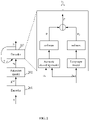
- the end-to-end speech recognition model may include an encoder 201, an attention model 202, and a decoder 203.
- Input of the encoder 201 is acoustic features which are represented by a vector x, and the acoustic features may be obtained by performing feature extraction on the speech using various related arts, for example, Filterbank features extracted frame by frame after frame division is performed on a speech signal.
- the encoder 201 encodes the acoustic features to obtain encoded features which are represented by a vector h enc .
- the attention model 202 assigns different weights to different encoded features to obtain features after an attention processing operation, which are denoted by a vector c u , u being an index of temporal information (step).
- the decoder 203 outputs a text, and the text may be output character by character; that is, the decoder 203 obtains an output text sequence based on input features, the input features include an output text y u-1 at a previous moment and c u output by the attention model 202, and output of the decoder 203 is the output text y u at the current moment.
- y u may include a beginning character [SOS] and an ending character [EOS].
- Output of the attention model may be understood to resemble output of an acoustic model in a conventional ASR solution, and thus, the output c u of the attention model may be understood as the acoustic related information; in the related art, the input of the decoder includes only the output text y u-1 at the previous moment and the acoustic related information c u , and correspondingly, the decoder in the related art may be understood to include only the acoustic decoding model.
- the decoding operation relies on both the acoustic related information and language related information.
- the decoder includes both the acoustic decoding model and the language model (LM) configured to predict the output text at the current moment based on the output text at the previous moment.
- LM language model
- a number of output nodes of the acoustic decoding model is the same as a total number of the candidate texts
- a number of output nodes of the language model is also the same as the total number of the candidate texts
- the number of the candidate texts may be one or plurality
- the plurality refers to at least two.
- the output of the acoustic decoding model and the output of the language model may be processed using softmax respectively to obtain a numerical value between [0, 1], and when one candidate text is provided, the numerical value is the probability that the candidate text is the standard text; generally, a plural candidate texts are provided, and in this case, the probability corresponding to each of the plural candidate texts is required to be determined, and taking the determination of the probability corresponding to each candidate text as an example for description, the numerical value is the probability that each candidate text is the standard text, and the standard text refers to a correct text corresponding to the speech.
- the output of the acoustic decoding model after the softmax processing operation may be referred to as a first probability P 1
- the output of the language model after the softmax processing operation may be referred to as a second probability P 2
- the fusion probability P of each candidate text may be calculated based on the first probability P 1 and the second probability P 2 ; for example, the first probability P 1 and the second probability P 2 are subjected to weighted summation, and the weighted summation value is taken as the fusion probability P.
- a weighting coefficient in the weighted summation may be set according to actual requirements.
- the fusion probability is calculated for each candidate text; for example, for the candidate text " (jin)", the first probability of “ (jin)” may be determined using the acoustic decoding model, the second probability of “ (jin)” may be determined using the language model, and then, the fusion probability of " (jin)” may be calculated based on the first probability of " (jin)” and the second probability of " (jin)".
- the predicted text may be determined based on the N candidate texts.
- the N candidate texts may be directly used as the predicted texts.
- “ (jin)” and “ (jin)” are used as the predicted texts.
- the loss function may be calculated based on the predicted text and the standard text.
- the standard text refers to the correct text of the speech, and may be obtained by means of manual annotation; for example, in the above example, the standard text is " (jin tian tian qi)".
- the loss function may be a loss function adopted in a discrimination training algorithm, and a specific form may be selected according to actual requirements, for example, a cross entropy function, or the like. In the embodiment of the present disclosure, the loss function is a word error rate function.
- x P y i
- L wasr N ⁇ best x , y * is the loss function; y i is the ith predicted text, and N predicted texts are provided in total; y* is the standard text; W ( y i ,y* ) is a number of errors of the ith predicted text, i.e., a number of errors of y i with respect to y *; W ⁇ is an average number of errors of the N predicted texts; P ⁇ y i
- x is a normalized value, and P ( y i
- the speech recognition model may be trained based on the loss function; that is, the speech recognition model is initialized randomly or by loading a pre-trained model; after the initialization, parameters of the speech recognition model are adjusted until the loss function converges, and the speech recognition model when the loss function converges is used as the finally obtained speech recognition model.
- the speech recognition model includes the encoder, the attention model and the decoder
- the decoder includes the acoustic decoding model and the language model
- the encoder, the acoustic decoding model and the language model may all be configured as deep neural network models, and specific model structures may be selected according to actual requirements; for example, the encoder, the acoustic decoding model and the language model may all be configured as recurrent neural network (RNN) models, and a multi-headed attention model is used as the attention model.
- RNN recurrent neural network
- the fusion probability of the candidate text is calculated based on the acoustic decoding model and the language model, and the candidate text is selected based on the fusion probability, such that reference may be made to both the acoustic related information and related information of the language model when the candidate text is selected, thereby improving recognition accuracy of the speech recognition model.
- Fig. 3 is a schematic diagram according to a third embodiment of the present disclosure, this embodiment provides a method for training a speech recognition model, and takes character-by-character output as an example, and in conjunction with the structure shown in Fig. 2 , the method includes: 301: extracting acoustic features of a speech.
- the speech is, for example, a speech corresponding to " (jin tian tian qi)".
- the acoustic features such as FilterBank features, may be extracted using various related arts.
- the encoder may be configured as an RNN model, such as a long short-term memory (LSTM) model.
- LSTM long short-term memory
- the attention model may adopt a model in various related arts, such as a multi-headed attention model.
- the acoustic features are extracted and encoded, and the attention processing operation is performed on the encoded features, such that semantic features may be obtained and decoded to obtain a predicted text, thereby training the speech recognition model based on the predicted text.
- the acoustic decoding model may be configured as an RNN model, such as a long short-term memory (LSTM) model.
- RNN model such as a long short-term memory (LSTM) model.
- a processing operation may be performed by the acoustic decoding model based on a beginning character [SOS] and the feature c 1 after the attention processing operation at the current moment, so as to obtain the first probability corresponding to each candidate text; for example, if the candidate texts include “ (jin)", “ (jin)", or the like, the first probabilities of " (jin)", “ (jin)", or the like, may be predicted.
- the language model may be configured as a neural network model, such as an RNN model, a Transformer model, or the like.
- a processing operation may be performed by the language model based on the beginning character [SOS], so as to obtain the second probability corresponding to each candidate text; for example, if the candidate texts include “ (jin)", “ (jin)", or the like, the second probabilities of " (jin)", “ (jin)", or the like, may be predicted.
- the first probability and the second probability may be subjected to weighted summation to obtain a weighted summation value, and the weighted summation value may be determined as the fusion probability of the corresponding candidate text.
- the first probability and the second probability of " (jin)" are subjected to weighted summation to obtain the fusion probability of " (jin)".
- the fusion probability is obtained by performing weighted summation on the first probability and the second probability, thus simply and conveniently calculating the fusion probability.
- the standard text corresponding to the speech may be obtained by means of manual annotation; for example, the standard text is " (jin)" for the first moment.
- the standard text is " (jin)"
- the selected N candidate texts are “ (jin)” and “ (jin)”, but do not include “ (jin)”
- the standard text " (jin)” may be forcibly included in the predicted text.
- the previous candidate text may be replaced with the standard text by means of a code in a specified output path or a randomly selected output path; for example, " (jin)” is replaced with “ (jin)", and then, the predicted texts are " (jin)” and " (jin)”.
- the standard text may be forcibly included in the predicted text, thus improving a recognition effect of the speech recognition model.
- 311 obtaining an accumulated number of errors of the predicted text based on the standard text corresponding to the speech and the predicted text, the accumulated error number being obtained based on a historical error number and a current error number.
- the current error number is a number of errors of the predicted text at the current moment with respect to the standard text
- the historical error number is a number of errors of the predicted text at a historical moment before the current moment with respect to the standard text.
- the standard text is " (jin tian tian qi)", and in the related art, as shown on the upper side of Fig. 4 , the error number is calculated according to the whole sentence, and since the whole sentence error numbers (global error numbers) of the three predicted texts are all 1, a local error optimizing effect is unable to be achieved.
- the error number is calculated on a per moment basis; for example, the error numbers of " (jin)” and “ (jin)” are calculated for a first moment; the accumulated numbers of errors of" (jin)” and “ (tian)” as well as the accumulated numbers of errors of “ (jin)” and “ (tian)” are calculated for a second moment; the accumulated numbers of errors of " (jin)", “ (tian)” and “ (tian)”, the accumulated numbers of errors of " (jin )", “ (tian)” and “ (tian)”, as well as the accumulated numbers of errors of" (jin)", “ (tian)” and “ (tian)” are calculated for a third moment, and so on, until the whole sentence is finished.
- the local error optimizing effect may be achieved by calculating the accumulated error number.
- the first probability is calculated using the acoustic decoding model
- the second probability is calculated using the language model
- the fusion probability is obtained based on the first probability and the second probability
- the candidate text is selected based on the fusion probability, such that the more accurate candidate text may be obtained, thereby improving the recognition effect of the speech recognition model.
- Fig. 5 is a schematic diagram according to a fifth embodiment of the present disclosure, this embodiment provides an apparatus for training a speech recognition model, and the apparatus 500 includes a processing module 501, a determining module 502 and a training module 503.
- the processing module 501 is configured for obtaining a fusion probability of each of at least one candidate text corresponding to a speech based on an acoustic decoding model and a language model;
- the determining module 502 is configured for selecting a preset number of one or more candidate texts based on the fusion probability of each of the at least one candidate text, and determine a predicted text based on the preset number of candidate texts;
- the training module 503 is configured to obtain a loss function based on the predicted text and a standard text corresponding to the speech, and train the speech recognition model based on the loss function.
- the processing module 501 is specifically configured for: processing an output text at a previous moment and acoustic related information at a current moment using the acoustic decoding model to obtain a first probability corresponding to the at least one candidate text corresponding to the speech; processing the output text at the previous moment using the language model to obtain a second probability corresponding to the candidate text; and obtaining the fusion probability of the candidate text based on the first probability and the second probability.
- the processing module 501 is specifically configured for: for the candidate text, performing weighted summation of the first probability and the second probability to obtain a weighted summation value, and determining the weighted summation value as the fusion probability of the corresponding candidate text.
- the determining module 502 is specifically configured for: if the preset number of the one or more candidate texts include the standard text, determining the preset number of the one or more candidate texts as the predicted texts; or if the preset number of the one or more candidate texts do not include the standard text, replace one candidate text of the preset number of the one or more candidate texts with the standard text to obtain one or more texts after the replacing, and determining the one or more texts after the replacing as the predicted text.
- the training module 503 is specifically configured for: obtaining an accumulated number of errors of the predicted text based on the predicted text and the standard text corresponding to the speech, the accumulated error number being obtained based on a historical error number and a current error number; and obtaining the loss function based on the accumulated error number of the predicted text.
- some embodiments further provide an apparatus for training a speech recognition model
- the apparatus 600 includes a processing module 601, a determining module 602 and a training module 603, and further includes an extracting module 604, an encoding module 605 and an attention processing module 606.
- the extracting module 604 is configured for extracting acoustic features of a speech; the encoding module 605 is configured for encoding the acoustic features to obtain encoded features; the attention processing module 606 is configured for processing the encoded features to obtain features after the attention processing operation.
- the acoustic features are extracted and encoded, and the attention processing operation is performed on the encoded features, such that semantic features may be obtained and decoded to obtain the predicted text, thereby training the speech recognition model based on the predicted text.
- the first probability is calculated using the acoustic decoding model
- the second probability is calculated using the language model
- the fusion probability is obtained based on the first probability and the second probability
- the candidate text is selected based on the fusion probability, such that the more accurate candidate text may be obtained, thereby improving the recognition effect of the speech recognition model.
- the fusion probability is obtained by performing weighted summation of the first probability and the second probability, thus simply and conveniently calculating the fusion probability.
- the local error optimizing effect may be achieved by calculating the accumulated error number.
- an electronic device a readable storage medium and a computer program product.
- Fig. 7 shows a schematic block diagram of an exemplary electronic device 700 which may be configured to implement the embodiments of the present disclosure.
- the electronic device is intended to represent various forms of digital computers, such as laptop computers, desktop computers, workstations, servers, blade servers, mainframe computers, and other appropriate computers.
- the electronic device may also represent various forms of mobile devices, such as personal digital assistants, cellular telephones, smart phones, wearable devices, and other similar computing devices.
- the components shown herein, their connections and relationships, and their functions, are meant to be exemplary only, and are not meant to limit implementation of the present disclosure described and/or claimed herein.
- the electronic device 700 includes a computing unit 701 which may perform various appropriate actions and processing operations according to a computer program stored in a read only memory (ROM) 702 or a computer program loaded from a storage unit 708 into a random access memory (RAM) 703.
- Various programs and data necessary for the operation of the electronic device 700 may be also stored in the RAM 703.
- the computing unit 701, the ROM 702, and the RAM 703 are connected with one other through a bus 704.
- An input/output (I/O) interface 705 is also connected to the bus 704.
- the plural components in the electronic device 700 are connected to the I/O interface 705, and include: an input unit 706, such as a keyboard, a mouse, or the like; an output unit 707, such as various types of displays, speakers, or the like; the storage unit 708, such as a magnetic disk, an optical disk, or the like; and a communication unit 709, such as a network card, a modem, a wireless communication transceiver, or the like.
- the communication unit 709 allows the electronic device 700 to exchange information/data with other devices through a computer network, such as the Internet, and/or various telecommunication networks.
- the computing unit 701 may be a variety of general and/or special purpose processing components with processing and computing capabilities. Some examples of the computing unit 701 include, but are not limited to, a central processing unit (CPU), a graphic processing unit (GPU), various dedicated artificial intelligence (AI) computing chips, various computing units running machine learning model algorithms, a digital signal processor (DSP), and any suitable processor, controller, microcontroller, or the like.
- the computing unit 701 performs the methods and processing operations described above, such as the method for training a speech recognition model.
- a human-machine conversation method may be implemented as a computer software program tangibly contained in a machine readable medium, such as the storage unit 708.
- part or all of the computer program may be loaded and/or installed into the electronic device 700 via the ROM 702 and/or the communication unit 709.
- the computer program When the computer program is loaded into the RAM 703 and executed by the computing unit 701, one or more steps of the method for training a speech recognition model described above may be performed.
- the computing unit 701 may be configured to perform the human-machine conversation method by any other suitable means (for example, by means of firmware).
- Various implementations of the systems and technologies described herein above may be implemented in digital electronic circuitry, integrated circuitry, field programmable gate arrays (FPGA), application specific integrated circuits (ASIC), application specific standard products (ASSP), systems on chips (SOC), complex programmable logic devices (CPLD), computer hardware, firmware, software, and/or combinations thereof.
- the systems and technologies may be implemented in one or more computer programs which are executable and/or interpretable on a programmable system including at least one programmable processor, and the programmable processor may be special or general, and may receive data and instructions from, and transmit data and instructions to, a storage system, at least one input device, and at least one output device.
- Program codes for implementing the method according to the present disclosure may be written in any combination of one or more programming languages. These program codes may be provided to a processor or a controller of a general purpose computer, a special purpose computer, or other programmable data processing devices, such that the program code, when executed by the processor or the controller, causes functions/operations specified in the flowchart and/or the block diagram to be implemented.
- the program code may be executed entirely on a machine, partly on a machine, partly on a machine as a stand-alone software package and partly on a remote machine, or entirely on a remote machine or a server.
- the machine readable medium may be a tangible medium which may contain or store a program for use by or in connection with an instruction execution system, apparatus, or device.
- the machine readable medium may be a machine readable signal medium or a machine readable storage medium.
- the machine readable medium may include, but is not limited to, an electronic, magnetic, optical, electromagnetic, infrared, or semiconductor system, apparatus, or device, or any suitable combination of the foregoing.
- machine readable storage medium may include an electrical connection based on one or more wires, a portable computer disk, a hard disk, a random access memory (RAM), a read only memory (ROM), an erasable programmable read only memory (EPROM or flash memory), an optical fiber, a portable compact disc read only memory (CD-ROM), an optical storage device, a magnetic storage device, or any suitable combination of the foregoing.
- RAM random access memory
- ROM read only memory
- EPROM or flash memory erasable programmable read only memory
- CD-ROM compact disc read only memory
- magnetic storage device or any suitable combination of the foregoing.
- a computer having: a display device (for example, a cathode ray tube (CRT) or liquid crystal display (LCD) monitor) for displaying information to a user; and a keyboard and a pointing device (for example, a mouse or a trackball) by which a user may provide input for the computer.
- a display device for example, a cathode ray tube (CRT) or liquid crystal display (LCD) monitor
- LCD liquid crystal display
- keyboard and a pointing device for example, a mouse or a trackball
- Other kinds of devices may also be used to provide interaction with a user; for example, feedback provided for a user may be any form of sensory feedback (for example, visual feedback, auditory feedback, or tactile feedback); and input from a user may be received in any form (including acoustic, speech or tactile input).
- the systems and technologies described here may be implemented in a computing system (for example, as a data server) which includes a back-end component, or a computing system (for example, an application server) which includes a middleware component, or a computing system (for example, a user computer having a graphical user interface or a web browser through which a user may interact with an implementation of the systems and technologies described here) which includes a front-end component, or a computing system which includes any combination of such back-end, middleware, or front-end components.
- the components of the system may be interconnected through any form or medium of digital data communication (for example, a communication network). Examples of the communication network include: a local area network (LAN), a wide area network (WAN) and the Internet.
- a computer system may include a client and a server.
- the client and the server are remote from each other and interact through the communication network.
- the relationship between the client and the server is generated by virtue of computer programs which run on respective computers and have a client-server relationship to each other.
- the server may be a cloud server, also called a cloud computing server or a cloud host, and is a host product in a cloud computing service system, so as to overcome the defects of high management difficulty and weak service expansibility in conventional physical host and virtual private server (VPS) service.
- the server may also be a server of a distributed system, or a server incorporating a blockchain.
Landscapes
- Engineering & Computer Science (AREA)
- Physics & Mathematics (AREA)
- Computational Linguistics (AREA)
- Health & Medical Sciences (AREA)
- Audiology, Speech & Language Pathology (AREA)
- Human Computer Interaction (AREA)
- Acoustics & Sound (AREA)
- Multimedia (AREA)
- Artificial Intelligence (AREA)
- Evolutionary Computation (AREA)
- Software Systems (AREA)
- Theoretical Computer Science (AREA)
- Computer Vision & Pattern Recognition (AREA)
- Probability & Statistics with Applications (AREA)
- Data Mining & Analysis (AREA)
- Medical Informatics (AREA)
- Computing Systems (AREA)
- General Engineering & Computer Science (AREA)
- General Physics & Mathematics (AREA)
- Mathematical Physics (AREA)
- Machine Translation (AREA)
- Electrically Operated Instructional Devices (AREA)
Abstract
Description
- The present disclosure relates to the field of computer technologies, and particularly relates to the fields of speech recognition technologies, deep learning technologies, or the like, and more particularly to a method and apparatus for training a speech recognition model, a device and a storage medium.
- Automatic speech recognition (ASR) is a technology of converting a speech into a text. Different from a conventional ASR solution in which a speech recognition task is divided into a plurality of subtasks, input of an end-to-end speech recognition model is acoustic features, and output thereof is directly a natural language text, thereby simplifying a model training process.
- The end-to-end speech recognition model may be configured as a sequence-to-sequence (Seq2Seq) model, the sequence-to-sequence model includes a decoder, and when the end-to-end speech recognition model is trained, the decoder may obtain a plurality of decoding results by means of beam search.
- In a related art, when the decoder performs the beam search, the input only includes the output text at a previous moment and acoustic related information.
- The present disclosure provides a method and apparatus for training a speech recognition model, a device and a storage medium.
- According to an aspect of the present disclosure, there is provided a method for training a speech recognition model, including: obtaining a fusion probability of each of at least one candidate text corresponding to a speech based on an acoustic decoding model and a language model; selecting a preset number of the candidate texts based on the fusion probabilities of the candidate texts, and determining a predicted text based on the preset number of the candidate texts; and obtaining a loss function based on a standard text corresponding to the speech and the predicted text, and training the speech recognition model based on the loss function.
- According to another aspect of the present disclosure, there is provided an apparatus for training a speech recognition model, including: a processing module configured for obtaining a fusion probability of each of at least one candidate text corresponding to a speech based on an acoustic decoding model and a language model; a determining module configured for selecting a preset number of the candidate texts based on the fusion probabilities of the candidate texts, and determine a predicted text based on the preset number of the candidate texts; and a training module configured for obtaining a loss function based on a standard text corresponding to the speech and the predicted text, and training the speech recognition model based on the loss function.
- According to another aspect of the present disclosure, there is provided an electronic device, including: at least one processor; and a memory connected with the at least one processor communicatively, wherein the memory stores instructions executable by the at least one processor to enable the at least one processor to carry out the method according to any one of the above-mentioned aspects.
- According to another aspect of the present disclosure, there is provided a non-transitory computer readable storage medium including computer instructions, which, when executed by a computer, cause the computer to carry out the method according to any one of the above-mentioned aspects.
- According to another aspect of the present disclosure, there is provided a computer program product including a computer program which, when executed by a computer, cause the computer to carry out the method according to any one of the above-mentioned aspects.
- The technical solution according to the present disclosure may improve recognition accuracy of the speech recognition model.
- It should be understood that the statements in this section are not intended to identify key or critical features of the embodiments of the present disclosure, nor limit the scope of the present disclosure. Other features of the present disclosure will become apparent from the following description.
- The drawings are used for better understanding the present solution and do not constitute a limitation of the present disclosure. In the drawings:
-
Fig. 1 is a schematic diagram according to a first embodiment of the present disclosure; -
Fig. 2 is a schematic diagram according to a second embodiment of the present disclosure; -
Fig. 3 is a schematic diagram according to a third embodiment of the present disclosure; -
Fig. 4 is a schematic diagram according to a fourth embodiment of the present disclosure; -
Fig. 5 is a schematic diagram according to a fifth embodiment of the present disclosure; -
Fig. 6 is a schematic diagram according to a sixth embodiment of the present disclosure; and -
Fig. 7 is a schematic diagram of an electronic device configured to implement any of methods for training a speech recognition model according to the embodiments of the present disclosure. - The following part will illustrate exemplary embodiments of the present disclosure with reference to the drawings, including various details of the embodiments of the present disclosure for a better understanding. The embodiments should be regarded only as exemplary ones. Therefore, those skilled in the art should appreciate that various changes or modifications can be made with respect to the embodiments described herein without departing from the scope and spirit of the present disclosure. Similarly, for clarity and conciseness, the descriptions of the known functions and structures are omitted in the descriptions below.
-
Fig. 1 is a schematic diagram according to a first embodiment of the present disclosure, this embodiment provides a method for training a speech recognition model, the speech recognition model includes an acoustic decoder and a language model, and the method includes: - 101: obtaining a fusion probability of each of at least one candidate text corresponding to a speech based on an acoustic decoding model and the language model.
- 102: selecting a preset number of one or more candidate texts based on the fusion probability of each of the at least one candidate text and determining a predicted text based on the preset number of the one or more candidate texts.
- 103: obtaining a loss function based on the predicted text and a standard text corresponding to the speech, and training the speech recognition model based on the loss function.
- In the embodiment of the present disclosure, the speech recognition model, for example, is an end-to-end speech recognition model. The end-to-end speech recognition model, for example, is an attention-based sequence-to-sequence model.
- As shown in
Fig. 2 , the end-to-end speech recognition model may include anencoder 201, anattention model 202, and adecoder 203. Input of theencoder 201 is acoustic features which are represented by a vector x, and the acoustic features may be obtained by performing feature extraction on the speech using various related arts, for example, Filterbank features extracted frame by frame after frame division is performed on a speech signal. Theencoder 201 encodes the acoustic features to obtain encoded features which are represented by a vector henc. Theattention model 202 assigns different weights to different encoded features to obtain features after an attention processing operation, which are denoted by a vector cu, u being an index of temporal information (step). Thedecoder 203 outputs a text, and the text may be output character by character; that is, thedecoder 203 obtains an output text sequence based on input features, the input features include an output text yu-1 at a previous moment and cu output by theattention model 202, and output of thedecoder 203 is the output text yu at the current moment. Further, yu may include a beginning character [SOS] and an ending character [EOS]. For example, if the speech is "(pronounced as "jin tian tian qi")", " (jin)" may be predicted from the beginning character [SOS], "
 (tian)" is predicted from "
 (jin)", and so on, until the ending character [EOS] is output.
- Output of the attention model may be understood to resemble output of an acoustic model in a conventional ASR solution, and thus, the output cu of the attention model may be understood as the acoustic related information; in the related art, the input of the decoder includes only the output text yu-1 at the previous moment and the acoustic related information cu, and correspondingly, the decoder in the related art may be understood to include only the acoustic decoding model.
- In the embodiment of the present disclosure, referring to
Fig. 2 , the decoding operation relies on both the acoustic related information and language related information. As shown inFig. 2 , the decoder includes both the acoustic decoding model and the language model (LM) configured to predict the output text at the current moment based on the output text at the previous moment. A number of output nodes of the acoustic decoding model is the same as a total number of the candidate texts, a number of output nodes of the language model is also the same as the total number of the candidate texts, the number of the candidate texts may be one or plurality, and the plurality refers to at least two. For example, if M candidate texts are provided, the number of the output nodes of the acoustic decoding model and the number of the output nodes of the language model are both M, the output of the acoustic decoding model and the output of the language model may be processed using softmax respectively to obtain a numerical value between [0, 1], and when one candidate text is provided, the numerical value is the probability that the candidate text is the standard text; generally, a plural candidate texts are provided, and in this case, the probability corresponding to each of the plural candidate texts is required to be determined, and taking the determination of the probability corresponding to each candidate text as an example for description, the numerical value is the probability that each candidate text is the standard text, and the standard text refers to a correct text corresponding to the speech. For differentiation, the output of the acoustic decoding model after the softmax processing operation may be referred to as a first probability P1, the output of the language model after the softmax processing operation may be referred to as a second probability P2, and then, the fusion probability P of each candidate text may be calculated based on the first probability P1 and the second probability P2; for example, the first probability P1 and the second probability P2 are subjected to weighted summation, and the weighted summation value is taken as the fusion probability P. A weighting coefficient in the weighted summation may be set according to actual requirements. The fusion probability is calculated for each candidate text; for example, for the candidate text " (jin)", the first probability of "
 (jin)" may be determined using the acoustic decoding model, the second probability of "
 (jin)" may be determined using the language model, and then, the fusion probability of "
 (jin)" may be calculated based on the first probability of "
 (jin)" and the second probability of "
 (jin)".
- After the fusion probability of each candidate text is obtained, assuming that a beam search width is N, N candidate texts may be selected according to the descending fusion probabilities. For example, for "
 (jintian tianqi)", when the output character at a first moment is predicted, the candidate texts may include "
 (jin)", "
 (jin)" and "
 (jin)", assuming that the fusion probability of "
 (jin)" is 0.7, the fusion probability of "
 (jin)" is 0.2, and the fusion probability of "
 (jin)" is 0.1, if N=2, "
 (jin)" and "
 (jin)" may be selected.
- After selection of the N candidate texts, the predicted text may be determined based on the N candidate texts. For example, the N candidate texts may be directly used as the predicted texts. For example, for the first moment, "
 (jin)" and "
 (jin)" are used as the predicted texts.
- After the predicted text is obtained, the loss function may be calculated based on the predicted text and the standard text. The standard text refers to the correct text of the speech, and may be obtained by means of manual annotation; for example, in the above example, the standard text is "
 (jin tian tian qi)". The loss function may be a loss function adopted in a discrimination training algorithm, and a specific form may be selected according to actual requirements, for example, a cross entropy function, or the like. In the embodiment of the present disclosure, the loss function is a word error rate function. The word error rate function is formulated as:


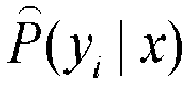
- After the loss function is obtained, the speech recognition model may be trained based on the loss function; that is, the speech recognition model is initialized randomly or by loading a pre-trained model; after the initialization, parameters of the speech recognition model are adjusted until the loss function converges, and the speech recognition model when the loss function converges is used as the finally obtained speech recognition model. The speech recognition model includes the encoder, the attention model and the decoder, the decoder includes the acoustic decoding model and the language model, the encoder, the acoustic decoding model and the language model may all be configured as deep neural network models, and specific model structures may be selected according to actual requirements; for example, the encoder, the acoustic decoding model and the language model may all be configured as recurrent neural network (RNN) models, and a multi-headed attention model is used as the attention model.
- In this embodiment, the fusion probability of the candidate text is calculated based on the acoustic decoding model and the language model, and the candidate text is selected based on the fusion probability, such that reference may be made to both the acoustic related information and related information of the language model when the candidate text is selected, thereby improving recognition accuracy of the speech recognition model.
-
Fig. 3 is a schematic diagram according to a third embodiment of the present disclosure, this embodiment provides a method for training a speech recognition model, and takes character-by-character output as an example, and in conjunction with the structure shown inFig. 2 , the method includes:
301: extracting acoustic features of a speech. - The speech is, for example, a speech corresponding to "
 (jin tian tian qi)".
- The acoustic features, such as FilterBank features, may be extracted using various related arts.
- 302: encoding the acoustic features using an encoder to obtain encoded features.
- The encoder may be configured as an RNN model, such as a long short-term memory (LSTM) model.
- 303: performing an attention processing operation on the encoded features using the attention model to obtain features after the attention processing operation.
- The attention model may adopt a model in various related arts, such as a multi-headed attention model.
- In this embodiment, the acoustic features are extracted and encoded, and the attention processing operation is performed on the encoded features, such that semantic features may be obtained and decoded to obtain a predicted text, thereby training the speech recognition model based on the predicted text.
- 304: processing an output character at a previous moment and the feature after the attention processing operation using an acoustic decoding model to obtain a first probability corresponding to each of at least one candidate text corresponding to the speech.
- The acoustic decoding model may be configured as an RNN model, such as a long short-term memory (LSTM) model.
- For example, if the speech is a speech corresponding to "
 (jin tian tian qi)" and "
 (jin)" is to be predicted at a current moment, a processing operation may be performed by the acoustic decoding model based on a beginning character [SOS] and the feature c1 after the attention processing operation at the current moment, so as to obtain the first probability corresponding to each candidate text; for example, if the candidate texts include "
 (jin)", "
 (jin)", or the like, the first probabilities of "
 (jin)", "
 (jin)", or the like, may be predicted.
- 305: processing the output character at the previous moment using a language model to obtain a second probability corresponding to each candidate text.
- The language model may be configured as a neural network model, such as an RNN model, a Transformer model, or the like.
- For example, if "
 (jin)" is to be predicted at the current moment, a processing operation may be performed by the language model based on the beginning character [SOS], so as to obtain the second probability corresponding to each candidate text; for example, if the candidate texts include "
 (jin)", "
 (jin)", or the like, the second probabilities of "
 (jin)", "
 (jin)", or the like, may be predicted.
- 306: obtaining a fusion probability corresponding to each candidate text based on the first probability and the second probability.
- Specifically, for each candidate text, the first probability and the second probability may be subjected to weighted summation to obtain a weighted summation value, and the weighted summation value may be determined as the fusion probability of the corresponding candidate text.
- For example, the first probability and the second probability of "
 (jin)" are subjected to weighted summation to obtain the fusion probability of "
 (jin)".
- In this embodiment, the fusion probability is obtained by performing weighted summation on the first probability and the second probability, thus simply and conveniently calculating the fusion probability.
- 307: selecting a preset number of candidate texts based on the fusion probability.
- Specifically, the candidate texts with a number equal to a beam search width may be selected according to the fusion probabilities in descending order; for example, the beam search width is represented by N, and if N=2, for a first moment, assuming that "
 (jin)" and "
 (jin)" have higher fusion probabilities, "
 (jin)" and "
 (jin)" are selected as the candidate texts at the first moment.
- 308: judging whether a standard text corresponding to the speech exists in the preset number of candidate texts, if yes, executing 309, and otherwise, executing 310.
- The standard text corresponding to the speech may be obtained by means of manual annotation; for example, the standard text is "
 (jin)" for the first moment.
- 309: determining the preset number of candidate texts as the predicted texts.
- 310: replacing one of the preset number of candidate texts with the standard text to obtain texts after the replacing, and determining the texts after the replacing as the predicted texts.
- For example, for the first moment, if the standard text is "
 (jin)", and the selected N candidate texts are "
 (jin)" and "
 (jin)", but do not include "
 (jin)", the standard text "
 (jin)" may be forcibly included in the predicted text. Specifically, the previous candidate text may be replaced with the standard text by means of a code in a specified output path or a randomly selected output path; for example, "
 (jin)" is replaced with "
 (jin)", and then, the predicted texts are "
 (jin)" and "
 (jin)".
- In the related art, in a discrimination training process, generally, a candidate text with an error rate higher than an average error rate is suppressed, and a candidate text with an error rate lower than the average error rate is encouraged. However, if the N candidate texts do not have a completely correct result, there exists a problem of encouraging an erroneous result.
- In this embodiment, by replacing the candidate text with the standard text, the standard text may be forcibly included in the predicted text, thus improving a recognition effect of the speech recognition model.
- 311: obtaining an accumulated number of errors of the predicted text based on the standard text corresponding to the speech and the predicted text, the accumulated error number being obtained based on a historical error number and a current error number.
- The current error number is a number of errors of the predicted text at the current moment with respect to the standard text, and the historical error number is a number of errors of the predicted text at a historical moment before the current moment with respect to the standard text.
- For example, referring to
Fig. 4 , the standard text is " (jin tian tian qi)", and in the related art, as shown on the upper side of
Fig. 4 , the error number is calculated according to the whole sentence, and since the whole sentence error numbers (global error numbers) of the three predicted texts are all 1, a local error optimizing effect is unable to be achieved. - In this embodiment, as shown on the lower side of
Fig. 4 , the error number is calculated on a per moment basis; for example, the error numbers of " (jin)" and "
 (jin)" are calculated for a first moment; the accumulated numbers of errors of"
 (jin)" and "
 (tian)" as well as the accumulated numbers of errors of "
 (jin)" and "
 (tian)" are calculated for a second moment; the accumulated numbers of errors of "
 (jin)", "
 (tian)" and "
 (tian)", the accumulated numbers of errors of "
 (jin )", "
 (tian)" and "
 (tian)", as well as the accumulated numbers of errors of"
 (jin)", "
 (tian)" and "
 (tian)" are calculated for a third moment, and so on, until the whole sentence is finished.
- In this embodiment, the local error optimizing effect may be achieved by calculating the accumulated error number.
- 312: obtaining a loss function based on the accumulated error number of the predicted text.
- 313: training the speech recognition model based on the loss function.
- In this embodiment, the first probability is calculated using the acoustic decoding model, the second probability is calculated using the language model, the fusion probability is obtained based on the first probability and the second probability, and the candidate text is selected based on the fusion probability, such that the more accurate candidate text may be obtained, thereby improving the recognition effect of the speech recognition model.
-
Fig. 5 is a schematic diagram according to a fifth embodiment of the present disclosure, this embodiment provides an apparatus for training a speech recognition model, and theapparatus 500 includes aprocessing module 501, a determiningmodule 502 and atraining module 503. Theprocessing module 501 is configured for obtaining a fusion probability of each of at least one candidate text corresponding to a speech based on an acoustic decoding model and a language model; the determiningmodule 502 is configured for selecting a preset number of one or more candidate texts based on the fusion probability of each of the at least one candidate text, and determine a predicted text based on the preset number of candidate texts; thetraining module 503 is configured to obtain a loss function based on the predicted text and a standard text corresponding to the speech, and train the speech recognition model based on the loss function. - In some embodiments, the
processing module 501 is specifically configured for: processing an output text at a previous moment and acoustic related information at a current moment using the acoustic decoding model to obtain a first probability corresponding to the at least one candidate text corresponding to the speech; processing the output text at the previous moment using the language model to obtain a second probability corresponding to the candidate text; and obtaining the fusion probability of the candidate text based on the first probability and the second probability. - In some embodiments, the
processing module 501 is specifically configured for: for the candidate text, performing weighted summation of the first probability and the second probability to obtain a weighted summation value, and determining the weighted summation value as the fusion probability of the corresponding candidate text. - In some embodiments, the determining
module 502 is specifically configured for: if the preset number of the one or more candidate texts include the standard text, determining the preset number of the one or more candidate texts as the predicted texts; or if the preset number of the one or more candidate texts do not include the standard text, replace one candidate text of the preset number of the one or more candidate texts with the standard text to obtain one or more texts after the replacing, and determining the one or more texts after the replacing as the predicted text. - In some embodiments, the
training module 503 is specifically configured for: obtaining an accumulated number of errors of the predicted text based on the predicted text and the standard text corresponding to the speech, the accumulated error number being obtained based on a historical error number and a current error number; and obtaining the loss function based on the accumulated error number of the predicted text. - As shown in
Fig. 6 , some embodiments further provide an apparatus for training a speech recognition model, and theapparatus 600 includes aprocessing module 601, a determiningmodule 602 and atraining module 603, and further includes an extractingmodule 604, anencoding module 605 and anattention processing module 606. - The extracting
module 604 is configured for extracting acoustic features of a speech; theencoding module 605 is configured for encoding the acoustic features to obtain encoded features; theattention processing module 606 is configured for processing the encoded features to obtain features after the attention processing operation. - In the embodiment of the present disclosure, the acoustic features are extracted and encoded, and the attention processing operation is performed on the encoded features, such that semantic features may be obtained and decoded to obtain the predicted text, thereby training the speech recognition model based on the predicted text. The first probability is calculated using the acoustic decoding model, the second probability is calculated using the language model, the fusion probability is obtained based on the first probability and the second probability, and the candidate text is selected based on the fusion probability, such that the more accurate candidate text may be obtained, thereby improving the recognition effect of the speech recognition model. The fusion probability is obtained by performing weighted summation of the first probability and the second probability, thus simply and conveniently calculating the fusion probability. The local error optimizing effect may be achieved by calculating the accumulated error number.
- It may be understood that in the embodiments of the present disclosure, mutual reference may be made to the same or similar contents in different embodiments.
- It may be understood that "first", "second", or the like, in the embodiments of the present disclosure are only for distinguishing and do not represent an importance degree, a sequential order, or the like.
- According to the embodiment of the present disclosure, there are also provided an electronic device, a readable storage medium and a computer program product.
-
Fig. 7 shows a schematic block diagram of an exemplaryelectronic device 700 which may be configured to implement the embodiments of the present disclosure. The electronic device is intended to represent various forms of digital computers, such as laptop computers, desktop computers, workstations, servers, blade servers, mainframe computers, and other appropriate computers. The electronic device may also represent various forms of mobile devices, such as personal digital assistants, cellular telephones, smart phones, wearable devices, and other similar computing devices. The components shown herein, their connections and relationships, and their functions, are meant to be exemplary only, and are not meant to limit implementation of the present disclosure described and/or claimed herein. - As shown in
Fig. 7 , theelectronic device 700 includes acomputing unit 701 which may perform various appropriate actions and processing operations according to a computer program stored in a read only memory (ROM) 702 or a computer program loaded from astorage unit 708 into a random access memory (RAM) 703. Various programs and data necessary for the operation of theelectronic device 700 may be also stored in theRAM 703. Thecomputing unit 701, theROM 702, and theRAM 703 are connected with one other through abus 704. An input/output (I/O)interface 705 is also connected to thebus 704. - The plural components in the
electronic device 700 are connected to the I/O interface 705, and include: aninput unit 706, such as a keyboard, a mouse, or the like; anoutput unit 707, such as various types of displays, speakers, or the like; thestorage unit 708, such as a magnetic disk, an optical disk, or the like; and acommunication unit 709, such as a network card, a modem, a wireless communication transceiver, or the like. Thecommunication unit 709 allows theelectronic device 700 to exchange information/data with other devices through a computer network, such as the Internet, and/or various telecommunication networks. - The
computing unit 701 may be a variety of general and/or special purpose processing components with processing and computing capabilities. Some examples of thecomputing unit 701 include, but are not limited to, a central processing unit (CPU), a graphic processing unit (GPU), various dedicated artificial intelligence (AI) computing chips, various computing units running machine learning model algorithms, a digital signal processor (DSP), and any suitable processor, controller, microcontroller, or the like. Thecomputing unit 701 performs the methods and processing operations described above, such as the method for training a speech recognition model. For example, in some embodiments, a human-machine conversation method may be implemented as a computer software program tangibly contained in a machine readable medium, such as thestorage unit 708. In some embodiments, part or all of the computer program may be loaded and/or installed into theelectronic device 700 via theROM 702 and/or thecommunication unit 709. When the computer program is loaded into theRAM 703 and executed by thecomputing unit 701, one or more steps of the method for training a speech recognition model described above may be performed. Alternatively, in other embodiments, thecomputing unit 701 may be configured to perform the human-machine conversation method by any other suitable means (for example, by means of firmware). - Various implementations of the systems and technologies described herein above may be implemented in digital electronic circuitry, integrated circuitry, field programmable gate arrays (FPGA), application specific integrated circuits (ASIC), application specific standard products (ASSP), systems on chips (SOC), complex programmable logic devices (CPLD), computer hardware, firmware, software, and/or combinations thereof. The systems and technologies may be implemented in one or more computer programs which are executable and/or interpretable on a programmable system including at least one programmable processor, and the programmable processor may be special or general, and may receive data and instructions from, and transmit data and instructions to, a storage system, at least one input device, and at least one output device.
- Program codes for implementing the method according to the present disclosure may be written in any combination of one or more programming languages. These program codes may be provided to a processor or a controller of a general purpose computer, a special purpose computer, or other programmable data processing devices, such that the program code, when executed by the processor or the controller, causes functions/operations specified in the flowchart and/or the block diagram to be implemented. The program code may be executed entirely on a machine, partly on a machine, partly on a machine as a stand-alone software package and partly on a remote machine, or entirely on a remote machine or a server.
- In the context of the present disclosure, the machine readable medium may be a tangible medium which may contain or store a program for use by or in connection with an instruction execution system, apparatus, or device. The machine readable medium may be a machine readable signal medium or a machine readable storage medium. The machine readable medium may include, but is not limited to, an electronic, magnetic, optical, electromagnetic, infrared, or semiconductor system, apparatus, or device, or any suitable combination of the foregoing. More specific examples of the machine readable storage medium may include an electrical connection based on one or more wires, a portable computer disk, a hard disk, a random access memory (RAM), a read only memory (ROM), an erasable programmable read only memory (EPROM or flash memory), an optical fiber, a portable compact disc read only memory (CD-ROM), an optical storage device, a magnetic storage device, or any suitable combination of the foregoing.
- To provide interaction with a user, the systems and technologies described here may be implemented on a computer having: a display device (for example, a cathode ray tube (CRT) or liquid crystal display (LCD) monitor) for displaying information to a user; and a keyboard and a pointing device (for example, a mouse or a trackball) by which a user may provide input for the computer. Other kinds of devices may also be used to provide interaction with a user; for example, feedback provided for a user may be any form of sensory feedback (for example, visual feedback, auditory feedback, or tactile feedback); and input from a user may be received in any form (including acoustic, speech or tactile input).
- The systems and technologies described here may be implemented in a computing system (for example, as a data server) which includes a back-end component, or a computing system (for example, an application server) which includes a middleware component, or a computing system (for example, a user computer having a graphical user interface or a web browser through which a user may interact with an implementation of the systems and technologies described here) which includes a front-end component, or a computing system which includes any combination of such back-end, middleware, or front-end components. The components of the system may be interconnected through any form or medium of digital data communication (for example, a communication network). Examples of the communication network include: a local area network (LAN), a wide area network (WAN) and the Internet.
- A computer system may include a client and a server. Generally, the client and the server are remote from each other and interact through the communication network. The relationship between the client and the server is generated by virtue of computer programs which run on respective computers and have a client-server relationship to each other. The server may be a cloud server, also called a cloud computing server or a cloud host, and is a host product in a cloud computing service system, so as to overcome the defects of high management difficulty and weak service expansibility in conventional physical host and virtual private server (VPS) service. The server may also be a server of a distributed system, or a server incorporating a blockchain.
- It should be understood that various forms of the flows shown above may be used and reordered, and steps may be added or deleted. For example, the steps described in the present disclosure may be executed in parallel, sequentially, or in different orders, which is not limited herein as long as the desired results of the technical solution disclosed in the present disclosure may be achieved.
- The above-mentioned implementations are not intended to limit the scope of the present disclosure. It should be understood by those skilled in the art that various modifications, combinations, sub-combinations and substitutions may be made, depending on design requirements and other factors. Any modification, equivalent substitution and improvement made within the spirit and principle of the present disclosure all should be included in the extent of protection of the present disclosure.
Claims (15)
- A method for training a speech recognition model, the speech recognition model comprising an acoustic decoding model and a language model, the method comprising:obtaining (101) a fusion probability of each of at least one candidate text corresponding to a speech based on the acoustic decoding model and the language model;selecting (102) a preset number of one or more candidate texts based on the fusion probability of each of the at least one candidate text, and determining a predicted text based on the preset number of one or more candidate texts; andobtaining (103) a loss function based on the predicted text and a standard text corresponding to the speech, and training the speech recognition model based on the loss function.
- The method according to claim 1, wherein the obtaining (101) the fusion probability of each of the at least one candidate text corresponding to the speech based on the acoustic decoding model and the language model comprises:processing (304) an output text at a previous moment and acoustic related information at a current moment using the acoustic decoding model to obtain a first probability corresponding to the at least one candidate text corresponding to the speech;processing (305) the output text at the previous moment using the language model to obtain a second probability corresponding to the candidate text; andobtaining (306) the fusion probability of the candidate text based on the first probability and the second probability.
- The method according to claim 2, wherein the obtaining (306) the fusion probability of the candidate text based on the first probability and the second probability comprises:
for the candidate text, performing weighted summation of the first probability and the second probability to obtain a weighted summation value, and determining the weighted summation value as the fusion probability of the corresponding candidate text. - The method according to any one of claims 1 to 3, wherein the determining (102) the predicted text based on the preset number of the one or more candidate texts comprises:
if the preset number of the one or more candidate texts comprise the standard text, determining (309) the preset number of the one or more candidate texts as the predicted text; if the preset number of the one or more candidate texts do not comprise the standard text, replacing (310) one candidate text of the preset number of the one or more candidate texts with the standard text to obtain one or more texts after the replacing, and determining the one or more texts after the replacing as the predicted text. - The method according to any one of claims 1 to 4, wherein the obtaining (103) the loss function based on the predicted text and the standard text corresponding to the speech comprises:obtaining (311) an accumulated number of errors of the predicted text based on the predicted text and the standard text corresponding to the speech, the accumulated error number being obtained based on a historical error number and a current error number; andobtaining (312) the loss function based on the accumulated error number of the predicted text.
- The method according to any one of claims 1 to 5, wherein the speech recognition model further comprises an encoder (201) and an attention model (202), the acoustic related information is features after an attention processing operation, and the method further comprises:extracting (301) acoustic features of the speech;encoding (302) the acoustic features using the encoder to obtain encoded features; andperforming (303) the attention processing operation on the encoded features using the attention model to obtain the features after the attention processing operation.
- An apparatus for training a speech recognition model (500, 600), comprising:a processing module (501, 601) configured for obtaining (101) a fusion probability of each of at least one candidate text corresponding to a speech based on an acoustic decoding model and a language model;a determining module (502, 602) configured for selecting (102) a preset number of one or more candidate texts based on the fusion probability of each of the at least one candidate text, and determine a predicted text based on the preset number of one or more candidate texts; anda training module (503, 603) configured for obtaining (103) a loss function based on the predicted text and a standard text corresponding to the speech, and training the speech recognition model based on the loss function.
- The apparatus (500, 600) according to claim 7, wherein the processing module is specifically configured for:processing (304) an output text at a previous moment and acoustic related information at a current moment using the acoustic decoding model to obtain a first probability corresponding to the at least one candidate text corresponding to the speech;processing (305) the output text at the previous moment using the language model to obtain a second probability corresponding to the candidate text; andobtaining (306) the fusion probability of the candidate text based on the first probability and the second probability.
- The apparatus (500, 600) according to claim 8, wherein the processing module is further specifically configured for:
for the candidate text, performing weighted summation of the first probability and the second probability to obtain a weighted summation value, and determining the weighted summation value as the fusion probability of the corresponding candidate text. - The apparatus (500, 600) according to any one of claims 7 to 9, wherein the determining module is specifically configured for:if the preset number of the one or more candidate texts comprise the standard text, determining (309) the preset number of the one or more candidate texts as the predicted text;if the preset number of the one or more candidate texts do not comprise the standard text, replacing (310) one candidate text of the preset number of the one or more candidate texts with the standard text to obtain one or more texts after the replacing, and determining the one or more texts after the replacing as the predicted text.
- The apparatus (500, 600) according to any one of claims 7 to 10, wherein the training module is specifically configured for:obtaining (311) an accumulated number of errors of the predicted text based on the predicted text and the standard text corresponding to the speech, the accumulated error number being obtained based on a historical error number and a current error number; andobtaining (312) the loss function based on the accumulated error number of the predicted text.
- The apparatus (500, 600) according to any one of claims 7 to 11, wherein the speech recognition model further comprises an encoder (201) and an attention model (202), the acoustic related information is features after an attention processing operation, and the apparatus further comprises:an extracting module (604) configured for extracting (301) acoustic features of the speech;an encoding module (605) configured for encoding (302) the acoustic features to obtain encoded features; andan attention processing module (606) configured for performing (303) the attention processing operation on the encoded features to obtain the features after the attention processing operation.
- An electronic device, comprising:at least one processor; anda memory connected with the at least one processor communicatively;wherein the memory stores instructions executable by the at least one processor to enable the at least one processor to carry out the method according to any one of claims 1 to 6.
- A non-transitory computer readable storage medium comprising computer instructions, which, when executed by a computer, cause the computer to carry out the method according to any one of claims 1 to 6.
- A computer program product comprising a computer program which, when the program is executed by a computer, cause the computer to carry out the method according to any one of claims 1 to 6.
Applications Claiming Priority (1)
| Application Number | Priority Date | Filing Date | Title |
|---|---|---|---|
| CN202110308608.0A CN113129870B (en) | 2021-03-23 | 2021-03-23 | Training method, device, equipment and storage medium of speech recognition model |
Publications (2)
| Publication Number | Publication Date |
|---|---|
| EP4064277A1 true EP4064277A1 (en) | 2022-09-28 |
| EP4064277B1 EP4064277B1 (en) | 2023-11-29 |
Family
ID=76773806
Family Applications (1)
| Application Number | Title | Priority Date | Filing Date |
|---|---|---|---|
| EP22150464.0A Active EP4064277B1 (en) | 2021-03-23 | 2022-01-06 | Method and apparatus for training speech recognition model, device and storage medium |
Country Status (5)
| Country | Link |
|---|---|
| US (1) | US12033616B2 (en) |
| EP (1) | EP4064277B1 (en) |
| JP (1) | JP7346788B2 (en) |
| KR (1) | KR102776462B1 (en) |
| CN (1) | CN113129870B (en) |
Cited By (1)
| Publication number | Priority date | Publication date | Assignee | Title |
|---|---|---|---|---|
| CN117116264A (en) * | 2023-02-20 | 2023-11-24 | 荣耀终端有限公司 | A speech recognition method, electronic device and medium |
Families Citing this family (16)
| Publication number | Priority date | Publication date | Assignee | Title |
|---|---|---|---|---|
| CN113850291B (en) * | 2021-08-18 | 2023-11-24 | 北京百度网讯科技有限公司 | Text processing and model training method, device, equipment and storage medium |
| CN113611311A (en) * | 2021-08-20 | 2021-11-05 | 天津讯飞极智科技有限公司 | Voice transcription method, device, recording equipment and storage medium |
| CN113889088B (en) | 2021-09-28 | 2022-07-15 | 北京百度网讯科技有限公司 | Method and device, electronic device and storage medium for training speech recognition model |
| CN114520001B (en) * | 2022-03-22 | 2025-08-01 | 科大讯飞股份有限公司 | Voice recognition method, device, equipment and storage medium |
| CN114842834B (en) * | 2022-03-31 | 2024-11-05 | 中国科学院自动化研究所 | A speech-text joint pre-training method and system |
| CN115116437B (en) * | 2022-04-07 | 2024-02-09 | 腾讯科技(深圳)有限公司 | Speech recognition method, device, computer equipment, storage medium and product |
| KR102478763B1 (en) * | 2022-06-28 | 2022-12-19 | (주)액션파워 | Method for speech recognition with grapheme information |
| US12165641B2 (en) * | 2022-07-11 | 2024-12-10 | Google Llc | History-based ASR mistake corrections |
| CN115171668B (en) * | 2022-07-12 | 2025-10-10 | 平安科技(深圳)有限公司 | Model training method, device, equipment and storage medium for speech recognition |
| CN115132209B (en) * | 2022-09-01 | 2022-11-08 | 北京百度网讯科技有限公司 | Speech recognition method, apparatus, device and medium |
| CN115841811A (en) * | 2022-10-27 | 2023-03-24 | 中国科学技术大学 | Voice recognition method and device |
| CN116597826B (en) * | 2023-05-30 | 2026-05-08 | 深圳市优必选科技股份有限公司 | Speech recognition methods, devices, terminal equipment and computer-readable storage media |
| CN116778929A (en) * | 2023-07-25 | 2023-09-19 | 北京有竹居网络技术有限公司 | A speech recognition method, device, electronic equipment and storage medium |
| US12586577B2 (en) * | 2023-09-05 | 2026-03-24 | Zoom Communications, Inc. | Automatic speech recognition using multiple language models |
| KR102724363B1 (en) * | 2023-11-23 | 2024-11-01 | 포티투닷 주식회사 | Electronic device and speech recognition method |
| CN120235152A (en) * | 2023-12-30 | 2025-07-01 | 深圳云天励飞技术股份有限公司 | Method for generating text, method for training text generation model and related devices |
Citations (3)
| Publication number | Priority date | Publication date | Assignee | Title |
|---|---|---|---|---|
| CN111128394A (en) * | 2020-03-26 | 2020-05-08 | 腾讯科技(深圳)有限公司 | Medical text semantic recognition method and device, electronic equipment and readable storage medium |
| US20200175961A1 (en) * | 2018-12-04 | 2020-06-04 | Sorenson Ip Holdings, Llc | Training of speech recognition systems |
| CN112509562A (en) * | 2020-11-09 | 2021-03-16 | 北京有竹居网络技术有限公司 | Method, apparatus, electronic device and medium for text post-processing |
Family Cites Families (59)
| Publication number | Priority date | Publication date | Assignee | Title |
|---|---|---|---|---|
| US6208964B1 (en) * | 1998-08-31 | 2001-03-27 | Nortel Networks Limited | Method and apparatus for providing unsupervised adaptation of transcriptions |
| US8407041B2 (en) * | 2010-12-01 | 2013-03-26 | Microsoft Corporation | Integrative and discriminative technique for spoken utterance translation |
| US10019985B2 (en) * | 2013-11-04 | 2018-07-10 | Google Llc | Asynchronous optimization for sequence training of neural networks |
| JP6188831B2 (en) * | 2014-02-06 | 2017-08-30 | 三菱電機株式会社 | Voice search apparatus and voice search method |
| KR20160082150A (en) * | 2014-12-31 | 2016-07-08 | 한국전자통신연구원 | Method for spontaneous speech recognition using incomplete speech dictionary |
| US11264044B2 (en) * | 2016-02-02 | 2022-03-01 | Nippon Telegraph And Telephone Corporation | Acoustic model training method, speech recognition method, acoustic model training apparatus, speech recognition apparatus, acoustic model training program, and speech recognition program |
| US10896669B2 (en) * | 2017-05-19 | 2021-01-19 | Baidu Usa Llc | Systems and methods for multi-speaker neural text-to-speech |
| CN107578771B (en) * | 2017-07-25 | 2021-02-02 | 科大讯飞股份有限公司 | Voice recognition method and device, storage medium and electronic equipment |
| CN109841220B (en) * | 2017-11-24 | 2022-09-13 | 深圳市腾讯计算机系统有限公司 | Speech signal processing model training method and device, electronic equipment and storage medium |
| CN109887494B (en) * | 2017-12-01 | 2022-08-16 | 腾讯科技(深圳)有限公司 | Method and apparatus for reconstructing a speech signal |
| US10672388B2 (en) | 2017-12-15 | 2020-06-02 | Mitsubishi Electric Research Laboratories, Inc. | Method and apparatus for open-vocabulary end-to-end speech recognition |
| JP6831343B2 (en) | 2018-02-01 | 2021-02-17 | 日本電信電話株式会社 | Learning equipment, learning methods and learning programs |
| KR102699827B1 (en) * | 2018-05-11 | 2024-08-29 | 삼성전자주식회사 | Device and method to personlize voice recognition model |
| US11145293B2 (en) * | 2018-07-20 | 2021-10-12 | Google Llc | Speech recognition with sequence-to-sequence models |
| US10810996B2 (en) * | 2018-07-31 | 2020-10-20 | Nuance Communications, Inc. | System and method for performing automatic speech recognition system parameter adjustment via machine learning |
| US11107463B2 (en) * | 2018-08-01 | 2021-08-31 | Google Llc | Minimum word error rate training for attention-based sequence-to-sequence models |
| CN110364144B (en) * | 2018-10-25 | 2022-09-02 | 腾讯科技(深圳)有限公司 | Speech recognition model training method and device |
| US12346804B2 (en) * | 2018-10-29 | 2025-07-01 | Nippon Telegraph And Telephone Corporation | Acoustic model learning apparatus, model learning apparatus, method and program for the same |
| US11715012B2 (en) * | 2018-11-16 | 2023-08-01 | Uatc, Llc | Feature compression and localization for autonomous devices |
| CN112673421B (en) * | 2018-11-28 | 2024-07-16 | 谷歌有限责任公司 | Training and/or using a language selection model to automatically determine a language for speech recognition of spoken utterances |
| CN109754809B (en) * | 2019-01-29 | 2021-02-09 | 北京猎户星空科技有限公司 | Voice recognition method and device, electronic equipment and storage medium |
| US11538463B2 (en) * | 2019-04-12 | 2022-12-27 | Adobe Inc. | Customizable speech recognition system |
| US11170789B2 (en) * | 2019-04-16 | 2021-11-09 | Microsoft Technology Licensing, Llc | Attentive adversarial domain-invariant training |
| KR102803152B1 (en) | 2019-05-10 | 2025-05-07 | 구글 엘엘씨 | Using context information with end-to-end models for speech recognition |
| CN110211588A (en) * | 2019-06-03 | 2019-09-06 | 北京达佳互联信息技术有限公司 | Audio recognition method, device and electronic equipment |
| CN118865957A (en) * | 2019-07-09 | 2024-10-29 | 谷歌有限责任公司 | On-device speech synthesis of text snippets for training on-device speech recognition models |
| CN112242144A (en) * | 2019-07-17 | 2021-01-19 | 百度在线网络技术(北京)有限公司 | Speech recognition decoding method, apparatus, device and computer-readable storage medium based on streaming attention model |
| CN110415679B (en) * | 2019-07-25 | 2021-12-17 | 北京百度网讯科技有限公司 | Voice error correction method, device, equipment and storage medium |
| CN110517693B (en) * | 2019-08-01 | 2022-03-04 | 出门问问(苏州)信息科技有限公司 | Speech recognition method, speech recognition device, electronic equipment and computer-readable storage medium |
| CN110534095B (en) * | 2019-08-22 | 2020-10-23 | 百度在线网络技术(北京)有限公司 | Speech recognition method, apparatus, device and computer readable storage medium |
| JP7212596B2 (en) | 2019-09-02 | 2023-01-25 | 日本電信電話株式会社 | LEARNING DEVICE, LEARNING METHOD AND LEARNING PROGRAM |
| EP3891728B1 (en) * | 2019-09-03 | 2025-05-14 | Google LLC | Using corrections, of predicted textual segments of spoken utterances, for training of on-device speech recognition model |
| US11263198B2 (en) * | 2019-09-05 | 2022-03-01 | Soundhound, Inc. | System and method for detection and correction of a query |
| CN110648658B (en) * | 2019-09-06 | 2022-04-08 | 北京达佳互联信息技术有限公司 | Method and device for generating voice recognition model and electronic equipment |
| KR20210044559A (en) * | 2019-10-15 | 2021-04-23 | 삼성전자주식회사 | Method and device for determining output token |
| WO2021091573A1 (en) * | 2019-11-08 | 2021-05-14 | Google Llc | Using corrections, of automated assistant functions, for training of on-device machine learning models |
| CN110956959B (en) * | 2019-11-25 | 2023-07-25 | 科大讯飞股份有限公司 | Speech recognition error correction method, related equipment and readable storage medium |
| US11749281B2 (en) * | 2019-12-04 | 2023-09-05 | Soundhound Ai Ip, Llc | Neural speech-to-meaning |
| KR20210079666A (en) * | 2019-12-20 | 2021-06-30 | 엘지전자 주식회사 | Artificial intelligence apparatus for training acoustic model |
| CN111261144B (en) * | 2019-12-31 | 2023-03-03 | 华为技术有限公司 | Voice recognition method, device, terminal and storage medium |
| US20210210109A1 (en) * | 2020-01-03 | 2021-07-08 | Knowles Electronics, Llc | Adaptive decoder for highly compressed grapheme model |
| CN111261146B (en) * | 2020-01-16 | 2022-09-09 | 腾讯科技(深圳)有限公司 | Speech recognition and model training method, device and computer-readable storage medium |
| CN111243576B (en) * | 2020-01-16 | 2022-06-03 | 腾讯科技(深圳)有限公司 | Speech recognition and model training method, device, equipment and storage medium |
| WO2021154520A1 (en) * | 2020-01-28 | 2021-08-05 | Google Llc | Proper noun recognition in end-to-end speech recognition |
| KR102827834B1 (en) * | 2020-03-04 | 2025-07-01 | 구글 엘엘씨 | Consistency prediction for streaming sequence models |
| US11990134B2 (en) * | 2020-03-18 | 2024-05-21 | Sas Institute Inc. | Method for configuring and using a numeric-to-alphabetic expression machine learning model |
| CN113470662B (en) * | 2020-03-31 | 2024-08-27 | 微软技术许可有限责任公司 | Generating and using text-to-speech data for keyword spotting systems and speaker adaptation in speech recognition systems |
| US11741943B2 (en) * | 2020-04-27 | 2023-08-29 | SoundHound, Inc | Method and system for acoustic model conditioning on non-phoneme information features |
| US11521595B2 (en) * | 2020-05-01 | 2022-12-06 | Google Llc | End-to-end multi-talker overlapping speech recognition |
| US11222620B2 (en) * | 2020-05-07 | 2022-01-11 | Google Llc | Speech recognition using unspoken text and speech synthesis |
| CN111753549B (en) * | 2020-05-22 | 2023-07-21 | 江苏大学 | A multi-modal emotional feature learning and recognition method based on attention mechanism |
| US12067978B2 (en) * | 2020-06-02 | 2024-08-20 | Samsung Electronics Co., Ltd. | Methods and systems for confusion reduction for compressed acoustic models |
| US11741941B2 (en) * | 2020-06-12 | 2023-08-29 | SoundHound, Inc | Configurable neural speech synthesis |
| US11335324B2 (en) * | 2020-08-31 | 2022-05-17 | Google Llc | Synthesized data augmentation using voice conversion and speech recognition models |
| US20220093088A1 (en) * | 2020-09-24 | 2022-03-24 | Apple Inc. | Contextual sentence embeddings for natural language processing applications |
| CN112466318B (en) * | 2020-10-27 | 2024-01-19 | 北京百度网讯科技有限公司 | Speech processing method and device and speech processing model generation method and device |
| CN112102815B (en) * | 2020-11-13 | 2021-07-13 | 深圳追一科技有限公司 | Speech recognition method, speech recognition device, computer equipment and storage medium |
| US11741944B2 (en) * | 2020-11-24 | 2023-08-29 | Google Llc | Speech personalization and federated training using real world noise |
| KR20220118583A (en) * | 2021-02-18 | 2022-08-26 | 삼성전자주식회사 | Speech recognition using facial skin strain data |
-
2021
- 2021-03-23 CN CN202110308608.0A patent/CN113129870B/en active Active
-
2022
- 2022-01-06 EP EP22150464.0A patent/EP4064277B1/en active Active
- 2022-01-10 US US17/571,805 patent/US12033616B2/en active Active
- 2022-01-12 KR KR1020220004740A patent/KR102776462B1/en active Active
- 2022-02-22 JP JP2022025648A patent/JP7346788B2/en active Active
Patent Citations (3)
| Publication number | Priority date | Publication date | Assignee | Title |
|---|---|---|---|---|
| US20200175961A1 (en) * | 2018-12-04 | 2020-06-04 | Sorenson Ip Holdings, Llc | Training of speech recognition systems |
| CN111128394A (en) * | 2020-03-26 | 2020-05-08 | 腾讯科技(深圳)有限公司 | Medical text semantic recognition method and device, electronic equipment and readable storage medium |
| CN112509562A (en) * | 2020-11-09 | 2021-03-16 | 北京有竹居网络技术有限公司 | Method, apparatus, electronic device and medium for text post-processing |
Non-Patent Citations (1)
| Title |
|---|
| VASWANI ASHISH ET AL: "Attention Is All You Need", 31ST CONFERENCE ON NEURAL INFORMATION PROCESSING SYSTEMS NIPS 2017, 9 December 2017 (2017-12-09), Long Beach, CA, USA, XP055832424, Retrieved from the Internet <URL:https://papers.nips.cc/paper/2017/file/3f5ee243547dee91fbd053c1c4a845aa-Paper.pdf> [retrieved on 20210817] * |
Cited By (1)
| Publication number | Priority date | Publication date | Assignee | Title |
|---|---|---|---|---|
| CN117116264A (en) * | 2023-02-20 | 2023-11-24 | 荣耀终端有限公司 | A speech recognition method, electronic device and medium |
Also Published As
| Publication number | Publication date |
|---|---|
| CN113129870B (en) | 2022-03-25 |
| KR20220132414A (en) | 2022-09-30 |
| US20220310064A1 (en) | 2022-09-29 |
| CN113129870A (en) | 2021-07-16 |
| US12033616B2 (en) | 2024-07-09 |
| JP2022151649A (en) | 2022-10-07 |
| EP4064277B1 (en) | 2023-11-29 |
| JP7346788B2 (en) | 2023-09-20 |
| KR102776462B1 (en) | 2025-03-04 |
Similar Documents
| Publication | Publication Date | Title |
|---|---|---|
| EP4064277B1 (en) | Method and apparatus for training speech recognition model, device and storage medium | |
| JP7331975B2 (en) | Cross-modal search model training methods, apparatus, equipment, and storage media | |
| CN113553412B (en) | Question answering method, device, electronic device and storage medium | |
| US20200065374A1 (en) | Method and system for joint named entity recognition and relation extraction using convolutional neural network | |
| CN114416943B (en) | Training method and device for dialogue model, electronic equipment and storage medium | |
| CN115062718A (en) | Language model training method and device, electronic equipment and storage medium | |
| CN112632227B (en) | Resume matching method, device, electronic device, storage medium and program product | |
| CN116152833B (en) | Training method of form restoration model based on image and form restoration method | |
| US20220374678A1 (en) | Method for determining pre-training model, electronic device and storage medium | |
| CN114724168A (en) | Training method of deep learning model, text recognition method, text recognition device and text recognition equipment | |
| EP4407606A1 (en) | Speech recognition method and apparatus, and device and medium | |
| CN113204616A (en) | Method and device for training text extraction model and extracting text | |
| US20250217376A1 (en) | Method and apparatus for intent recognition based on a large language model (llm), electronic device, and storage medium | |
| CN115309888A (en) | Method and device for generating chart abstract and method and device for training generated model | |
| CN112528641A (en) | Method and device for establishing information extraction model, electronic equipment and readable storage medium | |
| CN115454706A (en) | System abnormity determining method and device, electronic equipment and storage medium | |
| CN115455940A (en) | Text error correction method and device, electronic equipment and storage medium | |
| CN114299956A (en) | Error correction method for voice recognition, model training method and device | |
| CN114490965A (en) | Question processing method and device, electronic equipment and storage medium | |
| CN114758649B (en) | Voice recognition method, device, equipment and medium | |
| CN115757763A (en) | Event summary generation method, summary generation model training method, device and equipment | |
| US20250036671A1 (en) | Method of detecting text, training method, apparatus, device, medium, and program product | |
| CN116245088A (en) | Decoding processing method, device and storage medium | |
| CN114611625A (en) | Language model training method, language model training device, language model data processing method, language model data processing device, language model data processing equipment, language model data processing medium and language model data processing product | |
| CN115131709B (en) | Video category prediction method, training method and device for video category prediction model |
Legal Events
| Date | Code | Title | Description |
|---|---|---|---|
| PUAI | Public reference made under article 153(3) epc to a published international application that has entered the european phase |
Free format text: ORIGINAL CODE: 0009012 |
|
| STAA | Information on the status of an ep patent application or granted ep patent |
Free format text: STATUS: REQUEST FOR EXAMINATION WAS MADE |
|
| 17P | Request for examination filed |
Effective date: 20220106 |
|
| AK | Designated contracting states |
Kind code of ref document: A1 Designated state(s): AL AT BE BG CH CY CZ DE DK EE ES FI FR GB GR HR HU IE IS IT LI LT LU LV MC MK MT NL NO PL PT RO RS SE SI SK SM TR |
|
| GRAP | Despatch of communication of intention to grant a patent |
Free format text: ORIGINAL CODE: EPIDOSNIGR1 |
|
| STAA | Information on the status of an ep patent application or granted ep patent |
Free format text: STATUS: GRANT OF PATENT IS INTENDED |
|
| INTG | Intention to grant announced |
Effective date: 20230630 |
|
| GRAS | Grant fee paid |
Free format text: ORIGINAL CODE: EPIDOSNIGR3 |
|
| GRAA | (expected) grant |
Free format text: ORIGINAL CODE: 0009210 |
|
| STAA | Information on the status of an ep patent application or granted ep patent |
Free format text: STATUS: THE PATENT HAS BEEN GRANTED |
|
| P01 | Opt-out of the competence of the unified patent court (upc) registered |
Effective date: 20230929 |
|
| RAP3 | Party data changed (applicant data changed or rights of an application transferred) |
Owner name: BEIJING BAIDU NETCOM SCIENCE TECHNOLOGY CO., LTD. |
|
| AK | Designated contracting states |
Kind code of ref document: B1 Designated state(s): AL AT BE BG CH CY CZ DE DK EE ES FI FR GB GR HR HU IE IS IT LI LT LU LV MC MK MT NL NO PL PT RO RS SE SI SK SM TR |
|
| REG | Reference to a national code |
Ref country code: GB Ref legal event code: FG4D |
|
| REG | Reference to a national code |
Ref country code: CH Ref legal event code: EP |
|
| REG | Reference to a national code |
Ref country code: DE Ref legal event code: R096 Ref document number: 602022001098 Country of ref document: DE |
|
| REG | Reference to a national code |
Ref country code: IE Ref legal event code: FG4D |
|
| REG | Reference to a national code |
Ref country code: LT Ref legal event code: MG9D |
|
| REG | Reference to a national code |
Ref country code: NL Ref legal event code: MP Effective date: 20231129 |
|
| PG25 | Lapsed in a contracting state [announced via postgrant information from national office to epo] |
Ref country code: GR Free format text: LAPSE BECAUSE OF FAILURE TO SUBMIT A TRANSLATION OF THE DESCRIPTION OR TO PAY THE FEE WITHIN THE PRESCRIBED TIME-LIMIT Effective date: 20240301 |
|
| PG25 | Lapsed in a contracting state [announced via postgrant information from national office to epo] |
Ref country code: IS Free format text: LAPSE BECAUSE OF FAILURE TO SUBMIT A TRANSLATION OF THE DESCRIPTION OR TO PAY THE FEE WITHIN THE PRESCRIBED TIME-LIMIT Effective date: 20240329 |
|
| PG25 | Lapsed in a contracting state [announced via postgrant information from national office to epo] |
Ref country code: LT Free format text: LAPSE BECAUSE OF FAILURE TO SUBMIT A TRANSLATION OF THE DESCRIPTION OR TO PAY THE FEE WITHIN THE PRESCRIBED TIME-LIMIT Effective date: 20231129 |
|
| PG25 | Lapsed in a contracting state [announced via postgrant information from national office to epo] |
Ref country code: ES Free format text: LAPSE BECAUSE OF FAILURE TO SUBMIT A TRANSLATION OF THE DESCRIPTION OR TO PAY THE FEE WITHIN THE PRESCRIBED TIME-LIMIT Effective date: 20231129 |
|
| PG25 | Lapsed in a contracting state [announced via postgrant information from national office to epo] |
Ref country code: LT Free format text: LAPSE BECAUSE OF FAILURE TO SUBMIT A TRANSLATION OF THE DESCRIPTION OR TO PAY THE FEE WITHIN THE PRESCRIBED TIME-LIMIT Effective date: 20231129 Ref country code: IS Free format text: LAPSE BECAUSE OF FAILURE TO SUBMIT A TRANSLATION OF THE DESCRIPTION OR TO PAY THE FEE WITHIN THE PRESCRIBED TIME-LIMIT Effective date: 20240329 Ref country code: GR Free format text: LAPSE BECAUSE OF FAILURE TO SUBMIT A TRANSLATION OF THE DESCRIPTION OR TO PAY THE FEE WITHIN THE PRESCRIBED TIME-LIMIT Effective date: 20240301 Ref country code: ES Free format text: LAPSE BECAUSE OF FAILURE TO SUBMIT A TRANSLATION OF THE DESCRIPTION OR TO PAY THE FEE WITHIN THE PRESCRIBED TIME-LIMIT Effective date: 20231129 Ref country code: BG Free format text: LAPSE BECAUSE OF FAILURE TO SUBMIT A TRANSLATION OF THE DESCRIPTION OR TO PAY THE FEE WITHIN THE PRESCRIBED TIME-LIMIT Effective date: 20240229 |
|
| REG | Reference to a national code |
Ref country code: AT Ref legal event code: MK05 Ref document number: 1636966 Country of ref document: AT Kind code of ref document: T Effective date: 20231129 |
|
| PG25 | Lapsed in a contracting state [announced via postgrant information from national office to epo] |
Ref country code: NL Free format text: LAPSE BECAUSE OF FAILURE TO SUBMIT A TRANSLATION OF THE DESCRIPTION OR TO PAY THE FEE WITHIN THE PRESCRIBED TIME-LIMIT Effective date: 20231129 |
|
| PG25 | Lapsed in a contracting state [announced via postgrant information from national office to epo] |
Ref country code: SE Free format text: LAPSE BECAUSE OF FAILURE TO SUBMIT A TRANSLATION OF THE DESCRIPTION OR TO PAY THE FEE WITHIN THE PRESCRIBED TIME-LIMIT Effective date: 20231129 Ref country code: RS Free format text: LAPSE BECAUSE OF FAILURE TO SUBMIT A TRANSLATION OF THE DESCRIPTION OR TO PAY THE FEE WITHIN THE PRESCRIBED TIME-LIMIT Effective date: 20231129 Ref country code: PL Free format text: LAPSE BECAUSE OF FAILURE TO SUBMIT A TRANSLATION OF THE DESCRIPTION OR TO PAY THE FEE WITHIN THE PRESCRIBED TIME-LIMIT Effective date: 20231129 Ref country code: NO Free format text: LAPSE BECAUSE OF FAILURE TO SUBMIT A TRANSLATION OF THE DESCRIPTION OR TO PAY THE FEE WITHIN THE PRESCRIBED TIME-LIMIT Effective date: 20240229 Ref country code: NL Free format text: LAPSE BECAUSE OF FAILURE TO SUBMIT A TRANSLATION OF THE DESCRIPTION OR TO PAY THE FEE WITHIN THE PRESCRIBED TIME-LIMIT Effective date: 20231129 Ref country code: LV Free format text: LAPSE BECAUSE OF FAILURE TO SUBMIT A TRANSLATION OF THE DESCRIPTION OR TO PAY THE FEE WITHIN THE PRESCRIBED TIME-LIMIT Effective date: 20231129 Ref country code: HR Free format text: LAPSE BECAUSE OF FAILURE TO SUBMIT A TRANSLATION OF THE DESCRIPTION OR TO PAY THE FEE WITHIN THE PRESCRIBED TIME-LIMIT Effective date: 20231129 |
|
| PG25 | Lapsed in a contracting state [announced via postgrant information from national office to epo] |
Ref country code: DK Free format text: LAPSE BECAUSE OF FAILURE TO SUBMIT A TRANSLATION OF THE DESCRIPTION OR TO PAY THE FEE WITHIN THE PRESCRIBED TIME-LIMIT Effective date: 20231129 |
|
| PG25 | Lapsed in a contracting state [announced via postgrant information from national office to epo] |
Ref country code: AT Free format text: LAPSE BECAUSE OF FAILURE TO SUBMIT A TRANSLATION OF THE DESCRIPTION OR TO PAY THE FEE WITHIN THE PRESCRIBED TIME-LIMIT Effective date: 20231129 Ref country code: CZ Free format text: LAPSE BECAUSE OF FAILURE TO SUBMIT A TRANSLATION OF THE DESCRIPTION OR TO PAY THE FEE WITHIN THE PRESCRIBED TIME-LIMIT Effective date: 20231129 |
|
| PG25 | Lapsed in a contracting state [announced via postgrant information from national office to epo] |
Ref country code: SK Free format text: LAPSE BECAUSE OF FAILURE TO SUBMIT A TRANSLATION OF THE DESCRIPTION OR TO PAY THE FEE WITHIN THE PRESCRIBED TIME-LIMIT Effective date: 20231129 |
|
| PG25 | Lapsed in a contracting state [announced via postgrant information from national office to epo] |
Ref country code: SM Free format text: LAPSE BECAUSE OF FAILURE TO SUBMIT A TRANSLATION OF THE DESCRIPTION OR TO PAY THE FEE WITHIN THE PRESCRIBED TIME-LIMIT Effective date: 20231129 Ref country code: SK Free format text: LAPSE BECAUSE OF FAILURE TO SUBMIT A TRANSLATION OF THE DESCRIPTION OR TO PAY THE FEE WITHIN THE PRESCRIBED TIME-LIMIT Effective date: 20231129 Ref country code: RO Free format text: LAPSE BECAUSE OF FAILURE TO SUBMIT A TRANSLATION OF THE DESCRIPTION OR TO PAY THE FEE WITHIN THE PRESCRIBED TIME-LIMIT Effective date: 20231129 Ref country code: IT Free format text: LAPSE BECAUSE OF FAILURE TO SUBMIT A TRANSLATION OF THE DESCRIPTION OR TO PAY THE FEE WITHIN THE PRESCRIBED TIME-LIMIT Effective date: 20231129 Ref country code: EE Free format text: LAPSE BECAUSE OF FAILURE TO SUBMIT A TRANSLATION OF THE DESCRIPTION OR TO PAY THE FEE WITHIN THE PRESCRIBED TIME-LIMIT Effective date: 20231129 Ref country code: DK Free format text: LAPSE BECAUSE OF FAILURE TO SUBMIT A TRANSLATION OF THE DESCRIPTION OR TO PAY THE FEE WITHIN THE PRESCRIBED TIME-LIMIT Effective date: 20231129 Ref country code: CZ Free format text: LAPSE BECAUSE OF FAILURE TO SUBMIT A TRANSLATION OF THE DESCRIPTION OR TO PAY THE FEE WITHIN THE PRESCRIBED TIME-LIMIT Effective date: 20231129 Ref country code: AT Free format text: LAPSE BECAUSE OF FAILURE TO SUBMIT A TRANSLATION OF THE DESCRIPTION OR TO PAY THE FEE WITHIN THE PRESCRIBED TIME-LIMIT Effective date: 20231129 |
|
| PG25 | Lapsed in a contracting state [announced via postgrant information from national office to epo] |
Ref country code: PT Free format text: LAPSE BECAUSE OF FAILURE TO SUBMIT A TRANSLATION OF THE DESCRIPTION OR TO PAY THE FEE WITHIN THE PRESCRIBED TIME-LIMIT Effective date: 20240401 |
|
| PG25 | Lapsed in a contracting state [announced via postgrant information from national office to epo] |
Ref country code: MC Free format text: LAPSE BECAUSE OF FAILURE TO SUBMIT A TRANSLATION OF THE DESCRIPTION OR TO PAY THE FEE WITHIN THE PRESCRIBED TIME-LIMIT Effective date: 20231129 |
|
| PG25 | Lapsed in a contracting state [announced via postgrant information from national office to epo] |
Ref country code: PT Free format text: LAPSE BECAUSE OF FAILURE TO SUBMIT A TRANSLATION OF THE DESCRIPTION OR TO PAY THE FEE WITHIN THE PRESCRIBED TIME-LIMIT Effective date: 20240401 Ref country code: MC Free format text: LAPSE BECAUSE OF FAILURE TO SUBMIT A TRANSLATION OF THE DESCRIPTION OR TO PAY THE FEE WITHIN THE PRESCRIBED TIME-LIMIT Effective date: 20231129 |
|
| REG | Reference to a national code |
Ref country code: DE Ref legal event code: R097 Ref document number: 602022001098 Country of ref document: DE |
|
| PG25 | Lapsed in a contracting state [announced via postgrant information from national office to epo] |
Ref country code: LU Free format text: LAPSE BECAUSE OF NON-PAYMENT OF DUE FEES Effective date: 20240106 |
|
| PG25 | Lapsed in a contracting state [announced via postgrant information from national office to epo] |
Ref country code: LU Free format text: LAPSE BECAUSE OF NON-PAYMENT OF DUE FEES Effective date: 20240106 |
|
| PLBE | No opposition filed within time limit |
Free format text: ORIGINAL CODE: 0009261 |
|
| STAA | Information on the status of an ep patent application or granted ep patent |
Free format text: STATUS: NO OPPOSITION FILED WITHIN TIME LIMIT |
|
| PG25 | Lapsed in a contracting state [announced via postgrant information from national office to epo] |
Ref country code: BE Free format text: LAPSE BECAUSE OF NON-PAYMENT OF DUE FEES Effective date: 20240131 |
|
| PG25 | Lapsed in a contracting state [announced via postgrant information from national office to epo] |
Ref country code: SI Free format text: LAPSE BECAUSE OF FAILURE TO SUBMIT A TRANSLATION OF THE DESCRIPTION OR TO PAY THE FEE WITHIN THE PRESCRIBED TIME-LIMIT Effective date: 20231129 |
|
| PG25 | Lapsed in a contracting state [announced via postgrant information from national office to epo] |
Ref country code: SI Free format text: LAPSE BECAUSE OF FAILURE TO SUBMIT A TRANSLATION OF THE DESCRIPTION OR TO PAY THE FEE WITHIN THE PRESCRIBED TIME-LIMIT Effective date: 20231129 Ref country code: BE Free format text: LAPSE BECAUSE OF NON-PAYMENT OF DUE FEES Effective date: 20240131 |
|
| REG | Reference to a national code |
Ref country code: BE Ref legal event code: MM Effective date: 20240131 |
|
| 26N | No opposition filed |
Effective date: 20240830 |
|
| PG25 | Lapsed in a contracting state [announced via postgrant information from national office to epo] |
Ref country code: IE Free format text: LAPSE BECAUSE OF NON-PAYMENT OF DUE FEES Effective date: 20240106 |
|
| PG25 | Lapsed in a contracting state [announced via postgrant information from national office to epo] |
Ref country code: IE Free format text: LAPSE BECAUSE OF NON-PAYMENT OF DUE FEES Effective date: 20240106 |
|
| PG25 | Lapsed in a contracting state [announced via postgrant information from national office to epo] |
Ref country code: CY Free format text: LAPSE BECAUSE OF FAILURE TO SUBMIT A TRANSLATION OF THE DESCRIPTION OR TO PAY THE FEE WITHIN THE PRESCRIBED TIME-LIMIT; INVALID AB INITIO Effective date: 20220106 |
|
| REG | Reference to a national code |
Ref country code: CH Ref legal event code: PL |
|
| PG25 | Lapsed in a contracting state [announced via postgrant information from national office to epo] |
Ref country code: FI Free format text: LAPSE BECAUSE OF FAILURE TO SUBMIT A TRANSLATION OF THE DESCRIPTION OR TO PAY THE FEE WITHIN THE PRESCRIBED TIME-LIMIT Effective date: 20231129 |
|
| PG25 | Lapsed in a contracting state [announced via postgrant information from national office to epo] |
Ref country code: CH Free format text: LAPSE BECAUSE OF NON-PAYMENT OF DUE FEES Effective date: 20250131 |
|
| PG25 | Lapsed in a contracting state [announced via postgrant information from national office to epo] |
Ref country code: TR Free format text: LAPSE BECAUSE OF FAILURE TO SUBMIT A TRANSLATION OF THE DESCRIPTION OR TO PAY THE FEE WITHIN THE PRESCRIBED TIME-LIMIT Effective date: 20231129 |
|
| PGFP | Annual fee paid to national office [announced via postgrant information from national office to epo] |
Ref country code: GB Payment date: 20251205 Year of fee payment: 5 |
|
| PGFP | Annual fee paid to national office [announced via postgrant information from national office to epo] |
Ref country code: FR Payment date: 20251208 Year of fee payment: 5 |
|
| PGFP | Annual fee paid to national office [announced via postgrant information from national office to epo] |
Ref country code: DE Payment date: 20260120 Year of fee payment: 5 |