EP4063881B1 - Method and apparatus for detecting anomaly of lithium battery, and battery management system and battery system - Google Patents
Method and apparatus for detecting anomaly of lithium battery, and battery management system and battery system Download PDFInfo
- Publication number
- EP4063881B1 EP4063881B1 EP21865345.9A EP21865345A EP4063881B1 EP 4063881 B1 EP4063881 B1 EP 4063881B1 EP 21865345 A EP21865345 A EP 21865345A EP 4063881 B1 EP4063881 B1 EP 4063881B1
- Authority
- EP
- European Patent Office
- Prior art keywords
- value
- lithium battery
- current
- voltage
- battery
- Prior art date
- Legal status (The legal status is an assumption and is not a legal conclusion. Google has not performed a legal analysis and makes no representation as to the accuracy of the status listed.)
- Active
Links
Images






Classifications
-
- G—PHYSICS
- G01—MEASURING; TESTING
- G01R—MEASURING ELECTRIC VARIABLES; MEASURING MAGNETIC VARIABLES
- G01R31/00—Arrangements for testing electric properties; Arrangements for locating electric faults; Arrangements for electrical testing characterised by what is being tested not provided for elsewhere
- G01R31/36—Arrangements for testing, measuring or monitoring the electrical condition of accumulators or electric batteries, e.g. capacity or state of charge [SoC]
- G01R31/382—Arrangements for monitoring battery or accumulator variables, e.g. SoC
- G01R31/3835—Arrangements for monitoring battery or accumulator variables, e.g. SoC involving only voltage measurements
-
- B—PERFORMING OPERATIONS; TRANSPORTING
- B60—VEHICLES IN GENERAL
- B60L—PROPULSION OF ELECTRICALLY-PROPELLED VEHICLES; SUPPLYING ELECTRIC POWER FOR AUXILIARY EQUIPMENT OF ELECTRICALLY-PROPELLED VEHICLES; ELECTRODYNAMIC BRAKE SYSTEMS FOR VEHICLES IN GENERAL; MAGNETIC SUSPENSION OR LEVITATION FOR VEHICLES; MONITORING OPERATING VARIABLES OF ELECTRICALLY-PROPELLED VEHICLES; ELECTRIC SAFETY DEVICES FOR ELECTRICALLY-PROPELLED VEHICLES
- B60L3/00—Electric devices on electrically-propelled vehicles for safety purposes; Monitoring operating variables, e.g. speed, deceleration or energy consumption
- B60L3/0023—Detecting, eliminating, remedying or compensating for drive train abnormalities, e.g. failures within the drive train
- B60L3/0046—Detecting, eliminating, remedying or compensating for drive train abnormalities, e.g. failures within the drive train relating to electric energy storage systems, e.g. batteries or capacitors
-
- B—PERFORMING OPERATIONS; TRANSPORTING
- B60—VEHICLES IN GENERAL
- B60L—PROPULSION OF ELECTRICALLY-PROPELLED VEHICLES; SUPPLYING ELECTRIC POWER FOR AUXILIARY EQUIPMENT OF ELECTRICALLY-PROPELLED VEHICLES; ELECTRODYNAMIC BRAKE SYSTEMS FOR VEHICLES IN GENERAL; MAGNETIC SUSPENSION OR LEVITATION FOR VEHICLES; MONITORING OPERATING VARIABLES OF ELECTRICALLY-PROPELLED VEHICLES; ELECTRIC SAFETY DEVICES FOR ELECTRICALLY-PROPELLED VEHICLES
- B60L50/00—Electric propulsion with power supplied within the vehicle
- B60L50/50—Electric propulsion with power supplied within the vehicle using propulsion power supplied by batteries or fuel cells
- B60L50/60—Electric propulsion with power supplied within the vehicle using propulsion power supplied by batteries or fuel cells using power supplied by batteries
-
- B—PERFORMING OPERATIONS; TRANSPORTING
- B60—VEHICLES IN GENERAL
- B60L—PROPULSION OF ELECTRICALLY-PROPELLED VEHICLES; SUPPLYING ELECTRIC POWER FOR AUXILIARY EQUIPMENT OF ELECTRICALLY-PROPELLED VEHICLES; ELECTRODYNAMIC BRAKE SYSTEMS FOR VEHICLES IN GENERAL; MAGNETIC SUSPENSION OR LEVITATION FOR VEHICLES; MONITORING OPERATING VARIABLES OF ELECTRICALLY-PROPELLED VEHICLES; ELECTRIC SAFETY DEVICES FOR ELECTRICALLY-PROPELLED VEHICLES
- B60L53/00—Methods of charging batteries, specially adapted for electric vehicles; Charging stations or on-board charging equipment therefor; Exchange of energy storage elements in electric vehicles
- B60L53/10—Methods of charging batteries, specially adapted for electric vehicles; Charging stations or on-board charging equipment therefor; Exchange of energy storage elements in electric vehicles characterised by the energy transfer between the charging station and the vehicle
- B60L53/14—Conductive energy transfer
-
- B—PERFORMING OPERATIONS; TRANSPORTING
- B60—VEHICLES IN GENERAL
- B60L—PROPULSION OF ELECTRICALLY-PROPELLED VEHICLES; SUPPLYING ELECTRIC POWER FOR AUXILIARY EQUIPMENT OF ELECTRICALLY-PROPELLED VEHICLES; ELECTRODYNAMIC BRAKE SYSTEMS FOR VEHICLES IN GENERAL; MAGNETIC SUSPENSION OR LEVITATION FOR VEHICLES; MONITORING OPERATING VARIABLES OF ELECTRICALLY-PROPELLED VEHICLES; ELECTRIC SAFETY DEVICES FOR ELECTRICALLY-PROPELLED VEHICLES
- B60L53/00—Methods of charging batteries, specially adapted for electric vehicles; Charging stations or on-board charging equipment therefor; Exchange of energy storage elements in electric vehicles
- B60L53/60—Monitoring or controlling charging stations
- B60L53/62—Monitoring or controlling charging stations in response to charging parameters, e.g. current, voltage or electrical charge
-
- B—PERFORMING OPERATIONS; TRANSPORTING
- B60—VEHICLES IN GENERAL
- B60L—PROPULSION OF ELECTRICALLY-PROPELLED VEHICLES; SUPPLYING ELECTRIC POWER FOR AUXILIARY EQUIPMENT OF ELECTRICALLY-PROPELLED VEHICLES; ELECTRODYNAMIC BRAKE SYSTEMS FOR VEHICLES IN GENERAL; MAGNETIC SUSPENSION OR LEVITATION FOR VEHICLES; MONITORING OPERATING VARIABLES OF ELECTRICALLY-PROPELLED VEHICLES; ELECTRIC SAFETY DEVICES FOR ELECTRICALLY-PROPELLED VEHICLES
- B60L58/00—Methods or circuit arrangements for monitoring or controlling batteries or fuel cells, specially adapted for electric vehicles
- B60L58/10—Methods or circuit arrangements for monitoring or controlling batteries or fuel cells, specially adapted for electric vehicles for monitoring or controlling batteries
- B60L58/12—Methods or circuit arrangements for monitoring or controlling batteries or fuel cells, specially adapted for electric vehicles for monitoring or controlling batteries responding to state of charge [SoC]
-
- B—PERFORMING OPERATIONS; TRANSPORTING
- B60—VEHICLES IN GENERAL
- B60L—PROPULSION OF ELECTRICALLY-PROPELLED VEHICLES; SUPPLYING ELECTRIC POWER FOR AUXILIARY EQUIPMENT OF ELECTRICALLY-PROPELLED VEHICLES; ELECTRODYNAMIC BRAKE SYSTEMS FOR VEHICLES IN GENERAL; MAGNETIC SUSPENSION OR LEVITATION FOR VEHICLES; MONITORING OPERATING VARIABLES OF ELECTRICALLY-PROPELLED VEHICLES; ELECTRIC SAFETY DEVICES FOR ELECTRICALLY-PROPELLED VEHICLES
- B60L58/00—Methods or circuit arrangements for monitoring or controlling batteries or fuel cells, specially adapted for electric vehicles
- B60L58/10—Methods or circuit arrangements for monitoring or controlling batteries or fuel cells, specially adapted for electric vehicles for monitoring or controlling batteries
- B60L58/16—Methods or circuit arrangements for monitoring or controlling batteries or fuel cells, specially adapted for electric vehicles for monitoring or controlling batteries responding to battery ageing, e.g. to the number of charging cycles or the state of health [SoH]
-
- G—PHYSICS
- G01—MEASURING; TESTING
- G01R—MEASURING ELECTRIC VARIABLES; MEASURING MAGNETIC VARIABLES
- G01R31/00—Arrangements for testing electric properties; Arrangements for locating electric faults; Arrangements for electrical testing characterised by what is being tested not provided for elsewhere
- G01R31/36—Arrangements for testing, measuring or monitoring the electrical condition of accumulators or electric batteries, e.g. capacity or state of charge [SoC]
- G01R31/392—Determining battery ageing or deterioration, e.g. state of health
-
- H—ELECTRICITY
- H01—ELECTRIC ELEMENTS
- H01M—PROCESSES OR MEANS, e.g. BATTERIES, FOR THE DIRECT CONVERSION OF CHEMICAL ENERGY INTO ELECTRICAL ENERGY
- H01M10/00—Secondary cells; Manufacture thereof
- H01M10/42—Methods or arrangements for servicing or maintenance of secondary cells or secondary half-cells
- H01M10/425—Structural combination with electronic components, e.g. electronic circuits integrated to the outside of the casing
-
- H—ELECTRICITY
- H01—ELECTRIC ELEMENTS
- H01M—PROCESSES OR MEANS, e.g. BATTERIES, FOR THE DIRECT CONVERSION OF CHEMICAL ENERGY INTO ELECTRICAL ENERGY
- H01M10/00—Secondary cells; Manufacture thereof
- H01M10/42—Methods or arrangements for servicing or maintenance of secondary cells or secondary half-cells
- H01M10/48—Accumulators combined with arrangements for measuring, testing or indicating the condition of cells, e.g. the level or density of the electrolyte
-
- H—ELECTRICITY
- H02—GENERATION; CONVERSION OR DISTRIBUTION OF ELECTRIC POWER
- H02J—ELECTRIC POWER NETWORKS; CIRCUIT ARRANGEMENTS OR SYSTEMS FOR SUPPLYING OR DISTRIBUTING ELECTRIC POWER; SYSTEMS FOR STORING ELECTRIC ENERGY
- H02J7/00—Circuit arrangements for charging or discharging batteries or for supplying loads from batteries
- H02J7/80—Circuit arrangements for charging or discharging batteries or for supplying loads from batteries including monitoring or indicating arrangements
-
- H—ELECTRICITY
- H02—GENERATION; CONVERSION OR DISTRIBUTION OF ELECTRIC POWER
- H02J—ELECTRIC POWER NETWORKS; CIRCUIT ARRANGEMENTS OR SYSTEMS FOR SUPPLYING OR DISTRIBUTING ELECTRIC POWER; SYSTEMS FOR STORING ELECTRIC ENERGY
- H02J7/00—Circuit arrangements for charging or discharging batteries or for supplying loads from batteries
- H02J7/80—Circuit arrangements for charging or discharging batteries or for supplying loads from batteries including monitoring or indicating arrangements
- H02J7/82—Control of state of charge [SOC]
-
- H—ELECTRICITY
- H02—GENERATION; CONVERSION OR DISTRIBUTION OF ELECTRIC POWER
- H02J—ELECTRIC POWER NETWORKS; CIRCUIT ARRANGEMENTS OR SYSTEMS FOR SUPPLYING OR DISTRIBUTING ELECTRIC POWER; SYSTEMS FOR STORING ELECTRIC ENERGY
- H02J7/00—Circuit arrangements for charging or discharging batteries or for supplying loads from batteries
- H02J7/80—Circuit arrangements for charging or discharging batteries or for supplying loads from batteries including monitoring or indicating arrangements
- H02J7/84—Control of state of health [SOH]
-
- B—PERFORMING OPERATIONS; TRANSPORTING
- B60—VEHICLES IN GENERAL
- B60L—PROPULSION OF ELECTRICALLY-PROPELLED VEHICLES; SUPPLYING ELECTRIC POWER FOR AUXILIARY EQUIPMENT OF ELECTRICALLY-PROPELLED VEHICLES; ELECTRODYNAMIC BRAKE SYSTEMS FOR VEHICLES IN GENERAL; MAGNETIC SUSPENSION OR LEVITATION FOR VEHICLES; MONITORING OPERATING VARIABLES OF ELECTRICALLY-PROPELLED VEHICLES; ELECTRIC SAFETY DEVICES FOR ELECTRICALLY-PROPELLED VEHICLES
- B60L2240/00—Control parameters of input or output; Target parameters
- B60L2240/40—Drive Train control parameters
- B60L2240/54—Drive Train control parameters related to batteries
- B60L2240/545—Temperature
-
- B—PERFORMING OPERATIONS; TRANSPORTING
- B60—VEHICLES IN GENERAL
- B60L—PROPULSION OF ELECTRICALLY-PROPELLED VEHICLES; SUPPLYING ELECTRIC POWER FOR AUXILIARY EQUIPMENT OF ELECTRICALLY-PROPELLED VEHICLES; ELECTRODYNAMIC BRAKE SYSTEMS FOR VEHICLES IN GENERAL; MAGNETIC SUSPENSION OR LEVITATION FOR VEHICLES; MONITORING OPERATING VARIABLES OF ELECTRICALLY-PROPELLED VEHICLES; ELECTRIC SAFETY DEVICES FOR ELECTRICALLY-PROPELLED VEHICLES
- B60L2240/00—Control parameters of input or output; Target parameters
- B60L2240/40—Drive Train control parameters
- B60L2240/54—Drive Train control parameters related to batteries
- B60L2240/547—Voltage
-
- B—PERFORMING OPERATIONS; TRANSPORTING
- B60—VEHICLES IN GENERAL
- B60L—PROPULSION OF ELECTRICALLY-PROPELLED VEHICLES; SUPPLYING ELECTRIC POWER FOR AUXILIARY EQUIPMENT OF ELECTRICALLY-PROPELLED VEHICLES; ELECTRODYNAMIC BRAKE SYSTEMS FOR VEHICLES IN GENERAL; MAGNETIC SUSPENSION OR LEVITATION FOR VEHICLES; MONITORING OPERATING VARIABLES OF ELECTRICALLY-PROPELLED VEHICLES; ELECTRIC SAFETY DEVICES FOR ELECTRICALLY-PROPELLED VEHICLES
- B60L2240/00—Control parameters of input or output; Target parameters
- B60L2240/40—Drive Train control parameters
- B60L2240/54—Drive Train control parameters related to batteries
- B60L2240/549—Current
-
- G—PHYSICS
- G01—MEASURING; TESTING
- G01R—MEASURING ELECTRIC VARIABLES; MEASURING MAGNETIC VARIABLES
- G01R31/00—Arrangements for testing electric properties; Arrangements for locating electric faults; Arrangements for electrical testing characterised by what is being tested not provided for elsewhere
- G01R31/36—Arrangements for testing, measuring or monitoring the electrical condition of accumulators or electric batteries, e.g. capacity or state of charge [SoC]
- G01R31/382—Arrangements for monitoring battery or accumulator variables, e.g. SoC
-
- H—ELECTRICITY
- H01—ELECTRIC ELEMENTS
- H01M—PROCESSES OR MEANS, e.g. BATTERIES, FOR THE DIRECT CONVERSION OF CHEMICAL ENERGY INTO ELECTRICAL ENERGY
- H01M10/00—Secondary cells; Manufacture thereof
- H01M10/42—Methods or arrangements for servicing or maintenance of secondary cells or secondary half-cells
- H01M10/425—Structural combination with electronic components, e.g. electronic circuits integrated to the outside of the casing
- H01M2010/4271—Battery management systems including electronic circuits, e.g. control of current or voltage to keep battery in healthy state, cell balancing
-
- H—ELECTRICITY
- H01—ELECTRIC ELEMENTS
- H01M—PROCESSES OR MEANS, e.g. BATTERIES, FOR THE DIRECT CONVERSION OF CHEMICAL ENERGY INTO ELECTRICAL ENERGY
- H01M2220/00—Batteries for particular applications
- H01M2220/20—Batteries in motive systems, e.g. vehicle, ship, plane
-
- H—ELECTRICITY
- H02—GENERATION; CONVERSION OR DISTRIBUTION OF ELECTRIC POWER
- H02J—ELECTRIC POWER NETWORKS; CIRCUIT ARRANGEMENTS OR SYSTEMS FOR SUPPLYING OR DISTRIBUTING ELECTRIC POWER; SYSTEMS FOR STORING ELECTRIC ENERGY
- H02J2105/00—Networks for supplying or distributing electric power characterised by their spatial reach or by the load
- H02J2105/30—Networks for supplying or distributing electric power characterised by their spatial reach or by the load the load networks being external to vehicles, i.e. exchanging power with vehicles
- H02J2105/33—Networks for supplying or distributing electric power characterised by their spatial reach or by the load the load networks being external to vehicles, i.e. exchanging power with vehicles exchanging power with road vehicles
- H02J2105/37—Networks for supplying or distributing electric power characterised by their spatial reach or by the load the load networks being external to vehicles, i.e. exchanging power with vehicles exchanging power with road vehicles exchanging power with electric vehicles [EV] or with hybrid electric vehicles [HEV]
Definitions
- This application relates to the technical field of batteries, and in particular, to a method and device for detecting abnormality of a lithium battery, a battery management system, and a battery system.
- lithium-ion batteries are widely used in the fields of consumer electronics, energy storage, and electric vehicles by virtue of significant advantages such as a high energy density, a long cycle life, and environment-friendliness.
- an indispensable technical indicator is a cycle life, including the cycle life under various temperatures and even some extreme application environments.
- essential life evaluation indicators in addition to a capacity retention rate of the battery include: whether abnormality occurs during a cycle, and when the abnormality occurs. It is well known that, once the battery is abnormal, the abnormality may not only accelerate performance degradation, but also lead to a short circuit in the battery and result in a safety hazard.
- a most commonly used method for determining whether the lithium-ion battery is abnormal is to charge the battery at different C-rates and temperatures, then disassemble the battery, visually check for abnormality, and subjectively identify an abnormal state and severity.
- this method mainly relies on empirical judgment of personnel, involves errors caused by subjective judgment, and is complicated to operate and inefficient.
- the lithium-ion battery, especially a power battery is relatively large in size and weight. Some batteries are even steel-shell batteries, and disassembling the batteries brings some safety hazards and requires a relatively large number of labor resources and physical resources.
- D1 relates to a lithium ion battery charging and lithium separating real-time detection method and system, wherein the method comprises the following steps: carrying out intermittent charging test on the lithium ion battery, cutting off the SOC for 3s when the electric quantity is increased by 1%, collecting voltage change (dV) and current change (dI) in an intermittent period, calculating a resistance value (ZTR) through ohm law (dU/dI), drawing a distribution curve of the ZTR along with the charging capacity, and judging the lithium analysis state in the lithium ion battery according to the distribution curve of the ZTR along with the charging capacity.
- the method comprises the following steps: carrying out intermittent charging test on the lithium ion battery, cutting off the SOC for 3s when the electric quantity is increased by 1%, collecting voltage change (dV) and current change (dI) in an intermittent period, calculating a resistance value (ZTR) through ohm law (dU/dI), drawing a distribution curve of the ZTR along with the charging capacity, and judging the lithium analysis
- D2 relates to a method and system for monitoring the safety of a rechargeable Li-ion battery (LIB).
- An initial electrical state of the LIB is determined and altered by application or removal of DC electrical stimulus to trigger a time-varying response.
- the time-varying response of the LIB is measured, and at least one primary response parameter associated with the functional form of the measured response is extracted.
- At least one secondary response parameter is derived from the primary response parameter.
- a composite response parameter may be further derived from the primary response parameter and secondary response parameter.
- a likelihood of a short circuit precursor condition is determined in accordance with the primary response parameter, secondary response parameter and/or composite response parameter.
- An objective of this application is to provide a method and a device for detecting abnormality of a lithium battery, a battery management system, and a battery system to implement non-destructive detection of abnormality of a lithium-ion battery, simplify operation, and achieve relatively high accuracy.
- the invention is defined in the appended claims.
- this application provides a method for detecting abnormality of a lithium battery, including: obtaining a SOC value of the lithium battery in a charge process, where the SOC value is a ratio of a remaining capacity of the battery to a nominal capacity of the battery; changing a value of a charge current at a time point corresponding to an arbitrary SOC value, and obtaining a response signal within a time period of maintaining the changed charge current; and determining, based on response signals at time points corresponding to a plurality of SOC values, whether the lithium battery is abnormal; the response signal is a voltage signal; the determining, based on response signals at time points corresponding to a plurality of SOC values, whether the lithium battery is abnormal includes: obtaining a first voltage value in an N th voltage signal at a start time point of a first preset duration, and obtaining a second voltage value in the N th voltage signal at an end time point of the first preset duration, where the first preset duration is an
- the changing a value of a charge current at a time point corresponding to an arbitrary SOC value includes: outputting a change-current instruction at the time point corresponding to the arbitrary SOC value, so as to change the value of the charge current, where the change-current instruction includes an instruction to change the value of the charge current and an instruction indicating the time period of maintaining the changed charge current.
- the changing a value of a charge current at a time point corresponding to an arbitrary SOC value includes: changing the value of the charge current at time points corresponding to at least three SOC values.
- the determining, based on the voltage variation value, whether the lithium battery is abnormal includes: obtaining an N th data point based on the N th voltage variation value and a corresponding SOC value; and determining, based on the data point, whether the lithium battery is abnormal.
- the determining, based on the voltage variation value, whether the lithium battery is abnormal includes: obtaining a first current value of the charge current at an arbitrary time point prior to each time of changing the charge current; calculating a ratio of the N th voltage variation value to the first current value, and recording the ratio as an N th first resistance variation value; obtaining an N th data point based on the N th first resistance variation value and a corresponding SOC value; and determining, based on the data point, whether the lithium battery is abnormal.
- the determining, based on the voltage variation value, whether the lithium battery is abnormal includes: obtaining a second current value of the charge current at an arbitrary time point within the time period of maintaining the charge current changed each time; calculating a ratio of the N th voltage variation value to the second current value, and recording the ratio as an N th second resistance variation value; obtaining an N th data point based on the N th second resistance variation value and a corresponding SOC value; and determining, based on the data point, whether the lithium battery is abnormal.
- the determining, based on the voltage variation value, whether the lithium battery is abnormal includes: obtaining a third current value of the charge current at an arbitrary time point prior to each time of changing the charge current, and a fourth current value of the charge current at an arbitrary time point within the time period of maintaining the charge current changed each time; calculating an absolute value of a difference between the third current value and the fourth current value; calculating a ratio of the N th voltage variation value to the absolute value, and recording the ratio as an N th third resistance variation value; obtaining an N th data point based on the N th third resistance variation value and a corresponding SOC value; and determining, based on the data point, whether the lithium battery is abnormal.
- the determining, based on the data point, whether the lithium battery is abnormal includes: obtaining an N th slope between an (N+1) th data point and the N th data point, and an (N+1) th slope between an (N+2) th data point and the (N+1) th data point; and determining, if the N th slope is greater than 0 and the (N+1) th slope is less than 0, that the lithium battery is abnormal.
- this application further provides a device for detecting abnormality of a lithium battery, including: a first obtaining unit, configured to obtain a SOC value of the lithium battery in a charge process, where the SOC value is a ratio of a remaining capacity of the battery to a nominal capacity of the battery; a second obtaining unit, configured to change a value of a charge current at a time point corresponding to an arbitrary SOC value, and obtain a response signal within a time period of maintaining the changed charge current; and a determining unit, configured to determine, based on response signals at time points corresponding to a plurality of SOC values, whether the lithium battery is abnormal; wherein the response signal is a voltage signal; the second obtaining unit, configured to obtain a first voltage value in an N th voltage signal at a start time point of a first preset duration, and obtaining a second voltage value in the N th voltage signal at an end time point of the first preset duration, the first preset duration is an arbitrary time period within the time period
- this application further provides a battery management system, including the foregoing device for detecting abnormality of a lithium battery.
- this application further provides a battery system, including a rechargeable battery and the foregoing battery management system.
- this application further provides an electric vehicle, including a charging and discharging device and the foregoing battery system.
- this application further provides a computer-readable storage medium, storing a computer-executable instruction.
- the computer-executable instruction is set to be the foregoing method process.
- the method for detecting abnormality of a lithium battery includes: first, obtaining a SOC value of the lithium battery in a charge process, where the SOC value is a ratio of a remaining capacity of the battery to a nominal capacity of the battery; then, changing a value of a charge current at a time point corresponding to an arbitrary SOC value, and obtaining a response signal within a time period of maintaining the changed charge current; and finally, determining, based on response signals at time points corresponding to a plurality of SOC values, whether the lithium battery is abnormal.
- This application can perform detection without disassembling the battery, and implement a non-destructive detection method. Just the value of the charge current needs to be changed in the charge process, thereby simplifying operation. In addition, whether the battery is abnormal is determined based on an automatically generated response signal, thereby avoiding errors caused by subjective judgment, and achieving relatively high accuracy.
- a plurality of means two or more; the terms such as “upper”, “lower”, “left”, “right”, “inner”, and “outer” indicating a direction or a position relationship are merely intended for ease or brevity of description of this application, but do not indicate or imply that the device or component referred to must be located in the specified direction or constructed or operated in the specified direction. Therefore, such terms shall not be understood as a limitation on this application.
- the terms “first”, “second”, and “third” are merely intended for descriptive purposes, but are not intended to indicate or imply relative importance.
- Perfect is not exactly perpendicular, but within an error tolerance range.
- Parallel is not exactly parallel, but within an error tolerance range.
- connection may be a fixed connection, a detachable connection, or an integrated connection, and may be a direct connection or an indirect connection implemented through an intermediary.
- An embodiment of this application provides a method for detecting abnormality of a lithium battery.
- the method can determine abnormality of the lithium battery by merely using a single charge process of the lithium battery.
- this application can directly determine, in real time in the charge process of the lithium battery, whether the battery is abnormal, without limiting a charging mode of the lithium battery.
- the method is applicable to both constant-current charging and variable-current charging.
- the abnormality in this application primarily means a type of performance abnormality of a battery in use, and the performance abnormality is caused by lithium plating inside the lithium battery.
- lithium ions are deintercalated from an active material of a positive electrode, and intercalated into sheets of an active material of a negative electrode (using graphite as an example).
- Lithium plating of the lithium battery means: after being deintercalated, the lithium ions are obstructed and unable to be intercalated into the sheets of the active material of the negative electrode, and therefore, are deposited and grown on a surface of the negative electrode.
- the lithium battery usually exists in the form of a battery pack.
- the abnormality increases a voltage difference between the lithium battery undergoing lithium plating and other batteries.
- a plurality of parallel- or serial-connected lithium batteries are generally disposed in the battery pack. That is because, when a normal lithium battery is not in use, the voltage of the battery drops continuously and slowly.
- the lithium plating of the lithium battery leads to a micro short circuit inside the battery, aggravates the voltage drop of the battery, and therefore, leads to voltage inconsistency between the lithium battery undergoing lithium plating and other lithium batteries in the battery pack.
- Attenuation of a capacity of the lithium battery undergoing lithium plating accelerates, and a service life decreases. That is because, on the one hand, a lithium plating process consumes active lithium ions inside the battery, decreases a total content of available lithium ions in the lithium battery, and causes a loss of the capacity of the battery. On the other hand, precipitated lithium ions form an inert layer between the negative electrode and a separator to hinder transmission of lithium ions. This aggravates polarization in a charge and discharge process, and also causes a loss of the capacity of the battery.
- the method for detecting abnormality of a lithium battery according to this application can detect whether the foregoing abnormality occurs in the lithium battery.
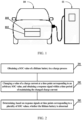
- FIG. 1 shows an application scenario of a method for detecting abnormality of a lithium battery according to this application.
- This scenario includes an electric vehicle 10 and a charging pile 11.
- a BMS 101 (BMS is an acronym of battery management system) and a lithium battery 102 are disposed in the electric vehicle 10.
- the BMS 101 is a set of control systems for protecting operation safety of the lithium battery 102 and always monitors operation status of the lithium battery 102.
- the charging post 11 is configured to charge the lithium battery 102. The charge process needs to be controlled by the BMS 101.
- the BMS 101 can control a charging mode in which the charging pile 11 charges the lithium battery 102, such as a constant-current charging mode or a variable-current charging mode.
- the BMS 101 can control a value of a charge current at which the charging pile 11 charges the lithium battery 102, and read parameter changes of the lithium battery 102, so as to determine in real time whether the lithium battery 102 is abnormal.
- the foregoing method can detect, in a non-destructive manner in the charge process, whether the lithium battery 102 is abnormal in the charge process, so that corresponding countermeasures can be taken in time to avoid accidents caused by the abnormality of the lithium battery 102, for example, to avoid a major safety accident such as an explosion of the lithium battery 102 caused by the abnormality such as a short circuit of the rechargeable battery.
- FIG. 2 is a schematic flowchart of a method for detecting abnormality of a lithium battery according to an embodiment of this application. As shown in FIG. 2 , the method includes the following steps.
- the charge process may include a constant-current charge process or a variable-current charge process.
- the constant-current charge process primarily means that a charge current keeps constant in the charge process.
- the lithium battery keeps being charged at a charge rate of 1C.
- the charge rate of 1C means a charge rate at which the lithium battery can be charged to a full capacity from zero within 1 hour.
- the variable-current charge process generally means a stepwise constant-current charge process (step charge), in which a variable-current charge process is divided into a plurality of constant-current charge sub-processes, and the charge rate varies between the constant-current charge sub-processes (each constant-current charge sub-process represents a phase of the constant-current charge process).
- step charge a stepwise constant-current charge process
- a variable-current charge process is divided into three phases. The charge rate at a first phase is 2C, the charge rate at a second phase is 1.8C, and the charge rate at a third phase is 1.5C.
- the SOC value means a ratio of a remaining capacity of the battery to a nominal capacity of the battery.
- the SOC value keeps changing in the charge process of the battery.
- the SOC value obtained in real time in the charge process may be used to determine a specific charge value that is available when the lithium battery is abnormal.
- phase of constant-current charge process may be a phase of constant-current charge process in a constant-current charge process, or a phase of constant-current charge process in a variable-current charge process (that is, a constant-current charge sub-process).
- Changing the current in a phase of constant-current charge process is equivalent to imposing a disturbance on a steady electrochemical process in the lithium battery.
- This disturbance generates a variety of response signals (similar to throwing a stone onto a calm water surface).
- the most sensitive response signal may be selected from a variety of response signals to distinguish between a lithium battery undergoing lithium plating and a normal battery.
- the most sensitive response signal is generally a response signal that has changed most significantly.
- this application changes the charge current to obtain a response signal.
- a change-current instruction is output at a time point corresponding to an arbitrary SOC value, so as to change the value of the charge current.
- the instruction includes an instruction to change the value of the charge current and an instruction indicating a time period of maintaining the changed charge current.
- a BMS of the electric vehicle outputs a change-charge-current instruction to the charging pile at the time point corresponding to the arbitrary SOC value.
- the charging pile changes the value (for example, I2) of the charge current that is output to the lithium battery in the electric vehicle, and maintains the changed charge current for the indicated time period, thereby achieving a purpose of changing the charge current.
- the charging pile restores the charge current prior to changing the charge current. That is, within the time period, the charging pile maintains the current at I2; and after expiry of the time period, the charging pile restores the current to I1 from I2.
- the method is applied to, in a production process of the lithium battery, testing whether the lithium battery is abnormal.
- the charge current of the lithium battery is provided by a charger & discharger.
- a control unit in the charger & discharger outputs a change-current instruction.
- the instruction is executed by an execution unit of the charger & discharger, so as to achieve the purpose of changing the charge current.
- the charge current is changed at the time point corresponding to an arbitrary SOC value, the charge current changed each time is maintained for a time period.
- a corresponding response signal is generated just within the time period of maintaining the changed charge current.
- a constant-current charging mode is used as an example.
- a constant-current charge current of the lithium battery is I1A.
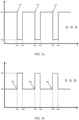
- the value of the charge current is changed to I2A at time points T1A, T3A, and T5A corresponding to the SOC values 1A%, 2A%, and 3A% respectively.
- the time period of maintaining the charge current changed each time is from the time point T1A to the time point T2A, abbreviated as (T1A, T2A); from the time point T3A to the time point T4A, abbreviated as (T3A, T4A); and, from the time point T5A to the time point T6A, abbreviated as (T5A, T6A), respectively.
- the three time periods may be set depending on actual working conditions, and may be the same or different. This is not limited herein.
- the three time periods (T1A, T2A), (T3A, T4A), and (T5A, T6A) are set to 20 seconds uniformly, or set to 10 seconds, 20 seconds, and 30 seconds, respectively.
- the charge current I2A is less than the charge current I1A. This means that as shown in FIG. 3a , an operation performed at a time point corresponding to an arbitrary SOC is to reduce the charge current.
- the operation may be to increase the charge current or directly change the charge current to 0.
- the charge current is increased from I1B to I2B at the time points T1B, T3B, and TSB corresponding to the SOC values 1B%, 2B%, and 3B%, respectively.
- the implementation process is similar to the process of reducing the charge current, details of which are easily understandable to a person skilled in the art and are omitted here.
- signals that can be collected by a battery management system include a voltage signal, a current signal, a capacity signal, and a temperature signal of the battery.
- the capacity signal and the temperature signal are sampled at a relatively low precision, and suffers a hysteresis to some extent.
- the change of such signals, which is caused by a small amount of lithium plating, is hardly distinguishable. Therefore, the capacity signal and the temperature signal are not suitable as a response signal.
- the charge current is changed to obtain the response signal. This also means that the current signal is not suitable as a response signal. Therefore, in this application, the voltage signal characterized by higher precision and quicker response is selected as the response signal. Alternatively, a resistance signal obtained from a voltage signal may be selected as the response signal.
- the response signal is a voltage signal or a resistance signal.
- FIG. 4 is a schematic diagram of a possible response signal (in this case, a voltage signal). As shown in FIG. 4 , the voltage changes with time to form a curve U1. The curve U1 represents the voltage signal. The voltage signal is just the response signal within a time period of maintaining the charge current changed for one time.
- a sampling interval may be set in advance. Voltage values are collected continuously at intervals of the sampling intervals within the time period of maintaining the charge current changed each time. The collected voltage values constitute voltage signals.
- the resistance signal may be obtained in diverse ways. If the charge process is a constant-current charge process, referring to FIG. 3a , assuming that the resistance signal is a response signal generated between the time point T1A and the time point T2A, the resistance signal is obtained in the following way: (1) obtaining a charge current applied before the SOC value is 1A%, and recording the charge current as I old , and calculating a ratio of each voltage value in the curve U1 to I old to obtain resistance signals; (2) obtaining a charge current within the time period of (T1A, T2A), recording the charge current as I new , and calculating a ratio of each voltage value in the curve U1 to I new to obtain resistance signals; and (3) obtaining a difference between I new and I old , recording the difference as I new1 , and calculating a ratio of each voltage value in the curve U1 to I new1 to obtain resistance signals.
- the charge process is a variable-current charge process, as can be learned from the foregoing description, when the charge current is changed in a specific constant-current charge sub-process of the variable-current charge process, the charge current in the constant-current charge sub-process is used as I old , and I new and I new1 are obtained in a way similar to the case of the constant-current charging. Subsequently, whether the lithium battery is abnormal can be determined based on a plurality of voltage signals or a plurality of resistance signals.
- the value of the charge current is changed at time points corresponding to at least three SOC values to obtain at least three response signals. Whether the lithium battery is abnormal is determined according to the at least three response signals.
- the specific determining method is described by using an example in which the response signals are voltage signals. As shown in FIG. 5 , the method includes the following steps.
- the first preset duration is an arbitrary time period within the time period of maintaining the charge current changed each time, as described below with reference to the content shown in FIG. 3a and FIG. 4 .
- the value of the charge current is changed to I2A.
- the corresponding voltage signals are obtained in the time periods (T1A, T2A), (T3A, T4A), and (T5A, T6A), respectively. Therefore, at least three voltage signals are obtained in total. Assuming that the voltage signals obtained in the time period (T1A, T2A) are the voltage signal U1 shown in FIG.
- the voltage signal U1 in this case is the first voltage signal (N is 1). Therefore, in an arbitrary time period in the time period (T1A, T2A), such as a time period of (T41, T42), is used as a first preset duration, where (T41, T42) falls within (T1A, T2A). That is, T41 ⁇ T1A and T42 ⁇ T2A.
- T41 is a start time point of the first preset duration
- T42 is an end time point of the first preset duration.
- a first voltage value U41 of the voltage signal U1 is obtained, and a second voltage value U42 is obtained.
- ⁇ U1 I U41 - U42
- the difference ⁇ U1 may be regarded as a first voltage variation value.
- a second voltage variation value can be obtained from (T3A, T4A)
- a third voltage variation value can be obtained from (T5A, T6A), and so on. If the charge current is changed N times in total, a total of N voltage variation values are obtained.
- the first preset duration may be selected depending on actual working conditions, and is generally set to be between 0.1 s and 100 s. This is not limited herein.
- a time period corresponding to a lowest-noise part of the response signal may be selected as the first preset duration depending on the battery type and the sampling method.
- a time range in which test signals are relatively steady is determined first based on parameters of a device configured to change the value of the charge current, so as to avoid noise signals. Then a voltage variation value is obtained from voltage signals of higher precision, so that the final determining result is more accurate. For example, as shown in FIG. 6 , before the time point T61, a noise signal may be generated due to instability of the current. Therefore, the first preset duration may be set in advance to be subsequent to the time point T61, so as to avoid the noise signal.
- the charge current may be changed at equal intervals or unequal intervals of the SOC value.
- the value of the charge current is changed in equal increments of 5% SOC.
- increments of the SOC value within both the time period (T2A, T3A) and the time period (T4A, T5A) in FIG. 3a are set to 5%.
- an increment of the SOC value within the time period (T2A, T3A) may be set to 5%
- an increment of the SOC value within the time period (T4A, T5A) may be set to 10%.
- the time period of maintaining the charge current changed each time may be the same or different. Still using FIG. 3a as an example, lengths of the three time periods (T1A, T2A), (T3A, T4A), and (T5A, T6A) may be the same or different. However, it needs to be noted that the first preset duration in each time period needs to be the same. Using FIG. 3a and FIG.
- the first preset duration extracted from the time period (T1A, T2A) is a length of (T41, T42)
- the corresponding first voltage value, second voltage value, and voltage variation value need to be obtained in the same first preset duration in the time periods (T3A, T4A) and (T5A, T6A).
- the lengths of the three time periods (T1A, T2A), (T3A, T4A), and (T5A, T6A) are 10 seconds, 12 seconds, and 15 seconds respectively and that the first preset duration is 5 seconds
- a response signal that lasts for 5 seconds needs to be extracted from 10 seconds, 12 seconds, and 15 seconds, respectively.
- the time period from which the first preset duration is extracted each time is the same.
- the time point on each time of changing the charge current needs to serve as a relative "0 th second" position, and the first voltage value, the second voltage value, and the voltage variation value in the time period of the relative "3 rd -8 th seconds" are obtained.
- the time points T1A, T3A, and T5A serve as the relative "0 th second" position.
- the time point T1A is the 20 th second
- the time point T3A is the 50 th second
- the time point T5A is the 100 th second
- the first voltage variation value is obtained within the 23 rd -28 th seconds
- the second voltage variation value is obtained within the 53 rd -58 th seconds
- the third voltage variation value is obtained within the 103 rd -108 th seconds.
- the foregoing is a specific implementation process of obtaining a plurality of voltage variation values when the response signal is a voltage signal. If the response signal is a resistance signal, a plurality of resistance variation values can be obtained in the same way, details of which are easily understandable to a person skilled in the art and are omitted here.
- the response signal is the voltage signal
- whether the lithium battery is abnormal may be directly determined based on the voltage variation value; or, the corresponding resistance variation value can be obtained based on the voltage variation value, and whether the lithium battery is abnormal is determined based on the resistance variation value.
- whether the lithium battery is abnormal may be determined directly based on the voltage variation value. As shown in FIG. 7 , the implementation process is as follows:
- FIG. 3a As shown in FIG. 3a , it can be seen from the foregoing description that the value of the charge current is changed to I2A at the time points T1A, T3A, T5A, and so on corresponding to the SOC values 1A%, 2A%, 3A%, and so on, respectively. Therefore, voltage signals can be obtained in the time periods (T1A, T2A), (T3A, T4A), (T5A, T6A), and so on, respectively, so that a total of N voltage signals are obtained.
- first voltage value and the second voltage value in each voltage signal are extracted in the first preset duration in the foregoing time periods, so as to obtain the voltage variation value in the time periods (T1A, T2A), (T3A, T4A), (T5A, T6A), and so on, respectively.
- the voltage variation value is recorded as a first voltage variation value ⁇ U1, a second voltage variation value ⁇ U2, a third voltage variation value ⁇ U3, and so on, and an N th voltage variation value ⁇ UN, respectively.
- each voltage variation value and the corresponding SOC value may be used as a data point.
- the SOC value may be a SOC value prior to changing each charge current.
- the SOC value corresponding to the first voltage variation value ⁇ U1 is 1A%
- the SOC value corresponding to the second voltage variation value ⁇ U2 is 2A%
- the SOC value corresponding to the third voltage variation value ⁇ U3 is 3A%, and so on, thereby obtaining data points such as (1A%, ⁇ U1), (2A%, ⁇ U2), (3A%, ⁇ U3), and so on.
- Whether the lithium battery is abnormal can be determined based on the data points.
- any SOC value within the time period of maintaining the charge current changed each time may be selected as the SOC value corresponding to each voltage variation value.
- the SOC value corresponding to the first voltage variation value ⁇ U1 may be an arbitrary value selected in (1A%, 1A1%)
- the SOC value corresponding to the second voltage variation value ⁇ U2 is an arbitrary value in (2A%, 2A1%)
- the SOC value corresponding to the third voltage variation value ⁇ U3 is an arbitrary value in (3A%, 3A1%)
- a plurality of data points can be obtained, and whether the lithium battery is abnormal can be determined based on the data points.
- the obtained data point is different.
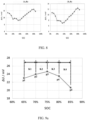
- the first preset duration is set to a length of the time period (1s, 8s), and the first preset duration is set to a length of the time period (3s, 8s) separately, so that curves formed by a plurality of data points are obtained respectively, as shown in FIG. 8 .
- Whether the lithium battery is abnormal may be determined based on the plurality of data points of the two curves.
- whether the lithium battery is abnormal may be determined based on a slope of adjacent data points.
- a specific implementation process is: obtaining an N th slope between an (N+1) th data point and the N th data point, and an (N+1) th slope between an (N+2) th data point and the (N+1) th data point. If the N th slope is greater than 0 and the (N+1) th slope is less than 0, it is determined that the lithium battery is abnormal.
- a difference between the SOC values corresponding to every two data points is the same, and is 5% uniformly. In other embodiments, the difference between the SOC values corresponding to every two data points may be different.
- 6 data points obtained are p11, p21, p31, p41, p51, and p61, respectively.
- a difference between the SOC values corresponding to the data point p31 and the data point p21 respectively is 2%, and a difference between the SOC values corresponding to the data point p41 and the data point p31 respectively is 5%.
- whether the lithium battery is abnormal may be determined based on slopes according to the foregoing solution.
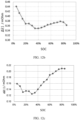
- the strength of the response signal does not undergo a process of decreasing first and then increasing with the change of the SOC value, but may undergo a process in which the strength of the response signal (in this case, voltage signal) decreases, then increases, then decreases, and then increases again, as shown in FIG. 10 .
- the battery is not abnormal. Therefore, to prevent misjudgment and improve accuracy of judgment, whether the battery is abnormal is generally determined when the SOC value is greater than 40%. Optimally, whether the battery is abnormal is determined when the SOC value is greater than 60%.
- the N th resistance variation value may be obtained based on the N th voltage variation value first, and then whether the lithium battery is abnormal is determined based on the obtained resistance variation value.
- the foregoing process may be implemented in many other ways.
- FIG. 11 shows a possible implementation process of a method for determining, based on a resistance variation value, whether a lithium battery is abnormal.
- the method includes the following steps:
- each first resistance variation value can be obtained by directly calculating a ratio of each obtained voltage variation value to I11.
- each first resistance variation value can also be obtained by calculating a ratio of each obtained voltage variation value to I21. After a plurality of first resistance variation values are obtained, the data point can also be obtained based on the N th first resistance variation value and the corresponding SOC value.
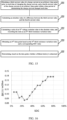
- the data points obtained from the voltage variation value are shown in FIG. 12a
- the data points obtained from the first resistance variation value ( ⁇ R1) in the constant-current charging mode are shown in FIG. 12b
- the data points obtained from the first resistance variation value ( ⁇ R11) in the variable-current charging mode are shown in FIG. 12c .
- the N th slope and the (N+1) th slope can also be obtained based on the data points. If the N th slope is greater than 0 and the (N+1) th slope is less than 0, it is determined that the lithium battery is abnormal.
- the foregoing process is similar to the process of obtaining data points based on the voltage variation value and the corresponding SOC value and determining, based on the data points, whether the lithium battery is abnormal, details of which are easily understandable to a person skilled in the art and are omitted here.
- FIG. 13 shows another possible implementation process of a method for determining, based on a resistance variation value, whether a lithium battery is abnormal.
- the method includes the following steps:
- the obtained value is the second current value I13 of the charge current at an arbitrary time point within the time period of maintaining the charge current changed each time.
- Each second resistance variation value can be obtained by calculating the ratio of each voltage variation value to I13.
- the data point obtained from the second resistance variation value ( ⁇ R13) is shown in FIG. 14 .
- the N th slope and the (N+1) th slope can be obtained based on the data points. If the N th slope is greater than 0 and the (N+1) th slope is less than 0, it is determined that the lithium battery is abnormal.
- the foregoing process is similar to the process of obtaining data points based on the voltage variation value and the corresponding SOC value and determining, based on the data points, whether the lithium battery is abnormal, details of which are easily understandable to a person skilled in the art and are omitted here.
- FIG. 15 shows still another possible implementation process of a method for determining, based on a resistance variation value, whether a lithium battery is abnormal.
- the method includes the following steps:
- the way of obtaining the third current value is the same as the way of obtaining the first current value as shown in FIG. 11
- the way of obtaining the fourth current value is the same as the way of obtaining the second current value as shown in FIG. 13 .
- the absolute value I15 of the difference between the third current value and the fourth current value can be calculated.
- Each third resistance variation value can be obtained by calculating the ratio of each voltage variation value to I15.
- the data point obtained from the third resistance variation value ( ⁇ R15) is shown in FIG. 16 .
- the N th slope and the (N+1) th slope can be obtained based on the data points. If the N th slope is greater than 0 and the (N+1) th slope is less than 0, it is determined that the lithium battery is abnormal.
- the foregoing process is similar to the process of obtaining data points based on the voltage variation value and the corresponding SOC value and determining, based on the data points, whether the lithium battery is abnormal, details of which are easily understandable to a person skilled in the art and are omitted here.
- the charging mode is a constant-current charging mode or a variable-current charging mode
- the method provided in this embodiment of this application can be used to determine whether a lithium battery is abnormal.
- a method of highest detection precision suitable for detecting a small amount of abnormality is the method shown in FIG. 15
- a method of lowest precision is the method shown in FIG. 13 .
- the response signal is a voltage signal
- a plurality of data points can be obtained directly based on the voltage variation values, and then whether the lithium battery is abnormal is determined based on a slope of adjacent data points in the plurality of data points.
- resistance variation values are obtained from the voltage variation values first, and then a plurality of data points are obtained based on the resistance variation values, and finally, whether the lithium battery is abnormal is determined based on the slope of the adjacent data points in the plurality of data points.
- the response signal is a resistance signal
- the resistance signal needs to be obtained based on the voltage signal, and then a resistance variation value is directly obtained from the resistance signal. Subsequently, a plurality of data points can be obtained based on the resistance variation value, and whether the lithium battery is abnormal is determined based on a slope of adjacent data points in the plurality of data points.
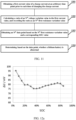
- a test on whether a lithium battery is abnormal is carried out when the lithium battery is controlled to be under different charge currents, using a constant-current charging mode as an example.
- the test may use a 60 Ah commercial lithium-ion battery.
- a charge rate of constant-current charging is 0.3C, 0.5C, and 1.0C respectively.
- the SOC value of the battery increases by each 5% as a result of charging, the current is changed to 0.1C and stays for 8 seconds.
- the obtained data points and determining results are shown in FIG. 17 .
- the value of the charge current can be changed in the charge process to determine whether the lithium battery is abnormal.
- the constant-current charging mode is used as an example, and the charge rate of the constant-current charging is maintained at 1.2C.
- the charge current is reduced to 0 (that is, the battery stands statically), increased (or decreased) by a current of 1.1C and 1.0C, separately, to detect whether the lithium battery is abnormal.
- the SOC value of the battery increases each 5% as a result of charging, the charge current is changed and stays for 8 seconds.
- the obtained data points and the determining result are shown in FIG. 18 .
- Adding a pulse means a process of changing the value of the current, and the process may be approximately regarded as adding a pulse onto the original charge current. For example, adding a static standing duration of 8 seconds is to reduce the current to 0 and stay for 8 seconds. This is equivalent to adding a current pulse of the same value but an opposite direction onto the original charge current, so that the actual charge current is 0 within the 8 seconds.
- FIG. 18 in all the three circumstances described above, near a SOC value of 80%, adjacent slopes meet the condition that the former slope in the adjacent slopes is greater than 0 and the latter slope is less than 0, indicating that the lithium battery is abnormal. In addition, by disassembling the lithium battery, it is concluded that the lithium battery is abnormal. The conclusion is consistent with the determining result of the determining method provided in this embodiment of this application.
- the method for detecting abnormality of a lithium battery according this embodiment of this application may be implemented by increasing the charge current of the lithium battery, or by decreasing the charge current of the lithium battery.
- the charge rate is maintained at 1.5C.
- the SOC value of the battery increases by each 5% as a result of charging
- the current of the battery increases (or decreases) by 1.4C and stays for 8 seconds.
- Different data points can be obtained by selecting different first preset durations. The obtained data points and the determining result are shown in FIG. 19 .
- the first preset duration is set to 3 seconds, 8 seconds, and 5 seconds, respectively.
- adjacent slopes meet the condition that the former slope in the adjacent slopes is greater than 0 and the latter slope is less than 0, indicating that the lithium battery is abnormal.
- disassembling the lithium battery it is concluded that the lithium battery is abnormal. The conclusion is consistent with the determining result of the determining method provided in this embodiment of this application.
- both the first preset duration and a start point thereof may be set according to actual usage conditions of the user, and can be used to determine whether the lithium battery is abnormal.
- FIG. 20 is a schematic structural diagram of a device for detecting abnormality of a lithium battery according to an embodiment of this application.
- the device 2000 for detecting abnormality of a lithium battery includes a first obtaining unit 2001, a second obtaining unit 2002, and a determining unit 2003.
- the first obtaining unit 2001 is configured to obtain a SOC value of the lithium battery in a charge process, where the SOC value is a ratio of a remaining capacity of the battery to a nominal capacity of the battery.
- the second obtaining unit 2002 is configured to change a value of a charge current at a time point corresponding to an arbitrary SOC value, and obtain a response signal within a time period of maintaining the changed charge current.
- the determining unit 2003 is configured to determine, based on response signals at time points corresponding to a plurality of SOC values, whether the lithium battery is abnormal; the response signal is a voltage signal; the second obtaining unit 2002 is configured to obtain a first voltage value in an N th voltage signal at a start time point of a first preset duration, and obtain a second voltage value in the N th voltage signal at an end time point of the first preset duration, the first preset duration is an arbitrary time period within the time period of maintaining the charge current changed each time; the determining unit 2003 is configured to obtain an N th voltage variation value based on an absolute value of a difference between the first voltage value and the second voltage value in the N th voltage signal, and determine whether the lithium battery 102 is abnormal based on the voltage variation value.
- the device embodiment and the method embodiment are based on the same conception. Therefore, the content of the device embodiment can be obtained by referring to the method embodiment as long as the content does not conflict with each other, and the details are omitted here.
- FIG. 21 is a schematic structural diagram of a device for detecting abnormality of a lithium battery according to an embodiment of this application, which does not form part of the invention.
- the device 2100 for detecting abnormality of a lithium battery includes one or more processors 2101 and a memory 2102.
- one processor 2101 is used as an example.
- the processor 2101 and the memory 2102 may be connected by a bus or by other means.
- connecting by a bus is used as an example.
- the memory 2102 serving as a non-volatile computer-readable storage medium, can be used to store non-volatile software programs, and non-volatile computer-executable programs and modules, for example, program instructions/modules (such as the units shown in FIG. 20 ) corresponding to the method for detecting abnormality of a lithium battery according to this embodiment of this application.
- the processor 2101 By running the non-volatile software programs, instructions, and modules stored in the memory 2102, the processor 2101 performs various functions and data processing of the device for detecting abnormality of a lithium battery, that is, implements the method for detecting abnormality of a lithium battery in the foregoing method embodiment and the functions of various modules and units in the foregoing device embodiment.
- the memory 2102 may include a high-speed random access memory, and may further include a non-volatile memory, for example, at least one disk storage device, a flash memory device, or other non-volatile solid-state storage devices.
- the memory 2102 optionally includes memories disposed remotely with respect to the processor 2101.
- the remote memories may be connected to the processor 2101 by a network. Examples of the network include, but are not limited to, the Internet, a corporate intranet, a local area network, a mobile communications network, and any combination thereof.
- the program instructions/modules are stored in the memory 2102.
- the program instructions/modules When executed by the one or more processors 2101, the program instructions/modules implement the method for detecting abnormality of a lithium battery according to any method embodiment described above, for example, implement the steps described above and shown in FIG. 2 , FIG. 5 , FIG. 7 , FIG. 11 , FIG. 13 , and FIG. 15 ; and can further implement the functions of each unit shown in FIG. 20 .
- An embodiment of this application further provides a battery management system, including the device for detecting abnormality of a lithium battery according to any embodiment described above.
- the battery management system may be installed in a vehicle or the like to manage a battery.
- An embodiment of this application further provides a battery system, including a rechargeable battery and the battery management system according to any embodiment described above.
- the battery management system is configured to manage the battery.
- An embodiment of this application further provides an electric vehicle, including a charging and discharging device and the battery system according to any embodiment described above.
- the charging and discharging device is configured to charge a battery.
- a battery management system in the battery system can control a value of a charge current that is used by the charging and discharging device to charge the battery.
- An embodiment of this application further provides a non-volatile computer storage medium.
- the computer storage medium stores a computer-executable instruction.
- the computer-executable instruction is executed by one or more processors, for example, one processor 2101 shown in FIG. 21 .
- the one or more processors can implement the method for detecting abnormality of a lithium battery according to any method embodiment described above, for example, implement the steps described above and shown in FIG. 2 , FIG. 5 , FIG. 7 , FIG. 11 , FIG. 13 , and FIG. 15 ; and can further implement the functions of each unit shown in FIG. 20 .
- the apparatus or device embodiments described above are merely exemplary.
- the units or modules described as discrete parts may be physically separate or not, and the parts displayed as units or modules may be physical units or not, and may be located in one position or distributed on a plurality of network modules or units. A part of or all of the modules may be selected according to the actual needs to achieve the objectives of the solutions of the embodiments.
- the foregoing technical solutions essentially or the part contributing to the related art may be implemented in a form of a software product.
- the computer software product may be stored in a computer-readable storage medium such as a ROM/RAM, a magnetic disk, or an optical disc, and may include several instructions that cause a computer device (which may be a personal computer, a server, a network device, or the like) to perform the methods described in the foregoing embodiments or in some parts of the embodiments.
Landscapes
- Engineering & Computer Science (AREA)
- Power Engineering (AREA)
- Mechanical Engineering (AREA)
- Transportation (AREA)
- Life Sciences & Earth Sciences (AREA)
- Sustainable Energy (AREA)
- Sustainable Development (AREA)
- Chemical Kinetics & Catalysis (AREA)
- General Chemical & Material Sciences (AREA)
- Electrochemistry (AREA)
- Chemical & Material Sciences (AREA)
- Manufacturing & Machinery (AREA)
- Physics & Mathematics (AREA)
- General Physics & Mathematics (AREA)
- Microelectronics & Electronic Packaging (AREA)
- Charge And Discharge Circuits For Batteries Or The Like (AREA)
- Secondary Cells (AREA)
Description
- This application relates to the technical field of batteries, and in particular, to a method and device for detecting abnormality of a lithium battery, a battery management system, and a battery system.
- With the advancement of technology, lithium-ion batteries are widely used in the fields of consumer electronics, energy storage, and electric vehicles by virtue of significant advantages such as a high energy density, a long cycle life, and environment-friendliness. In performance evaluation of a lithium-ion battery, an indispensable technical indicator is a cycle life, including the cycle life under various temperatures and even some extreme application environments. In a cycle test, essential life evaluation indicators in addition to a capacity retention rate of the battery include: whether abnormality occurs during a cycle, and when the abnormality occurs. It is well known that, once the battery is abnormal, the abnormality may not only accelerate performance degradation, but also lead to a short circuit in the battery and result in a safety hazard.
- Currently, a most commonly used method for determining whether the lithium-ion battery is abnormal is to charge the battery at different C-rates and temperatures, then disassemble the battery, visually check for abnormality, and subjectively identify an abnormal state and severity. However, this method mainly relies on empirical judgment of personnel, involves errors caused by subjective judgment, and is complicated to operate and inefficient. In addition, the lithium-ion battery, especially a power battery, is relatively large in size and weight. Some batteries are even steel-shell batteries, and disassembling the batteries brings some safety hazards and requires a relatively large number of labor resources and physical resources.
- D1 relates to a lithium ion battery charging and lithium separating real-time detection method and system, wherein the method comprises the following steps: carrying out intermittent charging test on the lithium ion battery, cutting off the SOC for 3s when the electric quantity is increased by 1%, collecting voltage change (dV) and current change (dI) in an intermittent period, calculating a resistance value (ZTR) through ohm law (dU/dI), drawing a distribution curve of the ZTR along with the charging capacity, and judging the lithium analysis state in the lithium ion battery according to the distribution curve of the ZTR along with the charging capacity.
- D2 relates to a method and system for monitoring the safety of a rechargeable Li-ion battery (LIB). An initial electrical state of the LIB is determined and altered by application or removal of DC electrical stimulus to trigger a time-varying response. The time-varying response of the LIB is measured, and at least one primary response parameter associated with the functional form of the measured response is extracted. At least one secondary response parameter is derived from the primary response parameter. A composite response parameter may be further derived from the primary response parameter and secondary response parameter. A likelihood of a short circuit precursor condition is determined in accordance with the primary response parameter, secondary response parameter and/or composite response parameter.
- An objective of this application is to provide a method and a device for detecting abnormality of a lithium battery, a battery management system, and a battery system to implement non-destructive detection of abnormality of a lithium-ion battery, simplify operation, and achieve relatively high accuracy. The invention is defined in the appended claims.
- To achieve the foregoing objective, according to a first aspect, this application provides a method for detecting abnormality of a lithium battery, including: obtaining a SOC value of the lithium battery in a charge process, where the SOC value is a ratio of a remaining capacity of the battery to a nominal capacity of the battery; changing a value of a charge current at a time point corresponding to an arbitrary SOC value, and obtaining a response signal within a time period of maintaining the changed charge current; and determining, based on response signals at time points corresponding to a plurality of SOC values, whether the lithium battery is abnormal; the response signal is a voltage signal; the determining, based on response signals at time points corresponding to a plurality of SOC values, whether the lithium battery is abnormal includes: obtaining a first voltage value in an Nth voltage signal at a start time point of a first preset duration, and obtaining a second voltage value in the Nth voltage signal at an end time point of the first preset duration, where the first preset duration is an arbitrary time period within the time period of maintaining the charge current changed each time; obtaining an Nth voltage variation value based on an absolute value of a difference between the first voltage value and the second voltage value in the Nth voltage signal; and determining, based on the voltage variation value, whether the lithium battery is abnormal.
- In an optional implementation, the changing a value of a charge current at a time point corresponding to an arbitrary SOC value includes: outputting a change-current instruction at the time point corresponding to the arbitrary SOC value, so as to change the value of the charge current, where the change-current instruction includes an instruction to change the value of the charge current and an instruction indicating the time period of maintaining the changed charge current.
- In an optional implementation, the changing a value of a charge current at a time point corresponding to an arbitrary SOC value includes: changing the value of the charge current at time points corresponding to at least three SOC values.
- In an optional implementation, the determining, based on the voltage variation value, whether the lithium battery is abnormal includes: obtaining an Nth data point based on the Nth voltage variation value and a corresponding SOC value; and determining, based on the data point, whether the lithium battery is abnormal.
- In an optional implementation, the determining, based on the voltage variation value, whether the lithium battery is abnormal includes: obtaining a first current value of the charge current at an arbitrary time point prior to each time of changing the charge current; calculating a ratio of the Nth voltage variation value to the first current value, and recording the ratio as an Nth first resistance variation value; obtaining an Nth data point based on the Nth first resistance variation value and a corresponding SOC value; and determining, based on the data point, whether the lithium battery is abnormal.
- In an optional implementation, the determining, based on the voltage variation value, whether the lithium battery is abnormal includes: obtaining a second current value of the charge current at an arbitrary time point within the time period of maintaining the charge current changed each time; calculating a ratio of the Nth voltage variation value to the second current value, and recording the ratio as an Nth second resistance variation value; obtaining an Nth data point based on the Nth second resistance variation value and a corresponding SOC value; and determining, based on the data point, whether the lithium battery is abnormal.
- In an optional implementation, the determining, based on the voltage variation value, whether the lithium battery is abnormal includes: obtaining a third current value of the charge current at an arbitrary time point prior to each time of changing the charge current, and a fourth current value of the charge current at an arbitrary time point within the time period of maintaining the charge current changed each time; calculating an absolute value of a difference between the third current value and the fourth current value; calculating a ratio of the Nth voltage variation value to the absolute value, and recording the ratio as an Nth third resistance variation value; obtaining an Nth data point based on the Nth third resistance variation value and a corresponding SOC value; and determining, based on the data point, whether the lithium battery is abnormal.
- In an optional implementation, the determining, based on the data point, whether the lithium battery is abnormal includes: obtaining an Nth slope between an (N+1)th data point and the Nth data point, and an (N+1)th slope between an (N+2)th data point and the (N+1)th data point; and determining, if the Nth slope is greater than 0 and the (N+1)th slope is less than 0, that the lithium battery is abnormal.
- According to a second aspect, this application further provides a device for detecting abnormality of a lithium battery, including: a first obtaining unit, configured to obtain a SOC value of the lithium battery in a charge process, where the SOC value is a ratio of a remaining capacity of the battery to a nominal capacity of the battery; a second obtaining unit, configured to change a value of a charge current at a time point corresponding to an arbitrary SOC value, and obtain a response signal within a time period of maintaining the changed charge current; and a determining unit, configured to determine, based on response signals at time points corresponding to a plurality of SOC values, whether the lithium battery is abnormal; wherein the response signal is a voltage signal; the second obtaining unit, configured to obtain a first voltage value in an Nth voltage signal at a start time point of a first preset duration, and obtaining a second voltage value in the Nth voltage signal at an end time point of the first preset duration, the first preset duration is an arbitrary time period within the time period of maintaining the charge current changed each time; the determining unit, configured to obtain an Nth voltage variation value based on an absolute value of a difference between the first voltage value and the second voltage value in the Nth voltage signal, and determine whether the lithium battery (102) is abnormal based on the voltage variation value.
- According to a third aspect, this application further provides a battery management system, including the foregoing device for detecting abnormality of a lithium battery.
- According to a fourth aspect, this application further provides a battery system, including a rechargeable battery and the foregoing battery management system.
- According to a fifth aspect, this application further provides an electric vehicle, including a charging and discharging device and the foregoing battery system.
- According to a sixth aspect, this application further provides a computer-readable storage medium, storing a computer-executable instruction. The computer-executable instruction is set to be the foregoing method process.
- Beneficial effects of the embodiments of this application are: the method for detecting abnormality of a lithium battery according to this application includes: first, obtaining a SOC value of the lithium battery in a charge process, where the SOC value is a ratio of a remaining capacity of the battery to a nominal capacity of the battery; then, changing a value of a charge current at a time point corresponding to an arbitrary SOC value, and obtaining a response signal within a time period of maintaining the changed charge current; and finally, determining, based on response signals at time points corresponding to a plurality of SOC values, whether the lithium battery is abnormal. This application can perform detection without disassembling the battery, and implement a non-destructive detection method. Just the value of the charge current needs to be changed in the charge process, thereby simplifying operation. In addition, whether the battery is abnormal is determined based on an automatically generated response signal, thereby avoiding errors caused by subjective judgment, and achieving relatively high accuracy.
- To describe the technical solutions in the embodiments of this application more clearly, the following outlines the drawings used in the embodiments of this application. Apparently, the drawings outlined below are merely a part of embodiments of this application. A person of ordinary skill in the art may derive other drawings from the outlined drawings without making any creative efforts.
-
FIG. 1 is a schematic diagram of an application scenario according to an embodiment of this application; -
FIG. 2 is a schematic flowchart of a method for detecting abnormality of a lithium battery according to an embodiment of this application; -
FIG. 3a is a schematic diagram of changing a value of a charge current at a time point corresponding to an arbitrary SOC value according to an embodiment of this application; -
FIG. 3b is a schematic diagram of changing a value of a charge current at a time point corresponding to an arbitrary SOC value according to another embodiment of this application; -
FIG. 4 is a schematic diagram of response signals according to an embodiment of this application; -
FIG. 5 is a schematic diagram of a method for determining abnormality of a lithium battery based on at least three response signals according to an embodiment of this application; -
FIG. 6 is a schematic diagram of a response signal according to another embodiment of this application; -
FIG. 7 is a schematic diagram of a method for determining abnormality of a lithium battery based on a voltage variation value according to an embodiment of this application; -
FIG. 8 is a schematic diagram of data points obtained when different first preset durations are set according to an embodiment of this application; -
FIG. 9a is a schematic diagram of obtained data points according to an embodiment of this application; -
FIG. 9b is a schematic diagram of obtained data points according to another embodiment of this application; -
FIG. 10 is a schematic diagram of response signals according to still another embodiment of this application; -
FIG. 11 is a schematic diagram of a method for determining abnormality of a lithium battery based on a first resistance variation value according to an embodiment of this application; -
FIG. 12a is a schematic diagram of data points obtained from voltage variation values according to an embodiment of this application; -
FIG. 12b is a schematic diagram of data points obtained from first resistance variation values according to an embodiment of this application; -
FIG. 12c is a schematic diagram of data points obtained from first resistance variation values according to another embodiment of this application; -
FIG. 13 is a schematic diagram of a method for determining abnormality of a lithium battery based on a second resistance variation value according to an embodiment of this application; -
FIG. 14 is a schematic diagram of data points obtained from second resistance variation values according to an embodiment of this application; -
FIG. 15 is a schematic diagram of a method for determining abnormality of a lithium battery based on a third resistance variation value according to an embodiment of this application; -
FIG. 16 is a schematic diagram of data points obtained from third resistance variation values according to an embodiment of this application; -
FIG. 17 is a schematic diagram of determining abnormality of a lithium battery at different charge currents of the lithium battery according to an embodiment of this application; -
FIG. 18 is a schematic diagram of determining abnormality of a lithium battery by changing a charge current to different values according to an embodiment of this application; -
FIG. 19 is a schematic diagram of determining abnormality of a lithium battery based on different first preset durations according to an embodiment of this application; -
FIG. 20 is a schematic diagram of a device for detecting abnormality of a lithium battery according to an embodiment of this application; and -
FIG. 21 is a schematic diagram of a device for detecting abnormality of a lithium battery according to another embodiment of this application. - The drawings are not drawn to scale.
- The following gives a more detailed description of implementations of this application with reference to accompanying drawings and embodiments. The detailed description of the following embodiments and the accompanying drawings are intended to exemplarily describe the principles of this application.
- In the description of this application, unless otherwise specified, "a plurality of" means two or more; the terms such as "upper", "lower", "left", "right", "inner", and "outer" indicating a direction or a position relationship are merely intended for ease or brevity of description of this application, but do not indicate or imply that the device or component referred to must be located in the specified direction or constructed or operated in the specified direction. Therefore, such terms shall not be understood as a limitation on this application. In addition, the terms "first", "second", and "third" are merely intended for descriptive purposes, but are not intended to indicate or imply relative importance. "Perpendicular" is not exactly perpendicular, but within an error tolerance range. "Parallel" is not exactly parallel, but within an error tolerance range.
- The directional terms appearing in the following description indicate the directions shown in the drawings, but are not intended to limit specific structures in this application. In the context of this application, unless otherwise expressly specified, the terms "mount", "concatenate", and "connect" are understood in a broad sense. For example, a "connection" may be a fixed connection, a detachable connection, or an integrated connection, and may be a direct connection or an indirect connection implemented through an intermediary. A person of ordinary skill in the art can understand the specific meanings of the terms in this application according to specific situations.
- An embodiment of this application provides a method for detecting abnormality of a lithium battery. The method can determine abnormality of the lithium battery by merely using a single charge process of the lithium battery. Compared with the prior art, this application can directly determine, in real time in the charge process of the lithium battery, whether the battery is abnormal, without limiting a charging mode of the lithium battery. For example, the method is applicable to both constant-current charging and variable-current charging.
- It needs to be noted that the abnormality in this application primarily means a type of performance abnormality of a battery in use, and the performance abnormality is caused by lithium plating inside the lithium battery.
- During charging of a normal lithium battery, lithium ions are deintercalated from an active material of a positive electrode, and intercalated into sheets of an active material of a negative electrode (using graphite as an example). Lithium plating of the lithium battery means: after being deintercalated, the lithium ions are obstructed and unable to be intercalated into the sheets of the active material of the negative electrode, and therefore, are deposited and grown on a surface of the negative electrode.
- Consequently, after lithium plating occurs in the lithium battery, the following abnormal circumstances may occur in the lithium battery.
- First, a self-discharge rate of the lithium battery that undergoes lithium plating increases. Therefore, in practical applications, for example, in an electric vehicle, the lithium battery usually exists in the form of a battery pack. The abnormality increases a voltage difference between the lithium battery undergoing lithium plating and other batteries. A plurality of parallel- or serial-connected lithium batteries are generally disposed in the battery pack. That is because, when a normal lithium battery is not in use, the voltage of the battery drops continuously and slowly. The lithium plating of the lithium battery leads to a micro short circuit inside the battery, aggravates the voltage drop of the battery, and therefore, leads to voltage inconsistency between the lithium battery undergoing lithium plating and other lithium batteries in the battery pack.
- Second, attenuation of a capacity of the lithium battery undergoing lithium plating accelerates, and a service life decreases. That is because, on the one hand, a lithium plating process consumes active lithium ions inside the battery, decreases a total content of available lithium ions in the lithium battery, and causes a loss of the capacity of the battery. On the other hand, precipitated lithium ions form an inert layer between the negative electrode and a separator to hinder transmission of lithium ions. This aggravates polarization in a charge and discharge process, and also causes a loss of the capacity of the battery.
- Third, a thermal runaway phenomenon occurs in the lithium battery undergoing lithium plating, and leads to a fire and explosion. That is because precipitated lithium dendrites keep accumulating, and eventually pierce the separator to form a short circuit in a large area. Consequently, a temperature at a short-circuit point rises sharply, causes thermal runaway in the lithium battery, and leads to a fire and explosion.
- In conclusion, by detecting whether the lithium battery has undergone lithium plating, the method for detecting abnormality of a lithium battery according to this application can detect whether the foregoing abnormality occurs in the lithium battery.
- For ease of understanding this application, the following describes application scenarios of this application first. Refer to
FIG. 1. FIG. 1 shows an application scenario of a method for detecting abnormality of a lithium battery according to this application. This scenario includes anelectric vehicle 10 and a chargingpile 11. As shown inFIG. 1 , a BMS 101 (BMS is an acronym of battery management system) and alithium battery 102 are disposed in theelectric vehicle 10. TheBMS 101 is a set of control systems for protecting operation safety of thelithium battery 102 and always monitors operation status of thelithium battery 102. The chargingpost 11 is configured to charge thelithium battery 102. The charge process needs to be controlled by theBMS 101. Therefore, in the charge process, theBMS 101 can control a charging mode in which the chargingpile 11 charges thelithium battery 102, such as a constant-current charging mode or a variable-current charging mode. In addition, theBMS 101 can control a value of a charge current at which the chargingpile 11 charges thelithium battery 102, and read parameter changes of thelithium battery 102, so as to determine in real time whether thelithium battery 102 is abnormal. The foregoing method can detect, in a non-destructive manner in the charge process, whether thelithium battery 102 is abnormal in the charge process, so that corresponding countermeasures can be taken in time to avoid accidents caused by the abnormality of thelithium battery 102, for example, to avoid a major safety accident such as an explosion of thelithium battery 102 caused by the abnormality such as a short circuit of the rechargeable battery. -
FIG. 2 is a schematic flowchart of a method for detecting abnormality of a lithium battery according to an embodiment of this application. As shown inFIG. 2 , the method includes the following steps. - 201: Obtaining a SOC value of a lithium battery in a charge process.
- The charge process may include a constant-current charge process or a variable-current charge process. The constant-current charge process primarily means that a charge current keeps constant in the charge process. For example, the lithium battery keeps being charged at a charge rate of 1C. The charge rate of 1C means a charge rate at which the lithium battery can be charged to a full capacity from zero within 1 hour.
- The variable-current charge process generally means a stepwise constant-current charge process (step charge), in which a variable-current charge process is divided into a plurality of constant-current charge sub-processes, and the charge rate varies between the constant-current charge sub-processes (each constant-current charge sub-process represents a phase of the constant-current charge process). For example, a variable-current charge process is divided into three phases. The charge rate at a first phase is 2C, the charge rate at a second phase is 1.8C, and the charge rate at a third phase is 1.5C.
- The SOC value means a ratio of a remaining capacity of the battery to a nominal capacity of the battery. The SOC value keeps changing in the charge process of the battery. The SOC value obtained in real time in the charge process may be used to determine a specific charge value that is available when the lithium battery is abnormal.
- 202: Changing a value of the charge current at a time point corresponding to an arbitrary SOC value, and obtaining a response signal within a time period of maintaining the changed charge current.
- Understandably, no matter whether the process is a constant-current charge process or a variable-current charge process, changing the charge current at a time point corresponding to an arbitrary SOC value may be regarded as changing the charge current in a phase of the constant-current charge process. The phase of constant-current charge process may be a phase of constant-current charge process in a constant-current charge process, or a phase of constant-current charge process in a variable-current charge process (that is, a constant-current charge sub-process).
- Changing the current in a phase of constant-current charge process is equivalent to imposing a disturbance on a steady electrochemical process in the lithium battery. This disturbance generates a variety of response signals (similar to throwing a stone onto a calm water surface). Subsequently, the most sensitive response signal may be selected from a variety of response signals to distinguish between a lithium battery undergoing lithium plating and a normal battery. The most sensitive response signal is generally a response signal that has changed most significantly.
- In addition, because a current disturbance can be responded to quickly and is easy to control, this application changes the charge current to obtain a response signal.
- In an embodiment, a change-current instruction is output at a time point corresponding to an arbitrary SOC value, so as to change the value of the charge current. The instruction includes an instruction to change the value of the charge current and an instruction indicating a time period of maintaining the changed charge current.
- For example, when the method is applied to an electric vehicle and a charging pile shown in
FIG. 1 . If an original charge current is I1, a BMS of the electric vehicle outputs a change-charge-current instruction to the charging pile at the time point corresponding to the arbitrary SOC value. Based on the instruction, the charging pile changes the value (for example, I2) of the charge current that is output to the lithium battery in the electric vehicle, and maintains the changed charge current for the indicated time period, thereby achieving a purpose of changing the charge current. After expiry of the time period of maintaining the changed charge current, the charging pile restores the charge current prior to changing the charge current. That is, within the time period, the charging pile maintains the current at I2; and after expiry of the time period, the charging pile restores the current to I1 from I2. - In another example, it is assumed that the method is applied to, in a production process of the lithium battery, testing whether the lithium battery is abnormal. The charge current of the lithium battery is provided by a charger & discharger. In this case, a control unit in the charger & discharger outputs a change-current instruction. The instruction is executed by an execution unit of the charger & discharger, so as to achieve the purpose of changing the charge current.
- Understandably, although the charge current is changed at the time point corresponding to an arbitrary SOC value, the charge current changed each time is maintained for a time period. In addition, a corresponding response signal is generated just within the time period of maintaining the changed charge current.
- As shown in
FIG. 3a , a constant-current charging mode is used as an example. A constant-current charge current of the lithium battery is I1A. The value of the charge current is changed to I2A at time points T1A, T3A, and T5A corresponding to the SOC values 1A%, 2A%, and 3A% respectively. The time period of maintaining the charge current changed each time is from the time point T1A to the time point T2A, abbreviated as (T1A, T2A); from the time point T3A to the time point T4A, abbreviated as (T3A, T4A); and, from the time point T5A to the time point T6A, abbreviated as (T5A, T6A), respectively. The three time periods may be set depending on actual working conditions, and may be the same or different. This is not limited herein. For example, the three time periods (T1A, T2A), (T3A, T4A), and (T5A, T6A) are set to 20 seconds uniformly, or set to 10 seconds, 20 seconds, and 30 seconds, respectively. - As can be learned from the above description, when the SOC value is 1A%, the charge current is changed to I2A at the corresponding time point T1A, and the time period of maintaining the changed charge current is (T1A, T2A). A response signal can be obtained within the time period. Therefore, the response signal is the response signal generated when the SOC value is 1A%. Based on the same reason, a response signal generated when the SOC value is 2A% and a response signal generated when the SOC value is 3A% can be obtained respectively. Understandably, the charge current I2A is less than the charge current I1A. This means that as shown in
FIG. 3a , an operation performed at a time point corresponding to an arbitrary SOC is to reduce the charge current. - In other embodiments, the operation may be to increase the charge current or directly change the charge current to 0. As shown in
FIG. 3b , the charge current is increased from I1B to I2B at the time points T1B, T3B, and TSB corresponding to the SOC values 1B%, 2B%, and 3B%, respectively. The implementation process is similar to the process of reducing the charge current, details of which are easily understandable to a person skilled in the art and are omitted here. - 203: Determining, based on response signals at time points corresponding to a plurality of SOC values, whether the lithium battery is abnormal.
- Currently, signals that can be collected by a battery management system include a voltage signal, a current signal, a capacity signal, and a temperature signal of the battery.
- The capacity signal and the temperature signal are sampled at a relatively low precision, and suffers a hysteresis to some extent. The change of such signals, which is caused by a small amount of lithium plating, is hardly distinguishable. Therefore, the capacity signal and the temperature signal are not suitable as a response signal. In addition, in this application, the charge current is changed to obtain the response signal. This also means that the current signal is not suitable as a response signal. Therefore, in this application, the voltage signal characterized by higher precision and quicker response is selected as the response signal. Alternatively, a resistance signal obtained from a voltage signal may be selected as the response signal.
- In conclusion, the response signal is a voltage signal or a resistance signal. Referring to
FIG. 4, FIG. 4 is a schematic diagram of a possible response signal (in this case, a voltage signal). As shown inFIG. 4 , the voltage changes with time to form a curve U1. The curve U1 represents the voltage signal. The voltage signal is just the response signal within a time period of maintaining the charge current changed for one time. - Specifically, a sampling interval may be set in advance. Voltage values are collected continuously at intervals of the sampling intervals within the time period of maintaining the charge current changed each time. The collected voltage values constitute voltage signals.
- If the response signal is a resistance signal, the resistance signal may be obtained in diverse ways. If the charge process is a constant-current charge process, referring to
FIG. 3a , assuming that the resistance signal is a response signal generated between the time point T1A and the time point T2A, the resistance signal is obtained in the following way: (1) obtaining a charge current applied before the SOC value is 1A%, and recording the charge current as Iold, and calculating a ratio of each voltage value in the curve U1 to Iold to obtain resistance signals; (2) obtaining a charge current within the time period of (T1A, T2A), recording the charge current as Inew, and calculating a ratio of each voltage value in the curve U1 to Inew to obtain resistance signals; and (3) obtaining a difference between Inew and Iold, recording the difference as Inew1, and calculating a ratio of each voltage value in the curve U1 to Inew1 to obtain resistance signals. - If the charge process is a variable-current charge process, as can be learned from the foregoing description, when the charge current is changed in a specific constant-current charge sub-process of the variable-current charge process, the charge current in the constant-current charge sub-process is used as Iold, and Inew and Inew1 are obtained in a way similar to the case of the constant-current charging. Subsequently, whether the lithium battery is abnormal can be determined based on a plurality of voltage signals or a plurality of resistance signals.
- In an embodiment, the value of the charge current is changed at time points corresponding to at least three SOC values to obtain at least three response signals. Whether the lithium battery is abnormal is determined according to the at least three response signals. The specific determining method is described by using an example in which the response signals are voltage signals. As shown in
FIG. 5 , the method includes the following steps. - 85, 501: Obtaining a first voltage value in an Nth voltage signal at a start time point of a first preset duration, and obtaining a second voltage value in the Nth voltage signal at an end time point of the first preset duration.
- 502: Obtaining an Nth voltage variation value based on an absolute value of a difference between the first voltage value and the second voltage value in the Nth voltage signal.
- The first preset duration is an arbitrary time period within the time period of maintaining the charge current changed each time, as described below with reference to the content shown in
FIG. 3a andFIG. 4 . As shown inFIG. 3a , at time points corresponding to at least threeSOC values 1A%, 2A%, 3A%, and so on, respectively, the value of the charge current is changed to I2A. The corresponding voltage signals are obtained in the time periods (T1A, T2A), (T3A, T4A), and (T5A, T6A), respectively. Therefore, at least three voltage signals are obtained in total. Assuming that the voltage signals obtained in the time period (T1A, T2A) are the voltage signal U1 shown inFIG. 4 , the voltage signal U1 in this case is the first voltage signal (N is 1). Therefore, in an arbitrary time period in the time period (T1A, T2A), such as a time period of (T41, T42), is used as a first preset duration, where (T41, T42) falls within (T1A, T2A). That is, T41 ≥ T1A and T42 ≤ T2A. T41 is a start time point of the first preset duration, and T42 is an end time point of the first preset duration. A first voltage value U41 of the voltage signal U1 is obtained, and a second voltage value U42 is obtained. An absolute value of a difference between the first voltage value U41 and the second voltage value U42 is calculated: ΔU1 = I U41 - U42| (the absolute value of the difference between U41 and U42). The difference ΔU1 may be regarded as a first voltage variation value. Similarly, a second voltage variation value can be obtained from (T3A, T4A), and a third voltage variation value can be obtained from (T5A, T6A), and so on. If the charge current is changed N times in total, a total of N voltage variation values are obtained. - The first preset duration may be selected depending on actual working conditions, and is generally set to be between 0.1 s and 100 s. This is not limited herein. In an optional implementation solution, a time period corresponding to a lowest-noise part of the response signal may be selected as the first preset duration depending on the battery type and the sampling method. To be specific, before a test, a time range in which test signals are relatively steady is determined first based on parameters of a device configured to change the value of the charge current, so as to avoid noise signals. Then a voltage variation value is obtained from voltage signals of higher precision, so that the final determining result is more accurate. For example, as shown in
FIG. 6 , before the time point T61, a noise signal may be generated due to instability of the current. Therefore, the first preset duration may be set in advance to be subsequent to the time point T61, so as to avoid the noise signal. - Understandably, in a process of changing the charge current for a plurality of times, the charge current may be changed at equal intervals or unequal intervals of the SOC value. For example, in an embodiment, in a charge process, the value of the charge current is changed in equal increments of 5% SOC. For example, increments of the SOC value within both the time period (T2A, T3A) and the time period (T4A, T5A) in
FIG. 3a are set to 5%. By contrast, in another embodiment, an increment of the SOC value within the time period (T2A, T3A) may be set to 5%, and an increment of the SOC value within the time period (T4A, T5A) may be set to 10%. - Similarly, the time period of maintaining the charge current changed each time may be the same or different. Still using
FIG. 3a as an example, lengths of the three time periods (T1A, T2A), (T3A, T4A), and (T5A, T6A) may be the same or different. However, it needs to be noted that the first preset duration in each time period needs to be the same. UsingFIG. 3a andFIG. 4 as an example, assuming that the first preset duration extracted from the time period (T1A, T2A) is a length of (T41, T42), the corresponding first voltage value, second voltage value, and voltage variation value need to be obtained in the same first preset duration in the time periods (T3A, T4A) and (T5A, T6A). - For example, assuming that the lengths of the three time periods (T1A, T2A), (T3A, T4A), and (T5A, T6A) are 10 seconds, 12 seconds, and 15 seconds respectively and that the first preset duration is 5 seconds, a response signal that lasts for 5 seconds needs to be extracted from 10 seconds, 12 seconds, and 15 seconds, respectively. In addition, it is best that the time period from which the first preset duration is extracted each time is the same. To be specific, if the time period corresponding to the first preset duration is set to 3rd-8th seconds within the time period of maintaining the changed charge current, then the time point on each time of changing the charge current needs to serve as a relative "0th second" position, and the first voltage value, the second voltage value, and the voltage variation value in the time period of the relative "3rd-8th seconds" are obtained. To be specific, the time points T1A, T3A, and T5A serve as the relative "0th second" position. If the time point T1A is the 20th second, the time point T3A is the 50th second, and the time point T5A is the 100th second, then the first voltage variation value is obtained within the 23rd-28th seconds, the second voltage variation value is obtained within the 53rd-58th seconds, and the third voltage variation value is obtained within the 103rd-108th seconds.
- Understandably, the foregoing is a specific implementation process of obtaining a plurality of voltage variation values when the response signal is a voltage signal. If the response signal is a resistance signal, a plurality of resistance variation values can be obtained in the same way, details of which are easily understandable to a person skilled in the art and are omitted here.
- 503: Determining, based on the voltage variation value, whether the lithium battery is abnormal.
- Still using an example in which the response signal is the voltage signal, after the voltage variation value is obtained, whether the lithium battery is abnormal may be directly determined based on the voltage variation value; or, the corresponding resistance variation value can be obtained based on the voltage variation value, and whether the lithium battery is abnormal is determined based on the resistance variation value.
- In an embodiment, whether the lithium battery is abnormal may be determined directly based on the voltage variation value. As shown in
FIG. 7 , the implementation process is as follows: - 701: Obtaining an Nth data point based on an Nth voltage variation value and a corresponding SOC value.
- 702: Determining, based on the data point, whether a lithium battery is abnormal.
- Still using
FIG. 3a as an example, as shown inFIG. 3a , it can be seen from the foregoing description that the value of the charge current is changed to I2A at the time points T1A, T3A, T5A, and so on corresponding to the SOC values 1A%, 2A%, 3A%, and so on, respectively. Therefore, voltage signals can be obtained in the time periods (T1A, T2A), (T3A, T4A), (T5A, T6A), and so on, respectively, so that a total of N voltage signals are obtained. In addition, the first voltage value and the second voltage value in each voltage signal are extracted in the first preset duration in the foregoing time periods, so as to obtain the voltage variation value in the time periods (T1A, T2A), (T3A, T4A), (T5A, T6A), and so on, respectively. The voltage variation value is recorded as a first voltage variation value ΔU1, a second voltage variation value ΔU2, a third voltage variation value ΔU3, and so on, and an Nth voltage variation value ΔUN, respectively. - Therefore, in an embodiment, each voltage variation value and the corresponding SOC value may be used as a data point. The SOC value may be a SOC value prior to changing each charge current. For example, the SOC value corresponding to the first voltage variation value ΔU1 is 1A%, the SOC value corresponding to the second voltage variation value ΔU2 is 2A%, the SOC value corresponding to the third voltage variation value ΔU3 is 3A%, and so on, thereby obtaining data points such as (1A%, ΔU1), (2A%, ΔU2), (3A%, ΔU3), and so on. Whether the lithium battery is abnormal can be determined based on the data points.
- Obviously, because the length of the time period of maintaining the charge current changed each time is relatively short, the change of the SOC value in the time period is relatively small. Therefore, any SOC value within the time period of maintaining the charge current changed each time may be selected as the SOC value corresponding to each voltage variation value. For example, assuming that the SOC values corresponding to the time points T2A, T4A, and T6A are 1A1%, 2A1%, 3A1% respectively, the SOC value corresponding to the first voltage variation value ΔU1 may be an arbitrary value selected in (1A%, 1A1%), the SOC value corresponding to the second voltage variation value ΔU2 is an arbitrary value in (2A%, 2A1%), the SOC value corresponding to the third voltage variation value ΔU3 is an arbitrary value in (3A%, 3A1%), and so on. Similarly, a plurality of data points can be obtained, and whether the lithium battery is abnormal can be determined based on the data points.
- Understandably, depending on the first preset duration that is set variously, the obtained data point is different. For example, in an embodiment, the first preset duration is set to a length of the time period (1s, 8s), and the first preset duration is set to a length of the time period (3s, 8s) separately, so that curves formed by a plurality of data points are obtained respectively, as shown in
FIG. 8 . Whether the lithium battery is abnormal may be determined based on the plurality of data points of the two curves. - Further, in another embodiment, after a plurality of data points are obtained, whether the lithium battery is abnormal may be determined based on a slope of adjacent data points. A specific implementation process is: obtaining an Nth slope between an (N+1)th data point and the Nth data point, and an (N+1)th slope between an (N+2)th data point and the (N+1)th data point. If the Nth slope is greater than 0 and the (N+1)th slope is less than 0, it is determined that the lithium battery is abnormal.
- As shown in
FIG. 9a , it is assumed that, after the charge current is changed at time points corresponding to the SOC values 65%, 70%, 75%, 80%, and 85% respectively, 5 data points obtained are p1 (65%, 23), p2 (70%, 24), p3 (75%, 25), p4 (80%, 23), and p5 (85%, 21). A slope between p2 and p1 is K1 (K1 = (24-23)/(70%-60%)). A slope between p3 and p2 is K2. A slope between p4 and p3 is K3. A slope between p5 and p4 is K4. Subsequently, the two adjacent slopes are checked. If the former slope in the two adjacent slopes is greater than 0 and the latter slope is less than 0, it is determined that abnormality has occurred so far. For example, inFIG. 9a , K1 and K2 are adjacent slopes but both K1 and K2 are greater than 0. Therefore, no abnormality has occurred so far. Further, adjacent slopes K2 and K3 are obtained. At this time, the slope K2 is greater than 0 and the slope K3 is less than 0. Therefore, it is determined that the lithium battery is abnormal, and it is considered that the lithium battery will exhibit an abnormal phenomenon when the lithium battery is charged to a SOC value of approximately 75%. - It needs to be noted that in the embodiment shown in
FIG. 9a , a difference between the SOC values corresponding to every two data points is the same, and is 5% uniformly. In other embodiments, the difference between the SOC values corresponding to every two data points may be different. - As shown in
FIG. 9b , in this embodiment, after the charge current is changed at time points corresponding to the SOC values 65%, 68%, 70%, 75%, 80%, and 85% respectively, 6 data points obtained are p11, p21, p31, p41, p51, and p61, respectively. A difference between the SOC values corresponding to the data point p31 and the data point p21 respectively is 2%, and a difference between the SOC values corresponding to the data point p41 and the data point p31 respectively is 5%. Alternatively, whether the lithium battery is abnormal may be determined based on slopes according to the foregoing solution. - In addition, when the SOC value of the battery changes from 0% to 100%, the strength of the response signal does not undergo a process of decreasing first and then increasing with the change of the SOC value, but may undergo a process in which the strength of the response signal (in this case, voltage signal) decreases, then increases, then decreases, and then increases again, as shown in
FIG. 10 . In this case, the battery is not abnormal. Therefore, to prevent misjudgment and improve accuracy of judgment, whether the battery is abnormal is generally determined when the SOC value is greater than 40%. Optimally, whether the battery is abnormal is determined when the SOC value is greater than 60%. - 107, In another embodiment, the Nth resistance variation value may be obtained based on the Nth voltage variation value first, and then whether the lithium battery is abnormal is determined based on the obtained resistance variation value. The foregoing process may be implemented in many other ways.
- Optionally, as shown in
FIG. 11, FIG. 11 shows a possible implementation process of a method for determining, based on a resistance variation value, whether a lithium battery is abnormal. The method includes the following steps: - 1101: Obtaining a first current value of a charge current at an arbitrary time point prior to each time of changing the charge current;
- 1102: Calculating a ratio of an Nth voltage variation value to the first current value, and recording the ratio as an Nth first resistance variation value;
- 1103: Obtaining an Nth data point based on the Nth first resistance variation value and a corresponding SOC value; and
- 1104: Determining, based on the data point, whether the lithium battery is abnormal.
- In a constant-current charging mode, assuming that the value of the charge current is I11, a first current value of the charge current at any time point prior to each time of changing the charge current is I11. Therefore, each first resistance variation value can be obtained by directly calculating a ratio of each obtained voltage variation value to I11.
- In a variable-current charging mode, as can be learned from the foregoing description, when the charge current is changed in a specific constant-current charge sub-process of the variable-current charge process, assuming that the value of the charge current in the constant-current charge sub-process is 121, each first resistance variation value can also be obtained by calculating a ratio of each obtained voltage variation value to I21. After a plurality of first resistance variation values are obtained, the data point can also be obtained based on the Nth first resistance variation value and the corresponding SOC value.
- Assuming that the data points obtained from the voltage variation value are shown in
FIG. 12a , the data points obtained from the first resistance variation value (ΔR1) in the constant-current charging mode are shown inFIG. 12b , and the data points obtained from the first resistance variation value (ΔR11) in the variable-current charging mode are shown inFIG. 12c . Evidently, after the data points are obtained from the first resistance variation value, the Nth slope and the (N+1)th slope can also be obtained based on the data points. If the Nth slope is greater than 0 and the (N+1)th slope is less than 0, it is determined that the lithium battery is abnormal. The foregoing process is similar to the process of obtaining data points based on the voltage variation value and the corresponding SOC value and determining, based on the data points, whether the lithium battery is abnormal, details of which are easily understandable to a person skilled in the art and are omitted here. - Optionally, as shown in
FIG. 13, FIG. 13 shows another possible implementation process of a method for determining, based on a resistance variation value, whether a lithium battery is abnormal. The method includes the following steps: - 1301: Obtaining a second current value of a charge current at an arbitrary time point within a time period of maintaining the charge current changed each time;
- 1302: Calculating a ratio of an Nth voltage variation value to the second current value, and recording the ratio as an Nth second resistance variation value;
- 1303: Obtaining an Nth data point based on the Nth second resistance variation value and a corresponding SOC value; and
- 1304: Determining, based on the data point, whether the lithium battery is abnormal.
- In this way, no matter whether the charging mode is a constant-current charging mode or a variable-current charging mode, the obtained value is the second current value I13 of the charge current at an arbitrary time point within the time period of maintaining the charge current changed each time. Each second resistance variation value can be obtained by calculating the ratio of each voltage variation value to I13. In the variable-current charging mode, the data point obtained from the second resistance variation value (ΔR13) is shown in
FIG. 14 . - Likewise, after the data points are obtained from the second resistance variation value, the Nth slope and the (N+1)th slope can be obtained based on the data points. If the Nth slope is greater than 0 and the (N+1)th slope is less than 0, it is determined that the lithium battery is abnormal. The foregoing process is similar to the process of obtaining data points based on the voltage variation value and the corresponding SOC value and determining, based on the data points, whether the lithium battery is abnormal, details of which are easily understandable to a person skilled in the art and are omitted here.
- Optionally, as shown in
FIG. 15, FIG. 15 shows still another possible implementation process of a method for determining, based on a resistance variation value, whether a lithium battery is abnormal. The method includes the following steps: - 1501: Obtaining a third current value of a charge current at an arbitrary time point prior to each time of changing the charge current, and a fourth current value of the charge current at an arbitrary time point within a time period of maintaining the charge current changed each time;
- 1502: Calculating an absolute value of a difference between the third current value and the fourth current value;
- 1503: Calculating a ratio of an Nth voltage variation value to the absolute value, and recording the ratio as an Nth third resistance variation value;
- 1504: Obtaining an Nth data point based on the Nth third resistance variation value and a corresponding SOC value; and
- 1505: Determining, based on the data point, whether the lithium battery is abnormal.
- The way of obtaining the third current value is the same as the way of obtaining the first current value as shown in
FIG. 11 , and the way of obtaining the fourth current value is the same as the way of obtaining the second current value as shown inFIG. 13 . Subsequently, the absolute value I15 of the difference between the third current value and the fourth current value can be calculated. Each third resistance variation value can be obtained by calculating the ratio of each voltage variation value to I15. In the variable-current charging mode, the data point obtained from the third resistance variation value (ΔR15) is shown inFIG. 16 . - Likewise, after the data points are obtained from the third resistance variation value, the Nth slope and the (N+1)th slope can be obtained based on the data points. If the Nth slope is greater than 0 and the (N+1)th slope is less than 0, it is determined that the lithium battery is abnormal. The foregoing process is similar to the process of obtaining data points based on the voltage variation value and the corresponding SOC value and determining, based on the data points, whether the lithium battery is abnormal, details of which are easily understandable to a person skilled in the art and are omitted here.
- Understandably, no matter whether the charging mode is a constant-current charging mode or a variable-current charging mode, the method provided in this embodiment of this application can be used to determine whether a lithium battery is abnormal. However, it needs to be noted that, for the variable-current charging mode, a method of highest detection precision suitable for detecting a small amount of abnormality is the method shown in
FIG. 15 , and a method of lowest precision is the method shown inFIG. 13 . - In conclusion, in a case that the response signal is a voltage signal, after a plurality of voltage variation values are obtained, a plurality of data points can be obtained directly based on the voltage variation values, and then whether the lithium battery is abnormal is determined based on a slope of adjacent data points in the plurality of data points. Alternatively, resistance variation values are obtained from the voltage variation values first, and then a plurality of data points are obtained based on the resistance variation values, and finally, whether the lithium battery is abnormal is determined based on the slope of the adjacent data points in the plurality of data points.
- If the response signal is a resistance signal, the resistance signal needs to be obtained based on the voltage signal, and then a resistance variation value is directly obtained from the resistance signal. Subsequently, a plurality of data points can be obtained based on the resistance variation value, and whether the lithium battery is abnormal is determined based on a slope of adjacent data points in the plurality of data points.
- In practical applications, a test on whether a lithium battery is abnormal is carried out when the lithium battery is controlled to be under different charge currents, using a constant-current charging mode as an example. The test may use a 60 Ah commercial lithium-ion battery. A charge rate of constant-current charging is 0.3C, 0.5C, and 1.0C respectively. In each case, when the SOC value of the battery increases by each 5% as a result of charging, the current is changed to 0.1C and stays for 8 seconds. The obtained data points and determining results are shown in
FIG. 17 . - When the charge rate of constant-current charging is 0.3C, if none of the slopes obtained based on adjacent data points meets a condition that the former slope in adjacent slopes is greater than 0 and the latter slope is less than 0, it indicates that the lithium battery is not abnormal. In addition, by disassembling the lithium battery, it can also be concluded that the lithium battery is not abnormal. The conclusion is consistent with the determining result of the determining method provided in this embodiment of this application.
- When the charge rate of constant-current charging is 0.5C, if none of the slopes obtained based on adjacent data points meets a condition that the former slope in adjacent slopes is greater than 0 and the latter slope is less than 0, it indicates that the lithium battery is not abnormal. In addition, by disassembling the lithium battery, it can be concluded that the lithium battery is not abnormal.
- When the charge rate of constant-current charging is 1.0C, if, near a SOC value of 80%, adjacent slopes in the slopes obtained based on adjacent data points meet a condition that the former slope in the adjacent slopes is greater than 0 and the latter slope is less than 0, it indicates that the lithium battery is abnormal. In addition, by disassembling the lithium battery, it is concluded that the lithium battery is abnormal. The conclusion is consistent with the determining result of the determining method provided in this embodiment of this application.
- In conclusion, regardless of an initial charge current in the constant-current charging, the value of the charge current can be changed in the charge process to determine whether the lithium battery is abnormal.
- In another embodiment, still the constant-current charging mode is used as an example, and the charge rate of the constant-current charging is maintained at 1.2C. The charge current is reduced to 0 (that is, the battery stands statically), increased (or decreased) by a current of 1.1C and 1.0C, separately, to detect whether the lithium battery is abnormal. Still, when the SOC value of the battery increases each 5% as a result of charging, the charge current is changed and stays for 8 seconds. The obtained data points and the determining result are shown in
FIG. 18 . - Adding a pulse means a process of changing the value of the current, and the process may be approximately regarded as adding a pulse onto the original charge current. For example, adding a static standing duration of 8 seconds is to reduce the current to 0 and stay for 8 seconds. This is equivalent to adding a current pulse of the same value but an opposite direction onto the original charge current, so that the actual charge current is 0 within the 8 seconds. As can be seen from
FIG. 18 , in all the three circumstances described above, near a SOC value of 80%, adjacent slopes meet the condition that the former slope in the adjacent slopes is greater than 0 and the latter slope is less than 0, indicating that the lithium battery is abnormal. In addition, by disassembling the lithium battery, it is concluded that the lithium battery is abnormal. The conclusion is consistent with the determining result of the determining method provided in this embodiment of this application. - Therefore, the method for detecting abnormality of a lithium battery according this embodiment of this application may be implemented by increasing the charge current of the lithium battery, or by decreasing the charge current of the lithium battery.
- In another embodiment, still using the constant-current charging mode as an example, the charge rate is maintained at 1.5C. When the SOC value of the battery increases by each 5% as a result of charging, the current of the battery increases (or decreases) by 1.4C and stays for 8 seconds. Different data points can be obtained by selecting different first preset durations. The obtained data points and the determining result are shown in
FIG. 19 . - The first preset duration is set to 3 seconds, 8 seconds, and 5 seconds, respectively. As can be seen from
FIG. 19 , in all the three circumstances described above, near a SOC value of 70%, adjacent slopes meet the condition that the former slope in the adjacent slopes is greater than 0 and the latter slope is less than 0, indicating that the lithium battery is abnormal. In addition, by disassembling the lithium battery, it is concluded that the lithium battery is abnormal. The conclusion is consistent with the determining result of the determining method provided in this embodiment of this application. - Therefore, both the first preset duration and a start point thereof may be set according to actual usage conditions of the user, and can be used to determine whether the lithium battery is abnormal.
-
FIG. 20 is a schematic structural diagram of a device for detecting abnormality of a lithium battery according to an embodiment of this application. As shown inFIG. 20 , thedevice 2000 for detecting abnormality of a lithium battery includes a first obtainingunit 2001, a second obtainingunit 2002, and a determiningunit 2003. The first obtainingunit 2001 is configured to obtain a SOC value of the lithium battery in a charge process, where the SOC value is a ratio of a remaining capacity of the battery to a nominal capacity of the battery. The second obtainingunit 2002 is configured to change a value of a charge current at a time point corresponding to an arbitrary SOC value, and obtain a response signal within a time period of maintaining the changed charge current. The determiningunit 2003 is configured to determine, based on response signals at time points corresponding to a plurality of SOC values, whether the lithium battery is abnormal; the response signal is a voltage signal; the second obtainingunit 2002 is configured to obtain a first voltage value in an Nth voltage signal at a start time point of a first preset duration, and obtain a second voltage value in the Nth voltage signal at an end time point of the first preset duration, the first preset duration is an arbitrary time period within the time period of maintaining the charge current changed each time; the determiningunit 2003 is configured to obtain an Nth voltage variation value based on an absolute value of a difference between the first voltage value and the second voltage value in the Nth voltage signal, and determine whether thelithium battery 102 is abnormal based on the voltage variation value. - The device embodiment and the method embodiment are based on the same conception. Therefore, the content of the device embodiment can be obtained by referring to the method embodiment as long as the content does not conflict with each other, and the details are omitted here.
-
FIG. 21 is a schematic structural diagram of a device for detecting abnormality of a lithium battery according to an embodiment of this application, which does not form part of the invention. As shown inFIG. 21 , thedevice 2100 for detecting abnormality of a lithium battery includes one ormore processors 2101 and amemory 2102. InFIG. 21 , oneprocessor 2101 is used as an example. - The
processor 2101 and thememory 2102 may be connected by a bus or by other means. InFIG. 21 , connecting by a bus is used as an example. - The
memory 2102, serving as a non-volatile computer-readable storage medium, can be used to store non-volatile software programs, and non-volatile computer-executable programs and modules, for example, program instructions/modules (such as the units shown inFIG. 20 ) corresponding to the method for detecting abnormality of a lithium battery according to this embodiment of this application. By running the non-volatile software programs, instructions, and modules stored in thememory 2102, theprocessor 2101 performs various functions and data processing of the device for detecting abnormality of a lithium battery, that is, implements the method for detecting abnormality of a lithium battery in the foregoing method embodiment and the functions of various modules and units in the foregoing device embodiment. - The
memory 2102 may include a high-speed random access memory, and may further include a non-volatile memory, for example, at least one disk storage device, a flash memory device, or other non-volatile solid-state storage devices. In some embodiments, thememory 2102 optionally includes memories disposed remotely with respect to theprocessor 2101. The remote memories may be connected to theprocessor 2101 by a network. Examples of the network include, but are not limited to, the Internet, a corporate intranet, a local area network, a mobile communications network, and any combination thereof. - The program instructions/modules are stored in the
memory 2102. When executed by the one ormore processors 2101, the program instructions/modules implement the method for detecting abnormality of a lithium battery according to any method embodiment described above, for example, implement the steps described above and shown inFIG. 2 ,FIG. 5 ,FIG. 7 ,FIG. 11 ,FIG. 13 , andFIG. 15 ; and can further implement the functions of each unit shown inFIG. 20 . - An embodiment of this application further provides a battery management system, including the device for detecting abnormality of a lithium battery according to any embodiment described above. The battery management system may be installed in a vehicle or the like to manage a battery.
- An embodiment of this application further provides a battery system, including a rechargeable battery and the battery management system according to any embodiment described above. The battery management system is configured to manage the battery.
- An embodiment of this application further provides an electric vehicle, including a charging and discharging device and the battery system according to any embodiment described above. The charging and discharging device is configured to charge a battery. A battery management system in the battery system can control a value of a charge current that is used by the charging and discharging device to charge the battery.
- An embodiment of this application further provides a non-volatile computer storage medium. The computer storage medium stores a computer-executable instruction. The computer-executable instruction is executed by one or more processors, for example, one
processor 2101 shown inFIG. 21 . In this way, the one or more processors can implement the method for detecting abnormality of a lithium battery according to any method embodiment described above, for example, implement the steps described above and shown inFIG. 2 ,FIG. 5 ,FIG. 7 ,FIG. 11 ,FIG. 13 , andFIG. 15 ; and can further implement the functions of each unit shown inFIG. 20 . - The apparatus or device embodiments described above are merely exemplary. The units or modules described as discrete parts may be physically separate or not, and the parts displayed as units or modules may be physical units or not, and may be located in one position or distributed on a plurality of network modules or units. A part of or all of the modules may be selected according to the actual needs to achieve the objectives of the solutions of the embodiments.
- According to the embodiments described above, a person skilled in the art clearly understands that all the embodiments may be implemented by using software in combination with a universal hardware platform, or by using hardware. Based on such an understanding, the foregoing technical solutions essentially or the part contributing to the related art may be implemented in a form of a software product. The computer software product may be stored in a computer-readable storage medium such as a ROM/RAM, a magnetic disk, or an optical disc, and may include several instructions that cause a computer device (which may be a personal computer, a server, a network device, or the like) to perform the methods described in the foregoing embodiments or in some parts of the embodiments.
- Although this application has been described with reference to exemplary embodiments, to the extent that no structural conflict exists, various technical features mentioned in various embodiments can be combined in any manner. This application is not limited to the specific embodiments disclosed herein, but includes all technical solutions falling within the scope of the claims.
Claims (12)
- A method for detecting abnormality of a lithium battery (102), comprising:obtaining a state of charge, SOC, value of the lithium battery (102) in a charge process, wherein the SOC value is a ratio of a remaining capacity of the battery to a nominal capacity of the battery;changing a value of a charge current at a time point corresponding to an arbitrary SOC value, and obtaining a response signal within a time period of maintaining the changed charge current; anddetermining, based on response signals at time points corresponding to a plurality of SOC values, whether the lithium battery (102) is abnormal;wherein the response signal is a voltage signal;the determining, based on response signals at time points corresponding to a plurality of SOC values, whether the lithium battery (102) is abnormal comprises:obtaining a first voltage value in an Nth voltage signal at a start time point of a first preset duration, and obtaining a second voltage value in the Nth voltage signal at an end time point of the first preset duration, wherein the first preset duration is an arbitrary time period within the time period of maintaining the charge current changed each time;obtaining an Nth voltage variation value based on an absolute value of a difference between the first voltage value and the second voltage value in the Nth voltage signal; anddetermining, based on the voltage variation value, whether the lithium battery (102) is abnormal.
- The method according to claim 1, wherein the changing a value of a charge current at a time point corresponding to an arbitrary SOC value comprises:
outputting a change-current instruction at the time point corresponding to the arbitrary SOC value, so as to change the value of the charge current, wherein the change-current instruction comprises an instruction to change the value of the charge current and an instruction indicating the time period of maintaining the changed charge current. - The method according to claim 1 or 2, wherein the changing a value of a charge current at a time point corresponding to an arbitrary SOC value comprises:
changing the value of the charge current at time points corresponding to at least three SOC values. - The method according to claim 1, wherein the determining, based on the voltage variation value, whether the lithium battery (102) is abnormal comprises:obtaining an Nth data point based on the Nth voltage variation value and a corresponding SOC value; anddetermining, based on the data point, whether the lithium battery (102) is abnormal.
- The method according to claim 1, wherein the determining, based on the voltage variation value, whether the lithium battery (102) is abnormal comprises:obtaining a first current value of the charge current at an arbitrary time point prior to each time of changing the charge current;calculating a ratio of the Nth voltage variation value to the first current value, and recording the ratio as an Nth first resistance variation value;obtaining an Nth data point based on the Nth first resistance variation value and a corresponding SOC value; anddetermining, based on the data point, whether the lithium battery (102) is abnormal.
- The method according to claim 1, wherein the determining, based on the voltage variation value, whether the lithium battery (102) is abnormal comprises:obtaining a second current value of the charge current at an arbitrary time point within the time period of maintaining the charge current changed each time;calculating a ratio of the Nth voltage variation value to the second current value, and recording the ratio as an Nth second resistance variation value; andobtaining an Nth data point based on the Nth second resistance variation value and a corresponding SOC value; anddetermining, based on the data point, whether the lithium battery (102) is abnormal.
- The method according to claim 1, wherein the determining, based on the voltage variation value, whether the lithium battery (102) is abnormal comprises:obtaining a third current value of the charge current at an arbitrary time point prior to each time of changing the charge current, and a fourth current value of the charge current at an arbitrary time point within the time period of maintaining the charge current changed each time;calculating an absolute value of a difference between the third current value and the fourth current value; andcalculating a ratio of the Nth voltage variation value to the absolute value, and recording the ratio as an Nth third resistance variation value; andobtaining an Nth data point based on the Nth third resistance variation value and a corresponding SOC value; anddetermining, based on the data point, whether the lithium battery (102) is abnormal.
- The method according to any one of claims 4 to 7, wherein the determining, based on the data point, whether the lithium battery (102) is abnormal comprises:obtaining an Nth slope between an (N+1)th data point and the Nth data point, and an (N+1)th slope between an (N+2)th data point and the (N+1)th data point; anddetermining, if the Nth slope is greater than 0 and the (N+1)th slope is less than 0, that the lithium battery (102) is abnormal.
- A device for detecting abnormality of a lithium battery (102), comprising:a first obtaining unit, configured to obtain a state of charge, SOC, value of the lithium battery (102) in a charge process, wherein the SOC value is a ratio of a remaining capacity of the battery to a nominal capacity of the battery;a second obtaining unit, configured to change a value of a charge current at a time point corresponding to an arbitrary SOC value, and obtain a response signal within a time period of maintaining the changed charge current; anda determining unit, configured to determine, based on response signals at time points corresponding to a plurality of SOC values, whether the lithium battery (102) is abnormal;wherein the response signal is a voltage signal;the second obtaining unit, configured to obtain a first voltage value in an Nth voltage signal at a start time point of a first preset duration, and obtaining a second voltage value in the Nth voltage signal at an end time point of the first preset duration, the first preset duration is an arbitrary time period within the time period of maintaining the charge current changed each time;the determining unit, configured to obtain an Nth voltage variation value based on an absolute value of a difference between the first voltage value and the second voltage value in the Nth voltage signal, and determine whether the lithium battery (102) is abnormal based on the voltage variation value.
- A battery management system (101), comprising the device for detecting abnormality of a lithium battery (102) according to claim 9.
- A battery system, comprising a rechargeable battery and the battery management system (101) according to claim 10.
- An electric vehicle (10), comprising a charging and discharging device and the battery system according to claim 11.
Priority Applications (1)
| Application Number | Priority Date | Filing Date | Title |
|---|---|---|---|
| HUE21865345A HUE064875T2 (en) | 2021-01-28 | 2021-01-28 | Method and apparatus for detecting anomaly of lithium battery, and battery management system and battery system |
Applications Claiming Priority (1)
| Application Number | Priority Date | Filing Date | Title |
|---|---|---|---|
| PCT/CN2021/074249 WO2022160212A1 (en) | 2021-01-28 | 2021-01-28 | Method and apparatus for detecting anomaly of lithium battery, and battery management system and battery system |
Publications (3)
| Publication Number | Publication Date |
|---|---|
| EP4063881A1 EP4063881A1 (en) | 2022-09-28 |
| EP4063881A4 EP4063881A4 (en) | 2022-10-05 |
| EP4063881B1 true EP4063881B1 (en) | 2023-11-22 |
Family
ID=82495637
Family Applications (1)
| Application Number | Title | Priority Date | Filing Date |
|---|---|---|---|
| EP21865345.9A Active EP4063881B1 (en) | 2021-01-28 | 2021-01-28 | Method and apparatus for detecting anomaly of lithium battery, and battery management system and battery system |
Country Status (6)
| Country | Link |
|---|---|
| US (1) | US11906590B2 (en) |
| EP (1) | EP4063881B1 (en) |
| CN (1) | CN115777070B (en) |
| ES (1) | ES2971003T3 (en) |
| HU (1) | HUE064875T2 (en) |
| WO (1) | WO2022160212A1 (en) |
Families Citing this family (12)
| Publication number | Priority date | Publication date | Assignee | Title |
|---|---|---|---|---|
| CN112260372B (en) * | 2020-12-23 | 2021-04-27 | 江苏时代新能源科技有限公司 | Battery equalization method and device and battery management system |
| KR102893180B1 (en) * | 2021-01-28 | 2025-12-01 | 컨템포러리 엠퍼렉스 테크놀로지 (홍콩) 리미티드 | Charging method, battery management system of power battery and charging file |
| KR102644606B1 (en) * | 2021-01-28 | 2024-03-08 | 컨템포러리 엠퍼렉스 테크놀로지 씨오., 리미티드 | Charging method and power conversion device |
| KR102726227B1 (en) * | 2021-01-28 | 2024-11-05 | 컨템포러리 엠퍼렉스 테크놀로지 (홍콩) 리미티드 | Charging method, battery management system of power battery and charging file |
| KR102913839B1 (en) * | 2021-09-08 | 2026-01-16 | 컨템포러리 엠퍼렉스 테크놀로지 (홍콩) 리미티드 | Power Battery Charging Method and Battery Management System |
| CN115951230B (en) * | 2023-03-10 | 2023-06-16 | 苏州时代华景新能源有限公司 | Abnormality detection method and system for lithium battery energy storage box |
| CN116142029B (en) * | 2023-04-07 | 2026-02-17 | 北京新能源汽车股份有限公司 | A method, device and vehicle for safety early warning of power batteries |
| CN117200401B (en) * | 2023-11-07 | 2024-03-29 | 宁德时代新能源科技股份有限公司 | Battery charging control method, device, equipment and storage medium |
| CN120142976A (en) * | 2023-12-13 | 2025-06-13 | 宁德时代新能源科技股份有限公司 | Internal resistance determination method, device, computer equipment and storage medium |
| CN118549825B (en) * | 2024-07-30 | 2024-10-22 | 中创新航技术研究院(江苏)有限公司 | Online detection method and online detection device for internal short circuit of lithium battery |
| CN120233253B (en) * | 2025-06-03 | 2025-09-09 | 江苏南极星新能源技术股份有限公司 | Intelligent detection method and system for energy storage battery production line processes |
| CN120314808B (en) * | 2025-06-19 | 2025-08-29 | 江苏时代新能源科技有限公司 | Battery self-discharge detection method, device, electronic equipment and storage medium |
Family Cites Families (18)
| Publication number | Priority date | Publication date | Assignee | Title |
|---|---|---|---|---|
| US7856328B2 (en) * | 2007-10-10 | 2010-12-21 | Texas Instruments Incorporated | Systems, methods and circuits for determining potential battery failure based on a rate of change of internal impedance |
| JP4821891B2 (en) * | 2009-07-01 | 2011-11-24 | トヨタ自動車株式会社 | Battery control system and vehicle |
| JP2013096752A (en) * | 2011-10-28 | 2013-05-20 | Sanyo Electric Co Ltd | Abnormality determination method for battery pack and battery pack |
| KR101454833B1 (en) * | 2012-12-03 | 2014-10-28 | 주식회사 엘지화학 | Apparatus for Estimating Parameter of Secondary Battery and Method thereof |
| JP2016122531A (en) * | 2014-12-24 | 2016-07-07 | トヨタ自動車株式会社 | Voltage adjustment method for secondary battery |
| IL239852A (en) * | 2015-07-08 | 2016-12-29 | Algolion Ltd | Lithium-ion battery safety monitoring |
| US11415630B2 (en) * | 2016-02-29 | 2022-08-16 | University Of Hawaii | Methods and apparatus for updating a fuel gauge and estimating state of health of an energy storage cell |
| CN109451772B (en) * | 2016-04-08 | 2022-02-01 | 加拿大电池能源公司 | Battery charging based on real-time battery characteristics |
| KR102706941B1 (en) | 2016-12-23 | 2024-09-13 | 삼성전자주식회사 | Method and apparatus for determining abnormal state of battery |
| JP2019120647A (en) * | 2018-01-10 | 2019-07-22 | 株式会社デンソーテン | SOC estimation device and SOC estimation method |
| CN109066864A (en) * | 2018-08-21 | 2018-12-21 | 郑州万迪来电子技术有限公司 | Charging method, device and the charging equipment of battery |
| CN109358290A (en) * | 2018-09-06 | 2019-02-19 | 深圳市比克动力电池有限公司 | A kind of non-destructive testing method for lithium ion batteries |
| CN109613436B (en) * | 2018-12-27 | 2021-06-18 | 蜂巢能源科技有限公司 | Battery management system, battery system, and detection method and device for battery lithium deposition |
| KR20210050443A (en) * | 2019-10-28 | 2021-05-07 | 주식회사 엘지화학 | Apparatus and method for diagnosing battery |
| CN111273180B (en) * | 2020-01-22 | 2021-08-31 | 华为技术有限公司 | Method and device for detecting lithium evolution of lithium battery |
| CN111751741B (en) * | 2020-05-14 | 2022-09-06 | 天津力神电池股份有限公司 | A kind of non-destructive testing method for the threshold voltage of lithium evolution of lithium ion battery |
| CN111638461A (en) * | 2020-06-27 | 2020-09-08 | 天能帅福得能源股份有限公司 | A kind of real-time detection method and system of lithium ion battery charging lithium evolution |
| KR102707237B1 (en) * | 2020-09-22 | 2024-09-20 | 주식회사 엘지에너지솔루션 | Method for detecting a low voltage defective battery cell |
-
2021
- 2021-01-28 WO PCT/CN2021/074249 patent/WO2022160212A1/en not_active Ceased
- 2021-01-28 CN CN202180045459.1A patent/CN115777070B/en active Active
- 2021-01-28 EP EP21865345.9A patent/EP4063881B1/en active Active
- 2021-01-28 HU HUE21865345A patent/HUE064875T2/en unknown
- 2021-01-28 ES ES21865345T patent/ES2971003T3/en active Active
-
2022
- 2022-04-11 US US17/717,605 patent/US11906590B2/en active Active
Also Published As
| Publication number | Publication date |
|---|---|
| WO2022160212A1 (en) | 2022-08-04 |
| EP4063881A4 (en) | 2022-10-05 |
| US11906590B2 (en) | 2024-02-20 |
| US20220236333A1 (en) | 2022-07-28 |
| EP4063881A1 (en) | 2022-09-28 |
| ES2971003T3 (en) | 2024-06-03 |
| HUE064875T2 (en) | 2024-04-28 |
| CN115777070A (en) | 2023-03-10 |
| CN115777070B (en) | 2026-01-27 |
Similar Documents
| Publication | Publication Date | Title |
|---|---|---|
| EP4063881B1 (en) | Method and apparatus for detecting anomaly of lithium battery, and battery management system and battery system | |
| EP3890097B1 (en) | Charging method and device | |
| CN107797070B (en) | Evaluation method and evaluation device for power battery state of health | |
| US8952823B2 (en) | Battery early warning and monitoring system | |
| JP5818878B2 (en) | Lithium ion battery charge state calculation method | |
| US9252465B2 (en) | Battery recharge estimator using battery impedance response | |
| CN111198328A (en) | Battery lithium separation detection method and battery lithium separation detection system | |
| CN104823351A (en) | Response to detection of overdischarge event in series connected battery element | |
| CN115032551A (en) | A SOC value calibration method, device and vehicle | |
| CN113135115A (en) | Method and device for detecting short circuit of battery system, vehicle and storage medium | |
| Song et al. | Two strain modes and transition point of 18650 lithium-ion battery at different charging rates | |
| CN108363016B (en) | Quantitative diagnosis method of battery micro-short circuit based on artificial neural network | |
| CN106997026A (en) | For the method and apparatus for the residual capacitance for determining lead-acid accumulator | |
| CN107748329A (en) | Charge states of lithium ion battery monitoring method, monitoring device and monitoring modular | |
| KR102900017B1 (en) | Method and apparatus for adjusting value of applied current to battery | |
| CN114814604B (en) | Battery SOC estimation method and device | |
| CN119716615B (en) | SOH calibration method, device, equipment and medium | |
| EP4228118A1 (en) | Method for charging power battery and battery management system | |
| KR20240080789A (en) | Battery system and battery balancing method thereof | |
| CN115534675A (en) | A battery pack health detection method and device | |
| EP4376162B1 (en) | Battery processing system and battery processing method | |
| KR102899567B1 (en) | Battery management apparatus and operating method of the same | |
| CN109991553A (en) | A kind of evaluation method of battery SOC | |
| CN121522512A (en) | A health warning method based on battery pack charging internal resistance | |
| CN118068071A (en) | Calibration method for optimal charge and discharge voltage of battery |
Legal Events
| Date | Code | Title | Description |
|---|---|---|---|
| STAA | Information on the status of an ep patent application or granted ep patent |
Free format text: STATUS: UNKNOWN |
|
| STAA | Information on the status of an ep patent application or granted ep patent |
Free format text: STATUS: THE INTERNATIONAL PUBLICATION HAS BEEN MADE |
|
| PUAI | Public reference made under article 153(3) epc to a published international application that has entered the european phase |
Free format text: ORIGINAL CODE: 0009012 |
|
| STAA | Information on the status of an ep patent application or granted ep patent |
Free format text: STATUS: REQUEST FOR EXAMINATION WAS MADE |
|
| 17P | Request for examination filed |
Effective date: 20220317 |
|
| AK | Designated contracting states |
Kind code of ref document: A1 Designated state(s): AL AT BE BG CH CY CZ DE DK EE ES FI FR GB GR HR HU IE IS IT LI LT LU LV MC MK MT NL NO PL PT RO RS SE SI SK SM TR |
|
| A4 | Supplementary search report drawn up and despatched |
Effective date: 20220901 |
|
| RIC1 | Information provided on ipc code assigned before grant |
Ipc: G01R 31/378 20190101ALI20220826BHEP Ipc: G01R 31/388 20190101ALI20220826BHEP Ipc: G01R 31/389 20190101ALI20220826BHEP Ipc: G01R 31/392 20190101ALI20220826BHEP Ipc: H02J 7/00 20060101ALI20220826BHEP Ipc: G01R 31/36 20200101AFI20220826BHEP |
|
| STAA | Information on the status of an ep patent application or granted ep patent |
Free format text: STATUS: EXAMINATION IS IN PROGRESS |
|
| 17Q | First examination report despatched |
Effective date: 20221215 |
|
| REG | Reference to a national code |
Ref country code: DE Ref country code: DE Ref legal event code: R079 Ref document number: 602021007122 Country of ref document: DE Free format text: PREVIOUS MAIN CLASS: G01R0031360000 Ipc: B60L0003000000 |
|
| RIC1 | Information provided on ipc code assigned before grant |
Ipc: H01M 10/48 20060101ALI20230511BHEP Ipc: H01M 10/42 20060101ALI20230511BHEP Ipc: B60L 58/16 20190101ALI20230511BHEP Ipc: B60L 58/12 20190101ALI20230511BHEP Ipc: B60L 53/62 20190101ALI20230511BHEP Ipc: B60L 53/14 20190101ALI20230511BHEP Ipc: B60L 50/60 20190101ALI20230511BHEP Ipc: H02J 7/00 20060101ALI20230511BHEP Ipc: G01R 31/392 20190101ALI20230511BHEP Ipc: G01R 31/389 20190101ALI20230511BHEP Ipc: G01R 31/388 20190101ALI20230511BHEP Ipc: G01R 31/378 20190101ALI20230511BHEP Ipc: G01R 31/36 20200101ALI20230511BHEP Ipc: B60L 3/00 20190101AFI20230511BHEP |
|
| GRAP | Despatch of communication of intention to grant a patent |
Free format text: ORIGINAL CODE: EPIDOSNIGR1 |
|
| STAA | Information on the status of an ep patent application or granted ep patent |
Free format text: STATUS: GRANT OF PATENT IS INTENDED |
|
| DAV | Request for validation of the european patent (deleted) | ||
| DAX | Request for extension of the european patent (deleted) | ||
| INTG | Intention to grant announced |
Effective date: 20230621 |
|
| GRAS | Grant fee paid |
Free format text: ORIGINAL CODE: EPIDOSNIGR3 |
|
| GRAA | (expected) grant |
Free format text: ORIGINAL CODE: 0009210 |
|
| STAA | Information on the status of an ep patent application or granted ep patent |
Free format text: STATUS: THE PATENT HAS BEEN GRANTED |
|
| AK | Designated contracting states |
Kind code of ref document: B1 Designated state(s): AL AT BE BG CH CY CZ DE DK EE ES FI FR GB GR HR HU IE IS IT LI LT LU LV MC MK MT NL NO PL PT RO RS SE SI SK SM TR |
|
| REG | Reference to a national code |
Ref country code: GB Ref legal event code: FG4D |
|
| REG | Reference to a national code |
Ref country code: CH Ref legal event code: EP Ref country code: DE Ref legal event code: R096 Ref document number: 602021007122 Country of ref document: DE |
|
| REG | Reference to a national code |
Ref country code: IE Ref legal event code: FG4D |
|
| REG | Reference to a national code |
Ref country code: NO Ref legal event code: T2 Effective date: 20231122 |
|
| REG | Reference to a national code |
Ref country code: NL Ref legal event code: FP |
|
| P01 | Opt-out of the competence of the unified patent court (upc) registered |
Effective date: 20240104 |
|
| REG | Reference to a national code |
Ref country code: LT Ref legal event code: MG9D |
|
| PG25 | Lapsed in a contracting state [announced via postgrant information from national office to epo] |
Ref country code: GR Free format text: LAPSE BECAUSE OF FAILURE TO SUBMIT A TRANSLATION OF THE DESCRIPTION OR TO PAY THE FEE WITHIN THE PRESCRIBED TIME-LIMIT Effective date: 20240223 |
|
| PG25 | Lapsed in a contracting state [announced via postgrant information from national office to epo] |
Ref country code: IS Free format text: LAPSE BECAUSE OF FAILURE TO SUBMIT A TRANSLATION OF THE DESCRIPTION OR TO PAY THE FEE WITHIN THE PRESCRIBED TIME-LIMIT Effective date: 20240322 |
|
| PG25 | Lapsed in a contracting state [announced via postgrant information from national office to epo] |
Ref country code: LT Free format text: LAPSE BECAUSE OF FAILURE TO SUBMIT A TRANSLATION OF THE DESCRIPTION OR TO PAY THE FEE WITHIN THE PRESCRIBED TIME-LIMIT Effective date: 20231122 |
|
| REG | Reference to a national code |
Ref country code: AT Ref legal event code: MK05 Ref document number: 1633526 Country of ref document: AT Kind code of ref document: T Effective date: 20231122 |
|
| PG25 | Lapsed in a contracting state [announced via postgrant information from national office to epo] |
Ref country code: AT Free format text: LAPSE BECAUSE OF FAILURE TO SUBMIT A TRANSLATION OF THE DESCRIPTION OR TO PAY THE FEE WITHIN THE PRESCRIBED TIME-LIMIT Effective date: 20231122 |
|
| REG | Reference to a national code |
Ref country code: HU Ref legal event code: AG4A Ref document number: E064875 Country of ref document: HU |
|
| PG25 | Lapsed in a contracting state [announced via postgrant information from national office to epo] |
Ref country code: LT Free format text: LAPSE BECAUSE OF FAILURE TO SUBMIT A TRANSLATION OF THE DESCRIPTION OR TO PAY THE FEE WITHIN THE PRESCRIBED TIME-LIMIT Effective date: 20231122 Ref country code: IS Free format text: LAPSE BECAUSE OF FAILURE TO SUBMIT A TRANSLATION OF THE DESCRIPTION OR TO PAY THE FEE WITHIN THE PRESCRIBED TIME-LIMIT Effective date: 20240322 Ref country code: GR Free format text: LAPSE BECAUSE OF FAILURE TO SUBMIT A TRANSLATION OF THE DESCRIPTION OR TO PAY THE FEE WITHIN THE PRESCRIBED TIME-LIMIT Effective date: 20240223 Ref country code: BG Free format text: LAPSE BECAUSE OF FAILURE TO SUBMIT A TRANSLATION OF THE DESCRIPTION OR TO PAY THE FEE WITHIN THE PRESCRIBED TIME-LIMIT Effective date: 20240222 Ref country code: AT Free format text: LAPSE BECAUSE OF FAILURE TO SUBMIT A TRANSLATION OF THE DESCRIPTION OR TO PAY THE FEE WITHIN THE PRESCRIBED TIME-LIMIT Effective date: 20231122 Ref country code: PT Free format text: LAPSE BECAUSE OF FAILURE TO SUBMIT A TRANSLATION OF THE DESCRIPTION OR TO PAY THE FEE WITHIN THE PRESCRIBED TIME-LIMIT Effective date: 20240322 |
|
| PG25 | Lapsed in a contracting state [announced via postgrant information from national office to epo] |
Ref country code: SE Free format text: LAPSE BECAUSE OF FAILURE TO SUBMIT A TRANSLATION OF THE DESCRIPTION OR TO PAY THE FEE WITHIN THE PRESCRIBED TIME-LIMIT Effective date: 20231122 Ref country code: RS Free format text: LAPSE BECAUSE OF FAILURE TO SUBMIT A TRANSLATION OF THE DESCRIPTION OR TO PAY THE FEE WITHIN THE PRESCRIBED TIME-LIMIT Effective date: 20231122 Ref country code: PL Free format text: LAPSE BECAUSE OF FAILURE TO SUBMIT A TRANSLATION OF THE DESCRIPTION OR TO PAY THE FEE WITHIN THE PRESCRIBED TIME-LIMIT Effective date: 20231122 Ref country code: LV Free format text: LAPSE BECAUSE OF FAILURE TO SUBMIT A TRANSLATION OF THE DESCRIPTION OR TO PAY THE FEE WITHIN THE PRESCRIBED TIME-LIMIT Effective date: 20231122 Ref country code: HR Free format text: LAPSE BECAUSE OF FAILURE TO SUBMIT A TRANSLATION OF THE DESCRIPTION OR TO PAY THE FEE WITHIN THE PRESCRIBED TIME-LIMIT Effective date: 20231122 |
|
| REG | Reference to a national code |
Ref country code: ES Ref legal event code: FG2A Ref document number: 2971003 Country of ref document: ES Kind code of ref document: T3 Effective date: 20240603 |
|
| PG25 | Lapsed in a contracting state [announced via postgrant information from national office to epo] |
Ref country code: DK Free format text: LAPSE BECAUSE OF FAILURE TO SUBMIT A TRANSLATION OF THE DESCRIPTION OR TO PAY THE FEE WITHIN THE PRESCRIBED TIME-LIMIT Effective date: 20231122 |
|
| PG25 | Lapsed in a contracting state [announced via postgrant information from national office to epo] |
Ref country code: CZ Free format text: LAPSE BECAUSE OF FAILURE TO SUBMIT A TRANSLATION OF THE DESCRIPTION OR TO PAY THE FEE WITHIN THE PRESCRIBED TIME-LIMIT Effective date: 20231122 |
|
| PG25 | Lapsed in a contracting state [announced via postgrant information from national office to epo] |
Ref country code: SK Free format text: LAPSE BECAUSE OF FAILURE TO SUBMIT A TRANSLATION OF THE DESCRIPTION OR TO PAY THE FEE WITHIN THE PRESCRIBED TIME-LIMIT Effective date: 20231122 |
|
| PG25 | Lapsed in a contracting state [announced via postgrant information from national office to epo] |
Ref country code: SM Free format text: LAPSE BECAUSE OF FAILURE TO SUBMIT A TRANSLATION OF THE DESCRIPTION OR TO PAY THE FEE WITHIN THE PRESCRIBED TIME-LIMIT Effective date: 20231122 Ref country code: SK Free format text: LAPSE BECAUSE OF FAILURE TO SUBMIT A TRANSLATION OF THE DESCRIPTION OR TO PAY THE FEE WITHIN THE PRESCRIBED TIME-LIMIT Effective date: 20231122 Ref country code: RO Free format text: LAPSE BECAUSE OF FAILURE TO SUBMIT A TRANSLATION OF THE DESCRIPTION OR TO PAY THE FEE WITHIN THE PRESCRIBED TIME-LIMIT Effective date: 20231122 Ref country code: IT Free format text: LAPSE BECAUSE OF FAILURE TO SUBMIT A TRANSLATION OF THE DESCRIPTION OR TO PAY THE FEE WITHIN THE PRESCRIBED TIME-LIMIT Effective date: 20231122 Ref country code: EE Free format text: LAPSE BECAUSE OF FAILURE TO SUBMIT A TRANSLATION OF THE DESCRIPTION OR TO PAY THE FEE WITHIN THE PRESCRIBED TIME-LIMIT Effective date: 20231122 Ref country code: DK Free format text: LAPSE BECAUSE OF FAILURE TO SUBMIT A TRANSLATION OF THE DESCRIPTION OR TO PAY THE FEE WITHIN THE PRESCRIBED TIME-LIMIT Effective date: 20231122 Ref country code: CZ Free format text: LAPSE BECAUSE OF FAILURE TO SUBMIT A TRANSLATION OF THE DESCRIPTION OR TO PAY THE FEE WITHIN THE PRESCRIBED TIME-LIMIT Effective date: 20231122 |
|
| REG | Reference to a national code |
Ref country code: DE Ref legal event code: R097 Ref document number: 602021007122 Country of ref document: DE |
|
| PG25 | Lapsed in a contracting state [announced via postgrant information from national office to epo] |
Ref country code: MC Free format text: LAPSE BECAUSE OF FAILURE TO SUBMIT A TRANSLATION OF THE DESCRIPTION OR TO PAY THE FEE WITHIN THE PRESCRIBED TIME-LIMIT Effective date: 20231122 |
|
| REG | Reference to a national code |
Ref country code: NL Ref legal event code: PD Owner name: CONTEMPORARY AMPEREX TECHNOLOGY (HONG KONG) LIMITED; CN Free format text: DETAILS ASSIGNMENT: CHANGE OF OWNER(S), ASSIGNMENT; FORMER OWNER NAME: CONTEMPORARY AMPEREX TECHNOLOGY CO., LIMITED Effective date: 20240819 Ref country code: DE Ref legal event code: R081 Ref document number: 602021007122 Country of ref document: DE Owner name: CONTEMPORARY AMPEREX TECHNOLOGY (HONG KONG) LI, HK Free format text: FORMER OWNER: CONTEMPORARY AMPEREX TECHNOLOGY CO., LIMITED, NINGDE CITY, FUJIAN, CN |
|
| PG25 | Lapsed in a contracting state [announced via postgrant information from national office to epo] |
Ref country code: MC Free format text: LAPSE BECAUSE OF FAILURE TO SUBMIT A TRANSLATION OF THE DESCRIPTION OR TO PAY THE FEE WITHIN THE PRESCRIBED TIME-LIMIT Effective date: 20231122 |
|
| REG | Reference to a national code |
Ref country code: CH Ref legal event code: PL |
|
| REG | Reference to a national code |
Ref country code: GB Ref legal event code: 732E Free format text: REGISTERED BETWEEN 20240808 AND 20240814 |
|
| PG25 | Lapsed in a contracting state [announced via postgrant information from national office to epo] |
Ref country code: LU Free format text: LAPSE BECAUSE OF NON-PAYMENT OF DUE FEES Effective date: 20240128 |
|
| PLBE | No opposition filed within time limit |
Free format text: ORIGINAL CODE: 0009261 |
|
| STAA | Information on the status of an ep patent application or granted ep patent |
Free format text: STATUS: NO OPPOSITION FILED WITHIN TIME LIMIT |
|
| REG | Reference to a national code |
Ref country code: HU Ref legal event code: GB9C Owner name: CONTEMPORARY AMPEREX TECHNOLOGY (HONG KONG) LIMITED, HK Free format text: FORMER OWNER(S): CONTEMPORARY AMPEREX TECHNOLOGY CO., LIMITED, CN Ref country code: HU Ref legal event code: FH1C Free format text: FORMER REPRESENTATIVE(S): DANUBIA SZABADALMI ES JOGI IRODA KFT., HU Representative=s name: DANUBIA SZABADALMI ES JOGI IRODA KFT., HU |
|
| PG25 | Lapsed in a contracting state [announced via postgrant information from national office to epo] |
Ref country code: LU Free format text: LAPSE BECAUSE OF NON-PAYMENT OF DUE FEES Effective date: 20240128 |
|
| RAP2 | Party data changed (patent owner data changed or rights of a patent transferred) |
Owner name: CONTEMPORARY AMPEREX TECHNOLOGY(HONG KONG) LIMITED |
|
| PG25 | Lapsed in a contracting state [announced via postgrant information from national office to epo] |
Ref country code: BE Free format text: LAPSE BECAUSE OF NON-PAYMENT OF DUE FEES Effective date: 20240131 |
|
| PG25 | Lapsed in a contracting state [announced via postgrant information from national office to epo] |
Ref country code: CH Free format text: LAPSE BECAUSE OF NON-PAYMENT OF DUE FEES Effective date: 20240131 |
|
| PG25 | Lapsed in a contracting state [announced via postgrant information from national office to epo] |
Ref country code: SI Free format text: LAPSE BECAUSE OF FAILURE TO SUBMIT A TRANSLATION OF THE DESCRIPTION OR TO PAY THE FEE WITHIN THE PRESCRIBED TIME-LIMIT Effective date: 20231122 |
|
| 26N | No opposition filed |
Effective date: 20240823 |
|
| PG25 | Lapsed in a contracting state [announced via postgrant information from national office to epo] |
Ref country code: SI Free format text: LAPSE BECAUSE OF FAILURE TO SUBMIT A TRANSLATION OF THE DESCRIPTION OR TO PAY THE FEE WITHIN THE PRESCRIBED TIME-LIMIT Effective date: 20231122 Ref country code: CH Free format text: LAPSE BECAUSE OF NON-PAYMENT OF DUE FEES Effective date: 20240131 Ref country code: BE Free format text: LAPSE BECAUSE OF NON-PAYMENT OF DUE FEES Effective date: 20240131 |
|
| REG | Reference to a national code |
Ref country code: BE Ref legal event code: MM Effective date: 20240131 |
|
| PG25 | Lapsed in a contracting state [announced via postgrant information from national office to epo] |
Ref country code: IE Free format text: LAPSE BECAUSE OF NON-PAYMENT OF DUE FEES Effective date: 20240128 |
|
| PG25 | Lapsed in a contracting state [announced via postgrant information from national office to epo] |
Ref country code: IE Free format text: LAPSE BECAUSE OF NON-PAYMENT OF DUE FEES Effective date: 20240128 |
|
| PG25 | Lapsed in a contracting state [announced via postgrant information from national office to epo] |
Ref country code: CY Free format text: LAPSE BECAUSE OF FAILURE TO SUBMIT A TRANSLATION OF THE DESCRIPTION OR TO PAY THE FEE WITHIN THE PRESCRIBED TIME-LIMIT; INVALID AB INITIO Effective date: 20210128 |
|
| PG25 | Lapsed in a contracting state [announced via postgrant information from national office to epo] |
Ref country code: FI Free format text: LAPSE BECAUSE OF FAILURE TO SUBMIT A TRANSLATION OF THE DESCRIPTION OR TO PAY THE FEE WITHIN THE PRESCRIBED TIME-LIMIT Effective date: 20231122 |
|
| PG25 | Lapsed in a contracting state [announced via postgrant information from national office to epo] |
Ref country code: TR Free format text: LAPSE BECAUSE OF FAILURE TO SUBMIT A TRANSLATION OF THE DESCRIPTION OR TO PAY THE FEE WITHIN THE PRESCRIBED TIME-LIMIT Effective date: 20231122 |
|
| PGFP | Annual fee paid to national office [announced via postgrant information from national office to epo] |
Ref country code: NL Payment date: 20260128 Year of fee payment: 6 |
|
| PGFP | Annual fee paid to national office [announced via postgrant information from national office to epo] |
Ref country code: HU Payment date: 20251229 Year of fee payment: 6 |
|
| PGFP | Annual fee paid to national office [announced via postgrant information from national office to epo] |
Ref country code: GB Payment date: 20260123 Year of fee payment: 6 |
|
| PGFP | Annual fee paid to national office [announced via postgrant information from national office to epo] |
Ref country code: ES Payment date: 20260203 Year of fee payment: 6 |
|
| PGFP | Annual fee paid to national office [announced via postgrant information from national office to epo] |
Ref country code: NO Payment date: 20260123 Year of fee payment: 6 Ref country code: DE Payment date: 20260126 Year of fee payment: 6 |
|
| PGFP | Annual fee paid to national office [announced via postgrant information from national office to epo] |
Ref country code: FR Payment date: 20260129 Year of fee payment: 6 |