EP4063347A1 - Method for producing isocyanate - Google Patents
Method for producing isocyanate Download PDFInfo
- Publication number
- EP4063347A1 EP4063347A1 EP19953515.4A EP19953515A EP4063347A1 EP 4063347 A1 EP4063347 A1 EP 4063347A1 EP 19953515 A EP19953515 A EP 19953515A EP 4063347 A1 EP4063347 A1 EP 4063347A1
- Authority
- EP
- European Patent Office
- Prior art keywords
- group
- hydrocarbon group
- general formula
- carbamate
- compound
- Prior art date
- Legal status (The legal status is an assumption and is not a legal conclusion. Google has not performed a legal analysis and makes no representation as to the accuracy of the status listed.)
- Withdrawn
Links
- 239000012948 isocyanate Substances 0.000 title claims abstract description 311
- 150000002513 isocyanates Chemical class 0.000 title claims abstract description 309
- 238000004519 manufacturing process Methods 0.000 title abstract description 4
- KXDHJXZQYSOELW-UHFFFAOYSA-M Carbamate Chemical group NC([O-])=O KXDHJXZQYSOELW-UHFFFAOYSA-M 0.000 claims abstract description 401
- 150000001875 compounds Chemical class 0.000 claims abstract description 368
- 238000005979 thermal decomposition reaction Methods 0.000 claims abstract description 339
- 238000000354 decomposition reaction Methods 0.000 claims abstract description 48
- 238000009835 boiling Methods 0.000 claims abstract description 35
- 239000007791 liquid phase Substances 0.000 claims abstract description 8
- 125000001931 aliphatic group Chemical group 0.000 claims description 174
- 239000007788 liquid Substances 0.000 claims description 163
- 239000000203 mixture Substances 0.000 claims description 146
- 125000002029 aromatic hydrocarbon group Chemical group 0.000 claims description 135
- -1 cyclic aliphatic hydrocarbons Chemical class 0.000 claims description 132
- 238000002360 preparation method Methods 0.000 claims description 115
- 239000012442 inert solvent Substances 0.000 claims description 61
- RTZKZFJDLAIYFH-UHFFFAOYSA-N ether Substances CCOCC RTZKZFJDLAIYFH-UHFFFAOYSA-N 0.000 claims description 59
- 238000004821 distillation Methods 0.000 claims description 58
- 229910052757 nitrogen Inorganic materials 0.000 claims description 47
- 125000002723 alicyclic group Chemical group 0.000 claims description 39
- 229910052799 carbon Inorganic materials 0.000 claims description 31
- 125000002947 alkylene group Chemical group 0.000 claims description 30
- 125000004435 hydrogen atom Chemical group [H]* 0.000 claims description 27
- 125000001570 methylene group Chemical group [H]C([H])([*:1])[*:2] 0.000 claims description 27
- 125000002887 hydroxy group Chemical group [H]O* 0.000 claims description 26
- 150000002440 hydroxy compounds Chemical class 0.000 claims description 23
- 125000003118 aryl group Chemical group 0.000 claims description 22
- 125000000962 organic group Chemical group 0.000 claims description 21
- 125000004430 oxygen atom Chemical group O* 0.000 claims description 19
- OKTJSMMVPCPJKN-UHFFFAOYSA-N Carbon Chemical compound [C] OKTJSMMVPCPJKN-UHFFFAOYSA-N 0.000 claims description 17
- 125000004433 nitrogen atom Chemical group N* 0.000 claims description 15
- 125000003837 (C1-C20) alkyl group Chemical group 0.000 claims description 14
- 150000001338 aliphatic hydrocarbons Chemical class 0.000 claims description 13
- 125000002915 carbonyl group Chemical group [*:2]C([*:1])=O 0.000 claims description 13
- 125000004453 alkoxycarbonyl group Chemical group 0.000 claims description 12
- 125000005842 heteroatom Chemical group 0.000 claims description 12
- 125000005843 halogen group Chemical group 0.000 claims description 11
- 125000000732 arylene group Chemical group 0.000 claims description 10
- 239000003795 chemical substances by application Substances 0.000 claims description 10
- 125000002993 cycloalkylene group Chemical group 0.000 claims description 10
- 229920000642 polymer Polymers 0.000 claims description 10
- 229920006395 saturated elastomer Polymers 0.000 claims description 10
- NAWXUBYGYWOOIX-SFHVURJKSA-N (2s)-2-[[4-[2-(2,4-diaminoquinazolin-6-yl)ethyl]benzoyl]amino]-4-methylidenepentanedioic acid Chemical compound C1=CC2=NC(N)=NC(N)=C2C=C1CCC1=CC=C(C(=O)N[C@@H](CC(=C)C(O)=O)C(O)=O)C=C1 NAWXUBYGYWOOIX-SFHVURJKSA-N 0.000 claims description 8
- 238000000926 separation method Methods 0.000 claims description 7
- 125000001183 hydrocarbyl group Chemical group 0.000 claims 25
- 238000006243 chemical reaction Methods 0.000 abstract description 39
- 238000007086 side reaction Methods 0.000 abstract description 16
- 238000000197 pyrolysis Methods 0.000 abstract 4
- 238000011027 product recovery Methods 0.000 abstract 2
- 239000011259 mixed solution Substances 0.000 abstract 1
- 238000011084 recovery Methods 0.000 abstract 1
- 238000003860 storage Methods 0.000 description 135
- 150000002430 hydrocarbons Chemical group 0.000 description 98
- VIDOPANCAUPXNH-UHFFFAOYSA-N 1,2,3-triethylbenzene Chemical compound CCC1=CC=CC(CC)=C1CC VIDOPANCAUPXNH-UHFFFAOYSA-N 0.000 description 63
- IJGRMHOSHXDMSA-UHFFFAOYSA-N Atomic nitrogen Chemical compound N#N IJGRMHOSHXDMSA-UHFFFAOYSA-N 0.000 description 56
- 229940126062 Compound A Drugs 0.000 description 47
- NLDMNSXOCDLTTB-UHFFFAOYSA-N Heterophylliin A Natural products O1C2COC(=O)C3=CC(O)=C(O)C(O)=C3C3=C(O)C(O)=C(O)C=C3C(=O)OC2C(OC(=O)C=2C=C(O)C(O)=C(O)C=2)C(O)C1OC(=O)C1=CC(O)=C(O)C(O)=C1 NLDMNSXOCDLTTB-UHFFFAOYSA-N 0.000 description 47
- GTCAXTIRRLKXRU-UHFFFAOYSA-N methyl carbamate Chemical compound COC(N)=O GTCAXTIRRLKXRU-UHFFFAOYSA-N 0.000 description 41
- 239000000047 product Substances 0.000 description 41
- 125000001997 phenyl group Chemical group [H]C1=C([H])C([H])=C(*)C([H])=C1[H] 0.000 description 34
- BSCCSDNZEIHXOK-UHFFFAOYSA-N phenyl carbamate Chemical compound NC(=O)OC1=CC=CC=C1 BSCCSDNZEIHXOK-UHFFFAOYSA-N 0.000 description 32
- 238000000034 method Methods 0.000 description 29
- RWCCWEUUXYIKHB-UHFFFAOYSA-N benzophenone Chemical compound C=1C=CC=CC=1C(=O)C1=CC=CC=C1 RWCCWEUUXYIKHB-UHFFFAOYSA-N 0.000 description 28
- 239000012965 benzophenone Substances 0.000 description 28
- 150000004657 carbamic acid derivatives Chemical class 0.000 description 26
- ISWSIDIOOBJBQZ-UHFFFAOYSA-N phenol group Chemical group C1(=CC=CC=C1)O ISWSIDIOOBJBQZ-UHFFFAOYSA-N 0.000 description 26
- 239000011552 falling film Substances 0.000 description 25
- UHOVQNZJYSORNB-UHFFFAOYSA-N Benzene Chemical compound C1=CC=CC=C1 UHOVQNZJYSORNB-UHFFFAOYSA-N 0.000 description 24
- 238000003756 stirring Methods 0.000 description 24
- JOYRKODLDBILNP-UHFFFAOYSA-N urethane group Chemical group NC(=O)OCC JOYRKODLDBILNP-UHFFFAOYSA-N 0.000 description 22
- QWUWMCYKGHVNAV-UHFFFAOYSA-N 1,2-dihydrostilbene Chemical compound C=1C=CC=CC=1CCC1=CC=CC=C1 QWUWMCYKGHVNAV-UHFFFAOYSA-N 0.000 description 21
- URLKBWYHVLBVBO-UHFFFAOYSA-N Para-Xylene Chemical group CC1=CC=C(C)C=C1 URLKBWYHVLBVBO-UHFFFAOYSA-N 0.000 description 20
- 239000005057 Hexamethylene diisocyanate Substances 0.000 description 18
- RRAMGCGOFNQTLD-UHFFFAOYSA-N hexamethylene diisocyanate Chemical compound O=C=NCCCCCCN=C=O RRAMGCGOFNQTLD-UHFFFAOYSA-N 0.000 description 18
- 125000000217 alkyl group Chemical group 0.000 description 17
- 150000004651 carbonic acid esters Chemical class 0.000 description 17
- 125000004122 cyclic group Chemical group 0.000 description 16
- ZYILYULSVKLHKZ-UHFFFAOYSA-N methyl 2-isocyanatopropanoate Chemical compound COC(=O)C(C)N=C=O ZYILYULSVKLHKZ-UHFFFAOYSA-N 0.000 description 15
- VZSRBBMJRBPUNF-UHFFFAOYSA-N 2-(2,3-dihydro-1H-inden-2-ylamino)-N-[3-oxo-3-(2,4,6,7-tetrahydrotriazolo[4,5-c]pyridin-5-yl)propyl]pyrimidine-5-carboxamide Chemical compound C1C(CC2=CC=CC=C12)NC1=NC=C(C=N1)C(=O)NCCC(N1CC2=C(CC1)NN=N2)=O VZSRBBMJRBPUNF-UHFFFAOYSA-N 0.000 description 14
- POAOYUHQDCAZBD-UHFFFAOYSA-N 2-butoxyethanol Chemical compound CCCCOCCO POAOYUHQDCAZBD-UHFFFAOYSA-N 0.000 description 14
- AFCARXCZXQIEQB-UHFFFAOYSA-N N-[3-oxo-3-(2,4,6,7-tetrahydrotriazolo[4,5-c]pyridin-5-yl)propyl]-2-[[3-(trifluoromethoxy)phenyl]methylamino]pyrimidine-5-carboxamide Chemical compound O=C(CCNC(=O)C=1C=NC(=NC=1)NCC1=CC(=CC=C1)OC(F)(F)F)N1CC2=C(CC1)NN=N2 AFCARXCZXQIEQB-UHFFFAOYSA-N 0.000 description 14
- 125000000843 phenylene group Chemical group C1(=C(C=CC=C1)*)* 0.000 description 14
- PRAKJMSDJKAYCZ-UHFFFAOYSA-N squalane Chemical compound CC(C)CCCC(C)CCCC(C)CCCCC(C)CCCC(C)CCCC(C)C PRAKJMSDJKAYCZ-UHFFFAOYSA-N 0.000 description 14
- UPMLOUAZCHDJJD-UHFFFAOYSA-N 4,4'-Diphenylmethane Diisocyanate Chemical compound C1=CC(N=C=O)=CC=C1CC1=CC=C(N=C=O)C=C1 UPMLOUAZCHDJJD-UHFFFAOYSA-N 0.000 description 13
- 230000000052 comparative effect Effects 0.000 description 13
- DMHZDOTYAVHSEH-UHFFFAOYSA-N 1-(chloromethyl)-4-methylbenzene Chemical compound CC1=CC=C(CCl)C=C1 DMHZDOTYAVHSEH-UHFFFAOYSA-N 0.000 description 12
- KRADHMIOFJQKEZ-UHFFFAOYSA-N Tri-2-ethylhexyl trimellitate Chemical compound CCCCC(CC)COC(=O)C1=CC=C(C(=O)OCC(CC)CCCC)C(C(=O)OCC(CC)CCCC)=C1 KRADHMIOFJQKEZ-UHFFFAOYSA-N 0.000 description 12
- 125000004956 cyclohexylene group Chemical group 0.000 description 12
- FLKPEMZONWLCSK-UHFFFAOYSA-N diethyl phthalate Chemical compound CCOC(=O)C1=CC=CC=C1C(=O)OCC FLKPEMZONWLCSK-UHFFFAOYSA-N 0.000 description 12
- SNRUBQQJIBEYMU-UHFFFAOYSA-N dodecane Chemical compound CCCCCCCCCCCC SNRUBQQJIBEYMU-UHFFFAOYSA-N 0.000 description 12
- 229910052751 metal Inorganic materials 0.000 description 12
- 239000002184 metal Substances 0.000 description 12
- 125000002496 methyl group Chemical group [H]C([H])([H])* 0.000 description 12
- 125000004169 (C1-C6) alkyl group Chemical group 0.000 description 11
- 150000001721 carbon Chemical group 0.000 description 11
- KXDHJXZQYSOELW-UHFFFAOYSA-N Carbamic acid Chemical group NC(O)=O KXDHJXZQYSOELW-UHFFFAOYSA-N 0.000 description 10
- YGYAWVDWMABLBF-UHFFFAOYSA-N Phosgene Chemical compound ClC(Cl)=O YGYAWVDWMABLBF-UHFFFAOYSA-N 0.000 description 10
- 125000004185 ester group Chemical group 0.000 description 10
- 229930195733 hydrocarbon Natural products 0.000 description 10
- 229940094933 n-dodecane Drugs 0.000 description 10
- 229920005989 resin Polymers 0.000 description 10
- 239000011347 resin Substances 0.000 description 10
- YLZOPXRUQYQQID-UHFFFAOYSA-N 3-(2,4,6,7-tetrahydrotriazolo[4,5-c]pyridin-5-yl)-1-[4-[2-[[3-(trifluoromethoxy)phenyl]methylamino]pyrimidin-5-yl]piperazin-1-yl]propan-1-one Chemical compound N1N=NC=2CN(CCC=21)CCC(=O)N1CCN(CC1)C=1C=NC(=NC=1)NCC1=CC(=CC=C1)OC(F)(F)F YLZOPXRUQYQQID-UHFFFAOYSA-N 0.000 description 9
- UFWIBTONFRDIAS-UHFFFAOYSA-N Naphthalene Chemical compound C1=CC=CC2=CC=CC=C21 UFWIBTONFRDIAS-UHFFFAOYSA-N 0.000 description 9
- 239000006227 byproduct Substances 0.000 description 9
- 239000003054 catalyst Substances 0.000 description 9
- 125000001033 ether group Chemical group 0.000 description 9
- 125000001495 ethyl group Chemical group [H]C([H])([H])C([H])([H])* 0.000 description 9
- 125000000816 ethylene group Chemical group [H]C([H])([*:1])C([H])([H])[*:2] 0.000 description 9
- 239000005058 Isophorone diisocyanate Substances 0.000 description 8
- 125000004429 atom Chemical group 0.000 description 8
- FUZZWVXGSFPDMH-UHFFFAOYSA-M hexanoate Chemical compound CCCCCC([O-])=O FUZZWVXGSFPDMH-UHFFFAOYSA-M 0.000 description 8
- NIMLQBUJDJZYEJ-UHFFFAOYSA-N isophorone diisocyanate Chemical compound CC1(C)CC(N=C=O)CC(C)(CN=C=O)C1 NIMLQBUJDJZYEJ-UHFFFAOYSA-N 0.000 description 8
- 239000000463 material Substances 0.000 description 8
- WXAFYKZGPWPQPQ-UHFFFAOYSA-N phenyl n-[[1,3,3-trimethyl-5-(phenoxycarbonylamino)cyclohexyl]methyl]carbamate Chemical compound C1C(C)(C)CC(NC(=O)OC=2C=CC=CC=2)CC1(C)CNC(=O)OC1=CC=CC=C1 WXAFYKZGPWPQPQ-UHFFFAOYSA-N 0.000 description 8
- 229920003987 resole Polymers 0.000 description 8
- 125000001424 substituent group Chemical group 0.000 description 8
- MQIUGAXCHLFZKX-UHFFFAOYSA-N Di-n-octyl phthalate Natural products CCCCCCCCOC(=O)C1=CC=CC=C1C(=O)OCCCCCCCC MQIUGAXCHLFZKX-UHFFFAOYSA-N 0.000 description 7
- 125000003277 amino group Chemical group 0.000 description 7
- 150000004945 aromatic hydrocarbons Chemical class 0.000 description 7
- 125000004432 carbon atom Chemical group C* 0.000 description 7
- 239000007795 chemical reaction product Substances 0.000 description 7
- 229920003986 novolac Polymers 0.000 description 7
- 229910052717 sulfur Inorganic materials 0.000 description 7
- 239000011135 tin Substances 0.000 description 7
- 125000003258 trimethylene group Chemical group [H]C([H])([*:2])C([H])([H])C([H])([H])[*:1] 0.000 description 7
- FYGHSUNMUKGBRK-UHFFFAOYSA-N 1,2,3-trimethylbenzene Chemical compound CC1=CC=CC(C)=C1C FYGHSUNMUKGBRK-UHFFFAOYSA-N 0.000 description 6
- OHVLMTFVQDZYHP-UHFFFAOYSA-N 1-(2,4,6,7-tetrahydrotriazolo[4,5-c]pyridin-5-yl)-2-[4-[2-[[3-(trifluoromethoxy)phenyl]methylamino]pyrimidin-5-yl]piperazin-1-yl]ethanone Chemical compound N1N=NC=2CN(CCC=21)C(CN1CCN(CC1)C=1C=NC(=NC=1)NCC1=CC(=CC=C1)OC(F)(F)F)=O OHVLMTFVQDZYHP-UHFFFAOYSA-N 0.000 description 6
- WZFUQSJFWNHZHM-UHFFFAOYSA-N 2-[4-[2-(2,3-dihydro-1H-inden-2-ylamino)pyrimidin-5-yl]piperazin-1-yl]-1-(2,4,6,7-tetrahydrotriazolo[4,5-c]pyridin-5-yl)ethanone Chemical compound C1C(CC2=CC=CC=C12)NC1=NC=C(C=N1)N1CCN(CC1)CC(=O)N1CC2=C(CC1)NN=N2 WZFUQSJFWNHZHM-UHFFFAOYSA-N 0.000 description 6
- XEEYBQQBJWHFJM-UHFFFAOYSA-N Iron Chemical group [Fe] XEEYBQQBJWHFJM-UHFFFAOYSA-N 0.000 description 6
- 235000010290 biphenyl Nutrition 0.000 description 6
- 239000012295 chemical reaction liquid Substances 0.000 description 6
- 125000000753 cycloalkyl group Chemical group 0.000 description 6
- HJOVHMDZYOCNQW-UHFFFAOYSA-N isophorone Chemical compound CC1=CC(=O)CC(C)(C)C1 HJOVHMDZYOCNQW-UHFFFAOYSA-N 0.000 description 6
- VLKZOEOYAKHREP-UHFFFAOYSA-N n-Hexane Chemical compound CCCCCC VLKZOEOYAKHREP-UHFFFAOYSA-N 0.000 description 6
- JXTPJDDICSTXJX-UHFFFAOYSA-N n-Triacontane Natural products CCCCCCCCCCCCCCCCCCCCCCCCCCCCCC JXTPJDDICSTXJX-UHFFFAOYSA-N 0.000 description 6
- 238000012856 packing Methods 0.000 description 6
- 125000003367 polycyclic group Chemical group 0.000 description 6
- 239000000243 solution Substances 0.000 description 6
- 125000003161 (C1-C6) alkylene group Chemical group 0.000 description 5
- HMUNWXXNJPVALC-UHFFFAOYSA-N 1-[4-[2-(2,3-dihydro-1H-inden-2-ylamino)pyrimidin-5-yl]piperazin-1-yl]-2-(2,4,6,7-tetrahydrotriazolo[4,5-c]pyridin-5-yl)ethanone Chemical compound C1C(CC2=CC=CC=C12)NC1=NC=C(C=N1)N1CCN(CC1)C(CN1CC2=C(CC1)NN=N2)=O HMUNWXXNJPVALC-UHFFFAOYSA-N 0.000 description 5
- LDXJRKWFNNFDSA-UHFFFAOYSA-N 2-(2,4,6,7-tetrahydrotriazolo[4,5-c]pyridin-5-yl)-1-[4-[2-[[3-(trifluoromethoxy)phenyl]methylamino]pyrimidin-5-yl]piperazin-1-yl]ethanone Chemical compound C1CN(CC2=NNN=C21)CC(=O)N3CCN(CC3)C4=CN=C(N=C4)NCC5=CC(=CC=C5)OC(F)(F)F LDXJRKWFNNFDSA-UHFFFAOYSA-N 0.000 description 5
- JQMFQLVAJGZSQS-UHFFFAOYSA-N 2-[4-[2-(2,3-dihydro-1H-inden-2-ylamino)pyrimidin-5-yl]piperazin-1-yl]-N-(2-oxo-3H-1,3-benzoxazol-6-yl)acetamide Chemical compound C1C(CC2=CC=CC=C12)NC1=NC=C(C=N1)N1CCN(CC1)CC(=O)NC1=CC2=C(NC(O2)=O)C=C1 JQMFQLVAJGZSQS-UHFFFAOYSA-N 0.000 description 5
- CONKBQPVFMXDOV-QHCPKHFHSA-N 6-[(5S)-5-[[4-[2-(2,3-dihydro-1H-inden-2-ylamino)pyrimidin-5-yl]piperazin-1-yl]methyl]-2-oxo-1,3-oxazolidin-3-yl]-3H-1,3-benzoxazol-2-one Chemical compound C1C(CC2=CC=CC=C12)NC1=NC=C(C=N1)N1CCN(CC1)C[C@H]1CN(C(O1)=O)C1=CC2=C(NC(O2)=O)C=C1 CONKBQPVFMXDOV-QHCPKHFHSA-N 0.000 description 5
- 239000004215 Carbon black (E152) Substances 0.000 description 5
- 239000002253 acid Substances 0.000 description 5
- 125000004450 alkenylene group Chemical group 0.000 description 5
- 235000001014 amino acid Nutrition 0.000 description 5
- 150000001491 aromatic compounds Chemical class 0.000 description 5
- 150000007514 bases Chemical class 0.000 description 5
- 239000004305 biphenyl Substances 0.000 description 5
- 150000002170 ethers Chemical class 0.000 description 5
- 239000000945 filler Substances 0.000 description 5
- 229910052736 halogen Inorganic materials 0.000 description 5
- 150000002367 halogens Chemical class 0.000 description 5
- 125000001160 methoxycarbonyl group Chemical group [H]C([H])([H])OC(*)=O 0.000 description 5
- UWFLIWPVRTVDNO-UHFFFAOYSA-N methyl 2-isocyanato-4-methylpentanoate Chemical compound COC(=O)C(CC(C)C)N=C=O UWFLIWPVRTVDNO-UHFFFAOYSA-N 0.000 description 5
- 125000002950 monocyclic group Chemical group 0.000 description 5
- ZUOUZKKEUPVFJK-UHFFFAOYSA-N phenylbenzene Natural products C1=CC=CC=C1C1=CC=CC=C1 ZUOUZKKEUPVFJK-UHFFFAOYSA-N 0.000 description 5
- 229940032094 squalane Drugs 0.000 description 5
- 125000004434 sulfur atom Chemical group 0.000 description 5
- LZTRCELOJRDYMQ-UHFFFAOYSA-N triphenylmethanol Chemical compound C=1C=CC=CC=1C(C=1C=CC=CC=1)(O)C1=CC=CC=C1 LZTRCELOJRDYMQ-UHFFFAOYSA-N 0.000 description 5
- YYGNTYWPHWGJRM-UHFFFAOYSA-N (6E,10E,14E,18E)-2,6,10,15,19,23-hexamethyltetracosa-2,6,10,14,18,22-hexaene Chemical compound CC(C)=CCCC(C)=CCCC(C)=CCCC=C(C)CCC=C(C)CCC=C(C)C YYGNTYWPHWGJRM-UHFFFAOYSA-N 0.000 description 4
- JZODKRWQWUWGCD-UHFFFAOYSA-N 2,5-di-tert-butylbenzene-1,4-diol Chemical compound CC(C)(C)C1=CC(O)=C(C(C)(C)C)C=C1O JZODKRWQWUWGCD-UHFFFAOYSA-N 0.000 description 4
- GPZYYYGYCRFPBU-UHFFFAOYSA-N 6-Hydroxyflavone Chemical compound C=1C(=O)C2=CC(O)=CC=C2OC=1C1=CC=CC=C1 GPZYYYGYCRFPBU-UHFFFAOYSA-N 0.000 description 4
- CURLTUGMZLYLDI-UHFFFAOYSA-N Carbon dioxide Chemical compound O=C=O CURLTUGMZLYLDI-UHFFFAOYSA-N 0.000 description 4
- RYGMFSIKBFXOCR-UHFFFAOYSA-N Copper Chemical group [Cu] RYGMFSIKBFXOCR-UHFFFAOYSA-N 0.000 description 4
- LFQSCWFLJHTTHZ-UHFFFAOYSA-N Ethanol Chemical compound CCO LFQSCWFLJHTTHZ-UHFFFAOYSA-N 0.000 description 4
- YNQLUTRBYVCPMQ-UHFFFAOYSA-N Ethylbenzene Chemical compound CCC1=CC=CC=C1 YNQLUTRBYVCPMQ-UHFFFAOYSA-N 0.000 description 4
- 239000002841 Lewis acid Substances 0.000 description 4
- IMNFDUFMRHMDMM-UHFFFAOYSA-N N-Heptane Chemical compound CCCCCCC IMNFDUFMRHMDMM-UHFFFAOYSA-N 0.000 description 4
- BHEOSNUKNHRBNM-UHFFFAOYSA-N Tetramethylsqualene Natural products CC(=C)C(C)CCC(=C)C(C)CCC(C)=CCCC=C(C)CCC(C)C(=C)CCC(C)C(C)=C BHEOSNUKNHRBNM-UHFFFAOYSA-N 0.000 description 4
- ORILYTVJVMAKLC-UHFFFAOYSA-N adamantane Chemical compound C1C(C2)CC3CC1CC2C3 ORILYTVJVMAKLC-UHFFFAOYSA-N 0.000 description 4
- 150000001412 amines Chemical class 0.000 description 4
- 150000001413 amino acids Chemical class 0.000 description 4
- QARVLSVVCXYDNA-UHFFFAOYSA-N bromobenzene Chemical compound BrC1=CC=CC=C1 QARVLSVVCXYDNA-UHFFFAOYSA-N 0.000 description 4
- 125000000484 butyl group Chemical group [H]C([*])([H])C([H])([H])C([H])([H])C([H])([H])[H] 0.000 description 4
- MVPPADPHJFYWMZ-UHFFFAOYSA-N chlorobenzene Chemical compound ClC1=CC=CC=C1 MVPPADPHJFYWMZ-UHFFFAOYSA-N 0.000 description 4
- 239000010949 copper Substances 0.000 description 4
- JFCQEDHGNNZCLN-UHFFFAOYSA-L glutarate(2-) Chemical compound [O-]C(=O)CCCC([O-])=O JFCQEDHGNNZCLN-UHFFFAOYSA-L 0.000 description 4
- DCAYPVUWAIABOU-UHFFFAOYSA-N hexadecane Chemical compound CCCCCCCCCCCCCCCC DCAYPVUWAIABOU-UHFFFAOYSA-N 0.000 description 4
- CBFCDTFDPHXCNY-UHFFFAOYSA-N icosane Chemical compound CCCCCCCCCCCCCCCCCCCC CBFCDTFDPHXCNY-UHFFFAOYSA-N 0.000 description 4
- 150000007517 lewis acids Chemical class 0.000 description 4
- LTRPJRSRZAQDQI-UHFFFAOYSA-N methyl 2-isocyanato-4-methylsulfanylbutanoate Chemical compound COC(=O)C(N=C=O)CCSC LTRPJRSRZAQDQI-UHFFFAOYSA-N 0.000 description 4
- LQNUZADURLCDLV-UHFFFAOYSA-N nitrobenzene Chemical compound [O-][N+](=O)C1=CC=CC=C1 LQNUZADURLCDLV-UHFFFAOYSA-N 0.000 description 4
- RZJRJXONCZWCBN-UHFFFAOYSA-N octadecane Chemical compound CCCCCCCCCCCCCCCCCC RZJRJXONCZWCBN-UHFFFAOYSA-N 0.000 description 4
- WWZKQHOCKIZLMA-UHFFFAOYSA-M octanoate Chemical compound CCCCCCCC([O-])=O WWZKQHOCKIZLMA-UHFFFAOYSA-M 0.000 description 4
- 125000004817 pentamethylene group Chemical group [H]C([H])([*:2])C([H])([H])C([H])([H])C([H])([H])C([H])([H])[*:1] 0.000 description 4
- 125000001436 propyl group Chemical group [H]C([*])([H])C([H])([H])C([H])([H])[H] 0.000 description 4
- 239000002994 raw material Substances 0.000 description 4
- 150000003333 secondary alcohols Chemical class 0.000 description 4
- 239000007787 solid Substances 0.000 description 4
- 229940031439 squalene Drugs 0.000 description 4
- TUHBEKDERLKLEC-UHFFFAOYSA-N squalene Natural products CC(=CCCC(=CCCC(=CCCC=C(/C)CCC=C(/C)CC=C(C)C)C)C)C TUHBEKDERLKLEC-UHFFFAOYSA-N 0.000 description 4
- 150000003509 tertiary alcohols Chemical class 0.000 description 4
- 125000000383 tetramethylene group Chemical group [H]C([H])([*:1])C([H])([H])C([H])([H])C([H])([H])[*:2] 0.000 description 4
- 239000011701 zinc Substances 0.000 description 4
- RFFLAFLAYFXFSW-UHFFFAOYSA-N 1,2-dichlorobenzene Chemical compound ClC1=CC=CC=C1Cl RFFLAFLAYFXFSW-UHFFFAOYSA-N 0.000 description 3
- ZWEHNKRNPOVVGH-UHFFFAOYSA-N 2-Butanone Chemical compound CCC(C)=O ZWEHNKRNPOVVGH-UHFFFAOYSA-N 0.000 description 3
- YMWUJEATGCHHMB-UHFFFAOYSA-N Dichloromethane Chemical compound ClCCl YMWUJEATGCHHMB-UHFFFAOYSA-N 0.000 description 3
- WYURNTSHIVDZCO-UHFFFAOYSA-N Tetrahydrofuran Chemical compound C1CCOC1 WYURNTSHIVDZCO-UHFFFAOYSA-N 0.000 description 3
- ATJFFYVFTNAWJD-UHFFFAOYSA-N Tin Chemical compound [Sn] ATJFFYVFTNAWJD-UHFFFAOYSA-N 0.000 description 3
- YXFVVABEGXRONW-UHFFFAOYSA-N Toluene Chemical compound CC1=CC=CC=C1 YXFVVABEGXRONW-UHFFFAOYSA-N 0.000 description 3
- ZMANZCXQSJIPKH-UHFFFAOYSA-N Triethylamine Chemical compound CCN(CC)CC ZMANZCXQSJIPKH-UHFFFAOYSA-N 0.000 description 3
- QYKIQEUNHZKYBP-UHFFFAOYSA-N Vinyl ether Chemical group C=COC=C QYKIQEUNHZKYBP-UHFFFAOYSA-N 0.000 description 3
- HCHKCACWOHOZIP-UHFFFAOYSA-N Zinc Chemical compound [Zn] HCHKCACWOHOZIP-UHFFFAOYSA-N 0.000 description 3
- 150000001335 aliphatic alkanes Chemical class 0.000 description 3
- BJQHLKABXJIVAM-UHFFFAOYSA-N bis(2-ethylhexyl) phthalate Chemical compound CCCCC(CC)COC(=O)C1=CC=CC=C1C(=O)OCC(CC)CCCC BJQHLKABXJIVAM-UHFFFAOYSA-N 0.000 description 3
- DWNAQMUDCDVSLT-UHFFFAOYSA-N diphenyl phthalate Chemical compound C=1C=CC=C(C(=O)OC=2C=CC=CC=2)C=1C(=O)OC1=CC=CC=C1 DWNAQMUDCDVSLT-UHFFFAOYSA-N 0.000 description 3
- 230000000694 effects Effects 0.000 description 3
- 150000002148 esters Chemical class 0.000 description 3
- 125000003754 ethoxycarbonyl group Chemical group C(=O)(OCC)* 0.000 description 3
- CZEPJJXZASVXQF-ZETCQYMHSA-N ethyl (2s)-2,6-diaminohexanoate Chemical compound CCOC(=O)[C@@H](N)CCCCN CZEPJJXZASVXQF-ZETCQYMHSA-N 0.000 description 3
- 125000004836 hexamethylene group Chemical group [H]C([H])([*:2])C([H])([H])C([H])([H])C([H])([H])C([H])([H])C([H])([H])[*:1] 0.000 description 3
- 239000011261 inert gas Substances 0.000 description 3
- 150000002576 ketones Chemical class 0.000 description 3
- 125000000449 nitro group Chemical group [O-][N+](*)=O 0.000 description 3
- JFNLZVQOOSMTJK-KNVOCYPGSA-N norbornene Chemical compound C1[C@@H]2CC[C@H]1C=C2 JFNLZVQOOSMTJK-KNVOCYPGSA-N 0.000 description 3
- JQCXWCOOWVGKMT-UHFFFAOYSA-N phthalic acid diheptyl ester Natural products CCCCCCCOC(=O)C1=CC=CC=C1C(=O)OCCCCCCC JQCXWCOOWVGKMT-UHFFFAOYSA-N 0.000 description 3
- 150000003138 primary alcohols Chemical class 0.000 description 3
- 125000000467 secondary amino group Chemical group [H]N([*:1])[*:2] 0.000 description 3
- SQGYOTSLMSWVJD-UHFFFAOYSA-N silver(1+) nitrate Chemical compound [Ag+].[O-]N(=O)=O SQGYOTSLMSWVJD-UHFFFAOYSA-N 0.000 description 3
- 150000003457 sulfones Chemical class 0.000 description 3
- 150000003462 sulfoxides Chemical class 0.000 description 3
- 150000003568 thioethers Chemical class 0.000 description 3
- 229910052718 tin Inorganic materials 0.000 description 3
- 150000003606 tin compounds Chemical class 0.000 description 3
- IMNIMPAHZVJRPE-UHFFFAOYSA-N triethylenediamine Chemical compound C1CN2CCN1CC2 IMNIMPAHZVJRPE-UHFFFAOYSA-N 0.000 description 3
- NQPDZGIKBAWPEJ-UHFFFAOYSA-M valerate Chemical compound CCCCC([O-])=O NQPDZGIKBAWPEJ-UHFFFAOYSA-M 0.000 description 3
- 125000006839 xylylene group Chemical group 0.000 description 3
- 229910052725 zinc Inorganic materials 0.000 description 3
- GRWFGVWFFZKLTI-IUCAKERBSA-N (-)-α-pinene Chemical compound CC1=CC[C@@H]2C(C)(C)[C@H]1C2 GRWFGVWFFZKLTI-IUCAKERBSA-N 0.000 description 2
- BRCWUAZOJNULLQ-UHFFFAOYSA-N (2,3-dimethylphenyl) carbamate Chemical compound CC1=CC=CC(OC(N)=O)=C1C BRCWUAZOJNULLQ-UHFFFAOYSA-N 0.000 description 2
- 125000004191 (C1-C6) alkoxy group Chemical group 0.000 description 2
- 125000006586 (C3-C10) cycloalkylene group Chemical group 0.000 description 2
- WQONPSCCEXUXTQ-UHFFFAOYSA-N 1,2-dibromobenzene Chemical compound BrC1=CC=CC=C1Br WQONPSCCEXUXTQ-UHFFFAOYSA-N 0.000 description 2
- VQOXUMQBYILCKR-UHFFFAOYSA-N 1-Tridecene Chemical compound CCCCCCCCCCCC=C VQOXUMQBYILCKR-UHFFFAOYSA-N 0.000 description 2
- DLKQHBOKULLWDQ-UHFFFAOYSA-N 1-bromonaphthalene Chemical compound C1=CC=C2C(Br)=CC=CC2=C1 DLKQHBOKULLWDQ-UHFFFAOYSA-N 0.000 description 2
- JTPNRXUCIXHOKM-UHFFFAOYSA-N 1-chloronaphthalene Chemical compound C1=CC=C2C(Cl)=CC=CC2=C1 JTPNRXUCIXHOKM-UHFFFAOYSA-N 0.000 description 2
- ADOBXTDBFNCOBN-UHFFFAOYSA-N 1-heptadecene Chemical compound CCCCCCCCCCCCCCCC=C ADOBXTDBFNCOBN-UHFFFAOYSA-N 0.000 description 2
- GQEZCXVZFLOKMC-UHFFFAOYSA-N 1-hexadecene Chemical compound CCCCCCCCCCCCCCC=C GQEZCXVZFLOKMC-UHFFFAOYSA-N 0.000 description 2
- RJKGJBPXVHTNJL-UHFFFAOYSA-N 1-nitronaphthalene Chemical compound C1=CC=C2C([N+](=O)[O-])=CC=CC2=C1 RJKGJBPXVHTNJL-UHFFFAOYSA-N 0.000 description 2
- PJLHTVIBELQURV-UHFFFAOYSA-N 1-pentadecene Chemical compound CCCCCCCCCCCCCC=C PJLHTVIBELQURV-UHFFFAOYSA-N 0.000 description 2
- HFDVRLIODXPAHB-UHFFFAOYSA-N 1-tetradecene Chemical compound CCCCCCCCCCCCC=C HFDVRLIODXPAHB-UHFFFAOYSA-N 0.000 description 2
- MEKOFIRRDATTAG-UHFFFAOYSA-N 2,2,5,8-tetramethyl-3,4-dihydrochromen-6-ol Chemical compound C1CC(C)(C)OC2=C1C(C)=C(O)C=C2C MEKOFIRRDATTAG-UHFFFAOYSA-N 0.000 description 2
- NXQMCAOPTPLPRL-UHFFFAOYSA-N 2-(2-benzoyloxyethoxy)ethyl benzoate Chemical compound C=1C=CC=CC=1C(=O)OCCOCCOC(=O)C1=CC=CC=C1 NXQMCAOPTPLPRL-UHFFFAOYSA-N 0.000 description 2
- UGPWRRVOLLMHSC-UHFFFAOYSA-N 2-[3-(2-hydroxypropan-2-yl)phenyl]propan-2-ol Chemical compound CC(C)(O)C1=CC=CC(C(C)(C)O)=C1 UGPWRRVOLLMHSC-UHFFFAOYSA-N 0.000 description 2
- KWOLFJPFCHCOCG-UHFFFAOYSA-N Acetophenone Chemical compound CC(=O)C1=CC=CC=C1 KWOLFJPFCHCOCG-UHFFFAOYSA-N 0.000 description 2
- QGZKDVFQNNGYKY-UHFFFAOYSA-N Ammonia Chemical compound N QGZKDVFQNNGYKY-UHFFFAOYSA-N 0.000 description 2
- XKRFYHLGVUSROY-UHFFFAOYSA-N Argon Chemical compound [Ar] XKRFYHLGVUSROY-UHFFFAOYSA-N 0.000 description 2
- HEDRZPFGACZZDS-UHFFFAOYSA-N Chloroform Chemical compound ClC(Cl)Cl HEDRZPFGACZZDS-UHFFFAOYSA-N 0.000 description 2
- XDTMQSROBMDMFD-UHFFFAOYSA-N Cyclohexane Chemical compound C1CCCCC1 XDTMQSROBMDMFD-UHFFFAOYSA-N 0.000 description 2
- RGSFGYAAUTVSQA-UHFFFAOYSA-N Cyclopentane Chemical compound C1CCCC1 RGSFGYAAUTVSQA-UHFFFAOYSA-N 0.000 description 2
- KCXZNSGUUQJJTR-UHFFFAOYSA-N Di-n-hexyl phthalate Chemical compound CCCCCCOC(=O)C1=CC=CC=C1C(=O)OCCCCCC KCXZNSGUUQJJTR-UHFFFAOYSA-N 0.000 description 2
- IAZDPXIOMUYVGZ-UHFFFAOYSA-N Dimethylsulphoxide Chemical compound CS(C)=O IAZDPXIOMUYVGZ-UHFFFAOYSA-N 0.000 description 2
- VEXZGXHMUGYJMC-UHFFFAOYSA-N Hydrochloric acid Chemical compound Cl VEXZGXHMUGYJMC-UHFFFAOYSA-N 0.000 description 2
- PXHVJJICTQNCMI-UHFFFAOYSA-N Nickel Chemical compound [Ni] PXHVJJICTQNCMI-UHFFFAOYSA-N 0.000 description 2
- CTQNGGLPUBDAKN-UHFFFAOYSA-N O-Xylene Chemical compound CC1=CC=CC=C1C CTQNGGLPUBDAKN-UHFFFAOYSA-N 0.000 description 2
- OFBQJSOFQDEBGM-UHFFFAOYSA-N Pentane Chemical compound CCCCC OFBQJSOFQDEBGM-UHFFFAOYSA-N 0.000 description 2
- ATUOYWHBWRKTHZ-UHFFFAOYSA-N Propane Chemical compound CCC ATUOYWHBWRKTHZ-UHFFFAOYSA-N 0.000 description 2
- XUIMIQQOPSSXEZ-UHFFFAOYSA-N Silicon Chemical compound [Si] XUIMIQQOPSSXEZ-UHFFFAOYSA-N 0.000 description 2
- NINIDFKCEFEMDL-UHFFFAOYSA-N Sulfur Chemical compound [S] NINIDFKCEFEMDL-UHFFFAOYSA-N 0.000 description 2
- UKLDJPRMSDWDSL-UHFFFAOYSA-L [dibutyl(dodecanoyloxy)stannyl] dodecanoate Chemical compound CCCCCCCCCCCC(=O)O[Sn](CCCC)(CCCC)OC(=O)CCCCCCCCCCC UKLDJPRMSDWDSL-UHFFFAOYSA-L 0.000 description 2
- CUJRVFIICFDLGR-UHFFFAOYSA-N acetylacetonate Chemical compound CC(=O)[CH-]C(C)=O CUJRVFIICFDLGR-UHFFFAOYSA-N 0.000 description 2
- YRKCREAYFQTBPV-UHFFFAOYSA-N acetylacetone Chemical compound CC(=O)CC(C)=O YRKCREAYFQTBPV-UHFFFAOYSA-N 0.000 description 2
- WNLRTRBMVRJNCN-UHFFFAOYSA-N adipic acid Chemical compound OC(=O)CCCCC(O)=O WNLRTRBMVRJNCN-UHFFFAOYSA-N 0.000 description 2
- 125000003545 alkoxy group Chemical group 0.000 description 2
- MWPLVEDNUUSJAV-UHFFFAOYSA-N anthracene Chemical compound C1=CC=CC2=CC3=CC=CC=C3C=C21 MWPLVEDNUUSJAV-UHFFFAOYSA-N 0.000 description 2
- QVGXLLKOCUKJST-UHFFFAOYSA-N atomic oxygen Chemical compound [O] QVGXLLKOCUKJST-UHFFFAOYSA-N 0.000 description 2
- 125000001797 benzyl group Chemical group [H]C1=C([H])C([H])=C(C([H])=C1[H])C([H])([H])* 0.000 description 2
- 125000006267 biphenyl group Chemical group 0.000 description 2
- IISBACLAFKSPIT-UHFFFAOYSA-N bisphenol A Chemical compound C=1C=C(O)C=CC=1C(C)(C)C1=CC=C(O)C=C1 IISBACLAFKSPIT-UHFFFAOYSA-N 0.000 description 2
- PXKLMJQFEQBVLD-UHFFFAOYSA-N bisphenol F Chemical compound C1=CC(O)=CC=C1CC1=CC=C(O)C=C1 PXKLMJQFEQBVLD-UHFFFAOYSA-N 0.000 description 2
- GGBJHURWWWLEQH-UHFFFAOYSA-N butylcyclohexane Chemical compound CCCCC1CCCCC1 GGBJHURWWWLEQH-UHFFFAOYSA-N 0.000 description 2
- 239000001569 carbon dioxide Substances 0.000 description 2
- 229910002092 carbon dioxide Inorganic materials 0.000 description 2
- 238000001816 cooling Methods 0.000 description 2
- 229910052802 copper Inorganic materials 0.000 description 2
- QTMDXZNDVAMKGV-UHFFFAOYSA-L copper(ii) bromide Chemical compound [Cu+2].[Br-].[Br-] QTMDXZNDVAMKGV-UHFFFAOYSA-L 0.000 description 2
- RWGFKTVRMDUZSP-UHFFFAOYSA-N cumene Chemical compound CC(C)C1=CC=CC=C1 RWGFKTVRMDUZSP-UHFFFAOYSA-N 0.000 description 2
- NNBZCPXTIHJBJL-UHFFFAOYSA-N decalin Chemical compound C1CCCC2CCCCC21 NNBZCPXTIHJBJL-UHFFFAOYSA-N 0.000 description 2
- 238000004925 denaturation Methods 0.000 description 2
- 230000036425 denaturation Effects 0.000 description 2
- 238000010586 diagram Methods 0.000 description 2
- DOIRQSBPFJWKBE-UHFFFAOYSA-N dibutyl phthalate Chemical compound CCCCOC(=O)C1=CC=CC=C1C(=O)OCCCC DOIRQSBPFJWKBE-UHFFFAOYSA-N 0.000 description 2
- 239000012975 dibutyltin dilaurate Substances 0.000 description 2
- USIUVYZYUHIAEV-UHFFFAOYSA-N diphenyl ether Chemical compound C=1C=CC=CC=1OC1=CC=CC=C1 USIUVYZYUHIAEV-UHFFFAOYSA-N 0.000 description 2
- KZTYYGOKRVBIMI-UHFFFAOYSA-N diphenyl sulfone Chemical compound C=1C=CC=CC=1S(=O)(=O)C1=CC=CC=C1 KZTYYGOKRVBIMI-UHFFFAOYSA-N 0.000 description 2
- HOWGUJZVBDQJKV-UHFFFAOYSA-N docosane Chemical compound CCCCCCCCCCCCCCCCCCCCCC HOWGUJZVBDQJKV-UHFFFAOYSA-N 0.000 description 2
- IIEWJVIFRVWJOD-UHFFFAOYSA-N ethylcyclohexane Chemical compound CCC1CCCCC1 IIEWJVIFRVWJOD-UHFFFAOYSA-N 0.000 description 2
- 239000007789 gas Substances 0.000 description 2
- 239000007792 gaseous phase Substances 0.000 description 2
- 150000008282 halocarbons Chemical class 0.000 description 2
- 238000010438 heat treatment Methods 0.000 description 2
- FNAZRRHPUDJQCJ-UHFFFAOYSA-N henicosane Chemical compound CCCCCCCCCCCCCCCCCCCCC FNAZRRHPUDJQCJ-UHFFFAOYSA-N 0.000 description 2
- BJQWYEJQWHSSCJ-UHFFFAOYSA-N heptacosane Chemical compound CCCCCCCCCCCCCCCCCCCCCCCCCCC BJQWYEJQWHSSCJ-UHFFFAOYSA-N 0.000 description 2
- NDJKXXJCMXVBJW-UHFFFAOYSA-N heptadecane Chemical compound CCCCCCCCCCCCCCCCC NDJKXXJCMXVBJW-UHFFFAOYSA-N 0.000 description 2
- HMSWAIKSFDFLKN-UHFFFAOYSA-N hexacosane Chemical compound CCCCCCCCCCCCCCCCCCCCCCCCCC HMSWAIKSFDFLKN-UHFFFAOYSA-N 0.000 description 2
- 125000004051 hexyl group Chemical group [H]C([H])([H])C([H])([H])C([H])([H])C([H])([H])C([H])([H])C([H])([H])* 0.000 description 2
- IXCSERBJSXMMFS-UHFFFAOYSA-N hydrogen chloride Substances Cl.Cl IXCSERBJSXMMFS-UHFFFAOYSA-N 0.000 description 2
- 229910000041 hydrogen chloride Inorganic materials 0.000 description 2
- 150000007529 inorganic bases Chemical class 0.000 description 2
- 125000000959 isobutyl group Chemical group [H]C([H])([H])C([H])(C([H])([H])[H])C([H])([H])* 0.000 description 2
- IQPQWNKOIGAROB-UHFFFAOYSA-N isocyanate group Chemical group [N-]=C=O IQPQWNKOIGAROB-UHFFFAOYSA-N 0.000 description 2
- 125000001449 isopropyl group Chemical group [H]C([H])([H])C([H])(*)C([H])([H])[H] 0.000 description 2
- VNWKTOKETHGBQD-UHFFFAOYSA-N methane Chemical compound C VNWKTOKETHGBQD-UHFFFAOYSA-N 0.000 description 2
- VAMFXQBUQXONLZ-UHFFFAOYSA-N n-alpha-eicosene Natural products CCCCCCCCCCCCCCCCCCC=C VAMFXQBUQXONLZ-UHFFFAOYSA-N 0.000 description 2
- 125000004108 n-butyl group Chemical group [H]C([H])([H])C([H])([H])C([H])([H])C([H])([H])* 0.000 description 2
- 125000000740 n-pentyl group Chemical group [H]C([H])([H])C([H])([H])C([H])([H])C([H])([H])C([H])([H])* 0.000 description 2
- 125000001971 neopentyl group Chemical group [H]C([*])([H])C(C([H])([H])[H])(C([H])([H])[H])C([H])([H])[H] 0.000 description 2
- IGGUPRCHHJZPBS-UHFFFAOYSA-N nonacosane Chemical compound CCCCCCCCCCCCCCCCCCCCCCCCCCCCC IGGUPRCHHJZPBS-UHFFFAOYSA-N 0.000 description 2
- NHLUYCJZUXOUBX-UHFFFAOYSA-N nonadec-1-ene Chemical compound CCCCCCCCCCCCCCCCCC=C NHLUYCJZUXOUBX-UHFFFAOYSA-N 0.000 description 2
- BKIMMITUMNQMOS-UHFFFAOYSA-N nonane Chemical compound CCCCCCCCC BKIMMITUMNQMOS-UHFFFAOYSA-N 0.000 description 2
- ZYURHZPYMFLWSH-UHFFFAOYSA-N octacosane Chemical compound CCCCCCCCCCCCCCCCCCCCCCCCCCCC ZYURHZPYMFLWSH-UHFFFAOYSA-N 0.000 description 2
- CCCMONHAUSKTEQ-UHFFFAOYSA-N octadec-1-ene Chemical compound CCCCCCCCCCCCCCCCC=C CCCMONHAUSKTEQ-UHFFFAOYSA-N 0.000 description 2
- SSDSCDGVMJFTEQ-UHFFFAOYSA-N octadecyl 3-(3,5-ditert-butyl-4-hydroxyphenyl)propanoate Chemical compound CCCCCCCCCCCCCCCCCCOC(=O)CCC1=CC(C(C)(C)C)=C(O)C(C(C)(C)C)=C1 SSDSCDGVMJFTEQ-UHFFFAOYSA-N 0.000 description 2
- 125000002347 octyl group Chemical group [H]C([*])([H])C([H])([H])C([H])([H])C([H])([H])C([H])([H])C([H])([H])C([H])([H])C([H])([H])[H] 0.000 description 2
- 150000007530 organic bases Chemical class 0.000 description 2
- 239000003960 organic solvent Substances 0.000 description 2
- 229910052760 oxygen Inorganic materials 0.000 description 2
- 239000001301 oxygen Substances 0.000 description 2
- YKNWIILGEFFOPE-UHFFFAOYSA-N pentacosane Chemical compound CCCCCCCCCCCCCCCCCCCCCCCCC YKNWIILGEFFOPE-UHFFFAOYSA-N 0.000 description 2
- YCOZIPAWZNQLMR-UHFFFAOYSA-N pentadecane Chemical compound CCCCCCCCCCCCCCC YCOZIPAWZNQLMR-UHFFFAOYSA-N 0.000 description 2
- 125000001147 pentyl group Chemical group C(CCCC)* 0.000 description 2
- YNPNZTXNASCQKK-UHFFFAOYSA-N phenanthrene Chemical compound C1=CC=C2C3=CC=CC=C3C=CC2=C1 YNPNZTXNASCQKK-UHFFFAOYSA-N 0.000 description 2
- 229920001281 polyalkylene Polymers 0.000 description 2
- 239000005056 polyisocyanate Substances 0.000 description 2
- 229920001228 polyisocyanate Polymers 0.000 description 2
- 230000035484 reaction time Effects 0.000 description 2
- 238000010992 reflux Methods 0.000 description 2
- 150000003839 salts Chemical class 0.000 description 2
- 229910052710 silicon Inorganic materials 0.000 description 2
- 239000010703 silicon Substances 0.000 description 2
- 125000003003 spiro group Chemical group 0.000 description 2
- 239000000126 substance Substances 0.000 description 2
- HHVIBTZHLRERCL-UHFFFAOYSA-N sulfonyldimethane Chemical compound CS(C)(=O)=O HHVIBTZHLRERCL-UHFFFAOYSA-N 0.000 description 2
- 239000011593 sulfur Substances 0.000 description 2
- 125000000999 tert-butyl group Chemical group [H]C([H])([H])C(*)(C([H])([H])[H])C([H])([H])[H] 0.000 description 2
- VZGDMQKNWNREIO-UHFFFAOYSA-N tetrachloromethane Chemical compound ClC(Cl)(Cl)Cl VZGDMQKNWNREIO-UHFFFAOYSA-N 0.000 description 2
- POOSGDOYLQNASK-UHFFFAOYSA-N tetracosane Chemical compound CCCCCCCCCCCCCCCCCCCCCCCC POOSGDOYLQNASK-UHFFFAOYSA-N 0.000 description 2
- BGHCVCJVXZWKCC-UHFFFAOYSA-N tetradecane Chemical compound CCCCCCCCCCCCCC BGHCVCJVXZWKCC-UHFFFAOYSA-N 0.000 description 2
- 239000010409 thin film Substances 0.000 description 2
- 125000003944 tolyl group Chemical group 0.000 description 2
- 150000003623 transition metal compounds Chemical class 0.000 description 2
- FIGVVZUWCLSUEI-UHFFFAOYSA-N tricosane Chemical compound CCCCCCCCCCCCCCCCCCCCCCC FIGVVZUWCLSUEI-UHFFFAOYSA-N 0.000 description 2
- IIYFAKIEWZDVMP-UHFFFAOYSA-N tridecane Chemical compound CCCCCCCCCCCCC IIYFAKIEWZDVMP-UHFFFAOYSA-N 0.000 description 2
- 239000008096 xylene Substances 0.000 description 2
- WTARULDDTDQWMU-RKDXNWHRSA-N (+)-β-pinene Chemical compound C1[C@H]2C(C)(C)[C@@H]1CCC2=C WTARULDDTDQWMU-RKDXNWHRSA-N 0.000 description 1
- WTARULDDTDQWMU-IUCAKERBSA-N (-)-Nopinene Natural products C1[C@@H]2C(C)(C)[C@H]1CCC2=C WTARULDDTDQWMU-IUCAKERBSA-N 0.000 description 1
- 125000006273 (C1-C3) alkyl group Chemical group 0.000 description 1
- 125000004455 (C1-C3) alkylthio group Chemical group 0.000 description 1
- 125000006700 (C1-C6) alkylthio group Chemical group 0.000 description 1
- OKIRBHVFJGXOIS-UHFFFAOYSA-N 1,2-di(propan-2-yl)benzene Chemical compound CC(C)C1=CC=CC=C1C(C)C OKIRBHVFJGXOIS-UHFFFAOYSA-N 0.000 description 1
- NMUWSGQKPAEPBA-UHFFFAOYSA-N 1,2-dibutylbenzene Chemical compound CCCCC1=CC=CC=C1CCCC NMUWSGQKPAEPBA-UHFFFAOYSA-N 0.000 description 1
- YJTKZCDBKVTVBY-UHFFFAOYSA-N 1,3-Diphenylbenzene Chemical group C1=CC=CC=C1C1=CC=CC(C=2C=CC=CC=2)=C1 YJTKZCDBKVTVBY-UHFFFAOYSA-N 0.000 description 1
- RYHBNJHYFVUHQT-UHFFFAOYSA-N 1,4-Dioxane Chemical compound C1COCCO1 RYHBNJHYFVUHQT-UHFFFAOYSA-N 0.000 description 1
- 229940106006 1-eicosene Drugs 0.000 description 1
- FIKTURVKRGQNQD-UHFFFAOYSA-N 1-eicosene Natural products CCCCCCCCCCCCCCCCCC=CC(O)=O FIKTURVKRGQNQD-UHFFFAOYSA-N 0.000 description 1
- MBDUIEKYVPVZJH-UHFFFAOYSA-N 1-ethylsulfonylethane Chemical compound CCS(=O)(=O)CC MBDUIEKYVPVZJH-UHFFFAOYSA-N 0.000 description 1
- HECLRDQVFMWTQS-RGOKHQFPSA-N 1755-01-7 Chemical compound C1[C@H]2[C@@H]3CC=C[C@@H]3[C@@H]1C=C2 HECLRDQVFMWTQS-RGOKHQFPSA-N 0.000 description 1
- NOFQKTWPZFUCOO-UHFFFAOYSA-N 2,2,4,4,6-pentamethylheptane Chemical compound CC(C)CC(C)(C)CC(C)(C)C NOFQKTWPZFUCOO-UHFFFAOYSA-N 0.000 description 1
- SBMPIZWDWDNTJU-UHFFFAOYSA-N 2,4-didodecylphenol Chemical compound CCCCCCCCCCCCC1=CC=C(O)C(CCCCCCCCCCCC)=C1 SBMPIZWDWDNTJU-UHFFFAOYSA-N 0.000 description 1
- OZYHDRHMWRNOID-UHFFFAOYSA-N 2,4-diheptylphenol Chemical compound CCCCCCCC1=CC=C(O)C(CCCCCCC)=C1 OZYHDRHMWRNOID-UHFFFAOYSA-N 0.000 description 1
- GKPNMUZVXNHWPX-UHFFFAOYSA-N 2,4-dipentylphenol Chemical compound CCCCCC1=CC=C(O)C(CCCCC)=C1 GKPNMUZVXNHWPX-UHFFFAOYSA-N 0.000 description 1
- SJVKHZYVCVKEGM-UHFFFAOYSA-N 2-methylundec-1-ene Chemical compound CCCCCCCCCC(C)=C SJVKHZYVCVKEGM-UHFFFAOYSA-N 0.000 description 1
- UMPGNGRIGSEMTC-UHFFFAOYSA-N 4-[1-(4-hydroxyphenyl)-3,3,5-trimethylcyclohexyl]phenol Chemical compound C1C(C)CC(C)(C)CC1(C=1C=CC(O)=CC=1)C1=CC=C(O)C=C1 UMPGNGRIGSEMTC-UHFFFAOYSA-N 0.000 description 1
- YPOHZFOZYNRWKX-UHFFFAOYSA-N 91465-71-3 Chemical compound C12CC=CCC2C2CCC1C2 YPOHZFOZYNRWKX-UHFFFAOYSA-N 0.000 description 1
- ZAMOUSCENKQFHK-UHFFFAOYSA-N Chlorine atom Chemical compound [Cl] ZAMOUSCENKQFHK-UHFFFAOYSA-N 0.000 description 1
- 229910021589 Copper(I) bromide Inorganic materials 0.000 description 1
- 229910021591 Copper(I) chloride Inorganic materials 0.000 description 1
- 229910021595 Copper(I) iodide Inorganic materials 0.000 description 1
- 229910021590 Copper(II) bromide Inorganic materials 0.000 description 1
- 229910021592 Copper(II) chloride Inorganic materials 0.000 description 1
- ZVFDTKUVRCTHQE-UHFFFAOYSA-N Diisodecyl phthalate Chemical compound CC(C)CCCCCCCOC(=O)C1=CC=CC=C1C(=O)OCCCCCCCC(C)C ZVFDTKUVRCTHQE-UHFFFAOYSA-N 0.000 description 1
- JJHHIJFTHRNPIK-UHFFFAOYSA-N Diphenyl sulfoxide Chemical compound C=1C=CC=CC=1S(=O)C1=CC=CC=C1 JJHHIJFTHRNPIK-UHFFFAOYSA-N 0.000 description 1
- OTMSDBZUPAUEDD-UHFFFAOYSA-N Ethane Chemical compound CC OTMSDBZUPAUEDD-UHFFFAOYSA-N 0.000 description 1
- 229910017147 Fe(CO)5 Inorganic materials 0.000 description 1
- 229920005830 Polyurethane Foam Polymers 0.000 description 1
- WTARULDDTDQWMU-UHFFFAOYSA-N Pseudopinene Natural products C1C2C(C)(C)C1CCC2=C WTARULDDTDQWMU-UHFFFAOYSA-N 0.000 description 1
- 229910009260 Sn(OC2H5)2 Inorganic materials 0.000 description 1
- 229910009254 Sn(OCH3)2 Inorganic materials 0.000 description 1
- RTAQQCXQSZGOHL-UHFFFAOYSA-N Titanium Chemical compound [Ti] RTAQQCXQSZGOHL-UHFFFAOYSA-N 0.000 description 1
- BGYHLZZASRKEJE-UHFFFAOYSA-N [3-[3-(3,5-ditert-butyl-4-hydroxyphenyl)propanoyloxy]-2,2-bis[3-(3,5-ditert-butyl-4-hydroxyphenyl)propanoyloxymethyl]propyl] 3-(3,5-ditert-butyl-4-hydroxyphenyl)propanoate Chemical compound CC(C)(C)C1=C(O)C(C(C)(C)C)=CC(CCC(=O)OCC(COC(=O)CCC=2C=C(C(O)=C(C=2)C(C)(C)C)C(C)(C)C)(COC(=O)CCC=2C=C(C(O)=C(C=2)C(C)(C)C)C(C)(C)C)COC(=O)CCC=2C=C(C(O)=C(C=2)C(C)(C)C)C(C)(C)C)=C1 BGYHLZZASRKEJE-UHFFFAOYSA-N 0.000 description 1
- 238000010521 absorption reaction Methods 0.000 description 1
- 125000003668 acetyloxy group Chemical group [H]C([H])([H])C(=O)O[*] 0.000 description 1
- 239000000853 adhesive Substances 0.000 description 1
- 230000001070 adhesive effect Effects 0.000 description 1
- 239000001361 adipic acid Substances 0.000 description 1
- 235000011037 adipic acid Nutrition 0.000 description 1
- 230000002411 adverse Effects 0.000 description 1
- 150000001334 alicyclic compounds Chemical class 0.000 description 1
- 150000007824 aliphatic compounds Chemical class 0.000 description 1
- 150000008044 alkali metal hydroxides Chemical class 0.000 description 1
- 229910001860 alkaline earth metal hydroxide Inorganic materials 0.000 description 1
- 125000004414 alkyl thio group Chemical group 0.000 description 1
- 125000001118 alkylidene group Chemical group 0.000 description 1
- XCPQUQHBVVXMRQ-UHFFFAOYSA-N alpha-Fenchene Natural products C1CC2C(=C)CC1C2(C)C XCPQUQHBVVXMRQ-UHFFFAOYSA-N 0.000 description 1
- 150000001370 alpha-amino acid derivatives Chemical group 0.000 description 1
- 150000001371 alpha-amino acids Chemical class 0.000 description 1
- 235000008206 alpha-amino acids Nutrition 0.000 description 1
- MVNCAPSFBDBCGF-UHFFFAOYSA-N alpha-pinene Natural products CC1=CCC23C1CC2C3(C)C MVNCAPSFBDBCGF-UHFFFAOYSA-N 0.000 description 1
- 229910021529 ammonia Inorganic materials 0.000 description 1
- 229910052786 argon Inorganic materials 0.000 description 1
- 125000004104 aryloxy group Chemical group 0.000 description 1
- 229930006722 beta-pinene Natural products 0.000 description 1
- DJVJYUSJJPGJQA-UHFFFAOYSA-N bis(2,3-diethylphenyl) carbonate Chemical compound CCC1=CC=CC(OC(=O)OC=2C(=C(CC)C=CC=2)CC)=C1CC DJVJYUSJJPGJQA-UHFFFAOYSA-N 0.000 description 1
- XNSRUXGNTBMMNV-UHFFFAOYSA-N bis(2-ethyl-3-methylphenyl) carbonate Chemical compound CCC1=C(C)C=CC=C1OC(=O)OC1=CC=CC(C)=C1CC XNSRUXGNTBMMNV-UHFFFAOYSA-N 0.000 description 1
- POZGCGJFBOZPCM-UHFFFAOYSA-N bis(2-methylphenyl) carbonate Chemical compound CC1=CC=CC=C1OC(=O)OC1=CC=CC=C1C POZGCGJFBOZPCM-UHFFFAOYSA-N 0.000 description 1
- SKKTUOZKZKCGTB-UHFFFAOYSA-N butyl carbamate Chemical compound CCCCOC(N)=O SKKTUOZKZKCGTB-UHFFFAOYSA-N 0.000 description 1
- 125000004744 butyloxycarbonyl group Chemical group 0.000 description 1
- 150000004649 carbonic acid derivatives Chemical class 0.000 description 1
- 125000003178 carboxy group Chemical group [H]OC(*)=O 0.000 description 1
- 239000013522 chelant Substances 0.000 description 1
- 239000007810 chemical reaction solvent Substances 0.000 description 1
- 239000000460 chlorine Substances 0.000 description 1
- 229910052801 chlorine Inorganic materials 0.000 description 1
- 229910001914 chlorine tetroxide Inorganic materials 0.000 description 1
- 239000011248 coating agent Substances 0.000 description 1
- 238000000576 coating method Methods 0.000 description 1
- 229910017052 cobalt Inorganic materials 0.000 description 1
- 239000010941 cobalt Substances 0.000 description 1
- GUTLYIVDDKVIGB-UHFFFAOYSA-N cobalt atom Chemical compound [Co] GUTLYIVDDKVIGB-UHFFFAOYSA-N 0.000 description 1
- 238000006482 condensation reaction Methods 0.000 description 1
- 238000011437 continuous method Methods 0.000 description 1
- OXBLHERUFWYNTN-UHFFFAOYSA-M copper(I) chloride Chemical compound [Cu]Cl OXBLHERUFWYNTN-UHFFFAOYSA-M 0.000 description 1
- ORTQZVOHEJQUHG-UHFFFAOYSA-L copper(II) chloride Chemical compound Cl[Cu]Cl ORTQZVOHEJQUHG-UHFFFAOYSA-L 0.000 description 1
- OPQARKPSCNTWTJ-UHFFFAOYSA-L copper(ii) acetate Chemical compound [Cu+2].CC([O-])=O.CC([O-])=O OPQARKPSCNTWTJ-UHFFFAOYSA-L 0.000 description 1
- ZKXWKVVCCTZOLD-FDGPNNRMSA-N copper;(z)-4-hydroxypent-3-en-2-one Chemical compound [Cu].C\C(O)=C\C(C)=O.C\C(O)=C\C(C)=O ZKXWKVVCCTZOLD-FDGPNNRMSA-N 0.000 description 1
- 125000001995 cyclobutyl group Chemical group [H]C1([H])C([H])([H])C([H])(*)C1([H])[H] 0.000 description 1
- 125000000582 cycloheptyl group Chemical group [H]C1([H])C([H])([H])C([H])([H])C([H])([H])C([H])(*)C([H])([H])C1([H])[H] 0.000 description 1
- 125000000113 cyclohexyl group Chemical group [H]C1([H])C([H])([H])C([H])([H])C([H])(*)C([H])([H])C1([H])[H] 0.000 description 1
- WVIIMZNLDWSIRH-UHFFFAOYSA-N cyclohexylcyclohexane Chemical group C1CCCCC1C1CCCCC1 WVIIMZNLDWSIRH-UHFFFAOYSA-N 0.000 description 1
- 125000000640 cyclooctyl group Chemical group [H]C1([H])C([H])([H])C([H])([H])C([H])([H])C([H])(*)C([H])([H])C([H])([H])C1([H])[H] 0.000 description 1
- 125000001511 cyclopentyl group Chemical group [H]C1([H])C([H])([H])C([H])([H])C([H])(*)C1([H])[H] 0.000 description 1
- 125000001559 cyclopropyl group Chemical group [H]C1([H])C([H])([H])C1([H])* 0.000 description 1
- 125000004980 cyclopropylene group Chemical group 0.000 description 1
- DIOQZVSQGTUSAI-NJFSPNSNSA-N decane Chemical compound CCCCCCCCC[14CH3] DIOQZVSQGTUSAI-NJFSPNSNSA-N 0.000 description 1
- 125000002704 decyl group Chemical group [H]C([H])([H])C([H])([H])C([H])([H])C([H])([H])C([H])([H])C([H])([H])C([H])([H])C([H])([H])C([H])([H])C([H])([H])* 0.000 description 1
- 230000008021 deposition Effects 0.000 description 1
- 230000001627 detrimental effect Effects 0.000 description 1
- 229960002380 dibutyl phthalate Drugs 0.000 description 1
- RJGHQTVXGKYATR-UHFFFAOYSA-L dibutyl(dichloro)stannane Chemical compound CCCC[Sn](Cl)(Cl)CCCC RJGHQTVXGKYATR-UHFFFAOYSA-L 0.000 description 1
- KORSJDCBLAPZEQ-UHFFFAOYSA-N dicyclohexylmethane-4,4'-diisocyanate Chemical compound C1CC(N=C=O)CCC1CC1CCC(N=C=O)CC1 KORSJDCBLAPZEQ-UHFFFAOYSA-N 0.000 description 1
- ZBCBWPMODOFKDW-UHFFFAOYSA-N diethanolamine Chemical compound OCCNCCO ZBCBWPMODOFKDW-UHFFFAOYSA-N 0.000 description 1
- HBGGXOJOCNVPFY-UHFFFAOYSA-N diisononyl phthalate Chemical compound CC(C)CCCCCCOC(=O)C1=CC=CC=C1C(=O)OCCCCCCC(C)C HBGGXOJOCNVPFY-UHFFFAOYSA-N 0.000 description 1
- ROORDVPLFPIABK-UHFFFAOYSA-N diphenyl carbonate Chemical compound C=1C=CC=CC=1OC(=O)OC1=CC=CC=C1 ROORDVPLFPIABK-UHFFFAOYSA-N 0.000 description 1
- LTYMSROWYAPPGB-UHFFFAOYSA-N diphenyl sulfide Chemical compound C=1C=CC=CC=1SC1=CC=CC=C1 LTYMSROWYAPPGB-UHFFFAOYSA-N 0.000 description 1
- CZZYITDELCSZES-UHFFFAOYSA-N diphenylmethane Chemical compound C=1C=CC=CC=1CC1=CC=CC=C1 CZZYITDELCSZES-UHFFFAOYSA-N 0.000 description 1
- QQVHEQUEHCEAKS-UHFFFAOYSA-N diundecyl benzene-1,2-dicarboxylate Chemical compound CCCCCCCCCCCOC(=O)C1=CC=CC=C1C(=O)OCCCCCCCCCCC QQVHEQUEHCEAKS-UHFFFAOYSA-N 0.000 description 1
- 125000003438 dodecyl group Chemical group [H]C([H])([H])C([H])([H])C([H])([H])C([H])([H])C([H])([H])C([H])([H])C([H])([H])C([H])([H])C([H])([H])C([H])([H])C([H])([H])C([H])([H])* 0.000 description 1
- KWKXNDCHNDYVRT-UHFFFAOYSA-N dodecylbenzene Chemical class CCCCCCCCCCCCC1=CC=CC=C1 KWKXNDCHNDYVRT-UHFFFAOYSA-N 0.000 description 1
- 238000000855 fermentation Methods 0.000 description 1
- 230000004151 fermentation Effects 0.000 description 1
- KTWOOEGAPBSYNW-UHFFFAOYSA-N ferrocene Chemical compound [Fe+2].C=1C=C[CH-]C=1.C=1C=C[CH-]C=1 KTWOOEGAPBSYNW-UHFFFAOYSA-N 0.000 description 1
- LCWMKIHBLJLORW-UHFFFAOYSA-N gamma-carene Natural products C1CC(=C)CC2C(C)(C)C21 LCWMKIHBLJLORW-UHFFFAOYSA-N 0.000 description 1
- 230000009931 harmful effect Effects 0.000 description 1
- 239000001307 helium Substances 0.000 description 1
- 229910052734 helium Inorganic materials 0.000 description 1
- SWQJXJOGLNCZEY-UHFFFAOYSA-N helium atom Chemical compound [He] SWQJXJOGLNCZEY-UHFFFAOYSA-N 0.000 description 1
- DMEGYFMYUHOHGS-UHFFFAOYSA-N heptamethylene Natural products C1CCCCCC1 DMEGYFMYUHOHGS-UHFFFAOYSA-N 0.000 description 1
- 125000002883 imidazolyl group Chemical group 0.000 description 1
- 125000001041 indolyl group Chemical group 0.000 description 1
- 230000009878 intermolecular interaction Effects 0.000 description 1
- 229910052742 iron Inorganic materials 0.000 description 1
- 230000002427 irreversible effect Effects 0.000 description 1
- 125000004491 isohexyl group Chemical group C(CCC(C)C)* 0.000 description 1
- 125000001972 isopentyl group Chemical group [H]C([H])([H])C([H])(C([H])([H])[H])C([H])([H])C([H])([H])* 0.000 description 1
- 125000005928 isopropyloxycarbonyl group Chemical group [H]C([H])([H])C([H])(OC(*)=O)C([H])([H])[H] 0.000 description 1
- 239000003446 ligand Substances 0.000 description 1
- 238000004811 liquid chromatography Methods 0.000 description 1
- 230000007774 longterm Effects 0.000 description 1
- AUHZEENZYGFFBQ-UHFFFAOYSA-N mesitylene Substances CC1=CC(C)=CC(C)=C1 AUHZEENZYGFFBQ-UHFFFAOYSA-N 0.000 description 1
- 229910021645 metal ion Inorganic materials 0.000 description 1
- 125000001800 methanetriyl group Chemical group C(*)(*)* 0.000 description 1
- GRVDJDISBSALJP-UHFFFAOYSA-N methyloxidanyl Chemical compound [O]C GRVDJDISBSALJP-UHFFFAOYSA-N 0.000 description 1
- 150000007522 mineralic acids Chemical class 0.000 description 1
- GKTNLYAAZKKMTQ-UHFFFAOYSA-N n-[bis(dimethylamino)phosphinimyl]-n-methylmethanamine Chemical compound CN(C)P(=N)(N(C)C)N(C)C GKTNLYAAZKKMTQ-UHFFFAOYSA-N 0.000 description 1
- DIOQZVSQGTUSAI-UHFFFAOYSA-N n-butylhexane Natural products CCCCCCCCCC DIOQZVSQGTUSAI-UHFFFAOYSA-N 0.000 description 1
- 125000004123 n-propyl group Chemical group [H]C([H])([H])C([H])([H])C([H])([H])* 0.000 description 1
- 150000002790 naphthalenes Chemical class 0.000 description 1
- 125000001624 naphthyl group Chemical group 0.000 description 1
- 125000005933 neopentyloxycarbonyl group Chemical group 0.000 description 1
- 229910052759 nickel Inorganic materials 0.000 description 1
- UMRZSTCPUPJPOJ-KNVOCYPGSA-N norbornane Chemical compound C1C[C@H]2CC[C@@H]1C2 UMRZSTCPUPJPOJ-KNVOCYPGSA-N 0.000 description 1
- 229940038384 octadecane Drugs 0.000 description 1
- TVMXDCGIABBOFY-UHFFFAOYSA-N octane Chemical compound CCCCCCCC TVMXDCGIABBOFY-UHFFFAOYSA-N 0.000 description 1
- 239000003921 oil Substances 0.000 description 1
- 150000007524 organic acids Chemical class 0.000 description 1
- 125000004043 oxo group Chemical group O=* 0.000 description 1
- 125000006353 oxyethylene group Chemical group 0.000 description 1
- 125000001148 pentyloxycarbonyl group Chemical group 0.000 description 1
- 125000001639 phenylmethylene group Chemical group [H]C(=*)C1=C([H])C([H])=C([H])C([H])=C1[H] 0.000 description 1
- RGCLLPNLLBQHPF-HJWRWDBZSA-N phosphamidon Chemical compound CCN(CC)C(=O)C(\Cl)=C(/C)OP(=O)(OC)OC RGCLLPNLLBQHPF-HJWRWDBZSA-N 0.000 description 1
- 229920000728 polyester Polymers 0.000 description 1
- 229920006389 polyphenyl polymer Polymers 0.000 description 1
- 239000004814 polyurethane Substances 0.000 description 1
- 229920002635 polyurethane Polymers 0.000 description 1
- 239000011496 polyurethane foam Substances 0.000 description 1
- 229910052573 porcelain Inorganic materials 0.000 description 1
- 239000001294 propane Substances 0.000 description 1
- 125000004742 propyloxycarbonyl group Chemical group 0.000 description 1
- 238000000746 purification Methods 0.000 description 1
- XQILZJGDWBRFIU-UHFFFAOYSA-L pyridine-3-carboxylate;trimethyl-[6-(trimethylazaniumyl)hexyl]azanium Chemical compound [O-]C(=O)C1=CC=CN=C1.[O-]C(=O)C1=CC=CN=C1.C[N+](C)(C)CCCCCC[N+](C)(C)C XQILZJGDWBRFIU-UHFFFAOYSA-L 0.000 description 1
- GRWFGVWFFZKLTI-UHFFFAOYSA-N rac-alpha-Pinene Natural products CC1=CCC2C(C)(C)C1C2 GRWFGVWFFZKLTI-UHFFFAOYSA-N 0.000 description 1
- 239000011541 reaction mixture Substances 0.000 description 1
- 125000002914 sec-butyl group Chemical group [H]C([H])([H])C([H])([H])C([H])(*)C([H])([H])[H] 0.000 description 1
- 125000005930 sec-butyloxycarbonyl group Chemical group [H]C([H])([H])C([H])([H])C([H])(OC(*)=O)C([H])([H])[H] 0.000 description 1
- 150000005619 secondary aliphatic amines Chemical class 0.000 description 1
- ADZWSOLPGZMUMY-UHFFFAOYSA-M silver bromide Chemical compound [Ag]Br ADZWSOLPGZMUMY-UHFFFAOYSA-M 0.000 description 1
- TYTYIUANSACAEM-UHFFFAOYSA-M silver;2,4,6-trinitrophenolate Chemical compound [Ag+].[O-]C1=C([N+]([O-])=O)C=C([N+]([O-])=O)C=C1[N+]([O-])=O TYTYIUANSACAEM-UHFFFAOYSA-M 0.000 description 1
- 239000011343 solid material Substances 0.000 description 1
- 239000002904 solvent Substances 0.000 description 1
- 239000007858 starting material Substances 0.000 description 1
- 239000000758 substrate Substances 0.000 description 1
- HXJUTPCZVOIRIF-UHFFFAOYSA-N sulfolane Chemical compound O=S1(=O)CCCC1 HXJUTPCZVOIRIF-UHFFFAOYSA-N 0.000 description 1
- 230000001629 suppression Effects 0.000 description 1
- 125000005931 tert-butyloxycarbonyl group Chemical group [H]C([H])([H])C(OC(*)=O)(C([H])([H])[H])C([H])([H])[H] 0.000 description 1
- 150000003510 tertiary aliphatic amines Chemical class 0.000 description 1
- YLQBMQCUIZJEEH-UHFFFAOYSA-N tetrahydrofuran Natural products C=1C=COC=1 YLQBMQCUIZJEEH-UHFFFAOYSA-N 0.000 description 1
- 125000003718 tetrahydrofuranyl group Chemical group 0.000 description 1
- 239000010936 titanium Substances 0.000 description 1
- 229910052719 titanium Inorganic materials 0.000 description 1
- 231100000167 toxic agent Toxicity 0.000 description 1
- 239000003440 toxic substance Substances 0.000 description 1
- 229940086542 triethylamine Drugs 0.000 description 1
- AAAQKTZKLRYKHR-UHFFFAOYSA-N triphenylmethane Chemical class C1=CC=CC=C1C(C=1C=CC=CC=1)C1=CC=CC=C1 AAAQKTZKLRYKHR-UHFFFAOYSA-N 0.000 description 1
- 125000002948 undecyl group Chemical group [H]C([*])([H])C([H])([H])C([H])([H])C([H])([H])C([H])([H])C([H])([H])C([H])([H])C([H])([H])C([H])([H])C([H])([H])C([H])([H])[H] 0.000 description 1
- 239000002699 waste material Substances 0.000 description 1
Images

Classifications
-
- C—CHEMISTRY; METALLURGY
- C07—ORGANIC CHEMISTRY
- C07C—ACYCLIC OR CARBOCYCLIC COMPOUNDS
- C07C263/00—Preparation of derivatives of isocyanic acid
- C07C263/04—Preparation of derivatives of isocyanic acid from or via carbamates or carbamoyl halides
-
- C—CHEMISTRY; METALLURGY
- C07—ORGANIC CHEMISTRY
- C07C—ACYCLIC OR CARBOCYCLIC COMPOUNDS
- C07C319/00—Preparation of thiols, sulfides, hydropolysulfides or polysulfides
- C07C319/14—Preparation of thiols, sulfides, hydropolysulfides or polysulfides of sulfides
- C07C319/20—Preparation of thiols, sulfides, hydropolysulfides or polysulfides of sulfides by reactions not involving the formation of sulfide groups
-
- C—CHEMISTRY; METALLURGY
- C07—ORGANIC CHEMISTRY
- C07C—ACYCLIC OR CARBOCYCLIC COMPOUNDS
- C07C2601/00—Systems containing only non-condensed rings
- C07C2601/12—Systems containing only non-condensed rings with a six-membered ring
- C07C2601/14—The ring being saturated
Definitions
- the present invention relates to a preparation method of an isocyanate.
- Isocyanates are widely used as raw materials of polyurethane foam, coating materials, or adhesives.
- Industrial preparation of isocyanates mainly uses a reaction of an amine compound and phosgene (phosgene method), and almost the entire production of isocyanates worldwide is by the phosgene method.
- the phosgene method has numerous problems.
- Phosgene is an extremely highly toxic substance, its handling requires special precautions to prevent handlers from being exposed, and a special device is required to remove waste.
- R is an a-valent organic remaining group.
- R' is a monovalent organic remaining group.
- a is an integer of 1 or more.
- Patent Document 1 discloses a method for preparing an isocyanate by subjecting a carbamate to thermal decomposition in a flask in the presence of an inert solvent.
- Patent Document 2 discloses a method for preparing an isocyanate by subjecting a carbamate to thermal decomposition in the presence of both an aromatic hydroxy compound and a carbonic acid derivative.
- the thermal decomposition reaction of a carbamic acid ester tends to be accompanied by various irreversible side reactions such as an unfavorable thermal denaturation reaction of the carbamic acid ester or condensation reaction of an isocyanate produced by the thermal decomposition reaction (see, for example, Non-Patent Documents 1 and 2).
- Patent Document 1 discloses a method in which thermal decomposition is conducted by supplying carbamates into a reactor while extracting the resultant isocyanates, it is difficult to prepare isocyanates continuously over a long period due to the absence of any structure configured to extract high-boiling-point components produced by side reactions.
- isocyanates produced by thermal decomposition of carbamates are extracted continuously as low-boiling-point decomposition products in a method disclosed in Patent Document 2, carbamates produced by reaction of the resultant isocyanates and hydroxy compounds fall to the bottom of a reactor, and high-boiling-point components are produced by side reactions in the bottom of the reactor, thereby tending to decrease the yield of isocyanates.
- the present invention has been obtained in view of the above-mentioned circumstances, and provides a preparation method of an isocyanate in which side reactions are suppressed and an isocyanate is prepared continuously.
- a preparation method of an isocyanate in which the isocyanate is prepared by thermal decomposition of a carbamate including:
- R 41 is a monovalent hydrocarbon group.
- the hydrocarbon group may have either an ether bond or an ester bond.
- n41 is 0 or an integer of 1 to 3.
- R 42 is a divalent organic group.
- n43 is an integer of 2 to 50.
- n51 is an integer of 1 to 4.
- R 51 is a hydrogen atom or an n51-valent organic group.
- R 52 is a monovalent hydrocarbon group. The hydrocarbon group may have either an ether bond or an ester bond.
- n52 is 0 or an integer of 1 to 4.
- n53 is 0 or 1.
- n61 is an integer of 1 to 3.
- R 61 is an n61-valent C1-60 hydrocarbon group.
- the C1-60 hydrocarbon group may have either an ether bond or an ester bond.
- R 62 is a C1-20 aliphatic hydrocarbon group or a C6-20 aromatic hydrocarbon group.
- n71 is 2 or 3.
- R 71 is an n71-valent C1-60 hydrocarbon group.
- the C1-60 hydrocarbon group may have either an ether bond or an ester bond.
- R 72 is a C1-20 aliphatic hydrocarbon group or a C6-20 aromatic hydrocarbon group.
- R 801 , R 802 and R 803 are each independently a C1-60 saturated or unsaturated linear or branched hydrocarbon group, when R 801 , R 802 or R 803 has a methylene group, the methylene group may be substituted with an oxygen atom, an arylene group, a cycloalkylene group or an NH group at least one CH group constituting R 801 , R 802 or R 803 may be substituted with a nitrogen atom, at least one hydrogen atom constituting R 801 , R 802 or R 803 may be substituted with a halogen atom or a hydroxy group, and R 801 , R 802 or R 803 may be bonded together to form a monocycle or a polycycle.
- R 804 and R 805 are each independently a C1-60 saturated or unsaturated linear or branched hydrocarbon group, when R 804 or R 805 has a methylene group, the methylene group may be substituted with an oxygen atom, an arylene group, a cycloalkylene group or an NH group, at least one CH group constituting R 804 or R 805 may be substituted with a nitrogen atom, at least one hydrogen atom constituting R 804 or R 805 may be substituted with a halogen atom or a hydroxy group, and R 804 or R 805 may be bonded together to form a monocycle or a polycycle.
- R 806 is a C1-60 saturated or unsaturated linear or branched hydrocarbon group, when R 806 has a methylene group, the methylene group may be substituted with an oxygen atom, an arylene group, a cycloalkylene group or an NH group, at least one CH group constituting R 806 may be substituted with a nitrogen atom, at least one hydrogen atom constituting R 806 may be substituted with a halogen atom or a hydroxy group, and branched chains may be bonded together to form a cycle.
- Y 91 and Y 93 are each independently a C4-10 divalent hydrocarbon group having either an alicyclic hydrocarbon group or an aromatic hydrocarbon group.
- Y 92 is a C4-10 trivalent hydrocarbon group having either an alicyclic hydrocarbon group or an aromatic hydrocarbon group, at least one CH group constituting an aromatic hydrocarbon group may be substituted with a nitrogen atom or a carbonyl group.
- n91 is an integer of 0 to 5.
- p101 is an integer of 0 to 90.
- n101 is an integer of 1 to 100.
- the sum of p101 and n101 is an integer of 10 to 100.
- m101 is an integer of 1 to 5.
- R 101 and R 102 are each independently a hydrogen atom or a C1-5 monovalent hydrocarbon group.
- R 103 is a C1-5 alkoxycarbonyl group or a C1-12 monovalent hydrocarbon group.
- R 104 and R 105 are each independently a monovalent organic group.
- R 411 is a monovalent hydrocarbon group.
- the monovalent hydrocarbon group may have either an ether bond or an ester bond, and may be substituted with a hydroxy group.
- n411 is 0 or an integer of 1 to 3. When n411 is 2 or 3, R 411 may be identical to or different from each other.
- R 421 is a divalent aliphatic hydrocarbon group. The divalent aliphatic hydrocarbon group may have either an ether bond or an ester bond.
- n431 is an integer of 2 to 50.
- R 412 is a monovalent hydrocarbon group.
- the monovalent hydrocarbon group may have either an ether bond or an ester bond.
- n412 is 0 or an integer of 1 to 3.
- R 422 is a divalent aromatic hydrocarbon group or a divalent group formed by bonding an aliphatic hydrocarbon group and an aromatic hydrocarbon group.
- the aliphatic hydrocarbon group may have either an ether bond or an ester bond.
- n432 is an integer of 2 to 50.
- R 521 is a C1-20 alkyl group which may be substituted with a C6-12 aryl group or a C1-20 alkoxycarbonyl group which may be substituted with a C6-12 aryl group.
- n521 is 0 or an integer of 1 to 4.
- n531 is 0 or 1.
- n512 is an integer of 2 to 4.
- R 512 is an n512-valent hydrocarbon group.
- the n512-valent hydrocarbon group may have an ether bond, an ester bond, a carbonyl group or a hetero ring.
- R 522 is a monovalent hydrocarbon group.
- the monovalent hydrocarbon group may have either an ether bond or an ester bond.
- n522 is 0 or an integer of 1 to 4.
- n611 is 2 or 3.
- R 611 is an n611-valent C1-60 aliphatic hydrocarbon group.
- the C1-60 aliphatic hydrocarbon group may have either an ether bond or an ester bond.
- R 612 is a C1-20 aliphatic hydrocarbon group or a C6-20 aromatic hydrocarbon group.
- n621 is 2 or 3.
- R 621 is an n621-valent C6-60 aromatic hydrocarbon group.
- the C6-60 aromatic hydrocarbon group may have either an ether bond or an ester bond.
- R 622 is a C1-20 aliphatic hydrocarbon group or a C6-20 aromatic hydrocarbon group.
- n711 is 2 or 3.
- R 711 is an n711-valent C1-60 aliphatic hydrocarbon group.
- the C1-60 aliphatic hydrocarbon group may have either an ether bond or an ester bond.
- R 712 is a CI-20 aliphatic hydrocarbon group or a C6-20 aromatic hydrocarbon group.
- R 613 and R 614 are each independently a C1-20 aliphatic hydrocarbon group or a C6-20 aromatic hydrocarbon group.
- Y 611 is a divalent C1-60 aliphatic hydrocarbon group.
- the C1-60 aliphatic hydrocarbon group may have either an ether bond or an ester bond.
- R 623 is a C1-20 aliphatic hydrocarbon group or a C6-20 aromatic hydrocarbon group.
- n622 is 2 or 3.
- R 713 and R 714 are each independently a Cl-20 aliphatic hydrocarbon group or a C6-20 aromatic hydrocarbon group.
- Y 711 is a divalent C1-60 aliphatic hydrocarbon group.
- the C1-20 aliphatic hydrocarbon group may have either an ether bond or an ester bond.
- Y 911 and Y 913 are each independently a C4-10 divalent alicyclic hydrocarbon group or a C6-10 divalent aromatic hydrocarbon group
- Y 912 is a C4-10 trivalent alicyclic hydrocarbon group or a C6-10 divalent aromatic hydrocarbon group
- n911 and n912 are each independently an integer of 1 to 5
- m911 is an integer of 0 to 5.
- p1011 is an integer of 0 to 50
- s1011 is an integer of 0 to 50
- n1011 is an integer of 1 to 100
- the sum of p1011, s1011 and n1011 is an integer of 10 to 100
- m1011 is an integer of 1 to 5
- R 1011 , R 1012 and R 1013 are each independently a hydrogen atom or a C1-5 monovalent hydrocarbon group
- R 1014 and R 1015 are each independently a C1-5 alkoxycarbonyl group or a C1-12 monovalent hydrocarbon group
- R 1016 and R 1017 are each independently a monovalent organic group.
- Y 921 and Y 923 are each independently a C4-10 alkylene group
- Y 912 is a 2,4,6-trioxohexahydro-1,3,5-triazine-1,3,5-triynyl group
- n921 is an integer of 1 to 6.
- n21 is an integer of 1 or more.
- R 21 is an n21-valent organic group.
- R 22 is a remaining group obtained by removing one hydroxy group from a hydroxy compound.
- the preparation method of an isocyanate according to the above-mentioned aspects makes it possible to suppress side reactions and to produce the isocyanate continuously.
- present embodiment An embodiment in which the present invention (hereinafter, referred to as "present embodiment") is carried out will be explained in detail below.
- present embodiment is an example to explain the present invention, although the present invention is not limited to the following present embodiment.
- present invention may be appropriately modified within the scope of the summary thereof to be carried out.
- the preparation method of an isocyanate according to the present embodiment is a method for preparing an isocyanate by subjecting a carbamate to thermal decomposition.
- the preparation method of an isocyanate according to the present embodiment is a method including: a thermal decomposition step; a low-boiling-point decomposition product collecting step; and a high-boiling-point component collecting step.
- a mixture liquid containing a carbamate and at least one compound (A) mentioned below is introduced continuously into a thermal decomposition reactor to allow a thermal decomposition reaction of the carbamate to proceed.
- a low-boiling-point decomposition product having a standard boiling point lower than that of the compound (A) is extracted continuously from the thermal decomposition reactor in a gaseous state.
- a liquid-phase component which is not collected in a gaseous state in the low-boiling-point decomposition product collecting step is extracted continuously from the thermal decomposition reactor as a high-boiling-point component.
- the preparation method according to the present embodiment makes it possible to suppress side reaction and to produce continuously an isocyanate.
- a mixture liquid containing a carbamate and the compound (A) is introduced continuously into a thermal decomposition reactor to allow a thermal decomposition reaction to proceed, thereby obtaining an isocyanate.
- a thermal decomposition reaction an isocyanate and a hydroxy compound (preferably an aromatic hydroxy compound) are produced from the carbamate.
- the step is preferably conducted in a liquid-phase.
- the mixture liquid may further contain an inert solvent.
- the inert solvent is substantially inert under thermal decomposition reaction conditions, and has a standard boiling point lower than the standard boiling point of the compound (A) and between standard boiling points of the isocyanate and the hydroxy compound that are produced by thermal decomposition. Namely, the standard boiling point of each component in the mixture liquid becomes high in the order of the hydroxy compound, the inert solvent, the isocyanate, and the compound (A).
- the phrase "substantially inert” means that the carbamate and thermally decomposed products, that is, the isocyanate and the hydroxy compound, do not react, or even if a reaction is caused, there are no significant effects on the thermal decomposition of the carbamate.
- the carbamate used in the present step is preferably a carbamate obtained by the preparation method described later.
- the amount of the carbamate in the mixture liquid is generally 1% by mass to 50% by mass, preferably 3% by mass to 40% by mass, and more preferably 5% by mass to 30% by mass, relative to the total mass of the mixture liquid.
- the amount of the carbamate is the lower limit or more, the space-time yield of the isocyanate is further improved, which tends to be advantageous in an industrial operation.
- the amount of the carbamate is the upper limit or less, side reactions tend to be further suppressed during thermal decomposition.
- the reaction temperature is generally 100°C to 300°C. Although a high temperature is preferable in order to increase the reaction rate, the reaction temperature is preferably 120°C to 270°C, and more preferably 150°C to 250°C from the viewpoint of further suppression of side reactions caused by at least either the carbamate or the resultant isocyanate.
- a conventionally-known cooling device and heating device may be installed in the thermal decomposition reactor.
- reaction pressure varies depending on the type of compounds used and the reaction temperature, the reaction pressure may be reduced pressure, ordinary pressure or pressurization, and is generally 1 Pa to 1 ⁇ 10 6 Pa.
- the reaction time is not particularly limited, and is usually preferably 0.001 hours to 100 hours, more preferably 0.005 hours to 50 hours, and even more preferably 0.01 hours to 10 hours.
- the type of the thermal decomposition reactor is not particularly limited, a conventionally-known distillation device is preferably used, and the thermal decomposition reactor is more preferably constituted by at least one reactor selected from the group consisting of an evaporator, a continuous multi-stage distillation column, a packed column, a thin film evaporator and a falling film evaporator, in order to efficiently collect the gaseous phase components.
- a packed column or a tubular reactor is preferably used, a tubular reactor is more preferably used, and a tubular reactor such as a tubular thin-film evaporator or a tubular falling film evaporator is even more preferably used.
- a tubular reactor such as a tubular thin-film evaporator or a tubular falling film evaporator is even more preferably used.
- a structure having a large gas-liquid contact area that allows the resultant low-boiling-point decomposition product to be quickly transferred to the gaseous phase is preferable.
- a filler generally used in a distillation column or an absorption column may be appropriately used as a solid filler provided in the packed column.
- Specific examples of the preferable solid filler include a Raschig ring, Lessing ring, Spiral ring, Pall ring, Intalox saddle, Stedman packing, McMahon packing, Dixon packing, helix packing, coil packing, and heat pipe packing.
- a material of the solid filler is not particularly limited, and may be porcelain, metallic, or the like. Among these, a material having a high thermal conductivity is preferable as the solid filler.
- thermal decomposition reactor or lines may be formed by any of conventionally known materials, unless the materials exert harmful effects on the carbamate or the resultant hydroxy compound or isocyanate, SUS 304, SUS 316, or SUS 316L is preferably used because of the low cost thereof.
- a catalyst is not always required, but a catalyst may be used so as to decrease the reaction temperature or terminate the reaction promptly.
- the amount of the catalyst to be used is preferably 0.01% by mass to 30% by mass, and more preferably 0.5% by mass to 20% by mass, relative to the mass of the carbamate.
- Examples of the catalyst include: Lewis acids; transition metal compounds that generate Lewis acids; organic tin compounds; compounds containing a copper group metal; compounds containing lead; compounds containing zinc; compounds containing an iron group metal; and amines.
- Lewis acids and transition metal compounds that generate Lewis acids include AlX 3 , TiX 3 , TiX 4 , VOX 3 , VX 5 , ZnX 2 , FeX 3 , and SnX 4 .
- X is a halogen, an acetoxy group, an alkoxy group, or an aryloxy group.
- organic tin compounds include (CH 3 ) 3 SnOCOCH 3 , (C 2 H 5 )SnOCOC 6 H 5 , Bu 3 SnOCOCH 3 , Ph 3 SnOCOCH 3 , Bu 2 Sn(OCOCH 3 ) 2 , Bu 2 Sn(OCOC 11 H 23 ) 2 (dibutyltin dilaurate), Ph 3 SnOCH 3 , (C 2 H 5 ) 3 SnOPh, Bu 2 Sn(OCH 3 ) 2 , Bu 2 Sn(OC 2 H 5 ) 2 , Bu 2 Sn(OPh) 2 , Ph 2 Sn(CH 3 ) 2 , (C 2 H 5 ) 3 SnOH, PhSnOH, Bu 2 SnO, (C 8 H 17 ) 2 SnO, Bu 2 SnCl 2 , BuSnO(OH) and tin octylate.
- Bu indicates a butyl group
- Ph indicates a butyl group and "
- compounds containing a copper group metal include CuCl, CuCl 2 , CuBr, CuBr 2 , CuI, CuI 2 , Cu(OAc) 2 , Cu(acac) 2 , copper olefinate, Bu 2 Cu, (CH 3 O) 2 Cu, AgNO 3 , AgBr, silver picrate, and AgC 6 H 6 ClO 4 .
- acac indicates an acetylacetone chelate ligand.
- Specific examples of compounds containing lead include lead octylate.
- Specific examples of compounds containing zinc include Zn(acac) 2 .
- compounds containing an iron group metal include Fe(C 10 H 8 )(CO) 5 , Fe(CO) 5 , Fe(C 4 H 6 )(CO) 3 , Co(mesitylene) 2 (PEt 2 Ph 2 ), CoC 5 F 5 (CO) 7 , and ferrocene.
- amines include 1,4-diazabicyclo[2,2,2]octane, triethylene diamine, and triethyl amine.
- dibutyltin dilaurate, lead octylate, or tin octylate is preferable.
- One of these catalysts may be used alone or at least two thereof may be used in combination.
- a low-boiling-point decomposition product produced by the thermal decomposition reaction of the carbamate is extracted continuously from the thermal decomposition reactor in a gaseous state.
- the term "low-boiling-point decomposition product" refers to a compound having a standard boiling point lower than the standard boiling point of the compound (A) among the isocyanate and the hydroxy compound that are produced by the thermal decomposition reaction of the carbamate.
- the low-boiling-point decomposition product at least either the hydroxy compound or the isocyanate is preferable, and both the hydroxy compound and the isocyanate are preferable.
- the mixture liquid contains an inert solvent
- the low-boiling-point decomposition product and the inert solvent are extracted continuously from the thermal decomposition reactor in a gaseous state in the present step.
- the temperature, the pressure, and other conditions under which the step is conducted be determined depending on used compounds or compounds produced by thermal decomposition of a carbamate.
- a carrier agent may be introduced into the thermal decomposition reactor to discharge a gaseous component containing the carrier agent from the thermal decomposition reactor.
- carrier agent used herein refers to an agent which is substantially inert in a gaseous state under thermal decomposition reaction conditions.
- such a carrier agent examples include inert gases and hydrocarbon gases.
- the inert gases include nitrogen, argon, helium, carbon dioxide, methane, ethane, and propane. Among these, inert gases such as nitrogen are preferable.
- Examples of an agent that exhibits a similar effect include low-boiling-point organic solvents.
- Examples of the low-boiling-point organic solvents include halogenated hydrocarbons, lower hydrocarbons and ethers.
- Examples of the halogenated hydrocarbons include dichloromethane, chloroform, and carbon tetrachloride.
- Examples of the lower hydrocarbons include pentane, hexane, heptane, and benzene.
- Examples of the ethers include tetrahydrofuran and dioxane.
- One of these carrier agents may be used alone, or at least two thereof may be mixed to be used. These carrier agents are preferably heated in advance to be used.
- the low-boiling-point decomposition product, or both the low-boiling-point decomposition product and the inert solvent, which are collected from the thermal decomposition reactor in a gaseous state, may be directly introduced into a cooler and then collected partially or entirely in a liquid state.
- the purification and separation may be conducted by supplying, to a distillation column, the low-boiling-point decomposition product or both the low-boiling-point decomposition product and the inert solvent in a gaseous state, or in a liquid state after being introduced into the cooler.
- a liquid-phase component which is not collected in a gaseous state in the low-boiling-point decomposition product collecting step is extracted continuously from the reactor to be collected as a high-boiling-point component.
- the low-boiling-point decomposition product having a standard boiling point lower than that of the compound (A) supplied to the thermal decomposition reactor or both the low-boiling-point decomposition product and the inert solvent are collected in a gaseous state in the low-boiling-point decomposition product collecting step.
- the high-boiling-point component collected in the present step is a liquid phase component that cannot be collected in a gaseous state in the low-boiling-point decomposition product collecting step, and that has a standard boiling point equal to or higher than the standard boiling point of the compound (A).
- the high-boiling-point component often contains side reaction products caused by an isocyanate produced by thermal decomposition of a carbamate and the carbamate, side reaction products caused by the isocyanate, side reaction products caused by the carbamate, or compounds caused by an additional reaction of these side reaction products. There are many cases in which these compounds are not collected in a gaseous state in the low-boiling-point decomposition product collecting step.
- the thermal decomposition step, the low-boiling-point decomposition product collecting step and the high-boiling-point component collecting step may be conducted separately using plural devices, or conducted simultaneously using one device.
- the preparation method of an isocyanate according to the present embodiment may further include a separation step and a carbamate preparing step, for example, in addition to the above-mentioned thermal decomposition step, the low-boiling-point decomposition product collecting step and the high-boiling-point component collecting step.
- the isocyanate which is contained in the low-boiling-point decomposition product collected in the low-boiling-point decomposition product collecting step is separated and purified.
- the low-boiling-point decomposition product collected in the low-boiling-point decomposition product collecting step is supplied in a gaseous state to a distillation column to separate an isocyanate from a hydroxy compound, thereby obtaining a highly purified isocyanate.
- the distillation condition, the distillation device, or the like may be appropriately selected from conventionally-known conditions or devices depending on the types of the isocyanate and the hydroxy compound or the like.
- a carbamate used in the thermal decomposition step be prepared using the method mentioned below.
- the carbamate be derived from an amino acid ester that produces a hydroxyl compound as the low-boiling-point decomposition product and an isocyanate as the high-boiling-point decomposition product.
- a carbonic acid ester and an amine compound are reacted to obtain a reaction mixture containing a carbamate which is a reaction product of the carbonic acid ester and the amine compound, a hydroxy compound which is a reaction by-product of the carbonic acid ester, and the carbonic acid ester.
- the reaction of the carbonic acid ester and the amine compound may be conducted in a reaction solvent.
- the carbonic acid ester used in an excess amount relative to the molar amount of amino group of the amine compound is preferably used as a solvent in the reaction.
- the reaction conditions of the carbonic acid ester and the amine compound depend on the compounds to be reacted, the stoichiometric ratio of the molar amount of the carbonic acid ester to the molar amount of an amino group of the amine compound may be 1 time or more.
- the molar amount of the carbonic acid ester relative to the molar amount of an amino group of the amine compound is preferably in excess, and more preferably 1 time to 1000 times, and, in view of the size of the reactor, even more preferably 1.1 times to 50 times, and particularly preferably 1.5 times to 10 times.
- the reaction temperature may be generally 0°C to 150°C. Although a high reaction temperature is preferable so as to increase the reaction rate, there is a case in which an unfavorable reaction is caused at a high temperature. Thus, the reaction temperature is preferably 10°C to 100°C. In order to keep the reaction temperature constant, a conventionally-known cooling device and heating device may be installed in the reactor.
- reaction pressure depends on the type of compounds to be used or the reaction temperature
- the reaction pressure may be reduced pressure, ordinary pressure or pressurization, and is generally 20 Pa to 1 ⁇ 10 6 Pa.
- the reaction time (residence time in a case of a continuous method) is not particularly limited, generally preferably 0.001 hours to 50 hours, more preferably 0.01 hours to 20 hours, and even more preferably 0.1 hours to 10 hours.
- the reaction may be terminated after confirming that a predetermined amount of a carbamate is produced by subjecting a collected reaction liquid to liquid chromatography, for example.
- a catalyst may or may not be used. When no catalyst is used, the thermal denaturation of a carbamate due to a metal component derived from the catalyst can be inhibited.
- the reaction can be completed in a short time, and the reaction temperature can be lowered.
- a used compound when a used compound forms a salt with an inorganic acid or an organic acid, a basic compound may be used.
- the basic compound may be an inorganic base or an organic base.
- the inorganic base include alkali metal hydroxides, alkaline earth metal hydroxides, and ammonia.
- the organic base include amines and phosphazene.
- the basic compound is preferably an amine, more preferably an aliphatic amine, and even more preferably a secondary aliphatic amine or a tertiary aliphatic amine.
- the amount of the basic compound to be used is appropriately determined depending on the compound to be used, the stoichiometric ratio of the molar amount of the basic compound to the molar amount of an amino group of the amine compound forming the salt is preferably 0.001 times or more, and more preferably 0.01 times to 100 times.
- a conventionally-known tank reactor, column reactor, or distillation column may be used as the reactor available in the reaction of the carbonic acid ester and the amine compound.
- materials of the reactor and the lines may be appropriately selected to be used from conventionally-known materials, unless starting materials or reaction materials are adversely affected, SUS 304, SUS 316, SUS 316L or the like is inexpensive and preferably used.
- a carbamate used in the preparation method according to the present embodiment is preferably a carbamate of the following general formula (2) (hereinafter, may be referred to as “carbamate (2)").
- the term “carbamate” used herein is not limited to the carbamate obtained in the above-mentioned “carbamate preparing step”, and encompasses any carbamates available in the preparation method according to the present embodiment.
- n21 is an integer of 1 or more.
- R 21 is an n21-valent organic group.
- R 22 is a remaining group formed by removing one hydroxy group from a hydroxy compound.
- n21 is preferably an integer of 1 to 5, more preferably 2 or more, and even more preferably 3 or more, in view of ease of preparation or ease of operation.
- R 21 is preferably a C3-85 organic group, and more preferably a C3-30 organic group.
- the organic group as R 21 is an aliphatic hydrocarbon group, an aromatic hydrocarbon group or a group formed by binding an aliphatic hydrocarbon group and an aromatic hydrocarbon group.
- Specific examples of R 21 include cyclic hydrocarbon groups, noncyclic hydrocarbon groups, groups formed by binding a noncyclic hydrocarbon group with at least one cyclic group, and groups formed by binding these groups with specific nonmetallic atoms via covalent bonds.
- the cyclic group include cyclic hydrocarbon groups, hetero ring groups, hetero ring-type spiro groups, and hetero cross-linked cyclic groups.
- cyclic hydrocarbon groups examples include monocyclic hydrocarbon groups, condensed polycyclic hydrocarbon groups, cross-linked cyclic hydrocarbon groups, spiro hydrocarbon groups, ring-assembly hydrocarbon groups, and side chain-containing cyclic hydrocarbon groups.
- nonmetallic atoms examples include carbon, oxygen, nitrogen, sulfur, and silicon.
- noncyclic aliphatic hydrocarbon groups as R 21 include C3-15, and more preferably C5-10 alkylene groups and alkenylene groups.
- cyclic aliphatic hydrocarbon groups as R 21 include C3-15 cycloalkylene groups, and more preferably include a cyclohexylene group.
- aliphatic hydrocarbon groups as R 21 include groups formed by binding a noncyclic aliphatic hydrocarbon group (such as C1-10 alkylene group) with at least one (preferably one or two) C3-15 cyclic aliphatic hydrocarbon group (preferably cyclohexylene group).
- the noncyclic aliphatic hydrocarbon group as R 21 may have one to four (preferably one or two) ester groups.
- a hydrogen atom constituting the noncyclic aliphatic hydrocarbon group as R 21 may be substituted with a C1-3 alkylthio group, an imidazolyl group or an indolyl group.
- aromatic hydrocarbon group as R 21 a C6-20, more preferably C6-12 arylene group is preferable, and a phenylene group is more preferable.
- the phenylene group may be substituted with a C1-6 alkyl group.
- a group formed by bonding an aliphatic hydrocarbon group and an aromatic hydrocarbon group as R 21 a group formed by bonding a C1-6 alkylene group with one or two phenylene groups is preferable.
- R 22 is a remaining group formed by removing one hydroxy group from a hydroxy compound, preferably a C1-20 monovalent aliphatic hydrocarbon group or a C6-20 monovalent aromatic hydrocarbon group, and more preferably a C6-20 monovalent aromatic hydrocarbon group.
- the C1-20 monovalent aliphatic hydrocarbon group or the C6-20 monovalent aromatic hydrocarbon group may have a substituent.
- the C1-20 monovalent aliphatic hydrocarbon group as R 22 may be chained or cyclic.
- Examples of the chained aliphatic hydrocarbon group include linear alkyl groups and branched alkyl groups.
- the carbon number of the linear alkyl group is preferably 1 to 5, more preferably 1 to 4, and even more preferably 1or 2.
- Specific examples of the linear alkyl groups include a methyl group, an ethyl group, a n-propyl group, a n-butyl group, and a n-pentyl group.
- the carbon number of the branched alkyl group is preferably 3 to 10, and more preferably 3 to 5.
- branched alkyl groups include an isopropyl group, an isobutyl group, a tert-butyl group, an isopentyl group, a neopentyl group, a 1,1-diethylpropyl group, and a 2,2-dimethylbutyl group.
- the cyclic aliphatic hydrocarbon group (that is, alicyclic hydrocarbon group) may be monocyclic or polycyclic. Specific examples of the monocyclic alicyclic hydrocarbon groups include cyclopentane and cyclohexane. Specific examples of the polycyclic alicyclic hydrocarbon groups include adamantane, norbornane, isobornane, tricyclodecane, and tetracyclododecane.
- the carbon number of the aromatic hydrocarbon group as R 22 is preferably 6 to 20, and more preferably 6 to 12.
- R 22 may be an aromatic hydrocarbon group having a carbon number of 21 or more, the carbon number of R 22 is preferably 20 or less from the viewpoint of facilitating separation from an isocyanate produced by the thermal decomposition reaction of a carbamate.
- Examples of the aromatic hydrocarbon group as R 22 include a phenyl group, a methylphenyl group (each isomer), an ethylphenyl group (each isomer), a propylphenyl group (each isomer), a butylphenyl group (each isomer), a pentylphenyl group (each isomer), a hexylphenyl group (each isomer), a dimethylphenyl group (each isomer), a methylethylphenyl group (each isomer), a methylpropylphenyl group (each isomer), a methylbutylphenyl group (each isomer), a methylpentylphenyl group (each isomer), a diethylphenyl group (each isomer), an ethylpropylphenyl group (each isomer), an ethylbutylphen
- R 22 is preferably a phenyl group or a C1-5 alkyl group.
- carbamate (2) In the case of a monofunctional carbamate in which n21 in the carbamate (2) is 1 (that is, a compound having one carbamate group in one molecule), preferable examples of the carbamate (2) include carbamates of the following general formula (2-1a) (hereinafter, may be referred to as “carbamates (2-1a)”) and carbamates of the following general formula (2-1b) (hereinafter, may be referred to as “carbamates (2-1b)").
- R 211 is a C3-85 hydrocarbon group, preferably a C5-10 alkylene group or alkenylene group which may have one ester bond, and more preferably a C5-10 alkenylene group which has one ester bond.
- R 212 is the same group as R 22 , a phenyl group is preferable.
- X 211 is an oxygen atom or a secondary amino group (-NH-).
- R 213 is the same group as R 22 .
- R 214 is a hydrogen atom, a C1-10 aliphatic hydrocarbon group or a C6-10 aromatic hydrocarbon group.
- the C1-10 aliphatic hydrocarbon group and the C6-10 aromatic hydrocarbon group may have at least one selected from the group consisting of a sulfur atom, an oxygen atom and halogen atoms.
- R 215 is a C1-10 monovalent aliphatic hydrocarbon group or a C6-10 monovalent aromatic hydrocarbon group.
- the carbamate (2-1b) is a carbamate having an ⁇ -amino acid skeleton.
- ⁇ -Amino acids have two possible sterically bonding modes of an amino group or a carboxyl group to an ⁇ carbon, and are respectively distinguished as D-type or L-type photoisomer.
- An amino acid (and a compound having an amino acid skeleton) available to prepare the carbamate (3-1b) may be D-type, L-type, a mixture thereof, or a racemic body.
- Many industrially inexpensively available amino acids are amino acids produced by fermentation, and are almost all L-type, which are preferably used.
- the steric configuration is not shown in the present specification, the steric configuration is either D-type or L-type.
- R 211 is a C3-85 hydrocarbon group.
- the hydrocarbon group as R 211 may be an aliphatic hydrocarbon group or a C6-60 aromatic hydrocarbon group.
- Examples of the hydrocarbon group as R 211 include the same hydrocarbon groups as R 21 .
- R 211 is preferably a C5-10 alkylene group or alkenylene group which may have one ester bond, and more preferably a C5-10 alkenylene group which has one ester bond.
- C1-10 monovalent aliphatic hydrocarbon group as R 214 and R 215 include a methyl group, an ethyl group, a propyl group, a butyl group, a pentyl group, a hexyl group, and a decyl group.
- Specific examples of the C6-10 monovalent aromatic hydrocarbon group as R 214 and R 215 include a phenyl group, a methylphenyl group, an ethylphenyl group, a butylphenyl group, a dimethylphenyl group, and a diethylphenyl group.
- the C1-10 aliphatic hydrocarbon group and C6-10 aromatic hydrocarbon group as R 214 may have at least one selected from the group consisting of a sulfur atom, an oxygen atom and halogen atoms.
- a sulfur atom or an oxygen atom is contained, a carbon atom constituting the C1-10 aliphatic hydrocarbon group or the C6-10 aromatic hydrocarbon group is substituted with a sulfur atom or an oxygen atom.
- X 211 is an oxygen atom or a secondary amino group (-NH-). When X 211 is an oxygen atom, X 211 forms an ester bond with an adjacent carbonyl group. When X 211 is a secondary amino group (-NH-), X 211 forms an amido bond with an adjacent carbonyl group.
- the monofunctional carbamate is preferably the carbamate (2-1b).
- carbamate (2-1b) examples include a compound of the following formula (2-1b-1), a compound of the following formula (2-1b-2), a compound of the following formula (2-1b-3), and a compound of the following formula (2-lb-4).
- carbamates (2-2a) carbamates of the following general formula (2-2a)
- carbamates of the following general formula (2-2b) hereinafter, may be referred to as “carbamates (2-2b)
- carbamates of the following general formula (2-2c) hereinafter, may be referred to as “carbamates (2-2c)”
- carbamates of the following general formula (2-2d) hereinafter, may be referred to as “carbamates (2-2d)
- carbamates of the following general formula (2-2e) hereinafter, may be referred to as “carbamates (2-2e)”).
- R 221 is preferably a C3-10 alkylene group, a C3-10 cycloalkylene group (more preferably a cyclohexylene group), a group formed by bonding a C3-10 cycloalkylene group (preferably a cyclohexylene group) which may be substituted with a C1-3 alkyl group with a C1-6 alkylene group, a phenylene group which may be substituted with a C1-6 alkyl group, or a group formed by connecting a C1-6 alkylene group with one or two phenylene group.
- R 222 is the same as R 22 , R 222 is preferably a phenyl group or a C1-5 alkyl group.
- X 221 is the same as X 211 mentioned above.
- R 223 is the same as R 22 .
- R 224 is the same as R 214 .
- R 225 is a C1-10 divalent aliphatic hydrocarbon group or a C6-10 divalent aromatic hydrocarbon group.
- X 222 is the same as X 211
- X 222 is preferably an oxygen atom.
- R 226 and R 227 are each independently the same as R 22 , R 226 and R 227 are preferably phenyl groups.
- Y 221 is a C1-5 alkylene chain.
- R 228 is the same as R 215 mentioned above, R 228 is preferably a C1-6 alkyl group.
- X 223 is the same as X 211
- X 223 is preferably an oxygen atom.
- R 229 and R 230 are each independently the same as R 22
- R 229 and R 230 are preferably phenyl groups.
- Y 222 is the same as Y 221 .
- R 231 is the same as R 214
- R 231 is preferably a C1-6 alkyl group or alkylthio group, and more preferably a C1-6 alkylthio group.
- R 234 and R 235 are each independently the same as R 22 , R 234 and R 235 are preferably phenyl groups.
- Y 222 is the same as Y 221 .
- R 232 and R 233 are the same as R 214 , R 232 and R 233 are preferably C1-6 alkyl groups.
- Examples of the C1-10 divalent aliphatic hydrocarbon group as R 225 include a methylene group, an ethylene group, a trimethylene group, a tetramethylene group, a pentamethylene group, and a hexamethylene group.
- Examples of the C6-10 divalent aromatic hydrocarbon group as R 225 include a phenylene group and a naphthalene-diyl group.
- Y 221 and Y 222 are each independently a C1-5 polyalkylene chain. Namely, Y 221 and Y 222 are divalent groups of the following general formula (II). -(CH 2 ) n221 - (II)
- n221 is an integer of 1 to 5.
- Examples of the C1-5 polyalkylene chain include a methylene group, an ethylene group, a trimethylene group, a tetramethylene group, and a pentamethylene group.
- carbamate (2-2a), the carbamate (2-2b), the carbamate (2-2c) and the carbamate (2-2d) include C4-30 aliphatic dicarbamates, C8-30 alicyclic dicarbamates, and C8-30 dicarbamates having an aromatic group.
- C4-30 aliphatic dicarbamates include 1,5-pentamethylene di(carbamic acid methyl ester), 1,6-hexamethylene di(carbamic acid methyl ester), lysine ethyl ester di(carbamic acid methyl ester), 1,5-pentamethylene di(carbamic acid ethyl ester), 1,6-hexamethylene di(carbamic acid ethyl ester), lysine ethyl ester di(carbamic acid ethyl ester), 1,5-pentamethylene di(carbamic acid phenyl ester), 1,6-hexamethylene di(carbamic acid phenyl ester), lysine ethyl ester di(carbamic acid phenyl ester), and ethyl-2,6-bis((phenoxycarbonyl)amino)hexonate.
- 1,6-hexamethylene di(carbamic acid phenyl ester) is
- C8-30 alicyclic dicarbamates include isophorone di(carbamic acid methyl ester), 1,3-bis((carbamic acid methyl ester)methyl)-cyclohexane, 4,4'-dicyclohexylmethane di(carbamic acid methyl ester), hydrogenated tetramethylxylylene di(carbamic acid methyl ester), norbornene di(carbamic acid methyl ester), isophorone di(carbamic acid ethyl ester), 1,3-bis((carbamic acid ethyl ester)ethyl)-cyclohexane, 4,4'-dicyclohexylmethane di(carbamic acid ethyl ester), hydrogenated tetraethylxylylene di(carbamic acid ethyl ester), norbornene di(carbamic acid ethyl ester), isophorone di(carbamic acid phenyl
- C8-30 dicarbamates having an aromatic group include 4,4'-diphenylmethane di(carbamic acid methyl ester), 2,6-tolylene di(carbamic acid methyl ester), xylylene di(carbamic acid methyl ester), tetramethylxylylene di(carbamic acid methyl ester), naphthalene di(carbamic acid methyl ester), 4,4'-diphenylmethane di(carbamic acid ethyl ester), 2,6-tolylene di(carbamic acid ethyl ester), xylylene di(carbamic acid ethyl ester), tetraethylxylylene di(carbamic acid ethyl ester), naphthalene di(carbamic acid ethyl ester), 4,4'-diphenylmethane di(carbamic acid phenyl ester), 2,6-tolylene di(carbamic acid phenyl
- the structural isomers are encompassed in the above-mentioned preferable examples of the carbamate (2).
- carbamate (2) is a trifunctional carbamate in which n31 is 3 (that is, a compound having three carbamate groups in one molecule)
- preferable examples of the carbamate (2) include carbamates of the following general formula (2-3a) (hereinafter, may be abbreviated as “carbamates (2-3a)”), carbamates of the following general formula (2-3b) (hereinafter, may be abbreviated as “carbamates (2-3b)”), and carbamates of the following general formula (2-3c) (hereinafter, may be abbreviated as “carbamates (2-3c)”).
- X 251 is the same as X 211 mentioned above.
- R 251 is the same as R 22 mentioned above.
- R 252 is the same as R 214 mentioned above.
- R 253 is a CI-10 trivalent aliphatic hydrocarbon group or a C6-10 trivalent aromatic hydrocarbon group.
- n251, n252 and n253 are each independently an integer of 1 to 4.
- n254, n255 and n256 are each independently an integer of 0 to 5. It is preferable that at least one selected from the group consisting of n254, n255 and n256 be 0.
- m251, m252 and m253 are each independently 0 or 1, at least one selected from the group consisting of m251, m252 and m253 is 1. It is preferable that at least one selected from the group consisting of m251, m225 and m253 be 0.
- R 254 , R 255 and R 256 are each independently the same as R 22 , and preferably a phenyl group.
- plural Y 251 are each independently a single bond or a C1-20 divalent hydrocarbon group which may have at least one selected from the group consisting of an ester group and an ether group, and preferably a C1-6 alkylene group.
- Plural R 258 are the same as R 22 , and preferably phenyl groups.
- Plural Y 251 and R 258 may be identical to or different from each other.
- R 257 is a hydrogen atom or a C1-12 monovalent hydrocarbon group, and preferably a hydrogen atom.
- the C1-20 divalent hydrocarbon group and the C1-20 hydrocarbon group may have a substituent.
- R 253 is a C1-10 trivalent aliphatic hydrocarbon group or a C6-10 trivalent aromatic hydrocarbon group.
- Examples of the C1-10 trivalent aliphatic hydrocarbon group as R 253 include a methanetriyl group, an ethanetriyl group, and a propanetriyl group.
- Examples of the C6-10 trivalent aromatic hydrocarbon group as R 253 include a benzenetriyl group and a naphthalenetriyl group.
- Y 251 include C1-20 divalent aliphatic hydrocarbon groups, C6-20 divalent aromatic hydrocarbon groups, C2-20 divalent groups formed by bonding an aliphatic hydrocarbon group and an aliphatic hydrocarbon group via an ester group, C2-20 divalent groups formed by bonding an aliphatic hydrocarbon group and an aliphatic hydrocarbon group via an ether group, C7-20 divalent groups formed by bonding an aliphatic hydrocarbon group and an aromatic hydrocarbon group via an ester group, C7-20 divalent groups formed by bonding an aliphatic hydrocarbon group and an aromatic hydrocarbon group via an ether group, C14-20 divalent groups formed by bonding an aromatic hydrocarbon group and an aromatic hydrocarbon group via an ester group, and C14-20 divalent groups formed by bonding an aromatic hydrocarbon group and an aromatic hydrocarbon group via an ether group.
- R 257 is preferably a C1-10 aliphatic hydrocarbon group or a C6-10 aromatic hydrocarbon group.
- Examples of the C1-10 aliphatic hydrocarbon group and C6-10 aromatic hydrocarbon group as R 257 include the same groups as those mentioned as R 214 and R 215 .
- carbamate (2-3b) examples include compounds of the following general formula (2-3b-1) (hereinafter, may be abbreviated as “compounds (2-3b-1)").
- R 259 are the same as R 22 , and preferably phenyl groups.
- n257 and n258 are each independently an integer of 2 to 4.
- Preferable examples of the compound (2-3b-1) include the following compounds.
- n257 is 2 and n258 is 4.
- Preferable examples of the carbamate (2-3c) include compounds in which Y 251 is a C1-20 divalent aliphatic hydrocarbon group, and compounds in which Y 251 is a C6-20 divalent aromatic hydrocarbon group.
- Y 251 is a C1-20 divalent aliphatic hydrocarbon group
- 1,8-di(carbamic acid methyl ester)-4-(carbamic acid methyl ester)methyloctane 1,8-di(carbamic acid ethyl ester) 4-(carbamic acid ethyl ester)methyloctane
- 2-(carbamic acid methyl ester)ethyl-2,5-di(carbamic acid methyl ester)pentanoate 2-(carbamic acid methyl ester)ethyl-2,6-di(carbamic acid methyl ester)hexanoate
- 2-(carbamic acid ethyl ester)ethyl-2,6-di(carbamic acid ethyl ester)hexanoate 2-
- Y 251 is a C6-20 divalent aromatic hydrocarbon group
- Y 251 is a C6-20 divalent aromatic hydrocarbon group
- Specific examples of the compounds in which Y 251 is a C6-20 divalent aromatic hydrocarbon group include 1,8-di(carbamic acid phenyl ester) 4-(carbamic acid phenyl ester)methyloctane, 2-(carbamic acid phenyl ester)ethyl-2,5-di(carbamic acid phenyl ester)pentanoate, 2-(carbamic acid phenyl ester)ethyl-2,6-di(carbamic acid phenyl ester)hexanoate, bis(2-(carbamic acid phenyl)ethyl)-2-(carbamic acid phenyl)pentanedioate, and 1,3,5-tri(carbamic acid phenyl ester )benzene.
- carbamate (2) is a polyfunctional carbamate in which n31 is 4 (that is, a compound having four carbamate groups in one molecule)
- preferable examples of the carbamate (2) include carbamates of the following general formula (2-4a) (hereinafter, may be abbreviated as “carbamate (2-4a)”), and carbamates of the following general formula (2-4b) (hereinafter, may be abbreviated as “carbamates (2-4b)”).
- X 241 is the same as X 211 mentioned above.
- R 241 is the same as R 22 mentioned above.
- R 242 is the same as R 214 mentioned above.
- R 243 is a C1-10 tetravalent aliphatic hydrocarbon group or a C6-10 tetravalent aromatic hydrocarbon group.
- Y 241 is a single bond or a C1-20 divalent hydrocarbon group which may have at least one selected from the group consisting of an ester group and an ether group.
- R 244 is a single bond or a C1-20 divalent hydrocarbon group which may have at least one selected from the group consisting of an ester group and an ether group, and preferably a C2-6 alkylene group.
- Plural R 245 are the same as R 22 mentioned above, and preferably phenyl groups.
- Y 241 include C1-20 divalent aliphatic hydrocarbon groups, C6-20 divalent aromatic hydrocarbon groups, C2-20 divalent groups formed by boding an aliphatic hydrocarbon group and an aliphatic hydrocarbon group via an ester group, C2-20 divalent groups formed by boding an aliphatic hydrocarbon group and an aliphatic hydrocarbon group via an ether group, C7-20 divalent groups formed by boding an aliphatic hydrocarbon group and an aromatic hydrocarbon group via an ester group, C7-20 divalent groups formed by boding an aliphatic hydrocarbon group and an aromatic hydrocarbon group via an ether group, C14-20 divalent groups formed by boding an aromatic hydrocarbon group and an aromatic hydrocarbon group via an ester group, and C14-20 divalent groups formed by boding an aromatic hydrocarbon group and an aromatic hydrocarbon group via an ether group.
- Y 241 is preferably a C2-6 alkylene group.
- carbamate (2-4b) examples include compounds of the following general formula (2-4b-1) (hereinafter, may be abbreviated as “compounds (2-4b-1)”).
- R 248 is the same as R 244 .
- Plural R 249 are the same as R 22 .
- n241 is 3or 4.
- Preferable examples of the compound (2-4b-1) include the following compounds.
- the carbamate (2) is preferably the carbamate (2-1a), the carbamate (2-1b), the carbamate (2-2a), the carbamate (2-2c), the carbamate (2-2d), the carbamate (2-2e), the carbamate (2-3b), the carbamate (2-3c), or the carbamate (2-4b).
- An inert solvent available in the preparation method according to the present embodiment is not particularly limited, provided that the inert solvent is substantially inert under a reaction condition and has a standard boiling point lower than that of the compound (A), the standard boiling point being between standard boiling points of the resultant isocyanate and hydroxyl compound.
- an inert solvent examples include aliphatic compounds, alicyclic compounds, aromatic compounds which may have a substituent, unsubstituted hydrocarbons and mixtures thereof.
- Additional examples thereof include compounds which may have an oxygen atom such as ethers, ketones, and esters, and compounds which may have a sulfur atom such as thioethers, sulfoxides, and sulfones.
- the inert solvent include alkanes, aromatic hydrocarbons, alkyl-substituted aromatic hydrocarbons, aromatic compounds substituted with a nitro group or a halogen, polycyclic hydrocarbon compounds, alicyclic hydrocarbons, ketones, esters, ethers, thioethers, sulfoxides, sulfones, and silicon oils.
- alkanes examples include hexane, heptane, octane, nonane, decane, n-dodecane, n-hexadecane, n-octadecane, eicosane, and squalane.
- aromatic hydrocarbons and alkyl-substituted aromatic hydrocarbons examples include benzene, toluene, xylene, ethylbenzene, trimethylbenzene, triethylbenzene, cumene, diisopropylbenzene, dibutylbenzene, naphthalene, lower alkyl-substituted naphthalene, and dodecylbenzene.
- Xylene, trimethylbenzene and triethylbenzene are preferable.
- aromatic compounds substituted with a nitro group or a halogen examples include chlorbenzene, 4-methylbenzyl chloride, dichlorbenzene, bromobenzene, dibromobenzene, chlornaphthalene, bromonaphthalene, nitrobenzene, and nitronaphthalene. 4-Methylbenzyl chloride is preferable.
- polycyclic hydrocarbon compounds examples include diphenyl, substituted diphenyls, diphenylmethane, terphenyl, anthracene, phenanthrene, benzyltoluene, isomers of benzyltoluene, and triphenylmethane. Benzyltoluene is preferable.
- Examples of the alicyclic hydrocarbons include cyclohexane and ethylcyclohexane.
- ketones examples include methylethylketone, acetophenone, and benzophenone. Benzophenone is preferable.
- esters examples include dibutylphthalate, dihexylphthalate, and dioctylphthalate.
- ethers and the thioethers examples include diphenyl ether, ethylene glycol monobutyl ether (may also be referred to as butyl cellosolve), and diphenyl sulfide. Ethylene glycol monobutyl ether is preferable.
- Examples of the sulfoxides include dimethyl sulfoxide, and diphenyl sulfoxide.
- examples of the sulfones include dimethyl sulfone, diethyl sulfone, diphenyl sulfone, and sulfolane.
- the inert solvent is preferably an aromatic hydrocarbon, an alkyl-substituted aromatic hydrocarbon, or an aromatic compound substituted with a nitro group or a halogen such as chlorbenzene, dichlorbenzene, bromobenzene, dibromobenzene, chlornaphthalene, bromonaphthalene, nitrobenzene, or nitronaphthalene, and more preferably an alkyl-substituted aromatic hydrocarbon or an aromatic compound substituted with a halogen such as chlorobenzene or dichlorbenzene (preferably benzene), and even more preferably triethylbenzene or 4-methylbenzyl chloride.
- a halogen such as chlorbenzene, dichlorbenzene, bromobenzene, dibromobenzene, chlornaphthalene, bromonaphthalene, nitrobenzene, or nitronaphthalene
- the compound (A) available in the preparation method according to the present embodiment is at least one selected from the group consisting of compounds having a repeating unit of the following general formula (4) (repeating unit (4)) (polymers (4)), compounds of the following general formula (5) (compounds (5)), compounds of the following general formula (6) (compounds (6)), compounds of the following general formula (7) (compounds (7)), compounds of the following general formula (S1) (compounds (S1)), compounds of the following general formula (S2) (compounds (S2)), and compounds of the following general formula (S3) (compounds (S3)), compounds of the following general formula (9) (compounds (9)), compounds of the following general formula (10) (compounds (10)), and C9-35 chained or cyclic aliphatic hydrocarbons.
- Compound (A) preferably has a polar group from the viewpoint of imparting appropriate polarity to ensure solubility.
- the polarity is an electrical bias that exists in the molecule and is created by an electric dipole moment.
- the polarity is generally imparted to an organic molecule by the presence of a heteroatom other than a carbon atom in the molecular structure.
- the number and the type of polar groups are not particularly limited provided that the above-mentioned viewpoint is satisfied.
- the compound (A) have a molecular structure in which an intermolecular interaction with a substrate or a component produced in the preparing step is appropriate and be a component in which the molecule is stable and compatible.
- a molecular structure having an aromatic ring is preferable from the viewpoint of the polarity and structure of the molecules sufficient for compatibility.
- the aromatic ring may be unsubstituted or may have a substituent.
- the number of aromatic rings in the same molecular structure is not particularly limited, the number is preferably 3 or more, and more preferably 4 or more.
- the use of the compound (A) having a preferable molecular structure makes it possible to obtain the target product in thermal decomposition in a high yield and to operate stably for a long period of time.
- the compound (A) is preferably at least one selected from the group consisting of the polymer (4) and the compound (5).
- R 41 is a monovalent hydrocarbon group.
- the hydrocarbon group may have either an ether bond or an ester bond, and may be substituted with a hydroxy group.
- n41 is 0 or an integer of 1 to 3.
- R 42 is a divalent organic group.
- n43 is a repeating number, and is preferably 2 to 50.
- the hydrocarbon group as R 41 may be a C1-20 aliphatic hydrocarbon group or a C6-20 aromatic hydrocarbon group.
- the aliphatic hydrocarbon group may be chained or cyclic.
- Examples of the chained aliphatic hydrocarbon group include linear alkyl groups and branched alkyl groups.
- the carbon number of the linear alkyl group is preferably 1 to 5.
- the carbon number of the branched alkyl group is preferably 3 to 10.
- the cyclic aliphatic hydrocarbon group (that is, alicyclic hydrocarbon group) may be monocyclic or polycyclic.
- the organic group as R 42 may be a C1-60 aliphatic hydrocarbon group, a C6-50 aromatic hydrocarbon group or a C7-60 group formed by bonding an aliphatic hydrocarbon group and an aromatic hydrocarbon group.
- the aliphatic hydrocarbon group and the aromatic hydrocarbon group may have a substituent.
- the aliphatic hydrocarbon group may have either an ether bond or an ester bond.
- the repeating unit (4) is preferably a repeating unit of the following general formula (4-1) (repeating unit (4-1)) or a repeating unit of the following general formula (4-2) (repeating unit (4-2)), and more preferably a repeating unit of the following general formula (4-1-1) (repeating unit (4-1-1)) or a repeating unit of the following general formula (4-2-1) (repeating unit (4-1-2)).
- R 411 is a monovalent hydrocarbon group.
- the monovalent hydrocarbon group may have either an ether bond or an ester bond, and may be substituted with a hydroxy group.
- n411 is 0 or an integer of 1 to 3. When n411 is 2 or 3, R 411 may be identical to or different from each other.
- R 421 is a divalent aliphatic hydrocarbon group. The divalent aliphatic hydrocarbon group may have either an ether bond or an ester bond.
- n431 is a repeating number, and is the same as n43.
- R 412 is a monovalent hydrocarbon group.
- the monovalent hydrocarbon group may have either an ether bond or an ester bond.
- n412 is 0 or an integer of 1 to 3.
- R 422 is a divalent aromatic hydrocarbon group or a divalent group formed by bonding an aliphatic hydrocarbon group and an aromatic hydrocarbon group.
- the aliphatic hydrocarbon group may have either an ether bond or an ester bond.
- n432 is a repeating number, and is the same as n43.
- R 4111 is a C1-20 alkyl group which may be substituted with a hydroxy group or a C6-20 aryl group.
- n 4111 is 0 or an integer of 1 to 3.
- R 4111 may be identical to or different from each other.
- R 4211 is a divalent C1-20 alkylene group.
- the C1-20 alkylene group may have either an ether bond or an ester bond.
- n4311 is a repeating number and is the same as n43.
- R 4121 is a C1-20 alkyl group or a C6-20 aryl group.
- the C1-20 alkyl group may have either an ether bond or an ester bond.
- n4121 is 0 or an integer of 1 to 3.
- Plural R 4221 are each independently a hydrogen atom or a C1-20 alkyl group.
- R 4222 is a C1-20 alkyl group or a C6-20 aryl group.
- the C1-20 alkyl group may have either an ether bond or an ester bond.
- n4222 is 0 or an integer of 1 to 4.
- n4224 is an integer of 1 or 2.
- R 4223 is a single bond or a divalent C1-20 aliphatic hydrocarbon group.
- the C1-20 aliphatic hydrocarbon group may have either an ether bond or an ester bond.
- n4321 is a repeating number, and is the same as n43.
- n51 is an integer of 1 to 4.
- R 51 is a hydrogen atom or an n51-valent organic group.
- R 52 is a monovalent hydrocarbon group. The hydrocarbon group may have either an ether bond or an ester bond.
- n52 is 0 or an integer of 1 to 4.
- n53 is 0 or 1.
- the organic group as R 51 may be a C1-60 hydrocarbon group.
- the hydrocarbon group include aliphatic hydrocarbon groups, aromatic hydrocarbon groups and groups formed by bonding an aliphatic hydrocarbon group and an aromatic hydrocarbon group.
- the hydrocarbon group as R 51 may have an ether bond, an ester bond, a carbonyl group, or a hetero ring.
- the hydrocarbon group may have a substituent.
- the compound (5) is preferably a compound of the following general formula (5-1) (compound (5-1)) or a compound of the following general formula (5-2) (compound (5-2)), more preferably a compound of the following general formula (5-1-1) (compound (5-1-1)), a compound of the following general formula (5-1-2) (compound (5-1-2)), a compound of the following general formula (5-1-3) (compound(5-1-3)), a compound of the following general formula (5-2-1) (compound (5-2-1)), a compound of the following general formula (5-2-2) (compound (5-2-2)), or a compound of the following general formula (5-2-3) (compound (5-2-3)), and even more preferably a compound (5-1-3).
- R 521 is a C1-20 (preferably C1-10) alkyl group which may be substituted with a C6-12 aryl group (preferably a phenyl group) or a C1-20 (preferably C1-6) alkoxycarbonyl group which may be substituted with a C6-12 aryl group (preferably a phenyl group).
- n521 is 0 or an integer of 1 to 4.
- n531 is 0 or 1, and more preferably 0.
- n512 is an integer of 2 to 4.
- R 512 is an n51-valent hydrocarbon group.
- the n51-divalent hydrocarbon group may have an ether bond, an ester bond, a carbonyl group, or a hetero ring, the n51-divalent hydrocarbon group is preferably a C1-6 alkylene group.
- R 522 is a monovalent hydrocarbon group. The monovalent hydrocarbon group may have either an ether bond or an ester bond.
- n522 is 0 or an integer of 1 to 4, and preferably 0.
- R 5211 is a C1-20 alkyl group which may be substituted with a C6-12 aryl group.
- n5211 is 0 or an integer of 1 to 4.
- plural R 5212 are each independently a C1-20 alkyl group which may be substituted with a C6-12 aryl group (preferably a phenyl group).
- plural R 5213 are each independently a C1-20 alkyl group which may be substituted with a C6-12 aryl group (preferably a phenyl group), and preferably a benzyl group or an ⁇ -methylbenzyl group.
- R 5121 is a divalent hydrocarbon group (preferably a C1-20 alkylidene group).
- Plural R 5221 are each independently a C1-20 alkyl group.
- Plural n5221 are each independently 0 or an integer of 1 to 4.
- R 5122 is a trivalent hydrocarbon group.
- Plural R 5222 are each independently a C1-20 alkyl group.
- Plural n5222 are each independently 0 or an integer of 1 to 4.
- R 3123 is a tetravalent alkane group.
- Plural R 5223 are each independently a C1-20 alkyl group.
- Plural n5223 are each independently 0 or an integer of 1 to 4.
- R 5121 , R 5122 or R 5123 may have an ether bond, an ester bond, a carbonyl group, or a hetero ring.
- R 5121 , R 5122 or R 5123 may be a cyclic hydrocarbon group, a noncyclic hydrocarbon group or a group formed by binding at least one cyclic group with a noncyclic hydrocarbon group.
- the cyclic group may have a hetero ring structure or an oxo group. Examples of a hetero atom of the hetero ring include nitrogen, sulfur, and oxygen.
- R 5221 , R 5222 , and R 5223 are linear or branched.
- Preferable examples of the polymer having the repeating unit (4-1-1) include phenolic novolac resins, ortho-cresolic novolac resins, phenolic resol resins, and cresolic resol resins, and phenolic novolac resins, phenolic resol resins, and cresolic resol resins are more preferable.
- Preferable examples of the polymer having the repeating unit (4-2-1) include phenolaralkyl resins and biphenylaralkyl resins.
- Preferable examples of the compound (5-1-1) include 2,5-di-tert-butylhydroquinone.
- Preferable examples of the compound (5-1-2) include 2,4-diheptylphenol, 2,4-didodecylphenol, and 2,4-dipentylphenol.
- Preferable examples of the compound (5-1-3) include stearyl 3-(3,5-di-tert-butyl-4-hydroxyphenyl)propionate (IRGANOX 1076).
- Preferable examples of the compound (5-2-1) include 4,4'-(3,3,5-trimethylcyclohexylidene)bisphenol, bisphenol A, and bisphenol F.
- Preferable examples of the compound (5-2-2) include ⁇ , ⁇ -bis(4-hydroxyphenyl)-4-(4-hydroxy- ⁇ , ⁇ -dimethylbenzyl)ethylbenzene, a compound of the following formula (5-2-2-1) and a compound of the following formula (5-2-2-2).
- Preferable examples of the compound (5-2-3) include a compound of the following formula (5-2-3-1) (IRGANOX 1010).
- the compound (A) is preferably at least one selected from the group consisting of the compounds (6) and the compounds (7).
- n61 is an integer of 1 to 3.
- R 61 is an n61-valent C1-60 hydrocarbon group.
- the C1-60 hydrocarbon group may have either an ether bond or an ester bond.
- R 62 is a C1-20 aliphatic hydrocarbon group or a C6-20 aromatic hydrocarbon group.
- n71 is 2 or 3.
- R 71 is an n71-valent C1-60 hydrocarbon group.
- the C1-60 hydrocarbon group may have either an ether bond or an ester bond.
- R 72 is a C1-20 aliphatic hydrocarbon group or a C6-20 aromatic hydrocarbon group.
- n61 is an integer of 1 to 3, preferably 2 or 3, and more preferably 3.
- R 61 is a monovalent C1-60 hydrocarbon group.
- R 61 is a divalent C1-60 hydrocarbon group.
- R 61 is a trivalent C1-60 hydrocarbon group.
- n71 is 2 or 3, and preferably 2.
- R 71 is a divalent C1-60 hydrocarbon group.
- R 71 is a trivalent C1-60 hydrocarbon group.
- R 61 is an n61-valent CI-60 hydrocarbon group.
- R 71 is an n71-valent C1-60 hydrocarbon group.
- the hydrocarbon group as R 61 or R 71 may be an aliphatic hydrocarbon group or an aromatic hydrocarbon group.
- the carbon number of the hydrocarbon group is 1 to 60, preferably 2 to 60, more preferably 3 to 60, and even more preferably 3 to 56.
- Examples of the hydrocarbon group as R 61 and R 71 include the same groups as those mentioned as R 21 above.
- the C1-60 hydrocarbon group may have either an ether bond or an ester bond. Namely, a carbon bond constituting the hydrocarbon group mentioned as R 21 may be substituted with an ether bond or an ester bond.
- R 61 when n61 is 1, that is R 61 is monovalent, R 61 is preferably a phenyl group which may have a C1-6 alkyl group or a C1-6 alkoxy group as a substituent.
- R 61 or R 71 is preferably a C3-10 alkylene group (trimethylene group), an oxybisethylene group, a 1-2-benzenediyl group or a group of the following general formula (III), and more preferably a C3-10 alkylene group or a 1-2-benzenediyl group.
- R 61 or R 71 is preferably a 1-2,4-benzenetriyl group. -[(CH 2 ) n641 COO(CH 2 ) n642 OCO] m61 (CH 2 ) n643 - (III)
- n641, n642 and n643 are each independently an integer of 1 to 20.
- m61 is an integer of 1 to 4.
- R 62 and R 72 are each independently a C1-20 aliphatic hydrocarbon group (preferably alkyl group) or a C6-20 aromatic hydrocarbon group (preferably phenyl group).
- R 62 is preferably a C1-20, more preferably C1-6 aliphatic hydrocarbon group (preferably alkyl group).
- the carbon number of an aliphatic hydrocarbon group as R 62 or R 72 is 1 to 20, preferably 2 to 18, more preferably 4 to 15, and even more preferably 6 to 12.
- the carbon number of an aromatic hydrocarbon group as R 62 or R 72 is 6 to 20, and preferably 6 to 12. Examples of the aliphatic hydrocarbon group and the aromatic hydrocarbon group as R 62 and R 72 include the same groups as those mentioned as R 22 above.
- a C6-12 alkyl group (an octyl group, a 7-methyloctyl group, an isononyl group, an isodecyl group, an undecyl group, or a dodecyl group) or a phenyl group is preferable as R 62 and R 72 .
- the compound (6) include compounds of the following general formula (6-1) (hereinafter, may be referred to as “compounds (6-1)”) and compounds of the following general formula (6-2) (hereinafter, may be referred to as “compounds (6-2)”).
- 6-1) compounds of the following general formula (6-1)
- 6-2 compounds of the following general formula (6-2)
- n611 is 2 or 3.
- R 611 is an n611-valent C1-60 aliphatic hydrocarbon group.
- the C1-60 aliphatic hydrocarbon group may have either an ether bond or an ester bond.
- R 612 is the same as R 62 .
- n621 is 2 or 3.
- R 621 is an n621-valent C6-60 aromatic hydrocarbon group.
- the C1-60 aromatic hydrocarbon group may have either an ether bond or an ester bond.
- R 622 is the same as R 62 mentioned above.
- the compound (7) include compounds of the following general formula (7-1) (hereinafter, may be referred to as "compounds (7-1)").
- n711 is the same as n71 mentioned above.
- R 711 is an n711-valent Cl-60 aliphatic hydrocarbon group.
- the C1-60 aliphatic hydrocarbon group may have either an ether bond or an ester bond.
- R 712 is the same as R 72 mentioned above.
- R 611 is an n611-valent C1-60 aliphatic hydrocarbon group.
- R 711 is an n711-valent C1-60 aliphatic hydrocarbon group.
- the carbon number of the aliphatic hydrocarbon group is 1 to 60, preferably 2 to 60, more preferably 3 to 60, and even more preferably 3 to 56.
- Examples of the aliphatic hydrocarbon group as R 611 and R 711 include the same groups as those mentioned as R 21 above.
- the C1-60 aliphatic hydrocarbon group may have either an ether bond or an ester bond. Namely, a carbon bond constituting the aliphatic hydrocarbon group mentioned as R 21 above may be substituted with an ether bond or an ester bond.
- R 611 or R 711 is divalent
- R 611 or R 711 is preferably a C3-10 alkylene group (trimethylene group), an oxybisethylene group, a 1-2-benzenediyl group or a group of the general formula (III), and more preferably a C3-10 alkylene group or a 1-2-benzenediyl group.
- n611 is 3 or n711 is 3, that is, R 611 or R 711 is trivalent
- R 611 or R 711 is preferably a 1-2,4-benzenetriyl group.
- Preferable examples of the compound (6-1) include compounds of the following general formula (6-1-1) (hereinafter, may be referred to as "compounds (6-1-1)”).
- Preferable examples of the compound (6-2) include compounds of the following general formula (6-2-1) (hereinafter, may be referred to as “compounds (6-2-1)”).
- the compound (6-2-1) is more preferable.
- R 613 and R 614 may be identical to or different from each other and are each the same as R 612 mentioned above.
- Y 611 is a divalent C1-60 aliphatic hydrocarbon group.
- the C1-60 aliphatic hydrocarbon group may have either an ether bond or an ester bond.
- R 623 and n622 are each the same as R 622 and n621 mentioned above.
- the groups may be bonded at any of an ortho-position (bonded with carbon atoms at the 1 st position and the 2 nd position of the benzene ring), a meta-position (bonded with carbon atoms at the 1 st position and the 3 rd position of the benzene ring) or a para-position (bonded with carbon atoms at the 1 st position and 4 th position of the benzene ring), and, among these, preferably bonded at the ortho-position.
- the groups may be bonded at the positions of the 1 st position, the 2 nd position and the 3 rd position, the positions of the 1 st position, the 2 nd position and the 4 th position, or the positions of the 1 st position, the 3 rd position and the 5 th position, and, among them, are preferably bonded at the positions of the 1 st position, the 2 nd position and the 4 th position.
- Preferable examples of the compound (7-1) include compounds of the following general formula (7-1-1) (hereinafter, may be referred to as "compounds (7-1-1)").
- R 713 and R 714 may be identical to or different from each other, and are each the same as R 72 mentioned above.
- Y 711 is a divalent C1-60 aliphatic hydrocarbon group.
- the C1-20 aliphatic hydrocarbon group may have either an ether bond or an ester bond.
- the divalent C1-20 aliphatic hydrocarbon group as Y 611 and Y 711 may be chained or cyclic, the divalent C1-20 aliphatic hydrocarbon group is preferably chained. Although the chained aliphatic hydrocarbon group may be linear or branched, the chained aliphatic hydrocarbon group is preferably linear.
- linear aliphatic hydrocarbon group examples include a methylene group, an ethylene group, a trimethylene group, a tetramethylene group, a pentamethylene group, a hexamethylene group, a heptamethylene group, and an octamethylene group.
- a carbon bond constituting the linear aliphatic hydrocarbon group may be substituted with either an ether bond or an ester bond.
- a C3-10 alkylene group (trimethylene group), an oxybisethylene group, or a 1-2-benzenediyl group is preferable, and a C3-10 alkylene group or a 1-2-benzenediyl group is more preferable as Y 611 and Y 711 .
- Y 611 and Y 711 are preferably an oxyethylene group, an oxytetramethylene group or a repetition thereof.
- Y 611 and Y 711 are preferably groups of the general formula (III).
- the compound (6-1-1) include diisononyl adipate, and compounds of the following general formula (6-1-1-1) (adipic acid-based polyester), and diisononyl adipate is more preferable.
- 6-1-1-1-1-1 adipic acid-based polyester
- diisononyl adipate is more preferable.
- n612 is an integer of 1 to 4.
- Preferable examples of the compound (6-2-1) include diethyl phthalate, di-n-octyl phthalate, bis(7-methyloctyl) phthalate, bis(2-ethylhexyl) phthalate, diisodecyl phthalate, diundecyl phthalate, diphenyl phthalate, and tris(2-ethylhexyl) trimellitate of the following formula (6-2-1a), and diethyl phthalate, diphenyl phthalate, di-n-octyl phthalate, or tris(2-ethylhexyl) trimellitate is more preferable, and tris(2-ethylhexyl) trimellitate is even more preferable.
- Preferable examples of the compound (7-1-1) include diethylene glycol dibenzoate (dibenzoic acid oxybisethylene ester).
- R 631 is a C1-6 alkyl group or a C1-6 alkoxy group, preferably a Cl-6 alkoxy group.
- n631 is 1 or 2, and preferably 2.
- R 632 is a C1-6 alkyl group.
- the compound (A) is preferably the compound (6-2), more preferably the compound (6-2-1), even more preferably diethyl phthalate, diphenyl phthalate, di-n-octyl phthalate, or tris(2-ethylhexyl) trimellitate, and even more preferably tris(2-ethylhexyl) trimellitate.
- the compound (A) is preferably at least one selected from the group consisting of compounds of the following general formula (S1) (hereinafter, may be referred to as “compounds (S1)”), compounds of the following general formula (S2) (hereinafter, may be referred to as “compounds (S2)”), and compounds of the following general formula (S3) (hereinafter, may be referred to as “compounds (S3)”).
- S1 compounds of the following general formula (S1)
- compounds of the following general formula (S2) hereinafter, may be referred to as “compounds (S2)
- compounds of the following general formula (S3) hereinafter, may be referred to as “compounds (S3)
- R 801 , R 802 , and R 803 are each independently a C1-60 saturated or unsaturated linear or branched hydrocarbon group.
- R 801 , R 802 or R 803 has a methylene group
- the methylene group may be substituted with an oxygen atom, an arylene group, a cycloalkylene group or an NH group.
- At least one CH group constituting R 801 , R 802 or R 803 may be substituted with a nitrogen atom.
- At least one hydrogen atom constituting R 801 , R 802 or R 803 may be substituted with a halogen atom or a hydroxy group.
- R 801 , R 802 or R 803 may be bonded together to form a monocycle or polycycle.
- R 801 , R 802 and R 803 are each independently a phenyl group which may be substituted with a C1-6 alkyl group which may be substituted with a hydroxy group, or a C1-6 alkyl group.
- R 804 and R 803 are each independently a C1-60 saturated or unsaturated linear or branched hydrocarbon group.
- R 804 or R 805 has a methylene group
- the methylene group may be substituted with an oxygen atom, an arylene group, a cycloalkylene group or an NH group.
- At least one CH group constituting R 804 or R 805 may be substituted with a nitrogen atom.
- At least one hydrogen atom constituting R 804 or R 805 may be substituted with a halogen atom or a hydroxy group.
- R 104 and R 805 may be bonded together to form a monocycle or a polycycle.
- R 804 and R 805 are each independently a C1-6 alkyl group, and the alkyl group may have an ether bond, and may be substituted with a phenyl group R 806 -CH 2 OH (S3)
- R 806 is a C1-60 saturated or unsaturated linear or branched hydrocarbon group.
- the methylene group may be substituted with an oxygen atom, an arylene group, a cycloalkylene group or an NH group.
- At least one CH group constituting R 806 may be substituted with a nitrogen atom.
- At least one hydrogen atom constituting R 806 may be substituted with a halogen atom or a hydroxy group, and the branched chains may be bonded together to form a ring.
- the compound (S1) is a tertiary alcohol
- the compound (S2) is a secondary alcohol
- the compound (S3) is a primary alcohol
- the compound (A) used in the preparation method according to the present embodiment may have at least one of one type selected from the group consisting of a hydroxy group bonded with a carbon atom to which one carbon atom is bonded in one molecule, a hydroxyl group bonded with a carbon atom to which two carbon atoms are bonded in one molecule, and a hydroxyl group bonded with a carbon atom to which three carbon atoms are bonded in one molecule, or may have at least one of two or more types selected therefrom.
- the compound (A) when the compound (A) has plural hydroxy groups in one molecule, the compound (A) is classified into a primary alcohol, a secondary alcohol, or a tertiary alcohol, based on a hydroxyl group bonded with a carbon atom to which the largest number of carbon atoms are bonded.
- the compound (A) when the compound (A) has both a hydroxyl group bonded with a carbon atom to which one carbon atom is bonded in one molecule and a hydroxyl group bonded with a carbon atom to which two carbon atoms are bonded in one molecule, the compound (A) is classified into the secondary alcohol.
- the standard boiling point of the compound (A) is required to be higher than the standard boiling point of an isocyanate produced by thermal decomposition of a carbamate. Since the boiling point of the compound (A) tends to become high, a secondary alcohol or a tertiary alcohol is preferable rather than a primary alcohol as the compound (A), and a tertiary alcohol is more preferable.
- an isocyanate and a hydroxy compound are produced by thermal decomposition of a carbamate.
- the compound (A) may also be referred to as a hydroxy compound.
- the compound (A) differs from a hydroxy compound produced by thermal decomposition of a carbamate at least in terms of the standard boiling point of the compound (A) higher than the standard boiling point of an isocyanate produced by thermal decomposition of a carbamate.
- the standard boiling point of the compound (A) is higher than the standard boiling point of a hydroxy compound produced by thermal decomposition of a carbamate by 10°C or more, for example, preferably by 30°C or more, and more preferably by 50°C or more.
- the standard boiling point of the compound (A) is higher than the standard boiling point of an isocyanate produced by thermal decomposition of a carbamate by 10°C or more, for example, preferably by 30°C or more, and more preferably by 50°C or more.
- an isocyanate can be produced continuously for a long time while extracting efficiently a high-boiling-point component produced by side reactions.
- Specific examples of the compound of the general formula (S1) include compounds of the following formulae (S1-1) to (S1-14), and the compound of the following formula (S1-1) or the compound of the following formula (S1-8) is preferable.
- Specific examples of the compounds of the general formula (S2) include compounds of the following formulae (S2-1) to (S2-29), and the compound of the formula (S2-29) is preferable.
- Specific examples of the compounds of the general formula (S3) include compounds of the following formulae (S3-1) to (S3-13).
- n is an integer of 1 to 20.
- n is an integer of 1 to 20.
- x, y and z are each independently an integer of 0 to 20, the sum of x, y and z is an integer of 0 to 20, and R is -(CH 2 ) 4 -, -(CH 2 ) 5 -, or -(CH 2 ) 6 -.
- the repeating unit of the following formula (S3-13-1), the repeating unit of the following formula (S3-13-2) and the repeating unit of the following formula (S3-13-3) may be contained randomly or in a block shape, the total number of the repeating unit of the following formula (S3-13-1) is x, the total number of the repeating unit of the following formula (S3-13-2) is y, and the total number of the repeating unit of the following formula (S3-13-3) is z.
- the compound (A) is preferably at least one selected from the group consisting of the compounds (9) and the compounds (10).
- Y 91 and Y 93 are each independently a C4-10 divalent hydrocarbon group having an alicyclic hydrocarbon group or an aromatic hydrocarbon group.
- Y 91 and Y 93 may be identical to or different from each other, but are preferably identical to each other.
- Y 92 is a C4-10 trivalent hydrocarbon group having an alicyclic hydrocarbon group or an aromatic hydrocarbon group, and at least one CH group constituting the aromatic hydrocarbon group may be substituted with a nitrogen atom or a carbonyl group.
- n91 is an integer of 0 to 5. When n91 is 0, "-(Y 92 (-NCO)) n91 -" is a single bond, and the compound (9) is "OCN-Y 91 -Y 93 -NCO".
- p101 is an integer of 0 to 90.
- n101 is an integer of 1 to 100.
- the sum of p101 and n101 is an integer of 10 to 100.
- m101 is an integer of 1 to 5.
- R 101 and R 102 are each independently a hydrogen atom or a C1-5 monovalent hydrocarbon group.
- R 103 is a C1-5 alkoxycarbonyl group or a C1-12 monovalent hydrocarbon group.
- R 104 and R 105 are each independently a monovalent organic group.
- the divalent hydrocarbon group as Y 91 and Y 93 may consist of a chained aliphatic hydrocarbon group, an alicyclic hydrocarbon group or an aromatic hydrocarbon group, or may be a group formed by bonding either an alicyclic hydrocarbon group or an aromatic hydrocarbon group with a chained aliphatic hydrocarbon group, a group formed by bonding an alicyclic hydrocarbon group with an aromatic hydrocarbon group, or a repetition of these groups.
- the divalent chained aliphatic hydrocarbon group as Y 91 and Y 93 may be linear or branched, the divalent chained aliphatic hydrocarbon group is preferably linear.
- the linear aliphatic hydrocarbon group include a methylene group, an ethylene group, a trimethylene group, a tetramethylene group, a pentamethylene group, a hexamethylene group, a heptamethylene group, an octamethylene group, a nonamethylene group, and a decamethylene group, and a C1-10 alkylene group is preferable.
- Examples of the divalent alicyclic hydrocarbon group as Y 91 and Y 93 include a cyclopropylene group, a cyclotetramethylene group, a cyclopentamethylene group, a cyclohexylene group, a cyclohexamethylene group, a cycloheptamethylene group, a cyclooctamethylene group, a cyclononamethylene group, and a cyclodecamethylene group, and a cyclohexylene group is preferable.
- Examples of the divalent aromatic hydrocarbon group as Y 91 and Y 93 include a phenylene group, and a naphthalene-diyl group, and a phenylene group is preferable.
- Y 91 is preferably a group formed by bonding either an alicyclic hydrocarbon group or an aromatic hydrocarbon group with a chained aliphatic hydrocarbon group, a group formed by repetition thereof or a chained aliphatic hydrocarbon group.
- Y 91 and Y 93 are preferably alicyclic hydrocarbon groups, aromatic hydrocarbon groups, or groups formed by bonding either an alicyclic hydrocarbon group or an aromatic hydrocarbon group with a chained aliphatic hydrocarbon group, and more preferably Y 91 is an alicyclic hydrocarbon group or an aromatic hydrocarbon group, and Y 93 is a group formed by bonding either an alicyclic hydrocarbon group or an aromatic hydrocarbon group with a chained aliphatic hydrocarbon group.
- Y 91 and Y 93 are preferably chained aliphatic hydrocarbon groups (preferably C4-10 alkylene groups).
- Y 91 and Y 93 include groups of the following general formula (IV) (groups (IV)). -(CH 2 ) n92 -Y 94 - (IV)
- n92 is an integer of 0 to 5.
- n92 is 0, "-(CH 2 ) n92 -" is a single bond and the group (IV) is "-Y 94 -".
- Y 94 is a C4-10 divalent alicyclic hydrocarbon group or an aromatic hydrocarbon group.
- n92 is an integer of 0 to 5, preferably an integer of 0 to 4, more preferably an integer of 0 to 3, and even more preferably an integer of 0 to 2.
- chained aliphatic hydrocarbon group (alkylene group) constituting the group formed by bonding either an alicyclic hydrocarbon group or an aromatic hydrocarbon group with a chained aliphatic hydrocarbon group a single bond or a C1-4 chained alkylene group is preferable, a single bond or a C1-3 chained alkylene group is more preferable, and a single bond, a methylene group or an ethylene group is even more preferable.
- Y 94 is a C4-10 divalent alicyclic hydrocarbon group or a C6-10 divalent aromatic hydrocarbon group.
- Examples of the C4-10 divalent alicyclic hydrocarbon group and the C6-10 divalent aromatic hydrocarbon group as Y 94 include the same groups as those mentioned as Y 91 and Y 93 above.
- Y 94 is preferably a cyclopentamethylene group, a cyclohexylene group, a cyclohexamethylene group, a cycloheptamethylene group, a cyclooctamethylene group, a phenylene group or a naphthalene-diyl group, more preferably a cyclopentamethylene group, a cyclohexylene group, a cyclohexamethylene group or a phenylene group, and even more preferably a cyclohexylene group or a phenylene group.
- Y 92 is a C4-10 trivalent hydrocarbon group having an alicyclic hydrocarbon group or an aromatic hydrocarbon group.
- the trivalent hydrocarbon group as Y 92 may consist of an alicyclic hydrocarbon group or an aromatic hydrocarbon group, or may be a group formed by bonding either an alicyclic hydrocarbon group or an aromatic hydrocarbon group with a chained aliphatic hydrocarbon group, or a group formed by bonding an alicyclic hydrocarbon group and an aromatic hydrocarbon group.
- At least one CH group constituting the aromatic hydrocarbon group may be substituted with a nitrogen atom or a carbonyl group, and more specifically one to six CH groups may be substituted with a nitrogen atom and/or a carbonyl group.
- Y 92 is preferably a group formed by bonding either an alicyclic hydrocarbon group or an aromatic hydrocarbon group with a chained aliphatic hydrocarbon group.
- -Y 92 (-NCO)- include groups of the following general formula (V1) or (V2) (group (V1) or group (V2)). -(CH 2 ) n931 -Y 95 (-NCO)- (V1) -Y 95 (-(CH 2 ) n932 -NCO)- (V2)
- n931 is an integer of 0 to 5
- n932 is an integer of 1 to 6.
- n931 is 0, "-(CH 2 ) n93 -" is a single bond
- the group (V1) is "-Y 95 (-NCO)-”.
- Y 95 is a C4-10 divalent alicyclic hydrocarbon group or a C6-10 divalent aromatic hydrocarbon group. At least one CH group constituting the aromatic hydrocarbon group may be substituted with a nitrogen atom and/or a carbonyl group.
- n931 is preferably an integer of 0 to 4, more preferably an integer of 0 to 3, and even more preferably an integer of 0 to 2.
- a chained aliphatic hydrocarbon group constituting the group formed by bonding either an alicyclic hydrocarbon group or an aromatic hydrocarbon group with the chained aliphatic hydrocarbon group a single bond or a C1-4 chained alkylene group is preferable, a single bond or a C1-3 chained alkylene group is more preferable, and a single bond, a methylene group or an ethylene group is even more preferable.
- n932 is preferably an integer of 1 to 6, more preferably an integer of 4 to 6, and even more preferably 6.
- Y 95 is a C4-10 trivalent alicyclic hydrocarbon group or a C6-10 trivalent aromatic hydrocarbon group.
- the trivalent alicyclic hydrocarbon group as Y 95 include a cyclobutane-triyl group, a cyclopentane-triyl group, a cyclohexanetriyl group, a cycloheptane-triyl group, a cyclooctanetriyl group, and a cyclodecane-triyl group.
- Examples of the trivalent aromatic hydrocarbon group as Y 98 include a benzene-triyl group and a naphthalenetriyl group.
- Examples of the group in which at least one CH group constituting the aromatic hydrocarbon group is substituted with a nitrogen atom and/or a carbonyl group include a 2,4,6-trioxohexahydro-1,3,5-triazine-1,3,5-triynyl group of the following formula.
- ⁇ indicates the bonding position with Y 91 , Y 93 , or a carbon atom.
- Y 95 is preferably a cyclopentane-triyl group, a cyclohexanetriyl group, a cycloheptane-triyl group, a cyclooctanetriyl group, a benzene-triyl group, a naphthalenetriyl group or a 2,4,6-trioxohexahydro-1,3,5-triazine-1,3,5-triynyl group, and more preferably a cyclopentane-triyl group, a cyclohexanetriyl group, a benzene-triyl group or a 2,4,6-trioxohexahydro-1,3,5-triazine-1,3,5-triynyl group.
- the type of the aliphatic ring or the aromatic ring contained in Y 91 , Y 92 and Y 93 may be identical to or different from each other, but is preferably identical to each other.
- Y 92 is the group (V2)
- Y 91 and Y 93 be each independently a chained aliphatic hydrocarbon group (C4-10 alkylene group).
- R 101 and R 102 are each independently a hydrogen atom or a C1-5 monovalent hydrocarbon group. R 101 and R 102 may be identical to or different from each other.
- Examples of C1-5 monovalent hydrocarbon group as R 101 and R 102 include aliphatic hydrocarbon groups. Although the aliphatic hydrocarbon group may be linear, branched, or cyclic, the aliphatic hydrocarbon group is preferably linear. Examples of the linear aliphatic hydrocarbon group include a methyl group, an ethyl group, a propyl group, an n-butyl group, and an n-pentyl group.
- R 101 and R 102 are preferably a hydrogen atom, a methyl group or an ethyl group, and more preferably a hydrogen atom or a methyl group.
- R 103 is a C1-5 alkoxycarbonyl group or a C1-12 monovalent hydrocarbon group.
- Examples of the C1-5 alkoxycarbonyl group as R 103 include a methoxycarbonyl group, an ethoxycarbonyl group, a propoxycarbonyl group, an isopropoxycarbonyl group, a butoxycarbonyl group, a sec-butoxycarbonyl group, a tert-butoxycarbonyl group, a pentoxycarbonyl group, and a neopentoxycarbonyl group.
- Examples of C1-12 monovalent hydrocarbon group as R 103 include aliphatic hydrocarbon groups, aromatic hydrocarbon groups and groups formed by bonding an aliphatic hydrocarbon group and an aromatic hydrocarbon group.
- the aliphatic hydrocarbon group may be linear, branched, or cyclic.
- Examples of the linear aliphatic hydrocarbon group include the same groups as R 101 and R 102 mentioned above.
- Examples of the branched aliphatic hydrocarbon group include an isopropyl group, a sec-butyl group, an isobutyl group, a tert-butyl group, a neopentyl group, and an isohexyl group.
- cyclic aliphatic hydrocarbon group examples include a cyclopropyl group, a cyclobutyl group, a cyclopentyl group, a cyclohexyl group, a cycloheptyl group, and a cyclooctyl group.
- aromatic hydrocarbon group examples include a phenyl group, and a napthyl group.
- Examples of the group formed by bonding an aliphatic hydrocarbon group and an aromatic hydrocarbon group include a benzyl group, and a phenylmethylene group.
- R 103 is preferably a C1-3 alkoxycarbonyl group or an aromatic hydrocarbon group, and more preferably a methoxycarbonyl group, an ethoxycarbonyl group or a phenyl group.
- R 104 and R 105 are each independently a monovalent organic group.
- R 104 and R 105 may be identical to or different from each other.
- Examples of the monovalent organic group as R 104 and R 105 include monovalent groups mentioned as R 21 . Among them, a C1-20 monovalent aliphatic hydrocarbon group or a C6-20 monovalent aromatic hydrocarbon group is preferable.
- the CI-20 monovalent aliphatic hydrocarbon group and the C6-20 monovalent aromatic hydrocarbon group may have a substituent.
- Examples of the C1-20 monovalent aliphatic hydrocarbon group and the C6-20 monovalent aromatic hydrocarbon group include the same groups as those mentioned as R 21 above.
- p101 is an integer of 0 to 90, preferably an integer of 0 to 80, more preferably an integer of 0 to 60, and even more preferably an integer of 0 to 40.
- n101 is an integer of 1 to 100, preferably an integer of 1 to 90, and more preferably an integer of 1 to 80.
- p101 and n101 is an integer of 10 to 100, preferably an integer of 10 to 90, more preferably an integer of 20 to 80, and even more preferably an integer of 30 to 70.
- m101 is an integer of 1 to 5, preferably an integer of 1 to 3, and more preferably 1 or 2.
- the compound (9) include compounds of the following general formula (9-1) (hereinafter, may be referred to as "compounds (9-1)").
- Y 911 and Y 913 are each independently identical to Y 94 mentioned above.
- Y 912 is identical to Y 95 mentioned above.
- n911 and n912 are each independently an integer of 1 to 5, and preferably 1. Although n911 and n912 may be identical to or different from each other, n911 and n912 are preferably identical to each other.
- m911 is an integer of 0 to 5. When m911 is 0, "-[(CH 2 ) n911 -(Y 912 (-NCO))-]" is a single bond, and the compound (9-1) is "OCN-Y 911 -(CH 2 ) n912 -Y 913 -NCO".
- a cyclopentamethylene group, a cyclohexylene group, a cyclohexamethylene group, a cycloheptamethylene group, a cyclooctamethylene group, a phenylene group or a naphthalene-diyl group is preferable, a cyclopentamethylene group, a cyclohexylene group, a cyclohexamethylene group or a phenylene group is more preferable, and a cyclohexylene group or a phenylene group is even more preferable.
- a cyclopentane-triyl group, a cyclohexanetriyl group, a cycloheptane-triyl group, a cyclooctanetriyl group, a benzene-triyl group or a naphthalenetriyl group is preferable, and a cyclopentane-triyl group, a cyclohexanetriyl group or a benzene-triyl group is more preferable.
- the type of the aliphatic rings or the aromatic rings contained in Y 911 , Y 912 and Y 913 may be identical to or different from each other, but are preferably identical to each other.
- n911 and n912 are each independently an integer of 1 to 5, preferably an integer of 1 to 4, more preferably an integer of 1 to 3, and even more preferably 1 or 2. Namely, as alkylene groups connecting Y 911 , Y 912 and Y 913 , C1-4 chained alkylene groups are preferable, C1-3 chained alkylene groups are more preferable, and a methylene group or an ethylene group is even more preferable.
- Y 921 and Y 923 are each independently a C4-10 alkylene group.
- Y 912 is a 2,4,6-trioxohexahydro-1,3,5-triazine-1,3,5-triynyl group.
- n921 is an integer of 1 to 6, and is preferably 6.
- Preferable examples of the compound (10) include compounds of the following general formula (10-1) (compounds (10-1)).
- p1011 is an integer of 0 to 50, preferably an integer of 0 to 40, more preferably an integer of 0 to 30, and even more preferably an integer of 0 to 25.
- p1011 is 0, an ethylene group having R 1011 and R 1014 as side-chains becomes a single bond.
- p1011, s1011 and n1011 is an integer of 10 to 100, preferably an integer of 10 to 90, more preferably an integer of 20 to 80, and even more preferably an integer of 30 to 70.
- m1011 is the same as m101 mentioned above, and is preferably an integer of 1 to 3, and more preferably 1 or 2.
- R 1011 , R 1012 and R 1013 are each the same as R 101 and R 102 mentioned above, and are preferably a hydrogen atom, a methyl group or an ethyl group, and more preferably a hydrogen atom or a methyl group.
- R 1011 , R 1012 and R 1013 may be identical to or different from each other.
- R 1014 and R 1015 are each the same as R 103 mentioned above, and are preferably a C1-3 alkoxycarbonyl group or an aromatic hydrocarbon group, and more preferably a methoxycarbonyl group, an ethoxycarbonyl group or a phenyl group.
- R 1014 and R 1013 may be identical to or different from each other.
- R 1016 and R 1017 are each the same as R 104 and R 105 mentioned above.
- the preferable compound (9-1) include 4,4'-diphenylmethane diisocyanate, 4,4'-dicyclohexylmethane diisocyanate, compounds of the following general formula (9-1-1) (polymethylene polyphenyl polyisocyanate (polymeric MDI)), compounds of the following general formula (9-1-2), compounds of the following general formula (9-1-3) (polymeric hydrogenated MDI), and compounds of the following general formula (9-1-4), and 4,4'-diphenylmethane diisocyanate or 4,4'-dicyclohexylmethane diisocyanate is more preferable.
- n913 is an integer of 1 to 5.
- n914 is an integer of 1 to 5.
- n915 is an integer of 1 to 5.
- n916 is an integer of 1 to 5.
- Preferable examples of the compound (9-2) include a compound of the following formula (9-2a).
- preferable examples of the compound (10-1) include compounds of the following general formula (10-1-1), and compounds of the following general formula (10-1-2).
- n1012 is an integer of 10 to 100, preferably an integer of 10 to 90, more preferably an integer of 20 to 80, and even more preferably an integer of 30 to 70.
- m1012 is the same as m101 mentioned above, and is preferably an integer of 1 to 3, and more preferably 1or 2.
- R 1018 and R 1019 are each the same as R 104 and R 105 mentioned above.
- n1013 is an integer of 10 to 100, preferably an integer of 10 to 90, more preferably an integer of 20 to 80, and even more preferably an integer of 30 to 70.
- m1013 is the same as m101 mentioned above, and is preferably an integer of 1 to 3, and more preferably 1 or 2.
- R 1020 and R 1021 are each the same as R 104 and R 105 mentioned above.
- R 1014 is a methoxycarbonyl group and s1011 is 0, preferable examples of the compound (10-1) include compounds of the following general formula (10-1-3), compounds of the following general formula (10-1-4), and compounds of the following general formula (10-1-5).
- p1012 is an integer of 1 to 90.
- n1014 is an integer of 1 to 99.
- the sum of p1012 and n1014 is an integer of 10 to 100.
- m1014 is an integer of 1 to 5.
- R 1022 and R 1023 are each the same as R 104 and R 105 mentioned above.
- p1013 is an integer of 1 to 90.
- n1015 is an integer of 1 to 99.
- the sum of p1013 and n1015 is an integer of 10 to 100.
- m1015 is an integer of 1 to 5.
- R 1024 and R 1025 are each the same as R 104 and R 105 mentioned above.
- p1014 is an integer of 1 to 90.
- n1016 is an integer of 1 to 99.
- the sum of p1014 and n1016 is an integer of 10 to 100.
- m1016 is an integer of 1 to 5.
- R 1026 and R 1027 are each the same as R 104 and R 105 mentioned above.
- R 1015 is a phenyl group and p1011 is 0, preferable examples of the compound (10-1) include compounds of the following general formula (10-1-6), compounds of the following general formula (10-1-7), and compounds of the following general formula (10-1-8).
- s1012 is an integer of 1 to 90.
- n1017 is an integer of 1 to 99.
- the sum of s1012 and n1017 is an integer of 10 to 100.
- m1017 is an integer of 1 to 5.
- R 1028 and R 1029 are each the same as R 104 and R 105 mentioned above.
- s1013 is an integer of 1 to 90.
- n1018 is an integer of 1 to 99.
- the sum of s1013 and n1018 is an integer of 10 to 100.
- m1018 is an integer of 1 to 5.
- R 1030 and R 1031 are each the same as R 104 and R 105 mentioned above.
- s1014 is an integer of 1 to 90.
- n1019 is an integer of 1 to 99.
- the sum of s1014 and n1019 is an integer of 10 to 100.
- m1019 is an integer of 1 to 5.
- R 1032 and R 1033 are each the same as R 104 and R 105 mentioned above.
- R 1014 is a methoxycarbonyl group and R 1015 is a phenyl group
- preferable examples of the compound (10-1) include compounds of the following general formula (10-1-9a), compounds of the following general formula (10-1-9b), and compounds of the following general formula (10-1-9c).
- p1015 is an integer of 1 to 50.
- s1015 is an integer of 1 to 50.
- n1020 is an integer of 1 to 98.
- the sum of p1015, s1015 and n1020 is an integer of 10 to 100.
- m1020 is an integer of 1 to 5.
- R 1034 and R 1035 are each the same as R 104 and R 105 mentioned above.
- p1016 is an integer of 1 to 50.
- s1016 is an integer of 1 to 50.
- n1021 is an integer of 1 to 98.
- the sum of p1016, s1016 and n1021 is an integer of 10 to 100.
- m1021 is an integer of 1 to 5.
- R 1036 and R 1037 are each the same as R 104 and R 105 mentioned above.
- p1017 is an integer of 1 to 50.
- s1017 is an integer of 1 to 50.
- n1022 is an integer of 1 to 98.
- the sum of p1017, s1017 and n1022 is an integer of 10 to 100.
- m1022 is an integer of 1 to 5.
- R 1038 and R 1039 are each the same as R 104 and R 105 mentioned above.
- the compound (A) is preferably at least one selected from C9-35 chained or cyclic aliphatic hydrocarbons.
- the carbon number of the chained aliphatic hydrocarbon is preferably 12 to 35, more preferably 12 to 30, and even more preferably 14 to 30.
- the chained aliphatic hydrocarbon may be a saturated aliphatic hydrocarbon or an unsaturated aliphatic hydrocarbon.
- the chained aliphatic hydrocarbon may be linear or branched, the chained aliphatic hydrocarbon preferably has a branched chain, and more preferably a branched chain composed of a C1-3 linear aliphatic hydrocarbon group.
- Examples of the C1-3 linear aliphatic hydrocarbon group include a methyl group, an ethyl group, and a propyl group.
- chained aliphatic hydrocarbon examples include 2,2,4,4,6-pentamethylheptane, 2-methyl-1-undecene, dodecane, 1-tridecene, tridecane, 1-tetradecene, tetradecane, 1-pentadecene, pentadecane, 1-hexadecene, hexadecane, 2,2,4,4,6,8,8-pentamethylnonane, 1-heptadecene, heptadecane, 1-octadecene, octadecane, 1-nonadecene, 2,6,10,1,4-tetramethylpentadecane, 1-eicosene, eicosane, heneicosane, docosane, tricosane, tetracosane, pentacosane, hexacosane, heptacosane,
- the cyclic aliphatic hydrocarbon (that is, alicyclic hydrocarbon) may be monocyclic, polycyclic, or condensed polycyclic.
- the carbon number of the alicyclic hydrocarbon is preferably 9 to 20, and more preferably 9 to 16.
- the alicyclic hydrocarbon may be formed by bonding a chained aliphatic hydrocarbon group to a ring, and a C1-6 linear aliphatic hydrocarbon group is preferable as the chained aliphatic hydrocarbon group bonded to a ring.
- Examples of the C1-6 linear aliphatic hydrocarbon group include a methyl group, an ethyl group, a propyl group, a butyl group, a pentyl group, and a hexyl group.
- alicyclic hydrocarbon examples include butylcyclohexane, 1-2,4-trimethylcyclohexane, decahydronaphthalene, adamantane, tricyclodecane, methyldecarine, tricyclo[6.2.1.02,7]undeca-4-ene, tetracyclododecane, bicyclohexyl, dicyclopentadiene, ⁇ -pinene, and ⁇ -pinene.
- the compound (A) is preferably at least one selected from the group consisting of the compound of the formula (5-1-3a), the compound of the formula (5-1-3b), the compound of the formula (6-2-1a) and the compound of the formula (9-2a), more preferably the compound of the formula (5-1-3a) or the compound of the formula (5-1-3b), and even more preferably the compound of the formula (5-1-3a).
- a carbonic acid ester available to prepare a carbamate include compounds of the following general formula (3) (hereinafter, may be referred to as "compounds (3)").
- plural R 31 are each independently a C1-20 aliphatic hydrocarbon group or a C6-20 aromatic hydrocarbon group.
- the plural R 31 may be identical to or different from each other. Among them, the plural R 31 are preferably identical to each other.
- Examples of the C1-20 aliphatic hydrocarbon group and the C6-20 aromatic hydrocarbon group as R 31 include the same groups as R 22 mentioned above.
- Preferable examples of the compound (3) include diaryl carbonates of the following general formula (3 - 1) (hereinafter, may be referred to as “diaryl carbonates (3-1)").
- plural R 311 are each independently a C6-20 aromatic hydrocarbon group.
- R 311 is a C6-20 aromatic hydrocarbon group, preferably a C6-12 aromatic hydrocarbon group, and more preferably a C6-8 aromatic hydrocarbon group.
- R 811 include the C6-20 aromatic hydrocarbon groups mentioned as R 22 above.
- diaryl carbonate (3-1) include diaryl carbonates in which R 311 is a C6-8 aromatic hydrocarbon group.
- Specific examples of such a diaryl carbonate (3-1) include diphenyl carbonate, di(methylphenyl)carbonate (each isomer), di(diethylphenyl)carbonate (each isomer), and di(methylethylphenyl)carbonate (each isomer).
- the carbonic acid ester may contain a metal atom.
- the amount of the metal atom relative to the mass of the carbonic acid ester is preferably 0.001 ppm by mass to 100,000 ppm by mass, more preferably 0.001 ppm by mass to 50,000 ppm by mass, and even more preferably 0.002 ppm by mass to 30,000 ppm by mass.
- the metal atom may be present as a metal ion or a simple substance of the metal atom.
- the metal atom is preferably a divalent to tetravalent metal atom, and more preferably at least one metal selected from the group consisting of iron, cobalt, nickel, zinc, tin, copper and titanium.
- the preparation method of the carbonic acid ester a conventionally-known method may be adopted. Particularly, a method disclosed in International Patent Application Publication No. 2009/139061 (Reference Document 1) in which an organic tin compound having a tin-oxygen-carbon bond and carbon dioxide are reacted to prepare an aliphatic carbonic acid ester, and then an aromatic carbonic acid ester (that is, diaryl carbonate) is prepared from the aliphatic carbonic acid ester and an aromatic hydroxy compound is preferable.
- the carbonic acid ester may be prepared using a preparation device disclosed in International Patent Application Publication No. 2009/139061 (Reference Document 1), for example.
- an amine compound in which an amino group is present instead of a carbamate group of a carbamate to be subjected to thermal decomposition is used to prepare the carbamate.
- an amine compound in which an amino group (-NH 2 ) is present instead of a carbamate group of the carbamate of the general formula (2) the carbamate of the general formula (2-1a), the carbamate of the general formula (2-1b), the carbamate of the general formula (2-2a), the carbamate of the general formula (2-2b), the carbamate of the general formula (2-2c), the carbamate of the general formula (2-2d), the carbamate of the general formula (2-2e), the carbamate of the general formula (2-3a), the carbamate of the general formula (2-3b), the carbamate of the general formula (2-3c), the carbamate of the general formula (2-4a) or the carbamate of the general formula (2-4b) is preferable.
- An isocyanate obtained in the preparation method according to the present embodiment is formed by substituting a carbamate group of the carbamate subjected to thermal decomposition with an isocyanate group.
- an isocyanate in which an isocyanate group (-NCO) is present instead of a carbamate group of the carbamate of the general formula (2), the carbamate of the general formula (2-1a), the carbamate of the general formula (2-1b), the carbamate of the general formula (2-2a), the carbamate of the general formula (2-2b), the carbamate of the general formula (2-2c), the carbamate of the general formula (2-2d), the carbamate of the general formula (2-2e), the carbamate of the general formula (2-3a), the carbamate of the general formula (2-3b), the carbamate of the general formula (2-3c), the carbamate of the general formula (2-4a), or the carbamate of the general formula (2-4b) is preferable.
- a compound of the following general formula (2)' a compound of the following general formula (2-1a)', a compound of the following general formula (2-1b)', a compound of the following general formula (2-2a)', a compound of the following general formula (2-2b)', a compound of the following general formula (2-2c)', a compound of the following general formula (2-2d)', a compound of the following general formula (2-2e)', a compound of the following general formula (2-3a)', a compound of the following general formula (2-3b)', a compound of the following general formula (2-3c)', a compound of the following general formula (2-4a)' or a compound of the following general formula (2-4b)' is preferable.
- R 21 -(NCO) n21 (2)' R 211 -NCO (2-1a)'
- n21 and R 21 are the same as n21 and R 21 in the general formula (2), respectively.
- R 211 is the same as R 211 in the general formula (2-1a).
- X 211 , R 214 and R 215 are the same as X 211 , R 214 and R 215 in the general formula (2-1b), respectively.
- R 221 is the same as R 221 in the general formula (2-2a).
- X 221 , R 224 and R 225 are the same as X 221 , R 224 and R 225 in the general formula (2-2b), respectively.
- X 222 , Y 221 and R 228 are the same as X 222 , Y 221 and R 228 in the general formula (2-2c), respectively.
- X 223 , Y 222 and R 231 are the same as X 223 , Y 222 and R 231 in the general formula (2-2d), respectively.
- Y 223 , R 232 and R 233 are the same as Y 223 , R 232 and R 233 in the general formula (2-2e), respectively.
- X 251 , R 252 and R 253 are the same as X 251 , R 252 and R 253 in the general formula (2-3a), respectively.
- n251, n252, n253, n254, n255, n256, m251, m252 and m253 are the same as n251, n252, n253, n254, n255, n256, m251, m252 and m253 in the general formula (2-3b), respectively.
- R 257 and plural Y 251 are the same as R 257 and Y 251 in the general formula (2-3c), respectively.
- X 241 , R 242 and R 243 are the same as X 241 , R 242 and R 243 in the general formula (2-4a), respectively.
- Y 241 and R 244 are the same as Y 241 and R 244 in the general formula (2-4b), respectively.
- the mixture liquid prepared in the step 1 was charged in a storage tank 101 of an isocyanate preparation device 1A shown in Fig. 1 .
- a mixture liquid composed of a phenolic novolac resin and benzophenone was charged into a reactor 100 equipped with a heat medium jacket to form a state in which the benzophenone was refluxed through a line 16, a condenser 115, a storage tank 103, a liquid feed pump 112, and a line 17 provided on the upper part of a packed bed 108 while maintaining the temperature of the heat medium passing through the heat medium jacket at 270°C and adjusting the internal pressure.
- the mixture liquid was supplied from the storage tank 101 to the reactor 100 via a line 10 and a liquid feed pump 116 at 1 kg/hr to allow thermal decomposition of 3-(phenoxycarbonylamino-methyl)-3,5,5-trimethylcyclohexyl carbamic acid phenyl ester to proceed.
- a mixture liquid containing phenol produced by thermal decomposition and benzophenone was collected in the storage tank 103 via the line 16 and the condenser 115 provided on the upper part of the packed bed 108.
- a mixture liquid containing isophorone diisocyanate produced by thermal decomposition, benzophenone, and the phenolic novolac resin was collected in a storage tank 104 via a line 14 and a condenser 114 provided on the upper part of a packed bed 107 to form a reflux state through a liquid feed pump 111 and a line15.
- the mixed liquid containing benzophenone as the main component was collected in a storage tank 105 via a line 12 and a condenser 113 provided on the upper part of a packed bed 106 during operation and a reflux state was formed via a pump 110 and a line 13.
- reaction liquid was extracted from the bottom of the reactor 100 via a line 11 to be collected in a storage tank 102 via a liquid feed pump 109 such that the liquid surface inside the reactor 100 was constant.
- the yield of isophorone diisocyanate collected in the storage tank 104 was 69%. The above operation could be continuously performed for 200 hours.
- the mixture liquid prepared in the step 1 was charged in a storage tank 201 of an isocyanate preparation device 2A shown in Fig. 2 .
- a p-xylene was charged into a distillation column 210 to form a state in which p-xylene was refluxed via a line 23, a condenser 205, a storage tank 203, a liquid feed pump 209, and a line 24 provided in the upper part of the distillation column 210 while maintaining the temperature of a reboiler 206 at 200°C and adjusting the internal pressure.
- the mixture liquid was supplied from the storage tank 201 to a falling film type reactor 200 preheated at 250°C via a line 20 and a liquid feed pump 207 at 1 kg/hr to allow thermal decomposition of the compound (2-1b-2) to proceed.
- Gaseous components containing ethanol and methyl 2-isocyanatopropionate and p-xylene produced by thermal decomposition were supplied to the distillation column 210 via a line 22.
- 2,5-di-tert-butylhydroquinone containing a by-product was collected in a storage tank 202 from the bottom of the falling film type reactor via a line 21.
- the gaseous components collected via the line 22 were separated by distillation in the distillation column 210 to collect a mixture liquid containing ethanol and p-xylene in a storage tank 203 via a line 23 and a condenser 205.
- a mixture liquid containing methyl 2-isocyanatopropionate, p-xylene and a small amount of 2,5-di-tert-butylhydroquinone was collected in a storage tank 204 from the bottom of the distillation column 210 via a line 26, a liquid feed pump 208, and a line 27, and a portion of the liquid extracted from the bottom of the column was heated by a reboiler 206 and returned to the bottom of the column via a line 25.
- the yield of methyl 2-isocyanatopropionate collected in the storage tank 204 was 92%. The above operation could be continuously performed for 200 hours.
- a mixture liquid containing isophorone diisocyanate produced by thermal decomposition and benzophenone was collected in a storage tank 104 by conducting thermal decomposition by the same method as that in the step 2 "Thermal decomposition of carbamate" in Example 1-1 except that the mixture liquid prepared in the step 1 was charged in a storage tank 101 of the isocyanate preparation device 1A shown in Fig. 1 , benzophenone was charged in a reactor 100 equipped with a heat medium jacket to form a state in which benzophenone was refluxed, and the mixture liquid was supplied from the storage tank 101 via a line 10 to the reactor 100 at 0.4 kg/hr. The yield of isophorone diisocyanate collected in the storage tank 104 was 15%. When the above operation was continued for 2 days, the line 11 was blocked and the continuation of the operation became difficult.
- a mixture liquid containing methyl 2-isocyanatopropionate and p-xylene was collected in a storage tank 204 via a line 27 by conducting thermal decomposition by the same method as that in the step 2 "Thermal decomposition of carbamate" in Example 1-2 except that the mixture liquid prepared in the step 1 was charged in a storage tank 201 of the isocyanate preparation device 2A shown in Fig.
- p-xylene was charged in a distillation column 210 to form a state in which p-xylene was refluxed, and the mixture liquid was supplied from the storage tank 201 via a line 20 to a falling film type reactor 200 preheated at 250°C at 0.3 kg/hr to allow a thermal decomposition of the compound (2-1b-2) to proceed.
- the yield of methyl 2-isocyanatopropionate collected in the storage tank 204 was 28%.
- the mixture liquid prepared in the step 1 was charged in a storage tank 101 of the isocyanate preparation device 1A shown in Fig. 1 .
- Diethyl phthalate and n-dodecane were charged in a reactor 100 equipped with a heat medium jacket to form a state in which n-dodecane was refluxed via a line 16, a condenser 115, a storage tank 103 and a line 17 provided on the upper part of a packed bed 108 while maintaining the temperature of a heat medium passing through the heat medium jacket at 270°C and adjusting the internal pressure.
- the mixture liquid was supplied to the reactor 100 from a storage tank 101 via a line 10 at 1 kg/hr to allow a thermal decomposition of 1,6-hexamethylene di(carbamic acid phenyl ester) to proceed.
- a mixture liquid containing phenol produced by thermal decomposition and n-dodecane was collected in the storage tank 103 via a line 16 and a condenser 115 provided on the upper part of the packed bed 108.
- a mixture liquid containing hexamethylene diisocyanate produced by thermal decomposition, n-dodecane and diethyl phthalate was collected in a storage tank 104 via a line 14 and a condenser 114 provided on the upper part of a packed bed 107.
- reaction liquid was extracted from the bottom of the reactor 100 via a line 11 to be collected in a storage tank 102 such that the liquid surface inside the reactor 100 was constant.
- the yield of hexamethylene diisocyanate collected in the storage tank 104 was 58%. The above operation could be continuously performed for 200 hours.
- the mixture liquid prepared in the step 1 was charged in a storage tank 201 of the isocyanate preparation device 2A shown in Fig. 2 .
- Triethylbenzene was charged in a distillation column 210 to form a state in which triethylbenzene was refluxed via a line 23, a condenser 205, a storage tank 203 and a line 24 provided on the upper part of the distillation column 210 while maintaining the temperature of a reboiler 206 at 200°C and adjusting the internal pressure.
- the mixture liquid was supplied at 1 kg/hr from the storage tank 201 via a line 20 to a falling film type reactor 200 preheated at 250°C to allow a thermal decomposition of 1,6-hexamethylene di(carbamic acid phenyl ester) to proceed.
- Gaseous components containing phenol, hexamethylene diisocyanate and triethylbenzene produced by thermal decomposition were supplied to the distillation column 210 via a line 22.
- tris(2-ethylhexyl) trimellitate containing a by-product was collected from the bottom of the falling film type reactor via a line 21 in a storage tank 202.
- the gaseous components collected via the line 22 were separated by distillation in the distillation column 210, and the mixture liquid containing phenol and triethylbenzene was collected in a storage tank 203 via a line 23 and a condenser 205.
- the mixture liquid containing hexamethylene diisocyanate, triethylbenzene and a small amount of tris(2-ethylhexyl) trimellitate was collected via a line 27 in a storage tank 204.
- the yield of hexamethylene diisocyanate collected in the storage tank 204 was 88%. The above operation could be continuously performed for 200 hours.
- the mixture liquid prepared in the step 1 was charged in a storage tank 201 of the isocyanate preparation device 2A shown in Fig. 2 .
- Triethylbenzene was charged in a distillation column 210 to form a state in which triethylbenzene was refluxed via a line 23, a condenser 205, a storage tank 203 and a line 24 provided on the upper part of the distillation column 210 while maintaining the temperature of a reboiler 206 at 200°C and adjusting the internal pressure.
- the mixture liquid was supplied at 1 kg/hr from the storage tank 201 via a line 20 to a falling film type reactor 200 preheated at 250°C to allow a thermal decomposition of the compound (2-1b-2) to proceed.
- Gaseous components containing phenol, methyl 2-isocyanatopropionate and triethylbenzene produced by thermal decomposition were supplied to the distillation column 210 via a line 22.
- tris(2-ethylhexyl) trimellitate containing a by-product was collected from the bottom of the falling film type reactor via a line 21 in a storage tank 202.
- the gaseous components collected via the line 22 were separated by distillation in the distillation column 210, and a mixture liquid containing phenol and triethylbenzene was collected in the storage tank 203 via the line 23 and condenser 205.
- a mixture liquid containing methyl 2-isocyanatopropionate, triethylbenzene and a small amount of tris(2-ethylhexyl) trimellitate was collected in a storage tank 204 via a line 27.
- the yield of methyl 2-isocyanatopropionate collected in the storage tank 204 was 88%. The above operation could be continuously performed for 200 hours.
- a mixture liquid containing hexamethylene diisocyanate produced by thermal decomposition and n-dodecane was collected in a storage tank 104 by conducting thermal decomposition by the same method as that in the step 2 "Thermal decomposition of carbamate" in Example 2-1 except that the mixture liquid prepared in the step 1 was charged in a storage tank 101 of the isocyanate preparation device 1A shown in Fig. 1 , n-dodecane was charged in a reactor 100 equipped with a heat medium jacket to form a state in which n-dodecane was refluxed, and the mixture liquid was supplied at 0.4 kg/hr from the storage tank 101 via a line 10 to the reactor 100.
- the yield of hexamethylene diisocyanate collected in the storage tank 104 was 18%. When the above operation was continued for 2 days, the line 11 was blocked and the continuation of the operation became difficult.
- a mixture liquid containing hexamethylene diisocyanate and triethylbenzene was collected in a storage tank 204 via a line 27 by conducting thermal decomposition by the same method as that in the step 2 "Thermal decomposition of carbamate" in Example 2-2 except that the mixture liquid prepared in the step 1 was charged in a storage tank 201 of the isocyanate preparation device 2A shown in Fig.
- triethylbenzene was charged in a distillation column 210 to form a state in which triethylbenzene was refluxed, and the mixture liquid was supplied at 0.3 kg/hr from the storage tank 201 via a line 20 to a falling film type reactor 200 preheated at 250°C to allow a thermal decomposition of 1,6-hexamethylene di(carbamic acid phenyl ester) to proceed.
- the yield of hexamethylene diisocyanate collected in the storage tank 204 was 23%.
- a mixture liquid containing methyl 2-isocyanatopropionate and triethylbenzene was collected in a storage tank 204 via a line 27 by conducting thermal decomposition by the same method as that in the step 2 "Thermal decomposition of carbamate" in Example 2-2 except that the mixture liquid prepared in the step 1 was charged in a storage tank 201 of the isocyanate preparation device 2A shown in Fig.
- triethylbenzene was charged in a distillation column 210 to form a state in which triethylbenzene was refluxed, and the mixture liquid was supplied at 0.3 kg/hr from the storage tank 201 via a line 20 to a falling film type reactor 200 preheated at 250°C to allow a thermal decomposition of the compound of the formula (E-3) to proceed.
- the yield of methyl 2-isocyanatopropionate collected in the storage tank 204 was 20%.
- the mixture liquid obtained in the "step of preparing mixture liquid” was charged in a storage tank 101 of the isocyanate preparation device 1A shown in Fig. 1.
- 1 3-bis( ⁇ -hydroxyisopropyl)benzene and triethylbenzene were charged in a reactor 100 equipped with a heat medium jacket to form a state in which triethylbenzene was refluxed via a line 16, a condenser 115, a storage tank 103, and a line 17 provided on the upper part of a packed bed 108 while maintaining the temperature of a heat medium passing through the heat medium jacket at 270°C and adjusting the internal pressure.
- the mixture liquid was supplied at 1 kg/hr from the storage tank 101 via a line 10 to the reactor 100 to allow a thermal decomposition of 3-(phenoxycarbonylamino-methyl)-3,5,5-trimethylcyclohexyl carbamic acid phenyl ester to proceed.
- a mixture liquid containing phenol produced by thermal decomposition and triethylbenzene was collected in a storage tank 103 via a line 16 and a condenser 115 provided on the upper part of a packed bed 108, and a mixture liquid containing isophorone diisocyanate produced by thermal decomposition and triethylbenzene was collected in a storage tank 104 via a line 14 and a condenser 114 provided on the upper part of a packed bed 107.
- the reaction liquid was extracted from the bottom of the reactor 100 via a line 11 to be collected in a storage tank 102 such that the liquid surface inside the reactor 100 was constant.
- the yield of isophorone diisocyanate collected in the storage tank 104 was 80%. The above operation could be continuously performed for 200 hours.
- the mixture liquid obtained in the "step of preparing mixture liquid” was charged in a storage tank 201 of the isocyanate preparation device 2A shown in Fig. 2 .
- Benzyltoluene was charged in a distillation column 210 to form a state in which benzyltoluene was refluxed via a line 23, a condenser 205, a storage tank 203, and a line 24 provided on the upper part of the distillation column 210 while maintaining the temperature of a reboiler 206 at 200°C and adjusting the internal pressure.
- the mixture liquid was supplied at 1 kg/hr from the storage tank 201 via a line 20 to a falling film type reactor 200 preheated at 250°C to allow a thermal decomposition of N,N'-(4,4'-methanediyl-diphenyl)-dicarbamic acid diphenyl ester to proceed.
- Gaseous components containing phenol, 4,4'-diphenylmethane diisocyanate and benzyltoluene produced by thermal decomposition were supplied to the distillation column 210 via a line 22.
- triphenylmethanol containing a by-product was collected from the bottom of the falling film type reactor via a line 21 in a storage tank 202.
- the gaseous components collected via the line 22 were separated by distillation in the distillation column 210, and a mixture liquid containing phenol and benzyltoluene was collected in a storage tank 203 via a line 23 and a condenser 205.
- a mixture liquid containing 4,4'-diphenylmethane diisocyanate and benzyltoluene was collected in a storage tank 204 via a line 27.
- the yield of 4,4'-diphenylmethane diisocyanate collected in the storage tank 204 was 79%. The above operation could be continuously performed for 200 hours.
- the mixture liquid obtained in the "step of preparing mixture liquid” was charged in a storage tank 201 of the isocyanate preparation device 2A shown in Fig. 2 .
- Triethylbenzene was charged in a distillation column 210 to form a state in which triethylbenzene was refluxed via a line 23, a condenser 205, a storage tank 203, and a line 24 provided on the upper part of the distillation column 210 while maintaining the temperature of a reboiler 206 at 200°C and adjusting the internal pressure.
- the mixture liquid was supplied at 1 kg/hr from the storage tank 201 via a line 20 to a falling film type reactor 200 preheated at 250°C to allow a thermal decomposition of the compound (2-1b-3) to proceed.
- Gas containing methyl 2-isocyanatopropionate produced by thermal decomposition and triethylbenzene was supplied to the distillation column 210 via a line 22.
- triphenylmethanol containing a by-product was collected in a storage tank 202 from the bottom of the falling film type reactor via a line 21.
- the gaseous component collected via the line 22 was separated by distillation in the distillation column 210, and a mixture liquid containing phenol and triethylbenzene was collected in a storage tank 203 via a line 23 and a condenser 205.
- a mixture liquid containing methyl 2-isocyanatopropionate and triethylbenzene was collected in a storage tank 204 via a line 27.
- the yield of methyl 2-isocyanatopropionate collected in the storage tank 204 was 75%. The above operation could be continuously performed for 200 hours.
- a mixture liquid containing isophorone diisocyanate produced by thermal decomposition and triethylbenzene was collected in a storage tank 104 by conducting "thermal decomposition of carbamate" in a manner as conducted in Example 3-1 except that the mixture liquid obtained in the "step of preparing mixture liquid" was charged in a storage tank 101 of the isocyanate preparation device 1A shown in Fig. 1 , triethylbenzene was charged in a reactor 100 equipped with a heat medium jacket to form a state in which triethylbenzene was refluxed, and the mixture liquid was supplied at 0.4 kg/hr from the storage tank 101 via a line 10 to a reactor 100.
- the yield of isophorone diisocyanate collected in the storage tank 104 was 15%. When the above operation was continued for 2 days, the line 11 was blocked and the continuation of the operation became difficult.
- a mixture liquid containing 4,4'-diphenylmethane diisocyanate and benzyltoluene was collected in a storage tank 204 via a line 27 by conducting "thermal decomposition of carbamate" in a manner as conducted in Example 3-2 except that the mixture liquid obtained in the "step of preparing mixture liquid” was charged in a storage tank 201 of the isocyanate preparation device 2A shown in Fig.
- benzyltoluene was charged in a distillation column 210 to form a state in which benzyltoluene was refluxed, and the mixture liquid was supplied at 0.3 kg/hr from the storage tank 201 via a line 20 to a falling film type reactor 200 preheated at 250°C to allow a thermal decomposition of N,N'-(4,4'-methanediyl-diphenyl)-dicarbamic acid diphenyl ester to proceed.
- the yield of 4,4'-diphenylmethane diisocyanate collected in the storage tank 204 was 15%.
- a mixture liquid containing methyl 2-isocyanatopropionate and triethylbenzene was collected in a storage tank 204 via a line 27 by conducting "thermal decomposition of carbamate" in a manner as conducted in Example 3-3 except that the mixture liquid obtained in the "step of preparing mixture liquid” was charged in a storage tank 201 of the isocyanate preparation device 2A shown in Fig.
- triethylbenzene was charged in a distillation column 210 to form a state in which triethylbenzene was refluxed, and the mixture liquid was supplied at 0.3 kg/hr from the storage tank 201 via a line 20 to a falling film type reactor 200 preheated at 250°C to allow a thermal decomposition of the compound (2-1b-3) to proceed.
- the yield of methyl 2-isocyanatopropionate collected in the storage tank 204 was 15%.
- the mixture liquid prepared in the step 1 was charged in a storage tank 101 of the isocyanate preparation device 1A shown in Fig. 1 .
- 4,4'-Diphenylmethane diisocyanate and 4-methylbenzyl chloride were charged in a reactor 100 equipped with a heat medium jacket to form a state in which 4-methylbenzyl chloride was refluxed via a line 16, a condenser 115, a storage tank 103 and a line 17 provided on the upper part of a packed bed 108, while maintaining the temperature of a heat medium passing through the heat medium jacket at 270°C and adjusting the internal pressure.
- the mixture liquid was supplied at 1 kg/hr from the storage tank 101 via a line 10 to the reactor 100 to allow a thermal decomposition of 1,6-hexamethylene di(carbamic acid phenyl ester) to proceed.
- a mixture liquid containing phenol produced by thermal decomposition and 4-methylbenzyl chloride was collected in the storage tank 103 via a line 16 and a condenser 115 provided on the upper part of a packed bed 108.
- a mixture liquid containing hexamethylene diisocyanate produced by thermal decomposition and 4-methylbenzyl chloride was collected in a storage tank 104 via a line 14 and a condenser 114 provided on the upper part of a packed bed 107.
- reaction liquid was extracted from the bottom of the reactor 100 via a line 11 to be collected in a storage tank 102 such that the liquid surface inside the reactor 100 was constant.
- the yield of hexamethylene diisocyanate collected in the storage tank 104 was 88%. The above operation could be continuously performed for 200 hours.
- the mixture liquid prepared in the step 1 was charged in a storage tank 201 of the isocyanate preparation device 2A shown in Fig. 2 .
- Triethylbenzene was charged in a distillation column 210 to form a state in which triethylbenzene was refluxed via a line 23, a condenser 205, a storage tank 203 and a line 24 provided on the upper part of a distillation column 210 while maintaining the temperature of a reboiler 206 at 200°C and adjusting the internal pressure.
- the mixture liquid was supplied at 1 kg/hr from the storage tank 201 via a line 20 to a falling film type reactor 200 preheated at 250°C to allow a thermal decomposition of the compound (2-1b-1) to proceed.
- Gaseous components containing phenol, methyl 2-isocyanato-4-methylvalerate and triethylbenzene produced by thermal decomposition were supplied to a distillation column 210 via a line 22.
- 4,4'-dicyclohexylmethane diisocyanate containing a by-product was collected from the bottom of the falling film type reactor via a line 21 in a storage tank 202.
- the gaseous components collected via the line 22 were separated by distillation in the distillation column 210 and a mixture liquid containing phenol and triethylbenzene was collected in a storage tank 203 via the line 23 and the condenser 205.
- a mixture liquid containing methyl 2-isocyanato-4-methylvalerate, triethylbenzene and a small amount of 4,4'-dicyclohexylmethane diisocyanate was collected in a storage tank 204 via a line 27.
- the yield of methyl 2-isocyanato-4-methylvalerate collected in the storage tank 204 was 88%. The above operation could be continuously performed for 200 hours.
- a mixture liquid containing hexamethylene diisocyanate produced by thermal decomposition and 4-methylbenzyl chloride was collected in a storage tank 104 by conducting thermal decomposition by the same method as that in the step 2 "Thermal decomposition of carbamate" in Example 4-1 except that the mixture liquid prepared in the step 1 was charged in a storage tank 101 of the isocyanate preparation device 1A shown in Fig. 1 , 4-methylbenzyl chloride was charged in a reactor 100 equipped with a heat medium jacket to form a state in which 4-methylbenzyl chloride was refluxed, and the mixture liquid was supplied at 0.4 kg/hr from the storage tank 101 via a line 10 to the reactor 100.
- the yield of hexamethylene diisocyanate collected in the storage tank 104 was 20%. When the above operation was continued for 2 days, the line 11 was blocked and the continuation of the operation became difficult.
- a mixture liquid containing methyl 2-isocyanato-4-methylvalerate and triethylbenzene was collected in a storage tank 204 via a line 27 by conducting thermal decomposition by the same method as that in the step 2 "Thermal decomposition of carbamate" in Example 4-2 except that the mixture liquid prepared in the step 1 was charged in a storage tank 201 of the isocyanate preparation device 2A shown in Fig.
- triethylbenzene was charged in a distillation column 210 to form a state in which triethylbenzene was refluxed, and the mixture liquid was supplied at 0.3 kg/hr from the storage tank 201 via a line 20 to a falling film type reactor 200 preheated at 250°C to allow a thermal decomposition of the compound (2-1b-1) to proceed.
- the yield of methyl 2-isocyanato-4-methylvalerate collected in the storage tank 204 was 20%.
- the mixture liquid prepared in the step 1 was charged in a storage tank 101 of the isocyanate preparation device 1A shown in Fig. 1 .
- Squalane and butyl cellosolve were charged in a reactor 100 equipped with a heat medium jacket to form a state in which butyl cellosolve was refluxed via a line 16, a condenser 115, a storage tank 103 and a line 17 provided on the upper part of a packed bed 108, while maintaining the temperature of a heat medium passing through the heat medium jacket at 270°C and adjusting the internal pressure.
- the mixture liquid was supplied at 1 kg/hr from the storage tank 101 via a line 10 to the reactor 100 to allow a thermal decomposition of the carbamate (2-1b-4) to proceed.
- a mixture liquid containing phenol produced by thermal decomposition and butyl cellosolve was collected in a storage tank 103 via a line 16 and a condenser 115 provided on the upper part of a packed bed 108.
- a mixture liquid containing methyl 2-isocyanato-4-(methylthio)butyrate produced by thermal decomposition and butyl cellosolve was collected in a storage tank 104 via a line 14 and a condenser 114 provided on the upper part of a packed bed 107.
- reaction liquid was extracted from the bottom of the reactor 100 via a line 11 to be collected in a storage tank 102 such that the liquid surface inside the reactor 100 was constant.
- the yield of methyl 2-isocyanato-4-(methylthio)butyrate collected in the storage tank 104 was 62%. The above operation could be continuously performed for 200 hours.
- the mixture liquid prepared in the step 1 was charged in a storage tank 201 of the isocyanate preparation device 2A shown in Fig. 2 .
- Triethylbenzene was charged in a distillation column 210 to form a state in which triethylbenzene was refluxed via a line 23, a condenser 205, a storage tank 203 and a line 24 provided on the upper part of the distillation column 210, while maintaining the temperature of a reboiler 206 at 200°C and adjusting the internal pressure.
- the mixture liquid was supplied at 1 kg/hr from the storage tank 201 via a line 20 to a falling film type reactor 200 preheated at 250°C to allow a thermal decomposition of 1,6-hexamethylene di(carbamic acid phenyl ester) to proceed.
- Gaseous components containing phenol, hexamethylene diisocyanate and triethylbenzene produced by thermal decomposition were supplied to a distillation column 210 via a line 22.
- squalene containing a by-product was collected from the bottom of the falling film type reactor via a line 21 in a storage tank 202.
- the gaseous components collected via the line 22 were separated by distillation in the distillation column 210, and a mixture liquid containing phenol and triethylbenzene was collected in the storage tank 203 via the line 23 and the condenser 205.
- a mixture liquid containing hexamethylene diisocyanate, triethylbenzene and a small amount of squalene was collected in a storage tank 204 via a line 27.
- the yield of hexamethylene diisocyanate collected in the storage tank 204 was 74%. The above operation could be continuously performed for 200 hours.
- a mixture liquid containing methyl 2-isocyanato-4-(methylthio)butyrate produced by thermal decomposition and butyl cellosolve was collected in a storage tank 104 by conducting thermal decomposition by the same method as that in the step 2 "Thermal decomposition of carbamate" in Example 5-1 except that the mixture liquid prepared in the step 1 was charged in a storage tank 101 of the isocyanate preparation device 1A shown in Fig. 1 , butyl cellosolve was charged in a reactor 100 equipped with a heat medium jacket to form a state in which butyl cellosolve was refluxed, and the mixture liquid was supplied at 0.4 kg/hr from the storage tank 101 via a line 10 to the reactor 100.
- the yield of methyl 2-isocyanato-4-(methylthio)butyrate collected in the storage tank 104 was 32%.
- a mixture liquid containing hexamethylene diisocyanate and triethylbenzene was collected in a storage tank 204 via a line 27 by conducting thermal decomposition by the same method as that in the step 2 "Thermal decomposition of carbamate" in Example 5-2 except that the mixture liquid prepared in the step 1 was charged in a storage tank 201 of the isocyanate preparation device 2A shown in Fig.
- triethylbenzene was charged in a distillation column 210 to form a state in which triethylbenzene was refluxed, and the mixture liquid was supplied at 0.3 kg/hr from the storage tank 201 via a line 20 to a falling film type reactor 200 preheated at 250°C to allow a thermal decomposition of 1,6-hexamethylene di(carbamic acid phenyl ester) to proceed.
- the yield of hexamethylene diisocyanate collected in the storage tank 204 was 35%.
- Each isocyanate was prepared by conducting thermal decomposition of a carbamate by the same method as Example 1-1, except that each carbamate shown in the following tables was used.
- Table 1 Ex. Carbamate Resultant isocyanate Thermal decomposition yield (%) 1A 76 2A 69 3A 74 4A 70 5A 75 6A 70 7A 71 8A 70 (Ex: Example)
- Table 2 Ex. Carbamate Resultant isocyanate Thermal decomposition yield (%) 9A 73 10A 68 11A 73 12A 71 13A 74
- Table 3 Ex. Carbamate Resultant isocyanate Thermal decomposition yield (%) 14A 73 15A 57 (Ex: Example)
- Example 4 Each isocyanate was prepared by thermal decomposition of carbamate as conducted in Example 1-2 except that a phenolic novolac resin was used as the compound A, benzophenone was used as an inert solvent, and each carbamate shown in the following tables was used.
- Table 4 Ex. Carbamate Resultant isocyanate Thermal decomposition yield (%) 1B 88 2B 81 3B 86 4B 84 5B 86 6B 84 7B 82 8B 83 (Ex: Example)
- Table 5 Ex. Carbamate Resultant isocyanate Thermal decomposition yield (%) 9B 84 10B 79 11B 85 12B 84 13B 86 (Ex: Example) Table 6 Ex. Carbamate Resultant isocyanate Thermal decomposition yield (%) 14B 84 15B 68 (Ex: Example)
- Example 7 Each isocyanate was prepared by thermal decomposition of carbamate as conducted in Example 1-1 except that a phenolic resol resin was used as the compound A and each carbamate shown in the following tables was used.
- Table 7 Ex. Carbamate Resultant isocyanate Thermal decomposition yield (%) 17 A 77 18 A 68 19 A 73 20 A 71 21 A 74 22 A 71 23 A 72 24 A 71 (Ex: Example)
- Table 8 Ex. Carbamate Resultant isocyanate Thermal decomposition yield (%) 25 A 72 26 A 69 27 A 73 28 A 72 29 A 73 (Ex: Example)
- Table 9 Ex. Carbamate Resultant isocyanate Thermal decomposition yield (%) 30 A 74 31 A 57 (Ex: Example)
- Each isocyanate was prepared by thermal decomposition of carbamate as conducted in Example 1-2 except that a phenolic resol resin was used as the compound A, benzophenone was used as an inert solvent, and each carbamate shown in the following tables was used.
- Table 10 Ex. Carbamate Resultant isocyanate Thermal decomposition yield (%) 17 B 89 18 B 83 19 B 87 20 B 84 21 B 87 22 B 85 23 B 83 24 B 84 (Ex: Example)
- Table 11 Ex. Carbamate Resultant isocyanate Thermal decomposition yield (%) 25 B 85 26 B 80 27 B 87 28 B 87 29 B 87 (Ex: Example)
- Table 12 Ex. Carbamate Resultant isocyanate Thermal decomposition yield (%) 30 B 85 31 B 69 (Ex: Example)
- Each isocyanate was prepared by thermal decomposition of carbamate as conducted in Example 1-1 except that a cresolic resol resin was used as the compound A and each carbamate shown in the following tables was used.
- Table 13 Ex. Carbamate Resultant isocyanate Thermal decomposition yield (%) 33 A 78 34 A 69 35 A 73 36 A 72 37 A 74 38 A 72 39 A 73 40 A 71 (Ex: Example)
- Table 14 Ex. Carbamate Resultant isocyanate Thermal decomposition yield (%) 41 A 72 42 A 70 43 A 73 44 A 73 45 A 73 (Ex: Example) Table 15 Ex. Carbamate Resultant isocyanate Thermal decomposition yield (%) 46 A 74 47 A 58 (Ex: Example)
- Each isocyanate was prepared by thermal decomposition of carbamate as conducted in Example 1-2 except that a cresolic resol resin was used as the compound A, benzophenone was used as an inert solvent and each carbamate shown in the following tables was used.
- Table 16 Ex. Carbamate Resultant isocyanate Thermal decomposition yield (%) 33 B 88 34 B 83 35 B 86 36 B 83 37 B 86 38 B 84 39 B 83 40 B 83 (Ex: Example)
- Table 17 Ex. Carbamate Resultant isocyanate Thermal decomposition yield (%) 41 B 84 42 B 84 43 B 86 44 B 85 45 B 84 (Ex: Example)
- Table 18 Ex. Carbamate Resultant isocyanate Thermal decomposition yield (%) 46 B 84 47 B 67 (Ex: Example)
- Example 19 Each isocyanate was prepared by thermal decomposition of carbamate as conducted in Example 1-1 except that a compound of the following formula (5-1d) was used as the compound A and each carbamate shown in the following tables was used.
- Table 19 Ex. Carbamate Resultant isocyanate Thermal decomposition yield (%) 49 A 77 50 A 68 51 A 73 52 A 71 53 A 73 54 A 72 55 A 71 56 A 71 (Ex: Example)
- Table 20 Ex. Carbamate Resultant isocyanate Thermal decomposition yield (%) 57 A 71 58 A 68 59 A 74 60 A 73 61 A 72 (Ex: Example) Table 21 Ex. Carbamate Resultant isocyanate Thermal decomposition yield (%) 62 A 73 (Ex: Example)
- Example 2 Each isocyanate was prepared by thermal decomposition of carbamate as conducted in Example 1-2 except that the compound of the formula (5-1d) was used as the compound A, benzophenone was used as an inert solvent and each carbamate shown in the following tables was used.
- Table 22 Ex. Carbamate Resultant isocyanate Thermal decomposition yield (%) 49 B 86 50 B 81 51 B 85 52 B 83 53 B 85 54 B 84 55 B 82 56 B 85 (Ex: Example)
- Table 23 Ex. Carbamate Resultant isocyanate Thermal decomposition yield (%) 57 B 84 58 B 84 59 B 86 60 B 85 61 B 86 (Ex: Example) Table 24 Ex. Carbamate Resultant isocyanate Thermal decomposition yield (%) 62 B 84 (Ex: Example)
- Each isocyanate was prepared by thermal decomposition of carbamate as conducted in Example 1-1 except that a compound of the following formula (5-2-1a) was used as the compound A and each carbamate shown in the following tables was used.
- Table 25 Ex. Carbamate Resultant isocyanate Thermal decomposition yield (%) 63 A 77 64 A 69 65 A 74 66 A 72 67 A 74 68 A 73 69 A 72 70 A 72 (Ex: Example)
- Table 26 Ex. Carbamate Resultant isocyanate Thermal decomposition yield (%) 71 A 71 72 A 69 73 A 73 74 A 72 75 A 73 (Ex: Example)
- Table 27 Ex. Carbamate Resultant isocyanate Thermal decomposition yield (%) 76 A 73 (Ex: Example)
- Example 2 Each isocyanate was prepared by thermal decomposition of carbamate as conducted in Example 1-2 except that the compound of the formula (5-2-1a) was used as the compound A, benzophenone was used as an inert solvent and each carbamate shown in the following tables was used.
- Table 28 Ex. Carbamate Resultant isocyanate Thermal decomposition yield (%) 63 B 85 64 B 80 65 B 85 66 B 83 67 B 83 68 B 84 69 B 82 70 B 83 (Ex: Example)
- Table 29 Ex. Carbamate Resultant isocyanate Thermal decomposition yield (%) 71 B 82 72 B 82 73 B 85 74 B 84 75 B 84 (Ex: Example)
- Table 30 Ex. Carbamate Resultant isocyanate Thermal decomposition yield (%) 76 B 85 (Ex: Example)
- Each isocyanate was prepared by thermal decomposition of carbamate as conducted in Example 1-1 except that a compound of the following formula (5-2-1b) was used as the compound A and each carbamate shown in the following tables was used.
- Table 31 Ex. Carbamate Resultant isocyanate Thermal decomposition yield (%) 77 A 78 78 A 70 79 A 73 80 A 73 81 A 73 82 A 74 83 A 73 84 A 71 (Ex: Example)
- Table 32 Ex. Carbamate Resultant isocyanate Thermal decomposition yield (%) 85 A 71 86 A 68 87 A 72 88 A 71 89 A 72 (Ex: Example)
- Table 33 Ex. Carbamate Resultant isocyanate Thermal decomposition yield (%) 90 A 73
- Example 1 Each isocyanate was prepared by thermal decomposition of carbamate as conducted in Example 1-2 except that the compound of the formula (5-2-1b) was used as the compound A, benzophenone was used as an inert solvent and each carbamate shown in the following tables was used.
- Table 34 Ex. Carbamate Resultant isocyanate Thermal decomposition yield (%) 77 B 85 78 B 80 79 B 85 80 B 83 81 B 83 82 B 84 83 B 82 84 B 83 (Ex: Example)
- Table 35 Ex. Carbamate Resultant isocyanate Thermal decomposition yield (%) 85 B 82 86 B 82 87 B 85 88 B 84 89 B 84 (Ex: Example)
- Table 36 Ex. Carbamate Resultant isocyanate Thermal decomposition yield (%) 90 B 85 (Ex: Example)
- Example 1-1 Each isocyanate was prepared by thermal decomposition of carbamate as conducted in Example 1-1 except that a compound of the following formula (5-1-2a) was used as the compound A and each carbamate shown in the following tables was used.
- Table 37 Ex. Carbamate Resultant isocyanate Thermal decomposition yield (%) 91 A 77 92 A 69 93 A 72 94 A 73 95 A 73 96 A 72 97 A 71 98 A 71
- Table 38 Ex. Carbamate Resultant isocyanate Thermal decomposition yield (%) 99 A 72 100 A 69 101 A 72 102 A 70 103 A 71 (Ex: Example)
- Table 39 Ex. Carbamate Resultant isocyanate Thermal decomposition yield (%) 104 A 73 (Ex: Example)
- Example 4 Each isocyanate was prepared by thermal decomposition of carbamate as conducted in Example 1-2 except that the compound of the formula (5-1-2b) was used as the compound A, benzophenone was used as an inert solvent and each carbamate shown in the following tables was used.
- Table 40 Ex. Carbamate Resultant isocyanate Thermal decomposition yield (%) 91B 86 92B 80 93B 86 94B 83 95B 84 96B 85 97B 83 98B 84
- Table 41 Ex. Carbamate Resultant isocyanate Thermal decomposition yield (%) 99B 82 100B 83 101B 85 102B 85 103B 84 (Ex: Example)
- Table 42 Ex. Carbamate Resultant isocyanate Thermal decomposition yield (%) 104B 86 (Ex: Example)
- Example 4 Each isocyanate was prepared by thermal decomposition of carbamate as conducted in Example 1-1 except that the compounds of the following formula (5-1a) were used as the compound A and each carbamate shown in the following tables was used.
- Table 43 Ex. Carbamate Resultant isocyanate Thermal decomposition yield (%) 105A 78 106A 70 107A 73 108A 74 109A 73 110A 73 111A 72 112A 72 (Ex: Example)
- Table 44 Ex. Carbamate Resultant isocyanate Thermal decomposition yield (%) 113A 73 114A 69 115A 72 116A 71 117A 71 (Ex: Example)
- Table 45 Ex. Carbamate Resultant isocyanate Thermal decomposition yield (%) 118A 74 (Ex: Example)
- Example 2 Each isocyanate was prepared by thermal decomposition of carbamate as conducted in Example 1-2 except that the compounds of the formula (5-1a) were used as the compound A, benzophenone was used an inert solvent, and each carbamate shown in the following tables was used.
- Table 46 Ex. Carbamate Resultant isocyanate Thermal decomposition yield (%) 105B 83 106B 79 107B 83 108B 82 109B 82 110B 83 111B 81 112B 82 (Ex: Example)
- Table 47 Ex. Carbamate Resultant isocyanate Thermal decomposition yield (%) 113B 82 114B 81 115B 84 116B 84 117B 84 (Ex: Example)
- Table 48 Ex. Carbamate Resultant isocyanate Thermal decomposition yield (%) 118B 84 (Ex: Example)
- Each isocyanate was prepared by thermal decomposition of carbamate as conducted in Example 1-1 except that the compounds of the following formula (5-1b) were used as the compound A, and each carbamate shown in the following tables was used.
- Table 49 Ex. Carbamate Resultant isocyanate Thermal decomposition yield (%) 119 A 76 120 A 69 121 A 71 122 A 72 123 A 73 124 A 71 125 A 70 126 A 71 (Ex: Example)
- Table 50 Ex. Carbamate Resultant isocyanate Thermal decomposition yield (%) 127 A 71 128 A 67 129 A 70 130 A 70 131 A 70 (Ex: Example)
- Table 51 Ex. Carbamate Resultant isocyanate Thermal decomposition yield (%) 132 A 71 (Ex: Example)
- Example 2 Each isocyanate was prepared by thermal decomposition of carbamate as conducted in Example 1-2 except that the compounds of formula (5-1b) were used as the compound A, benzophenone was used as an inert solvent and each carbamate shown in the following tables was used.
- Table 52 Ex. Carbamate Resultant isocyanate Thermal decomposition yield (%) 119 B 82 12C B 79 121 B 82 122 B 82 123 B 81 124 B 82 125 B 82 126 B 81 Table 53 Ex. Carbamate Resultant isocyanate Thermal decomposition yield (%) 127 B 82 128 B 79 129 B 83 130 B 82 131 B 83 (Ex: Example) Table 54 Ex. Carbamate Resultant isocyanate Thermal decomposition yield (%) 132 B 83 (Ex: Example)
- Each isocyanate was prepared by thermal decomposition of carbamate as conducted in Example 1-1 except that the compounds of the following formula (5-1c) were used as the compound A and each carbamate shown in the following tables was used.
- Table 55 Ex. Carbamate Resultant isocyanate Thermal decomposition yield (%) 133 A 76 134 A 68 135 A 71 136 A 71 137 A 72 138 A 70 139 A 70 140 A 70 (Ex: Example)
- Table 56 Ex. Carbamate Resultant isocyanate Thermal decomposition yield (%) 141 A 71 142 A 68 143 A 70 144 A 71 145 A 70 (Ex: Example)
- Table 57 Ex. Carbamate Resultant isocyanate Thermal decomposition yield (%) 146 A 71 (Ex: Example)
- Example 2 Each isocyanate was prepared by thermal decomposition of carbamate as conducted in Example 1-2 except that the compounds of the formula (5-1c) were used as the compound A, benzophenone was used as an inert solvent and each carbamate shown in the following tables was used.
- Table 58 Ex. Carbamate Resultant isocyanate Thermal decomposition yield (%) 133 B 81 134 B 78 135 B 82 136 B 81 137 B 81 138 B 81 139 B 81 140 B 80 (Ex: Example)
- Table 59 Ex. Carbamate Resultant isocyanate Thermal decomposition yield (%) 141 B 81 142 B 78 143 B 82 144 B 81 145 B 82 (Ex: Example)
- Table 60 Ex. Carbamate Resultant isocyanate Thermal decomposition yield (%) 146 B 82 (Ex: Example)
- Example 2 Each isocyanate was prepared by thermal decomposition of carbamate as conducted in Example 2-1 except that a compound of the following formula (6-2-1b) was used as the compound A, benzophenone was used as an inert solvent and each carbamate shown in the following tables was used.
- Table 61 Ex. Carbamate Resultant isocyanate Thermal decomposition yield (%) 147 A 79 148 A 71 149 A 74 150 A 74 151 A 75 152 A 74 153 A 73 154 A 72
- Table 62 Ex. Carbamate Resultant isocyanate Thermal decomposition yield (%) 155 A 71 156 A 70 157 A 71 158 A 72 159 A 73 (Ex: Example)
- Example 2 Each isocyanate was prepared by thermal decomposition of carbamate as conducted in Example 2-2 except that the compound of the formula (6-2-1b) was used as the compound A, benzophenone was used as an inert solvent and each carbamate shown in the following tables was used.
- Table 64 Ex. Carbamate Resultant isocyanate Thermal decomposition yield (%) 147 B 89 148 B 84 149 B 87 150 B 85 151 B 86 152 B 85 153 B 83 154 B 84 (Ex: Example)
- Table 65 Ex. Carbamate Resultant isocyanate Thermal decomposition yield (%) 155 B 84 156 B 81 157 B 86 158 B 86 159 B 85 (Ex: Example)
- Table 66 Ex. Carbamate Resultant isocyanate Thermal decomposition yield (%) 160 B 84 (Ex: Example)
- Each isocyanate was prepared by thermal decomposition of carbamate as conducted in Example 2-1 except that a compound of the following formula (6-2-1c) was used as the compound A, benzophenone was used as an inert solvent and each carbamate shown in the following tables was used.
- Table 68 Ex. Carbamate Resultant isocyanate Thermal decomposition yield (%) 169 A 71 170 A 71 171 A 72 172 A 73 173 A 72 (Ex: Example)
- Example 2 Each isocyanate was prepared by thermal decomposition of carbamate as conducted in Example 2-2 except that the compound of the formula (6-2-1c) was used as the compound A, benzophenone was used as an inert solvent and each carbamate shown in the following tables was used.
- Table 70 Ex. Carbamate Resultant isocyanate Thermal decomposition yield (%) 161 B 89 162 B 85 163 B 86 164 B 85 165 B 85 166 B 86 167 B 84 168 B 85 (Ex: Example)
- Table 71 Ex. Carbamate Resultant isocyanate Thermal decomposition yield (%) 169 B 85 170 B 82 171 B 86 172 B 85 173 B 85 (Ex: Example)
- Table 72 Ex. Carbamate Resultant isocyanate Thermal decomposition yield (%) 174 B 84 (Ex: Example)
- Each isocyanate was prepared by thermal decomposition of carbamate as conducted in Example 2-1 except that a compound of the following formula (6-3a) was used as the compound A, benzophenone was used as an inert solvent and each carbamate shown in the following tables was used.
- Table 75 Ex. Carbamate Resultant isocyanate Thermal decomposition yield (%) 188 A 73 (Ex: Example)
- Example 2 Each isocyanate was prepared by thermal decomposition of carbamate as conducted in Example 2-2 except that the compound of the formula (6-3a) was used as the compound A, benzophenone was used as an inert solvent and each carbamate shown in the following tables was used.
- Table 76 Ex. Carbamate Resultant isocyanate Thermal decomposition yield (%) 175 B 88 176 B 84 177 B 86 178 B 85 179 B 86 180 B 85 181 B 83 182 B 84 (Ex: Example)
- Table 77 Ex. Carbamate Resultant isocyanate Thermal decomposition yield (%) 183 B 84 184 B 81 185 B 86 186 B 86 187 B 85 (Ex: Example)
- Table 78 Ex. Carbamate Resultant isocyanate Thermal decomposition yield (%) 188 B 84 (Ex: Example)
- Each isocyanate was prepared by thermal decomposition of carbamate as conducted in Example 2-1 except that tris(2-ethylhexyl) trimellitate of the following formula (6-2-1a) was used as the compound A, triethylbenzene was used as an inert solvent and each carbamate shown in the following tables was used.
- Each isocyanate was prepared by thermal decomposition of carbamate as conducted in Example 2-2 except that each carbamate shown in the following tables was used.
- Table 82 Ex. Carbamate Resultant isocyanate Thermal decomposition yield (%) 189 B 89 190 B 85 191 B 86 192 B 85 193 B 87 194 B 86 195 B 84 196 B 85 (Ex: Example)
- Table 83 Ex. Carbamate Resultant isocyanate Thermal decomposition yield (%) 197 B 84 198 B 83 199 B 86 200 B 86 201 B 85 (Ex: Example)
- Table 84 Ex. Carbamate Resultant isocyanate Thermal decomposition yield (%) 202 B 84 (Ex: Example)
- Each isocyanate was prepared by thermal decomposition of carbamate as conducted in Example 2-1 except that diisononyl adipate of the following formula (6-1-1a) was used as the compound A, triethylbenzene was used as an inert solvent, and each carbamate shown in the following tables was used.
- Table 85 Ex. Carbamate Resultant isocyanate Thermal decomposition yield (%) 203 A 77 204 A 71 205 A 73 206 A 71 207 A 71 208 A 71
- Each isocyanate was prepared by thermal decomposition of carbamate as conducted in Example 2-2 except that diisononyl adipate of the formula (6-1-1a) was used as the compound A and each carbamate shown in the following tables was used.
- Table 88 Ex. Carbamate Resultant isocyanate Thermal decomposition yield (%) 203 B 82 204 B 79 205 B 80 206 B 81 207 B 80 208 B 80 (Ex: Example)
- Table 90 Ex. Carbamate Resultant isocyanate Thermal decomposition yield (%) 214 B 82 (Ex: Example)
- Each isocyanate was prepared by thermal decomposition of carbamate as conducted in Example 3-1 except that triphenylmethanol was used as the compound A, benzyltoluene was used as an inert solvent, and each carbamate shown in the following tables was used.
- Table 91 Ex. Carbamate Resultant isocyanate Thermal decomposition yield (%) 215 A 78 216 A 73 217 A 72 218 A 72 219 A 74 220 A 73 221 A 72 222 A 72 (Ex: Example)
- Table 92 Ex. Carbamate Resultant isocyanate Thermal decomposition yield (%) 223 A 71 224 A 72 225 A 72 226 A 72 227 A 72 (Ex: Example)
- Table 93 Ex. Carbamate Resultant isocyanate Thermal decomposition yield (%) 228 A 73 (Ex: Example)
- Example 2 Each isocyanate was prepared by thermal decomposition of carbamate as conducted in Example 3-2 except that each carbamate shown in the following tables was used.
- Table 94 Ex. Carbamate Resultant isocyanate Thermal decomposition yield (%) 215 B 84 216 B 80 217 B 84 218 B 83 219 B 83 220 B 84 221 B 82 222 B 83 (Ex: Example)
- Table 95 Ex. Carbamate Resultant isocyanate Thermal decomposition yield (%) 223 B 83 224 B 82 225 B 85 226 B 84 227 B 85 (Ex: Example)
- Table 96 Ex. Carbamate Resultant isocyanate Thermal decomposition yield (%) 228 B 84 (Ex: Example)
- Each isocyanate was prepared by thermal decomposition of carbamate as conducted in Example 3-1 except that a compound of the following formula (S2-29) was used as the compound A, benzyltoluene was used as an inert solvent, and each carbamate shown in the following tables was used.
- Example 2 Each isocyanate was prepared by thermal decomposition of carbamate as conducted in Example 3-2 except that the compound of the formula (S2-29) was used as the compound A and each carbamate shown in the following tables was used.
- Table 100 Ex. Carbamate Resultant isocyanate Thermal decomposition yield (%) 229 B 84 230 B 80 231 B 84 232 B 82 233 B 83 234 B 84 235 B 82 236 B 83 (Ex: Example)
- Table 101 Ex. Carbamate Resultant isocyanate Thermal decomposition yield (%) 237 B 82 238 B 82 239 B 84 240 B 84 241 B 85 (Ex: Example)
- Table 102 Ex. Carbamate Resultant isocyanate Thermal decomposition yield (%) 242 B 83 (Ex: Example)
- Each isocyanate was prepared by thermal decomposition of carbamate as conducted in Example 4-1 except that 4,4'-dicyclohexylmethane diisocyanate was used as the compound A, benzyltoluene was used as an inert solvent, and each carbamate shown in the following tables was used.
- Table 103 Ex. Carbamate Resultant isocyanate Thermal decomposition yield (%) 243 A 77 244 A 74 245 A 73 246 A 72 247 A 73 248 A 73 249 A 71 250 A 72 (Ex: Example) Table 104 Ex.
- Each isocyanate was prepared by thermal decomposition of carbamate as conducted in Example 4-2 except that benzyltoluene was used as an inert solvent and each carbamate shown in the following tables was used.
- Table 106 Ex. Carbamate Resultant isocyanate Thermal decomposition yield (%) 243 B 84 244 B 81 245 B 85 246 B 83 247 B 84 248 B 85 249 B 82 250 B 84 (Ex: Example)
- Table 107 Ex. Carbamate Resultant isocyanate Thermal decomposition yield (%) 251 B 83 252 B 83 253 B 84 254 B 83 255 B 85 (Ex: Example)
- Table 108 Ex. Carbamate Resultant isocyanate Thermal decomposition yield (%) 256 B 84 (Ex: Example)
- Each isocyanate was prepared by thermal decomposition of carbamate as conducted in Example 4-1 except that a compound of the following formula (9-2a) was used as the compound A, benzyltoluene was used as an inert solvent and each carbamate shown in the following tables was used.
- Table 109 Ex. Carbamate Resultant isocyanate Thermal decomposition yield (%) 257 A 78 258 A 75 259 A 74 260 A 73 261 A 73 262 A 73 263 A 72 264 A 72 (Ex: Example)
- Table 111 Ex. Carbamate Resultant isocyanate Thermal decomposition yield (%) 270 A 72 271 A 56 (Ex: Example)
- Example 112 Ex. Carbamate Resultant isocyanate Thermal decomposition yield (%) 257 B 86 258 B 84 259 B 85 260 B 84 261 B 84 262 B 86 263 B 85 264 B 83 (Ex: Example)
- Table 113 Ex. Carbamate Resultant isocyanate Thermal decomposition yield (%) 265 B 84 266 B 84 267 B 83 268 B 84 269 B 86 (Ex: Example)
- Table 114 Ex. Carbamate Resultant isocyanate Thermal decomposition yield (%) 270 B 84 271 B 60 (Ex: Example)
- Each isocyanate was prepared by thermal decomposition of carbamate as conducted in Example 4-1 except that the compounds of the following formula (9-1-1a) were used as the compound A, benzyltoluene was used as an inert solvent and each carbamate shown in the following tables was used.
- Each isocyanate was prepared by thermal decomposition of carbamate as conducted in Example 4-2 except that the compounds of the formula (9-1-1a) were used as the compound A, benzyltoluene was used as an inert solvent and each carbamate shown in the following tables was used.
- Table 118 Ex. Carbamate Resultant isocyanate Thermal decomposition yield (%) 273 B 87 274 B 85 275 B 85 276 B 86 277 B 85 278 B 86 279 B 85 280 B 83 (Ex: Example)
- Table 119 Ex. Carbamate Resultant isocyanate Thermal decomposition yield (%) 281 B 84 282 B 84 283 B 83 284 B 84 285 B 85 (Ex: Example)
- Table 120 Ex. Carbamate Resultant isocyanate Thermal decomposition yield (%) 286 B 84 287 B 60 (Ex: Example)
- Each isocyanate was prepared by thermal decomposition of carbamate as conducted in Example 5-1 except that each carbamate shown in the following tables was used.
- Each isocyanate was prepared by thermal decomposition of carbamate as conducted in Example 5-2 except that butyl cellosolve was used as an inert solvent and each carbamate shown in the following tables was used.
- Each isocyanate was prepared by thermal decomposition of carbamate as conducted in Example 5-1 except that a compound of the following formula (11a) was used as the compound A and each carbamate shown in the following tables was used.
- Each isocyanate was prepared by thermal decomposition of carbamate as conducted in Example 5-2 except that the compound of the formula (11a) was used as the compound A, butyl cellosolve was used as an inert solvent and each carbamate shown in the following tables was used.
- the preparation method of an isocyanate according to the above-mentioned aspects makes it possible to prepare an isocyanate continuously while suppressing side reactions.
Landscapes
- Chemical & Material Sciences (AREA)
- Organic Chemistry (AREA)
- Chemical Kinetics & Catalysis (AREA)
- Organic Low-Molecular-Weight Compounds And Preparation Thereof (AREA)
Abstract
Description
- The present invention relates to a preparation method of an isocyanate.
- Isocyanates are widely used as raw materials of polyurethane foam, coating materials, or adhesives. Industrial preparation of isocyanates mainly uses a reaction of an amine compound and phosgene (phosgene method), and almost the entire production of isocyanates worldwide is by the phosgene method. However, the phosgene method has numerous problems.
- Firstly, a large amount of phosgene is used as a raw material. Phosgene is an extremely highly toxic substance, its handling requires special precautions to prevent handlers from being exposed, and a special device is required to remove waste.
- Secondly, since a large amount of highly corrosive hydrogen chloride is produced as a by-product in the phosgene method, a process for removing hydrogen chloride is required. In addition, a hydrolyzable chlorine is often contained in the resultant isocyanates. Accordingly, there is a case in which the use of isocyanates produced by the phosgene method has a detrimental effect on the weather resistance or the heat resistance of polyurethane products.
- In consideration of these factors, there is a need for a preparation method of isocyanate compounds without using phosgene. As one of such preparation methods of isocyanate compounds without using phosgene, a method in which a carbamic acid ester is subjected to thermal decomposition has been proposed. It is known that an isocyanate and a hydroxy compound are obtained by the thermal decomposition of a carbamic acid ester (see, for example, Non-Patent Document 1). The basic reaction thereof is indicated by the following general formula (1):
R(NHCOOR')a → R(NCO)a+a R'OH (1)
- In the general formula (1), R is an a-valent organic remaining group. R' is a monovalent organic remaining group. a is an integer of 1 or more.
- Patent Document 1 discloses a method for preparing an isocyanate by subjecting a carbamate to thermal decomposition in a flask in the presence of an inert solvent. Patent Document 2 discloses a method for preparing an isocyanate by subjecting a carbamate to thermal decomposition in the presence of both an aromatic hydroxy compound and a carbonic acid derivative.
- On the other hand, the thermal decomposition reaction of a carbamic acid ester tends to be accompanied by various irreversible side reactions such as an unfavorable thermal denaturation reaction of the carbamic acid ester or condensation reaction of an isocyanate produced by the thermal decomposition reaction (see, for example, Non-Patent Documents 1 and 2).
- These side reactions not only cause a decrease in yield or selectivity of a target isocyanate, but also cause a case in which the long-term operation becomes difficult in the preparation of polyisocyanate particularly due to deposition of polymeric solid materials, thereby causing blockage of a reactor.
-
- Patent Document 1:
Japanese Unexamined Patent Application Publication No. 2003-252846 - Patent Document 2:
Japanese Unexamined Patent Application Publication No. 2012-233014 -
- Non-Patent Document 1: Berchte der Deutechen Chemischengesellschaft, Vol. 3, pp. 653, 1870.
- Non-Patent Document 2: Journal of American Chemical Society, Vol. 81, pp. 2138, 1959.
- Although Patent Document 1 discloses a method in which thermal decomposition is conducted by supplying carbamates into a reactor while extracting the resultant isocyanates, it is difficult to prepare isocyanates continuously over a long period due to the absence of any structure configured to extract high-boiling-point components produced by side reactions.
- Although isocyanates produced by thermal decomposition of carbamates are extracted continuously as low-boiling-point decomposition products in a method disclosed in Patent Document 2, carbamates produced by reaction of the resultant isocyanates and hydroxy compounds fall to the bottom of a reactor, and high-boiling-point components are produced by side reactions in the bottom of the reactor, thereby tending to decrease the yield of isocyanates.
- The present invention has been obtained in view of the above-mentioned circumstances, and provides a preparation method of an isocyanate in which side reactions are suppressed and an isocyanate is prepared continuously.
- The present intention encompasses the following aspects. (1) A preparation method of an isocyanate in which the isocyanate is prepared by thermal decomposition of a carbamate, the preparation method including:
- a thermal decomposition step in which a mixture liquid containing a carbamate and at least one compound (A) is introduced continuously into a thermal decomposition reactor to allow a thermal decomposition reaction of the carbamate to proceed;
- a low-boiling-point decomposition product collecting step in which a low-boiling-point decomposition product having a standard boiling point lower than a standard boiling point of the compound (A) is extracted continuously from the thermal decomposition reactor in a gaseous state; and
- a high-boiling-point component collecting step in which a liquid-phase component which is not collected in a gaseous state in the low-boiling-point decomposition product collecting step is extracted continuously from the thermal decomposition reactor as a high-boiling-point component,
- wherein the compound (A) is selected from the group consisting of polymers having a repeating unit of the following general formula (4), compounds of the following general formula (5), compounds of the following general formula (6), compounds of the following general formula (7), compounds of the following general formula (S1), compounds of the following general formula (S2), compounds of the following general formula (S3), compounds of the following general formula (9), compounds of the following general formula (10) and C9-35 chained or cyclic aliphatic hydrocarbons.
- In the general formula (4), R41 is a monovalent hydrocarbon group. The hydrocarbon group may have either an ether bond or an ester bond. n41 is 0 or an integer of 1 to 3. R42 is a divalent organic group. n43 is an integer of 2 to 50.

- In the general formula (5), n51 is an integer of 1 to 4. R51 is a hydrogen atom or an n51-valent organic group. R52 is a monovalent hydrocarbon group. The hydrocarbon group may have either an ether bond or an ester bond. n52 is 0 or an integer of 1 to 4. n53 is 0 or 1.
R61-(COO-R62)n61 (6)
- In the general formula (6), n61 is an integer of 1 to 3. R61 is an n61-valent C1-60 hydrocarbon group. The C1-60 hydrocarbon group may have either an ether bond or an ester bond. R62 is a C1-20 aliphatic hydrocarbon group or a C6-20 aromatic hydrocarbon group.
R71-(OCO-R72)n71 (7)
- In the general formula (7), n71 is 2 or 3. R71 is an n71-valent C1-60 hydrocarbon group. The C1-60 hydrocarbon group may have either an ether bond or an ester bond. R72 is a C1-20 aliphatic hydrocarbon group or a C6-20 aromatic hydrocarbon group.

- In the general formula (S1), R801, R802 and R803 are each independently a C1-60 saturated or unsaturated linear or branched hydrocarbon group, when R801, R802 or R803 has a methylene group, the methylene group may be substituted with an oxygen atom, an arylene group, a cycloalkylene group or an NH group at least one CH group constituting R801, R802 or R803 may be substituted with a nitrogen atom, at least one hydrogen atom constituting R801, R802 or R803 may be substituted with a halogen atom or a hydroxy group, and R801, R802 or R803 may be bonded together to form a monocycle or a polycycle.

- In the general formula (S2), R804 and R805 are each independently a C1-60 saturated or unsaturated linear or branched hydrocarbon group, when R804 or R805 has a methylene group, the methylene group may be substituted with an oxygen atom, an arylene group, a cycloalkylene group or an NH group, at least one CH group constituting R804 or R805 may be substituted with a nitrogen atom, at least one hydrogen atom constituting R804 or R805 may be substituted with a halogen atom or a hydroxy group, and R804 or R805 may be bonded together to form a monocycle or a polycycle.
R806-CH2OH (S3)
- In the general formula (S3), R806 is a C1-60 saturated or unsaturated linear or branched hydrocarbon group, when R806 has a methylene group, the methylene group may be substituted with an oxygen atom, an arylene group, a cycloalkylene group or an NH group, at least one CH group constituting R806 may be substituted with a nitrogen atom, at least one hydrogen atom constituting R806 may be substituted with a halogen atom or a hydroxy group, and branched chains may be bonded together to form a cycle.

- In the general formula (9), Y91 and Y93 are each independently a C4-10 divalent hydrocarbon group having either an alicyclic hydrocarbon group or an aromatic hydrocarbon group. Y92 is a C4-10 trivalent hydrocarbon group having either an alicyclic hydrocarbon group or an aromatic hydrocarbon group, at least one CH group constituting an aromatic hydrocarbon group may be substituted with a nitrogen atom or a carbonyl group. n91 is an integer of 0 to 5.

- In the general formula (10), p101 is an integer of 0 to 90. n101 is an integer of 1 to 100. The sum of p101 and n101 is an integer of 10 to 100. m101 is an integer of 1 to 5. R101 and R102 are each independently a hydrogen atom or a C1-5 monovalent hydrocarbon group. R103 is a C1-5 alkoxycarbonyl group or a C1-12 monovalent hydrocarbon group. R104 and R105 are each independently a monovalent organic group.
- (2) The preparation method of an isocyanate according to (1) mentioned above, wherein the compound (A) is selected from the group consisting of the polymers having a repeating unit of the general formula (4) and the compounds of the general formula (5).
- (3) The preparation method of an isocyanate according to (2) mentioned above, wherein the compound (A) is selected from the group consisting of polymers having either a repeating unit of the following general formula (4-1) or a repeating unit of the following general formula (4-2), compounds of the following general formula (5-1) and compounds of the following general formula (5-2).


- In the general formula (4-1), R411 is a monovalent hydrocarbon group. The monovalent hydrocarbon group may have either an ether bond or an ester bond, and may be substituted with a hydroxy group. n411 is 0 or an integer of 1 to 3. When n411 is 2 or 3, R411 may be identical to or different from each other. R421 is a divalent aliphatic hydrocarbon group. The divalent aliphatic hydrocarbon group may have either an ether bond or an ester bond. n431 is an integer of 2 to 50.
- In the general formula (4-2), R412 is a monovalent hydrocarbon group. The monovalent hydrocarbon group may have either an ether bond or an ester bond. n412 is 0 or an integer of 1 to 3. R422 is a divalent aromatic hydrocarbon group or a divalent group formed by bonding an aliphatic hydrocarbon group and an aromatic hydrocarbon group. The aliphatic hydrocarbon group may have either an ether bond or an ester bond. n432 is an integer of 2 to 50.


- In the general formula (5-1), R521 is a C1-20 alkyl group which may be substituted with a C6-12 aryl group or a C1-20 alkoxycarbonyl group which may be substituted with a C6-12 aryl group. n521 is 0 or an integer of 1 to 4. n531 is 0 or 1.
- In the general formula (5-2), n512 is an integer of 2 to 4. R512 is an n512-valent hydrocarbon group. The n512-valent hydrocarbon group may have an ether bond, an ester bond, a carbonyl group or a hetero ring. R522 is a monovalent hydrocarbon group. The monovalent hydrocarbon group may have either an ether bond or an ester bond. n522 is 0 or an integer of 1 to 4.
- (4) The preparation method of an isocyanate according to (1) mentioned above, wherein the compound (A) is selected from the group consisting of the compounds of the general formula (6) and the compounds of the general formula (7).
- (5) The preparation method of an isocyanate according to (4) mentioned above, wherein the compound (A) is selected from the group consisting of compounds of the following general formula (6-1), compounds of the following general formula (6-2) and compounds of the following general formula (7-1).
R611-(COO-R612)n611 (6-1)
R621-(COO-R622)n621 (6-2)
- In the general formula (6-1), n611 is 2 or 3. R611 is an n611-valent C1-60 aliphatic hydrocarbon group. The C1-60 aliphatic hydrocarbon group may have either an ether bond or an ester bond. R612 is a C1-20 aliphatic hydrocarbon group or a C6-20 aromatic hydrocarbon group.
- In the general formula (6-2), n621 is 2 or 3. R621 is an n621-valent C6-60 aromatic hydrocarbon group. The C6-60 aromatic hydrocarbon group may have either an ether bond or an ester bond. R622 is a C1-20 aliphatic hydrocarbon group or a C6-20 aromatic hydrocarbon group.
R711-(OCO-R712)n711 (7-1)
- In the general formula (7-1), n711 is 2 or 3. R711 is an n711-valent C1-60 aliphatic hydrocarbon group. The C1-60 aliphatic hydrocarbon group may have either an ether bond or an ester bond. R712 is a CI-20 aliphatic hydrocarbon group or a C6-20 aromatic hydrocarbon group.
- (6) The preparation method of an isocyanate according to (5) mentioned above, wherein the compound (A) is selected from the group consisting of compounds of the following general formula (6-1-1), compounds of the following general formula (6-2-1) and compounds of the following general formula (7-1-1).
R613-OOC-Y611-COO-R614 (6-1-1)
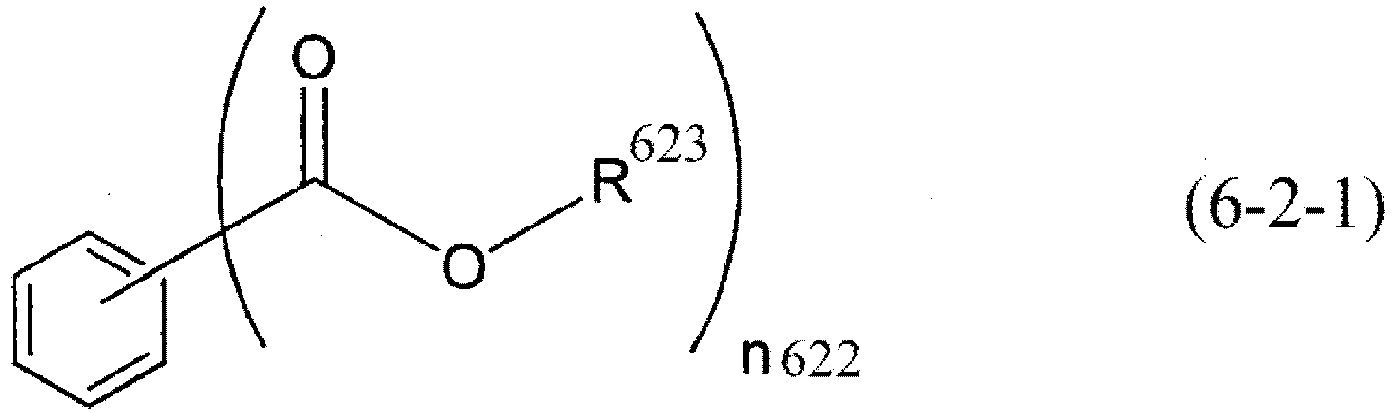
- In the general formula (6-1-1), R613 and R614 are each independently a C1-20 aliphatic hydrocarbon group or a C6-20 aromatic hydrocarbon group. Y611 is a divalent C1-60 aliphatic hydrocarbon group. The C1-60 aliphatic hydrocarbon group may have either an ether bond or an ester bond.
- In the general formula (6-2-1), R623 is a C1-20 aliphatic hydrocarbon group or a C6-20 aromatic hydrocarbon group. n622 is 2 or 3.
R713-OCO-Y711-OCO-R714 (7-1-1)
- In the general formula (7-1-1), R713 and R714 are each independently a Cl-20 aliphatic hydrocarbon group or a C6-20 aromatic hydrocarbon group. Y711 is a divalent C1-60 aliphatic hydrocarbon group. The C1-20 aliphatic hydrocarbon group may have either an ether bond or an ester bond.
- (7) The preparation method of an isocyanate according to (1) mentioned above, wherein the compound (A) is selected from the group consisting of the compounds of the general formula (S1), the compounds of the general formula (S2), and the compounds of the general formula (S3).
- (8) The preparation method of an isocyanate according to (7) mentioned above, wherein the compound (A) is the compound of the general formula (S1).
- (9) The preparation method of an isocyanate according to (1) mentioned above, wherein the compound (A) is selected from the group consisting of the compounds of the general formula (9) and the compounds of the general formula (10).
- (10) The preparation method of an isocyanate according to (9) mentioned above, wherein the compound (A) is selected from the group consisting of compounds of the following general formula (9-1) and compounds of the following general formula (10-1).

- In the general formula (9-1), Y911 and Y913 are each independently a C4-10 divalent alicyclic hydrocarbon group or a C6-10 divalent aromatic hydrocarbon group, Y912 is a C4-10 trivalent alicyclic hydrocarbon group or a C6-10 divalent aromatic hydrocarbon group, n911 and n912 are each independently an integer of 1 to 5, and m911 is an integer of 0 to 5.

- In the general formula (10-1), p1011 is an integer of 0 to 50, s1011 is an integer of 0 to 50, n1011 is an integer of 1 to 100, the sum of p1011, s1011 and n1011 is an integer of 10 to 100, m1011 is an integer of 1 to 5, R1011, R1012 and R1013 are each independently a hydrogen atom or a C1-5 monovalent hydrocarbon group, R1014 and R1015 are each independently a C1-5 alkoxycarbonyl group or a C1-12 monovalent hydrocarbon group, and R1016 and R1017 are each independently a monovalent organic group.
- (11) The preparation method of an isocyanate according to (9) mentioned above, wherein the compound (A) is a compound of the following formula (9-2).

- In the general formula (9-2), Y921 and Y923 are each independently a C4-10 alkylene group, Y912 is a 2,4,6-trioxohexahydro-1,3,5-triazine-1,3,5-triynyl group, and n921 is an integer of 1 to 6.
- (12) The preparation method of an isocyanate according to (1) mentioned above, wherein the compound (A) is selected from the group consisting of the C9-35 chained or cyclic aliphatic hydrocarbons.
- (13) The preparation method of an isocyanate according to (12) mentioned above, wherein the chained aliphatic hydrocarbons are chained aliphatic hydrocarbons having a branched chain composed of a C1-3 linear aliphatic hydrocarbon group.
- (14) The preparation method of an isocyanate according to (12) or (13) mentioned above, wherein the carbon number of the chained aliphatic hydrocarbon is 12 to 30. (15) The preparation method of an isocyanate according to any one of (1) to (14) mentioned above, wherein the mixture liquid further contains an inert solvent,
- the low-boiling-point decomposition product and the inert solvent are extracted continuously in a gaseous state from the thermal decomposition reactor in the low-boiling-point decomposition product collecting step, and
- the inert solvent is substantially inert under thermal decomposition reaction conditions, and has a standard boiling point lower than the standard boiling point of the compound (A) but between standard boiling points of an isocyanate and a hydroxy compound that are produced by thermal decomposition.
- (16) The preparation method of an isocyanate according to any one of (1) to (15) mentioned above, wherein the carbamate is a compound of the following general formula (2).

- In the general formula (2), n21 is an integer of 1 or more. R21 is an n21-valent organic group. R22 is a remaining group obtained by removing one hydroxy group from a hydroxy compound.
- (17) The preparation method of an isocyanate according to (16) mentioned above, wherein in the general formula (2), n21 is 2 or 3, and R22 is a C6-20 aromatic group.
- (18) The preparation method of an isocyanate according to any one of (1) to (17) mentioned above, wherein the thermal decomposition reactor is a tubular reactor.
- (19) The preparation method of an isocyanate according to any one of (1) to (18) mentioned above, wherein the low-boiling-point decomposition product contains the isocyanate, and the preparation method further includes a separation step in which the low-boiling-point decomposition product is supplied in a gaseous state to a distillation column to separate the isocyanate in the distillation column.
- (20) The preparation method of an isocyanate according to any one of (1) to (19) mentioned above, wherein a carrier agent which is substantially inert in a gaseous state under thermal decomposition reaction conditions is introduced into the thermal decomposition reactor to discharge a gaseous component from the thermal decomposition reactor.
- The preparation method of an isocyanate according to the above-mentioned aspects makes it possible to suppress side reactions and to produce the isocyanate continuously.
-
-
Fig. 1 is a schematic diagram illustrating the constitution of a preparation device of isocyanate used in Example 1-1 and the like. -
Fig. 2 is a schematic diagram illustrating the constitution of a preparation device of isocyanate used in Example 1-2 and the like. - An embodiment in which the present invention (hereinafter, referred to as "present embodiment") is carried out will be explained in detail below. The following present embodiment is an example to explain the present invention, although the present invention is not limited to the following present embodiment. The present invention may be appropriately modified within the scope of the summary thereof to be carried out.
- The preparation method of an isocyanate according to the present embodiment is a method for preparing an isocyanate by subjecting a carbamate to thermal decomposition.
- The preparation method of an isocyanate according to the present embodiment is a method including: a thermal decomposition step; a low-boiling-point decomposition product collecting step; and a high-boiling-point component collecting step.
- In the thermal decomposition step, a mixture liquid containing a carbamate and at least one compound (A) mentioned below is introduced continuously into a thermal decomposition reactor to allow a thermal decomposition reaction of the carbamate to proceed.
- In the low-boiling-point decomposition product collecting step, a low-boiling-point decomposition product having a standard boiling point lower than that of the compound (A) is extracted continuously from the thermal decomposition reactor in a gaseous state.
- In the high-boiling-point component collecting step, a liquid-phase component which is not collected in a gaseous state in the low-boiling-point decomposition product collecting step is extracted continuously from the thermal decomposition reactor as a high-boiling-point component.
- The preparation method according to the present embodiment makes it possible to suppress side reaction and to produce continuously an isocyanate.
- Each step will be explained below.
- In the step, a mixture liquid containing a carbamate and the compound (A) is introduced continuously into a thermal decomposition reactor to allow a thermal decomposition reaction to proceed, thereby obtaining an isocyanate. In the thermal decomposition reaction, an isocyanate and a hydroxy compound (preferably an aromatic hydroxy compound) are produced from the carbamate. The step is preferably conducted in a liquid-phase.
- The mixture liquid may further contain an inert solvent. The inert solvent is substantially inert under thermal decomposition reaction conditions, and has a standard boiling point lower than the standard boiling point of the compound (A) and between standard boiling points of the isocyanate and the hydroxy compound that are produced by thermal decomposition. Namely, the standard boiling point of each component in the mixture liquid becomes high in the order of the hydroxy compound, the inert solvent, the isocyanate, and the compound (A).
- In the present specification, the phrase "substantially inert" means that the carbamate and thermally decomposed products, that is, the isocyanate and the hydroxy compound, do not react, or even if a reaction is caused, there are no significant effects on the thermal decomposition of the carbamate.
- The carbamate used in the present step is preferably a carbamate obtained by the preparation method described later.
- The inert solvent and the compound (A) used in the present step will also be described later.
- The amount of the carbamate in the mixture liquid is generally 1% by mass to 50% by mass, preferably 3% by mass to 40% by mass, and more preferably 5% by mass to 30% by mass, relative to the total mass of the mixture liquid.
- When the amount of the carbamate is the lower limit or more, the space-time yield of the isocyanate is further improved, which tends to be advantageous in an industrial operation. When the amount of the carbamate is the upper limit or less, side reactions tend to be further suppressed during thermal decomposition.
- The reaction temperature is generally 100°C to 300°C. Although a high temperature is preferable in order to increase the reaction rate, the reaction temperature is preferably 120°C to 270°C, and more preferably 150°C to 250°C from the viewpoint of further suppression of side reactions caused by at least either the carbamate or the resultant isocyanate.
- In order to keep the reaction temperature constant, a conventionally-known cooling device and heating device may be installed in the thermal decomposition reactor.
- Although the reaction pressure varies depending on the type of compounds used and the reaction temperature, the reaction pressure may be reduced pressure, ordinary pressure or pressurization, and is generally 1 Pa to 1×10⁶ Pa.
- The reaction time (residence time) is not particularly limited, and is usually preferably 0.001 hours to 100 hours, more preferably 0.005 hours to 50 hours, and even more preferably 0.01 hours to 10 hours.
- Although the type of the thermal decomposition reactor is not particularly limited, a conventionally-known distillation device is preferably used, and the thermal decomposition reactor is more preferably constituted by at least one reactor selected from the group consisting of an evaporator, a continuous multi-stage distillation column, a packed column, a thin film evaporator and a falling film evaporator, in order to efficiently collect the gaseous phase components.
- In addition, various known methods such as a method in which a reactor including any of a distillation column, a multi-stage distillation column, a multitubular reactor, a reactor having an internal support, a forced circulation reactor, a falling film evaporator and a falling drop evaporator is used and a method in which these are combined are used.
- From the viewpoint of quickly removing the low-boiling-point decomposition product having a standard boiling point lower than that of the compound (A) from the reaction system, a packed column or a tubular reactor is preferably used, a tubular reactor is more preferably used, and a tubular reactor such as a tubular thin-film evaporator or a tubular falling film evaporator is even more preferably used. As the internal structure of these reactors, a structure having a large gas-liquid contact area that allows the resultant low-boiling-point decomposition product to be quickly transferred to the gaseous phase is preferable.
- When a packed column is used, a filler generally used in a distillation column or an absorption column may be appropriately used as a solid filler provided in the packed column. Specific examples of the preferable solid filler include a Raschig ring, Lessing ring, Spiral ring, Pall ring, Intalox saddle, Stedman packing, McMahon packing, Dixon packing, helix packing, coil packing, and heat pipe packing.
- A material of the solid filler is not particularly limited, and may be porcelain, metallic, or the like. Among these, a material having a high thermal conductivity is preferable as the solid filler.
- Although the thermal decomposition reactor or lines may be formed by any of conventionally known materials, unless the materials exert harmful effects on the carbamate or the resultant hydroxy compound or isocyanate, SUS 304, SUS 316, or SUS 316L is preferably used because of the low cost thereof.
- In the present step, a catalyst is not always required, but a catalyst may be used so as to decrease the reaction temperature or terminate the reaction promptly.
- The amount of the catalyst to be used is preferably 0.01% by mass to 30% by mass, and more preferably 0.5% by mass to 20% by mass, relative to the mass of the carbamate.
- Examples of the catalyst include: Lewis acids; transition metal compounds that generate Lewis acids; organic tin compounds; compounds containing a copper group metal; compounds containing lead; compounds containing zinc; compounds containing an iron group metal; and amines.
- Specific examples of Lewis acids and transition metal compounds that generate Lewis acids include AlX3, TiX3, TiX4, VOX3, VX5, ZnX2, FeX3, and SnX4. In the formulae, "X" is a halogen, an acetoxy group, an alkoxy group, or an aryloxy group.
- Specific examples of organic tin compounds include (CH3)3SnOCOCH3, (C2H5)SnOCOC6H5, Bu3SnOCOCH3, Ph3SnOCOCH3, Bu2Sn(OCOCH3)2, Bu2Sn(OCOC11H23)2 (dibutyltin dilaurate), Ph3SnOCH3, (C2H5)3SnOPh, Bu2Sn(OCH3)2, Bu2Sn(OC2H5)2, Bu2Sn(OPh)2, Ph2Sn(CH3)2, (C2H5)3SnOH, PhSnOH, Bu2SnO, (C8H17)2SnO, Bu2SnCl2, BuSnO(OH) and tin octylate. In the formulae, "Bu" indicates a butyl group and "Ph" indicates a phenyl group.
- Specific examples of compounds containing a copper group metal include CuCl, CuCl2, CuBr, CuBr2, CuI, CuI2, Cu(OAc)2, Cu(acac)2, copper olefinate, Bu2Cu, (CH3O)2Cu, AgNO3, AgBr, silver picrate, and AgC6H6ClO4. In the formula, "acac" indicates an acetylacetone chelate ligand.
- Specific examples of compounds containing lead include lead octylate.
- Specific examples of compounds containing zinc include Zn(acac)2.
- Specific examples of compounds containing an iron group metal include Fe(C10H8)(CO)5, Fe(CO)5, Fe(C4H6)(CO)3, Co(mesitylene)2(PEt2Ph2), CoC5F5(CO)7, and ferrocene.
- Specific examples of amines include 1,4-diazabicyclo[2,2,2]octane, triethylene diamine, and triethyl amine.
- Among these, dibutyltin dilaurate, lead octylate, or tin octylate is preferable. One of these catalysts may be used alone or at least two thereof may be used in combination.
- In the present step, a low-boiling-point decomposition product produced by the thermal decomposition reaction of the carbamate is extracted continuously from the thermal decomposition reactor in a gaseous state. The term "low-boiling-point decomposition product" refers to a compound having a standard boiling point lower than the standard boiling point of the compound (A) among the isocyanate and the hydroxy compound that are produced by the thermal decomposition reaction of the carbamate. As the low-boiling-point decomposition product, at least either the hydroxy compound or the isocyanate is preferable, and both the hydroxy compound and the isocyanate are preferable. When the mixture liquid contains an inert solvent, the low-boiling-point decomposition product and the inert solvent are extracted continuously from the thermal decomposition reactor in a gaseous state in the present step.
- In order to collect these components in a gaseous state, it is preferable that the temperature, the pressure, and other conditions under which the step is conducted be determined depending on used compounds or compounds produced by thermal decomposition of a carbamate.
- In order to collect the low-boiling-point decomposition product promptly, a carrier agent may be introduced into the thermal decomposition reactor to discharge a gaseous component containing the carrier agent from the thermal decomposition reactor. The term "carrier agent" used herein refers to an agent which is substantially inert in a gaseous state under thermal decomposition reaction conditions.
- Specific examples of such a carrier agent include inert gases and hydrocarbon gases. Examples of the inert gases include nitrogen, argon, helium, carbon dioxide, methane, ethane, and propane. Among these, inert gases such as nitrogen are preferable.
- Examples of an agent that exhibits a similar effect include low-boiling-point organic solvents. Examples of the low-boiling-point organic solvents include halogenated hydrocarbons, lower hydrocarbons and ethers. Examples of the halogenated hydrocarbons include dichloromethane, chloroform, and carbon tetrachloride. Examples of the lower hydrocarbons include pentane, hexane, heptane, and benzene. Examples of the ethers include tetrahydrofuran and dioxane.
- One of these carrier agents may be used alone, or at least two thereof may be mixed to be used. These carrier agents are preferably heated in advance to be used.
- The low-boiling-point decomposition product, or both the low-boiling-point decomposition product and the inert solvent, which are collected from the thermal decomposition reactor in a gaseous state, may be directly introduced into a cooler and then collected partially or entirely in a liquid state. The purification and separation may be conducted by supplying, to a distillation column, the low-boiling-point decomposition product or both the low-boiling-point decomposition product and the inert solvent in a gaseous state, or in a liquid state after being introduced into the cooler.
- In the present step, a liquid-phase component which is not collected in a gaseous state in the low-boiling-point decomposition product collecting step is extracted continuously from the reactor to be collected as a high-boiling-point component. The low-boiling-point decomposition product having a standard boiling point lower than that of the compound (A) supplied to the thermal decomposition reactor or both the low-boiling-point decomposition product and the inert solvent are collected in a gaseous state in the low-boiling-point decomposition product collecting step. Thus, it is understood that the high-boiling-point component collected in the present step is a liquid phase component that cannot be collected in a gaseous state in the low-boiling-point decomposition product collecting step, and that has a standard boiling point equal to or higher than the standard boiling point of the compound (A). The high-boiling-point component often contains side reaction products caused by an isocyanate produced by thermal decomposition of a carbamate and the carbamate, side reaction products caused by the isocyanate, side reaction products caused by the carbamate, or compounds caused by an additional reaction of these side reaction products. There are many cases in which these compounds are not collected in a gaseous state in the low-boiling-point decomposition product collecting step. In contrast, there are many cases in which these compounds adhere to the reactor surface, which causes blockage. Thus, the continuous collection of the liquid phase component from the thermal decomposition reactor with the compound (A) supplied to the thermal decomposition reaction suppresses adhesion to the reactor surface.
- The thermal decomposition step, the low-boiling-point decomposition product collecting step and the high-boiling-point component collecting step may be conducted separately using plural devices, or conducted simultaneously using one device.
- The preparation method of an isocyanate according to the present embodiment may further include a separation step and a carbamate preparing step, for example, in addition to the above-mentioned thermal decomposition step, the low-boiling-point decomposition product collecting step and the high-boiling-point component collecting step.
- In the separation step, the isocyanate which is contained in the low-boiling-point decomposition product collected in the low-boiling-point decomposition product collecting step is separated and purified. Specifically, the low-boiling-point decomposition product collected in the low-boiling-point decomposition product collecting step is supplied in a gaseous state to a distillation column to separate an isocyanate from a hydroxy compound, thereby obtaining a highly purified isocyanate. The distillation condition, the distillation device, or the like, may be appropriately selected from conventionally-known conditions or devices depending on the types of the isocyanate and the hydroxy compound or the like.
- It is preferable that a carbamate used in the thermal decomposition step be prepared using the method mentioned below. In addition, from the viewpoint of the quality and the yield of the obtained isocyanate, it is preferable that the carbamate be derived from an amino acid ester that produces a hydroxyl compound as the low-boiling-point decomposition product and an isocyanate as the high-boiling-point decomposition product.
- In the present step, a carbonic acid ester and an amine compound are reacted to obtain a reaction mixture containing a carbamate which is a reaction product of the carbonic acid ester and the amine compound, a hydroxy compound which is a reaction by-product of the carbonic acid ester, and the carbonic acid ester.
- The reaction of the carbonic acid ester and the amine compound may be conducted in a reaction solvent. The carbonic acid ester used in an excess amount relative to the molar amount of amino group of the amine compound is preferably used as a solvent in the reaction.
- Although the reaction conditions of the carbonic acid ester and the amine compound depend on the compounds to be reacted, the stoichiometric ratio of the molar amount of the carbonic acid ester to the molar amount of an amino group of the amine compound may be 1 time or more. From the viewpoint of increase in the reaction rate and prompt termination of the reaction, the molar amount of the carbonic acid ester relative to the molar amount of an amino group of the amine compound is preferably in excess, and more preferably 1 time to 1000 times, and, in view of the size of the reactor, even more preferably 1.1 times to 50 times, and particularly preferably 1.5 times to 10 times.
- The reaction temperature may be generally 0°C to 150°C. Although a high reaction temperature is preferable so as to increase the reaction rate, there is a case in which an unfavorable reaction is caused at a high temperature. Thus, the reaction temperature is preferably 10°C to 100°C. In order to keep the reaction temperature constant, a conventionally-known cooling device and heating device may be installed in the reactor.
- Although the reaction pressure depends on the type of compounds to be used or the reaction temperature, the reaction pressure may be reduced pressure, ordinary pressure or pressurization, and is generally 20 Pa to 1×10⁶ Pa. The reaction time (residence time in a case of a continuous method) is not particularly limited, generally preferably 0.001 hours to 50 hours, more preferably 0.01 hours to 20 hours, and even more preferably 0.1 hours to 10 hours. The reaction may be terminated after confirming that a predetermined amount of a carbamate is produced by subjecting a collected reaction liquid to liquid chromatography, for example.
- In the reaction of the carbonic acid ester and the amine compound, a catalyst may or may not be used. When no catalyst is used, the thermal denaturation of a carbamate due to a metal component derived from the catalyst can be inhibited.
- When a catalyst is used, the reaction can be completed in a short time, and the reaction temperature can be lowered.
- In particular, when a used compound forms a salt with an inorganic acid or an organic acid, a basic compound may be used.
- The basic compound may be an inorganic base or an organic base. Examples of the inorganic base include alkali metal hydroxides, alkaline earth metal hydroxides, and ammonia. Examples of the organic base include amines and phosphazene. Among them, the basic compound is preferably an amine, more preferably an aliphatic amine, and even more preferably a secondary aliphatic amine or a tertiary aliphatic amine.
- Although the amount of the basic compound to be used is appropriately determined depending on the compound to be used, the stoichiometric ratio of the molar amount of the basic compound to the molar amount of an amino group of the amine compound forming the salt is preferably 0.001 times or more, and more preferably 0.01 times to 100 times.
- As the reactor available in the reaction of the carbonic acid ester and the amine compound, a conventionally-known tank reactor, column reactor, or distillation column may be used. Although materials of the reactor and the lines may be appropriately selected to be used from conventionally-known materials, unless starting materials or reaction materials are adversely affected, SUS 304, SUS 316, SUS 316L or the like is inexpensive and preferably used.
- Each raw material used in the preparation method according to the present embodiment and the reaction product will be explained below.
- A carbamate used in the preparation method according to the present embodiment is preferably a carbamate of the following general formula (2) (hereinafter, may be referred to as "carbamate (2)"). The term "carbamate" used herein is not limited to the carbamate obtained in the above-mentioned "carbamate preparing step", and encompasses any carbamates available in the preparation method according to the present embodiment.
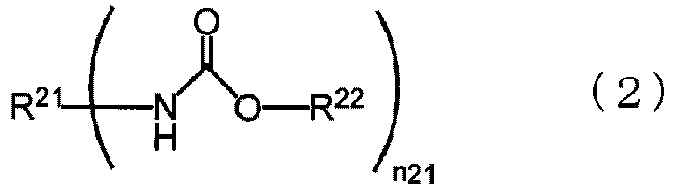
- In the general formula (2), n21 is an integer of 1 or more. R21 is an n21-valent organic group. R22 is a remaining group formed by removing one hydroxy group from a hydroxy compound.
- In the general formula (2), n21 is preferably an integer of 1 to 5, more preferably 2 or more, and even more preferably 3 or more, in view of ease of preparation or ease of operation.
- In the general formula (2), R21 is preferably a C3-85 organic group, and more preferably a C3-30 organic group. The organic group as R21 is an aliphatic hydrocarbon group, an aromatic hydrocarbon group or a group formed by binding an aliphatic hydrocarbon group and an aromatic hydrocarbon group. Specific examples of R21 include cyclic hydrocarbon groups, noncyclic hydrocarbon groups, groups formed by binding a noncyclic hydrocarbon group with at least one cyclic group, and groups formed by binding these groups with specific nonmetallic atoms via covalent bonds. Examples of the cyclic group include cyclic hydrocarbon groups, hetero ring groups, hetero ring-type spiro groups, and hetero cross-linked cyclic groups. Examples of the cyclic hydrocarbon groups include monocyclic hydrocarbon groups, condensed polycyclic hydrocarbon groups, cross-linked cyclic hydrocarbon groups, spiro hydrocarbon groups, ring-assembly hydrocarbon groups, and side chain-containing cyclic hydrocarbon groups.
- Examples of the nonmetallic atoms include carbon, oxygen, nitrogen, sulfur, and silicon.
- Preferable examples of noncyclic aliphatic hydrocarbon groups as R21 include C3-15, and more preferably C5-10 alkylene groups and alkenylene groups.
- Preferable examples of cyclic aliphatic hydrocarbon groups as R21 include C3-15 cycloalkylene groups, and more preferably include a cyclohexylene group.
- Additional preferable examples of aliphatic hydrocarbon groups as R21 include groups formed by binding a noncyclic aliphatic hydrocarbon group (such as C1-10 alkylene group) with at least one (preferably one or two) C3-15 cyclic aliphatic hydrocarbon group (preferably cyclohexylene group).
- The noncyclic aliphatic hydrocarbon group as R21 may have one to four (preferably one or two) ester groups.
- A hydrogen atom constituting the noncyclic aliphatic hydrocarbon group as R21 may be substituted with a C1-3 alkylthio group, an imidazolyl group or an indolyl group.
- As the aromatic hydrocarbon group as R21, a C6-20, more preferably C6-12 arylene group is preferable, and a phenylene group is more preferable. The phenylene group may be substituted with a C1-6 alkyl group.
- As the group formed by bonding an aliphatic hydrocarbon group and an aromatic hydrocarbon group as R21, a group formed by bonding a C1-6 alkylene group with one or two phenylene groups is preferable.
- In the general formula (2), R22 is a remaining group formed by removing one hydroxy group from a hydroxy compound, preferably a C1-20 monovalent aliphatic hydrocarbon group or a C6-20 monovalent aromatic hydrocarbon group, and more preferably a C6-20 monovalent aromatic hydrocarbon group. The C1-20 monovalent aliphatic hydrocarbon group or the C6-20 monovalent aromatic hydrocarbon group may have a substituent.
- The C1-20 monovalent aliphatic hydrocarbon group as R22 may be chained or cyclic.
- Examples of the chained aliphatic hydrocarbon group include linear alkyl groups and branched alkyl groups. The carbon number of the linear alkyl group is preferably 1 to 5, more preferably 1 to 4, and even more preferably 1or 2. Specific examples of the linear alkyl groups include a methyl group, an ethyl group, a n-propyl group, a n-butyl group, and a n-pentyl group. The carbon number of the branched alkyl group is preferably 3 to 10, and more preferably 3 to 5. Specific examples of the branched alkyl groups include an isopropyl group, an isobutyl group, a tert-butyl group, an isopentyl group, a neopentyl group, a 1,1-diethylpropyl group, and a 2,2-dimethylbutyl group.
- The cyclic aliphatic hydrocarbon group (that is, alicyclic hydrocarbon group) may be monocyclic or polycyclic. Specific examples of the monocyclic alicyclic hydrocarbon groups include cyclopentane and cyclohexane. Specific examples of the polycyclic alicyclic hydrocarbon groups include adamantane, norbornane, isobornane, tricyclodecane, and tetracyclododecane.
- The carbon number of the aromatic hydrocarbon group as R22 is preferably 6 to 20, and more preferably 6 to 12. Although R22 may be an aromatic hydrocarbon group having a carbon number of 21 or more, the carbon number of R22 is preferably 20 or less from the viewpoint of facilitating separation from an isocyanate produced by the thermal decomposition reaction of a carbamate.
- Examples of the aromatic hydrocarbon group as R22 include a phenyl group, a methylphenyl group (each isomer), an ethylphenyl group (each isomer), a propylphenyl group (each isomer), a butylphenyl group (each isomer), a pentylphenyl group (each isomer), a hexylphenyl group (each isomer), a dimethylphenyl group (each isomer), a methylethylphenyl group (each isomer), a methylpropylphenyl group (each isomer), a methylbutylphenyl group (each isomer), a methylpentylphenyl group (each isomer), a diethylphenyl group (each isomer), an ethylpropylphenyl group (each isomer), an ethylbutylphenyl group (each isomer), a dipropylphenyl group (each isomer), a trimethylphenyl group (each isomer), a triethylphenyl group (each isomer), and a naphthyl group (each isomer).
- Among these, R22 is preferably a phenyl group or a C1-5 alkyl group.
- In the case of a monofunctional carbamate in which n21 in the carbamate (2) is 1 (that is, a compound having one carbamate group in one molecule), preferable examples of the carbamate (2) include carbamates of the following general formula (2-1a) (hereinafter, may be referred to as "carbamates (2-1a)") and carbamates of the following general formula (2-1b) (hereinafter, may be referred to as "carbamates (2-1b)").

- In the general formula (2-1a), R211 is a C3-85 hydrocarbon group, preferably a C5-10 alkylene group or alkenylene group which may have one ester bond, and more preferably a C5-10 alkenylene group which has one ester bond. Although R212 is the same group as R22, a phenyl group is preferable.

- In the general formula (2-1b), X211 is an oxygen atom or a secondary amino group (-NH-). R213 is the same group as R22. R214 is a hydrogen atom, a C1-10 aliphatic hydrocarbon group or a C6-10 aromatic hydrocarbon group. The C1-10 aliphatic hydrocarbon group and the C6-10 aromatic hydrocarbon group may have at least one selected from the group consisting of a sulfur atom, an oxygen atom and halogen atoms. R215 is a C1-10 monovalent aliphatic hydrocarbon group or a C6-10 monovalent aromatic hydrocarbon group.
- The carbamate (2-1b) is a carbamate having an α-amino acid skeleton. α-Amino acids have two possible sterically bonding modes of an amino group or a carboxyl group to an α carbon, and are respectively distinguished as D-type or L-type photoisomer. An amino acid (and a compound having an amino acid skeleton) available to prepare the carbamate (3-1b) may be D-type, L-type, a mixture thereof, or a racemic body. Many industrially inexpensively available amino acids are amino acids produced by fermentation, and are almost all L-type, which are preferably used. Although the steric configuration is not shown in the present specification, the steric configuration is either D-type or L-type.
- (R211) R211 is a C3-85 hydrocarbon group. The hydrocarbon group as R211 may be an aliphatic hydrocarbon group or a C6-60 aromatic hydrocarbon group. Examples of the hydrocarbon group as R211 include the same hydrocarbon groups as R21. Among these, R211 is preferably a C5-10 alkylene group or alkenylene group which may have one ester bond, and more preferably a C5-10 alkenylene group which has one ester bond.
- Specific examples of the C1-10 monovalent aliphatic hydrocarbon group as R214 and R215 include a methyl group, an ethyl group, a propyl group, a butyl group, a pentyl group, a hexyl group, and a decyl group. Specific examples of the C6-10 monovalent aromatic hydrocarbon group as R214 and R215 include a phenyl group, a methylphenyl group, an ethylphenyl group, a butylphenyl group, a dimethylphenyl group, and a diethylphenyl group. The C1-10 aliphatic hydrocarbon group and C6-10 aromatic hydrocarbon group as R214 may have at least one selected from the group consisting of a sulfur atom, an oxygen atom and halogen atoms. When a sulfur atom or an oxygen atom is contained, a carbon atom constituting the C1-10 aliphatic hydrocarbon group or the C6-10 aromatic hydrocarbon group is substituted with a sulfur atom or an oxygen atom.
- X211 is an oxygen atom or a secondary amino group (-NH-). When X211 is an oxygen atom, X211 forms an ester bond with an adjacent carbonyl group. When X211 is a secondary amino group (-NH-), X211 forms an amido bond with an adjacent carbonyl group.
- Among these, the monofunctional carbamate is preferably the carbamate (2-1b).
- Preferable examples of the carbamate (2-1b) include a compound of the following formula (2-1b-1), a compound of the following formula (2-1b-2), a compound of the following formula (2-1b-3), and a compound of the following formula (2-lb-4).


- In the case of a difunctional carbamate in which n21 in the carbamate (2) is 2 (that is, a compound having two carbamate groups in one molecule), preferable examples of the carbamate (2) include carbamates of the following general formula (2-2a) (hereinafter, may be referred to as "carbamates (2-2a)"), carbamates of the following general formula (2-2b) (hereinafter, may be referred to as "carbamates (2-2b)"), carbamates of the following general formula (2-2c) (hereinafter, may be referred to as "carbamates (2-2c)"), carbamates of the following general formula (2-2d) (hereinafter, may be referred to as "carbamates (2-2d)"), and carbamates of the following general formula (2-2e) (hereinafter, may be referred to as "carbamates (2-2e)").

- In the general formula (2-2a), although R221 is the same as R21 mentioned above, R221 is preferably a C3-10 alkylene group, a C3-10 cycloalkylene group (more preferably a cyclohexylene group), a group formed by bonding a C3-10 cycloalkylene group (preferably a cyclohexylene group) which may be substituted with a C1-3 alkyl group with a C1-6 alkylene group, a phenylene group which may be substituted with a C1-6 alkyl group, or a group formed by connecting a C1-6 alkylene group with one or two phenylene group.
- Although R222 is the same as R22, R222 is preferably a phenyl group or a C1-5 alkyl group.

- In the general formula (2-2b), X221 is the same as X211 mentioned above. R223 is the same as R22. R224 is the same as R214. R225 is a C1-10 divalent aliphatic hydrocarbon group or a C6-10 divalent aromatic hydrocarbon group.

- In the general formula (2-2c), although X222 is the same as X211, X222 is preferably an oxygen atom. Although R226 and R227 are each independently the same as R22, R226 and R227 are preferably phenyl groups. Y221 is a C1-5 alkylene chain. Although R228 is the same as R215 mentioned above, R228 is preferably a C1-6 alkyl group.

- In the general formula (2-2d), although X223 is the same as X211, X223 is preferably an oxygen atom. Although R229 and R230 are each independently the same as R22, R229 and R230 are preferably phenyl groups. Y222 is the same as Y221. Although R231 is the same as R214, R231 is preferably a C1-6 alkyl group or alkylthio group, and more preferably a C1-6 alkylthio group.

- In the general formula (2-e), although R234 and R235 are each independently the same as R22, R234 and R235 are preferably phenyl groups. Y222 is the same as Y221. Although R232 and R233 are the same as R214, R232 and R233 are preferably C1-6 alkyl groups.
- Examples of the C1-10 divalent aliphatic hydrocarbon group as R225 include a methylene group, an ethylene group, a trimethylene group, a tetramethylene group, a pentamethylene group, and a hexamethylene group. Examples of the C6-10 divalent aromatic hydrocarbon group as R225 include a phenylene group and a naphthalene-diyl group.
- Y221 and Y222 are each independently a C1-5 polyalkylene chain. Namely, Y221 and Y222 are divalent groups of the following general formula (II).
-(CH2)n221- (II)
- In the general formula (II), n221 is an integer of 1 to 5.
- Examples of the C1-5 polyalkylene chain include a methylene group, an ethylene group, a trimethylene group, a tetramethylene group, and a pentamethylene group.
- Specific preferable examples of the carbamate (2-2a), the carbamate (2-2b), the carbamate (2-2c) and the carbamate (2-2d) include C4-30 aliphatic dicarbamates, C8-30 alicyclic dicarbamates, and C8-30 dicarbamates having an aromatic group.
- Specific examples of the C4-30 aliphatic dicarbamates include 1,5-pentamethylene di(carbamic acid methyl ester), 1,6-hexamethylene di(carbamic acid methyl ester), lysine ethyl ester di(carbamic acid methyl ester), 1,5-pentamethylene di(carbamic acid ethyl ester), 1,6-hexamethylene di(carbamic acid ethyl ester), lysine ethyl ester di(carbamic acid ethyl ester), 1,5-pentamethylene di(carbamic acid phenyl ester), 1,6-hexamethylene di(carbamic acid phenyl ester), lysine ethyl ester di(carbamic acid phenyl ester), and ethyl-2,6-bis((phenoxycarbonyl)amino)hexonate. Among these, 1,6-hexamethylene di(carbamic acid phenyl ester) is preferable.
- Specific examples of the C8-30 alicyclic dicarbamates include isophorone di(carbamic acid methyl ester), 1,3-bis((carbamic acid methyl ester)methyl)-cyclohexane, 4,4'-dicyclohexylmethane di(carbamic acid methyl ester), hydrogenated tetramethylxylylene di(carbamic acid methyl ester), norbornene di(carbamic acid methyl ester), isophorone di(carbamic acid ethyl ester), 1,3-bis((carbamic acid ethyl ester)ethyl)-cyclohexane, 4,4'-dicyclohexylmethane di(carbamic acid ethyl ester), hydrogenated tetraethylxylylene di(carbamic acid ethyl ester), norbornene di(carbamic acid ethyl ester), isophorone di(carbamic acid phenyl ester), 1,3-bis((carbamic acid phenyl ester)phenyl)-cyclohexane, 4,4'-dicyclohexylmethane di(carbamic acid phenyl ester), hydrogenated tetraphenylxylylene di(carbamic acid phenyl ester), norbornene di(carbamic acid phenyl ester), and 3-(phenoxycarbonylamino-methyl)-3,5,5-trimethylcyclohexylcarbamic acid phenyl ester. Among these, 3-(phenoxycarbonylamino-methyl)-3,5,5-trimethylcyclohexylcarbamic acid phenyl ester is preferable.
- Specific examples of C8-30 dicarbamates having an aromatic group include 4,4'-diphenylmethane di(carbamic acid methyl ester), 2,6-tolylene di(carbamic acid methyl ester), xylylene di(carbamic acid methyl ester), tetramethylxylylene di(carbamic acid methyl ester), naphthalene di(carbamic acid methyl ester), 4,4'-diphenylmethane di(carbamic acid ethyl ester), 2,6-tolylene di(carbamic acid ethyl ester), xylylene di(carbamic acid ethyl ester), tetraethylxylylene di(carbamic acid ethyl ester), naphthalene di(carbamic acid ethyl ester), 4,4'-diphenylmethane di(carbamic acid phenyl ester), 2,6-tolylene di(carbamic acid phenyl ester), xylylene di(carbamic acid phenyl ester), tetraphenylxylylene di(carbamic acid phenyl ester), and naphthalene di(carbamic acid dimethylphenyl ester).
- In the case where the above-mentioned compound has structural isomers, the structural isomers are encompassed in the above-mentioned preferable examples of the carbamate (2).
- When the carbamate (2) is a trifunctional carbamate in which n31 is 3 (that is, a compound having three carbamate groups in one molecule), preferable examples of the carbamate (2) include carbamates of the following general formula (2-3a) (hereinafter, may be abbreviated as "carbamates (2-3a)"), carbamates of the following general formula (2-3b) (hereinafter, may be abbreviated as "carbamates (2-3b)"), and carbamates of the following general formula (2-3c) (hereinafter, may be abbreviated as "carbamates (2-3c)").

- In the general formula (2-3a), X251 is the same as X211 mentioned above. R251 is the same as R22 mentioned above. R252 is the same as R214 mentioned above. R253 is a CI-10 trivalent aliphatic hydrocarbon group or a C6-10 trivalent aromatic hydrocarbon group.

- In the general formula (2-3b), n251, n252 and n253 are each independently an integer of 1 to 4. n254, n255 and n256 are each independently an integer of 0 to 5. It is preferable that at least one selected from the group consisting of n254, n255 and n256 be 0. Although m251, m252 and m253 are each independently 0 or 1, at least one selected from the group consisting of m251, m252 and m253 is 1. It is preferable that at least one selected from the group consisting of m251, m225 and m253 be 0. R254, R255 and R256 are each independently the same as R22, and preferably a phenyl group.
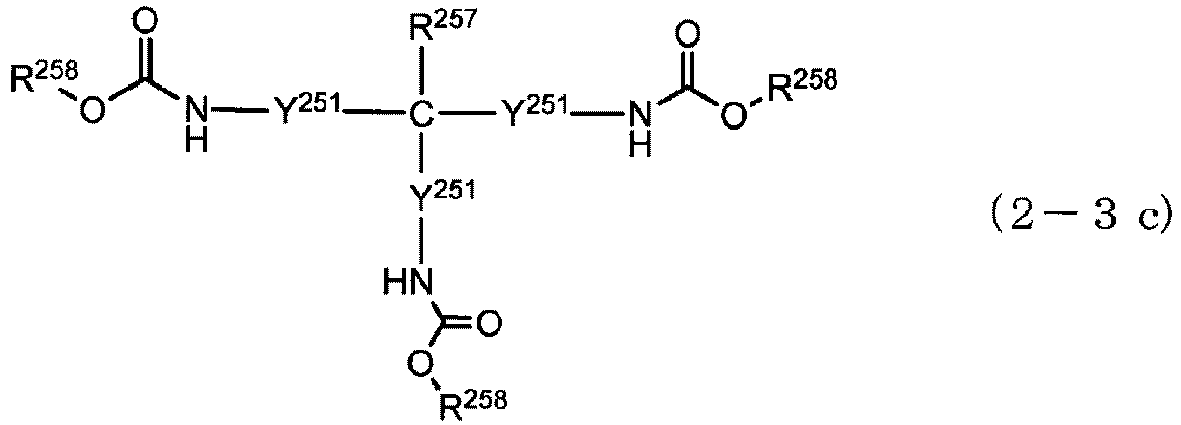
- In the general formula (2-3c), plural Y251 are each independently a single bond or a C1-20 divalent hydrocarbon group which may have at least one selected from the group consisting of an ester group and an ether group, and preferably a C1-6 alkylene group. Plural R258 are the same as R22, and preferably phenyl groups. Plural Y251 and R258 may be identical to or different from each other. R257 is a hydrogen atom or a C1-12 monovalent hydrocarbon group, and preferably a hydrogen atom. The C1-20 divalent hydrocarbon group and the C1-20 hydrocarbon group may have a substituent.
- R253 is a C1-10 trivalent aliphatic hydrocarbon group or a C6-10 trivalent aromatic hydrocarbon group.
- Examples of the C1-10 trivalent aliphatic hydrocarbon group as R253 include a methanetriyl group, an ethanetriyl group, and a propanetriyl group. Examples of the C6-10 trivalent aromatic hydrocarbon group as R253 include a benzenetriyl group and a naphthalenetriyl group.
- Preferable examples of Y251 include C1-20 divalent aliphatic hydrocarbon groups, C6-20 divalent aromatic hydrocarbon groups, C2-20 divalent groups formed by bonding an aliphatic hydrocarbon group and an aliphatic hydrocarbon group via an ester group, C2-20 divalent groups formed by bonding an aliphatic hydrocarbon group and an aliphatic hydrocarbon group via an ether group, C7-20 divalent groups formed by bonding an aliphatic hydrocarbon group and an aromatic hydrocarbon group via an ester group, C7-20 divalent groups formed by bonding an aliphatic hydrocarbon group and an aromatic hydrocarbon group via an ether group, C14-20 divalent groups formed by bonding an aromatic hydrocarbon group and an aromatic hydrocarbon group via an ester group, and C14-20 divalent groups formed by bonding an aromatic hydrocarbon group and an aromatic hydrocarbon group via an ether group.
- R257 is preferably a C1-10 aliphatic hydrocarbon group or a C6-10 aromatic hydrocarbon group. Examples of the C1-10 aliphatic hydrocarbon group and C6-10 aromatic hydrocarbon group as R257 include the same groups as those mentioned as R214 and R215.
- Preferable examples of the carbamate (2-3b) include compounds of the following general formula (2-3b-1) (hereinafter, may be abbreviated as "compounds (2-3b-1)").

- In the general formula (2-3b-1), plural R259 are the same as R22, and preferably phenyl groups. n257 and n258 are each independently an integer of 2 to 4.
- Preferable examples of the compound (2-3b-1) include the following compounds.
- In the general formula (2-3b-1), n257 is 2 and n258 is 4.
- 2,2-(Carbamic acid methyl ester)ethyl-2,6-di(carbamic acid methyl ester)hexanoate (R259 in the general formula (2-3b-1) is a methyl group).
- 2-(Carbamic acid ethyl ester)ethyl-2,6-di(carbamic acid ethyl ester)hexanoate (R259 in the general formula (2-3b-1) is an ethyl group).
- 2-(Carbamic acid butyl ester)ethyl-2,6-di(carbamic acid butyl ester)hexanoate (R239 in the general formula (2-3b-1) is a butyl group).
- 2-(Carbamic acid phenyl ester)ethyl-2,6-di(carbamic acid phenyl ester)hexanoate (R259 in the general formula (2-3b-1) is a phenyl group).
- 2-(Carbamic acid dimethylphenyl ester)ethyl-2,6-di(carbamic acid dimethylphenyl ester)hexanoate (R259 in the general formula (2-3b-1) is a dimethylphenyl group).
- Preferable examples of the carbamate (2-3c) include compounds in which Y251 is a C1-20 divalent aliphatic hydrocarbon group, and compounds in which Y251 is a C6-20 divalent aromatic hydrocarbon group.
- Specific examples of the compounds in which Y251 is a C1-20 divalent aliphatic hydrocarbon group include 1,8-di(carbamic acid methyl ester)-4-(carbamic acid methyl ester)methyloctane, 1,8-di(carbamic acid ethyl ester) 4-(carbamic acid ethyl ester)methyloctane, 2-(carbamic acid ethyl ester)ethyl-2,5-di(carbamic acid ethyl ester)pentanoate, 2-(carbamic acid methyl ester)ethyl-2,5-di(carbamic acid methyl ester)pentanoate, 2-(carbamic acid methyl ester)ethyl-2,6-di(carbamic acid methyl ester)hexanoate, 2-(carbamic acid ethyl ester)ethyl-2,6-di(carbamic acid ethyl ester)hexanoate, bis(2-(carbamic acid ethyl ester)ethyl)-2-(carbamic acid ethyl ester)pentanedioate, bis(2-(carbamic acid methyl ester)ethyl)-2-(carbamic acid methyl ester)pentanedioate, bis(2-(carbamic acid butyl ester)ethyl)-2-(carbamic acid butyl ester)pentanedioate, 1,3,5-tri(carbamic acid methyl ester)benzene, and 1,3,5-tri(carbamic acid ethyl ester)benzene.
- Specific examples of the compounds in which Y251 is a C6-20 divalent aromatic hydrocarbon group include 1,8-di(carbamic acid phenyl ester) 4-(carbamic acid phenyl ester)methyloctane, 2-(carbamic acid phenyl ester)ethyl-2,5-di(carbamic acid phenyl ester)pentanoate, 2-(carbamic acid phenyl ester)ethyl-2,6-di(carbamic acid phenyl ester)hexanoate, bis(2-(carbamic acid phenyl)ethyl)-2-(carbamic acid phenyl)pentanedioate, and 1,3,5-tri(carbamic acid phenyl ester )benzene.
- When the carbamate (2) is a polyfunctional carbamate in which n31 is 4 (that is, a compound having four carbamate groups in one molecule), preferable examples of the carbamate (2) include carbamates of the following general formula (2-4a) (hereinafter, may be abbreviated as "carbamate (2-4a)"), and carbamates of the following general formula (2-4b) (hereinafter, may be abbreviated as "carbamates (2-4b)").

- In the general formula (2-4a), X241 is the same as X211 mentioned above. R241 is the same as R22 mentioned above. R242 is the same as R214 mentioned above. R243 is a C1-10 tetravalent aliphatic hydrocarbon group or a C6-10 tetravalent aromatic hydrocarbon group.

- In the general formula (2-4b), Y241 is a single bond or a C1-20 divalent hydrocarbon group which may have at least one selected from the group consisting of an ester group and an ether group. R244 is a single bond or a C1-20 divalent hydrocarbon group which may have at least one selected from the group consisting of an ester group and an ether group, and preferably a C2-6 alkylene group. Plural R245 are the same as R22 mentioned above, and preferably phenyl groups.
- Preferable examples of Y241 include C1-20 divalent aliphatic hydrocarbon groups, C6-20 divalent aromatic hydrocarbon groups, C2-20 divalent groups formed by boding an aliphatic hydrocarbon group and an aliphatic hydrocarbon group via an ester group, C2-20 divalent groups formed by boding an aliphatic hydrocarbon group and an aliphatic hydrocarbon group via an ether group, C7-20 divalent groups formed by boding an aliphatic hydrocarbon group and an aromatic hydrocarbon group via an ester group, C7-20 divalent groups formed by boding an aliphatic hydrocarbon group and an aromatic hydrocarbon group via an ether group, C14-20 divalent groups formed by boding an aromatic hydrocarbon group and an aromatic hydrocarbon group via an ester group, and C14-20 divalent groups formed by boding an aromatic hydrocarbon group and an aromatic hydrocarbon group via an ether group. Among these, Y241 is preferably a C2-6 alkylene group.
- Preferable examples of the carbamate (2-4b) include compounds of the following general formula (2-4b-1) (hereinafter, may be abbreviated as "compounds (2-4b-1)").

- In the general formula (2-4b-1), R248 is the same as R244. Plural R249 are the same as R22. n241 is 3or 4.
- Preferable examples of the compound (2-4b-1) include the following compounds.


- Among these, the carbamate (2) is preferably the carbamate (2-1a), the carbamate (2-1b), the carbamate (2-2a), the carbamate (2-2c), the carbamate (2-2d), the carbamate (2-2e), the carbamate (2-3b), the carbamate (2-3c), or the carbamate (2-4b).
- An inert solvent available in the preparation method according to the present embodiment is not particularly limited, provided that the inert solvent is substantially inert under a reaction condition and has a standard boiling point lower than that of the compound (A), the standard boiling point being between standard boiling points of the resultant isocyanate and hydroxyl compound.
- Examples of such an inert solvent include aliphatic compounds, alicyclic compounds, aromatic compounds which may have a substituent, unsubstituted hydrocarbons and mixtures thereof.
- Additional examples thereof include compounds which may have an oxygen atom such as ethers, ketones, and esters, and compounds which may have a sulfur atom such as thioethers, sulfoxides, and sulfones.
- Specific examples of the inert solvent include alkanes, aromatic hydrocarbons, alkyl-substituted aromatic hydrocarbons, aromatic compounds substituted with a nitro group or a halogen, polycyclic hydrocarbon compounds, alicyclic hydrocarbons, ketones, esters, ethers, thioethers, sulfoxides, sulfones, and silicon oils.
- Examples of the alkanes include hexane, heptane, octane, nonane, decane, n-dodecane, n-hexadecane, n-octadecane, eicosane, and squalane.
- Examples of the aromatic hydrocarbons and alkyl-substituted aromatic hydrocarbons include benzene, toluene, xylene, ethylbenzene, trimethylbenzene, triethylbenzene, cumene, diisopropylbenzene, dibutylbenzene, naphthalene, lower alkyl-substituted naphthalene, and dodecylbenzene. Xylene, trimethylbenzene and triethylbenzene are preferable.
- Examples of the aromatic compounds substituted with a nitro group or a halogen include chlorbenzene, 4-methylbenzyl chloride, dichlorbenzene, bromobenzene, dibromobenzene, chlornaphthalene, bromonaphthalene, nitrobenzene, and nitronaphthalene. 4-Methylbenzyl chloride is preferable.
- Examples of the polycyclic hydrocarbon compounds include diphenyl, substituted diphenyls, diphenylmethane, terphenyl, anthracene, phenanthrene, benzyltoluene, isomers of benzyltoluene, and triphenylmethane. Benzyltoluene is preferable.
- Examples of the alicyclic hydrocarbons include cyclohexane and ethylcyclohexane.
- Examples of the ketones include methylethylketone, acetophenone, and benzophenone. Benzophenone is preferable.
- Examples of the esters include dibutylphthalate, dihexylphthalate, and dioctylphthalate.
- Examples of the ethers and the thioethers include diphenyl ether, ethylene glycol monobutyl ether (may also be referred to as butyl cellosolve), and diphenyl sulfide. Ethylene glycol monobutyl ether is preferable.
- Examples of the sulfoxides include dimethyl sulfoxide, and diphenyl sulfoxide. Examples of the sulfones include dimethyl sulfone, diethyl sulfone, diphenyl sulfone, and sulfolane.
- Among these, the inert solvent is preferably an aromatic hydrocarbon, an alkyl-substituted aromatic hydrocarbon, or an aromatic compound substituted with a nitro group or a halogen such as chlorbenzene, dichlorbenzene, bromobenzene, dibromobenzene, chlornaphthalene, bromonaphthalene, nitrobenzene, or nitronaphthalene, and more preferably an alkyl-substituted aromatic hydrocarbon or an aromatic compound substituted with a halogen such as chlorobenzene or dichlorbenzene (preferably benzene), and even more preferably triethylbenzene or 4-methylbenzyl chloride.
- The compound (A) available in the preparation method according to the present embodiment is at least one selected from the group consisting of compounds having a repeating unit of the following general formula (4) (repeating unit (4)) (polymers (4)), compounds of the following general formula (5) (compounds (5)), compounds of the following general formula (6) (compounds (6)), compounds of the following general formula (7) (compounds (7)), compounds of the following general formula (S1) (compounds (S1)), compounds of the following general formula (S2) (compounds (S2)), and compounds of the following general formula (S3) (compounds (S3)), compounds of the following general formula (9) (compounds (9)), compounds of the following general formula (10) (compounds (10)), and C9-35 chained or cyclic aliphatic hydrocarbons.
- Compound (A) preferably has a polar group from the viewpoint of imparting appropriate polarity to ensure solubility. The polarity is an electrical bias that exists in the molecule and is created by an electric dipole moment. The polarity is generally imparted to an organic molecule by the presence of a heteroatom other than a carbon atom in the molecular structure. The number and the type of polar groups are not particularly limited provided that the above-mentioned viewpoint is satisfied.
- It is preferable that the compound (A) have a molecular structure in which an intermolecular interaction with a substrate or a component produced in the preparing step is appropriate and be a component in which the molecule is stable and compatible. For example, a molecular structure having an aromatic ring is preferable from the viewpoint of the polarity and structure of the molecules sufficient for compatibility. Among them, it is also preferable to have a plurality of aromatic rings in the same molecular structure. The aromatic ring may be unsubstituted or may have a substituent. Although the number of aromatic rings in the same molecular structure is not particularly limited, the number is preferably 3 or more, and more preferably 4 or more. The use of the compound (A) having a preferable molecular structure makes it possible to obtain the target product in thermal decomposition in a high yield and to operate stably for a long period of time.
- The compound (A) is preferably at least one selected from the group consisting of the polymer (4) and the compound (5).

- In the general formula (4), R41 is a monovalent hydrocarbon group. The hydrocarbon group may have either an ether bond or an ester bond, and may be substituted with a hydroxy group. n41 is 0 or an integer of 1 to 3. R42 is a divalent organic group. n43 is a repeating number, and is preferably 2 to 50.
- The hydrocarbon group as R41 may be a C1-20 aliphatic hydrocarbon group or a C6-20 aromatic hydrocarbon group.
- The aliphatic hydrocarbon group may be chained or cyclic. Examples of the chained aliphatic hydrocarbon group include linear alkyl groups and branched alkyl groups. The carbon number of the linear alkyl group is preferably 1 to 5. The carbon number of the branched alkyl group is preferably 3 to 10. The cyclic aliphatic hydrocarbon group (that is, alicyclic hydrocarbon group) may be monocyclic or polycyclic.
- The organic group as R42 may be a C1-60 aliphatic hydrocarbon group, a C6-50 aromatic hydrocarbon group or a C7-60 group formed by bonding an aliphatic hydrocarbon group and an aromatic hydrocarbon group. The aliphatic hydrocarbon group and the aromatic hydrocarbon group may have a substituent. The aliphatic hydrocarbon group may have either an ether bond or an ester bond.
- The repeating unit (4) is preferably a repeating unit of the following general formula (4-1) (repeating unit (4-1)) or a repeating unit of the following general formula (4-2) (repeating unit (4-2)), and more preferably a repeating unit of the following general formula (4-1-1) (repeating unit (4-1-1)) or a repeating unit of the following general formula (4-2-1) (repeating unit (4-1-2)).

- In the general formula (4-1), R411 is a monovalent hydrocarbon group. The monovalent hydrocarbon group may have either an ether bond or an ester bond, and may be substituted with a hydroxy group. n411 is 0 or an integer of 1 to 3. When n411 is 2 or 3, R411 may be identical to or different from each other. R421 is a divalent aliphatic hydrocarbon group. The divalent aliphatic hydrocarbon group may have either an ether bond or an ester bond.
- n431 is a repeating number, and is the same as n43.

- In the general formula (4-2), R412 is a monovalent hydrocarbon group. The monovalent hydrocarbon group may have either an ether bond or an ester bond. n412 is 0 or an integer of 1 to 3. R422 is a divalent aromatic hydrocarbon group or a divalent group formed by bonding an aliphatic hydrocarbon group and an aromatic hydrocarbon group. The aliphatic hydrocarbon group may have either an ether bond or an ester bond.
- n432 is a repeating number, and is the same as n43.

- In the general formula (4-1-1), R4111 is a C1-20 alkyl group which may be substituted with a hydroxy group or a C6-20 aryl group. n4111 is 0 or an integer of 1 to 3. When n4111 is 2 or 3, R4111 may be identical to or different from each other. R4211 is a divalent C1-20 alkylene group. The C1-20 alkylene group may have either an ether bond or an ester bond.
- n4311 is a repeating number and is the same as n43.

- In the general formula (4-2-1), R4121 is a C1-20 alkyl group or a C6-20 aryl group. The C1-20 alkyl group may have either an ether bond or an ester bond. n4121 is 0 or an integer of 1 to 3.
- Plural R4221 are each independently a hydrogen atom or a C1-20 alkyl group.
- R4222 is a C1-20 alkyl group or a C6-20 aryl group. The C1-20 alkyl group may have either an ether bond or an ester bond. n4222 is 0 or an integer of 1 to 4.
- n4224 is an integer of 1 or 2.
- R4223 is a single bond or a divalent C1-20 aliphatic hydrocarbon group. The C1-20 aliphatic hydrocarbon group may have either an ether bond or an ester bond.
- n4321 is a repeating number, and is the same as n43.

- In the general formula (5), n51 is an integer of 1 to 4. R51 is a hydrogen atom or an n51-valent organic group. R52 is a monovalent hydrocarbon group. The hydrocarbon group may have either an ether bond or an ester bond. n52 is 0 or an integer of 1 to 4. n53 is 0 or 1.
- The organic group as R51 may be a C1-60 hydrocarbon group. Examples of the hydrocarbon group include aliphatic hydrocarbon groups, aromatic hydrocarbon groups and groups formed by bonding an aliphatic hydrocarbon group and an aromatic hydrocarbon group.
- The hydrocarbon group as R51 may have an ether bond, an ester bond, a carbonyl group, or a hetero ring. The hydrocarbon group may have a substituent.
- The compound (5) is preferably a compound of the following general formula (5-1) (compound (5-1)) or a compound of the following general formula (5-2) (compound (5-2)), more preferably a compound of the following general formula (5-1-1) (compound (5-1-1)), a compound of the following general formula (5-1-2) (compound (5-1-2)), a compound of the following general formula (5-1-3) (compound(5-1-3)), a compound of the following general formula (5-2-1) (compound (5-2-1)), a compound of the following general formula (5-2-2) (compound (5-2-2)), or a compound of the following general formula (5-2-3) (compound (5-2-3)), and even more preferably a compound (5-1-3).
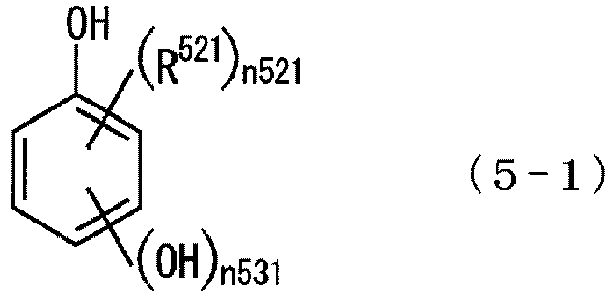

- In the general formula (5-1), R521 is a C1-20 (preferably C1-10) alkyl group which may be substituted with a C6-12 aryl group (preferably a phenyl group) or a C1-20 (preferably C1-6) alkoxycarbonyl group which may be substituted with a C6-12 aryl group (preferably a phenyl group). n521 is 0 or an integer of 1 to 4. n531 is 0 or 1, and more preferably 0.
- In the general formula (5-2), n512 is an integer of 2 to 4. R512 is an n51-valent hydrocarbon group. Although the n51-divalent hydrocarbon group may have an ether bond, an ester bond, a carbonyl group, or a hetero ring, the n51-divalent hydrocarbon group is preferably a C1-6 alkylene group. R522 is a monovalent hydrocarbon group. The monovalent hydrocarbon group may have either an ether bond or an ester bond. n522 is 0 or an integer of 1 to 4, and preferably 0.

- In the general formula (5-1-1), R5211 is a C1-20 alkyl group which may be substituted with a C6-12 aryl group. n5211 is 0 or an integer of 1 to 4.

- In the general formula (5-1-2), plural R5212 are each independently a C1-20 alkyl group which may be substituted with a C6-12 aryl group (preferably a phenyl group).

- In the general formula (5-1-3), plural R5213 are each independently a C1-20 alkyl group which may be substituted with a C6-12 aryl group (preferably a phenyl group), and preferably a benzyl group or an α-methylbenzyl group.
- As the compound of the general formula (5-1-3), a compound of the following formula (5-1-3a) or (5-1-3b) is preferable.


- In the general formula (5-2-1), R5121 is a divalent hydrocarbon group (preferably a C1-20 alkylidene group). Plural R5221 are each independently a C1-20 alkyl group. Plural n5221 are each independently 0 or an integer of 1 to 4.

- In the general formula (5-2-2), R5122 is a trivalent hydrocarbon group. Plural R5222 are each independently a C1-20 alkyl group. Plural n5222 are each independently 0 or an integer of 1 to 4.

- In the general formula (5-2-3), R3123 is a tetravalent alkane group. Plural R5223 are each independently a C1-20 alkyl group. Plural n5223 are each independently 0 or an integer of 1 to 4.
- R5121, R5122 or R5123 may have an ether bond, an ester bond, a carbonyl group, or a hetero ring. R5121, R5122 or R5123 may be a cyclic hydrocarbon group, a noncyclic hydrocarbon group or a group formed by binding at least one cyclic group with a noncyclic hydrocarbon group. The cyclic group may have a hetero ring structure or an oxo group. Examples of a hetero atom of the hetero ring include nitrogen, sulfur, and oxygen.
- R5221, R5222, and R5223 are linear or branched.
- Preferable examples of the polymer having the repeating unit (4-1-1) include phenolic novolac resins, ortho-cresolic novolac resins, phenolic resol resins, and cresolic resol resins, and phenolic novolac resins, phenolic resol resins, and cresolic resol resins are more preferable.
- Preferable examples of the polymer having the repeating unit (4-2-1) include phenolaralkyl resins and biphenylaralkyl resins.
- Preferable examples of the compound (5-1-1) include 2,5-di-tert-butylhydroquinone.
- Preferable examples of the compound (5-1-2) include 2,4-diheptylphenol, 2,4-didodecylphenol, and 2,4-dipentylphenol.
- Preferable examples of the compound (5-1-3) include stearyl 3-(3,5-di-tert-butyl-4-hydroxyphenyl)propionate (IRGANOX 1076).
- Preferable examples of the compound (5-2-1) include 4,4'-(3,3,5-trimethylcyclohexylidene)bisphenol, bisphenol A, and bisphenol F.
- Preferable examples of the compound (5-2-2) include α,α-bis(4-hydroxyphenyl)-4-(4-hydroxy-α,α-dimethylbenzyl)ethylbenzene, a compound of the following formula (5-2-2-1) and a compound of the following formula (5-2-2-2).
- Preferable examples of the compound (5-2-3) include a compound of the following formula (5-2-3-1) (IRGANOX 1010).


- Alternatively, the compound (A) is preferably at least one selected from the group consisting of the compounds (6) and the compounds (7).
R61-(COO-R62)n61 (6)
- In the general formula (6), n61 is an integer of 1 to 3. R61 is an n61-valent C1-60 hydrocarbon group. The C1-60 hydrocarbon group may have either an ether bond or an ester bond. R62 is a C1-20 aliphatic hydrocarbon group or a C6-20 aromatic hydrocarbon group.
R71-(OCO-R72)n71 (7)
- In general formula (7), n71 is 2 or 3. R71 is an n71-valent C1-60 hydrocarbon group. The C1-60 hydrocarbon group may have either an ether bond or an ester bond. R72 is a C1-20 aliphatic hydrocarbon group or a C6-20 aromatic hydrocarbon group.
- n61 is an integer of 1 to 3, preferably 2 or 3, and more preferably 3. When n61 is 1, R61 is a monovalent C1-60 hydrocarbon group. When n61 is 2, R61 is a divalent C1-60 hydrocarbon group. When n61 is 3, R61 is a trivalent C1-60 hydrocarbon group.
- n71 is 2 or 3, and preferably 2. When n71 is 2, R71 is a divalent C1-60 hydrocarbon group. When n71 is 3, R71 is a trivalent C1-60 hydrocarbon group.
- R61 is an n61-valent CI-60 hydrocarbon group. R71 is an n71-valent C1-60 hydrocarbon group. The hydrocarbon group as R61 or R71 may be an aliphatic hydrocarbon group or an aromatic hydrocarbon group. The carbon number of the hydrocarbon group is 1 to 60, preferably 2 to 60, more preferably 3 to 60, and even more preferably 3 to 56.
- Examples of the hydrocarbon group as R61 and R71 include the same groups as those mentioned as R21 above.
- The C1-60 hydrocarbon group may have either an ether bond or an ester bond. Namely, a carbon bond constituting the hydrocarbon group mentioned as R21 may be substituted with an ether bond or an ester bond.
- Among these, when n61 is 1, that is R61 is monovalent, R61 is preferably a phenyl group which may have a C1-6 alkyl group or a C1-6 alkoxy group as a substituent. When n61 is 2 or n71 is 2, that is R61 or R71 is divalent, R61 or R71 is preferably a C3-10 alkylene group (trimethylene group), an oxybisethylene group, a 1-2-benzenediyl group or a group of the following general formula (III), and more preferably a C3-10 alkylene group or a 1-2-benzenediyl group. When n61 is 3 or n71 is 3, that is R61 or R71 is trivalent, R61 or R71 is preferably a 1-2,4-benzenetriyl group.
-[(CH2)n641COO(CH2)n642OCO]m61(CH2)n643- (III)
- In the general formula (III), n641, n642 and n643 are each independently an integer of 1 to 20. m61 is an integer of 1 to 4.
- R62 and R72 are each independently a C1-20 aliphatic hydrocarbon group (preferably alkyl group) or a C6-20 aromatic hydrocarbon group (preferably phenyl group).
- When n61 is 1, R62 is preferably a C1-20, more preferably C1-6 aliphatic hydrocarbon group (preferably alkyl group).
- When n61 is 2 or n71 is 2, the carbon number of an aliphatic hydrocarbon group as R62 or R72 is 1 to 20, preferably 2 to 18, more preferably 4 to 15, and even more preferably 6 to 12. The carbon number of an aromatic hydrocarbon group as R62 or R72 is 6 to 20, and preferably 6 to 12. Examples of the aliphatic hydrocarbon group and the aromatic hydrocarbon group as R62 and R72 include the same groups as those mentioned as R22 above. Among these, a C6-12 alkyl group (an octyl group, a 7-methyloctyl group, an isononyl group, an isodecyl group, an undecyl group, or a dodecyl group) or a phenyl group is preferable as R62 and R72.
- Preferable examples of the compound (6) include compounds of the following general formula (6-1) (hereinafter, may be referred to as "compounds (6-1)") and compounds of the following general formula (6-2) (hereinafter, may be referred to as "compounds (6-2)").
R611-(COO-R612)n611 (6-1)
R621-(COO-R622)n621 (6-2)
- In the general formula (6-1), n611 is 2 or 3. R611 is an n611-valent C1-60 aliphatic hydrocarbon group. The C1-60 aliphatic hydrocarbon group may have either an ether bond or an ester bond. R612 is the same as R62.
- In the general formula (6-2), n621 is 2 or 3. R621 is an n621-valent C6-60 aromatic hydrocarbon group. The C1-60 aromatic hydrocarbon group may have either an ether bond or an ester bond. R622 is the same as R62 mentioned above.
- Preferable examples of the compound (7) include compounds of the following general formula (7-1) (hereinafter, may be referred to as "compounds (7-1)").
R711-(OCO-R712)n711 (7-1)
- In the general formula (7-1), n711 is the same as n71 mentioned above. R711 is an n711-valent Cl-60 aliphatic hydrocarbon group. The C1-60 aliphatic hydrocarbon group may have either an ether bond or an ester bond. R712 is the same as R72 mentioned above.
- R611 is an n611-valent C1-60 aliphatic hydrocarbon group. R711 is an n711-valent C1-60 aliphatic hydrocarbon group. The carbon number of the aliphatic hydrocarbon group is 1 to 60, preferably 2 to 60, more preferably 3 to 60, and even more preferably 3 to 56.
- Examples of the aliphatic hydrocarbon group as R611 and R711 include the same groups as those mentioned as R21 above.
- The C1-60 aliphatic hydrocarbon group may have either an ether bond or an ester bond. Namely, a carbon bond constituting the aliphatic hydrocarbon group mentioned as R21 above may be substituted with an ether bond or an ester bond.
- Among these, when n611 is 2 or n711 is 2, that is, R611 or R711 is divalent, R611 or R711 is preferably a C3-10 alkylene group (trimethylene group), an oxybisethylene group, a 1-2-benzenediyl group or a group of the general formula (III), and more preferably a C3-10 alkylene group or a 1-2-benzenediyl group. When n611 is 3 or n711 is 3, that is, R611 or R711 is trivalent, R611 or R711 is preferably a 1-2,4-benzenetriyl group.
- Preferable examples of the compound (6-1) include compounds of the following general formula (6-1-1) (hereinafter, may be referred to as "compounds (6-1-1)"). Preferable examples of the compound (6-2) include compounds of the following general formula (6-2-1) (hereinafter, may be referred to as "compounds (6-2-1)"). Among these, the compound (6-2-1) is more preferable.
R613-OOC-Y611-COO-R614 (6-1-1)

- In the general formula (6-1-1), R613 and R614 may be identical to or different from each other and are each the same as R612 mentioned above. Y611 is a divalent C1-60 aliphatic hydrocarbon group. The C1-60 aliphatic hydrocarbon group may have either an ether bond or an ester bond.
- In the general formula (6-2-1), R623 and n622 are each the same as R622 and n621 mentioned above. When the number of a group having an ester bond (-COOR623) bonded with a benzene ring is two (that is, n622 is 2), the groups may be bonded at any of an ortho-position (bonded with carbon atoms at the 1st position and the 2nd position of the benzene ring), a meta-position (bonded with carbon atoms at the 1st position and the 3rd position of the benzene ring) or a para-position (bonded with carbon atoms at the 1st position and 4th position of the benzene ring), and, among these, preferably bonded at the ortho-position. When the number of a group having an ester bond (-COOR623) bonded with a benzene ring is three (that is, n622 is 3), the groups may be bonded at the positions of the 1st position, the 2nd position and the 3rd position, the positions of the 1st position, the 2nd position and the 4th position, or the positions of the 1st position, the 3rd position and the 5th position, and, among them, are preferably bonded at the positions of the 1st position, the 2nd position and the 4th position.
- Preferable examples of the compound (7-1) include compounds of the following general formula (7-1-1) (hereinafter, may be referred to as "compounds (7-1-1)").
R713-COO-Y711-OCO-R714 (7-1-1)
- In the general formula (7-1-1), R713 and R714 may be identical to or different from each other, and are each the same as R72 mentioned above. Y711 is a divalent C1-60 aliphatic hydrocarbon group. The C1-20 aliphatic hydrocarbon group may have either an ether bond or an ester bond.
- Although the divalent C1-20 aliphatic hydrocarbon group as Y611 and Y711 may be chained or cyclic, the divalent C1-20 aliphatic hydrocarbon group is preferably chained. Although the chained aliphatic hydrocarbon group may be linear or branched, the chained aliphatic hydrocarbon group is preferably linear.
- Examples of the linear aliphatic hydrocarbon group include a methylene group, an ethylene group, a trimethylene group, a tetramethylene group, a pentamethylene group, a hexamethylene group, a heptamethylene group, and an octamethylene group. A carbon bond constituting the linear aliphatic hydrocarbon group may be substituted with either an ether bond or an ester bond. Among them, a C3-10 alkylene group (trimethylene group), an oxybisethylene group, or a 1-2-benzenediyl group is preferable, and a C3-10 alkylene group or a 1-2-benzenediyl group is more preferable as Y611 and Y711. When substituted with an ether bond, Y611 and Y711 are preferably an oxyethylene group, an oxytetramethylene group or a repetition thereof. When substituted with an ester bond, Y611 and Y711 are preferably groups of the general formula (III).
- Preferable examples of the compound (6-1-1) include diisononyl adipate, and compounds of the following general formula (6-1-1-1) (adipic acid-based polyester), and diisononyl adipate is more preferable.
C8H17O[CO(CH2)4COO(CH2)4O]n612CO(CH2)4COOC8H17 (6-1-1-1)
- In the general formula (6-1-1-1), n612 is an integer of 1 to 4.
- Preferable examples of the compound (6-2-1) include diethyl phthalate, di-n-octyl phthalate, bis(7-methyloctyl) phthalate, bis(2-ethylhexyl) phthalate, diisodecyl phthalate, diundecyl phthalate, diphenyl phthalate, and tris(2-ethylhexyl) trimellitate of the following formula (6-2-1a), and diethyl phthalate, diphenyl phthalate, di-n-octyl phthalate, or tris(2-ethylhexyl) trimellitate is more preferable, and tris(2-ethylhexyl) trimellitate is even more preferable.

- Preferable examples of the compound (7-1-1) include diethylene glycol dibenzoate (dibenzoic acid oxybisethylene ester).
- Additional examples of the compound (6) include compounds of the following general formula (6-3) (hereinafter, may be referred to as "compounds (6-3)").

- In the general formula (6-3), R631 is a C1-6 alkyl group or a C1-6 alkoxy group, preferably a Cl-6 alkoxy group. n631 is 1 or 2, and preferably 2. R632 is a C1-6 alkyl group.
- Among them, the compound (A) is preferably the compound (6-2), more preferably the compound (6-2-1), even more preferably diethyl phthalate, diphenyl phthalate, di-n-octyl phthalate, or tris(2-ethylhexyl) trimellitate, and even more preferably tris(2-ethylhexyl) trimellitate.
- Alternatively, the compound (A) is preferably at least one selected from the group consisting of compounds of the following general formula (S1) (hereinafter, may be referred to as "compounds (S1)"), compounds of the following general formula (S2) (hereinafter, may be referred to as "compounds (S2)"), and compounds of the following general formula (S3) (hereinafter, may be referred to as "compounds (S3)").

- In the general formula (S1), R801, R802, and R803 are each independently a C1-60 saturated or unsaturated linear or branched hydrocarbon group. When R801, R802 or R803 has a methylene group, the methylene group may be substituted with an oxygen atom, an arylene group, a cycloalkylene group or an NH group. At least one CH group constituting R801, R802 or R803 may be substituted with a nitrogen atom. At least one hydrogen atom constituting R801, R802 or R803 may be substituted with a halogen atom or a hydroxy group. R801, R802 or R803 may be bonded together to form a monocycle or polycycle.
- Among them, R801, R802 and R803 are each independently a phenyl group which may be substituted with a C1-6 alkyl group which may be substituted with a hydroxy group, or a C1-6 alkyl group.

- In the general formula (S2), R804 and R803 are each independently a C1-60 saturated or unsaturated linear or branched hydrocarbon group. When R804 or R805 has a methylene group, the methylene group may be substituted with an oxygen atom, an arylene group, a cycloalkylene group or an NH group. At least one CH group constituting R804 or R805 may be substituted with a nitrogen atom. At least one hydrogen atom constituting R804 or R805 may be substituted with a halogen atom or a hydroxy group. R104 and R805 may be bonded together to form a monocycle or a polycycle.
- Among them, R804 and R805 are each independently a C1-6 alkyl group, and the alkyl group may have an ether bond, and may be substituted with a phenyl group
R806-CH2OH (S3)
- In the general formula (S3), R806 is a C1-60 saturated or unsaturated linear or branched hydrocarbon group. When R806 has a methylene group, the methylene group may be substituted with an oxygen atom, an arylene group, a cycloalkylene group or an NH group. At least one CH group constituting R806 may be substituted with a nitrogen atom. At least one hydrogen atom constituting R806 may be substituted with a halogen atom or a hydroxy group, and the branched chains may be bonded together to form a ring.
- The compound (S1) is a tertiary alcohol, the compound (S2) is a secondary alcohol, and the compound (S3) is a primary alcohol.
- The compound (A) used in the preparation method according to the present embodiment may have at least one of one type selected from the group consisting of a hydroxy group bonded with a carbon atom to which one carbon atom is bonded in one molecule, a hydroxyl group bonded with a carbon atom to which two carbon atoms are bonded in one molecule, and a hydroxyl group bonded with a carbon atom to which three carbon atoms are bonded in one molecule, or may have at least one of two or more types selected therefrom.
- In the present specification, when the compound (A) has plural hydroxy groups in one molecule, the compound (A) is classified into a primary alcohol, a secondary alcohol, or a tertiary alcohol, based on a hydroxyl group bonded with a carbon atom to which the largest number of carbon atoms are bonded. For example, when the compound (A) has both a hydroxyl group bonded with a carbon atom to which one carbon atom is bonded in one molecule and a hydroxyl group bonded with a carbon atom to which two carbon atoms are bonded in one molecule, the compound (A) is classified into the secondary alcohol.
- The standard boiling point of the compound (A) is required to be higher than the standard boiling point of an isocyanate produced by thermal decomposition of a carbamate. Since the boiling point of the compound (A) tends to become high, a secondary alcohol or a tertiary alcohol is preferable rather than a primary alcohol as the compound (A), and a tertiary alcohol is more preferable.
- In the preparation method according to the present embodiment, an isocyanate and a hydroxy compound are produced by thermal decomposition of a carbamate. The compound (A) may also be referred to as a hydroxy compound. However, the compound (A) differs from a hydroxy compound produced by thermal decomposition of a carbamate at least in terms of the standard boiling point of the compound (A) higher than the standard boiling point of an isocyanate produced by thermal decomposition of a carbamate.
- The standard boiling point of the compound (A) is higher than the standard boiling point of a hydroxy compound produced by thermal decomposition of a carbamate by 10°C or more, for example, preferably by 30°C or more, and more preferably by 50°C or more. The standard boiling point of the compound (A) is higher than the standard boiling point of an isocyanate produced by thermal decomposition of a carbamate by 10°C or more, for example, preferably by 30°C or more, and more preferably by 50°C or more. When the standard boiling point of the compound (A) is within the above-mentioned range, an isocyanate can be produced continuously for a long time while extracting efficiently a high-boiling-point component produced by side reactions.
- Specific examples of the compound of the general formula (S1) include compounds of the following formulae (S1-1) to (S1-14), and the compound of the following formula (S1-1) or the compound of the following formula (S1-8) is preferable.


- Specific examples of the compounds of the general formula (S2) include compounds of the following formulae (S2-1) to (S2-29), and the compound of the formula (S2-29) is preferable.


- Specific examples of the compounds of the general formula (S3) include compounds of the following formulae (S3-1) to (S3-13).





- In the general formula (S31-1), n is an integer of 1 to 20.

- In the general formula (S3-12), n is an integer of 1 to 20.

- In the general formula (S3-13), x, y and z are each independently an integer of 0 to 20, the sum of x, y and z is an integer of 0 to 20, and R is -(CH2)4-, -(CH2)5-, or -(CH2)6-. The repeating unit of the following formula (S3-13-1), the repeating unit of the following formula (S3-13-2) and the repeating unit of the following formula (S3-13-3) may be contained randomly or in a block shape, the total number of the repeating unit of the following formula (S3-13-1) is x, the total number of the repeating unit of the following formula (S3-13-2) is y, and the total number of the repeating unit of the following formula (S3-13-3) is z.


- Alternatively, the compound (A) is preferably at least one selected from the group consisting of the compounds (9) and the compounds (10).

- In the general formula (9), Y91 and Y93 are each independently a C4-10 divalent hydrocarbon group having an alicyclic hydrocarbon group or an aromatic hydrocarbon group. Y91 and Y93 may be identical to or different from each other, but are preferably identical to each other. Y92 is a C4-10 trivalent hydrocarbon group having an alicyclic hydrocarbon group or an aromatic hydrocarbon group, and at least one CH group constituting the aromatic hydrocarbon group may be substituted with a nitrogen atom or a carbonyl group. n91 is an integer of 0 to 5. When n91 is 0, "-(Y92(-NCO))n91-" is a single bond, and the compound (9) is "OCN-Y91-Y93-NCO".

- In the general formula (10), p101 is an integer of 0 to 90. n101 is an integer of 1 to 100. The sum of p101 and n101 is an integer of 10 to 100. m101 is an integer of 1 to 5. R101 and R102 are each independently a hydrogen atom or a C1-5 monovalent hydrocarbon group. R103 is a C1-5 alkoxycarbonyl group or a C1-12 monovalent hydrocarbon group. R104 and R105 are each independently a monovalent organic group.
- The divalent hydrocarbon group as Y91 and Y93 may consist of a chained aliphatic hydrocarbon group, an alicyclic hydrocarbon group or an aromatic hydrocarbon group, or may be a group formed by bonding either an alicyclic hydrocarbon group or an aromatic hydrocarbon group with a chained aliphatic hydrocarbon group, a group formed by bonding an alicyclic hydrocarbon group with an aromatic hydrocarbon group, or a repetition of these groups.
- Although the divalent chained aliphatic hydrocarbon group as Y91 and Y93 may be linear or branched, the divalent chained aliphatic hydrocarbon group is preferably linear. Examples of the linear aliphatic hydrocarbon group include a methylene group, an ethylene group, a trimethylene group, a tetramethylene group, a pentamethylene group, a hexamethylene group, a heptamethylene group, an octamethylene group, a nonamethylene group, and a decamethylene group, and a C1-10 alkylene group is preferable.
- Examples of the divalent alicyclic hydrocarbon group as Y91 and Y93 include a cyclopropylene group, a cyclotetramethylene group, a cyclopentamethylene group, a cyclohexylene group, a cyclohexamethylene group, a cycloheptamethylene group, a cyclooctamethylene group, a cyclononamethylene group, and a cyclodecamethylene group, and a cyclohexylene group is preferable.
- Examples of the divalent aromatic hydrocarbon group as Y91 and Y93 include a phenylene group, and a naphthalene-diyl group, and a phenylene group is preferable.
- Among them, Y91 is preferably a group formed by bonding either an alicyclic hydrocarbon group or an aromatic hydrocarbon group with a chained aliphatic hydrocarbon group, a group formed by repetition thereof or a chained aliphatic hydrocarbon group.
- Among them, Y91 and Y93 are preferably alicyclic hydrocarbon groups, aromatic hydrocarbon groups, or groups formed by bonding either an alicyclic hydrocarbon group or an aromatic hydrocarbon group with a chained aliphatic hydrocarbon group, and more preferably Y91 is an alicyclic hydrocarbon group or an aromatic hydrocarbon group, and Y93 is a group formed by bonding either an alicyclic hydrocarbon group or an aromatic hydrocarbon group with a chained aliphatic hydrocarbon group. Alternatively, Y91 and Y93 are preferably chained aliphatic hydrocarbon groups (preferably C4-10 alkylene groups).
- Preferable examples of Y91 and Y93 include groups of the following general formula (IV) (groups (IV)).
-(CH2)n92-Y94- (IV)
- In the general formula (IV), n92 is an integer of 0 to 5. When n92 is 0, "-(CH2)n92-" is a single bond and the group (IV) is "-Y 94-". Y94 is a C4-10 divalent alicyclic hydrocarbon group or an aromatic hydrocarbon group.
- n92 is an integer of 0 to 5, preferably an integer of 0 to 4, more preferably an integer of 0 to 3, and even more preferably an integer of 0 to 2. Namely, as the chained aliphatic hydrocarbon group (alkylene group) constituting the group formed by bonding either an alicyclic hydrocarbon group or an aromatic hydrocarbon group with a chained aliphatic hydrocarbon group, a single bond or a C1-4 chained alkylene group is preferable, a single bond or a C1-3 chained alkylene group is more preferable, and a single bond, a methylene group or an ethylene group is even more preferable.
- Y94 is a C4-10 divalent alicyclic hydrocarbon group or a C6-10 divalent aromatic hydrocarbon group. Examples of the C4-10 divalent alicyclic hydrocarbon group and the C6-10 divalent aromatic hydrocarbon group as Y94 include the same groups as those mentioned as Y91 and Y93 above. Among them, Y94 is preferably a cyclopentamethylene group, a cyclohexylene group, a cyclohexamethylene group, a cycloheptamethylene group, a cyclooctamethylene group, a phenylene group or a naphthalene-diyl group, more preferably a cyclopentamethylene group, a cyclohexylene group, a cyclohexamethylene group or a phenylene group, and even more preferably a cyclohexylene group or a phenylene group.
- Y92 is a C4-10 trivalent hydrocarbon group having an alicyclic hydrocarbon group or an aromatic hydrocarbon group. The trivalent hydrocarbon group as Y92 may consist of an alicyclic hydrocarbon group or an aromatic hydrocarbon group, or may be a group formed by bonding either an alicyclic hydrocarbon group or an aromatic hydrocarbon group with a chained aliphatic hydrocarbon group, or a group formed by bonding an alicyclic hydrocarbon group and an aromatic hydrocarbon group. At least one CH group constituting the aromatic hydrocarbon group may be substituted with a nitrogen atom or a carbonyl group, and more specifically one to six CH groups may be substituted with a nitrogen atom and/or a carbonyl group. Among them, Y92 is preferably a group formed by bonding either an alicyclic hydrocarbon group or an aromatic hydrocarbon group with a chained aliphatic hydrocarbon group.
- Preferable examples of "-Y92(-NCO)-" include groups of the following general formula (V1) or (V2) (group (V1) or group (V2)).
-(CH2)n931-Y95(-NCO)- (V1)
-Y95(-(CH2)n932-NCO)- (V2)
- In the general formulae (V1) and (V2), n931 is an integer of 0 to 5, and n932 is an integer of 1 to 6. For example, when n931 is 0, "-(CH2)n93-" is a single bond, and the group (V1) is "-Y95(-NCO)-". Y95 is a C4-10 divalent alicyclic hydrocarbon group or a C6-10 divalent aromatic hydrocarbon group. At least one CH group constituting the aromatic hydrocarbon group may be substituted with a nitrogen atom and/or a carbonyl group.
- n931 is preferably an integer of 0 to 4, more preferably an integer of 0 to 3, and even more preferably an integer of 0 to 2. Namely, in the group (V1), as a chained aliphatic hydrocarbon group constituting the group formed by bonding either an alicyclic hydrocarbon group or an aromatic hydrocarbon group with the chained aliphatic hydrocarbon group, a single bond or a C1-4 chained alkylene group is preferable, a single bond or a C1-3 chained alkylene group is more preferable, and a single bond, a methylene group or an ethylene group is even more preferable.
- In contrast, n932 is preferably an integer of 1 to 6, more preferably an integer of 4 to 6, and even more preferably 6.
- Y95 is a C4-10 trivalent alicyclic hydrocarbon group or a C6-10 trivalent aromatic hydrocarbon group. Examples of the trivalent alicyclic hydrocarbon group as Y95 include a cyclobutane-triyl group, a cyclopentane-triyl group, a cyclohexanetriyl group, a cycloheptane-triyl group, a cyclooctanetriyl group, and a cyclodecane-triyl group. Examples of the trivalent aromatic hydrocarbon group as Y98 include a benzene-triyl group and a naphthalenetriyl group. Examples of the group in which at least one CH group constituting the aromatic hydrocarbon group is substituted with a nitrogen atom and/or a carbonyl group include a 2,4,6-trioxohexahydro-1,3,5-triazine-1,3,5-triynyl group of the following formula.

- In the formula, ∗ indicates the bonding position with Y91, Y93, or a carbon atom.
- Among them, Y95 is preferably a cyclopentane-triyl group, a cyclohexanetriyl group, a cycloheptane-triyl group, a cyclooctanetriyl group, a benzene-triyl group, a naphthalenetriyl group or a 2,4,6-trioxohexahydro-1,3,5-triazine-1,3,5-triynyl group, and more preferably a cyclopentane-triyl group, a cyclohexanetriyl group, a benzene-triyl group or a 2,4,6-trioxohexahydro-1,3,5-triazine-1,3,5-triynyl group.
- The type of the aliphatic ring or the aromatic ring contained in Y91, Y92 and Y93 may be identical to or different from each other, but is preferably identical to each other.
- When Y92 is the group (V2), it is preferable that Y91 and Y93 be each independently a chained aliphatic hydrocarbon group (C4-10 alkylene group).
- R101 and R102 are each independently a hydrogen atom or a C1-5 monovalent hydrocarbon group. R101 and R102 may be identical to or different from each other.
- Examples of C1-5 monovalent hydrocarbon group as R101 and R102 include aliphatic hydrocarbon groups. Although the aliphatic hydrocarbon group may be linear, branched, or cyclic, the aliphatic hydrocarbon group is preferably linear. Examples of the linear aliphatic hydrocarbon group include a methyl group, an ethyl group, a propyl group, an n-butyl group, and an n-pentyl group.
- Among them, R101 and R102 are preferably a hydrogen atom, a methyl group or an ethyl group, and more preferably a hydrogen atom or a methyl group.
- R103 is a C1-5 alkoxycarbonyl group or a C1-12 monovalent hydrocarbon group.
- Examples of the C1-5 alkoxycarbonyl group as R103 include a methoxycarbonyl group, an ethoxycarbonyl group, a propoxycarbonyl group, an isopropoxycarbonyl group, a butoxycarbonyl group, a sec-butoxycarbonyl group, a tert-butoxycarbonyl group, a pentoxycarbonyl group, and a neopentoxycarbonyl group.
- Examples of C1-12 monovalent hydrocarbon group as R103 include aliphatic hydrocarbon groups, aromatic hydrocarbon groups and groups formed by bonding an aliphatic hydrocarbon group and an aromatic hydrocarbon group.
- The aliphatic hydrocarbon group may be linear, branched, or cyclic. Examples of the linear aliphatic hydrocarbon group include the same groups as R101 and R102 mentioned above. Examples of the branched aliphatic hydrocarbon group include an isopropyl group, a sec-butyl group, an isobutyl group, a tert-butyl group, a neopentyl group, and an isohexyl group. Examples of the cyclic aliphatic hydrocarbon group (alicyclic hydrocarbon group) include a cyclopropyl group, a cyclobutyl group, a cyclopentyl group, a cyclohexyl group, a cycloheptyl group, and a cyclooctyl group.
- Examples of the aromatic hydrocarbon group include a phenyl group, and a napthyl group.
- Examples of the group formed by bonding an aliphatic hydrocarbon group and an aromatic hydrocarbon group include a benzyl group, and a phenylmethylene group.
- Among them, R103 is preferably a C1-3 alkoxycarbonyl group or an aromatic hydrocarbon group, and more preferably a methoxycarbonyl group, an ethoxycarbonyl group or a phenyl group.
- R104 and R105 are each independently a monovalent organic group. R104 and R105 may be identical to or different from each other.
- Examples of the monovalent organic group as R104 and R105 include monovalent groups mentioned as R21. Among them, a C1-20 monovalent aliphatic hydrocarbon group or a C6-20 monovalent aromatic hydrocarbon group is preferable. The CI-20 monovalent aliphatic hydrocarbon group and the C6-20 monovalent aromatic hydrocarbon group may have a substituent. Examples of the C1-20 monovalent aliphatic hydrocarbon group and the C6-20 monovalent aromatic hydrocarbon group include the same groups as those mentioned as R21 above.
- p101 is an integer of 0 to 90, preferably an integer of 0 to 80, more preferably an integer of 0 to 60, and even more preferably an integer of 0 to 40.
- n101 is an integer of 1 to 100, preferably an integer of 1 to 90, and more preferably an integer of 1 to 80.
- The sum of p101 and n101 is an integer of 10 to 100, preferably an integer of 10 to 90, more preferably an integer of 20 to 80, and even more preferably an integer of 30 to 70.
- m101 is an integer of 1 to 5, preferably an integer of 1 to 3, and more preferably 1 or 2.
- Preferable examples of the compound (9) include compounds of the following general formula (9-1) (hereinafter, may be referred to as "compounds (9-1)").

- In the general formula (9-1), Y911 and Y913 are each independently identical to Y94 mentioned above. Y912 is identical to Y95 mentioned above. n911 and n912 are each independently an integer of 1 to 5, and preferably 1. Although n911 and n912 may be identical to or different from each other, n911 and n912 are preferably identical to each other. m911 is an integer of 0 to 5. When m911 is 0, "-[(CH2)n911-(Y912(-NCO))-]" is a single bond, and the compound (9-1) is "OCN-Y911-(CH2)n912-Y913-NCO".
- As Y911 and Y913, a cyclopentamethylene group, a cyclohexylene group, a cyclohexamethylene group, a cycloheptamethylene group, a cyclooctamethylene group, a phenylene group or a naphthalene-diyl group is preferable, a cyclopentamethylene group, a cyclohexylene group, a cyclohexamethylene group or a phenylene group is more preferable, and a cyclohexylene group or a phenylene group is even more preferable.
- As Y912, a cyclopentane-triyl group, a cyclohexanetriyl group, a cycloheptane-triyl group, a cyclooctanetriyl group, a benzene-triyl group or a naphthalenetriyl group is preferable, and a cyclopentane-triyl group, a cyclohexanetriyl group or a benzene-triyl group is more preferable.
- The type of the aliphatic rings or the aromatic rings contained in Y911, Y912 and Y913 may be identical to or different from each other, but are preferably identical to each other.
- n911 and n912 are each independently an integer of 1 to 5, preferably an integer of 1 to 4, more preferably an integer of 1 to 3, and even more preferably 1 or 2. Namely, as alkylene groups connecting Y911, Y912 and Y913, C1-4 chained alkylene groups are preferable, C1-3 chained alkylene groups are more preferable, and a methylene group or an ethylene group is even more preferable.
- Additional preferable examples of the compound (9) include compounds of the following formula (9-2) (hereinafter, may be referred to as "compounds (9-2)").

- In the general formula (9-2), Y921 and Y923 are each independently a C4-10 alkylene group.
- Y912 is a 2,4,6-trioxohexahydro-1,3,5-triazine-1,3,5-triynyl group.
- n921 is an integer of 1 to 6, and is preferably 6.
- Preferable examples of the compound (10) include compounds of the following general formula (10-1) (compounds (10-1)).

- In the general formula (10-1), p1011 is an integer of 0 to 50, preferably an integer of 0 to 40, more preferably an integer of 0 to 30, and even more preferably an integer of 0 to 25. When p1011 is 0, an ethylene group having R1011 and R1014 as side-chains becomes a single bond.
- s1011 is an integer of 0 to 50, preferably an integer of 0 to 40, more preferably an integer of 0 to 30, and even more preferably an integer of 0 to 25. When s1011 is 0, an ethylene group having R1012 and R1015 as side-chains becomes a single bond.
- n1011 is the same as n101 mentioned above, and is preferably an integer of 1 to 90, more preferably an integer of 1 to 80, and even more preferably an integer of 1 to 60.
- The sum of p1011, s1011 and n1011 is an integer of 10 to 100, preferably an integer of 10 to 90, more preferably an integer of 20 to 80, and even more preferably an integer of 30 to 70.
m1011 is the same as m101 mentioned above, and is preferably an integer of 1 to 3, and more preferably 1 or 2. - R1011, R1012 and R1013 are each the same as R101 and R102 mentioned above, and are preferably a hydrogen atom, a methyl group or an ethyl group, and more preferably a hydrogen atom or a methyl group. R1011, R1012 and R1013 may be identical to or different from each other.
- R1014 and R1015 are each the same as R103 mentioned above, and are preferably a C1-3 alkoxycarbonyl group or an aromatic hydrocarbon group, and more preferably a methoxycarbonyl group, an ethoxycarbonyl group or a phenyl group. R1014 and R1013 may be identical to or different from each other.
- R1016 and R1017 are each the same as R104 and R105 mentioned above.
- Specific examples of the preferable compound (9-1) include 4,4'-diphenylmethane diisocyanate, 4,4'-dicyclohexylmethane diisocyanate, compounds of the following general formula (9-1-1) (polymethylene polyphenyl polyisocyanate (polymeric MDI)), compounds of the following general formula (9-1-2), compounds of the following general formula (9-1-3) (polymeric hydrogenated MDI), and compounds of the following general formula (9-1-4), and 4,4'-diphenylmethane diisocyanate or 4,4'-dicyclohexylmethane diisocyanate is more preferable.


- In the general formula (9-1-1), n913 is an integer of 1 to 5.
- In the general formula (9-1-2), n914 is an integer of 1 to 5.
- In the general formula (9-1-3), n915 is an integer of 1 to 5.
- In the general formula (9-1-4), n916 is an integer of 1 to 5.
- Preferable examples of the compound (9-2) include a compound of the following formula (9-2a).

- When p1011 and s1011 are 0, preferable examples of the compound (10-1) include compounds of the following general formula (10-1-1), and compounds of the following general formula (10-1-2).


- In the general formula (10-1-1), n1012 is an integer of 10 to 100, preferably an integer of 10 to 90, more preferably an integer of 20 to 80, and even more preferably an integer of 30 to 70. m1012 is the same as m101 mentioned above, and is preferably an integer of 1 to 3, and more preferably 1or 2. R1018 and R1019 are each the same as R104 and R105 mentioned above.
- In the general formula (10-1-2), n1013 is an integer of 10 to 100, preferably an integer of 10 to 90, more preferably an integer of 20 to 80, and even more preferably an integer of 30 to 70. m1013 is the same as m101 mentioned above, and is preferably an integer of 1 to 3, and more preferably 1 or 2. R1020 and R1021 are each the same as R104 and R105 mentioned above.
- When R1014 is a methoxycarbonyl group and s1011 is 0, preferable examples of the compound (10-1) include compounds of the following general formula (10-1-3), compounds of the following general formula (10-1-4), and compounds of the following general formula (10-1-5).


- In the general formula (10-1-3), p1012 is an integer of 1 to 90. n1014 is an integer of 1 to 99. The sum of p1012 and n1014 is an integer of 10 to 100. m1014 is an integer of 1 to 5. R1022 and R1023 are each the same as R104 and R105 mentioned above.
- In the general formula (10-1-4), p1013 is an integer of 1 to 90. n1015 is an integer of 1 to 99. The sum of p1013 and n1015 is an integer of 10 to 100. m1015 is an integer of 1 to 5. R1024 and R1025 are each the same as R104 and R105 mentioned above.
- In the general formula (10-1-5), p1014 is an integer of 1 to 90. n1016 is an integer of 1 to 99. The sum of p1014 and n1016 is an integer of 10 to 100. m1016 is an integer of 1 to 5. R1026 and R1027 are each the same as R104 and R105 mentioned above.
- When R1015 is a phenyl group and p1011 is 0, preferable examples of the compound (10-1) include compounds of the following general formula (10-1-6), compounds of the following general formula (10-1-7), and compounds of the following general formula (10-1-8).


- In the general formula (10-1-6), s1012 is an integer of 1 to 90. n1017 is an integer of 1 to 99. The sum of s1012 and n1017 is an integer of 10 to 100. m1017 is an integer of 1 to 5. R1028 and R1029 are each the same as R104 and R105 mentioned above.
- In the general formula (10-1-7), s1013 is an integer of 1 to 90. n1018 is an integer of 1 to 99. The sum of s1013 and n1018 is an integer of 10 to 100. m1018 is an integer of 1 to 5. R1030 and R1031 are each the same as R104 and R105 mentioned above.
- In the general formula (10-1-8), s1014 is an integer of 1 to 90. n1019 is an integer of 1 to 99. The sum of s1014 and n1019 is an integer of 10 to 100. m1019 is an integer of 1 to 5. R1032 and R1033 are each the same as R104 and R105 mentioned above.
- When R1014 is a methoxycarbonyl group and R1015 is a phenyl group, preferable examples of the compound (10-1) include compounds of the following general formula (10-1-9a), compounds of the following general formula (10-1-9b), and compounds of the following general formula (10-1-9c).


- In the general formula (10-1-9a), p1015 is an integer of 1 to 50. s1015 is an integer of 1 to 50. n1020 is an integer of 1 to 98. The sum of p1015, s1015 and n1020 is an integer of 10 to 100. m1020 is an integer of 1 to 5. R1034 and R1035 are each the same as R104 and R105 mentioned above.
- In the general formula (10-1-9b), p1016 is an integer of 1 to 50. s1016 is an integer of 1 to 50. n1021 is an integer of 1 to 98. The sum of p1016, s1016 and n1021 is an integer of 10 to 100. m1021 is an integer of 1 to 5. R1036 and R1037 are each the same as R104 and R105 mentioned above.
- In the general formula (10-1-9c), p1017 is an integer of 1 to 50. s1017 is an integer of 1 to 50. n1022 is an integer of 1 to 98. The sum of p1017, s1017 and n1022 is an integer of 10 to 100. m1022 is an integer of 1 to 5. R1038 and R1039 are each the same as R104 and R105 mentioned above.
- Alternatively, the compound (A) is preferably at least one selected from C9-35 chained or cyclic aliphatic hydrocarbons.
- The carbon number of the chained aliphatic hydrocarbon is preferably 12 to 35, more preferably 12 to 30, and even more preferably 14 to 30. The chained aliphatic hydrocarbon may be a saturated aliphatic hydrocarbon or an unsaturated aliphatic hydrocarbon. Although the chained aliphatic hydrocarbon may be linear or branched, the chained aliphatic hydrocarbon preferably has a branched chain, and more preferably a branched chain composed of a C1-3 linear aliphatic hydrocarbon group. Examples of the C1-3 linear aliphatic hydrocarbon group include a methyl group, an ethyl group, and a propyl group.
- Specific examples of the chained aliphatic hydrocarbon include 2,2,4,4,6-pentamethylheptane, 2-methyl-1-undecene, dodecane, 1-tridecene, tridecane, 1-tetradecene, tetradecane, 1-pentadecene, pentadecane, 1-hexadecene, hexadecane, 2,2,4,4,6,8,8-pentamethylnonane, 1-heptadecene, heptadecane, 1-octadecene, octadecane, 1-nonadecene, 2,6,10,1,4-tetramethylpentadecane, 1-eicosene, eicosane, heneicosane, docosane, tricosane, tetracosane, pentacosane, hexacosane, heptacosane, octacosane, nonacosane, squalene, and squalane, and squalane is preferable.
- The cyclic aliphatic hydrocarbon (that is, alicyclic hydrocarbon) may be monocyclic, polycyclic, or condensed polycyclic. The carbon number of the alicyclic hydrocarbon is preferably 9 to 20, and more preferably 9 to 16. The alicyclic hydrocarbon may be formed by bonding a chained aliphatic hydrocarbon group to a ring, and a C1-6 linear aliphatic hydrocarbon group is preferable as the chained aliphatic hydrocarbon group bonded to a ring. Examples of the C1-6 linear aliphatic hydrocarbon group include a methyl group, an ethyl group, a propyl group, a butyl group, a pentyl group, and a hexyl group.
- Specific examples of the alicyclic hydrocarbon include butylcyclohexane, 1-2,4-trimethylcyclohexane, decahydronaphthalene, adamantane, tricyclodecane, methyldecarine, tricyclo[6.2.1.02,7]undeca-4-ene, tetracyclododecane, bicyclohexyl, dicyclopentadiene, α-pinene, and β-pinene.
- Among them, the compound (A) is preferably at least one selected from the group consisting of the compound of the formula (5-1-3a), the compound of the formula (5-1-3b), the compound of the formula (6-2-1a) and the compound of the formula (9-2a), more preferably the compound of the formula (5-1-3a) or the compound of the formula (5-1-3b), and even more preferably the compound of the formula (5-1-3a).
- Preferable examples of a carbonic acid ester available to prepare a carbamate include compounds of the following general formula (3) (hereinafter, may be referred to as "compounds (3)").
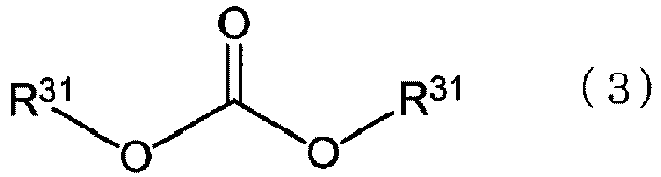
- In the general formula (3), plural R31 are each independently a C1-20 aliphatic hydrocarbon group or a C6-20 aromatic hydrocarbon group. The plural R31 may be identical to or different from each other. Among them, the plural R31 are preferably identical to each other.
- Examples of the C1-20 aliphatic hydrocarbon group and the C6-20 aromatic hydrocarbon group as R31 include the same groups as R22 mentioned above.
- Preferable examples of the compound (3) include diaryl carbonates of the following general formula (3 - 1) (hereinafter, may be referred to as "diaryl carbonates (3-1)").

- In the general formula (3-1), plural R311 are each independently a C6-20 aromatic hydrocarbon group.
- In the general formula (3-1), R311 is a C6-20 aromatic hydrocarbon group, preferably a C6-12 aromatic hydrocarbon group, and more preferably a C6-8 aromatic hydrocarbon group. Specific examples of such R811 include the C6-20 aromatic hydrocarbon groups mentioned as R22 above.
- Preferable examples of the diaryl carbonate (3-1) include diaryl carbonates in which R311 is a C6-8 aromatic hydrocarbon group. Specific examples of such a diaryl carbonate (3-1) include diphenyl carbonate, di(methylphenyl)carbonate (each isomer), di(diethylphenyl)carbonate (each isomer), and di(methylethylphenyl)carbonate (each isomer).
- The carbonic acid ester may contain a metal atom. The amount of the metal atom relative to the mass of the carbonic acid ester is preferably 0.001 ppm by mass to 100,000 ppm by mass, more preferably 0.001 ppm by mass to 50,000 ppm by mass, and even more preferably 0.002 ppm by mass to 30,000 ppm by mass.
- The metal atom may be present as a metal ion or a simple substance of the metal atom. Among them, the metal atom is preferably a divalent to tetravalent metal atom, and more preferably at least one metal selected from the group consisting of iron, cobalt, nickel, zinc, tin, copper and titanium.
- As the preparation method of the carbonic acid ester, a conventionally-known method may be adopted. Particularly, a method disclosed in International Patent Application Publication No.
2009/139061 (Reference Document 1) in which an organic tin compound having a tin-oxygen-carbon bond and carbon dioxide are reacted to prepare an aliphatic carbonic acid ester, and then an aromatic carbonic acid ester (that is, diaryl carbonate) is prepared from the aliphatic carbonic acid ester and an aromatic hydroxy compound is preferable. The carbonic acid ester may be prepared using a preparation device disclosed in International Patent Application Publication No.2009/139061 (Reference Document 1), for example. - An amine compound in which an amino group is present instead of a carbamate group of a carbamate to be subjected to thermal decomposition is used to prepare the carbamate. Namely, an amine compound in which an amino group (-NH2) is present instead of a carbamate group of the carbamate of the general formula (2), the carbamate of the general formula (2-1a), the carbamate of the general formula (2-1b), the carbamate of the general formula (2-2a), the carbamate of the general formula (2-2b), the carbamate of the general formula (2-2c), the carbamate of the general formula (2-2d), the carbamate of the general formula (2-2e), the carbamate of the general formula (2-3a), the carbamate of the general formula (2-3b), the carbamate of the general formula (2-3c), the carbamate of the general formula (2-4a) or the carbamate of the general formula (2-4b) is preferable.
- An isocyanate obtained in the preparation method according to the present embodiment is formed by substituting a carbamate group of the carbamate subjected to thermal decomposition with an isocyanate group. Among them, an isocyanate in which an isocyanate group (-NCO) is present instead of a carbamate group of the carbamate of the general formula (2), the carbamate of the general formula (2-1a), the carbamate of the general formula (2-1b), the carbamate of the general formula (2-2a), the carbamate of the general formula (2-2b), the carbamate of the general formula (2-2c), the carbamate of the general formula (2-2d), the carbamate of the general formula (2-2e), the carbamate of the general formula (2-3a), the carbamate of the general formula (2-3b), the carbamate of the general formula (2-3c), the carbamate of the general formula (2-4a), or the carbamate of the general formula (2-4b) is preferable. Namely, a compound of the following general formula (2)', a compound of the following general formula (2-1a)', a compound of the following general formula (2-1b)', a compound of the following general formula (2-2a)', a compound of the following general formula (2-2b)', a compound of the following general formula (2-2c)', a compound of the following general formula (2-2d)', a compound of the following general formula (2-2e)', a compound of the following general formula (2-3a)', a compound of the following general formula (2-3b)', a compound of the following general formula (2-3c)', a compound of the following general formula (2-4a)' or a compound of the following general formula (2-4b)' is preferable.
R21-(NCO)n21 (2)'
R211-NCO (2-1a)'


- In the general formula (2)', n21 and R21 are the same as n21 and R21 in the general formula (2), respectively.
- In the general formula (2-1a)', R211 is the same as R211 in the general formula (2-1a).
- In the general formula (2-1b)', X211, R214 and R215 are the same as X211, R214 and R215 in the general formula (2-1b), respectively.
- In the general formula (2-2a)', R221 is the same as R221 in the general formula (2-2a).
- In the general formula (2-2b)', X221, R224 and R225 are the same as X221, R224 and R225 in the general formula (2-2b), respectively.
- In the general formula (2-2c)', X222, Y221 and R228 are the same as X222, Y221 and R228 in the general formula (2-2c), respectively.
- In the general formula (2-2d)', X223, Y222 and R231 are the same as X223, Y222 and R231 in the general formula (2-2d), respectively.
- In the general formula (2-2e)', Y223, R232 and R233 are the same as Y223, R232 and R233 in the general formula (2-2e), respectively.
- In the general formula (2-3a)', X251, R252 and R253 are the same as X251, R252 and R253 in the general formula (2-3a), respectively.
- In the general formula general formula (2-3b)', n251, n252, n253, n254, n255, n256, m251, m252 and m253 are the same as n251, n252, n253, n254, n255, n256, m251, m252 and m253 in the general formula (2-3b), respectively.
- In the general formula (2-3c)', R257 and plural Y251 are the same as R257 and Y251 in the general formula (2-3c), respectively.
- In the general formula (2-4a)', X241, R242 and R243 are the same as X241, R242 and R243 in the general formula (2-4a), respectively.
- In the general formula (2-4b)', Y241 and R244 are the same as Y241 and R244 in the general formula (2-4b), respectively.
- Hereinafter, the present embodiment will be described in more detail with reference to specific examples and comparative examples, but the present embodiment is not limited to the following examples provided that the gist of the present embodiment is not exceeded.
- 30 kg of 3-(phenoxycarbonylamino-methyl)-3,5,5-trimethylcyclohexylcarbamic acid phenyl ester, 40 kg of benzophenone and 30 kg of a phenolic novolac resin were mixed in a stirring tank heated at 120°C under nitrogen at atmospheric pressure to obtain a uniform mixture liquid.
- The mixture liquid prepared in the step 1 was charged in a
storage tank 101 of anisocyanate preparation device 1A shown inFig. 1 . A mixture liquid composed of a phenolic novolac resin and benzophenone was charged into areactor 100 equipped with a heat medium jacket to form a state in which the benzophenone was refluxed through aline 16, acondenser 115, a storage tank 103, aliquid feed pump 112, and aline 17 provided on the upper part of a packedbed 108 while maintaining the temperature of the heat medium passing through the heat medium jacket at 270°C and adjusting the internal pressure. - The mixture liquid was supplied from the
storage tank 101 to thereactor 100 via a line 10 and aliquid feed pump 116 at 1 kg/hr to allow thermal decomposition of 3-(phenoxycarbonylamino-methyl)-3,5,5-trimethylcyclohexyl carbamic acid phenyl ester to proceed. A mixture liquid containing phenol produced by thermal decomposition and benzophenone was collected in the storage tank 103 via theline 16 and thecondenser 115 provided on the upper part of the packedbed 108. In contrast, a mixture liquid containing isophorone diisocyanate produced by thermal decomposition, benzophenone, and the phenolic novolac resin was collected in a storage tank 104 via aline 14 and acondenser 114 provided on the upper part of a packedbed 107 to form a reflux state through aliquid feed pump 111 and a line15. The mixed liquid containing benzophenone as the main component was collected in astorage tank 105 via aline 12 and acondenser 113 provided on the upper part of a packedbed 106 during operation and a reflux state was formed via apump 110 and aline 13. Furthermore, the reaction liquid was extracted from the bottom of thereactor 100 via aline 11 to be collected in astorage tank 102 via aliquid feed pump 109 such that the liquid surface inside thereactor 100 was constant. The yield of isophorone diisocyanate collected in the storage tank 104 was 69%. The above operation could be continuously performed for 200 hours. - 20 kg of the compound of the formula (2-1b-2) (compound (2-1b-2)), 30 kg of p-xylene and 50 kg of 2,5-di-tert-butylhydroquinone were mixed in a stirring tank heated at 120°C under nitrogen at atmospheric pressure to obtain a uniform mixture liquid.
- The mixture liquid prepared in the step 1 was charged in a
storage tank 201 of anisocyanate preparation device 2A shown inFig. 2 . A p-xylene was charged into adistillation column 210 to form a state in which p-xylene was refluxed via aline 23, acondenser 205, astorage tank 203, aliquid feed pump 209, and aline 24 provided in the upper part of thedistillation column 210 while maintaining the temperature of areboiler 206 at 200°C and adjusting the internal pressure. - The mixture liquid was supplied from the
storage tank 201 to a fallingfilm type reactor 200 preheated at 250°C via aline 20 and aliquid feed pump 207 at 1 kg/hr to allow thermal decomposition of the compound (2-1b-2) to proceed. Gaseous components containing ethanol and methyl 2-isocyanatopropionate and p-xylene produced by thermal decomposition were supplied to thedistillation column 210 via aline 22. In contrast, 2,5-di-tert-butylhydroquinone containing a by-product was collected in a storage tank 202 from the bottom of the falling film type reactor via aline 21. The gaseous components collected via theline 22 were separated by distillation in thedistillation column 210 to collect a mixture liquid containing ethanol and p-xylene in astorage tank 203 via aline 23 and acondenser 205. In contrast, a mixture liquid containing methyl 2-isocyanatopropionate, p-xylene and a small amount of 2,5-di-tert-butylhydroquinone was collected in astorage tank 204 from the bottom of thedistillation column 210 via aline 26, aliquid feed pump 208, and aline 27, and a portion of the liquid extracted from the bottom of the column was heated by areboiler 206 and returned to the bottom of the column via aline 25. The yield of methyl 2-isocyanatopropionate collected in thestorage tank 204 was 92%. The above operation could be continuously performed for 200 hours. - 60 kg of 3-(phenoxycarbonylamino-methyl)-3,5,5-trimethylcyclohexylcarbamic acid phenyl ester and 80 kg of benzophenone were mixed in a stirring tank heated at 120°C under nitrogen at atmospheric pressure to obtain a uniform mixture liquid.
- A mixture liquid containing isophorone diisocyanate produced by thermal decomposition and benzophenone was collected in a storage tank 104 by conducting thermal decomposition by the same method as that in the step 2 "Thermal decomposition of carbamate" in Example 1-1 except that the mixture liquid prepared in the step 1 was charged in a
storage tank 101 of theisocyanate preparation device 1A shown inFig. 1 , benzophenone was charged in areactor 100 equipped with a heat medium jacket to form a state in which benzophenone was refluxed, and the mixture liquid was supplied from thestorage tank 101 via a line 10 to thereactor 100 at 0.4 kg/hr. The yield of isophorone diisocyanate collected in the storage tank 104 was 15%. When the above operation was continued for 2 days, theline 11 was blocked and the continuation of the operation became difficult. - 40 kg of the compound (2-1b-2) and 60 kg of p-xylene were mixed in a stirring tank heated at 120°C under nitrogen at atmospheric pressure to obtain a uniform mixture liquid.
- A mixture liquid containing methyl 2-isocyanatopropionate and p-xylene was collected in a
storage tank 204 via aline 27 by conducting thermal decomposition by the same method as that in the step 2 "Thermal decomposition of carbamate" in Example 1-2 except that the mixture liquid prepared in the step 1 was charged in astorage tank 201 of theisocyanate preparation device 2A shown inFig. 2 , p-xylene was charged in adistillation column 210 to form a state in which p-xylene was refluxed, and the mixture liquid was supplied from thestorage tank 201 via aline 20 to a fallingfilm type reactor 200 preheated at 250°C at 0.3 kg/hr to allow a thermal decomposition of the compound (2-1b-2) to proceed. The yield of methyl 2-isocyanatopropionate collected in thestorage tank 204 was 28%. When the above operation was continued for 2 days, theline 21 was blocked and the continuation of the operation became difficult. - 30 kg of 1,6-hexamethylene di(carbamic acid phenyl ester) (carbamate), 10 kg of n-dodecane (inert solvent) and 60 kg of diethyl phthalate (compound A) were mixed in a stirring tank heated at 120°C under nitrogen at atmospheric pressure to obtain a uniform mixture liquid.
- The mixture liquid prepared in the step 1 was charged in a
storage tank 101 of theisocyanate preparation device 1A shown inFig. 1 . Diethyl phthalate and n-dodecane were charged in areactor 100 equipped with a heat medium jacket to form a state in which n-dodecane was refluxed via aline 16, acondenser 115, a storage tank 103 and aline 17 provided on the upper part of a packedbed 108 while maintaining the temperature of a heat medium passing through the heat medium jacket at 270°C and adjusting the internal pressure. - The mixture liquid was supplied to the
reactor 100 from astorage tank 101 via a line 10 at 1 kg/hr to allow a thermal decomposition of 1,6-hexamethylene di(carbamic acid phenyl ester) to proceed. A mixture liquid containing phenol produced by thermal decomposition and n-dodecane was collected in the storage tank 103 via aline 16 and acondenser 115 provided on the upper part of the packedbed 108. In contrast, a mixture liquid containing hexamethylene diisocyanate produced by thermal decomposition, n-dodecane and diethyl phthalate was collected in a storage tank 104 via aline 14 and acondenser 114 provided on the upper part of a packedbed 107. Furthermore, the reaction liquid was extracted from the bottom of thereactor 100 via aline 11 to be collected in astorage tank 102 such that the liquid surface inside thereactor 100 was constant. The yield of hexamethylene diisocyanate collected in the storage tank 104 was 58%. The above operation could be continuously performed for 200 hours. - 10 kg of 1,6-hexamethylene di(carbamic acid phenyl ester) (carbamate), 20 kg of triethylbenzene (inert solvent) and 70 kg of tris(2-ethylhexyl) trimellitate were mixed in a stirring tank heated at 120°C under nitrogen at atmospheric pressure to obtain a uniform mixture liquid.
- The mixture liquid prepared in the step 1 was charged in a
storage tank 201 of theisocyanate preparation device 2A shown inFig. 2 . Triethylbenzene was charged in adistillation column 210 to form a state in which triethylbenzene was refluxed via aline 23, acondenser 205, astorage tank 203 and aline 24 provided on the upper part of thedistillation column 210 while maintaining the temperature of areboiler 206 at 200°C and adjusting the internal pressure. - The mixture liquid was supplied at 1 kg/hr from the
storage tank 201 via aline 20 to a fallingfilm type reactor 200 preheated at 250°C to allow a thermal decomposition of 1,6-hexamethylene di(carbamic acid phenyl ester) to proceed. Gaseous components containing phenol, hexamethylene diisocyanate and triethylbenzene produced by thermal decomposition were supplied to thedistillation column 210 via aline 22. In contrast, tris(2-ethylhexyl) trimellitate containing a by-product was collected from the bottom of the falling film type reactor via aline 21 in a storage tank 202. The gaseous components collected via theline 22 were separated by distillation in thedistillation column 210, and the mixture liquid containing phenol and triethylbenzene was collected in astorage tank 203 via aline 23 and acondenser 205. In contrast, the mixture liquid containing hexamethylene diisocyanate, triethylbenzene and a small amount of tris(2-ethylhexyl) trimellitate was collected via aline 27 in astorage tank 204. The yield of hexamethylene diisocyanate collected in thestorage tank 204 was 88%. The above operation could be continuously performed for 200 hours. - 10 kg of the compound (2-1b-2) (carbamate), 20 kg of triethylbenzene (inert solvent) and 70 kg of tris(2-ethylhexyl) trimellitate (compound A) were mixed in a stirring tank heated at 120°C under nitrogen at atmospheric pressure to obtain a uniform mixture liquid.
- The mixture liquid prepared in the step 1 was charged in a
storage tank 201 of theisocyanate preparation device 2A shown inFig. 2 . Triethylbenzene was charged in adistillation column 210 to form a state in which triethylbenzene was refluxed via aline 23, acondenser 205, astorage tank 203 and aline 24 provided on the upper part of thedistillation column 210 while maintaining the temperature of areboiler 206 at 200°C and adjusting the internal pressure. - The mixture liquid was supplied at 1 kg/hr from the
storage tank 201 via aline 20 to a fallingfilm type reactor 200 preheated at 250°C to allow a thermal decomposition of the compound (2-1b-2) to proceed. Gaseous components containing phenol, methyl 2-isocyanatopropionate and triethylbenzene produced by thermal decomposition were supplied to thedistillation column 210 via aline 22. In contrast, tris(2-ethylhexyl) trimellitate containing a by-product was collected from the bottom of the falling film type reactor via aline 21 in a storage tank 202. The gaseous components collected via theline 22 were separated by distillation in thedistillation column 210, and a mixture liquid containing phenol and triethylbenzene was collected in thestorage tank 203 via theline 23 andcondenser 205. In contrast, a mixture liquid containing methyl 2-isocyanatopropionate, triethylbenzene and a small amount of tris(2-ethylhexyl) trimellitate was collected in astorage tank 204 via aline 27. The yield of methyl 2-isocyanatopropionate collected in thestorage tank 204 was 88%. The above operation could be continuously performed for 200 hours. - 60 kg of 1,6-hexamethylene di(carbamic acid phenyl ester) and 30 kg of n-dodecane were mixed in a stirring tank heated at 120°C under nitrogen at atmospheric pressure to obtain a uniform mixture liquid.
- A mixture liquid containing hexamethylene diisocyanate produced by thermal decomposition and n-dodecane was collected in a storage tank 104 by conducting thermal decomposition by the same method as that in the step 2 "Thermal decomposition of carbamate" in Example 2-1 except that the mixture liquid prepared in the step 1 was charged in a
storage tank 101 of theisocyanate preparation device 1A shown inFig. 1 , n-dodecane was charged in areactor 100 equipped with a heat medium jacket to form a state in which n-dodecane was refluxed, and the mixture liquid was supplied at 0.4 kg/hr from thestorage tank 101 via a line 10 to thereactor 100. The yield of hexamethylene diisocyanate collected in the storage tank 104 was 18%. When the above operation was continued for 2 days, theline 11 was blocked and the continuation of the operation became difficult. - 10 kg of 1,6-hexamethylene di(carbamic acid phenyl ester) and 20 kg of triethylbenzene were mixed in a stirring tank heated at 120°C under nitrogen at atmospheric pressure to obtain a uniform mixture liquid.
- A mixture liquid containing hexamethylene diisocyanate and triethylbenzene was collected in a
storage tank 204 via aline 27 by conducting thermal decomposition by the same method as that in the step 2 "Thermal decomposition of carbamate" in Example 2-2 except that the mixture liquid prepared in the step 1 was charged in astorage tank 201 of theisocyanate preparation device 2A shown inFig. 2 , triethylbenzene was charged in adistillation column 210 to form a state in which triethylbenzene was refluxed, and the mixture liquid was supplied at 0.3 kg/hr from thestorage tank 201 via aline 20 to a fallingfilm type reactor 200 preheated at 250°C to allow a thermal decomposition of 1,6-hexamethylene di(carbamic acid phenyl ester) to proceed. The yield of hexamethylene diisocyanate collected in thestorage tank 204 was 23%. When the above operation was continued for 2 days, theline 21 was blocked and the continuation of the operation became difficult. - 30 kg of the compound (2-1b-2) and 60 kg of triethylbenzene were mixed in a stirring tank heated at 120°C under nitrogen at atmospheric pressure to obtain a uniform mixture liquid.
- A mixture liquid containing methyl 2-isocyanatopropionate and triethylbenzene was collected in a
storage tank 204 via aline 27 by conducting thermal decomposition by the same method as that in the step 2 "Thermal decomposition of carbamate" in Example 2-2 except that the mixture liquid prepared in the step 1 was charged in astorage tank 201 of theisocyanate preparation device 2A shown inFig. 2 , triethylbenzene was charged in adistillation column 210 to form a state in which triethylbenzene was refluxed, and the mixture liquid was supplied at 0.3 kg/hr from thestorage tank 201 via aline 20 to a fallingfilm type reactor 200 preheated at 250°C to allow a thermal decomposition of the compound of the formula (E-3) to proceed. The yield of methyl 2-isocyanatopropionate collected in thestorage tank 204 was 20%. When the above operation was continued for 2 days, theline 21 was blocked and the continuation of the operation became difficult. - 20 kg of 3-(phenoxycarbonylamino-methyl)-3,5,5-trimethylcyclohexylcarbamic acid phenyl ester (carbamate), 20 kg of triethylbenzene (inert solvent) and 60 kg of 1,3-bis(α-hydroxyisopropyl)benzene (compound A) were mixed in a stirring tank heated at 120°C under nitrogen at atmospheric pressure to obtain a uniform solution.
- The mixture liquid obtained in the "step of preparing mixture liquid" was charged in a
storage tank 101 of theisocyanate preparation device 1A shown inFig. 1. 1 ,3-bis(α-hydroxyisopropyl)benzene and triethylbenzene were charged in areactor 100 equipped with a heat medium jacket to form a state in which triethylbenzene was refluxed via aline 16, acondenser 115, a storage tank 103, and aline 17 provided on the upper part of a packedbed 108 while maintaining the temperature of a heat medium passing through the heat medium jacket at 270°C and adjusting the internal pressure. - The mixture liquid was supplied at 1 kg/hr from the
storage tank 101 via a line 10 to thereactor 100 to allow a thermal decomposition of 3-(phenoxycarbonylamino-methyl)-3,5,5-trimethylcyclohexyl carbamic acid phenyl ester to proceed. A mixture liquid containing phenol produced by thermal decomposition and triethylbenzene was collected in a storage tank 103 via aline 16 and acondenser 115 provided on the upper part of a packedbed 108, and a mixture liquid containing isophorone diisocyanate produced by thermal decomposition and triethylbenzene was collected in a storage tank 104 via aline 14 and acondenser 114 provided on the upper part of a packedbed 107. In contrast, the reaction liquid was extracted from the bottom of thereactor 100 via aline 11 to be collected in astorage tank 102 such that the liquid surface inside thereactor 100 was constant. The yield of isophorone diisocyanate collected in the storage tank 104 was 80%. The above operation could be continuously performed for 200 hours. - 30 kg of N,N'-(4,4'-methanediyl-diphenyl)-dicarbamic acid diphenyl ester (carbamate), 30 kg of benzyltoluene (inert solvent) and 40 kg of triphenylmethanol (compound A) were mixed in a stirring tank heated at 150°C under nitrogen at atmospheric pressure to obtain a uniform solution.
- The mixture liquid obtained in the "step of preparing mixture liquid" was charged in a
storage tank 201 of theisocyanate preparation device 2A shown inFig. 2 . Benzyltoluene was charged in adistillation column 210 to form a state in which benzyltoluene was refluxed via aline 23, acondenser 205, astorage tank 203, and aline 24 provided on the upper part of thedistillation column 210 while maintaining the temperature of areboiler 206 at 200°C and adjusting the internal pressure. - The mixture liquid was supplied at 1 kg/hr from the
storage tank 201 via aline 20 to a fallingfilm type reactor 200 preheated at 250°C to allow a thermal decomposition of N,N'-(4,4'-methanediyl-diphenyl)-dicarbamic acid diphenyl ester to proceed. Gaseous components containing phenol, 4,4'-diphenylmethane diisocyanate and benzyltoluene produced by thermal decomposition were supplied to thedistillation column 210 via aline 22. In contrast, triphenylmethanol containing a by-product was collected from the bottom of the falling film type reactor via aline 21 in a storage tank 202. The gaseous components collected via theline 22 were separated by distillation in thedistillation column 210, and a mixture liquid containing phenol and benzyltoluene was collected in astorage tank 203 via aline 23 and acondenser 205. In contrast, a mixture liquid containing 4,4'-diphenylmethane diisocyanate and benzyltoluene was collected in astorage tank 204 via aline 27. The yield of 4,4'-diphenylmethane diisocyanate collected in thestorage tank 204 was 79%. The above operation could be continuously performed for 200 hours. - 20 kg of the compound of the formula (2-1b-3) (compound (2-1b-3)) (carbamate), 20 kg of triethylbenzene (inert solvent) and 60 kg of triphenylmethanol (compound A) were mixed in a stirring tank heated at 150°C under nitrogen at atmospheric pressure to obtain a uniform solution.
- The mixture liquid obtained in the "step of preparing mixture liquid" was charged in a
storage tank 201 of theisocyanate preparation device 2A shown inFig. 2 . Triethylbenzene was charged in adistillation column 210 to form a state in which triethylbenzene was refluxed via aline 23, acondenser 205, astorage tank 203, and aline 24 provided on the upper part of thedistillation column 210 while maintaining the temperature of areboiler 206 at 200°C and adjusting the internal pressure. - The mixture liquid was supplied at 1 kg/hr from the
storage tank 201 via aline 20 to a fallingfilm type reactor 200 preheated at 250°C to allow a thermal decomposition of the compound (2-1b-3) to proceed. Gas containing methyl 2-isocyanatopropionate produced by thermal decomposition and triethylbenzene was supplied to thedistillation column 210 via aline 22. In contrast, triphenylmethanol containing a by-product was collected in a storage tank 202 from the bottom of the falling film type reactor via aline 21. The gaseous component collected via theline 22 was separated by distillation in thedistillation column 210, and a mixture liquid containing phenol and triethylbenzene was collected in astorage tank 203 via aline 23 and acondenser 205. In contrast, a mixture liquid containing methyl 2-isocyanatopropionate and triethylbenzene was collected in astorage tank 204 via aline 27. The yield of methyl 2-isocyanatopropionate collected in thestorage tank 204 was 75%. The above operation could be continuously performed for 200 hours. - 50 kg of 3-(phenoxycarbonylamino-methyl)-3,5,5-trimethylcyclohexylcarbamic acid phenyl ester and 50 kg of triethylbenzene were mixed in a stirring tank heated at 120°C under nitrogen at atmospheric pressure to obtain a uniform solution.
- A mixture liquid containing isophorone diisocyanate produced by thermal decomposition and triethylbenzene was collected in a storage tank 104 by conducting "thermal decomposition of carbamate" in a manner as conducted in Example 3-1 except that the mixture liquid obtained in the "step of preparing mixture liquid" was charged in a
storage tank 101 of theisocyanate preparation device 1A shown inFig. 1 , triethylbenzene was charged in areactor 100 equipped with a heat medium jacket to form a state in which triethylbenzene was refluxed, and the mixture liquid was supplied at 0.4 kg/hr from thestorage tank 101 via a line 10 to areactor 100. The yield of isophorone diisocyanate collected in the storage tank 104 was 15%. When the above operation was continued for 2 days, theline 11 was blocked and the continuation of the operation became difficult. - 30 kg of N,N'-(4,4'-methanediyl-diphenyl)-dicarbamic acid diphenyl ester and 30kg of benzyltoluene were mixed in a stirring tank heated at 150°C under nitrogen at atmospheric pressure to obtain a uniform solution.
- A mixture liquid containing 4,4'-diphenylmethane diisocyanate and benzyltoluene was collected in a
storage tank 204 via aline 27 by conducting "thermal decomposition of carbamate" in a manner as conducted in Example 3-2 except that the mixture liquid obtained in the "step of preparing mixture liquid" was charged in astorage tank 201 of theisocyanate preparation device 2A shown inFig. 2 , benzyltoluene was charged in adistillation column 210 to form a state in which benzyltoluene was refluxed, and the mixture liquid was supplied at 0.3 kg/hr from thestorage tank 201 via aline 20 to a fallingfilm type reactor 200 preheated at 250°C to allow a thermal decomposition of N,N'-(4,4'-methanediyl-diphenyl)-dicarbamic acid diphenyl ester to proceed. The yield of 4,4'-diphenylmethane diisocyanate collected in thestorage tank 204 was 15%. When the above operation was continued for 2 days, theline 21 was blocked and the continuation of the operation became difficult. - 50 kg of the compound (2-1b-3) and 50 kg of triethylbenzene were mixed in a stirring tank heated at 150°C under nitrogen at atmospheric pressure to obtain a uniform solution.
- A mixture liquid containing methyl 2-isocyanatopropionate and triethylbenzene was collected in a
storage tank 204 via aline 27 by conducting "thermal decomposition of carbamate" in a manner as conducted in Example 3-3 except that the mixture liquid obtained in the "step of preparing mixture liquid" was charged in astorage tank 201 of theisocyanate preparation device 2A shown inFig. 2 , triethylbenzene was charged in adistillation column 210 to form a state in which triethylbenzene was refluxed, and the mixture liquid was supplied at 0.3 kg/hr from thestorage tank 201 via aline 20 to a fallingfilm type reactor 200 preheated at 250°C to allow a thermal decomposition of the compound (2-1b-3) to proceed. The yield of methyl 2-isocyanatopropionate collected in thestorage tank 204 was 15%. When the above operation was continued for 2 days, theline 21 was blocked and the continuation of the operation became difficult. - 30 kg of 1,6-hexamethylene di(carbamic acid phenyl ester) (carbamate), 10 kg of 4-methylbenzyl chloride (inert solvent), and 60 kg of 4,4'-diphenylmethane diisocyanate (compound A) were mixed in a stirring tank heated at 120°C under nitrogen at atmospheric pressure to obtain a uniform mixture liquid.
- The mixture liquid prepared in the step 1 was charged in a
storage tank 101 of theisocyanate preparation device 1A shown inFig. 1 . 4,4'-Diphenylmethane diisocyanate and 4-methylbenzyl chloride were charged in areactor 100 equipped with a heat medium jacket to form a state in which 4-methylbenzyl chloride was refluxed via aline 16, acondenser 115, a storage tank 103 and aline 17 provided on the upper part of a packedbed 108, while maintaining the temperature of a heat medium passing through the heat medium jacket at 270°C and adjusting the internal pressure. - The mixture liquid was supplied at 1 kg/hr from the
storage tank 101 via a line 10 to thereactor 100 to allow a thermal decomposition of 1,6-hexamethylene di(carbamic acid phenyl ester) to proceed. A mixture liquid containing phenol produced by thermal decomposition and 4-methylbenzyl chloride was collected in the storage tank 103 via aline 16 and acondenser 115 provided on the upper part of a packedbed 108. In contrast, a mixture liquid containing hexamethylene diisocyanate produced by thermal decomposition and 4-methylbenzyl chloride was collected in a storage tank 104 via aline 14 and acondenser 114 provided on the upper part of a packedbed 107. Furthermore, the reaction liquid was extracted from the bottom of thereactor 100 via aline 11 to be collected in astorage tank 102 such that the liquid surface inside thereactor 100 was constant. The yield of hexamethylene diisocyanate collected in the storage tank 104 was 88%. The above operation could be continuously performed for 200 hours. - 20 kg of the compound of the formula (2-1b-1) (compound (2-1b-1)) (carbamate), 20 kg of trimethylbenzene (inert solvent) and 60 kg of 4,4'-dicyclohexylmethane diisocyanate (compound A) were mixed in a stirring tank heated at 120°C under nitrogen at atmospheric pressure to obtain a uniform mixture liquid.
- The mixture liquid prepared in the step 1 was charged in a
storage tank 201 of theisocyanate preparation device 2A shown inFig. 2 . Triethylbenzene was charged in adistillation column 210 to form a state in which triethylbenzene was refluxed via aline 23, acondenser 205, astorage tank 203 and aline 24 provided on the upper part of adistillation column 210 while maintaining the temperature of areboiler 206 at 200°C and adjusting the internal pressure. - The mixture liquid was supplied at 1 kg/hr from the
storage tank 201 via aline 20 to a fallingfilm type reactor 200 preheated at 250°C to allow a thermal decomposition of the compound (2-1b-1) to proceed. Gaseous components containing phenol, methyl 2-isocyanato-4-methylvalerate and triethylbenzene produced by thermal decomposition were supplied to adistillation column 210 via aline 22. In contrast, 4,4'-dicyclohexylmethane diisocyanate containing a by-product was collected from the bottom of the falling film type reactor via aline 21 in a storage tank 202. The gaseous components collected via theline 22 were separated by distillation in thedistillation column 210 and a mixture liquid containing phenol and triethylbenzene was collected in astorage tank 203 via theline 23 and thecondenser 205. In contrast, a mixture liquid containing methyl 2-isocyanato-4-methylvalerate, triethylbenzene and a small amount of 4,4'-dicyclohexylmethane diisocyanate was collected in astorage tank 204 via aline 27. The yield of methyl 2-isocyanato-4-methylvalerate collected in thestorage tank 204 was 88%. The above operation could be continuously performed for 200 hours. - 60 kg of 1,6-hexamethylene di(carbamic acid phenyl ester) and 20 kg of 4-methylbenzyl chloride were mixed in a stirring tank heated at 120°C under nitrogen at atmospheric pressure to obtain a uniform mixture liquid.
- A mixture liquid containing hexamethylene diisocyanate produced by thermal decomposition and 4-methylbenzyl chloride was collected in a storage tank 104 by conducting thermal decomposition by the same method as that in the step 2 "Thermal decomposition of carbamate" in Example 4-1 except that the mixture liquid prepared in the step 1 was charged in a
storage tank 101 of theisocyanate preparation device 1A shown inFig. 1 , 4-methylbenzyl chloride was charged in areactor 100 equipped with a heat medium jacket to form a state in which 4-methylbenzyl chloride was refluxed, and the mixture liquid was supplied at 0.4 kg/hr from thestorage tank 101 via a line 10 to thereactor 100. The yield of hexamethylene diisocyanate collected in the storage tank 104 was 20%. When the above operation was continued for 2 days, theline 11 was blocked and the continuation of the operation became difficult. - 30 kg of the compound (2-1b-1) and 60 kg of triethylbenzene were mixed in a stirring tank heated at 120°C under nitrogen at atmospheric pressure to obtain a uniform mixture liquid.
- A mixture liquid containing methyl 2-isocyanato-4-methylvalerate and triethylbenzene was collected in a
storage tank 204 via aline 27 by conducting thermal decomposition by the same method as that in the step 2 "Thermal decomposition of carbamate" in Example 4-2 except that the mixture liquid prepared in the step 1 was charged in astorage tank 201 of theisocyanate preparation device 2A shown inFig. 2 , triethylbenzene was charged in adistillation column 210 to form a state in which triethylbenzene was refluxed, and the mixture liquid was supplied at 0.3 kg/hr from thestorage tank 201 via aline 20 to a fallingfilm type reactor 200 preheated at 250°C to allow a thermal decomposition of the compound (2-1b-1) to proceed. The yield of methyl 2-isocyanato-4-methylvalerate collected in thestorage tank 204 was 20%. When the above operation was continued for 2 days, theline 21 was blocked and the continuation of the operation became difficult. - 10 kg of the carbamate of the formula (2-1b-4) (carbamate (2-1b-4)), 50 kg of butyl cellosolve (inert solvent) and 40 kg of squalane (compound A) were mixed in a stirring tank heated at 120°C under nitrogen at atmospheric pressure to obtain a uniform mixture liquid
- The mixture liquid prepared in the step 1 was charged in a
storage tank 101 of theisocyanate preparation device 1A shown inFig. 1 . Squalane and butyl cellosolve were charged in areactor 100 equipped with a heat medium jacket to form a state in which butyl cellosolve was refluxed via aline 16, acondenser 115, a storage tank 103 and aline 17 provided on the upper part of a packedbed 108, while maintaining the temperature of a heat medium passing through the heat medium jacket at 270°C and adjusting the internal pressure. - The mixture liquid was supplied at 1 kg/hr from the
storage tank 101 via a line 10 to thereactor 100 to allow a thermal decomposition of the carbamate (2-1b-4) to proceed. A mixture liquid containing phenol produced by thermal decomposition and butyl cellosolve was collected in a storage tank 103 via aline 16 and acondenser 115 provided on the upper part of a packedbed 108. In contrast, a mixture liquid containing methyl 2-isocyanato-4-(methylthio)butyrate produced by thermal decomposition and butyl cellosolve was collected in a storage tank 104 via aline 14 and acondenser 114 provided on the upper part of a packedbed 107. Furthermore, the reaction liquid was extracted from the bottom of thereactor 100 via aline 11 to be collected in astorage tank 102 such that the liquid surface inside thereactor 100 was constant. The yield of methyl 2-isocyanato-4-(methylthio)butyrate collected in the storage tank 104 was 62%. The above operation could be continuously performed for 200 hours. - 20 kg of 1,6-hexamethylene di(carbamic acid phenyl ester) (carbamate), 50 kg of triethylbenzene (inert solvent), and 30 kg of squalene (compound A) were mixed in a stirring tank heated at 120°C under nitrogen at atmospheric pressure to obtain a uniform mixture liquid.
- The mixture liquid prepared in the step 1 was charged in a
storage tank 201 of theisocyanate preparation device 2A shown inFig. 2 . Triethylbenzene was charged in adistillation column 210 to form a state in which triethylbenzene was refluxed via aline 23, acondenser 205, astorage tank 203 and aline 24 provided on the upper part of thedistillation column 210, while maintaining the temperature of areboiler 206 at 200°C and adjusting the internal pressure. - The mixture liquid was supplied at 1 kg/hr from the
storage tank 201 via aline 20 to a fallingfilm type reactor 200 preheated at 250°C to allow a thermal decomposition of 1,6-hexamethylene di(carbamic acid phenyl ester) to proceed. Gaseous components containing phenol, hexamethylene diisocyanate and triethylbenzene produced by thermal decomposition were supplied to adistillation column 210 via aline 22. In contrast, squalene containing a by-product was collected from the bottom of the falling film type reactor via aline 21 in a storage tank 202. The gaseous components collected via theline 22 were separated by distillation in thedistillation column 210, and a mixture liquid containing phenol and triethylbenzene was collected in thestorage tank 203 via theline 23 and thecondenser 205. In contrast, a mixture liquid containing hexamethylene diisocyanate, triethylbenzene and a small amount of squalene was collected in astorage tank 204 via aline 27. The yield of hexamethylene diisocyanate collected in thestorage tank 204 was 74%. The above operation could be continuously performed for 200 hours. - 20 kg of the carbamate (2-1b-4) and 100 kg of butyl cellosolve were mixed in a stirring tank heated at 120°C under nitrogen at atmospheric pressure to obtain a uniform mixture liquid.
- A mixture liquid containing methyl 2-isocyanato-4-(methylthio)butyrate produced by thermal decomposition and butyl cellosolve was collected in a storage tank 104 by conducting thermal decomposition by the same method as that in the step 2 "Thermal decomposition of carbamate" in Example 5-1 except that the mixture liquid prepared in the step 1 was charged in a
storage tank 101 of theisocyanate preparation device 1A shown inFig. 1 , butyl cellosolve was charged in areactor 100 equipped with a heat medium jacket to form a state in which butyl cellosolve was refluxed, and the mixture liquid was supplied at 0.4 kg/hr from thestorage tank 101 via a line 10 to thereactor 100. The yield of methyl 2-isocyanato-4-(methylthio)butyrate collected in the storage tank 104 was 32%. When the above operation was continued for 2 days, theline 11 was blocked and the continuation of the operation became difficult. - 20 kg of 1,6-hexamethylene di(carbamic acid phenyl ester) and 50 kg of triethylbenzene were mixed in a stirring tank heated at 120°C under nitrogen at atmospheric pressure to obtain a uniform mixture liquid.
- A mixture liquid containing hexamethylene diisocyanate and triethylbenzene was collected in a
storage tank 204 via aline 27 by conducting thermal decomposition by the same method as that in the step 2 "Thermal decomposition of carbamate" in Example 5-2 except that the mixture liquid prepared in the step 1 was charged in astorage tank 201 of theisocyanate preparation device 2A shown inFig. 2 , triethylbenzene was charged in adistillation column 210 to form a state in which triethylbenzene was refluxed, and the mixture liquid was supplied at 0.3 kg/hr from thestorage tank 201 via aline 20 to a fallingfilm type reactor 200 preheated at 250°C to allow a thermal decomposition of 1,6-hexamethylene di(carbamic acid phenyl ester) to proceed. The yield of hexamethylene diisocyanate collected in thestorage tank 204 was 35%. When the above operation was continued for 2 days, theline 21 was blocked and the continuation of the operation became difficult. - Each isocyanate was prepared by conducting thermal decomposition of a carbamate by the same method as Example 1-1, except that each carbamate shown in the following tables was used.
Table 1 Ex. Carbamate Resultant isocyanate Thermal decomposition yield (%) 1A 

76 2A 

69 3A 
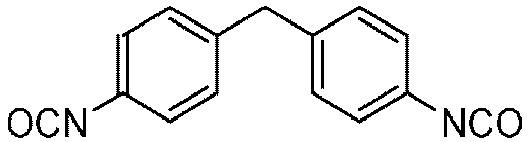
74 4A 

70 5A 

75 6A 

70 7A 

71 8A 

70 (Ex: Example) Table 2 Ex. Carbamate Resultant isocyanate Thermal decomposition yield (%) 9A 

73 10A 

68 11A 

73 12A 
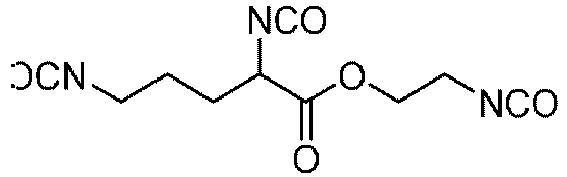
71 13A 
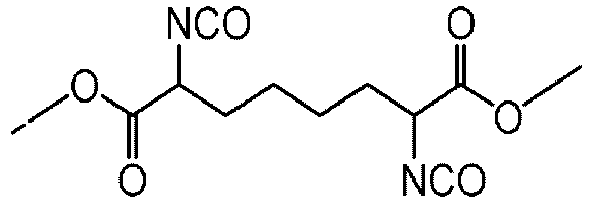
74 Table 3 Ex. Carbamate Resultant isocyanate Thermal decomposition yield (%) 14A 

73 15A 

57 (Ex: Example) - Each isocyanate was prepared by thermal decomposition of carbamate as conducted in Example 1-2 except that a phenolic novolac resin was used as the compound A, benzophenone was used as an inert solvent, and each carbamate shown in the following tables was used.
Table 4 Ex. Carbamate Resultant isocyanate Thermal decomposition yield (%) 1B 

88 2B 

81 3B 
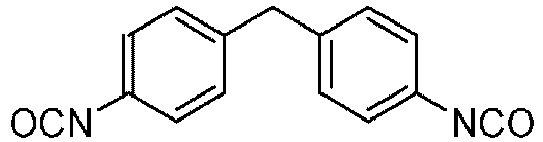
86 4B 

84 5B 

86 6B 

84 7B 

82 8B 

83 (Ex: Example) Table 5 Ex. Carbamate Resultant isocyanate Thermal decomposition yield (%) 9B 

84 10B 

79 11B 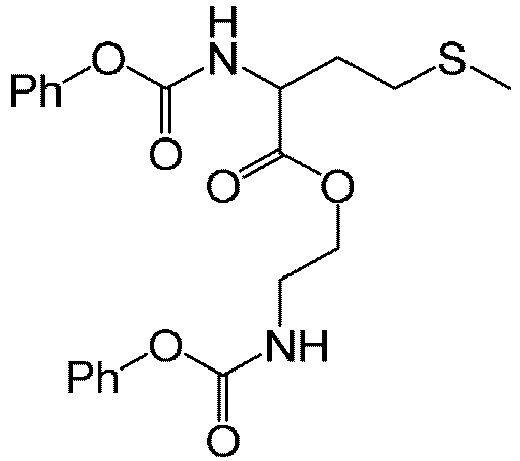

85 12B 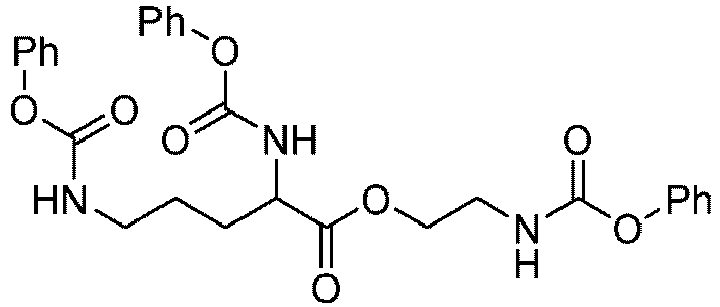

84 13B 

86 (Ex: Example) Table 6 Ex. Carbamate Resultant isocyanate Thermal decomposition yield (%) 14B 

84 15B 

68 (Ex: Example) - Each isocyanate was prepared by thermal decomposition of carbamate as conducted in Example 1-1 except that a phenolic resol resin was used as the compound A and each carbamate shown in the following tables was used.
Table 7 Ex. Carbamate Resultant isocyanate Thermal decomposition yield (%) 17 A 

77 18 A 

68 19 A 

73 20 A 

71 21 A 

74 22 A 

71 23 A 

72 24 A 

71 (Ex: Example) Table 8 Ex. Carbamate Resultant isocyanate Thermal decomposition yield (%) 25 A 

72 26 A 

69 27 A 

73 28 A 

72 29 A 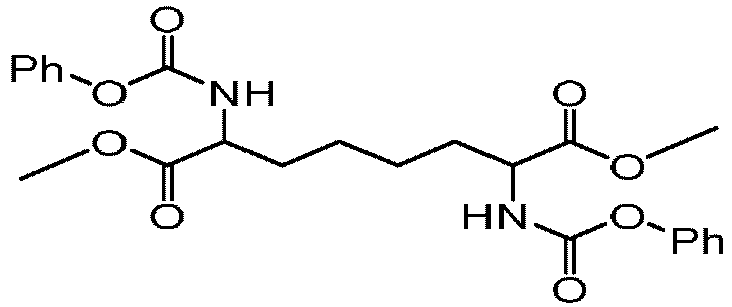

73 (Ex: Example) Table 9 Ex. Carbamate Resultant isocyanate Thermal decomposition yield (%) 30 A 

74 31 A 

57 (Ex: Example) - Each isocyanate was prepared by thermal decomposition of carbamate as conducted in Example 1-2 except that a phenolic resol resin was used as the compound A, benzophenone was used as an inert solvent, and each carbamate shown in the following tables was used.
Table 10 Ex. Carbamate Resultant isocyanate Thermal decomposition yield (%) 17 B 

89 18 B 

83 19 B 

87 20 B 

84 21 B 

87 22 B 

85 23 B 

83 24 B 

84 (Ex: Example) Table 11 Ex. Carbamate Resultant isocyanate Thermal decomposition yield (%) 25 B 

85 26 B 

80 27 B 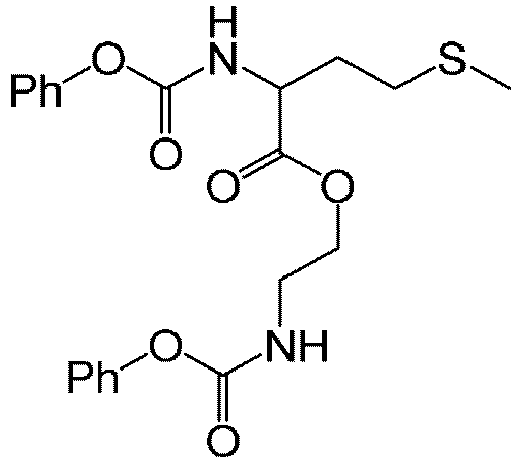

87 28 B 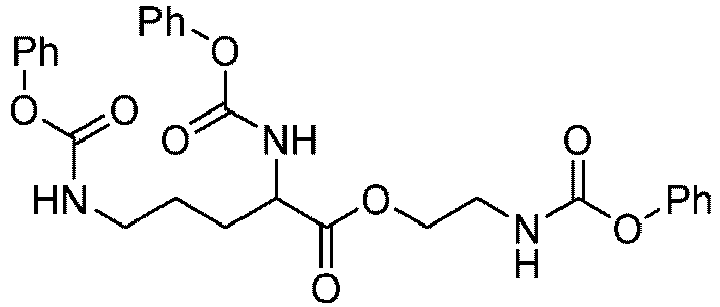

87 29 B 

87 (Ex: Example) Table 12 Ex. Carbamate Resultant isocyanate Thermal decomposition yield (%) 30 B 

85 31 B 

69 (Ex: Example) - Each isocyanate was prepared by thermal decomposition of carbamate as conducted in Example 1-1 except that a cresolic resol resin was used as the compound A and each carbamate shown in the following tables was used.
Table 13 Ex. Carbamate Resultant isocyanate Thermal decomposition yield (%) 33 A 

78 34 A 

69 35 A 

73 36 A 

72 37 A 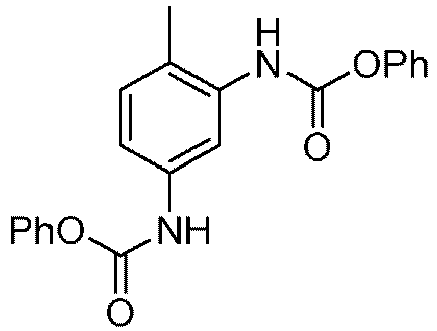

74 38 A 

72 39 A 

73 40 A 
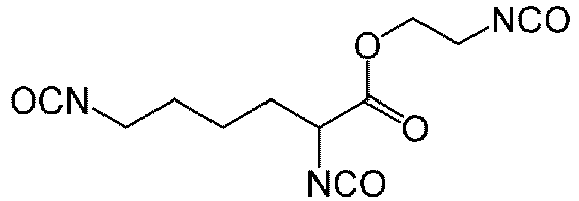
71 (Ex: Example) Table 14 Ex. Carbamate Resultant isocyanate Thermal decomposition yield (%) 41 A 

72 42 A 

70 43 A 
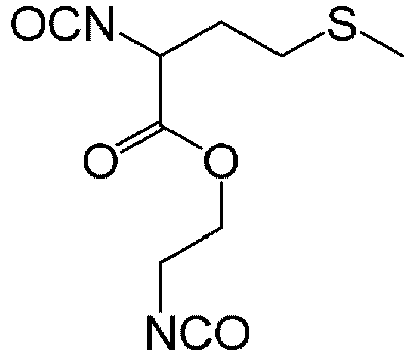
73 44 A 

73 45 A 

73 (Ex: Example) Table 15 Ex. Carbamate Resultant isocyanate Thermal decomposition yield (%) 46 A 

74 47 A 

58 (Ex: Example) - Each isocyanate was prepared by thermal decomposition of carbamate as conducted in Example 1-2 except that a cresolic resol resin was used as the compound A, benzophenone was used as an inert solvent and each carbamate shown in the following tables was used.
Table 16 Ex. Carbamate Resultant isocyanate Thermal decomposition yield (%) 33 B 

88 34 B 

83 35 B 

86 36 B 

83 37 B 

86 38 B 

84 39 B 

83 40 B 

83 (Ex: Example) Table 17 Ex. Carbamate Resultant isocyanate Thermal decomposition yield (%) 41 B 

84 42 B 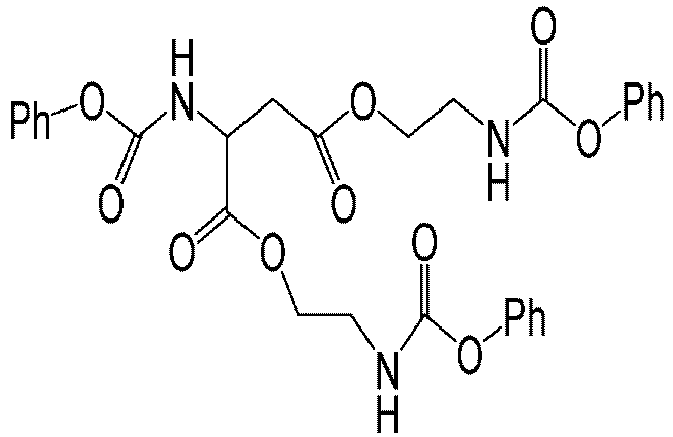

84 43 B 

86 44 B 

85 45 B 

84 (Ex: Example) Table 18 Ex. Carbamate Resultant isocyanate Thermal decomposition yield (%) 46 B 
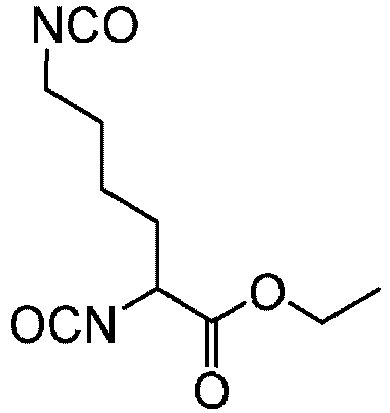
84 47 B 

67 (Ex: Example) - Each isocyanate was prepared by thermal decomposition of carbamate as conducted in Example 1-1 except that a compound of the following formula (5-1d) was used as the compound A and each carbamate shown in the following tables was used.

Table 19 Ex. Carbamate Resultant isocyanate Thermal decomposition yield (%) 49 A 

77 50 A 

68 51 A 
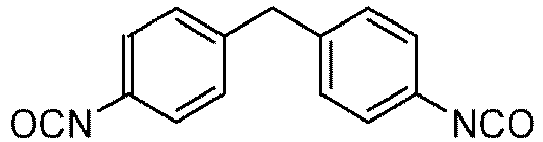
73 52 A 

71 53 A 

73 54 A 

72 55 A 
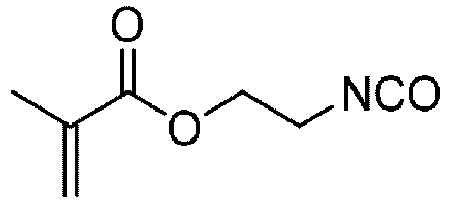
71 56 A 

71 (Ex: Example) Table 20 Ex. Carbamate Resultant isocyanate Thermal decomposition yield (%) 57 A 

71 58 A 

68 59 A 

74 60 A 
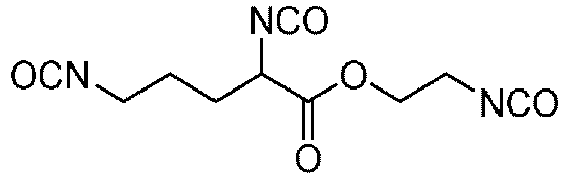
73 61 A 

72 (Ex: Example) Table 21 Ex. Carbamate Resultant isocyanate Thermal decomposition yield (%) 62 A 

73 (Ex: Example) - Each isocyanate was prepared by thermal decomposition of carbamate as conducted in Example 1-2 except that the compound of the formula (5-1d) was used as the compound A, benzophenone was used as an inert solvent and each carbamate shown in the following tables was used.
Table 22 Ex. Carbamate Resultant isocyanate Thermal decomposition yield (%) 49 B 

86 50 B 

81 51 B 

85 52 B 

83 53 B 

85 54 B 

84 55 B 

82 56 B 

85 (Ex: Example) Table 23 Ex. Carbamate Resultant isocyanate Thermal decomposition yield (%) 57 B 

84 58 B 

84 59 B 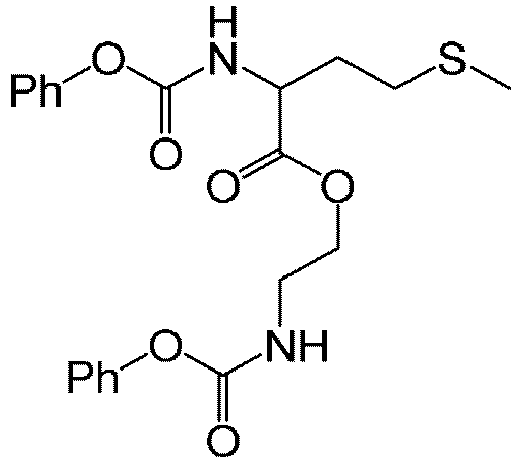

86 60 B 

85 61 B 

86 (Ex: Example) Table 24 Ex. Carbamate Resultant isocyanate Thermal decomposition yield (%) 62 B 

84 (Ex: Example) - Each isocyanate was prepared by thermal decomposition of carbamate as conducted in Example 1-1 except that a compound of the following formula (5-2-1a) was used as the compound A and each carbamate shown in the following tables was used.

Table 25 Ex. Carbamate Resultant isocyanate Thermal decomposition yield (%) 63 A 

77 64 A 

69 65 A 

74 66 A 

72 67 A 

74 68 A 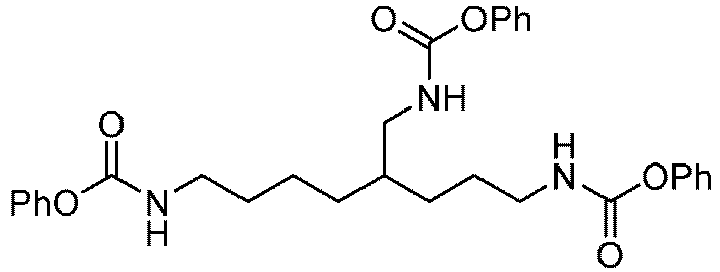

73 69 A 

72 70 A 

72 (Ex: Example) Table 26 Ex. Carbamate Resultant isocyanate Thermal decomposition yield (%) 71 A 

71 72 A 

69 73 A 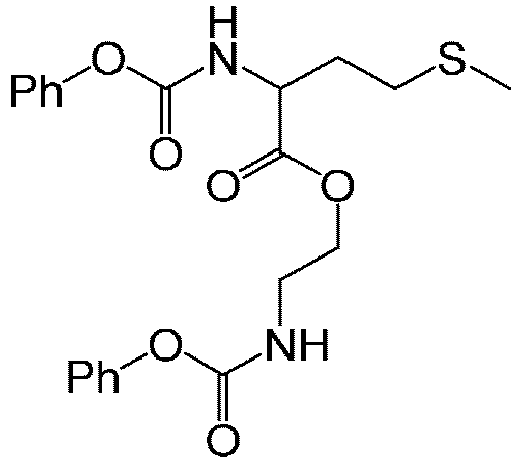

73 74 A 

72 75 A 

73 (Ex: Example) Table 27 Ex. Carbamate Resultant isocyanate Thermal decomposition yield (%) 76 A 

73 (Ex: Example) - Each isocyanate was prepared by thermal decomposition of carbamate as conducted in Example 1-2 except that the compound of the formula (5-2-1a) was used as the compound A, benzophenone was used as an inert solvent and each carbamate shown in the following tables was used.
Table 28 Ex. Carbamate Resultant isocyanate Thermal decomposition yield (%) 63 B 

85 64 B 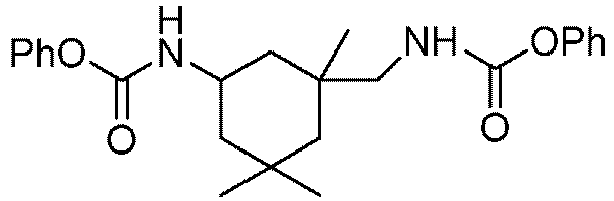

80 65 B 

85 66 B 

83 67 B 

83 68 B 

84 69 B 

82 70 B 

83 (Ex: Example) Table 29 Ex. Carbamate Resultant isocyanate Thermal decomposition yield (%) 71 B 

82 72 B 

82 73 B 
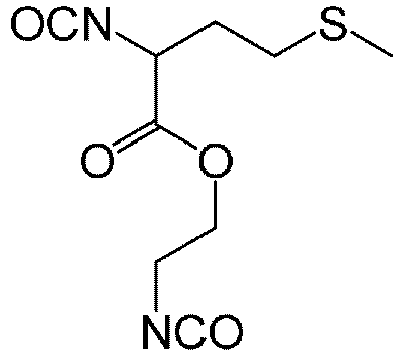
85 74 B 

84 75 B 

84 (Ex: Example) Table 30 Ex. Carbamate Resultant isocyanate Thermal decomposition yield (%) 76 B 

85 (Ex: Example) - Each isocyanate was prepared by thermal decomposition of carbamate as conducted in Example 1-1 except that a compound of the following formula (5-2-1b) was used as the compound A and each carbamate shown in the following tables was used.

Table 31 Ex. Carbamate Resultant isocyanate Thermal decomposition yield (%) 77 A 

78 78 A 

70 79 A 

73 80 A 

73 81 A 

73 82 A 

74 83 A 

73 84 A 

71 (Ex: Example) Table 32 Ex. Carbamate Resultant isocyanate Thermal decomposition yield (%) 85 A 

71 86 A 

68 87 A 

72 88 A 

71 89 A 

72 (Ex: Example) Table 33 Ex. Carbamate Resultant isocyanate Thermal decomposition yield (%) 90 A 

73 - Each isocyanate was prepared by thermal decomposition of carbamate as conducted in Example 1-2 except that the compound of the formula (5-2-1b) was used as the compound A, benzophenone was used as an inert solvent and each carbamate shown in the following tables was used.
Table 34 Ex. Carbamate Resultant isocyanate Thermal decomposition yield (%) 77 B 

85 78 B 

80 79 B 

85 80 B 

83 81 B 

83 82 B 

84 83 B 

82 84 B 

83 (Ex: Example) Table 35 Ex. Carbamate Resultant isocyanate Thermal decomposition yield (%) 85 B 

82 86 B 

82 87 B 

85 88 B 

84 89 B 

84 (Ex: Example) Table 36 Ex. Carbamate Resultant isocyanate Thermal decomposition yield (%) 90 B 

85 (Ex: Example) - Each isocyanate was prepared by thermal decomposition of carbamate as conducted in Example 1-1 except that a compound of the following formula (5-1-2a) was used as the compound A and each carbamate shown in the following tables was used.

Table 37 Ex. Carbamate Resultant isocyanate Thermal decomposition yield (%) 91 A 

77 92 A 

69 93 A 

72 94 A 

73 95 A 

73 96 A 

72 97 A 

71 98 A 

71 Table 38 Ex. Carbamate Resultant isocyanate Thermal decomposition yield (%) 99 A 

72 100 A 

69 101 A 

72 102 A 

70 103 A 

71 (Ex: Example) Table 39 Ex. Carbamate Resultant isocyanate Thermal decomposition yield (%) 104 A 

73 (Ex: Example) - Each isocyanate was prepared by thermal decomposition of carbamate as conducted in Example 1-2 except that the compound of the formula (5-1-2b) was used as the compound A, benzophenone was used as an inert solvent and each carbamate shown in the following tables was used.
Table 40 Ex. Carbamate Resultant isocyanate Thermal decomposition yield (%) 91B 

86 92B 

80 93B 
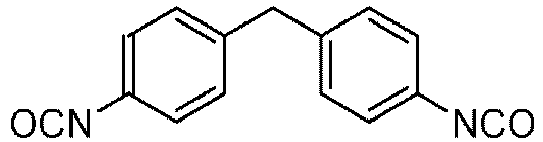
86 94B 

83 95B 

84 96B 

85 97B 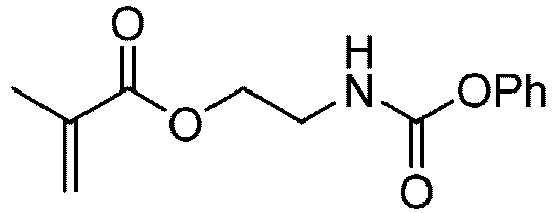

83 98B 

84 Table 41 Ex. Carbamate Resultant isocyanate Thermal decomposition yield (%) 99B 

82 100B 

83 101B 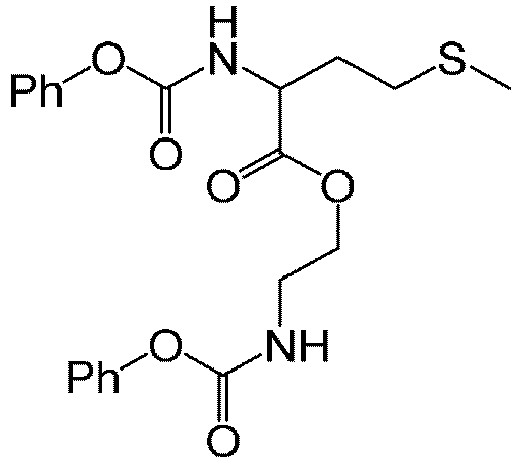

85 102B 

85 103B 

84 (Ex: Example) Table 42 Ex. Carbamate Resultant isocyanate Thermal decomposition yield (%) 104B 

86 (Ex: Example) - Each isocyanate was prepared by thermal decomposition of carbamate as conducted in Example 1-1 except that the compounds of the following formula (5-1a) were used as the compound A and each carbamate shown in the following tables was used.

Table 43 Ex. Carbamate Resultant isocyanate Thermal decomposition yield (%) 105A 

78 106A 

70 107A 

73 108A 

74 109A 

73 110A 

73 111A 

72 112A 

72 (Ex: Example) Table 44 Ex. Carbamate Resultant isocyanate Thermal decomposition yield (%) 113A 

73 114A 

69 115A 

72 116A 

71 117A 

71 (Ex: Example) Table 45 Ex. Carbamate Resultant isocyanate Thermal decomposition yield (%) 118A 
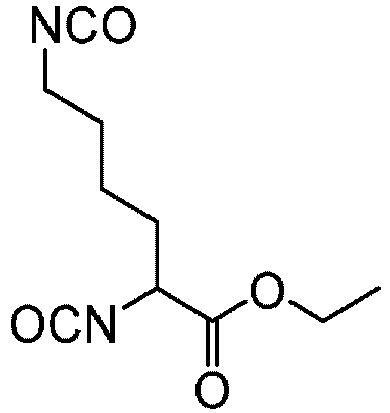
74 (Ex: Example) - Each isocyanate was prepared by thermal decomposition of carbamate as conducted in Example 1-2 except that the compounds of the formula (5-1a) were used as the compound A, benzophenone was used an inert solvent, and each carbamate shown in the following tables was used.
Table 46 Ex. Carbamate Resultant isocyanate Thermal decomposition yield (%) 105B 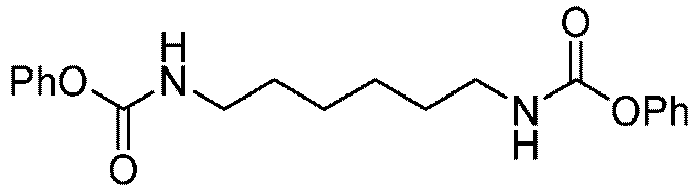

83 106B 

79 107B 

83 108B 

82 109B 

82 110B 

83 111B 

81 112B 

82 (Ex: Example) Table 47 Ex. Carbamate Resultant isocyanate Thermal decomposition yield (%) 113B 

82 114B 

81 115B 

84 116B 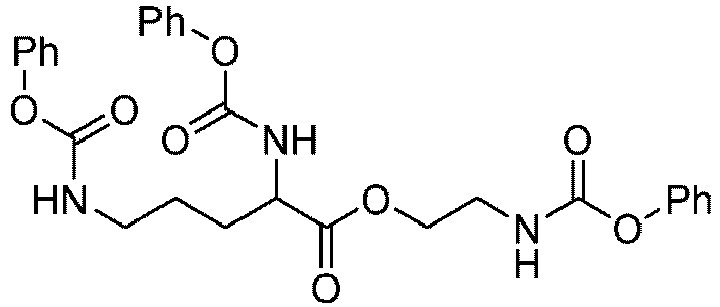

84 117B 

84 (Ex: Example) Table 48 Ex. Carbamate Resultant isocyanate Thermal decomposition yield (%) 118B 

84 (Ex: Example) - Each isocyanate was prepared by thermal decomposition of carbamate as conducted in Example 1-1 except that the compounds of the following formula (5-1b) were used as the compound A, and each carbamate shown in the following tables was used.

Table 49 Ex. Carbamate Resultant isocyanate Thermal decomposition yield (%) 119 A 

76 120 A 

69 121 A 

71 122 A 

72 123 A 

73 124 A 

71 125 A 

70 126 A 

71 (Ex: Example) Table 50 Ex. Carbamate Resultant isocyanate Thermal decomposition yield (%) 127 A 

71 128 A 

67 129 A 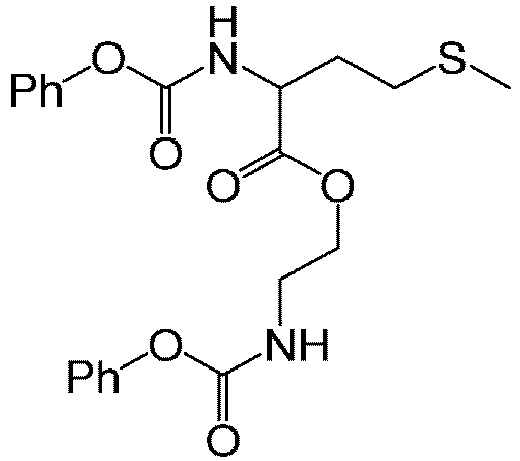

70 130 A 

70 131 A 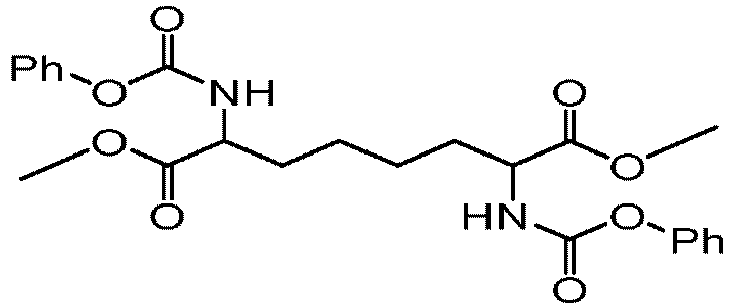

70 (Ex: Example) Table 51 Ex. Carbamate Resultant isocyanate Thermal decomposition yield (%) 132 A 

71 (Ex: Example) - Each isocyanate was prepared by thermal decomposition of carbamate as conducted in Example 1-2 except that the compounds of formula (5-1b) were used as the compound A, benzophenone was used as an inert solvent and each carbamate shown in the following tables was used.
Table 52 Ex. Carbamate Resultant isocyanate Thermal decomposition yield (%) 119 B 

82 12C B 

79 121 B 
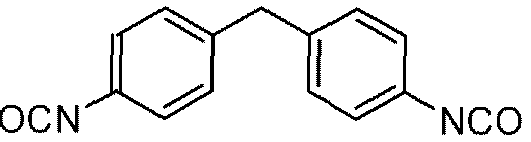
82 122 B 

82 123 B 

81 124 B 

82 125 B 

82 126 B 

81 Table 53 Ex. Carbamate Resultant isocyanate Thermal decomposition yield (%) 127 B 

82 128 B 

79 129 B 
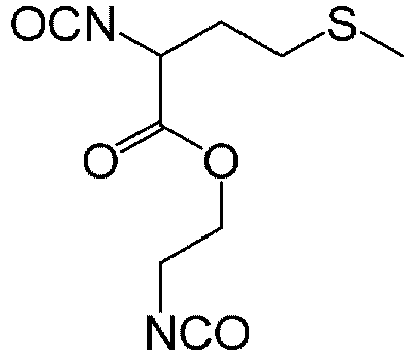
83 130 B 

82 131 B 

83 (Ex: Example) Table 54 Ex. Carbamate Resultant isocyanate Thermal decomposition yield (%) 132 B 

83 (Ex: Example) - Each isocyanate was prepared by thermal decomposition of carbamate as conducted in Example 1-1 except that the compounds of the following formula (5-1c) were used as the compound A and each carbamate shown in the following tables was used.

Table 55 Ex. Carbamate Resultant isocyanate Thermal decomposition yield (%) 133 A 

76 134 A 
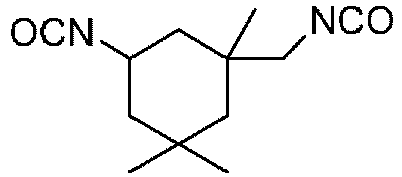
68 135 A 

71 136 A 

71 137 A 

72 138 A 

70 139 A 

70 140 A 

70 (Ex: Example) Table 56 Ex. Carbamate Resultant isocyanate Thermal decomposition yield (%) 141 A 
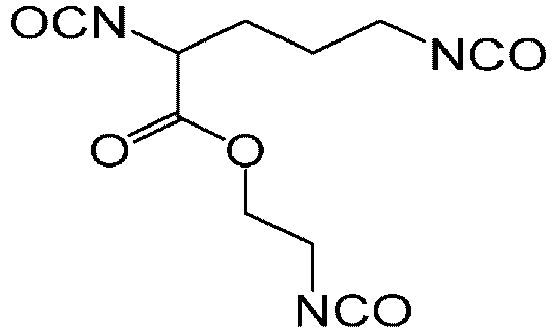
71 142 A 
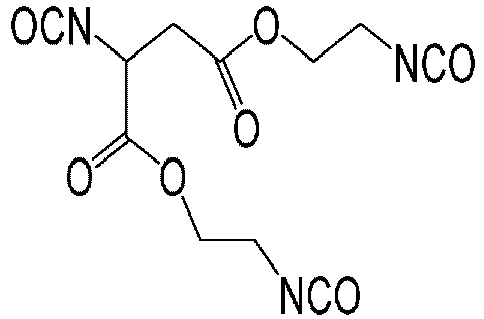
68 143 A 

70 144 A 

71 145 A 

70 (Ex: Example) Table 57 Ex. Carbamate Resultant isocyanate Thermal decomposition yield (%) 146 A 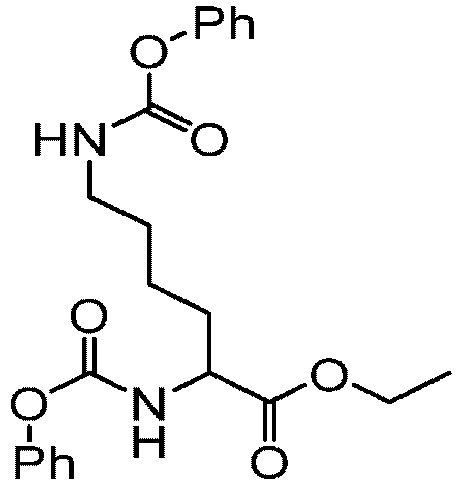

71 (Ex: Example) - Each isocyanate was prepared by thermal decomposition of carbamate as conducted in Example 1-2 except that the compounds of the formula (5-1c) were used as the compound A, benzophenone was used as an inert solvent and each carbamate shown in the following tables was used.
Table 58 Ex. Carbamate Resultant isocyanate Thermal decomposition yield (%) 133 B 

81 134 B 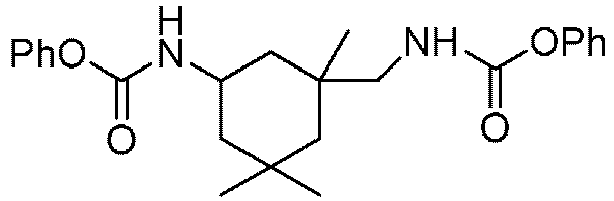

78 135 B 

82 136 B 

81 137 B 

81 138 B 
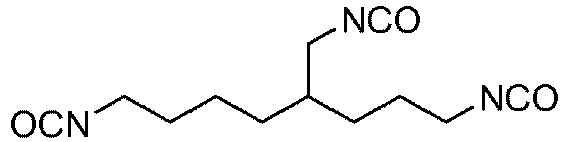
81 139 B 

81 140 B 

80 (Ex: Example) Table 59 Ex. Carbamate Resultant isocyanate Thermal decomposition yield (%) 141 B 

81 142 B 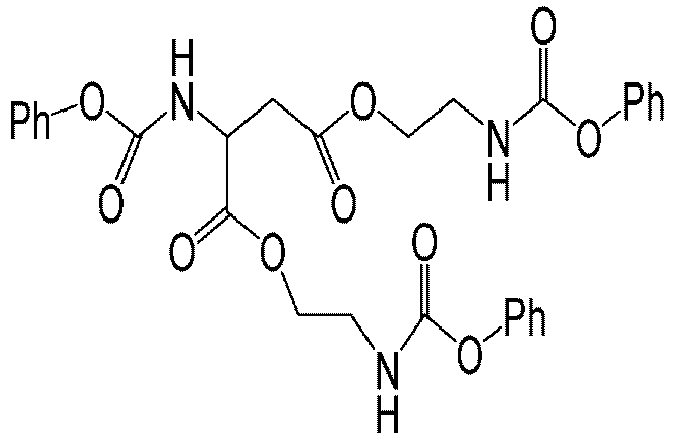

78 143 B 

82 144 B 

81 145 B 
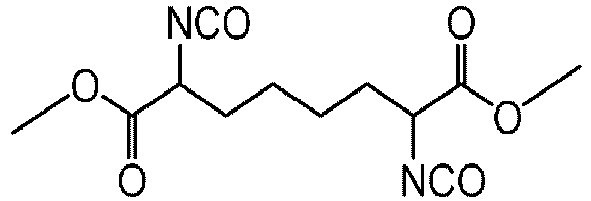
82 (Ex: Example) Table 60 Ex. Carbamate Resultant isocyanate Thermal decomposition yield (%) 146 B 

82 (Ex: Example) - Each isocyanate was prepared by thermal decomposition of carbamate as conducted in Example 2-1 except that a compound of the following formula (6-2-1b) was used as the compound A, benzophenone was used as an inert solvent and each carbamate shown in the following tables was used.

Table 61 Ex. Carbamate Resultant isocyanate Thermal decomposition yield (%) 147 A 

79 148 A 

71 149 A 

74 150 A 

74 151 A 

75 152 A 

74 153 A 

73 154 A 

72 Table 62 Ex. Carbamate Resultant isocyanate Thermal decomposition yield (%) 155 A 

71 156 A 

70 157 A 

71 158 A 

72 159 A 

73 (Ex: Example) Table 63 Ex. Carbamate Resultant isocyanate Thermal decomposition yield (%) 160 A 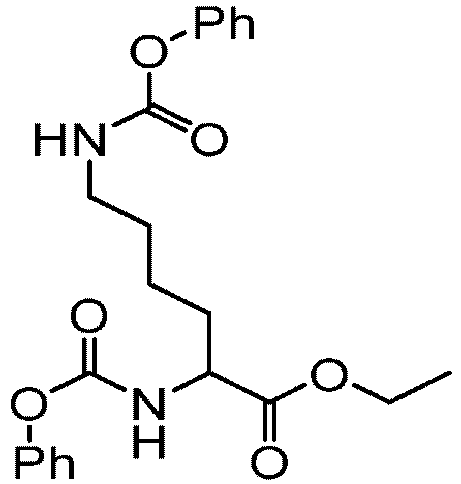

73 (Ex: Example) - Each isocyanate was prepared by thermal decomposition of carbamate as conducted in Example 2-2 except that the compound of the formula (6-2-1b) was used as the compound A, benzophenone was used as an inert solvent and each carbamate shown in the following tables was used.
Table 64 Ex. Carbamate Resultant isocyanate Thermal decomposition yield (%) 147 B 

89 148 B 

84 149 B 

87 150 B 

85 151 B 
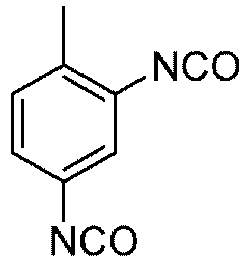
86 152 B 

85 153 B 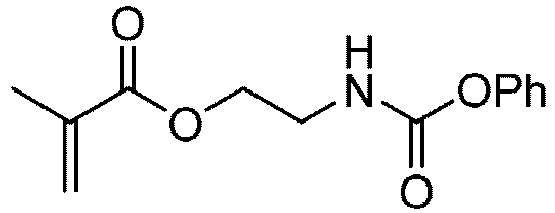

83 154 B 

84 (Ex: Example) Table 65 Ex. Carbamate Resultant isocyanate Thermal decomposition yield (%) 155 B 

84 156 B 

81 157 B 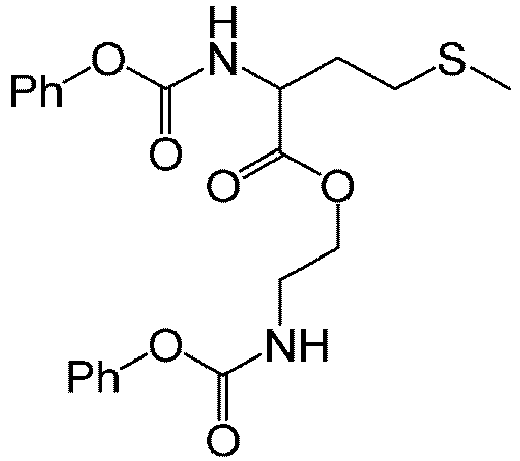

86 158 B 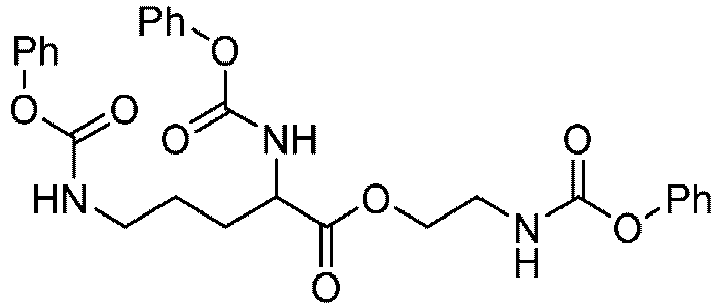
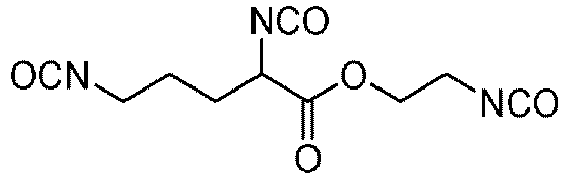
86 159 B 

85 (Ex: Example) Table 66 Ex. Carbamate Resultant isocyanate Thermal decomposition yield (%) 160 B 

84 (Ex: Example) - Each isocyanate was prepared by thermal decomposition of carbamate as conducted in Example 2-1 except that a compound of the following formula (6-2-1c) was used as the compound A, benzophenone was used as an inert solvent and each carbamate shown in the following tables was used.

Table 67 Ex. Carbamate Resultant isocyanate Thermal decomposition yield (%) 161 A 

78 162 A 

72 163 A 
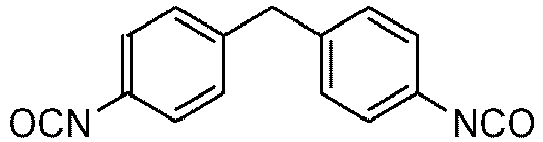
73 164 A 

72 165 A 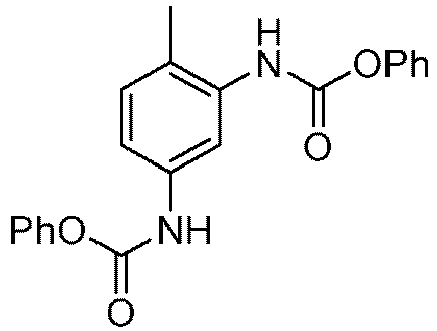

76 166 A 

73 167 A 

73 168 A 

72 (Ex: Example) Table 68 Ex. Carbamate Resultant isocyanate Thermal decomposition yield (%) 169 A 

71 170 A 

71 171 A 

72 172 A 

73 173 A 
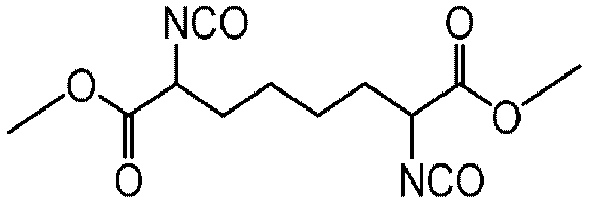
72 (Ex: Example) Table 69 Ex. Carbamate Resultant isocyanate Thermal decomposition yield (%) 174 A 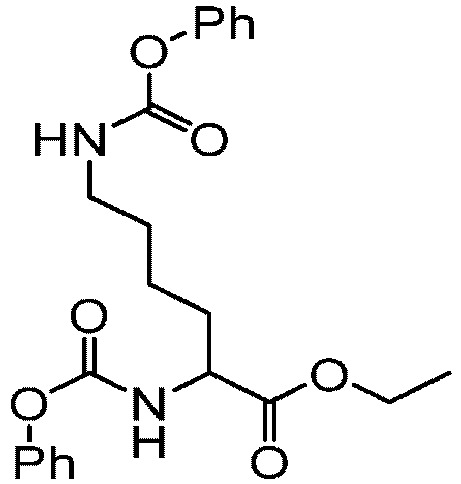

72 (Ex: Example) - Each isocyanate was prepared by thermal decomposition of carbamate as conducted in Example 2-2 except that the compound of the formula (6-2-1c) was used as the compound A, benzophenone was used as an inert solvent and each carbamate shown in the following tables was used.
Table 70 Ex. Carbamate Resultant isocyanate Thermal decomposition yield (%) 161 B 

89 162 B 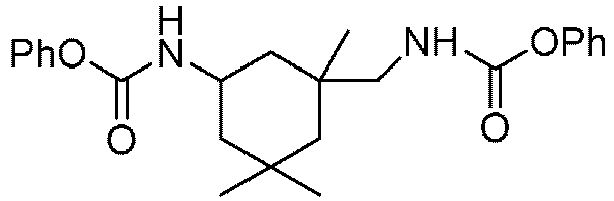

85 163 B 

86 164 B 

85 165 B 
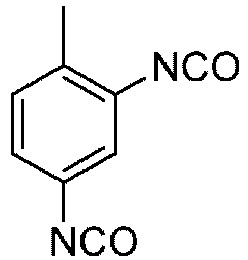
85 166 B 

86 167 B 

84 168 B 

85 (Ex: Example) Table 71 Ex. Carbamate Resultant isocyanate Thermal decomposition yield (%) 169 B 

85 170 B 

82 171 B 

86 172 B 

85 173 B 

85 (Ex: Example) Table 72 Ex. Carbamate Resultant isocyanate Thermal decomposition yield (%) 174 B 

84 (Ex: Example) - Each isocyanate was prepared by thermal decomposition of carbamate as conducted in Example 2-1 except that a compound of the following formula (6-3a) was used as the compound A, benzophenone was used as an inert solvent and each carbamate shown in the following tables was used.

Table 73 Ex. Carbamate Resultant isocyanate Thermal decomposition yield (%) 175 A 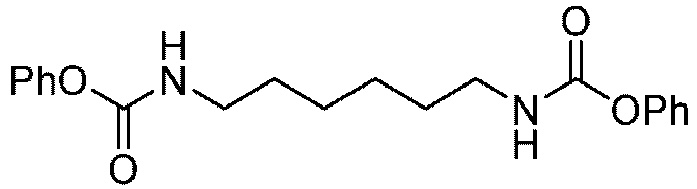

79 176 A 

72 177 A 

72 178 A 

73 179 A 

75 180 A 

72 181 A 

72 182 A 

71 (Ex: Example) Table 74 Ex. Carbamate Resultant isocyanate Thermal decomposition yield (%) 183 A 

72 184 A 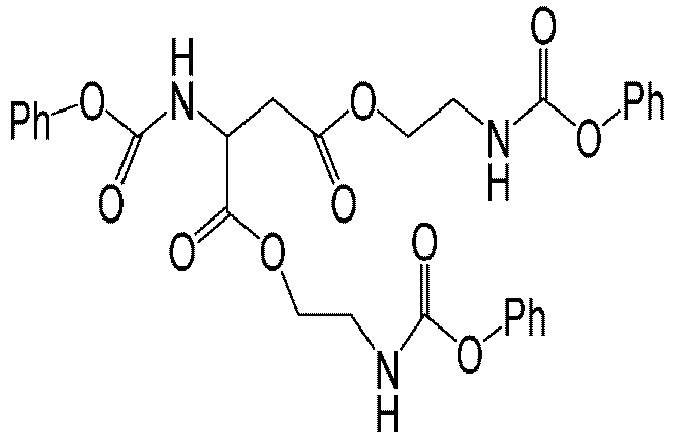

73 185 A 

72 186 A 

72 187 A 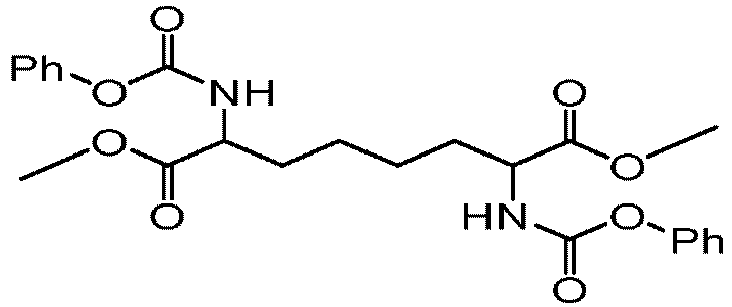

73 (Ex: Example) Table 75 Ex. Carbamate Resultant isocyanate Thermal decomposition yield (%) 188 A 

73 (Ex: Example) - Each isocyanate was prepared by thermal decomposition of carbamate as conducted in Example 2-2 except that the compound of the formula (6-3a) was used as the compound A, benzophenone was used as an inert solvent and each carbamate shown in the following tables was used.
Table 76 Ex. Carbamate Resultant isocyanate Thermal decomposition yield (%) 175 B 

88 176 B 

84 177 B 

86 178 B 

85 179 B 

86 180 B 

85 181 B 

83 182 B 

84 (Ex: Example) Table 77 Ex. Carbamate Resultant isocyanate Thermal decomposition yield (%) 183 B 

84 184 B 

81 185 B 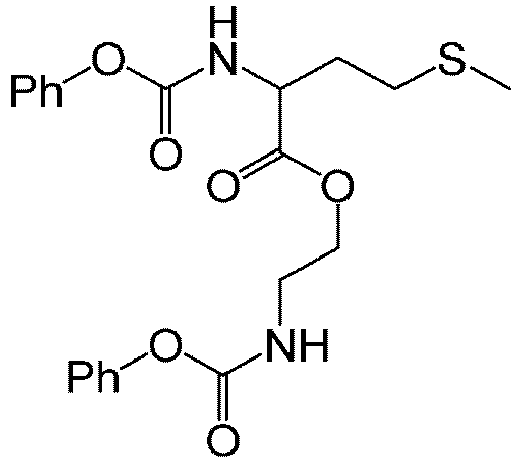

86 186 B 

86 187 B 

85 (Ex: Example) Table 78 Ex. Carbamate Resultant isocyanate Thermal decomposition yield (%) 188 B 

84 (Ex: Example) - Each isocyanate was prepared by thermal decomposition of carbamate as conducted in Example 2-1 except that tris(2-ethylhexyl) trimellitate of the following formula (6-2-1a) was used as the compound A, triethylbenzene was used as an inert solvent and each carbamate shown in the following tables was used.

Table 79 Ex. Carbamate Resultant isocyanate Thermal decomposition yield (%) 189 A 

78 190 A 

71 191 A 

72 192 A 

73 193 A 

74 194 A 
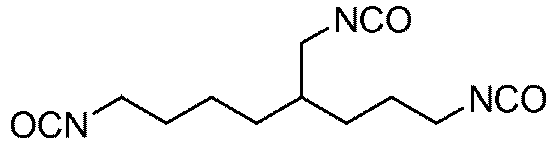
72 195 A 

72 196 A 

72 (Ex: Example) Table 80 Ex. Carbamate Resultant isocyanate Thermal decomposition yield (%) 197 A 

71 198 A 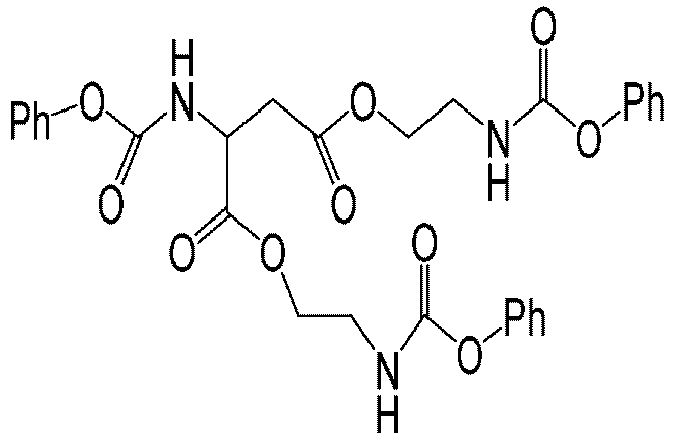

72 199 A 

72 200 A 

71 201 A 

72 (Ex: Example) Table 81 Ex. Carbamate Resultant isocyanate Thermal decomposition yield (%) 202 A 

73 (Ex: Example) - Each isocyanate was prepared by thermal decomposition of carbamate as conducted in Example 2-2 except that each carbamate shown in the following tables was used.
Table 82 Ex. Carbamate Resultant isocyanate Thermal decomposition yield (%) 189 B 

89 190 B 

85 191 B 

86 192 B 

85 193 B 

87 194 B 

86 195 B 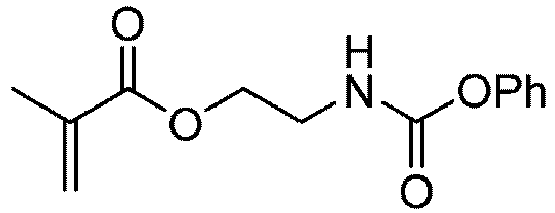
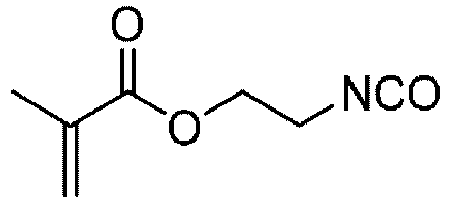
84 196 B 

85 (Ex: Example) Table 83 Ex. Carbamate Resultant isocyanate Thermal decomposition yield (%) 197 B 

84 198 B 

83 199 B 
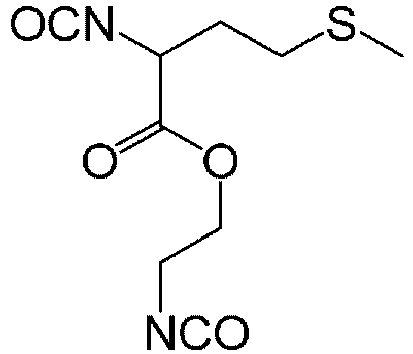
86 200 B 

86 201 B 

85 (Ex: Example) Table 84 Ex. Carbamate Resultant isocyanate Thermal decomposition yield (%) 202 B 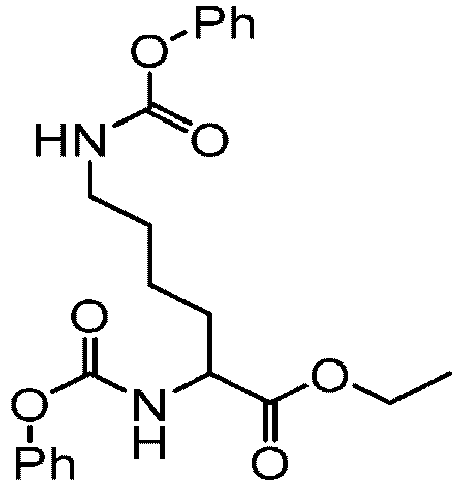

84 (Ex: Example) - Each isocyanate was prepared by thermal decomposition of carbamate as conducted in Example 2-1 except that diisononyl adipate of the following formula (6-1-1a) was used as the compound A, triethylbenzene was used as an inert solvent, and each carbamate shown in the following tables was used.

Table 85 Ex. Carbamate Resultant isocyanate Thermal decomposition yield (%) 203 A 

77 204 A 

71 205 A 

73 206 A 

71 207 A 

71 208 A 

71 -
Table 86 Ex. Carbamate Resultant isocyanate Thermal decomposition yield (%) 209 A 

72 210 A 

72 211 A 

72 212 A 

72 213 A 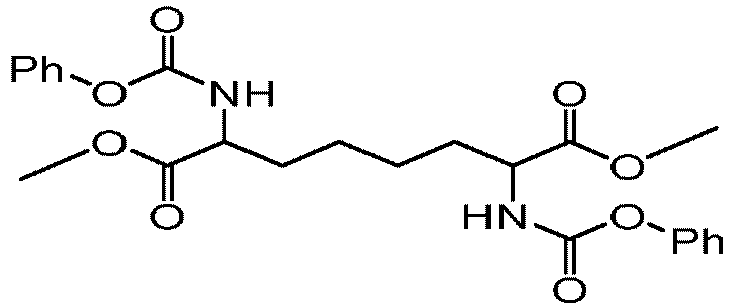
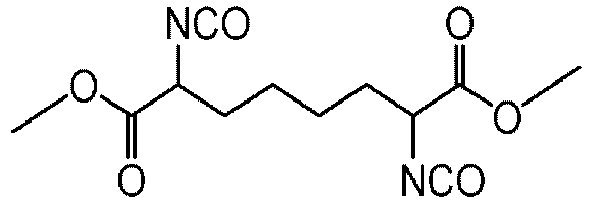
73 -
Table 87 Ex. Carbamate Resultant isocyanate Thermal decomposition yield (%) 214 A 

73 (Ex: Example) - Each isocyanate was prepared by thermal decomposition of carbamate as conducted in Example 2-2 except that diisononyl adipate of the formula (6-1-1a) was used as the compound A and each carbamate shown in the following tables was used.
Table 88 Ex. Carbamate Resultant isocyanate Thermal decomposition yield (%) 203 B 

82 204 B 

79 205 B 

80 206 B 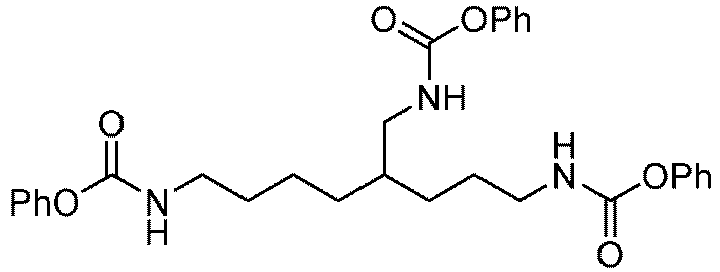

81 207 B 

80 208 B 

80 (Ex: Example) Table 89 Ex. Carbamate Resultant isocyanate Thermal decomposition yield (%) 209 B 

80 210 B 

78 211 B 

81 212 B 

80 213 B 

81 (Ex: Example) Table 90 Ex. Carbamate Resultant isocyanate Thermal decomposition yield (%) 214 B 

82 (Ex: Example) - Each isocyanate was prepared by thermal decomposition of carbamate as conducted in Example 3-1 except that triphenylmethanol was used as the compound A, benzyltoluene was used as an inert solvent, and each carbamate shown in the following tables was used.
Table 91 Ex. Carbamate Resultant isocyanate Thermal decomposition yield (%) 215 A 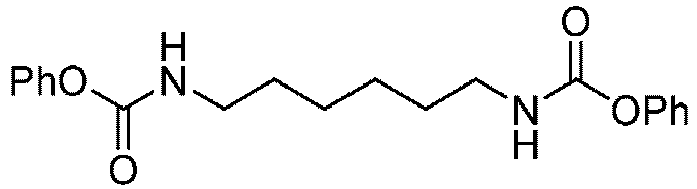

78 216 A 

73 217 A 

72 218 A 

72 219 A 

74 220 A 

73 221 A 

72 222 A 

72 (Ex: Example) Table 92 Ex. Carbamate Resultant isocyanate Thermal decomposition yield (%) 223 A 

71 224 A 

72 225 A 

72 226 A 
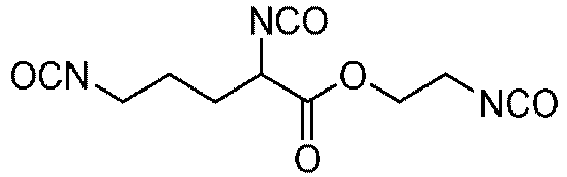
72 227 A 

72 (Ex: Example) Table 93 Ex. Carbamate Resultant isocyanate Thermal decomposition yield (%) 228 A 

73 (Ex: Example) - Each isocyanate was prepared by thermal decomposition of carbamate as conducted in Example 3-2 except that each carbamate shown in the following tables was used.
Table 94 Ex. Carbamate Resultant isocyanate Thermal decomposition yield (%) 215 B 

84 216 B 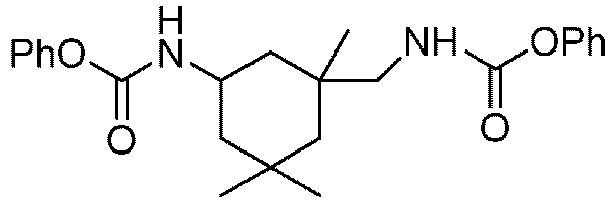

80 217 B 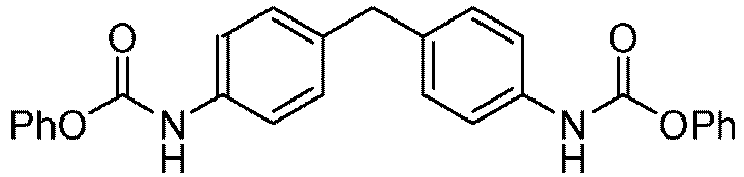

84 218 B 

83 219 B 

83 220 B 

84 221 B 

82 222 B 

83 (Ex: Example) Table 95 Ex. Carbamate Resultant isocyanate Thermal decomposition yield (%) 223 B 

83 224 B 

82 225 B 

85 226 B 

84 227 B 

85 (Ex: Example) Table 96 Ex. Carbamate Resultant isocyanate Thermal decomposition yield (%) 228 B 

84 (Ex: Example) - Each isocyanate was prepared by thermal decomposition of carbamate as conducted in Example 3-1 except that a compound of the following formula (S2-29) was used as the compound A, benzyltoluene was used as an inert solvent, and each carbamate shown in the following tables was used.

Table 97 Ex. Carbamate Resultant isocyanate Thermal decomposition yield (%) 229 A 

77 230 A 

73 231 A 

72 232 A 

71 233 A 

73 234 A 

72 235 A 

72 236 A 

72 (Ex: Example) Table 98 Ex. Carbamate Resultant isocyanate Thermal decomposition yield (%) 237 A 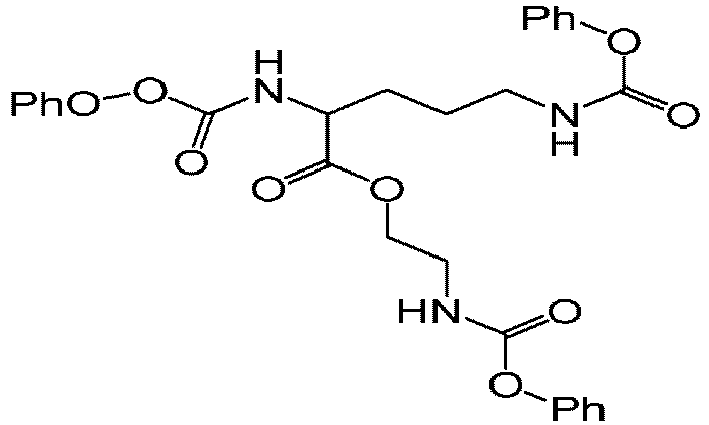

71 238 A 

71 239 A 

72 240 A 

71 241 A 

71 (Ex: Example) Table 99 Ex. Carbamate Resultant isocyanate Thermal decomposition yield (%) 242 A 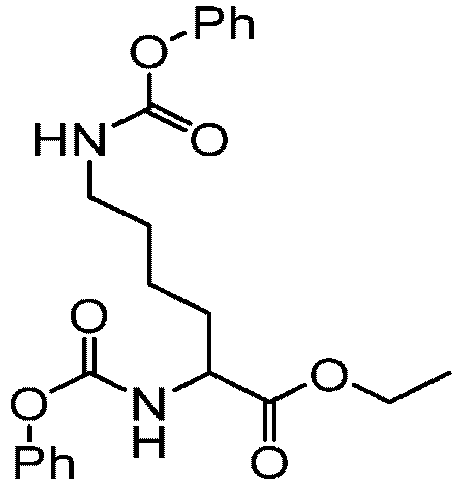

72 (Ex: Example) - Each isocyanate was prepared by thermal decomposition of carbamate as conducted in Example 3-2 except that the compound of the formula (S2-29) was used as the compound A and each carbamate shown in the following tables was used.
Table 100 Ex. Carbamate Resultant isocyanate Thermal decomposition yield (%) 229 B 

84 230 B 

80 231 B 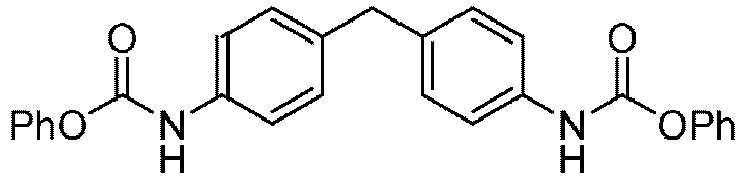

84 232 B 

82 233 B 
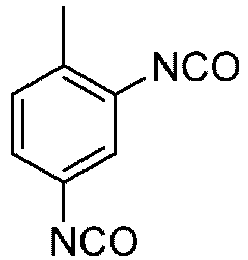
83 234 B 

84 235 B 

82 236 B 

83 (Ex: Example) Table 101 Ex. Carbamate Resultant isocyanate Thermal decomposition yield (%) 237 B 

82 238 B 
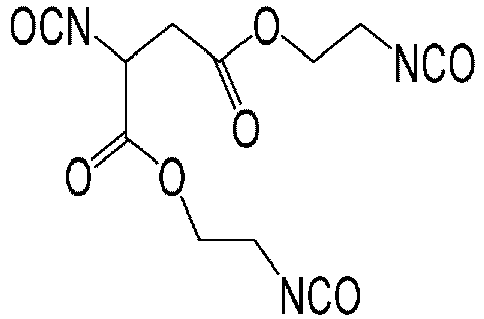
82 239 B 

84 240 B 

84 241 B 

85 (Ex: Example) Table 102 Ex. Carbamate Resultant isocyanate Thermal decomposition yield (%) 242 B 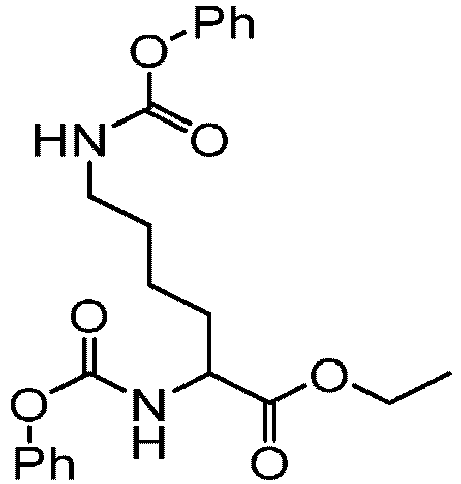

83 (Ex: Example) - Each isocyanate was prepared by thermal decomposition of carbamate as conducted in Example 4-1 except that 4,4'-dicyclohexylmethane diisocyanate was used as the compound A, benzyltoluene was used as an inert solvent, and each carbamate shown in the following tables was used.
Table 103 Ex. Carbamate Resultant isocyanate Thermal decomposition yield (%) 243 A 

77 244 A 

74 245 A 

73 246 A 

72 247 A 

73 248 A 

73 249 A 
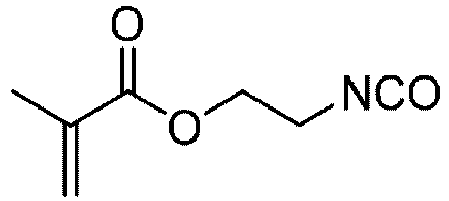
71 250 A 

72 (Ex: Example) Table 104 Ex. Carbamate Resultant isocyanate Thermal decomposition yield (%) 251 A 

72 252 A 

72 253 A 

72 254 A 

71 255 A 

72 (Ex: Example) Table 105 Ex. Carbamate Resultant isocyanate Thermal decomposition yield (%) 256 A 

72 (Ex: Example) - Each isocyanate was prepared by thermal decomposition of carbamate as conducted in Example 4-2 except that benzyltoluene was used as an inert solvent and each carbamate shown in the following tables was used.
Table 106 Ex. Carbamate Resultant isocyanate Thermal decomposition yield (%) 243 B 

84 244 B 

81 245 B 

85 246 B 

83 247 B 

84 248 B 

85 249 B 

82 250 B 

84 (Ex: Example) Table 107 Ex. Carbamate Resultant isocyanate Thermal decomposition yield (%) 251 B 

83 252 B 

83 253 B 

84 254 B 

83 255 B 

85 (Ex: Example) Table 108 Ex. Carbamate Resultant isocyanate Thermal decomposition yield (%) 256 B 

84 (Ex: Example) - Each isocyanate was prepared by thermal decomposition of carbamate as conducted in Example 4-1 except that a compound of the following formula (9-2a) was used as the compound A, benzyltoluene was used as an inert solvent and each carbamate shown in the following tables was used.

Table 109 Ex. Carbamate Resultant isocyanate Thermal decomposition yield (%) 257 A 

78 258 A 

75 259 A 

74 260 A 

73 261 A 

73 262 A 

73 263 A 

72 264 A 

72 (Ex: Example) Table 110 Ex. Carbamate Resultant isocyanate Thermal decomposition yield (%) 265 A 

72 266 A 

73 267 A 

73 268 A 

72 269 A 

73 (Ex: Example) Table 111 Ex. Carbamate Resultant isocyanate Thermal decomposition yield (%) 270 A 

72 271 A 
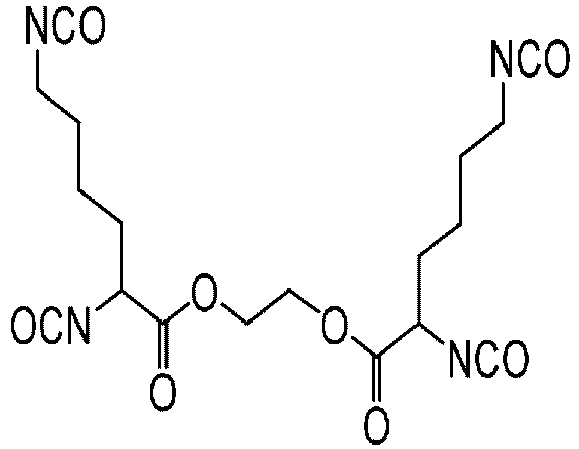
56 (Ex: Example) - Each isocyanate was prepared by thermal decomposition of carbamate as conducted in Example 4-2 except that the compound of the formula (9-2a) was used as the compound A, benzyltoluene was used as an inert solvent and each carbamate shown in the following tables was used.
Table 112 Ex. Carbamate Resultant isocyanate Thermal decomposition yield (%) 257 B 

86 258 B 

84 259 B 

85 260 B 

84 261 B 
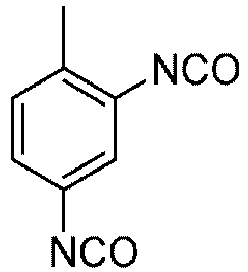
84 262 B 

86 263 B 

85 264 B 

83 (Ex: Example) Table 113 Ex. Carbamate Resultant isocyanate Thermal decomposition yield (%) 265 B 

84 266 B 

84 267 B 

83 268 B 

84 269 B 

86 (Ex: Example) Table 114 Ex. Carbamate Resultant isocyanate Thermal decomposition yield (%) 270 B 

84 271 B 

60 (Ex: Example) - Each isocyanate was prepared by thermal decomposition of carbamate as conducted in Example 4-1 except that the compounds of the following formula (9-1-1a) were used as the compound A, benzyltoluene was used as an inert solvent and each carbamate shown in the following tables was used.

Table 115 Ex. Carbamate Resultant isocyanate Thermal decomposition yield (%) 273 A 

79 274 A 

76 275 A 

73 276 A 

72 277 A 

73 278 A 

74 279 A 

73 280 A 

72 (Ex: Example) Table 116 Ex. Carbamate Resultant isocyanate Thermal decomposition yield (%) 281 A 

72 282 A 

74 283 A 

73 284 A 

72 285 A 

73 (Ex: Example) Table 117 Ex. Carbamate Resultant isocyanate Thermal decomposition yield (%) 286 A 

72 287 A 

48 (Ex: Example) - Each isocyanate was prepared by thermal decomposition of carbamate as conducted in Example 4-2 except that the compounds of the formula (9-1-1a) were used as the compound A, benzyltoluene was used as an inert solvent and each carbamate shown in the following tables was used.
Table 118 Ex. Carbamate Resultant isocyanate Thermal decomposition yield (%) 273 B 

87 274 B 

85 275 B 

85 276 B 

86 277 B 

85 278 B 

86 279 B 

85 280 B 

83 (Ex: Example) Table 119 Ex. Carbamate Resultant isocyanate Thermal decomposition yield (%) 281 B 

84 282 B 

84 283 B 

83 284 B 

84 285 B 

85 (Ex: Example) Table 120 Ex. Carbamate Resultant isocyanate Thermal decomposition yield (%) 286 B 

84 287 B 

60 (Ex: Example) - Each isocyanate was prepared by thermal decomposition of carbamate as conducted in Example 5-1 except that each carbamate shown in the following tables was used.
Table 121 Ex. Carbamate Resultant isocyanate Thermal decomposition yield (%) 289 A 

72 290 A 

66 291 A 

67 292 A 

66 293 A 

64 (Ex: Example) Table 122 Ex. Carbamate Resultant isocyanate Thermal decomposition yield (%) 294 A 

64 295 A 

63 296 A 
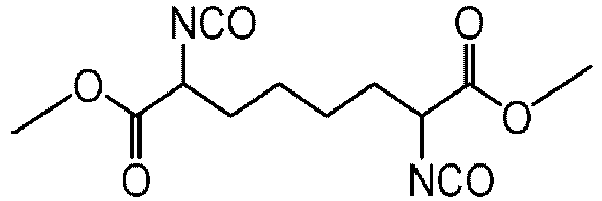
66 297 A 

66 (Ex: Example) - Each isocyanate was prepared by thermal decomposition of carbamate as conducted in Example 5-2 except that butyl cellosolve was used as an inert solvent and each carbamate shown in the following tables was used.
Table 123 Ex. Carbamate Resultant isocyanate Thermal decomposition yield (%) 289 B 

80 290 B 

76 291 B 

77 292 B 

75 293 B 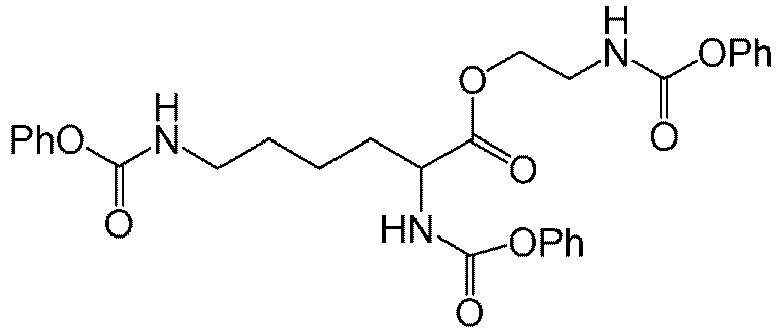

73 (Ex: Example) Table 124 Ex. Carbamate Resultant isocyanate Thermal decomposition yield (%) 294 B 

72 295 B 

72 296 B 

73 297 B 

74 (Ex: Example) - Each isocyanate was prepared by thermal decomposition of carbamate as conducted in Example 5-1 except that a compound of the following formula (11a) was used as the compound A and each carbamate shown in the following tables was used.

Table 125 Ex. Carbamate Resultant isocyanate Thermal decomposition yield (%) 298 A 

72 299 A 

66 300 A 

67 301 A 
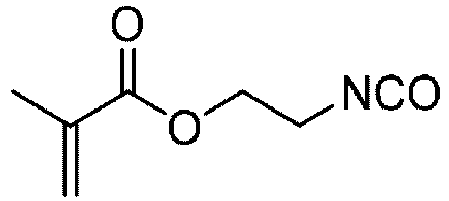
66 302 A 

64 (Ex: Example) Table 126 Ex. Carbamate Resultant isocyanate Thermal decomposition yield (%) 303 A 

64 304 A 

63 305 A 

66 306 A 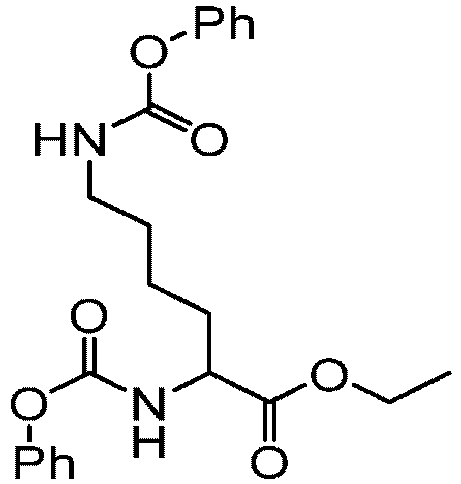

66 (Ex: Example) - Each isocyanate was prepared by thermal decomposition of carbamate as conducted in Example 5-2 except that the compound of the formula (11a) was used as the compound A, butyl cellosolve was used as an inert solvent and each carbamate shown in the following tables was used.
Table 127 Ex. Carbamate Resultant isocyanate Thermal decomposition yield (%) 298 B 

79 299 B 

75 300 B 

76 301 B 

70 302 B 

70 (Ex: Example) Table 128 Ex. Carbamate Resultant isocyanate Thermal decomposition yield (%) 303 B 

68 304 B 
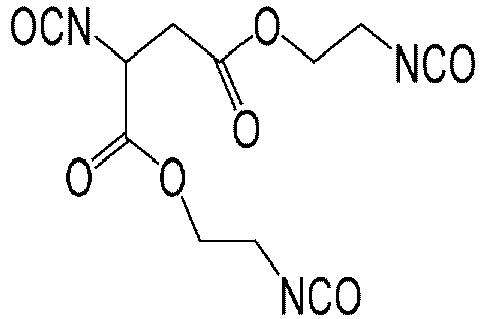
67 305 B 

70 306 B 
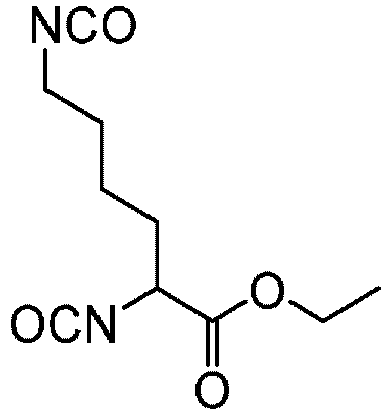
71 (Ex: Example) - The preparation method of an isocyanate according to the above-mentioned aspects makes it possible to prepare an isocyanate continuously while suppressing side reactions.
-
- 100: Reactor
- 101, 102, 103, 104, 105: Storage tank
- 106, 107, 108: Packed bed
- 109, 110, 111, 112, 116: Liquid feed pump
- 113, 114, 115: Condenser
- 10, 11, 12, 13, 14, 15, 16, 17: Line
- 1A: Isocyanate preparation device
- 200: Falling film type reactor
- 201, 202, 203, 204: Storage tank
- 205: Condenser
- 206: Reboiler
- 207, 208, 209: Liquid feed pump
- 210: Distillation column
- 20, 21, 22, 23, 24, 25, 26, 27: Line
- 2A: Isocyanate preparation device

Claims (20)
- A preparation method of an isocyanate in which the isocyanate is prepared by thermal decomposition of a carbamate, the preparation method comprising:a thermal decomposition step in which a mixture liquid comprising a carbamate and at least one compound (A) is introduced continuously into a thermal decomposition reactor to allow a thermal decomposition reaction of the carbamate to proceed;a low-boiling-point decomposition product collecting step in which a low-boiling-point decomposition product having a standard boiling point lower than a standard boiling point of the compound (A) is extracted continuously from the thermal decomposition reactor in a gaseous state; anda high-boiling-point component collecting step in which a liquid-phase component which is not collected in a gaseous state in the low-boiling-point decomposition product collecting step is extracted continuously from the thermal decomposition reactor as a high-boiling-point component,whereinthe compound (A) is selected from the group consisting of polymers having a repeating unit of general formula (4), compounds of general formula (5), compounds of general formula (6), compounds of general formula (7), compounds of general formula (S1), compounds of general formula (S2), compounds of general formula (S3), compounds of general formula (9), compounds of general formula (10), and C9-35 chained or cyclic aliphatic hydrocarbons,
 in the general formula (4), R41 is a monovalent hydrocarbon group, the hydrocarbon group may have either an ether bond or an ester bond, n41 is 0 or an integer of 1 to 3, R42 is a divalent organic group, and n43 is an integer of 2 to 50,
 in the general formula (5), n51 is an integer of 1 to 4, R51 is a hydrogen atom or an n51-valent organic group, R52 is a monovalent hydrocarbon group, the hydrocarbon group may have either an ether bond or an ester bond, n52 is 0 or an integer of 1 to 4, and n53 is 0 or 1,
R61-(COO-R62)n61 (6)
in the general formula (6), n61 is an integer of 1 to 3, R61 is an n61-valent C1-60 hydrocarbon group, the C1-60 hydrocarbon group may have either an ether bond or an ester bond, R62 is a C1-20 aliphatic hydrocarbon group or a C6-20 aromatic hydrocarbon group,
R71-(OCO-R72)n71 (7)
in the general formula (7), n71 is 2 or 3, R71 is an n71-valent C1-60 hydrocarbon group, the C1-60 hydrocarbon group may have either an ether bond or an ester bond, R72 is a C1-20 aliphatic hydrocarbon group or a C6-20 aromatic hydrocarbon group, in the general formula (S1), R801, R802 and R803 are each independently a C1-60 saturated or unsaturated linear or branched hydrocarbon group, when R801, R802 or R803 has a methylene group, the methylene group may be substituted with an oxygen atom, an arylene group, a cycloalkylene group or an NH group, at least one CH group constituting R801, R802 or R803 may be substituted with a nitrogen atom, at least one hydrogen atom constituting R801, R802 or R803 may be substituted with a halogen atom or a hydroxy group, R801, R802 or R803 may be bonded together to form a monocycle or a polycycle,
 in the general formula (S2), R804 and R805 are each independently a C1-60 saturated or unsaturated linear or branched hydrocarbon group, when R804 or R805 has a methylene group, the methylene group may be substituted with an oxygen atom, an arylene group, a cycloalkylene group or an NH group, at least one CH group constituting R804 or R805 may be substituted with a nitrogen atom, at least one hydrogen atom constituting R804 or R805 may be substituted with a halogen atom or a hydroxy group, and R804 or R805 may be bonded together to form a monocycle or a polycycle,
R 806-CH2OH (S3)
in the general formula (S3), R806 is a C1-60 saturated or unsaturated linear or branched hydrocarbon group, when R806 has a methylene group, the methylene group may be substituted with an oxygen atom, an arylene group, a cycloalkylene group or an NH group, at least one CH group constituting R806 may be substituted with a nitrogen atom, at least one hydrogen atom constituting R806 may be substituted with a halogen atom or a hydroxy group, branched chains may be bonded together to form a ring, in the general formula (9), Y91 and Y93 are each independently a C4-10 divalent hydrocarbon group having an alicyclic hydrocarbon group or an aromatic hydrocarbon group, Y92 is a C4-10 trivalent hydrocarbon group having an alicyclic hydrocarbon group or an aromatic hydrocarbon group, and n91 is an integer of 0 to 5, and
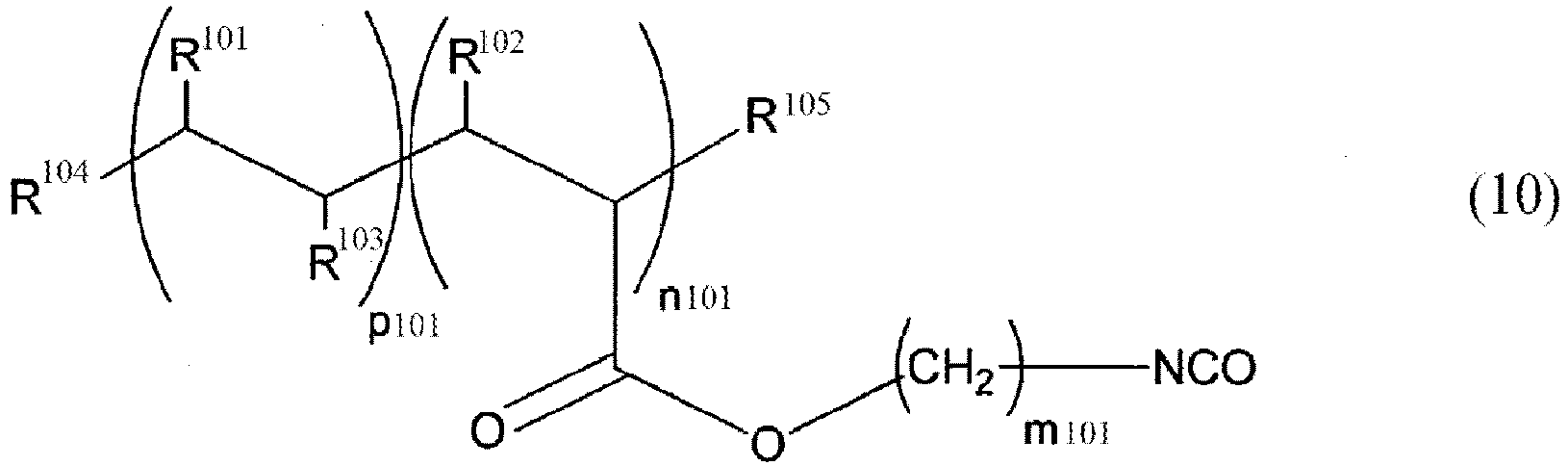 in the general formula (10), p101 is an integer of 0 to 90, n101 is an integer of 1 to 100, a sum of p101 and n101 is an integer of 10 to 100, m101 is an integer of 1 to 5, R101 and R102 are each independently a hydrogen atom or a C1-5 monovalent hydrocarbon group, R103 is a C1-5 alkoxycarbonyl group or a C1-12 monovalent hydrocarbon group and R104 and R105 are each independently a monovalent organic group.
 - The preparation method of an isocyanate according to claim 1, wherein the compound (A) is selected from the group consisting of the polymers having a repeating unit of the general formula (4) and the compounds of the general formula (5).
- The preparation method of an isocyanate according to claim 2, wherein the compound (A) is selected from the group consisting of polymers having either a repeating unit of general formula (4-1) or a repeating unit of general formula (4-2), compounds of general formula (5-1) and compounds of general formula (5-2),
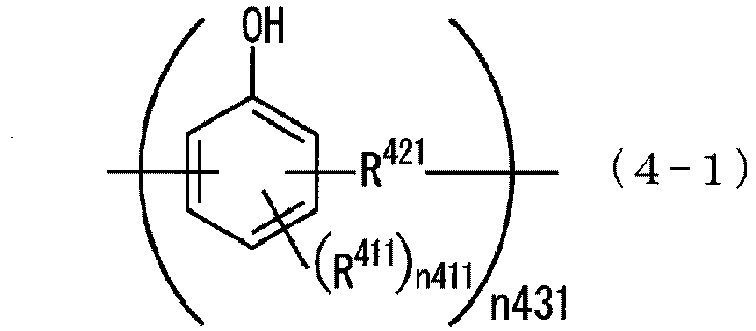
 in the general formula (4-1), R411 is a monovalent hydrocarbon group, the monovalent hydrocarbon group may have either an ether bond or an ester bond, and may be substituted with a hydroxy group, n411 is 0 or an integer of 1 to 3, when n411 is 2 or 3, R411 may be identical to or different from each other, R421 is a divalent aliphatic hydrocarbon group, the divalent aliphatic hydrocarbon group may have either an ether bond or an ester bond, and n431 is an integer of 2 to 50,in the general formula (4-2), R412 is a monovalent hydrocarbon group, the monovalent hydrocarbon group may have either an ether bond or an ester bond, n412 is 0 or an integer of 1 to 3, R422 is a divalent aromatic hydrocarbon group or a divalent group formed by bonding an aliphatic hydrocarbon group and an aromatic hydrocarbon group, the aliphatic hydrocarbon group may have either an ether bond or an ester bond, and n432 is an integer of 2 to 50,
 in the general formula (5-1), R521 is a C1-20 alkyl group which may be substituted with a C6-12 aryl group or a C1-20 alkoxycarbonyl group which may be substituted with a C6-12 aryl group, n521 is 0 or an integer of 1 to 4, and n531 is 0 or 1, andin the general formula (5-2), n512 is an integer of 2 to 4, R512 is an n512-divalent hydrocarbon group, the n512-divalent hydrocarbon group may have an ether bond, an ester bond, a carbonyl group, or a hetero ring, R522 is a monovalent hydrocarbon group, the monovalent hydrocarbon group may have either an ether bond or an ester bond, and n522 is 0 or an integer of 1 to 4.
 - The preparation method of an isocyanate according to claim 1, wherein the compound (A) is selected from the group consisting of the compounds of the general formula (6) and the compounds of the general formula (7).
- The preparation method of an isocyanate according to claim 7, wherein the compound (A) is selected from the group consisting of compounds of general formula (6-1), compounds of general formula (6-2), and compounds of general formula (7-1),
R611-(COO-R612)n611 (6-1)
R621-(COO-R622)n621 (6-2)
in the general formula (6-1), n611 is 2 or 3, R611 is an n611-valent C1-60 aliphatic hydrocarbon group, the C1-60 aliphatic hydrocarbon group may have either an ether bond or an ester bond, and R612 is a C1-20 aliphatic hydrocarbon group or a C6-20 aromatic hydrocarbon group,in the general formula (6-2), n621 is 2 or 3, R621 is an n621-valent C6-60 aromatic hydrocarbon group, the C6-60 aromatic hydrocarbon group may have either an ether bond or an ester bond, and R622 is a C1-20 aliphatic hydrocarbon group or a C6-20 aromatic hydrocarbon group, and
R711-(OCO-R712)n711 (7-1)
in the general formula (7-1), n711 is 2 or 3, R711 is an n711-valent C1-60 aliphatic hydrocarbon group, the C1-60 aliphatic hydrocarbon group may have either an ether bond or an ester bond, and R712 is a C1-20 aliphatic hydrocarbon group or a C6-20 aromatic hydrocarbon group. - The preparation method of an isocyanate according to claim 8, wherein the compound (A) is selected from the group consisting of compounds of general formula (6-1-1), compounds of general formula (6-2-1), and compounds of general formula (7-1-1), R
613-OCO-Y611-COO-R614 (6-1-1)
 in the general formula (6-1-1), R613 and R614 are each independently a C1-20 aliphatic hydrocarbon group or a C6-20 aromatic hydrocarbon group, Y611 is a divalent C1-60 aliphatic hydrocarbon group, and the C1-60 aliphatic hydrocarbon group may have either an ether bond or an ester bond,in the general formula (6-2-1), R623 is a C1-20 aliphatic hydrocarbon group or a C6-20 aromatic hydrocarbon group, and n622 is 2 or 3, and
R713-COO-Y711-OCO-R714 (7-1-1)
in the general formula (7-1-1), R713 and R714 are each independently a C1-20 aliphatic hydrocarbon group or a C6-20 aromatic hydrocarbon group, Y711 is a divalent C1-60 aliphatic hydrocarbon group, and the C1-20 aliphatic hydrocarbon group may have either an ether bond or an ester bond. - The preparation method of an isocyanate according to claim 1, wherein the compound (A) is selected from the group consisting of the compounds of the general formula (S1), the compounds of the general formula (S2) and the compounds of the general formula (S3).
- The preparation method of an isocyanate according to claim 7, wherein the compound (A) is a compound of the general formula (S1).
- The preparation method of an isocyanate according to claim 1, wherein the compound (A) is selected from the group consisting of the compounds of the general formula (9) and the compounds of the general formula (10).
- The preparation method of an isocyanate according to claim 9, wherein the compound (A) is selected from the group consisting of compounds of general formula (9-1) and compounds of general formula (10-1),
 in the general formula (9-1), Y911 and Y913 are each independently a C4-10 divalent alicyclic hydrocarbon group or a C6-10 divalent aromatic hydrocarbon group, Y912 is a C4-10 trivalent alicyclic hydrocarbon group or a C6-10 divalent aromatic hydrocarbon group, n911 and n912 are each independently an integer of 1 to 5, and m911 is an integer of 0 to 5, and
 in the general formula (10-1), p1011 is an integer of 0 to 50, s1011 is an integer of 0 to 50, n1011 is an integer of 1 to 100, a sum of p1011, s1011 and n1011 is an integer of 10 to 100, m1011 is an integer of 1 to 5, R1011, R1012 and R1013 are each independently a hydrogen atom or a C1-5 monovalent hydrocarbon group, R1014 and R1015 are each independently a C1-5 alkoxycarbonyl group or a C1-12 monovalent hydrocarbon group, and R1016 and R1017 are each independently a monovalent organic group.
 - The preparation method of an isocyanate according to claim 9, wherein the compound (A) is a compound of formula (9-2),

- The preparation method of an isocyanate according to claim 1, wherein the compound (A) is a C9-35 chained or cyclic aliphatic hydrocarbon.
- The preparation method of an isocyanate according to claim 12, wherein the chained aliphatic hydrocarbon is a chained aliphatic hydrocarbon having a branched chain consisting of a C1-3 linear aliphatic hydrocarbon group.
- The preparation method of an isocyanate according to claim 12 or 13, wherein a carbon number of the chained aliphatic hydrocarbon is 12 to 30.
- The preparation method of an isocyanate according to any one of claims 1 to 14, wherein the mixture liquid further comprises an inert solvent,in the low-boiling-point decomposition product collecting step, the low-boiling-point decomposition product and the inert solvent are extracted continuously from the thermal decomposition reactor in a gaseous state, andthe inert solvent is substantially inert under thermal decomposition reaction conditions, and a standard boiling point of the inert solvent is lower than the standard boiling point of the compound (A) and is between standard boiling points of the isocyanate and a hydroxy compound produced by thermal decomposition.
- The preparation method of an isocyanate according to any one of claim 1 to 15, wherein the carbamate is a compound of general formula (2),

- The preparation method of an isocyanate according to claim 16, wherein in the general formula (2), n21 is 2 or 3 and R22 is a C6-20 aromatic group.
- The preparation method of an isocyanate according to any one of claims 1 to 17, wherein the thermal decomposition reactor is a tubular reactor.
- The preparation method of an isocyanate according to any one of claims 1 to 18,wherein the low-boiling-point decomposition product comprises the isocyanate, andthe preparation method further comprises: a separation step in which the low-boiling-point decomposition product is supplied to a distillation column in a gaseous state, and the isocyanate is separated in the distillation column.
- The preparation method of an isocyanate according to any one of claims 1 to 19,
wherein a carrier agent which is substantially inert in a gaseous state under thermal decomposition reaction conditions is introduced into the thermal decomposition reactor and a gaseous component is discharged from the thermal decomposition reactor.
Applications Claiming Priority (1)
| Application Number | Priority Date | Filing Date | Title |
|---|---|---|---|
| PCT/JP2019/045351 WO2021100131A1 (en) | 2019-11-20 | 2019-11-20 | Method for producing isocyanate |
Publications (2)
| Publication Number | Publication Date |
|---|---|
| EP4063347A1 true EP4063347A1 (en) | 2022-09-28 |
| EP4063347A4 EP4063347A4 (en) | 2023-03-15 |
Family
ID=75980455
Family Applications (1)
| Application Number | Title | Priority Date | Filing Date |
|---|---|---|---|
| EP19953515.4A Withdrawn EP4063347A4 (en) | 2019-11-20 | 2019-11-20 | Method for producing isocyanate |
Country Status (5)
| Country | Link |
|---|---|
| US (1) | US20230021574A1 (en) |
| EP (1) | EP4063347A4 (en) |
| JP (1) | JPWO2021100131A1 (en) |
| CN (1) | CN114728892A (en) |
| WO (1) | WO2021100131A1 (en) |
Family Cites Families (12)
| Publication number | Priority date | Publication date | Assignee | Title |
|---|---|---|---|---|
| JPS60231640A (en) * | 1984-05-02 | 1985-11-18 | Asahi Chem Ind Co Ltd | Continuous production of isocyanate |
| JPH02212465A (en) * | 1989-02-13 | 1990-08-23 | Sumitomo Metal Ind Ltd | Production of polyisocyanate |
| JP4298995B2 (en) | 2001-12-28 | 2009-07-22 | 三井化学ポリウレタン株式会社 | Method for producing carbamate and method for producing isocyanate |
| TW200844080A (en) * | 2007-01-11 | 2008-11-16 | Asahi Kasei Chemicals Corp | Process for producing isocyanate |
| CN101652344B (en) * | 2007-03-30 | 2014-06-04 | 旭化成化学株式会社 | Method for production of isocyanate using composition comprising carbamic acid ester and aromatic hydroxy compound, and composition for transport or storage of carbamic acid ester |
| CA2721357C (en) | 2008-05-15 | 2014-01-07 | Asahi Kasei Chemicals Corporation | Process for producing isocyanates using diaryl carbonate |
| CN103588680B (en) * | 2009-08-21 | 2016-08-10 | 旭化成株式会社 | N-substituted carbamate conveying with and storage compositions and manufacture isocyanates method |
| US10968168B2 (en) * | 2017-05-15 | 2021-04-06 | Asahi Kasei Kabushiki Kaisha | Isocyanate production method |
| JP2019199431A (en) * | 2018-05-15 | 2019-11-21 | 旭化成株式会社 | Method for producing isocyanate |
| JP2019199422A (en) * | 2018-05-15 | 2019-11-21 | 旭化成株式会社 | Method for producing isocyanate |
| JP2019199420A (en) * | 2018-05-15 | 2019-11-21 | 旭化成株式会社 | Method for producing isocyanate |
| JP2019199418A (en) * | 2018-05-15 | 2019-11-21 | 旭化成株式会社 | Method for producing isocyanate |
-
2019
- 2019-11-20 US US17/777,646 patent/US20230021574A1/en not_active Abandoned
- 2019-11-20 WO PCT/JP2019/045351 patent/WO2021100131A1/en not_active Ceased
- 2019-11-20 EP EP19953515.4A patent/EP4063347A4/en not_active Withdrawn
- 2019-11-20 JP JP2021558084A patent/JPWO2021100131A1/ja active Pending
- 2019-11-20 CN CN201980102313.9A patent/CN114728892A/en active Pending
Also Published As
| Publication number | Publication date |
|---|---|
| JPWO2021100131A1 (en) | 2021-05-27 |
| CN114728892A (en) | 2022-07-08 |
| US20230021574A1 (en) | 2023-01-26 |
| WO2021100131A1 (en) | 2021-05-27 |
| EP4063347A4 (en) | 2023-03-15 |
Similar Documents
| Publication | Publication Date | Title |
|---|---|---|
| JP5612115B2 (en) | Separation method and isocyanate production method | |
| CN102026964B (en) | Method for producing isocyanate using diaryl carbonate | |
| CN105143178B (en) | Xylylene diisocyanate and its production method, and xylylene dicarbamate and its preservation method | |
| JPS58194849A (en) | Continuous pyrolysis of carbamic acid ester | |
| EP3214071B1 (en) | Isothiocyanate composition | |
| EP4063347A1 (en) | Method for producing isocyanate | |
| JP6757468B2 (en) | Isocyanate production method | |
| IN2012DN06523A (en) | ||
| US8455695B2 (en) | Process for the production of aliphatic isocyanates | |
| JP2019199431A (en) | Method for producing isocyanate | |
| JP2019199418A (en) | Method for producing isocyanate | |
| JP2019199420A (en) | Method for producing isocyanate | |
| JP2019199422A (en) | Method for producing isocyanate | |
| JP2019199425A (en) | Production method of isocyanate | |
| US5789614A (en) | Process for preparation of aliphatic diisocyanate compounds | |
| JP2019199417A (en) | Method for producing isocyanate | |
| JP7165509B2 (en) | Method for producing isocyanate | |
| JP2019199423A (en) | Method for producing isocyanate | |
| JP2019199421A (en) | Method for producing isocyanate | |
| JP2019199430A (en) | Production method of isocyanate | |
| JP7165508B2 (en) | Method for producing isocyanate | |
| JP2019199419A (en) | Method for producing isocyanate | |
| JP2019199427A (en) | Method for producing isocyanate | |
| JP2019199429A (en) | Method for producing isocyanate | |
| WO2019221210A1 (en) | Method for producing carbamate and method for producing isocyanate |
Legal Events
| Date | Code | Title | Description |
|---|---|---|---|
| STAA | Information on the status of an ep patent application or granted ep patent |
Free format text: STATUS: THE INTERNATIONAL PUBLICATION HAS BEEN MADE |
|
| PUAI | Public reference made under article 153(3) epc to a published international application that has entered the european phase |
Free format text: ORIGINAL CODE: 0009012 |
|
| STAA | Information on the status of an ep patent application or granted ep patent |
Free format text: STATUS: REQUEST FOR EXAMINATION WAS MADE |
|
| 17P | Request for examination filed |
Effective date: 20220517 |
|
| AK | Designated contracting states |
Kind code of ref document: A1 Designated state(s): AL AT BE BG CH CY CZ DE DK EE ES FI FR GB GR HR HU IE IS IT LI LT LU LV MC MK MT NL NO PL PT RO RS SE SI SK SM TR |
|
| RIC1 | Information provided on ipc code assigned before grant |
Ipc: C07C 319/20 20060101ALI20221103BHEP Ipc: C07C 323/57 20060101ALI20221103BHEP Ipc: C07C 265/14 20060101ALI20221103BHEP Ipc: C07C 265/04 20060101ALI20221103BHEP Ipc: C07C 263/04 20060101AFI20221103BHEP |
|
| DAV | Request for validation of the european patent (deleted) | ||
| DAX | Request for extension of the european patent (deleted) | ||
| STAA | Information on the status of an ep patent application or granted ep patent |
Free format text: STATUS: EXAMINATION IS IN PROGRESS |
|
| A4 | Supplementary search report drawn up and despatched |
Effective date: 20230213 |
|
| RIC1 | Information provided on ipc code assigned before grant |
Ipc: C07C 319/20 20060101ALI20230207BHEP Ipc: C07C 323/57 20060101ALI20230207BHEP Ipc: C07C 265/14 20060101ALI20230207BHEP Ipc: C07C 265/04 20060101ALI20230207BHEP Ipc: C07C 263/04 20060101AFI20230207BHEP |
|
| 17Q | First examination report despatched |
Effective date: 20230313 |
|
| STAA | Information on the status of an ep patent application or granted ep patent |
Free format text: STATUS: THE APPLICATION IS DEEMED TO BE WITHDRAWN |
|
| 18D | Application deemed to be withdrawn |
Effective date: 20230725 |