EP4061772B1 - Preparation method of lithium argyrodite - Google Patents
Preparation method of lithium argyrodite Download PDFInfo
- Publication number
- EP4061772B1 EP4061772B1 EP20808129.9A EP20808129A EP4061772B1 EP 4061772 B1 EP4061772 B1 EP 4061772B1 EP 20808129 A EP20808129 A EP 20808129A EP 4061772 B1 EP4061772 B1 EP 4061772B1
- Authority
- EP
- European Patent Office
- Prior art keywords
- solution
- solvent
- mol
- species under
- temperature
- Prior art date
- Legal status (The legal status is an assumption and is not a legal conclusion. Google has not performed a legal analysis and makes no representation as to the accuracy of the status listed.)
- Active
Links
Images


Classifications
-
- H—ELECTRICITY
- H01—ELECTRIC ELEMENTS
- H01M—PROCESSES OR MEANS, e.g. BATTERIES, FOR THE DIRECT CONVERSION OF CHEMICAL ENERGY INTO ELECTRICAL ENERGY
- H01M10/00—Secondary cells; Manufacture thereof
- H01M10/05—Accumulators with non-aqueous electrolyte
- H01M10/056—Accumulators with non-aqueous electrolyte characterised by the materials used as electrolytes, e.g. mixed inorganic/organic electrolytes
- H01M10/0561—Accumulators with non-aqueous electrolyte characterised by the materials used as electrolytes, e.g. mixed inorganic/organic electrolytes the electrolyte being constituted of inorganic materials only
- H01M10/0562—Solid materials
-
- C—CHEMISTRY; METALLURGY
- C01—INORGANIC CHEMISTRY
- C01D—COMPOUNDS OF ALKALI METALS, i.e. LITHIUM, SODIUM, POTASSIUM, RUBIDIUM, CAESIUM, OR FRANCIUM
- C01D15/00—Lithium compounds
-
- H—ELECTRICITY
- H01—ELECTRIC ELEMENTS
- H01M—PROCESSES OR MEANS, e.g. BATTERIES, FOR THE DIRECT CONVERSION OF CHEMICAL ENERGY INTO ELECTRICAL ENERGY
- H01M10/00—Secondary cells; Manufacture thereof
- H01M10/05—Accumulators with non-aqueous electrolyte
- H01M10/052—Li-accumulators
-
- H—ELECTRICITY
- H01—ELECTRIC ELEMENTS
- H01M—PROCESSES OR MEANS, e.g. BATTERIES, FOR THE DIRECT CONVERSION OF CHEMICAL ENERGY INTO ELECTRICAL ENERGY
- H01M2220/00—Batteries for particular applications
- H01M2220/20—Batteries in motive systems, e.g. vehicle, ship, plane
-
- H—ELECTRICITY
- H01—ELECTRIC ELEMENTS
- H01M—PROCESSES OR MEANS, e.g. BATTERIES, FOR THE DIRECT CONVERSION OF CHEMICAL ENERGY INTO ELECTRICAL ENERGY
- H01M2300/00—Electrolytes
- H01M2300/0017—Non-aqueous electrolytes
- H01M2300/0065—Solid electrolytes
- H01M2300/0068—Solid electrolytes inorganic
-
- H—ELECTRICITY
- H01—ELECTRIC ELEMENTS
- H01M—PROCESSES OR MEANS, e.g. BATTERIES, FOR THE DIRECT CONVERSION OF CHEMICAL ENERGY INTO ELECTRICAL ENERGY
- H01M2300/00—Electrolytes
- H01M2300/0017—Non-aqueous electrolytes
- H01M2300/0065—Solid electrolytes
- H01M2300/0068—Solid electrolytes inorganic
- H01M2300/008—Halides
-
- Y—GENERAL TAGGING OF NEW TECHNOLOGICAL DEVELOPMENTS; GENERAL TAGGING OF CROSS-SECTIONAL TECHNOLOGIES SPANNING OVER SEVERAL SECTIONS OF THE IPC; TECHNICAL SUBJECTS COVERED BY FORMER USPC CROSS-REFERENCE ART COLLECTIONS [XRACs] AND DIGESTS
- Y02—TECHNOLOGIES OR APPLICATIONS FOR MITIGATION OR ADAPTATION AGAINST CLIMATE CHANGE
- Y02E—REDUCTION OF GREENHOUSE GAS [GHG] EMISSIONS, RELATED TO ENERGY GENERATION, TRANSMISSION OR DISTRIBUTION
- Y02E60/00—Enabling technologies; Technologies with a potential or indirect contribution to GHG emissions mitigation
- Y02E60/10—Energy storage using batteries
Definitions
- the present invention concerns a method for the preparation of lithium argyrodite.
- Lithium batteries are used to power portable electronics and electric vehicles owing to their high energy and power density.
- Conventional lithium batteries make use of a liquid electrolyte that is composed of a lithium salt dissolved in an organic solvent.
- the aforementioned system raises security questions as the organic solvents are flammable.
- Lithium dendrites forming and passing through the liquid electrolyte medium can cause short circuit and produce heat, which result in accident that leads to serious injuries.
- Non-flammable inorganic solid electrolytes offer a solution to the security problem. Furthermore, their mechanic stability helps suppressing lithium dendrite formation, preventing self-discharge and heating problems, and prolonging the lifetime of a battery.
- Solid sulfide electrolytes are advantageous for lithium battery applications due to their high ionic conductivities and mechanical properties. These electrolytes can be pelletized and attached to electrode materials by cold pressing, which eliminates the necessity of a high temperature assembly step. Elimination of the high temperature sintering step removes one of the challenges against using lithium metal anodes in lithium batteries.
- Argyrodites have long been known and are derived from argyrodite Ag 8 GeS 6 , which was described for the first time in 1886 by C. Winkler and the analysis of which led to the discovery of germanium.
- the argyrodite family consists of more than 100 crystalline solids and includes, for example, those solid-state compounds in which the silver is replaced by copper, the germanium by gallium or phosphorus and the sulfur by selenium.
- Nitsche, Kuhs, Krebs, Evain, Boucher, Pfitzner and Nilges describe, inter alia, compounds such as Cu 9 GaS 6 , Ag 7 PSe 6 and Cu 8 GaS 5 Cl, the solid-state structures of which are derived from argyrodite.
- lithium argyrodites and in particular most of the Li 6 PS 5 Cl, as reported in the literature, are prepared via a dry or wet mechanochemical route.
- the aim of the present invention is to provide a method for the synthesis of a sulfide-based solid electrolyte with argyrodite structure being preferably both faster and easier to set up compared to previously described methods.
- the aim of the present invention is to provide a new process for the preparation in solution of lithium argyrodite preferably having improved productivity and allowing a control of the morphology of the obtained product.
- the present invention relates to a method for preparing Li 6 PS 5 X, wherein X is halogen, comprising at least one step for the preparation of a solution S1 at a temperature T1 comprised from -200°C to 10°C, preferably from -110°C to 0°C, said solution S1 comprising a solvent and at least P species under the form of (PS 4 ) 3- , Li species under the form of Li + , X species under the form of X - and remaining sulfur under the form of polysulfide, followed by a step for removing at least a portion of the solvent from said solution to obtain Li 6 PS 5 X.
- Ratios, concentrations, amounts, and other numerical data may be presented herein in a range format. It is to be understood that such range format is used merely for convenience and brevity and should be interpreted flexibly to include not only the numerical values explicitly recited as the limits of the range, but also to include all the individual numerical values or sub-ranges encompassed within that range as if each numerical value and sub-range is explicitly recited.
- a temperature range of about 120°C to about 150°C should be interpreted to include not only the explicitly recited limits of about 120°C to about 150°C, but also to include sub-ranges, such as 125°C to 145°C, 130°C to 150°C, and so forth, as well as individual amounts, including fractional amounts, within the specified ranges, such as 122.2°C, 140.6°C, and 141.3°C, for example.
- electrolyte refers in particular to a material that allows ions, e.g., Li + , to migrate therethrough but which does not allow electrons to conduct therethrough. Electrolytes are useful for electrically isolating the cathode and anodes of a battery while allowing ions, e.g., Li + , to transmit through the electrolyte.
- the "solid electrolyte” according to the present invention means in particular any kind of material in which ions, for example, Li + , can move around while the material is in a solid state.
- Electrochemical device refers in particular to a device which generates and/or stores electrical energy by, for example, electrochemical and/or electrostatic processes. Electrochemical devices may include electrochemical cells such as batteries, notably solid state batteries. A battery may be a primary (i.e., single or “disposable” use) battery, or a secondary (i.e., rechargeable) battery.
- vehicle or “vehicular” or other similar term as used herein is inclusive of motor vehicles in general such as passenger automobiles including sports utility vehicles (SUV), buses, trucks, various commercial vehicles, watercraft including a variety of boats and ships, aircraft, and the like, and includes hybrid vehicles, electric vehicles, plug-in hybrid electric vehicles, hydrogen-powered vehicles and other alternative fuel vehicles (e.g. fuels derived from resources other than petroleum).
- a hybrid vehicle is a vehicle that has two or more different sources of power, for example both gasoline-powered and electric-powered vehicles.
- the method of the invention is based on the preparation of a homogeneous solution comprising ionic species. It thus does not involve a suspension.
- An essential feature of the method of the invention is the temperature T1 as defined above.
- the method of the invention is thus carried out at a low temperature, notably in order to stabilize the (PS 4 ) 3- species in solution and thus to obtain the solution S1 at the required temperature.
- Li 6 PS 5 X is obtained as a solid, preferably as a powder.
- the term "at least a portion of the solvent” refers to at least 50% by weight of said solvent, preferably at least 60% by weight.
- the P species under the form of (PS 4 ) 3- are preferably obtained from a precursor chosen in the group consisting of: P 2 S 5 , P 4 S 10 , P 4 S 9 and P 4 S 9+x (with 0 ⁇ x ⁇ 1).
- the Li species under the form of Li + are preferably obtained from a precursor chosen in the group consisting of: Li 2 S and LiHS.
- the X species under the form of X - are preferably obtained from a precursor chosen in the group consisting of: LiF, LiCI, LiBr and Lil.
- the remaining sulfur under the form of polysulfide is preferably obtained from a precursor chosen in the group consisting of: P 2 S 5 , P 4 S 10 , P 4 S 9 , P 4 S 9+x (with 0 ⁇ x ⁇ 1), Li 2 S, S and LiHS.
- the solution S1 as defined above is obtained by admixing lithium sulfide, phosphorus sulfide, and a halogen compound in the solvent, at a temperature ranging from -200°C to 10°C, preferably from -110°C to 0°C.
- the solution S1 as defined above is obtained by carrying out the following steps:
- the solution S1 is prepared in two steps, in which the first step comprising the mixing of the lithium and halogen compounds.
- the method of the invention is easy to be implemented, and in particular easier than the prior art method.
- the lithium sulfide may be used as such even when it is obtained by carboreduction.
- the lithium sulfide obtained from carboreduction that contains residual carbon is to be submitted to a filtration step for removing the carbon and then be used directly in the solvent for the preparation of the solution S1. This eliminates the need for an intermediate lithium sulfide isolation step.
- the step for removing at least a portion of the solvent from the solution S1 is carried out at a temperature comprised from 30°C to 200°C, preferably from 30°C to 185°C, for instance from 30°C to 100°C. According to an embodiment, this temperature may be comprised from 35°C to 65°C.
- the step for removing the solvent may be carried out by implementing conventional means, in particular by solvent evaporation.
- This preferred temperature range for the solvent elimination is advantageous in that the secondary reactions are not promoted at such temperature values.
- the preparation of the solution S1 may occur in an inert atmosphere, under vacuum or under H 2 S flow.
- the method of the invention may comprise a further step, notably after the step for removing the solvent, of thermal treatment of Li 6 PS 5 X.
- a further step notably after the step for removing the solvent, of thermal treatment of Li 6 PS 5 X.
- Li 6 PS 5 X is then thermally treated at a temperature comprised from 150°C to 700°C, preferably at about 550°C.
- Such additional step advantageously thus consists in a thermal treatment of the solid Li 6 PS 5 X obtained after the solvent removal step.
- the solvent used in the method of the invention is able to dissolve Li 6 PS 5 X, lithium sulfide, phosphorus sulfide and a halogen compound.
- this solvent thus gives a homogeneous solution S1 as previously defined.
- the solvent is an aliphatic alcohol.
- the solvent is chosen in the group consisting of: ethanol, methanol and mixtures thereof.
- the temperature T1 is comprised from -200°C to 10°C, preferably from -110°C to 0°C, most preferably from -110°C to -10°C, and in particular from -100°C to - 50°C, notably from -90°C to -70°C.
- T1 is of about -80°C.
- the temperature used during the step from removing at least a portion of the solvent from the solution S1 is comprised from 35°C to 65°C and the temperature T1 is comprised from -110°C to -10°C, preferably from -100°C to -50°C.
- the temperature T1 remains constant.
- the method according to the invention allows much less and even none global and local deviation with respect to the stoichiometry.
- Lithium sulfide is generally a compound including one or more of sulfur atoms and one or more of lithium atoms, or alternatively, one or more of sulfur containing ionic groups and one or more of lithium containing ionic groups.
- lithium sulfide may consist of sulfur atoms and lithium atoms.
- Phosphorus sulfide is generally a compound including one or more of sulfur atoms and one or more of phosphorus atoms, or alternatively, one or more of sulfur containing ionic groups and one or more of phosphorus containing ionic groups.
- phosphorus sulfide may consist of sulfur atoms and phosphorus atoms. Examples of phosphorus sulfide may include, but are not limited to, P 2 S 5 , P 4 S 3 , P 4 S 10 , P 4 S 4 , P 4 S 5 , P 4 S 6 , P 4 S 7 , P 4 S 8 and P 4 S 9 .
- Halogen compound is a compound including one or more of halogen atoms such as F, Cl, Br, or I via chemical bond (e.g., ionic bond or covalent bond) to the other atoms constituting the compound.
- the halogen compound may include one or more of F, Cl, Br, I or combinations thereof, and one or more metal atoms.
- the halogen compound may include one or more of F, Cl, Br, I or combinations thereof, and one or more non-metal atoms.
- Non-limiting examples may suitably include metal halide such as LiF, LiBr, LiCI, Lil, NaF, NaBr, NaCl, Nal, KaF, KBr, KCI, KI, and the like.
- the halogen compound suitably for the use in a solid electrolyte in all-solid Li-ion battery may include one or more halogen atoms and Li.
- the lithium sulfide may include or is lithium sulfide Li 2 S
- the phosphorus sulfide may include or is phosphorus pentasulfide P 2 S 5 .
- the halogen compound as defined above may be chosen in the group consisting of: LiCI, LiBr, Lil, LiF and combinations thereof.
- said halogen compound is LiCl.
- the solution S1 may comprise at least 50% mol. of Li species under the form of Li + , with respect to the total amount in moles of lithium sulfide added in the solvent, preferably at least 80% mol. of Li species under the form of Li + , more preferably at least 95% mol. of Li species under the form of Li + .
- the solution S1 may comprise at least P species under the form of (PS 4 ) 3- and (P 2 S 7 ) 4- .
- the solution S1 may comprise at least 50% mol. of P species under the form of (PS 4 ) 3- , with respect to the total amount in moles of phosphorus sulfide added in the solvent, preferably at least 80% mol. of P species under the form of (PS 4 ) 3- , more preferably at least 95% mol. of P species under the form of (PS 4 ) 3- ,or even at least 99% mol. of P species under the form of (PS 4 ) 3- .
- the solution S1 may comprise at least 50% mol. of X species under the form of X - , with respect to the total amount in moles of halogen compound added in the solvent, preferably at least 80% mol. of X species under the form of X - , more preferably at least 95% mol. of X species under the form of X - .
- Li 6 PS 5 X wherein X is halogen, preferably, Li 6 PS 5 Cl, susceptible to be obtained by the method as defined above.
- Li 6 PS 5 X preferably Li 6 PS 5 Cl, is used as solid electrolyte.
- an electrochemical device comprising a Li6PS5X as defined above, a solid state battery, such as an all-solid-state lithium secondary batteries, comprising a solid electrolyte as defined above and a vehicle comprising a solid state battery as defined above.
- a solid state battery such as an all-solid-state lithium secondary batteries
- a lithium solid-state battery includes a positive electrode active material layer containing a positive electrode active material, a negative electrode active material layer containing a negative electrode active material, and a solid electrolyte layer formed between the positive electrode active material layer and the negative electrode active material layer.
- At least one of the positive electrode active material layer, the negative electrode active material layer, and the solid electrolyte layer includes a solid electrolyte comprising Li 6 PS 5 X, preferably Li 6 PS 5 Cl, as defined above.
- the XRD diffractograms of the powders were acquired on a XRD goniometer in the Bragg Brentano geometry, with a Cu X Ray tube (Cu Kalpha wavelength of 1.5406 ⁇ ).
- the setup may be used in different optical configurations, i.e. with variable or fixed divergence slits, or Soller slits.
- a filtering device on the primary side may also be used, like a monochromator or a Bragg Brentano HD optics from Panalytical. If variable divergence slits are used; the typical illuminated area is 10 mm ⁇ 10 mm.
- the sample holder is loaded on a spinner; rotation speed is typically 60 rpm during the acquisition.
- Tube settings were operating at 40 kV/30 mA for variable slits acquisition and at 45 kV/40 mA for fixed slits acquisition with incident Bragg Brentano HD optics. Acquisition step was 0.017° per step. Angular range is typically 5° to 90° in two theta or larger. Total acquisition time was typically 30 min or longer.
- the powders are covered by a Kapton film to prevent reactions with air moisture.
- the conductivity was acquired on pellets done using a uniaxial press operated at 500MPa.
- the measurement is done under a loading of 40MPa and two carbon paper foils are used as current collector in a pressure cell from MTI (BATTE-CELL-0067 EQ-PSC-15-P).
- the impedance spectra are acquired on a Biologic VMP3 device and the control of temperature is ensured by a Binder climatic chamber. Duration of two hours is set to allow the temperature to be equilibrated between two measurements.
- Impedance spectroscopy is acquired in PElS mode with an amplitude of 10mV and a range of frequencies from 1 MHz to 1kHz (25 points per decade and a mean of 50 measurements per frequency point.)
- Solid-State NMR spectra were recorded on a Bruker Avance 400 spectrometer equipped with a high-speed DVT4 probe.
- 31 P and 6 Li measurements were performed by magic-angle-spinning (MAS) at a speed of 10 kHz, in single-pulse mode with a relaxation time D1 depending on the experiment (see Example below).
- Reference for 31 P NMR was 85% H 3 PO 4 , for 6 Li NMR a 5 mol L -1 aqueous LiCI solution.
- LiCI (229 mg, Sigma-Aldrich) and Li 2 S (620 mg, Albemarle) were weighed in a 100 mL Schlenk flask, in an Ar-filled glove box with oxygen and moisture levels both below 1 ppm. The flask was then taken out of the glove box and connected to a N 2 / vacuum line. 35 mL of anhydrous ethanol (Merck Seccosolv ® , water content below 50 ppm) were added into this flask through a glass syringe. The resulting mixture was stirred under inert atmosphere (N 2 ). Complete dissolution of the reactants took ca. 20 min.
- P 2 S 5 (600 mg, Sigma-Aldrich, 99% purity) was weighed in a 100 mL three-necked flask equipped with an addition funnel. It was cooled to -80°C for 30 min using a dry ice / acetone bath, then the above Li/S/CI solution was transferred into the addition funnel and added rapidly. P 2 S 5 dissolved within ca. 10 min, leading to a clear yellow solution.
- a quartz tube of length 250 mm, inner diameter 10 mm and wall thickness 1.1 mm was closed at one end using a torch fueled by propane and oxygen.
- This tube was taken into an Ar-filled glove box with oxygen and moisture levels both below 1 ppm, and filled with 250 mg of a material prepared by following Example 1.
- the tube was then equipped with a PVC hose adapter closed by a valve, taken out of the glove box and connected to a vacuum line through the valve.
- the system was set under vacuum. When vacuum reached 1 mbar, the tube was sealed using the propane/oxygen torch.
- the sealed tube was heated in a muffle furnace following a 2°C/min ramp up to 550°C, and kept at this value for 5 h.
- LiCI (229 mg, Sigma-Aldrich) and Li 2 S (620 mg, Albemarle) were weighed in a 100 mL Schlenk flask, in an Ar-filled glove box with oxygen and moisture levels both below 1 ppm. The flask was then connected on a N 2 /vacuum line and 35 mL of anhydrous ethanol (Merck Seccosolv ® , water content below 50 ppm) were added. The mixture was stirred under inert atmosphere (N 2 ).
- P 2 S 5 (600 mg, Sigma-Aldrich, 99% purity) was weighed in a 100 mL Schlenk flask equipped with an addition funnel. The above Li/S/CI solution was then transferred into the addition funnel and added rapidly. P 2 S 5 dissolved within ca. 10 min, leading to a clear yellow solution. A 31 P NMR spectrum was then recorded on 600 ⁇ L of the reaction medium.
- the solution was then stirred for 2 h at room temperature (22°C). No further change was observed. After this time, another 600 ⁇ L sample of the solution was taken and characterized by 31 P NMR. The solution contains a high amount of impurities / by-products as seen on 31 P solution NMR ( figure 11 ), especially the signal at 114 ppm.
- the solvent was then removed under vacuum, first at room temperature, then when the solution was concentrated to ca. 60% of its initial volume the temperature was increased to 45°C, eventually when most of the ethanol was gone to 80°C, and kept at this value for another 3.5 h. The resulting product was a white paste. This paste was then heated to 100°C on the vacuum line for 3.5 h and turned into a white powder. The obtained powder contains a high amount of impurities / by-products as seen on 31 P solid NMR ( figure 9 ).
- LiCI (344 mg, Sigma-Aldrich), Li 2 S (930 mg, Albemarle) and elemental sulfur (135 mg, AnalR NORMAPUR ® , VWR Chemicals) were weighed together in a 100 mL Schlenk flask, in an Ar-filled glove box with oxygen and moisture levels both below 1 ppm. 30 g of anhydrous ethanol (VWR, water content below 30 ppm) were added to the mixture. The flask was then taken out of the glove box and connected to a N 2 / vacuum line. The resulting mixture was stirred under inert atmosphere (N 2 ), at 0 °C (water/ice bath). Complete dissolution of the reactants took ca. 15 min, resulting in a deep yellow solution, which was then stirred for another 20 min at 0 °C.
- N 2 inert atmosphere
- P 2 S 5 (600 mg, Sigma-Aldrich, 99% purity) was weighed in a 100 mL Schlenk flask. The flask was cooled to -15°C for 30 min using a sodium chloride / ice bath, then the above Li/S/CI solution was rapidly added through a Teflon ® cannula. P 2 S 5 dissolved within 5 min, leading to a deep yellow solution.
- This solution was stirred for 3 h 45 min while keeping the temperature between -15°C and -10°C.
- the reaction medium was then set under dynamic primary vacuum, and the temperature was increased to 180°C (silicon oil bath on hotplate) to remove the solvent. The temperature of 180°C was reached after 30 min, and kept at this value for another 2 h.
- the resulting product was a dry, grey powder. This powder was characterized by X-ray diffraction and solution 31 P NMR.
Landscapes
- Chemical & Material Sciences (AREA)
- Engineering & Computer Science (AREA)
- Inorganic Chemistry (AREA)
- Manufacturing & Machinery (AREA)
- Chemical Kinetics & Catalysis (AREA)
- Electrochemistry (AREA)
- General Chemical & Material Sciences (AREA)
- Organic Chemistry (AREA)
- Materials Engineering (AREA)
- General Physics & Mathematics (AREA)
- Condensed Matter Physics & Semiconductors (AREA)
- Physics & Mathematics (AREA)
- Secondary Cells (AREA)
- Conductive Materials (AREA)
- Battery Electrode And Active Subsutance (AREA)
- Inorganic Compounds Of Heavy Metals (AREA)
Description
- The present invention concerns a method for the preparation of lithium argyrodite.
- Lithium batteries are used to power portable electronics and electric vehicles owing to their high energy and power density. Conventional lithium batteries make use of a liquid electrolyte that is composed of a lithium salt dissolved in an organic solvent. The aforementioned system raises security questions as the organic solvents are flammable. Lithium dendrites forming and passing through the liquid electrolyte medium can cause short circuit and produce heat, which result in accident that leads to serious injuries.
- Non-flammable inorganic solid electrolytes offer a solution to the security problem. Furthermore, their mechanic stability helps suppressing lithium dendrite formation, preventing self-discharge and heating problems, and prolonging the lifetime of a battery.
- Solid sulfide electrolytes are advantageous for lithium battery applications due to their high ionic conductivities and mechanical properties. These electrolytes can be pelletized and attached to electrode materials by cold pressing, which eliminates the necessity of a high temperature assembly step. Elimination of the high temperature sintering step removes one of the challenges against using lithium metal anodes in lithium batteries.
- There is thus a need for new solid sulfide electrolytes.
- Argyrodites have long been known and are derived from argyrodite Ag8GeS6, which was described for the first time in 1886 by C. Winkler and the analysis of which led to the discovery of germanium. The argyrodite family consists of more than 100 crystalline solids and includes, for example, those solid-state compounds in which the silver is replaced by copper, the germanium by gallium or phosphorus and the sulfur by selenium. Thus, Nitsche, Kuhs, Krebs, Evain, Boucher, Pfitzner and Nilges describe, inter alia, compounds such as Cu9GaS6, Ag7PSe6 and Cu8GaS5Cl, the solid-state structures of which are derived from argyrodite.
- Most of the lithium argyrodites, and in particular most of the Li6PS5Cl, as reported in the literature, are prepared via a dry or wet mechanochemical route.
- Until today, the all solutions routes proposed in the literature are methods starting mostly from pre-formed Li3PS4 dissolved in ethanol, where Li2S and LiCI are then introduced or methods comprising the dissolution of pre-formed Li6PS5Cl.
- There exists thus a need for a full solution route for the preparation of a sulfide-based solid electrolyte.
- The aim of the present invention is to provide a method for the synthesis of a sulfide-based solid electrolyte with argyrodite structure being preferably both faster and easier to set up compared to previously described methods.
- The aim of the present invention is to provide a new process for the preparation in solution of lithium argyrodite preferably having improved productivity and allowing a control of the morphology of the obtained product.
- Thus, the present invention relates to a method for preparing Li6PS5X, wherein X is halogen, comprising at least one step for the preparation of a solution S1 at a temperature T1 comprised from -200°C to 10°C, preferably from -110°C to 0°C, said solution S1 comprising a solvent and at least P species under the form of (PS4)3-, Li species under the form of Li+, X species under the form of X- and remaining sulfur under the form of polysulfide, followed by a step for removing at least a portion of the solvent from said solution to obtain Li6PS5X.
- Throughout this specification, unless the context requires otherwise, the word "comprise" or "include", or variations such as "comprises", "comprising", "includes", including" will be understood to imply the inclusion of a stated element or method step or group of elements or method steps, but not the exclusion of any other element or method step or group of elements or method steps. According to preferred embodiments, the word "comprise" and "include", and their variations mean "consist exclusively of".
- As used in this specification, the singular forms "a", "an" and "the" include plural aspects unless the context clearly dictates otherwise. The term "and/or" includes the meanings "and", "or" and also all the other possible combinations of the elements connected to this term.
- The term "between" should be understood as being inclusive of the limits.
- Ratios, concentrations, amounts, and other numerical data may be presented herein in a range format. It is to be understood that such range format is used merely for convenience and brevity and should be interpreted flexibly to include not only the numerical values explicitly recited as the limits of the range, but also to include all the individual numerical values or sub-ranges encompassed within that range as if each numerical value and sub-range is explicitly recited. For example, a temperature range of about 120°C to about 150°C should be interpreted to include not only the explicitly recited limits of about 120°C to about 150°C, but also to include sub-ranges, such as 125°C to 145°C, 130°C to 150°C, and so forth, as well as individual amounts, including fractional amounts, within the specified ranges, such as 122.2°C, 140.6°C, and 141.3°C, for example.
- The term "electrolyte" refers in particular to a material that allows ions, e.g., Li+, to migrate therethrough but which does not allow electrons to conduct therethrough. Electrolytes are useful for electrically isolating the cathode and anodes of a battery while allowing ions, e.g., Li+, to transmit through the electrolyte. The "solid electrolyte" according to the present invention means in particular any kind of material in which ions, for example, Li+, can move around while the material is in a solid state.
- The term "electrochemical device" refers in particular to a device which generates and/or stores electrical energy by, for example, electrochemical and/or electrostatic processes. Electrochemical devices may include electrochemical cells such as batteries, notably solid state batteries. A battery may be a primary (i.e., single or "disposable" use) battery, or a secondary (i.e., rechargeable) battery.
- It is understood that the term "vehicle" or "vehicular" or other similar term as used herein is inclusive of motor vehicles in general such as passenger automobiles including sports utility vehicles (SUV), buses, trucks, various commercial vehicles, watercraft including a variety of boats and ships, aircraft, and the like, and includes hybrid vehicles, electric vehicles, plug-in hybrid electric vehicles, hydrogen-powered vehicles and other alternative fuel vehicles (e.g. fuels derived from resources other than petroleum). As referred to herein, a hybrid vehicle is a vehicle that has two or more different sources of power, for example both gasoline-powered and electric-powered vehicles.
- The method of the invention is based on the preparation of a homogeneous solution comprising ionic species. It thus does not involve a suspension.
- All species involved in the preparation of Li6PS5X are thus dissolved in a solvent and are in the form of ionic species as mentioned above.
- An essential feature of the method of the invention is the temperature T1 as defined above. The method of the invention is thus carried out at a low temperature, notably in order to stabilize the (PS4)3- species in solution and thus to obtain the solution S1 at the required temperature.
- Once the solution S1 is prepared, then a step for removing at least a portion of the solvent is carried out. Then Li6PS5X is obtained as a solid, preferably as a powder.
- Preferably, the term "at least a portion of the solvent" refers to at least 50% by weight of said solvent, preferably at least 60% by weight.
- The P species under the form of (PS4)3- are preferably obtained from a precursor chosen in the group consisting of: P2S5, P4S10, P4S9 and P4S9+x (with 0<x<1).
- The Li species under the form of Li+ are preferably obtained from a precursor chosen in the group consisting of: Li2S and LiHS.
- The X species under the form of X- are preferably obtained from a precursor chosen in the group consisting of: LiF, LiCI, LiBr and Lil.
- The remaining sulfur under the form of polysulfide is preferably obtained from a precursor chosen in the group consisting of: P2S5, P4S10, P4S9, P4S9+x (with 0<x<1), Li2S, S and LiHS.
- According to an embodiment, the solution S1 as defined above is obtained by admixing lithium sulfide, phosphorus sulfide, and a halogen compound in the solvent, at a temperature ranging from -200°C to 10°C, preferably from -110°C to 0°C.
- According to this embodiment, all the species (Li, P, halogen, and S) are advantageously added together into the solvent at the temperature T1.
- According to another embodiment, the solution S1 as defined above is obtained by carrying out the following steps:
- obtaining a precursor solution by admixing lithium sulfide and a halogen compound in the solvent; and
- adding phosphorus sulfide into said precursor solution at a temperature comprised from -200°C to 10°C, preferably from -110°C to 0°C, in order to obtain said solution S1.
- According to this embodiment, the solution S1 is prepared in two steps, in which the first step comprising the mixing of the lithium and halogen compounds.
- The method of the invention is easy to be implemented, and in particular easier than the prior art method. For example, the lithium sulfide may be used as such even when it is obtained by carboreduction. Indeed, the lithium sulfide obtained from carboreduction that contains residual carbon is to be submitted to a filtration step for removing the carbon and then be used directly in the solvent for the preparation of the solution S1. This eliminates the need for an intermediate lithium sulfide isolation step.
- Preferably, the step for removing at least a portion of the solvent from the solution S1 is carried out at a temperature comprised from 30°C to 200°C, preferably from 30°C to 185°C, for instance from 30°C to 100°C. According to an embodiment, this temperature may be comprised from 35°C to 65°C.
- The step for removing the solvent may be carried out by implementing conventional means, in particular by solvent evaporation.
- This preferred temperature range for the solvent elimination is advantageous in that the secondary reactions are not promoted at such temperature values.
- The preparation of the solution S1 may occur in an inert atmosphere, under vacuum or under H2S flow.
- The method of the invention may comprise a further step, notably after the step for removing the solvent, of thermal treatment of Li6PS5X. Preferably, after the solvent removal, Li6PS5X is then thermally treated at a temperature comprised from 150°C to 700°C, preferably at about 550°C.
- Such additional step advantageously thus consists in a thermal treatment of the solid Li6PS5X obtained after the solvent removal step.
- Preferably, the solvent used in the method of the invention is able to dissolve Li6PS5X, lithium sulfide, phosphorus sulfide and a halogen compound. As mentioned above, this solvent thus gives a homogeneous solution S1 as previously defined.
- According to a preferred embodiment, the solvent is an aliphatic alcohol. Most preferably, the solvent is chosen in the group consisting of: ethanol, methanol and mixtures thereof.
- The temperature T1 is comprised from -200°C to 10°C, preferably from -110°C to 0°C, most preferably from -110°C to -10°C, and in particular from -100°C to - 50°C, notably from -90°C to -70°C. For example, T1 is of about -80°C.
- According to a specific embodiment, the temperature used during the step from removing at least a portion of the solvent from the solution S1 is comprised from 35°C to 65°C and the temperature T1 is comprised from -110°C to -10°C, preferably from -100°C to -50°C.
- In particular, during the preparation of the solution S1, the temperature T1 remains constant.
- Advantageously, the method according to the invention allows much less and even none global and local deviation with respect to the stoichiometry.
- Lithium sulfide is generally a compound including one or more of sulfur atoms and one or more of lithium atoms, or alternatively, one or more of sulfur containing ionic groups and one or more of lithium containing ionic groups. In certain preferred aspects, lithium sulfide may consist of sulfur atoms and lithium atoms.
- Phosphorus sulfide is generally a compound including one or more of sulfur atoms and one or more of phosphorus atoms, or alternatively, one or more of sulfur containing ionic groups and one or more of phosphorus containing ionic groups. In certain preferred aspects, phosphorus sulfide may consist of sulfur atoms and phosphorus atoms. Examples of phosphorus sulfide may include, but are not limited to, P2S5, P4S3, P4S10, P4S4, P4S5, P4S6, P4S7, P4S8 and P4S9.
- Halogen compound is a compound including one or more of halogen atoms such as F, Cl, Br, or I via chemical bond (e.g., ionic bond or covalent bond) to the other atoms constituting the compound. In certain preferred aspects, the halogen compound may include one or more of F, Cl, Br, I or combinations thereof, and one or more metal atoms. In other preferred aspects, the halogen compound may include one or more of F, Cl, Br, I or combinations thereof, and one or more non-metal atoms. Non-limiting examples may suitably include metal halide such as LiF, LiBr, LiCI, Lil, NaF, NaBr, NaCl, Nal, KaF, KBr, KCI, KI, and the like. In certain preferred aspects, the halogen compound suitably for the use in a solid electrolyte in all-solid Li-ion battery may include one or more halogen atoms and Li.
- Preferably, the lithium sulfide may include or is lithium sulfide Li2S, and the phosphorus sulfide may include or is phosphorus pentasulfide P2S5.
- The halogen compound as defined above may be chosen in the group consisting of: LiCI, LiBr, Lil, LiF and combinations thereof. Preferably, said halogen compound is LiCl.
- The solution S1 may comprise at least 50% mol. of Li species under the form of Li+, with respect to the total amount in moles of lithium sulfide added in the solvent, preferably at least 80% mol. of Li species under the form of Li+, more preferably at least 95% mol. of Li species under the form of Li+.
- The solution S1 may comprise at least P species under the form of (PS4)3- and (P2S7)4-.
- The solution S1 may comprise at least 50% mol. of P species under the form of (PS4)3-, with respect to the total amount in moles of phosphorus sulfide added in the solvent, preferably at least 80% mol. of P species under the form of (PS4)3-, more preferably at least 95% mol. of P species under the form of (PS4)3-,or even at least 99% mol. of P species under the form of (PS4)3-.
- The solution S1 may comprise at least 50% mol. of X species under the form of X-, with respect to the total amount in moles of halogen compound added in the solvent, preferably at least 80% mol. of X species under the form of X-, more preferably at least 95% mol. of X species under the form of X-.
- Further disclosed is Li6PS5X, wherein X is halogen, preferably, Li6PS5Cl, susceptible to be obtained by the method as defined above. Li6PS5X, preferably Li6PS5Cl, is used as solid electrolyte.
- Further disclosed is an electrochemical device comprising a Li6PS5X as defined above, a solid state battery, such as an all-solid-state lithium secondary batteries, comprising a solid electrolyte as defined above and a vehicle comprising a solid state battery as defined above.
- Typically, a lithium solid-state battery includes a positive electrode active material layer containing a positive electrode active material, a negative electrode active material layer containing a negative electrode active material, and a solid electrolyte layer formed between the positive electrode active material layer and the negative electrode active material layer. At least one of the positive electrode active material layer, the negative electrode active material layer, and the solid electrolyte layer includes a solid electrolyte comprising Li6PS5X, preferably Li6PS5Cl, as defined above.
-
-
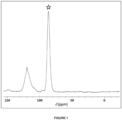
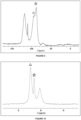
Figure 1 : NMR data Li6PS5Cl before annealing (example 1). The star corresponds to PS4 a-. -
Figure 2 : NMR data Li6PS5Cl before annealing (example 1). The star corresponds to Li in Li6PS5Cl. -
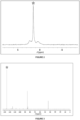
Figure 3 : Example 1 31P solution NMR of reaction medium (Solution S1) + 10% of DMSO-d6. The star corresponds to PS4 3- solvated by ethanol molecules. -
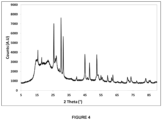
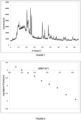
Figure 4 : XRD data after synthesis (example 1). -
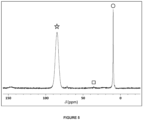
Figure 5 : NMR data Li6PS5Cl after 550°C annealing (example 2). The star corresponds to PS4 3-, the circle corresponds to PO4 3-, the square corresponds to partially oxidized thiophosphate, and the other signals are artifacts (spinning sidebands). -
Figure 6 : NMR data Li6PS5Cl after 550°C annealing (example 2). The star corresponds to Li in Li6PS5Cl and the circle corresponds to Li in Li3PO4. -
Figure 7 : XRD data after annealing at 550°C (example 2). -
Figure 8 : Conductivity measurements for example 2. -
Figure 9 : NMR 31P data Li6PS5Cl (example 3). The star corresponds to PS4 3- and the hexagon corresponds to P2S7 4-. -
Figure 10 :6 Li NMR data Li6PS5Cl (example 3). The star corresponds to Li in Li6PS5Cl and the triangle corresponds to Li2S. -
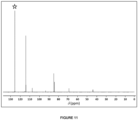
Figure 11 : 31P solution NMR of reaction medium (Solution S1) + 10% of DMSO-d6 (example 3). The star corresponds to PS4 3- solvated by ethanol molecules. -
Figure 12 : XRD data of powder of example 3. -
Figure 13 : XRD data of powder of example 4. - The examples below serve to illustrate the invention, but have no limiting character.
- The XRD diffractograms of the powders were acquired on a XRD goniometer in the Bragg Brentano geometry, with a Cu X Ray tube (Cu Kalpha wavelength of 1.5406 Å). The setup may be used in different optical configurations, i.e. with variable or fixed divergence slits, or Soller slits. A filtering device on the primary side may also be used, like a monochromator or a Bragg Brentano HD optics from Panalytical. If variable divergence slits are used; the typical illuminated area is 10 mm × 10 mm. The sample holder is loaded on a spinner; rotation speed is typically 60 rpm during the acquisition. Tube settings were operating at 40 kV/30 mA for variable slits acquisition and at 45 kV/40 mA for fixed slits acquisition with incident Bragg Brentano HD optics. Acquisition step was 0.017° per step. Angular range is typically 5° to 90° in two theta or larger. Total acquisition time was typically 30 min or longer.
- The powders are covered by a Kapton film to prevent reactions with air moisture.
- The conductivity was acquired on pellets done using a uniaxial press operated at 500MPa.
- The measurement is done under a loading of 40MPa and two carbon paper foils are used as current collector in a pressure cell from MTI (BATTE-CELL-0067 EQ-PSC-15-P).
- The impedance spectra are acquired on a Biologic VMP3 device and the control of temperature is ensured by a Binder climatic chamber. Duration of two hours is set to allow the temperature to be equilibrated between two measurements.
- Impedance spectroscopy is acquired in PElS mode with an amplitude of 10mV and a range of frequencies from 1 MHz to 1kHz (25 points per decade and a mean of 50 measurements per frequency point.)
- 31P solution NMR spectra were recorded on a Bruker 300 MHz spectrometer equipped with a QNP Z-GRD Z8352/107 probe. Relaxation time was 7 s. Spectra were de-coupled from 1H.
- Solid-State NMR spectra were recorded on a Bruker Avance 400 spectrometer equipped with a high-speed DVT4 probe. 31P and 6Li measurements were performed by magic-angle-spinning (MAS) at a speed of 10 kHz, in single-pulse mode with a relaxation time D1 depending on the experiment (see Example below). 7Li measurements were performed in the static, single-pulse mode with a relaxation time D1 = 120 s. Reference for 31P NMR was 85% H3PO4, for 6Li NMR a 5 mol L-1 aqueous LiCI solution.
- LiCI (229 mg, Sigma-Aldrich) and Li2S (620 mg, Albemarle) were weighed in a 100 mL Schlenk flask, in an Ar-filled glove box with oxygen and moisture levels both below 1 ppm. The flask was then taken out of the glove box and connected to a N2 / vacuum line. 35 mL of anhydrous ethanol (Merck Seccosolv®, water content below 50 ppm) were added into this flask through a glass syringe. The resulting mixture was stirred under inert atmosphere (N2). Complete dissolution of the reactants took ca. 20 min.
- P2S5 (600 mg, Sigma-Aldrich, 99% purity) was weighed in a 100 mL three-necked flask equipped with an addition funnel. It was cooled to -80°C for 30 min using a dry ice / acetone bath, then the above Li/S/CI solution was transferred into the addition funnel and added rapidly. P2S5 dissolved within ca. 10 min, leading to a clear yellow solution.
- The solution was then stirred for 6 h while keeping the temperature at -80°C. No further change was observed. 600 µL samples of the reaction medium were taken after 1, 3 and 6 hours for 31P NMR monitoring (Bruker 300 MHz spectrometer equipped with a QNP Z-GRD Z8352/107 probe). The solvent was then slowly removed under primary vacuum, first at room temperature, then when the solution was concentrated to ca. 60% of its initial volume the temperature was increased to 50°C, and left at this value overnight. The resulting product was a pale yellow powder. It was characterized by powder X-ray diffraction (Panalytical), solid-state 31P, 1H and 6Li MAS NMR, and solid-state 7Li static NMR (Bruker NEO 400 spectrometer equipped with a 4 mm BL4 probe).
- A quartz tube of length 250 mm,
inner diameter 10 mm and wall thickness 1.1 mm was closed at one end using a torch fueled by propane and oxygen. This tube was taken into an Ar-filled glove box with oxygen and moisture levels both below 1 ppm, and filled with 250 mg of a material prepared by following Example 1. The tube was then equipped with a PVC hose adapter closed by a valve, taken out of the glove box and connected to a vacuum line through the valve. The system was set under vacuum. When vacuum reached 1 mbar, the tube was sealed using the propane/oxygen torch. The sealed tube was heated in a muffle furnace following a 2°C/min ramp up to 550°C, and kept at this value for 5 h. After it had cooled down to 30°C it was transferred into an Ar-filled glove box and cut with a tungsten carbide cutter, in order to collect the product as a grey powder. This powder was characterized by X-ray diffraction, solid-state 31P, 6Li and 1H MAS NMR and solid-state static 7Li NMR. - Lithium ion conductivity has been measured by impedance spectroscopy on a pellet of this material, it reaches σ = 1.3×10⁻³ S.cm-1 at 30°C, with an activation energy of 0.43 eV.
- LiCI (229 mg, Sigma-Aldrich) and Li2S (620 mg, Albemarle) were weighed in a 100 mL Schlenk flask, in an Ar-filled glove box with oxygen and moisture levels both below 1 ppm. The flask was then connected on a N2/vacuum line and 35 mL of anhydrous ethanol (Merck Seccosolv®, water content below 50 ppm) were added. The mixture was stirred under inert atmosphere (N2).
- P2S5 (600 mg, Sigma-Aldrich, 99% purity) was weighed in a 100 mL Schlenk flask equipped with an addition funnel. The above Li/S/CI solution was then transferred into the addition funnel and added rapidly. P2S5 dissolved within ca. 10 min, leading to a clear yellow solution. A 31P NMR spectrum was then recorded on 600 µL of the reaction medium.
- The solution was then stirred for 2 h at room temperature (22°C). No further change was observed. After this time, another 600 µL sample of the solution was taken and characterized by 31P NMR. The solution contains a high amount of impurities / by-products as seen on 31P solution NMR (
figure 11 ), especially the signal at 114 ppm. The solvent was then removed under vacuum, first at room temperature, then when the solution was concentrated to ca. 60% of its initial volume the temperature was increased to 45°C, eventually when most of the ethanol was gone to 80°C, and kept at this value for another 3.5 h. The resulting product was a white paste. This paste was then heated to 100°C on the vacuum line for 3.5 h and turned into a white powder. The obtained powder contains a high amount of impurities / by-products as seen on 31P solid NMR (figure 9 ). - LiCI (344 mg, Sigma-Aldrich), Li2S (930 mg, Albemarle) and elemental sulfur (135 mg, AnalR NORMAPUR®, VWR Chemicals) were weighed together in a 100 mL Schlenk flask, in an Ar-filled glove box with oxygen and moisture levels both below 1 ppm. 30 g of anhydrous ethanol (VWR, water content below 30 ppm) were added to the mixture. The flask was then taken out of the glove box and connected to a N2 / vacuum line. The resulting mixture was stirred under inert atmosphere (N2), at 0 °C (water/ice bath). Complete dissolution of the reactants took ca. 15 min, resulting in a deep yellow solution, which was then stirred for another 20 min at 0 °C.
- P2S5 (600 mg, Sigma-Aldrich, 99% purity) was weighed in a 100 mL Schlenk flask. The flask was cooled to -15°C for 30 min using a sodium chloride / ice bath, then the above Li/S/CI solution was rapidly added through a Teflon® cannula. P2S5 dissolved within 5 min, leading to a deep yellow solution.
- This solution was stirred for 3
h 45 min while keeping the temperature between -15°C and -10°C. The reaction medium was then set under dynamic primary vacuum, and the temperature was increased to 180°C (silicon oil bath on hotplate) to remove the solvent. The temperature of 180°C was reached after 30 min, and kept at this value for another 2 h. The resulting product was a dry, grey powder. This powder was characterized by X-ray diffraction and solution 31P NMR. - Lithium ion conductivity has been measured by impedance spectroscopy on a pellet of this material, it reaches σ = 1×10⁻⁴ S.cm-1 at 30°C, with an activation energy of 0.42 eV.
Claims (15)
- A method for preparing Li6PS5X, wherein X is halogen, comprising at least one step for the preparation of a solution S1 at a temperature T1 comprised from - 200°C to 10°C, said solution S1 comprising a solvent and at least P species under the form of (PS4)3-, Li species under the form of Li+, X species under the form of X-and remaining sulfur under the form of polysulfide, followed by a step for removing at least a portion of the solvent from said solution S1 to obtain Li6PS5X.
- The method according to claim 1, wherein the solution S1 is obtained by admixing lithium sulfide, phosphorus sulfide, and a halogen compound in the solvent, at a temperature comprised from -200°C to 10°C.
- The method according to claim 1, wherein the solution S1 is obtained from the following steps:- obtaining a precursor solution by admixing lithium sulfide and a halogen compound in the solvent; and- adding phosphorus sulfide into said precursor solution at a temperature comprised from -200°C to 10°C; in order to obtain said solution S1.
- The method according to any one of claims 1 to 3, wherein the step for removing at least a portion of the solvent from S1 is carried out at a temperature comprised from 30°C to 200°C.
- The method according to any one of claims 1 to 4, wherein the preparation of the solution S1 occurs in an inert atmosphere, under vacuum or under H2S flow.
- The method according to any one of claims 1 to 5, wherein Li6PS5X is then thermally treated at a temperature comprised from 150°C to 700°C.
- The method according to any one of claims 1 to 6, wherein the solvent is able to dissolve Li6PS5X, lithium sulfide, phosphorus sulfide and a halogen compound.
- The method according to any one of claims 1 to 7, wherein the solvent is an aliphatic alcohol.
- The method according to any one of claims 1 to 8, wherein the solvent is chosen in the group consisting of: ethanol, methanol, and mixtures thereof.
- The method according to any one of claims 1 to 9, wherein the temperature T1 is comprised from -110°C to 0°C, preferably from -110°C to -10°C, in particular from -100°C to -50°C.
- The method according to any one of claims 2 to 10, wherein the halogen compound is chosen in the group consisting of: LiCI, LiBr, Lil, and LiF.
- The method according to any one of claims 1 to 11, wherein the solution S1 comprises at least 50% mol. of Li species under the form of Li+, with respect to the total amount in moles of lithium sulfide added in the solvent, preferably at least 80% mol. of Li species under the form of Li+, more preferably at least 95% mol. of Li species under the form of Li+.
- The method according to any one of claims 1 to 12, wherein the solution S1 comprises at least 50% mol. of P species under the form of (PS4)3-, with respect to the total amount in moles of phosphorus sulfide added in the solvent, preferably at least 80% mol. of P species under the form of (PS4)3-, more preferably at least 95% mol. of P species under the form of (PS4)3-.
- The method according to any one of claims 1 to 13, wherein the solution S1 comprises at least 50% mol. of X species under the form of X-, with respect to the total amount in moles of halogen compound added in the solvent, preferably at least 80% mol. of X species under the form of X-, more preferably at least 95% mol. of X species under the form of X-.
- The method according to anyone of claims 1 to 14, wherein the temperature T1 is comprised from -100°C to -50°C and the step for removing at least a portion of the solvent from the solution S1 is carried out at a temperature comprised from 35°C to 65°C.
Applications Claiming Priority (2)
| Application Number | Priority Date | Filing Date | Title |
|---|---|---|---|
| EP19306492 | 2019-11-20 | ||
| PCT/EP2020/082992 WO2021099625A1 (en) | 2019-11-20 | 2020-11-20 | Preparation method of lithium argyrodite |
Publications (2)
| Publication Number | Publication Date |
|---|---|
| EP4061772A1 EP4061772A1 (en) | 2022-09-28 |
| EP4061772B1 true EP4061772B1 (en) | 2023-12-20 |
Family
ID=68917810
Family Applications (1)
| Application Number | Title | Priority Date | Filing Date |
|---|---|---|---|
| EP20808129.9A Active EP4061772B1 (en) | 2019-11-20 | 2020-11-20 | Preparation method of lithium argyrodite |
Country Status (9)
| Country | Link |
|---|---|
| US (1) | US20230335787A1 (en) |
| EP (1) | EP4061772B1 (en) |
| JP (1) | JP7674349B2 (en) |
| KR (1) | KR20220103754A (en) |
| CN (1) | CN114728804B (en) |
| ES (1) | ES2974257T3 (en) |
| HU (1) | HUE065719T2 (en) |
| PL (1) | PL4061772T3 (en) |
| WO (1) | WO2021099625A1 (en) |
Families Citing this family (4)
| Publication number | Priority date | Publication date | Assignee | Title |
|---|---|---|---|---|
| KR102854498B1 (en) * | 2021-12-13 | 2025-09-03 | 고려대학교 산학협력단 | An sulfide-based solid electrolyte for lithium secondary battery, manufacturing method thereof, and electrode including the same |
| JP7812668B2 (en) * | 2022-01-19 | 2026-02-10 | トヨタ自動車株式会社 | Solid electrolyte, all-solid-state battery, solid electrolyte solution, and method for producing solid electrolyte |
| FR3157374A1 (en) | 2023-12-21 | 2025-06-27 | IFP Energies Nouvelles | Solution synthesis method of lithium argyrodite particles |
| CN118507816B (en) * | 2024-04-03 | 2025-03-04 | 中国科学院精密测量科学与技术创新研究院 | A solid electrolyte material and its preparation method and application |
Family Cites Families (8)
| Publication number | Priority date | Publication date | Assignee | Title |
|---|---|---|---|---|
| JP6243103B2 (en) * | 2012-06-29 | 2017-12-06 | 出光興産株式会社 | Positive electrode composite |
| US10439198B2 (en) * | 2013-10-03 | 2019-10-08 | Japan Science And Technology Agency | Solution for forming layer that contains solid electrolyte for all-solid-state alkali metal secondary batteries, coated active material particles, electrode, all-solid-state alkali metal secondary battery and method for manufacturing same |
| KR101684130B1 (en) * | 2015-06-16 | 2016-12-07 | 현대자동차주식회사 | Preparing method of lithium ion conductive sulfide, lithium ion conductive sulfide made by the same, and solid electrolyte, all solid battery comprising the same |
| JP7071899B2 (en) * | 2017-09-06 | 2022-05-19 | 出光興産株式会社 | Method for manufacturing solid electrolyte |
| US10879559B2 (en) * | 2017-09-06 | 2020-12-29 | Idemitsu Kosan Co., Ltd. | Method for producing solid electrolyte |
| KR102552142B1 (en) * | 2017-10-13 | 2023-07-05 | 현대자동차주식회사 | The fabrication method of composite material based on cathode active material and solid electrolyte, and the fabrication method of cathode for solid cell including the same |
| KR20190066792A (en) * | 2017-12-06 | 2019-06-14 | 현대자동차주식회사 | A method for manufacturing a sulfide-based solid electrolyte having crystal structure of argyrodite |
| CN109193026A (en) * | 2018-10-17 | 2019-01-11 | 浙江工业大学 | Preparation method of chalcogenide solid electrolyte |
-
2020
- 2020-11-20 EP EP20808129.9A patent/EP4061772B1/en active Active
- 2020-11-20 HU HUE20808129A patent/HUE065719T2/en unknown
- 2020-11-20 ES ES20808129T patent/ES2974257T3/en active Active
- 2020-11-20 CN CN202080080516.5A patent/CN114728804B/en active Active
- 2020-11-20 JP JP2022528567A patent/JP7674349B2/en active Active
- 2020-11-20 WO PCT/EP2020/082992 patent/WO2021099625A1/en not_active Ceased
- 2020-11-20 KR KR1020227020356A patent/KR20220103754A/en active Pending
- 2020-11-20 US US17/778,812 patent/US20230335787A1/en active Pending
- 2020-11-20 PL PL20808129.9T patent/PL4061772T3/en unknown
Also Published As
| Publication number | Publication date |
|---|---|
| CA3157948A1 (en) | 2021-05-27 |
| WO2021099625A1 (en) | 2021-05-27 |
| CN114728804B (en) | 2024-09-13 |
| JP2023502985A (en) | 2023-01-26 |
| HUE065719T2 (en) | 2024-06-28 |
| CN114728804A (en) | 2022-07-08 |
| EP4061772A1 (en) | 2022-09-28 |
| US20230335787A1 (en) | 2023-10-19 |
| KR20220103754A (en) | 2022-07-22 |
| ES2974257T3 (en) | 2024-06-26 |
| JP7674349B2 (en) | 2025-05-09 |
| PL4061772T3 (en) | 2024-05-13 |
Similar Documents
| Publication | Publication Date | Title |
|---|---|---|
| US20230335787A1 (en) | Preparation method of lithium argyrodite | |
| Xu et al. | Interface layer formation in solid polymer electrolyte lithium batteries: an XPS study | |
| Park et al. | One-step synthesis of a sulfur-impregnated graphene cathode for lithium–sulfur batteries | |
| KR102547952B1 (en) | Solid electrolyte and Solid battery | |
| US20250096329A1 (en) | Self-forming solid state batteries and self-healing solid electrolytes | |
| KR20180114151A (en) | Immobilized selenium, its preparation, and use of immobilized selenium in a rechargeable battery | |
| CN115335322B (en) | Solid sulfide electrolyte | |
| EP4061773B1 (en) | Preparation method of lithium thiophosphate | |
| CA3157948C (en) | Preparation method of lithium argyrodite | |
| Numan-Al-Mobin et al. | Interdigitated cathode–electrolyte architectural design for fast-charging lithium metal battery with lithium oxyhalide solid-state electrolyte | |
| KR102090284B1 (en) | Solid electrolytes for all solid state rechargeable lithium battery, methods for manufacturing the same, and all solid state rechargeable lithium battery including the same | |
| EP4339970A1 (en) | Sulfide solid electrolyte composition, electrode mixture containing same, and method for producing sulfide solid electrolyte composition | |
| CA3240311A1 (en) | Solid material comprising li, mg, p, s and halogen elements | |
| KR20240116806A (en) | Solid materials containing Li, Mg, P, S and halogen elements | |
| CN118401466A (en) | Preparation of a solution having formula MaLibPcSdXe(I) Is a solid sulfide material | |
| Chen | Electrolyte Engineering: From SEI Optimization to Lithium Inventory Compensation | |
| 이명환 | A study for designing cost-efficient and high-energy density aqueous rechargeable battery | |
| KR20230002515A (en) | New lithium rare earth halides | |
| Takada | Design of functional battery electrolytes based on coordination structures |
Legal Events
| Date | Code | Title | Description |
|---|---|---|---|
| STAA | Information on the status of an ep patent application or granted ep patent |
Free format text: STATUS: UNKNOWN |
|
| STAA | Information on the status of an ep patent application or granted ep patent |
Free format text: STATUS: THE INTERNATIONAL PUBLICATION HAS BEEN MADE |
|
| PUAI | Public reference made under article 153(3) epc to a published international application that has entered the european phase |
Free format text: ORIGINAL CODE: 0009012 |
|
| STAA | Information on the status of an ep patent application or granted ep patent |
Free format text: STATUS: REQUEST FOR EXAMINATION WAS MADE |
|
| 17P | Request for examination filed |
Effective date: 20220620 |
|
| AK | Designated contracting states |
Kind code of ref document: A1 Designated state(s): AL AT BE BG CH CY CZ DE DK EE ES FI FR GB GR HR HU IE IS IT LI LT LU LV MC MK MT NL NO PL PT RO RS SE SI SK SM TR |
|
| DAV | Request for validation of the european patent (deleted) | ||
| DAX | Request for extension of the european patent (deleted) | ||
| GRAP | Despatch of communication of intention to grant a patent |
Free format text: ORIGINAL CODE: EPIDOSNIGR1 |
|
| STAA | Information on the status of an ep patent application or granted ep patent |
Free format text: STATUS: GRANT OF PATENT IS INTENDED |
|
| INTG | Intention to grant announced |
Effective date: 20230831 |
|
| GRAS | Grant fee paid |
Free format text: ORIGINAL CODE: EPIDOSNIGR3 |
|
| GRAA | (expected) grant |
Free format text: ORIGINAL CODE: 0009210 |
|
| STAA | Information on the status of an ep patent application or granted ep patent |
Free format text: STATUS: THE PATENT HAS BEEN GRANTED |
|
| AK | Designated contracting states |
Kind code of ref document: B1 Designated state(s): AL AT BE BG CH CY CZ DE DK EE ES FI FR GB GR HR HU IE IS IT LI LT LU LV MC MK MT NL NO PL PT RO RS SE SI SK SM TR |
|
| REG | Reference to a national code |
Ref country code: GB Ref legal event code: FG4D |
|
| REG | Reference to a national code |
Ref country code: DE Ref legal event code: R096 Ref document number: 602020023156 Country of ref document: DE |
|
| REG | Reference to a national code |
Ref country code: CH Ref legal event code: EP |
|
| P01 | Opt-out of the competence of the unified patent court (upc) registered |
Effective date: 20231123 |
|
| REG | Reference to a national code |
Ref country code: IE Ref legal event code: FG4D |
|
| RAP2 | Party data changed (patent owner data changed or rights of a patent transferred) |
Owner name: SYENSQO SA |
|
| REG | Reference to a national code |
Ref country code: SE Ref legal event code: TRGR |
|
| PG25 | Lapsed in a contracting state [announced via postgrant information from national office to epo] |
Ref country code: GR Free format text: LAPSE BECAUSE OF FAILURE TO SUBMIT A TRANSLATION OF THE DESCRIPTION OR TO PAY THE FEE WITHIN THE PRESCRIBED TIME-LIMIT Effective date: 20240321 |
|
| REG | Reference to a national code |
Ref country code: LT Ref legal event code: MG9D |
|
| PG25 | Lapsed in a contracting state [announced via postgrant information from national office to epo] |
Ref country code: LT Free format text: LAPSE BECAUSE OF FAILURE TO SUBMIT A TRANSLATION OF THE DESCRIPTION OR TO PAY THE FEE WITHIN THE PRESCRIBED TIME-LIMIT Effective date: 20231220 |
|
| REG | Reference to a national code |
Ref country code: NL Ref legal event code: MP Effective date: 20231220 |
|
| PG25 | Lapsed in a contracting state [announced via postgrant information from national office to epo] |
Ref country code: LT Free format text: LAPSE BECAUSE OF FAILURE TO SUBMIT A TRANSLATION OF THE DESCRIPTION OR TO PAY THE FEE WITHIN THE PRESCRIBED TIME-LIMIT Effective date: 20231220 Ref country code: GR Free format text: LAPSE BECAUSE OF FAILURE TO SUBMIT A TRANSLATION OF THE DESCRIPTION OR TO PAY THE FEE WITHIN THE PRESCRIBED TIME-LIMIT Effective date: 20240321 Ref country code: FI Free format text: LAPSE BECAUSE OF FAILURE TO SUBMIT A TRANSLATION OF THE DESCRIPTION OR TO PAY THE FEE WITHIN THE PRESCRIBED TIME-LIMIT Effective date: 20231220 Ref country code: BG Free format text: LAPSE BECAUSE OF FAILURE TO SUBMIT A TRANSLATION OF THE DESCRIPTION OR TO PAY THE FEE WITHIN THE PRESCRIBED TIME-LIMIT Effective date: 20240320 |
|
| REG | Reference to a national code |
Ref country code: AT Ref legal event code: MK05 Ref document number: 1642331 Country of ref document: AT Kind code of ref document: T Effective date: 20231220 |
|
| PG25 | Lapsed in a contracting state [announced via postgrant information from national office to epo] |
Ref country code: NL Free format text: LAPSE BECAUSE OF FAILURE TO SUBMIT A TRANSLATION OF THE DESCRIPTION OR TO PAY THE FEE WITHIN THE PRESCRIBED TIME-LIMIT Effective date: 20231220 |
|
| REG | Reference to a national code |
Ref country code: DE Ref legal event code: R081 Ref document number: 602020023156 Country of ref document: DE Owner name: SYENSQO S.A., BE Free format text: FORMER OWNER: SOLVAY SA, BRUXELLES, BE |
|
| PG25 | Lapsed in a contracting state [announced via postgrant information from national office to epo] |
Ref country code: RS Free format text: LAPSE BECAUSE OF FAILURE TO SUBMIT A TRANSLATION OF THE DESCRIPTION OR TO PAY THE FEE WITHIN THE PRESCRIBED TIME-LIMIT Effective date: 20231220 Ref country code: NL Free format text: LAPSE BECAUSE OF FAILURE TO SUBMIT A TRANSLATION OF THE DESCRIPTION OR TO PAY THE FEE WITHIN THE PRESCRIBED TIME-LIMIT Effective date: 20231220 Ref country code: LV Free format text: LAPSE BECAUSE OF FAILURE TO SUBMIT A TRANSLATION OF THE DESCRIPTION OR TO PAY THE FEE WITHIN THE PRESCRIBED TIME-LIMIT Effective date: 20231220 Ref country code: HR Free format text: LAPSE BECAUSE OF FAILURE TO SUBMIT A TRANSLATION OF THE DESCRIPTION OR TO PAY THE FEE WITHIN THE PRESCRIBED TIME-LIMIT Effective date: 20231220 |
|
| REG | Reference to a national code |
Ref country code: BE Ref legal event code: PD Owner name: SYENSQO SA; BE Free format text: DETAILS ASSIGNMENT: CHANGE OF OWNER(S), ASSIGNMENT; FORMER OWNER NAME: SOLVAY SA Effective date: 20240502 |
|
| REG | Reference to a national code |
Ref country code: ES Ref legal event code: FG2A Ref document number: 2974257 Country of ref document: ES Kind code of ref document: T3 Effective date: 20240626 |
|
| REG | Reference to a national code |
Ref country code: HU Ref legal event code: AG4A Ref document number: E065719 Country of ref document: HU |
|
| PG25 | Lapsed in a contracting state [announced via postgrant information from national office to epo] |
Ref country code: IS Free format text: LAPSE BECAUSE OF FAILURE TO SUBMIT A TRANSLATION OF THE DESCRIPTION OR TO PAY THE FEE WITHIN THE PRESCRIBED TIME-LIMIT Effective date: 20240420 |
|
| PG25 | Lapsed in a contracting state [announced via postgrant information from national office to epo] |
Ref country code: AT Free format text: LAPSE BECAUSE OF FAILURE TO SUBMIT A TRANSLATION OF THE DESCRIPTION OR TO PAY THE FEE WITHIN THE PRESCRIBED TIME-LIMIT Effective date: 20231220 Ref country code: CZ Free format text: LAPSE BECAUSE OF FAILURE TO SUBMIT A TRANSLATION OF THE DESCRIPTION OR TO PAY THE FEE WITHIN THE PRESCRIBED TIME-LIMIT Effective date: 20231220 |
|
| PG25 | Lapsed in a contracting state [announced via postgrant information from national office to epo] |
Ref country code: SK Free format text: LAPSE BECAUSE OF FAILURE TO SUBMIT A TRANSLATION OF THE DESCRIPTION OR TO PAY THE FEE WITHIN THE PRESCRIBED TIME-LIMIT Effective date: 20231220 |
|
| PG25 | Lapsed in a contracting state [announced via postgrant information from national office to epo] |
Ref country code: SM Free format text: LAPSE BECAUSE OF FAILURE TO SUBMIT A TRANSLATION OF THE DESCRIPTION OR TO PAY THE FEE WITHIN THE PRESCRIBED TIME-LIMIT Effective date: 20231220 Ref country code: SK Free format text: LAPSE BECAUSE OF FAILURE TO SUBMIT A TRANSLATION OF THE DESCRIPTION OR TO PAY THE FEE WITHIN THE PRESCRIBED TIME-LIMIT Effective date: 20231220 Ref country code: RO Free format text: LAPSE BECAUSE OF FAILURE TO SUBMIT A TRANSLATION OF THE DESCRIPTION OR TO PAY THE FEE WITHIN THE PRESCRIBED TIME-LIMIT Effective date: 20231220 Ref country code: IS Free format text: LAPSE BECAUSE OF FAILURE TO SUBMIT A TRANSLATION OF THE DESCRIPTION OR TO PAY THE FEE WITHIN THE PRESCRIBED TIME-LIMIT Effective date: 20240420 Ref country code: EE Free format text: LAPSE BECAUSE OF FAILURE TO SUBMIT A TRANSLATION OF THE DESCRIPTION OR TO PAY THE FEE WITHIN THE PRESCRIBED TIME-LIMIT Effective date: 20231220 Ref country code: CZ Free format text: LAPSE BECAUSE OF FAILURE TO SUBMIT A TRANSLATION OF THE DESCRIPTION OR TO PAY THE FEE WITHIN THE PRESCRIBED TIME-LIMIT Effective date: 20231220 Ref country code: AT Free format text: LAPSE BECAUSE OF FAILURE TO SUBMIT A TRANSLATION OF THE DESCRIPTION OR TO PAY THE FEE WITHIN THE PRESCRIBED TIME-LIMIT Effective date: 20231220 |
|
| PG25 | Lapsed in a contracting state [announced via postgrant information from national office to epo] |
Ref country code: PT Free format text: LAPSE BECAUSE OF FAILURE TO SUBMIT A TRANSLATION OF THE DESCRIPTION OR TO PAY THE FEE WITHIN THE PRESCRIBED TIME-LIMIT Effective date: 20240422 |
|
| PG25 | Lapsed in a contracting state [announced via postgrant information from national office to epo] |
Ref country code: PT Free format text: LAPSE BECAUSE OF FAILURE TO SUBMIT A TRANSLATION OF THE DESCRIPTION OR TO PAY THE FEE WITHIN THE PRESCRIBED TIME-LIMIT Effective date: 20240422 |
|
| REG | Reference to a national code |
Ref country code: DE Ref legal event code: R097 Ref document number: 602020023156 Country of ref document: DE |
|
| PG25 | Lapsed in a contracting state [announced via postgrant information from national office to epo] |
Ref country code: DK Free format text: LAPSE BECAUSE OF FAILURE TO SUBMIT A TRANSLATION OF THE DESCRIPTION OR TO PAY THE FEE WITHIN THE PRESCRIBED TIME-LIMIT Effective date: 20231220 |
|
| PLBE | No opposition filed within time limit |
Free format text: ORIGINAL CODE: 0009261 |
|
| STAA | Information on the status of an ep patent application or granted ep patent |
Free format text: STATUS: NO OPPOSITION FILED WITHIN TIME LIMIT |
|
| PG25 | Lapsed in a contracting state [announced via postgrant information from national office to epo] |
Ref country code: SI Free format text: LAPSE BECAUSE OF FAILURE TO SUBMIT A TRANSLATION OF THE DESCRIPTION OR TO PAY THE FEE WITHIN THE PRESCRIBED TIME-LIMIT Effective date: 20231220 |
|
| PG25 | Lapsed in a contracting state [announced via postgrant information from national office to epo] |
Ref country code: SI Free format text: LAPSE BECAUSE OF FAILURE TO SUBMIT A TRANSLATION OF THE DESCRIPTION OR TO PAY THE FEE WITHIN THE PRESCRIBED TIME-LIMIT Effective date: 20231220 Ref country code: DK Free format text: LAPSE BECAUSE OF FAILURE TO SUBMIT A TRANSLATION OF THE DESCRIPTION OR TO PAY THE FEE WITHIN THE PRESCRIBED TIME-LIMIT Effective date: 20231220 |
|
| 26N | No opposition filed |
Effective date: 20240923 |
|
| REG | Reference to a national code |
Ref country code: CH Ref legal event code: PL |
|
| PG25 | Lapsed in a contracting state [announced via postgrant information from national office to epo] |
Ref country code: MC Free format text: LAPSE BECAUSE OF FAILURE TO SUBMIT A TRANSLATION OF THE DESCRIPTION OR TO PAY THE FEE WITHIN THE PRESCRIBED TIME-LIMIT Effective date: 20231220 |
|
| PG25 | Lapsed in a contracting state [announced via postgrant information from national office to epo] |
Ref country code: LU Free format text: LAPSE BECAUSE OF NON-PAYMENT OF DUE FEES Effective date: 20241120 |
|
| REG | Reference to a national code |
Ref country code: CH Ref legal event code: PL |
|
| PG25 | Lapsed in a contracting state [announced via postgrant information from national office to epo] |
Ref country code: CH Free format text: LAPSE BECAUSE OF NON-PAYMENT OF DUE FEES Effective date: 20241130 |
|
| PGFP | Annual fee paid to national office [announced via postgrant information from national office to epo] |
Ref country code: FR Payment date: 20250930 Year of fee payment: 6 |
|
| PG25 | Lapsed in a contracting state [announced via postgrant information from national office to epo] |
Ref country code: IE Free format text: LAPSE BECAUSE OF NON-PAYMENT OF DUE FEES Effective date: 20241120 |
|
| PGFP | Annual fee paid to national office [announced via postgrant information from national office to epo] |
Ref country code: HU Payment date: 20251105 Year of fee payment: 6 |
|
| PGFP | Annual fee paid to national office [announced via postgrant information from national office to epo] |
Ref country code: DE Payment date: 20250930 Year of fee payment: 6 |
|
| PGFP | Annual fee paid to national office [announced via postgrant information from national office to epo] |
Ref country code: GB Payment date: 20251001 Year of fee payment: 6 |
|
| PGFP | Annual fee paid to national office [announced via postgrant information from national office to epo] |
Ref country code: NO Payment date: 20251113 Year of fee payment: 6 |
|
| PGFP | Annual fee paid to national office [announced via postgrant information from national office to epo] |
Ref country code: IT Payment date: 20251022 Year of fee payment: 6 |
|
| PGFP | Annual fee paid to national office [announced via postgrant information from national office to epo] |
Ref country code: BE Payment date: 20251006 Year of fee payment: 6 Ref country code: TR Payment date: 20251106 Year of fee payment: 6 |
|
| PGFP | Annual fee paid to national office [announced via postgrant information from national office to epo] |
Ref country code: SE Payment date: 20251001 Year of fee payment: 6 |
|
| PGFP | Annual fee paid to national office [announced via postgrant information from national office to epo] |
Ref country code: PL Payment date: 20251014 Year of fee payment: 6 |
|
| PGFP | Annual fee paid to national office [announced via postgrant information from national office to epo] |
Ref country code: ES Payment date: 20251209 Year of fee payment: 6 |
|
| PG25 | Lapsed in a contracting state [announced via postgrant information from national office to epo] |
Ref country code: CY Free format text: LAPSE BECAUSE OF FAILURE TO SUBMIT A TRANSLATION OF THE DESCRIPTION OR TO PAY THE FEE WITHIN THE PRESCRIBED TIME-LIMIT; INVALID AB INITIO Effective date: 20201120 |