EP4061763B1 - Engine support system and method - Google Patents
Engine support system and method Download PDFInfo
- Publication number
- EP4061763B1 EP4061763B1 EP19953689.7A EP19953689A EP4061763B1 EP 4061763 B1 EP4061763 B1 EP 4061763B1 EP 19953689 A EP19953689 A EP 19953689A EP 4061763 B1 EP4061763 B1 EP 4061763B1
- Authority
- EP
- European Patent Office
- Prior art keywords
- vehicle
- engine
- support system
- coupler
- jack
- Prior art date
- Legal status (The legal status is an assumption and is not a legal conclusion. Google has not performed a legal analysis and makes no representation as to the accuracy of the status listed.)
- Active
Links
Images




Classifications
-
- B—PERFORMING OPERATIONS; TRANSPORTING
- B60—VEHICLES IN GENERAL
- B60K—ARRANGEMENT OR MOUNTING OF PROPULSION UNITS OR OF TRANSMISSIONS IN VEHICLES; ARRANGEMENT OR MOUNTING OF PLURAL DIVERSE PRIME-MOVERS IN VEHICLES; AUXILIARY DRIVES FOR VEHICLES; INSTRUMENTATION OR DASHBOARDS FOR VEHICLES; ARRANGEMENTS IN CONNECTION WITH COOLING, AIR INTAKE, GAS EXHAUST OR FUEL SUPPLY OF PROPULSION UNITS IN VEHICLES
- B60K5/00—Arrangement or mounting of internal-combustion or jet-propulsion units
- B60K5/12—Arrangement of engine supports
- B60K5/125—Telescopic supports, e.g. telescopic dampers
-
- B—PERFORMING OPERATIONS; TRANSPORTING
- B25—HAND TOOLS; PORTABLE POWER-DRIVEN TOOLS; MANIPULATORS
- B25H—WORKSHOP EQUIPMENT, e.g. FOR MARKING-OUT WORK; STORAGE MEANS FOR WORKSHOPS
- B25H1/00—Work benches; Portable stands or supports for positioning portable tools or work to be operated on thereby
- B25H1/0007—Work benches; Portable stands or supports for positioning portable tools or work to be operated on thereby for engines, motor-vehicles or bicycles
-
- B—PERFORMING OPERATIONS; TRANSPORTING
- B60—VEHICLES IN GENERAL
- B60K—ARRANGEMENT OR MOUNTING OF PROPULSION UNITS OR OF TRANSMISSIONS IN VEHICLES; ARRANGEMENT OR MOUNTING OF PLURAL DIVERSE PRIME-MOVERS IN VEHICLES; AUXILIARY DRIVES FOR VEHICLES; INSTRUMENTATION OR DASHBOARDS FOR VEHICLES; ARRANGEMENTS IN CONNECTION WITH COOLING, AIR INTAKE, GAS EXHAUST OR FUEL SUPPLY OF PROPULSION UNITS IN VEHICLES
- B60K5/00—Arrangement or mounting of internal-combustion or jet-propulsion units
- B60K5/12—Arrangement of engine supports
- B60K5/1283—Adjustable supports, e.g. the mounting or the characteristics being adjustable
-
- B—PERFORMING OPERATIONS; TRANSPORTING
- B66—HOISTING; LIFTING; HAULING
- B66C—CRANES; LOAD-ENGAGING ELEMENTS OR DEVICES FOR CRANES, CAPSTANS, WINCHES, OR TACKLES
- B66C1/00—Load-engaging elements or devices attached to lifting or lowering gear of cranes or adapted for connection therewith for transmitting lifting forces to articles or groups of articles
- B66C1/10—Load-engaging elements or devices attached to lifting or lowering gear of cranes or adapted for connection therewith for transmitting lifting forces to articles or groups of articles by mechanical means
- B66C1/107—Load-engaging elements or devices attached to lifting or lowering gear of cranes or adapted for connection therewith for transmitting lifting forces to articles or groups of articles by mechanical means for lifting engines
-
- B—PERFORMING OPERATIONS; TRANSPORTING
- B66—HOISTING; LIFTING; HAULING
- B66F—HOISTING, LIFTING, HAULING OR PUSHING, NOT OTHERWISE PROVIDED FOR, e.g. DEVICES WHICH APPLY A LIFTING OR PUSHING FORCE DIRECTLY TO THE SURFACE OF A LOAD
- B66F7/00—Lifting frames, e.g. for lifting vehicles; Platform lifts
- B66F7/10—Lifting frames, e.g. for lifting vehicles; Platform lifts with platforms supported directly by jacks
-
- B—PERFORMING OPERATIONS; TRANSPORTING
- B66—HOISTING; LIFTING; HAULING
- B66F—HOISTING, LIFTING, HAULING OR PUSHING, NOT OTHERWISE PROVIDED FOR, e.g. DEVICES WHICH APPLY A LIFTING OR PUSHING FORCE DIRECTLY TO THE SURFACE OF A LOAD
- B66F7/00—Lifting frames, e.g. for lifting vehicles; Platform lifts
- B66F7/10—Lifting frames, e.g. for lifting vehicles; Platform lifts with platforms supported directly by jacks
- B66F7/12—Lifting frames, e.g. for lifting vehicles; Platform lifts with platforms supported directly by jacks by mechanical jacks
- B66F7/14—Lifting frames, e.g. for lifting vehicles; Platform lifts with platforms supported directly by jacks by mechanical jacks screw operated
Definitions
- the disclosure relates generally to engine supports.
- the disclosure relates to a frame mounted engine support system and method including a frame mounted engine support and at least one engine mounted coupler.
- Vehicle engines such as for trucking vehicles, occasionally require servicing and/or tuning to repair, maintain, or improve engine performance. Operators may require access to different portions of the engine depending on the type of work to be performed. Accordingly, operators may need a mechanical device to support and/or elevate the engine relative to a frame of a vehicle to provide sufficient access to the desired portion of the engine.
- an engine support system for a vehicle includes a frame mount and a first jack assembly.
- the frame mount includes a telescoping body comprising at least one inner sleeve and at least one outer sleeve configured to slide axially relative to the inner sleeve, a first arm at a first end of the telescoping body configured to releasably engage a first side of a vehicle frame, and a second arm at a second end of the telescoping body opposite the first end configured to releasably engage a second side of the vehicle frame.
- the frame mount extends laterally (e.g., horizontally, side to side, etc.) under the vehicle engine to mount to a vehicle frame (lateral extension of the frame mount is relative to the vehicle frame).
- the first jack assembly includes a first collar slidably coupled to the telescoping body and configured to move horizontally along the telescoping body, and a first jack rod coupled to the first collar and configured to move vertically relative to the first collar.
- the first jack rod includes a body and a ball mount at an end of the body.
- the engine support system includes a first coupler that attaches to the engine to allow the first jack rod to engage the engine.
- the ball mount is configured to insert into the first coupler at an underside of an engine block of the vehicle.
- the engine support system further includes that the first coupler is configured to removably attach to the underside of the engine block of the vehicle.
- the first coupler is configured to removably attach to threaded holes configured to mount an oil drip pan to the underside of the engine block of the vehicle.
- the first coupler defines a through hole configured to receive a fastener to removably attach the first coupler to a single threaded hole at the underside of the engine block of the vehicle.
- the first coupler is fixedly attached to a plate with a plurality of through holes. At least two of the plurality of through holes are configured to align with at least two threaded holes at the underside of the engine block of the vehicle.
- the at least one inner sleeve and the at least one outer sleeve each comprise a non-circular cross-section.
- the telescoping body includes a first inner sleeve fixedly attached to the first arm and a second inner sleeve fixedly attached to the second arm.
- the first arm includes a first flange configured to engage a first upper surface of a first rail of the vehicle frame and the second arm includes a second flange configured to engage a second upper surface of a second rail of the vehicle frame.
- a first edge of the first flange of the first arm is tapered to increase a contact surface area with the first rail angled relative to a center axis of the vehicle, and a second edge of the second flange of the second arm is tapered to maximize a contact surface area with the second rail angled relative to the center axis of the vehicle.
- the frame mount further includes a first clamping jaw removably attached to the first arm.
- the first clamping jaw includes a first bracket and a first clamping bolt.
- the first bracket defines a first threaded hole.
- the first clamping bolt is positioned in the first threaded hole and configured to move relative thereto to clamp a portion of the first rail between the first flange and the first clamping bolt.
- the frame mount further includes a second clamping jaw removably attached to the second arm.
- the second clamping jaw includes a second bracket and a second clamping bolt.
- the second bracket defines a second threaded hole.
- the second clamping bolt is positioned in the second threaded hole and configured to move relative thereto to clamp a portion of the second rail between the second flange and the second clamping bolt.
- the first jack assembly is configured to lift the engine block of the vehicle relative to the vehicle frame by vertical movement of the jack rod relative to the frame mount engaged with the vehicle frame with the ball mount in the first coupler.
- the body of the first jack rod is threaded.
- the first jack assembly further includes a first threaded cuff attached to the first collar.
- the first jack rod is positioned within the threaded cuff.
- the first jack assembly further includes a first threaded cuff fixedly attached to an outer surface of the first collar and offset from a center of the first collar along a center axis of the first collar.
- the first collar includes a non-circular cross-section.
- the first jack assembly is configured to engage the first coupler at a first side of the engine block of the vehicle.
- the engine support system further includes a second jack assembly configured to engage a second coupler at a second side of the engine block of the vehicle.
- the second jack assembly includes a second collar slidably coupled to the telescoping body and configured to move horizontally along the telescoping body, and a second jack rod threadably coupled to the second collar and configured to move vertically relative to the second collar.
- the second jack rod includes a second body and a second ball mount at an end of the second body. The second ball mount is configured to insert into the second coupler at the underside of the engine block of the vehicle.
- a method of supporting an engine of a vehicle includes suspending a frame mount of an engine support system across a frame of a vehicle beneath an engine block of the vehicle by moving a first arm attached to a first end of a telescoping body relative to a second arm attached to a second end of the telescoping body to an engaged orientation.
- the method further includes horizontally sliding a first collar of a first jack assembly of the engine support system along the telescoping body to align a ball mount of a first jack rod of the first jack assembly with a first coupler at an underside of the engine block of the vehicle.
- the method further includes supporting an engine of the vehicle relative to the vehicle frame by vertically moving the first jack rod of the first jack assembly to insert the ball mount of the first jack rod of the first jack assembly into the first coupler at the underside of the engine block.
- the method further includes lifting an engine of the vehicle relative to the vehicle frame by continued vertical movement of the first jack rod of the first jack assembly.
- the method further includes attaching the first coupler to the underside of the engine block of the vehicle.
- the method further includes attaching a first clamping jaw to the first arm to position a portion of a first rail of the vehicle frame between a flange of the first arm and a first bracket of the first clamping jaw.
- the method further includes rotating a first clamping bolt in a first threaded hole of the first bracket of the first clamping jaw to clamp the portion of the first rail of the vehicle frame between the first flange and the first clamping bolt.
- the method further includes horizontally sliding a second collar of a second jack assembly of the engine support system along the telescoping body to align a ball mount of a second jack rod of the second jack assembly with a second coupler at the underside of the engine block of the vehicle.
- the method further includes engaging the second jack assembly with the engine block by vertically moving the second jack rod of the second jack assembly to insert the ball mount of the second jack assembly into the second coupler of the engine block.
- the method further includes supporting the engine of the vehicle relative to the vehicle frame by vertically moving the second jack rod of the second jack assembly to insert the ball mount of the second jack rod of the second jack assembly into the second coupler at the underside of the engine block.
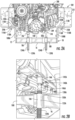
- FIGS. 1A-1C are views of an engine support system 10.
- the engine support system 10 includes an engine support 12 and two couplers 14A, 14B.
- the engine support 12 includes a frame mount 16, a first jack assembly 18A movably attached to the frame mount 16, and a second jack assembly 18B movably attached to the frame mount 16.
- the frame mount 16 includes a telescoping body 100, a first arm 102A at a first end of the telescoping body 100, and a second arm 102B at a second end of the telescoping body 100 opposite the first end.
- the telescoping body 100 includes an outer sleeve 104 (may also be referred to as an outer center sleeve, outer tube, etc.), a first inner sleeve 106A (may also be referred to as a first inner tube, etc.) fixedly attached (e.g., integrally) to the first arm 102A, and a second inner sleeve 106B (may also be referred to as a second inner tube, etc.) fixedly attached (e.g., integrally) to the second arm 102B.
- an outer sleeve 104 may also be referred to as an outer center sleeve, outer tube, etc.
- a first inner sleeve 106A may also be referred to as a first inner tube, etc.
- second inner sleeve 106B may also be referred to as a second inner tube, etc.
- the first inner sleeve 106A moves relative to the outer sleeve 104 along a common axis A
- the second inner sleeve 106B moves relative to the outer sleeve 104 along axis A.
- the telescoping body 100 only includes one outer sleeve (e.g., attached to the first arm 102A) and one inner sleeve (e.g., attached to the second arm 102B).
- the first inner sleeve 106A and the second inner sleeve 106B are at least partially inserted into the outer sleeve 104.
- the outer sleeve 104 is configured to slide (e.g., axially translatable) relative to the inner sleeves 106A, 106B.
- the outer sleeve 104, the first inner sleeve 106A, and the second inner sleeve 106B have corresponding non-circular cross-sections (e.g., rectangular cross-section, square cross-section, etc.) to prevent relative rotation between the outer sleeve 104 and the inner sleeves 106A, 106B.
- Such a configuration ensures vertical alignment of the first arm 102A, second arm 102B, first jack assembly 18A, and/or second jack assembly 18B. This relative alignment facilitates ease of use by an operator in mounting to the vehicle frame and engaging couplers 14A, 14B mounted to the underside of an engine block of the engine.
- the first arm 102A at the first end of the telescoping body 100 is configured to releasably engage a first side (e.g., first rail) of a vehicle frame of the vehicle.
- the first arm 102A includes a first vertical portion 108A extending upward from the first inner sleeve 106A defining one or more slots 109A.
- the first arm 102A further includes a first flange 110A outwardly extending from a top of the first vertical portion 108A.
- the first flange 110A is configured to engage the first rail of the vehicle frame.
- the first flange 110A includes a first edge 112A, which is tapered (e.g., from a front to a back) to provide a maximum contact surface area when the first rail is angled relative to a center axis of the vehicle.
- a first clamping jaw 114A is removably attached to the first arm 102A.
- the first clamping jaw 114A applies a compressive force on the first rail.
- the first clamping jaw 114A includes a first bracket 116A and a first clamping bolt 118A.
- the first bracket 116A includes a vertical portion 120A and a horizontal portion 122A.
- the vertical portion 120A includes one or more threaded holes 124A to receive fasteners 126A inserted through the slots 109A of the first arm 102A to attach the first clamping jaw 114A to the first arm 102A.
- the slots 109A of the first arm 102A allow for vertical movement of the first clamping jaw 114A relative to the first arm 102A to accommodate frame rails having flanges of varying thicknesses.
- the horizontal portion 122A includes a threaded hole 128A to receive the first clamping bolt 118A therein.
- the first clamping bolt 118A is configured to move relative to the horizontal portion 122A of the first bracket 116A to clamp a portion of the first rail between the first flange 110A and the first clamping bolt 118A.
- horizontal and “vertical” in this context generally refers to a directional orientation relative to a vehicle or vehicle frame.
- “horizontal” (or “lateral”) and “vertical” may refer to a directional orientation of the engine support system 10 and/or components thereof (e.g., engine support 12, couplers 14A, 14B, etc.) when applied or being applied to the vehicle frame.
- “horizontal” (or “lateral”) may refer to an orientation side to side and/or front to back relative to a vehicle (e.g., vehicle frame), and “vertical” may refer to an orientation top to bottom relative to a vehicle (e.g., vehicle frame).
- the second arm 102B at the second end of the telescoping body 100 is configured to releasably engage a second side (e.g., second rail) of the vehicle frame of the vehicle.
- a second clamping jaw 114B is removably attached to the second arm 102B.
- the second arm 102B and the second clamping jaw 114B include similar features as the first arm 102A and the first clamping jaw 114A and are accordingly similarly numbered.
- the first jack assembly 18A includes a first collar 130A, a first threaded cuff 132A, and a first jack rod 134A.
- the first collar 130A is slidably coupled to and positioned over the telescoping body 100 (e.g., the outer sleeve 104) and movable (e.g., laterally, horizontally, side to side, etc.) relative thereto along axis A.
- the first collar 130A includes a non-circular cross-section (e.g., rectangular cross-section, square cross-section, etc.) corresponding to the outer sleeve 104 to prevent relative rotation between the first collar 130A and the outer sleeve 104. As noted above, such a configuration ensures vertical alignment of the first jack assembly 18A.
- the first threaded cuff 132A is attached to an outer side surface of the first collar 130A.
- the axis B 1 of the first threaded cuff 132A is perpendicular to the axis A of the first collar 130A.
- the first threaded cuff 132A is offset from a center of the first collar 130A along axis A of the first collar 130A.
- the first jack rod 134A is positioned within the first threaded cuff 132A and vertically movable (e.g., translatable) relative thereto. In this way, the first jack rod 134A is coupled to the first collar 130A and configured to move vertically relative to the first collar 130A.
- the first jack rod 134A includes a threaded body 136A, a ball mount 138A at a top end of the threaded body 136A, and a hex cap 139A at a bottom end of the threaded body 136A.
- the hex cap 139A is configured to provide a feature for a tool to engage the first jack rod 134A to rotate the first jack rod 134A.
- the first jack assembly 18A is configured to engage the first coupler 14A at a first side of the engine block of the vehicle, such as by insertion of the ball mount 138A into the first coupler 14A at an underside of the engine block of the vehicle.
- the first jack assembly 18A is configured to engage the first coupler 14A to support and/or lift the engine of the vehicle.
- the second jack assembly 18B includes a second collar 130B, a second threaded cuff 132B, and a second jack rod 134B.
- the second jack assembly 18B includes similar features as the first jack assembly 18A and is accordingly similarly numbered.
- the second collar 130B is configured to move (e.g., translate) along axis A of the telescoping body 100 (e.g., independent of the first collar 130A).
- the axis B2 of the second threaded cuff 132B is perpendicular to the axis A of the second collar 130B.
- the second jack assembly 18B is configured to engage the second coupler 14 at a second side of the engine block of the vehicle, such as by insertion of the ball mount 138B into the second coupler 14B at an underside of the engine block of the vehicle.
- the second jack assembly 18B is configured to engage the second coupler 14B to support and/or lift the engine of the vehicle.
- the first coupler 14A is configured to removably attach to the underside of the engine block of the vehicle.
- the first coupler 14A includes a receptacle 140A fixedly attached to a plate 142A with a plurality of through holes 144A defined in the plate 142A.
- the plurality of through holes 144A are configured to accommodate different types of engine blocks which may have differently spaced holes.
- at least two of the plurality of through holes 144A of the plate 142A are configured to align with at least two threaded holes at the underside of the engine block of the vehicle.
- the receptacle 140A includes an opening 146A configured to receive the ball mount 138A of the first jack rod 134A.
- the second coupler 14B includes similar features as the first coupler 14A and is accordingly similarly numbered.
- components of the engine support system 10 could be made of steel and fastened together using any of a variety of attachments (e.g., bolts, welding, etc.).
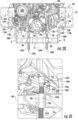
- FIGS. 2A-2E are views illustrating use of the engine support system 10 of FIGS. 1A-1C to support and/or lift an engine 200 of the vehicle 202.
- FIG. 2A is a side view of the engine support system 10 illustrating jack rods 134A, 134B of jack assemblies 18A, 18B of the engine support system 10 aligned with and disengaged from the couplers 14A, 14B mounted to the engine 200.
- the oil drip pan is removed from the underside 204 of the engine block 206.
- the couplers 14A, 14B are then mounted to the threaded holes 208 (see e.g., FIG. 2C ) at the underside 204 of the engine block 206 that were used for attachment of the oil drip pan.
- the telescoping body 100 is extended or retracted so that the first flange 110A rests on the first rail 210A of a vehicle frame 212 of the vehicle 202, and the second flange 110B rests on the second rail 210B of the vehicle frame 212 of the vehicle 202 with the telescoping body 100 positioned beneath the engine 200.
- the frame mount 16 is positioned along a length of the vehicle 202 so that the horizontal path of the jack rods 134A, 134B is aligned with the couplers 14A, 14B along the length of the vehicle 202.
- the first bracket 116A is mounted to the first vertical portion 108A of the first arm 102A and moved vertically toward the first rail 210A.
- the first clamping bolt 118A is then moved vertically to apply or increase the clamping pressure applied to the first rail 210A (i.e., between the first flange 110A and the first clamping bolt 118A).
- the second bracket 116B is mounted to the second vertical portion 108B of the second arm 102B and moved vertically toward the second rail 210B.
- the second clamping bolt 118B is then moved vertically to apply or increase the clamping pressure applied to the second rail 210B (i.e., between the second flange 110B and the second clamping bolt 118B).
- the first collar 130A of the first jack assembly 18A is slid horizontally along the telescoping body 100 to align the first jack rod 134A with the first opening 146A of the first receptacle 140A of the first coupler 14A.
- the second collar 130B of the second jack assembly 18B is slid horizontally along the telescoping body 100 to align the second jack rod 134B with the second opening 146B of the second receptacle 140B of the second coupler 14B.
- the offset of the jack rods 134A, 134B relative to the collars 130A, 130B means that the collars 130A, 130B could be disassembled from the telescoping body 100 and reassembled so that the relative position of the first jack assembly 18A is switched with that of the second jack assembly 18B.
- the jack rods 134A, 134B are positioned farther apart, and in a second orientation the jack rods 134A, 134B are positioned closer to one another, even though the respective collars 130A, 130B are in the same position on the telescoping body 100.
- positioning of the jack rods 134A, 134B on outer side surfaces of the collars 130A, 130B provides an additional orientation for mounting.
- first flange 110A is engaged with the first rail 210A and in another orientation the first flange 110A is engaged with the second rail 210B.
- Such asymmetries increase the modularity of the engine support system 10 to accommodate different types of engines and/or different types of vehicles.
- the first flange 110A includes a first edge 112A, which is tapered (e.g., from a front to a back) to increase a contact surface area with the first rail 210A
- the second flange 110B includes a second edge 112B, which is tapered (e.g., from a front to a back) to provide a maximum contact surface area with the second rail 210B.
- a tool engages the hex caps 139A, 139B of the jack rods 134A, 134B to rotate the jack rods 134A, 134B and move the jack rods 134A, 134B vertically relative to the collars 130A, 130B and cuffs 132A, 132B until the ball mounts 138A, 138B are inserted into the openings 146A, 146B of the receptacles 140A, 140B.
- the spherical shape of the ball mounts 138A, 138B and the oversize of the opening 146A, 146B (e.g., openings 146A, 146B are larger in diameter than the ball mounts 138A, 138B) accommodate rotational variance of the engine 200 (e.g., angled mount of the engine 200 relative to the vehicle frame 212). Further, the angled mount accounts for relative angling of the engine 200 as the jack rods 134A, 134B are iteratively rotated to support and/or lift the engine 200 relative to the vehicle frame 212. For example, to lift the engine level, the first jack rod 134A travels vertically and lifts a first side of the engine 200.
- the first jack rod 134A then travels further vertically to lift the first side of the engine 200 higher than the second side. Then the second jack rod 134B travels vertically to lift the second side of the engine 200 higher than the first side. This process repeats until the engine 200 is supported and/or lifted to a desired height relative to the vehicle frame 212.
- the jack assemblies 18A, 18B are configured to support the engine block 206 of the vehicle 202 relative to the vehicle frame 212 by vertical movement of the ball mounts 138A, 138B into the couplers 14A, 14B and relative to the frame mount 16 engaged with the vehicle frame 212.
- the jack assemblies 18A, 18B are configured to lift the engine block 206 of the vehicle 202 relative to the frame 212 of the vehicle 202 by vertical movement of the ball mounts 138A, 138B in the couplers 14A, 14B and relative to the frame mount 16 engaged with the vehicle frame 212.
- the engine 200 can be serviced (e.g., removing fly wheel housing, removing transmission, etc.).
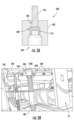
- FIG. 3A is a cross-sectional side view of an alternative embodiment of the coupler of FIGS. 1A-2E .
- the coupler 300 includes a receptacle 302 with an opening 304 at a bottom to receive the ball mounts 138A, 138B of the jack rods 134A, 134B of the jack assemblies 18A, 18B.
- the receptacle 302 further includes a through hole 306 and a countersink 308 to receive a fastener 310 therein, such that the head 312 of the fastener 310 is positioned in the countersink 308.
- FIG. 3B is a perspective view of the engine support system 10 of FIGS. 1A-2E engaged with the coupler 300 of FIG. 3A .
- the ball mount 138B of the second jack rod 134B of the second jack assembly 18B is inserted into the coupler 300.
- the coupler 300 is universal and only requires one threaded hole 208 in the engine block 206.
- the first coupler includes a receptacle defining a through hole 306 (see FIG. 3A ) configured to receive a fastener 310 (see FIG. 3A ) to removably attach the first coupler 300 to a single threaded hole 208 at the underside 204 of the engine block 206 of the vehicle 202. Accordingly, compared to the coupler 14A, 14B, the coupler 300 increases the flexibility and modularity of mounting.
- FIG. 6 is a flowchart 400 illustrating a method of supporting an engine 200 of a vehicle 202 using the engine support system 10 of FIGS. 1A-3B .
- Step 402 includes suspending a frame mount 416 of an engine support system 10 across a frame 212 of a vehicle 202 beneath an engine block 206 of the vehicle 202 by moving a first arm 102A attached to a first end of a telescoping body 100 relative to a second arm 102B attached to a second end of the telescoping body 100 to an engaged orientation.
- the method further includes attaching a first clamping jaw 114A to the first arm 102A to position a portion of a first rail 210A of the frame 212 of the vehicle 202 between a first flange 110A of the first arm 102A and a first bracket 116A of the first clamping jaw 114A, and rotating a first clamping bolt 118A in a first threaded hole 128A of the first bracket 116A of the first clamping jaw 114A to clamp the portion of the first rail 210A of the frame 212 of the vehicle 202 between the first flange 110A and the first clamping bolt 118A.
- the method further includes horizontally sliding a second collar 130B of a second jack assembly 18B of the engine support system 10 along the telescoping body 100 to align a ball mount 138B of a second jack rod 134B of the second jack assembly 18B with a second coupler 14B at the underside 204 of the engine block 206 of the vehicle 202.
- the method further includes engaging the second jack assembly 18B with the engine block 206 by vertically moving the second jack rod 134B of the second jack assembly 18B to insert the ball mount 138B of the second jack assembly 18B into the second coupler 14B of the engine block 206.
- the method further includes supporting the engine 200 of the vehicle 202 relative to the frame 212 of the vehicle 202 by vertically moving the second jack rod 134B of the second jack assembly 18B to insert the ball mount 138B of the second jack rod 134B of the second jack assembly 18B into the second coupler 14B at the underside 204 of the engine block 206.
- Step 404 includes horizontally sliding a first collar 130A of a first jack assembly 18A of the engine support system 10 along the telescoping body 100 to align a ball mount 138A of a first jack rod 134A of the first jack assembly 18A with a first coupler 14A at an underside 204 of the engine block 206 of the vehicle 202.
- the method further includes attaching the first coupler 14A to the underside 204 of the engine block 206 of the vehicle 202.
- Step 406 includes supporting an engine 200 of the vehicle 202 relative to the frame 212 of the vehicle 202 by vertically moving the first jack rod 134A of the first jack assembly 18A to insert the ball mount 138A of the first jack rod 134A of the first jack assembly 18A into the first coupler 14A at the underside 204 of the engine block 206.
- Step 408 includes lifting an engine 200 of the vehicle 202 relative to the frame 212 of the vehicle 202 by continued vertical movement of the first jack rod 134A of the first jack assembly 18A.
Landscapes
- Engineering & Computer Science (AREA)
- Mechanical Engineering (AREA)
- Chemical & Material Sciences (AREA)
- Combustion & Propulsion (AREA)
- Transportation (AREA)
- Life Sciences & Earth Sciences (AREA)
- Geology (AREA)
- Structural Engineering (AREA)
- Vehicle Cleaning, Maintenance, Repair, Refitting, And Outriggers (AREA)
- Arrangement Or Mounting Of Propulsion Units For Vehicles (AREA)
Description
- The disclosure relates generally to engine supports. In particular aspects, the disclosure relates to a frame mounted engine support system and method including a frame mounted engine support and at least one engine mounted coupler.
- Vehicle engines, such as for trucking vehicles, occasionally require servicing and/or tuning to repair, maintain, or improve engine performance. Operators may require access to different portions of the engine depending on the type of work to be performed. Accordingly, operators may need a mechanical device to support and/or elevate the engine relative to a frame of a vehicle to provide sufficient access to the desired portion of the engine.
-
US2865585A shows the preamble ofclaim 1. - Some other examples are also known from
US4804162A ,US2019126460A1 ,GB415271A US2748459A orUS6120236A . - According to an aspect of the disclosure, an engine support system for a vehicle includes a frame mount and a first jack assembly. The frame mount includes a telescoping body comprising at least one inner sleeve and at least one outer sleeve configured to slide axially relative to the inner sleeve, a first arm at a first end of the telescoping body configured to releasably engage a first side of a vehicle frame, and a second arm at a second end of the telescoping body opposite the first end configured to releasably engage a second side of the vehicle frame. The frame mount extends laterally (e.g., horizontally, side to side, etc.) under the vehicle engine to mount to a vehicle frame (lateral extension of the frame mount is relative to the vehicle frame). The first jack assembly includes a first collar slidably coupled to the telescoping body and configured to move horizontally along the telescoping body, and a first jack rod coupled to the first collar and configured to move vertically relative to the first collar. The first jack rod includes a body and a ball mount at an end of the body. The engine support system includes a first coupler that attaches to the engine to allow the first jack rod to engage the engine. The ball mount is configured to insert into the first coupler at an underside of an engine block of the vehicle.
- In certain embodiments, the engine support system further includes that the first coupler is configured to removably attach to the underside of the engine block of the vehicle.
- In certain embodiments, the first coupler is configured to removably attach to threaded holes configured to mount an oil drip pan to the underside of the engine block of the vehicle.
- In certain embodiments, the first coupler defines a through hole configured to receive a fastener to removably attach the first coupler to a single threaded hole at the underside of the engine block of the vehicle.
- In certain embodiments, the first coupler is fixedly attached to a plate with a plurality of through holes. At least two of the plurality of through holes are configured to align with at least two threaded holes at the underside of the engine block of the vehicle.
- In certain embodiments, the at least one inner sleeve and the at least one outer sleeve each comprise a non-circular cross-section.
- In certain embodiments, the telescoping body includes a first inner sleeve fixedly attached to the first arm and a second inner sleeve fixedly attached to the second arm.
- In certain embodiments, the first arm includes a first flange configured to engage a first upper surface of a first rail of the vehicle frame and the second arm includes a second flange configured to engage a second upper surface of a second rail of the vehicle frame.
- In certain embodiments, a first edge of the first flange of the first arm is tapered to increase a contact surface area with the first rail angled relative to a center axis of the vehicle, and a second edge of the second flange of the second arm is tapered to maximize a contact surface area with the second rail angled relative to the center axis of the vehicle.
- In certain embodiments, the frame mount further includes a first clamping jaw removably attached to the first arm. The first clamping jaw includes a first bracket and a first clamping bolt. The first bracket defines a first threaded hole. The first clamping bolt is positioned in the first threaded hole and configured to move relative thereto to clamp a portion of the first rail between the first flange and the first clamping bolt. The frame mount further includes a second clamping jaw removably attached to the second arm. The second clamping jaw includes a second bracket and a second clamping bolt. The second bracket defines a second threaded hole. The second clamping bolt is positioned in the second threaded hole and configured to move relative thereto to clamp a portion of the second rail between the second flange and the second clamping bolt.
- In certain embodiments, the first jack assembly is configured to lift the engine block of the vehicle relative to the vehicle frame by vertical movement of the jack rod relative to the frame mount engaged with the vehicle frame with the ball mount in the first coupler.
- In certain embodiments, the body of the first jack rod is threaded.
- In certain embodiments, the first jack assembly further includes a first threaded cuff attached to the first collar. The first jack rod is positioned within the threaded cuff.
- In certain embodiments, the first jack assembly further includes a first threaded cuff fixedly attached to an outer surface of the first collar and offset from a center of the first collar along a center axis of the first collar.
- In certain embodiments, the first collar includes a non-circular cross-section.
- In certain embodiments, the first jack assembly is configured to engage the first coupler at a first side of the engine block of the vehicle. The engine support system further includes a second jack assembly configured to engage a second coupler at a second side of the engine block of the vehicle. The second jack assembly includes a second collar slidably coupled to the telescoping body and configured to move horizontally along the telescoping body, and a second jack rod threadably coupled to the second collar and configured to move vertically relative to the second collar. The second jack rod includes a second body and a second ball mount at an end of the second body. The second ball mount is configured to insert into the second coupler at the underside of the engine block of the vehicle.
- According to another aspect of the disclosure, a method of supporting an engine of a vehicle includes suspending a frame mount of an engine support system across a frame of a vehicle beneath an engine block of the vehicle by moving a first arm attached to a first end of a telescoping body relative to a second arm attached to a second end of the telescoping body to an engaged orientation. The method further includes horizontally sliding a first collar of a first jack assembly of the engine support system along the telescoping body to align a ball mount of a first jack rod of the first jack assembly with a first coupler at an underside of the engine block of the vehicle. The method further includes supporting an engine of the vehicle relative to the vehicle frame by vertically moving the first jack rod of the first jack assembly to insert the ball mount of the first jack rod of the first jack assembly into the first coupler at the underside of the engine block.
- In certain embodiments, the method further includes lifting an engine of the vehicle relative to the vehicle frame by continued vertical movement of the first jack rod of the first jack assembly.
- In certain embodiments, the method further includes attaching the first coupler to the underside of the engine block of the vehicle.
- In certain embodiments, the method further includes attaching a first clamping jaw to the first arm to position a portion of a first rail of the vehicle frame between a flange of the first arm and a first bracket of the first clamping jaw. The method further includes rotating a first clamping bolt in a first threaded hole of the first bracket of the first clamping jaw to clamp the portion of the first rail of the vehicle frame between the first flange and the first clamping bolt.
- In certain embodiments, the method further includes horizontally sliding a second collar of a second jack assembly of the engine support system along the telescoping body to align a ball mount of a second jack rod of the second jack assembly with a second coupler at the underside of the engine block of the vehicle. The method further includes engaging the second jack assembly with the engine block by vertically moving the second jack rod of the second jack assembly to insert the ball mount of the second jack assembly into the second coupler of the engine block. The method further includes supporting the engine of the vehicle relative to the vehicle frame by vertically moving the second jack rod of the second jack assembly to insert the ball mount of the second jack rod of the second jack assembly into the second coupler at the underside of the engine block.
- Additional features and advantages will be set forth in the detailed description which follows, and in part will be readily apparent from that description to those skilled in the art or recognized by practicing the embodiments as described herein, including the detailed description which follows, the claims, as well as the appended drawings.
- It is to be understood that both the foregoing general description and the following detailed description are merely exemplary, and are intended to provide an overview or framework for understanding the nature and character of the claims. The accompanying drawings are included to provide a further understanding, and are incorporated in and constitute a part of this specification. The drawings illustrate one or more embodiment(s), and together with the description serve to explain principles and operation of the various embodiments.
- The accompanying drawing figures incorporated in and forming a part of this specification illustrate several aspects of the disclosure, and together with the description serve to explain the principles of the disclosure.
-
FIG. 1A is a perspective view of an engine support system. -
FIG. 1B is a top view of the engine support system ofFIG. 1A . -
FIG. 1C is a side view of the engine support system ofFIG. 1A . -
FIG. 2A is a side view of the engine support system ofFIGS. 1A-1C illustrating jack rods of jack assemblies of the engine support system aligned with and disengaged from couplers mounted to the engine. -
FIG. 2B is a perspective view of the engine support system ofFIG. 2A illustrating one of the jack rods aligned with and disengaged from one of the couplers. -
FIG. 2C is a bottom view of the engine support system ofFIG. 2A illustrating increased surface area contact between the engine support system and the vehicle frame by tapered edges of flanges of the engine support system. -
FIG. 2D is a side view of the engine support system ofFIG. 2A illustrating jack rods engaged with the couplers. -
FIG. 2E is a perspective view of the engine support system ofFIG. 2A illustrating one of the jack rods engaged with one of the couplers. -
FIG. 3A is a cross-sectional side view of an alternative embodiment of a coupler ofFIGS. 1A-2E . -
FIG. 3B is a perspective view of the engine support system ofFIGS. 1A- 2E engaged with the coupler ofFIG. 3A . -
FIG. 4 is a flowchart illustrating a method of supporting an engine of a vehicle using the engine support system ofFIGS. 1A-3B . - The embodiments set forth below represent the necessary information to enable those skilled in the art to practice the embodiments and illustrate the best mode of practicing the embodiments. Upon reading the following description in light of the accompanying drawing figures, those skilled in the art will understand the concepts of the disclosure and will recognize applications of these concepts not particularly addressed herein. It should be understood that these concepts and applications fall within the scope of the disclosure and the accompanying claims.
- It will be understood that, although the terms first, second, etc. may be used herein to describe various elements, these elements should not be limited by these terms. These terms are only used to distinguish one element from another. For example, a first element could be termed a second element, and, similarly, a second element could be termed a first element, without departing from the scope of the present disclosure. As used herein, the term "and/or" includes any and all combinations of one or more of the associated listed items.
- It will be understood that when an element is referred to as being "connected" or "coupled" to another element, it can be directly connected or coupled to the other element or intervening elements may be present. In contrast, when an element is referred to as being "directly connected" or "directly coupled" to another element, there are no intervening elements present.
- Relative terms such as "below" or "above" or "upper" or "lower" or "horizontal" or "vertical" may be used herein to describe a relationship of one element, layer, or region to another element, layer, or region as illustrated in the Figures. It will be understood that these terms and those discussed above are intended to encompass different orientations of the device in addition to the orientation depicted in the Figures.
- The terminology used herein is for the purpose of describing particular embodiments only and is not intended to be limiting of the disclosure. As used herein, the singular forms "a," "an," and "the" are intended to include the plural forms as well, unless the context clearly indicates otherwise. It will be further understood that the terms "comprises," "comprising," "includes," and/or "including" when used herein specify the presence of stated features, integers, steps, operations, elements, and/or components, but do not preclude the presence or addition of one or more other features, integers, steps, operations, elements, components, and/or groups thereof.
- Unless otherwise defined, all terms (including technical and scientific terms) used herein have the same meaning as commonly understood by one of ordinary skill in the art to which this disclosure belongs. It will be further understood that terms used herein should be interpreted as having a meaning that is consistent with their meaning in the context of this specification and the relevant art and will not be interpreted in an idealized or overly formal sense unless expressly so defined herein.
-
FIGS. 1A-1C are views of anengine support system 10. Theengine support system 10 includes anengine support 12 and twocouplers engine support 12 includes aframe mount 16, afirst jack assembly 18A movably attached to theframe mount 16, and asecond jack assembly 18B movably attached to theframe mount 16. Theframe mount 16 includes atelescoping body 100, afirst arm 102A at a first end of thetelescoping body 100, and asecond arm 102B at a second end of thetelescoping body 100 opposite the first end. - The
telescoping body 100 includes an outer sleeve 104 (may also be referred to as an outer center sleeve, outer tube, etc.), a firstinner sleeve 106A (may also be referred to as a first inner tube, etc.) fixedly attached (e.g., integrally) to thefirst arm 102A, and a secondinner sleeve 106B (may also be referred to as a second inner tube, etc.) fixedly attached (e.g., integrally) to thesecond arm 102B. The firstinner sleeve 106A moves relative to theouter sleeve 104 along a common axis A, and the secondinner sleeve 106B moves relative to theouter sleeve 104 along axis A. In certain embodiments, thetelescoping body 100 only includes one outer sleeve (e.g., attached to thefirst arm 102A) and one inner sleeve (e.g., attached to thesecond arm 102B). - The first
inner sleeve 106A and the secondinner sleeve 106B are at least partially inserted into theouter sleeve 104. Theouter sleeve 104 is configured to slide (e.g., axially translatable) relative to theinner sleeves outer sleeve 104, the firstinner sleeve 106A, and the secondinner sleeve 106B have corresponding non-circular cross-sections (e.g., rectangular cross-section, square cross-section, etc.) to prevent relative rotation between theouter sleeve 104 and theinner sleeves first arm 102A,second arm 102B,first jack assembly 18A, and/orsecond jack assembly 18B. This relative alignment facilitates ease of use by an operator in mounting to the vehicle frame and engagingcouplers - The
first arm 102A at the first end of thetelescoping body 100 is configured to releasably engage a first side (e.g., first rail) of a vehicle frame of the vehicle. Thefirst arm 102A includes a firstvertical portion 108A extending upward from the firstinner sleeve 106A defining one ormore slots 109A. Thefirst arm 102A further includes afirst flange 110A outwardly extending from a top of the firstvertical portion 108A. Thefirst flange 110A is configured to engage the first rail of the vehicle frame. Thefirst flange 110A includes afirst edge 112A, which is tapered (e.g., from a front to a back) to provide a maximum contact surface area when the first rail is angled relative to a center axis of the vehicle. - In certain embodiments, a
first clamping jaw 114A is removably attached to thefirst arm 102A. Thefirst clamping jaw 114A applies a compressive force on the first rail. Thefirst clamping jaw 114A includes afirst bracket 116A and afirst clamping bolt 118A. In particular, thefirst bracket 116A includes avertical portion 120A and ahorizontal portion 122A. Thevertical portion 120A includes one or more threadedholes 124A to receivefasteners 126A inserted through theslots 109A of thefirst arm 102A to attach thefirst clamping jaw 114A to thefirst arm 102A. Theslots 109A of thefirst arm 102A allow for vertical movement of thefirst clamping jaw 114A relative to thefirst arm 102A to accommodate frame rails having flanges of varying thicknesses. Thehorizontal portion 122A includes a threadedhole 128A to receive thefirst clamping bolt 118A therein. Thefirst clamping bolt 118A is configured to move relative to thehorizontal portion 122A of thefirst bracket 116A to clamp a portion of the first rail between thefirst flange 110A and thefirst clamping bolt 118A. - It is noted that "horizontal" (or "lateral") and "vertical" in this context generally refers to a directional orientation relative to a vehicle or vehicle frame. In particular, "horizontal" (or "lateral") and "vertical" may refer to a directional orientation of the
engine support system 10 and/or components thereof (e.g.,engine support 12,couplers - The
second arm 102B at the second end of thetelescoping body 100 is configured to releasably engage a second side (e.g., second rail) of the vehicle frame of the vehicle. In certain embodiments, asecond clamping jaw 114B is removably attached to thesecond arm 102B. Thesecond arm 102B and thesecond clamping jaw 114B include similar features as thefirst arm 102A and thefirst clamping jaw 114A and are accordingly similarly numbered. - The
first jack assembly 18A includes afirst collar 130A, a first threadedcuff 132A, and afirst jack rod 134A. Thefirst collar 130A is slidably coupled to and positioned over the telescoping body 100 (e.g., the outer sleeve 104) and movable (e.g., laterally, horizontally, side to side, etc.) relative thereto along axis A. Thefirst collar 130A includes a non-circular cross-section (e.g., rectangular cross-section, square cross-section, etc.) corresponding to theouter sleeve 104 to prevent relative rotation between thefirst collar 130A and theouter sleeve 104. As noted above, such a configuration ensures vertical alignment of thefirst jack assembly 18A. - The first threaded
cuff 132A is attached to an outer side surface of thefirst collar 130A. Theaxis B 1 of the first threadedcuff 132A is perpendicular to the axis A of thefirst collar 130A. In certain embodiments, the first threadedcuff 132A is offset from a center of thefirst collar 130A along axis A of thefirst collar 130A. These features provide more variability for mounting to thetelescoping body 100 and for accommodating different types of engines and/or vehicles. - The
first jack rod 134A is positioned within the first threadedcuff 132A and vertically movable (e.g., translatable) relative thereto. In this way, thefirst jack rod 134A is coupled to thefirst collar 130A and configured to move vertically relative to thefirst collar 130A. Thefirst jack rod 134A includes a threadedbody 136A, aball mount 138A at a top end of the threadedbody 136A, and ahex cap 139A at a bottom end of the threadedbody 136A. Thehex cap 139A is configured to provide a feature for a tool to engage thefirst jack rod 134A to rotate thefirst jack rod 134A. Accordingly, rotation of thefirst jack rod 134A rotates and vertically translates thefirst jack rod 134A relative to the first threadedcuff 132A and thefirst collar 130A. Thefirst jack assembly 18A is configured to engage thefirst coupler 14A at a first side of the engine block of the vehicle, such as by insertion of the ball mount 138A into thefirst coupler 14A at an underside of the engine block of the vehicle. Thefirst jack assembly 18A is configured to engage thefirst coupler 14A to support and/or lift the engine of the vehicle. - The
second jack assembly 18B includes asecond collar 130B, a second threadedcuff 132B, and asecond jack rod 134B. Thesecond jack assembly 18B includes similar features as thefirst jack assembly 18A and is accordingly similarly numbered. Thesecond collar 130B is configured to move (e.g., translate) along axis A of the telescoping body 100 (e.g., independent of thefirst collar 130A). - The axis B2 of the second threaded
cuff 132B is perpendicular to the axis A of thesecond collar 130B. Thesecond jack assembly 18B is configured to engage the second coupler 14 at a second side of the engine block of the vehicle, such as by insertion of theball mount 138B into thesecond coupler 14B at an underside of the engine block of the vehicle. Thesecond jack assembly 18B is configured to engage thesecond coupler 14B to support and/or lift the engine of the vehicle. - The
first coupler 14A is configured to removably attach to the underside of the engine block of the vehicle. In certain embodiments, thefirst coupler 14A includes areceptacle 140A fixedly attached to aplate 142A with a plurality of throughholes 144A defined in theplate 142A. The plurality of throughholes 144A are configured to accommodate different types of engine blocks which may have differently spaced holes. In other words, at least two of the plurality of throughholes 144A of theplate 142A are configured to align with at least two threaded holes at the underside of the engine block of the vehicle. Thereceptacle 140A includes anopening 146A configured to receive theball mount 138A of thefirst jack rod 134A. - The
second coupler 14B includes similar features as thefirst coupler 14A and is accordingly similarly numbered. - It is noted that the components of the
engine support system 10 could be made of steel and fastened together using any of a variety of attachments (e.g., bolts, welding, etc.). -
FIGS. 2A-2E are views illustrating use of theengine support system 10 ofFIGS. 1A-1C to support and/or lift anengine 200 of thevehicle 202.FIG. 2A is a side view of theengine support system 10 illustratingjack rods jack assemblies engine support system 10 aligned with and disengaged from thecouplers engine 200. In particular, to use theengine support system 10, the oil drip pan is removed from theunderside 204 of theengine block 206. Referring toFIGS. 2A and 2B , thecouplers FIG. 2C ) at theunderside 204 of theengine block 206 that were used for attachment of the oil drip pan. - Referring to
FIG. 2A , thetelescoping body 100 is extended or retracted so that thefirst flange 110A rests on thefirst rail 210A of avehicle frame 212 of thevehicle 202, and thesecond flange 110B rests on thesecond rail 210B of thevehicle frame 212 of thevehicle 202 with thetelescoping body 100 positioned beneath theengine 200. Further, theframe mount 16 is positioned along a length of thevehicle 202 so that the horizontal path of thejack rods couplers vehicle 202. - To secure the
frame mount 16 along the length of thevehicle 202, thefirst bracket 116A is mounted to the firstvertical portion 108A of thefirst arm 102A and moved vertically toward thefirst rail 210A. Thefirst clamping bolt 118A is then moved vertically to apply or increase the clamping pressure applied to thefirst rail 210A (i.e., between thefirst flange 110A and thefirst clamping bolt 118A). Similarly, thesecond bracket 116B is mounted to the secondvertical portion 108B of thesecond arm 102B and moved vertically toward thesecond rail 210B. The second clamping bolt 118B is then moved vertically to apply or increase the clamping pressure applied to thesecond rail 210B (i.e., between thesecond flange 110B and the second clamping bolt 118B). - Referring to
FIGS. 2A and 2B , once theframe mount 16 is secured along a length of thevehicle 202, thefirst collar 130A of thefirst jack assembly 18A is slid horizontally along thetelescoping body 100 to align thefirst jack rod 134A with thefirst opening 146A of thefirst receptacle 140A of thefirst coupler 14A. Further, thesecond collar 130B of thesecond jack assembly 18B is slid horizontally along thetelescoping body 100 to align thesecond jack rod 134B with thesecond opening 146B of thesecond receptacle 140B of thesecond coupler 14B. It is noted that the offset of thejack rods collars collars telescoping body 100 and reassembled so that the relative position of thefirst jack assembly 18A is switched with that of thesecond jack assembly 18B. In other words, in one orientation thejack rods jack rods respective collars telescoping body 100. Further, positioning of thejack rods collars first flange 110A is engaged with thefirst rail 210A and in another orientation thefirst flange 110A is engaged with thesecond rail 210B. Such asymmetries increase the modularity of theengine support system 10 to accommodate different types of engines and/or different types of vehicles. - Referring to
FIG. 2C , thefirst rail 210A and thesecond rail 210B are angled relative to a center axis C of thevehicle 202. Thefirst flange 110A includes afirst edge 112A, which is tapered (e.g., from a front to a back) to increase a contact surface area with thefirst rail 210A, and thesecond flange 110B includes asecond edge 112B, which is tapered (e.g., from a front to a back) to provide a maximum contact surface area with thesecond rail 210B. - Referring to
FIGS. 2D-2E , once thejack rods jack assemblies openings couplers jack rods jack rods jack rods collars cuffs openings receptacles opening openings engine 200 relative to the vehicle frame 212). Further, the angled mount accounts for relative angling of theengine 200 as thejack rods engine 200 relative to thevehicle frame 212. For example, to lift the engine level, thefirst jack rod 134A travels vertically and lifts a first side of theengine 200. Once level, thefirst jack rod 134A then travels further vertically to lift the first side of theengine 200 higher than the second side. Then thesecond jack rod 134B travels vertically to lift the second side of theengine 200 higher than the first side. This process repeats until theengine 200 is supported and/or lifted to a desired height relative to thevehicle frame 212. - Accordingly, the
jack assemblies engine block 206 of thevehicle 202 relative to thevehicle frame 212 by vertical movement of the ball mounts 138A, 138B into thecouplers frame mount 16 engaged with thevehicle frame 212. Thejack assemblies engine block 206 of thevehicle 202 relative to theframe 212 of thevehicle 202 by vertical movement of the ball mounts 138A, 138B in thecouplers frame mount 16 engaged with thevehicle frame 212. Once supported and/or lifted, theengine 200 can be serviced (e.g., removing fly wheel housing, removing transmission, etc.). -
FIG. 3A is a cross-sectional side view of an alternative embodiment of the coupler ofFIGS. 1A-2E . Thecoupler 300 includes areceptacle 302 with anopening 304 at a bottom to receive the ball mounts 138A, 138B of thejack rods jack assemblies receptacle 302 further includes a throughhole 306 and acountersink 308 to receive afastener 310 therein, such that thehead 312 of thefastener 310 is positioned in thecountersink 308. -
FIG. 3B is a perspective view of theengine support system 10 ofFIGS. 1A-2E engaged with thecoupler 300 ofFIG. 3A . In particular, theball mount 138B of thesecond jack rod 134B of thesecond jack assembly 18B is inserted into thecoupler 300. - The
coupler 300 is universal and only requires one threadedhole 208 in theengine block 206. In other words, for example, the first coupler includes a receptacle defining a through hole 306 (seeFIG. 3A ) configured to receive a fastener 310 (seeFIG. 3A ) to removably attach thefirst coupler 300 to a single threadedhole 208 at theunderside 204 of theengine block 206 of thevehicle 202. Accordingly, compared to thecoupler coupler 300 increases the flexibility and modularity of mounting. - FIG. 6 is a
flowchart 400 illustrating a method of supporting anengine 200 of avehicle 202 using theengine support system 10 ofFIGS. 1A-3B . Step 402 includes suspending a frame mount 416 of anengine support system 10 across aframe 212 of avehicle 202 beneath anengine block 206 of thevehicle 202 by moving afirst arm 102A attached to a first end of atelescoping body 100 relative to asecond arm 102B attached to a second end of thetelescoping body 100 to an engaged orientation. In certain embodiments, the method further includes attaching afirst clamping jaw 114A to thefirst arm 102A to position a portion of afirst rail 210A of theframe 212 of thevehicle 202 between afirst flange 110A of thefirst arm 102A and afirst bracket 116A of thefirst clamping jaw 114A, and rotating afirst clamping bolt 118A in a first threadedhole 128A of thefirst bracket 116A of thefirst clamping jaw 114A to clamp the portion of thefirst rail 210A of theframe 212 of thevehicle 202 between thefirst flange 110A and thefirst clamping bolt 118A. - In certain embodiments, the method further includes horizontally sliding a
second collar 130B of asecond jack assembly 18B of theengine support system 10 along thetelescoping body 100 to align aball mount 138B of asecond jack rod 134B of thesecond jack assembly 18B with asecond coupler 14B at theunderside 204 of theengine block 206 of thevehicle 202. The method further includes engaging thesecond jack assembly 18B with theengine block 206 by vertically moving thesecond jack rod 134B of thesecond jack assembly 18B to insert theball mount 138B of thesecond jack assembly 18B into thesecond coupler 14B of theengine block 206. The method further includes supporting theengine 200 of thevehicle 202 relative to theframe 212 of thevehicle 202 by vertically moving thesecond jack rod 134B of thesecond jack assembly 18B to insert theball mount 138B of thesecond jack rod 134B of thesecond jack assembly 18B into thesecond coupler 14B at theunderside 204 of theengine block 206. - Step 404 includes horizontally sliding a
first collar 130A of afirst jack assembly 18A of theengine support system 10 along thetelescoping body 100 to align aball mount 138A of afirst jack rod 134A of thefirst jack assembly 18A with afirst coupler 14A at anunderside 204 of theengine block 206 of thevehicle 202. In certain embodiments, the method further includes attaching thefirst coupler 14A to theunderside 204 of theengine block 206 of thevehicle 202. - Step 406 includes supporting an
engine 200 of thevehicle 202 relative to theframe 212 of thevehicle 202 by vertically moving thefirst jack rod 134A of thefirst jack assembly 18A to insert theball mount 138A of thefirst jack rod 134A of thefirst jack assembly 18A into thefirst coupler 14A at theunderside 204 of theengine block 206. Step 408 includes lifting anengine 200 of thevehicle 202 relative to theframe 212 of thevehicle 202 by continued vertical movement of thefirst jack rod 134A of thefirst jack assembly 18A. - Those skilled in the art will recognize improvements and modifications to the preferred embodiments of the present disclosure. All such improvements and modifications are considered within the scope of the concepts disclosed herein and the claims that follow.
Claims (15)
- An engine support system (10) for a vehicle, comprising:
a frame mount (16) comprising:a telescoping body (100) comprising at least one inner sleeve and at least one outer sleeve configured to slide relative to the inner sleeve;a first arm (102A) at a first end of the telescoping body configured to releasably engage a first side of a frame of a vehicle; anda second arm (102B) at a second end of the telescoping body opposite the first end configured to releasably engage a second side of the vehicle frame;a first coupler (14A) configured to attach to an engine of the vehicle; anda first jack assembly, characterized bya first collar (130A) slidably coupled to the telescoping body and configured to move horizontally along the telescoping body; anda first jack rod (134A) coupled to the first collar and configured to move vertically
relative to the first collar, the first jack rod comprising a body and a ball mount at an end of the body, the ball mount configured to insert into the first coupler at an underside of an engine block of the vehicle. - The engine support system of claim 1, further comprising the first coupler (14A) configured to
removably attach to the underside of the engine block of the vehicle. - The engine support system of claim 1, wherein the first coupler (14A) is configured to
removably attach to threaded holes (124A) configured to mount an oil drip pan to the underside of the engine block of the vehicle. - The engine support system of claim 1, wherein the first coupler includes a receptacle defining a through hole configured to receive a fastener to removably attach the first coupler to a single threaded hole at the underside of the engine block of the vehicle.
- The engine support system of claim 1, wherein the first coupler includes a receptacle fixedly attached to a plate (142A) with a plurality of through holes (144A), at least two of the plurality of
through holes configured to align with at least two threaded holes at the underside of the engine block of the vehicle. - The engine support system of claim 1, wherein the at least one inner sleeve and the at least one outer sleeve each comprise a non-circular cross-section.
- The engine support system of claim 1, wherein the telescoping body comprises a first inner sleeve fixedly attached to the first arm and a second inner sleeve fixedly attached to the second arm.
- The engine support system of claim 1, wherein the first arm comprises a first flange configured to engage a first upper surface of a first rail of the vehicle frame and the second arm comprises a second flange configured to engage a second upper surface of a second rail of the vehicle frame.
- The engine support system of claim 1, wherein the first jack assembly is configured to lift the engine block of the vehicle relative to the vehicle frame by vertical movement of the jack rod relative to the frame mount engaged with the vehicle frame with the ball mount in the first coupler.
- The engine support system of claim 1, wherein the body of the first jack rod is threaded.
- The engine support system of claim 10, wherein the first jack assembly further comprises a first threaded cuff attached to the first collar, the first jack rod positioned within the threaded cuff.
- The engine support system of claim 9, wherein the first jack assembly further comprises a first threaded cuff fixedly attached to an outer surface of the first collar and offset from a center of the first collar along a center axis of the first collar.
- The engine support system of claim 1, wherein the first collar comprises a non-circular cross-section.
- The engine support system of claim 1,wherein the first jack assembly is configured to engage the first coupler at a first side of the engine block of the vehicle;wherein the engine support system further comprises a second jack assembly configured to engage a second coupler at a second side of the engine block of the vehicle, comprising:a second collar slidably coupled to the telescoping body and configured to move horizontally along the telescoping body; anda second jack rod threadably coupled to the second collar and configured to move vertically relative to the second collar, the second jack rod comprising a second body and a second ball mount at an end of the second body, the second ball mount configured to insert into the second coupler at the underside of the engine block of the vehicle.
- A method of supporting an engine of a vehicle, comprising:suspending a frame mount (16) of an engine support system across a frame of a vehicle beneath an engine block of the vehicle by moving a first arm (102A) attached to a first end of a telescoping body relative to a second arm (102B) attached to a second end of the telescoping body to an engaged orientation;horizontally sliding a first collar (130A) of a first jack assembly (18A) of the engine support system along the telescoping body to align a ball mount of a first jack rod (134A) of the first jack assembly with a first coupler (14A) at an underside of the engine block of the vehicle; andsupporting an engine of the vehicle relative to the vehicle frame by vertically moving the first jack rod of the first jack assembly to insert the ball mount of the first jack rod of the first jack assembly into the first coupler at the underside of the engine block.
Applications Claiming Priority (1)
| Application Number | Priority Date | Filing Date | Title |
|---|---|---|---|
| PCT/US2019/062826 WO2021101573A1 (en) | 2019-11-22 | 2019-11-22 | Engine support system and method |
Publications (4)
| Publication Number | Publication Date |
|---|---|
| EP4061763A1 EP4061763A1 (en) | 2022-09-28 |
| EP4061763A4 EP4061763A4 (en) | 2023-08-23 |
| EP4061763C0 EP4061763C0 (en) | 2025-02-19 |
| EP4061763B1 true EP4061763B1 (en) | 2025-02-19 |
Family
ID=75980167
Family Applications (1)
| Application Number | Title | Priority Date | Filing Date |
|---|---|---|---|
| EP19953689.7A Active EP4061763B1 (en) | 2019-11-22 | 2019-11-22 | Engine support system and method |
Country Status (4)
| Country | Link |
|---|---|
| US (1) | US11794565B2 (en) |
| EP (1) | EP4061763B1 (en) |
| CN (1) | CN114401918A (en) |
| WO (1) | WO2021101573A1 (en) |
Families Citing this family (3)
| Publication number | Priority date | Publication date | Assignee | Title |
|---|---|---|---|---|
| CN114401918A (en) * | 2019-11-22 | 2022-04-26 | 沃尔沃卡车集团 | Engine support system and method |
| CN113580911B (en) * | 2021-06-29 | 2022-08-02 | 吉林省美新科技有限公司 | Engine cover opening mechanism for engine maintenance |
| US12370880B2 (en) * | 2023-04-17 | 2025-07-29 | Volvo Truck Corporation | Engine support system and method |
Family Cites Families (20)
| Publication number | Priority date | Publication date | Assignee | Title |
|---|---|---|---|---|
| GB415271A (en) * | 1933-09-19 | 1934-08-23 | Joseph Alphonse Potvin | Improvements in vehicle lifting and rotating apparatus |
| US2865585A (en) * | 1954-03-15 | 1958-12-23 | Thomas W Beyer | Universal jacking support for engines and transmissions |
| US2748459A (en) * | 1954-08-17 | 1956-06-05 | Rufus M Orr | Differential housing cradle |
| US3306601A (en) * | 1964-10-06 | 1967-02-28 | Jack E Mitchell | Transmission stand |
| US3353771A (en) * | 1965-12-30 | 1967-11-21 | C T Antomotive Inc | Universal engine mount and method of mounting engine |
| US4804162A (en) * | 1987-06-29 | 1989-02-14 | Joseph M. Rice | Adjustable engine support |
| US4932628A (en) * | 1988-03-03 | 1990-06-12 | Pacheco Orlando D | Portable engine test stand |
| US5372353A (en) * | 1993-07-14 | 1994-12-13 | West; Shelby J. | Truck transmission jack |
| US6120236A (en) * | 1998-07-02 | 2000-09-19 | Smith; Ralph N. | Engine hoist transmission attachment |
| US6122811A (en) * | 1998-12-22 | 2000-09-26 | Shirley; Samuel C. | Drive train support tool |
| US8302738B2 (en) * | 2003-06-03 | 2012-11-06 | Roger Chris Sorensen | Power train handler |
| DE202013002950U1 (en) * | 2013-03-27 | 2013-04-15 | Klann-Spezial-Werkzeugbau-Gmbh | Device for the underside support of a motor vehicle |
| CN103434381A (en) * | 2013-08-23 | 2013-12-11 | 中联重科股份有限公司 | Lifting devices and vehicles |
| CN203959727U (en) * | 2014-05-16 | 2014-11-26 | 马海青 | Quick rescue jack |
| US10744526B2 (en) * | 2014-07-22 | 2020-08-18 | Innovative Tools & Technologies, Inc. | Stand for one or more vehicle parts |
| US9821987B2 (en) * | 2015-12-18 | 2017-11-21 | Bosch Automotive Service Solutions Inc. | Adjustable universal adaptor for a lifting jack |
| US11897116B2 (en) * | 2017-10-27 | 2024-02-13 | Oshkosh Defense, Llc | Engine stand |
| USD856626S1 (en) * | 2017-12-03 | 2019-08-13 | Alan Freilich | Engine test stand |
| CN108859719A (en) * | 2018-08-07 | 2018-11-23 | 肥东县安达机械配件有限公司 | A kind of bus engine suspending apparatus |
| CN114401918A (en) * | 2019-11-22 | 2022-04-26 | 沃尔沃卡车集团 | Engine support system and method |
-
2019
- 2019-11-22 CN CN201980100466.XA patent/CN114401918A/en active Pending
- 2019-11-22 US US17/760,685 patent/US11794565B2/en active Active
- 2019-11-22 WO PCT/US2019/062826 patent/WO2021101573A1/en not_active Ceased
- 2019-11-22 EP EP19953689.7A patent/EP4061763B1/en active Active
Also Published As
| Publication number | Publication date |
|---|---|
| EP4061763A1 (en) | 2022-09-28 |
| US11794565B2 (en) | 2023-10-24 |
| EP4061763C0 (en) | 2025-02-19 |
| CN114401918A (en) | 2022-04-26 |
| WO2021101573A1 (en) | 2021-05-27 |
| EP4061763A4 (en) | 2023-08-23 |
| US20220332182A1 (en) | 2022-10-20 |
Similar Documents
| Publication | Publication Date | Title |
|---|---|---|
| EP4061763B1 (en) | Engine support system and method | |
| SE514876C2 (en) | Arrangement for handling a load | |
| CN209831446U (en) | Alignment tool | |
| CN110000492B (en) | Welding fixture for welding assembly of outer cylinder of automobile shock absorber | |
| US6173881B1 (en) | Car body assembly and welding station with reciprocal gate-supporting system | |
| DE60302681T2 (en) | Method and device for assembling a radiator unit on a motor vehicle | |
| CN116968933A (en) | Helicopter middle fuselage digital assembly system and control method | |
| EP0421090B1 (en) | Radiator attachment | |
| EP3860802B1 (en) | Handling apparatus and method for maintenance of a piston having a small end fixed to the piston by a piston pin | |
| WO2018041705A1 (en) | Device and method for joining a light pane to a housing of a lighting apparatus of a motor vehicle | |
| EP4450232A1 (en) | Engine support system | |
| CN110802407A (en) | Hub clamp for airplane hub assembly line and application method thereof | |
| CN120551744A (en) | A swing arm bushing extrusion device | |
| CN219275714U (en) | Quick dismounting tool for eccentric sleeve | |
| KR102388048B1 (en) | Top link apparatus of an Agricultural vehicle | |
| CN216576462U (en) | Spherical hinge press-fitting tool | |
| CN111890012B (en) | Press mounting device | |
| US20210354312A1 (en) | End Effectors for Robotic Units Used to Open and Close Vehicle Doors | |
| CN210081187U (en) | Gearbox support turning attachment | |
| CN107486716B (en) | Automobile air conditioner air outlet assembling device | |
| CN217707868U (en) | Nozzle transfer device | |
| CN112975520A (en) | Tray positioning device and machining center with same | |
| CN216705700U (en) | Positioning adjustment device and stamping production line | |
| CN210339527U (en) | Suspension type removes helping hand manipulator | |
| CN116967981A (en) | Universal joint installation device for new energy vehicle |
Legal Events
| Date | Code | Title | Description |
|---|---|---|---|
| STAA | Information on the status of an ep patent application or granted ep patent |
Free format text: STATUS: THE INTERNATIONAL PUBLICATION HAS BEEN MADE |
|
| PUAI | Public reference made under article 153(3) epc to a published international application that has entered the european phase |
Free format text: ORIGINAL CODE: 0009012 |
|
| STAA | Information on the status of an ep patent application or granted ep patent |
Free format text: STATUS: REQUEST FOR EXAMINATION WAS MADE |
|
| 17P | Request for examination filed |
Effective date: 20220512 |
|
| AK | Designated contracting states |
Kind code of ref document: A1 Designated state(s): AL AT BE BG CH CY CZ DE DK EE ES FI FR GB GR HR HU IE IS IT LI LT LU LV MC MK MT NL NO PL PT RO RS SE SI SK SM TR |
|
| DAV | Request for validation of the european patent (deleted) | ||
| DAX | Request for extension of the european patent (deleted) | ||
| A4 | Supplementary search report drawn up and despatched |
Effective date: 20230721 |
|
| RIC1 | Information provided on ipc code assigned before grant |
Ipc: F01D 25/28 20060101ALI20230717BHEP Ipc: B66C 23/36 20060101ALI20230717BHEP Ipc: B66C 23/04 20060101ALI20230717BHEP Ipc: B60S 9/14 20060101ALI20230717BHEP Ipc: B60S 5/00 20060101ALI20230717BHEP Ipc: B25H 1/00 20060101ALI20230717BHEP Ipc: B66F 7/10 20060101AFI20230717BHEP |
|
| GRAP | Despatch of communication of intention to grant a patent |
Free format text: ORIGINAL CODE: EPIDOSNIGR1 |
|
| STAA | Information on the status of an ep patent application or granted ep patent |
Free format text: STATUS: GRANT OF PATENT IS INTENDED |
|
| INTG | Intention to grant announced |
Effective date: 20240919 |
|
| GRAS | Grant fee paid |
Free format text: ORIGINAL CODE: EPIDOSNIGR3 |
|
| GRAA | (expected) grant |
Free format text: ORIGINAL CODE: 0009210 |
|
| STAA | Information on the status of an ep patent application or granted ep patent |
Free format text: STATUS: THE PATENT HAS BEEN GRANTED |
|
| AK | Designated contracting states |
Kind code of ref document: B1 Designated state(s): AL AT BE BG CH CY CZ DE DK EE ES FI FR GB GR HR HU IE IS IT LI LT LU LV MC MK MT NL NO PL PT RO RS SE SI SK SM TR |
|
| REG | Reference to a national code |
Ref country code: GB Ref legal event code: FG4D |
|
| REG | Reference to a national code |
Ref country code: CH Ref legal event code: EP |
|
| REG | Reference to a national code |
Ref country code: IE Ref legal event code: FG4D |
|
| REG | Reference to a national code |
Ref country code: DE Ref legal event code: R096 Ref document number: 602019066367 Country of ref document: DE |
|
| U01 | Request for unitary effect filed |
Effective date: 20250314 |
|
| U07 | Unitary effect registered |
Designated state(s): AT BE BG DE DK EE FI FR IT LT LU LV MT NL PT RO SE SI Effective date: 20250321 |
|
| PG25 | Lapsed in a contracting state [announced via postgrant information from national office to epo] |
Ref country code: RS Free format text: LAPSE BECAUSE OF FAILURE TO SUBMIT A TRANSLATION OF THE DESCRIPTION OR TO PAY THE FEE WITHIN THE PRESCRIBED TIME-LIMIT Effective date: 20250519 |
|
| PG25 | Lapsed in a contracting state [announced via postgrant information from national office to epo] |
Ref country code: PL Free format text: LAPSE BECAUSE OF FAILURE TO SUBMIT A TRANSLATION OF THE DESCRIPTION OR TO PAY THE FEE WITHIN THE PRESCRIBED TIME-LIMIT Effective date: 20250219 |
|
| PG25 | Lapsed in a contracting state [announced via postgrant information from national office to epo] |
Ref country code: ES Free format text: LAPSE BECAUSE OF FAILURE TO SUBMIT A TRANSLATION OF THE DESCRIPTION OR TO PAY THE FEE WITHIN THE PRESCRIBED TIME-LIMIT Effective date: 20250219 |
|
| PG25 | Lapsed in a contracting state [announced via postgrant information from national office to epo] |
Ref country code: NO Free format text: LAPSE BECAUSE OF FAILURE TO SUBMIT A TRANSLATION OF THE DESCRIPTION OR TO PAY THE FEE WITHIN THE PRESCRIBED TIME-LIMIT Effective date: 20250519 Ref country code: IS Free format text: LAPSE BECAUSE OF FAILURE TO SUBMIT A TRANSLATION OF THE DESCRIPTION OR TO PAY THE FEE WITHIN THE PRESCRIBED TIME-LIMIT Effective date: 20250619 |
|
| PG25 | Lapsed in a contracting state [announced via postgrant information from national office to epo] |
Ref country code: HR Free format text: LAPSE BECAUSE OF FAILURE TO SUBMIT A TRANSLATION OF THE DESCRIPTION OR TO PAY THE FEE WITHIN THE PRESCRIBED TIME-LIMIT Effective date: 20250219 |
|
| PG25 | Lapsed in a contracting state [announced via postgrant information from national office to epo] |
Ref country code: GR Free format text: LAPSE BECAUSE OF FAILURE TO SUBMIT A TRANSLATION OF THE DESCRIPTION OR TO PAY THE FEE WITHIN THE PRESCRIBED TIME-LIMIT Effective date: 20250520 |
|
| PG25 | Lapsed in a contracting state [announced via postgrant information from national office to epo] |
Ref country code: SM Free format text: LAPSE BECAUSE OF FAILURE TO SUBMIT A TRANSLATION OF THE DESCRIPTION OR TO PAY THE FEE WITHIN THE PRESCRIBED TIME-LIMIT Effective date: 20250219 |
|
| PG25 | Lapsed in a contracting state [announced via postgrant information from national office to epo] |
Ref country code: CZ Free format text: LAPSE BECAUSE OF FAILURE TO SUBMIT A TRANSLATION OF THE DESCRIPTION OR TO PAY THE FEE WITHIN THE PRESCRIBED TIME-LIMIT Effective date: 20250219 |
|
| PG25 | Lapsed in a contracting state [announced via postgrant information from national office to epo] |
Ref country code: SK Free format text: LAPSE BECAUSE OF FAILURE TO SUBMIT A TRANSLATION OF THE DESCRIPTION OR TO PAY THE FEE WITHIN THE PRESCRIBED TIME-LIMIT Effective date: 20250219 |
|
| PLBE | No opposition filed within time limit |
Free format text: ORIGINAL CODE: 0009261 |
|
| STAA | Information on the status of an ep patent application or granted ep patent |
Free format text: STATUS: NO OPPOSITION FILED WITHIN TIME LIMIT |
|
| 26N | No opposition filed |
Effective date: 20251120 |