EP4061679B1 - System for determining a wheel-rail adhesion value for a railway vehicle - Google Patents
System for determining a wheel-rail adhesion value for a railway vehicle Download PDFInfo
- Publication number
- EP4061679B1 EP4061679B1 EP20824641.3A EP20824641A EP4061679B1 EP 4061679 B1 EP4061679 B1 EP 4061679B1 EP 20824641 A EP20824641 A EP 20824641A EP 4061679 B1 EP4061679 B1 EP 4061679B1
- Authority
- EP
- European Patent Office
- Prior art keywords
- optical information
- rail
- railway vehicle
- wheel
- database
- Prior art date
- Legal status (The legal status is an assumption and is not a legal conclusion. Google has not performed a legal analysis and makes no representation as to the accuracy of the status listed.)
- Active
Links
Images


Classifications
-
- G—PHYSICS
- G01—MEASURING; TESTING
- G01N—INVESTIGATING OR ANALYSING MATERIALS BY DETERMINING THEIR CHEMICAL OR PHYSICAL PROPERTIES
- G01N21/00—Investigating or analysing materials by the use of optical means, i.e. using sub-millimetre waves, infrared, visible or ultraviolet light
- G01N21/17—Systems in which incident light is modified in accordance with the properties of the material investigated
- G01N21/55—Specular reflectivity
-
- B—PERFORMING OPERATIONS; TRANSPORTING
- B60—VEHICLES IN GENERAL
- B60T—VEHICLE BRAKE CONTROL SYSTEMS OR PARTS THEREOF; BRAKE CONTROL SYSTEMS OR PARTS THEREOF, IN GENERAL; ARRANGEMENT OF BRAKING ELEMENTS ON VEHICLES IN GENERAL; PORTABLE DEVICES FOR PREVENTING UNWANTED MOVEMENT OF VEHICLES; VEHICLE MODIFICATIONS TO FACILITATE COOLING OF BRAKES
- B60T17/00—Component parts, details, or accessories of power brake systems not covered by groups B60T8/00, B60T13/00 or B60T15/00, or presenting other characteristic features
- B60T17/18—Safety devices; Monitoring
- B60T17/22—Devices for monitoring or checking brake systems; Signal devices
- B60T17/228—Devices for monitoring or checking brake systems; Signal devices for railway vehicles
-
- B—PERFORMING OPERATIONS; TRANSPORTING
- B60—VEHICLES IN GENERAL
- B60T—VEHICLE BRAKE CONTROL SYSTEMS OR PARTS THEREOF; BRAKE CONTROL SYSTEMS OR PARTS THEREOF, IN GENERAL; ARRANGEMENT OF BRAKING ELEMENTS ON VEHICLES IN GENERAL; PORTABLE DEVICES FOR PREVENTING UNWANTED MOVEMENT OF VEHICLES; VEHICLE MODIFICATIONS TO FACILITATE COOLING OF BRAKES
- B60T13/00—Transmitting braking action from initiating means to ultimate brake actuator with power assistance or drive; Brake systems incorporating such transmitting means, e.g. air-pressure brake systems
- B60T13/10—Transmitting braking action from initiating means to ultimate brake actuator with power assistance or drive; Brake systems incorporating such transmitting means, e.g. air-pressure brake systems with fluid assistance, drive, or release
- B60T13/66—Electrical control in fluid-pressure brake systems
- B60T13/665—Electrical control in fluid-pressure brake systems the systems being specially adapted for transferring two or more command signals, e.g. railway systems
-
- B—PERFORMING OPERATIONS; TRANSPORTING
- B60—VEHICLES IN GENERAL
- B60T—VEHICLE BRAKE CONTROL SYSTEMS OR PARTS THEREOF; BRAKE CONTROL SYSTEMS OR PARTS THEREOF, IN GENERAL; ARRANGEMENT OF BRAKING ELEMENTS ON VEHICLES IN GENERAL; PORTABLE DEVICES FOR PREVENTING UNWANTED MOVEMENT OF VEHICLES; VEHICLE MODIFICATIONS TO FACILITATE COOLING OF BRAKES
- B60T8/00—Arrangements for adjusting wheel-braking force to meet varying vehicular or ground-surface conditions, e.g. limiting or varying distribution of braking force
- B60T8/17—Using electrical or electronic regulation means to control braking
- B60T8/1701—Braking or traction control means specially adapted for particular types of vehicles
- B60T8/1705—Braking or traction control means specially adapted for particular types of vehicles for rail vehicles
-
- B—PERFORMING OPERATIONS; TRANSPORTING
- B60—VEHICLES IN GENERAL
- B60T—VEHICLE BRAKE CONTROL SYSTEMS OR PARTS THEREOF; BRAKE CONTROL SYSTEMS OR PARTS THEREOF, IN GENERAL; ARRANGEMENT OF BRAKING ELEMENTS ON VEHICLES IN GENERAL; PORTABLE DEVICES FOR PREVENTING UNWANTED MOVEMENT OF VEHICLES; VEHICLE MODIFICATIONS TO FACILITATE COOLING OF BRAKES
- B60T8/00—Arrangements for adjusting wheel-braking force to meet varying vehicular or ground-surface conditions, e.g. limiting or varying distribution of braking force
- B60T8/17—Using electrical or electronic regulation means to control braking
- B60T8/172—Determining control parameters used in the regulation, e.g. by calculations involving measured or detected parameters
-
- B—PERFORMING OPERATIONS; TRANSPORTING
- B60—VEHICLES IN GENERAL
- B60T—VEHICLE BRAKE CONTROL SYSTEMS OR PARTS THEREOF; BRAKE CONTROL SYSTEMS OR PARTS THEREOF, IN GENERAL; ARRANGEMENT OF BRAKING ELEMENTS ON VEHICLES IN GENERAL; PORTABLE DEVICES FOR PREVENTING UNWANTED MOVEMENT OF VEHICLES; VEHICLE MODIFICATIONS TO FACILITATE COOLING OF BRAKES
- B60T8/00—Arrangements for adjusting wheel-braking force to meet varying vehicular or ground-surface conditions, e.g. limiting or varying distribution of braking force
- B60T8/32—Arrangements for adjusting wheel-braking force to meet varying vehicular or ground-surface conditions, e.g. limiting or varying distribution of braking force responsive to a speed condition, e.g. acceleration or deceleration
- B60T8/321—Arrangements for adjusting wheel-braking force to meet varying vehicular or ground-surface conditions, e.g. limiting or varying distribution of braking force responsive to a speed condition, e.g. acceleration or deceleration deceleration
- B60T8/3235—Systems specially adapted for rail vehicles
-
- B—PERFORMING OPERATIONS; TRANSPORTING
- B61—RAILWAYS
- B61H—BRAKES OR OTHER RETARDING DEVICES SPECIALLY ADAPTED FOR RAIL VEHICLES; ARRANGEMENT OR DISPOSITION THEREOF IN RAIL VEHICLES
- B61H13/00—Actuating rail-vehicle brakes
-
- B—PERFORMING OPERATIONS; TRANSPORTING
- B61—RAILWAYS
- B61L—GUIDING RAILWAY TRAFFIC; ENSURING THE SAFETY OF RAILWAY TRAFFIC
- B61L15/00—Indicators provided on the vehicle or train for signalling purposes
- B61L15/0072—On-board train data handling
-
- B—PERFORMING OPERATIONS; TRANSPORTING
- B61—RAILWAYS
- B61L—GUIDING RAILWAY TRAFFIC; ENSURING THE SAFETY OF RAILWAY TRAFFIC
- B61L15/00—Indicators provided on the vehicle or train for signalling purposes
- B61L15/0081—On-board diagnosis or maintenance
-
- B—PERFORMING OPERATIONS; TRANSPORTING
- B61—RAILWAYS
- B61L—GUIDING RAILWAY TRAFFIC; ENSURING THE SAFETY OF RAILWAY TRAFFIC
- B61L15/00—Indicators provided on the vehicle or train for signalling purposes
- B61L15/0094—Recorders on the vehicle
-
- G—PHYSICS
- G06—COMPUTING OR CALCULATING; COUNTING
- G06T—IMAGE DATA PROCESSING OR GENERATION, IN GENERAL
- G06T7/00—Image analysis
- G06T7/0002—Inspection of images, e.g. flaw detection
-
- B—PERFORMING OPERATIONS; TRANSPORTING
- B60—VEHICLES IN GENERAL
- B60T—VEHICLE BRAKE CONTROL SYSTEMS OR PARTS THEREOF; BRAKE CONTROL SYSTEMS OR PARTS THEREOF, IN GENERAL; ARRANGEMENT OF BRAKING ELEMENTS ON VEHICLES IN GENERAL; PORTABLE DEVICES FOR PREVENTING UNWANTED MOVEMENT OF VEHICLES; VEHICLE MODIFICATIONS TO FACILITATE COOLING OF BRAKES
- B60T2210/00—Detection or estimation of road or environment conditions; Detection or estimation of road shapes
- B60T2210/10—Detection or estimation of road conditions
- B60T2210/12—Friction
-
- G—PHYSICS
- G01—MEASURING; TESTING
- G01N—INVESTIGATING OR ANALYSING MATERIALS BY DETERMINING THEIR CHEMICAL OR PHYSICAL PROPERTIES
- G01N19/00—Investigating materials by mechanical methods
- G01N19/04—Measuring adhesive force between materials, e.g. of sealing tape, of coating
-
- G—PHYSICS
- G06—COMPUTING OR CALCULATING; COUNTING
- G06T—IMAGE DATA PROCESSING OR GENERATION, IN GENERAL
- G06T2207/00—Indexing scheme for image analysis or image enhancement
- G06T2207/10—Image acquisition modality
- G06T2207/10016—Video; Image sequence
-
- G—PHYSICS
- G06—COMPUTING OR CALCULATING; COUNTING
- G06T—IMAGE DATA PROCESSING OR GENERATION, IN GENERAL
- G06T2207/00—Indexing scheme for image analysis or image enhancement
- G06T2207/30—Subject of image; Context of image processing
- G06T2207/30248—Vehicle exterior or interior
- G06T2207/30252—Vehicle exterior; Vicinity of vehicle
Definitions
- This invention relates, in general, to the railway vehicle sector; in particular, the invention refers to a system for determining a wheel-rail adhesion value for a railway vehicle.
- the prior art for measuring wheel-rail adhesion is fundamentally based on "indirect” solutions based on vision or reflection optical sensors, or on “direct” solutions that implement a brake or traction control dedicated to estimating adhesion.
- This second category includes, for example, solutions which apply a known braking force to one or more axles and detect their response in terms of rotational speed. Using the braking force and the angular acceleration, it is easy to deduce the adhesion available in the wheel-rail contact.
- optical solutions based on vision or reflection are basically not used as they must be appropriately pre-calibrated through complex calibration procedures, which are nevertheless susceptible to the environmental conditions of visibility and lighting in which the system will operate.
- Direct adhesion measurements may only be carried out if a braking torque is applied to the axle. Therefore, this measurement may only be performed during the braking phase, unless a dedicated brake control is implemented which, for example, periodically applies a known braking force and detects the response of the axle in terms of angular acceleration.
- the dedicated control solution allows the adhesion to be measured with the desired spatial-temporal resolution, but requires the periodic application, not necessary for vehicle travel, of a braking force to at least one axle of the railway vehicle.
- DE 10 2011 113069 A1 relates to a control device for a rail vehicle, which is or can be connected to a sensor device, the latter being designed to determine rail condition data that represents the condition of a rail.
- a control device for a rail vehicle which is or can be connected to a sensor device, the latter being designed to determine rail condition data that represents the condition of a rail.
- An object of this invention is to provide a system for determining a wheel-rail adhesion value for a railway vehicle which is capable of self-calibrating during use, based on artificial intelligence techniques.
- the system for determining a wheel-rail adhesion value for a railway vehicle calibrates the results from optical sensors on the basis of direct adhesion measurements. Due to the aforesaid system, the interpretation of indirect measurements based on optical sensors will be increasingly reliable as the self-calibration procedure of the system will have accumulated a series of events, i.e. direct adhesion measurements. The reliability of the indirect measurements obtained by the appropriately calibrated system will allow a reliable and continuous measurement of wheel-rail adhesion and at the same time will allow the need for braking dedicated only to the measurement of adhesion to be reduced or eliminated.
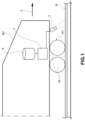
- a system for determining an adhesion value between wheel W and rail R for a railway vehicle RV is illustrated.
- 300 indicates the maximum braking force, at axle level, which may be required by an exemplifying railway vehicle in question.
- the maximum braking force is the braking force applied during emergency braking.
- the database 5 may be obtained on board the railway vehicle, or, as may be seen in Fig. 2 , the database 5 may be arranged remotely with respect to the railway vehicle. If the database 5 is remote, the system will be able to communicate with it through an appropriate wireless communication.
- the system further comprises a control unit 7 arranged to determine the current wheel-rail adhesion value on the basis of a comparison between current acquired optical information and the optical information previously stored in the database 5.
- the control unit 7 may for example be a PLC, a microprocessor, a microcontroller, or an FPGA.
- the optical information acquisition means 3 may be arranged in the railway vehicle in such a way as to acquire the optical information on the rail which is placed in front of a first axle A1 of the railway vehicle, according to the direction of travel V of the railway vehicle.
- the control unit 7 is arranged to determine that the current wheel-rail adhesion value associated with the current optical information acquired by the optical information acquisition means 3 corresponds to the adhesion value associated with the optical information stored in the database 5 having a greater degree of similarity with current optical information.
- the degree of similarity may be determined by the control unit 7 through deep learning algorithms.
- Deep learning refers to the research field of machine learning and artificial intelligence that is based on different levels of representation. Deep learning is a set of techniques based on artificial neural networks organized in different layers, where each layer calculates the values for the subsequent layer so that the information is processed more and more completely.
- Image recognition is a branch of computer science called "computer vision.”
- Algorithms for image recognition may be used to define the degree of similarity.
- recognizing an image automatically means using algorithms that receive an input image and are able to extract various information therefrom.
- the extracted information may be placed on several levels: low level (such as statistics on the presence of various shades of gray or colors, on sudden changes in brightness, etc.); intermediate level (characteristics related to regions of the image and relationships between regions) or high level (determination of objects with semantic significance). It is possible to recognize two images as similar even if only based on the low- or intermediate- or high-level characteristics.
- the optical information acquisition means 3 is a vision or image acquisition sensor, such as for example a video camera or a camera.
- the optical information acquisition means 3 may be a reflection-based optical sensor.
- the reflection-based optical sensor is arranged to send a light signal towards the rail and to detect a quantity and/or distribution of the light signal reflected from the rail indicative of a condition of the surface of the rail.
- the database 5 may pre-store a predetermined quantity of known optical information to which respective known adhesion values are associated, the correctness of which has been previously verified.
- the information stored will then be subsequently enhanced and updated during the normal operation of the railway vehicle.
- the optical information may be acquired by the optical information acquisition means 3 at determined time intervals, or upon detection of a degraded adhesion condition.
- the optical information acquisition means 3 will pick up one or more additional items of optical information which will be used to determine the current wheel-rail adhesion value in comparison with the additional optical information and the optical information previously stored in the database 5.
- the current wheel-rail adhesion value corresponds to the adhesion value associated with the optical information stored in the database 5 having a greater degree of similarity with the additional current optical information.
- the advantage achieved is therefore that of having provided a system for determining a wheel-rail adhesion value for a railway vehicle that is capable of self-calibrating in an increasingly reliable way as the self-calibration of the system will have accumulated a series of past events. Due to the appropriately calibrated system, the interpretation of indirect measurements based on optical sensors will be increasingly more reliable and will therefore allow for the reduction or elimination of the need for braking dedicated only to measuring adhesion.
Landscapes
- Engineering & Computer Science (AREA)
- Mechanical Engineering (AREA)
- Transportation (AREA)
- General Health & Medical Sciences (AREA)
- Physics & Mathematics (AREA)
- General Physics & Mathematics (AREA)
- Health & Medical Sciences (AREA)
- Theoretical Computer Science (AREA)
- Biomedical Technology (AREA)
- Computer Vision & Pattern Recognition (AREA)
- Quality & Reliability (AREA)
- Life Sciences & Earth Sciences (AREA)
- Chemical & Material Sciences (AREA)
- Analytical Chemistry (AREA)
- Biochemistry (AREA)
- Immunology (AREA)
- Pathology (AREA)
- Electric Propulsion And Braking For Vehicles (AREA)
- Train Traffic Observation, Control, And Security (AREA)
- Regulating Braking Force (AREA)
Description
- This invention relates, in general, to the railway vehicle sector; in particular, the invention refers to a system for determining a wheel-rail adhesion value for a railway vehicle.
- The prior art for measuring wheel-rail adhesion is fundamentally based on "indirect" solutions based on vision or reflection optical sensors, or on "direct" solutions that implement a brake or traction control dedicated to estimating adhesion. This second category includes, for example, solutions which apply a known braking force to one or more axles and detect their response in terms of rotational speed. Using the braking force and the angular acceleration, it is easy to deduce the adhesion available in the wheel-rail contact.
- However, disadvantageously, the optical solutions based on vision or reflection are basically not used as they must be appropriately pre-calibrated through complex calibration procedures, which are nevertheless susceptible to the environmental conditions of visibility and lighting in which the system will operate.
- Direct adhesion measurements, on the other hand, although reliable, may only be carried out if a braking torque is applied to the axle. Therefore, this measurement may only be performed during the braking phase, unless a dedicated brake control is implemented which, for example, periodically applies a known braking force and detects the response of the axle in terms of angular acceleration. Disadvantageously, the dedicated control solution allows the adhesion to be measured with the desired spatial-temporal resolution, but requires the periodic application, not necessary for vehicle travel, of a braking force to at least one axle of the railway vehicle.
-
DE 10 2011 113069 A1 relates to a control device for a rail vehicle, which is or can be connected to a sensor device, the latter being designed to determine rail condition data that represents the condition of a rail. However, the above problems still remain unresolved. - An object of this invention is to provide a system for determining a wheel-rail adhesion value for a railway vehicle which is capable of self-calibrating during use, based on artificial intelligence techniques. The system for determining a wheel-rail adhesion value for a railway vehicle calibrates the results from optical sensors on the basis of direct adhesion measurements. Due to the aforesaid system, the interpretation of indirect measurements based on optical sensors will be increasingly reliable as the self-calibration procedure of the system will have accumulated a series of events, i.e. direct adhesion measurements. The reliability of the indirect measurements obtained by the appropriately calibrated system will allow a reliable and continuous measurement of wheel-rail adhesion and at the same time will allow the need for braking dedicated only to the measurement of adhesion to be reduced or eliminated.
- The aforesaid and other objects and advantages are achieved, according to an aspect of the invention, by a system for determining a wheel-rail adhesion value for a railway vehicle having the features defined in claim 1. Preferred embodiments of the invention are defined in the dependent claims, the content of which is to be understood as an integral part of this description.
- The functional and structural features of some preferred embodiments of a system for determining a wheel-rail adhesion value for a railway vehicle according to the invention will now be described. Reference is made to the appended drawings, wherein:
-
Fig. 1 illustrates an embodiment of a system for determining a wheel-rail adhesion value for a railway vehicle; and -
Fig. 2 illustrates a further embodiment of a system for determining a wheel-rail adhesion value for a railway vehicle. -
Fig. 3A and3B each illustrate an example of direct adhesion measurement by applying a braking force to an axle. - Before describing in detail a plurality of embodiments of the invention, it should be clarified that the invention is not limited in its application to the construction details and configuration of the components presented in the following description or illustrated in the drawings. The invention is capable of assuming other embodiments and of being implemented or constructed in practice in different ways. It should also be understood that the phraseology and terminology have a descriptive purpose and should not be construed as limiting. The use of "include" and "comprise" and their variations are to be understood as encompassing the elements set out below and their equivalents, as well as additional elements and the equivalents thereof.
- Referring initially to
Fig. 1 , a system for determining an adhesion value between wheel W and rail R for a railway vehicle RV is illustrated. - This system comprises an optical information acquisition means 3 arranged to acquire optical information from the rail R, and a database 5 arranged, at least in a learning phase, to store the optical information and associate it with a respective real adhesion value between wheel W and rail R measured substantially at the moment of acquisition of the optical information by the optical information acquisition means 3. Clearly, the database 5 may be arranged to store the optical information and associate it with a respective real adhesion value between wheel W and rail R substantially measured at the moment of acquisition of the optical information by the optical information acquisition means 3, even during use following the initial learning phase, so as to continue with the training of the system even during its operational use.
- In other words, the optical information may be cataloged in the database 5 as a function of respective real adhesion values between wheel W and rail R.
- The measured real adhesion value between wheel W and rail W may be measured by braking an axle of the railway vehicle RV and analyzing the behavior of said axle. The fact of braking only one axle does not affect the behavior of the railway vehicle, as a single braked axle is not sufficient to influence the movement dynamics of the railway vehicle. In this way it will be possible to measure the real wheel-rail adhesion value without having negative effects on the speed of the railway vehicle and on the comfort of the passengers on board this railway vehicle. Preferably, the axle of the railway vehicle is braked until said axle begins to skid or up to a predetermined limit value.
- As may be seen in
Fig. 3A and3B , two examples of direct adhesion measurement are shown by applying a (dedicated) braking force to an axle. - In the graph, 300 indicates the maximum braking force, at axle level, which may be required by an exemplifying railway vehicle in question. Typically, the maximum braking force is the braking force applied during emergency braking.
- The procedure for direct adhesion measurement consists in applying a
braking force 302 to one or more axles with an increasing ramp. This ramp is interrupted, bringing the braking force back to zero, if themaximum braking force 300 is reached, as illustrated inFig. 3A , or if the axle in question begins to skid, i.e. itstangential speed 304 deviates from thetravel speed 306 of the vehicle, as illustrated inFig. 3B . - In the case of
Fig. 3A it is not possible to quantify the wheel-rail adhesion, but it may be stated that the wheel-rail adhesion is sufficient to apply the maximum braking force, for example, an emergency braking. Typically, the adhesion engaged by emergency braking is on the order of 0.15. Thus, in the case ofFig. 3A , it may be stated that the wheel-rail adhesion is greater than, for example, 0.15. - In any case, the adhesion measurement, in the event that it exceeds the adhesion necessary for emergency braking, is not of particular interest.
- Alternatively, in the case of
Fig. 3B , the wheel-rail adhesion is not sufficient for the application of the maximum braking force. Once a certain braking force value is reached, indicated by the dashed line, the axle begins to skid. At this point, the braking force is immediately reset to zero and the axle recovers the speed of the vehicle. - The adhesion may be calculated using the following relationship:

- µ: wheel-rail adhesion;
- F_brake: braking force applied to the axle;
- R: wheel radius;
- J: inertia of the axle;
- ω: angular acceleration of the axle;
- M: mass weighing on the axle;
- G: acceleration of gravity.
- As may be seen in
Fig. 1 , the database 5 may be obtained on board the railway vehicle, or, as may be seen inFig. 2 , the database 5 may be arranged remotely with respect to the railway vehicle. If the database 5 is remote, the system will be able to communicate with it through an appropriate wireless communication. - The system further comprises a control unit 7 arranged to determine the current wheel-rail adhesion value on the basis of a comparison between current acquired optical information and the optical information previously stored in the database 5.
- Advantageously, in light of the currently determined wheel-rail adhesion value, it will be possible to provide suggestions to the operator through a suitable human-machine interface arranged in the cabin. Alternatively or additionally, in light of the current determined wheel-rail adhesion value, it will be possible to automatically control the braking system of the railway vehicle and/or a WSP system of the railway vehicle, and/or the acceleration level of the railway vehicle.
- The control unit 7 may for example be a PLC, a microprocessor, a microcontroller, or an FPGA.
- As may be seen in the figures, the optical information acquisition means 3 may be arranged in the railway vehicle in such a way as to acquire the optical information on the rail which is placed in front of a first axle A1 of the railway vehicle, according to the direction of travel V of the railway vehicle.
- In this way, it will be possible to obtain optical information for the rail not disturbed by the passage of the wheels of the railway vehicle, which would tend to clean the rail or in any case to modify its state.
- The control unit 7 is arranged to determine that the current wheel-rail adhesion value associated with the current optical information acquired by the optical information acquisition means 3 corresponds to the adhesion value associated with the optical information stored in the database 5 having a greater degree of similarity with current optical information.
- The degree of similarity may be determined by the control unit 7 through deep learning algorithms.
- "Deep learning" refers to the research field of machine learning and artificial intelligence that is based on different levels of representation. Deep learning is a set of techniques based on artificial neural networks organized in different layers, where each layer calculates the values for the subsequent layer so that the information is processed more and more completely.
- Image recognition is a branch of computer science called "computer vision."
- Algorithms for image recognition may be used to define the degree of similarity. In a broad sense, recognizing an image automatically means using algorithms that receive an input image and are able to extract various information therefrom. The extracted information may be placed on several levels: low level (such as statistics on the presence of various shades of gray or colors, on sudden changes in brightness, etc.); intermediate level (characteristics related to regions of the image and relationships between regions) or high level (determination of objects with semantic significance). It is possible to recognize two images as similar even if only based on the low- or intermediate- or high-level characteristics.
- Preferably, the optical information acquisition means 3 is a vision or image acquisition sensor, such as for example a video camera or a camera.
- Alternatively, the optical information acquisition means 3 may be a reflection-based optical sensor. In this case, the reflection-based optical sensor is arranged to send a light signal towards the rail and to detect a quantity and/or distribution of the light signal reflected from the rail indicative of a condition of the surface of the rail.
- In order to calibrate the system, the database 5 may pre-store a predetermined quantity of known optical information to which respective known adhesion values are associated, the correctness of which has been previously verified. The information stored will then be subsequently enhanced and updated during the normal operation of the railway vehicle. For example, the optical information may be acquired by the optical information acquisition means 3 at determined time intervals, or upon detection of a degraded adhesion condition.
- Taking now a practical example, in a first phase of populating the database, by means of the optical information acquisition means 3 a determined quantity of optical information is taken which is associated with respective real wheel-rail adhesion values measured substantially in the moments of the acquisitions of the respective optical information from the optical information acquisition means 3. In a second operational step, the optical information acquisition means 3 will pick up one or more additional items of optical information which will be used to determine the current wheel-rail adhesion value in comparison with the additional optical information and the optical information previously stored in the database 5. In particular, it is determined that the current wheel-rail adhesion value corresponds to the adhesion value associated with the optical information stored in the database 5 having a greater degree of similarity with the additional current optical information.
- The advantage achieved is therefore that of having provided a system for determining a wheel-rail adhesion value for a railway vehicle that is capable of self-calibrating in an increasingly reliable way as the self-calibration of the system will have accumulated a series of past events. Due to the appropriately calibrated system, the interpretation of indirect measurements based on optical sensors will be increasingly more reliable and will therefore allow for the reduction or elimination of the need for braking dedicated only to measuring adhesion.
- Various aspects and embodiments of a system for determining a wheel-rail adhesion value for a railway vehicle according to the invention have been described. Furthermore, the invention is not limited to the described embodiments, but may be varied within the scope defined by the appended claims.
Claims (10)
- System for determining an adhesion value between wheel (W) and rail (R) for a railway vehicle (RV), comprising:- an optical information acquisition means (3) arranged to acquire optical information from the rail (R);- a database (5) arranged, at least in a learning phase, to store the acquired optical information and associate the acquired optical information with a respective real wheel-rail adhesion value substantially measured at the time of acquisition of the optical information by the optical information acquisition means (3);- a control unit (7) arranged to determine the current wheel-rail adhesion value on the basis of a comparison between current acquired optical information and the optical information previously stored in the database (5);wherein the control unit (7) is arranged to determine that the current wheel-rail adhesion value associated with the current optical information acquired by the optical information acquisition means (3) corresponds to the adhesion value associated with the optical information stored in the database (5) having the highest degree of similarity with the current acquired optical information;and being characterized in thatthe control unit (7) is configured to determine which is the optical information stored in the database (5) having the highest degree of similarity with the current optical information through image recognition algorithms based on artificial intelligence and/or machine learning.
- System according to claim 1, wherein the optical information acquisition means (3) is a vision sensor.
- System according to claim 2, wherein the vision sensor includes a video camera or a camera.
- System according to claim 1, wherein the optical information acquisition means (3) is an optical sensor based on reflection.
- System according to claim 4, wherein the optical means based on reflection is arranged to send a light signal towards the rail (R) and to detect a quantity and/or a distribution of the light signal reflected by the rail indicative of a condition of the rail surface.
- System according to any one of the preceding claims, wherein the database (5) is remote with respect to the railway vehicle.
- System according to any one of the preceding claims, wherein the optical information acquisition means (3) is arranged in the railway vehicle (RV) so as to acquire the optical information of the rail (R) which is placed in front of a first axle (A1) of the railway vehicle, according to the direction of travel of the railway vehicle (V).
- System according to any one of the preceding claims, wherein the database (5) is arranged to store a predetermined quantity of known optical information to which respective known adhesion values are associated, the correctness of which has been verified beforehand.
- System according to any one of the preceding claims, wherein the real wheel-rail adhesion value is measured by analyzing the behavior of an axle of the railway vehicle during a braking phase.
- System according to claim 9, wherein the axle of the railway vehicle is braked until such axle begins to skid or up to a predetermined limit value.
Applications Claiming Priority (2)
| Application Number | Priority Date | Filing Date | Title |
|---|---|---|---|
| IT102019000021951A IT201900021951A1 (en) | 2019-11-22 | 2019-11-22 | System for determining a value of adhesion between wheel and rail for a railway vehicle |
| PCT/IB2020/060951 WO2021100003A1 (en) | 2019-11-22 | 2020-11-20 | System for determining a wheel-rail adhesion value for a railway vehicle |
Publications (2)
| Publication Number | Publication Date |
|---|---|
| EP4061679A1 EP4061679A1 (en) | 2022-09-28 |
| EP4061679B1 true EP4061679B1 (en) | 2024-10-23 |
Family
ID=70228414
Family Applications (1)
| Application Number | Title | Priority Date | Filing Date |
|---|---|---|---|
| EP20824641.3A Active EP4061679B1 (en) | 2019-11-22 | 2020-11-20 | System for determining a wheel-rail adhesion value for a railway vehicle |
Country Status (8)
| Country | Link |
|---|---|
| US (1) | US12345639B2 (en) |
| EP (1) | EP4061679B1 (en) |
| JP (2) | JP2023503246A (en) |
| CN (1) | CN114728651B (en) |
| ES (1) | ES2997246T3 (en) |
| HU (1) | HUE069290T2 (en) |
| IT (1) | IT201900021951A1 (en) |
| WO (1) | WO2021100003A1 (en) |
Families Citing this family (2)
| Publication number | Priority date | Publication date | Assignee | Title |
|---|---|---|---|---|
| CN114061989B (en) * | 2021-09-17 | 2024-07-05 | 上海工程技术大学 | Wheel track adhesion characteristic simulation method and simulation test device |
| IT202200017958A1 (en) | 2022-09-01 | 2024-03-01 | Faiveley Transport Italia Spa | Procedure for predicting an expected deceleration of at least one vehicle, and corresponding system |
Family Cites Families (15)
| Publication number | Priority date | Publication date | Assignee | Title |
|---|---|---|---|---|
| IT1315804B1 (en) * | 2000-01-19 | 2003-03-26 | Vision Device S R L | AUTOMATIC GEOMETRIC-DIMENSIONAL INSPECTION AND CONTROL SYSTEM FOR WHEELS OF RAILWAY VEHICLES. |
| JP5053182B2 (en) * | 2008-06-06 | 2012-10-17 | 公益財団法人鉄道総合技術研究所 | Evaluation method of adhesion coefficient measured between rail and wheel |
| US8903574B2 (en) * | 2009-10-22 | 2014-12-02 | General Electric Company | System and method for vehicle communication, vehicle control, and/or route inspection |
| DE102011113073C5 (en) * | 2011-09-09 | 2022-03-10 | Knorr-Bremse Systeme für Schienenfahrzeuge GmbH | Improved Braking for a Rail Vehicle |
| DE102011113069B4 (en) * | 2011-09-09 | 2022-07-07 | Knorr-Bremse Systeme für Schienenfahrzeuge GmbH | Control device for a rail vehicle and method for determining an adhesion value for a rail vehicle |
| DE102011113117A1 (en) * | 2011-09-09 | 2013-03-14 | Knorr-Bremse Systeme für Schienenfahrzeuge GmbH | Brake control device for rail vehicles, brake system for rail vehicles and methods for brake control for rail vehicles and computer program product |
| AT516487A1 (en) * | 2014-10-16 | 2016-05-15 | Siemens Ag Oesterreich | Condition diagnosis of rail vehicle wheels |
| EP3168111A1 (en) * | 2015-11-11 | 2017-05-17 | KNORR-BREMSE Systeme für Schienenfahrzeuge GmbH | Control system with adhesion map for rail vehicles |
| US12311949B2 (en) * | 2016-04-05 | 2025-05-27 | Faiveley Transport Italia S.P.A. | Vehicle control system |
| DE102016005248A1 (en) * | 2016-04-29 | 2017-11-02 | Knorr-Bremse Systeme für Schienenfahrzeuge GmbH | Device and method for optimizing the Kaftschlussausnutzung between wheel and rail |
| FR3057380B1 (en) * | 2016-10-10 | 2019-07-26 | Sncf Reseau | METHOD AND SYSTEM FOR DETECTING REDUCED RAIL-WHEEL ADHERENCE, AND VEHICLE EQUIPPED WITH SUCH A SYSTEM |
| CN108090439A (en) * | 2017-12-14 | 2018-05-29 | 合肥寰景信息技术有限公司 | Pedestrian's feature extraction and processing system based on deep learning |
| CN108974043A (en) * | 2018-08-09 | 2018-12-11 | 铁路愿景欧洲有限公司 | Railroad track survey system |
| CN109460738B (en) * | 2018-11-14 | 2019-09-27 | 吉林大学 | A method for road surface type estimation based on deep convolutional neural network without loss function |
| CN110285825A (en) * | 2019-04-19 | 2019-09-27 | 武汉理工大学 | A voice-assisted driver anti-rear collision system based on driving recorder |
-
2019
- 2019-11-22 IT IT102019000021951A patent/IT201900021951A1/en unknown
-
2020
- 2020-11-20 HU HUE20824641A patent/HUE069290T2/en unknown
- 2020-11-20 US US17/756,308 patent/US12345639B2/en active Active
- 2020-11-20 ES ES20824641T patent/ES2997246T3/en active Active
- 2020-11-20 EP EP20824641.3A patent/EP4061679B1/en active Active
- 2020-11-20 CN CN202080080976.8A patent/CN114728651B/en active Active
- 2020-11-20 WO PCT/IB2020/060951 patent/WO2021100003A1/en not_active Ceased
- 2020-11-20 JP JP2022527683A patent/JP2023503246A/en active Pending
-
2025
- 2025-05-20 JP JP2025083862A patent/JP2025122082A/en active Pending
Also Published As
| Publication number | Publication date |
|---|---|
| HUE069290T2 (en) | 2025-02-28 |
| EP4061679A1 (en) | 2022-09-28 |
| CN114728651A (en) | 2022-07-08 |
| ES2997246T3 (en) | 2025-02-14 |
| JP2025122082A (en) | 2025-08-20 |
| WO2021100003A1 (en) | 2021-05-27 |
| JP2023503246A (en) | 2023-01-27 |
| CN114728651B (en) | 2025-01-28 |
| US12345639B2 (en) | 2025-07-01 |
| US20240011904A1 (en) | 2024-01-11 |
| IT201900021951A1 (en) | 2021-05-22 |
Similar Documents
| Publication | Publication Date | Title |
|---|---|---|
| US6426694B1 (en) | Method and apparatus for determining vehicle speed | |
| US6202009B1 (en) | Method for detecting fault of vehicle motion sensors | |
| US6092415A (en) | Method and device for monitoring the tire air pressure of the wheels of an automobile | |
| CN110920626B (en) | A data-driven electric drive vehicle attachment stability identification method and device | |
| JP2025122082A (en) | System for determining adhesion values between rail vehicle wheels and rails | |
| JP6159541B2 (en) | Method and apparatus for data acquisition for a safety device of a balanced vehicle | |
| US20040093128A1 (en) | Vehicle speed measuring apparatus | |
| KR20130133414A (en) | Travel velocity compensation apparatus for railway vehicles | |
| EP2758257B1 (en) | Method for estimating the rolling resistance of a vehicle wheel | |
| US12275280B2 (en) | Enhanced tracking of tire tread wear | |
| CN106232446A (en) | For the method determining the error of inertial sensor | |
| US20200307327A1 (en) | Determining a tire pressure status in a vehicle | |
| CN117897319A (en) | Method and device for determining and characterizing road surface irregularities | |
| KR20090085691A (en) | Friction Coefficient Estimation Method and Apparatus | |
| CN118119542A (en) | Method and device for determining and characterizing roadway irregularities | |
| CN104470783A (en) | Method of detecting an untimely acceleration of a motor vehicle | |
| US20030149516A1 (en) | Method for functional testing of a lateral-acceleration sensor | |
| US7487044B2 (en) | Apparatus and method for predicting a breaking distance of a vehicle | |
| DE102018205423A1 (en) | Detecting and suppressing sliding and skidding conditions of rail vehicles | |
| EP4217213B1 (en) | Adjustment of indirectly determined values of a tire monitoring system | |
| US6216061B1 (en) | Method for determining a reference magnitude | |
| US20040117100A1 (en) | Hydroplaning detection apparatus | |
| KR20090115317A (en) | Vehicle overload and irregular measurement detection device | |
| EP4378786B1 (en) | Estimation apparatus for water film thickness on road surface | |
| EA045978B1 (en) | SYSTEM FOR DETERMINING THE AMOUNT OF CLUTCH OF A RAILWAY VEHICLE WHEEL WITH A RAIL |
Legal Events
| Date | Code | Title | Description |
|---|---|---|---|
| STAA | Information on the status of an ep patent application or granted ep patent |
Free format text: STATUS: UNKNOWN |
|
| STAA | Information on the status of an ep patent application or granted ep patent |
Free format text: STATUS: THE INTERNATIONAL PUBLICATION HAS BEEN MADE |
|
| PUAI | Public reference made under article 153(3) epc to a published international application that has entered the european phase |
Free format text: ORIGINAL CODE: 0009012 |
|
| STAA | Information on the status of an ep patent application or granted ep patent |
Free format text: STATUS: REQUEST FOR EXAMINATION WAS MADE |
|
| 17P | Request for examination filed |
Effective date: 20220622 |
|
| AK | Designated contracting states |
Kind code of ref document: A1 Designated state(s): AL AT BE BG CH CY CZ DE DK EE ES FI FR GB GR HR HU IE IS IT LI LT LU LV MC MK MT NL NO PL PT RO RS SE SI SK SM TR |
|
| DAV | Request for validation of the european patent (deleted) | ||
| DAX | Request for extension of the european patent (deleted) | ||
| P01 | Opt-out of the competence of the unified patent court (upc) registered |
Effective date: 20230530 |
|
| GRAP | Despatch of communication of intention to grant a patent |
Free format text: ORIGINAL CODE: EPIDOSNIGR1 |
|
| STAA | Information on the status of an ep patent application or granted ep patent |
Free format text: STATUS: GRANT OF PATENT IS INTENDED |
|
| INTG | Intention to grant announced |
Effective date: 20240516 |
|
| GRAS | Grant fee paid |
Free format text: ORIGINAL CODE: EPIDOSNIGR3 |
|
| GRAA | (expected) grant |
Free format text: ORIGINAL CODE: 0009210 |
|
| STAA | Information on the status of an ep patent application or granted ep patent |
Free format text: STATUS: THE PATENT HAS BEEN GRANTED |
|
| AK | Designated contracting states |
Kind code of ref document: B1 Designated state(s): AL AT BE BG CH CY CZ DE DK EE ES FI FR GB GR HR HU IE IS IT LI LT LU LV MC MK MT NL NO PL PT RO RS SE SI SK SM TR |
|
| REG | Reference to a national code |
Ref country code: GB Ref legal event code: FG4D |
|
| REG | Reference to a national code |
Ref country code: CH Ref legal event code: EP |
|
| REG | Reference to a national code |
Ref country code: DE Ref legal event code: R096 Ref document number: 602020040008 Country of ref document: DE |
|
| REG | Reference to a national code |
Ref country code: IE Ref legal event code: FG4D |
|
| REG | Reference to a national code |
Ref country code: ES Ref legal event code: FG2A Ref document number: 2997246 Country of ref document: ES Kind code of ref document: T3 Effective date: 20250214 |
|
| REG | Reference to a national code |
Ref country code: LT Ref legal event code: MG9D |
|
| REG | Reference to a national code |
Ref country code: NL Ref legal event code: MP Effective date: 20241023 |
|
| REG | Reference to a national code |
Ref country code: HU Ref legal event code: AG4A Ref document number: E069290 Country of ref document: HU |
|
| REG | Reference to a national code |
Ref country code: AT Ref legal event code: MK05 Ref document number: 1734608 Country of ref document: AT Kind code of ref document: T Effective date: 20241023 |
|
| PG25 | Lapsed in a contracting state [announced via postgrant information from national office to epo] |
Ref country code: NL Free format text: LAPSE BECAUSE OF FAILURE TO SUBMIT A TRANSLATION OF THE DESCRIPTION OR TO PAY THE FEE WITHIN THE PRESCRIBED TIME-LIMIT Effective date: 20241023 |
|
| PG25 | Lapsed in a contracting state [announced via postgrant information from national office to epo] |
Ref country code: NL Free format text: LAPSE BECAUSE OF FAILURE TO SUBMIT A TRANSLATION OF THE DESCRIPTION OR TO PAY THE FEE WITHIN THE PRESCRIBED TIME-LIMIT Effective date: 20241023 |
|
| PG25 | Lapsed in a contracting state [announced via postgrant information from national office to epo] |
Ref country code: IS Free format text: LAPSE BECAUSE OF FAILURE TO SUBMIT A TRANSLATION OF THE DESCRIPTION OR TO PAY THE FEE WITHIN THE PRESCRIBED TIME-LIMIT Effective date: 20250223 Ref country code: HR Free format text: LAPSE BECAUSE OF FAILURE TO SUBMIT A TRANSLATION OF THE DESCRIPTION OR TO PAY THE FEE WITHIN THE PRESCRIBED TIME-LIMIT Effective date: 20241023 Ref country code: PT Free format text: LAPSE BECAUSE OF FAILURE TO SUBMIT A TRANSLATION OF THE DESCRIPTION OR TO PAY THE FEE WITHIN THE PRESCRIBED TIME-LIMIT Effective date: 20250224 |
|
| PG25 | Lapsed in a contracting state [announced via postgrant information from national office to epo] |
Ref country code: FI Free format text: LAPSE BECAUSE OF FAILURE TO SUBMIT A TRANSLATION OF THE DESCRIPTION OR TO PAY THE FEE WITHIN THE PRESCRIBED TIME-LIMIT Effective date: 20241023 |
|
| PG25 | Lapsed in a contracting state [announced via postgrant information from national office to epo] |
Ref country code: BG Free format text: LAPSE BECAUSE OF FAILURE TO SUBMIT A TRANSLATION OF THE DESCRIPTION OR TO PAY THE FEE WITHIN THE PRESCRIBED TIME-LIMIT Effective date: 20241023 |
|
| PG25 | Lapsed in a contracting state [announced via postgrant information from national office to epo] |
Ref country code: NO Free format text: LAPSE BECAUSE OF FAILURE TO SUBMIT A TRANSLATION OF THE DESCRIPTION OR TO PAY THE FEE WITHIN THE PRESCRIBED TIME-LIMIT Effective date: 20250123 |
|
| PG25 | Lapsed in a contracting state [announced via postgrant information from national office to epo] |
Ref country code: LV Free format text: LAPSE BECAUSE OF FAILURE TO SUBMIT A TRANSLATION OF THE DESCRIPTION OR TO PAY THE FEE WITHIN THE PRESCRIBED TIME-LIMIT Effective date: 20241023 Ref country code: AT Free format text: LAPSE BECAUSE OF FAILURE TO SUBMIT A TRANSLATION OF THE DESCRIPTION OR TO PAY THE FEE WITHIN THE PRESCRIBED TIME-LIMIT Effective date: 20241023 Ref country code: GR Free format text: LAPSE BECAUSE OF FAILURE TO SUBMIT A TRANSLATION OF THE DESCRIPTION OR TO PAY THE FEE WITHIN THE PRESCRIBED TIME-LIMIT Effective date: 20250124 |
|
| PG25 | Lapsed in a contracting state [announced via postgrant information from national office to epo] |
Ref country code: PL Free format text: LAPSE BECAUSE OF FAILURE TO SUBMIT A TRANSLATION OF THE DESCRIPTION OR TO PAY THE FEE WITHIN THE PRESCRIBED TIME-LIMIT Effective date: 20241023 |
|
| PG25 | Lapsed in a contracting state [announced via postgrant information from national office to epo] |
Ref country code: RS Free format text: LAPSE BECAUSE OF FAILURE TO SUBMIT A TRANSLATION OF THE DESCRIPTION OR TO PAY THE FEE WITHIN THE PRESCRIBED TIME-LIMIT Effective date: 20250123 |
|
| REG | Reference to a national code |
Ref country code: CH Ref legal event code: PL |
|
| PG25 | Lapsed in a contracting state [announced via postgrant information from national office to epo] |
Ref country code: SM Free format text: LAPSE BECAUSE OF FAILURE TO SUBMIT A TRANSLATION OF THE DESCRIPTION OR TO PAY THE FEE WITHIN THE PRESCRIBED TIME-LIMIT Effective date: 20241023 |
|
| PG25 | Lapsed in a contracting state [announced via postgrant information from national office to epo] |
Ref country code: MC Free format text: LAPSE BECAUSE OF FAILURE TO SUBMIT A TRANSLATION OF THE DESCRIPTION OR TO PAY THE FEE WITHIN THE PRESCRIBED TIME-LIMIT Effective date: 20241023 |
|
| PG25 | Lapsed in a contracting state [announced via postgrant information from national office to epo] |
Ref country code: DK Free format text: LAPSE BECAUSE OF FAILURE TO SUBMIT A TRANSLATION OF THE DESCRIPTION OR TO PAY THE FEE WITHIN THE PRESCRIBED TIME-LIMIT Effective date: 20241023 |
|
| PG25 | Lapsed in a contracting state [announced via postgrant information from national office to epo] |
Ref country code: LU Free format text: LAPSE BECAUSE OF NON-PAYMENT OF DUE FEES Effective date: 20241120 |
|
| REG | Reference to a national code |
Ref country code: CH Ref legal event code: PL |
|
| PG25 | Lapsed in a contracting state [announced via postgrant information from national office to epo] |
Ref country code: EE Free format text: LAPSE BECAUSE OF FAILURE TO SUBMIT A TRANSLATION OF THE DESCRIPTION OR TO PAY THE FEE WITHIN THE PRESCRIBED TIME-LIMIT Effective date: 20241023 |
|
| PG25 | Lapsed in a contracting state [announced via postgrant information from national office to epo] |
Ref country code: CH Free format text: LAPSE BECAUSE OF NON-PAYMENT OF DUE FEES Effective date: 20241130 |
|
| PG25 | Lapsed in a contracting state [announced via postgrant information from national office to epo] |
Ref country code: RO Free format text: LAPSE BECAUSE OF FAILURE TO SUBMIT A TRANSLATION OF THE DESCRIPTION OR TO PAY THE FEE WITHIN THE PRESCRIBED TIME-LIMIT Effective date: 20241023 |
|
| REG | Reference to a national code |
Ref country code: DE Ref legal event code: R097 Ref document number: 602020040008 Country of ref document: DE |
|
| PG25 | Lapsed in a contracting state [announced via postgrant information from national office to epo] |
Ref country code: SK Free format text: LAPSE BECAUSE OF FAILURE TO SUBMIT A TRANSLATION OF THE DESCRIPTION OR TO PAY THE FEE WITHIN THE PRESCRIBED TIME-LIMIT Effective date: 20241023 |
|
| PG25 | Lapsed in a contracting state [announced via postgrant information from national office to epo] |
Ref country code: CZ Free format text: LAPSE BECAUSE OF FAILURE TO SUBMIT A TRANSLATION OF THE DESCRIPTION OR TO PAY THE FEE WITHIN THE PRESCRIBED TIME-LIMIT Effective date: 20241023 |
|
| REG | Reference to a national code |
Ref country code: BE Ref legal event code: MM Effective date: 20241130 |
|
| PLBE | No opposition filed within time limit |
Free format text: ORIGINAL CODE: 0009261 |
|
| STAA | Information on the status of an ep patent application or granted ep patent |
Free format text: STATUS: NO OPPOSITION FILED WITHIN TIME LIMIT |
|
| PG25 | Lapsed in a contracting state [announced via postgrant information from national office to epo] |
Ref country code: SE Free format text: LAPSE BECAUSE OF FAILURE TO SUBMIT A TRANSLATION OF THE DESCRIPTION OR TO PAY THE FEE WITHIN THE PRESCRIBED TIME-LIMIT Effective date: 20241023 |
|
| 26N | No opposition filed |
Effective date: 20250724 |
|
| PG25 | Lapsed in a contracting state [announced via postgrant information from national office to epo] |
Ref country code: BE Free format text: LAPSE BECAUSE OF NON-PAYMENT OF DUE FEES Effective date: 20241130 |
|
| PG25 | Lapsed in a contracting state [announced via postgrant information from national office to epo] |
Ref country code: IE Free format text: LAPSE BECAUSE OF NON-PAYMENT OF DUE FEES Effective date: 20241120 |
|
| PGFP | Annual fee paid to national office [announced via postgrant information from national office to epo] |
Ref country code: HU Payment date: 20251030 Year of fee payment: 6 |
|
| PGFP | Annual fee paid to national office [announced via postgrant information from national office to epo] |
Ref country code: DE Payment date: 20251010 Year of fee payment: 6 |
|
| PGFP | Annual fee paid to national office [announced via postgrant information from national office to epo] |
Ref country code: GB Payment date: 20251119 Year of fee payment: 6 |
|
| PGFP | Annual fee paid to national office [announced via postgrant information from national office to epo] |
Ref country code: IT Payment date: 20251010 Year of fee payment: 6 |
|
| PGFP | Annual fee paid to national office [announced via postgrant information from national office to epo] |
Ref country code: FR Payment date: 20251106 Year of fee payment: 6 |
|
| PGFP | Annual fee paid to national office [announced via postgrant information from national office to epo] |
Ref country code: ES Payment date: 20251211 Year of fee payment: 6 |
|
| PG25 | Lapsed in a contracting state [announced via postgrant information from national office to epo] |
Ref country code: CY Free format text: LAPSE BECAUSE OF FAILURE TO SUBMIT A TRANSLATION OF THE DESCRIPTION OR TO PAY THE FEE WITHIN THE PRESCRIBED TIME-LIMIT; INVALID AB INITIO Effective date: 20201120 |