EP4060164B1 - Gas turbine engine and mount assembly therefor - Google Patents
Gas turbine engine and mount assembly therefor Download PDFInfo
- Publication number
- EP4060164B1 EP4060164B1 EP22163083.3A EP22163083A EP4060164B1 EP 4060164 B1 EP4060164 B1 EP 4060164B1 EP 22163083 A EP22163083 A EP 22163083A EP 4060164 B1 EP4060164 B1 EP 4060164B1
- Authority
- EP
- European Patent Office
- Prior art keywords
- component
- radial direction
- gas turbine
- turbine engine
- axial
- Prior art date
- Legal status (The legal status is an assumption and is not a legal conclusion. Google has not performed a legal analysis and makes no representation as to the accuracy of the status listed.)
- Active
Links
Images




Classifications
-
- F—MECHANICAL ENGINEERING; LIGHTING; HEATING; WEAPONS; BLASTING
- F01—MACHINES OR ENGINES IN GENERAL; ENGINE PLANTS IN GENERAL; STEAM ENGINES
- F01D—NON-POSITIVE DISPLACEMENT MACHINES OR ENGINES, e.g. STEAM TURBINES
- F01D25/00—Component parts, details, or accessories, not provided for in, or of interest apart from, other groups
- F01D25/04—Antivibration arrangements
-
- B—PERFORMING OPERATIONS; TRANSPORTING
- B64—AIRCRAFT; AVIATION; COSMONAUTICS
- B64D—EQUIPMENT FOR FITTING IN OR TO AIRCRAFT; FLIGHT SUITS; PARACHUTES; ARRANGEMENT OR MOUNTING OF POWER PLANTS OR PROPULSION TRANSMISSIONS IN AIRCRAFT
- B64D27/00—Arrangement or mounting of power plants in aircraft; Aircraft characterised by the type or position of power plants
- B64D27/40—Arrangements for mounting power plants in aircraft
- B64D27/402—Arrangements for mounting power plants in aircraft comprising box like supporting frames, e.g. pylons or arrangements for embracing the power plant
-
- F—MECHANICAL ENGINEERING; LIGHTING; HEATING; WEAPONS; BLASTING
- F01—MACHINES OR ENGINES IN GENERAL; ENGINE PLANTS IN GENERAL; STEAM ENGINES
- F01D—NON-POSITIVE DISPLACEMENT MACHINES OR ENGINES, e.g. STEAM TURBINES
- F01D25/00—Component parts, details, or accessories, not provided for in, or of interest apart from, other groups
- F01D25/24—Casings; Casing parts, e.g. diaphragms, casing fastenings
- F01D25/243—Flange connections; Bolting arrangements
-
- F—MECHANICAL ENGINEERING; LIGHTING; HEATING; WEAPONS; BLASTING
- F01—MACHINES OR ENGINES IN GENERAL; ENGINE PLANTS IN GENERAL; STEAM ENGINES
- F01D—NON-POSITIVE DISPLACEMENT MACHINES OR ENGINES, e.g. STEAM TURBINES
- F01D25/00—Component parts, details, or accessories, not provided for in, or of interest apart from, other groups
- F01D25/28—Supporting or mounting arrangements, e.g. for turbine casing
- F01D25/285—Temporary support structures, e.g. for testing, assembling, installing, repairing; Assembly methods using such structures
-
- F—MECHANICAL ENGINEERING; LIGHTING; HEATING; WEAPONS; BLASTING
- F02—COMBUSTION ENGINES; HOT-GAS OR COMBUSTION-PRODUCT ENGINE PLANTS
- F02C—GAS-TURBINE PLANTS; AIR INTAKES FOR JET-PROPULSION PLANTS; CONTROLLING FUEL SUPPLY IN AIR-BREATHING JET-PROPULSION PLANTS
- F02C7/00—Features, components parts, details or accessories, not provided for in, or of interest apart form groups F02C1/00 - F02C6/00; Air intakes for jet-propulsion plants
- F02C7/32—Arrangement, mounting, or driving, of auxiliaries
-
- B—PERFORMING OPERATIONS; TRANSPORTING
- B64—AIRCRAFT; AVIATION; COSMONAUTICS
- B64D—EQUIPMENT FOR FITTING IN OR TO AIRCRAFT; FLIGHT SUITS; PARACHUTES; ARRANGEMENT OR MOUNTING OF POWER PLANTS OR PROPULSION TRANSMISSIONS IN AIRCRAFT
- B64D27/00—Arrangement or mounting of power plants in aircraft; Aircraft characterised by the type or position of power plants
- B64D27/40—Arrangements for mounting power plants in aircraft
- B64D27/404—Suspension arrangements specially adapted for supporting vertical loads
-
- B—PERFORMING OPERATIONS; TRANSPORTING
- B64—AIRCRAFT; AVIATION; COSMONAUTICS
- B64D—EQUIPMENT FOR FITTING IN OR TO AIRCRAFT; FLIGHT SUITS; PARACHUTES; ARRANGEMENT OR MOUNTING OF POWER PLANTS OR PROPULSION TRANSMISSIONS IN AIRCRAFT
- B64D27/00—Arrangement or mounting of power plants in aircraft; Aircraft characterised by the type or position of power plants
- B64D27/40—Arrangements for mounting power plants in aircraft
- B64D27/406—Suspension arrangements specially adapted for supporting thrust loads, e.g. thrust links
-
- F—MECHANICAL ENGINEERING; LIGHTING; HEATING; WEAPONS; BLASTING
- F05—INDEXING SCHEMES RELATING TO ENGINES OR PUMPS IN VARIOUS SUBCLASSES OF CLASSES F01-F04
- F05D—INDEXING SCHEME FOR ASPECTS RELATING TO NON-POSITIVE-DISPLACEMENT MACHINES OR ENGINES, GAS-TURBINES OR JET-PROPULSION PLANTS
- F05D2220/00—Application
- F05D2220/30—Application in turbines
- F05D2220/32—Application in turbines in gas turbines
-
- F—MECHANICAL ENGINEERING; LIGHTING; HEATING; WEAPONS; BLASTING
- F05—INDEXING SCHEMES RELATING TO ENGINES OR PUMPS IN VARIOUS SUBCLASSES OF CLASSES F01-F04
- F05D—INDEXING SCHEME FOR ASPECTS RELATING TO NON-POSITIVE-DISPLACEMENT MACHINES OR ENGINES, GAS-TURBINES OR JET-PROPULSION PLANTS
- F05D2240/00—Components
- F05D2240/90—Mounting on supporting structures or systems
-
- F—MECHANICAL ENGINEERING; LIGHTING; HEATING; WEAPONS; BLASTING
- F05—INDEXING SCHEMES RELATING TO ENGINES OR PUMPS IN VARIOUS SUBCLASSES OF CLASSES F01-F04
- F05D—INDEXING SCHEME FOR ASPECTS RELATING TO NON-POSITIVE-DISPLACEMENT MACHINES OR ENGINES, GAS-TURBINES OR JET-PROPULSION PLANTS
- F05D2260/00—Function
- F05D2260/96—Preventing, counteracting or reducing vibration or noise
Definitions
- the application relates generally to gas turbine engines and, more particularly, to mount configurations therefore.
- mounts typically consisting of a number of discrete structures, are used between the component and the casing. Such structures can allow for varying degrees of freedom of movement of their attachment point on the component and the casing.
- Design consideration in mount configurations include the weight and static structural resistance of the mount, allowance for varying degrees of relative thermal expansion over the operating envelope. While existing mounts were satisfactory to a certain degree there remained room for improvement, particularly in terms of taking into consideration dynamic effects such as vibrational resonance.
- WO 2014/011982 A1 discloses a mid-turbine frame with oil system mounts
- US 3 543 588 A discloses an accessory drive arrangement for a ducted fan type aircraft engine.
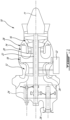
- Fig. 1 illustrates an example of a turbine engine.
- the turbine engine 10 is a turboshaft engine generally comprising in serial flow communication, a multistage compressor 12 for pressurizing the air, a combustor 14 in which the compressed air is mixed with fuel and ignited for generating an annular stream of hot combustion gases around the engine rotation axis 11, and a turbine section 16 for extracting energy from the combustion gases.
- the turbine engine terminates in an exhaust section.
- the fluid path extending sequentially across the compressor 12, the combustor 14 and the turbine 16 can be referred to as the core gas path 18.
- the combustor 14 can include a plurality of identical, circumferentially interspaced, combustor units.
- the exact design varies from one engine type to another, but it is common for turboshaft engines, for instance, to have two rotors, including one high pressure shaft 20, connecting a high pressure turbine section to the compressor 14, and a low pressure shaft 22, sometimes referred to as a power shaft, which is used as a power source during use.
- Turbofan, electric, and hybrid aircraft engines can also have one or more shaft associated to corresponding rotors.
- Turboshaft engines similarly to turboprop engines, typically have some form of gearing by which the power of the low pressure shaft 22 is transferred to an external shaft 26 bearing the blades (or propeller).
- This gearing which can be referred to as a gearbox 24 for the sake of simplicity, typically reduces the rotation speed to reach an external rotation speed which is better adapted to rotate the blades or propeller for instance.
- Aircraft engines have casings which can include a plurality of non-rotary components assembled to one another, and the exact design thereof can vary from one aircraft engine type to another.
- the casing 28 typically has a radially-inner wall, relative the rotation axis 11, forming a radially outer delimitation to the core gas path 18, and can also have a radially outer wall 28.
- the casing 28 can be housed within a nacelle having an aerodynamic configuration, or otherwise within the aerodynamic external skin of the aircraft.
- Aircraft engines typically have an accessory gearbox (AGB) 32 which can serve for exchanging power from the aircraft engine's core and "accessories".
- Accessory gearboxes 32 typically provide for the connection to more than one accessory.
- the exact selection of accessories can vary from one engine to another, but it is relatively common for the accessories to include one or more fuel pump, oil pump, engine starter, etc.
- the accessory gearbox 32 can be located externally to the casing 28, and somewhat remotely from the engine's core to avoid the harsh temperatures which can be sustained during operation of the higher pressure compressors, combustor 16, and turbine sections 18.
- the accessory gearbox 32 can be connected to transfer power to an engine shaft (e.g. shaft 20) by a radially-extending driveshaft 34.
- AGBs 32 can be relatively heavy components. Their placement, especially when remote to the engine's rotation axis 11, can make them prone to dynamic effects, such as resonant vibration frequency response, in addition to more typical structural considerations. This can also be true for other relatively large and heavy components secured externally to the casing, such as an oil tank, a starter/generator, an electronics housing, and an oil cooler, to name a few examples.
- mounts 38 typically consisting of a number of discrete structures 40a, 40b, 40c, can be used between the component 36 and the casing 28.
- Such structures 40a, 40b, 40c can allow for varying degrees of freedom of displacement at their attachment point on the component 36 or the casing 28.
- Design consideration in mount configurations include the weight and static structural resistance of the mount, allowance for varying degrees of relative thermal expansion over the operating envelope.
- the structures 40a, 40b, 40c can be brackets, for instance.
- FIG. 2 An example mount configuration which can be used to mount a relatively large and heavy component 36 externally to a casing 28 of an engine 10 is presented in Fig. 2 .
- the mount 38 has three structures 40a, 40b, 40c and is arranged in a so-called 3 - 2 - 1 configuration. More specifically, a first structure 40b is fixed in displacement in 3 orthogonal orientations, a second structure 40c is fixed in displacement in 2 orthogonal orientations, and free to displacement in the third orthogonal orientation to accommodate, say, thermal expansion in that orientation relative the first structure 40b, and a third structure 40a fixed in 1 orthogonal orientation, and free to displacement in the second and third orthogonal orientations.
- the second structure 40c can have a sliding engagement in the third orthogonal orientation
- the third structure 40a can have a double spherical joint allowing movement in the second and third orthogonal orientations, for instance.
- Such a mount configuration can allow mounting a relatively large and heavy component externally to the casing in a relatively low weight manner, and can be suitable to a certain degree in many embodiments. However, it may not be suitable for all embodiments.
- the component 36 in question is relatively long/tall in an orientation normal to a major vibration orientation
- one of its ends typically the one associated with the structure 40a offering the greatest degree of freedom
- a tall component 36 such as an oil tank, starter/generator, electronics housing, or oil cooler to name a few examples, is mounted externally to a casing 28 in a manner that its height extends normal to the engine's rotation axis 11, and where the engine 10 has a strong excitation vibration in the orientation of its rotation axis 11, which may particularly be the case in many turboshaft engines which rotate helicopter blades. Indeed, the helicopter blades can be a significant source of "chucking" vibration.
- the chucking load can be transferred to the engine through a front mount of the engine (not shown), which is attached to the case 28, and the load can therefore be carried by the case 28, which can translate in strong vibrations in the orientation of the rotation axis 11.
- a 3 structure 40b and a 2 structure 40c are used to support the bottom 42 of such a tall component 36 onto the casing 28, and where a 1 structure 40a is used to support the top 44 of such a tall component 36
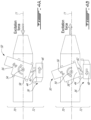
- the top 44 of the component 36 can experience vibration in the form of alternating forward 46 and backward 48 movement parallel to the rotation axis 11, such as schematized in Fig. 4A and 4B , for instance.
- a first side 70 and a second side 72 is defined relative the torsion axis 54, in opposite directions along the horizontal radial orientation 64.
- another relatively large and heavy component 50 is mounted to the engine casing 28, circumferentially adjacent the first component 36.
- This second component 50 is mounted to the engine 10 here with a corresponding mount 52, which can include a plurality of structures, such as three or four, for instance, and the mount 52 is subject to torsion around a torsion axis 54 oriented parallel to a height of the first component 36.
- the second component 50 has a center of gravity 56 which is offset from the torsion axis 54, as perhaps best seen in Figs.
- the overhang 60 can be considered relatively heavy when it laterally offsets the center of gravity by more than 3%, more than 8%, or more than 15% of the width of the second component 50, for instance, depending on the embodiment.
- the torsion axis 54 can coincide with the rotation axis of the driveshaft 34, for instance, and the overhang 60 can house a relatively heavy bearing oil pump for instance.
- the side 58 of the second component 50 and the top 44 of the first component 36 experience alternating axial movements in opposite directions, at the same frequency. As will now be detailed, this phenomena can be harnessed to dynamically stiffen the overall assembly.
- a structure 62 can be used to connect the top 44 of the first component 36 to the adjacent side 58 of the second component 50 in a manner to stiffen the overall assembly via axially oriented flexing stresses occurring in the structure 62 and communicated between the two components via the structure.
- the connection between the structure 62 and the side 58 of the second component can be made by directly, such as by connecting the structure 62 to a point or area forming part of the second component 50 itself (e.g. a housing of the second component 50), or indirectly, by connecting the structure to a point or area of an adjacent component which moves dynamically together with the second component 50.
- the mount 52 by which the second component 50 is mounted to the casing can by dynamically integral with the second component 50, and move with it, especially the portions of the mount 52 which are the closest to the second component 50. Accordingly, the structure 62 can be connected to the second component 50 indirectly, via a corresponding portion of its mount 52.
- the structure 62 can be stiff in the axial orientation, and in fact, in some embodiments, it can be preferred for the structure to exhibit some degree flexibility in the axial orientation. More specifically, the structure 62 can be stiff in the horizontal radial orientation 64, free in the vertical radial orientation 66, and flexible in the axial orientation 11. More specifically, in the horizontal radial orientation 64, the bracket can be pushed or pulled, which leads to compression or tension in the bracket instead of bending. The flexibility in the axial orientation 11 is designed in a manner to lead to bending within the elastic domain. The structure 62 can be designed in a manner to exhibit a lower degree of bending, or no bending at all, from stress exhibited in the width orientation.
- the structure can have a length extending mainly in the width orientation, or mainly in the height orientation, as both cases can be designed in a manner to exhibit flexibility in the axial orientation, rigidity in the horizontal radial orientation, and freedom of movement in the vertical radial orientation, for instance.
- the degree of flexibility can be tuned via the choice of material and shape/configuration, and the dimensions, particularly in the axial orientation 11.
- the spring rate of the structure 62 can be adjusted by changing the length, thickness, height and material type, which in turn can adjust the system dynamic response. More precisely, the stiffness of the structure 62 can be tuned precisely to couple the torsional mode of the second component 50 to the axial mode of the first component 36.
- the modes can be simulated and observed using computer assisted modelization using the components 36, 50 individually mounted with respective mounts 52, 38, but without the interconnecting structure 62.
- the presence of the structure 62 can increase the natural frequency of the components to a much higher frequency for a same mounting stiffness.
- the mounting configuration for the component 36 can be as schematized in Fig. 5 .
- three orthogonal orientations can be defined as the axial orientation 11, the horizontal radial orientation 64, and the vertical radial orientation 66, but it will be understood that these expressions are attributed arbitrarily and imply no particular reference to the orientation of the gas turbine engine relative to the ground, or relative to the aircraft.
- the two components 36, 50 can be in different relative orientations relative the main orientation of vibration
- the torsion axis can be defined as being normal to the main orientation of vibration, for instance.
- the relative position and orientation of the components can be alternately presented in a frame of reference of the torsion axis 54 instead of the frame of reference of the engine rotation axis 11, for instance.
- the second mount 138 includes a 2 structure 40c and a 3 structure 40b securing a bottom 42 of the component 36 to the casing 28, as in the mount 38.
- a different structure 62 is used to secure the top 44 of the component 36 to the second component 50.
- the structure 62 still fixes displacement in the horizontal radial orientation 64 and is still free to displacement along the vertical radial orientation 66, but is elastically flexible in the axial orientation 11, and thus offers only a partial resistance to displacement along the axial orientation 11.
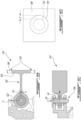
- Fig. 6A shows one possible example embodiment of a component 36, more precisely an oil tank 74.
- the oil tank 74 can be particularly sensitive to axially oriented resonant frequency modes in the top portion 44 thereof.
- the tank can be outfitted with a 2-structure 140c and a 3-structure 140b at the bottom thereof, which directly connect to the engine casing.
- Another structure 162 can be used to connect the top 44 directly to the AGB's housing laterally opposite the overhang portion.
- Fig. 6B and 6C are top and transverse cross-section views, respectively, showing the example structure 162 in further detail.
- the structure 162 can include a beam 180 extending between a first end 182 connecting the tank, and a second end 184 connecting the AGB 32.
- the beam 180 can be taller in the vertical radial orientation 66 than thick in the axial orientation 11, to be elastically bendable in the axial orientation 11. In other words, it can be more elastically flexible in the axial orientation 11 than in the horizontal radial orientation 64, where it is fixed. It can be at least three times narrower in the axial orientation 11 than in the vertical radial orientation 66, and in this specific embodiment, it is roughly 10 times narrower in the axial orientation 11 than in the vertical radial orientation 66.
- One of the two ends, the one 182 connecting the tank 74 in this embodiment, can have a sliding mount 186 providing sliding-ability, and thus a degree of freedom, along the vertical radial orientation 66.
- One of the two ends, or both, and more specifically the end 184 connecting the AGB 32 housing in this embodiment can be provided with one or more flanges 188 having one or more clearance holes 190 through which one or more fasteners 192 are to be introduced to secure the end 184 to the component.
- clearance holes 190 have a cross-sectional shape which is larger than a cross section of the corresponding fastener 192, leaving a clearance c, such that the two components can remain loosely connected to accommodate assembly tolerance stackups, until the final assembly step where the fastener sandwiches the flange between a head or nut and a corresponding surface of the component.
- the use of clearance holes can avoid pre-stressing the structure 162 during assembly.
- the following process can occur during the operation of the gas turbine engine.
- Generating axial vibrations along the axis 200 these axial vibrations can be generated, for instance, by the rotation of helicopter blades as a function of the speed of rotation and of the number of blades during operating conditions such as cruising.
- the axial vibrations then entrain two effects simultaneously : a torsional vibration mode 210 in a first component mounted externally to the casing, the torsional vibration mode 210 being defined around a torsion axis normal to the rotation axis, and an axial vibration mode 220 in a portion of a second component mounted externally to the casing, the portion of the second component extending adjacent a side of the first component, said torsional vibration mode 210 entraining an axial movement of the side of the first component opposite an axial movement of the portion of the second component entrained by the axial vibration mode.
- energy is transferred 230 from the torsional vibration mode to oppose energy from the axial vibration mode via a structure connecting the portion of the second component to the side of the first component.
Landscapes
- Engineering & Computer Science (AREA)
- Mechanical Engineering (AREA)
- General Engineering & Computer Science (AREA)
- Aviation & Aerospace Engineering (AREA)
- Chemical & Material Sciences (AREA)
- Combustion & Propulsion (AREA)
- Vibration Prevention Devices (AREA)
- Structures Of Non-Positive Displacement Pumps (AREA)
Description
- The application relates generally to gas turbine engines and, more particularly, to mount configurations therefore.
- It is relatively common for gas turbine engines to have one or more relatively large and heavy components secured externally to the casing. The nature of such components varies from one engine model to another, and can include an accessory gearbox (AGB), an oil tank, a starter/generator, an electronics housing, and an oil cooler to name a few examples. Various motivations may exist for mounting such a component externally to the casing, remotely from the engine's main rotation axis, such as seeking an environment which is cooler than the engine core, for instance, or connection convenience with another component. In some engine designs, it can be considered non-feasible to mount such components rigidly to the casing, and this can be due, for instance, to the requirement of allowing for different degrees of thermal expansion between the component and the casing, which can be particularly true for larger components. Accordingly, mounts, typically consisting of a number of discrete structures, are used between the component and the casing. Such structures can allow for varying degrees of freedom of movement of their attachment point on the component and the casing. Design consideration in mount configurations include the weight and static structural resistance of the mount, allowance for varying degrees of relative thermal expansion over the operating envelope. While existing mounts were satisfactory to a certain degree there remained room for improvement, particularly in terms of taking into consideration dynamic effects such as vibrational resonance.
-
WO 2014/011982 A1 discloses a mid-turbine frame with oil system mounts, andUS 3 543 588 A discloses an accessory drive arrangement for a ducted fan type aircraft engine. - In one aspect, there is provided a gas turbine engine as set forth in claim 1.
- In another aspect, there is provided a method as set forth in
claim 10. - Embodiments of the disclosure are set forth in the dependent claims.
- Reference is now made to the accompanying figures in which:
-
Fig. 1 is a schematic cross-sectional view of a gas turbine engine; -
Fig. 2 is a first example of a mount configuration; -
Fig. 3 is an oblique schematic view of the gas turbine engine; -
Fig. 4A and Fig. 4B are top schematic views of the gas turbine engine; -
Fig. 5 is a second example of a mount configuration; -
Fig. 6a is an example of an oil tank with a corresponding mount,Figs. 6B, 6C and 6D being enlarged portions thereof taken from different angles; and -
Fig. 7 is a flowchart of an example method of operating a gas turbine engine. -
Fig. 1 illustrates an example of a turbine engine. In this example, theturbine engine 10 is a turboshaft engine generally comprising in serial flow communication, amultistage compressor 12 for pressurizing the air, acombustor 14 in which the compressed air is mixed with fuel and ignited for generating an annular stream of hot combustion gases around theengine rotation axis 11, and aturbine section 16 for extracting energy from the combustion gases. The turbine engine terminates in an exhaust section. - The fluid path extending sequentially across the
compressor 12, thecombustor 14 and theturbine 16 can be referred to as thecore gas path 18. In practice, thecombustor 14 can include a plurality of identical, circumferentially interspaced, combustor units. The exact design varies from one engine type to another, but it is common for turboshaft engines, for instance, to have two rotors, including onehigh pressure shaft 20, connecting a high pressure turbine section to thecompressor 14, and alow pressure shaft 22, sometimes referred to as a power shaft, which is used as a power source during use. Turbofan, electric, and hybrid aircraft engines can also have one or more shaft associated to corresponding rotors. - Turboshaft engines, similarly to turboprop engines, typically have some form of gearing by which the power of the
low pressure shaft 22 is transferred to anexternal shaft 26 bearing the blades (or propeller). This gearing, which can be referred to as agearbox 24 for the sake of simplicity, typically reduces the rotation speed to reach an external rotation speed which is better adapted to rotate the blades or propeller for instance. - Aircraft engines have casings which can include a plurality of non-rotary components assembled to one another, and the exact design thereof can vary from one aircraft engine type to another. In the case of gas turbine engines or hybrid engines, the
casing 28 typically has a radially-inner wall, relative therotation axis 11, forming a radially outer delimitation to thecore gas path 18, and can also have a radiallyouter wall 28. Thecasing 28 can be housed within a nacelle having an aerodynamic configuration, or otherwise within the aerodynamic external skin of the aircraft. - Aircraft engines typically have an accessory gearbox (AGB) 32 which can serve for exchanging power from the aircraft engine's core and "accessories".
Accessory gearboxes 32 typically provide for the connection to more than one accessory. The exact selection of accessories can vary from one engine to another, but it is relatively common for the accessories to include one or more fuel pump, oil pump, engine starter, etc. Theaccessory gearbox 32 can be located externally to thecasing 28, and somewhat remotely from the engine's core to avoid the harsh temperatures which can be sustained during operation of the higher pressure compressors,combustor 16, andturbine sections 18. Theaccessory gearbox 32 can be connected to transfer power to an engine shaft (e.g. shaft 20) by a radially-extendingdriveshaft 34. - Given the presence of internal gearing, and especially in the case of AGB's having multiple ports,
AGBs 32 can be relatively heavy components. Their placement, especially when remote to the engine'srotation axis 11, can make them prone to dynamic effects, such as resonant vibration frequency response, in addition to more typical structural considerations. This can also be true for other relatively large and heavy components secured externally to the casing, such as an oil tank, a starter/generator, an electronics housing, and an oil cooler, to name a few examples. - Various motivations may exist for mounting such relatively large and
heavy components 36 externally to thecasing 28, remotely from the engine'srotation axis 11, such as seeking an environment which is cooler than the engine core, for instance, or connection convenience with another component. In some engine designs, it can be considered non-feasible to mountsuch components 36 rigidly to thecasing 28, and this can be due, for instance, to the requirement of allowing for different degrees of thermal expansion between thecomponent 36 and thecasing 28, which can be particularly true for larger components. Accordingly,mounts 38, typically consisting of a number ofdiscrete structures component 36 and thecasing 28.Such structures component 36 or thecasing 28. Design consideration in mount configurations include the weight and static structural resistance of the mount, allowance for varying degrees of relative thermal expansion over the operating envelope. Thestructures - An example mount configuration which can be used to mount a relatively large and
heavy component 36 externally to acasing 28 of anengine 10 is presented inFig. 2 . In this example, themount 38 has threestructures first structure 40b is fixed in displacement in 3 orthogonal orientations, asecond structure 40c is fixed in displacement in 2 orthogonal orientations, and free to displacement in the third orthogonal orientation to accommodate, say, thermal expansion in that orientation relative thefirst structure 40b, and athird structure 40a fixed in 1 orthogonal orientation, and free to displacement in the second and third orthogonal orientations. Thesecond structure 40c can have a sliding engagement in the third orthogonal orientation, and thethird structure 40a can have a double spherical joint allowing movement in the second and third orthogonal orientations, for instance. Such a mount configuration can allow mounting a relatively large and heavy component externally to the casing in a relatively low weight manner, and can be suitable to a certain degree in many embodiments. However, it may not be suitable for all embodiments. - In particular, if the
component 36 in question is relatively long/tall in an orientation normal to a major vibration orientation, one of its ends, typically the one associated with thestructure 40a offering the greatest degree of freedom, may be prone to resonant vibration due to the alternating excitation forces operating in the major vibration orientation, and it may be challenging or impossible to limit the amplitude of the resonant vibration of that end within a specified range without an unsatisfactory penalty in terms of weight. - Such a scenario can occur, for instance, in a context such as presented in
Fig. 3 where atall component 36, such as an oil tank, starter/generator, electronics housing, or oil cooler to name a few examples, is mounted externally to acasing 28 in a manner that its height extends normal to the engine'srotation axis 11, and where theengine 10 has a strong excitation vibration in the orientation of itsrotation axis 11, which may particularly be the case in many turboshaft engines which rotate helicopter blades. Indeed, the helicopter blades can be a significant source of "chucking" vibration. The chucking load can be transferred to the engine through a front mount of the engine (not shown), which is attached to thecase 28, and the load can therefore be carried by thecase 28, which can translate in strong vibrations in the orientation of therotation axis 11. In a context where a 3structure 40b and a 2structure 40c are used to support the bottom 42 of such atall component 36 onto thecasing 28, and where a 1structure 40a is used to support the top 44 of such atall component 36, the top 44 of thecomponent 36 can experience vibration in the form of alternating forward 46 and backward 48 movement parallel to therotation axis 11, such as schematized inFig. 4A and 4B , for instance. - For convenience, a
first side 70 and asecond side 72 is defined relative thetorsion axis 54, in opposite directions along the horizontalradial orientation 64. - In the scenario presented in
Fig. 3 , another relatively large andheavy component 50 is mounted to theengine casing 28, circumferentially adjacent thefirst component 36. Thissecond component 50 is mounted to theengine 10 here with acorresponding mount 52, which can include a plurality of structures, such as three or four, for instance, and themount 52 is subject to torsion around atorsion axis 54 oriented parallel to a height of thefirst component 36. In this scenario, thesecond component 50 has a center ofgravity 56 which is offset from thetorsion axis 54, as perhaps best seen inFigs. 4A and 4B , such that the axial vibration generates alternating forward and backward movement on the center ofgravity 56, and the center ofgravity 56 being laterally offset from thetorsion axis 54, the forward and backward movement translates into a moment around thetorsion axis 54, and thereby torsion around thetorsion axis 54. The torsion movement leads to an opposite forward and backward movement on theother side 58 of thesecond component 50. This scenario can occur when thesecond component 50 is anAGB 32 for instance which has an relativelyheavy overhang 60 protruding laterally on a side opposite thefirst component 36, for instance, relative to thetorsion axis 54 of themount 52. Theoverhang 60 can be considered relatively heavy when it laterally offsets the center of gravity by more than 3%, more than 8%, or more than 15% of the width of thesecond component 50, for instance, depending on the embodiment. In such as case, thetorsion axis 54 can coincide with the rotation axis of thedriveshaft 34, for instance, and theoverhang 60 can house a relatively heavy bearing oil pump for instance. It will be noted here that in this scenario, theside 58 of thesecond component 50 and the top 44 of thefirst component 36 experience alternating axial movements in opposite directions, at the same frequency. As will now be detailed, this phenomena can be harnessed to dynamically stiffen the overall assembly. - More specifically, a
structure 62 can be used to connect the top 44 of thefirst component 36 to theadjacent side 58 of thesecond component 50 in a manner to stiffen the overall assembly via axially oriented flexing stresses occurring in thestructure 62 and communicated between the two components via the structure. The connection between thestructure 62 and theside 58 of the second component can be made by directly, such as by connecting thestructure 62 to a point or area forming part of thesecond component 50 itself (e.g. a housing of the second component 50), or indirectly, by connecting the structure to a point or area of an adjacent component which moves dynamically together with thesecond component 50. In particular, themount 52 by which thesecond component 50 is mounted to the casing can by dynamically integral with thesecond component 50, and move with it, especially the portions of themount 52 which are the closest to thesecond component 50. Accordingly, thestructure 62 can be connected to thesecond component 50 indirectly, via a corresponding portion of itsmount 52. - It is not necessary for the
structure 62 to be stiff in the axial orientation, and in fact, in some embodiments, it can be preferred for the structure to exhibit some degree flexibility in the axial orientation. More specifically, thestructure 62 can be stiff in the horizontalradial orientation 64, free in the verticalradial orientation 66, and flexible in theaxial orientation 11. More specifically, in the horizontalradial orientation 64, the bracket can be pushed or pulled, which leads to compression or tension in the bracket instead of bending. The flexibility in theaxial orientation 11 is designed in a manner to lead to bending within the elastic domain. Thestructure 62 can be designed in a manner to exhibit a lower degree of bending, or no bending at all, from stress exhibited in the width orientation. Depending of the embodiment, the structure can have a length extending mainly in the width orientation, or mainly in the height orientation, as both cases can be designed in a manner to exhibit flexibility in the axial orientation, rigidity in the horizontal radial orientation, and freedom of movement in the vertical radial orientation, for instance. The degree of flexibility can be tuned via the choice of material and shape/configuration, and the dimensions, particularly in theaxial orientation 11. More specifically, the spring rate of thestructure 62 can be adjusted by changing the length, thickness, height and material type, which in turn can adjust the system dynamic response. More precisely, the stiffness of thestructure 62 can be tuned precisely to couple the torsional mode of thesecond component 50 to the axial mode of thefirst component 36. To achieve this, the modes can be simulated and observed using computer assisted modelization using thecomponents respective mounts structure 62. The presence of thestructure 62 can increase the natural frequency of the components to a much higher frequency for a same mounting stiffness. - The mounting configuration for the
component 36 can be as schematized inFig. 5 . For ease of reference, three orthogonal orientations can be defined as theaxial orientation 11, the horizontalradial orientation 64, and the verticalradial orientation 66, but it will be understood that these expressions are attributed arbitrarily and imply no particular reference to the orientation of the gas turbine engine relative to the ground, or relative to the aircraft. In alternate embodiments, for instance, the twocomponents torsion axis 54 instead of the frame of reference of theengine rotation axis 11, for instance. We will continue the explanation on the basis of the three orthogonal orientations as defined previously for simplicity and convenience. Here, thesecond mount 138 includes a 2structure 40c and a 3structure 40b securing a bottom 42 of thecomponent 36 to thecasing 28, as in themount 38. However, adifferent structure 62 is used to secure the top 44 of thecomponent 36 to thesecond component 50. Thestructure 62 still fixes displacement in the horizontalradial orientation 64 and is still free to displacement along the verticalradial orientation 66, but is elastically flexible in theaxial orientation 11, and thus offers only a partial resistance to displacement along theaxial orientation 11. -
Fig. 6A shows one possible example embodiment of acomponent 36, more precisely anoil tank 74. Indeed, it is common in gas turbine engines to make theoil tank 74 tall in a manner to stabilize the level of oil within thetank 74, and given the tallness, and weight of that component, and the context of a helicopter, theoil tank 74 can be particularly sensitive to axially oriented resonant frequency modes in thetop portion 44 thereof. The tank can be outfitted with a 2-structure 140c and a 3-structure 140b at the bottom thereof, which directly connect to the engine casing. Anotherstructure 162 can be used to connect the top 44 directly to the AGB's housing laterally opposite the overhang portion. -
Fig. 6B and 6C are top and transverse cross-section views, respectively, showing theexample structure 162 in further detail. Thestructure 162 can include abeam 180 extending between afirst end 182 connecting the tank, and asecond end 184 connecting theAGB 32. Thebeam 180 can be taller in the verticalradial orientation 66 than thick in theaxial orientation 11, to be elastically bendable in theaxial orientation 11. In other words, it can be more elastically flexible in theaxial orientation 11 than in the horizontalradial orientation 64, where it is fixed. It can be at least three times narrower in theaxial orientation 11 than in the verticalradial orientation 66, and in this specific embodiment, it is roughly 10 times narrower in theaxial orientation 11 than in the verticalradial orientation 66. One of the two ends, the one 182 connecting thetank 74 in this embodiment, can have a slidingmount 186 providing sliding-ability, and thus a degree of freedom, along the verticalradial orientation 66. One of the two ends, or both, and more specifically theend 184 connecting theAGB 32 housing in this embodiment, can be provided with one ormore flanges 188 having one ormore clearance holes 190 through which one ormore fasteners 192 are to be introduced to secure theend 184 to the component. As perhaps best seen inFig. 6D ,clearance holes 190 have a cross-sectional shape which is larger than a cross section of thecorresponding fastener 192, leaving a clearance c, such that the two components can remain loosely connected to accommodate assembly tolerance stackups, until the final assembly step where the fastener sandwiches the flange between a head or nut and a corresponding surface of the component. The use of clearance holes can avoid pre-stressing thestructure 162 during assembly. - In accordance with one embodiment, the following process can occur during the operation of the gas turbine engine. Generating axial vibrations along the
axis 200, these axial vibrations can be generated, for instance, by the rotation of helicopter blades as a function of the speed of rotation and of the number of blades during operating conditions such as cruising. The axial vibrations then entrain two effects simultaneously : atorsional vibration mode 210 in a first component mounted externally to the casing, thetorsional vibration mode 210 being defined around a torsion axis normal to the rotation axis, and anaxial vibration mode 220 in a portion of a second component mounted externally to the casing, the portion of the second component extending adjacent a side of the first component, saidtorsional vibration mode 210 entraining an axial movement of the side of the first component opposite an axial movement of the portion of the second component entrained by the axial vibration mode. Moreover, energy is transferred 230 from the torsional vibration mode to oppose energy from the axial vibration mode via a structure connecting the portion of the second component to the side of the first component. - The embodiments described in this document provide non-limiting examples of possible implementations of the present technology.
Claims (14)
- A gas turbine engine comprising :a casing (28);a rotor rotatable around a rotation axis (11) relative the casing (28), the casing (28) extending along and around the rotation axis (11), an axial direction (11) defined parallel to the rotation axis (11), a vertical radial direction (66) defined normal to the axial direction (11), the vertical radial direction (66) extending from a bottom to a top, and a horizontal radial direction (64) defined normal to both the axial direction (11) and to the vertical radial direction (66);a first component (50) mounted externally to the casing (28) by a first mount (52), the first mount (52) defining a torsion axis (54) extending along the vertical radial direction (66), a first side (70) and a second side (72) defined relative the torsion axis (54) in opposite directions along the horizontal radial direction (64), the first component (36) having a center of gravity located on the first side (70) of the torsion axis (54);a second component (36) mounted externally to the casing (28) on the second side (72), extending along the vertical radial direction (66) from a bottom portion (42) of the second component (36) to a top portion (44) of the second component (36), a second mount (38) connecting the bottom portion (42) of the second component (36) to the casing (28); characterised bya structure (62) connecting the top portion (44) of the second component (36) to at least one of the first component (50) and the first mount (52), on the second side (72) of the torsion axis (54), wherein the structure (62) is more elastically flexible in the axial direction (11) than in the horizontal radial direction (64), and has an end freely slidable along the vertical radial direction (66).
- The gas turbine engine of claim 1, wherein the structure (62) is at least three times narrower in the axial direction (11) than in the vertical radial direction (66).
- The gas turbine engine of claim 1 or 2, wherein the second mount (38) includes a second structure (40b) and a third structure (40c) axially spaced from one another.
- The gas turbine engine of claim 3, wherein the third structure (40c) is slidable in the axial direction (11) and fixes displacements in the vertical radial direction (66) and in the horizontal radial direction (64), and the second structure (40b) fixes all displacement.
- The gas turbine engine of any preceding claim, wherein the structure (62) is secured to at least one of the first component (50) and the second component (36) with at least one fastener (192) extending across a clearance hole (190) formed in the structure (62).
- The gas turbine engine of any preceding claim, wherein the first component (50) is an accessory gearbox (32) connected to the at least one rotor via a driveshaft (34), optionally:the first mount (52) includes at least three structures, the torsion axis (54) coinciding with a rotation axis (11) of the driveshaft (34); and/orthe accessory gearbox (32) has an overhanging portion protruding on the first side of the first mount (52), the overhanging portion housing a bearing oil pump of the gas turbine engine.
- The gas turbine engine of any preceding claim, wherein the second component (36) is longest along the vertical radial direction (66).
- The gas turbine engine of any preceding claim, wherein the second component (36) is an oil tank of the gas turbine engine.
- The gas turbine engine of any preceding claim, wherein the gas turbine engine is a turboshaft engine.
- A method of operating a gas turbine engine having a rotor rotating within a casing (28) around a rotation axis (11), the method comprising :generating axial vibrations along the rotation axis (11), a vertical radial direction (66) defined normal to the axial direction (11), the vertical radial direction (66) extending from a bottom to a top, and a horizontal radial direction (64) defined normal to both the axial direction (11) and to the vertical radial direction (66), said axial vibrations entraining a torsional vibration mode in a first component (50) mounted externally to the casing (28), said torsional vibration mode being defined around a torsion axis (54) normal to the rotation axis (11), a first side (70) and a second side (72) defined relative the torsion axis (54) in opposite directions along the horizontal radial direction (64), the first component (36) having a center of gravity located on the first side (70) of the torsion axis (54), and entraining an axial vibration mode in a portion of a second component (36) mounted externally to the casing (28) on the second side (72), said portion of the second component (36) extending adjacent the first component (50), said torsional vibration mode entraining an axial movement of the side of the first component (50) opposite an axial movement of the portion of the second component (36) entrained by the axial vibration mode; characterised bytransferring energy from the torsional vibration mode to oppose energy from the axial vibration mode via a structure (62) extending between the portion of the second component (36) and the side of the first component (50), wherein the structure (62) is more elastically flexible in the axial direction (11) than in the horizontal radial direction (64), and has an end freely slidable along the vertical radial direction (66).
- The method of claim 10, wherein said rotor is connected to blades of a helicopter, said axial vibrations stemming from chucking loads and occurring at a frequency which is a multiple of a number of said blades and a function of the time per revolution of the blades.
- The method of claim 10 or 11, wherein said transferring energy includes elastically flexing the structure (62) in alternating axial directions (11).
- The method of any of claims 10 to 12, further comprising maintaining said structure (62) free to move parallel to said torsion axis (54) relative to the second component (36), and preventing relative movement of said second component (36) and said first component (50) towards and away from one another.
- The method of any of claims 10 to 13, further comprising preventing relative movement between a second portion of the second component (36) and the casing (28).
Applications Claiming Priority (1)
| Application Number | Priority Date | Filing Date | Title |
|---|---|---|---|
| US17/206,887 US11674414B2 (en) | 2021-03-19 | 2021-03-19 | Gas turbine engine and mount assembly therefor |
Publications (2)
| Publication Number | Publication Date |
|---|---|
| EP4060164A1 EP4060164A1 (en) | 2022-09-21 |
| EP4060164B1 true EP4060164B1 (en) | 2024-11-20 |
Family
ID=80819876
Family Applications (1)
| Application Number | Title | Priority Date | Filing Date |
|---|---|---|---|
| EP22163083.3A Active EP4060164B1 (en) | 2021-03-19 | 2022-03-18 | Gas turbine engine and mount assembly therefor |
Country Status (3)
| Country | Link |
|---|---|
| US (1) | US11674414B2 (en) |
| EP (1) | EP4060164B1 (en) |
| CA (1) | CA3152682A1 (en) |
Families Citing this family (3)
| Publication number | Priority date | Publication date | Assignee | Title |
|---|---|---|---|---|
| FR3106126B1 (en) * | 2020-01-10 | 2022-01-07 | Safran Aircraft Engines | ASSEMBLY BETWEEN AN AIRCRAFT PYLON AND A TURBOMACHINE |
| US20240343405A1 (en) * | 2023-04-11 | 2024-10-17 | Pratt & Whitney Canada Corp. | Externally-mounted aircraft engine component |
| US20260022668A1 (en) * | 2024-07-16 | 2026-01-22 | Rtx Corporation | Gearbox arrangement for dual spool engine accessories |
Family Cites Families (41)
| Publication number | Priority date | Publication date | Assignee | Title |
|---|---|---|---|---|
| US2978869A (en) | 1956-11-01 | 1961-04-11 | Bristol Siddeley Engines Ltd | Engine accessory mounting arrangements |
| US2951395A (en) | 1958-09-17 | 1960-09-06 | United Aircraft Corp | Flexible gearbox mounting |
| US3027971A (en) * | 1960-04-13 | 1962-04-03 | Jr Albert E Ketler | Engine lubrication system |
| US3155352A (en) | 1961-03-31 | 1964-11-03 | United Aircraft Corp | Mounting system for accessory case |
| US3543588A (en) | 1968-11-12 | 1970-12-01 | Gen Motors Corp | Accessory installation |
| US3771287A (en) * | 1972-10-02 | 1973-11-13 | United Aircraft Corp | Deaerating oil tank |
| FR2599708A1 (en) * | 1986-06-10 | 1987-12-11 | Snecma | DEVICE FOR REARLY SECURING A TURBOJET ENGINE ON AN AIRCRAFT MAT |
| US4991431A (en) * | 1990-01-31 | 1991-02-12 | General Motors Corporation | Method of monitoring a mount system for an aircraft engine |
| US5127607A (en) * | 1991-07-09 | 1992-07-07 | Lord Corporation | Fluid torque-restraint system with optimized fluid expansion |
| US5435124A (en) * | 1994-08-10 | 1995-07-25 | United Technologies Corporation | Mounting bracket for an aircraft engine accessory |
| US5918833A (en) * | 1997-01-16 | 1999-07-06 | Applied Power Inc. | Hydraulic torque restraint system |
| US6126110A (en) * | 1997-12-22 | 2000-10-03 | Mcdonnell Douglas Corporation | Horizontally opposed trunnion forward engine mount system supported beneath a wing pylon |
| US6260351B1 (en) | 1998-12-10 | 2001-07-17 | United Technologies Corporation | Controlled spring rate gearbox mount |
| US6357220B1 (en) * | 1998-12-22 | 2002-03-19 | United Technologies Corporation | Gearbox accessory mount |
| FR2799432A1 (en) * | 1999-10-07 | 2001-04-13 | Snecma | SUSPENSION WITH INTEGRATED SAFETY FOR AIRCRAFT PUMP GROUPS |
| FR2862944B1 (en) * | 2003-12-01 | 2006-02-24 | Airbus France | DEVICE FOR ATTACHING A TURBOPROPULSER UNDER AN AIRCRAFT VESSEL |
| FR2885877B1 (en) * | 2005-05-23 | 2008-12-12 | Airbus France Sas | AIRBORNE TURBOJET ENGINEERING MACHINE |
| US8104736B2 (en) * | 2005-12-01 | 2012-01-31 | Hamilton Sundstrand Corporation | Gas turbine engine auxiliary component mount |
| FR2916736B1 (en) * | 2007-06-04 | 2009-09-04 | Airbus France Sa | APPARATUS FOR HANDLING AN AIRCRAFT TURBOPROPULSER COMPRISING HYDRAULIC FASTENING MEANS. |
| US20090056078A1 (en) * | 2007-08-30 | 2009-03-05 | Imi Cornelius Inc. | Floating hinge assembly |
| FR2928136B1 (en) * | 2008-02-28 | 2010-04-02 | Airbus France | AIRCRAFT ENGINE ASSEMBLY COMPRISING ENGINE FASTENERS DEPORTED DOWN TO THE BLOWER HOUSING. |
| FR2955311B1 (en) * | 2010-01-15 | 2012-03-23 | Airbus Operations Sas | DEVICE FOR ATTACHING A TURBOPROPULSER, PREFERABLY UNDER AN AIRCRAFT VESSEL |
| US20110239660A1 (en) * | 2010-03-30 | 2011-10-06 | United Technologies Corporation | Mounting arrangement for gas turbine engine accessories and gearbox therefor |
| US8561501B2 (en) | 2011-05-31 | 2013-10-22 | United Technologies Corporation | Gearbox mount bracket |
| US20130042630A1 (en) * | 2011-08-19 | 2013-02-21 | United Technologies Corporation | Gas turbine engine accessory mount |
| US9016068B2 (en) | 2012-07-13 | 2015-04-28 | United Technologies Corporation | Mid-turbine frame with oil system mounts |
| US9500133B2 (en) | 2012-12-23 | 2016-11-22 | United Technologies Corporation | Mount with an axial upstream linkage for connecting a gearbox to a turbine engine case |
| EP2964936A4 (en) | 2013-03-08 | 2016-11-02 | United Technologies Corp | Gearbox mounting assembly |
| FR3003323B1 (en) | 2013-03-14 | 2016-10-07 | Snecma | FIXING A V-GEAR BOX ON A TURBOMACHINE |
| US9863324B2 (en) | 2013-03-21 | 2018-01-09 | United Technologies Corporation | Oil tank mount with stiffeners |
| WO2015065525A1 (en) | 2013-10-29 | 2015-05-07 | United Technologies Corporation | Oil tank mount arrangement on a geared turbofan engine |
| EP3071481B1 (en) * | 2013-11-18 | 2020-01-08 | LORD Corporation | Turboprop engine attachment systems and methods |
| US9238511B2 (en) * | 2014-03-04 | 2016-01-19 | Mra Systems, Inc. | Engine pylon structure |
| EP3344544B1 (en) * | 2015-09-04 | 2022-07-06 | LORD Corporation | Anti-torque aft-mounting systems, devices, and methods for turboprop/turboshaft engines |
| US10066552B2 (en) | 2016-03-14 | 2018-09-04 | Hamilton Sundstrand Corporation | One degree-of-constraint semi-fusible gearbox mounting link |
| US10012149B2 (en) | 2016-03-14 | 2018-07-03 | Hamilton Sundstrand Corporation | Two degree-of-constraint semi-fusible gearbox mounting link |
| US10415415B2 (en) | 2016-07-22 | 2019-09-17 | Rolls-Royce North American Technologies Inc. | Turbine shroud with forward case and full hoop blade track |
| FR3053661B1 (en) * | 2016-07-11 | 2018-07-13 | Safran Aircraft Engines | PROPULSION DEVICE FOR AN AIRCRAFT, SUCH AS A TURBOPROPULSEUR |
| BE1024639B1 (en) * | 2016-10-13 | 2018-05-16 | Safran Aero Boosters S.A. | TURBOMACHINE OIL TANK |
| BE1024640B1 (en) * | 2016-10-13 | 2018-05-16 | Safran Aero Boosters S.A. | PROCESS FOR THE ADDITIVE MANUFACTURE OF TURBOMACHINE OIL TANK |
| US20190084134A1 (en) | 2017-09-15 | 2019-03-21 | Milwaukee Electric Tool Corporation | Tool bits and bit holders having non-circular cross-sections |
-
2021
- 2021-03-19 US US17/206,887 patent/US11674414B2/en active Active
-
2022
- 2022-03-15 CA CA3152682A patent/CA3152682A1/en active Pending
- 2022-03-18 EP EP22163083.3A patent/EP4060164B1/en active Active
Also Published As
| Publication number | Publication date |
|---|---|
| US11674414B2 (en) | 2023-06-13 |
| US20220298930A1 (en) | 2022-09-22 |
| CA3152682A1 (en) | 2022-09-19 |
| EP4060164A1 (en) | 2022-09-21 |
Similar Documents
| Publication | Publication Date | Title |
|---|---|---|
| EP4060164B1 (en) | Gas turbine engine and mount assembly therefor | |
| EP2597269B1 (en) | Support for electric machine in a turbine engine | |
| EP2872762B1 (en) | Mid-turbine frame with oil system mounts and corresponding method | |
| EP2935840B1 (en) | Mount with an axial upstream linkage for connecting a gearbox to a turbine engine case | |
| EP3144498B1 (en) | Multi-directional gearbox deflection limiter for a gas turbine engine | |
| US8943840B2 (en) | Mounting assembly | |
| EP2530281B1 (en) | Gearbox mount bracket | |
| US20110239660A1 (en) | Mounting arrangement for gas turbine engine accessories and gearbox therefor | |
| EP2535528A2 (en) | Turbofan engine bearing support | |
| WO2014100817A1 (en) | Turbine engine gearbox mount with multiple fuse joints | |
| EP3699414B1 (en) | Gas turbine engine with accessory gearbox | |
| US11674449B2 (en) | Mount assembly for accessory gearbox of aircraft engine and associated method of assembly | |
| US20140186168A1 (en) | Component retention with probe | |
| US20140245750A1 (en) | Circumferentially retained fairing | |
| EP3712391B1 (en) | Strut dampening assembly and method of making same | |
| EP3026213B1 (en) | Turbine engine assembly and method of manufacturing thereof | |
| EP3670942A1 (en) | Bearing assembly including active vibration control | |
| JP2008519580A (en) | Electromechanical equipment | |
| EP3683148B1 (en) | Mounting apparatus for a gas turbine engine | |
| EP3438421A1 (en) | A mount assembly | |
| EP4407171A1 (en) | Accessory gearbox cover linkages | |
| US12421869B2 (en) | Torsional vibration damper mechanism for gas turbine engine | |
| US12110803B2 (en) | Aircraft turbine engine assembly comprising a support for equipment |
Legal Events
| Date | Code | Title | Description |
|---|---|---|---|
| PUAI | Public reference made under article 153(3) epc to a published international application that has entered the european phase |
Free format text: ORIGINAL CODE: 0009012 |
|
| STAA | Information on the status of an ep patent application or granted ep patent |
Free format text: STATUS: THE APPLICATION HAS BEEN PUBLISHED |
|
| AK | Designated contracting states |
Kind code of ref document: A1 Designated state(s): AL AT BE BG CH CY CZ DE DK EE ES FI FR GB GR HR HU IE IS IT LI LT LU LV MC MK MT NL NO PL PT RO RS SE SI SK SM TR |
|
| STAA | Information on the status of an ep patent application or granted ep patent |
Free format text: STATUS: REQUEST FOR EXAMINATION WAS MADE |
|
| 17P | Request for examination filed |
Effective date: 20230321 |
|
| RBV | Designated contracting states (corrected) |
Designated state(s): AL AT BE BG CH CY CZ DE DK EE ES FI FR GB GR HR HU IE IS IT LI LT LU LV MC MK MT NL NO PL PT RO RS SE SI SK SM TR |
|
| GRAP | Despatch of communication of intention to grant a patent |
Free format text: ORIGINAL CODE: EPIDOSNIGR1 |
|
| STAA | Information on the status of an ep patent application or granted ep patent |
Free format text: STATUS: GRANT OF PATENT IS INTENDED |
|
| RIC1 | Information provided on ipc code assigned before grant |
Ipc: F02C 7/32 20060101ALI20240517BHEP Ipc: F01D 25/04 20060101AFI20240517BHEP |
|
| INTG | Intention to grant announced |
Effective date: 20240620 |
|
| GRAS | Grant fee paid |
Free format text: ORIGINAL CODE: EPIDOSNIGR3 |
|
| GRAA | (expected) grant |
Free format text: ORIGINAL CODE: 0009210 |
|
| STAA | Information on the status of an ep patent application or granted ep patent |
Free format text: STATUS: THE PATENT HAS BEEN GRANTED |
|
| AK | Designated contracting states |
Kind code of ref document: B1 Designated state(s): AL AT BE BG CH CY CZ DE DK EE ES FI FR GB GR HR HU IE IS IT LI LT LU LV MC MK MT NL NO PL PT RO RS SE SI SK SM TR |
|
| REG | Reference to a national code |
Ref country code: GB Ref legal event code: FG4D |
|
| REG | Reference to a national code |
Ref country code: CH Ref legal event code: EP |
|
| REG | Reference to a national code |
Ref country code: DE Ref legal event code: R096 Ref document number: 602022007789 Country of ref document: DE |
|
| REG | Reference to a national code |
Ref country code: IE Ref legal event code: FG4D |
|
| REG | Reference to a national code |
Ref country code: LT Ref legal event code: MG9D |
|
| REG | Reference to a national code |
Ref country code: NL Ref legal event code: MP Effective date: 20241120 |
|
| PG25 | Lapsed in a contracting state [announced via postgrant information from national office to epo] |
Ref country code: HR Free format text: LAPSE BECAUSE OF FAILURE TO SUBMIT A TRANSLATION OF THE DESCRIPTION OR TO PAY THE FEE WITHIN THE PRESCRIBED TIME-LIMIT Effective date: 20241120 Ref country code: IS Free format text: LAPSE BECAUSE OF FAILURE TO SUBMIT A TRANSLATION OF THE DESCRIPTION OR TO PAY THE FEE WITHIN THE PRESCRIBED TIME-LIMIT Effective date: 20250320 Ref country code: PT Free format text: LAPSE BECAUSE OF FAILURE TO SUBMIT A TRANSLATION OF THE DESCRIPTION OR TO PAY THE FEE WITHIN THE PRESCRIBED TIME-LIMIT Effective date: 20250320 |
|
| PG25 | Lapsed in a contracting state [announced via postgrant information from national office to epo] |
Ref country code: FI Free format text: LAPSE BECAUSE OF FAILURE TO SUBMIT A TRANSLATION OF THE DESCRIPTION OR TO PAY THE FEE WITHIN THE PRESCRIBED TIME-LIMIT Effective date: 20241120 Ref country code: NL Free format text: LAPSE BECAUSE OF FAILURE TO SUBMIT A TRANSLATION OF THE DESCRIPTION OR TO PAY THE FEE WITHIN THE PRESCRIBED TIME-LIMIT Effective date: 20241120 |
|
| REG | Reference to a national code |
Ref country code: AT Ref legal event code: MK05 Ref document number: 1743749 Country of ref document: AT Kind code of ref document: T Effective date: 20241120 |
|
| PG25 | Lapsed in a contracting state [announced via postgrant information from national office to epo] |
Ref country code: BG Free format text: LAPSE BECAUSE OF FAILURE TO SUBMIT A TRANSLATION OF THE DESCRIPTION OR TO PAY THE FEE WITHIN THE PRESCRIBED TIME-LIMIT Effective date: 20241120 |
|
| PG25 | Lapsed in a contracting state [announced via postgrant information from national office to epo] |
Ref country code: ES Free format text: LAPSE BECAUSE OF FAILURE TO SUBMIT A TRANSLATION OF THE DESCRIPTION OR TO PAY THE FEE WITHIN THE PRESCRIBED TIME-LIMIT Effective date: 20241120 |
|
| PG25 | Lapsed in a contracting state [announced via postgrant information from national office to epo] |
Ref country code: NO Free format text: LAPSE BECAUSE OF FAILURE TO SUBMIT A TRANSLATION OF THE DESCRIPTION OR TO PAY THE FEE WITHIN THE PRESCRIBED TIME-LIMIT Effective date: 20250220 |
|
| PG25 | Lapsed in a contracting state [announced via postgrant information from national office to epo] |
Ref country code: LV Free format text: LAPSE BECAUSE OF FAILURE TO SUBMIT A TRANSLATION OF THE DESCRIPTION OR TO PAY THE FEE WITHIN THE PRESCRIBED TIME-LIMIT Effective date: 20241120 Ref country code: GR Free format text: LAPSE BECAUSE OF FAILURE TO SUBMIT A TRANSLATION OF THE DESCRIPTION OR TO PAY THE FEE WITHIN THE PRESCRIBED TIME-LIMIT Effective date: 20250221 Ref country code: AT Free format text: LAPSE BECAUSE OF FAILURE TO SUBMIT A TRANSLATION OF THE DESCRIPTION OR TO PAY THE FEE WITHIN THE PRESCRIBED TIME-LIMIT Effective date: 20241120 |
|
| PG25 | Lapsed in a contracting state [announced via postgrant information from national office to epo] |
Ref country code: PL Free format text: LAPSE BECAUSE OF FAILURE TO SUBMIT A TRANSLATION OF THE DESCRIPTION OR TO PAY THE FEE WITHIN THE PRESCRIBED TIME-LIMIT Effective date: 20241120 |
|
| PG25 | Lapsed in a contracting state [announced via postgrant information from national office to epo] |
Ref country code: RS Free format text: LAPSE BECAUSE OF FAILURE TO SUBMIT A TRANSLATION OF THE DESCRIPTION OR TO PAY THE FEE WITHIN THE PRESCRIBED TIME-LIMIT Effective date: 20250220 |
|
| PG25 | Lapsed in a contracting state [announced via postgrant information from national office to epo] |
Ref country code: SM Free format text: LAPSE BECAUSE OF FAILURE TO SUBMIT A TRANSLATION OF THE DESCRIPTION OR TO PAY THE FEE WITHIN THE PRESCRIBED TIME-LIMIT Effective date: 20241120 |
|
| PG25 | Lapsed in a contracting state [announced via postgrant information from national office to epo] |
Ref country code: DK Free format text: LAPSE BECAUSE OF FAILURE TO SUBMIT A TRANSLATION OF THE DESCRIPTION OR TO PAY THE FEE WITHIN THE PRESCRIBED TIME-LIMIT Effective date: 20241120 |
|
| PG25 | Lapsed in a contracting state [announced via postgrant information from national office to epo] |
Ref country code: EE Free format text: LAPSE BECAUSE OF FAILURE TO SUBMIT A TRANSLATION OF THE DESCRIPTION OR TO PAY THE FEE WITHIN THE PRESCRIBED TIME-LIMIT Effective date: 20241120 |
|
| PG25 | Lapsed in a contracting state [announced via postgrant information from national office to epo] |
Ref country code: RO Free format text: LAPSE BECAUSE OF FAILURE TO SUBMIT A TRANSLATION OF THE DESCRIPTION OR TO PAY THE FEE WITHIN THE PRESCRIBED TIME-LIMIT Effective date: 20241120 |
|
| PG25 | Lapsed in a contracting state [announced via postgrant information from national office to epo] |
Ref country code: SK Free format text: LAPSE BECAUSE OF FAILURE TO SUBMIT A TRANSLATION OF THE DESCRIPTION OR TO PAY THE FEE WITHIN THE PRESCRIBED TIME-LIMIT Effective date: 20241120 |
|
| PG25 | Lapsed in a contracting state [announced via postgrant information from national office to epo] |
Ref country code: CZ Free format text: LAPSE BECAUSE OF FAILURE TO SUBMIT A TRANSLATION OF THE DESCRIPTION OR TO PAY THE FEE WITHIN THE PRESCRIBED TIME-LIMIT Effective date: 20241120 |
|
| PG25 | Lapsed in a contracting state [announced via postgrant information from national office to epo] |
Ref country code: IT Free format text: LAPSE BECAUSE OF FAILURE TO SUBMIT A TRANSLATION OF THE DESCRIPTION OR TO PAY THE FEE WITHIN THE PRESCRIBED TIME-LIMIT Effective date: 20241120 |
|
| REG | Reference to a national code |
Ref country code: DE Ref legal event code: R097 Ref document number: 602022007789 Country of ref document: DE |
|
| PG25 | Lapsed in a contracting state [announced via postgrant information from national office to epo] |
Ref country code: SE Free format text: LAPSE BECAUSE OF FAILURE TO SUBMIT A TRANSLATION OF THE DESCRIPTION OR TO PAY THE FEE WITHIN THE PRESCRIBED TIME-LIMIT Effective date: 20241120 |
|
| PLBE | No opposition filed within time limit |
Free format text: ORIGINAL CODE: 0009261 |
|
| STAA | Information on the status of an ep patent application or granted ep patent |
Free format text: STATUS: NO OPPOSITION FILED WITHIN TIME LIMIT |
|
| PG25 | Lapsed in a contracting state [announced via postgrant information from national office to epo] |
Ref country code: MC Free format text: LAPSE BECAUSE OF FAILURE TO SUBMIT A TRANSLATION OF THE DESCRIPTION OR TO PAY THE FEE WITHIN THE PRESCRIBED TIME-LIMIT Effective date: 20241120 |
|
| 26N | No opposition filed |
Effective date: 20250821 |
|
| REG | Reference to a national code |
Ref country code: CH Ref legal event code: H13 Free format text: ST27 STATUS EVENT CODE: U-0-0-H10-H13 (AS PROVIDED BY THE NATIONAL OFFICE) Effective date: 20251023 |
|
| PG25 | Lapsed in a contracting state [announced via postgrant information from national office to epo] |
Ref country code: LU Free format text: LAPSE BECAUSE OF NON-PAYMENT OF DUE FEES Effective date: 20250318 |
|
| REG | Reference to a national code |
Ref country code: BE Ref legal event code: MM Effective date: 20250331 |
|
| PG25 | Lapsed in a contracting state [announced via postgrant information from national office to epo] |
Ref country code: BE Free format text: LAPSE BECAUSE OF NON-PAYMENT OF DUE FEES Effective date: 20250331 |
|
| PG25 | Lapsed in a contracting state [announced via postgrant information from national office to epo] |
Ref country code: CH Free format text: LAPSE BECAUSE OF NON-PAYMENT OF DUE FEES Effective date: 20250331 |
|
| PG25 | Lapsed in a contracting state [announced via postgrant information from national office to epo] |
Ref country code: IE Free format text: LAPSE BECAUSE OF NON-PAYMENT OF DUE FEES Effective date: 20250318 |
|
| PGFP | Annual fee paid to national office [announced via postgrant information from national office to epo] |
Ref country code: GB Payment date: 20260219 Year of fee payment: 5 |
|
| PGFP | Annual fee paid to national office [announced via postgrant information from national office to epo] |
Ref country code: DE Payment date: 20260219 Year of fee payment: 5 |
|
| PGFP | Annual fee paid to national office [announced via postgrant information from national office to epo] |
Ref country code: FR Payment date: 20260219 Year of fee payment: 5 |