EP4059837B1 - Hybrid electric systems for rotorcraft - Google Patents
Hybrid electric systems for rotorcraft Download PDFInfo
- Publication number
- EP4059837B1 EP4059837B1 EP22163090.8A EP22163090A EP4059837B1 EP 4059837 B1 EP4059837 B1 EP 4059837B1 EP 22163090 A EP22163090 A EP 22163090A EP 4059837 B1 EP4059837 B1 EP 4059837B1
- Authority
- EP
- European Patent Office
- Prior art keywords
- power
- thermal
- thermal engine
- engine
- electrical machine
- Prior art date
- Legal status (The legal status is an assumption and is not a legal conclusion. Google has not performed a legal analysis and makes no representation as to the accuracy of the status listed.)
- Active
Links
Images

Classifications
-
- B—PERFORMING OPERATIONS; TRANSPORTING
- B64—AIRCRAFT; AVIATION; COSMONAUTICS
- B64D—EQUIPMENT FOR FITTING IN OR TO AIRCRAFT; FLIGHT SUITS; PARACHUTES; ARRANGEMENT OR MOUNTING OF POWER PLANTS OR PROPULSION TRANSMISSIONS IN AIRCRAFT
- B64D27/00—Arrangement or mounting of power plants in aircraft; Aircraft characterised by the type or position of power plants
- B64D27/02—Aircraft characterised by the type or position of power plants
-
- B—PERFORMING OPERATIONS; TRANSPORTING
- B64—AIRCRAFT; AVIATION; COSMONAUTICS
- B64C—AEROPLANES; HELICOPTERS
- B64C27/00—Rotorcraft; Rotors peculiar thereto
-
- B—PERFORMING OPERATIONS; TRANSPORTING
- B60—VEHICLES IN GENERAL
- B60L—PROPULSION OF ELECTRICALLY-PROPELLED VEHICLES; SUPPLYING ELECTRIC POWER FOR AUXILIARY EQUIPMENT OF ELECTRICALLY-PROPELLED VEHICLES; ELECTRODYNAMIC BRAKE SYSTEMS FOR VEHICLES IN GENERAL; MAGNETIC SUSPENSION OR LEVITATION FOR VEHICLES; MONITORING OPERATING VARIABLES OF ELECTRICALLY-PROPELLED VEHICLES; ELECTRIC SAFETY DEVICES FOR ELECTRICALLY-PROPELLED VEHICLES
- B60L50/00—Electric propulsion with power supplied within the vehicle
- B60L50/50—Electric propulsion with power supplied within the vehicle using propulsion power supplied by batteries or fuel cells
- B60L50/60—Electric propulsion with power supplied within the vehicle using propulsion power supplied by batteries or fuel cells using power supplied by batteries
- B60L50/61—Electric propulsion with power supplied within the vehicle using propulsion power supplied by batteries or fuel cells using power supplied by batteries by batteries charged by engine-driven generators, e.g. series hybrid electric vehicles
-
- B—PERFORMING OPERATIONS; TRANSPORTING
- B64—AIRCRAFT; AVIATION; COSMONAUTICS
- B64C—AEROPLANES; HELICOPTERS
- B64C27/00—Rotorcraft; Rotors peculiar thereto
- B64C27/04—Helicopters
- B64C27/12—Rotor drives
-
- B—PERFORMING OPERATIONS; TRANSPORTING
- B64—AIRCRAFT; AVIATION; COSMONAUTICS
- B64D—EQUIPMENT FOR FITTING IN OR TO AIRCRAFT; FLIGHT SUITS; PARACHUTES; ARRANGEMENT OR MOUNTING OF POWER PLANTS OR PROPULSION TRANSMISSIONS IN AIRCRAFT
- B64D27/00—Arrangement or mounting of power plants in aircraft; Aircraft characterised by the type or position of power plants
- B64D27/02—Aircraft characterised by the type or position of power plants
- B64D27/24—Aircraft characterised by the type or position of power plants using steam or spring force
-
- B—PERFORMING OPERATIONS; TRANSPORTING
- B64—AIRCRAFT; AVIATION; COSMONAUTICS
- B64D—EQUIPMENT FOR FITTING IN OR TO AIRCRAFT; FLIGHT SUITS; PARACHUTES; ARRANGEMENT OR MOUNTING OF POWER PLANTS OR PROPULSION TRANSMISSIONS IN AIRCRAFT
- B64D27/00—Arrangement or mounting of power plants in aircraft; Aircraft characterised by the type or position of power plants
- B64D27/02—Aircraft characterised by the type or position of power plants
- B64D27/30—Aircraft characterised by electric power plants
- B64D27/33—Hybrid electric aircraft
-
- B—PERFORMING OPERATIONS; TRANSPORTING
- B64—AIRCRAFT; AVIATION; COSMONAUTICS
- B64D—EQUIPMENT FOR FITTING IN OR TO AIRCRAFT; FLIGHT SUITS; PARACHUTES; ARRANGEMENT OR MOUNTING OF POWER PLANTS OR PROPULSION TRANSMISSIONS IN AIRCRAFT
- B64D27/00—Arrangement or mounting of power plants in aircraft; Aircraft characterised by the type or position of power plants
- B64D27/02—Aircraft characterised by the type or position of power plants
- B64D27/30—Aircraft characterised by electric power plants
- B64D27/35—Arrangements for on-board electric energy production, distribution, recovery or storage
- B64D27/357—Arrangements for on-board electric energy production, distribution, recovery or storage using batteries
-
- B—PERFORMING OPERATIONS; TRANSPORTING
- B64—AIRCRAFT; AVIATION; COSMONAUTICS
- B64D—EQUIPMENT FOR FITTING IN OR TO AIRCRAFT; FLIGHT SUITS; PARACHUTES; ARRANGEMENT OR MOUNTING OF POWER PLANTS OR PROPULSION TRANSMISSIONS IN AIRCRAFT
- B64D31/00—Power plant control systems; Arrangement of power plant control systems in aircraft
- B64D31/02—Initiating means
- B64D31/06—Initiating means actuated automatically
-
- B—PERFORMING OPERATIONS; TRANSPORTING
- B64—AIRCRAFT; AVIATION; COSMONAUTICS
- B64D—EQUIPMENT FOR FITTING IN OR TO AIRCRAFT; FLIGHT SUITS; PARACHUTES; ARRANGEMENT OR MOUNTING OF POWER PLANTS OR PROPULSION TRANSMISSIONS IN AIRCRAFT
- B64D31/00—Power plant control systems; Arrangement of power plant control systems in aircraft
- B64D31/16—Power plant control systems; Arrangement of power plant control systems in aircraft for electric power plants
- B64D31/18—Power plant control systems; Arrangement of power plant control systems in aircraft for electric power plants for hybrid-electric power plants
-
- B—PERFORMING OPERATIONS; TRANSPORTING
- B64—AIRCRAFT; AVIATION; COSMONAUTICS
- B64D—EQUIPMENT FOR FITTING IN OR TO AIRCRAFT; FLIGHT SUITS; PARACHUTES; ARRANGEMENT OR MOUNTING OF POWER PLANTS OR PROPULSION TRANSMISSIONS IN AIRCRAFT
- B64D35/00—Transmitting power from power plants to propellers or rotors; Arrangements of transmissions
- B64D35/02—Transmitting power from power plants to propellers or rotors; Arrangements of transmissions specially adapted for specific power plants
-
- B—PERFORMING OPERATIONS; TRANSPORTING
- B64—AIRCRAFT; AVIATION; COSMONAUTICS
- B64D—EQUIPMENT FOR FITTING IN OR TO AIRCRAFT; FLIGHT SUITS; PARACHUTES; ARRANGEMENT OR MOUNTING OF POWER PLANTS OR PROPULSION TRANSMISSIONS IN AIRCRAFT
- B64D35/00—Transmitting power from power plants to propellers or rotors; Arrangements of transmissions
- B64D35/02—Transmitting power from power plants to propellers or rotors; Arrangements of transmissions specially adapted for specific power plants
- B64D35/021—Transmitting power from power plants to propellers or rotors; Arrangements of transmissions specially adapted for specific power plants for electric power plants
- B64D35/022—Transmitting power from power plants to propellers or rotors; Arrangements of transmissions specially adapted for specific power plants for electric power plants of hybrid-electric type
- B64D35/023—Transmitting power from power plants to propellers or rotors; Arrangements of transmissions specially adapted for specific power plants for electric power plants of hybrid-electric type of series-parallel type
-
- B—PERFORMING OPERATIONS; TRANSPORTING
- B64—AIRCRAFT; AVIATION; COSMONAUTICS
- B64D—EQUIPMENT FOR FITTING IN OR TO AIRCRAFT; FLIGHT SUITS; PARACHUTES; ARRANGEMENT OR MOUNTING OF POWER PLANTS OR PROPULSION TRANSMISSIONS IN AIRCRAFT
- B64D35/00—Transmitting power from power plants to propellers or rotors; Arrangements of transmissions
- B64D35/02—Transmitting power from power plants to propellers or rotors; Arrangements of transmissions specially adapted for specific power plants
- B64D35/021—Transmitting power from power plants to propellers or rotors; Arrangements of transmissions specially adapted for specific power plants for electric power plants
- B64D35/022—Transmitting power from power plants to propellers or rotors; Arrangements of transmissions specially adapted for specific power plants for electric power plants of hybrid-electric type
- B64D35/025—Transmitting power from power plants to propellers or rotors; Arrangements of transmissions specially adapted for specific power plants for electric power plants of hybrid-electric type of parallel type
-
- F—MECHANICAL ENGINEERING; LIGHTING; HEATING; WEAPONS; BLASTING
- F02—COMBUSTION ENGINES; HOT-GAS OR COMBUSTION-PRODUCT ENGINE PLANTS
- F02C—GAS-TURBINE PLANTS; AIR INTAKES FOR JET-PROPULSION PLANTS; CONTROLLING FUEL SUPPLY IN AIR-BREATHING JET-PROPULSION PLANTS
- F02C6/00—Plural gas-turbine plants; Combinations of gas-turbine plants with other apparatus; Adaptations of gas-turbine plants for special use
- F02C6/02—Plural gas-turbine plants having a common power output
-
- F—MECHANICAL ENGINEERING; LIGHTING; HEATING; WEAPONS; BLASTING
- F02—COMBUSTION ENGINES; HOT-GAS OR COMBUSTION-PRODUCT ENGINE PLANTS
- F02C—GAS-TURBINE PLANTS; AIR INTAKES FOR JET-PROPULSION PLANTS; CONTROLLING FUEL SUPPLY IN AIR-BREATHING JET-PROPULSION PLANTS
- F02C6/00—Plural gas-turbine plants; Combinations of gas-turbine plants with other apparatus; Adaptations of gas-turbine plants for special use
- F02C6/14—Gas-turbine plants having means for storing energy, e.g. for meeting peak loads
-
- F—MECHANICAL ENGINEERING; LIGHTING; HEATING; WEAPONS; BLASTING
- F02—COMBUSTION ENGINES; HOT-GAS OR COMBUSTION-PRODUCT ENGINE PLANTS
- F02K—JET-PROPULSION PLANTS
- F02K5/00—Plants including an engine, other than a gas turbine, driving a compressor or a ducted fan
-
- B—PERFORMING OPERATIONS; TRANSPORTING
- B60—VEHICLES IN GENERAL
- B60L—PROPULSION OF ELECTRICALLY-PROPELLED VEHICLES; SUPPLYING ELECTRIC POWER FOR AUXILIARY EQUIPMENT OF ELECTRICALLY-PROPELLED VEHICLES; ELECTRODYNAMIC BRAKE SYSTEMS FOR VEHICLES IN GENERAL; MAGNETIC SUSPENSION OR LEVITATION FOR VEHICLES; MONITORING OPERATING VARIABLES OF ELECTRICALLY-PROPELLED VEHICLES; ELECTRIC SAFETY DEVICES FOR ELECTRICALLY-PROPELLED VEHICLES
- B60L2200/00—Type of vehicles
- B60L2200/10—Air crafts
-
- B—PERFORMING OPERATIONS; TRANSPORTING
- B64—AIRCRAFT; AVIATION; COSMONAUTICS
- B64D—EQUIPMENT FOR FITTING IN OR TO AIRCRAFT; FLIGHT SUITS; PARACHUTES; ARRANGEMENT OR MOUNTING OF POWER PLANTS OR PROPULSION TRANSMISSIONS IN AIRCRAFT
- B64D27/00—Arrangement or mounting of power plants in aircraft; Aircraft characterised by the type or position of power plants
- B64D27/02—Aircraft characterised by the type or position of power plants
- B64D27/026—Aircraft characterised by the type or position of power plants comprising different types of power plants, e.g. combination of a piston engine and a gas-turbine
-
- F—MECHANICAL ENGINEERING; LIGHTING; HEATING; WEAPONS; BLASTING
- F05—INDEXING SCHEMES RELATING TO ENGINES OR PUMPS IN VARIOUS SUBCLASSES OF CLASSES F01-F04
- F05D—INDEXING SCHEME FOR ASPECTS RELATING TO NON-POSITIVE-DISPLACEMENT MACHINES OR ENGINES, GAS-TURBINES OR JET-PROPULSION PLANTS
- F05D2220/00—Application
- F05D2220/30—Application in turbines
- F05D2220/32—Application in turbines in gas turbines
- F05D2220/329—Application in turbines in gas turbines in helicopters
-
- F—MECHANICAL ENGINEERING; LIGHTING; HEATING; WEAPONS; BLASTING
- F05—INDEXING SCHEMES RELATING TO ENGINES OR PUMPS IN VARIOUS SUBCLASSES OF CLASSES F01-F04
- F05D—INDEXING SCHEME FOR ASPECTS RELATING TO NON-POSITIVE-DISPLACEMENT MACHINES OR ENGINES, GAS-TURBINES OR JET-PROPULSION PLANTS
- F05D2220/00—Application
- F05D2220/70—Application in combination with
- F05D2220/76—Application in combination with an electrical generator
-
- F—MECHANICAL ENGINEERING; LIGHTING; HEATING; WEAPONS; BLASTING
- F05—INDEXING SCHEMES RELATING TO ENGINES OR PUMPS IN VARIOUS SUBCLASSES OF CLASSES F01-F04
- F05D—INDEXING SCHEME FOR ASPECTS RELATING TO NON-POSITIVE-DISPLACEMENT MACHINES OR ENGINES, GAS-TURBINES OR JET-PROPULSION PLANTS
- F05D2270/00—Control
- F05D2270/01—Purpose of the control system
- F05D2270/09—Purpose of the control system to cope with emergencies
- F05D2270/093—Purpose of the control system to cope with emergencies of one engine in a multi-engine system
-
- Y—GENERAL TAGGING OF NEW TECHNOLOGICAL DEVELOPMENTS; GENERAL TAGGING OF CROSS-SECTIONAL TECHNOLOGIES SPANNING OVER SEVERAL SECTIONS OF THE IPC; TECHNICAL SUBJECTS COVERED BY FORMER USPC CROSS-REFERENCE ART COLLECTIONS [XRACs] AND DIGESTS
- Y02—TECHNOLOGIES OR APPLICATIONS FOR MITIGATION OR ADAPTATION AGAINST CLIMATE CHANGE
- Y02T—CLIMATE CHANGE MITIGATION TECHNOLOGIES RELATED TO TRANSPORTATION
- Y02T50/00—Aeronautics or air transport
- Y02T50/60—Efficient propulsion technologies, e.g. for aircraft
Definitions
- This disclosure relates to hybrid electric aircraft systems.
- Each gas turbine engine is typically sized to provide additional (but temporary) power above rated maximum takeoff power (MTOP) in the event of failure of one of the gas turbine engines, for example.
- MTOP maximum takeoff power
- US 2014/117148 A1 discloses a hybrid electric system according to the preamble of claim 1
- US 2020/342772 A1 discloses an aircraft degraded operation ceiling increase using electric power boost
- US 2014/034781 A1 discloses a system and method of augmenting power in a rotorcraft
- US 2017/225794 A1 discloses a hybrid contingency power drive system
- US 2020/362753 A1 discloses a system and method for operating a multi-engine rotorcraft.
- a hybrid electric system for a rotorcraft as set forth in claim 1.
- FIG. 1 an illustrative view of an embodiment of a system in accordance with the disclosure is shown in Fig. 1 and is designated by reference character 100.
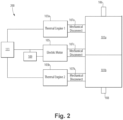
- FIG. 2 Other embodiments and/or aspects of this disclosure are shown in Fig. 2 .
- Certain embodiments described herein can be used to provide lighter, smaller, safer, and more energy efficient power systems and rotorcraft.
- a hybrid electric system 100 for a rotorcraft includes a first thermal engine 103a (e.g., a turbine engine, an internal combustion engine), a second thermal engine 103b (e.g., a turbine engine, an internal combustion engine), and an electrical machine 105 (e.g., useable as a motor and a generator).
- first thermal engine 103a e.g., a turbine engine, an internal combustion engine
- second thermal engine 103b e.g., a turbine engine, an internal combustion engine
- an electrical machine 105 e.g., useable as a motor and a generator
- the first thermal engine 103a is sized to produce a maximum first thermal engine power that is below a one-or-more-engine-inoperative (OEI) requirement power (e.g., as defined by FAA safety regulations) and the second thermal engine 103b is sized to produce a maximum second thermal engine power that is below the OEI requirement power.
- the one-or-more-engine-inoperative power can be a one-engine-inoperative power. Any suitable power requirement for any suitable number of engines inoperative is contemplated herein.
- the electrical machine 105 is sized to provide at least a remaining power needed to reach the OEI requirement power in an OEI state, for example.
- the system 100 can include a main gear box 101 operatively connected to each of the first thermal engine 103a, the second thermal engine 103b, and the electrical machine 105.
- the main gear box 101 can be configured to receive power from each of the power sources and combine the output to one or more rotors 106, 108 (e.g., a main rotor 106 and a tail rotor 106).
- Any suitable number of output rotors can be connected to one or more gear boxes 101 (e.g., a main rotor 106, a tail rotor 108, auxiliary rotor).
- a system 200 e.g. for a multirotor aircraft, can include a first gearbox 101a for driving a first rotor 106a and a second gear box 101b for driving a second rotor 106b.
- the first thermal engine 103a can be connected to the first gearbox 101a
- the second thermal engine 103b can be connected to the second gearbox 101b
- the electrical machine 105 can be connected to both gearboxes 101a, 101b. Any suitable other arrangements and/or connections are contemplated herein.
- Each of the thermal engines 103a, 103b can be connected to the main gear box 101 via a mechanical disconnect 107a, 107b.
- the electric motor 105 can also be connected to the main gear box 101 via a mechanical disconnect 107c. Any suitable connection type (e.g., the same or different for any or each) is contemplated herein.
- the system 100 can include a battery 109 (e.g., having one or more cells) sized to allow for the OEI power requirement to be reached for at least a required OEI power time.
- the OEI power time can be between about 30 seconds and about 2.5 minutes. Any other suitable time is contemplated herein (e.g., enough time to meet safety regulations).
- the electrical machine 105 can be configured to be driven by the first and/or second thermal engine 103a, 103b in an excess thermal power setting (e.g., during level cruise or any other time when desired or required) to generate electrical energy to charge the battery (e.g., to charge the battery, such as for example during cruise after transient use, for example to keep the battery at full charge or in a sufficient OEI requirement energy range).
- an excess thermal power setting e.g., during level cruise or any other time when desired or required
- Any suitable charging scheme e.g., to provide charge as soon as possible after use of the battery when excess power over what is demanded is available is contemplated herein.
- the one or more control modules 111 can include any suitable computer hardware and/or software module(s) configured to perform any suitable function(s) disclosed herein (e.g., controlling torque from each engine and the electrical machine, controlling energy flow, e.g., discharging or charging the battery, controlling performance based on selected mode or flight state, etc.). Any suitable delineation of control modules (e.g., hardware and/or software is contemplated herein).
- the one or more control modules 111 can be configured to allow selection of a normal mode or a performance mode, for example, by the pilot.
- the one or more control modules 111 can be configured to determine an emergency state based on a condition of one or more of the thermal engines 103a, 103b and/or the electrical machine 105
- the one or more control modules 111 are configured to cause output power only from the first thermal engine 103a and the second thermal engine 103b (e.g., so as to not utilize the electrical machine or energy stored in the battery).
- the one or more control modules 111 are configured to additionally cause output power to the main gear box 101 from the electrical machine 105 (e.g., to increase takeoff climb rate at the expense of battery charge state).
- the one or more control modules 111 can be configured to allow a discharge of the battery to power the electrical machine (for non-emergency performance enhancement or transient response) only to a OEI threshold where there is still enough energy to comply with the OEI power requirements.
- the one or more control modules 111 can be configured to reduce power of one of the first thermal engine 103a and the second thermal engine 103b to idle or off (for fuel efficiency), and to operate the other of the first and second thermal engine 103a, 103b at a set thermal cruise power suitable for level flight, for example (or to any other type of flight that can be performed by a single thermal engine).
- the one or more control modules 111 can be configured such that, during cruise, if a demanded power changes to be above the set thermal cruise power (producible by the single thermal engine), the one or more control modules 111 can cause the electrical machine 105 to output an electrical machine power that is a difference of power between a current thermal power and the demanded power until a total thermal power produced by either or both of the first thermal engine 103a and/or the second thermal engine 103b reaches the demanded power.
- the electrical machine power ramps down as the total thermal power (e.g., the total power of both thermal engine 103a, 103b ramps up to maintain the demanded power (e.g., essentially compensating for a loss of torque/power in certain embodiments).
- the one or more control modules 111 can be configured such that, in cruise, if the thermal engine (e.g., first thermal engine 103a) that is producing the set thermal cruise power fails, the one or more control modules 111 is configured to ramp up power from the idle or off thermal engine (e.g., second thermal engine 103b) to the demanded power and to produce the remaining power required using the electrical machine 105 (e.g., the difference of demanded power and thermal power).
- the one or more control modules 111 can be configured to have any suitable control logic (e.g., otherwise disclosed herein or appreciated by those having ordinary skill in the art in view of this disclosure), e.g., for any situation (e.g., emergency, normal, performance, or transient response use of the electric motor).
- the one or more control modules 111 can have a control function that is dedicated to each lane.
- the one or more control modules 111 can receive signals from one or more rotorcraft systems with rotorcraft-level commands (throttle, CLP, mode select, etc.), and the one or more control modules 111 can calculate and transmit the power and speed commands to each individual power lane.
- a rotorcraft (not shown) can include a rotor (not shown) and any suitable embodiment of a system as disclosed herein, e.g., system 100 as described above, connected to the rotor to power the rotor. Any other suitable components are contemplated herein.
- a non-transitory computer readable medium comprising computer executable instructions is configured to cause a computer to perform a method for controlling power in a multiengine rotorcraft.
- the method includes reducing power of one of a first or second thermal engine to idle or off, and operating the other of the first or second thermal engine at a set thermal cruise power suitable for level flight.
- the method includes causing an electrical machine to output an electrical machine power that is a difference of power between a current thermal power and the demanded power until a total thermal power produced by either or both of the first thermal engine and/or the second thermal engine reaches the demanded power.
- the method further includes outputting power only from the first thermal engine and the second thermal engine in a normal take-off mode and additionally outputting power from the electrical machine in a performance take-off mode.
- the method can include ramping electrical machine power down as the total thermal power ramps up to maintain the demanded power.
- Embodiments can include a hybrid electric propulsion system (HEPS) for a rotorcraft which can be configured to use an electric motor to provide OEI power in the event of engine failure.
- HEPS hybrid electric propulsion system
- the thermal engine can be configured to operate at a maximum continuous rating without the need for such a power reserve, and the electric motor can be used to backfill any required power, e.g., to provide suitable OEI power or performance enhancement and/or transient response.
- the electrical machine is not necessary for normal use, but can be used for efficiency (allowing one engine to idle or completely shut off while providing transient response), emergency, and performance enhancements (e.g., mode to be selected by the pilot).
- the thermal engines can be smaller and the battery need not be particularly large, making the whole system lighter (including less robust mechanical connections to the gearbox as the amount of maximum torque from any single powerplant is reduced).
- electrical machine can be used as an auxiliary power unit (APU), e.g., in an APU mode, to drive hydraulics, and electrical energy can be taken directly from the battery if necessary for other APU functions.
- APU auxiliary power unit
- Embodiments can also have the electrical machine to be placed in its own fire zone so high voltage wires can be segregated from fuel components
- just the thermal engines can be used unless the electric motor is intentionally selected by the pilot to provide more power, for example.
- the electric motor may be used in transients only (e.g., while waiting for thermal engines to ramp up), e.g., to climb over obstacles.
- Certain embodiments allow a single thermal engine to be used, and to put other engine(s) at idle or off for efficient cruise.
- the electric motor can be used for OEI power only if needed, for example. If the operating engine fails, for example then the e-motor can be used to provide maximum power until the idle/off motor powers up. After this, the electric motor can be used as needed from then on if OEI power is needed, for example (e.g., to climb). In certain embodiments, the electric motor may only be used to make up for power only when absolutely needed (e.g., only for engine failure scenarios) which can minimize the battery size and weight.
- each gas turbine In order to allow Category A operations for traditional two gas turbine engine-powered aircraft, each gas turbine must be rated to OEI power ratings (e.g. 30 second, 2 minute, continuous OEI ratings).
- Category A is a standard of design and operation outlined in helicopter certification requirements - FAR/CS29/AWM529. Category A certification is required for higher risk operations such as extended flight over remote areas without landing areas (e.g. forests, water, or urban areas).
- the OEI power is an auxiliary power rating above the maximum takeoff power (MTOP) that is only used in emergency and/or failure events.
- the helicopter maximum takeoff weight, performance, and operations are architected around the availability of OEI power in the event that one engine shuts down in flight.
- the safety criticality of OEI power dictates invasive and expensive checks to guarantee the power availability. Checks may include engine power assurance checks (EPAC), maintenance inspections, cycle counting, etc.
- both thermal engines can reduce power and allow the electric motor to backfill the required torque to reach the commanded torque until the electric motor reaches the rated torque for OEI power. Lowering the power of both thermal engines allows functional capability in case a subsequent failure of a thermal engine occurs during the electric motor torque availability check (e.g., for category A type flights).
- a HEPS architecture can include two thermal engine-provided power sources and one electrical-provided power source (e.g. electrical motor) connected to the helicopter main gearbox (MGB), each with a mechanical disconnect. If 100% maximum takeoff power (MTOP) is required for a helicopter takeoff rating, then each thermal engine can be rated to 50% helicopter MTOP.
- MGB helicopter main gearbox
- the HEPS can run the combination of power sources as optimized for performance, fuel efficiency, power availability required for the phase of flight.
- the electric motor can provide power when required for safety, power availability, and/or performance.
- both thermal engines can provide all of the takeoff power required.
- one thermal engine can provide the required cruise power while the other can run in low idle or shutdown mode to save fuel, referred to as Single Engine Operation (SEO).
- SEO Single Engine Operation
- the electrical machine can provide near instantaneous power to fill the required power availability or until the other thermal engine can ramp up to meet the power need. This provides greater power availability and minimal impact on helicopter performance with the SEO fuel savings.
- Rotor droop can be a performance concern for helicopter thermal engines, especially when using a free turbine configuration. The electrical machine can provide almost instantaneous power to mitigate any rotor droop and preserve helicopter performance. In cruise, either of the thermal engines could run at higher power to charge the battery via the electrical machine (operating as a generator).
- the controller or pilot can disconnect the failed engine via the mechanical disconnect, and the electrical machine can provide the power required to meet the One Engine Inoperative (OEI) power rating.
- OEI One Engine Inoperative
- the maximum continuous OEI rating can be about the same power level as MTOP.
- the electrical machine can be sized to provide enough power for the 30 second or 2 minute OEI power.
- the battery can be sized for the emergency power ratings plus additional energy for performance enhancements and emergency reserve, for example. Any suitable size is contemplated herein.
- Embodiments allow each thermal engine to be rated to the takeoff power instead of the OEI power resulting in reduced weight, fewer required maintenance checks, and no thermal engine EPACs.
- the electrical machine can be sized to provide emergency or temporary power when required. This allows for reduce sizing of the electrical machine, motor controller, and the battery system.
- Embodiments can provide redundant sources of power that can be separated and segregated to mitigate from failure propagation (e.g. each power sources is in a different fire zone). With the electrical machine in a different fire zone, the high voltage wiring system can be separated from flammable fluid sources such as fuel.
- any and/or all power sources can be designed to provide lower power thereby reducing weight, cost, fuel burn, and space in the aircraft.
- the thermal engine power sources can be designed for half of the total helicopter MTOP and optimized for single or dual engine cruise.
- the electrical machine can be designed to provide the remaining OEI power. Having two smaller thermal engines results in weight reduction, lower fuel burn, and lower emissions, for example.
- Embodiments of a system can provide greater torque response due to the faster response of the electrical machine. This can allow for improved aircraft-level performance response. The faster response also enables single engine operation without sacrificing performance, safety, or fuel burn savings.
- thermal engine OEI rating reduces the operational and maintenance burden required to ensure power availability in the case of emergency. EPACs are often run as penalty runs which can be costly. The additional maintenance burden due to the safety criticality such as temperature probe inspection and blade inspection can be reduced.
- the battery sizing can be optimized for emergency power and performance boosts only. The battery can be recharged off of the thermal engine during the flight. Additionally, the engine output shafts to the MGB do not need to be sized for OEI power. They can be optimized and downsized for MTOP. Accordingly, the use of a parallel hybrid-electric propulsion system (HEPS) having two or more thermal engines and one or more electrical power source can increase efficiencies compared to traditional architectures and provide performance, safety, operations, and weight benefits.
- HEPS parallel hybrid-electric propulsion system
- aspects of the present disclosure may be embodied as a system, method or computer program product. Accordingly, aspects of this disclosure may take the form of an entirely hardware embodiment, an entirely software embodiment (including firmware, resident software, micro-code, etc.), or an embodiment combining software and hardware aspects, all possibilities of which can be referred to herein as a "circuit,” “module,” or “system.”
- a “circuit,” “module,” or “system” can include one or more portions of one or more separate physical hardware and/or software components that can together perform the disclosed function of the "circuit,” “module,” or “system”, or a “circuit,” “module,” or “system” can be a single self-contained unit (e.g., of hardware and/or software).
- aspects of this disclosure may take the form of a computer program product embodied in one or more computer readable medium(s) having computer readable program code embodied thereon.
- the computer readable medium may be a computer readable signal medium or a computer readable storage medium.
- a computer readable storage medium may be, for example, but not limited to, an electronic, magnetic, optical, electromagnetic, infrared, or semiconductor system, apparatus, or device. More specific examples (a non-exhaustive list) of the computer readable storage medium would include the following: an electrical connection having one or more wires, a portable computer diskette, a hard disk, a random access memory (RAM), a read-only memory (ROM), an erasable programmable read-only memory (EPROM or Flash memory), an optical fiber, a portable compact disc read-only memory (CD-ROM), an optical storage device, or a magnetic storage device.
- a computer readable storage medium may be any tangible medium that can contain, or store a program for use by or in connection with an instruction execution system, apparatus, or device.
- a computer readable signal medium may include a propagated data signal with computer readable program code embodied therein, for example, in baseband or as part of a carrier wave. Such a propagated signal may take any of a variety of forms, including, but not limited to, electro-magnetic or optical.
- a computer readable signal medium may be any computer readable medium that is not a computer readable storage medium and that can communicate, propagate, or transport a program for use by or in connection with an instruction execution system, apparatus, or device.
- Program code embodied on a computer readable medium may be transmitted using any appropriate medium, including but not limited to wireless, wireline, optical fiber cable or RF.
- Computer program code for carrying out operations for aspects of this disclosure may be written one or more programming languages, including an object oriented programming language such as Java, Smalltalk, C++ or the like and conventional procedural programming languages, such as the "C" programming language or similar programming languages.
- the program code may execute entirely on the user's computer, partly on the user's computer, as a stand-alone software package, partly on the user's computer and partly on a remote computer or entirely on the remote computer or server.
- the remote computer may be connected to the user's computer through any type of network, including a local area network (LAN) or a wide area network (WAN), or the connection may be made to an external computer (for example, through the Internet using an Internet Service Provider).
- LAN local area network
- WAN wide area network
- Internet Service Provider for example, AT&T, MCI, Sprint, EarthLink, MSN, GTE, etc.
- These computer program instructions may also be stored in a computer readable medium that can direct a computer, other programmable data processing apparatus, or other devices to function in a particular manner, such that the instructions stored in the computer readable medium produce an article of manufacture including instructions which implement the function/act specified in the flowchart and/or block diagram block or blocks.
- the computer program instructions may also be loaded onto a computer, other programmable data processing apparatus, or other devices to cause a series of operational steps to be performed on the computer, other programmable apparatus or other devices to produce a computer implemented process such that the instructions which execute on the computer or other programmable apparatus provide processes for implementing the functions/acts specified herein.
- any numerical values disclosed herein can be exact values or can be values within a range. Further, any terms of approximation (e.g., “about”, “approximately”, “around”) used in this disclosure can mean the stated value within a range. For example, in certain embodiments, the range can be within (plus or minus) 20%, or within 10%, or within 5%, or within 2%, or within any other suitable percentage or number as appreciated by those having ordinary skill in the art (e.g., for known tolerance limits or error ranges).
- a reference to "A and/or B", when used in conjunction with open-ended language such as “comprising” can refer, in one embodiment, to A only (optionally including elements other than B); in another embodiment, to B only (optionally including elements other than A); in yet another embodiment, to both A and B (optionally including other elements); etc.
Landscapes
- Engineering & Computer Science (AREA)
- Mechanical Engineering (AREA)
- Aviation & Aerospace Engineering (AREA)
- Chemical & Material Sciences (AREA)
- General Engineering & Computer Science (AREA)
- Combustion & Propulsion (AREA)
- Life Sciences & Earth Sciences (AREA)
- Transportation (AREA)
- Power Engineering (AREA)
- Sustainable Energy (AREA)
- Sustainable Development (AREA)
- Hybrid Electric Vehicles (AREA)
- Electric Propulsion And Braking For Vehicles (AREA)
- Engine Equipment That Uses Special Cycles (AREA)
- Charge And Discharge Circuits For Batteries Or The Like (AREA)
Description
- This disclosure relates to hybrid electric aircraft systems.
- Traditional helicopter architectures using two gas turbine engines are designed to meet operation and safety requirements. Each gas turbine engine is typically sized to provide additional (but temporary) power above rated maximum takeoff power (MTOP) in the event of failure of one of the gas turbine engines, for example.
- Such conventional methods and systems have generally been considered satisfactory for their intended purpose. However, there is still a need in the art for improved power systems for rotorcraft, such as with respect to performance.
-
US 2014/117148 A1 discloses a hybrid electric system according to the preamble ofclaim 1,US 2020/342772 A1 discloses an aircraft degraded operation ceiling increase using electric power boost,US 2014/034781 A1 discloses a system and method of augmenting power in a rotorcraft,US 2017/225794 A1 discloses a hybrid contingency power drive system, andUS 2020/362753 A1 discloses a system and method for operating a multi-engine rotorcraft. - According to a first aspect, there is provided a hybrid electric system for a rotorcraft as set forth in
claim 1. - There is also provided a rotorcraft as set forth in claim 10.
- According to a further aspect, there is provide a non-transitory computer readable medium as set forth in claim 11.
- Embodiments of the disclosure are set forth in the dependent claims.
- These and other features of the embodiments of the subject disclosure will become more readily apparent to those skilled in the art from the following detailed description taken in conjunction with the drawings.
- So that those skilled in the art to which the subject disclosure appertains will readily understand how to make and use the devices and methods of the subject disclosure without undue experimentation, embodiments thereof will be described in detail herein below with reference to certain figures, wherein:
-
Fig. 1 is a schematic diagram of an embodiment of a system in accordance with this disclosure; and -
Fig. 2 is a schematic diagram of another embodiment of a system in accordance with this disclosure. - Reference will now be made to the drawings wherein like reference numerals identify similar structural features or aspects of the subject disclosure. For purposes of explanation and illustration, and not limitation, an illustrative view of an embodiment of a system in accordance with the disclosure is shown in
Fig. 1 and is designated byreference character 100. Other embodiments and/or aspects of this disclosure are shown inFig. 2 . Certain embodiments described herein can be used to provide lighter, smaller, safer, and more energy efficient power systems and rotorcraft. - Referring to
Fig. 1 , according to the invention, a hybridelectric system 100 for a rotorcraft (e.g., a helicopter) includes a firstthermal engine 103a (e.g., a turbine engine, an internal combustion engine), a secondthermal engine 103b (e.g., a turbine engine, an internal combustion engine), and an electrical machine 105 (e.g., useable as a motor and a generator). The firstthermal engine 103a is sized to produce a maximum first thermal engine power that is below a one-or-more-engine-inoperative (OEI) requirement power (e.g., as defined by FAA safety regulations) and the secondthermal engine 103b is sized to produce a maximum second thermal engine power that is below the OEI requirement power. The one-or-more-engine-inoperative power can be a one-engine-inoperative power. Any suitable power requirement for any suitable number of engines inoperative is contemplated herein. Theelectrical machine 105 is sized to provide at least a remaining power needed to reach the OEI requirement power in an OEI state, for example. - Any suitable mechanical arrangement (e.g., one or more gear boxes) to deliver power from the power sources is contemplated herein. In certain embodiments, as shown in
Fig. 1 thesystem 100 can include amain gear box 101 operatively connected to each of the firstthermal engine 103a, the secondthermal engine 103b, and theelectrical machine 105. Themain gear box 101 can be configured to receive power from each of the power sources and combine the output to one ormore rotors 106, 108 (e.g., amain rotor 106 and a tail rotor 106). Any suitable number of output rotors can be connected to one or more gear boxes 101 (e.g., amain rotor 106, atail rotor 108, auxiliary rotor). - For example, as shown in
Fig. 2 , asystem 200, e.g. for a multirotor aircraft, can include afirst gearbox 101a for driving a first rotor 106a and asecond gear box 101b for driving a second rotor 106b. As shown the firstthermal engine 103a can be connected to thefirst gearbox 101a, the secondthermal engine 103b can be connected to thesecond gearbox 101b, and theelectrical machine 105 can be connected to bothgearboxes - The OEI requirement power can be defined by a required torque ratio (e.g., a percentage of normal takeoff torque) as appreciated by those having ordinary skill in the art, or defined as a function of a performance metric (e.g., the ability to climb, e.g., at 46 meters per minute (150 feet per minute), for a certain period of time, e.g., 30 seconds or two and a half minutes) as appreciated by those having ordinary skill in the art. One having ordinary skill in the art appreciates how to determine an appropriate OEI power requirement based on the aircraft and/or applicable regulations.
- Each of the
thermal engines main gear box 101 via amechanical disconnect electric motor 105 can also be connected to themain gear box 101 via amechanical disconnect 107c. Any suitable connection type (e.g., the same or different for any or each) is contemplated herein. - The
system 100 can include a battery 109 (e.g., having one or more cells) sized to allow for the OEI power requirement to be reached for at least a required OEI power time. For example, the OEI power time can be between about 30 seconds and about 2.5 minutes. Any other suitable time is contemplated herein (e.g., enough time to meet safety regulations). In certain embodiments, theelectrical machine 105 can be configured to be driven by the first and/or secondthermal engine - According to the invention, the
system 100 includes one ormore control modules 111 operatively connected to the firstthermal engine 103a, the secondthermal engine 103b, and theelectrical machine 105 to control power output therefrom (e.g., from each source independently of the others, or combined output from two sources, or total output from all). In certain embodiments, the one ormore control modules 111 can include a separate controller for each thermal engine and/or the electric motor (e.g., three separate controllers or any other suitable number). In certain embodiments, the one ormore control modules 111 can include a single controller. The one ormore control modules 111 can include any suitable computer hardware and/or software module(s) configured to perform any suitable function(s) disclosed herein (e.g., controlling torque from each engine and the electrical machine, controlling energy flow, e.g., discharging or charging the battery, controlling performance based on selected mode or flight state, etc.). Any suitable delineation of control modules (e.g., hardware and/or software is contemplated herein). The one ormore control modules 111 can be configured to allow selection of a normal mode or a performance mode, for example, by the pilot. The one ormore control modules 111 can be configured to determine an emergency state based on a condition of one or more of thethermal engines electrical machine 105 - According to the invention, in a normal take-off mode, the one or
more control modules 111 are configured to cause output power only from the firstthermal engine 103a and the secondthermal engine 103b (e.g., so as to not utilize the electrical machine or energy stored in the battery). In a performance take-off mode, the one ormore control modules 111 are configured to additionally cause output power to themain gear box 101 from the electrical machine 105 (e.g., to increase takeoff climb rate at the expense of battery charge state). In certain embodiments, the one ormore control modules 111 can be configured to allow a discharge of the battery to power the electrical machine (for non-emergency performance enhancement or transient response) only to a OEI threshold where there is still enough energy to comply with the OEI power requirements. - In certain embodiments, in a normal cruise mode, the one or
more control modules 111 can be configured to reduce power of one of the firstthermal engine 103a and the secondthermal engine 103b to idle or off (for fuel efficiency), and to operate the other of the first and secondthermal engine more control modules 111 can be configured such that, during cruise, if a demanded power changes to be above the set thermal cruise power (producible by the single thermal engine), the one ormore control modules 111 can cause theelectrical machine 105 to output an electrical machine power that is a difference of power between a current thermal power and the demanded power until a total thermal power produced by either or both of the firstthermal engine 103a and/or the secondthermal engine 103b reaches the demanded power. In certain embodiments, the electrical machine power ramps down as the total thermal power (e.g., the total power of boththermal engine - In certain embodiments, the one or
more control modules 111 can be configured such that, in cruise, if the thermal engine (e.g., firstthermal engine 103a) that is producing the set thermal cruise power fails, the one ormore control modules 111 is configured to ramp up power from the idle or off thermal engine (e.g., secondthermal engine 103b) to the demanded power and to produce the remaining power required using the electrical machine 105 (e.g., the difference of demanded power and thermal power). The one ormore control modules 111 can be configured to have any suitable control logic (e.g., otherwise disclosed herein or appreciated by those having ordinary skill in the art in view of this disclosure), e.g., for any situation (e.g., emergency, normal, performance, or transient response use of the electric motor). - In certain embodiments, the one or
more control modules 111 can have a control function that is dedicated to each lane. The one ormore control modules 111 can receive signals from one or more rotorcraft systems with rotorcraft-level commands (throttle, CLP, mode select, etc.), and the one ormore control modules 111 can calculate and transmit the power and speed commands to each individual power lane. - In accordance with at least one aspect of this disclosure, a rotorcraft (not shown) can include a rotor (not shown) and any suitable embodiment of a system as disclosed herein, e.g.,
system 100 as described above, connected to the rotor to power the rotor. Any other suitable components are contemplated herein. - A non-transitory computer readable medium comprising computer executable instructions is configured to cause a computer to perform a method for controlling power in a multiengine rotorcraft. The method includes reducing power of one of a first or second thermal engine to idle or off, and operating the other of the first or second thermal engine at a set thermal cruise power suitable for level flight. During cruise, if a demanded power changes to be above the set thermal cruise power, the method includes causing an electrical machine to output an electrical machine power that is a difference of power between a current thermal power and the demanded power until a total thermal power produced by either or both of the first thermal engine and/or the second thermal engine reaches the demanded power. The method further includes outputting power only from the first thermal engine and the second thermal engine in a normal take-off mode and additionally outputting power from the electrical machine in a performance take-off mode. In certain embodiments, the method can include ramping electrical machine power down as the total thermal power ramps up to maintain the demanded power.
- Embodiments can include a hybrid electric propulsion system (HEPS) for a rotorcraft which can be configured to use an electric motor to provide OEI power in the event of engine failure. Instead of having to enter a power reserve regime that is over and above rated maximum takeoff power for a traditional engine (which can only be done for a very limited period of time without destroying the engine), the thermal engine can be configured to operate at a maximum continuous rating without the need for such a power reserve, and the electric motor can be used to backfill any required power, e.g., to provide suitable OEI power or performance enhancement and/or transient response.
- In certain embodiments, the electrical machine is not necessary for normal use, but can be used for efficiency (allowing one engine to idle or completely shut off while providing transient response), emergency, and performance enhancements (e.g., mode to be selected by the pilot). In certain embodiments, the thermal engines can be smaller and the battery need not be particularly large, making the whole system lighter (including less robust mechanical connections to the gearbox as the amount of maximum torque from any single powerplant is reduced).
- In certain embodiments, electrical machine can be used as an auxiliary power unit (APU), e.g., in an APU mode, to drive hydraulics, and electrical energy can be taken directly from the battery if necessary for other APU functions. Embodiments can also have the electrical machine to be placed in its own fire zone so high voltage wires can be segregated from fuel components
- In certain embodiments, in takeoff, just the thermal engines can be used unless the electric motor is intentionally selected by the pilot to provide more power, for example. In certain embodiments, during flight, the electric motor may be used in transients only (e.g., while waiting for thermal engines to ramp up), e.g., to climb over obstacles.
- Certain embodiments allow a single thermal engine to be used, and to put other engine(s) at idle or off for efficient cruise. The electric motor can be used for OEI power only if needed, for example. If the operating engine fails, for example then the e-motor can be used to provide maximum power until the idle/off motor powers up. After this, the electric motor can be used as needed from then on if OEI power is needed, for example (e.g., to climb). In certain embodiments, the electric motor may only be used to make up for power only when absolutely needed (e.g., only for engine failure scenarios) which can minimize the battery size and weight.
- In order to allow Category A operations for traditional two gas turbine engine-powered aircraft, each gas turbine must be rated to OEI power ratings (e.g. 30 second, 2 minute, continuous OEI ratings). Category A is a standard of design and operation outlined in helicopter certification requirements - FAR/CS29/AWM529. Category A certification is required for higher risk operations such as extended flight over remote areas without landing areas (e.g. forests, water, or urban areas). The OEI power is an auxiliary power rating above the maximum takeoff power (MTOP) that is only used in emergency and/or failure events. The helicopter maximum takeoff weight, performance, and operations are architected around the availability of OEI power in the event that one engine shuts down in flight. The safety criticality of OEI power dictates invasive and expensive checks to guarantee the power availability. Checks may include engine power assurance checks (EPAC), maintenance inspections, cycle counting, etc.
- In certain embodiments, uncovering of potential latency of failures causing the electric motor to be unable to reach full power can be automated. In certain embodiments, during the flight, both thermal engines can reduce power and allow the electric motor to backfill the required torque to reach the commanded torque until the electric motor reaches the rated torque for OEI power. Lowering the power of both thermal engines allows functional capability in case a subsequent failure of a thermal engine occurs during the electric motor torque availability check (e.g., for category A type flights).
- With the use of a parallel hybrid-electric propulsion system (HEPS) with three torque sources, e.g., two thermal and one electrical as shown in the embodiment of
Fig. 1 , the propulsion system and rotorcraft can be optimized to provide improved performance without sacrificing safety. As disclosed above, a HEPS architecture can include two thermal engine-provided power sources and one electrical-provided power source (e.g. electrical motor) connected to the helicopter main gearbox (MGB), each with a mechanical disconnect. If 100% maximum takeoff power (MTOP) is required for a helicopter takeoff rating, then each thermal engine can be rated to 50% helicopter MTOP. - As an example, if 75% power is required for the highest OEI rating, the electrical motor can be rated to the difference between the OEI rating and single engine rating (i.e. 75% - 50% = 25% MTOP). Any other suitable numbers are contemplated herein.
- The HEPS can run the combination of power sources as optimized for performance, fuel efficiency, power availability required for the phase of flight. The electric motor can provide power when required for safety, power availability, and/or performance. During takeoff, both thermal engines can provide all of the takeoff power required. When cruising, one thermal engine can provide the required cruise power while the other can run in low idle or shutdown mode to save fuel, referred to as Single Engine Operation (SEO). If the pilot requires additional power in SEO, the electrical machine can provide near instantaneous power to fill the required power availability or until the other thermal engine can ramp up to meet the power need. This provides greater power availability and minimal impact on helicopter performance with the SEO fuel savings. Rotor droop can be a performance concern for helicopter thermal engines, especially when using a free turbine configuration. The electrical machine can provide almost instantaneous power to mitigate any rotor droop and preserve helicopter performance. In cruise, either of the thermal engines could run at higher power to charge the battery via the electrical machine (operating as a generator).
- In the event of a thermal engine failure, the controller or pilot can disconnect the failed engine via the mechanical disconnect, and the electrical machine can provide the power required to meet the One Engine Inoperative (OEI) power rating. In certain embodiments, the maximum continuous OEI rating can be about the same power level as MTOP. The electrical machine can be sized to provide enough power for the 30 second or 2 minute OEI power. In certain embodiments, the battery can be sized for the emergency power ratings plus additional energy for performance enhancements and emergency reserve, for example. Any suitable size is contemplated herein.
- Embodiments allow each thermal engine to be rated to the takeoff power instead of the OEI power resulting in reduced weight, fewer required maintenance checks, and no thermal engine EPACs. The electrical machine can be sized to provide emergency or temporary power when required. This allows for reduce sizing of the electrical machine, motor controller, and the battery system. Embodiments can provide redundant sources of power that can be separated and segregated to mitigate from failure propagation (e.g. each power sources is in a different fire zone). With the electrical machine in a different fire zone, the high voltage wiring system can be separated from flammable fluid sources such as fuel.
- In embodiments, any and/or all power sources can be designed to provide lower power thereby reducing weight, cost, fuel burn, and space in the aircraft. The thermal engine power sources can be designed for half of the total helicopter MTOP and optimized for single or dual engine cruise. The electrical machine can be designed to provide the remaining OEI power. Having two smaller thermal engines results in weight reduction, lower fuel burn, and lower emissions, for example.
- Embodiments of a system can provide greater torque response due to the faster response of the electrical machine. This can allow for improved aircraft-level performance response. The faster response also enables single engine operation without sacrificing performance, safety, or fuel burn savings.
- The elimination of thermal engine OEI rating reduces the operational and maintenance burden required to ensure power availability in the case of emergency. EPACs are often run as penalty runs which can be costly. The additional maintenance burden due to the safety criticality such as temperature probe inspection and blade inspection can be reduced. The battery sizing can be optimized for emergency power and performance boosts only. The battery can be recharged off of the thermal engine during the flight. Additionally, the engine output shafts to the MGB do not need to be sized for OEI power. They can be optimized and downsized for MTOP. Accordingly, the use of a parallel hybrid-electric propulsion system (HEPS) having two or more thermal engines and one or more electrical power source can increase efficiencies compared to traditional architectures and provide performance, safety, operations, and weight benefits.
- As will be appreciated by those skilled in the art, aspects of the present disclosure may be embodied as a system, method or computer program product. Accordingly, aspects of this disclosure may take the form of an entirely hardware embodiment, an entirely software embodiment (including firmware, resident software, micro-code, etc.), or an embodiment combining software and hardware aspects, all possibilities of which can be referred to herein as a "circuit," "module," or "system." A "circuit," "module," or "system" can include one or more portions of one or more separate physical hardware and/or software components that can together perform the disclosed function of the "circuit," "module," or "system", or a "circuit," "module," or "system" can be a single self-contained unit (e.g., of hardware and/or software). Furthermore, aspects of this disclosure may take the form of a computer program product embodied in one or more computer readable medium(s) having computer readable program code embodied thereon.
- The computer readable medium may be a computer readable signal medium or a computer readable storage medium. A computer readable storage medium may be, for example, but not limited to, an electronic, magnetic, optical, electromagnetic, infrared, or semiconductor system, apparatus, or device. More specific examples (a non-exhaustive list) of the computer readable storage medium would include the following: an electrical connection having one or more wires, a portable computer diskette, a hard disk, a random access memory (RAM), a read-only memory (ROM), an erasable programmable read-only memory (EPROM or Flash memory), an optical fiber, a portable compact disc read-only memory (CD-ROM), an optical storage device, or a magnetic storage device. In the context of this document, a computer readable storage medium may be any tangible medium that can contain, or store a program for use by or in connection with an instruction execution system, apparatus, or device.
- A computer readable signal medium may include a propagated data signal with computer readable program code embodied therein, for example, in baseband or as part of a carrier wave. Such a propagated signal may take any of a variety of forms, including, but not limited to, electro-magnetic or optical. A computer readable signal medium may be any computer readable medium that is not a computer readable storage medium and that can communicate, propagate, or transport a program for use by or in connection with an instruction execution system, apparatus, or device.
- Program code embodied on a computer readable medium may be transmitted using any appropriate medium, including but not limited to wireless, wireline, optical fiber cable or RF.
- Computer program code for carrying out operations for aspects of this disclosure may be written one or more programming languages, including an object oriented programming language such as Java, Smalltalk, C++ or the like and conventional procedural programming languages, such as the "C" programming language or similar programming languages. The program code may execute entirely on the user's computer, partly on the user's computer, as a stand-alone software package, partly on the user's computer and partly on a remote computer or entirely on the remote computer or server. In the latter scenario, the remote computer may be connected to the user's computer through any type of network, including a local area network (LAN) or a wide area network (WAN), or the connection may be made to an external computer (for example, through the Internet using an Internet Service Provider).
- Aspects of this disclosure may be described above with reference to flowchart illustrations and/or block diagrams of methods, apparatus (systems) and computer program products according to embodiments of this disclosure. These computer program instructions may be provided to a processor of a general purpose computer, special purpose computer, or other programmable data processing apparatus to produce a machine, such that the instructions, which execute via the processor of the computer or other programmable data processing apparatus, create means for implementing the functions/acts specified in any flowchart and/or block diagram block or blocks.
- These computer program instructions may also be stored in a computer readable medium that can direct a computer, other programmable data processing apparatus, or other devices to function in a particular manner, such that the instructions stored in the computer readable medium produce an article of manufacture including instructions which implement the function/act specified in the flowchart and/or block diagram block or blocks.
- The computer program instructions may also be loaded onto a computer, other programmable data processing apparatus, or other devices to cause a series of operational steps to be performed on the computer, other programmable apparatus or other devices to produce a computer implemented process such that the instructions which execute on the computer or other programmable apparatus provide processes for implementing the functions/acts specified herein.
- Those having ordinary skill in the art understand that any numerical values disclosed herein can be exact values or can be values within a range. Further, any terms of approximation (e.g., "about", "approximately", "around") used in this disclosure can mean the stated value within a range. For example, in certain embodiments, the range can be within (plus or minus) 20%, or within 10%, or within 5%, or within 2%, or within any other suitable percentage or number as appreciated by those having ordinary skill in the art (e.g., for known tolerance limits or error ranges).
- The articles "a", "an", and "the" as used herein and in the appended claims are used herein to refer to one or to more than one (i.e., to at least one) of the grammatical object of the article unless the context clearly indicates otherwise. By way of example, "an element" means one element or more than one element.
- The phrase "and/or," as used herein in the specification and in the claims, should be understood to mean "either or both" of the elements so conjoined, i.e., elements that are conjunctively present in some cases and disjunctively present in other cases. Multiple elements listed with "and/or" should be construed in the same fashion, i.e., "one or more" of the elements so conjoined. Other elements may optionally be present other than the elements specifically identified by the "and/or" clause, whether related or unrelated to those elements specifically identified. Thus, as a non-limiting example, a reference to "A and/or B", when used in conjunction with open-ended language such as "comprising" can refer, in one embodiment, to A only (optionally including elements other than B); in another embodiment, to B only (optionally including elements other than A); in yet another embodiment, to both A and B (optionally including other elements); etc.
- When separating items in a list, "or" or "and/or" shall be interpreted as being inclusive, i.e., the inclusion of at least one, but also including more than one, of a number or list of elements, and, optionally, additional unlisted items. Only terms clearly indicated to the contrary, such as "only one of" or "exactly one of," or, when used in the claims, "consisting of," will refer to the inclusion of exactly one element of a number or list of elements. In general, the term "or" as used herein shall only be interpreted as indicating exclusive alternatives (i.e., "one or the other but not both") when preceded by terms of exclusivity, such as "either," "one of," "only one of," or "exactly one of."
- Modifications or changes may be made without departing from the invention, which is defined by the appended claims.
Claims (12)
- A hybrid electric system for a rotorcraft, comprising:a first thermal engine (103a);a second thermal engine (103b); andan electrical machine (105), wherein the first thermal engine (103a) is sized to produce a maximum first thermal engine power that is below a one-or-more-engine-inoperative (OEI) requirement power, the second thermal engine (103b) is sized to produce a maximum second thermal engine power that is below the OEI requirement power, and the electrical machine (105) is sized to provide at least a remaining power needed to reach the OEI requirement power in an OEI state, characterised in that the hybrid electric system further comprises:
one or more control modules (111) operatively connected to the first thermal engine (103a), the second thermal engine (103b), and the electrical machine (105) to control power output therefrom, wherein:in a normal take-off mode, the one or more control modules (111) are configured to cause output power only from the first thermal engine (103a) and the second thermal engine (103b); andin a performance take-off mode, the one or more control modules (111) are configured to additionally cause output power from the electrical machine (105). - The system of claim 1, further comprising a battery sized to allow for the OEI power requirement to be reached for at least a required OEI power time.
- The system of claim 2, wherein the OEI power time is between 30 seconds and 2.5 minutes.
- The system of claim 2 or 3, wherein the electrical machine (105) is configured to be driven by the first and/or second thermal engine (103b) in an excess thermal power setting to generate electrical energy to charge the battery.
- The system of any preceding claim, wherein in a normal cruise mode, the one or more control modules (111) are configured to reduce power of one of the first or second thermal engine (103a, 103b) to idle or off, and to operate the other of the first or second thermal engine (103a, 103b) at a set thermal cruise power suitable for level flight.
- The system of claim 5, wherein the one or more control modules (111) are configured such that, in cruise, if the thermal engine (103a, 103b) that is producing the set thermal cruise power fails, the one or more control modules (111) are configured to ramp up power from the idle or off thermal engine (103a, 103b) to the demanded power and to produce the remaining power required using the electrical machine (105).
- The system of any preceding claim, wherein the one or more control modules (111) are configured such that, during cruise, if a demanded power changes to be above the set thermal cruise power, the one or more control modules (111) cause the electrical machine (105) to output an electrical machine power that is a difference of power between a current thermal power and the demanded power until a total thermal power produced by either or both of the first thermal engine (103a) and/or the second thermal engine (103b) reaches the demanded power.
- The system of claim 7, wherein the electrical machine power ramps down as the total thermal power ramps up to maintain the demanded power.
- The system of any preceding claim, further comprising a main gear box (101) operatively connected to each of the first thermal engine (103a), the second thermal engine (103b), and the electrical machine (105) to receive power therefrom and to combine the output to one or more rotors.
- A rotorcraft, comprising:a rotor (106);a hybrid electric system (100; 200) according to any of claims 1 to 8; anda main gear box (101) connected to the rotor (106), wherein the first thermal engine (103a), the second thermal engine (103b) and the electrical machine (105) are each connected to the main gear box (101).
- A non-transitory computer readable medium comprising computer executable instructions configured to cause a computer to perform a method for controlling power in a multiengine rotorcraft, the method comprising:reducing power of one of a first or second thermal engine (103a, 103b) to idle or off, each of the first thermal engine and the second thermal engine sized to produce a maximum thermal engine power that is below a one-or-more-engine-inoperative (OEI) requirement power;operating the other of the first or second thermal engine (103a, 103b) at a set thermal cruise power suitable for level flight; andduring cruise, if a demanded power changes to be above the set thermal cruise power, causing an electrical machine (105) to output an electrical machine power that is a difference of power between a current thermal power and the demanded power until a total thermal power produced by either or both of the first thermal engine (103a) and/or the second thermal engine (103b) reaches the demanded power, wherein the method further comprises:outputting power only from the first thermal engine (103a) and the second thermal engine (103b) in a normal take-off mode; andadditionally outputting power from the electrical machine (105) in a performance take-off mode.
- The non-transitory computer readable medium of claim 11, the method further comprising ramping electrical machine power down as the total thermal power ramps up to maintain the demanded power.
Applications Claiming Priority (1)
| Application Number | Priority Date | Filing Date | Title |
|---|---|---|---|
| US17/207,553 US12054274B2 (en) | 2021-03-19 | 2021-03-19 | Hybrid electric systems for rotorcraft |
Publications (2)
| Publication Number | Publication Date |
|---|---|
| EP4059837A1 EP4059837A1 (en) | 2022-09-21 |
| EP4059837B1 true EP4059837B1 (en) | 2025-04-23 |
Family
ID=80819911
Family Applications (1)
| Application Number | Title | Priority Date | Filing Date |
|---|---|---|---|
| EP22163090.8A Active EP4059837B1 (en) | 2021-03-19 | 2022-03-18 | Hybrid electric systems for rotorcraft |
Country Status (6)
| Country | Link |
|---|---|
| US (1) | US12054274B2 (en) |
| EP (1) | EP4059837B1 (en) |
| CN (1) | CN115108028A (en) |
| BR (1) | BR102022004551A2 (en) |
| CA (1) | CA3152915A1 (en) |
| PL (1) | PL4059837T3 (en) |
Families Citing this family (12)
| Publication number | Priority date | Publication date | Assignee | Title |
|---|---|---|---|---|
| KR20220111784A (en) * | 2021-02-02 | 2022-08-10 | 현대자동차주식회사 | System and method for controlling power train of vtol aerial vehicle |
| US11634232B1 (en) * | 2022-04-30 | 2023-04-25 | Beta Air, Llc | Hybrid propulsion systems for an electric aircraft |
| US12195192B2 (en) * | 2022-04-30 | 2025-01-14 | Beta Air Llc | Hybrid propulsion systems for an electric aircraft |
| US11639230B1 (en) * | 2022-04-30 | 2023-05-02 | Beta Air, Llc | System for an integral hybrid electric aircraft |
| DE102022113828A1 (en) | 2022-06-01 | 2023-12-07 | Reiner Brach | Power control unit for automated control of a drive and aircraft |
| US12146443B2 (en) | 2023-03-31 | 2024-11-19 | Pratt & Whitney Canada Corp. | Boosting gas turbine engine power with fluid motor |
| FR3148580A1 (en) * | 2023-05-09 | 2024-11-15 | Airbus Helicopters | Method and device for entering and exiting an economical operating mode for a twin-engine aircraft |
| US20240425188A1 (en) * | 2023-06-26 | 2024-12-26 | Pratt & Whitney Canada Corp. | Testing secondary power system of aircraft powerplant |
| US12371178B1 (en) | 2024-01-30 | 2025-07-29 | Pratt & Whitney Canada Corp. | Method and system for controlling an aircraft propulsion system in an aircraft susceptible to ground resonance |
| EP4620820A1 (en) * | 2024-03-21 | 2025-09-24 | Aura Aero | A method of powering a hybrid aircraft during takeoff |
| US12595071B1 (en) | 2024-12-16 | 2026-04-07 | Lockheed Martin Corporation | Parallel hybrid electric vertical takeoff and landing aircraft |
| US12545419B1 (en) * | 2024-12-30 | 2026-02-10 | Pratt & Whitney Canada Corp. | Emergency energy protection assembly for hybrid-electric aircraft propulsion systems |
Family Cites Families (11)
| Publication number | Priority date | Publication date | Assignee | Title |
|---|---|---|---|---|
| FR2978124B1 (en) * | 2011-07-18 | 2013-08-02 | Eurocopter France | METHOD FOR CONTROLLING A GROUP OF ENGINES AND AIRCRAFT |
| US8939399B2 (en) * | 2012-07-31 | 2015-01-27 | Textron Innovations Inc. | System and method of augmenting power in a rotorcraft |
| FR2997382B1 (en) * | 2012-10-29 | 2014-11-21 | Eurocopter France | METHOD FOR MANAGING AN ENGINE FAILURE ON A MULTI-ENGINE AIRCRAFT PROVIDED WITH A HYBRID POWER PLANT |
| FR2998542B1 (en) * | 2012-11-26 | 2015-07-17 | Eurocopter France | METHOD AND AIRCRAFT WITH ROTARY WING WITH THREE ENGINES |
| FR2998543B1 (en) * | 2012-11-26 | 2015-07-17 | Eurocopter France | METHOD AND AIRCRAFT WITH ROTATING WING WITH TWO MAIN TURBOMOTORS AND A LOWER-POWERED SECONDARY TURBOMOTOR |
| WO2016049030A1 (en) | 2014-09-23 | 2016-03-31 | Sikorsky Aircraft Corporation | Hybrid contingency power drive system |
| FR3036235B1 (en) * | 2015-05-15 | 2018-06-01 | Airbus Helicopters | METHOD FOR ACTIVATING AN ELECTRIC MOTOR OF A HYBRID INSTALLATION OF A MULTI-ENGINE AIRCRAFT AND AN AIRCRAFT |
| FR3039614B1 (en) * | 2015-07-31 | 2018-05-04 | Airbus Helicopters | HYBRID POWER SUPPLY FOR AN AIRCRAFT WITH A ROTARY REVOLVING WING |
| FR3082504B1 (en) * | 2018-06-14 | 2021-03-05 | Airbus Helicopters | METHOD AND DEVICE FOR LIMITING TORQUE ON A GIRAVION INCLUDING AT LEAST THREE ENGINES NOT EQUIPPED WITH POWER |
| EP3928301A4 (en) | 2019-04-25 | 2022-11-16 | United Technologies Advanced Projects, Inc. | CEILING INCREASE IN DEGRADED OPERATING MODE OF AN AIRCRAFT USING ELECTRIC POWER AMPLIFICATION |
| US11643965B2 (en) * | 2019-05-15 | 2023-05-09 | Pratt & Whitney Canada Corp. | System and method for operating multi-engine rotorcraft |
-
2021
- 2021-03-19 US US17/207,553 patent/US12054274B2/en active Active
-
2022
- 2022-03-11 BR BR102022004551-8A patent/BR102022004551A2/en unknown
- 2022-03-17 CA CA3152915A patent/CA3152915A1/en active Pending
- 2022-03-18 PL PL22163090.8T patent/PL4059837T3/en unknown
- 2022-03-18 EP EP22163090.8A patent/EP4059837B1/en active Active
- 2022-03-18 CN CN202210269302.3A patent/CN115108028A/en active Pending
Also Published As
| Publication number | Publication date |
|---|---|
| US12054274B2 (en) | 2024-08-06 |
| US20220297846A1 (en) | 2022-09-22 |
| CA3152915A1 (en) | 2022-09-19 |
| EP4059837A1 (en) | 2022-09-21 |
| PL4059837T3 (en) | 2025-07-21 |
| CN115108028A (en) | 2022-09-27 |
| BR102022004551A2 (en) | 2022-09-20 |
Similar Documents
| Publication | Publication Date | Title |
|---|---|---|
| EP4059837B1 (en) | Hybrid electric systems for rotorcraft | |
| EP3936712B1 (en) | Hybrid electric powerplant (hep) control architecture | |
| US11999495B2 (en) | Degraded mode operation of hybrid electric propulsion systems | |
| EP3931098B1 (en) | Normal mode operation of hybrid electric propulsion systems | |
| US8757542B2 (en) | Electrical architecture for a rotary wing aircraft with a hybrid power plant | |
| US10759280B2 (en) | Hybrid electric power drive system for a rotorcraft | |
| US20240084748A1 (en) | Method of optimizing the noise generated in flight by a rotorcraft | |
| EP4032812B1 (en) | Methods and systems for power management of a hybrid electric powerplant | |
| US20170187311A1 (en) | Gas turbine engine and electrical system | |
| RU2608784C2 (en) | Method and system for power control in case of at least one aircraft engine failure | |
| EP3648278B1 (en) | Energy storage system for a hybrid power system | |
| US20210354840A1 (en) | Control systems for hybrid electric power plants | |
| EP3931096B1 (en) | Torque balancing for hybrid electric propulsion systems and aircraft utilizing hybrid electric propulsion systems | |
| US20210354837A1 (en) | Control systems for hybrid electric power plants | |
| US11884172B2 (en) | Battery charging for hybrid electric powerplants | |
| Shaw et al. | More electric power system concepts for an environmentally responsible aircraft (N+ 2) | |
| EP4620820A1 (en) | A method of powering a hybrid aircraft during takeoff | |
| CA3218594C (en) | System for managing power for an aircraft with a hybrid power source comprising at least one rechargeable electricity source and one electricity generating source | |
| Shaw et al. | Aircraft Power and Propulsion Systems-Research Challenges and Opportunities for Electrical Systems |
Legal Events
| Date | Code | Title | Description |
|---|---|---|---|
| PUAI | Public reference made under article 153(3) epc to a published international application that has entered the european phase |
Free format text: ORIGINAL CODE: 0009012 |
|
| STAA | Information on the status of an ep patent application or granted ep patent |
Free format text: STATUS: THE APPLICATION HAS BEEN PUBLISHED |
|
| AK | Designated contracting states |
Kind code of ref document: A1 Designated state(s): AL AT BE BG CH CY CZ DE DK EE ES FI FR GB GR HR HU IE IS IT LI LT LU LV MC MK MT NL NO PL PT RO RS SE SI SK SM TR |
|
| STAA | Information on the status of an ep patent application or granted ep patent |
Free format text: STATUS: REQUEST FOR EXAMINATION WAS MADE |
|
| 17P | Request for examination filed |
Effective date: 20230321 |
|
| RBV | Designated contracting states (corrected) |
Designated state(s): AL AT BE BG CH CY CZ DE DK EE ES FI FR GB GR HR HU IE IS IT LI LT LU LV MC MK MT NL NO PL PT RO RS SE SI SK SM TR |
|
| STAA | Information on the status of an ep patent application or granted ep patent |
Free format text: STATUS: EXAMINATION IS IN PROGRESS |
|
| 17Q | First examination report despatched |
Effective date: 20240311 |
|
| GRAP | Despatch of communication of intention to grant a patent |
Free format text: ORIGINAL CODE: EPIDOSNIGR1 |
|
| STAA | Information on the status of an ep patent application or granted ep patent |
Free format text: STATUS: GRANT OF PATENT IS INTENDED |
|
| RIC1 | Information provided on ipc code assigned before grant |
Ipc: B64D 27/02 20060101ALN20241023BHEP Ipc: F02C 6/02 20060101ALI20241023BHEP Ipc: B64D 35/08 20060101ALI20241023BHEP Ipc: B64D 35/02 20060101ALI20241023BHEP Ipc: B64D 31/06 20060101ALI20241023BHEP Ipc: B64D 31/00 20060101ALI20241023BHEP Ipc: B64D 27/24 20060101ALI20241023BHEP Ipc: B64C 27/00 20060101AFI20241023BHEP |
|
| INTG | Intention to grant announced |
Effective date: 20241106 |
|
| GRAS | Grant fee paid |
Free format text: ORIGINAL CODE: EPIDOSNIGR3 |
|
| GRAA | (expected) grant |
Free format text: ORIGINAL CODE: 0009210 |
|
| STAA | Information on the status of an ep patent application or granted ep patent |
Free format text: STATUS: THE PATENT HAS BEEN GRANTED |
|
| AK | Designated contracting states |
Kind code of ref document: B1 Designated state(s): AL AT BE BG CH CY CZ DE DK EE ES FI FR GB GR HR HU IE IS IT LI LT LU LV MC MK MT NL NO PL PT RO RS SE SI SK SM TR |
|
| REG | Reference to a national code |
Ref country code: GB Ref legal event code: FG4D |
|
| REG | Reference to a national code |
Ref country code: CH Ref legal event code: EP |
|
| REG | Reference to a national code |
Ref country code: DE Ref legal event code: R096 Ref document number: 602022013388 Country of ref document: DE |
|
| REG | Reference to a national code |
Ref country code: IE Ref legal event code: FG4D |
|
| REG | Reference to a national code |
Ref country code: NL Ref legal event code: MP Effective date: 20250423 |
|
| PG25 | Lapsed in a contracting state [announced via postgrant information from national office to epo] |
Ref country code: NL Free format text: LAPSE BECAUSE OF FAILURE TO SUBMIT A TRANSLATION OF THE DESCRIPTION OR TO PAY THE FEE WITHIN THE PRESCRIBED TIME-LIMIT Effective date: 20250423 |
|
| REG | Reference to a national code |
Ref country code: AT Ref legal event code: MK05 Ref document number: 1787553 Country of ref document: AT Kind code of ref document: T Effective date: 20250423 |
|
| PG25 | Lapsed in a contracting state [announced via postgrant information from national office to epo] |
Ref country code: FI Free format text: LAPSE BECAUSE OF FAILURE TO SUBMIT A TRANSLATION OF THE DESCRIPTION OR TO PAY THE FEE WITHIN THE PRESCRIBED TIME-LIMIT Effective date: 20250423 Ref country code: ES Free format text: LAPSE BECAUSE OF FAILURE TO SUBMIT A TRANSLATION OF THE DESCRIPTION OR TO PAY THE FEE WITHIN THE PRESCRIBED TIME-LIMIT Effective date: 20250423 Ref country code: PT Free format text: LAPSE BECAUSE OF FAILURE TO SUBMIT A TRANSLATION OF THE DESCRIPTION OR TO PAY THE FEE WITHIN THE PRESCRIBED TIME-LIMIT Effective date: 20250825 |
|
| REG | Reference to a national code |
Ref country code: LT Ref legal event code: MG9D |
|
| PG25 | Lapsed in a contracting state [announced via postgrant information from national office to epo] |
Ref country code: GR Free format text: LAPSE BECAUSE OF FAILURE TO SUBMIT A TRANSLATION OF THE DESCRIPTION OR TO PAY THE FEE WITHIN THE PRESCRIBED TIME-LIMIT Effective date: 20250724 Ref country code: NO Free format text: LAPSE BECAUSE OF FAILURE TO SUBMIT A TRANSLATION OF THE DESCRIPTION OR TO PAY THE FEE WITHIN THE PRESCRIBED TIME-LIMIT Effective date: 20250723 |
|
| PG25 | Lapsed in a contracting state [announced via postgrant information from national office to epo] |
Ref country code: BG Free format text: LAPSE BECAUSE OF FAILURE TO SUBMIT A TRANSLATION OF THE DESCRIPTION OR TO PAY THE FEE WITHIN THE PRESCRIBED TIME-LIMIT Effective date: 20250423 |
|
| PG25 | Lapsed in a contracting state [announced via postgrant information from national office to epo] |
Ref country code: HR Free format text: LAPSE BECAUSE OF FAILURE TO SUBMIT A TRANSLATION OF THE DESCRIPTION OR TO PAY THE FEE WITHIN THE PRESCRIBED TIME-LIMIT Effective date: 20250423 |
|
| PG25 | Lapsed in a contracting state [announced via postgrant information from national office to epo] |
Ref country code: AT Free format text: LAPSE BECAUSE OF FAILURE TO SUBMIT A TRANSLATION OF THE DESCRIPTION OR TO PAY THE FEE WITHIN THE PRESCRIBED TIME-LIMIT Effective date: 20250423 |
|
| PG25 | Lapsed in a contracting state [announced via postgrant information from national office to epo] |
Ref country code: RS Free format text: LAPSE BECAUSE OF FAILURE TO SUBMIT A TRANSLATION OF THE DESCRIPTION OR TO PAY THE FEE WITHIN THE PRESCRIBED TIME-LIMIT Effective date: 20250723 |
|
| PG25 | Lapsed in a contracting state [announced via postgrant information from national office to epo] |
Ref country code: IS Free format text: LAPSE BECAUSE OF FAILURE TO SUBMIT A TRANSLATION OF THE DESCRIPTION OR TO PAY THE FEE WITHIN THE PRESCRIBED TIME-LIMIT Effective date: 20250823 |
|
| PG25 | Lapsed in a contracting state [announced via postgrant information from national office to epo] |
Ref country code: LV Free format text: LAPSE BECAUSE OF FAILURE TO SUBMIT A TRANSLATION OF THE DESCRIPTION OR TO PAY THE FEE WITHIN THE PRESCRIBED TIME-LIMIT Effective date: 20250423 |
|
| PG25 | Lapsed in a contracting state [announced via postgrant information from national office to epo] |
Ref country code: DK Free format text: LAPSE BECAUSE OF FAILURE TO SUBMIT A TRANSLATION OF THE DESCRIPTION OR TO PAY THE FEE WITHIN THE PRESCRIBED TIME-LIMIT Effective date: 20250423 Ref country code: SM Free format text: LAPSE BECAUSE OF FAILURE TO SUBMIT A TRANSLATION OF THE DESCRIPTION OR TO PAY THE FEE WITHIN THE PRESCRIBED TIME-LIMIT Effective date: 20250423 |
|
| PG25 | Lapsed in a contracting state [announced via postgrant information from national office to epo] |
Ref country code: EE Free format text: LAPSE BECAUSE OF FAILURE TO SUBMIT A TRANSLATION OF THE DESCRIPTION OR TO PAY THE FEE WITHIN THE PRESCRIBED TIME-LIMIT Effective date: 20250423 |
|
| REG | Reference to a national code |
Ref country code: DE Ref legal event code: R097 Ref document number: 602022013388 Country of ref document: DE |
|
| PG25 | Lapsed in a contracting state [announced via postgrant information from national office to epo] |
Ref country code: SK Free format text: LAPSE BECAUSE OF FAILURE TO SUBMIT A TRANSLATION OF THE DESCRIPTION OR TO PAY THE FEE WITHIN THE PRESCRIBED TIME-LIMIT Effective date: 20250423 |
|
| PG25 | Lapsed in a contracting state [announced via postgrant information from national office to epo] |
Ref country code: IT Free format text: LAPSE BECAUSE OF FAILURE TO SUBMIT A TRANSLATION OF THE DESCRIPTION OR TO PAY THE FEE WITHIN THE PRESCRIBED TIME-LIMIT Effective date: 20250423 |
|
| PLBE | No opposition filed within time limit |
Free format text: ORIGINAL CODE: 0009261 |
|
| STAA | Information on the status of an ep patent application or granted ep patent |
Free format text: STATUS: NO OPPOSITION FILED WITHIN TIME LIMIT |
|
| REG | Reference to a national code |
Ref country code: CH Ref legal event code: L10 Free format text: ST27 STATUS EVENT CODE: U-0-0-L10-L00 (AS PROVIDED BY THE NATIONAL OFFICE) Effective date: 20260304 |
|
| 26N | No opposition filed |
Effective date: 20260126 |
|
| PGFP | Annual fee paid to national office [announced via postgrant information from national office to epo] |
Ref country code: GB Payment date: 20260219 Year of fee payment: 5 |
|
| PGFP | Annual fee paid to national office [announced via postgrant information from national office to epo] |
Ref country code: DE Payment date: 20260219 Year of fee payment: 5 |
|
| PGFP | Annual fee paid to national office [announced via postgrant information from national office to epo] |
Ref country code: FR Payment date: 20260219 Year of fee payment: 5 |
|
| PGFP | Annual fee paid to national office [announced via postgrant information from national office to epo] |
Ref country code: CZ Payment date: 20260302 Year of fee payment: 5 |
|
| PGFP | Annual fee paid to national office [announced via postgrant information from national office to epo] |
Ref country code: PL Payment date: 20260220 Year of fee payment: 5 |