EP4059817B1 - Leg assembly for legged robot and legged robot - Google Patents
Leg assembly for legged robot and legged robot Download PDFInfo
- Publication number
- EP4059817B1 EP4059817B1 EP21217883.4A EP21217883A EP4059817B1 EP 4059817 B1 EP4059817 B1 EP 4059817B1 EP 21217883 A EP21217883 A EP 21217883A EP 4059817 B1 EP4059817 B1 EP 4059817B1
- Authority
- EP
- European Patent Office
- Prior art keywords
- motor
- flange
- leg
- coupled
- coupling
- Prior art date
- Legal status (The legal status is an assumption and is not a legal conclusion. Google has not performed a legal analysis and makes no representation as to the accuracy of the status listed.)
- Active
Links
Images


Classifications
-
- B—PERFORMING OPERATIONS; TRANSPORTING
- B62—LAND VEHICLES FOR TRAVELLING OTHERWISE THAN ON RAILS
- B62D—MOTOR VEHICLES; TRAILERS
- B62D57/00—Vehicles characterised by having other propulsion or other ground- engaging means than wheels or endless track, alone or in addition to wheels or endless track
- B62D57/02—Vehicles characterised by having other propulsion or other ground- engaging means than wheels or endless track, alone or in addition to wheels or endless track with ground-engaging propulsion means, e.g. walking members
- B62D57/032—Vehicles characterised by having other propulsion or other ground- engaging means than wheels or endless track, alone or in addition to wheels or endless track with ground-engaging propulsion means, e.g. walking members with alternately or sequentially lifted supporting base and legs; with alternately or sequentially lifted feet or skid
-
- B—PERFORMING OPERATIONS; TRANSPORTING
- B62—LAND VEHICLES FOR TRAVELLING OTHERWISE THAN ON RAILS
- B62D—MOTOR VEHICLES; TRAILERS
- B62D57/00—Vehicles characterised by having other propulsion or other ground- engaging means than wheels or endless track, alone or in addition to wheels or endless track
- B62D57/02—Vehicles characterised by having other propulsion or other ground- engaging means than wheels or endless track, alone or in addition to wheels or endless track with ground-engaging propulsion means, e.g. walking members
-
- B—PERFORMING OPERATIONS; TRANSPORTING
- B25—HAND TOOLS; PORTABLE POWER-DRIVEN TOOLS; MANIPULATORS
- B25J—MANIPULATORS; CHAMBERS PROVIDED WITH MANIPULATION DEVICES
- B25J9/00—Program-controlled manipulators
- B25J9/10—Program-controlled manipulators characterised by positioning means for manipulator elements
- B25J9/1005—Program-controlled manipulators characterised by positioning means for manipulator elements comprising adjusting means
- B25J9/101—Program-controlled manipulators characterised by positioning means for manipulator elements comprising adjusting means using limit-switches, -stops
-
- B—PERFORMING OPERATIONS; TRANSPORTING
- B25—HAND TOOLS; PORTABLE POWER-DRIVEN TOOLS; MANIPULATORS
- B25J—MANIPULATORS; CHAMBERS PROVIDED WITH MANIPULATION DEVICES
- B25J9/00—Program-controlled manipulators
- B25J9/10—Program-controlled manipulators characterised by positioning means for manipulator elements
- B25J9/106—Program-controlled manipulators characterised by positioning means for manipulator elements with articulated links
-
- B—PERFORMING OPERATIONS; TRANSPORTING
- B25—HAND TOOLS; PORTABLE POWER-DRIVEN TOOLS; MANIPULATORS
- B25J—MANIPULATORS; CHAMBERS PROVIDED WITH MANIPULATION DEVICES
- B25J9/00—Program-controlled manipulators
- B25J9/10—Program-controlled manipulators characterised by positioning means for manipulator elements
- B25J9/12—Program-controlled manipulators characterised by positioning means for manipulator elements electric
- B25J9/126—Rotary actuators
-
- B—PERFORMING OPERATIONS; TRANSPORTING
- B60—VEHICLES IN GENERAL
- B60K—ARRANGEMENT OR MOUNTING OF PROPULSION UNITS OR OF TRANSMISSIONS IN VEHICLES; ARRANGEMENT OR MOUNTING OF PLURAL DIVERSE PRIME-MOVERS IN VEHICLES; AUXILIARY DRIVES FOR VEHICLES; INSTRUMENTATION OR DASHBOARDS FOR VEHICLES; ARRANGEMENTS IN CONNECTION WITH COOLING, AIR INTAKE, GAS EXHAUST OR FUEL SUPPLY OF PROPULSION UNITS IN VEHICLES
- B60K1/00—Arrangement or mounting of electrical propulsion units
- B60K1/02—Arrangement or mounting of electrical propulsion units comprising more than one electric motor
-
- B—PERFORMING OPERATIONS; TRANSPORTING
- B60—VEHICLES IN GENERAL
- B60K—ARRANGEMENT OR MOUNTING OF PROPULSION UNITS OR OF TRANSMISSIONS IN VEHICLES; ARRANGEMENT OR MOUNTING OF PLURAL DIVERSE PRIME-MOVERS IN VEHICLES; AUXILIARY DRIVES FOR VEHICLES; INSTRUMENTATION OR DASHBOARDS FOR VEHICLES; ARRANGEMENTS IN CONNECTION WITH COOLING, AIR INTAKE, GAS EXHAUST OR FUEL SUPPLY OF PROPULSION UNITS IN VEHICLES
- B60K17/00—Arrangement or mounting of transmissions in vehicles
- B60K17/04—Arrangement or mounting of transmissions in vehicles characterised by arrangement, location or kind of gearing
Definitions
- the present invention relates to the field of robot technologies, and more particularly, to a leg assembly for a legged robot and a legged robot.
- Legged robots also known as robots having legs, generally include a body assembly and a leg assembly.
- the leg assembly includes a thigh pivotably coupled to the body assembly and a shank pivotably coupled to the thigh.
- a joint of the leg assembly of legged robots has narrow movement range and low degree of freedom, resulting in that the legged robot cannot complete more complex actions. Therefore, the legged robots cannot meet use needs of users and have poor adaptability.
- CN112498517A discloses a three-degree-of-freedom robot leg structure which includes a first joint assembly, a second joint assembly and a third joint motor module
- the first joint assembly structurally includes a first joint motor support, a first joint motor module is fixed to the outer portion of the first joint motor support, and a crank is installed at the output end of the first j oint motor module; an output rod is hinged to the head of the crank, a shank is hinged to the head of the output rod, and a foot end assembly is installed at the bottom of the shank
- the second joint assembly structurally includes a second joint motor support, a second joint motor module is mounted in the second joint motor support, a second joint mounting disc is mounted at the output end of the second joint motor module, and the second joint mounting disc is fixed to the first joint motor support through a fastener; a thigh is further installed at one end of the first joint motor support and hinged to the shank.
- An output end of the third joint motor module is connected with the
- the present invention aims to solve at least one of the technical problems in the related art to a certain extent.
- embodiments of the present invention provide a leg assembly for a legged robot with a wide movement range and good adaptability.
- the embodiments of the present invention further provide a legged robot having the leg assembly of the above embodiments.
- the leg assembly for the legged robot includes: a first motor, a second motor and a third motor, the first motor being coupled to the second motor to drive the second motor to rotate relative to the first motor, a rotation axis of the first motor being substantially orthogonal to a rotation axis of the second motor, the second motor being coupled to the third motor to drive the third motor to rotate relative to the second motor, a rotation axis of the third motor substantially coinciding with the rotation axis of the second motor; and a first leg part, a second leg part and a transmission component, the third motor being arranged at a first end of the first leg part, the second leg part is pivotably coupled to a second end of the first leg part, the transmission component being coupled to an output shaft of the third motor and the second leg part to drive the second leg part to rotate relative to the first leg part.
- the leg assembly for the legged robot can allow the first leg part and the second leg part to move in a large range in the three-dimensional space through relative rotations between the first motor, the second motor and the third motor, so that the legged robot can complete more complex actions, and then improve the applicability of the leg assembly of the legged robot.
- the leg assembly further includes a first flange coupled to the second motor and located between the first motor and the second motor, the first flange is provided with a first limit portion, the first motor is provided with a first stop portion and a second stop portion, the first stop portion and the second stop portion are spaced apart to limit a rotation angle of the second motor by stopping the first limit portion.
- an angle ⁇ between a first coupling line of the first stop portion and a rotation center of the first motor and a second coupling line of the second stop portion and the rotation center of the first motor satisfies: 110 degrees ⁇ 130 degrees.
- the first flange is provided with a second limit portion
- the leg assembly further includes a second flange coupled to the third motor and located between the second motor and the third motor
- the second flange is provided with a third stop portion and a fourth stop portion
- the third stop portion and the fourth stop portion are spaced apart to limit a rotation angle of the third motor by stopping the second limit portion.
- an angle ⁇ between a third coupling line of the third stop portion and a rotation center of the second motor and a fourth coupling line of the fourth stop portion and the rotation center of the second motor satisfies: 170 degrees ⁇ 180 degrees.
- the second limit portion is substantially located on a coupling line between the first limit portion and the rotation center of the first flange.
- the first flange includes a first coupling portion and a second coupling portion, the first coupling portion is coupled to an output shaft of the first motor and the second coupling portion, the second coupling portion is coupled to the casing of the second motor, the first limit portion is located on the first coupling portion, and the second limit portion is located on the second coupling portion.
- the first coupling portion is a disc-shaped member, the first coupling portion is coupled to an end of the output shaft of the first motor, the second coupling portion is a ring-shaped member, and the second coupling portion surrounds the casing of the second motor.
- the leg assembly further includes a third flange, the third flange is coupled to an output shaft of the third motor to drive the third flange to rotate, the third flange is provided with a third limit portion, the first leg part is provided with a fifth stop portion and a sixth stop portion, and the fifth stop portion and the sixth stop portion are spaced apart to limit a rotation angle of the third motor by stopping the third limit portion.
- an angle ⁇ between a fifth coupling line of the fifth stop portion and a rotation center of the third motor and a sixth coupling line of the sixth stop portion and the rotation center of the third motor satisfies: 120 degrees ⁇ 140 degrees.
- the transmission component includes a coupling rod having a first end pivotably coupled to the third flange through a first pivot shaft and a second end pivotably coupled to a first end of the second leg part through a second pivot shaft, and the second end of the first leg part is pivotably coupled to the first end of the second leg part through a third pivot shaft.
- the third flange is provided with a recessed portion, an end of the recessed portion is provided with a U-shaped fitting groove, the first end of the coupling rod is pivotably fitted in the U-shaped fitting groove, and a surface of the recessed portion can stop the coupling rod to limit rotation of the second leg part.
- the first leg part includes an inner housing and an outer housing
- the third motor is coupled to the inner housing
- the inner housing and the outer housing are coupled with each other and define a receiving cavity
- the transmission component is arranged inside the receiving cavity
- the inner housing and the outer housing are detachably coupled through a threaded member, a circumferential wall of the receiving cavity is provided with crossed reinforcing ribs, and the threaded member is located at a junction of the reinforcing ribs.
- an outer circumferential wall of the outer housing is coated with a buffer layer.
- the legged robot includes a body assembly and a plurality of leg assemblies according to any one of the above embodiments, and the first motor of the leg assembly is coupled to the body assembly.
- the legged robot according to the embodiments of the present disclosure has a wide movement range and good applicability.
- leg assembly for a legged robot and a legged robot having the leg assembly according to an embodiment of the present invention are described below with reference to the accompanying drawings.
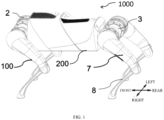
- the legged robot according to the embodiments of the present invention includes a body assembly 200 and a plurality of leg assemblies 100.
- the legged robot can be called as a quadruped robot or a four-legged robot.
- the present invention is not limited to this.
- the legged robot can also include two leg assemblies 100, and accordingly, the robot can be called as a biped robot or a two-legged robot.
- the four leg assemblies 100 are coupled to the body assembly 200 to support the body assembly 200. Actions such as walking of the robot can be realized when the leg assemblies 100 operate.
- leg assembly for the legged robot is described in detail below with reference to FIGS. 1 to 9 .
- the leg assembly 100 for the legged robot includes: a first motor 1, a second motor 2, a third motor 3, a first leg part 7, a second leg part 8 and a transmission component 9.
- the first motor 1 is mounted on the body assembly 200 of the legged robot.
- the first motor 1 is coupled to the second motor 2 to drive the second motor 2 to rotate relative to the first motor 1, and a rotation axis of the first motor 1 is substantially orthogonal to a rotation axis of the second motor 2.
- the second motor 2 is coupled to the third motor 3 to drive the third motor 3 to rotate relative to the second motor 2, and a rotation axis of the third motor 3 substantially coincides with a rotation axis of the second motor 2.
- the third motor 3 is arranged at a first end of the first leg part 7 (an upper end of the first leg part 7 as illustrated in FIG.
- the second leg part 8 is pivotably coupled to a second end of the first leg part 7 (a lower end of the first leg part 7 as illustrated in FIG. 8 ), and the transmission component 9 is coupled to an output shaft 31 of the third motor and the second leg part 8, to drive the second leg part 8 to rotate relative to the first leg part 7.
- the rotation axis of the first motor 1 is parallel to a front-rear direction of the body assembly 200
- the rotation axis of the second motor 2 is parallel to a left-right direction of the body assembly 200, so that the first motor 1 can drive the second motor 2 and associated first leg part 7 and second leg part 8 to swing circumferentially around the front-rear direction of the body assembly 200.
- leg assembly 100 can complete actions of a "extension” and a “retraction”, to increase the movement range of the first leg part 7 and the second leg part 8 within a space, improve the flexibility of the legged robot during motion, enable the legged robot to complete more complex actions, and improve the applicability of the legged robot.
- the second motor 2 can drive the first leg part 7 to rotate relative to the body assembly 200
- the third motor 3 can drive the second leg part 8 to rotate around the second end of the first leg part 7 through the transmission component 9. Therefore, the leg assembly 100 according to the embodiments of the present invention can realize a walking action of the first leg part 7 and the second leg part 8 through the rotation of the first motor 1 and the second motor 2.
- the leg assembly 100 further includes a first flange 4, and the first flange 4 is coupled to the second motor 2 and located between the first motor 1 and the second motor 2.
- the first flange 4 is provided with a first limit portion 411
- the first motor 1 is provided with a first stop portion 12 and a second stop portion 13
- the first stop portion 12 and the second stop portion 13 are spaced apart, to limit a rotation angle of the second motor 2 by stopping the first limit portion 411.
- the first stop portion 12 and the second stop portion 13 respectively define rotation limit positions of the first limit portion 411.
- the first motor 1 is provided with the first stop portion 12 and the second stop portion 13
- a range of the rotation angle of the first flange 4 can be conveniently limited, to conveniently control a rotation amplitude of an "extension” action and a “retraction” action of the first leg part 7 and the second leg part 8. Furthermore, it is more conducive to the accurate control of the leg assembly 100, and the limit reliability of the leg assembly 100 during motion is improved.
- an angle ⁇ between a first coupling line L1 of the first stop portion 12 and a rotation center of the first motor 1 and a second coupling line L2 of the second stop 13 and the rotation center of the first motor 1 satisfies: 110 degrees ⁇ 130 degrees. It is found through experiments that a force and an impact applied to the leg assembly 100 are small, and the legged robot is relatively stable when walking, when the angle ⁇ between the first coupling line L1 and the second coupling line L2 is 110 degrees or 130 degrees.
- the force and impact applied to the leg assembly 100 are less, and the legged robot is more stable when walking, when the angle ⁇ between the first coupling line L1 and the second coupling line L2 is 120 degrees.
- the angle set as above can make full use of their degrees of freedom, avoid interference, widen the movement range of the leg assembly 100, and improve the motion stability of the legged robot.
- the first flange 4 is provided with a second limit portion 421, and the leg assembly 100 further includes a second flange 5.
- the second flange 5 is coupled to the third motor and is pivotable relative to an output shaft 21 of the second motor, and the second flange 5 is located between the second motor 2 and the third motor 3.
- the second flange 5 is provided with a third stop portion 51 and a fourth stop portion 52, and the third stop portion 51 and the fourth stop portion 52 are spaced apart, to limit a rotation angle of the third motor 3 by stopping the second limit portion 421.
- the third stop portion 51 and the fourth stop portion 52 respectively define rotation limit positions of the second limit portion 421.
- the second limit portion 421 is stopped by the third stop portion 51 or the fourth stop portion 52, a further rotation of the second flange 5 can be prevented. Therefore, in the leg assembly 100 for a legged robot according to the embodiments of the present invention, since the second flange 5 is provided with the third stop portion 51 and the fourth stop portion 52, a range of a rotation angle of the second flange 5 can be conveniently limited, to conveniently control a swing amplitude of the first leg part 7. Furthermore it is more conducive to the accurate control of the leg assembly 100 and the limit reliability of the leg assembly 100 during motion is improved.
- an angle ⁇ between a third coupling line L3 of the third stop portion 51 and a rotation center of the second motor 2, and a fourth coupling line L4 of the fourth stop portion 52 and the rotation center of the second motor 2 satisfies: satisfies: 170 degrees ⁇ ⁇ ⁇ 180 degrees.
- the inventors of the present invention found through experiments that the force and impact applied to the leg assembly 100 are small, and the legged robot is relatively stable when walking, when the angle ⁇ between the third coupling line L3 and the fourth coupling line L4 is 170 degrees or 180 degrees.
- the force and impact applied to the leg assembly 100 are less, and the legged robot is more stable when walking, when the angle ⁇ between the third coupling line L3 and the fourth coupling line L4 is 175 degrees.
- the angle ⁇ set as above can make full use of their degrees of freedom, avoid the interference, widen the movement range of the leg assembly 100, and improve the motion stability of the legged robot.
- the second limit portion 421 is substantially located on a coupling line between the first limit portion 411 and the rotation center of the first flange 4.
- a coupling line between the second limit portion 421 and the center of the first flange 4 coincides with a coupling line between the first limit portion 411 and the center of the first flange 4. Therefore, when machining the first flange 4, the first limit portion 411 and the second limit portion 421 can be processed and formed more conveniently, thereby shortening the processing and manufacturing time of the first flange 4.
- the first limit portion 411 and the second limit portion 421 are substantially located at the same position, it is convenient for an operator to design and plan a motion trajectory when the leg assembly 100 rotates, to improve the controllability of the leg assembly 100 during motion.
- the first flange 4 includes a first coupling portion 41 and a second coupling portion 42.
- the first coupling portion 41 is detachably coupled to the output shaft 11 of the first motor through a threaded member.
- the first coupling portion 41 is integrally formed with the second coupling portion 42.
- the second coupling portion 42 is detachably coupled to a casing of the second motor 2 through the threaded member.
- the first limit portion 411 is located on the first coupling portion 41, and the second limit portion 421 is located on the second coupling portion 42.
- the first coupling portion 41 is a disc-shaped member, and is detachably coupled to an end of the output shaft 11 of the first motor through the threaded member;
- the second coupling portion 42 is a ring-shaped member, and surrounds the casing of the second motor 2; so that the coupling strength of the first flange 4 with the first motor 1 and the second motor 2 can be improved, and it is convenient for the assembly and the disassembly by the operator.
- the leg assembly 100 further includes a third flange 6, and an output shaft 31 of the third motor is coupled to the third flange 6, to drive the third flange 6 to rotate.
- the third flange 6 is provided with a third limit portion 63
- the first leg part 7 is provided with a fifth stop portion 711 and a sixth stop portion 712
- the fifth stop portion 711 and the sixth stop portion 712 are spaced apart, to limit a rotation angle of the third motor 3 by stopping the third limit portion 63.
- the fifth stop portion 711 and the sixth stop portion 712 respectively define rotation limit positions of the third limit portion 63.
- the first leg part 7 is provided with the fifth stop portion 711 and the sixth stop portion 712, a range of a rotation angle of the third flange 6 can be conveniently limited, to conveniently control a swing amplitude of the second leg part 8. Furthermore, it is more conducive to the accurate control of the leg assembly 100 and the limit reliability of the leg assembly 100 during motion is improved.
- an angle ⁇ between a fifth coupling line L5 of the fifth stop portion 711 and a rotation center of the third motor 3 and a sixth coupling line L6 of the sixth stop portion 712 and the rotation center of the third motor 3 satisfies: 120 degrees ⁇ ⁇ ⁇ 140 degrees. It is found through experiments that, the force and impact applied to the leg assembly 100 are small, and the legged robot is relatively stable when walking, when the angle ⁇ between the fifth coupling line L5 and the sixth coupling line L6 is 120 degrees or 140 degrees.
- the force and impact applied to the leg assembly 100 are less, and the legged robot is more stable when walking, when the angle ⁇ between the fifth coupling line L5 and the sixth coupling line L6 is 130 degrees.
- the angle ⁇ set as above can make full use of their degrees of freedom, avoid the interference, widen the movement range of the leg assembly 100, and improve the motion stability of the legged robot.
- the transmission component 9 includes a coupling rod 94, a first end (an upper end of the coupling rod 94 as illustrated in FIG. 8 ) of the coupling rod 94 is pivotably coupled to the third flange 6 through a first pivot shaft 91, and a second end of the coupling rod 94 is pivotably coupled to a first end (an upper end of the second leg part 8 as illustrated in FIG. 8 ) of the second leg part 8 through a second pivot shaft 92.
- the second end (the lower end of the first leg part 7 illustrated in FIG. 8 ) of the first leg part 7 is pivotably coupled to the first end of the second leg part 8 through a third pivot shaft 93.
- the third pivot shaft 93 is located between the second pivot shaft 92 and a second end of the first leg part 7, that is, the third pivot shaft 93 is closer to the second end (a lower end illustrated in FIG. 8 ) of the first leg part 7 than the second pivot shaft 92.
- the coupling rod 94 moves downward and drives the second pivot shaft 92 to move downward, to drive the second leg part 8 to swing clockwise around the third pivot shaft 93, that is, the second leg part 82 is retracted relative to the first leg part 71.
- the third flange 6 is provided with a recessed portion 62, an end of the recessed portion 62 is provided with a U-shaped fitting groove 61, the first end (the upper end of the coupling rod 94 illustrated in FIG. 8 ) of the coupling rod 94 is pivotably fitted in the U-shaped fitting groove 61, and a surface of the recessed portion 62 can stop the coupling rod 94 to limit rotation of the second leg part 8. It can be understood that, as illustrated in FIG.
- the first leg part 7 includes an inner housing 71 and an outer housing 72, and the third motor 3 is coupled to the inner housing 71.
- the inner housing 71 and the outer housing 72 are coupled with each other and define a receiving cavity, and the transmission component 9 is arranged inside the receiving cavity, so that the transmission component 9 can be prevented from being exposed to the outside for a long time, and then the transmission stability of the leg assembly 100 is improved.
- the inner housing 71 and the outer housing 72 are detachably coupled through the threaded member, a circumferential wall of the receiving cavity is provided with crossed reinforcing ribs 73, and the threaded member is located at a junction of the reinforcing ribs 73, to further improve the coupling strength between the inner housing 71 and the outer housing 72 and then further improve the service life of the leg assembly 100 for a legged robot according to the embodiments of the present invention.
- an outer circumferential wall of the outer housing 72 is coated with a buffer layer (not illustrated), for example, the buffer layer can be covered on an upper end of the outer housing 72, wherein the buffer layer can be a foam buffer layer or a rubber buffer layer, so that the legged robot can be buffered through the buffer layer when placed on the side or fallen down, thereby reducing the probability of the wear and the collision of the legged robot.
- a buffer layer (not illustrated)
- the buffer layer can be covered on an upper end of the outer housing 72, wherein the buffer layer can be a foam buffer layer or a rubber buffer layer, so that the legged robot can be buffered through the buffer layer when placed on the side or fallen down, thereby reducing the probability of the wear and the collision of the legged robot.
- the legged robot 1000 has four leg assemblies 100, and the first motors 1 of the four leg assemblies 100 are all coupled to the body assembly 200. It can be understood that, in the leg assembly 100, the swing amplitude of the extension and the retraction of the first leg part 7 and the second leg part 8 can be adjusted by the first motor 1, the second motor 2 controls the first leg part 7 to rotate relative to the body assembly 200, and the third motor 3 drives the second leg part 8 to rotate relative to the first leg part 7, to realize actions such as the walking of the robot.
- the legged robot 1000 according to the embodiments of the present invention has a wide movement range, good practicability, a reliable limit, the force and impact applied to various components are small, the operation is stable and the control precision is high.
- first and second are merely used for descriptive purposes and cannot be understood as indicating or implying relative importance or the number of technical features indicated.
- the features defined with “first” and “second” may explicitly or implicitly include at least one of the features.
- a plurality of means at least two, such as two, three, etc.
- the terms “mounted,” “coupled,” “connected,” “fixed” and the like are used broadly, and may be, for example, fixed connections, detachable connections, or integral connections; may also be mechanical or electrical connections or intercommunication; may also be direct connections or indirect connections via intervening structures; may also be inner communications or interactions of two elements, which can be understood by those skilled in the art according to specific situations.
- a structure in which a first feature is "on" or “below” a second feature may include an embodiment in which the first feature is in direct contact with the second feature, and may also include an embodiment in which the first feature and the second feature are not in direct contact with each other, but are contacted via an additional feature formed therebetween.
- a first feature "on,” “above,” or “on top of” a second feature may include an embodiment in which the first feature is right or obliquely “on,” “above,” or “on top of” the second feature, or just means that the first feature is at a height higher than that of the second feature; while a first feature “below,” “under,” or “on bottom of” a second feature may include an embodiment in which the first feature is right or obliquely “below,” “under,” or “on bottom of” the second feature, or just means that the first feature is at a height lower than that of the second feature.
Landscapes
- Engineering & Computer Science (AREA)
- Mechanical Engineering (AREA)
- Chemical & Material Sciences (AREA)
- Combustion & Propulsion (AREA)
- Transportation (AREA)
- Robotics (AREA)
- Toys (AREA)
- Manipulator (AREA)
Description
- The present invention relates to the field of robot technologies, and more particularly, to a leg assembly for a legged robot and a legged robot.
- Legged robots, also known as robots having legs, generally include a body assembly and a leg assembly. The leg assembly includes a thigh pivotably coupled to the body assembly and a shank pivotably coupled to the thigh. In the related art, a joint of the leg assembly of legged robots has narrow movement range and low degree of freedom, resulting in that the legged robot cannot complete more complex actions. Therefore, the legged robots cannot meet use needs of users and have poor adaptability.
-
CN112498517A discloses a three-degree-of-freedom robot leg structure which includes a first joint assembly, a second joint assembly and a third joint motor module, the first joint assembly structurally includes a first joint motor support, a first joint motor module is fixed to the outer portion of the first joint motor support, and a crank is installed at the output end of the first j oint motor module; an output rod is hinged to the head of the crank, a shank is hinged to the head of the output rod, and a foot end assembly is installed at the bottom of the shank; the second joint assembly structurally includes a second joint motor support, a second joint motor module is mounted in the second joint motor support, a second joint mounting disc is mounted at the output end of the second joint motor module, and the second joint mounting disc is fixed to the first joint motor support through a fastener; a thigh is further installed at one end of the first joint motor support and hinged to the shank. An output end of the third joint motor module is connected with the second joint motor support, and the work is reliable. - The present invention aims to solve at least one of the technical problems in the related art to a certain extent.
- The invention is set out in the appended set of claims.
- To this end, embodiments of the present invention provide a leg assembly for a legged robot with a wide movement range and good adaptability.
- The embodiments of the present invention further provide a legged robot having the leg assembly of the above embodiments.
- The leg assembly for the legged robot according to the embodiments of the present invention includes: a first motor, a second motor and a third motor, the first motor being coupled to the second motor to drive the second motor to rotate relative to the first motor, a rotation axis of the first motor being substantially orthogonal to a rotation axis of the second motor, the second motor being coupled to the third motor to drive the third motor to rotate relative to the second motor, a rotation axis of the third motor substantially coinciding with the rotation axis of the second motor; and a first leg part, a second leg part and a transmission component, the third motor being arranged at a first end of the first leg part, the second leg part is pivotably coupled to a second end of the first leg part, the transmission component being coupled to an output shaft of the third motor and the second leg part to drive the second leg part to rotate relative to the first leg part.
- The leg assembly for the legged robot according to the embodiments of the present invention can allow the first leg part and the second leg part to move in a large range in the three-dimensional space through relative rotations between the first motor, the second motor and the third motor, so that the legged robot can complete more complex actions, and then improve the applicability of the leg assembly of the legged robot.
- In some embodiments, the leg assembly further includes a first flange coupled to the second motor and located between the first motor and the second motor, the first flange is provided with a first limit portion, the first motor is provided with a first stop portion and a second stop portion, the first stop portion and the second stop portion are spaced apart to limit a rotation angle of the second motor by stopping the first limit portion.
- In some embodiments, an angle α between a first coupling line of the first stop portion and a rotation center of the first motor and a second coupling line of the second stop portion and the rotation center of the first motor satisfies: 110 degrees ≤α≤ 130 degrees.
- In some embodiments, the first flange is provided with a second limit portion, the leg assembly further includes a second flange coupled to the third motor and located between the second motor and the third motor, the second flange is provided with a third stop portion and a fourth stop portion, and the third stop portion and the fourth stop portion are spaced apart to limit a rotation angle of the third motor by stopping the second limit portion.
- In some embodiments, an angle β between a third coupling line of the third stop portion and a rotation center of the second motor and a fourth coupling line of the fourth stop portion and the rotation center of the second motor satisfies: 170 degrees ≤β≤ 180 degrees.
- In some embodiments, the second limit portion is substantially located on a coupling line between the first limit portion and the rotation center of the first flange.
- In some embodiments, the first flange includes a first coupling portion and a second coupling portion, the first coupling portion is coupled to an output shaft of the first motor and the second coupling portion, the second coupling portion is coupled to the casing of the second motor, the first limit portion is located on the first coupling portion, and the second limit portion is located on the second coupling portion.
- In some embodiments, the first coupling portion is a disc-shaped member, the first coupling portion is coupled to an end of the output shaft of the first motor, the second coupling portion is a ring-shaped member, and the second coupling portion surrounds the casing of the second motor.
- In some embodiments, the leg assembly further includes a third flange, the third flange is coupled to an output shaft of the third motor to drive the third flange to rotate, the third flange is provided with a third limit portion, the first leg part is provided with a fifth stop portion and a sixth stop portion, and the fifth stop portion and the sixth stop portion are spaced apart to limit a rotation angle of the third motor by stopping the third limit portion.
- In some embodiments, an angle γ between a fifth coupling line of the fifth stop portion and a rotation center of the third motor and a sixth coupling line of the sixth stop portion and the rotation center of the third motor satisfies: 120 degrees ≤γ≤ 140 degrees.
- In some embodiments, the transmission component includes a coupling rod having a first end pivotably coupled to the third flange through a first pivot shaft and a second end pivotably coupled to a first end of the second leg part through a second pivot shaft, and the second end of the first leg part is pivotably coupled to the first end of the second leg part through a third pivot shaft.
- In some embodiments, the third flange is provided with a recessed portion, an end of the recessed portion is provided with a U-shaped fitting groove, the first end of the coupling rod is pivotably fitted in the U-shaped fitting groove, and a surface of the recessed portion can stop the coupling rod to limit rotation of the second leg part.
- In some embodiments, the first leg part includes an inner housing and an outer housing, the third motor is coupled to the inner housing, the inner housing and the outer housing are coupled with each other and define a receiving cavity, and the transmission component is arranged inside the receiving cavity.
- In some embodiments, the inner housing and the outer housing are detachably coupled through a threaded member, a circumferential wall of the receiving cavity is provided with crossed reinforcing ribs, and the threaded member is located at a junction of the reinforcing ribs.
- In some embodiments, an outer circumferential wall of the outer housing is coated with a buffer layer.
- The legged robot according to the embodiments of the present invention includes a body assembly and a plurality of leg assemblies according to any one of the above embodiments, and the first motor of the leg assembly is coupled to the body assembly.
- The legged robot according to the embodiments of the present disclosure has a wide movement range and good applicability.
-
-
FIG. 1 is a schematic view of a legged robot according to an embodiment of the present invention. -
FIG. 2 is an assembly view of a first motor and a second motor of a leg assembly according to an embodiment of the present invention. -
FIG. 3 is a schematic view of a first motor of a leg assembly according to an embodiment of the present invention. -
FIG. 4 is a schematic view of a first flange of a leg assembly according to an embodiment of the present invention. -
FIG. 5 is a schematic view of a second flange of a leg assembly according to an embodiment of the present invention. -
FIG. 6 is a schematic view of a leg assembly according to an embodiment of the present invention. -
FIG. 7 is a schematic view of a leg assembly with an outer housing removed according to an embodiment of the present invention. -
FIG. 8 is a partial schematic view of a leg assembly according to an embodiment of the present invention. -
FIG. 9 is a schematic view of an inner housing of a leg assembly according to an embodiment of the present invention. - Embodiments of the present invention are described in detail below, and examples of the embodiments are illustrated in accompanying drawings. The following embodiments described with reference to the accompanying drawings are exemplary and are intended to explain the present invention rather than limit the present invention.
- A leg assembly for a legged robot and a legged robot having the leg assembly according to an embodiment of the present invention are described below with reference to the accompanying drawings.
- First, the legged robot according to the embodiments of the present invention is briefly described. As illustrated in
FIG. 1 , the legged robot according to the embodiments of the present invention includes abody assembly 200 and a plurality ofleg assemblies 100. In the embodiment illustrated inFIG. 1 , fourleg assemblies 100 are provided, and thus the robot can be called as a quadruped robot or a four-legged robot. It can be understood that the present invention is not limited to this. For example, the legged robot can also include twoleg assemblies 100, and accordingly, the robot can be called as a biped robot or a two-legged robot. In the embodiment illustrated inFIG. 1 , the fourleg assemblies 100 are coupled to thebody assembly 200 to support thebody assembly 200. Actions such as walking of the robot can be realized when the leg assemblies 100 operate. - The leg assembly for the legged robot according to the embodiments of the present invention is described in detail below with reference to
FIGS. 1 to 9 . - As illustrated in
FIGS. 1 ,6 and7 , theleg assembly 100 for the legged robot according to the embodiments of the present invention includes: afirst motor 1, asecond motor 2, athird motor 3, afirst leg part 7, asecond leg part 8 and a transmission component 9. - The
first motor 1 is mounted on thebody assembly 200 of the legged robot. Thefirst motor 1 is coupled to thesecond motor 2 to drive thesecond motor 2 to rotate relative to thefirst motor 1, and a rotation axis of thefirst motor 1 is substantially orthogonal to a rotation axis of thesecond motor 2. Thesecond motor 2 is coupled to thethird motor 3 to drive thethird motor 3 to rotate relative to thesecond motor 2, and a rotation axis of thethird motor 3 substantially coincides with a rotation axis of thesecond motor 2. Thethird motor 3 is arranged at a first end of the first leg part 7 (an upper end of thefirst leg part 7 as illustrated inFIG. 8 ), thesecond leg part 8 is pivotably coupled to a second end of the first leg part 7 (a lower end of thefirst leg part 7 as illustrated inFIG. 8 ), and the transmission component 9 is coupled to anoutput shaft 31 of the third motor and thesecond leg part 8, to drive thesecond leg part 8 to rotate relative to thefirst leg part 7. - It can be understood that, as illustrated in
FIG. 1 , the rotation axis of thefirst motor 1 is parallel to a front-rear direction of thebody assembly 200, and the rotation axis of thesecond motor 2 is parallel to a left-right direction of thebody assembly 200, so that thefirst motor 1 can drive thesecond motor 2 and associatedfirst leg part 7 andsecond leg part 8 to swing circumferentially around the front-rear direction of thebody assembly 200. Furthermore, theleg assembly 100 according to the embodiments of the present invention can complete actions of a "extension" and a "retraction", to increase the movement range of thefirst leg part 7 and thesecond leg part 8 within a space, improve the flexibility of the legged robot during motion, enable the legged robot to complete more complex actions, and improve the applicability of the legged robot. - As illustrated in
FIG. 6 , thesecond motor 2 can drive thefirst leg part 7 to rotate relative to thebody assembly 200, and thethird motor 3 can drive thesecond leg part 8 to rotate around the second end of thefirst leg part 7 through the transmission component 9. Therefore, theleg assembly 100 according to the embodiments of the present invention can realize a walking action of thefirst leg part 7 and thesecond leg part 8 through the rotation of thefirst motor 1 and thesecond motor 2. - In an embodiment, as illustrated in
FIGS. 2 to 4 , theleg assembly 100 further includes afirst flange 4, and thefirst flange 4 is coupled to thesecond motor 2 and located between thefirst motor 1 and thesecond motor 2. Thefirst flange 4 is provided with afirst limit portion 411, thefirst motor 1 is provided with afirst stop portion 12 and asecond stop portion 13, and thefirst stop portion 12 and thesecond stop portion 13 are spaced apart, to limit a rotation angle of thesecond motor 2 by stopping thefirst limit portion 411. In other words, thefirst stop portion 12 and thesecond stop portion 13 respectively define rotation limit positions of thefirst limit portion 411. When thefirst limit portion 411 is stopped by thefirst stop portion 12 or thesecond stop portion 13, a further rotation of thefirst flange 4, i.e., a further rotation of thefirst motor 1 is prevented. - In the
leg assembly 100 for the legged robot according to the embodiments of the present invention, since thefirst motor 1 is provided with thefirst stop portion 12 and thesecond stop portion 13, a range of the rotation angle of thefirst flange 4 can be conveniently limited, to conveniently control a rotation amplitude of an "extension" action and a "retraction" action of thefirst leg part 7 and thesecond leg part 8. Furthermore, it is more conducive to the accurate control of theleg assembly 100, and the limit reliability of theleg assembly 100 during motion is improved. - In some embodiments, as illustrated in
FIG. 3 , an angle α between a first coupling line L1 of thefirst stop portion 12 and a rotation center of thefirst motor 1 and a second coupling line L2 of thesecond stop 13 and the rotation center of thefirst motor 1 satisfies: 110 degrees ≤α≤ 130 degrees. It is found through experiments that a force and an impact applied to theleg assembly 100 are small, and the legged robot is relatively stable when walking, when the angle α between the first coupling line L1 and the second coupling line L2 is 110 degrees or 130 degrees. - In at least one embodiment, it is found through experiments that the force and impact applied to the
leg assembly 100 are less, and the legged robot is more stable when walking, when the angle α between the first coupling line L1 and the second coupling line L2 is 120 degrees. Moreover, the angle set as above can make full use of their degrees of freedom, avoid interference, widen the movement range of theleg assembly 100, and improve the motion stability of the legged robot. - Further, as illustrated in
FIG. 4 , thefirst flange 4 is provided with asecond limit portion 421, and theleg assembly 100 further includes asecond flange 5. Thesecond flange 5 is coupled to the third motor and is pivotable relative to anoutput shaft 21 of the second motor, and thesecond flange 5 is located between thesecond motor 2 and thethird motor 3. Thesecond flange 5 is provided with athird stop portion 51 and afourth stop portion 52, and thethird stop portion 51 and thefourth stop portion 52 are spaced apart, to limit a rotation angle of thethird motor 3 by stopping thesecond limit portion 421. - It can be understood that, as illustrated in
FIGS. 2 ,4 and 5 , thethird stop portion 51 and thefourth stop portion 52 respectively define rotation limit positions of thesecond limit portion 421. When thesecond limit portion 421 is stopped by thethird stop portion 51 or thefourth stop portion 52, a further rotation of thesecond flange 5 can be prevented. Therefore, in theleg assembly 100 for a legged robot according to the embodiments of the present invention, since thesecond flange 5 is provided with thethird stop portion 51 and thefourth stop portion 52, a range of a rotation angle of thesecond flange 5 can be conveniently limited, to conveniently control a swing amplitude of thefirst leg part 7. Furthermore it is more conducive to the accurate control of theleg assembly 100 and the limit reliability of theleg assembly 100 during motion is improved. - In some embodiments, as illustrated in
FIG. 5 , an angle β between a third coupling line L3 of thethird stop portion 51 and a rotation center of thesecond motor 2, and a fourth coupling line L4 of thefourth stop portion 52 and the rotation center of thesecond motor 2, satisfies: satisfies: 170 degrees ≤ β ≤ 180 degrees. The inventors of the present invention found through experiments that the force and impact applied to theleg assembly 100 are small, and the legged robot is relatively stable when walking, when the angle β between the third coupling line L3 and the fourth coupling line L4 is 170 degrees or 180 degrees. - In at least one embodiment, it is found through experiments that the force and impact applied to the
leg assembly 100 are less, and the legged robot is more stable when walking, when the angle β between the third coupling line L3 and the fourth coupling line L4 is 175 degrees. Moreover, the angle β set as above can make full use of their degrees of freedom, avoid the interference, widen the movement range of theleg assembly 100, and improve the motion stability of the legged robot. - Further, as illustrated in
FIG. 4 , thesecond limit portion 421 is substantially located on a coupling line between thefirst limit portion 411 and the rotation center of thefirst flange 4. In other words, a coupling line between thesecond limit portion 421 and the center of thefirst flange 4 coincides with a coupling line between thefirst limit portion 411 and the center of thefirst flange 4. Therefore, when machining thefirst flange 4, thefirst limit portion 411 and thesecond limit portion 421 can be processed and formed more conveniently, thereby shortening the processing and manufacturing time of thefirst flange 4. In addition, since thefirst limit portion 411 and thesecond limit portion 421 are substantially located at the same position, it is convenient for an operator to design and plan a motion trajectory when theleg assembly 100 rotates, to improve the controllability of theleg assembly 100 during motion. - In an embodiment, as illustrated in
FIG. 4 , thefirst flange 4 includes afirst coupling portion 41 and asecond coupling portion 42. Thefirst coupling portion 41 is detachably coupled to theoutput shaft 11 of the first motor through a threaded member. Thefirst coupling portion 41 is integrally formed with thesecond coupling portion 42. Thesecond coupling portion 42 is detachably coupled to a casing of thesecond motor 2 through the threaded member. Thefirst limit portion 411 is located on thefirst coupling portion 41, and thesecond limit portion 421 is located on thesecond coupling portion 42. For example, thefirst coupling portion 41 is a disc-shaped member, and is detachably coupled to an end of theoutput shaft 11 of the first motor through the threaded member; thesecond coupling portion 42 is a ring-shaped member, and surrounds the casing of thesecond motor 2; so that the coupling strength of thefirst flange 4 with thefirst motor 1 and thesecond motor 2 can be improved, and it is convenient for the assembly and the disassembly by the operator. - In some embodiments, as illustrated in
FIGS. 7 to 9 , theleg assembly 100 further includes athird flange 6, and anoutput shaft 31 of the third motor is coupled to thethird flange 6, to drive thethird flange 6 to rotate. Thethird flange 6 is provided with athird limit portion 63, thefirst leg part 7 is provided with afifth stop portion 711 and asixth stop portion 712, and thefifth stop portion 711 and thesixth stop portion 712 are spaced apart, to limit a rotation angle of thethird motor 3 by stopping thethird limit portion 63. In other words, thefifth stop portion 711 and thesixth stop portion 712 respectively define rotation limit positions of thethird limit portion 63. When thethird limit portion 63 is stopped by thefifth stop portion 711 or thesixth stop portion 712, a further rotation of thethird flange 6, i.e., a further rotation of thethird motor 3, can be prevented. - In the
leg assembly 100 for the legged robot according to the embodiments of the present invention, since thefirst leg part 7 is provided with thefifth stop portion 711 and thesixth stop portion 712, a range of a rotation angle of thethird flange 6 can be conveniently limited, to conveniently control a swing amplitude of thesecond leg part 8. Furthermore, it is more conducive to the accurate control of theleg assembly 100 and the limit reliability of theleg assembly 100 during motion is improved. - As illustrated in
FIG. 9 , an angle γ between a fifth coupling line L5 of thefifth stop portion 711 and a rotation center of thethird motor 3 and a sixth coupling line L6 of thesixth stop portion 712 and the rotation center of thethird motor 3 satisfies: 120 degrees ≤ γ ≤ 140 degrees. It is found through experiments that, the force and impact applied to theleg assembly 100 are small, and the legged robot is relatively stable when walking, when the angle γ between the fifth coupling line L5 and the sixth coupling line L6 is 120 degrees or 140 degrees. - In at least one embodiment, it is found through experiments that the force and impact applied to the
leg assembly 100 are less, and the legged robot is more stable when walking, when the angle γ between the fifth coupling line L5 and the sixth coupling line L6 is 130 degrees. Moreover, the angle γ set as above can make full use of their degrees of freedom, avoid the interference, widen the movement range of theleg assembly 100, and improve the motion stability of the legged robot. - In some embodiments, as illustrated in
FIGS. 7 and8 , the transmission component 9 includes acoupling rod 94, a first end (an upper end of thecoupling rod 94 as illustrated inFIG. 8 ) of thecoupling rod 94 is pivotably coupled to thethird flange 6 through afirst pivot shaft 91, and a second end of thecoupling rod 94 is pivotably coupled to a first end (an upper end of thesecond leg part 8 as illustrated inFIG. 8 ) of thesecond leg part 8 through asecond pivot shaft 92. The second end (the lower end of thefirst leg part 7 illustrated inFIG. 8 ) of thefirst leg part 7 is pivotably coupled to the first end of thesecond leg part 8 through athird pivot shaft 93. - In an embodiment, in
FIGS. 7 and8 , thethird pivot shaft 93 is located between thesecond pivot shaft 92 and a second end of thefirst leg part 7, that is, thethird pivot shaft 93 is closer to the second end (a lower end illustrated inFIG. 8 ) of thefirst leg part 7 than thesecond pivot shaft 92. When thethird flange 6 rotates clockwise, thecoupling rod 94 moves downward and drives thesecond pivot shaft 92 to move downward, to drive thesecond leg part 8 to swing clockwise around thethird pivot shaft 93, that is, the second leg part 82 is retracted relative to thefirst leg part 71. On the contrary, when thethird flange 6 rotates counterclockwise, thecoupling rod 94 moves upward and drives thesecond pivot shaft 92 to move upward, to drive thesecond leg part 8 to swing counterclockwise around thethird pivot shaft 93, that is, thesecond leg part 8 is extended relative to thefirst leg part 7. - In some embodiments, as illustrated in
FIGS. 7 and8 , thethird flange 6 is provided with a recessedportion 62, an end of the recessedportion 62 is provided with a U-shapedfitting groove 61, the first end (the upper end of thecoupling rod 94 illustrated inFIG. 8 ) of thecoupling rod 94 is pivotably fitted in the U-shapedfitting groove 61, and a surface of the recessedportion 62 can stop thecoupling rod 94 to limit rotation of thesecond leg part 8. It can be understood that, as illustrated inFIG. 8 , when thecoupling rod 94 rotates, a side wall of thecoupling rod 94 can abut against the surface of the recessedportion 62 to limit rotation of thecoupling rod 94, and then limit the rotation of thethird flange 6 and thesecond leg part 8, so that the reliability of the limit is further improved, the force and impact applied to respective members are reduced, and then the movement of thesecond leg part 8 can be controlled more accurately. - In some embodiments, as illustrated in
FIGS. 7 to 9 , thefirst leg part 7 includes aninner housing 71 and anouter housing 72, and thethird motor 3 is coupled to theinner housing 71. Theinner housing 71 and theouter housing 72 are coupled with each other and define a receiving cavity, and the transmission component 9 is arranged inside the receiving cavity, so that the transmission component 9 can be prevented from being exposed to the outside for a long time, and then the transmission stability of theleg assembly 100 is improved. - In an embodiment, as illustrated in
FIGS. 7 to 9 , theinner housing 71 and theouter housing 72 are detachably coupled through the threaded member, a circumferential wall of the receiving cavity is provided with crossed reinforcingribs 73, and the threaded member is located at a junction of the reinforcingribs 73, to further improve the coupling strength between theinner housing 71 and theouter housing 72 and then further improve the service life of theleg assembly 100 for a legged robot according to the embodiments of the present invention. - In some embodiments, an outer circumferential wall of the
outer housing 72 is coated with a buffer layer (not illustrated), for example, the buffer layer can be covered on an upper end of theouter housing 72, wherein the buffer layer can be a foam buffer layer or a rubber buffer layer, so that the legged robot can be buffered through the buffer layer when placed on the side or fallen down, thereby reducing the probability of the wear and the collision of the legged robot. - As illustrated in
FIG. 1 , thelegged robot 1000 according to the embodiments of the present invention has fourleg assemblies 100, and thefirst motors 1 of the fourleg assemblies 100 are all coupled to thebody assembly 200. It can be understood that, in theleg assembly 100, the swing amplitude of the extension and the retraction of thefirst leg part 7 and thesecond leg part 8 can be adjusted by thefirst motor 1, thesecond motor 2 controls thefirst leg part 7 to rotate relative to thebody assembly 200, and thethird motor 3 drives thesecond leg part 8 to rotate relative to thefirst leg part 7, to realize actions such as the walking of the robot. Thelegged robot 1000 according to the embodiments of the present invention has a wide movement range, good practicability, a reliable limit, the force and impact applied to various components are small, the operation is stable and the control precision is high. - In the description of the present invention, it shall be understood that terms such as "central," "longitudinal," "transverse," "length," "width," "thickness," "upper," "lower," "front," "rear," "left," "right," "vertical," "horizontal," "top," "bottom," "inner," "outer," "clockwise," "counterclockwise," "axial," "radial" and "circumferential" should be construed to refer to the orientation as then described or as illustrated in the drawings under discussion. These relative terms are for convenience of description and do not indicate or imply that the device or element referred to must have a particular orientation, or be constructed and operated in a particular orientation. Thus, these terms shall not be construed as limitation on the present invention.
- In addition, terms such as "first" and "second" are merely used for descriptive purposes and cannot be understood as indicating or implying relative importance or the number of technical features indicated. Thus, the features defined with "first" and "second" may explicitly or implicitly include at least one of the features. In the description of the present invention, unless otherwise specifically defined, "a plurality of" means at least two, such as two, three, etc.
- In the present invention, unless otherwise explicitly specified and defined, the terms "mounted," "coupled," "connected," "fixed" and the like are used broadly, and may be, for example, fixed connections, detachable connections, or integral connections; may also be mechanical or electrical connections or intercommunication; may also be direct connections or indirect connections via intervening structures; may also be inner communications or interactions of two elements, which can be understood by those skilled in the art according to specific situations.
- In the present invention, unless otherwise explicitly specified and defined, a structure in which a first feature is "on" or "below" a second feature may include an embodiment in which the first feature is in direct contact with the second feature, and may also include an embodiment in which the first feature and the second feature are not in direct contact with each other, but are contacted via an additional feature formed therebetween. Furthermore, a first feature "on," "above," or "on top of" a second feature may include an embodiment in which the first feature is right or obliquely "on," "above," or "on top of" the second feature, or just means that the first feature is at a height higher than that of the second feature; while a first feature "below," "under," or "on bottom of" a second feature may include an embodiment in which the first feature is right or obliquely "below," "under," or "on bottom of" the second feature, or just means that the first feature is at a height lower than that of the second feature.
- In the present invention, terms such as "an embodiment," "some embodiments," "an example," "a specific example," or "some examples," means that a particular feature, structure, material, or characteristic described in connection with the embodiment or example is included in at least one embodiment or example of the present invention. Thus, the appearances of these terms in various places throughout this specification are not necessarily referring to the same embodiment or example of the present invention. Furthermore, the particular features, structures, materials, or characteristics may be combined in any suitable manner in one or more embodiments or examples. In addition, without contradiction, those skilled in the art may combine and unite different embodiments or examples or features of the different embodiments or examples described in this specification.
- Although the embodiments of the present invention have been illustrated and described above, it can be understood that the above embodiments are exemplary and shall not be understood as limitation on the present invention, and changes, modifications, alternatives and variations can be made in the above embodiments by those skilled in the art within the scope of the present invention.
Claims (12)
- A leg assembly (100) for a legged robot (1000), comprising:a first motor (1), a second motor (2) and a third motor (3), the first motor (1) being coupled to the second motor (2) to drive the second motor (2) to rotate relative to the first motor (1), a rotation axis of the first motor (1) being substantially orthogonal to a rotation axis of the second motor (2), the second motor (2) being coupled to the third motor (3) to drive the third motor (3) to rotate relative to the second motor (2), a rotation axis of the third motor (3) substantially coinciding with the rotation axis of the second motor (2); anda first leg part (7), a second leg part (8) and a transmission component (9), the third motor (3) being arranged at a first end of the first leg part (7), the second leg part (8) is pivotably coupled to a second end of the first leg part (7), the transmission component (9) being coupled to an output shaft (31) of the third motor (3) and the second leg part (8) to drive the second leg part (8) to rotate relative to the first leg part (7),characterized in that the leg assembly (100) further comprises a first flange (4) coupled to the second motor (2) and located between the first motor (1) and the second motor (2), the first flange (4) is provided with a first limit portion (411), the first motor (1) is provided with a first stop portion (12) and a second stop portion (13), the first stop portion (12) and the second stop portion (13) are spaced apart to limit a rotation angle of the second motor (2) by stopping the first limit portion (411),wherein the first flange (4) is provided with a second limit portion (421), the leg assembly (100) further comprises a second flange (5) coupled to the third motor (3) and located between the second motor (2) and the third motor (3), the second flange (5) is provided with a third stop portion (51) and a fourth stop portion (52), and the third stop portion (51) and the fourth stop portion (52) are spaced apart to limit a rotation angle of the third motor (3) by stopping the second limit portion (421), andwherein the second limit portion (421) is substantially located on a coupling line between the first limit portion (411) and a rotation center of the first flange (4).
- The leg assembly (100) according to claim 1, wherein an angle α between a first coupling line (L1) of the first stop portion (12) and a rotation center of the first motor (1) and a second coupling line (L2) of the second stop portion (13) and the rotation center of the first motor (1) satisfies: 110 degrees ≤ α ≤ 130 degrees.
- The leg assembly (100) according to claim 1, wherein an angle β between a third coupling line (L3) of the third stop portion (51) and a rotation center of the second motor (2) and a fourth coupling line (L4) of the fourth stop portion (52) and the rotation center of the second motor (2) satisfies: 170 degrees ≤ β ≤ 180 degrees.
- The leg assembly (100) according to any one of claims 1 to 3, wherein the first flange (4) comprises a first coupling portion (41) and a second coupling portion (42), the first coupling portion (41) is coupled to an output shaft (11) of the first motor (1) and the second coupling portion (42), the second coupling portion (42) is coupled to a casing of the second motor (2), the first limit portion (411) is located on the first coupling portion (41), and the second limit portion (421) is located on the second coupling portion (42).
- The leg assembly (100) according to claim 4, wherein the first coupling portion (41) is a disc-shaped member, the first coupling portion (41) is coupled to an end of the output shaft (11) of the first motor (1), the second coupling portion (42) is a ring-shaped member, and the second coupling portion (42) surrounds the casing of the second motor (2).
- The leg assembly (100) according to any one of claims 1 to 5, further comprising a third flange (6), the output shaft (31) of the third motor (3) is coupled to the third flange (6) to drive the third flange (6) to rotate, the third flange (6) being provided with a third limit portion (63), the first leg part (7) being provided with a fifth stop portion (711) and a sixth stop portion (712), and the fifth stop portion (711) and the sixth stop portion (712) being spaced apart to limit a rotation angle of the third motor (3) by stopping the third limit portion (63).
- The leg assembly (100) according to claim 6, wherein an angle γ between a fifth coupling line (L5) of the fifth stop portion (711) and a rotation center of the third motor (3) and a sixth coupling line (L6) of the sixth stop portion (712) and the rotation center of the third motor (3) satisfies: 120 degrees ≤ γ ≤ 140 degrees.
- The leg assembly (100) according to claim 6 or 7, wherein the transmission component (9) comprises a coupling rod (94) having a first end pivotably coupled to the third flange (6) through a first pivot shaft (91) and a second end pivotably coupled to a first end of the second leg part (8) through a second pivot shaft (92), and the second end of the first leg part (7) is pivotably coupled to the first end of the second leg part (8) through a third pivot shaft (93).
- The leg assembly (100) according to claim 8, wherein the third flange (6) is provided with a recessed portion (62), an end of the recessed portion (62) is provided with a U-shaped fitting groove (61), the first end of the coupling rod (94) is pivotably fitted in the U-shaped fitting groove (61), and a surface of the recessed portion (62) can stop the coupling rod (94) to limit rotation of the second leg part (8).
- The leg assembly (100) according to any one of claims 1-9, wherein the first leg part (7) comprises an inner housing (71) and an outer housing (72), the third motor (3) is coupled to the inner housing (71), the inner housing (71) and the outer housing (72) are coupled with each other and define a receiving cavity, and the transmission component (9) is arranged inside the receiving cavity.
- The leg assembly (100) according to claim 10, wherein the inner housing (71) and the outer housing (72) are detachably coupled through a threaded member, a circumferential wall of the receiving cavity is provided with crossed reinforcing ribs (73), and the threaded member is located at a junction of the reinforcing ribs (73); or
an outer circumferential wall of the outer housing (72) is coated with a buffer layer. - A legged robot (1000), comprising:a body assembly (200); anda plurality of leg assemblies (100) according to any one of claims 1-11, and the first motor (1) of each leg assembly (100) is coupled to the body assembly (200).
Applications Claiming Priority (1)
| Application Number | Priority Date | Filing Date | Title |
|---|---|---|---|
| CN202120553343.6U CN217496321U (en) | 2021-03-17 | 2021-03-17 | Leg assembly and footed robot for footed robot |
Publications (2)
| Publication Number | Publication Date |
|---|---|
| EP4059817A1 EP4059817A1 (en) | 2022-09-21 |
| EP4059817B1 true EP4059817B1 (en) | 2024-11-27 |
Family
ID=79164454
Family Applications (1)
| Application Number | Title | Priority Date | Filing Date |
|---|---|---|---|
| EP21217883.4A Active EP4059817B1 (en) | 2021-03-17 | 2021-12-27 | Leg assembly for legged robot and legged robot |
Country Status (3)
| Country | Link |
|---|---|
| US (1) | US12258082B2 (en) |
| EP (1) | EP4059817B1 (en) |
| CN (1) | CN217496321U (en) |
Families Citing this family (2)
| Publication number | Priority date | Publication date | Assignee | Title |
|---|---|---|---|---|
| CN116141291A (en) * | 2023-01-04 | 2023-05-23 | 杭州智元研究院有限公司 | A transmission mode of exoskeleton using gear four-bar linkage mechanism |
| CN119682875B (en) * | 2024-05-04 | 2025-11-14 | 徕福机器人(深圳)有限公司 | Mechanical legs and their robots |
Family Cites Families (12)
| Publication number | Priority date | Publication date | Assignee | Title |
|---|---|---|---|---|
| CN206107391U (en) * | 2016-10-25 | 2017-04-19 | 南京农业大学 | Four -footed robot of three degrees of freedom of electric drive single leg |
| CN106476928A (en) * | 2016-12-21 | 2017-03-08 | 山东大学 | The variable electronic quadruped robot of mechanism configuration |
| CN106904226B (en) * | 2017-03-10 | 2022-12-23 | 杭州宇树科技有限公司 | Leg power system structure of electric drive quadruped robot |
| CN107128394B (en) * | 2017-05-11 | 2019-02-19 | 上海大学 | A bionic quadruped robot leg mechanism |
| CN109176595B (en) * | 2018-10-19 | 2023-11-24 | 杭州宇树科技有限公司 | Robot double-joint unit and footed robots and collaborative manipulators using it |
| CN109941369B (en) * | 2019-03-07 | 2024-11-29 | 杭州宇树科技有限公司 | Robot integrated joint unit and foot-type robot using same |
| CN110884588B (en) * | 2019-12-23 | 2022-03-18 | 中国科学院空间应用工程与技术中心 | A quadruped robot platform based on serial mechanical legs |
| CN112141238A (en) * | 2020-10-27 | 2020-12-29 | 东莞市华复实业有限公司 | Robot's anti-pressure, anti-sit and anti-break leg structure and robot |
| CN213414006U (en) * | 2020-10-29 | 2021-06-11 | 杭州宇树科技有限公司 | Robot leg structure with compact structure and quadruped robot applying same |
| CN112498517B (en) * | 2020-12-17 | 2021-11-16 | 江苏集萃复合材料装备研究所有限公司 | Three-degree-of-freedom robot leg structure |
| CN215322946U (en) * | 2021-01-15 | 2021-12-28 | 北京小米移动软件有限公司 | Foot type robot and leg assembly thereof |
| CN112623064B (en) * | 2021-01-19 | 2024-11-29 | 上海微电机研究所(中国电子科技集团公司第二十一研究所) | Leg mechanism of robot and quadruped robot |
-
2021
- 2021-03-17 CN CN202120553343.6U patent/CN217496321U/en active Active
- 2021-12-27 EP EP21217883.4A patent/EP4059817B1/en active Active
- 2021-12-30 US US17/565,825 patent/US12258082B2/en active Active
Also Published As
| Publication number | Publication date |
|---|---|
| US20220297776A1 (en) | 2022-09-22 |
| US12258082B2 (en) | 2025-03-25 |
| EP4059817A1 (en) | 2022-09-21 |
| CN217496321U (en) | 2022-09-27 |
Similar Documents
| Publication | Publication Date | Title |
|---|---|---|
| EP4059817B1 (en) | Leg assembly for legged robot and legged robot | |
| KR102525041B1 (en) | Cable guide device for multi-articular joint robot | |
| JP6104701B2 (en) | Link actuator | |
| US20160221182A1 (en) | Robot | |
| US11890756B2 (en) | Legged robot and leg assembly thereof | |
| CN118700187B (en) | Shoulder joint structure and humanoid robot | |
| WO2017170301A1 (en) | Linear extension/retraction mechanism and robot arm mechanism | |
| CN106974461B (en) | Multi freedom VR seat drive arrangement and VR seat | |
| CN104816313A (en) | Articulated robot | |
| KR20200000252U (en) | Robot arm joint device | |
| US9475190B2 (en) | Robot | |
| JPH01183384A (en) | Robot arm structure of horizontal, articulated robot | |
| KR102395309B1 (en) | Joint structure for robot and robot including the same | |
| CN217572896U (en) | Transmission assembly, driving device and robot | |
| CN223604400U (en) | Wrist structure, mechanical arm and robot | |
| JPH05337851A (en) | Arm turning robot | |
| CN120620311B (en) | Driving structure for composite motion of robot and robot | |
| CN220114565U (en) | Shock-absorbing structure, swing cleaning assembly for vehicle and vehicle | |
| CN222741452U (en) | Motor tensioning mechanism and five-axis robot | |
| CN223574558U (en) | Hip joint structure and humanoid robot | |
| CN213136742U (en) | Industrial robot who possesses crashproof structure and adjustable position | |
| CN119459930B (en) | Lower limb assembly and humanoid robot | |
| US20250144787A1 (en) | Parallel link robot | |
| JPH0756366Y2 (en) | Work machine link connecting pin device | |
| KR100213615B1 (en) | Articulated robot having stopper |
Legal Events
| Date | Code | Title | Description |
|---|---|---|---|
| PUAI | Public reference made under article 153(3) epc to a published international application that has entered the european phase |
Free format text: ORIGINAL CODE: 0009012 |
|
| STAA | Information on the status of an ep patent application or granted ep patent |
Free format text: STATUS: REQUEST FOR EXAMINATION WAS MADE |
|
| 17P | Request for examination filed |
Effective date: 20211227 |
|
| AK | Designated contracting states |
Kind code of ref document: A1 Designated state(s): AL AT BE BG CH CY CZ DE DK EE ES FI FR GB GR HR HU IE IS IT LI LT LU LV MC MK MT NL NO PL PT RO RS SE SI SK SM TR |
|
| RAP1 | Party data changed (applicant data changed or rights of an application transferred) |
Owner name: BEIJING XIAOMI ROBOT TECHNOLOGY CO., LTD. |
|
| GRAP | Despatch of communication of intention to grant a patent |
Free format text: ORIGINAL CODE: EPIDOSNIGR1 |
|
| STAA | Information on the status of an ep patent application or granted ep patent |
Free format text: STATUS: GRANT OF PATENT IS INTENDED |
|
| INTG | Intention to grant announced |
Effective date: 20240711 |
|
| P01 | Opt-out of the competence of the unified patent court (upc) registered |
Free format text: CASE NUMBER: APP_49378/2024 Effective date: 20240830 |
|
| GRAS | Grant fee paid |
Free format text: ORIGINAL CODE: EPIDOSNIGR3 |
|
| GRAA | (expected) grant |
Free format text: ORIGINAL CODE: 0009210 |
|
| STAA | Information on the status of an ep patent application or granted ep patent |
Free format text: STATUS: THE PATENT HAS BEEN GRANTED |
|
| AK | Designated contracting states |
Kind code of ref document: B1 Designated state(s): AL AT BE BG CH CY CZ DE DK EE ES FI FR GB GR HR HU IE IS IT LI LT LU LV MC MK MT NL NO PL PT RO RS SE SI SK SM TR |
|
| REG | Reference to a national code |
Ref country code: GB Ref legal event code: FG4D |
|
| REG | Reference to a national code |
Ref country code: CH Ref legal event code: EP |
|
| REG | Reference to a national code |
Ref country code: IE Ref legal event code: FG4D |
|
| REG | Reference to a national code |
Ref country code: DE Ref legal event code: R096 Ref document number: 602021022364 Country of ref document: DE |
|
| REG | Reference to a national code |
Ref country code: LT Ref legal event code: MG9D |
|
| REG | Reference to a national code |
Ref country code: NL Ref legal event code: MP Effective date: 20241127 |
|
| PG25 | Lapsed in a contracting state [announced via postgrant information from national office to epo] |
Ref country code: IS Free format text: LAPSE BECAUSE OF FAILURE TO SUBMIT A TRANSLATION OF THE DESCRIPTION OR TO PAY THE FEE WITHIN THE PRESCRIBED TIME-LIMIT Effective date: 20250327 Ref country code: HR Free format text: LAPSE BECAUSE OF FAILURE TO SUBMIT A TRANSLATION OF THE DESCRIPTION OR TO PAY THE FEE WITHIN THE PRESCRIBED TIME-LIMIT Effective date: 20241127 Ref country code: PT Free format text: LAPSE BECAUSE OF FAILURE TO SUBMIT A TRANSLATION OF THE DESCRIPTION OR TO PAY THE FEE WITHIN THE PRESCRIBED TIME-LIMIT Effective date: 20250327 |
|
| PG25 | Lapsed in a contracting state [announced via postgrant information from national office to epo] |
Ref country code: FI Free format text: LAPSE BECAUSE OF FAILURE TO SUBMIT A TRANSLATION OF THE DESCRIPTION OR TO PAY THE FEE WITHIN THE PRESCRIBED TIME-LIMIT Effective date: 20241127 Ref country code: NL Free format text: LAPSE BECAUSE OF FAILURE TO SUBMIT A TRANSLATION OF THE DESCRIPTION OR TO PAY THE FEE WITHIN THE PRESCRIBED TIME-LIMIT Effective date: 20241127 |
|
| REG | Reference to a national code |
Ref country code: AT Ref legal event code: MK05 Ref document number: 1745468 Country of ref document: AT Kind code of ref document: T Effective date: 20241127 |
|
| PG25 | Lapsed in a contracting state [announced via postgrant information from national office to epo] |
Ref country code: BG Free format text: LAPSE BECAUSE OF FAILURE TO SUBMIT A TRANSLATION OF THE DESCRIPTION OR TO PAY THE FEE WITHIN THE PRESCRIBED TIME-LIMIT Effective date: 20241127 |
|
| PG25 | Lapsed in a contracting state [announced via postgrant information from national office to epo] |
Ref country code: ES Free format text: LAPSE BECAUSE OF FAILURE TO SUBMIT A TRANSLATION OF THE DESCRIPTION OR TO PAY THE FEE WITHIN THE PRESCRIBED TIME-LIMIT Effective date: 20241127 |
|
| PG25 | Lapsed in a contracting state [announced via postgrant information from national office to epo] |
Ref country code: NO Free format text: LAPSE BECAUSE OF FAILURE TO SUBMIT A TRANSLATION OF THE DESCRIPTION OR TO PAY THE FEE WITHIN THE PRESCRIBED TIME-LIMIT Effective date: 20250227 |
|
| PG25 | Lapsed in a contracting state [announced via postgrant information from national office to epo] |
Ref country code: LV Free format text: LAPSE BECAUSE OF FAILURE TO SUBMIT A TRANSLATION OF THE DESCRIPTION OR TO PAY THE FEE WITHIN THE PRESCRIBED TIME-LIMIT Effective date: 20241127 Ref country code: GR Free format text: LAPSE BECAUSE OF FAILURE TO SUBMIT A TRANSLATION OF THE DESCRIPTION OR TO PAY THE FEE WITHIN THE PRESCRIBED TIME-LIMIT Effective date: 20250228 Ref country code: AT Free format text: LAPSE BECAUSE OF FAILURE TO SUBMIT A TRANSLATION OF THE DESCRIPTION OR TO PAY THE FEE WITHIN THE PRESCRIBED TIME-LIMIT Effective date: 20241127 |
|
| PG25 | Lapsed in a contracting state [announced via postgrant information from national office to epo] |
Ref country code: PL Free format text: LAPSE BECAUSE OF FAILURE TO SUBMIT A TRANSLATION OF THE DESCRIPTION OR TO PAY THE FEE WITHIN THE PRESCRIBED TIME-LIMIT Effective date: 20241127 |
|
| PG25 | Lapsed in a contracting state [announced via postgrant information from national office to epo] |
Ref country code: RS Free format text: LAPSE BECAUSE OF FAILURE TO SUBMIT A TRANSLATION OF THE DESCRIPTION OR TO PAY THE FEE WITHIN THE PRESCRIBED TIME-LIMIT Effective date: 20250227 |
|
| REG | Reference to a national code |
Ref country code: DE Ref legal event code: R119 Ref document number: 602021022364 Country of ref document: DE |
|
| PG25 | Lapsed in a contracting state [announced via postgrant information from national office to epo] |
Ref country code: SM Free format text: LAPSE BECAUSE OF FAILURE TO SUBMIT A TRANSLATION OF THE DESCRIPTION OR TO PAY THE FEE WITHIN THE PRESCRIBED TIME-LIMIT Effective date: 20241127 |
|
| PG25 | Lapsed in a contracting state [announced via postgrant information from national office to epo] |
Ref country code: DK Free format text: LAPSE BECAUSE OF FAILURE TO SUBMIT A TRANSLATION OF THE DESCRIPTION OR TO PAY THE FEE WITHIN THE PRESCRIBED TIME-LIMIT Effective date: 20241127 |
|
| PG25 | Lapsed in a contracting state [announced via postgrant information from national office to epo] |
Ref country code: EE Free format text: LAPSE BECAUSE OF FAILURE TO SUBMIT A TRANSLATION OF THE DESCRIPTION OR TO PAY THE FEE WITHIN THE PRESCRIBED TIME-LIMIT Effective date: 20241127 |
|
| PG25 | Lapsed in a contracting state [announced via postgrant information from national office to epo] |
Ref country code: RO Free format text: LAPSE BECAUSE OF FAILURE TO SUBMIT A TRANSLATION OF THE DESCRIPTION OR TO PAY THE FEE WITHIN THE PRESCRIBED TIME-LIMIT Effective date: 20241127 |
|
| PG25 | Lapsed in a contracting state [announced via postgrant information from national office to epo] |
Ref country code: SK Free format text: LAPSE BECAUSE OF FAILURE TO SUBMIT A TRANSLATION OF THE DESCRIPTION OR TO PAY THE FEE WITHIN THE PRESCRIBED TIME-LIMIT Effective date: 20241127 |
|
| PG25 | Lapsed in a contracting state [announced via postgrant information from national office to epo] |
Ref country code: CZ Free format text: LAPSE BECAUSE OF FAILURE TO SUBMIT A TRANSLATION OF THE DESCRIPTION OR TO PAY THE FEE WITHIN THE PRESCRIBED TIME-LIMIT Effective date: 20241127 |
|
| PG25 | Lapsed in a contracting state [announced via postgrant information from national office to epo] |
Ref country code: IT Free format text: LAPSE BECAUSE OF FAILURE TO SUBMIT A TRANSLATION OF THE DESCRIPTION OR TO PAY THE FEE WITHIN THE PRESCRIBED TIME-LIMIT Effective date: 20241127 |
|
| REG | Reference to a national code |
Ref country code: CH Ref legal event code: PL |
|
| PG25 | Lapsed in a contracting state [announced via postgrant information from national office to epo] |
Ref country code: LU Free format text: LAPSE BECAUSE OF NON-PAYMENT OF DUE FEES Effective date: 20241227 |
|
| PG25 | Lapsed in a contracting state [announced via postgrant information from national office to epo] |
Ref country code: SE Free format text: LAPSE BECAUSE OF FAILURE TO SUBMIT A TRANSLATION OF THE DESCRIPTION OR TO PAY THE FEE WITHIN THE PRESCRIBED TIME-LIMIT Effective date: 20241127 |
|
| PG25 | Lapsed in a contracting state [announced via postgrant information from national office to epo] |
Ref country code: MC Free format text: LAPSE BECAUSE OF FAILURE TO SUBMIT A TRANSLATION OF THE DESCRIPTION OR TO PAY THE FEE WITHIN THE PRESCRIBED TIME-LIMIT Effective date: 20241127 |
|
| PLBE | No opposition filed within time limit |
Free format text: ORIGINAL CODE: 0009261 |
|
| STAA | Information on the status of an ep patent application or granted ep patent |
Free format text: STATUS: NO OPPOSITION FILED WITHIN TIME LIMIT |
|
| REG | Reference to a national code |
Ref country code: BE Ref legal event code: MM Effective date: 20241231 |
|
| PG25 | Lapsed in a contracting state [announced via postgrant information from national office to epo] |
Ref country code: DE Free format text: LAPSE BECAUSE OF NON-PAYMENT OF DUE FEES Effective date: 20250701 |
|
| PG25 | Lapsed in a contracting state [announced via postgrant information from national office to epo] |
Ref country code: BE Free format text: LAPSE BECAUSE OF NON-PAYMENT OF DUE FEES Effective date: 20241231 |
|
| PG25 | Lapsed in a contracting state [announced via postgrant information from national office to epo] |
Ref country code: FR Free format text: LAPSE BECAUSE OF NON-PAYMENT OF DUE FEES Effective date: 20250127 |
|
| PG25 | Lapsed in a contracting state [announced via postgrant information from national office to epo] |
Ref country code: CH Free format text: LAPSE BECAUSE OF NON-PAYMENT OF DUE FEES Effective date: 20241231 |
|
| PG25 | Lapsed in a contracting state [announced via postgrant information from national office to epo] |
Ref country code: IE Free format text: LAPSE BECAUSE OF NON-PAYMENT OF DUE FEES Effective date: 20241227 |
|
| 26N | No opposition filed |
Effective date: 20250828 |
|
| PGFP | Annual fee paid to national office [announced via postgrant information from national office to epo] |
Ref country code: GB Payment date: 20251127 Year of fee payment: 5 |