EP4058311B1 - System for treating the air in the cabin of a vehicle - Google Patents
System for treating the air in the cabin of a vehicle Download PDFInfo
- Publication number
- EP4058311B1 EP4058311B1 EP20811448.8A EP20811448A EP4058311B1 EP 4058311 B1 EP4058311 B1 EP 4058311B1 EP 20811448 A EP20811448 A EP 20811448A EP 4058311 B1 EP4058311 B1 EP 4058311B1
- Authority
- EP
- European Patent Office
- Prior art keywords
- filtering device
- datum
- rfid tag
- control unit
- total usage
- Prior art date
- Legal status (The legal status is an assumption and is not a legal conclusion. Google has not performed a legal analysis and makes no representation as to the accuracy of the status listed.)
- Active
Links
Images



Classifications
-
- B—PERFORMING OPERATIONS; TRANSPORTING
- B60—VEHICLES IN GENERAL
- B60H—ARRANGEMENTS OF HEATING, COOLING, VENTILATING OR OTHER AIR-TREATING DEVICES SPECIALLY ADAPTED FOR PASSENGER OR GOODS SPACES OF VEHICLES
- B60H3/00—Other air-treating devices
- B60H3/06—Filtering
- B60H3/0608—Filter arrangements in the air stream
- B60H3/0616—Filter arrangements in the air stream with provisions for replacing the filter element
-
- B—PERFORMING OPERATIONS; TRANSPORTING
- B60—VEHICLES IN GENERAL
- B60H—ARRANGEMENTS OF HEATING, COOLING, VENTILATING OR OTHER AIR-TREATING DEVICES SPECIALLY ADAPTED FOR PASSENGER OR GOODS SPACES OF VEHICLES
- B60H1/00—Heating, cooling or ventilating devices
- B60H1/00357—Air-conditioning arrangements specially adapted for particular vehicles
- B60H1/00378—Air-conditioning arrangements specially adapted for particular vehicles for tractor or load vehicle cabins
-
- B—PERFORMING OPERATIONS; TRANSPORTING
- B01—PHYSICAL OR CHEMICAL PROCESSES OR APPARATUS IN GENERAL
- B01D—SEPARATION
- B01D46/00—Filters or filtering processes specially modified for separating dispersed particles from gases or vapours
- B01D46/0084—Filters or filtering processes specially modified for separating dispersed particles from gases or vapours provided with safety means
- B01D46/009—Identification of filter type or position thereof, e.g. by transponders or bar codes
-
- B—PERFORMING OPERATIONS; TRANSPORTING
- B01—PHYSICAL OR CHEMICAL PROCESSES OR APPARATUS IN GENERAL
- B01D—SEPARATION
- B01D46/00—Filters or filtering processes specially modified for separating dispersed particles from gases or vapours
- B01D46/10—Particle separators, e.g. dust precipitators, using filter plates, sheets or pads having plane surfaces
-
- B—PERFORMING OPERATIONS; TRANSPORTING
- B01—PHYSICAL OR CHEMICAL PROCESSES OR APPARATUS IN GENERAL
- B01D—SEPARATION
- B01D46/00—Filters or filtering processes specially modified for separating dispersed particles from gases or vapours
- B01D46/42—Auxiliary equipment or operation thereof
- B01D46/429—Means for wireless communication
-
- B—PERFORMING OPERATIONS; TRANSPORTING
- B01—PHYSICAL OR CHEMICAL PROCESSES OR APPARATUS IN GENERAL
- B01D—SEPARATION
- B01D46/00—Filters or filtering processes specially modified for separating dispersed particles from gases or vapours
- B01D46/52—Particle separators, e.g. dust precipitators, using filters embodying folded corrugated or wound sheet material
- B01D46/521—Particle separators, e.g. dust precipitators, using filters embodying folded corrugated or wound sheet material using folded, pleated material
-
- H—ELECTRICITY
- H04—ELECTRIC COMMUNICATION TECHNIQUE
- H04W—WIRELESS COMMUNICATION NETWORKS
- H04W4/00—Services specially adapted for wireless communication networks; Facilities therefor
- H04W4/80—Services using short range communication, e.g. near-field communication [NFC], radio-frequency identification [RFID] or low energy communication
-
- B—PERFORMING OPERATIONS; TRANSPORTING
- B60—VEHICLES IN GENERAL
- B60H—ARRANGEMENTS OF HEATING, COOLING, VENTILATING OR OTHER AIR-TREATING DEVICES SPECIALLY ADAPTED FOR PASSENGER OR GOODS SPACES OF VEHICLES
- B60H3/00—Other air-treating devices
- B60H3/06—Filtering
- B60H2003/0683—Filtering the quality of the filter or the air being checked
Definitions
- the present invention relates to a system for treating the air in the cabin of a vehicle, in particular for an agricultural machine.
- Document EP 1 985 351 A1 discloses a device for use in a motor vehicle which includes a filter unit with a housing structure and a filter insert having a frame and a filter element.
- the filter element is equipped with a transponder, and a reader is arranged in the housing structure for reading the transponder.
- the system according to the present invention allows for effectively monitoring and controlling a single filtering device used for filtering the air entering the air conditioning apparatus associated with the cabin of a vehicle, in particular an agricultural machine.
- numeral 10 designates as a whole a system for treating the air in the cabin of a vehicle, in particular for an agricultural machine.
- System 10 is made in accordance with one exemplary embodiment of the present invention.
- the cabin of agricultural machines is typically kept isolated and pressurized with respect to the outside environment.
- system 10 is intended for installation on the roof of the vehicle, in particular at the top of the cabin of the vehicle.
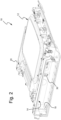
- System 10 comprises a casing 12 (shown in Figure 1 without the top cover, which has been partially removed) having at least one inlet opening 14 through which air is to be taken from the outside environment.
- inlet opening 14 is formed in a wall of casing 12.
- System 10 further comprises a filtering device 16 replaceably mounted in a housing 18 formed in casing 12.
- Filtering device 16 is fluidically connected downstream of inlet opening 14.
- filtering device 16 is configured for filtering contaminants contained in the air coming from the outside environment and entering through inlet opening 14.
- filtering device 16 can provide protection against contaminating dust, aerosol and vapours, and in particular is classified as "Category 4", as defined by the UNI EN 15695-2:2018 Standard.
- filtering device 16 may belong to any typology capable of filtering contaminants in the form of at least one material selected among dust, aerosol and vapour contained in the air entering through inlet opening 14.
- casing 12 preferably comprises also a further inlet opening 20 (better visible in Figures 3a-3c ), through which air is to be taken from the outside environment.
- the system comprises also a further filtering device 22 fluidically connected downstream of the further inlet opening 20.
- the further filtering device 22 can provide protection against dust, being more specifically classified as "Category 2" as defined by the UNI EN 15695-2:2018 Standard.
- the further filtering device 22 may belong to any typology capable of filtering contaminants in the form of at least one material selected from the group including dust, aerosol and vapour contained in the air entering through the further inlet opening 20.
- system 10 further comprises an air conditioning apparatus 24 sealingly contained within an inner space 26 formed in casing 12.
- Air conditioning apparatus 24 is fluidically connected downstream of filtering device 16 (and downstream of the further filtering device 22, if present), and is configured to be fluidically connected upstream of the cabin of the vehicle in which system 10 is to be installed, e.g. by means of a suitable outlet opening.
- the system comprises a valve arrangement identified by way of example by reference numeral 25.
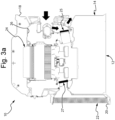
- valve arrangement 25 is fluidically interposed between inlet opening 14 and air conditioning apparatus 24 and configured for selectively activating ( Figure 3b ) and deactivating ( Figures 3a and 3c ), in a controlled manner, the fluidic communication between the latter.
- valve arrangement 25 comprises a solenoid valve provided with a swinging-plate obstructor configured for selectively assuming an activation condition ( Figure 3b ) and a deactivation condition ( Figures 3a and 3c ).
- the activation condition occurs when the swinging-plate obstructor is moved, by an associated electric motor or actuator 25a, into a position where air is conveyed from inlet opening 14 towards air conditioning apparatus 24, i.e. when filtering device 16 is operative.
- the deactivation condition occurs when the swinging-plate obstructor is moved, by the associated electric motor or actuator 25a, into a position where air is prevented from flowing from inlet opening 14 towards air conditioning apparatus 24, i.e. when filtering device 16 is inoperative (e.g. when it is purged, as shown in Figure 3a , or when only the further filtering device 22 is used, as shown in Figure 3c ).
- the interruption of such fluidic communication is desirable when, for example, the associated filtering device 16 is malfunctioning or has reached the end of its service life, since it would jeopardize the safety of the operator in the cabin of the vehicle in which the system has been installed.
- the further valve arrangement 27 comprises a solenoid valve provided with a swinging-plate obstructor configured for selectively assuming an activation condition ( Figure 3c ) and a deactivation condition ( Figures 3a and 3b ).
- the activation condition occurs when the swinging-plate obstructor is moved, by an associated electric motor or actuator 27a, into a position where air is conveyed from the further inlet opening 20 towards air conditioning apparatus 24, i.e. when the further filtering device 22 is operative.
- the deactivation condition occurs when the swinging-plate obstructor is moved, by the associated electric motor or actuator 27a, into a position where air is prevented from flowing from the further inlet opening 20 towards air conditioning apparatus 24, i.e. when the further filtering device 22 is inoperative.
- filtering device 16 is configured for being replaceably mounted in housing 18, i.e. it can be inserted and removed, e.g. in a repeatable manner, from casing 12 through housing 18.
- filtering device 16 may be secured into housing 18 in a per se known manner by using reversibly releasable coupling means (not numbered).
- Filtering device 16 further comprises an RFID tag 28 of a per se known type, operating according to the radiofrequency identification technology.
- RFID tag 28 contains identification information about filtering device 16 whereto it has been applied. In the illustrated embodiment, the identification information is originally stored into RFID tag 28 during an initialization phase.
- system 10 comprises an RFID reader 30 mounted in housing 18.
- RFID reader 30 is configured for being proximal to and co-operating with RFID tag 28 to read the identification information, when filtering device 16 is mounted in housing 18.
- identification information may preferably be modified by RFID reader 30 during the use of filtering device 16 in system 10.
- System 10 comprises also a control unit 32 connected to RFID reader 30 and configured for receiving the identification information read from RFID tag 28 and for executing predefined operations as a function of the identification information received.
- control unit 32 is configured for selectively putting valve arrangement 25 into the deactivation (or activation) condition and/or for transmitting a signal as a function of the identification information received.
- connection or communication channel between RFID reader 30 and control unit 32 may be effected, for example, via communication over a CAN bus or a LIN bus.
- control unit 32 is advantageously configured for co-operating with further components of system 10 such as, by way of non-limiting example:
- control unit 32 can selectively enable or disable the fluidic communication between inlet opening 14 and air conditioning apparatus 24, in particular by controlling valve arrangement 25.
- control unit 32 can supply current to electric motor or actuator 25a, which then puts valve arrangement 25 (e.g. with the swinging-plate obstructor) respectively into the activation condition and into the deactivation condition, in which such valve arrangement 25 respectively allows or prevents an air flow from inlet opening 14 towards air conditioning apparatus 24.
- valve arrangement 25 e.g. with the swinging-plate obstructor
- control unit 32 may be configured for outputting one or more signals intended to permit the communication of what is operatively going on as far as filtering device 16 is concerned.
- system 10 further comprises a signaling device 34 ( Figure 4 ), in particular a visualization device, e.g. comprising a dashboard and/or a display.
- Signaling device 34 may be configured for receiving the signal outputted by control unit 32 and for emitting a corresponding perceivable signal (e.g. an audible or visual signal) to an operator, indicating the condition of filtering device 16 detected by said control unit 32.
- RFID reader 30 is not able to co-operate with the RFID tag 28.
- This case may correspond to the absence of filtering device 16, which may have been removed without having been replaced with another one.
- this case may correspond to an improper installation of filtering device 16 in system 10.
- control unit 32 is configured for executing at least one of the following operations:
- RFID reader 30 in addition to performing the function of obtaining - from RFID tag 28 - said identification information about filtering device 16, RFID reader 30 also performs the function of indicating the proper installation and/or the presence of the latter. This avoids the necessity of employing, for example, any switches or commutators or check elements to verify the correct positioning of filtering device 16 and to ensure the proper operability of system 10.
- said identification information comprises an individual identifier datum univocally associated with the single filtering device 16 carrying RFID tag 28.
- identifier datum is determined by RFID tag 28 during an initial configuration phase of filtering device 16, when it is installed in system 10 for the first time.
- the individual identifier datum is essentially a serial number representing the "identity" attributed to filtering device 16 to which RFID tag 28 has been applied.
- the attribution of the individual identifier datum occurs, for example, by means of an encryption procedure carried out by control unit 32.
- control unit 32 is configured for storing the individual identifier datum into a list of used individual identifier data contained in memory means 36.
- said memory means 36 may be included in system 10, e.g. they may be integrated into control unit 32.
- the identification information stored in RFID tag 28 further comprises a total usage datum representative of the period of time during which filtering device 16 carrying RFID tag 28 has been operatively used.
- the total usage time substantially corresponds to the cumulative time during which filtering device 16 has remained in the associated housing 18 while valve arrangement 25 was in the operative condition and there was an air inflow through inlet opening 20 towards air conditioning apparatus 24 ( Figure 3a and 3b ).
- control unit 32 is configured for making a comparison between the total usage datum detected by RFID reader 30 and a threshold value.
- the threshold value may be:
- This case may correspond, for example, to the condition wherein filtering device 16 has exceeded its service life, which may imply a deterioration in its performance.
- control unit 32 is configured for executing at least one of the following operations:
- This case may correspond to the normal operating condition of filtering device 16, the performance of which falls within the standard operability range and does not jeopardize its reliability.
- control unit 32 is configured for executing at least one of the following operations:
- the residual life signal issued by said signaling device 34 may display a bar having a length proportional to the residual service life of filter 16.
- said threshold value may be contained in memory means 36.
- memory means 36 may be included in system 10, e.g. integrated into control unit 32.
- the identification information stored in RFID tag 28 comprises also a typology datum representative of the type and/or technical specifications of filtering device 16 carrying RFID tag 28.
- such typology datum is stored into RFID tag 28 during an initial configuration phase of filtering device 16 of system 10.
- the typology datum may include the category of filtering device 16 carrying RFID tag 28 (e.g. "Category 3" or “Category 4" according to the UNI EN 15695-2:2018 Standard ).
- the typology datum when the typology datum is stored into RFID tag 28, it is conveniently "write-protected” to avoid any future modification of such information.
- control unit 32 may be configured for determining (calculating or selecting) said threshold value as a function of said typology datum stored in RFID tag 28.
- the threshold value may be selected by control unit 32 from tables stored in memory means 36, such tables associating a respective threshold value with each typology datum. For example, a threshold value corresponding to 170 hours may be associated with a "Category 4" filter, whereas a lower threshold value may be associated with a "Category 3" filter.
- control unit 32 is configured for updating the total usage datum of filtering device 16 stored in RFID tag 28 by means of RFID reader 30.
- control unit 32 is configured for executing the following operations:
- the above operations may occur periodically at regular intervals, e.g. every 180 seconds.
- control unit 32 is also configured for storing into memory means 36 the updated total usage datum, associating it with the individual identifier datum of filtering device 16 carrying RFID tag 28, in particular at regular intervals during the use of system 10.
- memory means 36 associate the respective updated total usage data with each individual identifier datum contained in the list of used individual identifier data.
- control unit 32 is configured for executing the following operations:
- This case may correspond, for example, to an attempt to tamper RFID tag 28 associated with filtering device 16.
- control unit 32 may be configured for executing at least one of the following operations:
- control unit 32 may optionally be configured for transmitting such alteration signal to the diagnostic system of the customer or user of system 10, which will thus be informed about the possible tampering.
- memory means 36 may also store the individual identifier datum associated with RFID tag 28 into a list of unauthorized individual identifier data of "black-listed" filtering devices 16.
- control unit 32 may be arranged for comparing the individual identifier datum associated with filtering device 16 inserted in housing 18 with the list of black-listed individual identifier data stored in memory means 36; if the individual identifier datum is included in such "black list", then control unit 32 may:
- control unit 32 is associated with a further transmission module configured for transmitting said identification information relating to filtering device 16 (stored in memory means 36 and/or in RFID tag 28 ) to a main server via a telecommunications network, e.g. the Internet network.
- a telecommunications network e.g. the Internet network.
- the exchange of information between the transmission module and the main server may advantageously occur by cloud computing.
- the transmission module may be structurally and/or functionally separate from and independent of control unit 32, and connected thereto.
- the transmission module may be structurally and/or functionally integrated into control unit 32.
- the identification information contained in said main server can be read by a fixed or mobile external communication device (such as a cellular phone, a smartphone, a tablet, a laptop computer, or the like) via the telecommunications network.
- a fixed or mobile external communication device such as a cellular phone, a smartphone, a tablet, a laptop computer, or the like
- read-only access is granted to the external communication device via the telecommunications network through an enabled account.
- control unit 32 and/or the external communication device may be configured for executing check and verification operations on the identification information contained in RFID tag 28 and/or stored in memory means 36, comparing it with the same data contained in the main server.
- control unit 32 may cause the execution of several operations including, for example:
- RFID tag 28 is also equipped with near field communication functionalities, in particular compliant with the NFC Standard, so as to be able to interface directly with a fixed or mobile external communication device (such as a cellular phone, a smartphone, a tablet, a laptop computer, or the like).
- a fixed or mobile external communication device such as a cellular phone, a smartphone, a tablet, a laptop computer, or the like.
- the external communication device can be configured for reading said identification information contained in RFID tag 28, e.g. so that it can be displayed by an operator (typically on a screen operatively associated with the external communication device).
- read-only access is granted to the external communication device through an enabled account.
- filtering device 16 comprises a filter box 38 and a filter body 40 housed in filter box 38.
- filtering device 16 comprises an inlet grille 42 ( Figure 6 ) mounted on filter box 38 upstream of filter body 40.
- filter box 38 has an outlet section 44, in particular on the side opposite to te inlet grille 42.
- outlet section 44 is intended to be fluidically connected to air conditioning apparatus 24 through valve arrangement 25.
- outlet section 44 is a portion protruding rearward from filter box 38.
- outlet section 44 can be inserted into an associated recess (not numbered) of housing 18, communicating with air conditioning apparatus 24 through valve arrangement 25.
- sealing gasket 46 is compressed between the bottom of filter box 38 and the bottom of housing 18.
- RFID tag 28 is situated on the bottom of filtering device 16, facing towards the bottom of housing 18, which carries RFID reader 30.
- RFID tag 28 is situated on the bottom of filter box 38, e.g. near outlet section 44.
Landscapes
- Engineering & Computer Science (AREA)
- Chemical & Material Sciences (AREA)
- Chemical Kinetics & Catalysis (AREA)
- Mechanical Engineering (AREA)
- Computer Networks & Wireless Communication (AREA)
- Physics & Mathematics (AREA)
- Thermal Sciences (AREA)
- Signal Processing (AREA)
- Filtering Of Dispersed Particles In Gases (AREA)
- Air-Conditioning For Vehicles (AREA)
- Air Conditioning Control Device (AREA)
Description
- The present invention relates to a system for treating the air in the cabin of a vehicle, in particular for an agricultural machine.
- In the technical field of vehicular cabins there is the need for filtering the air taken in for controlling the climate in the cabin. This need is particularly felt in agricultural machines, in that their air conditioning systems include filters configured for removing contaminants from the intake air, such as pesticides, fertilizers and plant protection products, which might enter the cabin and make it dangerous.
-
Document EP 1 985 351 A1 discloses a device for use in a motor vehicle which includes a filter unit with a housing structure and a filter insert having a frame and a filter element. The filter element is equipped with a transponder, and a reader is arranged in the housing structure for reading the transponder. - Other devices are also known, as described in documents
FR 3 031 320 A1 DE 10 2008 049862 A1 . - It is one object of the present invention to provide a system for treating the air in the cabin of a vehicle, in particular for an agricultural machine, which is improved over the systems according to the prior art.
- According to the present invention, this and other objects are achieved through a system having the technical features set out in the appended
independent claim 1. - In particular, the system according to the present invention allows for effectively monitoring and controlling a single filtering device used for filtering the air entering the air conditioning apparatus associated with the cabin of a vehicle, in particular an agricultural machine.
- It is understood that the appended dependent claims define some preferred embodiments of the present invention that include some optional technical features.
- Further features and advantages of the present invention will become apparent in light of the following detailed description, provided merely as a non-limiting example and referring, in particular, to the annexed drawings as summarized below.
-
-
Figure 1 is a partially exploded perspective view of a system for treating the air in the cabin of a vehicle, in particular for an agricultural machine. Such system is made in accordance with one exemplary embodiment of the present invention. In particular, this figure shows a filtering device extracted from a casing of a system. -
Figure 2 is a partial perspective view similar to that ofFigure 1 , wherein the filtering device has been omitted. -
Figures 3a-3c represent a series of longitudinally sectioned views of the system shown inFigure 2 (without the filtering device), which illustrate different operative conditions of such system. -
Figure 4 is a block diagram that schematizes the system shown in the preceding figures into its functional components. -
Figure 5 is a block diagram that schematically and functionally illustrates the co-operation between an RFID tag carried by a filtering device and an RFID reader carried by the casing of the system shown in the preceding figures. -
Figures 6 to 8 are a series of elevation views of a filtering device of the system shown in the preceding figures. In particular,Figure 6 is a front elevation view,Figure 7 is a rear elevation view, andFigure 8 is a side elevation view. - For completeness' sake, the following is a list of the alphanumerical references used herein to identify parts, elements and components illustrated in the above-summarized drawings.
- 10
- System
- 12
- Casing
- 14
- Inlet opening
- 16
- Filtering device
- 18
- Housing
- 20
- Further inlet opening
- 22
- Further filtering device
- 24
- Air conditioning apparatus
- 25
- Valve arrangement
- 25a
- Electric motor or actuator
- 26
- Inner Space
- 27
- Further valve arrangement
- 27a
- Further electric motor or actuator
- 28
- RFID tag
- 30
- RFID reader
- 32
- Control unit
- 33a
- Main blower
- 33b
- Additional blower
- 33c
- Air flow sensor
- 33d
- Pressure sensor
- 34
- Signaling unit
- 36
- Memory means
- 38
- Filter box
- 40
- Filter body
- 42
- Inlet grille
- 44
- Outlet section,
- 46
- Sealing gasket
- With particular reference to
Figures 1 to 4 , numeral 10 designates as a whole a system for treating the air in the cabin of a vehicle, in particular for an agricultural machine.System 10 is made in accordance with one exemplary embodiment of the present invention. - For safety and law compliance reasons, the cabin of agricultural machines is typically kept isolated and pressurized with respect to the outside environment.
- In the embodiment illustrated in detail in
Figure 1 ,system 10 is intended for installation on the roof of the vehicle, in particular at the top of the cabin of the vehicle. -
System 10 comprises a casing 12 (shown inFigure 1 without the top cover, which has been partially removed) having at least oneinlet opening 14 through which air is to be taken from the outside environment. In particular, inlet opening 14 is formed in a wall ofcasing 12. -
System 10 further comprises afiltering device 16 replaceably mounted in ahousing 18 formed incasing 12.Filtering device 16 is fluidically connected downstream ofinlet opening 14. In addition,filtering device 16 is configured for filtering contaminants contained in the air coming from the outside environment and entering throughinlet opening 14. In the illustrated embodiment,filtering device 16 can provide protection against contaminating dust, aerosol and vapours, and in particular is classified as "Category 4", as defined by the UNI EN 15695-2:2018 Standard. However, according to the present invention,filtering device 16 may belong to any typology capable of filtering contaminants in the form of at least one material selected among dust, aerosol and vapour contained in the air entering throughinlet opening 14. - In the illustrated embodiment, casing 12 preferably comprises also a further inlet opening 20 (better visible in
Figures 3a-3c ), through which air is to be taken from the outside environment. The system comprises also afurther filtering device 22 fluidically connected downstream of thefurther inlet opening 20. In particular, thefurther filtering device 22 can provide protection against dust, being more specifically classified as "Category 2" as defined by the UNI EN 15695-2:2018 Standard. As already described with reference tofiltering device 16, according to the present invention, thefurther filtering device 22 may belong to any typology capable of filtering contaminants in the form of at least one material selected from the group including dust, aerosol and vapour contained in the air entering through thefurther inlet opening 20. - With particular reference to
Figures 3a-3c ,system 10 further comprises anair conditioning apparatus 24 sealingly contained within aninner space 26 formed incasing 12.Air conditioning apparatus 24 is fluidically connected downstream of filtering device 16 (and downstream of thefurther filtering device 22, if present), and is configured to be fluidically connected upstream of the cabin of the vehicle in whichsystem 10 is to be installed, e.g. by means of a suitable outlet opening. - In the illustrated embodiment, the system comprises a valve arrangement identified by way of example by
reference numeral 25.Such valve arrangement 25 is fluidically interposed between inlet opening 14 andair conditioning apparatus 24 and configured for selectively activating (Figure 3b ) and deactivating (Figures 3a and3c ), in a controlled manner, the fluidic communication between the latter. - For example,
valve arrangement 25 comprises a solenoid valve provided with a swinging-plate obstructor configured for selectively assuming an activation condition (Figure 3b ) and a deactivation condition (Figures 3a and3c ). The activation condition occurs when the swinging-plate obstructor is moved, by an associated electric motor oractuator 25a, into a position where air is conveyed from inlet opening 14 towardsair conditioning apparatus 24, i.e. when filteringdevice 16 is operative. The deactivation condition occurs when the swinging-plate obstructor is moved, by the associated electric motor oractuator 25a, into a position where air is prevented from flowing from inlet opening 14 towardsair conditioning apparatus 24, i.e. when filteringdevice 16 is inoperative (e.g. when it is purged, as shown inFigure 3a , or when only thefurther filtering device 22 is used, as shown inFigure 3c ). - Moreover, the interruption of such fluidic communication is desirable when, for example, the associated
filtering device 16 is malfunctioning or has reached the end of its service life, since it would jeopardize the safety of the operator in the cabin of the vehicle in which the system has been installed. - Since it envisages also a further inlet opening 20 and a
further filtering device 22, the illustrated embodiment likewise envisages afurther valve arrangement 27. As described above with reference tovalve arrangement 25, thefurther valve arrangement 27 is fluidically interposed between the further inlet opening 20 andair conditioning apparatus 24, and is configured for selectively activating and deactivating, in a controlled manner, the fluidic communication between the latter. - For example, the
further valve arrangement 27 comprises a solenoid valve provided with a swinging-plate obstructor configured for selectively assuming an activation condition (Figure 3c ) and a deactivation condition (Figures 3a and3b ). The activation condition occurs when the swinging-plate obstructor is moved, by an associated electric motor oractuator 27a, into a position where air is conveyed from the further inlet opening 20 towardsair conditioning apparatus 24, i.e. when thefurther filtering device 22 is operative. The deactivation condition occurs when the swinging-plate obstructor is moved, by the associated electric motor oractuator 27a, into a position where air is prevented from flowing from the further inlet opening 20 towardsair conditioning apparatus 24, i.e. when thefurther filtering device 22 is inoperative. - As aforementioned,
filtering device 16 is configured for being replaceably mounted inhousing 18, i.e. it can be inserted and removed, e.g. in a repeatable manner, from casing 12 throughhousing 18. For example,filtering device 16 may be secured intohousing 18 in a per se known manner by using reversibly releasable coupling means (not numbered). -
Filtering device 16 further comprises anRFID tag 28 of a per se known type, operating according to the radiofrequency identification technology.RFID tag 28 contains identification information about filteringdevice 16 whereto it has been applied. In the illustrated embodiment, the identification information is originally stored intoRFID tag 28 during an initialization phase. - Furthermore,
system 10 comprises anRFID reader 30 mounted inhousing 18.RFID reader 30 is configured for being proximal to and co-operating withRFID tag 28 to read the identification information, when filteringdevice 16 is mounted inhousing 18. However, such identification information may preferably be modified byRFID reader 30 during the use offiltering device 16 insystem 10. -
System 10 comprises also acontrol unit 32 connected toRFID reader 30 and configured for receiving the identification information read fromRFID tag 28 and for executing predefined operations as a function of the identification information received. - For example, such predefined operations may comprise the fact that
control unit 32 is configured for selectively puttingvalve arrangement 25 into the deactivation (or activation) condition and/or for transmitting a signal as a function of the identification information received. - In the illustrated embodiment, the connection or communication channel between
RFID reader 30 andcontrol unit 32 may be effected, for example, via communication over a CAN bus or a LIN bus. - In the illustrated embodiment,
control unit 32 is advantageously configured for co-operating with further components ofsystem 10 such as, by way of non-limiting example: - a
main blower 33a, - an
additional blower 33b intended to create an air flow from inlet opening 14 towardsair conditioning apparatus 24, - an
air flow sensor 33c, and - an
air pressure sensor 33d. - By way of non-limiting example, on the one
hand control unit 32 can selectively enable or disable the fluidic communication between inlet opening 14 andair conditioning apparatus 24, in particular by controllingvalve arrangement 25. Typically,control unit 32 can supply current to electric motor oractuator 25a, which then puts valve arrangement 25 (e.g. with the swinging-plate obstructor) respectively into the activation condition and into the deactivation condition, in whichsuch valve arrangement 25 respectively allows or prevents an air flow from inlet opening 14 towardsair conditioning apparatus 24. - Still by way of non-limiting example, on the other
hand control unit 32 may be configured for outputting one or more signals intended to permit the communication of what is operatively going on as far as filteringdevice 16 is concerned. In the illustrated embodiment,system 10 further comprises a signaling device 34 (Figure 4 ), in particular a visualization device, e.g. comprising a dashboard and/or a display.Signaling device 34 may be configured for receiving the signal outputted bycontrol unit 32 and for emitting a corresponding perceivable signal (e.g. an audible or visual signal) to an operator, indicating the condition offiltering device 16 detected by saidcontrol unit 32. - Let us now consider the case wherein
RFID reader 30 is not able to co-operate with theRFID tag 28. This case may correspond to the absence of filteringdevice 16, which may have been removed without having been replaced with another one. Alternatively, this case may correspond to an improper installation offiltering device 16 insystem 10. - In the above case, according to the embodiment illustrated herein,
control unit 32 is configured for executing at least one of the following operations: - selectively deactivating the fluidic communication between inlet opening 14 and air conditioning apparatus 24 (e.g. by appropriately controlling
valve arrangement 25 to put it into the deactivation condition), and - outputting (e.g. to signaling device 34) a fault signal indicating a possible improper installation or absence of said
filtering device 16. - In the above case, therefore, in addition to performing the function of obtaining - from RFID tag 28 - said identification information about filtering
device 16,RFID reader 30 also performs the function of indicating the proper installation and/or the presence of the latter. This avoids the necessity of employing, for example, any switches or commutators or check elements to verify the correct positioning offiltering device 16 and to ensure the proper operability ofsystem 10. - Preferably, said identification information comprises an individual identifier datum univocally associated with the
single filtering device 16 carryingRFID tag 28. In particular, such identifier datum is determined byRFID tag 28 during an initial configuration phase offiltering device 16, when it is installed insystem 10 for the first time. - In the illustrated embodiment, the individual identifier datum is essentially a serial number representing the "identity" attributed to
filtering device 16 to whichRFID tag 28 has been applied. The attribution of the individual identifier datum occurs, for example, by means of an encryption procedure carried out bycontrol unit 32. - In the illustrated embodiment,
control unit 32 is configured for storing the individual identifier datum into a list of used individual identifier data contained in memory means 36. - Furthermore, said memory means 36 may be included in
system 10, e.g. they may be integrated intocontrol unit 32. - In the illustrated embodiment, the identification information stored in
RFID tag 28 further comprises a total usage datum representative of the period of time during whichfiltering device 16 carryingRFID tag 28 has been operatively used. The total usage time substantially corresponds to the cumulative time during whichfiltering device 16 has remained in the associatedhousing 18 whilevalve arrangement 25 was in the operative condition and there was an air inflow through inlet opening 20 towards air conditioning apparatus 24 (Figure 3a and3b ). - In the illustrated embodiment,
control unit 32 is configured for making a comparison between the total usage datum detected byRFID reader 30 and a threshold value. - In particular, as will be further discussed below, the threshold value may be:
- a fixed predetermined value for any filtering device 16 (e.g. 170 hours), or
- a value which can be determined by
control unit 32 by selecting it among a plurality of threshold values contained in memory means 36, or - a value which can be calculated by
control unit 32 according to predefined criteria. - Let us consider the case wherein the total usage datum is higher than said threshold value. This case may correspond, for example, to the condition wherein
filtering device 16 has exceeded its service life, which may imply a deterioration in its performance. - In such a case,
control unit 32 is configured for executing at least one of the following operations: - selectively deactivating the fluidic communication between inlet opening 14 and air conditioning apparatus 24 (e.g. by appropriately controlling
valve arrangement 25; and - outputting (e.g. to signaling device 34) a depletion signal representative of the end of the service life of filtering
device 16 carryingRFID tag 28. - Let us now consider the case wherein the total usage datum is lower than the threshold value. This case may correspond to the normal operating condition of
filtering device 16, the performance of which falls within the standard operability range and does not jeopardize its reliability. - In the above-mentioned case,
control unit 32 is configured for executing at least one of the following operations: - selectively activating the fluidic communication between inlet opening 14 and
air conditioning apparatus 24; and - outputting a residual life signal representative of the remaining service life of filtering
device 16 carryingRFID tag 28, determined as a function of the threshold value and the total usage datum. - For example, when signaling
device 34 includes a display, the residual life signal issued by said signalingdevice 34 may display a bar having a length proportional to the residual service life offilter 16. - In particular, said threshold value may be contained in memory means 36. As mentioned above, such memory means 36 may be included in
system 10, e.g. integrated intocontrol unit 32. - Preferably, the identification information stored in
RFID tag 28 comprises also a typology datum representative of the type and/or technical specifications offiltering device 16 carryingRFID tag 28. In particular, such typology datum is stored intoRFID tag 28 during an initial configuration phase offiltering device 16 ofsystem 10. In the illustrated embodiment, the typology datum may include the category offiltering device 16 carrying RFID tag 28 (e.g. "Category 3" or "Category 4" according to the UNI EN 15695-2:2018 Standard). In particular, when the typology datum is stored intoRFID tag 28, it is conveniently "write-protected" to avoid any future modification of such information. - Advantageously, but not necessarily,
control unit 32 may be configured for determining (calculating or selecting) said threshold value as a function of said typology datum stored inRFID tag 28. In particular, the threshold value may be selected bycontrol unit 32 from tables stored in memory means 36, such tables associating a respective threshold value with each typology datum. For example, a threshold value corresponding to 170 hours may be associated with a "Category 4" filter, whereas a lower threshold value may be associated with a "Category 3" filter. - According to the embodiment illustrated herein,
control unit 32 is configured for updating the total usage datum offiltering device 16 stored inRFID tag 28 by means ofRFID reader 30. - In particular,
control unit 32 is configured for executing the following operations: - reading the total usage datum previously stored in
RFID tag 28 by means ofRFID reader 30; - calculating a current usage datum representative of the time of active utilization of
filtering device 16 during the current operation ofsystem 10; - calculating an updated total usage datum as a function of the previously stored total usage datum and said current usage datum;
- operating
RFID reader 30 in order to causeRFID tag 28 to store the updated total usage datum. - In particular, the above operations may occur periodically at regular intervals, e.g. every 180 seconds.
- Preferably,
control unit 32 is also configured for storing into memory means 36 the updated total usage datum, associating it with the individual identifier datum offiltering device 16 carryingRFID tag 28, in particular at regular intervals during the use ofsystem 10. In other words, memory means 36 associate the respective updated total usage data with each individual identifier datum contained in the list of used individual identifier data. - In the illustrated embodiment,
control unit 32 is configured for executing the following operations: - reading the individual identifier datum stored in
RFID tag 28 by means ofRFID reader 30; - reading the last total usage datum stored in
RFID tag 28 by means ofRFID reader 30; - reading the last total usage datum stored in memory means 36 and referred to the individual identifier datum associated with
RFID tag 28 in proximity toRFID reader 30; and - comparing the last total usage datum read from
RFID tag 28 with the last total usage datum read from memory means 36. - Let us now consider the case wherein there is a difference between the compared total usage data which exceeds a comparison threshold value. This case may correspond, for example, to an attempt to tamper
RFID tag 28 associated withfiltering device 16. - In this case,
control unit 32 may be configured for executing at least one of the following operations: - selectively deactivating the fluidic communication between inlet opening 14 and air conditioning apparatus 24 (e.g. by appropriately controlling valve arrangement 25); and
- outputting (e.g. to signaling device 34) an alteration signal representative of a possible tampering of
RFID tag 28 carried by filteringdevice 16. - Furthermore, in this
case control unit 32 may optionally be configured for transmitting such alteration signal to the diagnostic system of the customer or user ofsystem 10, which will thus be informed about the possible tampering. - In particular, memory means 36 may also store the individual identifier datum associated with
RFID tag 28 into a list of unauthorized individual identifier data of "black-listed"filtering devices 16. During the operation ofsystem 10, therefore,control unit 32 may be arranged for comparing the individual identifier datum associated withfiltering device 16 inserted inhousing 18 with the list of black-listed individual identifier data stored in memory means 36; if the individual identifier datum is included in such "black list", then controlunit 32 may: - selectively deactivate the fluidic communication between inlet opening 14 and air conditioning apparatus 24 (e.g. by appropriately controlling valve arrangement 25); and/or
- output (e.g. to signaling device 34) said alteration signal.
- According to a further illustrative embodiment of the present invention,
control unit 32 is associated with a further transmission module configured for transmitting said identification information relating to filtering device 16 (stored in memory means 36 and/or in RFID tag 28) to a main server via a telecommunications network, e.g. the Internet network. In particular, the exchange of information between the transmission module and the main server may advantageously occur by cloud computing. The transmission module may be structurally and/or functionally separate from and independent ofcontrol unit 32, and connected thereto. As an alternative, the transmission module may be structurally and/or functionally integrated intocontrol unit 32. - Preferably, the identification information contained in said main server can be read by a fixed or mobile external communication device (such as a cellular phone, a smartphone, a tablet, a laptop computer, or the like) via the telecommunications network. In particular, read-only access is granted to the external communication device via the telecommunications network through an enabled account.
- Preferably,
control unit 32 and/or the external communication device may be configured for executing check and verification operations on the identification information contained inRFID tag 28 and/or stored in memory means 36, comparing it with the same data contained in the main server. In particular, if the individual identifier associated withfiltering device 16 inserted inhousing 18 is included in the list of unauthorized individual identifier data stored in the main server, then controlunit 32 may cause the execution of several operations including, for example: - inhibiting the fluidic communication between inlet opening 14 and
air conditioning apparatus 24, and/or - outputting an alert signal visible to the user, and/or
- transmitting an alert signal to the main server (which may, for example, coincide with the customer's or user's diagnostic system provider).
- According to yet another exemplary embodiment of the present invention,
RFID tag 28 is also equipped with near field communication functionalities, in particular compliant with the NFC Standard, so as to be able to interface directly with a fixed or mobile external communication device (such as a cellular phone, a smartphone, a tablet, a laptop computer, or the like). In particular, the external communication device can be configured for reading said identification information contained inRFID tag 28, e.g. so that it can be displayed by an operator (typically on a screen operatively associated with the external communication device). In particular, read-only access is granted to the external communication device through an enabled account. - With particular reference to
Figures 6 to 8 , the following will describe some structural features offiltering device 16 according to the previously illustrated embodiment. - In the illustrated embodiment,
filtering device 16 comprises afilter box 38 and afilter body 40 housed infilter box 38. - Preferably,
filtering device 16 comprises an inlet grille 42 (Figure 6 ) mounted onfilter box 38 upstream offilter body 40. - Furthermore,
filter box 38 has anoutlet section 44, in particular on the side opposite to teinlet grille 42. When mounted tocasing 12,outlet section 44 is intended to be fluidically connected toair conditioning apparatus 24 throughvalve arrangement 25. - For example,
outlet section 44 is a portion protruding rearward fromfilter box 38. In particular,outlet section 44 can be inserted into an associated recess (not numbered) ofhousing 18, communicating withair conditioning apparatus 24 throughvalve arrangement 25. - Preferably, around
outlet section 44 there is also a sealinggasket 46. In the example illustrated herein, when filteringdevice 16 is inserted intohousing 18 sealinggasket 46 is compressed between the bottom offilter box 38 and the bottom ofhousing 18. - In the illustrated embodiment,
RFID tag 28 is situated on the bottom offiltering device 16, facing towards the bottom ofhousing 18, which carriesRFID reader 30. In particular,RFID tag 28 is situated on the bottom offilter box 38, e.g. nearoutlet section 44. - Of course, without prejudice to the principle of the invention, the forms of embodiment and the implementation details may be extensively varied from those described and illustrated herein by way of non-limiting example, without however departing from the scope of the invention as set out in the appended claims.
Claims (16)
- System (10) for treating the air in the cabin of a vehicle, in particular for an agricultural machine; said system (10) comprising:- a casing (12) having at least one inlet opening (14, 20) through which air is to be taken from the outside environment;- a filtering device (16, 22) fluidically connected downstream of the at least one inlet opening (14, 20) and configured for filtering contaminants in the form of at least one material among dust, aerosol and vapour contained in said air; and- an air conditioning apparatus (24) sealingly contained within an inner space (22) formed in said casing (12); said air conditioning apparatus (24) being fluidically connected downstream of said filtering device (16, 22) and being configured to be fluidically connected upstream of the cabin of the vehicle in which said system (10) is to be installed;wherein a single filtering device (16) is configured for being replaceably mounted in a housing (18) formed in said casing (12); said single filtering device (16) comprises an RFID tag (28) containing identification information about the single filtering device (16);wherein the system (10) comprises an RFID reader (30) mounted in said housing (18) and configured for being proximal to and co-operating with said RFID tag (28) to read said identification information, when said single filtering device (16) is mounted in said housing (18);wherein said identification information comprises an individual identifier datum univocally associated with the single filtering device (16) carrying the RFID tag (28); andsaid identification information further comprises a total usage datum representative of the period of time during which the single filtering device (16) carrying the RFID tag (28) has been operatively used;characterized in that the system (10) further comprises a control unit (32) connected to said RFID reader (30) and configured for receiving said identification information read from said RFID tag (28) and for executing predefined operations as a function of said identification information received; in thatsaid control unit (32) is configured for updating the total usage datum of said single filtering device (16) stored in the RFID tag (28) by means of the RFID reader (30);in that said control unit (32) is further configured for storing the updated total usage datum into memory means (36) while associating it with the individual identifier datum of the single filtering device (16) carrying the RFID tag (28); andin that said control unit (32) is configured for executing the following operations:- reading the individual identifier datum stored in the RFID tag (28) by means of the RFID reader (30);- reading the last total usage datum stored in the RFID tag (28) by means of the RFID reader (30);- reading the last total usage datum stored in said memory means (36) and referred to the individual identifier datum associated with the RFID tag (28) in proximity to the RFID reader (30); and- comparing the last total usage datum read from said RFID tag (28) with the last total usage datum read from said memory means (36).
- System (10) according to claim 1, wherein, when said RFID reader (30) is not able to co-operate with said RFID tag (28), said control unit (32) is also configured for executing at least one of the following operations:- selectively deactivating the fluidic communication between said inlet opening (14) downstream of which the single filtering device (16) is fluidically connected, and said air conditioning apparatus (24), and- outputting a fault signal indicating a possible improper installation or absence of said single filtering device (16).
- System (10) according to claim 1 or 2, wherein said control unit (32) is configured for determining said individual identifier datum when said single filtering device (16) is installed into said housing (18) for the first time.
- System (10) according to claim 3, wherein said control unit (32) is configured for storing said individual identifier datum into a list of used individual identifier data contained in the memory means (36).
- System (10) according to any of the preceding claims, wherein said identification information further comprises a typology datum indicative of the type and/or technical specifications of the single filtering device (16) carrying the RFID tag (28).
- System (10) according to any of the preceding claims, wherein said control unit (32) is configured for making a comparison between said total usage datum and a threshold value.
- System (10) according to claims 5 and 6, wherein said control unit (32) is configured for calculating or selecting the threshold value as a function of said typology datum.
- System (10) according to claim 6 or 7, wherein, when said total usage datum exceeds said threshold value, said control unit (32) is configured for executing at least one of the following operations:- selectively deactivating the fluidic communication between said inlet opening (14) downstream of which the single filtering device (16) is fluidically connected, and said air conditioning apparatus (24); and- outputting a depletion signal representative of the end of the service life of the single filtering device (16) carrying the RFID tag (28).
- System (10) according to any one of claims 6 to 8, wherein, when said total usage datum is lower than said threshold value, said control unit (32) is configured for executing at least one of the following operations:- selectively activating the fluidic communication between said inlet opening (14) downstream of which the single filtering device (16) is fluidically connected, and said air conditioning apparatus (24); and- outputting a residual life signal representative of the remaining service life of the single filtering device (16) carrying the RFID tag (28), determined as a function of said threshold value and said total usage datum.
- System (10) according to any of the preceding claims, whereinsaid control unit (32) is configured for executing the following operations:- reading the total usage datum previously stored in the RFID tag (28) by means of the RFID reader (30);- calculating a current usage datum representative of the time of active utilization of the single filtering device (16)during the current operation of the system (10);- calculating an updated total usage datum as a function of the previously stored total usage datum and said current usage datum; and- operating the RFID reader (30) in order to cause the RFID tag (28) to store the updated total usage datum.
- System (10) according to any the preceding claims, wherein, when there is a difference between the compared total usage datum which exceeds a predetermined comparison threshold value, the control unit (32) is configured for executing at least one of the following operations:- selectively deactivating the fluidic communication between the inlet opening (14) downstream of which the single filtering device (16) is fluidically connected, and the air conditioning apparatus (24); and- outputting an alteration signal representative of a possible tampering of the RFID tag (28) carried by the single filtering device (16).
- System (10) according to claim 11, wherein, when the difference between the compared total usage datum exceeds said comparison threshold value, said memory means (36) will store the individual identifier datum associated with said RFID tag (28) into a list of black-listed individual identifier data relating to filtering devices (16) that may have been tampered with.
- System (10) according to any of the preceding claims, wherein said control unit (32) is associated with a further transmission module configured for transmitting said identification information relating to said single filtering device (16) to a main server via a telecommunications network.
- System (10) according to any of the preceding claims, said RFID tag (28) is provided with near field communication or NFC means, so as to interface directly with an external communication device capable of accessing said identification information relating to said single filtering device (16).
- System (10) according to claim 14, wherein said external communication device is configured for displaying said identification information.
- Vehicle comprising a system (10) according to any one of the preceding claims.
Applications Claiming Priority (2)
| Application Number | Priority Date | Filing Date | Title |
|---|---|---|---|
| IT102019000021153A IT201900021153A1 (en) | 2019-11-14 | 2019-11-14 | Air treatment system in the cabin of a vehicle, in particular for an agricultural machine. |
| PCT/IB2020/060646 WO2021094965A1 (en) | 2019-11-14 | 2020-11-12 | System for treating the air in the cabin of a vehicle |
Publications (3)
| Publication Number | Publication Date |
|---|---|
| EP4058311A1 EP4058311A1 (en) | 2022-09-21 |
| EP4058311B1 true EP4058311B1 (en) | 2023-08-09 |
| EP4058311C0 EP4058311C0 (en) | 2023-08-09 |
Family
ID=69903878
Family Applications (1)
| Application Number | Title | Priority Date | Filing Date |
|---|---|---|---|
| EP20811448.8A Active EP4058311B1 (en) | 2019-11-14 | 2020-11-12 | System for treating the air in the cabin of a vehicle |
Country Status (6)
| Country | Link |
|---|---|
| US (1) | US12351004B2 (en) |
| EP (1) | EP4058311B1 (en) |
| JP (1) | JP2023501286A (en) |
| ES (1) | ES2963710T3 (en) |
| IT (1) | IT201900021153A1 (en) |
| WO (1) | WO2021094965A1 (en) |
Families Citing this family (3)
| Publication number | Priority date | Publication date | Assignee | Title |
|---|---|---|---|---|
| GB202108162D0 (en) * | 2021-06-08 | 2021-07-21 | Agco Int Gmbh | Vehicle heating, ventilation and air conditioning system |
| US12357935B2 (en) * | 2022-06-14 | 2025-07-15 | Purafil, Inc. | Filter module with radio-frequency identification tag for tuning a filtration system |
| FR3147971B1 (en) * | 2023-04-19 | 2025-03-07 | Psa Automobiles Sa | Method for analyzing the cabin air filter of a motor vehicle |
Family Cites Families (15)
| Publication number | Priority date | Publication date | Assignee | Title |
|---|---|---|---|---|
| JPH03271639A (en) * | 1990-03-20 | 1991-12-03 | Sharp Corp | Cooling/heating device |
| JPH11169634A (en) * | 1997-12-10 | 1999-06-29 | Mitsubishi Electric Corp | Air conditioner |
| JP2002366688A (en) * | 2001-06-08 | 2002-12-20 | Mitsubishi Heavy Ind Ltd | Managing method for filter and filter to be managed by the same |
| US6758739B1 (en) * | 2003-03-04 | 2004-07-06 | Delphi Technologies, Inc. | Air quality system for a vehicle |
| JP2006145053A (en) * | 2004-11-16 | 2006-06-08 | Matsushita Electric Ind Co Ltd | Home appliance having consumables management function and program |
| DE102007018455A1 (en) * | 2007-04-19 | 2008-10-30 | Helsa-Automotive Gmbh & Co. Kg | Filter device with radio detection system |
| DE102008049862B4 (en) * | 2008-10-01 | 2022-09-01 | Carl Freudenberg Kg | Filter element with means for locating and identifying |
| CN105719149B (en) * | 2010-03-09 | 2019-12-10 | 康明斯过滤Ip公司 | apparatus, system, and method for detecting the presence of genuine serviceable product components |
| JP2011227811A (en) * | 2010-04-22 | 2011-11-10 | Hitachi-Ge Nuclear Energy Ltd | Work management system and work management method |
| KR101579438B1 (en) * | 2014-07-02 | 2015-12-23 | 주식회사 오토스윙 | Information detectable structure of filter installed in pure air supplier of Respirator and method thereof |
| JP6444114B2 (en) * | 2014-09-25 | 2018-12-26 | 株式会社クボタ | Combine |
| FR3031320A1 (en) * | 2015-01-07 | 2016-07-08 | Peugeot Citroen Automobiles Sa | REVERSIBLE OPERATING PULSE AIR TREATMENT SYSTEM FOR SECURE ACCESS TO A DEPOLLUTION FILTER |
| AU2018204751B2 (en) * | 2017-06-30 | 2020-01-16 | The Sy-Klone Company, Llc | Air quality monitoring and control system |
| CN107823975A (en) * | 2017-10-26 | 2018-03-23 | 山西彩云归科技有限公司 | Air filter, information identifying method and Information Authentication method |
| CN110953099B (en) * | 2019-12-23 | 2022-05-17 | 平原滤清器有限公司 | Air filter and anti-counterfeiting and pre-alarming method for filter element of air filter |
-
2019
- 2019-11-14 IT IT102019000021153A patent/IT201900021153A1/en unknown
-
2020
- 2020-11-12 US US17/772,496 patent/US12351004B2/en active Active
- 2020-11-12 ES ES20811448T patent/ES2963710T3/en active Active
- 2020-11-12 EP EP20811448.8A patent/EP4058311B1/en active Active
- 2020-11-12 WO PCT/IB2020/060646 patent/WO2021094965A1/en not_active Ceased
- 2020-11-12 JP JP2022525647A patent/JP2023501286A/en active Pending
Also Published As
| Publication number | Publication date |
|---|---|
| US12351004B2 (en) | 2025-07-08 |
| BR112022009021A2 (en) | 2022-08-09 |
| ES2963710T3 (en) | 2024-04-01 |
| WO2021094965A1 (en) | 2021-05-20 |
| US20220379689A1 (en) | 2022-12-01 |
| EP4058311A1 (en) | 2022-09-21 |
| JP2023501286A (en) | 2023-01-18 |
| EP4058311C0 (en) | 2023-08-09 |
| IT201900021153A1 (en) | 2021-05-14 |
Similar Documents
| Publication | Publication Date | Title |
|---|---|---|
| EP4058311B1 (en) | System for treating the air in the cabin of a vehicle | |
| US12525113B2 (en) | Multi-zone filtration monitoring systems and methods | |
| US11716339B2 (en) | Integrated equipment fault and cyber attack detection arrangement | |
| US7048775B2 (en) | Device and method for monitoring the integrity of filtering installations | |
| US6018993A (en) | Method for monitoring tire pressure | |
| US8134445B2 (en) | RFID open fuse indicator, system, and method | |
| US8311698B2 (en) | Tracking vehicle maintenance using sensor detection | |
| JP4813732B2 (en) | Method and apparatus for calculating remaining drive period of product | |
| US9035766B2 (en) | System and method of determining gas detector information and status via RFID tags | |
| EP1981002A2 (en) | On-vehicle data collection apparatus, centre and on-vehicle system | |
| US20030025598A1 (en) | Method and apparatus for monitoring service-intensive replaceable parts in an assembly | |
| US8412412B2 (en) | Vehicle communication system and electronic control unit | |
| EP3328089B1 (en) | A filter element analysis system and associated methods | |
| JP2009511268A (en) | Air filter cartridge and method for identifying characteristics of the air filter cartridge | |
| CN208207797U (en) | A kind of accurate monitoring system in data center temperature field | |
| JP5706284B2 (en) | Abnormality diagnosis system for work machines | |
| GB2550384A (en) | Improvements in or relating to monitoring engine coolant | |
| KR20200020047A (en) | Vehicle integrated monitoring system based on embedded IoT sensor | |
| WO2005087518A1 (en) | Method and apparatus for electronic storing of calibration/identification data for a wireless linear passive sensor | |
| CN107864204B (en) | Self-adaptive vehicle parameter automatic identification and sharing method | |
| US10479303B2 (en) | Safety system for a vehicle of a vehicle fleet | |
| BR112022009021B1 (en) | AIR TREATMENT SYSTEM IN THE CABIN OF A VEHICLE | |
| CN106899977A (en) | The abnormal flow method of inspection and device | |
| CN112334214A (en) | System and method including air dryer unit and counter for air handling equipment | |
| KR101899259B1 (en) | Apparatus for providing guide corresponding to an alarm in the ship and method thereof |
Legal Events
| Date | Code | Title | Description |
|---|---|---|---|
| STAA | Information on the status of an ep patent application or granted ep patent |
Free format text: STATUS: UNKNOWN |
|
| STAA | Information on the status of an ep patent application or granted ep patent |
Free format text: STATUS: THE INTERNATIONAL PUBLICATION HAS BEEN MADE |
|
| PUAI | Public reference made under article 153(3) epc to a published international application that has entered the european phase |
Free format text: ORIGINAL CODE: 0009012 |
|
| STAA | Information on the status of an ep patent application or granted ep patent |
Free format text: STATUS: REQUEST FOR EXAMINATION WAS MADE |
|
| 17P | Request for examination filed |
Effective date: 20220613 |
|
| AK | Designated contracting states |
Kind code of ref document: A1 Designated state(s): AL AT BE BG CH CY CZ DE DK EE ES FI FR GB GR HR HU IE IS IT LI LT LU LV MC MK MT NL NO PL PT RO RS SE SI SK SM TR |
|
| DAV | Request for validation of the european patent (deleted) | ||
| DAX | Request for extension of the european patent (deleted) | ||
| GRAP | Despatch of communication of intention to grant a patent |
Free format text: ORIGINAL CODE: EPIDOSNIGR1 |
|
| STAA | Information on the status of an ep patent application or granted ep patent |
Free format text: STATUS: GRANT OF PATENT IS INTENDED |
|
| RIC1 | Information provided on ipc code assigned before grant |
Ipc: B01D 46/52 20060101ALI20230502BHEP Ipc: B01D 46/42 20060101ALI20230502BHEP Ipc: B01D 46/10 20060101ALI20230502BHEP Ipc: B01D 46/00 20220101ALI20230502BHEP Ipc: B60H 3/06 20060101ALI20230502BHEP Ipc: B60H 1/00 20060101AFI20230502BHEP |
|
| INTG | Intention to grant announced |
Effective date: 20230525 |
|
| GRAS | Grant fee paid |
Free format text: ORIGINAL CODE: EPIDOSNIGR3 |
|
| GRAA | (expected) grant |
Free format text: ORIGINAL CODE: 0009210 |
|
| STAA | Information on the status of an ep patent application or granted ep patent |
Free format text: STATUS: THE PATENT HAS BEEN GRANTED |
|
| AK | Designated contracting states |
Kind code of ref document: B1 Designated state(s): AL AT BE BG CH CY CZ DE DK EE ES FI FR GB GR HR HU IE IS IT LI LT LU LV MC MK MT NL NO PL PT RO RS SE SI SK SM TR |
|
| REG | Reference to a national code |
Ref country code: GB Ref legal event code: FG4D |
|
| REG | Reference to a national code |
Ref country code: CH Ref legal event code: EP |
|
| REG | Reference to a national code |
Ref country code: IE Ref legal event code: FG4D |
|
| REG | Reference to a national code |
Ref country code: DE Ref legal event code: R096 Ref document number: 602020015596 Country of ref document: DE |
|
| U01 | Request for unitary effect filed |
Effective date: 20230814 |
|
| U07 | Unitary effect registered |
Designated state(s): AT BE BG DE DK EE FI FR IT LT LU LV MT NL PT SE SI Effective date: 20230821 |
|
| U20 | Renewal fee for the european patent with unitary effect paid |
Year of fee payment: 4 Effective date: 20231117 |
|
| PG25 | Lapsed in a contracting state [announced via postgrant information from national office to epo] |
Ref country code: GR Free format text: LAPSE BECAUSE OF FAILURE TO SUBMIT A TRANSLATION OF THE DESCRIPTION OR TO PAY THE FEE WITHIN THE PRESCRIBED TIME-LIMIT Effective date: 20231110 |
|
| PG25 | Lapsed in a contracting state [announced via postgrant information from national office to epo] |
Ref country code: IS Free format text: LAPSE BECAUSE OF FAILURE TO SUBMIT A TRANSLATION OF THE DESCRIPTION OR TO PAY THE FEE WITHIN THE PRESCRIBED TIME-LIMIT Effective date: 20231209 |
|
| PG25 | Lapsed in a contracting state [announced via postgrant information from national office to epo] |
Ref country code: RS Free format text: LAPSE BECAUSE OF FAILURE TO SUBMIT A TRANSLATION OF THE DESCRIPTION OR TO PAY THE FEE WITHIN THE PRESCRIBED TIME-LIMIT Effective date: 20230809 Ref country code: NO Free format text: LAPSE BECAUSE OF FAILURE TO SUBMIT A TRANSLATION OF THE DESCRIPTION OR TO PAY THE FEE WITHIN THE PRESCRIBED TIME-LIMIT Effective date: 20231109 Ref country code: IS Free format text: LAPSE BECAUSE OF FAILURE TO SUBMIT A TRANSLATION OF THE DESCRIPTION OR TO PAY THE FEE WITHIN THE PRESCRIBED TIME-LIMIT Effective date: 20231209 Ref country code: HR Free format text: LAPSE BECAUSE OF FAILURE TO SUBMIT A TRANSLATION OF THE DESCRIPTION OR TO PAY THE FEE WITHIN THE PRESCRIBED TIME-LIMIT Effective date: 20230809 Ref country code: GR Free format text: LAPSE BECAUSE OF FAILURE TO SUBMIT A TRANSLATION OF THE DESCRIPTION OR TO PAY THE FEE WITHIN THE PRESCRIBED TIME-LIMIT Effective date: 20231110 |
|
| PG25 | Lapsed in a contracting state [announced via postgrant information from national office to epo] |
Ref country code: PL Free format text: LAPSE BECAUSE OF FAILURE TO SUBMIT A TRANSLATION OF THE DESCRIPTION OR TO PAY THE FEE WITHIN THE PRESCRIBED TIME-LIMIT Effective date: 20230809 |
|
| REG | Reference to a national code |
Ref country code: ES Ref legal event code: FG2A Ref document number: 2963710 Country of ref document: ES Kind code of ref document: T3 Effective date: 20240401 |
|
| PG25 | Lapsed in a contracting state [announced via postgrant information from national office to epo] |
Ref country code: SM Free format text: LAPSE BECAUSE OF FAILURE TO SUBMIT A TRANSLATION OF THE DESCRIPTION OR TO PAY THE FEE WITHIN THE PRESCRIBED TIME-LIMIT Effective date: 20230809 Ref country code: RO Free format text: LAPSE BECAUSE OF FAILURE TO SUBMIT A TRANSLATION OF THE DESCRIPTION OR TO PAY THE FEE WITHIN THE PRESCRIBED TIME-LIMIT Effective date: 20230809 Ref country code: CZ Free format text: LAPSE BECAUSE OF FAILURE TO SUBMIT A TRANSLATION OF THE DESCRIPTION OR TO PAY THE FEE WITHIN THE PRESCRIBED TIME-LIMIT Effective date: 20230809 Ref country code: SK Free format text: LAPSE BECAUSE OF FAILURE TO SUBMIT A TRANSLATION OF THE DESCRIPTION OR TO PAY THE FEE WITHIN THE PRESCRIBED TIME-LIMIT Effective date: 20230809 |
|
| REG | Reference to a national code |
Ref country code: DE Ref legal event code: R097 Ref document number: 602020015596 Country of ref document: DE |
|
| PLBE | No opposition filed within time limit |
Free format text: ORIGINAL CODE: 0009261 |
|
| STAA | Information on the status of an ep patent application or granted ep patent |
Free format text: STATUS: NO OPPOSITION FILED WITHIN TIME LIMIT |
|
| REG | Reference to a national code |
Ref country code: CH Ref legal event code: PL |
|
| PG25 | Lapsed in a contracting state [announced via postgrant information from national office to epo] |
Ref country code: MC Free format text: LAPSE BECAUSE OF FAILURE TO SUBMIT A TRANSLATION OF THE DESCRIPTION OR TO PAY THE FEE WITHIN THE PRESCRIBED TIME-LIMIT Effective date: 20230809 |
|
| 26N | No opposition filed |
Effective date: 20240513 |
|
| PG25 | Lapsed in a contracting state [announced via postgrant information from national office to epo] |
Ref country code: CH Free format text: LAPSE BECAUSE OF NON-PAYMENT OF DUE FEES Effective date: 20231130 |
|
| PG25 | Lapsed in a contracting state [announced via postgrant information from national office to epo] |
Ref country code: MC Free format text: LAPSE BECAUSE OF FAILURE TO SUBMIT A TRANSLATION OF THE DESCRIPTION OR TO PAY THE FEE WITHIN THE PRESCRIBED TIME-LIMIT Effective date: 20230809 Ref country code: CH Free format text: LAPSE BECAUSE OF NON-PAYMENT OF DUE FEES Effective date: 20231130 |
|
| REG | Reference to a national code |
Ref country code: IE Ref legal event code: MM4A |
|
| PG25 | Lapsed in a contracting state [announced via postgrant information from national office to epo] |
Ref country code: IE Free format text: LAPSE BECAUSE OF NON-PAYMENT OF DUE FEES Effective date: 20231112 |
|
| PG25 | Lapsed in a contracting state [announced via postgrant information from national office to epo] |
Ref country code: IE Free format text: LAPSE BECAUSE OF NON-PAYMENT OF DUE FEES Effective date: 20231112 |
|
| U20 | Renewal fee for the european patent with unitary effect paid |
Year of fee payment: 5 Effective date: 20241118 |
|
| GBPC | Gb: european patent ceased through non-payment of renewal fee |
Effective date: 20241112 |
|
| PG25 | Lapsed in a contracting state [announced via postgrant information from national office to epo] |
Ref country code: CY Free format text: LAPSE BECAUSE OF FAILURE TO SUBMIT A TRANSLATION OF THE DESCRIPTION OR TO PAY THE FEE WITHIN THE PRESCRIBED TIME-LIMIT; INVALID AB INITIO Effective date: 20201112 |
|
| PG25 | Lapsed in a contracting state [announced via postgrant information from national office to epo] |
Ref country code: HU Free format text: LAPSE BECAUSE OF FAILURE TO SUBMIT A TRANSLATION OF THE DESCRIPTION OR TO PAY THE FEE WITHIN THE PRESCRIBED TIME-LIMIT; INVALID AB INITIO Effective date: 20201112 |
|
| PG25 | Lapsed in a contracting state [announced via postgrant information from national office to epo] |
Ref country code: GB Free format text: LAPSE BECAUSE OF NON-PAYMENT OF DUE FEES Effective date: 20241112 |
|
| U20 | Renewal fee for the european patent with unitary effect paid |
Year of fee payment: 6 Effective date: 20251014 |
|
| PGFP | Annual fee paid to national office [announced via postgrant information from national office to epo] |
Ref country code: TR Payment date: 20251105 Year of fee payment: 6 |
|
| PGFP | Annual fee paid to national office [announced via postgrant information from national office to epo] |
Ref country code: ES Payment date: 20251212 Year of fee payment: 6 |