EP4058174B1 - Filter dampening device for pressure pulsation - Google Patents
Filter dampening device for pressure pulsation Download PDFInfo
- Publication number
- EP4058174B1 EP4058174B1 EP20797640.8A EP20797640A EP4058174B1 EP 4058174 B1 EP4058174 B1 EP 4058174B1 EP 20797640 A EP20797640 A EP 20797640A EP 4058174 B1 EP4058174 B1 EP 4058174B1
- Authority
- EP
- European Patent Office
- Prior art keywords
- baffle
- filter element
- free end
- center tube
- filter
- Prior art date
- Legal status (The legal status is an assumption and is not a legal conclusion. Google has not performed a legal analysis and makes no representation as to the accuracy of the status listed.)
- Active
Links
Images
Classifications
-
- B—PERFORMING OPERATIONS; TRANSPORTING
- B01—PHYSICAL OR CHEMICAL PROCESSES OR APPARATUS IN GENERAL
- B01D—SEPARATION
- B01D29/00—Filters with filtering elements stationary during filtration, e.g. pressure or suction filters, not covered by groups B01D24/00 - B01D27/00; Filtering elements therefor
- B01D29/60—Filters with filtering elements stationary during filtration, e.g. pressure or suction filters, not covered by groups B01D24/00 - B01D27/00; Filtering elements therefor integrally combined with devices for controlling the filtration
-
- B—PERFORMING OPERATIONS; TRANSPORTING
- B01—PHYSICAL OR CHEMICAL PROCESSES OR APPARATUS IN GENERAL
- B01D—SEPARATION
- B01D35/00—Filtering devices having features not specifically covered by groups B01D24/00 - B01D33/00, or for applications not specifically covered by groups B01D24/00 - B01D33/00; Auxiliary devices for filtration; Filter housing constructions
- B01D35/14—Safety devices specially adapted for filtration; Devices for indicating clogging
- B01D35/157—Flow control valves: Damping or calibrated passages
-
- B—PERFORMING OPERATIONS; TRANSPORTING
- B01—PHYSICAL OR CHEMICAL PROCESSES OR APPARATUS IN GENERAL
- B01D—SEPARATION
- B01D27/00—Cartridge filters of the throw-away type
- B01D27/08—Construction of the casing
-
- B—PERFORMING OPERATIONS; TRANSPORTING
- B01—PHYSICAL OR CHEMICAL PROCESSES OR APPARATUS IN GENERAL
- B01D—SEPARATION
- B01D29/00—Filters with filtering elements stationary during filtration, e.g. pressure or suction filters, not covered by groups B01D24/00 - B01D27/00; Filtering elements therefor
- B01D29/11—Filters with filtering elements stationary during filtration, e.g. pressure or suction filters, not covered by groups B01D24/00 - B01D27/00; Filtering elements therefor with bag, cage, hose, tube, sleeve or like filtering elements
- B01D29/13—Supported filter elements
- B01D29/15—Supported filter elements arranged for inward flow filtration
- B01D29/21—Supported filter elements arranged for inward flow filtration with corrugated, folded or wound sheets
-
- F—MECHANICAL ENGINEERING; LIGHTING; HEATING; WEAPONS; BLASTING
- F02—COMBUSTION ENGINES; HOT-GAS OR COMBUSTION-PRODUCT ENGINE PLANTS
- F02M—SUPPLYING COMBUSTION ENGINES IN GENERAL WITH COMBUSTIBLE MIXTURES OR CONSTITUENTS THEREOF
- F02M37/00—Apparatus or systems for feeding liquid fuel from storage containers to carburettors or fuel-injection apparatus; Arrangements for purifying liquid fuel specially adapted for, or arranged on, internal-combustion engines
- F02M37/0011—Constructional details; Manufacturing or assembly of elements of fuel systems; Materials therefor
- F02M37/0041—Means for damping pressure pulsations
-
- F—MECHANICAL ENGINEERING; LIGHTING; HEATING; WEAPONS; BLASTING
- F02—COMBUSTION ENGINES; HOT-GAS OR COMBUSTION-PRODUCT ENGINE PLANTS
- F02M—SUPPLYING COMBUSTION ENGINES IN GENERAL WITH COMBUSTIBLE MIXTURES OR CONSTITUENTS THEREOF
- F02M37/00—Apparatus or systems for feeding liquid fuel from storage containers to carburettors or fuel-injection apparatus; Arrangements for purifying liquid fuel specially adapted for, or arranged on, internal-combustion engines
- F02M37/22—Arrangements for purifying liquid fuel specially adapted for, or arranged on, internal-combustion engines, e.g. arrangements in the feeding system
- F02M37/32—Arrangements for purifying liquid fuel specially adapted for, or arranged on, internal-combustion engines, e.g. arrangements in the feeding system characterised by filters or filter arrangements
-
- F—MECHANICAL ENGINEERING; LIGHTING; HEATING; WEAPONS; BLASTING
- F02—COMBUSTION ENGINES; HOT-GAS OR COMBUSTION-PRODUCT ENGINE PLANTS
- F02M—SUPPLYING COMBUSTION ENGINES IN GENERAL WITH COMBUSTIBLE MIXTURES OR CONSTITUENTS THEREOF
- F02M37/00—Apparatus or systems for feeding liquid fuel from storage containers to carburettors or fuel-injection apparatus; Arrangements for purifying liquid fuel specially adapted for, or arranged on, internal-combustion engines
- F02M37/22—Arrangements for purifying liquid fuel specially adapted for, or arranged on, internal-combustion engines, e.g. arrangements in the feeding system
- F02M37/32—Arrangements for purifying liquid fuel specially adapted for, or arranged on, internal-combustion engines, e.g. arrangements in the feeding system characterised by filters or filter arrangements
- F02M37/46—Filters structurally associated with pressure regulators
-
- F—MECHANICAL ENGINEERING; LIGHTING; HEATING; WEAPONS; BLASTING
- F16—ENGINEERING ELEMENTS AND UNITS; GENERAL MEASURES FOR PRODUCING AND MAINTAINING EFFECTIVE FUNCTIONING OF MACHINES OR INSTALLATIONS; THERMAL INSULATION IN GENERAL
- F16L—PIPES; JOINTS OR FITTINGS FOR PIPES; SUPPORTS FOR PIPES, CABLES OR PROTECTIVE TUBING; MEANS FOR THERMAL INSULATION IN GENERAL
- F16L55/00—Devices or appurtenances for use in, or in connection with, pipes or pipe systems
- F16L55/04—Devices damping pulsations or vibrations in fluids
- F16L55/045—Devices damping pulsations or vibrations in fluids specially adapted to prevent or minimise the effects of water hammer
-
- F—MECHANICAL ENGINEERING; LIGHTING; HEATING; WEAPONS; BLASTING
- F16—ENGINEERING ELEMENTS AND UNITS; GENERAL MEASURES FOR PRODUCING AND MAINTAINING EFFECTIVE FUNCTIONING OF MACHINES OR INSTALLATIONS; THERMAL INSULATION IN GENERAL
- F16L—PIPES; JOINTS OR FITTINGS FOR PIPES; SUPPORTS FOR PIPES, CABLES OR PROTECTIVE TUBING; MEANS FOR THERMAL INSULATION IN GENERAL
- F16L55/00—Devices or appurtenances for use in, or in connection with, pipes or pipe systems
- F16L55/04—Devices damping pulsations or vibrations in fluids
- F16L55/045—Devices damping pulsations or vibrations in fluids specially adapted to prevent or minimise the effects of water hammer
- F16L55/055—Valves therefor
Definitions
- the present disclosure relates generally to canister style filter systems that employ a replaceable filter element. More specifically, the present disclosure relates to a filter element that includes a positioning and sealing feature for positioning the filter element axially and radially in a desired position while providing a seal that helps to ensure that dirty fluid is filtered by the filtering medium of the filter element.
- Liquid filter systems are known for filter various fluids such as gas, oil, diesel fuel, etc. to remove contaminants from these fluids.
- the filter is in fluid communication with pumps, engines, or other similar devices that may create pulses in the fluid to be filtered that may reach the filter. It has been shown that pressure pulses can reduce the efficiency of filters in actual use depending on the environment in which the filters operate.
- U.S. Pat. No. 8,479,712 discloses a pulsation reducing apparatus that includes a piston that is displaced in a valve chamber due to an increase in a fuel pressure in an upstream fuel passage caused by a pressure pulse.
- the fluid communication between the valve chamber and a downstream fuel passage is blocked, and fluid communication between the valve chamber and a return passage is unblocked, allowing a bypass flow of fluid.
- the pressure pulse is thus conducted into the return passage and dampened by a pulsation reducing mechanism including a plurality of flow restricting orifices.
- the fuel once it has passed through the orifices, is returned to the upstream fuel passage through the return passage.
- a pulse dampening interface between a filter and a filter base configured to mitigate pulses
- the interface comprising: a housing bolt; a base; and a replaceable filter element that includes at least a partially cylindrical configuration and that defines a longitudinal axis, and a radial direction.
- the filter element comprises an annular filter media defining a central passage, a center tube that is disposed in the central passage of the annular filter media that defines a central reservoir, and the annular filter media surrounds the center tube and the central reservoir, a top open end joined to the center tube disposed along the longitudinal axis, the top open end including an opening allowing fluid to flow from the central reservoir to the outside of the filter element, a bottom open end joined to the center tube opposite the top open end disposed along the longitudinal axis; and a filter pulsation dampening device.
- the filter pulsation dampening device includes a flexible valve that defines a valve free end that is disposed in the central reservoir of the center tube; a first baffle extending from the housing bolt and terminating at a first baffle free end and the flexible valve of the filter element which is disposed radially inwardly and longitudinally above the first baffle free end, defining a shut-off gap distance between the first baffle valve free end and the flexible valve, wherein the flexible valve opens and closes on the first baffle and opens when there is no pressure pulsation downstream, allowing a normal flow of filtered fluid.
- a filter element that may include a pulsation dampening device according to various embodiments will be discussed.
- the device may include an assortment of baffles, baffles and/or valves, etc. that are attached to various components of the filter element, the center tube, the top end cap, the base, etc.
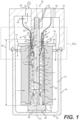
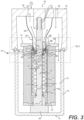
- FIGS. 1 thru 4 illustrate a canister filter system 100, 100' that may use a filter element 200, 200' according to various embodiments of the present disclosure.
- This system may also be referred to as a pulse dampening interface between a filter and a filter base that is configured to mitigate pulses.
- the canister filter system 100, 100' may include having a base 102, a canister 104, and a filter element 200, 200'.
- the canister filter system 100 may be used to filter fluids such as diesel or gasoline or other liquid fuels, lubrication oil, hydraulic fluid for hydraulic power systems, transmission fluid, or even possibly intake air for an engine.
- the canister filter system 100 may also be used as a fuel/water separator filter.
- the canister filter system 100 with the features described herein could be adapted by those of ordinary skill in this art to serve many different purposes and suit many other applications.
- the base 102 includes an inlet channel 106 for fluid to enter into the canister filter system 100, and an outlet channel 108 for fluid to exit from the canister filter system 100.
- the base 102 also includes base threads 110. Other attachment structure than threads may be used.
- the canister 104 includes a top open end 112 and a bottom closed end 114. Adjacent the top open end 112 are bolt threads 116 which can be engaged with base threads 110 to hold the canister 104 to base 102. Threads are one example of engagement structures which may be included on the base 102 and bolt 300, 300' to form a releasable engagement. Other engagement structures may be used as will be recognized by those of ordinary skill in this art.
- the filter element 200, 200' may take many different forms to suit a particular application.
- the filter element 200, 200' is well suited for filtering fuel or lubrication oil.
- the filter element 200, 200' may include annular filter media 202 circumferentially surrounding a central reservoir 204 defined by a center tube 206. Axial ends of annular filter media 202 are shown to be sealed by end caps.
- a top end cap 208 may define an axial open end of filter element 200.
- the top end cap 208 is termed "open” because it includes an opening 210 for allowing passage of fluid to outlet channel 108 from the central reservoir 204 defined by center tube 206.
- the bottom end cap 212 defines an axial closed end of filter element 200.
- the bottom end cap 212 is termed "closed” because it prevents any fluid outside the filter element 200 adjacent the axial end of the annular filter media 202 from flowing unfiltered into center tube 206.
- the bottom end cap 212 may be closed by mating with a housing bolt 300, 300' that in turn mates with the center tube 206. This may not be the case for other embodiments of the present disclosure.
- top end cap 208 and the bottom end cap 212 may each be joined to the center tube 206 via welding, adhesives, etc.
- center tube 206, the top end cap 208, and the bottom end cap 212 may be constructed as unitary components. Other configurations are possible.
- fluid to be filtered enters from the inlet channel 106 and flows to the annular cavity 118 between canister 104 and the annular filter media 202. The fluid then passes into and through filter media 202, then into the center tube 206 through the perforations 214 shown therein in FIGS. 1 and 2 .
- baffles, baffles and valves, etc. may be provided at the top of the canister filter system 100, 100' that will be discussed in detail later herein that prevent provide a similar seal and may also provide a pulsation dampening device according to various embodiments of the present disclosure.
- FIGS. 1 and 2 a canister filter system 100 according to various embodiments of the present disclosure that provides a pulsation dampening device will now be discussed.
- the canister filter system 100 may comprise a filter element 200 that includes at least partially a cylindrical configuration and that defines a longitudinal axis 216, and a radial direction 218.
- the filter element 200 may comprise an annular filter media 202 defining a central passage 219 and a center tube 206 that is disposed in the central passage 219 of the annular filter media 220 that defines a central reservoir 204.
- the annular filter media 202 surrounds the center tube 206, and the central reservoir 204.
- the filter element 200 may further include a top open end 220 joined to the center tube 206 disposed along the longitudinal axis 216.
- the top open end 220 includes an opening 210 that allows fluid to flow from the central reservoir 204 to the outside of the filter element 200.
- the filter element 200 may include a bottom open end 222 joined to the center tube 206 opposite the top open end 220 that is also disposed along the longitudinal axis 216.
- the bottom open end 222 allows insertion of the housing bolt 300.
- the canister filter system 100 may also include a canister 104 that includes a top open end 112 (see FIG. 1 ), and a bottom closed end 114 relative to the longitudinal axis 216 (as previously described herein, see FIGS. 1 and 3 ), and a housing bolt 300 that may penetrates through the bottom closed end 114 of the canister 104 (providing a seal(s)) or side on top of the bottom closed end 114 as shown in FIGS. 1 and 3 .
- This may be referred to as a stud style bolt that rests on the bottom closed end of the canister such that is shoulder portion or its head is trapped between the filter element and the canister, etc.
- a pulsation dampening device 224 may include a first baffle 226 extending from the housing bolt 300, and a second baffle 228 extending either from the base 102 or the filter element 200 that is disposed proximate to the first baffle 226, defining a flow passage 230 with a minimum distance 232 between the first baffle 226 and the second baffle 228.
- the minimum distance 232 ranges from 0.1 mm to 5.0 mm.
- a pressure pulsation(s) 120 downstream from the annular filter media 202 may be greatly reduced before they reach the annular filter media 202. In turn, this might reduce any degradation of the performance of the filter element 200 such as its output to an engine or another downstream device.
- the minimum distance 232 may be varied to achieve the desired effect, and may be different than the range just mentioned in other embodiments of the present disclosure.
- the configurations of the first baffle 226, and the second baffle 228 may be reversed in other embodiments of the present disclosure.
- the first baffle 226 may extend radially outwardly and longitudinally upwardly from the housing bolt 300 past the top open end 220 (e.g. top end cap 208) of the filter element 200.
- the second baffle 228 may be attached to the base 102 and extends longitudinally downwardly and radially inwardly from the base 102 past the top open end 220 (e.g. top end cap 208) of the filter element 200.
- the second baffle 228 may define a S-shaped portion 234.
- a third baffle 236 may extend purely longitudinally from the S-shaped portion 234 of the second baffle 228 to the top open end 220 (e.g. top end cap 208) or to the center tube 206, forming a downward facing V-shaped region 239 with the second baffle 228.
- the first baffle 226 may be disposed between the second baffle 228, and the third baffle 236, defining a serpentine shaped flow passage 230 (may have a consistent minimum distance 232 or not).
- the second baffle may have other configurations such as a straight shape, etc.
- the second baffle 228 and the third baffle 236 may be unitary and may be attached to the filter element 200 so that these baffles contact the base 102.
- Other variations are possible.
- the first baffle 226, the second baffle 228, and the third baffle 236 may all comprise a thermoplastic material (e.g. Polyurethane, nylon, etc.). Other materials such as metal may be used in other embodiments, and the materials of the various baffles may be different from each other, etc.
- the first baffle 226, the second baffle 228, and the third baffle 236 may all have the same thickness 238 (minimum dimension) ranging from 0.1 mm to 45.0 mm in certain embodiments. Other thicknesses and ranges may be used in other embodiments of the present disclosure.
- the first baffle 226, the second baffle 228, and the third baffle 236 may be concentric about the longitudinal axis 216 (e.g. may be geometrically formed by rotating the cross-section shown in FIG. 1 about the longitudinal axis).
- the filter element 200 may concentric with the canister 104, and with the housing bolt 300.
- the housing bolt 300 may be attached to the canister 104 or the base 102, fixing the position of the housing bolt 300 relative to the canister 104 and/or the base 102.
- the filter element 200 may further comprising a housing bolt 300 with a bolt baffle 226' extending radially outwardly and longitudinally upwardly from the housing bolt 300 past the top open end 220 (e.g. top end cap 208) of the filter element 200, terminating at a bolt baffle free end 240 in close but spaced apart relation to the filter element baffle 236', defining a flow passage 230 having a minimum distance 232 between the filter element baffle 236' and the bolt baffle 226'.
- the minimum distance 232 may range from 0.1 mm to 5.0 mm. This distance may be varied as previously described.
- the filter element baffle 236' may be attached to the top open end 220 (e.g. top end cap 208) of the filter element 200, to the center tube 206, or both.
- the bolt baffle 226' may be joined to the housing bolt 300 at a point 242 disposed longitudinally below the top open end 220 (e.g. top end cap 208) of the filter element 200.
- the filter element baffle 236', and the bolt baffle 226' comprise a thermoplastic material, and have the same thickness ranging from 0.1 mm to 54.0 mm.
- Other variations are possible as previously described herein.
- the filter element baffle 236', and the bolt baffle 226' may be concentric about the longitudinal axis 216 (e.g. may be formed by rotating the cross-sectional geometry in FIG. 1 about the longitudinal axis 216).
- the center tube 206 and the housing bolt 300 may be separate components or they may be formed as an unitary component.
- housing bolt 300 will be described in further detail with continued reference to FIGS. 1 and 2 .
- the housing bolt may comprise an at least partially cylindrical body 300 defining a cylindrical axis 302 and a radial direction 304.
- the housing bolt 300 may have a head 306 defining a head diameter 308, and a shaft portion 310 extending axially from the head 306.
- the shaft portion 310 defining a shaft portion diameter 312 that is less than the head diameter 308, forming a support surface 314 configured to contact a portion of the filter element 200.
- a first baffle 226 (as previously discussed herein) may extend from the shaft portion 310. More specifically, the first baffle 226 may extend from the side of the shaft portion 310, axially away from the head 306, and radially away from the shaft portion 310.
- the first baffle 226 may extend from the shaft portion 310 at an attachment point 242 that is spaced axially away from the head 306 an attachment point axial distance 316 ranging from 50% to 100% of the length of the filter.
- the first baffle 226 may define a first baffle thickness 238' ranging from 0.1 mm to 54. 0 mm. Other configurations and dimensional ranges are possible in other embodiments of the present disclosure.
- the first baffle 226 may terminate at a free end 240' that is also spaced axially away from the head 306 a free end axial distance 318 ranging from 50% to 120% of the length of the filter.
- the free end 240' may also being spaced radially away from the shaft portion 310 a free end radial distance 320 ranging from 10% to 98% of the inner diameter of the center tube.
- canister filter system 100' (similar to canister filter system 100) that uses a filter pulsation dampening device 224' according to other embodiments of the present disclosure will now be discussed.
- the filtration pulsation dampening device 224' may include a first baffle 226" extending from the housing bolt 300', and terminating at a first baffle free end 240'', and a flexible valve 244 extending from the filter element 200' that defines a valve free end 246 that is disposed radially inwardly and longitudinally above the first baffle free end 240".
- This construction defines a shut-off gap distance 248 between the first baffle valve free end 240" and the flexible valve 244.
- the shut-off gap distance 248 may range from 0.1 mm to 5.0 mm.
- a pressure pulsation(s) 120 downstream from the annular filter media 202 may be greatly reduced before they reach the annular filter media 202. In turn, this might reduce any degradation of the performance of the filter element 200' such as its output to an engine or another downstream device.
- the shut-off gap distance 248 may be varied to achieve the desired effect to be different than the range just mentioned in other embodiments of the present disclosure.
- the flexible valve 244 opens when there is no pressure pulsation downstream, allowing a normal flow of filtered fluid.
- the flexible valve 244 (e.g. a diaphragm, a flap, etc.) extends radially inwardly and longitudinally downwardly from the center tube 206 or the top open end 220 (e.g. the top end cap 208) of the filter element 200''. In certain embodiments, the flexible valve 244 extends from the center tube 206 and terminates in the central reservoir 204 of the filter element 200'.
- the pulsation dampening device 224' may also have a support baffle 250 extending from either the top open end 220 (e.g. the top end cap 208) or the center tube 206 of the filter element 200' longitudinally below and parallel with the flexible valve 244.
- the first baffle 226'', and the support baffle 250 may comprise the same material (similar to what has been described earlier herein), and may have the same thickness 238''.
- the support baffle 250 terminates at a support baffle free end 252 that is disposed radially outward and longitudinally above the valve free end 246.
- the support baffle 250 may help support the flexible valve 244 so that it does not tear, overly deform, or otherwise become ineffective as the flexible valve 244 opens and closes on the first baffle 226.
- the second baffle 228' may extend all the way from the base 102 or it may be split into two pieces including a bottom piece extending from the top end cap and a top piece extending from the base to the filter element, creating a seal between these components, etc.
- the support baffle and the second baffle may also be integrated into an unitary baffle that extends from the filter element and contacts the base. Other configurations are possible in other embodiments of the present disclosure.
- the second baffle 228' may limit the upward movement of the flexible valve 244 as it opens so that it does not tear, overly deform or otherwise become ineffective as the flexible valve 244 opens and closes.
- the first baffle 226", the second baffle 228', the support baffle 250, and the flexible valve 244 are concentric about the longitudinal axis 216. That is to say, these components may be created by rotating the cross-sectional geometry about the longitudinal axis 216.
- the filter element 200' may be concentric with the canister 104, and with the housing bolt 300'.
- the housing bolt 300' may be attached to the canister 104 or the base 102, fixing the position of the housing bolt 300' relative to the canister 104 and/or the base 102.
- Other constructions are possible in other embodiments of the present disclosure.
- the filter element 200' includes a filter pulsation dampening device 224' having a flexible valve 244 that defines a valve free end 246 that is disposed in the central reservoir 204 of the center tube 206.
- the flexible valve 246 extends radially inwardly and longitudinally downwardly from the center tube 206 or the top open end 220 (e.g. the top end cap 208) of the filter element 200'. As shown in FIGS. 3 and 4 , the flexible valve 246 actually extends from the center tube 206 in the embodiment shown.
- the pulsation dampening device 224' may include a radially outer baffle 256 extending from the center tube 206 that is disposed longitudinally below the flexible valve 244.
- the radially outer baffle 256 extends longitudinally downwardly and radially inwardly from the center tube 206.
- the radially outer baffle 256 terminates at an outer baffle free end 258 that is spaced longitudinally above and radially outwardly away from the valve free end 246.
- the radially outer baffle 256 may comprise a thermoplastic material or other suitable material as discussed earlier herein.
- the radially outer baffle 256 has an outer baffle thickness 260 ranging from 0.1 mm to 5.0 mm.
- the flexible valve 244 may comprise a rubber material or other suitable material.
- the flexible valve 244 has a valve thickness 262 ranging from 0.01 mm to 5.0 mm (may be made from an elastomer such as used in seals, and the range may be more particularly from 0.1 mm to 5.0 mm, etc.). These dimensional ranges may be different in other embodiments of the present disclosure.
- the flexible valve 244 and the radially inner baffle 256 may be concentric about the longitudinal axis 216 as previously alluded to herein. This may not be the case for other embodiments.
- the housing bolt 300' may have a radially inner baffle 322 extending longitudinally upwardly and radially outwardly from housing bolt 300', terminating at an inner baffle free end 324.
- the inner baffle free end 324 may be disposed radially outward and longitudinally below the valve free end 246, defining a gap 264 with a minimum gap distance 266 from ranging 0 mm to 10.0 mm. The range for this distance may be different in other embodiments of the present disclosure.
- the housing bolt 300' may be similarly constructed as discussed earlier herein with respect to FIG. 1 .
- the housing bolt 300' may include a first baffle 226" extending from the shaft portion 310.
- the first baffle 226'' may extend axially away from the head 306, and radially away from the shaft portion 310.
- first baffle 226'' may extend from the shaft portion 310 at an attachment point 242' that is spaced axially away from the head 306 an attachment point axial distance 316' ranging from 50% to 100% of the length of the filter, and the first baffle 226'' defines a first baffle thickness 238' ranging from 0.1 mm to 5.0 mm. These dimensional ranges may be different in other embodiments of the present disclosure.
- first baffle 226'' may terminate at a free end 240''' that is spaced axially away from the head 306 a free end axial distance 318' ranging from 5.0 mm to 15.0 mm.
- the free end 240''' may also be spaced radially away from the shaft portion 310 a free end radial distance 320' ranging from 5.0 mm to 15.0 mm.
- a filter element, a housing bolt, or a canister filter system may be obtained or provided in an OEM (original equipment manufacturer) or aftermarket context according to various embodiments of the present disclosure.
- the center tube and the housing bolt may be made from any suitable material including plastic, metal, etc. It may be desirable to choose materials that are chemically compatible with the fluids being filtered.
- Various parameters may be measured to determine the efficacy of any of the embodiments discussed herein for a particular application.
- the magnitude of the pressure pulsation 120 may be monitored, the pressure and the flow rate of the outgoing fluid may be monitored.
- base line pressures of the pressure pulses may be monitored, and the pressure of the fluid may be measured. So, the pressure drop of the fluid may be determined as well as the flow rate as a function opposing pressure pulsations.
- the geometry of the pulsation dampening mechanism may be adjusted to achieve the desired outgoing fluid flow and/or the desired pulsation pressure exerted on the filter media, etc.
- these parameters may determined and the geometry of the pulsation dampening device tailored using FEA (finite element analysis). Only the central reservoir, the outlet and any areas in fluid communication between these areas (defined by the baffles) may need to be modeled.
- FEA finite element analysis
Landscapes
- Engineering & Computer Science (AREA)
- Chemical & Material Sciences (AREA)
- General Engineering & Computer Science (AREA)
- Mechanical Engineering (AREA)
- Chemical Kinetics & Catalysis (AREA)
- Combustion & Propulsion (AREA)
- Pipe Accessories (AREA)
- Filtration Of Liquid (AREA)
- Lubrication Details And Ventilation Of Internal Combustion Engines (AREA)
- Check Valves (AREA)
- Rotary Presses (AREA)
- Confectionery (AREA)
Description
- The present disclosure relates generally to canister style filter systems that employ a replaceable filter element. More specifically, the present disclosure relates to a filter element that includes a positioning and sealing feature for positioning the filter element axially and radially in a desired position while providing a seal that helps to ensure that dirty fluid is filtered by the filtering medium of the filter element.
- Liquid filter systems are known for filter various fluids such as gas, oil, diesel fuel, etc. to remove contaminants from these fluids. In some cases, the filter is in fluid communication with pumps, engines, or other similar devices that may create pulses in the fluid to be filtered that may reach the filter. It has been shown that pressure pulses can reduce the efficiency of filters in actual use depending on the environment in which the filters operate.
-
U.S. Pat. No. 8,479,712 discloses a pulsation reducing apparatus that includes a piston that is displaced in a valve chamber due to an increase in a fuel pressure in an upstream fuel passage caused by a pressure pulse. The fluid communication between the valve chamber and a downstream fuel passage is blocked, and fluid communication between the valve chamber and a return passage is unblocked, allowing a bypass flow of fluid. The pressure pulse is thus conducted into the return passage and dampened by a pulsation reducing mechanism including a plurality of flow restricting orifices. The fuel, once it has passed through the orifices, is returned to the upstream fuel passage through the return passage. - As can be seen, the '712 patent requires an extra mechanism outside of the filter to provide pressure pulse protection. This extra mechanism increases the overall cost of the system and may need maintenance itself.
EP 0 290 787 A1 ,US 2003/010687 A1 ,US 2018/333665 A1 ,US 2016/201692 A1 andUS 5 411 376 A show other relevant prior art documents. - Accordingly, it desirable to develop a pressure pulse protection mechanism that is less complicated, less costly, and easier to maintain.
- According to an embodiment of the present disclosure, there is provided a pulse dampening interface between a filter and a filter base configured to mitigate pulses, the interface comprising: a housing bolt; a base; and a replaceable filter element that includes at least a partially cylindrical configuration and that defines a longitudinal axis, and a radial direction. The filter element comprises an annular filter media defining a central passage, a center tube that is disposed in the central passage of the annular filter media that defines a central reservoir, and the annular filter media surrounds the center tube and the central reservoir, a top open end joined to the center tube disposed along the longitudinal axis, the top open end including an opening allowing fluid to flow from the central reservoir to the outside of the filter element, a bottom open end joined to the center tube opposite the top open end disposed along the longitudinal axis; and a filter pulsation dampening device. The filter pulsation dampening device includes a flexible valve that defines a valve free end that is disposed in the central reservoir of the center tube; a first baffle extending from the housing bolt and terminating at a first baffle free end and the flexible valve of the filter element which is disposed radially inwardly and longitudinally above the first baffle free end, defining a shut-off gap distance between the first baffle valve free end and the flexible valve, wherein the flexible valve opens and closes on the first baffle and opens when there is no pressure pulsation downstream, allowing a normal flow of filtered fluid.
-
-
FIG. 1 is a front sectional view of a filter assembly of showing a filtration pulsation dampening device using small passages and baffles to keep pressure pulses from getting to the filter element according to an embodiment of the present disclosure. -
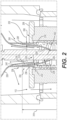
FIG. 2 is an enlarged detail view of the filtration pulsation dampening device of the filter assemblyFIG. 1 . -
FIG. 3 is a front sectional view of a filter assembly of showing a filtration pulsation dampening device using a rubber valve to keep pressure pulses from getting to the filter element according to another embodiment of the present disclosure. -
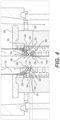
FIG. 4 is an enlarged detail view of the filtration pulsation dampening device of the filter assemblyFIG. 3 . - Reference will now be made in detail to embodiments of the disclosure, examples of which are illustrated in the accompanying drawings. Wherever possible, the same reference numbers will be used throughout the drawings to refer to the same or like parts. In some cases, a reference number will be indicated in this specification and the drawings will show the reference number followed by a letter for example, 100a, 100b or a prime indicator such as 100', 100" etc. It is to be understood that the use of letters or primes immediately after a reference number indicates that these features are similarly shaped and have similar function as is often the case when geometry is mirrored about a plane of symmetry. For ease of explanation in this specification, letters or primes will often not be included herein but may be shown in the drawings to indicate duplications of features discussed within this written specification.
- First, a filter system will now be described to give the reader the proper context for understanding how various embodiments of the present disclosure are used. It is to be understood that this description is given as exemplary and not in any limiting sense. Any embodiment of an apparatus or method described herein may be used in conjunction with any filter system.
- Then, a filter element that may include a pulsation dampening device according to various embodiments will be discussed. The device may include an assortment of baffles, baffles and/or valves, etc. that are attached to various components of the filter element, the center tube, the top end cap, the base, etc.
-
FIGS. 1 thru 4 illustrate acanister filter system 100, 100' that may use afilter element 200, 200' according to various embodiments of the present disclosure. This system may also be referred to as a pulse dampening interface between a filter and a filter base that is configured to mitigate pulses. - Starting with
FIGS. 1 and3 , thecanister filter system 100, 100' may include having abase 102, acanister 104, and afilter element 200, 200'. Thecanister filter system 100 may be used to filter fluids such as diesel or gasoline or other liquid fuels, lubrication oil, hydraulic fluid for hydraulic power systems, transmission fluid, or even possibly intake air for an engine. Thecanister filter system 100 may also be used as a fuel/water separator filter. Thecanister filter system 100 with the features described herein could be adapted by those of ordinary skill in this art to serve many different purposes and suit many other applications. - The
base 102 includes aninlet channel 106 for fluid to enter into thecanister filter system 100, and anoutlet channel 108 for fluid to exit from thecanister filter system 100. Thebase 102 also includesbase threads 110. Other attachment structure than threads may be used. - The
canister 104 includes a topopen end 112 and a bottom closedend 114. Adjacent the topopen end 112 arebolt threads 116 which can be engaged withbase threads 110 to hold thecanister 104 tobase 102. Threads are one example of engagement structures which may be included on thebase 102 andbolt 300, 300' to form a releasable engagement. Other engagement structures may be used as will be recognized by those of ordinary skill in this art. - The
filter element 200, 200' may take many different forms to suit a particular application. In the illustrated embodiment, thefilter element 200, 200' is well suited for filtering fuel or lubrication oil. Thefilter element 200, 200' may includeannular filter media 202 circumferentially surrounding acentral reservoir 204 defined by a center tube 206. Axial ends ofannular filter media 202 are shown to be sealed by end caps. - A
top end cap 208 may define an axial open end offilter element 200. Thetop end cap 208 is termed "open" because it includes anopening 210 for allowing passage of fluid tooutlet channel 108 from thecentral reservoir 204 defined by center tube 206. - On the other hand, the
bottom end cap 212 defines an axial closed end offilter element 200. Thebottom end cap 212 is termed "closed" because it prevents any fluid outside thefilter element 200 adjacent the axial end of theannular filter media 202 from flowing unfiltered into center tube 206. Thebottom end cap 212 may be closed by mating with ahousing bolt 300, 300' that in turn mates with the center tube 206. This may not be the case for other embodiments of the present disclosure. - The
top end cap 208 and thebottom end cap 212 may each be joined to the center tube 206 via welding, adhesives, etc. Alternatively, several or all of center tube 206, thetop end cap 208, and thebottom end cap 212 may be constructed as unitary components. Other configurations are possible. - In operation, fluid to be filtered enters from the
inlet channel 106 and flows to theannular cavity 118 betweencanister 104 and theannular filter media 202. The fluid then passes into and throughfilter media 202, then into the center tube 206 through theperforations 214 shown therein inFIGS. 1 and2 . - Then, the fluid exits center tube 206 through the
top end cap 208 and opening 210 into theoutlet channel 108. The sealed construction at the bottom of thefilter element 200, 200' helps to define the fluid channels into and out of theannular filter media 202, preventing any fluid from flowing directly tooutlet channel 108 and bypassing theannular filter media 202. To the same end, baffles, baffles and valves, etc. may be provided at the top of thecanister filter system 100, 100' that will be discussed in detail later herein that prevent provide a similar seal and may also provide a pulsation dampening device according to various embodiments of the present disclosure. - Referring now to
FIGS. 1 and2 , acanister filter system 100 according to various embodiments of the present disclosure that provides a pulsation dampening device will now be discussed. - The
canister filter system 100 may comprise afilter element 200 that includes at least partially a cylindrical configuration and that defines alongitudinal axis 216, and a radial direction 218. Thefilter element 200 may comprise anannular filter media 202 defining acentral passage 219 and a center tube 206 that is disposed in thecentral passage 219 of theannular filter media 220 that defines acentral reservoir 204. Thus, theannular filter media 202 surrounds the center tube 206, and thecentral reservoir 204. - As best seen in
FIG. 1 , thefilter element 200 may further include a topopen end 220 joined to the center tube 206 disposed along thelongitudinal axis 216. The topopen end 220 includes anopening 210 that allows fluid to flow from thecentral reservoir 204 to the outside of thefilter element 200. - Similarly, referring again to
FIG. 1 , thefilter element 200 may include a bottomopen end 222 joined to the center tube 206 opposite the topopen end 220 that is also disposed along thelongitudinal axis 216. Thus the bottomopen end 222 allows insertion of thehousing bolt 300. - The
canister filter system 100 may also include acanister 104 that includes a top open end 112 (seeFIG. 1 ), and a bottomclosed end 114 relative to the longitudinal axis 216 (as previously described herein, seeFIGS. 1 and3 ), and ahousing bolt 300 that may penetrates through the bottomclosed end 114 of the canister 104 (providing a seal(s)) or side on top of the bottomclosed end 114 as shown inFIGS. 1 and3 . This may be referred to as a stud style bolt that rests on the bottom closed end of the canister such that is shoulder portion or its head is trapped between the filter element and the canister, etc. - Looking at
FIGS. 1 and2 , apulsation dampening device 224 may include afirst baffle 226 extending from thehousing bolt 300, and asecond baffle 228 extending either from the base 102 or thefilter element 200 that is disposed proximate to thefirst baffle 226, defining aflow passage 230 with aminimum distance 232 between thefirst baffle 226 and thesecond baffle 228. In certain embodiments of the present disclosure, theminimum distance 232 ranges from 0.1 mm to 5.0 mm. - As a result of this construction, a pressure pulsation(s) 120 downstream from the
annular filter media 202 may be greatly reduced before they reach theannular filter media 202. In turn, this might reduce any degradation of the performance of thefilter element 200 such as its output to an engine or another downstream device. Theminimum distance 232 may be varied to achieve the desired effect, and may be different than the range just mentioned in other embodiments of the present disclosure. As will be described momentarily, the configurations of thefirst baffle 226, and thesecond baffle 228 may be reversed in other embodiments of the present disclosure. - As shown in
FIGS. 1 and2 , thefirst baffle 226 may extend radially outwardly and longitudinally upwardly from thehousing bolt 300 past the top open end 220 (e.g. top end cap 208) of thefilter element 200. Thesecond baffle 228 may be attached to thebase 102 and extends longitudinally downwardly and radially inwardly from the base 102 past the top open end 220 (e.g. top end cap 208) of thefilter element 200. - The
second baffle 228 may define a S-shapedportion 234. Athird baffle 236 may extend purely longitudinally from the S-shapedportion 234 of thesecond baffle 228 to the top open end 220 (e.g. top end cap 208) or to the center tube 206, forming a downward facing V-shapedregion 239 with thesecond baffle 228. Thefirst baffle 226 may be disposed between thesecond baffle 228, and thethird baffle 236, defining a serpentine shaped flow passage 230 (may have a consistentminimum distance 232 or not). Other configurations are possible in other embodiments. For example, the second baffle may have other configurations such as a straight shape, etc. - In some embodiments of present disclosure, such as shown in
FIG. 1 , thesecond baffle 228 is attached to thebase 102, thefirst baffle 226 is attached to thehousing bolt 300, and thethird baffle 236 is attached to the filter element 200 (thethird baffle 236 may be attached to the top open end 220 (e.g. the top end cap 208) or to the center tube 206, etc.). During assembly, thehousing bolt 300 may be attached tocanister 104 and thefilter element 200, forming a subassembly. Then, thecanister 104, thefilter element 200, and thehousing bolt 300 are attached to thebase 102. Thethird baffle 236 then contacts thesecond baffle 228, forming a seal therebetween, and thesecond baffle 228 fits between thefirst baffle 226, and thesecond baffle 228 to form theserpentine flow passage 230. - In other embodiments, the
second baffle 228 and thethird baffle 236 may be unitary and may be attached to thefilter element 200 so that these baffles contact thebase 102. Other variations are possible. - The
first baffle 226, thesecond baffle 228, and thethird baffle 236 may all comprise a thermoplastic material (e.g. Polyurethane, nylon, etc.). Other materials such as metal may be used in other embodiments, and the materials of the various baffles may be different from each other, etc. Thefirst baffle 226, thesecond baffle 228, and thethird baffle 236 may all have the same thickness 238 (minimum dimension) ranging from 0.1 mm to 45.0 mm in certain embodiments. Other thicknesses and ranges may be used in other embodiments of the present disclosure. - The
first baffle 226, thesecond baffle 228, and thethird baffle 236 may be concentric about the longitudinal axis 216 (e.g. may be geometrically formed by rotating the cross-section shown inFIG. 1 about the longitudinal axis). Similarly, thefilter element 200 may concentric with thecanister 104, and with thehousing bolt 300. Other configurations are possible in other embodiments of the present disclosure. Thehousing bolt 300 may be attached to thecanister 104 or thebase 102, fixing the position of thehousing bolt 300 relative to thecanister 104 and/or thebase 102. - A
filter element 200 that may be provided as a replacement part according to an embodiment of the present disclosure that may be used with thecanister filter system 100 just described will now be discussed with reference toFIGS. 1 and2 . Thefilter element 200 may include a filterpulsation dampening device 224 that has a filter element baffle 236' extending longitudinally upwardly from the top open end 220 (e.g. top end cap 208) or from the center tube 206 of thefilter element 200. - The
filter element 200 may further comprising ahousing bolt 300 with a bolt baffle 226' extending radially outwardly and longitudinally upwardly from thehousing bolt 300 past the top open end 220 (e.g. top end cap 208) of thefilter element 200, terminating at a bolt bafflefree end 240 in close but spaced apart relation to the filter element baffle 236', defining aflow passage 230 having aminimum distance 232 between the filter element baffle 236' and the bolt baffle 226'. Theminimum distance 232 may range from 0.1 mm to 5.0 mm. This distance may be varied as previously described. - In the embodiment shown in
FIGS. 1 and2 , the filter element baffle 236' may be attached to the top open end 220 (e.g. top end cap 208) of thefilter element 200, to the center tube 206, or both. The bolt baffle 226' may be joined to thehousing bolt 300 at apoint 242 disposed longitudinally below the top open end 220 (e.g. top end cap 208) of thefilter element 200. - As alluded to earlier herein, the filter element baffle 236', and the bolt baffle 226' comprise a thermoplastic material, and have the same thickness ranging from 0.1 mm to 54.0 mm. Other variations are possible as previously described herein.
- Similarly, the filter element baffle 236', and the bolt baffle 226' may be concentric about the longitudinal axis 216 (e.g. may be formed by rotating the cross-sectional geometry in
FIG. 1 about the longitudinal axis 216). - The center tube 206 and the
housing bolt 300 may be separate components or they may be formed as an unitary component. - Next, the
housing bolt 300 will be described in further detail with continued reference toFIGS. 1 and2 . - The housing bolt may comprise an at least partially
cylindrical body 300 defining acylindrical axis 302 and a radial direction 304. Thehousing bolt 300 may have ahead 306 defining ahead diameter 308, and a shaft portion 310 extending axially from thehead 306. The shaft portion 310 defining a shaft portion diameter 312 that is less than thehead diameter 308, forming a support surface 314 configured to contact a portion of thefilter element 200. A first baffle 226 (as previously discussed herein) may extend from the shaft portion 310. More specifically, thefirst baffle 226 may extend from the side of the shaft portion 310, axially away from thehead 306, and radially away from the shaft portion 310. - The
first baffle 226 may extend from the shaft portion 310 at anattachment point 242 that is spaced axially away from thehead 306 an attachment pointaxial distance 316 ranging from 50% to 100% of the length of the filter. Thefirst baffle 226 may define a first baffle thickness 238' ranging from 0.1 mm to 54. 0 mm. Other configurations and dimensional ranges are possible in other embodiments of the present disclosure. - The
first baffle 226 may terminate at a free end 240' that is also spaced axially away from the head 306 a free endaxial distance 318 ranging from 50% to 120% of the length of the filter. The free end 240' may also being spaced radially away from the shaft portion 310 a freeend radial distance 320 ranging from 10% to 98% of the inner diameter of the center tube. Again, other configurations and dimensional ranges are possible in other embodiments of the present disclosure. - Referring now to
FIGS. 3 and4 , canister filter system 100' (similar to canister filter system 100) that uses a filterpulsation dampening device 224' according to other embodiments of the present disclosure will now be discussed. - The filtration
pulsation dampening device 224' may include afirst baffle 226" extending from the housing bolt 300', and terminating at a first baffle free end 240'', and aflexible valve 244 extending from the filter element 200' that defines a valvefree end 246 that is disposed radially inwardly and longitudinally above the first bafflefree end 240". This construction defines a shut-offgap distance 248 between the first baffle valvefree end 240" and theflexible valve 244. The shut-offgap distance 248 may range from 0.1 mm to 5.0 mm. - As a result of this construction, a pressure pulsation(s) 120 downstream from the
annular filter media 202 may be greatly reduced before they reach theannular filter media 202. In turn, this might reduce any degradation of the performance of the filter element 200' such as its output to an engine or another downstream device. The shut-offgap distance 248 may be varied to achieve the desired effect to be different than the range just mentioned in other embodiments of the present disclosure. Theflexible valve 244 opens when there is no pressure pulsation downstream, allowing a normal flow of filtered fluid. - This arrangement of the flexible valve and the first baffle may be reversed in other embodiments of the present disclosure. In
FIGS. 3 and4 , the flexible valve 244 (e.g. a diaphragm, a flap, etc.) extends radially inwardly and longitudinally downwardly from the center tube 206 or the top open end 220 (e.g. the top end cap 208) of the filter element 200''. In certain embodiments, theflexible valve 244 extends from the center tube 206 and terminates in thecentral reservoir 204 of the filter element 200'. - The
pulsation dampening device 224' may also have asupport baffle 250 extending from either the top open end 220 (e.g. the top end cap 208) or the center tube 206 of the filter element 200' longitudinally below and parallel with theflexible valve 244. - The first baffle 226'', and the
support baffle 250 may comprise the same material (similar to what has been described earlier herein), and may have the same thickness 238''. Thesupport baffle 250 terminates at a support bafflefree end 252 that is disposed radially outward and longitudinally above the valvefree end 246. Thesupport baffle 250 may help support theflexible valve 244 so that it does not tear, overly deform, or otherwise become ineffective as theflexible valve 244 opens and closes on thefirst baffle 226. - A second baffle 228' including a serpentine shape (e.g. a S-shaped curve, undulating curve, etc.) that extends longitudinally below the top open end 220 (e.g. the top end cap 208) of the filter element 200', terminating in a second baffle
free end 254 that is disposed longitudinally above the valvefree end 246. The second baffle 228' may extend all the way from the base 102 or it may be split into two pieces including a bottom piece extending from the top end cap and a top piece extending from the base to the filter element, creating a seal between these components, etc. The support baffle and the second baffle may also be integrated into an unitary baffle that extends from the filter element and contacts the base. Other configurations are possible in other embodiments of the present disclosure. - The second baffle 228' may limit the upward movement of the
flexible valve 244 as it opens so that it does not tear, overly deform or otherwise become ineffective as theflexible valve 244 opens and closes. - Similar to what has been previously described herein, the
first baffle 226", the second baffle 228', thesupport baffle 250, and theflexible valve 244 are concentric about thelongitudinal axis 216. That is to say, these components may be created by rotating the cross-sectional geometry about thelongitudinal axis 216. Likewise, the filter element 200' may be concentric with thecanister 104, and with the housing bolt 300'. The housing bolt 300' may be attached to thecanister 104 or thebase 102, fixing the position of the housing bolt 300' relative to thecanister 104 and/or thebase 102. Other constructions are possible in other embodiments of the present disclosure. - Now, a filter element 200' that may be provided as a replacement part according to an embodiment of the present disclosure that may be used with the canister filter system 100' just described will now be discussed with reference to
FIGS. 3 and4 . The filter element 200' includes a filterpulsation dampening device 224' having aflexible valve 244 that defines a valvefree end 246 that is disposed in thecentral reservoir 204 of the center tube 206. Theflexible valve 246 extends radially inwardly and longitudinally downwardly from the center tube 206 or the top open end 220 (e.g. the top end cap 208) of the filter element 200'. As shown inFIGS. 3 and4 , theflexible valve 246 actually extends from the center tube 206 in the embodiment shown. - The
pulsation dampening device 224' may include a radiallyouter baffle 256 extending from the center tube 206 that is disposed longitudinally below theflexible valve 244. The radiallyouter baffle 256 extends longitudinally downwardly and radially inwardly from the center tube 206. The radiallyouter baffle 256 terminates at an outer bafflefree end 258 that is spaced longitudinally above and radially outwardly away from the valvefree end 246. - The radially
outer baffle 256 may comprise a thermoplastic material or other suitable material as discussed earlier herein. The radiallyouter baffle 256 has anouter baffle thickness 260 ranging from 0.1 mm to 5.0 mm. Theflexible valve 244 may comprise a rubber material or other suitable material. Theflexible valve 244 has avalve thickness 262 ranging from 0.01 mm to 5.0 mm (may be made from an elastomer such as used in seals, and the range may be more particularly from 0.1 mm to 5.0 mm, etc.). These dimensional ranges may be different in other embodiments of the present disclosure. - The
flexible valve 244 and the radiallyinner baffle 256 may be concentric about thelongitudinal axis 216 as previously alluded to herein. This may not be the case for other embodiments. - The housing bolt 300' may have a radially
inner baffle 322 extending longitudinally upwardly and radially outwardly from housing bolt 300', terminating at an inner bafflefree end 324. The inner bafflefree end 324 may be disposed radially outward and longitudinally below the valvefree end 246, defining a gap 264 with aminimum gap distance 266 from ranging 0 mm to 10.0 mm. The range for this distance may be different in other embodiments of the present disclosure. - Next, the housing bolt 300' will be described in further detail with continued reference to
FIGS. 3 and4 . The housing bolt 300' may be similarly constructed as discussed earlier herein with respect toFIG. 1 . Furthermore, the housing bolt 300' may include afirst baffle 226" extending from the shaft portion 310. The first baffle 226'' may extend axially away from thehead 306, and radially away from the shaft portion 310. - More specifically, the first baffle 226'' may extend from the shaft portion 310 at an attachment point 242' that is spaced axially away from the
head 306 an attachment point axial distance 316' ranging from 50% to 100% of the length of the filter, and the first baffle 226'' defines a first baffle thickness 238' ranging from 0.1 mm to 5.0 mm. These dimensional ranges may be different in other embodiments of the present disclosure. - Also, the first baffle 226'' may terminate at a free end 240''' that is spaced axially away from the head 306 a free end
axial distance 318' ranging from 5.0 mm to 15.0 mm. The free end 240''' may also be spaced radially away from the shaft portion 310 a free end radial distance 320' ranging from 5.0 mm to 15.0 mm. - Any of the aforementioned dimensions and configurations may be different than what has been specifically set forth herein. Moreover, the materials of the various components discussed above may be different than those specifically mentioned.
- In practice, a filter element, a housing bolt, or a canister filter system may be obtained or provided in an OEM (original equipment manufacturer) or aftermarket context according to various embodiments of the present disclosure.
- The center tube and the housing bolt may be made from any suitable material including plastic, metal, etc. It may be desirable to choose materials that are chemically compatible with the fluids being filtered.
- Various parameters may be measured to determine the efficacy of any of the embodiments discussed herein for a particular application. For example, at point A in
FIGS. 1 and3 , the magnitude of thepressure pulsation 120 may be monitored, the pressure and the flow rate of the outgoing fluid may be monitored. Also, at point B inFIGS. 1 and3 , base line pressures of the pressure pulses may be monitored, and the pressure of the fluid may be measured. So, the pressure drop of the fluid may be determined as well as the flow rate as a function opposing pressure pulsations. The geometry of the pulsation dampening mechanism may be adjusted to achieve the desired outgoing fluid flow and/or the desired pulsation pressure exerted on the filter media, etc. - In addition to or in lieu off actual testing, these parameters may determined and the geometry of the pulsation dampening device tailored using FEA (finite element analysis). Only the central reservoir, the outlet and any areas in fluid communication between these areas (defined by the baffles) may need to be modeled.
Claims (8)
- A pulse dampening interface between a filter and a filter base configured to mitigate pulses, the interface comprising:a housing bolt (300');a base (102);and a replaceable filter element (200') that includes at least a partially cylindrical configuration and that defines a longitudinal axis (216), and a radial direction (218), the filter element (200') comprising:an annular filter media (202) defining a central passage (219);a center tube (206) that is disposed in the central passage (219) of the annular filter media (202) that defines a central reservoir (204), and the annular filter media (202) surrounds the center tube (206) and the central reservoir (204);a top open end (220) joined to the center tube (206) disposed along the longitudinal axis (216), the top open end (220) including an opening (210) allowing fluid to flow from the central reservoir (204) to the outside of the filter element (200');a bottom open end (222) joined to the center tube (206) opposite the top open end (220) disposed along the longitudinal axis (216); anda filter pulsation dampening devicecharacterised in that the filter pulsation dampening device including a movable flexible valve (244) extending from the filter element (200') having a valve free end (246) that is disposed in the central reservoir (204) of the center tube (206);a first baffle (226") extending from the housing bolt (300') and terminating at a first baffle free end (240") and the flexible valve (244) of the filter element (200') which is disposed radially inwardly and longitudinally above the first baffle free end (240''), defining a shut-off gap distance (248) between the first baffle valve free end (246) and the flexible valve (244), wherein the flexible valve (244) opens and closes on the first baffle (226") and opens when there is no pressure pulsation downstream, allowing a normal flow of filtered fluid.
- The pulse dampening interface of claim 1 wherein the flexible valve (244) extends radially inwardly and longitudinally downwardly from the center tube (206) or the top open end (220) of the filter element (200').
- The pulse dampening interface of claim 2 wherein the flexible valve (244) extends from the center tube (206).
- The pulse dampening interface of claim 3 further comprising a radially outer baffle (256) extending from the center tube (206) that is disposed longitudinally below the flexible valve (244).
- The pulse dampening interface of claim 4 wherein the radially outer baffle (256) extends longitudinally downwardly and radially inwardly from the center tube (206), the radially outer baffle (256) terminating at an outer baffle free end (258) that is spaced longitudinally below and radially outwardly away from the valve free end (246); and
the radially outer baffle (256) comprises a thermoplastic material, the flexible valve (244) comprises an elastomer material, the radially outer baffle (256) has a outer baffle thickness (260) ranging from 0.1 mm to 5.0 mm. - The pulse dampening interface of claim 5 further including a housing bolt (300') that further comprises a radially inner baffle (322) extending longitudinally upwardly and radially outwardly from housing bolt (300'), terminating at a inner baffle free end (324) disposed radially outward and longitudinally below the valve free end (246), defining a gap (264) with a minimum gap distance (266) from ranging 0 mm to 10.0 mm.
- The pulse dampening interface of claim 1 wherein the shut-off gap distance (248) ranges from 0.1 mm to 5.0 mm.
- The pulse dampening interface of claim 1 further comprising:a support baffle (250) extending from either the top open end (220) or the center tube (206) of the filter element (200') longitudinally below flexible valve (244), and the support baffle (250) terminates at a support baffle free end (252) that is disposed radially outward and longitudinally below the valve free end (246); anda second baffle (228') including a serpentine shape that extends longitudinally below the top open end (220) of the filter element (200'), terminating in a second baffle free end (254) that is disposed longitudinally above the valve free end (246).
Applications Claiming Priority (2)
| Application Number | Priority Date | Filing Date | Title |
|---|---|---|---|
| US16/682,650 US11130082B2 (en) | 2019-11-13 | 2019-11-13 | Filter pulsation dampening device |
| PCT/US2020/054997 WO2021096621A1 (en) | 2019-11-13 | 2020-10-09 | Filter dampening device for pressure pulsation |
Publications (2)
| Publication Number | Publication Date |
|---|---|
| EP4058174A1 EP4058174A1 (en) | 2022-09-21 |
| EP4058174B1 true EP4058174B1 (en) | 2025-03-26 |
Family
ID=73020325
Family Applications (1)
| Application Number | Title | Priority Date | Filing Date |
|---|---|---|---|
| EP20797640.8A Active EP4058174B1 (en) | 2019-11-13 | 2020-10-09 | Filter dampening device for pressure pulsation |
Country Status (11)
| Country | Link |
|---|---|
| US (1) | US11130082B2 (en) |
| EP (1) | EP4058174B1 (en) |
| JP (1) | JP7553558B2 (en) |
| CN (1) | CN114728222B (en) |
| AU (1) | AU2020382734B2 (en) |
| CA (1) | CA3157103A1 (en) |
| CL (2) | CL2022001253A1 (en) |
| MX (1) | MX2022005690A (en) |
| PE (1) | PE20221002A1 (en) |
| WO (1) | WO2021096621A1 (en) |
| ZA (1) | ZA202205280B (en) |
Family Cites Families (23)
| Publication number | Priority date | Publication date | Assignee | Title |
|---|---|---|---|---|
| GB591599A (en) * | 1943-12-17 | 1947-08-22 | Bendix Aviat Corp | Improvements in pressure responsive apparatus for operating valves and other controldevices |
| DE2905918C2 (en) * | 1979-02-16 | 1987-02-26 | Robert Bosch Gmbh, 7000 Stuttgart | Liquid filter |
| DE3715581A1 (en) * | 1987-05-09 | 1988-11-17 | Bosch Gmbh Robert | DAMPER ELEMENT FOR PULSATING LIQUID FLOWS |
| JPH02223664A (en) * | 1989-02-23 | 1990-09-06 | Japan Electron Control Syst Co Ltd | fuel injector |
| US5395518A (en) | 1993-08-31 | 1995-03-07 | Donaldson Company, Inc. | High pressure filter with integral relief valve |
| US5411376A (en) | 1993-12-15 | 1995-05-02 | Walbro Corporation | Fuel pump with noise suppression |
| JPH07243575A (en) * | 1994-03-03 | 1995-09-19 | Hitachi Cable Ltd | High pressure hose for power steering |
| JP2929424B2 (en) * | 1994-12-26 | 1999-08-03 | 明禹 全 | Fluid filtration device |
| DE19536084A1 (en) * | 1995-09-28 | 1997-04-03 | Bosch Gmbh Robert | Liquid filter with built-in pressure regulator |
| GB2308986B (en) | 1996-01-11 | 1999-06-09 | Glacier Metal Co Ltd | Fluid filter assembly |
| US6555000B2 (en) * | 1999-12-03 | 2003-04-29 | Parker-Hannifin Corporation | Fuel filter with bypass valve |
| DE10025484A1 (en) | 2000-05-23 | 2001-11-29 | Mahle Filtersysteme Gmbh | Fuel filter for an internal combustion engine |
| US20050161378A1 (en) * | 2004-01-23 | 2005-07-28 | Cline L. S. | Two piece elastomer relief and anti-drain back valves for filter |
| DE202005007871U1 (en) * | 2005-05-13 | 2006-09-21 | Mann + Hummel Gmbh | Filter device, in particular for liquid filtration in internal combustion engines |
| US8211302B2 (en) | 2008-09-30 | 2012-07-03 | Caterpillar Inc. | Filter assembly |
| JP4803269B2 (en) | 2009-02-24 | 2011-10-26 | 株式会社デンソー | Pulsation reduction device |
| JP6056719B2 (en) | 2013-09-17 | 2017-01-11 | 株式会社デンソー | Fuel pump |
| DE102015103662A1 (en) * | 2015-03-12 | 2016-09-15 | Hengst Se & Co. Kg | Filter with a filter bypass valve and filter cartridge for it |
| US10272372B2 (en) * | 2015-12-16 | 2019-04-30 | Caterpillar Inc. | Filter system using a self-venting drain |
| FR3047183B1 (en) * | 2016-01-29 | 2020-11-13 | Sogefi Filtration France | FUEL FILTER AND MOUNTING BRACKET WHOSE OUTLET IS CLOSED BY A VALVE IN THE EVENT OF REMOVING A FILTER INSERT |
| CN107061084A (en) | 2016-12-28 | 2017-08-18 | 蚌埠国威滤清器有限公司 | Filter structure of two-way heat power expansion |
| DE102018110317A1 (en) | 2017-05-18 | 2018-11-22 | Mann+Hummel Gmbh | Filter system with a filter element |
| IT201700119893A1 (en) | 2017-10-23 | 2019-04-23 | Ufi Innovation Ct Srl | ASSEMBLY OF FILTRATION OF AN AQUEOUS FLUID |
-
2019
- 2019-11-13 US US16/682,650 patent/US11130082B2/en active Active
-
2020
- 2020-10-09 CA CA3157103A patent/CA3157103A1/en active Pending
- 2020-10-09 PE PE2022000756A patent/PE20221002A1/en unknown
- 2020-10-09 AU AU2020382734A patent/AU2020382734B2/en active Active
- 2020-10-09 MX MX2022005690A patent/MX2022005690A/en unknown
- 2020-10-09 WO PCT/US2020/054997 patent/WO2021096621A1/en not_active Ceased
- 2020-10-09 JP JP2022527836A patent/JP7553558B2/en active Active
- 2020-10-09 CN CN202080078232.2A patent/CN114728222B/en active Active
- 2020-10-09 EP EP20797640.8A patent/EP4058174B1/en active Active
-
2022
- 2022-05-12 CL CL2022001253A patent/CL2022001253A1/en unknown
- 2022-05-12 ZA ZA2022/05280A patent/ZA202205280B/en unknown
-
2025
- 2025-07-24 CL CL2025002213A patent/CL2025002213A1/en unknown
Also Published As
| Publication number | Publication date |
|---|---|
| CA3157103A1 (en) | 2021-05-20 |
| AU2020382734B2 (en) | 2023-08-10 |
| CN114728222A (en) | 2022-07-08 |
| ZA202205280B (en) | 2023-07-26 |
| WO2021096621A1 (en) | 2021-05-20 |
| MX2022005690A (en) | 2022-06-08 |
| AU2020382734A1 (en) | 2022-06-02 |
| CL2022001253A1 (en) | 2023-01-20 |
| US11130082B2 (en) | 2021-09-28 |
| US20210138371A1 (en) | 2021-05-13 |
| JP2023502043A (en) | 2023-01-20 |
| CL2025002213A1 (en) | 2025-09-05 |
| BR112022009028A2 (en) | 2022-08-09 |
| JP7553558B2 (en) | 2024-09-18 |
| PE20221002A1 (en) | 2022-06-15 |
| EP4058174A1 (en) | 2022-09-21 |
| CN114728222B (en) | 2023-12-12 |
Similar Documents
| Publication | Publication Date | Title |
|---|---|---|
| US20050211232A1 (en) | Valve arrangement, closed crankcase system, and methods | |
| US11691096B2 (en) | Filter pulsation dampening device | |
| EP1508353A1 (en) | One piece elastomer relief and anti-drain back valves for fluid filter | |
| EP4058174B1 (en) | Filter dampening device for pressure pulsation | |
| CA3157100C (en) | Filter pulsation dampening device | |
| EP1524021A1 (en) | Valve and spring for fluid filter | |
| CN105142751A (en) | Spherical contact ball joint style spool relief valve | |
| US10751651B2 (en) | No filter no run fluid filtration system | |
| AU2021264926B2 (en) | Filter element integrated seal profile | |
| EP4176954B1 (en) | Filter element with dual lip seal | |
| BR112022009028B1 (en) | REPLACEABLE FILTER ELEMENT AND PULSE DAMPING INTERFACE BETWEEN A FILTER AND A FILTER BASE | |
| BR112022009017B1 (en) | REPLACEABLE FILTER ELEMENT AND PULSE DAMPENING INTERFACE BETWEEN A FILTER AND A FILTER BASE | |
| EP4342561B1 (en) | Gas filter system | |
| US20210077924A1 (en) | Liquid filter positioning and sealing feature | |
| US20040164007A1 (en) | Center tube with integrated relief valve | |
| US20160107110A1 (en) | Filter assembly for fluid supply system |
Legal Events
| Date | Code | Title | Description |
|---|---|---|---|
| STAA | Information on the status of an ep patent application or granted ep patent |
Free format text: STATUS: UNKNOWN |
|
| STAA | Information on the status of an ep patent application or granted ep patent |
Free format text: STATUS: THE INTERNATIONAL PUBLICATION HAS BEEN MADE |
|
| PUAI | Public reference made under article 153(3) epc to a published international application that has entered the european phase |
Free format text: ORIGINAL CODE: 0009012 |
|
| STAA | Information on the status of an ep patent application or granted ep patent |
Free format text: STATUS: REQUEST FOR EXAMINATION WAS MADE |
|
| 17P | Request for examination filed |
Effective date: 20220423 |
|
| AK | Designated contracting states |
Kind code of ref document: A1 Designated state(s): AL AT BE BG CH CY CZ DE DK EE ES FI FR GB GR HR HU IE IS IT LI LT LU LV MC MK MT NL NO PL PT RO RS SE SI SK SM TR |
|
| DAV | Request for validation of the european patent (deleted) | ||
| DAX | Request for extension of the european patent (deleted) | ||
| STAA | Information on the status of an ep patent application or granted ep patent |
Free format text: STATUS: EXAMINATION IS IN PROGRESS |
|
| 17Q | First examination report despatched |
Effective date: 20230720 |
|
| GRAP | Despatch of communication of intention to grant a patent |
Free format text: ORIGINAL CODE: EPIDOSNIGR1 |
|
| STAA | Information on the status of an ep patent application or granted ep patent |
Free format text: STATUS: GRANT OF PATENT IS INTENDED |
|
| INTG | Intention to grant announced |
Effective date: 20241011 |
|
| GRAS | Grant fee paid |
Free format text: ORIGINAL CODE: EPIDOSNIGR3 |
|
| GRAA | (expected) grant |
Free format text: ORIGINAL CODE: 0009210 |
|
| STAA | Information on the status of an ep patent application or granted ep patent |
Free format text: STATUS: THE PATENT HAS BEEN GRANTED |
|
| P01 | Opt-out of the competence of the unified patent court (upc) registered |
Free format text: CASE NUMBER: APP_6749/2025 Effective date: 20250210 |
|
| AK | Designated contracting states |
Kind code of ref document: B1 Designated state(s): AL AT BE BG CH CY CZ DE DK EE ES FI FR GB GR HR HU IE IS IT LI LT LU LV MC MK MT NL NO PL PT RO RS SE SI SK SM TR |
|
| REG | Reference to a national code |
Ref country code: GB Ref legal event code: FG4D |
|
| REG | Reference to a national code |
Ref country code: CH Ref legal event code: EP |
|
| REG | Reference to a national code |
Ref country code: DE Ref legal event code: R096 Ref document number: 602020048393 Country of ref document: DE |
|
| REG | Reference to a national code |
Ref country code: IE Ref legal event code: FG4D |
|
| PG25 | Lapsed in a contracting state [announced via postgrant information from national office to epo] |
Ref country code: RS Free format text: LAPSE BECAUSE OF FAILURE TO SUBMIT A TRANSLATION OF THE DESCRIPTION OR TO PAY THE FEE WITHIN THE PRESCRIBED TIME-LIMIT Effective date: 20250626 |
|
| PG25 | Lapsed in a contracting state [announced via postgrant information from national office to epo] |
Ref country code: FI Free format text: LAPSE BECAUSE OF FAILURE TO SUBMIT A TRANSLATION OF THE DESCRIPTION OR TO PAY THE FEE WITHIN THE PRESCRIBED TIME-LIMIT Effective date: 20250326 |
|
| REG | Reference to a national code |
Ref country code: LT Ref legal event code: MG9D |
|
| PG25 | Lapsed in a contracting state [announced via postgrant information from national office to epo] |
Ref country code: NO Free format text: LAPSE BECAUSE OF FAILURE TO SUBMIT A TRANSLATION OF THE DESCRIPTION OR TO PAY THE FEE WITHIN THE PRESCRIBED TIME-LIMIT Effective date: 20250626 |
|
| PG25 | Lapsed in a contracting state [announced via postgrant information from national office to epo] |
Ref country code: HR Free format text: LAPSE BECAUSE OF FAILURE TO SUBMIT A TRANSLATION OF THE DESCRIPTION OR TO PAY THE FEE WITHIN THE PRESCRIBED TIME-LIMIT Effective date: 20250326 |
|
| PG25 | Lapsed in a contracting state [announced via postgrant information from national office to epo] |
Ref country code: LV Free format text: LAPSE BECAUSE OF FAILURE TO SUBMIT A TRANSLATION OF THE DESCRIPTION OR TO PAY THE FEE WITHIN THE PRESCRIBED TIME-LIMIT Effective date: 20250326 |
|
| PG25 | Lapsed in a contracting state [announced via postgrant information from national office to epo] |
Ref country code: BG Free format text: LAPSE BECAUSE OF FAILURE TO SUBMIT A TRANSLATION OF THE DESCRIPTION OR TO PAY THE FEE WITHIN THE PRESCRIBED TIME-LIMIT Effective date: 20250326 Ref country code: GR Free format text: LAPSE BECAUSE OF FAILURE TO SUBMIT A TRANSLATION OF THE DESCRIPTION OR TO PAY THE FEE WITHIN THE PRESCRIBED TIME-LIMIT Effective date: 20250627 |
|
| REG | Reference to a national code |
Ref country code: NL Ref legal event code: MP Effective date: 20250326 |
|
| PG25 | Lapsed in a contracting state [announced via postgrant information from national office to epo] |
Ref country code: NL Free format text: LAPSE BECAUSE OF FAILURE TO SUBMIT A TRANSLATION OF THE DESCRIPTION OR TO PAY THE FEE WITHIN THE PRESCRIBED TIME-LIMIT Effective date: 20250326 |
|
| PG25 | Lapsed in a contracting state [announced via postgrant information from national office to epo] |
Ref country code: SE Free format text: LAPSE BECAUSE OF FAILURE TO SUBMIT A TRANSLATION OF THE DESCRIPTION OR TO PAY THE FEE WITHIN THE PRESCRIBED TIME-LIMIT Effective date: 20250326 |
|
| REG | Reference to a national code |
Ref country code: AT Ref legal event code: MK05 Ref document number: 1778507 Country of ref document: AT Kind code of ref document: T Effective date: 20250326 |
|
| PG25 | Lapsed in a contracting state [announced via postgrant information from national office to epo] |
Ref country code: SM Free format text: LAPSE BECAUSE OF FAILURE TO SUBMIT A TRANSLATION OF THE DESCRIPTION OR TO PAY THE FEE WITHIN THE PRESCRIBED TIME-LIMIT Effective date: 20250326 |
|
| PG25 | Lapsed in a contracting state [announced via postgrant information from national office to epo] |
Ref country code: ES Free format text: LAPSE BECAUSE OF FAILURE TO SUBMIT A TRANSLATION OF THE DESCRIPTION OR TO PAY THE FEE WITHIN THE PRESCRIBED TIME-LIMIT Effective date: 20250326 Ref country code: PT Free format text: LAPSE BECAUSE OF FAILURE TO SUBMIT A TRANSLATION OF THE DESCRIPTION OR TO PAY THE FEE WITHIN THE PRESCRIBED TIME-LIMIT Effective date: 20250728 |
|
| PG25 | Lapsed in a contracting state [announced via postgrant information from national office to epo] |
Ref country code: PL Free format text: LAPSE BECAUSE OF FAILURE TO SUBMIT A TRANSLATION OF THE DESCRIPTION OR TO PAY THE FEE WITHIN THE PRESCRIBED TIME-LIMIT Effective date: 20250326 Ref country code: IT Free format text: LAPSE BECAUSE OF FAILURE TO SUBMIT A TRANSLATION OF THE DESCRIPTION OR TO PAY THE FEE WITHIN THE PRESCRIBED TIME-LIMIT Effective date: 20250326 |
|
| PGFP | Annual fee paid to national office [announced via postgrant information from national office to epo] |
Ref country code: GB Payment date: 20250923 Year of fee payment: 6 |
|
| PG25 | Lapsed in a contracting state [announced via postgrant information from national office to epo] |
Ref country code: AT Free format text: LAPSE BECAUSE OF FAILURE TO SUBMIT A TRANSLATION OF THE DESCRIPTION OR TO PAY THE FEE WITHIN THE PRESCRIBED TIME-LIMIT Effective date: 20250326 |
|
| PG25 | Lapsed in a contracting state [announced via postgrant information from national office to epo] |
Ref country code: EE Free format text: LAPSE BECAUSE OF FAILURE TO SUBMIT A TRANSLATION OF THE DESCRIPTION OR TO PAY THE FEE WITHIN THE PRESCRIBED TIME-LIMIT Effective date: 20250326 |
|
| PG25 | Lapsed in a contracting state [announced via postgrant information from national office to epo] |
Ref country code: RO Free format text: LAPSE BECAUSE OF FAILURE TO SUBMIT A TRANSLATION OF THE DESCRIPTION OR TO PAY THE FEE WITHIN THE PRESCRIBED TIME-LIMIT Effective date: 20250326 |
|
| PG25 | Lapsed in a contracting state [announced via postgrant information from national office to epo] |
Ref country code: SK Free format text: LAPSE BECAUSE OF FAILURE TO SUBMIT A TRANSLATION OF THE DESCRIPTION OR TO PAY THE FEE WITHIN THE PRESCRIBED TIME-LIMIT Effective date: 20250326 |
|
| PG25 | Lapsed in a contracting state [announced via postgrant information from national office to epo] |
Ref country code: IS Free format text: LAPSE BECAUSE OF FAILURE TO SUBMIT A TRANSLATION OF THE DESCRIPTION OR TO PAY THE FEE WITHIN THE PRESCRIBED TIME-LIMIT Effective date: 20250726 |
|
| REG | Reference to a national code |
Ref country code: DE Ref legal event code: R097 Ref document number: 602020048393 Country of ref document: DE |
|
| PGFP | Annual fee paid to national office [announced via postgrant information from national office to epo] |
Ref country code: DE Payment date: 20250923 Year of fee payment: 6 |
|
| PG25 | Lapsed in a contracting state [announced via postgrant information from national office to epo] |
Ref country code: DK Free format text: LAPSE BECAUSE OF FAILURE TO SUBMIT A TRANSLATION OF THE DESCRIPTION OR TO PAY THE FEE WITHIN THE PRESCRIBED TIME-LIMIT Effective date: 20250326 |
|
| PG25 | Lapsed in a contracting state [announced via postgrant information from national office to epo] |
Ref country code: CZ Free format text: LAPSE BECAUSE OF FAILURE TO SUBMIT A TRANSLATION OF THE DESCRIPTION OR TO PAY THE FEE WITHIN THE PRESCRIBED TIME-LIMIT Effective date: 20250326 |
|
| PLBE | No opposition filed within time limit |
Free format text: ORIGINAL CODE: 0009261 |
|
| STAA | Information on the status of an ep patent application or granted ep patent |
Free format text: STATUS: NO OPPOSITION FILED WITHIN TIME LIMIT |
|
| REG | Reference to a national code |
Ref country code: CH Ref legal event code: L10 Free format text: ST27 STATUS EVENT CODE: U-0-0-L10-L00 (AS PROVIDED BY THE NATIONAL OFFICE) Effective date: 20260211 |
|
| 26N | No opposition filed |
Effective date: 20260105 |