EP4057690A1 - Handover method, configuration method, terminal, and network device - Google Patents
Handover method, configuration method, terminal, and network device Download PDFInfo
- Publication number
- EP4057690A1 EP4057690A1 EP20884340.9A EP20884340A EP4057690A1 EP 4057690 A1 EP4057690 A1 EP 4057690A1 EP 20884340 A EP20884340 A EP 20884340A EP 4057690 A1 EP4057690 A1 EP 4057690A1
- Authority
- EP
- European Patent Office
- Prior art keywords
- trigger event
- message
- identifier
- index
- cell
- Prior art date
- Legal status (The legal status is an assumption and is not a legal conclusion. Google has not performed a legal analysis and makes no representation as to the accuracy of the status listed.)
- Granted
Links
Images


Classifications
-
- H—ELECTRICITY
- H04—ELECTRIC COMMUNICATION TECHNIQUE
- H04W—WIRELESS COMMUNICATION NETWORKS
- H04W36/00—Hand-off or reselection arrangements
- H04W36/0005—Control or signalling for completing the hand-off
- H04W36/0055—Transmission or use of information for re-establishing the radio link
- H04W36/0069—Transmission or use of information for re-establishing the radio link in case of dual connectivity, e.g. decoupled uplink/downlink
- H04W36/00692—Transmission or use of information for re-establishing the radio link in case of dual connectivity, e.g. decoupled uplink/downlink using simultaneous multiple data streams, e.g. cooperative multipoint [CoMP], carrier aggregation [CA] or multiple input multiple output [MIMO]
-
- H—ELECTRICITY
- H04—ELECTRIC COMMUNICATION TECHNIQUE
- H04W—WIRELESS COMMUNICATION NETWORKS
- H04W36/00—Hand-off or reselection arrangements
- H04W36/0005—Control or signalling for completing the hand-off
- H04W36/0083—Determination of parameters used for hand-off, e.g. generation or modification of neighbour cell lists
- H04W36/00837—Determination of triggering parameters for hand-off
-
- H—ELECTRICITY
- H04—ELECTRIC COMMUNICATION TECHNIQUE
- H04W—WIRELESS COMMUNICATION NETWORKS
- H04W36/00—Hand-off or reselection arrangements
- H04W36/0005—Control or signalling for completing the hand-off
- H04W36/0083—Determination of parameters used for hand-off, e.g. generation or modification of neighbour cell lists
- H04W36/0085—Hand-off measurements
-
- H—ELECTRICITY
- H04—ELECTRIC COMMUNICATION TECHNIQUE
- H04W—WIRELESS COMMUNICATION NETWORKS
- H04W36/00—Hand-off or reselection arrangements
- H04W36/24—Reselection being triggered by specific parameters
- H04W36/30—Reselection being triggered by specific parameters by measured or perceived connection quality data
- H04W36/304—Reselection being triggered by specific parameters by measured or perceived connection quality data due to measured or perceived resources with higher communication quality
-
- H—ELECTRICITY
- H04—ELECTRIC COMMUNICATION TECHNIQUE
- H04W—WIRELESS COMMUNICATION NETWORKS
- H04W36/00—Hand-off or reselection arrangements
- H04W36/34—Reselection control
- H04W36/36—Reselection control by user or terminal equipment
- H04W36/362—Conditional handover
-
- H—ELECTRICITY
- H04—ELECTRIC COMMUNICATION TECHNIQUE
- H04W—WIRELESS COMMUNICATION NETWORKS
- H04W36/00—Hand-off or reselection arrangements
- H04W36/0005—Control or signalling for completing the hand-off
- H04W36/0055—Transmission or use of information for re-establishing the radio link
- H04W36/0058—Transmission of hand-off measurement information, e.g. measurement reports
Definitions
- the present invention relates to the field of communications technologies, and in particular, to a handover method, a configuration method, a terminal, and a network device.
- a trigger event is configured by a source node. After being determined by a target node, configuration of candidate cells is transmitted to a terminal transparently through the source node. The terminal measures all candidate cells, and according to a handover command configured by the network and the trigger event, selects a target cell from the candidate cells for performing handover, in a case that a corresponding trigger condition is met.
- a success rate of the existing conditional handover is low.
- Embodiments of the present invention provide a conditional handover method, a configuration method, a terminal and a network device, to resolve a problem of low success rate of the existing handover manner.
- an embodiment of the present invention provides a handover method, applied to a terminal and including:
- an embodiment of the present invention provides a configuration method, applied to a network device and including:
- an embodiment of the present invention provides a terminal, including:
- an embodiment of the present invention provides a network device, including: a sending module, configured to send configuration information; where the configuration information includes at least one of the following:
- an embodiment of the present invention provides a communications device, including a memory, a processor, and a computer program stored in the memory and capable of running on the processor, where when the computer program is executed by the processor, the steps of the foregoing handover method, or the steps of the foregoing configuration method are implemented.
- an embodiment of the present invention provides a computer-readable storage medium, where a computer program is stored in the computer-readable storage medium, and when the computer program is executed by a processor, the steps of the foregoing handover method, or the steps of the foregoing configuration method are implemented.
- the terminal can detect, based on the measurement result of the first cell, whether the trigger condition is met, and hand over to the first cell in a case that the trigger condition is met. In this way, the success rate of the handover can be increased, to ensure a high success rate of the handover and low latency.
- LTE Long Time Evolution
- LTE-Advanced LTE-Advanced
- LTE-A Long Time Evolution
- technologies described herein are not limited to long term evolution (Long Time Evolution, LTE)/LTE-Advanced (LTE-Advanced, LTE-A) systems, and may also be used in various wireless communications systems, such as code division multiple access (Code Division Multiple Access, CDMA), time division multiple access (Time Division Multiple Access, TDMA), frequency division multiple access (Frequency Division Multiple Access, FDMA), orthogonal frequency division multiple access (Orthogonal Frequency Division Multiple Access, OFDMA), single-carrier frequency-division multiple access (Single-carrier Frequency-Division Multiple Access, SC-FDMA), and other systems.
- code division multiple access Code Division Multiple Access
- TDMA time division multiple access
- FDMA frequency division multiple access
- OFDMA Orthogonal frequency division multiple access
- SC-FDMA single-carrier Frequency-Division Multiple Access
- SC-FDMA
- the CDMA system can implement radio technologies such as CDMA2000 and universal terrestrial radio access (Universal Terrestrial Radio Access, UTRA).
- UTRA includes wideband CDMA (Wideband Code Division Multiple Access, WCDMA) and other CDMA variants.
- the TDMA system can implement radio technologies such as global system for mobile communications (Global System for Mobile Communication, GSM).
- GSM Global System for Mobile Communication
- the OFDMA system may implement radio technologies such as ultra mobile broadband (Ultra Mobile Broadband, UMB), evolved UTRA (Evolution-UTRA, E-UTRA), IEEE 802.11 (Wi-Fi), IEEE 802.16 (WiMAX), IEEE 802.20, and Flash-OFDM.
- UTRA and E-UTRA are part of the universal mobile telecommunications system (Universal Mobile Telecommunications System, UMTS).
- LTE and more advanced LTEs are new releases of UMTS that use E-UTRA.
- UTRA, E-UTRA, UMTS, LTE, LTE-A, and GSM are described in documents from an organization named "3rd Generation Partnership Project” (3rd Generation Partnership Project, 3GPP).
- CDMA2000 and UMB are described in documents from an organization named "3rd Generation Partnership Project 2" (3GPP2).
- the technologies described herein are applicable not only to the above-mentioned systems and radio technologies, but also to other systems and radio technologies such as a new radio (New Radio, NR) system.
- New Radio New Radio
- a wireless communications system in the embodiments of the present invention includes a terminal and a network device.
- the terminal may also be referred to as a terminal device or user equipment (User Equipment, UE).
- the terminal may be a terminal side device such as a mobile phone, a tablet computer (Tablet Personal Computer), a laptop computer (Laptop Computer), a personal digital assistant (Personal Digital Assistant, PDA), a mobile Internet device (Mobile Internet Device, MID), a wearable device (Wearable Device), or an in-vehicle device.
- PDA Personal Digital Assistant
- a mobile Internet device Mobile Internet Device, MID
- Wearable Device wearable Device
- the network device may be a base station or a core network.
- the base station may be a 5G base station or a base station of a later release (for example, a gNB or a 5G NR NB), or a base stations in other communications systems (for example, an eNB, a WLAN access point, or other access points).
- a 5G base station or a base station of a later release for example, a gNB or a 5G NR NB
- a base stations in other communications systems for example, an eNB, a WLAN access point, or other access points.
- the base station may be referred to as a NodeB, an evolved NodeB, an access point, a base transceiver station (Base Transceiver Station, BTS), a radio base station, a radio transceiver, a basic service set (Basic Service Set, BSS), an extended service set (Extended Service Set, ESS), a NodeB, an evolved NodeB (eNB), a home NodeB, a home evolved NodeB, a WLAN access point, a Wi-Fi node, or other applicable terms in the art.
- BTS Base Transceiver Station
- BSS Base Service Set
- ESS Extended Service Set
- a NodeB an evolved NodeB
- eNB evolved NodeB
- WLAN access point a Wi-Fi node
- a dual connectivity (Dual Connectivity, DC) architecture may be used for a terminal, and the DC architecture includes two cell groups: a master cell group (Master Cell Group, MCG) and a secondary cell group (Secondary Cell Group, SCG).
- the MCG corresponds to a network-side master node (Master Node, MN)
- the SCG corresponds to a network-side secondary node (secondary node, SN).
- the MCG includes a primary cell (Primary Cell, PCell) and a secondary cell (Secondary Cell, SCell).
- the SCG includes a primary secondary cell (Primary Secondary Cell, PSCell) and a SCell. Both the PCell and the PSCell may also be referred to as special cells (Special Cell, SpCell).
- the terminal may use carrier aggregation (Carrier Aggregation, CA) technology.
- CA Carrier Aggregation
- a cell corresponding to the terminal may be divided into a primary cell PCell and a secondary cell SCell.
- FIG. 1 is a flowchart of a handover method according to an embodiment of the present invention. The method is applied to a terminal. As shown in FIG. 1 , the method includes the following steps.
- Step 101 Determine, based on a measurement result of a first cell, whether a trigger condition is met.
- step 102 is performed. If the trigger condition is not met, step 103 is performed.
- the first cell may be a candidate cell.
- the first cell is associated with the trigger condition. It should be noted that in a case that the first cell is associated with the trigger condition, the first cell may be a candidate cell, or may not be a candidate cell, but is only a neighboring cell associated with the trigger condition.
- the trigger condition may be related to a servicing cell, for example, the trigger condition is that the trigger condition is met only when the first cell has a power higher than that of the servicing cell by specified decibels. Therefore, when step 101 is being performed, whether the trigger condition is met may be alternatively determined based on the measurement result of the first cell and a measurement result of the servicing cell.
- the measurement result in step 101 may include but is not limited to at least one of the following: reference signal receiving power (Reference Signal Receiving Power, RSRP), reference signal received quality (Reference Signal Received Quality, RSRQ), and a signal to interference plus noise ratio (Signal to Interference plus Noise Ratio, SINR), and a channel quality indicator (Channel Quality Indicator, CQI).
- Measurement corresponding to the measurement result may include cell measurement, and/or beam measurement.
- the beam measurement may include measurement of at least one of the following: a synchronization signal and PBCH block (Synchronization Signal and PBCH block, SSB), a demodulation reference signal (Demodulation Reference Signal, DMRS), or other reference signals.
- Step 102 Hand over to the first cell.
- the terminal may hand over to the first cell, and may further skip performing measurement reporting, thereby saving resources and reducing signaling overheads.
- the terminal may perform the measurement reporting.
- Step 103 Perform at least one of the following: skipping handing over to the first cell; and performing measurement reporting or skipping performing measurement reporting.
- the terminal if the trigger condition is not met, the terminal preferably performs the measurement reporting, so that the network device can obtain the network status. In a case that the first cell is associated with the trigger condition, if the trigger condition is not met, the terminal preferably skips performing the measurement reporting, to save resources and reduce signaling overheads.
- the handover method in this embodiment of the present invention can detect, based on the measurement result of the first cell, whether the trigger condition is met, and hand over to the first cell in a case that the trigger condition is met. In this way, the success rate of the handover can be increased, to ensure a high success rate of the handover and low latency.
- the trigger condition may be associated with a plurality of cells.
- the first cell may be a primary cell PCell associated with the trigger condition.
- the terminal may use the CA technology.
- the first cell in a case that the first cell is associated with the trigger condition, the first cell may be a special cell SpCell associated with the trigger condition. It can be understood that in this case, the terminal may use a DC architecture.
- the success rate of the handover can be increased by selecting a PCell or SpCell to trigger the handover.
- the terminal may receive handover-related configuration information from a network device (such as a source base station).
- the handover-related configuration information may include but is not limited to at least one of the following:
- the terminal may receive configuration information from the network device before performing step 101.
- the network device is a source base station.
- the configuration information may include at least one of the following:
- association involved in (3) may be: that the trigger event is associated with the candidate cell, or that the trigger event index is associated with the candidate cell.
- the configured trigger event or trigger event index is associated with one candidate cell.
- the candidate cell is the same as a PCell or Spcell indicated by a first message.
- the first message may be any one of the following: an RRC reconfiguration message, an RRC synchronization reconfiguration message, a handover command, mobile control information, or the like.
- the candidate cell is the same as a PCell or SpCell indicated by the RRC reconfiguration message.
- a trigger event is associated with a candidate cell may include any one of the following association manners: 1) the trigger event being in one-to-one correspondence to the candidate cell, for example, the trigger event being in one-to-one correspondence to the candidate cell through configuration; 2) in an RRC message configured with the trigger event, an information element (Information Element, IE) corresponding to the candidate cell identifier being configured; and 3) in an RRC message configured with the candidate cell, an IE of the RRC message corresponding to the trigger event being configured.
- Information Element Information Element
- That a trigger event index is associated with a candidate cell may include any of the following association manners: 1) the trigger event index being in one-to-one correspondence to the candidate cell, for example, the trigger event index being in one-to-one correspondence to the candidate cell through configuration; 2) in an RRC message configured with the trigger event index, an IE corresponding to the candidate cell identifier being configured; and 3) in an RRC message configured with the candidate cell, an IE corresponding to the trigger event index being configured.
- a trigger event or a trigger event index (index) is associated with a candidate cell identifier.
- association involved in (4) may be: the trigger event being associated with the candidate cell identifier, or the trigger event index being associated with the candidate cell identifier;
- the configured trigger event or trigger event index is associated with one candidate cell identifier.
- the candidate cell identifier may be the same as a PCell identifier or SpCell identifier in a first message.
- the first message may be any one of the following: an RRC reconfiguration message, an RRC synchronization reconfiguration message, a handover command, mobile control information, or the like.
- the candidate cell identifier is the same as a PCell identifier or SpCell identifier in the RRC reconfiguration message.
- the trigger event is associated with the candidate cell identifier may include any one of the following association manners: 1) the trigger event being in one-to-one correspondence to the candidate cell identifier, for example, the trigger event being in one-to-one correspondence to the candidate cell identifier through configuration; 2) in an RRC message configured with the trigger event, an IE corresponding to the candidate cell identifier being configured; and 3) in an RRC message corresponding to the configured candidate cell identifier, an IE of the RRC message corresponding to the trigger event being configured.
- the trigger event index being associated with the candidate cell identifier may include any one of the following association manners: 1) the trigger event index being in one-to-one correspondence to the candidate cell identifier, for example, the trigger event index being in one-to-one correspondence to the candidate cell identifier through configuration; 2) in an RRC message configured with the trigger event index, an IE corresponding to the candidate cell identifier being configured; and 3) in an RRC message configured with the candidate cell identifier, an IE corresponding to the trigger event index being configured.
- the configured trigger event is associated with one first message.
- the first message in (5) may be any one of the following: an RRC reconfiguration message, an RRC synchronization reconfiguration message, a handover command, mobile control information, or the like.
- a trigger event is associated with a first message may include any one of the following:
- the association relationship involved in (5) may include any one of the following: 1) the trigger event index being associated with one RRC reconfiguration message index; 2) the trigger event index being associated with one RRC reconfiguration message; and 3) the trigger event being associated with one RRC reconfiguration message index.
- a trigger event index being associated with a first-message index may include any one of the following association manners: 1) the trigger event being in one-to-one correspondence to the first message, for example, the trigger event being in one-to-one correspondence to the first message through configuration; 2) in an RRC message configured with the trigger event, an IE of the first message being configured; and 3) in the first message, an IE of the RRC message corresponding to the trigger event being configured.
- a trigger event is associated with a PCell identifier or SpCell identifier in a first message.
- association involved in (6) may be any one of the following: 1) the trigger event index being associated with the PCell identifier or SpCell identifier in the first message; 2) the trigger event index being associated with the PCell or SpCell indicated by the first message; and 3) the trigger event being associated with the PCell identifier or SpCell identifier in the first message.
- the first message in (6) may be any one of the following: an RRC reconfiguration message, an RRC synchronization reconfiguration message, a handover command, mobile control information, or the like.
- the trigger event index being associated with the PCell identifier or SpCell identifier in the first message may include any one of the following association manners: 1) the trigger event index being in one-to-one correspondence to the PCell identifier or SpCell identifier in the first message, for example, the trigger event being in one-to-one correspondence to the PCell identifier the first message through configuration; 2) in an RRC message configured with the trigger event, an IE of the first message being configured; and 3) in the first message, an IE corresponding to the trigger event index being configured.
- the trigger event index being associated with the PCell or SpCell indicated by the first message may include any one of the following association manners: 1) the trigger event index being in one-to-one correspondence to the PCell or SpCell indicated by the first message, for example, the trigger event index being in one-to-one correspondence to the PCell or SpCell indicated by the first message through configuration; 2) in an RRC message configured with the trigger event index, an IE of the first message being configured; and 3) in the first message, an IE corresponding to the trigger event index being configured.
- the trigger event being associated with the PCell identifier or SpCell identifier in the first message may include any one of the following association manners: 1) the trigger event being in one-to-one correspondence to the PCell identifier or SpCell identifier in the first message, for example, the trigger event being in one-to-one correspondence to the PCell identifier or SpCell identifier in the first message through configuration; 2) in an RRC message configured with the trigger event, an IE of the first message being configured; and 3) in the first message, an IE of the RRC message corresponding to the trigger event being configured.
- the trigger event in this embodiment of the present invention may be an existing trigger event or a newly defined trigger event.
- the trigger event when it is an existing trigger event, it may be event A1, event A2, event A3, event A4, event A5, event B1, event B2, event B3, event B4, event B5, event C1, event C2, event C3, or the like.
- Event A1 is that a cell measurement result of a serving cell is better than a first absolute threshold.
- Event A2 is that the cell measurement result of the serving cell is worse than a second absolute threshold.
- Event A3 is that a cell measurement result of a potential target cell is better than that of the serving cell.
- Event A4 is that the cell measurement result of the potential target cell is better than a third absolute threshold.
- Event A5 is that the cell measurement result of the serving cell is worse than a fourth absolute threshold, and that the cell measurement result of the potential target cell is better than a fifth absolute threshold.
- FIG. 2 is a flowchart of a configuration method according to an embodiment of the present invention. The method is applied to a network device. As shown in FIG. 2 , the method includes the following step.
- Step 201 Send configuration information.
- the configuration information may include at least one of the following:
- the candidate cell is the same as a PCell or Spcell indicated by the first message; or the candidate cell identifier is the same as the PCell identifier or SpCell identifier in the first message.
- a trigger event is associated with a first message includes any one of the following association manners:
- the first message includes any one of the following: an RRC reconfiguration message, an RRC synchronization reconfiguration message, a handover command, and mobile control information.
- the success rate of the handover performed by the terminal can be increased, thereby ensuring a high success rate of the handover and low latency.
- FIG. 3 is a schematic structural diagram of a terminal according to an embodiment of the present invention.
- the terminal 30 includes:
- the first cell is a candidate cell; or the first cell is associated with the trigger condition.
- the first cell is a primary cell PCell associated with the trigger condition; or the first cell is a special cell SpCell associated with the trigger condition.
- the processing module 32 is further configured to: in a case that the trigger condition is met, skip performing measurement reporting.
- processing module 32 is further configured to: in a case that the trigger condition is not met, perform at least one of the following:
- the terminal 30 further includes: a receiving module, configured to receive configuration information; where the configuration information includes at least one of the following:
- the candidate cell is the same as a PCell or Spcell indicated by the first message; or the candidate cell identifier is the same as the PCell identifier or SpCell identifier in the first message.
- a trigger event is associated with a first message includes any one of the following association manners:
- the first message includes any one of the following: an RRC reconfiguration message, an RRC synchronization reconfiguration message, a handover command, and mobile control information.
- the terminal 30 in this embodiment of the present invention can implement the processes of the method embodiment in FIG. 1 , with the same beneficial effects achieved. To avoid repetition, details are not described herein again.
- FIG. 4 is a schematic structural diagram of a network device according to an embodiment of this disclosure.
- the network device 40 includes: a sending module 41, configured to send configuration information; where the configuration information may include at least one of the following:
- the candidate cell is the same as a PCell or Spcell indicated by the first message; or the candidate cell identifier is the same as the PCell identifier or SpCell identifier in the first message.
- a trigger event is associated with a first message includes any one of the following association manners:
- the first message includes any one of the following: an RRC reconfiguration message, an RRC synchronization reconfiguration message, a handover command, and mobile control information.
- the success rate of the handover performed by the terminal can be increased, thereby ensuring a high success rate of the handover and low latency.
- An embodiment of the present invention further provides a communications device, including a processor, a memory, and a computer program stored in the memory and capable of running on the processor.
- a communications device including a processor, a memory, and a computer program stored in the memory and capable of running on the processor.
- the communications device may be a terminal or a network device.
- FIG. 5 is a schematic diagram of a hardware structure of a terminal for implementing the embodiments of the present invention.
- the terminal 500 includes but is not limited to components such as a radio frequency unit 501, a network module 502, an audio output unit 503, an input unit 504, a sensor 505, a display unit 506, a user input unit 507, an interface unit 506, a memory 509, a processor 510, and a power supply 511.
- a person skilled in the art can understand that the structure of the terminal shown in FIG. 5 does not constitute any limitation on the terminal, and the terminal may include more or fewer components than those shown in the diagram, or a combination of some components, or the components disposed differently.
- the terminal includes but is not limited to a mobile phone, a tablet computer, a notebook computer, a palmtop computer, a vehicle-mounted terminal, a wearable device, a pedometer, or the like.
- the processor 510 is configured to determine, based on a measurement result of a first cell, whether a trigger condition is met; and hand over to the first cell when the trigger condition is met.
- the terminal 500 in this embodiment of the present invention can implement the processes of the method embodiment in FIG. 1 , with the same beneficial effects achieved. To avoid repetition, details are not described herein again.
- the radio frequency unit 501 may be configured to receive and transmit signals in an information reception or transmission or call process. Specifically, after receiving downlink data from a base station, the radio frequency unit 501 transmits the downlink data to the processor 510 for processing, and in addition, transmits uplink data to the base station.
- the radio frequency unit 501 includes but is not limited to an antenna, at least one amplifier, a transceiver, a coupler, a low noise amplifier, a duplexer, and the like.
- the radio frequency unit 501 may further communicate with a network and other devices via a wireless communications system.
- the terminal provides a user with wireless broadband Internet access by using the network module 502, for example, helping the user send or receive an email, browse a web page, access streaming media, and the like.
- the audio output unit 503 may convert audio data received by the radio frequency unit 501 or the network module 502 or stored in the memory 509 into an audio signal, and output the audio signal as a sound.
- the audio output unit 503 may further provide audio output (for example, a call signal received tone or a message received tone) that is related to a specific function performed by the terminal 500.
- the audio output unit 503 includes a speaker, a buzzer, a receiver, and the like.
- the input unit 504 is configured to receive an audio signal or a video signal.
- the input unit 504 may include a graphics processing unit (Graphics Processing Unit, GPU) 5041 and a microphone 5042.
- the graphics processing unit 5041 processes image data of a static picture or a video obtained by an image capture apparatus (for example, a camera) in an image capture mode or a video capture mode.
- a processed image frame may be displayed on the display unit 506.
- the image frame processed by the graphics processing unit 5041 may be stored in the memory 509 (or another storage medium) or transmitted by using the radio frequency unit 501 or the network module 502.
- the microphone 5042 is capable of receiving sounds and processing such sounds into audio data.
- the processed audio data can be converted into a format output that can be transmitted to a mobile communication base station through the radio frequency unit 501 in a telephone call mode.
- the terminal 500 further includes at least one sensor 505, for example, an optical sensor, a motion sensor, and other sensors.
- the optical sensor includes an ambient light sensor and a proximity sensor.
- the ambient light sensor may adjust brightness of a display panel 5061 based on intensity of ambient light.
- the proximity sensor may disable the display panel 5061 and/or backlight.
- an accelerometer sensor may detect magnitudes of accelerations in various directions (typically three axes), and in a stationary state, may detect the magnitude and direction of gravity, and may be applied to terminal posture recognition (for example, switching between a landscape orientation and a portrait orientation, related gaming, and magnetometer posture calibration), vibration recognition related functions (for example, pedometer and tapping), and the like.
- the sensor 505 may further include a fingerprint sensor, a pressure sensor, an iris sensor, a molecular sensor, a gyroscope, a barometer, a hygrometer, a thermometer, an infrared sensor, and the like. Details are not described herein.
- the display unit 506 is configured to display information input by the user or information provided to the user.
- the display unit 506 may include the display panel 5061.
- the display panel 5061 may be configured in a form of a liquid crystal display (Liquid Crystal Display, LCD), an organic light-emitting diode (Organic Light-Emitting Diode, OLED), or the like.
- the user input unit 507 may be configured to receive input digit or character information, and generate key signal input that is related to user setting and function control of the terminal.
- the user input unit 507 includes a touch panel 5071 and other input devices 5072.
- the touch panel 5071 also referred to as a touchscreen, may capture a touch operation performed by a user on or near the touch panel (for example, an operation performed by the user on the touch panel 5071 or near the touch panel 5071 by using a finger or any appropriate object or accessory such as a stylus).
- the touch panel 5071 may include two parts: a touch detection apparatus and a touch controller.
- the touch detection apparatus detects a touch orientation of the user, detects a signal carried by the touch operation, and transmits the signal to the touch controller.
- the touch controller receives touch information from the touch detection apparatus, converts the touch information into contact coordinates, transmits the contact coordinates to the processor 510, receives a command transmitted by the processor 510, and executes the command.
- the touch panel 5071 may be implemented in a plurality of forms, for example, as a resistive, capacitive, infrared, or surface acoustic wave touch panel.
- the user input unit 507 may further include other input devices 5072.
- the other input devices 5072 may include but are not limited to a physical keyboard, a function key (such as a volume control key or an on/off key), a trackball, a mouse, and a joystick. Details are not described herein.
- the touch panel 5071 may cover the display panel 5061.
- the touch panel 5071 transmits the touch operation to the processor 510 to determine a type of a touch event. Then, the processor 510 provides a corresponding visual output on the display panel 5061 based on the type of the touch event.
- the touch panel 5071 and the display panel 5061 are used as two separate components to implement input and output functions of the terminal in FIG. 5
- the touch panel 5071 and the display panel 5061 may be integrated to implement the input and output functions of the terminal in some embodiments. This is not specifically limited herein.
- the interface unit 506 is an interface between an external apparatus and the terminal 500.
- the external apparatus may include a wired or wireless headphone port, an external power (or battery charger) port, a wired or wireless data port, a memory card port, a port for connecting an apparatus with an identification module, an audio input/output (I/O) port, a video I/O port, or an earphone port.
- the interface unit 506 may be configured to receive an input (for example, data information or power) from the external apparatus and transmit the received input to one or more elements within the terminal 500, or may be configured to transmit data between the terminal 500 and the external apparatus.
- the memory 509 may be configured to store software programs and various data.
- the memory 509 may mainly include a program storage region and a data storage region.
- the program storage region may store an operating system, an application program required by at least one function (for example, an audio play function or an image play function), and the like.
- the data storage region may store data (for example, audio data and a phone book) created based on usage of the mobile phone.
- the memory 509 may include a high-speed random access memory, and may further include a non-volatile memory such as a disk storage device, a flash memory device, or another volatile solid-state storage device.
- the processor 510 is a control center of the terminal, and is connected to all components of the terminal by using various interfaces and lines. By running or executing software programs and/or modules that are stored in the memory 509 and calling data stored in the memory 509, the processor 510 executes various functions of the terminal and processes data, so as to perform overall monitoring on the terminal.
- the processor 510 may include one or more processing units.
- the processor 510 may integrate an application processor and a modem processor.
- the application processor mainly processes an operating system, a user interface, an application program, and the like.
- the modem processor mainly processes wireless communication. It can be understood that the modem processor may alternatively be not integrated in the processor 510.
- the terminal 500 may further include a power supply 511 (for example, a battery) that supplies power to each component.
- a power supply 511 for example, a battery
- the power supply 511 may be logically connected to the processor 510 by using a power management system, so as to implement functions such as charging management, discharging management, and power consumption management by using the power management system.
- the terminal 500 may further include some functional modules that are not shown. Details are not described herein.
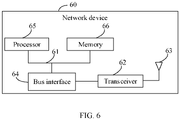
- FIG. 6 is a schematic diagram of a hardware structure of a network device for implementing the embodiments of the present invention.
- the network device 60 includes but is not limited to a bus 61, a transceiver 62, an antenna 63, a bus interface 64, a processor 65, and a memory 68.
- the network device 60 further includes a computer program stored in the memory 68 and capable of running on the processor 65.
- a computer program stored in the memory 68 and capable of running on the processor 65.
- the transceiver 62 is configured to transmit and receive data under control of the processor 65.
- the network device 60 in this embodiment of the present invention can implement the processes of the method embodiment in FIG. 2 , with the same beneficial effects achieved. To avoid repetition, details are not described herein again.
- the bus 61 may include any quantity of interconnected buses and bridges, and the bus 61 connects various circuits that include one or more processors represented by the processor 65 and a memory represented by the memory 68.
- the bus 61 may further connect various other circuits, such as a peripheral device, a voltage regulator, and a power management circuit. These are common sense in the art, and therefore are not further described in this specification.
- the bus interface 64 provides an interface between the bus 61 and the transceiver 62.
- the transceiver 62 may be one element, or may be a plurality of elements, for example, a plurality of receivers and transmitters, and provides a unit for communicating with various other apparatuses on a transmission medium.
- Data processed by the processor 65 is transmitted on a wireless medium through the antenna 63. Further, the antenna 63 receives data and transmits the data to the processor 65.
- the processor 65 is responsible for managing the bus 61 and general processing, and may further provide various functions, including timing, a peripheral interface, voltage regulation, power management, and other control functions.
- the memory 68 may be configured to store data for use by the processor 65 when the processor 65 performs an operation.
- the processor 65 may be a CPU, an ASIC, an FPGA, or a CPLD.
- An embodiment of the present invention further provides a computer-readable storage medium, where the computer-readable storage medium stores a computer program, and when the computer program is executed by a processor, the processes of the foregoing embodiment shown in FIG. 1 are implemented, or the processes of the foregoing embodiment shown in FIG. 2 are implemented, with the same technical effects achieved. To avoid repetition, details are not described herein again.
- the computer-readable storage medium may be a read-only memory (Read-Only Memory, ROM), a random access memory (Random Access Memory, RAM), a magnetic disk, an optical disc, or the like.
- the software product is stored in a storage medium (for example, ROM/RAM, a magnetic disk, or an optical disc), and includes several instructions for instructing a terminal (which may be a mobile phone, a computer, a server, an air conditioner, a network device, or the like) to perform the method described in the embodiments of the present invention.
- a storage medium for example, ROM/RAM, a magnetic disk, or an optical disc
- a terminal which may be a mobile phone, a computer, a server, an air conditioner, a network device, or the like
Landscapes
- Engineering & Computer Science (AREA)
- Computer Networks & Wireless Communication (AREA)
- Signal Processing (AREA)
- Mobile Radio Communication Systems (AREA)
Abstract
Description
- This application claims priority to
Chinese Patent Application No. 201911083762.1, filed in China on November 7, 2019 - The present invention relates to the field of communications technologies, and in particular, to a handover method, a configuration method, a terminal, and a network device.
- In the existing conditional handover (Conditional Handover, CHO) procedure, a trigger event is configured by a source node. After being determined by a target node, configuration of candidate cells is transmitted to a terminal transparently through the source node. The terminal measures all candidate cells, and according to a handover command configured by the network and the trigger event, selects a target cell from the candidate cells for performing handover, in a case that a corresponding trigger condition is met. However, a success rate of the existing conditional handover is low.
- Embodiments of the present invention provide a conditional handover method, a configuration method, a terminal and a network device, to resolve a problem of low success rate of the existing handover manner.
- To resolve the foregoing technical problem, the embodiments of the present invention are implemented as follows.
- According to a first aspect, an embodiment of the present invention provides a handover method, applied to a terminal and including:
- determining, based on a measurement result of a first cell, whether a trigger condition is met; and
- handing over to the first cell in a case that the trigger condition is met.
- According to a second aspect, an embodiment of the present invention provides a configuration method, applied to a network device and including:
- sending configuration information; where
- the configuration information includes at least one of the following:
- a trigger event;
- a trigger event index;
- that a trigger event or a trigger event index is associated with a candidate cell;
- that a trigger event or a trigger event index is associated with a candidate cell identifier;
- that a trigger event is associated with a first message; and
- that a trigger event is associated with a PCell identifier or SpCell identifier in a first message.
- According to a third aspect, an embodiment of the present invention provides a terminal, including:
- a determining module, configured to determine, based on a measurement result of a first cell, whether a trigger condition is met; and
- a processing module, configured to hand over to the first cell in a case that the trigger condition is met.
- According to a fourth aspect, an embodiment of the present invention provides a network device, including:
a sending module, configured to send configuration information; where the configuration information includes at least one of the following: - a trigger event;
- a trigger event index;
- that a trigger event or a trigger event index is associated with a candidate cell;
- that a trigger event or a trigger event index is associated with a candidate cell identifier;
- that a trigger event is associated with a first message; and
- that a trigger event is associated with a PCell identifier or SpCell identifier in a first message.
- According to a fifth aspect, an embodiment of the present invention provides a communications device, including a memory, a processor, and a computer program stored in the memory and capable of running on the processor, where when the computer program is executed by the processor, the steps of the foregoing handover method, or the steps of the foregoing configuration method are implemented.
- According to a sixth aspect, an embodiment of the present invention provides a computer-readable storage medium, where a computer program is stored in the computer-readable storage medium, and when the computer program is executed by a processor, the steps of the foregoing handover method, or the steps of the foregoing configuration method are implemented.
- In the embodiments of the present invention, the terminal can detect, based on the measurement result of the first cell, whether the trigger condition is met, and hand over to the first cell in a case that the trigger condition is met. In this way, the success rate of the handover can be increased, to ensure a high success rate of the handover and low latency.
- To describe the technical solutions in the embodiments of the present invention more clearly, the following briefly describes the accompanying drawings required for describing the embodiments of the present invention. Apparently, the accompanying drawings in the following description show merely some embodiments of the present invention, and a person of ordinary skill in the art may still derive other drawings from these accompanying drawings without creative efforts.
-
FIG. 1 is a flowchart of a handover method according to an embodiment of the present invention; -
FIG. 2 is a flowchart of a configuration method according to an embodiment of the present invention; -
FIG. 3 is a first schematic structural diagram of a terminal according to an embodiment of the present invention; -
FIG. 4 is a first schematic structural diagram of a network device according to an embodiment of the present invention; -
FIG. 5 is a second schematic structural diagram of a terminal according to an embodiment of the present invention; and -
FIG. 6 is a second schematic structural diagram of a network device according to an embodiment of the present invention. - To describe the technical solutions in the embodiments of the present invention more clearly, the following briefly describes the accompanying drawings required for describing the embodiments of the present invention. Apparently, the accompanying drawings in the following description show merely some embodiments of the present invention, and a person of ordinary skill in the art may still derive other drawings from these accompanying drawings without creative efforts.
- The technologies described herein are not limited to long term evolution (Long Time Evolution, LTE)/LTE-Advanced (LTE-Advanced, LTE-A) systems, and may also be used in various wireless communications systems, such as code division multiple access (Code Division Multiple Access, CDMA), time division multiple access (Time Division Multiple Access, TDMA), frequency division multiple access (Frequency Division Multiple Access, FDMA), orthogonal frequency division multiple access (Orthogonal Frequency Division Multiple Access, OFDMA), single-carrier frequency-division multiple access (Single-carrier Frequency-Division Multiple Access, SC-FDMA), and other systems. The terms "system" and "network" are often used interchangeably. The CDMA system can implement radio technologies such as CDMA2000 and universal terrestrial radio access (Universal Terrestrial Radio Access, UTRA). UTRA includes wideband CDMA (Wideband Code Division Multiple Access, WCDMA) and other CDMA variants. The TDMA system can implement radio technologies such as global system for mobile communications (Global System for Mobile Communication, GSM). The OFDMA system may implement radio technologies such as ultra mobile broadband (Ultra Mobile Broadband, UMB), evolved UTRA (Evolution-UTRA, E-UTRA), IEEE 802.11 (Wi-Fi), IEEE 802.16 (WiMAX), IEEE 802.20, and Flash-OFDM. UTRA and E-UTRA are part of the universal mobile telecommunications system (Universal Mobile Telecommunications System, UMTS). LTE and more advanced LTEs (such as LTE-A) are new releases of UMTS that use E-UTRA. UTRA, E-UTRA, UMTS, LTE, LTE-A, and GSM are described in documents from an organization named "3rd Generation Partnership Project" (3rd Generation Partnership Project, 3GPP). CDMA2000 and UMB are described in documents from an organization named "3rd Generation Partnership Project 2" (3GPP2). The technologies described herein are applicable not only to the above-mentioned systems and radio technologies, but also to other systems and radio technologies such as a new radio (New Radio, NR) system.
- A wireless communications system in the embodiments of the present invention includes a terminal and a network device. The terminal may also be referred to as a terminal device or user equipment (User Equipment, UE). The terminal may be a terminal side device such as a mobile phone, a tablet computer (Tablet Personal Computer), a laptop computer (Laptop Computer), a personal digital assistant (Personal Digital Assistant, PDA), a mobile Internet device (Mobile Internet Device, MID), a wearable device (Wearable Device), or an in-vehicle device. It should be noted that the specific type of the terminal is not limited in the embodiments of the present invention. The network device may be a base station or a core network. The base station may be a 5G base station or a base station of a later release (for example, a gNB or a 5G NR NB), or a base stations in other communications systems (for example, an eNB, a WLAN access point, or other access points). The base station may be referred to as a NodeB, an evolved NodeB, an access point, a base transceiver station (Base Transceiver Station, BTS), a radio base station, a radio transceiver, a basic service set (Basic Service Set, BSS), an extended service set (Extended Service Set, ESS), a NodeB, an evolved NodeB (eNB), a home NodeB, a home evolved NodeB, a WLAN access point, a Wi-Fi node, or other applicable terms in the art. As long as a same technical effect is achieved, the base station is not limited to any specific technical term.
- In this embodiment of the present invention, optionally, a dual connectivity (Dual Connectivity, DC) architecture may be used for a terminal, and the DC architecture includes two cell groups: a master cell group (Master Cell Group, MCG) and a secondary cell group (Secondary Cell Group, SCG). The MCG corresponds to a network-side master node (Master Node, MN), and the SCG corresponds to a network-side secondary node (secondary node, SN). The MCG includes a primary cell (Primary Cell, PCell) and a secondary cell (Secondary Cell, SCell). The SCG includes a primary secondary cell (Primary Secondary Cell, PSCell) and a SCell. Both the PCell and the PSCell may also be referred to as special cells (Special Cell, SpCell).
- Optionally, the terminal may use carrier aggregation (Carrier Aggregation, CA) technology. With the CA technology, a cell corresponding to the terminal may be divided into a primary cell PCell and a secondary cell SCell.
- The present invention is described below with reference to the embodiments and the accompanying drawings.
- Referring to
FIG. 1, FIG. 1 is a flowchart of a handover method according to an embodiment of the present invention. The method is applied to a terminal. As shown inFIG. 1 , the method includes the following steps. - Step 101: Determine, based on a measurement result of a first cell, whether a trigger condition is met.
- If it is determined that the trigger condition is met,
step 102 is performed. If the trigger condition is not met,step 103 is performed. - Optionally, the first cell may be a candidate cell. Alternatively, the first cell is associated with the trigger condition. It should be noted that in a case that the first cell is associated with the trigger condition, the first cell may be a candidate cell, or may not be a candidate cell, but is only a neighboring cell associated with the trigger condition.
- In addition, because the trigger condition may be related to a servicing cell, for example, the trigger condition is that the trigger condition is met only when the first cell has a power higher than that of the servicing cell by specified decibels. Therefore, when
step 101 is being performed, whether the trigger condition is met may be alternatively determined based on the measurement result of the first cell and a measurement result of the servicing cell. - The measurement result in
step 101 may include but is not limited to at least one of the following: reference signal receiving power (Reference Signal Receiving Power, RSRP), reference signal received quality (Reference Signal Received Quality, RSRQ), and a signal to interference plus noise ratio (Signal to Interference plus Noise Ratio, SINR), and a channel quality indicator (Channel Quality Indicator, CQI). Measurement corresponding to the measurement result may include cell measurement, and/or beam measurement. The beam measurement may include measurement of at least one of the following: a synchronization signal and PBCH block (Synchronization Signal and PBCH block, SSB), a demodulation reference signal (Demodulation Reference Signal, DMRS), or other reference signals. - Step 102: Hand over to the first cell.
- Optionally, if the trigger condition is met, the terminal may hand over to the first cell, and may further skip performing measurement reporting, thereby saving resources and reducing signaling overheads.
- In addition, if it is determined that the trigger condition is met in
step 101, but a corresponding condition handover is not configured, the terminal may perform the measurement reporting. - Step 103: Perform at least one of the following: skipping handing over to the first cell; and performing measurement reporting or skipping performing measurement reporting.
- It should be noted that in a case that the first cell is a candidate cell, if the trigger condition is not met, the terminal preferably performs the measurement reporting, so that the network device can obtain the network status. In a case that the first cell is associated with the trigger condition, if the trigger condition is not met, the terminal preferably skips performing the measurement reporting, to save resources and reduce signaling overheads.
- The handover method in this embodiment of the present invention can detect, based on the measurement result of the first cell, whether the trigger condition is met, and hand over to the first cell in a case that the trigger condition is met. In this way, the success rate of the handover can be increased, to ensure a high success rate of the handover and low latency.
- In this embodiment of the present invention, the trigger condition may be associated with a plurality of cells. Preferably, in a case that the first cell is associated with the trigger condition, the first cell may be a primary cell PCell associated with the trigger condition. It can be understood that in this case, the terminal may use the CA technology.
- Alternatively, in a case that the first cell is associated with the trigger condition, the first cell may be a special cell SpCell associated with the trigger condition. It can be understood that in this case, the terminal may use a DC architecture.
- In this way, the success rate of the handover can be increased by selecting a PCell or SpCell to trigger the handover.
- In this embodiment of the present invention, to ensure the handover process (such as a conditional handover process), the terminal may receive handover-related configuration information from a network device (such as a source base station). The handover-related configuration information may include but is not limited to at least one of the following:
- (a) a radio resource control (Radio Resource Control, RRC) reconfiguration message, an RRC synchronization reconfiguration message(ReconfigurationWithSync), a handover command (HO command), or mobility control information (Mobility Control Info);
- (b) a trigger event, for example, a conditional handover trigger event;
- (c) measurement configuration information, for example, a measurement object (measurement object);
- (d) measurement reporting configuration information, for example, a measurement report (measurement report);
- (e) a candidate cell identifier corresponding to the handover, where, for example, the identifier may include at least one of the following: a frequency identifier, an absolute radio frequency channel number (Absolute Radio Frequency Channel Number, ARFCN), a cell index (Cell Index), a physical cell identifier (Physical Cell Identifier, PCI), and the like; and
- (f) random access channel (Random Access Channel, RACH) configuration information corresponding to the candidate cell.
- Optionally, the terminal may receive configuration information from the network device before performing
step 101. For example, the network device is a source base station. The configuration information may include at least one of the following: - (1) a trigger event.
- (2) a trigger event index.
- (3) that a trigger event or a trigger event index (index) is associated with a candidate cell.
- Specifically, the association involved in (3) may be: that the trigger event is associated with the candidate cell, or that the trigger event index is associated with the candidate cell.
- In an embodiment, the configured trigger event or trigger event index is associated with one candidate cell.
- Optionally, the candidate cell is the same as a PCell or Spcell indicated by a first message. The first message may be any one of the following: an RRC reconfiguration message, an RRC synchronization reconfiguration message, a handover command, mobile control information, or the like.
- In an embodiment, the candidate cell is the same as a PCell or SpCell indicated by the RRC reconfiguration message.
- It should be noted that, that a trigger event is associated with a candidate cell may include any one of the following association manners: 1) the trigger event being in one-to-one correspondence to the candidate cell, for example, the trigger event being in one-to-one correspondence to the candidate cell through configuration; 2) in an RRC message configured with the trigger event, an information element (Information Element, IE) corresponding to the candidate cell identifier being configured; and 3) in an RRC message configured with the candidate cell, an IE of the RRC message corresponding to the trigger event being configured.
- That a trigger event index is associated with a candidate cell may include any of the following association manners: 1) the trigger event index being in one-to-one correspondence to the candidate cell, for example, the trigger event index being in one-to-one correspondence to the candidate cell through configuration; 2) in an RRC message configured with the trigger event index, an IE corresponding to the candidate cell identifier being configured; and 3) in an RRC message configured with the candidate cell, an IE corresponding to the trigger event index being configured.
- (4) that a trigger event or a trigger event index (index) is associated with a candidate cell identifier.
- Specifically, the association involved in (4) may be: the trigger event being associated with the candidate cell identifier, or the trigger event index being associated with the candidate cell identifier;
- In an embodiment, the configured trigger event or trigger event index is associated with one candidate cell identifier.
- Optionally, the candidate cell identifier may be the same as a PCell identifier or SpCell identifier in a first message. The first message may be any one of the following: an RRC reconfiguration message, an RRC synchronization reconfiguration message, a handover command, mobile control information, or the like.
- In an embodiment, the candidate cell identifier is the same as a PCell identifier or SpCell identifier in the RRC reconfiguration message.
- It should be noted that, that the trigger event is associated with the candidate cell identifier may include any one of the following association manners: 1) the trigger event being in one-to-one correspondence to the candidate cell identifier, for example, the trigger event being in one-to-one correspondence to the candidate cell identifier through configuration; 2) in an RRC message configured with the trigger event, an IE corresponding to the candidate cell identifier being configured; and 3) in an RRC message corresponding to the configured candidate cell identifier, an IE of the RRC message corresponding to the trigger event being configured.
- The trigger event index being associated with the candidate cell identifier may include any one of the following association manners: 1) the trigger event index being in one-to-one correspondence to the candidate cell identifier, for example, the trigger event index being in one-to-one correspondence to the candidate cell identifier through configuration; 2) in an RRC message configured with the trigger event index, an IE corresponding to the candidate cell identifier being configured; and 3) in an RRC message configured with the candidate cell identifier, an IE corresponding to the trigger event index being configured.
- (5) that a trigger event is associated with a first message.
- In an embodiment, the configured trigger event is associated with one first message.
- Optionally, the first message in (5) may be any one of the following: an RRC reconfiguration message, an RRC synchronization reconfiguration message, a handover command, mobile control information, or the like.
- Optionally, that a trigger event is associated with a first message may include any one of the following:
- a trigger event index being associated with a first-message index;
- a trigger event index being associated with the first message; and
- the trigger event being associated with a first-message index.
- For example, assuming that the first message is an RRC reconfiguration message, the association relationship involved in (5) may include any one of the following: 1) the trigger event index being associated with one RRC reconfiguration message index; 2) the trigger event index being associated with one RRC reconfiguration message; and 3) the trigger event being associated with one RRC reconfiguration message index.
- It should be noted that a trigger event index being associated with a first-message index may include any one of the following association manners: 1) the trigger event being in one-to-one correspondence to the first message, for example, the trigger event being in one-to-one correspondence to the first message through configuration; 2) in an RRC message configured with the trigger event, an IE of the first message being configured; and 3) in the first message, an IE of the RRC message corresponding to the trigger event being configured.
- (6) that a trigger event is associated with a PCell identifier or SpCell identifier in a first message.
- It should be understood that the association involved in (6) may be any one of the following: 1) the trigger event index being associated with the PCell identifier or SpCell identifier in the first message; 2) the trigger event index being associated with the PCell or SpCell indicated by the first message; and 3) the trigger event being associated with the PCell identifier or SpCell identifier in the first message.
- Optionally, the first message in (6) may be any one of the following: an RRC reconfiguration message, an RRC synchronization reconfiguration message, a handover command, mobile control information, or the like.
- It should be noted that the trigger event index being associated with the PCell identifier or SpCell identifier in the first message may include any one of the following association manners: 1) the trigger event index being in one-to-one correspondence to the PCell identifier or SpCell identifier in the first message, for example, the trigger event being in one-to-one correspondence to the PCell identifier the first message through configuration; 2) in an RRC message configured with the trigger event, an IE of the first message being configured; and 3) in the first message, an IE corresponding to the trigger event index being configured.
- The trigger event index being associated with the PCell or SpCell indicated by the first message may include any one of the following association manners: 1) the trigger event index being in one-to-one correspondence to the PCell or SpCell indicated by the first message, for example, the trigger event index being in one-to-one correspondence to the PCell or SpCell indicated by the first message through configuration; 2) in an RRC message configured with the trigger event index, an IE of the first message being configured; and 3) in the first message, an IE corresponding to the trigger event index being configured.
- The trigger event being associated with the PCell identifier or SpCell identifier in the first message may include any one of the following association manners: 1) the trigger event being in one-to-one correspondence to the PCell identifier or SpCell identifier in the first message, for example, the trigger event being in one-to-one correspondence to the PCell identifier or SpCell identifier in the first message through configuration; 2) in an RRC message configured with the trigger event, an IE of the first message being configured; and 3) in the first message, an IE of the RRC message corresponding to the trigger event being configured.
- In addition, it should be noted that the trigger event in this embodiment of the present invention may be an existing trigger event or a newly defined trigger event. For example, when the trigger event is an existing trigger event, it may be event A1, event A2, event A3, event A4, event A5, event B1, event B2, event B3, event B4, event B5, event C1, event C2, event C3, or the like. Event A1 is that a cell measurement result of a serving cell is better than a first absolute threshold. Event A2 is that the cell measurement result of the serving cell is worse than a second absolute threshold. Event A3 is that a cell measurement result of a potential target cell is better than that of the serving cell. Event A4 is that the cell measurement result of the potential target cell is better than a third absolute threshold. Event A5 is that the cell measurement result of the serving cell is worse than a fourth absolute threshold, and that the cell measurement result of the potential target cell is better than a fifth absolute threshold.
- Referring to
FIG. 2, FIG. 2 is a flowchart of a configuration method according to an embodiment of the present invention. The method is applied to a network device. As shown inFIG. 2 , the method includes the following step. - Step 201: Send configuration information.
- The configuration information may include at least one of the following:
- a trigger event;
- a trigger event index;
- that a trigger event or a trigger event index is associated with a candidate cell;
- that a trigger event or a trigger event index is associated with a candidate cell identifier;
- that a trigger event is associated with a first message; and
- that a trigger event is associated with a PCell identifier or SpCell identifier in a first message.
- Optionally, the candidate cell is the same as a PCell or Spcell indicated by the first message;
or
the candidate cell identifier is the same as the PCell identifier or SpCell identifier in the first message. - Optionally, that a trigger event is associated with a first message includes any one of the following:
- a trigger event index being associated with a first-message index;
- a trigger event index being associated with the first message; and
- the trigger event being associated with a first-message index; or
- that a trigger event is associated with a PCell identifier or SpCell identifier in a first message includes any one of the following:
- a trigger event index being associated with the PCell identifier or SpCell identifier in the first message;
- a trigger event index being associated with a PCell or SpCell indicated by the first message; and
- the trigger event being associated with the PCell identifier or SpCell identifier in the first message.
- Optionally, that a trigger event is associated with a first message includes any one of the following association manners:
- the trigger event being in one-to-one correspondence to the first message;
- an RRC message corresponding to the trigger event being configured with an IE of the first message; and
- the first message being configured with an IE of an RRC message corresponding to the trigger event.
- Optionally, the first message includes any one of the following:
an RRC reconfiguration message, an RRC synchronization reconfiguration message, a handover command, and mobile control information. - It can be understood that the content of the configuration information in this embodiment may be the same as that described in the embodiment shown in
FIG. 1 . Details are not described herein. - With the foregoing configuration information, the success rate of the handover performed by the terminal can be increased, thereby ensuring a high success rate of the handover and low latency.
- The foregoing embodiments describe the handover method and the configuration method in the present invention. The following describes the terminal and network device in the present invention with reference to the embodiments and the accompanying drawings.
- Referring to
FIG. 3, FIG. 3 is a schematic structural diagram of a terminal according to an embodiment of the present invention. As shown inFIG. 3 , the terminal 30 includes: - a determining
module 31, configured to determine, based on a measurement result of a first cell, whether a trigger condition is met; and - a
processing module 32, configured to hand over to the first cell in a case that the trigger condition is met. - Optionally, the first cell is a candidate cell; or
the first cell is associated with the trigger condition. - Optionally, in a case that the first cell is associated with the trigger condition, the first cell is a primary cell PCell associated with the trigger condition; or the first cell is a special cell SpCell associated with the trigger condition.
- Optionally, the
processing module 32 is further configured to: in a case that the trigger condition is met, skip performing measurement reporting. - Optionally, the
processing module 32 is further configured to:
in a case that the trigger condition is not met, perform at least one of the following: - skipping handing over to the first cell; and
- performing measurement reporting, or skipping performing measurement reporting.
- Optionally, the terminal 30 further includes:
a receiving module, configured to receive configuration information; where the configuration information includes at least one of the following: - a trigger event;
- a trigger event index;
- that a trigger event or a trigger event index is associated with a candidate cell;
- that a trigger event or a trigger event index is associated with a candidate cell identifier;
- that a trigger event is associated with a first message; and
- that a trigger event is associated with a PCell identifier or SpCell identifier in a first message.
- Optionally, the candidate cell is the same as a PCell or Spcell indicated by the first message;
or
the candidate cell identifier is the same as the PCell identifier or SpCell identifier in the first message. - Optionally, that a trigger event is associated with a first message includes any one of the following:
- a trigger event index being associated with a first-message index;
- a trigger event index being associated with the first message; and
- the trigger event being associated with a first-message index; or
- that a trigger event is associated with a PCell identifier or SpCell identifier in a first message includes any one of the following:
- a trigger event index being associated with the PCell identifier or SpCell identifier in the first message;
- a trigger event index being associated with a PCell or SpCell indicated by the first message; and
- the trigger event being associated with the PCell identifier or SpCell identifier in the first message.
- Optionally, that a trigger event is associated with a first message includes any one of the following association manners:
- the trigger event being in one-to-one correspondence to the first message;
- an RRC message corresponding to the trigger event being configured with an IE of the first message; and
- the first message being configured with an IE of an RRC message corresponding to the trigger event.
- Optionally, the first message includes any one of the following:
an RRC reconfiguration message, an RRC synchronization reconfiguration message, a handover command, and mobile control information. - The terminal 30 in this embodiment of the present invention can implement the processes of the method embodiment in
FIG. 1 , with the same beneficial effects achieved. To avoid repetition, details are not described herein again. - Referring to
FIG. 4, FIG. 4 is a schematic structural diagram of a network device according to an embodiment of this disclosure. As shown inFIG. 4 , thenetwork device 40 includes:
a sendingmodule 41, configured to send configuration information; where the configuration information may include at least one of the following: - a trigger event;
- a trigger event index;
- that a trigger event or a trigger event index is associated with a candidate cell;
- that a trigger event or a trigger event index is associated with a candidate cell identifier;
- that a trigger event is associated with a first message; and
- that a trigger event is associated with a PCell identifier or SpCell identifier in a first message.
- Optionally, the candidate cell is the same as a PCell or Spcell indicated by the first message;
or
the candidate cell identifier is the same as the PCell identifier or SpCell identifier in the first message. - Optionally, that a trigger event is associated with a first message includes any one of the following:
- a trigger event index being associated with a first-message index;
- a trigger event index being associated with the first message; and
- the trigger event being associated with a first-message index; or
- that a trigger event is associated with a PCell identifier or SpCell identifier in a first message includes any one of the following:
- a trigger event index being associated with the PCell identifier or SpCell identifier in the first message;
- a trigger event index being associated with a PCell or SpCell indicated by the first message; and
- the trigger event being associated with the PCell identifier or SpCell identifier in the first message.
- Optionally, that a trigger event is associated with a first message includes any one of the following association manners:
- the trigger event being in one-to-one correspondence to the first message;
- an RRC message corresponding to the trigger event being configured with an IE of the first message; and
- the first message being configured with an IE of an RRC message corresponding to the trigger event.
- Optionally, the first message includes any one of the following:
an RRC reconfiguration message, an RRC synchronization reconfiguration message, a handover command, and mobile control information. - It can be understood that the content of the configuration information in this embodiment may be the same as that described in the embodiment shown in
FIG. 1 . Details are not described herein. - With the foregoing configuration information, the success rate of the handover performed by the terminal can be increased, thereby ensuring a high success rate of the handover and low latency.
- An embodiment of the present invention further provides a communications device, including a processor, a memory, and a computer program stored in the memory and capable of running on the processor. When the computer program is executed by the processor, the processes of the embodiment shown in
FIG. 1 or the processes of the embodiment shown inFIG. 2 are implemented, with the same technical effects achieved. To avoid repetition, details are not described herein again. Optionally, the communications device may be a terminal or a network device. - Referring to
FIG. 5, FIG. 5 is a schematic diagram of a hardware structure of a terminal for implementing the embodiments of the present invention. The terminal 500 includes but is not limited to components such as aradio frequency unit 501, anetwork module 502, anaudio output unit 503, aninput unit 504, asensor 505, adisplay unit 506, auser input unit 507, aninterface unit 506, amemory 509, aprocessor 510, and apower supply 511. A person skilled in the art can understand that the structure of the terminal shown inFIG. 5 does not constitute any limitation on the terminal, and the terminal may include more or fewer components than those shown in the diagram, or a combination of some components, or the components disposed differently. In this embodiment of the present invention, the terminal includes but is not limited to a mobile phone, a tablet computer, a notebook computer, a palmtop computer, a vehicle-mounted terminal, a wearable device, a pedometer, or the like. - The
processor 510 is configured to determine, based on a measurement result of a first cell, whether a trigger condition is met; and hand over to the first cell when the trigger condition is met. - The terminal 500 in this embodiment of the present invention can implement the processes of the method embodiment in
FIG. 1 , with the same beneficial effects achieved. To avoid repetition, details are not described herein again. - It should be understood that in this embodiment of the present invention, the
radio frequency unit 501 may be configured to receive and transmit signals in an information reception or transmission or call process. Specifically, after receiving downlink data from a base station, theradio frequency unit 501 transmits the downlink data to theprocessor 510 for processing, and in addition, transmits uplink data to the base station. Generally, theradio frequency unit 501 includes but is not limited to an antenna, at least one amplifier, a transceiver, a coupler, a low noise amplifier, a duplexer, and the like. In addition, theradio frequency unit 501 may further communicate with a network and other devices via a wireless communications system. - The terminal provides a user with wireless broadband Internet access by using the
network module 502, for example, helping the user send or receive an email, browse a web page, access streaming media, and the like. - The
audio output unit 503 may convert audio data received by theradio frequency unit 501 or thenetwork module 502 or stored in thememory 509 into an audio signal, and output the audio signal as a sound. In addition, theaudio output unit 503 may further provide audio output (for example, a call signal received tone or a message received tone) that is related to a specific function performed by theterminal 500. Theaudio output unit 503 includes a speaker, a buzzer, a receiver, and the like. - The
input unit 504 is configured to receive an audio signal or a video signal. Theinput unit 504 may include a graphics processing unit (Graphics Processing Unit, GPU) 5041 and a microphone 5042. Thegraphics processing unit 5041 processes image data of a static picture or a video obtained by an image capture apparatus (for example, a camera) in an image capture mode or a video capture mode. A processed image frame may be displayed on thedisplay unit 506. The image frame processed by thegraphics processing unit 5041 may be stored in the memory 509 (or another storage medium) or transmitted by using theradio frequency unit 501 or thenetwork module 502. The microphone 5042 is capable of receiving sounds and processing such sounds into audio data. The processed audio data can be converted into a format output that can be transmitted to a mobile communication base station through theradio frequency unit 501 in a telephone call mode. - The terminal 500 further includes at least one
sensor 505, for example, an optical sensor, a motion sensor, and other sensors. Specifically, the optical sensor includes an ambient light sensor and a proximity sensor. The ambient light sensor may adjust brightness of adisplay panel 5061 based on intensity of ambient light. When the terminal 500 moves near an ear, the proximity sensor may disable thedisplay panel 5061 and/or backlight. As a motion sensor, an accelerometer sensor may detect magnitudes of accelerations in various directions (typically three axes), and in a stationary state, may detect the magnitude and direction of gravity, and may be applied to terminal posture recognition (for example, switching between a landscape orientation and a portrait orientation, related gaming, and magnetometer posture calibration), vibration recognition related functions (for example, pedometer and tapping), and the like. Thesensor 505 may further include a fingerprint sensor, a pressure sensor, an iris sensor, a molecular sensor, a gyroscope, a barometer, a hygrometer, a thermometer, an infrared sensor, and the like. Details are not described herein. - The
display unit 506 is configured to display information input by the user or information provided to the user. Thedisplay unit 506 may include thedisplay panel 5061. Thedisplay panel 5061 may be configured in a form of a liquid crystal display (Liquid Crystal Display, LCD), an organic light-emitting diode (Organic Light-Emitting Diode, OLED), or the like. - The
user input unit 507 may be configured to receive input digit or character information, and generate key signal input that is related to user setting and function control of the terminal. Specifically, theuser input unit 507 includes atouch panel 5071 andother input devices 5072. Thetouch panel 5071, also referred to as a touchscreen, may capture a touch operation performed by a user on or near the touch panel (for example, an operation performed by the user on thetouch panel 5071 or near thetouch panel 5071 by using a finger or any appropriate object or accessory such as a stylus). Thetouch panel 5071 may include two parts: a touch detection apparatus and a touch controller. The touch detection apparatus detects a touch orientation of the user, detects a signal carried by the touch operation, and transmits the signal to the touch controller. The touch controller receives touch information from the touch detection apparatus, converts the touch information into contact coordinates, transmits the contact coordinates to theprocessor 510, receives a command transmitted by theprocessor 510, and executes the command. In addition, thetouch panel 5071 may be implemented in a plurality of forms, for example, as a resistive, capacitive, infrared, or surface acoustic wave touch panel. In addition to thetouch panel 5071, theuser input unit 507 may further includeother input devices 5072. Specifically, theother input devices 5072 may include but are not limited to a physical keyboard, a function key (such as a volume control key or an on/off key), a trackball, a mouse, and a joystick. Details are not described herein. - Further, the
touch panel 5071 may cover thedisplay panel 5061. When detecting a touch operation on or near thetouch panel 5071, thetouch panel 5071 transmits the touch operation to theprocessor 510 to determine a type of a touch event. Then, theprocessor 510 provides a corresponding visual output on thedisplay panel 5061 based on the type of the touch event. Although thetouch panel 5071 and thedisplay panel 5061 are used as two separate components to implement input and output functions of the terminal inFIG. 5 , thetouch panel 5071 and thedisplay panel 5061 may be integrated to implement the input and output functions of the terminal in some embodiments. This is not specifically limited herein. - The
interface unit 506 is an interface between an external apparatus and the terminal 500. For example, the external apparatus may include a wired or wireless headphone port, an external power (or battery charger) port, a wired or wireless data port, a memory card port, a port for connecting an apparatus with an identification module, an audio input/output (I/O) port, a video I/O port, or an earphone port. Theinterface unit 506 may be configured to receive an input (for example, data information or power) from the external apparatus and transmit the received input to one or more elements within the terminal 500, or may be configured to transmit data between the terminal 500 and the external apparatus. - The
memory 509 may be configured to store software programs and various data. Thememory 509 may mainly include a program storage region and a data storage region. The program storage region may store an operating system, an application program required by at least one function (for example, an audio play function or an image play function), and the like. The data storage region may store data (for example, audio data and a phone book) created based on usage of the mobile phone. In addition, thememory 509 may include a high-speed random access memory, and may further include a non-volatile memory such as a disk storage device, a flash memory device, or another volatile solid-state storage device. - The
processor 510 is a control center of the terminal, and is connected to all components of the terminal by using various interfaces and lines. By running or executing software programs and/or modules that are stored in thememory 509 and calling data stored in thememory 509, theprocessor 510 executes various functions of the terminal and processes data, so as to perform overall monitoring on the terminal. Theprocessor 510 may include one or more processing units. Preferably, theprocessor 510 may integrate an application processor and a modem processor. The application processor mainly processes an operating system, a user interface, an application program, and the like. The modem processor mainly processes wireless communication. It can be understood that the modem processor may alternatively be not integrated in theprocessor 510. - The terminal 500 may further include a power supply 511 (for example, a battery) that supplies power to each component. Preferably, the
power supply 511 may be logically connected to theprocessor 510 by using a power management system, so as to implement functions such as charging management, discharging management, and power consumption management by using the power management system. - In addition, the terminal 500 may further include some functional modules that are not shown. Details are not described herein.
- Referring to
FIG. 6, FIG. 6 is a schematic diagram of a hardware structure of a network device for implementing the embodiments of the present invention. Thenetwork device 60 includes but is not limited to abus 61, atransceiver 62, anantenna 63, abus interface 64, aprocessor 65, and a memory 68. - In this embodiment of the present invention, the
network device 60 further includes a computer program stored in the memory 68 and capable of running on theprocessor 65. Optionally, when the computer program is executed by theprocessor 65, the following steps are implemented: - sending configuration information; where
- the configuration information includes at least one of the following:
- a trigger event;
- a trigger event index;
- that a trigger event or a trigger event index is associated with a candidate cell;
- that a trigger event or a trigger event index is associated with a candidate cell identifier;
- that a trigger event is associated with a first message; and
- that a trigger event is associated with a PCell identifier or SpCell identifier in a first message.
- The
transceiver 62 is configured to transmit and receive data under control of theprocessor 65. - The
network device 60 in this embodiment of the present invention can implement the processes of the method embodiment inFIG. 2 , with the same beneficial effects achieved. To avoid repetition, details are not described herein again. - In
FIG. 6 , in a bus architecture (represented by the bus 61), thebus 61 may include any quantity of interconnected buses and bridges, and thebus 61 connects various circuits that include one or more processors represented by theprocessor 65 and a memory represented by the memory 68. Thebus 61 may further connect various other circuits, such as a peripheral device, a voltage regulator, and a power management circuit. These are common sense in the art, and therefore are not further described in this specification. Thebus interface 64 provides an interface between thebus 61 and thetransceiver 62. Thetransceiver 62 may be one element, or may be a plurality of elements, for example, a plurality of receivers and transmitters, and provides a unit for communicating with various other apparatuses on a transmission medium. Data processed by theprocessor 65 is transmitted on a wireless medium through theantenna 63. Further, theantenna 63 receives data and transmits the data to theprocessor 65. - The
processor 65 is responsible for managing thebus 61 and general processing, and may further provide various functions, including timing, a peripheral interface, voltage regulation, power management, and other control functions. The memory 68 may be configured to store data for use by theprocessor 65 when theprocessor 65 performs an operation. - Optionally, the
processor 65 may be a CPU, an ASIC, an FPGA, or a CPLD. - An embodiment of the present invention further provides a computer-readable storage medium, where the computer-readable storage medium stores a computer program, and when the computer program is executed by a processor, the processes of the foregoing embodiment shown in
FIG. 1 are implemented, or the processes of the foregoing embodiment shown inFIG. 2 are implemented, with the same technical effects achieved. To avoid repetition, details are not described herein again. The computer-readable storage medium may be a read-only memory (Read-Only Memory, ROM), a random access memory (Random Access Memory, RAM), a magnetic disk, an optical disc, or the like. - It should be noted that in this specification, the terms "include" and "comprise", or any of their variants are intended to cover a non-exclusive inclusion, such that a process, a method, an article, or an apparatus that includes a list of elements not only includes those elements but also includes other elements that are not expressly listed, or further includes elements inherent to such a process, method, article, or apparatus. In absence of more constraints, an element preceded by "includes a..." does not preclude the existence of other identical elements in the process, method, article, or apparatus that includes the element.
- According to the foregoing description of the implementations, a person skilled in the art may clearly understand that the methods in the foregoing embodiments may be implemented by using software in combination with a necessary common hardware platform, and certainly may alternatively be implemented by using hardware. However, in most cases, the former is a preferred implementation. Based on such an understanding, the technical solutions of the present invention essentially, or the part contributing to the prior art may be implemented in a form of a software product. The software product is stored in a storage medium (for example, ROM/RAM, a magnetic disk, or an optical disc), and includes several instructions for instructing a terminal (which may be a mobile phone, a computer, a server, an air conditioner, a network device, or the like) to perform the method described in the embodiments of the present invention.
- The embodiments of the present invention are described above with reference to the accompanying drawings, but the present invention is not limited to the foregoing implementations. The foregoing embodiments are only illustrative rather than restrictive. Inspired by the present invention, a person of ordinary skill in the art can still derive many variations without departing from the essence of the present invention and the protection scope of the claims. All these variations shall fall within the protection of the present invention.
Claims (30)
- A handover method, applied to a terminal and comprising:determining, based on a measurement result of a first cell, whether a trigger condition is met; andhanding over to the first cell in a case that the trigger condition is met.
- The method according to claim 1, whereinthe first cell is a candidate cell; orthe first cell is associated with the trigger condition.
- The method according to claim 2, wherein in a case that the first cell is associated with the trigger condition,the first cell is a primary cell PCell associated with the trigger condition;orthe first cell is a special cell SpCell associated with the trigger condition.
- The method according to claim 1, wherein in a case that the trigger condition is met, the method further comprises:
skipping performing measurement reporting. - The method according to claim 1, further comprising:
in a case that the trigger condition is not met, performing at least one of the following:skipping handing over to the first cell; andperforming measurement reporting, or skipping performing measurement reporting. - The method according to claim 1, wherein before the determining, based on a measurement result of a first cell, whether a trigger condition is met, the method further comprises:receiving configuration information; whereinthe configuration information comprises at least one of the following:a trigger event;a trigger event index;that a trigger event or a trigger event index is associated with a candidate cell;that a trigger event or a trigger event index is associated with a candidate cell identifier;that a trigger event is associated with a first message; andthat a trigger event is associated with a PCell identifier or SpCell identifier in a first message.
- The method according to claim 6, wherein the candidate cell is the same as a PCell or Spcell indicated by the first message;
or
the candidate cell identifier is the same as the PCell identifier or SpCell identifier in the first message. - The method according to claim 6, wherein that a trigger event is associated with a first message comprises any one of the following:a trigger event index being associated with a first-message index;a trigger event index being associated with the first message; andthe trigger event being associated with a first-message index;orthat a trigger event is associated with a PCell identifier or SpCell identifier in a first message comprises any one of the following:a trigger event index being associated with the PCell identifier or SpCell identifier in the first message;a trigger event index being associated with a PCell or SpCell indicated by the first message; andthe trigger event being associated with the PCell identifier or SpCell identifier in the first message.
- The method according to claim 6, wherein that a trigger event is associated with a first message comprises any one of the following association manners:the trigger event being in one-to-one correspondence to the first message;a radio resource control RRC message corresponding to the trigger event being configured with an information element IE of the first message; andthe first message being configured with an IE of an RRC message corresponding to the trigger event.
- The method according to any one of claims 6 to 9, wherein the first message comprises any one of the following:
an RRC reconfiguration message, an RRC synchronization reconfiguration message, a handover command, and mobile control information. - A configuration method, applied to a network device and comprising:sending configuration information; whereinthe configuration information comprises at least one of the following:a trigger event;a trigger event index;that a trigger event or a trigger event index is associated with a candidate cell;that a trigger event or a trigger event index is associated with a candidate cell identifier;that a trigger event is associated with a first message; andthat a trigger event is associated with a PCell identifier or SpCell identifier in a first message.
- The method according to claim 11, wherein the candidate cell is the same as a PCell or Spcell indicated by the first message;
or
the candidate cell identifier is the same as the PCell identifier or SpCell identifier in the first message. - The method according to claim 11, wherein that a trigger event is associated with a first message comprises any one of the following:a trigger event index being associated with a first-message index;a trigger event index being associated with the first message; andthe trigger event being associated with a first-message index;orthat a trigger event is associated with a PCell identifier or SpCell identifier in a first message comprises any one of the following:a trigger event index being associated with the PCell identifier or SpCell identifier in the first message;a trigger event index being associated with a PCell or SpCell indicated by the first message; andthe trigger event being associated with the PCell identifier or SpCell identifier in the first message.
- The method according to claim 11, wherein that a trigger event is associated with a first message comprises any one of the following association manners:the trigger event being in one-to-one correspondence to the first message;an RRC message corresponding to the trigger event being configured with an IE of the first message; andthe first message being configured with an IE of an RRC message corresponding to the trigger event.
- The method according to any one of claims 11 to 14, wherein the first message comprises any one of the following:
an RRC reconfiguration message, an RRC synchronization reconfiguration message, a handover command, and mobile control information. - A terminal, comprising:a determining module, configured to determine, based on a measurement result of a first cell, whether a trigger condition is met; anda processing module, configured to hand over to the first cell in a case that the trigger condition is met.
- The terminal according to claim 16, whereinthe first cell is a candidate cell; orthe first cell is associated with the trigger condition.
- The terminal according to claim 17, wherein in a case that the first cell is associated with the trigger condition,the first cell is a primary cell PCell associated with the trigger condition;orthe first cell is a special cell SpCell associated with the trigger condition.
- The terminal according to claim 16, wherein the processing module is further configured to: in a case that the trigger condition is met, skip performing measurement reporting.
- The terminal according to claim 16, wherein the processing module is further configured to:
in a case that the trigger condition is not met, perform at least one of the following:skipping handing over to the first cell; andperforming measurement reporting, or skipping performing measurement reporting. - The terminal according to claim 16, further comprising a receiving module, configured to receive configuration information; wherein
the configuration information comprises at least one of the following:a trigger event;a trigger event index;that a trigger event or a trigger event index is associated with a candidate cell;that a trigger event or a trigger event index is associated with a candidate cell identifier;that a trigger event is associated with a first message; andthat a trigger event is associated with a PCell identifier or SpCell identifier in a first message. - The terminal according to claim 21, wherein the candidate cell is the same as a PCell or Spcell indicated by the first message;
or
the candidate cell identifier is the same as the PCell identifier or SpCell identifier in the first message. - The terminal according to claim 21, wherein that a trigger event is associated with a first message comprises any one of the following:a trigger event index being associated with a first-message index;a trigger event index being associated with the first message; andthe trigger event being associated with a first-message index;orthat a trigger event is associated with a PCell identifier or SpCell identifier in a first message comprises any one of the following:a trigger event index being associated with the PCell identifier or SpCell identifier in the first message;a trigger event index being associated with a PCell or SpCell indicated by the first message; andthe trigger event being associated with the PCell identifier or SpCell identifier in the first message.
- The terminal according to claim 21, wherein that a trigger event is associated with a first message comprises any one of the following association manners:the trigger event being in one-to-one correspondence to the first message;a radio resource control RRC message corresponding to the trigger event being configured with an information element IE of the first message; andthe first message being configured with an IE of an RRC message corresponding to the trigger event.
- A network device, comprising:a sending module, configured to send configuration information; whereinthe configuration information comprises at least one of the following:a trigger event;a trigger event index;that a trigger event or a trigger event index is associated with a candidate cell;that a trigger event or a trigger event index is associated with a candidate cell identifier;that a trigger event is associated with a first message; andthat a trigger event is associated with a PCell identifier or SpCell identifier in a first message.
- The network device according to claim 25, wherein the candidate cell is the same as a PCell or Spcell indicated by the first message;
or
the candidate cell identifier is the same as the PCell identifier or SpCell identifier in the first message. - The network device according to claim 25, wherein that a trigger event is associated with a first message comprises any one of the following:a trigger event index being associated with a first-message index;a trigger event index being associated with the first message; andthe trigger event being associated with a first-message index;orthat a trigger event is associated with a PCell identifier or SpCell identifier in a first message comprises any one of the following:a trigger event index being associated with the PCell identifier or SpCell identifier in the first message;a trigger event index being associated with a PCell or SpCell indicated by the first message; andthe trigger event being associated with the PCell identifier or SpCell identifier in the first message.
- The network device according to claim 25, wherein that a trigger event is associated with a first message comprises any one of the following association manners:the trigger event being in one-to-one correspondence to the first message;an RRC message corresponding to the trigger event being configured with an IE of the first message; andthe first message being configured with an IE of an RRC message corresponding to the trigger event.
- A communications device, comprising a memory, a processor, and a computer program stored in the memory and capable of running on the processor, wherein when the computer program is executed by the processor, the steps of the handover method according to any one of claims 1 to 10 are implemented, or the steps of the configuration method according to any one of claims 11 to 15 are implemented.
- A computer-readable storage medium, storing a computer program, wherein when the computer program is executed by a processor, the steps of the handover method according to any one of claims 1 to 10 are implemented, or the steps of the configuration method according to any one of claims 11 to 15 are implemented.
Applications Claiming Priority (2)
| Application Number | Priority Date | Filing Date | Title |
|---|---|---|---|
| CN201911083762.1A CN112788674B (en) | 2019-11-07 | 2019-11-07 | Switching method, configuration method, terminal and network equipment |
| PCT/CN2020/127039 WO2021088968A1 (en) | 2019-11-07 | 2020-11-06 | Handover method, configuration method, terminal, and network device |
Publications (4)
| Publication Number | Publication Date |
|---|---|
| EP4057690A1 true EP4057690A1 (en) | 2022-09-14 |
| EP4057690A4 EP4057690A4 (en) | 2022-12-28 |
| EP4057690C0 EP4057690C0 (en) | 2025-08-13 |
| EP4057690B1 EP4057690B1 (en) | 2025-08-13 |
Family
ID=75748080
Family Applications (1)
| Application Number | Title | Priority Date | Filing Date |
|---|---|---|---|
| EP20884340.9A Active EP4057690B1 (en) | 2019-11-07 | 2020-11-06 | Handover method, configuration method, terminal, and network device |
Country Status (8)
| Country | Link |
|---|---|
| US (1) | US20220264399A1 (en) |
| EP (1) | EP4057690B1 (en) |
| JP (1) | JP7526261B2 (en) |
| KR (1) | KR102831635B1 (en) |
| CN (1) | CN112788674B (en) |
| BR (1) | BR112022008877A2 (en) |
| ES (1) | ES3041066T3 (en) |
| WO (1) | WO2021088968A1 (en) |
Families Citing this family (2)
| Publication number | Priority date | Publication date | Assignee | Title |
|---|---|---|---|---|
| EP4550682A4 (en) * | 2022-07-01 | 2025-08-20 | Beijing Xiaomi Mobile Software Co Ltd | Beam measurement result reporting method and apparatus |
| CN116349281A (en) * | 2023-02-14 | 2023-06-27 | 北京小米移动软件有限公司 | A communication method, device and readable storage medium |
Family Cites Families (15)
| Publication number | Priority date | Publication date | Assignee | Title |
|---|---|---|---|---|
| US9860807B2 (en) * | 2015-01-30 | 2018-01-02 | Telefonaktiebolaget Lm Ericsson (Publ) | Handover in high speed scenario |
| CN107889145A (en) * | 2016-09-29 | 2018-04-06 | 华为技术有限公司 | Switching method and device |
| KR20190139848A (en) * | 2017-03-22 | 2019-12-18 | 아이디에이씨 홀딩스, 인크. | Delayed Handover Execution in Wireless Networks Based on Trigger Conditions |
| CN108810961B (en) * | 2017-04-28 | 2021-01-08 | 维沃移动通信有限公司 | Measurement information processing method, terminal and access network node |
| US10827398B2 (en) * | 2017-07-24 | 2020-11-03 | Electronics And Telecommunications Research Institute | Communication node for performing handover in wireless communication system and method therefor |
| KR102492305B1 (en) * | 2017-07-24 | 2023-01-26 | 한국전자통신연구원 | Communication node for operating handover and therefor method in wireless communication system |
| CN109429261A (en) * | 2017-08-31 | 2019-03-05 | 索尼公司 | Electronic equipment and method for wireless communication |
| CN109586861B (en) * | 2017-09-28 | 2021-05-25 | 中国移动通信集团山东有限公司 | A method and device for load balancing in a carrier aggregation system |
| JP2021510272A (en) * | 2018-01-12 | 2021-04-15 | 鴻穎創新有限公司Fg Innovation Company Limited | Conditional handover procedure |
| CN110290541A (en) * | 2018-03-19 | 2019-09-27 | 维沃移动通信有限公司 | Configuration method and equipment |
| CN110366212B (en) * | 2018-03-26 | 2021-08-24 | 维沃移动通信有限公司 | Condition switching result detection method and terminal |
| US11470517B2 (en) * | 2018-06-12 | 2022-10-11 | Nokia Technologies Oy | Two-step addition of a primary-secondary cell, PSCell, in a multi-connected handover |
| CN112351462B (en) * | 2019-08-09 | 2021-12-24 | 华为技术有限公司 | Switching method, communication device and terminal equipment |
| CN114503666B (en) * | 2019-09-26 | 2023-11-03 | 鸿颖创新有限公司 | Method and apparatus for conditional modification of primary and secondary cell group cells (pscells) |
| CN114679754B (en) * | 2019-09-29 | 2025-08-12 | 展讯通信(上海)有限公司 | Cell condition updating method, user equipment and computer readable storage medium |
-
2019
- 2019-11-07 CN CN201911083762.1A patent/CN112788674B/en active Active
-
2020
- 2020-11-06 JP JP2022522336A patent/JP7526261B2/en active Active
- 2020-11-06 WO PCT/CN2020/127039 patent/WO2021088968A1/en not_active Ceased
- 2020-11-06 BR BR112022008877A patent/BR112022008877A2/en unknown
- 2020-11-06 KR KR1020227019185A patent/KR102831635B1/en active Active
- 2020-11-06 EP EP20884340.9A patent/EP4057690B1/en active Active
- 2020-11-06 ES ES20884340T patent/ES3041066T3/en active Active
-
2022
- 2022-05-02 US US17/734,756 patent/US20220264399A1/en active Pending
Also Published As
| Publication number | Publication date |
|---|---|
| US20220264399A1 (en) | 2022-08-18 |
| EP4057690C0 (en) | 2025-08-13 |
| KR102831635B1 (en) | 2025-07-07 |
| WO2021088968A1 (en) | 2021-05-14 |
| JP2022552327A (en) | 2022-12-15 |
| EP4057690B1 (en) | 2025-08-13 |
| BR112022008877A2 (en) | 2022-08-23 |
| CN112788674A (en) | 2021-05-11 |
| CN112788674B (en) | 2022-08-16 |
| JP7526261B2 (en) | 2024-07-31 |
| ES3041066T3 (en) | 2025-11-06 |
| EP4057690A4 (en) | 2022-12-28 |
| KR20220097486A (en) | 2022-07-07 |
Similar Documents
| Publication | Publication Date | Title |
|---|---|---|
| US12219412B2 (en) | Method for reporting state information, terminal, and network device | |
| US11502737B2 (en) | Beam failure recovery method in multi-carrier system and apparatus | |
| US20210360645A1 (en) | Measurement method, terminal, measurement indication method, and network-side device | |
| US12432602B2 (en) | Measurement control method, terminal, and network-side device | |
| EP4102876A1 (en) | Beam failure recovery method, terminal, and network device | |
| US12317116B2 (en) | Measurement indication method, apparatus, and system | |
| EP4050927A1 (en) | Measurement processing method, indication information sending method, terminal and network device | |
| US11477669B2 (en) | Method of transmitting beam failure recovery request and user equipment | |
| CN112788676A (en) | Cell management method, cell management configuration method, terminal and network side equipment | |
| CN110730504A (en) | A paging indication method, device and system | |
| CN110719154A (en) | Beam failure recovery request transmission method and device | |
| EP3914036A1 (en) | Information indication method, information obtaining method, terminal and network node | |
| US20210092630A1 (en) | Method for cell management, terminal, and network-side device | |
| US20220264399A1 (en) | Handover method, configuration method, terminal, and network device | |
| US12144051B2 (en) | Information sending method, information receiving method, terminal, and network device | |
| US20220386144A1 (en) | Method for determining reference signal and communications device | |
| US12156218B2 (en) | Configuration information obtaining and sending method, terminal, and network side device | |
| HK40072715A (en) | Handover method, configuration method, terminal, and network device | |
| HK40072715B (en) | Handover method, configuration method, terminal, and network device | |
| HK40067216A (en) | Status information reporting method, terminal and network device |
Legal Events
| Date | Code | Title | Description |
|---|---|---|---|
| STAA | Information on the status of an ep patent application or granted ep patent |
Free format text: STATUS: THE INTERNATIONAL PUBLICATION HAS BEEN MADE |
|
| PUAI | Public reference made under article 153(3) epc to a published international application that has entered the european phase |
Free format text: ORIGINAL CODE: 0009012 |
|
| STAA | Information on the status of an ep patent application or granted ep patent |
Free format text: STATUS: REQUEST FOR EXAMINATION WAS MADE |
|
| 17P | Request for examination filed |
Effective date: 20220530 |
|
| AK | Designated contracting states |
Kind code of ref document: A1 Designated state(s): AL AT BE BG CH CY CZ DE DK EE ES FI FR GB GR HR HU IE IS IT LI LT LU LV MC MK MT NL NO PL PT RO RS SE SI SK SM TR |
|
| REG | Reference to a national code |
Ref country code: DE Ref legal event code: R079 Free format text: PREVIOUS MAIN CLASS: H04W0036000000 Ipc: H04W0036360000 Ref country code: DE Ref legal event code: R079 Ref document number: 602020056703 Country of ref document: DE Free format text: PREVIOUS MAIN CLASS: H04W0036000000 Ipc: H04W0036360000 |
|
| REG | Reference to a national code |
Ref country code: HK Ref legal event code: DE Ref document number: 40072715 Country of ref document: HK |
|
| A4 | Supplementary search report drawn up and despatched |
Effective date: 20221129 |
|
| RIC1 | Information provided on ipc code assigned before grant |
Ipc: H04W 36/00 20090101ALI20221123BHEP Ipc: H04W 36/36 20090101AFI20221123BHEP |
|
| DAV | Request for validation of the european patent (deleted) | ||
| DAX | Request for extension of the european patent (deleted) | ||
| REG | Reference to a national code |
Ref country code: DE Ref legal event code: R079 Free format text: PREVIOUS MAIN CLASS: H04W0036360000 Ipc: H04W0036300000 Ref country code: DE Ref legal event code: R079 Ref document number: 602020056703 Country of ref document: DE Free format text: PREVIOUS MAIN CLASS: H04W0036360000 Ipc: H04W0036300000 |
|
| RIC1 | Information provided on ipc code assigned before grant |
Ipc: H04W 36/00 20090101ALI20250123BHEP Ipc: H04W 36/36 20090101ALI20250123BHEP Ipc: H04W 36/30 20090101AFI20250123BHEP |
|
| GRAP | Despatch of communication of intention to grant a patent |
Free format text: ORIGINAL CODE: EPIDOSNIGR1 |
|
| STAA | Information on the status of an ep patent application or granted ep patent |
Free format text: STATUS: GRANT OF PATENT IS INTENDED |
|
| INTG | Intention to grant announced |
Effective date: 20250304 |
|
| GRAS | Grant fee paid |
Free format text: ORIGINAL CODE: EPIDOSNIGR3 |
|
| GRAA | (expected) grant |
Free format text: ORIGINAL CODE: 0009210 |
|
| STAA | Information on the status of an ep patent application or granted ep patent |
Free format text: STATUS: THE PATENT HAS BEEN GRANTED |
|
| AK | Designated contracting states |
Kind code of ref document: B1 Designated state(s): AL AT BE BG CH CY CZ DE DK EE ES FI FR GB GR HR HU IE IS IT LI LT LU LV MC MK MT NL NO PL PT RO RS SE SI SK SM TR |
|
| REG | Reference to a national code |
Ref country code: GB Ref legal event code: FG4D |
|
| REG | Reference to a national code |
Ref country code: CH Ref legal event code: EP |
|
| REG | Reference to a national code |
Ref country code: DE Ref legal event code: R096 Ref document number: 602020056703 Country of ref document: DE |
|
| REG | Reference to a national code |
Ref country code: IE Ref legal event code: FG4D |
|
| U01 | Request for unitary effect filed |
Effective date: 20250903 |
|
| U07 | Unitary effect registered |
Designated state(s): AT BE BG DE DK EE FI FR IT LT LU LV MT NL PT RO SE SI Effective date: 20250910 |
|
| REG | Reference to a national code |
Ref country code: ES Ref legal event code: FG2A Ref document number: 3041066 Country of ref document: ES Kind code of ref document: T3 Effective date: 20251106 |
|
| U20 | Renewal fee for the european patent with unitary effect paid |
Year of fee payment: 6 Effective date: 20251008 |
|
| PG25 | Lapsed in a contracting state [announced via postgrant information from national office to epo] |
Ref country code: IS Free format text: LAPSE BECAUSE OF FAILURE TO SUBMIT A TRANSLATION OF THE DESCRIPTION OR TO PAY THE FEE WITHIN THE PRESCRIBED TIME-LIMIT Effective date: 20251213 |
|
| PGFP | Annual fee paid to national office [announced via postgrant information from national office to epo] |
Ref country code: GB Payment date: 20251001 Year of fee payment: 6 |
|
| PG25 | Lapsed in a contracting state [announced via postgrant information from national office to epo] |
Ref country code: NO Free format text: LAPSE BECAUSE OF FAILURE TO SUBMIT A TRANSLATION OF THE DESCRIPTION OR TO PAY THE FEE WITHIN THE PRESCRIBED TIME-LIMIT Effective date: 20251113 |
|
| PG25 | Lapsed in a contracting state [announced via postgrant information from national office to epo] |
Ref country code: HR Free format text: LAPSE BECAUSE OF FAILURE TO SUBMIT A TRANSLATION OF THE DESCRIPTION OR TO PAY THE FEE WITHIN THE PRESCRIBED TIME-LIMIT Effective date: 20250813 |
|
| PG25 | Lapsed in a contracting state [announced via postgrant information from national office to epo] |
Ref country code: GR Free format text: LAPSE BECAUSE OF FAILURE TO SUBMIT A TRANSLATION OF THE DESCRIPTION OR TO PAY THE FEE WITHIN THE PRESCRIBED TIME-LIMIT Effective date: 20251114 |
|
| PG25 | Lapsed in a contracting state [announced via postgrant information from national office to epo] |
Ref country code: PL Free format text: LAPSE BECAUSE OF FAILURE TO SUBMIT A TRANSLATION OF THE DESCRIPTION OR TO PAY THE FEE WITHIN THE PRESCRIBED TIME-LIMIT Effective date: 20250813 |
|
| PG25 | Lapsed in a contracting state [announced via postgrant information from national office to epo] |
Ref country code: RS Free format text: LAPSE BECAUSE OF FAILURE TO SUBMIT A TRANSLATION OF THE DESCRIPTION OR TO PAY THE FEE WITHIN THE PRESCRIBED TIME-LIMIT Effective date: 20251113 |
|
| PGFP | Annual fee paid to national office [announced via postgrant information from national office to epo] |
Ref country code: ES Payment date: 20251211 Year of fee payment: 6 |
|
| PG25 | Lapsed in a contracting state [announced via postgrant information from national office to epo] |
Ref country code: SM Free format text: LAPSE BECAUSE OF FAILURE TO SUBMIT A TRANSLATION OF THE DESCRIPTION OR TO PAY THE FEE WITHIN THE PRESCRIBED TIME-LIMIT Effective date: 20250813 |
|
| PG25 | Lapsed in a contracting state [announced via postgrant information from national office to epo] |
Ref country code: CZ Free format text: LAPSE BECAUSE OF FAILURE TO SUBMIT A TRANSLATION OF THE DESCRIPTION OR TO PAY THE FEE WITHIN THE PRESCRIBED TIME-LIMIT Effective date: 20250813 |
|
| PG25 | Lapsed in a contracting state [announced via postgrant information from national office to epo] |
Ref country code: SK Free format text: LAPSE BECAUSE OF FAILURE TO SUBMIT A TRANSLATION OF THE DESCRIPTION OR TO PAY THE FEE WITHIN THE PRESCRIBED TIME-LIMIT Effective date: 20250813 |
|
| U1N | Appointed representative for the unitary patent procedure changed after the registration of the unitary effect |
Representative=s name: MARKS & CLERK LLP; GB |