EP4057343A2 - Switching module - Google Patents
Switching module Download PDFInfo
- Publication number
- EP4057343A2 EP4057343A2 EP22158193.7A EP22158193A EP4057343A2 EP 4057343 A2 EP4057343 A2 EP 4057343A2 EP 22158193 A EP22158193 A EP 22158193A EP 4057343 A2 EP4057343 A2 EP 4057343A2
- Authority
- EP
- European Patent Office
- Prior art keywords
- control
- power
- switching element
- control part
- conductor
- Prior art date
- Legal status (The legal status is an assumption and is not a legal conclusion. Google has not performed a legal analysis and makes no representation as to the accuracy of the status listed.)
- Pending
Links
Images








Classifications
-
- H—ELECTRICITY
- H10—SEMICONDUCTOR DEVICES; ELECTRIC SOLID-STATE DEVICES NOT OTHERWISE PROVIDED FOR
- H10W—GENERIC PACKAGES, INTERCONNECTIONS, CONNECTORS OR OTHER CONSTRUCTIONAL DETAILS OF DEVICES COVERED BY CLASS H10
- H10W42/00—Arrangements for protection of devices
- H10W42/20—Arrangements for protection of devices protecting against electromagnetic or particle radiation, e.g. light, X-rays, gamma-rays or electrons
-
- H—ELECTRICITY
- H02—GENERATION; CONVERSION OR DISTRIBUTION OF ELECTRIC POWER
- H02J—ELECTRIC POWER NETWORKS; CIRCUIT ARRANGEMENTS OR SYSTEMS FOR SUPPLYING OR DISTRIBUTING ELECTRIC POWER; SYSTEMS FOR STORING ELECTRIC ENERGY
- H02J9/00—Circuit arrangements for emergency or stand-by power supply, e.g. for emergency lighting
- H02J9/04—Circuit arrangements for emergency or stand-by power supply, e.g. for emergency lighting in which the distribution system is disconnected from the normal source and connected to a standby source
- H02J9/06—Circuit arrangements for emergency or stand-by power supply, e.g. for emergency lighting in which the distribution system is disconnected from the normal source and connected to a standby source with automatic change-over, e.g. UPS systems
- H02J9/068—Electronic means for switching from one power supply to another power supply, e.g. to avoid parallel connection
-
- H—ELECTRICITY
- H03—ELECTRONIC CIRCUITRY
- H03K—PULSE TECHNIQUE
- H03K17/00—Electronic switching or gating, i.e. not by contact-making and –breaking
- H03K17/16—Modifications for eliminating interference voltages or currents
-
- H—ELECTRICITY
- H02—GENERATION; CONVERSION OR DISTRIBUTION OF ELECTRIC POWER
- H02M—APPARATUS FOR CONVERSION BETWEEN AC AND AC, BETWEEN AC AND DC, OR BETWEEN DC AND DC, AND FOR USE WITH MAINS OR SIMILAR POWER SUPPLY SYSTEMS; CONVERSION OF DC OR AC INPUT POWER INTO SURGE OUTPUT POWER; CONTROL OR REGULATION THEREOF
- H02M1/00—Details of apparatus for conversion
- H02M1/0003—Details of control, feedback or regulation circuits
- H02M1/0009—Devices or circuits for detecting current in a converter
-
- H—ELECTRICITY
- H02—GENERATION; CONVERSION OR DISTRIBUTION OF ELECTRIC POWER
- H02M—APPARATUS FOR CONVERSION BETWEEN AC AND AC, BETWEEN AC AND DC, OR BETWEEN DC AND DC, AND FOR USE WITH MAINS OR SIMILAR POWER SUPPLY SYSTEMS; CONVERSION OF DC OR AC INPUT POWER INTO SURGE OUTPUT POWER; CONTROL OR REGULATION THEREOF
- H02M1/00—Details of apparatus for conversion
- H02M1/0003—Details of control, feedback or regulation circuits
- H02M1/0032—Control circuits allowing low power mode operation, e.g. in standby mode
-
- H—ELECTRICITY
- H02—GENERATION; CONVERSION OR DISTRIBUTION OF ELECTRIC POWER
- H02M—APPARATUS FOR CONVERSION BETWEEN AC AND AC, BETWEEN AC AND DC, OR BETWEEN DC AND DC, AND FOR USE WITH MAINS OR SIMILAR POWER SUPPLY SYSTEMS; CONVERSION OF DC OR AC INPUT POWER INTO SURGE OUTPUT POWER; CONTROL OR REGULATION THEREOF
- H02M1/00—Details of apparatus for conversion
- H02M1/44—Circuits or arrangements for compensating for electromagnetic interference in converters or inverters
-
- H—ELECTRICITY
- H10—SEMICONDUCTOR DEVICES; ELECTRIC SOLID-STATE DEVICES NOT OTHERWISE PROVIDED FOR
- H10W—GENERIC PACKAGES, INTERCONNECTIONS, CONNECTORS OR OTHER CONSTRUCTIONAL DETAILS OF DEVICES COVERED BY CLASS H10
- H10W44/00—Electrical arrangements for controlling or matching impedance
- H10W44/20—Electrical arrangements for controlling or matching impedance at high-frequency [HF] or radio frequency [RF]
-
- H—ELECTRICITY
- H10—SEMICONDUCTOR DEVICES; ELECTRIC SOLID-STATE DEVICES NOT OTHERWISE PROVIDED FOR
- H10W—GENERIC PACKAGES, INTERCONNECTIONS, CONNECTORS OR OTHER CONSTRUCTIONAL DETAILS OF DEVICES COVERED BY CLASS H10
- H10W44/00—Electrical arrangements for controlling or matching impedance
- H10W44/501—Inductive arrangements
-
- H—ELECTRICITY
- H10—SEMICONDUCTOR DEVICES; ELECTRIC SOLID-STATE DEVICES NOT OTHERWISE PROVIDED FOR
- H10W—GENERIC PACKAGES, INTERCONNECTIONS, CONNECTORS OR OTHER CONSTRUCTIONAL DETAILS OF DEVICES COVERED BY CLASS H10
- H10W70/00—Package substrates; Interposers; Redistribution layers [RDL]
- H10W70/40—Leadframes
- H10W70/464—Additional interconnections in combination with leadframes
- H10W70/465—Bumps or wires
-
- H—ELECTRICITY
- H10—SEMICONDUCTOR DEVICES; ELECTRIC SOLID-STATE DEVICES NOT OTHERWISE PROVIDED FOR
- H10W—GENERIC PACKAGES, INTERCONNECTIONS, CONNECTORS OR OTHER CONSTRUCTIONAL DETAILS OF DEVICES COVERED BY CLASS H10
- H10W70/00—Package substrates; Interposers; Redistribution layers [RDL]
- H10W70/40—Leadframes
- H10W70/481—Leadframes for devices being provided for in groups H10D8/00 - H10D48/00
-
- H—ELECTRICITY
- H10—SEMICONDUCTOR DEVICES; ELECTRIC SOLID-STATE DEVICES NOT OTHERWISE PROVIDED FOR
- H10W—GENERIC PACKAGES, INTERCONNECTIONS, CONNECTORS OR OTHER CONSTRUCTIONAL DETAILS OF DEVICES COVERED BY CLASS H10
- H10W72/00—Interconnections or connectors in packages
- H10W72/50—Bond wires
-
- H—ELECTRICITY
- H10—SEMICONDUCTOR DEVICES; ELECTRIC SOLID-STATE DEVICES NOT OTHERWISE PROVIDED FOR
- H10W—GENERIC PACKAGES, INTERCONNECTIONS, CONNECTORS OR OTHER CONSTRUCTIONAL DETAILS OF DEVICES COVERED BY CLASS H10
- H10W72/00—Interconnections or connectors in packages
- H10W72/90—Bond pads, in general
-
- H—ELECTRICITY
- H10—SEMICONDUCTOR DEVICES; ELECTRIC SOLID-STATE DEVICES NOT OTHERWISE PROVIDED FOR
- H10W—GENERIC PACKAGES, INTERCONNECTIONS, CONNECTORS OR OTHER CONSTRUCTIONAL DETAILS OF DEVICES COVERED BY CLASS H10
- H10W90/00—Package configurations
-
- H—ELECTRICITY
- H10—SEMICONDUCTOR DEVICES; ELECTRIC SOLID-STATE DEVICES NOT OTHERWISE PROVIDED FOR
- H10W—GENERIC PACKAGES, INTERCONNECTIONS, CONNECTORS OR OTHER CONSTRUCTIONAL DETAILS OF DEVICES COVERED BY CLASS H10
- H10W44/00—Electrical arrangements for controlling or matching impedance
- H10W44/20—Electrical arrangements for controlling or matching impedance at high-frequency [HF] or radio frequency [RF]
- H10W44/203—Electrical connections
- H10W44/206—Wires
-
- H—ELECTRICITY
- H10—SEMICONDUCTOR DEVICES; ELECTRIC SOLID-STATE DEVICES NOT OTHERWISE PROVIDED FOR
- H10W—GENERIC PACKAGES, INTERCONNECTIONS, CONNECTORS OR OTHER CONSTRUCTIONAL DETAILS OF DEVICES COVERED BY CLASS H10
- H10W72/00—Interconnections or connectors in packages
- H10W72/071—Connecting or disconnecting
- H10W72/075—Connecting or disconnecting of bond wires
- H10W72/07551—Connecting or disconnecting of bond wires characterised by changes in properties of the bond wires during the connecting
- H10W72/07554—Connecting or disconnecting of bond wires characterised by changes in properties of the bond wires during the connecting changes in dispositions
-
- H—ELECTRICITY
- H10—SEMICONDUCTOR DEVICES; ELECTRIC SOLID-STATE DEVICES NOT OTHERWISE PROVIDED FOR
- H10W—GENERIC PACKAGES, INTERCONNECTIONS, CONNECTORS OR OTHER CONSTRUCTIONAL DETAILS OF DEVICES COVERED BY CLASS H10
- H10W72/00—Interconnections or connectors in packages
- H10W72/50—Bond wires
- H10W72/531—Shapes of wire connectors
- H10W72/5368—Shapes of wire connectors the bond wires having helical loops
-
- H—ELECTRICITY
- H10—SEMICONDUCTOR DEVICES; ELECTRIC SOLID-STATE DEVICES NOT OTHERWISE PROVIDED FOR
- H10W—GENERIC PACKAGES, INTERCONNECTIONS, CONNECTORS OR OTHER CONSTRUCTIONAL DETAILS OF DEVICES COVERED BY CLASS H10
- H10W72/00—Interconnections or connectors in packages
- H10W72/50—Bond wires
- H10W72/59—Bond pads specially adapted therefor
-
- H—ELECTRICITY
- H10—SEMICONDUCTOR DEVICES; ELECTRIC SOLID-STATE DEVICES NOT OTHERWISE PROVIDED FOR
- H10W—GENERIC PACKAGES, INTERCONNECTIONS, CONNECTORS OR OTHER CONSTRUCTIONAL DETAILS OF DEVICES COVERED BY CLASS H10
- H10W72/00—Interconnections or connectors in packages
- H10W72/90—Bond pads, in general
- H10W72/921—Structures or relative sizes of bond pads
- H10W72/926—Multiple bond pads having different sizes
-
- H—ELECTRICITY
- H10—SEMICONDUCTOR DEVICES; ELECTRIC SOLID-STATE DEVICES NOT OTHERWISE PROVIDED FOR
- H10W—GENERIC PACKAGES, INTERCONNECTIONS, CONNECTORS OR OTHER CONSTRUCTIONAL DETAILS OF DEVICES COVERED BY CLASS H10
- H10W90/00—Package configurations
- H10W90/701—Package configurations characterised by the relative positions of pads or connectors relative to package parts
- H10W90/751—Package configurations characterised by the relative positions of pads or connectors relative to package parts of bond wires
- H10W90/753—Package configurations characterised by the relative positions of pads or connectors relative to package parts of bond wires between laterally-adjacent chips
-
- H—ELECTRICITY
- H10—SEMICONDUCTOR DEVICES; ELECTRIC SOLID-STATE DEVICES NOT OTHERWISE PROVIDED FOR
- H10W—GENERIC PACKAGES, INTERCONNECTIONS, CONNECTORS OR OTHER CONSTRUCTIONAL DETAILS OF DEVICES COVERED BY CLASS H10
- H10W90/00—Package configurations
- H10W90/701—Package configurations characterised by the relative positions of pads or connectors relative to package parts
- H10W90/751—Package configurations characterised by the relative positions of pads or connectors relative to package parts of bond wires
- H10W90/756—Package configurations characterised by the relative positions of pads or connectors relative to package parts of bond wires between a chip and a stacked lead frame, conducting package substrate or heat sink
Definitions
- the present disclosure relates to a switching module, and more particularly to a switching module for reducing the mutual inductance between a power loop and a control loop and reducing the self-inductance in the control loop.
- a switching module of a power electronic system is operated at a high frequency to achieve high power density.
- the high operating frequency may increase the switching loss, and thus reduce the efficiency of the switching module. Consequently, when the switching module is operated at the high frequency, it is necessary to increase the switching speed of the control terminal of the switching module in order to reduce the switching loss.
- EMI electromagnetic interference
- the distance between the power loop and the control loop in the switching module is relatively short.
- an induced magnetic field is generated around the power loop.
- a corresponding induced voltage is generated. Consequently, the electromagnetic interference caused by the mutual inductance between the power loop and the control loop is generated. Due to the electromagnetic interference of the mutual inductance, the switching process of the switching module is impacted. If the electromagnetic interference caused by the mutual inductance is too large and thus the interference voltage is increased, the voltage across the control terminal may exceed the safe range. Under this circumstance, the reliability of the switching module is reduced, and the switching module may even be unable to work normally.
- the present disclosure provides a switching module for reducing the mutual inductance between a power loop and a control loop and reducing the self-inductance in the control loop.
- a switching module includes at least one substrate, at least one switching element, at least one first control part, at least one second control part, at least one first power part and at least one second power part.
- the at least one switching element is disposed on the substrate.
- Each switching element includes a first control terminal, a second control terminal, a first power terminal and a second power terminal.
- the at least one first control part is connected with the first control terminal of the corresponding switching element.
- the at least one second control part is connected with the second control terminal of the corresponding switching element.
- a projection area of the first control part on a reference plane intersects with a projection area of the second control part on the reference plane at one or more first intersections.
- the at least one first power part is connected with the first power terminal of the corresponding switching element.
- the at least one second power part is connected with the second power terminal of the corresponding switching element.
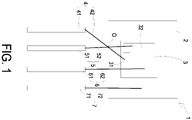
- FIG. 1 is a schematic view illustrating the structure of a switching module according to a first embodiment of the present disclosure.
- FIG. 2 is a schematic side view illustrating a portion of the switching module as shown in FIG. 1 .
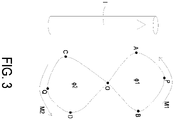
- FIG. 3 schematically illustrates how the mutual inductance between the power loop and the control loop of the switching module of FIG. 1 is countervailed.
- FIG. 4 is a schematic circuit diagram of the switching module as shown in FIG. 1 .
- the switching module 1 is disposed on a main circuit board (not shown) and electrically connected with the main circuit board.
- the switching module 1 includes a substrate 2, a switching element 3, a first control part 4, a second control part 5, and a first power part 6 and a second power part 7.
- the switching element 3 is a vertical device.
- the switching element 3 is an insulated gate bipolar transistor (IGBT), a bipolar junction transistor (BJT), a metal-oxide-semiconductor field-effect transistor (MOSFET), a junction field effect transistor (JFET) or a gallium nitride high electron mobility transistor (GaN-HEMT).
- IGBT insulated gate bipolar transistor
- BJT bipolar junction transistor
- MOSFET metal-oxide-semiconductor field-effect transistor
- JFET junction field effect transistor
- GaN-HEMT gallium nitride high electron mobility transistor
- the switching element 3 is bonded on the substrate 2 through a connecting material 11.
- the switching element 3 includes a first control terminal 31, a second control terminal 32, a first power terminal 32 and a second power terminal 33.
- the first control terminal 31 and the second control terminal 32 (and the first power terminal) are disposed on a first surface 34 of the switching element 3.
- the second control terminal and the first power terminal are located at the same region of the switching element 3, and are designated by identical numeral reference 32.
- the second power terminal 33 is disposed on a second surface 35 of the switching element 3.
- the second power terminal 33 is connected with the substrate 2 through the connecting material 11.
- the switching element 3 is an insulated gate bipolar transistor (IGBT)
- the first control terminal 31 is served as a gate terminal of the switching element 3
- the second control terminal 32 and the first power terminal 32 are collaboratively formed as an emitter of the switching element 3
- the second power terminal 33 is served as a collector of the switching element 3.
- the switching element 3 is a bipolar junction transistor (BJT)
- the first control terminal 31 is served as a base of the switching element 3
- the second control terminal 32 and the first power terminal 32 are collaboratively formed as an emitter of the switching element 3
- the second power terminal 33 is served as a collector of the switching element 3.
- the switching element 3 is a metal-oxide-semiconductor field-effect transistor (MOSFET), a junction field effect transistor (JFET) or a gallium nitride high electron mobility transistor (GaN-HEMT)
- MOSFET metal-oxide-semiconductor field-effect transistor
- JFET junction field effect transistor
- GaN-HEMT gallium nitride high electron mobility transistor
- the switching element 3 is a metal-oxide-semiconductor field-effect transistor (MOSFET).
- MOSFET metal-oxide-semiconductor field-effect transistor
- the first control part 4 is connected with the first control terminal 31 of the switching element 3.
- the first control part 4 includes a first control pin 41 and a first conductor 42.
- the first conductor 42 is connected between the first control pin 41 and the first control terminal 31 of the switching element 3.
- the second control part 5 is connected with the second control terminal 32 of the switching element 3.
- the second control part 5 includes a second control pin 51 and a second conductor 52.
- the second conductor 52 is connected between the second control pin 51 and the second control terminal 32 of the switching element 3.
- a control loop of the switching module 1 is defined by the second control terminal 32, the second conductor 52, the second pin 51, the main circuit board, the first control pin 41, the first conductor 42 and the first control terminal 31 collaboratively.
- the plane of the substrate 2 is a reference plane.
- the projection area of the first control part 4 on the reference plane intersects with the projection area of the second control part 5 on the reference plane at an intersection O.
- the projection area of the first conductor 42 of the first control part 4 on the reference plane intersects with the projection area of the second conductor 52 of the second control part 5 on the reference plane at the intersection O.
- the first power part 6 is connected with the first power terminal 32 of the switching element 3.
- the first power part 6 includes a first power pin 61 and a third conductor 62.
- the third conductor 62 is connected between the first power pin 61 and the first power terminal 32 of the switching element 3.
- the second power part 7 is connected with the substrate 2. Consequently, the second power part 7 is connected with the second power terminal 33 of the switching element 3 via the substrate 2.
- the second power part 7 includes a second power pin 71 and a fourth conductor 72.
- the fourth conductor 72 is connected between the substrate 2 and the second power pin 71.
- the fourth conductor 72 is connected with the second power terminal 33 of the switching element 3 through the substrate 2.
- a power loop of the switching module 1 is defined by the second power terminal 33, the substrate 2, the fourth conductor 72, the second power pin 71, the main circuit board, the first power pin 61, the third conductor 62 and the first power terminal 32 collaboratively.
- the first control pin 41, the second control pin 51, the first power pin 61 and the second power pin 71 are arranged sequentially.
- the point A and the point D denote the two ends of the first control part 4.
- the point B and the point C denote the two ends of the second control part 5.
- the point P denotes the connection point connecting the first control terminal 31 of the switching element 3 and the second control terminal 32 (and the first power terminal 32).
- the point Q denotes a connection point in the main circuit board.
- the reference label I denotes the current flowing through the power loop.
- the point O is the intersection of the first conductor 42 and the second conductor 52.
- the control loop of the switching module 1 is divided into two sub-control loops.
- the first sub-control loop is defined by the points O, B, P and A collaboratively.
- the second sub-control loop is defined by the points O, C, Q and D collaboratively.
- the area of the first sub-control loop is equal to or similar to the area of the second sub-control loop. Consequently, the magnetic fluxes generated by the current I of the power loop and passing through the two sub-control loops are equal or similar. That is, the magnetic flux ⁇ 1 of the first sub-control loop is equal to or substantially equal to the magnetic flux ⁇ 2 of the second sub-control loop, the mutual inductance M1 between the power loop and the first sub-control loop is equal to or substantially equal to the mutual inductance M2 between the power loop and the second sub-control loop.
- the mutual inductance M1 between the power loop and the first sub-control loop and the mutual inductance M2 between the power loop and the second sub-control loop have opposite signs.
- the mutual inductance M1 is equal to the mutual inductance M2.
- the sum of the mutual inductance M1 between the power loop and the first sub-control loop and the mutual inductance M2 between the power loop and the second sub-control loop is zero. Since the mutual inductance between the power loop and the overall control loop is zero, the purpose of reducing the mutual inductance between the power loop and the control loop is achieved.
- the point O is the intersection between the first conductor 42 and the second conductor 52. Consequently, the area of the control loop is equal to the area of the first sub-control loop plus the area of the second sub-control loop, i.e., the area enclosed by the points O, B, P and A plus the area enclosed by the points O, C, Q and D.
- the area of the control loop in the switching module 1 is reduced by the area formed by points A, O and D and the area formed by points B, O and D, and thus the self-inductance of the control loop is reduced.
- the projection area of the first conductor 42 of the first control part 4 on the reference plane intersects the projection area of the second conductor 52 of the second control part 5 on the reference plane at the intersection O.
- the mutual inductance between the control loop and the power loop in the switching module 1 of the present disclosure is reduced.
- the safety performance of the switching module 1 is enhanced.
- the positional relationships between the control loop and the power loop shown in FIG. 3 are all projection diagrams.
- the projections are projected on the substrate 2.
- the first control part 4 and the second control part 5 in FIG. 1 may not be completely on the same plane.
- the first conductor 42 of the first control part 4 and the second conductor 52 of the second control part 5 may not be completely coplanar. That is, the first conductor 42 of the first control part 4 and the second conductor 52 of the second control part 5 are not coplanar. From the side view of the structure shown in FIG.
- FIG. 5 further marks the directions of the magnetic fluxes ⁇ 1 and ⁇ 2 passing through the two sub-control loops when the current I of the power loop is greater than zero.
- the directions of the magnetic fluxes ⁇ 1 and ⁇ 2 passing through the two sub-control loops are identical. Since the current flowing through the two sub-control loops are opposed to each other, the direction of the mutual inductances M1 and M2 are opposite.
- the total mutual inductance between the power loop and the two sub-control loop is M1+M2.
- the magnitudes of the mutual inductances M1 and M2 are also similar or equal, and the total mutual inductance M1+M2 is close to 0 or equal to 0, and the effect is as described above.
- the values of the magnetic fluxes ⁇ 1 and ⁇ 2 differ greatly (i.e., ⁇ 1 > ⁇ 2 or ⁇ 1 ⁇ ⁇ 2), the value of the total mutual inductance M1+M2 will differ greatly from zero. Then, the third magnetic flux ⁇ 3 can be introduced for compensation.
- the magnetic flux of the magnetic field generated by the current I through the power loop upon the projection of the control loop on the side surface is ⁇ 3
- the direction of the magnetic flux ⁇ 3 is shown
- the mutual inductance of the magnetic flux ⁇ 3 in the entire control loop is defined as M3. Taking ⁇ 1 ⁇ ⁇ 2 as an example, the total mutual inductance M1+M2 ⁇ 0, the compensation of the magnetic flux ⁇ 3 can make the total mutual inductance M1+M2+M3 be equal to 0.
- the magnetic flux in the area formed by the projections of the first control part 4 and the second control part 5 on the side surface is used to compensate the magnetic flux in the area formed by the projections of the first control part 4 and the second control part 5 on the reference plane, so that the total magnetic flux through the control loop formed by the first control part 4 and the second control part 5 is reduced.
- the total magnetic flux is reduced to zero.
- the projection of the first control part 4 on the side surface is between the projection of the second control part 5 on the side surface and the projection of the current I through the power loop on the side surface.
- the projection of the first control part 4 on the side surface is between the projection of the second control part 5 on the side surface and the projection of the first power part 6 on the side surface, or the projection of the first control part 4 on the side surface is between the projection of the second control part 5 on the side surface and the projection of the second power part 7 on the side surface.
- ⁇ 1 > ⁇ 2 the compensation effect is also achieved by the magnetic flux ⁇ 3 on the projections of the first control part 4 and the second control part 5 on the side surfaces.
- the projection of the second control part 5 on the side surface is between the projection of the first control part 4 on the side surface and the projection of the current I through the power loop on the side surface. That is, the projection of the first control part 4 on the side surface is between the projection of the second control part 5 on the side surface and the projection of the first power part 6 on the side surface, or the projection of the first control part 4 on the side surface is between the projection of the second control part 5 on the side surface and the projection of the second power part 7 on the side surface.
- the side surface intersects the reference plane. Preferably but not exclusively, the side surface is perpendicular to the reference plane.
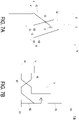
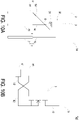
- FIG. 7A is a schematic view illustrating the structure of a switching module according to a second embodiment of the present invention.
- FIG. 7B is a schematic circuit diagram of the switching module as shown in FIG. 7A .
- the structures and functions of the components of the switching module 1a which are identical to those of the first embodiment are not redundantly described herein. Component parts and elements corresponding to those of the first embodiment are designated by identical numeral references.
- the second power pin 71 is formed by a portion of the substrate 2. Since the substrate 2 of the switching module 1a is directly connected with the second power terminal 33 of the switching element 3, the second power part of the switching module 1a is not additionally equipped with the fourth conductor.
- the power loop of the switching module 1a is defined by the second power terminal 33, the substrate 2, the main circuit board, the first power pin 61, the third conductor 62 and the first power terminal 32 collaboratively. Moreover, the first control pin 41, the second control pin 51 and the first power pin 61 are arranged sequentially.
- FIG. 8A is a schematic view illustrating the structure of a switching module according to a third embodiment of the present disclosure.
- FIG. 8B is a schematic circuit diagram of the switching module as shown in FIG. 8A .
- the structures and functions of the components of the switching module 1b which are identical to those of the first embodiment are not redundantly described herein. Component parts and elements corresponding to those of the first embodiment are designated by identical numeral references.
- the arrangement positions of the first control pin 41, the second control pin 51, the first power pin 61 and the second power pin 71 in the switching module 1b of this embodiment are changed. That is, the first control pin 41, the second power pin 71, the second control pin 51 and the first power pin 61 of the switching module 1b are arranged sequentially.
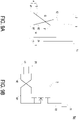
- FIG. 9A is a schematic view illustrating the structure of a switching module according to a fourth embodiment of the present disclosure.
- FIG. 9B is a schematic circuit diagram of the switching module as shown in FIG. 9A .
- the structures and functions of the components of the switching module 1c which are identical to those of the first embodiment are not redundantly described herein. Component parts and elements corresponding to those of the first embodiment are designated by identical numeral references.
- the second control part 5 and the first power part 6 of the switching module 1 are separately arranged.
- the second control part and the first power part share a common part 8.
- the common part 8 is connected with the second control terminal 32 (and the first power terminal 32) of the switching element 3.
- the common part 8 includes a fifth pin 81 and a fifth conductor 82.
- the fifth pin 81 is served as the second control pin of the second control part and the first power pin of the first power part.
- the fifth conductor 82 is connected between the second control terminal 32 (and the first power terminal 32) of the switching element 3 and the fifth pin 81.
- the fifth conductor 82 can be used as the second conductor of the second control part and the third conductor of the first power part collaboratively.
- the plane of the substrate 2 is reference plane.
- the projection area of the first conductor 42 of the first control part 4 on the reference plane intersects with the projection area of the fifth conductor 82 of the common part 8 on the reference plane at an intersection O.
- the first control pin 41, the fifth pin 81 and the second power pin 71 are arranged sequentially.
- FIG. 10A is a schematic view illustrating the structure of a switching module according to a fifth embodiment of the present disclosure.
- FIG. 10B is a schematic circuit diagram of the switching module as shown in FIG. 10A .
- the structures and functions of the components of the switching module Id which are identical to those of the switching module 1c of the fourth embodiment are not redundantly described herein. Component parts and elements corresponding to those of the first embodiment are designated by identical numeral references.
- the arrangement positions of the associated pins are changed. That is, the fifth pin 81, the first control pin 41 and the second power pin 71 in the switching module 1d of this embodiment are arranged sequentially.
- FIG. 11A is a schematic view illustrating the structure of a switching module according to a sixth embodiment of the present disclosure.
- FIG. 11B is a schematic circuit diagram of the switching module as shown in FIG. 11A .
- the structures and functions of the components of the switching module 1e which are identical to those of the first embodiment are not redundantly described herein. Component parts and elements corresponding to those of the first embodiment are designated by identical numeral references.
- the second power terminal 33 is disposed on the second surface 35 of the switching element 3.
- the first control terminal 31, the second control terminal 32 (and the first power terminal 32) and the second power terminal 33 of the switching module 1e of this embodiment are disposed on the first surface 34 of the switching element 3.
- the switching element 3 of the switching module 1e is a planar switching element such as a gallium nitride high electron mobility transistor (GaN-HEMT) or a low voltage metal-oxide-semiconductor field-effect transistor (MOSFET).
- GaN-HEMT gallium nitride high electron mobility transistor
- MOSFET metal-oxide-semiconductor field-effect transistor
- FIG. 12A is a schematic view illustrating the structure of a switching module according to a seventh embodiment of the present disclosure.
- FIG. 12B is a schematic circuit diagram of the switching module as shown in FIG. 12A .
- the structures and functions of the components of the switching module If which are identical to those of the first embodiment are not redundantly described herein. Component parts and elements corresponding to those of the first embodiment are designated by identical numeral references.
- the switching module If includes two switching elements (i.e., a first switching element 3' and a second switching element 3"), two first control parts 4, two second control parts 5, two first power parts 6 and a second power part 7.
- the second power terminal of the first switching element 3' and the second power terminal of the second switching element 3" are connected with each other.
- the plane of the substrate 2 is a reference plane.
- the projection area of the first conductor 42 of the first switching element 3' on the reference plane intersects with the projection area of the second conductor 52 of the first switching element 3' on the reference plane at an intersection O.
- the projection area of the first conductor 42 of the second switching element 3" on the reference plane intersects with the projection area of the second conductor 52 of the second switching element 3" on the reference plane at another intersection O.
- the switching module of this embodiment may be modified as long as the projection areas of first control part 4 of one switch on the reference plane intersects with the second control part 5 of said one switch on the reference plane.
- the first control pin 41 of the first control part 4 adjacent to the first switching element 3', the second control pin 51 of the second control part 5 adjacent to the first switching element 3', the first power pin 61 of the first power part 6 adjacent to the first switching element 3', the first power pin 61 of the first power part 6 adjacent to the second switching element 3", the second control pin 51 of the second control part 5 adjacent to the second switching element 3" and the first control pin 41 of the first control part 4 adjacent to the second switching element 3" are arranged sequentially. It is noted that the arrangement positions of the two first control pins 41, two second control pins 51, two first power pins 61 and a second power pin 7 are not restricted.
- the power module If includes a single first power pin 61. That is, the first power pin 61 is shared by the first switching element 3' and the second switching element 3".
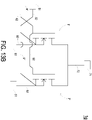
- FIG. 13A is a schematic view illustrating the structure of a switching module according to an eighth embodiment of the present disclosure.
- FIG. 13B is a schematic circuit diagram of the switching module as shown in FIG. 13A .
- the structures and functions of the components of the switching module 1g which are identical to those of the first embodiment are not redundantly described herein. Component parts and elements corresponding to those of the first embodiment are designated by identical numeral references.
- the switching module 1g includes two switching elements (i.e., a first switching element 3' and a second switching element 3"), a first control part 4, a second control part 5, two first power parts 6 and a second power part 7.
- the first switching element 3' and the second switching element 3" are connected with each other in parallel.
- one first control pin 41 and one second control pin 51 are shared by the first switching element 3' and the second switching element 3".
- the switching module 1g of this embodiment further includes a sixth conductor 91 and a seventh conductor 92.
- the sixth conductor 91 is connected between the second control terminal 32 of the first switching element 3' and the second control terminal 32 of the second switching element 3".
- the seventh conductor 92 is connected between the first control terminal 31 of the first switching element 3' and the first control terminal 31 of the second switching element 3".
- the switching module 1g includes a single first power pin 61. That is, the first power pin 61 is shared by the first switching element 3' and the second switching element 3".
- the first power pin 61 of the first power part 6 adjacent to the first switching element 3', the first control pin 41 of the first control part 4, the second control pin 51 of the second control part 5, and the first power pin 61 of the first power part 6 adjacent to the second switching element 3" are arranged sequentially. It is noted that the arrangement positions of the associated pins are not restricted.
- FIG. 14 is a schematic view illustrating the structure of a switching module according to a ninth embodiment of the present disclosure.
- the orientations of the two switching elements in the switching module 1h of this embodiment are opposite.
- the projection area of the sixth conductor 91 on the reference plane intersects with the projection area of the seventh conductor 92 on the reference plane at an intersection P.
- the substrate 2 is chosen as the reference plane.
- the projection area of the first conductor 42 on the reference plane intersects with the projection area of the second conductor 52 on the reference plane at an intersection O.
- the mutual inductance and the self-inductance are reduced.
- the projection area of the sixth conductor 91 on the reference plane intersects with the projection area of the seventh conductor 92 on the reference plane at the intersection P.
- a second power loop and a second control loop are defined by the intersection P, the sixth conductor 91, the seventh conductor 92 and the associated components. Consequently, the mutual inductance between the second power loop and the second control loop is further reduced, and the self-inductance of the second control loop is further reduced.
- FIG. 15A is a schematic view illustrating the structure of a switching module according to a tenth embodiment of the present disclosure.
- FIG. 15B is a schematic circuit diagram of the switching module as shown in FIG. 15A .
- the structures and functions of the components of the switching module 1i which are identical to those of the first embodiment are not redundantly described herein. Component parts and elements corresponding to those of the first embodiment are designated by identical numeral references.
- the switching module 1i includes two substrates (i.e., a first substrate 2' and a second substrate 2"), two switching elements (i.e., a first switching element 3' and a second switching element 3"), two first control parts 4, two second control parts 5, a first power part 6 and two second power parts 7.
- the first switching element 3' and the second switching element 3" are connected with each other in series.
- the first switching element 3' is disposed on the first substrate 2'.
- the second switching element 3" is disposed on the second substrate 2".
- the planes of the first substrate 2' and the second substrate 2" are reference planes.
- the projection area of the first conductor 42 of first switching element 3' on the reference plane intersects with the projection area of the second conductor 52 of the first switching element 3' on the reference plane at an intersection O.
- the projection area of the first conductor 42 of the second switching element 3" on the reference plane intersects with the projection area of the second conductor 52 of the second switching element 3" on the reference plane at another intersection O.
- the switching module 1i further includes an eighth conductor 93.
- the eighth conductor 93 is connected between the first substrate 2' and the second control terminal 32 (and the first power terminal 32) of the second switching element 3".
- FIG. 16 is a schematic view illustrating the structure of a switching module according to an eleventh embodiment of the present disclosure.
- the structures and functions of the components of the switching module 1j which are identical to those of the first embodiment are not redundantly described herein. Component parts and elements corresponding to those of the first embodiment are designated by identical numeral references.
- the projection area of the first conductor 42 of the first control part 4 on the reference plane intersects with the projection area of the second conductor 52 of the second control part 5 on the reference plane at a plurality of intersections O (e.g., three intersections O).
- the number of the intersections O is not limited. Due to the arrangement of the plurality of intersections O, the area of the control loop in the switching module 1j of this embodiment is further reduced. Consequently, the self-inductance of the control loop is further reduced.
- FIG. 17 is a schematic view illustrating the structure of a switching module according to a twelfth embodiment of the present disclosure.
- the structures and functions of the components of the switching module 1k which are identical to those of the first embodiment are not redundantly described herein. Component parts and elements corresponding to those of the first embodiment are designated by identical numeral references.
- the first control pin 41 of the first control part 4 includes a first segment 411 and a second segment 412.
- the first segment 411 and the second segment 412 are perpendicular to each other.
- a first end of the first segment 411 and a first end of the second segment 412 are connected with each other.
- the first segment 411 and the second segment 412 are integrally formed as a one-piece structure.
- a second end of the first segment 411 is connected with the first conductor 42.
- the plane of the substrate 2 is reference plane.
- the projection area of the first segment 411 of the first control pin 41 of the first control part 4 on the reference plane intersects with the projection area of the second conductor 52 of the second control part 5 on the reference plane at an intersection O.
- the projection area of the first segment 411 of the first control pin 41 of the first control part 4 on the substrate 2 intersects with the projection area of the second conductor 52 of the second control part 5 on the substrate 2 at the intersection O.
- the switching module of this embodiment may be modified.
- the angle between the first segment 411 and the second segment 412 is not restricted to 90 degrees.
- the projection area of the first segment 411 of the first control pin 41 of the first control part 4 on the reference plane intersects with the projection area of the second conductor 52 of the second control part 5 on the reference plane at a plurality of intersections O.
- the number of the intersections O is not limited and is adjustable according to the practical requirements.
- FIG. 18 is a schematic view illustrating the structure of a switching module according to a thirteenth embodiment of the present disclosure.
- the structures and functions of the components of the switching module 11 which are identical to those of the first embodiment are not redundantly described herein. Component parts and elements corresponding to those of the first embodiment are designated by identical numeral references.
- the second control pin 51 of the second control part 5 includes a third segment 511 and a fourth segment 512.
- the third segment 511 and the fourth segment 512 are perpendicular to each other.
- a first end of the third segment 511 and a first end of the fourth segment 512 are connected with each other.
- the third segment 511 and the fourth segment 512 are integrally formed as a one-piece structure.
- a second end of the third segment 511 is connected with the second conductor 52.
- the third segment 511 is arranged between the first control pin 41 and the switching element 3.
- the plane of the substrate 2 is a reference plane.
- the projection area of the first conductor 42 of the first control part 4 on the reference plane intersects with the projection area of the second conductor 52 of the second control part 5 on the reference plane at an intersection O.
- the projection area of the first conductor 42 of the first control part 4 on the reference plane intersects with the projection area of the third segment 511 of the second control pin 51 of the second control part 5 on the reference plane at another intersection O.
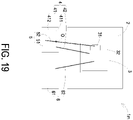
- FIG. 19 is a schematic view illustrating the structure of a switching module according to a fourteenth embodiment of the present disclosure.
- the structures and functions of the components of the switching module 1m which are identical to those of the first embodiment are not redundantly described herein. Component parts and elements corresponding to those of the first embodiment are designated by identical numeral references.
- the second power pin of the second power part in the switching module 1m of this embodiment is formed by a portion of the substrate 2, or the second power pin of the second power part in the switching module 1m of this embodiment is disposed on the substrate 2 by a surface mount technology.
- the second power part of the switching module 1m is not additionally equipped with the fourth conductor to be connected with the second power terminal 33 of the switching element 3.
- the first control pin 41 of the first control part 4 in the switching module 1m includes a first segment 411 and a second segment 412. A first end of the first segment 411 and a first end of the second segment 412 are connected with each other. An angle is formed between the first segment 411 and the second segment 412. For example, the first segment 411 and the second segment 412 are perpendicular to each other. A second end of the first segment 411 is connected with the first conductor 42.
- the first control terminal 31 of the switching element 3 is located beside a first side of the substrate 2, and the first control pin 41, the second control pin 51 and the first power pin 61 are located beside a second side of the substrate 2.
- the plane of the substrate 2 is a reference plane.
- the projection area of the first segment 411 of the first control pin 41 of the first control part 4 on the reference plane intersects with the projection area of the second conductor 52 of the second control part 5 on the reference plane at an intersection O.
- FIGS. 17 , 18 and 19 the projection areas of the conductor intersect with the corresponding control pin on the reference plane.
- FIGS. 11A, 11B , 12A , 12B , 13A , 13B , 14 , 15A and 15B can be also applied to the embodiments of FIGS. 11A, 11B , 12A , 12B , 13A , 13B , 14 , 15A and 15B .
- the preset disclosure provides a switching module.
- the switching module an intersection is formed between the projection area of the first control part on the reference plane and the projection area of the second control part on the reference plane.
- the mutual inductance between the current of the power loop and the overall control loop in the switching module is reduced, and the self-inductance of the control loop in the switching module is reduced. Consequently, the safety performance of the switching module is enhanced.
Landscapes
- Engineering & Computer Science (AREA)
- Power Engineering (AREA)
- Business, Economics & Management (AREA)
- Emergency Management (AREA)
- Physics & Mathematics (AREA)
- Electromagnetism (AREA)
- Power Conversion In General (AREA)
- Electronic Switches (AREA)
Abstract
Description
- The present disclosure relates to a switching module, and more particularly to a switching module for reducing the mutual inductance between a power loop and a control loop and reducing the self-inductance in the control loop.
- Generally, a switching module of a power electronic system is operated at a high frequency to achieve high power density. However, the high operating frequency may increase the switching loss, and thus reduce the efficiency of the switching module. Consequently, when the switching module is operated at the high frequency, it is necessary to increase the switching speed of the control terminal of the switching module in order to reduce the switching loss. However, when the switching module is operated at the higher switching speed, a serious electromagnetic interference (EMI) problem occurs.
- Especially, in case that the switching module has a high power density structure, the distance between the power loop and the control loop in the switching module is relatively short. When the current in the power loop changes, an induced magnetic field is generated around the power loop. When the induced magnetic field passes through the control loop, a corresponding induced voltage is generated. Consequently, the electromagnetic interference caused by the mutual inductance between the power loop and the control loop is generated. Due to the electromagnetic interference of the mutual inductance, the switching process of the switching module is impacted. If the electromagnetic interference caused by the mutual inductance is too large and thus the interference voltage is increased, the voltage across the control terminal may exceed the safe range. Under this circumstance, the reliability of the switching module is reduced, and the switching module may even be unable to work normally.
- In addition to the electromagnetic interference caused by the mutual inductance between the power loop and the control loop, there is also self-induced electromagnetic interference in the control loop. When the current through the control loop changes, an induced magnetic field is generated around the control loop and thus a self-induced electromagnetic interference is generated. The self-inductance of the control loop is in proportion to the area of the control loop. If the self-inductance is large, it is easy to cause the oscillation during the switching process. Due to the oscillation, the safety performance of the switching module is impaired.
- Therefore, there is a need of providing an improved switching module in order to overcome the drawbacks of the conventional technologies.
- The present disclosure provides a switching module for reducing the mutual inductance between a power loop and a control loop and reducing the self-inductance in the control loop.
- In accordance with an aspect of the present disclosure, a switching module is provided. The switching module includes at least one substrate, at least one switching element, at least one first control part, at least one second control part, at least one first power part and at least one second power part. The at least one switching element is disposed on the substrate. Each switching element includes a first control terminal, a second control terminal, a first power terminal and a second power terminal. The at least one first control part is connected with the first control terminal of the corresponding switching element. The at least one second control part is connected with the second control terminal of the corresponding switching element. A projection area of the first control part on a reference plane intersects with a projection area of the second control part on the reference plane at one or more first intersections. The at least one first power part is connected with the first power terminal of the corresponding switching element. The at least one second power part is connected with the second power terminal of the corresponding switching element.
- The above contents of the present disclosure will become more readily apparent to those ordinarily skilled in the art after reviewing the following detailed description and accompanying drawings, in which:
-
-
FIG. 1 is a schematic view illustrating the structure of a switching module according to a first embodiment of the present disclosure; -
FIG. 2 is a schematic side view illustrating a portion of the switching module as shown inFIG. 1 ; -
FIG. 3 schematically illustrates how the mutual inductance between the power loop and the control loop of the switching module ofFIG. 1 is countervailed; -
FIG. 4 is a schematic circuit diagram of the switching module as shown inFIG. 1 ; -
FIG. 5 schematically illustrates that the mutual inductance of the outer magnetic field is crossly countervailed by the control loop of the switching module ofFIG. 1 along a magnetic flux direction; -
FIG. 6 schematically illustrates that the mutual inductance of the outer magnetic field is crossly countervailed by the control loop of the switching module ofFIG. 1 along a lateral direction; -
FIG. 7A is a schematic view illustrating the structure of a switching module according to a second embodiment of the present disclosure; -
FIG. 7B is a schematic circuit diagram of the switching module as shown inFIG. 7A ; -
FIG. 8A is a schematic view illustrating the structure of a switching module according to a third embodiment of the present disclosure; -
FIG. 8B is a schematic circuit diagram of the switching module as shown inFIG. 8A ; -
FIG. 9A is a schematic view illustrating the structure of a switching module according to a fourth embodiment of the present disclosure; -
FIG. 9B is a schematic circuit diagram of the switching module as shown inFIG. 9A ; -
FIG. 10A is a schematic view illustrating the structure of a switching module according to a fifth embodiment of the present disclosure; -
FIG. 10B is a schematic circuit diagram of the switching module as shown inFIG. 10A ; -
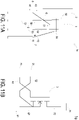
FIG. 11A is a schematic view illustrating the structure of a switching module according to a sixth embodiment of the present disclosure; -
FIG. 11B is a schematic circuit diagram of the switching module as shown inFIG. 11A ; -
FIG. 12A is a schematic view illustrating the structure of a switching module according to a seventh embodiment of the present disclosure; -
FIG. 12B is a schematic circuit diagram of the switching module as shown inFIG. 12A ; -
FIG. 13A is a schematic view illustrating the structure of a switching module according to an eighth embodiment of the present disclosure; -
FIG. 13B is a schematic circuit diagram of the switching module as shown inFIG. 13A ; -
FIG. 14 is a schematic view illustrating the structure of a switching module according to a ninth embodiment of the present disclosure; -
FIG. 15A is a schematic view illustrating the structure of a switching module according to a tenth embodiment of the present disclosure; -
FIG. 15B is a schematic circuit diagram of the switching module as shown inFIG. 15A ; -
FIG. 16 is a schematic view illustrating the structure of a switching module according to an eleventh embodiment of the present disclosure; -
FIG. 17 is a schematic view illustrating the structure of a switching module according to a twelfth embodiment of the present disclosure; -
FIG. 18 is a schematic view illustrating the structure of a switching module according to a thirteenth embodiment of the present disclosure; and -
FIG. 19 is a schematic view illustrating the structure of a switching module according to a fourteenth embodiment of the present disclosure. - The present disclosure will now be described more specifically with reference to the following embodiments. It is to be noted that the following descriptions of preferred embodiments of this disclosure are presented herein for purpose of illustration and description only. It is not intended to be exhaustive or to be limited to the precise form disclosed.
- Please refer to
FIGS. 1 ,2 ,3 and4 .FIG. 1 is a schematic view illustrating the structure of a switching module according to a first embodiment of the present disclosure.FIG. 2 is a schematic side view illustrating a portion of the switching module as shown inFIG. 1 .FIG. 3 schematically illustrates how the mutual inductance between the power loop and the control loop of the switching module ofFIG. 1 is countervailed.FIG. 4 is a schematic circuit diagram of the switching module as shown inFIG. 1 . - The
switching module 1 is disposed on a main circuit board (not shown) and electrically connected with the main circuit board. In an embodiment, theswitching module 1 includes asubstrate 2, aswitching element 3, afirst control part 4, asecond control part 5, and afirst power part 6 and asecond power part 7. - In an embodiment, the switching
element 3 is a vertical device. Preferably but not exclusively, the switchingelement 3 is an insulated gate bipolar transistor (IGBT), a bipolar junction transistor (BJT), a metal-oxide-semiconductor field-effect transistor (MOSFET), a junction field effect transistor (JFET) or a gallium nitride high electron mobility transistor (GaN-HEMT). - The switching
element 3 is bonded on thesubstrate 2 through a connectingmaterial 11. The switchingelement 3 includes afirst control terminal 31, asecond control terminal 32, afirst power terminal 32 and asecond power terminal 33. Thefirst control terminal 31 and the second control terminal 32 (and the first power terminal) are disposed on afirst surface 34 of theswitching element 3. The second control terminal and the first power terminal are located at the same region of theswitching element 3, and are designated by identicalnumeral reference 32. Thesecond power terminal 33 is disposed on asecond surface 35 of theswitching element 3. Thesecond power terminal 33 is connected with thesubstrate 2 through the connectingmaterial 11. - In some embodiments, in case that the switching
element 3 is an insulated gate bipolar transistor (IGBT), thefirst control terminal 31 is served as a gate terminal of theswitching element 3, thesecond control terminal 32 and thefirst power terminal 32 are collaboratively formed as an emitter of theswitching element 3, and thesecond power terminal 33 is served as a collector of theswitching element 3. In some other embodiments, in case that the switchingelement 3 is a bipolar junction transistor (BJT), thefirst control terminal 31 is served as a base of theswitching element 3, thesecond control terminal 32 and thefirst power terminal 32 are collaboratively formed as an emitter of theswitching element 3, and thesecond power terminal 33 is served as a collector of theswitching element 3. In some other embodiments, in case that the switchingelement 3 is a metal-oxide-semiconductor field-effect transistor (MOSFET), a junction field effect transistor (JFET) or a gallium nitride high electron mobility transistor (GaN-HEMT), thefirst control terminal 31 is served as a gate terminal of theswitching element 3, thesecond control terminal 32 and thefirst power terminal 32 are collaboratively formed as a source terminal of theswitching element 3, and thesecond power terminal 33 is served as a drain terminal of theswitching element 3. - In the circuit diagram of
FIG. 4 , the switchingelement 3 is a metal-oxide-semiconductor field-effect transistor (MOSFET). The circuit diagram of theswitching module 1 ofFIG. 1 is shown inFIG. 4 . - The
first control part 4 is connected with thefirst control terminal 31 of theswitching element 3. Thefirst control part 4 includes afirst control pin 41 and afirst conductor 42. Thefirst conductor 42 is connected between thefirst control pin 41 and thefirst control terminal 31 of theswitching element 3. Thesecond control part 5 is connected with thesecond control terminal 32 of theswitching element 3. Thesecond control part 5 includes asecond control pin 51 and asecond conductor 52. Thesecond conductor 52 is connected between thesecond control pin 51 and thesecond control terminal 32 of theswitching element 3. Moreover, a control loop of theswitching module 1 is defined by thesecond control terminal 32, thesecond conductor 52, thesecond pin 51, the main circuit board, thefirst control pin 41, thefirst conductor 42 and thefirst control terminal 31 collaboratively. - In an embodiment, the plane of the
substrate 2 is a reference plane. The projection area of thefirst control part 4 on the reference plane intersects with the projection area of thesecond control part 5 on the reference plane at an intersection O. For example, the projection area of thefirst conductor 42 of thefirst control part 4 on the reference plane intersects with the projection area of thesecond conductor 52 of thesecond control part 5 on the reference plane at the intersection O. - The
first power part 6 is connected with thefirst power terminal 32 of theswitching element 3. Thefirst power part 6 includes afirst power pin 61 and athird conductor 62. Thethird conductor 62 is connected between thefirst power pin 61 and thefirst power terminal 32 of theswitching element 3. Thesecond power part 7 is connected with thesubstrate 2. Consequently, thesecond power part 7 is connected with thesecond power terminal 33 of theswitching element 3 via thesubstrate 2. Thesecond power part 7 includes asecond power pin 71 and afourth conductor 72. Thefourth conductor 72 is connected between thesubstrate 2 and thesecond power pin 71. Thefourth conductor 72 is connected with thesecond power terminal 33 of theswitching element 3 through thesubstrate 2. Moreover, a power loop of theswitching module 1 is defined by thesecond power terminal 33, thesubstrate 2, thefourth conductor 72, thesecond power pin 71, the main circuit board, thefirst power pin 61, thethird conductor 62 and thefirst power terminal 32 collaboratively. As shown inFIG. 1 , thefirst control pin 41, thesecond control pin 51, thefirst power pin 61 and thesecond power pin 71 are arranged sequentially. - Please refer to
FIG. 3 . The point A and the point D denote the two ends of thefirst control part 4. The point B and the point C denote the two ends of thesecond control part 5. The point P denotes the connection point connecting thefirst control terminal 31 of theswitching element 3 and the second control terminal 32 (and the first power terminal 32). The point Q denotes a connection point in the main circuit board. The reference label I denotes the current flowing through the power loop. In this embodiment, the point O is the intersection of thefirst conductor 42 and thesecond conductor 52. The control loop of theswitching module 1 is divided into two sub-control loops. The first sub-control loop is defined by the points O, B, P and A collaboratively. The second sub-control loop is defined by the points O, C, Q and D collaboratively. In case that the integration level of the control loop is high, the area of the first sub-control loop is equal to or similar to the area of the second sub-control loop. Consequently, the magnetic fluxes generated by the current I of the power loop and passing through the two sub-control loops are equal or similar. That is, the magnetic flux Φ1 of the first sub-control loop is equal to or substantially equal to the magnetic flux Φ2 of the second sub-control loop, the mutual inductance M1 between the power loop and the first sub-control loop is equal to or substantially equal to the mutual inductance M2 between the power loop and the second sub-control loop. Since the current direction of the first sub-control loop and the current direction of the second sub-control loop are opposite, the mutual inductance M1 between the power loop and the first sub-control loop and the mutual inductance M2 between the power loop and the second sub-control loop have opposite signs. Preferably but not exclusively, the mutual inductance M1 is equal to the mutual inductance M2. In other words, the sum of the mutual inductance M1 between the power loop and the first sub-control loop and the mutual inductance M2 between the power loop and the second sub-control loop is zero. Since the mutual inductance between the power loop and the overall control loop is zero, the purpose of reducing the mutual inductance between the power loop and the control loop is achieved. - As mentioned above, the point O is the intersection between the
first conductor 42 and thesecond conductor 52. Consequently, the area of the control loop is equal to the area of the first sub-control loop plus the area of the second sub-control loop, i.e., the area enclosed by the points O, B, P and A plus the area enclosed by the points O, C, Q and D. In comparison with the conventional control loop without the intersection, the area of the control loop in theswitching module 1 is reduced by the area formed by points A, O and D and the area formed by points B, O and D, and thus the self-inductance of the control loop is reduced. - As mentioned above, the projection area of the
first conductor 42 of thefirst control part 4 on the reference plane intersects the projection area of thesecond conductor 52 of thesecond control part 5 on the reference plane at the intersection O. In comparison with the conventional switching module, the mutual inductance between the control loop and the power loop in theswitching module 1 of the present disclosure is reduced. As both the mutual inductance between the control loop and the power loop and the self-inductance of the control loop in theswitching module 1 is reduced, the safety performance of theswitching module 1 is enhanced. - The positional relationships between the control loop and the power loop shown in
FIG. 3 are all projection diagrams. For example, the projections are projected on thesubstrate 2. It is understandable that thefirst control part 4 and thesecond control part 5 inFIG. 1 may not be completely on the same plane. In particular, thefirst conductor 42 of thefirst control part 4 and thesecond conductor 52 of thesecond control part 5 may not be completely coplanar. That is, thefirst conductor 42 of thefirst control part 4 and thesecond conductor 52 of thesecond control part 5 are not coplanar. From the side view of the structure shown inFIG. 1 , for example in the projection on the plane perpendicular to the plane of thesubstrate 2, another area surrounded by thefirst control part 4 and thesecond control part 5 can be seen, as shown in the area enclosed by PAOCQDOB shown inFIG. 6 . On the basis ofFIG. 3 ,FIG. 5 further marks the directions of the magnetic fluxes Φ1 and Φ2 passing through the two sub-control loops when the current I of the power loop is greater than zero. The directions of the magnetic fluxes Φ1 and Φ2 passing through the two sub-control loops are identical. Since the current flowing through the two sub-control loops are opposed to each other, the direction of the mutual inductances M1 and M2 are opposite. The total mutual inductance between the power loop and the two sub-control loop is M1+M2. When the magnetic fluxes Φ1 and Φ2 are similar or equal, the magnitudes of the mutual inductances M1 and M2 are also similar or equal, and the total mutual inductance M1+M2 is close to 0 or equal to 0, and the effect is as described above. However, if the values of the magnetic fluxes Φ1 and Φ2 differ greatly (i.e., Φ1 > Φ2 or Φ1 < Φ2), the value of the total mutual inductance M1+M2 will differ greatly from zero. Then, the third magnetic flux Φ3 can be introduced for compensation.FIG. 6 shows the projection of the current I through the power loop and the projection of the control loop on the side surface. The projection of the current I through the power loop to the lateral direction is above the projection of the control loop on the side surface. Accordingly, the magnetic flux of the magnetic field generated by the current I through the power loop upon the projection of the control loop on the side surface (i.e., the PAOCQDOB area) is Φ3, the direction of the magnetic flux Φ3 is shown, and the mutual inductance of the magnetic flux Φ3 in the entire control loop is defined as M3. Taking Φ1 < Φ2 as an example, the total mutual inductance M1+M2 < 0, the compensation of the magnetic flux Φ3 can make the total mutual inductance M1+M2+M3 be equal to 0. The magnetic flux in the area formed by the projections of thefirst control part 4 and thesecond control part 5 on the side surface is used to compensate the magnetic flux in the area formed by the projections of thefirst control part 4 and thesecond control part 5 on the reference plane, so that the total magnetic flux through the control loop formed by thefirst control part 4 and thesecond control part 5 is reduced. Preferably but not exclusively, the total magnetic flux is reduced to zero. As a result, the mutual inductance between the power loop and the entire control loop is reduced. In this case, the projection of thefirst control part 4 on the side surface is between the projection of thesecond control part 5 on the side surface and the projection of the current I through the power loop on the side surface. That is, the projection of thefirst control part 4 on the side surface is between the projection of thesecond control part 5 on the side surface and the projection of thefirst power part 6 on the side surface, or the projection of thefirst control part 4 on the side surface is between the projection of thesecond control part 5 on the side surface and the projection of thesecond power part 7 on the side surface. In other cases, the total mutual inductance M1+M2+M3=0 can also be achieved by introducing the magnetic flux Φ3 of the side projection. That is, the mutual inductance is reduced. In case that Φ1 > Φ2, the compensation effect is also achieved by the magnetic flux Φ3 on the projections of thefirst control part 4 and thesecond control part 5 on the side surfaces. Then the projection of thesecond control part 5 on the side surface is between the projection of thefirst control part 4 on the side surface and the projection of the current I through the power loop on the side surface. That is, the projection of thefirst control part 4 on the side surface is between the projection of thesecond control part 5 on the side surface and the projection of thefirst power part 6 on the side surface, or the projection of thefirst control part 4 on the side surface is between the projection of thesecond control part 5 on the side surface and the projection of thesecond power part 7 on the side surface. In this embodiment, the side surface intersects the reference plane. Preferably but not exclusively, the side surface is perpendicular to the reference plane. - Please refer to
FIGS. 7A and 7B. FIG. 7A is a schematic view illustrating the structure of a switching module according to a second embodiment of the present invention.FIG. 7B is a schematic circuit diagram of the switching module as shown inFIG. 7A . The structures and functions of the components of theswitching module 1a which are identical to those of the first embodiment are not redundantly described herein. Component parts and elements corresponding to those of the first embodiment are designated by identical numeral references. In theswitching module 1a of this embodiment, thesecond power pin 71 is formed by a portion of thesubstrate 2. Since thesubstrate 2 of theswitching module 1a is directly connected with thesecond power terminal 33 of theswitching element 3, the second power part of theswitching module 1a is not additionally equipped with the fourth conductor. In this embodiment, the power loop of theswitching module 1a is defined by thesecond power terminal 33, thesubstrate 2, the main circuit board, thefirst power pin 61, thethird conductor 62 and thefirst power terminal 32 collaboratively. Moreover, thefirst control pin 41, thesecond control pin 51 and thefirst power pin 61 are arranged sequentially. - Please refer to
FIGS. 8A and 8B. FIG. 8A is a schematic view illustrating the structure of a switching module according to a third embodiment of the present disclosure.FIG. 8B is a schematic circuit diagram of the switching module as shown inFIG. 8A . The structures and functions of the components of theswitching module 1b which are identical to those of the first embodiment are not redundantly described herein. Component parts and elements corresponding to those of the first embodiment are designated by identical numeral references. In comparison with the first embodiment ofFIG. 1 , the arrangement positions of thefirst control pin 41, thesecond control pin 51, thefirst power pin 61 and thesecond power pin 71 in theswitching module 1b of this embodiment are changed. That is, thefirst control pin 41, thesecond power pin 71, thesecond control pin 51 and thefirst power pin 61 of theswitching module 1b are arranged sequentially. - In some embodiments, the second control part and the first power part share the same part. Please refer to
FIGS. 9A and 9B. FIG. 9A is a schematic view illustrating the structure of a switching module according to a fourth embodiment of the present disclosure.FIG. 9B is a schematic circuit diagram of the switching module as shown inFIG. 9A . The structures and functions of the components of theswitching module 1c which are identical to those of the first embodiment are not redundantly described herein. Component parts and elements corresponding to those of the first embodiment are designated by identical numeral references. In the embodiment ofFIG. 1 , thesecond control part 5 and thefirst power part 6 of theswitching module 1 are separately arranged. Whereas, in theswitching module 1c of this embodiment, the second control part and the first power part share acommon part 8. Thecommon part 8 is connected with the second control terminal 32 (and the first power terminal 32) of theswitching element 3. Thecommon part 8 includes afifth pin 81 and afifth conductor 82. Thefifth pin 81 is served as the second control pin of the second control part and the first power pin of the first power part. Thefifth conductor 82 is connected between the second control terminal 32 (and the first power terminal 32) of theswitching element 3 and thefifth pin 81. Thefifth conductor 82 can be used as the second conductor of the second control part and the third conductor of the first power part collaboratively. In an embodiment, the plane of thesubstrate 2 is reference plane. Moreover, the projection area of thefirst conductor 42 of thefirst control part 4 on the reference plane intersects with the projection area of thefifth conductor 82 of thecommon part 8 on the reference plane at an intersection O. In this embodiment, thefirst control pin 41, thefifth pin 81 and thesecond power pin 71 are arranged sequentially. - Please refer to
FIGS. 10A and 10B. FIG. 10A is a schematic view illustrating the structure of a switching module according to a fifth embodiment of the present disclosure.FIG. 10B is a schematic circuit diagram of the switching module as shown inFIG. 10A . The structures and functions of the components of the switching module Id which are identical to those of theswitching module 1c of the fourth embodiment are not redundantly described herein. Component parts and elements corresponding to those of the first embodiment are designated by identical numeral references. In comparison with the fourth embodiment ofFIGS. 9A and 9B , the arrangement positions of the associated pins are changed. That is, thefifth pin 81, thefirst control pin 41 and thesecond power pin 71 in theswitching module 1d of this embodiment are arranged sequentially. - Please refer to
FIGS. 11A and 11B. FIG. 11A is a schematic view illustrating the structure of a switching module according to a sixth embodiment of the present disclosure.FIG. 11B is a schematic circuit diagram of the switching module as shown inFIG. 11A . The structures and functions of the components of theswitching module 1e which are identical to those of the first embodiment are not redundantly described herein. Component parts and elements corresponding to those of the first embodiment are designated by identical numeral references. In theswitching module 1 of the first embodiment, thesecond power terminal 33 is disposed on thesecond surface 35 of theswitching element 3. In comparison with the first embodiment, thefirst control terminal 31, the second control terminal 32 (and the first power terminal 32) and thesecond power terminal 33 of theswitching module 1e of this embodiment are disposed on thefirst surface 34 of theswitching element 3. In other words, the switchingelement 3 of theswitching module 1e is a planar switching element such as a gallium nitride high electron mobility transistor (GaN-HEMT) or a low voltage metal-oxide-semiconductor field-effect transistor (MOSFET). Under this circumstance, thesecond power part 7 is directly connected with thesecond power terminal 33 of theswitching element 3 without the need of being contacted with thesubstrate 2. - Please refer to
FIGS. 12A and12B .FIG. 12A is a schematic view illustrating the structure of a switching module according to a seventh embodiment of the present disclosure.FIG. 12B is a schematic circuit diagram of the switching module as shown inFIG. 12A . The structures and functions of the components of the switching module If which are identical to those of the first embodiment are not redundantly described herein. Component parts and elements corresponding to those of the first embodiment are designated by identical numeral references. In this embodiment, the switching module If includes two switching elements (i.e., a first switching element 3' and asecond switching element 3"), twofirst control parts 4, twosecond control parts 5, twofirst power parts 6 and asecond power part 7. The second power terminal of the first switching element 3' and the second power terminal of thesecond switching element 3" are connected with each other. In an embodiment, the plane of thesubstrate 2 is a reference plane. The projection area of thefirst conductor 42 of the first switching element 3' on the reference plane intersects with the projection area of thesecond conductor 52 of the first switching element 3' on the reference plane at an intersection O. The projection area of thefirst conductor 42 of thesecond switching element 3" on the reference plane intersects with the projection area of thesecond conductor 52 of thesecond switching element 3" on the reference plane at another intersection O. The switching module of this embodiment may be modified as long as the projection areas offirst control part 4 of one switch on the reference plane intersects with thesecond control part 5 of said one switch on the reference plane. - In an embodiment, the
first control pin 41 of thefirst control part 4 adjacent to the first switching element 3', thesecond control pin 51 of thesecond control part 5 adjacent to the first switching element 3', thefirst power pin 61 of thefirst power part 6 adjacent to the first switching element 3', thefirst power pin 61 of thefirst power part 6 adjacent to thesecond switching element 3", thesecond control pin 51 of thesecond control part 5 adjacent to thesecond switching element 3" and thefirst control pin 41 of thefirst control part 4 adjacent to thesecond switching element 3" are arranged sequentially. It is noted that the arrangement positions of the two first control pins 41, two second control pins 51, two first power pins 61 and asecond power pin 7 are not restricted. Certainly, in some other embodiments, the power module If includes a singlefirst power pin 61. That is, thefirst power pin 61 is shared by the first switching element 3' and thesecond switching element 3". - Please refer to
FIGS. 13A and13B .FIG. 13A is a schematic view illustrating the structure of a switching module according to an eighth embodiment of the present disclosure.FIG. 13B is a schematic circuit diagram of the switching module as shown inFIG. 13A . The structures and functions of the components of theswitching module 1g which are identical to those of the first embodiment are not redundantly described herein. Component parts and elements corresponding to those of the first embodiment are designated by identical numeral references. In this embodiment, theswitching module 1g includes two switching elements (i.e., a first switching element 3' and asecond switching element 3"), afirst control part 4, asecond control part 5, twofirst power parts 6 and asecond power part 7. The first switching element 3' and thesecond switching element 3" are connected with each other in parallel. In comparison with the switching module ofFIG. 12A , onefirst control pin 41 and onesecond control pin 51 are shared by the first switching element 3' and thesecond switching element 3". In addition, theswitching module 1g of this embodiment further includes asixth conductor 91 and aseventh conductor 92. Thesixth conductor 91 is connected between thesecond control terminal 32 of the first switching element 3' and thesecond control terminal 32 of thesecond switching element 3". Theseventh conductor 92 is connected between thefirst control terminal 31 of the first switching element 3' and thefirst control terminal 31 of thesecond switching element 3". It is noted that the example of the switching module of this embodiment may be modified. For example, in some other embodiments, theswitching module 1g includes a singlefirst power pin 61. That is, thefirst power pin 61 is shared by the first switching element 3' and thesecond switching element 3". - In an embodiment, the
first power pin 61 of thefirst power part 6 adjacent to the first switching element 3', thefirst control pin 41 of thefirst control part 4, thesecond control pin 51 of thesecond control part 5, and thefirst power pin 61 of thefirst power part 6 adjacent to thesecond switching element 3" are arranged sequentially. It is noted that the arrangement positions of the associated pins are not restricted. -
FIG. 14 is a schematic view illustrating the structure of a switching module according to a ninth embodiment of the present disclosure. In comparison with the embodiment ofFIGS. 13A and13B , the orientations of the two switching elements in theswitching module 1h of this embodiment are opposite. Moreover, the projection area of thesixth conductor 91 on the reference plane intersects with the projection area of theseventh conductor 92 on the reference plane at an intersection P. In some embodiments, thesubstrate 2 is chosen as the reference plane. Similarly, the projection area of thefirst conductor 42 on the reference plane intersects with the projection area of thesecond conductor 52 on the reference plane at an intersection O. Since the magnetic fluxes generated by the current I through the power loop and passing through the two sub-control loops are equal or similar, the mutual inductance and the self-inductance are reduced. Moreover, the projection area of thesixth conductor 91 on the reference plane intersects with the projection area of theseventh conductor 92 on the reference plane at the intersection P. A second power loop and a second control loop are defined by the intersection P, thesixth conductor 91, theseventh conductor 92 and the associated components. Consequently, the mutual inductance between the second power loop and the second control loop is further reduced, and the self-inductance of the second control loop is further reduced. - Please refer to
FIGS. 15A and 15B. FIG. 15A is a schematic view illustrating the structure of a switching module according to a tenth embodiment of the present disclosure.FIG. 15B is a schematic circuit diagram of the switching module as shown inFIG. 15A . The structures and functions of the components of theswitching module 1i which are identical to those of the first embodiment are not redundantly described herein. Component parts and elements corresponding to those of the first embodiment are designated by identical numeral references. In this embodiment, theswitching module 1i includes two substrates (i.e., a first substrate 2' and asecond substrate 2"), two switching elements (i.e., a first switching element 3' and asecond switching element 3"), twofirst control parts 4, twosecond control parts 5, afirst power part 6 and twosecond power parts 7. The first switching element 3' and thesecond switching element 3" are connected with each other in series. The first switching element 3' is disposed on the first substrate 2'. Thesecond switching element 3" is disposed on thesecond substrate 2". In an embodiment, the planes of the first substrate 2' and thesecond substrate 2" are reference planes. The projection area of thefirst conductor 42 of first switching element 3' on the reference plane intersects with the projection area of thesecond conductor 52 of the first switching element 3' on the reference plane at an intersection O. The projection area of thefirst conductor 42 of thesecond switching element 3" on the reference plane intersects with the projection area of thesecond conductor 52 of thesecond switching element 3" on the reference plane at another intersection O. - The
switching module 1i further includes aneighth conductor 93. Theeighth conductor 93 is connected between the first substrate 2' and the second control terminal 32 (and the first power terminal 32) of thesecond switching element 3". -
FIG. 16 is a schematic view illustrating the structure of a switching module according to an eleventh embodiment of the present disclosure. The structures and functions of the components of theswitching module 1j which are identical to those of the first embodiment are not redundantly described herein. Component parts and elements corresponding to those of the first embodiment are designated by identical numeral references. In this embodiment, the projection area of thefirst conductor 42 of thefirst control part 4 on the reference plane intersects with the projection area of thesecond conductor 52 of thesecond control part 5 on the reference plane at a plurality of intersections O (e.g., three intersections O). The number of the intersections O is not limited. Due to the arrangement of the plurality of intersections O, the area of the control loop in theswitching module 1j of this embodiment is further reduced. Consequently, the self-inductance of the control loop is further reduced. -
FIG. 17 is a schematic view illustrating the structure of a switching module according to a twelfth embodiment of the present disclosure. The structures and functions of the components of theswitching module 1k which are identical to those of the first embodiment are not redundantly described herein. Component parts and elements corresponding to those of the first embodiment are designated by identical numeral references. In comparison with the first embodiment, thefirst control pin 41 of thefirst control part 4 includes afirst segment 411 and asecond segment 412. Thefirst segment 411 and thesecond segment 412 are perpendicular to each other. A first end of thefirst segment 411 and a first end of thesecond segment 412 are connected with each other. Preferably, thefirst segment 411 and thesecond segment 412 are integrally formed as a one-piece structure. A second end of thefirst segment 411 is connected with thefirst conductor 42. In an embodiment, the plane of thesubstrate 2 is reference plane. Moreover, the projection area of thefirst segment 411 of thefirst control pin 41 of thefirst control part 4 on the reference plane intersects with the projection area of thesecond conductor 52 of thesecond control part 5 on the reference plane at an intersection O. For example, the projection area of thefirst segment 411 of thefirst control pin 41 of thefirst control part 4 on thesubstrate 2 intersects with the projection area of thesecond conductor 52 of thesecond control part 5 on thesubstrate 2 at the intersection O. It is noted that the switching module of this embodiment may be modified. For example, in another embodiment, the angle between thefirst segment 411 and thesecond segment 412 is not restricted to 90 degrees. Alternatively, in another embodiment, the projection area of thefirst segment 411 of thefirst control pin 41 of thefirst control part 4 on the reference plane intersects with the projection area of thesecond conductor 52 of thesecond control part 5 on the reference plane at a plurality of intersections O. The number of the intersections O is not limited and is adjustable according to the practical requirements. -
FIG. 18 is a schematic view illustrating the structure of a switching module according to a thirteenth embodiment of the present disclosure. The structures and functions of the components of theswitching module 11 which are identical to those of the first embodiment are not redundantly described herein. Component parts and elements corresponding to those of the first embodiment are designated by identical numeral references. In comparison with the first embodiment, thesecond control pin 51 of thesecond control part 5 includes athird segment 511 and afourth segment 512. Thethird segment 511 and thefourth segment 512 are perpendicular to each other. A first end of thethird segment 511 and a first end of thefourth segment 512 are connected with each other. Preferably, thethird segment 511 and thefourth segment 512 are integrally formed as a one-piece structure. A second end of thethird segment 511 is connected with thesecond conductor 52. In addition, thethird segment 511 is arranged between thefirst control pin 41 and theswitching element 3. In an embodiment, the plane of thesubstrate 2 is a reference plane. In this embodiment, the projection area of thefirst conductor 42 of thefirst control part 4 on the reference plane intersects with the projection area of thesecond conductor 52 of thesecond control part 5 on the reference plane at an intersection O. Moreover, the projection area of thefirst conductor 42 of thefirst control part 4 on the reference plane intersects with the projection area of thethird segment 511 of thesecond control pin 51 of thesecond control part 5 on the reference plane at another intersection O. -
FIG. 19 is a schematic view illustrating the structure of a switching module according to a fourteenth embodiment of the present disclosure. The structures and functions of the components of theswitching module 1m which are identical to those of the first embodiment are not redundantly described herein. Component parts and elements corresponding to those of the first embodiment are designated by identical numeral references. In comparison with the first embodiment, the second power pin of the second power part in theswitching module 1m of this embodiment is formed by a portion of thesubstrate 2, or the second power pin of the second power part in theswitching module 1m of this embodiment is disposed on thesubstrate 2 by a surface mount technology. Since thesubstrate 2 of theswitching module 1m is directly connected with thesecond power terminal 33 of theswitching element 3, the second power part of theswitching module 1m is not additionally equipped with the fourth conductor to be connected with thesecond power terminal 33 of theswitching element 3. Moreover, thefirst control pin 41 of thefirst control part 4 in theswitching module 1m includes afirst segment 411 and asecond segment 412. A first end of thefirst segment 411 and a first end of thesecond segment 412 are connected with each other. An angle is formed between thefirst segment 411 and thesecond segment 412. For example, thefirst segment 411 and thesecond segment 412 are perpendicular to each other. A second end of thefirst segment 411 is connected with thefirst conductor 42. - In this embodiment, the
first control terminal 31 of theswitching element 3 is located beside a first side of thesubstrate 2, and thefirst control pin 41, thesecond control pin 51 and thefirst power pin 61 are located beside a second side of thesubstrate 2. In an embodiment, the plane of thesubstrate 2 is a reference plane. Moreover, the projection area of thefirst segment 411 of thefirst control pin 41 of thefirst control part 4 on the reference plane intersects with the projection area of thesecond conductor 52 of thesecond control part 5 on the reference plane at an intersection O. - In the embodiments of
FIGS. 17 ,18 and19 , the projection areas of the conductor intersect with the corresponding control pin on the reference plane. These concepts can be also applied to the embodiments ofFIGS. 11A, 11B ,12A ,12B ,13A ,13B ,14 ,15A and 15B . - From the above descriptions, the preset disclosure provides a switching module. In the switching module, an intersection is formed between the projection area of the first control part on the reference plane and the projection area of the second control part on the reference plane. The mutual inductance between the current of the power loop and the overall control loop in the switching module is reduced, and the self-inductance of the control loop in the switching module is reduced. Consequently, the safety performance of the switching module is enhanced.
Claims (16)
- A switching module (1, 1a, 1b, 1c, 1d, 1e, 1f, 1g, 1h, 1i, 1j, 1k, 1l, 1m), characterized by comprising:at least one substrate (2);at least one switching element (3) disposed on the substrate (2), wherein each switching element (3) comprises a first control terminal (31), a second control terminal (32), a first power terminal (32) and a second power terminal (33);at least one first control part (4) connected with the first control terminal (31) of the corresponding switching element (3);at least one second control part (5) connected with the second control terminal (32) of the corresponding switching element (3), wherein a projection area of the first control part (4) on a reference plane intersects with a projection area of the second control part (5) on the reference plane at one or more first intersections (O);at least one first power part (6) connected with the first power terminal (32) of the corresponding switching element (3); andat least one second power part (7) connected with the second power terminal (33) of the corresponding switching element (3).
- The switching module (1, 1a, 1b, 1c, 1e, 1f, 1g, 1h, 1i, 1j, 1k, 1l, 1m) according to claim 1, wherein the first control part (4) comprises a first control pin (41) and a first conductor (42), the first conductor (42) is connected between the first control pin (41) and the first control terminal (31) of the corresponding switching element (3), the second control part (5) comprises a second control pin (51) and a second conductor (52), and the second conductor (52) is connected between the second control pin (51) and the second control terminal (32) of the corresponding switching element (3).
- The switching module (1, 1a, 1b, 1c, 1e, 1f, 1g, 1h, 1i, 1j, 1k, 1l, 1m) according to claim 2, wherein a projection area of the first conductor (42) on the reference plane intersects with a projection area of the second conductor (52) on the reference plane at the one or more first intersections (O).
- The switching module (1, 1a, 1b, 1c, 1e, 1f, 1g, 1h, 1i, 1j, 1k, 1l, 1m) according to claim 2, wherein a projection area of the first control pin (41) on the reference plane intersects with a projection area of the second conductor (52) on the reference plane at the one or more first intersections (O).
- The switching module (1, 1b, 1c, 1e, 1h, 1i, 1j, 1k, 1l) according to claim 2, wherein the first power part (6) comprises a first power pin (61) and a third conductor (62), and the third conductor (62) is connected between the first power pin (61) and the first power terminal (32) of the corresponding switching element (3), wherein the second power part (7) comprises a second power pin (71) and a fourth conductor (72), and the fourth conductor (72) is connected between the second power pin (71) and the second power terminal (33) of the corresponding switching element (3).
- The switching module (1, 1e, 1j, 1k) according to claim 5, wherein the first control pin (41), the second control pin (51), the first power pin (61) and the second power pin (71) are arranged sequentially.
- The switching module (1c) according to claim 5, wherein the second control part (5) and the first power part (6) share a common part (8).
- The switching module (1k, 11) according to claim 2, wherein the first control pin (41) comprises a first segment (411) and a second segment (412), wherein a first end of the first segment (411) and a first end of the second segment (412) are connected with each other, an angle is formed between the first segment (411) and the second segment (412), a second end of the first segment (411) is connected with the first conductor (42), wherein the first segment (411) and the second segment (412) are integrally formed as a one-piece structure.
- The switching module (1f, 1g, 1h, 1i) according to claim 2, wherein the at least one switching element (3) comprises a plurality of switching elements (3), the at least one first control part (4) comprises a plurality of first control parts (4), and the at least one second control part (5) comprises a plurality of second control parts (5), wherein the first control pin (41) of each first control part (4) is connected with the first control terminal (31) of the corresponding switching element (3) through the corresponding first conductor (42), and the second control pin (51) of each second control part (5) is connected with the second control terminal (32) of the corresponding switching element (3) through the corresponding second conductor (52), wherein the projection area of the first control part (4) of at least one switching element (3) on the reference plane intersects with the projection area of the second control part (5) of the corresponding switching element (3) on the reference plane at the one or more first intersections (O).
- The switching module (1f, 1g, 1h, 1i) according to claim 9, wherein the projection area of the first control part (4) of each switching element (3) on the reference plane intersects with the projection area of the second control part (5) of the corresponding switching element (3) on the reference plane at the one or more first intersections (O).
- The switching module (1g, 1h) according to claim 2, wherein the at least one switching element (3) comprises a first switching element (3') and a second switching element (3"), wherein the first control terminal (31) of the first switching element (3') is connected with the first control terminal (31) of the second switching element (3") through a seventh conductor (92), the first control terminal (31) of the first switching element (3') is connected with the first control pin (41) through the first conductor (42), the second control terminal (32) of the first switching element (3') is connected with the second control terminal (32) of the second switching element (3") through a sixth conductor (91), and the second control terminal (32) of the first switching element (3') is connected with the second control pin (51) through the second conductor (52).
- The switching module (1g, 1h) according to claim 11, wherein a projection area of the sixth conductor (91) on the reference plane intersects with a projection area of the seventh conductor (92) on the reference plane at one or more second intersections (P).
- The switching module (1g, 1h) according to claim 11, wherein the second power terminal (33) of the first switching element (3') and the first power terminal (32) of the second switching element (3") are connected with each other, or wherein the first power terminal (32) of the first switching element (3') and the first power terminal (32) of the second switching element (3") are connected with each other, and the second power terminal (33) of the first switching element (3') and the second power terminal (33) of the second switching element (3") are connected with each other.
- The switching module (1, 1a, 1b, 1c, 1d, 1e, 1f, 1g, 1h, 1i, 1j, 1k, 1l, 1m) according to claim 1, wherein the magnetic fluxes passing through an area defined by a projection area of the first control part (4) and the second control part (5) on one side surface is used to compensate the magnetic fluxes passing through an area defined by a projection area of the first control part (4) and the second control part (5) on the reference plane, so that the total magnetic fluxes passing through and area defined by the first control part (4) and the second control part (5) is reduced, wherein the side surface and the reference plane are cross with each other.
- The switching module (1d, 1g, 1h, 1i, 1l) according to claim 14, wherein the first control part (4) and the second control part (5) are not coplanar, wherein a projection area of the first control part (4) on the side surface is located between a projection area of the second control part (5) on the side surface and a projection area of the first power part (6) on the side surface, or the projection area of the first control part (4) on the side surface is located between the projection area of the second control part (5) on the side surface and a projection area of the second power part (7) on the side surface.
- The switching module (1, 1a, 1b, 1c, 1e, 1f, 1g, 1h, 1i, 1j, 1k, 1m) according to claim 14, wherein the first control part (4) and the second control part (5) are not coplanar, wherein a projection area of the second control part (5) on the side surface is located between a projection area of the first control part (4) on the side surface and a projection area of the first power part (6) on the side surface, or the projection area of the second control part (5) on the side surface is located between the projection area of the first control part (4) on the side surface and a projection area of the second power part (7) on the side surface.
Applications Claiming Priority (1)
| Application Number | Priority Date | Filing Date | Title |
|---|---|---|---|
| CN202110263916.6A CN115085706B (en) | 2021-03-11 | 2021-03-11 | Switch module |
Publications (2)
| Publication Number | Publication Date |
|---|---|
| EP4057343A2 true EP4057343A2 (en) | 2022-09-14 |
| EP4057343A3 EP4057343A3 (en) | 2023-03-15 |
Family
ID=80446265
Family Applications (1)
| Application Number | Title | Priority Date | Filing Date |
|---|---|---|---|
| EP22158193.7A Pending EP4057343A3 (en) | 2021-03-11 | 2022-02-23 | Switching module |
Country Status (4)
| Country | Link |
|---|---|
| US (1) | US12199467B2 (en) |
| EP (1) | EP4057343A3 (en) |
| JP (1) | JP7371151B2 (en) |
| CN (1) | CN115085706B (en) |
Family Cites Families (15)
| Publication number | Priority date | Publication date | Assignee | Title |
|---|---|---|---|---|
| JP2001148458A (en) * | 1999-11-22 | 2001-05-29 | Mitsubishi Electric Corp | Power semiconductor module |
| JP2003068780A (en) | 2001-08-30 | 2003-03-07 | Matsushita Electric Ind Co Ltd | Semiconductor device |
| JP4133600B2 (en) | 2003-06-05 | 2008-08-13 | 株式会社豊田自動織機 | Semiconductor device |
| US6992377B2 (en) | 2004-02-26 | 2006-01-31 | Freescale Semiconductor, Inc. | Semiconductor package with crossing conductor assembly and method of manufacture |
| EP1746648A3 (en) | 2005-07-22 | 2008-09-03 | Marvell World Trade Ltd. | Packaging for high speed integrated circuits |
| US8816497B2 (en) | 2010-01-08 | 2014-08-26 | Transphorm Inc. | Electronic devices and components for high efficiency power circuits |
| JP5594242B2 (en) * | 2011-07-11 | 2014-09-24 | 株式会社デンソー | Switching element drive circuit |
| JP5783997B2 (en) * | 2012-12-28 | 2015-09-24 | 三菱電機株式会社 | Power semiconductor device |
| JP6065771B2 (en) * | 2013-07-03 | 2017-01-25 | 株式会社デンソー | Semiconductor device |
| JP6119570B2 (en) * | 2013-11-19 | 2017-04-26 | ソニー株式会社 | Display device, display method, and program |
| JP6252293B2 (en) * | 2014-03-26 | 2017-12-27 | 株式会社デンソー | Semiconductor device |
| JP6413939B2 (en) * | 2015-06-09 | 2018-10-31 | 株式会社デンソー | Semiconductor device and inverter |
| US9991880B2 (en) * | 2016-06-07 | 2018-06-05 | Ford Global Technologies, Llc | Discrete power switching devices with reduced common source inductance |
| US9994110B2 (en) * | 2016-08-30 | 2018-06-12 | Ford Global Technologies, Llc | Dual gate solid state devices to reduce switching loss |
| CN111742407A (en) | 2018-02-27 | 2020-10-02 | 三菱电机株式会社 | semiconductor device |
-
2021
- 2021-03-11 CN CN202110263916.6A patent/CN115085706B/en active Active
-
2022
- 2022-02-22 US US17/677,769 patent/US12199467B2/en active Active
- 2022-02-23 EP EP22158193.7A patent/EP4057343A3/en active Pending
- 2022-03-04 JP JP2022033827A patent/JP7371151B2/en active Active
Also Published As
| Publication number | Publication date |
|---|---|
| CN115085706A (en) | 2022-09-20 |
| US12199467B2 (en) | 2025-01-14 |
| JP7371151B2 (en) | 2023-10-30 |
| EP4057343A3 (en) | 2023-03-15 |
| CN115085706B (en) | 2025-04-11 |
| US20220294261A1 (en) | 2022-09-15 |
| JP2022140349A (en) | 2022-09-26 |
Similar Documents
| Publication | Publication Date | Title |
|---|---|---|
| US12255373B2 (en) | Digital phase shifter | |
| US10256640B2 (en) | Semiconductor device | |
| DE102005007373A1 (en) | Power semiconductor device | |
| JP6319509B2 (en) | Semiconductor device | |
| US11721613B2 (en) | Power module | |
| JP3046276B2 (en) | Power converter | |
| US7279963B2 (en) | Low inductance semiconductor device having half-bridge configuration | |
| US10608546B2 (en) | Power converter | |
| US11342279B2 (en) | Semiconductor device and amplifier having bonding wire and conductive member | |
| EP4057343A2 (en) | Switching module | |
| US10014795B2 (en) | Power converter | |
| EP4184570A2 (en) | Power electronic module with reduced mutual inductance between power and control loops | |
| US20240297592A1 (en) | Power semiconductor module and power conversion device using the same | |
| US20210351120A1 (en) | Power module | |
| JP7380124B2 (en) | Power semiconductor module and method for manufacturing power semiconductor module | |
| US10892748B1 (en) | Power module | |
| US20230307332A1 (en) | Power Semiconductor Module and Method for Producing a Power Semiconductor Module | |
| WO2022004420A1 (en) | Power supply module | |
| US12336094B2 (en) | Wiring board and power conversion apparatus | |
| US20190393175A1 (en) | Discrete electronic component comprising a transistor | |
| US20240321764A1 (en) | Component-embedded circuit board | |
| EP4432563A1 (en) | Switching assembly with a first transistor and a second transistor receiving a common gate signal | |
| US10930606B2 (en) | Electronic device comprising a discrete transistor assembled on a printed circuit board | |
| US20250359283A1 (en) | Semiconductor device | |
| WO2026083476A1 (en) | Power module |
Legal Events
| Date | Code | Title | Description |
|---|---|---|---|
| PUAI | Public reference made under article 153(3) epc to a published international application that has entered the european phase |
Free format text: ORIGINAL CODE: 0009012 |
|
| STAA | Information on the status of an ep patent application or granted ep patent |
Free format text: STATUS: THE APPLICATION HAS BEEN PUBLISHED |
|
| AK | Designated contracting states |
Kind code of ref document: A2 Designated state(s): AL AT BE BG CH CY CZ DE DK EE ES FI FR GB GR HR HU IE IS IT LI LT LU LV MC MK MT NL NO PL PT RO RS SE SI SK SM TR |
|
| PUAL | Search report despatched |
Free format text: ORIGINAL CODE: 0009013 |
|
| AK | Designated contracting states |
Kind code of ref document: A3 Designated state(s): AL AT BE BG CH CY CZ DE DK EE ES FI FR GB GR HR HU IE IS IT LI LT LU LV MC MK MT NL NO PL PT RO RS SE SI SK SM TR |
|
| RIC1 | Information provided on ipc code assigned before grant |
Ipc: H01L 23/495 20060101ALI20230206BHEP Ipc: H01L 23/66 20060101ALI20230206BHEP Ipc: H01L 25/07 20060101ALI20230206BHEP Ipc: H01L 23/64 20060101ALI20230206BHEP Ipc: H01L 23/552 20060101AFI20230206BHEP |
|
| STAA | Information on the status of an ep patent application or granted ep patent |
Free format text: STATUS: REQUEST FOR EXAMINATION WAS MADE |
|
| 17P | Request for examination filed |
Effective date: 20230812 |
|
| RBV | Designated contracting states (corrected) |
Designated state(s): AL AT BE BG CH CY CZ DE DK EE ES FI FR GB GR HR HU IE IS IT LI LT LU LV MC MK MT NL NO PL PT RO RS SE SI SK SM TR |