EP4057299A1 - Cable having a coating layer made of a recycled polymer material - Google Patents
Cable having a coating layer made of a recycled polymer material Download PDFInfo
- Publication number
- EP4057299A1 EP4057299A1 EP22160679.1A EP22160679A EP4057299A1 EP 4057299 A1 EP4057299 A1 EP 4057299A1 EP 22160679 A EP22160679 A EP 22160679A EP 4057299 A1 EP4057299 A1 EP 4057299A1
- Authority
- EP
- European Patent Office
- Prior art keywords
- weight
- recycled
- cable
- cable according
- lldpe
- Prior art date
- Legal status (The legal status is an assumption and is not a legal conclusion. Google has not performed a legal analysis and makes no representation as to the accuracy of the status listed.)
- Granted
Links
Images
Classifications
-
- H—ELECTRICITY
- H01—ELECTRIC ELEMENTS
- H01B—CABLES; CONDUCTORS; INSULATORS; SELECTION OF MATERIALS FOR THEIR CONDUCTIVE, INSULATING OR DIELECTRIC PROPERTIES
- H01B3/00—Insulators or insulating bodies characterised by the insulating materials; Selection of materials for their insulating or dielectric properties
- H01B3/18—Insulators or insulating bodies characterised by the insulating materials; Selection of materials for their insulating or dielectric properties mainly consisting of organic substances
- H01B3/30—Insulators or insulating bodies characterised by the insulating materials; Selection of materials for their insulating or dielectric properties mainly consisting of organic substances plastics; resins; waxes
- H01B3/42—Insulators or insulating bodies characterised by the insulating materials; Selection of materials for their insulating or dielectric properties mainly consisting of organic substances plastics; resins; waxes polyesters; polyethers; polyacetals
- H01B3/421—Polyesters
-
- C—CHEMISTRY; METALLURGY
- C08—ORGANIC MACROMOLECULAR COMPOUNDS; THEIR PREPARATION OR CHEMICAL WORKING-UP; COMPOSITIONS BASED THEREON
- C08L—COMPOSITIONS OF MACROMOLECULAR COMPOUNDS
- C08L23/00—Compositions of homopolymers or copolymers of unsaturated aliphatic hydrocarbons having only one carbon-to-carbon double bond; Compositions of derivatives of such polymers
- C08L23/02—Compositions of homopolymers or copolymers of unsaturated aliphatic hydrocarbons having only one carbon-to-carbon double bond; Compositions of derivatives of such polymers not modified by chemical after-treatment
- C08L23/04—Homopolymers or copolymers of ethene
- C08L23/08—Copolymers of ethene
- C08L23/0846—Copolymers of ethene with unsaturated hydrocarbons containing atoms other than carbon or hydrogen
- C08L23/0853—Ethylene vinyl acetate copolymers
-
- C—CHEMISTRY; METALLURGY
- C09—DYES; PAINTS; POLISHES; NATURAL RESINS; ADHESIVES; COMPOSITIONS NOT OTHERWISE PROVIDED FOR; APPLICATIONS OF MATERIALS NOT OTHERWISE PROVIDED FOR
- C09D—COATING COMPOSITIONS, e.g. PAINTS, VARNISHES OR LACQUERS; FILLING PASTES; CHEMICAL PAINT OR INK REMOVERS; INKS; CORRECTING FLUIDS; WOODSTAINS; PASTES OR SOLIDS FOR COLOURING OR PRINTING; USE OF MATERIALS THEREFOR
- C09D123/00—Coating compositions based on homopolymers or copolymers of unsaturated aliphatic hydrocarbons having only one carbon-to-carbon double bond; Coating compositions based on derivatives of such polymers
- C09D123/02—Coating compositions based on homopolymers or copolymers of unsaturated aliphatic hydrocarbons having only one carbon-to-carbon double bond; Coating compositions based on derivatives of such polymers not modified by chemical after-treatment
- C09D123/04—Homopolymers or copolymers of ethene
- C09D123/08—Copolymers of ethene
- C09D123/0846—Copolymers of ethene with unsaturated hydrocarbons containing other atoms than carbon or hydrogen atoms
- C09D123/0853—Vinylacetate
-
- H—ELECTRICITY
- H01—ELECTRIC ELEMENTS
- H01B—CABLES; CONDUCTORS; INSULATORS; SELECTION OF MATERIALS FOR THEIR CONDUCTIVE, INSULATING OR DIELECTRIC PROPERTIES
- H01B3/00—Insulators or insulating bodies characterised by the insulating materials; Selection of materials for their insulating or dielectric properties
- H01B3/18—Insulators or insulating bodies characterised by the insulating materials; Selection of materials for their insulating or dielectric properties mainly consisting of organic substances
- H01B3/30—Insulators or insulating bodies characterised by the insulating materials; Selection of materials for their insulating or dielectric properties mainly consisting of organic substances plastics; resins; waxes
- H01B3/44—Insulators or insulating bodies characterised by the insulating materials; Selection of materials for their insulating or dielectric properties mainly consisting of organic substances plastics; resins; waxes vinyl resins; acrylic resins
- H01B3/441—Insulators or insulating bodies characterised by the insulating materials; Selection of materials for their insulating or dielectric properties mainly consisting of organic substances plastics; resins; waxes vinyl resins; acrylic resins from alkenes
-
- H—ELECTRICITY
- H01—ELECTRIC ELEMENTS
- H01B—CABLES; CONDUCTORS; INSULATORS; SELECTION OF MATERIALS FOR THEIR CONDUCTIVE, INSULATING OR DIELECTRIC PROPERTIES
- H01B3/00—Insulators or insulating bodies characterised by the insulating materials; Selection of materials for their insulating or dielectric properties
- H01B3/18—Insulators or insulating bodies characterised by the insulating materials; Selection of materials for their insulating or dielectric properties mainly consisting of organic substances
- H01B3/30—Insulators or insulating bodies characterised by the insulating materials; Selection of materials for their insulating or dielectric properties mainly consisting of organic substances plastics; resins; waxes
- H01B3/44—Insulators or insulating bodies characterised by the insulating materials; Selection of materials for their insulating or dielectric properties mainly consisting of organic substances plastics; resins; waxes vinyl resins; acrylic resins
- H01B3/446—Insulators or insulating bodies characterised by the insulating materials; Selection of materials for their insulating or dielectric properties mainly consisting of organic substances plastics; resins; waxes vinyl resins; acrylic resins from vinylacetals
-
- H—ELECTRICITY
- H01—ELECTRIC ELEMENTS
- H01B—CABLES; CONDUCTORS; INSULATORS; SELECTION OF MATERIALS FOR THEIR CONDUCTIVE, INSULATING OR DIELECTRIC PROPERTIES
- H01B3/00—Insulators or insulating bodies characterised by the insulating materials; Selection of materials for their insulating or dielectric properties
- H01B3/18—Insulators or insulating bodies characterised by the insulating materials; Selection of materials for their insulating or dielectric properties mainly consisting of organic substances
- H01B3/30—Insulators or insulating bodies characterised by the insulating materials; Selection of materials for their insulating or dielectric properties mainly consisting of organic substances plastics; resins; waxes
- H01B3/44—Insulators or insulating bodies characterised by the insulating materials; Selection of materials for their insulating or dielectric properties mainly consisting of organic substances plastics; resins; waxes vinyl resins; acrylic resins
- H01B3/448—Insulators or insulating bodies characterised by the insulating materials; Selection of materials for their insulating or dielectric properties mainly consisting of organic substances plastics; resins; waxes vinyl resins; acrylic resins from other vinyl compounds
-
- H—ELECTRICITY
- H01—ELECTRIC ELEMENTS
- H01B—CABLES; CONDUCTORS; INSULATORS; SELECTION OF MATERIALS FOR THEIR CONDUCTIVE, INSULATING OR DIELECTRIC PROPERTIES
- H01B7/00—Insulated conductors or cables characterised by their form
- H01B7/17—Protection against damage caused by external factors, e.g. sheaths or armouring
- H01B7/18—Protection against damage caused by wear, mechanical force or pressure; Sheaths; Armouring
- H01B7/186—Sheaths comprising longitudinal lapped non-metallic layers
-
- C—CHEMISTRY; METALLURGY
- C08—ORGANIC MACROMOLECULAR COMPOUNDS; THEIR PREPARATION OR CHEMICAL WORKING-UP; COMPOSITIONS BASED THEREON
- C08L—COMPOSITIONS OF MACROMOLECULAR COMPOUNDS
- C08L2207/00—Properties characterising the ingredient of the composition
- C08L2207/20—Recycled plastic
-
- H—ELECTRICITY
- H01—ELECTRIC ELEMENTS
- H01B—CABLES; CONDUCTORS; INSULATORS; SELECTION OF MATERIALS FOR THEIR CONDUCTIVE, INSULATING OR DIELECTRIC PROPERTIES
- H01B11/00—Communication cables or conductors
- H01B11/22—Cables including at least one electrical conductor together with optical fibres
Definitions
- the present disclosure relates to a cable having a coating layer made of a recycled polymer material. More particularly, the present disclosure relates to a cable including at least one core comprising at least one transmissive element and at least one coating layer, said coating layer being made of a recycled polymer material comprising at least one polyethylene obtained from a waste material.
- US 2008/0304797 relates to a cable comprising at least one core comprising a coating layer made from a coating material, comprising a first polyethylene obtained from a waste material; and a second polyethylene having a density higher than 0.940 g/cm 3 .
- the first polyethylene may be selected from low density polyethylene (LDPE), linear low density polyethylene (LLDPE), very low density polyethylene (VLDPE), or mixtures thereof.
- the first polyethylene can be present in the coating material in an amount of between 30 wt% and 90 wt% with respect to the total weight of the coating material.
- the coating material may further comprise carbon black, preferably in an amount of between 2 wt% and 5 wt% with respect to the total weight of the coating material.
- carbon black preferably in an amount of between 2 wt% and 5 wt% with respect to the total weight of the coating material.
- Other conventional additives may be added to the coating material, e.g. glass particles, glass fibers, calcined clay, talc, or mixtures thereof.
- CN103965537 relates to a self-crosslinkable composite polyethylene cable material which comprises a recycled material of low density polyethylene (LDPE), a recycled material of linear low density polyethylene (LLDPE), a recycled material of high density polyethylene (HDPE), a polyethylene wax, a heat stabilizer, a cold resistant agent, a silane.
- LDPE low density polyethylene
- LLDPE linear low density polyethylene
- HDPE high density polyethylene
- recycled polymer materials usually provide cable coating layers having poor mechanical properties with respect to those obtained from virgin polymer materials. Moreover, such coating layers may have poor appearance and/or a sticky surface.
- These problems may be solved by mixing the recycled polymer materials with a virgin one, the amount of the virgin material being usually at least 10%w. This, of course, reduces environmental and economic advantages with respect to the use of recycled polymers alone. Also, some admixtures recycled/virgin polymer could not solve the problems or give rise to new ones.
- the Applicant has faced the technical problem of providing recycled polymer materials useful for producing cable coating layers, specifically cable jackets, wherein the recycled materials is by far the prevailing or even the sole polymer material present in the coating layer, which has satisfactory mechanical properties, particularly tensile and elongation at break, and good surface appearance.
- a cable with a coating layer made of a composition comprising a recycled linear low density polyethylene (r-LLDPE) in an amount of from 70% to 95% by weight, an ethylene-vinyl acetate copolymer (EVA) in an amount of from 5 to 30% by weight, the weight percentages being expressed with respect to the total weight of polymeric materials present in the composition.
- r-LLDPE recycled linear low density polyethylene
- EVA ethylene-vinyl acetate copolymer
- the present disclosure relates to a cable comprising: a core comprising a transmissive element, and a coating layer made of a coating material, said coating material comprising:
- the term "core" of a cable is used to indicate a semi-finished structure comprising a transmissive element, such as an electrical energy transmissive element, an optical signal transmissive element or an element which transmits both electrical energy and optical signals, and at least one electrical insulation or, respectively, at least one containment element (such as, for example, a tube, a sheath, a microsheath or a grooved core), or at least two elements, one of which is an electrical insulation element and one is a containment element, arranged at a radially outer position with respect to the relevant transmissive element.
- a transmissive element such as an electrical energy transmissive element, an optical signal transmissive element or an element which transmits both electrical energy and optical signals
- at least one electrical insulation or, respectively at least one containment element (such as, for example, a tube, a sheath, a microsheath or a grooved core), or at least two elements, one of which is an electrical insulation element and one is a containment element
- the term "electrical energy transmissive element” is used to indicate any element capable of carrying electrical energy such as, for example, a metallic conductor element.
- the "core” of the cable further comprises at least one of an inner semiconductive coating layer arranged at a radially outer position with respect to the conductor element, or an outer semiconductive coating layer arranged at a radially outer position with respect to the electrical insulation element.
- a metallic screen arranged at a radially outer position with respect to said outer semiconductive coating layer is generally provided.
- optical signal transmissive element is used to indicate any transmission element comprising at least one optical fibre. Therefore, such a term identifies both a single optical fibre and a plurality of optical fibres, optionally grouped together to form a bundle of optical fibres or arranged parallel to each other and coated with a common coating to form a ribbon of optical fibres.
- the "core” of the cable may further comprise a water blocking/absorbing material, e.g. a gel, embedding the transmissive element within a containment layer.
- mixed electro-optical transmissive element is used to indicate any element capable of transmitting both electrical energy and optical signals in accordance with the abovementioned definitions.
- coating layer means any coating deposited around the transmissive element of a cable for protective purposes, e.g. for preventing the damages of the transmission element due to mechanical stresses during manufacturing, installation and use; such coating layer may also be identified as “sheath” or “jacket”.
- the present disclosure also refers to cables provided with a plurality of cores as defined above, known in the field with the terms “bipolar cable”, “tripolar cable” and “multipolar cable”, depending on the number of cores incorporated therein (in the mentioned cases in number of two, three, or greater, respectively).
- the present disclosure refers to cables provided with one or more cores of any type.
- the present disclosure refers to unipolar or multipolar cables, of electrical type for transporting or distributing electrical energy, or of the optical type comprising at least one optical fibre, or of the mixed energy/telecommunications type.
- the amounts of the various components of the composition are expressed, unless otherwise specified, as % by weight with respect to the total weight of polymeric materials present in the composition.
- the r-LLDPE (recycled linear low density polyethylene)
- it may be a LLDPE obtained by recycling articles comprising or essentially consisting of LLDPE, such as mulching films used in agriculture or for packaging films.
- the r-LLDPE may have a density of from 0.850 to 0.926 g/cm 3 , measured according to standard method ASTM D792-00.
- LLDPE identifies a class of ethylene copolymers having short branchings, obtained by copolymerization of ethylene with small amounts of an alpha-olefin C 3 -C 12 , for example 1-butene, 1-hexene or 1-octene.
- LLDPE can be produced by a low-pressure copolymerization process in the presence of a Ziegler-Natta catalyst, a chromium catalyst or a metallocene catalyst.
- the alpha-olefin C 3 -C 12 can be contained in the copolymer in an amount of from 1 to 15% by mole.
- the r-LLDPE has a melt flow index (MFI; a.k.a. melt flow rate, MFR, or melt index) of from 0.8 to 10 g/10 min (190°C, 2.16 kg according to ASTM D1238-04 or ISO 1133-00).
- MFI melt flow index
- EVA ethylene-vinyl acetate copolymer
- the amount of vinylacetate in the EVA can be from 10% to 40% by weight, for example from 15% to 30% by weight.
- the EVA may be added to the r-LLDPE or, alternatively, be already contained in the r-LLDPE as a result of the previous LLDPE use. In the latter case EVA is recycled as well.
- the amount of EVA already contained in an r-LLDPE can be ascertained by FT-IR (Fourier transform infrared spectroscopy) analysis.
- the composition of the present coating layer may contain a virgin or an additional recycled polyethylene homopolymer or copolymer in an amount of 5 to 50% by weight.
- the virgin polyethylene may be, e.g., LLDPE or HDPE; the additional recycled polyethylene may be HDPE.
- LLDPE LLDPE
- HDPE high density polyethylene
- the addition of LLDPE may be useful to improve flexibility of the present composition, while the addition of HDPE, either virgin or recycled, may be useful to improve hardness of the present composition.
- composition of the present coating layer may further comprise a detackifier in an amount of from 1 to 25% by weight, for example from 1 to 8% by weight.
- the detackifier it is may be at least one of talc, kaolin, calcium carbonate, chalk, stearic acid and stearates, e.g. zinc, aluminium, calcium, magnesium, sodium stearates.
- the addition of the detackifier may be aimed to avoid sticking of the composition, both when it is reduced into a subdivided form, such as granules or beads, to be processed, or when it is applied onto the cable core.
- composition may contain other additives, such as: antioxidants, flame retardants, light or UV stabilizers, processing aids, lubricants, pigments, thermal stabilizers, or mixtures thereof.
- additives such as: antioxidants, flame retardants, light or UV stabilizers, processing aids, lubricants, pigments, thermal stabilizers, or mixtures thereof.
- the composition may contain carbon black in an amount of from 0.5% to 10% by weight, for example from 1% to 5% by weight. Carbon black may be useful to prevent UV degradation of the polymeric material or as a pigment to fulfil standard requirements.
- the coating layer according to the present disclosure may be produced according to known extrusion techniques.
- the composition is fed in a subdivided form to an extruder provided with an extrusion head where the cable core is conveyed.
- the composition is melted and mixed inside the extruder, optionally filtered and then deposited around the cable core.
- the so covered cable is cooled and collected on a reel.
- the cable according to the present disclosure may further comprise a skin layer placed around and in direct contact with the coating layer based on r-LLDPE.
- the skin layer may be made of virgin polyethylene and is aimed to improve the surface appearance. Also, the skin layer may be used when the coating layer is somewhat still sticky. In case the skin layer is made of virgin HDPE, this can provide the coating layer with the hardness sought in some applications.
- the skin layer may have a thickness of from 1 to 20% of the thickness of the coating layer.
- the coating layer of the cable of the present disclosure may be the outer sheath (a.k.a. jacket). It may be the outermost cable layer, unless a skin layer is present.
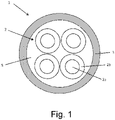
- FIG. 1 shows a low voltage (LV) cable 1 comprising four cable cores 2.
- Each cable core 2 comprises an electric conductor 2a made of a metal such as copper or aluminium or composite thereof, in the form of bundled or stranded wires or of a single rod.
- Each electric conductor 2a is surrounded by an insulating layer 2b.
- the insulating layer 2b can be made of a polymer material such as polyethylene.
- the four cable cores 2 are stranded together and at least partially embedded in a filler 5 made of a polymeric material.
- the filler is surrounded by a sheath or jacket 3 made of a polymeric composition according to the present disclosure.
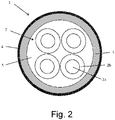
- the cable of Figure 2 differs from that of Figure 1 in that the jacket 3 is surrounded by a skin layer 4 according to the present disclosure.
- Materials M1, M7, M8, M9, M10 and M12 are according to the present disclosure. The above materials were tested as follows.
- the granules of the tested materials were placed in batches of about 150-250 ml between the rolls of a Schwabenthan laboratory testing roll mill.
- the roll distance was smaller than 3 mm.
- the obtained film was partially cut and folded over itself before going back into the mill in order to make it the most homogeneous possible. Then, the roll distance was increased to an extent so as to take out an even film from the roll mill.
- the film was placed to cool before it was put into a polymer press to homogenize the polymer and to create a sample piece of an even width.
- the polymer film was cut to fit into metal templates of 1 mm thickness.
- the film inside the template was put in between two polyester covers to prevent adhesion between polymer and metal.
- the covered film was put between two flat metal plates before being put into the press.
- the press had two compartments, one lower and one upper. Into each one separately, the samples were placed. The compartments were heated to 180°C throughout the first 10 min, then cooling was initiated. The pressures were set to 1 bar for 5 minutes, to 10 bar for 10 minutes, then the last 5 minutes were under cooling. After 15 min inside the press, the samples were heated, pressed and cooled. The plates, covers and metal templates were removed, and the samples were stented into dumbbells using a wrench.
- dumbbell specimens were subjected to tensile testing according Swedish standards SS 424 14 18 (2007) and SS-EN 60811-100 (2014), using an initial stretching speed of 25 mm/min. The test was carried out on 5 samples before and after ageing.
- Ageing was carried out by putting five specimens of each material in an oven at 100°C for 240 hours. The specimens were taken out of the oven, maintained at room temperature for at least 16 hours and then tensile properties were assessed again as described above.
- compositions according to the present disclosure showed mechanical properties comparable to those of a virgin polymer composition (M1) and better, both before and after ageing, than recycled polymer-based compositions comprising recycled LLDPE (M3, M4) but free from EVA.
- the compositions comprising recycled HDPE (M5, M6) showed a better performance by virtue of the higher density of that polyethylene.
- composition according to the present disclosure maintained suitable mechanical properties after cold treatment
- the ones comprising recycled HDPE (M5, M6) had a remarkable drop making their use for a cable sheath questionable.
- composition M12 having mechanical features similar to those of composition M10, was also tested for environmental stress crack resistance (ESCR) according to ASTM D1693-13 using 100% Igepal. No imperfections were observed after more than 1,000 hours.
- ESCR environmental stress crack resistance
- N1XE-AS 4G95 0.6/1 kV cables were produced having a jacket made from a composition according to the present disclosure or from a comparative one, selected from those of Example 1. Some cables were provided with a skin of virgin polymeric material, having a thickness of 10% of the thickness of the outer sheath.
- Tensile and elongation at break tests were performed on samples of the outer sheath. In particular, tests before and after ageing at 100°C for 240 hours were carried out on samples of the outer sheath detached from the cable.
Landscapes
- Physics & Mathematics (AREA)
- Spectroscopy & Molecular Physics (AREA)
- Chemical & Material Sciences (AREA)
- Organic Chemistry (AREA)
- Polymers & Plastics (AREA)
- Medicinal Chemistry (AREA)
- Chemical Kinetics & Catalysis (AREA)
- Health & Medical Sciences (AREA)
- Life Sciences & Earth Sciences (AREA)
- Engineering & Computer Science (AREA)
- Materials Engineering (AREA)
- Wood Science & Technology (AREA)
- Compositions Of Macromolecular Compounds (AREA)
- Organic Insulating Materials (AREA)
Abstract
Description
- The present disclosure relates to a cable having a coating layer made of a recycled polymer material. More particularly, the present disclosure relates to a cable including at least one core comprising at least one transmissive element and at least one coating layer, said coating layer being made of a recycled polymer material comprising at least one polyethylene obtained from a waste material.
- The possibility of using polymer materials obtained from wastes for the manufacturing of new products is a problem of increasing importance for environmental sustainability and costs reduction. In the field of cables, several efforts have been made to use recycled polymer materials, especially ethylene polymers obtained from waste materials, to produce cable coating layers, in particular cable sheaths (or jackets).
-
US 2008/0304797 relates to a cable comprising at least one core comprising a coating layer made from a coating material, comprising a first polyethylene obtained from a waste material; and a second polyethylene having a density higher than 0.940 g/cm3. The first polyethylene may be selected from low density polyethylene (LDPE), linear low density polyethylene (LLDPE), very low density polyethylene (VLDPE), or mixtures thereof. The first polyethylene can be present in the coating material in an amount of between 30 wt% and 90 wt% with respect to the total weight of the coating material. In order to protect the coating material from UV degradation the coating material may further comprise carbon black, preferably in an amount of between 2 wt% and 5 wt% with respect to the total weight of the coating material. Other conventional additives may be added to the coating material, e.g. glass particles, glass fibers, calcined clay, talc, or mixtures thereof. - In the article by Hamim, F. A. R. et al, (2016), J. Phys. Sci., 27(2), 23-39, recycled high density polyethylene (RHDPE)/ethylene vinyl acetate (EVA) blends with different blend compositions and compatibilisers are disclosed. The compatibilisation of RHDPE/EVA blends was enhanced by the addition of 6 phr of polyethylene-grafted-maleic anhydride (PE-g-MAH) and caprolactam-maleic anhydride (CL-MAH). All blends significantly decreased in tensile strength with increasing content of EVA. This was due to the presence of EVA which influenced the crystalline structure of RHDPE due to EVA amorphous characteristic. Compatibilised blends with PE-g-MAH reveal higher tensile strength than uncompatibilised RHDPE/EVA blends.
- In the article by Czarnecka-Komorowska D. et al, Advances in Science and Technology Research Journal, Vol. 12, No. 3, September 2018, pages 134-142 the results of the investigation into the properties of films made from recycled polyethylenes are presented. Reprocessing of LDPE and LLDPE originating from packaging materials brings to insignificant degree of degradation of the blends and recycled rLDPE or rLLDPE are characterized by usage properties similar to virgin polyethylenes. A significant increase of tensile properties like strength and elongation at break is observed for recycled LDPE. When the recycled material is LLDPE, the opposite behaviour was observed.
-
CN103965537 relates to a self-crosslinkable composite polyethylene cable material which comprises a recycled material of low density polyethylene (LDPE), a recycled material of linear low density polyethylene (LLDPE), a recycled material of high density polyethylene (HDPE), a polyethylene wax, a heat stabilizer, a cold resistant agent, a silane. - The Applicant has noticed that recycled polymer materials usually provide cable coating layers having poor mechanical properties with respect to those obtained from virgin polymer materials. Moreover, such coating layers may have poor appearance and/or a sticky surface. These problems may be solved by mixing the recycled polymer materials with a virgin one, the amount of the virgin material being usually at least 10%w. This, of course, reduces environmental and economic advantages with respect to the use of recycled polymers alone. Also, some admixtures recycled/virgin polymer could not solve the problems or give rise to new ones.
- The Applicant has faced the technical problem of providing recycled polymer materials useful for producing cable coating layers, specifically cable jackets, wherein the recycled materials is by far the prevailing or even the sole polymer material present in the coating layer, which has satisfactory mechanical properties, particularly tensile and elongation at break, and good surface appearance.
- The Applicant has found that the above technical problem and others can be solved by providing a cable with a coating layer made of a composition comprising a recycled linear low density polyethylene (r-LLDPE) in an amount of from 70% to 95% by weight, an ethylene-vinyl acetate copolymer (EVA) in an amount of from 5 to 30% by weight, the weight percentages being expressed with respect to the total weight of polymeric materials present in the composition.
- Therefore, according to a first aspect, the present disclosure relates to a cable comprising: a core comprising a transmissive element, and a coating layer made of a coating material, said coating material comprising:
- (i) a recycled linear low density polyethylene (r-LLDPE) in an amount of from 70% to 95% by weight, for example from 80% to 90% by weight; and
- (ii) an ethylene-vinyl acetate copolymer (EVA) in an amount of from 5 to 30% by weight, for example from 10% to 20% by weight;
- For the purposes of the present description and of the subsequent claims, the term "core" of a cable is used to indicate a semi-finished structure comprising a transmissive element, such as an electrical energy transmissive element, an optical signal transmissive element or an element which transmits both electrical energy and optical signals, and at least one electrical insulation or, respectively, at least one containment element (such as, for example, a tube, a sheath, a microsheath or a grooved core), or at least two elements, one of which is an electrical insulation element and one is a containment element, arranged at a radially outer position with respect to the relevant transmissive element.
- For the purposes of the present description and of the subsequent claims, the term "electrical energy transmissive element" is used to indicate any element capable of carrying electrical energy such as, for example, a metallic conductor element. As an illustrative example, if we consider a cable for transporting or distributing medium/high voltage electrical energy (where medium voltage indicates a voltage comprised between about 1 kV and about 30 kV, whereas high voltage indicates a voltage greater than about 30 kV), the "core" of the cable further comprises at least one of an inner semiconductive coating layer arranged at a radially outer position with respect to the conductor element, or an outer semiconductive coating layer arranged at a radially outer position with respect to the electrical insulation element. Also, a metallic screen arranged at a radially outer position with respect to said outer semiconductive coating layer is generally provided.
- For the purposes of the present description and of the subsequent claims, the term "optical signal transmissive element" is used to indicate any transmission element comprising at least one optical fibre. Therefore, such a term identifies both a single optical fibre and a plurality of optical fibres, optionally grouped together to form a bundle of optical fibres or arranged parallel to each other and coated with a common coating to form a ribbon of optical fibres. As an illustrative example, if we consider an optical cable, the "core" of the cable may further comprise a water blocking/absorbing material, e.g. a gel, embedding the transmissive element within a containment layer.
- For the purposes of the present description and of the subsequent claims, the term "mixed electro-optical transmissive element" is used to indicate any element capable of transmitting both electrical energy and optical signals in accordance with the abovementioned definitions.
- For the purposes of the present description and of the subsequent claims, the term "coating layer" means any coating deposited around the transmissive element of a cable for protective purposes, e.g. for preventing the damages of the transmission element due to mechanical stresses during manufacturing, installation and use; such coating layer may also be identified as "sheath" or "jacket".
- The present disclosure also refers to cables provided with a plurality of cores as defined above, known in the field with the terms "bipolar cable", "tripolar cable" and "multipolar cable", depending on the number of cores incorporated therein (in the mentioned cases in number of two, three, or greater, respectively).
- In accordance with the abovementioned definitions, the present disclosure refers to cables provided with one or more cores of any type. In other words, the present disclosure refers to unipolar or multipolar cables, of electrical type for transporting or distributing electrical energy, or of the optical type comprising at least one optical fibre, or of the mixed energy/telecommunications type.
- For the purpose of the present description and of the claims that follow, except where otherwise indicated, all numbers expressing amounts, quantities, percentages, and so forth, are to be understood as being modified in all instances by the term "about". Moreover, all ranges include any combination of the maximum and minimum points disclosed and include any intermediate ranges therein, which may or may not be specifically enumerated herein.
- The present disclosure, in at least one of its aspects, can be implemented according to one or more of the present embodiments, optionally combined together.
- For the purpose of the present description and of the appended claims, the words "a" or "an" should be read to include one or at least one and the singular also includes the plural unless it is obvious that it is meant otherwise. This is done merely for convenience and to give a general sense of the disclosure.
- For the purposes of the present description and of the subsequent claims, the amounts of the various components of the composition are expressed, unless otherwise specified, as % by weight with respect to the total weight of polymeric materials present in the composition.
- As regards the r-LLDPE (recycled linear low density polyethylene), it may be a LLDPE obtained by recycling articles comprising or essentially consisting of LLDPE, such as mulching films used in agriculture or for packaging films. In an embodiment, the r-LLDPE may have a density of from 0.850 to 0.926 g/cm3, measured according to standard method ASTM D792-00. As well known in the field, LLDPE identifies a class of ethylene copolymers having short branchings, obtained by copolymerization of ethylene with small amounts of an alpha-olefin C3-C12, for example 1-butene, 1-hexene or 1-octene. LLDPE can be produced by a low-pressure copolymerization process in the presence of a Ziegler-Natta catalyst, a chromium catalyst or a metallocene catalyst. The alpha-olefin C3-C12 can be contained in the copolymer in an amount of from 1 to 15% by mole.
- In an embodiment, the r-LLDPE has a melt flow index (MFI; a.k.a. melt flow rate, MFR, or melt index) of from 0.8 to 10 g/10 min (190°C, 2.16 kg according to ASTM D1238-04 or ISO 1133-00).
- As regards the ethylene-vinyl acetate copolymer (EVA), it is usually produced by high pressure copolymerization of ethylene with vinylacetate. The amount of vinylacetate in the EVA can be from 10% to 40% by weight, for example from 15% to 30% by weight.
- The EVA may be added to the r-LLDPE or, alternatively, be already contained in the r-LLDPE as a result of the previous LLDPE use. In the latter case EVA is recycled as well. The amount of EVA already contained in an r-LLDPE (recycled EVA) can be ascertained by FT-IR (Fourier transform infrared spectroscopy) analysis.
- The composition of the present coating layer may contain a virgin or an additional recycled polyethylene homopolymer or copolymer in an amount of 5 to 50% by weight. The virgin polyethylene may be, e.g., LLDPE or HDPE; the additional recycled polyethylene may be HDPE. The addition of LLDPE may be useful to improve flexibility of the present composition, while the addition of HDPE, either virgin or recycled, may be useful to improve hardness of the present composition.
- In an embodiment, the composition of the present coating layer may further comprise a detackifier in an amount of from 1 to 25% by weight, for example from 1 to 8% by weight.
- As regards the detackifier, it is may be at least one of talc, kaolin, calcium carbonate, chalk, stearic acid and stearates, e.g. zinc, aluminium, calcium, magnesium, sodium stearates. The addition of the detackifier may be aimed to avoid sticking of the composition, both when it is reduced into a subdivided form, such as granules or beads, to be processed, or when it is applied onto the cable core.
- The composition may contain other additives, such as: antioxidants, flame retardants, light or UV stabilizers, processing aids, lubricants, pigments, thermal stabilizers, or mixtures thereof.
- In an embodiment, the composition may contain carbon black in an amount of from 0.5% to 10% by weight, for example from 1% to 5% by weight. Carbon black may be useful to prevent UV degradation of the polymeric material or as a pigment to fulfil standard requirements.
- The coating layer according to the present disclosure may be produced according to known extrusion techniques. In an embodiment, the composition is fed in a subdivided form to an extruder provided with an extrusion head where the cable core is conveyed. The composition is melted and mixed inside the extruder, optionally filtered and then deposited around the cable core. The so covered cable is cooled and collected on a reel.
- The cable according to the present disclosure may further comprise a skin layer placed around and in direct contact with the coating layer based on r-LLDPE. The skin layer may be made of virgin polyethylene and is aimed to improve the surface appearance. Also, the skin layer may be used when the coating layer is somewhat still sticky. In case the skin layer is made of virgin HDPE, this can provide the coating layer with the hardness sought in some applications.
- The skin layer may have a thickness of from 1 to 20% of the thickness of the coating layer.
- The coating layer of the cable of the present disclosure may be the outer sheath (a.k.a. jacket). It may be the outermost cable layer, unless a skin layer is present.
- Further characteristics and advantages will be more apparent from the following description of some embodiments given as a way of an example with reference to the attached drawings in which:
-
Figure 1 shows a sectional view of an energy cable according to an embodiment of the present disclosure; -
Figure 2 shows a sectional view of an energy cable according to another embodiment of the present disclosure. -
Figure 1 shows a low voltage (LV)cable 1 comprising fourcable cores 2. Eachcable core 2 comprises anelectric conductor 2a made of a metal such as copper or aluminium or composite thereof, in the form of bundled or stranded wires or of a single rod. Eachelectric conductor 2a is surrounded by an insulatinglayer 2b. The insulatinglayer 2b can be made of a polymer material such as polyethylene. - The four
cable cores 2 are stranded together and at least partially embedded in afiller 5 made of a polymeric material. The filler is surrounded by a sheath orjacket 3 made of a polymeric composition according to the present disclosure. - The cable of
Figure 2 differs from that ofFigure 1 in that thejacket 3 is surrounded by askin layer 4 according to the present disclosure. - The following polymer materials were tested:
- M1 (reference material): virgin LLDPE having a density of 0.923 g/cm3 and added with 2.5 wt% carbon black (final density: 0.936 g/cm3; MFI=0.85 g/10min);
- M2: recycled LLDPE from mulching films containing 5.6 wt % of EVA, density= 0.969 g/cm3;
- M3 (comparative): 65-75 wt% of recycled low density polyethylene (LDPE) + 25-35 wt% of recycled LLDPE + less than 5 wt% of recycled polypropylene (PP), MFI = 0.8-1.1 g/min, density = 0.920-0.930 g/cm3;
- M4 (comparative): recycled LDPE containing less than 40 wt% of recycled LLDPE, MFI = 0.7-1.0 g/min, density = 0.920-0.935 g/cm3;
- M5 (comparative): recycled high density polyethylene (HDPE), MFI = 0.5 g/min, density = 0.95 g/cm3;
- M6 (comparative): recycled high density polyethylene (HDPE), MFI = 0.2 g/min, density = 0.96 g/cm3;
- M7: 70 wt% of M2 + 30 wt% of Ml;
- M8: M2 added with carbon black (2.5 wt%);
- M9: M2 added with chalk (5.0 wt%) + carbon black (2.5 wt%);
- M10: M2 added with talc (2.5 wt%) + carbon black (2.5 wt%);
- M11 (comparative): M4 added with carbon black (2.5 wt%);
- M12: M2 added with talc (2.5 wt%).
- Materials M1, M7, M8, M9, M10 and M12 are according to the present disclosure. The above materials were tested as follows.
- The granules of the tested materials were placed in batches of about 150-250 ml between the rolls of a Schwabenthan laboratory testing roll mill. The roll distance was smaller than 3 mm. The obtained film was partially cut and folded over itself before going back into the mill in order to make it the most homogeneous possible. Then, the roll distance was increased to an extent so as to take out an even film from the roll mill. The film was placed to cool before it was put into a polymer press to homogenize the polymer and to create a sample piece of an even width.
- The polymer film was cut to fit into metal templates of 1 mm thickness. The film inside the template was put in between two polyester covers to prevent adhesion between polymer and metal. Finally, the covered film was put between two flat metal plates before being put into the press. The press had two compartments, one lower and one upper. Into each one separately, the samples were placed. The compartments were heated to 180°C throughout the first 10 min, then cooling was initiated. The pressures were set to 1 bar for 5 minutes, to 10 bar for 10 minutes, then the last 5 minutes were under cooling. After 15 min inside the press, the samples were heated, pressed and cooled. The plates, covers and metal templates were removed, and the samples were stented into dumbbells using a wrench.
- The dumbbell specimens were subjected to tensile testing according Swedish standards SS 424 14 18 (2007) and SS-EN 60811-100 (2014), using an initial stretching speed of 25 mm/min. The test was carried out on 5 samples before and after ageing.
- Ageing was carried out by putting five specimens of each material in an oven at 100°C for 240 hours. The specimens were taken out of the oven, maintained at room temperature for at least 16 hours and then tensile properties were assessed again as described above.
- The results are reported in Table 1.
Table 1 Sample TS (MPa) before ageing TS (MPa) after ageing EB (%) before ageing EB (%) after ageing M1∗ 27.9 25.8 808.7 828.0 M2 28.9 26.5 828.9 813.0 M3∗ 19.9 17.5 727.2 730.4 M4∗ 24.0 24.3 693.0 747.0 M5∗ 26.1 26.3 880.5 453.8 M6∗ 32.3 33.5 966.7 1010.3 M7 27.8 25.8 835.4 836.9 M8 27.6 - 828.4 - M9 25.2 24.6 788 833.9 M10 28.7 24.8 830 840.3 M11∗ 26.3 22.5 780 780.1 ∗comparative - As from Table 1, the compositions according to the present disclosure (M2, M7, M8, M9 and M10) showed mechanical properties comparable to those of a virgin polymer composition (M1) and better, both before and after ageing, than recycled polymer-based compositions comprising recycled LLDPE (M3, M4) but free from EVA. The compositions comprising recycled HDPE (M5, M6) showed a better performance by virtue of the higher density of that polyethylene.
- Three specimens of each material were put into a cold chamber at -20°C for at least 16 hours. Then the specimens were brought to room temperature and they were caught in a wrench and fixed at both ends. The distance between the ends was l0. By using a crank shaft rotated of one turn every five seconds, an approximate elongation speed of 20 mm/min was applied.
- The elongation at break (EB) of the samples were evaluated as in Example 1. The results are reported in Table 2.
Table 2 Sample EB (%) after cold treatment M2 >200 M4∗ >200 M5∗ 25 M6∗ 70.8 - While the composition according to the present disclosure (M2) maintained suitable mechanical properties after cold treatment, the ones comprising recycled HDPE (M5, M6) had a remarkable drop making their use for a cable sheath questionable.
- The composition M12, having mechanical features similar to those of composition M10, was also tested for environmental stress crack resistance (ESCR) according to ASTM D1693-13 using 100% Igepal. No imperfections were observed after more than 1,000 hours.
- 4000 m of N1XE-AS 4G95 0.6/1 kV cables were produced having a jacket made from a composition according to the present disclosure or from a comparative one, selected from those of Example 1. Some cables were provided with a skin of virgin polymeric material, having a thickness of 10% of the thickness of the outer sheath.
- Tensile and elongation at break tests were performed on samples of the outer sheath. In particular, tests before and after ageing at 100°C for 240 hours were carried out on samples of the outer sheath detached from the cable.
- The results are reported in Table 3.
Table 3 Sample M4∗ M12 M12+LLDPE skin M12+MDPE° skin M12+HDPE°° skin TS (MPa) before ageing 19 30.7 32 31.4 31.2 TS (MPa) after ageing - 26.2 29.4 28.2 27.0 EB (%) before ageing 633 785 784 794 820 EB (%) after ageing - 773 817 793 822 ° Medium density polyethylene having a density of 0.936 g/cm3 and added with 2.5% carbon black (final density: 0.948 g/cm3; MFI=0.7 g/10min);
°° High density polyethylene (density: 0.950 g/cm3; MFI=0.3 g/10min) - While the cable outer sheath made with a comparative composition (M4) had, after extrusion, mechanical features unsuitable for a cable even before ageing, the cable outer sheaths made with a composition of the present disclosure had suitable mechanical features after ageing too. The presence of skin layer made of virgin polyethylene material did not substantially change the mechanical features.
Claims (16)
- A cable (1) comprising: a core (2) comprising a transmissive element (2a), and a coating layer (3) made of a coating material, said coating material comprising:(i) a recycled linear low density polyethylene in an amount of from 70% to 95% by weight; and(ii) an ethylene-vinyl acetate copolymer in an amount of from 5 to 30% by weight;the weight percentages being expressed with respect to the total weight of polymeric materials present in the composition.
- A cable according to claim 1, wherein the ethylene-vinyl acetate copolymer is recycled.
- A cable according to claim 1, wherein the coating material comprises a recycled linear low density polyethylene in an amount of from 80% to 90% by weight with respect to the total weight of polymeric materials present in the composition.
- A cable according to claim 1, wherein the coating material comprises an ethylene-vinyl acetate copolymer in an amount of 10% to 20% by weight with respect to the total weight of polymeric materials present in the composition.
- A cable according to claim 1, wherein the coating material comprises a virgin polyethylene homopolymer or copolymer in an amount of 5 to 50% by weight with respect to the total weight of polymeric materials present in the composition.
- A cable according to claim 1, wherein the coating material comprises an additional recycled polyethylene homopolymer or copolymer in an amount of 5 to 50% by weight with respect to the total weight of polymeric materials present in the composition.
- A cable according to claim 5, wherein the virgin polyethylene homopolymer or copolymer is selected from linear low density polyethylene and high density polyethylene.
- A cable according to claim 6, wherein the additional recycled polyethylene homopolymer or copolymer is recycled high density polyethylene.
- A cable according to claim 1, wherein the coating material further comprises a detackifier in an amount of from 1 to 25% by weight with respect to the total weight of polymeric materials present in the composition.
- A cable according to claim 9, wherein the detackifier is in an amount of from 1 to 8% by weight with respect to the total weight of polymeric materials present in the composition.
- A cable according to claim 9, wherein the detackifier is at least one of talc, kaolin, calcium carbonate, chalk, stearic acid and stearates.
- A cable according to claim 1, wherein the coating material comprises carbon black.
- A cable according to claim 12, wherein the carbon black is in an amount of from 0.5% to 10% by weight with respect to the total weight of polymeric materials present in the composition.
- A cable according to claim 1 further comprising a skin layer (4) around and in direct contact with the coating layer (3).
- A cable according to claim 14, wherein the skin layer (4) is made of a virgin polyethylene.
- A cable according to claim 14, wherein the skin layer (4) has a thickness of from 1 to 20% of the thickness of the coating layer (3).
Applications Claiming Priority (1)
| Application Number | Priority Date | Filing Date | Title |
|---|---|---|---|
| IT202100005426 | 2021-03-09 |
Publications (3)
| Publication Number | Publication Date |
|---|---|
| EP4057299A1 true EP4057299A1 (en) | 2022-09-14 |
| EP4057299C0 EP4057299C0 (en) | 2026-01-21 |
| EP4057299B1 EP4057299B1 (en) | 2026-01-21 |
Family
ID=75850612
Family Applications (1)
| Application Number | Title | Priority Date | Filing Date |
|---|---|---|---|
| EP22160679.1A Active EP4057299B1 (en) | 2021-03-09 | 2022-03-08 | Cable having a coating layer made of a recycled polymer material |
Country Status (5)
| Country | Link |
|---|---|
| US (1) | US11756701B2 (en) |
| EP (1) | EP4057299B1 (en) |
| CN (1) | CN115050506A (en) |
| AU (1) | AU2022201527A1 (en) |
| ES (1) | ES3064920T3 (en) |
Citations (6)
| Publication number | Priority date | Publication date | Assignee | Title |
|---|---|---|---|---|
| WO2006000244A1 (en) * | 2004-06-28 | 2006-01-05 | Prysmian Cavi E Sistemi Energia S.R.L. | Cable with environmental stress cracking resistance |
| EP1676283A1 (en) * | 2003-09-30 | 2006-07-05 | Pirelli & C. S.p.A. | Cable with a coating layer made from a waste material |
| US20140030520A1 (en) * | 2012-07-25 | 2014-01-30 | Hitachi Metals, Ltd. | Halogen-free flame-retardant polymer composition, insulated electric wire, and cable |
| CN103965537A (en) | 2014-05-07 | 2014-08-06 | 扬州市丰泽特种电缆材料有限公司 | Method for producing self-crosslinking composite polyethylene cable material |
| CN105086076A (en) * | 2015-08-20 | 2015-11-25 | 晶锋集团股份有限公司 | Waste-plastic-added environment-friendly cable sheath material and preparation method thereof |
| CN105778234A (en) * | 2016-04-20 | 2016-07-20 | 朱加尖 | Environment-friendly economical polyethylene sheath material and preparing method thereof |
Family Cites Families (5)
| Publication number | Priority date | Publication date | Assignee | Title |
|---|---|---|---|---|
| US5030662A (en) * | 1988-08-11 | 1991-07-09 | Polymerix, Inc. | Construction material obtained from recycled polyolefins containing other polymers |
| AUPR672901A0 (en) * | 2001-07-31 | 2001-08-23 | Compco Pty Ltd | Methods of recycling and/or upgrading olefin polymers and/or copolymers |
| EP2189495A1 (en) * | 2008-08-21 | 2010-05-26 | Lanxess Deutschland GmbH | Highly flexible, halogen-free and flame-retardant thermoplastic cable mixtures |
| CN102807693A (en) * | 2011-05-31 | 2012-12-05 | 江苏南方通信科技有限公司 | Sheath material for optical fiber cable, and production process thereof |
| CN107207797B (en) * | 2015-02-25 | 2021-04-06 | 联合碳化公司 | Polyolefin compounds for cable coatings |
-
2022
- 2022-03-02 US US17/684,482 patent/US11756701B2/en active Active
- 2022-03-04 AU AU2022201527A patent/AU2022201527A1/en active Pending
- 2022-03-08 EP EP22160679.1A patent/EP4057299B1/en active Active
- 2022-03-08 ES ES22160679T patent/ES3064920T3/en active Active
- 2022-03-08 CN CN202210217933.0A patent/CN115050506A/en active Pending
Patent Citations (7)
| Publication number | Priority date | Publication date | Assignee | Title |
|---|---|---|---|---|
| EP1676283A1 (en) * | 2003-09-30 | 2006-07-05 | Pirelli & C. S.p.A. | Cable with a coating layer made from a waste material |
| US20080304797A1 (en) | 2003-09-30 | 2008-12-11 | Pirelli & C.S.P.A. | Cable with a Coating Layer Made from a Waste Material |
| WO2006000244A1 (en) * | 2004-06-28 | 2006-01-05 | Prysmian Cavi E Sistemi Energia S.R.L. | Cable with environmental stress cracking resistance |
| US20140030520A1 (en) * | 2012-07-25 | 2014-01-30 | Hitachi Metals, Ltd. | Halogen-free flame-retardant polymer composition, insulated electric wire, and cable |
| CN103965537A (en) | 2014-05-07 | 2014-08-06 | 扬州市丰泽特种电缆材料有限公司 | Method for producing self-crosslinking composite polyethylene cable material |
| CN105086076A (en) * | 2015-08-20 | 2015-11-25 | 晶锋集团股份有限公司 | Waste-plastic-added environment-friendly cable sheath material and preparation method thereof |
| CN105778234A (en) * | 2016-04-20 | 2016-07-20 | 朱加尖 | Environment-friendly economical polyethylene sheath material and preparing method thereof |
Non-Patent Citations (2)
| Title |
|---|
| CZARNECKA-KOMOROWSKA D ET AL., ADVANCES IN SCIENCE AND TECHNOLOGY RESEARCH JOURNAL, vol. 12, no. 3, September 2018 (2018-09-01), pages 134 - 142 |
| HAMIM, F. A. R. ET AL., J. PHYS. SCI., vol. 27, no. 2, 2016, pages 23 - 39 |
Also Published As
| Publication number | Publication date |
|---|---|
| AU2022201527A1 (en) | 2022-09-29 |
| EP4057299C0 (en) | 2026-01-21 |
| ES3064920T3 (en) | 2026-04-30 |
| EP4057299B1 (en) | 2026-01-21 |
| US11756701B2 (en) | 2023-09-12 |
| US20220293296A1 (en) | 2022-09-15 |
| CN115050506A (en) | 2022-09-13 |
Similar Documents
| Publication | Publication Date | Title |
|---|---|---|
| US7672555B2 (en) | Cable with a coating layer made from a waste material | |
| EP2016128B1 (en) | High-density polyethylene compositions, method of making the same, wire and cable jackets made therefrom, and method of making such wire and cable jackets | |
| KR100935044B1 (en) | Outer sheath layer for power or communication cables | |
| EP2356175B1 (en) | Multiphase polymeric composition useful for preparing cable insulation | |
| EP1023364B1 (en) | Compositions of linear ultra low density polyethylene and propylene polymers and films therefrom | |
| KR100903600B1 (en) | Polyethylene compositioin of improved processability | |
| JP7447913B2 (en) | Resin compositions and power cables | |
| EP2591050A1 (en) | Ethylene polymer blends and oriented articles with improved shrink resistance | |
| EP4119346A1 (en) | Multilayer film comprising recycled polyethylene useful as silage film | |
| CN111108002B (en) | Polyolefin composition for enhanced laser printing | |
| US6197852B1 (en) | Polyolefin concentrates and composition having improved carbon black dispersion | |
| EP4057299B1 (en) | Cable having a coating layer made of a recycled polymer material | |
| JP7342634B2 (en) | Resin composition molded body and power cable | |
| AU2004320951B2 (en) | Cable with environmental stress cracking resistance | |
| DE69128546T2 (en) | Ethylene pentene copolymer compositions | |
| JP3477146B2 (en) | Ethylene resin composition and electric wire / cable coated with the same | |
| US5073458A (en) | Polypropylene-polybutylene laminated packaging film with improved tear strength | |
| KR102682424B1 (en) | Deco sheet and method for manufacturing the same | |
| JP3477145B2 (en) | Crosslinkable ethylene resin composition and electric wire / cable coated with the same | |
| US20030188823A1 (en) | Process for producing multilayer structures having a layer formed from a blend of an ethylene-alpha-olefin interpolymer and an ethylene-alkyl acrylate interpolymer | |
| US5075157A (en) | Polypropylene-polybutylene laminated packaging film with improved tear strength | |
| CN119384458B (en) | Process for producing polyethylene composition for oriented polyethylene film, polyethylene composition and film thereof | |
| KR102743533B1 (en) | coated conductor | |
| EP3976711A1 (en) | Coated conductor |
Legal Events
| Date | Code | Title | Description |
|---|---|---|---|
| PUAI | Public reference made under article 153(3) epc to a published international application that has entered the european phase |
Free format text: ORIGINAL CODE: 0009012 |
|
| STAA | Information on the status of an ep patent application or granted ep patent |
Free format text: STATUS: THE APPLICATION HAS BEEN PUBLISHED |
|
| AK | Designated contracting states |
Kind code of ref document: A1 Designated state(s): AL AT BE BG CH CY CZ DE DK EE ES FI FR GB GR HR HU IE IS IT LI LT LU LV MC MK MT NL NO PL PT RO RS SE SI SK SM TR |
|
| STAA | Information on the status of an ep patent application or granted ep patent |
Free format text: STATUS: REQUEST FOR EXAMINATION WAS MADE |
|
| 17P | Request for examination filed |
Effective date: 20230314 |
|
| RBV | Designated contracting states (corrected) |
Designated state(s): AL AT BE BG CH CY CZ DE DK EE ES FI FR GB GR HR HU IE IS IT LI LT LU LV MC MK MT NL NO PL PT RO RS SE SI SK SM TR |
|
| RIN1 | Information on inventor provided before grant (corrected) |
Inventor name: BERGLUND, KRISTOFFER Inventor name: JONSSON, GUSTAF |
|
| GRAP | Despatch of communication of intention to grant a patent |
Free format text: ORIGINAL CODE: EPIDOSNIGR1 |
|
| STAA | Information on the status of an ep patent application or granted ep patent |
Free format text: STATUS: GRANT OF PATENT IS INTENDED |
|
| RIC1 | Information provided on ipc code assigned before grant |
Ipc: H01B 3/44 20060101AFI20250731BHEP Ipc: C08L 23/08 20060101ALI20250731BHEP Ipc: C08J 11/04 20060101ALI20250731BHEP Ipc: H01B 7/18 20060101ALN20250731BHEP Ipc: B29B 17/00 20060101ALN20250731BHEP |
|
| INTG | Intention to grant announced |
Effective date: 20250818 |
|
| GRAS | Grant fee paid |
Free format text: ORIGINAL CODE: EPIDOSNIGR3 |
|
| GRAA | (expected) grant |
Free format text: ORIGINAL CODE: 0009210 |
|
| STAA | Information on the status of an ep patent application or granted ep patent |
Free format text: STATUS: THE PATENT HAS BEEN GRANTED |
|
| AK | Designated contracting states |
Kind code of ref document: B1 Designated state(s): AL AT BE BG CH CY CZ DE DK EE ES FI FR GB GR HR HU IE IS IT LI LT LU LV MC MK MT NL NO PL PT RO RS SE SI SK SM TR |
|
| REG | Reference to a national code |
Ref country code: CH Ref legal event code: F10 Free format text: ST27 STATUS EVENT CODE: U-0-0-F10-F00 (AS PROVIDED BY THE NATIONAL OFFICE) Effective date: 20260121 |
|
| REG | Reference to a national code |
Ref country code: IE Ref legal event code: FG4D |
|
| U01 | Request for unitary effect filed |
Effective date: 20260121 |
|
| U07 | Unitary effect registered |
Designated state(s): AT BE BG DE DK EE FI FR IT LT LU LV MT NL PT RO SE SI Effective date: 20260127 |
|
| PGFP | Annual fee paid to national office [announced via postgrant information from national office to epo] |
Ref country code: GB Payment date: 20260327 Year of fee payment: 5 |
|
| PGFP | Annual fee paid to national office [announced via postgrant information from national office to epo] |
Ref country code: NO Payment date: 20260327 Year of fee payment: 5 |
|
| PGFP | Annual fee paid to national office [announced via postgrant information from national office to epo] |
Ref country code: AT Payment date: 20260301 Year of fee payment: 5 |
|
| REG | Reference to a national code |
Ref country code: ES Ref legal event code: FG2A Ref document number: 3064920 Country of ref document: ES Kind code of ref document: T3 Effective date: 20260430 |
|
| U20 | Renewal fee for the european patent with unitary effect paid |
Year of fee payment: 5 Effective date: 20260327 |
|
| PG25 | Lapsed in a contracting state [announced via postgrant information from national office to epo] |
Ref country code: RS Free format text: LAPSE BECAUSE OF FAILURE TO SUBMIT A TRANSLATION OF THE DESCRIPTION OR TO PAY THE FEE WITHIN THE PRESCRIBED TIME-LIMIT Effective date: 20260421 |
|
| PGFP | Annual fee paid to national office [announced via postgrant information from national office to epo] |
Ref country code: ES Payment date: 20260401 Year of fee payment: 5 |
|
| PG25 | Lapsed in a contracting state [announced via postgrant information from national office to epo] |
Ref country code: PL Free format text: LAPSE BECAUSE OF FAILURE TO SUBMIT A TRANSLATION OF THE DESCRIPTION OR TO PAY THE FEE WITHIN THE PRESCRIBED TIME-LIMIT Effective date: 20260121 |
|
| PG25 | Lapsed in a contracting state [announced via postgrant information from national office to epo] |
Ref country code: GR Free format text: LAPSE BECAUSE OF FAILURE TO SUBMIT A TRANSLATION OF THE DESCRIPTION OR TO PAY THE FEE WITHIN THE PRESCRIBED TIME-LIMIT Effective date: 20260422 |
|
| PG25 | Lapsed in a contracting state [announced via postgrant information from national office to epo] |
Ref country code: HR Free format text: LAPSE BECAUSE OF FAILURE TO SUBMIT A TRANSLATION OF THE DESCRIPTION OR TO PAY THE FEE WITHIN THE PRESCRIBED TIME-LIMIT Effective date: 20260121 |
|
| PG25 | Lapsed in a contracting state [announced via postgrant information from national office to epo] |
Ref country code: IS Free format text: LAPSE BECAUSE OF FAILURE TO SUBMIT A TRANSLATION OF THE DESCRIPTION OR TO PAY THE FEE WITHIN THE PRESCRIBED TIME-LIMIT Effective date: 20260521 |