EP4056825B1 - Verfahren und computerprogrammprodukt zur überwachung eines zapfluftversorgungssystems eines flugzeugs - Google Patents
Verfahren und computerprogrammprodukt zur überwachung eines zapfluftversorgungssystems eines flugzeugs Download PDFInfo
- Publication number
- EP4056825B1 EP4056825B1 EP21161673.5A EP21161673A EP4056825B1 EP 4056825 B1 EP4056825 B1 EP 4056825B1 EP 21161673 A EP21161673 A EP 21161673A EP 4056825 B1 EP4056825 B1 EP 4056825B1
- Authority
- EP
- European Patent Office
- Prior art keywords
- bleed air
- air supply
- supply system
- characteristic
- state
- Prior art date
- Legal status (The legal status is an assumption and is not a legal conclusion. Google has not performed a legal analysis and makes no representation as to the accuracy of the status listed.)
- Active
Links
Images


Classifications
-
- F—MECHANICAL ENGINEERING; LIGHTING; HEATING; WEAPONS; BLASTING
- F02—COMBUSTION ENGINES; HOT-GAS OR COMBUSTION-PRODUCT ENGINE PLANTS
- F02C—GAS-TURBINE PLANTS; AIR INTAKES FOR JET-PROPULSION PLANTS; CONTROLLING FUEL SUPPLY IN AIR-BREATHING JET-PROPULSION PLANTS
- F02C6/00—Plural gas-turbine plants; Combinations of gas-turbine plants with other apparatus; Adaptations of gas-turbine plants for special use
- F02C6/04—Gas-turbine plants providing heated or pressurised working fluid for other apparatus, e.g. without mechanical power output
- F02C6/06—Gas-turbine plants providing heated or pressurised working fluid for other apparatus, e.g. without mechanical power output providing compressed gas
- F02C6/08—Gas-turbine plants providing heated or pressurised working fluid for other apparatus, e.g. without mechanical power output providing compressed gas the gas being bled from the gas-turbine compressor
-
- F—MECHANICAL ENGINEERING; LIGHTING; HEATING; WEAPONS; BLASTING
- F02—COMBUSTION ENGINES; HOT-GAS OR COMBUSTION-PRODUCT ENGINE PLANTS
- F02C—GAS-TURBINE PLANTS; AIR INTAKES FOR JET-PROPULSION PLANTS; CONTROLLING FUEL SUPPLY IN AIR-BREATHING JET-PROPULSION PLANTS
- F02C9/00—Controlling gas-turbine plants; Controlling fuel supply in air- breathing jet-propulsion plants
- F02C9/16—Control of working fluid flow
- F02C9/18—Control of working fluid flow by bleeding, bypassing or acting on variable working fluid interconnections between turbines or compressors or their stages
-
- B—PERFORMING OPERATIONS; TRANSPORTING
- B64—AIRCRAFT; AVIATION; COSMONAUTICS
- B64D—EQUIPMENT FOR FITTING IN OR TO AIRCRAFT; FLIGHT SUITS; PARACHUTES; ARRANGEMENT OR MOUNTING OF POWER PLANTS OR PROPULSION TRANSMISSIONS IN AIRCRAFT
- B64D45/00—Aircraft indicators or protectors not otherwise provided for
- B64D2045/0085—Devices for aircraft health monitoring, e.g. monitoring flutter or vibration
-
- B—PERFORMING OPERATIONS; TRANSPORTING
- B64—AIRCRAFT; AVIATION; COSMONAUTICS
- B64D—EQUIPMENT FOR FITTING IN OR TO AIRCRAFT; FLIGHT SUITS; PARACHUTES; ARRANGEMENT OR MOUNTING OF POWER PLANTS OR PROPULSION TRANSMISSIONS IN AIRCRAFT
- B64D45/00—Aircraft indicators or protectors not otherwise provided for
-
- F—MECHANICAL ENGINEERING; LIGHTING; HEATING; WEAPONS; BLASTING
- F05—INDEXING SCHEMES RELATING TO ENGINES OR PUMPS IN VARIOUS SUBCLASSES OF CLASSES F01-F04
- F05D—INDEXING SCHEME FOR ASPECTS RELATING TO NON-POSITIVE-DISPLACEMENT MACHINES OR ENGINES, GAS-TURBINES OR JET-PROPULSION PLANTS
- F05D2260/00—Function
- F05D2260/80—Diagnostics
-
- F—MECHANICAL ENGINEERING; LIGHTING; HEATING; WEAPONS; BLASTING
- F05—INDEXING SCHEMES RELATING TO ENGINES OR PUMPS IN VARIOUS SUBCLASSES OF CLASSES F01-F04
- F05D—INDEXING SCHEME FOR ASPECTS RELATING TO NON-POSITIVE-DISPLACEMENT MACHINES OR ENGINES, GAS-TURBINES OR JET-PROPULSION PLANTS
- F05D2260/00—Function
- F05D2260/83—Testing, e.g. methods, components or tools therefor
Definitions
- the invention relates to a method and a computer program product for monitoring a bleed air supply system of an aircraft.
- compressed air is bleed from the turbo compressor of an engine in order to generate or maintain a desired pressure in a pressurized cabin or in the aircraft's pneumatic systems.
- the engines can be jet engines, propeller turbines or auxiliary gas turbines (APUs). It is common practice for each engine of an aircraft to be equipped with a separate bleed air supply system, among other things to ensure redundancy.
- the bleed air is taken from an engine by a bleed air supply system and fed to the various consumers.
- the bleed air supply system basically has various actuators, in particular controllable or self-regulating valves, pressure and temperature sensors or pickups and, if necessary, a control unit that can operate the actuators depending on the determined pressure and temperature values and, if necessary, external control signals. It is also possible to do without a control unit, in which case purely pneumatic control of the individual actuators can be implemented. In both cases, in addition to maintaining a desired operating pressure, the temperature of the compressed air made available to the various consumers can also be regulated.
- Bleed air supply systems are not very reliable due to the large number of mechanical components, especially when controlled purely pneumatically. If a fault occurs, the bleed air supply system must always be switched off for safety reasons, even if the frequent failures can sometimes cause significant disruptions in the operation of an aircraft, especially a commercial aircraft.
- the values determined by the pressure and temperature sensors of the bleed air supply system can be monitored.
- a check is usually only carried out against specified threshold values, sometimes with long confirmation times. If a threshold value is exceeded by a measured value in such a system, the entire bleed air supply system is deactivated as a precaution. This form of monitoring does not allow the dynamic behavior of the components to be taken into account, nor does it allow an active assessment of the condition of the bleed air system.
- the deactivation of bleed air supply systems in the event of malfunctions also has the disadvantage that when one system is deactivated, the aircraft's other bleed air supply systems must also provide the bleed air of the deactivated bleed air supply system, which increases wear and also increases the risk of failure of the other bleed air supply systems.
- the comparison values can be fixed values, parameters determined from operating parameters of the engine and the associated bleed air supply system, (average) values determined in the past for the bleed air supply system in question, or average values determined in the past for all bleed air supply systems in a series.
- any deviations that may be detected can be specific to the flight phase, for example separately for the take-off, climb, descent and cruise phases.
- certain deviations of the sensor values from the comparison values in specified flight phases can then be attributed to specific faults in the bleed air supply system.
- too low a pressure in the climb or cruise phase cannot actually be clearly attributed to any component or at least to a small group of components.
- At least some of the fault reports are also interpreted using the procedure according to US 9,555,903 B2 no actual limitation of the possibly faulty components of the bleed air supply system, which makes troubleshooting in such a case very time-consuming.
- US2014/309846 A1 discloses another system for monitoring a bleed air supply system of an aircraft with two analog sensors.
- the object of the present invention is to provide a method and a computer program product for monitoring a bleed air supply system of an aircraft, which is improved over the prior art.
- the invention relates to a computer program product or a set of computer program products comprising program parts which, when loaded into a computer or into interconnected computers, are designed to monitor a bleed air supply system of an aircraft with at least two analog sensors for monitoring the condition of the bleed air supply system based on the sensor data according to the method according to the invention.
- An “analog sensor” is a sensor that can record a physical property of a component or its environment as a quantitative measurement. The measured value is made available as analog or - usually - digital sensor data. Typical examples of analog sensors are pressure sensors, temperature sensors or Absolute value encoder.
- the opposite of an “analog sensor” is a "binary sensor", which as a state sensor can only qualitatively confirm the presence of a certain defined state, e.g. whether a valve is closed or not.
- Corresponding state information that can be determined by a binary sensor (“binary sensor data”) can also be derived from the sensor data of an analog sensor by comparing the quantitative sensor data with a limit value, e.g. by comparing the valve position detected by an absolute value encoder with a limit value to determine whether the valve is closed.
- a target relationship in the form of a "characteristic curve" can be specified for sensor data from two different analog sensors.
- a corresponding characteristic curve generally shows the relationship between the sensor data from two analog sensors that can be expected in error-free operation.
- the characteristic curve can be obtained from a theoretical model of the bleed air supply system or from historical data from one or more identical bleed air supply systems.
- the characteristic curve can be represented by mathematical functions - possibly in sections - or by a polygonal line specified using pairs of coordinates.
- the invention has recognized that the fault diagnosis and fault prognosis in a bleed air supply system can be significantly improved if, instead of the temporal observation of individual status values of a bleed air supply system known from the prior art, one or more characteristic maps consisting of sensor data from two analog sensors each, which monitor the status of the bleed air supply system, are used. Depending on the choice of analog sensors, different components and/or different functions of the components of the bleed air supply system can be monitored for a specific characteristic map. In particular, dynamic states of the bleed air supply system, which are practically impossible to evaluate when looking at measured values in the time series, can be easily evaluated using the characteristic maps. This enables precise monitoring, in particular of the valves of the bleed air supply system, which are particularly subject to wear.
- analog sensors used for this can be assigned directly to the bleed air supply system.
- an analog sensor it is also possible for an analog sensor to be arranged in a component of the aircraft upstream or downstream of the bleed air supply system, for example the engine. The only important thing is that the analog sensor records a measured variable that has a direct influence on the bleed air supply system, for example the pressure prevailing in the engine in the area of a bleed air supply system bleed point.
- a map point cloud determined by the analog sensors can vary greatly depending on the operating state of the bleed air valve or the aircraft, in particular its engine.
- the map point cloud can change depending on the position of different valves of the bleed air valve and/or the speed of the engine.
- operating state-dependent maps are determined, whereby the operating state of the bleed air supply system is specified by a control unit of the bleed air supply system or the aircraft and/or determined by condition sensors on the bleed air supply system or on the aircraft.
- the bleed air supply system comprises at least one pressure control valve
- its activation state characterizes different operating states for which different characteristic maps are determined.
- the activation state can in particular be a binary indication, e.g. whether a certain valve is blocked.
- the binary blocking state is binary sensor data.
- bleed air supply systems air is often bleeded from at least two different pressure levels of the compressor of an engine, with a separate pressure control valve being provided at at least one bleed point.
- the binary blocking state of this separate pressure control valve can indicate different operating states of the bleed air supply system.
- one or more characteristic maps are parameter dependent, i.e. in addition to the two sensor data to be related, at least one further parameter is taken into account in the characteristic point cloud and the specified characteristic curve.
- the at least one additional parameter can preferably be one determined by an analog sensor for monitoring the condition of the bleed air supply system or the environment or a non-binary operating state value of the aircraft.
- the parameter for parameter-dependent characteristic maps can, for example, be the value determined by a dedicated analog sensor
- the target engine speed specified by the control system or the pressure measured or derived from other variables in specified areas within the engine or in the environment can also be used as parameters.
- the bleed air consumption and the associated requirement for the bleed air supply system can also be taken into account as parameters.
- characteristic map point clouds are determined over discrete, non-overlapping time periods, so that a trend analysis can be carried out using two or more characteristic map point clouds for different time periods.
- signs of wear on components of the bleed air supply system can be mapped and a possibly worn component can be replaced in advance before a wear-related failure of the component and possibly the entire bleed air supply system occurs.
- the time periods can be selected according to actual flights carried out by the aircraft, i.e. from starting the engines before take-off to switching off the engines after landing. It is also possible for a time period to extend over several corresponding flights.
- Possible deviations of the map point cloud from the specified characteristic curve can also be classified. It has been shown that different changes in a map point cloud that lead to deviations from the associated characteristic curve can be attributed to different signs of wear and/or errors, possibly of a specific component. By classifying the detected deviation, the actual cause of the error can often be identified immediately.
- the bleed air supply system comprises at least one analog pressure sensor, the sensor data of which is recorded and taken into account when determining the characteristic map point cloud.
- at least two analog pressure sensors can be provided at different points in the bleed air supply system, the sensor data of which together form a characteristic map point cloud.
- the method can be implemented in the computer program product or set of computer program products according to the invention.
- An expert system can be provided for the possible classification of detected deviations.
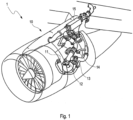
- a bleed air supply system 10 designed to carry out the method according to the invention is shown on the engine 1 of an aircraft (not shown), wherein Figure 1 the bleed air supply system 10 structurally on the engine 1, while Figure 2 a schematic functional sketch of the bleed air supply system 10 exclusively to the extent relevant for carrying out the method according to the invention.
- the bleed air supply system 10 has two bleed points 11, 12 in the area of the compressor stages of the engine 1, wherein one bleed point 11 is arranged in the area of the outlet of the high-pressure compressor of the engine 1, while the other bleed point 12 is arranged in an area of the engine 1 with lower pressure.
- the bleed point 11 in the area of the outlet of the high-pressure compressor of the engine 1 is assigned a first control valve 13, the high-pressure valve, whose outlet is connected to the bleed point 12.
- the bleed point 12 and the outlet of the high-pressure valve 14 are connected to a further control valve 15, the pressure control valve. From there, the bleed air passes through a heat exchanger 15 if necessary (see. Figure 1 ) for cooling the bleed air to the consumers or into a compressed air supply network (not shown).
- the control valves 13, 14 can be self-regulating valves or valves that are actively controlled by a control unit (not shown) via control lines (not shown). In both cases, the bleed air supply is basically dependent on, among other things, the operating state of the engine 1 and the air requirement of the consumers connected directly or via a compressed air supply network.
- a monitoring unit 20 which comprises a computer onto which a computer program product according to the invention is loaded.
- the monitoring unit 20 can be arranged directly on the bleed air supply system 10, remotely on board the aircraft or outside the aircraft on the ground. In the latter case, the necessary data is transmitted via a radio connection.
- the monitoring unit 20 comprises several inputs 21 for analog and binary sensor data, as well as operating status information from the engine 1, as well as an output 22 for issuing any warnings.
- the warnings generated by the monitoring unit 20 can be displayed in the cockpit of the aircraft, for example, or they can be forwarded to a maintenance company, which can then prepare the maintenance of the bleed air system. Alternatively or additionally, graphical map representations, such as those used in Figures 3 to 6 shown for further inspection by a service technician.
- the binary sensors 16, 17 are arranged on the valves 13, 14 with the inputs 21, whereby the binary sensor 16 assigned to the high-pressure valve 13 indicates the blocking position of the high-pressure valve 13 and outputs it as sensor data when the high-pressure valve 13 is completely closed. Sensor data of the binary sensor 17 on the pressure control valve 14 are logically yes when the pressure control valve 14 is fully open.
- analog pressure sensors 18, 19 are connected to the inputs of the monitoring unit 20.
- the analog pressure sensor 18 records the pressure in the supply line upstream of the pressure control valve 14, while the analog pressure sensor 19 records the regulated pressure downstream of the pressure control valve 14.
- the monitoring unit 20 is also connected via a data line 23 to a control and/or monitoring unit (not shown) of the engine 1 and/or the aircraft and receives from there further operating data and operating parameters of the engine 1 and/or the aircraft.
- a control and/or monitoring unit (not shown) of the engine 1 and/or the aircraft and receives from there further operating data and operating parameters of the engine 1 and/or the aircraft.
- the relative overpressure compared to the environment inside the engine in the area of the bleed point 11, i.e. behind the high-pressure compressor of the engine 1 is fed to the monitoring unit 20 via the data line 23 as analog sensor data.
- the temperatures of the air at various points on the engine 1 can also be fed to the monitoring unit 20 via the data line 23, which can be taken into account as additional parameters in the characteristic map determination described below.
- the pressure control valve 14 is fully opened and the pressure is controlled solely by suitable control of the high-pressure valve 13.
- the binary sensor 16 reports a logical no to the monitoring unit 20 (the high-pressure valve 13 is at least not completely closed), while the binary sensor 17 outputs a logical yes, since the pressure control valve 14 is completely open in this operating state.
- the monitoring unit 20 can use the sensor data from the two binary sensors 16, 17 to determine the operating state of the bleed air system 10 intended for idling of the engine 1.
- the characteristic map is intended to map the pressure in the supply line to the pressure control valve 14 as a function of the excess pressure prevailing in the area of the tapping point 11 in the engine 1 compared to the environment.
- the pressure in the supply line to the pressure control valve 14 is recorded by the analog pressure sensor 18, while the pressure in question inside the engine 1, which corresponds to the pressure after the high-pressure compressor, is available as analog sensor data via the data line 23.
- the latter sensor data is recorded by an analog sensor in the engine 1.
- the individual measured values are time-coded so that value pairs 31 can be formed from measured values recorded at the same time from the sensor data, which then results in a characteristic value point cloud 30.
- a corresponding characteristic value point cloud 30 is shown as an example from a large number of value pairs 31.
- the overpressure compared to the environment at the tapping point 11 is shown on the x-axis, and the pressure detected by the analog pressure sensor 18 is shown on the y-axis.
- an operating state-dependent characteristic curve 35 is provided, which depicts the ideal dependence of the two values considered.
- Figure 3b is one for Figure 3a Identically determined and displayed characteristic value point cloud 30 is shown, whereby due to the considerable scatter of the value pairs 31 at higher pressures at the tapping point 11 (x-axis), a considerable deviation from the characteristic curve 35 can be determined - also by the monitoring unit 20 - so that a warning can be issued via the output 22.
- the Figure 3b The deviation shown indicates faulty behavior of valve 16, so that troubleshooting can be limited to valve 16 (e.g. mechanical wear or leaks) or its control. More detailed statements about the cause of the error based solely on the deviations determined can be made by comparing them with previous similar deviations and their respective causes.
- the engine 1 When the aircraft is actually flying, the engine 1 is no longer running at idle and the bleed air supply system 10 is also in a different operating state. In this state, there is regularly sufficient pressure at the bleed point 12 for the bleed air supply, so that the high-pressure valve 13 is completely closed and the pressure regulation is exclusively via the pressure control valve 14.
- the operating state can again be determined by the monitoring unit 20 solely via the sensor data of the binary sensors 16, 17, since the binary sensor 16 outputs a logical yes for a completely closed high-pressure valve 13 and the binary sensor 17 outputs a logical no for a pressure control valve 14 that is not completely open.
- the characteristic map is intended to map the pressure after the pressure control valve 14 as a function of the pressure before the pressure control valve 14.
- the first-mentioned pressure is recorded by the analog pressure sensor 19, while the pressure in the supply line to the pressure control valve 14 is recorded by the analog pressure sensor 18.
- the individual measured values are each recorded simultaneously, so that value pairs 31 can be formed from measured values recorded at the same time from the sensor data, which then results in a characteristic value point cloud 30.
- a corresponding characteristic value point cloud 30 is shown as an example from a large number of value pairs 31.
- the pressure detected by the analog pressure sensor 18 upstream of the pressure control valve 14 is shown on the x-axis, and the pressure detected by the analog pressure sensor 18 downstream of the pressure control valve 14 is shown on the y-axis.
- a corresponding, predefined characteristic curve 35 for the target dependency of the two values is also provided in Figure 4a shown.
- the deviations of the characteristic point cloud 30 from the characteristic curve 35 in Figure 4a is still within the permissible tolerance range that can be checked by the monitoring unit using known mathematical methods, so that no warning needs to be or will be issued in the example shown.
- Figure 4b is one for Figure 4a identically determined and displayed characteristic point cloud 30 is shown.
- the characteristic point cloud 30 is compared to Figure 4a However, it is shifted significantly "upwards", resulting in a significant deviation from the characteristic curve 35. This deviation is recognized by the monitoring unit 20 as exceeding a specified tolerance and consequently a warning is issued via the output 22.
- the Figure 4b The deviation shown indicates faulty behavior of the valve 14, so that troubleshooting can be limited to the valve 14 (e.g. mechanical wear or leaks) or its control. More detailed statements about the cause of the error based solely on the deviations determined can be made by comparing them with previous similar deviations and their respective causes.
- Figure 5 is a characteristic point cloud 30 according to Figures 3a , b, where the circled pattern of value pairs 31 allows the conclusion that the binary sensor 16 is defective or is providing incorrect sensor data. If the binary sensor 16 were to correctly output a logical yes when the high-pressure valve 13 was actually closed, the value pairs 31 in question, which reflect the pressure control by the pressure control valve 15, would not be in this characteristic map, as shown in Figure 5 shown (see explanations on the operating state for the Figure 3a ).
- the in Figure 6a The characteristic point cloud 30 shown indicates that the control of the pressure control valve 14 is not working properly.
- the characteristic point cloud 30 from Figure 6b indicates a worn pressure control valve 13.
Landscapes
- Engineering & Computer Science (AREA)
- Chemical & Material Sciences (AREA)
- Combustion & Propulsion (AREA)
- Mechanical Engineering (AREA)
- General Engineering & Computer Science (AREA)
- Physics & Mathematics (AREA)
- Fluid Mechanics (AREA)
- Testing Of Devices, Machine Parts, Or Other Structures Thereof (AREA)
- Measuring Fluid Pressure (AREA)
Description
- Die Erfindung betrifft ein Verfahren und ein Computerprogrammprodukt zur Überwachung eines Zapfluftversorgungssystems eines Flugzeugs.
- Bei Flugzeugen, insbesondere Verkehrsflugzeugen, wird aus dem Turboverdichter eines Triebwerks verdichtete Luft abgezapft, um einen gewünschten Druck in einer Druckkabine oder in pneumatischen Systemen des Flugzeuges erzeugen bzw. aufrecht erhalten zu können. Bei den Triebwerken kann es sich um Strahltriebwerke, Propellerturbinen oder Hilfsgasturbinen (APUs) handeln. Es ist üblich, dass jedes Triebwerk eines Flugzeuges mit einem separaten Zapfluftversorgungssystem auszustatten, u. a. auch um eine Redundanz zu gewährleisten.
- Einem Triebwerk wird die Zapfluft durch ein Zapfluftversorgungssystem entnommen und den verschiedenen Verbrauchern zugeleitet. Das Zapfluftversorgungssystem verfügt grundsätzlich über verschiedene Stellglieder, insbesondere steuerbare oder selbstregulierende Ventile, Druck- und Temperatursensoren oder Aufnehmer sowie ggf. einer Steuerungseinheit, die in Abhängigkeit der ermittelten Druck- und Temperaturwerte, sowie ggf. externer Steuerungssignale, die Stellglieder betätigen kann. Es ist auch möglich, auf eine Steuerungseinheit zu verzichten, wobei dann eine rein pneumatische Regelung der einzelnen Stellglieder realisiert werden kann. In beiden Fällen kann neben der Einhaltung eines gewünschten Betriebsdrucks grundsätzlich auch die Temperatur der den verschiedenen Verbrauchern zur Verfügung gestellten Druckluft geregelt werden.
- Zapfluftversorgungssysteme weisen aufgrund der vielen mechanischen Komponenten, insbesondere bei rein pneumatischer Regelung, eine geringe Zuverlässigkeit auf. Bei Auftreten einer Störung ist das Zapfluftversorgungssystem aus Sicherheitsgründen grundsätzlich abzuschalten, auch wenn die häufigen Ausfälle teils erhebliche Störungen im Betrieb eines Flugzeugs, insbesondere eines Verkehrsflugzeugs, verursachen können.
- Um Störungen eines Zapfluftversorgungssystems während eines Fluges erkennen zu können, lassen sich die von den Druck- und Temperatursensoren des Zapfluftversorgungssystems ermittelten Werte überwachen, wobei im Stand der Technik regelmäßig lediglich eine Prüfung gegenüber vorgegebenen Schwellwerten mit zum Teil langen Bestätigungszeiten erfolgt. Wird bei einem solchen System ein Schwellwert durch einen Messwert überschritten, wird das gesamte Zapfluftversorgungssystem vorsorglich deaktiviert. Diese Form der Überwachung ermöglicht weder eine Berücksichtigung des dynamischen Verhaltens der Komponenten noch eine aktive Beurteilung des Zustands des Zapfluftsystems.
- Auch wenn diese Überwachung des Zapfluftversorgungssystems in der Lage ist, mögliche Störungen im Zapfluftversorgungssystem zu erkennen und das System bei Bedarf zu deaktivieren, liefern die aus dem Stand der Technik bekannten Überwachungseinrichtungen in den Störungsmeldungen keine detaillierten Informationen zur möglichen Ursache einer Störung des Zapfluftversorgungssystems, sodass eine Störung regelmäßig aufwendige Fehlersuche- und Behebungsmaßnahmen erfordert.
- Das Deaktivieren von Zapfluftversorgungssystem bei Störungen hat darüber hinaus den Nachteil, dass bei Deaktivierung eines Systems das oder die weiteren Zapfluftversorgungssysteme des Flugzeugs zusätzlich die Zapfluft des deaktivierten Zapfluftversorgungssystems bereitstellen müssen, was den Verschleiß und auch das Ausfallrisiko der weiteren Zapfluftversorgungssysteme erhöht.
- Aus dem Dokument
US 9,555,903 B2 - Die Interpretation evtl. festgestellter Abweichungen kann dabei flugphasenspezifisch erfolgen, also bspw. separat für die Start-, Steigflug-, Sinkflug- und Reiseflugphase. Es können dann in Einzelfällen bestimmte Abweichungen der Sensorwerte von den Vergleichswerten in vorgegebenen Flugphasen ggf. spezifischen Störungen des Zapfluftversorgungssystems zugeordnet werden. Hingegen kann bspw. ein zu geringer Druck in der Steigflug- oder Reiseflugphase tatsächlich keiner Komponente oder zumindest einer kleinen Gruppe von Komponenten eindeutig zugeordnet werden. Zumindest bei einem Teil der Störungsmeldungen erfolgt auch bei dem Verfahren gemäß
US 9,555,903 B2 -
US2014/309846 A1 offenbart ein weiteres System zur Überwachung eines Zapfluftversorgungssystems eines Flugzeugs mit zwei Analogsensoren. - Aufgabe der vorliegenden Erfindung ist es, ein Verfahren und ein Computerprogrammprodukt zur Überwachung eines Zapfluftversorgungssystems eines Flugzeugs zu schaffen, welches gegenüber dem Stand der Technik verbessert ist.
- Gelöst wird diese Aufgabe durch ein Verfahren gemäß dem Hauptanspruch sowie ein Computerprogrammprodukt bzw. ein Satz von Computerprogrammprodukten gemäß dem Anspruch 9. Vorteilhafte Weiterbildungen sind Gegenstand der abhängigen Ansprüche.
- Demnach betrifft die Erfindung ein Verfahren zur Überwachung eines Zapfluftversorgungssystems eines Flugzeuges mit
- wenigstens zwei Analogsensoren zur Zustandsüberwachung des Zapfluftversorgungssystems anhand der Sensordaten;
- Ermitteln von wenigstens einer Kennfeld-Punktwolke aus den zeitgleich erfassten Sensordaten von jeweils zwei Analogsensoren zum Zustand des Zapfluftversorgungssystems über einen vorgegebenen Mindestzeitraum;
- Abgleich der Kennfeld-Punktwolke mit einer vorgegebenen Kennlinie für den von der Kennfeld-Punktwolke abgebildeten Zusammenhang der erfassten Sensordaten; und
- Bei Feststellung einer Abweichung der Kennfeld-Punktwolke von der vorgegebenen Kennlinie über ein vorgegebenes Maß hinaus: Ausgeben einer Warnung.
- Weiterhin betrifft die Erfindung ein Computerprogrammprodukt oder einen Satz von Computerprogrammprodukten, umfassend Programmteile, welche, wenn geladen in einen Computer oder in untereinander vernetzte Computer, zur Überwachung eines Zapfluftversorgungssystems eines Flugzeuges mit wenigstens zwei Analogsensoren zur Zustandsüberwachung des Zapfluftversorgungssystems anhand der Sensordaten gemäß dem erfindungsgemäßen Verfahren ausgelegt sind.
- Zunächst werden einige in Zusammenhang mit der Erfindung verwendete Begriffe erläutert.
- Bei einem "Analogsensor" handelt es sich um einen Sensor, der einen physikalische Eigenschaften einer Komponente oder in seiner Umgebung als quantitative Messgröße erfassen kann. Die erfasste Messgröße wird als analoge oder - im Regelfall - digitale Sensordaten zur Verfügung gestellt. Typische Beispiele für Analogsensoren sind Drucksensoren, Temperatursensoren oder Absolutwertgeber. Gegenteil von "Analogsensor" ist ein "Binärsensor", der als Zustandssensor ausschließlich qualitativ das Vorliegen eines bestimmten definierten Zustandes bestätigten kann, bspw. ob ein Ventil geschlossen ist oder nicht. Entsprechende von einem Binärsensor feststellbare Zustandsinformationen ("binäre Sensordaten") können auch an den Sensordaten eines Analogsensors durch Abgleich der quantitativen Sensordaten mit einem Grenzwert abgeleitet werden, bspw. durch Vergleich der durch einen Absolutwertgeber erfasste Ventilstellung mit einem Grenzwert zur Feststellung, ob das Ventil geschlossen ist.
- In einem "Kennfeld" können grundsätzlich Zusammenhänge Sensordaten zweier verschiedener Analogsensoren abgebildet werde. Dabei können von den beiden Analogsensoren zu einem gleichen Zeitpunkt ermittelte Messwerte als Punkte mit den Messwerten als Koordinaten abgebildet. Werden über die Zeit mehrerer entsprechender Punkt in einem Kennfeld abgebildet, ergibt sich eine "Kennfeld-Punktwolke".
- Für Sensordaten zweier verschiedener Analogsensoren kann eine Soll-Relation in Form einer "Kennlinie" vorgegeben sein. Eine entsprechende Kennlinie gibt regelmäßig den im fehlerfreien Betrieb grundsätzlich zu erwartenden Zusammenhang der Sensordaten zweier Analogsensoren wieder. Die Kennlinie kann dabei aus einem theoretischen Modell des Zapfluftversorgungssystems oder aus historischen Daten einer oder mehrerer baugleicher Zapfluftversorgungssysteme gewonnen werden. Die Kennlinie kann durch - ggf. abschnittsweise - mathematische Funktionen oder durch einen über Koordinatenpaare vorgegebenen Polygonzug abgebildet werden.
- Die Erfindung hat erkannt, sich die Fehlerdiagnose und Fehlerprognose bei einem Zapfluftversorgungssystem deutlich verbessern lassen, wenn anstelle der aus dem Stand der Technik bekannten zeitlichen Beobachtung einzelner Zustandswerte eines Zapfluftversorgungssystems, auf ein oder mehrere Kennfelder aus jeweils Sensordaten von jeweils zwei Analogsensoren, die den Zustand des Zapfluftversorgungssystems überwachen, zurückgegriffen wird. Dabei können je nach Wahl der Analogsensoren für ein bestimmtes Kennfeld unterschiedliche Komponenten und/oder unterschiedliche Funktionen der Komponenten des Zapfluftversorgungssystems überwacht werden. Insbesondere können dynamische Zustände des Zapfluftversorgungssystems, die bei Betrachtung von Messwerten in der Zeitreihe praktisch nicht auswertbar sind, über die Kennfelder einfach ausgewertet werden. Das ermöglicht eine genaue Überwachung insbesondere der dem Verschleiß besonders unterliegenden Ventile des Zapfluftversorgungssystems.
- Die dazu verwendeten Analogsensoren können unmittelbar dem Zapfluftversorgungssystem zugeordnet sein. Es ist aber auch möglich, dass ein Analogsensor in einer dem Zapfluftversorgungssystem vor- oder nachgeschalteten Komponente des Flugzeugs angeordnet ist, bspw. dem Triebwerk. Wesentlich ist lediglich, dass der Analogsensor eine Messgröße erfasst, die unmittelbar Einfluss auf das Zapfluftversorgungssystem hat, bspw. der im Triebwerk herrschende Druck im Bereich einer Abzapfstelle des Zapfluftversorgungssystems.
- Eine durch die Analogsensoren ermittelte Kennfeld-Punktwolke kann sich je nach Betriebszustand des Zapfluftluftventils oder des Flugzeugs, insbesondere dessen Triebwerk, stark variieren. So kann sich die Kennfeld-Punktwolke je nach Stellung unterschiedlicher Ventile des Zapfluftventils und/oder der Drehzahl des Triebwerks verändern. Um dennoch eine einfache Auswertung der Kennfelder, bspw. im Abgleich mit einer Kennlinie, zu ermöglichen, ist es bevorzugt, wenn betriebszustandsabhängige Kennfelder ermittelt werden, wobei der Betriebszustand des Zapfluftversorgungssystems durch eine Steuerungseinheit des Zapfluftversorgungssystems oder des Flugzeugs vorgegeben und/oder durch Zustandssensoren am Zapfluftversorgungssystem oder am Flugzeug ermittelt wird.
- Falls das Zapfluftversorgungssystem wenigstens ein Druckregelventil umfasst, kann es bevorzugt sein, wenn dessen Aktivierungszustand unterschiedliche Betriebszustände kennzeichnet, für die unterschiedliche Kennfelder ermittelt werden. Bei dem Aktivierungszustand kann es sich insbesondere um eine binäre Angabe, bspw., ob ein bestimmtes Ventil gesperrt ist, handeln. Bei dem binären Sperrzustand handelt es sich um binäre Sensordaten.
- Bei Zapfluftversorgungssystemen wird häufig an wenigstens zwei unterschiedlichen Druckstufen des Verdichters eines Triebwerks Luft abgezapft, wobei dann an wenigstens einer Abzapfstelle ein gesondertes Druckregelungsventil vorgesehen ist. Der binäre Sperrzustand dieses gesonderten Druckregelungsventils kann unterschiedliche Betriebszustände des Zapfluftversorgungssystems kennzeichnen.
- Es ist weiterhin möglich, dass ein oder mehrere (auch betriebszustandsabhängige) Kennfelder parameterabhängig sind, also zusätzliche zu den beiden in Relation zu setzenden Sensordaten noch wenigstens ein weiterer Parameter bei der Kennwert-Punktwolke sowie der vorgegebenen Kennlinie berücksichtigt wird. Bei dem wenigstens einen zusätzlichen Parameter kann es sich vorzugsweise um einen durch einen Analogsensor zur Zustandsüberwachung des Zapfluftversorgungssystems oder der Umgebung oder einen nicht-binären Betriebszustandswert des Flugzeugs handeln.
- Bei dem Parameter für parameterabhängige Kennfelder kann es sich bspw. um die durch einen dafür vorgesehenen Analogsensor erfasste Durchflussmenge durch das Zapfluftversorgungssystem und/oder die durch einen dafür vorgesehenen Analogsensor im Zapfluftversorgungssystem oder im Triebwerk erfasste Lufttemperatur handeln. Auch die durch die Steuerung vorgegebene Soll-Drehzahl des Triebwerks oder der gemessene oder aus anderen Größen abgeleitete Druck in vorgegebenen Bereichen innerhalb des Triebwerks oder in der Umgebung kann als Parameter herangezogen werden. Auch kann als Parameter der Zapfluftverbrauch und die damit verbundene Anforderung an das Zapfluftversorgungssystem berücksichtigt werden.
- Vorzugsweise werden Kennfeld-Punktwolken über diskrete, sich nicht überschneidende Zeitabschnitte ermittelt, sodass sich anhand zweier oder mehrere Kennfeld-Punktwolken für unterschiedliche Zeitabschnitte eine Trendanalyse durchführen lässt. In einer entsprechenden Trendanalyse können sich Verschleißerscheinungen an Komponenten des Zapfluftversorgungssystems abbilden und eine ggf. verschlissene Komponente vorausschauend ausgetauscht werden, bevor es zu einem verschleißbedingten Ausfall der Komponente und ggf. des gesamten Zapfluftversorgungssystems kommt. Die Zeitabschnitte können entsprechend von dem Flugzeug durchgeführte tatsächliche Flüge gewählt werden, also vom Anlassen der Triebwerke vor dem Start bis zum Abschalten der Triebwerke nach der Landung. Es ist auch möglich, dass sich einen Zeitabschnitt über mehrere entsprechende Flüge erstreckt.
- Mögliche festgestellte Abweichungen der Kennfeld-Punktwolke von der vorgegebenen Kennlinie können auch klassifiziert werden. Es hat sich nämlich gezeigt, dass unterschiedliche Veränderungen einer Kennfeld-Punktwolke, die zu Abweichungen von der dazugehörigen Kennlinie führen, auf unterschiedliche Verschleißerscheinungen und/oder Fehler ggf. einer jeweils bestimmten Komponente hinweisen. Indem die festgestellte Abweichung klassifiziert wird, kann häufig die tatsächliche Fehlerursache unmittelbar identifiziert werden.
- Es ist bevorzugt, wenn das Zapfluftversorgungssystem wenigstens einen Analogdrucksensor umfasst, dessen Sensordaten erfasst und bei der Ermittlung der Kennfeld-Punktwolke berücksichtigt werden. Insbesondere können auch wenigstens zwei Analogdrucksensoren an unterschiedlichen Stellen des Zapfluftversorgungssystems vorgesehen sein, deren Sensordaten gemeinsam eine Kennfeld-Punktwolke bilden.
- Das Verfahren kann in dem erfindungsgemäßen Computerprogrammprodukt oder Satz von Computerprogrammprodukten implementiert werden. Für die evtl. Klassifizierung festgestellter Abweichungen kann ein Expertensystem vorgesehen werden.
- Die Erfindung wird nun anhand einer vorteilhaften Ausführungsform unter Bezugnahme auf die beigefügten Zeichnungen beispielhaft beschrieben. Es zeigen:
- Figur 1:
- eine Detaildarstellung eines zur Durchführung des erfindungsgemäßen Verfahrens ausgebildeten Zapfluftsystems;
- Figur 2:
- eine schematische Darstellung des Zapfluftsystems aus
Figur 1 ; - Figur 3a, b:
- ein erstes Beispiel eines bei dem erfindungsgemäßen Verfahren überprüften Kennfeldes;
- Figur 4a, b:
- ein zweites Beispiel eines bei dem erfindungsgemäßen Verfahren überprüften Kennfeldes;
- Figur 5:
- beispielhafte Darstellungen von klassifizierbaren Abweichungen von einer ersten vorgegebenen Kennlinie; und
- Figur 6a, b:
- beispielhafte Darstellungen von klassifizierbaren Abweichungen von einer zweiten vorgegebenen Kennlinie.
- In
Figuren 1 und2 ist ein zur Durchführung des erfindungsgemäßen Verfahrens ausgebildetes Zapfluftversorgungssystem 10 am Triebwerk 1 eines Flugzeugs (nicht dargestellt) gezeigt, wobeiFigur 1 das Zapfluftversorgungssystem 10 strukturell am Triebwerk 1 zeigt, währendFigur 2 eine schematische Funktionsskizze des Zapfluftversorgungssystems 10 ausschließlich in dem für die Durchführung des erfindungsgemäßen Verfahrens relevanten Umfang zeigt. - Das Zapfluftversorgungssystem 10 verfügt über zwei Abzapfstellen 11, 12 im Bereich der Verdichterstufen des Triebwerks 1, wobei die eine Abzapfstelle 11 im Bereich des Ausgangs des Hochdruckverdichters des Triebwerks 1 angeordnet ist, während die andere Abzapfstelle 12 in einem Bereich des Triebwerks 1 mit geringerem Druck angeordnet ist.
- Der Abzapfstelle 11 im Bereich des Ausgangs des Hochdruckverdichters des Triebwerks 1 ist ein erstes Steuerventil 13, das Hochdruckventil, zugeordnet, dessen Ausgang mit der Abzapfstelle 12 verbunden ist. Die Abzapfstelle 12 und der Ausgang des Hochdruckventils 14 sind an ein weiteres Steuerventil 15, dem Druckregelventil, angebunden. Von dort aus gelangt die Zapfluft ggf. durch einen Wärmetauscher 15 (vgl.
Figur 1 ) zur Abkühlung der Zapfluft zu den Verbrauchern bzw. in ein Druckluftversorgungsnetz (nicht dargestellt). - Bei den Steuerungsventilen 13, 14 kann es sich um selbst regulierende Ventile oder um durch eine Steuerungseinheit (nicht dargestellt) über Steuerleitungen (nicht dargestellt) aktiv gesteuerte Ventile handeln. In beiden Fällen erfolgt die Zapfluftversorgung grundsätzlich in Abhängigkeit u. a. des Betriebszustandes des Triebwerks 1 sowie der Luftbedarf der direkt oder über ein Druckluftversorgungsnetz angebundenen Verbraucher.
- Zur Überwachung des Zapfluftversorgungssystems 10 ist eine Überwachungseinheit 20 vorgesehen, die einen Computer umfasst, auf der ein erfindungsgemäßes Computerprogrammprodukt geladen ist. Die Überwachungseinheit 20 kann unmittelbar am Zapfluftversorgungssystem 10, davon entfernt an Bord des Flugzeuges oder außerhalb des Flugzeugs am Boden angeordnet sein. Im letzten Fall erfolgt die Übertragung der notwendigen Daten über eine Funkverbindung.
- Die Überwachungseinheit 20 umfasst mehrere Eingänge 21 für analoge und binäre Sensordaten, sowie Betriebszustandsinformationen vom Triebwerk 1, sowie einen Ausgang 22 zur Ausgabe evtl. Warnungen. Die von der Überwachungseinheit 20 ggf. generierten Warnungen können bspw. im Cockpit des Flugzeuges zur Anzeige gebracht werden oder sie werden an einen Wartungsbetrieb weitergeleitet, der daraufhin die Wartung des Zapfluftsystems vorbereiten kann. Alternativ oder zusätzlich können über den Ausgang 22 grafische Kennfeld-Darstellungen, wie sie bspw. in
Figuren 3 bis 6 gezeigt sind, zur weiteren Begutachtung durch einen Wartungstechniker ausgegeben werden. - Mit den Eingängen 21 sind die an den Ventilen 13, 14 Binärsensoren 16, 17 angeordnet, wobei der dem Hochdruckventil 13 zugeordnete Binärsensor 16 die Sperrstellung des Hochdruckventils 13 angibt, als logisch ja als Sensordaten ausgibt, wenn das Hochdruckventil 13 vollständig geschlossen ist. Die Sensordaten des Binärsensors 17 am Druckregelventil 14 sind logisch ja, wenn das Druckregelventil 14 vollständig geöffnet ist.
- Darüber hinaus sind noch zwei Analogdrucksensoren 18, 19 an die Eingänge der Überwachungseinheit 20 angeschlossen. Mit dem Analogdrucksensor 18 wird der Druck in der Zuleitung vor dem Druckregelventil 14 aufgenommen, während der Analogdrucksensor 19 den geregelten Druck nach dem Druckregeventil 14 aufnimmt.
- Die Überwachungseinheit 20 ist weiterhin über eine Datenleitung 23 mit einer Steuerungs- und/oder Überwachungseinheit (nicht dargestellt) des Triebwerks 1 und/oder des Flugzeugs verbunden und erhält von dort weitere Betriebsdaten und Betriebsparameter des Triebwerks 1 und/oder des Flugzeugs. Im dargestellten Beispiel wird der Überwachungseinheit 20 der relative Überdruck gegenüber der Umgebung innerhalb des Triebwerks im Bereich der Abzapfstelle 11, also hinter dem Hochdruckverdichter des Triebwerks 1, über die Datenleitung 23 als analoge Sensordaten zugeleitet. Darüber hinaus können der Überwachungseinheit 20 über die Datenleitung 23 noch die Temperaturen der Luft an verschiedenen Stellen des Triebwerks 1 zugeleitet werden, die bei der nachfolgend beschriebenen Kennfeld-Ermittlung als zusätzliche Parameter berücksichtigt werden können.
- In Abhängigkeit der durch die Binärsensoren 16, 17 ablesbaren Betriebszustände des Zapfluftversorgungssystems 1 werden unterschiedliche Kennfelder verwendet.
- Befindet sich das Triebwerk 1 im Leerlauf, sodass an der Abzapfstelle 12 keine Zapfluft mit ausreichendem Druck zur Verfügung steht, wird auf die Abzapfstelle 11 hinter dem Hochdruckverdichter des Triebwerks 1 zurückgegriffen, an der auch im Leerlauf des Triebwerks 1 ausreichender Druck für die Zapfluftversorgung herrscht. In diesem Fall wird bei dem dargestellten Ausführungsbeispiel das Druckregelventil 14 vollständig geöffnet und die Druckregelung erfolgt allein über geeignete Ansteuerung des Hochdruckventils 13.
- In diesem Betriebszustand meldet der Binärsensor 16 also ein logisches Nein an die Überwachungseinheit 20 (das Hochdruckventil 13 ist ja zumindest nicht vollständig geschlossen), während der Binärsensor 17 ein logische Ja ausgibt, da das Druckregelventil 14 in diesem Betriebszustand vollständig geöffnet ist. Die Überwachungseinheit 20 kann anhand der Sensordaten der beiden Binärsensoren 16, 17 den für den Leerlauf des Triebwerks 1 vorgesehenen Betriebszustand des Zapfluftsystems 10 feststellen.
- Für diesen Betriebszustand ist als Kennfeld vorgesehen, den Druck in der Zuleitung zum Druckregelventil 14 in Abhängigkeit des im Bereich der Abzapfstelle 11 in dem Triebwerk 1 herrschenden Überdrucks gegenüber der Umgebung abzubilden. Der Druck in der Zuleitung zum Druckregelventil 14 wird dabei vom Analogdrucksensor 18 erfasst, während der fragliche Druck im Innern des Triebwerks 1, der dem Druck nach dem Hochdruckverdichter entspricht, über die Datenleitung 23 als analoge Sensordaten zur Verfügung steht. Letztere Sensordaten werden von einem Analogsensor im Triebwerk 1 erfasst. Die einzelnen Messwerte sind dabei zeitcodiert, sodass sich jeweils Wertepaare 31 aus zum gleichen Zeitpunkt erfassten Messwerte aus den Sensordaten bilden lassen, womit sich dann eine Kennwert-Punktwolke 30 ergibt.
- In
Figur 3a ist exemplarisch eine entsprechende Kennwert-Punktwolke 30 aus einer Vielzahl von Wertepaaren 31 dargestellt. Dabei ist auf der x-Achse der Überdruck gegenüber der Umgebung an der Abzapfstelle 11, auf der y-Achse der durch den Analogdrucksensor 18 erfasste Druck dargestellt. - Für denselben Zusammenhang ist eine betriebszustandsabhängige Kennlinie 35 vorgesehen, welche die ideale Abhängigkeit der beiden betrachteten Werte abbildet.
- Wie in
Figur 3a zu sehen, ergibt sich - unter Berücksichtigung üblicher Messungenauigkeiten und Toleranzen - eine ausreichende Übereinstimmung der Kennwert-Punktwolke 30 mit der Kennlinie 35, sodass im dargestellten Beispiel keine Warnung ausgegeben werden muss. Die Überwachungseinheit 20 ist dabei dazu ausgebildet, eben diese Überprüfung durchzuführen, wobei in diesem Fall keine Warnung über den Ausgang 22 ausgegeben wird. - In
Figur 3b ist eine zurFigur 3a identisch ermittelte und dargestellte Kennwert-Punktwolke 30 gezeigt, wobei aufgrund der erheblichen Streuung der Wertepaare 31 bei höheren Drücken an der Abzapfstelle 11 (x-Achse) eine erhebliche Abweichung von der Kennlinie 35 - auch durch die Überwachungseinheit 20 - festgestellt werden kann, sodass eine Warnung über den Ausgang 22 ausgegeben werden kann. Die inFigur 3b gezeigte Abweichung zeugt von einem fehlerhaften Verhalten des Ventils 16, sodass sich die Fehlersuche auf das Ventil 16 (bspw. mechanischer Verschleiß oder Leckagen) bzw. dessen Ansteuerung beschränken kann. Detailliertere Aussagen über die Fehlerursache allein auf Basis der ermittelten Abweichungen können ggf. durch entsprechenden Vergleich mit vorherigen ähnlichen Abweichungen und deren jeweilige Fehlerursache getroffen werden. - Beim eigentlichen Flug des Flugzeugs läuft das Triebwerk 1 nicht mehr im Leerlauf und auch das Zapfluftversorgungssystem 10 befindet sich ein einem anderen Betriebszustand. In diesem liegt an der Abzapfstelle 12 regelmäßig ausreichender Druck für die Zapfluftversorgung vor, sodass das Hochdruckventil 13 vollständig geschlossen ist und die Druckregelung ausschließlich über das Druckregelungsventil 14 erfolgt. Der Betriebszustand kann von der Überwachungseinheit 20 erneut allein über die Sensordaten der Binärsensoren 16, 17 festgestellt werden, da nämlich der Binärsensor 16 ein logisches Ja für ein vollständig geschlossenes Hochdruckventil 13 und der Binärsensor 17 ein logisches Nein für ein nicht vollständig geöffnetes Druckregelungsventil 14 ausgibt.
- Für diesen Betriebszustand ist als Kennfeld vorgesehen, den Druck nach dem Druckregelventil 14 in Abhängigkeit des Drucks vor dem Druckregelventil 14 abzubilden. Der erstgenannte Druck wird dabei vom Analogdrucksensor 19 erfasst, während der Druck in der Zuleitung zum Druckregelventil 14 vom Analogdrucksensor 18 erfasst wird. Die einzelnen Messwerte werden jeweils zeitgleich erhoben, sodass sich jeweils Wertepaare 31 aus zum gleichen Zeitpunkt erfassten Messwerte aus den Sensordaten bilden lassen, womit sich dann eine Kennwert-Punktwolke 30 ergibt.
- In
Figur 4a ist exemplarisch eine entsprechende Kennwert-Punktwolke 30 aus einer Vielzahl von Wertepaaren 31 dargestellt. Dabei ist auf der x-Achse der durch den Analogdrucksensor 18 erfasste Druck vor dem Druckregelventil 14, auf der y-Achse der durch den Analogdrucksensor 18 erfasste Druck nach dem Druckregelventil 14 dargestellt. - Auch ist eine entsprechende, vorgegebene Kennlinie 35 für die Soll-Abhängigkeit der beiden Werte in
Figur 4a dargestellt. - Die Abweichungen der Kennwert-Punktwolke 30 von der Kennlinie 35 in
Figur 4a liegt noch im zulässigen und von der Überwachungseinheit mit bekannten mathematischen Methoden überprüfenbaren Toleranzbereich, sodass im dargestellten Beispiel keine Warnung ausgegeben werden muss bzw. wird. - In
Figur 4b ist eine zurFigur 4a identisch ermittelte und dargestellte Kennwert-Punktwolke 30 gezeigt. In diesem Beispiel ist die Kennwert-Punktwolke 30 im Vergleich zuFigur 4a jedoch deutlich "nach oben" verschoben, wodurch dich eine deutliche Abweichung zur Kennlinie 35 ergibt. Diese Abweichung wird von der Überwachungseinheit 20 als über ein vorgegebenes Toleranzmaß hinaus erkannt und folglich eine Warnung über den Ausgang 22 ausgegeben. Die inFigur 4b gezeigte Abweichung zeugt von einem fehlerhaften Verhalten des Ventils 14, sodass sich die Fehlersuche auf das Ventil 14 (bspw. mechanischer Verschleiß oder Leckagen) bzw. dessen Ansteuerung beschränken kann. Detailliertere Aussagen über die Fehlerursache allein auf Basis der ermittelten Abweichungen können ggf. durch entsprechenden Vergleich mit vorherigen ähnlichen Abweichungen und deren jeweilige Fehlerursache getroffen werden. - Aus bestimmten Abweichungen einer Kennwert-Punktwolke 30 von der dazugehörigen Kennlinie 35 lassen sich unmittelbar Rückschlüsse auf die Art des Defektes herleiten. Die festgestellten Abweichungen werden dazu - bspw. auch unmittelbar von der Überwachungseinheit 20 - klassifiziert, wobei bei einer ausreichend eindeutigen Klassifizierung durch die Überwachungseinheit 20 von dieser ein entsprechender Hinweis über den Ausgang 22 ausgegeben werden kann.
- In
Figur 5 ist eine Kennwert-Punktwolke 30 gemäßFiguren 3a , b gezeigt, bei der das eingekreisten Muster von Wertepaaren 31 den Rückschluss zulässt, dass der Binärsensor 16 defekt ist bzw. fehlerhafte Sensordaten liefert. Würde der Binärsensor 16 nämlich bei tatsächlich geschlossenem Hochdruckventil 13 korrekt ein logisches Ja ausgeben, würden die fraglichen Wertepaare 31, welche die Druckregelung durch das Druckregelventil 15 widerspiegeln, nämlich nicht in diesem Kennfeld, wie es inFigur 5 dargestellt ist, erfasst werden (vgl. Ausführungen zum Betriebszustand zurFigur 3a ). - In
Figur 6a, b sind weitere Beispiele von klassifizierbaren Abweichungen von der Kennlinie 35 bei Kennwert-Punktwolken 30 gemäßFigur 4a, b gezeigt. - Die in
Figur 6a gezeigte Kennwert-Punktwolke 30 deutet darauf hin, dass die Ansteuerung des Druckregelungsventils 14 nicht ordnungsgemäß arbeitet. Die Kennwert-Punktwolke 30 ausFigur 6b weist auf ein verschlissenes Druckregelventil 13 hin.
Claims (9)
- Verfahren zur Überwachung eines Zapfluftversorgungssystems (10) eines Flugzeuges mit- wenigstens zwei Analogsensoren (18, 19) zur Zustandsüberwachung des Zapfluftversorgungssystems (10) anhand der Sensordaten;mit den Schritten:- Ermitteln von wenigstens einer Kennfeld-Punktwolke (30) aus den zeitgleich erfassten Sensordaten von jeweils zwei Analogsensoren (18, 19) zum Zustand des Zapfluftversorgungssystems (10) über einen vorgegebenen Mindestzeitraum;- Abgleich der Kennfeld-Punktwolke (30) mit dafür einer entsprechenden vorgegebenen Kennlinie (35) für den von der Kennfeld-Punktwolke (30) abgebildeten Zusammenhang der erfassten Sensordaten; und- Bei Feststellung einer Abweichung der Kennfeld-Punktwolke (30) von der vorgegebenen Kennlinie (35) über ein vorgegebenes Maß hinaus: Ausgeben einer Warnung.
- Verfahren nach Anspruch 1,
dadurch gekennzeichnet, dass
betriebszustandsabhängige Kennfelder ermittelt werden, wobei der Betriebszustand des Zapfluftversorgungssystems (10) durch eine Steuerungseinheit des Zapfluftversorgungssystems (10) oder des Flugzeugs vorgegeben und/oder durch Zustandssensoren (16, 17) am Zapfluftversorgungssystem (10) oder am Flugzeug ermittelt wird. - Verfahren nach dem vorhergehenden Anspruch,
dadurch gekennzeichnet, dass
das Zapfluftversorgungssystem (10) wenigstens ein Druckregelventil (14) umfasst, dessen Aktivierungszustand, vorzugsweise dessen binärer Sperrzustand, unterschiedliche Betriebszustände kennzeichnet. - Verfahren nach einem der vorhergehenden Ansprüche,
dadurch gekennzeichnet, dass
parameterabhängige Kennfelder ermittelt werden, wobei der Parameter vorzugsweise ein durch einen Analogsensor zur Zustandsüberwachung des Zapfluftversorgungssystems (10) oder der Umgebung oder einen nicht-binären Betriebszustandswert des Flugzeugs abbildet. - Verfahren nach dem vorhergehenden Anspruch,
dadurch gekennzeichnet, dass
Parameter für parameterabhängige Kennfelder die durch einen dafür vorgesehenen Analogsensor erfasste Durchflussmenge durch das Zapfluftversorgungssystem (10) und/oder die durch einen dafür vorgesehenen Analogsensor im Zapfluftversorgungssystem (10) oder im Triebwerk (1) erfasste Lufttemperatur sind. - Verfahren nach einem der vorhergehenden Ansprüche,
dadurch gekennzeichnet, dass
wenigstens zwei Kennfeld-Punktwolken (30) über diskrete, sich nicht überschneidende Zeitabschnitte ermittelt werden und eine Trendanalyse anhand entsprechend erfasster Kennfeld-Punktwolken (30) für unterschiedliche Zeitabschnitte durchgeführt wird. - Verfahren nach einem der vorhergehenden Ansprüche,
dadurch gekennzeichnet, dass
festgestellte Abweichungen der Kennfeld-Punktwolke (30) von der vorgegebenen Kennlinie (35) klassifiziert werden. - Verfahren nach einem der vorhergehenden Ansprüche,
dadurch gekennzeichnet, dass
das Zapfluftversorgungssystem (10) wenigstens einen Analogdrucksensor (18, 19) umfasst, dessen Sensordaten erfasst und bei der Ermittlung der Kennfeld-Punktwolke (30) berücksichtigt werden. - Computerprogrammprodukt oder Satz von Computerprogrammprodukten, umfassend Programmteile, welche, wenn geladen in einen Computer oder in untereinander vernetzte Computer, zur Überwachung eines Zapfluftversorgungssystems (10) eines Flugzeuges mit wenigstens zwei Analogsensoren (18, 19) zur Zustandsüberwachung des Zapfluftversorgungssystems (10) anhand der Sensordaten gemäß dem Verfahren nach einem der vorhergehenden Ansprüche ausgelegt sind.
Priority Applications (8)
| Application Number | Priority Date | Filing Date | Title |
|---|---|---|---|
| EP21161673.5A EP4056825B1 (de) | 2021-03-10 | 2021-03-10 | Verfahren und computerprogrammprodukt zur überwachung eines zapfluftversorgungssystems eines flugzeugs |
| HUE21161673A HUE069578T2 (hu) | 2021-03-10 | 2021-03-10 | Eljárás és számítógépes programtermék egy repülõgép nyomáskiegyenlítõ levegõellátó rendszerének felügyeletére |
| ES21161673T ES3000932T3 (es) | 2021-03-10 | 2021-03-10 | Procedimiento y producto de programa informático para vigilar un sistema de suministro de aire de sangrado de un avión |
| EP22708959.6A EP4305288A1 (de) | 2021-03-10 | 2022-03-03 | Verfahren und computerprogrammprodukt zur überwachung eines zapfluftversorgungssystems eines flugzeugs |
| CN202280034242.5A CN117295881A (zh) | 2021-03-10 | 2022-03-03 | 用于监控飞机的引气供应系统的方法和计算机程序产品 |
| US18/549,599 US20240093646A1 (en) | 2021-03-10 | 2022-03-03 | Method and computer program product for monitoring a bleed air supply system of an aircraft |
| KR1020237034489A KR102919859B1 (ko) | 2021-03-10 | 2022-03-03 | 항공기의 블리드 에어 공급 시스템을 모니터링하는 방법 및 비일시적 컴퓨터 판독 가능 저장 매체에 저장된 컴퓨터 프로그램 |
| PCT/EP2022/055336 WO2022189235A1 (de) | 2021-03-10 | 2022-03-03 | Verfahren und computerprogrammprodukt zur überwachung eines zapfluftversorgungssystems eines flugzeugs |
Applications Claiming Priority (1)
| Application Number | Priority Date | Filing Date | Title |
|---|---|---|---|
| EP21161673.5A EP4056825B1 (de) | 2021-03-10 | 2021-03-10 | Verfahren und computerprogrammprodukt zur überwachung eines zapfluftversorgungssystems eines flugzeugs |
Publications (2)
| Publication Number | Publication Date |
|---|---|
| EP4056825A1 EP4056825A1 (de) | 2022-09-14 |
| EP4056825B1 true EP4056825B1 (de) | 2024-11-13 |
Family
ID=74870661
Family Applications (2)
| Application Number | Title | Priority Date | Filing Date |
|---|---|---|---|
| EP21161673.5A Active EP4056825B1 (de) | 2021-03-10 | 2021-03-10 | Verfahren und computerprogrammprodukt zur überwachung eines zapfluftversorgungssystems eines flugzeugs |
| EP22708959.6A Pending EP4305288A1 (de) | 2021-03-10 | 2022-03-03 | Verfahren und computerprogrammprodukt zur überwachung eines zapfluftversorgungssystems eines flugzeugs |
Family Applications After (1)
| Application Number | Title | Priority Date | Filing Date |
|---|---|---|---|
| EP22708959.6A Pending EP4305288A1 (de) | 2021-03-10 | 2022-03-03 | Verfahren und computerprogrammprodukt zur überwachung eines zapfluftversorgungssystems eines flugzeugs |
Country Status (7)
| Country | Link |
|---|---|
| US (1) | US20240093646A1 (de) |
| EP (2) | EP4056825B1 (de) |
| KR (1) | KR102919859B1 (de) |
| CN (1) | CN117295881A (de) |
| ES (1) | ES3000932T3 (de) |
| HU (1) | HUE069578T2 (de) |
| WO (1) | WO2022189235A1 (de) |
Family Cites Families (7)
| Publication number | Priority date | Publication date | Assignee | Title |
|---|---|---|---|---|
| GB2513132B (en) * | 2013-04-16 | 2015-05-27 | Ge Aviat Systems Ltd | Method for predicting a bleed air system fault |
| GB2514108B (en) | 2013-05-13 | 2015-06-24 | Ge Aviat Systems Ltd | Method for diagnosing a bleed air system fault |
| FR3023628A1 (fr) * | 2014-07-10 | 2016-01-15 | Airbus Helicopters | Procede et systeme de fusion d'indicateurs de surveillance d'un dispositif |
| DE102016201924A1 (de) | 2016-02-09 | 2017-08-10 | Lufthansa Technik Aktiengesellschaft | Flugzeug und Warneinrichtung für ein "Engine Oil Smell" in einer Flugzeugkabine eines Flugzeuges |
| US10252808B2 (en) * | 2016-09-22 | 2019-04-09 | The Boeing Company | Fluid ice protection system flow conductivity sensor |
| FR3060120B1 (fr) | 2016-12-14 | 2018-11-23 | Airbus Helicopters | Procede d'analyse des variations d'au moins un indicateur du comportement d'un mecanisme equipant un aeronef |
| EP3931772B1 (de) * | 2019-02-28 | 2023-08-09 | Eaton Intelligent Power Limited | Wartungssystem und -verfahren |
-
2021
- 2021-03-10 ES ES21161673T patent/ES3000932T3/es active Active
- 2021-03-10 HU HUE21161673A patent/HUE069578T2/hu unknown
- 2021-03-10 EP EP21161673.5A patent/EP4056825B1/de active Active
-
2022
- 2022-03-03 CN CN202280034242.5A patent/CN117295881A/zh active Pending
- 2022-03-03 EP EP22708959.6A patent/EP4305288A1/de active Pending
- 2022-03-03 WO PCT/EP2022/055336 patent/WO2022189235A1/de not_active Ceased
- 2022-03-03 US US18/549,599 patent/US20240093646A1/en active Pending
- 2022-03-03 KR KR1020237034489A patent/KR102919859B1/ko active Active
Also Published As
| Publication number | Publication date |
|---|---|
| US20240093646A1 (en) | 2024-03-21 |
| EP4056825A1 (de) | 2022-09-14 |
| KR102919859B1 (ko) | 2026-01-28 |
| KR20230154268A (ko) | 2023-11-07 |
| ES3000932T3 (es) | 2025-03-04 |
| WO2022189235A1 (de) | 2022-09-15 |
| HUE069578T2 (hu) | 2025-03-28 |
| CN117295881A (zh) | 2023-12-26 |
| EP4305288A1 (de) | 2024-01-17 |
Similar Documents
| Publication | Publication Date | Title |
|---|---|---|
| DE102015008754B4 (de) | Zustandsüberwachung eines Stellantriebs in einem Fluggerät | |
| DE102014106685B4 (de) | Verfahren zur Diagnose eines Zapfluftsystemfehlers | |
| DE60111262T2 (de) | Überwachungssysteme zum erkennen von sensorenfehlern | |
| EP1092177B1 (de) | Regler bzw. triebwerksregler, triebwerk und verfahren zum regeln eines stell- oder antriebssystems bzw. eines triebwerks | |
| DE102014104917A1 (de) | Verfahren zur Vorhersage eines Fehlers im Zapfluftsystem | |
| DE4438854C2 (de) | Überwachungssystem für eine technische Anlage | |
| DE102014100901A1 (de) | Verfahren zur Vorhersage eines Hinterkantenklappenfehlers | |
| EP3591482B1 (de) | Überwachung einer technischen anlage | |
| DE102018118437A1 (de) | System und Verfahren zum Überwachen des Zustands eines unbemannten Luftfahrzeugs | |
| DE19927372C2 (de) | Verfahren und Vorrichtung zum Erkennen einer Fehlfunktion von Stellantrieben | |
| DE102021203806A1 (de) | Verfahren zur Überwachung des Betriebs eines Ventilators, Vorrichtung und Ventilator | |
| DE112008003195T5 (de) | Elektrischer Schaltkreis mit einem physikalischen Übertragungsschicht-Diagnosesystem | |
| DE102021122846A1 (de) | Systeme und verfahren zum erfassen von kraftstoffeinspritzventilstörungen | |
| EP3818290B1 (de) | Diagnose von möglichen ursachen für veränderungen an einem stellventil | |
| EP4056825B1 (de) | Verfahren und computerprogrammprodukt zur überwachung eines zapfluftversorgungssystems eines flugzeugs | |
| EP4085007B1 (de) | Verfahren und computerprogrammprodukt zur überwachung eines zapfluftversorgungssystems eines flugzeugs | |
| EP1447544A1 (de) | Fehlerdetektionslogik für Triebwerke | |
| DE112022002188T5 (de) | Anlagenüberwachungsvorrichtung, anlagenüberwachungsverfahren und anlagenüberwachungsprogramm | |
| EP3819727B1 (de) | Leitsystem für eine technische anlage mit trendkurvendiagramm | |
| DE102020111934A1 (de) | Turbomaschine und Verfahren zur Überwachung für eine solche Turbomaschine | |
| EP4356209A1 (de) | Überwachung der produktion von werkstoffplatten, insbesondere holzwerkstoffplatten, insbesondere unter verwendung einer selbstorganisierenden karte | |
| HK40079879B (en) | Method and computer program product for monitoring an aircraft bleed air system | |
| DE102024103992A1 (de) | Verfahren zur Instandhaltung einer Mehrzahl von gleichartigen Komponenten für Luftfahrzeuge sowie System | |
| EP4467818A1 (de) | Verfahren zur ermittlung oder anpassung einer kennlinie einer hydraulischen komponente einer mobilen arbeitsmaschine | |
| HK40079879A (en) | Method and computer program product for monitoring an aircraft bleed air system |
Legal Events
| Date | Code | Title | Description |
|---|---|---|---|
| PUAI | Public reference made under article 153(3) epc to a published international application that has entered the european phase |
Free format text: ORIGINAL CODE: 0009012 |
|
| STAA | Information on the status of an ep patent application or granted ep patent |
Free format text: STATUS: THE APPLICATION HAS BEEN PUBLISHED |
|
| AK | Designated contracting states |
Kind code of ref document: A1 Designated state(s): AL AT BE BG CH CY CZ DE DK EE ES FI FR GB GR HR HU IE IS IT LI LT LU LV MC MK MT NL NO PL PT RO RS SE SI SK SM TR |
|
| STAA | Information on the status of an ep patent application or granted ep patent |
Free format text: STATUS: REQUEST FOR EXAMINATION WAS MADE |
|
| 17P | Request for examination filed |
Effective date: 20230313 |
|
| RBV | Designated contracting states (corrected) |
Designated state(s): AL AT BE BG CH CY CZ DE DK EE ES FI FR GB GR HR HU IE IS IT LI LT LU LV MC MK MT NL NO PL PT RO RS SE SI SK SM TR |
|
| REG | Reference to a national code |
Ref country code: HK Ref legal event code: DE Ref document number: 40079879 Country of ref document: HK |
|
| P01 | Opt-out of the competence of the unified patent court (upc) registered |
Effective date: 20230516 |
|
| GRAP | Despatch of communication of intention to grant a patent |
Free format text: ORIGINAL CODE: EPIDOSNIGR1 |
|
| STAA | Information on the status of an ep patent application or granted ep patent |
Free format text: STATUS: GRANT OF PATENT IS INTENDED |
|
| INTG | Intention to grant announced |
Effective date: 20240705 |
|
| GRAS | Grant fee paid |
Free format text: ORIGINAL CODE: EPIDOSNIGR3 |
|
| GRAA | (expected) grant |
Free format text: ORIGINAL CODE: 0009210 |
|
| STAA | Information on the status of an ep patent application or granted ep patent |
Free format text: STATUS: THE PATENT HAS BEEN GRANTED |
|
| AK | Designated contracting states |
Kind code of ref document: B1 Designated state(s): AL AT BE BG CH CY CZ DE DK EE ES FI FR GB GR HR HU IE IS IT LI LT LU LV MC MK MT NL NO PL PT RO RS SE SI SK SM TR |
|
| REG | Reference to a national code |
Ref country code: GB Ref legal event code: FG4D Free format text: NOT ENGLISH |
|
| REG | Reference to a national code |
Ref country code: CH Ref legal event code: EP |
|
| REG | Reference to a national code |
Ref country code: IE Ref legal event code: FG4D Free format text: LANGUAGE OF EP DOCUMENT: GERMAN |
|
| REG | Reference to a national code |
Ref country code: DE Ref legal event code: R096 Ref document number: 502021005774 Country of ref document: DE |
|
| REG | Reference to a national code |
Ref country code: NL Ref legal event code: FP |
|
| REG | Reference to a national code |
Ref country code: ES Ref legal event code: FG2A Ref document number: 3000932 Country of ref document: ES Kind code of ref document: T3 Effective date: 20250304 |
|
| REG | Reference to a national code |
Ref country code: LT Ref legal event code: MG9D |
|
| REG | Reference to a national code |
Ref country code: HU Ref legal event code: AG4A Ref document number: E069578 Country of ref document: HU |
|
| PG25 | Lapsed in a contracting state [announced via postgrant information from national office to epo] |
Ref country code: PT Free format text: LAPSE BECAUSE OF FAILURE TO SUBMIT A TRANSLATION OF THE DESCRIPTION OR TO PAY THE FEE WITHIN THE PRESCRIBED TIME-LIMIT Effective date: 20250313 Ref country code: IS Free format text: LAPSE BECAUSE OF FAILURE TO SUBMIT A TRANSLATION OF THE DESCRIPTION OR TO PAY THE FEE WITHIN THE PRESCRIBED TIME-LIMIT Effective date: 20250313 Ref country code: HR Free format text: LAPSE BECAUSE OF FAILURE TO SUBMIT A TRANSLATION OF THE DESCRIPTION OR TO PAY THE FEE WITHIN THE PRESCRIBED TIME-LIMIT Effective date: 20241113 |
|
| PG25 | Lapsed in a contracting state [announced via postgrant information from national office to epo] |
Ref country code: FI Free format text: LAPSE BECAUSE OF FAILURE TO SUBMIT A TRANSLATION OF THE DESCRIPTION OR TO PAY THE FEE WITHIN THE PRESCRIBED TIME-LIMIT Effective date: 20241113 |
|
| PG25 | Lapsed in a contracting state [announced via postgrant information from national office to epo] |
Ref country code: BG Free format text: LAPSE BECAUSE OF FAILURE TO SUBMIT A TRANSLATION OF THE DESCRIPTION OR TO PAY THE FEE WITHIN THE PRESCRIBED TIME-LIMIT Effective date: 20241113 |
|
| PG25 | Lapsed in a contracting state [announced via postgrant information from national office to epo] |
Ref country code: NO Free format text: LAPSE BECAUSE OF FAILURE TO SUBMIT A TRANSLATION OF THE DESCRIPTION OR TO PAY THE FEE WITHIN THE PRESCRIBED TIME-LIMIT Effective date: 20250213 |
|
| PG25 | Lapsed in a contracting state [announced via postgrant information from national office to epo] |
Ref country code: LV Free format text: LAPSE BECAUSE OF FAILURE TO SUBMIT A TRANSLATION OF THE DESCRIPTION OR TO PAY THE FEE WITHIN THE PRESCRIBED TIME-LIMIT Effective date: 20241113 Ref country code: GR Free format text: LAPSE BECAUSE OF FAILURE TO SUBMIT A TRANSLATION OF THE DESCRIPTION OR TO PAY THE FEE WITHIN THE PRESCRIBED TIME-LIMIT Effective date: 20250214 |
|
| PGFP | Annual fee paid to national office [announced via postgrant information from national office to epo] |
Ref country code: AT Payment date: 20250417 Year of fee payment: 5 |
|
| PG25 | Lapsed in a contracting state [announced via postgrant information from national office to epo] |
Ref country code: PL Free format text: LAPSE BECAUSE OF FAILURE TO SUBMIT A TRANSLATION OF THE DESCRIPTION OR TO PAY THE FEE WITHIN THE PRESCRIBED TIME-LIMIT Effective date: 20241113 |
|
| PG25 | Lapsed in a contracting state [announced via postgrant information from national office to epo] |
Ref country code: RS Free format text: LAPSE BECAUSE OF FAILURE TO SUBMIT A TRANSLATION OF THE DESCRIPTION OR TO PAY THE FEE WITHIN THE PRESCRIBED TIME-LIMIT Effective date: 20250213 |
|
| PG25 | Lapsed in a contracting state [announced via postgrant information from national office to epo] |
Ref country code: SM Free format text: LAPSE BECAUSE OF FAILURE TO SUBMIT A TRANSLATION OF THE DESCRIPTION OR TO PAY THE FEE WITHIN THE PRESCRIBED TIME-LIMIT Effective date: 20241113 |
|
| PG25 | Lapsed in a contracting state [announced via postgrant information from national office to epo] |
Ref country code: DK Free format text: LAPSE BECAUSE OF FAILURE TO SUBMIT A TRANSLATION OF THE DESCRIPTION OR TO PAY THE FEE WITHIN THE PRESCRIBED TIME-LIMIT Effective date: 20241113 |
|
| PGFP | Annual fee paid to national office [announced via postgrant information from national office to epo] |
Ref country code: ES Payment date: 20250416 Year of fee payment: 5 |
|
| PGFP | Annual fee paid to national office [announced via postgrant information from national office to epo] |
Ref country code: IT Payment date: 20250331 Year of fee payment: 5 |
|
| PG25 | Lapsed in a contracting state [announced via postgrant information from national office to epo] |
Ref country code: EE Free format text: LAPSE BECAUSE OF FAILURE TO SUBMIT A TRANSLATION OF THE DESCRIPTION OR TO PAY THE FEE WITHIN THE PRESCRIBED TIME-LIMIT Effective date: 20241113 |
|
| PG25 | Lapsed in a contracting state [announced via postgrant information from national office to epo] |
Ref country code: RO Free format text: LAPSE BECAUSE OF FAILURE TO SUBMIT A TRANSLATION OF THE DESCRIPTION OR TO PAY THE FEE WITHIN THE PRESCRIBED TIME-LIMIT Effective date: 20241113 |
|
| PG25 | Lapsed in a contracting state [announced via postgrant information from national office to epo] |
Ref country code: SK Free format text: LAPSE BECAUSE OF FAILURE TO SUBMIT A TRANSLATION OF THE DESCRIPTION OR TO PAY THE FEE WITHIN THE PRESCRIBED TIME-LIMIT Effective date: 20241113 |
|
| PG25 | Lapsed in a contracting state [announced via postgrant information from national office to epo] |
Ref country code: CZ Free format text: LAPSE BECAUSE OF FAILURE TO SUBMIT A TRANSLATION OF THE DESCRIPTION OR TO PAY THE FEE WITHIN THE PRESCRIBED TIME-LIMIT Effective date: 20241113 |
|
| REG | Reference to a national code |
Ref country code: DE Ref legal event code: R097 Ref document number: 502021005774 Country of ref document: DE |
|
| PG25 | Lapsed in a contracting state [announced via postgrant information from national office to epo] |
Ref country code: SE Free format text: LAPSE BECAUSE OF FAILURE TO SUBMIT A TRANSLATION OF THE DESCRIPTION OR TO PAY THE FEE WITHIN THE PRESCRIBED TIME-LIMIT Effective date: 20241113 |
|
| PLBE | No opposition filed within time limit |
Free format text: ORIGINAL CODE: 0009261 |
|
| STAA | Information on the status of an ep patent application or granted ep patent |
Free format text: STATUS: NO OPPOSITION FILED WITHIN TIME LIMIT |
|
| PG25 | Lapsed in a contracting state [announced via postgrant information from national office to epo] |
Ref country code: MC Free format text: LAPSE BECAUSE OF FAILURE TO SUBMIT A TRANSLATION OF THE DESCRIPTION OR TO PAY THE FEE WITHIN THE PRESCRIBED TIME-LIMIT Effective date: 20241113 |
|
| 26N | No opposition filed |
Effective date: 20250814 |
|
| REG | Reference to a national code |
Ref country code: CH Ref legal event code: H13 Free format text: ST27 STATUS EVENT CODE: U-0-0-H10-H13 (AS PROVIDED BY THE NATIONAL OFFICE) Effective date: 20251024 |
|
| PG25 | Lapsed in a contracting state [announced via postgrant information from national office to epo] |
Ref country code: LU Free format text: LAPSE BECAUSE OF NON-PAYMENT OF DUE FEES Effective date: 20250310 |
|
| REG | Reference to a national code |
Ref country code: BE Ref legal event code: MM Effective date: 20250331 |
|
| PG25 | Lapsed in a contracting state [announced via postgrant information from national office to epo] |
Ref country code: BE Free format text: LAPSE BECAUSE OF NON-PAYMENT OF DUE FEES Effective date: 20250331 |
|
| PG25 | Lapsed in a contracting state [announced via postgrant information from national office to epo] |
Ref country code: CH Free format text: LAPSE BECAUSE OF NON-PAYMENT OF DUE FEES Effective date: 20250331 |
|
| PG25 | Lapsed in a contracting state [announced via postgrant information from national office to epo] |
Ref country code: IE Free format text: LAPSE BECAUSE OF NON-PAYMENT OF DUE FEES Effective date: 20250310 |
|
| PGFP | Annual fee paid to national office [announced via postgrant information from national office to epo] |
Ref country code: GB Payment date: 20260317 Year of fee payment: 6 |
|
| PGFP | Annual fee paid to national office [announced via postgrant information from national office to epo] |
Ref country code: DE Payment date: 20260320 Year of fee payment: 6 |
|
| PGFP | Annual fee paid to national office [announced via postgrant information from national office to epo] |
Ref country code: HU Payment date: 20260306 Year of fee payment: 6 Ref country code: NL Payment date: 20260323 Year of fee payment: 6 |
|
| PGFP | Annual fee paid to national office [announced via postgrant information from national office to epo] |
Ref country code: FR Payment date: 20260324 Year of fee payment: 6 |