EP4056581A1 - Polypeptide having mmp2-inhibitory effect - Google Patents
Polypeptide having mmp2-inhibitory effect Download PDFInfo
- Publication number
- EP4056581A1 EP4056581A1 EP20883820.1A EP20883820A EP4056581A1 EP 4056581 A1 EP4056581 A1 EP 4056581A1 EP 20883820 A EP20883820 A EP 20883820A EP 4056581 A1 EP4056581 A1 EP 4056581A1
- Authority
- EP
- European Patent Office
- Prior art keywords
- single bond
- lys
- leu
- formula
- glu
- Prior art date
- Legal status (The legal status is an assumption and is not a legal conclusion. Google has not performed a legal analysis and makes no representation as to the accuracy of the status listed.)
- Pending
Links
Classifications
-
- A—HUMAN NECESSITIES
- A61—MEDICAL OR VETERINARY SCIENCE; HYGIENE
- A61K—PREPARATIONS FOR MEDICAL, DENTAL OR TOILETRY PURPOSES
- A61K38/00—Medicinal preparations containing peptides
- A61K38/04—Peptides having up to 20 amino acids in a fully defined sequence; Derivatives thereof
- A61K38/07—Tetrapeptides
-
- C—CHEMISTRY; METALLURGY
- C07—ORGANIC CHEMISTRY
- C07K—PEPTIDES
- C07K7/00—Peptides having 5 to 20 amino acids in a fully defined sequence; Derivatives thereof
- C07K7/04—Linear peptides containing only normal peptide links
- C07K7/06—Linear peptides containing only normal peptide links having 5 to 11 amino acids
-
- C—CHEMISTRY; METALLURGY
- C07—ORGANIC CHEMISTRY
- C07K—PEPTIDES
- C07K7/00—Peptides having 5 to 20 amino acids in a fully defined sequence; Derivatives thereof
- C07K7/02—Linear peptides containing at least one abnormal peptide link
-
- A—HUMAN NECESSITIES
- A61—MEDICAL OR VETERINARY SCIENCE; HYGIENE
- A61K—PREPARATIONS FOR MEDICAL, DENTAL OR TOILETRY PURPOSES
- A61K38/00—Medicinal preparations containing peptides
- A61K38/04—Peptides having up to 20 amino acids in a fully defined sequence; Derivatives thereof
- A61K38/08—Peptides having 5 to 11 amino acids
-
- A—HUMAN NECESSITIES
- A61—MEDICAL OR VETERINARY SCIENCE; HYGIENE
- A61P—SPECIFIC THERAPEUTIC ACTIVITY OF CHEMICAL COMPOUNDS OR MEDICINAL PREPARATIONS
- A61P35/00—Antineoplastic agents
-
- A—HUMAN NECESSITIES
- A61—MEDICAL OR VETERINARY SCIENCE; HYGIENE
- A61P—SPECIFIC THERAPEUTIC ACTIVITY OF CHEMICAL COMPOUNDS OR MEDICINAL PREPARATIONS
- A61P43/00—Drugs for specific purposes, not provided for in groups A61P1/00-A61P41/00
-
- C—CHEMISTRY; METALLURGY
- C07—ORGANIC CHEMISTRY
- C07K—PEPTIDES
- C07K5/00—Peptides containing up to four amino acids in a fully defined sequence; Derivatives thereof
- C07K5/02—Peptides containing up to four amino acids in a fully defined sequence; Derivatives thereof containing at least one abnormal peptide link
- C07K5/0215—Peptides containing up to four amino acids in a fully defined sequence; Derivatives thereof containing at least one abnormal peptide link containing natural amino acids, forming a peptide bond via their side chain functional group, e.g. epsilon-Lys, gamma-Glu
-
- C—CHEMISTRY; METALLURGY
- C12—BIOCHEMISTRY; BEER; SPIRITS; WINE; VINEGAR; MICROBIOLOGY; ENZYMOLOGY; MUTATION OR GENETIC ENGINEERING
- C12N—MICROORGANISMS OR ENZYMES; COMPOSITIONS THEREOF; PROPAGATING, PRESERVING, OR MAINTAINING MICROORGANISMS; MUTATION OR GENETIC ENGINEERING; CULTURE MEDIA
- C12N9/00—Enzymes; Proenzymes; Compositions thereof; Processes for preparing, activating, inhibiting, separating or purifying enzymes
- C12N9/99—Enzyme inactivation by chemical treatment
-
- A—HUMAN NECESSITIES
- A61—MEDICAL OR VETERINARY SCIENCE; HYGIENE
- A61K—PREPARATIONS FOR MEDICAL, DENTAL OR TOILETRY PURPOSES
- A61K38/00—Medicinal preparations containing peptides
Definitions
- the present invention relates to a substituted polypeptide compound having an effect to inhibit matrix metalloprotease 2 (hereinafter, appropriately abbreviated as "MMP2").
- MMP2 matrix metalloprotease 2
- Matrix metalloprotease is an endopeptidase having an active center of zinc, and 24 genes are known therefor. MMP degrades the extracellular matrix including collagen and gelatin, thus being involved not only in physiological response such as bone remodeling and wound healing, but also in pathological processes such as inflammation and the progression of cancer (see NPTL 1).
- MMP2 Activation of MMP2 has been reported to play an important role in the infiltration and metastasis of cancer cells.
- the infiltration and metastasis of cancer cells are key factors relating to the prognosis of malignant tumor, and inhibition of MMP2 activity can serve as an effective therapeutic means in cancer control.
- the growth of cancer is suppressed in MMP2-gene-knockout animals, and MMP2 has been reported to play an important role in the growth of cancer (see NPTL 4).
- MMP2 has been reported to be associated with the progression of pathological condition in patients with various types of cancer such as breast cancer, pancreatic cancer, bladder cancer, colorectal cancer, ovarian cancer, prostate cancer, brain tumor, gastric cancer, hepatocellular carcinoma, head and neck cancer, melanoma, uterine cancer, esophageal cancer, renal cell carcinoma, lung cancer, and glioma (see NPTLs 5 and 6). Further, MMP2 has been reported to be involved in the formation of pathological condition even in non-neoplastic diseases.
- MMP2 causes the epithelial-mesenchymal transition of the renal tubules by converting the structure of the tubular basement membrane, inducing tubular atrophy, fibrogenesis, and renal dysfunction (see NPTL 7). Further, increasing MMP2 concentrations in blood have been found in patients with chronic kidney disease (see NPTLs 8 and 9). Furthermore, it has been reported that renal fibrosis induced by unilateral ureteral obstruction is suppressed in MMP2-gene-knockout animals (see NPTLs 10 and 11). In light of these, inhibition of MMP2 activity to regulate the progression of pathological condition of chronic kidney disease can serve as an effective therapeutic means.
- Enhanced expression of MMP2 has been found in alveolar epithelial cells, fibroblasts, and macrophages in idiopathic pulmonary fibrosis, and, in particular, enhanced expression of MMP2 in alveolar lavage fluid has been found in patients with rapidly progressing idiopathic pulmonary fibrosis (see NPTLs 12 and 13).
- a non-selective MMP inhibitor to decrease the lung collagen contents in bleomycin-induced pulmonary fibrosis mice (see NPTL 14) and to prevent the transformation of lung parenchymal fibroblasts induced by TGF ⁇ (see NPTL 15) have been reported.
- inhibition of MMP2 activity to regulate the progression of pathological condition of idiopathic pulmonary fibrosis can serve as an effective therapeutic means.
- non-neoplastic diseases including multiple sclerosis, cerebral infarction, arteriosclerosis, abdominal aortic aneurysm, peritoneal sclerosis, myocardial infarction, acute kidney injury, diabetic nephropathy, nephrosclerosis, glomerulonephritis, polycystic kidney disease, polycystic liver disease, alcoholic liver disease, nonalcoholic steatohepatitis, cholestatic liver injury, chronic obstructive pulmonary disease, interstitial pneumonia, diabetic retinopathy, age-related macular degeneration, Sjogren's syndrome, meningitis, muscular dystrophy, scleroderma, inflammatory bowel disease, and tuberculosis (see NPTL 16).
- a compound with a hydroxamic acid or carboxylic acid introduced as a zinc chelator has been reported as a low-molecular-weight compound having MMP2-inhibitory effect.
- no compound having selective MMP2-inhibitory effect has been known (e.g., see NPTLs 17 and 18).
- ⁇ -Amyloid precursor protein (APP-IP, IIe-Ser-Tyr-Gly-Asn-Asp-Ala-Leu-Met-Pro)
- APP-IP ⁇ -Amyloid precursor protein
- MMP2-inhibitory effect see NPTL 19
- peptide compounds are in general quickly metabolized and excreted in vivo, and thus it is known that even when a peptide compound is administered, the expected pharmacological effect is not sustained.
- An object of the present invention is to provide a novel MMP2 inhibitor.
- embodiments of the present invention are as follows.
- the compounds of the present invention (hereinafter, occasionally referred to as “the present inventive compounds”) have an effect to inhibit MMP2. Some of the present inventive compounds have an effect to selectively inhibit MMP2.
- the present invention provides a substituted polypeptide represented by formula [I'], or a pharmaceutically acceptable salt thereof, having an effect to inhibit MMP2.
- amino acid is, in a broad sense, an organic compound having two functional groups: amino and carboxy.
- amino acid refers to " ⁇ -amino acid” (the ⁇ -amino acid is an amino acid in which amino is bonding to the carbon atom to which carboxy is bonding ( ⁇ carbon)) that serves as a constituent unit of biogenic proteins.
- amino acids in the present specification include natural proteogenic L-amino acids; natural nonproteogenic amino acids; and nonnatural amino acids.
- nonnatural amino acids include the D-forms of natural proteogenic L-amino acids; chemically modified amino acids such as amino acid variants and derivatives; and chemically synthesized compounds having properties that are characteristic to amino acids and known in the art.
- amino acid when “amino acid” is shown as its name without abbreviating, for example, as a three-letter code or a one-letter code, the name indicates the amino acid in the L-form, D-form, or both.
- amino acid when “amino acid” is shown as an abbreviation, for example, in a three-letter code or a one-letter code, the abbreviation indicates the amino acid in the L-form. “L” or “l” is occasionally added immediately before “amino acid” to explicitly show that the amino acid is in the L-form.
- natural proteogenic L-amino acid is a naturally occurring amino acid in L-form that constitutes proteins, and examples thereof include Gly, Ala, Val, Leu, Ile, Pro, Phe, His, Trp, Tyr, Ser, Thr, Met, Cys, Asp, Glu, Asn, Gln, Lys, and Arg.
- D-form of natural proteogenic L-amino acid refers to an enantiomer of the natural proteogenic L-amino acid.
- Natural proteogenic L-amino acids except glycine each have at least one asymmetric carbon, thus being optically active.
- the structures of these amino acids are classified into L-forms and D-forms on the basis of the structures of the L-form and D-form of glyceraldehyde.
- Amino acids other than natural proteogenic L-amino acids can also have D-forms.
- natural nonproteogenic amino acid is a naturally occurring amino acid that does not constitute proteins, and examples thereof include L-norleucine (hereinafter, also designated as Nle; hereinafter, “code following in parentheses” shows an abbreviation), ⁇ -alanine ( ⁇ -Ala), and L-ornithine (Orn).
- L-norleucine hereinafter, also designated as Nle; hereinafter, “code following in parentheses” shows an abbreviation
- ⁇ -alanine ⁇ -Ala
- Orn L-ornithine
- a natural nonproteogenic amino acid has an asymmetric carbon, there exist an L-form and a D-form for the amino acid. There can be L-forms and D-forms also for amino acids other than natural nonproteogenic amino acids.
- nonnatural amino acid refers to an amino acid that does not constitute proteins and is primarily artificially produced, being an amino acid not included in the above-described "natural proteogenic L-amino acid and natural nonproteogenic amino acid".
- nonnatural amino acids include the D-forms of natural proteogenic L-amino acids (such as D-Cys, D-Ser); ⁇ -methylamino acids (such as 2-aminoisobutyric acid (Aib)); amino acids with excessive methylene in the side chain (“homo” amino acids such as L- ⁇ -homoproline ( ⁇ -Hep or ⁇ -homoPro), L-homoserine (Hes or homoSer), L-homocysteine (Hec or homoCys), L-homoproline (homoPro), L-homoglutamic acid (homoGlu)); amino acids in which the side chain of an amino acid with a carboxylic acid functional group is substituted with a sulfonic acid group (such as
- a nonnatural amino acid has an asymmetric carbon, there exist an L-form and a D-form for the amino acid.
- nonnatural amino acid in the present specification include the followings:
- the nitrogen atom involved in peptide bonding in any amino acid in the present specification may be alkylated.
- the amino acid is also called "N-alkyl amino acid”.
- alkyl include methyl and ethyl.
- ⁇ -Asp means aspartic acid involved in amide bonding of the main chain via carboxy in the side chain, as illustrated in the structure represented by formula [III-1].
- ⁇ -(d)-Asp means aspartic acid involved in amide bonding of the main chain via carboxy in the side chain, as illustrated in the structure represented by formula [III-1].
- ⁇ -(d)-Asp means aspartic acid involved in amide bonding of the main chain via carboxy in the side chain, as illustrated in the structure represented by formula [III-1].
- ⁇ -(d)-Asp means aspartic acid involved in amide bonding of the main chain via carboxy in the side chain, as illustrated in the structure represented by formula [III-1].
- ⁇ -(d)-Asp means aspartic acid involved in amide bonding of the main chain via carboxy in the side chain, as illustrated in the structure represented by formula [III-1].
- ⁇ -(d)-Asp means aspartic acid involved in amide bonding of the
- (N-Me)Glu(OtBu) means the N-methyl form of the amino acid (Glu(OtBu)), as illustrated in the structure represented by formula [III-5].
- n indicates normal, "i” indicates iso, "s” indicates secondary, “t” and “tert” each indicate tertiary, “c” indicates cyclo, “o” indicates ortho, “m” indicates meta, and “p” indicates para.
- Halogen atom refers to a fluorine atom, a chlorine atom, a bromine atom, or an iodine atom.
- C 1-6 alkyl refers to linear or branched alkyl having one to six carbon atoms.
- Examples of “C 1-6 alkyl” include methyl, ethyl, n-propyl, isopropyl, n-butyl, isobutyl, sec-butyl, tert-butyl, n-pentyl, and n-hexyl.
- Halo C 1-6 alkyl refers to linear or branched alkyl having one to six carbon atoms and substituted with a halogen atom.
- a preferred number of halogen atoms as substituents is one to five, and a preferred halogen atom is a fluorine atom.
- halo C 1-6 alkyl examples include monofluoromethyl, difluoromethyl, trifluoromethyl, 1-fluoroethyl, 1,1-difluoroethyl, 1,1,2,2-tetrafluoroethyl, 1,1,2,2,2-pentafluoroethyl, 2-fluoroethyl, 2-fluoro-2-methylpropyl, 2,2-difluoropropyl, 1-fluoro-2-methylpropan-2-yl, 1,1-difluoro-2-methylpropan-2-yl, 1-fluoropentyl, 1-fluorohexyl, and 2,2,2-trifluoro-1-methylethyl.
- Aryl refers to a monocyclic aromatic hydrocarbon group or fused polycyclic aromatic hydrocarbon group having 6 to 14 carbon atoms.
- Examples of “aryl” include phenyl, naphthyl, and anthryl.
- Aromatic ring refers to a monocyclic aromatic hydrocarbon group or fused polycyclic aromatic hydrocarbon group having 6 to 14 carbon atoms.
- aromatic ring include a benzene ring, a naphthalene ring, and an anthracene ring.
- Partially saturated aryl is also included in the scope of "aryl". The same is applied to aromatic rings.
- Partially saturated aryl and the corresponding aromatic ring, “partially saturated aromatic ring” refer to a group wheren a monocyclic aromatic hydrocarbon group or fused polycyclic aromatic hydrocarbon group having 6 to 14 carbon atoms is partially saturated, and a ring having such a structure. Examples thereof include dihydroindenyl and a dihydroindene ring.
- Heteroaryl refers to a five- to seven-membered monocyclic aromatic heterocyclic group consisting of one to six carbon atoms and one or more atoms that are same or different and selected from the group consisting of an oxygen atom, a sulfur atom, and a nitrogen atom, or a fused polycyclic aromatic heterocyclic group composed of 9 to 14 atoms, specifically, consisting of 1 to 13 carbon atoms and one or more atoms that are same or different and selected from the group consisting of an oxygen atom, a sulfur atom, and a nitrogen atom.
- heteroaryl examples include imidazolyl, pyrazolyl, thienyl, thiazolyl, isothiazolyl, thiadiazolyl, oxazolyl, isooxazolyl, oxadiazolyl, pyrrolyl, triazolyl, tetrazolyl, pyridyl, pyrimidinyl, pyrazinyl, pyridazinyl, triazinyl, indolyl, benzopyrazolyl, benzotriazolyl, benzofuranyl, benzothiophenyl, quinolyl, isoquinolyl, and quinoxalyl.
- Heteroaromatic ring refers to a five- to seven-membered monocyclic aromatic heterocycle consisting of one to six carbon atoms and one or more atoms that are same or different and selected from the group consisting of an oxygen atom, a sulfur atom, and a nitrogen atom, or a fused polycyclic aromatic heterocycle composed of 9 to 14 atoms, specifically, consisting of 1 to 13 carbon atoms and one or more atoms that are same or different and selected from the group consisting of an oxygen atom, a sulfur atom, and a nitrogen atom.
- heteromatic ring examples include an imidazole ring, a pyrazole ring, a thiophene ring, a thiazole ring, an isothiazole ring, a thiadiazole ring, an oxazole ring, an isoxazole ring, an oxadiazole ring, a pyrrole ring, a triazole ring, a tetrazole ring, a pyridine ring, a pyrimidine ring, a pyrazine ring, a pyridazine ring, a triazine ring, an indole ring, a benzopyrazole ring, a benzotriazole ring, a benzofuran ring, a benzothiophene ring, a quinoline ring, an isoquinoline ring, and a quinoxaline ring.
- Partially saturated heteroaryl is also included in the scope of "heteroaryl”. The same is applied to heteroaromatic rings.
- Partially saturated heteroaryl and the corresponding heteroaromatic ring, “partially saturated heteroaromatic ring” refer to a five-to seven-membered partially saturated monocyclic heterocyclic group consisting of one to six carbon atoms and one or more atoms that are same or different and selected from the group consisting of an oxygen atom, a sulfur atom, and a nitrogen atom, or a partially saturated fused polycyclic heterocyclic group composed of 9 to 14 atoms, specifically, consisting of 1 to 13 carbon atoms and one or more atoms that are same or different and selected from the group consisting of an oxygen atom, a sulfur atom, and a nitrogen atom, and a ring having such a structure.
- Examples thereof include oxazolidinyl, thiazolinyl, dihydropyridinyl, dihydrobenzofuranyl, chromanyl, dihydropyranopyridinyl, dihydrofuropyridinyl, tetrahydroquinolyl, dihydrobenzodioxinyl, tetrahydrotriazoloazepinyl, an oxazolidine ring, a thiazoline ring, a dihydropyridine ring, a dihydrobenzofuran ring, a chroman ring, a dihydropyranopyridine ring, a dihydrofuropyridine ring, a tetrahydroquinoline ring, a tetrahydroquinoline ring, a dihydrobenzodioxine ring, and a tetrahydrotriazoloazepine ring.
- Frour- to seven-membered saturated heterocyclyl containing nitrogen atom refers to a four- to seven-membered monocyclic saturated heterocyclic group consisting of one nitrogen atom and three to six carbon atoms, and may further contain, in addition to the nitrogen atom, one atom selected from the group consisting of an oxygen atom, a sulfur atom, and a nitrogen atom.
- Examples of "four- to seven-membered saturated heterocyclyl containing nitrogen atom” include azetidinyl, pyrrolidinyl, piperidinyl, azepanyl, morpholinyl, thiomorpholinyl, and piperazinyl.
- Frour- to seven-membered saturated heterocyclyl containing one nitrogen atom and optionally further containing one heteroatom refers to a four- to seven-membered monocyclic saturated heterocyclic group consisting of one nitrogen atom and three to six carbon atoms, and may further contain, in addition to the nitrogen atom, one atom selected from the group consisting of an oxygen atom, a sulfur atom, and a nitrogen atom.
- Examples "four- to seven-membered saturated heterocyclyl containing one nitrogen atom and optionally further containing one heteroatom” include azetidinyl, pyrrolidinyl, piperidinyl, azepanyl, morpholinyl, thiomorpholinyl, and piperazinyl.
- Examples of "four- to seven-membered saturated heterocyclyl containing one nitrogen atom and optionally further containing one heteroatom, and optionally crosslinked with C 1-4 alkanediyl" include 8-oxa-3-azabicyclo[3.2.1]octan-3-yl (the group represented by formula [VI-16]) and 3,8-diazabicyclo[3.2.1]octan-3-yl (the group represented by formula [VI-18]):
- C 1-6 alkoxy refers to linear or branched alkoxy having one to six carbon atoms.
- Examples “C 1-6 alkoxy” include methoxy, ethoxy, n-propoxy, isopropoxy, n-butoxy, isobutoxy, sec-butoxy, tert-butoxy, n-pentyloxy, and n-hexyloxy.
- Halo C 1-6 alkoxy refers to linear or branched alkoxy having one to six carbon atoms and substituted with a halogen atom.
- a preferred number of halogen atoms as substituents is one to five, and a preferred halogen atom is a fluorine atom.
- halo C 1-6 alkoxy examples include monofluoromethoxy, difluoromethoxy, trifluoromethoxy, 1-fluoroethoxy, 1,1-difluoroethoxy, 1,1,2,2-tetrafluoroethoxy, 2-fluoroethoxy, 2,2,2-trifluoroethoxy, 3,3,3-trifluoropropoxy, 1,3-difluoropropan-2-yloxy, 2-fluoro-2-methylpropoxy, 2,2-difluoropropoxy, 1-fluoro-2-methylpropan-2-yloxy, 1,1-difluoro-2-methylpropan-2-yloxy, and 4,4,4-trifluorobutoxy.
- C 1-6 alkylcarbonyl refers to a group in which "C 1-6 alkyl” described above and carbonyl are bonding together.
- Examples of “C 1-6 alkylcarbonyl” include methylcarbonyl, ethylcarbonyl, n-propylcarbonyl, isopropylcarbonyl, n-butylcarbonyl, isobutylcarbonyl, sec-butylcarbonyl, tert-butylcarbonyl, n-pentylcarbonyl, and n-hexylcarbonyl.
- C 1-6 alkylcarbonylamino refers to a group in which "C 1-6 alkylcarbonyl” described above and an amino group are bonding together.
- Examples of “C 1-6 alkylcarbonylamino” include methylcarbonylamino, ethylcarbonylamino, n-propylcarbonylamino, isopropylcarbonylamino, n-butylcarbonylamino, isobutylcarbonylamino, sec-butylcarbonylamino, tert-butylcarbonylamino, n-pentylcarbonylamino, and n-hexylcarbonyl amino.
- C 1-6 alkylamino refers to amino having one or two "C 1-6 alkyl” described above, as substituents, that are same or different.
- Examples of “C 1-6 alkylamino” include methylamino, ethylamino, n-propylamino, isopropylamino, n-butylamino, isobutylamino, sec-butylamino, tert-butylamino, n-pentylamino, n-hexylamino, dimethylamino, diethylamino, di(n-propyl)amino, di(isopropyl)amino, ethylmethylamino, and methyl(n-propyl)amino.
- “Mono C 1-6 alkylamino” refers to amino having one "C 1-6 alkyl” described above as a substituent.
- Examples of “mono C 1-6 alkylamino” include methylamino, ethylamino, n-propylamino, isopropylamino, n-butylamino, isobutylamino, sec-butylamino, tert-butylamino, n-pentylamino, and n-hexylamino.
- Di C 1-6 alkylamino refers to amino having two "C 1-6 alkyl” described above, as substituents, that are same or different.
- Examples of “di C 1-6 alkylamino” include dimethylamino, diethylamino, di(n-propyl)amino, di(isopropyl)amino, ethylmethylamino, and methyl(n-propyl)amino.
- “Mono C 1-6 alkylaminocarbonyl” refers to a group in which "mono C 1-6 alkylamino” described above and carbonyl are bonding together.
- Examples of “mono C 1-6 alkylaminocarbonyl” include methylaminocarbonyl, ethylaminocarbonyl, n-propylaminocarbonyl, isopropylaminocarbonyl, n-butylaminocarbonyl, isobutylaminocarbonyl, n-pentylaminocarbonyl, and n-hexylaminocarbonyl.
- Di C 1-6 alkylaminocarbonyl refers to a group in which "di C 1-6 alkylamino” described above and carbonyl are bonding together.
- Examples of “di C 1-6 alkylaminocarbonyl” include dimethylaminocarbonyl, diethylaminocarbonyl, di(n-propyl)aminocarbonyl, di(isopropyl)aminocarbonyl, ethylmethylaminocarbonyl, and methyl (n-propyl)aminocarbonyl.
- C 1-6 alkylcarbonyl refers to a group in which "C 1-6 alkyl” described above and carbonyl are bonding together.
- Examples of “C 1-6 alkylcarbonyl” include methylcarbonyl, ethylcarbonyl, n-propylcarbonyl, isopropylcarbonyl, n-butylcarbonyl, isobutylcarbonyl, sec-butylcarbonyl, tert-butylcarbonyl, n-pentylcarbonyl, and n-hexylcarbonyl.
- C 2-16 alkylcarbonyl refers to a group in which linear or branched alkyl having 2 to 16 carbon atoms and carbonyl are bonding together.
- Examples of “C 2-16 alkylcarbonyl” include ethylcarbonyl, n-propylcarbonyl, isopropylcarbonyl, n-butylcarbonyl, isobutylcarbonyl, sec-butylcarbonyl, tert-butylcarbonyl, n-decylcarbonyl(undecanoyl), n-dodecylcarbonyl(tridecanoyl), and n-tetradecylcarbonyl(pentadecanoyl).
- C 2-16 alkylcarbonyl terminally-substituted with carboxy refers to a group in which a terminus of "C 2-16 alkyl” in “C 2-16 alkylcarbonyl” described above is substituted with carboxy.
- Examples of "C 2-16 alkylcarbonyl terminally-substituted with carboxy” include 11-carboxyundecanoyl, 13-carboxytridecanoyl, and 15-carboxypentadecanoyl.
- C 1-6 alkylsulfonyl refers to a group in which "C 1-6 alkyl” described above and sulfonyl are bonding together.
- Examples of “C 1-6 alkylsulfonyl” include methylsulfonyl, ethylsulfonyl, n-propylsulfonyl, isopropylsulfonyl, n-butylsulfonyl, isobutylsulfonyl, sec-butylsulfonyl, tert-butylsulfonyl, n-pentylsulfonyl, and n-hexylsulfonyl.
- C 1-3 alkanediyl refers to a divalent hydrocarbon formed by removing one hydrogen atom from alkyl having one to three carbon atoms.
- Examples of “C 1-3 alkanediyl” include methanediyl, ethane-1,1-diyl, ethane-1,2-diyl, propane-1,1-diyl, propane-1,3-diyl, and propane-2,2-diyl.
- C 1-4 alkanediyl refers to a divalent hydrocarbon formed by removing one hydrogen atom from alkyl having one to four carbon atoms.
- Examples of “C 1-4 alkanediyl” include methanediyl, ethane-1,1-diyl, ethane-1,2-diyl, propane-1,1-diyl, propane-1,3-diyl, propane-2,2-diyl, and butane-1,4-diyl.
- C 2-3 alkenediyl refers to a divalent unsaturated hydrocarbon formed by removing one hydrogen atom from alkenyl having two or three carbon atoms.
- Examples of “C 2-3 alkenediyl” include ethene-1,1-diyl, ethene-1,2-diyl, prop-1-ene-1,1-diyl, prop-2-ene-1,1-diyl, prop-1-ene-1,3-diyl, prop-2-ene-1,3-diyl, and prop-1-ene-2,2-diyl.
- Triazolediyl refers to divalent triazole formed by removing two hydrogen atoms from a triazole ring. Examples of “triazolediyl” include structures represented by formulas [VIII-1] to [VIII-5]:
- Preferable AA 1 is Asp, ⁇ -Asp, ⁇ -(d)-Asp, ⁇ -Glu, or ⁇ -(d)-Glu,
- Preferable AA 2 is a group represented by formula [II-1] or formula [II-2]: a group represented by formula [IV-7], [IV-8], [IV-9], [IV-11], or [IV-12]: Ala, a group represented by formula [IV-27]: , or
- Preferable AA 3 is Val, Leu, Ile, a group represented by formula [IV-2]: Phe, a group represented by formula [IV-3], [IV-4], or [IV-5]: or Trp,
- Preferable AA 4 is a single bond, Pro, Gly, homoSer, Met, Glu, (N-Me)Ala, (N-Me)Val, (N-Me)Leu, (N-Me)Ile, (N-Me)Phe, (N-Me)Tyr, (N-Me)Ser, (N-Me)Met, (N-Me)Asp, (N-Me)Glu, (d)-Pro, (d)-Ala, (d)-Phe, (d)-Tyr, (d)-Ser, (d)-Thr, or (d)-(N-Me)Glu,
- Preferable AA 5 is ⁇ -Ala, GABA, Ape, Acp, Pro, (d)-Pro, ⁇ -homoPro, a single bond, Arg, (d)-Arg, a group represented by [IV-7], [IV-9], or [IV-13]: Lys, (d)-Lys, Ala, a group represented by formula [IV-1]: a group represented by formula [IV-27], [IV-28], or [IV-29]: Phe, His, Thr, or a group represented by any of formulas [III-6] to [III-13]: more preferable AA 5 is ⁇ -Ala, GABA, Ape, Acp, Pro, (d)-Pro, ⁇ -homoPro, a single bond, Arg, (d)-Arg, a group represented by formula [IV-7], [IV-9], or [IV-13]: Lys, or (d)-Lys, further preferable AA 5 is ⁇ -Ala, GABA, Ape, Acp, Pro, (
- W 1 is -L 1 - or -L 1 '-L 1 "-,
- Preferable L 2 is a single bond.
- Preferable ring A is a benzene ring or a pyridine ring
- Preferable ring B is phenyl or pyridyl
- Preferable W C is a single bond or a linker consisting of one to three amino acids, wherein
- R C is:
- Another preferable embodiment of the compounds of the present invention is a substituted polypeptide represented by formula [I'], or a pharmaceutically acceptable salt thereof, wherein
- Another preferable embodiment of the present invention is a substituted polypeptide represented by formula [I'],or a pharmaceutically acceptable salt thereof, wherein
- Another preferable embodiment of the compounds of the present invention is the substituted polypeptide or a pharmaceutically acceptable salt thereof, wherein
- One particularly preferable mode of the present embodiment is as follows.
- substituted polypeptide represented by formula [I'-A] is any of the followings:
- Another preferable embodiment of the compounds of the present invention is the substituted polypeptide or a pharmaceutically acceptable salt thereof,
- One particularly preferable mode of the present embodiment is as follows.
- substituted polypeptide represented by formula [I'-B] is any of the followings:
- Another preferable embodiment of the compounds of the present invention is the substituted polypeptide or a pharmaceutically acceptable salt thereof,
- the substituted polypeptide represented by formula [I'-C] is any of the followings:
- substituted polypeptide represented by formula [I'-C] is the following:
- substituted polypeptide represented by formula [I'-C] is the following:
- substituted polypeptide represented by formula [I'-C] is the following:
- substituted polypeptide represented by formula [I'-C] is the following:
- substituted polypeptide represented by formula [I'-C] is the following:
- substituted polypeptide represented by formula [I'-C] is the following:
- substituted polypeptide represented by formula [I'-C] is the following:
- substituted polypeptide represented by formula [I'-C] is the following:
- substituted polypeptide represented by formula [I'-C] is the following:
- substituted polypeptide represented by formula [I'-C] is the following:
- substituted polypeptide represented by formula [I'-C] is the following:
- substituted polypeptide represented by formula [I'-C] is the following:
- substituted polypeptide represented by formula [I'-C] is the following:
- substituted polypeptide represented by formula [I'-C] is the following:
- substituted polypeptide represented by formula [I'-C] is the following:
- Another preferable embodiment of the compounds of the present invention is a substituted polypeptide represented by formula [I], or a pharmaceutically acceptable salt thereof, wherein
- the compounds of the present invention are each a compound having a basic backbone of polypeptide consisting of three to seven amino acids and further having substituted benzoyl or substituted phenylsulfonyl, and may be in the form of a pharmaceutically acceptable salt thereof.
- Examples of the pharmaceutically acceptable salt include: mineral acid salts such as hydrochlorides, hydrobromides, hydroiodides, phosphates, sulfates, and nitrates; acid addition salts such as sulfonates including methanesulfonates, ethanesulfonates, benzenesulfonates, p-toluenesulfonates, and trifluoromethanesulfonates, and organic acid salts including oxalates, tartrates, citrates, maleates, succinates, acetates, trifluoroacetates, benzoates, mandelates, ascorbates, lactates, gluconates, and malates; amino acid salts such as glycinates, lysinates, argininates, ornithinates, glutamates, and aspartates; inorganic salts such as lithium salts, sodium salts, potassium salts, calcium salts, and magnesium salts; and
- each of the compounds of the present invention may have an asymmetric center, and in this case various optical isomers exist therefor.
- each of the compounds of the present invention may exist as an individual optically active substance in any of the (R)-form and the (S)-form, or as a racemate or an (RS) mixture.
- diastereomers due to the optical isomerism of them further exist.
- the scope of the compounds of the present invention also includes mixtures containing all the forms at any ratio. For example, diastereomers can be separated with a method well known to those skilled in the art such as a fractional crystallization method, and optically active substances can be obtained with a technique of organic chemistry well known to those skilled in the art for that purpose.
- geometric isomers such as a cis form and a trans form may exist for each of the compounds of the present invention.
- the compounds of the present invention each exhibit tautomerism, and there exist various tautomers therefor.
- the scope of the compounds of the present invention also includes those isomers and mixtures containing them at any ratio.
- any of the compounds of the present invention or a salt thereof forms a hydrate or solvate
- the hydrate or solvate is also included in the scope of the compounds of the present invention or a salt thereof.
- MMP2 Metalloprotease 2
- MMP2 degrades the extracellular matrix including collagen and gelatin, and hence is involved in cell infiltration and migration, metastasis, and so on, thus being involved in pathological condition of cancerous disease, organ fibrosis, and so on.
- cancerous disease and organ fibrosis and symptoms relating to cancerous disease and organ fibrosis can be prevented or treated by inhibiting MMP2.
- the compounds of the present invention have an effect to inhibit MMP2. Accordingly, the compounds of the present invention can be used as an MMP2 inhibitor, or an active ingredient of a drug for preventing or treating cancerous disease and organ fibrosis.
- the compounds of the present invention can be used as an active ingredient of a drug for preventing or treating symptoms relating to cancerous disease and organ fibrosis.
- cancer examples include breast cancer, pancreatic cancer, bladder cancer, colorectal cancer, ovarian cancer, prostate cancer, brain tumor, gastric cancer, hepatocellular carcinoma, head and neck cancer, melanoma, uterine cancer, esophageal cancer, renal cell carcinoma, lung cancer, and glioma.
- symptoms relating to cancerous disease include pain associated with neoplastic cell multiplication or tumor growth, loss of body weight, and paraneoplastic syndrome.
- organ fibrosis examples include chronic kidney disease, interstitial pneumonia, and idiopathic pulmonary fibrosis.
- symptoms relating to organ fibrosis include proteinuria, kidney dysfunction, and so on in chronic kidney disease, and exertional dyspnea, dry cough, and so on in interstitial pneumonia and idiopathic pulmonary fibrosis.
- Evaluation of the effect of any of the compounds of the present invention to inhibit MMP2 can be carried out with a known procedure such as a method described later in Test Examples in the present specification.
- a compound having an effect to inhibit MMP2 being any of the compounds of the present invention contained in the pharmaceutical, or a pharmaceutically acceptable salt thereof may be administered singly, or together with a pharmaceutically acceptable additive.
- a common excipient or diluent, and, as necessary, a binder, a disintegrant, a lubricating agent, a coating agent, a sugar-coating agent, a pH adjuster, and a solubilizer or aqueous or nonaqueous solvent which is commonly used can be used as the additive.
- additives may include water, lactose, dextrose, fructose, sucrose, sorbitol, mannitol, polyethylene glycol, propylene glycol, starch, cornstarch, gum, gelatin, arginate, calcium silicate, calcium phosphate, cellulose, water syrup, methylcellulose, polyvinylpyrrolidone, alkyl para-hydroxybenzoate, talc, stearic acid, magnesium stearate, agar, pectin, gum arabic, glycerin, sesame oil, olive oil, soybean oil cocoa butter, ethylene glycol, low-viscosity hydroxypropylcellulose (HPC-L), microcrystalline cellulose, carboxymethylcellulose (CMC), carboxymethyl cellulose sodium (CMC-Na), and other common additives.
- HPC-L low-viscosity hydroxypropylcellulose
- CMC carboxymethylcellulose
- CMC-Na carboxymethyl cellulose sodium
- the pharmaceutical according to the present invention may be in any form of solid compositions, liquid compositions, and other compositions, and an optimum form is selected according to necessity.
- the pharmaceutical according to the present invention can be prepared, for example, as a tablet, a pill, a capsule, a granule, a powdered agent, a powder, a solution, an emulsion, a suspension, or an injection through a common formulation technique with addition of the aforementioned additive to any of the compounds of the present invention.
- the pharmaceutical according to the present invention can be formulated by forming a clathrate compound with any of the compounds of the present invention and ⁇ -, ⁇ -, or ⁇ -cyclodextrin or methylated cyclodextrin.
- the pharmaceutical according to the present invention can be prepared as a single formulation (combination drug) or two or more formulations (concomitant drugs) obtained by separately formulating.
- the individual formulations can be administered simultaneously, or separately at specific time intervals. In the latter case, any formulation may be first administered.
- the two or more formulations may be administered in different numbers of doses per day.
- the two or more formulations may be administered through different routes.
- those compounds are separately formulated into two or more formulations, they may be administered simultaneously, or separately at very short intervals, and it is preferable to instruct to use them in combination by means of a document such as an accompanying document or sales brochure of a commercially available pharmaceutical.
- any of the compounds of the present invention is used as an MMP2 inhibitor or the like is not limited, and any of the compounds of the present invention can be directly administered orally or parenterally.
- an agent containing any of the compounds of the present invention as an active ingredient may be orally or parenterally administered.
- any of the compounds of the present invention is used as an agent for preventing or treating cancerous disease and organ fibrosis, and symptoms relating to cancerous disease and organ fibrosis
- any of the compounds of the present invention can be directly administered orally or parenterally.
- an agent containing any of the compounds of the present invention as an active ingredient may be orally or parenterally administered.
- parenteral administration it is preferable to perform intravenous administration, subcutaneous administration, or transdermal administration.
- Examples of the dosage form for parenteral administration include an injection, an infusion drip, an implant drug, a transdermal drug, a transmucosal drug, and a patch, and the dosage form may be a microsphere formulation.
- the dose of any of the compounds of the present invention differs among subjects, routes of administration, target diseases, symptoms, and so on, and it is typically desirable in oral administration or parenteral administration to an adult patient to administer a single dose of 0.1 mg to 1000 mg, preferably of 1 mg to 200 mg, once to three times per day, or once every 2 to 3 days.
- a granule containing the following components is produced.
- Components compound represented by general formula [I'], lactose, and cornstarch, HPC-L.
- the compound represented by general formula [I'] and lactose are sieved. Cornstarch is sieved. These are mixed by using a mixer. HPC-L aqueous solution is added to the mixed powder, and the resultant is kneaded, granulated (extrusion granulation), and then dried. The resulting dry granule is sieved through a vibrating screen to obtain a granule.
- a powder for encapsulation containing the following components is produced.
- Components compound represented by general formula [I'], lactose, and cornstarch, magnesium stearate.
- the compound represented by general formula [I'] and lactose are sieved. Cornstarch is sieved. These together with magnesium stearate are mixed by using a mixer to obtain a powder. The powder obtained can be encapsulated.
- a granule for encapsulation containing the following components is produced.
- Components compound represented by general formula [I'], lactose, and cornstarch, HPC-L.
- the compound represented by general formula [I'] and lactose are sieved. Cornstarch is sieved. These are mixed by using a mixer. HPC-L aqueous solution is added to the mixed powder, and the resultant is kneaded, granulated, and then dried. The resulting dry granule is sieved through a vibrating screen to regulate the particle seize, and a granule is obtaened. The granule obtained can be encapsulated.
- Tablets containing the following components are produced.
- Components compound represented by general formula [I'], lactose, microcrystalline cellulose, magnesium stearate, and CMC-Na.
- the compound represented by general formula [I'], lactose, microcrystalline cellulose, and CMC-Na are sieved, and mixed together. Magnesium stearate is added to the mixed powder to obtain a mixed powder for formulation. This mixed powder is subjected to direct compression to obtain tablets.
- Components compound represented by general formula [I'], purified egg yolk lecithin, oleic acid, purified soybean oil, glycerin, and water for injection.
- the compound represented by general formula [I'], purified egg yolk lecithin, and oleic acid are added to purified soybean oil to dissolve therein; water for injection, mixed with glycerin, is then added; and the resultant is emulsified by using an emulsifying machine. Thereto, water for injection is added, and the resultant is aliquoted into ampules, which are sealed and sterilized to form an injection.
- Solvent to be used for the production may be any solvent that does not inhibit individual reactions, and is not limited by the following description.
- each raw material compound may be used as a salt thereof, and examples of such salts include "pharmaceutically acceptable salt” presented above.
- Compound [I'] can be produced through solid-phase synthesis, liquid-phase synthesis, or a combination of them. Production examples with solid-phase synthesis will be shown in the following production methods.
- Compound [I'] can be produced through methods shown in any of Schemes 1 to 9 or any combination of them.
- the side chain of each amino acid to form the polypeptide moiety of compound [I'] may have a functional group, and the functional group may be protected with a protecting group.
- the protecting group include tBu for carboxy, Trt for carbamoyl, tBu for hydroxy, tBu for phenolic hydroxy, tBu for thiol (sulfanyl), Boc for amino, Trt for imidazolyl, Boc for indolyl, and Pbf for guanidino. These protecting groups can be each subjected to deprotection by treating with an acid.
- Each of the amino acids can be used for the production even if the functional group in the side chain is not protected.
- Method A a method for producing compound [1-f], a compound in which the amino of the N-terminal amino acid of the polypeptide moiety is sulfonylated and the carboxy of the C-terminal amino acid is amidated (-CONH 2 )
- Compound [1-f] can be produced, for example, through solid-phase synthesis the summary of which is described in the following (Scheme 1). wherein
- a resin having amino protected with Fmoc (compound [1-a]) is subjected to deFmoc by using a base.
- the resin obtained in (1) is reacted with an amino acid whose amino has been protected with a liposoluble protecting group (PG x ) (compound [1-b]) for amidation reaction between the free amino in the resin and the carboxy in compound [1-b].
- PG x liposoluble protecting group
- the liposoluble protecting group of the amino of the N-terminal amino acid of the polypeptide moiety in the compound obtained in (2) is subjected to deprotection.
- compound [1-c] By repeating steps (2) and (3) twice or more times, compound [1-c] can be produced in which the carboxy of the C-terminal amino acid of the polypeptide moiety is bonding to the resin and the amino of the N-terminal amino acid is free.
- Compound [1-e] can be produced by reacting compound [1-c] obtained in (4) with compound [1-d] to sulfonylate the free amino in compound [1-c].
- Compound [1-f] one of the present inventive compounds, can be produced by using an acid on compound [1-e] obtained in (5) to cleave the bond to the resin.
- the acid applicable in the present step may include TFA.
- the protecting group of the functional group can be simultaneously deprotected.
- Compound [1-f] obtained in the described manner can be isolate/purified by a known separation/purification means such as concentration, concentration under reduced pressure, reprecipitation, solvent extraction, crystallization, and chromatography.
- resin [1-a], compound [1-b], and compound [1-d] to be used as raw material compounds can be obtained by producing with a method known per se, or purchasing commercially available products of them.
- Method B a method for producing compound [2-c], a compound in which the amino of the N-terminal amino acid of the polypeptide moiety is acylated and the carboxy of the C-terminal amino acid is amidated (-CONH 2 )
- Compound [2-c] can be produced, for example, through solid-phase synthesis the summary of which is described in the following (Scheme 2) with use of compound [1-c] as a starting material.
- Compound [2-b] can be produced by allowing compound [2-a] to act on compound [1-c] for amidation reaction.
- Compound [2-c] one of the present inventive compounds, can be produced by using an acid on compound [2-b] obtained in (1) to cleave the bond to the resin.
- Examples of the acid applicable in the present step may include TFA.
- the protecting group of the functional group can be simultaneously deprotected.
- Compound [2-c] obtained in the described manner can be isolate/purified by a known separation/purification means such as concentration, concentration under reduced pressure, reprecipitation, solvent extraction, crystallization, and chromatography.
- compound [2-a] to be used as a raw material compound can be obtained by producing with a method known per se, or purchasing a commercially available product of it.
- Compound [1-c] can be produced with the method described in Scheme 1.
- Method C-1 a method for producing compound [3-h], a compound in which the amino of the N-terminal amino acid of the polypeptide moiety is sulfonylated or acylated and the carboxy of the C-terminal amino acid is secondary- or tertiary-amidated
- Compound [3-h] can be produced, for example, through solid-phase synthesis the summary of which is described in the following (Scheme 3).
- Examples of the resin (resin [3-a]) applicable in the present production method may include chlorotrityl chloride resin and Wang resin.
- Compound [3-c] can be produced by reacting the resin (compound [3-a]) with an amino acid whose amino has been protected with a liposoluble protecting group (PG 1 ) (compound [3-b]).
- PG 1 liposoluble protecting group
- the liposoluble protecting group (PG 1 ) in compound [3-c] obtained in (1) is subjected to deprotection.
- the compound obtained in (2) is reacted with an amino acid whose amino has been protected with a liposoluble protecting group (PG x ) (compound [1-b]) for amidation reaction between the free amino in the compound obtained in (1) and the carboxy in compound [1-b].
- PG x liposoluble protecting group
- the liposoluble protecting group of the amino of the N-terminal amino acid of the polypeptide moiety in the compound obtained in (3) is subjected to deprotection.
- compound [3-d] By repeating steps (3) and (4) twice or more times, compound [3-d] can be produced in which the carboxy of the C-terminal amino acid of the polypeptide moiety is bonding to the resin and the amino of the N-terminal amino acid is free.
- Compound [3-e] can be produced by reacting compound [3-d] obtained in (5) with compound [1-d] or compound [2-a] to sulfonylate or acylate the free amino in compound [3-d].
- Compound [3-f] in which the carboxy of the C-terminal amino acid of the polypeptide moiety is free, can be produced by using an acid on compound [3-e] obtained in (6) to cleave the bond to the resin.
- the acid applicable in the present step may include TFA.
- the protecting group of the functional group can be simultaneously deprotected.
- Compound [3-h] one of the present inventive compounds, can be produced by allowing compound [3-g] to act on compound [3-f] obtained in (7) for amidation reaction.
- Compound [3-h] obtained in the described manner can be isolate/purified by a known separation/purification means such as concentration, concentration under reduced pressure, reprecipitation, solvent extraction, crystallization, and chromatography.
- compound [3-a], compound [3-b], compound [1-b], compound [1-d], compound [2-a], and [3-g] to be used as raw material compounds can be obtained by producing with a method known per se, or purchasing commercially available products of them.
- Method C-2 a method for producing compound [4-e], a compound in which the amino of the N-terminal amino acid of the polypeptide moiety is sulfonylated or acylated and the carboxy of the C-terminal amino acid is secondary- or tertiary-amidated
- compound [4-e] can be produced, for example, through solid-phase synthesis the summary of which is described in the following (Scheme 4).
- Examples of the resin applicable in the present production method may include, as in Scheme 3, chlorotrityl chloride resin and Wang resin.
- Compound [4-b] in which the carboxy of the C-terminal amino acid of the polypeptide moiety is free, can be produced by using an acid on compound [4-a] to cleave the bond to the resin.
- the deprotection for the protecting group (PG sc ) present in the side chain of the m'th amino acid counted from the C-terminal amino acid can be prevented by using a weak acid as the acid.
- the weak acid may include HFIP, acetic acid, and diluted TFA.
- Compound [4-d] can be produced by allowing compound "4-c" to act on compound [4-b] obtained in (1) for amidation reaction between the free carboxy in compound [4-b] and the amino in compound [4-c].
- Compound [4-e] one of the present inventive compounds, can be produced by using an acid for deprotection for the aforementioned protecting group (PG sc ) present in the side chain of the m'th amino acid counted from the C-terminal amino acid.
- the acid applicable in the present step may include TFA.
- Compound [4-e] obtained in the described manner can be isolate/purified by a known separation/purification means such as concentration, concentration under reduced pressure, reprecipitation, solvent extraction, crystallization, and chromatography.
- compound [4-c] to be used as a raw material compound can be obtained by producing with a method known per se, or purchasing a commercially available product of it.
- Compound [4-a] can be produced with the method described in Scheme 3.
- Method D a method for producing compound [5-f], in which a functional group is present in the side chain of an amino acid forming the polypeptide moiety, the functional group is substituted with a polypeptide linker and the amino of the N-terminal amino acid of the polypeptide linker is substituted with "C 1-20 alkylcarbonyl substituted with carboxy"
- polypeptide linker consists of one to five amino acids.
- the protecting group (PG S' ) for the functional group present in the side chain of the m'th amino acid counted from the C-terminal amino acid of the polypeptide moiety in compound [5-a] is subjected to selective deprotection.
- the compound obtained in (1) is reacted with an amino acid whose amino has been protected with a liposoluble protecting group (PG sc y ) (compound [5-b]) for amidation reaction between the free functional group (FG sc' ) in the compound obtained in (1) and the carboxy in compound [5-b].
- PG sc y liposoluble protecting group
- the liposoluble protecting group (PG sc y ) is subjected to deprotection.
- Compound [5-e] can be produced by reacting compound [5-c] obtained in (4) with compound [5-d], which is an alkanedicarboxylic acid, for amidation reaction of the free amino in compound [5-c] with one carboxy in compound [5-d].
- Compound [5-f] one of the present inventive compounds, can be produced by using an acid on compound [5-e] obtained in (5) to cleave the bond to the resin.
- Examples of the acid applicable in the present step may include TFA.
- the protecting group of the functional group can be simultaneously deprotected.
- Compound [5-f] obtained in the described manner can be isolate/purified by a known separation/purification means such as concentration, concentration under reduced pressure, reprecipitation, solvent extraction, crystallization, and chromatography.
- compound [5-b] and compound [5-d] to be used as raw material compounds can be obtained by producing with a method known per se, or purchasing commercially available products of them.
- Compound [5-a] can be produced with the method described in Scheme 1 or Scheme 2, or a method similar to any of these.
- Method E a method for producing compound [6-c], in which a functional group is present in the side chain of each of two amino acids among the amino acids forming the polypeptide moiety, and the functional groups are substituted with the same polypeptide linker (-Z sc 1 -Z sc 2 -...-Z sc y' -) to form a ring
- Compound [6-c] can be produced, for example, through solid-phase synthesis the summary of which is described in the following (Scheme 6).
- polypeptide linker consists of one to four amino acids.
- the protecting group (PG sc' ) for the functional group present in the side chain of the m'th amino acid counted from the C-terminal amino acid of the polypeptide moiety in compound [6-a] is subjected to selective deprotection.
- the compound obtained in (1) is reacted with an amino acid whose amino has been protected with a liposoluble protecting group (PG sc y' ) (compound [6-d]) for amidation reaction between the free functional group (FG sc' ) in the compound obtained in (1) and the carboxy in compound [6-d], the amino of which has been protected with the liposoluble protecting group.
- PG sc y' a liposoluble protecting group
- the liposoluble protecting group is subjected to deprotection.
- the protecting group (PG sc" ) present in the side chain of the m"th amino acid counted from the C-terminal amino acid of the polypeptide moiety in compound [6-b] is subjected to selective deprotection.
- Compound [6-c] one of the present inventive compounds, can be produced by using an acid on the compound obtained in (6) to cleave the bond to the resin.
- Examples of the acid applicable in the present step may include TFA.
- the protecting group of the functional group can be simultaneously deprotected.
- Compound [6-c] obtained in the described manner can be isolate/purified by a known separation/purification means such as concentration, concentration under reduced pressure, reprecipitation, solvent extraction, crystallization, and chromatography.
- compound [6-d] to be used as a raw material compound can be obtained by producing with a method known per se, or purchasing a commercially available product of it.
- Compound [6-a] can be produced with the method described in Scheme 1 or Scheme 2, or a method similar to any of these.
- Method F a method for producing compound [7-f], which has a substituent, "alkylaminocarbonyl substituted with functional group", on ring B
- Compound [7-c] which has carboxy on ring B, can be produced by reacting compound [1-c] with compound [7-a] or compound [7-b] to sulfonylate or acylate the free amino of the N-terminal amino acid of the polypeptide moiety in compound [1-c].
- Compound [7-e] can be produced by reacting compound [7-c] with compound [7-d] for amidation reaction between the carboxy in compound [7-c] and the amino in compound [7-d].
- Compound [7-f] one of the present inventive compounds, can be produced by using an acid on compound [7-e] obtained in (2) to cleave the bond to the resin and simultaneously deprotect the protecting group (PG R ) of the functional group of "alkylaminocarbonyl substituted with functional group (FG R )" present on ring B.
- the acid applicable in the present step may include TFA.
- the protecting group of the functional group can be simultaneously deprotected.
- Compound [7-f] obtained in the described manner can be isolate/purified by a known separation/purification means such as concentration, concentration under reduced pressure, reprecipitation, solvent extraction, crystallization, and chromatography.
- compound [7-a], compound [7-b], and compound [7-d] to be used as raw material compounds can be obtained by producing with a method known per se, or purchasing commercially available products of them.
- Compound [1-c] can be produced with the method described in Scheme 1, or a method similar to it.
- Method G a method for producing compound [8-f], in which ring A is directly substituted with ring B
- Compound [8-c] can be produced by reacting compound [1-c] with compound [8-a] or compound [8-b] to sulfonylate or acylate the free amino of the N-terminal amino acid of the polypeptide moiety in compound [1-c].
- Compound [8-e], in which ring A is directly substituted with ring B, can be produced by subjecting compound [8-c] to coupling reaction with compound [8-d] in the presence of a metal catalyst and a base.
- a metal catalyst may include tetrakis(triphenylphosphine)palladium, palladium acetate, and tris(dibenzylideneacetone)dipalladium.
- the base may include metal carbonates such as cesium carbonate, potassium carbonate, and sodium carbonate, and potassium phosphate, cesium fluoride, potassium fluoride, and tetrabutylammonium fluoride.
- Compound [8-f] one of the present inventive compounds, can be produced by using an acid on compound [8-e] obtained in (2) to cleave the bond to the resin.
- Examples of the acid applicable in the present step may include TFA.
- the protecting group of the functional group can be simultaneously deprotected.
- Compound [8-f] obtained in the described manner can be isolate/purified by a known separation/purification means such as concentration, concentration under reduced pressure, reprecipitation, solvent extraction, crystallization, and chromatography.
- compound [8-a], compound [8-b], and compound [8-d] to be used as raw material compounds can be obtained by producing with a method known per se, or purchasing commercially available products of them.
- Compound [1-c] can be produced with the method described in Scheme 1, or a method similar to it.
- compound [9-c] can be produced by reacting compound [1-c] with compound [9-a] or compound [9-b] to sulfonylate or acylate the free amino of the N-terminal amino acid of the polypeptide moiety in compound [1-c].
- the liposoluble protecting group (PG A ) in compound [9-c] obtained in (1) is subjected to deprotection.
- Compound [9-e] can be produced by reacting the compound obtained in (2) with compound [9-d] for amidation (acylation) reaction between the free amino in the compound obtained in (2) and the carboxy in compound [9-d].
- Compound [9-f] one of the present inventive compounds, can be produced by using an acid on compound [9-e] obtained in (3) to cleave the bond to the resin.
- the acid applicable in the present step may include TFA.
- the protecting group of the functional group can be simultaneously deprotected.
- Compound [9-f] obtained in the described manner can be isolate/purified by a known separation/purification means such as concentration, concentration under reduced pressure, reprecipitation, solvent extraction, crystallization, and chromatography.
- compound [9-a], compound [9-b], and compound [9-d] to be used as raw material compounds can be obtained by producing with a method known per se, or purchasing commercially available products of them.
- Compound [1-c] can be produced with the method described in Scheme 1, or a method similar to it.
- amino acids can be used for the amino acids in the methods shown in Schemes 1 to 9 for producing compound [I'] according to the present invention, and examples of the amino acids include natural proteogenic L-amino acids: Gly, Ala, Val, Leu, Ile, Pro, Phe, His, Trp, Tyr, Ser, Thr, Met, Cys, Asp, Glu, Asn, Gln, Lys, and Arg.
- nonnatural amino acids including natural nonproteogenic amino acids and the D-forms of the natural proteogenic L-amino acids described above may be used in the present production methods.
- nonnatural amino acids applicable in the present production methods include the following:
- liposoluble protecting groups may include carbonate protecting groups, amide protecting groups, and alkyl protecting groups such as 9-fluorenylmethoxycarbonyl (Fmoc), tert-butyloxycarbonyl (Boc), benzyl (Bn), allyl (Allyl), allyloxycarbonyl (Alloc), and acetyl (Ac).
- Introduction of a liposoluble protecting group to an amino acid for example, introduction of Fmoc, can be achieved by adding 9-fluorenylmethyl-N-succinidyl carbonate and sodium hydrogen carbonate for reaction. It is recommended to perform the reaction at 0 to 50°C, preferably at room temperature, for about 1 to 5 hours.
- amino acids protected with a liposoluble protecting group may be used.
- examples thereof may include Fmoc-Ser-OH, Fmoc-Asn-OH, Fmoc-Val-OH, Fmoc-Leu-OH, Fmoc-Ile-OH, Fmoc-Ala-OH, Fmoc-Tyr-OH, Fmoc-Gly-OH, Fmoc-Lys-OH, Fmoc-Arg-OH, Fmoc-His-OH, Fmoc-Asp-OH, Fmoc-Glu-OH, Fmoc-Gln-OH, Fmoc-Thr-OH, Fmoc-Cys-OH, Fmoc-Met-OH, Fmoc-Phe-OH, Fmoc-Trp-OH, and Fmoc-Pro-OH.
- amino acids protected with a liposoluble protecting group and having a protecting group introduced into the side chain may include Fmoc-Arg(Pbf)-OH, Fmoc-Asn(Trt)-OH, Fmoc-Asp(OtBu)-OH, Fmoc-Cys(tBu)-OH, Fmoc-Glu(OtBu)-OH, Fmoc-Gln(Trt)-OH, Fmoc-His(Trt)-OH, Fmoc-Lys(Boc)-OH, Fmoc-Ser(tBu)-OH, Fmoc-Thr(tBu)-OH, Fmoc-Trp(Boc)-OH, and Fmoc-Tyr(tBu)-OH.
- the resin may be any resin commonly used for solid-phase synthesis, and, for example, 2-chlorotrityl chloride resin, which is functionalized with a chlorine atom, Wang resin, HMPA-PEGA resin, and Amino-PEGA resin, which is functionalized with amino, are applicable.
- Solid-phase synthesis using resin for amide synthesis is recommended as a method for obtaining an amide formed at the C terminus of peptide.
- resin for amide synthesis is recommended as a method for obtaining an amide formed at the C terminus of peptide.
- Rink-Amide-AM resin, SAL-PEG resin, SAL-MBHA resin, or Rink-Amide-PEGA resin can be used.
- An amide formed at the C terminus of peptide can be obtained by cleaving off peptide from the resin.
- the bonding can be achieved by allowing the carboxy of the amino acid to form an ester bond to the resin.
- the bonding can be achieved by allowing the carboxy of the amino acid to form an amide bond to the resin.
- esterification can be performed by using a base such as diisopropylethylamine (DIPEA), triethylamine, pyridine, and 2,4,6-collidine.
- DIPEA diisopropylethylamine
- pyridine triethylamine
- 2,4,6-collidine 2,4,6-collidine
- a known dehydrating/condensing agent such as 1-(mesitylene-2-sulfonyl)-3-nitro-1,2,4,-triazole (MSNT), dicyclohexylcarbodiimide (DCC), and diisopropylcarbodiimide (DIC) can be used as an esterification catalyst.
- MSNT 1-(mesitylene-2-sulfonyl)-3-nitro-1,2,4,-triazole
- DCC dicyclohexylcarbodiimide
- DIC diisopropylcarbodiimide
- the amount of the latter is typically 1 to 10 equivalents, and preferably 2 to 5 equivalents per equivalent of the former.
- esterification reaction it is preferable to perform esterification reaction in such a manner that a resin is put in a solid-phase column, this resin is washed with a solvent, and a solution of an amino acid is then added thereto.
- the washing solvent may include chloroform, dimethylformamide (DMF), 2-propanol, and dichloromethane.
- the solvent to dissolve an amino acid therein include chloroform, dimethyl sulfoxide (DMSO), DMF, and dichloromethane. It is recommended to perform esterification reaction at 0 to 50°C, preferably at room temperature, for about 10 minutes to 30 hours, preferably for about 15 minutes to 24 hours.
- Elimination of a liposoluble protecting group can be performed, for example, by treating with a base.
- a base may include piperidine and morpholine.
- the elimination it is preferable that the elimination be performed in the presence of a solvent.
- the solvent may include DMF, DMSO, and methanol.
- the activator may include dicyclohexylcarbodiimide (DCC), 1-ethyl-3-(dimethylaminopropyl)carbodiimide ⁇ hydrochloride (WSC/HCl), diphenylphosphorylazide (DPPA), carbonyldiimidazole (CDI), diethylcyanophosphonate (DEPC), benzotriazol-1-yloxy-trispyrrolidinophosphonium (DIPCI), benzotriazol-1-yloxy-trispyrrolidinophosphonium hexafluorophosphate (PyBOP), 1-hydroxybenzotriazole (HOBt), hydroxysuccinimide (HOSu), dimethylaminopyridine (DMAP), 1-hydroxy-7-azabenzotriazole (HOAt), hydroxyphthalimide (HOPht), pentafluorophenol (Pfp-OH), 2-(1H-benzotriazol-1-yl)-1,1,3,3,-
- the amount of usage of the activator is preferable to set the amount of usage of the activator to 1 to 20 equivalents, preferably to 1 to 10 equivalents, more preferably to 1 to 5 equivalents, with respect to any amino acid whose amino has been protected with a protecting group having liposolubility.
- Examples of the solvent may include DMF, DMSO, and dichloromethane. It is recommended to perform the reaction at 0 to 50°C, preferably at room temperature, for about 10 minutes to 30 hours, preferably for about 15 minutes to 2 hours.
- Cleaving-off of a peptide chain from resin can be performed through treatment with an acid.
- the acid may include trifluoroacetic acid (TFA) and hydrogen fluoride (HF). It is recommended to perform the reaction for separation from resin at 0 to 50°C, preferably at room temperature, for about 10 minutes to 10 hours, preferably for about 30 minutes to 4 hours.
- Solvent solution A; water with 0.1% formic acid, solution B; acetonitrile with 0.1% formic acid
- Fmoc-Rink Amide AM resin (0.10 mmol) was treated with DMF solution of piperidine (concentration: 40%, 1.6 mL) for 3 minutes, and then treated with DMF solution of piperidine (concentration: 20%, 1.6 mL) for 12 minutes to deprotect the Fmoc on the resin.
- Fmoc-NH-SAL-PEG resin (0.12 mmol) was treated with DMF solution of piperidine (concentration: 40%, 1.9 mL) for 3 minutes, and then treated with DMF solution of piperidine (concentration: 20%, 1.9 mL) for 12 minutes to deprotect the Fmoc on the resin.
- Fmoc-NH-SAL-PEG resin (0.10 mmol) was treated with DMF solution of piperidine (concentration: 40%, 1.6 mL) for 3 minutes, and then treated with DMF solution of piperidine (concentration: 20%, 1.6 mL) for 12 minutes to deprotect the Fmoc on the resin.
- Fmoc-NH-SAL-PEG resin (0.10 mmol) was treated with DMF solution of piperidine (concentration: 40%, 1.6 mL) for 3 minutes, and then treated with DMF solution of piperidine (concentration: 20%, 1.6 mL) for 12 minutes to deprotect the Fmoc on the resin.
- the eluate was fractionated using test tubes, and eluted fractions containing the target product were collected and lyophilized to afford 5-Br-thiophene-2-SO 2 - ⁇ -Ala-Asn-Asp-Ala-Leu-(N-Me)Met-Pro-NH 2 (27 mg) as a white powder.
- Fmoc-Rink Amide AM resin (0.10 mmol) was treated with DMF solution of piperidine (concentration: 40%, 1.6 mL) for 3 minutes, and then treated with DMF solution of piperidine (concentration: 20%, 1.6 mL) for 12 minutes to deprotect the Fmoc on the resin.
- Fmoc-NH-SAL-PEG resin (0.10 mmol) was treated with DMF solution of piperidine (concentration: 40%, 1.6 mL) for 3 minutes, and then treated with DMF solution of piperidine (concentration: 20%, 1.6 mL) for 12 minutes to deprotect the Fmoc on the resin.
- Fmoc-Rink Amide AM resin (0.10 mmol) was treated with DMF solution of piperidine (concentration: 40%, 1.6 mL) for 3 minutes, and then treated with DMF solution of piperidine (concentration: 20%, 1.6 mL) for 12 minutes to deprotect the Fmoc on the resin.
- Fmoc-NH-SAL-PEG resin (0.12 mmol) was treated with DMF solution of piperidine (concentration: 40%, 1.9 mL) for 3 minutes, and then treated with DMF solution of piperidine (concentration: 20%, 1.9 mL) for 12 minutes to deprotect the Fmoc on the resin.
- Fmoc-Rink Amide AM resin (0.12 mmol) was treated with DMF solution of piperidine (concentration: 40%, 1.9 mL) for 3 minutes, and then treated with DMF solution of piperidine (concentration: 20%, 1.9 mL) for 12 minutes to deprotect the Fmoc on the resin.
- the human-MMP2-inhibitory effects of the compounds were determined through enzyme assay using MOCAc-Pro-Leu-Gly-Leu-A2pr(Dnp)-Ala-Arg-NH 2 as a substrate.
- a reaction solution 50 mmol/L Tris-HCl (pH 7.5), 150 mmol/L NaCl, 10 mmol/L CaCl 2 , 0.05% Brij L23], 100 ⁇ g/mL human recombinant MMP2 enzyme and 1 mmol/L 4-Aminophenylmercuric acetate were mixed together, and reacted at 37°C for 60 minutes.
- the human MMP2 activated through the reaction was poured into a 96-well microplate to reach a final concentration of 0.7 or 7 ng/mL. Further, the compounds of the present invention, which had been diluted to different concentrations, were added, and left to stand at room temperature for 15 minutes. Then, MOCAc-Pro-Leu-Gly-Leu-A2pr(Dnp)-Ala-Arg-NH 2 was added to reach a final concentration of 5 or 16 ⁇ mol/L, and enzymatic reaction was initiated. After reacting at room temperature for 2 hours, fluorescence intensity (Ex 320 nm/Em 400 nm) was measured by using a microplate reader.
- the human-MMP2-inhibitory effects of the compounds were determined through enzyme assay using MOCAc-Pro-Leu-Gly-Leu-A2pr(Dnp)-Ala-Arg-NH 2 as a substrate.
- a reaction solution 50 mmol/L Tris-HCl (pH 7.5), 150 mmol/L NaCl, 10 mmol/L CaCl 2 , 0.05% Brij L23], 12.5 ⁇ g/mL human recombinant MMP2 enzyme and 1 mmol/L 4-Aminophenylmercuric acetate were mixed together, and reacted at 37°C for 60 minutes.
- the human MMP2 activated through the reaction was poured into a 384-well microplate to reach a final concentration of 7 or 2.8 ng/mL. Further, the compounds of the present invention, which had been diluted to different concentrations, were added, and left to stand at room temperature for 10 minutes. Then, MOCAc-Pro-Leu-Gly-Leu-A2pr(Dnp)-Ala-Arg-NH 2 was added to reach a final concentration of 16 or 5 ⁇ mol/L, and enzymatic reaction was initiated. After reacting at room temperature for 1 to 2 hours, fluorescence intensity (Ex 320 nm/Em 405 nm) was measured by using a microplate reader.
- the human-MMP1-inhibitory effects of the compounds are determined through enzyme assay using MOCAc-Lys-Pro-Leu-Gly-Leu-A2pr(Dnp)-Ala-Arg-NH 2 as a substrate.
- a reaction solution [50 mmol/L Tris-HCl (pH 7.5), 150 mmol/L NaCl, 10 mmol/L CaCl 2 , 0.05% Brij L23], 50 ⁇ g/mL human recombinant MMP1 enzyme and 1 mmol/L 4-Aminophenylmercuric acetate are mixed together, and reacted at 37°C for 120 minutes.
- the human MMP1 activated through the reaction is poured into a 96-well microplate to reach a final concentration of 8 ng/mL. Further, the compounds of the present invention, which have been diluted to different concentrations, are added, and left to stand at room temperature for 15 minutes. Then, MOCAc-Lys-Pro-Leu-Gly-Leu-A2pr(Dnp)-Ala-Arg-NH 2 is added to reach a final concentration of 11 ⁇ mol/L, and enzymatic reaction is initiated. After reacting at room temperature for 1 hour, fluorescence intensity (Ex 320 nm/Em 400 nm) is determined by using a microplate reader.
- the human-MMP3-inhibitory effects of the compounds are determined through enzyme assay using MOCAc-Arg-Pro-Lys-Pro-Val-Glu-Nva-Trp-Arg-Lys(Dnp)-NH 2 as a substrate.
- a reaction solution [50 mmol/L Tris-HCl (pH 7.5), 150 mmol/L NaCl, 10 mmol/L CaCl 2 , 0.05% Brij L23], 3 ⁇ g/mL human recombinant MMP3 enzyme and 5 ⁇ g/mL Chymotrypsin are mixed together. After reacting at 37°C for 30 minutes, PMSF is added to reach 2 mmol/L, thereby terminating the reaction.
- the human MMP3 activated through the reaction is poured into a 96-well microplate to reach a final concentration of 52 ng/mL. Further, the compounds of the present invention, which have been diluted to different concentrations, are added, and left to stand at room temperature for 15 minutes. Then, MOCAc-Arg-Pro-Lys-Pro-Val-Glu-Nva-Trp-Arg-Lys(Dnp)-NH 2 is added to reach a final concentration of 26 ⁇ mol/L, and enzymatic reaction is initiated. After reacting at room temperature for 1 hour, fluorescence intensity (Ex 320 nm/Em 400 nm) is determined by using a microplate reader.
- the human-MMP7-inhibitory effects of the compounds are determined through enzyme assay using MOCAc-Pro-Leu-Gly-Leu-A2pr(Dnp)-Ala-Arg-NH 2 as a substrate.
- a reaction solution 50 mmol/L Tris-HCl (pH 7.5), 150 mmol/L NaCl, 10 mmol/L CaCl 2 , 0.05% Brij L23], 50 ⁇ g/mL human recombinant MMP7 enzyme and 1 mmol/L 4-Aminophenylmercuric acetate are mixed together, and reacted at 37°C for 60 minutes.
- the human MMP7 activated through the reaction is poured into a 96-well microplate to reach a final concentration of 18 ng/mL. Further, the compounds of the present invention, which have been diluted to different concentrations, are added, and left to stand at room temperature for 15 minutes. Then, MOCAc-Pro-Leu-Gly-Leu-A2pr(Dnp)-Ala-Arg-NH 2 is added to reach a final concentration of 22 ⁇ mol/L, and enzymatic reaction is initiated. After reacting at room temperature for 1 hour, fluorescence intensity (Ex 320 nm/Em 400 nm) is determined by using a microplate reader.
- the human-MMP8-inhibitory effects of the compounds are determined through enzyme assay using MOCAc-Pro-Leu-Gly-Leu-A2pr(Dnp)-Ala-Arg-NH 2 as a substrate.
- a reaction solution 50 mmol/L Tris-HCl (pH 7.5), 150 mmol/L NaCl, 10 mmol/L CaCl 2 , 0.05% Brij L23], 100 ⁇ g/mL human recombinant MMP8 enzyme and 1 mmol/L 4-Aminophenylmercuric acetate are mixed together, and reacted at 37°C for 60 minutes.
- the human MMP8 activated through the reaction is poured into a 96-well microplate to reach a final concentration of 149 ng/mL. Further, the compounds of the present invention, which have been diluted to different concentrations, are added, and left to stand at room temperature for 15 minutes. Then, MOCAc-Pro-Leu-Gly-Leu-A2pr(Dnp)-Ala-Arg-NH 2 is added to reach a final concentration of 25 ⁇ mol/L, and enzymatic reaction is initiated. After reacting at room temperature for 1 hour, fluorescence intensity (Ex 320 nm/Em 400 nm) is determined by using a microplate reader.
- the human-MMP9-inhibitory effects of the compounds are determined through enzyme assay using MOCAc-Pro-Leu-Gly-Leu-A2pr(Dnp)-Ala-Arg-NH 2 as a substrate.
- a reaction solution 50 mmol/L Tris-HCl (pH 7.5), 150 mmol/L NaCl, 10 mmol/L CaCl 2 , 0.05% Brij L23], 50 ⁇ g/mL human recombinant MMP9 enzyme and 1 mmol/L 4-Aminophenylmercuric acetate are mixed together, and reacted at 37°C for 24 hours.
- the human MMP9 activated through the reaction is poured into a 96-well microplate to reach a final concentration of 58 ng/mL. Further, the compounds of the present invention, which have been diluted to different concentrations, are added, and left to stand at room temperature for 15 minutes. Then, MOCAc-Pro-Leu-Gly-Leu-A2pr(Dnp)-Ala-Arg-NH 2 is added to reach a final concentration of 3 ⁇ mol/L, and enzymatic reaction is initiated. After reacting at room temperature for 1 hour, fluorescence intensity (Ex 320 nm/Em 400 nm) is determined by using a microplate reader.
- the human-MMP12-inhibitory effects of the compounds were determined through enzyme assay using MOCAc-Pro-Leu-Gly-Leu-A2pr(Dnp)-Ala-Arg-NH 2 as a substrate.
- a reaction solution 50 mmol/L Tris-HCl (pH 7.5), 150 mmol/L NaCl, 10 mmol/L CaCl 2 , 0.05% Brij L23], 50 ⁇ g/mL human recombinant MMP12 enzyme and 1 mmol/L 4-Aminophenylmercuric acetate were mixed together, and reacted at 37°C for 4 or 24 hours.
- the human MMP12 activated through the reaction was poured into a 96-well microplate to reach a final concentration of 17 or 5.2 ng/mL. Further, the compounds of the present invention, which had been diluted to different concentrations, were added, and left to stand at room temperature for 15 minutes. Then, MOCAc-Pro-Leu-Gly-Leu-A2pr(Dnp)-Ala-Arg-NH 2 was added to reach a final concentration of 5 or 14 ⁇ mol/L, and enzymatic reaction was initiated. After reacting at room temperature for 1 hour, fluorescence intensity (Ex 320 nm/Em 400 nm) was determined by using a microplate reader.
- the human-MMP 13-inhibitory effects of the compounds were determined through enzyme assay using MOCAc-Pro-Leu-Gly-Leu-A2pr(Dnp)-Ala-Arg-NH 2 as a substrate.
- a reaction solution 50 mmol/L Tris-HCl (pH 7.5), 150 mmol/L NaCl, 10 mmol/L CaCl 2 , 0.05% Brij L23], 50 ⁇ g/mL human recombinant MMP13 enzyme and 1 mmol/L 4-Aminophenylmercuric acetate were mixed together, and reacted at 37°C for 2 hours.
- the human MMP13 activated through the reaction was poured into a 96-well microplate to reach a final concentration of 5 ng/mL. Further, the compounds of the present invention, which had been diluted to different concentrations, were added, and left to stand at room temperature for 15 minutes. Then,
- the human-MMP14-inhibitory effects of the compounds are determined through enzyme assay using MOCAc-Lys-Pro-Leu-Gly-Leu-A2pr(Dnp)-Ala-Arg-NH 2 as a substrate.
- a reaction solution 50 mmol/L Tris-HCl (pH 7.5), 200 mmol/L NaCl, 5 mmol/L CaCl 2 , 20 ⁇ mol/L ZnSO 4 , 0.05% Brij L23]
- 100 ⁇ g/mL human recombinant MMP14 enzyme and 5 ⁇ g/mL trypsin are mixed together.
- a trypsin inhibitor is added to reach 25 ⁇ g/mL, thereby terminating the reaction.
- the human MMP14 activated through the reaction is poured into a 96-well microplate to reach a final concentration of 6 ng/mL.
- the compounds of the present invention which have been diluted to different concentrations, are added, and left to stand at room temperature for 15 minutes.
- MOCAc-Lys-Pro-Leu-Gly-Leu-A2pr(Dnp)-Ala-Arg-NH 2 is added to reach a final concentration of 5 ⁇ mol/L, and enzymatic reaction is initiated.
- Enzyme inhibition rate % 1 ⁇ A ⁇ B / C ⁇ B * 100
- the compounds of the present invention have a superior effect to inhibit MMP2, and the present invention can provide a pharmaceutical product effective for preventing or treating cancerous disease and organ fibrosis, and symptoms relating to cancerous disease and organ fibrosis, and is expected to reduce burdens on patients, thereby contributing to the development of the pharmaceutical industry.
Landscapes
- Health & Medical Sciences (AREA)
- Chemical & Material Sciences (AREA)
- Life Sciences & Earth Sciences (AREA)
- Organic Chemistry (AREA)
- General Health & Medical Sciences (AREA)
- Medicinal Chemistry (AREA)
- Engineering & Computer Science (AREA)
- Bioinformatics & Cheminformatics (AREA)
- Genetics & Genomics (AREA)
- Proteomics, Peptides & Aminoacids (AREA)
- Animal Behavior & Ethology (AREA)
- Pharmacology & Pharmacy (AREA)
- Public Health (AREA)
- Veterinary Medicine (AREA)
- Biochemistry (AREA)
- Molecular Biology (AREA)
- General Chemical & Material Sciences (AREA)
- Zoology (AREA)
- Wood Science & Technology (AREA)
- Biophysics (AREA)
- Epidemiology (AREA)
- Immunology (AREA)
- Chemical Kinetics & Catalysis (AREA)
- Nuclear Medicine, Radiotherapy & Molecular Imaging (AREA)
- Gastroenterology & Hepatology (AREA)
- Microbiology (AREA)
- Biomedical Technology (AREA)
- Biotechnology (AREA)
- General Engineering & Computer Science (AREA)
- Medicines That Contain Protein Lipid Enzymes And Other Medicines (AREA)
- Peptides Or Proteins (AREA)
Abstract
Description
- The present invention relates to a substituted polypeptide compound having an effect to inhibit matrix metalloprotease 2 (hereinafter, appropriately abbreviated as "MMP2").
- Matrix metalloprotease is an endopeptidase having an active center of zinc, and 24 genes are known therefor. MMP degrades the extracellular matrix including collagen and gelatin, thus being involved not only in physiological response such as bone remodeling and wound healing, but also in pathological processes such as inflammation and the progression of cancer (see NPTL 1).
- Clinical trials for multiple MMP inhibitors have been previously carried out with focus on the anti-cancer effect by MMP inhibition, but given up because of adverse effects such as skeletal muscle pain and possible promotion of cancer metastasis that are inferred to be caused by the inhibitory effect relatively non-selective to MMP subtypes (see NPTLs 2 and 3).
- Activation of MMP2 has been reported to play an important role in the infiltration and metastasis of cancer cells. The infiltration and metastasis of cancer cells are key factors relating to the prognosis of malignant tumor, and inhibition of MMP2 activity can serve as an effective therapeutic means in cancer control. The growth of cancer is suppressed in MMP2-gene-knockout animals, and MMP2 has been reported to play an important role in the growth of cancer (see NPTL 4). Moreover, MMP2 has been reported to be associated with the progression of pathological condition in patients with various types of cancer such as breast cancer, pancreatic cancer, bladder cancer, colorectal cancer, ovarian cancer, prostate cancer, brain tumor, gastric cancer, hepatocellular carcinoma, head and neck cancer, melanoma, uterine cancer, esophageal cancer, renal cell carcinoma, lung cancer, and glioma (see NPTLs 5 and 6). Further, MMP2 has been reported to be involved in the formation of pathological condition even in non-neoplastic diseases.
- It has been reported that, in chronic kidney disease, MMP2 causes the epithelial-mesenchymal transition of the renal tubules by converting the structure of the tubular basement membrane, inducing tubular atrophy, fibrogenesis, and renal dysfunction (see NPTL 7). Further, increasing MMP2 concentrations in blood have been found in patients with chronic kidney disease (see NPTLs 8 and 9). Furthermore, it has been reported that renal fibrosis induced by unilateral ureteral obstruction is suppressed in MMP2-gene-knockout animals (see NPTLs 10 and 11). In light of these, inhibition of MMP2 activity to regulate the progression of pathological condition of chronic kidney disease can serve as an effective therapeutic means.
- Enhanced expression of MMP2 has been found in alveolar epithelial cells, fibroblasts, and macrophages in idiopathic pulmonary fibrosis, and, in particular, enhanced expression of MMP2 in alveolar lavage fluid has been found in patients with rapidly progressing idiopathic pulmonary fibrosis (see NPTLs 12 and 13). In addition, the effects of a non-selective MMP inhibitor to decrease the lung collagen contents in bleomycin-induced pulmonary fibrosis mice (see NPTL 14) and to prevent the transformation of lung parenchymal fibroblasts induced by TGFβ (see NPTL 15) have been reported. In light of these, inhibition of MMP2 activity to regulate the progression of pathological condition of idiopathic pulmonary fibrosis can serve as an effective therapeutic means.
- Moreover, the relationship between MMP2 and non-neoplastic diseases has been reported, the non-neoplastic diseases including multiple sclerosis, cerebral infarction, arteriosclerosis, abdominal aortic aneurysm, peritoneal sclerosis, myocardial infarction, acute kidney injury, diabetic nephropathy, nephrosclerosis, glomerulonephritis, polycystic kidney disease, polycystic liver disease, alcoholic liver disease, nonalcoholic steatohepatitis, cholestatic liver injury, chronic obstructive pulmonary disease, interstitial pneumonia, diabetic retinopathy, age-related macular degeneration, Sjogren's syndrome, meningitis, muscular dystrophy, scleroderma, inflammatory bowel disease, and tuberculosis (see NPTL 16).
- In light of the matters described above, finding a means to selectively inhibit MMP2 is an approach of high possibility to establish an effective therapeutic method for diseases in which MMP2 is involved.
- A compound with a hydroxamic acid or carboxylic acid introduced as a zinc chelator has been reported as a low-molecular-weight compound having MMP2-inhibitory effect. However, no compound having selective MMP2-inhibitory effect has been known (e.g., see NPTLs 17 and 18).
- "β-Amyloid precursor protein (APP-IP, IIe-Ser-Tyr-Gly-Asn-Asp-Ala-Leu-Met-Pro)", a peptide compound consisting of 10 natural amino acids, has been reported to exhibit selective MMP2-inhibitory effect (see NPTL 19). However, peptide compounds are in general quickly metabolized and excreted in vivo, and thus it is known that even when a peptide compound is administered, the expected pharmacological effect is not sustained.
-
- NPL 1: H. J. Ra and W. C. Parks Matrix Biol., 2007, 26(8), 587-596.
- NPL 2: A. H. Drummond et al. Ann N Y Acad Sci., 1999, 878, 228-235.
- NPL 3: A. D. Baxter et al. Bioorg Med Chem Lett., 2001, 11, 1465-1468.
- NPL 4: T. Itoh et al. Cancer Res., 1998, 58, 1048-1051.
- NPL 5: R. Roy et al. J Clin Oncol., 2009, 27, 5287-5297.
- NPL 6: T. Turpeenniemi-Hujanen Biochimie., 2005, 87, 287-297.
- NPL 7: S. Cheng et al. FASEB J., 2006, 20, 1898-1900.
- NPL 8: K. Pawlak et al. Clin Biochem., 2011, 44, 838-843.
- NPL 9: H. R. Chang et al. Clin Chim Acta., 2006, 366, 243-248.
- NPL 10: X. Du et al. Lab Invest., 2012, 92, 1149-1160.
- NPL 11: M. K. Tveitaras et al. PLoS One., 2015, 10, e0143390.
- NPL 12: M. Selman et al. Am J Physiol Lung Cell Mol Physiol., 2000, 279, L562-L574.
- NPL 13: M. Suga et al. Am J Respir Crit Care Med., 2000, 162, 1949-1956.
- NPL 14: M. Corbel et al. J Pathol., 2001, 193, 538-545.
- NPL 15: J. Michael et al. Am J Respir Cell Mol Biol., 2009, 41, 731-741.
- NPL 16: A. Tokito et al. Int J Mol Sci., 2016, 17, E1178.
- NPL 17: D. E. Levy et al. J Med Chem., 1998, 41, 199-223.
- NPL 18: Y. Tamura et al. J Med Chem., 1998, 41, 640-649.
- NPL 19: S. Higashi et al. J Biol Chem., 2003, 278, 14020-14028.
- An object of the present invention is to provide a novel MMP2 inhibitor.
- The present inventors diligently examined to achieve the object, and found that a compound represented by formula [I'] (hereinafter, occasionally referred to as compound [I']) has an effect to inhibit MMP2.
- Hereinafter, the present invention will be described in detail.
- Specifically, embodiments of the present invention are as follows.
- (1) Provided as an embodiment of the present invention is a substituted polypeptide represented by formula [I']:

wherein- AA1 represents:
- Asp,
- β-Asp, β-(d)-Asp, γ-Glu, or γ-(d)-Glu;
- AA2 represents one group selected from the group consisting of:
- Ala,
- a group represented by any of formulas [IV-7], [IV-8], [IV-9], [IV-11], [IV-12], and [IV-13]:


- AA1 and AA2 may be taken together to form a structure represented by formula [IV-32]:

- AA3 represents one group selected from the group consisting of:
Val, Leu, Ile, a group represented by formula [IV-2]:
Tyr, Lys, a group represented by any of formulas [IV-3], [IV-4], and [IV-5]:
a group represented by formula [IV-9]: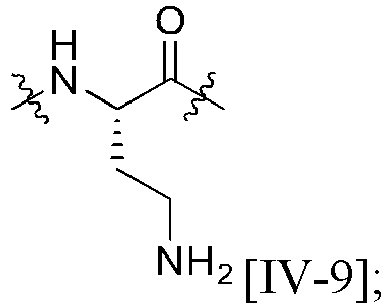
- AA4 represents one group selected from the group consisting of:
- a single bond,
- Gly, (d)-Ala, (N-Me)Ala, (N-Me)Val, (N-Me)Leu, (N-Me)Ile,
- Pro, (d)-Pro,
- (N-Me)Phe, (d)-Phe,
- (N-Me)Tyr, (d)-Tyr,
- (N-Me)Ser, (d)-Ser, homoSer, (d)-Thr,
- Met, (N-Me)Met,
- (N-Me)Asp, Glu, (N-Me)Glu, (d)-(N-Me)Glu, homoGlu,
- (N-Me)Asn,
- (N-Me)Arg, (d)-Arg,
- a group represented by any of formulas [IV-7], [IV-9], and [IV-13]:

- wherein if AA4 represents Lys, then
- the amino in the side chain of the Lys is optionally substituted with C2-16 alkylcarbonyl terminally-substituted with carboxy;
- AA5 represents one group selected from the group consisting of:
- a single bond,
- Ala, a group represented by formula [IV-1]:

- a group represented by any of formulas [IV-27], [IV-28], and [IV-29]:

- Pro, (d)-Pro, β-homoPro, homoPro, a group represented by formula [II-1']:

- Phe, His,
- Thr,
- Arg, (d)-Arg,
- a group represented by any of formulas [IV-7], [IV-9], and [IV-13]:

- Lys, (d)-Lys, β-Ala, (N-Me)-β-Ala, GABA, Ape, Acp,
- a group represented by any of formulas [III-6] to [III-13]:


- a group represented by any of formula [IV-25] and [IV-26]:

- W1 represents -L1- or -L1'-L1"-; wherein
- L1 represents a single bond; and
- L1' represents one group selected from the group consisting of:
- a single bond,
- β-Ala, GABA, (N-Me)GABA, Ape, Acp,
- a group represented by any of formulas [III-6] to [III-13]


- a group represented by any of formulas [IV-23] and [IV-24]:

- L1" represents one group selected from the group consisting of:
- a single bond,
- Gly, (N-Me)Gly,
- Ala, (N-Me)Ala, (d)-Ala, Val, (N-Me)Val, (N-Me)Leu, (N-Me)Ile,
- a group represented by formula [IV-27]:

- Pro, (d)-Pro, homoPro, Phe, (N-Me)Phe, (d)-Phe,
- His, (d)-His, Trp, (N-Me)Trp, (d)-Trp,
- Tyr, (N-Me)Tyr, (d)-Tyr,
- (d)-Ser, homoSer, Thr, (N-Me)Thr, (d)-Thr,
- Cys, (d)-Cys, Met, (N-Me)Met,
- (N-Me)Asp, Glu, (N-Me)Glu, (d)-Glu,
- Asn, (N-Me)Asn, (d)-Asn, Gln, (N-Me)Gln, (d)-Gln,
- Arg, (N-Me)Arg, (d)-Arg, Cit, (d)-Cit,
- a group represented by any of formulas [IV-7], [IV-9], [IV-10], and [IV-13]:


- Lys, (N-Me)Lys, (d)-Lys, a group represented by formula [IV-14]:

- β-Ala,
- β-Asp, β-(d)-Asp, and
- a group represented by any of formulas [III-6] and [III-7]:

- the amino in the side chain of the Lys or (d)-Lys is optionally substituted with a group represented by formula [VII-1]:
FAN-AAN5-AAN4-AAN3-AAN2-AAN1- [VII-1]
wherein - FAN represents C2-16 alkylcarbonyl terminally-substituted with carboxy;
- AANS represents:
- a single bond,
- Arg, (d)-Arg,
- Lys, (d)-Lys,
- γ-Glu, or
- a group represented by formula [IV-24]:

- AAN4 represents:
- a single bond,
- Arg, (d)-Arg,
- Lys, (d)-Lys, or
- a group represented by formula [IV-24]:

- AAN3 represents:
- a single bond,
- Arg, (d)-Arg,
- Lys, (d)-Lys,
- γ-Glu, or
- a group represented by formula [IV-24]:

- AAN2 represents:
- a single bond, or
- (d)-Lys; and
- AAN1 represents:
- a single bond, or
- (d)-Lys;
- wherein if L1" represents Glu and AA3 represents Lys, then
- the compound represented by formula [I'] may be taken together with L3 attached to each of functional groups in the side chains of the two amino acids to form a cyclic structure, as represented by formula [I'-α]:

- LN1 represents the formula -C(=O)- or the formula -S(=O)2-;
- LN2 represents:
- a single bond,
- C1-3 alkanediyl,
- C2-3 alkenediyl,
- ethynediyl,
- the formula -O-,
- the formula -C(=O)-, the formula -C(=O)-NH-, or
- triazolediyl;
- L2 represents a single bond;
- ring A represents an aromatic ring or a heteroaromatic ring;
- RA1 and RA2 each independently represent:
- a hydrogen atom,
- a halogen atom,
- C1-6 alkyl, or
- C1-6 alkoxy;
- ring B represents:
aryl or heteroaryl;
- RB1, RB2, and RB3 each independently represent:
- a hydrogen atom,
- carbamoyl,
- cyano,
- a halogen atom,
- C1-6 alkyl optionally substituted with one hydroxy, halo C1-6 alkyl,
- C1-6 alkoxy optionally substituted with one hydroxy, halo C1-6 alkoxy,
- C1-6 alkylcarbonyl,
- C1-6 alkylcarbonylamino,
- mono C1-6 alkylaminocarbonyl, di C1-6 alkylaminocarbonyl, wherein the alkyl in each of the mono C1-6 alkylaminocarbonyl and the di C1-6 alkylaminocarbonyl is optionally substituted with one group selected from the group consisting of hydroxy, carboxy, carbamoyl, and amino,
- C1-6 alkylsulfonyl, or
- aryl;
- WC is a single bond or a linker consisting of one to three amino acids, wherein the one to three amino acids forming the linker are same or different and each selected from the group consisting of:
- Gly,
- Pro,
- Arg, (d)-Arg,
- Lys, (d)-Lys,
- β-Ala, GABA, and Ape,
- wherein if Lys or (d)-Lys is included in the group represented by WC, then
- the amino in the side chain of the Lys or (d)-Lys is optionally substituted with:
- C2-16 alkylcarbonyl terminally-substituted with carboxy,
- Lys, wherein the amino in the side chain of the Lys is optionally substituted with C2-16 alkylcarbonyl terminally-substituted with carboxy, or
- (d)-Lys, wherein the amino in the side chain of the (d)-Lys is optionally substituted with C2-16 alkylcarbonyl terminally-substituted with carboxy; and
- RC is:
- the formula -OH, the formula -NH2,
- C1-6 alkylamino, wherein the C1-6 alkyl of the C1-6 alkylamino is optionally substituted with one group selected from the group consisting of hydroxy, amino, C1-6 alkoxy, and four- to seven-membered saturated heterocyclyl containing one nitrogen atom and optionally further containing one heteroatom, or
- four- to seven-membered saturated heterocyclyl containing one nitrogen atom and optionally further containing one heteroatom, wherein the four- to seven-membered saturated heterocyclyl containing one nitrogen atom and optionally further containing one heteroatom is optionally substituted with one group selected from the group consisting of hydroxy, amino, and C1-6 alkyl, wherein the C1-6 alkyl is optionally substituted with one carbamoyl; and two carbon atoms in the four- to seven-membered saturated heterocyclyl containing one nitrogen atom and optionally further containing one heteroatom are optionally crosslinked with C1-4 alkanediyl.
- AA1 represents:
- (2) Provided as another embodiment of the present invention is the substituted polypeptide or pharmaceutically acceptable salt thereof according to (1), wherein
- WC is:
- a single bond,
- Pro,
- Arg, (d)-Arg,
- Lys, (d)-Lys,
- β-Ala, GABA, Ape,
- Gly-(d)-Lys, Gly-(d)-Lys-(d)-Lys, Gly-(d)-Lys-(d)-Arg, Gly-(d)-Arg-(d)-Lys,
- Lys-Lys, (d)-Lys-(d)-Lys, (d)-Lys-(d)-Lys-(d)-Lys,
- Arg-Arg, (d)-Arg-(d)-Arg, (d)-Arg-(d)-Lys,
- Lys-(d)-Lys-(d)-Lys, (d)-Lys-Lys-(d)-Lys, (d)-Lys-(d)-Lys-Lys,
- β-Ala-(d)-Lys, β-Ala-(d)-Lys-(d)-Arg, β-Ala-(d)-Arg-(d)-Lys, or β-Ala-(d)-Arg-(d)-Arg
- wherein if Lys is contained in the group represented by WC,
- then the amino in the side chain of the Lys is optionally substituted with:
- C2-16 alkylcarbonyl terminally-substituted with carboxy, or
- (d)-Lys, wherein the amino in the side chain of the (d)-Lys is optionally substituted with C2-16 alkylcarbonyl terminally-substituted with carboxy.
- WC is:
- (3) Provided as another embodiment of the present invention is the substituted polypeptide or pharmaceutically acceptable salt thereof according to (1) or (2), wherein
- ring A is a benzene ring, a thiophene ring, or a pyridine ring;
- RA1 and RA2 are each independently:
- a hydrogen atom, or
- a halogen atom;
- ring B is:
phenyl, oxazolyl, thiadiazolyl, pyridyl, or benzofuranyl; - RB1, RB2, and RB3 are each independently:
- a hydrogen atom,
- carbamoyl,
- cyano,
- a halogen atom,
- C1-6 alkyl, wherein the C1-6 alkyl is optionally substituted with one hydroxy,
- halo C1-6 alkyl,
- C1-6 alkoxy, wherein the C1-6 alkoxy is optionally substituted with one hydroxy,
- halo C1-6 alkoxy,
- C1-6 alkylcarbonyl,
- mono C1-6 alkylaminocarbonyl, di C1-6 alkylaminocarbonyl, wherein the alkyl in each of the mono C1-6 alkylaminocarbonyl and the di C1-6 alkylaminocarbonyl is optionally substituted with one group selected from the group consisting of hydroxy, carboxy, carbamoyl, and amino, or
- C1-6 alkylsulfonyl; and
- RC is:
- the formula -OH, the formula -NH2,
- C1-6 alkylamino, wherein the C1-6 alkyl of the C1-6 alkylamino is optionally substituted with one group selected from the group consisting of hydroxy, amino, C1-6 alkoxy, and morpholinyl, or
- azetidinyl, pyrrolidinyl, piperidinyl, morpholinyl, or piperazinyl, wherein the azetidinyl, pyrrolidinyl, piperidinyl, morpholinyl, or piperazinyl is optionally substituted with one group selected from the group consisting of hydroxy, amino, and C1-6 alkyl, wherein the C1-6 alkyl is optionally substituted with one carbamoyl, wherein
- two carbon atoms in the azetidinyl, pyrrolidinyl, piperidinyl, morpholinyl, or piperazinyl are optionally crosslinked with C1-4 alkanediyl.
- (4) Provided as another embodiment of the present invention is the substituted polypeptide or pharmaceutically acceptable salt thereof according to any of (1) to (3), wherein in the substituted polypeptide represented by formula [I'],
- ring A is a benzene ring;
- ring B is phenyl;
- L1" is one group selected from the group consisting of:
- a single bond,
- Gly, (N-Me)Gly,
- Ala, (N-Me)Ala, (d)-Ala, Val, (N-Me)Val, (N-Me)Leu, (N-Me)Ile,
- a group represented by formula [IV-27]:

- Pro, (d)-Pro, homoPro, Phe, (N-Me)Phe, (d)-Phe,
- His, (d)-His, Trp, (N-Me)Trp, (d)-Trp,
- Tyr, (N-Me)Tyr, (d)-Tyr,
- (d)-Ser, homoSer, Thr, (N-Me)Thr, (d)-Thr,
- Cys, (d)-Cys, Met, (N-Me)Met,
- (N-Me)Asp, Glu, (N-Me)Glu, (d)-Glu,
- Asn, (N-Me)Asn, (d)-Asn, Gln, (N-Me)Gln, (d)-Gln,
- Arg, (N-Me)Arg, (d)-Arg, Cit, (d)-Cit,
- a group represented by any of formulas [IV-7], [IV-9], [IV-10], and [IV-13]:


- Lys, (N-Me)Lys, (d)-Lys, a group represented by formula [IV-14]:

- β-Ala,
- β-Asp, β-(d)-Asp, and
- a group represented by any of formulas [III-6] and [III-7]:

- a single bond,
- Pro,
- Arg, (d)-Arg,
- Lys, (d)-Lys,
- β-Ala, GABA, Ape,
- Gly-(d)-Lys, Gly-(d)-Lys-(d)-Lys, Gly-(d)-Lys-(d)-Arg, Gly-(d)-Arg-(d)-Lys,
- Lys-Lys, (d)-Lys-(d)-Lys, (d)-Lys-(d)-Lys-(d)-Lys,
- Arg-Arg, (d)-Arg-(d)-Arg, (d)-Arg-(d)-Lys,
- Lys-(d)-Lys-(d)-Lys, (d)-Lys-Lys-(d)-Lys, (d)-Lys-(d)-Lys-Lys,
- β-Ala-(d)-Lys, β-Ala-(d)-Lys-(d)-Arg,
- β-Ala-(d)-Arg-(d)-Lys, or β-Ala-(d)-Arg-(d)-Arg.
- (5) Provided as another embodiment of the present invention is the substituted polypeptide or pharmaceutically acceptable salt thereof according to any of (1) to (4), wherein in the substituted polypeptide represented by formula [I'],
- AA2 is one group selected from the group consisting of:
- a group represented by formula [II-1]:

- a group represented by any of formulas [IV-7], [IV-8], [IV-9], [IV-11], and [IV-12]:


- AA3 is Val, Leu, Ile, Phe, or Trp;
- AA4 is (N-Me)Val, (N-Me)Leu, (N-Me)Ile, (N-Me)Asp, or (N-Me)Glu;
- AA5 is β-Ala, GABA, Ape, Acp, Pro, (d)-Pro, or β-homoPro;
- WC is a single bond, Arg, (d)-Arg, Lys, or (d)-Lys; and
- RC is the formula -OH or the formula -NH2.
- a group represented by formula [II-1]:
- AA2 is one group selected from the group consisting of:
- (6) Provided as another embodiment of the present invention is the substituted polypeptide or pharmaceutically acceptable salt thereof according to any of (1) to (5), wherein in the substituted polypeptide represented by formula [I'],
- W1 is -L1'-L1"-;
- L2 is a single bond;
- AA1 is Asp;
- L1' is one group selected from the group consisting of β-Ala, GABA, Ape, Acp, and a group represented by any of formulas [IV-23] and [IV-24]:

- L1" is a single bond, Asn, (d)-Ser, (d)-Thr, or Glu;
- L1' is one group selected from the group consisting of β-Ala, GABA, Ape, Acp, and a group represented by any of formulas [IV-23] and [IV-24]:
- LN1 is the formula -C(=O)- or the formula -S(=O)2-;
- LN2 is the formula -O- or the formula -C(=O)-NH-;
- RA1 and RA2 are each a hydrogen atom; and
- RB1, RB2, and RB3 are each independently a hydrogen atom, carbamoyl, a halogen atom,
- C1-6 alkoxy, or halo C1-6 alkoxy.
- (7) Provided as another embodiment of the present invention is the substituted polypeptide or pharmaceutically acceptable salt thereof according to any of (1) to (5), wherein in the substituted polypeptide represented by formula [I'],
- W1 is -L1-, wherein L1 is a single bond;
- L2 is a single bond;
- AA1 is β-Asp, β-(d)-Asp, γ-Glu, or γ-(d)-Glu;
- AA2 is one group selected from the group consisting of:
- a group represented by formula [II-1]:

- a group represented by any of formulas [IV-7], [IV-8], [IV-9], [IV-11], and [IV-12]:


- a group represented by formula [II-1]:
- AA3 is Val, Leu, Ile, Phe, or Trp;
- AA4 is (N-Me)Val, (N-Me)Leu, (N-Me)Ile, (N-Me)Asp, or (N-Me)Glu;
- AA5 is β-Ala, GABA, Ape, Acp, or β-homoPro;
- LN1 is the formula -C(=O)- or the formula -S(=O)2-;
- LN2 is a single bond, the formula -O-, or the formula -C(=O)-NH-;
- RA1 and RA2 are each a hydrogen atom; and
- RB1, RB2, and RB3 are each independently a hydrogen atom, carbamoyl, a halogen atom,
- C1-6 alkoxy, or halo C1-6 alkoxy.
- (8) Provided as another embodiment of the present invention is the substituted polypeptide or pharmaceutically acceptable salt thereof according to any of (1) to (4), wherein the substituted polypeptide represented by formula [1'] is a substituted polypeptide represented by formula [I]:

- AA1 is β-Asp, γ-Glu, or γ-(d)-Glu;
- AA2 is a group represented by formula [II-1] or formula [II-2]:

- AA3 is Val, Leu, Ile, Phe, or Trp;
- AA4 is a single bond, Pro, (N-Me)Ala, (N-Me)Val, (N-Me)Leu, (N-Me)Ile, (N-Me)Phe, (N-Me)Tyr, (N-Me)Ser, (N-Me)Asp, or (N-Me)Glu;
- AA5 is a single bond, Pro, (d)-Pro, β-homoPro, Arg, (d)-Arg, Lys, (d)-Lys, β-Ala, GABA, Ape, or Acp;
- L1 is a single bond;
- L2 is a single bond;
- LN1 is the formula -C(=O)- or the formula -S(=O)2-;
- LN2 is a single bond, C1-3 alkanediyl, the formula -O-, or the formula -C(=O)-NH-;
- RA is a hydrogen atom, a halogen atom, C1-6 alkyl, or C1-6 alkoxy;
- RB is a hydrogen atom, carbamoyl, a halogen atom, C1-6 alkyl, or C1-6 alkoxy;
- LC is a single bond, Pro, Arg, (d)-Arg, Lys, (d)-Lys, or (d)-Lys-(d)-Lys; and
- RC is the formula -OH or the formula -NH2.
- (9) Provided as another embodiment of the present invention is the substituted polypeptide or pharmaceutically acceptable salt thereof according to any of (1) to (5), wherein in the substituted polypeptide represented by formula [I'],
- AA1 is Asp, β-(d)-Asp, or γ-(d)-Glu;
- AA2 is one group selected from the group consisting of:
- a group represented by formula [II-1]:

- a group represented by any of formulas [IV-7] and [IV-9]:

- a group represented by formula [II-1]:
- AA3 is Val, Leu, or Ile;
- AA4 is (N-Me)Ile or (N-Me)Glu;
- AA5 is Ape or β-homoPro;
- W1 is -L1- or -L1'-L1"-,
wherein- L1 is a single bond,
- L1' is GABA or Ape, and
- L1" is Asn, (d)-Ser, (d)-Thr, or Glu;
- LN1 is the formula -C(=O)- or the formula -S(=O)2-;
- LN2 is the formula -O- or the formula -C(=O)-NH-;
- RA1 and RA2 are each a hydrogen atom;
- RB1, RB2, and RB3 are each independently a hydrogen atom, carbamoyl, a halogen atom, C1-6 alkoxy, or halo C1-6 alkoxy;
- WC is a single bond or (d)-Lys; and
- RC is the formula -NH2.
- (10) Provided as another embodiment of the present invention is the substituted polypeptide or pharmaceutically acceptable salt thereof according to any one of (1) to (5), wherein the substituted polypeptide is selected from compounds shown in the following:


- (11) Provided as another embodiment of the present invention is a pharmaceutical comprising the substituted polypeptide or pharmaceutically acceptable salt thereof according to any one of (1) to (10) as an active ingredient.
- (12) Provided as another embodiment of the present invention is an MMP2 inhibitor comprising the substituted polypeptide or pharmaceutically acceptable salt thereof according to any one of (1) to (10) as an active ingredient.
- (13) Provided as another embodiment of the present invention is an agent for suppressing growth, infiltration, or metastasis of cancer cells, comprising the substituted polypeptide or pharmaceutically acceptable salt thereof according to any one of (1) to (10) as an active ingredient.
- (14) Provided as another embodiment of the present invention is an agent for suppressing fibrogenesis comprising the substituted polypeptide or pharmaceutically acceptable salt thereof according to any one of (1) to (10) as an active ingredient.
- (15) Provided as another embodiment of the present invention is a drug for preventing or treating cancerous disease or organ fibrosis, or a symptom associated with cancerous disease or organ fibrosis, comprising the substituted polypeptide or pharmaceutically acceptable salt thereof according to any one of (1) to (10) as an active ingredient.
- The compounds of the present invention (hereinafter, occasionally referred to as "the present inventive compounds") have an effect to inhibit MMP2. Some of the present inventive compounds have an effect to selectively inhibit MMP2.
- The present invention provides a substituted polypeptide represented by formula [I'], or a pharmaceutically acceptable salt thereof, having an effect to inhibit MMP2.
- The compounds of the present invention will be described in more detail in the following; however, the present invention is not limited to exemplified ones.
- Herein, "amino acid" is, in a broad sense, an organic compound having two functional groups: amino and carboxy. In a narrow sense (in particular, in the field of biochemistry), "amino acid" refers to "α-amino acid" (the α-amino acid is an amino acid in which amino is bonding to the carbon atom to which carboxy is bonding (α carbon)) that serves as a constituent unit of biogenic proteins.
- Examples of amino acids in the present specification include natural proteogenic L-amino acids; natural nonproteogenic amino acids; and nonnatural amino acids. Examples of nonnatural amino acids include the D-forms of natural proteogenic L-amino acids; chemically modified amino acids such as amino acid variants and derivatives; and chemically synthesized compounds having properties that are characteristic to amino acids and known in the art.
- Herein, when "amino acid" is shown as its name without abbreviating, for example, as a three-letter code or a one-letter code, the name indicates the amino acid in the L-form, D-form, or both.
- Herein, when "amino acid" is shown as an abbreviation, for example, in a three-letter code or a one-letter code, the abbreviation indicates the amino acid in the L-form. "L" or "l" is occasionally added immediately before "amino acid" to explicitly show that the amino acid is in the L-form.
- Herein, "D" or "d" added immediately before "amino acid" indicates that the amino acid is in the D-form.
- Herein, "natural proteogenic L-amino acid" is a naturally occurring amino acid in L-form that constitutes proteins, and examples thereof include Gly, Ala, Val, Leu, Ile, Pro, Phe, His, Trp, Tyr, Ser, Thr, Met, Cys, Asp, Glu, Asn, Gln, Lys, and Arg.
- Herein, "D-form of natural proteogenic L-amino acid" refers to an enantiomer of the natural proteogenic L-amino acid. Natural proteogenic L-amino acids except glycine each have at least one asymmetric carbon, thus being optically active. The structures of these amino acids are classified into L-forms and D-forms on the basis of the structures of the L-form and D-form of glyceraldehyde.
- Amino acids other than natural proteogenic L-amino acids can also have D-forms.
- Herein, "natural nonproteogenic amino acid" is a naturally occurring amino acid that does not constitute proteins, and examples thereof include L-norleucine (hereinafter, also designated as Nle; hereinafter, "code following in parentheses" shows an abbreviation), β-alanine (β-Ala), and L-ornithine (Orn).
- If a natural nonproteogenic amino acid has an asymmetric carbon, there exist an L-form and a D-form for the amino acid. There can be L-forms and D-forms also for amino acids other than natural nonproteogenic amino acids.
- Herein, "nonnatural amino acid" refers to an amino acid that does not constitute proteins and is primarily artificially produced, being an amino acid not included in the above-described "natural proteogenic L-amino acid and natural nonproteogenic amino acid". Examples of nonnatural amino acids include the D-forms of natural proteogenic L-amino acids (such as D-Cys, D-Ser); α-methylamino acids (such as 2-aminoisobutyric acid (Aib)); amino acids with excessive methylene in the side chain ("homo" amino acids such as L-β-homoproline (β-Hep or β-homoPro), L-homoserine (Hes or homoSer), L-homocysteine (Hec or homoCys), L-homoproline (homoPro), L-homoglutamic acid (homoGlu)); amino acids in which the side chain of an amino acid with a carboxylic acid functional group is substituted with a sulfonic acid group (such as L-cysteic acid); chemically modified amino acids such as amino acid variants and derivatives (such as hydroxyproline, L-2,3-diaminopropionic acid (Dap), L-2,4-diaminobutyric acid (Dab), N-methylglycine); and chemically synthesized compounds having properties that are characteristic to amino acids and known in the art (such as 4-aminobenzoic acid).
- If a nonnatural amino acid has an asymmetric carbon, there exist an L-form and a D-form for the amino acid.
- Specific examples of "nonnatural amino acid" in the present specification include the followings:
- (d)-Pro, (d)-Ser, (d)-Thr, (d)-Asp, (d)-Glu, (d)-Arg, (d)-Lys
- β-homoPro
- β-Ala, GABA, Ape, Acp
- (N-Me)Ala, (N-Me)Val, (N-Me)Leu, (N-Me)Ile, (N-Me)Phe, (N-Me)Tyr, (N-Me)Ser, (N-Me)Asp, (N-Me)Glu
- a group represented by formula [II-1] or formula [II-2]:

- amino acids listed later in Table 1 and Table 2
- The nitrogen atom involved in peptide bonding in any amino acid in the present specification may be alkylated. In this case, the amino acid is also called "N-alkyl amino acid". Examples of the alkyl include methyl and ethyl.
- Herein, the expression "β-Asp" means aspartic acid involved in amide bonding of the main chain via carboxy in the side chain, as illustrated in the structure represented by formula [III-1]. Likewise, the expressions "β-(d)-Asp", "γ-Glu", and "γ-(d)-Glu" mean the structures represented by formula [III-2] to formula [III-4].


- The expression "(N-Me)Glu(OtBu)" means the N-methyl form of the amino acid (Glu(OtBu)), as illustrated in the structure represented by formula [III-5].

- The expression "(2S,4S)-(4-amino)Pro" on the structure corresponding to AA2 means the structure represented by formula [II-3]. Likewise, the expressions "(2S,4R)-(4-amino)Pro", "(2S,4S)-(4-hydroxy)Pro", and "(2S,4R)-(4-hydroxy)Pro" mean the structures represented by formula [II-4] to formula [II-6]. Further, the expression "(S)-piperazine" means the structure represented by formula [II-2].


- Herein, "n" indicates normal, "i" indicates iso, "s" indicates secondary, "t" and "tert" each indicate tertiary, "c" indicates cyclo, "o" indicates ortho, "m" indicates meta, and "p" indicates para.
- "Halogen atom" refers to a fluorine atom, a chlorine atom, a bromine atom, or an iodine atom.
- "C1-6 alkyl" refers to linear or branched alkyl having one to six carbon atoms. Examples of "C1-6 alkyl" include methyl, ethyl, n-propyl, isopropyl, n-butyl, isobutyl, sec-butyl, tert-butyl, n-pentyl, and n-hexyl.
- "Halo C1-6 alkyl" refers to linear or branched alkyl having one to six carbon atoms and substituted with a halogen atom. A preferred number of halogen atoms as substituents is one to five, and a preferred halogen atom is a fluorine atom. Examples of "halo C1-6 alkyl" include monofluoromethyl, difluoromethyl, trifluoromethyl, 1-fluoroethyl, 1,1-difluoroethyl, 1,1,2,2-tetrafluoroethyl, 1,1,2,2,2-pentafluoroethyl, 2-fluoroethyl, 2-fluoro-2-methylpropyl, 2,2-difluoropropyl, 1-fluoro-2-methylpropan-2-yl, 1,1-difluoro-2-methylpropan-2-yl, 1-fluoropentyl, 1-fluorohexyl, and 2,2,2-trifluoro-1-methylethyl.
- "Aryl" refers to a monocyclic aromatic hydrocarbon group or fused polycyclic aromatic hydrocarbon group having 6 to 14 carbon atoms. Examples of "aryl" include phenyl, naphthyl, and anthryl.
- "Aromatic ring" refers to a monocyclic aromatic hydrocarbon group or fused polycyclic aromatic hydrocarbon group having 6 to 14 carbon atoms. Examples of "aromatic ring" include a benzene ring, a naphthalene ring, and an anthracene ring.
- Partially saturated aryl is also included in the scope of "aryl". The same is applied to aromatic rings. "Partially saturated aryl" and the corresponding aromatic ring, "partially saturated aromatic ring", refer to a group wheren a monocyclic aromatic hydrocarbon group or fused polycyclic aromatic hydrocarbon group having 6 to 14 carbon atoms is partially saturated, and a ring having such a structure. Examples thereof include dihydroindenyl and a dihydroindene ring.
- "Heteroaryl" refers to a five- to seven-membered monocyclic aromatic heterocyclic group consisting of one to six carbon atoms and one or more atoms that are same or different and selected from the group consisting of an oxygen atom, a sulfur atom, and a nitrogen atom, or a fused polycyclic aromatic heterocyclic group composed of 9 to 14 atoms, specifically, consisting of 1 to 13 carbon atoms and one or more atoms that are same or different and selected from the group consisting of an oxygen atom, a sulfur atom, and a nitrogen atom. Examples of "heteroaryl" include imidazolyl, pyrazolyl, thienyl, thiazolyl, isothiazolyl, thiadiazolyl, oxazolyl, isooxazolyl, oxadiazolyl, pyrrolyl, triazolyl, tetrazolyl, pyridyl, pyrimidinyl, pyrazinyl, pyridazinyl, triazinyl, indolyl, benzopyrazolyl, benzotriazolyl, benzofuranyl, benzothiophenyl, quinolyl, isoquinolyl, and quinoxalyl.
- "Heteroaromatic ring" refers to a five- to seven-membered monocyclic aromatic heterocycle consisting of one to six carbon atoms and one or more atoms that are same or different and selected from the group consisting of an oxygen atom, a sulfur atom, and a nitrogen atom, or a fused polycyclic aromatic heterocycle composed of 9 to 14 atoms, specifically, consisting of 1 to 13 carbon atoms and one or more atoms that are same or different and selected from the group consisting of an oxygen atom, a sulfur atom, and a nitrogen atom. Examples of "heteroaromatic ring" include an imidazole ring, a pyrazole ring, a thiophene ring, a thiazole ring, an isothiazole ring, a thiadiazole ring, an oxazole ring, an isoxazole ring, an oxadiazole ring, a pyrrole ring, a triazole ring, a tetrazole ring, a pyridine ring, a pyrimidine ring, a pyrazine ring, a pyridazine ring, a triazine ring, an indole ring, a benzopyrazole ring, a benzotriazole ring, a benzofuran ring, a benzothiophene ring, a quinoline ring, an isoquinoline ring, and a quinoxaline ring.
- Partially saturated heteroaryl is also included in the scope of "heteroaryl". The same is applied to heteroaromatic rings. "Partially saturated heteroaryl", and the corresponding heteroaromatic ring, "partially saturated heteroaromatic ring", refer to a five-to seven-membered partially saturated monocyclic heterocyclic group consisting of one to six carbon atoms and one or more atoms that are same or different and selected from the group consisting of an oxygen atom, a sulfur atom, and a nitrogen atom, or a partially saturated fused polycyclic heterocyclic group composed of 9 to 14 atoms, specifically, consisting of 1 to 13 carbon atoms and one or more atoms that are same or different and selected from the group consisting of an oxygen atom, a sulfur atom, and a nitrogen atom, and a ring having such a structure. Examples thereof include oxazolidinyl, thiazolinyl, dihydropyridinyl, dihydrobenzofuranyl, chromanyl, dihydropyranopyridinyl, dihydrofuropyridinyl, tetrahydroquinolyl, dihydrobenzodioxinyl, tetrahydrotriazoloazepinyl, an oxazolidine ring, a thiazoline ring, a dihydropyridine ring, a dihydrobenzofuran ring, a chroman ring, a dihydropyranopyridine ring, a dihydrofuropyridine ring, a tetrahydroquinoline ring, a tetrahydroquinoline ring, a dihydrobenzodioxine ring, and a tetrahydrotriazoloazepine ring.
- "Four- to seven-membered saturated heterocyclyl containing nitrogen atom" refers to a four- to seven-membered monocyclic saturated heterocyclic group consisting of one nitrogen atom and three to six carbon atoms, and may further contain, in addition to the nitrogen atom, one atom selected from the group consisting of an oxygen atom, a sulfur atom, and a nitrogen atom. Examples of "four- to seven-membered saturated heterocyclyl containing nitrogen atom" include azetidinyl, pyrrolidinyl, piperidinyl, azepanyl, morpholinyl, thiomorpholinyl, and piperazinyl.
- "Four- to seven-membered saturated heterocyclyl containing one nitrogen atom and optionally further containing one heteroatom" refers to a four- to seven-membered monocyclic saturated heterocyclic group consisting of one nitrogen atom and three to six carbon atoms, and may further contain, in addition to the nitrogen atom, one atom selected from the group consisting of an oxygen atom, a sulfur atom, and a nitrogen atom. Examples "four- to seven-membered saturated heterocyclyl containing one nitrogen atom and optionally further containing one heteroatom" include azetidinyl, pyrrolidinyl, piperidinyl, azepanyl, morpholinyl, thiomorpholinyl, and piperazinyl.
- Examples of "four- to seven-membered saturated heterocyclyl containing one nitrogen atom and optionally further containing one heteroatom, and optionally crosslinked with C1-4 alkanediyl" include 8-oxa-3-azabicyclo[3.2.1]octan-3-yl (the group represented by formula [VI-16]) and 3,8-diazabicyclo[3.2.1]octan-3-yl (the group represented by formula [VI-18]):

- "C1-6 alkoxy" refers to linear or branched alkoxy having one to six carbon atoms. Examples "C1-6 alkoxy" include methoxy, ethoxy, n-propoxy, isopropoxy, n-butoxy, isobutoxy, sec-butoxy, tert-butoxy, n-pentyloxy, and n-hexyloxy.
- "Halo C1-6 alkoxy" refers to linear or branched alkoxy having one to six carbon atoms and substituted with a halogen atom. A preferred number of halogen atoms as substituents is one to five, and a preferred halogen atom is a fluorine atom. Examples of "halo C1-6 alkoxy" include monofluoromethoxy, difluoromethoxy, trifluoromethoxy, 1-fluoroethoxy, 1,1-difluoroethoxy, 1,1,2,2-tetrafluoroethoxy, 2-fluoroethoxy, 2,2,2-trifluoroethoxy, 3,3,3-trifluoropropoxy, 1,3-difluoropropan-2-yloxy, 2-fluoro-2-methylpropoxy, 2,2-difluoropropoxy, 1-fluoro-2-methylpropan-2-yloxy, 1,1-difluoro-2-methylpropan-2-yloxy, and 4,4,4-trifluorobutoxy.
- "C1-6 alkylcarbonyl" refers to a group in which "C1-6 alkyl" described above and carbonyl are bonding together. Examples of "C1-6 alkylcarbonyl" include methylcarbonyl, ethylcarbonyl, n-propylcarbonyl, isopropylcarbonyl, n-butylcarbonyl, isobutylcarbonyl, sec-butylcarbonyl, tert-butylcarbonyl, n-pentylcarbonyl, and n-hexylcarbonyl.
- "C1-6 alkylcarbonylamino" refers to a group in which "C1-6 alkylcarbonyl" described above and an amino group are bonding together. Examples of "C1-6 alkylcarbonylamino" include methylcarbonylamino, ethylcarbonylamino, n-propylcarbonylamino, isopropylcarbonylamino, n-butylcarbonylamino, isobutylcarbonylamino, sec-butylcarbonylamino, tert-butylcarbonylamino, n-pentylcarbonylamino, and n-hexylcarbonyl amino.
- "C1-6 alkylamino" refers to amino having one or two "C1-6 alkyl" described above, as substituents, that are same or different. Examples of "C1-6 alkylamino" include methylamino, ethylamino, n-propylamino, isopropylamino, n-butylamino, isobutylamino, sec-butylamino, tert-butylamino, n-pentylamino, n-hexylamino, dimethylamino, diethylamino, di(n-propyl)amino, di(isopropyl)amino, ethylmethylamino, and methyl(n-propyl)amino.
- "Mono C1-6 alkylamino" refers to amino having one "C1-6 alkyl" described above as a substituent. Examples of "mono C1-6 alkylamino" include methylamino, ethylamino, n-propylamino, isopropylamino, n-butylamino, isobutylamino, sec-butylamino, tert-butylamino, n-pentylamino, and n-hexylamino.
- "Di C1-6 alkylamino" refers to amino having two "C1-6 alkyl" described above, as substituents, that are same or different. Examples of "di C1-6 alkylamino" include dimethylamino, diethylamino, di(n-propyl)amino, di(isopropyl)amino, ethylmethylamino, and methyl(n-propyl)amino.
- "Mono C1-6 alkylaminocarbonyl" refers to a group in which "mono C1-6 alkylamino" described above and carbonyl are bonding together. Examples of "mono C1-6 alkylaminocarbonyl" include methylaminocarbonyl, ethylaminocarbonyl, n-propylaminocarbonyl, isopropylaminocarbonyl, n-butylaminocarbonyl, isobutylaminocarbonyl, n-pentylaminocarbonyl, and n-hexylaminocarbonyl.
- "Di C1-6 alkylaminocarbonyl" refers to a group in which "di C1-6 alkylamino" described above and carbonyl are bonding together. Examples of "di C1-6 alkylaminocarbonyl" include dimethylaminocarbonyl, diethylaminocarbonyl, di(n-propyl)aminocarbonyl, di(isopropyl)aminocarbonyl, ethylmethylaminocarbonyl, and methyl (n-propyl)aminocarbonyl.
- "C1-6 alkylcarbonyl" refers to a group in which "C1-6 alkyl" described above and carbonyl are bonding together. Examples of "C1-6 alkylcarbonyl" include methylcarbonyl, ethylcarbonyl, n-propylcarbonyl, isopropylcarbonyl, n-butylcarbonyl, isobutylcarbonyl, sec-butylcarbonyl, tert-butylcarbonyl, n-pentylcarbonyl, and n-hexylcarbonyl.
- "C2-16 alkylcarbonyl" refers to a group in which linear or branched alkyl having 2 to 16 carbon atoms and carbonyl are bonding together. Examples of "C2-16 alkylcarbonyl" include ethylcarbonyl, n-propylcarbonyl, isopropylcarbonyl, n-butylcarbonyl, isobutylcarbonyl, sec-butylcarbonyl, tert-butylcarbonyl, n-decylcarbonyl(undecanoyl), n-dodecylcarbonyl(tridecanoyl), and n-tetradecylcarbonyl(pentadecanoyl).
- "C2-16 alkylcarbonyl terminally-substituted with carboxy" refers to a group in which a terminus of "C2-16 alkyl" in "C2-16 alkylcarbonyl" described above is substituted with carboxy. Examples of "C2-16 alkylcarbonyl terminally-substituted with carboxy" include 11-carboxyundecanoyl, 13-carboxytridecanoyl, and 15-carboxypentadecanoyl.
- "C1-6 alkylsulfonyl" refers to a group in which "C1-6 alkyl" described above and sulfonyl are bonding together. Examples of "C1-6 alkylsulfonyl" include methylsulfonyl, ethylsulfonyl, n-propylsulfonyl, isopropylsulfonyl, n-butylsulfonyl, isobutylsulfonyl, sec-butylsulfonyl, tert-butylsulfonyl, n-pentylsulfonyl, and n-hexylsulfonyl.
- "C1-3 alkanediyl" refers to a divalent hydrocarbon formed by removing one hydrogen atom from alkyl having one to three carbon atoms. Examples of "C1-3 alkanediyl" include methanediyl, ethane-1,1-diyl, ethane-1,2-diyl, propane-1,1-diyl, propane-1,3-diyl, and propane-2,2-diyl.
- "C1-4 alkanediyl" refers to a divalent hydrocarbon formed by removing one hydrogen atom from alkyl having one to four carbon atoms. Examples of "C1-4 alkanediyl" include methanediyl, ethane-1,1-diyl, ethane-1,2-diyl, propane-1,1-diyl, propane-1,3-diyl, propane-2,2-diyl, and butane-1,4-diyl.
- "C2-3 alkenediyl" refers to a divalent unsaturated hydrocarbon formed by removing one hydrogen atom from alkenyl having two or three carbon atoms. Examples of "C2-3 alkenediyl" include ethene-1,1-diyl, ethene-1,2-diyl, prop-1-ene-1,1-diyl, prop-2-ene-1,1-diyl, prop-1-ene-1,3-diyl, prop-2-ene-1,3-diyl, and prop-1-ene-2,2-diyl.
- "Triazolediyl" refers to divalent triazole formed by removing two hydrogen atoms from a triazole ring. Examples of "triazolediyl" include structures represented by formulas [VIII-1] to [VIII-5]:


- Abbreviations used herein indicate structures listed in Table 1 to Table 4.
[Table 1-1] # Formula number Abbreviation Structure 1 [III-6] β-Dap 
2 [III-7] β-(d)-Dap 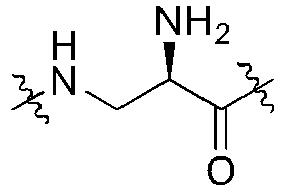
3 [III-8] γ-Dab 
4 [III-9] γ-(d)-Dab 
5 [III-10] δ-Orn 
6 [III-11] δ-(d)-Orn 
7 [III-12] ε-Lys 
8 [III-13] ε-(d)-Lys 
[Table 2-1] # Formula number Abbreviation Structure 1 [IV-1] Aib 
2 [IV-2] Nle 
3 [IV-3] Ala(cPropyl) 
4 [IV-4] Ala(2-Pyr) 
5 [IV-5] Ala(4-Thz) 
6 [IV-6] homoSer 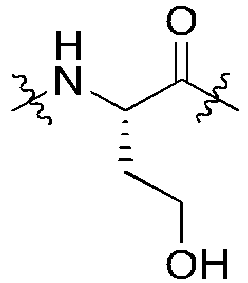
7 [IV-7] Dap 
8 [IV-8] Dap(Me) 
[Table 2-2] # Formula number Abbreviation Structure 9 [IV-9] Dab 
10 [IV-10] (d)-Dab 
11 [IV-11] Dab(Me) 
12 [IV-12] Dab(Me)2 
13 [IV-13] Orn 
14 [IV-14] Lys(Ac) 
[Table 2-3] # Formula number Abbreviation Structure 15 [IV-15] Cit 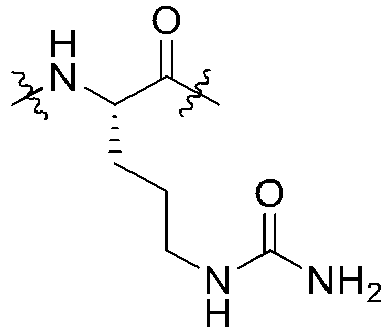
16 [IV-16] (d)-Cit 
17 [IV-17] β-Ala 
18 [IV-18] (N-Me)-β-Ala 
19 [IV-19] GABA 
20 [IV-20] (N-Me)GABA 
21 [IV-21] Ape 
22 [IV-22] Acp 
23 [IV-23] -NH-(CH2)2-O-CH2-CO- 
24 [IV-24] Adox 
[Table 2-4] # Formula number Abbreviation Structure 25 [IV-25] cis-NH(3)cPen 
26 [IV-26] (4)Abz 
27 [IV-27] Aze(2) 
28 [IV-28] (d)-Aze(2) 
29 [IV-29] Aze(3) 
30 [IV-30] β-homoPro 
31 [IV-31] homoPro 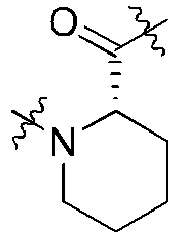
32 [IV-32] aspartimide-Dab 
33 [IV-33] homoGlu 
[Table 3-1] # Formula number Abbreviation Structure 1 [V-1] Lys(CO-(CH2)10-CO2H) 
2 [V-2] Lys(CO-(CH2)12-CO2H) 
3 [V-3] Lys(CO-(CH2)14-CO2H) 
[Table 4-1] # Formula number Abbreviation Structure 1 [VI-1] -NHMe 
2 [VI-2] -NHEt 
3 [VI-3] -NH-(CH2)2-OH 
4 [VI-4] -NH-(CH2)2-NH2 
5 [VI-5] -NH-(CH2)3-NH2 
6 [VI-6] -NH-(CH2)4-NH2 
7 [VI-7] -NH-(CH2)5-NH2 
8 [VI-8] the formula [VI-8] 
9 [VI-9] azetidin-1-yl 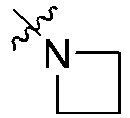
10 [VI-10] pyrrolidin-1-yl 
11 [VI-11] piperidin-1-yl 
12 [VI-12] (3-OH)azetidin-1-yl 
13 [VI-13] (4-OH)piperidin-1-yl 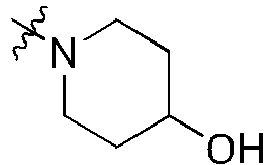
[Table 4-2] # Formula number Abbreviation Structure 14 [VI-14] the formula [VI-14] 
15 [VI-15] morpholin-4-yl 
16 [VI-16] the formula [VI-16] 
17 [VI-17] (4-Me)piperazin-1-yl 
18 [VI-18] the formula [VI-18] 
- Preferable embodiments of the substituted polypeptide represented by formula [I'], or pharmaceutically acceptable salt thereof according to the present invention are as follows.
- Preferable AA1 is Asp, β-Asp, β-(d)-Asp, γ-Glu, or γ-(d)-Glu,
- one more preferable AA1 is β-Asp, γ-Glu, or γ-(d)-Glu,
- wherein further preferable AA1 is γ-(d)-Glu,
- another more preferable AA1 is β-(d)-Asp or γ-(d)-Glu,
- wherein further preferable AA1 is β-(d)-Asp, and
- another more preferable AA1 is Asp.
- Preferable AA2 is a group represented by formula [II-1] or formula [II-2]:


a group represented by formula [IV-27]:
- Pro,
- wherein preferable RAA2 is hydroxy or amino,
- more preferable AA2 is a group represented by formula [II-1]:

- or a group represented by formula [IV-7], [IV-8], [IV-9], [IV-11], or [IV-12]:


- further preferable AA2 is
- a group represented by formula [IV-7] or [IV-9]:

- or a group represented by formula [II-1]:

- one particularly preferable AA2 is
- a group represented by formula [II-1]:

- another particularly preferable AA2 is
- a group represented by formula [IV-7] or [IV-9]:

- Preferable AA3 is Val, Leu, Ile, a group represented by formula [IV-2]:


- more preferable AA3 is Val, Leu, Ile, Phe, or Trp,
- further preferable AA3 is Val, Leu, or Ile,
- one particularly preferable AA3 is Val,
- another particularly preferable AA3 is Leu, and
- another particularly preferable AA3 is Ile.
- Preferable AA4 is a single bond, Pro, Gly, homoSer, Met, Glu, (N-Me)Ala, (N-Me)Val, (N-Me)Leu, (N-Me)Ile, (N-Me)Phe, (N-Me)Tyr, (N-Me)Ser, (N-Me)Met, (N-Me)Asp, (N-Me)Glu, (d)-Pro, (d)-Ala, (d)-Phe, (d)-Tyr, (d)-Ser, (d)-Thr, or (d)-(N-Me)Glu,
- more preferable AA4 is (N-Me)Ala, (N-Me)Val, (N-Me)Leu, (N-Me)Ile, (N-Me)Phe, (N-Me)Tyr, (N-Me)Ser, (N-Me)Met, (N-Me)Asp, (N-Me)Glu, (d)-Pro, (d)-Ala, (d)-Phe, (d)-Tyr, (d)-Ser, (d)-Thr, or (d)-(N-Me)Glu,
- one further preferable AA4 is (N-Me)Glu or (N-Me)Asp,
- wherein particularly preferable AA4 is (N-Me)Glu, and
- another further preferable AA4 is (N-Me)Ile, (N-Me)Val, or (N-Me)Leu,
- wherein particularly preferable AA4 is (N-Me)Ile.
- Preferable AA5 is β-Ala, GABA, Ape, Acp, Pro, (d)-Pro, β-homoPro, a single bond, Arg, (d)-Arg,
a group represented by [IV-7], [IV-9], or [IV-13]:
Ala, a group represented by formula [IV-1]:
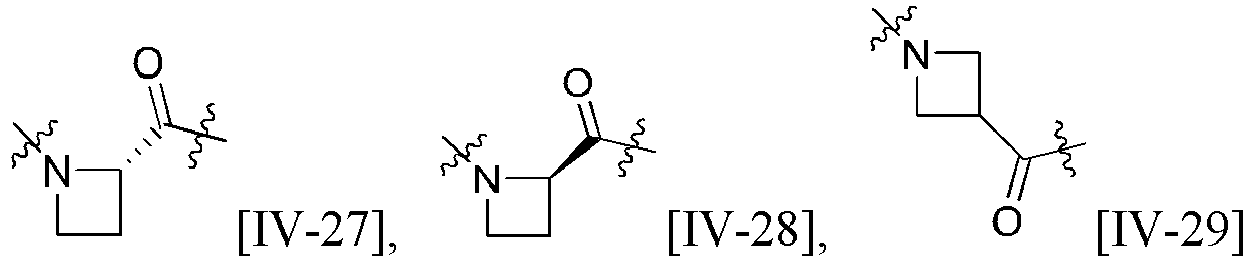
a group represented by any of formulas [III-6] to [III-13]:


a group represented by formula [IV-7], [IV-9], or [IV-13]:
further preferable AA5 is β-Ala, GABA, Ape, Acp, Pro, (d)-Pro, or β-homoPro, and particularly preferable AA5 is β-Ala, GABA, Ape, Acp, or β-homoPro. - Preferable W1 is -L1- or -L1'-L1"-,
- wherein L1 is a single bond,
- L1' is selected from the group consisting of β-Ala, GABA, Ape, Acp,
- a group represented by any of formulas [III-6] to [III-13]:




- , and a group represented by any of formulas [IV-23] and [IV-24]:

- , and L1" is a single bond, Asn, (d)-Ser, (d)-Thr, Lys, Arg, or Glu, one more preferable W1 is -L1- or -L1'-L1"-,
- wherein L1 is a single bond,
- L1' is β-Ala, GABA, Ape, Acp, or
- a group represented by any of formulas [III-6] to [III-13]:


- wherein further preferable W1 is -L1- or -L1'-L1"-,
- wherein L1 is a single bond,
- L1' is β-Ala, GABA, Ape, or Acp, and
- L1" is Asn, (d)-Ser, (d)-Thr, or Glu,
- wherein particularly preferable W1 is -L1-,
- wherein L1 is a single bond, and
- another more preferable W1 is -L1'-L1"-,
- wherein L1' is a group represented by formula [IV-23] or [IV-24]:

- Preferable L2 is a single bond.
- Preferable LN1 is the formula -C(=O)- or the formula -S(=O)2-,
- one more preferable LN1 is the formula -C(=O)-, and
- another more preferable LN1 is the formula -S(=O)2-.
- Preferable LN2 is a single bond, the formula -O-, or the formula -C(=O)-NH-, more preferable LN2 is the formula -O- or the formula -C(=O)-NH-,
- one further preferable LN2 is the formula -O-, and
- another further preferable LN2 is the formula -C(=O)-NH-.
- Preferable ring A is a benzene ring or a pyridine ring,
- more preferable ring A is a benzene ring,
- preferable RA1 and RA2 are each independently a hydrogen atom or a halogen atom, and
- more preferable RA1 and RA2 are each a hydrogen atom.
- Preferable ring B is phenyl or pyridyl,
- more preferable ring B is phenyl,
- preferable RB1, RB2, and RB3 are each independently a hydrogen atom, carbamoyl, a halogen atom, C1-6 alkyl, halo C1-6 alkyl, C1-6 alkoxy, or halo C1-6 alkoxy, and more preferable RB1, RB2, and RB3 are each independently a hydrogen atom, carbamoyl, a halogen atom, C1-6 alkoxy, or halo C1-6 alkoxy.
- Preferable WC is a single bond or a linker consisting of one to three amino acids, wherein
- the one to three amino acids forming the linker are not limited, but preferably same or
- different and each selected from the group consisting of: Gly, Pro, Arg, (d)-Arg, Lys, (d)-Lys, β-Ala, GABA, and Ape, wherein
- if Lys or (d)-Lys is included in the group represented by WC,
- then the amino in the side chain of the Lys or (d)-Lys is optionally substituted with:
- C2-16 alkylcarbonyl terminally-substituted with carboxy,
- Lys, wherein the amino in the side chain of the Lys is optionally substituted with C2-16 alkylcarbonyl terminally-substituted with carboxy, or
- (d)-Lys, wherein the amino in the side chain of the (d)-Lys is optionally substituted with C2-16 alkylcarbonyl terminally-substituted with carboxy,
- more preferable WC is a single bond, Pro, Arg, (d)-Arg, Lys, (d)-Lys, or (d)-Lys-(d)-Lys, further preferable WC is a single bond, Arg, (d)-Arg, Lys, or (d)-Lys,
- one particularly preferable WC is a single bond, and
- another particularly preferable WC is (d)-Lys.
- Preferable RC is:
- the formula -OH, the formula -NH2,
- C1-6 alkylamino, wherein the C1-6 alkyl of the C1-6 alkylamino is optionally substituted with one group selected from the group consisting of hydroxy, amino, and a four-to seven-membered saturated heterocyclyl containing one nitrogen atom, or
- four- to seven-membered saturated heterocyclyl containing one nitrogen atom and optionally further containing one heteroatom, wherein the four- to seven-membered saturated heterocyclyl containing one nitrogen atom and optionally further containing one heteroatom is optionally substituted with one group selected from the group consisting of hydroxy, and C1-6 alkyl, wherein the C1-6 alkyl is optionally substituted with one carbamoyl; and two carbon atoms in the four- to seven-membered saturated heterocyclyl containing one nitrogen atom and optionally further containing one heteroatom are optionally crosslinked with C1-4 alkanediyl,
- more preferable RC is the formula -OH or the formula -NH2, and
- further preferable RC is the formula -NH2.
- Another preferable embodiment of the compounds of the present invention is a substituted polypeptide represented by formula [I'], or a pharmaceutically acceptable salt thereof, wherein
- AA1 is β-Asp, γ-Glu, or γ-(d)-Glu,
- AA2 is a group represented by formula [II-1] or formula [II-2]:

- AA3 is Val, Leu, Ile, Phe, or Trp,
- AA4 is a single bond, Pro, (N-Me)Ala, (N-Me)Val, (N-Me)Leu, (N-Me)Ile, (N-Me)Phe, (N-Me)Tyr, (N-Me)Ser, (N-Me)Asp, or (N-Me)Glu,
- AA5 is a single bond, Pro, (d)-Pro, β-homoPro, Arg, (d)-Arg, Lys, (d)-Lys, β-Ala, GABA, Ape, or Acp,
- W1 is L1, and L1 is a single bond,
- L2 is a single bond,
- LN1 is the formula -S(=O)2-,
- LN2 is a single bond, the formula -O-, or the formula -C(=O)-NH-,
- ring A is a benzene ring,
- RA1 and RA2 are each a hydrogen atom,
- ring B is phenyl,
- RB1, RB2, and RB3 are each independently a hydrogen atom, carbamoyl, a halogen atom, or C1-6 alkoxy,
- WC is a single bond, Pro, Arg, (d)-Arg, Lys, (d)-Lys, or (d)-Lys-(d)-Lys, and
- RC is the formula -NH2.
- Another preferable embodiment of the present invention is a substituted polypeptide represented by formula [I'],or a pharmaceutically acceptable salt thereof, wherein
- AA1 is β-Asp, γ-Glu, or γ-(d)-Glu, wherein further preferable AA1 is γ-(d)-Glu,
- AA2 is a group represented by formula [II-1]:

- AA3 is Val, Leu, or Ile,
- wherein one further preferable AA3 is Val,
- another further preferable AA3 is Leu, and
- another further preferable AA3 is Ile,
- AA4 is (N-Me)Val, (N-Me)Leu, (N-Me)Ile, (N-Me)Asp, or (N-Me)Glu,
- wherein one further preferable AA4 is (N-Me)Val, (N-Me)Leu, or (N-Me)Ile,
- wherein particularly preferable AA4 is (N-Me)Ile,
- another further preferable AA4 is (N-Me)Asp or (N-Me)Glu,
- wherein particularly preferable AA4 is (N-Me)Glu,
- AA5 is Pro, (d)-Pro, β-homoPro, β-Ala, GABA, Ape, or Acp,
- wherein one further preferable AA5 is Pro, (d)-Pro, or β-homoPro,
- wherein particularly preferable AA5 is β-homoPro,
- another further preferable AA5 is β-Ala, GABA, Ape, or Acp,
- wherein particularly preferable AA5 is β-Ala, GABA, or Ape,
- W1 is L1,
- L1 is a single bond,
- L2 is a single bond,
- LN1 is the formula -S(=O)2-,
- LN2 is a single bond, the formula -O-, or the formula -C(=O)-NH-,
- wherein one further preferable LN1 is the formula -C(=O)-, and
- another further preferable LN1 is the formula -S(=O)2-,
- ring A is a benzene ring,
- RA1 and RA2 are each a hydrogen atom,
- ring B is phenyl,
- RB1, RB2, and RB3 are each independently a hydrogen atom, carbamoyl, a halogen atom, or C1-6 alkoxy,
- WC is a single bond or (d)-Lys,
- wherein one further preferable WC is a single bond, and
- another further preferable WC is (d)-Lys, and
- RC is the formula -NH2.
- Another preferable embodiment of the compounds of the present invention is the substituted polypeptide or a pharmaceutically acceptable salt thereof, wherein
- W1 is -L1'-L1"-,
- L2 is a single bond, and
- the polypeptide is represented by formula [I'-A]:

- WC, and RC are as described above.
- In a more preferable embodiment of the polypeptide represented by formula [I'-A] or a pharmaceutically acceptable salt thereof,
- AA2 is a group represented by formula [II-1]:

- or a group represented by formula [IV-7], [IV-8], [IV-9], [IV-11], or [IV-12]:


- AA3 is Val, Leu, Ile, Phe, or Trp,
- AA4 is (N-Me)Val, (N-Me)Leu, (N-Me)Ile, (N-Me)Asp, or (N-Me)Glu,
- AA5 is β-Ala, GABA, Ape, Acp, Pro, (d)-Pro, or β-homoPro,
- L1' is β-Ala, GABA, Ape, Acp, or a group represented by formula [IV-23] or [IV-24]:

- L1" is a single bond, Asn, (d)-Ser, (d)-Thr, or Glu,
- LN1 is the formula -C(=O)- or the formula -S(=O)2-,
- LN2 is the formula -O- or the formula -C(=O)-NH-,
- RB1, RB2, and RB3 are each independently a hydrogen atom, carbamoyl, a halogen atom, C1-6 alkoxy, or halo C1-6 alkoxy,
- WC is a single bond, Arg, (d)-Arg, Lys, or (d)-Lys, and
- RC is the formula -OH or the formula -NH2.
- In a further preferable embodiment of the polypeptide represented by formula [I'-A] or a pharmaceutically acceptable salt thereof,
- AA2 is a group represented by formula [IV-7] or [IV-9]:

- AA3 is Val, Leu, or Ile,
- AA4 is (N-Me)Ile or (N-Me)Glu,
- AA5 is β-Ala, GABA, Ape, Acp, or β-homoPro,
- L1' is GABA or Ape,
- L1" is Asn, Glu, (d)-Ser, or (d)-Thr,
- LN1 is the formula -C(=O)- or the formula -S(=O)2-,
- LN2 is the formula -O- or the formula -C(=O)-NH-,
- RB1 is carbamoyl or fluorine atom,
- RB2 is a hydrogen atom,
- RB3 is a hydrogen atom,
- WC is a single bond, and
- RC is the formula -NH2.
- One particularly preferable mode of the present embodiment is as follows.
- In the polypeptide represented by formula [I'-A] or a pharmaceutically acceptable salt thereof,
- AA2 is a group represented by formula [IV-7] or [IV-9]:

- AA3 is Val,
- AA3 may be Leu,
- AA3 may be Ile,
- AA4 is (N-Me)Ile,
- AA4 may be (N-Me)Glu,
- AA5 is β-Ala, GABA, Ape, or Acp,
- AA5 may be β-homoPro,
- L1' is GABA or Ape,
- L1" is Asn, Glu, (d)-Ser, or (d)-Thr,
- the combination of L1' and L1" is preferably GABA-Asn, Ape-Asn, Ape-Glu, Ape-(d)-Ser, or Ape-(d)-Thr,
- LN1 is the formula -C(=O)-,
- LN1 may be the formula -S(=O)2-,
- LN2 is the formula -O-, and LN2 may be the formula -C(=O)-NH-,
- RB1 is carbamoyl or fluorine atom,
- RB2 is a hydrogen atom,
- RB3 is a hydrogen atom,
- WC is a single bond, and
- RC is the formula -NH2.
- In another particularly preferable mode of the present embodiment,
the substituted polypeptide represented by formula [I'-A] is any of the followings: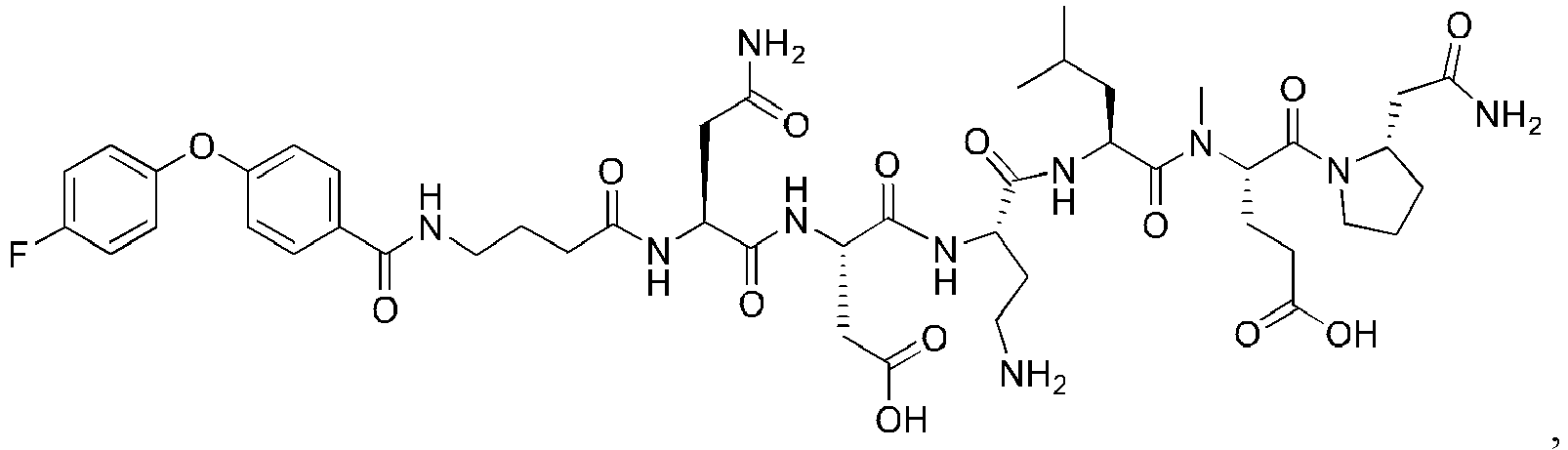


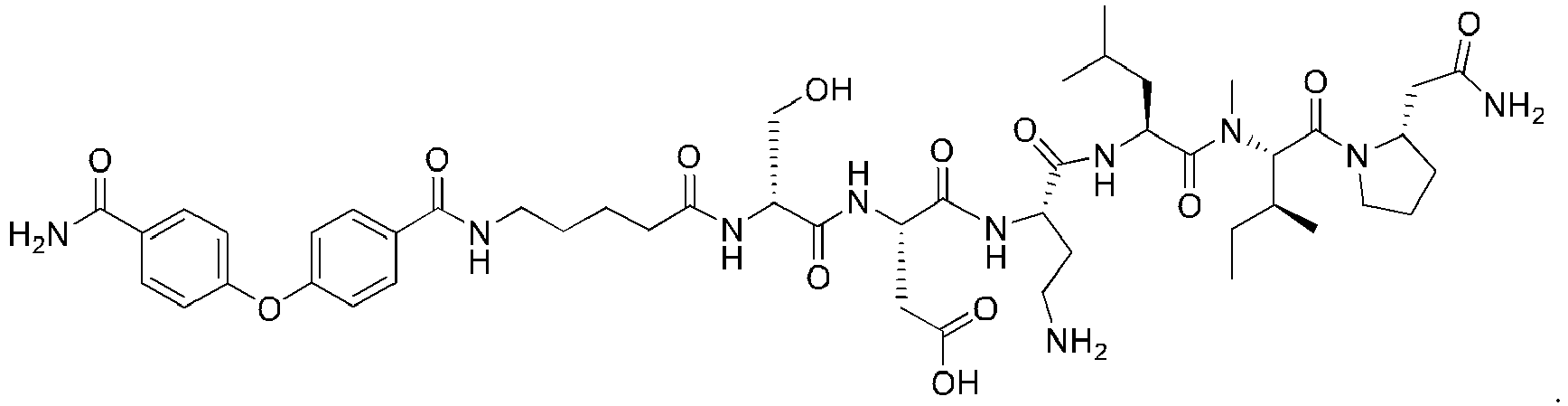
- Another preferable embodiment of the compounds of the present invention is the substituted polypeptide or a pharmaceutically acceptable salt thereof,
- wherein W1 is -L1-, wherein L1 is a single bond,
- L2 is a single bond, and
- the substituted polypeptide is represented by formula [I'-B]:

- wherein preferable embodiments of AA1, AA2, AA3, AA4, AA5, LN1, LN2, RB1, RB2, RB3, WC, and RC are as described above.
- In a more preferable embodiment of the polypeptide represented by formula [I'-B] or a pharmaceutically acceptable salt thereof,
- AA1 is β-Asp, β-(d)-Asp, γ-Glu, or γ-(d)-Glu,
- AA2 is a group represented by formula [II-1]:

- or a group represented by formula [IV-7], [IV-8], [IV-9], [IV-11], or [IV-12]:


- AA3 is Val, Leu, Ile, Phe, or Trp,
- AA4 is (N-Me)Val, (N-Me)Leu, (N-Me)Ile, (N-Me)Asp, or (N-Me)Glu,
- AA5 is β-Ala, GABA, Ape, Acp, or β-homoPro,
- LN1 is the formula -C(=O)- or the formula -S(=O)2-,
- LN2 is a single bond, the formula -O-, or the formula -C(=O)-NH-,
- RB1, RB2, and RB3 are each independently a hydrogen atom, carbamoyl, a halogen atom, C1-6 alkoxy, or halo C1-6 alkoxy,
- WC is a single bond, Arg, (d)-Arg, Lys, or (d)-Lys, and
- RC is the formula -OH or the formula -NH2.
- In a further preferable embodiment of the polypeptide represented by formula [I'-B] or a pharmaceutically acceptable salt thereof,
- AA1 is β-(d)-Asp or γ-(d)-Glu,
- AA2 is a group represented by formula [II-1]:

- or a group represented by formula [IV-7] or [IV-9]:

- AA3 is Val, Leu, or Ile,
- AA4 is (N-Me)Ile or (N-Me)Glu,
- AA5 is β-Ala, GABA, Ape, Acp, or β-homoPro,
- LN1 is the formula -C(=O)- or the formula -S(=O)2-,
- LN2 is the formula -O- or the formula -C(=O)-NH-,
- RB1 is carbamoyl, a chlorine atom, a bromine atom, methoxy, or trifluoromethoxy,
- RB2 is a hydrogen atom,
- RB3 is a hydrogen atom,
- WC is a single bond or (d)-Lys, and
- RC is the formula -NH2.
- One particularly preferable mode of the present embodiment is as follows.
- In the polypeptide represented by formula [I'-B] or a pharmaceutically acceptable salt thereof,
- AA1 is β-(d)-Asp,
- AA1 may be γ-(d)-Glu,
- AA2 is a group represented by formula [II-1]:

- AA2 may be a group represented by formula [IV-7] or [IV-9]:

- AA3 is Val,
- AA3 may be Leu,
- AA3 may be Ile,
- AA4 is (N-Me)Ile,
- AA4 may be (N-Me)Glu,
- AA5 is β-Ala, GABA, Ape, or Acp,
- AA5 may be β-homoPro,
- LN1 is the formula -C(=O)-,
- LN1 may be the formula -S(=O)2-,
- LN2 is the formula -O-,
- LN2 may be the formula -C(=O)-NH-,
- RB1 is carbamoyl, a chlorine atom, a bromine atom, methoxy, or trifluoromethoxy,
- RB2 is a hydrogen atom,
- RB3 is a hydrogen atom,
- WC is a single bond,
- WC may be (d)-Lys, and
- RC is the formula -NH2.
- In another particularly preferable mode of the present embodiment,
the substituted polypeptide represented by formula [I'-B] is any of the followings:

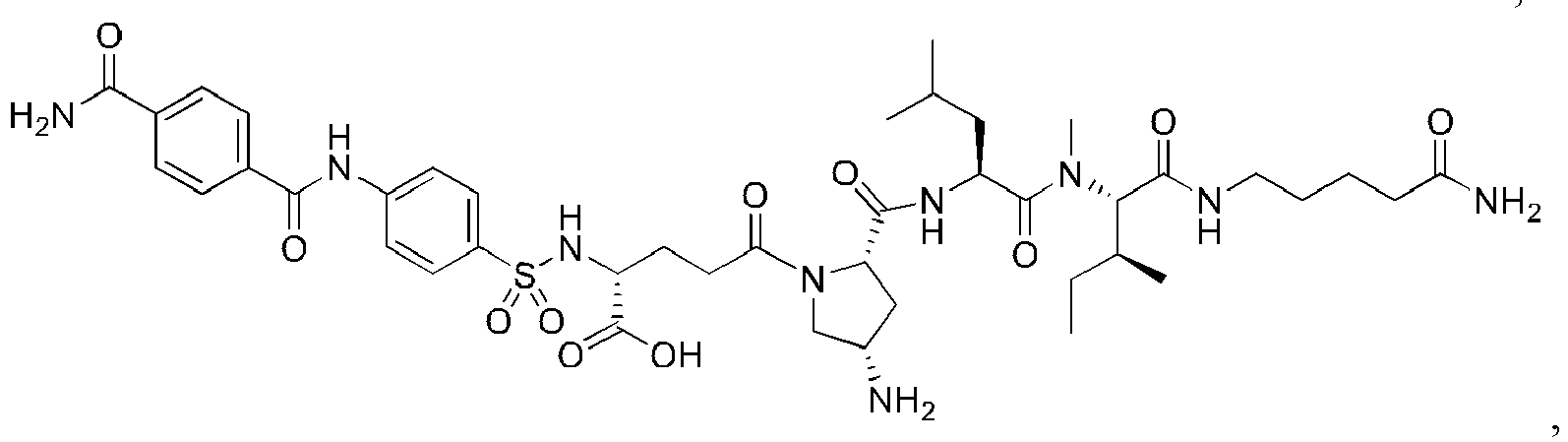


- Another preferable embodiment of the compounds of the present invention is the substituted polypeptide or a pharmaceutically acceptable salt thereof,
- wherein L2 is a single bond, and
- the substituted polypeptid is represented by formula [I'-C]:

- preferable embodiments of AA1, AA2, AA3, AA4, AA5, W1, LN1, LN2, RB1, RB2, RB3, WC, and
- RC are as described above.
- In a more preferable embodiment of the polypeptide represented by formula [I'-C] or a pharmaceutically acceptable salt thereof,
- AA1 is Asp, β-(d)-Asp, or γ-(d)-Glu,
- AA2 is a group represented by formula [IV-7] or [IV-9]:

- or a group represented by formula [II-1]:

- AA3 is Val, Leu, or Ile,
- AA4 is (N-Me)Ile or (N-Me)Glu,
- AA5 is Ape or β-homoPro,
- W1 is -L1- or -L1'-L1"-,
- wherein L1 is a single bond,
- L1' is GABA or Ape, and
- L1" is Asn, (d)-Ser, (d)-Thr, or Glu,
- LN1 is the formula -C(=O)- or the formula -S(=O)2-,
- LN2 is the formula -O- or the formula -C(=O)-NH-,
- RB1, RB2, and RB3 are each independently a hydrogen atom, carbamoyl, a halogen atom,
- C1-6 alkoxy, or halo C1-6 alkoxy,
- WC is a single bond or (d)-Lys, and
- RC is the formula -NH2.
- In a further preferable embodiment of the polypeptide represented by formula [I'-C] or a pharmaceutically acceptable salt thereof,
- AA1 is Asp,
- AA1 may be β-(d)-Asp,
- AA1 may be γ-(d)-Glu,
- AA2 is a group represented by formula [IV-7] or [IV-9]:

- AA2 may be a group represented by formula [II-1']:

- AA3 is Val,
- AA3 may be Leu,
- AA3 may be Ile,
- AA4 is (N-Me)Ile,
- AA4 may be (N-Me)Glu,
- AA5 is Ape,
- AA5 may be β-homoPro,
- W1 is -L1- or -L1'-L1"-,
- L1 is a single bond,
- the combination of L1' and L1" (-L1'-L1"-) is GABA-Asn, Ape-Asn, Ape-Glu, Ape-(d)-Ser, or
- Ape-(d)-Thr,
- LN1 is the formula -C(=O)-,
- LN1 may be the formula -S(=O)2-,
- LN2 is the formula -O-,
- LN2 may be the formula -C(=O)-NH-,
- RB1 is carbamoyl, a chlorine atom, a bromine atom, methoxy, or trifluoromethoxy,
- RB2 is a hydrogen atom,
- RB3 is a hydrogen atom,
- WC is a single bond,
- WC may be (d)-Lys, and
- RC is the formula -NH2.
- In one particularly preferable mode of the present embodiment,
the substituted polypeptide represented by formula [I'-C] is any of the followings:


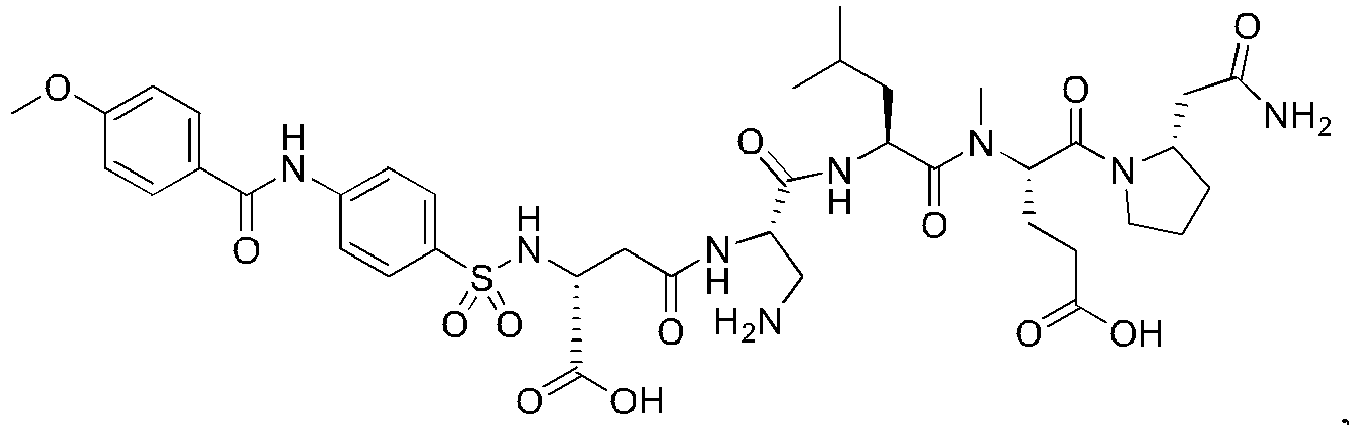

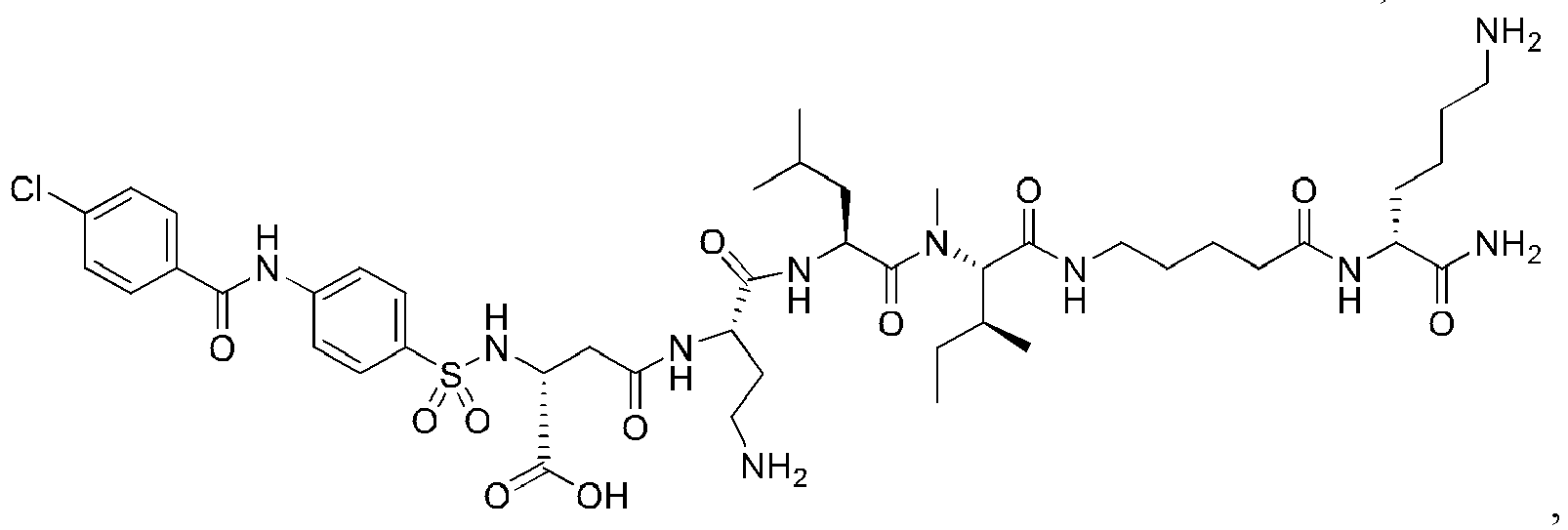


- In another particularly preferable mode of the present embodiment,
the substituted polypeptide represented by formula [I'-C] is the following:
- In another particularly preferable mode of the present embodiment,
the substituted polypeptide represented by formula [I'-C] is the following:
- In another particularly preferable mode of the present embodiment,
the substituted polypeptide represented by formula [I'-C] is the following:
- In another particularly preferable mode of the present embodiment,
the substituted polypeptide represented by formula [I'-C] is the following: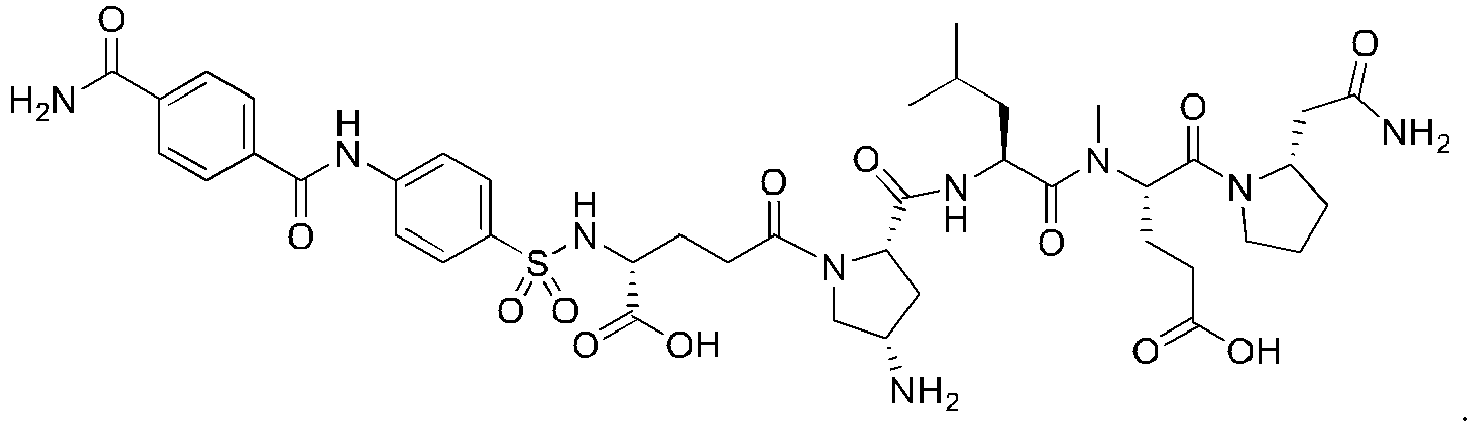
- In another particularly preferable mode of the present embodiment,
the substituted polypeptide represented by formula [I'-C] is the following:
- In another particularly preferable mode of the present embodiment,
the substituted polypeptide represented by formula [I'-C] is the following:
- In another particularly preferable mode of the present embodiment,
the substituted polypeptide represented by formula [I'-C] is the following:
- In another particularly preferable mode of the present embodiment,
the substituted polypeptide represented by formula [I'-C] is the following:
- In another particularly preferable mode of the present embodiment,
the substituted polypeptide represented by formula [I'-C] is the following:
- In another particularly preferable mode of the present embodiment,
the substituted polypeptide represented by formula [I'-C] is the following:
- In another particularly preferable mode of the present embodiment,
the substituted polypeptide represented by formula [I'-C] is the following:
- In another particularly preferable mode of the present embodiment,
the substituted polypeptide represented by formula [I'-C] is the following:
- In another particularly preferable mode of the present embodiment,
the substituted polypeptide represented by formula [I'-C] is the following:
- In another particularly preferable mode of the present embodiment,
the substituted polypeptide represented by formula [I'-C] is the following:
- In another particularly preferable mode of the present embodiment,
the substituted polypeptide represented by formula [I'-C] is the following:
- Another preferable embodiment of the compounds of the present invention is a substituted polypeptide represented by formula [I], or a pharmaceutically acceptable salt thereof, wherein
- AA1 is β-Asp, γ-Glu, or γ-(d)-Glu,
- AA2 is a group represented by formula [II-1] or formula [II-2]:

- AA3 is Val, Leu, Ile, Phe, or Trp,
- AA4 is a single bond, Pro, (N-Me)Ala, (N-Me)Val, (N-Me)Leu, (N-Me)Ile, (N-Me)Phe, (N-Me)Tyr, (N-Me)Ser, (N-Me)Asp, or (N-Me)Glu,
- AA5 is a single bond, Pro, (d)-Pro, β-homoPro, Arg, (d)-Arg, Lys, (d)-Lys, β-Ala, GABA, Ape, or Acp,
- L1 is a single bond,
- L2 is a single bond,
- LN1 is the formula -S(=O)2-,
- LN2 is a single bond, the formula -O-, or the formula -C(=O)-NH-,
- RA is a hydrogen atom,
- RB is a hydrogen atom, carbamoyl, a halogen atom, or C1-6 alkoxy,
- LC is a single bond, Pro, Arg, (d)-Arg, Lys, (d)-Lys, or (d)-Lys-(d)-Lys, and
- RC is the formula -NH2.
- The compounds of the present invention are each a compound having a basic backbone of polypeptide consisting of three to seven amino acids and further having substituted benzoyl or substituted phenylsulfonyl, and may be in the form of a pharmaceutically acceptable salt thereof.
- Examples of the pharmaceutically acceptable salt include: mineral acid salts such as hydrochlorides, hydrobromides, hydroiodides, phosphates, sulfates, and nitrates; acid addition salts such as sulfonates including methanesulfonates, ethanesulfonates, benzenesulfonates, p-toluenesulfonates, and trifluoromethanesulfonates, and organic acid salts including oxalates, tartrates, citrates, maleates, succinates, acetates, trifluoroacetates, benzoates, mandelates, ascorbates, lactates, gluconates, and malates; amino acid salts such as glycinates, lysinates, argininates, ornithinates, glutamates, and aspartates; inorganic salts such as lithium salts, sodium salts, potassium salts, calcium salts, and magnesium salts; and salts with organic base such as ammonium salts, triethylamine salts, diisopropylamine salts, and cyclohexylamine salts. Salts include hydrate salts.
- Each of the compounds of the present invention may have an asymmetric center, and in this case various optical isomers exist therefor. Thus, each of the compounds of the present invention may exist as an individual optically active substance in any of the (R)-form and the (S)-form, or as a racemate or an (RS) mixture. For a compound having two or more asymmetric centers, diastereomers due to the optical isomerism of them further exist. The scope of the compounds of the present invention also includes mixtures containing all the forms at any ratio. For example, diastereomers can be separated with a method well known to those skilled in the art such as a fractional crystallization method, and optically active substances can be obtained with a technique of organic chemistry well known to those skilled in the art for that purpose. In addition, geometric isomers such as a cis form and a trans form may exist for each of the compounds of the present invention. Moreover, the compounds of the present invention each exhibit tautomerism, and there exist various tautomers therefor. The scope of the compounds of the present invention also includes those isomers and mixtures containing them at any ratio.
- Further, if any of the compounds of the present invention or a salt thereof forms a hydrate or solvate, the hydrate or solvate is also included in the scope of the compounds of the present invention or a salt thereof.
- "Matrix metalloprotease 2 (MMP2)" is one of endopeptidases having an active center of zinc.
- As described above, MMP2 degrades the extracellular matrix including collagen and gelatin, and hence is involved in cell infiltration and migration, metastasis, and so on, thus being involved in pathological condition of cancerous disease, organ fibrosis, and so on.
- Therefore, cancerous disease and organ fibrosis, and symptoms relating to cancerous disease and organ fibrosis can be prevented or treated by inhibiting MMP2.
- The compounds of the present invention have an effect to inhibit MMP2. Accordingly, the compounds of the present invention can be used as an MMP2 inhibitor, or an active ingredient of a drug for preventing or treating cancerous disease and organ fibrosis.
- In addition, the compounds of the present invention can be used as an active ingredient of a drug for preventing or treating symptoms relating to cancerous disease and organ fibrosis.
- Examples of "cancerous disease" include breast cancer, pancreatic cancer, bladder cancer, colorectal cancer, ovarian cancer, prostate cancer, brain tumor, gastric cancer, hepatocellular carcinoma, head and neck cancer, melanoma, uterine cancer, esophageal cancer, renal cell carcinoma, lung cancer, and glioma. Examples of "symptoms relating to cancerous disease" include pain associated with neoplastic cell multiplication or tumor growth, loss of body weight, and paraneoplastic syndrome.
- Examples of "organ fibrosis" include chronic kidney disease, interstitial pneumonia, and idiopathic pulmonary fibrosis. Examples of "symptoms relating to organ fibrosis" include proteinuria, kidney dysfunction, and so on in chronic kidney disease, and exertional dyspnea, dry cough, and so on in interstitial pneumonia and idiopathic pulmonary fibrosis.
- Evaluation of the effect of any of the compounds of the present invention to inhibit MMP2 can be carried out with a known procedure such as a method described later in Test Examples in the present specification.
- For the pharmaceutical according to the present invention, a compound having an effect to inhibit MMP2, being any of the compounds of the present invention contained in the pharmaceutical, or a pharmaceutically acceptable salt thereof may be administered singly, or together with a pharmaceutically acceptable additive.
- A common excipient or diluent, and, as necessary, a binder, a disintegrant, a lubricating agent, a coating agent, a sugar-coating agent, a pH adjuster, and a solubilizer or aqueous or nonaqueous solvent which is commonly used can be used as the additive. Specific examples of the additives may include water, lactose, dextrose, fructose, sucrose, sorbitol, mannitol, polyethylene glycol, propylene glycol, starch, cornstarch, gum, gelatin, arginate, calcium silicate, calcium phosphate, cellulose, water syrup, methylcellulose, polyvinylpyrrolidone, alkyl para-hydroxybenzoate, talc, stearic acid, magnesium stearate, agar, pectin, gum arabic, glycerin, sesame oil, olive oil, soybean oil cocoa butter, ethylene glycol, low-viscosity hydroxypropylcellulose (HPC-L), microcrystalline cellulose, carboxymethylcellulose (CMC), carboxymethyl cellulose sodium (CMC-Na), and other common additives.
- The pharmaceutical according to the present invention may be in any form of solid compositions, liquid compositions, and other compositions, and an optimum form is selected according to necessity.
- The pharmaceutical according to the present invention can be prepared, for example, as a tablet, a pill, a capsule, a granule, a powdered agent, a powder, a solution, an emulsion, a suspension, or an injection through a common formulation technique with addition of the aforementioned additive to any of the compounds of the present invention.
- The pharmaceutical according to the present invention can be formulated by forming a clathrate compound with any of the compounds of the present invention and α-, β-, or γ-cyclodextrin or methylated cyclodextrin.
- With respect to compounds that can be used in combination with any of the compounds of the present invention, the pharmaceutical according to the present invention can be prepared as a single formulation (combination drug) or two or more formulations (concomitant drugs) obtained by separately formulating.
- If those compounds are separately formulated into two or more formulations, the individual formulations can be administered simultaneously, or separately at specific time intervals. In the latter case, any formulation may be first administered. The two or more formulations may be administered in different numbers of doses per day. The two or more formulations may be administered through different routes.
- If those compounds are separately formulated into two or more formulations, they may be administered simultaneously, or separately at very short intervals, and it is preferable to instruct to use them in combination by means of a document such as an accompanying document or sales brochure of a commercially available pharmaceutical.
- It is also preferable to separately formulate those active ingredients into the form of a kit consisting of two formulations.
- The form of administration when any of the compounds of the present invention is used as an MMP2 inhibitor or the like is not limited, and any of the compounds of the present invention can be directly administered orally or parenterally. Alternatively, an agent containing any of the compounds of the present invention as an active ingredient may be orally or parenterally administered.
- Also in the case that any of the compounds of the present invention is used as an agent for preventing or treating cancerous disease and organ fibrosis, and symptoms relating to cancerous disease and organ fibrosis, any of the compounds of the present invention can be directly administered orally or parenterally. Alternatively, an agent containing any of the compounds of the present invention as an active ingredient may be orally or parenterally administered.
- In the parenteral administration, it is preferable to perform intravenous administration, subcutaneous administration, or transdermal administration.
- Examples of the dosage form for parenteral administration include an injection, an infusion drip, an implant drug, a transdermal drug, a transmucosal drug, and a patch, and the dosage form may be a microsphere formulation.
- The dose of any of the compounds of the present invention differs among subjects, routes of administration, target diseases, symptoms, and so on, and it is typically desirable in oral administration or parenteral administration to an adult patient to administer a single dose of 0.1 mg to 1000 mg, preferably of 1 mg to 200 mg, once to three times per day, or once every 2 to 3 days.
- Production Examples for formulations of the compounds of the present invention will be shown in the following.
- A granule containing the following components is produced.
- Components: compound represented by general formula [I'], lactose, and cornstarch, HPC-L.
- The compound represented by general formula [I'] and lactose are sieved. Cornstarch is sieved. These are mixed by using a mixer. HPC-L aqueous solution is added to the mixed powder, and the resultant is kneaded, granulated (extrusion granulation), and then dried. The resulting dry granule is sieved through a vibrating screen to obtain a granule.
- A powder for encapsulation containing the following components is produced.
- Components: compound represented by general formula [I'], lactose, and cornstarch, magnesium stearate.
- The compound represented by general formula [I'] and lactose are sieved. Cornstarch is sieved. These together with magnesium stearate are mixed by using a mixer to obtain a powder. The powder obtained can be encapsulated.
- A granule for encapsulation containing the following components is produced.
- Components: compound represented by general formula [I'], lactose, and cornstarch, HPC-L.
- The compound represented by general formula [I'] and lactose are sieved. Cornstarch is sieved. These are mixed by using a mixer. HPC-L aqueous solution is added to the mixed powder, and the resultant is kneaded, granulated, and then dried. The resulting dry granule is sieved through a vibrating screen to regulate the particle seize, and a granule is obtaened. The granule obtained can be encapsulated.
- Tablets containing the following components are produced.
- Components: compound represented by general formula [I'], lactose, microcrystalline cellulose, magnesium stearate, and CMC-Na.
- The compound represented by general formula [I'], lactose, microcrystalline cellulose, and CMC-Na are sieved, and mixed together. Magnesium stearate is added to the mixed powder to obtain a mixed powder for formulation. This mixed powder is subjected to direct compression to obtain tablets.
- An injection containing the following compositions is produced.
- Components: compound represented by general formula [I'], purified egg yolk lecithin, oleic acid, purified soybean oil, glycerin, and water for injection.
- The compound represented by general formula [I'], purified egg yolk lecithin, and oleic acid are added to purified soybean oil to dissolve therein; water for injection, mixed with glycerin, is then added; and the resultant is emulsified by using an emulsifying machine. Thereto, water for injection is added, and the resultant is aliquoted into ampules, which are sealed and sterilized to form an injection.
- Production methods for compound [I'] according to the present invention will be described in detail in the following, but the production is not limited to the exemplified production methods. Solvent to be used for the production may be any solvent that does not inhibit individual reactions, and is not limited by the following description.
- In the production of compound [I'], the order of steps in the production can be appropriately changed.
- In the production, each raw material compound may be used as a salt thereof, and examples of such salts include "pharmaceutically acceptable salt" presented above.
- Compound [I'] can be produced through solid-phase synthesis, liquid-phase synthesis, or a combination of them. Production examples with solid-phase synthesis will be shown in the following production methods.
- Compound [I'] can be produced through methods shown in any of Schemes 1 to 9 or any combination of them.
- The side chain of each amino acid to form the polypeptide moiety of compound [I'] may have a functional group, and the functional group may be protected with a protecting group. Examples of the protecting group include tBu for carboxy, Trt for carbamoyl, tBu for hydroxy, tBu for phenolic hydroxy, tBu for thiol (sulfanyl), Boc for amino, Trt for imidazolyl, Boc for indolyl, and Pbf for guanidino. These protecting groups can be each subjected to deprotection by treating with an acid.
- Each of the amino acids can be used for the production even if the functional group in the side chain is not protected.
- Compound [1-f] can be produced, for example, through solid-phase synthesis the summary of which is described in the following (Scheme 1).

- RA1, RA2, RB1, RB2, RB3, LN2, ring A, and ring B have the same definitions as those described above,
- H-Zx-OH represents an amino acid,
- x represents an integer of 1 to m,
- m represents an integer of 2 to 15,
- wherein Zx corresponds to AAx, L2, W1, or Wc in the compound represented by formula [I'], and may represent a single bond, and
- PGx represents a liposoluble protecting group protecting the amino of the amino acid (H-Zx-OH).
- A resin having amino protected with Fmoc (compound [1-a]) is subjected to deFmoc by using a base.
- The resin obtained in (1) is reacted with an amino acid whose amino has been protected with a liposoluble protecting group (PGx) (compound [1-b]) for amidation reaction between the free amino in the resin and the carboxy in compound [1-b].
- The liposoluble protecting group of the amino of the N-terminal amino acid of the polypeptide moiety in the compound obtained in (2) is subjected to deprotection.
- (4) By repeating steps (2) and (3) twice or more times, compound [1-c] can be produced in which the carboxy of the C-terminal amino acid of the polypeptide moiety is bonding to the resin and the amino of the N-terminal amino acid is free.
- Compound [1-e] can be produced by reacting compound [1-c] obtained in (4) with compound [1-d] to sulfonylate the free amino in compound [1-c].
- Compound [1-f], one of the present inventive compounds, can be produced by using an acid on compound [1-e] obtained in (5) to cleave the bond to the resin. Examples of the acid applicable in the present step may include TFA.
- At that time, if a protected functional group is present in the side chain of an amino acid forming the polypeptide moiety, the protecting group of the functional group can be simultaneously deprotected.
- Compound [1-f] obtained in the described manner can be isolate/purified by a known separation/purification means such as concentration, concentration under reduced pressure, reprecipitation, solvent extraction, crystallization, and chromatography.
- In the method described in Scheme 1, resin [1-a], compound [1-b], and compound [1-d] to be used as raw material compounds can be obtained by producing with a method known per se, or purchasing commercially available products of them.
- Compound [2-c] can be produced, for example, through solid-phase synthesis the summary of which is described in the following (Scheme 2) with use of compound [1-c] as a starting material.


- RA1, RA2, RB1, RB2, RB3, LN2, ring A, ring B, H-Zx-OH, x, m, and Zx have the same definitions as those described above, and
- Y1 represents hydroxy or a chlorine atom.
- Compound [2-b] can be produced by allowing compound [2-a] to act on compound [1-c] for amidation reaction.
- Compound [2-c], one of the present inventive compounds, can be produced by using an acid on compound [2-b] obtained in (1) to cleave the bond to the resin. Examples of the acid applicable in the present step may include TFA.
- At that time, if a protected functional group is present in the side chain of an amino acid forming the polypeptide moiety, the protecting group of the functional group can be simultaneously deprotected.
- Compound [2-c] obtained in the described manner can be isolate/purified by a known separation/purification means such as concentration, concentration under reduced pressure, reprecipitation, solvent extraction, crystallization, and chromatography.
- In the method described in Scheme 2, compound [2-a] to be used as a raw material compound can be obtained by producing with a method known per se, or purchasing a commercially available product of it. Compound [1-c] can be produced with the method described in Scheme 1.
- Compound [3-h] can be produced, for example, through solid-phase synthesis the summary of which is described in the following (Scheme 3).
- Examples of the resin (resin [3-a]) applicable in the present production method may include chlorotrityl chloride resin and Wang resin.


- RA1, RA2, RB1, RB2, RB3, LN1, LN2, ring A, ring B, H-Zx-OH, x, m, Zx, PGx, and Y1 have the same definitions as those described above,
- Rr represents hydroxy or a chlorine atom,
- Rc' and Rc" are same or different and each represent a hydrogen atom or C1-6 alkyl, wherein the C1-6 alkyl is optionally substituted with one group selected from the group consisting of hydroxy, amino, and C1-6 alkoxy,
- Rc' and Rc" may be taken together with the neighboring nitrogen atom to form a four- to seven-membered saturated heterocycle containing a nitrogen atom, wherein
- the four- to seven-membered saturated heterocycle containing a nitrogen atom, formed by Rc' and Rc" taken together with the neighboring nitrogen atom, is optionally substituted with one group selected from the group consisting of hydroxy, amino, C1-6 alkyl, and C1-6 alkoxy, and
- two carbon atoms in the four- to seven-membered saturated heterocycle containing a nitrogen atom, formed by Rc' and Rc" taken together with the neighboring nitrogen atom, are optionally crosslinked with C1-4 alkanediyl.
- Compound [3-c] can be produced by reacting the resin (compound [3-a]) with an amino acid whose amino has been protected with a liposoluble protecting group (PG1) (compound [3-b]).
- The liposoluble protecting group (PG1) in compound [3-c] obtained in (1) is subjected to deprotection.
- The compound obtained in (2) is reacted with an amino acid whose amino has been protected with a liposoluble protecting group (PGx) (compound [1-b]) for amidation reaction between the free amino in the compound obtained in (1) and the carboxy in compound [1-b].
- The liposoluble protecting group of the amino of the N-terminal amino acid of the polypeptide moiety in the compound obtained in (3) is subjected to deprotection.
- (5) By repeating steps (3) and (4) twice or more times, compound [3-d] can be produced in which the carboxy of the C-terminal amino acid of the polypeptide moiety is bonding to the resin and the amino of the N-terminal amino acid is free.
- Compound [3-e] can be produced by reacting compound [3-d] obtained in (5) with compound [1-d] or compound [2-a] to sulfonylate or acylate the free amino in compound [3-d].
- Compound [3-f], in which the carboxy of the C-terminal amino acid of the polypeptide moiety is free, can be produced by using an acid on compound [3-e] obtained in (6) to cleave the bond to the resin. Examples of the acid applicable in the present step may include TFA.
- At that time, if a protected functional group is present in the side chain of an amino acid forming the polypeptide moiety, the protecting group of the functional group can be simultaneously deprotected.
- Compound [3-h], one of the present inventive compounds, can be produced by allowing compound [3-g] to act on compound [3-f] obtained in (7) for amidation reaction.
- Compound [3-h] obtained in the described manner can be isolate/purified by a known separation/purification means such as concentration, concentration under reduced pressure, reprecipitation, solvent extraction, crystallization, and chromatography.
- In the method described in Scheme 3, compound [3-a], compound [3-b], compound [1-b], compound [1-d], compound [2-a], and [3-g] to be used as raw material compounds can be obtained by producing with a method known per se, or purchasing commercially available products of them.
- Alternatively, compound [4-e] can be produced, for example, through solid-phase synthesis the summary of which is described in the following (Scheme 4).
- In Scheme 4, a method for producing a compound wherein a functional group is present in the side chain of the m'th amino acid counted from the C-terminal amino acid of the polypeptide moiety in compound [4-e] is presented as an example.
- Examples of the resin applicable in the present production method may include, as in Scheme 3, chlorotrityl chloride resin and Wang resin.

- RA1, RA2, RB1, RB2, RB3, LN1, LN2, ring A, ring B, H-Zx-OH, x, m, Zx, Rc', and Rc" have the same definitions as those described above,
- m' represents an integer of 1 to 15, provided that the relationship "m' ≤ m" is satisfied,
- Lsc represents C1-4 alkanediyl,
- FGsc represents the aforementioned functional group present in the side chain of the m'th amino acid counted from the C-terminal amino acid of the polypeptide moiety,
- wherein examples of the functional group may include the formula -O- (the formula -OH), the formula -S- (the formula -SH), the formula -NH- (the formula -NH2), the formula
- -C(=O)O- (the formula -C(=O)OH), the formula -C(=O)NH- (the formula -C(=O)NH2), and the formula -NHC(=NH)NH- (-NHC(=NH)NH2), and
- PGsc represents a protecting group for the functional group, wherein examples of the functional group may include, as described above, tBu, Trt, Boc, and Pbf.
- Compound [4-b], in which the carboxy of the C-terminal amino acid of the polypeptide moiety is free, can be produced by using an acid on compound [4-a] to cleave the bond to the resin.
- At that time, the deprotection for the protecting group (PGsc) present in the side chain of the m'th amino acid counted from the C-terminal amino acid can be prevented by using a weak acid as the acid. Examples of the weak acid may include HFIP, acetic acid, and diluted TFA.
- Compound [4-d] can be produced by allowing compound "4-c" to act on compound [4-b] obtained in (1) for amidation reaction between the free carboxy in compound [4-b] and the amino in compound [4-c].
- Compound [4-e], one of the present inventive compounds, can be produced by using an acid for deprotection for the aforementioned protecting group (PGsc) present in the side chain of the m'th amino acid counted from the C-terminal amino acid. Examples of the acid applicable in the present step may include TFA.
- Compound [4-e] obtained in the described manner can be isolate/purified by a known separation/purification means such as concentration, concentration under reduced pressure, reprecipitation, solvent extraction, crystallization, and chromatography.
- In the method described in Scheme 4, compound [4-c] to be used as a raw material compound can be obtained by producing with a method known per se, or purchasing a commercially available product of it. Compound [4-a] can be produced with the method described in Scheme 3.
- Compound [5-f] can be produced through solid-phase synthesis the summary of which is described in the following (Scheme 5).
- Here, the polypeptide linker consists of one to five amino acids.
- In Scheme 5, a method for producing a compound wherein a functional group is present in the side chain of the m'th amino acid counted from the C-terminal amino acid of the polypeptide moiety in compound [5-f], the functional group is substituted with a polypeptide linker, and the amino of the N-terminal amino acid of the polypeptide linker is substituted with "C1-20 alkylcarbonyl substituted with carboxy" is presented as an example.
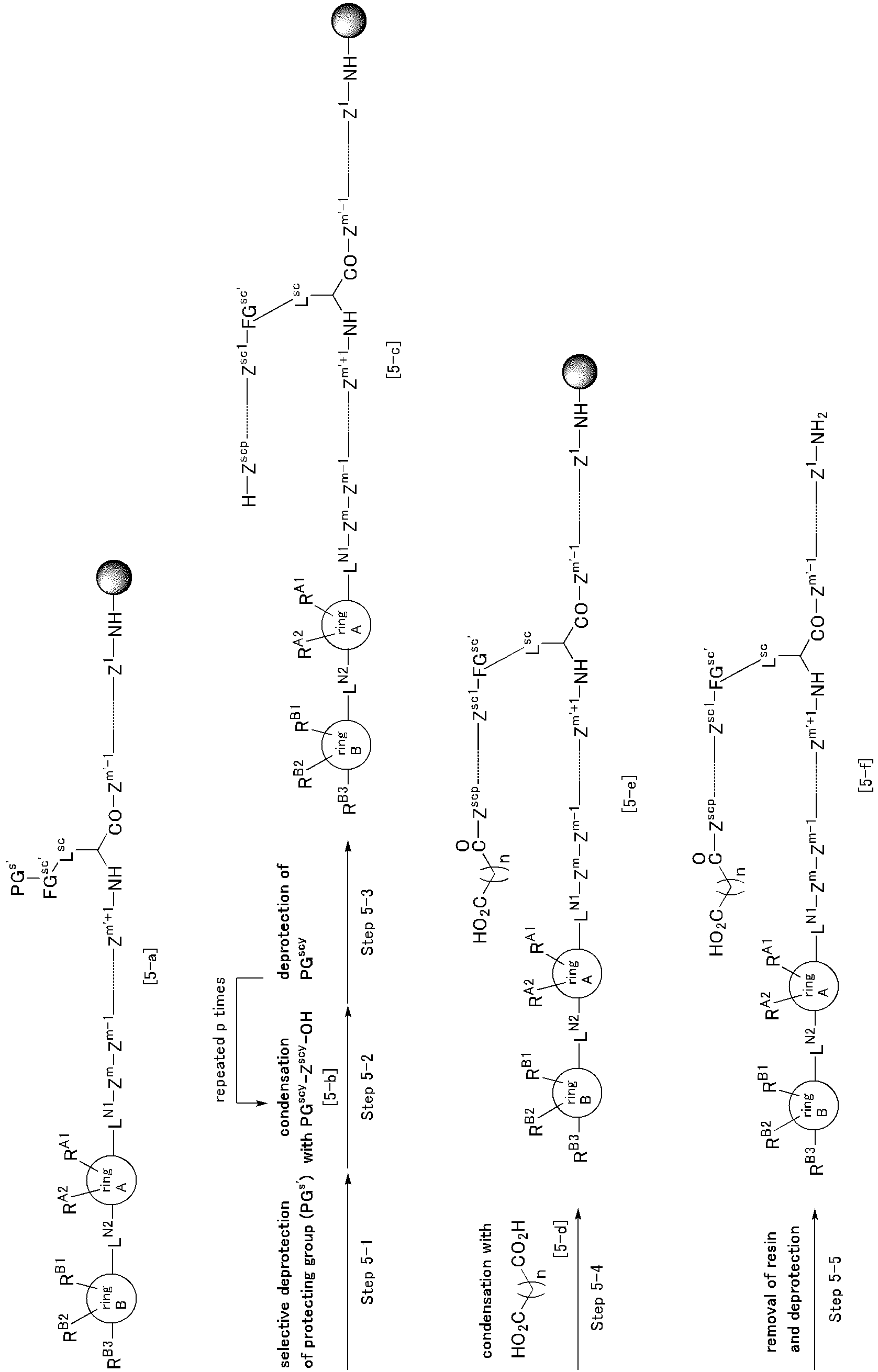
- RA1, RA2, RB1, RB2, RB3, LN1, LN2, ring A, ring B, H-Zx-OH, x, m, m', Zx, and Lsc have the same definitions as those described above,
- PGs' represents a protecting group for the aforementioned functional group (FGsc') present in the side chain of an amino acid, wherein examples of the protecting group include Dde, ivDde, Alloc, and Mtt for amino,
- H-Zsc y-OH represents an amino acid forming the polypeptide linker attached to the functional group (FGsc'),
- y represents an integer of 1 to p,
- p represents an integer of 0 to 5,
- PGsc y represents a liposoluble protecting group protecting the amino of the amino acid (H-Zsc y-OH),
- FGsc' represents a functional group present in the side chain of an amino acid; examples of the functional group may include the formula -NH- (the formula -NH2) and the formula -COO-(the formula -COOH); Scheme 5 shows the case that FGsc' is the formula -NH- (the formula -NH2), and
- n represents an integer of 1 to 20.
- The protecting group (PGS') for the functional group present in the side chain of the m'th amino acid counted from the C-terminal amino acid of the polypeptide moiety in compound [5-a] is subjected to selective deprotection.
- The compound obtained in (1) is reacted with an amino acid whose amino has been protected with a liposoluble protecting group (PGsc y) (compound [5-b]) for amidation reaction between the free functional group (FGsc') in the compound obtained in (1) and the carboxy in compound [5-b].
- The liposoluble protecting group (PGsc y) is subjected to deprotection.
- (4) By repeating steps (2) and (3) once or more times, compound [5-c], in which the carboxy of the C-terminal amino acid of the polypeptide moiety is bonding to the resin, the functional group present in the side chain of the m'th amino acid counted from the C-terminal amino acid is substituted with a polypeptide linker, and the amino of the N-terminal amino acid of the polypeptide linker is free, can be produced.
- Compound [5-e] can be produced by reacting compound [5-c] obtained in (4) with compound [5-d], which is an alkanedicarboxylic acid, for amidation reaction of the free amino in compound [5-c] with one carboxy in compound [5-d].
- Compound [5-f], one of the present inventive compounds, can be produced by using an acid on compound [5-e] obtained in (5) to cleave the bond to the resin. Examples of the acid applicable in the present step may include TFA.
- At that time, if a protected functional group is present in the side chain of an amino acid forming the polypeptide moiety, the protecting group of the functional group can be simultaneously deprotected.
- Compound [5-f] obtained in the described manner can be isolate/purified by a known separation/purification means such as concentration, concentration under reduced pressure, reprecipitation, solvent extraction, crystallization, and chromatography.
- In the method described in Scheme 5, compound [5-b] and compound [5-d] to be used as raw material compounds can be obtained by producing with a method known per se, or purchasing commercially available products of them. Compound [5-a] can be produced with the method described in Scheme 1 or Scheme 2, or a method similar to any of these.
- Compound [6-c] can be produced, for example, through solid-phase synthesis the summary of which is described in the following (Scheme 6).
- Here, the polypeptide linker consists of one to four amino acids.
- In Scheme 6, a method for producing a compound wherein a functional group is present in the side chain of each of the m'th and m"th amino acids counted from the C-terminal amino acid of the polypeptide moiety, and the functional groups are substituted with the same polypeptide linker to form a ring is presented as an example.

- RA1, RA2, RB1, RB2, RB3, LN1, LN2, ring A, ring B, H-Zx-OH, x, m, m', Zx, and Lsc have the same definitions as those described above,
- m" represents an integer of 2 to 15, provided that the relationship "m' < m" ≤ m" is satisfied, the polypeptide linker (-Zsc 1-Zsc 2-...-Zsc y'-) in compound [6-c] corresponds to L3 in the compound represented by formula [I'], wherein L3 represents Gly, β-Ala, or GABA,
- y' represents an integer of 1 to p',
- p' represents an integer of 1 to 4,
- Lsc' and Lsc" each represent C1-4 alkanediyl,
- FGsc' and FGsc" each represent a functional group present in the side chain of an amino acid, wherein the functional group represents the formula -O- (the formula -OH), the formula -S-(the formula -SH), the formula -NH- (the formula -NH2), the formula -C(=O)O- (the formula -C(=O)OH), or the formula -C(=O)NH- (the formula -C(=O)NH2), and PGsc' and PGsc" each represent a protecting group for a functional group present in the side chain of an amino acid, wherein the functional group is, for example, Dde, ivDde, Alloc, or allyl.
- The protecting group (PGsc') for the functional group present in the side chain of the m'th amino acid counted from the C-terminal amino acid of the polypeptide moiety in compound [6-a] is subjected to selective deprotection.
- The compound obtained in (1) is reacted with an amino acid whose amino has been protected with a liposoluble protecting group (PGsc y') (compound [6-d]) for amidation reaction between the free functional group (FGsc') in the compound obtained in (1) and the carboxy in compound [6-d], the amino of which has been protected with the liposoluble protecting group.
- The liposoluble protecting group is subjected to deprotection.
- (4) By repeating steps (2) and (3) once or more times, compound [6-b], in which the functional group present in the side chain of the m'th amino acid counted from the C-terminal amino acid of the polypeptide moiety is substituted with a polypeptide linker, the amino of the N-terminal amino acid of the polypeptide linker is free, and the functional group (FGsc") present in the side chain of the m"th amino acid counted from the C-terminal amino acid is protected with a protecting group (PGsc"), can be produced.
- The protecting group (PGsc") present in the side chain of the m"th amino acid counted from the C-terminal amino acid of the polypeptide moiety in compound [6-b] is subjected to selective deprotection.
- "Free functional group (FGsc")" and "free amino in Zscp'" in the compound obtained in (5) are reacted for intramolecular cyclization reaction.
- Compound [6-c], one of the present inventive compounds, can be produced by using an acid on the compound obtained in (6) to cleave the bond to the resin. Examples of the acid applicable in the present step may include TFA.
- At that time, if a protected functional group is present in the side chain of an amino acid forming the polypeptide moiety, the protecting group of the functional group can be simultaneously deprotected.
- Compound [6-c] obtained in the described manner can be isolate/purified by a known separation/purification means such as concentration, concentration under reduced pressure, reprecipitation, solvent extraction, crystallization, and chromatography.
- In the method described in Scheme 6, compound [6-d] to be used as a raw material compound can be obtained by producing with a method known per se, or purchasing a commercially available product of it. Compound [6-a] can be produced with the method described in Scheme 1 or Scheme 2, or a method similar to any of these.
- Compound [7-f] can be produced, for example, through solid-phase synthesis the summary of which is described in the following (Scheme 7).

- RA1, RA2, RB1, RB2, LN1, LN2, ring A, ring B, H-Zx-OH, x, m, Zx, and Y1 have the same definitions as those described above,
- LR represents C1-4 alkanediyl,
- FGR represents a functional group attached to "alkyl (LR)" of "alkylaminocarbonyl (LR-NHC(=O)-)", a substituent present on ring B, and examples thereof may include the formula -O- (the formula -OH), the formula -S- (the formula -SH), the formula -NH- (the formula -NH2), the formula -C(=O)O- (the formula -C(=O)OH), and the formula -C(=O)NH-(the formula -C(=O)NH2),
- PGR represents a protecting group for the functional group (FGR), wherein examples of the protecting group include tBu for carboxy, Trt for carbamoyl, tBu for hydroxy, tBu for thiol (sulfanyl), and Boc for amino, and these protecting groups can be each deprotected by treating with an acid.
- Compound [7-c], which has carboxy on ring B, can be produced by reacting compound [1-c] with compound [7-a] or compound [7-b] to sulfonylate or acylate the free amino of the N-terminal amino acid of the polypeptide moiety in compound [1-c].
- Compound [7-e] can be produced by reacting compound [7-c] with compound [7-d] for amidation reaction between the carboxy in compound [7-c] and the amino in compound [7-d].
- Compound [7-f], one of the present inventive compounds, can be produced by using an acid on compound [7-e] obtained in (2) to cleave the bond to the resin and simultaneously deprotect the protecting group (PGR) of the functional group of "alkylaminocarbonyl substituted with functional group (FGR)" present on ring B. Examples of the acid applicable in the present step may include TFA. At that time, if a protected functional group is present in the side chain of an amino acid forming the polypeptide moiety, the protecting group of the functional group can be simultaneously deprotected.
- Compound [7-f] obtained in the described manner can be isolate/purified by a known separation/purification means such as concentration, concentration under reduced pressure, reprecipitation, solvent extraction, crystallization, and chromatography.
- In the method described in Scheme 7, compound [7-a], compound [7-b], and compound [7-d] to be used as raw material compounds can be obtained by producing with a method known per se, or purchasing commercially available products of them. Compound [1-c] can be produced with the method described in Scheme 1, or a method similar to it.
- Compound [8-f] can be produced, for example, through solid-phase synthesis the summary of which is described in the following (Scheme 8).

- RA1, RA2, RB1, RB2, RB3, LN1, ring A, ring B, H-Zx-OH, x, m, Zx, and Y1 have the same definitions as those described above,
- LGA represents a leaving group, wherein examples of the leaving group may include a chlorine atom, a bromine atom, an iodine atom, and halo C1-6 alkylsulfonyloxy, and MB represents boronic acid, boronic acid ester, alkyltin, alkylsilane, or alkoxysilane.
- Compound [8-c] can be produced by reacting compound [1-c] with compound [8-a] or compound [8-b] to sulfonylate or acylate the free amino of the N-terminal amino acid of the polypeptide moiety in compound [1-c].
- Compound [8-e], in which ring A is directly substituted with ring B, can be produced by subjecting compound [8-c] to coupling reaction with compound [8-d] in the presence of a metal catalyst and a base. Examples of the metal catalyst may include tetrakis(triphenylphosphine)palladium, palladium acetate, and tris(dibenzylideneacetone)dipalladium. Examples of the base may include metal carbonates such as cesium carbonate, potassium carbonate, and sodium carbonate, and potassium phosphate, cesium fluoride, potassium fluoride, and tetrabutylammonium fluoride.
- Compound [8-f], one of the present inventive compounds, can be produced by using an acid on compound [8-e] obtained in (2) to cleave the bond to the resin. Examples of the acid applicable in the present step may include TFA.
- At that time, if a protected functional group is present in the side chain of an amino acid forming the polypeptide moiety, the protecting group of the functional group can be simultaneously deprotected.
- Compound [8-f] obtained in the described manner can be isolate/purified by a known separation/purification means such as concentration, concentration under reduced pressure, reprecipitation, solvent extraction, crystallization, and chromatography.
- In the method described in Scheme 8, compound [8-a], compound [8-b], and compound [8-d] to be used as raw material compounds can be obtained by producing with a method known per se, or purchasing commercially available products of them. Compound [1-c] can be produced with the method described in Scheme 1, or a method similar to it.
- Compound [9-f] can be produced, for example, through solid-phase synthesis the summary of which is described in the following (Scheme 9).

- RA1, RA2, RB1, RB2, RB3, LN1, ring A, ring B, H-Zx-OH, x, m, Zx, and Y1 have the same definitions as those described above,
- Y2 represents hydroxy or a chlorine atom, and
- PGA represents a liposoluble protecting group protecting amino present on ring A,
- wherein examples of the liposoluble protecting group may include Fmoc.
- As in step 8-1 of Scheme 8, compound [9-c] can be produced by reacting compound [1-c] with compound [9-a] or compound [9-b] to sulfonylate or acylate the free amino of the N-terminal amino acid of the polypeptide moiety in compound [1-c].
- The liposoluble protecting group (PGA) in compound [9-c] obtained in (1) is subjected to deprotection.
- Compound [9-e] can be produced by reacting the compound obtained in (2) with compound [9-d] for amidation (acylation) reaction between the free amino in the compound obtained in (2) and the carboxy in compound [9-d].
- Compound [9-f], one of the present inventive compounds, can be produced by using an acid on compound [9-e] obtained in (3) to cleave the bond to the resin. Examples of the acid applicable in the present step may include TFA.
- At that time, if a protected functional group is present in the side chain of an amino acid forming the polypeptide moiety, the protecting group of the functional group can be simultaneously deprotected.
- Compound [9-f] obtained in the described manner can be isolate/purified by a known separation/purification means such as concentration, concentration under reduced pressure, reprecipitation, solvent extraction, crystallization, and chromatography.
- In the method described in Scheme 9, compound [9-a], compound [9-b], and compound [9-d] to be used as raw material compounds can be obtained by producing with a method known per se, or purchasing commercially available products of them. Compound [1-c] can be produced with the method described in Scheme 1, or a method similar to it.
- All kinds of amino acids can be used for the amino acids in the methods shown in Schemes 1 to 9 for producing compound [I'] according to the present invention, and examples of the amino acids include natural proteogenic L-amino acids: Gly, Ala, Val, Leu, Ile, Pro, Phe, His, Trp, Tyr, Ser, Thr, Met, Cys, Asp, Glu, Asn, Gln, Lys, and Arg.
- In addition, nonnatural amino acids including natural nonproteogenic amino acids and the D-forms of the natural proteogenic L-amino acids described above may be used in the present production methods.
- Here, examples of nonnatural amino acids applicable in the present production methods include the following:
- (d)-Pro, (d)-Ser, (d)-Thr, (d)-Asp, (d)-Glu, (d)-Arg, (d)-Lys
- β-homoPro
- β-Ala, GABA, Ape, Acp
- (N-Me)Ala, (N-Me)Val, (N-Me)Leu, (N-Me)Ile, (N-Me)Phe, (N-Me)Tyr, (N-Me)Ser, (N-Me)Asp, (N-Me)Glu
- a group represented by formula [II-1] or formula [II-2]:

- the amino acids listed in Table 1 and Table 2
- Examples of liposoluble protecting groups may include carbonate protecting groups, amide protecting groups, and alkyl protecting groups such as 9-fluorenylmethoxycarbonyl (Fmoc), tert-butyloxycarbonyl (Boc), benzyl (Bn), allyl (Allyl), allyloxycarbonyl (Alloc), and acetyl (Ac). Introduction of a liposoluble protecting group to an amino acid, for example, introduction of Fmoc, can be achieved by adding 9-fluorenylmethyl-N-succinidyl carbonate and sodium hydrogen carbonate for reaction. It is recommended to perform the reaction at 0 to 50°C, preferably at room temperature, for about 1 to 5 hours.
- Commercially available amino acids protected with a liposoluble protecting group may be used. Examples thereof may include Fmoc-Ser-OH, Fmoc-Asn-OH, Fmoc-Val-OH, Fmoc-Leu-OH, Fmoc-Ile-OH, Fmoc-Ala-OH, Fmoc-Tyr-OH, Fmoc-Gly-OH, Fmoc-Lys-OH, Fmoc-Arg-OH, Fmoc-His-OH, Fmoc-Asp-OH, Fmoc-Glu-OH, Fmoc-Gln-OH, Fmoc-Thr-OH, Fmoc-Cys-OH, Fmoc-Met-OH, Fmoc-Phe-OH, Fmoc-Trp-OH, and Fmoc-Pro-OH.
- Examples of amino acids protected with a liposoluble protecting group and having a protecting group introduced into the side chain may include Fmoc-Arg(Pbf)-OH, Fmoc-Asn(Trt)-OH, Fmoc-Asp(OtBu)-OH, Fmoc-Cys(tBu)-OH, Fmoc-Glu(OtBu)-OH, Fmoc-Gln(Trt)-OH, Fmoc-His(Trt)-OH, Fmoc-Lys(Boc)-OH, Fmoc-Ser(tBu)-OH, Fmoc-Thr(tBu)-OH, Fmoc-Trp(Boc)-OH, and Fmoc-Tyr(tBu)-OH.
- The resin may be any resin commonly used for solid-phase synthesis, and, for example, 2-chlorotrityl chloride resin, which is functionalized with a chlorine atom, Wang resin, HMPA-PEGA resin, and Amino-PEGA resin, which is functionalized with amino, are applicable.
- Solid-phase synthesis using resin for amide synthesis is recommended as a method for obtaining an amide formed at the C terminus of peptide. For example, Rink-Amide-AM resin, SAL-PEG resin, SAL-MBHA resin, or Rink-Amide-PEGA resin can be used. An amide formed at the C terminus of peptide can be obtained by cleaving off peptide from the resin.
- To bond an amino acid whose amino has been protected with a liposoluble protecting group to resin, for example, in the case that resin having hydroxy or resin functionalized with a chlorine atom is used, the bonding can be achieved by allowing the carboxy of the amino acid to form an ester bond to the resin.
- In the case that resin functionalized with amino is used, the bonding can be achieved by allowing the carboxy of the amino acid to form an amide bond to the resin.
- In the case that 2-chlorotrityl chloride resin is used, esterification can be performed by using a base such as diisopropylethylamine (DIPEA), triethylamine, pyridine, and 2,4,6-collidine.
- In the case that resin having hydroxy is used, a known dehydrating/condensing agent such as 1-(mesitylene-2-sulfonyl)-3-nitro-1,2,4,-triazole (MSNT), dicyclohexylcarbodiimide (DCC), and diisopropylcarbodiimide (DIC) can be used as an esterification catalyst. Regarding the usage ratio between an amino acid and a dehydrating/condensing agent, the amount of the latter is typically 1 to 10 equivalents, and preferably 2 to 5 equivalents per equivalent of the former.
- For example, it is preferable to perform esterification reaction in such a manner that a resin is put in a solid-phase column, this resin is washed with a solvent, and a solution of an amino acid is then added thereto. Examples of the washing solvent may include chloroform, dimethylformamide (DMF), 2-propanol, and dichloromethane. Examples of the solvent to dissolve an amino acid therein include chloroform, dimethyl sulfoxide (DMSO), DMF, and dichloromethane. It is recommended to perform esterification reaction at 0 to 50°C, preferably at room temperature, for about 10 minutes to 30 hours, preferably for about 15 minutes to 24 hours.
- At that time, it is also preferable to acetylate unreacted hydroxy on the solid phase by using acetic anhydride or the like for capping.
- Elimination of a liposoluble protecting group can be performed, for example, by treating with a base. Examples of the base may include piperidine and morpholine. At that time, it is preferable that the elimination be performed in the presence of a solvent. Examples of the solvent may include DMF, DMSO, and methanol.
- It is preferable to perform amidation reaction between the liberated amino and the carboxy of any amino acid whose amino has been protected with a liposoluble protecting group in the presence of an activator and a solvent.
- Examples of the activator may include dicyclohexylcarbodiimide (DCC), 1-ethyl-3-(dimethylaminopropyl)carbodiimide·hydrochloride (WSC/HCl), diphenylphosphorylazide (DPPA), carbonyldiimidazole (CDI), diethylcyanophosphonate (DEPC), benzotriazol-1-yloxy-trispyrrolidinophosphonium (DIPCI), benzotriazol-1-yloxy-trispyrrolidinophosphonium hexafluorophosphate (PyBOP), 1-hydroxybenzotriazole (HOBt), hydroxysuccinimide (HOSu), dimethylaminopyridine (DMAP), 1-hydroxy-7-azabenzotriazole (HOAt), hydroxyphthalimide (HOPht), pentafluorophenol (Pfp-OH), 2-(1H-benzotriazol-1-yl)-1,1,3,3,-tetramethyluronium hexafluorophosphate (HBTU), 1-[bis(dimethylamino)methylene]-5-chloro-1H-benzotriazolium 3-oxide hexafluorophosphate (HCTU), O-(7-azabenzotriazol-1-yl)-1,1,3,3-tetramethyluronium hexafluorophosphonate (HATU), O-benzotriazol-1-yl-1,1,3,3-tetramethyluronium tetrafluoroborate (TBTU), 3,4-dihydro-3-hydrodi-4-oxa-1,2,3-benzotriazine (Dhbt), N-[1-(cyano-2-ethoxy-2-oxoethylideneaminooxy)dimethylamino (morpholino)]uronium hexafluorophosphate (COMU), and ethyl cyano(hydroxyimino)acetate (Oxyma).
- It is preferable to set the amount of usage of the activator to 1 to 20 equivalents, preferably to 1 to 10 equivalents, more preferably to 1 to 5 equivalents, with respect to any amino acid whose amino has been protected with a protecting group having liposolubility.
- Examples of the solvent may include DMF, DMSO, and dichloromethane. It is recommended to perform the reaction at 0 to 50°C, preferably at room temperature, for about 10 minutes to 30 hours, preferably for about 15 minutes to 2 hours.
- Cleaving-off of a peptide chain from resin can be performed through treatment with an acid. Examples of the acid may include trifluoroacetic acid (TFA) and hydrogen fluoride (HF). It is recommended to perform the reaction for separation from resin at 0 to 50°C, preferably at room temperature, for about 10 minutes to 10 hours, preferably for about 30 minutes to 4 hours.
- The present invention is described in more detail with reference to Examples, Reference Examples, and Test Examples below; however, these do not limit the present invention, and any modification may be made without departing from the scope of the present invention.
- Abbreviations in the present specification are shown in the following.
- APCI: atmospheric pressure chemical ionization
- Arg (Pbf): Nω-2,2,4,6,7-pentamethyldihydrobenzofuransulfonylarginine
- Bu: butyl
- BuOH: butanol
- Dde: 1-(4,4-dimethyl-2,6-dioxocyclohexylidene)-3-ethyl
- DMSO-d6: hexadeutrated dimethyl sulfoxide
- ELSD: evaporative light scattering detector
- ESI: electrospray ionization
- HPLC: high-performance liquid chromatography
- ivDde: 1-(4,4-dimethyl-2,6-dioxocyclohexylidene)-3-methylbutyl
- LCMS: liquid chromatography/mass spectrometry
- NMP: 1-methyl-2-pyrrolidone
- Trt: trityl
- UV: ultraviolet ray
- Herein, "room temperature" refers to 20 to 30°C, unless otherwise specified.
- "Under ice-cooling" refers to 0 to 5°C, unless otherwise specified.
- Herein, Biotage (registered trademark) SNAP Ultra manufactured by Biotage AB or REVELERIS (registered trademark) Silica 40 µm manufactured by BUCHI Labortechnik AG was used for "silica gel cartridge" in purification with column chromatography.
- In purification with reversed-phase column chromatography (hereinafter, occasionally referred to as preparative LCMS), an appropriate condition was selected from two conditions shown in the following, and purification was performed.
- Separation apparatus: used was Agilent 1260 Infinity and Agilent 6130 (ionization method: Electron Spray Ionization: ESI), or Agilent 385-ELSD when an ELSD detector was involved, each apparatus being from Agilent Technologies
- Solvent: solution A; water with 0.1% formic acid, solution B; acetonitrile with 0.1% formic acid
- Flow rate: 50 mL/min
- One of the following columns was used.
- Waters XBridge Prep C18, 5 µm, 30 × 50 mm
- Waters XSelect CSH C18, 5 µm, 30 × 50 mm
- (Separation condition A)
- 0.0-0.5 min (solution A/solution B = 90/10)
- 0.5-7.5 min (solution A/solution B = 90/10 to 20/80)
- 7.5-7.95 min (solution A/solution B = 20/80)
- 7.95-8.0 min (solution A/solution B = 20/80 to 5/95)
- 8.0-9.0 min (solution A/solution B = 5/95)
- (Separation condition B)
- 0.0-0.5 min (solution A/solution B = 95/5)
- 0.5-7.5 min (solution A/solution B = 95/5 to 50/50)
- 7.5-7.95 min (solution A/solution B = 50/50)
- 7.95-8.0 min (solution A/solution B = 50/50 to 5/95)
- 8.0-9.0 min (solution A/solution B = 5/95)
- Instrumental data shown herein were determined with the following instruments.
- Microwave reactor: Initiator (Biotage AB)
- NMR spectra: [1H-NMR] 600 MHz: JNM-ECA600 (JEOL Ltd.), 400 MHz: AVANCE III HD 400 (Bruker)
- Mass spectra of high-performance liquid chromatography (LCMS) and retention time (RT) in the present specification were determined under conditions shown in the following.
- Measurement apparatus: LCMS-2010EV, Shimadzu Corporation
- Column: Shimadzu XR-ODS, 2.2 µm, 2.0 × 30 mm
- Ionization method: ESI/APCI dual source
- Solvent: solution A; water with 0.1% formic acid, solution B; acetonitrile with 0.1% formic acid
- Flow rate: 0.6 mL/min, detection method: UV 210 nm, 254 nm
- (Analysis condition A)
- 0.0-1.0 min (solution A/solution B = 90/10 to 60/40)
- 1.0-2.0 min (solution A/solution B = 60/40 to 1/99)
- 2.0-2.6 min (solution A/solution B = 1/99)
- (Analysis condition B)
- 0.0-0.5 min (solution A/solution B = 90/10)
- 0.5-1.5 min (solution A/solution B = 90/10 to 70/30)
- 1.5-2.5 min (solution A/solution B = 70/30 to 1/99)
- 2.5-5.0 min (solution A/solution B = 1/99)
- Compound names in Production Examples, Reference Examples, and Examples were given in accordance with "ACD/Name 2019.1.2 (ACD Labs 2019.1.2, Advanced Chemistry Development Inc.)".
-

- To a solution of 4-carbamoylbenzoic acid (150 g) in DMF (180 mL), WSC monohydrochloride (209 g), HOBt monohydrate (167 g), and DIPEA (380 mL) were added. After stirring at room temperature for 5 minutes, aniline (99 mL) was added, and the resultant was stirred at room temperature for 72 hours. Water was added to the reaction solution, and a solid precipitated was collected through filtration to afford N-phenylterephthalamide (147 g) as a yellow amorphous.
- To N-phenylterephthalamide obtained, chlorosulfonic acid (407 mL) was added, and the resultant was stirred at 60°C for 1 hour with heating. The reaction mixture was ice-cooled, and then added to iced water. A solid precipitated was collected through filtration, washed with water, and then dried to afford the title compound (198 g) as a light-yellow solid.
- 1H NMR (400 MHz, DMSO-d6) δ ppm 7.54 (bs, 1 H), 7.62 (d, J=8.2 Hz, 2 H), 7.79 (d, J=8.2 Hz, 2 H), 7.96-8.09 (m, 4 H), 8.14 (bs, 1 H), 10.46 (s, 1 H)
-

- With the same procedure as in Reference Example 1, the title compound was obtained as a yellow solid from the corresponding raw material.
- 1H NMR (400 MHz, DMSO-d6) δ ppm 7.52 (d, J=8.3 Hz, 2 H), 7.58 (d, J=8.3 Hz, 2 H), 7.72 (d, J=8.3 Hz, 2 H), 8.08 (d, J=8.3 Hz, 2 H), 10.42 (s, 1 H)
-

- With the same procedure as in Reference Example 1, the title compound was obtained as a gray solid from the corresponding raw material.
- 1H NMR (600 MHz, DMSO-d6) δ ppm 2.81 (d, J=4.1 Hz, 3 H), 7.57-7.61 (m, 2 H), 7.72-7.78 (m, 2 H), 7.96 (d, J=8.7 Hz, 2 H), 8.03 (d, J=8.7 Hz, 2 H), 8.62 (q, J=4.1, 1 H), 10.42 (s, 1 H)
-

- With the same procedure as in Reference Example 1, the title compound was obtained as a brown solid from the corresponding raw material.
- 1H NMR (600 MHz, DMSO-d6) δ ppm 2.91 (s, 3 H), 3.01 (s, 3 H), 7.54 (d, J=8.3 Hz, 2 H), 7.58 (d, J=8.3 Hz, 2 H), 7.74 (d, J=8.3 Hz, 2 H), 8.01 (d, J=8.3 Hz, 2 H), 10.41 (s, 1 H)
-

- With the same procedure as in Reference Example 1, the title compound was obtained as a white solid from the corresponding raw material.
- 1H NMR (400 MHz, CHLOROFORM-d) δ ppm 7.81 (d, J=8.2 Hz, 2 H), 7.93 (d, J=8.1 Hz, 2 H), 8.01 (d, J=8.2 Hz, 2 H), 8.08 (d, J=8.1 Hz, 3 H)
-

- With the same procedure as in Reference Example 1, the title compound was obtained as a light brown solid from the corresponding raw material.
- 1H NMR (600 MHz, DMSO-d6) δ ppm 7.58 (d, J=8.3 Hz, 2 H), 7.74 (d, J=8.3 Hz, 2 H), 7.99 (d, J=8.3 Hz, 2 H), 8.01 (d, J=8.3 Hz, 2 H), 10.42 (s, 1 H)
-

- With the same procedure as in Reference Example 1, the title compound was obtained as a yellow solid from the corresponding raw material.
- 1H NMR (400 MHz, CHLOROFORM-d) δ ppm 5.95 (tt, J=53.2 Hz, 2.8 Hz, 1 H), 7.37 (d, J=8,6 Hz, 2 H), 7.92 (d, J=7.2 Hz, 2 H), 7.94 (d, J=7.2 Hz, 2 H), 8.05 (d, J=8.6 Hz, 2 H), 8.12 (s, 1 H)
-

- With the same procedure as in Reference Example 1, the title compound was obtained as a white solid from the corresponding raw material.
- 1H NMR (400 MHz, CHLOROFORM-d) δ ppm 7.20-7.27 (m, 1 H), 7.37 (dd, J=7.6 Hz, 7.6 Hz, 1 H), 7.56-7.63 (m, 1 H), 7.95 (d, J=9.1 Hz, 2 H), 8.06 (d, J=9.1 Hz, 2 H), 8.20 (td, J=8.0 Hz, 1.8 Hz, 1 H), 8.75 (d, J=16.9 Hz, 1 H)
-

- To a solution of 2,4-difluorobenzaldehyde (250 mg) and phenol (199 mg) in DMF (10 mL), potassium carbonate (535 mg) was added, and the resultant was stirred at 120°C for 4 hours with heating. After allowing to cool to room temperature, the reaction solution was diluted with ethyl acetate, and washed with water. The organic layer was dried over anhydrous magnesium sulfate, and concentrated under reduced pressure to afford 2-fluoro-4-phenoxybenzaldehyde.
- In tetrahydrofuran (5 mL) and water (5 mL), 2-fluoro-4-phenoxybenzaldehyde obtained was dissolved, to which sodium dihydrogen phosphate (844 mg), 2-methyl-2-butene (1.49 mL), and sodium chlorite (636 mg) were added, and the resultant was stirred at room temperature for 3 hours. Chloroform was added to the reaction solution, which was washed with water. The organic layer was allowed to pass through a Phase separator, and concentrated under reduced pressure to afford the title compound (182 mg) as a white solid.
- 1H NMR (400 MHz, DMSO-d6) δ ppm 6.75-6.92 (m, 2 H), 7.17 (d, J=7.5 Hz, 2 H), 7.24-7.33 (m, 1 H), 7.43-7.55 (m, 2 H), 7.83-7.97 (m, 1 H), 13.0 (br s, 1 H)
-

- With the same procedure as in Reference Example 9, the title compound was obtained as a white solid from the corresponding raw material.
- 1H NMR (400 MHz, DMSO-d6) δ ppm 7.12 (d, J=8.4 Hz, 1 H), 7.19 (d, J=8.4 Hz, 2 H), 7.40 (t, J=8.3 Hz, 1 H), 7.53 (br s, 1 H), 7.82 (t, J=8.3 Hz, 1 H), 7.90-8.00 (m, 2 H), 8.07 (br s, 1 H), 9.95 (s, 1 H)
-
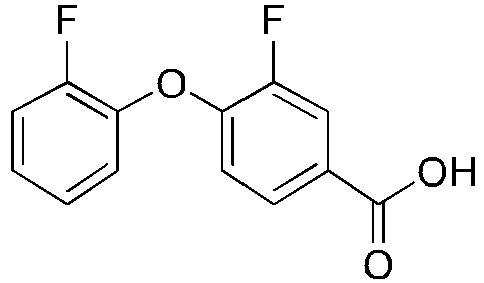
- With the same procedure as in Reference Example 9, the title compound was obtained as a white solid from the corresponding raw material.
- 1H NMR (400 MHz, CHLOROFORM-d) δ ppm 6.89 (t, J=8.1 Hz, 1 H), 7.10-7.25 (m, 4H), 7.80 (d, J=8.4 Hz, 1 H), 7.89 (d, J=11.3 Hz, 1 H)
-


- To a solution of benzyl 5-aminopentanoate·tosilate (1.48 g) in chloroform (20 mL), triethylamine (2.3 mL) and 4-fluorobenzenesulfonyl chloride (800 mg) were added under ice-cooling, and the resultant was stirred under ice-cooling for 1 hour. After the completion of the reaction, saturated sodium hydrogen carbonate aqueous solution was added to the reaction mixture, and extraction was performed with chloroform. The organic layer was allowed to pass through a Phase separator, and concentrated under reduced pressure. The residue was purified by column chromatography (silica gel cartridge, hexane:ethyl acetate = 80:20 to 50:50) to afford benzyl 5-((4-fluorophenyl)sulfonamide)pentanoate (1.24 g) as a colorless oily substance.
- 1H NMR (400 MHz, CHLOROFORM-d) δ ppm 1.46-1.56 (m, 2 H), 1.58-1.68 (m, 2 H), 2.33 (t, J=7.0 Hz, 2 H), 2.96 (q, J=6.5 Hz, 2 H), 4.40-4.47 (m, 1 H), 5.09 (s, 2 H), 7.18 (t, J=8.2 Hz, 2 H), 7.31-7.39 (m, 5 H), 7.86 (dd, J=7.6 Hz, 5.3 Hz, 2 H)

- To a solution of benzyl 5-((4-fluorophenyl)sulfonamide)pentanoate (500 mg) obtained in (1) in DMF (13 mL), 4-hydroxybenzonitrile (179 mg) and potassium carbonate (567 mg) were added, and the resultant was stirred under microwave irradiation at 180°C for 1 hour. After the reaction solution was allowed to cool, ethyl acetate and water were added to the reaction mixture for liquid separation. After the aqueous layer was washed with ethyl acetate, the pH was adjusted to 1 with 1 M hydrochloric acid aqueous solution, and extraction was performed with ethyl acetate/toluene mixed solvent. The organic layer was washed with water, then dried over anhydrous magnesium sulfate, and concentrated under reduced pressure to afford 5-((4-(4-cyanophenoxy)phenyl)sulfonamide)pentanoic acid (285 mg) as a white solid.
- 1H NMR (400 MHz, DMSO-d6) δ ppm 1.32-1.49 (m, 4 H), 2.10-2.17 (m, 2 H), 2.69-2.78 (m, 2 H), 7.23-7.31 (m, 2 H), 7.43 (t, J=8.7 Hz, 2 H), 7.59-7.66 (m, 1 H), 7.81-7.87 (m, 3 H), 7.91 (d, J=8.3 Hz, 1 H)
- (3) To a solution of 5-((4-(4-cyanophenoxy)phenyl)sulfonamide)pentanoic acid (100 mg) obtained in (2) in DMSO (2 mL), potassium carbonate (81 mg) and 30% hydrogen peroxide solution (0.15 mL) were added, and the resultant was stirred at room temperature for 2 hours. After the completion of the reaction, sodium thiosulfate aqueous solution and 1 M hydrochloric acid aqueous solution were added, and extraction was performed with ethyl acetate. The organic layer was washed with water, then dried over anhydrous magnesium sulfate, and concentrated under reduced pressure to afford the title compound (89 mg) as a white solid.
- 1H NMR (400 MHz, DMSO-d6) δ ppm 1.32-1.50 (m, 4 H), 2.10-2.18 (m, 2 H), 2.69-2.78 (m, 2 H), 7.16 (d, J= 8.2 Hz, 1 H), 7.19 (d, J= 8.6 Hz, 1 H), 7.34 (br s, 1 H), 7.43 (t, J= 8.6 Hz, 2 H), 7.52-7.58 (m, 1 H), 7.59-7.66 (m, 1 H), 7.86- 7.79 (m 3 H), 7.96 (d, J=7.7 Hz, 1 H), 12.0 (br s, 1 H)
-

- (1) Fmoc-Rink Amide AM resin (0.10 mmol) was treated with DMF solution of piperidine (concentration: 40%, 1.6 mL) for 3 minutes, and then treated with DMF solution of piperidine (concentration: 20%, 1.6 mL) for 12 minutes to deprotect the Fmoc on the resin. Subsequently, a solution of Fmoc-Ape-OH (0.40 mmol) in DMF (0.8 mL), a solution of COMU (0.40 mmol) and Oxyma (0.40 mmol) in DMF (0.8 mL), and a solution of DIPEA (0.80 mmol) in NMP (0.4 mL) were added, and the mixture was shaken at room temperature for 40 minutes to introduce an Ape residue. In the same manner, deprotection for Fmoc and condensation were repeated: specifically, Fmoc-(N-Me)Glu(OtBu)-OH, Fmoc-Leu-OH, Fmoc-(2S,4S)-(4-NHBoc)Pro-OH, and Fmoc-(d)-Glu-OtBu were sequentially condensed, wherein deprotection was performed for the N-terminal Fmoc formed in the resin after each condensation by piperidine/DMF treatment in the above manner, and
H-γ-(d)-Glu(OtBu)-(2S,4S)-(4-NHBoc)Pro-Leu-(N-Me)Glu(OtBu)-Ape-Rink Amide AM resin was synthesized. - (2) To the resin obtained in (1), a solution of 4-(4-carbamoylbenzamide)benzenesulfonyl chloride (0.30 mmol) obtained in Reference Example 1 and DIPEA (0.60 mmol) in DMF (3 mL) was added, and the mixture was shaken at room temperature for 1 hour. After the completion of the reaction, the resulting resin was washed with DMF (3 mL × three times) and chloroform (3 mL × three times).
- (3) To the resin obtained in (2), TFA:water:triisopropylsilane (92.5:2.5:5, 4 mL) was added, the mixture was shaken at room temperature for 1.5 hours, and the resin was removed through filtration. An operation in which cooled diethyl ether was added to the filtrate, a resulting white powder was precipitated by centrifugation, and diethyl ether was removed by decantation was repeated three times to afford a crude product of peptide. The crude product obtained was purified by preparative LCMS (separation condition B). The eluate was fractionated using test tubes, and eluted fractions containing the target product were collected and lyophilized to afford the title compound (46 mg) as a white powder.
-

- (1) Fmoc-NH-SAL-PEG resin (0.12 mmol) was treated with DMF solution of piperidine (concentration: 40%, 1.9 mL) for 3 minutes, and then treated with DMF solution of piperidine (concentration: 20%, 1.9 mL) for 12 minutes to deprotect the Fmoc on the resin. Subsequently, a solution of Fmoc-β-homoPro-OH (0.48 mmol) in DMF (1.0 mL), a solution of COMU (0.48 mmol) and Oxyma (0.48 mmol) in DMF (1.0 mL), and a solution of DIPEA (0.96 mmol) in NMP (0.48 mL) were added, and the mixture was shaken at room temperature for 40 minutes to introduce a β-homoPro residue. In the same manner, deprotection for Fmoc and condensation were repeated: specifically, Fmoc-(N-Me)Ile-OH, Fmoc-Leu-OH, Fmoc-Dab(Boc)-OH, Fmoc-Asp(OtBu)-OH, Fmoc-Asn(Trt)-OH, Fmoc-GABA-OH, and 4-phenoxybenzoic acid were sequentially condensed, and
Ph-O-Ph-CO-GABA-Asn(Trt)-Asp(OtBu)-Dab(Boc)-Leu-(N-Me)Ile-β-homoPro-NH-SAL-P EG resin was synthesized. After the completion of the reaction, the resulting resin was washed with DMF (3 mL × three times) and chloroform (3 mL × three times). - (2) To the resin obtained in (1), TFA:water:triisopropylsilane:dithiothreitol (90:2.5:5:2.5, 4 mL) was added, the mixture was shaken at room temperature for 2 hours, and the resin was removed through filtration. An operation in which cooled diethyl ether was added to the filtrate, a resulting white powder was precipitated by centrifugation, and diethyl ether was removed by decantation was repeated three times to afford a crude product of peptide. The crude product obtained was purified by preparative LCMS (separation condition A). The eluate was fractionated using test tubes, and eluted fractions containing the target product were collected and lyophilized to afford the title compound (14 mg) as a white powder.
-
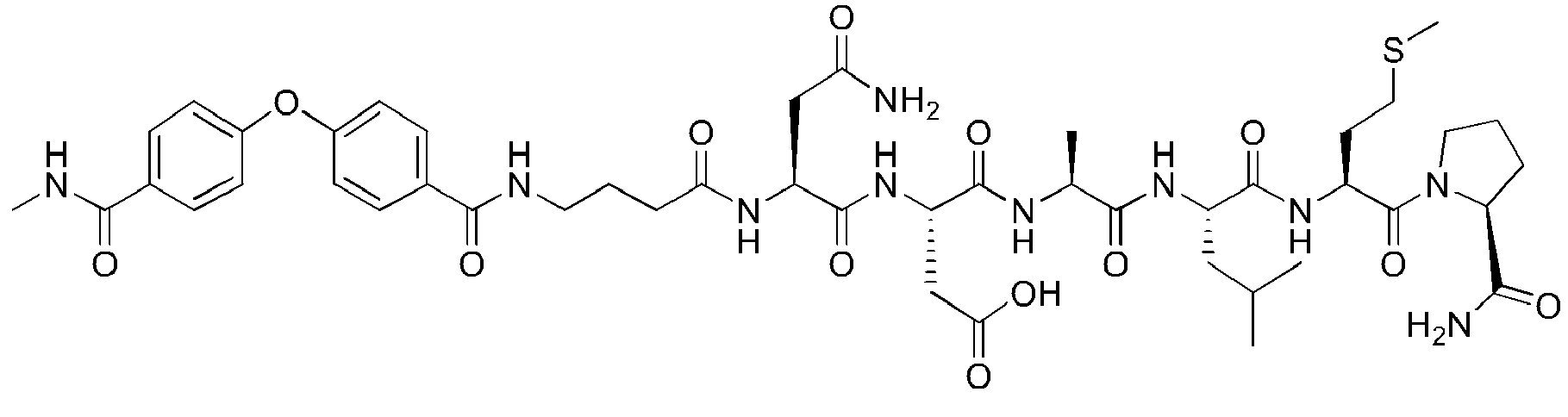
- (1) Fmoc-NH-SAL-PEG resin (0.10 mmol) was treated with DMF solution of piperidine (concentration: 40%, 1.6 mL) for 3 minutes, and then treated with DMF solution of piperidine (concentration: 20%, 1.6 mL) for 12 minutes to deprotect the Fmoc on the resin. Subsequently, a solution of Fmoc-Pro-OH (0.40 mmol) in DMF (0.8 mL), a solution of COMU (0.40 mmol) and Oxyma (0.40 mmol) in DMF (0.8 mL), and a solution of DIPEA (0.80 mmol) in NMP (0.4 mL) were added, and the mixture was shaken at room temperature for 40 minutes to introduce a Pro residue. In the same manner, deprotection for Fmoc and condensation were repeated: specifically, Fmoc-Met-OH, Fmoc-Leu-OH, Fmoc-Ala-OH, Fmoc-Asp(OtBu)-OH, Fmoc-Asn(Trt)-OH, and Fmoc-GABA-OH were sequentially condensed, wherein deprotection was performed for the N-terminal Fmoc formed in the resin after each condensation by piperidine/DMF treatment in the above manner, and H-GABA-Asn(Trt)-Asp(OtBu)-Ala-Leu-Met-Pro-NH-SAL-PEG resin was synthesized.
- (2) To the resin obtained in (1), a solution of 4,4'-oxybisbenzoic acid (0.75 mmol), HATU (0.15 mmol), and DIPEA (2.0 mmol) in DMF (3 mL) was added, and the mixture was shaken at room temperature for 2 hours. After the completion of the reaction, the resulting resin was washed with DMF (3 mL × three times).
- (3) To the resin obtained in (2), a solution of HATU (0.30 mmol), DIPEA (0.60 mmol), and methanol solution of methylamine (concentration: 9.8 mol/L, 0.30 mmol) in DMF (3 mL) was added, and the mixture was stirred at room temperature for 4 hours. After the completion of the reaction, the resulting resin was washed with DMF (3 mL × three times) and chloroform (3 mL × three times).
- (4) To the resin obtained in (3), TFA:water:triisopropylsilane:dithiothreitol (90:2.5:5:2.5, 4 mL) was added, the mixture was shaken at room temperature for 2 hours, and the resin was removed through filtration. An operation in which cooled diethyl ether was added to the filtrate, a resulting white powder was precipitated by centrifugation, and diethyl ether was removed by decantation was repeated three times to afford a crude product of peptide. The crude product obtained was purified by preparative LCMS (separation condition A). The eluate was fractionated using test tubes, and eluted fractions containing the target product were collected and lyophilized to afford the title compound (30 mg) as a white powder.
-

- (1) Fmoc-NH-SAL-PEG resin (0.10 mmol) was treated with DMF solution of piperidine (concentration: 40%, 1.6 mL) for 3 minutes, and then treated with DMF solution of piperidine (concentration: 20%, 1.6 mL) for 12 minutes to deprotect the Fmoc on the resin. Subsequently, a solution of Fmoc-Pro-OH (0.40 mmol) in DMF (0.8 mL) solution, a solution of COMU (0.40 mmol) and Oxyma (0.40 mmol) in DMF (0.8 mL), and a solution of DIPEA (0.80 mmol) in NMP (0.4 mL) were added, and the mixture was shaken at room temperature for 40 minutes to introduce a Pro residue. In the same manner, deprotection for Fmoc and condensation were repeated: specifically, Fmoc-(N-Me)Met-OH, Fmoc-Leu-OH, Fmoc-Ala-OH, Fmoc-Asp(OtBu)-OH, Fmoc-Asn(Trt)-OH, and Fmoc-β-Ala-OH were sequentially condensed, wherein deprotection was performed for the N-terminal Fmoc formed in the resin after each condensation by piperidine/DMF treatment in the above manner, and H-β-Ala-Asn(Trt)-Asp(OtBu)-Ala-Leu-(N-Me)Met-Pro-NH-SAL-PEG resin was synthesized.
- (2) To the resin obtained in (1), a solution of 5-bromothiophene-2-sulfonyl chloride (0.20 mmol) and DIPEA (0.40 mmol) in DMF (3 mL) was added, and the mixture was shaken at room temperature for 2 hours. After the completion of the reaction, the resulting resin was washed with DMF (3 mL × three times) and chloroform (3 mL × three times).
- (3) To the resin obtained in (2), TFA:water:triisopropylsilane:dithiothreitol (90:2.5:5:2.5, 4 mL) was added, the mixture was shaken at room temperature for 2 hours, and the resin was removed through filtration. An operation in which cooled diethyl ether was added to the filtrate, a resulting white powder was precipitated by centrifugation, and diethyl ether was removed by decantation was repeated three times to afford a crude product of peptide. The crude product obtained was purified by preparative LCMS (separation condition B). The eluate was fractionated using test tubes, and eluted fractions containing the target product were collected and lyophilized to afford
5-Br-thiophene-2-SO2-β-Ala-Asn-Asp-Ala-Leu-(N-Me)Met-Pro-NH2 (27 mg) as a white powder. - (4) The compound obtained in (3) was dissolved in DMF (0.5 mL), 4-ethinyltoluene (0.30 mmol), dichlorobis(triphenylphosphine)palladium(II) (0.01 mmol), triethylamine (0.18 mmol), and copper iodide (0.01 mmol) were added thereto, and the mixture was stirred under nitrogen atmosphere at 50°C for 5 hours with heating. After allowing to cool to room temperature, the reaction solution was diluted with DMSO, filtered, and purified by preparative LCMS (separation condition A). The eluate was fractionated using test tubes, and eluted fractions containing the target product were collected and lyophilized to afford the title compound (4 mg) as a white powder.
-

- (1) Fmoc-Rink Amide AM resin (0.10 mmol) was treated with DMF solution of piperidine (concentration: 40%, 1.6 mL) for 3 minutes, and then treated with DMF solution of piperidine (concentration: 20%, 1.6 mL) for 12 minutes to deprotect the Fmoc on the resin. Subsequently, a solution of Fmoc-β-homoPro-OH (0.40 mmol) in DMF (0.8 mL), a solution of COMU (0.40 mmol) and Oxyma (0.40 mmol) in DMF (0.8 mL), and a solution of DIPEA (0.80 mmol) in NMP (0.4 mL) were added, and the mixture was shaken at room temperature for 40 minutes to introduce a β-homoPro residue. In the same manner, deprotection for Fmoc and condensation were repeated: specifically, Fmoc-(N-Me)Ile-OH, Fmoc-Leu-OH, Fmoc-Dab(Boc)-OH, and Fmoc-(d)-Glu-OtBu were sequentially condensed, wherein deprotection was performed for the N-terminal Fmoc formed in the resin after each condensation by piperidine/DMF treatment in the above manner, and H-γ-(d)-Glu(OtBu)-Dab(Boc)-Leu-(N-Me)Ile-β-homoPro-Rink Amide AM resin was synthesized.
- (2) To the resin obtained in (1), a solution of 4-bromobenzenesulfonyl chloride (0.30 mmol) and DIPEA (0.60 mmol) in DMF (2 mL) was added, and the mixture was shaken at room temperature for 2 hours. After the completion of the reaction, the resulting resin was washed with DMF (2 mL × three times).
- (3) To the resin obtained in (2), a solution of trimethylsilylacetylene (0.30 mmol), dichlorobis(triphenylphosphine)palladium(II) (0.03 mmol), and copper iodide (0.03 mmol) in DMF (2 mL) was added, and the mixture was stirred under microwave irradiation at 80°C for 30 minutes with heating. After the completion of the reaction, the resulting resin was washed with DMF (2 mL × three times) and chloroform (2 mL × three times).
- To the resin obtained, tetrahydrofuran solution of tetrabutylammonium fluoride (concentration: 0.33 mol/L, 0.50 mmol) was added, and the mixture was shaken at room temperature for 1 hour. After the completion of the reaction, the resulting resin was washed with DMF (2 mL × three times) and chloroform (2 mL × three times).
- (4) To the resin obtained in (3), a solution of azidobenzene (0.20 mmol), copper(II) sulfate pentahydrate (0.40 mmol), and ascorbic acid (0.40 mmol) in water (2 mL) and tBuOH (1 mL) was added, and the mixture was stirred under microwave irradiation at 60°C for 1 hour with heating. After the completion of the reaction, the resulting resin was washed with DMF (2 mL × three times) and chloroform (2 mL × three times).
- (5) To the resin obtained in (4), TFA:water:triisopropylsilane (92.5:2.5:5, 4 mL) was added, the mixture was shaken at room temperature for 2 hours, and the resin was removed through filtration. An operation in which cooled diethyl ether was added to the filtrate, a resulting white powder was precipitated by centrifugation, and diethyl ether was removed by decantation was repeated three times to afford a crude product of peptide. The crude product obtained was purified by preparative LCMS (separation condition A). The eluate was fractionated using test tubes, and eluted fractions containing the target product were collected and lyophilized to afford the title compound (12 mg) as a white powder.
-

- (1) Fmoc-NH-SAL-PEG resin (0.10 mmol) was treated with DMF solution of piperidine (concentration: 40%, 1.6 mL) for 3 minutes, and then treated with DMF solution of piperidine (concentration: 20%, 1.6 mL) for 12 minutes to deprotect the Fmoc on the resin. Subsequently, a solution of Fmoc-β-homoPro-OH (0.40 mmol) in DMF (0.8 mL), a solution of COMU (0.40 mmol) and Oxyma (0.40 mmol) in DMF (0.8 mL), and a solution of DIPEA (0.80 mmol) in NMP (0.4 mL) were added, and the mixture was shaken at room temperature for 40 minutes to introduce a β-homoPro residue. In the same manner, deprotection for Fmoc and condensation were repeated: specifically, Fmoc-(N-Me)Ile-OH, Fmoc-Leu-OH, Fmoc-Ala-OH, and Fmoc-(d)-Asp-OtBu were sequentially condensed, wherein deprotection was performed for the N-terminal Fmoc formed in the resin after each condensation by piperidine/DMF treatment in the above manner, and H-β-(d)-Asp(OtBu)-Ala-Leu-(N-Me)Ile-β-homoPro-NH-SAL-PEG resin was synthesized.
- (2) To the resin obtained in (1), a solution of 4-iodobenzenesulfonyl chloride (0.30 mmol) and DIPEA (0.60 mmol) in DMF (2 mL) was added, and the mixture was shaken at room temperature for 2 hours. After the completion of the reaction, the resulting resin was washed with DMF (2 mL × three times) and chloroform (2 mL × three times).
- (3) To the resin obtained in (2), a solution of 4-acetylphenylboronic acid (0.40 mmol), tetrakis(triphenylphosphine)palladium(0) (0.03 mmol), and potassium phosphate (0.50 mmol) in 1,4-dioxane (1.5 mL) and water (1.5 mL) was added, and the mixture was stirred under microwave irradiation at 100°C for 30 minutes with heating. After the completion of the reaction, the resulting resin was washed with DMF (2 mL × three times) and chloroform (2 mL × three times).
- (4) To the resin obtained in (3), TFA:water:triisopropylsilane (92.5:2.5:5, 4 mL) was added, the mixture was shaken at room temperature for 2 hours, and the resin was removed through filtration. An operation in which cooled diethyl ether was added to the filtrate, a resulting white powder was precipitated by centrifugation, and diethyl ether was removed by decantation was repeated three times to afford a crude product of peptide. The crude product obtained was purified by preparative LCMS (separation condition A). The eluate was fractionated using test tubes, and eluted fractions containing the target product were collected and lyophilized to afford the title compound (8 mg) as a white powder.
-

- (1) Fmoc-Rink Amide AM resin (0.10 mmol) was treated with DMF solution of piperidine (concentration: 40%, 1.6 mL) for 3 minutes, and then treated with DMF solution of piperidine (concentration: 20%, 1.6 mL) for 12 minutes to deprotect the Fmoc on the resin. Subsequently, a solution of Fmoc-β-homoPro-OH (0.40 mmol) in DMF (0.8 mL), a solution of COMU (0.40 mmol) and Oxyma (0.40 mmol) in DMF (0.8 mL), and a solution of DIPEA (0.80 mmol) in NMP (0.4 mL) were added, and the mixture was shaken at room temperature for 40 minutes to introduce a β-homoPro residue. In the same manner, deprotection for Fmoc and condensation were repeated: specifically, Fmoc-(N-Me)Ile-OH, Fmoc-Leu-OH, Fmoc-Dap(Boc)-OH, and Fmoc-(d)-Asp-OtBu were sequentially condensed, wherein deprotection was performed for the N-terminal Fmoc formed in the resin after each condensation by piperidine/DMF treatment in the above manner, and H-γ-(d)-Asp(OtBu)-Dap(Boc)-Leu-(N-Me)Ile-β-homoPro-Rink Amide AM resin, was synthesized.
- (2) To the resin obtained in (1), a solution of (9H-fluoren-9-yl)methyl (4-(chlorosulfonyl)phenyl)carbamate (0.30 mmol) and DIPEA (0.60 mmol) in 1,4-dioxane (3 mL) was added, and the mixture was shaken at room temperature for 1 hour. After the completion of the reaction, the resulting resin was washed with DMF (3 mL × three times). Subsequently, DMF solution of piperidine (concentration: 20%, 3 mL) and Oxyma (0.01 mmol) were added, and the resultant was shaken at room temperature for 10 minutes.
- (3) To the resin obtained in (2), a solution of 4-methoxybenzoyl chloride (0.30 mmol) and DIPEA (0.60 mmol) in 1,4-dioxane (2 mL) was added, and the mixture was shaken at room temperature for 3 hours. After the completion of the reaction, the resulting resin was washed with chloroform (3 mL × three times).
- (4)To the resin obtained in (3), TFA:water:triisopropylsilane:dithiothreitol (90:2.5:5:2.5, 4 mL) was added, the mixture was shaken at room temperature for 2 hours, and the resin was removed through filtration. An operation in which cooled diethyl ether was added to the filtrate, a resulting white powder was precipitated by centrifugation, and diethyl ether was removed by decantation was repeated three times to afford a crude product of peptide. The crude product obtained was purified by preparative LCMS (separation condition A). The eluate was fractionated using test tubes, and eluted fractions containing the target product were collected and lyophilized to afford the title compound (12 mg) as a white powder.
-

- (1) Fmoc-NH-SAL-PEG resin (0.12 mmol) was treated with DMF solution of piperidine (concentration: 40%, 1.9 mL) for 3 minutes, and then treated with DMF solution of piperidine (concentration: 20%, 1.9 mL) for 12 minutes to deprotect the Fmoc on the resin. Subsequently, a solution of Fmoc-β-homoPro-OH (0.48 mmol) in DMF (1.0 mL), a solution of COMU (0.48 mmol) and Oxyma (0.48 mmol) in DMF (1.0 mL), and a solution of DIPEA (0.96 mmol) in NMP (0.48 mL) were added, and the mixture was shaken at room temperature for 40 minutes to introduce a β-homoPro residue. In the same manner, deprotection for Fmoc and condensation were repeated: specifically, Fmoc-(N-Me)Ile-OH, Fmoc-Lys(Dde)-OH, Fmoc-Ala-OH, Fmoc-Asp(OtBu)-OH, Fmoc-Glu(OAllyl)-OH, and Fmoc-GABA-OH were sequentially condensed, wherein deprotection was performed for the N-terminal Fmoc formed in the resin after each condensation by piperidine/DMF treatment in the above manner, andH-GABA-Glu(OAllyl)-Asp(OtBu)-Ala-Lys(Dde)-(N-Me)Ile-β-homoPro-SAL-PEG resin was synthesized.
- (2) To the resin obtained in (1), a solution of 4-phenoxybenzenesulfonyl chloride (0.36 mmol) and DIPEA (0.72 mmol) in DMF (3 mL) was added, and the mixture was shaken at room temperature for 1.5 hours. After the completion of the reaction, the resulting resin was washed with DMF (3 mL × three times).
- (3) To the resin obtained in (2), DMF solution of hydrazine monohydrate (concentration: 5%, 3 mL) and allyl alcohol (3.1 mmol) were added, and the mixture was shaken at room temperature for 30 minutes to deprotect the Dde of the Lys side chain. Subsequently, a solution of Fmoc-Gly-OH (0.48 mmol), COMU (0.48 mmol), Oxyma (0.48 mmol), and DIPEA (0.96 mmol) in DMF (3 mL) was added, and the mixture was shaken at room temperature for 30 minutes to introduce a Gly residue. After the completion of the reaction, the resulting resin was washed with DMF (3 mL × three times) and chloroform (3 mL × three times).
- (4) To the resin obtained in (3), a solution of tetrakis(triphenylphosphine)palladium(0) (0.12 mmol) and phenylsilane (0.60 mmol) in chloroform (4 mL) was added, and the mixture was shaken at room temperature for 1.5 hours to deprotect the Allyl of the Glu side chain. Subsequently, DMF solution of piperidine (concentration: 20%, 3 mL) was added, and the mixture was shaken at room temperature for 30 minutes to deprotect the Fmoc. After the completion of the reaction, the resulting residue was washed with DMF (3 mL × five times).
- (5) To the resin obtained in (4), a solution of PyBOP (0.36 mmol) and DIPEA (0.12 mmol) in DMF (4 mL) was added, and the mixture was shaken at room temperature for 2 hours. After the completion of the reaction, the resulting residue was washed with DMF (3 mL × three times) and chloroform (3 mL × three times).
- (6) To the resin obtained in (5), TFA:water:triisopropylsilane:dithiothreitol (90:2.5:5:2.5, 4 mL) was added, the mixture was shaken at room temperature for 2 hours, and the resin was removed through filtration. An operation in which cooled diethyl ether was added to the filtrate, a resulting white powder was precipitated by centrifugation, and diethyl ether was removed by decantation was repeated three times to afford a crude product of peptide. The crude product obtained was purified by preparative LCMS (separation condition A). The eluate was fractionated using test tubes, and eluted fractions containing the target product were collected and lyophilized to afford the title compound (10 mg) as a white powder.
-

- (1) Fmoc-Rink Amide AM resin (0.12 mmol) was treated with DMF solution of piperidine (concentration: 40%, 1.9 mL) for 3 minutes, and then treated with DMF solution of piperidine (concentration: 20%, 1.9 mL) for 12 minutes to deprotect the Fmoc on the resin. Subsequently, a solution of Fmoc-β-homoPro-OH (0.48 mmol) in DMF (1.0 mL), a solution of COMU (0.48 mmol) and Oxyma (0.48 mmol) in DMF (1.0 mL), and a solution of DIPEA (0.96 mmol) in NMP (0.48 mL) were added, and the mixture was shaken at room temperature for 40 minutes to introduce a β-homoPro residue. In the same manner, deprotection for Fmoc and condensation were repeated: specifically, Fmoc-(N-Me)Ile-OH, Fmoc-Leu-OH, Fmoc-Ala-OH, Fmoc-Asp(OtBu)-OH, Fmoc-Lys(Dde)-OH, and Fmoc-GABA-OH were sequentially condensed, wherein deprotection was performed for the N-terminal Fmoc formed in the resin after each condensation by piperidine/DMF treatment in the above manner, and H-GABA-Lys(Dde)-Asp(OtBu)-Ala-Leu-(N-Me)Ile-β-homoPro-Rink Amide AM resin was synthesized.
- (2) To the resin obtained in (1), a solution of 4-phenoxybenzenesulfonyl chloride (0.36 mmol) and DIPEA (0.72 mmol) in DMF (3 mL) was added, and the mixture was shaken at room temperature for 2 hours. After the completion of the reaction, the resulting resin was washed with DMF (3 mL × three times).
- (3) To the resin obtained in (2), DMF solution of hydrazine monohydrate (concentration: 5%, 3 mL) was added, and the mixture was shaken at room temperature for 30 minutes. This operation was repeated four times to deprotect the Dde of the Lys side chain. For the resulting resin, condensation and deFmoc were repeatedly performed: specifically, Fmoc-Adox-OH, Fmoc-Adox-OH, and Fmoc-Glu-OtBu were sequentially condensed to extend the Lys side chain with a peptide. Deprotection was performed for the N-terminal Fmoc of the Lys side chain by piperidine/DMF treatment.
- (4)To the resin obtained in (3), a solution of hexadecanedioic acid (0.96 mmol), COMU (0.18 mmol), Oxyma (0.18 mmol), and DIPEA (0.96 mmol) in DMF (3 mL) was added, and the mixture was shaken at room temperature for 1 hour. After the completion of the reaction, the resulting resin was washed with DMF (3 mL × four times) and chloroform (3 mL × three times).
- (5) To the resin obtained in (4), TFA:water:triisopropylsilane:dithiothreitol (90:2.5:5:2.5, 4 mL) was added, the mixture was shaken at room temperature for 2 hours, and the resin was removed through filtration. An operation in which cooled diethyl ether was added to the filtrate, a resulting white powder was precipitated by centrifugation, and diethyl ether was removed by decantation was repeated three times to afford a crude product of peptide. The crude product obtained was purified by preparative LCMS (separation condition A). The eluate was fractionated using test tubes, and eluted fractions containing the target product were collected and lyophilized to afford the title compound (29 mg) as a white powder.
- The structures of compounds represented by formula [I'-1], which were synthesized in Example 1 or with the same method as in Example 1, are shown in the following table.

[Table 5] Compound No. AA1 AA2 AA3 AA4 AA5 W6 1 γ-(d)-Glu (2S, 4S) - (4-anino)Pro Leu (N-Me)Glu Ape single bond 2 β -Asp (2S, 4S)-(4-amino)Pro Leu (N-Me)Glu Ape single bond 3 β-(d)-Asp (2S, 4S)-(4-amino)Pro Lett (N-Me)Glu Ape single bond 4 γ -Glu (2S, 4S)-(4-amino)Pro Leu (N-Me)Glu Ape single bond 5 γ -(d)-Glu (2S, 4S)-(4-amino)Pro Val (N-Me)Glu Ape single bond 6 γ -(d)-Glu (2S, 4S)-(4-amino)Pro Ile (N-Me)Glu Ape single bond 7 γ -(d)-Glu (2S, 4S)-(4-amino)Pro Phe (N-Me)Glu Ape single bond 8 γ -(d)-Glu (2S, 4S)-(4-amino)Pro Trp (N-Me)Glu Ape single bond 9 γ -(d)-Glu (2S, 4S)-(4-amino)Pro Leu (N-Me)Ile Ape single bond 10 γ -(d)-Glu (2S, 4S)-(4-amino)Pro Leu (N-Me)Val Ape single bond 11 γ -(d)-Glu (2S, 4S)-(4-amino)Pro Leu (N-Me)Leu Ape single bond 12 γ -(d)-Glu (2S, 4S)-(4-amino)Pro Leu (N-Me)LeU Ape single bond 13 γ -(d)-Glu (2S, 4S)-(4-amino)Pro Leu (N-Me)Phe Ape single bond 14 γ-(d)-Glu (2S, 4S)-(4-amino)Pro Leu (N-Me)Tyr Ape single bond 16 γ -(d)-Glu (2S, 4S)-(4-amino)Pro Leu (N-Me)Ser Ape single bond 16 γ -(d)-Glu (2S, 4S)-(4-amino)Pro Leu Pro Ape single bond 17 γ -(d)-Glu (2S, 4S)-(4-amino)Pro Leu (N-Me)Asp β -homoPro single bond 18 γ -(d)-Glu (2S, 4S)-(4-amino)Pro Leu (N-Me)Asp Pro single bond 19 γ -(d)-Glu (2S, 4S)-(4-amino)Pro LeU (N-Me)Asp (d)-Pro single bond 20 γ -(d)-Glu (2S, 4S)-(4-amino)Pro Leu (N-Me)Glu β -homoPro single bond 21 γ -(d)-Glu (2S, 4S)-(4-amino)Pro Leu (N-Me)Glu Pro single bond 22 γ-(d)-Glu (2S, 4S)-(4-amino)Pro Leu (N-Me)Glu β -Ala single bond 23 γ -(d)-Glu (2S, 4S)-(4-amino)Pro Leu (N-Me)Glu GABA single bond 24 γ -(d)-Glu (2S, 4S)-(4-amino)Pro Leu (N-Me)Glu Acp single bond 25 γ -(4)-Glu (2S, 4S)-(4-amino)Pro Leu (N-Me)Glu (d)-Pro single bond 26 γ-(d)-Glu (2S, 4S)-(4-amino)Pro Leu (N-Me)Glu Lys single bond 27 γ-(d)-Glu (2S, 4S)-(4-amino)Pro Leu (N-Me)Glu (d)-Lys single bond 28 γ -(d)-Glu -(2S, 4S) - (4-amino)Pro Leu (N-Me)Glu Arg single bond 29 γ -(d)-Glu (2S, 4S)-(4-amino)Pro Leu (N-Me)Glu (d)-Arg single bond 30 γ -(d)-Glu (2S, 4S)-(4-amino)Pro Leu (N-Me)Glu single bond single bond 31 γ -(d)-Glu (2S, 4S)-(4-amino)Pro Leu single bond single bond single bond 32 γ -(d)-Glu (2S, 4S)-(4-amino)Pro Leu (N-Me)Glu Ape Pro 33 γ -(d)-Glu (2S, 4S)-(4-amino)Pro Leu (N-Me)Glu Ape Lys 34 γ -(d)-Glu (2S, 4S)-(4-amino)Pro Leu (N-Me)Glu Ape (d)-Lys 35 γ -(d)-Glu (2S, 4S)-(4-amino)Pro Leu (N-Me)Glu Ape Arg 36 γ -(d)-Glu (2S, 4S)-(4-amino)Pro Leu (N-Me)Glu Ape (d)-Arg 37 γ -(d)-Glu (2S, 4S)-(4-amino)Pro Leu (N-Me)Glu Ape (d) - Lys-(d) - Lys 38 β -(d)-Asp (2S, 4S)-(4-amino)Pro Leu (N-Me)Ile β -homoPro single bond 39 γ -(d)-Glu (2S, 4S) - (4-amino) Pro Leu (N-Me)Ile β -homoPro single bond - The structure of a compound represented by formula [I'-2], which was synthesized with the same method as in Example 1, is shown in the following table.

[Table 6] Compound No. AA1 AA2 AA3 AA4 AA5 Wc 40 γ -(d)-Glu (2S, 4S)-(4-amino)Pro Leu (N-Me)Glu Ape single bond - The structure of a compound represented by formula [I'-3], which was synthesized with the same method as in Example 1, is shown in the following table.

[Table 7] Compound No. AA1 AA2 AA3 AA4 AA5 Wc 41 γ -(d)-Glu (2S, 4S)-(4-amino) Pro Leu (N-Me)Glu Ape single bond - The structure of a compound represented by formula [I'-4], which was synthesized with the same method as in Example 1, is shown in the following table.

[Table 8] Compound No. AA1 AA2 AA3 AA1 AA5 We 42 γ -(d)-Glu (2S, 4S)-(4-amino)Pro Leu (N-Me)Glu Ape single bond - The structure of a compound represented by formula [I'-5], which was synthesized with the same method as in Example 1, is shown in the following table.

[Table 9] Compound No. AA1 AA2 AA3 AA4 AA5 Wc 43 γ -(d)-Glu (2S, 4S)-(4-amino)Pro Leu (N-Me)Glu Ape single bond - The structure of a compound represented by formula [I'-6], which was synthesized with the same method as in Example 1 is shown in the following table.

[Table 10] Compound No. AA1 AA2 AA3 AA4 AA5 Wc 44 γ -(d)-Glu (2S, 4S)-(4-amino)Pro Leu (N-Me)Glu Ape single bond - The structures of compounds represented by formula [I'-7], which weer synthesized with the same method as in Example 1, are shown in the following table.
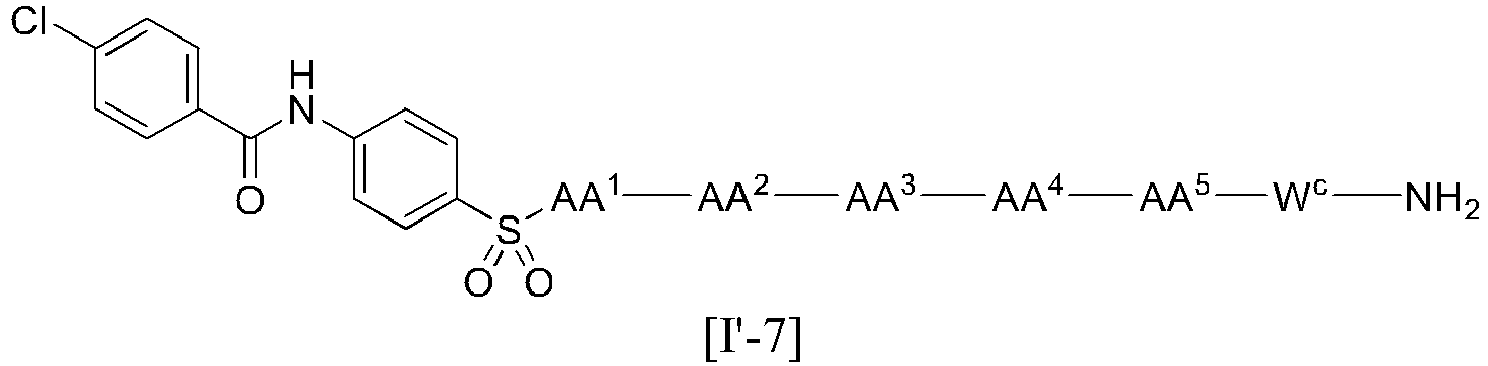
[Table 11] Compound No. AA1 AA2 AA3 AA4 AA5 Wc 45 β -(d)-Asp (2S, 4S)-(4-amino)Pro Leu (N-Me)Ile Ape single bond 46 β -(d)-Asp (S)-piperazine Leu (N-Me)Ile Ape single bond 47 β -(d)-Asp (2S, 4R)-(4-amino)Pro Leu (N-Me)Ile Ape single bond 48 β -(d)-Asp (2S, 4S)-(4-hydroxy)Pro Leu (N-Me)Ile β -homoPro single bond 49 β -(d)-Asp (2S, 4R)-(4-hydroxy)Pro Leu (N-Me)Ile Ape single bond 50 β -(d)-Asp (2S, 4S)-(4-amino)Pro Leu (N-Me)Glu β -homoPro single bond 51 β -(d)-Asp (2S, 4S)-(4-amino)Pro Leu (N-Me)Ile β -homoPrο single bond 52 β -(d)-Asp (2S, 4S)-(4-amino)Pro Leu (N-Me)Glu Ape single bond 53 γ -(d)-Glu (2S, 4S) - (4-amino)Pro Leu (N-Me) Glu Ape single bond 64 γ -Glu (2S, 4S)-(4-amino)Pro Leu (N-Me)Ile β -homoPro single bond 55 γ -(d)-Glu (2S, 4S)-(4-amino)Pro Leu (N-Me)Ile β -homoPro single bond - The structures of compounds represented by formula [I'-8], which were synthesized with the same method as in Example 1, are shown in the following table.

[Table 12] Compound No. RB1 L1* L1* AA1 AA2 AA3 AA4 AA5 Wc Rc 56 H GABA Asn Asp Ala Leu Met Pro single bond NH2 57 H GABA Asn Asp Ala Leu (N-Me) Val Pro single bond NH2 58 H GABA Asn Asp Ala Leu (N-Me) Ile Pro single bond NH2 59 H GABA Asn Asp Ala Leu (N-Me)Val β - homo Pro single bond NH2 60 H (N-Me) GABA Asn Asp Ala Leu (N-Me) Ile Pro single bond NH2 61 H GABA Asn Asp Dap Leu (N-Me) Ile β - homo Pro single bond NH2 62 H GABA Asn Asp Dab Leu (N-Me) Ile β - homo Pro single bond NH2 63 H GABA Asn Asp Orn Leu (N-Me) Ile β - homo Pro single bond NH2 64 H GABA Asn Asp Ala Leu Glu β - homo Pro single bond NH2 65 H GABA (N-Me) Asn Asp Ala Leu (N-He) Ile Pro single bond NH2 66 H GABA Asn Asp Ala Leu (N-Me) Glu β - homo Pro single bond NH2 67 H GABA Asn Asp Dab Leu (N-Me) Ile Pro single bond NH2 68 H GABA Asn Asp Dab Leu (N-Me) Glu β - homo Pro single bond NH2 69 H GABA Asn Asp Dab Leu (N-Me) Glu Pro single bond NH2 70 H GABA (N-Me) Asn Asp Dab Leu (N-Me) Ile β - homo Pro single bond NH2 71 H GABA (N-Me) Asn Asp Dab Leu (N-Me) Ile Pro single bond NH2 72 H GABA (N-Me) Asn Asp Dab Leu (N-Me) Glu β-homo Pro single bond NH2 73 H GABA (N-Me) Asn Asp Dab Leu (N-Me) Glu Pro single bond NH2 74 H GABA Asn Asp Ala Dab (N-Me) Ile β - homo Pro single bond NH2 75 H GABA Asn Asp Ala Leu homoGlu β - homo Pro single bond NH2 76 H GABA Asn Asp Dab Leu (N-Me) Glu β - homo Pro single bond OH 77 F Ape Glu Asp Dab Leu (N-Me) Glu β - homo Pro single bond NH2 78 F Ape Asn Asp Dab Leu (N-Me) Ile β - homo Pro single bond NH2 79 F Ape Asn Asp Dab Leu (N-Me) Glu β - homo Pro single bond NH2 80 H2NCO Ape Asn Asp Dab Leu (N-Me) Glu β - homo Pro single bond NH2 81 H2NCO Ape Gln Asp Dab Leu (N-Me) Glu β - homo Pro single bond NH2 82 H2NCO Ape (d)-Ser Asp Dab Leu (N-Me) Glu β - homo Pro single bond NH2 83 H2NCO Ape homo Ser Asp Dab Leu (N-Me) Glu β - homo Pro single bond NH2 84 H Ape (d)-Thr Asp Dab Leu (N-Me) Glu β - homo Pro single bond NH2 85 H Ape (d)-Thr Asp Dab Leu (N-Me) Ile β - homo Pro single bond NH2 86 F Ape (d)-Thr Asp Dab Leu (N-Me) Glu β - homo Pro single bond NH2 87 F Ape (d)-Thr Asp Dab Leu (N-Me) Ile β - homo Pro single bond NH2 88 F Ape Arg Asp Dab Leu (N-Me) Glu β - homo Pro single bond NH2 89 F Ape Arg Asp Dab Leu (N-Me) Ile β - homo Pro single bond NH2 90 F Ape Gln Asp Dab Leu (N-Me) Ile β - homo Pro (d)-Lys NH2 91 F Ape Gln Asp Dab Leu (N-Me) Ile β - homo Pro (d)-Arg NH2 - The structures of compounds represented by formula [I'-9], which were synthesized in Example 2 or with the same method as in Example 2, are shown in the following table.

[Table 13] Compound No. RB1 L1* L1* AA1 AA2 AA3 AA4 AA5 Wc Rc 92 H GABA (N-Me) Ala Asp Ala Leu (N-Me) Ile Pro single bond NH2 93 F GABA (N-Me) Ala Asp Ala Leu (N-Me) Ile Pro single bond NH2 94 H GABA (N-Me) Asn Asp Ala Leu (N-Me) Ile Pro single bond NH2 95 F GABA (N-Me) Asn Asp Ala Leu (N-Me) Ile Pro single bond NH2 96 H GABA (N-Me) Ala Asp Ala Leu (N-Me) Ile Aib single bond NH2 97 F GABA (N-Me) Ala Asp Ala Leu (N-Me) Ile Aib single bond NH2 98 H GABA (N-Me) Asn Asp Ala Leu (N-Me) Ile Aib single bond NH2 99 F GABA (N-Me) Asn Asp Ala Leu (N-Me) Ile Aib single bond NH2 100 H (N-Me) GABA (N-Me) Ala Asp Ala Leu (N-Me) Ile Pro single bond NH2 101 F (N-Me) GABA (N-Me) Ala Asp Ala Leu (N-Me) Ile Pro single bond NH2 102 Me (N-Me) GABA (N-Me) Ala Asp Ala Leu (N-Me) Ile Pro single bond NH2 103 H (N-Me) GABA (N-Me) Asn Asp Ala Leu (N-Me) Ile Pro single bond NH2 104 F (N-Me) GABA (N-Me) Asn Asp Ala Leu (N-Me) Ile Pro single bond NH2 105 Me (N-Me) GABA (N-Me) Asn Asp Ala Leu (N-Me) Ile Pro single bond NH2 106 H GABA Asn Asp Dab Leu (N-Me) Ile β - homo Pro single bond NH2 107 H GABA Asn Asp Dab Leu (N-Me) Ile Pro single bond NH2 108 H GABA Asn Asp Dab Leu (N-Me) Glu β - homo Pro single bond NH2 109 H GABA Asn Asp Dab Leu (N-Me) Glu Pro single bond NH2 110 H GABA (N-Me) Asn Asp Dab Leu (N-Me) Ile β - homo Pro single bond NH2 111 H GABA (N-Me) Asn Asp Dab Leu (N-Me) Ile Pro single bond NH2 112 H GABA (N-Me) Asn Asp Dab Leu (N-Me) Glu β - homo Pro single bond NH2 113 H GABA (N-Me) Asn Asp Dab Leu (N-Me) Glu Pro single bond NH2 114 H GABA (d) - Asn Asp Ala Leu (N-Me) Ile Pro single bond NH2 115 H GABA (N-Me) Gly Asp Ala Leu (N-Me) Ile Pro single bond NH2 116 H GABA Aze (2) Asp Ala Leu (N-Me) Ile Pro single bond NH2 117 H GABA Pro Asp Ala Leu (N-Me) Ile Pro single bond NH2 118 H GABA homo Pro Asp Ala Leu (N-Me) Ile Pro single bond NH2 119 H GABA (N-Me) Val Asp Ala Lou (N-Me) Ile Pro single bond NH2 120 H GABA (N-Me) Leu Asp Ala Leu (N-Me) Ile Pro single bond NH2 121 H GABA (N-Me) Ile Asp Ala Leu (N-Me) Ile Pro single bond NH2 122 H GABA (N-Me) Met Asp Ala Leu (N-Me) Ile Pro single bond NH2 123 H GABA (d)-Lys Asp Ala Leu (N-Me) Ile Pro single bond NH2 124 H GABA (N-Me) Phe Asp Ala Leu (N-Me) Ile Pro single bond NH2 126 H GABA (N-Me) Asp Asp Ala Leu (N-Me) Ile Pro single bond NH2 126 H GABA (N-Me) Glu Asp Ala Leu (N-Me)Ile Pro single bond NH2 127 H GABA (N-Me) Lys Asp Ala Leu (N-Me) Ile Pro single bond NH2 128 H GABA Gln Asp Ala Leu (N-Me) Ile Pro single bond NH2 129 H GABA (N-Me) Tyr Asp Ala Leu (N-Me) Ile Pro single bond NH2 130 H GABA (N-Me) Trp Asp Ala Leu (N-Me) Ile Pro single bond NH2 131 H GABA (N-Me) Thr Asp Ala Leu (N-Me) Ile Pro single bond NH2 132 H GABA Aze(2) Asp Dap Leu (N-Me) Ile β - homo Pro single bond NH2 133 H GABA Aze (2) Asp Dab Leu (N-Me) Ile β - homo Pro single bond NH2 134 H GABA (N-Me) Met Asp Dab Leu (N-Me) Ile Pro single bond NH2 135 H GABA (N-Me) Val Asp Dab Leu (N-Me) Ile Pro single bond NH2 136 H GABA (N-Me) Leu Asp Dab Leu (N-Me) Ile Pro single bond NH2 137 F GABA (N-Me) Asn Asp Dab Leu (N-Me) Ile Pro single bond NH2 138 F GABA (N-Me) Asn Asp Dab Leu (N-Me) Ile β - homo Pro single bond NH2 139 F GABA (N-Me) Asn Asp Dab Leu (N-Me) Asp β - homo Pro single bond NH2 140 F GABA (N-Me) Asn Asp Dab Leu (N-Me) Glu β - homo Pro single bond NH2 141 F GABA (N-Me) Asn Asp Dab Leu (N-Me) Asp Pro single bond NH2 142 F GABA (N-Me) Asn Asp Dab Leu (N-Me) Glu Pro single bond NH2 143 H GABA Val Asp Dab Leu (N-Me) Glu β - homo Pro single bond NH2 144 H GABA Glu Asp Dab Leu (N-Me) Glu β - homo Pro single bond NH2 145 H GABA Orn Asp Dab Leu (N-Me) Glu β - homo Pro single bond NH2 146 H GABA Val Asp Dab Leu (N-Me) Ile β - homo Pro single bond NH2 147 H GABA Glu Asp Dab Leu (N-Me) Ile β - homo Pro single bond NH2 148 H GABA Orn Asp Dab Leu (N-Me) Ile β - homo Pro single bond NH2 149 F GABA Asn Asp Dab Leu (N-Me) Glu β - homo Pro single bond NH2 150 F GABA Val Asp Dab Leu (N-Me) Glu β - homo Pro single bond NH2 161 F GABA Glu Asp Dab Leu (N-Me) Glu β - homo Pro single bond NH2 152 F GABA Orn Asp Dab Leu (N-Me) Glu β - homo Pro single bond NH2 153 F GABA Asn Asp Dab Leu (N-Me) Ile β - homo Pro single bond NH2 154 H GABA (N-Me) Asn Asp Dap (M e) Leu (N-Me) Ile β - homo Pro single bond NH2 155 H GABA Asn Asp Dab Leu (N-Me) Glu β - homo Pro single bond NH2 156 H GABA Asn Asp Dab Leu (N-Me) Ile β - homo Pro single bond NH2 - The structures of compounds represented by formula [I'-10], which were synthesized with the same method as in Example 9, are shown in the following table.

[Table 14] Compound No. RB1 L1 AAN5 AAN4 AAN3 AAN2 AAN1 n AA1 AA2 AA3 AA4 AA5 157 H2NC O GAB A γ - Glu Ado x Ado x single bond single bond 12 Asp Dab Leu (N-Me) Glu β - hom oPr o 158 H2NC O GAB A γ Glu Ado x Ado x single bond single bond 14 Asp Dab Leu (N-Me) Glu β - hom oPr o 159 H2NC O GAB A (d) - Lys (d) - Lys (d) - Lys single bond single bond 12 Asp Dab Leu (N-Me) Glu β - hom oPr o 160 H2NC O GAB A (d) Lys (d) - Lys (d) - Lys single bond single bond 14 Asp Dab Leu (N-Me) Glu β - hom oPr o - The structures of compounds represented by formula [I'-9], which were synthesized in Example 2 or with the same method as in Example 2, are shown in the following table.

[Table 15] Compound No. RB1 L1' L1" AA1 AA2 AA3 AA4 AA5 Wc Rc 161 F GABA Asn Asp Dab Leu (N-Me) Glu β - homoPro single bond OH 162 F GABA Gln Asp Dab Leu (N-Me) Glu β - homoPro single bond NH2 163 F Ape Asn Asp Dab Leu (N-Me) Glu β - homoPro single bond NH2 164 F Ape Gln Asp Dab Leu (N-Me) Glu β - homoPro single bond NH2 165 F Ape Gln Asp Dab Leu (N-Me) Ile β - homoPro single bond NH2 166 H Adox Asn Asp Dab Leu (N-Me) Ile β - homoPro single bond NH2 167 H Adox Asn Asp Dab Leu (N-Me) Glu β - homoPro single bond NH2 168 MeSO2 Ape Asn Asp Dab Leu (N-Me) Glu β - homoPro single bond NH2 169 MeSO2 Ape (d) - Ser Asp Dab Leu (N-Me) Glu β - homoPro single bond NH2 170 F Ape Gln Asp Dab Leu (N-Me) Ile β - homoPro single bond NH2 171 F Ape Glu Asp Dab Leu (N-Me) Ile β - homoPro single bond NH2 172 F Ape (d) - Ser Asp Dab Leu (N-Me) Ile β - homoPro single bond NH2 173 H Ape (d) - Thr Asp Dab Leu (N-Me) Glu β - homoPro single bond NH2 174 H Ape (d) - Thr Asp Dab Leu (N-Me) Ile β - homoPro single bond NH2 175 F Ape Gln Asp Dab Leu (N-Me) Ile β - homoPro (d) - Lys NH2 176 F Ape Gln Asp Dab Leu (N-Me) Ile β - homoPro (d) - Arg NH2 - The structures of compounds represented by formula [I'-9], which were synthesized in Example 3 or with the same method as in Example 3, are shown in the following table.

[Table 16] Compound No. RB1 L1' L1" AA1 AA2 AA3 AA4 AA5 Wc Rc 177 MeHNC O GABA Asn Asp Ala Leu Met Pro single bond NH2 178 HO2C-H2CHN CO Ape Asn Asp Ala Leu Met Pro single bond NH2 179 H2N-( CH2)2-NHCO Ape Asn Asp Dab Leu (N-Me) Glu β -homo Pro single bond HH2 180 H2N-( CH2)a-NHCO Ape Asn Asp Dab Leu (N-Me) Glu β -homo Pro single bond NH2 181 H2N-( CH2)4-NHCO Ape Asn Asp Dab Leu (N-Me) Glu β -homo Pro single bond NH2 182 HO-(C H2)3-N HCO Ape Asn Asp Dab Leu (N-Me) Glu β -homo Pro single bond NH2 183 HO2C-(CH2)2 -NHCO Ape Asn Asp Dab Leu (N-Me) Glu β -homo Pro single bond NH2 184 MeNHC O Ape Lys Asp Dab Leu (N-Me) Glu β -homo Pro single bond NH2 185 MeNHC O Ape Lys Asp Dab Leu (N-Me) Ile β -homo Pro single bond HH2 186 MeNHC O Acp Lys Asp Dab Leu (N-Me) Glu β -homo Pro single bond NH2 187 MeNHC O Acp Lys Asp Dab Leu (N-Me) Ile β -homo Pro single bond NH2 188 MeNHC O Ape Arg Asp Dab Leu (N-Me) Glu β -homo Pro single bond NH2 189 MeNHC O Ape Arg Asp Dab Leu (N-Me) Ile β -homo Pro single bond NH2 190 MeNHC O Acp Arg Asp Dab Leu (N-Me) Glu β-homo Pro single bond NH2 191 MeNHC O Acp Arg Asp Dab Leu (N-Me) Ile β -homo Pro single bond NH2 192 EtNHC O Ape Lys Asp Dab Leu (N-Me) Glu β -homo Pro single bond NH2 193 EtNHC O) Ape Lys Asp Dab Leu Of-Me) Ile β -homo Pro single bond NH2 194 EtNHC O Acp Lys Asp Dab Leu (N-Me) Glu β -homo Pro single bond NH2 195 EtNHC O Acp Lys Asp Dab Leu (N-Me) Ile β -homo Pro single bond NH2 196 ETNHC O Ape Arg Asp Dab Leu (N-Me) Glu β -homo Pro single bond NH2 197 EtNHC O Ape Arg Asp Dab Leu (N-Me) Lie β Pro single bond NH2 198 ETNHC O Acp Arg Asp Dab Leu (N-Me) Ile β -homo Pro single bond NH2 199 H2NCO -(CH2 )4-NH CO Ape Glu Asp Dab Leu (N-Me) Glu β -homo Pro single bond NH2 200 HO2C-(CH2)4 -NHCO Ape Glu Asp Dab Leu (N-Me) Ile β -homo Pro single bond NH2 201 H2NCO -(CH2 )4-NH CO Ape Glu Asp Dab Leu (N-Me) Ile β -homo Pro single bond NH2 - The structure of a compound represented by formula [I'-11], which was synthesized with the same method as in Example 2, is shown in the following table.

[Table 17] Compound No. L1' L1" AA1 AA2 AA3 AA4 AA5 Wc Rc 202 GABA Asn Asp Ala Leu Met Pro single bond NH2 - The structures of compounds represented by formula [I'-12], which were synthesized with the same method as in Example 2, are shown in the following table.

[Table 18] Compound No. L1' L1" AA1 AA2 AA3 AA4 AA5 Wc Rc 203 Acp Asn Asp Dab Leu (N-Me) Glu β -homo Pro single bond NH2 204 Acp Gln Asp Dab Leu (N-Me) Glu β -homo Pro single bond NH2 205 Acp Ala Asp Dab Leu (N-Me) Glu β -homo Pro single bond NH2 - The structures of compounds represented by formula [I'-13], which were synthesized with the same method as in Example 2, are shown in the following table.

[Table 19] Compound No. L1' L1" AA1 AA2 AA3 AA4 AA5 Wc Rc 206 Acp Asn Asp Dab Leu (N-Me) Glu β -homo Pro single bond NH2 207 Acp Gln Asp Dab Leu (N-Me) Glu β -homo Pro single bond NH2 208 Acp Ala Asp Dab Leu (N-Me) Glu β -homo Pro single bond NH2 209 Ape Asn Asp Dab Leu (N-Me) Glu β -homo Pro single bond NH2 - The structures of compounds represented by formula [I'-14], which were synthesized with the same method as in Example 2, are shown in the following table.

[Table 20] Compound No. L1' L1" AA1 AA2 AA3 AA4 AA5 Wc Rc 210 GABA Asn Asp Dab Leu (N-Me) Glu β - homoPro single bond NH2 211 GABA Val Asp Dab Leu (N-Me) Glu β - homoPro single bond NH2 212 GABA Glu Asp Dab Leu (N-Me) Glu β - homoPro single bond NH2 213 GABA Orn Asp Dab Leu (N-Me) Glu β - homoPro single bond NH2 214 GABA Asn Asp Dab Leu (N-Me) Ile β - homoPro single bond NH2 215 GABA Val Asp Dab Leu (N-Me) Ile β - homoPro single bond NH2 216 GABA Glu Asp Dab Leu (N-Me) Ile β - homoPro single bond NH2 217 GABA Orn Asp Dab Leu (N-Me) Ile β - homoPro single bond NH2 218 GABA (N-Me) Asn Asp Dap (Me) Leu (N-Me) Ile β -homoPro single bond NH2 219 GABA (N-Me) Asn Asp Dap (Me) Leu (N-Me) Glu β -homoPro single bond NH2 220 GABA (N-Me) Asn Asp Dab (Me) Leu (N-Me) Glu β single bond NH2 221 β -Ala Asn Asp Dab Leu (N-Me) Glu β -homoPro single bond NH2 222 Ape Asn Asp Dab Leu (N-Me) Glu β -homoPro single bond NH2 223 Ape Glu Asp Dab Leu (N-Me) Glu β -homoPro single bond NH2 224 β -Ala Asn Asp Dap Leu (N-Me) Glu β single bond NH2 225 GABA Asn Asp Dap Leu (N-Me) Glu β single bond NH2 226 Ape Asn Asp Dap Leu (N-Me) Glu β -homoPro single bond NH2 227 GABA Glu Asp Dap Leu (N-Me) Glu β -homoPro single bond NH2 228 Ape Glu Asp Dap Leu (N-Me) Glu β -homoPro single bond NH2 229 β -Ala Asn Asp Dab Leu (N-Me) Ile β -homoPro single bond NH2 230 Ape Asn Asp Dab Leu (N-Me) Ile single bond NH2 231 β -Ala Glu As p Dab Leu (N-Me) Ile β -homoPro single bond NH2 232 Ape Glu Asp Dab Leu (N-Me) Ile β -homoPro single bond NH2 233 Ape Gln Asp Dab Leu (N-Me) Glu β single bond NH2 234 Ape Gln Asp Dab Leu (N-Me) Ile β -homoPro single bond NH2 235 GABA Asn Asp Dab Leu (N-Me) Glu β -homoPro single bond OH 236 GABA Asn Asp Dab Leu (N-Me) Ile β single bond OH 237 GABA Gln Asp Dab Leu (N-Me) Glu β -homoPro single bond OH 238 GABA (d) - Asn Asp Dab Leu (N-Me) Glu homoPro single bond OH 239 GABA (d)-Asn Asp Dab Leu (N-Me) Ile β -homoPro single bond OH 240 GABA Asn Asp Dab Leu (N-Me) Asp β -homoPro single bond OH 241 GABA Asn Asp Dab Leu (N-Me) Asn β -homoPro single bond OH 242 GABA (d) - Gln Asp Dab Leu (N-Me) Glu β -homoPro single bond OH 243 GABA Gln Asp Dab Leu (N-Me) Glu β -homoPro single bond NH2 244 GABA Gln Asp Dab Leu (N-Me) Ile β -homoPro single bond NH2 245 ε -Lys Asn Asp Dab Leu (N-Me) Ile β single bond NH2 246 ε -Lys Gln Asp Dab Leu (N-Me) Ile β single bond NH2 247 ε - (d) - Lys Asn Asp Dab Leu (N-Me) Ile β -homoPro single bond NH2 248 GABA Asn Asp Dab(Me )2 Leu (N-Me) Ile β -homoPro single bond NH2 249 GABA Gln Asp Dab (Me )2 Leu (N-Me) Ile β -homoPro single bond NH2 250 GABA (d) - Asn Asp Dab Leu (N-Me) Glu β -homoPro single bond NH2 251 GABA (d)-Asn Asp Dab Leu (N-Me) Ile β single bond NH2 252 GABA Asn Asp Dab Leu (N-Me) Asp β -homoPro single bond NH2 253 GABA (d)-Gln Asp Dab Leu (N-Me) Glu β -homoPro single bond NH2 254 Ape Asn Asp Dab Leu (N-Me) Ile β single bond NHEt 255 Ape Asn Asp Dab Leu (N-Me) Ile β -homoPro single bond pipe ridi n-1-yl 256 Acp Asn Asp Dab Leu (N-Me) Glu β -homoPro single bond NH2 257 Aep Gln Asp Dab Leu (N-Me) Glu β single bond NH2 258 Acp Glu Asp Dab Leu (N-Me) Glu β -homoPro single bond NH2 259 Ape Asn Asp Dab Leu (N-Me) Glu β -homoPro single bond OH 260 Ape Gln Asp Dab Leu (N-Me) Glu β -homoPro single bond OH 261 Ape Gln Asp Dab Leu (N-Me) Ile β -homoPro single bond OH 262 Adox Asn Asp Dab Leu (N-Me) Ile β -homoPro single bond NH2 263 Adox Asn Asp Dab Leu (N-Me) Glu β -homoPro single bond NH2 264 Adox Glu Asp Dab Leu (N-Me) Ile β single bond NH2 265 Adox Glu Asp Dab Leu (N-Me) Glu β - honoPro single bond NH2 266 Adox Gln Asp Dab Leu (N-Me) Ile β - homoPro single bond NH2 267 Adox Gln As p Dab Leu (N-Me) Glu β -homoPro single bond NH2 268 Ape Asn Asp Dab Leu (N-Me) Glu β -homoPro single bond NHMe 269 Ape Asn Asp Dab Leu (N-Me) Glu β -homoPro single bond azet idin -1-yl 270 Ape Asn Asp Dab Leu (N-Me) Glu β -homoPro single bond pyrr olid in-1-yl 271 Ape Asn Asp Dab Leu (N-Me) Glu β -homoPro single bond (4-OH)p iper idin -1-yl 272 Ape Asn Asp Dab Leu (N-Me) Glu β -homoPro single bond NH-(CH2 )2-OH 273 Ape Asn Asp Dab Leu (N-Me) Ile β - homoPro single bond azet idin -1-yl 274 Ape Asn Asp Dab Leu (N-Me) Ile β - homoPro single bond (3-OH)3 zeti din-1-yl 275 Ape Asn Asp Dab Leu (N-Me) Ile β - homoPro single bond pyrr olid in-1-yl 276 Ape Asn Asp Dab Leu (N-Me) Ile β - homoPro single bond (4-0H) p iper idin -1-yl 277 Ape Asn Asp Dab Leu (N-Me) Ile β - homoPro single bond NH-(CH2 )2-OH 278 Ape Glu Asp Dab Leu (N-Me) Glu β - homoPro single bond NH2 279 GABA (N-Me) Asn Asp Dab Leu (N-Me) Ile β - homoPro single bond NH2 280 GABA (N-Me) Asn Asp Dab Leu (N-Me) Glu β - homoPro single bond NH2 281 Ape (N-Me) Asn Asp Dab Leu (N-Me) Ile β - homoPro single bond NH2 282 Ape (N-Me) Asn Asp Dab Leu (N-Me) Glu β - homoPro single bond NH2 283 Ape (d) - Asn Asp Dab Leu (N-Me) Ile β - homoPro single bond NH2 284 Ape (d) - Asn Asp Dab Leu (N-Me) Glu β - homoPro single bond NH2 285 Ape (d) - Ser Asp Dab Leu (N-Me) Glu β - homoPro single bond NH2 286 Ape (d) - Ala Asp Dab Leu (N-Me) Glu β - homoPro single bond NH2 287 Ape Phe Asp Dab Leu (N-Me) Glu β - homoPro single bond NH2 288 Ape (d) - Phe Asp Dab Leu (N-Me) Glu β - homoPro single bond NH2 289 Ape Tyr Asp Dab Leu (N-Me) Glu β - homoPro single bond NH2 290 Ape (d) - Tyr Asp Dab Leu (N-Me) Glu β - homoPro single bond NH2 291 γ -Dab Asn Asp Dab Leu (N-Me) Glu β - homoPro single bond NH2 292 δ - (d) - 0rn Asn Asp Dab Leu (N-Me) Glu β - homoPro single bond NH2 293 GABA β -Dap Asp Dab Leu (N-Me) Glu β - homoPro single bond NH2 294 GABA β - (d)-Dap Asp Dab Leu (N-Me) Glu β - homoPro single bond NH2 295 GABA β -Ala Asp Dab Leu (N-Me) Glu β - homoPro single bond NH2 296 Ape Dab Asp Dab Leu (N-Me) Glu β - homoPro single bond NH2 297 Ape Dap Asp Dab Leu (N-Me) Glu β - homoPro single bond NH2 298 Ape (d) - Dab Asp Dab Leu (N-Me) Glu β - homoPro single bond NH2 299 γ - (d) - Dab Asn Asp Dab Leu (N-Me) Glu β - homoPro single bond NH2 300 GABA Aze (2) Asp Dab Leu (N-Me) Ile β - homoPro single bond NH2 301 GABA Aze (2) Asp Dab Leu (N-Me) Glu β - homoPro single bond NH2 302 Ape Aze (2) Asp Dab Leu (N-Me) Ile β - homoPro single bond NH2 303 Ape Aze (2) Asp Dab Leu (N-Me) Glu β - homoPro single bond NH2 304 GABA (N-Me) Glu Asp Dab Leu (N-Me) Ile β - homoPro single bond NH2 305 GABA (N-Me) Glu Asp Dab Leu (N-Me) Glu β - homoPro single bond NH2 306 β -Dap Asn Asp Dab Leu (N-Me) Glu β - homoPro single bond NH2 307 β - (d) - Dap Asn Asp Dab Leu (N-Me) Glu β - homoPro single bond NH2 308 Ape (N-Me) Glu Asp Dab Leu (N-Me) Glu β - bomoPro single bond NH2 309 GABA (N-Me) Ile Asp Dab Leu (N-Me) Ile β - homoPro single bond NH2 310 GABA (N-Me) Lys Asp Dab Leu (N-Me) Ile β - homoPro single bond NH2 311 GABA (N-Me) Lys Asp Dab Leu (N-Me) Glu β - homoPro single bond NH2 312 Ape (N-Me )Lys Asp Dab Leu (N-Me) Ile β - homoPro single bond NH2 313 Ape (N-Me) Lys Asp Dab Leu (N-Me) Glu β - homoPro single bond NH2 314 -NH-(CH2)2 -0-CH2-C0- Asn Asp Dab Leu (N-Me) Ile β - homoPro single bond NH2 315 -NH-(CH2)2 -0-CH2-C0- (d) - Ser Asp Dab Leu (N-Me) Ile β - homoPro single bond NH2 - The structures of compounds represented by formula [I'-15], which were synthesized with the same method as in Example 2, are shown in the following table.

[Table 21] Compound No. L1- L1- AA1 AA2 AA3 AA4 AA5 Wc Rc 316 Ape Asn Asp Dab Leu (N-Me) Ile β - homo Pro single bond NH2 317 Ape (d) - Ser Asp Dab Leu (N-Me) Ile β - homo Pro single bond NH2 - The structures of compounds represented by formula [I'-14], which were synthesized with the same method as in Example 2, are shown in the following table.

[Table 22] Compound No. L1" L1- AA1 AA2 AA3 AA4 AA5 Wc Rc 318 Ape (N-Me) Glu Asp Dab Leu (N-Me) lie β - homoPro single bond NH2 319 Ape Thr Asp Dab Leu (N-Me) Glu β - homoPro single bond NH2 320 Ape (d) - Thr Asp Dab Leu (N-Me) Glu β - homoPro single bond NH2 321 Ape (d) - Pro Asp Dab Leu (N-Me) Glu β - homoPro single bond NH2 322 Ape Trp Asp Dab Leu (N-Me) Glu β - homoPro single bond NH2 323 Ape (N-Me) Leu Asp Dab Leu (N-Me) Ile β - homoPro single bond NH2 324 Ape (N-Me) Leu As p Dab Leu (N-Me) Glu β - homoPro single bond NH2 325 Ape (N-Me) Met As p Dab Leu (N-Me) Ile β - homoPro single bond NH2 326 Ape (N-Me) Met Asp Dab Leu (N-Me) Glu β - homoPro single bond NH2 327 Ape (d) - Trp Asp Dab Leu (N-Me) Glu β - homoPro single bond NH2 328 Ape His Asp Dab Leu (N-Me) Glu β - homoPro single bond NH2 329 Ape (d) - His Asp Dab Leu (N-Me) Glu β - homoPro single bond NH2 330 Ape Cys Asp Dab Leu (N-Me) Glu β - homoPro single bond NH2 331 Ape (d) - Cys Asp Dab Leu (N-Me) Glu β - homoPro single bond NH2 332 Ape Arg Asp Dab Leu (N-Me) Glu β - homoPro single bond NH2 333 Ape (d) - Arg Asp Dab Leu (N-Me) Glu β - homoPro single bond NH2 334 Ape (d) - Glu Asp Dab Leu (N-Me) Glu β - homoPro single bond NH2 335 -NH-(CH2)2 -0-CH2-C0- (d) - Ser Asp Dab Leu (N-Me) Glu β - homoPro single bond NH2 336 Ape Lys (Ac ) As p Dab Leu (N-Me) Ile β - homoPro single bond NH2 337 Ape Lys (Ac ) Asp Dab Leu (N-Me) Glu β - homoPro single bond NH2 338 Ape Cit Asp Dab Leu (N-Me) Ile β - homoPro single bond NH2 339 Ape (d) - Cit Asp Dab Leu (N-Me) Ile β - homoPro single bond NH2 340 Ape Cit Asp Dab Leu (N-Me) Glu β - homoPro single bond NH2 341 Ape (d) - Cit Asp Dab Leu (N-Me) Glu β - homoPro single bond NH2 342 Ape β -Asp As p Dab Leu (N-Me) Glu β - homoPro single bond NH2 343 Ape β - (d) - Asp As p Dab Leu (N-Me) Glu β - homoPro single bond NH2 344 Ape Lys Asp Dab Leu (N-Me) Ile β - homoPro single bond NH2 345 Ape Met Asp Dab Leu (N-Me) Ile β - homoPro single bond NH2 346 Ape Met Asp Dab Leu (N-Me) Glu β - homoPro single bond NH2 347 Ape (d) - Ser Asp Dab Leu (N-Me) Ile β - homoPro single bond NH2 348 Ape (d) - Thr Asp Dab Leu (N-Me) Ile β - homoPro single bond NH2 349 Adox 
Asp Dab Leu (N-Me) Glu β - homoPro single bond NH2 350 Ape (d) - Thr Asp Dab Leu (N-Me) Glu β - homoPro (d) - Lys-(d) - Lys-(d) - Lys NH2 351 Ape (d) - Thr As p Dab Leu (N-Me) Ile β - homoPro (d) - Lys-(d) - Lys-(d) - Lys NH2 352 GABA (d) - Thr Asp Dab Leu (N-Me) Glu β - homoPro single bond NH2 353 GABA (d) - Thr Asp Dab Leu (N-Me) Ile β - homoPro single bond NH2 354 Acp (d) - Thr Asp Dab Leu (N-Me) Glu β - homoPro single bond NH2 355 Acp (d) - Thr Asp Dab Leu (N-Me) Ile β - homoPro single bond NH2 356 Ape Arg Asp Dab Leu (N-Me) Ile β - homoPro single bond NH2 357 Ape (N-Me) Gln Asp Dab Leu (N-Me) Ile β - homoPro single bond NH2 358 Ape (N-Me) Gln Asp Dab Leu (N-Me) Glu β - homoPro single bond NH2 359 Ape Asn Asp Dab Phe (N-Me) Ile β - homoPro single bond NH2 360 Ape Asn Asp Dab Phe (N-Me) Glu β - homoPro single bond NH2 361 δ -0rn (d) - Ser As p Dab Leu (N-Me) Glu β - homoPro single bond NH2 362 δ -0rn (d) - Thr Asp Dab Leu (N-Me) Glu β - homoPro single bond NH2 363 δ -Orn Lys Asp Dab Leu (N-Me) Glu β - homoPro single bond NH2 364 δ -0rn (d) - Ser As p Dab Leu (N-Me) Ile β - homoPro single bond NH2 365 δ -0rn (d) - Thr Asp Dab Leu (N-Me) Ile β - homoPro single bond NH2 366 δ -0rn Lys Asp Dab Leu (N-Me) Ile β - homoPro single bond NH2 367 Ape (N-Me) Arg Asp Dab Leu (N-Me) Glu β - homoPro single bond NH2 368 Ape (N-Me) Arg Asp Dab Leu (N-Me) Ile β - homoPro . single bond NH2 369 Ape (d)-Lys Asp Dab Leu (N-Me) Glu β - homoPro single bond NH2 370 Ape (d) - Lys Asp Dab Leu (N-Me) Ile β - homoPro single bond NH2 371 Ape Lys Asp Dab Leu Dap β - homoPro single bond NH2 372 Ape Lys Asp Dab Leu Dab β - homoPro single bond NH2 373 Ape Lys Asp Dab Leu 0rn β - homoPro single bond NH2 374 Ape Lys Asp Dab Leu (N-Me) Arg β - homoPro single bond NH2 375 Ape Arg Asp Dab Leu Dap β - homoPro single bond NH2 376 Ape Arg Asp Dab Leu Dab β - homoPro single bond NH2 377 Ape Lys Asp Dab Leu 0rn β - homoPro single bond NH2 378 Ape Arg As p Dab Leu (N-Me) Lys β - homoPro single bond NH2 379 Ape Gln Asp Dap Leu (N-Me) lie single bond single bond NH2 380 Ape Gln Asp Dab Leu (N-Me) Glu single bond single bond NH2 331 Ape Gln Asp Dab Leu (N-Me) Ile single bond single bond NH2 382 Ape Gln Asp Dab Leu 
single bond single bond NH2 383 Ape Gln aspart imide Dab Leu (N-Me) Ile β - homoPro single bond NH2 384 Ape Gln Asp Dab Leu (N-Me) Glu β - homoPro (d)-Lys NH2 385 Ape Gln Asp Dab Leu (N-Me) Ile β - homoPro (d) - Lys NH2 386 Ape Gln Asp Dab Leu (N-Me) Glu β - homoPro (d)-Arg NH2 387 Ape Gln Asp Dab Leu (N-Me) Ile β - homoPro (d)-Arg NH2 388 Ape Arg Asp Dab Leu (N-Me) Glu β - homoPro (d) - Lys NH2 389 Ape Arg Asp Dab Leu (N-Me) Ile β - homoPro (d) - Lys NH2 390 Ape Arg Asp Dab Leu (N-Me) Glu β - homoPro (d)-Arg NH2 391 Ape Arg Asp Dab Leu (N-Me) Ile β - homoPro (d) - Arg NH2 392 Ape Gln Asp Dab Leu (N-Me) Ile Pro single bond NH2 393 Ape Gln Asp Dab Leu (N-Me) Glu Pro single bond NH2 394 Ape Glu Asp Dab Leu (N-Me) Ile Pro single bond NH2 395 Ape Glu Asp Dab Leu (N-Me) Glu Pro single bond NH2 396 Ape Arg Asp Dab Leu (N-Me) Ile Pro single bond NH2 397 Ape Arg Asp Dab Leu (N-Me) Glu Pro single bond NH2 398 Ape (d) - Thr Asp Dab Leu (N-Me) Ile Pro single bond NH2 399 Ape (d) - Thr Asp Dab Leu (N-Me) Glu Pro single bond NH2 400 Ape Gln Asp Dab Leu (N-Me) Glu Pro (d) - Arg NH2 401 Ape Gln Asp Dab Leu (N-Me) Ile Pro (d) - Arg NH2 402 Ape Gln Asp Dab Leu (N-Me) Glu Pro (d) - Lys NH2 403 Ape Gln Asp Dab Leu (N-Me) Ile Pro (d) - Lys NH2 404 Ape Gln Asp Dab Leu (N-Me) Glu Pro Lys NH2 405 Ape Gln Asp Dab Leu (N-Me) Ile Pro Lys NH2 406 Ape Gln Asp Dab Leu (N-Me) Glu Pro Arg NH2 407 Ape Gln Asp Dab Leu (N-Me) Ile Pro Arg NH2 408 Ape Gln Asp Dab Leu (N-Me) Glu Arg single bond NH2 409 Ape Gln Asp Dab Leu (N-Me) Ile Arg single bond NH2 410 Ape Gln Asp Dab Leu (N-Me) Glu Lys single bond NH2 411 Ape Gln Asp Dab Leu (N-Me) Ile Lys single bond NH2 412 Ape Gln Asp Dab Leu (N-Me) Glu β -Ala single bond NH2 413 Ape Gln Asp Dab Leu (N-Me) Ile β -Ala single bond NH2 414 Ape Gln Asp Dab Leu (N-Me) Glu GABA single bond NH2 415 Ape Gln Asp Dab Leu (N-Me) Ile GABA single bond NH2 416 Ape Gln Asp Dab Leu (N-Me) Glu Ape single bond NH2 417 Ape Gln Asp Dab Leu (N-Me) Glu His single bond NH2 418 Ape Gln Asp Dab Leu (N-Me) Ile (d) -Arg single bond NH2 419 Ape Gln Asp Dab Leu (N-Me) Glu (d) -Arg single bond NH2 420 Ape Gin Asp Dab Leu (N-Me) Ile (d) -Lys single bond NH2 42 1 Ape Gln Asp Dab Leu (N-Me) Glu (d) -Lys single bond NH2 422 Ape Gln Asp Dab Leu (N-Me) Glu Da p single bond NH2 423 Ape Gln Asp Dab Leu (N-Me) Glu Dab single bond NH2 424 Ape Gln As p Dab Leu (N-Me) Ile 0rn single bond NH2 425 Ape Gln Asp Dab Leu (N-Me) Glu 0rn single bond NH2 426 Ape Gin Asp Dab Leu (N-Me) Glu homoPro single bond NH2 427 Ape Gln Asp Dab Leu (N-Me) Ile Ape single bond NH2 428 Ape Gln Asp Dab Leu (N-Me) Ile (2S, 4R) -(4-amino)P ro single bond NH2 429 Ape Gln Asp Dab Leu (N-Me) Glu β - homoPro Arg-Arg NH2 430 Ape Gln Asp Dab Leu (N-Me) Ile β - homoPro Arg-Arg NH2 431 Ape Gln Asp Dab Leu (N-Me) Glu Pro Arg-Arg NH2 432 Ape Gln Asp Dab Leu (N-Me) Ile Pro Arg-Arg NH2 433 Ape Gln Asp Dab Leu (N-Me) Glu β - homoPro (d) - Arg-(d) - Arg NH2 434 Ape Gln Asp Dab Leu (N-Me) Ile β - homoPro (d) - Arg-(d) - Arg NH2 435 Ape Gln Asp Dab Leu (N-Me) Glu Pro (d)-Arg-(d) - Arg NH2 436 Ape Gln Asp Dab Leu (N-Me) Ile Pro (d) - Arg-(d) - Arg NH2 437 Ape Gln Asp Dab Leu (N-Me) Ile β -Dap single bond NH2 438 Ape Gln As p Dab Leu (N-Me) Ile β -(d)-Dap single bond NH2 439 Ape Gln Asp Dab Leu (N-Me) He γ -Dab single bond NH2 440 Ape Gln Asp Dab Leu (N-Me) Glu β - homoPro Lys-Lys NH2 441 Ape Gln Asp Dab Leu (N-Me) Ile β - homoPro Lys-Lys NH2 442 Ape Gln As p Dab Leu (N-Me) Glu Pro Lys-Lys NH2 443 Ape Gln Asp Dab Leu (N-Me) Ile Pro Lys-Lys NH2 444 Ape Gln As p Dab Leu (N-Me) Glu β - homoPro (d)-Lys-(d) - Lys NH2 445 Ape Gln Asp Dab Leu (N-Me) Ile β - homoPro (d) - Lys-(d) - Lys NH2 446 Ape Gln Asp Dab Leu (N-Me) Glu Pro (d) - Lys-(d) - Lys NH2 447 Ape Gln Asp Dab Leu (N-Me) Ile Pro (d) - Lys-(d) - Lys NH2 448 Ape Gln Asp Dab Leu (N-Me) Ile β - (d) - Dap single bond NH2 449 Ape Gln As p Dab Leu (N-Me) Ile δ -Orn single bond NH2 450 Ape Gln Asp Dab Leu (N-Me) Ile δ - (d) - Orn single bond NH2 451 Ape Gln As p Dab Leu (N-Me) Ile ε -Lys single bond NH2 452 Ape Gln Asp Dab Leu (N-Me) Ile ε -(d)- Lys single bond NH2 453 Ape Gln β -Asp Dab Leu (N-Me) Ile β - homoPro single bond NH2 454 Ape Gln Asp Dab Leu (N-Me) Ile Aze(2) single bond NH2 455 Ape Gln Asp Dab Leu (N-Me) Ile (d)-Aze (2) single bond NH2 456 Ape Gin Asp Dab Leu (N-Me) Ile (N-Me) - β -Ala single bond NH2 457 Ape Glu Asp Dab Leu (N-Me) Ile GABA Arg NH2 458 Ape Gln Asp Dab Leu (N-Me) Ile GABA (d)-Arg NH2 459 Ape Gin Asp Dab Leu (N-Me) Ile GABA Lys NH2 460 Ape Gln Asp Dab Leu (N-Me) Ile GABA (d) - Lys NH2 461 Ape Gln Asp Dab Leu (N-Me) Ile GABA Arg-Arg NH2 462 Ape Gln Asp Dab Leu (N-Me) Ile GABA (d) - Arg-(d) - Arg NH2 453 Ape Gln Asp Dab Leu (N-Me) Ile GABA (d) - Lys-(d) - Lys NH2 464 Ape Gln Asp Dab Leu (N-Me) Glu GABA Arg NH2 465 Ape Gln Asp Dab Leu (N-Me) Glu GABA (d) - Arg NH2 466 Ape Gln Asp Dab Leu (N-Me) Glu GABA Lys NH2 467 Ape Gln Asp Dab Leu (N-Me) Glu GABA (d)-Lys NH2 468 Ape Gln Asp Dab Leu (N-Me) Glu GABA Arg-Arg NH2 469 Ape Gln As p Dab Leu (N-Me) Glu GABA (d) - Arg-(d) - Arg NH2 470 Ape Gln Asp Dab Leu (N-Me) Glu GABA Lys-Lys NH2 471 Ape Gln Asp Dab Leu (N-Me) Glu GABA (d) - Lys-(d) - Lys NH2 472 Ape Gln Asp Dab Leu (N-Me) Ile Ape Arg NH2 473 Ape Gln Asp Dab Leu (N-Me) Ile Ape (d) - Arg NH2 474 Ape Gln Asp Dab Leu (N-Me) Ile Ape Lys NH2 476 Ape Gln Asp Dab Leu (N-Me) Ile Ape (d) - Lys NH2 476 Ape Gln Asp Dab Leu (N-Me) Ile Ape Arg-Arg NH2 477 Ape Gln Asp Dab Leu (N-Me) Ile Ape (d) - Arg-(d) - Arg NH2 478 Ape Gln Asp Dab Leu (N-Me) Ile Ape Lys-Lys NH2 479 Ape Gln Asp Dab Leu (N-Me) Ile Ape (d) - Lys-(d) - Lys NH2 480 Ape Gln Asp Dab Leu (N-Me) Ile Acp single bond NH2 481 Ape Gln Asp Dab Ile (N-Me) Glu Ape single bond NH2 482 Ape Gln Asp Dab Ile (N-Me) Ile Ape single bond NH2 483 Ape Gln Asp Dab Leu (N-Me) lie β - homoPro Arg NH2 484 Ape Gln Asp Dab Leu (N-Me) Ile β - homoPro Lys NH2 485 Ape Gln Asp Dab Leu (N-Me) Val Ape single bond NH2 486 Ape Gln Asp Dab Leu (N-Me) Leu Ape single bond NH2 487 Ape Gln Asp Dab Ile (N-Me) Ile Ape (d) - Lys NH2 488 Ape Gln Asp Dab Ile (N-Me) Ile Ape (d) - Arg NH2 489 Ape Gln Asp Dab Leu (N-Me) Val Ape (d) - Arg NH2 490 Ape Gln Asp Dab Leu (N-Me) Leu Ape (d) - Lys NH2 491 Ape Gln Asp Dab Leu (N-Me) Leu Ape (d) - Arg NH2 492 Ape Gln Asp Dab Leu (N-Me) Ile single bond single bond NH-(CH2)2 -NH2 493 Ape Gln Asp Dab Leu (N-Me) Ile Ape single bond MH-(CH2)2 -NH2 494 Ape Gln Asp Dab Leu (N-Me) Ile single bond single bond NH-(CH2)4 -NM2 495 Ape Gln Asp Dab Leu (N-Me) Ile single bond single bond NH-(CH2)5 -NH2 496 δ -Orn Gln Asp Dab Leu (N-Me) Ile β - homoPro single bond NH2 497 δ -Orn Gln Asp Dab Leu (N-Me) Ile Ape single bond NH2 498 δ -Orn Ala As p Dab Leu (N-Me) Ile β - homoPro single bond NH2 499 δ -Orn Ala Asp Dab Leu (N-Me) Ile Ape single bond NH2 500 δ -Orn Lys(Ac) Asp Dab Leu (N-Me) Ile β - homoPro single bond NH2 501 δ -Orn Lys(Ac ) Asp Dab Leu (N-Me) Ile Ape single bond NH2 502 δ -Orn Dap Asp Dab Leu (N-Me) Ile β - homoPro single bond NH2 503 δ -Orn Dab Asp Dab Leu (N-Me) Ile Ape single bond NH2 504 δ -Orn Gly Asp Dab Leu (N-Me) Ile β - homoPro single bond NH2 505 δ -Orn Gly Asp Dab Leu (N-Me) Ile Ape single bond NH2 506 δ -Orn Gln Asp Dab Leu (N-Me) Val β - homoPro single bond NH2 507 δ -Orn Gln Asp Dab Leu (N-Me) Val Ape single bond NH2 508 Ape (d) - Thr Asp Dab Leu (N-Me) Val Pro single bond NH2 509 Ape Gln Asp Dab Leu (N-Me) Val β - homoPro (d) - Arg NH2 510 Ape Gln Asp Dab Leu (N-Me) Val β - homoPro (d) - Lys NH2 511 Ape Gln Asp Dab Leu (N-Me) Val β -Ala single bond NH2 512 Ape Gln As p Dab Leu (N-Me) Val GABA single bond NH2 513 Ape Gln Asp Dab Leu (N-Me) Val ε - (d) - Lys single bond NH2 514 Ape Gln Asp Dab Leu (N-Me) Val Ape (d) - Arg NH2 515 Ape Gln Asp Dab Leu (N-Me) Val Ape (d) - Ly s NH2 516 δ -Orn Dap Asp Dab Leu (N-Me) Val β - homoPro single bond NH2 517 δ -Orn Dap Asp Dab Leu (N-Me) Val Ape single bond NH2 518 Ape Gln Asp Dab Leu (N-Me) Ile ε -(d)-Lys (d) - Arg NH2 519 Ape Gln Asp Dab Leu (N-Me) Ile ε -(d)-Lys (d) - Lys NH2 520 Ape Gln Asp Dab Leu (N-Me) Ile γ-Dab β -Ala NH2 521 Ape Gln Asp Dab Leu (N-Me) Ile γ -Dab GABA NH2 522 ε - (d) - Lys single bond Asp Dab Leu (N-Me) Ile Ape single bond NH2 523 ε -Lys single bond Asp Dab Leu (N-Me) Ile Ape single bond NH2 524 δ -Orn Gln Asp Dab Leu (N-Me) Val ε - (d) - Lys single bond NH2 525 δ -Orn Gln Asp Dab Leu (N-Me) Val ε -Lys single bond NH2 526 δ -Orn Gln Asp Dab Leu (N-Me) Ile ε - (d) - Lys single bond NH2 527 δ -Orn Gln Asp Dab Leu (N-Me) Ile ε -Lys single bond NH2 528 δ -Orn Arg Asp Dab Leu (N-Me) Ile ε - (d) - Lys single bond NH2 529 Ape Gln Asp Dab Leu (N-Me) Val β -Dap single bond NH2 530 Ape Gln Asp Dab Leu (N-Me) Val β - (d) - Dap single bond NEti 531 Ape Gln Asp Dab Leu (N-Me) Val γ -Dab single bond NH2 532 Ape Gln Asp Dab Leu (N-Me) Val γ - (d) - Dab single bond NH2 533 Ape Gln Asp Dab Leu (N-Me) Val δ - (d) - Orn single bond tm:2 534 Ape Gln Asp Dab Leu (N-Me) Val ε -Lys single bond NH2 535 δ -Orn Gln Asp Dab Leu (N-Me) Val β -Dap single bond NH2 536 δ -Orn Gln Asp Dab Leu (N-Me) Val β - (d) - Dap single bond NH2 537 δ -Orn Gln Asp Dab Leu (N-Me) Val γ -Dab single bond NH2 538 δ -Orn Gln Asp Dab Leu (N-Me) Val δ -Orn single bond HM: 539 δ -Orn Gln Asp Dab Leu (N-Me) Val δ - (d) - Orn single bond NH2 540 Ape Gln Asp Dab Leu (N-Me) Val γ -Dab -Ala NR2 541 Ape Gln Asp Dab Leu (N-Me) Val γ -Dab GABA NH2 542 Ape Gln Asp Dab Leu (N-Me) Val δ -Orn single bond NH2 543 Ape Arg Asp Dab Leu (N-Me) Ile ε -Lys single bond NH2 544 Ape Arg Asp Dab Leu (N-Me) Ile ε - (d) - Lys single bond NH2 545 Ape Arg Asp Dab Leu (N-Me) Val ε -Lys single bond NH2 546 Ape Arg As p Dab Leu (N-Me) Val ε - (d) - Lys single bond NH2 547 Ape (d) - Thr Asp Dab Leu (N-Me) Ile ε -Lys single bond NH2 548 Ape (d) - Thr Asp Dab Leu (N-Me) Ile ε - (d) - Lys single bond NH2 549 Ape (d) - Thr Asp Dab Leu (N-Me) Val ε -Lys single bond NH2 550 Ape (d) - Thr Asp Dab Leu (N-Me) Val ε - (d) - Lys single bond NH2 551 δ -Orn Arg Asp Dab Leu (N-Me) Ile ε -Lys single bond NH2 552 δ -Orn Arg Asp Dab Leu (N-Me) Val ε -Lys single bond NH2 553 δ -Orn Arg Asp Dab Leu (N-Me) Val ε - (d) - Lys single bond NH2 554 δ -Orn (d) - Thr Asp Dab Leu (N-Me) lie ε -Lys single bond NH2 555 δ -Orn (d) - Thr Asp Dab Leu (N-Me) lie ε - (d) - Lys single bond NH2 556 δ -Orn (d) - Thr Asp Dab Leu (N-Me) Val ε -Lys single bond NH2 557 δ -Orn (d) - Thr Asp Dab Leu (N-Me) Val ε -(d)-Lys single bond NH2 658 Ape Gln Asp Dab Leu (N-Me) Ile β -Dap β -Ala NH2 559 δ -Orn Gln Asp Dab Leu (N-Me) Ile β -Dap β -Ala NH2 560 δ -Orn Gln Asp Dab Leu (N-Me) Val β -Dap β -Ala NH2 561 δ -Orn Gln Asp Dab Leu (N-Me) Ile β -Dap single bond NH2 562 δ -Orn Gln Asp Dab Leu (N-Me) Ile β - (d) - Dap single bond NH2 563 δ -Orn Gln Asp Dab Leu (N-Me) Ile γ -Dab single bond NH2 564 δ -Orn Gln Asp Dab Leu (N-Me) Ile γ - (d) - Dab single bond NH2 565 δ -Orn Gln Asp Dab Leu (N-Me) Ile δ -Orn single bond NH2 566 δ -Orn Gln Asp Dab Leu (N-Me) lie δ - (d) - Orn single bond NH2 567 Ape Asn Asp Dab Leu (N-Me) Ile ε -Lys single bond NH2 568 Ape Asn Asp Dab Leu (N-Me) Ile ε - (d) - Lys single bond NH2 569 Ape Gln As p Dap Leu (N-Me) Ile ε -Lys single bond NH2 570 Ape Gln Asp Dap Leu (N-Me) Ile ε - (d) - Lys single bond NH2 671 Ape Gln Asp Dab Leu (N-Me) Glu ε -Lys single bond NH2 672 Ape Gln Asp Dab Leu (N-Me) Glu ε - (d) - Lys single bond NH2 573 Ape Gln Asp Dab Leu (N-Me) Ala ε -Lys single bond NH2 574 Ape Gln Asp Dab Leu (N-Me) Ala ε -(d)-Lys single bond NH2 575 Ape Gln Asp Dab Leu (N-Me) Leu ε -Lys single bond NH2 576 Ape Gln Asp Dab Leu (N-Me) Leu ε -(d)-Lys single bond NH2 577 Ape Gln Asp Dab Leu (N-Me) Ile ε - (d) - Lys single bond OH 578 Ape Gln Asp Dab Leu (N-Me) Ile Aze (2) single bond OH 579 Ape Gln Asp Aze (2) Leu (N-Me) Ile β -homoPro single bond NH2 580 Ape Lys Asp Aze (2) Leu (N-Me) Ile Ape single bond NH2 581 Ape Lys Asp Aze (2) Leu (N-Me) Ile β -homoPro single bond NH2 582 Ape Arg Asp Aze (2) Leu (N-Me) Ile Ape single bond NH2 583 Ape Arg Asp Aze (2) Leu (N-Me) Ile β -homoPro single bond NH2 584 Ape (d) - Ser Asp Aze (2) Leu (N-Me) Ile β -homoPro single bond NH2 585 Ape (d) - Thr Asp Aze (2) Leu (N-Me) Ile Ape single bond NH2 586 Ape (d) - Thr Asp Aze (2) Leu (N-Me) Ile β -homoPro single bond NH2 - The structures of compounds represented by formula [I'-16], which were synthesized in Example 4 or with the same method as in Example 4, are shown in the following table.

[Table 23] Compound No. L1' L1- AA1 AA2 AA3 AA4 AA5 Wc Rc 587 β -Ala Asn Asp Ala Leu (N-Me) Met Pro single bond NH2 588 GABA Asn Asp Ala Leu (N-Me) Met Pro single bond NH2 589 β-Ala Asn Asp Ala Leu (N-Me) Val Pro single bond NH2 - The structure of a compound represented by formula [I'-17], which was synthesized with the same method as in Example 2, is shown in the following table.

[Table 24] Compound No. L1· L1- AA1 AA2 AA3 AA4 AA5 Wc Rc 590 Ape Asn Asp Ala Leu Met Pro single bond NH2 - The structure of a compound represented by formula [I'-18], which was synthesized with the same method as in Example 2, is shown in the following table.

[Table 25] Compound No. L1· L1- AA1 AA2 AA3 AA4 AA5 WC Rc 591 GABA Asn Asp Ala Leu Met Pro single bond NH2 - The structure of a compound represented by formula [I'-19], which was synthesized with the same method as in Example 2, is shown in the following table.

[Table 26] Compound No. L1· L1- AA1 AA2 AA3 AA4 AA5 Wc Rc 592 Ape Asn Asp Ala Leu Met Pro single bond NH2 - The structure of a compound represented by formula [I'-20], which was synthesized with the same method as in Example 1, is shown in the following table.

[Table 27] Compound No. L1· L1- AA1 AA2 AA3 AA4 AA5 Wc Rc 593 single bond single bond β -(d) -Asp Ala Leu (N-Me) Glu β -hom oPro single bond NH2 - The structures of compounds represented by formula [I'-21], which were synthesized with the same method as in Example 1, are shown in the following table.

[Table 28] Compound No. L1· L1- AA1 AA2 AA3 AA4 AA5 Wc Rc 594 single bond single bond β -(d) -Asp Ala Leu (N-Me) Ile β-horn oPro single bond NH2 595 single bond single bond γ - (d) -Glu (2S, 4S )-(4-a mino)P ro Leu (N-Me) Glu Ape single bond NH2 - The structure of a compound represented by formula [I'-22], which was synthesized with the same method as in Example 2, is shown in the following table.

[Table 29] Compound No. L1· L1- AA1 AA2 AA3 AA4 AA5 Wc Rc 596 GABA Asn Asp Dab Leu (N-Me) Ile Pro single bond NH2 - The structure of a compound represented by formula [I'-23], was synthesized with the same method as in Example 2, is shown in the following table.

[Table 30] Compound No. L1· L1- AA1 AA2 AA3 AA4 AA5 Wc Rc 597 GABA Asn Asp Ala Leu Met Pro single bond NH2 - The structure of a compound represented by formula [I'-24], which was synthesized with the same method as in Example 2, is shown in the following table.

[Table 31] Compound No. L1· L1- AA1 AA2 AA3 AA4 AA5 Wc Rc 598 GABA Asn Asp Ala Leu Met Pro single bond NH2 - The structure of a compound represented by formula [I'-25], which was synthesized with the same method as in Example 2, is shown in the following table.

[Table 32] Compound No. L1· L1- AA1 AA2 AA3 AA4 AA5 Wc Rc 599 GABA Asn Asp Ala Leu Met Pro single bond NH2 - The structures of compounds represented by formula [I'-26], which were synthesized with the same method as in Example 2, are shown in the following table.

[Table 33] Compound No. L1· L1- AA1 AA2 AA3 AA4 AA5 Wc Rc 600 GABA Asn Asp Dab Leu (N-Me) Ile β -homo Pro single bond NH2 601 GABA Asn Asp Dab Leu (N-Me) Glu β -homo Pro single bond NH2 - The structures of compounds represented by formula [I'-27], which were synthesized with the same method as in Example 1, each are shown in the following table.

[Table 34] Compound No. L1· L1- AA1 AA2 AA3 AA4 AA5 Wc Rc 602 single bond single bond β -(d) -Asp Dap Leu (N-Me) Glu β -homo Pro single bond NH2 603 single bond single bond β -(d) -Asp Dab Leu (N-Me) Glu β -homo Pro single bond NH2 604 single bond single bond β -(d) -Asp Dap Leu (N-Me) Ile β -homo Pro single bond NH2 605 single bond single bond β -(d) -Asp Dab Leu (N-Me) Ile β -homo Pro single bond NH2 - The structure of a compound represented by formula [I'-28], which was synthesized with the same method as in Example 1 is shown in the following table.

[Table 35] Compound No. L1· L1- AA1 AA2 AA3 AA4 AA5 Wc Rc 606 single bond single bond γ -(d) -Glu (2S, 4S )-(4-a mino)P ro Leu (N-Me) Glu Ape single bond 0H - The structure of a compound represented by formula [I'-29], which was synthesized with the same method as in Example 1, is shown in the following table.

[Table 36] Compound No. L1· L1- AA1 AA2 AA3 AA4 AA5 Wc Rc 607 single bond single bond γ -(d) -Glu (2S, 4S )- (4-a mino)P ro Leu (N-Me) Glu Ape single bond 0H - The structure of a compound represented by formula [I'-30], which was synthesized with the same method as in Example 5, is shown in the following table.

[Table 37] Compound No. L1 L2 AA1 AA2 AA3 AA4 AA5 Wc Rc 608 single bond single bond γ - (d) -Glu Dab Leu (N-Me) Ile β -homo Pro single bond NH2 - The structure of a compound represented by formula [I'-31], which was synthesized with the same method as in Example 5, is shown in the following table.

[Table 38] Compound No. L1· L1- AA1 AA2 AA3 AA4 AA5 Wc Rc 609 single bond single bond γ - (d) -Glu Dab Leu (N-Me) Glu Ape single bond NH2 - The structures of compounds represented by formula [I'-32], which were synthesized with the same method as in Example 1, are shown in the following table.

[Table 39] Compound No. RB1 L1· L1- AA1 AA2 AA3 AA4 AA5 Wc Rc 610 Me0 single bond single bond β-(d) - Asp Ala Ala(2 -Pyr) Met Pro single bond NH2 611 Me0 single bond single bond β-(d) - Asp Dap Leu (N-Me) Glu β-homo Pro single bond NH2 612 Me0 single bond single bond β-(d)-Asp Dab Leu (N-Me) Glu β-homo Pro single bond NH2 613 Me0 single bond single bond β-(d) - Asp Dap Leu (N-Me) Ile β-homo Pro single bond NH2 614 Me0 single bond single bond β-(d) -Asp Dab Leu (N-Me) Ile β-homo Pro single bond NH2 615 F3C0 single bond single bond β-(d) -Asp Dap Leu (N-Me) Ile β-homo Pro single bond NH2 616 F3C0 single bond single bond β-(d) -Asp Dab Leu (N-Me) Ile β-homo Pro single bond NH2 617 Et0 single bond single bond β - (d)-Asp Dap Leu (N-Me) Glu β-homo Pro single bond NH2 618 Et0 single bond single bond β-(d) - Asp Dab Leu (N-Me) Glu β-homo Pro single bond NH2 619 Et0 single bond single bond β - (d) - Asp Orn Leu (N-Me) Ile β-homo Pro single bond NH2 620 H single bond single bond β-(d)-Asp (2S,4 S)-(4-amino )Pro Leu (N-Me) Glu β-homo Pro single bond NH2 621 H single bond single bond β-(d)-Asp (2S,4 S)-(4-amino )Pro Leu (N-Me) Ile β-homo Pro single bond NH2 622 MeO single bond single bond β-(d)-Asp (2S, 4 S)-(4-amino )Pro Leu (N-Me) Glu β-homo Pro single bond NH2 623 MoO single bond single bond β-(d) - Asp (2S, 4 S)-(4-amino )Pro Leu (N-Me) Ile β-homo Pro single bond NH2 624 F single bond single bond β - (d)-Asp (2S,4 S)-(4-amino )Pro Leu (N-Me) Glu β-homo Pro single bond NH2 625 F single bond single bond β - (d)-Asp (2S,4 S)-(4-amino )Pro Leu (N-Me) Ile β - homo Pro single bond NH2 626 C1 single bond single bond β - (d) - Asp (2S, 4 S)-(4-amino )Pro Leu (N-Me) Glu β - homo Pro single bond NH2 627 C1 single bond single bond β - (d) - Asp (2S, 4 S)-(4-amino )Pro Leu (N-Me) Ile β-homo Pro single bond NH2 628 Ac single bond single bond β - (d) - Asp (2S.4 S)-(4-amino )Prο Leu (N-Me) Glu β-homo Pro single bond NH2 629 Ac single bond single bond β - (d)-- Asp (2S, 4 S)-(4-amino )Pro Leu (N-Me) Ile β-homo Pro single bond NH2 630 Me0 single bond single bond γ-(d) -Glu (2S, 4 S)-(4-amino )Pro Leu (N-Me) Glu β-homo Pro single bond NH2 631 Me0 single bond single bond γ-(d)-Glu (2S, 4 S)-(4-amino )Pro Leu (N-Me) Ile β-homo Pro single bond NH2 632 Me0 single bond single bond γ - (d)-Glu (2S, 4 S)-(4-amino ) Pro Leu (N-Me) Glu Ape single bond NH2 633 MeO single bond single bond γ-(d)-Glu (2S,4 S)-(4-amino ) Pro Leu (N-Me) Glu single bond single bond NH2 - The structures of compounds represented by formula [I'-32], which were synthesized in Example 6 or with the same method as in Example 6, are shown in the following table.

[Table 40] Compound No. RB1 L1· L1- AA1 AA2 AA3 AA4 AA5 Wc Rc 634 Ac single bond single bond β - (d) -Asp Ala Leu (N-Me) Ile β -homo Pro single bond NH2 635 H2NCO single bond single bond β - (d) -Asp Ala Leu (N-Me) Ile β - homo Pro single bond NH2 636 MeCONH single bond single bond β - (d) -Asp Ala Leu (N-Me) Ile β -homo Pro single bond NH2 637 HO-CH2 single bond single bond β - (d) -Asp Dap Leu (N-Me) Glu β -homo Pro single bond NH2 638 HO-(C H2)2-O single bond single bond β - (d) -Asp Dap Leu (N-Me) Glu β -homo Pro single bond NH2 639 HO-CH2 single bond single bond β - (d) -Asp Dab Leu (N-Me) Glu β -homo Pro single bond NH2 640 HO-(CH2)2-O single bond single bond β - (d) -Asp Dab Leu (N-Me) Glu β -homo Pro single bond NN2 641 HO-CH2 single bond single bond β - (d) -Asp Dap Leu (N-Me) Ile β -homo Pro single bond NH2 642 HO-CH2 single bond single bond β - (d) -Asp Dab Leu (N-Me) Ile β -homo Pro single bond NH2 - The structure of a compound represented by formula [I'-33], which was synthesized with the same method as in Example 1, is shown in the following table.

[Table 41] Compound No. L1· L1- AA1 AA2 AA3 AA3 AA5 Wc Rc 643 single bond single bond γ - (d) -Glu (2S, 4S )-(4-a mino) Pro Leu (N-Me) Glu Ape single bond OH - The structures of compounds represented by formula [I'-34], which were synthesized with the same method as in Example 1, are shown in the following table.

[Table 42] Compound No. RB1 L1· L1- AA1 AA2 AA3 AA4 AA5 Wc Rc 644 H single bond single bond β-(d)-Asp Dap Leu (N-Me)Gl u β-homoP ro single bond NH2 646 H single bond single bond β-(d)-Asp Dap Leu (N-Me) Il e β-homoP ro single bond NH2 646 H single bond single bond β-(d)-Asp Dab Leu (N-Me)Gl u β-homoP ro single bond NH2 647 H single bond single bond β-(d)-Asp Da b Leu (N-Me)Il e β-homoP ro single bond NH2 648 H single bond single bond β-Asp Dap Leu (N-Me)Gl u β-homoP ro single bond NH2 649 H single bond single bond γ-Glu Dap Leu (N-Me)Il e β-homoP ro single bond NH2 650 H single bond single bond γ - (d) - Glu Dap Leu (N-Me)Gl u β-homoP ro single bond NH2 651 H single bond single bond γ-(d) - Glu Dap Leu (N-Me)Il β -( β-homoP ro single bond NH2 652 H single bond single bond γ - (d)-Glu Dab Leu (N-Me)Gl u β-homoP ro single bond NH2 653 H single bond single bond γ-(d) - Glu Dab Leu (N-Me)Il e β-homoP ro single bond NH2 654 F single bond single bond β-(d) - Asp Dap Leu (N-Me)Gl u β-homoP ro single bond NH2 655 F single bond single bond β-(d) - Asp Dap Leu (N-Me)Il e β-homoP ro single bond NH2 656 F single bond single bond β-(d) - Asp Dab Leu (N-Me)Gl u β-homoP ro single bond NH2 657 F single bond single bond β-(d) -Asp Dab Leu (N-Me) Il e β-homoP ro single bond NH2 658 Me single bond single bond β-(d) - Asp Dap Leu (N-Me)Gl u β-homoP ro single bond NH2 659 Me single bond single bond β-(d)-Asp Dap Leu (N-Me)Il e β-homoP ro single bond NH2 660 Me single bond single bond β-(d)-Asp Dab Leu (N-Me)Gl u β-homoP ro single bond NH2 661 Me single bond single bond β-(d) - Asp Dab Leu (N-Me) Il e β-homoP ro single bond NH2 662 CP3 single bond single bond β - (d)-Asp Dap Leu (N-Me)Gl u β-homoP ro single bond NH2 663 CF3 single bond single bond β-(d)-Asp Dap Leu (N-Me)Il e β-homoP ro single bond NH2 664 CFa single bond single bond β-(d)-Asp Dab Leu (N-Me)Gl u β-homoP ro single bond NH2 665 CFa single bond single bond β-(d)-Asp Dab Leu (N-Me)Il e β-homoP ro single bond NH2 666 Br single bond single bond β-(d) - Asp Dap Leu (N-Me)Gl u β-homoP ro single bond NH2 66T Br single bond single bond β-(d)-Asp Dab Leu (N-Me)Gl u β-homoP ro single bond NH2 668 CN single bond single bond β-(d)-Asp Dap Le u (N-Me)Gl u β-homoP ro single bond NH2 669 CN single bond single bond β-(d)-Asp Dap Leu (N-Me)Gl u β-homoP ro single bond NH2 670 H Ape Glu Asp Dab Leu (N-Me)Il e β-homoP ro single bond NH2 671 Br single bond single bond β - (d) - Asp Dap Leu (N-Me)Il e β-homoP ro single bond NH2 672 CN single bond single bond β - (d) - Asp Dap Le u (N-Me)Il e β-homoP ro single bond NH2 673 Br single bond single bond β-(d) - Asp Dab Leu (N-Me)Il e β -homoP ro single bond NH2 674 MeNHC 0 single bond single bond β-(d)-Asp Dap Leu (N-Me)Il e β-homoP ro single bond NH2 675 Me2NC 0 single bond single bond β - (d)-Asp Dap Leu (N-Me)Ile β - homoP ro single bond NH2 676 NeNHC 0 single bond single bond β - (d) - Asp Dab Leu (N-Me) 11 e β - homoP ro single bond NH2 677 Me2NC 0 single bond single bond β - (d) - Asp Dab Leu (N-Me)Ile β - homoP ro single bond NH2 678 MeNHC 0 single bond single bond β - (d) - Asp Dap Leu (N-Me)Glu β - homoP ro single bond NH2 679 Me2NC 0 single bond single bond β - (d) - Asp Dap Leu (N-Me)Gl u β - homoP ro single bond NH2 680 MeNHC 0 single bond single bond β - (d) - Asp Dab Leu (N-Me)Gl u β - homoP ro single bond NH2 681 Me2NC 0 single bond single bond β - (d) - Asp Dab Leu (N-Me)Gl u β - homoP ro single bond NH2 682 F single bond single bond γ - Glu (2S, 4 S)-(4-amino )Pro Leu (N-Me)Il e Ape single bond NH2 683 F single bond single bond γ - Glu (2S, 4 S) - (4-amino )Pro Leu (N-Me)Va 1 Ape single bond NH2 684 H single bond single bond γ - (d)-Glu (2S, 4 S)-(4-amino ) Pro Leu (N-Me)Gl u Ape single bond OH 685 F single bond single bond γ - (d) - Glu (2S, 4 S)-(4-amino )Pro Leu (N-Me)Gl u Ape single bond OH 686 Me single bond single bond γ - (d) - Glu (2S, 4 S)-(4-amino )Pro Leu (N-Me)Gl u Ape single bond OH 687 P2CO single bond single bond γ - (d) - Glu (2S, 4 S)-(4-amino )Pro Leu (N-Me)Gl u Ape single bond OH 688 F2C single bond single bond γ - (d) - Glu (2S, 4 S)-(4-amino )Pro Leu (N-Me)Gl u Ape single bond OH 689 F2HC-CF2 single bond single bond γ - (d)-Glu (2S, 4 S)-(4-amino )Pro Leu (N-Me)Gl u Ape single bond OH 690 CN single bond single bond γ - (d) - Glu (2S, 4 S)-(4-amino )Pro Leu (N-Me)Gl u Ape single bond OH - The structures of compounds represented by formula [I'-34], which were synthesized in Example 7 or with the same method as in Example 7, are shown in the following table.

[Table 43] Compound No. RB1 L1' L1' AA1 AA2 AA3 AA4 AA5 Wc Rc 691 MeO single bond single bond β - (d) -Asp Dap Leu (N-Me) Glu β -homo Pro single bond NH2 692 MeO single bond single bond β - (d) -Asp Dap Leu (N-Me) Ile β -homo Pro single bond NH2 693 MeO single bond single bond β - (d) -Asp Dab Leu (N-Me) Glu β -homo Pro single bond NH2 694 MeO single bond single bond β - (d) -Asp Dab Leu (N-Me) Ile β -homo Pro single bond NH2 695 MeO single bond single bond γ - (d) -Glu Dab Leu (N-Me) Ile β -homo Pro single bond NH2 696 n-PrO single bond single bond γ - (d) -Glu Dab Leu (N-Me) Ile β -homo Pro single bond NH2 697 MeO single bond single bond γ - (d) -Glu Dab Leu (N-Me) Glu β -homo Pro single bond NH2 698 EtO single bond single bond γ - (d) -Glu Dab Leu (N-Me) Ile β -homo Pro single bond NH2 699 i-PrO single bond single bond γ - (d) -Glu Dab Leu (N-Me) Ile β -homo Pro single bond NH2 700 c-PrO single bond single bond γ - (d) -Glu Dab Leu (N-Me) Ile β -homo Pro single bond NH2 701 F3CO single bond single bond γ - (d) -Glu Dab Leu (N-Me) Ile β -homo Pro single bond NH2 702 EtO single bond single bond γ - (d) -Glu Dab Leu (N-Me) Glu β -homo Pro single bond NH2 703 c-PrO single bond single bond γ - (d) -Glu Dab Leu (N-Me) Glu β -homo Pro single bond NH2 704 F3CO single bond single bond γ - (d) -Glu Dab Leu (N-Me) Glu β -homo Pro single bond NH2 - The structures of compounds represented by formula [I'-35], which were synthesized with the same method as in Example 1, are shown in the following table.

[Table 44] Compound No. L1 L1 AA1 AA2 AA3 AA4 AA5 Wc Rc 705 single bond single bond β - (d) - Asp Dap Leu (N-Me)Glu β - homoPr o single bond NH2 706 single bond single bond β - (d) - Asp Dap Leu (N-Me)Ile β - homoPr o single bond NH2 707 single bond single bond β - (d) - Asp Dab Leu (N-Me)Glu β - homoPr o single bond NH2 708 single bond single bond β - (d) - Asp Dab Leu (N-Me)Ile β - homoPr o single bond NH2 709 single bond single bond β - (d) - Asp Dap Leu (N-Me)Glu single bond single bond NH2 710 single bond single bond β - (d) - Asp Dap Leu (N-Me)Ile single bond single bond NH2 711 single bond single bond β - (d) - Asp Dab Leu (N-Me)Glu single bond single bond NH2 712 single bond single bond β - (d) - Asp Dab Leu (N-Me) Ile single bond single bond NH2 713 single bond single bond β - (d) - Asp Ala Leu (N-Me)Glu single bond single bond NH2 714 single bond single bond β - (d) - Asp Ala Leu (N-Me)Glu β - homoPr o single bond NH2 715 single bond single bond β - (d) - Asp Ala Leu (N-Me) Ile β - homoPro single bond NH2 716 single bond single bond γ - (d) - Glu Dap Leu (N-Me)Glu β - homoPr o single bond NH2 717 single bond single bond γ - (d) - Glu Dap Leu (N-Me)Ile β - homoPr o single bond NH2 718 single bond single bond γ - (d) - Glu Dab Leu (N-Me)Ile β - homoPr o single bond NH2 719 single bond single bond γ - (d) - Glu Dab Leu (N-Me)Glu β - homoPr o single bond NH2 720 single bond single bond γ - (d)-Glu Dap Leu (N-Me) Ile β - homoPr o (d) - Lys NH2 721 single bond single bond γ - (d) - Glu Dap Leu (N-Me)Ile β - homoPr o (d) - Arg NH2 722 single bond single bond γ - (d) - Glu Dap Leu (N-Me)Ile β - homoPr o single bond NH-(CH2)2 -NH2 723 single bond single bond γ - (d) - Glu Dab Leu (N-Me) Ile β - homoPr o (d)-Lys NH2 724 single bond single bond γ - (d)-Glu Dab Leu (N-Me)Ile β - homoPr o (d) - Arg NH2 725 single bond single bond γ - (d) - Glu Dab Leu (N-Me)Ile β - homoPr o single bond NH-(CH2)2 -NH2 726 single bond single bond γ - (d) - Glu Dab Nle (N-Me)Ile β - homoPr o single bond NH2 727 single bond single bond γ - (d)-Glu Dab Leu (N-Me)Ile Ala single bond NH2 728 single bond single bond γ - (d)-Glu Dab Leu (N-Me) Ile Thr single bond NH2 729 single bond single bond γ - (d)-Glu Dab Leu (N-Me) Ile Phe single bond NH2 730 single bond single bond γ - (d)-Glu Dab Leu (N-Me) Ile Lys single bond NH2 731 single bond single bond γ - (d)-Glu Dab Leu (N-Me)Ile β -Ala single bond NH2 732 single bond single bond γ - (d) - Glu Dab Leu (N-Me) Ile GABA single bond NH2 733 single bond single bond γ - (d) - Glu Dab Leu (N-Me)Ile Ape single bond NH2 734 single bond single bond γ - (d) - Glu Dab Leu (N-Me)Ile Acp single bond NH2 735 single bond single bond γ - (d) - Glu Dab Leu Lys (CO - (CH2)10 -CO2H) β - homoPr o single bond NH2 736 single bond single bond γ - (d) - Glu Dab Leu Lys (CO - (CH2)12 -CO2H) β - homoPro single bond NH2 737 single bond single bond γ - (d) - Glu Dab Leu Lys (CO - (CH2)14 -CO2H) β - homoPr o single bond NH2 738 single bond single bond γ - (d) - Glu Dab Leu (N-Me) Ile β -Dap single bond NH2 739 single bond single bond γ - (d) - Glu Dab Leu (N-Me)Ile β - (d)-Dap single bond NH2 740 single bond single bond γ - (d) - Glu Dab Leu (N-Me)Ile γ -Dab single bond NH2 741 single bond single bond γ - (d) - Glu Dab Leu (N-Me)Ile γ - (d) - Dab single bond NH2 742 single bond single bond γ - (d) - Glu Dab Leu (N-Me)Ile δ -Orn single bond NH2 743 single bond single bond γ - (d) - Glu Dab Leu (N-Me)Ile ε -Lys single bond NH2 744 single bond single bond γ - (d) - Glu Dab Leu (N-Me)Ile ε - (d) - Lys single bond NH2 745 single bond single bond γ - (d) - Glu Dab Leu (N-Me)Glu ε -Lys single bond NH2 746 single bond single bond γ - (d) - Glu Dab Leu (N-Me)Ile single bond single bond NH-(CH2)4 -NH2 747 single bond single bond γ - (d) - Glu Dab Leu (N-Me)Ile β - Ala single bond NH-(CH2)2 -NH2 748 single bond single bond γ - (d) - Glu Dab Leu (N-Me)Ile β -Ala single bond NH-(CH2)3 -NH2 749 single bond single bond γ - (d) - Glu Dab Leu (N)-Me) Ile β -Ala single bond NH-(CH2)4 -NH2 750 single bond single bond γ - (d) - Glu Dab Leu (N-Me) Ile β -Ala single bond NH-(CH2)5 -NH2 751 single bond single bond γ - (d)-Glu Dab Leu (N-Me)Ile GABA single bond NH-(CH2)2 -NH2 752 single bond single bond γ - (d) - Glu Dab Leu (N-Me)Ile GABA single bond NH-(CH2)3 -NH2 753 single bond single bond γ - (d)-Glu Dab Leu (N-Me)Ile GABA single bond NH-(CH2)4 -NH2 754 single bond single bond γ - (d) - Glu Dab Leu (N-Me) Ile GABA single bond NH-(CH2)5 -NH2 756 single bond single bond γ - (d) - Glu Dab Leu (N-Me)Ile Ape single bond NH-(CH2)2 -NH2 756 single bond single bond γ - (d) - Glu Dab Leu (N-Me)Ile Ape single bond NH-(CH2)3 -NH2 757 single bond single bond γ - (d) - Glu Dab Leu (N-Me)Ile Ape single bond NH-(CH2)4 -NH2 758 single bond single bond γ - (d) - Glu Dab Leu (N-Me) Ile Ape single bond NH-(CH2)5 -NH2 759 single bond single bond γ - (d) - Glu Dab Leu (N-Me)Ile (4)Abz single bond NH2 760 single bond single bond γ - (d) - Glu Dab Leu (N-Me)Ile Ape single bond (4-Me)pip erazin -1-yl 761 single bond single bond γ - (d) - Glu Dab Leu (N-Me)Ile Ape single bond morpho lin-4-yl 762 single bond single bond γ - (d) - Glu Dab Leu (N-Me)Ile Ape single bond [VI-8] 763 single bond single bond γ - (d) - Glu Dab Leu (N-Me)Ile Ape single bond [VI-16] 764 single bond single bond γ - (d) - Glu Dab Leu (N-Me) Ile Ape single bond [VI-18] 765 single bond single bond γ - (d) - Glu Dab Leu homoSe r Ape single bond NH2 766 single bond single bond β - (d) - Asp Dab Leu (N-Me)Ile Ape (d) - Lys NH2 767 single bond single bond β-- (d) - Asp Dab Leu (N-Me)Ile Ape (d) - Arg NH2 768 single bond single bond β - (d) - Asp Dab Leu (N-Me)Ile Ape (d) - Arg (d) -Lys NH2 769 single bond single bond β - (d) - Asp Dab Leu (N-Me)Ile Ape (d) - Arg(d) -Arg NH2 770 single bond single bond β - (d) - Asp Dab Leu (N-Me) Ile Ape (d)-Lys (d) -Arg NH2 771 single bond single bond β - (d) - Asp Dab Leu (N-Me) Ile Ape (d) - Lys(d) -Lys NH2 772 single bond single bond β-(d) - Asp (S)-pipera zine Leu (N-Me) Ile Ape (d) - Lys NH2 773 single bond single bond β - (d) - Asp Dab Leu (N-Me)Glu Ape (d) - Arg(d) -Lys NH2 774 single bond single bond β - (d) - Asp Dab Leu (N-Me)Glu Ape (d)-Arg(d) -Arg NH2 775 single bond single bond β - (d) - Asp Dab Leu (N-Me)Glu Ape (d)-Lys(d) -Arg NH2 776 single bond single bond β - (d) - Asp Dab Leu (N-Me)Glu Ape (d) - Lys(d) -Lys NH2 777 single bond single bond β - (d) - Asp Dab Leu (N-Me)Ile γ - (d) - Dab single bond NH2 778 single bond single bond β - (d) - Asp Dab Leu (N-Me)Ile δ -Orn single bond NH2 779 single bond single bond β - (d) - Asp Dab Leu (N-Me)Ile δ - (d) - Orn single bond NH2 780 single bond single bond β - (d) - Asp Dab Leu (N-Me)Ile ε -Lys single bond NH2 781 single bond single bond β - (d) - Asp Dab Leu (N-Me)Ile ε - (d) - Lys single bond NH2 782 single bond single bond β-(d) -Asp Dab Leu (N-Me)Val Ape (d)-Lys NH2 783 single bond single bond β - (d)-Asp Dab Leu (N-Me)Leu Ape (d)-Lys NH2 784 single bond single bond β - (d)-Asp Dab Leu (N-Me)Glu Ape (d) - Lys NH2 786 single bond single bond β - (d)-Asp Dab Leu (N-Me) Ile Ape (d)-Lys OH 786 single bond single bond γ - (d)-Glu (2S, 4S )-(4-amino) Pro Leu (N-Me)Glu Pro single bond NH2 787 single bond single bond γ - (d) - Glu (2S, 4S )-(4-amino) Pro Leu (N-Ne)Glu GABA single bond NH2 788 single bond single bond γ - (d)-Glu (2S, 4S )-(4-amino) Pro Leu (N-Me)Glu Acp single bond NH2 789 single bond single bond γ - (d) - Glu (2S, 4S )-(4-amino) Pro Leu (N-Me)Asp β-homoPr o single bond NH2 790 single bond single bond γ-(d) -Glu (2S, 4S )-(4-amino) Pro Leu (N-Me) Asp Pro single bond NH2 791 single bond single bond γ -Glu (2S, 4S ) - (4-amino) Pro Leu (N-Me)Ile Ape single bond NH2 - The structures of compounds represented by formula [I'-36], which were synthesized with the same method as in Example 1, are shown in the following table.
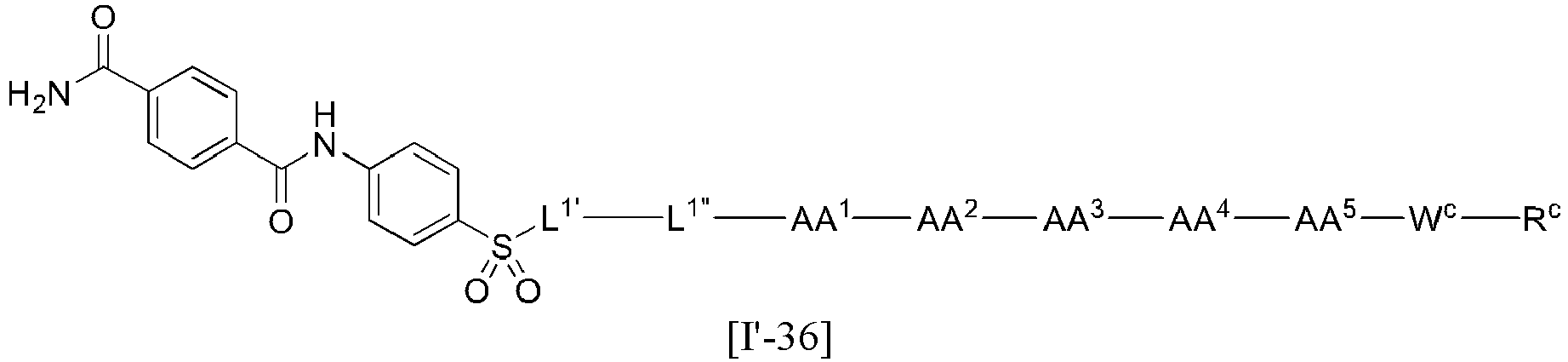
[Table 45] Compound No. L1· L1- AA1 AA2 AA3 AA4 AA5 Wc Rc 792 single bond single bond β - (d)-Asp Dap Leu (N-Me)Glu β - homoPr o single bond NH2 793 single bond single bond β - (d)-Asp Dab Leu (N-Me)Glu β - homoPr o single bond NH2 794 single bond single bond β - (d)-Asp Dap Leu (N-Me)Ile β - homoPr o single bond NH2 795 single bond single bond β - (d)-Asp Dab Leu (N-Me)Ile β - homoPr o single bond NH2 796 single bond single bond γ - (d)-Glu Dab Leu (N-Me)Ile Ape single bond NH2 797 single bond single bond γ - (d)-Glu Dab Leu (N-Me) Ile Acp single bond NH2 798 single bond single bond γ - (d)-Glu Dab Leu (N-Me)Glu Ape single bond NH2 799 single bond single bond γ - (d)-Glu Dab Leu (N-Me)Glu Acp single bond NH2 800 single bond single bond γ - (d)-Glu Dab Leu (N-Me)Glu γ -Dab single bond NH2 801 single bond single bond γ - (d)-Glu Dab Ala(cP ropyl) (N-Me)Ile Ape single bond NH2 802 single bond single bond γ - (d)-Glu Dab Ala(4-Thz) (N-Me)Ile Ape single bond NH2 803 single bond single bond β - (d)-Asp Dab Leu (N-Me)Ile Ape (d) - Lys NH2 804 single bond single bond β - (d)-Asp Dab Leu (N-Me)Ile Ape (d)-Arg NH2 805 single bond single bond β - (d)-Asp Dab Leu (N-Me)Ile Ape (d)-Arg-(d)-Lys NH2 806 single bond single bond β - (d)-Asp Dab Leu (N-Me) Ile Ape (d)-Arg (d) -Arg NH2 807 single bond single bond β - (d)-Asp Dab Leu (N-Me)Ile Ape (d)-Lys(d) -Lys NH2 808 single bond single bond γ - (d)-Glu Dab Leu (N-Me)Ile Ape (d)-Arg NH2 809 single bond single bond γ - (d)-Glu Dab Leu (N-Me)Ile Ape (d)-Arg(d) -Lys NH2 810 single bond single bond γ - (d)-Glu Dab Leu (N-Me)Ile Ape (d)-Lys (d) -Arg NH2 811 single bond single bond γ - (d)-Glu Dab Leu (N-Me)Ile Ape (d)-Lys (d) -Lys NH2 812 single bond single bond γ - (d)-Glu Dab Leu (N-Me)Ile Ape (d)-Lys NH2 813 single bond single bond γ - (d)-Glu Dab Leu (N-Me)Ile Ape (d)-Arg (d) -Arg NH2 814 single bond single bond γ - (d)-Glu Dab Leu (N-Me)Ile β - (d)-Dap single bond NH2 815 single bond single bond γ - (d)-Glu Dab Leu (N-Me)Ile δ -Orn single bond NH2 816 single bond single bond γ - (d)-Glu Dab Leu (N-Me)Ile δ-(d)-Orn single bond NH2 817 single bond single bond γ - (d)-Glu Dab Leu (N-Me)Ile ε -Lys single bond NH2 818 single bond single bond γ - (d)-Glu Dab Leu (N-Me)Ile ε-(d)-Lys single bond NH2 819 single bond single bond γ - (d)-Glu Dab Leu (N-Me)Ile β-homoPr o single bond NH2 820 single bond single bond γ - (d)-Glu Dab Leu (N-Me)Ile β - homoPr o (d)-Lys NH2 821 single bond single bond γ - (d)-Glu Da b Leu (N-Me)Ile β-homoPr o (d)-Arg NH2 822 single bond single bond γ-(d)-Glu Dab Leu (N-Me)Ile β - homoPr o (d)-Arg(d) -Lys NH2 823 single bond single bond γ - (d)-Glu Dab Leu (N-Me)Ile β - homoPr o (d)-Arg(d) -Arg NH2 824 single bond single bond γ - (d)-Glu Dab Leu (N-Me)Ile β - homoPr o (d)-Lys(d) -Arg NH2 825 single bond single bond γ - (d)-Glu Dab Leu (N-Me)Ile β - homoPr o (d)-Lys(d) -Lys NH2 826 single bond single bond γ - (d)-Glu Dab Leu (N-Me)Val Ape single bond NH2 827 single bond single bond γ - (d)-Glu Dab Leu (N-Me)Val β - homoPr o single bond NH2 828 single bond single bond γ-(d)-Glu Dab Leu (N-Me)Ile Ape Gly-(d)-Lys NH2 829 single bond single bond γ - (d)-Glu Dab Leu (N-Me)Ile- Ape Gly-(d)-Arg NH2 830 single bond single bond γ - (d)-Glu Dab Leu (N-Me)Ile Ape Gly-(d) - Arg-(d)-Arg NH2 831 single bond single bond γ - (d)-Glu Dab Leu (N-Me)Ile Ape Gly-(d)-Lys(d) -Arg NH2 832 single bond single bond γ - (d)-Glu Dab Leu (N-Me)Ile Ape β - Ala-(d)-Lys NH2 833 single bond single bond γ - (d)-Glu Dab Leu (N-Me)Ile Ape β - Ala-(d) -Arg-(d) -Lys NH2 834 single bond single bond γ - (d)-Glu Dab Leu (N-Me)Ile Ape β-Ala-(d)-Arg-(d)-Arg NH2 835 single bond single bond γ - (d)-Glu Dab Leu (N-Me)Ile Ape β - Ala-(d) -Lys-(d)-Arg NH2 836 single bond single bond γ - (d)-Glu Dab Leu (N-Me)Ile Ape Gly-(d) -Arg-(d)-Lys NH2 837 single bond single bond γ - (d)-Glu Dab Leu (N-Me)Ile Ape Gly-(d)-Lys-(d) -Lys MH2 838 single bond single bond β - (d)-Asp Dab Leu (N-Me)Ile β - homoPr o single bond NH2 839 single bond single bond β - (d)-Asp Dab Leu (N-Me)Ile Pro single bond NH2 840 single bond single bond β - (d)-Asp Dab Leu (N-Me)Ile β -Ala single bond NH2 841 single bond single bond β - (d)-Asp Dab Leu (N-Me)Ile GABA single bond NH2 842 single bond single bond β - (d)-Asp Dab Leu (N-Me)Ile Ape single bond NH2 843 single bond single bond β - (d)-Asp Dab Leu (N-Me)Ile Acp single bond NH2 844 single bond single bond β - (d)-Asp Dab Leu (N-Me)Ile β -Dap single bond NH2 845 single bond single bond γ - (d)-Glu Dab Leu (N-Me)Ile Aze (2) single bond MH2 846 single bond single bond γ - (d)-Glu Dab Leu (N-Me)Ile (d)-Aze (2) single bond NH2 847 single bond single bond γ - (d)-Glu Dab Leu (N-Me)Ile Aze (3) single bond NH2 848 single bond single bond γ - (d)-Glu Dab Leu (N-Me)Ile cis-NH(3)c Pen single bond NH2 849 single bond single bond γ - (d)-Glu Dab Leu (N-Me)Ile cis-NlH(3)c Pen single bond NH2 850 single bond single bond γ - (d) - Glu Dab Leu (N-Me)Ile single bond single bond [VI-14] 851 single bond single bond β - (d)-Asp (S)-pipera zine Leu (N-Me)Ile Ape single bond NH2 852 single bond single bond γ -Glu Dab Leu (N-Me)Ile Ape single bond NH2 853 single bond single bond γ - (d)-Glu Dab Leu (N-Me)Leu Ape single bond NH2 854 single bond single bond γ - (d)-Glu Dab Leu (N-Me)Ile Ape single bond OH 855 single bond single bond γ - (d)-Glu (S)-pipera 2ine Leu (N-Me)Ile Ape single bond NH2 856 single bond single bond β - (d)-Asp (S)-pipera zine Leu (N-Me)Ile β-hompPr o single bond NH2 857 single bond single bond γ - (d)-Glu Pro Leu (N-Me)Glu Ape single bond NH2 858 single bond single bond γ - (d)-Glu (2S, 4S )-(4-amino) Pro Leu (N-Me)Glu Ape single bond OH 859 single bond single bond γ-(d)-Glu (2S, 4S )-(4-amino) Pro Leu (N-Me)Glu single bond single bond OH 860 single bond single bond γ - (d)-Glu (2S, 4S )-(4-amino) Pro Leu single bond Ape single bond NH2 861 single bond single bond γ - (d)-Glu (2S, 4S )-(4-amino) Pro Leu single bond β -Ala single bond NH2 862 single bond single bond γ - (d)-Glu (2S, 4S )-(4-amino) Pro Leu single bond GABA single bond NH2 863 single bond single bond γ - (d)-Glu (2S, 4S )-(4-amino) Pro Leu single bond Acp single bond NH2 864 single bond single bond γ - (d)-Glu (2S, 4S )-(4-amino) Pro Leu single bond (d)-Lys single bond NH2 865 single bond single bond β - (d) - Asp (2S, 4S )-(4-amino) Pro Leu (N-Me)Glu single bond single bond NH2 866 single bond single bond γ -Glu (2S, 4S )-(4-amino) Pro Leu (N-Me)Glu single bond single bond NH2 867 single bond single bond γ - (d)-Glu (2S, 4S )-(4-amino) Pro Ile (N-Me)Glu single bond single bond NH2 868 single bond single bond γ - (d)-Glu (2S, 4S )-(4-amino) Pro Leu (N-Me)Ser single bond single bond NH2 869 single bond single bond γ - (d)-Glu (2S, 4S )-(4-amino) Pro Leu (N-Me)Tyr single bond single bond NH2 870 single bond single bond γ - (d)-Glu (2S, 4S )-(4-amino) Pro Leu (N-Me)Phe single bond single bond NH2 871 single bond single bond γ - (d)-Glu (2S, 4S )-(4-amino) Pro Leu (N-Me)Ala single bond single bond NH2 872 single bond single bond γ - (d)-Glu (2S, 4S )-(4-amino) Pro Leu (N-Me)Ile single bond single bond NM2 873 single bond single bond γ - (d)-Glu (2S, 4S )-(4-amino) Pro Leu (N-Me)Val single bond single bond NH2 874 single bond single bond γ - (d)-Glu (2S, 4S )-(4-amino) Pro Leu (N-Me)Leu single bond single bond NH2 875 single bond single bond γ - (d)-Glu (2S, 4S )-(4-amino) Pro Leu (N-Me) Asp single bond single bond NH2 876 single bond single bond γ - (d)-Glu (2S, 4S )-(4-amino) Pro Leu (N-Me)Lys single bond single bond MH2 877 single bond single bond γ - (d)-Glu (2S, 4S )-(4-amino) Pro Leu Gly single bond single bond NH2 878 single bond single bond γ - (d)-Glu (2S, 4S )-(4-amino) Pro Leu (d)-Arg single bond single bond NH2 879 single bond single bond γ - (d)-Glu (2S, 4S )-(4-amino) Pro Leu (d)-Pro single bond single bond NH2 880 single bond single bond γ - (d)-Glu (2S, 4S )-(4-amino) Pro Leu (d)-Ser single bond single bond NH2 881 single bond single bond γ - (d)-Glu (2S, 4S )-(4-amino) Pro Leu (d)-Tyr single bond single bond NH2 882 single bond single bond γ - (d)-Glu (2S, 4S )-(4-amino) Pro Leu (d)-Phe single bond single bond NH2 883 single bond single bond γ - (d)-Glu (2S, 4S )-(4-amino) Pro Leu (d)-Ala single bond single bond NH2 884 single bond single bond γ - (d)-Glu (2S, 4S )-(4-amino) Pro Leu (d)-Thr single bond single bond NH2 885 single bond single bond γ - (d)-Glu (2S, 4S )-(4-amino) Pro Leu (N-Me)Arg single bond single bond NH2 886 single bond single bond γ - (d)-Glu (2S, 4S )-(4-amino) Pro Val (N-Me)Glu single bond single bond NH2 887 single bond single bond γ - (d)-Glu (2S, 4S )-(4-amino) Pro Tyr (N-Me)Glu single bond single bond NH2 888 single bond single bond γ - (d)-Glu (2S, 4S )-(4-amino) Pro Leu, (d)-(N-Me)Glu Ape single bond NH2 889 single bond single bond γ - (d)-Glu (2S, 4S )-(4-amino) Pro Leu Glu Ape single bond NH2 890 single bond single bond γ - (d)-Glu (2S, 4S )-(4-amino) Pro Leu (N-Me)Glu Ape Ape NH2 - The structures of compounds represented by formula [I'-37], which were synthesized in Example 8 or with the same method as in Example 8, are shown in the following table.

[Table 46] Compound No. RBI LNI AA2 L3 AA4 AA5 Rc 891 H S02 Ala Gly (N-Me) Ile β - homoPro OH 892 H S02 Ala Gly (N-Me) Ile β - homoPro NH2 893 H S02 Ala GABA (N-Me) lie β-homoPro NII2 894 H S02 Dab β-Ala (N-Me) Ile β - homoPro NH2 895 H S02 Dab β -Ala (N-Me) Asp β - homoPro NH2 896 H S02 Dab β -Ala (N-Me) Ile single bond NH2 897 F C0 Ala β -Ala (N-Me) Ile β - homoPro NH2 898 F C0 Dab β -Ala (N-Me) Ile β - homoPro NH2 899 F C0 Dab β -Ala (N-Me) Asp β - homoPro NH2 - The structures of compounds represented by formula [I'-38], which were synthesized in Example 9 or with the same method as in Example 9, are shown in the following table.

[Table 47] Compound No. L' L1- AAN5 AAN4 AAN3 n AA1 AA2 AA3 AA2 AA5 900 GABA Lys γ-Glu Adox Adox 4 Asp Ala Leu (N-Me) Ile β - homoPro 901 GABA Lys γ - Glu Adox Adox 6 Asp Ala Leu (N-Me) Ile β-homoPro 902 GABA Lys Lys Lys Lys 8 Asp Ala Leu (N-Me) Ile β-homoPro 903 GABA Lys γ-Glu Adox Adox 14 Asp Ala Leu (N-Me) Ile β - homoPro 904 GABA Lys γ _ Glu Adox Adox 16 Asp Ala Leu (N-Me) Ile β-homoPro 905 GABA Lys Lys Lys Lys 14 Asp Ala Leu (N-Me) Ile β-homoPro 906 GABA Lys γ-Glu Adox Adox 14 Asp Dab Leu (N-Me) Glu β-homoPro 907 GABA Lys Lys Lys Lys 14 Asp Dab Leu (N-Me) Glu β - homoPro 908 GABA Lys (d)-Lys (d) - Lys (d)-Lys 14 Asp Dab Leu (N-Me) Ile β-homoPro 909 GABA Lys (d) - Lys (d)-Lys (d)-Lys 14 Asp Dab Leu (N-Me) Glu β-homoPro 910 GABA (d)-Lys γ - Glu Adox Adox 14 Asp Dab Leu (N-Me) Glu β-homoPro 911 GABA (d)-Lys (d) - Lys (d) - Lys (d) - Lys 14 Asp Dab Leu (N-Me) Glu β - homoPro - The structures of compounds represented by formula [I'-39], which were synthesized with the same method as in Example 9, are shown in the following table.

[Table 48] Compound No. RB1 L1' AAN5 AAN4 AAN3 AAN2 AAN1 n AA1 AA2 AA3 AA4 AA5 912 F GAB A (d) Lys (d) - Lys (d) - Lys single bond single bond 14 Asp Dab Leu (N-Me) I le β - hom oPr o 913 F GAB A (d) - Lys (d) - Lys (d) - Lys single bond single bond 14 Asp Dab Leu (N-Me) A sp β - hom oPr o 914 H2NC 0 GAB A γ-Glu Ado x Ado x single bond single bond 14 Asp Dab Leu (N-Me) I le β - hom oPr o 915 H2NC 0 GAB A γ-Glu Ado x Ado x single bond single bond 14 Asp Dab Leu (N-Me) A sp β" hom oPr o 916 H2NC 0 GAB A (d) - Lys (d) - Lys (d) - Lys single bond single bond 14 Asp Dab Leu (N-Me) I Ie β-hom oPr o 917 H2NC 0 GAB A (d) - Lys (d) - Lys (d) - Lys single bond single bond 14 Asp Dab Leu (N-Me) A sp β-hom oPr o 918 H2NC 0 Ape γ - Glu Ado x Ado x single bond single bond 14 Asp Dab Leu (N-Me)G lu β-hom oPr o 919 H2NC. 0 Ape γ-Glu Ado x Ado x single bond single bond 14 Asp Dab Leu (N-Me) I le β-hom oPr o 920 H2NC 0 Ape (d) - Lys (d) - Lys (d) Lys single bond single bond 14 Asp Dab Leu (N-Me)G lu β - hom oPr o 921 H2NC 0 Ape (d) - Lys (d) - Lys (d) - Lys single bond single bond 14 Asp Dab Leu (N-Me) I le β-hom oPr o 922 H2NC 0 Ape γ - Glu Ado x Ado x single bond single bond 12 Asp Dab Leu (N-Me)G lu β - hom oPr o 923 H2NC 0 Ape γ - Glu Ado x Ado x single bond single bond 12 Asp Dab Leu (N-Me) I le β - hom oPr o 924 H2NC 0 Ape (d) - Lys (d) - Lys (d) - Lys single bond single bond 12 Asp Dab Leu (N-Me) G lu β - hom oPr o 925 H2NC 0 Ape (d) - Lys (d) - Lys (d) Lys single bond single bond 12 Asp Dab Leu (N-Me) I le β - hom oPr o 926 H2NC 0 Ape (d) - Lys single bond single bond single bond single bond 14 Asp Dab Leu (N-Me) I le β - hom oPr o 927 H2NC 0 Ape (d) - Lys (d) - Lys single bond single bond single bond 14 Asp Dab Leu (N-Me)I le β - hom oPr o 928 H2NC 0 Ape (d) - Lys (d) - Lys (d) - Lys (d) - Lys single bond 14 Asp Dab Leu (N-Me) I le β - hom oPr o 929 H2NC 0 Ape (d) Lys (d) Lys (d) Lys (d) Lys (d) Lys 14 Asp Dab Leu (N-Me) I le β-hom oPr o 930 H2NC 0 Ape (d) - Lys single bond single bond single bond single bond 12 Asp Dab Leu (N-Me)G lu β - hom oPr o 931 H2NC 0 Ape (d) - Lys (d) - Lys single bond single bond single bond 12 Asp Dab Leu (N-Me) G lu β - hom oPr o 932 H2NC 0 . Ape (d) - Lys (d) - Lys (d) - Lys (d) Lys single bond 12 Asp Dab Leu (N-Me)G lu β - hom oPr o 933 H2NC 0 Ape (d) - Lys (d) Lys (d) Lys (d) Lys (d) Lys 12 Asp Dab Leu (N-Me)G lu β - hom oPr o 934 H2NC 0 Ape Lys Lys Lys single bond single bond 12 Asp Dab Leu (N-Me)G lu β - hom oPr o 935 H2NC 0 Ape Arg Arg Arg single bond single bond 12 Asp Dab Leu (N-Me)G lu β - hom oPr o 936 HsNC. 0 Ape (d) - Arg (d) - Arg (d) Arg single bond single bond 12 Asp Dab Leu (N-Me)G lu β - hom oPr o 937 H2NC 0 Ape Ado x Ado x single bond single bond single bond 12 Asp Dab Leu (N-Me)G lu β - hom oPr o 938 H2NG 0 Ape Ado x single bond single bond single bond single bond 12 Asp Dab Leu (N-Me) G lu β - hom oPr o 939 H2NC 0 Ape γ - Glu single bond single bond single bond single bond 12 Asp Dab Leu (N-Me)G lu β - hom oPr o 940 H2NC 0 Ape Ado x Ado x γ-Glu single bond single bond 12 Asp Dab Leu (N-Me) G lu β - hom oPr o 941 H2NC 0 Ape single bond single bond single bond single bond single bond 12 Asp Dab Leu (N-Me)G lu β - hom oPr o 942 H2NC 0 Ape (d) - Lys single bond single bond single bond single bond 12 Asp Dab Leu (N-Me) I le β - hom oPr o 943 H2NC 0 Ape (d) Lys (d) - Lys single bond single bond single bond 12 Asp Dab Leu (N-Me) I le β - hom oPr ο 944 H2NC 0 Ape (d) - Lys single bond single bond single bond single bond 14 Asp Dab Leu (N-Me) G lu β - hom oPr o 946 H2NC 0 Ape (d) - Lys (d) - Lys single bond single bond single bond 14 Asp Dab Leu (N-Me) G lu β - hom oPr o 946 H2NC 0 Ape (d) - Lys (d) - Lys (d) Lys single bond single bond 10 Asp Dab Leu (N-Me)G lu β - hom oPr o 947 H2NC 0 Ape (d) - Lys (d) - Lys (d) - Lys single bond single bond 10 Asp Dab Leu (N-Me) I le β - hom oPr o 948 H2NC 0 Ape (d) Arg single bond single bond single bond single bond 12 Asp Dab Leu (N-Me) G lu β - hom oPr o 949 H2NG 0 Ape (d) - Arg (d) - Arg single bond single bond single bond 12 Asp Dab Leu (N-Me) G lu β - horn oPr o 950 H2NC 0 Ape (d) - Lys (d) - Lys (d) - Lys single bond single bond 12 Asp Dab Leu (N-Me)G lu β - hom oPr o 951 H2NC 0 Ape single bond single bond single bond single bond single bond 12 Asp Dab Leu (N-Me) I le β - hom oPr o 952 H2NC 0 Ape single bond single bond single bond single bond single bond 14 Asp Dab Leu (N-Me) G lu β - hom oPr o 953 H2NC 0 Ape single bond single bond single bond single bond single bond 14 Asp Dab Leu (N-Me) I le β - hom oPr o 954 H2NC 0 Ape (d) - Lys (d) Lys (d) - Lys single bond single bond 16 Asp Dab Leu (N-Me) G lu β - hom oPr o 956 H2NC 0 Ape (d) Lys (d) - Lys (d) - Lys single bond single bond 16 Asp Dab Leu (N-Me)I le β - hom oPr o - The structures of compounds represented by formula [I'-40], which were synthesized with the same method as in Example 9, are shown in the following table:

- the structure represented by formula [VII-2]:
-AAWC1-AAWC2-AAWC3-AAWC4-AAWC5- [VII-2]
- corresponds to WC, which is "linker consisting of one to three amino acids" in the compound represented by formula [I'],
- wherein
- AAWC1, AAWC2, AAWC4, and AAWC5 are same or different and each selected from the group consisting of a single bond and (d)-Lys,
- AAWC3 is Lys or (d)-Lys, and
- AAWCS is a single bond or (d)-Lys.
- Mass spectra of high-performance liquid chromatography (LCMS), retention time (RT), and analysis conditions for the present inventive compounds are shown in the following table.
[Table 50] Compound No. LCMS analysis MS (found) MS (calc.) Retention time RT (min) Analysis condition 1 916.7 [M+H]+ 916.4 [M+H]+ 0.97 A 2 902.5 [M+H]+ 902.4 [M+H]+ 0.98 A 3 902.5 [M+H]+ 902.4 [M+H]+ 0.99 A 4 916.4 [M+H]+ 916.4 [M+H]+ 0.94 A 5 902.4 [M+H]+ 902.4 [M+H]+ 0.81 A 6 916.4 [M+H]+ 916.4 [M+H]+ 0.90 A 7 950.4 [M+H]+ 950.4 [M+H]+ 0.99 A 8 989.4 [M+H]+ 989.4 [M+H]+ 1.01 A 9 900.6 [M+H]+ 900.4 [M+H]+ 1.08 A 10 886.4 [M+H]+ 886.4 [M+H]+ 1.02 A 11 900.5 [M+H]+ 900.4 [M+H]+ 1.10 A 12 858.4 [M+H]+ 858.4 [M+H]+ 0.98 A 13 934.4 [M+H]+ 934.4 [M+H]+ 1.20 A 14 950.5 [M+H]+ 950.4 [M+H]+ 1.02 A 15 874.4 [M+H]+ 874.4 [M+H]+ 0.88 A 16 870.4 [M+H]+ 870.4 [M+H]+ 0.96 A 17 914.5 [M+H]+ 914.4 [M+H]+ 0.99 A 18 900.4 [M+H]+ 900.3 [M+H]+ 0.95 A 19 900.3 [M+H]+ 900.3 [M+H]+ 0.92 A 20 928.6 [M+H]+ 928.4 [M+H]+ 1.01 A 21 914.4 [M+H]+ 914.4 [M+H]+ 0.94 A 22 888.3 [M+H]+ 888.3 [M+H]+ 0.87 A 23 902.4 [M+H]+ 902.4 [M+H]+ 0.89 A 24 930.4 [M+H]+ 930.4 [M+H]+ 0.99 A 25 914.4 [M+H]+ 914.4 [M+H]+ 0.91 A 26 945.5 [M+H]+ 945.4 [M+H]+ 0.69 A 27 945.4 [M+H]+ 945.4 [M+H]+ 0.69 A 28 973.4 [M+H]+ 973.4 [M+H]+ 0.70 A 29 973.4 [M+H]+ 973.4 [M+H]+ 0.71 A 30 817.3 [M+H]+ 817.3 [M+H]+ 0.89 A 31 674.1 [M+H]+ 674.3 [M+H]+ 0.85 A 32 1013.5 [M+H]+ 1013.4 [M+H]+ 1.00 A 33 1042.7 [M-H]- 1042.5 [M-H]- 0.74 A 34 1042.6 [M-H]- 1042.5 [M-H]- 0.74 A 35 1070.7 [M-H]- 1070.5 [M-H]- 0.75 A 36 1070.5 [M-H]- 1070.5 [M-H]- 0.76 A 37 587.0 [M+2H]2+ 586.8 [M+2H]2+ 0.64 A 38 898.7 [M+H]+ 898.4 [M+H]+ 1.07 A 39 912.6 [M+H]+ 912.4 [M+H]+ 1.06 A 40 830.3 [M+H]+ 830.4 [M+H]+ 1.28 A 41 860.4 [M+H]+ 860.4 [M+H]+ 1.27 A 42 864.4 [M+H]+ 864.3 [M+H]+ 1.38 A 43 848.4 [M+H]+ 848.4 [M+H]+ 1.30 A 44 846.4 [M+H]+ 846.4 [M+H]+ 1.28 A 45 877.5 [M+H]+ 877.4 [M+H]+ 1.46 A 46 877.5 [M+H]+ 877.4 [M+H]+ 1.47 A 47 875.5 [M-H]- 875.4 [M-H]- 1.48 A 48 888.5 [M-H]- 888.3 [M-H]- 1.74 A 49 876.5 [M-H]- 876.3 [M-H]- 1.71 A 50 905.6 [M+H]+ 905.3 [M+H]+ 1.36 A 51 889.5 [M+H]+ 889.4 [M+H]+ 1.44 A 52 893.5 [M+H]+ 893.3 [M+H]+ 1.32 A 53 907.5 [M+H]+ 907.3 [M+H]+ 1.29 A 54 903.6 [M+H]+ 903.4 [M+H]+ 1.40 A 55 903.6 [M+H]+ 903.4 [M+H]+ 1.40 A 56 976.4 [M+H]+ 976.4 [M+H]+ 1.66 A 57 956.6 [M-H]- 956.4 [M-H]- 1.63 A 58 970.7 [M-H]- 970.4 [M-H]- 1.65 A 59 970.6 [M-H]- 970.4 [M-H]- 1.64 A 60 985.0 [M-H]- 984.5 [M-H]- 1.72 A 61 1001.6 [M+H]+ 1001.5 [M+H]+ 1.37 A 62 1015.6 [M+H]+ 1015.5 [M+H]+ 1.35 A 63 1029.6 [M+H]+ 1029.5 [M+H]+ 1.35 A 64 988.6 [M+H]+ 988.4 [M+H]+ 1.59 A 65 984.6 [M-H]- 984.5 [M-H]- 1.66 A 66 1000.6 [M-H]- 1000.4 [M-H]- 1.58 A 67 1001.6 [M+H]+ 1001.5 [M+H]+ 1.33 A 68 1031.6 [M+H]+ 1031.4 [M+H]+ 1.29 A 69 1017.5 [M+H]+ 1017.4 [M+H]+ 1.29 A 70 1027.7 [M-H]- 1027.5 [M-H]- 1.40 A 71 1015.6 [M+H]+ 1015.5 [M+H]+ 1.37 A 72 1045.6 [M+H]+ 1045.5 [M+H]+ 1.31 A 73 1031.5 [M+H]+ 1031.4 [M+H]+ 1.30 A 74 973.6 [M+H]+ 973.4 [M+H]+ 1.31 A 75 1002.6 [M+H]+ 1002.4 [M+H]+ 1.60 A 76 1032.7 [M+H]+ 1032.4 [M+H]+ 1.35 A 77 1078.7 [M+H]+ 1078.4 [M+H]+ 1.39 A 78 1047.7 [M+H]+ 1047.5 [M+H]+ 1.44 A 79 1063.6 [M+H]+ 1063.4 [M+H]+ 1.37 A 80 1088.8 [M+H]+ 1088.5 [M+H]+ 1.06 A 81 1102.7 [M+H]+ 1102.5 [M+H]+ 1.06 A 82 1025.6 [M+H]+ 1025.5 [M+H]+ 1.03 A 83 1037.7 [M-H]- 1037.5 [M-H]- 1.02 A 84 1032.8 [M+H]+ 1032.5 [M+H]+ 1.37 A 85 1016.7 [M+H]+ 1016.5 [M+H]+ 1.45 A 86 1050.7 [M+H]+ 1050.5 [M+H]+ 1.42 A 87 1034.7 [M+H]+ 1034.5 [M+H]+ 1.48 A 88 1103.8 [M-H]- 1103.5 [M-H]- 1.20 A 89 1089.8 [M+H]+ 1089.5 [M+H]+ 1.25 A 90 1188.1 [M-H]- 1187.6 [M-H]- 1.16 A 91 1216.0 [M-H]- 1215.6 [M-H]- 1.19 A 92 905.7 [M-H]- 905.5 [M-H]- 1.72 A 93 923.6 [M-H]- 923.5 [M-H]- 1.73 A 94 948.7 [M-H]- 948.5 [M-H]- 1.62 A 95 966.6 [M-H]- 966.5 [M-H]- 1.65 A 96 893.7 [M-H]- 893.5 [M-H]- 1.80 A 97 911.7 [M-H]- 911.5 [M-H]- 1.82 A 98 938.7 [M+H]+ 938.5 [M+H]+ 1.71 A 99 956.7 [M+H]+ 956.5 [M+H]+ 1.74 A 100 919.7 [M-H]- 919.5 [M-H]- 1.73 A 101 937.7 [M-H]- 937.5 [M-H]- 1.75 A 102 933.7 [M-H]- 933.5 [M-H]- 1.81 A 103 962.6 [M-H]- 962.5 [M-H]- 1.63 A 104 980.7 [M-H]- 980.5 [M-H]- 1.66 A 105 976.7 [M-H]- 976.5 [M-H]- 1.71 A 106 979.7 [M+H]+ 979.5 [M+H]+ 1.33 A 107 965.7 [M+H]+ 965.5 [M+H]+ 1.28 A 108 995.6 [M+H]+ 995.5 [M+H]+ 1.25 A 109 981.6 [M+H]+ 981.5 [M+H]+ 1.23 A 110 993.7 [M+H]+ 993.5 [M+H]+ 1.34 A 111 979.6 [M+H]+ 979.5 [M+H]+ 1.31 A 112 1009.6 [M+H]+ 1009.5 [M+H]+ 1.26 A 113 995.6 [M+H]+ 995.5 [M+H]+ 1.25 A 114 934.7 [M-H]- 934.5 [M-H]- 1.60 A 115 891.6 [M-H]- 891.5 [M-H]- 1.66 A 116 903.6 [M-H]- 903.5 [M-H]- 1.68 A 117 917.6 [M-H]- 917.5 [M-H]- 1.74 A 118 931.7 [M-H]- 931.5 [M-H]- 1.76 A 119 933.7 [M-H]- 933.5 [M-H]- 1.80 A 120 947.7 [M-H]- 947.5 [M-H]- 1.85 A 121 947.7 [M-H]- 947.5 [M-H]- 1.85 A 122 965.6 [M-H]- 965.5 [M-H]- 1.79 A 123 948.7 [M-H]- 948.5 [M-H]- 1.33 A 124 981.7 [M-H]- 981.5 [M-H]- 1.87 A 125 949.6 [M-H]- 949.5 [M-H]- 1.65 A 126 963.7 [M-H]- 963.5 [M-H]- 1.67 A 127 962.6 [M-H]- 962.5 [M-H]- 1.35 A 128 948.7 [M-H]- 948.5 [M-H]- 1.60 A 129 997.7 [M-H]- 997.5 [M-H]- 1.74 A 130 1020.6 [M-H]- 1020.5 [M-H]- 1.85 A 131 935.7 [M-H]- 935.5 [M-H]- 1.41 A 132 932.8 [M-H]- 932.5 [M-H]- 1.40 A 133 946.7 [M-H]- 946.5 [M-H]- 1.39 A 134 996.6 [M+H]+ 996.5 [M+H]+ 1.50 A 135 962.7 [M-H]- 962.5 [M-H]- 1.49 A 136 978.7 [M+H]+ 978.6 [M+H]+ 1.54 A 137 997.7 [M+H]+ 997.5 [M+H]+ 1.32 A 138 1011.8 [M+H]+ 1011.5 [M+H]+ 1.35 A 139 1013.6 [M+H]+ 1013.5 [M+H]+ 1.29 A 140 1027.7 [M+H]+ 1027.5 [M+H]+ 1.28 A 141 999.6 [M+H]+ 999.5 [M+H]+ 1.28 A 142 1013.6 [M+H]+ 1013.5 [M+H]+ 1.28 A 143 980.8 [M+H]+ 980.5 [M+H]+ 1.38 A 144 1010.7 [M+H]+ 1010.5 [M+H]+ 1.27 A 145 995.7 [M+H]+ 995.5 [M+H]+ 1.07 A 146 964.7 [M+H]+ 964.5 [M+H]+ 1.46 A 147 994.7 [M+H]+ 994.5 [M+H]+ 1.34 A 148 977.9 [M-H]- 977.6 [M-H]- 1.10 A 149 1013.7 [M+H]+ 1013.5 [M+H]+ 1.26 A 150 998.7 [M+H]+ 998.5 [M+H]+ 1.42 A 151 1028.6 [M+H]+ 1028.5 [M+H]+ 1.30 A 152 1013.6 [M+H]+ 1013.5 [M+H]+ 1.09 A 153 997.7 [M+H]+ 997.5 [M+H]+ 1.35 A 154 993.7 [M+H]+ 993.5 [M+H]+ 1.37 A 155 996.7 [M+H]+ 996.5 [M+H]+ 1.30 A 156 980.7 [M+H]+ 980.5 [M+H]+ 1.39 A 157 854.4 [M-2H]2- 854.5 [M-2H]2- 1.44 A 158 870.7 [M+2H]2+ 870.5 [M+2H]2+ 1.56 A 159 1675.3 [M-H]- 1675.0 [M-H]- 1.01 A 160 853.4 [M+2H]2+ 853.0 [M+2H]2+ 1.10 A 161 1012.6 [M-H]- 1012.5 [M-H]- 1.36 A 162 1025.7 [M-H]- 1025.5 [M-H]- 1.28 A 163 1026.0 [M-H]- 1025.5 [M-H]- 1.31 A 164 1041.8 [M+H]+ 1041.5 [M+H]+ 1.28 A 165 1025.8 [M+H]+ 1025.5 [M+H]+ 1.35 A 166 1039.7 [M+H]+ 1039.5 [M+H]+ 1.33 A 167 1055.7 [M+H]+ 1055.5 [M+H]+ 1.25 A 168 1087.7 [M+H]+ 1087.5 [M+H]+ 1.10 A 169 1060.6 [M+H]+ 1060.5 [M+H]+ 1.10 A 170 1059.6 [M-H]- 1059.5 [M-H]- 1.94 B 171 1062.6 [M+H]+ 1062.5 [M+H]+ 1.98 B 172 1020.6 [M+H]+ 1020.5 [M+H]+ 1.97 B 173 996.8 [M+H]+ 996.5 [M+H]+ 1.30 A 174 980.8 [M+H]+ 980.5 [M+H]+ 1.38 A 175 1152.0 [M-H]- 1151.6 [M-H]- 1.11 A 176 1180.0 [M-H]- 1179.6 [M-H]- 1.14 A 177 995.7 [M-H]- 995.4 [M-H]- 1.30 A 178 1055.4 [M+H]+ 1055.4 [M+H]+ 1.29 A 179 548.7 [M+2H]2+ 548.3 [M+2H]2+ 0.82 A 180 555.7 [M+2H]2+ 555.3 [M+2H]2+ 0.84 A 181 1121.8 [M-H]- 1121.6 [M-H]- 0.86 A 182 1110.7 [M+H]+ 1110.5 [M+H]+ 1.03 A 183 1124.7 [M+H]+ 1124.5 [M+H]+ 1.04 A 184 1079.0 [M-H]- 1078.6 [M-H]- 0.91 A 185 1063.4 [M-H]- 1062.6 [M-H]- 1.00 A 186 1093.0 [M-H]- 1092.6 [M-H]- 0.97 A 187 1077.0 [M-H]- 1076.6 [M-H]- 1.01 A 188 1106.9 [M-H]- 1106.6 [M-H]- 0.94 A 189 1090.9 [M-H]- 1090.6 [M-H]- 1.00 A 190 1121.1 [M-H]- 1120.6 [M-H]- 0.97 A 191 1105.0 [M-H]- 1104.6 [M-H]- 1.02 A 192 1093.1 [M-H]- 1092.6 [M-H]- 0.99 A 193 1077.0 [M-H]- 1076.6 [M-H]- 1.03 A 194 1106.9 [M-H]- 1106.6 [M-H]- 1.01 A 195 1091.0 [M-H]- 1090.6 [M-H]- 1.05 A 196 1121.0 [M-H]- 1120.6 [M-H]- 1.00 A 197 1105.0 [M-H]- 1104.6 [M-H]- 1.04 A 198 1118.9 [M-H]- 1118.6 [M-H]- 1.06 A 199 1164.8 [M-H]- 1164.6 [M-H]- 1.05 A 200 1151.7 [M+H]+ 1151.6 [M+H]+ 1.17 A 201 1150.7 [M+H]+ 1150.6 [M+H]+ 1.12 A 202 958.5 [M+H]+ 958.4 [M+H]+ 1.62 A 203 1059.7 [M+H]+ 1059.5 [M+H]+ 1.36 A 204 1073.7 [M+H]+ 1073.5 [M+H]+ 1.34 A 205 1016.7 [M+H]+ 1016.5 [M+H]+ 1.40 A 206 1084.7 [M+H]+ 1084.5 [M+H]+ 1.07 A 207 1098.7 [M+H]+ 1098.5 [M+H]+ 1.07 A 208 1041.7 [M+H]+ 1041.5 [M+H]+ 1.12 A 209 1070.6 [M+H]+ 1070.5 [M+H]+ 1.04 A 210 1038.7 [M+H]+ 1038.5 [M+H]+ 1.49 B 211 1023.7 [M+H]+ 1023.5 [M+H]+ 1.62 B 212 1053.7 [M+H]+ 1053.5 [M+H]+ 1.52 B 213 1038.7 [M+H]+ 1038.5 [M+H]+ 1.33 B 214 1022.7 [M+H]+ 1022.5 [M+H]+ 1.57 B 215 1007.7 [M+H]+ 1007.6 [M+H]+ 1.70 B 216 1037.6 [M+H]+ 1037.5 [M+H]+ 1.59 B 217 1020.6 [M-H]- 1020.6 [M-H]- 1.44 B 218 1036.7 [M+H]+ 1036.5 [M+H]+ 1.08 A 219 1052.7 [M+H]+ 1052.5 [M+H]+ 1.03 A 220 1066.6 [M+H]+ 1066.5 [M+H]+ 1.03 A 221 1024.7 [M+H]+ 1024.5 [M+H]+ 0.98 A 222 1052.7 [M+H]+ 1052.5 [M+H]+ 1.02 A 223 1067.7 [M+H]+ 1067.5 [M+H]+ 1.04 A 224 1010.6 [M+H]+ 1010.5 [M+H]+ 1.00 A 225 1024.5 [M+H]+ 1024.5 [M+H]+ 1.01 A 226 1038.6 [M+H]+ 1038.5 [M+H]+ 1.03 A 227 1039.6 [M+H]+ 1039.5 [M+H]+ 1.03 A 228 1053.6 [M+H]+ 1053.5 [M+H]+ 1.04 A 229 1008.7 [M+H]+ 1008.5 [M+H]+ 1.05 A 230 1036.7 [M+H]+ 1036.5 [M+H]+ 1.09 A 231 1023.7 [M+H]+ 1023.5 [M+H]+ 1.07 A 232 1051.7 [M+H]+ 1051.5 [M+H]+ 1.10 A 233 1066.6 [M+H]+ 1066.5 [M+H]+ 1.02 A 234 1050.6 [M+H]+ 1050.6 [M+H]+ 1.07 A 235 1039.7 [M+H]+ 1039.5 [M+H]+ 1.04 A 236 1023.7 [M+H]+ 1023.5 [M+H]+ 1.12 A 237 1053.7 [M+H]+ 1053.5 [M+H]+ 1.04 A 238 1039.7 [M+H]+ 1039.5 [M+H]+ 1.04 A 239 1023.7 [M+H]+ 1023.5 [M+H]+ 1.11 A 240 1025.6 [M+H]+ 1025.5 [M+H]+ 1.04 A 241 1024.6 [M+H]+ 1024.5 [M+H]+ 1.02 A 242 1053.6 [M+H]+ 1053.5 [M+H]+ 1.04 A 243 1052.6 [M+H]+ 1052.5 [M+H]+ 1.00 A 244 1036.7 [M-H]+ 1036.5 [M-H]+ 1.05 A 245 1065.8 [M+H]+ 1065.6 [M+H]+ 0.95 A 246 1079.8 [M+H]+ 1079.6 [M+H]+ 0.95 A 247 533.6 [M+2H]2+ 533.3 [M+2H]2+ 0.90 A 248 1050.7 [M+H]+ 1050.6 [M+H]+ 1.06 A 249 1064.7 [M+H]+ 1064.6 [M+H]+ 1.07 A 250 1038.7 [M+H]+ 1038.5 [M+H]+ 0.99 A 251 1022.7 [M+H]+ 1022.5 [M+H]+ 1.05 A 252 1024.7 [M+H]+ 1024.5 [M+H]+ 1.00 A 253 1052.6 [M+H]+ 1052.5 [M+H]+ 1.00 A 254 1064.8 [M+H]+ 1064.6 [M+H]+ 1.16 A 255 1104.8 [M+H]+ 1104.6 [M+H]+ 1.31 A 256 1066.7 [M+H]+ 1066.5 [M+H]+ 1.04 A 257 1080.7 [M+H]+ 1080.5 [M+H]+ 1.04 A 258 1081.7 [M+H]+ 1081.5 [M+H]+ 1.07 A 259 1053.6 [M+H]+ 1053.5 [M+H]+ 1.07 A 260 1067.7 [M+H]+ 1067.5 [M+H]+ 1.06 A 261 1051.6 [M+H]+ 1051.5 [M+H]+ 1.13 A 262 1082.7 [M+H]+ 1082.5 [M+H]+ 1.09 A 263 1098.6 [M+H]+ 1098.5 [M+H]+ 1.03 A 264 1097.7 [M+H]+ 1097.5 [M+H]+ 1.11 A 265 1113.6 [M+H]+ 1113.5 [M+H]+ 1.05 A 266 1096.6 [M+H]+ 1096.6 [M+H]+ 1.07 A 267 1112.7 [M+H]+ 1112.5 [M+H]+ 1.03 A 268 1066.7 [M+H]+ 1066.5 [M+H]+ 1.03 A 269 1092.7 [M+H]+ 1092.5 [M+H]+ 1.06 A 270 1106.7 [M+H]+ 1106.6 [M+H]+ 1.11 A 271 1136.7 [M+H]+ 1136.6 [M+H]+ 1.03 A 272 1096.6 [M+H]+ 1096.5 [M+H]+ 1.01 A 273 1076.7 [M+H]+ 1076.6 [M+H]+ 1.16 A 274 1092.6 [M+H]+ 1092.6 [M+H]+ 1.07 A 275 1090.7 [M+H]+ 1090.6 [M+H]+ 1.22 A 276 1120.7 [M+H]+ 1120.6 [M+H]+ 1.10 A 277 1080.6 [M+H]+ 1080.6 [M+H]+ 1.07 A 278 1103.7 [M+H]+ 1103.5 [M+H]+ 1.09 A 279 1036.8 [M+H]+ 1036.5 [M+H]+ 1.06 A 280 1052.7 [M+H]+ 1052.5 [M+H]+ 1.02 A 281 1050.7 [M+H]+ 1050.6 [M+H]+ 1.08 A 282 1066.7 [M+H]+ 1066.5 [M+H]+ 1.03 A 283 1036.8 [M+H]+ 1036.5 [M+H]+ 1.06 A 284 1052.6 [M+H]+ 1052.5 [M+H]+ 1.00 A 285 1025.7 [M+H]+ 1025.5 [M+H]+ 1.02 A 286 1007.7 [M-H]- 1007.5 [M-H]- 1.04 A 287 1085.7 [M+H]+ 1085.5 [M+H]+ 1.22 A 288 1085.7 [M+H]+ 1085.5 [M+H]+ 1.21 A 289 1101.7 [M+H]+ 1101.5 [M+H]+ 1.11 A 290 1101.5 [M+H]+ 1101.5 [M+H]+ 1.11 A 291 527.6 [M+2H]2+ 527.3 [M+2H]2+ 0.83 A 292 534.5 [M+2H]2+ 534.3 [M+2H]2+ 0.80 A 293 505.9 [M+2H]2+ 505.8 [M+2H]2+ 0.86 A 294 506.0 [M+2H]2+ 505.8 [M+2H]2+ 0.86 A 295 993.5 [M-H]- 993.5 [M-H]- 1.03 A 296 520.0 [M+2H]2+ 519.8 [M+2H]2+ 0.85 A 297 513.1 [M+2H]2+ 512.8 [M+2H]2+ 0.87 A 298 1036.8 [M-H]- 1036.5 [M-H]- 0.86 A 299 1051.8 [M-H]- 1051.5 [M-H]- 0.76 A 300 991.7 [M+H]+ 991.5 [M+H]+ 1.11 A 301 1007.6 [M+H]+ 1007.5 [M+H]+ 1.04 A 302 1005.6 [M+H]+ 1005.5 [M+H]+ 1.12 A 303 1021.6 [M+H]+ 1021.5 [M+H]+ 1.06 A 304 1051.7 [M+H]+ 1051.5 [M+H]+ 1.11 A 305 534.5 [M+2H]2+ 534.2 [M+2H]2+ 1.05 A 306 1037.7 [M-H]- 1037.5 [M-H]- 0.78 A 307 1037.7 [M-H]- 1037.5 [M-H]- 0.75 A 308 1081.8 [M+H]+ 1081.5 [M+H]+ 1.07 A 309 1035.8 [M+H]+ 1035.6 [M+H]+ 1.31 A 310 1048.9 [M-H]- 1048.6 [M-H]- 0.98 A 311 1066.8 [M+H]+ 1066.6 [M+H]+ 0.88 A 312 1062.8 [M-H]- 1062.6 [M-H]- 1.00 A 313 1078.9 [M-H]- 1078.6 [M-H]- 0.91 A 314 1038.7 [M+H]+ 1038.5 [M+H]+ 1.06 A 315 1011.7 [M+H]+ 1011.5 [M+H]+ 1.07 A 316 1071.7 [M+H]+ 1071.5 [M+H]+ 1.18 A 317 1044.7 [M+H]+ 1044.5 [M+H]+ 1.18 A 318 1065.7 [M+H]+ 1065.6 [M+H]+ 1.11 A 319 1039.8 [M+H]+ 1039.5 [M+H]+ 1.04 A 320 1039.7 [M+H]+ 1039.5 [M+H]+ 1.03 A 321 1035.7 [M+H]+ 1035.5 [M+H]+ 1.09 A 322 1124.7 [M+H]+ 1124.5 [M+H]+ 1.22 A 323 1049.8 [M+H]+ 1049.6 [M+H]+ 1.32 A 324 1064.8 [M+H]+ 1065.6 [M+H]+ 1.24 A 325 1067.8 [M+H]+ 1067.6 [M+H]+ 1.26 A 326 1082.7 [M+H]+ 1083.5 [M+H]+ 1.17 A 327 1124.7 [M+H]+ 1124.5 [M+H]+ 1.21 A 328 538.6 [M+2H]2+ 538.3 [M+2H]2+ 0.85 A 329 1073.8 [M-H]- 1073.5 [M-H]- 0.85 A 330 1041.7 [M+H]+ 1041.5 [M+H]+ 1.08 A 331 1041.7 [M+H]+ 1041.5 [M+H]+ 1.07 A 332 1092.7 [M-H]- 1092.6 [M-H]- 0.86 A 333 1092.9 [M-H]- 1092.6 [M-H]- 0.86 A 334 534.6 [M+2H]2+ 534.3 [M+2H]2+ 1.03 A 335 1027.7 [M+H]+ 1027.5 [M+H]+ 1.00 A 336 1092.8 [M+H]+ 1092.6 [M+H]+ 1.09 A 337 1108.7 [M+H]+ 1108.6 [M+H]+ 1.05 A 338 1079.8 [M+H]+ 1079.6 [M+H]+ 1.06 A 339 1079.8 [M+H]+ 1079.6 [M+H]+ 1.05 A 340 1095.7 [M+H]+ 1095.5 [M+H]+ 1.01 A 341 1095.7 [M+H]+ 1095.5 [M+H]+ 1.01 A 342 1053.7 [M+H]+ 1053.5 [M+H]+ 1.04 A 343 1053.6 [M+H]+ 1053.5 [M+H]+ 1.04 A 344 1048.9 [M-H]- 1048.6 [M-H]- 0.92 A 345 1053.7 [M+H]+ 1053.5 [M+H]+ 1.20 A 346 1069.7 [M+H]+ 1069.5 [M+H]+ 1.14 A 347 1009.8 [M+H]+ 1009.5 [M+H]+ 1.06 A 348 1023.8 [M+H]+ 1023.5 [M+H]+ 1.08 A 349 984.6 [M+H]+ 984.5 [M+H]+ 1.04 A 350 1422.4 [M-H]- 1421.8 [M-H]- 0.60 A 351 470.1 [M+3M]3+ 469.9 [M+3M]3+ 0.67 A 352 1025.7 [M+H]+ 1025.5 [M+H]+ 1.02 A 353 1009.7 [M+M]+ 1009.5 [M+M]+ 1.07 A 354 1053.7 [M+M]+ 1053.5 [M+M]+ 1.06 A 355 1037.7 [M+M]+ 1037.6 [M+M]+ 1.13 A 356 1076.8 [M-H]- 1076.6 [M-H]- 0.99 A 357 1064.7 [M+H]+ 1064.6 [M+M]+ 1.09 A 358 1080.7 [M+H]+ 1080.5 [M+M]+ 1.04 A 359 1070.6 [M+H]+ 1070.5 [M+M]+ 1.07 A 360 1086.6 [M+H]+ 1086.5 [M+M]+ 1.04 A 361 1038.9 [M-H]- 1038.5 [M-H]- 0.80 A 362 1052.7 [M-H]- 1052.5 [M-H]- 0.83 A 363 1079.8 [M-H]- 1079.6 [M-H]- 0.71 A 364 513.1 [M+2H]2+ 512.8 [M+2H]2+ 0.91 A 365 520.1 [M+2H]2+ 519.8 [M+2H]2+ 0.98 A 366 1064.0 [M-H]- 1063.6 [M-H]- 0.78 A 367 1107.0 [M-H]- 1106.6 [M-H]- 0.94 A 368 1091.1 [M-H]- 1090.6 [M-H]- 1.00 A 369 1064.9 [M-H]- 1064.5 [M-H]- 0.86 A 370 1049.1 [M-H]- 1048.6 [M-H]- 0.99 A 371 1009.9 [M+H]+ 1009.5 [M+H]+ 0.66 A 372 1021.8 [M-H]- 1021.5 [M-H]- 0.66 A 373 1035.9 [M-H]- 1035.6 [M-H]- 0.62 A 374 1092.0 [M-H]- 1091.6 [M-H]- 0.73 A 375 1035.9 [M-H]- 1035.5 [M-H]- 0.68 A 376 1049.9 [M-H]- 1049.6 [M-H]- 0.68 A 377 1065.8 [M+H]+ 1065.6 [M+M]+ 0.67 A 378 1093.8 [M+H]+ 1093.6 [M+M]+ 0.73 A 379 925.5 [M+H]+ 925.5 [M+H]+ 1.13 A 380 955.5 [M+H]+ 955.5 [M+H]+ 1.00 A 381 939.6 [M+H]+ 939.5 [M+H]+ 1.13 A 382 812.5 [M+H]+ 812.4 [M+H]+ 0.97 A 383 1032.7 [M+H]+ 1032.6 [M+H]+ 1.09 A 384 1192.9 [M-H]- 1192.6 [M-H]- 0.86 A 385 1176.9 [M-H]- 1176.6 [M-H]- 0.89 A 386 1221.0 [M-H]- 1220.6 [M-H]- 0.85 A 387 1204.9 [M-H]- 1204.6 [M-H]- 0.93 A 388 1220.9 [M-H]- 1220.6 [M-H]- 0.72 A 389 1205.0 [M-H]- 1204.7 [M-H]- 0.80 A 390 1249.0 [M-H]- 1248.6 [M-H]- 0.74 A 391 1232.9 [M-H]- 1232.7 [M-H]- 0.81 A 392 1036.7 [M+H]+ 1036.5 [M+H]+ 1.05 A 393 1052.7 [M+H]+ 1052.5 [M+H]+ 1.01 A 394 1037.7 [M+H]+ 1037.5 [M+H]+ 1.07 A 395 1053.6 [M+H]+ 1053.5 [M+H]+ 1.04 A 396 1062.9 [M-H]- 1062.6 [M-H]- 0.93 A 397 1078.9 [M-H]- 1078.5 [M-H]- 0.85 A 398 1009.7 [M+H]+ 1009.5 [M+H]+ 1.06 A 399 1025.7 [M+H]+ 1025.5 [M+H]+ 1.02 A 400 1206.8 [M-H]- 1206.6 [M-H]- 0.83 A 401 1191.0 [M-H]- 1190.6 [M-H]- 0.90 A 402 1178.9 [M-H]- 1178.6 [M-H]- 0.82 A 403 1163.0 [M-H]- 1162.6 [M-H]- 0.86 A 404 1179.0 [M-H]- 1178.6 [M-H]- 0.83 A 405 1163.1 [M-H]- 1162.6 [M-H]- 0.86 A 406 1206.9 [M-H]- 1206.6 [M-H]- 0.84 A 407 1191.0 [M-H]- 1190.6 [M-H]- 0.88 A 408 1110.0 [M-H]- 1109.5 [M-H]- 0.79 A 409 1093.9 [M-H]- 1093.6 [M-H]- 0.99 A 410 1081.9 [M-H]- 1081.5 [M-H]- 0.78 A 411 1065.7 [M-H]- 1065.6 [M-H]- 0.98 A 412 1026.7 [M+H]+ 1026.5 [M+H]+ 0.97 A 413 1010.7 [M+H]+ 1010.5 [M+H]+ 1.09 A 414 1040.7 [M+H]+ 1040.5 [M+H]+ 0.99 A 415 1024.8 [M+H]+ 1024.5 [M+H]+ 1.10 A 416 1054.7 [M+H]+ 1054.5 [M+H]+ 1.01 A 417 1092.7 [M+H]+ 1092.5 [M+H]+ 0.81 A 418 1093.9 [M-H]- 1093.6 [M-H]- 0.97 A 419 1109.9 [M-H]- 1109.5 [M-H]- 0.81 A 420 1065.8 [M-H]- 1065.6 [M-H]- 0.95 A 421 1081.8 [M-H]- 1081.5 [M-H]- 0.78 A 422 1039.8 [M-H]- 1039.5 [M-H]- 0.79 A 423 1053.7 [M-H]- 1053.5 [M-H]- 0.78 A 424 1051.9 [M-H]- 1051.6 [M-H]- 0.97 A 425 1067.8 [M-H]- 1067.5 [M-H]- 0.77 A 426 1066.7 [M+H]+ 1066.5 [M+H]+ 1.07 A 427 1038.8 [M+H]+ 1038.6 [M+H]+ 1.11 A 428 1049.8 [M-H]- 1049.5 [M-H]- 0.85 A 429 1377.2 [M-H]- 1376.7 [M-H]- 0.75 A 430 1361.0 [M-H]- 1360.7 [M-H]- 0.80 A 431 680.9 [M-2H]2- 680.8 [M-2H]2- 0.72 A 432 1347.1 [M-H]- 1346.7 [M-H]- 0.75 A 433 1376.8 [M-H]- 1376.7 [M-H]- 0.74 A 434 1361.2 [M-H]- 1360.7 [M-H]- 0.80 A 435 1363.0 [M-H]- 1362.7 [M-H]- 0.73 A 436 1347.1 [M-H]- 1346.7 [M-H]- 0.77 A 437 1025.8 [M+H]+ 1025.5 [M+H]+ 0.96 A 438 1023.8 [M-H]- 1023.5 [M-H]- 0.96 A 439 1038.1 [M-H]- 1037.5 [M-H]- 0.95 A 440 1321.1 [M-H]- 1320.7 [M-H]- 0.72 A 441 1305.1 [M-H]- 1304.7 [M-H]- 0.76 A 442 1307.1 [M-H]- 1306.7 [M-H]- 0.71 A 443 1291.1 [M-H]- 1290.7 [M-H]- 0.73 A 444 1321.1 [M-H]- 1320.7 [M-H]- 0.70 A 445 1305.1 [M-H]- 1304.7 [M-H]- 0.75 A 446 1307.0 [M-H]- 1306.7 [M-H]- 0.70 A 447 1291.2 [M-H]- 1290.7 [M-H]- 0.73 A 448 1037.9 [M-H]- 1037.5 [M-H]- 0.97 A 449 1053.8 [M+H]+ 1053.6 [M+H]+ 0.97 A 450 1051.9 [M-H]- 1051.6 [M-H]- 0.98 A 451 1065.8 [M-H]- 1065.6 [M-H]- 0.99 A 452 1065.9 [M-H]- 1065.6 [M-H]- 0.97 A 453 1050.8 [M+H]+ 1050.6 [M+H]+ 1.08 A 454 1020.8 [M-H]- 1020.5 [M-H]- 1.04 A 455 1020.9 [M-H]- 1020.5 [M-H]- 1.08 A 456 1022.9 [M-H]- 1022.5 [M-H]- 1.05 A 457 1179.0 [M-H]- 1178.6 [M-H]- 1.00 A 458 1179.0 [M-H]- 1178.6 [M-H]- 0.98 A 459 1150.9 [M-H]- 1150.6 [M-H]- 0.98 A 460 1151.0 [M-H]- 1150.6 [M-H]- 0.98 A 461 1335.1 [M-H]- 1334.7 [M-H]- 0.85 A 462 669.1 [M+2H]2+ 668.9 [M+2H]2+ 0.86 A 463 1279.3 [M-H]- 1278.7 [M-H]- 0.82 A 464 1194.9 [M-H]- 1194.6 [M-H]- 0.82 A 465 1195.0 [M-H]- 1194.6 [M-H]- 0.83 A 466 1167.1 [M-H]- 1166.6 [M-H]- 0.80 A 467 1166.9 [M-H]- 1166.6 [M-H]- 0.79 A 468 1351.2 [M-H]- 1350.7 [M-H]- 0.71 A 469 1351.1 [M-H]- 1350.7 [M-H]- 0.70 A 470 1295.1 [M-H]- 1294.7 [M-H]- 0.69 A 471 1295.0 [M-H]- 1294.7 [M-H]- 0.68 A 472 1193.0 [M-H]- 1192.7 [M-H]- 0.99 A 473 1193.0 [M-H]- 1192.7 [M-H]- 0.99 A 474 1165.1 [M-H]- 1164.6 [M-H]- 0.99 A 475 1165.0 [M-H]- 1164.6 [M-H]- 0.99 A 476 1349.2 [M-H]- 1348.8 [M-H]- 0.87 A 477 1349.5 [M-H]- 1348.8 [M-H]- 0.86 A 478 1293.1 [M-H]- 1292.7 [M-H]- 0.84 A 479 648.0 [M+2H]2+ 647.9 [M+2H]2+ 0.83 A 480 1052.9 [M+H]+ 1052.6 [M+M]+ 1.13 A 481 1052.9 [M-H]- 1052.5 [M-H]- 1.01 A 482 1037.0 [M-H]- 1036.6 [M-H]- 1.07 A 483 1205.2 [M-H]- 1204.7 [M-H]- 0.94 A 484 1177.2 [M-H]- 1176.6 [M-H]- 0.91 A 485 1022.9 [M-H]- 1022.5 [M-H]- 1.08 A 486 1037.0 [M-H]- 1036.6 [M-H]- 1.15 A 487 1164.9 [M-H]- 1164.7 [M-H]- 0.91 A 488 1193.0 [M-H]- 1192.7 [M-H]- 0.96 A 489 1178.9 [M-H]- 1178.6 [M-H]- 0.97 A 490 1165.1 [M-H]- 1164.6 [M-H]- 1.01 A 491 1193.1 [M-H]- 1192.7 [M-H]- 1.01 A 492 980.9 [M-H]- 980.5 [M-H]- 1.00 A 493 1080.1 [M-H]- 1079.6 [M-H]- 0.99 A 494 1008.9 [M-H]- 1008.6 [M-H]- 0.98 A 495 1023.0 [M-H]- 1022.6 [M-H]- 0.99 A 496 1063.9 [M-H]- 1063.6 [M-H]- 0.92 A 497 1051.9 [M-H]- 1051.6 [M-H]- 0.98 A 498 1006.9 [M-H]- 1006.5 [M-H]- 0.94 A 499 994.8 [M-H]- 994.5 [M-H]- 0.99 A 500 1105.7 [M-H]- 1105.6 [M-H]- 0.96 A 501 1093.8 [M-H]- 1093.6 [M-H]- 1.00 A 502 1021.9 [M-H]- 1021.6 [M-H]- 0.77 A 503 1009.9 [M-H]- 1009.6 [M-H]- 0.81 A 504 992.9 [M-H]- 992.5 [M-H]- 0.91 A 505 980.8 [M-H]- 980.5 [M-H]- 0.98 A 506 1050.0 [M-H]- 1049.5 [M-H]- 0.86 A 507 1037.9 [M-H]- 1037.5 [M-H]- 0.87 A 508 993.9 [M-H]- 994.5 [M-H]- 1.04 A 509 1191.0 [M-H]- 1190.6 [M-H]- 0.88 A 510 1163.0 [M-H]- 1162.6 [M-H]- 0.87 A 511 994.8 [M-H]- 994.5 [M-H]- 1.04 A 512 1008.8 [M-H]- 1008.5 [M-H]- 1.05 A 513 1052.0 [M-H]- 1051.6 [M-H]- 0.92 A 514 1179.0 [M-H]- 1178.6 [M-H]- 0.94 A 515 1150.9 [M-H]- 1150.6 [M-H]- 0.92 A 516 1007.7 [M-H]- 1007.5 [M-H]- 0.76 A 517 995.7 [M-H]- 995.5 [M-H]- 0.77 A 518 1221.9 [M-H]- 1221.7 [M-H]- 0.84 A 519 1193.9 [M-H]- 1193.7 [M-H]- 0.83 A 520 1109.0 [M-H]- 1108.6 [M-H]- 0.93 A 521 1123.0 [M-H]- 1122.6 [M-H]- 0.93 A 522 937.8 [M-H]- 937.5 [M-H]- 1.00 A 523 937.8 [M-H]- 937.5 [M-H]- 1.01 A 524 1067.1 [M-H]- 1066.6 [M-H]- 0.72 A 525 1067.0 [M-H]- 1066.6 [M-H]- 0.72 A 526 1080.8 [M-H]- 1080.6 [M-H]- 0.77 A 527 1080.5 [M-H]- 1080.6 [M-H]- 0.77 A 528 1108.9 [M-H]- 1108.6 [M-H]- 0.68 A 529 1009.9 [M-H]- 1009.5 [M-H]- 0.88 A 530 1009.9 [M-H]- 1009.5 [M-H]- 0.89 A 531 1023.8 [M-H]- 1023.5 [M-H]- 0.88 A 532 1023.9 [M-H]- 1023.5 [M-H]- 0.88 A 533 1037.9 [M-H]- 1037.5 [M-H]- 0.89 A 534 1051.9 [M-H]- 1051.6 [M-H]- 0.89 A 535 514.3 [M+2H]2+ 513.8 [M+2H]2+ 0.73 A 536 514.2 [M+2H]2+ 513.8 [M+2H]2+ 0.69 A 537 521.2 [M+2H]2+ 520.8 [M+2H]2+ 0.69 A 538 1053.0 [M-H]- 1052.6 [M-H]- 0.72 A 539 1052.9 [M-H]- 1052.6 [M-H]- 0.70 A 540 1095.0 [M-H]- 1094.6 [M-H]- 0.88 A 541 1108.9 [M-H]- 1108.6 [M-H]- 0.88 A 542 1038.0 [M-H]- 1037.5 [M-H]- 0.87 A 543 1094.0 [M-H]- 1093.6 [M-H]- 0.82 A 544 1094.0 [M-H]- 1093.6 [M-H]- 0.82 A 545 1080.0 [M-H]- 1079.6 [M-H]- 0.76 A 546 1079.8 [M-H]- 1079.6 [M-H]- 0.78 A 547 1038.8 [M-H]- 1038.6 [M-H]- 0.99 A 548 1038.9 [M-H]- 1038.6 [M-H]- 1.00 A 549 1024.9 [M-H]- 1024.6 [M-H]- 0.93 A 550 1024.9 [M-H]- 1024.6 [M-H]- 0.98 A 551 1109.0 [M-H]- 1108.6 [M-H]- 0.71 A 552 1095.0 [M-H]- 1094.6 [M-H]- 0.64 A 553 1095.0 [M-H]- 1094.6 [M-H]- 0.66 A 554 1053.7 [M-H]- 1053.6 [M-H]- 0.80 A 555 1053.8 [M-H]- 1053.6 [M-H]- 0.80 A 556 1039.8 [M-H]- 1039.6 [M-H]- 0.74 A 557 1039.8 [M-H]- 1039.6 [M-H]- 0.74 A 558 1094.9 [M-H]- 1094.6 [M-H]- 0.99 A 559 1109.9 [M-H]- 1109.6 [M-H]- 0.78 A 560 1095.8 [M-H]- 1095.6 [M-H]- 0.72 A 561 1039.0 [M-H]- 1038.5 [M-H]- 0.77 A 562 1038.8 [M-H]- 1038.5 [M-H]- 0.76 A 563 1053.0 [M-H]- 1052.6 [M-H]- 0.76 A 564 1052.9 [M-H]- 1052.6 [M-H]- 0.75 A 565 1066.9 [M-H]- 1066.6 [M-H]- 0.75 A 566 1067.0 [M-H]- 1066.6 [M-H]- 0.75 A 567 1051.9 [M-H]- 1051.6 [M-H]- 0.99 A 568 1051.9 [M-H]- 1051.6 [M-H]- 0.99 A 569 1051.9 [M-H]- 1051.6 [M-H]- 0.99 A 570 1051.9 [M-H]- 1051.6 [M-H]- 0.99 A 571 1081.9 [M-H]- 1081.5 [M-H]- 0.82 A 572 1081.9 [M-H]- 1081.5 [M-H]- 0.80 A 573 1023.9 [M-H]- 1023.5 [M-H]- 0.82 A 574 1023.9 [M-H]- 1023.5 [M-H]- 0.82 A 575 1065.9 [M-H]- 1065.6 [M-H]- 1.02 A 576 1065.8 [M-H]- 1065.6 [M-H]- 0.99 A 577 1066.9 [M-H]- 1066.6 [M-H]- 1.05 A 578 1021.8 [M-H]- 1021.5 [M-H]- 1.10 A 579 1031.9 [M-H]- 1031.5 [M-H]- 1.30 A 580 1019.8 [M-H]- 1019.6 [M-H]- 1.14 A 581 1031.8 [M-H]- 1031.6 [M-H]- 1.12 A 582 1047.8 [M-H]- 1047.6 [M-H]- 1.17 A 583 1059.8 [M-H]- 1059.6 [M-H]- 1.14 A 584 990.8 [M-H]- 990.5 [M-H]- 1.32 A 585 992.7 [M-H]- 992.5 [M-H]- 1.38 A 586 1004.7 [M-H]- 1004.5 [M-H]- 1.35 A 587 1002.7 [M-H]- 1002.4 [M-H]- 1.81 A 588 1016.7 [M-H]- 1016.4 [M-H]- 1.83 A 589 970.7 [M-H]- 970.4 [M-H]- 1.79 A 590 939.5 [M-H]- 939.4 [M-H]- 1.08 A 591 941.6 [M+H]+ 941.4 [M+H]+ 0.89 A 592 939.4 [M-H]- 939.4 [M-H]- 1.49 A 593 801.3 [M+H]+ 801.2 [M+H]+ 1.89 B 594 774.5 [M-H]- 774.4 [M-H]- 1.53 A 595 835.3 [M+H]+ 835.4 [M+H]+ 1.04 A 596 989.6 [M+H]+ 989.5 [M+H]+ 1.34 A 597 974.5 [M-H]- 974.4 [M-H]- 1.65 A 598 974.5 [M-H]- 974.4 [M-H]- 1.63 A 599 958.6 [M+H]+ 958.4 [M+H]+ 1.64 A 600 991.7 [M+H]+ 991.5 [M+H]+ 1.22 A 601 1007.7 [M+M]+ 1007.5 [M+H]+ 1.15 A 602 844.6 [M-H]- 844.3 [M-H]- 0.98 A 603 858.5 [M-H]- 858.4 [M-H]- 0.97 A 604 828.4 [M-H]- 828.4 [M-H]- 1.06 A 605 842.5 [M-H]- 842.5 [M-H]- 1.04 A 606 872.7 [M-H]- 872.4 [M-H]- 1.07 A 607 872.5 [M-H]- 872.4 [M-H]- 0.87 A 608 881.6 [M+H]+ 881.4 [M+H]+ 1.38 A 609 928.6 [M+H]+ 928.4 [M+H]+ 1.07 A 610 826.4 [M+H]+ 826.3 [M+H]+ 1.39 A 611 830.8 [M-H]- 830.3 [M-H]- 1.37 A 612 846.5 [M+H]+ 846.4 [M+H]+ 1.34 A 613 816.5 [M+H]+ 816.4 [M+H]+ 1.45 A 614 830.5 [M+H]+ 830.4 [M+H]+ 1.42 A 615 870.4 [M+H]+ 870.4 [M+H]+ 1.63 A 616 884.4 [M+H]+ 884.4 [M+H]+ 1.61 A 617 846.4 [M+H]+ 846.4 [M+H]+ 1.48 A 618 860.4 [M+H]+ 860.4 [M+H]+ 1.45 A 619 858.5 [M+H]+ 858.4 [M+H]+ 1.51 A 620 826.5 [M-H]- 826.4 [M-H]- 1.35 A 621 810.5 [M-H]- 810.4 [M-H]- 1.44 A 622 856.5 [M-H]- 856.4 [M-H]- 1.36 A 623 840.6 [M-H]- 840.4 [M-H]- 1.43 A 624 844.5 [M-H]- 844.3 [M-H]- 1.40 A 625 828.5 [M-H]- 828.4 [M-H]- 1.47 A 626 860.5 [M-H]- 860.3 [M-H]- 1.49 A 627 844.6 [M-H]- 844.3 [M-H]- 1.55 A 628 868.6 [M-H]- 868.4 [M-H]- 1.28 A 629 852.6 [M-H]- 852.4 [M-H]- 1.36 A 630 870.5 [M-H]- 870.4 [M-H]- 1.33 A 631 854.6 [M-H]- 854.4 [M-H]- 1.40 A 632 858.5 [M-H]- 858.4 [M-H]- 1.29 A 633 759.3 [M-H]- 759.3 [M-H]- 1.28 A 634 811.6 [M-H]- 811.4 [M-H]- 1.67 A 635 812.6 [M-H]- 812.4 [M-H]- 1.38 A 636 826.5 [M-H]- 826.4 [M-H]- 1.50 A 637 832.6 [M+H]+ 832.3 [M+H]+ 1.14 A 638 862.5 [M+H]+ 862.4 [M+H]+ 1.16 A 639 846.6 [M+H]+ 846.4 [M+H]+ 1.12 A 640 876.6 [M+H]+ 876.4 [M+H]+ 1.15 A 641 816.5 [M+H]+ 816.4 [M+H]+ 1.22 A 642 830.5 [M+H]+ 830.4 [M+H]+ 1.20 A 643 889.6 [M-H]- 889.4 [M-H]- 1.10 A 644 845.5 [M+H]+ 845.3 [M+H]+ 1.22 A 645 827.6 [M-H]- 827.4 [M-H]- 1.32 A 646 859.5 [M+H]+ 859.4 [M+H]+ 1.21 A 647 843.5 [M+H]+ 843.4 [M+H]+ 1.29 A 648 845.5 [M+H]+ 845.3 [M+H]+ 1.71 B 649 843.5 [M+H]+ 843.4 [M+H]+ 1.79 B 650 859.5 [M+H]+ 859.4 [M+H]+ 1.70 B 651 843.5 [M+H]+ 843.4 [M+H]+ 1.80 B 652 873.6 [M+H]+ 873.4 [M+H]+ 1.71 B 653 857.6 [M+H]+ 857.4 [M+H]+ 1.79 B 654 863.5 [M+H]+ 863.3 [M+H]+ 1.27 A 655 847.6 [M+H]+ 847.4 [M+H]+ 1.35 A 656 877.6 [M+H]+ 877.3 [M+H]+ 1.25 A 657 861.6 [M+H]+ 861.4 [M+H]+ 1.33 A 658 859.5 [M+H]+ 859.4 [M+H]+ 1.32 A 659 843.6 [M+H]+ 843.4 [M+H]+ 1.44 A 660 873.6 [M+H]+ 873.4 [M+H]+ 1.30 A 661 857.6 [M+H]+ 857.4 [M+H]+ 1.39 A 662 913.5 [M+H]+ 913.3 [M+H]+ 1.48 A 663 897.5 [M+H]+ 897.4 [M+H]+ 1.54 A 664 927.6 [M+H]+ 927.3 [M+H]+ 1.45 A 665 911.6 [M+H]+ 911.4 [M+H]+ 1.51 A 666 921.5 [M-H]- 921.4 [M-H]- 1.42 A 667 937.3 [M+H]+ 937.3 [M+H]+ 1.36 A 668 870.5 [M+H]+ 870.3 [M+H]+ 1.23 A 669 884.6 [M+H]+ 884.4 [M+H]+ 1.21 A 670 1071.7 [M+H]+ 1071.5 [M+M]+ 1.28 A 671 907.3 [M+H]+ 907.3 [M+H]+ 1.48 A 672 852.5 [M-H]- 852.4 [M-H]- 1.32 A 673 921.3 [M+H]+ 921.3 [M+H]+ 1.44 A 674 886.5 [M+H]+ 886.4 [M+H]+ 1.13 A 675 900.6 [M+H]+ 900.4 [M+H]+ 1.18 A 676 900.6 [M+H]+ 900.4 [M+H]+ 1.12 A 677 912.6 [M-H]- 912.4 [M-H]- 1.17 A 678 902.5 [M+H]+ 902.4 [M+H]+ 1.06 A 679 916.5 [M+H]+ 916.4 [M+H]+ 1.11 A 680 914.6 [M-H]- 914.4 [M-H]- 1.05 A 681 930.5 [M+H]+ 930.4 [M+H]+ 1.10 A 682 848.4 [M+H]+ 848.4 [M+H]+ 1.44 A 683 834.4 [M+H]+ 834.4 [M+H]+ 1.39 A 684 871.6 [M-H]- 871.4 [M-H]- 1.10 A 685 889.6 [M-H]- 889.4 [M-H]- 1.15 A 686 885.6 [M-H]- 885.4 [M-H]- 1.19 A 687 955.6 [M-H]- 955.4 [M-H]- 1.36 A 688 939.7 [M-H]- 939.4 [M-H]- 1.34 A 689 987.6 [M-H]- 987.4 [M-H]- 1.38 A 690 898.4 [M+H]+ 898.4 [M+H]+ 1.10 A 691 875.4 [M+H]+ 875.4 [M+H]+ 1.26 A 692 859.5 [M+H]+ 859.4 [M+H]+ 1.35 A 693 889.4 [M+H]+ 889.4 [M+H]+ 1.24 A 694 873.4 [M+H]+ 873.4 [M+H]+ 1.33 A 695 887.6 [M+H]+ 887.4 [M+H]+ 1.31 A 696 915.6 [M+H]+ 915.5 [M+H]+ 1.51 A 697 903.5 [M+H]+ 903.4 [M+H]+ 1.23 A 698 901.6 [M+H]+ 901.4 [M+H]+ 1.37 A 699 915.6 [M+H]+ 915.5 [M+H]+ 1.46 A 700 913.6 [M+H]+ 913.4 [M+H]+ 1.43 A 701 941.5 [M+H]+ 941.4 [M+H]+ 1.51 A 702 917.6 [M+H]+ 917.4 [M+H]+ 1.31 A 703 929.6 [M+H]+ 929.4 [M+H]+ 1.36 A 704 957.5 [M+H]+ 957.4 [M+H]+ 1.45 A 705 879.5 [M+H]+ 879.3 [M+H]+ 1.39 A 706 863.5 [M+H]+ 863.3 [M+H]+ 1.47 A 707 893.5 [M+H]+ 893.3 [M+H]+ 1.37 A 708 877.5 [M+H]+ 877.4 [M+H]+ 1.45 A 709 768.4 [M+H]+ 768.2 [M+H]+ 1.37 A 710 752.4 [M+H]+ 752.3 [M+H]+ 1.53 A 711 782.4 [M+H]+ 782.3 [M+H]+ 1.35 A 712 766.4 [M+H]+ 766.3 [M+H]+ 1.52 A 713 751.2 [M-H]- 751.2 [M-H]- 1.64 A 714 864.5 [M+H]+ 864.3 [M+H]+ 1.65 A 715 846.3 [M-H]- 846.3 [M-H]- 1.75 A 716 893.5 [M+H]+ 893.3 [M+H]+ 1.34 A 717 877.5 [M+H]+ 877.4 [M+H]+ 1.43 A 718 891.5 [M+H]+ 891.4 [M+H]+ 1.43 A 719 907.5 [M+H]+ 907.3 [M+H]+ 1.34 A 720 1003.8 [M-H]- 1003.5 [M-H]- 1.15 A 721 1031.7 [M-H]- 1031.5 [M-H]- 1.17 A 722 918.7 [M-H]- 918.4 [M-H]- 1.16 A 723 1017.8 [M-H]- 1017.5 [M-H]- 1.15 A 724 1045.8 [M-H]- 1045.5 [M-H]- 1.17 A 725 932.7 [M-H]- 932.4 [M-H]- 1.15 A 726 891.6 [M+H]+ 891.4 [M+H]+ 1.40 A 727 851.5 [M+H]+ 851.3 [M+H]+ 1.46 A 728 881.5 [M+H]+ 881.4 [M+H]+ 1.47 A 729 927.5 [M+H]+ 927.4 [M+H]+ 1.58 A 730 906.6 [M-H]- 906.4 [M-H]- 1.21 A 731 851.5 [M+H]+ 851.3 [M+H]+ 1.45 A 732 865.5 [M+H]+ 865.4 [M+H]+ 1.47 A 733 879.5 [M+H]+ 879.4 [M+H]+ 1.47 A 734 893.6 [M+H]+ 893.4 [M+H]+ 1.48 A 735 1104.7 [M+H]+ 1104.5 [M+H]+ 1.61 A 736 1132.8 [M+H]+ 1132.5 [M+H]+ 1.68 A 737 1159.0 [M-H]- 1158.6 [M-H]- 1.77 A 738 864.5 [M-H]- 864.4 [M-H]- 1.27 A 739 864.5 [M-H]- 864.4 [M-H]- 1.23 A 740 878.7 [M-H]- 878.4 [M-H]- 1.22 A 741 878.6 [M-H]- 878.4 [M-H]- 1.21 A 742 892.6 [M-H]- 892.4 [M-H]- 1.20 A 743 906.6 [M-H]- 906.4 [M-H]- 1.20 A 744 906.6 [M-H]- 906.4 [M-H]- 1.18 A 745 922.6 [M-H]- 922.4 [M-H]- 1.10 A 746 849.6 [M-H]- 849.4 [M-H]- 1.23 A 747 892.6 [M-H]- 892.4 [M-H]- 1.20 A 748 906.6 [M-H]- 906.4 [M-H]- 1.22 A 749 920.7 [M-H]- 920.4 [M-H]- 1.20 A 750 934.9 [M-H]- 934.4 [M-H]- 1.23 A 751 906.6 [M-H]- 906.4 [M-H]- 1.22 A 752 920.6 [M-H]- 920.4 [M-H]- 1.22 A 753 934.7 [M-H]- 934.4 [M-H]- 1.22 A 754 948.6 [M-H]- 948.4 [M-H]- 1.24 A 755 920.6 [M-H]- 920.4 [M-H]- 1.21 A 756 934.7 [M-H]- 934.4 [M-H]- 1.23 A 757 948.7 [M-H]- 948.6 [M-H]- 1.23 A 758 962.7 [M-H]- 962.7 [M-H]- 1.24 A 759 899.6 [M+H]+ 899.4 [M+H]+ 1.55 A 760 960.7 [M-H]- 960.6 [M-H]- 1.22 A 761 949.5 [M+H]+ 949.4 [M+H]+ 1.53 A 762 990.8 [M-H]- 990.5 [M-H]- 1.23 A 763 975.6 [M+H]+ 975.4 [M+H]+ 1.54 A 764 972.7 [M-H]- 972.6 [M-H]- 1.23 A 765 853.5 [M+H]+ 853.3 [M+H]+ 1.26 A 766 991.7 [M-H]- 991.8 [M-H]- 1.22 A 767 1019.8 [M-H]- 1019.6 [M-H]- 1.23 A 768 1147.9 [M-H]- 1147.9 [M-H]- 1.09 A 769 1175.9 [M-H]- 1175.7 [M-H]- 1.11 A 770 1147.9 [M-H]- 1147.9 [M-H]- 1.08 A 771 1119.7 [M-H]- 1119.7 [M-H]- 1.09 A 772 1003.7 [M-H]- 1003.5 [M-H]- 1.22 A 773 1164.0 [M-H]- 1163.7 [M-H]- 1.00 A 774 595.5 [M-2H]2- 595.3 [M-2H]2- 1.01 A 775 1163.9 [M-H]- 1163.7 [M-H]- 1.00 A 776 1136.0 [M-H]- 1135.6 [M-H]- 0.98 A 777 864.5 [M-H]- 864.6 [M-H]- 1.25 A 778 878.5 [M-H]- 878.6 [M-H]- 1.23 A 779 878.5 [M-H]- 878.6 [M-H]- 1.23 A 780 892.7 [M-H]- 892.5 [M-H]- 1.23 A 781 892.5 [M-H]- 892.5 [M-H]- 1.23 A 782 977.8 [M-H]- 977.4 [M-H]- 1.19 A 783 991.8 [M-H]- 991.4 [M-H]- 1.27 A 784 1007.8 [M-H]- 1007.4 [M-H]- 1.11 A 785 992.8 [M-H]- 992.4 [M-H]- 1.28 A 786 905.5 [M+H]+ 905.3 [M+H]+ 1.30 A 787 893.5 [M+H]+ 893.3 [M+H]+ 1.26 A 788 921.5 [M+H]+ 921.4 [M+H]+ 1.32 A 789 905.5 [M+H]+ 905.3 [M+H]+ 1.31 A 790 891.4 [M+H]+ 891.3 [M+H]+ 1.31 A 791 864.4 [M+H]+ 864.4 [M+H]+ 1.51 A 792 888.6 [M+H]+ 888.5 [M+H]+ 1.03 A 793 902.6 [M+H]+ 902.4 [M+H]+ 1.02 A 794 870.5 [M-H]- 870.6 [M-H]- 1.10 A 795 886.5 [M+H]+ 886.6 [M+H]+ 1.08 A 796 888.6 [M+H]+ 888.4 [M+H]+ 1.13 A 797 902.7 [M+H]+ 902.7 [M+H]+ 1.15 A 798 904.6 [M+H]+ 904.7 [M+H]+ 1.00 A 799 918.6 [M+H]+ 918.5 [M+H]+ 1.02 A 800 903.7 [M-H]- 903.5 [M-H]- 0.77 A 801 884.6 [M-H]- 884.6 [M-H]- 1.05 A 802 927.5 [M-H]- 927.5 [M-H]- 1.02 A 803 1000.8 [M-H]- 1000.5 [M-H]- 1.00 A 804 1028.7 [M-H]- 1028.8 [M-H]- 1.00 A 805 1156.9 [M-H]- 1156.8 [M-H]- 0.89 A 806 1184.9 [M-H]- 1184.6 [M-H]- 0.91 A 807 1129.0 [M-H]- 1128.7 [M-H]- 0.87 A 808 1043.0 [M-H]- 1042.5 [M-H]- 1.00 A 809 1171.0 [M-H]- 1170.7 [M-H]- 0.85 A 810 1171.0 [M-H]- 1170.7 [M-H]- 0.84 A 811 1142.8 [M-H]- 1142.6 [M-H]- 0.83 A 812 1014.8 [M-H]- 1014.7 [M-H]- 0.99 A 813 1199.0 [M-H]- 1198.6 [M-H]- 0.86 A 814 873.5 [M-H]- 873.4 [M-H]- 1.01 A 815 901.6 [M-H]- 901.4 [M-H]- 1.00 A 816 901.7 [M-H]- 901.4 [M-H]- 0.99 A 817 915.8 [M-H]- 915.7 [M-H]- 0.99 A 818 915.6 [M-H]- 915.7 [M-H]- 0.99 A 819 900.6 [M+H]+ 900.4 [M+H]+ 1.08 A 820 1026.8 [M-H]- 1026.7 [M-H]- 0.90 A 821 1054.7 [M-H]- 1054.5 [M-H]- 0.92 A 822 1183.0 [M-H]- 1182.7 [M-H]- 0.75 A 823 1211.0 [M-H]- 1210.6 [M-H]- 0.76 A 824 1183.1 [M-H]- 1182.7 [M-H]- 0.75 A 825 1155.0 [M-H]- 1154.6 [M-H]- 0.73 A 826 874.6 [M+H]+ 874.6 [M+H]+ 1.07 A 827 886.6 [M+H]+ 886.6 [M+H]+ 1.04 A 828 1072.0 [M-H]- 1071.8 [M-H]- 0.99 A 829 1099.9 [M-H]- 1099.5 [M-H]- 1.00 A 830 1256.0 [M-H]- 1255.6 [M-H]- 0.86 A 831 1228.1 [M-H]- 1227.6 [M-H]- 0.82 A 832 1085.8 [M-H]- 1085.6 [M-H]- 0.99 A 833 1242.1 [M-H]- 1241.7 [M-H]- 0.83 A 834 1270.1 [M-H]- 1269.8 [M-H]- 0.85 A 835 1242.1 [M-H]- 1241.7 [M-H]- 0.83 A 836 1228.0 [M-H]- 1227.9 [M-H]- 0.86 A 837 1199.8 [M-H]- 1199.6 [M-H]- 0.85 A 838 884.5 [M-H]- 884.6 [M-H]- 1.09 A 839 872.5 [M+H]+ 872.6 [M+H]+ 1.06 A 840 844.5 [M-H]- 844.5 [M-H]- 1.13 A 841 858.5 [M-H]- 858.6 [M-H]- 1.13 A 842 872.8 [M-H]- 872.6 [M-H]- 1.14 A 843 886.7 [M-H]- 886.4 [M-H]- 1.16 A 844 859.6 [M-H]- 859.6 [M-H]- 1.00 A 845 870.5 [M-H]- 870.6 [M-H]- 1.06 A 846 872.5 [M+H]+ 872.6 [M+H]+ 1.09 A 847 872.5 [M+H]+ 872.6 [M+H]+ 1.06 A 848 900.5 [M+H]+ 900.4 [M+H]+ 1.17 A 849 900.6 [M+H]+ 900.4 [M+H]+ 1.20 A 850 914.6 [M+H]+ 914.7 [M+H]+ 1.10 A 851 886.5 [M+H]+ 886.4 [M+H]+ 1.12 A 852 886.7 [M-H]- 886.4 [M-H]- 1.11 A 853 886.7 [M-H]- 886.4 [M-H]- 1.13 A 854 887.7 [M-H]- 887.4 [M-H]- 1.18 A 855 891.6 [M+H]+ 891.4 [M+H]+ 1.45 A 856 887.6 [M-H]- 887.4 [M-H]- 1.44 A 857 901.4 [M+H]+ 901.4 [M+H]+ 1.24 A 858 915.5 [M-H]- 915.4 [M-H]- 1.02 A 859 816.3 [M-H]- 816.3 [M-H]- 0.96 A 860 771.3 [M-H]- 771.3 [M-H]- 0.90 A 861 743.2 [M-H]- 743.3 [M-H]- 0.82 A 862 757.2 [M-H]- 757.3 [M-H]- 0.86 A 863 785.4 [M-H]- 785.3 [M-H]- 0.94 A 864 800.4 [M-H]- 800.3 [M-H]- 0.64 A 865 803.3 [M+H]+ 803.3 [M+H]+ 0.93 A 866 817.4 [M+H]+ 817.3 [M+H]+ 0.91 A 867 817.4 [M+H]+ 817.3 [M+H]+ 0.86 A 868 775.3 [M+H]+ 775.3 [M+H]+ 0.84 A 869 851.4 [M+H]+ 851.3 [M+H]+ 1.01 A 870 835.3 [M+H]+ 835.3 [M+H]+ 1.22 A 871 759.3 [M+H]+ 759.3 [M+H]+ 0.96 A 872 799.4 [M-H]- 799.4 [M-H]- 1.08 A 873 787.4 [M+H]+ 787.3 [M+H]+ 1.03 A 874 801.4 [M+H]+ 801.4 [M+H]+ 1.12 A 875 803.3 [M+H]+ 803.3 [M+H]+ 0.89 A 876 816.4 [M+H]+ 816.4 [M+H]+ 0.68 A 877 729.3 [M-H]- 729.3 [M-H]- 0.85 A 878 828.3 [M-H]- 828.3 [M-H]- 0.64 A 879 769.5 [M-H]- 769.3 [M-H]- 1.01 A 880 759.5 [M-H]- 759.3 [M-H]- 0.81 A 881 835.3 [M-H]- 835.3 [M-H]- 1.00 A 882 819.3 [M-H]- 819.3 [M-H]- 1.20 A 883 743.3 [M-H]- 743.3 [M-H]- 0.94 A 884 773.3 [M-H]- 773.3 [M-H]- 0.89 A 885 844.4 [M+H]+ 844.4 [M+H]+ 0.72 A 886 803.3 [M+H]+ 803.3 [M+H]+ 0.78 A 887 867.4 [M+H]+ 867.3 [M+H]+ 0.77 A 888 914.7 [M-H]- 914.4 [M-H]- 0.92 A 889 900.6 [M-H]- 900.4 [M-H]- 0.83 A 890 1015.5 [M+H]+ 1015.4 [M+H]+ 0.96 A 891 1054.7 [M-H]- 1054.5 [M-H]- 1.67 A 892 1053.7 [M-H]- 1053.5 [M-H]- 1.62 A 893 1105.8 [M+Na]+ 1105.5 [M+Na]+ 1.60 A 894 1098.6 [M+H]+ 1098.5 [M+H]+ 1.26 A 895 1100.6 [M+H]+ 1100.5 [M+H]+ 1.19 A 896 987.6 [M+H]+ 987.5 [M+H]+ 1.29 A 897 1073.6 [M+Na]+ 1073.5 [M+Na]+ 1.59 A 898 1080.8 [M+H]+ 1080.5 [M+H]+ 1.23 A 899 1082.7 [M+H]+ 1082.5 [M+H]+ 1.17 A 900 1546.2 [M-H]- 1545.8 [M-H]- 1.64 A 901 1598.2 [M+Na]+ 1597.8 [M+Na]+ 1.67 A 902 785.1 [M+2H]2+ 785.0 [M+2H]2+ 1.17 A 903 1686.5 [M-H]- 1685.9 [M-H]- 1.95 A 904 1714.3 [M-H]- 1713.9 [M-H]- 2.06 A 905 1651.7 [M-H]- 1651.0 [M-H]- 1.40 A 906 1733.4 [M+H]+ 1732.9 [M+H]+ 1.67 A 907 1696.5 [M-H]- 1696.0 [M-H]- 1.21 A 908 841.6 [M+2H]2+ 841.5 [M+2H]2+ 1.25 A 909 1696.4 [M-H]- 1696.0 [M-H]- 1.22 A 910 1733.2 [M+H]+ 1732.9 [M+H]+ 1.67 A 911 1695.9 [M-H]- 1696.0 [M-H]- 1.23 A 912 1662.8 [M-H]- 1662.1 [M-H]- 1.23 A 913 1664.4 [M-H]- 1664.0 [M-H]- 1.20 A 914 1724.6 [M+H]+ 1724.0 [M+H]+ 2.05 B 915 1726.5 [M+H]+ 1725.9 [M+H]+ 1.54 A 916 1687.6 [M-H]- 1687.1 [M-H]- 1.10 A 917 1689.6 [M-H]- 1689.0 [M-H]- 1.06 A 918 1754.5 [M+H]+ 1753.9 [M+H]+ 2.05 B 919 1736.6 [M-H]- 1736.0 [M-H]- 2.07 B 920 1717.6 [M-H]- 1717.0 [M-H]- 1.60 B 921 1701.2 [M-H]- 1701.1 [M-H]- 1.63 B 922 1723.9 [M-H]- 1723.9 [M-H]- 1.95 B 923 1710.6 [M+H]+ 1710.0 [M+H]+ 1.97 B 924 1689.5 [M-H]- 1689.0 [M-H]- 1.53 B 925 1673.0 [M-H]- 1673.0 [M-H]- 1.57 B 926 1445.0 [M-H]- 1444.9 [M-H]- 1.94 B 927 1573.7 [M-H]- 1573.0 [M-H]- 1.77 B 928 1829.7 [M-H]- 1829.2 [M-H]- 1.56 B 929 1957.9 [M-H]- 1957.3 [M-H]- 1.52 B 930 1433.4 [M-H]- 1432.8 [M-H]- 1.77 B 931 1561.4 [M-H]- 1560.9 [M-H]- 1.63 B 932 1817.3 [M-H]- 1817.1 [M-H]- 1.49 B 933 1945.8 [M-H]- 1945.2 [M-H]- 1.39 B 934 1689.7 [M-H]- 1689.0 [M-H]- 1.52 B 935 1773.7 [M-H]- 1773.0 [M-H]- 1.55 B 936 886.3 [M-2H]2- 886.0 [M-2H]2- 1.60 B 937 1597.3 [M+H]+ 1596.9 [M+H]+ 1.97 B 938 1452.3 [M+H]+ 1451.8 [M+H]+ 1.98 B 939 1434.3 [M-H]- 1433.8 [M-H]- 1.97 B 940 1726.5 [M+H]+ 1725.9 [M+H]+ 1.98 B 941 1307.0 [M+H]+ 1306.7 [M+H]+ 2.01 B 942 1417.5 [M-H]- 1416.9 [M-H]- 1.32 A 943 1545.6 [M-H]- 1545.0 [M-H]- 1.16 A 944 1461.0 [M-H]- 1460.9 [M-H]- 1.39 A 945 1589.7 [M-H]- 1588.9 [M-H]- 1.21 A 946 1661.6 [M-H]- 1661.0 [M-H]- 0.97 A 947 1645.8 [M-H]- 1645.0 [M-H]- 1.00 A 948 1461.3 [M-H]- 1460.8 [M-H]- 1.29 A 949 1617.2 [M-H]- 1616.9 [M-H]- 1.14 A 950 1675.4 [M-H]- 1675.0 [M-H]- 1.03 A 951 1291.0 [M+H]+ 1290.8 [M+H]+ 1.55 A 952 1335.1 [M+H]+ 1334.8 [M+H]+ 1.61 A 953 1319.1 [M+H]+ 1318.8 [M+H]+ 1.64 A 954 1745.5 [M-H]- 1745.1 [M-H]- 1.20 A 955 1729.8 [M-H]- 1729.1 [M-H]- 1.23 A 956 839.2 [M+2H]2+ 838.5 [M+2H]2+ 1.18 A 957 1702.8 [M-H]- 1702.0 [M-H]- 1.30 A 958 1718.3 [M-H]- 1718.0 [M-H]- 1.26 A 959 1674.3 [M-H]- 1674.0 [M-H]- 1.16 A 960 1702.4 [M-H]- 1702.0 [M-H]- 1.25 A 961 1690.2 [M-H]- 1690.0 [M-H]- 1.15 A 962 1719.3 [M-H]- 1719.0 [M-H]- 1.28 A 963 1675.2 [M-H]- 1675.0 [M-H]- 1.21 A 964 1703.4 [M-H]- 1703.0 [M-H]- 1.34 A 965 1691.1 [M-H]- 1691.0 [M-H]- 1.20 A 966 1719.4 [M-H]- 1719.0 [M-H]- 1.32 A 967 1418.0 [M-H]- 1417.8 [M-H]- 1.54 A 968 1448.0 [M+H]+ 1447.8 [M+H]+ 1.63 A 969 1420.0 [M+H]+ 1419.8 [M+H]+ 1.53 A 970 1446.1 [M-H]- 1445.8 [M-H]- 1.63 A 971 1546.3 [M-H]- 1545.9 [M-H]- 1.30 A 972 1573.9 [M-H]- 1573.9 [M-H]- 1.41 A - The inhibitory effects of the present inventive compounds on MMP2 were determined with the method described in Test Examples 1-1 and 1-2 shown below.
- The human-MMP2-inhibitory effects of the compounds were determined through enzyme assay using MOCAc-Pro-Leu-Gly-Leu-A2pr(Dnp)-Ala-Arg-NH2 as a substrate. In a reaction solution [50 mmol/L Tris-HCl (pH 7.5), 150 mmol/L NaCl, 10 mmol/L CaCl2, 0.05% Brij L23], 100 µg/mL human recombinant MMP2 enzyme and 1 mmol/L 4-Aminophenylmercuric acetate were mixed together, and reacted at 37°C for 60 minutes. The human MMP2 activated through the reaction was poured into a 96-well microplate to reach a final concentration of 0.7 or 7 ng/mL. Further, the compounds of the present invention, which had been diluted to different concentrations, were added, and left to stand at room temperature for 15 minutes. Then, MOCAc-Pro-Leu-Gly-Leu-A2pr(Dnp)-Ala-Arg-NH2 was added to reach a final concentration of 5 or 16 µmol/L, and enzymatic reaction was initiated. After reacting at room temperature for 2 hours, fluorescence intensity (Ex 320 nm/Em 400 nm) was measured by using a microplate reader. Enzyme inhibition rates (%) were calculated with the measured fluorescence values in accordance with the following formula, and the 50% inhibitory concentrations (IC50 values) of the inventive compounds were calculated.

- A: Fluorescence value with addition of compound
- B: Fluorescence value without addition of compound and enzyme
- C: Fluorescence value without addition of compound
- The human-MMP2-inhibitory effects of the compounds were determined through enzyme assay using MOCAc-Pro-Leu-Gly-Leu-A2pr(Dnp)-Ala-Arg-NH2 as a substrate. In a reaction solution [50 mmol/L Tris-HCl (pH 7.5), 150 mmol/L NaCl, 10 mmol/L CaCl2, 0.05% Brij L23], 12.5 µg/mL human recombinant MMP2 enzyme and 1 mmol/L 4-Aminophenylmercuric acetate were mixed together, and reacted at 37°C for 60 minutes. The human MMP2 activated through the reaction was poured into a 384-well microplate to reach a final concentration of 7 or 2.8 ng/mL. Further, the compounds of the present invention, which had been diluted to different concentrations, were added, and left to stand at room temperature for 10 minutes. Then, MOCAc-Pro-Leu-Gly-Leu-A2pr(Dnp)-Ala-Arg-NH2 was added to reach a final concentration of 16 or 5 µmol/L, and enzymatic reaction was initiated. After reacting at room temperature for 1 to 2 hours, fluorescence intensity (Ex 320 nm/Em 405 nm) was measured by using a microplate reader. Enzyme inhibition rates (%) were calculated with the measured fluorescence values in accordance with the following formula, and the 50% inhibitory concentrations (IC50 values) of the inventive compounds were calculated.

- A: Fluorescence value with addition of compound
- B: Fluorescence value without addition of compound and enzyme
- C: Fluorescence value without addition of compound
- The results on the inhibitory effects of the present inventive compounds on human MMP2 enzyme activity are shown in the following tables.
[Table 51-1] Compound Human MMP2, Test Compound Human MMP2, Test No. IC50 (nmol/L) Example No. No. IC50 (nmol/L) Example No. 1 0.22 1-1 29 0.140 1-2 2 2.04 1-2 30 0.107 1-2 3 0.25 1-1 31 0.199 1-2 4 0.128 1-2 32 0.0996 1-2 5 0.608 1-2 33 0.144 1-2 6 0.198 1-2 34 0.130 1-2 7 0.898 1-2 35 0.147 1-2 8 3.15 1-2 36 0.152 1-2 9 0.29 1-1 37 0.178 1-2 10 0.107 1-2 38 0.27 1-1 11 0.109 1-2 39 0.27 1-1 12 0.109 1-2 40 0.451 1-2 13 0.0784 1-2 41 0.0719 1-2 14 0.0897 1-2 42 0.113 1-2 15 0.108 1-2 43 0.594 1-2 16 0.119 1-2 44 4.75 1-2 17 0.199 1-2 45 0.32 1-1 18 0.135 1-2 46 0.31 1-1 19 0.148 1-2 47 4.1 1-1 20 0.20 1-1 48 0.0740 1-2 21 0.101 1-2 49 0.113 1-2 22 0.109 1-2 50 0.089 1-1 23 0.0923 1-2 51 0.21 1-1 24 0.105 1-2 52 0.12 1-1 25 0.178 1-2 53 0.0702 1-2 26 0.151 1-2 54 0.095 1-1 27 0.152 1-2 55 0.13 1-1 28 0.136 1-2 [Table 51-2] Compound No. Human MMP2, IC50 (nmol/L) Test Example No. Compound No. Human MMP2, IC50 (nmol/L) Test Example No. 56 0.083 1-1 86 0.40 1-1 57 0.078 1-1 87 0.84 1-1 58 0.097 1-1 88 0.97 1-1 59 0.046 1-1 89 0.58 1-1 60 0.97 1-1 90 1.4 1-1 61 0.13 1-1 91 1.5 1-1 62 0.090 1-1 92 0.31 1-1 63 0.61 1-1 93 0.34 1-1 64 0.060 1-1 94 0.088 1-1 65 0.083 1-1 95 0.13 1-1 66 0.047 1-1 96 0.74 1-1 67 0.11 1-1 97 0.84 1-1 68 0.068 1-1 98 0.27 1-1 69 0.19 1-1 99 0.33 1-1 70 0.34 1-1 100 1.2 1-1 71 0.89 1-1 101 1.2 1-1 72 0.52 1-1 102 0.55 1-1 73 1.9 1-1 103 0.67 1-1 74 8.1 1-1 104 0.51 1-1 75 0.097 1-1 105 0.30 1-1 76 0.055 1-1 106 0.16 1-1 77 0.25 1-1 107 0.32 1-1 78 0.037 1-1 108 0.19 1-1 79 0.091 1-1 109 0.70 1-1 80 0.22 1-1 110 0.37 1-1 81 0.48 1-1 111 0.96 1-1 82 0.83 1-1 112 0.55 1-1 83 0.37 1-1 113 2.2 1-1 84 0.17 1-1 114 0.072 1-1 85 0.49 1-1 115 0.42 1-1 [Table 51-3] Compound No. Human MMP2, IC50 (nmol/L) Test Example No. Compound No. Human MMP2, IC50 (nmol/L) Test Example No. 116 0.055 1-1 146 1.7 1-1 117 0.55 1-1 147 0.14 1-1 118 0.40 1-1 148 0.48 1-1 119 0.17 1-1 149 0.11 1-1 120 0.21 1-1 150 3.3 1-1 121 0.19 1-1 151 0.33 1-1 122 0.16 1-1 152 0.85 1-1 123 1.11 1-1 153 0.066 1-1 124 0.31 1-1 154 0.44 1-1 125 0.47 1-1 155 0.19 1-1 126 0.29 1-1 156 0.088 1-1 127 0.24 1-1 157 1.24 1-1 128 0.15 1-1 158 1.38 1-1 129 0.46 1-1 159 0.37 1-1 130 0.36 1-1 160 0.68 1-1 131 0.36 1-1 161 0.33 1-1 132 0.43 1-1 162 0.60 1-1 133 0.88 1-1 163 0.12 1-1 134 2.0 1-1 164 0.37 1-1 135 9.3 1-1 165 0.23 1-1 136 4.7 1-1 166 0.39 1-1 137 0.60 1-1 167 0.58 1-1 138 0.26 1-1 168 1.2 1-1 139 1.1 1-1 169 2.5 1-1 140 0.43 1-1 170 0.072 1-1 141 1.0 1-1 171 0.068 1-1 142 2.1 1-1 172 0.13 1-1 143 2.6 1-1 173 0.19 1-1 144 0.26 1-1 174 0.55 1-1 145 0.72 1-1 175 2.0 1-1 [Table 51-4] Compound No. Human MMP2, IC50 (nmol/L) Test Example No. Compound No. Human MMP2, IC50 (nmol/L) Test Example No. 176 1.9 1-1 206 0.101 1-1 177 0.21 1-1 207 0.49 1-1 178 3.6 1-1 208 0.61 1-1 179 3.5 1-1 209 0.094 1-1 180 2.6 1-1 210 0.17 1-1 181 3.1 1-1 211 2.9 1-1 182 0.49 1-1 212 0.62 1-1 183 7.0 1-1 213 1.9 1-1 184 0.61 1-1 214 0.096 1-1 185 1.0 1-1 215 2.6 1-1 186 2.0 1-1 216 0.21 1-1 187 2.8 1-1 217 0.72 1-1 188 0.81 1-1 218 0.32 1-1 189 0.86 1-1 219 0.47 1-1 190 1.8 1-1 220 0.12 1-1 191 2.7 1-1 221 0.53 1-1 192 1.9 1-1 222 0.051 1-1 193 1.7 1-1 223 0.20 1-1 194 3.7 1-1 224 1.1 1-1 195 2.7 1-1 225 0.33 1-1 196 1.7 1-1 226 0.12 1-1 197 2.6 1-1 227 0.49 1-1 198 5.1 1-1 228 0.19 1-1 199 1.4 1-1 229 0.39 1-1 200 7.4 1-1 230 0.103 1-1 201 1.4 1-1 231 1.1 1-1 202 0.097 1-1 232 0.18 1-1 203 0.13 1-1 233 0.17 1-1 204 0.42 1-1 234 0.14 1-1 205 0.80 1-1 235 0.22 1-1 [Table 51-5] Compound No. Human MMP2, IC50 (nmol/L) Test Example No. Compound No. Human MMP2, IC50 (nmol/L) Test Example No. 236 0.10 1-1 266 1.5 1-1 237 0.53 1-1 267 1.6 1-1 238 0.11 1-1 268 0.16 1-1 239 0.108 1-1 269 0.15 1-1 240 0.44 1-1 270 0.12 1-1 241 0.32 1-1 271 0.084 1-1 242 6.3 1-1 272 0.13 1-1 243 0.33 1-1 273 0.071 1-1 244 0.27 1-1 274 0.12 1-1 245 0.16 1-1 275 0.096 1-1 246 0.64 1-1 276 0.103 1-1 247 1.9 1-1 277 0.12 1-1 248 6.0 1-1 278 0.71 1-1 249 8.9 1-1 279 0.084 1-1 250 0.093 1-1 280 0.15 1-1 251 0.18 1-1 281 0.047 1-1 252 0.31 1-1 282 0.059 1-1 253 3.5 1-1 283 0.046 1-1 254 0.18 1-1 284 0.064 1-1 255 0.072 1-1 285 0.091 1-1 256 0.13 1-1 286 1.15 1-1 257 0.68 1-1 287 0.35 1-1 258 0.94 1-1 288 1.9 1-1 259 0.083 1-1 289 0.29 1-1 260 0.15 1-1 290 1.3 1-1 261 0.13 1-1 291 0.11 1-1 262 0.14 1-1 292 0.14 1-1 263 0.17 1-1 293 2.8 1-1 264 0.97 1-1 294 2.1 1-1 265 2.0 1-1 295 2.8 1-1 [Table 51-6] Compound No. Human MMP2, IC50 (nmol/L) Test Example No. Compound No. Human MMP2, IC50 (nmol/L) Test Example No. 296 0.96 1-1 326 1.9 1-1 297 0.35 1-1 327 0.92 1-1 298 3.4 1-1 328 0.43 1-1 299 0.62 1-1 329 2.5 1-1 300 0.86 1-1 330 0.22 1-1 301 2.0 1-1 331 0.22 1-1 302 0.29 1-1 332 0.14 1-1 303 0.21 1-1 333 0.84 1-1 304 1.05 1-1 334 0.63 1-1 305 1.9 1-1 335 0.56 1-1 306 2.2 1-1 336 0.13 1-1 307 3.7 1-1 337 0.17 1-1 308 0.48 1-1 338 0.13 1-1 309 1.4 1-1 339 0.62 1-1 310 3.2 1-1 340 0.16 1-1 311 4.5 1-1 341 0.77 1-1 312 0.29 1-1 342 3.9 1-1 313 0.57 1-1 343 7.0 1-1 314 0.11 1-1 344 0.13 1-1 315 0.54 1-1 345 0.10 1-1 316 1.06 1-1 346 0.11 1-1 317 2.3 1-1 347 0.059 1-1 318 0.15 1-1 348 0.083 1-1 319 0.75 1-1 349 1.4 1-1 320 0.061 1-1 350 0.21 1-1 321 5.8 1-1 351 0.34 1-1 322 0.27 1-1 352 0.26 1-1 323 0.17 1-1 353 0.28 1-1 324 7.8 1-1 354 0.076 1-1 325 0.17 1-1 355 0.12 1-1 [Table 51-7] Compound No. Human MMP2, IC50 (nmol/L) Test Example No. Compound No. Human MMP2, IC50 (nmol/L) Test Example No. 356 0.19 1-1 386 0.12 1-1 357 0.10 1-1 387 0.12 1-1 358 0.14 1-1 388 0.20 1-1 359 5.1 1-1 389 0.39 1-1 360 2.5 1-1 390 0.36 1-1 361 0.20 1-1 391 0.37 1-1 362 0.27 1-1 392 0.15 1-1 363 0.24 1-1 393 0.28 1-1 364 0.25 1-1 394 0.17 1-1 365 0.49 1-1 395 0.48 1-1 366 0.33 1-1 396 0.40 1-1 367 0.17 1-1 397 0.61 1-1 368 0.28 1-1 398 0.12 1-1 369 0.76 1-1 399 0.13 1-1 370 1.2 1-1 400 0.43 1-1 371 2.1 1-1 401 0.43 1-1 372 6.5 1-1 402 0.31 1-1 373 4.7 1-1 403 0.20 1-1 374 1.9 1-1 404 0.42 1-1 375 2.4 1-1 405 0.15 1-1 376 3.4 1-1 406 0.45 1-1 377 2.8 1-1 407 0.15 1-1 378 2.6 1-1 408 2.0 1-1 379 0.20 1-1 409 1.8 1-1 380 0.75 1-1 410 1.1 1-1 381 0.23 1-1 411 0.59 1-1 382 5.3 1-1 412 0.30 1-1 383 6.3 1-1 413 0.13 1-1 384 0.13 1-1 414 0.27 1-1 385 0.17 1-1 415 0.082 1-1 [Table 51-8] Compound No. Human MMP2, IC50 (nmol/L) Test Example No. Compound No. Human MMP2, IC50 (nmol/L) Test Example No. 416 0.29 1-1 446 0.46 1-1 417 1.5 1-1 447 0.50 1-1 418 2.1 1-1 448 0.19 1-1 419 1.8 1-1 449 0.17 1-1 420 1.5 1-1 450 0.24 1-1 421 2.6 1-1 451 0.16 1-1 422 1.8 1-1 452 0.14 1-1 423 1.9 1-1 453 30 1-1 424 0.44 1-1 454 0.19 1-1 425 0.62 1-1 455 0.46 1-1 426 0.27 1-1 456 0.61 1-1 427 0.073 1-1 457 0.24 1-1 428 1.0 1-1 458 0.27 1-1 429 0.15 1-1 459 0.25 1-1 430 0.071 1-1 460 0.29 1-1 431 0.69 1-1 461 0.29 1-1 432 0.38 1-1 462 0.33 1-1 433 0.19 1-1 463 0.76 1-1 434 0.23 1-1 464 0.79 1-1 435 0.45 1-1 465 0.82 1-1 436 0.30 1-1 466 1.1 1-1 437 0.21 1-1 467 0.85 1-1 438 0.26 1-1 468 0.52 1-1 439 0.16 1-1 469 0.85 1-1 440 0.28 1-1 470 0.81 1-1 441 0.29 1-1 471 1.6 1-1 442 0.67 1-1 472 0.21 1-1 443 0.32 1-1 473 0.18 1-1 444 0.17 1-1 474 0.30 1-1 445 0.24 1-1 475 0.19 1-1 [Table 51-9] Compound No. Human MMP2, IC50 (nmol/L) Test Example No. Compound No. Human MMP2, IC50 (nmol/L) Test Example No. 476 0.20 1-1 506 0.15 1-1 477 0.46 1-1 507 0.16 1-1 478 0.53 1-1 508 0.30 1-1 479 0.66 1-1 509 0.28 1-1 480 0.45 1-1 510 0.40 1-1 481 2.4 1-1 511 0.20 1-1 482 0.90 1-1 512 0.15 1-1 483 0.22 1-1 513 0.18 1-1 484 0.26 1-1 514 0.22 1-1 485 0.096 1-1 515 0.29 1-1 486 0.39 1-1 516 1.3 1-1 487 1.4 1-1 517 1.3 1-1 488 1.8 1-1 518 1.4 1-1 489 0.27 1-1 519 1.6 1-1 490 0.86 1-1 520 0.32 1-1 491 0.81 1-1 521 0.41 1-1 492 0.68 1-1 522 3.1 1-1 493 0.55 1-1 523 1.9 1-1 494 0.37 1-1 524 0.12 1-1 495 0.44 1-1 525 0.15 1-1 496 0.23 1-1 526 0.21 1-1 497 0.24 1-1 527 0.32 1-1 498 0.32 1-1 528 0.23 1-1 499 0.31 1-1 529 0.49 1-1 500 0.25 1-1 530 0.42 1-1 501 0.32 1-1 531 0.35 1-1 502 0.30 1-1 532 0.31 1-1 503 0.45 1-1 533 0.34 1-1 504 0.34 1-1 534 0.29 1-1 505 0.38 1-1 535 0.31 1-1 [Table 51-10] Compound No. Human MMP2, IC50 (nmol/L) Test Example No. Compound No. Human MMP2, IC50 (nmol/L) Test Example No. 536 0.35 1-1 566 0.59 1-1 537 0.28 1-1 567 0.54 1-1 538 0.22 1-1 568 0.92 1-1 539 0.23 1-1 569 0.93 1-1 540 0.29 1-1 570 1.0 1-1 541 0.35 1-1 571 1.7 1-1 542 0.45 1-1 572 1.8 1-1 543 1.3 1-1 573 4.3 1-1 544 1.3 1-1 574 4.8 1-1 545 1.0 1-1 575 2.0 1-1 546 0.98 1-1 576 2.8 1-1 547 0.59 1-1 577 0.34 1-1 548 0.67 1-1 578 0.36 1-1 549 0.52 1-1 579 0.249 1-2 550 0.52 1-1 580 0.436 1-2 551 0.92 1-1 581 0.412 1-2 552 0.62 1-1 582 0.254 1-2 553 1.1 1-1 583 0.217 1-2 554 0.89 1-1 584 1.82 1-2 555 0.87 1-1 585 1.20 1-2 556 0.55 1-1 586 1.03 1-2 557 0.44 1-1 587 0.19 1-1 558 0.66 1-1 588 0.12 1-1 559 0.42 1-1 589 0.12 1-1 560 0.42 1-1 590 3.2 1-1 561 0.74 1-1 591 0.98 1-1 562 0.58 1-1 592 0.38 1-1 563 0.49 1-1 593 2.6 1-1 564 0.44 1-1 594 1.8 1-1 565 0.42 1-1 595 3.83 1-2 [Table 51-11] Compound No. Human MMP2, IC50 (nmol/L) Test Example No. Compound No. Human MMP2, IC50 (nmol/L) Test Example No. 596 1.3 1-1 626 0.18 1-1 597 0.27 1-1 627 <0.05 1-2 598 4.1 1-1 628 0.0914 1-2 599 0.39 1-1 629 0.0655 1-2 600 0.98 1-1 630 0.11 1-1 601 1.03 1-1 631 <0.05 1-2 602 0.59 1-1 632 0.0682 1-2 603 1.6 1-1 633 0.135 1-2 604 0.94 1-1 634 0.13 1-1 605 0.80 1-1 635 0.83 1-1 606 0.355 1-2 636 0.94 1-1 607 2.68 1-2 637 0.48 1-1 608 0.34 1-1 638 0.14 1-1 609 0.24 1-1 639 1.0 1-1 610 0.70 1-1 640 0.38 1-1 611 0.15 1-1 641 0.57 1-1 612 0.31 1-1 642 1.6 1-1 613 0.12 1-1 643 0.320 1-2 614 0.35 1-1 644 0.26 1-1 615 0.18 1-1 645 0.41 1-1 616 0.36 1-1 646 0.29 1-1 617 0.087 1-1 647 0.35 1-1 618 0.17 1-1 648 5.9 1-1 619 0.30 1-1 649 0.70 1-1 620 0.132 1-2 650 1.6 1-1 621 0.0867 1-2 651 2.0 1-1 622 <0.05 1-2 652 1.1 1-1 623 <0.05 1-2 653 0.74 1-1 624 0.159 1-2 654 0.21 1-1 625 0.103 1-2 655 0.27 1-1 [Table 51-12] Compound No. Human MMP2, IC50 (nmol/L) Test Example No. Compound No. Human MMP2, IC50 (nmol/L) Test Example No. 656 0.72 1-1 686 0.0488 1-2 657 0.56 1-1 687 0.0577 1-2 658 0.055 1-1 688 0.0513 1-2 659 0.065 1-1 689 0.0319 1-2 660 0.12 1-1 690 0.0974 1-2 661 0.11 1-1 691 0.065 1-1 662 0.093 1-1 692 0.068 1-1 663 0.13 1-1 693 0.079 1-1 664 0.19 1-1 694 0.094 1-1 665 0.17 1-1 695 0.53 1-1 666 0.035 1-1 696 0.22 1-1 667 0.079 1-1 697 0.28 1-1 668 0.25 1-1 698 0.31 1-1 669 0.37 1-1 699 0.27 1-1 670 5.3 1-1 700 0.41 1-1 671 0.069 1-1 701 0.27 1-1 672 0.23 1-1 702 0.25 1-1 673 0.061 1-1 703 0.33 1-1 674 0.22 1-1 704 0.42 1-1 675 3.7 1-1 705 0.066 1-1 676 0.49 1-1 706 0.080 1-1 677 6.3 1-1 707 0.14 1-1 678 0.20 1-1 708 0.16 1-1 679 1.5 1-1 709 0.41 1-1 680 0.33 1-1 710 0.29 1-1 681 4.1 1-1 711 1.0 1-1 682 1.68 1-2 712 0.27 1-1 683 1.86 1-2 713 0.11 1-1 684 0.126 1-2 714 0.065 1-1 685 0.134 1-2 715 0.069 1-1 [Table 51-13] Compound No. Human MMP2, IC50 (nmol/L) Test Example No. Compound No. Human MMP2, IC50 (nmol/L) Test Example No. 716 0.48 1-1 746 1.0 1-1 717 0.80 1-1 747 0.88 1-1 718 0.43 1-1 748 0.96 1-1 719 0.55 1-1 749 1.1 1-1 720 0.72 1-1 750 0.78 1-1 721 0.43 1-1 751 1.4 1-1 722 0.66 1-1 752 1.6 1-1 723 0.41 1-1 753 1.7 1-1 724 0.45 1-1 754 2.3 1-1 725 0.51 1-1 755 1.9 1-1 726 2.4 1-1 756 1.3 1-1 727 0.39 1-1 757 1.4 1-1 728 1.9 1-1 758 0.86 1-1 729 1.4 1-1 759 2.1 1-1 730 2.9 1-1 760 1.4 1-1 731 0.20 1-1 761 1.5 1-1 732 0.16 1-1 762 1.1 1-1 733 0.11 1-1 763 0.78 1-1 734 0.10 1-1 764 1.7 1-1 735 0.65 1-1 765 1.7 1-1 736 1.2 1-1 766 0.27 1-1 737 4.5 1-1 767 0.29 1-1 738 1.2 1-1 768 0.35 1-1 739 1.0 1-1 769 0.34 1-1 740 1.4 1-1 770 0.31 1-1 741 0.61 1-1 771 0.44 1-1 742 0.57 1-1 772 0.81 1-1 743 0.78 1-1 773 5.4 1-1 744 1.0 1-1 774 5.1 1-1 745 1.7 1-1 775 4.4 1-1 [Table 51-14] Compound No. Human MMP2, IC50 (nmol/L) Test Example No. Compound No. Human MMP2, IC50 (nmol/L) Test Example No. 776 5.2 1-1 806 0.28 1-1 777 1.0 1-1 807 1.0 1-1 778 1.1 1-1 808 0.55 1-1 779 1.3 1-1 809 1.9 1-1 780 0.97 1-1 810 0.99 1-1 781 1.8 1-1 811 0.82 1-1 782 0.41 1-1 812 1.3 1-1 783 2.1 1-1 813 1.6 1-1 784 2.1 1-1 814 1.5 1-1 785 0.51 1-1 815 0.98 1-1 786 0.0830 1-2 816 1.3 1-1 787 0.0670 1-2 817 0.93 1-1 788 0.0645 1-2 818 1.1 1-1 789 0.0553 1-2 819 0.42 1-1 790 0.0605 1-2 820 0.70 1-1 791 0.584 1-2 821 1.2 1-1 792 0.11 1-1 822 1.1 1-1 793 0.23 1-1 823 0.95 1-1 794 0.15 1-1 824 1.0 1-1 795 0.19 1-1 825 1.1 1-1 796 0.22 1-1 826 0.32 1-1 797 0.30 1-1 827 0.58 1-1 798 0.59 1-1 828 1.4 1-1 799 0.72 1-1 829 1.5 1-1 800 1.6 1-1 830 1.7 1-1 801 1.3 1-1 831 1.1 1-1 802 1.4 1-1 832 1.1 1-1 803 0.46 1-1 833 1.4 1-1 804 0.32 1-1 834 1.2 1-1 805 0.46 1-1 835 1.2 1-1 [Table 51-15] Compound No. Human MMP2, IC50 (nmol/L) Test Example No. Compound No. Human MMP2, IC50 (nmol/L) Test Example No. 836 1.2 1-1 866 0.137 1-2 837 1.0 1-1 867 0.213 1-2 838 0.61 1-1 868 0.143 1-2 839 0.62 1-1 869 0.106 1-2 840 0.80 1-1 870 0.124 1-2 841 0.74 1-1 871 0.140 1-2 842 0.82 1-1 872 0.123 1-2 843 1.1 1-1 873 0.135 1-2 844 1.4 1-1 874 0.133 1-2 845 1.3 1-1 875 0.191 1-2 846 2.3 1-1 876 0.158 1-2 847 2.1 1-1 877 0.136 1-2 848 1.1 1-1 878 0.124 1-2 849 1.3 1-1 879 0.133 1-2 850 0.92 1-1 880 0.146 1-2 851 0.66 1-1 881 0.106 1-2 852 0.64 1-1 882 0.0996 1-2 853 0.57 1-1 883 0.143 1-2 854 0.89 1-1 884 0.153 1-2 855 0.67 1-1 885 0.128 1-2 856 0.19 1-1 886 1.09 1-2 857 0.307 1-2 887 1.34 1-2 858 0.17 1-1 888 0.153 1-2 859 0.25 1-1 889 0.170 1-2 860 0.108 1-2 890 0.158 1-2 861 0.124 1-2 891 1.6 1-1 862 0.114 1-2 892 1.7 1-1 863 0.118 1-2 893 1.15 1-1 864 0.107 1-2 894 1.1 1-1 865 0.150 1-2 895 1.3 1-1 [Table 51-16] Compound No. Human MMP2, IC50 (nmol/L) Test Example No. Compound No. Human MMP2, IC50 (nmol/L) Test Example No. 896 1.2 1-1 926 0.090 1-1 897 0.87 1-1 927 0.090 1-1 898 6.4 1-1 928 0.081 1-1 899 4.2 1-1 929 0.12 1-1 900 0.055 1-1 930 0.074 1-1 901 0.054 1-1 931 0.081 1-1 902 0.049 1-1 932 0.077 1-1 903 0.127 1-1 933 0.084 1-1 904 0.20 1-1 934 0.086 1-1 905 0.092 1-1 935 0.079 1-1 906 0.19 1-1 936 0.11 1-1 907 0.080 1-1 937 0.13 1-1 908 0.049 1-1 938 0.21 1-1 909 0.13 1-1 939 0.20 1-1 910 2.5 1-1 940 0.26 1-1 911 3.1 1-1 941 0.22 1-1 912 0.111 1-1 942 0.080 1-1 913 0.38 1-1 943 0.081 1-1 914 0.23 1-1 944 0.15 1-1 915 1.19 1-1 945 0.11 1-1 916 0.19 1-1 946 0.093 1-1 917 0.61 1-1 947 0.082 1-1 918 0.31 1-1 948 0.12 1-1 919 0.18 1-1 949 0.12 1-1 920 0.18 1-1 950 0.19 1-1 921 0.085 1-1 951 0.088 1-1 922 0.27 1-1 952 0.29 1-1 923 0.13 1-1 953 0.21 1-1 924 0.096 1-1 954 0.11 1-1 925 0.16 1-1 955 0.17 1-1 [Table 51-17] Compound No. Human MMP2, IC50 (nmol/L) Test Example No. Compound No. Human MMP2, IC50 (nmol/L) Test Example No. 956 0.18 1-1 965 0.50 1-1 957 0.12 1-1 966 0.37 1-1 958 0.35 1-1 967 0.18 1-1 959 0.23 1-1 968 0.23 1-1 960 0.28 1-1 969 0.14 1-1 961 0.28 1-1 970 0.25 1-1 962 0.38 1-1 971 0.16 1-1 963 0.26 1-1 972 0.36 1-1 964 0.27 1-1 - The inhibitory effects of the present inventive compounds on different types of MMP can be determined with the methods described in Test Examples 2 to 9.
- The human-MMP1-inhibitory effects of the compounds are determined through enzyme assay using MOCAc-Lys-Pro-Leu-Gly-Leu-A2pr(Dnp)-Ala-Arg-NH2 as a substrate. In a reaction solution [50 mmol/L Tris-HCl (pH 7.5), 150 mmol/L NaCl, 10 mmol/L CaCl2, 0.05% Brij L23], 50 µg/mL human recombinant MMP1 enzyme and 1 mmol/L 4-Aminophenylmercuric acetate are mixed together, and reacted at 37°C for 120 minutes. The human MMP1 activated through the reaction is poured into a 96-well microplate to reach a final concentration of 8 ng/mL. Further, the compounds of the present invention, which have been diluted to different concentrations, are added, and left to stand at room temperature for 15 minutes. Then, MOCAc-Lys-Pro-Leu-Gly-Leu-A2pr(Dnp)-Ala-Arg-NH2 is added to reach a final concentration of 11 µmol/L, and enzymatic reaction is initiated. After reacting at room temperature for 1 hour, fluorescence intensity (Ex 320 nm/Em 400 nm) is determined by using a microplate reader. Enzyme inhibition rates (%) are calculated with the measured fluorescence values in accordance with the following formulation, and the 50% inhibitory concentrations (IC50 values) of the inventive compounds are calculated.

- A: Fluorescence value with addition of compound
- B: Fluorescence value without addition of compound and enzyme
- C: Fluorescence value without addition of compound
- The human-MMP3-inhibitory effects of the compounds are determined through enzyme assay using MOCAc-Arg-Pro-Lys-Pro-Val-Glu-Nva-Trp-Arg-Lys(Dnp)-NH2 as a substrate. In a reaction solution [50 mmol/L Tris-HCl (pH 7.5), 150 mmol/L NaCl, 10 mmol/L CaCl2, 0.05% Brij L23], 3 µg/mL human recombinant MMP3 enzyme and 5 µg/mL Chymotrypsin are mixed together. After reacting at 37°C for 30 minutes, PMSF is added to reach 2 mmol/L, thereby terminating the reaction. The human MMP3 activated through the reaction is poured into a 96-well microplate to reach a final concentration of 52 ng/mL. Further, the compounds of the present invention, which have been diluted to different concentrations, are added, and left to stand at room temperature for 15 minutes. Then, MOCAc-Arg-Pro-Lys-Pro-Val-Glu-Nva-Trp-Arg-Lys(Dnp)-NH2 is added to reach a final concentration of 26 µmol/L, and enzymatic reaction is initiated. After reacting at room temperature for 1 hour, fluorescence intensity (Ex 320 nm/Em 400 nm) is determined by using a microplate reader. Enzyme inhibition rates (%) are calculated with the measured fluorescence values in accordance with the following formulation, and the 50% inhibitory concentrations (IC50 values) of the inventive compounds are calculated.

- A: Fluorescence value with addition of compound
- B: Fluorescence value without addition of compound and enzyme
- C: Fluorescence value without addition of compound
- The human-MMP7-inhibitory effects of the compounds are determined through enzyme assay using MOCAc-Pro-Leu-Gly-Leu-A2pr(Dnp)-Ala-Arg-NH2 as a substrate. In a reaction solution [50 mmol/L Tris-HCl (pH 7.5), 150 mmol/L NaCl, 10 mmol/L CaCl2, 0.05% Brij L23], 50 µg/mL human recombinant MMP7 enzyme and 1 mmol/L 4-Aminophenylmercuric acetate are mixed together, and reacted at 37°C for 60 minutes. The human MMP7 activated through the reaction is poured into a 96-well microplate to reach a final concentration of 18 ng/mL. Further, the compounds of the present invention, which have been diluted to different concentrations, are added, and left to stand at room temperature for 15 minutes. Then, MOCAc-Pro-Leu-Gly-Leu-A2pr(Dnp)-Ala-Arg-NH2 is added to reach a final concentration of 22 µmol/L, and enzymatic reaction is initiated. After reacting at room temperature for 1 hour, fluorescence intensity (Ex 320 nm/Em 400 nm) is determined by using a microplate reader. Enzyme inhibition rates (%) are calculated with the measured fluorescence values in accordance with the following formulation, and the 50% inhibitory concentrations (IC50 values) of the inventive compounds are calculated.

- A: Fluorescence value with addition of compound
- B: Fluorescence value without addition of compound and enzyme
- C: Fluorescence value without addition of compound
- The human-MMP8-inhibitory effects of the compounds are determined through enzyme assay using MOCAc-Pro-Leu-Gly-Leu-A2pr(Dnp)-Ala-Arg-NH2 as a substrate. In a reaction solution [50 mmol/L Tris-HCl (pH 7.5), 150 mmol/L NaCl, 10 mmol/L CaCl2, 0.05% Brij L23], 100 µg/mL human recombinant MMP8 enzyme and 1 mmol/L 4-Aminophenylmercuric acetate are mixed together, and reacted at 37°C for 60 minutes. The human MMP8 activated through the reaction is poured into a 96-well microplate to reach a final concentration of 149 ng/mL. Further, the compounds of the present invention, which have been diluted to different concentrations, are added, and left to stand at room temperature for 15 minutes. Then, MOCAc-Pro-Leu-Gly-Leu-A2pr(Dnp)-Ala-Arg-NH2 is added to reach a final concentration of 25 µmol/L, and enzymatic reaction is initiated. After reacting at room temperature for 1 hour, fluorescence intensity (Ex 320 nm/Em 400 nm) is determined by using a microplate reader. Enzyme inhibition rates (%) are calculated with the measured fluorescence values in accordance with the following formulation, and the 50% inhibitory concentrations (IC50 values) of the inventive compounds are calculated.

- A: Fluorescence value with addition of compound
- B: Fluorescence value without addition of compound and enzyme
- C: Fluorescence value without addition of compound
- The human-MMP9-inhibitory effects of the compounds are determined through enzyme assay using MOCAc-Pro-Leu-Gly-Leu-A2pr(Dnp)-Ala-Arg-NH2 as a substrate. In a reaction solution [50 mmol/L Tris-HCl (pH 7.5), 150 mmol/L NaCl, 10 mmol/L CaCl2, 0.05% Brij L23], 50 µg/mL human recombinant MMP9 enzyme and 1 mmol/L 4-Aminophenylmercuric acetate are mixed together, and reacted at 37°C for 24 hours. The human MMP9 activated through the reaction is poured into a 96-well microplate to reach a final concentration of 58 ng/mL. Further, the compounds of the present invention, which have been diluted to different concentrations, are added, and left to stand at room temperature for 15 minutes. Then, MOCAc-Pro-Leu-Gly-Leu-A2pr(Dnp)-Ala-Arg-NH2 is added to reach a final concentration of 3 µmol/L, and enzymatic reaction is initiated. After reacting at room temperature for 1 hour, fluorescence intensity (Ex 320 nm/Em 400 nm) is determined by using a microplate reader. Enzyme inhibition rates (%) are calculated with the measured fluorescence values in accordance with the following formulation, and the 50% inhibitory concentrations (IC50 values) of the inventive compounds are calculated.

- A: Fluorescence value with addition of compound
- B: Fluorescence value without addition of compound and enzyme
- C: Fluorescence value without addition of compound
- The human-MMP12-inhibitory effects of the compounds were determined through enzyme assay using MOCAc-Pro-Leu-Gly-Leu-A2pr(Dnp)-Ala-Arg-NH2 as a substrate. In a reaction solution [50 mmol/L Tris-HCl (pH 7.5), 150 mmol/L NaCl, 10 mmol/L CaCl2, 0.05% Brij L23], 50 µg/mL human recombinant MMP12 enzyme and 1 mmol/L 4-Aminophenylmercuric acetate were mixed together, and reacted at 37°C for 4 or 24 hours. The human MMP12 activated through the reaction was poured into a 96-well microplate to reach a final concentration of 17 or 5.2 ng/mL. Further, the compounds of the present invention, which had been diluted to different concentrations, were added, and left to stand at room temperature for 15 minutes. Then, MOCAc-Pro-Leu-Gly-Leu-A2pr(Dnp)-Ala-Arg-NH2 was added to reach a final concentration of 5 or 14 µmol/L, and enzymatic reaction was initiated. After reacting at room temperature for 1 hour, fluorescence intensity (Ex 320 nm/Em 400 nm) was determined by using a microplate reader. Enzyme inhibition rates (%) were calculated with the measured fluorescence values in accordance with the following formulation, and the 50% inhibitory concentrations (IC50 values) of the inventive compounds were calculated.

- A: Fluorescence value with addition of compound
- B: Fluorescence value without addition of compound and enzyme
- C: Fluorescence value without addition of compound
- The results on the inhibitory effects of the present inventive compounds on human MMP12 enzyme activity are shown in the following table.
[Table 52] Compound No. Human MMP 12, IC50 (nmol/L) 1 253 3 502 9 160 20 254 52 190 149 4478 223 1367 230 1270 320 1897 347 2769 666 80 691 101 701 169 766 756 796 411 - The human-MMP 13-inhibitory effects of the compounds were determined through enzyme assay using MOCAc-Pro-Leu-Gly-Leu-A2pr(Dnp)-Ala-Arg-NH2 as a substrate. In a reaction solution [50 mmol/L Tris-HCl (pH 7.5), 150 mmol/L NaCl, 10 mmol/L CaCl2, 0.05% Brij L23], 50 µg/mL human recombinant MMP13 enzyme and 1 mmol/L 4-Aminophenylmercuric acetate were mixed together, and reacted at 37°C for 2 hours. The human MMP13 activated through the reaction was poured into a 96-well microplate to reach a final concentration of 5 ng/mL. Further, the compounds of the present invention, which had been diluted to different concentrations, were added, and left to stand at room temperature for 15 minutes. Then,
- MOCAc-Pro-Leu-Gly-Leu-A2pr(Dnp)-Ala-Arg-NH2 was added to reach a final concentration of 6 µmol/L, and enzymatic reaction was initiated. After reacting at room temperature for 1 hour, fluorescence intensity (Ex 320 nm/Em 400 nm) was determined by using a microplate reader. Enzyme inhibition rates (%) were calculated with the measured fluorescence values in accordance with the following formulation, and the 50% inhibitory concentrations (IC50 values) of the inventive compounds were calculated.

- A: Fluorescence value with addition of compound
- B: Fluorescence value without addition of compound and enzyme
- C: Fluorescence value without addition of compound
- The results on the inhibitory effects of the present inventive compounds on human MMP13 enzyme activity are shown in the following table.
[Table 53] Compound No. Human MMP 13, IC50 (nmol/L) 1 240 3 732 9 250 20 224 52 679 149 1293 223 174 230 114 320 94 347 162 666 81 691 142 701 116 766 699 796 685 - The human-MMP14-inhibitory effects of the compounds are determined through enzyme assay using MOCAc-Lys-Pro-Leu-Gly-Leu-A2pr(Dnp)-Ala-Arg-NH2 as a substrate. In a reaction solution [50 mmol/L Tris-HCl (pH 7.5), 200 mmol/L NaCl, 5 mmol/L CaCl2, 20 µmol/L ZnSO4, 0.05% Brij L23], 100 µg/mL human recombinant MMP14 enzyme and 5 µg/mL trypsin are mixed together. After reacting at room temperature for 25 minutes, a trypsin inhibitor is added to reach 25 µg/mL, thereby terminating the reaction. The human MMP14 activated through the reaction is poured into a 96-well microplate to reach a final concentration of 6 ng/mL. Further, the compounds of the present invention, which have been diluted to different concentrations, are added, and left to stand at room temperature for 15 minutes. Then, MOCAc-Lys-Pro-Leu-Gly-Leu-A2pr(Dnp)-Ala-Arg-NH2 is added to reach a final concentration of 5 µmol/L, and enzymatic reaction is initiated. After reacting at room temperature for 1 hour, fluorescence intensity (Ex 320 nm/Em 400 nm) is determined by using a microplate reader. Enzyme inhibition rates (%) are calculated with the measured fluorescence values in accordance with the following formulation, and the 50% inhibitory concentrations (IC50 values) of the inventive compounds are calculated.

- A: Fluorescence value with addition of compound
- B: Fluorescence value without addition of compound and enzyme
- C: Fluorescence value without addition of compound
- The compounds of the present invention have a superior effect to inhibit MMP2, and the present invention can provide a pharmaceutical product effective for preventing or treating cancerous disease and organ fibrosis, and symptoms relating to cancerous disease and organ fibrosis, and is expected to reduce burdens on patients, thereby contributing to the development of the pharmaceutical industry.
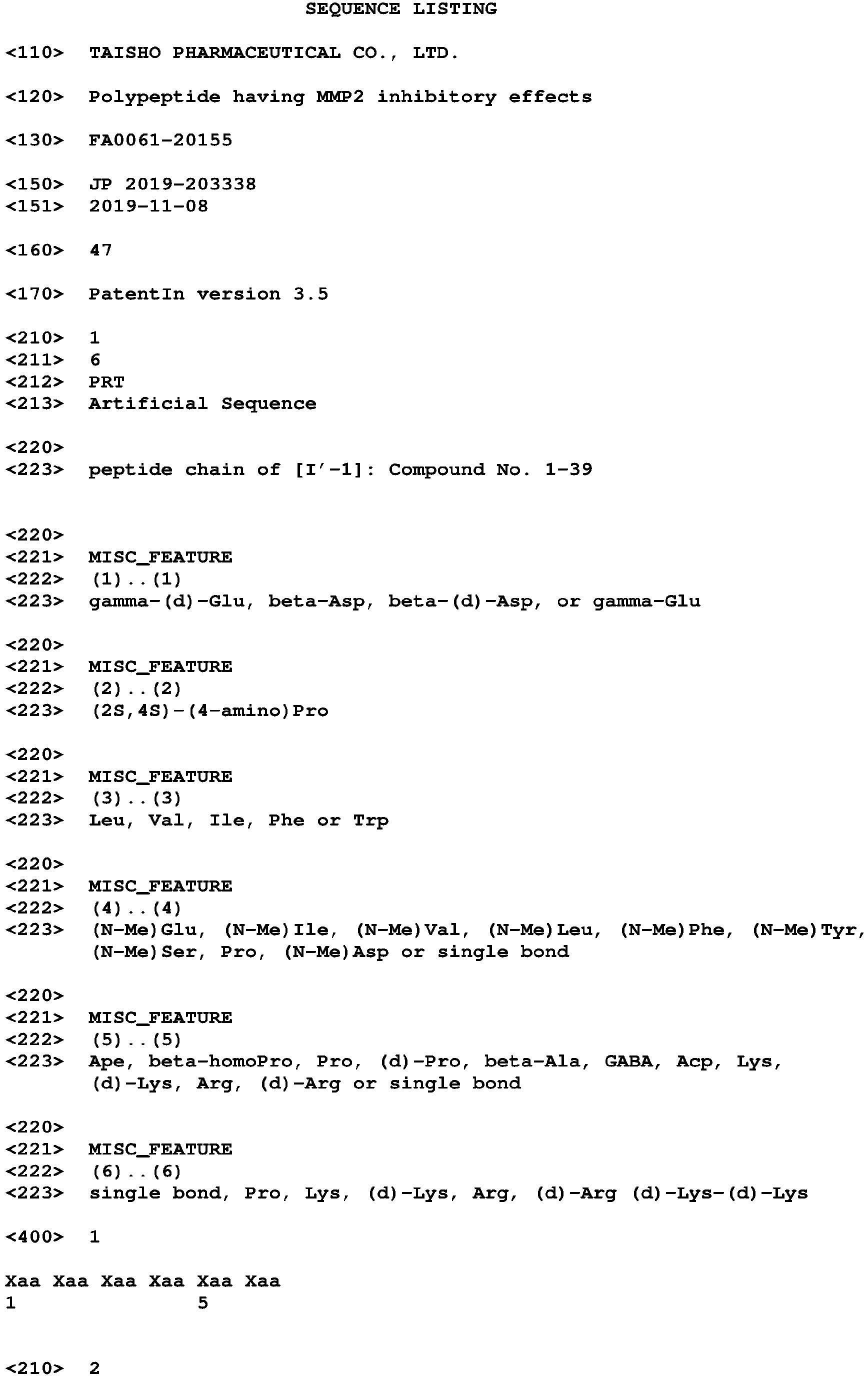
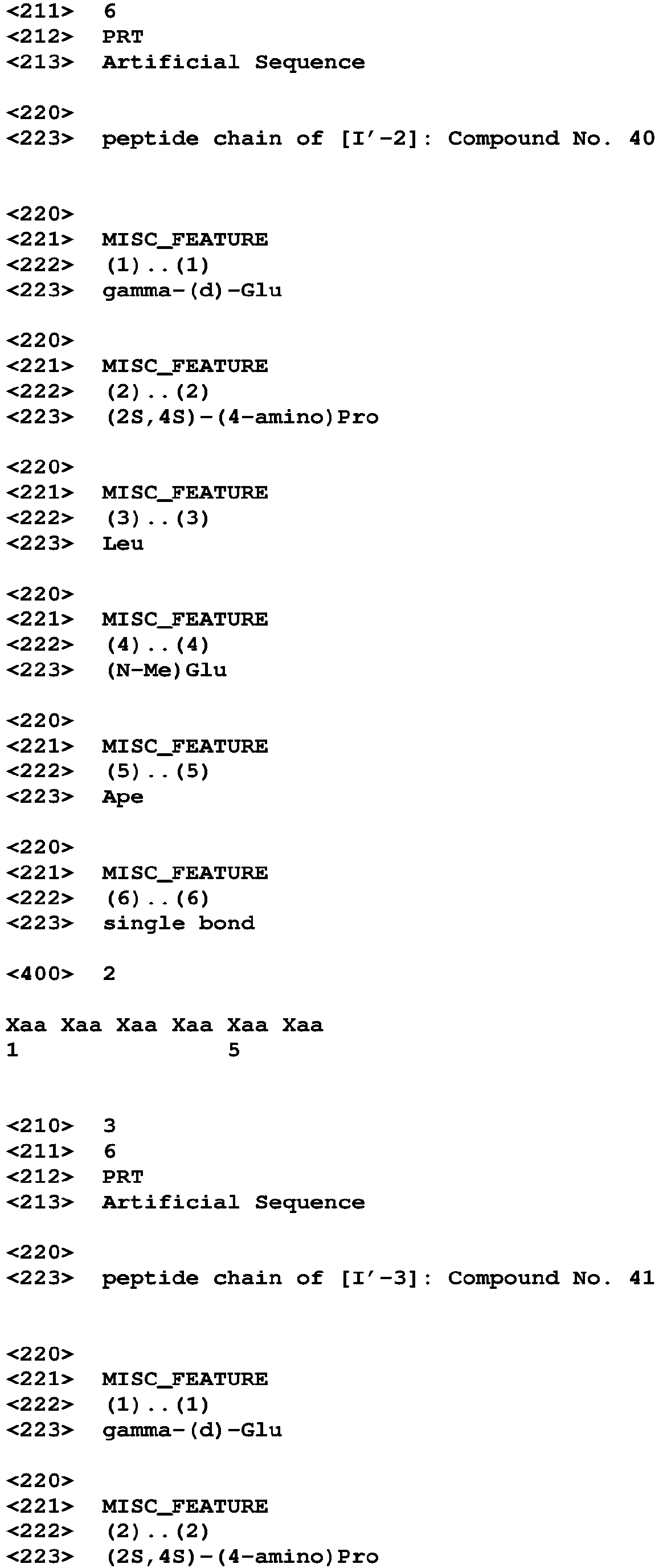


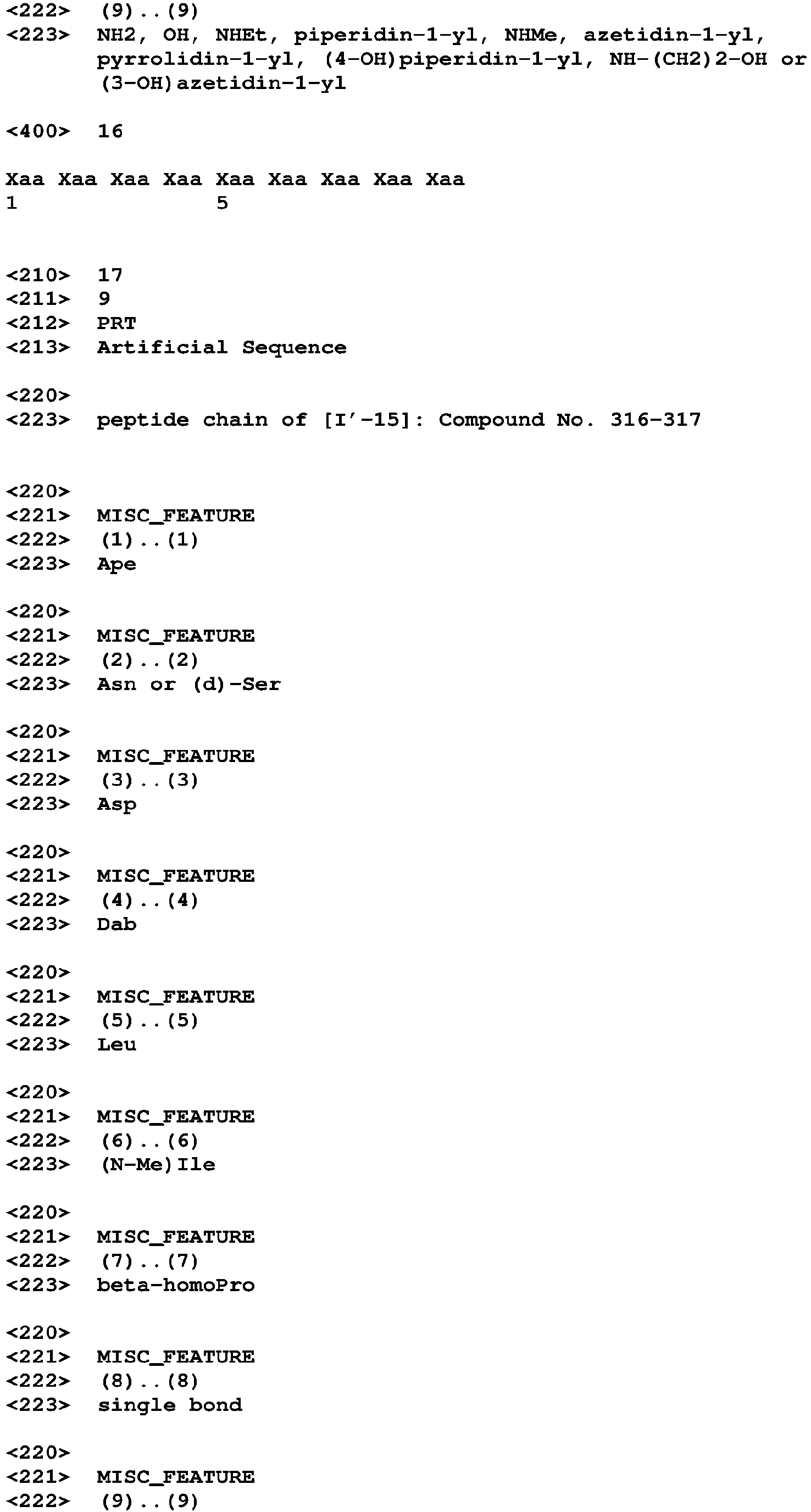


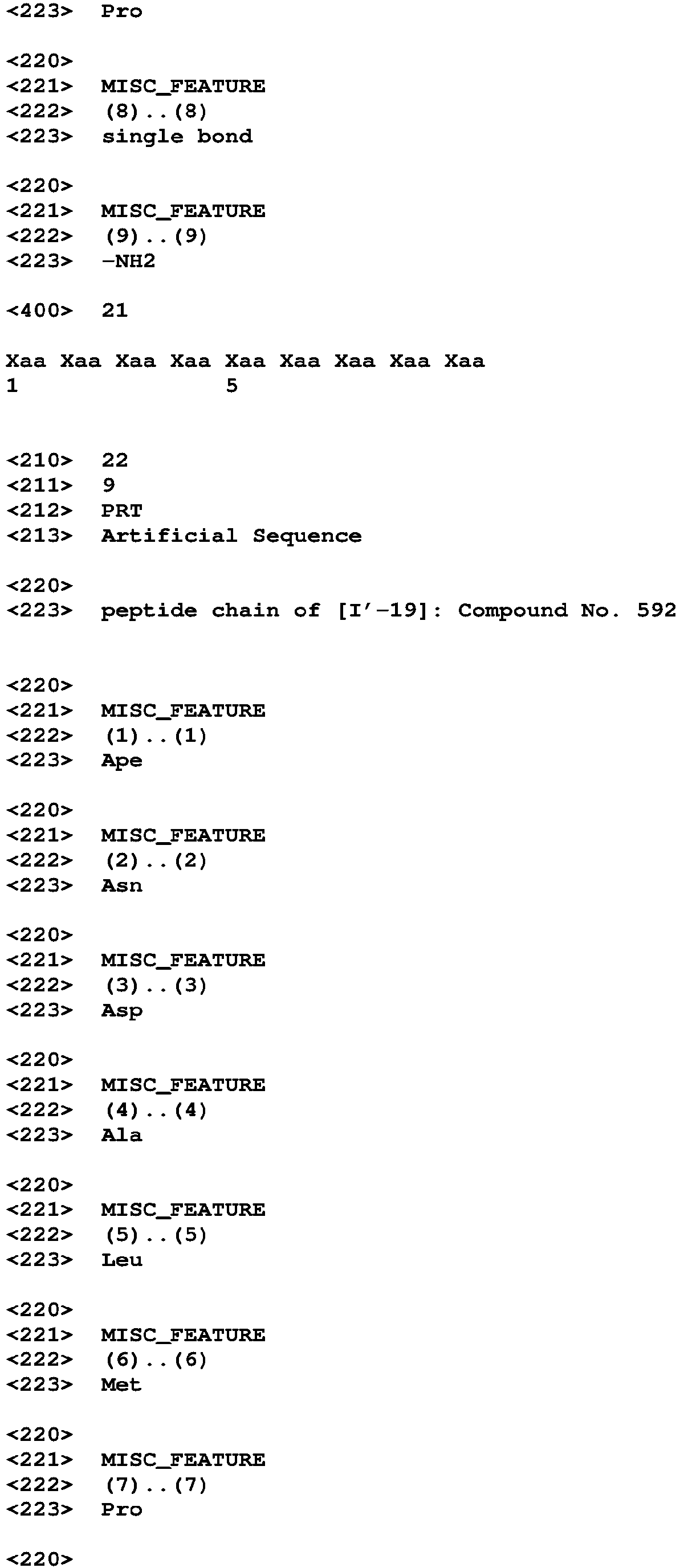
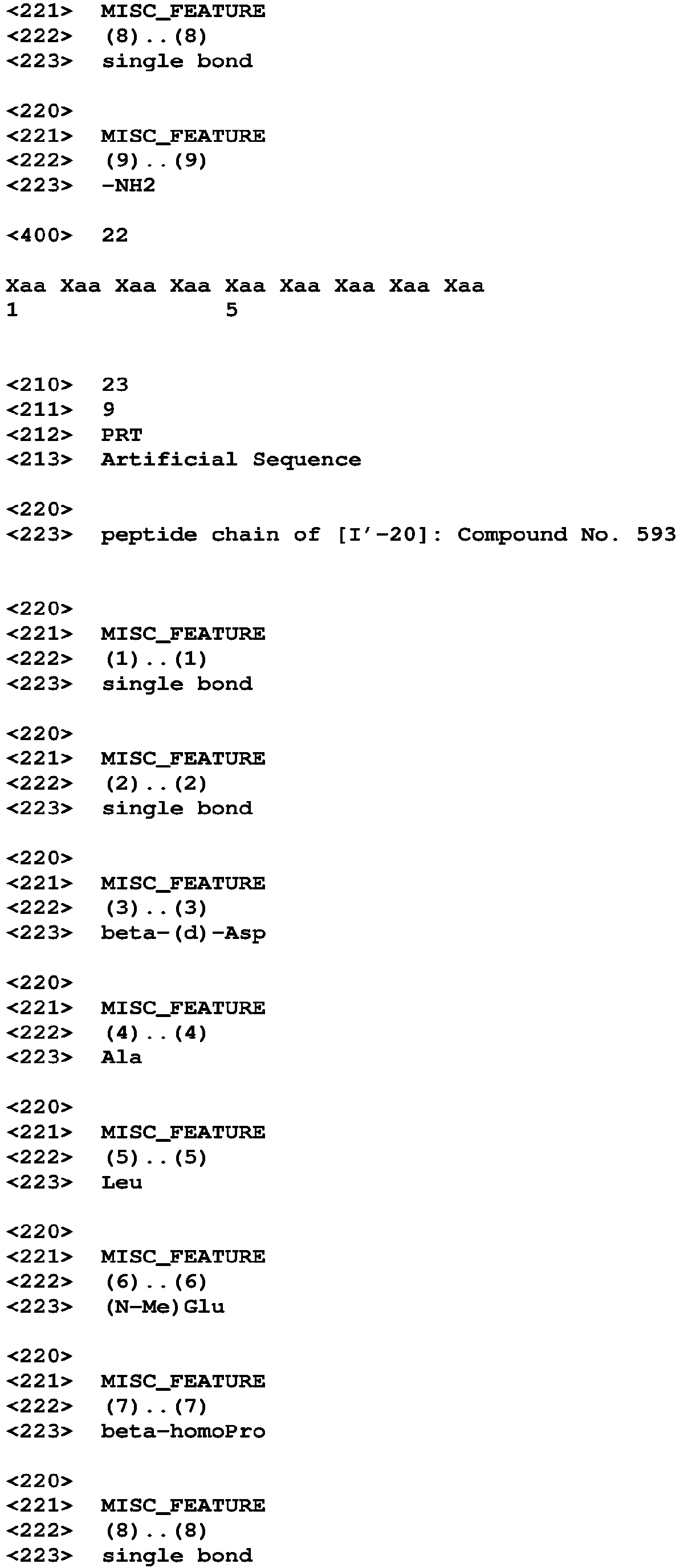


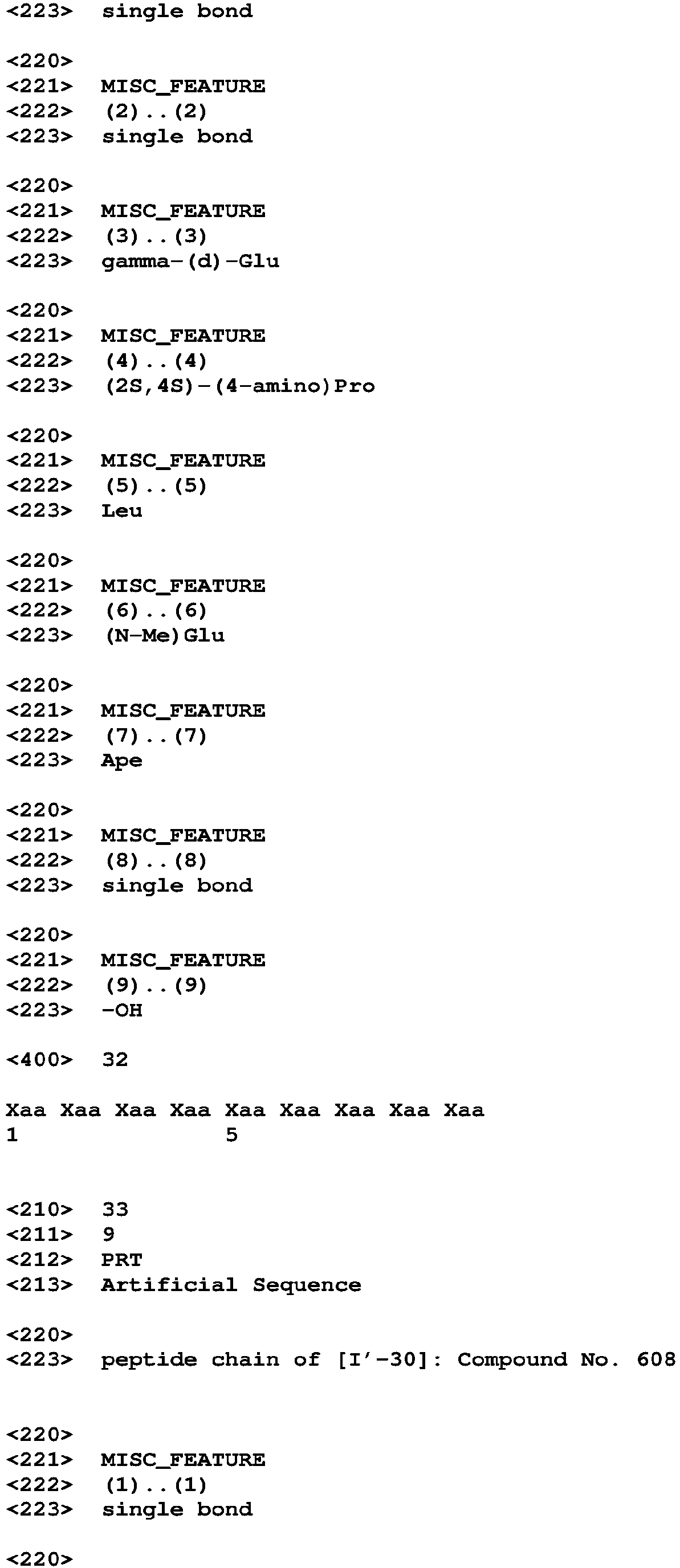

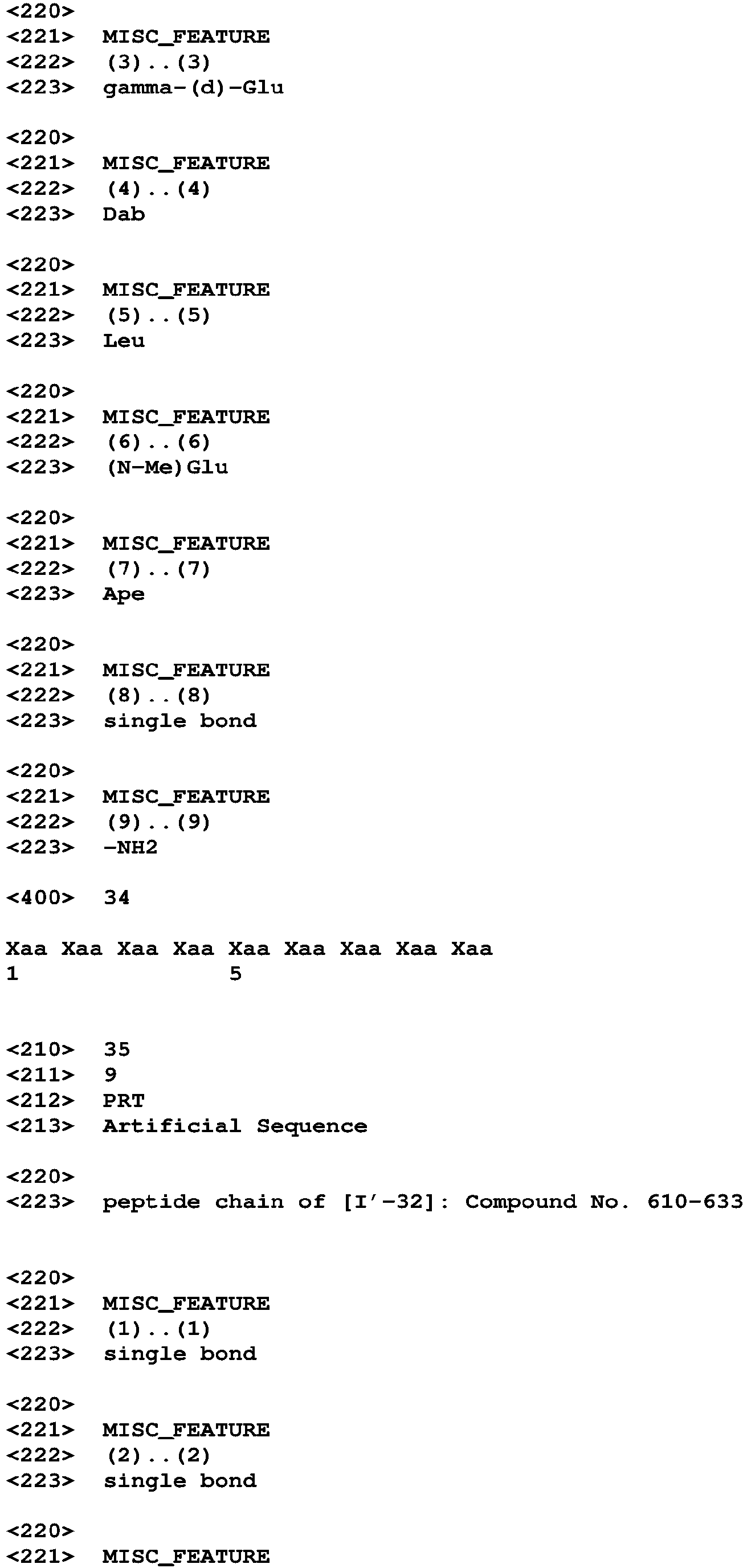

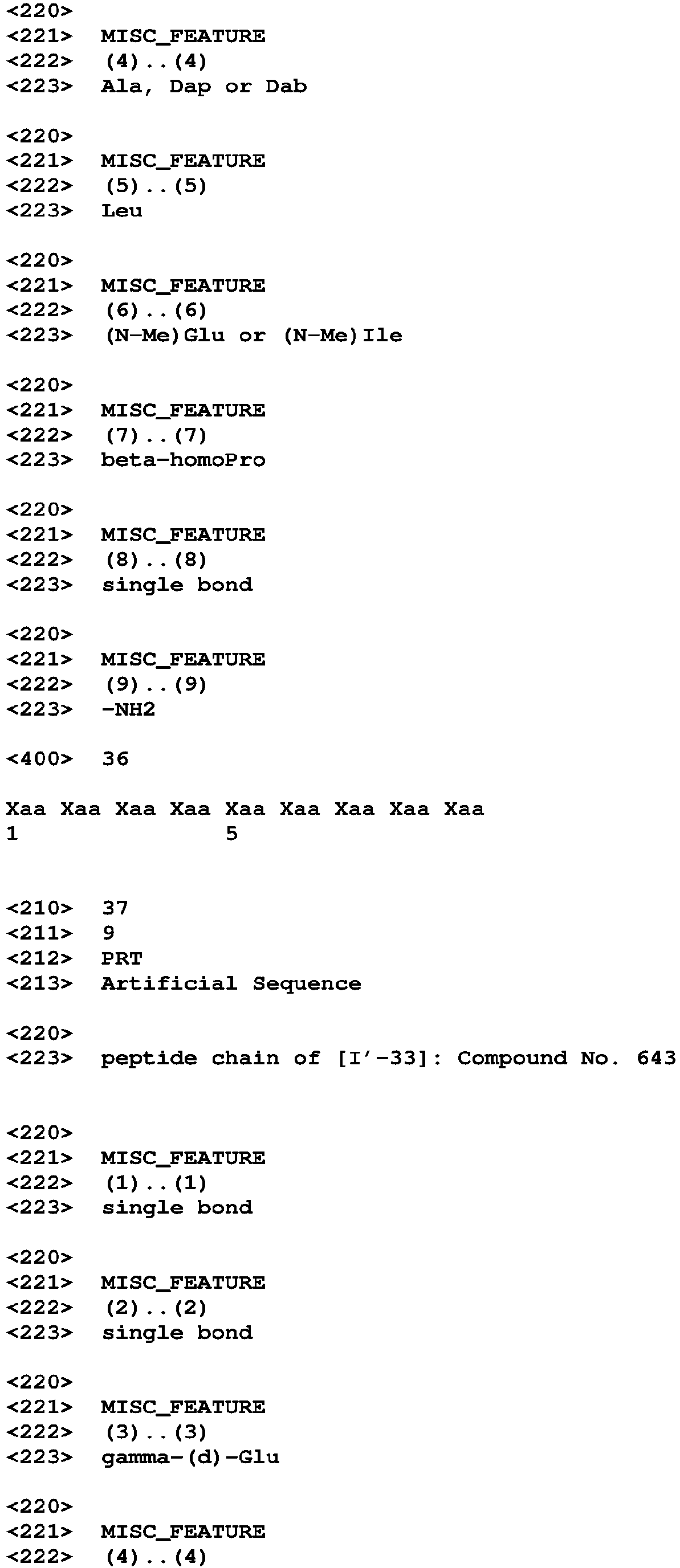

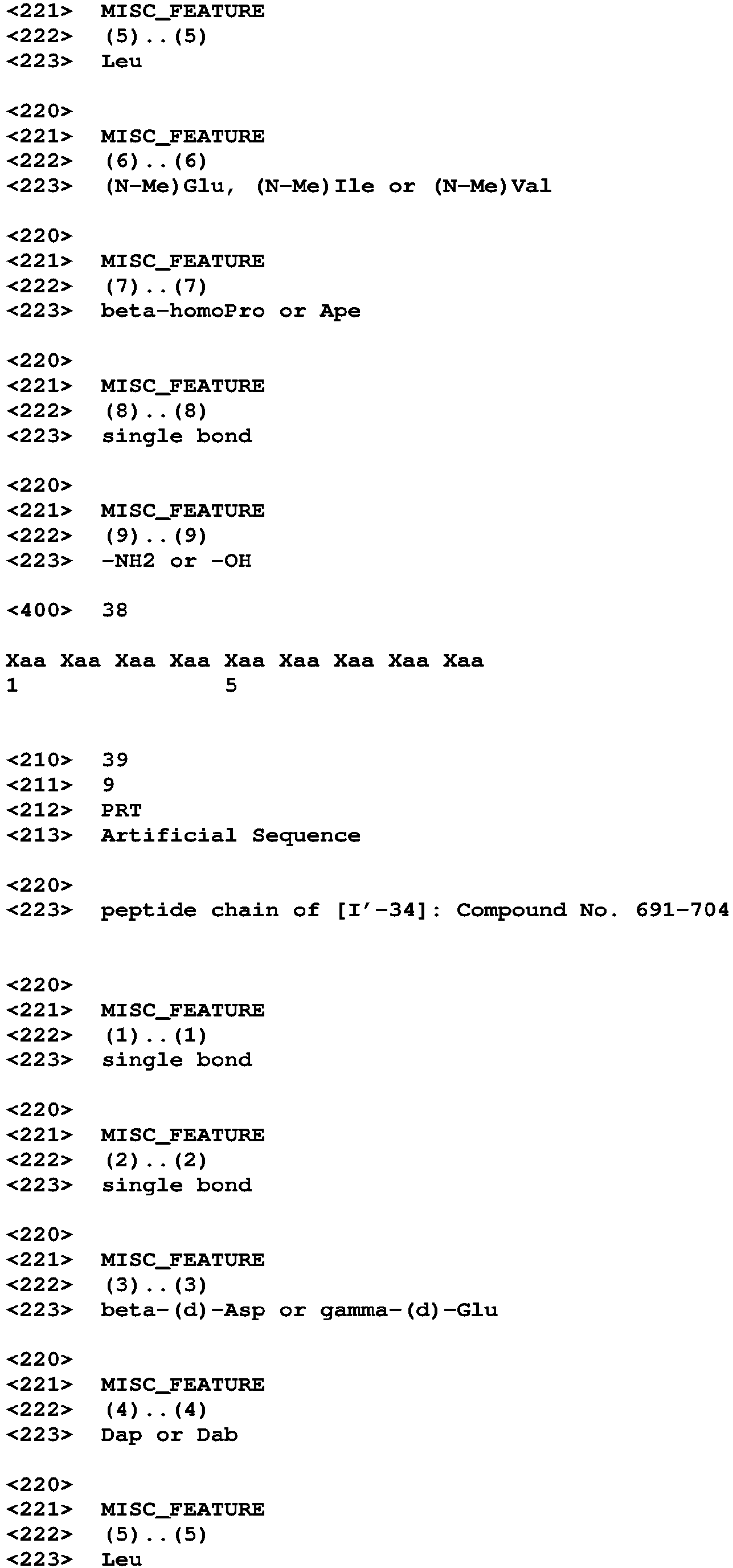
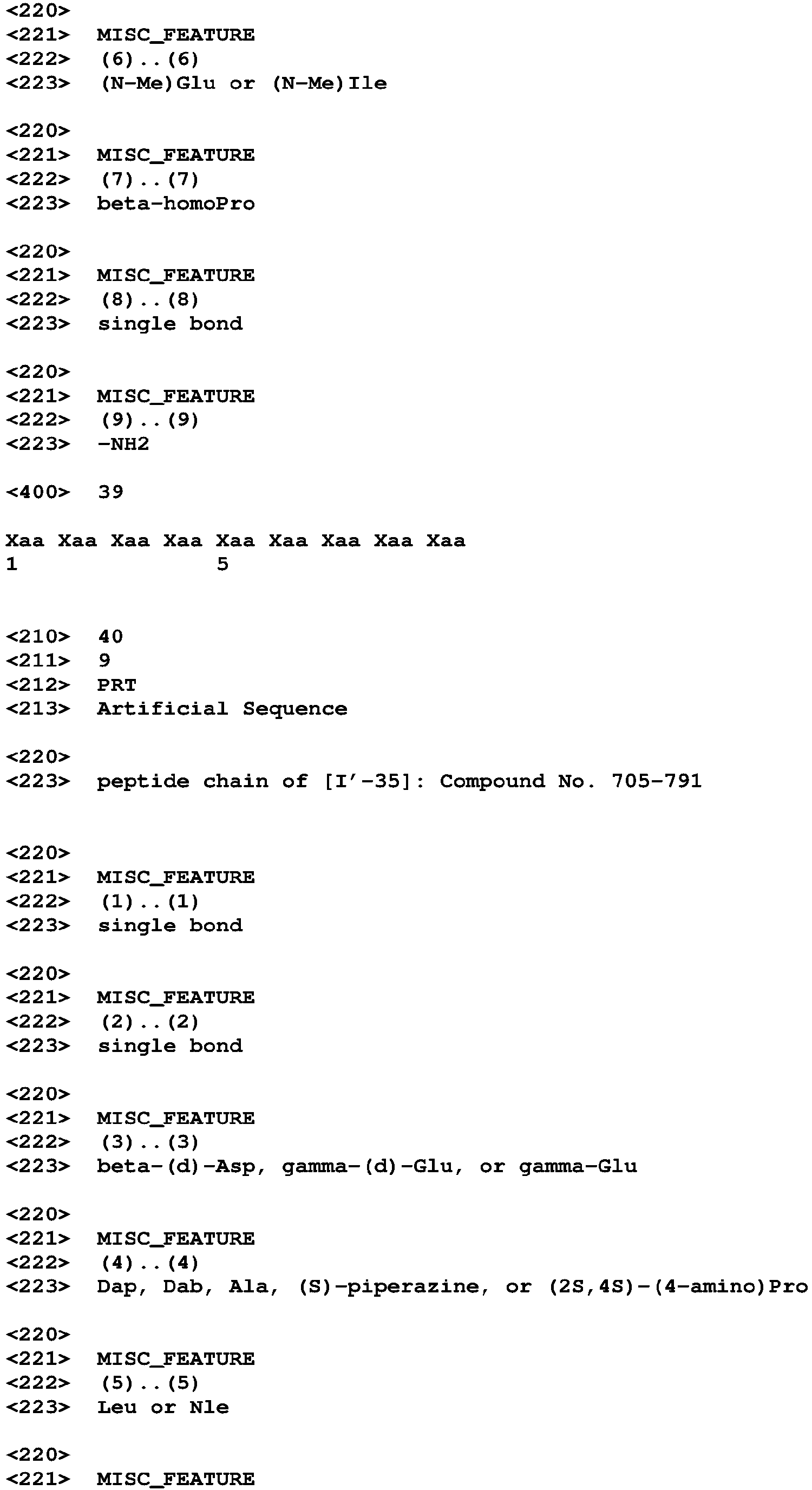


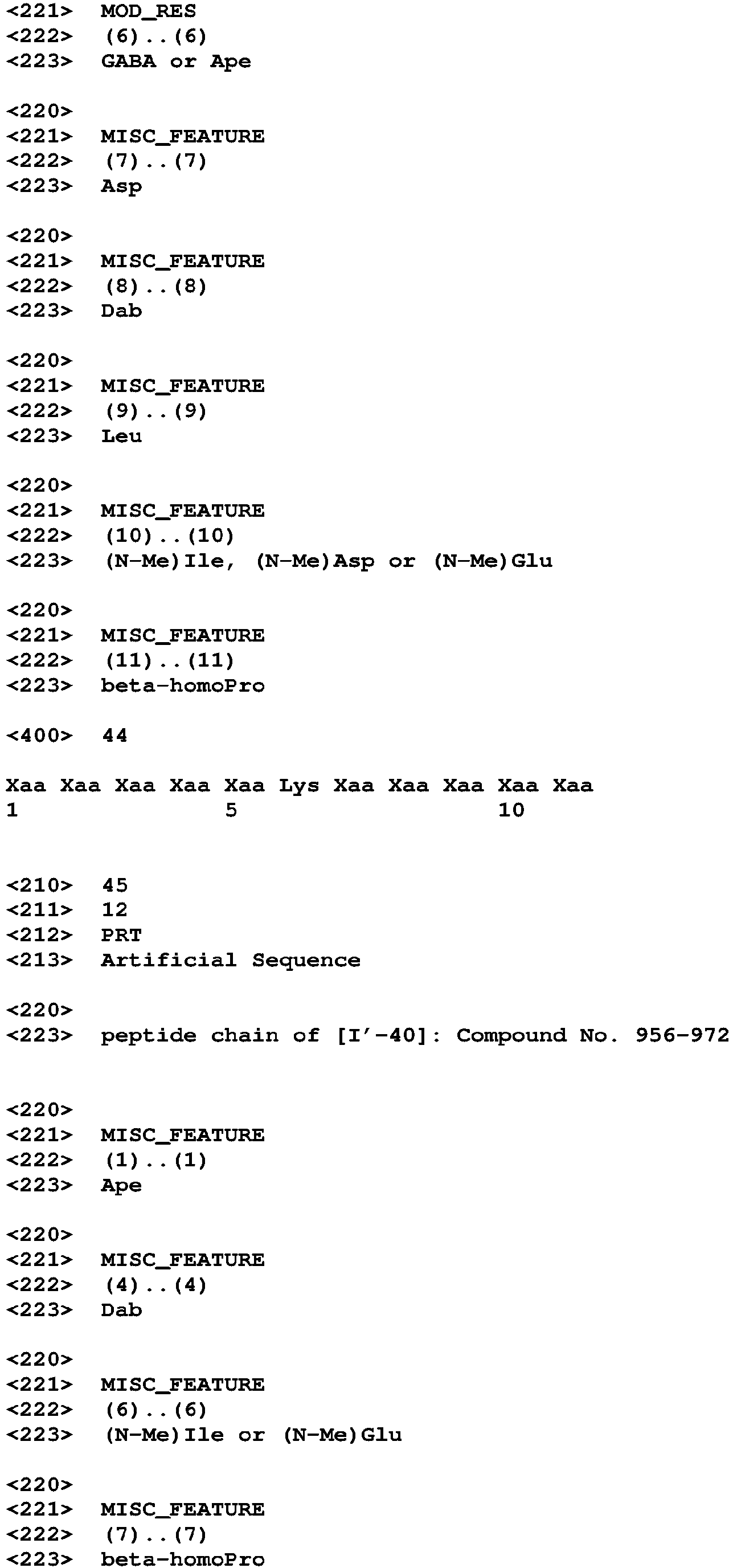
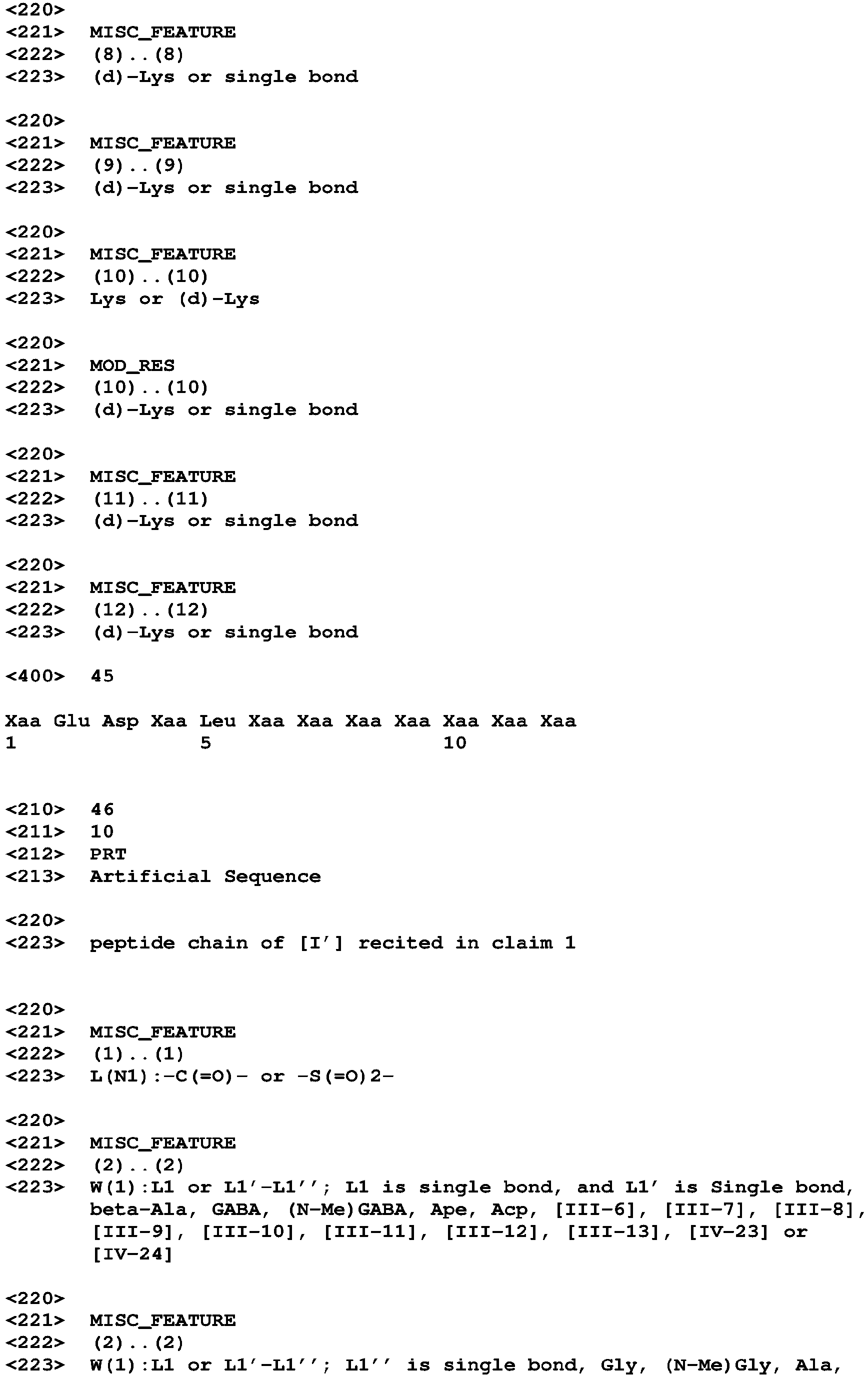


| Compound No. | AA4 | AA5 | AAWC1 | AAWC2 | AAWC3 | AAWC4 | AAWC5 | AAWCS | n |
| 956 | (N-Me) Ile | β - homoPro | (d) - Lys | (d)-Lys | Lys | single bond | single bond | single bond | 12 |
| 957 | (N-Me) Ile | β - homoPro | (d)-Lys | (d)-Lys | Lys | single bond | single bond | single bond | 14 |
| 958 | (N-Me) Glu | β - homoPro | (d) - Lys- | (d) -Lys | Lys | single bond | single bond | single bond | 14 |
| 959 | (N-Me) Ile | β - homoPro | (d) - Lys | single bond | Lys | (d)-Lys | single bond | single bond | 12 |
| 960 | (N-Me) Ile | β - homoPro | (d) - Lys | single bond | Lys | (d) - Lys | single bond | single bond | 14 |
| 961 | (N-Me) Glu | β - homoPro | (d)-Lys | single bond | Lys | (d)-Lys | single bond | single bond | 12 |
| 962 | (N-Me) Glu | β - homoPro | (d)-Lys | single bond | Lys | (d)-Lys | single bond | single bond | 14 |
| 963 | (N-Me) Ile | β - homoPro | single bond | single bond | Lys | (d)-Lys | (d)-Lys | single bond | 12 |
| 964 | (N-Me) Ile | β-homoPro | single bond | single bond | Lys | (d)-Lys | (d)-Lys | single bond | 14 |
| 965 | (N-Me) Glu | β - homoPro | single bond | single bond | Lys | (d) - Lys | (d)-Lys | single bond | 12 |
| 966 | (N-Me) Glu | β - homoPro | single bond | single bond | Lys | (d) - Lys | (d)-Lys | single bond | 14 |
| 967 | (N-Me) Ile | β - homoPro | single bond | single bond | Lys | single bond | single bond | single bond | 12 |
| 968 | (N-Me) Ile | β - homoPro | single bond | single bond | Lys | single bond | single bond | single bond | 14 |
| 969 | (N-Me) Ile | β - homoPro | single bond | single bond | (d)-Lys | single bond | single bond | single bond | 12 |
| 970 | (N-Me) Ile | β - homoPro | single bond | single bond | (d) - Lys | single bond | single bond | single bond | 14 |
| 971 | (N-Me) Ile | β - homoPro | single bond | single bond | Lys | single bond | single bond | (d)-Lys | 12 |
| 972 | (N-Me) Ile | β - homoPro | single bond | single bond | Lys | single bond | single bond | (d) - Lys | 14 |
Claims (13)
- A substituted polypeptide represented by formula [I']:
 whereinAA1 represents:Asp,β-Asp, β-(d)-Asp, γ-Glu, or γ-(d)-Glu;AA2 represents one group selected from the group consisting of:Ala,a group represented by any of formulas [IV-7], [IV-8], [IV-9], [IV-11], [IV-12], and [IV-13]:

 a group represented by formula [IV-27]:
 Pro, and a group represented by any of formulas [II-1] and [II-2]:
 AA1 and AA2 may be taken together to form a structure represented by formula [IV-32]:
 AA3 represents one group selected from the group consisting of:Val, Leu, Ile, a group represented by formula [IV-2]:
 Tyr, Lys, a group represented by any of formulas [IV-3], [IV-4], and [IV-5]:
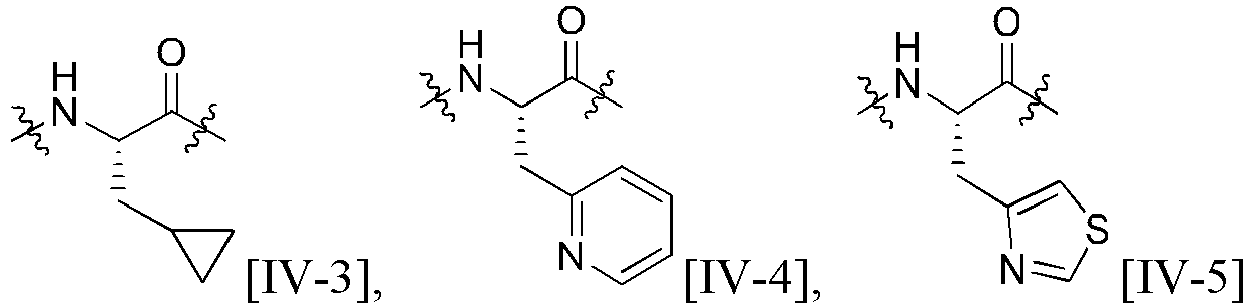 a group represented by formula [IV-9]:
 AA4 represents one group selected from the group consisting of:a single bond,Gly, (d)-Ala, (N-Me)Ala, (N-Me)Val, (N-Me)Leu, (N-Me)Ile, Pro, (d)-Pro,(N-Me)Phe, (d)-Phe,(N-Me)Tyr, (d)-Tyr,(N-Me)Ser, (d)-Ser, homoSer, (d)-Thr,Met, (N-Me)Met,(N-Me)Asp, Glu, (N-Me)Glu, (d)-(N-Me)Glu, homoGlu, (N-Me)Asn,(N-Me)Arg, (d)-Arg,a group represented by any of formulas [IV-7], [IV-9], and [IV-13]:
 wherein if AA4 represents Lys, thenthe amino in the side chain of the Lys is optionally substituted with C2-16 alkylcarbonyl terminally-substituted with carboxy;AA5 represents one group selected from the group consisting of:a single bond,Ala, a group represented by formula [IV-1]:
 a group represented by any of formulas [IV-27], [IV-28], and [IV-29]:
 Pro, (d)-Pro, β-homoPro, homoPro, a group represented by formula [II-1']:
 Thr,Arg, (d)-Arg,a group represented by any of formulas [IV-7], [IV-9], and [IV-13]:
 Lys, (d)-Lys,β-Ala, (N-Me)-β-Ala, GABA, Ape, Acp,a group represented by any of formulas [III-6] to [III-13]:


 a group represented by any of formula [IV-25] and [IV-26]:
 W1 represents -L1- or -L1'-L1"-; whereinL1 represents a single bond; andL1' represents one group selected from the group consisting of:a single bond,β-Ala, GABA, (N-Me)GABA, Ape, Acp,a group represented by any of formulas [III-6] to [III-13]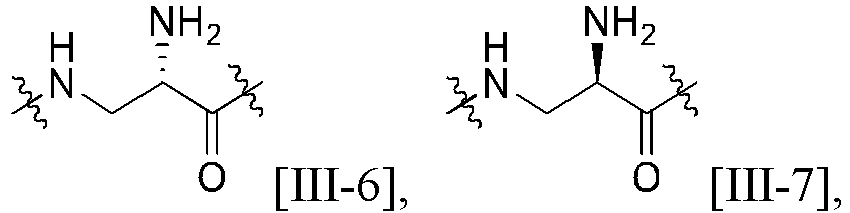


 a group represented by any of formulas [IV-23] and [IV-24]:
 L1" represents one group selected from the group consisting of:a single bond,Gly, (N-Me)Gly,Ala, (N-Me)Ala, (d)-Ala, Val, (N-Me)Val, (N-Me)Leu, (N-Me)Ile,a group represented by formula [IV-27]:Pro, (d)-Pro, homoPro, Phe, (N-Me)Phe, (d)-Phe,
 His, (d)-His, Trp, (N-Me)Trp, (d)-Trp,Tyr, (N-Me)Tyr, (d)-Tyr,(d)-Ser, homoSer, Thr, (N-Me)Thr, (d)-Thr,Cys, (d)-Cys, Met, (N-Me)Met,(N-Me)Asp, Glu, (N-Me)Glu, (d)-Glu,Asn, (N-Me)Asn, (d)-Asn, Gln, (N-Me)Gln, (d)-Gln,Arg, (N-Me)Arg, (d)-Arg, Cit, (d)-Cit,a group represented by any of formulas [IV-7], [IV-9], [IV-10], and [IV-13]:
 Lys, (N-Me)Lys, (d)-Lys, a group represented by formula [IV-14]:
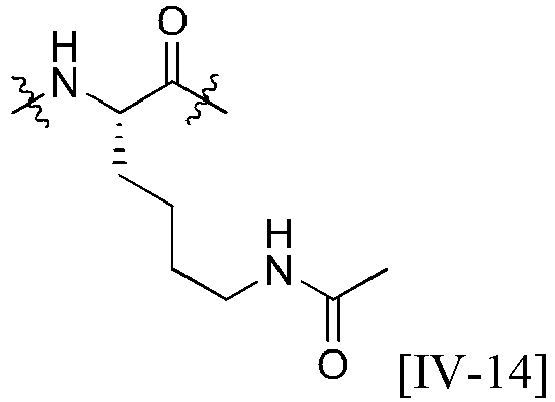 β-Asp, β-(d)-Asp, anda group represented by any of formulas [III-6] and [III-7]:
 the amino in the side chain of the Lys or (d)-Lys is optionally substituted with a group represented by formula [VII-1]:
FAN-AAN5-AAN4-AAN3-AAN2-AAN1- [VII-1]
whereinFAN represents C2-16 alkylcarbonyl terminally-substituted with carboxy;AAN5 represents:a single bond,Arg, (d)-Arg,Lys, (d)-Lys,γ-Glu, ora group represented by formula [IV-24]: AAN4 represents:a single bond,Arg, (d)-Arg,Lys, (d)-Lys, ora group represented by formula [IV-24]:
 AAN3 represents:a single bond,Arg, (d)-Arg,Lys, (d)-Lys,γ-Glu, ora group represented by formula [IV-24]:
 AAN2 represents:a single bond, or(d)-Lys; andAAN1 represents:a single bond, or(d)-Lys;wherein if L1" represents by Glu and AA3 represents Lys, thenthe compound represented by formula [I'] may be taken together with L3 attached to each of functional groups in the side chains of the two amino acids to form a cyclic structure, as represented by formula [I'-α]:
 wherein the L3 represents Gly, β-Ala, or GABA;LN1 represents the formula -C(=O)- or the formula -S(=O)2-;LN2 represents:a single bond,C1-3 alkanediyl,C2-3 alkenediyl,ethynediyl,the formula -O-,the formula -C(=O)-, the formula -C(=O)-NH-, ortriazolediyl;L2 represents a single bond;ring A represents an aromatic ring or a heteroaromatic ring;RA1 and RA2 each independently represent:a hydrogen atom,a halogen atom,C1-6 alkyl, orC1-6 alkoxy;ring B represents:
aryl or heteroaryl;RB1, RB2, and RB3 each independently represent:a hydrogen atom,carbamoyl,cyano,a halogen atom,C1-6 alkyl optionally substituted with one hydroxy, halo C1-6 alkyl,C1-6 alkoxy optionally substituted with one hydroxy, halo C1-6 alkoxy,C1-6 alkylcarbonyl,C1-6 alkylcarbonylamino,mono C1-6 alkylaminocarbonyl, di C1-6 alkylaminocarbonyl, wherein the alkyl in each of the mono C1-6 alkylaminocarbonyl and the di C1-6 alkylaminocarbonyl is optionally substituted with one group selected from the group consisting of hydroxy, carboxy, carbamoyl, and amino,C1-6 alkylsulfonyl, oraryl;WC is a single bond or a linker consisting of one to three amino acids, wherein the one to three amino acids forming the linker are same or different and each selected from the group consisting of:Gly,Pro,Arg, (d)-Arg,Lys, (d)-Lys,β-Ala, GABA, and Ape,wherein if Lys or (d)-Lys is included in the group represented by WC, thenthe amino in the side chain of the Lys or (d)-Lys is optionally substituted with:C2-16 alkylcarbonyl terminally-substituted with carboxy,Lys, wherein the amino in the side chain of the Lys is optionally substituted with C2-16 alkylcarbonyl terminally-substituted with carboxy, or(d)-Lys, wherein the amino in the side chain of the (d)-Lys is optionally substituted with C2-16 alkylcarbonyl terminally-substituted with carboxy; andRC is:the formula -OH, the formula -NH2,C1-6 alkylamino, wherein the C1-6 alkyl of the C1-6 alkylamino is optionally substituted with one group selected from the group consisting of hydroxy, amino, C1-6 alkoxy, and four- to seven-membered saturated heterocyclyl containing one nitrogen atom and optionally further containing one heteroatom, orfour- to seven-membered saturated heterocyclyl containing one nitrogen atom and optionally further containing one heteroatom; wherein the four- to seven-membered saturated heterocyclyl containing one nitrogen atom and optionally further containing one heteroatom is optionally substituted with one group selected from the group consisting of hydroxy, amino, and C1-6 alkyl, wherein the C1-6 alkyl is optionally substituted with one carbamoyl; and two carbon atoms in the four- to seven-membered saturated heterocyclyl containing one nitrogen atom and optionally further containing one heteroatom are optionally crosslinked with C1-4 alkanediyl. - The substituted polypeptide or pharmaceutically acceptable salt thereof according to claim 1, wherein
WC is:a single bond,Pro,Arg, (d)-Arg,Lys, (d)-Lys,β-Ala, GABA, Ape,Gly-(d)-Lys, Gly-(d)-Lys-(d)-Lys, Gly-(d)-Lys-(d)-Arg, Gly-(d)-Arg-(d)-Lys, Lys-Lys, (d)-Lys-(d)-Lys, (d)-Lys-(d)-Lys-(d)-Lys,Arg-Arg, (d)-Arg-(d)-Arg, (d)-Arg-(d)-Lys,Lys-(d)-Lys-(d)-Lys, (d)-Lys-Lys-(d)-Lys, (d)-Lys-(d)-Lys-Lys, β-Ala-(d)-Lys, β-Ala-(d)-Lys-(d)-Arg,β-Ala-(d)-Arg-(d)-Lys, or β-Ala-(d)-Arg-(d)-Arg,wherein if Lys is contained in the group represented by WC, thenthe amino in the side chain of the Lys is optionally substituted with:C2-16 alkylcarbonyl terminally-substituted with carboxy, or(d)-Lys, wherein the amino in the side chain of the (d)-Lys is optionally substituted with C2-16 alkylcarbonyl terminally-substituted with carboxy. - The substituted polypeptide or pharmaceutically acceptable salt thereof according to claim 1 or 2, whereinring A is a benzene ring, a thiophene ring, or a pyridine ring;RA1 and RA2 are each independently:a hydrogen atom, ora halogen atom;ring B is:
phenyl, oxazolyl, thiadiazolyl, pyridyl, or benzofuranyl;RB1, RB2, and RB3 are each independently:a hydrogen atom,carbamoyl,cyano,a halogen atom,C1-6 alkyl, wherein the C1-6 alkyl is optionally substituted with one hydroxy, halo C1-6 alkyl,C1-6 alkoxy, wherein the C1-6 alkoxy is optionally substituted with one hydroxy,halo C1-6 alkoxy,C1-6 alkylcarbonyl,mono C1-6 alkylaminocarbonyl, di C1-6 alkylaminocarbonyl, wherein the alkyl in each of the mono C1-6 alkylaminocarbonyl and the di C1-6 alkylaminocarbonyl is optionally substituted with one group selected from the group consisting of hydroxy, carboxy, carbamoyl, and amino, orC1-6 alkylsulfonyl; andRC is:the formula -OH, the formula -NH2,C1-6 alkylamino, wherein the C1-6 alkyl of the C1-6 alkylamino is optionally substituted with one group selected from the group consisting of hydroxy, amino, C1-6 alkoxy, and morpholinyl,azetidinyl, pyrrolidinyl, piperidinyl, morpholinyl, or piperazinyl, wherein the azetidinyl, pyrrolidinyl, piperidinyl, morpholinyl, or piperazinyl is optionally substituted with one group selected from the group consisting of hydroxy, amino, and C1-6 alkyl, wherein the C1-6 alkyl is optionally substituted with one carbamoyl, whereintwo carbon atoms in the azetidinyl, pyrrolidinyl, piperidinyl, morpholinyl, or piperazinyl are optionally crosslinked with C1-4 alkanediyl. - The substituted polypeptide or pharmaceutically acceptable salt thereof according to any one of claims 1 to 3, wherein in the substituted polypeptide represented by formula [I'],ring A is a benzene ring;ring B is phenyl;L1" is one group selected from the group consisting of:a single bond,Gly, (N-Me)Gly,Ala, (N-Me)Ala, (d)-Ala, Val, (N-Me)Val, (N-Me)Leu, (N-Me)Ile,a group represented by formula [IV-27]:
 Pro, (d)-Pro, homoPro, Phe, (N-Me)Phe, (d)-Phe,His, (d)-His, Trp, (N-Me)Trp, (d)-Trp,Tyr, (N-Me)Tyr, (d)-Tyr,(d)-Ser, homoSer, Thr, (N-Me)Thr, (d)-Thr,Cys, (d)-Cys, Met, (N-Me)Met,(N-Me)Asp, Glu, (N-Me)Glu, (d)-Glu,Asn, (N-Me)Asn, (d)-Asn, Gln, (N-Me)Gln, (d)-Gln,Arg, (N-Me)Arg, (d)-Arg, Cit, (d)-Cit,a group represented by any of formulas [IV-7], [IV-9], [IV-10], and [IV-13]:
 Lys, (N-Me)Lys, (d)-Lys, a group represented by formula [IV-14]:
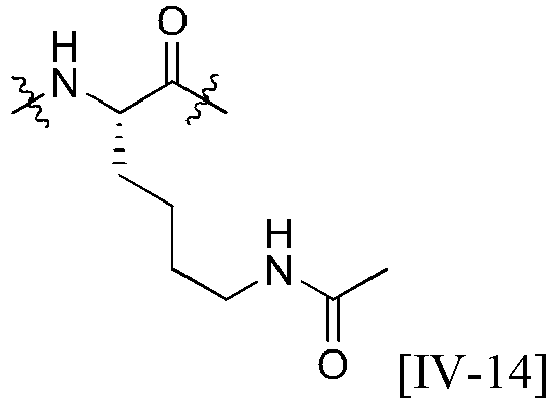 β-Ala,β-Asp, β-(d)-Asp, anda group represented by any of formulas [III-6] and [III-7]:
 WC is:a single bond,Pro,Arg, (d)-Arg,Lys, (d)-Lys,β-Ala, GABA, Ape,Gly-(d)-Lys, Gly-(d)-Lys-(d)-Lys, Gly-(d)-Lys-(d)-Arg, Gly-(d)-Arg-(d)-Lys, Lys-Lys, (d)-Lys-(d)-Lys, (d)-Lys-(d)-Lys-(d)-Lys,Arg-Arg, (d)-Arg-(d)-Arg, (d)-Arg-(d)-Lys,Lys-(d)-Lys-(d)-Lys, (d)-Lys-Lys-(d)-Lys, (d)-Lys-(d)-Lys-Lys,β-Ala-(d)-Lys, β-Ala-(d)-Lys-(d)-Arg,β-Ala-(d)-Arg-(d)-Lys, or β-Ala-(d)-Arg-(d)-Arg.
 - The substituted polypeptide or pharmaceutically acceptable salt thereof according to any one of claims 1 to 4, wherein in the substituted polypeptide represented by formula [I'], AA2 is one group selected from the group consisting of:a group represented by formula [II-1]:
 a group represented by any of formulas [IV-7], [IV-8], [IV-9], [IV-11], and [IV-12]:
 AA3 is Val, Leu, Ile, Phe, or Trp;AA4 is (N-Me)Val, (N-Me)Leu, (N-Me)Ile, (N-Me)Asp, or (N-Me)Glu;AA5 is β-Ala, GABA, Ape, Acp, Pro, (d)-Pro, or β-homoPro;WC is a single bond, Arg, (d)-Arg, Lys, or (d)-Lys; andRC is the formula -OH or the formula -NH2.
 - The substituted polypeptide or pharmaceutically acceptable salt thereof according to any one of claims 1 to 5, wherein in the substituted polypeptide represented by formula [I'],W1 is -L1'-L1"-;L2 is a single bond;AA1 is Asp;L1' is one group selected from the group consisting of β-Ala, GABA, Ape, Acp, and a group represented by any of formulas [IV-23] and [IV-24]:
 LN1 is the formula -C(=O)- or the formula -S(=O)2-;LN2 is the formula -O- or the formula -C(=O)-NH-;RA1 and RA2 are each a hydrogen atom; andRB1, RB2, and RB3 are each independently a hydrogen atom, carbamoyl, a halogen atom,C1-6 alkoxy, or halo C1-6 alkoxy.
 - The substituted polypeptide or pharmaceutically acceptable salt thereof according to any one of claims 1 to 5, wherein in the substituted polypeptide represented by formula [I'],W1 is -L1-, wherein L1 is a single bond;L2 is a single bond;AA1 is β-Asp, β-(d)-Asp, γ-Glu, or γ-(d)-Glu;AA2 is one group selected from the group consisting of:a group represented by formula [II-1]:
 a group represented by any of formulas [IV-7], [IV-8], [IV-9], [IV-11], and [IV-12]:
 AA3 is Val, Leu, Ile, Phe, or Trp;AA4 is (N-Me)Val, (N-Me)Leu, (N-Me)Ile, (N-Me)Asp, or (N-Me)Glu;AA5 is β-Ala, GABA, Ape, Acp, or β-homoPro;LN1 is the formula -C(=O)- or the formula -S(=O)2-;LN2 is a single bond, the formula -O-, or the formula -C(=O)-NH-;RA1 and RA2 are each a hydrogen atom; andRB1, RB2, and RB3 are each independently a hydrogen atom, carbamoyl, a halogen atom,C1-6 alkoxy, or halo C1-6 alkoxy.
 - The substituted polypeptide or pharmaceutically acceptable salt thereof according to any one of claims 1 to 4, wherein the substituted polypeptide represented by formula [I'] is a substituted polypeptide represented by formula [I]:
 AA1 is β-Asp, γ-Glu, or γ-(d)-Glu;AA2 is a group represented by formula [II-1] or formula [II-2]:
 AA3 is Val, Leu, Ile, Phe, or Trp;AA4 is a single bond, Pro, (N-Me)Ala, (N-Me)Val, (N-Me)Leu, (N-Me)Ile, (N-Me)Phe, (N-Me)Tyr, (N-Me)Ser, (N-Me)Asp, or (N-Me)Glu;AA5 is a single bond, Pro, (d)-Pro, β-homoPro, Arg, (d)-Arg, Lys, (d)-Lys, β-Ala, GABA, Ape, or Acp;L1 is a single bond;L2 is a single bond;LN1 is the formula -C(=O)- or the formula -S(=O)2-;LN2 is a single bond, C1-3 alkanediyl, the formula -O-, or the formula -C(=O)-NH-;RA is a hydrogen atom, a halogen atom, C1-6 alkyl, or C1-6 alkoxy;RB is a hydrogen atom, carbamoyl, a halogen atom, C1-6 alkyl, or C1-6 alkoxy;LC is a single bond, Pro, Arg, (d)-Arg, Lys, (d)-Lys, or (d)-Lys-(d)-Lys; andRC is the formula -OH or the formula -NH2.
 - The substituted polypeptide or pharmaceutically acceptable salt thereof according to any one of claims 1 to 5, wherein in the substituted polypeptide represented by formula [I'],AA1 is Asp, β-(d)-Asp, or γ-(d)-Glu;AA2 is one group selected from the group consisting of:a group represented by formula [II-1]:
 a group represented by any of formulas [IV-7] and [IV-9]:
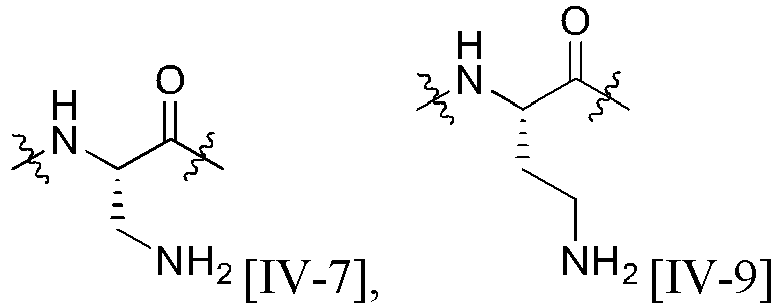 AA3 is Val, Leu, or Ile;AA4 is (N-Me)Ile or (N-Me)Glu;AA5 is Ape or β-homoPro;W1 is -L1- or -L1'-L1"-,whereinL1 is a single bond,L1' is GABA or Ape, andL1" is Asn, (d)-Ser, (d)-Thr, or Glu;LN1 is the formula -C(=O)- or the formula -S(=O)2-;LN2 is the formula -O- or the formula -C(=O)-NH-;RA1 and RA2 are each a hydrogen atom;RB1, RB2, and RB3 are each independently a hydrogen atom, carbamoyl, a halogen atom,C1-6 alkoxy, or halo C1-6 alkoxy;WC is a single bond or (d)-Lys; andRC is the formula -NH2.
 - The substituted polypeptide or pharmaceutically acceptable salt thereof according to any one of claims 1 to 5, wherein the substituted polypeptide is selected from compounds shown in the following:


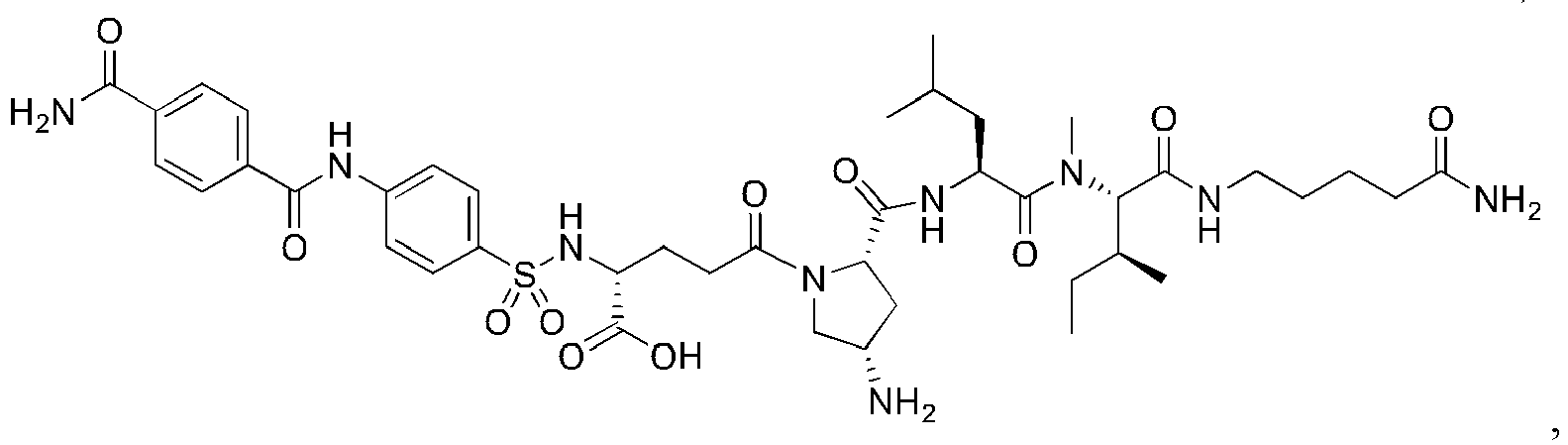


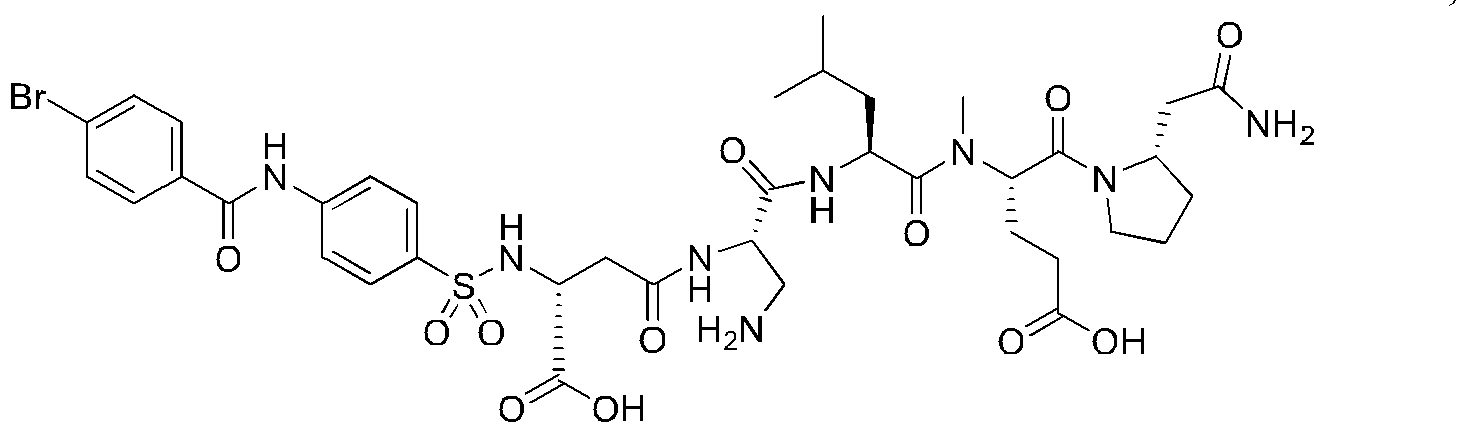


- A pharmaceutical comprising the substituted polypeptide or pharmaceutically acceptable salt thereof according to any one of claims 1 to 10 as an active ingredient.
- An MMP2 inhibitor comprising the substituted polypeptide or pharmaceutically acceptable salt thereof according to any one of claims 1 to 10 as an active ingredient.
- A drug for preventing or treating cancerous disease or organ fibrosis, or a symptom associated with cancerous disease or organ fibrosis, comprising the substituted polypeptide or pharmaceutically acceptable salt thereof according to any one of claims 1 to 10 as an active ingredient.
Applications Claiming Priority (2)
| Application Number | Priority Date | Filing Date | Title |
|---|---|---|---|
| JP2019203338 | 2019-11-08 | ||
| PCT/JP2020/042350 WO2021090959A1 (en) | 2019-11-08 | 2020-11-06 | Polypeptide having mmp2-inhibitory effect |
Publications (2)
| Publication Number | Publication Date |
|---|---|
| EP4056581A1 true EP4056581A1 (en) | 2022-09-14 |
| EP4056581A4 EP4056581A4 (en) | 2023-11-29 |
Family
ID=75849183
Family Applications (1)
| Application Number | Title | Priority Date | Filing Date |
|---|---|---|---|
| EP20883820.1A Pending EP4056581A4 (en) | 2019-11-08 | 2020-11-06 | POLYPEPTIDE HAVING AN INHIBITORY EFFECT ON MMP2 |
Country Status (14)
| Country | Link |
|---|---|
| US (1) | US20240199692A1 (en) |
| EP (1) | EP4056581A4 (en) |
| JP (2) | JPWO2021090959A1 (en) |
| KR (1) | KR20220093087A (en) |
| CN (2) | CN119119189A (en) |
| AU (1) | AU2020380902A1 (en) |
| BR (1) | BR112022007729A2 (en) |
| CA (1) | CA3160310A1 (en) |
| IL (1) | IL292684A (en) |
| MX (1) | MX2022005440A (en) |
| PH (1) | PH12022551059A1 (en) |
| TW (1) | TW202132327A (en) |
| WO (1) | WO2021090959A1 (en) |
| ZA (1) | ZA202205158B (en) |
Families Citing this family (1)
| Publication number | Priority date | Publication date | Assignee | Title |
|---|---|---|---|---|
| WO2023204170A1 (en) * | 2022-04-18 | 2023-10-26 | 大正製薬株式会社 | Prophylactic or therapeutic agent, for lung inflammation and fibrosis, containing compound having mmp2 inhibitory activity as active ingredient |
Family Cites Families (5)
| Publication number | Priority date | Publication date | Assignee | Title |
|---|---|---|---|---|
| GB9918684D0 (en) * | 1999-08-09 | 1999-10-13 | Novartis Ag | Organic compounds |
| EP2119690A1 (en) * | 2008-05-14 | 2009-11-18 | Academisch Medisch Centrum bij de Universiteit van Amsterdam | Radiolabelled MMP selective compounds |
| GB201110938D0 (en) * | 2011-06-27 | 2011-08-10 | Iti Scotland Ltd | Compounds |
| KR101363455B1 (en) * | 2011-09-09 | 2014-02-21 | (주)케어젠 | Peptides Inhibiting the Activity of Matrix Metalloproteases and Use Thereof |
| KR101744959B1 (en) * | 2014-12-05 | 2017-06-12 | (주)케어젠 | Peptides Having Activities of Skin Condition Improvement and Uses Thereof |
-
2020
- 2020-11-06 IL IL292684A patent/IL292684A/en unknown
- 2020-11-06 CA CA3160310A patent/CA3160310A1/en active Pending
- 2020-11-06 MX MX2022005440A patent/MX2022005440A/en unknown
- 2020-11-06 BR BR112022007729A patent/BR112022007729A2/en unknown
- 2020-11-06 CN CN202411255394.5A patent/CN119119189A/en active Pending
- 2020-11-06 KR KR1020227007099A patent/KR20220093087A/en active Pending
- 2020-11-06 EP EP20883820.1A patent/EP4056581A4/en active Pending
- 2020-11-06 WO PCT/JP2020/042350 patent/WO2021090959A1/en not_active Ceased
- 2020-11-06 US US17/774,993 patent/US20240199692A1/en active Pending
- 2020-11-06 TW TW109138820A patent/TW202132327A/en unknown
- 2020-11-06 CN CN202080068221.6A patent/CN114450294B/en active Active
- 2020-11-06 JP JP2021555146A patent/JPWO2021090959A1/ja not_active Ceased
- 2020-11-06 AU AU2020380902A patent/AU2020380902A1/en not_active Abandoned
- 2020-11-06 PH PH1/2022/551059A patent/PH12022551059A1/en unknown
-
2022
- 2022-05-10 ZA ZA2022/05158A patent/ZA202205158B/en unknown
-
2024
- 2024-10-28 JP JP2024188810A patent/JP2025020218A/en not_active Ceased
Also Published As
| Publication number | Publication date |
|---|---|
| JP2025020218A (en) | 2025-02-12 |
| MX2022005440A (en) | 2022-05-30 |
| US20240199692A1 (en) | 2024-06-20 |
| CA3160310A1 (en) | 2021-05-14 |
| EP4056581A4 (en) | 2023-11-29 |
| JPWO2021090959A1 (en) | 2021-05-14 |
| ZA202205158B (en) | 2023-11-29 |
| AU2020380902A1 (en) | 2022-05-26 |
| KR20220093087A (en) | 2022-07-05 |
| WO2021090959A1 (en) | 2021-05-14 |
| TW202132327A (en) | 2021-09-01 |
| CN114450294B (en) | 2024-11-26 |
| BR112022007729A2 (en) | 2022-07-12 |
| CN119119189A (en) | 2024-12-13 |
| PH12022551059A1 (en) | 2023-09-18 |
| IL292684A (en) | 2022-07-01 |
| CN114450294A (en) | 2022-05-06 |
Similar Documents
| Publication | Publication Date | Title |
|---|---|---|
| EP2694095B1 (en) | Compositions comprising glucagon analogs and methods of making and using the same | |
| EP2213680B1 (en) | Peptides having pharmacological activity for treating disorders associated with altered cell migration, such as cancer | |
| US5480870A (en) | Tumor growth-inhibiting somatostatin analogues, pharmaceutical compositions containing them and process for preparing same | |
| US4758550A (en) | Calcitonin derivatives | |
| BRPI0717441B1 (en) | COMPOUND, MEDICINAL PRODUCT, AND USE OF THE METASTINE DERIVATIVE | |
| US20110118172A1 (en) | Metastin derivative and use thereof | |
| RU2430107C2 (en) | Metastin derivatives and application thereof | |
| JPS5989648A (en) | Novel peptide | |
| KR20130127985A (en) | Glucose-dependent insulinotropic peptide analogs | |
| US11168114B2 (en) | Process for the manufacture of degarelix and its intermediates | |
| KR101417872B1 (en) | Analogues of insulin-like growth factor-1 (igf-1) having amino acid substitution at position 59 | |
| KR20120034606A (en) | Short-chain peptides as parathyroid hormone(pth) receptor agonist | |
| JP2025020218A (en) | Polypeptide having MMP2 inhibitory activity | |
| JP2002512254A (en) | New omega-conotoxins and peptides | |
| US20120094910A1 (en) | Improved process for the preparation of desmopressin or its pharmaceutically acceptable salts | |
| RU2828218C9 (en) | Polypeptide having mmr-2 inhibitory action | |
| RU2828218C1 (en) | Polypeptide having mmr-2 inhibitory action | |
| EP2314609A1 (en) | Metastin derivative and use thereof | |
| Staykova et al. | Synthesis and in vitro study of the anticancer activity of new analogs of octreotide | |
| JPH02262595A (en) | Polypeptide derivative | |
| JP2022173143A (en) | A drug containing a polypeptide having MMP2 inhibitory activity as an active ingredient | |
| KR102198130B1 (en) | Vasopressin-2 receptor agonists | |
| CN116143872A (en) | A kind of C-terminal formylation modified NPFF and its preparation method and application | |
| HK40114238A (en) | Polypeptide having mmp2-inhibitory effect | |
| HK40066866A (en) | Polypeptide having mmp2-inhibitory effect |
Legal Events
| Date | Code | Title | Description |
|---|---|---|---|
| STAA | Information on the status of an ep patent application or granted ep patent |
Free format text: STATUS: THE INTERNATIONAL PUBLICATION HAS BEEN MADE |
|
| PUAI | Public reference made under article 153(3) epc to a published international application that has entered the european phase |
Free format text: ORIGINAL CODE: 0009012 |
|
| STAA | Information on the status of an ep patent application or granted ep patent |
Free format text: STATUS: REQUEST FOR EXAMINATION WAS MADE |
|
| 17P | Request for examination filed |
Effective date: 20220603 |
|
| AK | Designated contracting states |
Kind code of ref document: A1 Designated state(s): AL AT BE BG CH CY CZ DE DK EE ES FI FR GB GR HR HU IE IS IT LI LT LU LV MC MK MT NL NO PL PT RO RS SE SI SK SM TR |
|
| DAV | Request for validation of the european patent (deleted) | ||
| A4 | Supplementary search report drawn up and despatched |
Effective date: 20231027 |
|
| RIC1 | Information provided on ipc code assigned before grant |
Ipc: C07K 5/113 20060101ALI20231023BHEP Ipc: C07C 311/29 20060101ALI20231023BHEP Ipc: C12N 9/99 20060101ALI20231023BHEP Ipc: A61P 43/00 20060101ALI20231023BHEP Ipc: A61P 35/00 20060101ALI20231023BHEP Ipc: A61K 38/08 20190101ALI20231023BHEP Ipc: A61K 38/07 20060101ALI20231023BHEP Ipc: C07K 7/06 20060101AFI20231023BHEP |