EP4056572A1 - Synthesis of spirocyclic isoxazoline derivatives - Google Patents
Synthesis of spirocyclic isoxazoline derivatives Download PDFInfo
- Publication number
- EP4056572A1 EP4056572A1 EP22170224.4A EP22170224A EP4056572A1 EP 4056572 A1 EP4056572 A1 EP 4056572A1 EP 22170224 A EP22170224 A EP 22170224A EP 4056572 A1 EP4056572 A1 EP 4056572A1
- Authority
- EP
- European Patent Office
- Prior art keywords
- formula
- compound
- solids
- water
- aqueous base
- Prior art date
- Legal status (The legal status is an assumption and is not a legal conclusion. Google has not performed a legal analysis and makes no representation as to the accuracy of the status listed.)
- Withdrawn
Links
- 150000002547 isoxazolines Chemical class 0.000 title abstract description 5
- 238000003786 synthesis reaction Methods 0.000 title description 5
- 230000015572 biosynthetic process Effects 0.000 title description 4
- 238000004519 manufacturing process Methods 0.000 claims abstract description 20
- 150000001875 compounds Chemical class 0.000 claims description 88
- WEVYAHXRMPXWCK-UHFFFAOYSA-N Acetonitrile Chemical compound CC#N WEVYAHXRMPXWCK-UHFFFAOYSA-N 0.000 claims description 39
- OKKJLVBELUTLKV-UHFFFAOYSA-N Methanol Chemical compound OC OKKJLVBELUTLKV-UHFFFAOYSA-N 0.000 claims description 30
- 238000000034 method Methods 0.000 claims description 28
- XEKOWRVHYACXOJ-UHFFFAOYSA-N Ethyl acetate Chemical compound CCOC(C)=O XEKOWRVHYACXOJ-UHFFFAOYSA-N 0.000 claims description 27
- XLYOFNOQVPJJNP-UHFFFAOYSA-N water Substances O XLYOFNOQVPJJNP-UHFFFAOYSA-N 0.000 claims description 26
- ZMANZCXQSJIPKH-UHFFFAOYSA-N Triethylamine Chemical group CCN(CC)CC ZMANZCXQSJIPKH-UHFFFAOYSA-N 0.000 claims description 24
- LFQSCWFLJHTTHZ-UHFFFAOYSA-N Ethanol Chemical compound CCO LFQSCWFLJHTTHZ-UHFFFAOYSA-N 0.000 claims description 23
- 239000007787 solid Substances 0.000 claims description 23
- IMNFDUFMRHMDMM-UHFFFAOYSA-N N-Heptane Chemical compound CCCCCCC IMNFDUFMRHMDMM-UHFFFAOYSA-N 0.000 claims description 15
- 239000002585 base Substances 0.000 claims description 15
- 239000003960 organic solvent Substances 0.000 claims description 15
- BZLVMXJERCGZMT-UHFFFAOYSA-N Methyl tert-butyl ether Chemical compound COC(C)(C)C BZLVMXJERCGZMT-UHFFFAOYSA-N 0.000 claims description 13
- 239000000203 mixture Substances 0.000 claims description 13
- KWYUFKZDYYNOTN-UHFFFAOYSA-M Potassium hydroxide Chemical compound [OH-].[K+] KWYUFKZDYYNOTN-UHFFFAOYSA-M 0.000 claims description 12
- HEMHJVSKTPXQMS-UHFFFAOYSA-M Sodium hydroxide Chemical group [OH-].[Na+] HEMHJVSKTPXQMS-UHFFFAOYSA-M 0.000 claims description 12
- YXFVVABEGXRONW-UHFFFAOYSA-N Toluene Chemical compound CC1=CC=CC=C1 YXFVVABEGXRONW-UHFFFAOYSA-N 0.000 claims description 12
- JMMWKPVZQRWMSS-UHFFFAOYSA-N isopropanol acetate Natural products CC(C)OC(C)=O JMMWKPVZQRWMSS-UHFFFAOYSA-N 0.000 claims description 12
- 229940011051 isopropyl acetate Drugs 0.000 claims description 12
- GWYFCOCPABKNJV-UHFFFAOYSA-N isovaleric acid Chemical compound CC(C)CC(O)=O GWYFCOCPABKNJV-UHFFFAOYSA-N 0.000 claims description 12
- 238000001914 filtration Methods 0.000 claims description 11
- 239000011541 reaction mixture Substances 0.000 claims description 11
- WYURNTSHIVDZCO-UHFFFAOYSA-N Tetrahydrofuran Chemical compound C1CCOC1 WYURNTSHIVDZCO-UHFFFAOYSA-N 0.000 claims description 10
- 239000002253 acid Substances 0.000 claims description 9
- 239000013078 crystal Substances 0.000 claims description 9
- 239000001257 hydrogen Substances 0.000 claims description 9
- 229910052739 hydrogen Inorganic materials 0.000 claims description 9
- 125000000449 nitro group Chemical group [O-][N+](*)=O 0.000 claims description 9
- 150000003839 salts Chemical class 0.000 claims description 9
- 238000003756 stirring Methods 0.000 claims description 9
- IJGRMHOSHXDMSA-UHFFFAOYSA-N Atomic nitrogen Chemical compound N#N IJGRMHOSHXDMSA-UHFFFAOYSA-N 0.000 claims description 8
- 125000005843 halogen group Chemical group 0.000 claims description 8
- 229910052736 halogen Inorganic materials 0.000 claims description 7
- 150000002367 halogens Chemical class 0.000 claims description 7
- NYEHUAQIJXERLP-UHFFFAOYSA-N 2-methylsulfonylacetic acid Chemical compound CS(=O)(=O)CC(O)=O NYEHUAQIJXERLP-UHFFFAOYSA-N 0.000 claims description 6
- VHUUQVKOLVNVRT-UHFFFAOYSA-N Ammonium hydroxide Chemical compound [NH4+].[OH-] VHUUQVKOLVNVRT-UHFFFAOYSA-N 0.000 claims description 5
- 239000000908 ammonium hydroxide Substances 0.000 claims description 5
- YLQBMQCUIZJEEH-UHFFFAOYSA-N tetrahydrofuran Natural products C=1C=COC=1 YLQBMQCUIZJEEH-UHFFFAOYSA-N 0.000 claims description 5
- SRSXLGNVWSONIS-UHFFFAOYSA-N benzenesulfonic acid Chemical group OS(=O)(=O)C1=CC=CC=C1 SRSXLGNVWSONIS-UHFFFAOYSA-N 0.000 claims description 4
- 229940092714 benzenesulfonic acid Drugs 0.000 claims description 4
- 238000001035 drying Methods 0.000 claims description 4
- 238000002156 mixing Methods 0.000 claims description 4
- 229910052757 nitrogen Inorganic materials 0.000 claims description 4
- NXLNNXIXOYSCMB-UHFFFAOYSA-N (4-nitrophenyl) carbonochloridate Chemical compound [O-][N+](=O)C1=CC=C(OC(Cl)=O)C=C1 NXLNNXIXOYSCMB-UHFFFAOYSA-N 0.000 claims description 3
- FPQQSJJWHUJYPU-UHFFFAOYSA-N 3-(dimethylamino)propyliminomethylidene-ethylazanium;chloride Chemical compound Cl.CCN=C=NCCCN(C)C FPQQSJJWHUJYPU-UHFFFAOYSA-N 0.000 claims description 3
- BTJIUGUIPKRLHP-UHFFFAOYSA-N 4-nitrophenol Chemical compound OC1=CC=C([N+]([O-])=O)C=C1 BTJIUGUIPKRLHP-UHFFFAOYSA-N 0.000 claims description 3
- 125000001309 chloro group Chemical group Cl* 0.000 claims description 3
- 125000001153 fluoro group Chemical group F* 0.000 claims description 3
- 238000010438 heat treatment Methods 0.000 claims description 3
- 238000010791 quenching Methods 0.000 claims description 3
- 125000002023 trifluoromethyl group Chemical group FC(F)(F)* 0.000 claims description 3
- XLYOFNOQVPJJNP-UHFFFAOYSA-M hydroxide Chemical compound [OH-] XLYOFNOQVPJJNP-UHFFFAOYSA-M 0.000 claims description 2
- 150000002431 hydrogen Chemical class 0.000 claims 4
- 238000001816 cooling Methods 0.000 claims 3
- 238000005406 washing Methods 0.000 claims 3
- BVKZGUZCCUSVTD-UHFFFAOYSA-L Carbonate Chemical compound [O-]C([O-])=O BVKZGUZCCUSVTD-UHFFFAOYSA-L 0.000 claims 1
- 239000012141 concentrate Substances 0.000 claims 1
- 230000000171 quenching effect Effects 0.000 claims 1
- -1 i.e. Chemical group 0.000 description 37
- 125000000217 alkyl group Chemical group 0.000 description 15
- 238000006243 chemical reaction Methods 0.000 description 15
- 239000000126 substance Substances 0.000 description 13
- 125000001424 substituent group Chemical group 0.000 description 13
- 239000000543 intermediate Substances 0.000 description 12
- 125000004169 (C1-C6) alkyl group Chemical group 0.000 description 10
- 125000004432 carbon atom Chemical group C* 0.000 description 10
- 125000001931 aliphatic group Chemical group 0.000 description 9
- 125000006239 protecting group Chemical group 0.000 description 8
- IKHGUXGNUITLKF-UHFFFAOYSA-N Acetaldehyde Chemical compound CC=O IKHGUXGNUITLKF-UHFFFAOYSA-N 0.000 description 7
- 125000000753 cycloalkyl group Chemical group 0.000 description 7
- 125000000623 heterocyclic group Chemical group 0.000 description 7
- 238000004809 thin layer chromatography Methods 0.000 description 7
- HBAQYPYDRFILMT-UHFFFAOYSA-N 8-[3-(1-cyclopropylpyrazol-4-yl)-1H-pyrazolo[4,3-d]pyrimidin-5-yl]-3-methyl-3,8-diazabicyclo[3.2.1]octan-2-one Chemical class C1(CC1)N1N=CC(=C1)C1=NNC2=C1N=C(N=C2)N1C2C(N(CC1CC2)C)=O HBAQYPYDRFILMT-UHFFFAOYSA-N 0.000 description 6
- 125000001072 heteroaryl group Chemical group 0.000 description 6
- 238000002360 preparation method Methods 0.000 description 6
- 239000000047 product Substances 0.000 description 6
- 238000005160 1H NMR spectroscopy Methods 0.000 description 5
- 150000001412 amines Chemical group 0.000 description 5
- 239000003153 chemical reaction reagent Substances 0.000 description 5
- 125000004435 hydrogen atom Chemical class [H]* 0.000 description 5
- 125000002887 hydroxy group Chemical group [H]O* 0.000 description 5
- 238000001819 mass spectrum Methods 0.000 description 5
- LRHPLDYGYMQRHN-UHFFFAOYSA-N N-Butanol Chemical compound CCCCO LRHPLDYGYMQRHN-UHFFFAOYSA-N 0.000 description 4
- HEDRZPFGACZZDS-MICDWDOJSA-N Trichloro(2H)methane Chemical compound [2H]C(Cl)(Cl)Cl HEDRZPFGACZZDS-MICDWDOJSA-N 0.000 description 4
- 150000007513 acids Chemical class 0.000 description 4
- 125000003342 alkenyl group Chemical group 0.000 description 4
- 125000003545 alkoxy group Chemical group 0.000 description 4
- 125000000304 alkynyl group Chemical group 0.000 description 4
- 125000006242 amine protecting group Chemical group 0.000 description 4
- 229940077388 benzenesulfonate Drugs 0.000 description 4
- SRSXLGNVWSONIS-UHFFFAOYSA-M benzenesulfonate Chemical compound [O-]S(=O)(=O)C1=CC=CC=C1 SRSXLGNVWSONIS-UHFFFAOYSA-M 0.000 description 4
- 125000004093 cyano group Chemical group *C#N 0.000 description 4
- CZZYITDELCSZES-UHFFFAOYSA-N diphenylmethane Chemical compound C=1C=CC=CC=1CC1=CC=CC=C1 CZZYITDELCSZES-UHFFFAOYSA-N 0.000 description 4
- 125000001188 haloalkyl group Chemical group 0.000 description 4
- 125000005842 heteroatom Chemical group 0.000 description 4
- 239000000463 material Substances 0.000 description 4
- 229920006395 saturated elastomer Polymers 0.000 description 4
- 239000007858 starting material Substances 0.000 description 4
- QIFOIAXXLKQGJD-UHFFFAOYSA-N (4-nitrophenyl) 2-methylsulfonylacetate Chemical compound CS(=O)(=O)CC(=O)OC1=CC=C([N+]([O-])=O)C=C1 QIFOIAXXLKQGJD-UHFFFAOYSA-N 0.000 description 3
- WEQPBCSPRXFQQS-UHFFFAOYSA-N 4,5-dihydro-1,2-oxazole Chemical compound C1CC=NO1 WEQPBCSPRXFQQS-UHFFFAOYSA-N 0.000 description 3
- 229910003827 NRaRb Inorganic materials 0.000 description 3
- RWRDLPDLKQPQOW-UHFFFAOYSA-N Pyrrolidine Chemical compound C1CCNC1 RWRDLPDLKQPQOW-UHFFFAOYSA-N 0.000 description 3
- HONIICLYMWZJFZ-UHFFFAOYSA-N azetidine Chemical compound C1CNC1 HONIICLYMWZJFZ-UHFFFAOYSA-N 0.000 description 3
- RRIWSQXXBIFKQM-UHFFFAOYSA-N benzylcarbamic acid Chemical class OC(=O)NCC1=CC=CC=C1 RRIWSQXXBIFKQM-UHFFFAOYSA-N 0.000 description 3
- 239000011203 carbon fibre reinforced carbon Substances 0.000 description 3
- 238000004587 chromatography analysis Methods 0.000 description 3
- 238000009833 condensation Methods 0.000 description 3
- 230000005494 condensation Effects 0.000 description 3
- 238000005859 coupling reaction Methods 0.000 description 3
- 239000012065 filter cake Substances 0.000 description 3
- 125000000262 haloalkenyl group Chemical group 0.000 description 3
- 125000004438 haloalkoxy group Chemical group 0.000 description 3
- 125000002950 monocyclic group Chemical group 0.000 description 3
- 239000002002 slurry Substances 0.000 description 3
- 239000002904 solvent Substances 0.000 description 3
- 125000004737 (C1-C6) haloalkoxy group Chemical group 0.000 description 2
- 125000000171 (C1-C6) haloalkyl group Chemical group 0.000 description 2
- 125000005913 (C3-C6) cycloalkyl group Chemical group 0.000 description 2
- ZVJHJDDKYZXRJI-UHFFFAOYSA-N 1-Pyrroline Chemical compound C1CC=NC1 ZVJHJDDKYZXRJI-UHFFFAOYSA-N 0.000 description 2
- LMDZBCPBFSXMTL-UHFFFAOYSA-N 1-ethyl-3-(3-dimethylaminopropyl)carbodiimide Chemical compound CCN=C=NCCCN(C)C LMDZBCPBFSXMTL-UHFFFAOYSA-N 0.000 description 2
- LBLYYCQCTBFVLH-UHFFFAOYSA-M 2-methylbenzenesulfonate Chemical compound CC1=CC=CC=C1S([O-])(=O)=O LBLYYCQCTBFVLH-UHFFFAOYSA-M 0.000 description 2
- KWOLFJPFCHCOCG-UHFFFAOYSA-N Acetophenone Chemical compound CC(=O)C1=CC=CC=C1 KWOLFJPFCHCOCG-UHFFFAOYSA-N 0.000 description 2
- XKRFYHLGVUSROY-UHFFFAOYSA-N Argon Chemical compound [Ar] XKRFYHLGVUSROY-UHFFFAOYSA-N 0.000 description 2
- WKBOTKDWSSQWDR-UHFFFAOYSA-N Bromine atom Chemical compound [Br] WKBOTKDWSSQWDR-UHFFFAOYSA-N 0.000 description 2
- ZAMOUSCENKQFHK-UHFFFAOYSA-N Chlorine atom Chemical compound [Cl] ZAMOUSCENKQFHK-UHFFFAOYSA-N 0.000 description 2
- PMPVIKIVABFJJI-UHFFFAOYSA-N Cyclobutane Chemical compound C1CCC1 PMPVIKIVABFJJI-UHFFFAOYSA-N 0.000 description 2
- LVZWSLJZHVFIQJ-UHFFFAOYSA-N Cyclopropane Chemical compound C1CC1 LVZWSLJZHVFIQJ-UHFFFAOYSA-N 0.000 description 2
- IAZDPXIOMUYVGZ-WFGJKAKNSA-N Dimethyl sulfoxide Chemical compound [2H]C([2H])([2H])S(=O)C([2H])([2H])[2H] IAZDPXIOMUYVGZ-WFGJKAKNSA-N 0.000 description 2
- KFZMGEQAYNKOFK-UHFFFAOYSA-N Isopropanol Chemical compound CC(C)O KFZMGEQAYNKOFK-UHFFFAOYSA-N 0.000 description 2
- JGFZNNIVVJXRND-UHFFFAOYSA-N N,N-Diisopropylethylamine (DIPEA) Chemical compound CCN(C(C)C)C(C)C JGFZNNIVVJXRND-UHFFFAOYSA-N 0.000 description 2
- 229910002651 NO3 Inorganic materials 0.000 description 2
- NHNBFGGVMKEFGY-UHFFFAOYSA-N Nitrate Chemical compound [O-][N+]([O-])=O NHNBFGGVMKEFGY-UHFFFAOYSA-N 0.000 description 2
- 229910019142 PO4 Inorganic materials 0.000 description 2
- KDLHZDBZIXYQEI-UHFFFAOYSA-N Palladium Chemical compound [Pd] KDLHZDBZIXYQEI-UHFFFAOYSA-N 0.000 description 2
- GLUUGHFHXGJENI-UHFFFAOYSA-N Piperazine Chemical compound C1CNCCN1 GLUUGHFHXGJENI-UHFFFAOYSA-N 0.000 description 2
- NQRYJNQNLNOLGT-UHFFFAOYSA-N Piperidine Chemical compound C1CCNCC1 NQRYJNQNLNOLGT-UHFFFAOYSA-N 0.000 description 2
- JUJWROOIHBZHMG-UHFFFAOYSA-N Pyridine Chemical compound C1=CC=NC=C1 JUJWROOIHBZHMG-UHFFFAOYSA-N 0.000 description 2
- VYPSYNLAJGMNEJ-UHFFFAOYSA-N Silicium dioxide Chemical compound O=[Si]=O VYPSYNLAJGMNEJ-UHFFFAOYSA-N 0.000 description 2
- CDBYLPFSWZWCQE-UHFFFAOYSA-L Sodium Carbonate Chemical compound [Na+].[Na+].[O-]C([O-])=O CDBYLPFSWZWCQE-UHFFFAOYSA-L 0.000 description 2
- QAOWNCQODCNURD-UHFFFAOYSA-L Sulfate Chemical compound [O-]S([O-])(=O)=O QAOWNCQODCNURD-UHFFFAOYSA-L 0.000 description 2
- DTQVDTLACAAQTR-UHFFFAOYSA-N Trifluoroacetic acid Chemical compound OC(=O)C(F)(F)F DTQVDTLACAAQTR-UHFFFAOYSA-N 0.000 description 2
- 230000002378 acidificating effect Effects 0.000 description 2
- 125000002252 acyl group Chemical group 0.000 description 2
- 125000004423 acyloxy group Chemical group 0.000 description 2
- 230000006978 adaptation Effects 0.000 description 2
- 150000001338 aliphatic hydrocarbons Chemical group 0.000 description 2
- 125000005119 alkyl cycloalkyl group Chemical group 0.000 description 2
- 125000005037 alkyl phenyl group Chemical group 0.000 description 2
- GDTBXPJZTBHREO-UHFFFAOYSA-N bromine Substances BrBr GDTBXPJZTBHREO-UHFFFAOYSA-N 0.000 description 2
- 229910052794 bromium Inorganic materials 0.000 description 2
- 150000004649 carbonic acid derivatives Chemical class 0.000 description 2
- 239000000460 chlorine Substances 0.000 description 2
- 229910052801 chlorine Inorganic materials 0.000 description 2
- 238000007796 conventional method Methods 0.000 description 2
- 230000008878 coupling Effects 0.000 description 2
- 238000010168 coupling process Methods 0.000 description 2
- 125000001495 ethyl group Chemical group [H]C([H])([H])C([H])([H])* 0.000 description 2
- 239000012458 free base Substances 0.000 description 2
- 125000000524 functional group Chemical group 0.000 description 2
- 238000004128 high performance liquid chromatography Methods 0.000 description 2
- 150000004679 hydroxides Chemical class 0.000 description 2
- 125000001449 isopropyl group Chemical group [H]C([H])([H])C([H])(*)C([H])([H])[H] 0.000 description 2
- QPJVMBTYPHYUOC-UHFFFAOYSA-N methyl benzoate Chemical compound COC(=O)C1=CC=CC=C1 QPJVMBTYPHYUOC-UHFFFAOYSA-N 0.000 description 2
- 125000002496 methyl group Chemical group [H]C([H])([H])* 0.000 description 2
- BDJAEZRIGNCQBZ-UHFFFAOYSA-N methylcyclobutane Chemical compound CC1CCC1 BDJAEZRIGNCQBZ-UHFFFAOYSA-N 0.000 description 2
- UAEPNZWRGJTJPN-UHFFFAOYSA-N methylcyclohexane Chemical compound CC1CCCCC1 UAEPNZWRGJTJPN-UHFFFAOYSA-N 0.000 description 2
- QJGQUHMNIGDVPM-UHFFFAOYSA-N nitrogen group Chemical group [N] QJGQUHMNIGDVPM-UHFFFAOYSA-N 0.000 description 2
- 150000007524 organic acids Chemical class 0.000 description 2
- 125000004043 oxo group Chemical group O=* 0.000 description 2
- 229910052760 oxygen Inorganic materials 0.000 description 2
- NBIIXXVUZAFLBC-UHFFFAOYSA-K phosphate Chemical compound [O-]P([O-])([O-])=O NBIIXXVUZAFLBC-UHFFFAOYSA-K 0.000 description 2
- 239000010452 phosphate Substances 0.000 description 2
- BWHMMNNQKKPAPP-UHFFFAOYSA-L potassium carbonate Chemical compound [K+].[K+].[O-]C([O-])=O BWHMMNNQKKPAPP-UHFFFAOYSA-L 0.000 description 2
- 239000000843 powder Substances 0.000 description 2
- BDERNNFJNOPAEC-UHFFFAOYSA-N propan-1-ol Chemical compound CCCO BDERNNFJNOPAEC-UHFFFAOYSA-N 0.000 description 2
- 125000001436 propyl group Chemical group [H]C([*])([H])C([H])([H])C([H])([H])[H] 0.000 description 2
- 238000000746 purification Methods 0.000 description 2
- 125000002914 sec-butyl group Chemical group [H]C([H])([H])C([H])([H])C([H])(*)C([H])([H])[H] 0.000 description 2
- 239000000741 silica gel Substances 0.000 description 2
- 229910002027 silica gel Inorganic materials 0.000 description 2
- 238000006467 substitution reaction Methods 0.000 description 2
- 230000002194 synthesizing effect Effects 0.000 description 2
- 125000000999 tert-butyl group Chemical group [H]C([H])([H])C(*)(C([H])([H])[H])C([H])([H])[H] 0.000 description 2
- VZCYOOQTPOCHFL-UHFFFAOYSA-N trans-butenedioic acid Natural products OC(=O)C=CC(O)=O VZCYOOQTPOCHFL-UHFFFAOYSA-N 0.000 description 2
- DQFBYFPFKXHELB-VAWYXSNFSA-N trans-chalcone Chemical compound C=1C=CC=CC=1C(=O)\C=C\C1=CC=CC=C1 DQFBYFPFKXHELB-VAWYXSNFSA-N 0.000 description 2
- 230000009466 transformation Effects 0.000 description 2
- 238000000844 transformation Methods 0.000 description 2
- GETQZCLCWQTVFV-UHFFFAOYSA-N trimethylamine Chemical compound CN(C)C GETQZCLCWQTVFV-UHFFFAOYSA-N 0.000 description 2
- APDYQYKEFAHPCP-UHFFFAOYSA-N (2-nitrophenyl) 2-sulfonylacetate Chemical compound S(=O)(=O)=CC(=O)OC1=C(C=CC=C1)[N+](=O)[O-] APDYQYKEFAHPCP-UHFFFAOYSA-N 0.000 description 1
- GWYPDXLJACEENP-UHFFFAOYSA-N 1,3-cycloheptadiene Chemical compound C1CC=CC=CC1 GWYPDXLJACEENP-UHFFFAOYSA-N 0.000 description 1
- FLEFKKUZMDEUIP-QFIPXVFZSA-N 1-[6-[(5s)-5-(3,5-dichloro-4-fluorophenyl)-5-(trifluoromethyl)-4h-1,2-oxazol-3-yl]spiro[1h-2-benzofuran-3,3'-azetidine]-1'-yl]-2-methylsulfonylethanone Chemical compound C1N(C(=O)CS(=O)(=O)C)CC21C1=CC=C(C=3C[C@](ON=3)(C=3C=C(Cl)C(F)=C(Cl)C=3)C(F)(F)F)C=C1CO2 FLEFKKUZMDEUIP-QFIPXVFZSA-N 0.000 description 1
- 125000004973 1-butenyl group Chemical group C(=CCC)* 0.000 description 1
- 125000006017 1-propenyl group Chemical group 0.000 description 1
- PDQRQJVPEFGVRK-UHFFFAOYSA-N 2,1,3-benzothiadiazole Chemical compound C1=CC=CC2=NSN=C21 PDQRQJVPEFGVRK-UHFFFAOYSA-N 0.000 description 1
- UTQNKKSJPHTPBS-UHFFFAOYSA-N 2,2,2-trichloroethanone Chemical group ClC(Cl)(Cl)[C]=O UTQNKKSJPHTPBS-UHFFFAOYSA-N 0.000 description 1
- KZJRKRQSDZGHEC-UHFFFAOYSA-N 2,2,2-trifluoro-1-phenylethanone Chemical compound FC(F)(F)C(=O)C1=CC=CC=C1 KZJRKRQSDZGHEC-UHFFFAOYSA-N 0.000 description 1
- PTLWKRLAWHBMLM-UHFFFAOYSA-N 2,3-dihydroazete Chemical compound C1CN=C1 PTLWKRLAWHBMLM-UHFFFAOYSA-N 0.000 description 1
- HCSBTDBGTNZOAB-UHFFFAOYSA-N 2,3-dinitrobenzoic acid Chemical compound OC(=O)C1=CC=CC([N+]([O-])=O)=C1[N+]([O-])=O HCSBTDBGTNZOAB-UHFFFAOYSA-N 0.000 description 1
- JECYNCQXXKQDJN-UHFFFAOYSA-N 2-(2-methylhexan-2-yloxymethyl)oxirane Chemical compound CCCCC(C)(C)OCC1CO1 JECYNCQXXKQDJN-UHFFFAOYSA-N 0.000 description 1
- UXGVMFHEKMGWMA-UHFFFAOYSA-N 2-benzofuran Chemical class C1=CC=CC2=COC=C21 UXGVMFHEKMGWMA-UHFFFAOYSA-N 0.000 description 1
- 125000004974 2-butenyl group Chemical group C(C=CC)* 0.000 description 1
- 125000000069 2-butynyl group Chemical group [H]C([H])([H])C#CC([H])([H])* 0.000 description 1
- 125000004493 2-methylbut-1-yl group Chemical group CC(C*)CC 0.000 description 1
- 125000005916 2-methylpentyl group Chemical group 0.000 description 1
- 125000006024 2-pentenyl group Chemical group 0.000 description 1
- VSWICNJIUPRZIK-UHFFFAOYSA-N 2-piperideine Chemical compound C1CNC=CC1 VSWICNJIUPRZIK-UHFFFAOYSA-N 0.000 description 1
- 125000003903 2-propenyl group Chemical group [H]C([*])([H])C([H])=C([H])[H] 0.000 description 1
- 125000001494 2-propynyl group Chemical group [H]C#CC([H])([H])* 0.000 description 1
- NTJMGOWFGQXUDY-UHFFFAOYSA-N 2H-azirine Chemical compound C1C=N1 NTJMGOWFGQXUDY-UHFFFAOYSA-N 0.000 description 1
- 125000004975 3-butenyl group Chemical group C(CC=C)* 0.000 description 1
- 125000000474 3-butynyl group Chemical group [H]C#CC([H])([H])C([H])([H])* 0.000 description 1
- ZCYVEMRRCGMTRW-UHFFFAOYSA-N 7553-56-2 Chemical compound [I] ZCYVEMRRCGMTRW-UHFFFAOYSA-N 0.000 description 1
- QTBSBXVTEAMEQO-UHFFFAOYSA-M Acetate Chemical compound CC([O-])=O QTBSBXVTEAMEQO-UHFFFAOYSA-M 0.000 description 1
- NOWKCMXCCJGMRR-UHFFFAOYSA-N Aziridine Chemical compound C1CN1 NOWKCMXCCJGMRR-UHFFFAOYSA-N 0.000 description 1
- 125000006847 BOC protecting group Chemical group 0.000 description 1
- LSNNMFCWUKXFEE-UHFFFAOYSA-M Bisulfite Chemical compound OS([O-])=O LSNNMFCWUKXFEE-UHFFFAOYSA-M 0.000 description 1
- 125000000882 C2-C6 alkenyl group Chemical group 0.000 description 1
- 239000004215 Carbon black (E152) Substances 0.000 description 1
- DQFBYFPFKXHELB-UHFFFAOYSA-N Chalcone Natural products C=1C=CC=CC=1C(=O)C=CC1=CC=CC=C1 DQFBYFPFKXHELB-UHFFFAOYSA-N 0.000 description 1
- KRKNYBCHXYNGOX-UHFFFAOYSA-K Citrate Chemical compound [O-]C(=O)CC(O)(CC([O-])=O)C([O-])=O KRKNYBCHXYNGOX-UHFFFAOYSA-K 0.000 description 1
- XDTMQSROBMDMFD-UHFFFAOYSA-N Cyclohexane Chemical compound C1CCCCC1 XDTMQSROBMDMFD-UHFFFAOYSA-N 0.000 description 1
- RGHNJXZEOKUKBD-SQOUGZDYSA-M D-gluconate Chemical class OC[C@@H](O)[C@@H](O)[C@H](O)[C@@H](O)C([O-])=O RGHNJXZEOKUKBD-SQOUGZDYSA-M 0.000 description 1
- FEWJPZIEWOKRBE-JCYAYHJZSA-N Dextrotartaric acid Chemical compound OC(=O)[C@H](O)[C@@H](O)C(O)=O FEWJPZIEWOKRBE-JCYAYHJZSA-N 0.000 description 1
- ZAFNJMIOTHYJRJ-UHFFFAOYSA-N Diisopropyl ether Chemical compound CC(C)OC(C)C ZAFNJMIOTHYJRJ-UHFFFAOYSA-N 0.000 description 1
- KRHYYFGTRYWZRS-UHFFFAOYSA-N Fluorane Chemical compound F KRHYYFGTRYWZRS-UHFFFAOYSA-N 0.000 description 1
- PXGOKWXKJXAPGV-UHFFFAOYSA-N Fluorine Chemical compound FF PXGOKWXKJXAPGV-UHFFFAOYSA-N 0.000 description 1
- VZCYOOQTPOCHFL-OWOJBTEDSA-N Fumaric acid Chemical compound OC(=O)\C=C\C(O)=O VZCYOOQTPOCHFL-OWOJBTEDSA-N 0.000 description 1
- 241000238631 Hexapoda Species 0.000 description 1
- VEXZGXHMUGYJMC-UHFFFAOYSA-N Hydrochloric acid Chemical compound Cl VEXZGXHMUGYJMC-UHFFFAOYSA-N 0.000 description 1
- CPELXLSAUQHCOX-UHFFFAOYSA-N Hydrogen bromide Chemical compound Br CPELXLSAUQHCOX-UHFFFAOYSA-N 0.000 description 1
- AVXURJPOCDRRFD-UHFFFAOYSA-N Hydroxylamine Chemical compound ON AVXURJPOCDRRFD-UHFFFAOYSA-N 0.000 description 1
- JVTAAEKCZFNVCJ-UHFFFAOYSA-M Lactate Chemical compound CC(O)C([O-])=O JVTAAEKCZFNVCJ-UHFFFAOYSA-M 0.000 description 1
- OFOBLEOULBTSOW-UHFFFAOYSA-L Malonate Chemical compound [O-]C(=O)CC([O-])=O OFOBLEOULBTSOW-UHFFFAOYSA-L 0.000 description 1
- 238000003820 Medium-pressure liquid chromatography Methods 0.000 description 1
- 241001465754 Metazoa Species 0.000 description 1
- AFVFQIVMOAPDHO-UHFFFAOYSA-N Methanesulfonic acid Chemical compound CS(O)(=O)=O AFVFQIVMOAPDHO-UHFFFAOYSA-N 0.000 description 1
- MUBZPKHOEPUJKR-UHFFFAOYSA-N Oxalic acid Chemical compound OC(=O)C(O)=O MUBZPKHOEPUJKR-UHFFFAOYSA-N 0.000 description 1
- NBIIXXVUZAFLBC-UHFFFAOYSA-L Phosphate ion(2-) Chemical compound OP([O-])([O-])=O NBIIXXVUZAFLBC-UHFFFAOYSA-L 0.000 description 1
- XBDQKXXYIPTUBI-UHFFFAOYSA-M Propionate Chemical compound CCC([O-])=O XBDQKXXYIPTUBI-UHFFFAOYSA-M 0.000 description 1
- UIIMBOGNXHQVGW-DEQYMQKBSA-M Sodium bicarbonate-14C Chemical compound [Na+].O[14C]([O-])=O UIIMBOGNXHQVGW-DEQYMQKBSA-M 0.000 description 1
- LSNNMFCWUKXFEE-UHFFFAOYSA-N Sulfurous acid Chemical compound OS(O)=O LSNNMFCWUKXFEE-UHFFFAOYSA-N 0.000 description 1
- DHXVGJBLRPWPCS-UHFFFAOYSA-N Tetrahydropyran Chemical compound C1CCOCC1 DHXVGJBLRPWPCS-UHFFFAOYSA-N 0.000 description 1
- DTQVDTLACAAQTR-UHFFFAOYSA-M Trifluoroacetate Chemical compound [O-]C(=O)C(F)(F)F DTQVDTLACAAQTR-UHFFFAOYSA-M 0.000 description 1
- QYKIQEUNHZKYBP-UHFFFAOYSA-N Vinyl ether Chemical compound C=COC=C QYKIQEUNHZKYBP-UHFFFAOYSA-N 0.000 description 1
- IPBVNPXQWQGGJP-UHFFFAOYSA-N acetic acid phenyl ester Natural products CC(=O)OC1=CC=CC=C1 IPBVNPXQWQGGJP-UHFFFAOYSA-N 0.000 description 1
- 125000002339 acetoacetyl group Chemical group O=C([*])C([H])([H])C(=O)C([H])([H])[H] 0.000 description 1
- 125000002777 acetyl group Chemical group [H]C([H])([H])C(*)=O 0.000 description 1
- 239000003463 adsorbent Substances 0.000 description 1
- 125000003158 alcohol group Chemical group 0.000 description 1
- 125000005213 alkyl heteroaryl group Chemical group 0.000 description 1
- AEMOLEFTQBMNLQ-BKBMJHBISA-N alpha-D-galacturonic acid Chemical class O[C@H]1O[C@H](C(O)=O)[C@H](O)[C@H](O)[C@H]1O AEMOLEFTQBMNLQ-BKBMJHBISA-N 0.000 description 1
- HSFWRNGVRCDJHI-UHFFFAOYSA-N alpha-acetylene Natural products C#C HSFWRNGVRCDJHI-UHFFFAOYSA-N 0.000 description 1
- 150000001408 amides Chemical class 0.000 description 1
- 150000001413 amino acids Chemical class 0.000 description 1
- 235000011114 ammonium hydroxide Nutrition 0.000 description 1
- 229910052786 argon Inorganic materials 0.000 description 1
- 159000000032 aromatic acids Chemical class 0.000 description 1
- 125000003118 aryl group Chemical group 0.000 description 1
- 238000000065 atmospheric pressure chemical ionisation Methods 0.000 description 1
- QVGXLLKOCUKJST-UHFFFAOYSA-N atomic oxygen Chemical group [O] QVGXLLKOCUKJST-UHFFFAOYSA-N 0.000 description 1
- 230000009286 beneficial effect Effects 0.000 description 1
- 150000008107 benzenesulfonic acids Chemical class 0.000 description 1
- 125000003785 benzimidazolyl group Chemical group N1=C(NC2=C1C=CC=C2)* 0.000 description 1
- 125000000499 benzofuranyl group Chemical group O1C(=CC2=C1C=CC=C2)* 0.000 description 1
- WPYMKLBDIGXBTP-UHFFFAOYSA-N benzoic acid Chemical compound OC(=O)C1=CC=CC=C1 WPYMKLBDIGXBTP-UHFFFAOYSA-N 0.000 description 1
- 125000004196 benzothienyl group Chemical group S1C(=CC2=C1C=CC=C2)* 0.000 description 1
- 125000003354 benzotriazolyl group Chemical group N1N=NC2=C1C=CC=C2* 0.000 description 1
- 125000003236 benzoyl group Chemical group [H]C1=C([H])C([H])=C(C([H])=C1[H])C(*)=O 0.000 description 1
- PUJDIJCNWFYVJX-UHFFFAOYSA-N benzyl carbamate Chemical compound NC(=O)OCC1=CC=CC=C1 PUJDIJCNWFYVJX-UHFFFAOYSA-N 0.000 description 1
- 125000001584 benzyloxycarbonyl group Chemical group C(=O)(OCC1=CC=CC=C1)* 0.000 description 1
- 125000000484 butyl group Chemical group [H]C([*])([H])C([H])([H])C([H])([H])C([H])([H])[H] 0.000 description 1
- 125000002837 carbocyclic group Chemical group 0.000 description 1
- 239000003054 catalyst Substances 0.000 description 1
- 235000005513 chalcones Nutrition 0.000 description 1
- KVSASDOGYIBWTA-UHFFFAOYSA-N chloro benzoate Chemical compound ClOC(=O)C1=CC=CC=C1 KVSASDOGYIBWTA-UHFFFAOYSA-N 0.000 description 1
- 125000002668 chloroacetyl group Chemical group ClCC(=O)* 0.000 description 1
- 229940001468 citrate Drugs 0.000 description 1
- 238000004440 column chromatography Methods 0.000 description 1
- CFBGXYDUODCMNS-UHFFFAOYSA-N cyclobutene Chemical compound C1CC=C1 CFBGXYDUODCMNS-UHFFFAOYSA-N 0.000 description 1
- 125000001995 cyclobutyl group Chemical group [H]C1([H])C([H])([H])C([H])(*)C1([H])[H] 0.000 description 1
- ZXIJMRYMVAMXQP-UHFFFAOYSA-N cycloheptene Chemical compound C1CCC=CCC1 ZXIJMRYMVAMXQP-UHFFFAOYSA-N 0.000 description 1
- 125000000113 cyclohexyl group Chemical group [H]C1([H])C([H])([H])C([H])([H])C([H])(*)C([H])([H])C1([H])[H] 0.000 description 1
- URYYVOIYTNXXBN-UPHRSURJSA-N cyclooctene Chemical compound C1CCC\C=C/CC1 URYYVOIYTNXXBN-UPHRSURJSA-N 0.000 description 1
- 239000004913 cyclooctene Substances 0.000 description 1
- 125000001511 cyclopentyl group Chemical group [H]C1([H])C([H])([H])C([H])([H])C([H])(*)C1([H])[H] 0.000 description 1
- OOXWYYGXTJLWHA-UHFFFAOYSA-N cyclopropene Chemical compound C1C=C1 OOXWYYGXTJLWHA-UHFFFAOYSA-N 0.000 description 1
- 125000001559 cyclopropyl group Chemical group [H]C1([H])C([H])([H])C1([H])* 0.000 description 1
- 150000001991 dicarboxylic acids Chemical class 0.000 description 1
- 238000009792 diffusion process Methods 0.000 description 1
- NBIIXXVUZAFLBC-UHFFFAOYSA-M dihydrogenphosphate Chemical compound OP(O)([O-])=O NBIIXXVUZAFLBC-UHFFFAOYSA-M 0.000 description 1
- IJKVHSBPTUYDLN-UHFFFAOYSA-N dihydroxy(oxo)silane Chemical compound O[Si](O)=O IJKVHSBPTUYDLN-UHFFFAOYSA-N 0.000 description 1
- XPPKVPWEQAFLFU-UHFFFAOYSA-J diphosphate(4-) Chemical compound [O-]P([O-])(=O)OP([O-])([O-])=O XPPKVPWEQAFLFU-UHFFFAOYSA-J 0.000 description 1
- 235000011180 diphosphates Nutrition 0.000 description 1
- 230000000694 effects Effects 0.000 description 1
- 229920001971 elastomer Polymers 0.000 description 1
- CCIVGXIOQKPBKL-UHFFFAOYSA-M ethanesulfonate Chemical compound CCS([O-])(=O)=O CCIVGXIOQKPBKL-UHFFFAOYSA-M 0.000 description 1
- NEZRFXZYPAIZAD-UHFFFAOYSA-N ethylcyclobutane Chemical compound CCC1CCC1 NEZRFXZYPAIZAD-UHFFFAOYSA-N 0.000 description 1
- FOTXAJDDGPYIFU-UHFFFAOYSA-N ethylcyclopropane Chemical compound CCC1CC1 FOTXAJDDGPYIFU-UHFFFAOYSA-N 0.000 description 1
- 125000002534 ethynyl group Chemical group [H]C#C* 0.000 description 1
- 238000000605 extraction Methods 0.000 description 1
- 238000003818 flash chromatography Methods 0.000 description 1
- 229910052731 fluorine Inorganic materials 0.000 description 1
- 239000011737 fluorine Substances 0.000 description 1
- 125000002485 formyl group Chemical group [H]C(*)=O 0.000 description 1
- 238000001640 fractional crystallisation Methods 0.000 description 1
- 125000002541 furyl group Chemical group 0.000 description 1
- 229940050410 gluconate Drugs 0.000 description 1
- 125000000232 haloalkynyl group Chemical group 0.000 description 1
- 125000004051 hexyl group Chemical group [H]C([H])([H])C([H])([H])C([H])([H])C([H])([H])C([H])([H])C([H])([H])* 0.000 description 1
- 229930195733 hydrocarbon Natural products 0.000 description 1
- XMBWDFGMSWQBCA-UHFFFAOYSA-N hydrogen iodide Chemical compound I XMBWDFGMSWQBCA-UHFFFAOYSA-N 0.000 description 1
- QAOWNCQODCNURD-UHFFFAOYSA-M hydrogensulfate Chemical compound OS([O-])(=O)=O QAOWNCQODCNURD-UHFFFAOYSA-M 0.000 description 1
- 125000002883 imidazolyl group Chemical group 0.000 description 1
- 125000003453 indazolyl group Chemical group N1N=C(C2=C1C=CC=C2)* 0.000 description 1
- 125000001041 indolyl group Chemical group 0.000 description 1
- 229910052500 inorganic mineral Inorganic materials 0.000 description 1
- 239000011630 iodine Substances 0.000 description 1
- 229910052740 iodine Inorganic materials 0.000 description 1
- 125000000959 isobutyl group Chemical group [H]C([H])([H])C([H])(C([H])([H])[H])C([H])([H])* 0.000 description 1
- KQNPFQTWMSNSAP-UHFFFAOYSA-N isobutyric acid Chemical compound CC(C)C(O)=O KQNPFQTWMSNSAP-UHFFFAOYSA-N 0.000 description 1
- 238000002955 isolation Methods 0.000 description 1
- 125000001972 isopentyl group Chemical group [H]C([H])([H])C([H])(C([H])([H])[H])C([H])([H])C([H])([H])* 0.000 description 1
- 125000000555 isopropenyl group Chemical group [H]\C([H])=C(\*)C([H])([H])[H] 0.000 description 1
- 125000000842 isoxazolyl group Chemical group 0.000 description 1
- 229940001447 lactate Drugs 0.000 description 1
- 239000007788 liquid Substances 0.000 description 1
- 238000004895 liquid chromatography mass spectrometry Methods 0.000 description 1
- 231100000053 low toxicity Toxicity 0.000 description 1
- 230000014759 maintenance of location Effects 0.000 description 1
- 229940049920 malate Drugs 0.000 description 1
- VZCYOOQTPOCHFL-UPHRSURJSA-N maleic acid Chemical compound OC(=O)\C=C/C(O)=O VZCYOOQTPOCHFL-UPHRSURJSA-N 0.000 description 1
- BJEPYKJPYRNKOW-UHFFFAOYSA-N malic acid Chemical compound OC(=O)C(O)CC(O)=O BJEPYKJPYRNKOW-UHFFFAOYSA-N 0.000 description 1
- IWYDHOAUDWTVEP-UHFFFAOYSA-M mandelate Chemical compound [O-]C(=O)C(O)C1=CC=CC=C1 IWYDHOAUDWTVEP-UHFFFAOYSA-M 0.000 description 1
- 238000004949 mass spectrometry Methods 0.000 description 1
- 125000005341 metaphosphate group Chemical group 0.000 description 1
- 125000001160 methoxycarbonyl group Chemical group [H]C([H])([H])OC(*)=O 0.000 description 1
- 229940095102 methyl benzoate Drugs 0.000 description 1
- GYNNXHKOJHMOHS-UHFFFAOYSA-N methyl-cycloheptane Natural products CC1CCCCCC1 GYNNXHKOJHMOHS-UHFFFAOYSA-N 0.000 description 1
- VNXBKJFUJUWOCW-UHFFFAOYSA-N methylcyclopropane Chemical compound CC1CC1 VNXBKJFUJUWOCW-UHFFFAOYSA-N 0.000 description 1
- 239000011707 mineral Substances 0.000 description 1
- 235000010755 mineral Nutrition 0.000 description 1
- 150000007522 mineralic acids Chemical class 0.000 description 1
- 125000004108 n-butyl group Chemical group [H]C([H])([H])C([H])([H])C([H])([H])C([H])([H])* 0.000 description 1
- 125000000740 n-pentyl group Chemical group [H]C([H])([H])C([H])([H])C([H])([H])C([H])([H])C([H])([H])* 0.000 description 1
- 125000004123 n-propyl group Chemical group [H]C([H])([H])C([H])([H])C([H])([H])* 0.000 description 1
- 125000001971 neopentyl group Chemical group [H]C([*])([H])C(C([H])([H])[H])(C([H])([H])[H])C([H])([H])[H] 0.000 description 1
- WWZKQHOCKIZLMA-UHFFFAOYSA-M octanoate Chemical compound CCCCCCCC([O-])=O WWZKQHOCKIZLMA-UHFFFAOYSA-M 0.000 description 1
- 238000005580 one pot reaction Methods 0.000 description 1
- 235000005985 organic acids Nutrition 0.000 description 1
- 125000001715 oxadiazolyl group Chemical group 0.000 description 1
- 125000002971 oxazolyl group Chemical group 0.000 description 1
- AHHWIHXENZJRFG-UHFFFAOYSA-N oxetane Chemical compound C1COC1 AHHWIHXENZJRFG-UHFFFAOYSA-N 0.000 description 1
- JOXIMZWYDAKGHI-UHFFFAOYSA-N p-toluenesulfonic acid Substances CC1=CC=C(S(O)(=O)=O)C=C1 JOXIMZWYDAKGHI-UHFFFAOYSA-N 0.000 description 1
- 125000005489 p-toluenesulfonic acid group Chemical group 0.000 description 1
- 229910052763 palladium Inorganic materials 0.000 description 1
- 230000000590 parasiticidal effect Effects 0.000 description 1
- 125000001997 phenyl group Chemical group [H]C1=C([H])C([H])=C(*)C([H])=C1[H] 0.000 description 1
- WVDDGKGOMKODPV-ZQBYOMGUSA-N phenyl(114C)methanol Chemical compound O[14CH2]C1=CC=CC=C1 WVDDGKGOMKODPV-ZQBYOMGUSA-N 0.000 description 1
- 229940049953 phenylacetate Drugs 0.000 description 1
- WLJVXDMOQOGPHL-UHFFFAOYSA-N phenylacetic acid Chemical compound OC(=O)CC1=CC=CC=C1 WLJVXDMOQOGPHL-UHFFFAOYSA-N 0.000 description 1
- UYWQUFXKFGHYNT-UHFFFAOYSA-N phenylmethyl ester of formic acid Natural products O=COCC1=CC=CC=C1 UYWQUFXKFGHYNT-UHFFFAOYSA-N 0.000 description 1
- XNGIFLGASWRNHJ-UHFFFAOYSA-L phthalate(2-) Chemical compound [O-]C(=O)C1=CC=CC=C1C([O-])=O XNGIFLGASWRNHJ-UHFFFAOYSA-L 0.000 description 1
- 239000011736 potassium bicarbonate Substances 0.000 description 1
- 229910000028 potassium bicarbonate Inorganic materials 0.000 description 1
- 235000015497 potassium bicarbonate Nutrition 0.000 description 1
- 229910000027 potassium carbonate Inorganic materials 0.000 description 1
- 235000011181 potassium carbonates Nutrition 0.000 description 1
- TYJJADVDDVDEDZ-UHFFFAOYSA-M potassium hydrogencarbonate Chemical compound [K+].OC([O-])=O TYJJADVDDVDEDZ-UHFFFAOYSA-M 0.000 description 1
- 235000011118 potassium hydroxide Nutrition 0.000 description 1
- 239000002244 precipitate Substances 0.000 description 1
- 125000003373 pyrazinyl group Chemical group 0.000 description 1
- 125000003226 pyrazolyl group Chemical group 0.000 description 1
- 125000002098 pyridazinyl group Chemical group 0.000 description 1
- UMJSCPRVCHMLSP-UHFFFAOYSA-N pyridine Natural products COC1=CC=CN=C1 UMJSCPRVCHMLSP-UHFFFAOYSA-N 0.000 description 1
- 125000004076 pyridyl group Chemical group 0.000 description 1
- 125000000714 pyrimidinyl group Chemical group 0.000 description 1
- 125000000168 pyrrolyl group Chemical group 0.000 description 1
- 239000000376 reactant Substances 0.000 description 1
- 238000001953 recrystallisation Methods 0.000 description 1
- 238000007363 ring formation reaction Methods 0.000 description 1
- 229940116351 sebacate Drugs 0.000 description 1
- CXMXRPHRNRROMY-UHFFFAOYSA-L sebacate(2-) Chemical compound [O-]C(=O)CCCCCCCCC([O-])=O CXMXRPHRNRROMY-UHFFFAOYSA-L 0.000 description 1
- 125000003548 sec-pentyl group Chemical group [H]C([H])([H])C([H])([H])C([H])([H])C([H])(*)C([H])([H])[H] 0.000 description 1
- 238000000926 separation method Methods 0.000 description 1
- 238000010898 silica gel chromatography Methods 0.000 description 1
- 229910000029 sodium carbonate Inorganic materials 0.000 description 1
- 235000017550 sodium carbonate Nutrition 0.000 description 1
- 235000011121 sodium hydroxide Nutrition 0.000 description 1
- 238000004611 spectroscopical analysis Methods 0.000 description 1
- 238000001228 spectrum Methods 0.000 description 1
- 125000003003 spiro group Chemical group 0.000 description 1
- TYFQFVWCELRYAO-UHFFFAOYSA-L suberate(2-) Chemical compound [O-]C(=O)CCCCCCC([O-])=O TYFQFVWCELRYAO-UHFFFAOYSA-L 0.000 description 1
- 239000000758 substrate Substances 0.000 description 1
- KDYFGRWQOYBRFD-UHFFFAOYSA-L succinate(2-) Chemical compound [O-]C(=O)CCC([O-])=O KDYFGRWQOYBRFD-UHFFFAOYSA-L 0.000 description 1
- BDHFUVZGWQCTTF-UHFFFAOYSA-M sulfonate Chemical compound [O-]S(=O)=O BDHFUVZGWQCTTF-UHFFFAOYSA-M 0.000 description 1
- 239000013589 supplement Substances 0.000 description 1
- 229940095064 tartrate Drugs 0.000 description 1
- VMKIXWAFFVLJCK-UHFFFAOYSA-N tert-butyl 3-oxoazetidine-1-carboxylate Chemical compound CC(C)(C)OC(=O)N1CC(=O)C1 VMKIXWAFFVLJCK-UHFFFAOYSA-N 0.000 description 1
- OKUKFGKSJZBSBP-UHFFFAOYSA-N tert-butyl 6-bromospiro[1h-2-benzofuran-3,3'-azetidine]-1'-carboxylate Chemical compound C1N(C(=O)OC(C)(C)C)CC21C1=CC=C(Br)C=C1CO2 OKUKFGKSJZBSBP-UHFFFAOYSA-N 0.000 description 1
- RAOIDOHSFRTOEL-UHFFFAOYSA-N tetrahydrothiophene Chemical compound C1CCSC1 RAOIDOHSFRTOEL-UHFFFAOYSA-N 0.000 description 1
- CZDYPVPMEAXLPK-UHFFFAOYSA-N tetramethylsilane Chemical compound C[Si](C)(C)C CZDYPVPMEAXLPK-UHFFFAOYSA-N 0.000 description 1
- 125000003831 tetrazolyl group Chemical group 0.000 description 1
- 125000001113 thiadiazolyl group Chemical group 0.000 description 1
- 125000000335 thiazolyl group Chemical group 0.000 description 1
- GDQBPBMIAFIRIU-UHFFFAOYSA-N thieno[2,3-c]pyridine Chemical compound C1=NC=C2SC=CC2=C1 GDQBPBMIAFIRIU-UHFFFAOYSA-N 0.000 description 1
- DBDCNCCRPKTRSD-UHFFFAOYSA-N thieno[3,2-b]pyridine Chemical compound C1=CC=C2SC=CC2=N1 DBDCNCCRPKTRSD-UHFFFAOYSA-N 0.000 description 1
- 125000001544 thienyl group Chemical group 0.000 description 1
- 125000005270 trialkylamine group Chemical group 0.000 description 1
- 125000001425 triazolyl group Chemical group 0.000 description 1
- 125000004044 trifluoroacetyl group Chemical group FC(C(=O)*)(F)F 0.000 description 1
- 125000000876 trifluoromethoxy group Chemical group FC(F)(F)O* 0.000 description 1
- 238000004704 ultra performance liquid chromatography Methods 0.000 description 1
- 125000000391 vinyl group Chemical group [H]C([*])=C([H])[H] 0.000 description 1
- 229920002554 vinyl polymer Polymers 0.000 description 1
- 238000012800 visualization Methods 0.000 description 1
- 239000003643 water by type Substances 0.000 description 1
Classifications
-
- C—CHEMISTRY; METALLURGY
- C07—ORGANIC CHEMISTRY
- C07D—HETEROCYCLIC COMPOUNDS
- C07D491/00—Heterocyclic compounds containing in the condensed ring system both one or more rings having oxygen atoms as the only ring hetero atoms and one or more rings having nitrogen atoms as the only ring hetero atoms, not provided for by groups C07D451/00 - C07D459/00, C07D463/00, C07D477/00 or C07D489/00
- C07D491/02—Heterocyclic compounds containing in the condensed ring system both one or more rings having oxygen atoms as the only ring hetero atoms and one or more rings having nitrogen atoms as the only ring hetero atoms, not provided for by groups C07D451/00 - C07D459/00, C07D463/00, C07D477/00 or C07D489/00 in which the condensed system contains two hetero rings
- C07D491/10—Spiro-condensed systems
- C07D491/107—Spiro-condensed systems with only one oxygen atom as ring hetero atom in the oxygen-containing ring
-
- C—CHEMISTRY; METALLURGY
- C07—ORGANIC CHEMISTRY
- C07C—ACYCLIC OR CARBOCYCLIC COMPOUNDS
- C07C315/00—Preparation of sulfones; Preparation of sulfoxides
- C07C315/04—Preparation of sulfones; Preparation of sulfoxides by reactions not involving the formation of sulfone or sulfoxide groups
-
- C—CHEMISTRY; METALLURGY
- C07—ORGANIC CHEMISTRY
- C07D—HETEROCYCLIC COMPOUNDS
- C07D491/00—Heterocyclic compounds containing in the condensed ring system both one or more rings having oxygen atoms as the only ring hetero atoms and one or more rings having nitrogen atoms as the only ring hetero atoms, not provided for by groups C07D451/00 - C07D459/00, C07D463/00, C07D477/00 or C07D489/00
- C07D491/02—Heterocyclic compounds containing in the condensed ring system both one or more rings having oxygen atoms as the only ring hetero atoms and one or more rings having nitrogen atoms as the only ring hetero atoms, not provided for by groups C07D451/00 - C07D459/00, C07D463/00, C07D477/00 or C07D489/00 in which the condensed system contains two hetero rings
- C07D491/10—Spiro-condensed systems
-
- Y—GENERAL TAGGING OF NEW TECHNOLOGICAL DEVELOPMENTS; GENERAL TAGGING OF CROSS-SECTIONAL TECHNOLOGIES SPANNING OVER SEVERAL SECTIONS OF THE IPC; TECHNICAL SUBJECTS COVERED BY FORMER USPC CROSS-REFERENCE ART COLLECTIONS [XRACs] AND DIGESTS
- Y02—TECHNOLOGIES OR APPLICATIONS FOR MITIGATION OR ADAPTATION AGAINST CLIMATE CHANGE
- Y02P—CLIMATE CHANGE MITIGATION TECHNOLOGIES IN THE PRODUCTION OR PROCESSING OF GOODS
- Y02P20/00—Technologies relating to chemical industry
- Y02P20/50—Improvements relating to the production of bulk chemicals
- Y02P20/55—Design of synthesis routes, e.g. reducing the use of auxiliary or protecting groups
Definitions
- This invention relates to an improved process for preparing spirocyclic isoxazoline derivatives having parasiticidal activity.
- the spirocyclic isoxazoline derivatives have exceptional activity against insects and acarids with low toxicity which makes them particularly valuable for use in domestic animals.
- the spiroazetidine isobenzofuran derivatives were prepared using a substituent, i.e., protecting group, to block or protect the amine moiety on the compound.
- a substituent i.e., protecting group
- non-limiting amine protecting groups include acyl groups, acyloxy groups, diphenylmethane, and benzylcarbamates. Removal of the BOC protecting group was accomplished under acidic conditions with subsequent coupling reactions to obtain the chiral amides.
- the present invention provides an improved process for preparing the methylsulfonylethanone spiro[azetidine-3,1-isobenzofuran] isoxazoline derivatives.
- the benzenesulfonic acid salt of the intermediate amine is neutralized and then undergoes simple coupling with a nitrophenyl sulfonylacetate reactant.
- the present invention describes an improved process for preparing the methylsulfonylethanone spiro[azetidine-3,1-isobenzofuran] isoxazoline derivatives of Formula 1 where R 1a , R 1b , and R 1c are each independently selected from hydrogen, halogen, or CF 3 ; and "*" represents a chiral center.
- R 1a , R 1b , and R 1c are each independently selected from fluoro and chloro.
- a process for preparing a Formula (1) compound by reacting a Formula (1a) compound wherein "*", R 1a , R 1b , and R 1c are as described herein, and X is an acid addition salt, with a Formula (2) compound, in an organic solvent, wherein R 2 is hydrogen, halogen, or nitro, and m is the integer 1, 2, 3, 4, or 5, and wherein at least one of R 2 is halo or nitro, provided that only one of R 2 is nitro; in the presence of a non-aqueous base.
- a process for preparing a Formula (1) compound by reacting a Formula (1a1) compound, wherein "*" is as defined herein, and a Formula (2) compound, in an organic solvent, wherein R 2 and m are as defined herein, in the presence of a non-aqueous base.
- a process for preparing a Formula (1) compound by reacting a Formula (1a1) compound with a Formula (2a) compound, in an organic solvent, in the presence of a non-aqueous base.
- a Formula (3) compound in another aspect of the invention is a process for preparing a Formula (3) compound by reacting a Formula (1b1) compound with the Formula (2) compound, in an organic solvent, wherein R 2 and m are as defined herein, in the presence of a non-aqueous base.
- a process for preparing a Formula (3) compound by reacting a Formula (1b1) compound with a Formula (2a) compound, in an organic solvent, in the presence of a non-aqueous base.
- non-limiting examples of the organic solvent include: isopropyl acetate, tetrahydrofuran, methyl tert-butyl ether, ethyl acetate, toluene, and the like.
- a preferred organic solvent is isopropyl acetate.
- non-limiting examples of a non-aqueous base include: trialkylamines (e.g., trimethylamine, triethylamine, diisopropylethylamine, and the like), pyridine, diazaobicyclo-undec-7-ene (DBU), and the like.
- a preferred non-aqueous base is triethylamine.
- Formula (1a) compound and Formula (2) compound; Formula (1a) compound and Formula (2a) compound; Formula (1a1) compound and Formula (2) compound; Formula (1a1) compound and Formula (2a) compound; Formula (1b1) compound and Formula (2) compound; and Formula (1b1) compound and Formula (2a) compound are reacted in about equimolar amounts, in an organic solvent, in the presence of a non-aqueous base.
- the solids that precipitate out of the organic solution are removed and the remaining organic solution is sequentially washed at least two times with an aqueous base and then at least two times with water.
- an aqueous base include hydroxides, carbonates, and the like.
- a preferred aqueous base is selected from sodium hydroxide, potassium hydroxide, ammonium hydroxide, sodium carbonate, potassium carbonate, sodium bicarbonate, and potassium bicarbonate.
- An even more preferred aqueous base is a hydroxide, for example sodium hydroxide, potassium hydroxide, and ammonium hydroxide.
- the organic solution is then concentrated under vacuum.
- the concentrated organics are added to a volume of alcohol, for example, methanol, ethanol, propanol, butanol, and the like.
- a preferred alcohol is methanol.
- the methanolic solution is then slowly added to water while stirring. The resulting amorphous solids are filtered and dried.
- the concentrated organics are added to a volume of a solution comprising ethyl acetate, n-heptane, and ethanol.
- Ethyl acetate is about 5% volume/volume
- n-heptane is about 35% volume/volume
- ethanol is about 60% volume/volume.
- Crystal seeds of polymorphic Form A (S)-(5'-(5-(3,5-dichloro-4-fluorophenyl)-5-trifluoromethyl)-4,5-dihydroisoxazol-3-yl)-3'H-spiro[azetidine-3,1'-isobenzofuran]-1-yl)-2-(methylsulfonyl)ethanone, are added. The mixture is cooled and the resulting crystalline solids are isolated by filtration and dried.
- a process for preparing a Formula (2a) compound comprising mixing methanesulfonylacetic acid, acetonitrile, and triethylamine.
- the reaction mixture is cooled and then p-nitrophenylchloroformate in acetonitrile is added.
- Water is added and the reaction mixture is filtered and washed with acetonitrile:water (1:3).
- the material is dried and then further purified by heating the solids to about 80°C in isopropylacetate.
- the mixture is cooled, filtered, and washed with tert-butyl methyl ether.
- the solids are then dried under vacuum.
- the Formula (2a) compound can be prepared by mixing methanesulfonylacetic acid, 4-nitrophenol, and acetonitrile together under nitrogen. The reaction mixture is cooled and N-(-3-dimethylaminopropyl)-N'-ethylcarbodiimide hydrochloride is added portionwise. The reaction mixture is quench with water. The solids are filtered and washed with water and then dried under vacuum.
- the present invention provides an improved process for preparing Formula (1) compounds by reacting spiro[azetidineisobenzofuran] isoxazolines with compounds of Formula (2).
- Compounds of the present invention may be synthesized by synthetic routes that include processes analogous to those well known in the chemical arts, particularly in light of the description contained herein.
- the starting materials are generally available from commercial sources such as Aldrich Chemicals (Milwaukee, Wis.) or are readily prepared using methods well known to those skilled in the art (e.g., prepared by methods generally described in Louis F. Fieser and Mary Fieser, "Reagents for Organic Synthesis", 1; 19, Wiley, New York (1967, 1999 ed .), or Beilsteins Handbuch der organischen Chemie, 4, Aufl. ed. Springer-Verlag, Berl in, including supplements (also available via the Beilstein online database)).
- reaction schemes depicted below demonstrate potential routes for synthesizing compounds of the present invention, and key intermediates.
- Examples section below A skilled artisan will appreciate that other suitable starting materials, reagents, and synthetic routes may be used to synthesize the compounds of the present invention and a variety of derivatives thereof.
- many of the compounds prepared by the methods described below can be further modified in light of this disclosure using conventional chemistry well known to the skilled artisan.
- Enantiomeric mixtures can be separated into their individual enantiomers on the basis of their physical chemical differences by methods well known to those skilled in the art, such as chromatography and/or fractional crystallization.
- chromatography and/or fractional crystallization A more detailed description of techniques that can be used to resolve stereoisomers of compounds from their racemic mixture can be found in Jean Jacques Andre Collet, Samuel H. Wilen, Enantiomers, Racemates and Resolutions, John Wiley and Sons, Inc. (1981 ).
- Compounds of this invention can exist as one or more stereoisomers.
- the various stereoisomers include enantiomers, diastereomers and atropisomers.
- one stereoisomer may be more active and/or may exhibit beneficial effects when enriched relative to the other stereoisomer(s) or when separated from the other stereoisomer(s). Additionally, the skilled artisan knows how to separate, enrich, and/or to selectively prepare said stereoisomers.
- the compounds of the invention may be present as a mixture of stereoisomers, individual stereo isomers or as an optically active form.
- Formula (a) S-isomer
- Formula (b) R-isomer
- Molecular depictions drawn herein follow standard conventions for depicting stereochemistry.
- the variables R 1a , R 1b , R 1c , and X are as defined herein.
- an amine-protecting group is a substituent attached to an amine that blocks or protects the amine-functionality of the compound or intermediate.
- Suitable amine protecting groups include: acyl groups (e.g., formyl, acetyl, chloroacetyl, trichloro-acetyl, o-nitrophenylacetyl, o-nitrophenoxyacetyl, trifluoroacetyl, acetoacetyl, 4-chlorobutyryl, isobutyryl, o-nitrocinnamoyl, picolinoyl, acylisothiocyanate, aminocaproyl, benzoyl, and the like); and acyloxy groups (e.g., 1- tert- butyloxycarbonyl (Boc), methoxycarbonyl, 9-fluorenyl-methoxycarbonyl, 2,2,2-trifluoroethoxy-carbonyl, 2-trimethylsilylethxoycarbonyl, vinyloxycarbonyl, allyloxycarbonyl, 1,1-dimethyl-propynyloxycarbonyl, benzy
- R 1a , R 1b , and R 1c are as defined herein.
- the R substituent depicts a C 1 -C 6 alkyl moiety (e.g., methyl, ethyl, propyl, isopropyl, butyl, and the like).
- the R 3 substituent depicts hydrogen, C 1 -C 6 alkyl, C 2 -C 6 alkenyl, C 0 -C 6 alkylC 3 -C 6 -cycloalkyl, C 0 -C 6 alkylphenyl, C 0 -C 6 alkylheteroaryl, or C 0 -C 6 alkylheterocycle; wherein each R 3 C 1 -C 6 alkyl or C 0 -C 6 alkylC 3 -C 6 cycloalkyl moiety can be optionally and independently substituted by at least one substituent selected from cyano, halo, hydroxyl, oxo, C 1 -C 6 alkoxy, C 1 -C 6 haloalkoxy, C 1 -C 6 haloalkyl, C 1 -C 6 alkyl, hydroxylC 1 -C 6 alkyl-, -S(O) p C 1 -C 6 alkyl, -SH,
- Pg is a protecting group, for example Boc, diphenylmethane, or a benzylcarbamate and Y can be bromine, chlorine, iodine, hydroxyl, or a sulfonate leaving group.
- the asterisk (*) depicts a chiral center, (i.e., (R) or (S) stereochemistry).
- the compounds of the present invention possess a free base form, for example, non-protected Formula (S1-8) compounds; wherein the Pg group is displaced with an acid addition salt ("X")
- the compounds can be prepared as an acid addition salt by reacting the free base form of the compound with an acceptable inorganic or organic acid, e.g., hydrohalides such as hydrochloride, hydrobromide, hydrofluoride, hydroiodide; other mineral acids and their corresponding salts such as sulfate, nitrate, phosphate; and alkyl and monoarysulfonates such as ethanesulfonate, toluenesulfonate, and benzene sulfonate; and other organic acids and their corresponding salts such as aliphatic mono- and dicarboxylic acids, phenyl-substituted alkanoic acids, hydroxy alkanoic acids, alkanedioic acids, aromatic acids, aliphatic and aromatic sul
- Such salts include sulfate, pyrosulfate, bisulfate, sulfite, bisulfite, nitrate, phosphate, monohydrogenphosphate, dihydrogenphosphate, metaphosphate, pyrophosphate, trifluoroacetate, propionate, caprylate, isobutyrate, oxalate, malonate, succinate, suberate, sebacate, fumarate, acetate, maleate, mandelate, benzoate, chlorobenzoate, methylbenzoate, dinitrobenzoate, phthalate, benzenesulfonate, toluenesulfonate, phenylacetate, citrate, lactate, malate, tartrate, methanesulfonate, and the like.
- salts of amino acids such as arginate, gluconate, galacturonate, and the like. See, e.g., Berge S. M., et al., Pharmaceutical Salts, J. Pharm. Sci., 66:1 (1977 ).
- reaction flasks were fitted with rubber septa for the introduction of substrates and reagents via syringe.
- Glassware was oven dried and/or heat dried.
- Analytical thin layer chromatography (TLC) was performed using glass-backed silica gel 60 F 254 precoated plates and eluted with appropriate solvent ratios (v/v). Reactions were assayed by TLC or LCMS and terminated as judged by the consumption of starting material. Visualization of the TLC plates was done with UV light (254 nM wavelength) or with an appropriate TLC visualizing solvent and activated with heat.
- Flash column chromatography ( Still et al., J. Org. Chem., 43, 2923, (1978 ) was performed using silica gel (RediSep Rf) or various MPLC systems, such as Biotage or ISCO purification system.
- (4-nitrophenyl)-2-methylsulfonylacetate can be prepared by stirring methanesulphonylacetic acid (59g), 4-nitrophenol (119g), and acetonitrile (600mL), under nitrogen. Cool the mixture in an ice/water bath to an internal temperature of about 3°C. Add N-(3-dimethylaminopropyl)-N'-ethylcarbodiimide hydrochloride (EDAC, 100g) portionwise over 30 minutes. The internal temperature rises to a maximum of about 8°C during the addition. Allow the reaction to cool to about 1-3°C while stirring for 1 hour. Quench the reaction mixture by adding water (1200mL) over 15 minutes at a maximum temperature of 10°C.
- EDAC N-(3-dimethylaminopropyl)-N'-ethylcarbodiimide hydrochloride
- Benzenesulfonic acid (66.7g, 418mmol) was added to the reaction over 30 minutes as a solution in methanol (60mL). The reaction was stirred at 60°C for thirty minutes and then tert -butylmethyl ether (455mL) was added. The reaction was cooled to 20°C and was filtered to isolate the product. The product was washed with tert- butylmethyl ether (200mL) and was dried to afford 167.4g (92%) of a white powder.
- organic solvents for example: tetrahydrofuran, ethyl acetate, toluene, methyl tert-butyl ether, and the like.
- triethylamine 9.26g, 1.10 equivalents.
- the reaction was stirred for 15 minutes at about 5-10°C and then at about 20°C for two hours.
- the solids which formed were removed by filtration.
- the remaining organic solution was washed sequentially with 6N aqueous ammonium hydroxide (2x250mL) and then with water (2x200mL).
- aqueous bases can be used, for example: carbonates and other hydroxides (e.g., sodium hydroxide and potassium hydroxide), and the like.
- the washed organics were concentrated under vacuum to a small volume.
- the concentrated organics were then added to 300mL methanol.
- the methanolic solution was added slowly to 20°C water (300mL) while stirring over 30 minutes. After stirring for an additional 15 minutes, the solids were isolated by filtration.
- the resulting white powder was dried under vacuum at 50°C to a final yield of 38g.
- the crystal form of the product can be isolated by adding the concentrated organics to a solution (300mL) containing ethyl acetate (5%), n-heptane (35%) and ethanol (60%). The reaction mixture was heated to about 60°C and then cooled to about 45°C over a period of about 15-20 minutes. Crystal seeds of (S)-(5'-(5-(3,5-dichloro-4-fluorophenyl)-5-trifluoromethyl)-4,5-dihydroisoxazol-3-yl)-3'H-spiro[azetidine-3,1'-isobenzofuran]-1-yl)-2-(methylsulfonyl)ethanone were added to the mixture.
- the crystal seeds were made by dissolving amorphous (S)-1-(5'-(5-(3,5-dichloro-4-fluorophenyl)-5-(trifluoromethyl)-4,5-dihydroisoxazol-3-yl)-3'H-spiro[azetidine-3,1'-isobenzofuran]-1-yl)-2-(methylsulfonyl)ethanone in methanol and allowing vapor diffusion of an outer layer of diisopropyl ether to slowly convert the amorphous form to the crystal form over a period of about 5 days at room temperature.] The reaction mixture was maintained at about 45°C for about 2 hours then cooled to about 30°C at a rate of about 1.5°C per hour, then cooled to 10°C over three hours, linearly, then held at 10°C for about 4.5 hours.
Landscapes
- Chemical & Material Sciences (AREA)
- Organic Chemistry (AREA)
- Chemical Kinetics & Catalysis (AREA)
- Plural Heterocyclic Compounds (AREA)
- Pharmaceuticals Containing Other Organic And Inorganic Compounds (AREA)
- Heterocyclic Carbon Compounds Containing A Hetero Ring Having Nitrogen And Oxygen As The Only Ring Hetero Atoms (AREA)
- Nitrogen And Oxygen Or Sulfur-Condensed Heterocyclic Ring Systems (AREA)
- Nitrogen Condensed Heterocyclic Rings (AREA)
Abstract
Description
- This invention relates to an improved process for preparing spirocyclic isoxazoline derivatives having parasiticidal activity. The spirocyclic isoxazoline derivatives have exceptional activity against insects and acarids with low toxicity which makes them particularly valuable for use in domestic animals.
- As described in an earlier application,
WO2012/120399 , the spiroazetidine isobenzofuran derivatives were prepared using a substituent, i.e., protecting group, to block or protect the amine moiety on the compound. For example, non-limiting amine protecting groups include acyl groups, acyloxy groups, diphenylmethane, and benzylcarbamates. Removal of the BOC protecting group was accomplished under acidic conditions with subsequent coupling reactions to obtain the chiral amides. Further, the process for preparing the crystalline form of (S)-(5'-(5-(3,5-dichloro-4-fluorophenyl)-5-trifluoromethyl)-4,5-dihydroisoxazol-3-yl)-3'H-spiro[azetidine-3,1'-isobenzofuran]-1-yl)-2-(methylsulfonyl)ethanone is fully described inPCT/US2013/56945 . - The present invention provides an improved process for preparing the methylsulfonylethanone spiro[azetidine-3,1-isobenzofuran] isoxazoline derivatives. The benzenesulfonic acid salt of the intermediate amine is neutralized and then undergoes simple coupling with a nitrophenyl sulfonylacetate reactant.
- The present invention describes an improved process for preparing the methylsulfonylethanone spiro[azetidine-3,1-isobenzofuran] isoxazoline derivatives of Formula 1

- In another aspect of the invention is a process for preparing a Formula (1) compound wherein R1a, R1b, and R1c are each independently halogen.
- In another aspect of the invention is a process for preparing a Formula (1) compound wherein R1a, R1b, and R1c are each independently selected from fluoro and chloro.
- In another aspect of the invention is a process for preparing a Formula (1) compound wherein R1a and R1c are each chloro and R1b is fluoro.
- In another aspect of the invention is a process for preparing a Formula (1) compound wherein at least one of R1a, R1b, and R1c is CF3.
- In another aspect of the invention is a process for preparing a Formula (1) compound by reacting a Formula (1a) compound


- In yet another aspect of the invention is a process for preparing a Formula (1) compound by reacting a Formula (1a) compound wherein "*", R1a, R1b, and R1c are as described herein, and a Formula (2a) compound, in an organic solvent,

- In another aspect of the invention is a process for preparing a Formula (1) compound by reacting a Formula (1a1) compound, wherein "*" is as defined

- In another aspect of the invention is a process for preparing a Formula (1) compound by reacting a Formula (1a1) compound with a Formula (2a) compound, in an organic solvent, in the presence of a non-aqueous base.
- In another aspect of the invention is a process for preparing a Formula (3) compound


- In another aspect of the invention is a process for preparing a Formula (3) compound by reacting a Formula (1b1) compound with a Formula (2a) compound, in an organic solvent, in the presence of a non-aqueous base.
- In another aspect of the invention, non-limiting examples of the organic solvent include: isopropyl acetate, tetrahydrofuran, methyl tert-butyl ether, ethyl acetate, toluene, and the like. A preferred organic solvent is isopropyl acetate.
- In another aspect of the invention, non-limiting examples of a non-aqueous base include: trialkylamines (e.g., trimethylamine, triethylamine, diisopropylethylamine, and the like), pyridine, diazaobicyclo-undec-7-ene (DBU), and the like. A preferred non-aqueous base is triethylamine.
- In another aspect of the invention the Formula (1a) compound and Formula (2) compound; Formula (1a) compound and Formula (2a) compound; Formula (1a1) compound and Formula (2) compound; Formula (1a1) compound and Formula (2a) compound; Formula (1b1) compound and Formula (2) compound; and Formula (1b1) compound and Formula (2a) compound are reacted in about equimolar amounts, in an organic solvent, in the presence of a non-aqueous base.
- In another aspect of the invention, the solids that precipitate out of the organic solution (i.e., isopropyl acetate) are removed and the remaining organic solution is sequentially washed at least two times with an aqueous base and then at least two times with water. Non-limiting examples of an aqueous base include hydroxides, carbonates, and the like. A preferred aqueous base is selected from sodium hydroxide, potassium hydroxide, ammonium hydroxide, sodium carbonate, potassium carbonate, sodium bicarbonate, and potassium bicarbonate. An even more preferred aqueous base is a hydroxide, for example sodium hydroxide, potassium hydroxide, and ammonium hydroxide. The organic solution is then concentrated under vacuum.
- In one aspect of the invention, the concentrated organics are added to a volume of alcohol, for example, methanol, ethanol, propanol, butanol, and the like. A preferred alcohol is methanol. The methanolic solution is then slowly added to water while stirring. The resulting amorphous solids are filtered and dried.
- In yet another aspect of the invention, the concentrated organics are added to a volume of a solution comprising ethyl acetate, n-heptane, and ethanol. Ethyl acetate is about 5% volume/volume, n-heptane is about 35% volume/volume, and ethanol is about 60% volume/volume. Crystal seeds of polymorphic Form A, (S)-(5'-(5-(3,5-dichloro-4-fluorophenyl)-5-trifluoromethyl)-4,5-dihydroisoxazol-3-yl)-3'H-spiro[azetidine-3,1'-isobenzofuran]-1-yl)-2-(methylsulfonyl)ethanone, are added. The mixture is cooled and the resulting crystalline solids are isolated by filtration and dried.
- In another aspect of the invention is a process for preparing a Formula (2a) compound

- Alternatively, the Formula (2a) compound can be prepared by mixing methanesulfonylacetic acid, 4-nitrophenol, and acetonitrile together under nitrogen. The reaction mixture is cooled and N-(-3-dimethylaminopropyl)-N'-ethylcarbodiimide hydrochloride is added portionwise. The reaction mixture is quench with water. The solids are filtered and washed with water and then dried under vacuum.
- As described above, the methylsulfonylethanone spiro[azetidine-3,1-isobenzofuran] isoxazoline derivatives of Formula 1, including the amorphous (S)-(5'-(5-(3,5-dichloro-4-fluorophenyl)-5-trifluoromethyl)-4,5-dihydroisoxazol-3-yl)-3'H-spiro[azetidine-3,1'-isobenzofuran]-1-yl)-2-(methylsulfonyl)ethanone, and the crystal polymorphic Form A of (S)-(5'-(5-(3,5-dichloro-4-fluorophenyl)-5-trifluoromethyl)-4,5-dihydroisoxazol-3-yl)-3'H-spiro[azetidine-3,1'-isobenzofuran]-1-yl)-2-(methylsulfonyl)ethanone, can be prepared as described in
WO2012/120399 andPCT/US2013/56945 , respectively. - For purposes of the present invention, as described and claimed herein, the following terms and phrases are defined as follows:
- "Alcohol", as used herein, unless otherwise indicated, refers to a hydroxyl moiety having a further alkyl substituent. The alkyl portion (i.e., alkyl moiety) of the alcohol group has the same definition as below. Non-limiting examples include: methanol, ethanol, propanol, isopropanol, butanol, benzyl alcohol, and the like.
- "Alkoxy", as used herein, unless otherwise indicated, refers to an oxygen moiety having a further alkyl substituent. The alkyl portion (i.e., alkyl moiety) of an alkoxy group has the same definition as below. Non-limiting examples include: methoxy, ethoxy, and the like.
- "Alkyl", as used herein, unless otherwise indicated, refers to saturated monovalent hydrocarbon alkane radicals of the general formula CnH2n+1. The alkane radical may be straight or branched and may be unsubstituted or substituted. For example, the term "(C1-C6)alkyl" refers to a monovalent, straight or branched aliphatic group containing 1 to 6 carbon atoms. Non-exclusive examples of (C1-C6) alkyl groups include, but are not limited to methyl, ethyl, propyl, isopropyl, sec-butyl, t-butyl, n-propyl, n-butyl, i-butyl, s-butyl, n-pentyl, 1-methylbutyl, 2-methylbutyl, 3-methylbutyl, neopentyl, 3,3-dimethylpropyl, 2-methylpentyl, hexyl, and the like. The alkyl moiety may be attached to the chemical moiety by any one of the carbon atoms of the aliphatic chain. Alkyl groups are optionally substituted as described herein. Further when used in compound words such as alkylphenyl, said alkyl moiety has the same meaning as herein defined and may be attached to the chemical moiety by any one of the carbon atoms of the aliphatic chain. Non-limiting examples of the compound word, alkylphenyl include: C1alkylphenyl is -CH2phenyl, C2alkylphenyl is -CH2CH2phenyl, C0phenyl is phenyl, and the like.
- "Alkenyl" as used herein, unless otherwise indicated, refers to a straight or branched aliphatic hydrocarbon chain having 2- to 6-carbon atoms and containing at least one carbon-carbon double bond (for example -C=C-, or -C=CH2). Non- exclusive examples of alkenyl include: vinyl, 1-propenyl, 2-propenyl, isopropenyl, 1-butenyl, 2-butenyl, 3-butenyl, 2-pentenyl, and the like.
- "Alkynyl" as used herein, unless otherwise indicated, refers to straight or branched aliphatic hydrocarbon chain having 2- to 6-carbon atoms and containing at least one carbon-carbon triple bond (for example, -C=C- or -C=CH). Non- exclusive examples of alkynyl include: ethynyl, 2-propynyl, 1-methyl-2-propynyl, 2-butynyl, 3-butynyl, 2-methyl-3-butynyl, and the like.
- "Chiral", as used herein, unless otherwise indicated, refers to the structural characteristic of a molecule that makes it impossible to superimpose it on its mirror image, (e.g., "R" and "S" enantiomers). The term is also depicted as an asterisk (i.e.,*) in the Examples and preparations and refers to a chiral center which includes both the S and R enantiomers.
- "Cycloalkyl", as used herein, unless otherwise indicated, includes fully saturated or partially saturated carbocyclic alkyl moieties. Non-limiting examples of partially saturated cycloalkyls include: cyclopropene, cyclobutene, cycloheptene, cyclooctene, cyclohepta-1,3-diene, and the like. Preferred cycloalkyls are 3- to 6-membered saturated monocyclic rings including cyclopropyl, cyclobutyl, cyclopentyl, and cyclohexyl. The cycloalkyl group may be attached to the chemical moiety by any one of the carbon atoms within the carbocyclic ring. Cycloalkyl groups are optionally substituted with at least one substituent. Further when used in compound words such as alkylcycloalkyl, said alkyl and cycloalkyl moiety has the same meaning as herein defined and may be attached to the chemical moiety by any one of the carbon atoms of the aliphatic chain. Examples of C0-C6alkylC3-C6cycloalkyl include, methylcyclopropane (C1alkylC3cycloalkyl or -CH2cyclopropane), ethylcyclopropane (C2alkylC3cycloalkyl or -CH2CH2cyclopropane), methylcyclobutane (C1alkylC4cycloalkyl or -CH2cyclobutane), ethylcyclobutane (C2alkylC4cycloalkyl or -CH2CH2cyclobutane), methylcyclohexane (C1alkylC6cycloalkyl or -CH2cyclohexane), and the like. C0alkylC3-C6cycloalkyl is C3-C6cycloalkyl. Cycloalkyl moieties are optionally substituted as described herein
- "Halogen" or "halo", as used herein, unless otherwise indicated, refers to fluorine, chlorine, bromine and iodine. Further, when used in compound words such as "haloalkyl", "haloalkoxy", "haloalkenyl", or "haloalkynyl", said alkyl, alkoxy, alkenyl, and alkynyl may be partially or fully substituted with halogen atoms which may be the same or different and said alkyl, alkoxy, alkenyl, and alkynyl moiety has the same meaning as above and may be attached to the chemical moiety by any one of the carbon atoms of the aliphatic chain. Examples of "haloalkyl" include F3C-, ClCH2-, CF3CH2- and CF3CCl2-, and the like. The term "haloalkoxy" is defined analogously to the term "haloalkyl". Examples of "haloalkoxy" include CF3O-, CCl3CH2O-, HCF2CH2CH2O- and CF3CH2O-, and the like. The term "haloalkenyl is defined analogously to the term "haloalkyl" except that the aliphatic chain contains at least one carbon-carbon double bond. Examples of "haloalkenyl" include CF3HC=CH-, CCl3HC=CH-, and HCF2HC=CH-, and the like.
- "Heteroaryl" or "Het", as used herein, unless otherwise indicated, refers to a 5- to 6-membered aromatic monocyclic ring or an 8- to 10-membered fused aromatic ring where said monocyclic- and fused-ring moiety contains one or more heteroatoms each independently selected from N, O, or S, preferably from one to four heteroatoms. Non-exclusive examples of monocyclic heteroaryls include pyrrolyl, furanyl, thiophenyl, pyrazolyl, imidazolyl, triazolyl, tetrazolyl, thiazolyl, isoxazolyl, oxazolyl, oxadiazolyl, thiadiazolyl, pyridinyl, pyridazinyl, pyrimidinyl, pyrazinyl, and the like. Non-exclusive examples of fused heteroaryls include: benzofuranyl, benzothiophenyl, indolyl, benzimidazolyl, indazolyl, benzotriazolyl, thieno[2,3-c]pyridine, thieno[3,2-b]pyridine, benzo[1,2,5]thiadiazole, and the like. The heteroaryl group may be attached to the chemical moiety by any one of the carbon atoms or nitrogen heteroatoms within the monocyclic or fused ring. Further when used in compound words such as alkylheteroaryl, said alkyl and heteroaryl moiety have the same meaning as herein defined and may be attached to the chemical moiety by any one of the carbon atoms of the aliphatic chain. For example, C0alkylheteroaryl is heteroaryl, C1alkylheteroaryl is -CH2heteroaryl, C2alkylheteroaryl is -CH2CH2heteroaryl, and the like. Heteroaryls are optionally substituted as described herein.
- "Heterocycle", as used herein, unless otherwise indicated, refers to a partially saturated or saturated 3- to 7-membered monocyclic ring containing one or more heteroatoms each independently selected from N, O, or S, preferably from one to four heteroatoms. The heterocyclic ring can be part of a fused ring or spiro-ring moiety. Non-exclusive examples of heterocycle include oxirane, thiarane, aziridine, oxetane, azetidine, thiatane, tetrahydrofuran, tetrahydrothiophene, pyrrolidine, tetrahydropyrane, piperidine, piperazine, tetrahydropyridine, 2H-azirine, 2,3-dihydro-azete, 3,4-dihydro-2H-pyrrole, and the like. The heterocycle group may be attached to the chemical moiety by any one of the carbon atoms or nitrogen heteroatoms within the ring. Further when used in compound words such as alkylheterocycle, said alkyl and heterocycle moiety have the same meaning as herein defined and may be attached to the chemical moiety by any one of the carbon atoms of the aliphatic chain. For example, C0alkylheterocycle is heterocycle, C1alkylheterocycle is -CH2heterocycle, C2alkylheterocycle is -CH2CH2heterocycle, and the like. Heterocycles are optionally substituted as described herein.
- "Optionally substituted", is used herein interchangeably with the phrase substituted or unsubstituted. Unless otherwise indicated, an optionally substituted group may have a substituent at each substitutable position of the group, and each substitution is independent of the other. An optionally substituted group also may have no substituents. Therefore, the phrase "optionally substituted with at least one substituent" means that the number of substituents may vary from zero up to a number of available positions for substitution.
- "Protecting group" or "Pg", as used herein, unless otherwise indicated, refers to a substituent that is commonly employed to block or protect an amine on the compound thereby protecting its functionality while allowing for the reaction of other functional groups on the compound
- "Seed(s)" or "Crystal Seed(s)", as used herein, unless otherwise indicated, refer to crystals of polymorphic Form A of (S)-(5'-(5-(3,5-dichloro-4-fluorophenyl)-5-trifluoromethyl)-4,5-dihydroisoxazol-3-yl)-3'H-spiro[azetidine-3,1'-isobenzofuran]-1-yl)-2-(methylsulfonyl)ethanone as described in
PCT/US2013/56945 . - The present invention provides an improved process for preparing Formula (1) compounds by reacting spiro[azetidineisobenzofuran] isoxazolines with compounds of Formula (2).
- Compounds of the present invention may be synthesized by synthetic routes that include processes analogous to those well known in the chemical arts, particularly in light of the description contained herein. The starting materials are generally available from commercial sources such as Aldrich Chemicals (Milwaukee, Wis.) or are readily prepared using methods well known to those skilled in the art (e.g., prepared by methods generally described in Louis F. Fieser and Mary Fieser, "Reagents for Organic Synthesis", 1; 19, Wiley, New York (1967, 1999 ed.), or Beilsteins Handbuch der organischen Chemie, 4, Aufl. ed. Springer-Verlag, Berlin, including supplements (also available via the Beilstein online database)). For illustrative purposes, the reaction schemes depicted below demonstrate potential routes for synthesizing compounds of the present invention, and key intermediates. For a more detailed description of the individual reaction steps, see the Examples section below. A skilled artisan will appreciate that other suitable starting materials, reagents, and synthetic routes may be used to synthesize the compounds of the present invention and a variety of derivatives thereof. Further, many of the compounds prepared by the methods described below can be further modified in light of this disclosure using conventional chemistry well known to the skilled artisan.
- Compounds of the present invention described herein contain at least one asymmetric or chiral center; and, therefore, exist in different stereoisomeric forms. The R and S configurations are based upon knowledge of known chiral inversion/retention chemistry. Unless specified otherwise, it is intended that all stereoisomeric forms of the compounds of the present invention as well as mixtures thereof, including racemic mixtures and diastereomeric mixtures, form part of the present invention.
- Enantiomeric mixtures can be separated into their individual enantiomers on the basis of their physical chemical differences by methods well known to those skilled in the art, such as chromatography and/or fractional crystallization. A more detailed description of techniques that can be used to resolve stereoisomers of compounds from their racemic mixture can be found in Jean Jacques Andre Collet, Samuel H. Wilen, Enantiomers, Racemates and Resolutions, John Wiley and Sons, Inc. (1981).
- Compounds of this invention can exist as one or more stereoisomers. The various stereoisomers include enantiomers, diastereomers and atropisomers. One skilled in the art will appreciate that one stereoisomer may be more active and/or may exhibit beneficial effects when enriched relative to the other stereoisomer(s) or when separated from the other stereoisomer(s). Additionally, the skilled artisan knows how to separate, enrich, and/or to selectively prepare said stereoisomers. The compounds of the invention may be present as a mixture of stereoisomers, individual stereo isomers or as an optically active form. For example, two possible enantiomers of Formula 1 are depicted as Formula (a) (S-isomer) and Formula (b) (R-isomer) involving the isoxazoline chiral center. Molecular depictions drawn herein follow standard conventions for depicting stereochemistry. The variables R1a, R1b, R1c, and X are as defined herein.

- For illustrative purposes, the reaction schemes depicted below demonstrate potential routes for synthesizing key intermediates and compounds of the present invention. For a more detailed description of the individual reaction steps, see the Examples section below. Those skilled in the art will appreciate that other suitable starting materials, reagents, and synthetic routes may be used to synthesize the intermediates and compounds of the present invention and a variety of derivatives thereof. Further, many of the compounds prepared by the methods described below can be further modified in light of this disclosure using conventional chemistry. Scheme 1 outlines the general procedures useful for the preparation and isolation of compounds of the present invention. It is to be understood, however, that the invention, as fully described herein and as recited in the claims, is not intended to be limited by the details of the following schemes or modes of preparation.
- In the preparation of compounds of the present invention, protection of remote functionality of intermediates from undesired reactions can be accomplished with a protecting group. For example, an amine-protecting group is a substituent attached to an amine that blocks or protects the amine-functionality of the compound or intermediate. Suitable amine protecting groups include: acyl groups (e.g., formyl, acetyl, chloroacetyl, trichloro-acetyl, o-nitrophenylacetyl, o-nitrophenoxyacetyl, trifluoroacetyl, acetoacetyl, 4-chlorobutyryl, isobutyryl, o-nitrocinnamoyl, picolinoyl, acylisothiocyanate, aminocaproyl, benzoyl, and the like); and acyloxy groups (e.g., 1-tert-butyloxycarbonyl (Boc), methoxycarbonyl, 9-fluorenyl-methoxycarbonyl, 2,2,2-trifluoroethoxy-carbonyl, 2-trimethylsilylethxoycarbonyl, vinyloxycarbonyl, allyloxycarbonyl, 1,1-dimethyl-propynyloxycarbonyl, benzyloxy-carbonyl, p-nitrobenzyloxycarbonyl, 2,4-dichlorobenzyloxycarbonyl, and the like), diphenylmethane, and benzylcarbamates. Similarly, diphenylmethane and benzylcarbamates can be used as amine protecting groups. Suitable protecting groups and their respective uses are readily determined by one skilled in the art. For a general description of protecting groups and their use, see T. W. Greene, Protective Groups in Organic Synthesis, John Wiley & Sons, New York, 1991.

- R1a, R1b, and R1c are as defined herein. In Scheme 1, the R substituent depicts a C1-C6alkyl moiety (e.g., methyl, ethyl, propyl, isopropyl, butyl, and the like). The R3 substituent depicts hydrogen, C1-C6alkyl, C2-C6alkenyl, C0-C6alkylC3-C6-cycloalkyl, C0-C6alkylphenyl, C0-C6alkylheteroaryl, or C0-C6alkylheterocycle; wherein each R3 C1-C6alkyl or C0-C6alkylC3-C6cycloalkyl moiety can be optionally and independently substituted by at least one substituent selected from cyano, halo, hydroxyl, oxo, C1-C6alkoxy, C1-C6haloalkoxy, C1-C6haloalkyl, C1-C6alkyl, hydroxylC1-C6alkyl-, -S(O)pC1-C6alkyl, -SH, -S(O)pNRaRb, -NRaRb, -NRaC(O)Rb, -SC(O)R, -SCN, or -C(O)NRaRb; wherein Ra is hydrogen, C1-C6alkyl, or C0-C3alkylC3-C6cycloalkyl, wherein the Ra alkyl and alkylcycloalkyl is optionally substituted by cyano or at least one halo substituent; Rb is hydrogen, C1-C6alkyl, C3-C6cycloalkyl, C0-C3alkylphenyl, C0-C3alkylheteroaryl, or C0-C3alkylheterocycle, each Rb can be optionally substituted, where chemically possible, with at least one substituent selected from hydroxyl, cyano, halo, or -S(O)pC1-C6alkyl; and wherein R3 C0-C6alkylphenyl, C0-C6alkylheteroaryl, or C0-C6alkylheterocycle moiety can be further optionally substituted with at least one substituent selected from cyano, halo, oxo, =S, hydroxyl, C1-C6alkoxy, hydroxylC1-C6alkyl-, C1-C6alkyl, C1-C6haloalkyl, -SH, -S(O)p C1-C6alkyl, and C1-C6haloalkoxy; p is the integer 0, 1, or 2. Pg is a protecting group, for example Boc, diphenylmethane, or a benzylcarbamate and Y can be bromine, chlorine, iodine, hydroxyl, or a sulfonate leaving group. The asterisk (*) depicts a chiral center, (i.e., (R) or (S) stereochemistry).
- A chiral synthesis of the compounds described within can be achieved according to Scheme 1. From the iodobromobenzyl derivative (S1-3), Grignard formation and condensation with tert-butyl 3-oxoazetidine-1-carboxylate provides the cyclized tert-butyl 5'-bromo-3'H-spiro[azetidine-3,1'-isobenzofuran]-1-carboxylate (S1-4) in a one-pot reaction or a step-wise fashion. Palladium catalyzed condensation with a vinyl ether provides the acetophenone (S1-5) which can undergo condensation with the trifluoroacetophenone (S1-2) to give the chalcone (S1-6). Addition of hydroxylamine and cyclization in the presence of a chiral catalyst (Cat*) provides the desired enantiomer of the isoxazoline (S1-7). Removal of the Boc protecting group can be achieved under acidic conditions such as benzene sulfonic acid in methanol to provide the chiral azetidine (S1-8) which can undergo couplings as previously described to provide the chiral compounds (S1-9a and S1-9b).
- When the compounds of the present invention possess a free base form, for example, non-protected Formula (S1-8) compounds; wherein the Pg group is displaced with an acid addition salt ("X"), the compounds can be prepared as an acid addition salt by reacting the free base form of the compound with an acceptable inorganic or organic acid, e.g., hydrohalides such as hydrochloride, hydrobromide, hydrofluoride, hydroiodide; other mineral acids and their corresponding salts such as sulfate, nitrate, phosphate; and alkyl and monoarysulfonates such as ethanesulfonate, toluenesulfonate, and benzene sulfonate; and other organic acids and their corresponding salts such as aliphatic mono- and dicarboxylic acids, phenyl-substituted alkanoic acids, hydroxy alkanoic acids, alkanedioic acids, aromatic acids, aliphatic and aromatic sulfonic acids, etc. Such salts include sulfate, pyrosulfate, bisulfate, sulfite, bisulfite, nitrate, phosphate, monohydrogenphosphate, dihydrogenphosphate, metaphosphate, pyrophosphate, trifluoroacetate, propionate, caprylate, isobutyrate, oxalate, malonate, succinate, suberate, sebacate, fumarate, acetate, maleate, mandelate, benzoate, chlorobenzoate, methylbenzoate, dinitrobenzoate, phthalate, benzenesulfonate, toluenesulfonate, phenylacetate, citrate, lactate, malate, tartrate, methanesulfonate, and the like. Also contemplated are salts of amino acids such as arginate, gluconate, galacturonate, and the like. See, e.g., Berge S. M., et al., Pharmaceutical Salts, J. Pharm. Sci., 66:1 (1977).
- One skilled in the art will recognize that, in some cases, after the introduction of a given reagent as it is depicted in the schemes, it may be necessary to perform additional routine synthetic steps not described in detail to complete the synthesis of Formula (1) and Formula (2) compounds.
- The skilled person will appreciate that the compounds of the present invention could be made by methods other than those herein described as incorporated herein by reference, by adaptation of the methods herein described and/or adaptation of methods known in the art, for example the art described herein, or using standard textbooks such as "Comprehensive Organic Transformations - A Guide to Functional Group Transformations", RC Larock, Wiley-VCH (1999 or later editions).
- The reactions set forth below were done generally under a positive pressure of argon or nitrogen or with a drying tube, at ambient temperature (unless otherwise stated), in anhydrous solvents, and the reaction flasks were fitted with rubber septa for the introduction of substrates and reagents via syringe. Glassware was oven dried and/or heat dried. Analytical thin layer chromatography (TLC) was performed using glass-backed silica gel 60 F 254 precoated plates and eluted with appropriate solvent ratios (v/v). Reactions were assayed by TLC or LCMS and terminated as judged by the consumption of starting material. Visualization of the TLC plates was done with UV light (254 nM wavelength) or with an appropriate TLC visualizing solvent and activated with heat. Flash column chromatography (Still et al., J. Org. Chem., 43, 2923, (1978) was performed using silica gel (RediSep Rf) or various MPLC systems, such as Biotage or ISCO purification system.
- Conventional methods and/or techniques of separation and purification known to one of ordinary skill in the art can be used to isolate the compounds of the present invention, as well as the various intermediates related thereto. Such techniques will be well-known to one of ordinary skill in the art and may include, for example, all types of chromatography (high pressure liquid chromatography (HPLC), column chromatography using common adsorbents such as silica gel, and thin-layer chromatography (TLC), recrystallization, and differential (i.e., liquid-liquid) extraction techniques.
- The compound structures in the examples below were confirmed by one or more of the following methods: proton magnetic resonance spectroscopy, and mass spectroscopy. Proton magnetic resonance (1H NMR) spectra were determined using a Bruker spectrometer operating at a field strength of 400 megahertz (MHz). Chemical shifts are reported in parts per million (ppm, δ) downfield from an internal tetramethylsilane standard. Mass spectra (MS) data were obtained using Agilent mass spectrometer with atmospheric pressure chemical ionization. Method: Acquity UPLC with chromatography performed on a Waters BEH C18 column (2.1 x 50 mm, 1.7 µm) at 50°C. The mobile phase was a binary gradient of acetonitrile (containing 0.1% trifluoroacetic acid) and water (5-100%).
- Embodiments of the present invention are illustrated by the following Examples. It is to be understood, however, that the embodiments of the invention are not limited to the specific details of these Examples, as other variations thereof will be known, or apparent in light of the instant disclosure, to one of ordinary skill in the art.
- The following intermediates and example provide a more detailed description of the process conditions for preparing Formula (1) compounds. It is to be understood, however, that the invention, as fully described herein and as recited in the claims, is not intended to be limited by the details of the scheme or modes of preparation as described herein.
-
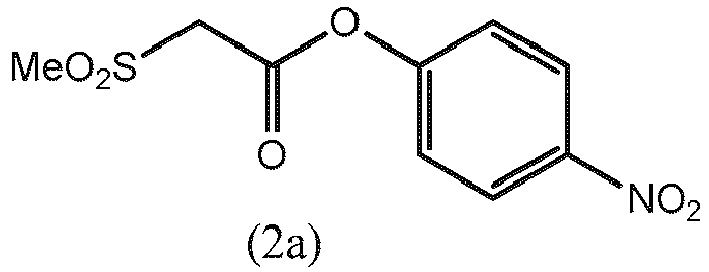
- Add 100.0g methanesulfonylacetic acid (724mmol) to 500mL of acetonitrile. Add triethylamine (3.78 grams, 724mmol) and cool the reaction to 0°C. Slowly add a solution of p-nitrophenylchloroformate (161g, 1.08 equivalents) in 240mL acetonitrile at a temperature of <5°C. Stir at about 5-10°C for 15 minutes after addition. Add 1500mL water and stir the resulting slurry for 15 minutes. Filter and wash with a solution of 25% acetonitrile in water. Dry the material. The material is further purified by heating to 80°C in isopropyl acetate (835mL). Cool the mixture to 20°C over two hours and isolate the product by filtration. Wash the filter cake with 200mL tert-butyl methyl ether. Dry the material under vacuum at 50°C to afford 147 grams (78%) of a white solid. 1H NMR (CDCl3, 600MHz) 8.35 (d, 2H), 7.37 (d, 2H), 4.28 (s, 2H), 3.23 (s, 3H). MS M+1 = 260.
- Alternatively, (4-nitrophenyl)-2-methylsulfonylacetate can be prepared by stirring methanesulphonylacetic acid (59g), 4-nitrophenol (119g), and acetonitrile (600mL), under nitrogen. Cool the mixture in an ice/water bath to an internal temperature of about 3°C. Add N-(3-dimethylaminopropyl)-N'-ethylcarbodiimide hydrochloride (EDAC, 100g) portionwise over 30 minutes. The internal temperature rises to a maximum of about 8°C during the addition. Allow the reaction to cool to about 1-3°C while stirring for 1 hour. Quench the reaction mixture by adding water (1200mL) over 15 minutes at a maximum temperature of 10°C. Stir the mixture in the ice/water bath for 1-hour. Isolate the product by filtration. The yellow filter cake was washed with water until the liquors ran colorless. The filter cake was dried at 50°C under vacuum to afford 79g (71% yield) of a white solid. 1H NMR (CDCl3, 600MHz) 8.35 (d, 2H), 7.37 (d, 2H), 4.28 (s, 2H), 3.23 (s, 3H). MS M+1 = 260.
-

- The compound was prepared similarly to that in Preparation 31 of
WO2012/120399 , except that the p-toluene sulfonic acid was replaced with benzene sulfonic acid. Chiral-tert-butyl 5'-(5-(3,5-dichloro-4-fluorophenyl)-5-(trifluoromethyl)-4,5-dihydroisoxazol-3-yl)-3'H-spiro[azetidine-3,1'-isobenzofuran]-1-carboxylate (195g, 348mmol) was dissolved in methanol (600mL) at 60°C. Benzenesulfonic acid (66.7g, 418mmol) was added to the reaction over 30 minutes as a solution in methanol (60mL). The reaction was stirred at 60°C for thirty minutes and then tert-butylmethyl ether (455mL) was added. The reaction was cooled to 20°C and was filtered to isolate the product. The product was washed with tert-butylmethyl ether (200mL) and was dried to afford 167.4g (92%) of a white powder. 1H NMR, 600MHz (d6-DMSO) d ppm: 9.08 (br s, 1H), 8.89 (d, 1H), 7.95 (d, 1H), 7.83 (m, 3H), 7.72 (s, 1H), 7.62 (d, 2H), 7.33 (m, 3H), 5.13 (s, 2H), 4.36 (m, 6H), 2.25; m/z (CI) 461 [M+H] (free amine). The asterisk (*) depicts the chiral center. -

- A slurry of (S)-5'-(5-(3,5-dichloro-4-fluorophenyl)-5-trifluoromethyl)-4,5-dihydroisoxazol-3-yl)-3'H-spiro[azetidine-3,1'-isobenzofuran]benzene sulfonate (Intermediate 2, 50.0g) and (4-nitrophenyl)-2-methylsulfonylacetate (Intermediate 1, 22.4g, 1.07 equivalents) in isopropyl acetate (450mL) was cooled to about 7°C. Besides isopropyl acetate, alternate non-limiting organic solvents can be used, for example: tetrahydrofuran, ethyl acetate, toluene, methyl tert-butyl ether, and the like. To this was added triethylamine (9.26g, 1.10 equivalents). The reaction was stirred for 15 minutes at about 5-10°C and then at about 20°C for two hours. The solids which formed were removed by filtration. The remaining organic solution was washed sequentially with 6N aqueous ammonium hydroxide (2x250mL) and then with water (2x200mL). Besides ammonium hydroxide, alternate non-limiting aqueous bases can be used, for example: carbonates and other hydroxides (e.g., sodium hydroxide and potassium hydroxide), and the like. The washed organics were concentrated under vacuum to a small volume. The concentrated organics were then added to 300mL methanol. The methanolic solution was added slowly to 20°C water (300mL) while stirring over 30 minutes. After stirring for an additional 15 minutes, the solids were isolated by filtration. The resulting white powder was dried under vacuum at 50°C to a final yield of 38g. Alternatively, the crystal form of the product can be isolated by adding the concentrated organics to a solution (300mL) containing ethyl acetate (5%), n-heptane (35%) and ethanol (60%). The reaction mixture was heated to about 60°C and then cooled to about 45°C over a period of about 15-20 minutes. Crystal seeds of (S)-(5'-(5-(3,5-dichloro-4-fluorophenyl)-5-trifluoromethyl)-4,5-dihydroisoxazol-3-yl)-3'H-spiro[azetidine-3,1'-isobenzofuran]-1-yl)-2-(methylsulfonyl)ethanone were added to the mixture. [The crystal seeds were made by dissolving amorphous (S)-1-(5'-(5-(3,5-dichloro-4-fluorophenyl)-5-(trifluoromethyl)-4,5-dihydroisoxazol-3-yl)-3'H-spiro[azetidine-3,1'-isobenzofuran]-1-yl)-2-(methylsulfonyl)ethanone in methanol and allowing vapor diffusion of an outer layer of diisopropyl ether to slowly convert the amorphous form to the crystal form over a period of about 5 days at room temperature.] The reaction mixture was maintained at about 45°C for about 2 hours then cooled to about 30°C at a rate of about 1.5°C per hour, then cooled to 10°C over three hours, linearly, then held at 10°C for about 4.5 hours. The white slurry was cooled to about 0-1°C over 20 minutes and held overnight (approximately 23 hours) at about 0-1°C. The product was isolated by filtration and dried. 1H NMR, 600MHz (d6-DMSO): 7.88 (d, 2H), 7.82 (d, 1H), 7.73 (m, 2H), 5.18 (s, 2H), 4.62 (dd, 2H), 4.42 (dd, 2H), 4.28 (m, 4H), 3.20 (s, 3H). MS: M+H = 582.
Claims (15)
- A process for preparing a Formula (1) compound
 a) reacting a Formula (1a) compound
 b) with a Formula (2) compound
- The process of Claim 1 wherein Formula (2) is a compound of Formula (2a)

- The process of Claim 2 wherein R1a, R1b, and R1c are each independently selected from hydrogen, fluoro, and chloro; the organic solvent is selected from the group consisting of isopropyl acetate, tetrahydrofuran, methyl tert-butyl ether, ethyl acetate, and toluene; and wherein the acid addition salt is benzene sulfonic acid.
- The process of Claim 3 wherein the Formula (1a) compound is a Formula (1a1) compound

- The process of Claim 4 whereina) equimolar amounts of the Formula (1a1) compound and Formula (2a) compound are reacted in isopropyl acetate;b) the solids are removed and the organics sequentially washed with an aqueous base and water; andc) the organics are concentrated.
- The process of Claim 5 further comprising:a) addition of alcohol to the concentrated organics;b) slowly adding the alcohol solution to water while stirring; andc) filter and dry the resulting solids.
- The process of Claim 5 wherein the concentrated solids are washed twice with an aqueous base selected from a hydroxide or carbonate and then washed twice with water.
- The process of Claim 7 wherein the aqueous base is selected from sodium hydroxide, potassium hydroxide, or ammonium hydroxide.
- The process of Claim 6 wherein the alcohol is methanol.
- The process of Claim 5 further comprising:a) the concentrated organics are added to a solution comprising ethyl acetate, n-heptane, and ethanol;b) add crystal seeds to the solution and cool; andc) filter and dry the resulting solids.
- A process for preparing a Formula (3) compound


- The process of Claim 11 wherein the Formula (2) compound is a compound of Formula (2a)

- The process of Claim 12, wherein the organic solvent is isopropyl acetate, remove the solids, sequentially wash the organics with an aqueous base and water, and concentrate the organics.
- The process of Claim 13 wherein the concentrated organics are either added to methanol, slowly mixed with water, and the resulting solids isolated by filtration and dried; or the concentrated organics are added to a solution comprising ethyl acetate, n-heptane, and ethanol, then mixed with crystal seeds, allowed to cool, and the resulting solids isolated by filtration and dried.
- A process for preparing a Formula (2a) compound
 A) a) mixing methanesulfonylacetic acid, acetonitrile, and triethylamine, b) cooling the reaction mixture and adding p-nitrophenylchloroformate in acetonitrile, c) adding water, d) filtering and washing the reaction mixture with acetonitrile/water (1:3), e) drying the solids and further purifying the solids by heating to about 80°C in isopropyl acetate, f) cooling the mixture, filtering and washing the solids with tert-butyl methyl ether, g) and drying the solids; orB) a) mixing methanesulfonylacetic acid, 4-nitrophenol, and acetonitrile under nitrogen, b) cooling the reaction mixture, c) add N-(-3-dimethylaminopropyl)-N'-ethylcarbodiimide hydrochloride portionwise, d) quenching the reaction mixture with water, e) filtering and washing the solids with water and f) drying the solids.
Applications Claiming Priority (3)
| Application Number | Priority Date | Filing Date | Title |
|---|---|---|---|
| US201261729022P | 2012-11-21 | 2012-11-21 | |
| EP13802788.3A EP2922854B1 (en) | 2012-11-21 | 2013-11-20 | Synthesis of spirocyclic isoxazoline derivatives |
| PCT/US2013/070959 WO2014081800A1 (en) | 2012-11-21 | 2013-11-20 | Synthesis of spirocyclic isoxazoline derivatives |
Related Parent Applications (1)
| Application Number | Title | Priority Date | Filing Date |
|---|---|---|---|
| EP13802788.3A Division EP2922854B1 (en) | 2012-11-21 | 2013-11-20 | Synthesis of spirocyclic isoxazoline derivatives |
Publications (1)
| Publication Number | Publication Date |
|---|---|
| EP4056572A1 true EP4056572A1 (en) | 2022-09-14 |
Family
ID=49753486
Family Applications (2)
| Application Number | Title | Priority Date | Filing Date |
|---|---|---|---|
| EP22170224.4A Withdrawn EP4056572A1 (en) | 2012-11-21 | 2013-11-20 | Synthesis of spirocyclic isoxazoline derivatives |
| EP13802788.3A Active EP2922854B1 (en) | 2012-11-21 | 2013-11-20 | Synthesis of spirocyclic isoxazoline derivatives |
Family Applications After (1)
| Application Number | Title | Priority Date | Filing Date |
|---|---|---|---|
| EP13802788.3A Active EP2922854B1 (en) | 2012-11-21 | 2013-11-20 | Synthesis of spirocyclic isoxazoline derivatives |
Country Status (11)
| Country | Link |
|---|---|
| US (1) | US9593126B2 (en) |
| EP (2) | EP4056572A1 (en) |
| JP (1) | JP6234471B2 (en) |
| CN (1) | CN104918944B (en) |
| AU (1) | AU2013348091B2 (en) |
| BR (1) | BR112015011740B1 (en) |
| CA (1) | CA2892344C (en) |
| ES (1) | ES2916805T3 (en) |
| MX (1) | MX368078B (en) |
| PL (1) | PL2922854T3 (en) |
| WO (1) | WO2014081800A1 (en) |
Families Citing this family (14)
| Publication number | Priority date | Publication date | Assignee | Title |
|---|---|---|---|---|
| AU2013312896A1 (en) * | 2012-09-07 | 2015-02-26 | Zoetis Services Llc | Spirocyclic derivatives as antiparasitic agents |
| UY37137A (en) | 2016-02-24 | 2017-09-29 | Merial Inc | ANTIPARASITARY COMPOUNDS OF ISOXAZOLINE, INJECTABLE FORMULATIONS OF PROLONGED ACTION THAT INCLUDE THEM, METHODS AND USES OF THE SAME |
| WO2017153217A1 (en) | 2016-03-09 | 2017-09-14 | Basf Se | Spirocyclic derivatives |
| HUE056909T2 (en) | 2016-04-06 | 2022-04-28 | Boehringer Ingelheim Animal Health Usa Inc | Process for the preparation of enantiomerically enriched isoxazoline compounds - crystalline toluene solvate of (s)-afoxolaner |
| WO2017201134A1 (en) * | 2016-05-20 | 2017-11-23 | Avista Pharma Solutions, Inc. | Synthetic process and novel intermediates |
| CN110381738B (en) | 2016-10-14 | 2021-07-16 | 勃林格殷格翰动物保健美国公司 | Pesticidal and parasiticidal vinylisoxazoline compounds |
| WO2018162312A1 (en) * | 2017-03-10 | 2018-09-13 | Basf Se | Spirocyclic derivatives |
| ES2944616T3 (en) | 2017-08-14 | 2023-06-22 | Boehringer Ingelheim Animal Health Usa Inc | Pyrazole-Isoxazoline Compounds Pesticides and Parasiticides |
| AU2019376282A1 (en) * | 2018-11-06 | 2021-05-20 | Basf Se | Process for preparation of optically enriched isoxazolines |
| JP7724845B2 (en) | 2020-07-24 | 2025-08-18 | エランコ・ユーエス・インコーポレイテッド | Methods for making isoxazoline compounds and intermediates therefor - Patent Application 20070122997 |
| KR20230061465A (en) | 2020-09-04 | 2023-05-08 | 엘랑코 유에스 인코포레이티드 | palatable formulation |
| CN113548989A (en) * | 2021-07-14 | 2021-10-26 | 浙江倍合德制药有限公司 | Preparation process and production line of 4-nitrophenyl-2-methylsulfonyl acetate |
| MX2023014962A (en) | 2021-08-11 | 2024-02-13 | Elanco Us Inc | Process for making diaryl isoxazoline derivative. |
| WO2026043852A1 (en) | 2024-08-20 | 2026-02-26 | Zoetis Services Llc | Process for preparing optically enriched isoxazolines |
Citations (4)
| Publication number | Priority date | Publication date | Assignee | Title |
|---|---|---|---|---|
| WO1991014434A1 (en) * | 1990-03-28 | 1991-10-03 | Glasky Alvin J | Multi-functional pharmaceutical compounds and methods of use |
| WO2004113347A1 (en) * | 2003-06-20 | 2004-12-29 | Celltech R & D Limited | Thienopyridone derivatives as kinase inhibitors |
| WO2012017359A1 (en) * | 2010-08-05 | 2012-02-09 | Pfizer Inc. | Isoxazoline derivatives as antiparasitic agents |
| WO2012120399A1 (en) | 2011-03-10 | 2012-09-13 | Pfizer Inc. | Spirocyclic isoxazoline derivatives as antiparasitic agents |
Family Cites Families (3)
| Publication number | Priority date | Publication date | Assignee | Title |
|---|---|---|---|---|
| US9167013B2 (en) * | 2011-03-10 | 2015-10-20 | Telefonaktiebolaget L M Ericsson (Publ) | Method and apparatus for prioritizing media within an electronic conference according to utilization settings at respective conference participants |
| AR086113A1 (en) * | 2011-04-30 | 2013-11-20 | Abbott Lab | ISOXAZOLINS AS THERAPEUTIC AGENTS |
| TWM424868U (en) | 2011-09-02 | 2012-03-21 | yi-zhen Huang | Baby walker |
-
2013
- 2013-11-20 JP JP2015544110A patent/JP6234471B2/en active Active
- 2013-11-20 AU AU2013348091A patent/AU2013348091B2/en active Active
- 2013-11-20 EP EP22170224.4A patent/EP4056572A1/en not_active Withdrawn
- 2013-11-20 WO PCT/US2013/070959 patent/WO2014081800A1/en not_active Ceased
- 2013-11-20 ES ES13802788T patent/ES2916805T3/en active Active
- 2013-11-20 MX MX2015006458A patent/MX368078B/en active IP Right Grant
- 2013-11-20 US US14/439,091 patent/US9593126B2/en active Active
- 2013-11-20 PL PL13802788.3T patent/PL2922854T3/en unknown
- 2013-11-20 CN CN201380060755.4A patent/CN104918944B/en active Active
- 2013-11-20 CA CA2892344A patent/CA2892344C/en active Active
- 2013-11-20 EP EP13802788.3A patent/EP2922854B1/en active Active
- 2013-11-20 BR BR112015011740A patent/BR112015011740B1/en active IP Right Grant
Patent Citations (4)
| Publication number | Priority date | Publication date | Assignee | Title |
|---|---|---|---|---|
| WO1991014434A1 (en) * | 1990-03-28 | 1991-10-03 | Glasky Alvin J | Multi-functional pharmaceutical compounds and methods of use |
| WO2004113347A1 (en) * | 2003-06-20 | 2004-12-29 | Celltech R & D Limited | Thienopyridone derivatives as kinase inhibitors |
| WO2012017359A1 (en) * | 2010-08-05 | 2012-02-09 | Pfizer Inc. | Isoxazoline derivatives as antiparasitic agents |
| WO2012120399A1 (en) | 2011-03-10 | 2012-09-13 | Pfizer Inc. | Spirocyclic isoxazoline derivatives as antiparasitic agents |
Non-Patent Citations (8)
| Title |
|---|
| BERGE S. M. ET AL.: "Pharmaceutical Salts", J. PHARM. SCI., vol. 66, 1977, pages 1, XP002675560, DOI: 10.1002/jps.2600660104 |
| DATABASE REGISTRY [online] CHEMICAL ABSTRACTS SERVICE, COLUMBUS, OHIO, US; 16 June 2009 (2009-06-16), XP002718792, retrieved from STN Database accession no. 1158363-70-2 * |
| JEAN JACQUES ANDRE COLLETSAMUEL H. WILEN: "Beilsteins Handbuch der organischen Chemie", 1981, JOHN WILEY AND SONS |
| LOUIS F. FIESERMARY FIESER: "Reagents for Organic Synthesis", vol. 1, 1967, WILEY, pages: 19 |
| RC LAROCK: "Comprehensive Organic Transformations - A Guide to Functional Group Transformations", 1999, WILEY-VCH |
| STILL ET AL., J. ORG. CHEM., vol. 43, 1978, pages 2923 |
| T. W. GREENE: "Protective Groups in Organic Synthesis", 1991, JOHN WILEY & SONS |
| TOKUTAKE N ET AL: "A CONVENIENT SYNTHESIS OF 1,4-DIARYL-3-(4-TOLUENESULFONYL)-AZETIDIN-2-ONES FROM ESTERS AND ALDIMINES", SYNTHESIS, GEORG THIEME VERLAG, STUTTGART, DE, no. 1, 1 January 1983 (1983-01-01), pages 66/67, XP001179960, ISSN: 0039-7881, DOI: 10.1055/S-1983-30226 * |
Also Published As
| Publication number | Publication date |
|---|---|
| AU2013348091B2 (en) | 2017-04-13 |
| WO2014081800A1 (en) | 2014-05-30 |
| PL2922854T3 (en) | 2022-07-18 |
| AU2013348091A1 (en) | 2015-06-04 |
| JP6234471B2 (en) | 2017-11-22 |
| AU2013348091A8 (en) | 2015-07-09 |
| MX368078B (en) | 2019-09-17 |
| BR112015011740A2 (en) | 2017-07-11 |
| CN104918944A (en) | 2015-09-16 |
| EP2922854A1 (en) | 2015-09-30 |
| CN104918944B (en) | 2017-05-10 |
| BR112015011740B1 (en) | 2020-04-14 |
| MX2015006458A (en) | 2015-08-14 |
| US20150291612A1 (en) | 2015-10-15 |
| JP2016500106A (en) | 2016-01-07 |
| US9593126B2 (en) | 2017-03-14 |
| EP2922854B1 (en) | 2022-05-04 |
| CA2892344C (en) | 2017-06-06 |
| CA2892344A1 (en) | 2014-05-30 |
| ES2916805T3 (en) | 2022-07-06 |
Similar Documents
| Publication | Publication Date | Title |
|---|---|---|
| EP2922854B1 (en) | Synthesis of spirocyclic isoxazoline derivatives | |
| TWI760919B (en) | A kind of pyrimidocyclic derivative and its application in medicine | |
| NO331656B1 (en) | Process for synthesizing camptothesin related compounds | |
| TWI666211B (en) | Method for preparation of quibetin and the intermediate thereof | |
| WO2014058035A1 (en) | Novel spirooxindole derivative and process for producing the same | |
| Promontorio et al. | Domino Michael-aldol annulations for the stereocontrolled synthesis of bicyclo [3.3. 1] nonane and bicyclo [3.2. 1] octane derivatives | |
| Monbaliu et al. | [4+ 2] Cycloaddition of 1-phosphono-1, 3-butadiene with azo-and nitroso-heterodienophiles | |
| WO2022007838A1 (en) | Method for preparing glucopyranosyl derivatives and intermediates thereof | |
| EP4662326A1 (en) | Ligand-enabled transannular c-h functionalization of cycloalkane carboxylic acids | |
| HK1213547B (en) | Synthesis of spirocyclic isoxazoline derivatives | |
| CN103709101A (en) | Kind of synthesis intermediates of renierramycin G and preparation method of synthesis intermediate | |
| Nakagawa et al. | Total synthesis of (−)-eudistomins with an oxathiazepine ring. Part 1. Formation of the oxathiazepine ring system | |
| Xu et al. | SAR of tricyclic sulfones as γ-secretase inhibitors | |
| CN119490501A (en) | Imidazole bicyclic compound and its preparation method and use | |
| RU2346947C1 (en) | Method of obtaining furylhetarylmethanes with thieno[2,3-b]pyridine fragment | |
| CA2995554C (en) | Tetrahydrooxepinopyridine compound | |
| Zheng | Lewis Base Catalyzed Electrophilic Transformations | |
| Wodnicka et al. | Synthesis of 2-[2-(3, 4, 5-Trimethoxybenzoyloxy) ethyl] pyrrolidine Hydrochloride Controlled by GC-MS,^ 1H and^{13} C NMR Analyses | |
| WO2014133416A2 (en) | Substituted (r)-3-(4-methylcarbamoyl-3-fluorophenylamino)tetrahydrofuran-3-enecarboxylic acid (variants) and ester thereof, method for producing and using same | |
| Marquardt | A new synthetic pathway to epothilone analogues and an efficient approach to cyclohexenylamines as precursors for the total synthesis of epibatidine | |
| JPWO2018105492A1 (en) | Method for producing 3- (pyridyl-2-amino) propionitrile and its analogs | |
| Csuk et al. | From a glycal to a [1, 3] dioxolan-4-yl ester | |
| BR112018003171B1 (en) | TETRAHYDROOXEPINOPYRIDINE COMPOUNDS, PHARMACEUTICAL COMPOSITION COMPRISING SAID COMPOUNDS AND THERAPEUTIC USE THEREOF | |
| CA2647655A1 (en) | Novel c-1 analogs of pancratistatin and 7-deoxypancratistatin and processes for their preparation | |
| KR20000032801A (en) | Manufacturing method of 2-nitrothioxanthone |
Legal Events
| Date | Code | Title | Description |
|---|---|---|---|
| PUAI | Public reference made under article 153(3) epc to a published international application that has entered the european phase |
Free format text: ORIGINAL CODE: 0009012 |
|
| STAA | Information on the status of an ep patent application or granted ep patent |
Free format text: STATUS: REQUEST FOR EXAMINATION WAS MADE |
|
| 17P | Request for examination filed |
Effective date: 20220427 |
|
| AC | Divisional application: reference to earlier application |
Ref document number: 2922854 Country of ref document: EP Kind code of ref document: P |
|
| AK | Designated contracting states |
Kind code of ref document: A1 Designated state(s): AL AT BE BG CH CY CZ DE DK EE ES FI FR GB GR HR HU IE IS IT LI LT LU LV MC MK MT NL NO PL PT RO RS SE SI SK SM TR |
|
| STAA | Information on the status of an ep patent application or granted ep patent |
Free format text: STATUS: THE APPLICATION IS DEEMED TO BE WITHDRAWN |
|
| 18D | Application deemed to be withdrawn |
Effective date: 20230315 |