EP4056534A1 - Neodymium-graphene composite material and preparation method and application thereof - Google Patents
Neodymium-graphene composite material and preparation method and application thereof Download PDFInfo
- Publication number
- EP4056534A1 EP4056534A1 EP21173938.8A EP21173938A EP4056534A1 EP 4056534 A1 EP4056534 A1 EP 4056534A1 EP 21173938 A EP21173938 A EP 21173938A EP 4056534 A1 EP4056534 A1 EP 4056534A1
- Authority
- EP
- European Patent Office
- Prior art keywords
- graphene
- neodymium
- nickel foam
- composite material
- preparation
- Prior art date
- Legal status (The legal status is an assumption and is not a legal conclusion. Google has not performed a legal analysis and makes no representation as to the accuracy of the status listed.)
- Granted
Links
Images




Classifications
-
- C—CHEMISTRY; METALLURGY
- C23—COATING METALLIC MATERIAL; COATING MATERIAL WITH METALLIC MATERIAL; CHEMICAL SURFACE TREATMENT; DIFFUSION TREATMENT OF METALLIC MATERIAL; COATING BY VACUUM EVAPORATION, BY SPUTTERING, BY ION IMPLANTATION OR BY CHEMICAL VAPOUR DEPOSITION, IN GENERAL; INHIBITING CORROSION OF METALLIC MATERIAL OR INCRUSTATION IN GENERAL
- C23C—COATING METALLIC MATERIAL; COATING MATERIAL WITH METALLIC MATERIAL; SURFACE TREATMENT OF METALLIC MATERIAL BY DIFFUSION INTO THE SURFACE, BY CHEMICAL CONVERSION OR SUBSTITUTION; COATING BY VACUUM EVAPORATION, BY SPUTTERING, BY ION IMPLANTATION OR BY CHEMICAL VAPOUR DEPOSITION, IN GENERAL
- C23C16/00—Chemical coating by decomposition of gaseous compounds, without leaving reaction products of surface material in the coating, i.e. chemical vapour deposition [CVD] processes
- C23C16/22—Chemical coating by decomposition of gaseous compounds, without leaving reaction products of surface material in the coating, i.e. chemical vapour deposition [CVD] processes characterised by the deposition of inorganic material, other than metallic material
- C23C16/26—Deposition of carbon only
-
- C—CHEMISTRY; METALLURGY
- C01—INORGANIC CHEMISTRY
- C01B—NON-METALLIC ELEMENTS; COMPOUNDS THEREOF; METALLOIDS OR COMPOUNDS THEREOF NOT COVERED BY SUBCLASS C01C
- C01B32/00—Carbon; Compounds thereof
- C01B32/15—Nano-sized carbon materials
- C01B32/182—Graphene
- C01B32/184—Preparation
- C01B32/186—Preparation by chemical vapour deposition [CVD]
-
- C—CHEMISTRY; METALLURGY
- C01—INORGANIC CHEMISTRY
- C01B—NON-METALLIC ELEMENTS; COMPOUNDS THEREOF; METALLOIDS OR COMPOUNDS THEREOF NOT COVERED BY SUBCLASS C01C
- C01B32/00—Carbon; Compounds thereof
- C01B32/15—Nano-sized carbon materials
- C01B32/182—Graphene
- C01B32/194—After-treatment
-
- C—CHEMISTRY; METALLURGY
- C23—COATING METALLIC MATERIAL; COATING MATERIAL WITH METALLIC MATERIAL; CHEMICAL SURFACE TREATMENT; DIFFUSION TREATMENT OF METALLIC MATERIAL; COATING BY VACUUM EVAPORATION, BY SPUTTERING, BY ION IMPLANTATION OR BY CHEMICAL VAPOUR DEPOSITION, IN GENERAL; INHIBITING CORROSION OF METALLIC MATERIAL OR INCRUSTATION IN GENERAL
- C23C—COATING METALLIC MATERIAL; COATING MATERIAL WITH METALLIC MATERIAL; SURFACE TREATMENT OF METALLIC MATERIAL BY DIFFUSION INTO THE SURFACE, BY CHEMICAL CONVERSION OR SUBSTITUTION; COATING BY VACUUM EVAPORATION, BY SPUTTERING, BY ION IMPLANTATION OR BY CHEMICAL VAPOUR DEPOSITION, IN GENERAL
- C23C16/00—Chemical coating by decomposition of gaseous compounds, without leaving reaction products of surface material in the coating, i.e. chemical vapour deposition [CVD] processes
- C23C16/56—After-treatment
-
- C—CHEMISTRY; METALLURGY
- C25—ELECTROLYTIC OR ELECTROPHORETIC PROCESSES; APPARATUS THEREFOR
- C25B—ELECTROLYTIC OR ELECTROPHORETIC PROCESSES FOR THE PRODUCTION OF COMPOUNDS OR NON-METALS; APPARATUS THEREFOR
- C25B1/00—Electrolytic production of inorganic compounds or non-metals
- C25B1/01—Products
- C25B1/02—Hydrogen or oxygen
- C25B1/04—Hydrogen or oxygen by electrolysis of water
-
- H—ELECTRICITY
- H01—ELECTRIC ELEMENTS
- H01M—PROCESSES OR MEANS, e.g. BATTERIES, FOR THE DIRECT CONVERSION OF CHEMICAL ENERGY INTO ELECTRICAL ENERGY
- H01M4/00—Electrodes
- H01M4/86—Inert electrodes with catalytic activity, e.g. for fuel cells
- H01M4/90—Selection of catalytic material
-
- H—ELECTRICITY
- H01—ELECTRIC ELEMENTS
- H01M—PROCESSES OR MEANS, e.g. BATTERIES, FOR THE DIRECT CONVERSION OF CHEMICAL ENERGY INTO ELECTRICAL ENERGY
- H01M4/00—Electrodes
- H01M4/86—Inert electrodes with catalytic activity, e.g. for fuel cells
- H01M4/90—Selection of catalytic material
- H01M4/9041—Metals or alloys
-
- H—ELECTRICITY
- H01—ELECTRIC ELEMENTS
- H01M—PROCESSES OR MEANS, e.g. BATTERIES, FOR THE DIRECT CONVERSION OF CHEMICAL ENERGY INTO ELECTRICAL ENERGY
- H01M4/00—Electrodes
- H01M4/86—Inert electrodes with catalytic activity, e.g. for fuel cells
- H01M4/90—Selection of catalytic material
- H01M4/9075—Catalytic material supported on carriers, e.g. powder carriers
- H01M4/9083—Catalytic material supported on carriers, e.g. powder carriers on carbon or graphite
-
- H—ELECTRICITY
- H01—ELECTRIC ELEMENTS
- H01M—PROCESSES OR MEANS, e.g. BATTERIES, FOR THE DIRECT CONVERSION OF CHEMICAL ENERGY INTO ELECTRICAL ENERGY
- H01M4/00—Electrodes
- H01M4/86—Inert electrodes with catalytic activity, e.g. for fuel cells
- H01M2004/8678—Inert electrodes with catalytic activity, e.g. for fuel cells characterised by the polarity
- H01M2004/8689—Positive electrodes
Definitions
- the present invention relates to the technical field of catalytic materials, in particular to a neodymium-graphene composite material and a preparation method and an application thereof.
- the preparation of hydrogen and oxygen by electrocatalytic cracking of water is a safe and sustainable way to obtain clean energy, which has important application value and research significance in the efficient use of renewable clean energy, alleviation of the energy crisis, and prevention of environmental pollution.
- the best hydrogen and oxygen evolution catalysts are respectively Pt-based and Ir/Ru-based materials.
- noble metal catalytic materials are limited in reserves and of high cost, limiting their use in large-scale applications. Therefore, it is of great significance to search for cheap non-noble metal catalysts with abundant reserves and excellent performance.
- the performance of the catalysts mainly depends on the intrinsic activity of active catalytic sites in the catalysts and the number of the catalytic sites. So far, the number of high-efficient hydrogen evolution catalysts used in alkaline media is far less than that of acidic catalysts. Moreover, the development of the hydrogen evolution catalysts with high activity and high stability in the alkaline media has important industrial application value and broad application prospects.
- nickel-based catalysts have been extensively studied due to their excellent corrosion resistance in the alkaline media. Due to the special three-dimensional electron distribution of the nickel-based catalysts, the nickel-based catalysts are considered as one of the most promising electrode materials for hydrogen evolution in the alkaline media. Most of the existing research take graphene as the main body, and a series of materials are prepared by combining the graphene with transition metals.
- the prior art discloses a preparation method of a material with a three-dimensional well-developed pore structure, which comprises the steps of: preparing a three-dimensional graphene block through high-temperature carbonization and graphitization of a polymer product, then conducting nitrogen-doped reaction under ammonia gas to obtain a high-strength nitrogen-doped graphene material, and finally introducing a MoS2 material to prepare the material with the three-dimensional well-developed pore structure.
- the prior art also discloses a preparation method and an application of a catalyst with Ni 2 P loaded graphene foam structure; the technological process of the preparation method follows the below steps: soaking the nickel foam in a graphene oxide solution, and enabling the graphene oxide to be loaded and grow on the surface of the nickel foam in an environment saturated with rare gas, taking out the sample after freeze-drying to obtain a monodisperse ultra-small NiO graphene-loaded foaming structure catalyst; and performing phosphating on the freeze-dried sample to obtain a monodisperse ultra-small Ni 2 P graphene-loaded foaming structure catalyst.
- transition metal compounds are generally synthesized by solution hydrothermal reaction. Some materials need to undergo subsequent freeze-drying treatment, the synthesis process takes a long time, some sulfides and phosphides are needed for subsequent vulcanization and phosphating treatment, pungent odors are produced, and exhaust gas treatment is required.
- the material synthesis cycle is relatively long, the efficiency is low, and therefore, the method is difficult to apply to the production of large-area materials.
- the present invention provides a neodymium-graphene composite material and a preparation method and an application thereof so as to solve or at least partially solve the technical problems in the prior art.
- the present invention provides a preparation method of a neodymium-graphene composite material, which comprises the steps of:
- the preparation method of the neodymium-graphene composite material characterized in that the preparation of the neodymium elements on the graphene surface of the graphene nickel foam material described in the step 2 specially comprises: placing the graphene nickel foam material in a tube furnace, placing neodymium fluoride(NdF 3 ) powder in the tube furnace, and heating to 1200-1400 °C, so that the neodymium fluoride is volatilized and decomposed to produce neodymium-containing elements, and the neodymium-containing elements are deposited on a surface of the graphene.
- the preparation method of the neodymium-graphene composite material characterized in that the preparation of the neodymium elements on the graphene surface of the graphene nickel foam material described in the step 2 specially comprises: soaking the graphene nickel foam material in a neodymium nitrate or neodymium sulfate solution, taking out the graphene nickel foam material, drying the graphene nickel foam material, and then conducting heat treatment on the graphene nickel foam material in inert gas.
- the preparation method of the neodymium-graphene composite material characterized in that the carbon source in the step 1 comprises one of ethylene, methane and acetylene.
- the preparation method of the neodymium-graphene composite material characterized in that the process of growing the graphene on the surface of the nickel foam substrate by using the chemical vapor deposition method to obtain the graphene nickel foam material in the step 1 specially comprises: placing nickel foam in the tube furnace, introducing a gas mixture of hydrogen and argon, then increasing the temperature to 900-1200 °C, and introducing carbon source gas to grow the graphene on the surface of the nickel foam substrate.
- the preparation method of the neodymium-graphene composite material characterized in that the time for introducing the carbon source gas is 15-25 minutes, and the flow rate of the carbon source gas is 90-110 sccm.
- the preparation method of the neodymium-graphene composite material characterized in that the graphene nickel foam material is placed in the tube furnace, meanwhile the gas mixture of hydrogen and argon is introduced, and the flow rate of the gas mixture is 90-110 sccm.
- the preparation method of the neodymium-graphene composite material characterized in that the nickel foam is cleaned by using ethanol before the nickel foam is placed in the tube furnace.
- neodymium-graphene composite material characterized by being prepared by the preparation method.
- the neodymium-graphene composite material can be applied to a device for producing hydrogen by water electrolysis as an electrode material, or be applied to a fuel cell or a metal-air battery as a cathode material.
- the preparation method of the neodymium-graphene composite material has the following beneficial effects:
- the present invention provides a preparation method of a neodymium-graphene composite material, which comprises the steps of:
- the preparation of the neodymium elements on the graphene surface of the graphene nickel foam material described in the step 2 specially comprises: placing the graphene nickel foam material in a tube furnace, placing neodymium fluoride powder in the tube furnace, and heating to 1200-1400 °C, so that the neodymium fluoride is volatilized and decomposed to produce neodymium-containing elements, and the neodymium-containing elements are deposited on the surface of the graphene.
- the preparation of the Neodymium elements on the graphene surface of the graphene nickel foam material described in the step 2 specially comprises: soaking the graphene nickel foam material in a neodymium nitrate or neodymium sulfate solution, taking out the graphene nickel foam material, drying the graphene nickel foam material, and then conducting heat treatment on the graphene nickel foam material in inert gas; and specially, the inert gas is Ar gas, the heat treatment temperature is 1000-1200°C, and the heat treatment time is 10-15 minutes.
- the carbon source in the step 1 comprises one of ethylene, methane and acetylene.
- the process of growing the graphene on the surface of the nickel foam substrate by using the chemical vapor deposition method to obtain the graphene nickel foam material in the step 1 specially comprises: placing nickel foam in the tube furnace, introducing a gas mixture of hydrogen and argon, then increasing the temperature to 900-1200°C, and introducing carbon source gas to grow the graphene on the surface of the nickel foam substrate.
- the introduced gas mixture of hydrogen and argon can prevent the formation of oxides on the surface of the nickel foam and is conducive to the uniform growth of the graphene.
- the flow rate of the introduced gas mixture of hydrogen and argon is 90-110 sccm, and the volume ratio of hydrogen to argon is (5-9): 100.
- the time for introducing the carbon source gas is 15-25 minutes, and the flow rate of the carbon source gas is 90-110 sccm.
- the graphene nickel foam material in the process of preparing a neodymium compound on the graphene surface of the graphene nickel foam material in the step 2, the graphene nickel foam material is placed in the tube furnace, meanwhile the gas mixture of hydrogen and argon is introduced, and the flow rate of the gas mixture is 90-110 sccm; and specially, the volume ratio of hydrogen to argon is (5-9):100.
- the nickel foam in the process of growing the graphene on the surface of the nickel foam substrate by using the chemical vapor deposition method to obtain the graphene nickel foam material in the step 1, the nickel foam is cleaned by using ethanol before the nickel foam is placed in the tube furnace; and specifically, the nickel foam is soaked in an ethanol solution with a mass concentration of 5-10% for 5-10 minutes.
- the preparation method of the neodymium-graphene composite material comprises the steps of: placing the nickel foam in one temperature zone of the tube furnace, placing the neodymium fluoride (NdF3) powder in the other temperature zone of the tube furnace, introducing the gas mixture of hydrogen and argon with the flow rate of 90-110 sccm, heating the temperature zone corresponding to the nickel foam to 900-1200 °C, heating the temperature zone corresponding to the neodymium fluoride powder to 1200-1400 °C, meanwhile conducting heat preservation for 10 minutes, and then introducing ethylene gas with the flow rate of 90-110 sccm for 10 minutes, wherein, the neodymium fluoride is volatilized and decomposed at a high temperatures above 1200 °C to produce neodymium-containing elements, and the neodymium-containing elements are deposited on the surface of the graphene with the gas, and then are cooled to a room temperature with the furnace
- the nickel foam only adsorbs carbon atoms, and the carbon atoms are adsorbed on the surface of the nickel foam to form the graphene; when neodymium atoms and the carbon atoms are deposited at the same time, the neodymium atoms are not adsorbed on the nickel foam, after cooling, the carbon atoms form the graphene on the surface of the nickel foam, and the neodymium atoms form spherical or fibrous compounds on the surface of the graphene; the arrangement of carbon atoms helps to grow neodymium morphologies, and at the same time, as the growth mechanisms of graphene and neodymium morphologies are different, the neodymium has no effect on the growth of the graphene.
- the nickel foam is used as the substrate, is an electrically conductive 3D porous material with low price and good performance, can act as a skeleton when being used as the substrate, can avoid graphene stacking and allow graphene to be fully spread out; and meanwhile neodymium in the neodymium fluoride is a rare earth element, and due to the unique properties of 4f electrons in the neodymium, the electrochemical catalytic efficiency of hydrogen evolution reaction (HER), oxygen evolution reaction (OER), oxygen reduction reaction (ORR) and the like can be significantly improved by combining the neodymium with an electrocatalyst.
- HER hydrogen evolution reaction
- OER oxygen evolution reaction
- ORR oxygen reduction reaction
- the neodymium-graphene composite material is synthesized in one step by the chemical vapor deposition method, the synthesis process is simple, the cycle is relatively short, and the efficiency is high, and therefore, the preparation method can be applied to the production of large-area materials.
- the preparation method of the neodymium-graphene composite material raw materials are abundant in source, cheap, easy to obtain, and pollution-free to environments.
- the preparation method of the neodymium-graphene composite material by changing the heating temperature or heat treatment temperature of the neodymium fluoride powder in the tube furnace, the morphology of the composite material can be adjusted and controlled, and spherical and fibrous neodymium compounds are synthesized on the surface of the graphene, so that the specific surface area and electrochemical active area of the composite material can be increased, and then the hydrogen evolution performance of the composite material is improved.
- the composite material prepared in this application has the advantages of uniform surface morphology, large specific surface area, good electrochemical performance, low hydrogen evolution overpotential, and etc. Combined with the advantages of large specific surface area of graphene and good electrical conductivity, the performance of the composite material is improved.
- the nickel foam is a material with a three-dimensional network structure
- the graphene loaded on the nickel foam has the structure of the nickel foam and is unlike powdered materials, the structure is not easily destroyed, meanwhile the graphene nickel foam material has very good electrical conductivity and does not need to be loaded on other conductive materials, and therefore, a binder is not needed in use of the material.
- the present invention also provides the neodymium-graphene composite material prepared by the above-mentioned preparation method.
- the present invention also provides the application of the neodymium-graphene composite material prepared above.
- the neodymium-graphene composite material prepared in the present invention can be directly used as an electrode material for producing hydrogen by water electrolysis, or is applied to a fuel cell, metal-air batteries and other energy devices as a cathode material; the material can not only be used as a hydrogen evolution catalyst, but also can catalyze organic matters to produce other industrial raw materials; and specifically, an organic matter solution rich in source is used as an electrolytic solution, so that the hydrogen production performance is improved, meanwhile the oxidation reaction is used to synthesize high value-added chemical products (organic substances) such as benzaldehyde and ketone organic substances.
- organic substances such as benzaldehyde and ketone organic substances.
- the preparation method of the neodymium-graphene composite material is further illustrated below with specific examples.
- the preparation method of the neodymium-graphene composite material comprises the steps of:
- the above-mentioned tube furnace is a conventional tube furnace, and the tube furnace has at least two temperature zones, and the temperatures required by the different temperature zones can be realized by heating the different temperature zones.
- the preparation method of the neodymium-graphene composite material provided in the present example is the same as that of Example 1, except that the temperature of the second temperature zone in the present example is 1350 °C.
- the comparative example provides the preparation method of the graphene nickel foam material, which comprises the steps of:
- the neodymium elements are spherically distributed on the surface of the graphene, and in the neodymium-graphene composite material prepared in Example 1, the neodymium elements are distributed in a fibrous shape on the surface of graphene. It shows that by controlling the heating temperature of the neodymium fluoride, the neodymium elements with different morphologies can be formed and are distributed on the surface of the graphene.
- the nitrogen adsorption-desorption curves of the neodymium-graphene composite material prepared in the above-mentioned Examples 1 and 2 and the graphene nickel foam material prepared in Comparative Example 1 are tested, and the results are shown in FIG. 2 to 4 .
- the test method of the nitrogen adsorption-desorption curves is in accordance with a conventional test method, and comprises the steps that nitrogen is used as an adsorbent, adsorption curves are measured, then the nitrogen is removed from the sample, and desorption curves are recorded.
- FIG. 2 is the adsorption-desorption curve graph of the graphene nickel foam material prepared in Comparative Example 1;
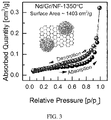
- FIG. 3 is the nitrogen adsorption-desorption curve graph of the neodymium-graphene composite material prepared in Example 2;
- FIG. 4 is the nitrogen adsorption-desorption curve graph of the neodymium-graphene composite material prepared in Example 1; it can be seen from FIG. 2 that the specific surface area of the graphene nickel foam material prepared in Comparative Example 1 is 218 cm 2 /g; it can be seen from FIG. 4 that the specific surface area of the neodymium-graphene composite material prepared in Example 1 is 2217 cm 2 /g; it can be seen from FIG.
- the specific surface area of the neodymium-graphene composite material prepared in Example 2 is 1403 cm 2 /g; and it can be known from the above that the material prepared in Comparative Example 1 has the largest porosity and the smallest surface area, and the neodymium-graphene composite material prepared in Example 1 has the smallest porosity and the largest specific surface area.
- the specific test method of the hydrogen evolution curve comprises the steps that: a three-electrode system is adopted for operation in a 1 M KOH electrolyte on Shanghai Chenhua Electrochemical Workstation (CHI 760E), and the linear scanning voltammetry test is performed at a scanning rate of 5mV/s by respectively using the samples in Examples 1 and 2, Comparative Example 1 and the pure nickel foam as working electrodes, a graphite rod as a counter electrode, and the saturated calomel as a reference electrode to obtain the hydrogen evolution curves.
- NF represents the pure nickel foam
- Gr/NF-1100 °C represents the graphene nickel foam material prepared in Comparative Example 1
- Nd/Gr/NF-1350 °C represents the material prepared in Example 2
- Nd/Gr/NF-1400 °C represents the material prepared in Example 1.
Landscapes
- Chemical & Material Sciences (AREA)
- Organic Chemistry (AREA)
- Engineering & Computer Science (AREA)
- Materials Engineering (AREA)
- Inorganic Chemistry (AREA)
- Chemical Kinetics & Catalysis (AREA)
- General Chemical & Material Sciences (AREA)
- Nanotechnology (AREA)
- Electrochemistry (AREA)
- Metallurgy (AREA)
- Mechanical Engineering (AREA)
- Carbon And Carbon Compounds (AREA)
- Catalysts (AREA)
Abstract
Description
- The application claims priority to
Chinese patent application No. 202110261743.4, filed on March 10, 2021 - The present invention relates to the technical field of catalytic materials, in particular to a neodymium-graphene composite material and a preparation method and an application thereof.
- The preparation of hydrogen and oxygen by electrocatalytic cracking of water is a safe and sustainable way to obtain clean energy, which has important application value and research significance in the efficient use of renewable clean energy, alleviation of the energy crisis, and prevention of environmental pollution. At present, the best hydrogen and oxygen evolution catalysts are respectively Pt-based and Ir/Ru-based materials. Such noble metal catalytic materials are limited in reserves and of high cost, limiting their use in large-scale applications. Therefore, it is of great significance to search for cheap non-noble metal catalysts with abundant reserves and excellent performance.
- The performance of the catalysts mainly depends on the intrinsic activity of active catalytic sites in the catalysts and the number of the catalytic sites. So far, the number of high-efficient hydrogen evolution catalysts used in alkaline media is far less than that of acidic catalysts. Moreover, the development of the hydrogen evolution catalysts with high activity and high stability in the alkaline media has important industrial application value and broad application prospects.
- Among transition metal materials, nickel-based catalysts have been extensively studied due to their excellent corrosion resistance in the alkaline media. Due to the special three-dimensional electron distribution of the nickel-based catalysts, the nickel-based catalysts are considered as one of the most promising electrode materials for hydrogen evolution in the alkaline media. Most of the existing research take graphene as the main body, and a series of materials are prepared by combining the graphene with transition metals. For example, the prior art discloses a preparation method of a material with a three-dimensional well-developed pore structure, which comprises the steps of: preparing a three-dimensional graphene block through high-temperature carbonization and graphitization of a polymer product, then conducting nitrogen-doped reaction under ammonia gas to obtain a high-strength nitrogen-doped graphene material, and finally introducing a MoS2 material to prepare the material with the three-dimensional well-developed pore structure. The prior art also discloses a preparation method and an application of a catalyst with Ni2P loaded graphene foam structure; the technological process of the preparation method follows the below steps: soaking the nickel foam in a graphene oxide solution, and enabling the graphene oxide to be loaded and grow on the surface of the nickel foam in an environment saturated with rare gas, taking out the sample after freeze-drying to obtain a monodisperse ultra-small NiO graphene-loaded foaming structure catalyst; and performing phosphating on the freeze-dried sample to obtain a monodisperse ultra-small Ni2P graphene-loaded foaming structure catalyst.
- For transition metal and carbon material composite catalyst materials disclosed in the prior art, transition metal compounds are generally synthesized by solution hydrothermal reaction. Some materials need to undergo subsequent freeze-drying treatment, the synthesis process takes a long time, some sulfides and phosphides are needed for subsequent vulcanization and phosphating treatment, pungent odors are produced, and exhaust gas treatment is required. The material synthesis cycle is relatively long, the efficiency is low, and therefore, the method is difficult to apply to the production of large-area materials.
- Finally, from the perspective of practical applications, most of the existing catalyst materials are powder materials, a binder is needed during the use of the materials, and therefore, the proton transmission efficiency is reduced. In the process of use, some catalyst materials can only be used in acidic environments, and their hydrogen evolution performance in alkaline environments is very poor, which makes their application subject to many restrictions.
- Based on the technical shortcomings of current catalyst materials, it is necessary to improve this.
- In view of the above problems, the present invention provides a neodymium-graphene composite material and a preparation method and an application thereof so as to solve or at least partially solve the technical problems in the prior art.
- The present invention provides a preparation method of a neodymium-graphene composite material, which comprises the steps of:
- step 1. growing graphene on a nickel foam surface of a substrate by using nickel foam a chemical vapor deposition method with carbon-containing gas as a carbon source to obtain a graphene nickel foam material; and
- step 2. preparing neodymium(Nd) elements on the graphene surface of the graphene nickel foam material to obtain a neodymium-graphene composite material.
- Further, the preparation method of the neodymium-graphene composite material, characterized in that the preparation of the neodymium elements on the graphene surface of the graphene nickel foam material described in the step 2 specially comprises: placing the graphene nickel foam material in a tube furnace, placing neodymium fluoride(NdF3) powder in the tube furnace, and heating to 1200-1400 °C, so that the neodymium fluoride is volatilized and decomposed to produce neodymium-containing elements, and the neodymium-containing elements are deposited on a surface of the graphene.
- Further, the preparation method of the neodymium-graphene composite material, characterized in that the preparation of the neodymium elements on the graphene surface of the graphene nickel foam material described in the step 2 specially comprises: soaking the graphene nickel foam material in a neodymium nitrate or neodymium sulfate solution, taking out the graphene nickel foam material, drying the graphene nickel foam material, and then conducting heat treatment on the graphene nickel foam material in inert gas.
- Further, the preparation method of the neodymium-graphene composite material, characterized in that the carbon source in the step 1 comprises one of ethylene, methane and acetylene.
- Further, the preparation method of the neodymium-graphene composite material, characterized in that the process of growing the graphene on the surface of the nickel foam substrate by using the chemical vapor deposition method to obtain the graphene nickel foam material in the step 1 specially comprises: placing nickel foam in the tube furnace, introducing a gas mixture of hydrogen and argon, then increasing the temperature to 900-1200 °C, and introducing carbon source gas to grow the graphene on the surface of the nickel foam substrate.
- Further, the preparation method of the neodymium-graphene composite material, characterized in that the time for introducing the carbon source gas is 15-25 minutes, and the flow rate of the carbon source gas is 90-110 sccm.
- Further, the preparation method of the neodymium-graphene composite material, characterized in that the graphene nickel foam material is placed in the tube furnace, meanwhile the gas mixture of hydrogen and argon is introduced, and the flow rate of the gas mixture is 90-110 sccm.
- Further, the preparation method of the neodymium-graphene composite material, characterized in that the nickel foam is cleaned by using ethanol before the nickel foam is placed in the tube furnace.
- Further, a neodymium-graphene composite material, characterized by being prepared by the preparation method.
- The neodymium-graphene composite material can be applied to a device for producing hydrogen by water electrolysis as an electrode material, or be applied to a fuel cell or a metal-air battery as a cathode material.
- Compared with the prior art, the preparation method of the neodymium-graphene composite material has the following beneficial effects:
- (1). according to the preparation method of the neodymium-graphene composite material, the nickel foam is used as the substrate. The nickel foam is an electrically conductive 3D porous material with low price and good performance, can act as a skeleton when being used as the substrate, can avoid graphene stacking and allow graphene to be fully spread out; at the same time, neodymium in neodymium fluoride is a rare earth element, and due to the unique properties of 4f electrons in the neodymium, the electrochemical catalytic efficiency of hydrogen evolution reaction, oxygen evolution reaction, oxygen reduction reaction and the like can be significantly improved by combining the neodymium with an electrocatalyst; according to the preparation method of the neodymium-graphene composite material, the neodymium-graphene composite material is synthesized in one step by a chemical vapor deposition method, the synthesis process is simple, the cycle is relatively short, and the efficiency is high, and therefore, the preparation method can be applied to the production of large-area materials; according to the preparation method of the neodymium-graphene composite material, raw materials are abundant in source, cheap, easy to obtain, and pollution-free to environments; according to the preparation method of the neodymium-graphene composite material, by changing the heating temperature of neodymium fluoride powder in a tube furnace, the morphology of the composite material can be adjusted and controlled, and spherical and fibrous neodymium compounds are synthesized on the surface of the graphene, so that the specific surface area and electrochemical active area of the composite material can be increased, and then the hydrogen evolution performance of the composite material is improved; the composite material prepared in this application has the advantages of uniform surface morphology, large specific surface area, good electrochemical performance, low hydrogen evolution overpotential, and etc.. Combined with the advantages mentioned above, the performance of the composite material is improved, and the material has a self-supporting structure and does not need a binder during use.
- In order to explain the embodiments of the present invention or the technical solutions in the prior art more clearly, the drawings that need to be used in the description of the embodiments or the prior art will be briefly introduced below. Obviously, the drawings in the following description are only some embodiments of the present invention, and other drawings can be obtained based on these drawings by those of ordinary skill in the art without creative work.
-
FIG. 1 is surface morphology graphs of neodymium-graphene composite materials prepared in Examples 1 and 2 of the present invention and a graphene nickel foam material prepared in Comparative Example 1; -
FIG. 2 is an adsorption-desorption curve graph of the graphene nickel foam material prepared in Comparative Example 1; -
FIG. 3 is a nitrogen adsorption-desorption curve graph of the neodymium-graphene composite material prepared in Example 2 of the present invention; -
FIG. 4 is a nitrogen adsorption-desorption curve graph of the neodymium-graphene composite material prepared in Example 1 of the present invention; and -
FIG. 5 is hydrogen evolution curve graphs of the neodymium-graphene composite materials prepared in Examples 1 and 2 of the present invention, the graphene nickel foam material prepared in Comparative Example 1, and pure nickel foam in a 1 mol/L KOH solution. - The technical solutions in the embodiments of the present invention will be clearly and completely described below in conjunction with the embodiments of the present invention. Obviously, the described embodiments are only a part of the embodiments of the present invention, rather than all of them. Based on the embodiments of the present invention, all other embodiments obtained by those of ordinary skill in the art without creative work shall fall within the protection scope of the present invention.
- The present invention provides a preparation method of a neodymium-graphene composite material, which comprises the steps of:
- step 1. growing graphene on a nickel foam surface of a substrate by using nickel foam a chemical vapor deposition method with carbon-containing gas as a carbon source to obtain a graphene nickel foam material; and
- step 2. preparing neodymium(Nd) elements on the graphene surface of the graphene nickel foam material to obtain a neodymium-graphene composite material.
- In some embodiments, the preparation of the neodymium elements on the graphene surface of the graphene nickel foam material described in the step 2 specially comprises: placing the graphene nickel foam material in a tube furnace, placing neodymium fluoride powder in the tube furnace, and heating to 1200-1400 °C, so that the neodymium fluoride is volatilized and decomposed to produce neodymium-containing elements, and the neodymium-containing elements are deposited on the surface of the graphene.
- In some embodiments, the preparation of the Neodymium elements on the graphene surface of the graphene nickel foam material described in the step 2 specially comprises: soaking the graphene nickel foam material in a neodymium nitrate or neodymium sulfate solution, taking out the graphene nickel foam material, drying the graphene nickel foam material, and then conducting heat treatment on the graphene nickel foam material in inert gas; and specially, the inert gas is Ar gas, the heat treatment temperature is 1000-1200°C, and the heat treatment time is 10-15 minutes.
- In some embodiments, the carbon source in the step 1 comprises one of ethylene, methane and acetylene.
- In some embodiments, the process of growing the graphene on the surface of the nickel foam substrate by using the chemical vapor deposition method to obtain the graphene nickel foam material in the step 1 specially comprises: placing nickel foam in the tube furnace, introducing a gas mixture of hydrogen and argon, then increasing the temperature to 900-1200°C, and introducing carbon source gas to grow the graphene on the surface of the nickel foam substrate. The introduced gas mixture of hydrogen and argon can prevent the formation of oxides on the surface of the nickel foam and is conducive to the uniform growth of the graphene.
- In some embodiments, in the process of growing the graphene on the surface of the nickel foam substrate by using the chemical vapor deposition method to obtain the graphene nickel foam material in the step 1, the flow rate of the introduced gas mixture of hydrogen and argon is 90-110 sccm, and the volume ratio of hydrogen to argon is (5-9): 100.
- In some embodiments, in the process of growing the graphene on the surface of the nickel foam substrate by using the chemical vapor deposition method to obtain the graphene nickel foam material in the step 1, the time for introducing the carbon source gas is 15-25 minutes, and the flow rate of the carbon source gas is 90-110 sccm.
- In some embodiments, in the process of preparing a neodymium compound on the graphene surface of the graphene nickel foam material in the step 2, the graphene nickel foam material is placed in the tube furnace, meanwhile the gas mixture of hydrogen and argon is introduced, and the flow rate of the gas mixture is 90-110 sccm; and specially, the volume ratio of hydrogen to argon is (5-9):100.
- In some embodiments, in the process of growing the graphene on the surface of the nickel foam substrate by using the chemical vapor deposition method to obtain the graphene nickel foam material in the step 1, the nickel foam is cleaned by using ethanol before the nickel foam is placed in the tube furnace; and specifically, the nickel foam is soaked in an ethanol solution with a mass concentration of 5-10% for 5-10 minutes.
- In some embodiments, the preparation method of the neodymium-graphene composite material comprises the steps of:
placing the nickel foam in one temperature zone of the tube furnace, placing the neodymium fluoride (NdF3) powder in the other temperature zone of the tube furnace, introducing the gas mixture of hydrogen and argon with the flow rate of 90-110 sccm, heating the temperature zone corresponding to the nickel foam to 900-1200 °C, heating the temperature zone corresponding to the neodymium fluoride powder to 1200-1400 °C, meanwhile conducting heat preservation for 10 minutes, and then introducing ethylene gas with the flow rate of 90-110 sccm for 10 minutes, wherein, the neodymium fluoride is volatilized and decomposed at a high temperatures above 1200 °C to produce neodymium-containing elements, and the neodymium-containing elements are deposited on the surface of the graphene with the gas, and then are cooled to a room temperature with the furnace to obtain the neodymium compound graphene foamed composite material. - It should be noted that in the embodiments of the present invention, the nickel foam only adsorbs carbon atoms, and the carbon atoms are adsorbed on the surface of the nickel foam to form the graphene; when neodymium atoms and the carbon atoms are deposited at the same time, the neodymium atoms are not adsorbed on the nickel foam, after cooling, the carbon atoms form the graphene on the surface of the nickel foam, and the neodymium atoms form spherical or fibrous compounds on the surface of the graphene; the arrangement of carbon atoms helps to grow neodymium morphologies, and at the same time, as the growth mechanisms of graphene and neodymium morphologies are different, the neodymium has no effect on the growth of the graphene.
- According to the preparation method of the neodymium-graphene composite material, the nickel foam is used as the substrate, is an electrically conductive 3D porous material with low price and good performance, can act as a skeleton when being used as the substrate, can avoid graphene stacking and allow graphene to be fully spread out; and meanwhile neodymium in the neodymium fluoride is a rare earth element, and due to the unique properties of 4f electrons in the neodymium, the electrochemical catalytic efficiency of hydrogen evolution reaction (HER), oxygen evolution reaction (OER), oxygen reduction reaction (ORR) and the like can be significantly improved by combining the neodymium with an electrocatalyst. According to the preparation method of the neodymium-graphene composite material, the neodymium-graphene composite material is synthesized in one step by the chemical vapor deposition method, the synthesis process is simple, the cycle is relatively short, and the efficiency is high, and therefore, the preparation method can be applied to the production of large-area materials. According to the preparation method of the neodymium-graphene composite material, raw materials are abundant in source, cheap, easy to obtain, and pollution-free to environments. According to the preparation method of the neodymium-graphene composite material, by changing the heating temperature or heat treatment temperature of the neodymium fluoride powder in the tube furnace, the morphology of the composite material can be adjusted and controlled, and spherical and fibrous neodymium compounds are synthesized on the surface of the graphene, so that the specific surface area and electrochemical active area of the composite material can be increased, and then the hydrogen evolution performance of the composite material is improved. The composite material prepared in this application has the advantages of uniform surface morphology, large specific surface area, good electrochemical performance, low hydrogen evolution overpotential, and etc. Combined with the advantages of large specific surface area of graphene and good electrical conductivity, the performance of the composite material is improved. According to the composite material of the present invention, the nickel foam is a material with a three-dimensional network structure, the graphene loaded on the nickel foam has the structure of the nickel foam and is unlike powdered materials, the structure is not easily destroyed, meanwhile the graphene nickel foam material has very good electrical conductivity and does not need to be loaded on other conductive materials, and therefore, a binder is not needed in use of the material.
- Based on the same inventive concept, the present invention also provides the neodymium-graphene composite material prepared by the above-mentioned preparation method.
- Based on the same inventive concept, the present invention also provides the application of the neodymium-graphene composite material prepared above. Specifically, the neodymium-graphene composite material prepared in the present invention can be directly used as an electrode material for producing hydrogen by water electrolysis, or is applied to a fuel cell, metal-air batteries and other energy devices as a cathode material; the material can not only be used as a hydrogen evolution catalyst, but also can catalyze organic matters to produce other industrial raw materials; and specifically, an organic matter solution rich in source is used as an electrolytic solution, so that the hydrogen production performance is improved, meanwhile the oxidation reaction is used to synthesize high value-added chemical products (organic substances) such as benzaldehyde and ketone organic substances.
- The preparation method of the neodymium-graphene composite material is further illustrated below with specific examples.
- The preparation method of the neodymium-graphene composite material comprises the steps of:
- A1. soaking the nickel foam in the ethanol solution with the mass concentration of 5% for 8 minutes;
- A2. placing the nickel foam subjected to ethanol treatment in a first temperature zone of the tube furnace, placing the neodymium fluoride powder in a second temperature zone of the tube furnace, then introducing the gas mixture of hydrogen and argon with the flow rate of 100 sccm (the volume ratio of hydrogen to argon is 5:100), heating the first temperature zone to 1100 °C, heating the second temperature zone to 1400 °C, meanwhile conducting heat preservation for 10 minutes, introducing the ethylene gas with the flow rate of 100 sccm for 10 minutes, and naturally cooling two temperature zone to a room temperature to obtain the neodymium compound graphene foamed composite material.
- It should be noted that the above-mentioned tube furnace is a conventional tube furnace, and the tube furnace has at least two temperature zones, and the temperatures required by the different temperature zones can be realized by heating the different temperature zones.
- The preparation method of the neodymium-graphene composite material provided in the present example is the same as that of Example 1, except that the temperature of the second temperature zone in the present example is 1350 °C.
- The comparative example provides the preparation method of the graphene nickel foam material, which comprises the steps of:
- A1. soaking the nickel foam in the ethanol solution with the mass concentration of 5% for 8 minutes;
- A2. placing the nickel foam subjected to ethanol treatment in the tube furnace, then introducing the gas mixture of hydrogen and argon with the flow rate of 100 sccm (the volume ratio of hydrogen to argon is 5:100), heating the tube furnace to 1100 °C, introducing the ethylene gas with the flow rate of 100 sccm for 10 minutes, and naturally cooling to a room temperature to obtain the graphene nickel foam material.
- The surface morphologies of the neodymium-graphene composite material prepared in the above-mentioned Examples 1 and 2 and the graphene nickel foam material prepared in Comparative Example 1 are tested, and the results are as shown in
FIG. 1 (a inFIG. 1 is the graphene nickel foam material prepared in Comparative Example 1, b is the neodymium-graphene composite material prepared in Example 2, and c is the neodymium-graphene composite material prepared in Example 1). - It can be seen from
FIG. 1 that in the neodymium-graphene composite material prepared in Example 2, the neodymium elements are spherically distributed on the surface of the graphene, and in the neodymium-graphene composite material prepared in Example 1, the neodymium elements are distributed in a fibrous shape on the surface of graphene. It shows that by controlling the heating temperature of the neodymium fluoride, the neodymium elements with different morphologies can be formed and are distributed on the surface of the graphene. - The nitrogen adsorption-desorption curves of the neodymium-graphene composite material prepared in the above-mentioned Examples 1 and 2 and the graphene nickel foam material prepared in Comparative Example 1 are tested, and the results are shown in
FIG. 2 to 4 . Wherein, the test method of the nitrogen adsorption-desorption curves is in accordance with a conventional test method, and comprises the steps that nitrogen is used as an adsorbent, adsorption curves are measured, then the nitrogen is removed from the sample, and desorption curves are recorded. -
FIG. 2 is the adsorption-desorption curve graph of the graphene nickel foam material prepared in Comparative Example 1;FIG. 3 is the nitrogen adsorption-desorption curve graph of the neodymium-graphene composite material prepared in Example 2;FIG. 4 is the nitrogen adsorption-desorption curve graph of the neodymium-graphene composite material prepared in Example 1; it can be seen fromFIG. 2 that the specific surface area of the graphene nickel foam material prepared in Comparative Example 1 is 218 cm2/g; it can be seen fromFIG. 4 that the specific surface area of the neodymium-graphene composite material prepared in Example 1 is 2217 cm2/g; it can be seen fromFIG. 3 that the specific surface area of the neodymium-graphene composite material prepared in Example 2 is 1403 cm2/g; and it can be known from the above that the material prepared in Comparative Example 1 has the largest porosity and the smallest surface area, and the neodymium-graphene composite material prepared in Example 1 has the smallest porosity and the largest specific surface area. - The hydrogen evolution curves of the neodymium-graphene composite materials prepared in the above-mentioned Examples 1 and 2, the graphene nickel foam material prepared in Comparative Example 1, and the pure nickel foam in a 1mol/L KOH solution are tested, and the results are shown in
FIG. 5 . Wherein, the specific test method of the hydrogen evolution curve comprises the steps that: a three-electrode system is adopted for operation in a 1 M KOH electrolyte on Shanghai Chenhua Electrochemical Workstation (CHI 760E), and the linear scanning voltammetry test is performed at a scanning rate of 5mV/s by respectively using the samples in Examples 1 and 2, Comparative Example 1 and the pure nickel foam as working electrodes, a graphite rod as a counter electrode, and the saturated calomel as a reference electrode to obtain the hydrogen evolution curves. - In
FIG. 5 , NF represents the pure nickel foam, Gr/NF-1100 °C represents the graphene nickel foam material prepared in Comparative Example 1, Nd/Gr/NF-1350 °C represents the material prepared in Example 2, and Nd/Gr/NF-1400 °C represents the material prepared in Example 1. It can be seen fromFIG. 5 that the graphene growing on the nickel foam substrate is beneficial to improvement of the hydrogen evolution performance, the hydrogen evolution performance is improved after the graphene is combined with the neodymium elements, further, the neodymium-graphene composite material prepared in Example 1 requires the lowest overpotential for hydrogen evolution and still has the hydrogen evolution performance under high electric current density. - The above embodiments are only the preferred embodiments of the present invention and are not intended to limit the present invention. Any modification, equivalent replacement, improvement, etc. made within the spirit and principle of the present invention shall be included in the protection range of the present invention.
Claims (10)
- A preparation method of a neodymium-graphene composite material, characterized by comprising the steps of:step 1. growing graphene on a nickel foam surface of a substrate by using nickel foam a chemical vapor deposition method with carbon-containing gas as a carbon source to obtain a graphene nickel foam material; andstep 2. preparing neodymium elements on a graphene surface of the graphene nickel foam material to obtain a neodymium-graphene composite material.
- The preparation method of the neodymium-graphene composite material of claim 1, characterized in that the preparation of the neodymium elements on the graphene surface of the graphene nickel foam material described in the step 2 specially comprises: placing the graphene nickel foam material in a tube furnace, placing neodymium fluoride powder in the tube furnace, and heating to 1200-1400 °C, so that the neodymium fluoride is volatilized and decomposed to produce neodymium-containing elements, and the neodymium-containing elements are deposited on a surface of the graphene.
- The preparation method of the neodymium-graphene composite material of claim 1, characterized in that the preparation of the neodymium elements on the graphene surface of the graphene nickel foam material described in the step 2 specially comprises: soaking the graphene nickel foam material in a neodymium nitrate or neodymium sulfate solution, taking out the graphene nickel foam material, drying the graphene nickel foam material, and then conducting heat treatment on the graphene nickel foam in inert gas.
- The preparation method of the neodymium-graphene composite material of claim 1, characterized in that the carbon source in the step 1 comprises one of ethylene, methane and acetylene.
- The preparation method of the neodymium-graphene composite material of claim 4, characterized in that the process of growing the graphene on the surface of the nickel foam substrate by using the chemical vapor deposition method to obtain the graphene nickel foam material in the step 1 specially comprises: placing nickel foam in the tube furnace, introducing a gas mixture of hydrogen and argon, then increasing the temperature to 900-1200°C, and introducing carbon source gas to grow the graphene on the surface of the nickel foam substrate.
- The preparation method of the neodymium-graphene composite material of claim 5, characterized in that the time for introducing the carbon source gas is 15-25 minutes, and the flow rate of the carbon source gas is 90-110 sccm.
- The preparation method of the neodymium-graphene composite material of claim 2, characterized in that the graphene nickel foam material is placed in the tube furnace, meanwhile the gas mixture of hydrogen and argon is introduced, and the flow rate of the gas mixture is 90-110 sccm.
- The preparation method of the neodymium-graphene composite material of claim 5, characterized in that the nickel foam is cleaned by using ethanol before the nickel foam is placed in the tube furnace.
- A neodymium-graphene composite material, characterized by being prepared by the preparation method of any one of claims 1 to 8.
- The neodymium-graphene composite material of claim 9, applied to a device for producing hydrogen by water electrolysis as an electrode material, or applied to a fuel cell or a metal-air battery as a cathode material.
Applications Claiming Priority (1)
| Application Number | Priority Date | Filing Date | Title |
|---|---|---|---|
| CN202110261743.4A CN113046720B (en) | 2021-03-10 | 2021-03-10 | Nd-graphene composite material and preparation method and application thereof |
Publications (2)
| Publication Number | Publication Date |
|---|---|
| EP4056534A1 true EP4056534A1 (en) | 2022-09-14 |
| EP4056534B1 EP4056534B1 (en) | 2024-02-28 |
Family
ID=75936783
Family Applications (1)
| Application Number | Title | Priority Date | Filing Date |
|---|---|---|---|
| EP21173938.8A Active EP4056534B1 (en) | 2021-03-10 | 2021-05-14 | Neodymium-graphene composite material and preparation method and application thereof |
Country Status (2)
| Country | Link |
|---|---|
| EP (1) | EP4056534B1 (en) |
| CN (1) | CN113046720B (en) |
Cited By (3)
| Publication number | Priority date | Publication date | Assignee | Title |
|---|---|---|---|---|
| CN115852426A (en) * | 2022-12-12 | 2023-03-28 | 上海纳米技术及应用国家工程研究中心有限公司 | Preparation method of molybdenum sulfide/nitrogen-doped graphene and carbon nanofiber composite material with stacked structure, product and application thereof |
| CN116873908A (en) * | 2023-08-10 | 2023-10-13 | 哈尔滨工业大学 | A method to obtain high-quality graphene using the carbon content in sugars |
| CN118183715A (en) * | 2024-03-25 | 2024-06-14 | 广东墨睿科技有限公司 | A method for preparing graphene film material and graphene thermal conductive pad |
Families Citing this family (1)
| Publication number | Priority date | Publication date | Assignee | Title |
|---|---|---|---|---|
| CN113828312B (en) * | 2021-10-28 | 2023-11-03 | 梧州学院 | Preparation method of foam metal/graphene/monoatomic composite catalytic material |
Citations (2)
| Publication number | Priority date | Publication date | Assignee | Title |
|---|---|---|---|---|
| WO2017155468A1 (en) * | 2016-03-09 | 2017-09-14 | Nanyang Technological University | Chemical vapor deposition process to build 3d foam-like structures |
| CN107245597A (en) * | 2017-05-31 | 2017-10-13 | 东南大学 | A kind of method of quick preparation silver nanoparticle purpose square graphite alkene foam nickel composite material |
Family Cites Families (5)
| Publication number | Priority date | Publication date | Assignee | Title |
|---|---|---|---|---|
| US9263196B2 (en) * | 2011-04-20 | 2016-02-16 | Empire Technology Development Llc | Chemical vapor deposition graphene foam electrodes for pseudo-capacitors |
| CN105390300B (en) * | 2015-12-23 | 2017-08-25 | 中国科学院重庆绿色智能技术研究院 | A kind of method of the fast-growth graphene flowers array in nickel foam |
| EP3248937A1 (en) * | 2016-05-24 | 2017-11-29 | Repsol, S.A. | Direct process for fabrication of functionalised 3d graphene foams |
| US9748206B1 (en) * | 2016-05-26 | 2017-08-29 | Taiwan Semiconductor Manufacturing Co., Ltd. | Three-dimensional stacking structure and manufacturing method thereof |
| CN109728313A (en) * | 2018-12-29 | 2019-05-07 | 盐城工学院 | A kind of new self-supporting methanol fuel cell anode catalyst and preparation method thereof |
-
2021
- 2021-03-10 CN CN202110261743.4A patent/CN113046720B/en not_active Expired - Fee Related
- 2021-05-14 EP EP21173938.8A patent/EP4056534B1/en active Active
Patent Citations (2)
| Publication number | Priority date | Publication date | Assignee | Title |
|---|---|---|---|---|
| WO2017155468A1 (en) * | 2016-03-09 | 2017-09-14 | Nanyang Technological University | Chemical vapor deposition process to build 3d foam-like structures |
| CN107245597A (en) * | 2017-05-31 | 2017-10-13 | 东南大学 | A kind of method of quick preparation silver nanoparticle purpose square graphite alkene foam nickel composite material |
Non-Patent Citations (2)
| Title |
|---|
| DEVADAS BALAMURUGAN ET AL: "Electrochemically Reduced Graphene Oxide/ Neodymium Hexacyanoferrate Modified Electrodes for the Electrochemical Detection of Paracetomol", INT. J. ELECTROCHEM. SCI. INTERNATIONAL JOURNAL, 1 January 2012 (2012-01-01) - 1 April 2012 (2012-04-01), pages 3339 - 3349, XP055857610, Retrieved from the Internet <URL:http://www.electrochemsci.org/papers/vol7/7043339.pdf> [retrieved on 20211103] * |
| TRINSOUTROT PIERRE ET AL: "Three dimensional graphene synthesis on nickel foam by chemical vapor deposition from ethylene", MATERIALS SCIENCE AND ENGINEERING: B, vol. 179, 12 October 2013 (2013-10-12), pages 12 - 16, XP028782653, ISSN: 0921-5107, DOI: 10.1016/J.MSEB.2013.09.018 * |
Cited By (3)
| Publication number | Priority date | Publication date | Assignee | Title |
|---|---|---|---|---|
| CN115852426A (en) * | 2022-12-12 | 2023-03-28 | 上海纳米技术及应用国家工程研究中心有限公司 | Preparation method of molybdenum sulfide/nitrogen-doped graphene and carbon nanofiber composite material with stacked structure, product and application thereof |
| CN116873908A (en) * | 2023-08-10 | 2023-10-13 | 哈尔滨工业大学 | A method to obtain high-quality graphene using the carbon content in sugars |
| CN118183715A (en) * | 2024-03-25 | 2024-06-14 | 广东墨睿科技有限公司 | A method for preparing graphene film material and graphene thermal conductive pad |
Also Published As
| Publication number | Publication date |
|---|---|
| EP4056534B1 (en) | 2024-02-28 |
| CN113046720A (en) | 2021-06-29 |
| CN113046720B (en) | 2022-08-23 |
Similar Documents
| Publication | Publication Date | Title |
|---|---|---|
| EP4056534A1 (en) | Neodymium-graphene composite material and preparation method and application thereof | |
| WO2022142155A1 (en) | Preparation method for nitrogen-phosphorus doped porous carbon for wide-ph range oxygen reduction electrocatalysis | |
| CN110993975B (en) | Nitrogen-doped porous carbon non-metal catalyst, preparation method thereof and application thereof in redox reaction | |
| CN113512738B (en) | Ternary iron-nickel-molybdenum-based composite material water electrolysis catalyst, and preparation method and application thereof | |
| CN113955728B (en) | Preparation of Cobalt Phosphide/Cobalt Manganese Phosphide with Hollow Hierarchical Structure and Its Application in Water Electrolysis | |
| CN112439459B (en) | Ultrathin nanosheet material with coexisting crystal and amorphous interface and application thereof in water electrolysis | |
| CN113957471A (en) | A kind of preparation method of nickel-iron double-layer hydroxide for efficient electrolysis of water | |
| CN114892206B (en) | Multi-metal nitride heterojunction nanorod array composite electrocatalyst and preparation method and application thereof | |
| CN116564574B (en) | Graphene/two-dimensional metal organic conductive framework modified three-dimensional electrode material and application thereof | |
| Zheng et al. | Biomass-derived nitrogen-doped carbons activated by zinc halides for electrocatalytic oxygen reduction reaction | |
| CN115261885B (en) | Preparation of RuSe2/Co-N-C Nanocomposites and Their Application in Hydrogen Evolution under Alkaline Conditions | |
| CN116742023A (en) | Nitrogen-doped carbon nano-tube supported metal alloy nitrogen-doped carbon nano-sheet catalyst and preparation method and application thereof | |
| CN113105645A (en) | Preparation method, product and application of nickel-based metal organic framework compound | |
| Hu et al. | High-performance Li-CO2 batteries enabled by synergistic interaction of iron dopant-modulated catalysts and nitrogen-modified substrates | |
| CN114574894A (en) | Ruthenium-molybdenum carbide composite material and preparation method and application thereof | |
| CN113215594A (en) | Nickel-iron hydroxide/nickel-iron alloy loaded wood-based electrocatalyst, preparation method thereof and catalyst for hydrogen production by electrolyzing water | |
| CN113684497A (en) | A kind of foamed copper-supported nickel-molybdenum-phosphorus-based composite material and its preparation method and application | |
| Yan et al. | Controllable transformation of sheet-like CoMo-hydro (oxide) and phosphide arrays on nickel foam as efficient catalysts for alkali water splitting and Zn–H2O cell | |
| CN106115667A (en) | The low temperature preparation method of S, N codope Graphene and application | |
| Pang et al. | A post-synthesis surface reconstructed carbon aerogel as an enhanced oxygen reduction reaction catalyst for zinc–air batteries | |
| CN116404179B (en) | Preparation method and application of zinc single atom loaded porous carbon nanotubes | |
| CN113881964B (en) | A non-acid medium preparation method of flake nickel phosphide array electrode material | |
| CN117996096A (en) | A mesoporous carbon fiber@carbon nanolayer loaded with single-atom metal catalyst and its preparation method and application | |
| CN117638329A (en) | Atomic-level dispersed nickel-based catalyst and preparation method and application thereof | |
| Chen et al. | Core–shell structured nanoporous N-doped carbon decorated with embedded Co nanoparticles as bifunctional oxygen electrocatalysts for rechargeable Zn–air batteries |
Legal Events
| Date | Code | Title | Description |
|---|---|---|---|
| PUAI | Public reference made under article 153(3) epc to a published international application that has entered the european phase |
Free format text: ORIGINAL CODE: 0009012 |
|
| STAA | Information on the status of an ep patent application or granted ep patent |
Free format text: STATUS: REQUEST FOR EXAMINATION WAS MADE |
|
| 17P | Request for examination filed |
Effective date: 20211019 |
|
| AK | Designated contracting states |
Kind code of ref document: A1 Designated state(s): AL AT BE BG CH CY CZ DE DK EE ES FI FR GB GR HR HU IE IS IT LI LT LU LV MC MK MT NL NO PL PT RO RS SE SI SK SM TR |
|
| STAA | Information on the status of an ep patent application or granted ep patent |
Free format text: STATUS: EXAMINATION IS IN PROGRESS |
|
| 17Q | First examination report despatched |
Effective date: 20230913 |
|
| GRAP | Despatch of communication of intention to grant a patent |
Free format text: ORIGINAL CODE: EPIDOSNIGR1 |
|
| STAA | Information on the status of an ep patent application or granted ep patent |
Free format text: STATUS: GRANT OF PATENT IS INTENDED |
|
| INTG | Intention to grant announced |
Effective date: 20231120 |
|
| GRAS | Grant fee paid |
Free format text: ORIGINAL CODE: EPIDOSNIGR3 |
|
| RIN1 | Information on inventor provided before grant (corrected) |
Inventor name: DENG, YIQUN Inventor name: LIANG, TONGXIANG Inventor name: CHEN, LIFANG Inventor name: SAGAR, RIZWAN UR REHMAN Inventor name: JIANG, HONGHUI |
|
| GRAA | (expected) grant |
Free format text: ORIGINAL CODE: 0009210 |
|
| STAA | Information on the status of an ep patent application or granted ep patent |
Free format text: STATUS: THE PATENT HAS BEEN GRANTED |
|
| AK | Designated contracting states |
Kind code of ref document: B1 Designated state(s): AL AT BE BG CH CY CZ DE DK EE ES FI FR GB GR HR HU IE IS IT LI LT LU LV MC MK MT NL NO PL PT RO RS SE SI SK SM TR |
|
| REG | Reference to a national code |
Ref country code: GB Ref legal event code: FG4D |
|
| RIN1 | Information on inventor provided before grant (corrected) |
Inventor name: DENG, YIQUN Inventor name: LIANG, TONGXIANG Inventor name: CHEN, LIFANG Inventor name: SAGAR, RIZWAN UR REHMAN Inventor name: JIANG, HONGHUI |
|
| REG | Reference to a national code |
Ref country code: CH Ref legal event code: EP |
|
| REG | Reference to a national code |
Ref country code: DE Ref legal event code: R096 Ref document number: 602021009738 Country of ref document: DE |
|
| REG | Reference to a national code |
Ref country code: IE Ref legal event code: FG4D |
|
| REG | Reference to a national code |
Ref country code: LT Ref legal event code: MG9D |
|
| PG25 | Lapsed in a contracting state [announced via postgrant information from national office to epo] |
Ref country code: IS Free format text: LAPSE BECAUSE OF FAILURE TO SUBMIT A TRANSLATION OF THE DESCRIPTION OR TO PAY THE FEE WITHIN THE PRESCRIBED TIME-LIMIT Effective date: 20240628 |
|
| REG | Reference to a national code |
Ref country code: NL Ref legal event code: MP Effective date: 20240228 |
|
| PG25 | Lapsed in a contracting state [announced via postgrant information from national office to epo] |
Ref country code: LT Free format text: LAPSE BECAUSE OF FAILURE TO SUBMIT A TRANSLATION OF THE DESCRIPTION OR TO PAY THE FEE WITHIN THE PRESCRIBED TIME-LIMIT Effective date: 20240228 |
|
| PG25 | Lapsed in a contracting state [announced via postgrant information from national office to epo] |
Ref country code: GR Free format text: LAPSE BECAUSE OF FAILURE TO SUBMIT A TRANSLATION OF THE DESCRIPTION OR TO PAY THE FEE WITHIN THE PRESCRIBED TIME-LIMIT Effective date: 20240529 |
|
| PG25 | Lapsed in a contracting state [announced via postgrant information from national office to epo] |
Ref country code: HR Free format text: LAPSE BECAUSE OF FAILURE TO SUBMIT A TRANSLATION OF THE DESCRIPTION OR TO PAY THE FEE WITHIN THE PRESCRIBED TIME-LIMIT Effective date: 20240228 Ref country code: RS Free format text: LAPSE BECAUSE OF FAILURE TO SUBMIT A TRANSLATION OF THE DESCRIPTION OR TO PAY THE FEE WITHIN THE PRESCRIBED TIME-LIMIT Effective date: 20240528 Ref country code: NL Free format text: LAPSE BECAUSE OF FAILURE TO SUBMIT A TRANSLATION OF THE DESCRIPTION OR TO PAY THE FEE WITHIN THE PRESCRIBED TIME-LIMIT Effective date: 20240228 |
|
| PG25 | Lapsed in a contracting state [announced via postgrant information from national office to epo] |
Ref country code: ES Free format text: LAPSE BECAUSE OF FAILURE TO SUBMIT A TRANSLATION OF THE DESCRIPTION OR TO PAY THE FEE WITHIN THE PRESCRIBED TIME-LIMIT Effective date: 20240228 |
|
| PG25 | Lapsed in a contracting state [announced via postgrant information from national office to epo] |
Ref country code: RS Free format text: LAPSE BECAUSE OF FAILURE TO SUBMIT A TRANSLATION OF THE DESCRIPTION OR TO PAY THE FEE WITHIN THE PRESCRIBED TIME-LIMIT Effective date: 20240528 Ref country code: NO Free format text: LAPSE BECAUSE OF FAILURE TO SUBMIT A TRANSLATION OF THE DESCRIPTION OR TO PAY THE FEE WITHIN THE PRESCRIBED TIME-LIMIT Effective date: 20240528 Ref country code: NL Free format text: LAPSE BECAUSE OF FAILURE TO SUBMIT A TRANSLATION OF THE DESCRIPTION OR TO PAY THE FEE WITHIN THE PRESCRIBED TIME-LIMIT Effective date: 20240228 Ref country code: LT Free format text: LAPSE BECAUSE OF FAILURE TO SUBMIT A TRANSLATION OF THE DESCRIPTION OR TO PAY THE FEE WITHIN THE PRESCRIBED TIME-LIMIT Effective date: 20240228 Ref country code: IS Free format text: LAPSE BECAUSE OF FAILURE TO SUBMIT A TRANSLATION OF THE DESCRIPTION OR TO PAY THE FEE WITHIN THE PRESCRIBED TIME-LIMIT Effective date: 20240628 Ref country code: HR Free format text: LAPSE BECAUSE OF FAILURE TO SUBMIT A TRANSLATION OF THE DESCRIPTION OR TO PAY THE FEE WITHIN THE PRESCRIBED TIME-LIMIT Effective date: 20240228 Ref country code: GR Free format text: LAPSE BECAUSE OF FAILURE TO SUBMIT A TRANSLATION OF THE DESCRIPTION OR TO PAY THE FEE WITHIN THE PRESCRIBED TIME-LIMIT Effective date: 20240529 Ref country code: FI Free format text: LAPSE BECAUSE OF FAILURE TO SUBMIT A TRANSLATION OF THE DESCRIPTION OR TO PAY THE FEE WITHIN THE PRESCRIBED TIME-LIMIT Effective date: 20240228 Ref country code: ES Free format text: LAPSE BECAUSE OF FAILURE TO SUBMIT A TRANSLATION OF THE DESCRIPTION OR TO PAY THE FEE WITHIN THE PRESCRIBED TIME-LIMIT Effective date: 20240228 Ref country code: BG Free format text: LAPSE BECAUSE OF FAILURE TO SUBMIT A TRANSLATION OF THE DESCRIPTION OR TO PAY THE FEE WITHIN THE PRESCRIBED TIME-LIMIT Effective date: 20240228 |
|
| PG25 | Lapsed in a contracting state [announced via postgrant information from national office to epo] |
Ref country code: PL Free format text: LAPSE BECAUSE OF FAILURE TO SUBMIT A TRANSLATION OF THE DESCRIPTION OR TO PAY THE FEE WITHIN THE PRESCRIBED TIME-LIMIT Effective date: 20240228 Ref country code: PT Free format text: LAPSE BECAUSE OF FAILURE TO SUBMIT A TRANSLATION OF THE DESCRIPTION OR TO PAY THE FEE WITHIN THE PRESCRIBED TIME-LIMIT Effective date: 20240628 |
|
| REG | Reference to a national code |
Ref country code: AT Ref legal event code: MK05 Ref document number: 1661121 Country of ref document: AT Kind code of ref document: T Effective date: 20240228 |
|
| PG25 | Lapsed in a contracting state [announced via postgrant information from national office to epo] |
Ref country code: SE Free format text: LAPSE BECAUSE OF FAILURE TO SUBMIT A TRANSLATION OF THE DESCRIPTION OR TO PAY THE FEE WITHIN THE PRESCRIBED TIME-LIMIT Effective date: 20240228 Ref country code: PT Free format text: LAPSE BECAUSE OF FAILURE TO SUBMIT A TRANSLATION OF THE DESCRIPTION OR TO PAY THE FEE WITHIN THE PRESCRIBED TIME-LIMIT Effective date: 20240628 Ref country code: PL Free format text: LAPSE BECAUSE OF FAILURE TO SUBMIT A TRANSLATION OF THE DESCRIPTION OR TO PAY THE FEE WITHIN THE PRESCRIBED TIME-LIMIT Effective date: 20240228 Ref country code: LV Free format text: LAPSE BECAUSE OF FAILURE TO SUBMIT A TRANSLATION OF THE DESCRIPTION OR TO PAY THE FEE WITHIN THE PRESCRIBED TIME-LIMIT Effective date: 20240228 |
|
| PG25 | Lapsed in a contracting state [announced via postgrant information from national office to epo] |
Ref country code: DK Free format text: LAPSE BECAUSE OF FAILURE TO SUBMIT A TRANSLATION OF THE DESCRIPTION OR TO PAY THE FEE WITHIN THE PRESCRIBED TIME-LIMIT Effective date: 20240228 |
|
| PG25 | Lapsed in a contracting state [announced via postgrant information from national office to epo] |
Ref country code: SM Free format text: LAPSE BECAUSE OF FAILURE TO SUBMIT A TRANSLATION OF THE DESCRIPTION OR TO PAY THE FEE WITHIN THE PRESCRIBED TIME-LIMIT Effective date: 20240228 |
|
| PG25 | Lapsed in a contracting state [announced via postgrant information from national office to epo] |
Ref country code: CZ Free format text: LAPSE BECAUSE OF FAILURE TO SUBMIT A TRANSLATION OF THE DESCRIPTION OR TO PAY THE FEE WITHIN THE PRESCRIBED TIME-LIMIT Effective date: 20240228 Ref country code: EE Free format text: LAPSE BECAUSE OF FAILURE TO SUBMIT A TRANSLATION OF THE DESCRIPTION OR TO PAY THE FEE WITHIN THE PRESCRIBED TIME-LIMIT Effective date: 20240228 |
|
| PG25 | Lapsed in a contracting state [announced via postgrant information from national office to epo] |
Ref country code: AT Free format text: LAPSE BECAUSE OF FAILURE TO SUBMIT A TRANSLATION OF THE DESCRIPTION OR TO PAY THE FEE WITHIN THE PRESCRIBED TIME-LIMIT Effective date: 20240228 |
|
| PG25 | Lapsed in a contracting state [announced via postgrant information from national office to epo] |
Ref country code: SK Free format text: LAPSE BECAUSE OF FAILURE TO SUBMIT A TRANSLATION OF THE DESCRIPTION OR TO PAY THE FEE WITHIN THE PRESCRIBED TIME-LIMIT Effective date: 20240228 |
|
| PG25 | Lapsed in a contracting state [announced via postgrant information from national office to epo] |
Ref country code: SM Free format text: LAPSE BECAUSE OF FAILURE TO SUBMIT A TRANSLATION OF THE DESCRIPTION OR TO PAY THE FEE WITHIN THE PRESCRIBED TIME-LIMIT Effective date: 20240228 Ref country code: SK Free format text: LAPSE BECAUSE OF FAILURE TO SUBMIT A TRANSLATION OF THE DESCRIPTION OR TO PAY THE FEE WITHIN THE PRESCRIBED TIME-LIMIT Effective date: 20240228 Ref country code: RO Free format text: LAPSE BECAUSE OF FAILURE TO SUBMIT A TRANSLATION OF THE DESCRIPTION OR TO PAY THE FEE WITHIN THE PRESCRIBED TIME-LIMIT Effective date: 20240228 Ref country code: EE Free format text: LAPSE BECAUSE OF FAILURE TO SUBMIT A TRANSLATION OF THE DESCRIPTION OR TO PAY THE FEE WITHIN THE PRESCRIBED TIME-LIMIT Effective date: 20240228 Ref country code: DK Free format text: LAPSE BECAUSE OF FAILURE TO SUBMIT A TRANSLATION OF THE DESCRIPTION OR TO PAY THE FEE WITHIN THE PRESCRIBED TIME-LIMIT Effective date: 20240228 Ref country code: CZ Free format text: LAPSE BECAUSE OF FAILURE TO SUBMIT A TRANSLATION OF THE DESCRIPTION OR TO PAY THE FEE WITHIN THE PRESCRIBED TIME-LIMIT Effective date: 20240228 Ref country code: AT Free format text: LAPSE BECAUSE OF FAILURE TO SUBMIT A TRANSLATION OF THE DESCRIPTION OR TO PAY THE FEE WITHIN THE PRESCRIBED TIME-LIMIT Effective date: 20240228 |
|
| REG | Reference to a national code |
Ref country code: DE Ref legal event code: R097 Ref document number: 602021009738 Country of ref document: DE |
|
| REG | Reference to a national code |
Ref country code: DE Ref legal event code: R119 Ref document number: 602021009738 Country of ref document: DE |
|
| PG25 | Lapsed in a contracting state [announced via postgrant information from national office to epo] |
Ref country code: IT Free format text: LAPSE BECAUSE OF FAILURE TO SUBMIT A TRANSLATION OF THE DESCRIPTION OR TO PAY THE FEE WITHIN THE PRESCRIBED TIME-LIMIT Effective date: 20240228 |
|
| REG | Reference to a national code |
Ref country code: CH Ref legal event code: PL |
|
| PG25 | Lapsed in a contracting state [announced via postgrant information from national office to epo] |
Ref country code: IT Free format text: LAPSE BECAUSE OF FAILURE TO SUBMIT A TRANSLATION OF THE DESCRIPTION OR TO PAY THE FEE WITHIN THE PRESCRIBED TIME-LIMIT Effective date: 20240228 |
|
| PLBE | No opposition filed within time limit |
Free format text: ORIGINAL CODE: 0009261 |
|
| STAA | Information on the status of an ep patent application or granted ep patent |
Free format text: STATUS: NO OPPOSITION FILED WITHIN TIME LIMIT |
|
| PG25 | Lapsed in a contracting state [announced via postgrant information from national office to epo] |
Ref country code: MC Free format text: LAPSE BECAUSE OF FAILURE TO SUBMIT A TRANSLATION OF THE DESCRIPTION OR TO PAY THE FEE WITHIN THE PRESCRIBED TIME-LIMIT Effective date: 20240228 |
|
| PG25 | Lapsed in a contracting state [announced via postgrant information from national office to epo] |
Ref country code: LU Free format text: LAPSE BECAUSE OF NON-PAYMENT OF DUE FEES Effective date: 20240514 |
|
| PG25 | Lapsed in a contracting state [announced via postgrant information from national office to epo] |
Ref country code: MC Free format text: LAPSE BECAUSE OF FAILURE TO SUBMIT A TRANSLATION OF THE DESCRIPTION OR TO PAY THE FEE WITHIN THE PRESCRIBED TIME-LIMIT Effective date: 20240228 Ref country code: LU Free format text: LAPSE BECAUSE OF NON-PAYMENT OF DUE FEES Effective date: 20240514 Ref country code: CH Free format text: LAPSE BECAUSE OF NON-PAYMENT OF DUE FEES Effective date: 20240531 |
|
| 26N | No opposition filed |
Effective date: 20241129 |
|
| REG | Reference to a national code |
Ref country code: BE Ref legal event code: MM Effective date: 20240531 |
|
| PG25 | Lapsed in a contracting state [announced via postgrant information from national office to epo] |
Ref country code: DE Free format text: LAPSE BECAUSE OF NON-PAYMENT OF DUE FEES Effective date: 20241203 |
|
| PG25 | Lapsed in a contracting state [announced via postgrant information from national office to epo] |
Ref country code: IE Free format text: LAPSE BECAUSE OF NON-PAYMENT OF DUE FEES Effective date: 20240514 |
|
| PG25 | Lapsed in a contracting state [announced via postgrant information from national office to epo] |
Ref country code: SI Free format text: LAPSE BECAUSE OF FAILURE TO SUBMIT A TRANSLATION OF THE DESCRIPTION OR TO PAY THE FEE WITHIN THE PRESCRIBED TIME-LIMIT Effective date: 20240228 Ref country code: BE Free format text: LAPSE BECAUSE OF NON-PAYMENT OF DUE FEES Effective date: 20240531 |
|
| PG25 | Lapsed in a contracting state [announced via postgrant information from national office to epo] |
Ref country code: FR Free format text: LAPSE BECAUSE OF NON-PAYMENT OF DUE FEES Effective date: 20240531 |
|
| PG25 | Lapsed in a contracting state [announced via postgrant information from national office to epo] |
Ref country code: CY Free format text: LAPSE BECAUSE OF FAILURE TO SUBMIT A TRANSLATION OF THE DESCRIPTION OR TO PAY THE FEE WITHIN THE PRESCRIBED TIME-LIMIT; INVALID AB INITIO Effective date: 20210514 |
|
| PG25 | Lapsed in a contracting state [announced via postgrant information from national office to epo] |
Ref country code: HU Free format text: LAPSE BECAUSE OF FAILURE TO SUBMIT A TRANSLATION OF THE DESCRIPTION OR TO PAY THE FEE WITHIN THE PRESCRIBED TIME-LIMIT; INVALID AB INITIO Effective date: 20210514 |
|
| GBPC | Gb: european patent ceased through non-payment of renewal fee |
Effective date: 20250514 |
|
| PG25 | Lapsed in a contracting state [announced via postgrant information from national office to epo] |
Ref country code: GB Free format text: LAPSE BECAUSE OF NON-PAYMENT OF DUE FEES Effective date: 20250514 |