EP4056438B1 - Vehicle driving system and control method performed by vehicle driving system - Google Patents
Vehicle driving system and control method performed by vehicle driving system Download PDFInfo
- Publication number
- EP4056438B1 EP4056438B1 EP22159868.3A EP22159868A EP4056438B1 EP 4056438 B1 EP4056438 B1 EP 4056438B1 EP 22159868 A EP22159868 A EP 22159868A EP 4056438 B1 EP4056438 B1 EP 4056438B1
- Authority
- EP
- European Patent Office
- Prior art keywords
- vehicle
- traveling object
- priority
- traveling
- controller
- Prior art date
- Legal status (The legal status is an assumption and is not a legal conclusion. Google has not performed a legal analysis and makes no representation as to the accuracy of the status listed.)
- Active
Links
Images





Classifications
-
- B—PERFORMING OPERATIONS; TRANSPORTING
- B60—VEHICLES IN GENERAL
- B60W—CONJOINT CONTROL OF VEHICLE SUB-UNITS OF DIFFERENT TYPE OR DIFFERENT FUNCTION; CONTROL SYSTEMS SPECIALLY ADAPTED FOR HYBRID VEHICLES; ROAD VEHICLE DRIVE CONTROL SYSTEMS FOR PURPOSES NOT RELATED TO THE CONTROL OF A PARTICULAR SUB-UNIT
- B60W30/00—Purposes of road vehicle drive control systems not related to the control of a particular sub-unit, e.g. of systems using conjoint control of vehicle sub-units
- B60W30/08—Active safety systems predicting or avoiding probable or impending collision or attempting to minimise its consequences
- B60W30/09—Taking automatic action to avoid collision, e.g. braking and steering
-
- B—PERFORMING OPERATIONS; TRANSPORTING
- B60—VEHICLES IN GENERAL
- B60W—CONJOINT CONTROL OF VEHICLE SUB-UNITS OF DIFFERENT TYPE OR DIFFERENT FUNCTION; CONTROL SYSTEMS SPECIALLY ADAPTED FOR HYBRID VEHICLES; ROAD VEHICLE DRIVE CONTROL SYSTEMS FOR PURPOSES NOT RELATED TO THE CONTROL OF A PARTICULAR SUB-UNIT
- B60W30/00—Purposes of road vehicle drive control systems not related to the control of a particular sub-unit, e.g. of systems using conjoint control of vehicle sub-units
- B60W30/08—Active safety systems predicting or avoiding probable or impending collision or attempting to minimise its consequences
- B60W30/095—Predicting travel path or likelihood of collision
- B60W30/0956—Predicting travel path or likelihood of collision the prediction being responsive to traffic or environmental parameters
-
- B—PERFORMING OPERATIONS; TRANSPORTING
- B60—VEHICLES IN GENERAL
- B60W—CONJOINT CONTROL OF VEHICLE SUB-UNITS OF DIFFERENT TYPE OR DIFFERENT FUNCTION; CONTROL SYSTEMS SPECIALLY ADAPTED FOR HYBRID VEHICLES; ROAD VEHICLE DRIVE CONTROL SYSTEMS FOR PURPOSES NOT RELATED TO THE CONTROL OF A PARTICULAR SUB-UNIT
- B60W30/00—Purposes of road vehicle drive control systems not related to the control of a particular sub-unit, e.g. of systems using conjoint control of vehicle sub-units
- B60W30/08—Active safety systems predicting or avoiding probable or impending collision or attempting to minimise its consequences
- B60W30/095—Predicting travel path or likelihood of collision
-
- B—PERFORMING OPERATIONS; TRANSPORTING
- B60—VEHICLES IN GENERAL
- B60W—CONJOINT CONTROL OF VEHICLE SUB-UNITS OF DIFFERENT TYPE OR DIFFERENT FUNCTION; CONTROL SYSTEMS SPECIALLY ADAPTED FOR HYBRID VEHICLES; ROAD VEHICLE DRIVE CONTROL SYSTEMS FOR PURPOSES NOT RELATED TO THE CONTROL OF A PARTICULAR SUB-UNIT
- B60W30/00—Purposes of road vehicle drive control systems not related to the control of a particular sub-unit, e.g. of systems using conjoint control of vehicle sub-units
- B60W30/08—Active safety systems predicting or avoiding probable or impending collision or attempting to minimise its consequences
- B60W30/095—Predicting travel path or likelihood of collision
- B60W30/0953—Predicting travel path or likelihood of collision the prediction being responsive to vehicle dynamic parameters
-
- B—PERFORMING OPERATIONS; TRANSPORTING
- B60—VEHICLES IN GENERAL
- B60W—CONJOINT CONTROL OF VEHICLE SUB-UNITS OF DIFFERENT TYPE OR DIFFERENT FUNCTION; CONTROL SYSTEMS SPECIALLY ADAPTED FOR HYBRID VEHICLES; ROAD VEHICLE DRIVE CONTROL SYSTEMS FOR PURPOSES NOT RELATED TO THE CONTROL OF A PARTICULAR SUB-UNIT
- B60W40/00—Estimation or calculation of non-directly measurable driving parameters for road vehicle drive control systems not related to the control of a particular sub unit, e.g. by using mathematical models
- B60W40/02—Estimation or calculation of non-directly measurable driving parameters for road vehicle drive control systems not related to the control of a particular sub unit, e.g. by using mathematical models related to ambient conditions
- B60W40/06—Road conditions
-
- B—PERFORMING OPERATIONS; TRANSPORTING
- B60—VEHICLES IN GENERAL
- B60W—CONJOINT CONTROL OF VEHICLE SUB-UNITS OF DIFFERENT TYPE OR DIFFERENT FUNCTION; CONTROL SYSTEMS SPECIALLY ADAPTED FOR HYBRID VEHICLES; ROAD VEHICLE DRIVE CONTROL SYSTEMS FOR PURPOSES NOT RELATED TO THE CONTROL OF A PARTICULAR SUB-UNIT
- B60W40/00—Estimation or calculation of non-directly measurable driving parameters for road vehicle drive control systems not related to the control of a particular sub unit, e.g. by using mathematical models
- B60W40/10—Estimation or calculation of non-directly measurable driving parameters for road vehicle drive control systems not related to the control of a particular sub unit, e.g. by using mathematical models related to vehicle motion
- B60W40/105—Speed
-
- B—PERFORMING OPERATIONS; TRANSPORTING
- B60—VEHICLES IN GENERAL
- B60W—CONJOINT CONTROL OF VEHICLE SUB-UNITS OF DIFFERENT TYPE OR DIFFERENT FUNCTION; CONTROL SYSTEMS SPECIALLY ADAPTED FOR HYBRID VEHICLES; ROAD VEHICLE DRIVE CONTROL SYSTEMS FOR PURPOSES NOT RELATED TO THE CONTROL OF A PARTICULAR SUB-UNIT
- B60W40/00—Estimation or calculation of non-directly measurable driving parameters for road vehicle drive control systems not related to the control of a particular sub unit, e.g. by using mathematical models
- B60W40/10—Estimation or calculation of non-directly measurable driving parameters for road vehicle drive control systems not related to the control of a particular sub unit, e.g. by using mathematical models related to vehicle motion
- B60W40/107—Longitudinal acceleration
-
- B—PERFORMING OPERATIONS; TRANSPORTING
- B60—VEHICLES IN GENERAL
- B60W—CONJOINT CONTROL OF VEHICLE SUB-UNITS OF DIFFERENT TYPE OR DIFFERENT FUNCTION; CONTROL SYSTEMS SPECIALLY ADAPTED FOR HYBRID VEHICLES; ROAD VEHICLE DRIVE CONTROL SYSTEMS FOR PURPOSES NOT RELATED TO THE CONTROL OF A PARTICULAR SUB-UNIT
- B60W50/00—Details of control systems for road vehicle drive control not related to the control of a particular sub-unit, e.g. process diagnostic or vehicle driver interfaces
- B60W50/0097—Predicting future conditions
-
- B—PERFORMING OPERATIONS; TRANSPORTING
- B60—VEHICLES IN GENERAL
- B60W—CONJOINT CONTROL OF VEHICLE SUB-UNITS OF DIFFERENT TYPE OR DIFFERENT FUNCTION; CONTROL SYSTEMS SPECIALLY ADAPTED FOR HYBRID VEHICLES; ROAD VEHICLE DRIVE CONTROL SYSTEMS FOR PURPOSES NOT RELATED TO THE CONTROL OF A PARTICULAR SUB-UNIT
- B60W50/00—Details of control systems for road vehicle drive control not related to the control of a particular sub-unit, e.g. process diagnostic or vehicle driver interfaces
- B60W50/0098—Details of control systems ensuring comfort, safety or stability not otherwise provided for
-
- B—PERFORMING OPERATIONS; TRANSPORTING
- B60—VEHICLES IN GENERAL
- B60W—CONJOINT CONTROL OF VEHICLE SUB-UNITS OF DIFFERENT TYPE OR DIFFERENT FUNCTION; CONTROL SYSTEMS SPECIALLY ADAPTED FOR HYBRID VEHICLES; ROAD VEHICLE DRIVE CONTROL SYSTEMS FOR PURPOSES NOT RELATED TO THE CONTROL OF A PARTICULAR SUB-UNIT
- B60W60/00—Drive control systems specially adapted for autonomous road vehicles
- B60W60/001—Planning or execution of driving tasks
-
- B—PERFORMING OPERATIONS; TRANSPORTING
- B60—VEHICLES IN GENERAL
- B60W—CONJOINT CONTROL OF VEHICLE SUB-UNITS OF DIFFERENT TYPE OR DIFFERENT FUNCTION; CONTROL SYSTEMS SPECIALLY ADAPTED FOR HYBRID VEHICLES; ROAD VEHICLE DRIVE CONTROL SYSTEMS FOR PURPOSES NOT RELATED TO THE CONTROL OF A PARTICULAR SUB-UNIT
- B60W60/00—Drive control systems specially adapted for autonomous road vehicles
- B60W60/001—Planning or execution of driving tasks
- B60W60/0015—Planning or execution of driving tasks specially adapted for safety
-
- B—PERFORMING OPERATIONS; TRANSPORTING
- B60—VEHICLES IN GENERAL
- B60W—CONJOINT CONTROL OF VEHICLE SUB-UNITS OF DIFFERENT TYPE OR DIFFERENT FUNCTION; CONTROL SYSTEMS SPECIALLY ADAPTED FOR HYBRID VEHICLES; ROAD VEHICLE DRIVE CONTROL SYSTEMS FOR PURPOSES NOT RELATED TO THE CONTROL OF A PARTICULAR SUB-UNIT
- B60W60/00—Drive control systems specially adapted for autonomous road vehicles
- B60W60/001—Planning or execution of driving tasks
- B60W60/0015—Planning or execution of driving tasks specially adapted for safety
- B60W60/0016—Planning or execution of driving tasks specially adapted for safety of the vehicle or its occupants
-
- B—PERFORMING OPERATIONS; TRANSPORTING
- B60—VEHICLES IN GENERAL
- B60W—CONJOINT CONTROL OF VEHICLE SUB-UNITS OF DIFFERENT TYPE OR DIFFERENT FUNCTION; CONTROL SYSTEMS SPECIALLY ADAPTED FOR HYBRID VEHICLES; ROAD VEHICLE DRIVE CONTROL SYSTEMS FOR PURPOSES NOT RELATED TO THE CONTROL OF A PARTICULAR SUB-UNIT
- B60W60/00—Drive control systems specially adapted for autonomous road vehicles
- B60W60/001—Planning or execution of driving tasks
- B60W60/0015—Planning or execution of driving tasks specially adapted for safety
- B60W60/0017—Planning or execution of driving tasks specially adapted for safety of other traffic participants
-
- B—PERFORMING OPERATIONS; TRANSPORTING
- B60—VEHICLES IN GENERAL
- B60W—CONJOINT CONTROL OF VEHICLE SUB-UNITS OF DIFFERENT TYPE OR DIFFERENT FUNCTION; CONTROL SYSTEMS SPECIALLY ADAPTED FOR HYBRID VEHICLES; ROAD VEHICLE DRIVE CONTROL SYSTEMS FOR PURPOSES NOT RELATED TO THE CONTROL OF A PARTICULAR SUB-UNIT
- B60W60/00—Drive control systems specially adapted for autonomous road vehicles
- B60W60/001—Planning or execution of driving tasks
- B60W60/0027—Planning or execution of driving tasks using trajectory prediction for other traffic participants
-
- B—PERFORMING OPERATIONS; TRANSPORTING
- B60—VEHICLES IN GENERAL
- B60W—CONJOINT CONTROL OF VEHICLE SUB-UNITS OF DIFFERENT TYPE OR DIFFERENT FUNCTION; CONTROL SYSTEMS SPECIALLY ADAPTED FOR HYBRID VEHICLES; ROAD VEHICLE DRIVE CONTROL SYSTEMS FOR PURPOSES NOT RELATED TO THE CONTROL OF A PARTICULAR SUB-UNIT
- B60W60/00—Drive control systems specially adapted for autonomous road vehicles
- B60W60/001—Planning or execution of driving tasks
- B60W60/0027—Planning or execution of driving tasks using trajectory prediction for other traffic participants
- B60W60/00272—Planning or execution of driving tasks using trajectory prediction for other traffic participants relying on extrapolation of current movement
-
- G—PHYSICS
- G06—COMPUTING OR CALCULATING; COUNTING
- G06V—IMAGE OR VIDEO RECOGNITION OR UNDERSTANDING
- G06V20/00—Scenes; Scene-specific elements
- G06V20/50—Context or environment of the image
- G06V20/56—Context or environment of the image exterior to a vehicle by using sensors mounted on the vehicle
-
- B—PERFORMING OPERATIONS; TRANSPORTING
- B60—VEHICLES IN GENERAL
- B60W—CONJOINT CONTROL OF VEHICLE SUB-UNITS OF DIFFERENT TYPE OR DIFFERENT FUNCTION; CONTROL SYSTEMS SPECIALLY ADAPTED FOR HYBRID VEHICLES; ROAD VEHICLE DRIVE CONTROL SYSTEMS FOR PURPOSES NOT RELATED TO THE CONTROL OF A PARTICULAR SUB-UNIT
- B60W50/00—Details of control systems for road vehicle drive control not related to the control of a particular sub-unit, e.g. process diagnostic or vehicle driver interfaces
- B60W2050/0062—Adapting control system settings
- B60W2050/0075—Automatic parameter input, automatic initialising or calibrating means
- B60W2050/009—Priority selection
-
- B—PERFORMING OPERATIONS; TRANSPORTING
- B60—VEHICLES IN GENERAL
- B60W—CONJOINT CONTROL OF VEHICLE SUB-UNITS OF DIFFERENT TYPE OR DIFFERENT FUNCTION; CONTROL SYSTEMS SPECIALLY ADAPTED FOR HYBRID VEHICLES; ROAD VEHICLE DRIVE CONTROL SYSTEMS FOR PURPOSES NOT RELATED TO THE CONTROL OF A PARTICULAR SUB-UNIT
- B60W2520/00—Input parameters relating to overall vehicle dynamics
- B60W2520/10—Longitudinal speed
- B60W2520/105—Longitudinal acceleration
-
- B—PERFORMING OPERATIONS; TRANSPORTING
- B60—VEHICLES IN GENERAL
- B60W—CONJOINT CONTROL OF VEHICLE SUB-UNITS OF DIFFERENT TYPE OR DIFFERENT FUNCTION; CONTROL SYSTEMS SPECIALLY ADAPTED FOR HYBRID VEHICLES; ROAD VEHICLE DRIVE CONTROL SYSTEMS FOR PURPOSES NOT RELATED TO THE CONTROL OF A PARTICULAR SUB-UNIT
- B60W2554/00—Input parameters relating to objects
- B60W2554/20—Static objects
-
- B—PERFORMING OPERATIONS; TRANSPORTING
- B60—VEHICLES IN GENERAL
- B60W—CONJOINT CONTROL OF VEHICLE SUB-UNITS OF DIFFERENT TYPE OR DIFFERENT FUNCTION; CONTROL SYSTEMS SPECIALLY ADAPTED FOR HYBRID VEHICLES; ROAD VEHICLE DRIVE CONTROL SYSTEMS FOR PURPOSES NOT RELATED TO THE CONTROL OF A PARTICULAR SUB-UNIT
- B60W2554/00—Input parameters relating to objects
- B60W2554/40—Dynamic objects, e.g. animals, windblown objects
- B60W2554/404—Characteristics
- B60W2554/4041—Position
-
- B—PERFORMING OPERATIONS; TRANSPORTING
- B60—VEHICLES IN GENERAL
- B60W—CONJOINT CONTROL OF VEHICLE SUB-UNITS OF DIFFERENT TYPE OR DIFFERENT FUNCTION; CONTROL SYSTEMS SPECIALLY ADAPTED FOR HYBRID VEHICLES; ROAD VEHICLE DRIVE CONTROL SYSTEMS FOR PURPOSES NOT RELATED TO THE CONTROL OF A PARTICULAR SUB-UNIT
- B60W2554/00—Input parameters relating to objects
- B60W2554/40—Dynamic objects, e.g. animals, windblown objects
- B60W2554/404—Characteristics
- B60W2554/4042—Longitudinal speed
-
- B—PERFORMING OPERATIONS; TRANSPORTING
- B60—VEHICLES IN GENERAL
- B60W—CONJOINT CONTROL OF VEHICLE SUB-UNITS OF DIFFERENT TYPE OR DIFFERENT FUNCTION; CONTROL SYSTEMS SPECIALLY ADAPTED FOR HYBRID VEHICLES; ROAD VEHICLE DRIVE CONTROL SYSTEMS FOR PURPOSES NOT RELATED TO THE CONTROL OF A PARTICULAR SUB-UNIT
- B60W2554/00—Input parameters relating to objects
- B60W2554/40—Dynamic objects, e.g. animals, windblown objects
- B60W2554/404—Characteristics
- B60W2554/4049—Relationship among other objects, e.g. converging dynamic objects
-
- B—PERFORMING OPERATIONS; TRANSPORTING
- B60—VEHICLES IN GENERAL
- B60W—CONJOINT CONTROL OF VEHICLE SUB-UNITS OF DIFFERENT TYPE OR DIFFERENT FUNCTION; CONTROL SYSTEMS SPECIALLY ADAPTED FOR HYBRID VEHICLES; ROAD VEHICLE DRIVE CONTROL SYSTEMS FOR PURPOSES NOT RELATED TO THE CONTROL OF A PARTICULAR SUB-UNIT
- B60W2554/00—Input parameters relating to objects
- B60W2554/80—Spatial relation or speed relative to objects
- B60W2554/802—Longitudinal distance
-
- B—PERFORMING OPERATIONS; TRANSPORTING
- B60—VEHICLES IN GENERAL
- B60W—CONJOINT CONTROL OF VEHICLE SUB-UNITS OF DIFFERENT TYPE OR DIFFERENT FUNCTION; CONTROL SYSTEMS SPECIALLY ADAPTED FOR HYBRID VEHICLES; ROAD VEHICLE DRIVE CONTROL SYSTEMS FOR PURPOSES NOT RELATED TO THE CONTROL OF A PARTICULAR SUB-UNIT
- B60W2554/00—Input parameters relating to objects
- B60W2554/80—Spatial relation or speed relative to objects
- B60W2554/804—Relative longitudinal speed
-
- B—PERFORMING OPERATIONS; TRANSPORTING
- B60—VEHICLES IN GENERAL
- B60W—CONJOINT CONTROL OF VEHICLE SUB-UNITS OF DIFFERENT TYPE OR DIFFERENT FUNCTION; CONTROL SYSTEMS SPECIALLY ADAPTED FOR HYBRID VEHICLES; ROAD VEHICLE DRIVE CONTROL SYSTEMS FOR PURPOSES NOT RELATED TO THE CONTROL OF A PARTICULAR SUB-UNIT
- B60W2554/00—Input parameters relating to objects
- B60W2554/80—Spatial relation or speed relative to objects
- B60W2554/806—Relative heading
-
- B—PERFORMING OPERATIONS; TRANSPORTING
- B60—VEHICLES IN GENERAL
- B60Y—INDEXING SCHEME RELATING TO ASPECTS CROSS-CUTTING VEHICLE TECHNOLOGY
- B60Y2300/00—Purposes or special features of road vehicle drive control systems
- B60Y2300/08—Predicting or avoiding probable or impending collision
Definitions
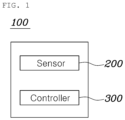
- FIG. 1 illustrates a configuration of a vehicle driving system 100 of the present invention.
- the vehicle driving system includes: a sensor 200 configured to monitor an environment outside a vehicle; and a controller 300 configured to recognize an oncoming traveling object through the sensor 200, derive the width of a travelable road between the traveling object and the vehicle, determine priority between the traveling object and the vehicle when the width of the travelable road is smaller than the sum of the widths of the traveling object and the vehicle, and, when it is determined that the traveling object has priority, control traveling of the vehicle such that a space through which the traveling object can pass is ensured in the lateral direction of the vehicle.
- the sensor 200 (e.g., an ultrasonic sensor, a radar, a LiDAR, a camera, etc.), which is an element for the system, monitors an environment outside the vehicle. Specifically, the sensor 200 may monitor whether there is a traveling object (e.g., an oncoming vehicle, a bicycle, etc.) in front of the vehicle, whether there is a lane around the vehicle, or whether there is an obstacle (e.g., a parked or stopped vehicle, etc.) around the vehicle.
- a traveling object e.g., an oncoming vehicle, a bicycle, etc.
- an obstacle e.g., a parked or stopped vehicle, etc.
- the controller 300 When it is determined, based on the outside environment by the sensor 200, that there is a traveling object in front of the vehicle, the controller 300 sums the transverse width of the traveling object in front of the vehicle and the transverse width of the vehicle, compares the sum with the transverse width of a travelable road, and then determines priority regarding which of the traveling object and the vehicle can first pass through the travelable road.
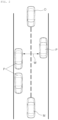
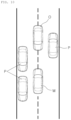
- FIG. 2 is a view provided for helping to understand the present invention.
- Three parked or stopped vehicles P are on a road, and a traveling object O and a vehicle M have different traveling directions.
- the traveling object O and the vehicle M need to travel while passing through a space between the parked or stopped vehicles, and the space between the parked or stopped vehicles becomes a travelable road.
- the controller 300 Since the traveling object has been recognized by the sensor 200, the controller 300 sums the transverse width of the traveling object O and the transverse width of the vehicle M, and then compares the sum with the width W of the travelable road.
- the width W of the travelable road is smaller than the sum of the transverse widths of the traveling object O and the vehicle M, and thus the traveling object and the vehicle cannot simultaneously travel on the travelable road.
- the controller 300 prioritizes the traveling object O and the vehicle M to determine which of the traveling object O and the vehicle M is given priority to travel on the travelable road and which of the traveling object O and the vehicle M needs to yield. For example, when the traveling object O is determined to have priority, the controller 300 may control traveling of the vehicle M to provide a space such that the traveling object O can safely pass by the vehicle M.
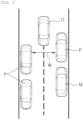
- the vehicle M may be controlled to make way for the traveling object O, and, for example, as illustrated in FIGS. 3 and 4 , may be controlled to provide a traveling space to the traveling object O.
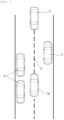
- the controller 300 may derive the expected collision site (S) through the speeds of the vehicle M and the traveling object O and the distance therebetween.
- the controller 300 fixes the collision site, and determines which of the vehicle M and the traveling object O will reach the collision site (S) first, that is, which of the vehicle M and the traveling object O requires a less time to reach the collision site (S).
- the traveling object O first reaches the collision site (S). Therefore, it is determined that the traveling object O has priority.
- the collision site (S) is derived, when the speed of the vehicle M is not changed and when the speed of the traveling object O decreases, the vehicle M first reaches the collision site (S). Therefore, it is determined that the vehicle M has priority.
- the controller 300 may derive a time to collision (TTC) between the vehicle M and the traveling object O, and when the TTC is less than a reference value, may determine that one of the vehicle M and the traveling object O, which has a higher speed or higher acceleration, has priority.
- TTC time to collision
- the controller 300 may derive an expected collision time, that is, the time that remains until collision therebetween, through the speeds of the vehicle M and the traveling object O and the distance therebetween. At this time, the controller 300 derives a TTC, and then, when the TTC is less than the reference value, may determine that the vehicle M and the traveling object O are in danger of colliding with each other on a travelable road, and may determine that one of the vehicle M and the traveling object O, which has a higher speed or higher acceleration, has priority. If the TTC is greater than the reference value, much time remains until collision, and thus the vehicle M and the traveling object O are considered to have a much time to avoid each other, whereby the vehicle M may speed up and first pass through travelable road.
- an expected collision time that is, the time that remains until collision therebetween, through the speeds of the vehicle M and the traveling object O and the distance therebetween.
- the controller 300 derives a TTC, and then, when the TTC is less than the reference value, may determine that the vehicle M and the traveling object O are
- the controller 300 may derive an expected collision site (S) of the vehicle M and the traveling object O, and may determine that one of the vehicle M and the traveling object O, which first passes through any one of two sites (S') spaced a predetermined distance apart from the expected collision site (S) and facing each other, has priority.
- the controller 300 may derive an expected collision site (S) through the speeds of the vehicle M and the traveling object O and the distance therebetween.
- the controller 300 may fix the collision site (S), may configure two imaginary sites (S') spaced the same distance apart from the collision site (S) interposed therebetween, and may determine that one of the vehicle M and the traveling object O, which first passes through any one of the two sites (S'), has priority. For example, when the traveling object O first passes through an imaginary site (S'), the traveling object O has priority, and when the vehicle M first passes through an imaginary site (S'), the vehicle M has priority.
- the controller 300 may determine that the traveling object O has priority.
- the vehicle driving system 100 of the present invention When the vehicle driving system 100 of the present invention is included in both the vehicle M and the traveling object O, the vehicle M and the traveling object O can travel on a narrow road even under the above condition. However, if the traveling object O does not include the vehicle driving system 100, even when it is determined that the vehicle M has priority, the vehicle M and the traveling object O are in danger of colliding with each other provided that the traveling object O has an intention to travel. Thus, in this case, the traveling object O may be considered to have priority.
- the controller 300 may recognize the traveling object O as having an intention to travel. Referring to FIG. 7 , in a situation in which the vehicle M has been determined to have priority, when the traveling object O does not decelerate, the controller 300 may consider the traveling object O to have an intention to travel, and may re-determine that the traveling object O has priority.
- the controller 300 may recognize the traveling object O as having an intention to travel.
- the traveling object O needs to change the traveling direction thereof in order to avoid the vehicle. Therefore, if the traveling object O has an intention to yield, the heading angle is changed as illustrated in FIG. 8 . However, if the traveling object O has no intention to yield, the heading angle is not changed even while the traveling object O travels as illustrated in FIG. 9 . Therefore, when the rate of change in the heading angle of the traveling object O is less than the reference value, the controller 300 may re-determine that the traveling object O has an intention to travel and the traveling object O has priority.
- the traveling object O may be recognized as having an intention to travel.
- the traveling object O needs to yield to the vehicle such that the vehicle can pass.
- the controller 300 controls the vehicle M such that the vehicle M stands by for a predetermined time.
- the controller 300 may determine that the traveling object O has an intention to travel, and may re-determine that the traveling object O has priority, whereby the vehicle M may travel backward on a traveling path to make way for the traveling object O.
- a method for controlling the vehicle driving system includes: a step S100 of recognizing an oncoming traveling object through a sensor; a step S200 of deriving the width of a travelable road between the traveling object and a vehicle; a step of S300 of determining priority between the traveling object and the vehicle when the width of the travelable road is smaller than the sum of the widths of the traveling object and the vehicle; and a step S400 of controlling, when the traveling object is determined to have priority, traveling of the vehicle such that a space through which the traveling object can pass is ensured in the lateral direction of the vehicle.
- an expected collision site of the vehicle and the traveling object may be derived, and one of the vehicle and the traveling object, which requires a less time to reach the expected collision site, may be determined to have priority.
- the traveling object when the traveling object requires the less time to reach the expected collision site, the traveling object may be determined to have priority, and the traveling of the vehicle may be controlled such that the traveling object can pass through a travelable road.
- the method may further include a step S500 of determining whether the traveling object has an intention to travel, and it may be determined that the traveling object has priority when the traveling object is recognized as having an intention to travel.
- the traveling of the vehicle may be controlled such that the traveling object can first pass through the travelable road.
- the controller 300 may include a processor or a microprocessor.
- the controller 300 may also include a memory.
- the aforementioned operations/functions of the controller 300 can be embodied as computer readable code/algorithm/software stored on the memory thereof which may include a non-transitory computer readable recording medium.
- the non-transitory computer readable recording medium is any data storage device that can store data which can thereafter be read by the processor or the microprocessor. Examples of the computer readable recording medium include a hard disk drive (HDD), a solid state drive (SSD), a silicon disc drive (SDD), read-only memory (ROM), random-access memory (RAM), CD-ROM, magnetic tapes, floppy disks, optical data storage devices, etc.
- the processor or the microprocessor may perform the above described operations/functions of the controller 300, by executing the computer readable code/algorithm/software stored on the non-transitory computer readable recording medium.
- a vehicle driving system and a method for controlling the same in the present invention it is possible for an unskilled driver to easily pass through a narrow road and perform safe traveling even in a busy and narrow road environment. Further, when there is an oncoming traveling object, it is possible to travel while safely avoiding the same.
Landscapes
- Engineering & Computer Science (AREA)
- Automation & Control Theory (AREA)
- Transportation (AREA)
- Mechanical Engineering (AREA)
- Human Computer Interaction (AREA)
- Physics & Mathematics (AREA)
- Mathematical Physics (AREA)
- General Physics & Mathematics (AREA)
- Multimedia (AREA)
- Theoretical Computer Science (AREA)
- Control Of Driving Devices And Active Controlling Of Vehicle (AREA)
- Traffic Control Systems (AREA)
- Aviation & Aerospace Engineering (AREA)
- Radar, Positioning & Navigation (AREA)
- Remote Sensing (AREA)
- Train Traffic Observation, Control, And Security (AREA)
Description
- The present invention relates to a system for enabling an autonomous vehicle to travel in narrow alleys and a method for controlling the same and, more specifically, to a vehicle driving system configured such that, when there is a traveling object traveling in the opposite direction in a narrow alley, the vehicle is driven safely so as not to collide with the traveling object, and even an inexperienced driver is enabled to travel safely in a congested alley crowded with parked vehicles or obstacles.
- There has recently been ongoing development regarding autonomous driving technologies for minimizing driver intervention, including ADAS systems for assisting drivers' driving. Autonomous driving technologies have a problem in that the same are easy to implement if the driving environment can be clearly recognized, and if there is sufficient peripheral space (for example, in the case of wide roads having clearly defined lanes), but the same are implemented in a limited manner in the case of narrow roads (for example, alleys), requiring manual manipulation by the drivers, and inexperienced drivers who have insufficient judgement regarding vehicle widths cause accidents frequently.
-
US 2019/196486 A1 discloses a vehicle control device including a first recognizer recognizing one or more other vehicles present in the vicinity of a subject vehicle, a second recognizer recognizing that a road on which the subject vehicle is running is a road having no center line, an estimator estimating a state of a driver of an oncoming vehicle facing the subject vehicle among the one or more other vehicles recognized by the first recognizer, a
determiner determining whether the oncoming vehicle is a vehicle executing manual driving, and a controller decelerating the subject vehicle to a speed equal to or lower than a predetermined speed on the basis of the state of the driver of the oncoming vehicle in a case in which the oncoming vehicle is a vehicle executing manual driving, and the road on which the subject vehicle is running is a road having no center line. - The invention is defined by the appended claims.
- The present invention is advantageous in that it is possible to travel on a narrow road regardless of whether the same has lanes or not, and even if there are obstacles (for example, parked vehicles) on the narrow road, it is possible to safely travel while avoiding the same. In addition, even an inexperienced driver can safely travel in a narrow and congested road environment.
- The above and other aspects, features, and advantages of the present invention will be more apparent from the following detailed description taken in conjunction with the accompanying drawings, in which:
-
FIG. 1 illustrates a configuration of a vehicle driving system of the present invention; -
FIGS. 2 to 10 are views provided for helping to understand the present invention; and -
FIG. 11 is a flowchart illustrating a system control method of the present invention. - Hereinafter, the present invention will be described in detail.
-
FIG. 1 illustrates a configuration of avehicle driving system 100 of the present invention. The vehicle driving system according to the present invention includes: asensor 200 configured to monitor an environment outside a vehicle; and acontroller 300 configured to recognize an oncoming traveling object through thesensor 200, derive the width of a travelable road between the traveling object and the vehicle, determine priority between the traveling object and the vehicle when the width of the travelable road is smaller than the sum of the widths of the traveling object and the vehicle, and, when it is determined that the traveling object has priority, control traveling of the vehicle such that a space through which the traveling object can pass is ensured in the lateral direction of the vehicle. - Specifically, the present invention relates to a traveling system for controlling traveling of a vehicle on a narrow road, in particular, a narrow road on which two vehicles traveling in different directions cannot simultaneously travel due to parked vehicles or other obstacles on the narrow road.
- The sensor 200 (e.g., an ultrasonic sensor, a radar, a LiDAR, a camera, etc.), which is an element for the system, monitors an environment outside the vehicle. Specifically, the
sensor 200 may monitor whether there is a traveling object (e.g., an oncoming vehicle, a bicycle, etc.) in front of the vehicle, whether there is a lane around the vehicle, or whether there is an obstacle (e.g., a parked or stopped vehicle, etc.) around the vehicle. - When it is determined, based on the outside environment by the
sensor 200, that there is a traveling object in front of the vehicle, thecontroller 300 sums the transverse width of the traveling object in front of the vehicle and the transverse width of the vehicle, compares the sum with the transverse width of a travelable road, and then determines priority regarding which of the traveling object and the vehicle can first pass through the travelable road. -
FIG. 2 is a view provided for helping to understand the present invention. Three parked or stopped vehicles P are on a road, and a traveling object O and a vehicle M have different traveling directions. The traveling object O and the vehicle M need to travel while passing through a space between the parked or stopped vehicles, and the space between the parked or stopped vehicles becomes a travelable road. Since the traveling object has been recognized by thesensor 200, thecontroller 300 sums the transverse width of the traveling object O and the transverse width of the vehicle M, and then compares the sum with the width W of the travelable road. InFIG. 2 , the width W of the travelable road is smaller than the sum of the transverse widths of the traveling object O and the vehicle M, and thus the traveling object and the vehicle cannot simultaneously travel on the travelable road. Therefore, subsequently, thecontroller 300 prioritizes the traveling object O and the vehicle M to determine which of the traveling object O and the vehicle M is given priority to travel on the travelable road and which of the traveling object O and the vehicle M needs to yield. For example, when the traveling object O is determined to have priority, thecontroller 300 may control traveling of the vehicle M to provide a space such that the traveling object O can safely pass by the vehicle M. - At this time, the vehicle M may be controlled to make way for the traveling object O, and, for example, as illustrated in
FIGS. 3 and4 , may be controlled to provide a traveling space to the traveling object O. - Specific control to determine which of the vehicle M and the traveling object O has priority is as follows.
- The
controller 300 may derive an expected collision site (S) of the vehicle M and the traveling object O, and may determine that one of the vehicle M and the traveling object O, which requires a less time to reach the expected collision site (S), has priority over the other. - Specifically, the
controller 300 may derive the expected collision site (S) through the speeds of the vehicle M and the traveling object O and the distance therebetween. When the collision site (S) is derived, thecontroller 300 fixes the collision site, and determines which of the vehicle M and the traveling object O will reach the collision site (S) first, that is, which of the vehicle M and the traveling object O requires a less time to reach the collision site (S). For example, referring toFIG. 5 , after the collision site (S) is derived, when the speed of the vehicle M is not changed and when the speed of the traveling object O increases, the traveling object O first reaches the collision site (S). Therefore, it is determined that the traveling object O has priority. On the contrary, after the collision site (S) is derived, when the speed of the vehicle M is not changed and when the speed of the traveling object O decreases, the vehicle M first reaches the collision site (S). Therefore, it is determined that the vehicle M has priority. - The
controller 300 may derive a time to collision (TTC) between the vehicle M and the traveling object O, and when the TTC is less than a reference value, may determine that one of the vehicle M and the traveling object O, which has a higher speed or higher acceleration, has priority. - Specifically, the
controller 300 may derive an expected collision time, that is, the time that remains until collision therebetween, through the speeds of the vehicle M and the traveling object O and the distance therebetween. At this time, thecontroller 300 derives a TTC, and then, when the TTC is less than the reference value, may determine that the vehicle M and the traveling object O are in danger of colliding with each other on a travelable road, and may determine that one of the vehicle M and the traveling object O, which has a higher speed or higher acceleration, has priority. If the TTC is greater than the reference value, much time remains until collision, and thus the vehicle M and the traveling object O are considered to have a much time to avoid each other, whereby the vehicle M may speed up and first pass through travelable road. - The
controller 300 may derive an expected collision site (S) of the vehicle M and the traveling object O, and may determine that one of the vehicle M and the traveling object O, which first passes through any one of two sites (S') spaced a predetermined distance apart from the expected collision site (S) and facing each other, has priority. - Specifically, referring to
FIG. 6 , thecontroller 300 may derive an expected collision site (S) through the speeds of the vehicle M and the traveling object O and the distance therebetween. When the collision site (S) is derived, thecontroller 300 may fix the collision site (S), may configure two imaginary sites (S') spaced the same distance apart from the collision site (S) interposed therebetween, and may determine that one of the vehicle M and the traveling object O, which first passes through any one of the two sites (S'), has priority. For example, when the traveling object O first passes through an imaginary site (S'), the traveling object O has priority, and when the vehicle M first passes through an imaginary site (S'), the vehicle M has priority. - When the traveling object O is recognized as having an intention to travel, the
controller 300 may determine that the traveling object O has priority. - When the
vehicle driving system 100 of the present invention is included in both the vehicle M and the traveling object O, the vehicle M and the traveling object O can travel on a narrow road even under the above condition. However, if the traveling object O does not include thevehicle driving system 100, even when it is determined that the vehicle M has priority, the vehicle M and the traveling object O are in danger of colliding with each other provided that the traveling object O has an intention to travel. Thus, in this case, the traveling object O may be considered to have priority. - Specifically, when the traveling object O does not decelerate, the
controller 300 may recognize the traveling object O as having an intention to travel. Referring toFIG. 7 , in a situation in which the vehicle M has been determined to have priority, when the traveling object O does not decelerate, thecontroller 300 may consider the traveling object O to have an intention to travel, and may re-determine that the traveling object O has priority. - Further, when the rate of change in a forward heading angle of the traveling object O is less than a reference value, the
controller 300 may recognize the traveling object O as having an intention to travel. - Specifically, referring to
FIG. 8 andFIG. 9 , in the situation in which the vehicle M has been determined to have priority, the traveling object O needs to change the traveling direction thereof in order to avoid the vehicle. Therefore, if the traveling object O has an intention to yield, the heading angle is changed as illustrated inFIG. 8 . However, if the traveling object O has no intention to yield, the heading angle is not changed even while the traveling object O travels as illustrated inFIG. 9 . Therefore, when the rate of change in the heading angle of the traveling object O is less than the reference value, thecontroller 300 may re-determine that the traveling object O has an intention to travel and the traveling object O has priority. - In a situation in which the vehicle M and the traveling object O stop, when the traveling object O does not make way for a predetermined time, the traveling object O may be recognized as having an intention to travel.
- Specifically, referring to
FIG. 10 , in a situation in which the vehicle M has been determined to have priority, the traveling object O needs to yield to the vehicle such that the vehicle can pass. In a situation in which both the traveling object O and the vehicle M stop, thecontroller 300 controls the vehicle M such that the vehicle M stands by for a predetermined time. When the traveling object does not make way for a predetermined time, thecontroller 300 may determine that the traveling object O has an intention to travel, and may re-determine that the traveling object O has priority, whereby the vehicle M may travel backward on a traveling path to make way for the traveling object O. - Referring to
FIG. 11 , a method for controlling the vehicle driving system includes: a step S100 of recognizing an oncoming traveling object through a sensor; a step S200 of deriving the width of a travelable road between the traveling object and a vehicle; a step of S300 of determining priority between the traveling object and the vehicle when the width of the travelable road is smaller than the sum of the widths of the traveling object and the vehicle; and a step S400 of controlling, when the traveling object is determined to have priority, traveling of the vehicle such that a space through which the traveling object can pass is ensured in the lateral direction of the vehicle. - In the step S300 of determining priority, an expected collision site of the vehicle and the traveling object may be derived, and one of the vehicle and the traveling object, which requires a less time to reach the expected collision site, may be determined to have priority.
- For example, when the traveling object requires the less time to reach the expected collision site, the traveling object may be determined to have priority, and the traveling of the vehicle may be controlled such that the traveling object can pass through a travelable road.
- After the step S300 of determining priority, the method may further include a step S500 of determining whether the traveling object has an intention to travel, and it may be determined that the traveling object has priority when the traveling object is recognized as having an intention to travel.
- For example, even when the vehicle has been determined to have priority, if the traveling object is determined to have an intention to travel, the traveling of the vehicle may be controlled such that the traveling object can first pass through the travelable road.
- The
controller 300 may include a processor or a microprocessor. Optionally, thecontroller 300 may also include a memory. The aforementioned operations/functions of thecontroller 300 can be embodied as computer readable code/algorithm/software stored on the memory thereof which may include a non-transitory computer readable recording medium. The non-transitory computer readable recording medium is any data storage device that can store data which can thereafter be read by the processor or the microprocessor. Examples of the computer readable recording medium include a hard disk drive (HDD), a solid state drive (SSD), a silicon disc drive (SDD), read-only memory (ROM), random-access memory (RAM), CD-ROM, magnetic tapes, floppy disks, optical data storage devices, etc. The processor or the microprocessor may perform the above described operations/functions of thecontroller 300, by executing the computer readable code/algorithm/software stored on the non-transitory computer readable recording medium. - According to a vehicle driving system and a method for controlling the same in the present invention, it is possible for an unskilled driver to easily pass through a narrow road and perform safe traveling even in a busy and narrow road environment. Further, when there is an oncoming traveling object, it is possible to travel while safely avoiding the same.
Claims (7)
- A vehicle driving system (100) comprising:a sensor (200) configured to monitor an environment outside a vehicle; anda controller (300) configured to recognize an oncoming traveling object through the sensor, derive a width of a travelable road between the traveling object and the vehicle, determine priority between the traveling object and the vehicle when the width of the travelable road is smaller than a sum of widths of the traveling object and the vehicle, and, when the traveling object is determined to have the priority, control traveling of the vehicle to provide a space in a lateral direction of the vehicle to allow the traveling object to pass,wherein the controller (300) is configured to derive an expected collision site of the vehicle and the traveling object, and determine that one of the vehicle and the traveling object, which requires a less time to reach the expected collision site, has the priority, orwherein the controller (300) is configured to derive a time to collision, TTC, between the vehicle and the traveling object, and when the TTC is less than a reference value, determine that one of the vehicle and the traveling object, which has a higher speed or higher acceleration, has the priority, orwherein the controller (300) is configured to derive an expected collision site of the vehicle and the traveling object, and determine that one of the vehicle and the traveling object, which first passes through one of two sites spaced a predetermined distance apart from the expected collision site and facing each other, has the priority.
- The vehicle driving system (100) of claim 1, wherein, after the controller (300) determines the priority, the controller (300) is configured to further determine that the traveling object has the priority when the traveling object is recognized as having an intention to travel.
- The vehicle driving system (100) of claim 2, wherein the controller (300) is further configured to recognize, when the traveling object does not decelerate, the traveling object as having an intention to travel.
- The vehicle driving system of claim 2 or 3, wherein the controller is configured to recognize the traveling object as having an intention to travel, when a rate of change in a forward heading angle of the traveling object is less than a reference value.
- The vehicle driving system (100) of any one of claims 2 to 4, wherein the controller (300) is further configured to recognize the traveling object as having an intention to travel, when the traveling object does not make way for a predetermined time in a situation in which the vehicle and the traveling object stop.
- A method performed by a vehicle driving system for controlling a vehicle, the method comprising:recognizing (S100), by a sensor, an oncoming traveling object;deriving (S200), by a controller, a width of a travelable road between the traveling object and a vehicle;determining (S300), by the controller, priority between the traveling object and the vehicle when the width of the travelable road is smaller than a sum of widths of the traveling object and the vehicle; andcontrolling (S400), by the controller, when the traveling object is determined to have the priority, traveling of the vehicle to provide a space in a lateral direction of the vehicle to allow the traveling object to pass,wherein the method comprises, in the determining (S300) of priority:deriving an expected collision site of the vehicle and the traveling object, and determining that one of the vehicle and the traveling object, which requires a less time to reach the expected collision site, has the priority, orderiving a time to collision, TTC, between the vehicle and the traveling object, and when the TTC is less than a reference value, determining that one of the vehicle and the traveling object, which has a higher speed or higher acceleration, has the priority, orderiving an expected collision site of the vehicle and the traveling object, and determining that one of the vehicle and the traveling object, which first passes through one of two sites spaced a predetermined distance apart from the expected collision site and facing each other, has the priority.
- The method of claim 6, further comprising, after the determining (S300) of priority, determining (S500), by a controller, whether the traveling object has an intention to travel,
wherein the traveling object is determined to have the priority when the traveling object is recognized as having an intention to travel.
Applications Claiming Priority (1)
| Application Number | Priority Date | Filing Date | Title |
|---|---|---|---|
| KR1020210030093A KR20220126311A (en) | 2021-03-08 | 2021-03-08 | Vehicle driving system and control method |
Publications (2)
| Publication Number | Publication Date |
|---|---|
| EP4056438A1 EP4056438A1 (en) | 2022-09-14 |
| EP4056438B1 true EP4056438B1 (en) | 2025-07-09 |
Family
ID=80625139
Family Applications (1)
| Application Number | Title | Priority Date | Filing Date |
|---|---|---|---|
| EP22159868.3A Active EP4056438B1 (en) | 2021-03-08 | 2022-03-03 | Vehicle driving system and control method performed by vehicle driving system |
Country Status (4)
| Country | Link |
|---|---|
| US (1) | US20220281447A1 (en) |
| EP (1) | EP4056438B1 (en) |
| KR (1) | KR20220126311A (en) |
| CN (1) | CN115027462A (en) |
Family Cites Families (18)
| Publication number | Priority date | Publication date | Assignee | Title |
|---|---|---|---|---|
| AU2009338673B2 (en) * | 2009-01-28 | 2014-03-13 | Jenoptik Robot Gmbh | Method and system for conclusively capturing a violation of the speed limit on a section of a road |
| EP2302412B1 (en) * | 2009-09-29 | 2012-08-15 | Volvo Car Corporation | System and method for evaluation of an automotive vehicle forward collision threat |
| SE537184C2 (en) * | 2013-03-19 | 2015-02-24 | Scania Cv Ab | Method and system for controlling autonomous vehicles |
| JP6174516B2 (en) * | 2014-04-24 | 2017-08-02 | 本田技研工業株式会社 | Collision avoidance support device, collision avoidance support method, and program |
| DE102016211139A1 (en) * | 2016-06-22 | 2017-12-28 | Continental Automotive Gmbh | Method for autonomously driving a vehicle in a bottleneck |
| JP2018097590A (en) * | 2016-12-13 | 2018-06-21 | アイシン・エィ・ダブリュ株式会社 | Obstacle judgment system and obstacle judgment program |
| US10351129B2 (en) * | 2017-01-13 | 2019-07-16 | Ford Global Technologies, Llc | Collision mitigation and avoidance |
| CN206374737U (en) * | 2017-01-22 | 2017-08-04 | 长城汽车股份有限公司 | A kind of vehicle avoids accessory system |
| JP2018189616A (en) * | 2017-05-11 | 2018-11-29 | 株式会社デンソーテン | Driving support device, driving support system, and driving support method |
| CN107506739B (en) * | 2017-08-31 | 2021-01-12 | 南京富士通南大软件技术有限公司 | Night forward vehicle detection and distance measurement method |
| JP6600878B2 (en) * | 2017-12-21 | 2019-11-06 | 本田技研工業株式会社 | Vehicle control device, vehicle control method, and program |
| JP7132713B2 (en) * | 2017-12-28 | 2022-09-07 | 株式会社Soken | Vehicle cruise control device, vehicle cruise control system, and vehicle cruise control method |
| JP7113383B2 (en) * | 2018-03-26 | 2022-08-05 | パナソニックIpマネジメント株式会社 | Driving support system, driving support device, driving support method |
| KR102164800B1 (en) | 2019-10-21 | 2020-10-14 | 인천대학교 산학협력단 | Artificial intelligence based moving path generation device using an around view monitoring system and operating method thereof |
| KR20210083459A (en) * | 2019-12-26 | 2021-07-07 | 주식회사 만도 | Advanced Driver Assistance System, Vehicle having the same and method for controlling the vehicle |
| JP7478607B2 (en) * | 2020-07-01 | 2024-05-07 | 日産自動車株式会社 | Driving support method and driving support device |
| JP7410819B2 (en) * | 2020-07-31 | 2024-01-10 | 株式会社デンソー | Vehicle control device |
| US11603101B2 (en) * | 2020-09-24 | 2023-03-14 | Toyota Motor Engineering & Manufacturing North America, Inc. | Systems and methods for vehicles resolving a standoff |
-
2021
- 2021-03-08 KR KR1020210030093A patent/KR20220126311A/en active Pending
-
2022
- 2022-03-03 EP EP22159868.3A patent/EP4056438B1/en active Active
- 2022-03-04 US US17/687,314 patent/US20220281447A1/en active Pending
- 2022-03-07 CN CN202210222988.0A patent/CN115027462A/en active Pending
Also Published As
| Publication number | Publication date |
|---|---|
| EP4056438A1 (en) | 2022-09-14 |
| US20220281447A1 (en) | 2022-09-08 |
| KR20220126311A (en) | 2022-09-16 |
| CN115027462A (en) | 2022-09-09 |
Similar Documents
| Publication | Publication Date | Title |
|---|---|---|
| EP4137379B1 (en) | Obstacle avoidance control method and device | |
| CN111717198B (en) | Control method, device, equipment and medium for L2 level automatic driving | |
| US10078331B2 (en) | System and method for determining transfer of driving control authority of self-driving vehicle | |
| JP7096350B2 (en) | Driving control device, vehicle and driving control method | |
| EP2949548B1 (en) | Lane keeping suppressing system and method | |
| JP6687165B2 (en) | Driving control method and driving control device for driving assistance vehicle | |
| US20170101096A1 (en) | Vehicle control apparatus and method for driving safety | |
| US20170351926A1 (en) | Travel control device for vehicle | |
| CN112384419B (en) | Vehicle driving support control device, vehicle driving support system, and vehicle driving support control method | |
| JP7605012B2 (en) | AUTONOMOUS DRIVING SYSTEM, AUTONOMOUS DRIVING CONTROL METHOD, AND AUTONOMOUS DRIVING CONTROL PROGRAM | |
| CN111806465B (en) | Automatic driving control method and device | |
| JP2019043396A (en) | Driving control method and driving control device for driving support vehicle | |
| JP2022500297A (en) | Methods and equipment for driving a first vehicle that is at least partially automated | |
| JPWO2019106788A1 (en) | Vehicle control device, vehicle, and vehicle control method | |
| KR20240114825A (en) | A Method for Preventing a Collision with a Vehicle Located ahead with Its Side Being Shown and a Vehicle Control System of the Same | |
| KR20240020421A (en) | Forward collision-avoidance assist system and method thereof | |
| CN116215577B (en) | Low-speed automatic pilot method, system, electronic equipment and storage medium | |
| CN118439017A (en) | Collision avoidance assistance device and collision avoidance assistance method | |
| RU2712732C2 (en) | Method, system and computer-readable media for identifying device for receiving barrier | |
| JP7754034B2 (en) | Vehicle Control System | |
| EP4056438B1 (en) | Vehicle driving system and control method performed by vehicle driving system | |
| JP2023536349A (en) | Method for determining avoidance trajectories for vehicles | |
| JP2024014381A (en) | Vehicle control method, vehicle control device, and vehicle control program | |
| CN109421702A (en) | A kind of automobile control method and device | |
| US20240409159A1 (en) | Active Steering Assistance for Vehicle Turns and Parking Maneuvers |
Legal Events
| Date | Code | Title | Description |
|---|---|---|---|
| PUAI | Public reference made under article 153(3) epc to a published international application that has entered the european phase |
Free format text: ORIGINAL CODE: 0009012 |
|
| STAA | Information on the status of an ep patent application or granted ep patent |
Free format text: STATUS: REQUEST FOR EXAMINATION WAS MADE |
|
| 17P | Request for examination filed |
Effective date: 20220303 |
|
| AK | Designated contracting states |
Kind code of ref document: A1 Designated state(s): AL AT BE BG CH CY CZ DE DK EE ES FI FR GB GR HR HU IE IS IT LI LT LU LV MC MK MT NL NO PL PT RO RS SE SI SK SM TR |
|
| STAA | Information on the status of an ep patent application or granted ep patent |
Free format text: STATUS: EXAMINATION IS IN PROGRESS |
|
| 17Q | First examination report despatched |
Effective date: 20240516 |
|
| GRAP | Despatch of communication of intention to grant a patent |
Free format text: ORIGINAL CODE: EPIDOSNIGR1 |
|
| STAA | Information on the status of an ep patent application or granted ep patent |
Free format text: STATUS: GRANT OF PATENT IS INTENDED |
|
| INTG | Intention to grant announced |
Effective date: 20250217 |
|
| RIN1 | Information on inventor provided before grant (corrected) |
Inventor name: KIM, MIN SEOK Inventor name: KWON, TAE MIN |
|
| GRAS | Grant fee paid |
Free format text: ORIGINAL CODE: EPIDOSNIGR3 |
|
| P01 | Opt-out of the competence of the unified patent court (upc) registered |
Free format text: CASE NUMBER: APP_20669/2025 Effective date: 20250430 |
|
| GRAA | (expected) grant |
Free format text: ORIGINAL CODE: 0009210 |
|
| STAA | Information on the status of an ep patent application or granted ep patent |
Free format text: STATUS: THE PATENT HAS BEEN GRANTED |
|
| AK | Designated contracting states |
Kind code of ref document: B1 Designated state(s): AL AT BE BG CH CY CZ DE DK EE ES FI FR GB GR HR HU IE IS IT LI LT LU LV MC MK MT NL NO PL PT RO RS SE SI SK SM TR |
|
| REG | Reference to a national code |
Ref country code: GB Ref legal event code: FG4D |
|
| REG | Reference to a national code |
Ref country code: CH Ref legal event code: EP |
|
| REG | Reference to a national code |
Ref country code: IE Ref legal event code: FG4D |
|
| REG | Reference to a national code |
Ref country code: DE Ref legal event code: R096 Ref document number: 602022017155 Country of ref document: DE |
|
| REG | Reference to a national code |
Ref country code: NL Ref legal event code: MP Effective date: 20250709 |
|
| PG25 | Lapsed in a contracting state [announced via postgrant information from national office to epo] |
Ref country code: PT Free format text: LAPSE BECAUSE OF FAILURE TO SUBMIT A TRANSLATION OF THE DESCRIPTION OR TO PAY THE FEE WITHIN THE PRESCRIBED TIME-LIMIT Effective date: 20251110 |
|
| PG25 | Lapsed in a contracting state [announced via postgrant information from national office to epo] |
Ref country code: NL Free format text: LAPSE BECAUSE OF FAILURE TO SUBMIT A TRANSLATION OF THE DESCRIPTION OR TO PAY THE FEE WITHIN THE PRESCRIBED TIME-LIMIT Effective date: 20250709 |
|
| REG | Reference to a national code |
Ref country code: AT Ref legal event code: MK05 Ref document number: 1811613 Country of ref document: AT Kind code of ref document: T Effective date: 20250709 |
|
| PG25 | Lapsed in a contracting state [announced via postgrant information from national office to epo] |
Ref country code: IS Free format text: LAPSE BECAUSE OF FAILURE TO SUBMIT A TRANSLATION OF THE DESCRIPTION OR TO PAY THE FEE WITHIN THE PRESCRIBED TIME-LIMIT Effective date: 20251109 |
|
| PG25 | Lapsed in a contracting state [announced via postgrant information from national office to epo] |
Ref country code: NO Free format text: LAPSE BECAUSE OF FAILURE TO SUBMIT A TRANSLATION OF THE DESCRIPTION OR TO PAY THE FEE WITHIN THE PRESCRIBED TIME-LIMIT Effective date: 20251009 |
|
| REG | Reference to a national code |
Ref country code: LT Ref legal event code: MG9D |
|
| PG25 | Lapsed in a contracting state [announced via postgrant information from national office to epo] |
Ref country code: AT Free format text: LAPSE BECAUSE OF FAILURE TO SUBMIT A TRANSLATION OF THE DESCRIPTION OR TO PAY THE FEE WITHIN THE PRESCRIBED TIME-LIMIT Effective date: 20250709 |
|
| PG25 | Lapsed in a contracting state [announced via postgrant information from national office to epo] |
Ref country code: FI Free format text: LAPSE BECAUSE OF FAILURE TO SUBMIT A TRANSLATION OF THE DESCRIPTION OR TO PAY THE FEE WITHIN THE PRESCRIBED TIME-LIMIT Effective date: 20250709 |
|
| PG25 | Lapsed in a contracting state [announced via postgrant information from national office to epo] |
Ref country code: HR Free format text: LAPSE BECAUSE OF FAILURE TO SUBMIT A TRANSLATION OF THE DESCRIPTION OR TO PAY THE FEE WITHIN THE PRESCRIBED TIME-LIMIT Effective date: 20250709 |
|
| PG25 | Lapsed in a contracting state [announced via postgrant information from national office to epo] |
Ref country code: GR Free format text: LAPSE BECAUSE OF FAILURE TO SUBMIT A TRANSLATION OF THE DESCRIPTION OR TO PAY THE FEE WITHIN THE PRESCRIBED TIME-LIMIT Effective date: 20251010 |
|
| PG25 | Lapsed in a contracting state [announced via postgrant information from national office to epo] |
Ref country code: SE Free format text: LAPSE BECAUSE OF FAILURE TO SUBMIT A TRANSLATION OF THE DESCRIPTION OR TO PAY THE FEE WITHIN THE PRESCRIBED TIME-LIMIT Effective date: 20250709 |
|
| PG25 | Lapsed in a contracting state [announced via postgrant information from national office to epo] |
Ref country code: LV Free format text: LAPSE BECAUSE OF FAILURE TO SUBMIT A TRANSLATION OF THE DESCRIPTION OR TO PAY THE FEE WITHIN THE PRESCRIBED TIME-LIMIT Effective date: 20250709 |
|
| PG25 | Lapsed in a contracting state [announced via postgrant information from national office to epo] |
Ref country code: BG Free format text: LAPSE BECAUSE OF FAILURE TO SUBMIT A TRANSLATION OF THE DESCRIPTION OR TO PAY THE FEE WITHIN THE PRESCRIBED TIME-LIMIT Effective date: 20250709 Ref country code: PL Free format text: LAPSE BECAUSE OF FAILURE TO SUBMIT A TRANSLATION OF THE DESCRIPTION OR TO PAY THE FEE WITHIN THE PRESCRIBED TIME-LIMIT Effective date: 20250709 |
|
| PG25 | Lapsed in a contracting state [announced via postgrant information from national office to epo] |
Ref country code: RS Free format text: LAPSE BECAUSE OF FAILURE TO SUBMIT A TRANSLATION OF THE DESCRIPTION OR TO PAY THE FEE WITHIN THE PRESCRIBED TIME-LIMIT Effective date: 20251009 |
|
| PG25 | Lapsed in a contracting state [announced via postgrant information from national office to epo] |
Ref country code: ES Free format text: LAPSE BECAUSE OF FAILURE TO SUBMIT A TRANSLATION OF THE DESCRIPTION OR TO PAY THE FEE WITHIN THE PRESCRIBED TIME-LIMIT Effective date: 20250709 |
|
| PG25 | Lapsed in a contracting state [announced via postgrant information from national office to epo] |
Ref country code: SM Free format text: LAPSE BECAUSE OF FAILURE TO SUBMIT A TRANSLATION OF THE DESCRIPTION OR TO PAY THE FEE WITHIN THE PRESCRIBED TIME-LIMIT Effective date: 20250709 |
|
| PGFP | Annual fee paid to national office [announced via postgrant information from national office to epo] |
Ref country code: GB Payment date: 20260122 Year of fee payment: 5 |
|
| PG25 | Lapsed in a contracting state [announced via postgrant information from national office to epo] |
Ref country code: DK Free format text: LAPSE BECAUSE OF FAILURE TO SUBMIT A TRANSLATION OF THE DESCRIPTION OR TO PAY THE FEE WITHIN THE PRESCRIBED TIME-LIMIT Effective date: 20250709 |
|
| PGFP | Annual fee paid to national office [announced via postgrant information from national office to epo] |
Ref country code: DE Payment date: 20260120 Year of fee payment: 5 |
|
| PG25 | Lapsed in a contracting state [announced via postgrant information from national office to epo] |
Ref country code: IT Free format text: LAPSE BECAUSE OF FAILURE TO SUBMIT A TRANSLATION OF THE DESCRIPTION OR TO PAY THE FEE WITHIN THE PRESCRIBED TIME-LIMIT Effective date: 20250709 |
|
| PGFP | Annual fee paid to national office [announced via postgrant information from national office to epo] |
Ref country code: FR Payment date: 20260121 Year of fee payment: 5 |
|
| PG25 | Lapsed in a contracting state [announced via postgrant information from national office to epo] |
Ref country code: CZ Free format text: LAPSE BECAUSE OF FAILURE TO SUBMIT A TRANSLATION OF THE DESCRIPTION OR TO PAY THE FEE WITHIN THE PRESCRIBED TIME-LIMIT Effective date: 20250709 |
|
| PG25 | Lapsed in a contracting state [announced via postgrant information from national office to epo] |
Ref country code: EE Free format text: LAPSE BECAUSE OF FAILURE TO SUBMIT A TRANSLATION OF THE DESCRIPTION OR TO PAY THE FEE WITHIN THE PRESCRIBED TIME-LIMIT Effective date: 20250709 Ref country code: SK Free format text: LAPSE BECAUSE OF FAILURE TO SUBMIT A TRANSLATION OF THE DESCRIPTION OR TO PAY THE FEE WITHIN THE PRESCRIBED TIME-LIMIT Effective date: 20250709 |