EP4055364B1 - Rfid-based wear sensing and monitoring system - Google Patents
Rfid-based wear sensing and monitoring system Download PDFInfo
- Publication number
- EP4055364B1 EP4055364B1 EP21880686.7A EP21880686A EP4055364B1 EP 4055364 B1 EP4055364 B1 EP 4055364B1 EP 21880686 A EP21880686 A EP 21880686A EP 4055364 B1 EP4055364 B1 EP 4055364B1
- Authority
- EP
- European Patent Office
- Prior art keywords
- wear
- tag
- housing
- sensing system
- radio frequency
- Prior art date
- Legal status (The legal status is an assumption and is not a legal conclusion. Google has not performed a legal analysis and makes no representation as to the accuracy of the status listed.)
- Active
Links
Images

Classifications
-
- F—MECHANICAL ENGINEERING; LIGHTING; HEATING; WEAPONS; BLASTING
- F16—ENGINEERING ELEMENTS AND UNITS; GENERAL MEASURES FOR PRODUCING AND MAINTAINING EFFECTIVE FUNCTIONING OF MACHINES OR INSTALLATIONS; THERMAL INSULATION IN GENERAL
- F16D—COUPLINGS FOR TRANSMITTING ROTATION; CLUTCHES; BRAKES
- F16D66/00—Arrangements for monitoring working conditions, e.g. wear, temperature
- F16D66/02—Apparatus for indicating wear
-
- B—PERFORMING OPERATIONS; TRANSPORTING
- B60—VEHICLES IN GENERAL
- B60C—VEHICLE TYRES; TYRE INFLATION; TYRE CHANGING; CONNECTING VALVES TO INFLATABLE ELASTIC BODIES IN GENERAL; DEVICES OR ARRANGEMENTS RELATED TO TYRES
- B60C11/00—Tyre tread bands; Tread patterns; Anti-skid inserts
- B60C11/24—Wear-indicating arrangements
Definitions
- the present invention relates to a system for monitoring wear state of the wear plates which are positioned on the equipment exposing to the physical and mechanical wear and which aims to prolong the lifespan of the equipment.
- interior surface of equipment is coated with replaceable plates, which can be manufactured from various materials, so that the main structure of equipment is not worn.
- the fact that the interior surface of the equipment is coated may ensure to prolong the lifespan of the equipment, however plates worn over time in different thickness and sizes should be replaced.
- continuously reaching and accessing inside of the equipment and examining wear states of the wear plates constitute a drawback.
- the invention is a real sensor that detects wear state of the friction lining and configured, such that it senses the wear state continuously or at least in a slightly-increasing manner. As the friction lining wears more, the conductor tracks are gradually interrupted and an appertaining signal generated by the receiver-transmitter unit located in the wear indicator is received and displayed by a control unit and/or reading device that is installed in the vehicle or located externally.
- the transmission technology preferred according to the invention is the so-called RFID (radio frequency identification) technology and especially SAW (surface acoustic wave) technology.
- the patent document numbered " US2017003208A1 " subjected to the application comprises a sensor, an outer body and a sensor to detect and indicate wear to the outer body.
- the outer body exhibits an opening extending at least partially through it and the sensor is positioned within the gap.
- the patent document numbered " DE 10 2014 112868 B3 " subjected to the application relates to a brake shoe for disk or drum brakes, which comprises a supporting plate with a friction pad attached thereto and at least one wear indicator.
- the wear indicator has a wear sensor for continuous or multi-stage measurement of the wear of the friction lining and a receiver and transmitter unit for wireless signal transmission, the receiver and transmitter unit being a passive RFID (Radio Frequency Identification) or SAW (Sound Acoustic Wave) transponder.
- RFID tag In the state of the art, there are applications that perform wear monitoring by means of RFID tag.
- RFID sensor In such application, RFID sensor is embedded in the wear plate. This process is both laborsome and the signal sensitivity between the RFID tag and the reader is weakened due to the metal effect. Furthermore, RFID tags should be protected against impacts.
- the most important object of the present invention is to provide a system for monitoring wear state of the wear plates which are positioned on the equipment exposing to the physical and mechanical wear and which aims to prolong the lifespan of the equipment.
- Another important object of the present invention is to decrease the additional cost and complexity resulting from the cabling.
- Another important object of the present invention is to provide ease of mounting.
- Another important object of the present invention is to prevent possible signal losses due to metal, because RFID tags will be on outer side of the wear plate.
- Another object of the present invention is to eliminate the need for the power supply, such as cell battery or battery, through complexed electronic circuits on the sensor for the purpose of data exchange and signal transmission.
- the power supply such as cell battery or battery
- the present invention relates to a system for monitoring wear state of the wear plates which are positioned on the equipment exposing to the physical and mechanical wear and which aims to prolong the lifespan of the equipment.
- the inventive wear sensing system (100) comprises a housing (101), a tag housing (102), a radio frequency identification tag (103) and a trigger mechanism (104).
- the inventive wear sensing system (100) can be mounted on the wear plate (200) directly or through a nut.
- Said wear plate (200) is mounted on equipment, which are exposed to physical and mechanical wear, and ensures to prolong the lifespan of the equipment.
- the housing (101) is mounted on the wear plate (200) and is worn simultaneously together with the wear plate (200). Further, the housing (101) ensures to attach the trigger mechanism (104) therein and the tag housing (102) thereon.
- Said tag housing (102) is affixed on the housing (101) and ensures to attach the radio frequency identification tag (103) thereon.
- the tag housing (102) keeps the radio frequency identification (103) distant from the metal environment.
- the tag housing (102) is manufactured from a material such as plastic or polyamide.
- Tag reader and antenna system (300) reads the radio frequency identification (RFID) tag (103) and performs the signal exchange.
- RFID radio frequency identification
- the tag reader and antenna system (300) provides a warning that the wear has reached up a critical level, when it cannot receive a signal from the radio frequency identification tag (103).
- the radio frequency identification tag (103) carries out the signal exchange with the tag reader and antenna system (300).
- the radio frequency identification tag (103) is activated by the signal received from the tag reader and antenna system (300) and sends back a signal and carries out the reading process. Since the radio frequency identification tag (103) is a passive tag, it does not require any power supply.
- Trigger mechanism (104) is activated, when the wear occurring in the housing (101) reaches a critical level, and further comprises a metal needle (114) to break the radio frequency identification tag (103) and a metal spring (115) to operate the needle (114).
- the trigger mechanism (104) ensures that the spring (115) is released and the needle (114) breaks the radio frequency identification tag (103), when the wear reaches a predetermined critical level.
- the trigger mechanism (104) is manufactured from a material such as metal, polyamide or castermid.
- the trigger mechanism (104) is positioned in the tag housing (102) in a proper distance based on the critical wear point of the wear plate (200). The distance may vary based on the thickness of the wear plate (200).
Landscapes
- Engineering & Computer Science (AREA)
- Mechanical Engineering (AREA)
- General Engineering & Computer Science (AREA)
- Braking Arrangements (AREA)
- Testing Of Devices, Machine Parts, Or Other Structures Thereof (AREA)
- Manipulator (AREA)
- Measurement Of Length, Angles, Or The Like Using Electric Or Magnetic Means (AREA)
Description
- The present invention relates to a system for monitoring wear state of the wear plates which are positioned on the equipment exposing to the physical and mechanical wear and which aims to prolong the lifespan of the equipment.
- Factors such as impact, corrosion and friction occurring on the portion, where the raw material strikes on the equipment surface, while granular or solid particulate materials flow causes wear on the equipment surface.
- Nowadays, interior surface of equipment is coated with replaceable plates, which can be manufactured from various materials, so that the main structure of equipment is not worn. The fact that the interior surface of the equipment is coated may ensure to prolong the lifespan of the equipment, however plates worn over time in different thickness and sizes should be replaced. Furthermore, continuously reaching and accessing inside of the equipment and examining wear states of the wear plates constitute a drawback.
- In the state of the art, the patent document numbered "
US2017184169A1 " subject to the application, it is provided a wear indicator arranged on the real friction lining and preferably embedded therein. The invention is a real sensor that detects wear state of the friction lining and configured, such that it senses the wear state continuously or at least in a slightly-increasing manner. As the friction lining wears more, the conductor tracks are gradually interrupted and an appertaining signal generated by the receiver-transmitter unit located in the wear indicator is received and displayed by a control unit and/or reading device that is installed in the vehicle or located externally. The transmission technology preferred according to the invention is the so-called RFID (radio frequency identification) technology and especially SAW (surface acoustic wave) technology. - In the state of the art, the patent document numbered "
US2017003208A1 " subjected to the application comprises a sensor, an outer body and a sensor to detect and indicate wear to the outer body. The outer body exhibits an opening extending at least partially through it and the sensor is positioned within the gap. - In the state of the art, the patent document numbered "
TR201903671 - In the state of the art, the patent document numbered "
DE 10 2014 112868 B3 " subjected to the application relates to a brake shoe for disk or drum brakes, which comprises a supporting plate with a friction pad attached thereto and at least one wear indicator. The wear indicator has a wear sensor for continuous or multi-stage measurement of the wear of the friction lining and a receiver and transmitter unit for wireless signal transmission, the receiver and transmitter unit being a passive RFID (Radio Frequency Identification) or SAW (Sound Acoustic Wave) transponder. - In the state of the art, there are various wired and wireless approaches to monitor lifespans of the wear plates. In wired ones, it is required to install a cabling system to each sensor, that is, to each wear plate to be measured in terms of wear. Therefore, it is required to use more equipment, thereby causing to a difficult assembly due to complexed cabling. Furthermore, it is inevitable to avoid damages to the cabling during the operation. In wireless ones, complexed electronic circuits are needed in the sensor and said circuits are required to be connected with a power supply to receive and transmit signals. And this leads that the wear monitoring sensor has a certain lifespan.
- In the state of the art, there are applications that perform wear monitoring by means of RFID tag. In such application, RFID sensor is embedded in the wear plate. This process is both laborsome and the signal sensitivity between the RFID tag and the reader is weakened due to the metal effect. Furthermore, RFID tags should be protected against impacts.
- In the state of the art, there is no system that is able to monitor the wear state that may occur on the wear plates in a wireless manner by means of passive RFID tag out of the sensor and wear plates operation through a mechanism mounted on the wear plate.
- Consequently, An improvement is necessary to be made to overcome the abovementioned disadvantages and the inadequacy of recent solutions in eliminating these disadvantages in the related technical field.
- The most important object of the present invention is to provide a system for monitoring wear state of the wear plates which are positioned on the equipment exposing to the physical and mechanical wear and which aims to prolong the lifespan of the equipment.
- Another important object of the present invention is to decrease the additional cost and complexity resulting from the cabling.
- Another important object of the present invention is to provide ease of mounting.
- Another important object of the present invention is to prevent possible signal losses due to metal, because RFID tags will be on outer side of the wear plate.
- Another object of the present invention is to eliminate the need for the power supply, such as cell battery or battery, through complexed electronic circuits on the sensor for the purpose of data exchange and signal transmission.
- The subject matter invention's structural features and characteristics and its all advantages will be understood clearly by means of the figures given below and the detailed description provided with references to the figures. Therefore, assessment should be done by taking these figures and detailed description into consideration.
-
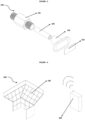
- Figure -1; an isometric view of the inventive wear sensing system.
- Figure -2; a sectional view of the inventive wear sensing system.
- Figure -3; an isometric view of components of the inventive wear sensing system.
- Figure -4; an isometric view of the inventive wear sensing system.
-
- 100. Wear sensing system
- 101. Housing
- 102. Tag housing
- 103. Radio frequency identification tag
- 104. Trigger mechanism
- 114. Needle
- 115. Spring
- 200. Wear plate
- 300. Tag reader and antenna system
- The present invention relates to a system for monitoring wear state of the wear plates which are positioned on the equipment exposing to the physical and mechanical wear and which aims to prolong the lifespan of the equipment.
- The inventive wear sensing system (100) comprises a housing (101), a tag housing (102), a radio frequency identification tag (103) and a trigger mechanism (104).
- The inventive wear sensing system (100) can be mounted on the wear plate (200) directly or through a nut.
- Said wear plate (200) is mounted on equipment, which are exposed to physical and mechanical wear, and ensures to prolong the lifespan of the equipment.
- The housing (101) is mounted on the wear plate (200) and is worn simultaneously together with the wear plate (200). Further, the housing (101) ensures to attach the trigger mechanism (104) therein and the tag housing (102) thereon.
- Said tag housing (102) is affixed on the housing (101) and ensures to attach the radio frequency identification tag (103) thereon. The tag housing (102) keeps the radio frequency identification (103) distant from the metal environment. The tag housing (102) is manufactured from a material such as plastic or polyamide.
- Tag reader and antenna system (300) reads the radio frequency identification (RFID) tag (103) and performs the signal exchange. The tag reader and antenna system (300) provides a warning that the wear has reached up a critical level, when it cannot receive a signal from the radio frequency identification tag (103).
- The radio frequency identification tag (103) carries out the signal exchange with the tag reader and antenna system (300). The radio frequency identification tag (103) is activated by the signal received from the tag reader and antenna system (300) and sends back a signal and carries out the reading process. Since the radio frequency identification tag (103) is a passive tag, it does not require any power supply.
- Trigger mechanism (104) is activated, when the wear occurring in the housing (101) reaches a critical level, and further comprises a metal needle (114) to break the radio frequency identification tag (103) and a metal spring (115) to operate the needle (114). The trigger mechanism (104) ensures that the spring (115) is released and the needle (114) breaks the radio frequency identification tag (103), when the wear reaches a predetermined critical level. The trigger mechanism (104) is manufactured from a material such as metal, polyamide or castermid. The trigger mechanism (104) is positioned in the tag housing (102) in a proper distance based on the critical wear point of the wear plate (200). The distance may vary based on the thickness of the wear plate (200).
- In an embodiment of the present invention, said system is mounted on the wear plate (200) directly or by means of a nut. The system comprises a metal housing (101), wherein the trigger mechanism (104) is to be positioned and on which the tag housing (102) is to be positioned. Said housing (101) is mounted on the wear plate (200) and is exposed to the physical wear together with the wear plate (200). When the wear does not reach a critical level, the tag reader and antenna system (300) is able to receive a signal from the passive radio frequency identification tag (103) and thus, it will be understood that the wear does not reach a critical level. When the wear reaches a predetermined critical level, the mechanism is activated, and the metal needle (114) damages the radio frequency identification tag (103). Since it is not possible to receive a signal from the damaged radio frequency identification tag (103), it will be detected that the wear occurring on the wear plate (200) reaches a critical level and a warning will appear on the monitoring device.
Claims (9)
- A system for monitoring wear state of the wear plates which are positioned on the equipment exposing to the physical and mechanical wear and which aims to prolong the lifespan of the equipment, comprising the following;- at least one housing (101), which is mounted on the wear plate (200) and is worn simultaneously together with the wear plate (200),- at least one tag housing (102), which is affixed on the housing (101) and ensures to attach at least a radio frequency identification tag (103) thereon,- said at least one radio frequency identification tag (103), gives a signal to carry out the signal exchange with the tag reader and antenna system (300), - a wear plate (200), that ensures to prolong the lifespan of the equipment as it is mounted on the equipments those are exposed to physical and mechanical wear- at least a tag reader and antenna system (300), which receives a signal from the radio frequency identification (RFID) tag (103) to perform the signal exchange, and characterized in that it further comprises- a wear sensing system (100) comprising said at least one trigger mechanism (104), which is activated, when the wear occurring in the housing (101) reaches a critical level, and further comprises a metal needle (114) to break the radio frequency identification tag (103) and a metal spring (115) to operate the needle (114).
- Wear sensing system (100) according to Claim 1, characterized in that it comprises a housing (100) that ensures to attach the trigger mechanism (104) therein and the tag housing (102) thereon.
- Wear sensing system (100) according to Claim 1, characterized in that it comprises a tag housing (100) that keeps the radio frequency identification (103) distant from the metal environment.
- Wear sensing system (100) according to Claim 1, characterized in that it comprises a tag housing (100) that is manufactured from a material such as plastic or polyamide.
- Wear sensing system (100) according to Claim 1, characterized in that it comprises a tag reader and antenna system (300) that provides a warning that the wear has reached up a critical level, when it cannot receive a signal from the radio frequency identification tag (103).
- Wear sensing system (100) according to Claim 1, characterized in that it comprises a trigger mechanism (100) that ensures that the spring (115) is released and the needle (114) damages the radio frequency identification tag (103), when the wear reaches a predetermined critical level.
- Wear sensing system (100) according to Claim 1, characterized in that it comprises a trigger mechanism (104) that is manufactured from a material such as metal, polyamide or castermid.
- Wear sensing system (100) according to Claim 1, characterized in that it comprises a trigger mechanism (100) that is positioned in the tag housing (102) in a proper distance based on the critical wear point of the wear plate (200).
- Wear sensing system (100) according to Claim 1, characterized in that the wear sensing system (100) comprises a wear plate (200) for being mounted thereon directly or through a nut.
Applications Claiming Priority (2)
| Application Number | Priority Date | Filing Date | Title |
|---|---|---|---|
| TR2020/16546A TR202016546A2 (en) | 2020-10-16 | 2020-10-16 | RFID based abrasion detection and tracking system. |
| PCT/TR2021/050465 WO2022081109A1 (en) | 2020-10-16 | 2021-05-17 | Rfid-based wear sensing and monitoring system |
Publications (4)
| Publication Number | Publication Date |
|---|---|
| EP4055364A1 EP4055364A1 (en) | 2022-09-14 |
| EP4055364A4 EP4055364A4 (en) | 2023-03-08 |
| EP4055364C0 EP4055364C0 (en) | 2024-05-08 |
| EP4055364B1 true EP4055364B1 (en) | 2024-05-08 |
Family
ID=75526883
Family Applications (1)
| Application Number | Title | Priority Date | Filing Date |
|---|---|---|---|
| EP21880686.7A Active EP4055364B1 (en) | 2020-10-16 | 2021-05-17 | Rfid-based wear sensing and monitoring system |
Country Status (3)
| Country | Link |
|---|---|
| EP (1) | EP4055364B1 (en) |
| TR (1) | TR202016546A2 (en) |
| WO (1) | WO2022081109A1 (en) |
Families Citing this family (1)
| Publication number | Priority date | Publication date | Assignee | Title |
|---|---|---|---|---|
| DE102023112698A1 (en) * | 2023-05-15 | 2024-11-21 | Faun Umwelttechnik Gmbh & Co. Kg | wear indicator |
Family Cites Families (8)
| Publication number | Priority date | Publication date | Assignee | Title |
|---|---|---|---|---|
| US7432812B2 (en) * | 2006-04-26 | 2008-10-07 | Xerox Corporation | Passive radio frequency device for monitoring wear in components |
| DE102008032818A1 (en) * | 2007-10-10 | 2009-04-16 | Continental Teves Ag & Co. Ohg | brake shoe |
| US8479556B2 (en) * | 2010-12-30 | 2013-07-09 | Toyota Motor Engineering & Manufacturing North America, Inc. | I-beam wear assessment trolleys and methods for using the same |
| US9683918B2 (en) * | 2014-01-14 | 2017-06-20 | Toyota Motor Engineering & Manufacturing North America, Inc. | Wear detection systems for overhead conveyor systems |
| DE102014112868B9 (en) | 2014-09-08 | 2016-04-21 | Tmd Friction Services Gmbh | Brake shoe with wear indicator |
| US20160075189A1 (en) * | 2014-09-12 | 2016-03-17 | The Goodyear Tire & Rubber Company | Tire tread wear sensor system |
| PL3078959T3 (en) | 2015-04-09 | 2017-10-31 | Flooring Technologies Ltd | Method for determining the abrasion resistance of at least one wear layer on a support plate |
| US9724697B2 (en) | 2015-07-02 | 2017-08-08 | Dash Llc | Wear indication devices, and related assemblies and methods |
-
2020
- 2020-10-16 TR TR2020/16546A patent/TR202016546A2/en unknown
-
2021
- 2021-05-17 WO PCT/TR2021/050465 patent/WO2022081109A1/en not_active Ceased
- 2021-05-17 EP EP21880686.7A patent/EP4055364B1/en active Active
Also Published As
| Publication number | Publication date |
|---|---|
| EP4055364C0 (en) | 2024-05-08 |
| EP4055364A4 (en) | 2023-03-08 |
| WO2022081109A1 (en) | 2022-04-21 |
| EP4055364A1 (en) | 2022-09-14 |
| TR202016546A2 (en) | 2020-11-23 |
Similar Documents
| Publication | Publication Date | Title |
|---|---|---|
| CN106068397B (en) | Brake shoes with wear indicators | |
| US20140091918A1 (en) | Wear Detection System and Method | |
| US8310356B2 (en) | Wireless brake electronic wear sensors | |
| US8860566B2 (en) | Device for monitoring the lining thickness of a brake lining of a friction brake of a vehicle | |
| US7172144B1 (en) | System for measuring wear in a grinding mill | |
| CA2856796C (en) | Apparatus and method for detecting unauthorized removal of asset tracking device | |
| CN101821528A (en) | brake block | |
| EP3290946B1 (en) | Monitoring and alert apparatus for radome performance affected by dirt or debris | |
| EP4055364B1 (en) | Rfid-based wear sensing and monitoring system | |
| JP2011189795A (en) | Tire wear detection device | |
| EP3680018B1 (en) | System for in-line measurement of mill liner wear and mill bolt tension by means of an echographic sensor inserted into the threaded end of bolts | |
| US20120006633A1 (en) | Vehicle Brake | |
| CA2376990A1 (en) | Apparatus and method for detecting the condition of an item | |
| AU2018308716B2 (en) | Wear liners | |
| CN114502804B (en) | Apparatus, method and system for monitoring condition of wear assembly | |
| AU2016245324B2 (en) | Conveyor pulley monitoring apparatus | |
| JP2019019979A (en) | Position sensing system for brake system | |
| WO2007101319A1 (en) | System for remotely measuring and monitoring wear in a grinding mill | |
| KR20050078036A (en) | Managerial system | |
| CN107004103B (en) | Metallurgical vessels with multiple transponders | |
| US9551754B2 (en) | Test device for kinetic switches and method of testing kinetic switches | |
| WO2021116533A1 (en) | A sealing arrangement for detecting thickness of a sealing element of a seal | |
| CN213270679U (en) | Screw assembly and anti-loosening alarm system | |
| EP4177140A1 (en) | Track link assembly | |
| US20210301894A1 (en) | Wear sensing |
Legal Events
| Date | Code | Title | Description |
|---|---|---|---|
| STAA | Information on the status of an ep patent application or granted ep patent |
Free format text: STATUS: THE INTERNATIONAL PUBLICATION HAS BEEN MADE |
|
| PUAI | Public reference made under article 153(3) epc to a published international application that has entered the european phase |
Free format text: ORIGINAL CODE: 0009012 |
|
| STAA | Information on the status of an ep patent application or granted ep patent |
Free format text: STATUS: REQUEST FOR EXAMINATION WAS MADE |
|
| 17P | Request for examination filed |
Effective date: 20220609 |
|
| AK | Designated contracting states |
Kind code of ref document: A1 Designated state(s): AL AT BE BG CH CY CZ DE DK EE ES FI FR GB GR HR HU IE IS IT LI LT LU LV MC MK MT NL NO PL PT RO RS SE SI SK SM TR |
|
| A4 | Supplementary search report drawn up and despatched |
Effective date: 20230206 |
|
| RIC1 | Information provided on ipc code assigned before grant |
Ipc: G01M 5/00 20060101ALI20230131BHEP Ipc: F16D 66/02 20060101ALI20230131BHEP Ipc: F16C 41/00 20060101ALI20230131BHEP Ipc: B60C 11/24 20060101ALI20230131BHEP Ipc: G01N 3/56 20060101AFI20230131BHEP |
|
| DAV | Request for validation of the european patent (deleted) | ||
| DAX | Request for extension of the european patent (deleted) | ||
| GRAP | Despatch of communication of intention to grant a patent |
Free format text: ORIGINAL CODE: EPIDOSNIGR1 |
|
| STAA | Information on the status of an ep patent application or granted ep patent |
Free format text: STATUS: GRANT OF PATENT IS INTENDED |
|
| GRAS | Grant fee paid |
Free format text: ORIGINAL CODE: EPIDOSNIGR3 |
|
| GRAA | (expected) grant |
Free format text: ORIGINAL CODE: 0009210 |
|
| STAA | Information on the status of an ep patent application or granted ep patent |
Free format text: STATUS: THE PATENT HAS BEEN GRANTED |
|
| INTG | Intention to grant announced |
Effective date: 20240318 |
|
| AK | Designated contracting states |
Kind code of ref document: B1 Designated state(s): AL AT BE BG CH CY CZ DE DK EE ES FI FR GB GR HR HU IE IS IT LI LT LU LV MC MK MT NL NO PL PT RO RS SE SI SK SM TR |
|
| REG | Reference to a national code |
Ref country code: GB Ref legal event code: FG4D |
|
| REG | Reference to a national code |
Ref country code: CH Ref legal event code: EP |
|
| REG | Reference to a national code |
Ref country code: DE Ref legal event code: R096 Ref document number: 602021013169 Country of ref document: DE |
|
| REG | Reference to a national code |
Ref country code: IE Ref legal event code: FG4D |
|
| U01 | Request for unitary effect filed |
Effective date: 20240607 |
|
| U07 | Unitary effect registered |
Designated state(s): AT BE BG DE DK EE FI FR IT LT LU LV MT NL PT SE SI Effective date: 20240620 |
|
| U20 | Renewal fee for the european patent with unitary effect paid |
Year of fee payment: 4 Effective date: 20240705 |
|
| PG25 | Lapsed in a contracting state [announced via postgrant information from national office to epo] |
Ref country code: IS Free format text: LAPSE BECAUSE OF FAILURE TO SUBMIT A TRANSLATION OF THE DESCRIPTION OR TO PAY THE FEE WITHIN THE PRESCRIBED TIME-LIMIT Effective date: 20240908 |
|
| PG25 | Lapsed in a contracting state [announced via postgrant information from national office to epo] |
Ref country code: HR Free format text: LAPSE BECAUSE OF FAILURE TO SUBMIT A TRANSLATION OF THE DESCRIPTION OR TO PAY THE FEE WITHIN THE PRESCRIBED TIME-LIMIT Effective date: 20240508 |
|
| PG25 | Lapsed in a contracting state [announced via postgrant information from national office to epo] |
Ref country code: GR Free format text: LAPSE BECAUSE OF FAILURE TO SUBMIT A TRANSLATION OF THE DESCRIPTION OR TO PAY THE FEE WITHIN THE PRESCRIBED TIME-LIMIT Effective date: 20240809 |
|
| PG25 | Lapsed in a contracting state [announced via postgrant information from national office to epo] |
Ref country code: ES Free format text: LAPSE BECAUSE OF FAILURE TO SUBMIT A TRANSLATION OF THE DESCRIPTION OR TO PAY THE FEE WITHIN THE PRESCRIBED TIME-LIMIT Effective date: 20240508 |
|
| PG25 | Lapsed in a contracting state [announced via postgrant information from national office to epo] |
Ref country code: PL Free format text: LAPSE BECAUSE OF FAILURE TO SUBMIT A TRANSLATION OF THE DESCRIPTION OR TO PAY THE FEE WITHIN THE PRESCRIBED TIME-LIMIT Effective date: 20240508 |
|
| PG25 | Lapsed in a contracting state [announced via postgrant information from national office to epo] |
Ref country code: PL Free format text: LAPSE BECAUSE OF FAILURE TO SUBMIT A TRANSLATION OF THE DESCRIPTION OR TO PAY THE FEE WITHIN THE PRESCRIBED TIME-LIMIT Effective date: 20240508 Ref country code: NO Free format text: LAPSE BECAUSE OF FAILURE TO SUBMIT A TRANSLATION OF THE DESCRIPTION OR TO PAY THE FEE WITHIN THE PRESCRIBED TIME-LIMIT Effective date: 20240808 Ref country code: IS Free format text: LAPSE BECAUSE OF FAILURE TO SUBMIT A TRANSLATION OF THE DESCRIPTION OR TO PAY THE FEE WITHIN THE PRESCRIBED TIME-LIMIT Effective date: 20240908 Ref country code: HR Free format text: LAPSE BECAUSE OF FAILURE TO SUBMIT A TRANSLATION OF THE DESCRIPTION OR TO PAY THE FEE WITHIN THE PRESCRIBED TIME-LIMIT Effective date: 20240508 Ref country code: GR Free format text: LAPSE BECAUSE OF FAILURE TO SUBMIT A TRANSLATION OF THE DESCRIPTION OR TO PAY THE FEE WITHIN THE PRESCRIBED TIME-LIMIT Effective date: 20240809 Ref country code: ES Free format text: LAPSE BECAUSE OF FAILURE TO SUBMIT A TRANSLATION OF THE DESCRIPTION OR TO PAY THE FEE WITHIN THE PRESCRIBED TIME-LIMIT Effective date: 20240508 Ref country code: RS Free format text: LAPSE BECAUSE OF FAILURE TO SUBMIT A TRANSLATION OF THE DESCRIPTION OR TO PAY THE FEE WITHIN THE PRESCRIBED TIME-LIMIT Effective date: 20240808 |
|
| REG | Reference to a national code |
Ref country code: CH Ref legal event code: PL |
|
| PG25 | Lapsed in a contracting state [announced via postgrant information from national office to epo] |
Ref country code: CZ Free format text: LAPSE BECAUSE OF FAILURE TO SUBMIT A TRANSLATION OF THE DESCRIPTION OR TO PAY THE FEE WITHIN THE PRESCRIBED TIME-LIMIT Effective date: 20240508 |
|
| PG25 | Lapsed in a contracting state [announced via postgrant information from national office to epo] |
Ref country code: SK Free format text: LAPSE BECAUSE OF FAILURE TO SUBMIT A TRANSLATION OF THE DESCRIPTION OR TO PAY THE FEE WITHIN THE PRESCRIBED TIME-LIMIT Effective date: 20240508 Ref country code: RO Free format text: LAPSE BECAUSE OF FAILURE TO SUBMIT A TRANSLATION OF THE DESCRIPTION OR TO PAY THE FEE WITHIN THE PRESCRIBED TIME-LIMIT Effective date: 20240508 |
|
| PG25 | Lapsed in a contracting state [announced via postgrant information from national office to epo] |
Ref country code: SM Free format text: LAPSE BECAUSE OF FAILURE TO SUBMIT A TRANSLATION OF THE DESCRIPTION OR TO PAY THE FEE WITHIN THE PRESCRIBED TIME-LIMIT Effective date: 20240508 |
|
| PG25 | Lapsed in a contracting state [announced via postgrant information from national office to epo] |
Ref country code: SM Free format text: LAPSE BECAUSE OF FAILURE TO SUBMIT A TRANSLATION OF THE DESCRIPTION OR TO PAY THE FEE WITHIN THE PRESCRIBED TIME-LIMIT Effective date: 20240508 Ref country code: SK Free format text: LAPSE BECAUSE OF FAILURE TO SUBMIT A TRANSLATION OF THE DESCRIPTION OR TO PAY THE FEE WITHIN THE PRESCRIBED TIME-LIMIT Effective date: 20240508 Ref country code: RO Free format text: LAPSE BECAUSE OF FAILURE TO SUBMIT A TRANSLATION OF THE DESCRIPTION OR TO PAY THE FEE WITHIN THE PRESCRIBED TIME-LIMIT Effective date: 20240508 Ref country code: CZ Free format text: LAPSE BECAUSE OF FAILURE TO SUBMIT A TRANSLATION OF THE DESCRIPTION OR TO PAY THE FEE WITHIN THE PRESCRIBED TIME-LIMIT Effective date: 20240508 Ref country code: CH Free format text: LAPSE BECAUSE OF NON-PAYMENT OF DUE FEES Effective date: 20240531 |
|
| PG25 | Lapsed in a contracting state [announced via postgrant information from national office to epo] |
Ref country code: MC Free format text: LAPSE BECAUSE OF FAILURE TO SUBMIT A TRANSLATION OF THE DESCRIPTION OR TO PAY THE FEE WITHIN THE PRESCRIBED TIME-LIMIT Effective date: 20240508 |
|
| REG | Reference to a national code |
Ref country code: DE Ref legal event code: R097 Ref document number: 602021013169 Country of ref document: DE |
|
| PLBE | No opposition filed within time limit |
Free format text: ORIGINAL CODE: 0009261 |
|
| STAA | Information on the status of an ep patent application or granted ep patent |
Free format text: STATUS: NO OPPOSITION FILED WITHIN TIME LIMIT |
|
| 26N | No opposition filed |
Effective date: 20250211 |
|
| PG25 | Lapsed in a contracting state [announced via postgrant information from national office to epo] |
Ref country code: IE Free format text: LAPSE BECAUSE OF NON-PAYMENT OF DUE FEES Effective date: 20240517 |
|
| U20 | Renewal fee for the european patent with unitary effect paid |
Year of fee payment: 5 Effective date: 20250527 |
|
| PG25 | Lapsed in a contracting state [announced via postgrant information from national office to epo] |
Ref country code: CY Free format text: LAPSE BECAUSE OF FAILURE TO SUBMIT A TRANSLATION OF THE DESCRIPTION OR TO PAY THE FEE WITHIN THE PRESCRIBED TIME-LIMIT; INVALID AB INITIO Effective date: 20210517 |
|
| PG25 | Lapsed in a contracting state [announced via postgrant information from national office to epo] |
Ref country code: HU Free format text: LAPSE BECAUSE OF FAILURE TO SUBMIT A TRANSLATION OF THE DESCRIPTION OR TO PAY THE FEE WITHIN THE PRESCRIBED TIME-LIMIT; INVALID AB INITIO Effective date: 20210517 |
|
| GBPC | Gb: european patent ceased through non-payment of renewal fee |
Effective date: 20250517 |
|
| PG25 | Lapsed in a contracting state [announced via postgrant information from national office to epo] |
Ref country code: GB Free format text: LAPSE BECAUSE OF NON-PAYMENT OF DUE FEES Effective date: 20250517 |