EP4055262B1 - Dispositif de protection thermique amélioré pour tuyère - Google Patents
Dispositif de protection thermique amélioré pour tuyère Download PDFInfo
- Publication number
- EP4055262B1 EP4055262B1 EP20811704.4A EP20811704A EP4055262B1 EP 4055262 B1 EP4055262 B1 EP 4055262B1 EP 20811704 A EP20811704 A EP 20811704A EP 4055262 B1 EP4055262 B1 EP 4055262B1
- Authority
- EP
- European Patent Office
- Prior art keywords
- nozzle
- insulating material
- strips
- nozzle body
- stiffeners
- Prior art date
- Legal status (The legal status is an assumption and is not a legal conclusion. Google has not performed a legal analysis and makes no representation as to the accuracy of the status listed.)
- Active
Links
Images
Classifications
-
- F—MECHANICAL ENGINEERING; LIGHTING; HEATING; WEAPONS; BLASTING
- F02—COMBUSTION ENGINES; HOT-GAS OR COMBUSTION-PRODUCT ENGINE PLANTS
- F02K—JET-PROPULSION PLANTS
- F02K9/00—Rocket-engine plants, i.e. plants carrying both fuel and oxidant therefor; Control thereof
- F02K9/97—Rocket nozzles
-
- F—MECHANICAL ENGINEERING; LIGHTING; HEATING; WEAPONS; BLASTING
- F02—COMBUSTION ENGINES; HOT-GAS OR COMBUSTION-PRODUCT ENGINE PLANTS
- F02K—JET-PROPULSION PLANTS
- F02K9/00—Rocket-engine plants, i.e. plants carrying both fuel and oxidant therefor; Control thereof
- F02K9/97—Rocket nozzles
- F02K9/974—Nozzle- linings; Ablative coatings
-
- F—MECHANICAL ENGINEERING; LIGHTING; HEATING; WEAPONS; BLASTING
- F05—INDEXING SCHEMES RELATING TO ENGINES OR PUMPS IN VARIOUS SUBCLASSES OF CLASSES F01-F04
- F05D—INDEXING SCHEME FOR ASPECTS RELATING TO NON-POSITIVE-DISPLACEMENT MACHINES OR ENGINES, GAS-TURBINES OR JET-PROPULSION PLANTS
- F05D2260/00—Function
- F05D2260/20—Heat transfer, e.g. cooling
- F05D2260/231—Preventing heat transfer
-
- F—MECHANICAL ENGINEERING; LIGHTING; HEATING; WEAPONS; BLASTING
- F05—INDEXING SCHEMES RELATING TO ENGINES OR PUMPS IN VARIOUS SUBCLASSES OF CLASSES F01-F04
- F05D—INDEXING SCHEME FOR ASPECTS RELATING TO NON-POSITIVE-DISPLACEMENT MACHINES OR ENGINES, GAS-TURBINES OR JET-PROPULSION PLANTS
- F05D2260/00—Function
- F05D2260/30—Retaining components in desired mutual position
- F05D2260/38—Retaining components in desired mutual position by a spring, i.e. spring loaded or biased towards a certain position
Definitions
- This presentation concerns the field of space launchers, and more specifically space launcher nozzles.
- Space launchers have an engine equipped with a nozzle, commonly called a divergent, which guides the flow of fluid generated by the engine.
- the nozzles must therefore resist both thermal and mechanical stress.
- constraints specific to space launchers particularly in terms of size, mass and cost, make it particularly complex to obtain properties enabling these demands to be met.
- Known devices in particular as presented in the documents FR3060062 And FR3074539 propose using rigid insulating blocks which are positioned around the nozzle.
- Such devices imply significant constraints for the production of the insulating blocks, which must be made in order to perfectly correspond to the geometry of the nozzle.
- the present invention thus aims to provide an insulating structure which does not present such constraints.
- the present presentation concerns a nozzle of a spacecraft engine as defined in claim 1, comprising a nozzle body extending in a main direction, from an integral proximal end of the spacecraft engine, and a free distal end, said nozzle body having a plurality of stiffeners extending from an external surface of the nozzle body, radially relative to the main direction, said nozzle comprising a thermal insulation system, comprising at least one strip of insulating material arranged so as to surround the external surface of the nozzle body over at least part of the height of said nozzle body , the height being measured in the main direction, said thermal insulation system comprising a plurality of holding elements, each holding element being positioned so as to surround said strips of insulating material, and being arranged between two stiffeners of the body of nozzle.
- each holding element comprises a cable associated with a tensioning system.
- each holding element comprises a covering made of thermal insulation.
- the tensioning system is a turnbuckle.
- a holding element is placed in each interval between two stiffeners.
- the thermal insulation system comprises at least two strips of insulating material superimposed.
- the thermal insulation system comprises a plurality of strips of insulating material, each strip of insulating material being positioned so as to at least partially cover the adjacent strips of insulating material.
- This presentation also concerns a spacecraft comprising a nozzle as defined above.
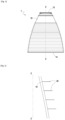
- the nozzle 1 as presented comprises a nozzle body 10 having a general shape of a truncated cone around a main axis Z-Z defining a main direction, with curved walls.
- the nozzle body 10 is provided with a plurality of stiffeners 20.
- Each stiffener 20 is typically a rib extending from an external face of the nozzle body 10, radially relative to the main axis Z-Z.
- the stiffeners 20 are typically spaced regularly, and extend over all or part of the height of the nozzle 1, typically over a height of between 50% and 80% of the height of the nozzle 1, from its distal end 14.
- There figure 2 presents an example of a detailed view representing the arrangement of the stiffeners 20.
- the stiffeners 20 typically have a dimension of between 30 and 60 mm measured in a radial direction relative to the main axis Z-Z.
- the stiffeners 20 are typically spaced at a distance of between 30 and 100 mm measured in the direction defined by the main axis Z-Z.
- the strip of insulating material 30 is dimensioned so as to cover at least two successive stiffeners 20.
- two strips of insulating material 30 have been positioned which each extend over the entire height of the nozzle body 10 including the stiffeners 20, but covering only part of the circumference of the nozzle body 10.
- the thermal insulation system comprises one or more strips of insulating material 30 forming strips which are positioned end to end or so as to overlap at their junction so as to cover all of the stiffeners 20.
- Each strip of insulating material 30 typically has a sufficient dimension so as to be able to make a complete turn around the nozzle body 10. The two ends of the strip of insulating material 30 then typically overlap over a defined width, typically between 30 and 100 mm so as to ensure continuity of thermal protection.
- the strips of insulating material 30 can be dimensioned so as to cover only a portion of the external periphery of the nozzle body 10. It is thus necessary to position several strips of insulating material 30 in order to cover the entire circumference of the nozzle body 10. nozzle body 10.
- the strips of insulating material 30 are then positioned so that their adjacent ends overlap over a defined width, typically between 30 and 100 mm so as to ensure continuity of thermal protection. More generally, the strips of insulating material 30 can overlap in the direction defined by the main axis ZZ, and/or according to the circumference of the nozzle body 10.
- the strips of insulating material 30 used to wrap the nozzle body 10 may be identical or distinct, particularly in terms of dimension.
- the strips of insulating material 30 can be composed of an envelope made of alumina, silica and boron oxide fibers, for example fibers of a material marketed under the name “Nextel ® ” (registered trademark) , the envelope being filled with a polycrystalline wool insulating material, for example a material marketed under the name “Fibermax ® ” (registered trademark).
- the strips of insulating material 30 are flexible elements, which can thus be positioned freely around the nozzle body 10, independently of the section of the nozzle and the arrangement of the stiffeners 20.
- a holding element 40 can be composed of a steel cable or a material marketed under the designation “Inconel ® ” (registered trademark), the cable typically being surrounded by a thermal insulator, for example made of material marketed under the name “Fibermax ® ” (registered trademark) surrounded by an envelope of material marketed under the name “Nextel ® ” (registered trademark), or made by one or more layers of material marketed under the name “Nextel ® ” (trademark).
- the cable can also be made of material marketed under the name “Fibermax ® ” (registered trademark), of glass fibers surrounded by thermal insulation, or of carbon fibers.
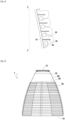
- a holding element 40 is positioned in each interval between two successive stiffeners 20, as shown for example on the Figure 4 .
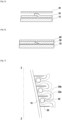
- THE figures 5 and 6 illustrate the effect of tensioning the holding elements 40 on a covering portion of a strip of insulating material 30.
- the strips of insulating material 30 arranged around the nozzle body 10 are typically dimensioned so so that their ends overlap over a defined width. This is shown schematically on the Figure 5 .
- the holding element 40 When the holding element 40 is put under tension, it then compresses the strip of insulating material 30, and in particular the overlapping portions, to obtain a substantially uniform thickness, as shown schematically on the Figure 6 .
- FIG. 7 represents an exemplary embodiment in which two strips of insulating material 30 are superimposed. They are designated respectively by 30a and 30b to designate respectively the strip of insulating material in contact with the nozzle body 10, and the strip of insulating material most outside.
- the tensioning of the holding elements 40 conforms the different strips of insulating material 30a and 30b on the external surface of the nozzle body 10, including on the stiffeners 20.
- the air possibly present between the divergent 10 and the insulator 30a and between the different strips of insulating material 30 will typically escape at the level of the covering portion of the ends strips of insulating material shown schematically on the figures 5 and 6 .
- this exemplary embodiment is not limiting, and that any number of strips of insulating material 30 can thus be superimposed in order to obtain the desired properties, the operation remaining unchanged.
- the use of several superimposed strips of insulating material 30 makes it possible in particular to use strips of insulating material 30 having distinct properties, particularly in terms of thickness and thermal and/or mechanical properties.
- the proposed thermal insulation system is advantageous in particular for the following reasons.
- the strips of insulating material 30 are in fact supported over their entire surface against the external wall of the nozzle body 10 which is rigid. It also has good resistance to external depressurization, because the air present between the nozzle body 10 and the strips of insulating material 30 or between the different strips of insulating material 30 can escape at the areas where the strips cover. of insulating material 30.
- the thermal insulation system is also advantageous in terms of installation, because it does not require structural modifications to the nozzle 1, and only requires the addition of strips of insulating material and a tensioning element. Its mass and cost are also low.
- the various elements of the proposed thermal insulation system are not subject to mechanical stress during operation, which ensures the reliability of the thermal insulation system.
- the strips of insulating material 30 do not require specific sizing to adapt to the geometry of the nozzle 1.
- the strips of insulating material 30 are flexible, and can be positioned freely around the nozzle body 10, conformation to the geometry of the nozzle 1 being ensured when tightening the holding elements 40.
Landscapes
- Engineering & Computer Science (AREA)
- Chemical & Material Sciences (AREA)
- Combustion & Propulsion (AREA)
- Mechanical Engineering (AREA)
- General Engineering & Computer Science (AREA)
- Turbine Rotor Nozzle Sealing (AREA)
- Thermal Insulation (AREA)
Description
- Le présent exposé concerne le domaine des lanceurs spatiaux, et plus précisément les tuyères de lanceurs spatiaux.
- Les lanceurs spatiaux présentent un moteur muni d'une tuyère, communément appelée divergent, qui guide le flux de fluide généré par le moteur.
- Les tuyères doivent ainsi résister à la fois à des sollicitations thermiques et mécaniques. Toutefois, les contraintes spécifiques aux lanceurs spatiaux, notamment en termes d'encombrement, de masse et de coût, rendent particulièrement complexe l'obtention de propriétés permettant de répondre à ces sollicitations.
- Des dispositifs connus notamment tels que présentés dans les documents
FR3060062 FR3074539 - Afin de répondre au moins partiellement à ces problématiques, le présent exposé concerne une tuyère d'un moteur d'engin spatial telle que définie dans la revendication 1, comprenant un corps de tuyère s'étendant selon une direction principale, depuis une extrémité proximale solidaire du moteur de l'engin spatial, et une extrémité distale libre,ledit corps de tuyère présentant une pluralité de raidisseurs s'étendant depuis une surface externe du corps de tuyère, radialement par rapport à la direction principale, ladite tuyère comprenant un système d'isolation thermique, comprenant au moins une bande de matériau isolant disposée de manière à entourer la surface externe du corps de tuyère sur au moins une partie de la hauteur dudit corps de tuyère, la hauteur étant mesurée selon la direction principale, ledit système d'isolation thermique comprenant une pluralité d'éléments de maintien, chaque élément de maintien étant positionné de manière à entourer lesdites bandes de matériau isolant, et étant disposé entre deux raidisseurs du corps de tuyère.
- Selon un exemple, chaque élément de maintien comprend un câble associé à un système de mise en tension.
- Selon un exemple, chaque élément de maintien comprend un revêtement réalisé en isolant thermique.
- Selon un exemple, le système de mise en tension est un ridoir.
- Selon un exemple, un élément de maintien est disposé dans chaque intervalle entre deux raidisseurs.
- Selon un exemple, le système d'isolation thermique comprend au moins deux bandes de matériau isolant superposées.
- Selon un exemple, le système d'isolation thermique comprend une pluralité de bandes de matériau isolant, chaque bande de matériau isolant étant positionnée de manière à recouvrir au moins partiellement les bandes de matériau isolant adjacentes.
- Le présent exposé concerne également un engin spatial comprenant une tuyère telle que définie précédemment.
- L'invention et ses avantages seront mieux compris à la lecture de la description détaillée faite ci-après de différents modes de réalisation de l'invention donnés à titre d'exemples non limitatifs.
- [
Fig. 1 ] Lafigure 1 est un exemple de structure de tuyère. - [
Fig. 2 ] Lafigure 2 est une vue détaillée schématisant la disposition de raidisseurs de la tuyère. - [
Fig. 3 ] Lafigure 3 représente un exemple de système d'isolation thermique. - [
Fig. 4 ] Lafigure 4 représente un exemple de système d'isolation thermique. - [
Fig. 5 ] Lafigure 5 illustre l'effet de la mise sous tension des éléments de maintien d'un exemple de système d'isolation thermique, et est une représentation schématique du système avant mise sous tension. - [
Fig. 6 ] Lafigure 6 illustre l'effet de la mise sous tension des éléments de maintien d'un exemple de système d'isolation thermique, et représente schématiquement le système après mise sous tension des éléments de maintien. - [
Fig. 7 ] Lafigure 7 représente un exemple de système d'isolation thermique. - Sur l'ensemble des figures, les éléments en commun sont repérés par des références numériques identiques.
- La
figure 1 présente un exemple de structure de tuyère 1. - La tuyère 1 telle que présentée comprend un corps de tuyère 10 présentant une forme générale de tronc de cône autour d'un axe principal Z-Z définissant une direction principale, avec des parois incurvées.
- On définit selon l'axe principal Z-Z une hauteur de la tuyère 10, qui s'étend entre une extrémité proximale 12 typiquement solidaire d'un moteur de lanceur spatial, et une extrémité distale 14, typiquement libre, les désignations « proximale » et « distale » étant ici arbitraires.
- Le corps de tuyère 10 est muni d'une pluralité de raidisseurs 20. Chaque raidisseur 20 est typiquement une nervure s'étendant depuis une face externe du corps de tuyère 10, radialement par rapport à l'axe principal Z-Z.
- Les raidisseurs 20 sont typiquement espacés régulièrement, et s'étendent sur tout ou partie de la hauteur de la tuyère 1, typiquement sur une hauteur comprise entre 50% et 80% de la hauteur de la tuyère 1, depuis son extrémité distale 14. La
figure 2 présente un exemple de vue détaillée représentant la disposition des raidisseurs 20. - Les raidisseurs 20 présentent typiquement une dimension comprise entre 30 et 60 mm mesurée selon une direction radiale par rapport à l'axe principal Z-Z.
- Les raidisseurs 20 sont typiquement espacés d'une distance comprise entre 30 et 100 mm mesurée selon la direction définie par l'axe principal Z-Z.
- Afin de réaliser une isolation thermique de la tuyère 1, on dispose un système d'isolation thermique autour du corps de tuyère 10, sur tout ou partie de sa hauteur.
- Les
figures 3 et 4 représentent un exemple de système d'isolation thermique. On a ici positionné autour d'une portion du corps de tuyère 10 comprenant les raidisseurs 20 une bande de matériau isolant 30 et une pluralité d'éléments de maintien 40. - La bande de matériau isolant 30 est dimensionnée de manière à recouvrir au moins deux raidisseurs 20 successifs. Dans l'exemple illustré, on a positionné deux bandes de matériau isolant 30 qui s'étendent chacune sur toute la hauteur du corps de tuyère 10 comprenant les raidisseurs 20, mais ne couvrant qu'une partie de la circonférence du corps de tuyère 10.
- Selon un exemple, le système d'isolation thermique comprend une ou plusieurs bandes de matériau isolant 30 formant des lés qui sont positionnés bout à bout ou de manière à se chevaucher à leur jonction de manière à recouvrir l'ensemble des raidisseurs 20. Chaque bande de matériau isolant 30 présente typiquement une dimension suffisante de manière à pouvoir faire un tour complet autour du corps de tuyère 10. Les deux extrémités de la bande de matériau isolant 30 se chevauchent alors typiquement sur une largeur définie, typiquement comprise entre 30 et 100 mm de manière à assurer une continuité de la protection thermique. En variante, les bandes de matériau isolant 30 peuvent être dimensionnées de manière à ne recouvrir qu'une portion de la périphérie externe du corps de tuyère 10. Il est ainsi nécessaire de positionner plusieurs bandes de matériau isolant 30 afin de couvrir toute la circonférence du corps de tuyère 10. Les bandes de matériau isolant 30 sont alors positionnées de manière à ce que leurs extrémités adjacentes se chevauchent sur une largeur définie, typiquement comprise entre 30 et 100 mm de manière à assurer une continuité de la protection thermique. Plus généralement, les bandes de matériau isolant 30 peuvent se chevaucher selon la direction définie par l'axe principal Z-Z, et/ou selon la circonférence du corps de tuyère 10.
- Les bandes de matériau isolant 30 employées pour envelopper le corps de tuyère 10 peuvent être identiques ou distinctes, notamment en termes de dimension. A titre d'exemple les bandes de matériau isolant 30 peuvent être composées d'une enveloppe en fibres d'alumine, silice et oxyde de bore, par exemple en fibres d'un matériau commercialisé sous la dénomination « Nextel ® » (marque déposée), l'enveloppe étant remplie d'un matériau isolant en laine polycristalline, par exemple un matériau commercialisé sous la dénomination « Fibermax ® » (marque déposée). Les bandes de matériau isolant 30 sont des éléments souples, pouvant ainsi être positionnés librement autour du corps de tuyère 10, indépendamment de la section de la tuyère et de l'agencement des raidisseurs 20.
- On positionne ensuite des éléments de maintien 40 autour du corps de tuyère 10. Chaque élément de maintien 40 est positionné entre deux raidisseurs 20 successifs. Les éléments de maintien 40 sont typiquement des moyens élastiques, des moyens présentant une fonction élastique ou de mise sous tension, ou des sangles couplés à un système de mise en tension. Selon un exemple, chaque élément de maintien 40 comprend un câble métallique typiquement entouré d'un isolant thermique et un système de mise en tension tel qu'un ridoir. A titre d'exemple, un élément de maintien 40 peut être composé d'un câble en acier ou en matériau commercialisé sous la désignation « Inconel ® » (marque déposée), le câble étant typiquement entouré d'un isolant thermique par exemple réalisé en matériau commercialisé sous la dénomination « Fibermax ® » (marque déposée) entouré d'une enveloppe en matériau commercialisé sous la dénomination « Nextel ® » (marque déposée), ou réalisé par une ou plusieurs couches de matériau commercialisé sous la dénomination « Nextel ® » (marque déposée). Le câble peut également être réalisé en matériau commercialisé sous la dénomination « Fibermax ® » (marque déposée), en fibres de verre entourées d'un isolant thermique, ou en fibres de carbone.
- La mise en tension de chaque élément de maintien 40 va venir enserrer la bande de matériau isolant 30 qui se trouve ainsi enserrée entre le corps de tuyère 10 d'une part et l'élément de maintien 40 d'autre part. Cette mise en tension vient ainsi loger les éléments de maintien dans les intervalles entre deux raidisseurs 20 successifs, ainsi que la bande de matériau isolant 30. La mise en tension des différents éléments de maintien 40 vient ainsi sensiblement déformer et conformer la bande de matériau isolant 30 à la géométrie du corps de tuyère 10, incluant les raidisseurs 20, et permet d'obtenir une couche isolante continue et stable autour du corps de tuyère 10.
- Selon un exemple, on positionne un élément de maintien 40 dans chaque intervalle entre deux raidisseurs 20 successifs, comme représenté par exemple sur la
figure 4 . - Les
figures 5 et 6 illustrent l'effet de la mise en tension des éléments de maintien 40 sur une portion de recouvrement d'une bande de matériau isolant 30. Comme indiqué précédemment, les bandes de matériau isolant 30 disposées autour du corps de tuyère 10 sont typiquement dimensionnées de manière à ce que leurs extrémités se recouvrent sur une largeur définie. Cela est représenté schématiquement sur lafigure 5 . Lorsque l'élément de maintien 40 est mis en tension, il vient alors comprimer la bande de matériau isolant 30, et en particulier les portions se chevauchant, pour obtenir une épaisseur sensiblement uniforme, comme représenté schématiquement sur lafigure 6 . - La
figure 7 représente un exemple de réalisation dans lequel deux bandes de matériau isolant 30 sont superposées. On les désigne respectivement par 30a et 30b pour désigner respectivement la bande de matériau isolant au contact du corps de tuyère 10, et la bande de matériau isolant le plus à l'extérieur. - La mise en tension des éléments de maintien 40 vient conformer les différentes bandes de matériau isolant 30a et 30b sur la surface externe du corps de tuyère 10, y compris sur les raidisseurs 20.
- En fonctionnement, l'air éventuellement présent entre le divergent 10 et l'isolant 30a et entre les différentes bandes de matériau isolant 30 va typiquement s'échapper au niveau de la portion de recouvrement des extrémités des bandes de matériau isolant représentées schématiquement sur les
figures 5 et 6 . - On comprend que cet exemple de réalisation n'est pas limitatif, et que l'on peut ainsi superposer un nombre quelconque de bandes de matériau isolant 30 afin d'obtenir les propriétés souhaitées, le fonctionnement demeurant inchangé. L'utilisation de plusieurs bandes de matériau isolant 30 superposées permet notamment d'utiliser des bandes de matériau isolant 30 ayant des propriétés distinctes, notamment en termes d'épaisseur et de propriétés thermiques et/ou mécaniques.
- Le système d'isolation thermique proposé est avantageux notamment pour les raisons suivantes.
- II présente une bonne tenue à l'onde de souffle résultant de l'allumage des propulseurs d'appoint de l'engin spatial et également aux vibrations de la tuyère 1. Les bandes de matériau isolant 30 s'appuient en effet sur toute leur surface contre la paroi externe du corps de tuyère 10 qui est rigide. Il présente également une bonne tenue à la dépressurisation externe, car l'air présent entre le corps de tuyère 10 et les bandes de matériau isolant 30 ou entre les différentes bandes de matériau isolant 30 peut s'échapper au niveau des zones de recouvrement des bandes de matériau isolant 30.
- Le système d'isolation thermique est également avantageux en termes de mise en place, car il ne nécessite pas de modifications structurelles de la tuyère 1, et requiert uniquement l'ajout de bandes de matériau isolant et d'élément de mise sous tension. Sa masse et son coût sont également faibles. De plus, les différents éléments du système d'isolation thermique proposé ne sont pas soumis à des sollicitations mécaniques lors du fonctionnement, ce qui assure la fiabilité du système d'isolation thermique. Par ailleurs, contrairement aux dispositifs connus qui emploient des éléments isolant rigides, les bandes de matériau isolant 30 ne requièrent pas de dimensionnement spécifique pour s'adapter à la géométrie de la tuyère 1. Les bandes de matériau isolant 30 sont souples, et peuvent être positionnées librement autour du corps de tuyère 10, la conformation à la géométrie de la tuyère 1 étant assurée lors du serrage des éléments de maintien 40.
- Bien que la présente invention ait été décrite en se référant à des exemples de réalisation spécifiques, il est évident que des modifications et des changements peuvent être effectués sur ces exemples sans sortir de la portée générale de l'invention telle que définie par les revendications. En particulier, des caractéristiques individuelles des différents modes de réalisation illustrés/mentionnés peuvent être combinées dans des modes de réalisation additionnels. Par conséquent, la description et les dessins doivent être considérés dans un sens illustratif plutôt que restrictif.
- Il est également évident que toutes les caractéristiques décrites en référence à un procédé sont transposables, seules ou en combinaison, à un dispositif, et inversement, toutes les caractéristiques décrites en référence à un dispositif sont transposables, seules ou en combinaison, à un procédé.
Claims (8)
- Tuyère (1) d'un moteur d'engin spatial, comprenant un corps de tuyère (10) s'étendant selon une direction principale (Z-Z), depuis une extrémité proximale (12) solidaire du moteur de l'engin spatial, et une extrémité distale (14) libre,ledit corps de tuyère (10) présentant une pluralité de raidisseurs (20) s'étendant depuis une surface externe du corps de tuyère (10), radialement par rapport à la direction principale (Z-Z),ladite tuyère (1) comprenant un système d'isolation thermique, comprenant au moins une bande de matériau isolant (30) souple disposée de manière à entourer la surface externe du corps de tuyère (10) sur au moins une partie de la hauteur dudit corps de tuyère (10), la hauteur étant mesurée selon la direction principale (Z-Z), ledit système d'isolation thermique comprenant une pluralité d'éléments de maintien (40), chaque élément de maintien (40) étant disposé entre deux raidisseurs (20) du corps de tuyère (10) et positionné de manière à entourer lesdites bandes de matériau isolant (30) et de manière à conformer les bandes de matériau isolant (30) sur la surface externe du corps de tuyère (10) et sur les raidisseurs (20) .
- Tuyère (1) selon la revendication 1, dans laquelle chaque élément de maintien (40) comprend un câble associé à un système de mise en tension.
- Tuyère (1) selon la revendication 2, dans laquelle chaque élément de maintien (40) comprend un revêtement réalisé en isolant thermique.
- Tuyère (1) selon l'une des revendications 2 ou 3, dans laquelle le système de mise en tension est un ridoir.
- Tuyère (1) selon l'une des revendications 1 à 4, dans laquelle un élément de maintien (40) est disposé dans chaque intervalle entre deux raidisseurs (20).
- Tuyère (1) selon l'une des revendications 1 à 5, dans laquelle le système d'isolation thermique comprend au moins deux bandes de matériau isolant (30) superposées.
- Tuyère (1) selon l'une des revendications 1 à 6, dans laquelle le système d'isolation thermique comprend une pluralité de bandes de matériau isolant (30), chaque bande de matériau isolant (30) étant positionnée de manière à recouvrir au moins partiellement les bandes de matériau isolant (30) adjacentes.
- Engin spatial comprenant une tuyère (1) selon l'une des revendications précédentes.
Applications Claiming Priority (2)
| Application Number | Priority Date | Filing Date | Title |
|---|---|---|---|
| FR1912335A FR3102808B1 (fr) | 2019-11-04 | 2019-11-04 | Dispositif de protection thermique amélioré pour tuyère |
| PCT/FR2020/051977 WO2021089935A1 (fr) | 2019-11-04 | 2020-11-02 | Dispositif de protection thermique ameliore pour tuyere |
Publications (2)
| Publication Number | Publication Date |
|---|---|
| EP4055262A1 EP4055262A1 (fr) | 2022-09-14 |
| EP4055262B1 true EP4055262B1 (fr) | 2024-01-03 |
Family
ID=69811011
Family Applications (1)
| Application Number | Title | Priority Date | Filing Date |
|---|---|---|---|
| EP20811704.4A Active EP4055262B1 (fr) | 2019-11-04 | 2020-11-02 | Dispositif de protection thermique amélioré pour tuyère |
Country Status (6)
| Country | Link |
|---|---|
| US (1) | US11821388B2 (fr) |
| EP (1) | EP4055262B1 (fr) |
| JP (1) | JP7672401B2 (fr) |
| ES (1) | ES2975864T3 (fr) |
| FR (1) | FR3102808B1 (fr) |
| WO (1) | WO2021089935A1 (fr) |
Family Cites Families (7)
| Publication number | Priority date | Publication date | Assignee | Title |
|---|---|---|---|---|
| US3126702A (en) * | 1964-03-31 | newcomb | ||
| US3508404A (en) * | 1968-06-24 | 1970-04-28 | Curtiss Wright Corp | Support member for restartable rocket engines |
| US4426038A (en) * | 1982-01-11 | 1984-01-17 | Thiokol Corporation | Non-radiating extendible cloth exit cone for rocket nozzles |
| FR2586080B1 (fr) * | 1985-08-12 | 1987-11-27 | Centre Nat Etd Spatiales | Element de protection thermique pour un engin soumis a des echauffements importants |
| FR3060062B1 (fr) * | 2016-12-14 | 2020-10-30 | Airbus Safran Launchers Sas | Dispositif de protection thermique pour divergent |
| FR3072426B1 (fr) * | 2017-10-12 | 2019-11-01 | Arianegroup Sas | Protection thermique, son procede de fabrication et divergent comprenant une telle protection thermique |
| FR3074539B1 (fr) * | 2017-12-06 | 2019-12-20 | Arianegroup Sas | Dispositif ameliore de blocage de cables de serrage de protections thermiques de divergents de moteurs spatiaux |
-
2019
- 2019-11-04 FR FR1912335A patent/FR3102808B1/fr active Active
-
2020
- 2020-11-02 ES ES20811704T patent/ES2975864T3/es active Active
- 2020-11-02 JP JP2022525946A patent/JP7672401B2/ja active Active
- 2020-11-02 WO PCT/FR2020/051977 patent/WO2021089935A1/fr not_active Ceased
- 2020-11-02 US US17/755,552 patent/US11821388B2/en active Active
- 2020-11-02 EP EP20811704.4A patent/EP4055262B1/fr active Active
Also Published As
| Publication number | Publication date |
|---|---|
| JP7672401B2 (ja) | 2025-05-07 |
| FR3102808B1 (fr) | 2022-10-14 |
| US11821388B2 (en) | 2023-11-21 |
| US20220381202A1 (en) | 2022-12-01 |
| EP4055262A1 (fr) | 2022-09-14 |
| WO2021089935A1 (fr) | 2021-05-14 |
| ES2975864T3 (es) | 2024-07-16 |
| FR3102808A1 (fr) | 2021-05-07 |
| JP2023501331A (ja) | 2023-01-18 |
Similar Documents
| Publication | Publication Date | Title |
|---|---|---|
| EP2486247B1 (fr) | Dispositif de centrage et de guidage en rotation d'un arbre de turbomachine | |
| EP1818616B1 (fr) | Chambre de combustion de turbomachine à fentes tangentielles | |
| EP2175183B1 (fr) | Dispositif de maintien étanche d'une conduite, procédé de montage étanche d'une conduite à travers une cloison et utilisation d'un tel dispositif pour la traversée étanche d'une cloison d'un réservoir d'aéronef | |
| EP0721246A1 (fr) | Dispositif de fixation, de reprise de masse et d'étanchéité pour câble optique | |
| EP1607582A1 (fr) | Montage de chambre de combustion de turbine à gaz avec distributeur intégré de turbine haute pression | |
| WO2000022337A1 (fr) | Conduite flexible a frette de forte inertie | |
| WO1998028533A1 (fr) | Divergent deployable pour propulseur | |
| FR2758791A1 (fr) | Dispositif de suspension d'une charge utile dans un lanceur spatial | |
| EP4028645B1 (fr) | Fixation d'une virole acoustique a une enveloppé de carter pour une turbomachine d'aéronef | |
| EP0815378A1 (fr) | Canalisation flexible | |
| EP2673545B1 (fr) | Element de conduit a perte de charge reduite | |
| EP3084140B1 (fr) | Bras de guidage d'éléments de forme allongée, en particulier pour une turbomachine | |
| EP1355120B1 (fr) | Dispositif de liaison provisoire et de séparation pyrotechnique de deux éléments, sans rupture | |
| EP0706608B1 (fr) | Tubulure d'echappement pour dispositif d'echappement a catalyse | |
| EP2893227B1 (fr) | Joint circulaire d'etancheite a brosse | |
| FR2503476A1 (fr) | Procede de depose d'une gaine protectrice sur l'extremite d'un cable electrique et dispositif pour la mise en oeuvre de celui-ci | |
| EP4055262B1 (fr) | Dispositif de protection thermique amélioré pour tuyère | |
| EP1361411A2 (fr) | Dispositif de liaison provisoire et de séparation pyrotechnique de deux éléments, à organe mobile | |
| FR2899665A1 (fr) | "conduite flexible a embouts d'extremite integres" | |
| FR2705739A1 (fr) | Tuyère de moteur-fusée à section de sortie sélectivement réduite. | |
| FR2846704A1 (fr) | Joint tisse tubulaire composite pour l'interface horizontale des cloisons d'une turbine a vapeur | |
| EP3918204B1 (fr) | Carter de soufflante pour une turbomachine d'aeronef | |
| FR2505057A1 (fr) | Element porteur non metallique pour cable et cable comportant un tel porteur | |
| EP1567761A2 (fr) | Liaison entre fond arriere de chambre de combustion et tuyere de moteur fusee | |
| FR2703105A1 (fr) | Dispositif de purification catalytique des gaz d'échappement d'un moteur, notamment de véhicule automobile. |
Legal Events
| Date | Code | Title | Description |
|---|---|---|---|
| STAA | Information on the status of an ep patent application or granted ep patent |
Free format text: STATUS: UNKNOWN |
|
| STAA | Information on the status of an ep patent application or granted ep patent |
Free format text: STATUS: THE INTERNATIONAL PUBLICATION HAS BEEN MADE |
|
| PUAI | Public reference made under article 153(3) epc to a published international application that has entered the european phase |
Free format text: ORIGINAL CODE: 0009012 |
|
| STAA | Information on the status of an ep patent application or granted ep patent |
Free format text: STATUS: REQUEST FOR EXAMINATION WAS MADE |
|
| 17P | Request for examination filed |
Effective date: 20220601 |
|
| AK | Designated contracting states |
Kind code of ref document: A1 Designated state(s): AL AT BE BG CH CY CZ DE DK EE ES FI FR GB GR HR HU IE IS IT LI LT LU LV MC MK MT NL NO PL PT RO RS SE SI SK SM TR |
|
| DAV | Request for validation of the european patent (deleted) | ||
| DAX | Request for extension of the european patent (deleted) | ||
| GRAP | Despatch of communication of intention to grant a patent |
Free format text: ORIGINAL CODE: EPIDOSNIGR1 |
|
| STAA | Information on the status of an ep patent application or granted ep patent |
Free format text: STATUS: GRANT OF PATENT IS INTENDED |
|
| INTG | Intention to grant announced |
Effective date: 20230621 |
|
| P01 | Opt-out of the competence of the unified patent court (upc) registered |
Effective date: 20230612 |
|
| GRAS | Grant fee paid |
Free format text: ORIGINAL CODE: EPIDOSNIGR3 |
|
| GRAA | (expected) grant |
Free format text: ORIGINAL CODE: 0009210 |
|
| STAA | Information on the status of an ep patent application or granted ep patent |
Free format text: STATUS: THE PATENT HAS BEEN GRANTED |
|
| AK | Designated contracting states |
Kind code of ref document: B1 Designated state(s): AL AT BE BG CH CY CZ DE DK EE ES FI FR GB GR HR HU IE IS IT LI LT LU LV MC MK MT NL NO PL PT RO RS SE SI SK SM TR |
|
| REG | Reference to a national code |
Ref country code: GB Ref legal event code: FG4D Free format text: NOT ENGLISH |
|
| REG | Reference to a national code |
Ref country code: DE Ref legal event code: R096 Ref document number: 602020023947 Country of ref document: DE |
|
| REG | Reference to a national code |
Ref country code: CH Ref legal event code: EP |
|
| REG | Reference to a national code |
Ref country code: IE Ref legal event code: FG4D Free format text: LANGUAGE OF EP DOCUMENT: FRENCH |
|
| REG | Reference to a national code |
Ref country code: LT Ref legal event code: MG9D |
|
| REG | Reference to a national code |
Ref country code: NL Ref legal event code: MP Effective date: 20240103 |
|
| REG | Reference to a national code |
Ref country code: AT Ref legal event code: MK05 Ref document number: 1647021 Country of ref document: AT Kind code of ref document: T Effective date: 20240103 |
|
| PG25 | Lapsed in a contracting state [announced via postgrant information from national office to epo] |
Ref country code: NL Free format text: LAPSE BECAUSE OF FAILURE TO SUBMIT A TRANSLATION OF THE DESCRIPTION OR TO PAY THE FEE WITHIN THE PRESCRIBED TIME-LIMIT Effective date: 20240103 |
|
| PG25 | Lapsed in a contracting state [announced via postgrant information from national office to epo] |
Ref country code: NL Free format text: LAPSE BECAUSE OF FAILURE TO SUBMIT A TRANSLATION OF THE DESCRIPTION OR TO PAY THE FEE WITHIN THE PRESCRIBED TIME-LIMIT Effective date: 20240103 |
|
| PG25 | Lapsed in a contracting state [announced via postgrant information from national office to epo] |
Ref country code: IS Free format text: LAPSE BECAUSE OF FAILURE TO SUBMIT A TRANSLATION OF THE DESCRIPTION OR TO PAY THE FEE WITHIN THE PRESCRIBED TIME-LIMIT Effective date: 20240503 |
|
| PG25 | Lapsed in a contracting state [announced via postgrant information from national office to epo] |
Ref country code: LT Free format text: LAPSE BECAUSE OF FAILURE TO SUBMIT A TRANSLATION OF THE DESCRIPTION OR TO PAY THE FEE WITHIN THE PRESCRIBED TIME-LIMIT Effective date: 20240103 |
|
| PG25 | Lapsed in a contracting state [announced via postgrant information from national office to epo] |
Ref country code: GR Free format text: LAPSE BECAUSE OF FAILURE TO SUBMIT A TRANSLATION OF THE DESCRIPTION OR TO PAY THE FEE WITHIN THE PRESCRIBED TIME-LIMIT Effective date: 20240404 |
|
| REG | Reference to a national code |
Ref country code: ES Ref legal event code: FG2A Ref document number: 2975864 Country of ref document: ES Kind code of ref document: T3 Effective date: 20240716 |
|
| PG25 | Lapsed in a contracting state [announced via postgrant information from national office to epo] |
Ref country code: RS Free format text: LAPSE BECAUSE OF FAILURE TO SUBMIT A TRANSLATION OF THE DESCRIPTION OR TO PAY THE FEE WITHIN THE PRESCRIBED TIME-LIMIT Effective date: 20240403 Ref country code: HR Free format text: LAPSE BECAUSE OF FAILURE TO SUBMIT A TRANSLATION OF THE DESCRIPTION OR TO PAY THE FEE WITHIN THE PRESCRIBED TIME-LIMIT Effective date: 20240103 |
|
| PG25 | Lapsed in a contracting state [announced via postgrant information from national office to epo] |
Ref country code: CZ Free format text: LAPSE BECAUSE OF FAILURE TO SUBMIT A TRANSLATION OF THE DESCRIPTION OR TO PAY THE FEE WITHIN THE PRESCRIBED TIME-LIMIT Effective date: 20240103 Ref country code: AT Free format text: LAPSE BECAUSE OF FAILURE TO SUBMIT A TRANSLATION OF THE DESCRIPTION OR TO PAY THE FEE WITHIN THE PRESCRIBED TIME-LIMIT Effective date: 20240103 |
|
| PG25 | Lapsed in a contracting state [announced via postgrant information from national office to epo] |
Ref country code: RS Free format text: LAPSE BECAUSE OF FAILURE TO SUBMIT A TRANSLATION OF THE DESCRIPTION OR TO PAY THE FEE WITHIN THE PRESCRIBED TIME-LIMIT Effective date: 20240403 Ref country code: NO Free format text: LAPSE BECAUSE OF FAILURE TO SUBMIT A TRANSLATION OF THE DESCRIPTION OR TO PAY THE FEE WITHIN THE PRESCRIBED TIME-LIMIT Effective date: 20240403 Ref country code: LT Free format text: LAPSE BECAUSE OF FAILURE TO SUBMIT A TRANSLATION OF THE DESCRIPTION OR TO PAY THE FEE WITHIN THE PRESCRIBED TIME-LIMIT Effective date: 20240103 Ref country code: IS Free format text: LAPSE BECAUSE OF FAILURE TO SUBMIT A TRANSLATION OF THE DESCRIPTION OR TO PAY THE FEE WITHIN THE PRESCRIBED TIME-LIMIT Effective date: 20240503 Ref country code: HR Free format text: LAPSE BECAUSE OF FAILURE TO SUBMIT A TRANSLATION OF THE DESCRIPTION OR TO PAY THE FEE WITHIN THE PRESCRIBED TIME-LIMIT Effective date: 20240103 Ref country code: GR Free format text: LAPSE BECAUSE OF FAILURE TO SUBMIT A TRANSLATION OF THE DESCRIPTION OR TO PAY THE FEE WITHIN THE PRESCRIBED TIME-LIMIT Effective date: 20240404 Ref country code: CZ Free format text: LAPSE BECAUSE OF FAILURE TO SUBMIT A TRANSLATION OF THE DESCRIPTION OR TO PAY THE FEE WITHIN THE PRESCRIBED TIME-LIMIT Effective date: 20240103 Ref country code: BG Free format text: LAPSE BECAUSE OF FAILURE TO SUBMIT A TRANSLATION OF THE DESCRIPTION OR TO PAY THE FEE WITHIN THE PRESCRIBED TIME-LIMIT Effective date: 20240103 Ref country code: AT Free format text: LAPSE BECAUSE OF FAILURE TO SUBMIT A TRANSLATION OF THE DESCRIPTION OR TO PAY THE FEE WITHIN THE PRESCRIBED TIME-LIMIT Effective date: 20240103 |
|
| PG25 | Lapsed in a contracting state [announced via postgrant information from national office to epo] |
Ref country code: PL Free format text: LAPSE BECAUSE OF FAILURE TO SUBMIT A TRANSLATION OF THE DESCRIPTION OR TO PAY THE FEE WITHIN THE PRESCRIBED TIME-LIMIT Effective date: 20240103 Ref country code: PT Free format text: LAPSE BECAUSE OF FAILURE TO SUBMIT A TRANSLATION OF THE DESCRIPTION OR TO PAY THE FEE WITHIN THE PRESCRIBED TIME-LIMIT Effective date: 20240503 |
|
| PG25 | Lapsed in a contracting state [announced via postgrant information from national office to epo] |
Ref country code: SE Free format text: LAPSE BECAUSE OF FAILURE TO SUBMIT A TRANSLATION OF THE DESCRIPTION OR TO PAY THE FEE WITHIN THE PRESCRIBED TIME-LIMIT Effective date: 20240103 Ref country code: PT Free format text: LAPSE BECAUSE OF FAILURE TO SUBMIT A TRANSLATION OF THE DESCRIPTION OR TO PAY THE FEE WITHIN THE PRESCRIBED TIME-LIMIT Effective date: 20240503 Ref country code: PL Free format text: LAPSE BECAUSE OF FAILURE TO SUBMIT A TRANSLATION OF THE DESCRIPTION OR TO PAY THE FEE WITHIN THE PRESCRIBED TIME-LIMIT Effective date: 20240103 Ref country code: LV Free format text: LAPSE BECAUSE OF FAILURE TO SUBMIT A TRANSLATION OF THE DESCRIPTION OR TO PAY THE FEE WITHIN THE PRESCRIBED TIME-LIMIT Effective date: 20240103 |
|
| REG | Reference to a national code |
Ref country code: DE Ref legal event code: R097 Ref document number: 602020023947 Country of ref document: DE |
|
| PG25 | Lapsed in a contracting state [announced via postgrant information from national office to epo] |
Ref country code: DK Free format text: LAPSE BECAUSE OF FAILURE TO SUBMIT A TRANSLATION OF THE DESCRIPTION OR TO PAY THE FEE WITHIN THE PRESCRIBED TIME-LIMIT Effective date: 20240103 |
|
| PG25 | Lapsed in a contracting state [announced via postgrant information from national office to epo] |
Ref country code: SM Free format text: LAPSE BECAUSE OF FAILURE TO SUBMIT A TRANSLATION OF THE DESCRIPTION OR TO PAY THE FEE WITHIN THE PRESCRIBED TIME-LIMIT Effective date: 20240103 |
|
| PG25 | Lapsed in a contracting state [announced via postgrant information from national office to epo] |
Ref country code: EE Free format text: LAPSE BECAUSE OF FAILURE TO SUBMIT A TRANSLATION OF THE DESCRIPTION OR TO PAY THE FEE WITHIN THE PRESCRIBED TIME-LIMIT Effective date: 20240103 |
|
| PG25 | Lapsed in a contracting state [announced via postgrant information from national office to epo] |
Ref country code: SK Free format text: LAPSE BECAUSE OF FAILURE TO SUBMIT A TRANSLATION OF THE DESCRIPTION OR TO PAY THE FEE WITHIN THE PRESCRIBED TIME-LIMIT Effective date: 20240103 |
|
| PG25 | Lapsed in a contracting state [announced via postgrant information from national office to epo] |
Ref country code: SM Free format text: LAPSE BECAUSE OF FAILURE TO SUBMIT A TRANSLATION OF THE DESCRIPTION OR TO PAY THE FEE WITHIN THE PRESCRIBED TIME-LIMIT Effective date: 20240103 Ref country code: SK Free format text: LAPSE BECAUSE OF FAILURE TO SUBMIT A TRANSLATION OF THE DESCRIPTION OR TO PAY THE FEE WITHIN THE PRESCRIBED TIME-LIMIT Effective date: 20240103 Ref country code: RO Free format text: LAPSE BECAUSE OF FAILURE TO SUBMIT A TRANSLATION OF THE DESCRIPTION OR TO PAY THE FEE WITHIN THE PRESCRIBED TIME-LIMIT Effective date: 20240103 Ref country code: EE Free format text: LAPSE BECAUSE OF FAILURE TO SUBMIT A TRANSLATION OF THE DESCRIPTION OR TO PAY THE FEE WITHIN THE PRESCRIBED TIME-LIMIT Effective date: 20240103 Ref country code: DK Free format text: LAPSE BECAUSE OF FAILURE TO SUBMIT A TRANSLATION OF THE DESCRIPTION OR TO PAY THE FEE WITHIN THE PRESCRIBED TIME-LIMIT Effective date: 20240103 |
|
| PLBE | No opposition filed within time limit |
Free format text: ORIGINAL CODE: 0009261 |
|
| STAA | Information on the status of an ep patent application or granted ep patent |
Free format text: STATUS: NO OPPOSITION FILED WITHIN TIME LIMIT |
|
| 26N | No opposition filed |
Effective date: 20241007 |
|
| PG25 | Lapsed in a contracting state [announced via postgrant information from national office to epo] |
Ref country code: SI Free format text: LAPSE BECAUSE OF FAILURE TO SUBMIT A TRANSLATION OF THE DESCRIPTION OR TO PAY THE FEE WITHIN THE PRESCRIBED TIME-LIMIT Effective date: 20240103 |
|
| REG | Reference to a national code |
Ref country code: CH Ref legal event code: PL |
|
| PG25 | Lapsed in a contracting state [announced via postgrant information from national office to epo] |
Ref country code: MC Free format text: LAPSE BECAUSE OF FAILURE TO SUBMIT A TRANSLATION OF THE DESCRIPTION OR TO PAY THE FEE WITHIN THE PRESCRIBED TIME-LIMIT Effective date: 20240103 |
|
| PG25 | Lapsed in a contracting state [announced via postgrant information from national office to epo] |
Ref country code: LU Free format text: LAPSE BECAUSE OF NON-PAYMENT OF DUE FEES Effective date: 20241102 |
|
| REG | Reference to a national code |
Ref country code: CH Ref legal event code: PL |
|
| PG25 | Lapsed in a contracting state [announced via postgrant information from national office to epo] |
Ref country code: CH Free format text: LAPSE BECAUSE OF NON-PAYMENT OF DUE FEES Effective date: 20241130 |
|
| REG | Reference to a national code |
Ref country code: BE Ref legal event code: MM Effective date: 20241130 |
|
| PG25 | Lapsed in a contracting state [announced via postgrant information from national office to epo] |
Ref country code: FI Free format text: LAPSE BECAUSE OF FAILURE TO SUBMIT A TRANSLATION OF THE DESCRIPTION OR TO PAY THE FEE WITHIN THE PRESCRIBED TIME-LIMIT Effective date: 20240103 |
|
| PG25 | Lapsed in a contracting state [announced via postgrant information from national office to epo] |
Ref country code: BE Free format text: LAPSE BECAUSE OF NON-PAYMENT OF DUE FEES Effective date: 20241130 |
|
| PG25 | Lapsed in a contracting state [announced via postgrant information from national office to epo] |
Ref country code: IE Free format text: LAPSE BECAUSE OF NON-PAYMENT OF DUE FEES Effective date: 20241102 |
|
| PGFP | Annual fee paid to national office [announced via postgrant information from national office to epo] |
Ref country code: DE Payment date: 20251119 Year of fee payment: 6 |
|
| PGFP | Annual fee paid to national office [announced via postgrant information from national office to epo] |
Ref country code: GB Payment date: 20251121 Year of fee payment: 6 |
|
| PGFP | Annual fee paid to national office [announced via postgrant information from national office to epo] |
Ref country code: IT Payment date: 20251125 Year of fee payment: 6 |
|
| PGFP | Annual fee paid to national office [announced via postgrant information from national office to epo] |
Ref country code: FR Payment date: 20251126 Year of fee payment: 6 |
|
| PGFP | Annual fee paid to national office [announced via postgrant information from national office to epo] |
Ref country code: ES Payment date: 20251229 Year of fee payment: 6 |
|
| PG25 | Lapsed in a contracting state [announced via postgrant information from national office to epo] |
Ref country code: HU Free format text: LAPSE BECAUSE OF FAILURE TO SUBMIT A TRANSLATION OF THE DESCRIPTION OR TO PAY THE FEE WITHIN THE PRESCRIBED TIME-LIMIT; INVALID AB INITIO Effective date: 20201102 |
|
| PG25 | Lapsed in a contracting state [announced via postgrant information from national office to epo] |
Ref country code: CY Free format text: LAPSE BECAUSE OF FAILURE TO SUBMIT A TRANSLATION OF THE DESCRIPTION OR TO PAY THE FEE WITHIN THE PRESCRIBED TIME-LIMIT; INVALID AB INITIO Effective date: 20201102 |