EP4054072A1 - Energy harvesting system using multiple surrounding energy sources - Google Patents
Energy harvesting system using multiple surrounding energy sources Download PDFInfo
- Publication number
- EP4054072A1 EP4054072A1 EP19946250.8A EP19946250A EP4054072A1 EP 4054072 A1 EP4054072 A1 EP 4054072A1 EP 19946250 A EP19946250 A EP 19946250A EP 4054072 A1 EP4054072 A1 EP 4054072A1
- Authority
- EP
- European Patent Office
- Prior art keywords
- energy
- converter
- internal power
- power
- sources
- Prior art date
- Legal status (The legal status is an assumption and is not a legal conclusion. Google has not performed a legal analysis and makes no representation as to the accuracy of the status listed.)
- Pending
Links
Images

Classifications
-
- H—ELECTRICITY
- H02—GENERATION; CONVERSION OR DISTRIBUTION OF ELECTRIC POWER
- H02N—ELECTRIC MACHINES NOT OTHERWISE PROVIDED FOR
- H02N2/00—Electric machines in general using piezoelectric effect, electrostriction or magnetostriction
- H02N2/18—Electric machines in general using piezoelectric effect, electrostriction or magnetostriction producing electrical output from mechanical input, e.g. generators
- H02N2/186—Vibration harvesters
-
- H—ELECTRICITY
- H02—GENERATION; CONVERSION OR DISTRIBUTION OF ELECTRIC POWER
- H02J—ELECTRIC POWER NETWORKS; CIRCUIT ARRANGEMENTS OR SYSTEMS FOR SUPPLYING OR DISTRIBUTING ELECTRIC POWER; SYSTEMS FOR STORING ELECTRIC ENERGY
- H02J50/00—Circuit arrangements or systems for wireless supply or distribution of electric power
- H02J50/001—Energy harvesting or scavenging
-
- H—ELECTRICITY
- H02—GENERATION; CONVERSION OR DISTRIBUTION OF ELECTRIC POWER
- H02J—ELECTRIC POWER NETWORKS; CIRCUIT ARRANGEMENTS OR SYSTEMS FOR SUPPLYING OR DISTRIBUTING ELECTRIC POWER; SYSTEMS FOR STORING ELECTRIC ENERGY
- H02J7/00—Circuit arrangements for charging or discharging batteries or for supplying loads from batteries
- H02J7/34—Parallel operation in networks using both storage and other DC sources, e.g. providing buffering
-
- H—ELECTRICITY
- H02—GENERATION; CONVERSION OR DISTRIBUTION OF ELECTRIC POWER
- H02N—ELECTRIC MACHINES NOT OTHERWISE PROVIDED FOR
- H02N11/00—Generators or motors not provided for elsewhere; Alleged perpetua mobilia obtained by electric or magnetic means
-
- H—ELECTRICITY
- H02—GENERATION; CONVERSION OR DISTRIBUTION OF ELECTRIC POWER
- H02N—ELECTRIC MACHINES NOT OTHERWISE PROVIDED FOR
- H02N2/00—Electric machines in general using piezoelectric effect, electrostriction or magnetostriction
- H02N2/18—Electric machines in general using piezoelectric effect, electrostriction or magnetostriction producing electrical output from mechanical input, e.g. generators
- H02N2/181—Circuits; Control arrangements or methods
-
- H—ELECTRICITY
- H02—GENERATION; CONVERSION OR DISTRIBUTION OF ELECTRIC POWER
- H02N—ELECTRIC MACHINES NOT OTHERWISE PROVIDED FOR
- H02N2/00—Electric machines in general using piezoelectric effect, electrostriction or magnetostriction
- H02N2/18—Electric machines in general using piezoelectric effect, electrostriction or magnetostriction producing electrical output from mechanical input, e.g. generators
- H02N2/185—Electric machines in general using piezoelectric effect, electrostriction or magnetostriction producing electrical output from mechanical input, e.g. generators using fluid streams
-
- H—ELECTRICITY
- H02—GENERATION; CONVERSION OR DISTRIBUTION OF ELECTRIC POWER
- H02J—ELECTRIC POWER NETWORKS; CIRCUIT ARRANGEMENTS OR SYSTEMS FOR SUPPLYING OR DISTRIBUTING ELECTRIC POWER; SYSTEMS FOR STORING ELECTRIC ENERGY
- H02J7/00—Circuit arrangements for charging or discharging batteries or for supplying loads from batteries
- H02J7/34—Parallel operation in networks using both storage and other DC sources, e.g. providing buffering
- H02J7/35—Parallel operation in networks using both storage and other DC sources, e.g. providing buffering with light sensitive cells
Definitions
- the present invention relates to an energy harvesting system.
- the present invention relates to an energy harvesting system that collects more energy from multiple ambient energy sources and operates an electronic device based on the energy.
- IoT Internet of Things
- Representative energy sources for energy harvesting include sunlight, vibration, heat, and wind, and devices that operate using such an individual energy source exist.
- the existing energy harvesting technology uses only one energy source in a limited environment, so that there is a problem in that it is difficult to utilize if the amount of corresponding energy is insufficient.
- an object of the present invention is to provide an energy harvesting system capable of collecting more energy in various environments by using multiple ambient energy sources rather than using only one energy source.
- Another object of the present invention is to provide an energy harvesting system capable of improving energy collection efficiency by using small amounts of electric energy collected by respective energy converters.
- the present invention provides an energy harvesting system using multiple ambient energy sources, the energy harvesting system including a plurality of energy converters connected to the multiple ambient energy sources, respectively, receiving energy from the multiple ambient energy sources, and converting the received energy into electrical energy; an electrical energy buffer receiving and collecting electrical energy from the plurality of energy converters, and combining the collected electrical energy to have a predetermined power level; a constant voltage converter receiving the combined electrical energy from the electrical energy buffer, and converting the received electrical energy into driving power of a power level usable by a load; and an electrical energy storage receiving the driving power from the constant voltage converter, storing the received driving power, and providing the stored driving power to the load.
- the generated internal power is selectively used as external power for another energy converter.
- the multiple ambient energy sources may include at least two ambient energy sources selected from the group consisting of sunlight, vibration, heat, and wind.
- Each of the plurality of energy converters may include a core connected to each of the multiple ambient energy sources, receiving energy from the multiple ambient energy sources, and converting the received energy into electrical energy; and a controller controlling an operation of the core, and when internal power is generated according to strength of the ambient energy sources, selectively using the generated internal power as external power of another energy converter.
- Each of the plurality of energy converters may include an internal power node, when internal power is generated according to strength of the ambient energy sources, selectively supplying the generated internal power as external power of another energy converter; and an external power node selectively receiving internal power generated in another energy converter from an internal power node of the another energy converter.
- the energy converter receiving internal power from an internal power node of another energy converter may maintain a standby state for operation.
- the present invention provides an energy converter of an energy harvesting system using multiple ambient energy sources, the energy converter including a core connected to each of the multiple ambient energy sources, receiving energy from the multiple ambient energy sources, and converting the received energy into electrical energy; and a controller controlling an operation of the core, and when internal power is generated according to strength of the ambient energy sources, selectively using the generated internal power as external power of another energy converter.
- the energy harvesting system according to the present invention can collect more energy from multiple ambient energy sources rather than from only one energy source, thereby operating an electronic device based on the collected energy.
- the energy harvesting system according to the present invention can combine small amounts of electric energy collected from the respective ambient energy sources and convert the combined energy to have a usable electric energy level.
- the energy harvesting system according to the present invention can collect more ambient energy in the same environment, so that it is possible to expand the types of electronic devices that can be operated using the energy harvesting technology. Accordingly, the energy harvesting system according to the present invention can be utilized for the development of sensors and devices that can be operated using ambient energy sources without a battery.
- the energy harvesting system can selectively use the generated internal power as external power of another energy converter. Accordingly, using a small amount of electrical energy collected by each energy converter, the energy collection efficiency can be improved.
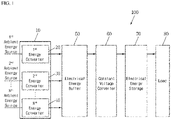
- FIG. 1 is a block diagram illustrating an energy harvesting system using two or more types of energy according to an embodiment of the present invention.
- the energy harvesting system 100 is a system that collects more energy from multiple ambient energy sources rather than collects energy from only one ambient energy source, and operates a load 80 (e.g., an electronic device) based on the collected energy.
- a load 80 e.g., an electronic device
- the energy harvesting system 100 includes a plurality of energy converters 10, an electrical energy buffer 50, a constant voltage converter 60, and an electrical energy storage 70.
- the plurality of energy converters 10 are connected to multiple ambient energy sources, respectively, receive energy from the multiple ambient energy sources, and convert the received energy into electrical energy.
- the electrical energy buffer 50 receives and collects electrical energy from the plurality of energy converters 10, and combines the collected electrical energy to have a predetermined power level.
- the constant voltage converter 60 receives the combined electrical energy from the electrical energy buffer 50, and converts the received electrical energy into driving power of a power level usable by the load 80.
- the electrical energy storage 70 receives the driving power from the constant voltage converter 60, stores the received driving power, and provides the stored driving power to the load 80. In this case, when internal power is generated in a specific energy converter among the plurality of energy converters 10 according to the strength of the ambient energy source, the generated internal power may be selectively used as external power for another energy converter.
- the multiple ambient energy sources include first to nth ambient energy sources (hereinafter, 'n' is a natural number of 2 or more).
- the ambient energy sources may be sunlight, vibration, heat, and wind, but are not limited thereto.
- the multiple ambient energy sources include two or more different types of ambient energy sources.
- the plurality of energy converters 10 are connected one-to-one to the multiple ambient energy sources, and each energy converter receives energy from each ambient energy source and converts it into electrical energy.
- the plurality of energy converters 10 includes first to nth energy converters 20, 30, and 40. Each of the plurality of energy converters 10 generates internal power by using the ambient energy source.
- the electrical energy buffer 50 temporarily stores electrical energy collected from the plurality of energy converters 10, and includes a passive element such as a capacitor capable of storing electrical energy.
- the electrical energy buffer 50 combines the electrical energy collected from the plurality of energy converters 10, converts the combined electrical energy to have a predetermined power level, and delivers the converted electrical energy to the constant voltage converter 60.
- the constant voltage converter 60 receives the stored electrical energy from the electrical energy buffer 50, and converts the received electrical energy into driving power of a power level usable by the load 80.
- the electrical energy storage 70 is an energy storage device that stores driving power for operating the load 80, and may use, for example, a capacitor, a secondary battery, or the like.
- the electrical energy storage 70 provides the stored driving power to the load 80.
- the energy converters 10 receives energy from one or more ambient energy sources and converts it into electrical energy.
- the electrical energy obtained by the energy converters 10 is accumulated in the electrical energy buffer 50. Because the type and intensity of the ambient energy sources are varied depending on the surrounding environment, the amount of electrical energy obtained by the respective energy converters 10 and accumulated in the electrical energy buffer 50 is also different. Therefore, the electrical energy buffer 50 adds up the accumulated electric energy.
- the load 80 such as an electronic device has a determined operable power level (voltage and current level), so that the electrical energy accumulated in the electrical energy buffer 50 cannot be used for the load 80 as it is.
- the electrical energy accumulated in the electrical energy buffer 20 is transferred to the constant voltage converter 60 to be converted into the driving power that can be used by the load 80, that is, a constant voltage/current.
- the constant voltage converter 60 transfers the driving power to the electrical energy storage 70.
- the electrical energy storage 70 stores the driving power received from the constant voltage converter 60 and provides required driving power to the load 80 from among the stored driving power.
- the generated internal power may be selectively used as external power for another energy converter. Accordingly, using a small amount of electrical energy collected by each of the first to nth energy converters 20, 30, and 40, the energy collection efficiency can be improved.
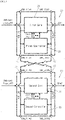
- FIG. 2 is a block diagram illustrating the energy converter 10 of FIG. 1
- FIG. 3 is a block diagram illustrating a connection structure of two energy converters 20 and 30 of FIG. 1 .
- the energy converter 10 includes a core 11 and a controller 13.
- the core 11 is connected to each of multiple ambient energy sources, receives energy from the multiple ambient energy sources, and converts the received energy into electrical energy.
- the controller 13 controls the operation of the core 13.
- the energy converter 10 In order for the energy converter 10 to operate, operating power should be applied to the core 11 and the controller 13.
- the energy converter 10 generates internal power (VDD_INT) by itself using an ambient energy source and uses the generated internal power as operating power.
- the energy converter 10 uses separate external power (VDD_EXT) as operating power.
- the energy converter 10 in which the advantages of using internal power and using external power are combined. That is, when the internal power (VDD_INT) is generated according to the strength of the ambient energy source, the controller 11 of the energy converter 10 selectively uses the generated internal power as the external power (VDD_EXT) of another energy converter.
- the energy converter 10 may include an internal power node 15 and an external power node 17.
- the internal power (VDD_INT) When the internal power (VDD_INT) is generated according to the strength of the ambient energy source, the internal power node 15 may selectively supply the generated internal power (VDD_INT) as the external power (VDD_EXT) of another energy converter.
- the external power node 17 selectively receives the internal power (VDD_INT) from the internal power node of another energy converter.
- the internal power node of the specific energy converter where the internal power (VDD_INT) is generated is selectively connected to the external power node of another energy converter to supply external operating power (VDD_EXT).
- the energy converter that receives the internal power (VDD_INT) from the internal power node of another energy converter can maintain a standby state for operation, so that it can collect even very small energy and thus improve the efficiency of converting input energy into electrical energy in the energy converter.
- the first and second energy converters 20 and 30 include first and second cores 21 and 31 and first and second controllers 23 and 33.
- internal power nodes 25 and 35 and external power nodes 27 and 37 of the first and second energy converters 20 and 30 are cross connected to each other. That is, the internal power node 25 of the first energy converter 20 is selectively connected to the external power node 37 of the second energy converter 30. The external power node 27 of the first energy converter 20 is selectively connected to the internal power node 35 of the second energy converter 30.
- the internal power node 25 of the first energy converter 20 is selectively connected to the external power node 37 of the second energy converter 30 and provides the internal power (VDD_INT) generated in the first energy converter 20 to the second energy converter 30.
- the internal power node 35 of the second energy converter 30 is selectively connected to the external power node 27 of the first energy converter 20 and provides the internal power (VDD_INT) generated in the energy converter 30 to the first energy converter 20.
- FIG. 3 illustrates that the internal power nodes 25 and 35 and the external power nodes 27 and 37 of the first and second energy converters 20 and 30 are cross connected to each other, this is exemplary only and is not construed as a limitation. Depending on the number of energy sources for collection, it can be expanded to n energy converters. In addition, depending on the ambient energy source situation, it is possible to selectively use the internal power of one energy converter generating the internal power among n energy converters as the external power of the other n-1 energy converters.
- the energy converter 10 can improve energy collection efficiency when collecting energy from multiple ambient energy sources without any separate connection of a battery or other external power source. That is, in the energy harvesting system 100 according to this embodiment, when the internal power (VDD_INT) is generated in the specific energy converter 10 according to the strength of the ambient energy source, the generated internal power (VDD_INT) can be selectively used as the external power (VDD_EXT) of another energy converter 10. Accordingly, using a small amount of electrical energy collected by each energy converter 10, the energy collection efficiency can be improved.
- the energy harvesting system 100 can collect more energy from multiple ambient energy sources rather than from only one energy source, thereby operating an electronic device based on the collected energy.
- the energy harvesting system 100 can combine small amounts of electric energy collected from the respective ambient energy sources and convert the combined energy to have a usable electric energy level.
- the energy harvesting system 100 can collect more ambient energy in the same environment, so that it is possible to expand the types of electronic devices that can be operated using the energy harvesting technology. Accordingly, the energy harvesting system 100 according to this embodiment can be utilized for the development of sensors and devices that can be operated using ambient energy sources without a battery.
Landscapes
- Engineering & Computer Science (AREA)
- Power Engineering (AREA)
- Computer Networks & Wireless Communication (AREA)
- Charge And Discharge Circuits For Batteries Or The Like (AREA)
Abstract
Description
- The present invention relates to an energy harvesting system. Particularly, the present invention relates to an energy harvesting system that collects more energy from multiple ambient energy sources and operates an electronic device based on the energy.
- As the Internet of Things (IoT) technology spreads in a wide range of fields, it is predicted that the ultra-small/low-power IoT device market will grow explosively. However, such IoT devices have limitations in power supply manners such as battery replacement or power cord connection, which is one of the obstacles to the spread of IoT services.
- Energy harvesting technology is attracting attention as the power supply technology for IoT devices. Recently, through the convergence of energy harvesting and IoT technologies, research on power-free driving technology or battery usage time extension technology for IoT devices is being actively conducted, and the demands of related markets are also increasing.
- Representative energy sources for energy harvesting include sunlight, vibration, heat, and wind, and devices that operate using such an individual energy source exist. However, the existing energy harvesting technology uses only one energy source in a limited environment, so that there is a problem in that it is difficult to utilize if the amount of corresponding energy is insufficient.
-
Korean Patent Publication No. 2017-0101756 (published on September 6, 2017 - Accordingly, an object of the present invention is to provide an energy harvesting system capable of collecting more energy in various environments by using multiple ambient energy sources rather than using only one energy source.
- Another object of the present invention is to provide an energy harvesting system capable of improving energy collection efficiency by using small amounts of electric energy collected by respective energy converters.
- In order to accomplish the above object, the present invention provides an energy harvesting system using multiple ambient energy sources, the energy harvesting system including a plurality of energy converters connected to the multiple ambient energy sources, respectively, receiving energy from the multiple ambient energy sources, and converting the received energy into electrical energy; an electrical energy buffer receiving and collecting electrical energy from the plurality of energy converters, and combining the collected electrical energy to have a predetermined power level; a constant voltage converter receiving the combined electrical energy from the electrical energy buffer, and converting the received electrical energy into driving power of a power level usable by a load; and an electrical energy storage receiving the driving power from the constant voltage converter, storing the received driving power, and providing the stored driving power to the load.
- When internal power is generated in a specific energy converter among the plurality of energy converters according to strength of the ambient energy sources, the generated internal power is selectively used as external power for another energy converter.
- The multiple ambient energy sources may include at least two ambient energy sources selected from the group consisting of sunlight, vibration, heat, and wind.
- Each of the plurality of energy converters may include a core connected to each of the multiple ambient energy sources, receiving energy from the multiple ambient energy sources, and converting the received energy into electrical energy; and a controller controlling an operation of the core, and when internal power is generated according to strength of the ambient energy sources, selectively using the generated internal power as external power of another energy converter.
- Each of the plurality of energy converters may include an internal power node, when internal power is generated according to strength of the ambient energy sources, selectively supplying the generated internal power as external power of another energy converter; and an external power node selectively receiving internal power generated in another energy converter from an internal power node of the another energy converter.
- The energy converter receiving internal power from an internal power node of another energy converter may maintain a standby state for operation.
- In addition, the present invention provides an energy converter of an energy harvesting system using multiple ambient energy sources, the energy converter including a core connected to each of the multiple ambient energy sources, receiving energy from the multiple ambient energy sources, and converting the received energy into electrical energy; and a controller controlling an operation of the core, and when internal power is generated according to strength of the ambient energy sources, selectively using the generated internal power as external power of another energy converter.
- The energy harvesting system according to the present invention can collect more energy from multiple ambient energy sources rather than from only one energy source, thereby operating an electronic device based on the collected energy.
- The energy harvesting system according to the present invention can combine small amounts of electric energy collected from the respective ambient energy sources and convert the combined energy to have a usable electric energy level.
- The energy harvesting system according to the present invention can collect more ambient energy in the same environment, so that it is possible to expand the types of electronic devices that can be operated using the energy harvesting technology. Accordingly, the energy harvesting system according to the present invention can be utilized for the development of sensors and devices that can be operated using ambient energy sources without a battery.
- When internal power is generated in a specific energy converter according to the strength of the ambient energy source, the energy harvesting system according to the present invention can selectively use the generated internal power as external power of another energy converter. Accordingly, using a small amount of electrical energy collected by each energy converter, the energy collection efficiency can be improved.
-
-
FIG. 1 is a block diagram illustrating an energy harvesting system using two or more types of energy according to an embodiment of the present invention. -
FIG. 2 is a block diagram illustrating the energy converter ofFIG. 1 . -
FIG. 3 is a block diagram illustrating a connection structure of two energy converters ofFIG. 1 . - In the following description, only parts necessary to understand embodiments of the present invention will be described, and other parts will not be described to avoid obscuring the subject matter of the present invention.
- Terms used herein should not be construed as being limited to their usual or dictionary meanings. In view of the fact that the inventor can appropriately define the meanings of terms in order to describe his/her own invention in the best way, the terms should be interpreted as meanings consistent with the technical idea of the present invention. In addition, the following description and corresponding drawings merely relate to specific embodiments of the present invention and do not represent all the subject matter of the present invention. Therefore, it will be understood that there are various equivalents and modifications of the disclosed embodiments at the time of the present application.
- Now, embodiments of the present invention will be described in detail with reference to the accompanying drawings.
-
FIG. 1 is a block diagram illustrating an energy harvesting system using two or more types of energy according to an embodiment of the present invention. - Referring to
FIG. 1 , theenergy harvesting system 100 according to this embodiment is a system that collects more energy from multiple ambient energy sources rather than collects energy from only one ambient energy source, and operates a load 80 (e.g., an electronic device) based on the collected energy. - The
energy harvesting system 100 according to this embodiment includes a plurality ofenergy converters 10, anelectrical energy buffer 50, aconstant voltage converter 60, and anelectrical energy storage 70. The plurality ofenergy converters 10 are connected to multiple ambient energy sources, respectively, receive energy from the multiple ambient energy sources, and convert the received energy into electrical energy. Theelectrical energy buffer 50 receives and collects electrical energy from the plurality ofenergy converters 10, and combines the collected electrical energy to have a predetermined power level. Theconstant voltage converter 60 receives the combined electrical energy from theelectrical energy buffer 50, and converts the received electrical energy into driving power of a power level usable by theload 80. Theelectrical energy storage 70 receives the driving power from theconstant voltage converter 60, stores the received driving power, and provides the stored driving power to theload 80. In this case, when internal power is generated in a specific energy converter among the plurality ofenergy converters 10 according to the strength of the ambient energy source, the generated internal power may be selectively used as external power for another energy converter. - The multiple ambient energy sources include first to nth ambient energy sources (hereinafter, 'n' is a natural number of 2 or more). The ambient energy sources may be sunlight, vibration, heat, and wind, but are not limited thereto. The multiple ambient energy sources include two or more different types of ambient energy sources.
- The plurality of
energy converters 10 are connected one-to-one to the multiple ambient energy sources, and each energy converter receives energy from each ambient energy source and converts it into electrical energy. The plurality ofenergy converters 10 includes first tonth energy converters energy converters 10 generates internal power by using the ambient energy source. - The
electrical energy buffer 50 temporarily stores electrical energy collected from the plurality ofenergy converters 10, and includes a passive element such as a capacitor capable of storing electrical energy. Theelectrical energy buffer 50 combines the electrical energy collected from the plurality ofenergy converters 10, converts the combined electrical energy to have a predetermined power level, and delivers the converted electrical energy to theconstant voltage converter 60. - The
constant voltage converter 60 receives the stored electrical energy from theelectrical energy buffer 50, and converts the received electrical energy into driving power of a power level usable by theload 80. - The
electrical energy storage 70 is an energy storage device that stores driving power for operating theload 80, and may use, for example, a capacitor, a secondary battery, or the like. Theelectrical energy storage 70 provides the stored driving power to theload 80. - Hereinafter, the operation principle of the
energy harvesting system 100 according to this embodiment will be described. - First, the
energy converters 10 receives energy from one or more ambient energy sources and converts it into electrical energy. - Next, the electrical energy obtained by the
energy converters 10 is accumulated in theelectrical energy buffer 50. Because the type and intensity of the ambient energy sources are varied depending on the surrounding environment, the amount of electrical energy obtained by therespective energy converters 10 and accumulated in theelectrical energy buffer 50 is also different. Therefore, theelectrical energy buffer 50 adds up the accumulated electric energy. - In general, the
load 80 such as an electronic device has a determined operable power level (voltage and current level), so that the electrical energy accumulated in theelectrical energy buffer 50 cannot be used for theload 80 as it is. - Therefore, the electrical energy accumulated in the
electrical energy buffer 20 is transferred to theconstant voltage converter 60 to be converted into the driving power that can be used by theload 80, that is, a constant voltage/current. Theconstant voltage converter 60 transfers the driving power to theelectrical energy storage 70. - The
electrical energy storage 70 stores the driving power received from theconstant voltage converter 60 and provides required driving power to theload 80 from among the stored driving power. - As described above, when internal power is generated in a specific energy converter among the plurality of
energy converters 10 according to the strength of the ambient energy source, the generated internal power may be selectively used as external power for another energy converter. Accordingly, using a small amount of electrical energy collected by each of the first tonth energy converters - Now, the
energy converter 10 of theenergy harvesting system 100 according to this embodiment will be described with reference toFIGS. 1 to 3 .FIG. 2 is a block diagram illustrating theenergy converter 10 ofFIG. 1 , andFIG. 3 is a block diagram illustrating a connection structure of twoenergy converters FIG. 1 . - Referring to
FIG. 2 , theenergy converter 10 according to this embodiment includes acore 11 and acontroller 13. Thecore 11 is connected to each of multiple ambient energy sources, receives energy from the multiple ambient energy sources, and converts the received energy into electrical energy. Thecontroller 13 controls the operation of thecore 13. - In order for the
energy converter 10 to operate, operating power should be applied to thecore 11 and thecontroller 13. In one method, theenergy converter 10 generates internal power (VDD_INT) by itself using an ambient energy source and uses the generated internal power as operating power. In another method, theenergy converter 10 uses separate external power (VDD_EXT) as operating power. - In case of using internal power as the operating power, there is an advantage that the use of separate external power is not required. However, until the operating power for operating the energy converter is generated at the initial operation, it is impossible to collect and convert energy. Therefore, there is a disadvantage that very little energy cannot be collected.
- On the other hand, in case of using external power as the operating power, the operating voltage is already supplied to the
core 11 and thecontroller 13, and thus the energy converter maintains a standby state. Therefore, it is possible to collect relatively small energy compared to the method using internal power, and it is also possible to improve the efficiency of converting input energy into electrical energy in the energy converter. However, because of having to separately use external power, there is a disadvantage that it cannot be used in an environment where there is no battery or external power connection is impossible, and there is also a disadvantage that it is impossible to implement an energy harvesting system that operates using only the ambient energy source. - Provided in this embodiment is the
energy converter 10 in which the advantages of using internal power and using external power are combined. That is, when the internal power (VDD_INT) is generated according to the strength of the ambient energy source, thecontroller 11 of theenergy converter 10 selectively uses the generated internal power as the external power (VDD_EXT) of another energy converter. - The
energy converter 10 according to this embodiment may include aninternal power node 15 and anexternal power node 17. When the internal power (VDD_INT) is generated according to the strength of the ambient energy source, theinternal power node 15 may selectively supply the generated internal power (VDD_INT) as the external power (VDD_EXT) of another energy converter. Theexternal power node 17 selectively receives the internal power (VDD_INT) from the internal power node of another energy converter. - That is, when the internal power (VDD_INT) is generated in a specific energy converter according to the strength of the ambient energy source, the internal power node of the specific energy converter where the internal power (VDD_INT) is generated is selectively connected to the external power node of another energy converter to supply external operating power (VDD_EXT).
- The energy converter that receives the internal power (VDD_INT) from the internal power node of another energy converter can maintain a standby state for operation, so that it can collect even very small energy and thus improve the efficiency of converting input energy into electrical energy in the energy converter.
- Referring to
FIG. 3 , the first andsecond energy converters second cores second controllers 23 and 33. - In addition,
internal power nodes external power nodes second energy converters internal power node 25 of thefirst energy converter 20 is selectively connected to theexternal power node 37 of thesecond energy converter 30. Theexternal power node 27 of thefirst energy converter 20 is selectively connected to theinternal power node 35 of thesecond energy converter 30. - Therefore, when internal power is generated in the
first energy converter 20, theinternal power node 25 of thefirst energy converter 20 is selectively connected to theexternal power node 37 of thesecond energy converter 30 and provides the internal power (VDD_INT) generated in thefirst energy converter 20 to thesecond energy converter 30. - On the contrary, when internal power is generated in the
second energy converter 30, theinternal power node 35 of thesecond energy converter 30 is selectively connected to theexternal power node 27 of thefirst energy converter 20 and provides the internal power (VDD_INT) generated in theenergy converter 30 to thefirst energy converter 20. - Although
FIG. 3 illustrates that theinternal power nodes external power nodes second energy converters - As described above, the
energy converter 10 according to this embodiment can improve energy collection efficiency when collecting energy from multiple ambient energy sources without any separate connection of a battery or other external power source. That is, in theenergy harvesting system 100 according to this embodiment, when the internal power (VDD_INT) is generated in thespecific energy converter 10 according to the strength of the ambient energy source, the generated internal power (VDD_INT) can be selectively used as the external power (VDD_EXT) of anotherenergy converter 10. Accordingly, using a small amount of electrical energy collected by eachenergy converter 10, the energy collection efficiency can be improved. - The
energy harvesting system 100 according to this embodiment can collect more energy from multiple ambient energy sources rather than from only one energy source, thereby operating an electronic device based on the collected energy. - The
energy harvesting system 100 according to this embodiment can combine small amounts of electric energy collected from the respective ambient energy sources and convert the combined energy to have a usable electric energy level. - The
energy harvesting system 100 according to this embodiment can collect more ambient energy in the same environment, so that it is possible to expand the types of electronic devices that can be operated using the energy harvesting technology. Accordingly, theenergy harvesting system 100 according to this embodiment can be utilized for the development of sensors and devices that can be operated using ambient energy sources without a battery. - While the present invention has been particularly shown and described with reference to an exemplary embodiment thereof, it will be understood by those skilled in the art that various changes in form and details may be made therein without departing from the scope of the present invention as defined by the appended claims.
[Reference Numeral] 10: Energy converter 11: Core 13: Controller 20: First energy converter 30: Second energy converter 40: Nth energy converter 50: Electrical energy buffer 60: Constant voltage converter 70: Electrical energy storage 80: Load 100: Energy harvesting system
Claims (8)
- An energy harvesting system using multiple ambient energy sources, the energy harvesting system comprising:a plurality of energy converters connected to the multiple ambient energy sources, respectively, receiving energy from the multiple ambient energy sources, and converting the received energy into electrical energy;an electrical energy buffer receiving and collecting electrical energy from the plurality of energy converters, and combining the collected electrical energy to have a predetermined power level;a constant voltage converter receiving the combined electrical energy from the electrical energy buffer, and converting the received electrical energy into driving power of a power level usable by a load; andan electrical energy storage receiving the driving power from the constant voltage converter, storing the received driving power, and providing the stored driving power to the load,wherein when internal power is generated in a specific energy converter among the plurality of energy converters according to strength of the ambient energy sources, the generated internal power is selectively used as external power for another energy converter.
- The energy harvesting system of claim 1, wherein the multiple ambient energy sources include at least two ambient energy sources selected from the group consisting of sunlight, vibration, heat, and wind.
- The energy harvesting system of claim 1, wherein each of the plurality of energy converters includes:a core connected to each of the multiple ambient energy sources, receiving energy from the multiple ambient energy sources, and converting the received energy into electrical energy; anda controller controlling an operation of the core, and when internal power is generated according to strength of the ambient energy sources, selectively using the generated internal power as external power of another energy converter.
- The energy harvesting system of claim 1, wherein each of the plurality of energy converters includes:an internal power node, when internal power is generated according to strength of the ambient energy sources, selectively supplying the generated internal power as external power of another energy converter; andan external power node selectively receiving internal power generated in another energy converter from an internal power node of the another energy converter.
- The energy harvesting system of claim 1, wherein the energy converter receiving internal power from an internal power node of another energy converter maintains a standby state for operation.
- An energy converter of an energy harvesting system using multiple ambient energy sources, the energy converter comprising:a core connected to each of the multiple ambient energy sources, receiving energy from the multiple ambient energy sources, and converting the received energy into electrical energy; anda controller controlling an operation of the core, and when internal power is generated according to strength of the ambient energy sources, selectively using the generated internal power as external power of another energy converter.
- The energy converter of claim 6, further comprising:an internal power node, when internal power is generated according to strength of the ambient energy sources, selectively supplying the generated internal power as external power of another energy converter; andan external power node selectively receiving internal power generated in another energy converter from an internal power node of the another energy converter.
- The energy converter of claim 7, wherein the controller receives the internal power of the another energy converter through the external power node and maintains a standby state for operation.
Applications Claiming Priority (1)
| Application Number | Priority Date | Filing Date | Title |
|---|---|---|---|
| PCT/KR2019/016620 WO2021107198A1 (en) | 2019-11-28 | 2019-11-28 | Energy harvesting system using multiple surrounding energy sources |
Publications (2)
| Publication Number | Publication Date |
|---|---|
| EP4054072A1 true EP4054072A1 (en) | 2022-09-07 |
| EP4054072A4 EP4054072A4 (en) | 2023-01-25 |
Family
ID=76130588
Family Applications (1)
| Application Number | Title | Priority Date | Filing Date |
|---|---|---|---|
| EP19946250.8A Pending EP4054072A4 (en) | 2019-11-28 | 2019-11-28 | ENERGY HARVESTING SYSTEM WITH MULTIPLE SURROUNDING ENERGY SOURCES |
Country Status (3)
| Country | Link |
|---|---|
| US (1) | US12047019B2 (en) |
| EP (1) | EP4054072A4 (en) |
| WO (1) | WO2021107198A1 (en) |
Families Citing this family (1)
| Publication number | Priority date | Publication date | Assignee | Title |
|---|---|---|---|---|
| US12395232B2 (en) * | 2023-05-12 | 2025-08-19 | Cisco Technology, Inc. | Backscatter device placement and placement calibration |
Family Cites Families (15)
| Publication number | Priority date | Publication date | Assignee | Title |
|---|---|---|---|---|
| JP2006340482A (en) * | 2005-06-01 | 2006-12-14 | Ishikawajima Harima Heavy Ind Co Ltd | Light emitting device, light emitting system, and power supplement method for light emitting device |
| JP5211772B2 (en) * | 2008-03-13 | 2013-06-12 | オムロン株式会社 | Power conditioner operation control device and photovoltaic power generation system |
| KR101077880B1 (en) * | 2009-09-10 | 2011-10-31 | 김군주 | emergency power source supply system using multiple power generation |
| KR101243869B1 (en) * | 2009-09-14 | 2013-03-20 | 한국전자통신연구원 | The Energy and Power Management Integrated Circuit Device |
| US20110304295A1 (en) * | 2010-06-09 | 2011-12-15 | Mcnally Mark | Power system for use with renewable energy sources and the power grid |
| WO2014064762A1 (en) * | 2012-10-23 | 2014-05-01 | 三菱電機エンジニアリング株式会社 | Power source control device and method for controlling power source control device |
| JP6158628B2 (en) | 2013-07-29 | 2017-07-05 | 京セラ株式会社 | Power supply device determination device, power supply device determination method, and power conversion device |
| US10211631B2 (en) * | 2013-12-17 | 2019-02-19 | Enphase Energy, Inc. | Voltage clipping |
| US20160211742A1 (en) * | 2015-01-21 | 2016-07-21 | Khalifa University of Science, Technology & Research (KUSTAR) | Autonomous Multi-Source Energy Harvesting System |
| JP6489918B2 (en) | 2015-04-22 | 2019-03-27 | 全面性系統整合科技股▲フン▼有限公司 | Power supply device with multiple energy including solar energy |
| JP2017060375A (en) * | 2015-09-14 | 2017-03-23 | 株式会社福元技研 | Power supply method and system for generated electric power by renewable energy |
| KR102259137B1 (en) | 2015-11-13 | 2021-06-03 | 한국전자통신연구원 | Multi input power manager |
| KR20170101756A (en) | 2016-02-26 | 2017-09-06 | 전자부품연구원 | RF Harvesting Method and Apparatus therefor |
| WO2018212520A1 (en) * | 2017-05-17 | 2018-11-22 | Samsung Electronics Co., Ltd. | Electronic device for harvesting power from at least one power source and method for operating the same |
| GB201708852D0 (en) * | 2017-06-02 | 2017-07-19 | Univ Exeter | Method of controlling an energy harvesting system |
-
2019
- 2019-11-28 EP EP19946250.8A patent/EP4054072A4/en active Pending
- 2019-11-28 WO PCT/KR2019/016620 patent/WO2021107198A1/en not_active Ceased
-
2021
- 2021-03-26 US US17/213,866 patent/US12047019B2/en active Active
Also Published As
| Publication number | Publication date |
|---|---|
| EP4054072A4 (en) | 2023-01-25 |
| US12047019B2 (en) | 2024-07-23 |
| US20210218352A1 (en) | 2021-07-15 |
| WO2021107198A1 (en) | 2021-06-03 |
Similar Documents
| Publication | Publication Date | Title |
|---|---|---|
| Li et al. | Single-inductor multi-input multi-output DC–DC converter with high flexibility and simple control | |
| KR102504806B1 (en) | Energy harvesting system using more than two kinds of ambient energy | |
| US7893662B2 (en) | Method and related device for charging at the same voltage two or more capacitors connected in series | |
| Kim et al. | Size and topology optimization for supercapacitor-based sub-watt energy harvesters | |
| US9343967B2 (en) | Single input multiple input/output supply for energy harvest application | |
| US7737669B2 (en) | Hierarchical control for an integrated voltage regulator | |
| Lopez-Lapena | Time-division multiplexing control of multi-input converters for low-power solar energy harvesters | |
| Kim et al. | Energy harvesting with supercapacitor-based energy storage | |
| KR102356691B1 (en) | Energy harvesting system using multiple ambient energy sources | |
| US12047019B2 (en) | Energy harvesting system using multiple ambient energy sources | |
| KR20160058999A (en) | Multiple output switched capacitor dc-dc converter | |
| US8884462B2 (en) | Power flow regulator including a plurality of DC-DC converters | |
| KR20150073680A (en) | Apparatus and method of tracking maximum power | |
| US20100100149A1 (en) | Power supply control circuit, power supply and body implant | |
| Sharma | Piezoelectric energy harvesting and management in WSN using MPPT algorithm | |
| Mahnashi et al. | Systematic approach to optimal SC converter synthesis for multi voltage-gain-ratio applications | |
| JP2024538343A (en) | Inductorless Power Converter | |
| US20150022179A1 (en) | Voltage transformer having a first parallel connection | |
| US9960670B2 (en) | Apparatus for charge recycling | |
| JP7096194B2 (en) | Operating point control circuit device for series-connected solar cells or other power sources | |
| Srinivasan et al. | Dual input buck-boost converter for hybrid piezoelectric energy harvester–Supercapacitor sources | |
| Lotfy et al. | Optimizing thermo-electric generation with quasi-z-source converter in energy harvesting for wearable devices | |
| Lueangamornsiri et al. | Solar battery charger using a multi-stage converter | |
| Wang et al. | A cross regulation reduced multi-output and multi-VCR piezoelectric energy harvesting system using shared capacitors | |
| Jung et al. | Time slot optimization algorithm for multisource energy harvesting systems |
Legal Events
| Date | Code | Title | Description |
|---|---|---|---|
| STAA | Information on the status of an ep patent application or granted ep patent |
Free format text: STATUS: UNKNOWN |
|
| STAA | Information on the status of an ep patent application or granted ep patent |
Free format text: STATUS: THE INTERNATIONAL PUBLICATION HAS BEEN MADE |
|
| PUAI | Public reference made under article 153(3) epc to a published international application that has entered the european phase |
Free format text: ORIGINAL CODE: 0009012 |
|
| STAA | Information on the status of an ep patent application or granted ep patent |
Free format text: STATUS: REQUEST FOR EXAMINATION WAS MADE |
|
| 17P | Request for examination filed |
Effective date: 20210331 |
|
| AK | Designated contracting states |
Kind code of ref document: A1 Designated state(s): AL AT BE BG CH CY CZ DE DK EE ES FI FR GB GR HR HU IE IS IT LI LT LU LV MC MK MT NL NO PL PT RO RS SE SI SK SM TR |
|
| REG | Reference to a national code |
Ref country code: DE Ref legal event code: R079 Free format text: PREVIOUS MAIN CLASS: H02N0011000000 Ipc: H02J0007340000 |
|
| A4 | Supplementary search report drawn up and despatched |
Effective date: 20230104 |
|
| RIC1 | Information provided on ipc code assigned before grant |
Ipc: H02J 50/00 20160101ALI20221222BHEP Ipc: H02N 11/00 20060101ALI20221222BHEP Ipc: H02J 7/34 20060101AFI20221222BHEP |
|
| DAV | Request for validation of the european patent (deleted) | ||
| DAX | Request for extension of the european patent (deleted) |