EP4053943A1 - Electrode for calcium batteries and its manufacturing method - Google Patents
Electrode for calcium batteries and its manufacturing method Download PDFInfo
- Publication number
- EP4053943A1 EP4053943A1 EP21382186.1A EP21382186A EP4053943A1 EP 4053943 A1 EP4053943 A1 EP 4053943A1 EP 21382186 A EP21382186 A EP 21382186A EP 4053943 A1 EP4053943 A1 EP 4053943A1
- Authority
- EP
- European Patent Office
- Prior art keywords
- calcium
- mno
- electrode
- copolymers
- based secondary
- Prior art date
- Legal status (The legal status is an assumption and is not a legal conclusion. Google has not performed a legal analysis and makes no representation as to the accuracy of the status listed.)
- Withdrawn
Links
- 239000011575 calcium Substances 0.000 title claims abstract description 140
- OYPRJOBELJOOCE-UHFFFAOYSA-N Calcium Chemical compound [Ca] OYPRJOBELJOOCE-UHFFFAOYSA-N 0.000 title claims abstract description 49
- 229910052791 calcium Inorganic materials 0.000 title claims abstract description 45
- 238000004519 manufacturing process Methods 0.000 title claims abstract description 6
- 239000007774 positive electrode material Substances 0.000 claims abstract description 8
- AMWRITDGCCNYAT-UHFFFAOYSA-L hydroxy(oxo)manganese;manganese Chemical compound [Mn].O[Mn]=O.O[Mn]=O AMWRITDGCCNYAT-UHFFFAOYSA-L 0.000 claims abstract description 6
- ODINCKMPIJJUCX-UHFFFAOYSA-N calcium oxide Inorganic materials [Ca]=O ODINCKMPIJJUCX-UHFFFAOYSA-N 0.000 claims abstract description 3
- OKTJSMMVPCPJKN-UHFFFAOYSA-N Carbon Chemical compound [C] OKTJSMMVPCPJKN-UHFFFAOYSA-N 0.000 claims description 27
- -1 polyethylene Polymers 0.000 claims description 20
- 239000003792 electrolyte Substances 0.000 claims description 19
- 229920001577 copolymer Polymers 0.000 claims description 18
- 230000009467 reduction Effects 0.000 claims description 15
- 239000000203 mixture Substances 0.000 claims description 14
- 238000000034 method Methods 0.000 claims description 13
- 239000002482 conductive additive Substances 0.000 claims description 11
- 229920000642 polymer Polymers 0.000 claims description 9
- 229910014478 Ca(BF4)2 Inorganic materials 0.000 claims description 8
- 229910052799 carbon Inorganic materials 0.000 claims description 7
- 239000007772 electrode material Substances 0.000 claims description 7
- 229910052751 metal Inorganic materials 0.000 claims description 6
- 239000002184 metal Substances 0.000 claims description 6
- 239000000758 substrate Substances 0.000 claims description 6
- 229910002804 graphite Inorganic materials 0.000 claims description 5
- 239000010439 graphite Substances 0.000 claims description 5
- 229920001780 ECTFE Polymers 0.000 claims description 4
- 239000002033 PVDF binder Substances 0.000 claims description 4
- PUQLFUHLKNBKQQ-UHFFFAOYSA-L calcium;trifluoromethanesulfonate Chemical compound [Ca+2].[O-]S(=O)(=O)C(F)(F)F.[O-]S(=O)(=O)C(F)(F)F PUQLFUHLKNBKQQ-UHFFFAOYSA-L 0.000 claims description 4
- 230000008021 deposition Effects 0.000 claims description 4
- 125000002573 ethenylidene group Chemical group [*]=C=C([H])[H] 0.000 claims description 4
- 229920000840 ethylene tetrafluoroethylene copolymer Polymers 0.000 claims description 4
- 239000002931 mesocarbon microbead Substances 0.000 claims description 4
- 239000003960 organic solvent Substances 0.000 claims description 4
- 229920002493 poly(chlorotrifluoroethylene) Polymers 0.000 claims description 4
- 239000005023 polychlorotrifluoroethylene (PCTFE) polymer Substances 0.000 claims description 4
- 229920001343 polytetrafluoroethylene Polymers 0.000 claims description 4
- 239000004810 polytetrafluoroethylene Substances 0.000 claims description 4
- 229920002981 polyvinylidene fluoride Polymers 0.000 claims description 4
- 238000002360 preparation method Methods 0.000 claims description 4
- 159000000007 calcium salts Chemical class 0.000 claims description 3
- 239000000919 ceramic Substances 0.000 claims description 3
- 150000002739 metals Chemical class 0.000 claims description 3
- WHQOKFZWSDOTQP-UHFFFAOYSA-N 2,3-dihydroxypropyl 4-aminobenzoate Chemical compound NC1=CC=C(C(=O)OCC(O)CO)C=C1 WHQOKFZWSDOTQP-UHFFFAOYSA-N 0.000 claims description 2
- 229910000882 Ca alloy Inorganic materials 0.000 claims description 2
- 229910014477 Ca(CF3SO3)2 Inorganic materials 0.000 claims description 2
- 229910014495 Ca(PF6)2 Inorganic materials 0.000 claims description 2
- 229920002134 Carboxymethyl cellulose Polymers 0.000 claims description 2
- 229910014332 N(SO2CF3)2 Inorganic materials 0.000 claims description 2
- 239000004698 Polyethylene Substances 0.000 claims description 2
- 239000004743 Polypropylene Substances 0.000 claims description 2
- 229910001914 chlorine tetroxide Inorganic materials 0.000 claims description 2
- 229920006242 ethylene acrylic acid copolymer Polymers 0.000 claims description 2
- VLTRZXGMWDSKGL-UHFFFAOYSA-M perchlorate Chemical compound [O-]Cl(=O)(=O)=O VLTRZXGMWDSKGL-UHFFFAOYSA-M 0.000 claims description 2
- 229920000573 polyethylene Polymers 0.000 claims description 2
- 229920001155 polypropylene Polymers 0.000 claims description 2
- 229920005989 resin Polymers 0.000 claims description 2
- 239000011347 resin Substances 0.000 claims description 2
- 229920003048 styrene butadiene rubber Polymers 0.000 claims description 2
- KMTRUDSVKNLOMY-UHFFFAOYSA-N Ethylene carbonate Chemical compound O=C1OCCO1 KMTRUDSVKNLOMY-UHFFFAOYSA-N 0.000 description 12
- QGZKDVFQNNGYKY-UHFFFAOYSA-N Ammonia Chemical compound N QGZKDVFQNNGYKY-UHFFFAOYSA-N 0.000 description 10
- 229910001424 calcium ion Inorganic materials 0.000 description 10
- 239000011572 manganese Substances 0.000 description 10
- 239000000463 material Substances 0.000 description 10
- 230000004888 barrier function Effects 0.000 description 9
- 230000003647 oxidation Effects 0.000 description 9
- 238000007254 oxidation reaction Methods 0.000 description 9
- RUOJZAUFBMNUDX-UHFFFAOYSA-N propylene carbonate Chemical compound CC1COC(=O)O1 RUOJZAUFBMNUDX-UHFFFAOYSA-N 0.000 description 9
- BHPQYMZQTOCNFJ-UHFFFAOYSA-N Calcium cation Chemical compound [Ca+2] BHPQYMZQTOCNFJ-UHFFFAOYSA-N 0.000 description 8
- SECXISVLQFMRJM-UHFFFAOYSA-N N-Methylpyrrolidone Chemical compound CN1CCCC1=O SECXISVLQFMRJM-UHFFFAOYSA-N 0.000 description 8
- 239000013078 crystal Substances 0.000 description 8
- 229910000069 nitrogen hydride Inorganic materials 0.000 description 8
- 230000015572 biosynthetic process Effects 0.000 description 7
- VYPSYNLAJGMNEJ-UHFFFAOYSA-N Silicium dioxide Chemical compound O=[Si]=O VYPSYNLAJGMNEJ-UHFFFAOYSA-N 0.000 description 6
- 238000002441 X-ray diffraction Methods 0.000 description 6
- KRKNYBCHXYNGOX-UHFFFAOYSA-N citric acid Chemical compound OC(=O)CC(O)(C(O)=O)CC(O)=O KRKNYBCHXYNGOX-UHFFFAOYSA-N 0.000 description 6
- 238000003775 Density Functional Theory Methods 0.000 description 5
- ZMXDDKWLCZADIW-UHFFFAOYSA-N N,N-Dimethylformamide Chemical compound CN(C)C=O ZMXDDKWLCZADIW-UHFFFAOYSA-N 0.000 description 5
- 239000011149 active material Substances 0.000 description 5
- 238000004364 calculation method Methods 0.000 description 5
- 150000001875 compounds Chemical class 0.000 description 5
- 230000037361 pathway Effects 0.000 description 5
- 239000002002 slurry Substances 0.000 description 5
- SBLRHMKNNHXPHG-UHFFFAOYSA-N 4-fluoro-1,3-dioxolan-2-one Chemical compound FC1COC(=O)O1 SBLRHMKNNHXPHG-UHFFFAOYSA-N 0.000 description 4
- XTHFKEDIFFGKHM-UHFFFAOYSA-N Dimethoxyethane Chemical compound COCCOC XTHFKEDIFFGKHM-UHFFFAOYSA-N 0.000 description 4
- CPLXHLVBOLITMK-UHFFFAOYSA-N Magnesium oxide Chemical compound [Mg]=O CPLXHLVBOLITMK-UHFFFAOYSA-N 0.000 description 4
- WYURNTSHIVDZCO-UHFFFAOYSA-N Tetrahydrofuran Chemical compound C1CCOC1 WYURNTSHIVDZCO-UHFFFAOYSA-N 0.000 description 4
- MCMNRKCIXSYSNV-UHFFFAOYSA-N Zirconium dioxide Chemical compound O=[Zr]=O MCMNRKCIXSYSNV-UHFFFAOYSA-N 0.000 description 4
- 239000011230 binding agent Substances 0.000 description 4
- 238000006243 chemical reaction Methods 0.000 description 4
- 238000009792 diffusion process Methods 0.000 description 4
- IEJIGPNLZYLLBP-UHFFFAOYSA-N dimethyl carbonate Chemical compound COC(=O)OC IEJIGPNLZYLLBP-UHFFFAOYSA-N 0.000 description 4
- 230000005012 migration Effects 0.000 description 4
- 238000013508 migration Methods 0.000 description 4
- 238000002156 mixing Methods 0.000 description 4
- 238000003786 synthesis reaction Methods 0.000 description 4
- 238000011282 treatment Methods 0.000 description 4
- LYCAIKOWRPUZTN-UHFFFAOYSA-N Ethylene glycol Chemical compound OCCO LYCAIKOWRPUZTN-UHFFFAOYSA-N 0.000 description 3
- XOJVVFBFDXDTEG-UHFFFAOYSA-N Norphytane Natural products CC(C)CCCC(C)CCCC(C)CCCC(C)C XOJVVFBFDXDTEG-UHFFFAOYSA-N 0.000 description 3
- 238000003991 Rietveld refinement Methods 0.000 description 3
- 230000008901 benefit Effects 0.000 description 3
- 229910052748 manganese Inorganic materials 0.000 description 3
- 230000010287 polarization Effects 0.000 description 3
- 239000002243 precursor Substances 0.000 description 3
- 230000002441 reversible effect Effects 0.000 description 3
- 239000000243 solution Substances 0.000 description 3
- 239000002904 solvent Substances 0.000 description 3
- XLYOFNOQVPJJNP-UHFFFAOYSA-N water Substances O XLYOFNOQVPJJNP-UHFFFAOYSA-N 0.000 description 3
- ZZXUZKXVROWEIF-UHFFFAOYSA-N 1,2-butylene carbonate Chemical compound CCC1COC(=O)O1 ZZXUZKXVROWEIF-UHFFFAOYSA-N 0.000 description 2
- VAYTZRYEBVHVLE-UHFFFAOYSA-N 1,3-dioxol-2-one Chemical compound O=C1OC=CO1 VAYTZRYEBVHVLE-UHFFFAOYSA-N 0.000 description 2
- 241000238876 Acari Species 0.000 description 2
- OIFBSDVPJOWBCH-UHFFFAOYSA-N Diethyl carbonate Chemical compound CCOC(=O)OCC OIFBSDVPJOWBCH-UHFFFAOYSA-N 0.000 description 2
- 229910001290 LiPF6 Inorganic materials 0.000 description 2
- WHXSMMKQMYFTQS-UHFFFAOYSA-N Lithium Chemical compound [Li] WHXSMMKQMYFTQS-UHFFFAOYSA-N 0.000 description 2
- HBBGRARXTFLTSG-UHFFFAOYSA-N Lithium ion Chemical compound [Li+] HBBGRARXTFLTSG-UHFFFAOYSA-N 0.000 description 2
- PWHULOQIROXLJO-UHFFFAOYSA-N Manganese Chemical compound [Mn] PWHULOQIROXLJO-UHFFFAOYSA-N 0.000 description 2
- 229910018663 Mn O Inorganic materials 0.000 description 2
- 229910003176 Mn-O Inorganic materials 0.000 description 2
- FAPWRFPIFSIZLT-UHFFFAOYSA-M Sodium chloride Chemical compound [Na+].[Cl-] FAPWRFPIFSIZLT-UHFFFAOYSA-M 0.000 description 2
- 239000000654 additive Substances 0.000 description 2
- 229910052782 aluminium Inorganic materials 0.000 description 2
- XAGFODPZIPBFFR-UHFFFAOYSA-N aluminium Chemical compound [Al] XAGFODPZIPBFFR-UHFFFAOYSA-N 0.000 description 2
- 239000005030 aluminium foil Substances 0.000 description 2
- PNEYBMLMFCGWSK-UHFFFAOYSA-N aluminium oxide Inorganic materials [O-2].[O-2].[O-2].[Al+3].[Al+3] PNEYBMLMFCGWSK-UHFFFAOYSA-N 0.000 description 2
- 239000007864 aqueous solution Substances 0.000 description 2
- 239000012298 atmosphere Substances 0.000 description 2
- 238000005284 basis set Methods 0.000 description 2
- ZCCIPPOKBCJFDN-UHFFFAOYSA-N calcium nitrate Chemical compound [Ca+2].[O-][N+]([O-])=O.[O-][N+]([O-])=O ZCCIPPOKBCJFDN-UHFFFAOYSA-N 0.000 description 2
- 239000006229 carbon black Substances 0.000 description 2
- 235000019241 carbon black Nutrition 0.000 description 2
- CETPSERCERDGAM-UHFFFAOYSA-N ceric oxide Chemical compound O=[Ce]=O CETPSERCERDGAM-UHFFFAOYSA-N 0.000 description 2
- 229910000422 cerium(IV) oxide Inorganic materials 0.000 description 2
- 229910052681 coesite Inorganic materials 0.000 description 2
- RKTYLMNFRDHKIL-UHFFFAOYSA-N copper;5,10,15,20-tetraphenylporphyrin-22,24-diide Chemical compound [Cu+2].C1=CC(C(=C2C=CC([N-]2)=C(C=2C=CC=CC=2)C=2C=CC(N=2)=C(C=2C=CC=CC=2)C2=CC=C3[N-]2)C=2C=CC=CC=2)=NC1=C3C1=CC=CC=C1 RKTYLMNFRDHKIL-UHFFFAOYSA-N 0.000 description 2
- 229910052593 corundum Inorganic materials 0.000 description 2
- 229910052906 cristobalite Inorganic materials 0.000 description 2
- 230000001351 cycling effect Effects 0.000 description 2
- 230000001419 dependent effect Effects 0.000 description 2
- 238000001035 drying Methods 0.000 description 2
- 238000000840 electrochemical analysis Methods 0.000 description 2
- 238000002848 electrochemical method Methods 0.000 description 2
- JBTWLSYIZRCDFO-UHFFFAOYSA-N ethyl methyl carbonate Chemical compound CCOC(=O)OC JBTWLSYIZRCDFO-UHFFFAOYSA-N 0.000 description 2
- 238000011066 ex-situ storage Methods 0.000 description 2
- 239000011888 foil Substances 0.000 description 2
- GAEKPEKOJKCEMS-UHFFFAOYSA-N gamma-valerolactone Chemical compound CC1CCC(=O)O1 GAEKPEKOJKCEMS-UHFFFAOYSA-N 0.000 description 2
- 238000010438 heat treatment Methods 0.000 description 2
- 239000012535 impurity Substances 0.000 description 2
- 238000003780 insertion Methods 0.000 description 2
- 229910052744 lithium Inorganic materials 0.000 description 2
- 229910001416 lithium ion Inorganic materials 0.000 description 2
- 238000005457 optimization Methods 0.000 description 2
- 229910052760 oxygen Inorganic materials 0.000 description 2
- 239000002245 particle Substances 0.000 description 2
- 239000000843 powder Substances 0.000 description 2
- 238000000634 powder X-ray diffraction Methods 0.000 description 2
- 238000011002 quantification Methods 0.000 description 2
- 238000007086 side reaction Methods 0.000 description 2
- 239000000377 silicon dioxide Substances 0.000 description 2
- 235000002639 sodium chloride Nutrition 0.000 description 2
- 239000011780 sodium chloride Substances 0.000 description 2
- 229910001220 stainless steel Inorganic materials 0.000 description 2
- 239000010935 stainless steel Substances 0.000 description 2
- 229910052682 stishovite Inorganic materials 0.000 description 2
- ZUHZGEOKBKGPSW-UHFFFAOYSA-N tetraglyme Chemical compound COCCOCCOCCOCCOC ZUHZGEOKBKGPSW-UHFFFAOYSA-N 0.000 description 2
- YLQBMQCUIZJEEH-UHFFFAOYSA-N tetrahydrofuran Natural products C=1C=COC=1 YLQBMQCUIZJEEH-UHFFFAOYSA-N 0.000 description 2
- 229910052905 tridymite Inorganic materials 0.000 description 2
- 229910001845 yogo sapphire Inorganic materials 0.000 description 2
- JWUJQDFVADABEY-UHFFFAOYSA-N 2-methyltetrahydrofuran Chemical compound CC1CCCO1 JWUJQDFVADABEY-UHFFFAOYSA-N 0.000 description 1
- 229910002964 CaMnO2.5 Inorganic materials 0.000 description 1
- 229910002969 CaMnO3 Inorganic materials 0.000 description 1
- 229920000049 Carbon (fiber) Polymers 0.000 description 1
- 239000006230 acetylene black Substances 0.000 description 1
- 229910021529 ammonia Inorganic materials 0.000 description 1
- 229910052787 antimony Inorganic materials 0.000 description 1
- 229910021383 artificial graphite Inorganic materials 0.000 description 1
- 238000003556 assay Methods 0.000 description 1
- QVGXLLKOCUKJST-UHFFFAOYSA-N atomic oxygen Chemical compound [O] QVGXLLKOCUKJST-UHFFFAOYSA-N 0.000 description 1
- 230000003190 augmentative effect Effects 0.000 description 1
- 238000000498 ball milling Methods 0.000 description 1
- 229910052797 bismuth Inorganic materials 0.000 description 1
- 239000005388 borosilicate glass Substances 0.000 description 1
- 229910052793 cadmium Inorganic materials 0.000 description 1
- 239000004917 carbon fiber Substances 0.000 description 1
- 239000002134 carbon nanofiber Substances 0.000 description 1
- 239000002041 carbon nanotube Substances 0.000 description 1
- 229910021393 carbon nanotube Inorganic materials 0.000 description 1
- 238000010000 carbonizing Methods 0.000 description 1
- 230000001413 cellular effect Effects 0.000 description 1
- 230000008859 change Effects 0.000 description 1
- 239000006231 channel black Substances 0.000 description 1
- 238000012512 characterization method Methods 0.000 description 1
- 239000003610 charcoal Substances 0.000 description 1
- 239000003638 chemical reducing agent Substances 0.000 description 1
- 239000003795 chemical substances by application Substances 0.000 description 1
- 239000003245 coal Substances 0.000 description 1
- 239000011248 coating agent Substances 0.000 description 1
- 238000000576 coating method Methods 0.000 description 1
- 239000006255 coating slurry Substances 0.000 description 1
- 238000004891 communication Methods 0.000 description 1
- 230000008602 contraction Effects 0.000 description 1
- 229910052802 copper Inorganic materials 0.000 description 1
- 238000005336 cracking Methods 0.000 description 1
- 238000000354 decomposition reaction Methods 0.000 description 1
- 230000007423 decrease Effects 0.000 description 1
- 230000002950 deficient Effects 0.000 description 1
- 238000009831 deintercalation Methods 0.000 description 1
- 238000006056 electrooxidation reaction Methods 0.000 description 1
- 238000004146 energy storage Methods 0.000 description 1
- 238000011156 evaluation Methods 0.000 description 1
- 230000001747 exhibiting effect Effects 0.000 description 1
- 238000002474 experimental method Methods 0.000 description 1
- 238000000605 extraction Methods 0.000 description 1
- 239000004744 fabric Substances 0.000 description 1
- 239000000835 fiber Substances 0.000 description 1
- 239000012467 final product Substances 0.000 description 1
- 230000004907 flux Effects 0.000 description 1
- 239000006232 furnace black Substances 0.000 description 1
- 229910052733 gallium Inorganic materials 0.000 description 1
- 229910052732 germanium Inorganic materials 0.000 description 1
- 229910052737 gold Inorganic materials 0.000 description 1
- 229910021389 graphene Inorganic materials 0.000 description 1
- 229910052738 indium Inorganic materials 0.000 description 1
- 230000037431 insertion Effects 0.000 description 1
- 239000012212 insulator Substances 0.000 description 1
- 230000010354 integration Effects 0.000 description 1
- 230000003993 interaction Effects 0.000 description 1
- 238000009830 intercalation Methods 0.000 description 1
- 238000011835 investigation Methods 0.000 description 1
- 239000002608 ionic liquid Substances 0.000 description 1
- 239000003273 ketjen black Substances 0.000 description 1
- 239000006233 lamp black Substances 0.000 description 1
- 229910052745 lead Inorganic materials 0.000 description 1
- 238000011068 loading method Methods 0.000 description 1
- 150000002696 manganese Chemical class 0.000 description 1
- MIVBAHRSNUNMPP-UHFFFAOYSA-N manganese(II) nitrate Inorganic materials [Mn+2].[O-][N+]([O-])=O.[O-][N+]([O-])=O MIVBAHRSNUNMPP-UHFFFAOYSA-N 0.000 description 1
- 229910000473 manganese(VI) oxide Inorganic materials 0.000 description 1
- VNWKTOKETHGBQD-UHFFFAOYSA-N methane Chemical class C VNWKTOKETHGBQD-UHFFFAOYSA-N 0.000 description 1
- 229910021382 natural graphite Inorganic materials 0.000 description 1
- 239000007773 negative electrode material Substances 0.000 description 1
- 150000002823 nitrates Chemical class 0.000 description 1
- 239000001301 oxygen Substances 0.000 description 1
- 229910052763 palladium Inorganic materials 0.000 description 1
- 230000003071 parasitic effect Effects 0.000 description 1
- 239000011301 petroleum pitch Substances 0.000 description 1
- 229910052697 platinum Inorganic materials 0.000 description 1
- 230000008569 process Effects 0.000 description 1
- 239000000047 product Substances 0.000 description 1
- 238000011946 reduction process Methods 0.000 description 1
- 229910052710 silicon Inorganic materials 0.000 description 1
- 239000007787 solid Substances 0.000 description 1
- 239000007858 starting material Substances 0.000 description 1
- 238000003860 storage Methods 0.000 description 1
- 239000011232 storage material Substances 0.000 description 1
- 229920002994 synthetic fiber Polymers 0.000 description 1
- 239000012209 synthetic fiber Substances 0.000 description 1
- 238000012360 testing method Methods 0.000 description 1
- 229910052716 thallium Inorganic materials 0.000 description 1
- 239000006234 thermal black Substances 0.000 description 1
- 238000007669 thermal treatment Methods 0.000 description 1
- 229910052718 tin Inorganic materials 0.000 description 1
- 230000001988 toxicity Effects 0.000 description 1
- 231100000419 toxicity Toxicity 0.000 description 1
- 230000009466 transformation Effects 0.000 description 1
- YFNKIDBQEZZDLK-UHFFFAOYSA-N triglyme Chemical compound COCCOCCOCCOC YFNKIDBQEZZDLK-UHFFFAOYSA-N 0.000 description 1
- 230000035899 viability Effects 0.000 description 1
- 230000005428 wave function Effects 0.000 description 1
Images




Classifications
-
- H—ELECTRICITY
- H01—ELECTRIC ELEMENTS
- H01M—PROCESSES OR MEANS, e.g. BATTERIES, FOR THE DIRECT CONVERSION OF CHEMICAL ENERGY INTO ELECTRICAL ENERGY
- H01M10/00—Secondary cells; Manufacture thereof
- H01M10/05—Accumulators with non-aqueous electrolyte
- H01M10/054—Accumulators with insertion or intercalation of metals other than lithium, e.g. with magnesium or aluminium
-
- C—CHEMISTRY; METALLURGY
- C01—INORGANIC CHEMISTRY
- C01G—COMPOUNDS CONTAINING METALS NOT COVERED BY SUBCLASSES C01D OR C01F
- C01G45/00—Compounds of manganese
- C01G45/12—Complex oxides containing manganese and at least one other metal element
- C01G45/1221—Manganates or manganites with trivalent manganese, tetravalent manganese or mixtures thereof
-
- H—ELECTRICITY
- H01—ELECTRIC ELEMENTS
- H01M—PROCESSES OR MEANS, e.g. BATTERIES, FOR THE DIRECT CONVERSION OF CHEMICAL ENERGY INTO ELECTRICAL ENERGY
- H01M10/00—Secondary cells; Manufacture thereof
- H01M10/05—Accumulators with non-aqueous electrolyte
- H01M10/056—Accumulators with non-aqueous electrolyte characterised by the materials used as electrolytes, e.g. mixed inorganic/organic electrolytes
- H01M10/0564—Accumulators with non-aqueous electrolyte characterised by the materials used as electrolytes, e.g. mixed inorganic/organic electrolytes the electrolyte being constituted of organic materials only
- H01M10/0566—Liquid materials
- H01M10/0568—Liquid materials characterised by the solutes
-
- H—ELECTRICITY
- H01—ELECTRIC ELEMENTS
- H01M—PROCESSES OR MEANS, e.g. BATTERIES, FOR THE DIRECT CONVERSION OF CHEMICAL ENERGY INTO ELECTRICAL ENERGY
- H01M4/00—Electrodes
- H01M4/02—Electrodes composed of, or comprising, active material
- H01M4/13—Electrodes for accumulators with non-aqueous electrolyte, e.g. for lithium-accumulators; Processes of manufacture thereof
- H01M4/139—Processes of manufacture
- H01M4/1391—Processes of manufacture of electrodes based on mixed oxides or hydroxides, or on mixtures of oxides or hydroxides, e.g. LiCoOx
-
- H—ELECTRICITY
- H01—ELECTRIC ELEMENTS
- H01M—PROCESSES OR MEANS, e.g. BATTERIES, FOR THE DIRECT CONVERSION OF CHEMICAL ENERGY INTO ELECTRICAL ENERGY
- H01M4/00—Electrodes
- H01M4/02—Electrodes composed of, or comprising, active material
- H01M4/36—Selection of substances as active materials, active masses, active liquids
- H01M4/48—Selection of substances as active materials, active masses, active liquids of inorganic oxides or hydroxides
- H01M4/50—Selection of substances as active materials, active masses, active liquids of inorganic oxides or hydroxides of manganese
- H01M4/505—Selection of substances as active materials, active masses, active liquids of inorganic oxides or hydroxides of manganese of mixed oxides or hydroxides containing manganese for inserting or intercalating light metals, e.g. LiMn2O4 or LiMn2OxFy
-
- H—ELECTRICITY
- H01—ELECTRIC ELEMENTS
- H01M—PROCESSES OR MEANS, e.g. BATTERIES, FOR THE DIRECT CONVERSION OF CHEMICAL ENERGY INTO ELECTRICAL ENERGY
- H01M4/00—Electrodes
- H01M4/02—Electrodes composed of, or comprising, active material
- H01M4/62—Selection of inactive substances as ingredients for active masses, e.g. binders, fillers
- H01M4/621—Binders
- H01M4/622—Binders being polymers
-
- H—ELECTRICITY
- H01—ELECTRIC ELEMENTS
- H01M—PROCESSES OR MEANS, e.g. BATTERIES, FOR THE DIRECT CONVERSION OF CHEMICAL ENERGY INTO ELECTRICAL ENERGY
- H01M4/00—Electrodes
- H01M4/02—Electrodes composed of, or comprising, active material
- H01M4/62—Selection of inactive substances as ingredients for active masses, e.g. binders, fillers
- H01M4/624—Electric conductive fillers
-
- C—CHEMISTRY; METALLURGY
- C01—INORGANIC CHEMISTRY
- C01P—INDEXING SCHEME RELATING TO STRUCTURAL AND PHYSICAL ASPECTS OF SOLID INORGANIC COMPOUNDS
- C01P2002/00—Crystal-structural characteristics
- C01P2002/70—Crystal-structural characteristics defined by measured X-ray, neutron or electron diffraction data
- C01P2002/72—Crystal-structural characteristics defined by measured X-ray, neutron or electron diffraction data by d-values or two theta-values, e.g. as X-ray diagram
-
- C—CHEMISTRY; METALLURGY
- C01—INORGANIC CHEMISTRY
- C01P—INDEXING SCHEME RELATING TO STRUCTURAL AND PHYSICAL ASPECTS OF SOLID INORGANIC COMPOUNDS
- C01P2002/00—Crystal-structural characteristics
- C01P2002/70—Crystal-structural characteristics defined by measured X-ray, neutron or electron diffraction data
- C01P2002/76—Crystal-structural characteristics defined by measured X-ray, neutron or electron diffraction data by a space-group or by other symmetry indications
-
- C—CHEMISTRY; METALLURGY
- C01—INORGANIC CHEMISTRY
- C01P—INDEXING SCHEME RELATING TO STRUCTURAL AND PHYSICAL ASPECTS OF SOLID INORGANIC COMPOUNDS
- C01P2002/00—Crystal-structural characteristics
- C01P2002/70—Crystal-structural characteristics defined by measured X-ray, neutron or electron diffraction data
- C01P2002/77—Crystal-structural characteristics defined by measured X-ray, neutron or electron diffraction data by unit-cell parameters, atom positions or structure diagrams
Definitions
- the invention relates to a positive electrode that includes a positive-electrode active material and its manufacturing method, said positive-electrode active material being capable of accepting and releasing calcium ions.
- the invention also relates to a calcium-based secondary cell comprising said electrode and to a non-aqueous calcium-based secondary battery comprising such a calcium-based secondary cell.
- Electrode positive electrode
- anode negative electrode
- Torres A. et al. Energy Storage Materials 2019, 21, 354-360 also discloses computational work to estimate barriers for calcium migration in several oxides. Ca 2 Mn 2 O 5 and CaMn 4 O 8 are found to exhibit too high energy barriers for migration of calcium ions.
- the document WO2019096446A1 discloses oxides such as Ca 3 Mn 2 O 6 , for positive electrodes of calcium-based secondary cell. This electrode has a low theoretical electrochemical capacity.
- the present invention proposes a different Ca-Mn-O material to those known in the state of the art for use in electrodes of calcium batteries.
- the material used in the present invention presents several advantages as explained below in the description of the invention.
- the present invention discloses a new use of the oxide Ca 2 MnO 3.5 as an active material of a positive electrode in a calcium-based secondary battery.
- a first aspect of the present invention relates to an electrode for calcium-based secondary battery characterized in that the active electrode material is the calcium and manganese oxide of formula Ca 2 MnO 3.5 .
- the active electrode material is the material that is oxidized or reduced when used in a battery (on charge or discharge).
- the electrode is a positive electrode.
- positive electrode is intended to refer to the electrode undergoing oxidation on charge and reduction on discharge of the battery.
- the positive electrode acts as the cathode on discharge and the anode on charge.
- the electrode comprises additional components as electrically conductive additives and/or polymers.
- the electrically conductive additives are selected preferably from the list comprising: carbon, metals or ceramics. Preferably, these electrically conductive additives have an average particle size between 2 and 50 nm.
- ceramics as used in this disclosure refers to substantially inorganic nonmetallic material.
- Al 2 O 3 , SiO 2 , ZrO 2 , MgO, and CeO 2 Particulate carbon may be selected within one or more of carbon blacks such as ketjen black, acetylene black, channel black, furnace black, lamp black, and thermal black; graphite, such as natural graphite, e.g., scaly graphite, artificial graphite, and expanded graphite; activated carbon from charcoal and coal; carbon fibers obtained by carbonizing synthetic fibers and petroleum pitch-based materials; carbon nanofibers; tubular carbon, such as carbon nanotubes; and graphene.
- carbon blacks such as ketjen black, acetylene black, channel black, furnace black, lamp black, and thermal black
- graphite such as natural graphite, e.g., scaly graphite, artificial graphite, and expanded graphite
- activated carbon from charcoal and coal carbon fibers obtained by carbonizing synthetic fibers and petroleum pitch-based materials
- carbon nanofibers tubular carbon, such
- Nanometals/nanoceramics may include Ni or other metals, Al 2 O 3 , SiO 2 , ZrO 2 , MgO, and/or CeO 2 and may have an average particle size equal to or lower than about 15 nm (between 1 and 15 nm).
- the polymers are selected preferably from the list comprising: polyethylene, polypropylene, polytetrafluoroethylene (PTFE), polyvinylidene fluoride (PVDF), styrene-butadiene rubber (SBR), carboxymethylcellulose (CMC), tetrafluoroethylenehexafluoropropylene copolymers, tetrafluoroethylenehexafluoropropylene copolymers (FEP), tetrafluoroethylene-perfluoroalkyl vinyl ether copolymers (PFA), vinylidene fluoride-hexafluoropropylene copolymers, vinylidene, fluoride-chlorotrifluoroethylene copolymers, ethylenetetrafluoroethylene copolymers (ETFE resins), polychlorotrifluoroethylene (PCTFE), vinylidene fluoride-pentafluoropropylene copolymers, propylene-tetrafluoro
- the electrode comprises Ca 2 MnO 3.5 , an electrically conductive additive and a polymer.
- the electrode contains Ca 2 MnO 3.5 , conductive additive and a polymer in a weight ratio of 96-60/2-20/2-20, more preferably 80/10/10.
- a second aspect of the present invention refers to a method of manufacturing the electrode described in the first aspect of the present invention, comprising the following steps:
- the method comprises, previously to the deposition step an additional step of mixing Ca 2 MnO 3.5 with a conductive additive and/or a polymer (polymeric binder).
- a solvent may also be used such as water or N-Methyl-2-pyrrolidone (NMP), forming a slurry.
- NMP N-Methyl-2-pyrrolidone
- a drying step can be carried out a temperature between 15 and 200oC or under vacuum.
- the conductive additive and the polymer are selected preferably as defined in the first aspect of the invention.
- the prepared mix contains Ca 2 MnO 3.5 , conductive additive and polymeric binder in a weight ratio of 96-60/2-20/2-20, more preferably in a weight ratio of 80/10/10.
- Ca 2 MnO 4 precursor was achieved by the Pechini method ( US3330679 ). It consists of mixing aqueous solutions of calcium and manganese salts (typically nitrates) in stoichiometric amounts to achieve the final product, adding citric acid to the mixture and then heating to dryness to achieve a powder which is then further treated at 1000°C for 24h to form Ca 2 MnO 4 .
- Pechini method US3330679
- the electrodes can be produced by coating a conducting substrate that acts as a current collector with the Ca 2 MnO 3.5 or with the mixture of Ca 2 MnO 3.5 and a conductive additive and/or a polymer.
- the mixture is in the form of a slurry since the mixture is prepared using a solvent as indicated above.
- the electrically conducting substrate is selected preferably from carbon, stainless steel or aluminium foils. More preferably, the conductive substrate is aluminium foil. Preferably, the thickness of the conducting substrate is between 5 and 30 micrometers.
- the reduction of Ca 2 MnO 4 is carried out in the presence of NH 3 , more preferably in presence of a flow of NH 3 between 50 and 1200 ml/min, and even more preferably, a flow of NH 3 of 1200ml/min.
- the reduction step a) is carried out at a temperature between 390 and 550°C, more preferably at 420 oC.
- the reduction step a) is carried out during a time in the range 4h to 50h, more preferably, 4 h.
- the reduction of Ca 2 MnO 4 is carried out in the presence of a NH 3 flow between 50 and 1200 ml/min, at a temperature between 390 and 550°C and time in the range 4h to 50h and, more preferably, in presence of a flow of NH 3 of 1200ml/min, at 420 oC and for 4 h.
- a third aspect of the present invention refers to a calcium-based secondary cell comprising:
- negative electrode is intended to refer to the electrode undergoing oxidation on discharge and reduction on charge of the battery.
- the counter electrode acts as the anode on discharge and the cathode on charge.
- the electrolyte is an electrolyte compatible with the electrodes, that is, the electrolyte has high conductivity of Ca 2+ ions, is an electronic insulator and has high electrochemical stability.
- this electrolyte comprises a calcium salt dissolved in an organic solvent or in an ionic liquid.
- the electrolyte is a solution of calcium tetrafluoroborate (Ca(BF 4 ) 2 ), calcium perchlorate (Ca(ClO 4 ) 2 ) calcium hexafluorophosphate (Ca(PF 6 ) 2 ), calcium tetrafluorosulfonylimide (Ca(TFSI) 2 ) or (Ca(N(SO 2 CF 3 ) 2 ) 2 ), calcium triflate Ca(Tf) 2 , calcium trifluoromethanesulfonate (Ca(CF 3 SO 3 ) 2 ) or mixtures thereof in an organic solvent. More preferably, the electrolyte is a solution of calcium tetrafluoroborate (Ca(BF 4 ) 2 ).
- said organic solvent may be selected from the group comprising: propylene carbonate (PC), ethylene carbonate (EC), butylene carbonate (BC), vinylene carbonate (VC), fluoroethylenecarbonate (FEC), dimethyl carbonate (DMC), diethylcarbonate (DEC), ethyl methyl carbonate (EMC), N,N-dimethylformamide (DMF), fluoroethylene carbonate (FEC), ⁇ -buryrolactone, ⁇ -valerolactone, tetrahydrofuran (THF), 2-methyltetrahydrofuran, dimethoxyethane (DME), ethylene glycol dimethyl ether, triethylene glycol dimethyl ether (TEDGE), tetraethyleneglycol dimethyl ether (TEDGE), and combinations thereof may be preferred.
- PC propylene carbonate
- EC ethylene carbonate
- BC butylene carbonate
- VVC vinylene carbonate
- FEC fluoroethylenecarbonate
- DMC dimethyl carbonate
- the solvent is a mixture of ethylene carbonate (EC) and propylene carbonate (PC), and even mor preferably in a proportion 1:1 v/v.
- the invention further relates to a calcium-based secondary battery comprising an electrode as defined in the first aspect of the present invention or a calcium-based secondary cell as described in the second aspect of the present invention.
- oxide Ca 2 MnO 3.5 as an active electrode material, more particularly, as an active positive electrode material.
- this aspect refers to the use of the oxide Ca 2 MnO 3.5 as the active electrode material of a calcium-based secondary battery and more preferably as active positive electrode material of a calcium-based secondary battery.
- a last aspect of the present invention relates to the use of an electrode as defined in the first aspect of the present invention as part of a calcium-based secondary battery or for manufacturing a calcium-based secondary battery.
- the oxide Ca 2 MnO 3.5 presents the next advantages to be used as an active material of an electrode:
- the invention shall be illustrated below by means of assays performed by the inventors that reveal the effectiveness of the product of the invention.
- Ca deinsertion from Ca 2 MnO 3.5 is considered up to the limit composition Ca 1.5 MnO 3.5 (Mn 3+ /Mn 4+ redox couple).
- Ca 1.5 MnO 3.5 Mn 3+ /Mn 4+ redox couple
- Figure 5 includes the calculated average voltage taking the most stable configuration out of this set; 2.4 (GGA) and a most reliable value of 3.3 (GGA+U) .
- Calcium deintercalation implies a moderate volume contraction of about 2% (GGA and GGA+U).
- Ca 2+ mobility in Ca 2 MnO 3.5 is investigated using a 2x1x1 supercell where one Ca site is removed creating a vacancy (Ca 31 Mn 16 O 56 composition).
- DFT calculations are performed using the Nudged Elastic Band method (NEB) as implemented in VASP. Constant volume calculations were performed for three intermediate images. To calculate the energy at the saddle point, cubic splines were fit through the images along each hop.
- Figure 6A shows the crystal structure of Ca 2 MnO 3.5 .
- Ca diffusion in the ab plane involve the possible pathways depicted by arrows in figure 6A .
- the calculated barriers of 1.1 and 1.2 eV in two different directions suggest that two-dimensional conductivity may occur in the material.
- the diffusion pathways along the c-axis been two consecutive Ca layers have energy barriers of 1.8 and 2.3 eV ( Figure 6C ).
- Ca diffusion passing through the Mn-O plane is impeded by a large energy migration barrier of 3.2 eV.
- Example 2 Preparation of the electrode containing the oxide Ca 2 MnO 3.5
- the electrodes are produced by coating slurry on a metal foil that acts as a current collector.
- the slurry is prepared by mixing active material, a conductive additive such as carbon black and a polymeric binder such as PVFD in a weight ratio of 80/10/10.
- NMP N-Methyl-2-pyrrolidone
- Mixing is done by means of ball milling in an agate container with 3 agate balls of 1 cm diameter at 500 rpm for 2 h with change of the rotating way every 30 min using a PM100 Retsch planetary Ball Miller.
- the slurries are tape cast on a 20 ⁇ m thick aluminum foil (Goodfellow) with a 400 ⁇ m Doctor-Blade and dried at 120°C under vacuum for 2 h. Once dried, 1 cm 2 disk electrodes are cut and pressed at 5 tons.
- a three electrode Swagelok cell was used for the electrochemical test.
- Ca metal AlfaAesar, 99.5%
- AC Kelnol, ACC-509220
- CE counter electrodes
- Either Ca metal or an Ag wire were used as reference electrodes (RE).
- the electrolytes used were 0.3 M Ca(BF 4 ) 2 dissolved in a 1:1 mixture (v/v) of ethylene carbonate (EC, Aldrich anhydrous 99.0%) and propylene carbonate (PC, Aldrich anhydrous 99.0%), prepared from Ca(BF 4 ) 2 x H 2 O salt (Alfa Aesar) or in LiPF 6 in ethylene carbonate: dimethyl carbonate [DMC] [1:1 v/v] (LP30, Aldrich).
- Aluminum current collector was used for the positive electrode, stainless steel for the counter and reference electrodes. Two sheets of Whatman ® Grade GF/D borosilicate glass fiber were used as separators.
- Electrolyte preparation and cell assembling were done in Ar filled glove box with less than 1 ppm of O 2 and H 2 O.
- Said electrode typically loading ca. 2 mg/cm 2 of active material
- GCPL galvanostatic cycling with potential limit
- Electrodes were recovered after oxidation (calcium extraction) and powder sealed inside a capillary to perform X-ray diffraction Significant changes in the diffraction pattern are observed after the experiments conducted in 1M LiPF 6 in EC:DMC (ethylene carbonate: dimethyl carbonate [DMC] [1:1 v/v]) electrolyte, which seem to point at the feasibility of calcium de-intercalation from this material (see Figure 2 ).
- EC:DMC ethylene carbonate: dimethyl carbonate [DMC] [1:1 v/v]
- FIG. 3A Shows the first oxidation and first cycle of Ca 2 MnO 3.5 electrodes at several currents (C being equivalent to deintercalacion of one mole of calcium ions in one hour).
- C being equivalent to deintercalacion of one mole of calcium ions in one hour.
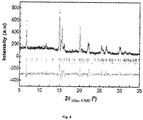
- the observed and calculated laboratory X-ray diffraction patterns obtained by Rietveld refinement for the electrochemically oxidized sample are shown in Figure 4 .
- the corresponding electrochemical measurement was performed in a Ca(BF 4 ) 2 in EC:PC electrolyte at room temperature and at C/50.
- the refinements indicate the presence of two phase in the oxidized sample.
- the first phase corresponds to the remaining unoxidized Ca 2 MnO 3.5 phase that was fit with the Bbcm space group.
Landscapes
- Chemical & Material Sciences (AREA)
- Chemical Kinetics & Catalysis (AREA)
- General Chemical & Material Sciences (AREA)
- Electrochemistry (AREA)
- Engineering & Computer Science (AREA)
- Manufacturing & Machinery (AREA)
- Inorganic Chemistry (AREA)
- Materials Engineering (AREA)
- Organic Chemistry (AREA)
- Physics & Mathematics (AREA)
- Condensed Matter Physics & Semiconductors (AREA)
- General Physics & Mathematics (AREA)
- Battery Electrode And Active Subsutance (AREA)
Abstract
The invention relates to a positive electrode that includes the calcium and manganese oxide of formula Ca<sub>2</sub>MnO<sub>3.5</sub> as positive-electrode active material and its manufacturing method. The invention also relates to a calcium-based secondary cell comprising said electrode and to a calcium-based secondary battery comprising such a calcium-based secondary cell.
Description
- The invention relates to a positive electrode that includes a positive-electrode active material and its manufacturing method, said positive-electrode active material being capable of accepting and releasing calcium ions. The invention also relates to a calcium-based secondary cell comprising said electrode and to a non-aqueous calcium-based secondary battery comprising such a calcium-based secondary cell.
- Secondary (i.e. rechargeable) electrochemical cells and batteries are a power source widely used in information-related devices, communication devices (such as personal computers, camcorders and cellular phones) as well as in the automobile industry or in stationary power storage devices. Conventional lithium-based cells typically include a positive electrode (also referred to as "cathode") and a negative electrode (also referred to as "anode") whose active materials are capable of accepting and releasing lithium ions, as well as an electrolyte arranged between the electrodes and including lithium ions.
- Calcium is much more abundant in nature than lithium and, despite the high atomic weight of Ca with respect to Li, the bivalent nature of Ca means that it could in principle act as a suitable material for rechargeable batteries exhibiting high energy density, even if it has proven difficult so far to identify suitable positive electrode materials and Ca batteries are very underdeveloped as compared to their Li counterparts.
- Thus, unfortunately, to date, the number of materials that have been shown to electrochemically react with calcium in a reversible manner is very limited and they operate at rather low potential, which limits the energy density achievable for the battery.
- In prior art, the next documents: "Pathreeker, S., et al. Journal of Electroanalytical Chemistry, 2020, 874,114453", " Liu, M. et al. Energy Environ. Sci., 2015, 8, 964-974" and "Arroyo-de Dompablo M. E. et al. Phys. Chem. Chem. Phys., 2016,18, 19966-19972" disclose a refer to a computational evaluation of the calcium ion mobility and CaMn2O4 polymorphs and CaMnO3 with perovskite-type structure to elucidate whether they could be potentially considered as positive electrode materials for calcium batteries. The calculated energy barriers showed that Ca diffusion is very much dependent on the crystal structure and too high, except for hypothetical compound with formula CaMn2O4, a spinel-type crystal structure which is not stable enough to be synthesized.
- The document "Torres A. et al. Energy Storage Materials 2019, 21, 354-360" also discloses computational work to estimate barriers for calcium migration in several oxides. Ca2Mn2O5 and CaMn4O8 are found to exhibit too high energy barriers for migration of calcium ions.
- The document
WO2019096446A1 discloses oxides such as Ca3Mn2O6, for positive electrodes of calcium-based secondary cell. This electrode has a low theoretical electrochemical capacity. - In view of the above, the present invention proposes a different Ca-Mn-O material to those known in the state of the art for use in electrodes of calcium batteries. The material used in the present invention presents several advantages as explained below in the description of the invention.
- The present invention discloses a new use of the oxide Ca2MnO3.5 as an active material of a positive electrode in a calcium-based secondary battery.
- Then, a first aspect of the present invention relates to an electrode for calcium-based secondary battery characterized in that the active electrode material is the calcium and manganese oxide of formula Ca2MnO3.5.
- The active electrode material is the material that is oxidized or reduced when used in a battery (on charge or discharge).
- In preferred embodiment, the electrode is a positive electrode.
- The term "positive electrode" is intended to refer to the electrode undergoing oxidation on charge and reduction on discharge of the battery. The positive electrode acts as the cathode on discharge and the anode on charge.
- Preferably, the electrode comprises additional components as electrically conductive additives and/or polymers.
- The electrically conductive additives are selected preferably from the list comprising: carbon, metals or ceramics. Preferably, these electrically conductive additives have an average particle size between 2 and 50 nm. The term "ceramics" as used in this disclosure refers to substantially inorganic nonmetallic material. For example: Al2O3, SiO2, ZrO2, MgO, and CeO2 Particulate carbon may be selected within one or more of carbon blacks such as ketjen black, acetylene black, channel black, furnace black, lamp black, and thermal black; graphite, such as natural graphite, e.g., scaly graphite, artificial graphite, and expanded graphite; activated carbon from charcoal and coal; carbon fibers obtained by carbonizing synthetic fibers and petroleum pitch-based materials; carbon nanofibers; tubular carbon, such as carbon nanotubes; and graphene. Nanometals/nanoceramics may include Ni or other metals, Al2O3, SiO2, ZrO2, MgO, and/or CeO2 and may have an average particle size equal to or lower than about 15 nm (between 1 and 15 nm).
- The polymers are selected preferably from the list comprising: polyethylene, polypropylene, polytetrafluoroethylene (PTFE), polyvinylidene fluoride (PVDF), styrene-butadiene rubber (SBR), carboxymethylcellulose (CMC), tetrafluoroethylenehexafluoropropylene copolymers, tetrafluoroethylenehexafluoropropylene copolymers (FEP), tetrafluoroethylene-perfluoroalkyl vinyl ether copolymers (PFA), vinylidene fluoride-hexafluoropropylene copolymers, vinylidene, fluoride-chlorotrifluoroethylene copolymers, ethylenetetrafluoroethylene copolymers (ETFE resins), polychlorotrifluoroethylene (PCTFE), vinylidene fluoride-pentafluoropropylene copolymers, propylene-tetrafluoroethylene copolymers, ethylene-chlorotrifluoroethylene copolymers (ECTFE), vinylidene fluoride-hexafluoropropylene-tetrafluoroethylene copolymers, vinylidene fluoride-perfluoromethyl vinyl ether-tetrafluoroethylene copolymers, ethylene-acrylic acid copolymers, and combinations thereof may be preferred. The polymer acts as a binder.
- In a preferred embodiment, the electrode comprises Ca2MnO3.5, an electrically conductive additive and a polymer. In a more preferred embodiment, the electrode contains Ca2MnO3.5, conductive additive and a polymer in a weight ratio of 96-60/2-20/2-20, more preferably 80/10/10.
- Ca2MnO3.5 has an orthorhombic crystal structure (Bbcm, a = 5.30 Å, b = 10.05 Å, and c = 12.23 Å) and is an oxygen-deficient compound. Its crystal structure can be described as square pyramidal polyhedra of MnO4 linked by corners in the ab plane, forming rings of six MnO4 units. Along the c-axis, in between two sheets of [MnO4], there are two consecutive layers of calcium atoms which form an 8-fold coordination polyhedron ("Structure determination of Ca2MnO4 and Ca2MnO3.5 by X-ray and neutron methods", J. Sol. State Chem. 1985, 59, 71). The calculated barriers of 1.1 and 1.3 eV in two different crystallographic directions (as calculated in example 1) suggest that two-dimensional conductivity may occur in this compound.
- A second aspect of the present invention refers to a method of manufacturing the electrode described in the first aspect of the present invention, comprising the following steps:
- preparation of the oxide Ca2MnO3.5 by reducing Ca2MnO4,
- deposition of the prepared oxide Ca2MnO3.5 on an electrically conducting substrate.
- In a preferred embodiment, the method comprises, previously to the deposition step an additional step of mixing Ca2MnO3.5 with a conductive additive and/or a polymer (polymeric binder). To prepare de mixture, a solvent may also be used such as water or N-Methyl-2-pyrrolidone (NMP), forming a slurry. After deposition, a drying step. The drying step can be carried out a temperature between 15 and 200ºC or under vacuum.
- The conductive additive and the polymer are selected preferably as defined in the first aspect of the invention. In a preferred embodiment the prepared mix contains Ca2MnO3.5, conductive additive and polymeric binder in a weight ratio of 96-60/2-20/2-20, more preferably in a weight ratio of 80/10/10.
- Ca2MnO4 precursor was achieved by the Pechini method (
US3330679 ). It consists of mixing aqueous solutions of calcium and manganese salts (typically nitrates) in stoichiometric amounts to achieve the final product, adding citric acid to the mixture and then heating to dryness to achieve a powder which is then further treated at 1000°C for 24h to form Ca2MnO4. - The electrodes can be produced by coating a conducting substrate that acts as a current collector with the Ca2MnO3.5 or with the mixture of Ca2MnO3.5 and a conductive additive and/or a polymer. Generally, the mixture is in the form of a slurry since the mixture is prepared using a solvent as indicated above.
- The electrically conducting substrate is selected preferably from carbon, stainless steel or aluminium foils. More preferably, the conductive substrate is aluminium foil. Preferably, the thickness of the conducting substrate is between 5 and 30 micrometers.
- In a preferred embodiment, the reduction of Ca2MnO4 is carried out in the presence of NH3, more preferably in presence of a flow of NH3 between 50 and 1200 ml/min, and even more preferably, a flow of NH3 of 1200ml/min.
- In another embodiment, the reduction step a) is carried out at a temperature between 390 and 550°C, more preferably at 420 ºC.
- In another embodiment, the reduction step a) is carried out during a time in the range 4h to 50h, more preferably, 4 h.
- In another embodiment, the reduction of Ca2MnO4 is carried out in the presence of a NH3 flow between 50 and 1200 ml/min, at a temperature between 390 and 550°C and time in the range 4h to 50h and, more preferably, in presence of a flow of NH3 of 1200ml/min, at 420 ºC and for 4 h.
- A third aspect of the present invention refers to a calcium-based secondary cell comprising:
- a negative electrode (also called "counter electrode") that includes a negative-electrode active material,
- a positive electrode as defined in the first aspect of the present invention,
- an electrolyte arranged between the negative electrode and the positive electrode, said electrolyte comprising a calcium salt.
- The term "negative electrode" is intended to refer to the electrode undergoing oxidation on discharge and reduction on charge of the battery. The counter electrode acts as the anode on discharge and the cathode on charge.
- The electrolyte is an electrolyte compatible with the electrodes, that is, the electrolyte has high conductivity of Ca2+ ions, is an electronic insulator and has high electrochemical stability. In a preferred embodiment, this electrolyte comprises a calcium salt dissolved in an organic solvent or in an ionic liquid.
- In a preferred embodiment, the electrolyte is a solution of calcium tetrafluoroborate (Ca(BF4)2), calcium perchlorate (Ca(ClO4)2) calcium hexafluorophosphate (Ca(PF6)2), calcium tetrafluorosulfonylimide (Ca(TFSI)2) or (Ca(N(SO2CF3)2)2), calcium triflate Ca(Tf)2, calcium trifluoromethanesulfonate (Ca(CF3SO3)2) or mixtures thereof in an organic solvent. More preferably, the electrolyte is a solution of calcium tetrafluoroborate (Ca(BF4)2).
- In a preferred embodiment, said organic solvent may be selected from the group comprising: propylene carbonate (PC), ethylene carbonate (EC), butylene carbonate (BC), vinylene carbonate (VC), fluoroethylenecarbonate (FEC), dimethyl carbonate (DMC), diethylcarbonate (DEC), ethyl methyl carbonate (EMC), N,N-dimethylformamide (DMF), fluoroethylene carbonate (FEC), γ-buryrolactone, γ-valerolactone, tetrahydrofuran (THF), 2-methyltetrahydrofuran, dimethoxyethane (DME), ethylene glycol dimethyl ether, triethylene glycol dimethyl ether (TEDGE), tetraethyleneglycol dimethyl ether (TEDGE), and combinations thereof may be preferred. More preferably, the solvent is a mixture of ethylene carbonate (EC) and propylene carbonate (PC), and even mor preferably in a proportion 1:1 v/v.,
In a preferred embodiment, the negative electrode comprises graphite, carbon, meso-carbon microbead (MCMB), activated carbon, metallic calcium or a calcium alloy CaxMy where M= Sb, Ge, Al, Pb, Cu, Cd, Ge, Ga, Bi, In, Tl, Hg, Ag, Au, Pt, and Pd, Sn or Si; "x" is a value between 5 and 0.2 and "y" is a value between 5 and 0.2. - The invention further relates to a calcium-based secondary battery comprising an electrode as defined in the first aspect of the present invention or a calcium-based secondary cell as described in the second aspect of the present invention.
- During battery charging, the following reaction takes place in the positive electrode: Ca2MnO3.5 → Ca2-xMnO3.5 + x Ca2+ + 2x e-
During discharge the reverse reaction takes place. - Other aspect of the invention refers to the use of the oxide Ca2MnO3.5 as an active electrode material, more particularly, as an active positive electrode material.
- In a preferred embodiment, this aspect refers to the use of the oxide Ca2MnO3.5 as the active electrode material of a calcium-based secondary battery and more preferably as active positive electrode material of a calcium-based secondary battery.
- A last aspect of the present invention relates to the use of an electrode as defined in the first aspect of the present invention as part of a calcium-based secondary battery or for manufacturing a calcium-based secondary battery.
- The oxide Ca2MnO3.5 presents the next advantages to be used as an active material of an electrode:
- it contains calcium in its composition, which makes it possible to use negative electrodes that do not contain calcium,
- it is based on elements that are abundant in the earth's crust and have low cost and toxicity,
- it has a high redox potential, which will increase the energy density of the batteries,
- it has a predicted band-gap below 1.5 eV, which will allow for a fair electronic conductivity when mixed with additives,
- the predicted low cell volume variation upon Ca deinterclation (below 3%) decreases the risk of crystal cracking upon cycling.
- The potential viability of Ca2MnO3.5 as an electrode material was evaluated by DFT ( Density functional theory) calculations that allowed estimating the approximate operating potential as well as the energy barriers for the migration of calcium ions in the crystalline structure, which were found to be approximately 3.2 V (for the Mn3+/Mn4+ redox couple) and 1.1 eV.
- Unless otherwise defined, all technical and scientific terms used herein have the same meaning as commonly understood by one of ordinary skilled in the art to which this invention belongs. Methods and materials similar or equivalent to those described herein can be used in the practice of the present invention. Throughout the description and claims the word "comprise" and its variations are not intended to exclude other technical features, additives, components, or steps. Additional objects, advantages and features of the invention will become apparent to those skilled in the art upon examination of the description or may be learned by practice of the invention. The following examples, drawings are provided by way of illustration and are not intended to be limiting of the present invention.
-
-
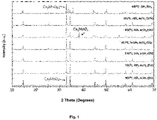
Figure 1 . Selected X-ray diffraction patterns of some Ca2MnO3.5 synthesis attempts during synthesis route optimization. -
Figure 2 . X-ray powder diffraction patterns of pristine and electrochemically oxidized Ca2MnO3.5 samples. -
Figure 3 . (A) Characteristic voltage profiles versus specific capacity expressed as mole of virtually de-inserted Ca2+. The corresponding ex-situ X-ray diffraction (XRD) patterns at the end of oxidation and reduction together with the pristine sample are displayed in (B) and (C). -
Figure 4 . Rietveld fit of laboratory X-ray powder diffraction pattern for a electrochemically oxidized sample of Ca2-xMnO3.5 up to equivalent x=1.5 in Ca(BF4)2 in EC:PC electrolyte at room temperature and at a Crate of C/50. Upper ticks correspond to calculated reflections for remaining Ca2MnO3.5 and lower ticks to calculated reflections for oxidized phase in tetragonal space group l41/acd. -
Figure 5 . Calculated average voltage profile for the oxidation of the Ca2MnO3.5 cathode to Ca1.5MnO3.5 upon battery charge, and predicted cell parameters and volume variation. -
Figure 6 . (A) Crystal structure of Ca2MnO3.5: Mn in polyhedral representation, O omitted and Ca ions as balls. The calculated energy barriers (in eV) are displayed in (B) for in-plane pathways and in (C) for inter-plane pathways. (D) Calculated energy landscape for the investigated pathways. -
Figure 7 . Calculated Density of States for Ca2MnO3.5 within the GGA+U approximation. The Fermi level is set as the zero of energy. - The invention shall be illustrated below by means of assays performed by the inventors that reveal the effectiveness of the product of the invention.
- The calculations have been performed using the ab-initio total-energy and molecular dynamics program VASP (Vienna Ab-initio Simulation Program) developed at the Universitat Wien. Total energy calculations based on Density Functional Theory (DFT) were performed within the Generalized Gradient Approximation (GGA), with the exchange and correlation functional form developed by Perdew, Burke, and Ernzerhof (PBE). The interaction of core electrons with the nuclei is described by the Projector Augmented Wave (PAW) method. The energy cut off for the plane wave basis set was kept fix at a constant value of 600 eV throughout the calculations. The integration in the Brillouin zone is done on an appropriate set of k-points determined by the Monkhorst-Pack scheme. A convergence of the total energy close to 10 meV per formula unit is achieved with such parameters. All crystal structures were fully relaxed (atomic positions, cell parameters and volume). The final energies of the optimized geometries were recalculated so as to correct the changes in the basis set of wave functions during relaxation. To take electron correlation into account, the total energies of the GGA-optimized compounds have been calculated using the GGA+U method, with U eff of 4 eV for the d- states of Mn.
- Ca deinsertion from Ca2MnO3.5 is considered up to the limit composition Ca1.5MnO3.5 (Mn3+/Mn4+ redox couple). To simulate the Ca1.5MnO3.5 phase, seven different vacancies/ Ca arrangements within the unit cell have been considered.
Figure 5 includes the calculated average voltage taking the most stable configuration out of this set; 2.4 (GGA) and a most reliable value of 3.3 (GGA+U) . Calcium deintercalation implies a moderate volume contraction of about 2% (GGA and GGA+U). - Ca2+ mobility in Ca2MnO3.5 is investigated using a 2x1x1 supercell where one Ca site is removed creating a vacancy (Ca31Mn16O56 composition). DFT calculations are performed using the Nudged Elastic Band method (NEB) as implemented in VASP. Constant volume calculations were performed for three intermediate images. To calculate the energy at the saddle point, cubic splines were fit through the images along each hop.
Figure 6A shows the crystal structure of Ca2MnO3.5. Ca diffusion in the ab plane involve the possible pathways depicted by arrows infigure 6A . The calculated barriers of 1.1 and 1.2 eV in two different directions suggest that two-dimensional conductivity may occur in the material. The diffusion pathways along the c-axis been two consecutive Ca layers have energy barriers of 1.8 and 2.3 eV (Figure 6C ). Ca diffusion passing through the Mn-O plane is impeded by a large energy migration barrier of 3.2 eV. - The synthesis of Ca2MnO3.5 by low temperature reduction of the Ruddlesden-Popper (n=1) Ca2MnO4 compound was reported by Poeppelmeier et al. (K. R. Poeppelmeier et al., "CaMnO2.5 and Ca2MnO3.5: new oxygen-defect perovskite-type oxides", J. Sol. State Chem. 1982, 44, 89; M. E. Leonowicz et al., "Structure determination of Ca2MnO4 and Ca2MnO3.5 by X-ray and neutron methods", J. Sol. State Chem. 1985, 59, 71) and found to require careful control of both the temperature and an appropriate reduction agent, as Ca2MnO3.5 was found to be metastable and could only be achieved in a very narrow range of temperatures. Ca2MnO4 precursor was achieved by the Pechini method(
US3330679 ), starting from an aqueous solution containing the appropriate molar amounts of calcium and manganese cations obtained by dissolving Mn(NO3)2·9H2O and Ca(NO3)2·4H2O followed by the addition of citric acid (C6H8O7) and Ethylene glycol (C2H6O2) in a molar ratio Ca:Mn:C6H8O7:C2H6O2=2:1:1:1. This solution is stirred under heating at 55-80°C. and evaporated to dryness after 12h. The solid residue achieved is then heated 500°C in air for 6h and finally annealed at 1000°C for 24h to achieve Ca2MnO4.
Its reduction was studied at temperatures ranging between 300°C and 430°C with a variety of reducing atmospheres (H2/Ar 5%, 10% and NH3) and different flows, during different periods of time. In 5% H2/Ar atmosphere no evidence of the reduced Ca2MnO3.5 phase could be observed after treatments at temperatures between 300°C and 350°C even after several treatments of 48h. At temperatures of 382°C the characteristic reflections of the reduced phase started to appear. However, the amount of reduced phase did not improve after consecutive regrinding and thermal treatment steps. Short treatment of the starting material Ca2MnO4 at 400°C in 5% H2/Ar led to the formation of a larger quantity of Ca2MnO3.5 together with a large amount of the over reduced Mn2+ containing rock salt Ca2MnO3 phase. Equivalent studies were performed with 10% H2/Ar leading to similar results. At this point, the use of a less reducing atmosphere was deemed necessary. Synthesis attempts using NH3 as reducing agent did indeed yield Ca2MnO3.5. Optimization of the protocol was required to minimize the amount of impurities (either Ca2MnO4 precursor and/or over reduced rock salt phase, both confirmed to be electrochemically inactive). Within the range of conditions systematically explored (seeFigure 1 ) (temperature between 390 and 550°C, NH3 flow between 50 and 1200 ml/min and time in the range 4h to 50), the best Ca2MnO3.5 batches obtained contain less than 5% impurities (as deduced from Rietveld refinement) and were prepared by a short treatment (4h) under high ammonia flux (1200 ml/min) at 420°C. These were selected for electrochemical characterization. - The electrodes are produced by coating slurry on a metal foil that acts as a current collector. The slurry is prepared by mixing active material, a conductive additive such as carbon black and a polymeric binder such as PVFD in a weight ratio of 80/10/10. To achieve the right viscosity, N-Methyl-2-pyrrolidone (NMP) is added as long as the slurry exhibits a flow. Mixing is done by means of ball milling in an agate container with 3 agate balls of 1 cm diameter at 500 rpm for 2 h with change of the rotating way every 30 min using a PM100 Retsch planetary Ball Miller. The slurries are tape cast on a 20 µm thick aluminum foil (Goodfellow) with a 400 µm Doctor-Blade and dried at 120°C under vacuum for 2 h. Once dried, 1 cm2 disk electrodes are cut and pressed at 5 tons.
- A three electrode Swagelok cell was used for the electrochemical test. Ca metal (AlfaAesar, 99.5%) or AC (Kynol, ACC-509220) were used as counter electrodes (CE). Either Ca metal or an Ag wire were used as reference electrodes (RE). The electrolytes used were 0.3 M Ca(BF4)2 dissolved in a 1:1 mixture (v/v) of ethylene carbonate (EC, Aldrich anhydrous 99.0%) and propylene carbonate (PC, Aldrich anhydrous 99.0%), prepared from Ca(BF4)2 x H2O salt (Alfa Aesar) or in LiPF6 in ethylene carbonate: dimethyl carbonate [DMC] [1:1 v/v] (LP30, Aldrich). Aluminum current collector was used for the positive electrode, stainless steel for the counter and reference electrodes. Two sheets of Whatman® Grade GF/D borosilicate glass fiber were used as separators. Electrolyte preparation and cell assembling were done in Ar filled glove box with less than 1 ppm of O2 and H2O. Said electrode (typical loading ca. 2 mg/cm2 of active material) was used galvanostatic cycling with potential limit (GCPL) test at a C/50 rate at room temperature or at 100°C.
- Electrodes were recovered after oxidation (calcium extraction) and powder sealed inside a capillary to perform X-ray diffraction Significant changes in the diffraction pattern are observed after the experiments conducted in 1M LiPF6 in EC:DMC (ethylene carbonate: dimethyl carbonate [DMC] [1:1 v/v]) electrolyte, which seem to point at the feasibility of calcium de-intercalation from this material (see
Figure 2 ). - Further electrochemical tests were carried out in Ca cell with Ca(BF4)2, EC/PC electrolyte and activated carbon cloth as counter electrode at room temperature.
Figure 3A Shows the first oxidation and first cycle of Ca2MnO3.5 electrodes at several currents (C being equivalent to deintercalacion of one mole of calcium ions in one hour). Upon oxidation, as the intensity increases a slight increase of polarization is observed on the plateaus that are centered between 1.4 - 2.2 V vs. Ag+/Ag, while upon reduction, a strong polarization takes place as the intensity increases. The changes observed in the corresponding ex-situ XRD pattern of the oxidized sample (Figure 3B ) are consistent with the formation of a secondary phase similar to the one observed in Li cells. At a given intensity, the proportion of the secondary phase increases with the capacity (XRD not shown here) and at the same level of charge a different proportion of secondary phase is observed for each intensity value. Upon oxidation the maximum phase evolution is observed at C/50. Considering Mn+4 as the highest achievable oxidation state of manganese in the studied conditions, the full transformation to the secondary phase should be achieved for Ca1.5MnO3.5. yet at virtually de-interlaced calcium values of 1.5 mol small fraction of pristine Ca2MnO3.5 is still present. Therefore, contributions to the observed values of capacity from electrolyte decomposition side reactions must be taken into account. Upon reduction the degree of reversibility was found to be dependent to the intensity value. Despite the strong polarization the highest degree of reversibility was achieved at C/10. Low intensity values favor kinetically controlled reactions but also increases substantially the amount of parasitic reactions. Therefore, at C/100 the major contribution to the observed capacity comes presumably from side reactions wile at C/10 manganese reduction process is the major contributor to the observed capacity. Although the overall reversible calcium insertion and de-insertion in Ca2-xMnO3.5 appears to be achievable, at least to a certain extent, the kinetic of these two processes differ substantially between each other. Structural characterization of the oxidized secondary phase and precise quantification of calcium in oxidized Ca2-xMnO3.5 can be attempt by Rietveld refinement. - The observed and calculated laboratory X-ray diffraction patterns obtained by Rietveld refinement for the electrochemically oxidized sample are shown in
Figure 4 . The corresponding electrochemical measurement was performed in a Ca(BF4)2 in EC:PC electrolyte at room temperature and at C/50. The refinements indicate the presence of two phase in the oxidized sample. The first phase corresponds to the remaining unoxidized Ca2MnO3.5 phase that was fit with the Bbcm space group. The refined lattice parameters for this phase were a= 5.2961(9), b= 10.0966(16) and c= 12.2133(20). Additional peaks observed upon electrochemical oxidation of Ca2MnO3.5 are consistent with the formation of a tetragonal phase with space group l41/acd and lattice parameters a= 5.2377(6) and c= 24.3541(48). The refined phase weight fractions resulted in a 71% of the oxidized phase. Due to low signal to noise ratio and low peak resolution precise quantification of calcium in oxidized Ca2-xMnO3.5 cannot be inferred from these data.
Claims (15)
- Electrode, for calcium-based secondary battery characterized in that the active electrode material is the calcium and manganese oxide of formula Ca2MnO3.5.
- Electrode, according to claim 1, wherein the electrode comprises electrically conductive additives selected from the list comprising: carbon, metals or ceramics.
- Electrode, according to claim 1 or 2, wherein the electrode comprises a polymer selected from the list comprising: polyethylene, polypropylene, polytetrafluoroethylene (PTFE), polyvinylidene fluoride (PVDF), styrene-butadiene rubber (SBR), carboxymethylcellulose (CMC), tetrafluoroethylenehexafluoropropylene copolymers, tetrafluoroethylenehexafluoropropylene copolymers (FEP), tetrafluoroethylene-perfluoroalkyl vinyl ether copolymers (PFA), vinylidene fluoride-hexafluoropropylene copolymers, vinylidene, fluoride-chlorotrifluoroethylene copolymers, ethylenetetrafluoroethylene copolymers (ETFE resins), polychlorotrifluoroethylene (PCTFE), vinylidene fluoride-pentafluoropropylene copolymers, propylene-tetrafluoroethylene copolymers, ethylene-chlorotrifluoroethylene copolymers (ECTFE), vinylidene fluoride-hexafluoropropylene-tetrafluoroethylene copolymers, vinylidene fluoride-perfluoromethyl vinyl ether-tetrafluoroethylene copolymers, ethylene-acrylic acid copolymers and mixtures thereof.
- Electrode, according to any of claims 1 to 3, wherein it is a positive electrode.
- Method of manufacturing the electrode according to any of the preceding claims, comprising the following steps:- preparation of the oxide Ca2MnO3.5 by reducing Ca2MnO4, and- deposition of the prepared oxide Ca2MnO3.5 on an electrically conducting substrate.
- Method, according to claim 5, wherein the reduction of Ca2MnO4 is carry out in the presence of a NH3 flow between 50 and 1200 ml/min.
- Method, according to any of claims 5 to 6, wherein the reduction of Ca2MnO4 is carry out at a temperature between 390 and 550°C.
- Method, according to any of claims 5 to 7, wherein the reduction of Ca2MnO4 is carry out in during a time in the range 4h to 50h.
- A calcium-based secondary cell comprising:- a negative electrode,- a positive electrode as defined in any of claims 1 to 4 and- an electrolyte arranged between the negative electrode and the positive electrode, said electrolyte comprising a calcium salt.
- Calcium-based secondary cell according to claim 9 wherein the negative electrode comprises graphite, carbon, meso-carbon microbead (MCMB), activated carbon, metallic calcium or a calcium alloy.
- Calcium-based secondary cell according to any of claims 8 to 10 wherein the electrolyte is a solution of calcium tetrafluoroborate (Ca(BF4)2), calcium perchlorate (Ca(ClO4)2) calcium hexafluorophosphate (Ca(PF6)2), calcium tetrafluorosulfonylimide (Ca(TFSI)2) or (Ca(N(SO2CF3)2)2), calcium triflate Ca(Tf)2, calcium trifluoromethanesulfonate (Ca(CF3SO3)2) or mixtures thereof in an organic solvent..
- Calcium-based secondary battery comprising an electrode as defined in claims 1-4 or a calcium-based secondary cell as described in claims 9-11.
- Use of the oxide Ca2MnO3.5 as an active electrode material.
- Use of the oxide Ca2MnO3.5, according to claim 13, as an active positive electrode material of a calcium-based secondary battery.
- Use of the electrode of any of claims 1 to 4 as part of a calcium-based secondary battery.
Priority Applications (1)
| Application Number | Priority Date | Filing Date | Title |
|---|---|---|---|
| EP21382186.1A EP4053943A1 (en) | 2021-03-05 | 2021-03-05 | Electrode for calcium batteries and its manufacturing method |
Applications Claiming Priority (1)
| Application Number | Priority Date | Filing Date | Title |
|---|---|---|---|
| EP21382186.1A EP4053943A1 (en) | 2021-03-05 | 2021-03-05 | Electrode for calcium batteries and its manufacturing method |
Publications (1)
| Publication Number | Publication Date |
|---|---|
| EP4053943A1 true EP4053943A1 (en) | 2022-09-07 |
Family
ID=75223256
Family Applications (1)
| Application Number | Title | Priority Date | Filing Date |
|---|---|---|---|
| EP21382186.1A Withdrawn EP4053943A1 (en) | 2021-03-05 | 2021-03-05 | Electrode for calcium batteries and its manufacturing method |
Country Status (1)
| Country | Link |
|---|---|
| EP (1) | EP4053943A1 (en) |
Citations (3)
| Publication number | Priority date | Publication date | Assignee | Title |
|---|---|---|---|---|
| US3330679A (en) | 1961-08-09 | 1967-07-11 | Cabot Corp | Carbon black process |
| US4388294A (en) * | 1981-07-31 | 1983-06-14 | Exxon Research And Engineering Co. | Oxygen deficient manganese perovskites |
| WO2019096446A1 (en) | 2017-11-16 | 2019-05-23 | Toyota Motor Europe | One-dimensional structure pre-calciated materials as positive electrode for rechargeable calcium batteries and cell comprising the same |
-
2021
- 2021-03-05 EP EP21382186.1A patent/EP4053943A1/en not_active Withdrawn
Patent Citations (3)
| Publication number | Priority date | Publication date | Assignee | Title |
|---|---|---|---|---|
| US3330679A (en) | 1961-08-09 | 1967-07-11 | Cabot Corp | Carbon black process |
| US4388294A (en) * | 1981-07-31 | 1983-06-14 | Exxon Research And Engineering Co. | Oxygen deficient manganese perovskites |
| WO2019096446A1 (en) | 2017-11-16 | 2019-05-23 | Toyota Motor Europe | One-dimensional structure pre-calciated materials as positive electrode for rechargeable calcium batteries and cell comprising the same |
Non-Patent Citations (10)
| Title |
|---|
| "Structure determination of Ca MnO and Ca MnO .5 by X-ray and neutron methods", J. SOL. STATE CHEM., vol. 59, 1985, pages 71 |
| ARROYO-DE DOMPABLO M. E. ET AL., PHYS. CHEM. CHEM. PHYS., vol. 18, 2016, pages 19966 - 19972 |
| GUMMOW ROSALIND J. ET AL: "Calcium-Ion Batteries: Current State-of-the-Art and Future Perspectives", ADVANCED MATERIALS, vol. 30, no. 39, September 2018 (2018-09-01), DE, pages 1801702, XP055836251, ISSN: 0935-9648, Retrieved from the Internet <URL:https://api.wiley.com/onlinelibrary/tdm/v1/articles/10.1002%2Fadma.201801702> DOI: 10.1002/adma.201801702 * |
| K. R. POEPPELMEIER ET AL.: "CaMn0 . and Ca MO : new oxygen-defect perovskite-type oxides", J. SOL. STATE CHEM., vol. 44, 1982, pages 89, XP024193553, DOI: 10.1016/0022-4596(82)90404-2 |
| LIU, M. ET AL., ENERGY ENVIRON. SCI., vol. 8, 2015, pages 964 - 974 |
| M. E. LEONOWICZ ET AL.: "Structure determination of Ca MnO and Ca MnO . by X-ray and neutron methods", J. SOL. STATE CHEM., vol. 59, 1985, pages 71 |
| PATHREEKER, S. ET AL., JOURNAL OF ELECTROANALYTICAL CHEMISTRY, vol. 874, 2020, pages 114453 |
| RELLER A ET AL: "Reversible topotactic reduction of perovskite-related calcium manganese oxides", THERMOCHIMICA ACTA, ELSEVIER SCIENCE PUBLISHERS, AMSTERDAM, NL, vol. 83, no. 1, 15 January 1985 (1985-01-15), pages 121 - 124, XP026603855, ISSN: 0040-6031, [retrieved on 19850115], DOI: 10.1016/0040-6031(85)85801-9 * |
| TORRES A. ET AL., ENERGY STORAGE MATERIALS, vol. 21, 2019, pages 354 - 360 |
| ZHANG ZIHE ET AL: "Computational Screening of Layered Materials for Multivalent Ion Batteries", ACS OMEGA, vol. 4, no. 4, 30 April 2019 (2019-04-30), US, pages 7822 - 7828, XP055835870, ISSN: 2470-1343, Retrieved from the Internet <URL:http://pubs.acs.org/doi/pdf/10.1021/acsomega.9b00482> DOI: 10.1021/acsomega.9b00482 * |
Similar Documents
| Publication | Publication Date | Title |
|---|---|---|
| JP7681325B2 (en) | solid electrolyte | |
| Kubota et al. | practical issues and future perspective for Na-ion batteries | |
| TWI613858B (en) | Bivalent metal doping for sodium manganese oxide as cathode materials for sodium ion batteries | |
| Luo et al. | Aqueous lithium‐ion battery LiTi2 (PO4) 3/LiMn2O4 with high power and energy densities as well as superior cycling stability | |
| KR101965016B1 (en) | Blended cathode materials | |
| US7358009B2 (en) | Layered electrodes for lithium cells and batteries | |
| CA2844466C (en) | Fluorinated electrolyte compositions | |
| CN101809788B (en) | Positive electrode active material for nonaqueous electrolyte secondary battery and nonaqueous electrolyte secondary battery using same | |
| JP6487375B2 (en) | Secondary battery system | |
| KR20150131031A (en) | High voltage lithium ion battery | |
| JP3141858B2 (en) | Lithium transition metal halide oxide, method for producing the same and use thereof | |
| EP3357115A1 (en) | Non-aqueous electrolytes for high energy lithium-ion batteries | |
| WO2013052494A1 (en) | Cathode materials including an oxygen-gettering compound and an ion-storage compound | |
| KR20140015700A (en) | Lithium ion conductor, electrolyte including the same, active material including the same and battery including lithium ion conductor | |
| JP7742307B2 (en) | Electrode materials comprising layered potassium metal oxides, electrodes comprising the electrode materials, and uses of the electrode materials in electrochemistry | |
| KR20220065673A (en) | Method for producing cathode active material, cathode active material, and method for producing lithium ion battery | |
| HWANG et al. | Electrochemical sodiation-desodiation of maricite NaFePO4 in ionic liquid electrolyte | |
| US20140065477A1 (en) | Positive active material composition for rechargeable lithium battery, and positive electrode and rechargeable lithium battery including same | |
| WO2022182313A2 (en) | Development of new air-stable o3-naxmo2 type layered metal oxides for sodium ion batteries | |
| WO2014157743A1 (en) | Cathode active material for lithium secondary battery, and lithium secondary battery using same | |
| JP7827364B2 (en) | Positive electrode active material and lithium secondary battery containing the same | |
| US20230411692A1 (en) | Electrolyte solution for nonaqueous secondary batteries, nonaqueous secondary battery using same, and method for discharging nonaqueous secondary battery | |
| KR20240150400A (en) | Cathode active material for lithium rechargeable battery, cathode including the same, and lithium rechargeable battery including the same | |
| EP4053943A1 (en) | Electrode for calcium batteries and its manufacturing method | |
| CN118156489A (en) | Positive electrode active material for lithium secondary battery and lithium secondary battery containing the positive electrode active material |
Legal Events
| Date | Code | Title | Description |
|---|---|---|---|
| PUAI | Public reference made under article 153(3) epc to a published international application that has entered the european phase |
Free format text: ORIGINAL CODE: 0009012 |
|
| STAA | Information on the status of an ep patent application or granted ep patent |
Free format text: STATUS: THE APPLICATION HAS BEEN PUBLISHED |
|
| AK | Designated contracting states |
Kind code of ref document: A1 Designated state(s): AL AT BE BG CH CY CZ DE DK EE ES FI FR GB GR HR HU IE IS IT LI LT LU LV MC MK MT NL NO PL PT RO RS SE SI SK SM TR |
|
| STAA | Information on the status of an ep patent application or granted ep patent |
Free format text: STATUS: THE APPLICATION IS DEEMED TO BE WITHDRAWN |
|
| 18D | Application deemed to be withdrawn |
Effective date: 20230308 |