EP4053224A1 - Aqueous paint additive, aqueous paint composition, and coating layer - Google Patents
Aqueous paint additive, aqueous paint composition, and coating layer Download PDFInfo
- Publication number
- EP4053224A1 EP4053224A1 EP20882834.3A EP20882834A EP4053224A1 EP 4053224 A1 EP4053224 A1 EP 4053224A1 EP 20882834 A EP20882834 A EP 20882834A EP 4053224 A1 EP4053224 A1 EP 4053224A1
- Authority
- EP
- European Patent Office
- Prior art keywords
- sub
- sup
- general formula
- water
- based paint
- Prior art date
- Legal status (The legal status is an assumption and is not a legal conclusion. Google has not performed a legal analysis and makes no representation as to the accuracy of the status listed.)
- Granted
Links
Classifications
-
- C—CHEMISTRY; METALLURGY
- C09—DYES; PAINTS; POLISHES; NATURAL RESINS; ADHESIVES; COMPOSITIONS NOT OTHERWISE PROVIDED FOR; APPLICATIONS OF MATERIALS NOT OTHERWISE PROVIDED FOR
- C09D—COATING COMPOSITIONS, e.g. PAINTS, VARNISHES OR LACQUERS; FILLING PASTES; CHEMICAL PAINT OR INK REMOVERS; INKS; CORRECTING FLUIDS; WOODSTAINS; PASTES OR SOLIDS FOR COLOURING OR PRINTING; USE OF MATERIALS THEREFOR
- C09D5/00—Coating compositions, e.g. paints, varnishes or lacquers, characterised by their physical nature or the effects produced; Filling pastes
- C09D5/16—Antifouling paints; Underwater paints
- C09D5/1606—Antifouling paints; Underwater paints characterised by the anti-fouling agent
- C09D5/1637—Macromolecular compounds
-
- C—CHEMISTRY; METALLURGY
- C09—DYES; PAINTS; POLISHES; NATURAL RESINS; ADHESIVES; COMPOSITIONS NOT OTHERWISE PROVIDED FOR; APPLICATIONS OF MATERIALS NOT OTHERWISE PROVIDED FOR
- C09D—COATING COMPOSITIONS, e.g. PAINTS, VARNISHES OR LACQUERS; FILLING PASTES; CHEMICAL PAINT OR INK REMOVERS; INKS; CORRECTING FLUIDS; WOODSTAINS; PASTES OR SOLIDS FOR COLOURING OR PRINTING; USE OF MATERIALS THEREFOR
- C09D5/00—Coating compositions, e.g. paints, varnishes or lacquers, characterised by their physical nature or the effects produced; Filling pastes
- C09D5/16—Antifouling paints; Underwater paints
- C09D5/1687—Use of special additives
-
- C—CHEMISTRY; METALLURGY
- C08—ORGANIC MACROMOLECULAR COMPOUNDS; THEIR PREPARATION OR CHEMICAL WORKING-UP; COMPOSITIONS BASED THEREON
- C08G—MACROMOLECULAR COMPOUNDS OBTAINED OTHERWISE THAN BY REACTIONS ONLY INVOLVING UNSATURATED CARBON-TO-CARBON BONDS
- C08G18/00—Polymeric products of isocyanates or isothiocyanates
- C08G18/06—Polymeric products of isocyanates or isothiocyanates with compounds having active hydrogen
- C08G18/28—Polymeric products of isocyanates or isothiocyanates with compounds having active hydrogen characterised by the compounds used containing active hydrogen
- C08G18/2805—Compounds having only one group containing active hydrogen
- C08G18/288—Compounds containing at least one heteroatom other than oxygen or nitrogen
- C08G18/289—Compounds containing at least one heteroatom other than oxygen or nitrogen containing silicon
-
- C—CHEMISTRY; METALLURGY
- C08—ORGANIC MACROMOLECULAR COMPOUNDS; THEIR PREPARATION OR CHEMICAL WORKING-UP; COMPOSITIONS BASED THEREON
- C08G—MACROMOLECULAR COMPOUNDS OBTAINED OTHERWISE THAN BY REACTIONS ONLY INVOLVING UNSATURATED CARBON-TO-CARBON BONDS
- C08G18/00—Polymeric products of isocyanates or isothiocyanates
- C08G18/06—Polymeric products of isocyanates or isothiocyanates with compounds having active hydrogen
- C08G18/28—Polymeric products of isocyanates or isothiocyanates with compounds having active hydrogen characterised by the compounds used containing active hydrogen
- C08G18/40—High-molecular-weight compounds
- C08G18/64—Macromolecular compounds not provided for by groups C08G18/42 - C08G18/63
- C08G18/6469—Macromolecular compounds not provided for by groups C08G18/42 - C08G18/63 having silicon
-
- C—CHEMISTRY; METALLURGY
- C08—ORGANIC MACROMOLECULAR COMPOUNDS; THEIR PREPARATION OR CHEMICAL WORKING-UP; COMPOSITIONS BASED THEREON
- C08G—MACROMOLECULAR COMPOUNDS OBTAINED OTHERWISE THAN BY REACTIONS ONLY INVOLVING UNSATURATED CARBON-TO-CARBON BONDS
- C08G18/00—Polymeric products of isocyanates or isothiocyanates
- C08G18/06—Polymeric products of isocyanates or isothiocyanates with compounds having active hydrogen
- C08G18/70—Polymeric products of isocyanates or isothiocyanates with compounds having active hydrogen characterised by the isocyanates or isothiocyanates used
- C08G18/72—Polyisocyanates or polyisothiocyanates
- C08G18/73—Polyisocyanates or polyisothiocyanates acyclic
-
- C—CHEMISTRY; METALLURGY
- C09—DYES; PAINTS; POLISHES; NATURAL RESINS; ADHESIVES; COMPOSITIONS NOT OTHERWISE PROVIDED FOR; APPLICATIONS OF MATERIALS NOT OTHERWISE PROVIDED FOR
- C09D—COATING COMPOSITIONS, e.g. PAINTS, VARNISHES OR LACQUERS; FILLING PASTES; CHEMICAL PAINT OR INK REMOVERS; INKS; CORRECTING FLUIDS; WOODSTAINS; PASTES OR SOLIDS FOR COLOURING OR PRINTING; USE OF MATERIALS THEREFOR
- C09D133/00—Coating compositions based on homopolymers or copolymers of compounds having one or more unsaturated aliphatic radicals, each having only one carbon-to-carbon double bond, and at least one being terminated by only one carboxyl radical, or of salts, anhydrides, esters, amides, imides, or nitriles thereof; Coating compositions based on derivatives of such polymers
- C09D133/04—Homopolymers or copolymers of esters
-
- C—CHEMISTRY; METALLURGY
- C09—DYES; PAINTS; POLISHES; NATURAL RESINS; ADHESIVES; COMPOSITIONS NOT OTHERWISE PROVIDED FOR; APPLICATIONS OF MATERIALS NOT OTHERWISE PROVIDED FOR
- C09D—COATING COMPOSITIONS, e.g. PAINTS, VARNISHES OR LACQUERS; FILLING PASTES; CHEMICAL PAINT OR INK REMOVERS; INKS; CORRECTING FLUIDS; WOODSTAINS; PASTES OR SOLIDS FOR COLOURING OR PRINTING; USE OF MATERIALS THEREFOR
- C09D175/00—Coating compositions based on polyureas or polyurethanes; Coating compositions based on derivatives of such polymers
- C09D175/04—Polyurethanes
-
- C—CHEMISTRY; METALLURGY
- C09—DYES; PAINTS; POLISHES; NATURAL RESINS; ADHESIVES; COMPOSITIONS NOT OTHERWISE PROVIDED FOR; APPLICATIONS OF MATERIALS NOT OTHERWISE PROVIDED FOR
- C09D—COATING COMPOSITIONS, e.g. PAINTS, VARNISHES OR LACQUERS; FILLING PASTES; CHEMICAL PAINT OR INK REMOVERS; INKS; CORRECTING FLUIDS; WOODSTAINS; PASTES OR SOLIDS FOR COLOURING OR PRINTING; USE OF MATERIALS THEREFOR
- C09D201/00—Coating compositions based on unspecified macromolecular compounds
-
- C—CHEMISTRY; METALLURGY
- C09—DYES; PAINTS; POLISHES; NATURAL RESINS; ADHESIVES; COMPOSITIONS NOT OTHERWISE PROVIDED FOR; APPLICATIONS OF MATERIALS NOT OTHERWISE PROVIDED FOR
- C09D—COATING COMPOSITIONS, e.g. PAINTS, VARNISHES OR LACQUERS; FILLING PASTES; CHEMICAL PAINT OR INK REMOVERS; INKS; CORRECTING FLUIDS; WOODSTAINS; PASTES OR SOLIDS FOR COLOURING OR PRINTING; USE OF MATERIALS THEREFOR
- C09D7/00—Features of coating compositions, not provided for in group C09D5/00; Processes for incorporating ingredients in coating compositions
- C09D7/40—Additives
- C09D7/65—Additives macromolecular
-
- C—CHEMISTRY; METALLURGY
- C08—ORGANIC MACROMOLECULAR COMPOUNDS; THEIR PREPARATION OR CHEMICAL WORKING-UP; COMPOSITIONS BASED THEREON
- C08G—MACROMOLECULAR COMPOUNDS OBTAINED OTHERWISE THAN BY REACTIONS ONLY INVOLVING UNSATURATED CARBON-TO-CARBON BONDS
- C08G77/00—Macromolecular compounds obtained by reactions forming a linkage containing silicon with or without sulfur, nitrogen, oxygen or carbon in the main chain of the macromolecule
- C08G77/42—Block-or graft-polymers containing polysiloxane sequences
- C08G77/46—Block-or graft-polymers containing polysiloxane sequences containing polyether sequences
-
- C—CHEMISTRY; METALLURGY
- C08—ORGANIC MACROMOLECULAR COMPOUNDS; THEIR PREPARATION OR CHEMICAL WORKING-UP; COMPOSITIONS BASED THEREON
- C08G—MACROMOLECULAR COMPOUNDS OBTAINED OTHERWISE THAN BY REACTIONS ONLY INVOLVING UNSATURATED CARBON-TO-CARBON BONDS
- C08G77/00—Macromolecular compounds obtained by reactions forming a linkage containing silicon with or without sulfur, nitrogen, oxygen or carbon in the main chain of the macromolecule
- C08G77/48—Macromolecular compounds obtained by reactions forming a linkage containing silicon with or without sulfur, nitrogen, oxygen or carbon in the main chain of the macromolecule in which at least two but not all the silicon atoms are connected by linkages other than oxygen atoms
- C08G77/50—Macromolecular compounds obtained by reactions forming a linkage containing silicon with or without sulfur, nitrogen, oxygen or carbon in the main chain of the macromolecule in which at least two but not all the silicon atoms are connected by linkages other than oxygen atoms by carbon linkages
-
- C—CHEMISTRY; METALLURGY
- C08—ORGANIC MACROMOLECULAR COMPOUNDS; THEIR PREPARATION OR CHEMICAL WORKING-UP; COMPOSITIONS BASED THEREON
- C08G—MACROMOLECULAR COMPOUNDS OBTAINED OTHERWISE THAN BY REACTIONS ONLY INVOLVING UNSATURATED CARBON-TO-CARBON BONDS
- C08G81/00—Macromolecular compounds obtained by interreacting polymers in the absence of monomers, e.g. block polymers
Definitions
- the present invention relates to: an additive for water-based paint, the additive containing a siloxane-branched polyether-modified silicone; a water-based paint composition and a coating layer containing the additive for water-based paint; and, in further detail, a water-based paint composition and a coating layer with antifouling performance.
- coatings with paints are performed so as to prevent dirt in various uses including: electric appliances, such as portable telephones, personal computers, televisions, and plasma displays; transportation equipment, such as motor vehicles and trains; and further various everyday necessities.
- Patent Document 1 a composition using an additive which contains fluorine in a molecule
- Patent Document 1 a composition using an additive which contains fluorine in a molecule
- fluorine-free additives are required.
- water-based (water-soluble, water-dispersible) materials are also attracting attention as paints to be used.
- a polyether-modified silicone is widely used as paint additive for reasons of surface leveling property, defoaming property, etc. (Patent Document 2).
- Patent Document 2 a polyether-modified silicone imparting excellent antifouling performance is not known.
- Patent Document 3 a siloxane-branched polyether-modified silicone produced by addition reaction of a polyoxyalkylene compound and a silicone compound to an organohydrogenpolysiloxane is known (Patent Document 3).
- Patent Document 3 a siloxane-branched polyether-modified silicone produced by addition reaction of a polyoxyalkylene compound and a silicone compound to an organohydrogenpolysiloxane is known (Patent Document 3).
- Patent Document 3 does not disclose applications for paints at all.
- An object of the present invention is to provide: a paint additive and a paint composition, particularly a water-based paint, with small environmental load and imparting excellent antifouling performance.
- the present invention provides an additive for water-based paint, comprising a siloxane-branched polyether-modified silicone shown by an average composition formula (1) R 1 a R 2 b R 3 c SiO (4-a-b-c)/2 and having a weight-average molecular weight in a range of 500 to 100,000, wherein in the formula (1) each R 1 is identical to or different from one another and represents an organic group selected from an alkyl group, an aryl group, and an aralkyl group having 1 to 30 carbon atoms, and an organic group shown by a general formula (2) -C m H 2m -O-(C 2 H 4 O) d (C 3 H 6 O) e R 4 ;
- Such an additive for water-based paint can have little environmental load and impart excellent antifouling performance.
- the additive for water-based paint preferably further comprises a solvent.
- Such an additive for water-based paint can have more excellent workability.
- the present invention provides a water-based paint composition comprising the additive for water-based paint.
- Such a paint composition particularly a water-based paint, contains the paint additive which successfully reduces environmental load and imparts excellent antifouling performance.
- the inventive water-based paint composition preferably comprises a resin selected from the group consisting of urethane resins, acrylic resins, amide resins, phenolic resins, epoxy resins, melamine resins, urea resins, alkyd resins, polyimide resins, polyalkylene resins, polyvinyl chloride, polystyrene, polyvinyl acetate, and alloys of the resins.
- a resin selected from the group consisting of urethane resins, acrylic resins, amide resins, phenolic resins, epoxy resins, melamine resins, urea resins, alkyd resins, polyimide resins, polyalkylene resins, polyvinyl chloride, polystyrene, polyvinyl acetate, and alloys of the resins.
- Such various resins can be employed in the inventive water-based paint composition.
- the resin is preferably a urethane resin or an acrylic resin.
- inventive water-based paint composition is preferably used for antifouling paint.
- the inventive water-based paint composition can exhibit excellent antifouling property without impairing various paint properties, such as defoaming property and leveling property.
- the present invention provides a coating layer formed from the water-based paint composition.
- the inventive coating layer can be applied to various base materials, and exhibits excellent antifouling property.
- inventive additive for water-based paint containing the siloxane-branched polyether-modified silicone makes it possible to provide the water-based paint composition and coating layer with small environmental load and excellent antifouling property.
- the present inventor has diligently investigated to achieve the above object and consequently found that a siloxane-branched polyether-modified silicone imparts excellent antifouling performance to a paint, and completed the present invention.
- the present invention is an additive for water-based paint, comprising a siloxane-branched polyether-modified silicone shown by an average composition formula (1) R 1 a R 2 b R 3 c SiO (4-a-b-c)/2 and having a weight-average molecular weight in a range of 500 to 100,000, wherein in the formula (1) each R 1 is identical to or different from one another and represents an organic group selected from an alkyl group, an aryl group, and an aralkyl group having 1 to 30 carbon atoms, and an organic group shown by a general formula (2) -C m H 2m -O-(C 2 H 4 O) d (C 3 H 6 O) e R 4 ;
- each R 1 is identical to or different from one another and represents an organic group selected from an alkyl group, an aryl group, and an aralkyl group having 1 to 30 carbon atoms, and an organic group shown by a general formula (2) -C m H 2m -O- (C 2 H 4 O) d (C 3 H 6 O) e R 4 .
- Each R 2 represents a group shown by a general formula (3) -C m H 2m -O-(C 2 H 4 O) f (C 3 H 6 O) g -R 5 .
- Each R 3 represents an organosiloxane shown by the following general formula (4)
- R 4 represents a hydrocarbon group having 4 to 30 carbon atoms, or an organic group shown by R 6 -(CO)-.
- R 5 represents a hydrogen atom, a hydrocarbon group having 1 to 30 carbon atoms, or an organic group shown by R 6 -(CO)-.
- R 6 represents a hydrocarbon group having 1 to 30 carbon atoms.
- R 1 in the general formula (4) is the same as R 1 in the formula (1).
- "a”, “b”, and “c” respectively satisfy 1.0 ⁇ 2.5, 0.001 ⁇ b ⁇ 1.5, and 0.001 ⁇ c ⁇ 1.5.
- “d” and "e” respectively represent integers satisfying 0 ⁇ d ⁇ 50 and 0 ⁇ e ⁇ 50.
- f and g respectively represent integers satisfying 2 ⁇ f ⁇ 200, 0 ⁇ g ⁇ 200, and f+g being 3 to 200.
- m represents an integer satisfying 0 ⁇ m ⁇ 10.
- h represents an integer satisfying 0 ⁇ h ⁇ 500.
- n represents an integer satisfying 1 ⁇ n ⁇ 5.
- siloxane-branched polyether-modified silicone satisfies the following expression (I),
- R 1 in the formulae is an alkyl group, an aryl group, and an aralkyl group having 1 to 30 carbon atoms.
- R 1 is preferably an alkyl group, an aryl group, and an aralkyl group having 1 to 12 carbon atoms.
- R 1 is particularly preferably a methyl group, an ethyl group, a propyl group, a hexyl group, an octyl group, a dodecyl group, a phenyl group, and a 2-phenylpropyl group.
- Preferably, 80% or more of R 1 's are methyl groups.
- R 1 may be an alkoxy group, an ester group, an alkenyl ether residue, or an alkenyl ester residue shown by the general formula (2) -C m H 2m -O-(C 2 H 4 O) d (C 3 H 6 O) e -R 4 .
- R 4 in the formula (2) is a monovalent hydrocarbon group having 4 to 30 carbon atoms, or an organic group shown by R 6 -(CO)-, and preferably a monovalent hydrocarbon group having 4 to 10 carbon atoms, or an organic group shown by R 6 -(CO)- because of availability.
- R 6 is a hydrocarbon group having 1 to 30 carbon atoms, and preferably a hydrocarbon group having 1 to 10 carbon atoms because of availability.
- d are respectively integers satisfying 0 ⁇ d ⁇ 50, 0 ⁇ e ⁇ 50, and 0 ⁇ m ⁇ 10, and preferably integers satisfying 0 ⁇ d ⁇ 30, 0 ⁇ e ⁇ 30, and 2 ⁇ m ⁇ 5 because of availability.
- the polyoxyalkylene moiety in the formula (2) is composed of both ethyleneoxide units and propyleneoxide units, the polyoxyalkylene moiety may be any of a block polymer and a random polymer of these two units.
- R 2 is a group shown by the general formula (3) - C m H 2m -O- (C 2 H 4 O) f (C 3 H 6 O) g -R 5 .
- R 5 in the formula (3) represents a hydrogen atom, a monovalent hydrocarbon group having 1 to 30 carbon atoms, or an organic group shown by R 6 -(CO)-, and preferably a hydrocarbon group having 1 to 10 carbon atoms, an organic group shown by R 6 -(CO)-, or a hydrogen atom because of availability.
- R 6 is as defined above.
- f and g are respectively integers satisfying 2 ⁇ f ⁇ 200 and 0 ⁇ g ⁇ 200, and preferably integers satisfying 2 ⁇ f ⁇ 50 and 0 ⁇ g ⁇ 50 because of availability. Further, f+g is an integer satisfying 3 to 200, and preferably an integer satisfying 5 to 100. If f+g is smaller than 3, the antifouling property lowers. If f+g is larger than 200, the synthesis is hindered. "m" is as defined above.
- the polyoxyalkylene moiety in the formula (3) when the polyoxyalkylene moiety in the formula (3) is composed of both ethyleneoxide units and propyleneoxide units, the polyoxyalkylene moiety may be any of a block polymer and a random polymer of these two units.
- R 3 is an organosiloxane shown by the following general formula (4).
- R 1 is as defined above.
- "h” is an integer satisfying 0 ⁇ h ⁇ 500, and preferably an integer satisfying 1 ⁇ h ⁇ 100.
- n is an integer satisfying 1 ⁇ n ⁇ 5, and preferably 2 because of availability. If “h” is larger than 500, the synthesis is hindered, and the compatibility with a resin is lowered as the water-based paint composition in some cases.
- “a”, "b”, and “c” respectively satisfy 1.0 ⁇ a ⁇ 2.5, preferably 1.0 ⁇ a ⁇ 2.3, 0.001 ⁇ b ⁇ 1.5, preferably 0.05 ⁇ b ⁇ 1.0, and 0.001 ⁇ c ⁇ 1.5, preferably 0.01 ⁇ c ⁇ 1.0. If “a” and “b” deviates from the range, the compatibility is unstable as the water-based paint composition. Further, if “c” is below 0.001, the antifouling property as the water-based paint composition decreases, and if more than 1.5, the compatibility is unstable as the water-based paint composition.
- the siloxane-branched polyether-modified silicone shown by the formula (1) has a weight-average molecular weight of 500 to 100,000, preferably 1,000 to 80,000, and particularly preferably 1,500 to 40,000, in terms of polystyrene according to GPC.
- the weight-average molecular weight is less than 500, the antifouling property lowers.
- the weight-average molecular weight is 100,000 or more, the resulting silicone has such high viscosity that it is difficult to handle, and further the compatibility with a resin is lowered as the water-based paint composition in some cases.
- the siloxane-branched polyether-modified silicone contained in the inventive additive for water-based paint can be obtained by a known method.
- the siloxane-branched polyether-modified silicone can be easily synthesized by subjecting an organohydrogenpolysiloxane to addition reaction with an alkenyl group-containing organosiloxane and an alkenyl group-containing polyoxyalkylene compound in the presence of a platinum or rhodium catalyst.
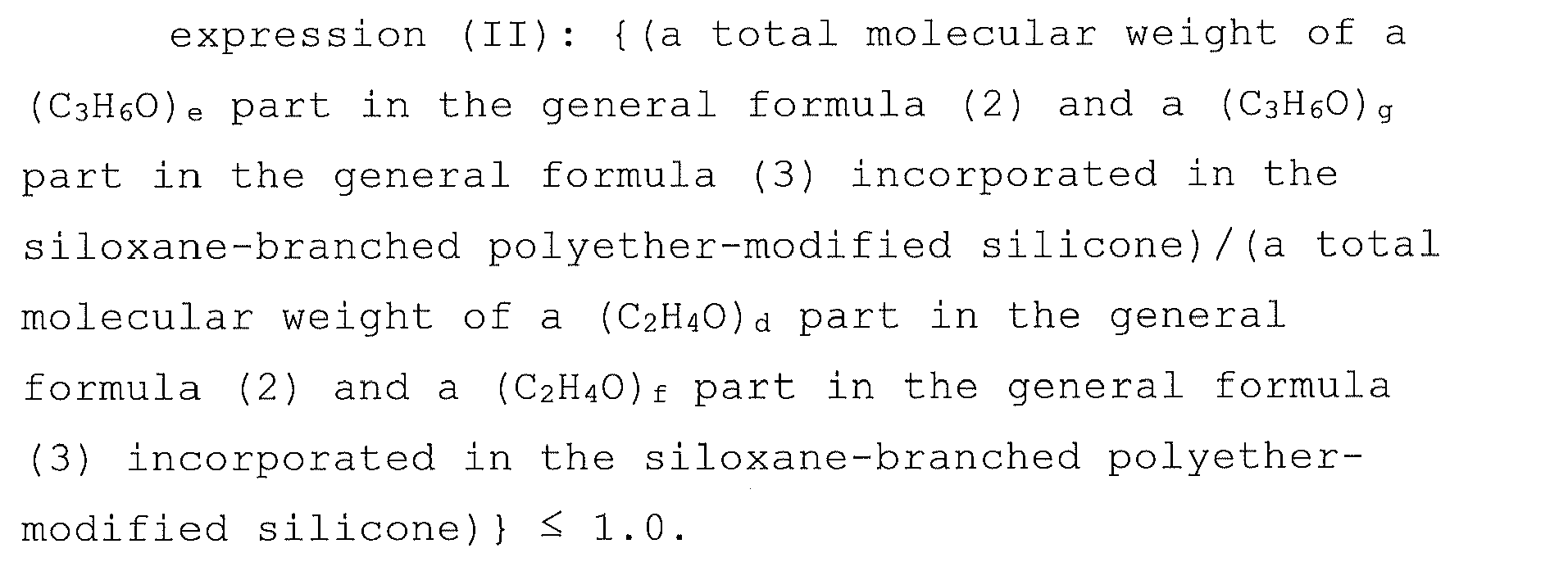
- the siloxane-branched polyether-modified silicone shown by the formula (1) satisfies the following expression (I), 5 ⁇ a total molecular weight of a C 2 H 4 O d part in the general formula 2 and a C 2 H 4 O f part in the general formula 3 incorporated in the siloxane - branched polyether-modified silicone / a molecular weight of the siloxane-branched polyether- modified silicone ⁇ 20 ⁇ 10 ; and the following expression II , ⁇ a total molecular weight of a C 3 H 6 O e part in the general formula 2 and a C 3 H 6 O g part in the general formula 3 incorporated in the siloxane - branched polyether - modified silicone / a total molecular weight of a C 2 H 4 O d part in the general formula 2 and a C 2 H 4 O f part in the general formula 3 incorporated in the siloxane - branched polyether - modified silicone siloxane -
- the expression (I) is preferably 5.5 ⁇ a total molecular weight of a C 2 H 4 O d part in the general formula 2 and a C 2 H 4 O f part in the general formula 3 incorporated in the siloxane - branched polyether-modified silicone / a molecular weight of the siloxane-branched polyether- modified silicone ⁇ 20 ⁇ 9 .
- the expression (II) is preferably ⁇ a total molecular weight of a C 3 H 6 O e part in the general formula 2 and a C 3 H 6 O g part in the general formula 3 incorporated in the siloxane - branched polyether - modified silicone / a total molecular weight of a C 2 H 4 O d part in the general formula 2 and a C 2 H 4 O f part in the general formula 3 incorporated in the siloxane - branched polyether - modified silicone siloxane - branched polyether - modified silicone ⁇ ⁇ 0.5 .
- the value of the expression (I) is smaller than the range, the compatibility with other component(s) in the water-based paint composition is impaired, and this causes segregation or lowers the leveling property (forming spots). If the value is larger than the range, the antifouling property consequently lowers. Further, if the value of the expression (II) is larger than the range likewise, the compatibility with other component(s) in the water-based paint composition is impaired, and this causes segregation and lowers not only the leveling property (forming spots) but also lowers the antifouling property.
- the inventive additive for water-based paint may be the siloxane-branched polyether-modified silicone only, or may further contain a solvent in addition to the siloxane-branched polyether-modified silicone.
- the inventive additive for water-based paint contains a solvent and is added to a water-based paint composition, homogenizing by stirring becomes easier.
- the paint additive may contain other components as necessary.
- the solvent which may be blended to the inventive additive for water-based paint for example, it is possible to use one explained in the description of the water-based paint composition described below.
- Preferable ones are water, propylene glycol methyl ether, propylene glycol ethyl ether, propylene glycol butyl ether, dipropylene glycol methyl ether, dipropylene glycol ethyl ether, propylene glycol monomethyl ether acetate, butyl acetate methyl ethyl ketone, methyl isobutyl ketone.
- the water-based-paint additive may be a 10 to 90% solution of the siloxane-branched polyether-modified silicone, preferably 10 to 50% solution, and further preferably 15 to 30% solution.
- the present invention provides a water-based paint composition containing the additive for water-based paint.
- the water-based paint composition is used particularly for antifouling paint.
- the addition amount of the siloxane-branched polyether-modified silicone (that is, the effective component contained in the inventive additive for water-based paint) is 0.01 to 10 parts by mass, preferably 0.1 to 5 parts by mass, of 100 parts by mass of the inventive water-based paint composition. With these ranges of the addition amount, dirt prevention corresponding to the addition amount is surely obtained, which is cost effective.
- the inventive water-based paint composition preferably contains a resin.
- the resin is not particularly limited, and is selected from the group consisting of urethane resins, acrylic resins, amide resins, phenolic resins, epoxy resins, melamine resins, urea resins, alkyd resins, polyimide resins, polyalkylene resins, polyvinyl chloride, polystyrene, polyvinyl acetate, and alloys of the resins.
- the resin is preferably a urethane resin or an acrylic resin in view of the compatibility with the water-based-paint additive containing the siloxane-branched polyether-modified silicone.
- the addition amount of the resin is 10 to 99.5 parts by mass, preferably 30 to 90 parts by mass, of 100 parts by mass of the inventive water-based paint composition. With the resin content being 10 parts by mass or more, there is no fear of decrease of mechanical strength.
- the inventive water-based paint composition can be optionally blended with other well-known components in the industry as appropriate, such as a curing agent, a dilution solvent, a ultraviolet absorber, a polymerization initiator, a polymerization inhibitor, a neutralizing agent, a stabilizer (a light-resistant stabilizer, a weather-resistant stabilizer, a heat-resistant stabilizer), an antioxidant, a leveling agent, a defoaming agent, a viscosity adjuster, a precipitation-inhibitor, a pigment, a dye, a dispersant, an antistatic agent, an anti-fog agent, and a rubber.
- a curing agent such as a dilution solvent, a ultraviolet absorber, a polymerization initiator, a polymerization inhibitor, a neutralizing agent, a stabilizer (a light-resistant stabilizer, a weather-resistant stabilizer, a heat-resistant stabilizer), an antioxidant, a leveling agent, a defoaming agent,
- Isocyanate compounds usable in aqueous systems are useful as the curing agent.
- examples thereof include aliphatic isocyanate (hexamethylene diisocyanate derivative, Bayhydur XP 2655 manufactured by Covestro AG), etc.
- the amount of the curing agent is not particularly limited, and may be 1 to 30 parts by mass, preferably 3 to 20 parts by mass, of 100 parts by mass of the inventive water-based paint composition.
- the dilution solvent examples include water, alcohols, esters, aliphatic hydrocarbons, aromatic hydrocarbons, ketones.
- Preferable are water, propylene glycol methyl ether, propylene glycol ethyl ether, propylene glycol butyl ether, dipropylene glycol methyl ether, dipropylene glycol ethyl ether, propylene glycol monomethyl ether acetate, butyl acetate methyl ethyl ketone, and methyl isobutyl ketone.
- the amount of the dilution solvent is not particularly limited, and may be 10 to 90 parts by mass, preferably 20 to 70 parts by mass, of 100 parts by mass of the inventive water-based paint composition.
- the inventive water-based paint composition has a viscosity (25°C, B-type viscometer) of, for example, 1 to 10,000 mPa ⁇ s, preferably 10 to 5,000 mPa ⁇ s, in consideration of the coatability, film thickness, etc.
- the present invention relates to a coating layer using the water-based paint composition.
- the coating method with the water-based paint composition for obtaining the inventive coating layer includes spray coating, spin coating, roll coating, curtain coating, brushing, electrostatic coating, anionic and cationic electrodeposition coating, dipping, etc.
- the curing method after coating is not particularly limited and examples thereof include (heat) curing particularly at 0 to 200°C, more preferably 40 to 180°C.
- examples of base materials to which the coating layer is applied include: plastics such as polystyrene resins, acrylic resins, acrylonitrile-styrene-butadiene resins (ABS), polypropylene, ethylene-propylene resins, polycarbonate resins, Noryl resins, nylon resins, polyester resins, and blends (alloys) of these resins with, for example, polyolefins, fillers, and reinforcement materials, such as glasses and carbon fibers; thermosetting resins, such as epoxy resins, unsaturated polyester resins, and urethane resins; inorganic materials, such as glasses, mortars, asbestos-cement slates, and rocks; metals, such as iron (and alloys), copper (and alloys), aluminum (and alloys), and magnesium (and alloys); combustible materials, such as papers and vinyl fabrics; etc.
- plastics such as polystyrene resins, acrylic resins, acrylonitrile-styrene-butadiene
- organohydrogensiloxane shown by the following structural formula (I) In a reactor, 250 g of organohydrogensiloxane shown by the following structural formula (I), 43 g of organosiloxane shown by the following structural formula (i), and 150 g of isopropyl alcohol were mixed, and 0.05 g of isopropyl alcohol solution of 3% by mass chloroplatinic acid was added. This mixture was allowed to react at 80°C for 4 hours.
- the obtained compound (A) had a value of 5.3 in the expression (I), a value of 0 in the expression (II), and a weight-average molecular weight of 6,000.
- a compound (B) of the following formula was obtained in a yield of 95% as in Synthesis Example 1, except that 250 g of organohydrogensiloxane shown by the following structural formula (II) was used instead of one in the structural formula (I) in Synthesis Example 1, the addition amount of organosiloxane of the structural formula (i) was changed to 62 g, and polyoxyalkylene compound of the structural formula (b) was used in place of one in the structural formula (a) and added in an amount of 160 g.
- CH 2 CHCH 2 O(C 2 H 4 O) 12 H ... structural formula (b)
- the obtained compound (B) had a value of 5.7 in the expression (I), a value of 0 in the expression (II), and a weight-average molecular weight of 9,200.
- a compound (C) of the following formula was obtained in a yield of 95% as in Synthesis Example 1, except that 250 g of organohydrogensiloxane shown by the following structural formula (III) was used instead of one in the structural formula (I) in Synthesis Example 1, the addition amount of organosiloxane of the structural formula (i) was changed to 41 g, and polyoxyalkylene compound of the structural formula (c) was used in place of one in the structural formula (a) and added in an amount of 335 g.
- CH 2 CHCH 2 O(C 2 H 4 O) 15 (C 3 H 6 O) 5 H ... structural formula (c)
- the obtained compound (C) had a value of 7.0 in the expression (I), a value of 0.44 in the expression (II), and a weight-average molecular weight of 18,800.
- the obtained compound (F) had a value of 8.9 in the expression (I), a value of 0 in the expression (II), and a weight-average molecular weight of 16,800.
- a mixture was prepared by mixing 116 g of Bayhydrol A 2651 (aqueous dispersion of 41% acrylic resin manufactured by Covestro AG), 4.65 g of water, 23.3 g of Bayhydur XP 2655 (isocyanate-based curing agent for aqueous system, manufactured by Covestro AG), and 4.00 g of dipropylene glycol methyl ether.
- Bayhydrol A 2651 aqueous dispersion of 41% acrylic resin manufactured by Covestro AG
- 23.3 g of Bayhydur XP 2655 isocyanate-based curing agent for aqueous system, manufactured by Covestro AG
- dipropylene glycol methyl ether To 20 g of this mixture, 0.8 g of 25% dipropylene glycol methyl ether solution of the compound (A) obtained in Synthesis Example 1 was added as the additive for water-based paint.
- the resultant was mixed by using a dispersion mixer until uniform to prepare a water-based paint composition.
- the obtained water-based paint composition was coated on glass using an applicator so as to have the thickness of 30 ⁇ m, and heated and cured at 80°C for 90 minutes to form a coating layer (1).
- the obtained coating layer (1) was subjected to various evaluations as follows.
- the water-based paint composition was uniformly mixed by using a dispersion mixer and left standing for 10 minutes. Then, the state of the water-based paint composition was observed.
- the water-based paint composition was uniformly mixed by using a dispersion mixer and left standing for 10 minutes. Then, the state of the water-based paint composition was observed.
- the surface state of the coating layer on the glass was visually observed.
- a line was drawn with a marker pen on the coating layer on the glass, and rubbed with tissue paper. The easiness for erasing the line was evaluated in this event.
- a coating layer (2) was formed and the various properties thereof were evaluated as in Example 1, except that 25% dipropylene glycol methyl ether solution of the compound (B) was used instead of 25% dipropylene glycol methyl ether solution of the compound (A) in Example 1.
- a coating layer (3) was formed and the various properties thereof were evaluated as in Example 1, except that 25% dipropylene glycol methyl ether solution of the compound (C) was used instead of 25% dipropylene glycol methyl ether solution of the compound (A) in Example 1.
- a coating layer (4) was formed and the various properties thereof were evaluated as in Example 1, except that 25% dipropylene glycol methyl ether solution of the compound (F) was used instead of 25% dipropylene glycol methyl ether solution of the compound (A) in Example 1.
- a coating layer (5) was formed and the various properties thereof were evaluated as in Example 1, except that 25% dipropylene glycol methyl ether solution of the compound (A) in Example 1 was not added.
- a coating layer (6) was formed and the various properties thereof were evaluated as in Example 1, except that 25% dipropylene glycol methyl ether solution of a compound (D) of the following formula (the value in the expression (I): 3.9, the value in the expression (II): 0, weight-average molecular weight: 6,100) was used instead of 25% dipropylene glycol methyl ether solution of the compound (A) in Example 1.
- a coating layer (7) was formed and the various properties thereof were evaluated as in Example 1, except that 25% dipropylene glycol methyl ether solution of a compound (E) of the following formula (the value in the expression (I): 4.7, the value in the expression (II): 0, weight-average molecular weight: 6,100) was used instead of 25% dipropylene glycol methyl ether solution of the compound (A) in Example 1.
- a coating layer (8) was formed and the various properties thereof were evaluated as in Example 1, except that 25% dipropylene glycol methyl ether solution of a compound (G) of the following formula (the value in the expression (I): 10.1, the value in the expression (II): 0, weight-average molecular weight: 17,100) was used instead of 25% dipropylene glycol methyl ether solution of the compound (A) in Example 1.
- a coating layer (9) was formed and the various properties thereof were evaluated as in Example 1, except that 25% dipropylene glycol methyl ether solution of a compound (H) of the following formula (the value in the expression (I): 5.2, the value in the expression (II): 1.10, weight-average molecular weight: 20,400) was used instead of 25% dipropylene glycol methyl ether solution of the compound (A) in Example 1.
- Example 1 Example 2
- Example 3 Example 4 Comparative Example 1 Comparative Example 2 Comparative Example 3 Comparative Example 4 Comparative Example 5
- Coating layer (1) (2) (3) (4) (5) (6) (7)
- (9) Compatibility Excellent Excellent Excellent Excellent Excellent Excellent Excellent Excellent Bad Bad Excellent Fair Defoaming Property Excellent Excellent Excellent Excellent Fair Excellent Excellent Fair Excellent Leveling Property Excellent Excellent Excellent Excellent Bad Bad Fair Excellent Fair Antifouling Property Excellent Excellent Excellent Excellent Bad Bad Fair Bad Bad Bad
- the coating layers (1), (2), (3), and (4) formed from the water-based paint compositions using the inventive additives for water-based paint exhibited excellent antifouling property without impairing compatibility, defoaming property, and leveling property.
- Comparative Example 1 using the water-based paint composition without the additive failed to obtain good results in any of defoaming property, leveling property and antifouling property.
- Comparative Example 2 since the additive used in Comparative Example 2 did not have the structure of the general formula (4), good antifouling property was not obtained, either; besides, since the value in the expression (I) was not more than the lower limit value, the compatibility was also poor.
- Comparative Example 3 although the additive having the structure of the general formula (4) was used, the value in the expression (I) was not more than the lower limit value, so that the compatibility was poor, and the result of the antifouling property was also inferior to the present invention.
- Comparative Example 4 exceeded the upper limit of the expression (I), so that the antifouling property was lower. Further, Comparative Example 5 exceeded the upper limit of the expression (II), so that decreases in compatibility, leveling property, and antifouling property were observed.
Landscapes
- Chemical & Material Sciences (AREA)
- Organic Chemistry (AREA)
- Life Sciences & Earth Sciences (AREA)
- Engineering & Computer Science (AREA)
- Materials Engineering (AREA)
- Wood Science & Technology (AREA)
- Health & Medical Sciences (AREA)
- Chemical Kinetics & Catalysis (AREA)
- Medicinal Chemistry (AREA)
- Polymers & Plastics (AREA)
- Paints Or Removers (AREA)
- Compositions Of Macromolecular Compounds (AREA)
Abstract
Description
- The present invention relates to: an additive for water-based paint, the additive containing a siloxane-branched polyether-modified silicone; a water-based paint composition and a coating layer containing the additive for water-based paint; and, in further detail, a water-based paint composition and a coating layer with antifouling performance.
- In recent years, coatings with paints are performed so as to prevent dirt in various uses including: electric appliances, such as portable telephones, personal computers, televisions, and plasma displays; transportation equipment, such as motor vehicles and trains; and further various everyday necessities.
- As a paint with excellent antifouling property, generally, a composition using an additive which contains fluorine in a molecule (Patent Document 1) is known. However, because the material is expensive, and from the standpoint of environmental issues, fluorine-free additives are required. From the same standpoint of environmental issues, water-based (water-soluble, water-dispersible) materials are also attracting attention as paints to be used.
- As a fluorine-free paint additive, a polyether-modified silicone is widely used as paint additive for reasons of surface leveling property, defoaming property, etc. (Patent Document 2). However, a polyether-modified silicone imparting excellent antifouling performance is not known.
- On the other hand, as a polyether-modified silicone for enhancing an emulsifying property for cosmetics, a siloxane-branched polyether-modified silicone produced by addition reaction of a polyoxyalkylene compound and a silicone compound to an organohydrogenpolysiloxane is known (Patent Document 3). However, the document does not disclose applications for paints at all.
-
- Patent Document 1:
JP 2018-070683 A - Patent Document 2:
JP 2013-166830 A - Patent Document 3:
JP 2001-039819 A - The present invention has been made in view of the circumstance. An object of the present invention is to provide: a paint additive and a paint composition, particularly a water-based paint, with small environmental load and imparting excellent antifouling performance.
- To achieve the object, the present invention provides an additive for water-based paint, comprising a siloxane-branched polyether-modified silicone shown by an average composition formula (1) R1 aR2 bR3 cSiO(4-a-b-c)/2 and having a weight-average molecular weight in a range of 500 to 100,000, wherein in the formula (1) each R1 is identical to or different from one another and represents an organic group selected from an alkyl group, an aryl group, and an aralkyl group having 1 to 30 carbon atoms, and an organic group shown by a general formula (2) -CmH2m-O-(C2H4O)d(C3H6O)eR4;
- each R2 represents a group shown by a general formula (3) -CmH2m-O- (C2H4O)f(C3H6O)g-R5;
- each R3 represents an organosiloxane shown by the following general formula (4)

- R4 represents a hydrocarbon group having 4 to 30 carbon atoms, or an organic group shown by R6-(CO)-;
- R5 represents a hydrogen atom, a hydrocarbon group having 1 to 30 carbon atoms, or an organic group shown by R6-(CO)-;
- R6 represents a hydrocarbon group having 1 to 30 carbon atoms;
- R1 in the general formula (4) is the same as R1 in the formula (1) ;
- "a", "b", and "c" respectively satisfy 1.0≤a≤2.5, 0.001≤b≤1.5, and 0.001≤c≤1.5;
- "d" and "e" respectively represent integers satisfying 0≤d≤50 and 0≤e≤50;
- "f" and "g" respectively represent integers satisfying 2≤f≤200, 0≤g≤200, and f+g being 3 to 200;
- "m" represents an integer satisfying 0≤m≤10;
- "h" represents an integer satisfying 0≤h≤500; and
- "n" represents an integer satisfying 1≤n≤5, and wherein the siloxane-branched polyether-modified silicone satisfies the following expression (I) and the following expression (II),


- Such an additive for water-based paint can have little environmental load and impart excellent antifouling performance.
- Moreover, the additive for water-based paint preferably further comprises a solvent.
- Such an additive for water-based paint can have more excellent workability.
- Further, the present invention provides a water-based paint composition comprising the additive for water-based paint.
- Such a paint composition, particularly a water-based paint, contains the paint additive which successfully reduces environmental load and imparts excellent antifouling performance.
- Furthermore, the inventive water-based paint composition preferably comprises a resin selected from the group consisting of urethane resins, acrylic resins, amide resins, phenolic resins, epoxy resins, melamine resins, urea resins, alkyd resins, polyimide resins, polyalkylene resins, polyvinyl chloride, polystyrene, polyvinyl acetate, and alloys of the resins.
- Such various resins can be employed in the inventive water-based paint composition.
- In this case, the resin is preferably a urethane resin or an acrylic resin.
- These resins are preferable because of good compatibility with the additive for water-based paint containing the siloxane-branched polyether-modified silicone.
- In addition, the inventive water-based paint composition is preferably used for antifouling paint.
- The inventive water-based paint composition can exhibit excellent antifouling property without impairing various paint properties, such as defoaming property and leveling property.
- Further, the present invention provides a coating layer formed from the water-based paint composition.
- The inventive coating layer can be applied to various base materials, and exhibits excellent antifouling property.
- The use of the inventive additive for water-based paint containing the siloxane-branched polyether-modified silicone makes it possible to provide the water-based paint composition and coating layer with small environmental load and excellent antifouling property.
- As described above, there have been demands for the development of a paint additive, as well as a paint composition and particularly a water-based paint, with small environmental load and imparting excellent antifouling performance.
- The present inventor has diligently investigated to achieve the above object and consequently found that a siloxane-branched polyether-modified silicone imparts excellent antifouling performance to a paint, and completed the present invention.
- Specifically, the present invention is an additive for water-based paint, comprising a siloxane-branched polyether-modified silicone shown by an average composition formula (1) R1 aR2 bR3 cSiO(4-a-b-c)/2 and having a weight-average molecular weight in a range of 500 to 100,000,
wherein in the formula (1) each R1 is identical to or different from one another and represents an organic group selected from an alkyl group, an aryl group, and an aralkyl group having 1 to 30 carbon atoms, and an organic group shown by a general formula (2) -CmH2m-O-(C2H4O)d(C3H6O)eR4; - each R2 represents a group shown by a general formula (3) -CmH2m-O- (C2H4O)f(C3H6O)g-R5;
- each R3 represents an organosiloxane shown by the following general formula (4)

- R4 represents a hydrocarbon group having 4 to 30 carbon atoms, or an organic group shown by R6-(CO)-;
- R5 represents a hydrogen atom, a hydrocarbon group having 1 to 30 carbon atoms, or an organic group shown by R6-(CO)-;
- R6 represents a hydrocarbon group having 1 to 30 carbon atoms;
- R1 in the general formula (4) is the same as R1 in the formula (1);
- "a", "b", and "c" respectively satisfy 1.0≤a≤2.5, 0.001≤b≤1.5, and 0.001≤c≤1.5;
- "d" and "e" respectively represent integers satisfying 0≤d≤50 and 0≤e≤50;
- "f" and "g" respectively represent integers satisfying 2≤f≤200, 0≤g≤200, and f+g being 3 to 200;
- "m" represents an integer satisfying 0≤m≤10;
- "h" represents an integer satisfying 0≤h≤500; and
- "n" represents an integer satisfying 1≤n≤5, and wherein the siloxane-branched polyether-modified silicone satisfies the following expression (I), and the following expression (II),


- Hereinafter, the present invention will be described in detail. However, the present invention is not limited thereto.
- The siloxane-branched polyether-modified silicone contained in the additive for water-based paint of the present invention is shown by an average composition formula (1) R1 aR2 bR3 cSiO(4-a-b-c)/2. In the formula (1), each R1 is identical to or different from one another and represents an organic group selected from an alkyl group, an aryl group, and an aralkyl group having 1 to 30 carbon atoms, and an organic group shown by a general formula (2) -CmH2m-O- (C2H4O)d(C3H6O)eR4. Each R2 represents a group shown by a general formula (3) -CmH2m-O-(C2H4O)f(C3H6O)g-R5. Each R3 represents an organosiloxane shown by the following general formula (4)

- R4 represents a hydrocarbon group having 4 to 30 carbon atoms, or an organic group shown by R6-(CO)-. R5 represents a hydrogen atom, a hydrocarbon group having 1 to 30 carbon atoms, or an organic group shown by R6-(CO)-. R6 represents a hydrocarbon group having 1 to 30 carbon atoms. R1 in the general formula (4) is the same as R1 in the formula (1). "a", "b", and "c" respectively satisfy 1.0≤α≤2.5, 0.001≤b≤1.5, and 0.001≤c≤1.5. "d" and "e" respectively represent integers satisfying 0≤d≤50 and 0≤e≤50. "f" and "g" respectively represent integers satisfying 2≤f≤200, 0≤g≤200, and f+g being 3 to 200. "m" represents an integer satisfying 0≤m≤10. "h" represents an integer satisfying 0≤h≤500. "n" represents an integer satisfying 1≤n≤5.
- Further, the siloxane-branched polyether-modified silicone satisfies the following expression (I),
- expression (I): 5 ≤ {(a total molecular weight of a (C2H4O)d part in the general formula (2) and a (C2H4O)f part in the general formula (3) incorporated in the siloxane-branched polyether-modified silicone)/(a molecular weight of the siloxane-branched polyether-modified silicone)} × 20 ≤ 10; and the following expression (II),
- expression (II): {(a total molecular weight of a (C3H6O)e part in the general formula (2) and a (C3H6O)g part in the general formula (3) incorporated in the siloxane-branched polyether-modified silicone)/(a total molecular weight of a (C2H4O)d part in the general formula (2) and a (C2H4O)f part in the general formula (3) incorporated in the siloxane-branched polyether-modified silicone)} ≤ 1.0.
- R1 in the formulae is an alkyl group, an aryl group, and an aralkyl group having 1 to 30 carbon atoms. R1 is preferably an alkyl group, an aryl group, and an aralkyl group having 1 to 12 carbon atoms. R1 is particularly preferably a methyl group, an ethyl group, a propyl group, a hexyl group, an octyl group, a dodecyl group, a phenyl group, and a 2-phenylpropyl group. Preferably, 80% or more of R1's are methyl groups.
- Alternatively, R1 may be an alkoxy group, an ester group, an alkenyl ether residue, or an alkenyl ester residue shown by the general formula (2) -CmH2m-O-(C2H4O)d (C3H6O)e-R4. Herein R4 in the formula (2) is a monovalent hydrocarbon group having 4 to 30 carbon atoms, or an organic group shown by R6-(CO)-, and preferably a monovalent hydrocarbon group having 4 to 10 carbon atoms, or an organic group shown by R6-(CO)- because of availability. R6 is a hydrocarbon group having 1 to 30 carbon atoms, and preferably a hydrocarbon group having 1 to 10 carbon atoms because of availability.
- "d", "e" and "m" are respectively integers satisfying 0≤d≤50, 0≤e≤50, and 0≤m≤10, and preferably integers satisfying 0≤d≤30, 0≤e≤30, and 2≤m≤5 because of availability. Incidentally, when the polyoxyalkylene moiety in the formula (2) is composed of both ethyleneoxide units and propyleneoxide units, the polyoxyalkylene moiety may be any of a block polymer and a random polymer of these two units.
- R2 is a group shown by the general formula (3) - CmH2m-O- (C2H4O)f(C3H6O)g-R5. Herein R5 in the formula (3) represents a hydrogen atom, a monovalent hydrocarbon group having 1 to 30 carbon atoms, or an organic group shown by R6-(CO)-, and preferably a hydrocarbon group having 1 to 10 carbon atoms, an organic group shown by R6-(CO)-, or a hydrogen atom because of availability. R6 is as defined above.
- "f" and "g" are respectively integers satisfying 2≤f≤200 and 0≤g≤200, and preferably integers satisfying 2≤f≤50 and 0≤g≤50 because of availability. Further, f+g is an integer satisfying 3 to 200, and preferably an integer satisfying 5 to 100. If f+g is smaller than 3, the antifouling property lowers. If f+g is larger than 200, the synthesis is hindered. "m" is as defined above.
- Incidentally, like the formula (2), when the polyoxyalkylene moiety in the formula (3) is composed of both ethyleneoxide units and propyleneoxide units, the polyoxyalkylene moiety may be any of a block polymer and a random polymer of these two units.
- R3 is an organosiloxane shown by the following general formula (4).

- R1 is as defined above. "h" is an integer satisfying 0≤h≤500, and preferably an integer satisfying 1≤h≤100. "n" is an integer satisfying 1≤n≤5, and preferably 2 because of availability. If "h" is larger than 500, the synthesis is hindered, and the compatibility with a resin is lowered as the water-based paint composition in some cases.
- "a", "b", and "c" respectively satisfy 1.0≤a≤2.5, preferably 1.0≤a≤2.3, 0.001≤b≤1.5, preferably 0.05≤b≤1.0, and 0.001≤c≤1.5, preferably 0.01≤c≤1.0. If "a" and "b" deviates from the range, the compatibility is unstable as the water-based paint composition. Further, if "c" is below 0.001, the antifouling property as the water-based paint composition decreases, and if more than 1.5, the compatibility is unstable as the water-based paint composition.
- Further, the siloxane-branched polyether-modified silicone shown by the formula (1) has a weight-average molecular weight of 500 to 100,000, preferably 1,000 to 80,000, and particularly preferably 1,500 to 40,000, in terms of polystyrene according to GPC. When the weight-average molecular weight is less than 500, the antifouling property lowers. When the weight-average molecular weight is 100,000 or more, the resulting silicone has such high viscosity that it is difficult to handle, and further the compatibility with a resin is lowered as the water-based paint composition in some cases.
- The siloxane-branched polyether-modified silicone contained in the inventive additive for water-based paint can be obtained by a known method. For example, as described in Patent Document 3 (
JP 2001-039819 A - The siloxane-branched polyether-modified silicone shown by the formula (1) satisfies the following expression (I),

- Further, the expression (I) is preferably

- The expression (II) is preferably

- If the value of the expression (I) is smaller than the range, the compatibility with other component(s) in the water-based paint composition is impaired, and this causes segregation or lowers the leveling property (forming spots). If the value is larger than the range, the antifouling property consequently lowers. Further, if the value of the expression (II) is larger than the range likewise, the compatibility with other component(s) in the water-based paint composition is impaired, and this causes segregation and lowers not only the leveling property (forming spots) but also lowers the antifouling property.
- Moreover, the inventive additive for water-based paint may be the siloxane-branched polyether-modified silicone only, or may further contain a solvent in addition to the siloxane-branched polyether-modified silicone. When the inventive additive for water-based paint contains a solvent and is added to a water-based paint composition, homogenizing by stirring becomes easier. Further, the paint additive may contain other components as necessary.
- As the solvent which may be blended to the inventive additive for water-based paint, for example, it is possible to use one explained in the description of the water-based paint composition described below. Preferable ones are water, propylene glycol methyl ether, propylene glycol ethyl ether, propylene glycol butyl ether, dipropylene glycol methyl ether, dipropylene glycol ethyl ether, propylene glycol monomethyl ether acetate, butyl acetate methyl ethyl ketone, methyl isobutyl ketone. Furthermore, when the inventive additive for water-based paint contains a solvent, for example, the water-based-paint additive may be a 10 to 90% solution of the siloxane-branched polyether-modified silicone, preferably 10 to 50% solution, and further preferably 15 to 30% solution.
- Furthermore, the present invention provides a water-based paint composition containing the additive for water-based paint. The water-based paint composition is used particularly for antifouling paint.
- The addition amount of the siloxane-branched polyether-modified silicone (that is, the effective component contained in the inventive additive for water-based paint) is 0.01 to 10 parts by mass, preferably 0.1 to 5 parts by mass, of 100 parts by mass of the inventive water-based paint composition. With these ranges of the addition amount, dirt prevention corresponding to the addition amount is surely obtained, which is cost effective.
- The inventive water-based paint composition preferably contains a resin. The resin is not particularly limited, and is selected from the group consisting of urethane resins, acrylic resins, amide resins, phenolic resins, epoxy resins, melamine resins, urea resins, alkyd resins, polyimide resins, polyalkylene resins, polyvinyl chloride, polystyrene, polyvinyl acetate, and alloys of the resins. The resin is preferably a urethane resin or an acrylic resin in view of the compatibility with the water-based-paint additive containing the siloxane-branched polyether-modified silicone.
- The addition amount of the resin is 10 to 99.5 parts by mass, preferably 30 to 90 parts by mass, of 100 parts by mass of the inventive water-based paint composition. With the resin content being 10 parts by mass or more, there is no fear of decrease of mechanical strength.
- The inventive water-based paint composition can be optionally blended with other well-known components in the industry as appropriate, such as a curing agent, a dilution solvent, a ultraviolet absorber, a polymerization initiator, a polymerization inhibitor, a neutralizing agent, a stabilizer (a light-resistant stabilizer, a weather-resistant stabilizer, a heat-resistant stabilizer), an antioxidant, a leveling agent, a defoaming agent, a viscosity adjuster, a precipitation-inhibitor, a pigment, a dye, a dispersant, an antistatic agent, an anti-fog agent, and a rubber.
- Isocyanate compounds usable in aqueous systems are useful as the curing agent. Examples thereof include aliphatic isocyanate (hexamethylene diisocyanate derivative, Bayhydur XP 2655 manufactured by Covestro AG), etc. The amount of the curing agent is not particularly limited, and may be 1 to 30 parts by mass, preferably 3 to 20 parts by mass, of 100 parts by mass of the inventive water-based paint composition.
- Examples of the dilution solvent include water, alcohols, esters, aliphatic hydrocarbons, aromatic hydrocarbons, ketones. Preferable are water, propylene glycol methyl ether, propylene glycol ethyl ether, propylene glycol butyl ether, dipropylene glycol methyl ether, dipropylene glycol ethyl ether, propylene glycol monomethyl ether acetate, butyl acetate methyl ethyl ketone, and methyl isobutyl ketone. Particularly preferable are water, propylene glycol methyl ether, propylene glycol ethyl ether, propylene glycol butyl ether, dipropylene glycol methyl ether, and dipropylene glycol ethyl ether. The amount of the dilution solvent is not particularly limited, and may be 10 to 90 parts by mass, preferably 20 to 70 parts by mass, of 100 parts by mass of the inventive water-based paint composition.
- The inventive water-based paint composition has a viscosity (25°C, B-type viscometer) of, for example, 1 to 10,000 mPa·s, preferably 10 to 5,000 mPa·s, in consideration of the coatability, film thickness, etc.
- Further, the present invention relates to a coating layer using the water-based paint composition.
- Various methods to be applied for typical paints are available as the coating method with the water-based paint composition for obtaining the inventive coating layer. Specifically, examples thereof include spray coating, spin coating, roll coating, curtain coating, brushing, electrostatic coating, anionic and cationic electrodeposition coating, dipping, etc. In addition, the curing method after coating is not particularly limited and examples thereof include (heat) curing particularly at 0 to 200°C, more preferably 40 to 180°C.
- Moreover, examples of base materials to which the coating layer is applied (materials to be coated) include: plastics such as polystyrene resins, acrylic resins, acrylonitrile-styrene-butadiene resins (ABS), polypropylene, ethylene-propylene resins, polycarbonate resins, Noryl resins, nylon resins, polyester resins, and blends (alloys) of these resins with, for example, polyolefins, fillers, and reinforcement materials, such as glasses and carbon fibers; thermosetting resins, such as epoxy resins, unsaturated polyester resins, and urethane resins; inorganic materials, such as glasses, mortars, asbestos-cement slates, and rocks; metals, such as iron (and alloys), copper (and alloys), aluminum (and alloys), and magnesium (and alloys); combustible materials, such as papers and vinyl fabrics; etc.
- Hereinafter, the present invention will be specifically described with reference to Examples and Comparative Examples. However, the present invention is not limited thereto. Incidentally, in a case where multiple repeating units, each of which is shown in the parentheses, are included in the structural formulae described below, these units are arranged at random.
- In a reactor, 250 g of organohydrogensiloxane shown by the following structural formula (I), 43 g of organosiloxane shown by the following structural formula (i), and 150 g of isopropyl alcohol were mixed, and 0.05 g of isopropyl alcohol solution of 3% by mass chloroplatinic acid was added. This mixture was allowed to react at 80°C for 4 hours.


- Then, 140 g of polyoxyalkylene compound of the following structural formula (a) was added, and the reaction was further continued for 3 hours.
CH2=CHCH2O(C2H4O)9H ... structural formula (a)
- After completion of the reaction, the obtained solution was heated under reduced pressure to distill the solvent to give a compound (A) of organopolysiloxane shown by the following structural formula in a yield of 95%.


- The obtained compound (A) had a value of 5.3 in the expression (I), a value of 0 in the expression (II), and a weight-average molecular weight of 6,000.
- A compound (B) of the following formula was obtained in a yield of 95% as in Synthesis Example 1, except that 250 g of organohydrogensiloxane shown by the following structural formula (II) was used instead of one in the structural formula (I) in Synthesis Example 1, the addition amount of organosiloxane of the structural formula (i) was changed to 62 g, and polyoxyalkylene compound of the structural formula (b) was used in place of one in the structural formula (a) and added in an amount of 160 g.

CH2=CHCH2O(C2H4O)12H ... structural formula (b)

- The obtained compound (B) had a value of 5.7 in the expression (I), a value of 0 in the expression (II), and a weight-average molecular weight of 9,200.
- A compound (C) of the following formula was obtained in a yield of 95% as in Synthesis Example 1, except that 250 g of organohydrogensiloxane shown by the following structural formula (III) was used instead of one in the structural formula (I) in Synthesis Example 1, the addition amount of organosiloxane of the structural formula (i) was changed to 41 g, and polyoxyalkylene compound of the structural formula (c) was used in place of one in the structural formula (a) and added in an amount of 335 g.

CH2=CHCH2O(C2H4O)15(C3H6O)5H ... structural formula (c)

- The obtained compound (C) had a value of 7.0 in the expression (I), a value of 0.44 in the expression (II), and a weight-average molecular weight of 18,800.
- A compound (F) of the following formula was obtained in a yield of 95% as in Synthesis Example 3, except that 269 g of polyoxyalkylene compound of the structural formula (d) was used in place of one in the structural formula (c) in Synthesis Example 3.
CH2=CHCH2O(C2H4O)17H ... structural formula (d)

- The obtained compound (F) had a value of 8.9 in the expression (I), a value of 0 in the expression (II), and a weight-average molecular weight of 16,800.
- A mixture was prepared by mixing 116 g of Bayhydrol A 2651 (aqueous dispersion of 41% acrylic resin manufactured by Covestro AG), 4.65 g of water, 23.3 g of Bayhydur XP 2655 (isocyanate-based curing agent for aqueous system, manufactured by Covestro AG), and 4.00 g of dipropylene glycol methyl ether. To 20 g of this mixture, 0.8 g of 25% dipropylene glycol methyl ether solution of the compound (A) obtained in Synthesis Example 1 was added as the additive for water-based paint. Then, the resultant was mixed by using a dispersion mixer until uniform to prepare a water-based paint composition. After being left standing for 30 minutes, the obtained water-based paint composition was coated on glass using an applicator so as to have the thickness of 30 µm, and heated and cured at 80°C for 90 minutes to form a coating layer (1). The obtained coating layer (1) was subjected to various evaluations as follows.
- The water-based paint composition was uniformly mixed by using a dispersion mixer and left standing for 10 minutes. Then, the state of the water-based paint composition was observed.
- Excellent: transparent.
- Fair: slightly cloudy.
- Bad: cloudy or separated.
- The water-based paint composition was uniformly mixed by using a dispersion mixer and left standing for 10 minutes. Then, the state of the water-based paint composition was observed.
- Excellent: no foams.
- Fair: a few fine foams.
- Bad: a lot of foams.
- The surface state of the coating layer on the glass was visually observed.
- Excellent: smooth surface state.
- Fair: fine craters in places on surface.
- Bad: large craters and waves on surface.
- A line was drawn with a marker pen on the coating layer on the glass, and rubbed with tissue paper. The easiness for erasing the line was evaluated in this event.
- Excellent: the line was easily erased.
- Fair: the line was erased by repeatedly rubbing the layer with force.
- Bad: the line was not erased.
- A coating layer (2) was formed and the various properties thereof were evaluated as in Example 1, except that 25% dipropylene glycol methyl ether solution of the compound (B) was used instead of 25% dipropylene glycol methyl ether solution of the compound (A) in Example 1.
- A coating layer (3) was formed and the various properties thereof were evaluated as in Example 1, except that 25% dipropylene glycol methyl ether solution of the compound (C) was used instead of 25% dipropylene glycol methyl ether solution of the compound (A) in Example 1.
- A coating layer (4) was formed and the various properties thereof were evaluated as in Example 1, except that 25% dipropylene glycol methyl ether solution of the compound (F) was used instead of 25% dipropylene glycol methyl ether solution of the compound (A) in Example 1.
- A coating layer (5) was formed and the various properties thereof were evaluated as in Example 1, except that 25% dipropylene glycol methyl ether solution of the compound (A) in Example 1 was not added.
- A coating layer (6) was formed and the various properties thereof were evaluated as in Example 1, except that 25% dipropylene glycol methyl ether solution of a compound (D) of the following formula (the value in the expression (I): 3.9, the value in the expression (II): 0, weight-average molecular weight: 6,100) was used instead of 25% dipropylene glycol methyl ether solution of the compound (A) in Example 1.

- A coating layer (7) was formed and the various properties thereof were evaluated as in Example 1, except that 25% dipropylene glycol methyl ether solution of a compound (E) of the following formula (the value in the expression (I): 4.7, the value in the expression (II): 0, weight-average molecular weight: 6,100) was used instead of 25% dipropylene glycol methyl ether solution of the compound (A) in Example 1.

- A coating layer (8) was formed and the various properties thereof were evaluated as in Example 1, except that 25% dipropylene glycol methyl ether solution of a compound (G) of the following formula (the value in the expression (I): 10.1, the value in the expression (II): 0, weight-average molecular weight: 17,100) was used instead of 25% dipropylene glycol methyl ether solution of the compound (A) in Example 1.

- A coating layer (9) was formed and the various properties thereof were evaluated as in Example 1, except that 25% dipropylene glycol methyl ether solution of a compound (H) of the following formula (the value in the expression (I): 5.2, the value in the expression (II): 1.10, weight-average molecular weight: 20,400) was used instead of 25% dipropylene glycol methyl ether solution of the compound (A) in Example 1.

- The following Table 1 shows the results of Examples 1, 2, 3, and 4 and Comparative Examples 1, 2, 3, 4, and 5.
[Table 1] Example 1 Example 2 Example 3 Example 4 Comparative Example 1 Comparative Example 2 Comparative Example 3 Comparative Example 4 Comparative Example 5 Coating layer (1) (2) (3) (4) (5) (6) (7) (8) (9) Compatibility Excellent Excellent Excellent Excellent Excellent Bad Bad Excellent Fair Defoaming Property Excellent Excellent Excellent Excellent Fair Excellent Excellent Fair Excellent Leveling Property Excellent Excellent Excellent Excellent Bad Bad Fair Excellent Fair Antifouling Property Excellent Excellent Excellent Excellent Bad Bad Fair Bad Bad - As shown in Table 1, it was revealed that the coating layers (1), (2), (3), and (4) formed from the water-based paint compositions using the inventive additives for water-based paint exhibited excellent antifouling property without impairing compatibility, defoaming property, and leveling property.
- In contrast, Comparative Example 1 using the water-based paint composition without the additive failed to obtain good results in any of defoaming property, leveling property and antifouling property. Unlike the inventive additives for water-based paint, since the additive used in Comparative Example 2 did not have the structure of the general formula (4), good antifouling property was not obtained, either; besides, since the value in the expression (I) was not more than the lower limit value, the compatibility was also poor. In Comparative Example 3, although the additive having the structure of the general formula (4) was used, the value in the expression (I) was not more than the lower limit value, so that the compatibility was poor, and the result of the antifouling property was also inferior to the present invention. Meanwhile, Comparative Example 4 exceeded the upper limit of the expression (I), so that the antifouling property was lower. Further, Comparative Example 5 exceeded the upper limit of the expression (II), so that decreases in compatibility, leveling property, and antifouling property were observed.
- It should be noted that the present invention is not limited to the above-described embodiments. The embodiments are just examples, and any embodiments that substantially have the same feature and demonstrate the same functions and effects as those in the technical concept disclosed in claims of the present invention are included in the technical scope of the present invention.
Claims (7)
- An additive for water-based paint, comprising a siloxane-branched polyether-modified silicone shown by an average composition formula (1) R1 aR2 bR3 cSiO(4-a-b-c)/2 and having a weight-average molecular weight in a range of 500 to 100,000,
wherein in the formula (1) each R1 is identical to or different from one another and represents an organic group selected from an alkyl group, an aryl group, and an aralkyl group having 1 to 30 carbon atoms, and an organic group shown by a general formula (2) -CmH2m-O-(C2H4O)d(C3H6O)eR4;each R2 represents a group shown by a general formula (3) -CmH2m-O- (C2H4O)f(C3H6O)g-R5;each R3 represents an organosiloxane shown by the following general formula (4) R4 represents a hydrocarbon group having 4 to 30 carbon atoms, or an organic group shown by R6-(CO)-;R5 represents a hydrogen atom, a hydrocarbon group having 1 to 30 carbon atoms, or an organic group shown by R6-(CO)-;R6 represents a hydrocarbon group having 1 to 30 carbon atoms;R1 in the general formula (4) is the same as R1 in the formula (1);"a", "b", and "c" respectively satisfy 1.0≤a≤2.5, 0.001≤b≤1.5, and 0.001≤c≤1.5;"d" and "e" respectively represent integers satisfying 0≤d≤50 and 0≤e≤50;"f" and "g" respectively represent integers satisfying 2≤f≤200, 0≤g≤200, and f+g being 3 to 200;"m" represents an integer satisfying 0≤m≤10;"h" represents an integer satisfying 0≤h≤500; and"n" represents an integer satisfying 1≤n≤5, and wherein the siloxane-branched polyether-modified silicone satisfies the following expression (I) and the following expression (II),

- The additive for water-based paint according to claim 1, further comprising a solvent.
- A water-based paint composition comprising the additive for water-based paint according to claim 1 or 2.
- The water-based paint composition according to claim 3, comprising a resin selected from the group consisting of urethane resins, acrylic resins, amide resins, phenolic resins, epoxy resins, melamine resins, urea resins, alkyd resins, polyimide resins, polyalkylene resins, polyvinyl chloride, polystyrene, polyvinyl acetate, and alloys of the resins.
- The water-based paint composition according to claim 4, wherein the resin is a urethane resin or an acrylic resin.
- The water-based paint composition according to any one of claims 3 to 5, the composition being used for antifouling paint.
- A coating layer formed from the water-based paint composition according to any one of claims 3 to 6.
Applications Claiming Priority (2)
| Application Number | Priority Date | Filing Date | Title |
|---|---|---|---|
| JP2019196496A JP7158362B2 (en) | 2019-10-29 | 2019-10-29 | ADDITIVE FOR WATER-BASED PAINT, WATER-BASED PAINT COMPOSITION, AND COATING LAYER |
| PCT/JP2020/032432 WO2021084881A1 (en) | 2019-10-29 | 2020-08-27 | Aqueous paint additive, aqueous paint composition, and coating layer |
Publications (3)
| Publication Number | Publication Date |
|---|---|
| EP4053224A1 true EP4053224A1 (en) | 2022-09-07 |
| EP4053224A4 EP4053224A4 (en) | 2023-11-15 |
| EP4053224B1 EP4053224B1 (en) | 2025-07-16 |
Family
ID=75712468
Family Applications (1)
| Application Number | Title | Priority Date | Filing Date |
|---|---|---|---|
| EP20882834.3A Active EP4053224B1 (en) | 2019-10-29 | 2020-08-27 | Aqueous paint additive, aqueous paint composition, and coating layer |
Country Status (5)
| Country | Link |
|---|---|
| US (1) | US20240166886A1 (en) |
| EP (1) | EP4053224B1 (en) |
| JP (1) | JP7158362B2 (en) |
| CN (1) | CN114641541B (en) |
| WO (1) | WO2021084881A1 (en) |
Families Citing this family (2)
| Publication number | Priority date | Publication date | Assignee | Title |
|---|---|---|---|---|
| KR102800803B1 (en) * | 2022-06-07 | 2025-04-29 | 주식회사 케이씨씨 | Electrodeposition coating composition |
| CN115612336A (en) * | 2022-11-07 | 2023-01-17 | 东莞大宝化工制品有限公司 | Paint composite additive and preparation method thereof |
Family Cites Families (22)
| Publication number | Priority date | Publication date | Assignee | Title |
|---|---|---|---|---|
| JPS6279273A (en) * | 1985-10-01 | 1987-04-11 | Shin Etsu Chem Co Ltd | paint composition |
| JP2865518B2 (en) * | 1993-05-07 | 1999-03-08 | 信越化学工業株式会社 | Antifouling paint |
| JP3724988B2 (en) | 1999-07-30 | 2005-12-07 | 信越化学工業株式会社 | Novel silicone compound and cosmetic comprising the same |
| JP2004250699A (en) | 2003-01-31 | 2004-09-09 | Kose Corp | Detergent composition |
| DE102006031152A1 (en) * | 2006-07-04 | 2008-01-10 | Byk-Chemie Gmbh | Polyhydroxy-functional polysiloxanes as anti-adhesive and dirt-repellent additives in coatings, polymeric molding compounds and thermoplastics, process for their preparation and their use |
| KR101475801B1 (en) | 2007-05-01 | 2014-12-23 | 아크조노벨코팅스인터내셔널비.브이. | Anti-fouling coating compositions containing a carboxyl-functional organosilicone |
| JP4798396B2 (en) | 2008-07-07 | 2011-10-19 | 信越化学工業株式会社 | Underwater biological adhesion prevention coating composition and underwater structure using the same |
| DE102009022628A1 (en) * | 2008-12-05 | 2010-06-10 | Evonik Goldschmidt Gmbh | Method for modifying surfaces |
| JP5929668B2 (en) * | 2011-10-14 | 2016-06-08 | 日信化学工業株式会社 | Surfactant composition, coating solution containing the same, and rubber product treated with the solution |
| JP5788852B2 (en) * | 2011-11-01 | 2015-10-07 | 信越化学工業株式会社 | Fluorooxyalkylene group-containing polymer composition, surface treatment agent containing the composition, article treated with the surface treatment agent, and optical article |
| JP6369888B2 (en) * | 2011-12-27 | 2018-08-08 | 東レ・ダウコーニング株式会社 | Novel liquid organopolysiloxane and use thereof |
| JP6369887B2 (en) * | 2011-12-27 | 2018-08-08 | 東レ・ダウコーニング株式会社 | Novel co-modified organopolysiloxane, treatment agent containing the same, and external preparation |
| JP5934852B2 (en) | 2012-02-14 | 2016-06-15 | サンノプコ株式会社 | Surfactant, method for producing the same, and aqueous coating agent composition containing the same |
| KR20150082500A (en) * | 2012-11-13 | 2015-07-15 | 주고꾸 도료 가부시키가이샤 | Curable organopolysiloxane anti-fouling composite coating, and anti-fouling substrate coated with the composite coating |
| KR20160013959A (en) * | 2013-05-24 | 2016-02-05 | 비와이케이-케미 게엠베하 | Hyperbranched polyalkoxysiloxane additives for dirt-repellent surface coatings |
| US10174170B2 (en) * | 2014-04-21 | 2019-01-08 | Dow Corning Toray Co., Ltd. | Method for producing liquid high-purity polyhydric alcohol derivative-modified silicone or composition thereof |
| JP6480309B2 (en) | 2015-11-16 | 2019-03-06 | 信越化学工業株式会社 | Novel silicone compound and cosmetic containing the same |
| KR102287413B1 (en) * | 2016-04-27 | 2021-08-10 | 다우 실리콘즈 코포레이션 | Novel organopolysiloxanes or acid neutralized salts thereof, and uses thereof |
| EP3498777B1 (en) | 2016-08-10 | 2023-05-03 | Shin-Etsu Chemical Co., Ltd. | Organopolysiloxane emulsion compositon and resin composition |
| JP6658449B2 (en) | 2016-10-25 | 2020-03-04 | 信越化学工業株式会社 | Fluorine-containing acrylic compound, method for producing the same, and curable composition and article |
| JP6859080B2 (en) * | 2016-11-17 | 2021-04-14 | 中国塗料株式会社 | Antifouling paint compositions, antifouling coatings and their uses |
| JP6887783B2 (en) | 2016-11-17 | 2021-06-16 | 中国塗料株式会社 | Antifouling paint compositions, antifouling coatings and their uses |
-
2019
- 2019-10-29 JP JP2019196496A patent/JP7158362B2/en active Active
-
2020
- 2020-08-27 WO PCT/JP2020/032432 patent/WO2021084881A1/en not_active Ceased
- 2020-08-27 CN CN202080076084.0A patent/CN114641541B/en active Active
- 2020-08-27 US US17/768,673 patent/US20240166886A1/en active Pending
- 2020-08-27 EP EP20882834.3A patent/EP4053224B1/en active Active
Also Published As
| Publication number | Publication date |
|---|---|
| EP4053224B1 (en) | 2025-07-16 |
| JP7158362B2 (en) | 2022-10-21 |
| CN114641541B (en) | 2023-06-16 |
| JP2021070721A (en) | 2021-05-06 |
| EP4053224A4 (en) | 2023-11-15 |
| US20240166886A1 (en) | 2024-05-23 |
| WO2021084881A1 (en) | 2021-05-06 |
| CN114641541A (en) | 2022-06-17 |
Similar Documents
| Publication | Publication Date | Title |
|---|---|---|
| EP2297229B1 (en) | Polyhydroxyfunctional polysiloxane as anti-adhesive and dirt-repellant additives in coatings polymeric moulded masses and thermoplastics method for production and use thereof | |
| EP2035487B1 (en) | Polyhydroxyfunctional polysiloxanes, method for the production and use thereof | |
| EP4059985B1 (en) | Polyether-modified siloxane, paint additive, paint composition, coating agent, coating layer, and method for producing polyether-modified siloxane | |
| CN101389682B (en) | Branched polyglycols and branched polyether functional organopolysiloxanes and coatings containing same | |
| EP3687654B1 (en) | Polysiloxane defoaming agent | |
| EP3323867A1 (en) | Silicone composition for release paper or release film, and release paper and release film | |
| EP2468831B1 (en) | Coating agent composition | |
| EP0874032B1 (en) | Sprayable addition curable silicone foul release coatings and articles coated therewith | |
| CN114729227B (en) | Water-based paint additive, water-based paint composition and coating agent | |
| EP4053224B1 (en) | Aqueous paint additive, aqueous paint composition, and coating layer | |
| EP4053226B1 (en) | Paint additive, paint composition, and coating layer | |
| US20250250457A1 (en) | Coating composition and use thereof | |
| EP1174467A9 (en) | Heat stable, corrosion inhibiting polyorganosiloxane resins | |
| EP4314175A1 (en) | Two-component aqueous coating composition | |
| JPH09221630A (en) | Coating composition and coating film therefrom | |
| EP4671328A1 (en) | SILICONE EMULSION COMPOSITION | |
| JP2013091701A (en) | Curable composition |
Legal Events
| Date | Code | Title | Description |
|---|---|---|---|
| STAA | Information on the status of an ep patent application or granted ep patent |
Free format text: STATUS: THE INTERNATIONAL PUBLICATION HAS BEEN MADE |
|
| PUAI | Public reference made under article 153(3) epc to a published international application that has entered the european phase |
Free format text: ORIGINAL CODE: 0009012 |
|
| STAA | Information on the status of an ep patent application or granted ep patent |
Free format text: STATUS: REQUEST FOR EXAMINATION WAS MADE |
|
| 17P | Request for examination filed |
Effective date: 20220420 |
|
| AK | Designated contracting states |
Kind code of ref document: A1 Designated state(s): AL AT BE BG CH CY CZ DE DK EE ES FI FR GB GR HR HU IE IS IT LI LT LU LV MC MK MT NL NO PL PT RO RS SE SI SK SM TR |
|
| DAV | Request for validation of the european patent (deleted) | ||
| DAX | Request for extension of the european patent (deleted) | ||
| A4 | Supplementary search report drawn up and despatched |
Effective date: 20231011 |
|
| RIC1 | Information provided on ipc code assigned before grant |
Ipc: C09D 7/65 20180101ALI20231006BHEP Ipc: C09D 201/00 20060101ALI20231006BHEP Ipc: C08L 83/04 20060101ALI20231006BHEP Ipc: C09D 5/16 20060101ALI20231006BHEP Ipc: C09D 5/02 20060101AFI20231006BHEP |
|
| GRAP | Despatch of communication of intention to grant a patent |
Free format text: ORIGINAL CODE: EPIDOSNIGR1 |
|
| STAA | Information on the status of an ep patent application or granted ep patent |
Free format text: STATUS: GRANT OF PATENT IS INTENDED |
|
| INTG | Intention to grant announced |
Effective date: 20250305 |
|
| GRAS | Grant fee paid |
Free format text: ORIGINAL CODE: EPIDOSNIGR3 |
|
| GRAA | (expected) grant |
Free format text: ORIGINAL CODE: 0009210 |
|
| STAA | Information on the status of an ep patent application or granted ep patent |
Free format text: STATUS: THE PATENT HAS BEEN GRANTED |
|
| AK | Designated contracting states |
Kind code of ref document: B1 Designated state(s): AL AT BE BG CH CY CZ DE DK EE ES FI FR GB GR HR HU IE IS IT LI LT LU LV MC MK MT NL NO PL PT RO RS SE SI SK SM TR |
|
| REG | Reference to a national code |
Ref country code: GB Ref legal event code: FG4D |
|
| REG | Reference to a national code |
Ref country code: CH Ref legal event code: EP |
|
| REG | Reference to a national code |
Ref country code: DE Ref legal event code: R096 Ref document number: 602020054783 Country of ref document: DE |
|
| REG | Reference to a national code |
Ref country code: IE Ref legal event code: FG4D |
|
| PGFP | Annual fee paid to national office [announced via postgrant information from national office to epo] |
Ref country code: DE Payment date: 20250819 Year of fee payment: 6 |
|
| PGFP | Annual fee paid to national office [announced via postgrant information from national office to epo] |
Ref country code: GB Payment date: 20250821 Year of fee payment: 6 |
|
| PGFP | Annual fee paid to national office [announced via postgrant information from national office to epo] |
Ref country code: FR Payment date: 20250821 Year of fee payment: 6 |
|
| REG | Reference to a national code |
Ref country code: NL Ref legal event code: MP Effective date: 20250716 |
|
| PG25 | Lapsed in a contracting state [announced via postgrant information from national office to epo] |
Ref country code: PT Free format text: LAPSE BECAUSE OF FAILURE TO SUBMIT A TRANSLATION OF THE DESCRIPTION OR TO PAY THE FEE WITHIN THE PRESCRIBED TIME-LIMIT Effective date: 20251117 |
|
| PG25 | Lapsed in a contracting state [announced via postgrant information from national office to epo] |
Ref country code: NL Free format text: LAPSE BECAUSE OF FAILURE TO SUBMIT A TRANSLATION OF THE DESCRIPTION OR TO PAY THE FEE WITHIN THE PRESCRIBED TIME-LIMIT Effective date: 20250716 |
|
| REG | Reference to a national code |
Ref country code: AT Ref legal event code: MK05 Ref document number: 1814036 Country of ref document: AT Kind code of ref document: T Effective date: 20250716 |
|
| PG25 | Lapsed in a contracting state [announced via postgrant information from national office to epo] |
Ref country code: IS Free format text: LAPSE BECAUSE OF FAILURE TO SUBMIT A TRANSLATION OF THE DESCRIPTION OR TO PAY THE FEE WITHIN THE PRESCRIBED TIME-LIMIT Effective date: 20251116 |
|
| PG25 | Lapsed in a contracting state [announced via postgrant information from national office to epo] |
Ref country code: NO Free format text: LAPSE BECAUSE OF FAILURE TO SUBMIT A TRANSLATION OF THE DESCRIPTION OR TO PAY THE FEE WITHIN THE PRESCRIBED TIME-LIMIT Effective date: 20251016 |
|
| REG | Reference to a national code |
Ref country code: LT Ref legal event code: MG9D |
|
| PG25 | Lapsed in a contracting state [announced via postgrant information from national office to epo] |
Ref country code: AT Free format text: LAPSE BECAUSE OF FAILURE TO SUBMIT A TRANSLATION OF THE DESCRIPTION OR TO PAY THE FEE WITHIN THE PRESCRIBED TIME-LIMIT Effective date: 20250716 |
|
| PG25 | Lapsed in a contracting state [announced via postgrant information from national office to epo] |
Ref country code: FI Free format text: LAPSE BECAUSE OF FAILURE TO SUBMIT A TRANSLATION OF THE DESCRIPTION OR TO PAY THE FEE WITHIN THE PRESCRIBED TIME-LIMIT Effective date: 20250716 |
|
| PG25 | Lapsed in a contracting state [announced via postgrant information from national office to epo] |
Ref country code: HR Free format text: LAPSE BECAUSE OF FAILURE TO SUBMIT A TRANSLATION OF THE DESCRIPTION OR TO PAY THE FEE WITHIN THE PRESCRIBED TIME-LIMIT Effective date: 20250716 |
|
| PG25 | Lapsed in a contracting state [announced via postgrant information from national office to epo] |
Ref country code: GR Free format text: LAPSE BECAUSE OF FAILURE TO SUBMIT A TRANSLATION OF THE DESCRIPTION OR TO PAY THE FEE WITHIN THE PRESCRIBED TIME-LIMIT Effective date: 20251017 |
|
| PG25 | Lapsed in a contracting state [announced via postgrant information from national office to epo] |
Ref country code: SE Free format text: LAPSE BECAUSE OF FAILURE TO SUBMIT A TRANSLATION OF THE DESCRIPTION OR TO PAY THE FEE WITHIN THE PRESCRIBED TIME-LIMIT Effective date: 20250716 |
|
| PG25 | Lapsed in a contracting state [announced via postgrant information from national office to epo] |
Ref country code: LV Free format text: LAPSE BECAUSE OF FAILURE TO SUBMIT A TRANSLATION OF THE DESCRIPTION OR TO PAY THE FEE WITHIN THE PRESCRIBED TIME-LIMIT Effective date: 20250716 |
|
| PG25 | Lapsed in a contracting state [announced via postgrant information from national office to epo] |
Ref country code: PL Free format text: LAPSE BECAUSE OF FAILURE TO SUBMIT A TRANSLATION OF THE DESCRIPTION OR TO PAY THE FEE WITHIN THE PRESCRIBED TIME-LIMIT Effective date: 20250716 Ref country code: BG Free format text: LAPSE BECAUSE OF FAILURE TO SUBMIT A TRANSLATION OF THE DESCRIPTION OR TO PAY THE FEE WITHIN THE PRESCRIBED TIME-LIMIT Effective date: 20250716 |
|
| PG25 | Lapsed in a contracting state [announced via postgrant information from national office to epo] |
Ref country code: RS Free format text: LAPSE BECAUSE OF FAILURE TO SUBMIT A TRANSLATION OF THE DESCRIPTION OR TO PAY THE FEE WITHIN THE PRESCRIBED TIME-LIMIT Effective date: 20251016 |
|
| PG25 | Lapsed in a contracting state [announced via postgrant information from national office to epo] |
Ref country code: ES Free format text: LAPSE BECAUSE OF FAILURE TO SUBMIT A TRANSLATION OF THE DESCRIPTION OR TO PAY THE FEE WITHIN THE PRESCRIBED TIME-LIMIT Effective date: 20250716 |
|
| PG25 | Lapsed in a contracting state [announced via postgrant information from national office to epo] |
Ref country code: RO Free format text: LAPSE BECAUSE OF FAILURE TO SUBMIT A TRANSLATION OF THE DESCRIPTION OR TO PAY THE FEE WITHIN THE PRESCRIBED TIME-LIMIT Effective date: 20250716 |
|
| REG | Reference to a national code |
Ref country code: CH Ref legal event code: H13 Free format text: ST27 STATUS EVENT CODE: U-0-0-H10-H13 (AS PROVIDED BY THE NATIONAL OFFICE) Effective date: 20260324 |
|
| PG25 | Lapsed in a contracting state [announced via postgrant information from national office to epo] |
Ref country code: SM Free format text: LAPSE BECAUSE OF FAILURE TO SUBMIT A TRANSLATION OF THE DESCRIPTION OR TO PAY THE FEE WITHIN THE PRESCRIBED TIME-LIMIT Effective date: 20250716 |
|
| PG25 | Lapsed in a contracting state [announced via postgrant information from national office to epo] |
Ref country code: DK Free format text: LAPSE BECAUSE OF FAILURE TO SUBMIT A TRANSLATION OF THE DESCRIPTION OR TO PAY THE FEE WITHIN THE PRESCRIBED TIME-LIMIT Effective date: 20250716 |
|
| PG25 | Lapsed in a contracting state [announced via postgrant information from national office to epo] |
Ref country code: LU Free format text: LAPSE BECAUSE OF NON-PAYMENT OF DUE FEES Effective date: 20250827 Ref country code: IT Free format text: LAPSE BECAUSE OF FAILURE TO SUBMIT A TRANSLATION OF THE DESCRIPTION OR TO PAY THE FEE WITHIN THE PRESCRIBED TIME-LIMIT Effective date: 20250716 |
|
| PG25 | Lapsed in a contracting state [announced via postgrant information from national office to epo] |
Ref country code: CZ Free format text: LAPSE BECAUSE OF FAILURE TO SUBMIT A TRANSLATION OF THE DESCRIPTION OR TO PAY THE FEE WITHIN THE PRESCRIBED TIME-LIMIT Effective date: 20250716 Ref country code: CH Free format text: LAPSE BECAUSE OF NON-PAYMENT OF DUE FEES Effective date: 20250831 |
|
| PG25 | Lapsed in a contracting state [announced via postgrant information from national office to epo] |
Ref country code: EE Free format text: LAPSE BECAUSE OF FAILURE TO SUBMIT A TRANSLATION OF THE DESCRIPTION OR TO PAY THE FEE WITHIN THE PRESCRIBED TIME-LIMIT Effective date: 20250716 Ref country code: SK Free format text: LAPSE BECAUSE OF FAILURE TO SUBMIT A TRANSLATION OF THE DESCRIPTION OR TO PAY THE FEE WITHIN THE PRESCRIBED TIME-LIMIT Effective date: 20250716 |