EP4053164A1 - Manufacture of photo-crosslinkable biodegradable tissue adhesive using copolymer - Google Patents
Manufacture of photo-crosslinkable biodegradable tissue adhesive using copolymer Download PDFInfo
- Publication number
- EP4053164A1 EP4053164A1 EP20882584.4A EP20882584A EP4053164A1 EP 4053164 A1 EP4053164 A1 EP 4053164A1 EP 20882584 A EP20882584 A EP 20882584A EP 4053164 A1 EP4053164 A1 EP 4053164A1
- Authority
- EP
- European Patent Office
- Prior art keywords
- chemical formula
- copolymer
- photo
- hama
- hapa
- Prior art date
- Legal status (The legal status is an assumption and is not a legal conclusion. Google has not performed a legal analysis and makes no representation as to the accuracy of the status listed.)
- Pending
Links
Images


Classifications
-
- C—CHEMISTRY; METALLURGY
- C08—ORGANIC MACROMOLECULAR COMPOUNDS; THEIR PREPARATION OR CHEMICAL WORKING-UP; COMPOSITIONS BASED THEREON
- C08J—WORKING-UP; GENERAL PROCESSES OF COMPOUNDING; AFTER-TREATMENT NOT COVERED BY SUBCLASSES C08B, C08C, C08F, C08G or C08H
- C08J3/00—Processes of treating or compounding macromolecular substances
- C08J3/02—Making solutions, dispersions, lattices or gels by other methods than by solution, emulsion or suspension polymerisation techniques
- C08J3/03—Making solutions, dispersions, lattices or gels by other methods than by solution, emulsion or suspension polymerisation techniques in aqueous media
- C08J3/075—Macromolecular gels
-
- A—HUMAN NECESSITIES
- A61—MEDICAL OR VETERINARY SCIENCE; HYGIENE
- A61L—METHODS OR APPARATUS FOR STERILISING MATERIALS OR OBJECTS IN GENERAL; DISINFECTION, STERILISATION OR DEODORISATION OF AIR; CHEMICAL ASPECTS OF BANDAGES, DRESSINGS, ABSORBENT PADS OR SURGICAL ARTICLES; MATERIALS FOR BANDAGES, DRESSINGS, ABSORBENT PADS OR SURGICAL ARTICLES
- A61L24/00—Surgical adhesives or cements; Adhesives for colostomy devices
- A61L24/04—Surgical adhesives or cements; Adhesives for colostomy devices containing macromolecular materials
- A61L24/08—Polysaccharides
-
- A—HUMAN NECESSITIES
- A61—MEDICAL OR VETERINARY SCIENCE; HYGIENE
- A61L—METHODS OR APPARATUS FOR STERILISING MATERIALS OR OBJECTS IN GENERAL; DISINFECTION, STERILISATION OR DEODORISATION OF AIR; CHEMICAL ASPECTS OF BANDAGES, DRESSINGS, ABSORBENT PADS OR SURGICAL ARTICLES; MATERIALS FOR BANDAGES, DRESSINGS, ABSORBENT PADS OR SURGICAL ARTICLES
- A61L24/00—Surgical adhesives or cements; Adhesives for colostomy devices
- A61L24/001—Use of materials characterised by their function or physical properties
- A61L24/0031—Hydrogels or hydrocolloids
-
- A—HUMAN NECESSITIES
- A61—MEDICAL OR VETERINARY SCIENCE; HYGIENE
- A61L—METHODS OR APPARATUS FOR STERILISING MATERIALS OR OBJECTS IN GENERAL; DISINFECTION, STERILISATION OR DEODORISATION OF AIR; CHEMICAL ASPECTS OF BANDAGES, DRESSINGS, ABSORBENT PADS OR SURGICAL ARTICLES; MATERIALS FOR BANDAGES, DRESSINGS, ABSORBENT PADS OR SURGICAL ARTICLES
- A61L24/00—Surgical adhesives or cements; Adhesives for colostomy devices
- A61L24/001—Use of materials characterised by their function or physical properties
- A61L24/0042—Materials resorbable by the body
-
- C—CHEMISTRY; METALLURGY
- C08—ORGANIC MACROMOLECULAR COMPOUNDS; THEIR PREPARATION OR CHEMICAL WORKING-UP; COMPOSITIONS BASED THEREON
- C08B—POLYSACCHARIDES; DERIVATIVES THEREOF
- C08B37/00—Preparation of polysaccharides not provided for in groups C08B1/00 - C08B35/00; Derivatives thereof
- C08B37/006—Heteroglycans, i.e. polysaccharides having more than one sugar residue in the main chain in either alternating or less regular sequence; Gellans; Succinoglycans; Arabinogalactans; Tragacanth or gum tragacanth or traganth from Astragalus; Gum Karaya from Sterculia urens; Gum Ghatti from Anogeissus latifolia; Derivatives thereof
- C08B37/0063—Glycosaminoglycans or mucopolysaccharides, e.g. keratan sulfate; Derivatives thereof, e.g. fucoidan
- C08B37/0072—Hyaluronic acid, i.e. HA or hyaluronan; Derivatives thereof, e.g. crosslinked hyaluronic acid (hylan) or hyaluronates
-
- C—CHEMISTRY; METALLURGY
- C08—ORGANIC MACROMOLECULAR COMPOUNDS; THEIR PREPARATION OR CHEMICAL WORKING-UP; COMPOSITIONS BASED THEREON
- C08J—WORKING-UP; GENERAL PROCESSES OF COMPOUNDING; AFTER-TREATMENT NOT COVERED BY SUBCLASSES C08B, C08C, C08F, C08G or C08H
- C08J3/00—Processes of treating or compounding macromolecular substances
- C08J3/24—Crosslinking, e.g. vulcanising, of macromolecules
-
- C—CHEMISTRY; METALLURGY
- C08—ORGANIC MACROMOLECULAR COMPOUNDS; THEIR PREPARATION OR CHEMICAL WORKING-UP; COMPOSITIONS BASED THEREON
- C08J—WORKING-UP; GENERAL PROCESSES OF COMPOUNDING; AFTER-TREATMENT NOT COVERED BY SUBCLASSES C08B, C08C, C08F, C08G or C08H
- C08J3/00—Processes of treating or compounding macromolecular substances
- C08J3/28—Treatment by wave energy or particle radiation
-
- C—CHEMISTRY; METALLURGY
- C08—ORGANIC MACROMOLECULAR COMPOUNDS; THEIR PREPARATION OR CHEMICAL WORKING-UP; COMPOSITIONS BASED THEREON
- C08L—COMPOSITIONS OF MACROMOLECULAR COMPOUNDS
- C08L5/00—Compositions of polysaccharides or of their derivatives not provided for in groups C08L1/00 or C08L3/00
- C08L5/08—Chitin; Chondroitin sulfate; Hyaluronic acid; Derivatives thereof
-
- C—CHEMISTRY; METALLURGY
- C09—DYES; PAINTS; POLISHES; NATURAL RESINS; ADHESIVES; COMPOSITIONS NOT OTHERWISE PROVIDED FOR; APPLICATIONS OF MATERIALS NOT OTHERWISE PROVIDED FOR
- C09J—ADHESIVES; NON-MECHANICAL ASPECTS OF ADHESIVE PROCESSES IN GENERAL; ADHESIVE PROCESSES NOT PROVIDED FOR ELSEWHERE; USE OF MATERIALS AS ADHESIVES
- C09J105/00—Adhesives based on polysaccharides or on their derivatives, not provided for in groups C09J101/00 or C09J103/00
- C09J105/08—Chitin; Chondroitin sulfate; Hyaluronic acid; Derivatives thereof
-
- A—HUMAN NECESSITIES
- A61—MEDICAL OR VETERINARY SCIENCE; HYGIENE
- A61L—METHODS OR APPARATUS FOR STERILISING MATERIALS OR OBJECTS IN GENERAL; DISINFECTION, STERILISATION OR DEODORISATION OF AIR; CHEMICAL ASPECTS OF BANDAGES, DRESSINGS, ABSORBENT PADS OR SURGICAL ARTICLES; MATERIALS FOR BANDAGES, DRESSINGS, ABSORBENT PADS OR SURGICAL ARTICLES
- A61L2430/00—Materials or treatment for tissue regeneration
- A61L2430/40—Preparation and treatment of biological tissue for implantation, e.g. decellularisation, cross-linking
-
- C—CHEMISTRY; METALLURGY
- C08—ORGANIC MACROMOLECULAR COMPOUNDS; THEIR PREPARATION OR CHEMICAL WORKING-UP; COMPOSITIONS BASED THEREON
- C08J—WORKING-UP; GENERAL PROCESSES OF COMPOUNDING; AFTER-TREATMENT NOT COVERED BY SUBCLASSES C08B, C08C, C08F, C08G or C08H
- C08J2305/00—Characterised by the use of polysaccharides or of their derivatives not provided for in groups C08J2301/00 or C08J2303/00
- C08J2305/08—Chitin; Chondroitin sulfate; Hyaluronic acid; Derivatives thereof
Definitions
- the present disclosure relates to manufacture of a photo-crosslinkable biodegradable tissue adhesive using a copolymer.
- Medical tissue adhesives are used for wound healing by hemostasis or bonding of the wound, or by protecting a treatment site.
- fibrin-based tissue adhesives using the blood coagulation process in the body have high biocompatibility, it has a disadvantage in that it has low adhesion to mucous membranes and wet tissues.
- a photo-crosslinkable tissue adhesive capable of maintaining high adhesion with tissues by forming a hydrogel on the spot by light such as UV, is attracting attention.
- it is possible to achieve high adhesion to a desired tissue by introducing a photo-crosslinking group to a water-soluble polymer to prepare a photo-crosslinkable polymer, and irradiating light to a solution dissolved with the same to form a hydrogel.
- hyaluronic acid which is a component of various tissues in the human body, may help wound healing, and thus introduction of the photo-crosslinking group may facilitate wound closure as well as tissue regeneration.
- the conventional photo-crosslinkable HA has a problem in that it is used only in limited fields due to poor flexibility and difficulty in controlling physical properties.
- An object of the present disclosure is to provide a copolymeric hyaluronic acid with different photo-crosslinking lengths forming multilength networks, thereby providing excellent elongation, mechanical properties, and excellent adhesiveness even in skin and mucosal tissues.
- Another object of the present disclosure is to provide a biodegradable tissue adhesive using the hyaluronic acid copolymer compound.
- example embodiments of the present disclosure provide a compound represented by Chemical Formula 1.
- n is an integer of 1 to 10,000, respectively.
- X 1 ⁇ X 8 may be the same or different and is OH or a substituent of Chemical Formula 1-1, and
- p or q is an integer of 0 to 10, respectively.
- example embodiments of the present disclosure provide a hydrogel which includes compounds represented by Chemical Formula 1 to 3 and is formed via a photo-crosslinking reaction.
- example embodiments of the present disclosure provide a biodegradable tissue adhesive including the compound represented by Chemical Formula 1 above.
- a hyaluronic acid copolymer compound prepared according to example embodiments of the present disclosure does not fundamentally undergo phase separation as a single component (unlike blending system), and has excellent elongation and mechanical properties as well as excellent adhesion to skin and mucosal tissues.
- the adhesive since the physical properties of the adhesive may be controlled by copolymeric hyaluronic acid compounds with multiple photocrosslinkable groups with crosslinking lengths, the adhesive may be used as a medical adhesive to be used in various parts of the body and is also useful as a medical hemostatic agent, a wound dressing agent, and an anti-adhesion agent.
- the present inventors synthesized a hyaluronic acid copolymer compound copolymerized with hyaluronic acid compounds having different photo-crosslinking lengths with excellent properties such as elongation, mechanical strength, and tissue adhesion, enabling manufacture of tissue adhesives having desired adhesiveness and physical properties while not fundamentally undergoing phase separation. Therefore, the inventors completed the present invention by discovering that the hyaluronic acid copolymer compound may be usefully used as a medical adhesive, a medical hemostatic agent, a wound dressing agent, and an anti-adhesion agent that are applicable to various parts of the body.
- An example embodiment of the present disclosure provides a compound represented by Chemical Formula 1.
- n is an integer of 1 to 10,000, respectively, X 1 ⁇ X 8 may be the same or different and is OH or a substituent represented by Chemical Formula 1-1, and
- p or q is an integer of 0 to 10, respectively.
- each of X 1 ⁇ X 4 and X 5 ⁇ X 8 essentially includes at least one substituent represented by Chemical Formula 1-1, the remainder may be a hydroxyl group, and the substitution rate of the substituent of Chemical Formula 1-1 may be 1 to 400%.
- X 1 ⁇ X 4 include at least one substituent of Chemical Formula 1-1
- X 5 ⁇ X 8 also include at least one substituent of Chemical Formula 1-1 which is different from the substituent of X 1 ⁇ X 4
- p or q is preferably an integer of 0 to 10, respectively.
- the compound of Chemical Formula 1 has an ethylenically unsaturated group in a hyaluronic acid.
- the compound represented by Chemical Formula 1 may be a compound represented by Chemical Formula 2 or Chemical Formula 3 below.
- n is an integer of 1 to 10,000, respectively.
- the compound represented by Chemical Formula 1 may be randomly copolymerized with m and n in a ratio of 9:1 to 7:3 and may preferably be formed by random copolymerization in a ratio of 7:3, but is not limited thereto.
- the compounds of Chemical Formulas 1 to 3 are hyaluronic acid copolymer compounds obtained by random copolymerization of hyaluronic acid compounds having different photo-crosslinking lengths, and problems such as phase separation and degradation in the commercial value of a product that may occur by simply mixing two or more polymers may be solved.
- the compound of Chemical Formula 2 manufactured by random copolymerization of HAMA and HAPA shows improved mechanical strength than a simple mixture of HAMA and HAPA and also exhibits excellent elongation and adhesion.
- a multi-network structure is formed inside a copolymer hydrogel, which increases flexibility as well as mechanical strength at the same time, whereas, generally in the case of a mixture, the strength of the mixture is difficult to be higher than that of a single material (HAMA) having high strength, showing only strength of an average value.
- an example embodiment of the present disclosure provides a hydrogel which includes the compounds represented by Chemical Formula 1 to Chemical Formula 3 and is formed via a photo-crosslinking reaction.
- the hydrogel may be used as a carrier for a physiologically active material or drug delivery, and tissue regeneration and implant material for filling, but is not limited thereto.
- an example embodiment of the present disclosure provides a biodegradable tissue adhesive including any one of the compounds represented by the Chemical Formula 1 to Chemical Formula 3.
- the compound is a photo-crosslinkable biodegradable tissue adhesive capable of maintaining a high adhesion with tissues by forming a hydrogel through a light-induced crosslinking reaction.
- the photo-crosslinking reaction as well as a UV-induced crosslinking reaction, enables the formation of a hydrogel by the photo-crosslinking reaction even under light of other wavelengths including visible light if using a photoinitiator having different absorption wavelength.
- biodegradable tissue adhesive may be used as any one or more selected from the group consisting of a medical adhesive, a medical hemostatic agent, a wound dressing agent, an anti-adhesion agent, a cell culture support, a 3D printer bioink, and a bio-coating material, but is not limited thereto.
- HAMA photo-crosslinkable hyaluronic acid methacrylate
- HABA hyaluronic acid butylacrylate
- HAPA hyaluronic acid pentacrylate
- the copolymer fundamentally has no risk of undergoing the phase separation.
- the newly synthesized photo-crosslinkable copolymer is flexible and has excellent mechanical strength while the physical properties of an adhesive are freely adjustable, thereby enabling development of medical adhesives to be used in various parts of the body.
- copolymer compound according to the example embodiment of the present disclosure may be applied as a medical hemostatic agent, a wound dressing agent, an anti-adhesion agent, a cell culture support, a 3D printer bioink, and a bio-coating material, but any application is possible if being usable as a bioadhesive without limitation.
- HAMA-co-HAPA the ratio of m and n was 7:3, and HAMA-co-HAPA copolymers whose ratio of methacrylic anhydride and 4-pentenoic anhydride to be added varies from 10:0 to 9:1 were prepared to be used as a sample for Examples below.
- HAMA and HAPA were prepared by simply mixing the prepared HAMA and HAPA in varied mixing ratios of 10:0, 9:1, 8:2, 7:3, 6:4 and 5:5, respectively.
- test piece molded in the dogbone shape according to the ASTM method using AND's Universal testing machine was measured at a speed of 1 mm/min.
- the HAMA-co-HAPA copolymer showed higher adhesion than the HAMA single polymer, which is determined to be due to the improvement in mechanical properties.
Landscapes
- Health & Medical Sciences (AREA)
- Chemical & Material Sciences (AREA)
- Life Sciences & Earth Sciences (AREA)
- General Health & Medical Sciences (AREA)
- Organic Chemistry (AREA)
- Public Health (AREA)
- Engineering & Computer Science (AREA)
- Surgery (AREA)
- Epidemiology (AREA)
- Materials Engineering (AREA)
- Animal Behavior & Ethology (AREA)
- Veterinary Medicine (AREA)
- Chemical Kinetics & Catalysis (AREA)
- Polymers & Plastics (AREA)
- Medicinal Chemistry (AREA)
- Dispersion Chemistry (AREA)
- Molecular Biology (AREA)
- Biochemistry (AREA)
- Materials For Medical Uses (AREA)
- Polysaccharides And Polysaccharide Derivatives (AREA)
- Medicinal Preparation (AREA)
- Medicines That Contain Protein Lipid Enzymes And Other Medicines (AREA)
- Pharmaceuticals Containing Other Organic And Inorganic Compounds (AREA)
- Adhesives Or Adhesive Processes (AREA)
Abstract
Description
- The present disclosure relates to manufacture of a photo-crosslinkable biodegradable tissue adhesive using a copolymer.
- Medical tissue adhesives are used for wound healing by hemostasis or bonding of the wound, or by protecting a treatment site.
- Conventional cyanoacrylate-based tissue adhesives show fast adhesive performance, but have poor adhesion and flexibility on wet surfaces, and toxic by-products such as formaldehyde are generated in the decomposition process, resulting in low biocompatibility. Further, since a formed adhesive layer is opaque and uneven, there has been a limitation in that it is difficult to apply to a surface requiring high light transmittance, such as the surface of eyeballs.
- In addition, although fibrin-based tissue adhesives using the blood coagulation process in the body have high biocompatibility, it has a disadvantage in that it has low adhesion to mucous membranes and wet tissues.
- Recently, a photo-crosslinkable tissue adhesive, capable of maintaining high adhesion with tissues by forming a hydrogel on the spot by light such as UV, is attracting attention. In general, it is possible to achieve high adhesion to a desired tissue by introducing a photo-crosslinking group to a water-soluble polymer to prepare a photo-crosslinkable polymer, and irradiating light to a solution dissolved with the same to form a hydrogel.
- In particular, hyaluronic acid (HA), which is a component of various tissues in the human body, may help wound healing, and thus introduction of the photo-crosslinking group may facilitate wound closure as well as tissue regeneration.
- However, the conventional photo-crosslinkable HA has a problem in that it is used only in limited fields due to poor flexibility and difficulty in controlling physical properties.
- Therefore, there is a need for research on a photo-crosslinkable hyaluronic acid compound using a multinetwork-forming copolymer providing improved mechanical properties (mechanical strength and flexibility).
- An object of the present disclosure is to provide a copolymeric hyaluronic acid with different photo-crosslinking lengths forming multilength networks, thereby providing excellent elongation, mechanical properties, and excellent adhesiveness even in skin and mucosal tissues.
- In addition, another object of the present disclosure is to provide a biodegradable tissue adhesive using the hyaluronic acid copolymer compound.
- To achieve the above objects, example embodiments of the present disclosure provide a compound represented by Chemical Formula 1.

- In
Chemical Formula 1, m or n is an integer of 1 to 10,000, respectively, - X1~X8 may be the same or different and is OH or a substituent of Chemical Formula 1-1, and

- in Chemical Formula 1-1, p or q is an integer of 0 to 10, respectively.
- Further, example embodiments of the present disclosure provide a hydrogel which includes compounds represented by Chemical Formula 1 to 3 and is formed via a photo-crosslinking reaction.
- Furthermore, example embodiments of the present disclosure provide a biodegradable tissue adhesive including the compound represented by Chemical Formula 1 above.
- A hyaluronic acid copolymer compound prepared according to example embodiments of the present disclosure does not fundamentally undergo phase separation as a single component (unlike blending system), and has excellent elongation and mechanical properties as well as excellent adhesion to skin and mucosal tissues.
- In addition, since the physical properties of the adhesive may be controlled by copolymeric hyaluronic acid compounds with multiple photocrosslinkable groups with crosslinking lengths, the adhesive may be used as a medical adhesive to be used in various parts of the body and is also useful as a medical hemostatic agent, a wound dressing agent, and an anti-adhesion agent.
-
-
FIG. 1 is a diagram showing changes in tensile strength according to a mixing ratio of HAMA and HAPA. -
FIG. 2 is a diagram showing changes in mechanical properties according to a component ratio in a HAMA-co-HAPA copolymer and shows analysis results of (a) tensile strength, (b) tensile modulus, (c) toughness, and (d) elongation. -
FIG. 3 shows results of an adhesion test for a HAMA-co-HAPA copolymer. -
FIG. 4 is an NMR image of a HAMA-co-HAPA copolymer. -
FIGS. 5 and6 are NMR images of HAMA and HAPA, respectively. - Hereinafter, the present invention will be described in detail.
- The present inventors synthesized a hyaluronic acid copolymer compound copolymerized with hyaluronic acid compounds having different photo-crosslinking lengths with excellent properties such as elongation, mechanical strength, and tissue adhesion, enabling manufacture of tissue adhesives having desired adhesiveness and physical properties while not fundamentally undergoing phase separation. Therefore, the inventors completed the present invention by discovering that the hyaluronic acid copolymer compound may be usefully used as a medical adhesive, a medical hemostatic agent, a wound dressing agent, and an anti-adhesion agent that are applicable to various parts of the body.
- An example embodiment of the present disclosure provides a compound represented by Chemical Formula 1.


- In
Chemical Formula 1, m or n is an integer of 1 to 10,000, respectively,
X1~X8 may be the same or different and is OH or a substituent represented by Chemical Formula 1-1, and
- in Chemical Formula 1-1, p or q is an integer of 0 to 10, respectively.
- In this case, each of X1~X4 and X5~X8 essentially includes at least one substituent represented by Chemical Formula 1-1, the remainder may be a hydroxyl group, and the substitution rate of the substituent of Chemical Formula 1-1 may be 1 to 400%.
- In particular, in Chemical Formula 1, m or n is an integer of 1 to 10000 respectively, X1~X4 include at least one substituent of Chemical Formula 1-1, and X5~X8 also include at least one substituent of Chemical Formula 1-1 which is different from the substituent of X1~X4, and p or q is preferably an integer of 0 to 10, respectively.
- As described above, the compound of Chemical Formula 1 has an ethylenically unsaturated group in a hyaluronic acid.
- In addition, the compound represented by Chemical Formula 1 may be a compound represented by Chemical Formula 2 or Chemical Formula 3 below.


- In Chemical Formula 2 or Chemical Formula 3, m or n is an integer of 1 to 10,000, respectively.
- In this case, the compound represented by Chemical Formula 1 may be randomly copolymerized with m and n in a ratio of 9:1 to 7:3 and may preferably be formed by random copolymerization in a ratio of 7:3, but is not limited thereto.
- The compounds of
Chemical Formulas 1 to 3 are hyaluronic acid copolymer compounds obtained by random copolymerization of hyaluronic acid compounds having different photo-crosslinking lengths, and problems such as phase separation and degradation in the commercial value of a product that may occur by simply mixing two or more polymers may be solved. - According to an example embodiment of the present disclosure, it was confirmed that the compound of Chemical Formula 2 manufactured by random copolymerization of HAMA and HAPA shows improved mechanical strength than a simple mixture of HAMA and HAPA and also exhibits excellent elongation and adhesion. In other words, according to the example embodiment of the present disclosure, a multi-network structure is formed inside a copolymer hydrogel, which increases flexibility as well as mechanical strength at the same time, whereas, generally in the case of a mixture, the strength of the mixture is difficult to be higher than that of a single material (HAMA) having high strength, showing only strength of an average value.
- In addition, an example embodiment of the present disclosure provides a hydrogel which includes the compounds represented by Chemical Formula 1 to Chemical Formula 3 and is formed via a photo-crosslinking reaction. The hydrogel may be used as a carrier for a physiologically active material or drug delivery, and tissue regeneration and implant material for filling, but is not limited thereto.
- In addition, an example embodiment of the present disclosure provides a biodegradable tissue adhesive including any one of the compounds represented by the Chemical Formula 1 to Chemical Formula 3.
- In this case, the compound is a photo-crosslinkable biodegradable tissue adhesive capable of maintaining a high adhesion with tissues by forming a hydrogel through a light-induced crosslinking reaction. In this case, the photo-crosslinking reaction, as well as a UV-induced crosslinking reaction, enables the formation of a hydrogel by the photo-crosslinking reaction even under light of other wavelengths including visible light if using a photoinitiator having different absorption wavelength.
- In addition, the biodegradable tissue adhesive may be used as any one or more selected from the group consisting of a medical adhesive, a medical hemostatic agent, a wound dressing agent, an anti-adhesion agent, a cell culture support, a 3D printer bioink, and a bio-coating material, but is not limited thereto.
- Conventional photo-crosslinkable hyaluronic acid methacrylate (HAMA) has been applied in limited area due to lack of flexibility during photo-crosslinking. In order to improve the same, through adjustment of the mechanical properties of the hydrogel tissue adhesive by mixing hyaluronic acid butylacrylate (HABA) or hyaluronic acid pentacrylate (HAPA) with excellent elongation, the range of use may be broadened for a portion where movement occurs, thereby expecting the increase in the adhesion of tissues.
- However, simply mixing two or more polymers may cause phase separation due to internal and external factors, which leads to degradation in the commercial value of a product.
- In the present disclosure, in order to solve the issue, two or more photo-crosslinkable functional groups having different lengths were simultaneously introduced to hyaluronic acid to synthesize a new photo-crosslinkable copolymer with excellent mechanical properties while being flexible.
- As a single component, the copolymer fundamentally has no risk of undergoing the phase separation. In addition, the newly synthesized photo-crosslinkable copolymer is flexible and has excellent mechanical strength while the physical properties of an adhesive are freely adjustable, thereby enabling development of medical adhesives to be used in various parts of the body.
- In addition, the copolymer compound according to the example embodiment of the present disclosure may be applied as a medical hemostatic agent, a wound dressing agent, an anti-adhesion agent, a cell culture support, a 3D printer bioink, and a bio-coating material, but any application is possible if being usable as a bioadhesive without limitation.
- Hereinafter, the present disclosure will be described in more detail through examples. These examples are merely for describing the present disclosure in more detail, and it is apparent to a person of an ordinary skill in the art to which the present invention pertains that the scope of the present invention is not limited by the examples according to the gist of the present invention.
-

- As in
Scheme 1, 10 g (26 mmol) of hyaluronic acid was dissolved in 100 ml of purified water and cooled to 0-5°C. 36.4 mmol of methacrylic anhydride, 15.6 mmol of 4-pentenoic anhydride, and 100 ml of 3M NaOH solution were added thereto, followed by stirring for 2 days. The reaction product was purified by precipitation in ethanol and vacuum-dried to prepare a HAMA-HAPA random copolymer (hereinafter referred to as 'HAMA-co-HAPA'). - Yield: 82%, 1H-NMR (300 MHz, D2O):δ (ppm)= 6.5, 6.1, 5.6 (CH=CH2), 4.5-4.3 (CH2), 3.8-3.0 (CH), 2.5-2.35 (CH2CH2), 1.8 (CH3), 1.7 (CH3). (See
FIG. 4 ) - In the synthesized HAMA-co-HAPA, the ratio of m and n was 7:3, and HAMA-co-HAPA copolymers whose ratio of methacrylic anhydride and 4-pentenoic anhydride to be added varies from 10:0 to 9:1 were prepared to be used as a sample for Examples below.
-

- 10 g (26 mmol) of hyaluronic acid was dissolved in 100 ml of purified water and cooled to 0-5°C. Here, 104 mmol of methacrylic anhydride and 100 ml of 3M NaOH solution were added thereto, followed by stirring for 2 days. The reaction product was purified by precipitation in ethanol and vacuum-dried to prepare hyaluronic acid methacrylate (HAMA) (see
FIG. 5 ). - 10 g (26 mmol) of hyaluronic acid was dissolved in 100 ml of purified water and cooled to 0-5°C. 156 mmol of 4-pentenoic anhydride and 100 ml of 3M NaOH solution were added thereto, followed by stirring for 2 days. The reaction product was purified by precipitation in ethanol and vacuum-dried to prepare hyaluronic acid pentacrylate (HAPA) (see
FIG. 6 ). - Mixtures of HAMA and HAPA were prepared by simply mixing the prepared HAMA and HAPA in varied mixing ratios of 10:0, 9:1, 8:2, 7:3, 6:4 and 5:5, respectively.
- Tensile strength, tensile modulus, toughness, and elongation of the copolymer HAMA-co-HAPA were measure by a tensile test, wherein the copolymer HAMA-co-HAPA was synthesized to have HAMA and HAPA in a varied ratio of 10:0, 9:1, and 7:3 by varying the ratio of methacrylic anhydride and 4-pentenoic anhydride added in <Synthesis Example 1>.
- For the tensile test, a test piece molded in the dogbone shape according to the ASTM method using AND's Universal testing machine was measured at a speed of 1 mm/min.
- For tensile strength, the maximum stress was measured in a strain-stress curve, and for tensile modulus, the slope between stress and strain rate was measured. Toughness was analyzed by integrating the total area up to a fracture point of a specimen, and elongation was analyzed by measuring the strain rate at the fracture point.
- As a result, as shown in
FIG. 1 , it was confirmed that the tensile strength of the formed hydrogel decreased as the ratio of HAPA with a long cross-linking length increased in the mixture formed by simply mixing HAMA and HAPA. - However, in the preparation of the HAMA-co-HAPA copolymer according to <Synthesis Example 1>, the tensile strength and tensile modulus of the formed hydrogel increased as the ratio of HAPA with a long cross-linking length increased in the tensile test (see
FIGS. 2a and2b ). - In addition, in the toughness test showing resistance to deformation, the HAMA-co-HAPA copolymer showed a result that was more than twice higher than that of the HAMA compound (
FIG. 2c ) and also showed a significantly improved result in the elongation that was higher than that of the conventional photo-crosslinkable single polymer (HAMA, MA:PA=10:0) (FIG. 2d ). - Therefore, it was confirmed that by synthesizing the copolymer, rather than simply mixing HAMA and HAPA, the mechanical strength as well as the flexibility were improved.
- In order to evaluate the adhesive performance of the HAMA-co-HAPA copolymer prepared in <Synthesis Example 1>, a Lap shear test of the copolymer HAMA-co-HAPA was performed, wherein the HAMA-co-HAPA was synthesized by varying the mixing ratio of methacrylic anhydride and 4-pentenoic anhydride to be added from 10:0 to 9:1.
- After applying a HAMA-co-HAPA solution within artificial skin made of gelatin, UV was irradiated for 5 seconds, and the adhesion was evaluated by pulling both ends.
- As a result, as shown in
FIG. 3 , the HAMA-co-HAPA copolymer showed higher adhesion than the HAMA single polymer, which is determined to be due to the improvement in mechanical properties. - As described above, a specific part of the present invention has been described in detail, for a person of an ordinary skill in the art, it is apparent that these specific descriptions are merely preferred embodiments, and the scope of the present invention is not limited thereby. Accordingly, the substantial scope of the present invention will be defined by the appended claims and equivalents thereof.
Claims (7)
- A compound represented by Chemical Formula 1:
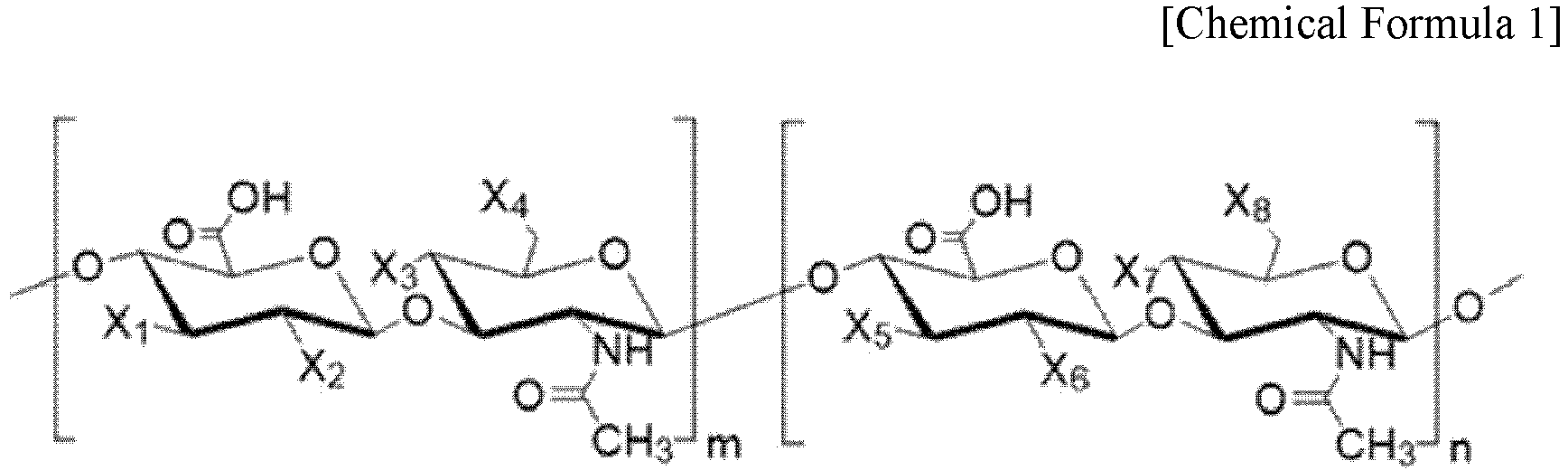
X1~X8 each may be the same or different and is OH or a substituent of Chemical Formula 1-1, and
- The compound of claim 1, wherein, in Chemical Formula 1, m or n is an integer of 1 to 10,000, respectively, X1~X4 include at least one substituent of Chemical Formula 1-1, and X5~X8 include at least one substituent of Chemical Formula 1-1 which is different from the substituent of X1~X4, and p or q is an integer of 0 to 10, respectively.
- The compound of claim 1, wherein the compound represented by Chemical Formula 1 is a compound represented by Chemical Formula 2 or Chemical Formula 3:


- The compound of claim 1, wherein the compound represented by Chemical Formula 1 is randomly copolymerized with m and n in a ratio of 9:1 to 7:3.
- A hydrogel, comprising the compound of any one of claims 1 to 4 and formed via a photo-crosslinking reaction.
- A biodegradable tissue adhesive, comprising the compound of any one of claims 1 to 4.
- The biodegradable tissue adhesive of claim 6, wherein the compound forms a hydrogel by a light-induced crosslinking reaction.
Applications Claiming Priority (3)
| Application Number | Priority Date | Filing Date | Title |
|---|---|---|---|
| KR20190137872 | 2019-10-31 | ||
| KR1020200011257A KR102415181B1 (en) | 2019-10-31 | 2020-01-30 | Preparation of photo-crosslinkable biodegradable tissue adhesive using copolymer |
| PCT/KR2020/014941 WO2021086072A1 (en) | 2019-10-31 | 2020-10-31 | Manufacture of photo-crosslinkable biodegradable tissue adhesive using copolymer |
Publications (2)
| Publication Number | Publication Date |
|---|---|
| EP4053164A1 true EP4053164A1 (en) | 2022-09-07 |
| EP4053164A4 EP4053164A4 (en) | 2023-11-08 |
Family
ID=75716054
Family Applications (1)
| Application Number | Title | Priority Date | Filing Date |
|---|---|---|---|
| EP20882584.4A Pending EP4053164A4 (en) | 2019-10-31 | 2020-10-31 | PRODUCTION OF A PHOTO-CROSS-LINKABLE BIODEGRADABLE TISSUE ADHESIVE USING A COPOLYMER |
Country Status (5)
| Country | Link |
|---|---|
| US (1) | US12472280B2 (en) |
| EP (1) | EP4053164A4 (en) |
| JP (1) | JP7328451B2 (en) |
| CN (1) | CN114667300B (en) |
| WO (1) | WO2021086072A1 (en) |
Families Citing this family (2)
| Publication number | Priority date | Publication date | Assignee | Title |
|---|---|---|---|---|
| CN121909218A (en) * | 2023-09-27 | 2026-04-21 | 旭化成株式会社 | Hyaluronic acid derivative, hyaluronic acid derivative crosslinked gel and pharmaceutical composition |
| JPWO2025134771A1 (en) * | 2023-12-21 | 2025-06-26 |
Family Cites Families (8)
| Publication number | Priority date | Publication date | Assignee | Title |
|---|---|---|---|---|
| US8293890B2 (en) * | 2004-04-30 | 2012-10-23 | Advanced Cardiovascular Systems, Inc. | Hyaluronic acid based copolymers |
| FR2967677B1 (en) | 2010-11-18 | 2014-05-16 | Centre Nat Rech Scient | POLYSACCHARIDE DERIVATIVES COMPRISING ALKENOUS PATTERN AND THIO-CLICK CHEMICAL COUPLING REACTION |
| EP2727597A1 (en) * | 2012-11-06 | 2014-05-07 | Centre National de la Recherche Scientifique (CNRS) | Glucose responsive hydrogel comprising pba-grafted hyaluronic acid (ha) |
| CN103724455B (en) | 2013-12-11 | 2016-07-06 | 四川大学 | A kind of preparation method of derivatives of hyaluronic acids and hydrogel thereof |
| KR101763368B1 (en) | 2016-02-04 | 2017-08-01 | 태경하이텍(주) | Silicon adhesvie compositoin with hyaluronic acid for moisturizing skin |
| KR102240726B1 (en) * | 2019-01-31 | 2021-04-16 | 주식회사 에스엔비아 | Radioisotope-labelled photo-crosslinkable hydrogels and fabrication method thereof |
| KR102577913B1 (en) * | 2020-11-20 | 2023-09-14 | 주식회사 에스엔비아 | Photo-crosslinked copolymeric hyaluronic acid sponge and method for preparing thereof |
| KR102595422B1 (en) * | 2020-12-10 | 2023-10-31 | 부산대학교 산학협력단 | Photocrosslinkable hemostatic composition |
-
2020
- 2020-10-31 JP JP2022525137A patent/JP7328451B2/en active Active
- 2020-10-31 CN CN202080076871.5A patent/CN114667300B/en active Active
- 2020-10-31 WO PCT/KR2020/014941 patent/WO2021086072A1/en not_active Ceased
- 2020-10-31 US US17/772,530 patent/US12472280B2/en active Active
- 2020-10-31 EP EP20882584.4A patent/EP4053164A4/en active Pending
Also Published As
| Publication number | Publication date |
|---|---|
| JP7328451B2 (en) | 2023-08-16 |
| US12472280B2 (en) | 2025-11-18 |
| EP4053164A4 (en) | 2023-11-08 |
| JP2023501200A (en) | 2023-01-18 |
| WO2021086072A1 (en) | 2021-05-06 |
| US20220387664A1 (en) | 2022-12-08 |
| CN114667300B (en) | 2023-05-16 |
| CN114667300A (en) | 2022-06-24 |
Similar Documents
| Publication | Publication Date | Title |
|---|---|---|
| US20170129999A1 (en) | PH Responsive Self-Healing Hydrogels Formed By Boronate-Catechol Complexation | |
| EP2792372B1 (en) | Biodegradable medical adhesive and preparation method and use thereof | |
| JP5599712B2 (en) | Oligofluorinated cross-linked polymer and use thereof | |
| CN103282368B (en) | Phosphorylcholine compound containing amino group and preparation method thereof | |
| US20250136758A1 (en) | Oxime Cross-Linked Biocompatible Polymer Hydrogels and Methods of Use Thereof | |
| CN105017528B (en) | A kind of preparation method and applications of the polymer containing catechol | |
| US12472280B2 (en) | Manufacture of photo-crosslinkable biodegradable tissue adhesive using copolymer | |
| JPWO2016143647A1 (en) | Method for producing low-concentration gel using gel precursor cluster, and gel obtained by the production method | |
| Zhang et al. | A nucleobase-inspired super adhesive hydrogel with desirable mechanical, tough and fatigue resistant properties based on cytosine and ε-caprolactone | |
| EP3103486A1 (en) | Preparation for adhesion prevention comprising composition of polycationic triblock copolymer and polyanionic polymer | |
| KR102515178B1 (en) | Preparation of photo-crosslinkable biodegradable tissue adhesive | |
| CN117126317A (en) | Polymerizable composition, method for forming adhesive material using same, and application thereof | |
| KR102415181B1 (en) | Preparation of photo-crosslinkable biodegradable tissue adhesive using copolymer | |
| CN105561377B (en) | A kind of degradable light curing medical adhesive and its preparation and application | |
| US10669435B2 (en) | Process for producing an antibacterial coating composition for implants | |
| JP2003505585A (en) | Hydrophilic biomedical composition | |
| CN117447717B (en) | Strong wet tissue adhesion hydrogel and preparation method and application thereof | |
| EP3052529B1 (en) | Single-step functionalization and cross-linking of hyaluronic acid | |
| EP4458890A1 (en) | Composition, kit and method for surface treatment of polymer material | |
| KR102595422B1 (en) | Photocrosslinkable hemostatic composition | |
| US20040102598A1 (en) | Novel thiol activation of polyurethanes and methods of making the same | |
| EP3713993B1 (en) | Hydrogel composition and its uses | |
| JP2004331637A (en) | Bifunctional cross-linking agent monomer, method for producing the same and cross-linked polymer | |
| PI et al. | Development of a methodology for the study of polymer wound coatings for application characteristics | |
| CN121401509B (en) | Intestinal microneedle anastomosis stent with antibacterial function and preparation method and application thereof |
Legal Events
| Date | Code | Title | Description |
|---|---|---|---|
| STAA | Information on the status of an ep patent application or granted ep patent |
Free format text: STATUS: THE INTERNATIONAL PUBLICATION HAS BEEN MADE |
|
| PUAI | Public reference made under article 153(3) epc to a published international application that has entered the european phase |
Free format text: ORIGINAL CODE: 0009012 |
|
| STAA | Information on the status of an ep patent application or granted ep patent |
Free format text: STATUS: REQUEST FOR EXAMINATION WAS MADE |
|
| 17P | Request for examination filed |
Effective date: 20220503 |
|
| AK | Designated contracting states |
Kind code of ref document: A1 Designated state(s): AL AT BE BG CH CY CZ DE DK EE ES FI FR GB GR HR HU IE IS IT LI LT LU LV MC MK MT NL NO PL PT RO RS SE SI SK SM TR |
|
| DAV | Request for validation of the european patent (deleted) | ||
| DAX | Request for extension of the european patent (deleted) | ||
| A4 | Supplementary search report drawn up and despatched |
Effective date: 20231010 |
|
| RIC1 | Information provided on ipc code assigned before grant |
Ipc: C08J 3/24 20060101ALI20231004BHEP Ipc: A61L 15/28 20060101ALI20231004BHEP Ipc: A61L 15/58 20060101ALI20231004BHEP Ipc: A61L 24/00 20060101ALI20231004BHEP Ipc: A61L 24/08 20060101ALI20231004BHEP Ipc: C08L 5/08 20060101ALI20231004BHEP Ipc: C08B 37/08 20060101AFI20231004BHEP |
|
| RAP1 | Party data changed (applicant data changed or rights of an application transferred) |
Owner name: SNVIA CO., LTD. |