EP4053098A1 - Method for manufacturing fluoroacetic acid ester - Google Patents
Method for manufacturing fluoroacetic acid ester Download PDFInfo
- Publication number
- EP4053098A1 EP4053098A1 EP20880470.8A EP20880470A EP4053098A1 EP 4053098 A1 EP4053098 A1 EP 4053098A1 EP 20880470 A EP20880470 A EP 20880470A EP 4053098 A1 EP4053098 A1 EP 4053098A1
- Authority
- EP
- European Patent Office
- Prior art keywords
- formula
- compound represented
- mass
- composition
- group
- Prior art date
- Legal status (The legal status is an assumption and is not a legal conclusion. Google has not performed a legal analysis and makes no representation as to the accuracy of the status listed.)
- Withdrawn
Links
Classifications
-
- C—CHEMISTRY; METALLURGY
- C07—ORGANIC CHEMISTRY
- C07C—ACYCLIC OR CARBOCYCLIC COMPOUNDS
- C07C69/00—Esters of carboxylic acids; Esters of carbonic or haloformic acids
- C07C69/62—Halogen-containing esters
- C07C69/63—Halogen-containing esters of saturated acids
-
- C—CHEMISTRY; METALLURGY
- C07—ORGANIC CHEMISTRY
- C07C—ACYCLIC OR CARBOCYCLIC COMPOUNDS
- C07C67/00—Preparation of carboxylic acid esters
- C07C67/30—Preparation of carboxylic acid esters by modifying the acid moiety of the ester, such modification not being an introduction of an ester group
- C07C67/307—Preparation of carboxylic acid esters by modifying the acid moiety of the ester, such modification not being an introduction of an ester group by introduction of halogen; by substitution of halogen atoms by other halogen atoms
-
- C—CHEMISTRY; METALLURGY
- C07—ORGANIC CHEMISTRY
- C07C—ACYCLIC OR CARBOCYCLIC COMPOUNDS
- C07C69/00—Esters of carboxylic acids; Esters of carbonic or haloformic acids
- C07C69/003—Esters of saturated alcohols having the esterified hydroxy group bound to an acyclic carbon atom
Definitions
- the present disclosure relates to a method for producing a fluoroacetic acid ester, and the like.
- Fluoroacetic acid esters are effective compounds as starting materials of pharmaceuticals and agrochemicals.
- a method for producing a fluoroacetic acid ester a method for reacting a chloroacetic acid ester with KF in the presence of an additive is known.
- a method in which an additive is not used is also known.
- Non-patent Literature 1 discloses a method comprising reacting a chloroacetic acid ester with 1.2 equivalents of KF, then adding an ether to filtrate an inorganic material, and isolating a target product by distillation.
- Non-patent Literature 2 discloses a method comprising reacting a chloroacetic acid ester with 1.1 equivalents of KF, then directly subjecting the resultant to distillation to distill an organic material, followed by rectification to isolate a target product.
- the method using an additive is uneconomical, and has a risk of mixing the additive as an impurity into a target product, which raises quality concerns.
- the resultant is in a wet, crystalline state in a reaction vessel, and efficient stirring cannot be performed. Thus, performing such methods is industrially difficult, resulting in reduced productivity.
- An object of the present disclosure is to provide a method for producing a fluoroacetic acid ester with excellent economic efficiency, quality, and productivity; and the like.
- the present disclosure includes the following aspects.
- the room temperature referred to herein can mean a temperature in the range of 10 to 40°C.
- C n-m (where n and m are each a number) used herein means that the number of carbon atoms is n or more and m or less, as is usually understood by persons skilled in the art.
- halogen atom examples include fluorine, chlorine, bromine, and iodine, unless otherwise specified.
- the "organic group” in the present specification means a group formed by removing one hydrogen atom from an organic compound.
- organic group examples include
- substituteduents include a halogen atom, a cyano group, an amino group, an alkoxy group, and an alkylthio group. Two or more substituents may be the same or different from each other.
- hydrocarbon examples include alkyl, alkenyl, alkynyl, cycloalkyl, cycloalkenyl, cycloalkadienyl, aryl, and aralkyl, unless otherwise specified.
- alkyl in the present specification include linear or branched C 1 - 20 alkyl groups, such as methyl, ethyl, propyl (e.g., n-propyl and isopropyl), butyl (e.g., n-butyl, isobutyl, sec-butyl, and tert-butyl), pentyl, and hexyl, unless otherwise specified.
- alkoxy examples include linear or branched C 1 - 20 alkoxy groups, such as methoxy, ethoxy, propoxy (e.g., n-propoxy and isopropoxy), butoxy (e.g., n-butoxy, isobutoxy, sec-butoxy, and tert-butoxy), pentyloxy, and hexyloxy, unless otherwise specified.
- alkylthio examples include linear or branched C 1 - 20 alkylthio groups, such as methylthio, ethylthio, propylthio (e.g., n-propylthio and isopropylthio), butylthio (e.g., n-butylthio, isobutylthio, sec-butylthio, and tert-butylthio), pentylthio, and hexylthio, unless otherwise specified.
- aryloxy in the present specification include Cc-is aryloxy groups, such as phenyloxy and naphthyloxy, unless otherwise specified.
- alkenyl in the present specification include linear or branched C 2-20 alkenyl groups, such as vinyl, 1-propen-1-yl, 2-propen-1-yl, isopropenyl, 2-buten-1-yl, 4-penten-1-yl, and 5-hexen-1-yl, unless otherwise specified.
- alkynyl in the present specification include linear or branched C 2 - 20 alkynyl groups, such as ethynyl, 1-propyn-1-yl, 2-propyn-1-yl, 4-pentyn-1-yl, and 5-hexyn-1-yl, unless otherwise specified.
- cycloalkyl in the present specification include C 3-10 cycloalkyl groups, such as cyclopropyl, cyclobutyl, cyclopentyl, cyclohexyl, and cycloheptyl, unless otherwise specified.
- cycloalkenyl examples include C 3-10 cycloalkenyl groups, such as cyclopropenyl, cyclobutenyl, cyclopentenyl, cyclohexenyl, and cycloheptenyl, unless otherwise specified.
- cycloalkadienyl examples include C 4-10 cycloalkadienyl groups, such as cyclobutadienyl, cyclopentadienyl, cyclohexadienyl, cycloheptadienyl, cyclooctadienyl, cyclononadienyl, and cyclodecadienyl, unless otherwise specified.
- aryl in the present specification can be monocyclic, bicyclic, tricyclic, or tetracyclic, unless otherwise specified.
- aryl in the present specification can be a C 6-18 aryl group, unless otherwise specified.
- aryl examples include phenyl, 1-naphthyl, 2-naphthyl, 2-biphenyl, 3-biphenyl, 4-biphenyl, and 2-anthryl, unless otherwise specified.
- aralkyl examples include benzyl, phenethyl, diphenylmethyl, 1-naphthylmethyl, 2-naphthylmethyl, 2,2-diphenylethyl, 3-phenylpropyl, 4-phenylbutyl, 5-phenylpentyl, 2-biphenylmethyl, 3-biphenylmethyl, and 4-biphenylmethyl, unless otherwise specified.
- non-aromatic heterocyclic group in the present specification means a group formed by removing one hydrogen atom from a non-aromatic heterocycle.
- non-aromatic heterocyclic group in the present specification can be monocyclic, bicyclic, tricyclic, or tetracyclic, unless otherwise specified.
- non-aromatic heterocyclic group in the present specification can be saturated or unsaturated, unless otherwise specified.
- non-aromatic heterocyclic group in the present specification can be a 5- to 18-membered non-aromatic heterocyclic group, unless otherwise specified.
- non-aromatic heterocyclic group in the present specification can be, for example, a non-aromatic heterocyclic group containing, in addition to carbon atoms, 1 to 4 heteroatoms selected from oxygen, sulfur, and nitrogen atoms as a ring-constituting atom.
- non-aromatic heterocyclic group examples include tetrahydrofuryl, oxazolidinyl, imidazolinyl (e.g., 1-imidazolinyl, 2-imidazolinyl, and 4-imidazolinyl), aziridinyl (e.g., 1-aziridinyl and 2-aziridinyl), pyrrolidinyl (e.g., 1-pyrrolidinyl, 2-pyrrolidinyl, and 3-pyrrolidinyl), piperidinyl (e.g., 1-piperidinyl, 2-piperidinyl, and 3-piperidinyl), azepanyl (e.g., 1-azepanyl, 2-azepanyl, 3-azepanyl, and 4-azepanyl), azocanyl (e.g., 1-azocanyl, 2-azocanyl, 3-azocanyl, and 4-azo
- heteroaryl in the present specification can be monocyclic, bicyclic, tricyclic, or tetracyclic, unless otherwise specified.
- heteroaryl in the present specification can be, for example, a 5- to 18-membered heteroaryl group.
- heteroaryl in the present specification can be, for example, a heteroaryl group containing, in addition to carbon atoms, 1 to 4 heteroatoms selected from oxygen, sulfur, and nitrogen atoms as a ring-constituting atom.
- heteroaryl in the present specification includes “monocyclic heteroaryl” and “aromatic fused heterocyclic group,” unless otherwise specified.
- examples of the "monocyclic heteroaryl" in the present specification include pyrrolyl (e.g., 1-pyrrolyl, 2-pyrrolyl, and 3-pyrrolyl), furyl (e.g., 2-furyl and 3-furyl), thienyl (e.g., 2-thienyl and 3-thienyl), pyrazolyl (e.g., 1-pyrazolyl, 3-pyrazolyl, and 4-pyrazolyl), imidazolyl (e.g., 1-imidazolyl, 2-imidazolyl, and 4-imidazolyl), isoxazolyl (e.g., 3-isoxazolyl, 4-isoxazolyl, and 5-isoxazolyl), oxazolyl (e.g., 2-oxazolyl, 4-oxazolyl, and 5-oxazolyl), isothiazolyl (e.g., 3-isothiazolyl, 4-isothiazolyl,
- examples of the "aromatic fused heterocyclic group" in the present specification include isoindolyl (e.g., 1-isoindolyl, 2-isoindolyl, 3-isoindolyl, 4-isoindolyl, 5-isoindolyl, 6-isoindolyl, and 7-isoindolyl), indolyl (e.g., 1-indolyl, 2-indolyl, 3-indolyl, 4-indolyl, 5-indolyl, 6-indolyl, and 7-indolyl), benzo[b]furanyl (e.g., 2-benzo[b]furanyl, 3-benzo[b]furanyl, 4-benzo[b]furanyl, 5-benzo[b]furanyl, 6-benzo[b]furanyl, and 7-benzo[b]furanyl), benzo[c]furanyl (e.g., 1-isoind
- R is preferably a hydrocarbon group optionally having one or more substituents, more preferably alkyl optionally having one or more substituents, or aryl optionally having one or more substituents, even more preferably C 1 - 4 alkyl optionally having one or more substituents or C 6 - 12 aryl optionally having one or more substituents, and particularly preferably C 1 - 4 alkyl optionally having one or more substituents.
- the one or more substituents are preferably at least one member selected from the group consisting of fluorine, aryl, alkoxy, and aryloxy; more preferably at least one member selected from the group consisting of fluorine, C 6 - 12 aryl, C 1-4 alkoxy, and C 6 - 12 aryloxy; even more preferably at least one member selected from fluorine and C 6 - 12 aryl; and particularly preferably fluorine.
- R is aryl optionally having one or more substituents
- the one or more substituents are preferably at least one member selected from the group consisting of fluorine, alkyl, and alkoxy; and more preferably at least one member selected from the group consisting of fluorine, C 1 - 4 alkyl, and C 1-4 alkoxy.
- the number of substituents substituted with alkyl or aryl can be selected from the range between 0 and the maximum substitutable number, and varies depending on the type of the substituent.
- the number of substituents is, for example 0, 1, 2, 3, 4, or 5.
- the leaving group represented by X is not limited as long as it is a group that can be removed by the reaction. Examples include halogen other than fluorine, alkylsulfonyloxy, haloalkylsulfonyloxy, and arylsulfonyloxy.
- alkylsulfonyloxy examples include C 1-6 alkylsulfonyloxy, such as methanesulfonyloxy and ethanesulfonyloxy.
- haloalkylsulfonyloxy examples include halo-C 1-6 alkylsulfonyloxy, such as trifluoromethanesulfonyloxy and nonafluorobutanesulfonyloxy.
- arylsulfonyloxy examples include C 6 - 18 arylsulfonyloxy such as benzenesulfonyloxy and p-toluenesulfonyloxy.
- X is preferably halogen other than fluorine, methanesulfonyloxy, benzenesulfonyloxy, p-toluenesulfonyloxy, trifluoromethanesulfonyloxy, or nonafluorobutanesulfonyloxy; more preferably halogen other than fluorine; even more preferably chlorine or bromine; and particularly preferably chlorine.
- the cation represented by M is not limited, as long as it is a counterion for fluorine ion.
- Examples include monovalent or divalent cations such as hydrogen ions, alkali metal ions, alkaline earth metal ions, and ammonium ions.
- alkali metal ions examples include Na + , K + and Cs + .
- alkaline earth metal ions examples include Mg 2+ and Ca 2+ .
- ammonium ions include NH 4 + , primary ammonium ions, secondary ammonium ions, tertiary ammonium ions, and quaternary ammonium ions.
- primary ammonium ions include primary ammonium ions derived from C 1-6 alkyl amines such as methylamine, ethylamine, propylamine (n-propylamine and isopropylamine), and butylamine; and aniline.
- secondary ammonium ions include secondary ammonium ions derived from di-C 1-6 alkyl amines such as dimethylamine, diethylamine, ethyl methylamine, and dipropylamine; pyrrolidine; imidazole; piperidine; and morpholine.
- tertiary ammonium ions include tertiary ammonium ions derived from tri-C 1-6 alkyl amines such as trimethylamine and triethylamine; pyridine; and quinoline.
- quaternary ammonium ions include tetra C 1-6 alkylammonium ions, such as tetramethylammonium ions and tetraethylammonium ions.
- M is preferably a hydrogen ion, alkali metal ion, or alkaline earth metal ion; and more preferably, a hydrogen ion or an alkali metal ion.
- n can be suitably selected according to the valence of the cation, and is, for example, 1 or 2.
- the compound represented by formula (3) is preferably at least one member selected from the group consisting of HF, NaF, KF, CsF, and CaF 2 ; and more preferably at least one member selected from the group consisting of KF and CsF.
- the upper limit of the moisture content of the compound represented by formula (3) is preferably 1.0 mass%, more preferably 0.5 mass%, and even more preferably 0.2 mass%.
- the lower limit of the moisture content of the compound represented by formula (3) is usually 0.01 mass%.
- the moisture content of the compound represented by formula (3) is preferably 1.0 mass% or less, and more preferably in the range of 0.01 to 0.5 mass%.
- the compound represented by formula (3) is, for example, a powder.
- the compound represented by formula (3) can also be, for example, a spray-dried product.
- the average particle size of the powder can be selected, for example, from the range of 0.5 to 300 pm, preferably the range of 0.5 to 200 pm, more preferably the range of 0.5 to 150 pm, even more preferably the range of 0.5 to 100 pm, and particularly preferably the range of 0.5 to 50 pm.
- the average particle size can usually be measured by dynamic light scattering, laser diffraction, or centrifugal sedimentation.
- the specific surface area of the powder can be selected, for example, from the range of 0.1 to 5.0 m 2 /g, preferably the range of 0.5 to 5.0 m 2 /g, and more preferably the range of 1.0 to 5.0 m 2 /g, from the viewpoint of reaction efficiency.
- the specific surface area can usually be measured by a transmission method, a gas adsorption method, or a mercury pressure intrusion method.
- the amount of the compound represented by formula (3) is 0.9 moles or less, preferably 0.8 moles or less, more preferably 0.7 moles or less, and even more preferably 0.6 moles or less per mole of the compound represented by formula (2).
- the amount of the compound represented by formula (3) is preferably 0.1 moles or more, more preferably 0.2 moles or more, and even more preferably 0.3 moles or more, per mole of the compound represented by formula (2).
- the reaction of step A may be performed in the presence of additives.
- additives include catalysts (e.g. phase transfer catalysts).
- the reaction of step A is preferably performed in the absence of a catalyst (e.g., a phase-transfer catalyst), and even more preferably in the absence of an additive.
- the compound represented by formula (2) can be used as a solvent.
- the reaction of step A may be performed in the presence of one or more further solvents.
- further solvents include aliphatic hydrocarbons (e.g., hexane), aromatic hydrocarbons (e.g., toluene and xylene), halogenated hydrocarbons (e.g., dichloromethane and dichloroethane), ethers (e.g., diethyl ether and tetrahydrofuran), ketones (e.g., acetone and methyl ethyl ketone), and nitriles (e.g. acetonitrile).
- the reaction of step A is preferably performed in the absence of further solvents.
- step A is substantially performed with the compound represented by formula (2) and the compound represented by formula (3) alone.
- the upper limit of the viscosity of the reaction solution in step A at 25°C is preferably 3 Pa ⁇ s, 2 Pa ⁇ s, or 1 Pa ⁇ s.
- the lower limit of the viscosity of the reaction solution in step A at 25°C is preferably 0.01 Pa ⁇ s.
- the viscosity of the reaction solution in step A at 25°C is preferably in the range of 0.01 to 3 Pa ⁇ s, 0.01 to 2 Pa ⁇ s, or 0.01 to 1 Pa ⁇ s. When the viscosity is within such a range, solid precipitation is reduced, the stirring efficiency is increased, and productivity can be improved.
- the viscosity can be measured using a commonly used viscometer (e.g., SV-10, produced by A&D Corporation).
- the lower limit of the reaction temperature in step A is preferably 100°C, more preferably 120°C, and even more preferably 150°C.
- the upper limit of the reaction temperature in step A is preferably 250°C, more preferably 240°C, and even more preferably 230°C.
- the reaction temperature in step A is preferably in the range of 100 to 250°C, more preferably in the range of 120 to 240°C, and even more preferably in the range of 150 to 230°C.
- the lower limit of the reaction time in step A can be preferably 0.5 hours, more preferably 1 hour, even more preferably 2 hours, even more preferably 5 hours, and particularly preferably 10 hours, in terms of conversion.
- the upper limit of the reaction time in step A can be preferably 48 hours, more preferably 36 hours, even more preferably 24 hours, and especially preferably 15 hours, in terms of selectivity.
- the reaction time in step A is preferably within the range of 0.5 to 48 hours, more preferably 1 to 36 hours, even more preferably 2 to 24 hours, and particularly preferably 5 to 15 hours.
- the method for producing the compound represented by formula (1) further includes the step of distilling the product obtained in step A (hereinafter sometimes referred to as "step B").
- step B the step of distilling the product obtained in step A
- a compound represented by formula (1) can be obtained at a high selectivity even if the product obtained by step A is distilled as is, without being subjected to extraction or other operations.
- the distillation of step B is preferably vacuum distillation.
- the pressure of vacuum distillation can usually be in the range of 0.1 to 98 kPa, preferably in the range of 0.1 to 70 kPa, and more preferably in the range of 0.1 to 40 kPa.
- the temperature of the vacuum distillation can be higher than the boiling point of the compound represented by formula (1), preferably in the range of 20 to 200°C, and more preferably in the range of 60 to 200°C.
- the method for producing the compound represented by formula (1) further includes the step of refining the product obtained in step B (hereinafter sometimes referred to as "step C").
- step C The rectification of step C is preferably performed using a rectification column.
- the rectification column include plate columns, concentric cylindrical columns, rotation band columns, and packed columns.
- the rectification of step C is performed under atmospheric or reduced pressure.
- the pressure in the rectification is usually in the range of 0.1 to 98 kPa, preferably in the range of 0.1 to 70 kPa, and more preferably in the range of 0.1 to 40 kPa.
- the temperature in the rectification may be any temperature at which the compound represented by formula (1) can be separated from the compound represented by formula (2) by a difference in boiling point, and is preferably in the range of 20 to 140°C, and more preferably 60 to 140°C.
- composition of the present disclosure comprises the compound represented by formula (1) and at least one compound selected from the group consisting of:
- composition a containing compound represented by formula (1) and compound represented by formula (2)
- the composition a is not limited as long as it contains the compound represented by formula (1) and the compound represented by formula (2).
- the compound represented by formula (2) can be, for example, an unreacted starting material in the reaction of step A.
- the composition a can be, for example, a composition after the reaction of step A, a composition after the distillation of step B, or a composition after the rectification of step C.
- the upper limit of the content of the compound represented by formula (2) can be preferably 2.5 mass%, more preferably 2.2 mass%, and even more preferably 2.0 mass%.
- the upper limit may be 0.001 mass% or the detection limit.
- the lower limit of the content of the compound represented by formula (2) can be preferably the detection limit, 0.001 mass%, 0.002 mass%, or 0.003 mass%.
- the content of the compound represented by formula (2) can be preferably in the range of more than 0.001 to 2.5 mass% or less, and more preferably in the range of 0.002 to 2.5 mass%.
- the upper limit of the content of the compound represented by formula (2) can be preferably 2.5 parts by mass, more preferably 2.3 parts by mass, and even more preferably 2.2 parts by mass, relative to 100 parts by mass of the compound represented by formula (1).
- the upper limit may be 0.001 mass% or the detection limit.
- the lower limit of the content of the compound represented by formula (2) may be preferably the detection limit, and 0.001 parts by mass, 0.002 parts by mass, or 0.003 parts by mass, relative to 100 parts by mass of the compound represented by formula (1).
- the content of the compound represented by formula (2) can be preferably in the range of more than 0.001 to 2.5 parts by mass or less, and more preferably in the range of 0.002 to 2.5 parts by mass, relative to 100 parts by mass of the compound represented by formula (1).
- the contents of compounds in the composition a can be measured by gas chromatography-mass spectrometry.
- Gas chromatography conditions can be as follows.
- compositions b to k described below The contents of compounds in compositions b to k described below can be measured in the same manner.
- composition a can be a composition of any of the following:
- composition a the contents of the compound represented by formula (4), 2-fluoroacetic acid, compound represented by formula (5), acetic acid, compound represented by formula (6), compound represented by formula (7), compound represented by formula (8), compound represented by formula (9), and inorganic salt are the same as those described in the sections for compositions b, c, d, e, f, g, h, i, and j below.
- composition b containing compound represented by formula (1) and compound represented by formula (4)
- the composition b is not limited as long as it contains the compound represented by formula (1) and the compound represented by formula (4).
- the compound represented by formula (4) can be, for example, a side product in the reaction of step A.
- the composition b can be, for example, a composition after the reaction of step A, a composition after the distillation of step B, or a composition after the rectification of step C.
- the upper limit of the content of the compound represented by formula (4) can be preferably 2.5 mass%, more preferably 2.3 mass%, and even more preferably 2.2 mass%.
- the upper limit may be 1.0 mass%, 0.9 mass%, or the detection limit.
- the lower limit of the content of the compound represented by formula (4) can be preferably the detection limit, 0.001 mass%, 1.1 mass%, or 1.2 mass%.
- the content of the compound represented by formula (4) can be preferably 1.0 mass% or less and more preferably 0.9 mass% or less, or in the range of 1.1 to 2.5 mass%, and more preferably in the range of 1.2 to 2.5 mass%.
- the upper limit of the content of the compound represented by formula (4) can be preferably 2.5 parts by mass, more preferably 2.4 parts by mass, and even more preferably 2.3 parts by mass, relative to 100 parts by mass of the compound represented by formula (1).
- the upper limit may be 1.0 part by mass, 0.9 parts by mass, or the detection limit.
- the lower limit of the content of the compound represented by formula (4) may be preferably the detection limit, and 0.001 parts by mass, 1.1 parts by mass, or 1.2 parts by mass, relative to 100 parts by mass of the compound represented by formula (1).
- the content of the compound represented by formula (4) can be preferably 1.0 part by mass or less and more preferably 0.9 parts by mass or less; or in the range of 1.1 to 2.5 parts by mass, and more preferably 1.2 to 2.5 parts by mass, relative to 100 parts by mass of the compound represented by formula (1).
- composition b can be a composition of any of the following:
- composition b the contents of the 2-fluoroacetic acid, compound represented by formula (5), acetic acid, compound represented by formula (6), compound represented by formula (7), compound represented by formula (8), compound represented by formula (9), and inorganic salt are the same as those described in the sections for compositions c, d, e, f, g, h, i, and j below.
- composition c containing compound represented by formula (1) and 2-fluoroacetic acid
- composition c is not limited as long as it contains the compound represented by formula (1) and 2-fluoroacetic acid.
- the 2-fluoroacetic acid can be, for example, a side product in the reaction of step A, specifically, the hydrolysate of the compound represented by formula (1).
- the composition c can be, for example, a composition after the reaction of step A, a composition after the distillation of step B, or a composition after the rectification of step C.
- the upper limit of the content of the 2-fluoroacetic acid can be preferably 0.9 mass%, more preferably 0.8 mass%, even more preferably 0.7 mass%, and particularly preferably 0.6 mass%.
- the lower limit of the content of the 2-fluoroacetic acid can be usually the detection limit or 0.001 mass%.
- the content of the 2-fluoroacetic acid can be preferably 0.9 mass% or less, and more preferably in the range of 0.001 to 0.8 mass%
- the upper limit of the content of the 2-fluoroacetic acid can be preferably 0.9 parts by mass, more preferably 0.8 parts by mass, even more preferably 0.7 parts by mass, and particularly preferably 0.6 parts by mass, relative to 100 parts by mass of the compound represented by formula (1).
- the lower limit of the content of the 2-fluoroacetic acid can be usually the detection limit, or 0.001 parts by mass, relative to 100 parts by mass of the compound represented by formula (1).
- the content of the 2-fluoroacetic acid can be preferably 0.9 parts by mass or less and more preferably in the range of 0.001 to 0.8 parts by mass, relative to 100 parts by mass of the compound represented by formula (1).
- composition c can be a composition of any of the following:
- composition c the contents of the compound represented by formula (5), acetic acid, compound represented by formula (6), compound represented by formula (7), compound represented by formula (8), compound represented by formula (9), and inorganic salt are the same as those described in the sections for compositions d, e, f, g, h, i, and j below.
- composition d containing compound represented by formula (1) and compound represented by formula (5)
- the composition d is not limited as long as it contains the compound represented by formula (1) and the compound represented by formula (5).
- the compound represented by formula (5) can be, for example, a side product in the reaction of step A, specifically, the hydrolysate of the compound represented by formula (2).
- the composition d can be, for example, a composition after the reaction of step A, a composition after the distillation of step B, or a composition after the rectification of step C.
- the upper limit of the content of the compound represented by formula (5) can be preferably 1 mass%, more preferably 0.5 mass%, and even more preferably 0.1 mass%.
- the upper limit may be 0.001 mass% or the detection limit.
- the lower limit of the content of the compound represented by formula (5) can be preferably the detection limit, 0.002 mass%, 0.003 mass%, or 0.004 mass%.
- the content of the compound represented by formula (5) can be preferably 0.001 mass% or less or in the range of 0.002 to 1 mass%.
- the upper limit of the content of the compound represented by formula (5) can be preferably 1 part by mass, more preferably 0.5 parts by mass, and even more preferably 0.1 parts by mass, relative to 100 parts by mass of the compound represented by formula (1).
- the upper limit may be 0.001 parts by mass or the detection limit.
- the lower limit of the content of the compound represented by formula (5) may be preferably the detection limit, and 0.002 parts by mass, 0.003 parts by mass, or 0.004 parts by mass, relative to 100 parts by mass of the compound represented by formula (1).
- the content of the compound represented by formula (5) can be preferably 0.001 parts by mass or less or in the range of 0.002 to 1 part by mass, relative to 100 parts by mass of the compound represented by formula (1).
- composition d can be a composition of any of the following:
- composition d the contents of the acetic acid, compound represented by formula (6), compound represented by formula (7), compound represented by formula (8), compound represented by formula (9), and inorganic salt are the same as those described in the sections for compositions e, f, g, h, i, and j below.
- composition e containing compound represented by formula (1) and acetic acid
- the composition e is not limited as long as it contains the compound represented by formula (1) and acetic acid.
- the acetic acid can be, for example, a side product in the reaction of step A.
- the composition e can be, for example, a composition after the reaction of step A, a composition after the distillation of step B, or a composition after the rectification of step C.
- the upper limit of the content of acetic acid can be preferably 2.5 mass%, more preferably 1.5 mass%, and even more preferably 1.0 mass%.
- the lower limit of the content of the acetic acid can be usually the detection limit or 0.001 mass%.
- the content of the acetic acid can be preferably 2.5 mass% or less, and more preferably in the range of 0.001 to 1.0 mass%.
- the upper limit of the content of the acetic acid can be preferably 2.5 parts by mass, more preferably 1.5 parts by mass, and even more preferably 1.0 part by mass, relative to 100 parts by mass of the compound represented by formula (1).
- the lower limit of the content of the acetic acid can be usually the detection limit, or 0.001 parts by mass, relative to 100 parts by mass of the compound represented by formula (1).
- the content of the acetic acid can be preferably 2.5 parts by mass or less and more preferably in the range of 0.001 to 1.0 part by mass, relative to 100 parts by mass of the compound represented by formula (1).
- composition e can be a composition of any of the following:
- composition e the contents of the compound represented by formula (6), compound represented by formula (7), compound represented by formula (8), compound represented by formula (9), and inorganic salt are the same as those described in the sections for compositions f, g, h, i, and j below.
- composition f containing compound represented by formula (1) and compound represented by formula (6)
- the composition f is not limited as long as it contains the compound represented by formula (1) and the compound represented by formula (6).
- the compound represented by formula (6) can be a side product in the reaction of step A.
- the composition f can be, for example, a composition after the reaction of step A, a composition after the distillation of step B, or a composition after the rectification of step C.
- the upper limit of the content of the compound represented by formula (6) can be preferably 0.01 mass%, more preferably 0.009 mass%, and even more preferably 0.008 mass%.
- the lower limit of the content of the compound represented by formula (6) can be usually the detection limit or 0.001 mass%.
- the content of the compound represented by formula (6) can be preferably less than 0.01 mass%, and more preferably in the range of 0.001 to 0.009 mass%.
- the upper limit of the content of the compound represented by formula (6) can be preferably 0.01 parts by mass, more preferably 0.009 parts by mass, and even more preferably 0.008 parts by mass, relative to 100 parts by mass of the compound represented by formula (1).
- the lower limit of the content of the compound represented by formula (6) may be usually the detection limit, or 0.001 parts by mass relative to 100 parts by mass of the compound represented by formula (1).
- the content of the compound represented by formula (6) can be preferably less than 0.01 parts, and more preferably in the range of 0.001 to 0.009 parts by mass, relative to 100 parts by mass of the compound represented by formula (1).
- composition f can be a composition of any of the following:
- composition f the contents of the compound represented by formula (7), compound represented by formula (8), compound represented by formula (9), and inorganic salt are the same as those described in the sections for compositions g, h, i, and j below.
- composition g containing compound represented by formula (1) and compound represented by formula (7)
- the composition g is not limited as long as it contains the compound represented by formula (1) and the compound represented by formula (7).
- the compound represented by formula (7) can be a side product in the reaction of step A.
- the composition g can be, for example, a composition after the reaction of step A, a composition after the distillation of step B, or a composition after the rectification of step C.
- the upper limit of the content of the compound represented by formula (7) can be preferably 0.01 mass%, more preferably 0.009 mass%, and even more preferably 0.008 mass%.
- the lower limit of the content of the compound represented by formula (7) can be usually the detection limit or 0.001 mass%.
- the content of the compound represented by formula (7) can be preferably less than 0.01 mass%, and more preferably in the range of 0.001 to 0.009 mass%.
- the upper limit of the content of the compound represented by formula (7) can be preferably 0.01 parts by mass, more preferably 0.009 parts by mass, and even more preferably 0.008 parts by mass, relative to 100 parts by mass of the compound represented by formula (1).
- the lower limit of the content of the compound represented by formula (7) may be usually the detection limit, or 0.001 parts by mass, relative to 100 parts by mass of the compound represented by formula (1).
- the content of the compound represented by formula (7) can be preferably less than 0.01 parts by mass, and more preferably in the range of 0.001 to 0.009 parts by mass, relative to 100 parts by mass of the compound represented by formula (1).
- composition g can be a composition of any of the following:
- composition g the contents of the compound represented by formula (8), compound represented by formula (9), and inorganic salt are the same as those described in the sections for compositions h, i, and j below.
- composition h containing compound represented by formula (1) and compound represented by formula (8)
- the composition h is not limited as long as it contains the compound represented by formula (1) and the compound represented by formula (8).
- the compound represented by formula (8) can be a side product in the reaction of step A.
- the composition h can be, for example, a composition after the reaction of step A, a composition after the distillation of step B, or a composition after the rectification of step C.
- the upper limit of the content of the compound represented by formula (8) can be preferably 0.5 mass%, and more preferably 0.1 mass%.
- the upper limit may be 0.005 mass%, 0.004 mass%, or detection limit.
- the lower limit of the content of the compound represented by formula (8) can be usually 0.006 or 0.007 mass%.
- the content of the compound represented by formula (8) can be preferably in the range of 0.006 to 0.5 mass%, and more preferably in the range of 0.007 to 0.1 mass%.
- the upper limit of the content of the compound represented by formula (8) can be preferably 0.5 parts by mass, and more preferably 0.1 parts by mass, relative to 100 parts by mass of the compound represented by formula (1); and may be 0.005 parts by mass, 0.004 parts by mass, or the detection limit.
- the lower limit of the content of the compound represented by formula (8) can be usually 0.006 or 0.007 parts by mass, relative to 100 parts by mass of the compound represented by formula (1).
- the content of the compound represented by formula (8) can be preferably in the range of 0.006 to 0.5 parts by mass, and more preferably 0.007 to 0.1 parts by mass, relative to 100 parts by mass of the compound represented by formula (1).
- composition h can be a composition of any of the following:
- composition h the contents of the compound represented by formula (9) and inorganic salt are the same as those described in the sections for compositions i and j below.
- composition i containing compound represented by formula (1) and compound represented by formula (9)
- the composition i is not limited as long as it contains the compound represented by formula (1) and the compound represented by formula (9).
- the compound represented by formula (9) can be a side product in the reaction of step A.
- the composition i can be, for example, a composition after the reaction of step A, a composition after the distillation of step B, or a composition after the rectification of step C.
- the upper limit of the content of the compound represented by formula (9) can be preferably 1.0 mass%, more preferably 0.9 mass%, and even more preferably 0.8 mass%.
- the lower limit of the content of the compound represented by formula (9) can be usually the detection limit or 0.001 mass%.
- the content of the compound represented by formula (9) can be preferably in the range of more than the detection limit to 1.0 mass% or less, and more preferably in the range of 0.001 to 0.9 mass%.
- the upper limit of the content of the compound represented by formula (9) can be preferably 1.0 part by mass, more preferably 0.9 parts by mass, and even more preferably 0.8 parts by mass, relative to 100 parts by mass of the compound represented by formula (1).
- the lower limit of the content of the compound represented by formula (9) may be usually the detection limit or 0.001 parts by mass, relative to 100 parts by mass of the compound represented by formula (1).
- the content of the compound represented by formula (9) can be preferably more than the detection limit and 1.0 part by mass or less, and more preferably 0.001 to 0.9 parts by mass, relative to 100 parts by mass of the compound represented by formula (1).
- the composition i can be a composition further comprising an inorganic salt.
- the content of the inorganic salt is the same as that described in the section for a composition j below.
- Composition j containing compound represented by formula (1), and at least one member selected from the group consisting of compound represented by formula (3) and compound represented by formula (3')
- the composition j is not limited as long as it contains the compound represented by formula (1), and at least one inorganic salt selected from the group consisting of the compound represented by formula (3) and the compound represented by formula (3'): MCl n (3') wherein M and n are as defined above.
- the compound represented by formula (3) can be an unreacted starting material in the reaction of step A.
- the compound represented by formula (3') can be, for example, a side product.
- the composition j can be, for example, a composition after the reaction of step A, a composition after the distillation of step B, or a composition after the rectification of step C.
- the upper limit of the content of the inorganic salt can be preferably 0.01 mass%.
- the lower limit of the content of the inorganic salt can be usually the detection limit.
- the content of the inorganic salt can be preferably in the range of more than the detection limit to 0.01 mass% or less.
- the upper limit of the content of the inorganic salt can be preferably 0.01 parts by mass, relative to 100 parts by mass of the compound represented by formula (1).
- the lower limit of the content of the inorganic salt can be usually the detection limit.
- the content of the inorganic salt can be preferably in the range of more than the detection limit to 0.01 parts by mass or less, relative to 100 parts by mass of the compound represented by formula (1).
- the content of the inorganic salt in the composition j can be measured by ion chromatography-mass spectrometry.
- the ion chromatography conditions can be as follows. Conditions
- Composition k containing methyl 2-fluoroacetate and ethyl 2-fluoroacetate
- composition k is not limited as long as it contains methyl 2-fluoroacetate and ethyl 2-fluoroacetate.
- the upper limit of the content of the ethyl 2-fluoroacetate can be preferably 0.019 mass%, more preferably 0.015 mass%, and even more preferably 0.010 mass%.
- the lower limit of the content of the ethyl 2-fluoroacetate can be usually the detection limit or 0.001 mass%.
- the content of the ethyl 2-fluoroacetate can be preferably 0.019 mass% or less and more preferably in the range of 0.001 to 0.015 mass%.
- the upper limit of the content of the ethyl 2-fluoroacetate can be preferably 0.019 parts by mass, more preferably 0.015 parts by mass, and even more preferably 0.010 parts by mass, relative to 100 parts by mass of the methyl 2-fluoroacetate.
- the lower limit of the content of the ethyl 2-fluoroacetate can be usually the detection limit or 0.001 parts by mass, relative to 100 parts by mass of the methyl 2-fluoroacetate.
- the content of the ethyl 2-fluoroacetate can be preferably 0.019 parts by mass or less and more preferably in the range of 0.001 to 0.015 parts by mass, relative to 100 parts by mass of the methyl 2-fluoroacetate.
- composition k can be a composition of any of the following:
- composition k the contents of the compound represented by formula (2), compound represented by formula (4), 2-fluoroacetic acid, compound represented by formula (5), acetic acid, compound represented by formula (6), compound represented by formula (7), compound represented by formula (8), compound represented by formula (9), and inorganic salt are the same as those described in the sections for compositions a, b, c, d, e, f, g, h, i, and j above.
Landscapes
- Chemical & Material Sciences (AREA)
- Organic Chemistry (AREA)
- Organic Low-Molecular-Weight Compounds And Preparation Thereof (AREA)
Abstract
Description
- The present disclosure relates to a method for producing a fluoroacetic acid ester, and the like.
- Fluoroacetic acid esters are effective compounds as starting materials of pharmaceuticals and agrochemicals. As a method for producing a fluoroacetic acid ester, a method for reacting a chloroacetic acid ester with KF in the presence of an additive is known. On the other hand, a method in which an additive is not used is also known. As an example, Non-patent Literature 1 discloses a method comprising reacting a chloroacetic acid ester with 1.2 equivalents of KF, then adding an ether to filtrate an inorganic material, and isolating a target product by distillation. Non-patent Literature 2 discloses a method comprising reacting a chloroacetic acid ester with 1.1 equivalents of KF, then directly subjecting the resultant to distillation to distill an organic material, followed by rectification to isolate a target product.
-
- NPL 1: Saunders, B.C. et al., Journal of the Chemical Society (1948) pp. 1773-1779
- NPL 2: Gryszkiewicz-Trochimowski, E. et al., Rec. Trav. Chim. (1947) 66, p. 413
- The method using an additive is uneconomical, and has a risk of mixing the additive as an impurity into a target product, which raises quality concerns. On the other hand, in the methods of Non-patent Literature 1 and 2, the resultant is in a wet, crystalline state in a reaction vessel, and efficient stirring cannot be performed. Thus, performing such methods is industrially difficult, resulting in reduced productivity.
- An object of the present disclosure is to provide a method for producing a fluoroacetic acid ester with excellent economic efficiency, quality, and productivity; and the like.
- The present disclosure includes the following aspects.
- [1] A method for producing a compound represented by formula (1):

- R is an organic group,
- the method comprising:
the step of reacting a compound represented by formula (2):
- X is a leaving group other than fluorine, and R is as defined above,
- with a compound represented by formula (3):
MFn (3)
- wherein
- M is a cation and n is an integer corresponding to the valence of the cation,
- wherein
- the compound represented by formula (3) is used in an amount of 0.9 moles or less per mole of the compound represented by formula (2) .
- [2] The production method according to Item 1, wherein the reaction is substantially performed with the compound represented by formula (2) and the compound represented by formula (3) alone.
- [3] The production method according to Item 1 or 2, wherein the compound represented by formula (3) is used in an amount of 0.8 moles or less per mole of the compound represented by formula (2) .
- [4] The production method according to any one of Items 1 to 3, wherein the compound represented by formula (3) is used in an amount of 0.7 moles or less per mole of the compound represented by formula (2).
- [5] The production method according to any one of Items 1 to 4, wherein the compound represented by formula (3) is used in an amount of 0.6 moles or less per mole of the compound represented by formula (2).
- [6] The production method according to any one of Items 1 to 5, wherein the reaction is performed at 100 to 250°C.
- [7] The production method according to any one of Items 1 to 6, comprising the step of distilling a product obtained by the above step.
- [8] The production method according to any one of Items 1 to 7, wherein R is a hydrocarbon group optionally having one or more substituents.
- [9] The production method according to any one of Items 1 to 8, wherein R is an alkyl group, a fluoroalkyl group, or an aryl group optionally having one or more substituents.
- [10] The production method according to any one of Items 1 to 9, wherein X is halogen other than fluorine, an alkylsulfonyloxy group, a haloalkylsulfonyloxy group, or an arylsulfonyloxy group.
- [11] The production method according to any one of Items 1 to 10, wherein X is chlorine or bromine.
- [12] The production method according to any one of Items 1 to 11, wherein X is chlorine.
- [13] The production method according to any one of Items 1 to 12, wherein M is a hydrogen ion, an alkali metal ion, an alkaline earth metal ion, or an ammonium ion.
- [14] The production method according to any one of Items 1 to 13, wherein M is a hydrogen ion or an alkali metal ion.
- [15] The production method according to any one of Items 1 to 13, wherein the compound represented by formula (3) is at least one member selected from HF, NaF, KF, CsF, and CaF2.
- [16] The production method according to any one of Items 1 to 15, wherein the compound represented by formula (3) is at least one member selected from KF and CsF.
- [17] The production method according to any one of Items 1 to 16, wherein the compound represented by formula (3) has a moisture content of 1.0 mass% or less.
- [18] A composition comprising
- a compound represented by formula (1):

- a compound represented by formula (2):

- wherein X is halogen other than fluorine, an alkylsulfonyloxy group, a haloalkylsulfonyloxy group, or an arylsulfonyloxy group, and R is an organic group,
- wherein
- the content of the compound represented by formula (2) is more than 0.001 mass% to 2.5 mass% or less.
- a compound represented by formula (1):
- [19] A composition comprising
- a compound represented by formula (1):

- a compound represented by formula (2):

- wherein X is halogen other than fluorine, an alkylsulfonyloxy group, a haloalkylsulfonyloxy group, or an arylsulfonyloxy group, and R is an organic group,
- wherein
- the content of the compound represented by formula (2) is more than 0.001 parts by mass to 2.5 parts by mass or less relative to 100 parts by mass of the compound represented by formula (1).
- a compound represented by formula (1):
- [20] A composition comprising
- a compound represented by formula (1):

- wherein R is an organic group, and a compound represented by formula (4):
R-OH (4)
- wherein R is as defined above,
- wherein
- the content of the compound represented by formula (4) is 1.0 mass% or less, or 1.1 to 2.5 mass%.
- a compound represented by formula (1):
- [21] A composition comprising
- a compound represented by formula (1):

- wherein R is an organic group, and a compound represented by formula (4):
R-OH (4)
- wherein R is as defined above,
- wherein
- the content of the compound represented by formula (4) is 1.0 part by mass or less, or 1.1 to 2.5 parts by mass relative to 100 parts by mass of the compound represented by formula (1).
- a compound represented by formula (1):
- [22] A composition comprising
- a compound represented by formula (1):
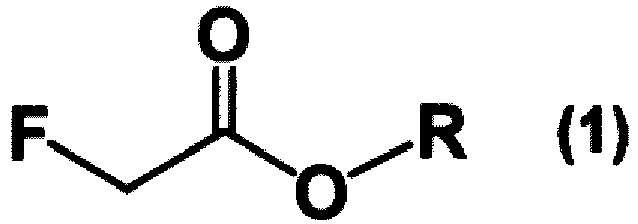
- wherein R is an organic group, and
- 2-fluoroacetic acid,
- wherein
- the content of the 2-fluoroacetic acid is 0.9 mass% or less.
- a compound represented by formula (1):
- [23] A composition comprising
- a compound represented by formula (1):
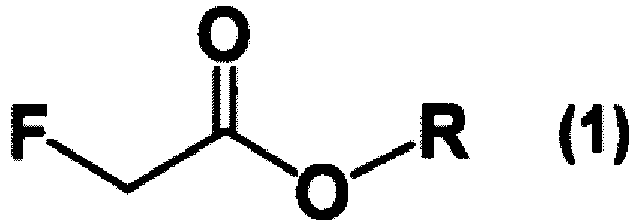
- wherein R is an organic group, and
- 2-fluoroacetic acid,
- wherein
- the content of the 2-fluoroacetic acid is 0.9 parts by mass or less relative to 100 parts by mass of the compound represented by formula (1).
- a compound represented by formula (1):
- [24] A composition comprising
- a compound represented by formula (1):

- wherein R is an organic group, and
- a compound represented by formula (5):

- wherein X is halogen other than fluorine, an alkylsulfonyloxy group, a haloalkylsulfonyloxy group, or an arylsulfonyloxy group, wherein
- the content of the compound represented by formula (5) is 0.001 mass% or less, or 0.002 to 1 mass%.
- a compound represented by formula (1):
- [25] A composition comprising
- a compound represented by formula (1):

- wherein R is an organic group, and
- a compound represented by formula (5):

- wherein X is halogen other than fluorine, an alkylsulfonyloxy group, a haloalkylsulfonyloxy group, or an arylsulfonyloxy group,
- wherein
- the content of the compound represented by formula (5) is 0.001 parts by mass or less, or 0.002 to 1 part by mass relative to 100 parts by mass of the compound represented by formula (1).
- a compound represented by formula (1):
- [26] A composition comprising
- a compound represented by formula (1):

- wherein R is an organic group, and a compound represented by formula (6):
CH3COOR (6)
- wherein R is as defined above,
- wherein
- the content of the compound represented by formula (6) is less than 0.01 mass%.
- a compound represented by formula (1):
- [27] A composition comprising
- a compound represented by formula (1):

- wherein R is an organic group, and
- a compound represented by formula (6):
CH3COOR (6)
- wherein R is as defined above,
- wherein
- the content of the compound represented by formula (6) is less than 0.01 parts by mass relative to 100 parts by mass of the compound represented by formula (1).
- a compound represented by formula (1):
- [28] A composition comprising
- a compound represented by formula (1):

- wherein R is an organic group, and
- a compound represented by formula (7):

- wherein R is as defined above,
- wherein
- the content of the compound represented by formula (7) is less than 0.01 mass%.
- a compound represented by formula (1):
- [29] A composition comprising
- a compound represented by formula (1):

- wherein R is an organic group, and
- a compound represented by formula (7)

- wherein R is as defined above,
- wherein
- the content of the compound represented by formula (7) is less than 0.01 parts by mass relative to 100 parts by mass of the compound represented by formula (1).
- a compound represented by formula (1):
- [30] A composition comprising
- a compound represented by formula (1):

- wherein R is an organic group, and
- a compound represented by formula (8):

- wherein R is as defined above,
- wherein
- the content of the compound represented by formula (8) is 0.006 to 0.5 mass%.
- a compound represented by formula (1):
- [31] A composition comprising a compound represented by formula (1):

- wherein R is an organic group, and
- a compound represented by formula (8):

- wherein R is as defined above,
- wherein
- the content of the compound represented by formula (8) is 0.006 to 0.5 parts by mass relative to 100 parts by mass of the compound represented by formula (1).
- [32] The composition according to any one of Items 18 to 31, wherein R is a hydrocarbon group optionally having one or more substituents.
- [33] The composition according to any one of Items 18 to 32, wherein R is an alkyl group, a fluoroalkyl group, or an aryl group optionally having one or more substituents.
- [34] The composition according to any one of Items 18, 19, 24 and 25, wherein X is chlorine or bromine.
- [35] A composition comprising at least one inorganic salt selected from the group consisting of a compound represented by formula (1):

- a compound represented by formula (3):
MFn (3)
- wherein M is a cation and n is an integer corresponding to the valence of the cation, and
- a compound represented by formula (3'):
MCln (3')
- wherein M and n are as defined above.
- a compound represented by formula (3):
- [36] A composition comprising methyl 2-fluoroacetate and ethyl 2-fluoroacetate.
- According to the present disclosure, a method for producing fluoroacetic acid esters having excellent economic efficiency, quality, productivity, and the like is provided.
- The above summary of the present disclosure is not intended to describe each disclosed embodiment or every implementation of the present disclosure.
- The following description of the present disclosure more particularly exemplifies illustrative embodiments.
- In several places throughout the present disclosure, guidance is provided through lists of examples, and these examples can be used in various combinations.
- In each instance, the described list serves only as a representative group, and should not be interpreted as an exclusive list.
- All publications, patents, and patent applications cited herein are incorporated herein by reference in their entirety.
- Unless otherwise specified, the symbols and abbreviations herein can be understood in the context of the present specification in the meanings commonly used in the art to which the present disclosure belongs.
- The term "contains" as used herein is intended to include "consisting essentially of" and "consisting of."
- Unless otherwise specified, the steps, treatments, or operations described herein can be performed at room temperature.
- The room temperature referred to herein can mean a temperature in the range of 10 to 40°C.
- The notation "Cn-m" (where n and m are each a number) used herein means that the number of carbon atoms is n or more and m or less, as is usually understood by persons skilled in the art.
- Examples of the "halogen atom" in the present specification include fluorine, chlorine, bromine, and iodine, unless otherwise specified.
- The "organic group" in the present specification means a group formed by removing one hydrogen atom from an organic compound.
- Examples of the "organic group" include
- a hydrocarbon group optionally having one or more substituents,
- a non-aromatic heterocyclic group optionally having one or more substituents,
- a heteroaryl group optionally having one or more substituents,
- a cyano group,
- an aldehyde group,
- QO-,
- QS-,
- QCO-,
- QS02- ,
- QOCO-, and
- QOS02-(wherein Q is independently
- a hydrocarbon group optionally having one or more substituents,
- a non-aromatic heterocyclic group optionally having one or more substituents, or
- a heteroaryl group optionally having one or more substituents).
- Examples of the "substituents" include a halogen atom, a cyano group, an amino group, an alkoxy group, and an alkylthio group. Two or more substituents may be the same or different from each other.
- Examples of the "hydrocarbon" in the present specification include alkyl, alkenyl, alkynyl, cycloalkyl, cycloalkenyl, cycloalkadienyl, aryl, and aralkyl, unless otherwise specified.
- Examples of the "alkyl" in the present specification include linear or branched C1-20 alkyl groups, such as methyl, ethyl, propyl (e.g., n-propyl and isopropyl), butyl (e.g., n-butyl, isobutyl, sec-butyl, and tert-butyl), pentyl, and hexyl, unless otherwise specified.
- Examples of the "alkoxy" in the present specification include linear or branched C1-20 alkoxy groups, such as methoxy, ethoxy, propoxy (e.g., n-propoxy and isopropoxy), butoxy (e.g., n-butoxy, isobutoxy, sec-butoxy, and tert-butoxy), pentyloxy, and hexyloxy, unless otherwise specified.
- Examples of the "alkylthio" in the present specification include linear or branched C1-20 alkylthio groups, such as methylthio, ethylthio, propylthio (e.g., n-propylthio and isopropylthio), butylthio (e.g., n-butylthio, isobutylthio, sec-butylthio, and tert-butylthio), pentylthio, and hexylthio, unless otherwise specified.
- Examples of the "aryloxy" in the present specification include Cc-is aryloxy groups, such as phenyloxy and naphthyloxy, unless otherwise specified.
- Examples of the "alkenyl" in the present specification include linear or branched C2-20 alkenyl groups, such as vinyl, 1-propen-1-yl, 2-propen-1-yl, isopropenyl, 2-buten-1-yl, 4-penten-1-yl, and 5-hexen-1-yl, unless otherwise specified.
- Examples of the "alkynyl" in the present specification include linear or branched C2-20 alkynyl groups, such as ethynyl, 1-propyn-1-yl, 2-propyn-1-yl, 4-pentyn-1-yl, and 5-hexyn-1-yl, unless otherwise specified.
- Examples of the "cycloalkyl" in the present specification include C3-10 cycloalkyl groups, such as cyclopropyl, cyclobutyl, cyclopentyl, cyclohexyl, and cycloheptyl, unless otherwise specified.
- Examples of the "cycloalkenyl" in the present specification include C3-10 cycloalkenyl groups, such as cyclopropenyl, cyclobutenyl, cyclopentenyl, cyclohexenyl, and cycloheptenyl, unless otherwise specified.
- Examples of the "cycloalkadienyl" in the present specification include C4-10 cycloalkadienyl groups, such as cyclobutadienyl, cyclopentadienyl, cyclohexadienyl, cycloheptadienyl, cyclooctadienyl, cyclononadienyl, and cyclodecadienyl, unless otherwise specified.
- The "aryl" in the present specification can be monocyclic, bicyclic, tricyclic, or tetracyclic, unless otherwise specified.
- The "aryl" in the present specification can be a C6-18 aryl group, unless otherwise specified.
- Examples of the "aryl" in the present specification include phenyl, 1-naphthyl, 2-naphthyl, 2-biphenyl, 3-biphenyl, 4-biphenyl, and 2-anthryl, unless otherwise specified.
- Examples of the "aralkyl" in the present specification include benzyl, phenethyl, diphenylmethyl, 1-naphthylmethyl, 2-naphthylmethyl, 2,2-diphenylethyl, 3-phenylpropyl, 4-phenylbutyl, 5-phenylpentyl, 2-biphenylmethyl, 3-biphenylmethyl, and 4-biphenylmethyl, unless otherwise specified.
- The "non-aromatic heterocyclic group" in the present specification means a group formed by removing one hydrogen atom from a non-aromatic heterocycle.
- The "non-aromatic heterocyclic group" in the present specification can be monocyclic, bicyclic, tricyclic, or tetracyclic, unless otherwise specified.
- The "non-aromatic heterocyclic group" in the present specification can be saturated or unsaturated, unless otherwise specified.
- The "non-aromatic heterocyclic group" in the present specification can be a 5- to 18-membered non-aromatic heterocyclic group, unless otherwise specified.
- Unless otherwise specified, the "non-aromatic heterocyclic group" in the present specification can be, for example, a non-aromatic heterocyclic group containing, in addition to carbon atoms, 1 to 4 heteroatoms selected from oxygen, sulfur, and nitrogen atoms as a ring-constituting atom.
- Unless otherwise specified, examples of the "non-aromatic heterocyclic group" in the present specification include tetrahydrofuryl, oxazolidinyl, imidazolinyl (e.g., 1-imidazolinyl, 2-imidazolinyl, and 4-imidazolinyl), aziridinyl (e.g., 1-aziridinyl and 2-aziridinyl), pyrrolidinyl (e.g., 1-pyrrolidinyl, 2-pyrrolidinyl, and 3-pyrrolidinyl), piperidinyl (e.g., 1-piperidinyl, 2-piperidinyl, and 3-piperidinyl), azepanyl (e.g., 1-azepanyl, 2-azepanyl, 3-azepanyl, and 4-azepanyl), azocanyl (e.g., 1-azocanyl, 2-azocanyl, 3-azocanyl, and 4-azocanyl), piperazinyl (e.g., 1,4-piperazin-1-yl and 1,4-piperazin-2-yl), diazepinyl (e.g., 1,4-diazepin-1-yl, 1,4-diazepin-2-yl, 1,4-diazepin-5-yl, and 1,4-diazepin-6-yl), diazocanyl (e.g., 1,4-diazocan-1-yl, 1,4-diazocan-2-yl, 1,4-diazocan-5-yl, 1,4-diazocan-6-yl, 1,5-diazocan-1-yl, 1,5-diazocan-2-yl, and 1,5-diazocan-3-yl), tetrahydropyranyl (e.g., tetrahydrofuran-4-yl), morpholinyl (e.g., 4-morpholinyl), thiomorpholinyl (e.g., 4-thiomorpholinyl), 2-oxazolidinyl, dihydrofuryl, dihydropyranyl, dihydroquinolyl, and the like.
- The "heteroaryl" in the present specification can be monocyclic, bicyclic, tricyclic, or tetracyclic, unless otherwise specified.
- The "heteroaryl" in the present specification can be, for example, a 5- to 18-membered heteroaryl group.
- Unless otherwise specified, the "heteroaryl" in the present specification can be, for example, a heteroaryl group containing, in addition to carbon atoms, 1 to 4 heteroatoms selected from oxygen, sulfur, and nitrogen atoms as a ring-constituting atom.
- The "heteroaryl" in the present specification includes "monocyclic heteroaryl" and "aromatic fused heterocyclic group," unless otherwise specified.
- Unless otherwise specified, examples of the "monocyclic heteroaryl" in the present specification include pyrrolyl (e.g., 1-pyrrolyl, 2-pyrrolyl, and 3-pyrrolyl), furyl (e.g., 2-furyl and 3-furyl), thienyl (e.g., 2-thienyl and 3-thienyl), pyrazolyl (e.g., 1-pyrazolyl, 3-pyrazolyl, and 4-pyrazolyl), imidazolyl (e.g., 1-imidazolyl, 2-imidazolyl, and 4-imidazolyl), isoxazolyl (e.g., 3-isoxazolyl, 4-isoxazolyl, and 5-isoxazolyl), oxazolyl (e.g., 2-oxazolyl, 4-oxazolyl, and 5-oxazolyl), isothiazolyl (e.g., 3-isothiazolyl, 4-isothiazolyl, and 5-isothiazolyl), thiazolyl (e.g., 2-thiazolyl, 4-thiazolyl, and 5-thiazolyl), triazolyl (e.g., 1,2,3-triazol-3-yl and 1,2,4-triazol-4-yl), oxadiazolyl (e.g., 1,2,4-oxadiazol-3-yl and 1,2,4-oxadiazol-5-yl), thiadiazolyl (e.g., 1,2,4-thiadiazol-3-yl and 1,2,4-thiadiazol-5-yl), tetrazolyl, pyridyl (e.g., 2-pyridyl, 3-pyridyl, and 4-pyridyl), pyridazinyl (e.g., 3-pyridazinyl and 4-pyridazinyl), pyrimidinyl (e.g., 2-pyrimidinyl, 4-pyrimidinyl, and 5-pyrimidinyl), pyrazinyl, and the like.
- Unless otherwise specified, examples of the "aromatic fused heterocyclic group" in the present specification include isoindolyl (e.g., 1-isoindolyl, 2-isoindolyl, 3-isoindolyl, 4-isoindolyl, 5-isoindolyl, 6-isoindolyl, and 7-isoindolyl), indolyl (e.g., 1-indolyl, 2-indolyl, 3-indolyl, 4-indolyl, 5-indolyl, 6-indolyl, and 7-indolyl), benzo[b]furanyl (e.g., 2-benzo[b]furanyl, 3-benzo[b]furanyl, 4-benzo[b]furanyl, 5-benzo[b]furanyl, 6-benzo[b]furanyl, and 7-benzo[b]furanyl), benzo[c]furanyl (e.g., 1-benzo[c]furanyl, 4-benzo[c]furanyl, and 5-benzo[c]furanyl), benzo[b]thienyl (e.g., 2-benzo[b]thienyl, 3-benzo[b]thienyl, 4-benzo[b]thienyl, 5-benzo[b]thienyl, 6-benzo[b]thienyl, and 7-benzo[b]thienyl), benzo[c]thienyl (e.g., 1-benzo[c]thienyl, 4-benzo[c]thienyl, and 5-benzo[c]thienyl), indazolyl (e.g., 1-indazolyl, 2-indazolyl, 3-indazolyl, 4-indazolyl, 5-indazolyl, 6-indazolyl, and 7-indazolyl), benzimidazolyl (e.g., 1-benzimidazolyl, 2-benzimidazolyl, 4-benzimidazolyl, and 5-benzimidazolyl), 1,2-benzisoxazolyl (e.g., 1,2-benzisoxazol-3-yl, 1,2-benzisoxazol-4-yl, 1,2-benzisoxazol-5-yl, 1,2-benzisoxazol-6-yl, and 1,2-benzisoxazol-7-yl), benzoxazolyl (e.g., 2-benzoxazolyl, 4-benzoxazolyl, 5-benzoxazolyl, 6-benzoxazolyl, and 7-benzoxazolyl), 1,2-benzisothiazolyl (e.g., 1,2-benzisothiazol-3-yl, 1,2-benzisothiazol-4-yl, 1,2-benzisothiazol-5-yl, 1,2-benzisothiazol-6-yl, and 1,2-benzisothiazol-7-yl), benzothiazolyl (e.g., 2-benzothiazolyl, 4-benzothiazolyl, 5-benzothiazolyl, 6-benzothiazolyl, and 7-benzothiazolyl), isoquinolyl (e.g., 1-isoquinolyl, 3-isoquinolyl, 4-isoquinolyl, and 5-isoquinolyl), quinolyl (e.g., 2-quinolyl, 3-quinolyl, 4-quinolyl, 5-quinolyl, and 8-quinolyl), cinnolinyl (e.g., 3-cinnolinyl, 4-cinnolinyl, 5-cinnolinyl, 6-cinnolinyl, 7-cinnolinyl, and 8-cinnolinyl), phthalazinyl (e.g., 1-phthalazinyl, 4-phthalazinyl, 5-phthalazinyl, 6-phthalazinyl, 7-phthalazinyl, and 8-phthalazinyl), quinazolinyl (e.g., 2-quinazolinyl, 4-quinazolinyl, 5-quinazolinyl, 6-quinazolinyl, 7-quinazolinyl, and 8-quinazolinyl), quinoxalinyl (e.g., 2-quinoxalinyl, 3-quinoxalinyl, 5-quinoxalinyl, 6-quinoxalinyl, 7-quinoxalinyl, and 8-quinoxalinyl), pyrazolo[1,5-a]pyridyl (e.g., pyrazolo[1,5-a]pyridin-2-yl, pyrazolo[1,5-a]pyridin-3-yl, pyrazolo[1,5-a]pyridin-4-yl, pyrazolo[1,5-a]pyridin-5-yl, pyrazolo[1,5-a]pyridin-6-yl, and pyrazolo[1,5-a]pyridin-7-yl), imidazo[1,2-a]pyridyl (e.g., imidazo[1,2-a]pyridin-2-yl, imidazo[1,2-a]pyridin-3-yl, imidazo[1,2-a]pyridin-5-yl, imidazo[1,2-a]pyridin-6-yl, imidazo[1,2-a]pyridin-7-yl, and imidazo[1,2-a]pyridin-8-yl), and the like.
- In one embodiment, a method for producing a compound represented by formula (1):

- R is an organic group,
- the method comprising
- the step (hereinbelow referred to as step (A)) of reacting a compound represented by formula (2):

- X is a leaving group other than fluorine, and R is as defined above,
- with a compound represented by formula (3):
MFn (3)
wherein - M is a cation and n is an integer corresponding to the valence of the cation,
- wherein
- the compound represented by formula (3) is used in an amount of 0.9 moles or less per mole of the compound represented by formula (2) .
- R is preferably a hydrocarbon group optionally having one or more substituents, more preferably alkyl optionally having one or more substituents, or aryl optionally having one or more substituents, even more preferably C1-4 alkyl optionally having one or more substituents or C6-12 aryl optionally having one or more substituents, and particularly preferably C1-4 alkyl optionally having one or more substituents.
- When R is alkyl optionally having one or more substituents, the one or more substituents are preferably at least one member selected from the group consisting of fluorine, aryl, alkoxy, and aryloxy; more preferably at least one member selected from the group consisting of fluorine, C6-12 aryl, C1-4 alkoxy, and C6-12 aryloxy; even more preferably at least one member selected from fluorine and C6-12 aryl; and particularly preferably fluorine.
- When R is aryl optionally having one or more substituents, the one or more substituents are preferably at least one member selected from the group consisting of fluorine, alkyl, and alkoxy; and more preferably at least one member selected from the group consisting of fluorine, C1-4 alkyl, and C1-4 alkoxy.
- In R, the number of substituents substituted with alkyl or aryl can be selected from the range between 0 and the maximum substitutable number, and varies depending on the type of the substituent. The number of substituents is, for example 0, 1, 2, 3, 4, or 5.
- The leaving group represented by X is not limited as long as it is a group that can be removed by the reaction. Examples include halogen other than fluorine, alkylsulfonyloxy, haloalkylsulfonyloxy, and arylsulfonyloxy.
- Examples of the alkylsulfonyloxy include C1-6 alkylsulfonyloxy, such as methanesulfonyloxy and ethanesulfonyloxy.
- Examples of the haloalkylsulfonyloxy include halo-C1-6 alkylsulfonyloxy, such as trifluoromethanesulfonyloxy and nonafluorobutanesulfonyloxy.
- Examples of the arylsulfonyloxy include C6-18 arylsulfonyloxy such as benzenesulfonyloxy and p-toluenesulfonyloxy.
- X is preferably halogen other than fluorine, methanesulfonyloxy, benzenesulfonyloxy, p-toluenesulfonyloxy, trifluoromethanesulfonyloxy, or nonafluorobutanesulfonyloxy; more preferably halogen other than fluorine; even more preferably chlorine or bromine; and particularly preferably chlorine.
- The cation represented by M is not limited, as long as it is a counterion for fluorine ion. Examples include monovalent or divalent cations such as hydrogen ions, alkali metal ions, alkaline earth metal ions, and ammonium ions.
- Examples of alkali metal ions include Na+, K+ and Cs+.
- Examples of alkaline earth metal ions include Mg2+ and Ca2+.
- Examples of ammonium ions include NH4 +, primary ammonium ions, secondary ammonium ions, tertiary ammonium ions, and quaternary ammonium ions.
- Examples of primary ammonium ions include primary ammonium ions derived from C1-6 alkyl amines such as methylamine, ethylamine, propylamine (n-propylamine and isopropylamine), and butylamine; and aniline.
- Examples of secondary ammonium ions include secondary ammonium ions derived from di-C1-6 alkyl amines such as dimethylamine, diethylamine, ethyl methylamine, and dipropylamine; pyrrolidine; imidazole; piperidine; and morpholine.
- Examples of tertiary ammonium ions include tertiary ammonium ions derived from tri-C1-6 alkyl amines such as trimethylamine and triethylamine; pyridine; and quinoline.
- Examples of quaternary ammonium ions include tetra C1-6 alkylammonium ions, such as tetramethylammonium ions and tetraethylammonium ions.
- M is preferably a hydrogen ion, alkali metal ion, or alkaline earth metal ion; and more preferably, a hydrogen ion or an alkali metal ion.
- n can be suitably selected according to the valence of the cation, and is, for example, 1 or 2.
- The compound represented by formula (3) is preferably at least one member selected from the group consisting of HF, NaF, KF, CsF, and CaF2; and more preferably at least one member selected from the group consisting of KF and CsF.
- The upper limit of the moisture content of the compound represented by formula (3) is preferably 1.0 mass%, more preferably 0.5 mass%, and even more preferably 0.2 mass%. The lower limit of the moisture content of the compound represented by formula (3) is usually 0.01 mass%. The moisture content of the compound represented by formula (3) is preferably 1.0 mass% or less, and more preferably in the range of 0.01 to 0.5 mass%.
- The compound represented by formula (3) is, for example, a powder. The compound represented by formula (3) can also be, for example, a spray-dried product.
- The average particle size of the powder can be selected, for example, from the range of 0.5 to 300 pm, preferably the range of 0.5 to 200 pm, more preferably the range of 0.5 to 150 pm, even more preferably the range of 0.5 to 100 pm, and particularly preferably the range of 0.5 to 50 pm. The average particle size can usually be measured by dynamic light scattering, laser diffraction, or centrifugal sedimentation.
- The specific surface area of the powder can be selected, for example, from the range of 0.1 to 5.0 m2/g, preferably the range of 0.5 to 5.0 m2/g, and more preferably the range of 1.0 to 5.0 m2/g, from the viewpoint of reaction efficiency. The specific surface area can usually be measured by a transmission method, a gas adsorption method, or a mercury pressure intrusion method.
- The amount of the compound represented by formula (3) is 0.9 moles or less, preferably 0.8 moles or less, more preferably 0.7 moles or less, and even more preferably 0.6 moles or less per mole of the compound represented by formula (2). The amount of the compound represented by formula (3) is preferably 0.1 moles or more, more preferably 0.2 moles or more, and even more preferably 0.3 moles or more, per mole of the compound represented by formula (2).
- The reaction of step A may be performed in the presence of additives. Examples of additives include catalysts (e.g. phase transfer catalysts). From the viewpoint of preventing impurities from being mixed into the target product, the reaction of step A is preferably performed in the absence of a catalyst (e.g., a phase-transfer catalyst), and even more preferably in the absence of an additive.
- The compound represented by formula (2) can be used as a solvent. The reaction of step A may be performed in the presence of one or more further solvents. Examples of further solvents include aliphatic hydrocarbons (e.g., hexane), aromatic hydrocarbons (e.g., toluene and xylene), halogenated hydrocarbons (e.g., dichloromethane and dichloroethane), ethers (e.g., diethyl ether and tetrahydrofuran), ketones (e.g., acetone and methyl ethyl ketone), and nitriles (e.g. acetonitrile). For simplicity of purification and yield, the reaction of step A is preferably performed in the absence of further solvents.
- It is preferable that the reaction of step A is substantially performed with the compound represented by formula (2) and the compound represented by formula (3) alone.
- The upper limit of the viscosity of the reaction solution in step A at 25°C is preferably 3 Pa·s, 2 Pa·s, or 1 Pa·s.
- The lower limit of the viscosity of the reaction solution in step A at 25°C is preferably 0.01 Pa·s.
- The viscosity of the reaction solution in step A at 25°C is preferably in the range of 0.01 to 3 Pa·s, 0.01 to 2 Pa·s, or 0.01 to 1 Pa·s. When the viscosity is within such a range, solid precipitation is reduced, the stirring efficiency is increased, and productivity can be improved. The viscosity can be measured using a commonly used viscometer (e.g., SV-10, produced by A&D Corporation).
- The lower limit of the reaction temperature in step A is preferably 100°C, more preferably 120°C, and even more preferably 150°C.
- The upper limit of the reaction temperature in step A is preferably 250°C, more preferably 240°C, and even more preferably 230°C.
- The reaction temperature in step A is preferably in the range of 100 to 250°C, more preferably in the range of 120 to 240°C, and even more preferably in the range of 150 to 230°C.
- The lower limit of the reaction time in step A can be preferably 0.5 hours, more preferably 1 hour, even more preferably 2 hours, even more preferably 5 hours, and particularly preferably 10 hours, in terms of conversion.
- The upper limit of the reaction time in step A can be preferably 48 hours, more preferably 36 hours, even more preferably 24 hours, and especially preferably 15 hours, in terms of selectivity. The reaction time in step A is preferably within the range of 0.5 to 48 hours, more preferably 1 to 36 hours, even more preferably 2 to 24 hours, and particularly preferably 5 to 15 hours.
- It is preferable that the method for producing the compound represented by formula (1) further includes the step of distilling the product obtained in step A (hereinafter sometimes referred to as "step B"). According to the method of the present disclosure, a compound represented by formula (1) can be obtained at a high selectivity even if the product obtained by step A is distilled as is, without being subjected to extraction or other operations.
- The distillation of step B is preferably vacuum distillation. The pressure of vacuum distillation can usually be in the range of 0.1 to 98 kPa, preferably in the range of 0.1 to 70 kPa, and more preferably in the range of 0.1 to 40 kPa. The temperature of the vacuum distillation can be higher than the boiling point of the compound represented by formula (1), preferably in the range of 20 to 200°C, and more preferably in the range of 60 to 200°C.
- It is preferable that the method for producing the compound represented by formula (1) further includes the step of refining the product obtained in step B (hereinafter sometimes referred to as "step C"). The rectification of step C is preferably performed using a rectification column. Usable examples of the rectification column include plate columns, concentric cylindrical columns, rotation band columns, and packed columns.
- The rectification of step C is performed under atmospheric or reduced pressure. The pressure in the rectification is usually in the range of 0.1 to 98 kPa, preferably in the range of 0.1 to 70 kPa, and more preferably in the range of 0.1 to 40 kPa. The temperature in the rectification may be any temperature at which the compound represented by formula (1) can be separated from the compound represented by formula (2) by a difference in boiling point, and is preferably in the range of 20 to 140°C, and more preferably 60 to 140°C.
- The composition of the present disclosure comprises the compound represented by formula (1) and at least one compound selected from the group consisting of:
- the compound represented by formula (2);
- the compound represented by formula (4): R-OH (4), wherein R is as defined above;
- 2-fluoroacetic acid;
- the compound represented by formula (5):

- acetic acid;
- the compound represented by formula (6):
CH3COOR (6)
- wherein R is as defined above;
- the compound represented by formula (7):

- wherein R is as defined above;
- the compound represented by formula (8):

- wherein R is as defined above;
- the compound represented by formula (9):

- compound represented by formula (3) and the compound represented by formula (3'):
MCln (3')
- wherein M and n are as defined above.
- The composition a is not limited as long as it contains the compound represented by formula (1) and the compound represented by formula (2). The compound represented by formula (2) can be, for example, an unreacted starting material in the reaction of step A. The composition a can be, for example, a composition after the reaction of step A, a composition after the distillation of step B, or a composition after the rectification of step C.
- In the composition a, the upper limit of the content of the compound represented by formula (2) can be preferably 2.5 mass%, more preferably 2.2 mass%, and even more preferably 2.0 mass%. The upper limit may be 0.001 mass% or the detection limit.
- In the composition a, the lower limit of the content of the compound represented by formula (2) can be preferably the detection limit, 0.001 mass%, 0.002 mass%, or 0.003 mass%.
- In the composition a, the content of the compound represented by formula (2) can be preferably in the range of more than 0.001 to 2.5 mass% or less, and more preferably in the range of 0.002 to 2.5 mass%.
- The upper limit of the content of the compound represented by formula (2) can be preferably 2.5 parts by mass, more preferably 2.3 parts by mass, and even more preferably 2.2 parts by mass, relative to 100 parts by mass of the compound represented by formula (1). The upper limit may be 0.001 mass% or the detection limit.
- The lower limit of the content of the compound represented by formula (2) may be preferably the detection limit, and 0.001 parts by mass, 0.002 parts by mass, or 0.003 parts by mass, relative to 100 parts by mass of the compound represented by formula (1).
- The content of the compound represented by formula (2) can be preferably in the range of more than 0.001 to 2.5 parts by mass or less, and more preferably in the range of 0.002 to 2.5 parts by mass, relative to 100 parts by mass of the compound represented by formula (1).
- The contents of compounds in the composition a can be measured by gas chromatography-mass spectrometry. Gas chromatography conditions can be as follows.
- Conditions:
- Column: J&W HP-1 produced by Agilent Technologies Ltd., (1.00 pm, 30 m, 0.32 mm ID)
- Column oven: 40°C (5 min) -> temperature rise (10°C/min) → 300°C (10 min) or 40°C (5 min) -> temperature rise (7°C/min) -> 280°C (0 min)
- Vaporization chamber temperature: 250°C
- Detector: Flame ionization detector (FID)
- The contents of compounds in compositions b to k described below can be measured in the same manner.
- The composition a can be a composition of any of the following:
- (a-1) a composition further comprising another component;
- (a-2) the composition of (a-1) in which the other component comprises the compound represented by formula (4);
- (a-3) the composition of (a-1) or (a-2) in which the other component comprises 2-fluoroacetic acid;
- (a-4) the composition of any of (a-1) to (a-3) in which the other component comprises the compound represented by formula (5);
- (a-5) the composition of any of (a-1) to (a-4) in which the other component comprises acetic acid;
- (a-6) the composition of any of (a-1) to (a-5) in which the other component comprises the compound represented by formula (6);
- (a-7) the composition of any of (a-1) to (a-6) in which the other component comprises the compound represented by formula (7);
- (a-8) the composition of any of (a-1) to (a-7) in which the other component comprises the compound represented by formula (8);
- (a-9) the composition of any of (a-1) to (a-8) in which the other component comprises the compound represented by formula (9); or
- (a-10) the composition of any of (a-1) to (a-9) in which the other component comprises an inorganic salt.
- In the composition a, the contents of the compound represented by formula (4), 2-fluoroacetic acid, compound represented by formula (5), acetic acid, compound represented by formula (6), compound represented by formula (7), compound represented by formula (8), compound represented by formula (9), and inorganic salt are the same as those described in the sections for compositions b, c, d, e, f, g, h, i, and j below.
- The composition b is not limited as long as it contains the compound represented by formula (1) and the compound represented by formula (4). The compound represented by formula (4) can be, for example, a side product in the reaction of step A. The composition b can be, for example, a composition after the reaction of step A, a composition after the distillation of step B, or a composition after the rectification of step C.
- In the composition b, the upper limit of the content of the compound represented by formula (4) can be preferably 2.5 mass%, more preferably 2.3 mass%, and even more preferably 2.2 mass%. The upper limit may be 1.0 mass%, 0.9 mass%, or the detection limit.
- In the composition b, the lower limit of the content of the compound represented by formula (4) can be preferably the detection limit, 0.001 mass%, 1.1 mass%, or 1.2 mass%.
- In the composition b, the content of the compound represented by formula (4) can be preferably 1.0 mass% or less and more preferably 0.9 mass% or less, or in the range of 1.1 to 2.5 mass%, and more preferably in the range of 1.2 to 2.5 mass%.
- The upper limit of the content of the compound represented by formula (4) can be preferably 2.5 parts by mass, more preferably 2.4 parts by mass, and even more preferably 2.3 parts by mass, relative to 100 parts by mass of the compound represented by formula (1). The upper limit may be 1.0 part by mass, 0.9 parts by mass, or the detection limit.
- The lower limit of the content of the compound represented by formula (4) may be preferably the detection limit, and 0.001 parts by mass, 1.1 parts by mass, or 1.2 parts by mass, relative to 100 parts by mass of the compound represented by formula (1).
- The content of the compound represented by formula (4) can be preferably 1.0 part by mass or less and more preferably 0.9 parts by mass or less; or in the range of 1.1 to 2.5 parts by mass, and more preferably 1.2 to 2.5 parts by mass, relative to 100 parts by mass of the compound represented by formula (1).
- The composition b can be a composition of any of the following:
- (b-1) a composition further comprising another component;
- (b-2) the composition of (b-1) in which the other component comprises 2-fluoroacetic acid;
- (b-3) the composition of (b-1) or (b-2) in which the other component comprises the compound represented by formula (5);
- (b-4) the composition of any of (b-1) to (b-3)in which the other component comprises acetic acid;
- (b-5) the composition of any of (b-1) to (b-4) in which the other component comprises the compound represented by formula (6);
- (b-6) the composition of any of (b-1) to (b-5) in which the other component comprises the compound represented by formula (7);
- (b-7) the composition of any of (b-1) to (b-6) in which the other component comprises the compound represented by formula (8);
- (b-8) the composition of any of (b-1) to (b-7) in which the other component comprises the compound represented by formula (9); or
- (b-9) the composition of any of (b-1) to (b-8) in which the other component comprises an inorganic salt.
- In the composition b, the contents of the 2-fluoroacetic acid, compound represented by formula (5), acetic acid, compound represented by formula (6), compound represented by formula (7), compound represented by formula (8), compound represented by formula (9), and inorganic salt are the same as those described in the sections for compositions c, d, e, f, g, h, i, and j below.
- The composition c is not limited as long as it contains the compound represented by formula (1) and 2-fluoroacetic acid. The 2-fluoroacetic acid can be, for example, a side product in the reaction of step A, specifically, the hydrolysate of the compound represented by formula (1).
- The composition c can be, for example, a composition after the reaction of step A, a composition after the distillation of step B, or a composition after the rectification of step C.
- In the composition c, the upper limit of the content of the 2-fluoroacetic acid can be preferably 0.9 mass%, more preferably 0.8 mass%, even more preferably 0.7 mass%, and particularly preferably 0.6 mass%.
- In the composition c, the lower limit of the content of the 2-fluoroacetic acid can be usually the detection limit or 0.001 mass%.
- In the composition c, the content of the 2-fluoroacetic acid can be preferably 0.9 mass% or less, and more preferably in the range of 0.001 to 0.8 mass%
- The upper limit of the content of the 2-fluoroacetic acid can be preferably 0.9 parts by mass, more preferably 0.8 parts by mass, even more preferably 0.7 parts by mass, and particularly preferably 0.6 parts by mass, relative to 100 parts by mass of the compound represented by formula (1).
- The lower limit of the content of the 2-fluoroacetic acid can be usually the detection limit, or 0.001 parts by mass, relative to 100 parts by mass of the compound represented by formula (1).
- The content of the 2-fluoroacetic acid can be preferably 0.9 parts by mass or less and more preferably in the range of 0.001 to 0.8 parts by mass, relative to 100 parts by mass of the compound represented by formula (1).
- The composition c can be a composition of any of the following:
- (c-1) a composition further comprising another component;
- (c-2) the composition of (c-1) in which the other component comprises the compound represented by formula (5);
- (c-3) the composition of (c-1) or (c-2) in which the other component comprises acetic acid;
- (c-4) the composition of any of (c-1) to (c-3) in which the other component comprises the compound represented by formula (6);
- (c-5) the composition of any of (c-1) to (c-4) in which the other component comprises the compound represented by formula (7);
- (c-6) the composition of any of (c-1) to (c-5) in which the other component comprises the compound represented by formula (8);
- (c-7) the composition of any of (c-1) to (c-6) in which the other component comprises the compound represented by formula (9); or
- (c-8) the composition of any of (c-1) to (c-7) in which the other component comprises an inorganic salt.
- In the composition c, the contents of the compound represented by formula (5), acetic acid, compound represented by formula (6), compound represented by formula (7), compound represented by formula (8), compound represented by formula (9), and inorganic salt are the same as those described in the sections for compositions d, e, f, g, h, i, and j below.
- The composition d is not limited as long as it contains the compound represented by formula (1) and the compound represented by formula (5). The compound represented by formula (5) can be, for example, a side product in the reaction of step A, specifically, the hydrolysate of the compound represented by formula (2). The composition d can be, for example, a composition after the reaction of step A, a composition after the distillation of step B, or a composition after the rectification of step C.
- In the composition d, the upper limit of the content of the compound represented by formula (5) can be preferably 1 mass%, more preferably 0.5 mass%, and even more preferably 0.1 mass%. The upper limit may be 0.001 mass% or the detection limit.
- In the composition d, the lower limit of the content of the compound represented by formula (5) can be preferably the detection limit, 0.002 mass%, 0.003 mass%, or 0.004 mass%.
- In the composition d, the content of the compound represented by formula (5) can be preferably 0.001 mass% or less or in the range of 0.002 to 1 mass%.
- The upper limit of the content of the compound represented by formula (5) can be preferably 1 part by mass, more preferably 0.5 parts by mass, and even more preferably 0.1 parts by mass, relative to 100 parts by mass of the compound represented by formula (1). The upper limit may be 0.001 parts by mass or the detection limit.
- The lower limit of the content of the compound represented by formula (5) may be preferably the detection limit, and 0.002 parts by mass, 0.003 parts by mass, or 0.004 parts by mass, relative to 100 parts by mass of the compound represented by formula (1).
- The content of the compound represented by formula (5) can be preferably 0.001 parts by mass or less or in the range of 0.002 to 1 part by mass, relative to 100 parts by mass of the compound represented by formula (1).
- The composition d can be a composition of any of the following:
- (d-1) a composition further comprising another component;
- (d-2) the composition of (d-1) in which the other component comprises acetic acid;
- (d-3) the composition of (d-1) or (d-2) in which the other component comprises the compound represented by formula (6);
- (d-4) the composition of any of (d-1) to (d-3) in which the other component comprises the compound represented by formula (7);
- (d-5) the composition of any of (d-1) to (d-4) in which the other component comprises the compound represented by formula (8);
- (d-6) the composition of any of (d-1) to (d-5) in which the other component comprises the compound represented by formula (9); or
- (d-7) the composition of any of (d-1) to (d-6) in which the other component comprises an inorganic salt.
- In the composition d, the contents of the acetic acid, compound represented by formula (6), compound represented by formula (7), compound represented by formula (8), compound represented by formula (9), and inorganic salt are the same as those described in the sections for compositions e, f, g, h, i, and j below.
- The composition e is not limited as long as it contains the compound represented by formula (1) and acetic acid. The acetic acid can be, for example, a side product in the reaction of step A. The composition e can be, for example, a composition after the reaction of step A, a composition after the distillation of step B, or a composition after the rectification of step C.
- In the composition e, the upper limit of the content of acetic acid can be preferably 2.5 mass%, more preferably 1.5 mass%, and even more preferably 1.0 mass%.
- In the composition e, the lower limit of the content of the acetic acid can be usually the detection limit or 0.001 mass%.
- In the composition e, the content of the acetic acid can be preferably 2.5 mass% or less, and more preferably in the range of 0.001 to 1.0 mass%.
- The upper limit of the content of the acetic acid can be preferably 2.5 parts by mass, more preferably 1.5 parts by mass, and even more preferably 1.0 part by mass, relative to 100 parts by mass of the compound represented by formula (1).
- The lower limit of the content of the acetic acid can be usually the detection limit, or 0.001 parts by mass, relative to 100 parts by mass of the compound represented by formula (1).
- The content of the acetic acid can be preferably 2.5 parts by mass or less and more preferably in the range of 0.001 to 1.0 part by mass, relative to 100 parts by mass of the compound represented by formula (1).
- The composition e can be a composition of any of the following:
- (e-1) a composition further comprising another component;
- (e-2) the composition of (e-1) in which the other component comprises the compound represented by formula (6);
- (e-3) the composition of (e-1) or (e-2) in which the other component comprises the compound represented by formula (7);
- (e-4) the composition of any of (e-1) to (e-3) in which the other component comprises the compound represented by formula (8);
- (e-5) the composition of any of (e-1) to (e-4) in which the other component comprises the compound represented by formula (9); or
- (e-6) the composition of any of (e-1) to (e-5) in which the other component comprises an inorganic salt.
- In the composition e, the contents of the compound represented by formula (6), compound represented by formula (7), compound represented by formula (8), compound represented by formula (9), and inorganic salt are the same as those described in the sections for compositions f, g, h, i, and j below.
- The composition f is not limited as long as it contains the compound represented by formula (1) and the compound represented by formula (6). The compound represented by formula (6) can be a side product in the reaction of step A. The composition f can be, for example, a composition after the reaction of step A, a composition after the distillation of step B, or a composition after the rectification of step C.
- In the composition f, the upper limit of the content of the compound represented by formula (6) can be preferably 0.01 mass%, more preferably 0.009 mass%, and even more preferably 0.008 mass%.
- In the composition f, the lower limit of the content of the compound represented by formula (6) can be usually the detection limit or 0.001 mass%.
- In the composition f, the content of the compound represented by formula (6) can be preferably less than 0.01 mass%, and more preferably in the range of 0.001 to 0.009 mass%.
- The upper limit of the content of the compound represented by formula (6) can be preferably 0.01 parts by mass, more preferably 0.009 parts by mass, and even more preferably 0.008 parts by mass, relative to 100 parts by mass of the compound represented by formula (1).
- The lower limit of the content of the compound represented by formula (6) may be usually the detection limit, or 0.001 parts by mass relative to 100 parts by mass of the compound represented by formula (1).
- The content of the compound represented by formula (6) can be preferably less than 0.01 parts, and more preferably in the range of 0.001 to 0.009 parts by mass, relative to 100 parts by mass of the compound represented by formula (1).
- The composition f can be a composition of any of the following:
- (f-1) a composition further comprising another component;
- (f-2) the composition of (f-1) in which the other component comprises the compound represented by formula (7);
- (f-3) the composition of (f-1) or (f-2) in which the other component comprises the compound represented by formula (8);
- (f-4) the composition of any of (f-1) to (f-3) in which the other component comprises the compound represented by formula (9); or
- (f-5) the composition of any of (f-1) to (f-4) in which the other component comprises an inorganic salt.
- In the composition f, the contents of the compound represented by formula (7), compound represented by formula (8), compound represented by formula (9), and inorganic salt are the same as those described in the sections for compositions g, h, i, and j below.
- The composition g is not limited as long as it contains the compound represented by formula (1) and the compound represented by formula (7). The compound represented by formula (7) can be a side product in the reaction of step A. The composition g can be, for example, a composition after the reaction of step A, a composition after the distillation of step B, or a composition after the rectification of step C.
- In the composition g, the upper limit of the content of the compound represented by formula (7) can be preferably 0.01 mass%, more preferably 0.009 mass%, and even more preferably 0.008 mass%.
- In the composition g, the lower limit of the content of the compound represented by formula (7) can be usually the detection limit or 0.001 mass%.
- In the composition g, the content of the compound represented by formula (7) can be preferably less than 0.01 mass%, and more preferably in the range of 0.001 to 0.009 mass%.
- The upper limit of the content of the compound represented by formula (7) can be preferably 0.01 parts by mass, more preferably 0.009 parts by mass, and even more preferably 0.008 parts by mass, relative to 100 parts by mass of the compound represented by formula (1).
- The lower limit of the content of the compound represented by formula (7) may be usually the detection limit, or 0.001 parts by mass, relative to 100 parts by mass of the compound represented by formula (1).
- The content of the compound represented by formula (7) can be preferably less than 0.01 parts by mass, and more preferably in the range of 0.001 to 0.009 parts by mass, relative to 100 parts by mass of the compound represented by formula (1).
- The composition g can be a composition of any of the following:
- (g-1) a composition further comprising another component;
- (g-2) the composition of (g-1) in which the other component comprises the compound represented by formula (8);
- (g-3) the composition of (g-1) or (g-2) in which the other component comprises the compound represented by formula (9); or
- (g-4) the composition of any of (g-1) to (g-3) in which the other component comprises an inorganic salt.
- In the composition g, the contents of the compound represented by formula (8), compound represented by formula (9), and inorganic salt are the same as those described in the sections for compositions h, i, and j below.
- The composition h is not limited as long as it contains the compound represented by formula (1) and the compound represented by formula (8). The compound represented by formula (8) can be a side product in the reaction of step A. The composition h can be, for example, a composition after the reaction of step A, a composition after the distillation of step B, or a composition after the rectification of step C.
- In the composition h, the upper limit of the content of the compound represented by formula (8) can be preferably 0.5 mass%, and more preferably 0.1 mass%. The upper limit may be 0.005 mass%, 0.004 mass%, or detection limit.
- In the composition h, the lower limit of the content of the compound represented by formula (8) can be usually 0.006 or 0.007 mass%.
- In the composition h, the content of the compound represented by formula (8) can be preferably in the range of 0.006 to 0.5 mass%, and more preferably in the range of 0.007 to 0.1 mass%.
- The upper limit of the content of the compound represented by formula (8) can be preferably 0.5 parts by mass, and more preferably 0.1 parts by mass, relative to 100 parts by mass of the compound represented by formula (1); and may be 0.005 parts by mass, 0.004 parts by mass, or the detection limit.
- The lower limit of the content of the compound represented by formula (8) can be usually 0.006 or 0.007 parts by mass, relative to 100 parts by mass of the compound represented by formula (1).
- The content of the compound represented by formula (8) can be preferably in the range of 0.006 to 0.5 parts by mass, and more preferably 0.007 to 0.1 parts by mass, relative to 100 parts by mass of the compound represented by formula (1).
- The composition h can be a composition of any of the following:
- (h-1) a composition further comprising another component;
- (h-2) the composition of (h-1) in which the other component comprises the compound represented by formula (9); or
- (h-3) the composition of (h-1) or (h-2) in which the other component comprises an inorganic salt.
- In the composition h, the contents of the compound represented by formula (9) and inorganic salt are the same as those described in the sections for compositions i and j below.
- The composition i is not limited as long as it contains the compound represented by formula (1) and the compound represented by formula (9). The compound represented by formula (9) can be a side product in the reaction of step A. The composition i can be, for example, a composition after the reaction of step A, a composition after the distillation of step B, or a composition after the rectification of step C.
- In the composition i, the upper limit of the content of the compound represented by formula (9) can be preferably 1.0 mass%, more preferably 0.9 mass%, and even more preferably 0.8 mass%.
- In the composition i, the lower limit of the content of the compound represented by formula (9) can be usually the detection limit or 0.001 mass%.
- In the composition i, the content of the compound represented by formula (9) can be preferably in the range of more than the detection limit to 1.0 mass% or less, and more preferably in the range of 0.001 to 0.9 mass%.
- The upper limit of the content of the compound represented by formula (9) can be preferably 1.0 part by mass, more preferably 0.9 parts by mass, and even more preferably 0.8 parts by mass, relative to 100 parts by mass of the compound represented by formula (1).
- The lower limit of the content of the compound represented by formula (9) may be usually the detection limit or 0.001 parts by mass, relative to 100 parts by mass of the compound represented by formula (1).
- The content of the compound represented by formula (9) can be preferably more than the detection limit and 1.0 part by mass or less, and more preferably 0.001 to 0.9 parts by mass, relative to 100 parts by mass of the compound represented by formula (1).
- The composition i can be a composition further comprising an inorganic salt. In the composition i, the content of the inorganic salt is the same as that described in the section for a composition j below.
- The composition j is not limited as long as it contains the compound represented by formula (1), and at least one inorganic salt selected from the group consisting of the compound represented by formula (3) and the compound represented by formula (3'):
MCln (3')
wherein M and n are as defined above. The compound represented by formula (3) can be an unreacted starting material in the reaction of step A. The compound represented by formula (3') can be, for example, a side product. The composition j can be, for example, a composition after the reaction of step A, a composition after the distillation of step B, or a composition after the rectification of step C. - In the composition j, the upper limit of the content of the inorganic salt can be preferably 0.01 mass%. In the composition j, the lower limit of the content of the inorganic salt can be usually the detection limit. In the composition j, the content of the inorganic salt can be preferably in the range of more than the detection limit to 0.01 mass% or less.
- The upper limit of the content of the inorganic salt can be preferably 0.01 parts by mass, relative to 100 parts by mass of the compound represented by formula (1).
- The lower limit of the content of the inorganic salt can be usually the detection limit.
- The content of the inorganic salt can be preferably in the range of more than the detection limit to 0.01 parts by mass or less, relative to 100 parts by mass of the compound represented by formula (1).
- The content of the inorganic salt in the composition j can be measured by ion chromatography-mass spectrometry. The ion chromatography conditions can be as follows. Conditions
- Column: produced by Thermo Fisher Scientific
- Dionex IonPac AS4A-SC, 4 x 250 mm
- Column oven: 45°C
- Eluent: 4 mM sodium carbonate aqueous solution
- Eluent flow rate: 0.8 ml/min
- Detector: conductometer
- The composition k is not limited as long as it contains methyl 2-fluoroacetate and ethyl 2-fluoroacetate.
- In the composition k, the upper limit of the content of the ethyl 2-fluoroacetate can be preferably 0.019 mass%, more preferably 0.015 mass%, and even more preferably 0.010 mass%.
- In the composition k, the lower limit of the content of the ethyl 2-fluoroacetate can be usually the detection limit or 0.001 mass%.
- In the composition k, the content of the ethyl 2-fluoroacetate can be preferably 0.019 mass% or less and more preferably in the range of 0.001 to 0.015 mass%.
- The upper limit of the content of the ethyl 2-fluoroacetate can be preferably 0.019 parts by mass, more preferably 0.015 parts by mass, and even more preferably 0.010 parts by mass, relative to 100 parts by mass of the methyl 2-fluoroacetate.
- The lower limit of the content of the ethyl 2-fluoroacetate can be usually the detection limit or 0.001 parts by mass, relative to 100 parts by mass of the methyl 2-fluoroacetate.
- The content of the ethyl 2-fluoroacetate can be preferably 0.019 parts by mass or less and more preferably in the range of 0.001 to 0.015 parts by mass, relative to 100 parts by mass of the methyl 2-fluoroacetate.
- The composition k can be a composition of any of the following:
- (k-1) a composition further comprising another component;
- (k-2) the composition of (k-1) in which the other component comprises the compound represented by formula (2);
- (k-3) the composition of (k-1) or (k-2) in which the other component comprises the compound represented by formula (4);
- (k-4) the composition of any of (k-1) to (k-3) in which the other component comprises 2-fluoroacetic acid;
- (k-5) the composition of any of (k-1) to (k-4) in which the other component comprises the compound represented by formula (5);
- (k-6) the composition of any of (k-1) to (k-5) in which the other component comprises acetic acid;
- (k-7) the composition of any of (k-1) to (k-6) in which the other component comprises the compound represented by formula (6);
- (k-8) the composition of any of (k-1) to (k-7) in which the other component comprises the compound represented by formula (7);
- (k-9) the composition of any of (k-1) to (k-7) in which the other component comprises the compound represented by formula (8);
- (k-10) the composition of any of (k-1) to (k-9) in which the other component comprises the compound represented by formula (9); or
- (k-11) the composition of any of (k-1) to (k-10) in which the other component comprises an inorganic salt.
- In the composition k, the contents of the compound represented by formula (2), compound represented by formula (4), 2-fluoroacetic acid, compound represented by formula (5), acetic acid, compound represented by formula (6), compound represented by formula (7), compound represented by formula (8), compound represented by formula (9), and inorganic salt are the same as those described in the sections for compositions a, b, c, d, e, f, g, h, i, and j above.
- One embodiment of the present disclosure is described in more detail below by way of the Examples; however, the disclosure is not limited thereto.
- The viscosity of a suspension comprising methyl chloroacetate and 1.0 molar equivalent of potassium fluoride (corresponding to the reaction solution in the Comparative Example) and a suspension comprising methyl chloroacetate and 0.5 molar equivalent of potassium fluoride (corresponding to the reaction solution in the Example) at 25°C was measured using a viscometer (SV-10, produced by A&D Company Ltd.). The results are shown in Table 1.
Table 1 Viscosity (25 °C) Methyl chloroacetate + potassium fluoride (1.0 molar equivalent) 5 Pa-s Methyl chloroacetate + potassium fluoride (0.5 molar equivalent) 0.6 Pa-s - The results showed that the use of 0.5 molar equivalent of potassium fluoride could reduce viscosity (reduce solid precipitation), provide excellent stirring efficiency, and improve productivity as compared to the use of 1.0 molar equivalent of potassium fluoride.
- Potassium fluoride (30.7 g, 0.53 mol) and methyl chloroacetate (116 g, 1.07 mol) were placed in an autoclave, and then the autoclave was sealed. With stirring, the internal temperature was raised to 208°C and the reaction was performed for 12 hours. The conversion and selectivity at 2, 5, and 12 hours after the start of the reaction are shown in Table 2.
Table 2 Reaction time (hour) Conversion (%) Selectivity (%) 2 46 94 5 83 93 12 90 90 - After cooling, the crude solution was extracted by vacuum distillation. Rectification was then performed to isolate methyl fluoroacetate. The formulation of the composition immediately after reaction, after vacuum distillation, and after rectification is shown in Table 3.
Table 3 Immediately after reaction After vacuum distillation After rectification Example 1 After rectification Example 2 MFAc 39.8% 33.8% 99.1% 95.3% MCAc 54.2% 63.7% 0.8225% 1.9231% KF 0.3% 0.1% 0.506 ppm - KCl 0.4% 0.1% 0.514 ppm - MeOH 1.0% 0.8% 0.0177% 2.1229% FAA 0.5% 0.5% - 0.5196% CAA 0.4% 0.3% - 0.0522% Acetic acid 0.1% 0.1% - - Methyl acetate 0.007% 0.007% 0.005% 0.001% Methyl 2,2-difluoro acetate 0.007% 0.007% 0.003% 0.005% CH3CHFC02Me 0.006% 0.09% 0.0483% 0.0542% CH3CHClCO2Me 0.6% 0.5% 0.0219% 0.0333% - In the table, "%" means "mass%" and "-" means "below detection limit."
-
- MFAc: Methyl fluoroacetate
- MCAc: Methyl chloroacetate
- MeOH: Methanol
- FAA: Fluoroacetic acid
- CAA: Chloroacetic acid
- The content of each of the components other than KF and KCl was analyzed by gas chromatography (under the following conditions). Conditions
- Column: J&W HP-1 produced by Agilent Technologies Ltd (1.00 pm, 30 m, 0.32 mm ID)
- Column oven: 40°C (5 min) → temperature rise (10°C/min) -> 300°C (10 min) or 40°C (5 min) -> temperature rise (7°C/min) -> 280°C (0 min)
- Vaporization chamber temperature: 250°C
- Detector: Flame ionization detector (FID)
- The content of KF and the content of KCl were respectively analyzed as F ions and Cl ions by ion chromatography (under the following conditions). Conditions
- Column: produced by Thermo Fisher Scientific
- Dionex IonPac AS4A-SC 4 x 250 mm
- Column oven: 45°C
- Eluent: 4 mM sodium carbonate aqueous solution
- Eluent flow rate: 0.8 ml/min
- Detector: conductometer
Claims (36)
- A method for producing a compound represented by formula (1) :
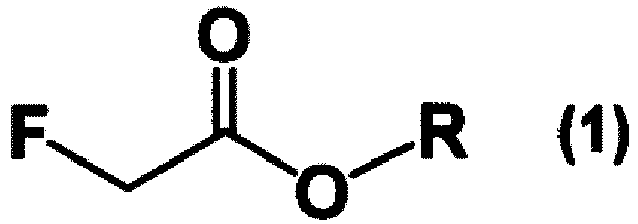 R is an organic group,the method comprisingthe step of reacting a compound represented by formula (2):
 whereinX is a leaving group other than fluorine, and R is as defined above,with a compound represented by formula (3):
MFn (3)
whereinM is a cation and n is an integer corresponding to the valence of the cation,whereinthe compound represented by formula (3) is used in an amount of 0.9 moles or less per mole of the compound represented by formula (2). - The production method according to claim 1, wherein the reaction is substantially performed with the compound represented by formula (2) and the compound represented by formula (3) alone.
- The production method according to claim 1 or 2, wherein the compound represented by formula (3) is used in an amount of 0.8 moles or less per mole of the compound represented by formula (2).
- The production method according to any one of claims 1 to 3, wherein the compound represented by formula (3) is used in an amount of 0.7 moles or less per mole of the compound represented by formula (2).
- The production method according to any one of claims 1 to 4, wherein the compound represented by formula (3) is used in an amount of 0.6 moles or less per mole of the compound represented by formula (2).
- The production method according to any one of claims 1 to 5, wherein the reaction is performed at 100 to 250°C.
- The production method according to any one of claims 1 to 6, comprising the step of distilling a product obtained by the above step.
- The production method according to any one of claims 1 to 7, wherein R is a hydrocarbon group optionally having one or more substituents.
- The production method according to any one of claims 1 to 8, wherein R is an alkyl group, a fluoroalkyl group, or an aryl group optionally having one or more substituents.
- The production method according to any one of claims 1 to 9, wherein X is halogen other than fluorine, an alkylsulfonyloxy group, a haloalkylsulfonyloxy group, or an arylsulfonyloxy group.
- The production method according to any one of claims 1 to 10, wherein X is chlorine or bromine.
- The production method according to any one of claims 1 to 11, wherein X is chlorine.
- The production method according to any one of claims 1 to 12, wherein M is a hydrogen ion, an alkali metal ion, an alkaline earth metal ion, or an ammonium ion.
- The production method according to any one of claims 1 to 13, wherein M is a hydrogen ion or an alkali metal ion.
- The production method according to any one of claims 1 to 13, wherein the compound represented by formula (3) is at least one member selected from HF, NaF, KF, CsF, and CaF2.
- The production method according to any one of claims 1 to 15, wherein the compound represented by formula (3) is at least one member selected from KF and CsF.
- The production method according to any one of claims 1 to 16, wherein the compound represented by formula (3) has a moisture content of 1.0 mass% or less.
- A composition comprisinga compound represented by formula (1):
 wherein R is an organic group, anda compound represented by formula (2):
 wherein X is halogen other than fluorine, an alkylsulfonyloxy group, a haloalkylsulfonyloxy group, or an arylsulfonyloxy group, and R is an organic group,wherein the content of the compound represented by formula (2) is morethan 0.001 mass% to 2.5 mass% or less.
 - A composition comprisinga compound represented by formula (1):
 wherein R is an organic group, anda compound represented by formula (2):
 wherein X is halogen other than fluorine, an alkylsulfonyloxy group, a haloalkylsulfonyloxy group, or an arylsulfonyloxy group, and R is an organic group,whereinthe content of the compound represented by formula (2) is morethan 0.001 parts by mass to 2.5 parts by mass or less relative to 100 parts by mass of the compound represented by formula (1).
 - A composition comprisinga compound represented by formula (1):
 wherein R is an organic group, anda compound represented by formula (4):
R-OH (4)
wherein R is as defined above,whereinthe content of the compound represented by formula (4) is 1.0 mass% or less, or 1.1 to 2.5 mass%. - A composition comprisinga compound represented by formula (1):
 wherein R is an organic group, anda compound represented by formula (4):
R-OH (4)
wherein R is as defined above,whereinthe content of the compound represented by formula (4) is 1.0 part by mass or less, or 1.1 to 2.5 parts by mass relative to 100 parts by mass of the compound represented by formula (1). - A composition comprisinga compound represented by formula (1):
 wherein R is an organic group, and2-fluoroacetic acid,whereinthe content of the 2-fluoroacetic acid is 0.9 mass% or less.
 - A composition comprisinga compound represented by formula (1):
 wherein R is an organic group, and2-fluoroacetic acid,whereinthe content of the 2-fluoroacetic acid is 0.9 parts by mass or less relative to 100 parts by mass of the compound represented by formula (1).
 - A composition comprisinga compound represented by formula (1):
 wherein R is an organic group, anda compound represented by formula (5):
 wherein X is halogen other than fluorine, an alkylsulfonyloxy group, a haloalkylsulfonyloxy group, or an arylsulfonyloxy group,whereinthe content of the compound represented by formula (5) is 0.001 mass% or less, or 0.002 to 1 mass%.
 - A composition comprisinga compound represented by formula (1):
 wherein R is an organic group, anda compound represented by formula (5):
 wherein X is halogen other than fluorine, an alkylsulfonyloxy group, a haloalkylsulfonyloxy group, or an arylsulfonyloxy group,whereinthe content of the compound represented by formula (5) is 0.001 parts by mass or less, or 0.002 to 1 part by mass relative to 100 parts by mass of the compound represented by formula (1).
 - A composition comprisinga compound represented by formula (1):
 wherein R is an organic group, anda compound represented by formula (6):
CH3COOR (6)
wherein R is as defined above,whereinthe content of the compound represented by formula (6) is less than 0.01 mass%. - A composition comprisinga compound represented by formula (1):
 wherein R is an organic group, anda compound represented by formula (6):
CH3COOR (6)
wherein R is as defined above,whereinthe content of the compound represented by formula (6) is less than 0.01 parts by mass relative to 100 parts by mass of the compound represented by formula (1). - A composition comprisinga compound represented by formula (1):
 wherein R is an organic group, anda compound represented by formula (7):
 wherein R is as defined above,whereinthe content of the compound represented by formula (7) is less than 0.01 mass%.
 - A composition comprisinga compound represented by formula (1):
 wherein R is an organic group, anda compound represented by formula (7)
 wherein R is as defined above,whereinthe content of the compound represented by formula (7) is less than 0.01 parts by mass relative to 100 parts by mass of the compound represented by formula (1).
 - A composition comprisinga compound represented by formula (1):
 wherein R is an organic group, anda compound represented by formula (8):
 wherein R is as defined above,whereinthe content of the compound represented by formula (8) is 0.006 to 0.5 mass%.
 - A composition comprising a compound represented by formula (1):
 wherein R is an organic group, anda compound represented by formula (8):
 wherein R is as defined above,whereinthe content of the compound represented by formula (8) is 0.006 to 0.5 parts by mass relative to 100 parts by mass of the compound represented by formula (1).
 - The composition according to any one of claims 18 to 31, wherein R is a hydrocarbon group optionally having one or more substituents.
- The composition according to any one of claims 18 to 32, wherein R is an alkyl group, a fluoroalkyl group, or an aryl group optionally having one or more substituents.
- The composition according to any one of claims 18, 19, 24 and 25, wherein X is chlorine or bromine.
- A composition comprising a compound represented by formula (1):
 wherein R is an organic group, andat least one inorganic salt selected from the group consisting ofa compound represented by formula (3):
MFn (3)
wherein M is a cation and n is an integer corresponding to the valence of the cation, anda compound represented by formula (3'):
MCln (3')
wherein M and n are as defined above. - A composition comprising methyl 2-fluoroacetate and ethyl 2-fluoroacetate.
Applications Claiming Priority (2)
| Application Number | Priority Date | Filing Date | Title |
|---|---|---|---|
| JP2019198220 | 2019-10-31 | ||
| PCT/JP2020/040943 WO2021085631A1 (en) | 2019-10-31 | 2020-10-30 | Method for manufacturing fluoroacetic acid ester |
Publications (2)
| Publication Number | Publication Date |
|---|---|
| EP4053098A1 true EP4053098A1 (en) | 2022-09-07 |
| EP4053098A4 EP4053098A4 (en) | 2023-12-13 |
Family
ID=75715546
Family Applications (1)
| Application Number | Title | Priority Date | Filing Date |
|---|---|---|---|
| EP20880470.8A Withdrawn EP4053098A4 (en) | 2019-10-31 | 2020-10-30 | Method for manufacturing fluoroacetic acid ester |
Country Status (5)
| Country | Link |
|---|---|
| US (1) | US20220259135A1 (en) |
| EP (1) | EP4053098A4 (en) |
| JP (2) | JP7476076B2 (en) |
| CN (2) | CN114599632A (en) |
| WO (1) | WO2021085631A1 (en) |
Family Cites Families (5)
| Publication number | Priority date | Publication date | Assignee | Title |
|---|---|---|---|---|
| JP2003267931A (en) * | 2002-03-18 | 2003-09-25 | Mitsubishi Chemicals Corp | Method for producing saturated fluorocarboxylic acid ester |
| KR101181563B1 (en) * | 2008-11-14 | 2012-09-10 | 에스케이케미칼주식회사 | Method for preparing microspheres and microspheres produced thereby |
| FR2975990B1 (en) * | 2011-06-01 | 2013-05-24 | Rhodia Operations | PROCESS FOR PREPARING A FLUORINE ORGANIC COMPOUND |
| CN102976934A (en) * | 2012-12-21 | 2013-03-20 | 王学军 | Preparation method of fluoroacetate |
| CN104292104B (en) * | 2014-03-04 | 2016-06-22 | 多氟多化工股份有限公司 | The preparation method of a kind of methylfluoracetate and equipment |
-
2020
- 2020-10-30 EP EP20880470.8A patent/EP4053098A4/en not_active Withdrawn
- 2020-10-30 CN CN202080074692.8A patent/CN114599632A/en active Pending
- 2020-10-30 WO PCT/JP2020/040943 patent/WO2021085631A1/en not_active Ceased
- 2020-10-30 JP JP2020182707A patent/JP7476076B2/en active Active
- 2020-10-30 CN CN202411334290.3A patent/CN119080620A/en active Pending
-
2021
- 2021-11-24 JP JP2021190056A patent/JP2022031779A/en active Pending
-
2022
- 2022-04-27 US US17/730,768 patent/US20220259135A1/en not_active Abandoned
Also Published As
| Publication number | Publication date |
|---|---|
| EP4053098A4 (en) | 2023-12-13 |
| JP2022031779A (en) | 2022-02-22 |
| JP7476076B2 (en) | 2024-04-30 |
| US20220259135A1 (en) | 2022-08-18 |
| JP2021075527A (en) | 2021-05-20 |
| CN119080620A (en) | 2024-12-06 |
| WO2021085631A1 (en) | 2021-05-06 |
| CN114599632A (en) | 2022-06-07 |
Similar Documents
| Publication | Publication Date | Title |
|---|---|---|
| US20250282704A1 (en) | Method for producing fluoroalkoxide | |
| RU2807292C9 (en) | Method for production of fluoroacetic acid ester | |
| JP7476076B2 (en) | Method for producing fluoroacetic esters | |
| RU2807292C1 (en) | Method for production of fluoroacetic acid ester | |
| JP7244789B2 (en) | Cyclic carbonate compound and method for producing the same | |
| EP4567018A1 (en) | Method for producing fluorinated organic compound | |
| JP2023042598A (en) | Haloether, method for producing the same, vinyl ether, and method for producing the same | |
| US11945773B2 (en) | Method for producing propionic acid derivative | |
| CN112004793B (en) | Method for manufacturing fluorinated organic compounds | |
| JP6497548B2 (en) | Fluorine-containing complex compound, and method for producing fluorine-containing organic compound using fluorine-containing complex compound | |
| US12162854B2 (en) | Production method for fluoromethyl derivative | |
| JP6629020B2 (en) | Method for producing substituted olefin compound | |
| JP2024039602A (en) | Method for producing α-chloroacrylic acid esters | |
| WO2024053502A1 (en) | METHOD FOR PRODUCING α-CHLOROACRYLIC ACID ESTER | |
| JP2018150263A (en) | Cyclic carbonate compound and method for producing the same | |
| JP2018150264A (en) | Cyclic carbonate compound and method for producing the same | |
| JP2017202989A (en) | Fluorine-containing compound, and method for producing the same | |
| JP2016166168A (en) | Method for producing substituted olefin | |
| JPH09104682A (en) | Method for producing thiophenes |
Legal Events
| Date | Code | Title | Description |
|---|---|---|---|
| STAA | Information on the status of an ep patent application or granted ep patent |
Free format text: STATUS: THE INTERNATIONAL PUBLICATION HAS BEEN MADE |
|
| PUAI | Public reference made under article 153(3) epc to a published international application that has entered the european phase |
Free format text: ORIGINAL CODE: 0009012 |
|
| STAA | Information on the status of an ep patent application or granted ep patent |
Free format text: STATUS: REQUEST FOR EXAMINATION WAS MADE |
|
| 17P | Request for examination filed |
Effective date: 20220509 |
|
| AK | Designated contracting states |
Kind code of ref document: A1 Designated state(s): AL AT BE BG CH CY CZ DE DK EE ES FI FR GB GR HR HU IE IS IT LI LT LU LV MC MK MT NL NO PL PT RO RS SE SI SK SM TR |
|
| RAP3 | Party data changed (applicant data changed or rights of an application transferred) |
Owner name: DAIKIN INDUSTRIES, LTD. |
|
| DAV | Request for validation of the european patent (deleted) | ||
| DAX | Request for extension of the european patent (deleted) | ||
| P01 | Opt-out of the competence of the unified patent court (upc) registered |
Effective date: 20230525 |
|
| A4 | Supplementary search report drawn up and despatched |
Effective date: 20231113 |
|
| RIC1 | Information provided on ipc code assigned before grant |
Ipc: C07C 69/63 20060101ALI20231107BHEP Ipc: C07C 67/307 20060101AFI20231107BHEP |
|
| STAA | Information on the status of an ep patent application or granted ep patent |
Free format text: STATUS: THE APPLICATION HAS BEEN WITHDRAWN |
|
| 18W | Application withdrawn |
Effective date: 20250410 |