EP4052977B1 - Interface adapter for a control valve and control valve with an interface adapter - Google Patents
Interface adapter for a control valve and control valve with an interface adapter Download PDFInfo
- Publication number
- EP4052977B1 EP4052977B1 EP21160855.9A EP21160855A EP4052977B1 EP 4052977 B1 EP4052977 B1 EP 4052977B1 EP 21160855 A EP21160855 A EP 21160855A EP 4052977 B1 EP4052977 B1 EP 4052977B1
- Authority
- EP
- European Patent Office
- Prior art keywords
- interface
- fluid
- control valve
- valve
- fluid communication
- Prior art date
- Legal status (The legal status is an assumption and is not a legal conclusion. Google has not performed a legal analysis and makes no representation as to the accuracy of the status listed.)
- Active
Links
Images


Classifications
-
- F—MECHANICAL ENGINEERING; LIGHTING; HEATING; WEAPONS; BLASTING
- F16—ENGINEERING ELEMENTS AND UNITS; GENERAL MEASURES FOR PRODUCING AND MAINTAINING EFFECTIVE FUNCTIONING OF MACHINES OR INSTALLATIONS; THERMAL INSULATION IN GENERAL
- F16K—VALVES; TAPS; COCKS; ACTUATING-FLOATS; DEVICES FOR VENTING OR AERATING
- F16K37/00—Special means in or on valves or other cut-off apparatus for indicating or recording operation thereof, or for enabling an alarm to be given
- F16K37/0075—For recording or indicating the functioning of a valve in combination with test equipment
- F16K37/0091—For recording or indicating the functioning of a valve in combination with test equipment by measuring fluid parameters
-
- B—PERFORMING OPERATIONS; TRANSPORTING
- B60—VEHICLES IN GENERAL
- B60T—VEHICLE BRAKE CONTROL SYSTEMS OR PARTS THEREOF; BRAKE CONTROL SYSTEMS OR PARTS THEREOF, IN GENERAL; ARRANGEMENT OF BRAKING ELEMENTS ON VEHICLES IN GENERAL; PORTABLE DEVICES FOR PREVENTING UNWANTED MOVEMENT OF VEHICLES; VEHICLE MODIFICATIONS TO FACILITATE COOLING OF BRAKES
- B60T13/00—Transmitting braking action from initiating means to ultimate brake actuator with power assistance or drive; Brake systems incorporating such transmitting means, e.g. air-pressure brake systems
- B60T13/10—Transmitting braking action from initiating means to ultimate brake actuator with power assistance or drive; Brake systems incorporating such transmitting means, e.g. air-pressure brake systems with fluid assistance, drive, or release
- B60T13/66—Electrical control in fluid-pressure brake systems
- B60T13/665—Electrical control in fluid-pressure brake systems the systems being specially adapted for transferring two or more command signals, e.g. railway systems
-
- B—PERFORMING OPERATIONS; TRANSPORTING
- B60—VEHICLES IN GENERAL
- B60T—VEHICLE BRAKE CONTROL SYSTEMS OR PARTS THEREOF; BRAKE CONTROL SYSTEMS OR PARTS THEREOF, IN GENERAL; ARRANGEMENT OF BRAKING ELEMENTS ON VEHICLES IN GENERAL; PORTABLE DEVICES FOR PREVENTING UNWANTED MOVEMENT OF VEHICLES; VEHICLE MODIFICATIONS TO FACILITATE COOLING OF BRAKES
- B60T15/00—Construction arrangement, or operation of valves incorporated in power brake systems and not covered by groups B60T11/00 or B60T13/00
- B60T15/02—Application and release valves
- B60T15/021—Railway control or brake valves
-
- B—PERFORMING OPERATIONS; TRANSPORTING
- B60—VEHICLES IN GENERAL
- B60T—VEHICLE BRAKE CONTROL SYSTEMS OR PARTS THEREOF; BRAKE CONTROL SYSTEMS OR PARTS THEREOF, IN GENERAL; ARRANGEMENT OF BRAKING ELEMENTS ON VEHICLES IN GENERAL; PORTABLE DEVICES FOR PREVENTING UNWANTED MOVEMENT OF VEHICLES; VEHICLE MODIFICATIONS TO FACILITATE COOLING OF BRAKES
- B60T15/00—Construction arrangement, or operation of valves incorporated in power brake systems and not covered by groups B60T11/00 or B60T13/00
- B60T15/02—Application and release valves
- B60T15/025—Electrically controlled valves
- B60T15/027—Electrically controlled valves in pneumatic systems
-
- B—PERFORMING OPERATIONS; TRANSPORTING
- B60—VEHICLES IN GENERAL
- B60T—VEHICLE BRAKE CONTROL SYSTEMS OR PARTS THEREOF; BRAKE CONTROL SYSTEMS OR PARTS THEREOF, IN GENERAL; ARRANGEMENT OF BRAKING ELEMENTS ON VEHICLES IN GENERAL; PORTABLE DEVICES FOR PREVENTING UNWANTED MOVEMENT OF VEHICLES; VEHICLE MODIFICATIONS TO FACILITATE COOLING OF BRAKES
- B60T15/00—Construction arrangement, or operation of valves incorporated in power brake systems and not covered by groups B60T11/00 or B60T13/00
- B60T15/02—Application and release valves
- B60T15/18—Triple or other relay valves which allow step-wise application or release and which are actuated by brake-pipe pressure variation to connect brake cylinders or equivalent to compressed air or vacuum source or atmosphere
- B60T15/24—Triple or other relay valves which allow step-wise application or release and which are actuated by brake-pipe pressure variation to connect brake cylinders or equivalent to compressed air or vacuum source or atmosphere controlled by three fluid pressures
- B60T15/30—Triple or other relay valves which allow step-wise application or release and which are actuated by brake-pipe pressure variation to connect brake cylinders or equivalent to compressed air or vacuum source or atmosphere controlled by three fluid pressures with a quick braking action
- B60T15/302—Railway control or brake valves with evacuation of air to a reservoir, to the atmosphere or to the brake cylinder
-
- B—PERFORMING OPERATIONS; TRANSPORTING
- B60—VEHICLES IN GENERAL
- B60T—VEHICLE BRAKE CONTROL SYSTEMS OR PARTS THEREOF; BRAKE CONTROL SYSTEMS OR PARTS THEREOF, IN GENERAL; ARRANGEMENT OF BRAKING ELEMENTS ON VEHICLES IN GENERAL; PORTABLE DEVICES FOR PREVENTING UNWANTED MOVEMENT OF VEHICLES; VEHICLE MODIFICATIONS TO FACILITATE COOLING OF BRAKES
- B60T17/00—Component parts, details, or accessories of power brake systems not covered by groups B60T8/00, B60T13/00 or B60T15/00, or presenting other characteristic features
- B60T17/18—Safety devices; Monitoring
- B60T17/22—Devices for monitoring or checking brake systems; Signal devices
- B60T17/221—Procedure or apparatus for checking or keeping in a correct functioning condition of brake systems
Definitions
- the present invention relates to an interface adapter for a control valve, particularly for a rail car pneumatic brake system, and to a control valve, comprising such an interface adapter.
- Control valves in a pneumatic brake system have to react precisely to changes in the brake pipe pressure and to provide the corresponding brake cylinder pressure.
- Modern pneumatic brake systems use electric valves that receive braking signals by wire or radio to control the airflow to and from the brake cylinder.
- the valves and the pipe system connected to the valves need to be monitored and checked.
- EP 3 608 184 A1 proposes a valve diagnostic and monitoring system, especially for a distributor valve in a pneumatic brake system for rail cars.
- the monitoring system can monitor and check different parameters, especially different pressures in the control valve and the pipe system that is in fluid communication with the control valve.
- the referenced solution only gives a general overview of such a diagnostic and monitoring system, but there is no concrete mechanical implementation of the concept within the control valve or a solution on how to implement the monitoring system into the control valve.
- the downside of the solution is further that the monitoring system is designed to be used with a new generation of control valves and has an interface that is adapted to the new generation of control valves.
- Existing control valves have standardised interfaces to which the interface of the new monitoring system is not compatible.
- the monitoring system can not be used as a retrofit solution to upgrade existing control valves.
- Another problem is that, especially in rail car pneumatic brake systems, the installation space for the control valve is limited, making it difficult to integrate the monitoring system without interference with the control valve or other components next to it.
- US 2019/0061730 A1 shows a distributor valve for a pneumatic brake System of a rail vehicle, wherein the distributor valve comprises a pipe bracket and two housing portions. Between the pipe bracket and the housing portions a adapter plate may be placed.
- WO 02/22421 A2 describes a car control device includes a pneumatic manifold with a plurality of fluid ports integrally formed in a housing. The configuration of the manifold and ports enables fluid communication with a brake valve, and a control valve module.
- the car control device also includes a functional control module in electric communication with a power management module, the control valve module, and the network. Each of the power management module, and the control valve module, the functional control module, and a battery assembly are all positioned to separately accessible within a housing.
- EP0861180 A1 describes an electropneumatic brake control valve unit capable of operating at the interface of the emergency brake portion or the service brake portion of a standard brake control valve as a retrofit unit or operating as a stand alone electropneumatic unit.
- An interface adapter for a control valve, particularly of a rail car pneumatic brake system, according to the invention, is designed to be integrated in a control valve having at least two housing compartments.
- the interface adapter enables a modular construction of the control valve, when an additional housing compartment or module with an interface that is not compatible with a standardised interface of the existing control valve, needs to be integrated in the control valve.
- the interface adapter is placed between the two housing compartments of the control valve.
- the housing compartments and/or the additional module or housing compartment can be connected to the interface adapter, preferably in an easy detachable way, for example by screws.
- the interface adapter can be made out of steel, aluminium, polymer or other material to be suitable for working temperatures between -50°C and 70°C.
- the interface adapter further comprises an essentially even plate structure having a fluid interface duplicate plate section and a further interface plate section, wherein the fluid interface duplicate plate section and the further interface plate section extended in the same plane.
- the control valve can also comprise one ore more further housing compartments.
- the housing compartments can be rearranged or exchanged easily, providing a modular construction of the control valve.
- the housing compartments can be connected to each other, preferably in an easy detachable way.
- Each housing compartment can comprise or be connected to one or more modules of the control valve.
- These modules may include but are not limited to a valve arrangement, such as a distributor valve or a relay valve arrangement, or an electronic module, such as a monitoring system.
- the relay valve arrangement may comprise one or more relay valves.
- Such a modular construction has the advantage that the control valve can be adapted flexibly to potential requirements and that all modules requiring maintenance are easy detachable.
- the housing compartments can be made out of steel, aluminium, polymer or other material to be suitable for working temperatures between -50°C and 70°C.
- the control valve comprises a first housing compartment, in particular a valve bracket, that does not comprise and is not connected to a module of the control valve. Instead the valve bracket my be connected to one or more further housing compartments.
- the further housing compartments each can comprise or can be connected to a module of the control valve, such as a distributor valve, a relay valve arrangement or an electronic module.
- the interface adapter is preferably placed between the valve bracket and the other housing compartments each comprising or connected to a module of the control valve, such as a distributor valve, a relay valve arrangement or an electronic module.
- the at least two housing compartments of the control valve are in fluid communication with each other via a fluid interface. Via this fluid interface the fluid of the brake system, in particular the air stream, can pass from one housing compartment to the other housing compartment.
- the fluid interface can be designed to enable fluid communication between more than two housing compartments, preferably between all housing compartments.
- there can be more than one fluid interface wherein each fluid interface enables fluid communication between two housing compartments, in particular to enable fluid communication between all housing compartments.
- each housing compartment comprises at least one fluid interface.
- the fluid interface can be realized by at least one fluid inlet or outlet.
- the fluid interface can also comprise one or more further fluid inlets and/or outlets.
- At least one housing compartment has further fluid inlets and/or outlets to enable fluid communication with other components of the brake system.
- This fluid communication can be realized by a pipe system.
- the pipe system connects the control valve with the brakes, wherein the brake pipe leads the air stream from the control valve to the brakes, as well as the emergency reservoir, the auxiliary reservoir and the brake cylinder, wherein the pipes lead the air stream to the control valve.
- the fluid interface between the housing compartments guides the air stream, coming into the valve bracket through a fluid channel, from the valve bracket to the distributor valve and the relay valve. From there it can pass back to the valve bracket and through the brake pipe to the brakes.
- housing compartments can be in fluid communication via a standardised interface.
- some housing compartments or modules that may need to be integrated in the control valve, can have a different interface, in particular a new standardised interface.
- a monitoring system was developed, that can monitor and check different parameters in the control valve and the pipe system in order to provide a reliable brake system. This monitoring system has a new standardised interface that is not compatible with the standardised interface of the existing control valve.
- the interface adapter comprises a fluid interface duplicate for enabling fluid communication between the housing compartments of the control valve through the interface adapter.
- the fluid interface duplicate therefore matches the fluid interface of the housing compartments of the existing control valve, in particular the standardised interface of the existing control valve. This allows to place the interface adapter between the housing compartments without interrupting the fluid flow and hence the fluid communication and without having to change the existing, in particular standardised, fluid interface design.
- the interface adapter also comprises a further interface being in fluid communication with the fluid interface duplicate for enabling access to the fluid communication between the housing compartments from outside the housing, in particular to enable fluid communication with the additional module and/or housing compartment that needs to be integrated.
- the additional module or housing compartment is preferably connected, in particular mounted, to the further interface.
- the two interfaces of the interface adapter can be designed independently from each other and can easily be adapted to specific requirements.
- the further interface can be adapted as required to be compatible with the interface of an additional module and/or housing compartment that is not compatible with the standardised interface of the control valve.
- the further interface can be adapted to the new standardised interface of the monitoring system.
- the further interface of the interface adapter is in fluid communication with the fluid interface duplicate so it is also in fluid communication with the fluid interface between the housing compartments of the control valve.
- the further interface enables access to the fluid communication between the housing compartments from outside the housing to integrate an additional module or housing compartment.
- the fluid communication between the housing compartments can be accessed by a monitoring system with a standardised interface of the new generation of control valves.
- the interface adapter can adapt the old standardised interface of the existing control valve to the new standardised interface of the new generation of control valves. So it enables a mechanical implementation of the monitoring system as a retrofit solution to upgrade the existing control valve. It also provides a standardised interface across all valve products, especially across existing control valves and the new generation of control valves, because the same housing compartments and/or modules, for example the monitoring system, can be integrated in all control valves.
- the monitoring system can check and monitor different parameters in order to provide a reliable brake system.
- the parameters may be related to the flow and/or pressure of the fluid at various points in the control valve or the pipe system. Other parameters may include but are not limited to temperature, moisture or vibrations at various points in the control valve or the pipe system. It is also possible to monitor one or more further pressures and/or one or more further other paratemeters. In an example embodiment there are various pressures that need to be monitored by the monitoring system in order to provide a reliable brake system. These include but are not limited to the pressures of a auxiliary reservoir and a emergency reservoir of the control valve, a relay valve arrangement, a brake cylinder, a brake pipe and a distributor valve.
- an interface adapter according to the invention enables easy access to all pressures that need to be monitored by the monitoring system, as they can be accessed from outside the housing via the further interface that is in fluid communication with the fluid interface duplicate and hence the fluid interface between the housing compartments.
- the interface adapter comprises an essentially even plate structure.
- the plate structure has a fluid interface duplicate plate section and a further interface plate section.
- the fluid interface duplicate plate section and the further interface plate section extend in the same plane. They may be manufactured in one piece.
- the interface adapter in particular an intermediate plate, provides a simple mechanical solution to integrate the monitoring system as a retrofit solution to existing control valves.
- the interface adapter is configured to branch off the fluid communication in a direction at least section wisely parallel to the fluid interface between the housing compartments. This allows placing the further interface at a certain distance to the fluid interface duplicate at a better accessible position or at a position where the additional module and/or housing compartment connected to the interface adapter, for example the monitoring system, does not interfere with the housing compartments of the control valve or other components of the brake system next to the control valve.
- the monitoring system can be placed next to an existing housing compartment instead of being mounted on the housing compartment. This reduces the installation space needed for the control valve.
- the fluid interface duplicate of the interface adapter comprises at least one through hole, preferably at least two, three, four, five, six, seven or eigth through holes, for enabling distinct fluid flows through the interface adapter.
- the fluid interface duplicate can also comprise one or more further through holes to enable distinct fluid flows through the interface adapter.
- the further interface comprises a number of openings adapted to the number of through holes of the fluid interface duplicate.
- the number of through holes of the fluid interface duplicate and the number of openings of the further interface can be adapted to the number of pressures that need to be monitored by the monitoring system.
- each opening of the further interface is in fluid communication with one through hole of the fluid interface duplicate.
- the through holes enable an uninterrupted fluid flow between the housing compartments of the control valve.
- the fluid communication between each through hole and each opening enables access to the fluid flow between the housing compartments from outside the housing, for example by a monitoring system.
- the fluid communication between each opening and through hole is realized by means of a fluid channel extending through the interface adapter, in particular the plate structure, or a groove arranged on an outer surface of the interface adapter, in particular the plate structure.
- a fluid channel extending through the interface adapter, in particular the plate structure, or a groove arranged on an outer surface of the interface adapter, in particular the plate structure.
- a control valve particularly for a rail car pneumatic brake system, comprises a housing with at least two housing compartments.
- the housing can also comprise one or more further housing compartments.
- the housing compartments are in fluid communication with each other via a fluid interface.
- the control valve according to the invention further comprises an interface adapter configured to transfer the fluid interface of the housing compartments to an accessible space outside the housing for enabling a further access to the fluid communication, for example by a monitoring system.
- the control valve provides a mechanical solution to integrate the monitoring system in existing control valves as a retrofit solution to upgrade the existing control valve. It also provides a standardised interface across all valve products, especially across existing control valves and new generation control valves.
- control valve comprises an interface adapter according to one of the previous aspects or example embodiments to make use of the advantages described above.
- the interface adapter is configured to transfer the fluid interface in a direction at least section wisely parallel to the interface between the housing compartments. This allows placing the further access to the fluid communication at a certain distance to the fluid interface at a better accessible position or at a position that offers more installation space to integrate an additional module and/or housing compartment, for example a monitoring system. Thus it allows using the limited installation space, especially in rail car pneumatic brake systems, in an optimal way.
- the further interface of the interface adapter is an electronics interface configured to be connected to an electronic module or a dummy for occupying the electronics interface.
- the electronic module is mounted to the interface adapter, in particular to the electronics interface.
- the electronic module or the dummy are mounted in an easy detachable way, for example by screws.
- This embodiment has the advantage that it provides a modular construction of the control valve, wherein either an electronic module or a dummy can be connected to the same electronics interface of the interface adapter.
- the dummy is needed in brake systems without an electronic module, to close the openings of the electronics interface in order to prevent air from getting into the brake system.
- the dummy preferably comprises an essentially even plate structure.
- the electronic module comprises a measuring and/or monitoring device, in particular a data hub, configured to determine and/or monitor at least one parameter of the fluid flow, such as a pressure.
- the measuring and/or monitoring device can also determine and/or monitor one or more further parameters of the fluid flow, such as a pressure.
- Other parameters that can be determined and/or monitored can include but are not limited to temperature, vibrations and/or moisture.
- the pressures that need to be measured and/or monitored include the pressures of an auxiliary reservoir and an emergency reservoir of the control valve, a relay valve arrangement, a distributor valve, a brake cylinder and a brake pipe.
- the measuring and/or monitoring device in particular the data hub, comprises a predetermined sensor arrangement of at least one sensor, in particular a pressure sensor.
- the predetermined sensor arrangement can also comprise one or more further sensors, in particular one or more further pressure sensors.
- the predetermined sensor arrangement can further include additional temperature sensors, accelerometers and/or moisture sensors.
- the data hub helps to integrate the data from all sensors and to process it. It can also transmit the data to a processing unit wirelessly or by wire.
- the electronics interface design is adapted to the predetermined sensor arrangement.
- the pressure sensors of the predetermined sensor arrangement are each allocated to one electronics interface opening, enabling easy access to all parameters, for example all pressures, that need to be monitored in order to provide a reliable brake system.
- each of the housing compartments comprises or is connected to a valve arrangement, such as a distributor valve or a relay valve arrangement.
- the relay valve arrangement comprises one or more relay valves that can quickly increase or decrease the air pressure. They help to shorten the pressure application time of the brake cylinders and also function as quick exhaust valves when the brakes are released.
- the further interface comprises a connection, such as an opening or a hole, for connecting to a fluid pipe enabling fluid communication of the further interface with the relay valve arrangement, in particular for enabling access to the control pressure of the relay valve arrangement.
- a control valve according to the invention is generally indicated with the reference numeral 1.
- Fig. 1 and Fig. 2 show a control valve 1, particularly of a rail car pneumatic brake system, with a modular construction to be able to adapt the control valve 1 as flexibly as possible to potential requirements. It comprises three housing compartments 3, 5, 7.
- the first housing compartment, a valve bracket 3, is designed to hold the other two housing compartments 5, 7 and/or to mount the control valve 1 for example to a chassis structure of a rail car and to connect the control valve 1 to other components of the brake system.
- the valve bracket 3 comprises a fluid channel 13 to guide the fluid, in particular the air stream of compressed air from the pneumatic brake system, into the control valve 1. It further comprises various pressure inlets and outlets 15, 17, 19, 21, in particular one pressure outlet and three pressure inlets, to enable fluid communication with a pipe system that is connected to other components of the brake system (not shown in Fig.1 and Fig. 2 ).
- the pipe system connects the control valve 1 with the brakes, wherein the brake pipe leads the air stream from the control valve 1 to the brakes, as well as the emergency reservoir, the auxiliary reservoir and the brake cylinder, wherein the pipes lead the air stream to the control valve 1.
- the other two housing compartments each comprise a module of the control valve 1.
- the second housing compartment 5 comprises a distributor valve and the third housing compartment 7 comprises a relay valve arrangement comprising one relay valve. There may also be a second relay valve adjacent to the first relay valve.
- At least two of the three housing compartments 3, 5, 7, in particular all three housing compartments 3, 5, 7 are in fluid communication with each other via a standardised fluid interface 23. Via this fluid interface 23 the air stream coming into the valve bracket 3 through the fluid channel 13 can pass from the valve bracket 3 to the distributor valve 5 and the relay valve 7. From there it can pass back to the valve bracket 3 and through the brake pipe to the brakes.
- the control valve 1 further comprises an interface adapter, generally indicated with the reference numeral 9 which, in the example embodiments of Fig. 1 to 4 , is formed as an intermediate plate 9 with an even plate structure.
- the intermediate plate 9 is placed between the valve bracket 3 and the other two housing compartments comprising the distributor valve 5 and the relay valve 7. All three housing compartments 3, 5, 7 are connected to the intermediate plate 9 in an easy detachable way.
- the valve bracket 3 and the housing compartment comprising the relay valve 7 are mounted on the intermediate plate 9 by screws.
- the housing compartment comprising the distributor valve 5 is mounted on the intermediate plate 9 by screws and two control levers 27, 29.
- the intermediate plate 9 is needed to integrate an additional module, an electronic module, into the control valve 1 in particular without having to amend the interface structures and/or designs of the control valve and/or the additional module.
- This electronic module is a monitoring system 11, that can measure and/or monitor different parameters in the control valve 1 and the pipe system in order to provide a reliable pneumatic brake system.
- the monitoring system 11 measures different pressures in the control valve 1 and the pipe system. These are the four pressures in the pipe system being in fluid communication with the valve bracket 3 (not shown in Fig. 1 and Fig. 2 ) as well as the pressures of the fluid streams between the valve bracket 3 and the distributor valve 5 as well as between the valve bracket 3 and the relay valve 7.
- the monitoring system 11 comprises a predetermined sensor arrangement with one pressure sensor for each pressure that needs to be monitored.
- the monitoring system also comprises a data HUB to integrate the data from all sensors, to process and transmit it.
- the monitoring system 11 is mounted to the intermediate plate 9 by screws.
- the fluid interface of the monitoring system 11 is preferably designed to be implemented in a new generation of control valves setting a new standard fluid interface. Therefore it has a new standardised fluid interface, a sensor interface 25 ( Fig. 3 ), that is not compatible with the standardised fluid interface 23 of the housing compartments 3, 5, 7.
- the control valve 1 further comprises an additional fluid pipe 31 that connects an opening 95 on the back side 37 of the intermediate plate 9 and the relay valve 7 to access the control pressure of the relay valve 7.
- the intermediate plate 9 enables fluid communication between the monitoring system 11 and the housing compartments 3, 5, 7 of the control valve 1 and therefore provides a mechanical solution to integrate the monitoring system in an existing control valve 1 as a retrofit solution to upgrade the control valve 1. It also enables easy access to all pressures that need to be monitored by the monitoring system 11, because they can be accessed from outside the housing compartments 3, 5, 7.
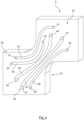
- Fig. 4 schematically shows the front side 39 of the intermediate plate 9 to explain how the intermediate plate 9 works.
- the front side 39 of the intermediate plate 9 comprises two fluid interface plate sections that extend in the same plane and are manufactured in one piece.
- Each of the fluid interface plate sections comprises a fluid interface.
- the first fluid interface is a fluid interface duplicate 33 that is compatible with the standardised interface 23 of the valve bracket 3 and the housing compartments comprising the distributor valve 5 and the relay valve 7.
- the fluid interface plate section 33 is placed between the housing compartments 3, 5, 7. It comprises a number of through holes 41, 43, 45, 47, 49 to enable uninterrupted fluid communication between the housing compartments 3, 5, 7 of the control valve 1 through the intermediate plate 9.
- the second fluid interface, the further fluid interface 35 is an electronics interface that is compatible with the predetermined sensor interface 25 of the monitoring system 11.
- the further interface 35 comprises a number of openings 51, 53, 55, 57, 59 adapted to the number of through holes 41, 43, 45, 47, 49 of the fluid interface duplicate 33.
- the monitoring system 11 is mounted on the further fluid interface plate section 35.
- the fluid interface duplicate 33 and the further interface 35 are in fluid communication with each other. This means that that the monitoring system 11 in fluid communication with the further interface 35 is also in fluid communication with the fluid communication between the housing compartments 3, 5, 7. To enable this fluid communication each opening 51, 53, 55, 57, 59 of the further interface 35 is in fluid communication with one through hole 41, 43, 45, 47, 49 of the fluid interface duplicate 33.
- the fluid communication is realized by a number of grooves, notches or channels 61, 63, 65, 67, 69.
- the grooves are arranged on an outer surface 37 of the intermediate plate 9. It is also possible that the channels 61, 63, 65, 67, 69 extend through the solid material of the intermediate plate 9 and are not accessible from the outside along their extension.
- There is one groove for each through hole of the fluid interface duplicate 33 enabling the fluid communication with the corresponding opening of the further interface 35.
- the through hole 41 is in fluid communication with the opening 51 via the groove 61.
- the intermediate plate 9 branches off the fluid communication parallel to the standardised fluid interface 23 between the valve bracket 3 and the housing compartments comprising the distributor valve 5 and the relay valve 7 by means of the grooves 61, 63, 65, 67, 69. This allows placing the further interface 35 at a position where it can be easily accessed by the monitoring system 11. It also allows placing the monitoring system 11 at any position in the limited installation space to prevent interference with the housing compartments 3, 5, 7 of the control valve 1 or other components of the brake system. In particular Fig. 1 shows that the monitoring system 11 is placed next to the valve bracket 3 instead of being mounted on the valve bracket 3, reducing the installation space needed for the control valve 1.
- Fig. 3 shows the actual interface of the monitoring system 11, the sensor interface 25. As described above it has a number of openings adapted to the number of pressures that need to be monitored by the monitoring system 11.
- the openings are adapted to the predetermined sensor arrangement of the monitoring system 11, wherein each pressure sensor is allocated to one opening of the sensor interface 25.
- the openings of the sensor interface 25 also enable fluid communication with the pipe system. There is one opening each for the pressure of the brake pipe (79) leading the air stream from the valve bracket 3 to the brakes and the pressures of the brake cylinder (75), the pre-control pressure (81), the emergency reservoir (83) and the auxiliary reservoir (35), wherein the pipes lead the air stream to the valve bracket 3.
- the sensor interface 25 comprises two openings 71, 73 for a breather and safety valve (not shown) to balance the internal pressures of the control valve 1 with the environment and to release internal over pressure if for example a pipe bursts.
- a dummy, preferably a dummy plate can be mounted to the sensor interface 25.
- the dummy plate prevents air from getting into the brake system in brake systems without a monitoring system.
- the sensor interface 25 in Fig. 3 is only one example of an electronics interface adapted to an exemplary monitoring system 11 to explain the function of such an electronics interface.
- the interface could comprise more or less openings to monitor more or less pressures or other parameters and/or the openings could be arranged in a different way.
Landscapes
- Engineering & Computer Science (AREA)
- Mechanical Engineering (AREA)
- Transportation (AREA)
- General Engineering & Computer Science (AREA)
- Physics & Mathematics (AREA)
- Fluid Mechanics (AREA)
- Valves And Accessory Devices For Braking Systems (AREA)
- Magnetically Actuated Valves (AREA)
- Feeding And Controlling Fuel (AREA)
Description
- The present invention relates to an interface adapter for a control valve, particularly for a rail car pneumatic brake system, and to a control valve, comprising such an interface adapter.
- Control valves in a pneumatic brake system have to react precisely to changes in the brake pipe pressure and to provide the corresponding brake cylinder pressure. Modern pneumatic brake systems use electric valves that receive braking signals by wire or radio to control the airflow to and from the brake cylinder. In order to provide a safely functioning and reliable pneumatic brake system, the valves and the pipe system connected to the valves need to be monitored and checked.
- For such an electric controlled brake system,
EP 3 608 184 A1 proposes a valve diagnostic and monitoring system, especially for a distributor valve in a pneumatic brake system for rail cars. The monitoring system can monitor and check different parameters, especially different pressures in the control valve and the pipe system that is in fluid communication with the control valve. - The referenced solution only gives a general overview of such a diagnostic and monitoring system, but there is no concrete mechanical implementation of the concept within the control valve or a solution on how to implement the monitoring system into the control valve. The downside of the solution is further that the monitoring system is designed to be used with a new generation of control valves and has an interface that is adapted to the new generation of control valves. Existing control valves have standardised interfaces to which the interface of the new monitoring system is not compatible. Thus the monitoring system can not be used as a retrofit solution to upgrade existing control valves. Another problem is that, especially in rail car pneumatic brake systems, the installation space for the control valve is limited, making it difficult to integrate the monitoring system without interference with the control valve or other components next to it.
- Finally,
US 2019/0061730 A1 shows a distributor valve for a pneumatic brake System of a rail vehicle, wherein the distributor valve comprises a pipe bracket and two housing portions. Between the pipe bracket and the housing portions a adapter plate may be placed. -
WO 02/22421 A2 -
EP0861180 A1 describes an electropneumatic brake control valve unit capable of operating at the interface of the emergency brake portion or the service brake portion of a standard brake control valve as a retrofit unit or operating as a stand alone electropneumatic unit. - It is an object of the present invention to overcome the above-mentioned disadvantages of the state of the art, particularly to provide a mechanical solution to integrate the monitoring system in existing control valves as a retrofit solution and to provide a standardised interface across all valve products, preferably in order to gain easy access to all pressures that need to be monitored by the monitoring system to provide a reliable pneumatic brake system.
- This objective is solved by the subject matter of the independent claims. Advantageous embodiments are subject to the dependent claims and will be set out herein below.
- An interface adapter for a control valve, particularly of a rail car pneumatic brake system, according to the invention, is designed to be integrated in a control valve having at least two housing compartments. The interface adapter enables a modular construction of the control valve, when an additional housing compartment or module with an interface that is not compatible with a standardised interface of the existing control valve, needs to be integrated in the control valve. Preferably, the interface adapter is placed between the two housing compartments of the control valve. The housing compartments and/or the additional module or housing compartment can be connected to the interface adapter, preferably in an easy detachable way, for example by screws. The interface adapter can be made out of steel, aluminium, polymer or other material to be suitable for working temperatures between -50°C and 70°C.
- The interface adapter further comprises an essentially even plate structure having a fluid interface duplicate plate section and a further interface plate section, wherein the fluid interface duplicate plate section and the further interface plate section extended in the same plane.
- The control valve can also comprise one ore more further housing compartments. The housing compartments can be rearranged or exchanged easily, providing a modular construction of the control valve. The housing compartments can be connected to each other, preferably in an easy detachable way. Each housing compartment can comprise or be connected to one or more modules of the control valve. These modules may include but are not limited to a valve arrangement, such as a distributor valve or a relay valve arrangement, or an electronic module, such as a monitoring system. The relay valve arrangement may comprise one or more relay valves. Such a modular construction has the advantage that the control valve can be adapted flexibly to potential requirements and that all modules requiring maintenance are easy detachable. The housing compartments can be made out of steel, aluminium, polymer or other material to be suitable for working temperatures between -50°C and 70°C. In an example embodiment the control valve comprises a first housing compartment, in particular a valve bracket, that does not comprise and is not connected to a module of the control valve. Instead the valve bracket my be connected to one or more further housing compartments. The further housing compartments each can comprise or can be connected to a module of the control valve, such as a distributor valve, a relay valve arrangement or an electronic module. In this embodiment the interface adapter is preferably placed between the valve bracket and the other housing compartments each comprising or connected to a module of the control valve, such as a distributor valve, a relay valve arrangement or an electronic module.
- The at least two housing compartments of the control valve are in fluid communication with each other via a fluid interface. Via this fluid interface the fluid of the brake system, in particular the air stream, can pass from one housing compartment to the other housing compartment. As the control valve can comprise more than two housing compartments, the fluid interface can be designed to enable fluid communication between more than two housing compartments, preferably between all housing compartments. Further, there can be more than one fluid interface wherein each fluid interface enables fluid communication between two housing compartments, in particular to enable fluid communication between all housing compartments. Preferably each housing compartment comprises at least one fluid interface. The fluid interface can be realized by at least one fluid inlet or outlet. The fluid interface can also comprise one or more further fluid inlets and/or outlets. Preferably at least one housing compartment has further fluid inlets and/or outlets to enable fluid communication with other components of the brake system. This fluid communication can be realized by a pipe system. For example the pipe system connects the control valve with the brakes, wherein the brake pipe leads the air stream from the control valve to the brakes, as well as the emergency reservoir, the auxiliary reservoir and the brake cylinder, wherein the pipes lead the air stream to the control valve. In this example the fluid interface between the housing compartments guides the air stream, coming into the valve bracket through a fluid channel, from the valve bracket to the distributor valve and the relay valve. From there it can pass back to the valve bracket and through the brake pipe to the brakes.
- In order to enable a modular construction of the control valve, preferably all housing compartments can be in fluid communication via a standardised interface. As a new generation of control valves was developed, some housing compartments or modules, that may need to be integrated in the control valve, can have a different interface, in particular a new standardised interface. For example a monitoring system was developed, that can monitor and check different parameters in the control valve and the pipe system in order to provide a reliable brake system. This monitoring system has a new standardised interface that is not compatible with the standardised interface of the existing control valve.
- According to an aspect of the invention, the interface adapter comprises a fluid interface duplicate for enabling fluid communication between the housing compartments of the control valve through the interface adapter. The fluid interface duplicate therefore matches the fluid interface of the housing compartments of the existing control valve, in particular the standardised interface of the existing control valve. This allows to place the interface adapter between the housing compartments without interrupting the fluid flow and hence the fluid communication and without having to change the existing, in particular standardised, fluid interface design.
- The interface adapter also comprises a further interface being in fluid communication with the fluid interface duplicate for enabling access to the fluid communication between the housing compartments from outside the housing, in particular to enable fluid communication with the additional module and/or housing compartment that needs to be integrated. The additional module or housing compartment is preferably connected, in particular mounted, to the further interface. The two interfaces of the interface adapter can be designed independently from each other and can easily be adapted to specific requirements. Thus the further interface can be adapted as required to be compatible with the interface of an additional module and/or housing compartment that is not compatible with the standardised interface of the control valve. For example the further interface can be adapted to the new standardised interface of the monitoring system.
- The further interface of the interface adapter is in fluid communication with the fluid interface duplicate so it is also in fluid communication with the fluid interface between the housing compartments of the control valve. Thus the further interface enables access to the fluid communication between the housing compartments from outside the housing to integrate an additional module or housing compartment. For example the fluid communication between the housing compartments can be accessed by a monitoring system with a standardised interface of the new generation of control valves. In this embodiment the interface adapter can adapt the old standardised interface of the existing control valve to the new standardised interface of the new generation of control valves. So it enables a mechanical implementation of the monitoring system as a retrofit solution to upgrade the existing control valve. It also provides a standardised interface across all valve products, especially across existing control valves and the new generation of control valves, because the same housing compartments and/or modules, for example the monitoring system, can be integrated in all control valves.
- The monitoring system can check and monitor different parameters in order to provide a reliable brake system. The parameters may be related to the flow and/or pressure of the fluid at various points in the control valve or the pipe system. Other parameters may include but are not limited to temperature, moisture or vibrations at various points in the control valve or the pipe system. It is also possible to monitor one or more further pressures and/or one or more further other paratemeters. In an example embodiment there are various pressures that need to be monitored by the monitoring system in order to provide a reliable brake system. These include but are not limited to the pressures of a auxiliary reservoir and a emergency reservoir of the control valve, a relay valve arrangement, a brake cylinder, a brake pipe and a distributor valve. In this embodiment an interface adapter, according to the invention enables easy access to all pressures that need to be monitored by the monitoring system, as they can be accessed from outside the housing via the further interface that is in fluid communication with the fluid interface duplicate and hence the fluid interface between the housing compartments.
- According to the invention, the interface adapter comprises an essentially even plate structure. The plate structure has a fluid interface duplicate plate section and a further interface plate section. The fluid interface duplicate plate section and the further interface plate section extend in the same plane. They may be manufactured in one piece. In this embodiment the interface adapter, in particular an intermediate plate, provides a simple mechanical solution to integrate the monitoring system as a retrofit solution to existing control valves.
- In another example embodiment, the interface adapter is configured to branch off the fluid communication in a direction at least section wisely parallel to the fluid interface between the housing compartments. This allows placing the further interface at a certain distance to the fluid interface duplicate at a better accessible position or at a position where the additional module and/or housing compartment connected to the interface adapter, for example the monitoring system, does not interfere with the housing compartments of the control valve or other components of the brake system next to the control valve. Thus it allows using the limited installation space, especially in rail car pneumatic brake systems, in an optimal way. In an example embodiment the monitoring system can be placed next to an existing housing compartment instead of being mounted on the housing compartment. This reduces the installation space needed for the control valve.
- In a further example embodiment, the fluid interface duplicate of the interface adapter comprises at least one through hole, preferably at least two, three, four, five, six, seven or eigth through holes, for enabling distinct fluid flows through the interface adapter. The fluid interface duplicate can also comprise one or more further through holes to enable distinct fluid flows through the interface adapter. In this embodiment the further interface comprises a number of openings adapted to the number of through holes of the fluid interface duplicate. In an example embodiment the number of through holes of the fluid interface duplicate and the number of openings of the further interface can be adapted to the number of pressures that need to be monitored by the monitoring system.
- In a further development each opening of the further interface is in fluid communication with one through hole of the fluid interface duplicate. The through holes enable an uninterrupted fluid flow between the housing compartments of the control valve. The fluid communication between each through hole and each opening enables access to the fluid flow between the housing compartments from outside the housing, for example by a monitoring system.
- Preferably, the fluid communication between each opening and through hole is realized by means of a fluid channel extending through the interface adapter, in particular the plate structure, or a groove arranged on an outer surface of the interface adapter, in particular the plate structure. Such an embodiment has the advantage that there is no need for pipes to enable fluid communication between the fluid interface of the housing compartments and an additional module or housing compartment, for example the monitoring system.
- According to another aspect of the invention that can be combined with previous aspects and example embodiments of the invention, a control valve, particularly for a rail car pneumatic brake system, comprises a housing with at least two housing compartments. The housing can also comprise one or more further housing compartments. The housing compartments are in fluid communication with each other via a fluid interface. The control valve according to the invention further comprises an interface adapter configured to transfer the fluid interface of the housing compartments to an accessible space outside the housing for enabling a further access to the fluid communication, for example by a monitoring system. Thus the control valve provides a mechanical solution to integrate the monitoring system in existing control valves as a retrofit solution to upgrade the existing control valve. It also provides a standardised interface across all valve products, especially across existing control valves and new generation control valves.
- In an example embodiment the control valve comprises an interface adapter according to one of the previous aspects or example embodiments to make use of the advantages described above.
- In a further example embodiment, the interface adapter is configured to transfer the fluid interface in a direction at least section wisely parallel to the interface between the housing compartments. This allows placing the further access to the fluid communication at a certain distance to the fluid interface at a better accessible position or at a position that offers more installation space to integrate an additional module and/or housing compartment, for example a monitoring system. Thus it allows using the limited installation space, especially in rail car pneumatic brake systems, in an optimal way.
- Preferably the further interface of the interface adapter is an electronics interface configured to be connected to an electronic module or a dummy for occupying the electronics interface. Preferably the electronic module is mounted to the interface adapter, in particular to the electronics interface. Preferably the electronic module or the dummy are mounted in an easy detachable way, for example by screws. This embodiment has the advantage that it provides a modular construction of the control valve, wherein either an electronic module or a dummy can be connected to the same electronics interface of the interface adapter. The dummy is needed in brake systems without an electronic module, to close the openings of the electronics interface in order to prevent air from getting into the brake system. The dummy preferably comprises an essentially even plate structure.
- In another example embodiment the electronic module comprises a measuring and/or monitoring device, in particular a data hub, configured to determine and/or monitor at least one parameter of the fluid flow, such as a pressure. The measuring and/or monitoring device can also determine and/or monitor one or more further parameters of the fluid flow, such as a pressure. Other parameters that can be determined and/or monitored can include but are not limited to temperature, vibrations and/or moisture. In an example embodiment the pressures that need to be measured and/or monitored include the pressures of an auxiliary reservoir and an emergency reservoir of the control valve, a relay valve arrangement, a distributor valve, a brake cylinder and a brake pipe.
- In a further development, the measuring and/or monitoring device, in particular the data hub, comprises a predetermined sensor arrangement of at least one sensor, in particular a pressure sensor. The predetermined sensor arrangement can also comprise one or more further sensors, in particular one or more further pressure sensors. The predetermined sensor arrangement can further include additional temperature sensors, accelerometers and/or moisture sensors. The data hub helps to integrate the data from all sensors and to process it. It can also transmit the data to a processing unit wirelessly or by wire. Preferably the electronics interface design is adapted to the predetermined sensor arrangement.
- Preferably the pressure sensors of the predetermined sensor arrangement are each allocated to one electronics interface opening, enabling easy access to all parameters, for example all pressures, that need to be monitored in order to provide a reliable brake system.
- In a particular embodiment of the control valve, each of the housing compartments comprises or is connected to a valve arrangement, such as a distributor valve or a relay valve arrangement. The relay valve arrangement comprises one or more relay valves that can quickly increase or decrease the air pressure. They help to shorten the pressure application time of the brake cylinders and also function as quick exhaust valves when the brakes are released.
- In a further development, the further interface comprises a connection, such as an opening or a hole, for connecting to a fluid pipe enabling fluid communication of the further interface with the relay valve arrangement, in particular for enabling access to the control pressure of the relay valve arrangement.
- The following detailed description refers to the accompanying drawings. The same reference numbers may be used in different drawings to identify the same or similar elements. In the following description, for purposes of explanation and not limitation, specific details are set forth such as particular structures, functionality, etc. in order to provide a thorough understanding of the various aspects of the claimed invention.
- However, it will be apparent to those skilled in the art having the benefit of the present disclosure that the various aspects of the invention claimed may be practiced in other examples that depart from these specific details. In certain instances, descriptions of well-known devices and methods are omitted so as not to obscure the description of the present invention with unnecessary detail.
- Fig. 1
- shows an example embodiment of a control valve according to the invention comprising an interface adapter according to the invention configured to implement a monitoring system.
- Fig. 2
- shows the control valve in
Fig. 1 from the back. - Fig. 3
- shows the interface of the monitoring system that is not compatible with the fluid interface of the control valve.
- Fig. 4
- shows a schematic view of an interface adapter according to the invention.
- In the following description of prefered embodiments of the present invention, a control valve according to the invention is generally indicated with the
reference numeral 1. -
Fig. 1 andFig. 2 show acontrol valve 1, particularly of a rail car pneumatic brake system, with a modular construction to be able to adapt thecontrol valve 1 as flexibly as possible to potential requirements. It comprises threehousing compartments - The first housing compartment, a
valve bracket 3, is designed to hold the other twohousing compartments control valve 1 for example to a chassis structure of a rail car and to connect thecontrol valve 1 to other components of the brake system. Thevalve bracket 3 comprises afluid channel 13 to guide the fluid, in particular the air stream of compressed air from the pneumatic brake system, into thecontrol valve 1. It further comprises various pressure inlets andoutlets Fig.1 andFig. 2 ). The pipe system connects thecontrol valve 1 with the brakes, wherein the brake pipe leads the air stream from thecontrol valve 1 to the brakes, as well as the emergency reservoir, the auxiliary reservoir and the brake cylinder, wherein the pipes lead the air stream to thecontrol valve 1. - The other two housing compartments each comprise a module of the
control valve 1. Thesecond housing compartment 5 comprises a distributor valve and thethird housing compartment 7 comprises a relay valve arrangement comprising one relay valve. There may also be a second relay valve adjacent to the first relay valve. - At least two of the three
housing compartments housing compartments standardised fluid interface 23. Via thisfluid interface 23 the air stream coming into thevalve bracket 3 through thefluid channel 13 can pass from thevalve bracket 3 to thedistributor valve 5 and therelay valve 7. From there it can pass back to thevalve bracket 3 and through the brake pipe to the brakes. - The
control valve 1 further comprises an interface adapter, generally indicated with thereference numeral 9 which, in the example embodiments ofFig. 1 to 4 , is formed as anintermediate plate 9 with an even plate structure. Theintermediate plate 9 is placed between thevalve bracket 3 and the other two housing compartments comprising thedistributor valve 5 and therelay valve 7. All threehousing compartments intermediate plate 9 in an easy detachable way. Thevalve bracket 3 and the housing compartment comprising therelay valve 7 are mounted on theintermediate plate 9 by screws. The housing compartment comprising thedistributor valve 5 is mounted on theintermediate plate 9 by screws and twocontrol levers - The
intermediate plate 9 is needed to integrate an additional module, an electronic module, into thecontrol valve 1 in particular without having to amend the interface structures and/or designs of the control valve and/or the additional module. This electronic module is amonitoring system 11, that can measure and/or monitor different parameters in thecontrol valve 1 and the pipe system in order to provide a reliable pneumatic brake system. In particular themonitoring system 11 measures different pressures in thecontrol valve 1 and the pipe system. These are the four pressures in the pipe system being in fluid communication with the valve bracket 3 (not shown inFig. 1 andFig. 2 ) as well as the pressures of the fluid streams between thevalve bracket 3 and thedistributor valve 5 as well as between thevalve bracket 3 and therelay valve 7. Themonitoring system 11 comprises a predetermined sensor arrangement with one pressure sensor for each pressure that needs to be monitored. The monitoring system also comprises a data HUB to integrate the data from all sensors, to process and transmit it. Themonitoring system 11 is mounted to theintermediate plate 9 by screws. - The fluid interface of the
monitoring system 11 is preferably designed to be implemented in a new generation of control valves setting a new standard fluid interface. Therefore it has a new standardised fluid interface, a sensor interface 25 (Fig. 3 ), that is not compatible with thestandardised fluid interface 23 of thehousing compartments - The
control valve 1 further comprises anadditional fluid pipe 31 that connects anopening 95 on theback side 37 of theintermediate plate 9 and therelay valve 7 to access the control pressure of therelay valve 7. - The
intermediate plate 9 enables fluid communication between themonitoring system 11 and thehousing compartments control valve 1 and therefore provides a mechanical solution to integrate the monitoring system in an existingcontrol valve 1 as a retrofit solution to upgrade thecontrol valve 1. It also enables easy access to all pressures that need to be monitored by themonitoring system 11, because they can be accessed from outside thehousing compartments Fig. 4 schematically shows thefront side 39 of theintermediate plate 9 to explain how theintermediate plate 9 works. - The
front side 39 of theintermediate plate 9 comprises two fluid interface plate sections that extend in the same plane and are manufactured in one piece. Each of the fluid interface plate sections comprises a fluid interface. The first fluid interface is afluid interface duplicate 33 that is compatible with thestandardised interface 23 of thevalve bracket 3 and the housing compartments comprising thedistributor valve 5 and therelay valve 7. The fluidinterface plate section 33 is placed between thehousing compartments holes housing compartments control valve 1 through theintermediate plate 9. The second fluid interface, thefurther fluid interface 35, is an electronics interface that is compatible with thepredetermined sensor interface 25 of themonitoring system 11. Thefurther interface 35 comprises a number ofopenings holes fluid interface duplicate 33. Themonitoring system 11 is mounted on the further fluidinterface plate section 35. - The
fluid interface duplicate 33 and thefurther interface 35 are in fluid communication with each other. This means that that themonitoring system 11 in fluid communication with thefurther interface 35 is also in fluid communication with the fluid communication between thehousing compartments opening further interface 35 is in fluid communication with one throughhole fluid interface duplicate 33. The fluid communication is realized by a number of grooves, notches orchannels outer surface 37 of theintermediate plate 9. It is also possible that thechannels intermediate plate 9 and are not accessible from the outside along their extension. There is one groove for each through hole of thefluid interface duplicate 33 enabling the fluid communication with the corresponding opening of thefurther interface 35. For example the throughhole 41 is in fluid communication with theopening 51 via thegroove 61. - The
intermediate plate 9 branches off the fluid communication parallel to thestandardised fluid interface 23 between thevalve bracket 3 and the housing compartments comprising thedistributor valve 5 and therelay valve 7 by means of thegrooves further interface 35 at a position where it can be easily accessed by themonitoring system 11. It also allows placing themonitoring system 11 at any position in the limited installation space to prevent interference with thehousing compartments control valve 1 or other components of the brake system. In particularFig. 1 shows that themonitoring system 11 is placed next to thevalve bracket 3 instead of being mounted on thevalve bracket 3, reducing the installation space needed for thecontrol valve 1. -
Fig. 3 shows the actual interface of themonitoring system 11, thesensor interface 25. As described above it has a number of openings adapted to the number of pressures that need to be monitored by themonitoring system 11. The openings are adapted to the predetermined sensor arrangement of themonitoring system 11, wherein each pressure sensor is allocated to one opening of thesensor interface 25. There are two openings for the distributor valve 5 (79, 81), to monitor the pressure of the air flow between thevalve bracket 3 and thedistributor valve 5. There are also two openings for the relay valve 7 (75, 77) to monitor the air flow between thevalve bracket 3 and therelay valve 7. If thecontrol valve 1 comprises a second relay valve adjacent to thefirst relay valve 7, thesensor interface 25 comprises two further openings adjacent to theopenings first relay valve 7. The openings of thesensor interface 25 also enable fluid communication with the pipe system. There is one opening each for the pressure of the brake pipe (79) leading the air stream from thevalve bracket 3 to the brakes and the pressures of the brake cylinder (75), the pre-control pressure (81), the emergency reservoir (83) and the auxiliary reservoir (35), wherein the pipes lead the air stream to thevalve bracket 3. - Further the
sensor interface 25 comprises twoopenings control valve 1 with the environment and to release internal over pressure if for example a pipe bursts. - Further there are four
holes monitoring system 11 on thesensor interface 25. In an alternative embodiment (not shown) a dummy, preferably a dummy plate can be mounted to thesensor interface 25. The dummy plate prevents air from getting into the brake system in brake systems without a monitoring system. - It should be clear that the
sensor interface 25 inFig. 3 is only one example of an electronics interface adapted to anexemplary monitoring system 11 to explain the function of such an electronics interface. In another example of an electronics interface, the interface could comprise more or less openings to monitor more or less pressures or other parameters and/or the openings could be arranged in a different way. -
- 1
- control valve
- 3
- valve bracket
- 5
- housing compartment comprising a distributor valve
- 7
- housing compartment comprising a relay valve
- 9
- intermediate plate
- 11
- monitoring system
- 13
- fluid channel
- 15, 17, 19 ,21
- pressure inlets and outlets of the valve bracket
- 23
- standardised fluid interface of the existing control valve
- 25
- sensor interface
- 27, 29
- control levers
- 31
- additional fluid pipe
- 33
- fluid interface duplicate
- 35
- further interface
- 37
- Back side of the intermediate plate
- 39
- Front side of the intermediate plate
- 41, 43, 45, 47, 49
- through holes of the fluid interface duplicate
- 51, 53, 55, 57, 59
- openings of the further interface
- 61, 63, 65, 67, 69
- grooves
- 71, 73
- openings for a breather and safety valve
- 75,77
- openings for the relay valve
- 79, 81
- openings for the distributor valve
- 83
- opening for the emergency reservoir
- 85
- opening for the auxiliary reservoir
- 87, 89, 91, 93
- holes to mount the monitoring system
- 95
- opening to connect the additional fluid pipe
Claims (13)
- Interface adapter (9) for a control valve (1), particularly of a rail car pneumatic brake system, the control valve (1) having at least two housing compartments being in fluid communication with each other via a fluid interface (23), comprising a fluid interface duplicate (33) for enabling fluid communication between the housing compartments through the interface adapter (9) and a further interface (35) being in fluid communication with the fluid interface duplicate (33) for enabling access to the fluid communication between the housing compartments from outside the housing, wherein the interface adapter (9) further comprises an essentially even plate structure having a fluid interface duplicate plate section and a further interface plate section, characterized in that the fluid interface duplicate plate section and the further interface plate section extend in the same plane.
- Interface adapter (9) according to Claim 1, wherein the interface adapter (9) is configured to branch off the fluid communication in a direction at least section wisely parallel to the fluid interface (23).
- Interface adapter (9) according to claim 1 or 2, wherein the fluid interface duplicate (33) comprises at least one through hole, preferably at least two, three, four, five, six, seven or eight through holes, for enabling distinct fluid flows through the interface adapter (9) and the further interface (35) comprises a number of openings adapted to the number of through holes.
- Interface adapter (9) according to Claim 3, wherein each opening is in fluid communication with one through hole.
- Interface adapter (9) according to Claim 4, wherein the fluid communication between the opening and the through hole is realized by means of a fluid channel extending through the interface adapter (9), in particular the plate structure, or a groove arranged on an outer surface of the interface adapter (9), in particular the plate structure.
- Control valve (1), particularly for a rail car pneumatic brake system, the control valve (1) comprising a housing with at least two housing compartments being in fluid communication with each other via a fluid interface (23) and an interface adapter (9) configured to transfer the fluid interface (23) to an accessible space outside the housing for enabling a further access to the fluid communication, wherein the interface adapter (9) is configured according to any of the Claims 1 to 5.
- Control valve (1) according to claim 6, wherein the interface adapter (9) is configured to transfer the fluid interface in a direction at least section wisely parallel to the interface (23) between the two housing compartments.
- Control valve (1) according to any of Claims 6 to 7, wherein the further interface (35) is an electronics interface (25) configured to be connected to an electronic module or a dummy for occupying the electronics interface (25), wherein particularly, the electronic module is mounted to the interface adapter (9), in particular the electronics interface (25).
- Control valve (1) according to Claim 8, wherein the electronic module comprises a measuring and/or monitoring device (11), in particular a data hub, configured to determine and/or monitor at least one parameter of the fluid flow, such as a pressure.
- Control valve (1) according to Claim 9, wherein the measuring and/or monitoring device (11), in particular the data hub, comprises a predetermined sensor arrangement of at least one sensor, in particular a pressure sensor, and the electronics interface (25) design is adapted to the predetermined sensor arrangement.
- Control valve (1) according to Claim 10, wherein the pressure sensors of the predetermined sensor arrangement are each allocated to one electronics interface opening.
- Control valve (1) according to any of Claims 6 to 11, wherein each of the housing compartments comprises or is connected to a valve arrangement, such as distributor valve or a relay valve arrangement.
- Control valve (1) according to Claim 12, wherein the further interface (35) comprises a connection, such as an opening or a hole, for connecting to a fluid pipe enabling fluid communication of the further interface (35) with the relay valve arrangement, in particular for enabling access to the control pressure from the relay valve arrangement.
Priority Applications (6)
| Application Number | Priority Date | Filing Date | Title |
|---|---|---|---|
| EP21160855.9A EP4052977B1 (en) | 2021-03-05 | 2021-03-05 | Interface adapter for a control valve and control valve with an interface adapter |
| ES21160855T ES3037066T3 (en) | 2021-03-05 | 2021-03-05 | Interface adapter for a control valve and control valve with an interface adapter |
| CN202280018424.3A CN116917178A (en) | 2021-03-05 | 2022-02-17 | Interface adapters for control valves and control valves with interface adapters |
| US18/280,331 US20240068593A1 (en) | 2021-03-05 | 2022-02-17 | Interface adapter for a control valve and control valve with an interface adapter |
| AU2022228616A AU2022228616B2 (en) | 2021-03-05 | 2022-02-17 | Interface adapter for a control valve and control valve with an interface adapter |
| PCT/EP2022/053924 WO2022184450A1 (en) | 2021-03-05 | 2022-02-17 | Interface adapter for a control valve and control valve with an interface adapter |
Applications Claiming Priority (1)
| Application Number | Priority Date | Filing Date | Title |
|---|---|---|---|
| EP21160855.9A EP4052977B1 (en) | 2021-03-05 | 2021-03-05 | Interface adapter for a control valve and control valve with an interface adapter |
Publications (2)
| Publication Number | Publication Date |
|---|---|
| EP4052977A1 EP4052977A1 (en) | 2022-09-07 |
| EP4052977B1 true EP4052977B1 (en) | 2025-06-04 |
Family
ID=74859237
Family Applications (1)
| Application Number | Title | Priority Date | Filing Date |
|---|---|---|---|
| EP21160855.9A Active EP4052977B1 (en) | 2021-03-05 | 2021-03-05 | Interface adapter for a control valve and control valve with an interface adapter |
Country Status (6)
| Country | Link |
|---|---|
| US (1) | US20240068593A1 (en) |
| EP (1) | EP4052977B1 (en) |
| CN (1) | CN116917178A (en) |
| AU (1) | AU2022228616B2 (en) |
| ES (1) | ES3037066T3 (en) |
| WO (1) | WO2022184450A1 (en) |
Citations (1)
| Publication number | Priority date | Publication date | Assignee | Title |
|---|---|---|---|---|
| EP0861180B1 (en) * | 1996-09-06 | 2002-05-08 | New York Air Brake Corporation | Electropneumatic brake control valve |
Family Cites Families (24)
| Publication number | Priority date | Publication date | Assignee | Title |
|---|---|---|---|---|
| US5335974A (en) * | 1993-03-19 | 1994-08-09 | Technical Services & Marketing, Inc. | Retrofit of railcar air brake system with electronic controller and air distribution apparatus |
| US5480218C1 (en) * | 1994-09-15 | 2001-05-01 | Westinghouse Air Brake Co | Railway brake pipe bracket with access ports |
| US5451099A (en) * | 1994-12-28 | 1995-09-19 | Westinghouse Air Brake Company | Railway brake pipe bracket access plate |
| CA2148424C (en) * | 1995-03-02 | 2000-04-18 | James E. Hart | Railway automatic brake control valve test unit |
| US5559281A (en) * | 1995-04-25 | 1996-09-24 | Westinghouse Air Brake Company | Test connector for accessing compressed air at test ports of a railroad brake control valve |
| US5676431A (en) * | 1995-09-06 | 1997-10-14 | New York Air Brake Corporation | Electropneumatic pilot adapter |
| US5714684A (en) * | 1996-03-25 | 1998-02-03 | Westinghouse Air Brake Co. | Test plat adapter for manual single car tester |
| US5709436A (en) * | 1996-12-17 | 1998-01-20 | Westinghouse Air Brake Company | Arrangement for connecting a test device to a railroad car brake control valve device |
| DE19839843A1 (en) * | 1998-09-02 | 2000-03-09 | Knorr Bremse Systeme | Pressure control device for vehicles |
| US6086163A (en) * | 1998-09-25 | 2000-07-11 | Tsm, Inc. | Electronic interface manifold adapter for railroad passenger cars |
| US6079260A (en) * | 1999-03-04 | 2000-06-27 | Westing House Air Brake Company | Two-part manual test connector |
| US6186600B1 (en) * | 1999-06-10 | 2001-02-13 | Westinghouse Air Brake Company | Automatic test connector adapter plate for AB pipe bracket |
| US6472769B1 (en) * | 2000-09-14 | 2002-10-29 | New York Air Brake Corporation | Car control device assembly |
| ITTO20040239A1 (en) * | 2004-04-20 | 2004-07-20 | Sab Wabco Spa | ELECTRO-PNEUMATIC CONTROL UNIT FOR THE BRAKING OF A RAILWAY OR RAILWAY VEHICLE |
| CN100436217C (en) * | 2004-05-28 | 2008-11-26 | 外博泰克控股股份有限公司 | Brake valve ecp manifold |
| US7210501B2 (en) * | 2004-09-29 | 2007-05-01 | Mac Valves, Inc. | Directly operated pneumatic valve having a differential assist return |
| US20110232370A1 (en) * | 2010-03-29 | 2011-09-29 | New York Air Brake Corporation | Test port adapter for ep overlay |
| DE102010050580A1 (en) * | 2010-11-05 | 2012-05-10 | Wabco Gmbh | Valve device, brake system and vehicle |
| JP5456009B2 (en) * | 2011-11-30 | 2014-03-26 | 三菱重工業株式会社 | Brake control device |
| US10214195B1 (en) * | 2017-08-30 | 2019-02-26 | Westinghouse Air Brake Technologies Corporation | Automatic brake control valve test unit for railway vehicle |
| US11014585B2 (en) * | 2017-11-16 | 2021-05-25 | Westinghouse Air Brake Technologies Corporation | ECP overlay system for W-type triple valve |
| US10994756B2 (en) * | 2017-11-16 | 2021-05-04 | Westinghouse Air Brake Technologies Corporation | Electronically controlled brake overlay system for distributor valve |
| EP3608184B1 (en) | 2018-08-08 | 2023-01-18 | KNORR-BREMSE Systeme für Schienenfahrzeuge GmbH | Valve diagnostic system |
| CN111348025B (en) * | 2019-04-26 | 2021-11-19 | 京西重工(上海)有限公司 | Electro-hydraulic brake system and method for preventing wheel slip of vehicle using the same |
-
2021
- 2021-03-05 ES ES21160855T patent/ES3037066T3/en active Active
- 2021-03-05 EP EP21160855.9A patent/EP4052977B1/en active Active
-
2022
- 2022-02-17 WO PCT/EP2022/053924 patent/WO2022184450A1/en not_active Ceased
- 2022-02-17 AU AU2022228616A patent/AU2022228616B2/en active Active
- 2022-02-17 US US18/280,331 patent/US20240068593A1/en active Pending
- 2022-02-17 CN CN202280018424.3A patent/CN116917178A/en active Pending
Patent Citations (1)
| Publication number | Priority date | Publication date | Assignee | Title |
|---|---|---|---|---|
| EP0861180B1 (en) * | 1996-09-06 | 2002-05-08 | New York Air Brake Corporation | Electropneumatic brake control valve |
Also Published As
| Publication number | Publication date |
|---|---|
| EP4052977A1 (en) | 2022-09-07 |
| WO2022184450A1 (en) | 2022-09-09 |
| CN116917178A (en) | 2023-10-20 |
| AU2022228616A1 (en) | 2023-08-17 |
| US20240068593A1 (en) | 2024-02-29 |
| AU2022228616B2 (en) | 2024-12-12 |
| ES3037066T3 (en) | 2025-09-26 |
Similar Documents
| Publication | Publication Date | Title |
|---|---|---|
| US9676378B2 (en) | Valve device adaptable for brake control of a variety of pressure medium-operated vehicle brake systems | |
| EP1731396B1 (en) | On-board brake system diagnostic and reporting system | |
| CA2214476C (en) | Modular locomotive brake control unit | |
| US7191800B2 (en) | Fluidic control system | |
| US8979217B2 (en) | Electro-pneumatic pressure regulation module comprising pressure regulation channels having separate pneumatic circuits | |
| US9764724B2 (en) | Valve device for a pneumatically operated brake system | |
| ATE347508T1 (en) | BRAKE SYSTEM FOR RAILWAY OR TRAM CARS | |
| US9114793B2 (en) | Brake control device | |
| ES2896909T3 (en) | Modular hydraulic braking system and a method for data transmission for a railway vehicle | |
| CN109204373B (en) | integrated air brake device for railway vehicle | |
| US20140022717A1 (en) | Device for Acquiring and Processing Sensor Measured Values and for Controlling Actuators | |
| EP4052977B1 (en) | Interface adapter for a control valve and control valve with an interface adapter | |
| AU2022230670B2 (en) | Valve housing for a control valve and control valve | |
| US10543827B2 (en) | System for accessing integral pressures of brake control valve | |
| JP5456009B2 (en) | Brake control device | |
| US6186600B1 (en) | Automatic test connector adapter plate for AB pipe bracket | |
| US20060119174A1 (en) | Distributed antilock brake system | |
| US7137407B2 (en) | Trip manifold | |
| EP1544072B1 (en) | Electronically controlled braking system | |
| US7011380B2 (en) | Electrohydraulic pressure regulating device | |
| KR20220147166A (en) | Pressure Sensing System for Vehicle Pneumatic Spring Brake Chamber | |
| CN112781897A (en) | Installation tool and train test system | |
| WO2024090648A1 (en) | Abnormality diagnostic system for pneumatic spring brake chamber for vehicle | |
| CA2460628C (en) | Modular locomotive brake control unit | |
| CZ132197A3 (en) | Air-operated control mechanism |
Legal Events
| Date | Code | Title | Description |
|---|---|---|---|
| PUAI | Public reference made under article 153(3) epc to a published international application that has entered the european phase |
Free format text: ORIGINAL CODE: 0009012 |
|
| STAA | Information on the status of an ep patent application or granted ep patent |
Free format text: STATUS: THE APPLICATION HAS BEEN PUBLISHED |
|
| AK | Designated contracting states |
Kind code of ref document: A1 Designated state(s): AL AT BE BG CH CY CZ DE DK EE ES FI FR GB GR HR HU IE IS IT LI LT LU LV MC MK MT NL NO PL PT RO RS SE SI SK SM TR |
|
| STAA | Information on the status of an ep patent application or granted ep patent |
Free format text: STATUS: REQUEST FOR EXAMINATION WAS MADE |
|
| 17P | Request for examination filed |
Effective date: 20230307 |
|
| RBV | Designated contracting states (corrected) |
Designated state(s): AL AT BE BG CH CY CZ DE DK EE ES FI FR GB GR HR HU IE IS IT LI LT LU LV MC MK MT NL NO PL PT RO RS SE SI SK SM TR |
|
| STAA | Information on the status of an ep patent application or granted ep patent |
Free format text: STATUS: EXAMINATION IS IN PROGRESS |
|
| 17Q | First examination report despatched |
Effective date: 20240513 |
|
| GRAP | Despatch of communication of intention to grant a patent |
Free format text: ORIGINAL CODE: EPIDOSNIGR1 |
|
| STAA | Information on the status of an ep patent application or granted ep patent |
Free format text: STATUS: GRANT OF PATENT IS INTENDED |
|
| INTG | Intention to grant announced |
Effective date: 20250124 |
|
| GRAS | Grant fee paid |
Free format text: ORIGINAL CODE: EPIDOSNIGR3 |
|
| GRAA | (expected) grant |
Free format text: ORIGINAL CODE: 0009210 |
|
| STAA | Information on the status of an ep patent application or granted ep patent |
Free format text: STATUS: THE PATENT HAS BEEN GRANTED |
|
| AK | Designated contracting states |
Kind code of ref document: B1 Designated state(s): AL AT BE BG CH CY CZ DE DK EE ES FI FR GB GR HR HU IE IS IT LI LT LU LV MC MK MT NL NO PL PT RO RS SE SI SK SM TR |
|
| REG | Reference to a national code |
Ref country code: GB Ref legal event code: FG4D |
|
| REG | Reference to a national code |
Ref country code: CH Ref legal event code: EP |
|
| REG | Reference to a national code |
Ref country code: DE Ref legal event code: R096 Ref document number: 602021031585 Country of ref document: DE |
|
| REG | Reference to a national code |
Ref country code: IE Ref legal event code: FG4D |
|
| P01 | Opt-out of the competence of the unified patent court (upc) registered |
Free format text: CASE NUMBER: UPC_APP_0758_4052977/2025 Effective date: 20250722 |
|
| REG | Reference to a national code |
Ref country code: ES Ref legal event code: FG2A Ref document number: 3037066 Country of ref document: ES Kind code of ref document: T3 Effective date: 20250926 |
|
| REG | Reference to a national code |
Ref country code: NL Ref legal event code: MP Effective date: 20250604 |
|
| PG25 | Lapsed in a contracting state [announced via postgrant information from national office to epo] |
Ref country code: FI Free format text: LAPSE BECAUSE OF FAILURE TO SUBMIT A TRANSLATION OF THE DESCRIPTION OR TO PAY THE FEE WITHIN THE PRESCRIBED TIME-LIMIT Effective date: 20250604 |
|
| REG | Reference to a national code |
Ref country code: LT Ref legal event code: MG9D |
|
| PG25 | Lapsed in a contracting state [announced via postgrant information from national office to epo] |
Ref country code: NO Free format text: LAPSE BECAUSE OF FAILURE TO SUBMIT A TRANSLATION OF THE DESCRIPTION OR TO PAY THE FEE WITHIN THE PRESCRIBED TIME-LIMIT Effective date: 20250904 Ref country code: GR Free format text: LAPSE BECAUSE OF FAILURE TO SUBMIT A TRANSLATION OF THE DESCRIPTION OR TO PAY THE FEE WITHIN THE PRESCRIBED TIME-LIMIT Effective date: 20250905 |
|
| PG25 | Lapsed in a contracting state [announced via postgrant information from national office to epo] |
Ref country code: PL Free format text: LAPSE BECAUSE OF FAILURE TO SUBMIT A TRANSLATION OF THE DESCRIPTION OR TO PAY THE FEE WITHIN THE PRESCRIBED TIME-LIMIT Effective date: 20250604 |
|
| PG25 | Lapsed in a contracting state [announced via postgrant information from national office to epo] |
Ref country code: BG Free format text: LAPSE BECAUSE OF FAILURE TO SUBMIT A TRANSLATION OF THE DESCRIPTION OR TO PAY THE FEE WITHIN THE PRESCRIBED TIME-LIMIT Effective date: 20250604 |
|
| PG25 | Lapsed in a contracting state [announced via postgrant information from national office to epo] |
Ref country code: HR Free format text: LAPSE BECAUSE OF FAILURE TO SUBMIT A TRANSLATION OF THE DESCRIPTION OR TO PAY THE FEE WITHIN THE PRESCRIBED TIME-LIMIT Effective date: 20250604 |
|
| PG25 | Lapsed in a contracting state [announced via postgrant information from national office to epo] |
Ref country code: RS Free format text: LAPSE BECAUSE OF FAILURE TO SUBMIT A TRANSLATION OF THE DESCRIPTION OR TO PAY THE FEE WITHIN THE PRESCRIBED TIME-LIMIT Effective date: 20250904 |
|
| PG25 | Lapsed in a contracting state [announced via postgrant information from national office to epo] |
Ref country code: LV Free format text: LAPSE BECAUSE OF FAILURE TO SUBMIT A TRANSLATION OF THE DESCRIPTION OR TO PAY THE FEE WITHIN THE PRESCRIBED TIME-LIMIT Effective date: 20250604 |
|
| PG25 | Lapsed in a contracting state [announced via postgrant information from national office to epo] |
Ref country code: NL Free format text: LAPSE BECAUSE OF FAILURE TO SUBMIT A TRANSLATION OF THE DESCRIPTION OR TO PAY THE FEE WITHIN THE PRESCRIBED TIME-LIMIT Effective date: 20250604 |
|
| PG25 | Lapsed in a contracting state [announced via postgrant information from national office to epo] |
Ref country code: PT Free format text: LAPSE BECAUSE OF FAILURE TO SUBMIT A TRANSLATION OF THE DESCRIPTION OR TO PAY THE FEE WITHIN THE PRESCRIBED TIME-LIMIT Effective date: 20251006 |
|
| REG | Reference to a national code |
Ref country code: AT Ref legal event code: MK05 Ref document number: 1800075 Country of ref document: AT Kind code of ref document: T Effective date: 20250604 |
|
| PG25 | Lapsed in a contracting state [announced via postgrant information from national office to epo] |
Ref country code: IS Free format text: LAPSE BECAUSE OF FAILURE TO SUBMIT A TRANSLATION OF THE DESCRIPTION OR TO PAY THE FEE WITHIN THE PRESCRIBED TIME-LIMIT Effective date: 20251004 |
|
| PG25 | Lapsed in a contracting state [announced via postgrant information from national office to epo] |
Ref country code: AT Free format text: LAPSE BECAUSE OF FAILURE TO SUBMIT A TRANSLATION OF THE DESCRIPTION OR TO PAY THE FEE WITHIN THE PRESCRIBED TIME-LIMIT Effective date: 20250604 Ref country code: SM Free format text: LAPSE BECAUSE OF FAILURE TO SUBMIT A TRANSLATION OF THE DESCRIPTION OR TO PAY THE FEE WITHIN THE PRESCRIBED TIME-LIMIT Effective date: 20250604 |
|
| PG25 | Lapsed in a contracting state [announced via postgrant information from national office to epo] |
Ref country code: CZ Free format text: LAPSE BECAUSE OF FAILURE TO SUBMIT A TRANSLATION OF THE DESCRIPTION OR TO PAY THE FEE WITHIN THE PRESCRIBED TIME-LIMIT Effective date: 20250604 |
|
| PG25 | Lapsed in a contracting state [announced via postgrant information from national office to epo] |
Ref country code: EE Free format text: LAPSE BECAUSE OF FAILURE TO SUBMIT A TRANSLATION OF THE DESCRIPTION OR TO PAY THE FEE WITHIN THE PRESCRIBED TIME-LIMIT Effective date: 20250604 |
|
| PG25 | Lapsed in a contracting state [announced via postgrant information from national office to epo] |
Ref country code: SK Free format text: LAPSE BECAUSE OF FAILURE TO SUBMIT A TRANSLATION OF THE DESCRIPTION OR TO PAY THE FEE WITHIN THE PRESCRIBED TIME-LIMIT Effective date: 20250604 |
|
| REG | Reference to a national code |
Ref country code: DE Ref legal event code: R097 Ref document number: 602021031585 Country of ref document: DE |
|
| REG | Reference to a national code |
Ref country code: CH Ref legal event code: U11 Free format text: ST27 STATUS EVENT CODE: U-0-0-U10-U11 (AS PROVIDED BY THE NATIONAL OFFICE) Effective date: 20260401 |
|
| PGFP | Annual fee paid to national office [announced via postgrant information from national office to epo] |
Ref country code: GB Payment date: 20260319 Year of fee payment: 6 |
|
| PLBE | No opposition filed within time limit |
Free format text: ORIGINAL CODE: 0009261 |
|
| STAA | Information on the status of an ep patent application or granted ep patent |
Free format text: STATUS: NO OPPOSITION FILED WITHIN TIME LIMIT |
|
| PG25 | Lapsed in a contracting state [announced via postgrant information from national office to epo] |
Ref country code: DK Free format text: LAPSE BECAUSE OF FAILURE TO SUBMIT A TRANSLATION OF THE DESCRIPTION OR TO PAY THE FEE WITHIN THE PRESCRIBED TIME-LIMIT Effective date: 20250604 |
|
| PGFP | Annual fee paid to national office [announced via postgrant information from national office to epo] |
Ref country code: DE Payment date: 20260320 Year of fee payment: 6 |
|
| PGFP | Annual fee paid to national office [announced via postgrant information from national office to epo] |
Ref country code: IT Payment date: 20260320 Year of fee payment: 6 |
|
| REG | Reference to a national code |
Ref country code: CH Ref legal event code: L10 Free format text: ST27 STATUS EVENT CODE: U-0-0-L10-L00 (AS PROVIDED BY THE NATIONAL OFFICE) Effective date: 20260416 |
|
| PGFP | Annual fee paid to national office [announced via postgrant information from national office to epo] |
Ref country code: FR Payment date: 20260323 Year of fee payment: 6 |