EP4051891B1 - Pumped heat energy storage system with annular ducting arrangement - Google Patents
Pumped heat energy storage system with annular ducting arrangement Download PDFInfo
- Publication number
- EP4051891B1 EP4051891B1 EP20834080.2A EP20834080A EP4051891B1 EP 4051891 B1 EP4051891 B1 EP 4051891B1 EP 20834080 A EP20834080 A EP 20834080A EP 4051891 B1 EP4051891 B1 EP 4051891B1
- Authority
- EP
- European Patent Office
- Prior art keywords
- turbomachinery
- hot
- duct
- working fluid
- temperature
- Prior art date
- Legal status (The legal status is an assumption and is not a legal conclusion. Google has not performed a legal analysis and makes no representation as to the accuracy of the status listed.)
- Active
Links
Images




Classifications
-
- F—MECHANICAL ENGINEERING; LIGHTING; HEATING; WEAPONS; BLASTING
- F02—COMBUSTION ENGINES; HOT-GAS OR COMBUSTION-PRODUCT ENGINE PLANTS
- F02C—GAS-TURBINE PLANTS; AIR INTAKES FOR JET-PROPULSION PLANTS; CONTROLLING FUEL SUPPLY IN AIR-BREATHING JET-PROPULSION PLANTS
- F02C6/00—Plural gas-turbine plants; Combinations of gas-turbine plants with other apparatus; Adaptations of gas-turbine plants for special use
- F02C6/14—Gas-turbine plants having means for storing energy, e.g. for meeting peak loads
-
- F—MECHANICAL ENGINEERING; LIGHTING; HEATING; WEAPONS; BLASTING
- F02—COMBUSTION ENGINES; HOT-GAS OR COMBUSTION-PRODUCT ENGINE PLANTS
- F02C—GAS-TURBINE PLANTS; AIR INTAKES FOR JET-PROPULSION PLANTS; CONTROLLING FUEL SUPPLY IN AIR-BREATHING JET-PROPULSION PLANTS
- F02C1/00—Gas-turbine plants characterised by the use of hot gases or unheated pressurised gases, as the working fluid
- F02C1/04—Gas-turbine plants characterised by the use of hot gases or unheated pressurised gases, as the working fluid the working fluid being heated indirectly
-
- F—MECHANICAL ENGINEERING; LIGHTING; HEATING; WEAPONS; BLASTING
- F02—COMBUSTION ENGINES; HOT-GAS OR COMBUSTION-PRODUCT ENGINE PLANTS
- F02C—GAS-TURBINE PLANTS; AIR INTAKES FOR JET-PROPULSION PLANTS; CONTROLLING FUEL SUPPLY IN AIR-BREATHING JET-PROPULSION PLANTS
- F02C1/00—Gas-turbine plants characterised by the use of hot gases or unheated pressurised gases, as the working fluid
- F02C1/04—Gas-turbine plants characterised by the use of hot gases or unheated pressurised gases, as the working fluid the working fluid being heated indirectly
- F02C1/10—Closed cycles
- F02C1/105—Closed cycles construction; details
-
- F—MECHANICAL ENGINEERING; LIGHTING; HEATING; WEAPONS; BLASTING
- F28—HEAT EXCHANGE IN GENERAL
- F28D—HEAT-EXCHANGE APPARATUS, NOT PROVIDED FOR IN ANOTHER SUBCLASS, IN WHICH THE HEAT-EXCHANGE MEDIA DO NOT COME INTO DIRECT CONTACT
- F28D20/00—Heat storage plants or apparatus in general; Regenerative heat-exchange apparatus not covered by groups F28D17/00 or F28D19/00
- F28D20/0056—Heat storage plants or apparatus in general; Regenerative heat-exchange apparatus not covered by groups F28D17/00 or F28D19/00 using solid heat storage material
-
- F—MECHANICAL ENGINEERING; LIGHTING; HEATING; WEAPONS; BLASTING
- F05—INDEXING SCHEMES RELATING TO ENGINES OR PUMPS IN VARIOUS SUBCLASSES OF CLASSES F01-F04
- F05D—INDEXING SCHEME FOR ASPECTS RELATING TO NON-POSITIVE-DISPLACEMENT MACHINES OR ENGINES, GAS-TURBINES OR JET-PROPULSION PLANTS
- F05D2250/00—Geometry
- F05D2250/30—Arrangement of components
- F05D2250/31—Arrangement of components according to the direction of their main axis or their axis of rotation
- F05D2250/311—Arrangement of components according to the direction of their main axis or their axis of rotation the axes being in line
-
- F—MECHANICAL ENGINEERING; LIGHTING; HEATING; WEAPONS; BLASTING
- F05—INDEXING SCHEMES RELATING TO ENGINES OR PUMPS IN VARIOUS SUBCLASSES OF CLASSES F01-F04
- F05D—INDEXING SCHEME FOR ASPECTS RELATING TO NON-POSITIVE-DISPLACEMENT MACHINES OR ENGINES, GAS-TURBINES OR JET-PROPULSION PLANTS
- F05D2260/00—Function
- F05D2260/42—Storage of energy
-
- F—MECHANICAL ENGINEERING; LIGHTING; HEATING; WEAPONS; BLASTING
- F05—INDEXING SCHEMES RELATING TO ENGINES OR PUMPS IN VARIOUS SUBCLASSES OF CLASSES F01-F04
- F05D—INDEXING SCHEME FOR ASPECTS RELATING TO NON-POSITIVE-DISPLACEMENT MACHINES OR ENGINES, GAS-TURBINES OR JET-PROPULSION PLANTS
- F05D2260/00—Function
- F05D2260/60—Fluid transfer
-
- F—MECHANICAL ENGINEERING; LIGHTING; HEATING; WEAPONS; BLASTING
- F28—HEAT EXCHANGE IN GENERAL
- F28D—HEAT-EXCHANGE APPARATUS, NOT PROVIDED FOR IN ANOTHER SUBCLASS, IN WHICH THE HEAT-EXCHANGE MEDIA DO NOT COME INTO DIRECT CONTACT
- F28D20/00—Heat storage plants or apparatus in general; Regenerative heat-exchange apparatus not covered by groups F28D17/00 or F28D19/00
- F28D2020/0065—Details, e.g. particular heat storage tanks, auxiliary members within tanks
- F28D2020/0078—Heat exchanger arrangements
-
- F—MECHANICAL ENGINEERING; LIGHTING; HEATING; WEAPONS; BLASTING
- F28—HEAT EXCHANGE IN GENERAL
- F28F—DETAILS OF HEAT-EXCHANGE AND HEAT-TRANSFER APPARATUS, OF GENERAL APPLICATION
- F28F2270/00—Thermal insulation; Thermal decoupling
-
- Y—GENERAL TAGGING OF NEW TECHNOLOGICAL DEVELOPMENTS; GENERAL TAGGING OF CROSS-SECTIONAL TECHNOLOGIES SPANNING OVER SEVERAL SECTIONS OF THE IPC; TECHNICAL SUBJECTS COVERED BY FORMER USPC CROSS-REFERENCE ART COLLECTIONS [XRACs] AND DIGESTS
- Y02—TECHNOLOGIES OR APPLICATIONS FOR MITIGATION OR ADAPTATION AGAINST CLIMATE CHANGE
- Y02E—REDUCTION OF GREENHOUSE GAS [GHG] EMISSIONS, RELATED TO ENERGY GENERATION, TRANSMISSION OR DISTRIBUTION
- Y02E60/00—Enabling technologies; Technologies with a potential or indirect contribution to GHG emissions mitigation
- Y02E60/14—Thermal energy storage
Definitions
- Disclosed embodiments relate generally to the field of pumped heat energy storage (PHES) systems, and, more particularly, to PHES systems involving annular ducting arrangements.
- PHES pumped heat energy storage
- PHES systems store excess electrical power in the form of thermal energy during periods of excess electrical generation that, for example, may be available in an electrical grid. Conversely, during periods of high demand of electricity, PHES systems use the stored thermal energy to generate electricity, which is transferable to the electrical grid to meet the high demand.
- a motor may utilize electrical energy to drive a heat pump cycle during a charging cycle. The heat pump cycle effectively moves thermal energy from a cold reservoir to a hot reservoir to store the thermal energy.
- a heat engine cycle may be utilized to extract and convert the stored thermal energy to produce mechanical energy, which may be utilized to generate electricity.
- WO 2019/013898 A1 describes a pumped heat energy storage system including a charging circuit and a discharging circuit effective to balance or split a total heat rejection of the PHES system between the charging circuit and the discharging circuit.
- US 2019/0162482 A1 describes also a pumped heat energy storage system.
- cycle efficiency in a PHES system generally improves with higher temperature of a working fluid that, for example, flows between the hot turbomachinery and the hot stores.
- a working fluid may be air, nitrogen, argon, etc.
- the higher temperature would lead to relatively smaller store volume, which would be conducive to lowering the cost of the PHES system. In an idealized implementation, this temperature should therefore be as high as feasible.
- the present inventor has further recognized that appropriately containing a high-temperature, high-pressure flow of the working fluid in a real-world implementation of a PHES system can present several challenges. For instance, low-cost materials, such as carbon steel, tend to lose their strength at high temperature. At substantially elevated temperatures, high-temperature alloys, such as nickel-base alloys, cobalt-base alloys, etc., may be necessary, since such high-temperature alloys maintain favorable strength at high temperatures. However, such alloys are costly and are difficult to fabricate, and consequently their use in a cost-effective implementation of a PHES system should ideally be minimized or at least substantially reduced.
- the stores and ducts involved in a practical PHES system may be voluminous, and, therefore, it would not be cost-effective to fabricate such components solely relying on high-temperature alloys. Furthermore, even if one uses high-temperature alloys, the temperature level, in certain situations, could exceed the temperature limits of these alloys, and, in these situations, the high-temperature alloys may have to be coated with a thermally-insulating coating to protect the alloys from the high-temperature flow, and this would further add to the cost and complexity of the stores and ducts involved.
- Disclosed embodiments are believed to resolve the issue of containing the high-temperature working fluid at elevated pressure by appropriately compartmentalizing the functions of temperature management and pressure containment in a cost-effective and reliable manner.
- this can be favorably achieved by constructing at least portions of the high-temperature section of the system with an annular configuration.
- FIG. 1 is an idealized flow diagram regarding a PHES thermodynamic cycle as may be arranged in a disclosed PHES system 11.
- PHES system 11 may be configured to perform an overlapped cycle. That is, the PHES thermodynamic cycle may be an overlapped cycle.
- thermodynamic charging turbomachinery such as comprising a hot compressor 10 and a cold expander 12-- is arranged to move thermal energy from a cold heat exchange and thermal storage apparatus 14 towards a hot heat exchange and storage apparatus 16. That is, during the charging portion of the cycle performed by thermodynamic charging subsystem 11', the system operates as a heat pump using work produced, for example, by an electric motor 18 powered with electrical power available from a source of electrical power --such as may be sourced from renewable and/or non-renewable resources (e.g. wind, solar, natural gas, oil, etc.), and which could be (but need not be) arranged in an electric grid-- to effectively move heat against its natural gradient from a cooler region to a hotter region and store the available energy in the form of heat.
- a source of electrical power such as may be sourced from renewable and/or non-renewable resources (e.g. wind, solar, natural gas, oil, etc.), and which could be (but need not be) arranged in an electric grid-- to effectively move heat against its natural
- FIG. 1 illustrates the heat rejection located in the charging portion of the cycle, it will be appreciated that the heat rejection could be located in the discharging portion of the cycle, or, alternatively, could be located both in the charging portion of the cycle and in the discharging portion of the cycle.
- thermodynamic discharging subsystem 11" of PHES system 11 discharging turbomachinery --such as comprising a cold compressor 20 and a hot expander 22-- is arranged to move thermal energy from hot heat exchange storage apparatus 16 towards cold heat exchange storage apparatus 14. That is, during the discharging portion of the cycle, the system operates as a heat engine where work can be extracted to, for example, drive an electric generator 28 and generate electrical energy.
- the cold-temperature heat exchange process (labeled Cold Store) can be extended to a temperature (labeled Twarm) comparable to the recuperator hot-end temperature while the hot-temperature heat exchange process (labeled Hot Store) can be extended to a temperature (labeled Tambient) comparable to the recuperator cold-end temperature.
- Twarm a temperature comparable to the recuperator hot-end temperature
- Tambient a temperature comparable to the recuperator cold-end temperature
- This temperature overlap allows reducing the temperature range to which the respective hot and cold turbomachinery are subject to, and this in turn allows reducing the pressure ratio involved in the overlapped cycle, resulting in various benefits to the system and cost reduction based on the elimination of recuperator and concomitant piping. It will be appreciated that in certain applications --such as may involve balancing tradeoffs of efficiency versus costs-- disclosed PHES systems may be implemented using the recuperated cycle or a non-recuperated cycle in lieu of the overlapped cycle.
- FIG. 3 depicts a similar version of the PHES thermodynamic cycle described above in the context of FIG. 1 , with a distinction that FIG. 3 is used to elaborate structural and/or operational details regarding an annular ducting arrangement that may be featured in a disclosed PHES system 100 that includes a charging subsystem 102 operable to transfer heat from a cold thermal storage apparatus 105 to a hot thermal storage apparatus 103 that may include one or more hot store units 107 with structural features appropriate for the annular ducting arrangement.
- Charging subsystem 102 includes a charging turbomachinery 104 including a hot compressor 106 and a cold expander 108.
- a ducting arrangement 110 has an inner duct 112 and an annular duct 114 coaxially disposed about the inner duct.
- a first portion 116 of inner duct 112 and annular duct 114 may be connected to charging turbomachinery 104 so that inner duct 112 is connected to transmit a high-temperature, high-pressure flow of working fluid from hot compressor 106 to hot thermal storage apparatus 103, and annular duct 114 is connected to transmit a lower-temperature, high-pressure flow of the working fluid that is returned from hot thermal storage apparatus 103 to cold expander 108.
- the annular ducting arrangement may be arranged at any selectable location of a path to transmit the high-temperature, high-pressure flow of working fluid and the lower-temperature, high-pressure flow of working fluid between hot thermal storage apparatus 103 and a charging turbomachinery 104 and/or a discharging turbomachinery 162 of the pumped heat energy storage system. That is, based on the needs of a given application, the designer has the flexibility to selectively arrange the annular ducting arrangement at desired locations of the PHES system.
- non-limiting locations where the annular ducting arrangement may be arranged may involve a turbomachinery ducting arrangement 122 ( FIG. 6 ) in charging turbomachinery 104, and/or may involve a turbomachinery ducting arrangement 172 ( FIG. 7 ) in discharging turbomachinery 162.
- the annular ducting arrangement may be arranged in a location involving a valve arrangement 190 to fluidly couple, during a charging cycle of the PHES system, charging turbomachinery 104 to hot thermal storage apparatus 103 and to fluidly couple, during a discharging cycle of the PHES system, discharging turbomachinery 162 to hot thermal storage apparatus 103.
- the annular ducting arrangement may be arranged in a location involving a heat rejection cooler 150 and may include a bulkhead 152 arranged in an annulus defined by the annular duct 114 to divert e.g., during the charging cycle of the PHES system, the lower-temperature, high-pressure flow of working fluid transmitted within the annular duct into heat rejection cooler 150.
- ducting arrangement 100 permits the inner duct 112 that transmits the high-temperature, high-pressure flow to be located inside of the annular duct 114 that transmits the lower-temperature, high-pressure flow, such that the lower temperature flow occupies an annular space between inner duct 112 and an outer wall of annular duct 114.
- the high-temperature, high-pressure flow may reach in the charging subsystem a temperature of approximately 1260°C (2300°F) or more, and a pressure of approximately 3.447 MPa (500 psi) or more.
- the lower-temperature, high-pressure flow may reach a temperature of approximately 179.444°C (355°F) or more and a pressure of approximately 3.31 MPa (480 psi) or more.
- a duct boundary e.g., a metal structure, such as a liner, or tubular structure
- the metal structure that provides the duct boundary such as between inner duct 112 and annular duct 114, can be made relatively thin.
- the outer-most containment of the high-pressure flow may be handled by a relatively thicker structure, such as the outer wall of annular duct 114, where the temperature is lower compared to the temperature in the inner duct 112.
- the duct boundary can be made relatively thin, then such metal structure can be cost-effectively made from a more expensive high-temperature alloy, if so needed.
- the duct boundary is not subject to any substantial loading on account of a pressure difference, based on the needs of a given application, bellows-type thermal expansion devices may be used, if so desired. It is further noted that as the duct boundary can be made relatively thin, this is conducive to avoiding undesirable thermal gradients that otherwise could limit the rate of heating or cooling of the system.
- heat rejection cooler 150 may be disposed upstream of cold expander 108.
- bulkhead 152 may be arranged in the annulus defined by annular duct 114 to divert during the charging cycle of the PHES system the lower-temperature, high-pressure flow of the working fluid being transmitted within annular duct 114 to heat rejection cooler 150 prior to the working fluid being returned to cold expander 108 via annular duct 114.
- charging turbomachinery 104 may have turbomachinery ducting arrangement 122 appropriate for connecting to the annular ducting arrangement, described above in the context of FIG. 3 .
- an outer casing 120 of charging turbomachinery 104 encloses turbomachinery ducting arrangement 122, which may be connected to first portion 116 of inner duct 112 and annular duct 114.
- turbomachinery ducting arrangement 122 defines an outlet 124 of hot compressor 106 that may be connected to first portion 116 ( FIG. 3 ) of inner duct 112 to supply the high-temperature, high-pressure flow of working fluid to hot thermal storage apparatus 103.
- This high-temperature, high-pressure flow is schematically represented in FIGs. 4 and 6 by respective arrows labeled with reference numeral 134.
- Turbomachinery ducting arrangement 122 further defines an inlet 126 of cold expander 108 that may be connected to first portion 116 of annular duct 114 to receive the lower-temperature, high-pressure flow of working fluid returned from hot thermal storage apparatus 103.
- This lower-temperature, high-pressure flow is schematically represented in FIGs. 4 and 6 by respective arrows labeled with reference numeral 138.
- the lower-temperature, high-pressure flow 138 is coaxially disposed about the high-temperature, high-pressure flow 134, as described above in the context of ducting arrangement 110.
- at least some portion of inlet 126 of cold expander 108 is coaxially disposed about some portion of outlet 124 of hot compressor 106.
- PHES system 100 further includes a discharging subsystem 160 operable to transfer heat from hot thermal storage apparatus 103 to cold thermal storage apparatus 105.
- Discharging subsystem 160 includes discharging turbomachinery 162 including a cold compressor 164 and a hot expander 166.
- a second portion 168 of inner duct 112 and annular duct 114 may be connected to discharging turbomachinery 162 so that annular duct 114 is connected to transmit a high-pressure flow of working fluid from cold compressor 164 into hot thermal storage apparatus 103 and inner duct 112 is connected to transmit a high-temperature, high-pressure flow of working fluid that is returned from hot thermal storage apparatus 103 to hot expander 166.
- the temperature of the high-pressure flow of working fluid being transmitted within annular duct 114 is lower compared to the high-temperature, high-pressure flow being transmitted within inner duct 112.
- the high-temperature, high-pressure flow may reach in the discharging subsystem a temperature of approximately 1248.89°C (2280°F) or more, and a pressure of approximately 3.31 MPa (480 psi) or more.
- the lower-temperature, high-pressure flow may reach a temperature of approximately 165.56°C (330°F) or more and a pressure of approximately 3.447 MPa (500 psi) or more.
- discharging turbomachinery 162 has turbomachinery ducting arrangement 172 appropriate for connecting to the annular ducting arrangement.
- an outer casing 170 of discharging turbomachinery 162 encloses turbomachinery ducting arrangement 172, which may be connected to second portion 168 of inner duct 112 and annular duct 114.
- turbomachinery ducting arrangement 172 of discharging turbomachinery 162 defines an outlet 174 of cold compressor 164 that may be connected to second portion 168 ( FIG. 3 ) of annular duct 114 to supply the lower-temperature, high-pressure flow of working fluid into hot thermal storage apparatus 103.
- This lower-temperature, high-pressure flow is schematically represented in FIGs. 5 and 7 by respective arrows labeled with reference numeral 167.
- Turbomachinery ducting arrangement 172 of discharging turbomachinery 162 further defines an inlet 176 of hot expander 166 that may be connected to second portion 168 of inner duct 112 to receive the high-temperature, high-pressure flow of working fluid from hot thermal storage apparatus 103.
- This high-temperature, high-pressure flow is schematically represented in FIGs. 5 and 7 by respective arrows labeled with reference numeral 169.
- the lower-temperature, high-pressure flow 167 is coaxially disposed about the high-temperature, high-pressure flow 169, as described above in the context of annular ducting arrangement 110.
- at least some portion of outlet 174 of cold compressor 164 is coaxially disposed about some portion of inlet 176 of hot expander 166.
- a liner 131 defines the inner duct of the annular ducting arrangement.
- Liner 131 also forms the inner wall 130 of the annular duct 114 of the annular ducting arrangement.
- an inner side 132 of liner 131 is subject to the high-temperature, high-pressure flow (schematically represented by arrow 134) of the working fluid being transmitted within the inner duct and an outer side 136 of liner 131 is subject to the lower-temperature, high-pressure flow (schematically represented by arrow 138) of the working fluid being transmitted within the annular duct.
- the outer wall 140 of annular duct 114 may be structured to provide pressure-containment to the working fluid that passes through annular duct 114.
- a cross-section of liner 131 has a lower thickness (schematically represented by arrows labeled T2) compared to a cross section of outer wall 140, (schematically represented by arrows labeled T1).
- liner 131 which in disclosed embodiments can be made from a relatively thin-metal structure, can be cost-effectively made at desired locations from more expensive high-temperature alloy. It will be appreciated that, based on the needs of a given application, such locations of the liner may optionally be internally thermally-insulated to further reduce the operating temperature of the liner.
- hot store unit 107 has a chamber 180 that contains a thermal storage media 182, e.g., solid thermal storage media, such as may include without limitation, granular materials, such as sand; rock bulk materials, such as quartzite and gneiss rock, including those of volcanic origin, such as basalt rock, diabase rock, and granite rock.
- the thermal storage media may be bulk solid thermal storage media, such as may be or include metal oxides, such as hematite (iron oxide), and alumina (aluminum oxide); and may include cofalit filler material.
- the thermal storage media may comprise ball bulk material, such as single-grain bulk material, such as a comprising spheroids of approximately the same diameter or multi-grain bulk material comprising spheroids of different diameters, etc.
- the thermal storage media may be or include heat-storage ceramics.
- a thermal store that is "randomly packed", i.e., the combined materials may be poured into the chamber and such combined materials would settle in a natural way.
- the media could be in the form of bricks engineered to incorporate channels or holes through which the working fluid may pass and transfer heat to or from the media.
- a brick format may be conducive to a "structured packing”, which may be an attractive modality because in structured packing one can design at least a portion of the media to bear its own weight down to a supporting foundation.
- certain random packings could potentially give rise to hoop stresses acting on the wall of the hot store unit as the material settles.
- hot store unit 107 may include a media support system 218, such as may include a supporting foundation 220, e.g., a concrete foundation, and a base 222 of hot store unit 107 may be anchored onto foundation 220 by a bolt assembly 224.
- a filler 226, e.g., a grout filler may be used to provide an interface between foundation 220 and the outer surface of base 222.
- thermal media 182 toward the center of chamber 180 and establish upward fluid communication through thermal media 182 (or in the reverse direction, ( FIG. 4 ) while providing sufficient load-bearing capability to bear the weight of thermal media 182, which in certain embodiments could be substantially large, e.g., many tons.
- media support system 218 may be implemented using various modalities for supporting thermal storage media 182.
- media support in hot store unit 107 may be a bed of random packed material filled from the base 222 of hot store unit 107 to a point where the media forms its own base.
- the media support in hot store unit 107 may involve structured bricks with holes that permit the flow to enter from/to the annulus and distribute itself across a bottom surface; or the media support in hot store unit 107 could be in the form of a sufficiently strong metal grate with openings, where the grate is in turn supported by a grate support structure (e.g., involving columns and/or beams) extending from the base 222 of hot store unit 107.
- a grate support structure e.g., involving columns and/or beams
- chamber 180 has an opening 184 at a first axial end of the chamber that, during the charging cycle, may be in fluid communication with the inner duct to admit into the chamber the high-temperature, high-pressure flow 134 of working fluid from hot compressor 106 ( FIG. 6 ).
- the second axial end of chamber 180 may be in fluid communication with annular duct 114 --by way of media support system 218-- to discharge from chamber 180, during the charging cycle, the lower-temperature, high-pressure flow 138 ( FIG. 4 ) of the working fluid that is returned to cold expander 108.
- media support system 218 may be in fluid communication with annular duct 114 to admit into the chamber the lower-temperature, high-pressure flow 167 of working fluid from cold compressor 164, and opening 184 may be in fluid communication with the inner duct to discharge from chamber 180 the high-temperature, high-pressure flow 169 of the working fluid that is returned to hot expander 166.
- a valve arrangement 190 may be used to fluidly couple during the charging cycle charging turbomachinery 104 to hot thermal storage apparatus 103, and to fluidly couple during the discharging cycle discharging turbomachinery 162 to hot thermal storage apparatus 103.
- the valve arrangement includes a first valve assembly 190', such as may be arranged in the first portion 116 of the inner duct and the annular duct, and configured to: 1) in the charging cycle, fluidly couple charging turbomachinery 104 to hot thermal storage apparatus 103 and 2) in the discharging cycle, decouple discharging turbomachinery 162 from the hot thermal storage apparatus; and a second valve assembly 190" that may be arranged in the second portion 168 of the inner duct and the annular duct, and configured to: 1) in the discharging cycle, fluidly couple the discharging turbomachinery 162 to hot thermal storage apparatus 103, and 2) in the charging cycle decouple the charging turbomachinery 104 from the hot thermal storage apparatus.
- a first valve assembly 190' such as may be arranged in the first portion 116 of the inner duct and the annular duct, and configured to: 1) in the charging cycle, fluidly couple charging turbomachinery 104 to hot thermal storage apparatus 103 and 2) in the discharging cycle, decouple
- each valve assembly 190 has a plate 200 in a plane orthogonal to a longitudinal axis of a respective inner duct. (This axis is schematically represented by line 192 in FIG. 8 ), and a dot 192 FIG. 9 ).
- Plate 200 defines a central opening 202 in the inner duct and further defines two openings 204 in the annular duct.
- An actuating shaft 206 may extend orthogonal to longitudinal axis 192.
- a first valve element 208 may be disposed in central opening 202.
- a second valve element 210' and a third valve element 210" may each be respectively disposed in the two openings 204 defined by plate 200 in the annular duct.
- the first, the second and the third valve elements 208, 210 may each be mounted on actuating shaft 206.
- each valve element may be a butterfly-style flap responsive to a rotation position of actuating shaft 206 --e.g., responsive to an actuator 212-to be simultaneously either in a closed condition or in an open condition relative to the working fluid that passes within the respective inner duct and within the respective annular duct.
- disclosed embodiments are believed to resolve the issue of containing the high-temperature working fluid at elevated pressure by appropriately compartmentalizing the functions of temperature management and pressure containment in a cost-effective and reliable manner.
- this is favorably achieved by constructing at least portions of the high-temperature portion of the system with an annular configuration.
- the stores and ducts involved in a disclosed PHES system may be cost-effectively manufactured since use of high-temperature alloys may be reduced while providing reliable and long-lasting usability.
Landscapes
- Engineering & Computer Science (AREA)
- Mechanical Engineering (AREA)
- General Engineering & Computer Science (AREA)
- Chemical & Material Sciences (AREA)
- Combustion & Propulsion (AREA)
- Physics & Mathematics (AREA)
- Thermal Sciences (AREA)
- Structures Of Non-Positive Displacement Pumps (AREA)
- Engine Equipment That Uses Special Cycles (AREA)
Description
- Disclosed embodiments relate generally to the field of pumped heat energy storage (PHES) systems, and, more particularly, to PHES systems involving annular ducting arrangements.
- PHES systems store excess electrical power in the form of thermal energy during periods of excess electrical generation that, for example, may be available in an electrical grid. Conversely, during periods of high demand of electricity, PHES systems use the stored thermal energy to generate electricity, which is transferable to the electrical grid to meet the high demand. In the PHES system, a motor may utilize electrical energy to drive a heat pump cycle during a charging cycle. The heat pump cycle effectively moves thermal energy from a cold reservoir to a hot reservoir to store the thermal energy. When desired, a heat engine cycle may be utilized to extract and convert the stored thermal energy to produce mechanical energy, which may be utilized to generate electricity.
WO 2019/013898 A1 describes a pumped heat energy storage system including a charging circuit and a discharging circuit effective to balance or split a total heat rejection of the PHES system between the charging circuit and the discharging circuit.US 2019/0162482 A1 describes also a pumped heat energy storage system. - According to the invention there is provided a pumped heat energy storage system as in the
claims 1 and 12. -
-
FIG. 1 is a flow diagram of an idealized overlapped cycle as may be used, without limitation, in a disclosed PHES system. -
FIG. 2 is a visual tabulation of non-limiting temperature ranges that may be associated with various cycles that may be involved in a generic PHES system including a disclosed PHES system configured with an overlapped cycle; this visual tabulation may be useful for conceptually interrelating the temperature ranges associated with the various PHES cycles. -
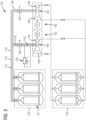
FIG. 3 is a schematic of one non-limiting embodiment of a disclosed PHES system that shows certain structural details in connection with one example of an annular ducting arrangement that may be featured in a disclosed PHES system. -
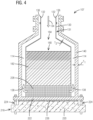
FIG. 4 is a schematic of one non-limiting embodiment of a disclosed hot store unit that shows certain structural details appropriate for the annular ducting arrangement and further shows a schematic flow diagram of a working fluid during a charging cycle of the PHES system. -
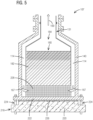
FIG. 5 is a schematic of the disclosed hot store unit shown inFIG. 4 and further shows a schematic flow diagram of the working fluid during a discharging cycle of the PHES system. -
FIG. 6 is a cross-sectional view illustrating one non-limiting embodiment of a disclosed charging turbomachinery that shows certain structural details that may implemented in another example of an annular ducting arrangement. -
FIG. 7 is a cross-sectional view illustrating one non-limiting embodiment of a disclosed discharging turbomachinery that shows certain structural details that may implemented in still another example of an annular ducting arrangement. -
FIG. 8 is a sectional view of one non-limiting embodiment of a disclosed valve arrangement that shows certain structural details that may implemented in yet another example of an annular ducting arrangement. -
FIG. 9 is a top view of the valve arrangement shown inFIG. 8 . - The present inventor has recognized that cycle efficiency in a PHES system generally improves with higher temperature of a working fluid that, for example, flows between the hot turbomachinery and the hot stores. Non-limiting examples of the working fluid may be air, nitrogen, argon, etc. Furthermore, the higher temperature would lead to relatively smaller store volume, which would be conducive to lowering the cost of the PHES system. In an idealized implementation, this temperature should therefore be as high as feasible.
- The present inventor has further recognized that appropriately containing a high-temperature, high-pressure flow of the working fluid in a real-world implementation of a PHES system can present several challenges. For instance, low-cost materials, such as carbon steel, tend to lose their strength at high temperature. At substantially elevated temperatures, high-temperature alloys, such as nickel-base alloys, cobalt-base alloys, etc., may be necessary, since such high-temperature alloys maintain favorable strength at high temperatures. However, such alloys are costly and are difficult to fabricate, and consequently their use in a cost-effective implementation of a PHES system should ideally be minimized or at least substantially reduced.
- The stores and ducts involved in a practical PHES system may be voluminous, and, therefore, it would not be cost-effective to fabricate such components solely relying on high-temperature alloys. Furthermore, even if one uses high-temperature alloys, the temperature level, in certain situations, could exceed the temperature limits of these alloys, and, in these situations, the high-temperature alloys may have to be coated with a thermally-insulating coating to protect the alloys from the high-temperature flow, and this would further add to the cost and complexity of the stores and ducts involved.
- Disclosed embodiments are believed to resolve the issue of containing the high-temperature working fluid at elevated pressure by appropriately compartmentalizing the functions of temperature management and pressure containment in a cost-effective and reliable manner. In a disclosed PHES system, this can be favorably achieved by constructing at least portions of the high-temperature section of the system with an annular configuration.
-
FIG. 1 is an idealized flow diagram regarding a PHES thermodynamic cycle as may be arranged in a disclosedPHES system 11. In certain embodiments,PHES system 11 may be configured to perform an overlapped cycle. That is, the PHES thermodynamic cycle may be an overlapped cycle. - As can be appreciated in
FIG. 1 , in a thermodynamic charging subsystem 11' ofPHES system 11, charging turbomachinery --such as comprising ahot compressor 10 and acold expander 12-- is arranged to move thermal energy from a cold heat exchange andthermal storage apparatus 14 towards a hot heat exchange andstorage apparatus 16. That is, during the charging portion of the cycle performed by thermodynamic charging subsystem 11', the system operates as a heat pump using work produced, for example, by anelectric motor 18 powered with electrical power available from a source of electrical power --such as may be sourced from renewable and/or non-renewable resources (e.g. wind, solar, natural gas, oil, etc.), and which could be (but need not be) arranged in an electric grid-- to effectively move heat against its natural gradient from a cooler region to a hotter region and store the available energy in the form of heat. - Since a PHES cycle, like any real-world thermodynamic system, involves irreversible energy losses or dissipation, the system involves a
heat rejection device 19 arranged to reject such energy losses or dissipation. Absence of heat rejection would imply a perpetual motion machine, which is a physical impossibility. AlthoughFIG. 1 illustrates the heat rejection located in the charging portion of the cycle, it will be appreciated that the heat rejection could be located in the discharging portion of the cycle, or, alternatively, could be located both in the charging portion of the cycle and in the discharging portion of the cycle. - As can be further appreciated in
FIG. 1 , in athermodynamic discharging subsystem 11" ofPHES system 11, discharging turbomachinery --such as comprising acold compressor 20 and ahot expander 22-- is arranged to move thermal energy from hot heatexchange storage apparatus 16 towards cold heatexchange storage apparatus 14. That is, during the discharging portion of the cycle, the system operates as a heat engine where work can be extracted to, for example, drive anelectric generator 28 and generate electrical energy. - As may be appreciated in
FIG. 2 , in the overlapped cycle the cold-temperature heat exchange process (labeled Cold Store) can be extended to a temperature (labeled Twarm) comparable to the recuperator hot-end temperature while the hot-temperature heat exchange process (labeled Hot Store) can be extended to a temperature (labeled Tambient) comparable to the recuperator cold-end temperature. As such, in the overlapped cycle the operable temperature ranges of the respective hot and cold stores overlap and thus the designation "overlapped cycle". This temperature overlap allows reducing the temperature range to which the respective hot and cold turbomachinery are subject to, and this in turn allows reducing the pressure ratio involved in the overlapped cycle, resulting in various benefits to the system and cost reduction based on the elimination of recuperator and concomitant piping. It will be appreciated that in certain applications --such as may involve balancing tradeoffs of efficiency versus costs-- disclosed PHES systems may be implemented using the recuperated cycle or a non-recuperated cycle in lieu of the overlapped cycle. - The description below will proceed to describe various non-limiting structural and/or operational relationships in connection with an annular ducting arrangement that may be featured in disclosed PHES systems. Elements having the same reference alphanumeric (or label) as illustrated in a previous figure, unless otherwise stated, provide the same functionality and will not be discussed again to avoid redundant description.
-
FIG. 3 , without limitation, depicts a similar version of the PHES thermodynamic cycle described above in the context ofFIG. 1 , with a distinction thatFIG. 3 is used to elaborate structural and/or operational details regarding an annular ducting arrangement that may be featured in a disclosedPHES system 100 that includes acharging subsystem 102 operable to transfer heat from a coldthermal storage apparatus 105 to a hotthermal storage apparatus 103 that may include one or morehot store units 107 with structural features appropriate for the annular ducting arrangement. -
Charging subsystem 102 includes acharging turbomachinery 104 including ahot compressor 106 and acold expander 108. In one non-limiting embodiment, aducting arrangement 110 has aninner duct 112 and anannular duct 114 coaxially disposed about the inner duct. In one nonlimiting embodiment, afirst portion 116 ofinner duct 112 andannular duct 114 may be connected to chargingturbomachinery 104 so thatinner duct 112 is connected to transmit a high-temperature, high-pressure flow of working fluid fromhot compressor 106 to hotthermal storage apparatus 103, andannular duct 114 is connected to transmit a lower-temperature, high-pressure flow of the working fluid that is returned from hotthermal storage apparatus 103 to cold expander 108. - In general, the annular ducting arrangement may be arranged at any selectable location of a path to transmit the high-temperature, high-pressure flow of working fluid and the lower-temperature, high-pressure flow of working fluid between hot
thermal storage apparatus 103 and acharging turbomachinery 104 and/or adischarging turbomachinery 162 of the pumped heat energy storage system. That is, based on the needs of a given application, the designer has the flexibility to selectively arrange the annular ducting arrangement at desired locations of the PHES system. In other words, although one could implement a disclosed annular ducting arrangement at each possible location involving flow of high-temperature, high-pressure working fluid between hotthermal storage apparatus 103 and chargingturbomachinery 104 and/or adischarging turbomachinery 162, the designer has the flexibility to use a targeted approach for partial implementation of the annular ducting arrangement at desired locations. - For example, non-limiting locations where the annular ducting arrangement may be arranged may involve a turbomachinery ducting arrangement 122 (
FIG. 6 ) in chargingturbomachinery 104, and/or may involve a turbomachinery ducting arrangement 172 (FIG. 7 ) indischarging turbomachinery 162. - In another non-limiting example, the annular ducting arrangement may be arranged in a location involving a
valve arrangement 190 to fluidly couple, during a charging cycle of the PHES system, chargingturbomachinery 104 to hotthermal storage apparatus 103 and to fluidly couple, during a discharging cycle of the PHES system, dischargingturbomachinery 162 to hotthermal storage apparatus 103. - In still another non-limiting example, the annular ducting arrangement may be arranged in a location involving a
heat rejection cooler 150 and may include abulkhead 152 arranged in an annulus defined by theannular duct 114 to divert e.g., during the charging cycle of the PHES system, the lower-temperature, high-pressure flow of working fluid transmitted within the annular duct intoheat rejection cooler 150. - Regardless of implementation location,
ducting arrangement 100 permits theinner duct 112 that transmits the high-temperature, high-pressure flow to be located inside of theannular duct 114 that transmits the lower-temperature, high-pressure flow, such that the lower temperature flow occupies an annular space betweeninner duct 112 and an outer wall ofannular duct 114. - In one non-limiting embodiment, the high-temperature, high-pressure flow may reach in the charging subsystem a temperature of approximately 1260°C (2300°F) or more, and a pressure of approximately 3.447 MPa (500 psi) or more. By way of non-limiting comparison, the lower-temperature, high-pressure flow may reach a temperature of approximately 179.444°C (355°F) or more and a pressure of approximately 3.31 MPa (480 psi) or more.
- As the high-temperature flow, and the lower temperature flow of working fluid are at commensurate pressures (e.g., relatively close in value to one another) --without limitation, such pressures may be within approximately ten percent from one another in one embodiment-- this means that a duct boundary (e.g., a metal structure, such as a liner, or tubular structure) dividing these flows is not subject to any substantial loading on account of a delta pressure at the duct boundary. Accordingly, the metal structure that provides the duct boundary, such as between
inner duct 112 andannular duct 114, can be made relatively thin. The outer-most containment of the high-pressure flow may be handled by a relatively thicker structure, such as the outer wall ofannular duct 114, where the temperature is lower compared to the temperature in theinner duct 112. - As the duct boundary can be made relatively thin, then such metal structure can be cost-effectively made from a more expensive high-temperature alloy, if so needed. As the duct boundary is not subject to any substantial loading on account of a pressure difference, based on the needs of a given application, bellows-type thermal expansion devices may be used, if so desired. It is further noted that as the duct boundary can be made relatively thin, this is conducive to avoiding undesirable thermal gradients that otherwise could limit the rate of heating or cooling of the system.
- As further illustrated in
FIG. 3 ,heat rejection cooler 150 may be disposed upstream ofcold expander 108. As noted above,bulkhead 152 may be arranged in the annulus defined byannular duct 114 to divert during the charging cycle of the PHES system the lower-temperature, high-pressure flow of the working fluid being transmitted withinannular duct 114 to heatrejection cooler 150 prior to the working fluid being returned tocold expander 108 viaannular duct 114. - In one non-limiting embodiment, as schematically illustrated in
FIG. 6 , chargingturbomachinery 104 may haveturbomachinery ducting arrangement 122 appropriate for connecting to the annular ducting arrangement, described above in the context ofFIG. 3 . In one non-limiting embodiment, anouter casing 120 of chargingturbomachinery 104 enclosesturbomachinery ducting arrangement 122, which may be connected tofirst portion 116 ofinner duct 112 andannular duct 114. - In one non-limiting embodiment,
turbomachinery ducting arrangement 122 defines anoutlet 124 ofhot compressor 106 that may be connected to first portion 116 (FIG. 3 ) ofinner duct 112 to supply the high-temperature, high-pressure flow of working fluid to hotthermal storage apparatus 103. This high-temperature, high-pressure flow is schematically represented inFIGs. 4 and6 by respective arrows labeled withreference numeral 134. -
Turbomachinery ducting arrangement 122 further defines aninlet 126 ofcold expander 108 that may be connected tofirst portion 116 ofannular duct 114 to receive the lower-temperature, high-pressure flow of working fluid returned from hotthermal storage apparatus 103. This lower-temperature, high-pressure flow is schematically represented inFIGs. 4 and6 by respective arrows labeled withreference numeral 138. It will be appreciated that in theturbomachinery ducting arrangement 122, the lower-temperature, high-pressure flow 138 is coaxially disposed about the high-temperature, high-pressure flow 134, as described above in the context ofducting arrangement 110. For example, at least some portion ofinlet 126 ofcold expander 108 is coaxially disposed about some portion ofoutlet 124 ofhot compressor 106. - As further illustrated in
FIG. 3 ,PHES system 100 further includes a dischargingsubsystem 160 operable to transfer heat from hotthermal storage apparatus 103 to coldthermal storage apparatus 105. Dischargingsubsystem 160 includes dischargingturbomachinery 162 including acold compressor 164 and ahot expander 166. - In one nonlimiting embodiment, a
second portion 168 ofinner duct 112 andannular duct 114 may be connected to dischargingturbomachinery 162 so thatannular duct 114 is connected to transmit a high-pressure flow of working fluid fromcold compressor 164 into hotthermal storage apparatus 103 andinner duct 112 is connected to transmit a high-temperature, high-pressure flow of working fluid that is returned from hotthermal storage apparatus 103 tohot expander 166. The temperature of the high-pressure flow of working fluid being transmitted withinannular duct 114 is lower compared to the high-temperature, high-pressure flow being transmitted withininner duct 112. In one non-limiting embodiment, the high-temperature, high-pressure flow may reach in the discharging subsystem a temperature of approximately 1248.89°C (2280°F) or more, and a pressure of approximately 3.31 MPa (480 psi) or more. By way of non-limiting comparison, the lower-temperature, high-pressure flow may reach a temperature of approximately 165.56°C (330°F) or more and a pressure of approximately 3.447 MPa (500 psi) or more. - In one non-limiting embodiment, as may be appreciated in
FIG. 7 , dischargingturbomachinery 162 hasturbomachinery ducting arrangement 172 appropriate for connecting to the annular ducting arrangement. In one non-limiting embodiment, anouter casing 170 of dischargingturbomachinery 162 enclosesturbomachinery ducting arrangement 172, which may be connected tosecond portion 168 ofinner duct 112 andannular duct 114. - In one non-limiting embodiment,
turbomachinery ducting arrangement 172 of dischargingturbomachinery 162 defines anoutlet 174 ofcold compressor 164 that may be connected to second portion 168 (FIG. 3 ) ofannular duct 114 to supply the lower-temperature, high-pressure flow of working fluid into hotthermal storage apparatus 103. This lower-temperature, high-pressure flow is schematically represented inFIGs. 5 and7 by respective arrows labeled withreference numeral 167. -
Turbomachinery ducting arrangement 172 of dischargingturbomachinery 162 further defines aninlet 176 ofhot expander 166 that may be connected tosecond portion 168 ofinner duct 112 to receive the high-temperature, high-pressure flow of working fluid from hotthermal storage apparatus 103. This high-temperature, high-pressure flow is schematically represented inFIGs. 5 and7 by respective arrows labeled withreference numeral 169. - It will be appreciated that, once again, the lower-temperature, high-
pressure flow 167 is coaxially disposed about the high-temperature, high-pressure flow 169, as described above in the context ofannular ducting arrangement 110. For example, at least some portion ofoutlet 174 ofcold compressor 164 is coaxially disposed about some portion ofinlet 176 ofhot expander 166. - As may be appreciated in
FIG. 4 (also inFIG. 5 ) in connection with ahot store unit 107 having structural features appropriate for the annular ducting arrangement, aliner 131 defines the inner duct of the annular ducting arrangement.Liner 131 also forms theinner wall 130 of theannular duct 114 of the annular ducting arrangement. In one non-limiting embodiment, aninner side 132 ofliner 131 is subject to the high-temperature, high-pressure flow (schematically represented by arrow 134) of the working fluid being transmitted within the inner duct and anouter side 136 ofliner 131 is subject to the lower-temperature, high-pressure flow (schematically represented by arrow 138) of the working fluid being transmitted within the annular duct. - As may be further appreciated in
FIGs. 4 and5 , in one non-limiting embodiment, theouter wall 140 ofannular duct 114 may be structured to provide pressure-containment to the working fluid that passes throughannular duct 114. In one non-limiting embodiment, a cross-section ofliner 131 has a lower thickness (schematically represented by arrows labeled T2) compared to a cross section ofouter wall 140, (schematically represented by arrows labeled T1). As suggested above,liner 131, which in disclosed embodiments can be made from a relatively thin-metal structure, can be cost-effectively made at desired locations from more expensive high-temperature alloy. It will be appreciated that, based on the needs of a given application, such locations of the liner may optionally be internally thermally-insulated to further reduce the operating temperature of the liner. - In one non-limiting embodiment, hot store unit 107 (
FIGs. 4 and5 ) has achamber 180 that contains athermal storage media 182, e.g., solid thermal storage media, such as may include without limitation, granular materials, such as sand; rock bulk materials, such as quartzite and gneiss rock, including those of volcanic origin, such as basalt rock, diabase rock, and granite rock. In certain embodiments, the thermal storage media may be bulk solid thermal storage media, such as may be or include metal oxides, such as hematite (iron oxide), and alumina (aluminum oxide); and may include cofalit filler material. In certain embodiments, the thermal storage media may comprise ball bulk material, such as single-grain bulk material, such as a comprising spheroids of approximately the same diameter or multi-grain bulk material comprising spheroids of different diameters, etc. In certain applications, the thermal storage media may be or include heat-storage ceramics. - In certain applications, such as involving both natural media and ball bulk material, one may have a thermal store that is "randomly packed", i.e., the combined materials may be poured into the chamber and such combined materials would settle in a natural way. In addition to ball bulk material, it should be appreciated that the media could be in the form of bricks engineered to incorporate channels or holes through which the working fluid may pass and transfer heat to or from the media. It is contemplated that a brick format may be conducive to a "structured packing", which may be an attractive modality because in structured packing one can design at least a portion of the media to bear its own weight down to a supporting foundation. By way of comparison, certain random packings could potentially give rise to hoop stresses acting on the wall of the hot store unit as the material settles.
- In one non-limiting embodiment,
hot store unit 107 may include a media support system 218, such as may include a supportingfoundation 220, e.g., a concrete foundation, and abase 222 ofhot store unit 107 may be anchored ontofoundation 220 by abolt assembly 224. In one non-limiting embodiment, afiller 226, e.g., a grout filler, may be used to provide an interface betweenfoundation 220 and the outer surface ofbase 222. In one non-limiting embodiment, an arrangement of thermally-insulatingbricks 228, engineered to pass fluid in at least two directions, (e.g., vertical and horizontal) to allow the working fluid to, for example, pass from annular duct 114 (FIG. 5 ) toward the center ofchamber 180 and establish upward fluid communication through thermal media 182 (or in the reverse direction, (FIG. 4 ) while providing sufficient load-bearing capability to bear the weight ofthermal media 182, which in certain embodiments could be substantially large, e.g., many tons. - As should be now appreciated by those skilled in the art, in general, media support system 218 may be implemented using various modalities for supporting
thermal storage media 182. For example, media support inhot store unit 107 may be a bed of random packed material filled from thebase 222 ofhot store unit 107 to a point where the media forms its own base. Alternatively, the media support inhot store unit 107 may involve structured bricks with holes that permit the flow to enter from/to the annulus and distribute itself across a bottom surface; or the media support inhot store unit 107 could be in the form of a sufficiently strong metal grate with openings, where the grate is in turn supported by a grate support structure (e.g., involving columns and/or beams) extending from thebase 222 ofhot store unit 107. - In one non-limiting embodiment,
chamber 180 has anopening 184 at a first axial end of the chamber that, during the charging cycle, may be in fluid communication with the inner duct to admit into the chamber the high-temperature, high-pressure flow 134 of working fluid from hot compressor 106 (FIG. 6 ). - In one non-limiting embodiment, the second axial end of
chamber 180 may be in fluid communication withannular duct 114 --by way of media support system 218-- to discharge fromchamber 180, during the charging cycle, the lower-temperature, high-pressure flow 138 (FIG. 4 ) of the working fluid that is returned tocold expander 108. - As can be appreciated in
FIG. 5 , during the discharging cycle, media support system 218 may be in fluid communication withannular duct 114 to admit into the chamber the lower-temperature, high-pressure flow 167 of working fluid fromcold compressor 164, andopening 184 may be in fluid communication with the inner duct to discharge fromchamber 180 the high-temperature, high-pressure flow 169 of the working fluid that is returned tohot expander 166. - As shown in
FIG. 3 , in one-non-limiting embodiment, avalve arrangement 190 may be used to fluidly couple during the chargingcycle charging turbomachinery 104 to hotthermal storage apparatus 103, and to fluidly couple during the dischargingcycle discharging turbomachinery 162 to hotthermal storage apparatus 103. - In one-non-limiting embodiment, the valve arrangement includes a first valve assembly 190', such as may be arranged in the
first portion 116 of the inner duct and the annular duct, and configured to: 1) in the charging cycle, fluidlycouple charging turbomachinery 104 to hotthermal storage apparatus 103 and 2) in the discharging cycle, decouple dischargingturbomachinery 162 from the hot thermal storage apparatus; and asecond valve assembly 190" that may be arranged in thesecond portion 168 of the inner duct and the annular duct, and configured to: 1) in the discharging cycle, fluidly couple the dischargingturbomachinery 162 to hotthermal storage apparatus 103, and 2) in the charging cycle decouple the chargingturbomachinery 104 from the hot thermal storage apparatus. - As shown in
FIGs. 8 and 9 , in one-non-limiting embodiment, eachvalve assembly 190 has aplate 200 in a plane orthogonal to a longitudinal axis of a respective inner duct. (This axis is schematically represented byline 192 inFIG. 8 ), and adot 192FIG. 9 ).Plate 200 defines acentral opening 202 in the inner duct and further defines twoopenings 204 in the annular duct. Anactuating shaft 206 may extend orthogonal tolongitudinal axis 192. - In in one-non-limiting embodiment, a
first valve element 208 may be disposed incentral opening 202. A second valve element 210' and athird valve element 210" may each be respectively disposed in the twoopenings 204 defined byplate 200 in the annular duct. The first, the second and thethird valve elements shaft 206. In one non-limiting embodiment, each valve element may be a butterfly-style flap responsive to a rotation position of actuatingshaft 206 --e.g., responsive to an actuator 212-to be simultaneously either in a closed condition or in an open condition relative to the working fluid that passes within the respective inner duct and within the respective annular duct. - In operation, disclosed embodiments are believed to resolve the issue of containing the high-temperature working fluid at elevated pressure by appropriately compartmentalizing the functions of temperature management and pressure containment in a cost-effective and reliable manner. In a disclosed PHES system, this is favorably achieved by constructing at least portions of the high-temperature portion of the system with an annular configuration.
- In operation, the stores and ducts involved in a disclosed PHES system may be cost-effectively manufactured since use of high-temperature alloys may be reduced while providing reliable and long-lasting usability.
- While embodiments of the present disclosure have been disclosed in exemplary forms, it will be apparent to those skilled in the art that many modifications, additions, and deletions can be made therein without departing from the scope of the invention as set forth in the following claims.
Claims (23)
- A pumped heat energy storage system (100) comprising:a hot thermal storage apparatus (103), anda charging turbomachinery (104) and/or a discharging turbomachinery (162),characterized by:an annular ducting arrangement (110) having an inner duct (112) and an annular duct (114) coaxially disposed about the inner duct (112),wherein the inner duct (112) is arranged to transmit a high-temperature, high-pressure flow of a working fluid while the annular duct (114) is arranged to transmit a lower-temperature, high-pressure flow of the working fluid,wherein the annular ducting arrangement (110) is arranged at a selected location of a path to transmit the high-temperature, high-pressure flow of working fluid and the lower-temperature, high-pressure flow of working fluid between the hot thermal storage apparatus (103) and the charging turbomachinery (104) and/or the discharging turbomachinery (162).
- The pumped heat energy storage system of claim 1, wherein the charging turbomachinery (104) includes a hot compressor (106) and a cold expander (108), wherein the annular ducting arrangement (110) is arranged at the charging turbomachinery (104), which has an outer casing (120) that encloses a turbomachinery ducting arrangement (122) that is connected to a first portion of the inner duct (112) and the annular duct (114), the turbomachinery ducting arrangement defining an outlet (124) of the hot compressor (106) that is connected to the first portion of the inner duct to supply the high-temperature, high-pressure flow (134) of working fluid to the hot thermal storage apparatus (103), the turbomachinery ducting arrangement (122) further defining an inlet (126) of the cold expander (108) that is connected to the first portion of the annular duct (114) to receive the lower-temperature, high-pressure flow (138) of working fluid from the hot thermal storage apparatus (103), wherein the inlet of the cold expander (108) is coaxially disposed about the outlet (124) of the hot compressor (106).
- The pumped heat energy storage system of claim 2 or claim 1, wherein the discharging turbomachinery (162) includes a cold compressor (164) and a hot expander (166), wherein the annular ducting arrangement (110) is arranged at the discharging turbomachinery (162) which has an outer casing (170) that encloses a turbomachinery ducting arrangement (172) that is connected to a second portion of the inner duct (112) and the annular duct (114), the turbomachinery ducting arrangement (122) of the discharging turbomachinery (162) defining an outlet (174) of the cold compressor (164) that is connected to the second portion of the annular duct (114) to supply the lower-temperature, high-pressure flow of working fluid into the hot thermal storage apparatus (103), the turbomachinery ducting arrangement (122) further defining an inlet (176) of the hot expander (166) that is connected to the second portion of the inner duct (112) to receive the high-temperature, high-pressure flow of working fluid from the hot thermal storage apparatus (103), and, wherein the outlet (174) of the cold compressor (164) is coaxially disposed about the inlet (176) of the hot expander (166).
- The pumped heat energy storage system of any the preceding claims, wherein the annular ducting arrangement (110) is in a valve arrangement (190) to fluidly couple, during a charging cycle, the charging turbomachinery (104) to the hot thermal storage apparatus (103) and to fluidly couple, during a discharging cycle, the discharging turbomachinery (162) to the hot thermal storage apparatus (103).
- The pumped heat energy storage system of any the preceding claims, wherein the annular ducting arrangement (110) is operatively coupled to a heat rejection cooler (150) and includes a bulkhead (152) disposed in an annulus defined by the annular duct (114) to divert the lower-temperature, high-pressure flow of working fluid transmitted during the charging cycle within the annular duct (114) into the heat rejection cooler (150).
- The pumped heat energy storage system of any the preceding claims, wherein the hot thermal storage apparatus (103) includes a hot store unit (107), wherein the annular ducting arrangement (110) is arranged in the hot store unit (107), which has a liner (131) that defines the inner duct (112) and forms an inner wall (130) of the annular duct (114), and wherein an inner side (132) of the liner (131) is subject to the high-temperature, high-pressure flow of the working fluid transmitted within the inner duct (112) and an outer side (136) of the liner (131) is subject to the lower-temperature, high-pressure of the working fluid transmitted within the annular duct (114), and wherein said respective pressures are within ten percent from one another.
- The pumped heat energy storage system of claim 6, wherein an outer wall (140) of the annular duct (114) is structured to provide pressure-containment, wherein a cross section of the liner (131) has a lower thickness compared to a cross section of the outer wall (140).
- The pumped heat energy storage system of claim 3, wherein the hot thermal storage apparatus (103) includes a hot store unit (107) having a chamber (180) that contains a thermal media (182),wherein the chamber (180) has an opening (184) at a first axial end of the chamber (180) that, during a charging cycle, is in fluid communication with the inner duct (112) to admit into the chamber (180) the high-temperature, high-pressure flow of working fluid from the hot compressor (106),wherein the chamber (180) has a media support system (218) at a second axial end of the chamber (180) opposite the first axial end of the chamber (180), the second axial end of the chamber (180) in fluid communication with the annular duct (114) to discharge from the chamber (180) the lower-temperature, high-pressure flow of the working fluid to the cold expander (108),wherein, during a discharging cycle, the second axial end of the chamber (180) is in fluid communication with the outer duct to admit into the chamber (180) the lower-temperature, high-pressure flow of working fluid from the cold compressor (164), and wherein the opening (184) of the chamber (180) is in fluid communication with the annular duct (114) to discharge from the chamber (180) the high-temperature, high-pressure flow of the working fluid to the hot expander (166).
- The pumped heat energy storage system of claim 8, wherein the thermal media is a solid thermal media selected from the group consisting of a randomly packed natural material, a structured packing formed by bricks with channels engineered to pass the working fluid, and a combination of the randomly packed natural material and the structured packing.
- The pumped heat energy storage system of claim 4, wherein the valve arrangement (190) includes a first valve assembly (190') arranged in the first portion of the inner duct (112) and the annular duct (114), and configured to: 1) in the charging cycle, fluidly couple charging turbomachinery (104) to hot thermal storage apparatus (103) and 2) in the discharging cycle, decouple discharging turbomachinery (162) from the hot thermal storage apparatus (103); and a second valve assembly (190") in the second portion (168) of the inner duct (112) and the annular duct (114), and configured to: 1) in the discharging cycle, fluidly couple the discharging turbomachinery (162) to hot thermal storage apparatus (103), and 2) in the charging cycle decouple the charging turbomachinery (104) from the hot thermal storage apparatus (103).
- The pumped heat energy storage system of claim 10, wherein each valve assembly (190', 190") comprises:a plate (200) in a plane orthogonal to a longitudinal axis of a respective inner duct (112), the plate (200) defining a central opening (202) in the respective inner duct (112) and further defining two openings (204) in the annular duct (114);an actuating shaft (206) that extends orthogonal to the longitudinal axis;a first valve element (208) disposed in the central opening (202); anda second valve element (210') and a third valve element (210") each respectively disposed in the two openings (204) defined by the plate (200) in the annular duct (114),wherein the first, the second and the third valve elements (208. 210, 210") is each mounted on the actuating shaft (206), wherein each valve element (208. 210, 210") includes a butterfly-style flap responsive to a rotation position of the actuating shaft (206) to be simultaneously either in a closed condition or in an open condition relative to the working fluid transmitted within the respective inner duct (112) and within the respective annular duct (114).
- A pumped heat energy storage system (100) comprising:a hot thermal storage apparatus (103);a charging subsystem (102) operable to transfer heat from a cold thermal storage apparatus (105) to the hot thermal storage apparatus (103),wherein the charging subsystem (102) includes a charging turbomachinery (104) including a hot compressor (106) and a cold expander (108); and characterized byan annular ducting arrangement (110) that has an inner duct (112) and an annular duct (114) coaxially disposed about the inner duct (112), wherein a first portion (116) of the inner duct (112) and the annular duct (114) is connected to the charging turbomachinery (104),wherein the inner duct (112) is connected to transmit a high-temperature, high-pressure flow of working fluid from the hot compressor (106) to the hot thermal storage apparatus (103), andwherein the annular duct (114) is connected to transmit a lower-temperature, high-pressure flow of the working fluid that is returned from the hot thermal storage apparatus (103) to the cold expander (108).
- The pumped heat energy storage system of claim 12, wherein the charging turbomachinery (104) has an outer casing (120) that encloses a turbomachinery ducting arrangement (122) that is connected to the first portion of the inner duct (112) and the annular duct (114), the turbomachinery ducting arrangement (122) defining an outlet (124) of the hot compressor (106) that is connected to the first portion of the inner duct (112) to supply the high-temperature, high-pressure flow (134) of working fluid to the hot thermal storage apparatus (103), the turbomachinery ducting arrangement (122) further defining an inlet (126) of the cold expander (108) that is connected to the first portion of the annular duct (114) to receive the lower-temperature, high-pressure flow (138) of the working fluid from the hot thermal storage apparatus (103), wherein the inlet (126) of the cold expander (108) is coaxially disposed about the outlet (124) of the hot compressor (106).
- The pumped heat energy storage system of claim 12, wherein the hot thermal storage apparatus (103) includes a hot store unit having a liner (131) that defines the inner duct (112) and forms an inner wall (130) of the annular duct (114), and wherein an inner side (132) of the liner (131) is subject to the high-temperature, high-pressure flow of the working fluid transmitted within the inner duct (112) and an outer side (136) of the liner (131) is subject to the lower-temperature, high-pressure of the working fluid transmitted within the annular duct (114), and wherein said respective pressures are within ten percent from one another.
- The pumped heat energy storage system of claim 14, wherein an outer wall (140) of the annular duct (114) is structured to provide pressure containment, wherein a cross section of the liner (131) has a lower thickness compared to a cross section of the outer wall (140).
- The pumped heat energy storage system of claim 12, further comprising a heat rejection cooler (150) disposed upstream of the cold expander (108), and
a bulkhead (152) arranged in an annulus defined by the annular duct (114) to divert the lower-temperature, high-pressure flow of the working fluid being transmitted within the annular duct (114) to the heat rejection cooler (150) prior to the working fluid being returned to the cold expander (108) via the annular duct (114). - The pumped heat energy storage system of claim 12, wherein the charging subsystem (102) is arranged to perform, during a charging cycle of the pumped heat energy storage system (100), a thermodynamic heat pump cycle that utilizes electrical energy,the pumped heat energy storage system (100) further comprising a discharging subsystem (160) arranged to perform, during a discharging cycle of the pumped heat energy storage system (100), a thermodynamic engine cycle to produce work, as heat is transferred from the hot thermal storage apparatus (103) to the cold thermal storage apparatus (105), so that at least a portion of the electrical energy utilized by the charging subsystem (102) is returned,wherein the discharging subsystem (102) includes a discharging turbomachinery (162) including a cold compressor (164) and a hot expander (166), wherein a second portion (168) of the inner duct (112) and the annular duct (114) is connected to the discharging turbomachinery (162);wherein the annular duct (114) is connected to transmit a high-pressure flow of working fluid from the cold compressor (164) into the hot thermal storage apparatus (103), andwherein the inner duct (112) is connected to transmit a high-temperature, high-pressure flow of working fluid that is returned from the hot thermal storage apparatus (103) to the hot expander (166), wherein a temperature of the high-pressure flow of working fluid being transmitted within the annular duct (114) is lower compared to the high-temperature, high-pressure flow being transmitted within the inner duct (112).
- The pumped heat energy storage system of claim 17, wherein the discharging turbomachinery (162) has an outer casing (170) that encloses a turbomachinery ducting arrangement (172) that is connected to the second portion of the inner duct (112) and the annular duct (114), the turbomachinery ducting arrangement (172) of the discharging turbomachinery (162) defining an outlet (174) of the cold compressor (164) that is connected to the second portion of the annular duct (114) to supply the lower-temperature, high-pressure flow of working fluid into the hot thermal storage apparatus (103), the turbomachinery ducting arrangement (172) of the discharging turbomachinery (162) further defining an inlet (176) of the hot expander (166) that is connected to the second portion of the inner duct (112) to receive the high-temperature, high-pressure flow of working fluid from the hot thermal storage apparatus (103), and, wherein the outlet of the cold compressor (164) is coaxially disposed about the inlet (176) of the hot expander (166).
- The pumped heat energy storage system of claim 17, wherein the hot thermal storage apparatus (103) includes a hot store unit (107) having a chamber (180) that contains thermal media (182), the chamber (180) having an opening (184) at a first axial end of the chamber (180) that, during the charging cycle, is in fluid communication with the inner duct (112) to admit into the chamber (180) the high-temperature, high-pressure flow of working fluid from the hot compressor (106), a media support system (218) at a second axial end of the chamber (180) opposite the first axial end of the chamber (180), the second axial end of the chamber (180) in fluid communication with the annular duct (114) to discharge from the chamber (180) the lower-temperature, high-pressure flow of the working fluid that is returned to the cold expander (108),
wherein, during the discharging cycle, the second axial end of the chamber (180) is in fluid communication with the outer duct to admit into the chamber (180) the lower-temperature, high-pressure flow of working fluid from the cold compressor (164), and wherein the opening (184) of the chamber (180) is in fluid communication with the annular duct (114) to discharge from the chamber (180) the high-temperature, high-pressure flow of the working fluid that is returned to the hot expander (166). - The pumped heat energy storage system of claim 19, wherein the thermal media is a solid thermal media selected from the group consisting of a randomly packed natural material, a structured packing formed by bricks with channels engineered to pass the working fluid, and a combination of the randomly packed natural material and the structured packing.
- The pumped heat energy storage system of claim 17, further comprising a valve arrangement (190) to fluidly couple during the charging cycle the charging turbomachinery (104) to the hot thermal storage apparatus (103) and to fluidly couple during the discharging cycle the discharging turbomachinery (162) to the hot thermal storage apparatus (103).
- The pumped heat energy storage system of claim 21, wherein the valve arrangement (190) includes a first valve assembly (190') arranged in the first portion of the inner duct (112) and the annular duct (114), and configured to: 1) in the charging cycle, fluidly couple charging turbomachinery (104) to hot thermal storage apparatus (103) and 2) in the discharging cycle, decouple discharging turbomachinery (162) from the hot thermal storage apparatus (103); and a second valve assembly (190") in the second portion (168) of the inner duct (112) and the annular duct (114), and configured to: 1) in the discharging cycle, fluidly couple the discharging turbomachinery (162) to hot thermal storage apparatus (103), and 2) in the charging cycle decouple the charging turbomachinery (104) from the hot thermal storage apparatus (103).
- The pumped heat energy storage system of claim 22, wherein each valve assembly (190', 190") comprises:a plate (200) in a plane orthogonal to a longitudinal axis of a respective inner duct (112), the plate (200) defining a central opening (202) in the respective inner duct (112) and further defining two openings (204) in the annular duct (114);an actuating shaft (206) that extends orthogonal to the longitudinal axis;a first valve element (208) disposed in the central opening (202); anda second valve element (210') and a third valve element (210") each respectively disposed in the two openings (204) defined by the plate (200) in the annular duct (114),wherein the first, the second and the third valve elements (208, 210', 210") is each mounted on the actuating shaft (206), wherein each valve element (208, 210', 210") includes a butterfly-style flap responsive to a rotation position of the actuating shaft (206) to be simultaneously either in a closed condition or in an open condition relative to the working fluid transmitted within the respective inner duct (112) and within the respective annular duct (114).
Applications Claiming Priority (2)
| Application Number | Priority Date | Filing Date | Title |
|---|---|---|---|
| US201962945521P | 2019-12-09 | 2019-12-09 | |
| PCT/US2020/063882 WO2021119049A1 (en) | 2019-12-09 | 2020-12-09 | Pumped heat energy storage system with annular ducting arrangement |
Publications (2)
| Publication Number | Publication Date |
|---|---|
| EP4051891A1 EP4051891A1 (en) | 2022-09-07 |
| EP4051891B1 true EP4051891B1 (en) | 2024-07-31 |
Family
ID=74106188
Family Applications (1)
| Application Number | Title | Priority Date | Filing Date |
|---|---|---|---|
| EP20834080.2A Active EP4051891B1 (en) | 2019-12-09 | 2020-12-09 | Pumped heat energy storage system with annular ducting arrangement |
Country Status (4)
| Country | Link |
|---|---|
| US (1) | US11401861B1 (en) |
| EP (1) | EP4051891B1 (en) |
| CN (1) | CN114829755B (en) |
| WO (1) | WO2021119049A1 (en) |
Family Cites Families (9)
| Publication number | Priority date | Publication date | Assignee | Title |
|---|---|---|---|---|
| AT251013B (en) * | 1964-05-20 | 1966-12-12 | Waagner Biro Ag | Heat exchanger |
| JP2871344B2 (en) * | 1992-09-29 | 1999-03-17 | 日産自動車株式会社 | Engine heat storage device |
| JP2005106415A (en) * | 2003-10-01 | 2005-04-21 | Paloma Ind Ltd | Supply and exhaust tube |
| FR2916101B1 (en) | 2007-05-11 | 2009-08-21 | Saipem Sa | INSTALLATION AND METHODS FOR STORAGE AND RESTITUTION OF ELECTRICAL ENERGY |
| AT506477B1 (en) * | 2008-02-21 | 2010-07-15 | Schweighofer Franz | HEAT STORAGE DEVICE |
| CN205878589U (en) * | 2016-07-01 | 2017-01-11 | 深圳市海顿热能技术有限公司 | Hanging stove with vortex device |
| US10724430B2 (en) * | 2017-07-10 | 2020-07-28 | Dresser-Rand Company | Pumped heat energy storage system |
| US10775111B2 (en) * | 2017-11-29 | 2020-09-15 | Dresser-Rand Company | Pumped heat energy storage system with convey able solid thermal storage media directly thermally coupled to working fluid |
| CN208090966U (en) * | 2018-03-07 | 2018-11-13 | 广东万和新电气股份有限公司 | A kind of air inlet cooling structure and gas heater for gas heater |
-
2020
- 2020-12-09 US US17/761,308 patent/US11401861B1/en active Active
- 2020-12-09 CN CN202080085031.5A patent/CN114829755B/en active Active
- 2020-12-09 EP EP20834080.2A patent/EP4051891B1/en active Active
- 2020-12-09 WO PCT/US2020/063882 patent/WO2021119049A1/en not_active Ceased
Also Published As
| Publication number | Publication date |
|---|---|
| CN114829755A (en) | 2022-07-29 |
| CN114829755B (en) | 2023-07-25 |
| EP4051891A1 (en) | 2022-09-07 |
| WO2021119049A1 (en) | 2021-06-17 |
| US20220243654A1 (en) | 2022-08-04 |
| US11401861B1 (en) | 2022-08-02 |
Similar Documents
| Publication | Publication Date | Title |
|---|---|---|
| AU2022241480B2 (en) | Multi-thermal storage unit systems, fluid flow control devices, and low pressure solar receivers for solar power systems, and related components and uses thereof | |
| US10077944B2 (en) | Combined chamber wall and heat exchanger | |
| KR102724519B1 (en) | Ultra-high temperature thermal energy storage system | |
| US7971437B2 (en) | Thermal energy storage systems and methods | |
| JP5032665B2 (en) | Electric energy storage and recovery system using piston type gas compression and expansion unit and electric energy storage and recovery method | |
| KR102069403B1 (en) | Thermodynamic cycle with compressor recuperation, and associated systems and methods | |
| CN107620857B (en) | Container for a system for storing and recovering heat comprising at least two modules formed of concrete | |
| US10240530B2 (en) | Container for a system for storing and restoring heat, comprising a double wall formed from concrete | |
| JP2010527221A (en) | Electric energy storage return system and electric energy storage return method | |
| Vijaykumar et al. | Optimizing the supercritical CO2 Brayton cycle for concentrating solar power application | |
| EP4051891B1 (en) | Pumped heat energy storage system with annular ducting arrangement | |
| US20240093640A1 (en) | Thermal storage and power generation systems and methods for electrical power source management | |
| Keller et al. | Industrial closed-cycle gas turbines for conventional and nuclear fuel | |
| WO2016160022A1 (en) | Heat pipe nozzle temperature management system for a turbomachine |
Legal Events
| Date | Code | Title | Description |
|---|---|---|---|
| STAA | Information on the status of an ep patent application or granted ep patent |
Free format text: STATUS: UNKNOWN |
|
| STAA | Information on the status of an ep patent application or granted ep patent |
Free format text: STATUS: THE INTERNATIONAL PUBLICATION HAS BEEN MADE |
|
| PUAI | Public reference made under article 153(3) epc to a published international application that has entered the european phase |
Free format text: ORIGINAL CODE: 0009012 |
|
| STAA | Information on the status of an ep patent application or granted ep patent |
Free format text: STATUS: REQUEST FOR EXAMINATION WAS MADE |
|
| 17P | Request for examination filed |
Effective date: 20220603 |
|
| AK | Designated contracting states |
Kind code of ref document: A1 Designated state(s): AL AT BE BG CH CY CZ DE DK EE ES FI FR GB GR HR HU IE IS IT LI LT LU LV MC MK MT NL NO PL PT RO RS SE SI SK SM TR |
|
| DAV | Request for validation of the european patent (deleted) | ||
| DAX | Request for extension of the european patent (deleted) | ||
| RAP1 | Party data changed (applicant data changed or rights of an application transferred) |
Owner name: SIEMENS ENERGY, INC. |
|
| GRAP | Despatch of communication of intention to grant a patent |
Free format text: ORIGINAL CODE: EPIDOSNIGR1 |
|
| STAA | Information on the status of an ep patent application or granted ep patent |
Free format text: STATUS: GRANT OF PATENT IS INTENDED |
|
| INTG | Intention to grant announced |
Effective date: 20240226 |
|
| GRAS | Grant fee paid |
Free format text: ORIGINAL CODE: EPIDOSNIGR3 |
|
| GRAA | (expected) grant |
Free format text: ORIGINAL CODE: 0009210 |
|
| STAA | Information on the status of an ep patent application or granted ep patent |
Free format text: STATUS: THE PATENT HAS BEEN GRANTED |
|
| AK | Designated contracting states |
Kind code of ref document: B1 Designated state(s): AL AT BE BG CH CY CZ DE DK EE ES FI FR GB GR HR HU IE IS IT LI LT LU LV MC MK MT NL NO PL PT RO RS SE SI SK SM TR |
|
| REG | Reference to a national code |
Ref country code: CH Ref legal event code: EP Ref country code: GB Ref legal event code: FG4D |
|
| REG | Reference to a national code |
Ref country code: DE Ref legal event code: R096 Ref document number: 602020035010 Country of ref document: DE |
|
| REG | Reference to a national code |
Ref country code: IE Ref legal event code: FG4D |
|
| REG | Reference to a national code |
Ref country code: LT Ref legal event code: MG9D |
|
| REG | Reference to a national code |
Ref country code: NL Ref legal event code: MP Effective date: 20240731 |
|
| PG25 | Lapsed in a contracting state [announced via postgrant information from national office to epo] |
Ref country code: PT Free format text: LAPSE BECAUSE OF FAILURE TO SUBMIT A TRANSLATION OF THE DESCRIPTION OR TO PAY THE FEE WITHIN THE PRESCRIBED TIME-LIMIT Effective date: 20241202 |
|
| REG | Reference to a national code |
Ref country code: AT Ref legal event code: MK05 Ref document number: 1708647 Country of ref document: AT Kind code of ref document: T Effective date: 20240731 |
|
| PG25 | Lapsed in a contracting state [announced via postgrant information from national office to epo] |
Ref country code: PT Free format text: LAPSE BECAUSE OF FAILURE TO SUBMIT A TRANSLATION OF THE DESCRIPTION OR TO PAY THE FEE WITHIN THE PRESCRIBED TIME-LIMIT Effective date: 20241202 |
|
| PG25 | Lapsed in a contracting state [announced via postgrant information from national office to epo] |
Ref country code: NO Free format text: LAPSE BECAUSE OF FAILURE TO SUBMIT A TRANSLATION OF THE DESCRIPTION OR TO PAY THE FEE WITHIN THE PRESCRIBED TIME-LIMIT Effective date: 20241031 |
|
| PG25 | Lapsed in a contracting state [announced via postgrant information from national office to epo] |
Ref country code: FI Free format text: LAPSE BECAUSE OF FAILURE TO SUBMIT A TRANSLATION OF THE DESCRIPTION OR TO PAY THE FEE WITHIN THE PRESCRIBED TIME-LIMIT Effective date: 20240731 Ref country code: NL Free format text: LAPSE BECAUSE OF FAILURE TO SUBMIT A TRANSLATION OF THE DESCRIPTION OR TO PAY THE FEE WITHIN THE PRESCRIBED TIME-LIMIT Effective date: 20240731 Ref country code: GR Free format text: LAPSE BECAUSE OF FAILURE TO SUBMIT A TRANSLATION OF THE DESCRIPTION OR TO PAY THE FEE WITHIN THE PRESCRIBED TIME-LIMIT Effective date: 20241101 Ref country code: PL Free format text: LAPSE BECAUSE OF FAILURE TO SUBMIT A TRANSLATION OF THE DESCRIPTION OR TO PAY THE FEE WITHIN THE PRESCRIBED TIME-LIMIT Effective date: 20240731 |
|
| PG25 | Lapsed in a contracting state [announced via postgrant information from national office to epo] |
Ref country code: BG Free format text: LAPSE BECAUSE OF FAILURE TO SUBMIT A TRANSLATION OF THE DESCRIPTION OR TO PAY THE FEE WITHIN THE PRESCRIBED TIME-LIMIT Effective date: 20240731 |
|
| PG25 | Lapsed in a contracting state [announced via postgrant information from national office to epo] |
Ref country code: LV Free format text: LAPSE BECAUSE OF FAILURE TO SUBMIT A TRANSLATION OF THE DESCRIPTION OR TO PAY THE FEE WITHIN THE PRESCRIBED TIME-LIMIT Effective date: 20240731 |
|
| PG25 | Lapsed in a contracting state [announced via postgrant information from national office to epo] |
Ref country code: AT Free format text: LAPSE BECAUSE OF FAILURE TO SUBMIT A TRANSLATION OF THE DESCRIPTION OR TO PAY THE FEE WITHIN THE PRESCRIBED TIME-LIMIT Effective date: 20240731 Ref country code: IS Free format text: LAPSE BECAUSE OF FAILURE TO SUBMIT A TRANSLATION OF THE DESCRIPTION OR TO PAY THE FEE WITHIN THE PRESCRIBED TIME-LIMIT Effective date: 20241130 |
|
| PG25 | Lapsed in a contracting state [announced via postgrant information from national office to epo] |
Ref country code: HR Free format text: LAPSE BECAUSE OF FAILURE TO SUBMIT A TRANSLATION OF THE DESCRIPTION OR TO PAY THE FEE WITHIN THE PRESCRIBED TIME-LIMIT Effective date: 20240731 |
|
| PG25 | Lapsed in a contracting state [announced via postgrant information from national office to epo] |
Ref country code: RS Free format text: LAPSE BECAUSE OF FAILURE TO SUBMIT A TRANSLATION OF THE DESCRIPTION OR TO PAY THE FEE WITHIN THE PRESCRIBED TIME-LIMIT Effective date: 20241031 Ref country code: ES Free format text: LAPSE BECAUSE OF FAILURE TO SUBMIT A TRANSLATION OF THE DESCRIPTION OR TO PAY THE FEE WITHIN THE PRESCRIBED TIME-LIMIT Effective date: 20240731 |
|
| PG25 | Lapsed in a contracting state [announced via postgrant information from national office to epo] |
Ref country code: RS Free format text: LAPSE BECAUSE OF FAILURE TO SUBMIT A TRANSLATION OF THE DESCRIPTION OR TO PAY THE FEE WITHIN THE PRESCRIBED TIME-LIMIT Effective date: 20241031 Ref country code: PL Free format text: LAPSE BECAUSE OF FAILURE TO SUBMIT A TRANSLATION OF THE DESCRIPTION OR TO PAY THE FEE WITHIN THE PRESCRIBED TIME-LIMIT Effective date: 20240731 Ref country code: NO Free format text: LAPSE BECAUSE OF FAILURE TO SUBMIT A TRANSLATION OF THE DESCRIPTION OR TO PAY THE FEE WITHIN THE PRESCRIBED TIME-LIMIT Effective date: 20241031 Ref country code: NL Free format text: LAPSE BECAUSE OF FAILURE TO SUBMIT A TRANSLATION OF THE DESCRIPTION OR TO PAY THE FEE WITHIN THE PRESCRIBED TIME-LIMIT Effective date: 20240731 Ref country code: LV Free format text: LAPSE BECAUSE OF FAILURE TO SUBMIT A TRANSLATION OF THE DESCRIPTION OR TO PAY THE FEE WITHIN THE PRESCRIBED TIME-LIMIT Effective date: 20240731 Ref country code: IS Free format text: LAPSE BECAUSE OF FAILURE TO SUBMIT A TRANSLATION OF THE DESCRIPTION OR TO PAY THE FEE WITHIN THE PRESCRIBED TIME-LIMIT Effective date: 20241130 Ref country code: HR Free format text: LAPSE BECAUSE OF FAILURE TO SUBMIT A TRANSLATION OF THE DESCRIPTION OR TO PAY THE FEE WITHIN THE PRESCRIBED TIME-LIMIT Effective date: 20240731 Ref country code: GR Free format text: LAPSE BECAUSE OF FAILURE TO SUBMIT A TRANSLATION OF THE DESCRIPTION OR TO PAY THE FEE WITHIN THE PRESCRIBED TIME-LIMIT Effective date: 20241101 Ref country code: FI Free format text: LAPSE BECAUSE OF FAILURE TO SUBMIT A TRANSLATION OF THE DESCRIPTION OR TO PAY THE FEE WITHIN THE PRESCRIBED TIME-LIMIT Effective date: 20240731 Ref country code: ES Free format text: LAPSE BECAUSE OF FAILURE TO SUBMIT A TRANSLATION OF THE DESCRIPTION OR TO PAY THE FEE WITHIN THE PRESCRIBED TIME-LIMIT Effective date: 20240731 Ref country code: BG Free format text: LAPSE BECAUSE OF FAILURE TO SUBMIT A TRANSLATION OF THE DESCRIPTION OR TO PAY THE FEE WITHIN THE PRESCRIBED TIME-LIMIT Effective date: 20240731 Ref country code: AT Free format text: LAPSE BECAUSE OF FAILURE TO SUBMIT A TRANSLATION OF THE DESCRIPTION OR TO PAY THE FEE WITHIN THE PRESCRIBED TIME-LIMIT Effective date: 20240731 |
|
| PG25 | Lapsed in a contracting state [announced via postgrant information from national office to epo] |
Ref country code: DK Free format text: LAPSE BECAUSE OF FAILURE TO SUBMIT A TRANSLATION OF THE DESCRIPTION OR TO PAY THE FEE WITHIN THE PRESCRIBED TIME-LIMIT Effective date: 20240731 Ref country code: RO Free format text: LAPSE BECAUSE OF FAILURE TO SUBMIT A TRANSLATION OF THE DESCRIPTION OR TO PAY THE FEE WITHIN THE PRESCRIBED TIME-LIMIT Effective date: 20240731 Ref country code: SM Free format text: LAPSE BECAUSE OF FAILURE TO SUBMIT A TRANSLATION OF THE DESCRIPTION OR TO PAY THE FEE WITHIN THE PRESCRIBED TIME-LIMIT Effective date: 20240731 |
|
| PG25 | Lapsed in a contracting state [announced via postgrant information from national office to epo] |
Ref country code: EE Free format text: LAPSE BECAUSE OF FAILURE TO SUBMIT A TRANSLATION OF THE DESCRIPTION OR TO PAY THE FEE WITHIN THE PRESCRIBED TIME-LIMIT Effective date: 20240731 |
|
| PG25 | Lapsed in a contracting state [announced via postgrant information from national office to epo] |
Ref country code: CZ Free format text: LAPSE BECAUSE OF FAILURE TO SUBMIT A TRANSLATION OF THE DESCRIPTION OR TO PAY THE FEE WITHIN THE PRESCRIBED TIME-LIMIT Effective date: 20240731 |
|
| PG25 | Lapsed in a contracting state [announced via postgrant information from national office to epo] |
Ref country code: SK Free format text: LAPSE BECAUSE OF FAILURE TO SUBMIT A TRANSLATION OF THE DESCRIPTION OR TO PAY THE FEE WITHIN THE PRESCRIBED TIME-LIMIT Effective date: 20240731 |
|
| REG | Reference to a national code |
Ref country code: DE Ref legal event code: R097 Ref document number: 602020035010 Country of ref document: DE |
|
| PLBE | No opposition filed within time limit |
Free format text: ORIGINAL CODE: 0009261 |
|
| STAA | Information on the status of an ep patent application or granted ep patent |
Free format text: STATUS: NO OPPOSITION FILED WITHIN TIME LIMIT |
|
| PG25 | Lapsed in a contracting state [announced via postgrant information from national office to epo] |
Ref country code: MC Free format text: LAPSE BECAUSE OF FAILURE TO SUBMIT A TRANSLATION OF THE DESCRIPTION OR TO PAY THE FEE WITHIN THE PRESCRIBED TIME-LIMIT Effective date: 20240731 |
|
| 26N | No opposition filed |
Effective date: 20250501 |
|
| PG25 | Lapsed in a contracting state [announced via postgrant information from national office to epo] |
Ref country code: LU Free format text: LAPSE BECAUSE OF NON-PAYMENT OF DUE FEES Effective date: 20241209 |
|
| GBPC | Gb: european patent ceased through non-payment of renewal fee |
Effective date: 20241209 |
|
| PG25 | Lapsed in a contracting state [announced via postgrant information from national office to epo] |
Ref country code: SE Free format text: LAPSE BECAUSE OF FAILURE TO SUBMIT A TRANSLATION OF THE DESCRIPTION OR TO PAY THE FEE WITHIN THE PRESCRIBED TIME-LIMIT Effective date: 20240731 |
|
| REG | Reference to a national code |
Ref country code: BE Ref legal event code: MM Effective date: 20241231 |
|
| PG25 | Lapsed in a contracting state [announced via postgrant information from national office to epo] |
Ref country code: GB Free format text: LAPSE BECAUSE OF NON-PAYMENT OF DUE FEES Effective date: 20241209 Ref country code: BE Free format text: LAPSE BECAUSE OF NON-PAYMENT OF DUE FEES Effective date: 20241231 |
|
| PG25 | Lapsed in a contracting state [announced via postgrant information from national office to epo] |
Ref country code: IE Free format text: LAPSE BECAUSE OF NON-PAYMENT OF DUE FEES Effective date: 20241209 |
|
| REG | Reference to a national code |
Ref country code: CH Ref legal event code: U11 Free format text: ST27 STATUS EVENT CODE: U-0-0-U10-U11 (AS PROVIDED BY THE NATIONAL OFFICE) Effective date: 20260101 |
|
| PGFP | Annual fee paid to national office [announced via postgrant information from national office to epo] |
Ref country code: IT Payment date: 20251218 Year of fee payment: 6 |
|
| PGFP | Annual fee paid to national office [announced via postgrant information from national office to epo] |
Ref country code: FR Payment date: 20251223 Year of fee payment: 6 |
|
| PGFP | Annual fee paid to national office [announced via postgrant information from national office to epo] |
Ref country code: DE Payment date: 20251229 Year of fee payment: 6 |
|
| PGFP | Annual fee paid to national office [announced via postgrant information from national office to epo] |
Ref country code: CH Payment date: 20260101 Year of fee payment: 6 |