EP4050603A1 - Voice activity detection with low-power accelerometer - Google Patents
Voice activity detection with low-power accelerometer Download PDFInfo
- Publication number
- EP4050603A1 EP4050603A1 EP22155997.4A EP22155997A EP4050603A1 EP 4050603 A1 EP4050603 A1 EP 4050603A1 EP 22155997 A EP22155997 A EP 22155997A EP 4050603 A1 EP4050603 A1 EP 4050603A1
- Authority
- EP
- European Patent Office
- Prior art keywords
- accelerometer
- acceleration signal
- signal
- calculation
- acceleration
- Prior art date
- Legal status (The legal status is an assumption and is not a legal conclusion. Google has not performed a legal analysis and makes no representation as to the accuracy of the status listed.)
- Granted
Links
Images

Classifications
-
- G—PHYSICS
- G10—MUSICAL INSTRUMENTS; ACOUSTICS
- G10L—SPEECH ANALYSIS TECHNIQUES OR SPEECH SYNTHESIS; SPEECH RECOGNITION; SPEECH OR VOICE PROCESSING TECHNIQUES; SPEECH OR AUDIO CODING OR DECODING
- G10L25/00—Speech or voice analysis techniques not restricted to a single one of groups G10L15/00 - G10L21/00
- G10L25/78—Detection of presence or absence of voice signals
-
- G—PHYSICS
- G06—COMPUTING OR CALCULATING; COUNTING
- G06N—COMPUTING ARRANGEMENTS BASED ON SPECIFIC COMPUTATIONAL MODELS
- G06N20/00—Machine learning
- G06N20/10—Machine learning using kernel methods, e.g. support vector machines [SVM]
-
- G—PHYSICS
- G06—COMPUTING OR CALCULATING; COUNTING
- G06N—COMPUTING ARRANGEMENTS BASED ON SPECIFIC COMPUTATIONAL MODELS
- G06N5/00—Computing arrangements using knowledge-based models
- G06N5/01—Dynamic search techniques; Heuristics; Dynamic trees; Branch-and-bound
-
- G—PHYSICS
- G10—MUSICAL INSTRUMENTS; ACOUSTICS
- G10K—SOUND-PRODUCING DEVICES; METHODS OR DEVICES FOR PROTECTING AGAINST, OR FOR DAMPING, NOISE OR OTHER ACOUSTIC WAVES IN GENERAL; ACOUSTICS NOT OTHERWISE PROVIDED FOR
- G10K11/00—Methods or devices for transmitting, conducting or directing sound in general; Methods or devices for protecting against, or for damping, noise or other acoustic waves in general
- G10K11/16—Methods or devices for protecting against, or for damping, noise or other acoustic waves in general
- G10K11/175—Methods or devices for protecting against, or for damping, noise or other acoustic waves in general using interference effects; Masking sound
- G10K11/178—Methods or devices for protecting against, or for damping, noise or other acoustic waves in general using interference effects; Masking sound by electro-acoustically regenerating the original acoustic waves in anti-phase
- G10K11/1783—Methods or devices for protecting against, or for damping, noise or other acoustic waves in general using interference effects; Masking sound by electro-acoustically regenerating the original acoustic waves in anti-phase handling or detecting of non-standard events or conditions, e.g. changing operating modes under specific operating conditions
-
- G—PHYSICS
- G10—MUSICAL INSTRUMENTS; ACOUSTICS
- G10L—SPEECH ANALYSIS TECHNIQUES OR SPEECH SYNTHESIS; SPEECH RECOGNITION; SPEECH OR VOICE PROCESSING TECHNIQUES; SPEECH OR AUDIO CODING OR DECODING
- G10L25/00—Speech or voice analysis techniques not restricted to a single one of groups G10L15/00 - G10L21/00
- G10L25/03—Speech or voice analysis techniques not restricted to a single one of groups G10L15/00 - G10L21/00 characterised by the type of extracted parameters
- G10L25/09—Speech or voice analysis techniques not restricted to a single one of groups G10L15/00 - G10L21/00 characterised by the type of extracted parameters the extracted parameters being zero crossing rates
-
- G—PHYSICS
- G10—MUSICAL INSTRUMENTS; ACOUSTICS
- G10L—SPEECH ANALYSIS TECHNIQUES OR SPEECH SYNTHESIS; SPEECH RECOGNITION; SPEECH OR VOICE PROCESSING TECHNIQUES; SPEECH OR AUDIO CODING OR DECODING
- G10L25/00—Speech or voice analysis techniques not restricted to a single one of groups G10L15/00 - G10L21/00
- G10L25/27—Speech or voice analysis techniques not restricted to a single one of groups G10L15/00 - G10L21/00 characterised by the analysis technique
- G10L25/30—Speech or voice analysis techniques not restricted to a single one of groups G10L15/00 - G10L21/00 characterised by the analysis technique using neural networks
-
- G—PHYSICS
- G10—MUSICAL INSTRUMENTS; ACOUSTICS
- G10L—SPEECH ANALYSIS TECHNIQUES OR SPEECH SYNTHESIS; SPEECH RECOGNITION; SPEECH OR VOICE PROCESSING TECHNIQUES; SPEECH OR AUDIO CODING OR DECODING
- G10L25/00—Speech or voice analysis techniques not restricted to a single one of groups G10L15/00 - G10L21/00
- G10L25/48—Speech or voice analysis techniques not restricted to a single one of groups G10L15/00 - G10L21/00 specially adapted for particular use
- G10L25/51—Speech or voice analysis techniques not restricted to a single one of groups G10L15/00 - G10L21/00 specially adapted for particular use for comparison or discrimination
-
- G—PHYSICS
- G10—MUSICAL INSTRUMENTS; ACOUSTICS
- G10L—SPEECH ANALYSIS TECHNIQUES OR SPEECH SYNTHESIS; SPEECH RECOGNITION; SPEECH OR VOICE PROCESSING TECHNIQUES; SPEECH OR AUDIO CODING OR DECODING
- G10L25/00—Speech or voice analysis techniques not restricted to a single one of groups G10L15/00 - G10L21/00
- G10L25/78—Detection of presence or absence of voice signals
- G10L25/87—Detection of discrete points within a voice signal
-
- H—ELECTRICITY
- H04—ELECTRIC COMMUNICATION TECHNIQUE
- H04R—LOUDSPEAKERS, MICROPHONES, GRAMOPHONE PICK-UPS OR LIKE ACOUSTIC ELECTROMECHANICAL TRANSDUCERS; ELECTRIC HEARING AIDS; PUBLIC ADDRESS SYSTEMS
- H04R25/00—Electric hearing aids
- H04R25/40—Arrangements for obtaining a desired directivity characteristic
-
- H—ELECTRICITY
- H04—ELECTRIC COMMUNICATION TECHNIQUE
- H04R—LOUDSPEAKERS, MICROPHONES, GRAMOPHONE PICK-UPS OR LIKE ACOUSTIC ELECTROMECHANICAL TRANSDUCERS; ELECTRIC HEARING AIDS; PUBLIC ADDRESS SYSTEMS
- H04R25/00—Electric hearing aids
- H04R25/50—Customised settings for obtaining desired overall acoustical characteristics
- H04R25/505—Customised settings for obtaining desired overall acoustical characteristics using digital signal processing
-
- H—ELECTRICITY
- H04—ELECTRIC COMMUNICATION TECHNIQUE
- H04R—LOUDSPEAKERS, MICROPHONES, GRAMOPHONE PICK-UPS OR LIKE ACOUSTIC ELECTROMECHANICAL TRANSDUCERS; ELECTRIC HEARING AIDS; PUBLIC ADDRESS SYSTEMS
- H04R25/00—Electric hearing aids
- H04R25/60—Mounting or interconnection of hearing aid parts, e.g. inside tips, housings or to ossicles
- H04R25/604—Mounting or interconnection of hearing aid parts, e.g. inside tips, housings or to ossicles of acoustic or vibrational transducers
-
- G—PHYSICS
- G10—MUSICAL INSTRUMENTS; ACOUSTICS
- G10L—SPEECH ANALYSIS TECHNIQUES OR SPEECH SYNTHESIS; SPEECH RECOGNITION; SPEECH OR VOICE PROCESSING TECHNIQUES; SPEECH OR AUDIO CODING OR DECODING
- G10L15/00—Speech recognition
- G10L15/08—Speech classification or search
- G10L15/16—Speech classification or search using artificial neural networks
-
- G—PHYSICS
- G10—MUSICAL INSTRUMENTS; ACOUSTICS
- G10L—SPEECH ANALYSIS TECHNIQUES OR SPEECH SYNTHESIS; SPEECH RECOGNITION; SPEECH OR VOICE PROCESSING TECHNIQUES; SPEECH OR AUDIO CODING OR DECODING
- G10L19/00—Speech or audio signals analysis-synthesis techniques for redundancy reduction, e.g. in vocoders; Coding or decoding of speech or audio signals, using source filter models or psychoacoustic analysis
- G10L19/04—Speech or audio signals analysis-synthesis techniques for redundancy reduction, e.g. in vocoders; Coding or decoding of speech or audio signals, using source filter models or psychoacoustic analysis using predictive techniques
- G10L19/26—Pre-filtering or post-filtering
-
- H—ELECTRICITY
- H04—ELECTRIC COMMUNICATION TECHNIQUE
- H04R—LOUDSPEAKERS, MICROPHONES, GRAMOPHONE PICK-UPS OR LIKE ACOUSTIC ELECTROMECHANICAL TRANSDUCERS; ELECTRIC HEARING AIDS; PUBLIC ADDRESS SYSTEMS
- H04R2460/00—Details of hearing devices, i.e. of ear- or headphones covered by H04R1/10 or H04R5/033 but not provided for in any of their subgroups, or of hearing aids covered by H04R25/00 but not provided for in any of its subgroups
- H04R2460/13—Hearing devices using bone conduction transducers
Definitions
- the present invention is directed to a device and method for detecting voice activity.
- TWS headphones detect a user's voice in addition to playing audio.
- TWS headphones function as both a telephone headset for phone calls and an audio playback device for playing media (e.g., music).
- VAD voice activity detection
- Audio headsets typically implement VAD using a microphone and/or a bone conduction accelerometer.
- a user's voice may be detected by a microphone as acoustic signals propagating through air, and by a bone conduction accelerometer as bone vibration signals propagating through the human body (e.g., bone and tissue vibrations through the jaw or ear canal).
- the detected acoustic signals and bone vibration signals are synchronized using, for example, time-division multiplexing (TDM).
- TDM time-division multiplexing
- the audio headset detects the presence or absence of the user's voice based on the synchronized acoustic signals and bone vibration signals.
- VAD techniques that utilize a microphone and/or a bone conduction accelerometer typically involve processing large amounts of data for detected acoustic signals and bone vibration signals at a high rate.
- each of the microphone and the bone conduction accelerometer may have a data rate between 2 kilohertz and 32 kilohertz, and the microcontroller may process data every 1 millisecond. Consequently, VAD techniques consume large amounts of power, and are, thus, often unsuitable for portable audio devices, such as true wireless stereo (TWS) headphones, that have a limited power supply.
- TWS true wireless stereo
- a microphone typically consumes between 120 microamps and 700 microamps
- a bone conduction accelerometer typically consumes between 1.68 milliamps and 3.3 milliamps
- a microcontroller for controlling the microphone and the bone conduction accelerometer typically consumes between 3 milliamps and 5 milliamps.
- An aim of the invention is to provide voice activity detection that solves problems of prior solutions.
- VAD voice activity detection
- the present invention is directed to a device and method for performing VAD.
- the presence or absence of human speech is detected using a low-cost, low-power accelerometer, instead of a microphone and/or a bone conduction accelerometer used in current audio headsets.
- the overall current consumption of the device disclosed herein is greatly reduced compared to devices that utilize a microphone and/or a bone conduction accelerometer for VAD.
- the device and method disclosed herein are ideal for portable audio devices, such as TWS headphones, that have a limited power supply.
- the device and method generate an acceleration signal using the accelerometer, filter the acceleration signal with a band pass filter or a high pass filter, determine at least one calculation of the filtered acceleration signal, and detect a presence or absence of a voice based on the at least one calculation.
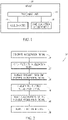
- FIG. 1 is a block diagram of a device 10 for performing VAD.
- the device 10 may be any type of audio headset that detects a user's voice.
- the device 10 may be TWS headphones, a gaming headset, a telephone headset, etc.
- the device 10 includes a processing unit 12, an accelerometer 14, and a bone conduction accelerometer 16.
- the device 10 may also include other components, such as a microphone for capturing voice signals.
- the processing unit 12 is, for example, a processor, controller, signal processor, or microcontroller that controls and processes various functions of the device 10.
- the processing unit 12 controls and coordinates the hardware components (e.g ., the accelerometer 14 and the bone conduction accelerometer 16) of the device 10, and any features or applications of the device 10 (e.g., a pedometer, gesture recognition, activity recognition, tap detection, etc.).
- the processing unit 12 also gathers and processes data from the hardware components of the device 10 (e.g. , acoustic signals generated by a microphone, bone vibration signals generated by the bone conduction accelerometer 16, and acceleration signals generated by the accelerometer 14).
- the accelerometer 14 is communicatively coupled to the processing unit 12.
- the accelerometer 14 measures acceleration of the device 10, and generates an acceleration signal that indicates measured accelerations.
- the accelerometer 14 includes sensing circuitry configured to measure acceleration of the device 10 along at least one axis.
- the accelerometer may measure acceleration along three axes.
- the accelerometer 14 also includes control or processing circuitry configured to detect a user's voice as bone vibration signals propagating through the human body (e.g. , bone and tissue vibrations through the jaw or ear canal) for VAD.
- control or processing circuitry configured to detect a user's voice as bone vibration signals propagating through the human body (e.g. , bone and tissue vibrations through the jaw or ear canal) for VAD.
- the bone conduction accelerometer 16 may be communicatively coupled to the processing unit 12. In the alternative, the bone conduction accelerometer 16 may be communicatively coupled to the accelerometer 14.
- the bone conduction accelerometer 16 is similar to the accelerometer 14. For example, the bone conduction accelerometer 16 measures acceleration of the device 10, and generates an acceleration signal that indicates measured accelerations. However, in contrast to the accelerometer 14, the bone conduction accelerometer 16 is specialized to detect a user's voice as bone vibration signals propagating through the human body.
- the bone conduction accelerometer 16 processes data at a high rate (e.g. , between 2 kilohertz and 32 kilohertz), and typically includes a TDM interface to, for example, synchronize with acoustic signals detected by a microphone. Consequently, as discussed above, the bone conduction accelerometer 16 consumes large amounts of power (e.g., consumes between 1.68 milliamps and 3.3 milliamps).
- the accelerometer 14 is a conventional accelerometer that is both low-cost and low-power.
- the accelerometer 14 is not a bone conduction accelerometer that is specialized to detect a user's voice as bone vibration signals propagating through the human body. Rather, the accelerometer 14 is used to implement other applications of the device 10, such as a pedometer, gesture recognition, activity recognition, and tap detection.
- the accelerometer 14 Compared to the bone conduction accelerometer 16, the accelerometer 14 has a low data rate and does not consume large amounts of power.
- the accelerometer 14 can have a data rate between 600 hertz and 1000 hertz, and consume between 150 microamps and 200 microamps.
- Figure 2 is a flow diagram of a method 18 of detecting a presence or absence of speech.
- the accelerometer 14 measures acceleration of the device 10, and generates an acceleration signal that indicates the measured accelerations.
- the acceleration signal is indicative of bone vibration signals propagating through the human body (e.g. , bone and tissue vibrations through the jaw or ear canal) that are caused by a user's voice.
- the accelerometer 14 may measure acceleration along a single axis or multiple axes.
- the accelerometer 14 applies a filter to the acceleration signal generated in block 20, and generates a filtered acceleration signal.
- the accelerometer 14 applies the filter to the acceleration signal in order to remove frequencies outside of the frequency range of voiced speech.
- a voiced speech of a typical adult male has a fundamental frequency between 85 hertz and 180 hertz, and that of a typical adult female has fundamental frequency between 165 hertz and 255 hertz.
- the accelerometer 14 may apply a high pass filter with for example, a cutoff frequency at 85 hertz to remove frequencies outside of, e.g., below, the frequency range of voiced speech.
- the accelerometer 14 may apply a band pass filter with, for example, cutoff frequencies at 85 hertz and 255 hertz.
- the filtered acceleration signal generated in block 22 is indicative of acceleration measurements of vibrations signals caused by the user's voice, rather than vibrations signals caused by a surrounding environment or a user's movement.
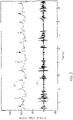
- Figure 3 shows an acceleration signal 24 and a filtered acceleration signal 26
- a user is walking and talking concurrently.
- the horizontal axis represents time (seconds), and the vertical axis represents acceleration (milli-g).
- the acceleration signal 24 is, for example, the acceleration signal generated in block 20, and the filtered acceleration signal 26 is the acceleration signal 24 after applying a filter in block 22.
- a high pass filter having a cutoff frequency at 85 hertz is applied to the acceleration signal 24.
- the filtered acceleration signal 26 represents acceleration measurements of vibrations signals caused by the user's voice because frequencies outside of the frequency range of voiced speech, which in this example are frequencies below 85 hertz, is removed from the acceleration signal 24 by the filter.
- the filtered acceleration signal 26 includes many features (e.g. , peaks, zero crossings, etc.) that are indicative of voiced speech.
- the accelerometer 14 extracts features from the filtered acceleration signal generated in block 22 ( e.g., the filtered acceleration signal 26 in Figure 3 ).
- the extracted features are distinguishing characteristics of the filtered acceleration measurements that are indicative of human speech.
- features are extracted from the filtered acceleration signal in the time domain.
- the accelerometer 14 determines at least one of the following calculations: a peak-to-peak calculation (e.g. , a difference between the maximum amplitude and the minimum amplitude of the filtered acceleration signal in a period of time), a zero crossing calculation ( e.g. , a number of times the filtered acceleration signal crosses zero in a period of time), a peak count calculation ( e.g., a total number of peaks in the filtered acceleration signal in a period of time), or a variance calculation ( e.g. , a variance of the filtered acceleration signal in a period of time).
- a peak-to-peak calculation e.g. , a difference between the maximum amplitude and the minimum amplitude of the filtered acceleration signal in a period of time
- a zero crossing calculation e.g. , a number of times the filtered
- the features may be extracted within a time window of the filtered acceleration signal that is defined based on a desired minimum latency of the VAD algorithm (e.g., the method 18). For example, the features may be calculated within a 0.1 seconds time window of the filtered acceleration signal.
- the accelerometer 14 classifies the filtered acceleration signal as either human speech or not human speech based on the features extracted in block 28. Stated differently, the accelerometer 14 detects the presence or absence of a user's voice by detecting whether the filtered acceleration signal, and in turn the acceleration signal, is a speech signal.
- the accelerometer 14 uses a machine learning approach to classify the filtered acceleration signal as either human speech or not human speech.
- the accelerometer 14 may classify the filtered acceleration signal as either human speech or not human speech using at least one of a decision tree, a neural network, and a support vector machine. Other machine learning techniques are also possible.
- DCNN deep convolutional neural networks
- a DCNN is a computer-based tool that processes large quantities of data and adaptively "learns” by conflating proximally related features within the data, making broad predictions about the data, and refining the predictions based on reliable conclusions and new conflations.
- the DCNN is arranged in a plurality of "layers,” and different types of predictions are made at each layer.
- the accelerometer 14 may extract different features along different axes of the device 10, and utilize a decision tree to classify the filtered acceleration signal as either human speech or not human speech based on the extracted features along the different axes. For example, in block 28, the accelerometer 14 determines, within a selected time window (e.g., 60 milliseconds), a first peak-to-peak calculation of the filtered acceleration signal along a z-axis of the device 10, a second peak-to-peak calculation of the filtered acceleration signal along a x-axis of the device 10, and a zero crossing calculation of the filtered acceleration signal along a y-axis of the device 10.
- a selected time window e.g. 60 milliseconds
- the accelerometer classifies the filtered acceleration signal as either human speech or not human speech based on the first peak-to-peak calculation, the second peak-to-peak calculation, and the zero crossing calculation using a decision tree.
- Figure 4 is a decision tree 32 that may be used to this end.
- the accelerometer 14 determines whether the first peak-to-peak calculation is greater than a first threshold value. If the first peak-to-peak calculation is greater than the first threshold value, the decision tree 32 moves to block 36. If the first peak-to-peak calculation is not greater than ( i.e., is less than or equal to) the first threshold value, the decision tree 32 moves to block 38.
- the accelerometer 14 determines that the filtered acceleration signal is not human speech.
- the accelerometer 14 determines whether the second peak-to-peak calculation is greater than a second threshold value. If the second peak-to-peak calculation is greater than the second threshold value, the decision tree 32 moves to block 40. If the second peak-to-peak calculation is not greater than ( i.e., is less than or equal to) the second threshold value, the decision tree 32 moves to block 42.
- the accelerometer 14 determines that the filtered acceleration signal is not human speech.
- the accelerometer 14 determines whether the zero crossing calculation is greater than a third threshold value. If the zero crossing calculation is greater than the third threshold value, the decision tree 32 moves to block 44. If the zero crossing calculation is not greater than ( i.e., is less than or equal to) the third threshold value, the decision tree 32 moves to block 46.
- the accelerometer 14 determines that the filtered acceleration signal is human speech.
- the accelerometer 14 determines that the filtered acceleration signal is not human speech.
- the first, second, and third threshold values may be set to any values. Further, although peak-to-peak calculations and a zero crossing calculation are used along three axes in the decision tree 32, any type of feature extracted in block 28 may be used (e.g., a peak-to-peak calculation, a zero crossing calculation, a peak count calculation, a variance calculation, etc.) along any number of axes.
- human speech is detected based on the directionality of the features, by detecting different features along the monitored axes.
- human speech is detected if the filtered acceleration signal on a first axis (Z) is higher than a threshold, if the filtered acceleration signal on a second axis (X) is lower than another threshold and if the frequency (measured by counting the zero-crossings) on a third axis (Y) is higher than a still another threshold.
- the accelerometer 14 uses a meta-classifier to filter classifications of the filtered acceleration signal in block 30.
- the accelerometer 14 processes classifications of the filtered acceleration signal to remove or reduce false positives or false negatives.
- the accelerometer 14 reduces false detections of the filtered acceleration signal being human speech by maintaining a first count value.
- the first count value is a total number of times the accelerometer 14 classified the filtered acceleration signal as human speech. When the total number is equal to or greater than a first threshold count value, the accelerometer 14 determines that the filtered acceleration signal is human speech.
- the accelerometer 14 reduces false detections of the filtered acceleration signal not being human speech by maintaining a second count value.
- the second count value is a total number of times the accelerometer 14 classified the filtered acceleration signal as not being human speech. When the total number is equal to or greater than a second threshold count value, the accelerometer 14 determines that the filtered acceleration signal is not human speech.
- Block 48 may also be removed from the method 18 ( i.e., not performed) to reduce latency of the method 18.
- the accelerometer 14 outputs the detection results of the method 18. For example, the accelerometer 14 outputs, to the processing unit 12, a detection signal indicating either that human speech is present (i.e., the filtered acceleration signal is a speech signal) or human speech is not present (i.e., the filtered acceleration signal is not a speech signal).
- a detection signal indicating either that human speech is present (i.e., the filtered acceleration signal is a speech signal) or human speech is not present (i.e., the filtered acceleration signal is not a speech signal).
- the accelerometer 14 outputs a detection signal indicating that human speech is present in a case where the total number times the accelerometer 14 classified the filtered acceleration signal as human speech is equal to or greater than the first threshold count value. Conversely, the accelerometer 14 outputs a detection signal indicating that human speech is not present in a case where the total number of times the accelerometer 14 classified the filtered acceleration signal as not being human speech is equal to or greater than the second threshold count value.
- the accelerometer 14 outputs a detection signal indicating that human speech is present in a case where the accelerometer 14 classifies the filtered acceleration signal as human speech in block 30. Conversely, the accelerometer 14 outputs a detection signal indicating that human speech is not present in a case where the accelerometer 14 does not classify the filtered acceleration signal as human speech in block 30.
- the processing unit 12 may activate or deactivate the bone conduction accelerometer 16 based on the detection signal received from the accelerometer 14. For example, the processing unit 12 may activate the bone conduction accelerometer 16 in a case where detection signal indicates that human speech is present, and deactivate the bone conduction accelerometer 16 in a case where detection signal indicates that human speech is not present. Accordingly, power consumption of the device 10 may be reduced as the bone conduction accelerometer 16 is activated when human speech is detected, rather than being continuously on. In the alternative, the accelerometer 14 directly activates or deactivates the bone conduction accelerometer 16, without intervention from the processing unit 12.
- the program or algorithm to perform the method 18 of detecting a presence or absence of human speech is implemented directly in hardware of the accelerometer 14.
- the program or algorithm to perform the method 18 may be implemented in several different locations within the device 10.
- the program or algorithm to perform the method 18 may be implemented in the processing unit 12 instead of the accelerometer 14.
- the processing unit 12 is configured to detect a presence or absence of speech as described above with respect to Figure 2 .
- the processing unit 12 may receive the acceleration signal generated in block 20 of the method 18, and subsequently perform blocks 22, 28, 30, 48, and 50.
- the processing unit 12 is also configured to receive and process an acceleration signal from the bone conduction accelerometer 16 and any other components included in the device 10.
- the device and method utilize a low-power, low-cost accelerometer to perform VAD.
- the intervention of the processing unit 12 is reduced.
- the overall current consumption of the device disclosed herein is greatly reduced compared to devices that utilize a microphone and/or a bone conduction accelerometer for VAD.
- the device and method disclosed herein are well suited for portable audio devices, such as TWS headphones, that have a limited power supply.
- the device may include only the conventional accelerometer 14.
- a device comprising:
Landscapes
- Engineering & Computer Science (AREA)
- Physics & Mathematics (AREA)
- Acoustics & Sound (AREA)
- Health & Medical Sciences (AREA)
- Signal Processing (AREA)
- Computational Linguistics (AREA)
- Multimedia (AREA)
- Audiology, Speech & Language Pathology (AREA)
- Human Computer Interaction (AREA)
- Theoretical Computer Science (AREA)
- Evolutionary Computation (AREA)
- Software Systems (AREA)
- Artificial Intelligence (AREA)
- General Health & Medical Sciences (AREA)
- Neurosurgery (AREA)
- Otolaryngology (AREA)
- Computing Systems (AREA)
- General Engineering & Computer Science (AREA)
- General Physics & Mathematics (AREA)
- Mathematical Physics (AREA)
- Data Mining & Analysis (AREA)
- Medical Informatics (AREA)
- Computer Vision & Pattern Recognition (AREA)
- Telephone Function (AREA)
Abstract
Description
- The present invention is directed to a device and method for detecting voice activity.
- Many audio headsets, such as true wireless stereo (TWS) headphones and gaming headsets, detect a user's voice in addition to playing audio. For example, many TWS headphones function as both a telephone headset for phone calls and an audio playback device for playing media (e.g., music).
- When detecting the user's voice, the quality of the user's voice often suffers from environmental noise. In order to minimize the impact of environmental noise on the user's voice, many headsets include voice activity detection (VAD) to detect the presence or absence of human speech, and perform noise cancelling or suppression techniques in response to detecting the presence of human speech. As a result, the quality of the user's voice is improved during, for example, telephone calls.
- Audio headsets typically implement VAD using a microphone and/or a bone conduction accelerometer. For example, a user's voice may be detected by a microphone as acoustic signals propagating through air, and by a bone conduction accelerometer as bone vibration signals propagating through the human body (e.g., bone and tissue vibrations through the jaw or ear canal). The detected acoustic signals and bone vibration signals are synchronized using, for example, time-division multiplexing (TDM). The audio headset then detects the presence or absence of the user's voice based on the synchronized acoustic signals and bone vibration signals.
- VAD techniques that utilize a microphone and/or a bone conduction accelerometer typically involve processing large amounts of data for detected acoustic signals and bone vibration signals at a high rate. For example, each of the microphone and the bone conduction accelerometer may have a data rate between 2 kilohertz and 32 kilohertz, and the microcontroller may process data every 1 millisecond. Consequently, VAD techniques consume large amounts of power, and are, thus, often unsuitable for portable audio devices, such as true wireless stereo (TWS) headphones, that have a limited power supply. For example, a microphone typically consumes between 120 microamps and 700 microamps, a bone conduction accelerometer typically consumes between 1.68 milliamps and 3.3 milliamps, and a microcontroller for controlling the microphone and the bone conduction accelerometer typically consumes between 3 milliamps and 5 milliamps.
- An aim of the invention is to provide voice activity detection that solves problems of prior solutions.
- Accordingly, a device and a method for performing voice activity detection (VAD) are provided, as defined in the attached claims.
- For the understanding of the present invention, embodiments thereof are now described, purely as non-limitative examples, with reference to the attached drawings, wherein:
-
Figure 1 is a block diagram of a device for performing voice activity detection. -
Figure 2 is a flow diagram of a method of detecting a presence or absence of speech. -
Figure 3 shows an acceleration signal and a filtered acceleration signal that may be obtained with the method ofFigure 2 . -
Figure 4 is a decision tree that may be used in the method ofFigure 2 . - In the drawings, identical reference numbers identify similar features or elements. The size and relative positions of features in the drawings are not necessarily drawn to scale.
- The present invention is directed to a device and method for performing VAD. The presence or absence of human speech is detected using a low-cost, low-power accelerometer, instead of a microphone and/or a bone conduction accelerometer used in current audio headsets. As a result, the overall current consumption of the device disclosed herein is greatly reduced compared to devices that utilize a microphone and/or a bone conduction accelerometer for VAD. As such, the device and method disclosed herein are ideal for portable audio devices, such as TWS headphones, that have a limited power supply.
- In particular, the device and method generate an acceleration signal using the accelerometer, filter the acceleration signal with a band pass filter or a high pass filter, determine at least one calculation of the filtered acceleration signal, and detect a presence or absence of a voice based on the at least one calculation.
-
Figure 1 is a block diagram of adevice 10 for performing VAD. Thedevice 10 may be any type of audio headset that detects a user's voice. For example, thedevice 10 may be TWS headphones, a gaming headset, a telephone headset, etc. - The
device 10 includes aprocessing unit 12, anaccelerometer 14, and abone conduction accelerometer 16. Thedevice 10 may also include other components, such as a microphone for capturing voice signals. - The
processing unit 12 is, for example, a processor, controller, signal processor, or microcontroller that controls and processes various functions of thedevice 10. Theprocessing unit 12 controls and coordinates the hardware components (e.g., theaccelerometer 14 and the bone conduction accelerometer 16) of thedevice 10, and any features or applications of the device 10 (e.g., a pedometer, gesture recognition, activity recognition, tap detection, etc.). Theprocessing unit 12 also gathers and processes data from the hardware components of the device 10 (e.g., acoustic signals generated by a microphone, bone vibration signals generated by thebone conduction accelerometer 16, and acceleration signals generated by the accelerometer 14). - The
accelerometer 14 is communicatively coupled to theprocessing unit 12. Theaccelerometer 14 measures acceleration of thedevice 10, and generates an acceleration signal that indicates measured accelerations. Theaccelerometer 14 includes sensing circuitry configured to measure acceleration of thedevice 10 along at least one axis. The accelerometer may measure acceleration along three axes. - As will be discussed in further detail below, the
accelerometer 14 also includes control or processing circuitry configured to detect a user's voice as bone vibration signals propagating through the human body (e.g., bone and tissue vibrations through the jaw or ear canal) for VAD. - The
bone conduction accelerometer 16 may be communicatively coupled to theprocessing unit 12. In the alternative, thebone conduction accelerometer 16 may be communicatively coupled to theaccelerometer 14. - The
bone conduction accelerometer 16 is similar to theaccelerometer 14. For example, thebone conduction accelerometer 16 measures acceleration of thedevice 10, and generates an acceleration signal that indicates measured accelerations. However, in contrast to theaccelerometer 14, thebone conduction accelerometer 16 is specialized to detect a user's voice as bone vibration signals propagating through the human body. - The
bone conduction accelerometer 16 processes data at a high rate (e.g., between 2 kilohertz and 32 kilohertz), and typically includes a TDM interface to, for example, synchronize with acoustic signals detected by a microphone. Consequently, as discussed above, thebone conduction accelerometer 16 consumes large amounts of power (e.g., consumes between 1.68 milliamps and 3.3 milliamps). - In contrast, the
accelerometer 14 is a conventional accelerometer that is both low-cost and low-power. Theaccelerometer 14 is not a bone conduction accelerometer that is specialized to detect a user's voice as bone vibration signals propagating through the human body. Rather, theaccelerometer 14 is used to implement other applications of thedevice 10, such as a pedometer, gesture recognition, activity recognition, and tap detection. - Compared to the
bone conduction accelerometer 16, theaccelerometer 14 has a low data rate and does not consume large amounts of power. For example, theaccelerometer 14 can have a data rate between 600 hertz and 1000 hertz, and consume between 150 microamps and 200 microamps. - The
accelerometer 14, itself, detects the presence or absence of human speech. Stated differently, the steps or operations to perform VAD are implemented directly in hardware (e.g., control or processing circuitry) of theaccelerometer 14. As such, a separate, dedicated microcontroller to perform VAD is unnecessary. In addition, in some circumstances, thebone conduction accelerometer 16 may be turned off when not in use or even be removed from thedevice 10. -
Figure 2 is a flow diagram of amethod 18 of detecting a presence or absence of speech. - In
block 20, theaccelerometer 14 measures acceleration of thedevice 10, and generates an acceleration signal that indicates the measured accelerations. - The acceleration signal is indicative of bone vibration signals propagating through the human body (e.g., bone and tissue vibrations through the jaw or ear canal) that are caused by a user's voice. As discussed above, the
accelerometer 14 may measure acceleration along a single axis or multiple axes. - In
block 22, theaccelerometer 14 applies a filter to the acceleration signal generated inblock 20, and generates a filtered acceleration signal. - The
accelerometer 14 applies the filter to the acceleration signal in order to remove frequencies outside of the frequency range of voiced speech. A voiced speech of a typical adult male has a fundamental frequency between 85 hertz and 180 hertz, and that of a typical adult female has fundamental frequency between 165 hertz and 255 hertz. Thus, theaccelerometer 14 may apply a high pass filter with for example, a cutoff frequency at 85 hertz to remove frequencies outside of, e.g., below, the frequency range of voiced speech. Alternatively, theaccelerometer 14 may apply a band pass filter with, for example, cutoff frequencies at 85 hertz and 255 hertz. As a result, the filtered acceleration signal generated inblock 22 is indicative of acceleration measurements of vibrations signals caused by the user's voice, rather than vibrations signals caused by a surrounding environment or a user's movement. -
Figure 3 shows anacceleration signal 24 and a filteredacceleration signal 26 InFigure 3 , a user is walking and talking concurrently. The horizontal axis represents time (seconds), and the vertical axis represents acceleration (milli-g). - The
acceleration signal 24 is, for example, the acceleration signal generated inblock 20, and the filteredacceleration signal 26 is theacceleration signal 24 after applying a filter inblock 22. InFigure 3 , a high pass filter having a cutoff frequency at 85 hertz is applied to theacceleration signal 24. As discussed above, the filteredacceleration signal 26 represents acceleration measurements of vibrations signals caused by the user's voice because frequencies outside of the frequency range of voiced speech, which in this example are frequencies below 85 hertz, is removed from theacceleration signal 24 by the filter. As shown inFigure 3 , the filteredacceleration signal 26 includes many features (e.g., peaks, zero crossings, etc.) that are indicative of voiced speech. - Returning to
Figure 2 , inblock 28, theaccelerometer 14 extracts features from the filtered acceleration signal generated in block 22 (e.g., the filteredacceleration signal 26 inFigure 3 ). - The extracted features are distinguishing characteristics of the filtered acceleration measurements that are indicative of human speech. For instance, features are extracted from the filtered acceleration signal in the time domain. For example, the
accelerometer 14 determines at least one of the following calculations: a peak-to-peak calculation (e.g., a difference between the maximum amplitude and the minimum amplitude of the filtered acceleration signal in a period of time), a zero crossing calculation (e.g., a number of times the filtered acceleration signal crosses zero in a period of time), a peak count calculation (e.g., a total number of peaks in the filtered acceleration signal in a period of time), or a variance calculation (e.g., a variance of the filtered acceleration signal in a period of time). Other types of calculations are also possible. - The features may be extracted within a time window of the filtered acceleration signal that is defined based on a desired minimum latency of the VAD algorithm (e.g., the method 18). For example, the features may be calculated within a 0.1 seconds time window of the filtered acceleration signal.
- In
block 30, theaccelerometer 14 classifies the filtered acceleration signal as either human speech or not human speech based on the features extracted inblock 28. Stated differently, theaccelerometer 14 detects the presence or absence of a user's voice by detecting whether the filtered acceleration signal, and in turn the acceleration signal, is a speech signal. - The
accelerometer 14 uses a machine learning approach to classify the filtered acceleration signal as either human speech or not human speech. Theaccelerometer 14 may classify the filtered acceleration signal as either human speech or not human speech using at least one of a decision tree, a neural network, and a support vector machine. Other machine learning techniques are also possible. - Learning/inference machines may fall under the technological titles of machine learning, artificial intelligence, artificial neural networks (ANN), probabilistic inference engines, accelerators, and the like. Classification problems, such as VAD and other signal processing applications, benefit from the use of learning/inference machines, such as deep convolutional neural networks (DCNN), fuzzy-logic machines, etc. For example, a DCNN is a computer-based tool that processes large quantities of data and adaptively "learns" by conflating proximally related features within the data, making broad predictions about the data, and refining the predictions based on reliable conclusions and new conflations. The DCNN is arranged in a plurality of "layers," and different types of predictions are made at each layer.
- The
accelerometer 14 may extract different features along different axes of thedevice 10, and utilize a decision tree to classify the filtered acceleration signal as either human speech or not human speech based on the extracted features along the different axes. For example, inblock 28, theaccelerometer 14 determines, within a selected time window (e.g., 60 milliseconds), a first peak-to-peak calculation of the filtered acceleration signal along a z-axis of thedevice 10, a second peak-to-peak calculation of the filtered acceleration signal along a x-axis of thedevice 10, and a zero crossing calculation of the filtered acceleration signal along a y-axis of thedevice 10. - Subsequently, in
block 30, the accelerometer classifies the filtered acceleration signal as either human speech or not human speech based on the first peak-to-peak calculation, the second peak-to-peak calculation, and the zero crossing calculation using a decision tree.Figure 4 is adecision tree 32 that may be used to this end. - In
block 34 ofFigure 4 , theaccelerometer 14 determines whether the first peak-to-peak calculation is greater than a first threshold value. If the first peak-to-peak calculation is greater than the first threshold value, thedecision tree 32 moves to block 36. If the first peak-to-peak calculation is not greater than (i.e., is less than or equal to) the first threshold value, thedecision tree 32 moves to block 38. - In
block 38, theaccelerometer 14 determines that the filtered acceleration signal is not human speech. - In
block 36, theaccelerometer 14 determines whether the second peak-to-peak calculation is greater than a second threshold value. If the second peak-to-peak calculation is greater than the second threshold value, thedecision tree 32 moves to block 40. If the second peak-to-peak calculation is not greater than (i.e., is less than or equal to) the second threshold value, thedecision tree 32 moves to block 42. - In
block 40, theaccelerometer 14 determines that the filtered acceleration signal is not human speech. - In
block 42, theaccelerometer 14 determines whether the zero crossing calculation is greater than a third threshold value. If the zero crossing calculation is greater than the third threshold value, thedecision tree 32 moves to block 44. If the zero crossing calculation is not greater than (i.e., is less than or equal to) the third threshold value, thedecision tree 32 moves to block 46. - In
block 44, theaccelerometer 14 determines that the filtered acceleration signal is human speech. - In
block 46, theaccelerometer 14 determines that the filtered acceleration signal is not human speech. - The first, second, and third threshold values may be set to any values. Further, although peak-to-peak calculations and a zero crossing calculation are used along three axes in the
decision tree 32, any type of feature extracted inblock 28 may be used (e.g., a peak-to-peak calculation, a zero crossing calculation, a peak count calculation, a variance calculation, etc.) along any number of axes. - In practice, human speech is detected based on the directionality of the features, by detecting different features along the monitored axes.
- Here, human speech is detected if the filtered acceleration signal on a first axis (Z) is higher than a threshold, if the filtered acceleration signal on a second axis (X) is lower than another threshold and if the frequency (measured by counting the zero-crossings) on a third axis (Y) is higher than a still another threshold.
- Returning to
Figure 2 , in block 48, theaccelerometer 14 uses a meta-classifier to filter classifications of the filtered acceleration signal inblock 30. Theaccelerometer 14 processes classifications of the filtered acceleration signal to remove or reduce false positives or false negatives. - For example, the
accelerometer 14 reduces false detections of the filtered acceleration signal being human speech by maintaining a first count value. The first count value is a total number of times theaccelerometer 14 classified the filtered acceleration signal as human speech. When the total number is equal to or greater than a first threshold count value, theaccelerometer 14 determines that the filtered acceleration signal is human speech. - As an alternative, the
accelerometer 14 reduces false detections of the filtered acceleration signal not being human speech by maintaining a second count value. The second count value is a total number of times theaccelerometer 14 classified the filtered acceleration signal as not being human speech. When the total number is equal to or greater than a second threshold count value, theaccelerometer 14 determines that the filtered acceleration signal is not human speech. - Block 48 may also be removed from the method 18 (i.e., not performed) to reduce latency of the
method 18. - In
block 50, theaccelerometer 14 outputs the detection results of themethod 18. For example, theaccelerometer 14 outputs, to theprocessing unit 12, a detection signal indicating either that human speech is present (i.e., the filtered acceleration signal is a speech signal) or human speech is not present (i.e., the filtered acceleration signal is not a speech signal). - If the
method 18 includes block 48, theaccelerometer 14 outputs a detection signal indicating that human speech is present in a case where the total number times theaccelerometer 14 classified the filtered acceleration signal as human speech is equal to or greater than the first threshold count value. Conversely, theaccelerometer 14 outputs a detection signal indicating that human speech is not present in a case where the total number of times theaccelerometer 14 classified the filtered acceleration signal as not being human speech is equal to or greater than the second threshold count value. - If the
method 18 does not include block 48, theaccelerometer 14 outputs a detection signal indicating that human speech is present in a case where theaccelerometer 14 classifies the filtered acceleration signal as human speech inblock 30. Conversely, theaccelerometer 14 outputs a detection signal indicating that human speech is not present in a case where theaccelerometer 14 does not classify the filtered acceleration signal as human speech inblock 30. - The
processing unit 12 may activate or deactivate thebone conduction accelerometer 16 based on the detection signal received from theaccelerometer 14. For example, theprocessing unit 12 may activate thebone conduction accelerometer 16 in a case where detection signal indicates that human speech is present, and deactivate thebone conduction accelerometer 16 in a case where detection signal indicates that human speech is not present. Accordingly, power consumption of thedevice 10 may be reduced as thebone conduction accelerometer 16 is activated when human speech is detected, rather than being continuously on. In the alternative, theaccelerometer 14 directly activates or deactivates thebone conduction accelerometer 16, without intervention from theprocessing unit 12. - In the above description, the program or algorithm to perform the
method 18 of detecting a presence or absence of human speech is implemented directly in hardware of theaccelerometer 14. However, the program or algorithm to perform themethod 18 may be implemented in several different locations within thedevice 10. For example, the program or algorithm to perform themethod 18 may be implemented in theprocessing unit 12 instead of theaccelerometer 14. In this case, theprocessing unit 12 is configured to detect a presence or absence of speech as described above with respect toFigure 2 . For example, theprocessing unit 12 may receive the acceleration signal generated inblock 20 of themethod 18, and subsequently performblocks processing unit 12 is also configured to receive and process an acceleration signal from thebone conduction accelerometer 16 and any other components included in thedevice 10. - The device and method utilize a low-power, low-cost accelerometer to perform VAD. In addition, the intervention of the
processing unit 12 is reduced. As a result, the overall current consumption of the device disclosed herein is greatly reduced compared to devices that utilize a microphone and/or a bone conduction accelerometer for VAD. As such, the device and method disclosed herein are well suited for portable audio devices, such as TWS headphones, that have a limited power supply. - Finally, it is clear that numerous variations and modifications may be made to the device and method described and illustrated herein, all falling within the scope of the invention as defined in the attached claims. For example, the device may include only the
conventional accelerometer 14. - In practice, a device is disclosed, comprising:
- a sensing circuitry configured to generate an acceleration signal; and
- processing circuitry configured to:
- filter the acceleration signal;
- determine at least one characteristic of the filtered acceleration signal, the at least one characteristic including at least one of a peak-to-peak calculation, a zero crossing calculation, a peak count calculation, or a variance calculation;
- detect a presence of a voice based on the at least one characteristic; and output a detection signal that indicates the presence of the voice
Claims (15)
- A device (10) for performing voice activity detection, comprising:an accelerometer (14) configured to:measure a first acceleration of the device, and generate a first acceleration signal based on the measured first acceleration;apply a filter to the first acceleration signal;determine at least one characteristic of the filtered first acceleration signal;detect whether the first acceleration signal is a speech signal based on the at least one characteristic; andoutput a detection signal that indicates whether the first acceleration signal is a speech signal; andan operating system layer (12; 14) configured to receive the detection signal.
- The device of claim 1, further comprising:
a bone conduction accelerometer (16) configured to measure a second acceleration of the device, and generate a second acceleration signal based on the measured second acceleration. - The device of claim 2, wherein the operating system layer (12; 14) is configured to activate or deactivate the bone conduction accelerometer (16) based on the detection signal.
- The device of claim 2 or 3, wherein the bone conduction accelerometer (16) consumes a greater amount of current than the accelerometer (14).
- The device of any of the preceding claims, wherein the at least one characteristic includes at least one of a peak-to-peak calculation, a zero crossing calculation, a peak count calculation, or a variance calculation.
- The device of any of the preceding claims, wherein the accelerometer (14) is configured to:determine a first count value that indicates a total number of times the accelerometer detected that the first acceleration signal is a speech signal, the detection signal indicating that the first acceleration signal is a speech signal in a case where the first count value is equal to or greater than a first threshold count value; ordetermine a second count value that indicates a total number of times the accelerometer detected that the first acceleration signal is not a speech signal, the detection signal indicating that the first acceleration signal is not a speech signal in a case where the second count value is equal to or greater than a second threshold count value.
- The device of any of claims 1-5, wherein the accelerometer (14) is configured to detect whether the first acceleration signal is a speech signal based on directionality of the characteristics, by comparing different characteristics along different axes with respective thresholds.
- The device of any of the preceding claims, wherein the accelerometer (14) is configured to detect whether the first acceleration signal is a speech signal if the filtered first acceleration signal on a first axis (Z) is higher than a first threshold, if the filtered first acceleration signal on a second axis (X) is not greater than a second threshold and if the frequency of the filtered first acceleration signal on a third axis (Y) is higher than a third threshold.
- The device of any of the preceding claims wherein the filter is a band pass filter or a high pass filter.
- The device of any of the preceding claims, wherein the accelerometer (14) detects whether the first acceleration signal is a speech signal by using at least one of a decision tree, a neural network, or a support vector machine.
- A method for performing voice activity detection, comprising:generating an acceleration signal;filtering the acceleration signal with a band pass filter or a high pass filter;determining at least one calculation of the filtered acceleration signal, the at least one calculation including at least one of a peak-to-peak calculation, a zero crossing calculation, a peak count calculation, or a variance calculation;detecting a presence or absence of a voice based on the at least one calculation; andoutputting a detection signal that indicates the presence or absence of the voice, wherein the generating, filtering, determining, detection, and outputting are performed by an accelerometer.
- The method of the preceding claim, further comprising:determining a first count value that indicates a total number of times a presence of a voice is detected, the detection signal indicating the presence of the voice in a case where the first count value is equal to or greater than a first threshold count value; ordetermining a second count value that indicates a total number of times an absence of a voice is detected, the detection signal indicating the absence of the voice in a case where the second count value is equal to or greater than a second threshold count value.
- The method of claim 11 or 12, wherein the detecting of the presence or absence of the voice utilizes at least one of a decision tree, a neural network, or a support vector machine.
- The method of any of claims 11-13, wherein detecting the presence or absence of the voice comprises detecting whether the acceleration signal is a speech signal based on directionality of the characteristics of the filtered acceleration signal, by comparing different characteristics along different axes with respective thresholds.
- The method of any of claims 11-14, wherein detecting the presence or absence of the voice comprises detecting that the acceleration signal is a speech signal if the filtered acceleration signal on a first axis (Z) is higher than a first threshold, the filtered acceleration signal on a second axis (X) is not greater than a second threshold and the frequency of the filtered acceleration signal on a third axis (Y) is higher than a third threshold.
Applications Claiming Priority (1)
| Application Number | Priority Date | Filing Date | Title |
|---|---|---|---|
| US17/183,288 US11942107B2 (en) | 2021-02-23 | 2021-02-23 | Voice activity detection with low-power accelerometer |
Publications (2)
| Publication Number | Publication Date |
|---|---|
| EP4050603A1 true EP4050603A1 (en) | 2022-08-31 |
| EP4050603B1 EP4050603B1 (en) | 2024-12-11 |
Family
ID=80447343
Family Applications (1)
| Application Number | Title | Priority Date | Filing Date |
|---|---|---|---|
| EP22155997.4A Active EP4050603B1 (en) | 2021-02-23 | 2022-02-09 | Voice activity detection with low-power accelerometer |
Country Status (3)
| Country | Link |
|---|---|
| US (1) | US11942107B2 (en) |
| EP (1) | EP4050603B1 (en) |
| CN (1) | CN115171734A (en) |
Families Citing this family (4)
| Publication number | Priority date | Publication date | Assignee | Title |
|---|---|---|---|---|
| EP4131256A1 (en) | 2021-08-06 | 2023-02-08 | STMicroelectronics S.r.l. | Voice recognition system and method using accelerometers for sensing bone conduction |
| CN115731927B (en) * | 2021-08-30 | 2026-04-10 | 华为技术有限公司 | Methods, devices, equipment, storage media, and software products for voice wake-up |
| US12100420B2 (en) * | 2022-02-15 | 2024-09-24 | Google Llc | Speech detection using multiple acoustic sensors |
| US20240021212A1 (en) * | 2022-07-12 | 2024-01-18 | Invensense, Inc. | Accelerometer-Based Voice Activity Detection |
Citations (1)
| Publication number | Priority date | Publication date | Assignee | Title |
|---|---|---|---|---|
| CN111916101A (en) * | 2020-08-06 | 2020-11-10 | 大象声科(深圳)科技有限公司 | Deep learning noise reduction method and system fusing bone vibration sensor and double-microphone signals |
Family Cites Families (18)
| Publication number | Priority date | Publication date | Assignee | Title |
|---|---|---|---|---|
| US8019091B2 (en) | 2000-07-19 | 2011-09-13 | Aliphcom, Inc. | Voice activity detector (VAD) -based multiple-microphone acoustic noise suppression |
| WO2003096031A2 (en) * | 2002-03-05 | 2003-11-20 | Aliphcom | Voice activity detection (vad) devices and methods for use with noise suppression systems |
| EP2621150A1 (en) * | 2012-01-30 | 2013-07-31 | Research In Motion Limited | Adjusted noise suppression and voice activity detection |
| US9516442B1 (en) | 2012-09-28 | 2016-12-06 | Apple Inc. | Detecting the positions of earbuds and use of these positions for selecting the optimum microphones in a headset |
| US9313572B2 (en) | 2012-09-28 | 2016-04-12 | Apple Inc. | System and method of detecting a user's voice activity using an accelerometer |
| US20140270259A1 (en) * | 2013-03-13 | 2014-09-18 | Aliphcom | Speech detection using low power microelectrical mechanical systems sensor |
| US9997172B2 (en) | 2013-12-02 | 2018-06-12 | Nuance Communications, Inc. | Voice activity detection (VAD) for a coded speech bitstream without decoding |
| US20160284363A1 (en) * | 2015-03-24 | 2016-09-29 | Intel Corporation | Voice activity detection technologies, systems and methods employing the same |
| US10229700B2 (en) | 2015-09-24 | 2019-03-12 | Google Llc | Voice activity detection |
| GB201713946D0 (en) * | 2017-06-16 | 2017-10-18 | Cirrus Logic Int Semiconductor Ltd | Earbud speech estimation |
| CN107392106B (en) * | 2017-06-26 | 2021-03-02 | 辽宁大学 | A dual-threshold-based human activity endpoint detection method |
| US10455324B2 (en) * | 2018-01-12 | 2019-10-22 | Intel Corporation | Apparatus and methods for bone conduction context detection |
| CN112334977B (en) * | 2018-08-14 | 2024-05-17 | 华为技术有限公司 | Voice recognition method, wearable device and system |
| US11172909B2 (en) * | 2018-08-30 | 2021-11-16 | Biointellisense, Inc. | Sensor fusion to validate sound-producing behaviors |
| EP3684074A1 (en) * | 2019-03-29 | 2020-07-22 | Sonova AG | Hearing device for own voice detection and method of operating the hearing device |
| US12216746B2 (en) * | 2020-06-04 | 2025-02-04 | Qualcomm Technologies, Inc. | Biometric authentication using voice accelerometer |
| DE102020208206A1 (en) * | 2020-07-01 | 2022-01-05 | Robert Bosch Gesellschaft mit beschränkter Haftung | Inertial sensor unit and method for detecting speech activity |
| JP7634199B2 (en) * | 2021-02-05 | 2025-02-21 | パナソニックIpマネジメント株式会社 | Audio device and audio control method |
-
2021
- 2021-02-23 US US17/183,288 patent/US11942107B2/en active Active
-
2022
- 2022-02-09 EP EP22155997.4A patent/EP4050603B1/en active Active
- 2022-02-22 CN CN202210163081.1A patent/CN115171734A/en active Pending
Patent Citations (1)
| Publication number | Priority date | Publication date | Assignee | Title |
|---|---|---|---|---|
| CN111916101A (en) * | 2020-08-06 | 2020-11-10 | 大象声科(深圳)科技有限公司 | Deep learning noise reduction method and system fusing bone vibration sensor and double-microphone signals |
Non-Patent Citations (3)
| Title |
|---|
| ALEKSANDAR MATIC ET AL: "Speech activity detection using accelerometer", ENGINEERING IN MEDICINE AND BIOLOGY SOCIETY (EMBC), 2013 34TH ANNUAL INTERNATIONAL CONFERENCE OF THE IEEE, IEEE, 28 August 2012 (2012-08-28), pages 2112 - 2115, XP032463356, ISSN: 1557-170X, DOI: 10.1109/EMBC.2012.6346377 * |
| DUBEY SAURAV ET AL: "Real-Time Voice Activity Detection Using Neck-Mounted Accelerometers for Controlling a Wearable Vibration Device to Treat Speech Impairment", 2020 DESIGN OF MEDICAL DEVICES CONFERENCE, 6 April 2020 (2020-04-06), pages 1 - 7, XP055936665, ISBN: 978-0-7918-8354-9, Retrieved from the Internet <URL:http://asmedigitalcollection.asme.org/biomed/BIOMED/proceedings-pdf/doi/10.1115/DMD2020-9081/6552730/v001t09a007-dmd2020-9081.pdf> [retrieved on 20220629], DOI: 10.1115/DMD2020-9081 * |
| DUBEY SAURAV KUMAR: "Accelerometer-based real-time voice activity detection using neck surface vibration measurement", MASTER THESIS, 30 June 2019 (2019-06-30), pages 1 - 54, XP055936655, Retrieved from the Internet <URL:https://core.ac.uk/download/pdf/228205005.pdf> [retrieved on 20220629] * |
Also Published As
| Publication number | Publication date |
|---|---|
| CN115171734A (en) | 2022-10-11 |
| EP4050603B1 (en) | 2024-12-11 |
| US20220270593A1 (en) | 2022-08-25 |
| US11942107B2 (en) | 2024-03-26 |
Similar Documents
| Publication | Publication Date | Title |
|---|---|---|
| EP4050603B1 (en) | Voice activity detection with low-power accelerometer | |
| CN111328009B (en) | Acoustic in-ear detection method for audible device and audible device | |
| CN109196877B (en) | On/off-head detection of personal audio devices | |
| US11918345B2 (en) | Cough detection | |
| US9560456B2 (en) | Hearing aid and method of detecting vibration | |
| US11115762B2 (en) | Hearing device for own voice detection and method of operating a hearing device | |
| CN110268470A (en) | Audio device filter modification | |
| CN109346075A (en) | Method and system for recognizing user's voice through human body vibration to control electronic equipment | |
| CN110446149B (en) | Method for operating a hearing aid and hearing aid | |
| CN112230779B (en) | Operation response method, device, equipment and storage medium | |
| KR20220015427A (en) | detection of voice | |
| US12322365B2 (en) | Environmentally adaptive masking sound | |
| KR20180011015A (en) | Circuit and Method for Speech Recognition | |
| US20250338069A1 (en) | Systems and methods for own voice detection in a hearing system | |
| US20200177995A1 (en) | Proximity detection for wireless in-ear listening devices | |
| CN113314121B (en) | Soundless voice recognition method, soundless voice recognition device, soundless voice recognition medium, soundless voice recognition earphone and electronic equipment | |
| CN116935900A (en) | Voice detection method | |
| US12597435B2 (en) | Signal processing apparatus and signal processing method | |
| US12517590B1 (en) | Near infrasonic sound-based control system | |
| WO2022101614A1 (en) | Cough detection | |
| WO2019238061A1 (en) | Method and device for recognizing user voice by means of human body vibration | |
| WO2024205790A1 (en) | Interface control via body-conducted sound | |
| CN118870279A (en) | Headset conversation detection |
Legal Events
| Date | Code | Title | Description |
|---|---|---|---|
| PUAI | Public reference made under article 153(3) epc to a published international application that has entered the european phase |
Free format text: ORIGINAL CODE: 0009012 |
|
| STAA | Information on the status of an ep patent application or granted ep patent |
Free format text: STATUS: THE APPLICATION HAS BEEN PUBLISHED |
|
| AK | Designated contracting states |
Kind code of ref document: A1 Designated state(s): AL AT BE BG CH CY CZ DE DK EE ES FI FR GB GR HR HU IE IS IT LI LT LU LV MC MK MT NL NO PL PT RO RS SE SI SK SM TR |
|
| STAA | Information on the status of an ep patent application or granted ep patent |
Free format text: STATUS: REQUEST FOR EXAMINATION WAS MADE |
|
| 17P | Request for examination filed |
Effective date: 20230224 |
|
| RBV | Designated contracting states (corrected) |
Designated state(s): AL AT BE BG CH CY CZ DE DK EE ES FI FR GB GR HR HU IE IS IT LI LT LU LV MC MK MT NL NO PL PT RO RS SE SI SK SM TR |
|
| GRAP | Despatch of communication of intention to grant a patent |
Free format text: ORIGINAL CODE: EPIDOSNIGR1 |
|
| STAA | Information on the status of an ep patent application or granted ep patent |
Free format text: STATUS: GRANT OF PATENT IS INTENDED |
|
| RIC1 | Information provided on ipc code assigned before grant |
Ipc: G10L 25/78 20130101AFI20240624BHEP |
|
| INTG | Intention to grant announced |
Effective date: 20240708 |
|
| GRAS | Grant fee paid |
Free format text: ORIGINAL CODE: EPIDOSNIGR3 |
|
| GRAA | (expected) grant |
Free format text: ORIGINAL CODE: 0009210 |
|
| STAA | Information on the status of an ep patent application or granted ep patent |
Free format text: STATUS: THE PATENT HAS BEEN GRANTED |
|
| AK | Designated contracting states |
Kind code of ref document: B1 Designated state(s): AL AT BE BG CH CY CZ DE DK EE ES FI FR GB GR HR HU IE IS IT LI LT LU LV MC MK MT NL NO PL PT RO RS SE SI SK SM TR |
|
| REG | Reference to a national code |
Ref country code: GB Ref legal event code: FG4D |
|
| REG | Reference to a national code |
Ref country code: CH Ref legal event code: EP |
|
| REG | Reference to a national code |
Ref country code: IE Ref legal event code: FG4D |
|
| REG | Reference to a national code |
Ref country code: DE Ref legal event code: R096 Ref document number: 602022008510 Country of ref document: DE |
|
| REG | Reference to a national code |
Ref country code: LT Ref legal event code: MG9D |
|
| PG25 | Lapsed in a contracting state [announced via postgrant information from national office to epo] |
Ref country code: HR Free format text: LAPSE BECAUSE OF FAILURE TO SUBMIT A TRANSLATION OF THE DESCRIPTION OR TO PAY THE FEE WITHIN THE PRESCRIBED TIME-LIMIT Effective date: 20241211 |
|
| PG25 | Lapsed in a contracting state [announced via postgrant information from national office to epo] |
Ref country code: FI Free format text: LAPSE BECAUSE OF FAILURE TO SUBMIT A TRANSLATION OF THE DESCRIPTION OR TO PAY THE FEE WITHIN THE PRESCRIBED TIME-LIMIT Effective date: 20241211 |
|
| PG25 | Lapsed in a contracting state [announced via postgrant information from national office to epo] |
Ref country code: BG Free format text: LAPSE BECAUSE OF FAILURE TO SUBMIT A TRANSLATION OF THE DESCRIPTION OR TO PAY THE FEE WITHIN THE PRESCRIBED TIME-LIMIT Effective date: 20241211 |
|
| REG | Reference to a national code |
Ref country code: NL Ref legal event code: MP Effective date: 20241211 |
|
| PG25 | Lapsed in a contracting state [announced via postgrant information from national office to epo] |
Ref country code: ES Free format text: LAPSE BECAUSE OF FAILURE TO SUBMIT A TRANSLATION OF THE DESCRIPTION OR TO PAY THE FEE WITHIN THE PRESCRIBED TIME-LIMIT Effective date: 20241211 |
|
| PG25 | Lapsed in a contracting state [announced via postgrant information from national office to epo] |
Ref country code: NO Free format text: LAPSE BECAUSE OF FAILURE TO SUBMIT A TRANSLATION OF THE DESCRIPTION OR TO PAY THE FEE WITHIN THE PRESCRIBED TIME-LIMIT Effective date: 20250311 |
|
| PG25 | Lapsed in a contracting state [announced via postgrant information from national office to epo] |
Ref country code: LV Free format text: LAPSE BECAUSE OF FAILURE TO SUBMIT A TRANSLATION OF THE DESCRIPTION OR TO PAY THE FEE WITHIN THE PRESCRIBED TIME-LIMIT Effective date: 20241211 Ref country code: GR Free format text: LAPSE BECAUSE OF FAILURE TO SUBMIT A TRANSLATION OF THE DESCRIPTION OR TO PAY THE FEE WITHIN THE PRESCRIBED TIME-LIMIT Effective date: 20250312 |
|
| PG25 | Lapsed in a contracting state [announced via postgrant information from national office to epo] |
Ref country code: RS Free format text: LAPSE BECAUSE OF FAILURE TO SUBMIT A TRANSLATION OF THE DESCRIPTION OR TO PAY THE FEE WITHIN THE PRESCRIBED TIME-LIMIT Effective date: 20250311 |
|
| PG25 | Lapsed in a contracting state [announced via postgrant information from national office to epo] |
Ref country code: NL Free format text: LAPSE BECAUSE OF FAILURE TO SUBMIT A TRANSLATION OF THE DESCRIPTION OR TO PAY THE FEE WITHIN THE PRESCRIBED TIME-LIMIT Effective date: 20241211 |
|
| REG | Reference to a national code |
Ref country code: AT Ref legal event code: MK05 Ref document number: 1751044 Country of ref document: AT Kind code of ref document: T Effective date: 20241211 |
|
| PG25 | Lapsed in a contracting state [announced via postgrant information from national office to epo] |
Ref country code: SM Free format text: LAPSE BECAUSE OF FAILURE TO SUBMIT A TRANSLATION OF THE DESCRIPTION OR TO PAY THE FEE WITHIN THE PRESCRIBED TIME-LIMIT Effective date: 20241211 |
|
| PG25 | Lapsed in a contracting state [announced via postgrant information from national office to epo] |
Ref country code: PL Free format text: LAPSE BECAUSE OF FAILURE TO SUBMIT A TRANSLATION OF THE DESCRIPTION OR TO PAY THE FEE WITHIN THE PRESCRIBED TIME-LIMIT Effective date: 20241211 |
|
| PG25 | Lapsed in a contracting state [announced via postgrant information from national office to epo] |
Ref country code: IS Free format text: LAPSE BECAUSE OF FAILURE TO SUBMIT A TRANSLATION OF THE DESCRIPTION OR TO PAY THE FEE WITHIN THE PRESCRIBED TIME-LIMIT Effective date: 20250411 |
|
| PG25 | Lapsed in a contracting state [announced via postgrant information from national office to epo] |
Ref country code: PT Free format text: LAPSE BECAUSE OF FAILURE TO SUBMIT A TRANSLATION OF THE DESCRIPTION OR TO PAY THE FEE WITHIN THE PRESCRIBED TIME-LIMIT Effective date: 20250411 |
|
| PG25 | Lapsed in a contracting state [announced via postgrant information from national office to epo] |
Ref country code: EE Free format text: LAPSE BECAUSE OF FAILURE TO SUBMIT A TRANSLATION OF THE DESCRIPTION OR TO PAY THE FEE WITHIN THE PRESCRIBED TIME-LIMIT Effective date: 20241211 |
|
| PG25 | Lapsed in a contracting state [announced via postgrant information from national office to epo] |
Ref country code: AT Free format text: LAPSE BECAUSE OF FAILURE TO SUBMIT A TRANSLATION OF THE DESCRIPTION OR TO PAY THE FEE WITHIN THE PRESCRIBED TIME-LIMIT Effective date: 20241211 Ref country code: RO Free format text: LAPSE BECAUSE OF FAILURE TO SUBMIT A TRANSLATION OF THE DESCRIPTION OR TO PAY THE FEE WITHIN THE PRESCRIBED TIME-LIMIT Effective date: 20241211 |
|
| PG25 | Lapsed in a contracting state [announced via postgrant information from national office to epo] |
Ref country code: SK Free format text: LAPSE BECAUSE OF FAILURE TO SUBMIT A TRANSLATION OF THE DESCRIPTION OR TO PAY THE FEE WITHIN THE PRESCRIBED TIME-LIMIT Effective date: 20241211 |
|
| PG25 | Lapsed in a contracting state [announced via postgrant information from national office to epo] |
Ref country code: CZ Free format text: LAPSE BECAUSE OF FAILURE TO SUBMIT A TRANSLATION OF THE DESCRIPTION OR TO PAY THE FEE WITHIN THE PRESCRIBED TIME-LIMIT Effective date: 20241211 |
|
| PG25 | Lapsed in a contracting state [announced via postgrant information from national office to epo] |
Ref country code: IT Free format text: LAPSE BECAUSE OF FAILURE TO SUBMIT A TRANSLATION OF THE DESCRIPTION OR TO PAY THE FEE WITHIN THE PRESCRIBED TIME-LIMIT Effective date: 20241211 |
|
| PG25 | Lapsed in a contracting state [announced via postgrant information from national office to epo] |
Ref country code: SE Free format text: LAPSE BECAUSE OF FAILURE TO SUBMIT A TRANSLATION OF THE DESCRIPTION OR TO PAY THE FEE WITHIN THE PRESCRIBED TIME-LIMIT Effective date: 20241211 |
|
| REG | Reference to a national code |
Ref country code: DE Ref legal event code: R097 Ref document number: 602022008510 Country of ref document: DE |
|
| PG25 | Lapsed in a contracting state [announced via postgrant information from national office to epo] |
Ref country code: MC Free format text: LAPSE BECAUSE OF FAILURE TO SUBMIT A TRANSLATION OF THE DESCRIPTION OR TO PAY THE FEE WITHIN THE PRESCRIBED TIME-LIMIT Effective date: 20241211 |
|
| REG | Reference to a national code |
Ref country code: CH Ref legal event code: PL |
|
| PG25 | Lapsed in a contracting state [announced via postgrant information from national office to epo] |
Ref country code: DK Free format text: LAPSE BECAUSE OF FAILURE TO SUBMIT A TRANSLATION OF THE DESCRIPTION OR TO PAY THE FEE WITHIN THE PRESCRIBED TIME-LIMIT Effective date: 20241211 |
|
| PG25 | Lapsed in a contracting state [announced via postgrant information from national office to epo] |
Ref country code: LU Free format text: LAPSE BECAUSE OF NON-PAYMENT OF DUE FEES Effective date: 20250209 |
|
| PLBE | No opposition filed within time limit |
Free format text: ORIGINAL CODE: 0009261 |
|
| STAA | Information on the status of an ep patent application or granted ep patent |
Free format text: STATUS: NO OPPOSITION FILED WITHIN TIME LIMIT |
|
| PG25 | Lapsed in a contracting state [announced via postgrant information from national office to epo] |
Ref country code: CH Free format text: LAPSE BECAUSE OF NON-PAYMENT OF DUE FEES Effective date: 20250228 |
|
| 26N | No opposition filed |
Effective date: 20250912 |
|
| REG | Reference to a national code |
Ref country code: BE Ref legal event code: MM Effective date: 20250228 |
|
| PG25 | Lapsed in a contracting state [announced via postgrant information from national office to epo] |
Ref country code: FR Free format text: LAPSE BECAUSE OF NON-PAYMENT OF DUE FEES Effective date: 20250211 |
|
| PG25 | Lapsed in a contracting state [announced via postgrant information from national office to epo] |
Ref country code: BE Free format text: LAPSE BECAUSE OF NON-PAYMENT OF DUE FEES Effective date: 20250228 |
|
| PG25 | Lapsed in a contracting state [announced via postgrant information from national office to epo] |
Ref country code: IE Free format text: LAPSE BECAUSE OF NON-PAYMENT OF DUE FEES Effective date: 20250209 |
|
| PGFP | Annual fee paid to national office [announced via postgrant information from national office to epo] |
Ref country code: DE Payment date: 20260121 Year of fee payment: 5 |