EP4050450A1 - Methods, computer programs and apparatus for performing a tele-operated driving session - Google Patents
Methods, computer programs and apparatus for performing a tele-operated driving session Download PDFInfo
- Publication number
- EP4050450A1 EP4050450A1 EP21159108.6A EP21159108A EP4050450A1 EP 4050450 A1 EP4050450 A1 EP 4050450A1 EP 21159108 A EP21159108 A EP 21159108A EP 4050450 A1 EP4050450 A1 EP 4050450A1
- Authority
- EP
- European Patent Office
- Prior art keywords
- vehicle
- control
- tele
- route
- operated driving
- Prior art date
- Legal status (The legal status is an assumption and is not a legal conclusion. Google has not performed a legal analysis and makes no representation as to the accuracy of the status listed.)
- Granted
Links
Images



Classifications
-
- G—PHYSICS
- G05—CONTROLLING; REGULATING
- G05D—SYSTEMS FOR CONTROLLING OR REGULATING NON-ELECTRIC VARIABLES
- G05D1/00—Control of position, course, altitude or attitude of land, water, air or space vehicles, e.g. using automatic pilots
- G05D1/0011—Control of position, course, altitude or attitude of land, water, air or space vehicles, e.g. using automatic pilots associated with a remote control arrangement
- G05D1/0022—Control of position, course, altitude or attitude of land, water, air or space vehicles, e.g. using automatic pilots associated with a remote control arrangement characterised by the communication link
-
- G—PHYSICS
- G05—CONTROLLING; REGULATING
- G05D—SYSTEMS FOR CONTROLLING OR REGULATING NON-ELECTRIC VARIABLES
- G05D1/00—Control of position, course, altitude or attitude of land, water, air or space vehicles, e.g. using automatic pilots
- G05D1/0011—Control of position, course, altitude or attitude of land, water, air or space vehicles, e.g. using automatic pilots associated with a remote control arrangement
- G05D1/0038—Control of position, course, altitude or attitude of land, water, air or space vehicles, e.g. using automatic pilots associated with a remote control arrangement by providing the operator with simple or augmented images from one or more cameras located onboard the vehicle, e.g. tele-operation
-
- G—PHYSICS
- G08—SIGNALLING
- G08C—TRANSMISSION SYSTEMS FOR MEASURED VALUES, CONTROL OR SIMILAR SIGNALS
- G08C17/00—Arrangements for transmitting signals characterised by the use of a wireless electrical link
- G08C17/02—Arrangements for transmitting signals characterised by the use of a wireless electrical link using a radio link
-
- H—ELECTRICITY
- H04—ELECTRIC COMMUNICATION TECHNIQUE
- H04Q—SELECTING
- H04Q9/00—Arrangements in telecontrol or telemetry systems for selectively calling a substation from a main station, in which substation desired apparatus is selected for applying a control signal thereto or for obtaining measured values therefrom
-
- H—ELECTRICITY
- H04—ELECTRIC COMMUNICATION TECHNIQUE
- H04W—WIRELESS COMMUNICATION NETWORKS
- H04W24/00—Supervisory, monitoring or testing arrangements
- H04W24/02—Arrangements for optimising operational condition
-
- H—ELECTRICITY
- H04—ELECTRIC COMMUNICATION TECHNIQUE
- H04W—WIRELESS COMMUNICATION NETWORKS
- H04W4/00—Services specially adapted for wireless communication networks; Facilities therefor
- H04W4/30—Services specially adapted for particular environments, situations or purposes
- H04W4/40—Services specially adapted for particular environments, situations or purposes for vehicles, e.g. vehicle-to-pedestrians [V2P]
- H04W4/44—Services specially adapted for particular environments, situations or purposes for vehicles, e.g. vehicle-to-pedestrians [V2P] for communication between vehicles and infrastructures, e.g. vehicle-to-cloud [V2C] or vehicle-to-home [V2H]
-
- H—ELECTRICITY
- H04—ELECTRIC COMMUNICATION TECHNIQUE
- H04Q—SELECTING
- H04Q2209/00—Arrangements in telecontrol or telemetry systems
- H04Q2209/80—Arrangements in the sub-station, i.e. sensing device
- H04Q2209/82—Arrangements in the sub-station, i.e. sensing device where the sensing device takes the initiative of sending data
- H04Q2209/823—Arrangements in the sub-station, i.e. sensing device where the sensing device takes the initiative of sending data where the data is sent when the measured values exceed a threshold, e.g. sending an alarm
Definitions
- the present invention is related to methods, computer programs, and apparatus for performing a tele-operated driving session for a vehicle equipped with an automated driving function.
- the invention is further related to a vehicle equipped with an automated driving function, which makes use of such a method or apparatus.
- Tele-operated driving is gathering more and more interest.
- Tele-operated driving in the present context means that an external operator controls a vehicle remotely.
- the external operator is located in a control center. There may be a large distance between the control center and the vehicle.
- the control center and the vehicle are connected via a radio communication system and its backhaul.
- the radio communication system is part of a public mobile communication system such as LTE (Long Term Evolution) or 5G.
- Tele-operated driving belongs to safety-related time-critical applications.
- Main requirements for the exchange of information are low latency, high data rate, and high reliability.
- Autonomous driving also referred to as automatic driving, automated driving, or piloted driving
- automatic driving automated driving
- piloted driving is the movement of vehicles, mobile robots and driverless transport systems that are largely autonomous.
- various transport ceremonies for example the Federal Institute for Road Systems (Bundes GmbH fürdorflich) in Germany, have defined the following autonomous stages:
- SAE Society of Automotive Engineers
- Tele-operated driving might become a key technology in order to solve issues with Level 4 and Level 5 driven vehicles.
- a vehicle driving autonomously makes its decisions based on the perception of its environment as well as on predefined traffic regulations. However, it may happen that an autonomous vehicle is no longer able to continue its planned route, e.g. due to an incorrect interpretation of the environment, sensor failures, poor road conditions, or unclear traffic conditions, e.g. an accident or a construction site. In such situations, the vehicle needs external instructions from someone else to solve the situation, e.g. the external operator located in the control center. The vehicle will be driven remotely by the external operator during a tele-operated driving session until the vehicle can resume its autonomous driving operation.
- WO 2019/180700 A1 discloses a method of tele-operated driving of vehicles.
- a vehicular Artificial Intelligence (Al) unit of a vehicle receives inputs from a plurality of vehicular sensors.
- the AI unit locally processes a first portion of the inputs, and wirelessly transmits a second portion of the inputs to a remote tele-driving processor located externally to the vehicle.
- the AI unit wirelessly receives, from the remote tele-driving processor, a remotely computed processing result that is obtained by a remote Artificial Intelligence unit.
- the AI unit then implements a vehicular operating command based on the remotely computed processing result, via an autonomous driving unit of the vehicle or via a tele-driving unit of the vehicle.
- QoS quality of service
- QoA quality of application
- a first mode is direct control, in which the control center controls the steering and throttle of the car.
- a second mode is indirect control, in which the control center gives high-level commands, such as waypoints or modifications of the environmental model.
- Direct control has higher requirements on the communication service, as the direct commands need to arrive as a real time stream at the vehicle under control.
- US 2020/0004240 A1 discloses a method of remotely controlling a vehicle.
- the method involves creating an exterior situation image for the vehicle using a sensor system for detecting the surroundings of the vehicle.
- a trajectory of the vehicle is specified by a driver assistance system of the vehicle.
- the exterior situation image and the trajectory are transmitted wirelessly to a remote control that is arranged spatially separately from the vehicle.
- the vehicle is then controlled by the remote control based on the trajectory and the exterior situation image.
- Remote control may be performed using a plotted trajectory or steering commands, depending on a quality of a data link.
- the quality of service may drop below and not meet the quality of service requirements anymore. In this case, the vehicle under control has to stop to put itself in a safe state. If the quality of service meets the requirements again at a later stage, the tele-operated driving session may continue. In some instances, it may even be necessary to start a new tele-operated driving session.
- a method for performing a tele-operated driving session for a vehicle equipped with an automated driving function comprises:
- a computer program comprises instructions, which, when executed by at least one processor, cause the at least one processor to perform the following steps for performing a tele-operated driving session for a vehicle equipped with an automated driving function:
- the term computer has to be understood broadly. In particular, it also includes workstations, distributed systems and other processor-based data processing devices.
- the computer program code can, for example, be made available for electronic retrieval or stored on a computer-readable storage medium.
- an apparatus for performing a tele-operated driving session for a vehicle equipped with an automated driving function comprises:
- the control center uses a recent concept in communications, namely predictive quality of service.
- the future quality of service is estimated and made available as a basis for decisions or adaptations.
- the predictive quality of service is now used to determine a problematic drop in the quality of service.
- the quality of service can drop for multiple reasons, such as white spots in the coverage map, temporary channel overload, temporary network congestion, etc. These factors can be predicted by the communication service and provided within the predictive quality of service. Using this information, the control center can know in advance that during a specific part of the route driven during the tele-operated driving session direct control will not be possible.
- control mode i.e., the mode of tele-operated driving
- the control mode is temporarily changed from direct control to indirect control in order to enable the vehicle to pass through this unfavorable part of the route.
- control data to be used by the vehicle in this section is provided to the vehicle before the section is reached.
- the section of the route for which an indirect control shall be used is determined by detecting a drop of the predictive quality of service below a threshold.
- a threshold For a tele-operated driving session with direct control, a defined minimum quality of service is needed. By detecting a drop in the quality of service below this defined minimum, a section that requires indirect control can easily be determined.
- the predictive quality of service is provided by the vehicle or by a communication network.
- the estimation of the quality of service can be performed at the vehicle or be provided by the communication network.
- the latter case has the advantage that the communication network has access to a larger amount of information, such as radio maps, instant radio resource utilization, historical utilization, etc.
- control data comprises a set of waypoints or one or more trajectories.
- the automated driving function of the vehicle has to make use of the control data to continue along the route.
- One solution for enabling the automated driving function to continue operation is to provide a trajectory that the vehicle shall follow.
- Another solution is to provide waypoints, which are located on a trajectory. The automated driving function then sequentially approach the various locations.
- trigger and stop times, trigger and stop positions, or switching signals are sent to the vehicle.
- trigger and stop times may be used.
- the trigger time corresponds to the temporal beginning of the quality of service drop period.
- the stop time corresponds to the temporal end of the quality of service drop period.
- trigger and stop positions may be used.
- the trigger position corresponds to the spatial beginning of the quality of service drop section.
- the stop position corresponds to the spatial end of the quality of service drop section.
- a further possibility is to provide dedicated switching signals at the beginning and the end of the indirect control section.
- a method for performing a tele-operated driving session for a vehicle equipped with an automated driving function comprises:
- a computer program comprises instructions, which, when executed by at least one processor, cause the at least one processor to perform the following steps for performing a tele-operated driving session for a vehicle equipped with an automated driving function:
- the term computer has to be understood broadly. In particular, it also includes electronic control units, embedded devices and other processor-based data processing devices.
- the computer program code can, for example, be made available for electronic retrieval or stored on a computer-readable storage medium.
- an apparatus for performing a tele-operated driving session for a vehicle equipped with an automated driving function comprises:
- control mode i.e., the mode of tele-operated driving
- the control mode is temporarily changed from direct control to indirect control in order to enable the vehicle to pass through this unfavorable part of the route.
- control data to be used by the vehicle in this section is received by the vehicle before the section is reached.
- the section of the route with indirect control is a section with a drop of a predictive quality of service below a threshold.
- a defined minimum quality of service is needed for a tele-operated driving session with direct control.
- the predictive quality of service is provided by the vehicle or by a communication network.
- the estimation of the quality of service can be performed at the vehicle or be provided by the communication network.
- the latter case has the advantage that the communication network has access to a larger amount of information, such as radio maps, instant radio resource utilization, historical utilization, etc.
- control data comprises a set of waypoints or one or more trajectories.
- the automated driving function of the vehicle makes use of the control data to continue along the route.
- One solution for enabling the automated driving function to continue operation is to provide a trajectory that the vehicle shall follow.
- Another solution is to provide waypoints, which are located on a trajectory. The automated driving function then sequentially approach the various locations.
- trigger and stop times, trigger and stop positions, or switching signals are received.
- trigger and stop times may be used.
- the trigger time corresponds to the temporal beginning of the quality of service drop period.
- the stop time corresponds to the temporal end of the quality of service drop period.
- trigger and stop positions may be used.
- the trigger position corresponds to the spatial beginning of the quality of service drop section.
- the stop position corresponds to the spatial end of the quality of service drop section.
- a further possibility is to provide dedicated switching signals at the beginning and the end of the indirect control section.
- an autonomous or semi-autonomous vehicle comprises an apparatus according to the invention or is configured to perform a method according to the invention for performing a tele-operated driving session.
- the vehicle shows an improved behavior when a tele-operated driving session is subject to a drop in the quality of service.
- the vehicle may be any type of vehicle, e.g. a car, a bus, a motorcycle, a commercial vehicle, in particular a truck, an agricultural machinery, a construction machinery, a rail vehicle, etc.
- the invention can be used in land vehicles, rail vehicles, watercrafts, and aircrafts. This expressively includes robots and drones.
- processor or “controller” should not be construed to refer exclusively to hardware capable of executing software, and may implicitly include, without limitation, digital signal processor (DSP) hardware, read only memory (ROM) for storing software, random access memory (RAM), and nonvolatile storage.
- DSP digital signal processor
- ROM read only memory
- RAM random access memory
- any switches shown in the figures are conceptual only. Their function may be carried out through the operation of program logic, through dedicated logic, through the interaction of program control and dedicated logic, or even manually, the particular technique being selectable by the implementer as more specifically understood from the context.
- any element expressed as a means for performing a specified function is intended to encompass any way of performing that function including, for example, a combination of circuit elements that performs that function or software in any form, including, therefore, firmware, microcode or the like, combined with appropriate circuitry for executing that software to perform the function.
- the disclosure as defined by such claims resides in the fact that the functionalities provided by the various recited means are combined and brought together in the manner which the claims call for. It is thus regarded that any means that can provide those functionalities are equivalent to those shown herein.
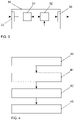
- Fig. 1 schematically illustrates a method according to the invention implemented in a control center for performing a tele-operated driving session for a vehicle equipped with an automated driving function.
- a predictive quality of service for a communication between the vehicle and a control center for a route driven in a tele-operated driving session is analyzed 10.
- This predictive quality of service may be provided, for example, by the vehicle or by a communication network.
- a section of the route for which an indirect control shall be used is determined 11, e.g., by detecting a drop of the predictive quality of service below a threshold.
- control data to be used by the vehicle in the determined section of the route are determined 12.
- the control data may comprise, for example, a set of waypoints or one or more trajectories. At least the control data are then sent 13 to the vehicle before or after initiating a tele-operated driving session with direct control of the vehicle. Preferably, trigger and stop times, trigger and stop positions, or switching signals are also sent to the vehicle.
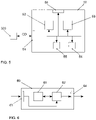
- Fig. 2 schematically illustrates a block diagram of a first embodiment of an apparatus 20 according to the invention for use in a control center for performing a tele-operated driving session for a vehicle 1 equipped with an automated driving function.
- the apparatus 20 has an interface 21 for receiving data, e.g. a predictive quality of service PQoS or a request by a vehicle 1 for a tele-operated driving session.
- the predictive quality of service PQoS may be provided, for example, by the vehicle 1 or by a communication network.
- An analyzing module 22 is configured to analyze a predictive quality of service PQoS for a communication between the vehicle 1 and a control center for a route driven in a tele-operated driving session.
- a processing module 23 is configured to determine a section of the route for which an indirect control shall be used, e.g., by detecting a drop of the predictive quality of service below a threshold, and to determine control data CD to be used by the vehicle 1 in the determined section of the route.
- the control data CD may comprise, for example, a set of waypoints or one or more trajectories.
- a communication module 24 is configured to send at least the control data CD to the vehicle 1 before or after initiating a tele-operated driving session with direct control of the vehicle 1, e.g. via the interface 21.
- the communication module 24 is further configured to send trigger and stop times, trigger and stop positions, or switching signals to the vehicle 1.
- a local storage unit 26 is provided, e.g. for storing data during processing.
- the interface 21 may likewise be split into an input and output.
- the analyzing module 22, the processing module 23, and the communication module 24 may be controlled by a controller 25.
- a user interface 27 may be provided for enabling a user to modify settings of the analyzing module 22, the processing module 23, the communication module 24, or the controller 25.
- the various modules 22-25 can be embodied as dedicated hardware units. Of course, they may likewise be fully or partially combined into a single unit or implemented as software running on a processor, e.g. a CPU or a GPU.
- FIG. 3 A block diagram of a second embodiment of an apparatus 30 according to the invention for use in a control center for performing a tele-operated driving session for a vehicle equipped with an automated driving function is illustrated in Fig. 3 .
- the apparatus 30 comprises a processing device 31 and a memory device 32.
- the apparatus 30 may be a computer, a workstation, or a distributed system.
- the memory device 32 has stored instructions that, when executed by the processing device 31, cause the apparatus 30 to perform steps according to one of the described methods.
- the instructions stored in the memory device 32 thus tangibly embody a program of instructions executable by the processing device 31 to perform program steps as described herein according to the present principles.
- the apparatus 30 has an input 33 for receiving data. Data generated by the processing device 31 are made available via an output 34. In addition, such data may be stored in the memory device 32.
- the input 33 and the output 34 may be combined into a single bidirectional interface.
- the processing device 31 as used herein may include one or more processing units, such as microprocessors, digital signal processors, or a combination thereof.
- the local storage unit 26 and the memory device 32 may include volatile and/or non-volatile memory regions and storage devices such as hard disk drives, optical drives, and/or solid-state memories.
- Fig. 4 schematically illustrates a method according to the invention implemented in a vehicle equipped with an automated driving function for performing a tele-operated driving session.
- a tele-operated driving session is requested 40.
- control data for an indirect control for a section of a route driven in the tele-operated driving session are received 41.
- the control data comprises a set of waypoints or one or more trajectories.
- the section of the route with indirect control may be a section with a drop of a predictive quality of service below a threshold.
- the predictive quality of service may be provided by the vehicle or by a communication network.
- the tele-operated driving session is switched 42 from direct control to indirect control.
- the tele-operated driving session is switched 43 from indirect control to direct control.
- trigger and stop times, trigger and stop positions, or switching signals may be received along with the control data.
- Fig. 5 schematically illustrates a block diagram of a first embodiment of an apparatus 50 according to the invention for use in a vehicle equipped with an automated driving function for performing a tele-operated driving session.
- the apparatus 50 has an interface 51 for exchanging data with a control center computer 320.
- a communication module 52 is configured to request a tele-operated driving session and to receive control data CD for an indirect control for a section of a route driven in the tele-operated driving session.
- the control data CD comprises a set of waypoints or one or more trajectories.
- the section of the route with indirect control may be a section with a drop of a predictive quality of service below a threshold.
- the predictive quality of service may be provided by the vehicle or by a communication network.
- a control module 53 is configured to switch from direct control to indirect control when the vehicle reaches a beginning of the section of the route with indirect control, and to switch from indirect control to direct control when the vehicle reaches an end of the section of the route with indirect control.
- trigger and stop times, trigger and stop positions, or switching signals may be received along with the control data CD.
- a local storage unit 55 is provided, e.g. for storing data during processing.
- the interface 51 may likewise be split into an input and output.
- the communication module 52 and the control module 53 may be controlled by a controller 54.
- a user interface 56 may be provided for enabling a user to modify settings of the communication module 52, the control module 53, or the controller 54.
- the various modules 52-54 can be embodied as dedicated hardware units. Of course, they may likewise be fully or partially combined into a single unit or implemented as software running on a processor, e.g. a CPU or a GPU.
- FIG. 6 A block diagram of a second embodiment of an apparatus 60 according to the invention for use in a vehicle equipped with an automated driving function for performing a tele-operated driving session is illustrated in Fig. 6 .
- the apparatus 60 comprises a processing device 61 and a memory device 62.
- the apparatus 60 may be a computer, an electronic control unit or an embedded system.
- the memory device 62 has stored instructions that, when executed by the processing device 61, cause the apparatus 60 to perform steps according to one of the described methods.
- the instructions stored in the memory device 62 thus tangibly embody a program of instructions executable by the processing device 61 to perform program steps as described herein according to the present principles.
- the apparatus 60 has an input 63 for receiving data. Data generated by the processing device 61 are made available via an output 64. In addition, such data may be stored in the memory device 62.
- the input 63 and the output 64 may be combined into a single bidirectional interface.
- the processing device 61 as used herein may include one or more processing units, such as microprocessors, digital signal processors, or a combination thereof.
- the local storage unit 55 and the memory device 62 may include volatile and/or non-volatile memory regions and storage devices such as hard disk drives, optical drives, and/or solid-state memories.
- Fig. 7 illustrates a basic architecture of a V2V (Vehicle-to-Vehicle) and V2X (Vehicle-to-Everything) communication system.
- Reference numeral 1 denotes a vehicle, which in this example is a car, in particular a passenger car.
- the vehicle 1 is equipped with an on-board connectivity module 160 including a corresponding antenna such that the vehicle 1 can participate in any form of mobile communication service.
- the vehicle 1 may transmit and receive signals to and from a base station 210 of a mobile communication service provider using a V2N (Vehicle-to-Network) communication link Uu.
- V2N Vehicle-to-Network
- Such base station 210 may be an eNodeB (Evolved Node B) base station of an LTE mobile communication service provider or a gNB (Next Generation Node B) base station of a 5G mobile communication provider.
- the base station 210 and the corresponding equipment are part of a mobile communication network with a plurality of network cells, where each cell is served by one base station 210.
- the base station 210 in Fig. 7 is positioned close to a main road, on which the vehicle 1 is driving.
- a mobile terminal corresponds to a user equipment, which allows a user to access network services, connecting to the UTRAN (UMTS (Universal Mobile Telecommunications System) Terrestrial Radio Access Network) or Evolved-UTRAN via the radio interface.
- UTRAN Universal Mobile Telecommunications System
- Evolved-UTRAN via the radio interface.
- user equipment corresponds to a smart phone.
- mobile terminals are also used in the vehicles 1, 2 in the form of said on-board connectivity modules 160.
- These on-board connectivity modules 160 are LTE, 5G, or any other communication modules, which enable the vehicles 1, 2 to receive mobile data in downstream direction and to send such data in upstream or in direct device-to-device direction.
- the Evolved-UTRAN consists of a plurality of eNodeBs, providing the E-UTRA user plane protocol terminations, i.e. PDCP (Packet Data Convergence Protocol), RLC (Radio Link Control), MAC, (Medium Access Control), and PHY (Physical Layer), and the control plane protocol termination, i.e. RRC (Radio Resource Control) towards the user equipment.
- PDCP Packet Data Convergence Protocol
- RLC Radio Link Control
- MAC Medium Access Control
- PHY Physical Layer
- RRC Radio Resource Control
- the eNodeBs are interconnected by means of the so-called X2 interface.
- the eNodeBs are also connected by means of the so-called S1 interface to an EPC (Evolved Packet Core) 200, more specifically to an MME (Mobility Management Entity) by means of an S1-MME interface and to a serving gateway by means of an S1-U interface.
- EPC Evolved Packet Core
- MME Mobility Management Entity
- Fig. 7 shows that the eNodeB is connected to the EPC 200 via the S1 interface and that EPC 200 is connected to the Internet 300.
- the control center computer 320 to which the vehicles 1, 2 send messages and from which the vehicles 1, 2 receive messages, is also connected to the Internet 300.
- the control center computer 320 typically is located in a traffic control center, where the operators for the tele-operated driving sessions requested by the vehicles 1, 2 are working.
- an infrastructure network component is shown, in this case a roadside unit 310.
- it is considered that all components have assigned an Internet address, typically in the form of an IPv6 address, such that the packets transporting messages between the components can be routed accordingly.
- the vehicles 1, 2 may also be equipped with means for observing their surroundings.
- Their sensor systems which are used to capture the environmental objects, are based on different measuring methods, depending on the application. Widespread technologies are, among others, RADAR, LIDAR, cameras for 2D and 3D image acquisition, and ultrasonic sensors.
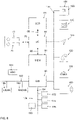
- Fig. 8 schematically shows a block diagram of a board electronics system of a vehicle.
- Part of the board electronics system is an infotainment system, which comprises a touch-sensitive display unit 65, a computing device 67, an input unit 70, and a memory device 80.
- the display unit 65 is connected to the computing device 67 via a data line 66 and includes both a display area for displaying variable graphical information and an operator interface (touch-sensitive layer) arranged above the display area for inputting commands by a user.
- the input unit 70 is connected to the computing device 67 via a data line 75.
- Reference numeral 71 designates a press button that allows a driver to manually request a tele-operated driving session if the vehicle is blocked and the driver wants the support of a tele-operated driving operator to find a way out of the blocking situation. There is no need for a dedicated press button 71 if other techniques for manual control are used. This includes selecting an option in a user menu displayed on the display unit 65, detecting the command with speech recognition, or using gesture control means.
- the memory device 80 is connected to the computing device 67 via a data line 85.
- a pictogram directory and/or symbol directory is deposited with pictograms and/or symbols for possible overlays of additional information.
- the other parts of the infotainment system such as a camera 150, radio 140, navigation device 130, telephone 120 and instrument cluster 110 are connected via a data bus 100 with the computing device 60.
- data bus 100 the high-speed variant of the CAN (Controller Area Network) bus according to ISO standard 11898-2 may be used.
- an Ethernet-based bus system such as IEEE 802.03cg can be used.
- Bus systems implementing the data transmission via optical fibers are also usable. Examples are the MOST Bus (Media Oriented System Transport) or the D2B Bus (Domestic Digital Bus).
- MOST Bus Media Oriented System Transport
- D2B Bus Domestic Digital Bus
- the vehicle is equipped with an on-board connectivity module 160. It can be used for mobile communication, e.g. mobile communication according to the 5G standard.
- Reference numeral 172 denotes an engine control unit.
- Reference numeral 174 denotes an ESC (electronic stability control) unit, whereas reference numeral 176 denotes a transmission control unit.
- Modern vehicles may comprise additional components, such as further sensors for scanning the surroundings, like a LIDAR sensor 186 or a RADAR sensor 182 and additional video cameras 151, e.g. a front camera, a rear camera or side cameras. Such sensors are increasingly used in vehicles for observation of the environment. Further control devices, such as an ADC (automatic driving control) unit 184, etc., may be provided in the vehicle.
- the RADAR and LIDAR sensors 182, 186 may have a scanning range of up to 250 m, whereas the cameras 150, 151 may cover a range from 30 m to 120 m.
- the components 182 to 186 are connected to another communication bus 102, e.g. an Ethernet-Bus due to its higher bandwidth for data transport.
- Ethernet-bus adapted to the special needs of car communication is standardized in the IEEE 802.1Q specification. Moreover, a lot of information about the environment may be received via V2V communication from other vehicles. Particularly for those vehicles that are not in line of sight to the observing vehicle, it is very advantageous to receive the information about their position and motion via V2V communication.
- Reference numeral 190 denotes an on-board diagnosis interface, which is connected to another communication bus 106.
- a gateway 90 For the purpose of transmitting the vehicle-relevant sensor data via the an on-board connectivity module 160 to another vehicle or to a control center computer, a gateway 90 is provided. This gateway 90 is connected to the different bus systems 100, 102, 104 and 106. The gateway 90 is adapted to convert the data it receives via one bus to the transmission format of another bus so that it can be distributed using the packets specified for the respective other bus. For forwarding this data to the outside, i.e. to another vehicle or to the control central computer, the an on-board connectivity module 160 is equipped with a communication interface to receive these data packets and, in turn, to convert them into the transmission format of the appropriate mobile radio standard.
- Fig. 9 shows a situation in which a temporary switch from direct control to indirect control is needed during a tele-operated driving session.
- Depicted is an example of a deadlock situation, in which tele-operated driving is needed to resolve the situation.
- a truck 3 is blocking a one-way road.
- a vehicle 1 with a level 4 or 5 automated driving capability needs to pass this obstacle.
- the automated driving function needs to respect all traffic regulations, including traffic signs and traffic lights, etc. Since it is not an option for the automated driving function to drive over the sidewalk 4 in order to pass the truck 3, the vehicle 1 will remain behind the truck 3 and wait until the truck 3 moves on. This, however, could take hours, e.g., in case the truck 3 has stopping inadvertently due to a breakdown or a road accident.
- the vehicle 1 needs to drive over the sidewalk 4 in order to continue its planned route.
- a tele-operated driving session under control of an external operator located in a control center with a control center computer 320 is needed.
- the operator can drive the vehicle 1 carefully along a route R over the sidewalk 4 in order to resolve the blocking situation.
- the truck 3 may have a negative impact on the quality of service of a communication between the vehicle 1 and a roadside unit 310.
- the predictive quality of service drops below a threshold necessary for a tele-operated driving session with direct control.
- the control center computer 320 first obtains information about the predictive quality of service along the driven route R.
- control center computer 320 detects a drop in the predictive quality of service in this information and associate it with a spatial section S of the route R.
- the trajectory of the vehicle 1 for this section S of the route R is then planned as a set of waypoints or trajectories.
- This set of waypoints or trajectories is sent to the vehicle 1 along with a trigger and stop times for a switch between direct control and indirect control.
- the trigger time which corresponds to the beginning of the drop section S
- the tele-operated driving session is switched to indirect control.
- stop time which corresponds to the end of the drop section S
- the tele-operated driving session is switched back to direct control and the operator regains access to the low-level control, i.e. to steering and throttle.
Landscapes
- Engineering & Computer Science (AREA)
- Radar, Positioning & Navigation (AREA)
- Remote Sensing (AREA)
- Physics & Mathematics (AREA)
- General Physics & Mathematics (AREA)
- Computer Networks & Wireless Communication (AREA)
- Aviation & Aerospace Engineering (AREA)
- Automation & Control Theory (AREA)
- Signal Processing (AREA)
- Traffic Control Systems (AREA)
Abstract
Description
- The present invention is related to methods, computer programs, and apparatus for performing a tele-operated driving session for a vehicle equipped with an automated driving function. The invention is further related to a vehicle equipped with an automated driving function, which makes use of such a method or apparatus.
- Tele-operated driving is gathering more and more interest. Tele-operated driving in the present context means that an external operator controls a vehicle remotely. The external operator is located in a control center. There may be a large distance between the control center and the vehicle. The control center and the vehicle are connected via a radio communication system and its backhaul. Primarily, the radio communication system is part of a public mobile communication system such as LTE (Long Term Evolution) or 5G.
- Tele-operated driving belongs to safety-related time-critical applications. Main requirements for the exchange of information are low latency, high data rate, and high reliability.
- Autonomous driving, also referred to as automatic driving, automated driving, or piloted driving, is the movement of vehicles, mobile robots and driverless transport systems that are largely autonomous. There are different degrees of autonomous driving. In Europe, various transport ministries, for example the Federal Institute for Road Systems (Bundesanstalt für Straßenwesen) in Germany, have defined the following autonomous stages:
- Level 0: "Driver only", the driver drives himself, steers, accelerates, brakes, etc.
- Level 1: Certain assistance systems help with vehicle operation, including a cruise control system such as ACC (Automatic Cruise Control).
- Level 2: Partial automation. Therein, automatic parking, tracking function, general longitudinal guidance, acceleration, deceleration, etc. are taken over by the assistance systems, including collision avoidance.
- Level 3: High automation. The driver does not have to monitor the system continuously. The vehicle independently performs functions such as the triggering of the turn signal, lane change and tracking. The driver can turn to other things, but if requested, the driver has to take over control within a pre-warning period.
- Level 4: Full automation. The guidance of the vehicle is permanently performed by the system. If the system is no longer able to handle the tasks, the driver can be asked to take over control.
- Level 5: No driver required. Apart from setting the target and starting the system, no human intervention is required.
- A slightly different definition of levels is known from the Society of Automotive Engineers (SAE). In this regard, reference is made to the SAE J3016 standard. Such definitions could also be used instead of the above given definition.
- Tele-operated driving might become a key technology in order to solve issues with
Level 4 and Level 5 driven vehicles. A vehicle driving autonomously makes its decisions based on the perception of its environment as well as on predefined traffic regulations. However, it may happen that an autonomous vehicle is no longer able to continue its planned route, e.g. due to an incorrect interpretation of the environment, sensor failures, poor road conditions, or unclear traffic conditions, e.g. an accident or a construction site. In such situations, the vehicle needs external instructions from someone else to solve the situation, e.g. the external operator located in the control center. The vehicle will be driven remotely by the external operator during a tele-operated driving session until the vehicle can resume its autonomous driving operation. - In this regard,
WO 2019/180700 A1 discloses a method of tele-operated driving of vehicles. A vehicular Artificial Intelligence (Al) unit of a vehicle receives inputs from a plurality of vehicular sensors. The AI unit locally processes a first portion of the inputs, and wirelessly transmits a second portion of the inputs to a remote tele-driving processor located externally to the vehicle. The AI unit wirelessly receives, from the remote tele-driving processor, a remotely computed processing result that is obtained by a remote Artificial Intelligence unit. The AI unit then implements a vehicular operating command based on the remotely computed processing result, via an autonomous driving unit of the vehicle or via a tele-driving unit of the vehicle. - To operate this remote control, data is exchanged through a cellular network. The quality of the uplink connection for the transmission of perception data and the downlink connection for the transmission of control data, also named quality of service (QoS), has a dramatic impact on the quality of application (QoA). The most important key performance indicators for tele-operations are latency and data rate of the communication network, e.g. a 4G network.
- Two modes of tele-operated driving co-exist. A first mode is direct control, in which the control center controls the steering and throttle of the car. A second mode is indirect control, in which the control center gives high-level commands, such as waypoints or modifications of the environmental model. Direct control has higher requirements on the communication service, as the direct commands need to arrive as a real time stream at the vehicle under control.
- In this regard,
US 2020/0004240 A1 discloses a method of remotely controlling a vehicle. The method involves creating an exterior situation image for the vehicle using a sensor system for detecting the surroundings of the vehicle. A trajectory of the vehicle is specified by a driver assistance system of the vehicle. The exterior situation image and the trajectory are transmitted wirelessly to a remote control that is arranged spatially separately from the vehicle. The vehicle is then controlled by the remote control based on the trajectory and the exterior situation image. Remote control may be performed using a plotted trajectory or steering commands, depending on a quality of a data link. - During a tele-operated driving session with direct control, the quality of service may drop below and not meet the quality of service requirements anymore. In this case, the vehicle under control has to stop to put itself in a safe state. If the quality of service meets the requirements again at a later stage, the tele-operated driving session may continue. In some instances, it may even be necessary to start a new tele-operated driving session.
- It is an object of the present invention to provide improved solutions for performing a tele-operated driving session for a vehicle, which avoids an inefficient interruption of the tele-operated driving session.
- This object is achieved by a method according to
claim 1 or 8, by a computer program according to claim 6 or 9, which implements such a method, and by an apparatus according to claim 7 or 14. The dependent claims include advantageous further developments and improvements of the present principles as described below. - According to a first aspect, a method for performing a tele-operated driving session for a vehicle equipped with an automated driving function comprises:
- analyzing a predictive quality of service for a communication between the vehicle and a control center for a route driven in a tele-operated driving session;
- determining a section of the route for which an indirect control shall be used;
- determining control data to be used by the vehicle in the determined section of the route; and
- sending at least the control data to the vehicle before or after initiating a tele-operated driving session with direct control of the vehicle.
- Accordingly, a computer program comprises instructions, which, when executed by at least one processor, cause the at least one processor to perform the following steps for performing a tele-operated driving session for a vehicle equipped with an automated driving function:
- analyzing a predictive quality of service for a communication between the vehicle and a control center for a route driven in a tele-operated driving session;
- determining a section of the route for which an indirect control shall be used;
- determining control data to be used by the vehicle in the determined section of the route; and
- sending at least the control data to the vehicle before or after initiating a tele-operated driving session with direct control of the vehicle.
- The term computer has to be understood broadly. In particular, it also includes workstations, distributed systems and other processor-based data processing devices.
- The computer program code can, for example, be made available for electronic retrieval or stored on a computer-readable storage medium.
- According to another aspect, an apparatus for performing a tele-operated driving session for a vehicle equipped with an automated driving function comprises:
- an analyzing module configured to analyze a predictive quality of service for a communication between the vehicle and a control center for a route driven in a tele-operated driving session;
- a processing module configured to determine a section of the route for which an indirect control shall be used, and to determine control data to be used by the vehicle in the determined section of the route; and
- a communication module configured to send at least the control data to the vehicle before or after initiating a tele-operated driving session with direct control of the vehicle.
- From the point of view of the control center, use is made of a recent concept in communications, namely predictive quality of service. According to this concept, the future quality of service is estimated and made available as a basis for decisions or adaptations. The predictive quality of service is now used to determine a problematic drop in the quality of service. The quality of service can drop for multiple reasons, such as white spots in the coverage map, temporary channel overload, temporary network congestion, etc. These factors can be predicted by the communication service and provided within the predictive quality of service. Using this information, the control center can know in advance that during a specific part of the route driven during the tele-operated driving session direct control will not be possible. Therefore, the control mode, i.e., the mode of tele-operated driving, is temporarily changed from direct control to indirect control in order to enable the vehicle to pass through this unfavorable part of the route. To avoid any interruption of the tele-operated driving session, control data to be used by the vehicle in this section is provided to the vehicle before the section is reached.
- In an advantageous embodiment, the section of the route for which an indirect control shall be used is determined by detecting a drop of the predictive quality of service below a threshold. For a tele-operated driving session with direct control, a defined minimum quality of service is needed. By detecting a drop in the quality of service below this defined minimum, a section that requires indirect control can easily be determined.
- In an advantageous embodiment, the predictive quality of service is provided by the vehicle or by a communication network. The estimation of the quality of service can be performed at the vehicle or be provided by the communication network. The latter case has the advantage that the communication network has access to a larger amount of information, such as radio maps, instant radio resource utilization, historical utilization, etc.
- In an advantageous embodiment, the control data comprises a set of waypoints or one or more trajectories. When the tele-operated driving session is switched to indirect control, the automated driving function of the vehicle has to make use of the control data to continue along the route. One solution for enabling the automated driving function to continue operation is to provide a trajectory that the vehicle shall follow. Another solution is to provide waypoints, which are located on a trajectory. The automated driving function then sequentially approach the various locations.
- In an advantageous embodiment, trigger and stop times, trigger and stop positions, or switching signals are sent to the vehicle. Various possibilities exist for switching the control mode from direct control to indirect control and later back to direct control. For example, trigger and stop times may be used. The trigger time corresponds to the temporal beginning of the quality of service drop period. The stop time corresponds to the temporal end of the quality of service drop period. Alternatively, trigger and stop positions may be used. The trigger position corresponds to the spatial beginning of the quality of service drop section. The stop position corresponds to the spatial end of the quality of service drop section. A further possibility is to provide dedicated switching signals at the beginning and the end of the indirect control section.
- According to a further aspect, a method for performing a tele-operated driving session for a vehicle equipped with an automated driving function comprises:
- requesting a tele-operated driving session;
- receiving control data for an indirect control for a section of a route driven in the tele-operated driving session;
- switching from direct control to indirect control when the vehicle reaches a beginning of the section of the route with indirect control; and
- switching from indirect control to direct control when the vehicle reaches an end of the section of the route with indirect control.
- Accordingly, a computer program comprises instructions, which, when executed by at least one processor, cause the at least one processor to perform the following steps for performing a tele-operated driving session for a vehicle equipped with an automated driving function:
- requesting a tele-operated driving session;
- receiving control data for an indirect control for a section of a route driven in the tele-operated driving session;
- switching from direct control to indirect control when the vehicle reaches a beginning of the section of the route with indirect control; and
- switching from indirect control to direct control when the vehicle reaches an end of the section of the route with indirect control.
- The term computer has to be understood broadly. In particular, it also includes electronic control units, embedded devices and other processor-based data processing devices.
- The computer program code can, for example, be made available for electronic retrieval or stored on a computer-readable storage medium.
- According to another aspect, an apparatus for performing a tele-operated driving session for a vehicle equipped with an automated driving function comprises:
- a communication module configured to request a tele-operated driving session and to receive control data for an indirect control for a section of a route driven in the tele-operated driving session; and
- a control module configured to switch from direct control to indirect control when the vehicle reaches a beginning of the section of the route with indirect control, and to switch from indirect control to direct control when the vehicle reaches an end of the section of the route with indirect control.
- From the point of view of the vehicle to be controlled, the vehicle receives information that during a specific part of the route driven during a tele-operated driving session direct control will not be possible. Therefore, the control mode, i.e., the mode of tele-operated driving, is temporarily changed from direct control to indirect control in order to enable the vehicle to pass through this unfavorable part of the route. To avoid any interruption of the tele-operated driving session, control data to be used by the vehicle in this section is received by the vehicle before the section is reached.
- In an advantageous embodiment, the section of the route with indirect control is a section with a drop of a predictive quality of service below a threshold. For a tele-operated driving session with direct control, a defined minimum quality of service is needed. By detecting a drop in the quality of service below this defined minimum, a section that requires indirect control can easily be determined.
- In an advantageous embodiment, the predictive quality of service is provided by the vehicle or by a communication network. The estimation of the quality of service can be performed at the vehicle or be provided by the communication network. The latter case has the advantage that the communication network has access to a larger amount of information, such as radio maps, instant radio resource utilization, historical utilization, etc.
- In an advantageous embodiment, the control data comprises a set of waypoints or one or more trajectories. When the tele-operated driving session is switched to indirect control, the automated driving function of the vehicle makes use of the control data to continue along the route. One solution for enabling the automated driving function to continue operation is to provide a trajectory that the vehicle shall follow. Another solution is to provide waypoints, which are located on a trajectory. The automated driving function then sequentially approach the various locations.
- In an advantageous embodiment, trigger and stop times, trigger and stop positions, or switching signals are received. Various possibilities exist for switching the control mode from direct control to indirect control and later back to direct control. For example, trigger and stop times may be used. The trigger time corresponds to the temporal beginning of the quality of service drop period. The stop time corresponds to the temporal end of the quality of service drop period. Alternatively, trigger and stop positions may be used. The trigger position corresponds to the spatial beginning of the quality of service drop section. The stop position corresponds to the spatial end of the quality of service drop section. A further possibility is to provide dedicated switching signals at the beginning and the end of the indirect control section.
- Advantageously, an autonomous or semi-autonomous vehicle comprises an apparatus according to the invention or is configured to perform a method according to the invention for performing a tele-operated driving session. In this way, the vehicle shows an improved behavior when a tele-operated driving session is subject to a drop in the quality of service. The vehicle may be any type of vehicle, e.g. a car, a bus, a motorcycle, a commercial vehicle, in particular a truck, an agricultural machinery, a construction machinery, a rail vehicle, etc. More generally, the invention can be used in land vehicles, rail vehicles, watercrafts, and aircrafts. This expressively includes robots and drones.
- Further features of the present invention will become apparent from the following description and the appended claims in conjunction with the figures.
- Fig. 1
- schematically illustrates a method implemented in a control center for performing a tele-operated driving session for a vehicle equipped with an automated driving function;
- Fig. 2
- schematically illustrates a first embodiment of an apparatus for use in a control center for performing a tele-operated driving session for a vehicle equipped with an automated driving function;
- Fig. 3
- schematically illustrates a second embodiment of an apparatus for use in a control center for performing a tele-operated driving session for a vehicle equipped with an automated driving function;
- Fig. 4
- schematically illustrates a method implemented in a vehicle equipped with an automated driving function for performing a tele-operated driving session;
- Fig. 5
- schematically illustrates a first embodiment of an apparatus for use in a vehicle equipped with an automated driving function for performing a tele-operated driving session;
- Fig. 6
- schematically illustrates a second embodiment of an apparatus for use in a vehicle equipped with an automated driving function for performing a tele-operated driving session;
- Fig. 7
- illustrates a basic architecture of a V2V and V2X communication system;
- Fig. 8
- shows a block diagram of an electronics system of a vehicle; and
- Fig. 9
- shows a situation in which a temporary switch from direct control to indirect control is needed during a tele-operated driving session.
- The present description illustrates the principles of the present disclosure. It will thus be appreciated that those skilled in the art will be able to devise various arrangements that, although not explicitly described or shown herein, embody the principles of the disclosure.
- All examples and conditional language recited herein are intended for educational purposes to aid the reader in understanding the principles of the disclosure and the concepts contributed by the inventor to furthering the art, and are to be construed as being without limitation to such specifically recited examples and conditions.
- Moreover, all statements herein reciting principles, aspects, and embodiments of the disclosure, as well as specific examples thereof, are intended to encompass both structural and functional equivalents thereof. Additionally, it is intended that such equivalents include both currently known equivalents as well as equivalents developed in the future, i.e., any elements developed that perform the same function, regardless of structure.
- Thus, for example, it will be appreciated by those skilled in the art that the diagrams presented herein represent conceptual views of illustrative circuitry embodying the principles of the disclosure.
- The functions of the various elements shown in the figures may be provided through the use of dedicated hardware as well as hardware capable of executing software in association with appropriate software. When provided by a processor, the functions may be provided by a single dedicated processor, by a single shared processor, or by a plurality of individual processors, some of which may be shared. Moreover, explicit use of the term "processor" or "controller" should not be construed to refer exclusively to hardware capable of executing software, and may implicitly include, without limitation, digital signal processor (DSP) hardware, read only memory (ROM) for storing software, random access memory (RAM), and nonvolatile storage.
- Other hardware, conventional and/or custom, may also be included. Similarly, any switches shown in the figures are conceptual only. Their function may be carried out through the operation of program logic, through dedicated logic, through the interaction of program control and dedicated logic, or even manually, the particular technique being selectable by the implementer as more specifically understood from the context.
- In the claims hereof, any element expressed as a means for performing a specified function is intended to encompass any way of performing that function including, for example, a combination of circuit elements that performs that function or software in any form, including, therefore, firmware, microcode or the like, combined with appropriate circuitry for executing that software to perform the function. The disclosure as defined by such claims resides in the fact that the functionalities provided by the various recited means are combined and brought together in the manner which the claims call for. It is thus regarded that any means that can provide those functionalities are equivalent to those shown herein.
-
Fig. 1 schematically illustrates a method according to the invention implemented in a control center for performing a tele-operated driving session for a vehicle equipped with an automated driving function. In a first step, a predictive quality of service for a communication between the vehicle and a control center for a route driven in a tele-operated driving session is analyzed 10. This predictive quality of service may be provided, for example, by the vehicle or by a communication network. Based on the analysis, a section of the route for which an indirect control shall be used is determined 11, e.g., by detecting a drop of the predictive quality of service below a threshold. Furthermore, control data to be used by the vehicle in the determined section of the route are determined 12. The control data may comprise, for example, a set of waypoints or one or more trajectories. At least the control data are then sent 13 to the vehicle before or after initiating a tele-operated driving session with direct control of the vehicle. Preferably, trigger and stop times, trigger and stop positions, or switching signals are also sent to the vehicle. -
Fig. 2 schematically illustrates a block diagram of a first embodiment of anapparatus 20 according to the invention for use in a control center for performing a tele-operated driving session for avehicle 1 equipped with an automated driving function. Theapparatus 20 has aninterface 21 for receiving data, e.g. a predictive quality of service PQoS or a request by avehicle 1 for a tele-operated driving session. The predictive quality of service PQoS may be provided, for example, by thevehicle 1 or by a communication network. An analyzingmodule 22 is configured to analyze a predictive quality of service PQoS for a communication between thevehicle 1 and a control center for a route driven in a tele-operated driving session. Aprocessing module 23 is configured to determine a section of the route for which an indirect control shall be used, e.g., by detecting a drop of the predictive quality of service below a threshold, and to determine control data CD to be used by thevehicle 1 in the determined section of the route. The control data CD may comprise, for example, a set of waypoints or one or more trajectories. Acommunication module 24 is configured to send at least the control data CD to thevehicle 1 before or after initiating a tele-operated driving session with direct control of thevehicle 1, e.g. via theinterface 21. Preferably, thecommunication module 24 is further configured to send trigger and stop times, trigger and stop positions, or switching signals to thevehicle 1. Alocal storage unit 26 is provided, e.g. for storing data during processing. Theinterface 21 may likewise be split into an input and output. - The analyzing
module 22, theprocessing module 23, and thecommunication module 24 may be controlled by acontroller 25. Auser interface 27 may be provided for enabling a user to modify settings of the analyzingmodule 22, theprocessing module 23, thecommunication module 24, or thecontroller 25. The various modules 22-25 can be embodied as dedicated hardware units. Of course, they may likewise be fully or partially combined into a single unit or implemented as software running on a processor, e.g. a CPU or a GPU. - A block diagram of a second embodiment of an
apparatus 30 according to the invention for use in a control center for performing a tele-operated driving session for a vehicle equipped with an automated driving function is illustrated inFig. 3 . Theapparatus 30 comprises aprocessing device 31 and amemory device 32. For example, theapparatus 30 may be a computer, a workstation, or a distributed system. Thememory device 32 has stored instructions that, when executed by theprocessing device 31, cause theapparatus 30 to perform steps according to one of the described methods. The instructions stored in thememory device 32 thus tangibly embody a program of instructions executable by theprocessing device 31 to perform program steps as described herein according to the present principles. Theapparatus 30 has aninput 33 for receiving data. Data generated by theprocessing device 31 are made available via anoutput 34. In addition, such data may be stored in thememory device 32. Theinput 33 and theoutput 34 may be combined into a single bidirectional interface. - The
processing device 31 as used herein may include one or more processing units, such as microprocessors, digital signal processors, or a combination thereof. - The
local storage unit 26 and thememory device 32 may include volatile and/or non-volatile memory regions and storage devices such as hard disk drives, optical drives, and/or solid-state memories. -
Fig. 4 schematically illustrates a method according to the invention implemented in a vehicle equipped with an automated driving function for performing a tele-operated driving session. In a first step, a tele-operated driving session is requested 40. In response, control data for an indirect control for a section of a route driven in the tele-operated driving session are received 41. Preferably, the control data comprises a set of waypoints or one or more trajectories. For example, the section of the route with indirect control may be a section with a drop of a predictive quality of service below a threshold. As a basis for detecting such a drop, the predictive quality of service may be provided by the vehicle or by a communication network. When the vehicle reaches a beginning of the section of the route with indirect control, the tele-operated driving session is switched 42 from direct control to indirect control. When the vehicle reaches an end of the section of the route with indirect control, the tele-operated driving session is switched 43 from indirect control to direct control. For facilitating the switching 42, 43, trigger and stop times, trigger and stop positions, or switching signals may be received along with the control data. -
Fig. 5 schematically illustrates a block diagram of a first embodiment of anapparatus 50 according to the invention for use in a vehicle equipped with an automated driving function for performing a tele-operated driving session. Theapparatus 50 has aninterface 51 for exchanging data with acontrol center computer 320. Acommunication module 52 is configured to request a tele-operated driving session and to receive control data CD for an indirect control for a section of a route driven in the tele-operated driving session. Preferably, the control data CD comprises a set of waypoints or one or more trajectories. For example, the section of the route with indirect control may be a section with a drop of a predictive quality of service below a threshold. As a basis for detecting such a drop, the predictive quality of service may be provided by the vehicle or by a communication network. Acontrol module 53 is configured to switch from direct control to indirect control when the vehicle reaches a beginning of the section of the route with indirect control, and to switch from indirect control to direct control when the vehicle reaches an end of the section of the route with indirect control. For facilitating the switching by thecontrol module 53, trigger and stop times, trigger and stop positions, or switching signals may be received along with the control data CD. Alocal storage unit 55 is provided, e.g. for storing data during processing. Theinterface 51 may likewise be split into an input and output. - The
communication module 52 and thecontrol module 53 may be controlled by acontroller 54. Auser interface 56 may be provided for enabling a user to modify settings of thecommunication module 52, thecontrol module 53, or thecontroller 54. The various modules 52-54 can be embodied as dedicated hardware units. Of course, they may likewise be fully or partially combined into a single unit or implemented as software running on a processor, e.g. a CPU or a GPU. - A block diagram of a second embodiment of an
apparatus 60 according to the invention for use in a vehicle equipped with an automated driving function for performing a tele-operated driving session is illustrated inFig. 6 . Theapparatus 60 comprises aprocessing device 61 and amemory device 62. For example, theapparatus 60 may be a computer, an electronic control unit or an embedded system. Thememory device 62 has stored instructions that, when executed by theprocessing device 61, cause theapparatus 60 to perform steps according to one of the described methods. The instructions stored in thememory device 62 thus tangibly embody a program of instructions executable by theprocessing device 61 to perform program steps as described herein according to the present principles. Theapparatus 60 has aninput 63 for receiving data. Data generated by theprocessing device 61 are made available via anoutput 64. In addition, such data may be stored in thememory device 62. Theinput 63 and theoutput 64 may be combined into a single bidirectional interface. - The
processing device 61 as used herein may include one or more processing units, such as microprocessors, digital signal processors, or a combination thereof. - The
local storage unit 55 and thememory device 62 may include volatile and/or non-volatile memory regions and storage devices such as hard disk drives, optical drives, and/or solid-state memories. - In the following, a preferred embodiment of the invention shall be explained in more detail with reference to
Fig. 7 to Fig. 9 . -
Fig. 7 illustrates a basic architecture of a V2V (Vehicle-to-Vehicle) and V2X (Vehicle-to-Everything) communication system.Reference numeral 1 denotes a vehicle, which in this example is a car, in particular a passenger car. Thevehicle 1 is equipped with an on-board connectivity module 160 including a corresponding antenna such that thevehicle 1 can participate in any form of mobile communication service. As shown inFig. 7 , thevehicle 1 may transmit and receive signals to and from abase station 210 of a mobile communication service provider using a V2N (Vehicle-to-Network) communication link Uu. -
Such base station 210 may be an eNodeB (Evolved Node B) base station of an LTE mobile communication service provider or a gNB (Next Generation Node B) base station of a 5G mobile communication provider. Thebase station 210 and the corresponding equipment are part of a mobile communication network with a plurality of network cells, where each cell is served by onebase station 210. - The
base station 210 inFig. 7 is positioned close to a main road, on which thevehicle 1 is driving. Of course,other vehicles 2 may also drive on the road. In the terminology of LTE, a mobile terminal corresponds to a user equipment, which allows a user to access network services, connecting to the UTRAN (UMTS (Universal Mobile Telecommunications System) Terrestrial Radio Access Network) or Evolved-UTRAN via the radio interface. Typically, such user equipment corresponds to a smart phone. Of course, mobile terminals are also used in thevehicles board connectivity modules 160. These on-board connectivity modules 160 are LTE, 5G, or any other communication modules, which enable thevehicles - In terms of an LTE mobile communication system, the Evolved-UTRAN consists of a plurality of eNodeBs, providing the E-UTRA user plane protocol terminations, i.e. PDCP (Packet Data Convergence Protocol), RLC (Radio Link Control), MAC, (Medium Access Control), and PHY (Physical Layer), and the control plane protocol termination, i.e. RRC (Radio Resource Control) towards the user equipment. The eNodeBs are interconnected by means of the so-called X2 interface. The eNodeBs are also connected by means of the so-called S1 interface to an EPC (Evolved Packet Core) 200, more specifically to an MME (Mobility Management Entity) by means of an S1-MME interface and to a serving gateway by means of an S1-U interface.
- In relation to this general architecture,
Fig. 7 shows that the eNodeB is connected to theEPC 200 via the S1 interface and thatEPC 200 is connected to theInternet 300. Thecontrol center computer 320, to which thevehicles vehicles Internet 300. In the field of cooperative and automated driving, thecontrol center computer 320 typically is located in a traffic control center, where the operators for the tele-operated driving sessions requested by thevehicles roadside unit 310. For the ease of implementation, it is considered that all components have assigned an Internet address, typically in the form of an IPv6 address, such that the packets transporting messages between the components can be routed accordingly. - The various interfaces of the LTE network architecture are standardized. In this regard, reference is made to the various LTE specifications, which are publicly available for the sake of sufficiently disclosing further implementation details.
- The
vehicles - Since automated driving is on the rise, a lot more data needs to be exchanged among the
vehicles vehicles -
Fig. 8 schematically shows a block diagram of a board electronics system of a vehicle. Part of the board electronics system is an infotainment system, which comprises a touch-sensitive display unit 65, acomputing device 67, aninput unit 70, and amemory device 80. Thedisplay unit 65 is connected to thecomputing device 67 via adata line 66 and includes both a display area for displaying variable graphical information and an operator interface (touch-sensitive layer) arranged above the display area for inputting commands by a user. Theinput unit 70 is connected to thecomputing device 67 via adata line 75.Reference numeral 71 designates a press button that allows a driver to manually request a tele-operated driving session if the vehicle is blocked and the driver wants the support of a tele-operated driving operator to find a way out of the blocking situation. There is no need for adedicated press button 71 if other techniques for manual control are used. This includes selecting an option in a user menu displayed on thedisplay unit 65, detecting the command with speech recognition, or using gesture control means. - The
memory device 80 is connected to thecomputing device 67 via adata line 85. In thememory device 80, a pictogram directory and/or symbol directory is deposited with pictograms and/or symbols for possible overlays of additional information. - The other parts of the infotainment system, such as a
camera 150,radio 140,navigation device 130,telephone 120 andinstrument cluster 110 are connected via adata bus 100 with thecomputing device 60. Asdata bus 100, the high-speed variant of the CAN (Controller Area Network) bus according to ISO standard 11898-2 may be used. Alternatively, an Ethernet-based bus system such as IEEE 802.03cg can be used. Bus systems implementing the data transmission via optical fibers are also usable. Examples are the MOST Bus (Media Oriented System Transport) or the D2B Bus (Domestic Digital Bus). For inbound and outbound wireless communication, the vehicle is equipped with an on-board connectivity module 160. It can be used for mobile communication, e.g. mobile communication according to the 5G standard. -
Reference numeral 172 denotes an engine control unit.Reference numeral 174 denotes an ESC (electronic stability control) unit, whereasreference numeral 176 denotes a transmission control unit. The networking of such control units, all of which are allocated to the category of the drive train, typically occurs with aCAN bus 104. Since various sensors are installed in the motor vehicle and these are no longer only connected to individual control units, such sensor data are also distributed via thebus system 104 to the individual control devices. - Modern vehicles may comprise additional components, such as further sensors for scanning the surroundings, like a
LIDAR sensor 186 or aRADAR sensor 182 andadditional video cameras 151, e.g. a front camera, a rear camera or side cameras. Such sensors are increasingly used in vehicles for observation of the environment. Further control devices, such as an ADC (automatic driving control)unit 184, etc., may be provided in the vehicle. The RADAR andLIDAR sensors cameras components 182 to 186 are connected to anothercommunication bus 102, e.g. an Ethernet-Bus due to its higher bandwidth for data transport. One Ethernet-bus adapted to the special needs of car communication is standardized in the IEEE 802.1Q specification. Moreover, a lot of information about the environment may be received via V2V communication from other vehicles. Particularly for those vehicles that are not in line of sight to the observing vehicle, it is very advantageous to receive the information about their position and motion via V2V communication. -
Reference numeral 190 denotes an on-board diagnosis interface, which is connected to anothercommunication bus 106. - For the purpose of transmitting the vehicle-relevant sensor data via the an on-
board connectivity module 160 to another vehicle or to a control center computer, agateway 90 is provided. Thisgateway 90 is connected to thedifferent bus systems gateway 90 is adapted to convert the data it receives via one bus to the transmission format of another bus so that it can be distributed using the packets specified for the respective other bus. For forwarding this data to the outside, i.e. to another vehicle or to the control central computer, the an on-board connectivity module 160 is equipped with a communication interface to receive these data packets and, in turn, to convert them into the transmission format of the appropriate mobile radio standard. -
Fig. 9 shows a situation in which a temporary switch from direct control to indirect control is needed during a tele-operated driving session. Depicted is an example of a deadlock situation, in which tele-operated driving is needed to resolve the situation. Atruck 3 is blocking a one-way road. Avehicle 1 with alevel 4 or 5 automated driving capability needs to pass this obstacle. The automated driving function needs to respect all traffic regulations, including traffic signs and traffic lights, etc. Since it is not an option for the automated driving function to drive over thesidewalk 4 in order to pass thetruck 3, thevehicle 1 will remain behind thetruck 3 and wait until thetruck 3 moves on. This, however, could take hours, e.g., in case thetruck 3 has stopping inadvertently due to a breakdown or a road accident. To overcome this deadlock situation, thevehicle 1 needs to drive over thesidewalk 4 in order to continue its planned route. In this situation, a tele-operated driving session under control of an external operator located in a control center with acontrol center computer 320 is needed. The operator can drive thevehicle 1 carefully along a route R over thesidewalk 4 in order to resolve the blocking situation. However, as can be seen thetruck 3 may have a negative impact on the quality of service of a communication between thevehicle 1 and aroadside unit 310. For a certain section S of the route R, the predictive quality of service drops below a threshold necessary for a tele-operated driving session with direct control. To cope with this situation, thecontrol center computer 320 first obtains information about the predictive quality of service along the driven route R. Furthermore, thecontrol center computer 320 detects a drop in the predictive quality of service in this information and associate it with a spatial section S of the route R. The trajectory of thevehicle 1 for this section S of the route R is then planned as a set of waypoints or trajectories. This set of waypoints or trajectories is sent to thevehicle 1 along with a trigger and stop times for a switch between direct control and indirect control. At the trigger time, which corresponds to the beginning of the drop section S, the tele-operated driving session is switched to indirect control. At the stop time, which corresponds to the end of the drop section S, the tele-operated driving session is switched back to direct control and the operator regains access to the low-level control, i.e. to steering and throttle. -
- 1
- Vehicle
- 2
- Other vehicle
- 3
- Truck
- 4
- Sidewalk
- 10
- Analyze predictive quality of service
- 11
- Determine section with indirect control
- 12
- Determine control data to be used by vehicle
- 13
- Send control data to vehicle
- 20
- Apparatus
- 21
- Interface
- 22
- Analyzing module
- 23
- Processing module
- 24
- Communication module
- 25
- Controller
- 26
- Local storage unit
- 27
- User interface
- 30
- Apparatus
- 31
- Processing device
- 32
- Memory device
- 33
- Input
- 34
- Output
- 40
- Request tele-operated driving session
- 41
- Receive control data for section with indirect control
- 42
- Switch to indirect control at beginning of section with indirect control
- 43
- Switch to direct control at end of section with indirect control
- 50
- Apparatus
- 51
- Interface
- 52
- Communication module
- 53
- Control module
- 60
- Apparatus
- 61
- Processing device
- 62
- Memory device
- 63
- Input
- 64
- Output
- 65
- Display Unit
- 66
- Data line to display unit
- 67
- Computing device
- 70
- Input unit
- 71
- Press button
- 75
- Data line to input unit
- 80
- Memory unit
- 85
- Data line to memory unit
- 90
- Gateway
- 100
- First data bus
- 102
- Second data bus
- 104
- Third data bus
- 106
- Fourth data bus
- 110
- Instrument cluster
- 120
- Telephone
- 130
- Navigation device
- 140
- Radio
- 150
- Camera
- 151
- Further cameras
- 160
- On-board connectivity module
- 172
- Engine control unit
- 174
- Electronic stability control unit
- 176
- Transmission control unit
- 182
- RADAR sensor
- 184
- Automatic driving control unit
- 186
- LIDAR sensor
- 190
- On-board diagnosis interface
- 200
- Evolved packet core
- 210
- Base station
- 300
- Internet
- 310
- Roadside unit
- 320
- Control center computer
- CD
- Control data
- PC5
- V2V communication link
- PQoS
- Predictive quality of service
- R
- Route
- S
- Section
- S1
- S1 interface
- Uu
- V2N communication link
Claims (15)
- A method for performing a tele-operated driving session for a vehicle (1) equipped with an automated driving function, the method comprising:- analyzing (10) a predictive quality of service (PQoS) for a communication between the vehicle (1) and a control center for a route (R) driven in a tele-operated driving session;- determining (11) a section (S) of the route (R) for which an indirect control shall be used;- determining (12) control data (CD) to be used by the vehicle (1) in the determined section (S) of the route (R); and- sending (13) at least the control data (CD) to the vehicle (1) before or after initiating a tele-operated driving session with direct control of the vehicle (1).
- The method according to claim 1, wherein the section (S) of the route (R) for which an indirect control shall be used is determined (11) by detecting a drop of the predictive quality of service (PQoS) below a threshold.
- The method according to claim 1 or 2, wherein the predictive quality of service (PQoS) is provided by the vehicle (1) or by a communication network.
- The method according to any of the preceding claims, wherein the control data (CD) comprises a set of waypoints or one or more trajectories.
- The method according to any of the preceding claims, further comprising sending (13) trigger and stop times, trigger and stop positions, or switching signals to the vehicle (1).
- A computer program comprising instructions, which, when executed by a computer, cause the computer to perform a method according to any of claims 1 to 5 for performing a tele-operated driving session for a vehicle (1) equipped with an automated driving function.
- An apparatus (20) for performing a tele-operated driving session for a vehicle (1) equipped with an automated driving function, the apparatus (20) comprising:- an analyzing module (22) configured to analyze (10) a predictive quality of service (PQoS) for a communication between the vehicle (1) and a control center for a route (R) driven in a tele-operated driving session;- a processing module (23) configured to determine (11) a section (S) of the route (R) for which an indirect control shall be used, and to determine (12) control data (CD) to be used by the vehicle (1) in the determined section (S) of the route (R); and- a communication module (24) configured to send (13) at least the control data (CD) to the vehicle (1) before or after initiating a tele-operated driving session with direct control of the vehicle (1).
- A method for performing a tele-operated driving session for a vehicle (1) equipped with an automated driving function, the method comprising:- requesting (40) a tele-operated driving session;- receiving (41) control data (CD) for an indirect control for a section (S) of a route (R) driven in the tele-operated driving session;- switching (42) from direct control to indirect control when the vehicle (1) reaches a beginning of the section (S) of the route (R) with indirect control; and- switching (43) from indirect control to direct control when the vehicle (1) reaches an end of the section (S) of the route (R) with indirect control.
- The method according to claim 8, wherein the section (S) of the route (R) with indirect control is a section with a drop of a predictive quality of service (PQoS) below a threshold.
- The method according to claim 8 or 9, wherein the predictive quality of service (PQoS) is provided by the vehicle (1) or by a communication network.
- The method according to any of the claims 8 to 10, wherein the control data (CD) comprises a set of waypoints or one or more trajectories.
- The method according to any of the claims 8 to 11, further comprising receiving (41) trigger and stop times, trigger and stop positions, or switching signals.
- A computer program comprising instructions, which, when executed by a computer, cause the computer to perform a method according to any of claims 8 to 12 for performing a tele-operated driving session for a vehicle (1) equipped with an automated driving function.
- An apparatus (50) for performing a tele-operated driving session for a vehicle (1) equipped with an automated driving function, the apparatus (50) comprising:- a communication module (52) configured to request (40) a tele-operated driving session and to receive (41) control data (CD) for an indirect control for a section (S) of a route (R) driven in the tele-operated driving session; and- a control module (53) configured to switch (42) from direct control to indirect control when the vehicle (1) reaches a beginning of the section (S) of the route (R) with indirect control, and to switch (43) from indirect control to direct control when the vehicle (1) reaches an end of the section (S) of the route (R) with indirect control.
- A vehicle (1) equipped with an automated driving function, characterized in that the vehicle (1) comprises an apparatus (50) according to claim 14 or is configured to perform a method according to any of claims 8 to 12 for performing a tele-operated driving session.
Priority Applications (4)
| Application Number | Priority Date | Filing Date | Title |
|---|---|---|---|
| EP21159108.6A EP4050450B1 (en) | 2021-02-24 | 2021-02-24 | Methods, computer programs and apparatus for performing a tele-operated driving session |
| US18/547,554 US20240053744A1 (en) | 2021-02-24 | 2022-02-22 | Methods, Computer Programs and Apparatus for Performing a Teleoperated Driving Session |
| PCT/EP2022/054388 WO2022180027A1 (en) | 2021-02-24 | 2022-02-22 | Methods, computer programs and apparatus for performing a tele-operated driving session |
| CN202280023376.7A CN117083578A (en) | 2021-02-24 | 2022-02-22 | Methods, computer programs and devices for performing remote control driving sessions |
Applications Claiming Priority (1)
| Application Number | Priority Date | Filing Date | Title |
|---|---|---|---|
| EP21159108.6A EP4050450B1 (en) | 2021-02-24 | 2021-02-24 | Methods, computer programs and apparatus for performing a tele-operated driving session |
Publications (2)
| Publication Number | Publication Date |
|---|---|
| EP4050450A1 true EP4050450A1 (en) | 2022-08-31 |
| EP4050450B1 EP4050450B1 (en) | 2024-04-10 |
Family
ID=74758535
Family Applications (1)
| Application Number | Title | Priority Date | Filing Date |
|---|---|---|---|
| EP21159108.6A Active EP4050450B1 (en) | 2021-02-24 | 2021-02-24 | Methods, computer programs and apparatus for performing a tele-operated driving session |
Country Status (4)
| Country | Link |
|---|---|
| US (1) | US20240053744A1 (en) |
| EP (1) | EP4050450B1 (en) |
| CN (1) | CN117083578A (en) |
| WO (1) | WO2022180027A1 (en) |
Cited By (3)
| Publication number | Priority date | Publication date | Assignee | Title |
|---|---|---|---|---|
| WO2025021383A1 (en) * | 2023-07-26 | 2025-01-30 | Stellantis Auto Sas | Manual-teleoperated alternate operation of a transport vehicle |
| EP4647862A1 (en) | 2024-05-08 | 2025-11-12 | Stellantis Auto SAS | Trajectory planning after interrupted vehicle teleoperation |
| DE102024205654A1 (en) | 2024-06-19 | 2025-12-24 | Fca Us Llc | Camera-based trajectory planning of a vehicle during a communication interruption with a teleoperation center |
Families Citing this family (2)
| Publication number | Priority date | Publication date | Assignee | Title |
|---|---|---|---|---|
| EP4111281A1 (en) * | 2020-02-24 | 2023-01-04 | Telefonaktiebolaget LM Ericsson (publ) | Adaptive virtual dead man's switch for safe operation of autonomous systems |
| US11708087B2 (en) * | 2021-07-22 | 2023-07-25 | Waymo Llc | No-block zone costs in space and time for autonomous vehicles |
Citations (4)
| Publication number | Priority date | Publication date | Assignee | Title |
|---|---|---|---|---|
| WO2019180700A1 (en) | 2018-03-18 | 2019-09-26 | Liveu Ltd. | Device, system, and method of autonomous driving and tele-operated vehicles |
| US20200004240A1 (en) | 2017-08-01 | 2020-01-02 | Continental Automotive Gmbh | Method and System for Remotely Controlling a Vehicle |
| DE102019204943A1 (en) * | 2019-04-05 | 2020-10-08 | Robert Bosch Gmbh | Method and device for teleoperated driving of a vehicle |
| EP3742767A1 (en) * | 2019-05-21 | 2020-11-25 | Volkswagen AG | Method for predicting a quality of service for a communication between at least two communication partners, one of which may be a moving vehicle; apparatus for performing the steps of the method and computer program |
Family Cites Families (8)
| Publication number | Priority date | Publication date | Assignee | Title |
|---|---|---|---|---|
| DE202013100347U1 (en) * | 2013-01-24 | 2013-03-05 | Ford Global Technologies, Llc | If necessary activatable remote control system for motor vehicles |
| US10303166B2 (en) * | 2016-05-23 | 2019-05-28 | nuTonomy Inc. | Supervisory control of vehicles |
| US10437247B2 (en) * | 2017-08-10 | 2019-10-08 | Udelv Inc. | Multi-stage operation of autonomous vehicles |
| DE102018206736A1 (en) * | 2018-05-02 | 2019-11-07 | Bayerische Motoren Werke Aktiengesellschaft | Method, system and corresponding computer program for operating an at least partially remotely controllable and / or driverless driving functionality of a vehicle |
| EP3803527A1 (en) * | 2018-06-07 | 2021-04-14 | Telefonaktiebolaget LM Ericsson (publ) | Method and vehicle manager for managing remote-controlled vehicle |
| DE102019117397A1 (en) * | 2019-06-27 | 2020-12-31 | Bayerische Motoren Werke Aktiengesellschaft | Method, device and computer program Operating a vehicle that can be driven at least partially in an automated and / or remote-controlled manner |
| EP3772226B1 (en) * | 2019-07-30 | 2023-01-25 | Volkswagen AG | Methods, computer programs, and apparatuses for a command center and a vehicle |
| EP3869843B1 (en) * | 2020-02-19 | 2024-06-19 | Volkswagen Ag | Method for invoking a teleoperated driving session, apparatus for performing the steps of the method, vehicle and computer program |
-
2021
- 2021-02-24 EP EP21159108.6A patent/EP4050450B1/en active Active
-
2022
- 2022-02-22 CN CN202280023376.7A patent/CN117083578A/en active Pending
- 2022-02-22 WO PCT/EP2022/054388 patent/WO2022180027A1/en not_active Ceased
- 2022-02-22 US US18/547,554 patent/US20240053744A1/en active Pending
Patent Citations (4)
| Publication number | Priority date | Publication date | Assignee | Title |
|---|---|---|---|---|
| US20200004240A1 (en) | 2017-08-01 | 2020-01-02 | Continental Automotive Gmbh | Method and System for Remotely Controlling a Vehicle |
| WO2019180700A1 (en) | 2018-03-18 | 2019-09-26 | Liveu Ltd. | Device, system, and method of autonomous driving and tele-operated vehicles |
| DE102019204943A1 (en) * | 2019-04-05 | 2020-10-08 | Robert Bosch Gmbh | Method and device for teleoperated driving of a vehicle |
| EP3742767A1 (en) * | 2019-05-21 | 2020-11-25 | Volkswagen AG | Method for predicting a quality of service for a communication between at least two communication partners, one of which may be a moving vehicle; apparatus for performing the steps of the method and computer program |
Cited By (4)
| Publication number | Priority date | Publication date | Assignee | Title |
|---|---|---|---|---|
| WO2025021383A1 (en) * | 2023-07-26 | 2025-01-30 | Stellantis Auto Sas | Manual-teleoperated alternate operation of a transport vehicle |
| EP4647862A1 (en) | 2024-05-08 | 2025-11-12 | Stellantis Auto SAS | Trajectory planning after interrupted vehicle teleoperation |
| DE102024204351A1 (en) | 2024-05-08 | 2025-11-13 | Fca Us Llc | Trajectory planning after interrupted vehicle teleoperation |
| DE102024205654A1 (en) | 2024-06-19 | 2025-12-24 | Fca Us Llc | Camera-based trajectory planning of a vehicle during a communication interruption with a teleoperation center |
Also Published As
| Publication number | Publication date |
|---|---|
| CN117083578A (en) | 2023-11-17 |
| WO2022180027A1 (en) | 2022-09-01 |
| US20240053744A1 (en) | 2024-02-15 |
| EP4050450B1 (en) | 2024-04-10 |
Similar Documents
| Publication | Publication Date | Title |
|---|---|---|
| EP4050450B1 (en) | Methods, computer programs and apparatus for performing a tele-operated driving session | |
| KR102283247B1 (en) | Method for predicting a quality of service for a communication between at least two moving communication partners, apparatus for performing steps of the method, vehicle, backend server and computer program | |
| CN110996302B (en) | Method and device for predicting service quality of communication of communication links of communication equipment | |
| US11513513B2 (en) | Method for invoking a teleoperated driving session, apparatus for performing the steps of the method, vehicle and computer program | |
| US10916128B2 (en) | Method for data communication between at least two participants of a wireless communication system, corresponding control unit and transportation vehicle equipped with a control unit, and computer program | |
| CN111988164B (en) | Method for predicting the quality of service of a communication between at least two communication partners and device for carrying out the steps of the method | |
| CN115315670B (en) | Method, computer program and apparatus for invoking a teleoperated driving session | |
| KR102370302B1 (en) | Method for determining a high-density platooning driving maneuver, apparatus, vehicle and computer program | |
| EP3859709A1 (en) | Method for planning a cooperative driving maneuver, corresponding control unit and vehicle equipped with a control unit as well as computer program | |
| US12113860B2 (en) | Method, computer program and apparatus for invoking a tele-operated driving session | |
| US20210271239A1 (en) | Automatic vehicle and method for operating the same | |
| EP3845991B1 (en) | Method for invoking a tele-operated driving session, apparatus for performing the steps of the method, vehicle and computer program | |
| WO2020048941A1 (en) | Method for setting up an abstracted channel representation for a communication between at least two moving communication partners, apparatus for performing a step of the method, vehicle and computer program |
Legal Events
| Date | Code | Title | Description |
|---|---|---|---|
| PUAI | Public reference made under article 153(3) epc to a published international application that has entered the european phase |
Free format text: ORIGINAL CODE: 0009012 |
|
| STAA | Information on the status of an ep patent application or granted ep patent |
Free format text: STATUS: THE APPLICATION HAS BEEN PUBLISHED |
|
| AK | Designated contracting states |
Kind code of ref document: A1 Designated state(s): AL AT BE BG CH CY CZ DE DK EE ES FI FR GB GR HR HU IE IS IT LI LT LU LV MC MK MT NL NO PL PT RO RS SE SI SK SM TR |
|
| STAA | Information on the status of an ep patent application or granted ep patent |
Free format text: STATUS: REQUEST FOR EXAMINATION WAS MADE |
|
| 17P | Request for examination filed |
Effective date: 20230228 |
|
| RBV | Designated contracting states (corrected) |
Designated state(s): AL AT BE BG CH CY CZ DE DK EE ES FI FR GB GR HR HU IE IS IT LI LT LU LV MC MK MT NL NO PL PT RO RS SE SI SK SM TR |
|
| STAA | Information on the status of an ep patent application or granted ep patent |
Free format text: STATUS: EXAMINATION IS IN PROGRESS |
|
| 17Q | First examination report despatched |
Effective date: 20230629 |
|
| REG | Reference to a national code |
Ref country code: DE Ref legal event code: R079 Free format text: PREVIOUS MAIN CLASS: G05D0001020000 Ipc: G05D0001000000 Ref country code: DE Ref legal event code: R079 Ref document number: 602021011456 Country of ref document: DE Free format text: PREVIOUS MAIN CLASS: G05D0001020000 Ipc: G05D0001000000 |
|
| GRAP | Despatch of communication of intention to grant a patent |
Free format text: ORIGINAL CODE: EPIDOSNIGR1 |
|
| STAA | Information on the status of an ep patent application or granted ep patent |
Free format text: STATUS: GRANT OF PATENT IS INTENDED |
|
| RIC1 | Information provided on ipc code assigned before grant |
Ipc: H04Q 9/00 20060101ALI20240110BHEP Ipc: G08C 17/02 20060101ALI20240110BHEP Ipc: G05D 1/00 20060101AFI20240110BHEP |
|
| INTG | Intention to grant announced |
Effective date: 20240124 |
|
| GRAS | Grant fee paid |
Free format text: ORIGINAL CODE: EPIDOSNIGR3 |
|
| P01 | Opt-out of the competence of the unified patent court (upc) registered |
Effective date: 20240126 |
|
| GRAA | (expected) grant |
Free format text: ORIGINAL CODE: 0009210 |
|
| STAA | Information on the status of an ep patent application or granted ep patent |
Free format text: STATUS: THE PATENT HAS BEEN GRANTED |
|
| AK | Designated contracting states |
Kind code of ref document: B1 Designated state(s): AL AT BE BG CH CY CZ DE DK EE ES FI FR GB GR HR HU IE IS IT LI LT LU LV MC MK MT NL NO PL PT RO RS SE SI SK SM TR |
|
| REG | Reference to a national code |
Ref country code: GB Ref legal event code: FG4D |
|
| REG | Reference to a national code |
Ref country code: CH Ref legal event code: EP |
|
| REG | Reference to a national code |
Ref country code: DE Ref legal event code: R096 Ref document number: 602021011456 Country of ref document: DE |
|
| REG | Reference to a national code |
Ref country code: IE Ref legal event code: FG4D |
|
| REG | Reference to a national code |
Ref country code: LT Ref legal event code: MG9D |
|
| REG | Reference to a national code |
Ref country code: NL Ref legal event code: MP Effective date: 20240410 |
|
| REG | Reference to a national code |
Ref country code: AT Ref legal event code: MK05 Ref document number: 1675546 Country of ref document: AT Kind code of ref document: T Effective date: 20240410 |
|
| PG25 | Lapsed in a contracting state [announced via postgrant information from national office to epo] |
Ref country code: NL Free format text: LAPSE BECAUSE OF FAILURE TO SUBMIT A TRANSLATION OF THE DESCRIPTION OR TO PAY THE FEE WITHIN THE PRESCRIBED TIME-LIMIT Effective date: 20240410 |
|
| PG25 | Lapsed in a contracting state [announced via postgrant information from national office to epo] |
Ref country code: NL Free format text: LAPSE BECAUSE OF FAILURE TO SUBMIT A TRANSLATION OF THE DESCRIPTION OR TO PAY THE FEE WITHIN THE PRESCRIBED TIME-LIMIT Effective date: 20240410 |
|
| PG25 | Lapsed in a contracting state [announced via postgrant information from national office to epo] |
Ref country code: IS Free format text: LAPSE BECAUSE OF FAILURE TO SUBMIT A TRANSLATION OF THE DESCRIPTION OR TO PAY THE FEE WITHIN THE PRESCRIBED TIME-LIMIT Effective date: 20240810 |
|
| PG25 | Lapsed in a contracting state [announced via postgrant information from national office to epo] |
Ref country code: BG Free format text: LAPSE BECAUSE OF FAILURE TO SUBMIT A TRANSLATION OF THE DESCRIPTION OR TO PAY THE FEE WITHIN THE PRESCRIBED TIME-LIMIT Effective date: 20240410 |
|
| PG25 | Lapsed in a contracting state [announced via postgrant information from national office to epo] |
Ref country code: HR Free format text: LAPSE BECAUSE OF FAILURE TO SUBMIT A TRANSLATION OF THE DESCRIPTION OR TO PAY THE FEE WITHIN THE PRESCRIBED TIME-LIMIT Effective date: 20240410 Ref country code: FI Free format text: LAPSE BECAUSE OF FAILURE TO SUBMIT A TRANSLATION OF THE DESCRIPTION OR TO PAY THE FEE WITHIN THE PRESCRIBED TIME-LIMIT Effective date: 20240410 |
|
| PG25 | Lapsed in a contracting state [announced via postgrant information from national office to epo] |
Ref country code: GR Free format text: LAPSE BECAUSE OF FAILURE TO SUBMIT A TRANSLATION OF THE DESCRIPTION OR TO PAY THE FEE WITHIN THE PRESCRIBED TIME-LIMIT Effective date: 20240711 |
|
| PG25 | Lapsed in a contracting state [announced via postgrant information from national office to epo] |
Ref country code: PT Free format text: LAPSE BECAUSE OF FAILURE TO SUBMIT A TRANSLATION OF THE DESCRIPTION OR TO PAY THE FEE WITHIN THE PRESCRIBED TIME-LIMIT Effective date: 20240812 |
|
| PG25 | Lapsed in a contracting state [announced via postgrant information from national office to epo] |
Ref country code: ES Free format text: LAPSE BECAUSE OF FAILURE TO SUBMIT A TRANSLATION OF THE DESCRIPTION OR TO PAY THE FEE WITHIN THE PRESCRIBED TIME-LIMIT Effective date: 20240410 |
|
| PG25 | Lapsed in a contracting state [announced via postgrant information from national office to epo] |
Ref country code: AT Free format text: LAPSE BECAUSE OF FAILURE TO SUBMIT A TRANSLATION OF THE DESCRIPTION OR TO PAY THE FEE WITHIN THE PRESCRIBED TIME-LIMIT Effective date: 20240410 |
|
| PG25 | Lapsed in a contracting state [announced via postgrant information from national office to epo] |
Ref country code: PL Free format text: LAPSE BECAUSE OF FAILURE TO SUBMIT A TRANSLATION OF THE DESCRIPTION OR TO PAY THE FEE WITHIN THE PRESCRIBED TIME-LIMIT Effective date: 20240410 |
|
| PG25 | Lapsed in a contracting state [announced via postgrant information from national office to epo] |
Ref country code: LV Free format text: LAPSE BECAUSE OF FAILURE TO SUBMIT A TRANSLATION OF THE DESCRIPTION OR TO PAY THE FEE WITHIN THE PRESCRIBED TIME-LIMIT Effective date: 20240410 |
|
| PG25 | Lapsed in a contracting state [announced via postgrant information from national office to epo] |
Ref country code: PT Free format text: LAPSE BECAUSE OF FAILURE TO SUBMIT A TRANSLATION OF THE DESCRIPTION OR TO PAY THE FEE WITHIN THE PRESCRIBED TIME-LIMIT Effective date: 20240812 Ref country code: PL Free format text: LAPSE BECAUSE OF FAILURE TO SUBMIT A TRANSLATION OF THE DESCRIPTION OR TO PAY THE FEE WITHIN THE PRESCRIBED TIME-LIMIT Effective date: 20240410 Ref country code: NO Free format text: LAPSE BECAUSE OF FAILURE TO SUBMIT A TRANSLATION OF THE DESCRIPTION OR TO PAY THE FEE WITHIN THE PRESCRIBED TIME-LIMIT Effective date: 20240710 Ref country code: LV Free format text: LAPSE BECAUSE OF FAILURE TO SUBMIT A TRANSLATION OF THE DESCRIPTION OR TO PAY THE FEE WITHIN THE PRESCRIBED TIME-LIMIT Effective date: 20240410 Ref country code: IS Free format text: LAPSE BECAUSE OF FAILURE TO SUBMIT A TRANSLATION OF THE DESCRIPTION OR TO PAY THE FEE WITHIN THE PRESCRIBED TIME-LIMIT Effective date: 20240810 Ref country code: HR Free format text: LAPSE BECAUSE OF FAILURE TO SUBMIT A TRANSLATION OF THE DESCRIPTION OR TO PAY THE FEE WITHIN THE PRESCRIBED TIME-LIMIT Effective date: 20240410 Ref country code: GR Free format text: LAPSE BECAUSE OF FAILURE TO SUBMIT A TRANSLATION OF THE DESCRIPTION OR TO PAY THE FEE WITHIN THE PRESCRIBED TIME-LIMIT Effective date: 20240711 Ref country code: FI Free format text: LAPSE BECAUSE OF FAILURE TO SUBMIT A TRANSLATION OF THE DESCRIPTION OR TO PAY THE FEE WITHIN THE PRESCRIBED TIME-LIMIT Effective date: 20240410 Ref country code: ES Free format text: LAPSE BECAUSE OF FAILURE TO SUBMIT A TRANSLATION OF THE DESCRIPTION OR TO PAY THE FEE WITHIN THE PRESCRIBED TIME-LIMIT Effective date: 20240410 Ref country code: BG Free format text: LAPSE BECAUSE OF FAILURE TO SUBMIT A TRANSLATION OF THE DESCRIPTION OR TO PAY THE FEE WITHIN THE PRESCRIBED TIME-LIMIT Effective date: 20240410 Ref country code: AT Free format text: LAPSE BECAUSE OF FAILURE TO SUBMIT A TRANSLATION OF THE DESCRIPTION OR TO PAY THE FEE WITHIN THE PRESCRIBED TIME-LIMIT Effective date: 20240410 Ref country code: RS Free format text: LAPSE BECAUSE OF FAILURE TO SUBMIT A TRANSLATION OF THE DESCRIPTION OR TO PAY THE FEE WITHIN THE PRESCRIBED TIME-LIMIT Effective date: 20240710 |
|
| REG | Reference to a national code |
Ref country code: DE Ref legal event code: R097 Ref document number: 602021011456 Country of ref document: DE |
|
| PG25 | Lapsed in a contracting state [announced via postgrant information from national office to epo] |
Ref country code: DK Free format text: LAPSE BECAUSE OF FAILURE TO SUBMIT A TRANSLATION OF THE DESCRIPTION OR TO PAY THE FEE WITHIN THE PRESCRIBED TIME-LIMIT Effective date: 20240410 |
|
| PG25 | Lapsed in a contracting state [announced via postgrant information from national office to epo] |
Ref country code: EE Free format text: LAPSE BECAUSE OF FAILURE TO SUBMIT A TRANSLATION OF THE DESCRIPTION OR TO PAY THE FEE WITHIN THE PRESCRIBED TIME-LIMIT Effective date: 20240410 |
|
| PG25 | Lapsed in a contracting state [announced via postgrant information from national office to epo] |
Ref country code: CZ Free format text: LAPSE BECAUSE OF FAILURE TO SUBMIT A TRANSLATION OF THE DESCRIPTION OR TO PAY THE FEE WITHIN THE PRESCRIBED TIME-LIMIT Effective date: 20240410 |
|
| PG25 | Lapsed in a contracting state [announced via postgrant information from national office to epo] |
Ref country code: RO Free format text: LAPSE BECAUSE OF FAILURE TO SUBMIT A TRANSLATION OF THE DESCRIPTION OR TO PAY THE FEE WITHIN THE PRESCRIBED TIME-LIMIT Effective date: 20240410 Ref country code: SK Free format text: LAPSE BECAUSE OF FAILURE TO SUBMIT A TRANSLATION OF THE DESCRIPTION OR TO PAY THE FEE WITHIN THE PRESCRIBED TIME-LIMIT Effective date: 20240410 |
|
| PG25 | Lapsed in a contracting state [announced via postgrant information from national office to epo] |
Ref country code: SM Free format text: LAPSE BECAUSE OF FAILURE TO SUBMIT A TRANSLATION OF THE DESCRIPTION OR TO PAY THE FEE WITHIN THE PRESCRIBED TIME-LIMIT Effective date: 20240410 |
|
| PG25 | Lapsed in a contracting state [announced via postgrant information from national office to epo] |
Ref country code: SM Free format text: LAPSE BECAUSE OF FAILURE TO SUBMIT A TRANSLATION OF THE DESCRIPTION OR TO PAY THE FEE WITHIN THE PRESCRIBED TIME-LIMIT Effective date: 20240410 Ref country code: SK Free format text: LAPSE BECAUSE OF FAILURE TO SUBMIT A TRANSLATION OF THE DESCRIPTION OR TO PAY THE FEE WITHIN THE PRESCRIBED TIME-LIMIT Effective date: 20240410 Ref country code: RO Free format text: LAPSE BECAUSE OF FAILURE TO SUBMIT A TRANSLATION OF THE DESCRIPTION OR TO PAY THE FEE WITHIN THE PRESCRIBED TIME-LIMIT Effective date: 20240410 Ref country code: EE Free format text: LAPSE BECAUSE OF FAILURE TO SUBMIT A TRANSLATION OF THE DESCRIPTION OR TO PAY THE FEE WITHIN THE PRESCRIBED TIME-LIMIT Effective date: 20240410 Ref country code: DK Free format text: LAPSE BECAUSE OF FAILURE TO SUBMIT A TRANSLATION OF THE DESCRIPTION OR TO PAY THE FEE WITHIN THE PRESCRIBED TIME-LIMIT Effective date: 20240410 Ref country code: CZ Free format text: LAPSE BECAUSE OF FAILURE TO SUBMIT A TRANSLATION OF THE DESCRIPTION OR TO PAY THE FEE WITHIN THE PRESCRIBED TIME-LIMIT Effective date: 20240410 |
|
| PG25 | Lapsed in a contracting state [announced via postgrant information from national office to epo] |
Ref country code: IT Free format text: LAPSE BECAUSE OF FAILURE TO SUBMIT A TRANSLATION OF THE DESCRIPTION OR TO PAY THE FEE WITHIN THE PRESCRIBED TIME-LIMIT Effective date: 20240410 |
|
| PLBE | No opposition filed within time limit |
Free format text: ORIGINAL CODE: 0009261 |
|
| STAA | Information on the status of an ep patent application or granted ep patent |
Free format text: STATUS: NO OPPOSITION FILED WITHIN TIME LIMIT |
|
| 26N | No opposition filed |
Effective date: 20250113 |
|
| PG25 | Lapsed in a contracting state [announced via postgrant information from national office to epo] |
Ref country code: SI Free format text: LAPSE BECAUSE OF FAILURE TO SUBMIT A TRANSLATION OF THE DESCRIPTION OR TO PAY THE FEE WITHIN THE PRESCRIBED TIME-LIMIT Effective date: 20240410 |
|
| PG25 | Lapsed in a contracting state [announced via postgrant information from national office to epo] |
Ref country code: SE Free format text: LAPSE BECAUSE OF FAILURE TO SUBMIT A TRANSLATION OF THE DESCRIPTION OR TO PAY THE FEE WITHIN THE PRESCRIBED TIME-LIMIT Effective date: 20240410 |
|
| PG25 | Lapsed in a contracting state [announced via postgrant information from national office to epo] |
Ref country code: MC Free format text: LAPSE BECAUSE OF FAILURE TO SUBMIT A TRANSLATION OF THE DESCRIPTION OR TO PAY THE FEE WITHIN THE PRESCRIBED TIME-LIMIT Effective date: 20240410 |
|
| REG | Reference to a national code |
Ref country code: CH Ref legal event code: PL |
|
| PG25 | Lapsed in a contracting state [announced via postgrant information from national office to epo] |
Ref country code: LU Free format text: LAPSE BECAUSE OF NON-PAYMENT OF DUE FEES Effective date: 20250224 |
|
| PG25 | Lapsed in a contracting state [announced via postgrant information from national office to epo] |
Ref country code: CH Free format text: LAPSE BECAUSE OF NON-PAYMENT OF DUE FEES Effective date: 20250228 |
|
| REG | Reference to a national code |
Ref country code: BE Ref legal event code: MM Effective date: 20250228 |
|
| PG25 | Lapsed in a contracting state [announced via postgrant information from national office to epo] |
Ref country code: BE Free format text: LAPSE BECAUSE OF NON-PAYMENT OF DUE FEES Effective date: 20250228 |
|
| PG25 | Lapsed in a contracting state [announced via postgrant information from national office to epo] |
Ref country code: IE Free format text: LAPSE BECAUSE OF NON-PAYMENT OF DUE FEES Effective date: 20250224 |
|
| PGFP | Annual fee paid to national office [announced via postgrant information from national office to epo] |
Ref country code: GB Payment date: 20260223 Year of fee payment: 6 |
|
| PGFP | Annual fee paid to national office [announced via postgrant information from national office to epo] |
Ref country code: DE Payment date: 20260228 Year of fee payment: 6 |
|
| PGFP | Annual fee paid to national office [announced via postgrant information from national office to epo] |
Ref country code: FR Payment date: 20260224 Year of fee payment: 6 |