EP4050304A1 - Boehmite detection and warning system, and concentration indicator for lib separator sheet manufacturing - Google Patents
Boehmite detection and warning system, and concentration indicator for lib separator sheet manufacturing Download PDFInfo
- Publication number
- EP4050304A1 EP4050304A1 EP22158392.5A EP22158392A EP4050304A1 EP 4050304 A1 EP4050304 A1 EP 4050304A1 EP 22158392 A EP22158392 A EP 22158392A EP 4050304 A1 EP4050304 A1 EP 4050304A1
- Authority
- EP
- European Patent Office
- Prior art keywords
- separator membrane
- coating
- boehmite
- processor
- contaminant
- Prior art date
- Legal status (The legal status is an assumption and is not a legal conclusion. Google has not performed a legal analysis and makes no representation as to the accuracy of the status listed.)
- Pending
Links
Images

Classifications
-
- H—ELECTRICITY
- H01—ELECTRIC ELEMENTS
- H01M—PROCESSES OR MEANS, e.g. BATTERIES, FOR THE DIRECT CONVERSION OF CHEMICAL ENERGY INTO ELECTRICAL ENERGY
- H01M50/00—Constructional details or processes of manufacture of the non-active parts of electrochemical cells other than fuel cells, e.g. hybrid cells
- H01M50/40—Separators; Membranes; Diaphragms; Spacing elements inside cells
- H01M50/409—Separators, membranes or diaphragms characterised by the material
- H01M50/411—Organic material
- H01M50/414—Synthetic resins, e.g. thermoplastics or thermosetting resins
-
- G—PHYSICS
- G01—MEASURING; TESTING
- G01N—INVESTIGATING OR ANALYSING MATERIALS BY DETERMINING THEIR CHEMICAL OR PHYSICAL PROPERTIES
- G01N21/00—Investigating or analysing materials by the use of optical means, i.e. using sub-millimetre waves, infrared, visible or ultraviolet light
- G01N21/84—Systems specially adapted for particular applications
- G01N21/8422—Investigating thin films, e.g. matrix isolation method
-
- G—PHYSICS
- G01—MEASURING; TESTING
- G01N—INVESTIGATING OR ANALYSING MATERIALS BY DETERMINING THEIR CHEMICAL OR PHYSICAL PROPERTIES
- G01N23/00—Investigating or analysing materials by the use of wave or particle radiation, e.g. X-rays or neutrons, not covered by groups G01N3/00 – G01N17/00, G01N21/00 or G01N22/00
- G01N23/02—Investigating or analysing materials by the use of wave or particle radiation, e.g. X-rays or neutrons, not covered by groups G01N3/00 – G01N17/00, G01N21/00 or G01N22/00 by transmitting the radiation through the material
- G01N23/06—Investigating or analysing materials by the use of wave or particle radiation, e.g. X-rays or neutrons, not covered by groups G01N3/00 – G01N17/00, G01N21/00 or G01N22/00 by transmitting the radiation through the material and measuring the absorption
- G01N23/083—Investigating or analysing materials by the use of wave or particle radiation, e.g. X-rays or neutrons, not covered by groups G01N3/00 – G01N17/00, G01N21/00 or G01N22/00 by transmitting the radiation through the material and measuring the absorption the radiation being X-rays
-
- G—PHYSICS
- G01—MEASURING; TESTING
- G01N—INVESTIGATING OR ANALYSING MATERIALS BY DETERMINING THEIR CHEMICAL OR PHYSICAL PROPERTIES
- G01N23/00—Investigating or analysing materials by the use of wave or particle radiation, e.g. X-rays or neutrons, not covered by groups G01N3/00 – G01N17/00, G01N21/00 or G01N22/00
- G01N23/02—Investigating or analysing materials by the use of wave or particle radiation, e.g. X-rays or neutrons, not covered by groups G01N3/00 – G01N17/00, G01N21/00 or G01N22/00 by transmitting the radiation through the material
- G01N23/04—Investigating or analysing materials by the use of wave or particle radiation, e.g. X-rays or neutrons, not covered by groups G01N3/00 – G01N17/00, G01N21/00 or G01N22/00 by transmitting the radiation through the material and forming images of the material
-
- G—PHYSICS
- G01—MEASURING; TESTING
- G01B—MEASURING LENGTH, THICKNESS OR SIMILAR LINEAR DIMENSIONS; MEASURING ANGLES; MEASURING AREAS; MEASURING IRREGULARITIES OF SURFACES OR CONTOURS
- G01B11/00—Measuring arrangements characterised by the use of optical techniques
- G01B11/02—Measuring arrangements characterised by the use of optical techniques for measuring length, width or thickness
- G01B11/06—Measuring arrangements characterised by the use of optical techniques for measuring length, width or thickness for measuring thickness ; e.g. of sheet material
- G01B11/0616—Measuring arrangements characterised by the use of optical techniques for measuring length, width or thickness for measuring thickness ; e.g. of sheet material of coating
-
- G—PHYSICS
- G01—MEASURING; TESTING
- G01B—MEASURING LENGTH, THICKNESS OR SIMILAR LINEAR DIMENSIONS; MEASURING ANGLES; MEASURING AREAS; MEASURING IRREGULARITIES OF SURFACES OR CONTOURS
- G01B15/00—Measuring arrangements characterised by the use of electromagnetic waves or particle radiation, e.g. by the use of microwaves, X-rays, gamma rays or electrons
- G01B15/02—Measuring arrangements characterised by the use of electromagnetic waves or particle radiation, e.g. by the use of microwaves, X-rays, gamma rays or electrons for measuring thickness
-
- G—PHYSICS
- G01—MEASURING; TESTING
- G01G—WEIGHING
- G01G9/00—Methods of, or apparatus for, the determination of weight, not provided for in groups G01G1/00 - G01G7/00
- G01G9/005—Methods of, or apparatus for, the determination of weight, not provided for in groups G01G1/00 - G01G7/00 using radiations, e.g. radioactive
-
- G—PHYSICS
- G01—MEASURING; TESTING
- G01N—INVESTIGATING OR ANALYSING MATERIALS BY DETERMINING THEIR CHEMICAL OR PHYSICAL PROPERTIES
- G01N21/00—Investigating or analysing materials by the use of optical means, i.e. using sub-millimetre waves, infrared, visible or ultraviolet light
- G01N21/17—Systems in which incident light is modified in accordance with the properties of the material investigated
- G01N21/25—Colour; Spectral properties, i.e. comparison of effect of material on the light at two or more different wavelengths or wavelength bands
- G01N21/31—Investigating relative effect of material at wavelengths characteristic of specific elements or molecules, e.g. atomic absorption spectrometry
- G01N21/35—Investigating relative effect of material at wavelengths characteristic of specific elements or molecules, e.g. atomic absorption spectrometry using infrared light
- G01N21/3563—Investigating relative effect of material at wavelengths characteristic of specific elements or molecules, e.g. atomic absorption spectrometry using infrared light for analysing solids; Preparation of samples therefor
-
- G—PHYSICS
- G01—MEASURING; TESTING
- G01N—INVESTIGATING OR ANALYSING MATERIALS BY DETERMINING THEIR CHEMICAL OR PHYSICAL PROPERTIES
- G01N21/00—Investigating or analysing materials by the use of optical means, i.e. using sub-millimetre waves, infrared, visible or ultraviolet light
- G01N21/84—Systems specially adapted for particular applications
- G01N21/88—Investigating the presence of flaws or contamination
- G01N21/94—Investigating contamination, e.g. dust
-
- G—PHYSICS
- G01—MEASURING; TESTING
- G01N—INVESTIGATING OR ANALYSING MATERIALS BY DETERMINING THEIR CHEMICAL OR PHYSICAL PROPERTIES
- G01N23/00—Investigating or analysing materials by the use of wave or particle radiation, e.g. X-rays or neutrons, not covered by groups G01N3/00 – G01N17/00, G01N21/00 or G01N22/00
- G01N23/02—Investigating or analysing materials by the use of wave or particle radiation, e.g. X-rays or neutrons, not covered by groups G01N3/00 – G01N17/00, G01N21/00 or G01N22/00 by transmitting the radiation through the material
- G01N23/06—Investigating or analysing materials by the use of wave or particle radiation, e.g. X-rays or neutrons, not covered by groups G01N3/00 – G01N17/00, G01N21/00 or G01N22/00 by transmitting the radiation through the material and measuring the absorption
- G01N23/16—Investigating or analysing materials by the use of wave or particle radiation, e.g. X-rays or neutrons, not covered by groups G01N3/00 – G01N17/00, G01N21/00 or G01N22/00 by transmitting the radiation through the material and measuring the absorption the material being a moving sheet or film
-
- G—PHYSICS
- G01—MEASURING; TESTING
- G01N—INVESTIGATING OR ANALYSING MATERIALS BY DETERMINING THEIR CHEMICAL OR PHYSICAL PROPERTIES
- G01N23/00—Investigating or analysing materials by the use of wave or particle radiation, e.g. X-rays or neutrons, not covered by groups G01N3/00 – G01N17/00, G01N21/00 or G01N22/00
- G01N23/02—Investigating or analysing materials by the use of wave or particle radiation, e.g. X-rays or neutrons, not covered by groups G01N3/00 – G01N17/00, G01N21/00 or G01N22/00 by transmitting the radiation through the material
- G01N23/06—Investigating or analysing materials by the use of wave or particle radiation, e.g. X-rays or neutrons, not covered by groups G01N3/00 – G01N17/00, G01N21/00 or G01N22/00 by transmitting the radiation through the material and measuring the absorption
- G01N23/18—Investigating the presence of flaws defects or foreign matter
-
- H—ELECTRICITY
- H01—ELECTRIC ELEMENTS
- H01M—PROCESSES OR MEANS, e.g. BATTERIES, FOR THE DIRECT CONVERSION OF CHEMICAL ENERGY INTO ELECTRICAL ENERGY
- H01M10/00—Secondary cells; Manufacture thereof
- H01M10/42—Methods or arrangements for servicing or maintenance of secondary cells or secondary half-cells
- H01M10/48—Accumulators combined with arrangements for measuring, testing or indicating the condition of cells, e.g. the level or density of the electrolyte
-
- H—ELECTRICITY
- H01—ELECTRIC ELEMENTS
- H01M—PROCESSES OR MEANS, e.g. BATTERIES, FOR THE DIRECT CONVERSION OF CHEMICAL ENERGY INTO ELECTRICAL ENERGY
- H01M50/00—Constructional details or processes of manufacture of the non-active parts of electrochemical cells other than fuel cells, e.g. hybrid cells
- H01M50/40—Separators; Membranes; Diaphragms; Spacing elements inside cells
- H01M50/409—Separators, membranes or diaphragms characterised by the material
- H01M50/431—Inorganic material
- H01M50/434—Ceramics
-
- H—ELECTRICITY
- H01—ELECTRIC ELEMENTS
- H01M—PROCESSES OR MEANS, e.g. BATTERIES, FOR THE DIRECT CONVERSION OF CHEMICAL ENERGY INTO ELECTRICAL ENERGY
- H01M50/00—Constructional details or processes of manufacture of the non-active parts of electrochemical cells other than fuel cells, e.g. hybrid cells
- H01M50/40—Separators; Membranes; Diaphragms; Spacing elements inside cells
- H01M50/409—Separators, membranes or diaphragms characterised by the material
- H01M50/449—Separators, membranes or diaphragms characterised by the material having a layered structure
- H01M50/451—Separators, membranes or diaphragms characterised by the material having a layered structure comprising layers of only organic material and layers containing inorganic material
-
- G—PHYSICS
- G01—MEASURING; TESTING
- G01N—INVESTIGATING OR ANALYSING MATERIALS BY DETERMINING THEIR CHEMICAL OR PHYSICAL PROPERTIES
- G01N21/00—Investigating or analysing materials by the use of optical means, i.e. using sub-millimetre waves, infrared, visible or ultraviolet light
- G01N21/17—Systems in which incident light is modified in accordance with the properties of the material investigated
- G01N21/25—Colour; Spectral properties, i.e. comparison of effect of material on the light at two or more different wavelengths or wavelength bands
- G01N21/31—Investigating relative effect of material at wavelengths characteristic of specific elements or molecules, e.g. atomic absorption spectrometry
- G01N21/314—Investigating relative effect of material at wavelengths characteristic of specific elements or molecules, e.g. atomic absorption spectrometry with comparison of measurements at specific and non-specific wavelengths
- G01N2021/3148—Investigating relative effect of material at wavelengths characteristic of specific elements or molecules, e.g. atomic absorption spectrometry with comparison of measurements at specific and non-specific wavelengths using three or more wavelengths
-
- G—PHYSICS
- G01—MEASURING; TESTING
- G01N—INVESTIGATING OR ANALYSING MATERIALS BY DETERMINING THEIR CHEMICAL OR PHYSICAL PROPERTIES
- G01N21/00—Investigating or analysing materials by the use of optical means, i.e. using sub-millimetre waves, infrared, visible or ultraviolet light
- G01N21/17—Systems in which incident light is modified in accordance with the properties of the material investigated
- G01N21/25—Colour; Spectral properties, i.e. comparison of effect of material on the light at two or more different wavelengths or wavelength bands
- G01N21/31—Investigating relative effect of material at wavelengths characteristic of specific elements or molecules, e.g. atomic absorption spectrometry
- G01N21/35—Investigating relative effect of material at wavelengths characteristic of specific elements or molecules, e.g. atomic absorption spectrometry using infrared light
- G01N2021/3595—Investigating relative effect of material at wavelengths characteristic of specific elements or molecules, e.g. atomic absorption spectrometry using infrared light using FTIR
-
- G—PHYSICS
- G01—MEASURING; TESTING
- G01N—INVESTIGATING OR ANALYSING MATERIALS BY DETERMINING THEIR CHEMICAL OR PHYSICAL PROPERTIES
- G01N21/00—Investigating or analysing materials by the use of optical means, i.e. using sub-millimetre waves, infrared, visible or ultraviolet light
- G01N21/84—Systems specially adapted for particular applications
- G01N21/8422—Investigating thin films, e.g. matrix isolation method
- G01N2021/8427—Coatings
-
- G—PHYSICS
- G01—MEASURING; TESTING
- G01N—INVESTIGATING OR ANALYSING MATERIALS BY DETERMINING THEIR CHEMICAL OR PHYSICAL PROPERTIES
- G01N21/00—Investigating or analysing materials by the use of optical means, i.e. using sub-millimetre waves, infrared, visible or ultraviolet light
- G01N21/17—Systems in which incident light is modified in accordance with the properties of the material investigated
- G01N21/25—Colour; Spectral properties, i.e. comparison of effect of material on the light at two or more different wavelengths or wavelength bands
- G01N21/31—Investigating relative effect of material at wavelengths characteristic of specific elements or molecules, e.g. atomic absorption spectrometry
- G01N21/314—Investigating relative effect of material at wavelengths characteristic of specific elements or molecules, e.g. atomic absorption spectrometry with comparison of measurements at specific and non-specific wavelengths
-
- G—PHYSICS
- G01—MEASURING; TESTING
- G01N—INVESTIGATING OR ANALYSING MATERIALS BY DETERMINING THEIR CHEMICAL OR PHYSICAL PROPERTIES
- G01N2201/00—Features of devices classified in G01N21/00
- G01N2201/12—Circuits of general importance; Signal processing
- G01N2201/129—Using chemometrical methods
- G01N2201/1293—Using chemometrical methods resolving multicomponent spectra
-
- G—PHYSICS
- G01—MEASURING; TESTING
- G01N—INVESTIGATING OR ANALYSING MATERIALS BY DETERMINING THEIR CHEMICAL OR PHYSICAL PROPERTIES
- G01N2223/00—Investigating materials by wave or particle radiation
- G01N2223/03—Investigating materials by wave or particle radiation by transmission
- G01N2223/04—Investigating materials by wave or particle radiation by transmission and measuring absorption
-
- G—PHYSICS
- G01—MEASURING; TESTING
- G01N—INVESTIGATING OR ANALYSING MATERIALS BY DETERMINING THEIR CHEMICAL OR PHYSICAL PROPERTIES
- G01N2223/00—Investigating materials by wave or particle radiation
- G01N2223/60—Specific applications or type of materials
- G01N2223/61—Specific applications or type of materials thin films, coatings
-
- G—PHYSICS
- G01—MEASURING; TESTING
- G01N—INVESTIGATING OR ANALYSING MATERIALS BY DETERMINING THEIR CHEMICAL OR PHYSICAL PROPERTIES
- G01N2223/00—Investigating materials by wave or particle radiation
- G01N2223/60—Specific applications or type of materials
- G01N2223/633—Specific applications or type of materials thickness, density, surface weight (unit area)
-
- G—PHYSICS
- G01—MEASURING; TESTING
- G01N—INVESTIGATING OR ANALYSING MATERIALS BY DETERMINING THEIR CHEMICAL OR PHYSICAL PROPERTIES
- G01N2223/00—Investigating materials by wave or particle radiation
- G01N2223/60—Specific applications or type of materials
- G01N2223/652—Specific applications or type of materials impurities, foreign matter, trace amounts
-
- H—ELECTRICITY
- H01—ELECTRIC ELEMENTS
- H01M—PROCESSES OR MEANS, e.g. BATTERIES, FOR THE DIRECT CONVERSION OF CHEMICAL ENERGY INTO ELECTRICAL ENERGY
- H01M10/00—Secondary cells; Manufacture thereof
- H01M10/05—Accumulators with non-aqueous electrolyte
- H01M10/052—Li-accumulators
-
- H—ELECTRICITY
- H01—ELECTRIC ELEMENTS
- H01M—PROCESSES OR MEANS, e.g. BATTERIES, FOR THE DIRECT CONVERSION OF CHEMICAL ENERGY INTO ELECTRICAL ENERGY
- H01M50/00—Constructional details or processes of manufacture of the non-active parts of electrochemical cells other than fuel cells, e.g. hybrid cells
- H01M50/40—Separators; Membranes; Diaphragms; Spacing elements inside cells
- H01M50/409—Separators, membranes or diaphragms characterised by the material
- H01M50/411—Organic material
- H01M50/414—Synthetic resins, e.g. thermoplastics or thermosetting resins
- H01M50/417—Polyolefins
-
- Y—GENERAL TAGGING OF NEW TECHNOLOGICAL DEVELOPMENTS; GENERAL TAGGING OF CROSS-SECTIONAL TECHNOLOGIES SPANNING OVER SEVERAL SECTIONS OF THE IPC; TECHNICAL SUBJECTS COVERED BY FORMER USPC CROSS-REFERENCE ART COLLECTIONS [XRACs] AND DIGESTS
- Y02—TECHNOLOGIES OR APPLICATIONS FOR MITIGATION OR ADAPTATION AGAINST CLIMATE CHANGE
- Y02E—REDUCTION OF GREENHOUSE GAS [GHG] EMISSIONS, RELATED TO ENERGY GENERATION, TRANSMISSION OR DISTRIBUTION
- Y02E60/00—Enabling technologies; Technologies with a potential or indirect contribution to GHG emissions mitigation
- Y02E60/10—Energy storage using batteries
Definitions
- Disclosed aspects relate to measuring coating parameters of a coated separator sheet for a battery.
- Ceramic-coated polyethylene (PE) or polypropylene (PP) separator membranes are important components for the performance of lithium-ion batteries (LiBs).
- the separator membrane provides an ion-permeable barrier between the cathode and the anode. These membranes are porous and if uncoated generally start to degrade at temperatures of around 120°C causing the LiB to short-circuit and thus fail.
- Ceramic coatings applied to the separator membranes prevent or suppress the shrinkage of separator membranes under elevated temperatures.
- a ceramic coating is alumina (Al 2 O 3 ).
- the alumina found on some separator samples is not pure but contains a contaminant/additive such as boehmite or other binder material such as polyvinylidene fluoride (PVDF).
- PVDF polyvinylidene fluoride
- a ceramic coating comprising aluminum applied on the surface(s) of the separator membrane is known to help to improve the separator's temperature and chemical stability to up to about 200 °C.
- the plastic membrane breaks down creating electrically conductive paths between cathode and anode. Leads to shorts, leads to thermal runaway, then explosions.
- alumina coatings on separator membranes can include an admixture of boehmite.
- the presence of the boehmite in the alumina coating or alumina in the boehmite coating will generally affect the physical properties of the separator membrane. For example, boehmite has a lower density as compared to alumina by as much as 30%, and its hardness is also significantly lower.
- sodium ions and boehmite are known to leach out and contaminate the electrolytes of the battery.
- One disclosed aspect comprises a measurement apparatus for measuring a coated separator membrane including a separate membrane having an aluminum compound coating including at least one of alumina and boehmite on at least one surface.
- the measurement apparatus includes an x-ray sensor including an x-ray source having a high voltage power supply coupled thereto for emitting x-rays and an x-ray detector for providing a x-ray signal responsive to the x-rays received after being transmitted through the coated separator membrane, and an IR sensor.
- the IR sensor provides IR signals from the coated separator membrane including at least two spectral components, a first peak for the separator membrane and at least a second peak for the boehmite. Another IR spectral component can (but doesn't have to) act as a reference channel.
- a computing device is coupled to receive the x-ray signal and IR signals that includes a processor and a memory.
- the processor is for determining whether the second peak is present to indicate whether there is boehmite in the aluminum compound coating.
- the processor is also for calculating, using an algorithm, such as a multivariate regression algorithm, applied to the IR signals and the x-ray signal, a concentration of boehmite, and a concentration of the alumina.
- at least one of a weight of the aluminum compound coating, a density of the aluminum compound coating, and a thickness of the aluminum compound coating may also be calculated.
- a method in an embodiment, includes receiving an x-ray signal transmitted from an x-ray transmitter through a coated separator membrane. The method also includes obtaining infrared (IR) signals from the coated separator membrane. The IR signals include two or more spectral components including peaks that include a first peak from the separator membrane. The method also includes determining, by a processor, whether a second peak among the IR peaks is present. The processor determines if at least one contaminant or additive exists in the coating present within the coated separator membrane. The method also includes calculating, by the processor, a concentration of area weight of the at least one contaminant or additive and a weight, density, or thickness of the coating.
- IR infrared
- a method in an embodiment, includes receiving one or more x-ray signals that are transmitted through a coated separator membrane that includes ceramic coating. The method also includes obtaining, by a processor, infrared (IR) signals from the coated separator membrane with a first peak for the coated separator membrane and a second peak from a contaminant or additive. The method also includes determining, by the processor, whether the second peak is present from the IR signals. The processor determines a type of the contaminant or additive that is present in the ceramic coating within the coated separator membrane. The method also includes, calculating, by the processor, a concentration of the contaminant or additive from the second peak and a concentration of the ceramic coating from the one or more x-ray signals.
- IR infrared
- a system in an embodiment, includes an x-ray sensor receiving an x-ray signal transmitted through a coated separator membrane.
- the system also includes a top scanner head and a bottom scanner head that obtains infrared (IR) signals from the coated separator membrane.
- the IR signals include two or more spectral components including peaks that include a peak for the separator membrane.
- the system also includes a processor that determines whether a second peak among the peaks is present, and determines a presence of a contaminant or additive in a coating present within the coated separator membrane.
- the system also includes a memory that stores a calculated concentration or area weight of the contaminant or additive and a weight, density, or thickness of the coating.
- the coating thickness after one first determines the coating's density because it is recognized that the coating thickness measurement/calculation is generally not accurate enough unless one accurately knows the coating composition because the coating composition determines the coating density, which for LiBs the coating composition can range from pure alumina to pure boehmite.
- boehmite is used as a precursor material in the production of alumina that is a frequently used coating material for separator membranes. Customer data has evidenced that some alumina coating batches are contaminated with boehmite, but not all batches.
- boehmite specific spectral components comprising a first and at least a second peak/trough, such as shown as absorption peaks 202a and 202b in FIG. 2 (the IR-spectrum) described below. It is noted that IR filters are usually centered around peaks not troughs, but there are no hard rules as this may depend on many other factors.
- the coated separator membrane can be examined in either in reflection mode or transmission mode.
- the transmission mode may be advantageous as compared to the reflection mode since in the transmission mode one also measures the thickness of the separator membrane (e.g., comprising PP).
- Raman spectra represents an alternative to an IR spectra, where Raman spectroscopy can generally be used, but is not typically suitable for real-time measurements on a high-speed production coating machine.
- the boehmite peaks indicate not only whether boehmite is present in an alumina coating but also at what concentration based on the amplitude of the boehmite peak.
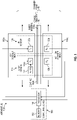
- FIG. 1 is a depiction of an example disclosed measurement apparatus 100 configured for calculating coating parameters for a coated separator membrane comprising a separator membrane having an aluminum compound coating on at least one surface, including a concentration of an additive or contaminant such as boehmite, PVDF, or a combination of boehmite and PVDF, a concentration of alumina, and optionally a weight and a density of the ceramic coating, as well as a thickness of the ceramic coating.
- the thickness of the ceramic coating can be the most important parameter for a LiB manufacturer that may be a customer for the apparatus 100.
- the coated separator membrane 180 is shown comprising a coating material 180b that comprises alumina or, other contaminant, or additive, or mixture of these materials, on at least one surface of a separator membrane/sheet material 180a generally in the form of a sheet of polymer material.
- the contaminant or additive can include boehmite, PVDF, or a binder or a combination of boehmite, PVDF and the binder.
- the sheet material 180a can comprise a polymer or layers of polymers (e.g., polyethylene (PE), or PP).
- the coating material 180b is generally a layer not solely comprised of alumina or other contaminants/additives, but as noted above can also generally include a binder material.
- a scanner head 160 comprises a top scanner head 160a and a bottom scanner head 160b that collectively has two sensors therein, comprising an x-ray sensor 110 and an IR sensor 120.
- transmitters shown as Tx 110a and Tx 120a are in the top scanner head 160a
- receivers shown as Rx 110b and Rx 120b are in the bottom scanner head 160b .
- the respective x-ray sensor and IR sensors 110, 120 are mounted along a line that can be oriented parallel to the machine direction (MD), or oriented in a cross direction (CD).
- MD orientation helps ensure that both the x-ray sensor 110 and IR sensor 120 measure the same sections (areas) of the coated separator membrane 180.
- the scanner heads 160a, 160b can scan across the coated separator membrane 180 which is moving between the scanning heads 160a, 160b .
- the scanner head 160 can scan over part of the width or the entire width of the coated separator membrane 180.
- the scanner head 160 is used to scan the respective x-ray sensor 110 and IR sensor 120 over the coated separator membrane 180 after the coating material 180b has been applied to the separator membrane/sheet material 180a .
- the x-ray sensor 110 includes an x-ray source shown as a Tx 110a that generally comprises an x-ray tube having a high-voltage power supply shown as HV PS 112 coupled thereto is for emitting an x-ray spectrum comprising x-rays at a plurality of energies. Further, an x-ray detector shown as Rx 110b for providing a measured x-ray signal value responsive to the x-rays received after being transmitted through the coated separator membrane 180 is also shown.
- the x-ray spectrum is generally calculated from a physics model for a specific x-ray tube at a specific high-voltage condition.
- the x-ray sensor 110 configured at a high-voltage (e.g., 4 kV to 10 kV) provides a measured x-ray signal value which, due to higher atomic numbers, is about 5 to 10 times more sensitive to the coating material 180b weight than to the weight of the separator membrane/sheet material 180a in the case of a LiB where the separator membrane/sheet material 180a generally comprises a plastic membrane.
- the IR sensor 120 can provide a weight measure that is mostly sensitive to the separator membrane/sheet material 180a weight (e.g., comprising PE),that is generally thus insensitive to the weight of the coating material 180b .
- a computing device 150 is coupled to receive the measured x-ray signal value from the x-ray sensor 110 and the sensor signal from the IR sensor 120.
- the computing device 150 includes a processor 151 that has an associated memory 152, where the processor 151 is configured to implement disclosed calculations.
- measured signals from the Rx's 110b, 120b are processed by electronics (not shown) including an electronic filter, an analog-to-digital converter (ADC), and an amplifier. After signal processing by the ADC, the resulting digital signal is then conveyed to the computing device 150.
- electronics not shown
- ADC analog-to-digital converter
- the thickness of a coating on a separator membrane can be measured.
- concentrations for the components of the coating may also be measured.
- conventional x-ray only systems or apparatus
- can measure the total coating weight it is recognized as inaccurate measurement results because the density of the coating is not known if any contaminant/additive is present in a ceramic coating in any significant quantity.
- Disclosed aspects are able to provide additional information comprising the contaminant/additive concentration or area weight and/or alumina (from 0% to 100%) in a ceramic compound coating.
- one or more x-ray signals will be transmitted from the transmitter 110a/120a through the coated separator membrane 180.
- Infrared (IR) signals are obtained from the coated separator membrane 180. Further, the IR signals include two or more spectral components that include a first peak from the coated separator membrane 180.
- the processor 151 determines whether a second peak among the IR peaks is present.
- the processor 151 also determines if at least one contaminant or additive exists in the coating 180b within the coated separator membrane 180.
- the processor 151 calculates a concentration or area weight of the at least one contaminant or additive, and also a weight, density, or thickness of the coating 180b.
- the contaminant or additive can be boehmite, PVDF, or a binder, or a combination of boehmite and PVDF or a binder.
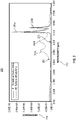
- FIG. 2 shows example of a graph 200 with an absorbance 210 and wavelength 220 illustrated.
- an IR spectrum 201 from 2 ⁇ m to 4 ⁇ m for a pure alumina coated polymer separator membrane, where there are no boehmite peaks is shown, and an IR spectrum 202 for an alumina coated polymer separator that includes some boehmite content. Is also shown.
- the IR spectrums 201 and 202 in FIG. 2 were obtained from a laboratory Fourier Transform Infrared Spectrometer (FTIR) apparatus. A unique IR signature for boehmite can be seen in FIG.
- FTIR Fourier Transform Infrared Spectrometer
- IR spectrum 202 comprising an absorption peak at 3.05 ⁇ m shown as 202a and an absorption peak at 3.25 ⁇ m shown as 202b .
- separator peaks for PP or PE at 3.45 ⁇ m shown as 206a and 3.52 ⁇ m shown as 206b, which are mostly affected by the weight of the PE/PP separator membrane. It is noted that it is more common to measure with online sensors only the spectral regions of interest, as opposed to the complete IR spectrum 201 or 202.
- the spectral regions of interest are generally one or two reference regions, being the separator membrane absorption regions 206a, 206b as well as the boehmite absorption regions 202a, 202b in the case of an alumina coating. Alumina does not have any absorption bands in the IR spectral region shown in Fig. 2 .
- An x-ray sensor senses the aluminum atoms primarily and the IR sensor senses boehmite, PVDF, or a binder, or combination of boehmite, PVDF, and the binder. This is enough information to extract the coating thickness and any contamination/additive content.
- These IR spectral component(s) can be used with x-ray information obtained from the x-ray sensor 110 shown as part of apparatus 100 in FIG. 1 .
- three possible outputs determined can be the weight, density, or the thickness of the sheet material 180a, and/or a weight, density, or thickness of the coating material which generally comprises mostly alumina or contaminants or additives such as boehmite, PVDF, binder or a combination of boehmite, PVDF and the binder.
- the coating can include alumina and contaminants/additives that include boehmite, PVDF, and/or other binders.
- a total weight of the composite sheet 180a can also be calculated as the sum of the separator weight and the coating weight that includes any contaminants/additives.
- the measurements can be calibrated by performing a multi-predictor (x-ray and IR signals) partial least square regression algorithm (or a similar statistical method such as principal component analysis (PCA), or neural network) on a set of composite coated separators with a known separator material weight, coating weight, and composition (concentration) parameters.
- a multi-predictor x-ray and IR signals
- PCA principal component analysis
- neural network a similar statistical method such as principal component analysis (PCA), or neural network
- the processor (shown in FIG. 1 ) can solve for the weight of the coated separator membrane, the weight of the coating, and the concentration of the contaminant/additive (boehmite, PVDF, binder, or combination).
- the procedure is generally performed by an algorithm run by a computing device, such as the computing device 150 shown in FIG. 1 described above.
- an embedded processor can also determine a concentration or area weight of the contaminant or additive that includes boehmite, PVDF, binder or a combination of the three.
- the combination of the X-ray sensor 110 and the IR sensor 120 in a disclosed system is used along with disclosed algorithms to extract an accurate coating weight, as well as concentration and/or area weight of at least one contaminant/additive such as boehmite, PVDF, binder, or a combination of the three.
- a system is also configured to determine a concentration of alumina, and at least one of the weight of the ceramic coating, a density of the ceramic coating, and/or a thickness of the ceramic coating.
- other outputs can be derived from these outputs.
- the IR signals at the two identified wavelengths shown in spectrum 202 in FIG. 2 as 202a and 202b (at 3.05 ⁇ m and 3.25 ⁇ m) described above are only measurably affected by the presence of boehmite.
- the IR signals 206a and 206b at 3.45 ⁇ m and 3.52 ⁇ m shown in FIG. 2 described above are mostly affected by the weight of the separator membrane that can comprise a PE/PP separator.
- a multi-parameter calibration such as using a multiple linear regression algorithm, principal component analysis (PCA) or a neural network can be utilized to extract an accurate concentration and area weight of contaminants/additives, weight of the ceramic coating, or optionally at least one of a density or thickness of the ceramic coating.
- PCA principal component analysis
- IR wavelengths are used.
- reference wavelengths/channels may also be employed as known in the art. Reference wavelengths are typically positioned in a part of the IR spectrum where absorption by the components of interest (i.e., the separator membrane and the boehmite) are low. Reference wavelengths are used in a known ratio metric technique, where a ratio of the amplitude (or strength) of an IR signal at a measurement wavelength along with an IR signal at a reference wavelength is used as a main input to the computing device or processor.
- a measured wavelength would be one at a unique absorption peak for PE or PP as a separator or boehmite.
- the same or a different reference wavelength could be used in these measurement ratios.
- two wavelengths can be identified that can be used as reference measurements, such as being around 2.8 ⁇ m and 3.6 ⁇ m.
- disclosed aspects can be applied to generally coated separator membranes that generally comprise at least one polymer.
- the IR measurement can be performed in a reflection mode.
- Disclosed aspects can be applied to generally determine the respective weights of any coating material including boehmite on any separator membrane material, where the separator membrane 180a can also comprise multiple layers of different polymers, for example PE/PP/PE, PP/PE/PP, PE/PP/PE/PP/PE.
- FIG. 3 is a flow chart that shows steps in a disclosed method 300. Moreover, the method or process 300 illustrates how it can be determined if at least one contaminant/additive exists.
- the contaminant/additive can be boehmite, PVDF, binder or a combination of boehmite, PVDF, or the binder.
- an x-ray signal is received from an x-ray transmitted through a coated separator membrane.
- a device such as the apparatus shown in figure 1 can include an x-ray transmitter in which the x-ray signal is transmitted through the coated separator membrane.
- IR signals are obtained from the coated separator membrane. Due to the transmitted x-ray signal, the IR signals are obtained that include two or more spectral components. In addition, multiple peaks will be included that include a first peak from the coated separator membrane.
- a processor configured within the apparatus shown in FIG. 1 , determines whether a second peak among the IR peaks exits. In addition, the processor determines if at least one contaminant/additive exists in the ceramic coating present within the coated separator membrane.
- the contaminant/additive can include boehmite, PVDF, or binder. Alternatively, the contaminant/additive can include a combination of the boehmite, PVDF, and binder.
- the processor calculates a concentration or area weight of the at least one contaminant or additive that includes boehmite, PVDF, or a binder, or a combination of boehmite, PVDF, and a binder. In addition, the processor calculates a weight, density, or thickness of the ceramic coating.
- the processor can determine from the second peak among the IR peaks if at least one contaminant or additive is presenet in the ceramic coating present within the coated separator membrane.
- the processer can determine if the contaminant/additive is boehmite, PVDF, binder material, or alternatively, a combination of boehmite, PVDF, and the binder.
- the processor can thereby calculate a concentration or area weight of the boehmite, PVDF, or binder. Further, the processer can calculate a weight, density, or thickness of the ceramic coating.
Landscapes
- Physics & Mathematics (AREA)
- Chemical & Material Sciences (AREA)
- General Physics & Mathematics (AREA)
- Health & Medical Sciences (AREA)
- General Health & Medical Sciences (AREA)
- Pathology (AREA)
- Biochemistry (AREA)
- Immunology (AREA)
- Life Sciences & Earth Sciences (AREA)
- Analytical Chemistry (AREA)
- Spectroscopy & Molecular Physics (AREA)
- Electrochemistry (AREA)
- Chemical Kinetics & Catalysis (AREA)
- General Chemical & Material Sciences (AREA)
- Toxicology (AREA)
- Mathematical Physics (AREA)
- Engineering & Computer Science (AREA)
- Inorganic Chemistry (AREA)
- Manufacturing & Machinery (AREA)
- Electromagnetism (AREA)
- Ceramic Engineering (AREA)
- Analysing Materials By The Use Of Radiation (AREA)
- Length-Measuring Devices Using Wave Or Particle Radiation (AREA)
- Investigating Or Analysing Materials By Optical Means (AREA)
- Cell Separators (AREA)
Abstract
A method includes receiving an x-ray signal transmitted from an x-ray transmitter through a coated separator membrane. The method also includes obtaining infrared (IR) signals from the coated separator membrane. The IR signals include two or more spectral components including peaks that include a first peak from the separator membrane. The method also includes the processor determining whether a second peak is present, and determining if at least one contaminant/additive exists in the coating present within the coated separator membrane. The method also includes calculating, by the processor, a concentration/area weight of the at least one contaminant/additive and a weight, density, or thickness of the coating.
Description
- This application claims benefit and priority to
US Provisional Application Serial No. 63/154,249 filed February 26, 2021 - Disclosed aspects relate to measuring coating parameters of a coated separator sheet for a battery.
- Ceramic-coated polyethylene (PE) or polypropylene (PP) separator membranes are important components for the performance of lithium-ion batteries (LiBs). The separator membrane provides an ion-permeable barrier between the cathode and the anode. These membranes are porous and if uncoated generally start to degrade at temperatures of around 120°C causing the LiB to short-circuit and thus fail. Ceramic coatings applied to the separator membranes prevent or suppress the shrinkage of separator membranes under elevated temperatures. One example of a ceramic coating is alumina (Al2O3). Sometimes, the alumina found on some separator samples is not pure but contains a contaminant/additive such as boehmite or other binder material such as polyvinylidene fluoride (PVDF). A ceramic coating comprising aluminum applied on the surface(s) of the separator membrane is known to help to improve the separator's temperature and chemical stability to up to about 200 °C. At higher temperatures, the plastic membrane breaks down creating electrically conductive paths between cathode and anode. Leads to shorts, leads to thermal runaway, then explosions.
- This Summary is provided to introduce a brief selection of disclosed concepts in a simplified form that are further described below in the Detailed Description including the drawings provided. This Summary is not intended to limit the claimed subject matter's scope.
- Disclosed aspects recognize alumina coatings on separator membranes can include an admixture of boehmite. The presence of the boehmite in the alumina coating or alumina in the boehmite coating will generally affect the physical properties of the separator membrane. For example, boehmite has a lower density as compared to alumina by as much as 30%, and its hardness is also significantly lower. In the case of alumina coatings, with low quality alumina, sodium ions and boehmite are known to leach out and contaminate the electrolytes of the battery.
- From a battery manufacturer's perspective, it is important to accurately know the composition of the coating whether it is pure alumina, pure boehmite, or a mixture of these two materials. From the measurement quality control perspective, knowing the composition and the density of the coating on a substrate, such as a separator membrane, enables a more accurate determination of the coating thickness. This is in part because absorption measurement techniques whether X-ray, beta particle, or infrared (IR)-based, are in essence weight measurement techniques, not thickness measurement techniques. Accordingly, it is recognized herein to be helpful to be able to detect the presence and the quantity of boehmite in alumina coatings or alumina in boehmite coating on substrates, such as on separator membranes.
- One disclosed aspect comprises a measurement apparatus for measuring a coated separator membrane including a separate membrane having an aluminum compound coating including at least one of alumina and boehmite on at least one surface. The measurement apparatus includes an x-ray sensor including an x-ray source having a high voltage power supply coupled thereto for emitting x-rays and an x-ray detector for providing a x-ray signal responsive to the x-rays received after being transmitted through the coated separator membrane, and an IR sensor. The IR sensor provides IR signals from the coated separator membrane including at least two spectral components, a first peak for the separator membrane and at least a second peak for the boehmite. Another IR spectral component can (but doesn't have to) act as a reference channel.
- A computing device is coupled to receive the x-ray signal and IR signals that includes a processor and a memory. The processor is for determining whether the second peak is present to indicate whether there is boehmite in the aluminum compound coating. The processor is also for calculating, using an algorithm, such as a multivariate regression algorithm, applied to the IR signals and the x-ray signal, a concentration of boehmite, and a concentration of the alumina. Optionally, at least one of a weight of the aluminum compound coating, a density of the aluminum compound coating, and a thickness of the aluminum compound coating may also be calculated.
- In an embodiment, a method includes receiving an x-ray signal transmitted from an x-ray transmitter through a coated separator membrane. The method also includes obtaining infrared (IR) signals from the coated separator membrane. The IR signals include two or more spectral components including peaks that include a first peak from the separator membrane. The method also includes determining, by a processor, whether a second peak among the IR peaks is present. The processor determines if at least one contaminant or additive exists in the coating present within the coated separator membrane. The method also includes calculating, by the processor, a concentration of area weight of the at least one contaminant or additive and a weight, density, or thickness of the coating.
- In an embodiment, a method includes receiving one or more x-ray signals that are transmitted through a coated separator membrane that includes ceramic coating. The method also includes obtaining, by a processor, infrared (IR) signals from the coated separator membrane with a first peak for the coated separator membrane and a second peak from a contaminant or additive. The method also includes determining, by the processor, whether the second peak is present from the IR signals. The processor determines a type of the contaminant or additive that is present in the ceramic coating within the coated separator membrane. The method also includes, calculating, by the processor, a concentration of the contaminant or additive from the second peak and a concentration of the ceramic coating from the one or more x-ray signals.
- In an embodiment, a system includes an x-ray sensor receiving an x-ray signal transmitted through a coated separator membrane. The system also includes a top scanner head and a bottom scanner head that obtains infrared (IR) signals from the coated separator membrane. The IR signals include two or more spectral components including peaks that include a peak for the separator membrane. The system also includes a processor that determines whether a second peak among the peaks is present, and determines a presence of a contaminant or additive in a coating present within the coated separator membrane. The system also includes a memory that stores a calculated concentration or area weight of the contaminant or additive and a weight, density, or thickness of the coating.
-
-
FIG. 1 is depiction of an example measurement apparatus including an x-ray sensor and an IR sensor configured for calculating for a coated separator membrane comprising a separator membrane having an aluminum compound coating on at least one surface, a boehmite concentration, and an alumina concentration, and optionally a weight and a density of the aluminum compound coating, as well as a thickness of the aluminum compound coating, according to an example aspect. -
FIG. 2 shows example IR spectra for a pure alumina coated polymer separator membrane, and for an alumina coated polymer separator membrane where the alumina coating includes some boehmite contamination. A unique IR signature for boehmite can be seen in this FIG. to be absorption peaks at 3.05 microns and at 3.25 microns. -
FIG. 3 is a flow chart that shows steps in a method of a determining for a coated separator membrane comprising a separator membrane having an aluminum compound coating on at least one surface, a boehmite concentration, an alumina concentration, and optionally a weight and density of the aluminum compound coating, as well as a thickness of the aluminum compound coating, according to an example aspect. - Disclosed aspects are described with reference to the attached figures, wherein like reference numerals are used throughout the figures to designate similar or equivalent elements. The figures are not drawn to scale, and they are provided merely to illustrate certain disclosed aspects. Several disclosed aspects are described below with reference to example applications for illustration. It should be understood that numerous specific details, relationships, and methods are set forth to provide a full understanding of the disclosed aspects.
- Battery customers are mostly interested in accurately knowing the thickness of the coating on the separator membrane. Using disclosed aspects one can generally calculate the coating thickness after one first determines the coating's density because it is recognized that the coating thickness measurement/calculation is generally not accurate enough unless one accurately knows the coating composition because the coating composition determines the coating density, which for LiBs the coating composition can range from pure alumina to pure boehmite. As noted above boehmite is used as a precursor material in the production of alumina that is a frequently used coating material for separator membranes. Customer data has evidenced that some alumina coating batches are contaminated with boehmite, but not all batches. The Inventors have identified boehmite specific spectral components comprising a first and at least a second peak/trough, such as shown as
absorption peaks FIG. 2 (the IR-spectrum) described below. It is noted that IR filters are usually centered around peaks not troughs, but there are no hard rules as this may depend on many other factors. - The coated separator membrane can be examined in either in reflection mode or transmission mode. However, the transmission mode may be advantageous as compared to the reflection mode since in the transmission mode one also measures the thickness of the separator membrane (e.g., comprising PP). Raman spectra represents an alternative to an IR spectra, where Raman spectroscopy can generally be used, but is not typically suitable for real-time measurements on a high-speed production coating machine. The boehmite peaks indicate not only whether boehmite is present in an alumina coating but also at what concentration based on the amplitude of the boehmite peak.
-
FIG. 1 is a depiction of an example disclosed measurement apparatus 100 configured for calculating coating parameters for a coated separator membrane comprising a separator membrane having an aluminum compound coating on at least one surface, including a concentration of an additive or contaminant such as boehmite, PVDF, or a combination of boehmite and PVDF, a concentration of alumina, and optionally a weight and a density of the ceramic coating, as well as a thickness of the ceramic coating. The thickness of the ceramic coating can be the most important parameter for a LiB manufacturer that may be a customer for the apparatus 100. - Referring to
FIG. 1 , thecoated separator membrane 180 is shown comprising acoating material 180b that comprises alumina or, other contaminant, or additive, or mixture of these materials, on at least one surface of a separator membrane/sheet material 180a generally in the form of a sheet of polymer material. The contaminant or additive can include boehmite, PVDF, or a binder or a combination of boehmite, PVDF and the binder. Thesheet material 180a can comprise a polymer or layers of polymers (e.g., polyethylene (PE), or PP). Thecoating material 180b is generally a layer not solely comprised of alumina or other contaminants/additives, but as noted above can also generally include a binder material. - In
FIG. 1 , ascanner head 160 comprises atop scanner head 160a and abottom scanner head 160b that collectively has two sensors therein, comprising anx-ray sensor 110 and anIR sensor 120. As shown, transmitters shown asTx 110a andTx 120a are in thetop scanner head 160a, and receivers shown asRx 110b andRx 120b are in thebottom scanner head 160b. Inside the scanning heads 160a, 160b, the respective x-ray sensor andIR sensors x-ray sensor 110 andIR sensor 120 measure the same sections (areas) of the coatedseparator membrane 180. - Still referring to
FIG. 1 , the scanner heads 160a, 160b can scan across the coatedseparator membrane 180 which is moving between the scanning heads 160a, 160b. Thescanner head 160 can scan over part of the width or the entire width of the coatedseparator membrane 180. Thescanner head 160 is used to scan therespective x-ray sensor 110 andIR sensor 120 over thecoated separator membrane 180 after thecoating material 180b has been applied to the separator membrane/sheet material 180a. - In
FIG. 1 , thex-ray sensor 110 includes an x-ray source shown as aTx 110a that generally comprises an x-ray tube having a high-voltage power supply shown asHV PS 112 coupled thereto is for emitting an x-ray spectrum comprising x-rays at a plurality of energies. Further, an x-ray detector shown asRx 110b for providing a measured x-ray signal value responsive to the x-rays received after being transmitted through the coatedseparator membrane 180 is also shown. The x-ray spectrum is generally calculated from a physics model for a specific x-ray tube at a specific high-voltage condition. - In
FIG. 1 , thex-ray sensor 110 configured at a high-voltage (e.g., 4 kV to 10 kV) provides a measured x-ray signal value which, due to higher atomic numbers, is about 5 to 10 times more sensitive to thecoating material 180b weight than to the weight of the separator membrane/sheet material 180a in the case of a LiB where the separator membrane/sheet material 180a generally comprises a plastic membrane. TheIR sensor 120 can provide a weight measure that is mostly sensitive to the separator membrane/sheet material 180a weight (e.g., comprising PE),that is generally thus insensitive to the weight of thecoating material 180b. - In
FIG. 1 , acomputing device 150 is coupled to receive the measured x-ray signal value from thex-ray sensor 110 and the sensor signal from theIR sensor 120. Thecomputing device 150 includes aprocessor 151 that has an associatedmemory 152, where theprocessor 151 is configured to implement disclosed calculations. - With respect to
FIG. 1 , measured signals from the Rx's 110b, 120b are processed by electronics (not shown) including an electronic filter, an analog-to-digital converter (ADC), and an amplifier. After signal processing by the ADC, the resulting digital signal is then conveyed to thecomputing device 150. - Still referring to
FIG. 1 , with the apparatus 100 comprising anx-ray sensor 110 and anIR sensor 120 as described above, the thickness of a coating on a separator membrane can be measured. In addition, concentrations for the components of the coating may also be measured. Although conventional x-ray only systems (or apparatus) can measure the total coating weight, it is recognized as inaccurate measurement results because the density of the coating is not known if any contaminant/additive is present in a ceramic coating in any significant quantity. Disclosed aspects are able to provide additional information comprising the contaminant/additive concentration or area weight and/or alumina (from 0% to 100%) in a ceramic compound coating. - In
FIG. 1 , one or more x-ray signals will be transmitted from thetransmitter 110a/120a through the coatedseparator membrane 180. Infrared (IR) signals are obtained from the coatedseparator membrane 180. Further, the IR signals include two or more spectral components that include a first peak from the coatedseparator membrane 180. Theprocessor 151 determines whether a second peak among the IR peaks is present. Theprocessor 151 also determines if at least one contaminant or additive exists in thecoating 180b within the coatedseparator membrane 180. Theprocessor 151 calculates a concentration or area weight of the at least one contaminant or additive, and also a weight, density, or thickness of thecoating 180b. The contaminant or additive can be boehmite, PVDF, or a binder, or a combination of boehmite and PVDF or a binder. -
FIG. 2 shows example of agraph 200 with anabsorbance 210 andwavelength 220 illustrated. InFIG. 2 , anIR spectrum 201 from 2 µm to 4 µm for a pure alumina coated polymer separator membrane, where there are no boehmite peaks is shown, and anIR spectrum 202 for an alumina coated polymer separator that includes some boehmite content. Is also shown. TheIR spectrums FIG. 2 were obtained from a laboratory Fourier Transform Infrared Spectrometer (FTIR) apparatus. A unique IR signature for boehmite can be seen inFIG. 2 to be inIR spectrum 202 comprising an absorption peak at 3.05 µm shown as 202a and an absorption peak at 3.25 µm shown as 202b. In addition, also shown forIR spectrum 202 are separator peaks for PP or PE at 3.45 µm shown as 206a and 3.52 µm shown as 206b, which are mostly affected by the weight of the PE/PP separator membrane. It is noted that it is more common to measure with online sensors only the spectral regions of interest, as opposed to thecomplete IR spectrum - With respect to
FIG. 2 , in order to measure the PE weight, obtaining a reference measurement in at least one unaffected region can get a baseline value for a relative measurement. For PE/PP, the absorption peak of choice would probably be the 206b, because the 206a is so massively absorbed to where there is no sensitivity. InFIG. 2 , the spectral regions of interest are generally one or two reference regions, being the separatormembrane absorption regions boehmite absorption regions Fig. 2 . An x-ray sensor senses the aluminum atoms primarily and the IR sensor senses boehmite, PVDF, or a binder, or combination of boehmite, PVDF, and the binder. This is enough information to extract the coating thickness and any contamination/additive content. These IR spectral component(s) can be used with x-ray information obtained from thex-ray sensor 110 shown as part of apparatus 100 inFIG. 1 . - Referring to
FIG. 2 , by measuring the respective inputs from thedetectors x-ray sensor 110 and theIR sensor 120, three possible outputs determined can be the weight, density, or the thickness of thesheet material 180a, and/or a weight, density, or thickness of the coating material which generally comprises mostly alumina or contaminants or additives such as boehmite, PVDF, binder or a combination of boehmite, PVDF and the binder. As such, the coating can include alumina and contaminants/additives that include boehmite, PVDF, and/or other binders. A total weight of thecomposite sheet 180a can also be calculated as the sum of the separator weight and the coating weight that includes any contaminants/additives. The measurements can be calibrated by performing a multi-predictor (x-ray and IR signals) partial least square regression algorithm (or a similar statistical method such as principal component analysis (PCA), or neural network) on a set of composite coated separators with a known separator material weight, coating weight, and composition (concentration) parameters. - Still referring to
FIG. 2 , the processor (shown inFIG. 1 ) can solve for the weight of the coated separator membrane, the weight of the coating, and the concentration of the contaminant/additive (boehmite, PVDF, binder, or combination). The procedure is generally performed by an algorithm run by a computing device, such as thecomputing device 150 shown inFIG. 1 described above. In other embodiments, an embedded processor can also determine a concentration or area weight of the contaminant or additive that includes boehmite, PVDF, binder or a combination of the three. - With respect to
FIG. 2 , the combination of theX-ray sensor 110 and theIR sensor 120 in a disclosed system, such as apparatus 100 shown inFIG. 1 , is used along with disclosed algorithms to extract an accurate coating weight, as well as concentration and/or area weight of at least one contaminant/additive such as boehmite, PVDF, binder, or a combination of the three. In addition, such a system is also configured to determine a concentration of alumina, and at least one of the weight of the ceramic coating, a density of the ceramic coating, and/or a thickness of the ceramic coating. As described above, other outputs can be derived from these outputs. The IR signals at the two identified wavelengths shown inspectrum 202 inFIG. 2 as 202a and 202b (at 3.05 µm and 3.25 µm) described above are only measurably affected by the presence of boehmite. - In
FIG 2 , the IR signals 206a and 206b at 3.45 µm and 3.52 µm shown inFIG. 2 described above are mostly affected by the weight of the separator membrane that can comprise a PE/PP separator. A multi-parameter calibration such as using a multiple linear regression algorithm, principal component analysis (PCA) or a neural network can be utilized to extract an accurate concentration and area weight of contaminants/additives, weight of the ceramic coating, or optionally at least one of a density or thickness of the ceramic coating. - Referring to
FIG. 2 , in embodiments, three or four IR wavelengths are used. In addition to the specific boehmite and separator wavelengths, reference wavelengths/channels may also be employed as known in the art. Reference wavelengths are typically positioned in a part of the IR spectrum where absorption by the components of interest (i.e., the separator membrane and the boehmite) are low. Reference wavelengths are used in a known ratio metric technique, where a ratio of the amplitude (or strength) of an IR signal at a measurement wavelength along with an IR signal at a reference wavelength is used as a main input to the computing device or processor. In an embodiment, a measured wavelength would be one at a unique absorption peak for PE or PP as a separator or boehmite. The same or a different reference wavelength could be used in these measurement ratios. In an embodiment, two wavelengths can be identified that can be used as reference measurements, such as being around 2.8 µm and 3.6 µm. - With respect to
FIG. 2 , disclosed aspects can be applied to generally coated separator membranes that generally comprise at least one polymer. For other separator types, for example a reflective separator material, the IR measurement can be performed in a reflection mode. Disclosed aspects can be applied to generally determine the respective weights of any coating material including boehmite on any separator membrane material, where theseparator membrane 180a can also comprise multiple layers of different polymers, for example PE/PP/PE, PP/PE/PP, PE/PP/PE/PP/PE. -
FIG. 3 is a flow chart that shows steps in a disclosedmethod 300. Moreover, the method orprocess 300 illustrates how it can be determined if at least one contaminant/additive exists. As described above, the contaminant/additive can be boehmite, PVDF, binder or a combination of boehmite, PVDF, or the binder. - In
FIG. 3 , atstep 310, an x-ray signal is received from an x-ray transmitted through a coated separator membrane. A device, such as the apparatus shown infigure 1 can include an x-ray transmitter in which the x-ray signal is transmitted through the coated separator membrane. - Referring to
FIG. 3 , atstep 320, IR signals are obtained from the coated separator membrane. Due to the transmitted x-ray signal, the IR signals are obtained that include two or more spectral components. In addition, multiple peaks will be included that include a first peak from the coated separator membrane. - In
FIG. 3 , atstep 330, a processor, configured within the apparatus shown inFIG. 1 , determines whether a second peak among the IR peaks exits. In addition, the processor determines if at least one contaminant/additive exists in the ceramic coating present within the coated separator membrane. The contaminant/additive can include boehmite, PVDF, or binder. Alternatively, the contaminant/additive can include a combination of the boehmite, PVDF, and binder. - With regard to
FIG. 3 , atstep 340, the processor calculates a concentration or area weight of the at least one contaminant or additive that includes boehmite, PVDF, or a binder, or a combination of boehmite, PVDF, and a binder. In addition, the processor calculates a weight, density, or thickness of the ceramic coating. - Overall, two or more peaks can be identified from the obtained IR signals. The processor can determine from the second peak among the IR peaks if at least one contaminant or additive is presenet in the ceramic coating present within the coated separator membrane. The processer can determine if the contaminant/additive is boehmite, PVDF, binder material, or alternatively, a combination of boehmite, PVDF, and the binder. The processor can thereby calculate a concentration or area weight of the boehmite, PVDF, or binder. Further, the processer can calculate a weight, density, or thickness of the ceramic coating.
- While various disclosed aspects have been described above, it should be understood that they have been presented by way of example only, and not limitation. Numerous changes to the subject matter disclosed herein can be made in accordance with this Disclosure without departing from the spirit or scope of this Disclosure. In addition, while a particular feature may have been disclosed with respect to only one of several implementations, such feature may be combined with one or more other features of the other implementations as may be desired and advantageous for any given or particular application.
Claims (10)
- A method comprising:receiving an x-ray signal transmitted from an x-ray transmitter (110a, 120a) through a coated separator membrane (180);obtaining infrared (IR) signals from the coated separator membrane (180), wherein the IR signals include two or more spectral components including peaks that include a first peak from the separator membrane (180);determining, by a processor (151), whether a second peak among the IR peaks is present, and determining, by the processor (151) if at least one contaminant or additive exists in the coating (180b) present within the coated separator membrane (180); andcalculating, by the processor (151), a concentration or area weight of the at least one contaminant or additive and a weight, density, or thickness of the coating (180b).
- The method of claim, wherein the at least one contaminant or additive is boehmite.
- The method of claim 1, wherein the at least one contaminant or additive is binder material such as polyvinylidene fluoride (PVDF) and boehmite.
- The method of claim 1, further comprising:
determining, by the processor (151), whether boehmite is present in the coated separator membrane (180). - The method of claim 1, further comprising:determining whether polyvinylidene fluoride (PVDF) is present in the coating (180b).
- The method of claim 1, further comprising:
determining a concentration of ceramic coating from the x-ray signal. - The method of claim 1, further comprising:
determining a weight and density of ceramic coating such as aluminum oxide or silicon oxide within the coated separator membrane. - A method, comprising:receiving one or more x-rays signals that are transmitted through a coated separator membrane (180) that includes ceramic coating;obtaining, by a processor (151), infrared (IR) signals from the coated separator membrane (180) with a first peak for the coated separator membrane (180) and a second peak from a contaminant or additive;determining, by the processor (151), whether the second peak is present from the IR signals, wherein the processor (151) determines a type of the contaminant or additive that is present in the ceramic coating within the coated separator membrane (18); andcalculating, by the processor (151), a concentration of the contaminant or additive from the second peak and a concentration of the ceramic coating from the one or more x-ray signals.
- The method of claim 7, further comprising:
determining, by the processor (151), a weight, density, or thickness of the ceramic coating. - The method of claim 7, wherein the processor (151) determines that the contaminant or additive is a binder material.
Applications Claiming Priority (2)
| Application Number | Priority Date | Filing Date | Title |
|---|---|---|---|
| US202163154249P | 2021-02-26 | 2021-02-26 | |
| US17/651,501 US12584869B2 (en) | 2021-02-26 | 2022-02-17 | Boehmite detection and warning system, and concentration indicator for LiB separator sheet manufacturing |
Publications (1)
| Publication Number | Publication Date |
|---|---|
| EP4050304A1 true EP4050304A1 (en) | 2022-08-31 |
Family
ID=80449096
Family Applications (1)
| Application Number | Title | Priority Date | Filing Date |
|---|---|---|---|
| EP22158392.5A Pending EP4050304A1 (en) | 2021-02-26 | 2022-02-24 | Boehmite detection and warning system, and concentration indicator for lib separator sheet manufacturing |
Country Status (5)
| Country | Link |
|---|---|
| US (1) | US12584869B2 (en) |
| EP (1) | EP4050304A1 (en) |
| JP (1) | JP7350914B2 (en) |
| KR (1) | KR102840882B1 (en) |
| CN (1) | CN114965517B (en) |
Citations (2)
| Publication number | Priority date | Publication date | Assignee | Title |
|---|---|---|---|---|
| KR102137656B1 (en) * | 2019-03-14 | 2020-07-28 | 에너에버배터리솔루션 주식회사 | One side or double side coating equipment for manufacturing coating separator for middle or large sized secondary battery of electric vehicle or energy storage system |
| US20200303706A1 (en) * | 2016-03-29 | 2020-09-24 | Celgard, Llc | Depositions or layers for microporous membranes, improved membranes, improved lithium battery separators, improved batteries, improved high voltage lithium batteries, and related methods |
Family Cites Families (24)
| Publication number | Priority date | Publication date | Assignee | Title |
|---|---|---|---|---|
| JPH0825861B2 (en) * | 1989-04-24 | 1996-03-13 | サンスター株式会社 | Toothpaste composition |
| US5091647A (en) | 1990-12-24 | 1992-02-25 | Ford Motor Company | Method and apparatus for measuring the thickness of a layer on a substrate |
| US6555496B1 (en) | 1999-08-11 | 2003-04-29 | Akzo Nobel N.V. | Micro-crystalline boehmites containing additives |
| JP4346629B2 (en) | 2001-08-29 | 2009-10-21 | 富士通株式会社 | Method for measuring nitrogen concentration in silicon crystal, method for determining conversion coefficient for calculating nitrogen concentration in silicon crystal, method for manufacturing silicon wafer, and method for manufacturing semiconductor device |
| KR100540865B1 (en) * | 2002-11-06 | 2006-01-11 | 삼성전자주식회사 | Concentration measuring method and measuring impurity concentration of semiconductor device using same |
| JP5266787B2 (en) * | 2008-02-22 | 2013-08-21 | 横河電機株式会社 | Film thickness measuring apparatus and method |
| CN102906013B (en) | 2010-03-22 | 2016-05-25 | 布莱阿姆青年大学 | Method for preparing highly porous stable metal oxides with controlled pore structure |
| JP5875403B2 (en) * | 2012-02-21 | 2016-03-02 | 株式会社日立ハイテクサイエンス | Transmission X-ray analyzer |
| US9823188B1 (en) | 2014-09-09 | 2017-11-21 | University Of South Florida | Systems and methods for detecting the presence of a contaminant |
| KR101963013B1 (en) * | 2014-09-26 | 2019-03-27 | 아사히 가세이 가부시키가이샤 | Separator for electricity storage device |
| JP6001198B2 (en) * | 2014-10-01 | 2016-10-05 | 日本碍子株式会社 | Batteries using layered double hydroxides |
| GB2533589A (en) | 2014-12-22 | 2016-06-29 | Ndc Infrared Eng Ltd | Measurement of porous film |
| JP6844814B2 (en) * | 2015-03-31 | 2021-03-17 | 株式会社村田製作所 | Negative electrode active material and its manufacturing method, negative electrode, and battery |
| JP6592281B2 (en) | 2015-06-11 | 2019-10-16 | 住友化学株式会社 | Method for measuring basis weight, method for producing laminated film, and unit for measuring basis weight |
| JP6828739B2 (en) * | 2016-04-12 | 2021-02-10 | 株式会社村田製作所 | Analytical devices, analysis methods, power storage devices, power storage systems, electronic devices, electric vehicles and electric power systems |
| JP6865646B2 (en) * | 2016-11-30 | 2021-04-28 | 住友化学株式会社 | Defect inspection equipment, defect inspection method, and method for manufacturing separator wound body |
| US20180281203A1 (en) * | 2017-03-31 | 2018-10-04 | Sumitomo Chemical Company, Limited | Robot arm and transfer system |
| CN116581479A (en) * | 2017-10-13 | 2023-08-11 | 株式会社Lg新能源 | Multilayer nanoporous separators |
| JP7219148B2 (en) | 2018-04-25 | 2023-02-07 | 住友化学株式会社 | Inspection system and method for driving inspection system |
| US11879765B2 (en) | 2018-09-26 | 2024-01-23 | Honeywell International Inc. | Apparatus for composite sheet weight determinations |
| JP7201481B2 (en) * | 2019-03-04 | 2023-01-10 | 株式会社日立ハイテクサイエンス | X-ray inspection device and X-ray inspection method |
| US11333544B2 (en) | 2019-06-17 | 2022-05-17 | Honeywell International Inc. | Apparatus for simultaneously determining weights of composite sheets |
| US10876882B1 (en) | 2019-06-26 | 2020-12-29 | Honeywell International Inc. | Online grade selection for weight measurements of composite sheets |
| KR102875276B1 (en) | 2020-07-02 | 2025-10-23 | 주식회사 엘지에너지솔루션 | Device and Method For Testing Pollution of Pouch Cell |
-
2022
- 2022-02-17 US US17/651,501 patent/US12584869B2/en active Active
- 2022-02-24 EP EP22158392.5A patent/EP4050304A1/en active Pending
- 2022-02-25 CN CN202210180337.XA patent/CN114965517B/en active Active
- 2022-02-25 KR KR1020220024892A patent/KR102840882B1/en active Active
- 2022-02-28 JP JP2022028757A patent/JP7350914B2/en active Active
Patent Citations (2)
| Publication number | Priority date | Publication date | Assignee | Title |
|---|---|---|---|---|
| US20200303706A1 (en) * | 2016-03-29 | 2020-09-24 | Celgard, Llc | Depositions or layers for microporous membranes, improved membranes, improved lithium battery separators, improved batteries, improved high voltage lithium batteries, and related methods |
| KR102137656B1 (en) * | 2019-03-14 | 2020-07-28 | 에너에버배터리솔루션 주식회사 | One side or double side coating equipment for manufacturing coating separator for middle or large sized secondary battery of electric vehicle or energy storage system |
Also Published As
| Publication number | Publication date |
|---|---|
| JP2022132202A (en) | 2022-09-07 |
| KR102840882B1 (en) | 2025-07-30 |
| US20220276185A1 (en) | 2022-09-01 |
| JP7350914B2 (en) | 2023-09-26 |
| CN114965517B (en) | 2026-01-23 |
| KR20220122542A (en) | 2022-09-02 |
| US12584869B2 (en) | 2026-03-24 |
| CN114965517A (en) | 2022-08-30 |
Similar Documents
| Publication | Publication Date | Title |
|---|---|---|
| EP3857187B1 (en) | Apparatus and method for composite sheet weight determinations | |
| US7115869B2 (en) | Method for measurement of composite heat damage with infrared spectroscopy | |
| JP6985461B2 (en) | Working grade selection for weighting of composite sheets | |
| CN107430054A (en) | Measurement of Porous Membranes | |
| US11519867B2 (en) | X-ray-based determining of weights for coated substrates | |
| US20250224331A1 (en) | Method, system and sensor for analysing a sample, and process for manufacturing an electrode | |
| CN111366573B (en) | Evaluation method based on LIBS spectral component analysis result | |
| JP2022091880A (en) | A device for determining the weight of a composite sheet at the same time | |
| EP4050304A1 (en) | Boehmite detection and warning system, and concentration indicator for lib separator sheet manufacturing | |
| CN120668036A (en) | Intelligent chromogenic active packaging film thickness uniformity detection method and system | |
| US11313670B2 (en) | Inspection method for multilayer semiconductor device | |
| CN117253989A (en) | Method for manufacturing lithium battery electrodes from lithium battery electrode materials | |
| KR102835680B1 (en) | Lib anode coating measurement with dual x-ray | |
| EP3143385B1 (en) | Method for monitoring a product property of a disposable diagnostic test product | |
| CN115615946A (en) | Method and system for rapidly detecting beta-phase content of polyvinylidene fluoride | |
| CN121453816A (en) | Method, device, medium and program product for measuring a multilayer material | |
| WO2025065036A1 (en) | Method for the determination of a crosslinking degree |
Legal Events
| Date | Code | Title | Description |
|---|---|---|---|
| PUAI | Public reference made under article 153(3) epc to a published international application that has entered the european phase |
Free format text: ORIGINAL CODE: 0009012 |
|
| STAA | Information on the status of an ep patent application or granted ep patent |
Free format text: STATUS: REQUEST FOR EXAMINATION WAS MADE |
|
| 17P | Request for examination filed |
Effective date: 20220224 |
|
| AK | Designated contracting states |
Kind code of ref document: A1 Designated state(s): AL AT BE BG CH CY CZ DE DK EE ES FI FR GB GR HR HU IE IS IT LI LT LU LV MC MK MT NL NO PL PT RO RS SE SI SK SM TR |
|
| P01 | Opt-out of the competence of the unified patent court (upc) registered |
Effective date: 20230414 |