EP4049996A1 - Glycoside compound, amidite compound, and production method for polynucleotide using said compounds - Google Patents
Glycoside compound, amidite compound, and production method for polynucleotide using said compounds Download PDFInfo
- Publication number
- EP4049996A1 EP4049996A1 EP20879365.3A EP20879365A EP4049996A1 EP 4049996 A1 EP4049996 A1 EP 4049996A1 EP 20879365 A EP20879365 A EP 20879365A EP 4049996 A1 EP4049996 A1 EP 4049996A1
- Authority
- EP
- European Patent Office
- Prior art keywords
- group
- formula
- compound
- hydrogen atom
- amidite
- Prior art date
- Legal status (The legal status is an assumption and is not a legal conclusion. Google has not performed a legal analysis and makes no representation as to the accuracy of the status listed.)
- Granted
Links
Classifications
-
- C—CHEMISTRY; METALLURGY
- C07—ORGANIC CHEMISTRY
- C07H—SUGARS; DERIVATIVES THEREOF; NUCLEOSIDES; NUCLEOTIDES; NUCLEIC ACIDS
- C07H1/00—Processes for the preparation of sugar derivatives
-
- C—CHEMISTRY; METALLURGY
- C07—ORGANIC CHEMISTRY
- C07H—SUGARS; DERIVATIVES THEREOF; NUCLEOSIDES; NUCLEOTIDES; NUCLEIC ACIDS
- C07H19/00—Compounds containing a hetero ring sharing one ring hetero atom with a saccharide radical; Nucleosides; Mononucleotides; Anhydro-derivatives thereof
- C07H19/02—Compounds containing a hetero ring sharing one ring hetero atom with a saccharide radical; Nucleosides; Mononucleotides; Anhydro-derivatives thereof sharing nitrogen
- C07H19/04—Heterocyclic radicals containing only nitrogen atoms as ring hetero atom
- C07H19/06—Pyrimidine radicals
- C07H19/10—Pyrimidine radicals with the saccharide radical esterified by phosphoric or polyphosphoric acids
-
- C—CHEMISTRY; METALLURGY
- C07—ORGANIC CHEMISTRY
- C07C—ACYCLIC OR CARBOCYCLIC COMPOUNDS
- C07C315/00—Preparation of sulfones; Preparation of sulfoxides
- C07C315/04—Preparation of sulfones; Preparation of sulfoxides by reactions not involving the formation of sulfone or sulfoxide groups
-
- C—CHEMISTRY; METALLURGY
- C07—ORGANIC CHEMISTRY
- C07C—ACYCLIC OR CARBOCYCLIC COMPOUNDS
- C07C317/00—Sulfones; Sulfoxides
- C07C317/16—Sulfones; Sulfoxides having sulfone or sulfoxide groups and singly-bound oxygen atoms bound to the same carbon skeleton
- C07C317/18—Sulfones; Sulfoxides having sulfone or sulfoxide groups and singly-bound oxygen atoms bound to the same carbon skeleton with sulfone or sulfoxide groups bound to acyclic carbon atoms of the carbon skeleton
-
- C—CHEMISTRY; METALLURGY
- C07—ORGANIC CHEMISTRY
- C07C—ACYCLIC OR CARBOCYCLIC COMPOUNDS
- C07C317/00—Sulfones; Sulfoxides
- C07C317/16—Sulfones; Sulfoxides having sulfone or sulfoxide groups and singly-bound oxygen atoms bound to the same carbon skeleton
- C07C317/22—Sulfones; Sulfoxides having sulfone or sulfoxide groups and singly-bound oxygen atoms bound to the same carbon skeleton with sulfone or sulfoxide groups bound to carbon atoms of six-membered aromatic rings of the carbon skeleton
-
- C—CHEMISTRY; METALLURGY
- C07—ORGANIC CHEMISTRY
- C07C—ACYCLIC OR CARBOCYCLIC COMPOUNDS
- C07C319/00—Preparation of thiols, sulfides, hydropolysulfides or polysulfides
- C07C319/14—Preparation of thiols, sulfides, hydropolysulfides or polysulfides of sulfides
- C07C319/20—Preparation of thiols, sulfides, hydropolysulfides or polysulfides of sulfides by reactions not involving the formation of sulfide groups
-
- C—CHEMISTRY; METALLURGY
- C07—ORGANIC CHEMISTRY
- C07C—ACYCLIC OR CARBOCYCLIC COMPOUNDS
- C07C323/00—Thiols, sulfides, hydropolysulfides or polysulfides substituted by halogen, oxygen or nitrogen atoms, or by sulfur atoms not being part of thio groups
- C07C323/10—Thiols, sulfides, hydropolysulfides or polysulfides substituted by halogen, oxygen or nitrogen atoms, or by sulfur atoms not being part of thio groups containing thio groups and singly-bound oxygen atoms bound to the same carbon skeleton
- C07C323/11—Thiols, sulfides, hydropolysulfides or polysulfides substituted by halogen, oxygen or nitrogen atoms, or by sulfur atoms not being part of thio groups containing thio groups and singly-bound oxygen atoms bound to the same carbon skeleton having the sulfur atoms of the thio groups bound to acyclic carbon atoms of the carbon skeleton
- C07C323/12—Thiols, sulfides, hydropolysulfides or polysulfides substituted by halogen, oxygen or nitrogen atoms, or by sulfur atoms not being part of thio groups containing thio groups and singly-bound oxygen atoms bound to the same carbon skeleton having the sulfur atoms of the thio groups bound to acyclic carbon atoms of the carbon skeleton the carbon skeleton being acyclic and saturated
-
- C—CHEMISTRY; METALLURGY
- C07—ORGANIC CHEMISTRY
- C07H—SUGARS; DERIVATIVES THEREOF; NUCLEOSIDES; NUCLEOTIDES; NUCLEIC ACIDS
- C07H19/00—Compounds containing a hetero ring sharing one ring hetero atom with a saccharide radical; Nucleosides; Mononucleotides; Anhydro-derivatives thereof
- C07H19/02—Compounds containing a hetero ring sharing one ring hetero atom with a saccharide radical; Nucleosides; Mononucleotides; Anhydro-derivatives thereof sharing nitrogen
- C07H19/04—Heterocyclic radicals containing only nitrogen atoms as ring hetero atom
- C07H19/06—Pyrimidine radicals
-
- C—CHEMISTRY; METALLURGY
- C07—ORGANIC CHEMISTRY
- C07H—SUGARS; DERIVATIVES THEREOF; NUCLEOSIDES; NUCLEOTIDES; NUCLEIC ACIDS
- C07H19/00—Compounds containing a hetero ring sharing one ring hetero atom with a saccharide radical; Nucleosides; Mononucleotides; Anhydro-derivatives thereof
- C07H19/02—Compounds containing a hetero ring sharing one ring hetero atom with a saccharide radical; Nucleosides; Mononucleotides; Anhydro-derivatives thereof sharing nitrogen
- C07H19/04—Heterocyclic radicals containing only nitrogen atoms as ring hetero atom
- C07H19/06—Pyrimidine radicals
- C07H19/067—Pyrimidine radicals with ribosyl as the saccharide radical
-
- C—CHEMISTRY; METALLURGY
- C07—ORGANIC CHEMISTRY
- C07H—SUGARS; DERIVATIVES THEREOF; NUCLEOSIDES; NUCLEOTIDES; NUCLEIC ACIDS
- C07H21/00—Compounds containing two or more mononucleotide units having separate phosphate or polyphosphate groups linked by saccharide radicals of nucleoside groups, e.g. nucleic acids
-
- C—CHEMISTRY; METALLURGY
- C07—ORGANIC CHEMISTRY
- C07H—SUGARS; DERIVATIVES THEREOF; NUCLEOSIDES; NUCLEOTIDES; NUCLEIC ACIDS
- C07H21/00—Compounds containing two or more mononucleotide units having separate phosphate or polyphosphate groups linked by saccharide radicals of nucleoside groups, e.g. nucleic acids
- C07H21/02—Compounds containing two or more mononucleotide units having separate phosphate or polyphosphate groups linked by saccharide radicals of nucleoside groups, e.g. nucleic acids with ribosyl as saccharide radical
-
- C—CHEMISTRY; METALLURGY
- C07—ORGANIC CHEMISTRY
- C07H—SUGARS; DERIVATIVES THEREOF; NUCLEOSIDES; NUCLEOTIDES; NUCLEIC ACIDS
- C07H23/00—Compounds containing boron, silicon or a metal, e.g. chelates or vitamin B12
-
- C—CHEMISTRY; METALLURGY
- C12—BIOCHEMISTRY; BEER; SPIRITS; WINE; VINEGAR; MICROBIOLOGY; ENZYMOLOGY; MUTATION OR GENETIC ENGINEERING
- C12N—MICROORGANISMS OR ENZYMES; COMPOSITIONS THEREOF; PROPAGATING, PRESERVING, OR MAINTAINING MICROORGANISMS; MUTATION OR GENETIC ENGINEERING; CULTURE MEDIA
- C12N15/00—Mutation or genetic engineering; DNA or RNA concerning genetic engineering, vectors, e.g. plasmids, or their isolation, preparation or purification; Use of hosts therefor
- C12N15/09—Recombinant DNA-technology
- C12N15/11—DNA or RNA fragments; Modified forms thereof; Non-coding nucleic acids having a biological activity
- C12N15/113—Non-coding nucleic acids modulating the expression of genes, e.g. antisense oligonucleotides; Antisense DNA or RNA; Triplex- forming oligonucleotides; Catalytic nucleic acids, e.g. ribozymes; Nucleic acids used in co-suppression or gene silencing
-
- C—CHEMISTRY; METALLURGY
- C12—BIOCHEMISTRY; BEER; SPIRITS; WINE; VINEGAR; MICROBIOLOGY; ENZYMOLOGY; MUTATION OR GENETIC ENGINEERING
- C12N—MICROORGANISMS OR ENZYMES; COMPOSITIONS THEREOF; PROPAGATING, PRESERVING, OR MAINTAINING MICROORGANISMS; MUTATION OR GENETIC ENGINEERING; CULTURE MEDIA
- C12N15/00—Mutation or genetic engineering; DNA or RNA concerning genetic engineering, vectors, e.g. plasmids, or their isolation, preparation or purification; Use of hosts therefor
- C12N15/09—Recombinant DNA-technology
- C12N15/11—DNA or RNA fragments; Modified forms thereof; Non-coding nucleic acids having a biological activity
- C12N15/115—Aptamers, i.e. nucleic acids binding a target molecule specifically and with high affinity without hybridising therewith ; Nucleic acids binding to non-nucleic acids, e.g. aptamers
-
- C—CHEMISTRY; METALLURGY
- C12—BIOCHEMISTRY; BEER; SPIRITS; WINE; VINEGAR; MICROBIOLOGY; ENZYMOLOGY; MUTATION OR GENETIC ENGINEERING
- C12Q—MEASURING OR TESTING PROCESSES INVOLVING ENZYMES, NUCLEIC ACIDS OR MICROORGANISMS; COMPOSITIONS OR TEST PAPERS THEREFOR; PROCESSES OF PREPARING SUCH COMPOSITIONS; CONDITION-RESPONSIVE CONTROL IN MICROBIOLOGICAL OR ENZYMOLOGICAL PROCESSES
- C12Q1/00—Measuring or testing processes involving enzymes, nucleic acids or microorganisms; Compositions therefor; Processes of preparing such compositions
- C12Q1/68—Measuring or testing processes involving enzymes, nucleic acids or microorganisms; Compositions therefor; Processes of preparing such compositions involving nucleic acids
- C12Q1/6806—Preparing nucleic acids for analysis, e.g. for polymerase chain reaction [PCR] assay
-
- C—CHEMISTRY; METALLURGY
- C12—BIOCHEMISTRY; BEER; SPIRITS; WINE; VINEGAR; MICROBIOLOGY; ENZYMOLOGY; MUTATION OR GENETIC ENGINEERING
- C12N—MICROORGANISMS OR ENZYMES; COMPOSITIONS THEREOF; PROPAGATING, PRESERVING, OR MAINTAINING MICROORGANISMS; MUTATION OR GENETIC ENGINEERING; CULTURE MEDIA
- C12N2310/00—Structure or type of the nucleic acid
- C12N2310/10—Type of nucleic acid
- C12N2310/11—Antisense
-
- C—CHEMISTRY; METALLURGY
- C12—BIOCHEMISTRY; BEER; SPIRITS; WINE; VINEGAR; MICROBIOLOGY; ENZYMOLOGY; MUTATION OR GENETIC ENGINEERING
- C12N—MICROORGANISMS OR ENZYMES; COMPOSITIONS THEREOF; PROPAGATING, PRESERVING, OR MAINTAINING MICROORGANISMS; MUTATION OR GENETIC ENGINEERING; CULTURE MEDIA
- C12N2310/00—Structure or type of the nucleic acid
- C12N2310/10—Type of nucleic acid
- C12N2310/12—Type of nucleic acid catalytic nucleic acids, e.g. ribozymes
-
- C—CHEMISTRY; METALLURGY
- C12—BIOCHEMISTRY; BEER; SPIRITS; WINE; VINEGAR; MICROBIOLOGY; ENZYMOLOGY; MUTATION OR GENETIC ENGINEERING
- C12N—MICROORGANISMS OR ENZYMES; COMPOSITIONS THEREOF; PROPAGATING, PRESERVING, OR MAINTAINING MICROORGANISMS; MUTATION OR GENETIC ENGINEERING; CULTURE MEDIA
- C12N2310/00—Structure or type of the nucleic acid
- C12N2310/10—Type of nucleic acid
- C12N2310/14—Type of nucleic acid interfering nucleic acids [NA]
-
- C—CHEMISTRY; METALLURGY
- C12—BIOCHEMISTRY; BEER; SPIRITS; WINE; VINEGAR; MICROBIOLOGY; ENZYMOLOGY; MUTATION OR GENETIC ENGINEERING
- C12N—MICROORGANISMS OR ENZYMES; COMPOSITIONS THEREOF; PROPAGATING, PRESERVING, OR MAINTAINING MICROORGANISMS; MUTATION OR GENETIC ENGINEERING; CULTURE MEDIA
- C12N2310/00—Structure or type of the nucleic acid
- C12N2310/10—Type of nucleic acid
- C12N2310/16—Aptamers
-
- C—CHEMISTRY; METALLURGY
- C12—BIOCHEMISTRY; BEER; SPIRITS; WINE; VINEGAR; MICROBIOLOGY; ENZYMOLOGY; MUTATION OR GENETIC ENGINEERING
- C12N—MICROORGANISMS OR ENZYMES; COMPOSITIONS THEREOF; PROPAGATING, PRESERVING, OR MAINTAINING MICROORGANISMS; MUTATION OR GENETIC ENGINEERING; CULTURE MEDIA
- C12N2330/00—Production
- C12N2330/30—Production chemically synthesised
-
- Y—GENERAL TAGGING OF NEW TECHNOLOGICAL DEVELOPMENTS; GENERAL TAGGING OF CROSS-SECTIONAL TECHNOLOGIES SPANNING OVER SEVERAL SECTIONS OF THE IPC; TECHNICAL SUBJECTS COVERED BY FORMER USPC CROSS-REFERENCE ART COLLECTIONS [XRACs] AND DIGESTS
- Y02—TECHNOLOGIES OR APPLICATIONS FOR MITIGATION OR ADAPTATION AGAINST CLIMATE CHANGE
- Y02P—CLIMATE CHANGE MITIGATION TECHNOLOGIES IN THE PRODUCTION OR PROCESSING OF GOODS
- Y02P20/00—Technologies relating to chemical industry
- Y02P20/50—Improvements relating to the production of bulk chemicals
- Y02P20/55—Design of synthesis routes, e.g. reducing the use of auxiliary or protecting groups
Definitions
- the present invention relates to a glycoside compound, an amidite compound thereof, and a production method for a polynucleotide using the compounds.
- the present invention further relates to an intermediate compound of the glycoside compound and a production method for the intermediate compound.
- RNA can be used as an RNA probe, an antisense RNA, a ribozyme, an siRNA, an aptamer, or the like, and is a useful material.
- RNA can be synthesized by the solid-phase synthesis or the like, and in the solid-phase synthesis, phosphoramidite of nucleoside (hereinafter referred to as "amidite”) is used as a raw material.
- a protecting group of a hydroxyl group at the 2' position of the amidite include t-butyldimethylsilyl (TBDMS), triisopropylsilyloxymethyl (TOM), bis(2-acetoxyethoxy)methyl (ACE), and others.
- An object of the present invention is to provide an amidite compound capable of improving a yield and a purity of a polynucleotide, and a production method for a polynucleotide using the amidite compound. Further, an object of the present invention is to provide a glycoside compound as an intermediate of the amidite compound, and a production method for an intermediate ether compound of the glycoside compound.
- the present invention has been completed after further examinations on the basis of these findings, and provides the following glycoside compound, an amidite compound thereof, a production method for a polynucleotide using the amidite compound, an ether compound as an intermediate of the glycoside compound, and a production method for the ether compound.
- the present invention includes embodiments described in the following items, but is not limited thereto.
- Item 2 The amidite compound according to Item 1, wherein R a represents a methyl group, and R b represents a hydrogen atom.
- Item 3 The amidite compound according to Item 1, wherein R a and R b both represent a methyl group.
- Item 4 The amidite compound according to any one of Items 1 to 3, wherein G 1 represents the following group: wherein R 1 , R 2 , and R 3 are identical to or different from each other and each represents hydrogen or an alkoxy group.
- Item 5 The amidite compound according to any one of Items 1 to 4, wherein G 2 represents the following group.
- Item 6 The amidite compound according to any one of Items 1 to 5, wherein G 3 represents an isopropyl group.
- Item 7 The amidite compound according to any one of Items 1 to 6, wherein R c represents a phenyl group or a tolyl group.
- Item 8 A production method for a compound containing a polynucleotide structure represented by formula (2), the method including a step of using the amidite compound according to any one of Items 1 to 7 for a solid-phase synthesis reaction: wherein B a is identical to or different from each other and each represents a group having an optionally-protected nucleobase structure,
- Item 9 The production method according to Item 8, wherein the compound containing a polynucleotide structure of formula (2) is a compound formed in a step of reacting a compound having an oligonucleotide structure represented by formula (3), formed in the solid-phase synthesis reaction using the amidite compound, with a tetraalkylammonium fluoride: wherein B a is identical to or different from each other and each represents a group having an optionally-protected nucleobase structure,
- Item 10 The production method according to Item 9, wherein R a represents a methyl group, and R b represents a hydrogen atom.
- Item 12 The ether compound according to Item 11, wherein R a represents a methyl group, R b represents a hydrogen atom, and R c represents a phenyl group or a tolyl group.
- a production method for an ether compound represented by formula (4) including step a of reacting a 2-hydroxyalkylsulfone represented by a formula with a bisthioether compound represented by formula (12) in a solvent in presence of a halogenating agent and an acid: wherein:
- Item 14 The production method according to Item 13, wherein R a represents a methyl group or an ethyl group, R b represents a hydrogen atom, and R c represents a phenyl group or a tolyl group.
- Item 15 The production method according to Item 13, wherein R a represents a methyl group, R b represents a hydrogen atom, and R c represents a phenyl group or a tolyl group.
- a production method for a compound represented by formula (8) including reacting a compound represented by formula (7) with a compound represented by formula (4) in presence of a halogenating agent: wherein B a represents a compound having an optionally-protected nucleobase structure, and G 4 represents a protecting group of a hydroxyl group, wherein R a , R b , R c , and R d are as defined in claim 11, wherein B a , R a , R b , and R c are as defined above, and G 4 represents a protecting group of a hydroxyl group.
- Item 17 A production method for the compound of formula (1) according to Item 1, the method including the steps of:
- Item 18 The production method according to Item 17, wherein G 4 has a G4-1 or G4-2 structure.
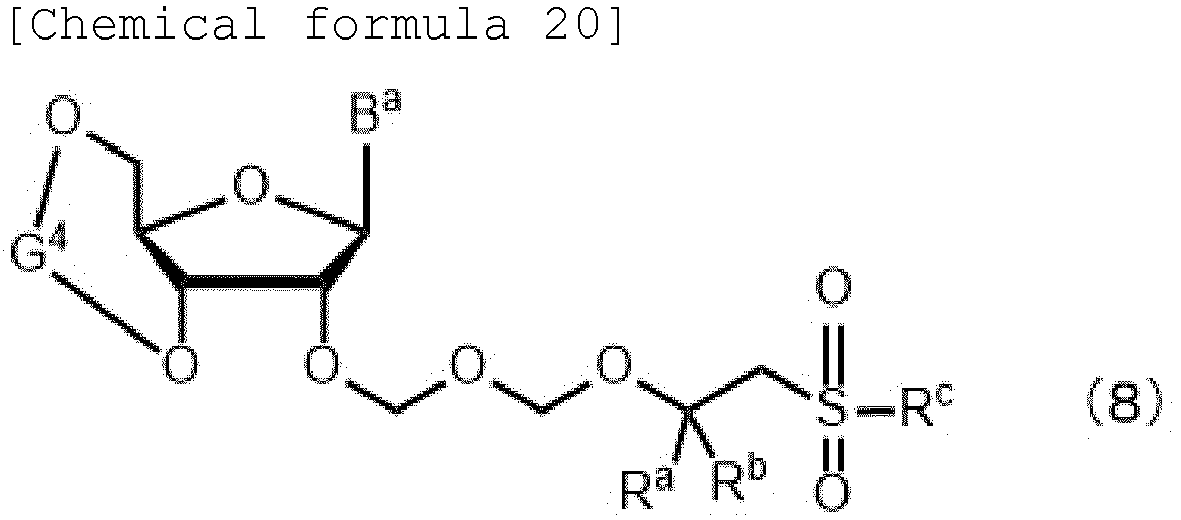
- Item 19 A compound represented by formula (8): wherein B a , R a , R b , R c , and G 4 are as defined in Item 16.
- Item 20 A compound represented by formula (9): wherein B a , R a , R b , and R c are as defined in Item 16,
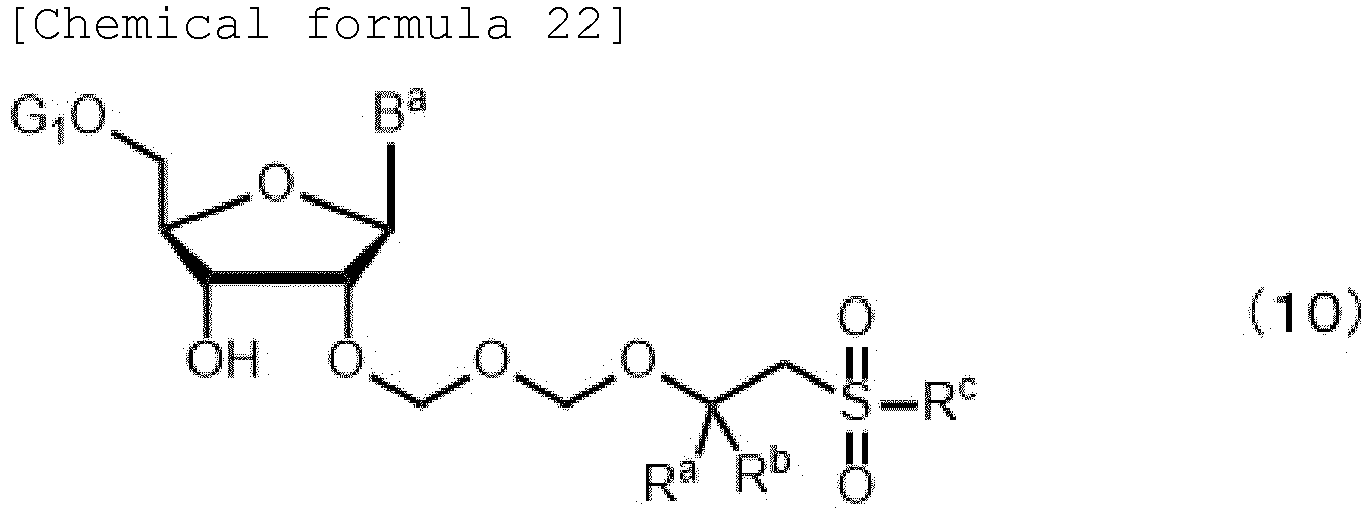
- Item 21 A compound represented by formula (10) (hereinafter referred to as "glycoside compound of the present invention"): wherein B a , R a , R b , R c , and G 1 are as defined in Item 17,
- An amidite compound can be obtained by using a glycoside compound of the present invention, and as a result, it is possible to improve a yield and a purity of RNA in the solid-phase synthesis.
- An amidite compound of the present invention is represented by formula (1): wherein R represents a formula: wherein:
- a nucleobase for B a is not particularly limited.
- the nucleobase include adenine, cytosine, guanine, uracil, thymine, 5-methylcytosine, pseudouracil, 1-methylpseudouracil, and others.
- the nucleobase may be substituted with a substituent.
- substituents examples include a halogen atom, an acyl group, an alkyl group, an arylalkyl group, an alkoxy group, an alkoxyalkyl group, a cyanoalkyl group, a hydroxy group, a hydroxymethyl group, an acyloxymethyl group, an amino group, a monoalkylamino group, a dialkylamino group, a carboxy group, a cyano group, a nitro group, and others as well as a combination of two or more of these substituents.
- a protecting group of the amino group is not particularly limited, and any publicly known protecting groups used in nucleic acid chemistry can be used.
- the protecting groups include a methyl group, a benzoyl group, a 4-methoxybenzoyl group, an acetyl group, a propionyl group, a butyryl group, an isobutyryl group, a phenylacetyl group, a phenoxyacetyl group, a 4-tert-butylphenoxyacetyl group, a 4-isopropylphenoxyacetyl group, a (dimethylamino)methylene group, and others as well as a combination of two or more of these protecting groups.
- G 1 Any groups can be used as G 1 without particular limitations when they may function as a protecting group, and publicly known protecting groups used for an amidite compound can widely be used.
- G 1 is preferably the following group: wherein R 1 , R 2 , and R 3 are identical to or different from each other and each represents hydrogen or an alkoxy group.
- R 1 , R 2 , and R 3 is a hydrogen and the remaining two thereof are an alkoxy group, and examples of the alkoxy group particularly preferably include a methoxy group.
- G 2 Any groups can be used as G 2 without particular limitations when they may function as a protecting group, and publicly known protecting groups used for an amidite compound can widely be used.
- G 2 include a hydrogen atom, an alkyl group, an alkenyl group, an alkynyl group, a cycloalkyl group, a haloalkyl group, an aryl group, a heteroaryl group, an arylalkyl group, a cycloalkenyl group, a cycloalkylalkyl group, a cyclylalkyl group, a hydroxyalkyl group, an aminoalkyl group, an alkoxyalkyl group, a heterocyclylalkenyl group, a heterocyclylalkyl group, a heteroarylalkyl group, a silyl group, a silyloxyalkyl group, a mono-, di-, or tri-alkylsilyl group, a mono-, di-, or tri
- G 2 is preferably an alkyl group substituted with an electron withdrawing group.
- the electron withdrawing groups include a cyano group, a nitro group, an alkylsulfonyl group, halogen, an arylsulfonyl group, a trihalomethyl group, a trialkylamino group, and others, preferably a cyano group.
- G 2 is particularly preferably the following group:
- G 3 two G 3 may be bonded to each other to form a cyclic structure.
- Both G 3 groups are preferably isopropyl groups.
- An alkyl group may be a straight or branched group, and is preferably an alkyl group having 1 to 12 carbon atoms, and more preferably an alkyl group having 1 to 6 carbon atoms.
- Examples of the alkyl group include methyl, ethyl, n-propyl, isopropyl, n-butyl, isobutyl, tert-butyl, n-pentyl, isopentyl, and hexyl.
- the alkyl group used herein also includes an alkyl moiety such as an alkoxy group.
- R a is preferably methyl.
- n is preferably an integer of 1 to 4, more preferably an integer of 1 to 3, still more preferably 1 or 2, and particularly preferably 1.
- a Salt of the amidite compound of the present invention is not particularly limited, and includes, for example, a salt with an inorganic base such as a sodium salt, a magnesium salt, a potassium salt, a calcium salt, and an aluminum salt; a salt with an organic base such as a methylamine, an ethylamine, and an ethanolamine; a salt with a basic amino acid such as lysine, ornithine, and arginine; and an ammonium salt.
- the salt may be an acid addition salt, and specific examples of the salt include a mineral acid such as a hydrochloric acid, a hydrobromic acid, a hydroiodic acid, a sulfuric acid, a nitric acid, and a phosphoric acid; an organic acid such as a formic acid, an acetic acid, a propionic acid, an oxalic acid, a malonic acid, a malic acid, a tartaric acid, a fumaric acid, a succinic acid, a lactic acid, a maleic acid, a citric acid, a methanesulfonic acid, a trifluoromethanesulfonic acid, and an ethanesulfonic acid; and an acid addition salt with an acidic amino acid such as an aspartic acid and a glutamic acid.
- the amidite compound of the present invention also includes a salt, a hydrate, a solvate, a crystal polymorph, and others.
- the amidite compound of the present invention can be produced according to a publicly known method such as those described in JP 5157168 B2 , JP 5554881 B2 , and the like or the methods described in Examples below, or by a method with appropriate modifications added to these methods as needed.
- the present invention includes a glycoside compound represented by the following formula (10): wherein the groups are as defined above.
- glycoside compound of the present invention include the following compound described in Examples.
- the present invention also includes a production intermediate compound for the glycoside compound represented by formula (10).
- the intermediate compound include an ether compound represented by formula (4): wherein:
- the ether compound represented by formula (4) can be produced by reacting a bisthioether compound represented by formula (12) (for example, bis(alkylthiomethyl)ether or bis(phenylthiomethyl)ether) with 3-hydroxy-3-alkylpropanesulfone in a solvent in the presence of a halogenating agent and an acid as shown in the following reaction formula.
- a bisthioether compound represented by formula (12) for example, bis(alkylthiomethyl)ether or bis(phenylthiomethyl)ether
- the bisthioether compound of formula (12) can be obtained, for example, by reacting a bischloromethylether or a bis(aryloxymethyl)ether with a corresponding alkyl mercaptan or phenyl mercaptan as shown in the following formula.
- Examples of the bis(aryloxymethyl)ether include a bis(2,4,6-trichlorophenyloxymethyl)ether.
- the bisthioether compound of formula (12) can also be produced according to a publicly known production method, for example, the method described in JP 6459852 B2 .
- Step a of producing a compound of formula (6) as one example of the ether compound of formula (4) will be explained.
- Step a will be explained below.
- halogenating agent examples include an N-halogenated succinimide such as an N-chlorosuccinimide, an N-bromosuccinimide, and an N-iodosuccinimide, an N-halogenated hydantoin such as a 1,3-diiodo-5,5-dimethylhydantoin, a halogen such as chlorine, bromine, and iodine, and the like as well as a combination of two or more thereof .
- an N-halogenated succinimide is preferably used, and an N-iodosuccinimide is more preferably used.
- An acid is not particularly limited, and includes, for example, a perfluoroalkyl carboxylic acid and a salt thereof, a perfluoroalkyl sulfonic acid and a salt thereof, and an alkyl sulfonic acid and a salt thereof as well as a combination of two or more thereof.
- a salt include for example, a copper salt and a silver salt.
- Specific examples of the acid include a methanesulfonic acid, a para-toluenesulfonic acid, a camphorsulfonic acid, a trifluoromethanesulfonic acid, a silver trifluoromethanesulfonate as well as a combination of two or more thereof.
- a trifluoromethanesulfonic acid is preferably used.
- Examples of a solvent include a tetrahydrofuran, a 2-methyltetrahydrofuran, a cyclopentyl methyl ether, a dioxane, a dichloromethane, a toluene, and the like as well as a combination of two or more thereof.
- a tetrahydrofuran is preferably used.
- the amount of the 2-hydroxyalkylsulfone of formula (5) is usually 0.5 to 2.0 equivalents and preferably 0.8 to 1.5 equivalents relative to the bisthioether compound of formula (12).
- the amount of the halogenating agent is usually 0.5 to 2 equivalents and preferably 0.7 to 1.2 equivalents relative to the compound of formula (12).
- the amount of the acid is usually 0.001 to 2.0 equivalents and preferably 0.01 to 0.1 equivalents relative to the compound of formula (12).
- the reaction temperature of this reaction is usually -80°C to 0°C and preferably -50°C to -30°C.
- the reaction time of this reaction is usually 1 to 24 hours and preferably 2 to 6 hours.
- the completion of the reaction can be confirmed, for example, by sampling and analyzing a part of a reaction mass by an analysis method such as GC, TLC, and LC.
- a base such as a triethylamine may be added to the reaction mass to stop the reaction.
- a residue containing the ether compound represented by formula (4) can be obtained by adding the reaction mass to water and subjecting the reaction mass to usual post-treatment operations such as organic solvent extraction, washing, and concentration.
- the ether compound represented by formula (4) with a high-purity can be obtained by subjecting the residue to a purification operation such as distillation and column chromatography.
- a preferred compound is one represented by formula (6): wherein R a represents a methyl group or an ethyl group, R b represents a hydrogen atom, and R c represents a phenyl group or a tolyl group, and more preferably, R a is a methyl group, R b is a hydrogen atom, and R c is a tolyl group.
- the amidite compound of the present invention can be used as a material for producing RNA in the solid-phase synthesis.
- RNA with a high purity can produced by using the amidite compound of the present invention in the solid-phase synthesis.
- a production method for a compound containing a polynucleotide structure represented by the following formula (2) of the present invention includes a step of performing a solid-phase synthesis reaction using the amidite compound: wherein B a is identical to or different from each other and each represents a group having an optionally-protected nucleobase structure,
- the production method of the present invention can also include a step of treating a compound having an oligonucleotide structure represented by formula (3) with a tetraalkylammonium fluoride to obtain the compound having an oligonucleotide structure represented by formula (2): wherein B a is identical to or different from each other and each represents a group having an optionally-protected nucleobase structure,
- n is not particularly limited, and is preferably an integer of 2 to 300.
- the "compound containing a polynucleotide structure” means a compound having at least one RNA, preferably a compound consisting of only RNA.
- the solid-phase synthesis reaction can be conducted according to a publicly known method such as the phosphoramidite method (for example, the methods described in JP 5157168 B2 and JP 5554881 B2 ). Also, the solid-phase synthesis reaction can be conducted with a commercially available automatic synthesis device for a nucleic acid and others.
- the production method for the compound containing a polynucleotide structure represented by formula (2) specifically includes steps such as (A) a step of deprotecting a hydroxyl group at the 5' position of a first amidite compound supported on a solid support (for example, G 1 in formula (1)); (B) a step of condensing the deprotected amidite compound formed in step (A) with a second amidite compound; (C) an optional step of capping a hydroxyl group at the 5' position of an unreacted compound in step (B); (D) a step of converting a phosphorus acid group of the condensate formed in (B) or (C) into a phosphate group or a thiophosphate group; (E) a step of cutting the compound obtained in step (D) from the solid support and deprotecting a hydroxyl groups at the 2' position and a nucleobase; and (F) a step of deprotecting the hydroxyl group at the 5' position. Steps (
- the compound having an oligonucleotide structure represented by formula (3) can preferably be treated with a tetraalkylammonium fluoride to eliminate a protecting group at the 2' position, and to produce the compound having an oligonucleotide structure represented by formula (2).
- the conditions according to publicly known methods can be adopted into the reaction conditions for the reaction (the reaction temperature, the reaction time, the amount of a reagent, etc.) .
- the compound having an oligonucleotide structure represented by formula (2), obtained by the production method of the present invention may be isolated and purified as needed.
- isolation can be performed by using a method of precipitating, extracting, and purifying RNA.
- HPLC high performance liquid chromatography
- RNA can be produced with a higher purity in the production method of the present invention than that in a conventional one.
- reaction conditions are not particularly limited for producing the amidite compound of the present invention represented by formula (1), the glycoside compound of the present invention of formula (10), and the intermediate ether compound of the present invention represented by formula (4).
- the intermediate ether compound represented by formula (4) can also be synthesized using a flow reactor.
- a reduction step with hydrogen or a reduction step with magnesium or the like can be added in the presence of a transition metal catalyst such as palladium.
- the 2-hydroxyalkylsulfone represented by formula (5) can also be synthesized via the following production route with reference to the following Documents 1 to 6.
- the compound of formula (1) can be produced from a compound of formula (7) in the following steps 1, 2, 3, and 4 of scheme 1.
- G 4 typically has the following G 4 -1 or G 4 -2 structure.
- These compounds can be purchased as commercial products, or can be produced, for example, by the method described in Tetrahedron Letters, 2005, 46, 2961 .
- Step 1 etherification step
- the etherification step is carried out by reacting the compound of formula (7) with the compound of formula (4). This reaction is usually carried out by adding a halogenating agent.
- the halogenating agent used in this step is not particularly limited, and is preferably at least one selected from the group consisting of an N-chlorosuccinimide, an N-bromosuccinimide, an N-iodosuccinimide, iodine, a 1,3-diiodo -5,5'-dimethylhydantoin, bromine, and chlorine.
- an acid may be added, and the acid to be used is not particularly limited and is preferably at least one selected from the group consisting of a perfluoroalkyl carboxylic acid, a perfluoroalkylsulfonic acid, an alkyl sulfonic acid, and a salt thereof.
- a reaction solvent used in this step is not particularly limited, and examples thereof include an ether such as a diethyl ether, a tetrahydrofuran (THF), a 2-methyltetrahydrofuran, a tetrahydropyran, a 4-methyltetrahydropyran, a dimethoxyethane, a diglyme, a cyclopentyl methyl ether, and a dioxane, or a nitrile such as an acetonitrile, an aromatic hydrocarbon such as a toluene, a chlorobenzene, and a dichlorobenzene, a dichloromethane, and the like as well as a combination of two or more of these solvents.
- an ether such as a diethyl ether, a tetrahydrofuran (THF), a 2-methyltetrahydrofuran, a tetrahydropyran, a 4-methyltetrahydro
- the solvent include an ether such as a diethyl ether, a tetrahydrofuran (THF), a 2-methyltetrahydrofuran, a tetrahydropyran, a 4-methyltetrahydropyran, a dimethoxyethane, a diglyme, a cyclopentyl methyl ether, and a dioxane.
- ether such as a diethyl ether, a tetrahydrofuran (THF), a 2-methyltetrahydrofuran, a tetrahydropyran, a 4-methyltetrahydropyran, a dimethoxyethane, a diglyme, a cyclopentyl methyl ether, and a dioxane.
- the reaction time in this step is not particularly limited, and is, for example, 10 minutes to 12 hours, preferably 10 minutes to 6 hours.
- the reaction temperature in this step is not particularly limited, and is, for example, -80 to 30°C, preferably -60 to 10°C.
- the concentration of the ether compound represented by formula (4) in this step is also not particularly limited, and can be set as appropriate.
- the number of moles of the ether compound represented by formula (4) in this step is, for example, 0.5 to 2 times, preferably 0.8 to 1.5 times the number of moles of the compound represented by formula (7).
- the number of moles of the halogenating agent in this step is, for example, 0.5 to 10 times, preferably 0.8 to 6 times the number of moles of the compound represented by formula (7).
- a compound of formula (8) obtained in step 1 is subjected to a deprotection reaction to be converted into a compound of formula (9).
- the deprotection step can be carried out by a publicly known method, and typically, a hydrogen fluoride/a triethylamine, a hydrogen fluoride/a pyridine, or a triethylamine trihydrofluoride is caused to act in a solvent to perform deprotection.
- the compound of formula (9) obtained in the above step is subjected to the protection step, and introduction of a protecting group can be carried out by a publicly known method.
- a compound (9) is reacted with a 4,4'-dimethoxytrityl chloride in a pyridine to introduce a protecting group, thereby producing a compound (10).
- This step is carried out by reacting the glycoside compound of formula (10) obtained in the above step with a compound of formula (11). Typically, this step is carried out by reacting a 2-cyanoethyl-N,N,N',N'-tetraisopropylphosphordiamidite as the compound of formula (11) in the presence of diisopropylammonium tetrazolide.
- the amidite step can be carried out according to the methods described in Examples 2 to 5 of JP 5554881 B2 .
- the compounds of formulae (7), (8), (9), and (10) can be used in the production of the amidite compound of formula (1).
- TPM (1-(4-methylbenzenesulfonyl)propan-2-yl)oxy)methoxy)methyl group;
- N-iodosuccinimide N-iodosuccinimide
- TfOH trifluoromethanesulfonic acid
- NIS (2.06 g, 9.15mmol, 1.35eq.) was added to the mixture, and TfOH (0.72 mL, 8.14 mmol, 1.2 eq.) was dropped at -55 to -45°C.
- the mixture was stirred at -55 to -45°C for 1 hour, and the reaction solution was added to a mixed liquid including a sodium thiosulfate pentahydrate (3.3 g), a sodium hydrogen carbonate (1.12 g), water (22 mL), and a toluene which had been cooled in an ice bath. The mixture was stirred in the ice bath for 30 minutes and separated.
- a solution including a sodium thiosulfate pentahydrate (1.65 g), a sodium hydrogen carbonate (0.6 g), and water (11 mL) was added to an organic layer, and the mixture was stirred at room temperature for 15 minutes and then separated. The organic layer was dried with a sodium sulfate (1 g) and then concentrated to dryness under reduced pressure. A residue was purified by silica gel column chromatography (hexane/ethyl acetate 3/1, silica gel 250 mL) to obtain colorless clear glassy solid TPM-U-2 (5.3 g).
- TPM-U-2 (5.3 g, 7.13 mmol) was dissolved in an acetone (10 mL), triethylamine hydrotrifluoride (1.3 mL, 7.84 mmol) was added, and the mixture was stirred at room temperature for 2 hours.
- Methyl tert-butyl ether (MTBE) (53 mL) was added to the reaction solution, the mixture was stirred for 30 minutes, and then a MTBE layer was removed by decantation. This procedure was repeated 3 times, and then the residue was dried and solidified under reduced pressure to obtain white amorphous TPM-U-3 (3.5 g).
- TPM-U-4 (4.7 g, 5.85 mmol) was dissolved in an anhydrous acetonitrile (47 mL, 10 vol/wt), then diisopropylammonium tetrazolide (1.10 g, 6.56 mmol, 1.12 eq.) and Molecular Sieves 4A (0.94 g, 0.2 wt/wt) were added, and the mixture was stirred at room temperature for 30 minutes.
- Solid-phase synthesis was performed from the 3' side toward the 5' side using NTS M-4MX-E (manufactured by NIHON TECHNO SERVICE CO., LTD.) as a nucleic acid synthesis device.
- NTS M-4MX-E manufactured by NIHON TECHNO SERVICE CO., LTD.
- porous glass was used as a solid support
- a high-purity trichloroacetic acid toluene solution was used as a deblocking solution
- 5-benzylmercapto-1H-tetrazole was used as a condensing agent
- an iodine solution was used as an oxidizing agent
- a phenoxyacetic acid solution and a N-methylimidazole solution were used as a capping solution.
- the purity of an oligonucleotide crude product after the solid-phase synthesis was measured by HPLC.
- the crude product was separated into each component by HPLC (wavelength 260 nm, column ACQUITY UPLC Oligonucleotide BEH C18, 2.1 mm ⁇ 100 mm), and the purity of the oligonucleotide was calculated from the obtained area value of a main product relative to the total area value of chromatogram.
- the OD 260 for 0.173 ⁇ mol was 37.21 OD, and the purity was 53.5%. From the OD 260 value, the yield for 1 ⁇ mol was calculated as 8603 ⁇ g/ ⁇ mol.
- Solid-phase synthesis was performed in the same manner as in the method described in Production Example 6 by using the uridine EMM amidite described in Example 2 of JP 5554881 B2 to produce a uridine 50-mer, and as a result, the OD 260 for 0.228 ⁇ mol was 41.41 OD and the purity thereof was 44.1%. From the OD 260 value, the yield for 1 ⁇ mol was calculated as 7264 ⁇ g/ ⁇ mol.
- Example 1 Comparative Example 1 Purity of uridine 50-mer (%) 53.5 44.1 Yield ( ⁇ g/ ⁇ mol) 8603 7264 Yield (%) 56.4 47.6
- the present invention provides a sulfone group-containing ether compound which is useful as a protecting group of a hydroxyl group at the 2' position of an amidite, and an amidite compound having the sulfone group-containing ether moiety.
- the amidite compound of the present invention is suitable for synthesis of an oligonucleic acid with a high-purity.
- SEQ ID NO: 1 in Sequence Listing represents the base sequence of the uridine 50-mer.
Landscapes
- Chemical & Material Sciences (AREA)
- Organic Chemistry (AREA)
- Life Sciences & Earth Sciences (AREA)
- Health & Medical Sciences (AREA)
- Engineering & Computer Science (AREA)
- Genetics & Genomics (AREA)
- Molecular Biology (AREA)
- Biotechnology (AREA)
- Biochemistry (AREA)
- General Health & Medical Sciences (AREA)
- Biomedical Technology (AREA)
- Wood Science & Technology (AREA)
- Zoology (AREA)
- General Engineering & Computer Science (AREA)
- Bioinformatics & Cheminformatics (AREA)
- Chemical Kinetics & Catalysis (AREA)
- Physics & Mathematics (AREA)
- Biophysics (AREA)
- Microbiology (AREA)
- Plant Pathology (AREA)
- Analytical Chemistry (AREA)
- Proteomics, Peptides & Aminoacids (AREA)
- Immunology (AREA)
- Saccharide Compounds (AREA)
Abstract
Description
- This patent application claims priority to and the benefit of
Japanese Patent Application No. 2019-192899 filed on October 23, 2019 - The present invention relates to a glycoside compound, an amidite compound thereof, and a production method for a polynucleotide using the compounds. The present invention further relates to an intermediate compound of the glycoside compound and a production method for the intermediate compound.
- RNA can be used as an RNA probe, an antisense RNA, a ribozyme, an siRNA, an aptamer, or the like, and is a useful material.
- RNA can be synthesized by the solid-phase synthesis or the like, and in the solid-phase synthesis, phosphoramidite of nucleoside (hereinafter referred to as "amidite") is used as a raw material. Examples of a protecting group of a hydroxyl group at the 2' position of the amidite include t-butyldimethylsilyl (TBDMS), triisopropylsilyloxymethyl (TOM), bis(2-acetoxyethoxy)methyl (ACE), and others. Further, although the protecting groups of the hydroxyl group at the 2' position of the amidite which are disclosed in Patent Documents 1 to 4 have been reported, a yield or a purity of RNA obtained through a synthesis method of RNA using an amidite containing these protecting groups may be unsatisfactory.
-
- Patent Document 1:
JP 5157168 B2 - Patent Document 2:
JP 5554881 B2 - Patent Document 3:
WO 2007/064291 A - Patent Document 4:
WO 2013/027843 A - An object of the present invention is to provide an amidite compound capable of improving a yield and a purity of a polynucleotide, and a production method for a polynucleotide using the amidite compound. Further, an object of the present invention is to provide a glycoside compound as an intermediate of the amidite compound, and a production method for an intermediate ether compound of the glycoside compound.
- The present inventors have intensively studied to achieve the objects, and as a result, found that use of the following group as a protecting group of a hydroxyl group at the 2' position of an amidite could lead to synthesis of RNA with high purity:

- Ra and Rb are identical to or different from each other and each represents a methyl group, an ethyl group, or a hydrogen atom, provided that Ra and Rb do not represent a hydrogen atom at the same time; and
- Rc represents a phenyl group, a C1 to C10 alkyl group, or a benzyl group which may be substituted with a halogen atom, a methyl group, a nitro group, a methoxy group, or a trifluoromethyl group.
- The present invention has been completed after further examinations on the basis of these findings, and provides the following glycoside compound, an amidite compound thereof, a production method for a polynucleotide using the amidite compound, an ether compound as an intermediate of the glycoside compound, and a production method for the ether compound.
- The present invention includes embodiments described in the following items, but is not limited thereto.
- Item 1. An amidite compound represented by formula (1) (hereinafter referred to as "amidite compound of the present invention"):
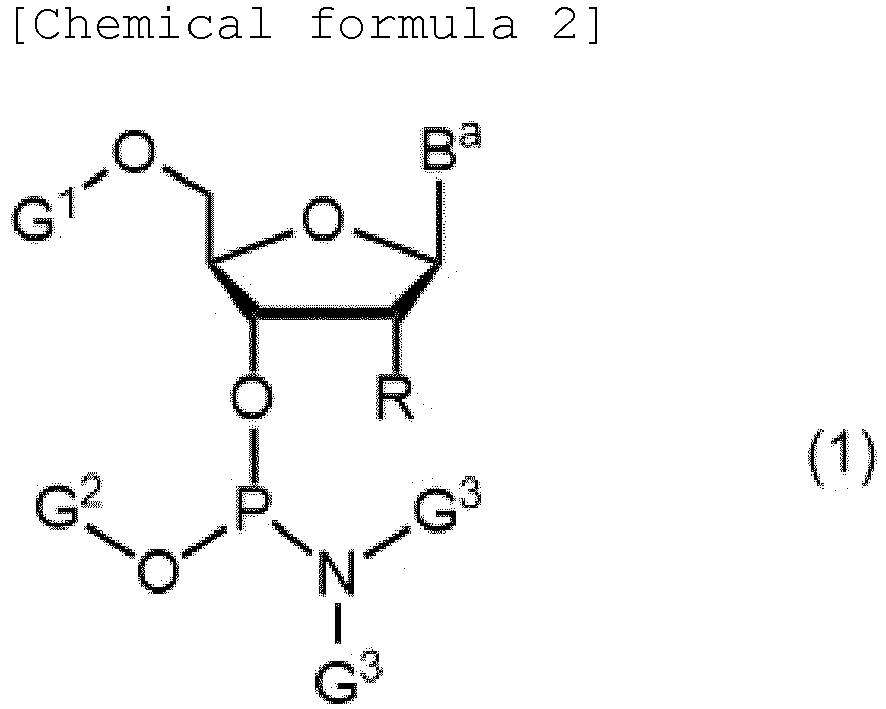
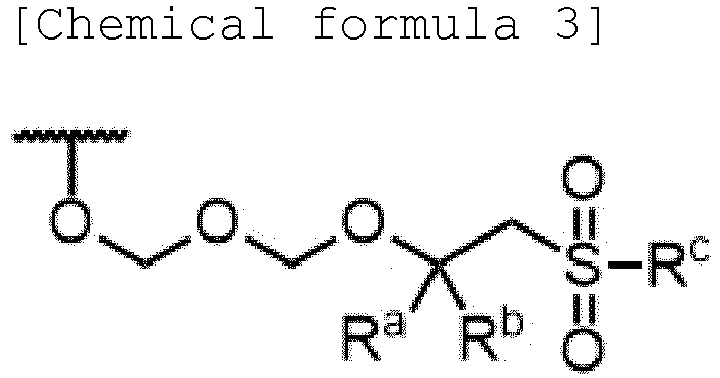
- Ra and Rb are identical to or different from each other and each represents a methyl group, an ethyl group, or a hydrogen atom, provided that Ra and Rb do not represent a hydrogen atom at the same time; and
- Rc represents a phenyl group, a C1 to C10 alkyl group, or a benzyl group which may be substituted with a halogen atom, a methyl group, a nitro group, a methoxy group, or a trifluoromethyl group,
- Ba represents a group having an optionally-protected nucleobase structure,
- G1 and G2 are identical to or different from each other and each represents a protecting group of a hydroxyl group, and
- G3 is identical to or different from each other and each represents an alkyl group.
- Item 2. The amidite compound according to Item 1, wherein Ra represents a methyl group, and Rb represents a hydrogen atom.
- Item 3. The amidite compound according to Item 1, wherein Ra and Rb both represent a methyl group.
- Item 4. The amidite compound according to any one of Items 1 to 3, wherein G1 represents the following group:


- Item 5. The amidite compound according to any one of Items 1 to 4, wherein G2 represents the following group.

- Item 6. The amidite compound according to any one of Items 1 to 5, wherein G3 represents an isopropyl group.
- Item 7. The amidite compound according to any one of Items 1 to 6, wherein Rc represents a phenyl group or a tolyl group.
- Item 8. A production method for a compound containing a polynucleotide structure represented by formula (2), the method including a step of using the amidite compound according to any one of Items 1 to 7 for a solid-phase synthesis reaction:


- X represents an oxygen atom or a sulfur atom, and
- m represents a positive integer.
- Item 9. The production method according to Item 8, wherein the compound containing a polynucleotide structure of formula (2) is a compound formed in a step of reacting a compound having an oligonucleotide structure represented by formula (3), formed in the solid-phase synthesis reaction using the amidite compound, with a tetraalkylammonium fluoride:

- X represents an oxygen atom or a sulfur atom, and
- R is identical to or different from each other and each represents a group represented by a formula:

- Ra and Rb are identical to or different from each other and each represents a methyl group, an ethyl group, or a hydrogen atom, provided that Ra and Rb do not represent a hydrogen atom at the same time; and
- Rc represents a phenyl group, a C1 to C10 alkyl group, or a benzyl group which may be substituted with a halogen atom, a methyl group, a nitro group, a methoxy group, or a trifluoromethyl group.
- Item 10. The production method according to Item 9, wherein Ra represents a methyl group, and Rb represents a hydrogen atom.
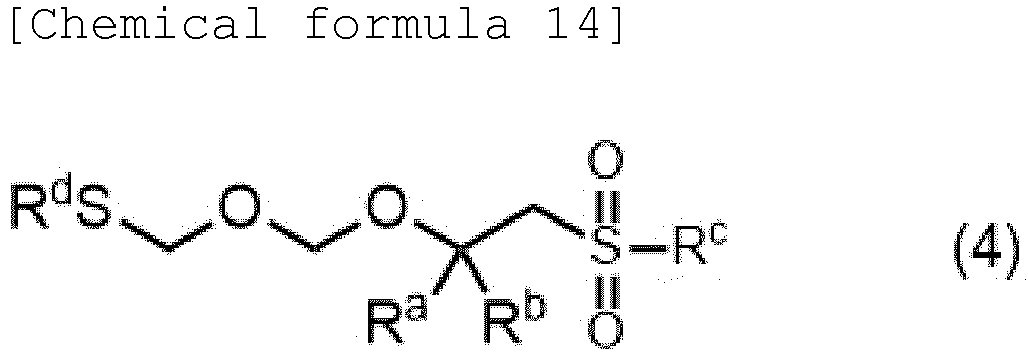
- Item 11. An ether compound represented by formula (4) :


- Ra and Rb are identical to or different from each other and each represents a methyl group, an ethyl group, or a hydrogen atom, provided that Ra and Rb do not represent a hydrogen atom at the same time;
- Rc represents a phenyl group, a C1 to C10 alkyl group, or a benzyl group which may be substituted with a halogen atom, a methyl group, a nitro group, a methoxy group, or a trifluoromethyl group; and Rd represents C1 to C10 alkyl or a phenyl group.
- Item 12. The ether compound according to Item 11, wherein Ra represents a methyl group, Rb represents a hydrogen atom, and Rc represents a phenyl group or a tolyl group.
- Item 13. A production method for an ether compound represented by formula (4), the method including step a of reacting a 2-hydroxyalkylsulfone represented by a formula with a bisthioether compound represented by formula (12) in a solvent in presence of a halogenating agent and an acid:

- Ra and Rb are identical to or different from each other and each represents a methyl group, an ethyl group, or a hydrogen atom, provided that Ra and Rb do not represent a hydrogen atom at the same time; and
- Rc represents a phenyl group, a C1 to C10 alkyl group, or a benzyl group which may be substituted with a halogen atom, a methyl group, a nitro group, a methoxy group, or a trifluoromethyl group.


- Item 14. The production method according to Item 13, wherein Ra represents a methyl group or an ethyl group, Rb represents a hydrogen atom, and Rc represents a phenyl group or a tolyl group.
- Item 15. The production method according to Item 13, wherein Ra represents a methyl group, Rb represents a hydrogen atom, and Rc represents a phenyl group or a tolyl group.
- Item 16. A production method for a compound represented by formula (8), the method including reacting a compound represented by formula (7) with a compound represented by formula (4) in presence of a halogenating agent:


- Item 17. A production method for the compound of formula (1) according to Item 1, the method including the steps of:
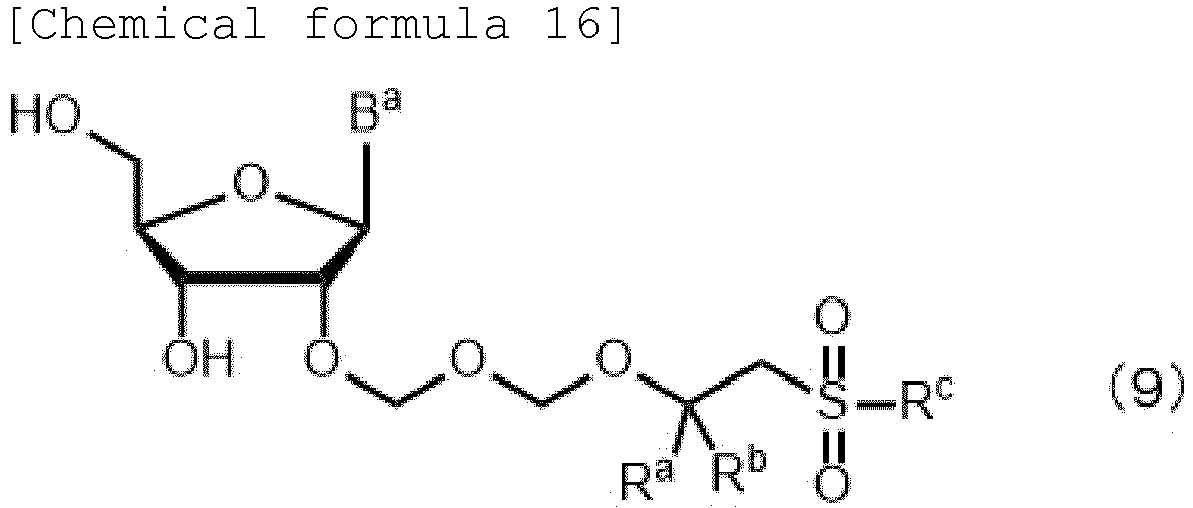
- further deprotecting the compound of formula (8) to obtain a compound represented by formula (9);
- selectively protecting a hydroxyl group at the 5' position of the compound of formula (9) to obtain a compound represented by formula (10); and
- reacting the compound of formula (10) with a phosphordiamidite represented by formula (11):


- Item 18. The production method according to Item 17, wherein G4 has a G4-1 or G4-2 structure.

- Item 19. A compound represented by formula (8):


- Item 21. A compound represented by formula (10) (hereinafter referred to as "glycoside compound of the present invention"):
- Item 22. Use of the amidite compound of formula (1) in production of RNA.
- An amidite compound can be obtained by using a glycoside compound of the present invention, and as a result, it is possible to improve a yield and a purity of RNA in the solid-phase synthesis.
- Hereinafter, the present invention will be explained in detail.
- As used herein, the expression of "comprise" encompasses the meanings of "essentially consist of" and "consist of".
- An amidite compound of the present invention is represented by formula (1):


- Ra and Rb are identical to or different from each other and each represents a methyl group, an ethyl group, or a hydrogen atom, provided that Ra and Rb do not represent a hydrogen atom at the same time; and
- Rc represents a phenyl group, a C1 to C10 alkyl group, or a benzyl group which may be substituted with a halogen atom, a methyl group, a nitro group, a methoxy group, or a trifluoromethyl group,
- Ba represents a group having an optionally-protected nucleobase structure,
- G1 and G2 are identical to or different from each other and each represents a protecting group of a hydroxyl group, and
- G3 is identical to or different from each other and each represents an alkyl group.
- A nucleobase for Ba is not particularly limited. Examples of the nucleobase include adenine, cytosine, guanine, uracil, thymine, 5-methylcytosine, pseudouracil, 1-methylpseudouracil, and others. Also, the nucleobase may be substituted with a substituent. Examples of the substituent include a halogen atom, an acyl group, an alkyl group, an arylalkyl group, an alkoxy group, an alkoxyalkyl group, a cyanoalkyl group, a hydroxy group, a hydroxymethyl group, an acyloxymethyl group, an amino group, a monoalkylamino group, a dialkylamino group, a carboxy group, a cyano group, a nitro group, and others as well as a combination of two or more of these substituents.
- When the nucleobase contains an exocyclic amino group, a protecting group of the amino group is not particularly limited, and any publicly known protecting groups used in nucleic acid chemistry can be used. Examples of the protecting groups include a methyl group, a benzoyl group, a 4-methoxybenzoyl group, an acetyl group, a propionyl group, a butyryl group, an isobutyryl group, a phenylacetyl group, a phenoxyacetyl group, a 4-tert-butylphenoxyacetyl group, a 4-isopropylphenoxyacetyl group, a (dimethylamino)methylene group, and others as well as a combination of two or more of these protecting groups.
- Ba more specifically represents a group represented by any of the following formulae:


- R4 represents a hydrogen atom, a methyl group, a phenoxyacetyl group, a 4-tert-butylphenoxyacetyl group, a 4-isopropylphenoxyacetyl group, a phenylacetyl group, an acetyl group, or a benzoyl group;
- R5 represents a hydrogen atom, an acetyl group, an isobutyryl group, or a benzoyl group;
- R6 represents a hydrogen atom, a phenoxyacetyl group, a 4-tert-butylphenoxyacetyl group, a 4-isopropylphenoxyacetyl group, a phenylacetyl group, an acetyl group, or an isobutyryl group;
- R7 represents a 2-cyanoethyl group;
- R8 represents a hydrogen atom, a methyl group, a benzoyl group, a 4-methoxybenzoyl group, or a 4-methylbenzoyl group; and
- R9 represents a dimethylaminomethylene group.
- Any groups can be used as G1 without particular limitations when they may function as a protecting group, and publicly known protecting groups used for an amidite compound can widely be used.
- G1 is preferably the following group:

- It is preferable that one of R1, R2, and R3 is a hydrogen and the remaining two thereof are an alkoxy group, and examples of the alkoxy group particularly preferably include a methoxy group.
- Any groups can be used as G2 without particular limitations when they may function as a protecting group, and publicly known protecting groups used for an amidite compound can widely be used. Examples of G2 include a hydrogen atom, an alkyl group, an alkenyl group, an alkynyl group, a cycloalkyl group, a haloalkyl group, an aryl group, a heteroaryl group, an arylalkyl group, a cycloalkenyl group, a cycloalkylalkyl group, a cyclylalkyl group, a hydroxyalkyl group, an aminoalkyl group, an alkoxyalkyl group, a heterocyclylalkenyl group, a heterocyclylalkyl group, a heteroarylalkyl group, a silyl group, a silyloxyalkyl group, a mono-, di-, or tri-alkylsilyl group, a mono-, di-, or tri-alkylsilyloxyalkyl group, and others, and these may be substituted with one or more electron withdrawing groups.
- G2 is preferably an alkyl group substituted with an electron withdrawing group. Examples of the electron withdrawing groups include a cyano group, a nitro group, an alkylsulfonyl group, halogen, an arylsulfonyl group, a trihalomethyl group, a trialkylamino group, and others, preferably a cyano group.
- G2 is particularly preferably the following group:

- With respect to G3, two G3 may be bonded to each other to form a cyclic structure. Both G3 groups are preferably isopropyl groups.
- An alkyl group may be a straight or branched group, and is preferably an alkyl group having 1 to 12 carbon atoms, and more preferably an alkyl group having 1 to 6 carbon atoms. Examples of the alkyl group include methyl, ethyl, n-propyl, isopropyl, n-butyl, isobutyl, tert-butyl, n-pentyl, isopentyl, and hexyl. The alkyl group used herein also includes an alkyl moiety such as an alkoxy group.
- Ra is preferably methyl. n is preferably an integer of 1 to 4, more preferably an integer of 1 to 3, still more preferably 1 or 2, and particularly preferably 1.
- Also, the amidite compound of the present invention can be used in a free state or a salt state. A Salt of the amidite compound of the present invention is not particularly limited, and includes, for example, a salt with an inorganic base such as a sodium salt, a magnesium salt, a potassium salt, a calcium salt, and an aluminum salt; a salt with an organic base such as a methylamine, an ethylamine, and an ethanolamine; a salt with a basic amino acid such as lysine, ornithine, and arginine; and an ammonium salt. The salt may be an acid addition salt, and specific examples of the salt include a mineral acid such as a hydrochloric acid, a hydrobromic acid, a hydroiodic acid, a sulfuric acid, a nitric acid, and a phosphoric acid; an organic acid such as a formic acid, an acetic acid, a propionic acid, an oxalic acid, a malonic acid, a malic acid, a tartaric acid, a fumaric acid, a succinic acid, a lactic acid, a maleic acid, a citric acid, a methanesulfonic acid, a trifluoromethanesulfonic acid, and an ethanesulfonic acid; and an acid addition salt with an acidic amino acid such as an aspartic acid and a glutamic acid. The amidite compound of the present invention also includes a salt, a hydrate, a solvate, a crystal polymorph, and others.
- The amidite compound of the present invention can be produced according to a publicly known method such as those described in
JP 5157168 B2 JP 5554881 B2 - Also, specific examples of the amidite compound of the present invention include the following compound described in Examples.

- The present invention includes a glycoside compound represented by the following formula (10):
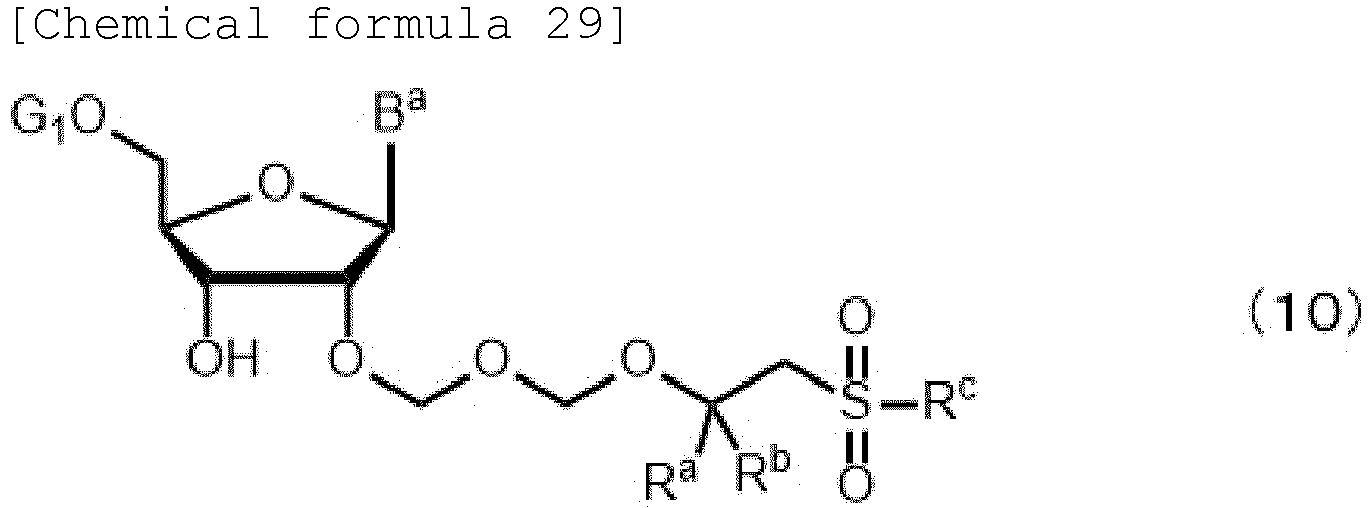
- Also, the specific examples of the glycoside compound of the present invention include the following compound described in Examples.


- The present invention also includes a production intermediate compound for the glycoside compound represented by formula (10). Examples of the intermediate compound include an ether compound represented by formula (4):

- Ra and Rb are identical to or different from each other and each represents a methyl group, an ethyl group, or a hydrogen atom, provided that Ra and Rb do not represent a hydrogen atom at the same time;
- Rc represents a phenyl group, a C1 to C10 alkyl group, or a benzyl group which may be substituted with a hydrogen atom, a halogen atom, a methyl group, a nitro group, a methoxy group, or a trifluoromethyl group; and Rd represents C1 to C10 alkyl or a phenyl group.
- The ether compound represented by formula (4) can be produced by reacting a bisthioether compound represented by formula (12) (for example, bis(alkylthiomethyl)ether or bis(phenylthiomethyl)ether) with 3-hydroxy-3-alkylpropanesulfone in a solvent in the presence of a halogenating agent and an acid as shown in the following reaction formula.

- The bisthioether compound of formula (12) can be obtained, for example, by reacting a bischloromethylether or a bis(aryloxymethyl)ether with a corresponding alkyl mercaptan or phenyl mercaptan as shown in the following formula. Examples of the bis(aryloxymethyl)ether include a bis(2,4,6-trichlorophenyloxymethyl)ether.

- The bisthioether compound of formula (12) can also be produced according to a publicly known production method, for example, the method described in
JP 6459852 B2 - Step a of producing a compound of formula (6) as one example of the ether compound of formula (4) will be explained.
- Step a will be explained below.
- Examples of the halogenating agent include an N-halogenated succinimide such as an N-chlorosuccinimide, an N-bromosuccinimide, and an N-iodosuccinimide, an N-halogenated hydantoin such as a 1,3-diiodo-5,5-dimethylhydantoin, a halogen such as chlorine, bromine, and iodine, and the like as well as a combination of two or more thereof . In the present invention, an N-halogenated succinimide is preferably used, and an N-iodosuccinimide is more preferably used.
- An acid is not particularly limited, and includes, for example, a perfluoroalkyl carboxylic acid and a salt thereof, a perfluoroalkyl sulfonic acid and a salt thereof, and an alkyl sulfonic acid and a salt thereof as well as a combination of two or more thereof. Examples of a salt include for example, a copper salt and a silver salt. Specific examples of the acid include a methanesulfonic acid, a para-toluenesulfonic acid, a camphorsulfonic acid, a trifluoromethanesulfonic acid, a silver trifluoromethanesulfonate as well as a combination of two or more thereof. In the present invention, a trifluoromethanesulfonic acid is preferably used.
- Examples of a solvent include a tetrahydrofuran, a 2-methyltetrahydrofuran, a cyclopentyl methyl ether, a dioxane, a dichloromethane, a toluene, and the like as well as a combination of two or more thereof. In the present invention, a tetrahydrofuran is preferably used.
- The amount of the 2-hydroxyalkylsulfone of formula (5) is usually 0.5 to 2.0 equivalents and preferably 0.8 to 1.5 equivalents relative to the bisthioether compound of formula (12). The amount of the halogenating agent is usually 0.5 to 2 equivalents and preferably 0.7 to 1.2 equivalents relative to the compound of formula (12). The amount of the acid is usually 0.001 to 2.0 equivalents and preferably 0.01 to 0.1 equivalents relative to the compound of formula (12).
- The reaction temperature of this reaction is usually -80°C to 0°C and preferably -50°C to -30°C. The reaction time of this reaction is usually 1 to 24 hours and preferably 2 to 6 hours.
- The completion of the reaction can be confirmed, for example, by sampling and analyzing a part of a reaction mass by an analysis method such as GC, TLC, and LC. After the completion of the reaction, a base such as a triethylamine may be added to the reaction mass to stop the reaction. A residue containing the ether compound represented by formula (4) can be obtained by adding the reaction mass to water and subjecting the reaction mass to usual post-treatment operations such as organic solvent extraction, washing, and concentration. The ether compound represented by formula (4) with a high-purity can be obtained by subjecting the residue to a purification operation such as distillation and column chromatography.
- In the above embodiment, a preferred compound is one represented by formula (6):

- The amidite compound of the present invention can be used as a material for producing RNA in the solid-phase synthesis. RNA with a high purity can produced by using the amidite compound of the present invention in the solid-phase synthesis.
- A production method for a compound containing a polynucleotide structure represented by the following formula (2) of the present invention includes a step of performing a solid-phase synthesis reaction using the amidite compound:

- X represents an oxygen atom or a sulfur atom, and
- m represents a positive integer.
- Further, the production method of the present invention can also include a step of treating a compound having an oligonucleotide structure represented by formula (3) with a tetraalkylammonium fluoride to obtain the compound having an oligonucleotide structure represented by formula (2):


- X represents an oxygen atom or a sulfur atom, and
- R is identical to or different from each other and each represents a formula:

- Ra and Rb are identical to or different from each other and each represents a methyl group, an ethyl group, or a hydrogen atom, provided that Ra and Rb do not represent a hydrogen atom at the same time;
- Rc represents a phenyl group, a C1 to C10 alkyl group, or a benzyl group which may be substituted with a halogen atom, a methyl group, a nitro group, a methoxy group or a trifluoromethyl group.
- Ba and m in formulae (2) and (3) are the same as those in formula (1).
- m is not particularly limited, and is preferably an integer of 2 to 300.
- In the present invention, the "compound containing a polynucleotide structure" means a compound having at least one RNA, preferably a compound consisting of only RNA.
- The solid-phase synthesis reaction can be conducted according to a publicly known method such as the phosphoramidite method (for example, the methods described in
JP 5157168 B2 JP 5554881 B2 - The production method for the compound containing a polynucleotide structure represented by formula (2) specifically includes steps such as (A) a step of deprotecting a hydroxyl group at the 5' position of a first amidite compound supported on a solid support (for example, G1 in formula (1)); (B) a step of condensing the deprotected amidite compound formed in step (A) with a second amidite compound; (C) an optional step of capping a hydroxyl group at the 5' position of an unreacted compound in step (B); (D) a step of converting a phosphorus acid group of the condensate formed in (B) or (C) into a phosphate group or a thiophosphate group; (E) a step of cutting the compound obtained in step (D) from the solid support and deprotecting a hydroxyl groups at the 2' position and a nucleobase; and (F) a step of deprotecting the hydroxyl group at the 5' position. Steps (A) to (D) are repeated to produce a compound containing a polynucleotide structure having a desired chain length (for example, the compound of formula (3)).
- The compound having an oligonucleotide structure represented by formula (3) can preferably be treated with a tetraalkylammonium fluoride to eliminate a protecting group at the 2' position, and to produce the compound having an oligonucleotide structure represented by formula (2). The conditions according to publicly known methods can be adopted into the reaction conditions for the reaction (the reaction temperature, the reaction time, the amount of a reagent, etc.) .
- The compound having an oligonucleotide structure represented by formula (2), obtained by the production method of the present invention may be isolated and purified as needed. Usually, isolation can be performed by using a method of precipitating, extracting, and purifying RNA. Specifically, the following methods are adopted: a method of precipitating RNA by adding a solvent having low solubility in RNA, such as an ethanol and an isopropyl alcohol, to a solution after the reaction; and a method of adding a solution of a phenol/chloroform/isoamyl alcohol (for example, phenol/chloroform/isoamyl alcohol = 25/24/1) to a reaction solution and extracting RNA into an aqueous layer. Thereafter, isolation and purification can be performed by a publicly known high performance liquid chromatography (HPLC) method such as reverse-phase column chromatography, anion-exchange column chromatography, and affinity column chromatography, or the like.
- RNA can be produced with a higher purity in the production method of the present invention than that in a conventional one.
- The reaction conditions are not particularly limited for producing the amidite compound of the present invention represented by formula (1), the glycoside compound of the present invention of formula (10), and the intermediate ether compound of the present invention represented by formula (4). The intermediate ether compound represented by formula (4) can also be synthesized using a flow reactor.
- In order to reduce impurities contained in the amidite compound of the present invention, a reduction step with hydrogen or a reduction step with magnesium or the like can be added in the presence of a transition metal catalyst such as palladium.
- The 2-hydroxyalkylsulfone represented by formula (5) can also be synthesized via the following production route with reference to the following Documents 1 to 6.
- Document 1 CHINESE JOURNAL OF CHEMISTRY 2003, 21, 917
- Document 2 SYNTHESIS 2012, 44, 3623
- Document 3 Chem. Commun., 2005, 5904
- Document 4 New J. Chem., 2009, 33, 972 (baker's yeast)
- Document 4 Adv. Synth. Catal. 2013, 355, 2860 (NaBH4 reduction)
- Document 4
WO 2017/223414 A1 (catalytic hydrogenation) - Document 5 Tetrahedron Asymmetry 2005, 16, 2157
- Document 6
JP 6448867 B2 (mCPBA - Document 6 Tetrahedron 2001, 57, 2469 (hydrogen peroxide, tungsten)


- The compound of formula (1) can be produced from a compound of formula (7) in the following steps 1, 2, 3, and 4 of scheme 1.
- In the compound of formula (7), Ba represents the same as described above, and G4 typically has the following G4-1 or G4-2 structure.

- These compounds can be purchased as commercial products, or can be produced, for example, by the method described in Tetrahedron Letters, 2005, 46, 2961.
- The etherification step is carried out by reacting the compound of formula (7) with the compound of formula (4). This reaction is usually carried out by adding a halogenating agent. The halogenating agent used in this step is not particularly limited, and is preferably at least one selected from the group consisting of an N-chlorosuccinimide, an N-bromosuccinimide, an N-iodosuccinimide, iodine, a 1,3-diiodo -5,5'-dimethylhydantoin, bromine, and chlorine.
- In this step, an acid may be added, and the acid to be used is not particularly limited and is preferably at least one selected from the group consisting of a perfluoroalkyl carboxylic acid, a perfluoroalkylsulfonic acid, an alkyl sulfonic acid, and a salt thereof.
- A reaction solvent used in this step is not particularly limited, and examples thereof include an ether such as a diethyl ether, a tetrahydrofuran (THF), a 2-methyltetrahydrofuran, a tetrahydropyran, a 4-methyltetrahydropyran, a dimethoxyethane, a diglyme, a cyclopentyl methyl ether, and a dioxane, or a nitrile such as an acetonitrile, an aromatic hydrocarbon such as a toluene, a chlorobenzene, and a dichlorobenzene, a dichloromethane, and the like as well as a combination of two or more of these solvents. Preferred examples of the solvent include an ether such as a diethyl ether, a tetrahydrofuran (THF), a 2-methyltetrahydrofuran, a tetrahydropyran, a 4-methyltetrahydropyran, a dimethoxyethane, a diglyme, a cyclopentyl methyl ether, and a dioxane.
- The reaction time in this step is not particularly limited, and is, for example, 10 minutes to 12 hours, preferably 10 minutes to 6 hours.
- The reaction temperature in this step is not particularly limited, and is, for example, -80 to 30°C, preferably -60 to 10°C.
- The concentration of the ether compound represented by formula (4) in this step is also not particularly limited, and can be set as appropriate.
- The number of moles of the ether compound represented by formula (4) in this step is, for example, 0.5 to 2 times, preferably 0.8 to 1.5 times the number of moles of the compound represented by formula (7).
- The number of moles of the halogenating agent in this step is, for example, 0.5 to 10 times, preferably 0.8 to 6 times the number of moles of the compound represented by formula (7).
- A compound of formula (8) obtained in step 1 is subjected to a deprotection reaction to be converted into a compound of formula (9). The deprotection step can be carried out by a publicly known method, and typically, a hydrogen fluoride/a triethylamine, a hydrogen fluoride/a pyridine, or a triethylamine trihydrofluoride is caused to act in a solvent to perform deprotection.
- The compound of formula (9) obtained in the above step is subjected to the protection step, and introduction of a protecting group can be carried out by a publicly known method. Typically, a compound (9) is reacted with a 4,4'-dimethoxytrityl chloride in a pyridine to introduce a protecting group, thereby producing a compound (10).
- This step is carried out by reacting the glycoside compound of formula (10) obtained in the above step with a compound of formula (11). Typically, this step is carried out by reacting a 2-cyanoethyl-N,N,N',N'-tetraisopropylphosphordiamidite as the compound of formula (11) in the presence of diisopropylammonium tetrazolide. The amidite step can be carried out according to the methods described in Examples 2 to 5 of
JP 5554881 B2 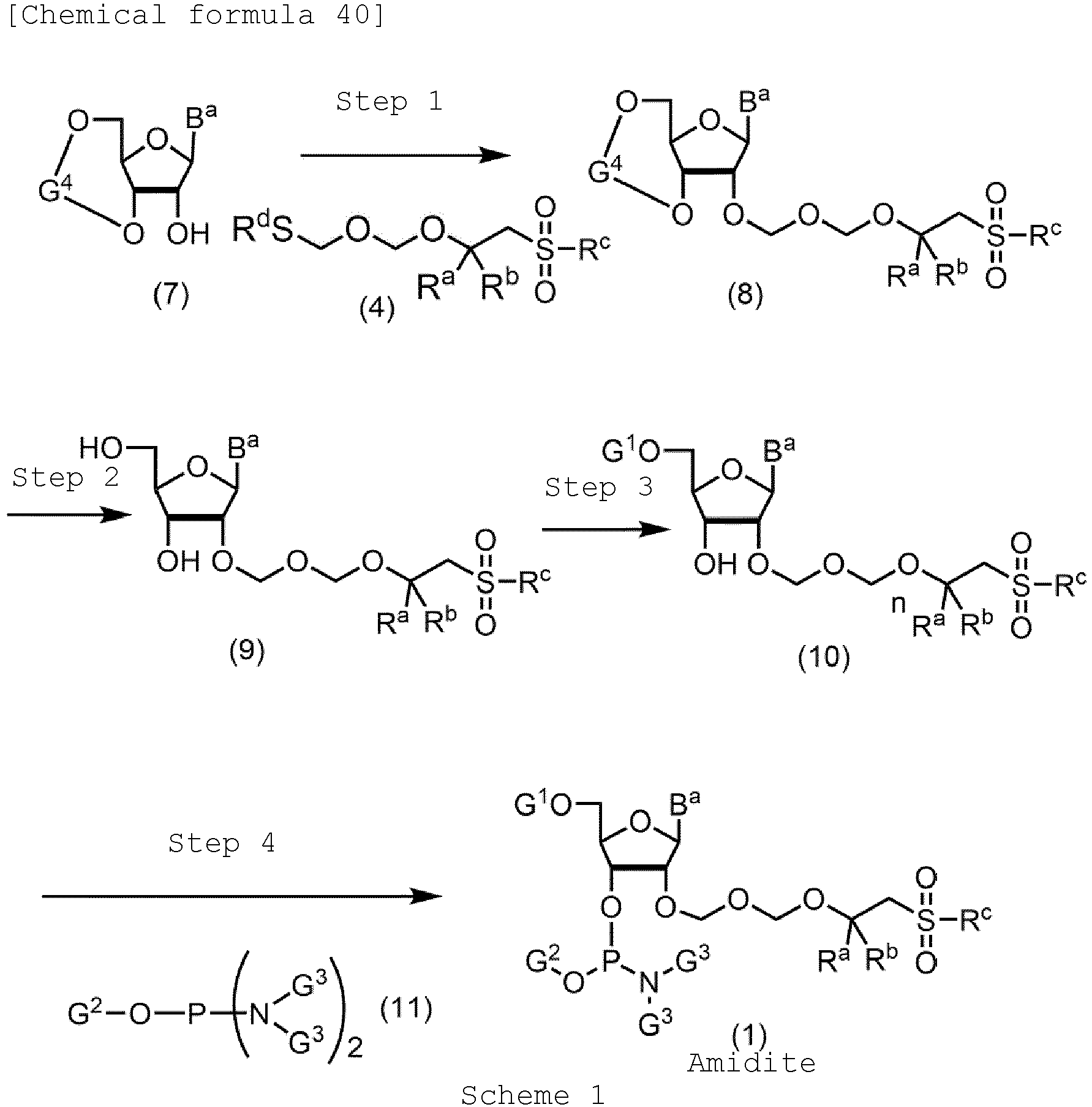
- As explained above, the compounds of formulae (7), (8), (9), and (10) can be used in the production of the amidite compound of formula (1).
- Hereinafter, Examples will be described to explain the present invention in more detail. However, the present invention is not limited to these Examples and so on.
- The following abbreviations are used herein.
- TPM = (1-(4-methylbenzenesulfonyl)propan-2-yl)oxy)methoxy)methyl group; A = adenine, G = guanine, C = cytosine, U = uracil.
-

- Bis(methylthiomethyl)ether (5.9 g, 0.043 mol) was dissolved in an anhydrous tetrahydrofuran (THF) (60 mL), Molecular Sieves 4A (5.9 g) was added thereto, and the mixture was stirred for 10 minutes. After the mixture was cooled to -50°C, N-iodosuccinimide (NIS) (11.5 g, 1.19 eq.) and then trifluoromethanesulfonic acid (TfOH) (0.11 mL, 0.030 eq.) were added. An acetonitrile (20 mL) solution of 1-(4-methylbenzenesulfonyl)propan-2-ol (10 g, 1.09 eq.) (manufactured by ENAMINE Ltd.) was dropped to the mixture, and the mixture was stirred at -50 to -45°C for 4 hours. After triethylamine (4.0 mL) was dropped to a reaction solution, the temperature was raised to -30 to -20°C, and then the reaction solution was added to a solution including a sodium thiosulfate pentahydrate (17.1 g), a sodium hydrogen carbonate (6.0 g), and water (130 mL) which had been pre-cooled to 5 to 10°C in an ice bath. Ethyl acetate (42 mL) was added to the mixture, and the mixture was stirred at 10 to 15°C for 30 minutes, and then was filtered through celite (5.9 g). A filtrate was separated, and then an organic layer was washed with a 20% brine (24 mL). The organic layer was dried using an anhydrous magnesium sulfate (3 g), and then a solvent was distilled off under reduced pressure (bath temperature: 40°C) . A residue was purified by silica gel chromatography (hexane/ethyl acetate = 3/1, silica gel 207 mL) to obtain 3.1 g of yellow oily matter.
- As a result of purity analysis by GC/FID, the purity was 91%.
- The purification was performed by silica gel chromatography again (hexane/ethyl acetate = 8/1, silica gel 150 mL) to obtain 3.1 g of TPMR with a purity of 98.2% and 1.5 g of TPMR with a purity of 97.8%. In the subsequent reactions, both were mixed and used.
- 1H-NMR (CDCl3):
57.79(d,2H)7.36(d,2H)4.76(s,2H)4.63(d,2H)4.27(m,1H)3.44(dd, 1H)3.14(dd,1H)2.45(s,3H)2.13(s,3H)1.32(d,3H) -

- Anhydrous toluene (16.5 mL, 5 vol/wt) was added to U-1 (3.3 g, 6.78 mmol), the mixture was concentrated under reduced pressure to 3 vol/wt, anhydrous toluene (6.6 mL, 2.0 vol/wt) was further added thereto, and the mixture was concentrated under reduced pressure to 3 vol/wt. Anhydrous tetrahydrofuran (6.6mL, 2.0 vol/wt) was added, the mixture was cooled to around -55°C, then PMMR (3.09 g, 10.17 mmol, 1.5 eq.) was dropped thereto, and the mixture was washed with 2 mL of THF. NIS (2.06 g, 9.15mmol, 1.35eq.) was added to the mixture, and TfOH (0.72 mL, 8.14 mmol, 1.2 eq.) was dropped at -55 to -45°C. The mixture was stirred at -55 to -45°C for 1 hour, and the reaction solution was added to a mixed liquid including a sodium thiosulfate pentahydrate (3.3 g), a sodium hydrogen carbonate (1.12 g), water (22 mL), and a toluene which had been cooled in an ice bath. The mixture was stirred in the ice bath for 30 minutes and separated. A solution including a sodium thiosulfate pentahydrate (1.65 g), a sodium hydrogen carbonate (0.6 g), and water (11 mL) was added to an organic layer, and the mixture was stirred at room temperature for 15 minutes and then separated. The organic layer was dried with a sodium sulfate (1 g) and then concentrated to dryness under reduced pressure. A residue was purified by silica gel column chromatography (hexane/ethyl acetate = 3/1, silica gel 250 mL) to obtain colorless clear glassy solid TPM-U-2 (5.3 g).
-

- After TPM-U-2 (5.3 g, 7.13 mmol) was dissolved in an acetone (10 mL), triethylamine hydrotrifluoride (1.3 mL, 7.84 mmol) was added, and the mixture was stirred at room temperature for 2 hours. Methyl tert-butyl ether (MTBE) (53 mL) was added to the reaction solution, the mixture was stirred for 30 minutes, and then a MTBE layer was removed by decantation. This procedure was repeated 3 times, and then the residue was dried and solidified under reduced pressure to obtain white amorphous TPM-U-3 (3.5 g).
-

- Pyridine (10.5 mL, 3 vol/wt) was added to TPM-U-3 (3.5 g, 7.00 mmol), azeotropic dehydration was conducted twice, then pyridine (7.0 mL, 2 vol/wt), toluene (17.5 mL, 5 vol/wt), and acetonitrile (7.0 mL, 2 vol/wt) were added thereto, and the mixture was cooled to around 0°C. 4,4'-dimethoxytrityl chloride (2.85 g, 8.40 mmol, 1.2 eq.) was added thereto. The mixture was stirred at room temperature for 6 hours, methanol (1.75 mL, 0.5 vol/wt) was added, and the mixture was stirred for 10 minutes. A solution including a sodium hydrogen carbonate (0.53 g) and water (10.5 mL) was added, and the mixture was stirred for 15 minutes and separated (this procedure was further repeated once more). A solution including a sodium chloride (1.05 g) and water (10.5 mL) was added to an organic layer, and the mixture was stirred for 15 minutes and then separated. The organic layer was dried with a sodium sulfate (1 g) and then concentrated under reduced pressure. A residue was purified by silica gel column chromatography (hexane/ethyl acetate = 1/1 to ethyl acetate only, silica gel 280 mL) to obtain 3.8 g of white amorphous TPM-U-4 (yield: 67%).
-

- TPM-U-4 (4.7 g, 5.85 mmol) was dissolved in an anhydrous acetonitrile (47 mL, 10 vol/wt), then diisopropylammonium tetrazolide (1.10 g, 6.56 mmol, 1.12 eq.) and Molecular Sieves 4A (0.94 g, 0.2 wt/wt) were added, and the mixture was stirred at room temperature for 30 minutes. 2-cyanoethyl-N,N,N',N'-tetraisopropylphosphordiamidite (Phos reagent) (2.65 g, 8.78 mmol, 1.5 eq.) was added to the solution, and the mixture was stirred at bath temperature of 45°C for 1.5 hours. The mixture was cooled to room temperature and filtered, and a filtrate was concentrated under reduced pressure. A residue was purified by silica gel column chromatography (hexane/acetone = 2/1 + 5% pyridine, silica gel 380 mL) to obtain 4.75 g of white solid TPM amidite U.
- 31P-NMR (CDCl3) : δ151.89, 151.86, 150.87
- Using the TPM amidite U produced in Production Example 5, a uridine 50-mer represented by the sequence of SEQ ID NO: 1 below was synthesized.
- 5'-UUUUUUUUUU UUUUUUUUUU UUUUUUUUUU UUUUUUUUUU UUUUUUUUUU-3' (SEQ ID NO: 1) (wherein U represents uridine monophosphate sodium salt)
- Solid-phase synthesis was performed from the 3' side toward the 5' side using NTS M-4MX-E (manufactured by NIHON TECHNO SERVICE CO., LTD.) as a nucleic acid synthesis device. For the synthesis, porous glass was used as a solid support, a high-purity trichloroacetic acid toluene solution was used as a deblocking solution, 5-benzylmercapto-1H-tetrazole was used as a condensing agent, an iodine solution was used as an oxidizing agent, and a phenoxyacetic acid solution and a N-methylimidazole solution were used as a capping solution.
- The purity of an oligonucleotide crude product after the solid-phase synthesis was measured by HPLC. The crude product was separated into each component by HPLC (wavelength 260 nm, column ACQUITY UPLC Oligonucleotide BEH C18, 2.1 mm × 100 mm), and the purity of the oligonucleotide was calculated from the obtained area value of a main product relative to the total area value of chromatogram.
- As a result of synthesizing a uridine 50-mer (molecular weight 15246.53) using the TPM amidite U prepared in Example 5, the OD260 for 0.173 µmol was 37.21 OD, and the purity was 53.5%. From the OD260 value, the yield for 1 µmol was calculated as 8603 µg/µmol.
- The results are shown in Table 1 below.
- (OD260 represents an absorbance of UV 260 nm for 10 mm optical path length in an 1 mL solution (pH = 7.5). Since RNA is generally known to have 1 OD = 40 µg, the production amount of RNA can be calculated from the absorbance.)
- Solid-phase synthesis was performed in the same manner as in the method described in Production Example 6 by using the uridine EMM amidite described in Example 2 of
JP 5554881 B2 - The results are shown in Table 1 below.
[Table 1] Example 1 Comparative Example 1 Purity of uridine 50-mer (%) 53.5 44.1 Yield (µg/µmol) 8603 7264 Yield (%) 56.4 47.6 - As shown in Table 1 above, when the amidite produced in the present invention is used, the uridine 50-mer with high purity can be obtained.
- The present invention provides a sulfone group-containing ether compound which is useful as a protecting group of a hydroxyl group at the 2' position of an amidite, and an amidite compound having the sulfone group-containing ether moiety. The amidite compound of the present invention is suitable for synthesis of an oligonucleic acid with a high-purity.
- SEQ ID NO: 1 in Sequence Listing represents the base sequence of the uridine 50-mer.

Claims (22)
- An amidite compound represented by formula (1):

 Ra and Rb are identical to or different from each other and each represents a methyl group, an ethyl group, or a hydrogen atom, provided that Ra and Rb do not represent a hydrogen atom at the same time; andRc represents a phenyl group, a C1 to C10 alkyl group, or a benzyl group which may be substituted with a halogen atom, a methyl group, a nitro group, a methoxy group, or a trifluoromethyl group,Ba represents a group having an optionally-protected nucleobase structure,G1 and G2 are identical to or different from each other and each represents a protecting group of a hydroxyl group, andG3 is identical to or different from each other and each represents an alkyl group.
 - The amidite compound according to claim 1, wherein Ra represents a methyl group, and Rb represents a hydrogen atom.
- The amidite compound according to claim 1, wherein Ra and Rb both represent a methyl group.
- The amidite compound according to any one of claims 1 to 3, wherein G1 represents the following group:

- The amidite compound according to any one of claims 1 to 4, wherein G2 represents the following group.

- The amidite compound according to any one of claims 1 to 5, wherein G3 represents an isopropyl group.
- The amidite compound according to any one of claims 1 to 6, wherein Rc represents a phenyl group or a tolyl group.
- A production method for a compound containing a polynucleotide structure represented by formula (2), the method comprising a step of using the amidite compound according to any one of claims 1 to 7 for a solid-phase synthesis reaction:
 X represents an oxygen atom or a sulfur atom, andm represents a positive integer.
 - The production method according to claim 8, wherein the compound containing a polynucleotide structure of formula (2) is formed by reacting a compound having an oligonucleotide structure represented by formula (3), formed in the solid-phase synthesis reaction using the amidite compound, with a tetraalkylammonium fluoride:
 X represents an oxygen atom or a sulfur atom, andR is identical to or different from each other and each represents a group represented by a formula:
 Ra and Rb are identical to or different from each other and each represents a methyl group, an ethyl group, or a hydrogen atom, provided that Ra and Rb do not represent a hydrogen atom at the same time; andRc represents a phenyl group, a C1 to C10 alkyl group, or a benzyl group which may be substituted with a hydrogen atom, a halogen atom, a methyl group, a nitro group, a methoxy group, or a trifluoromethyl group.
 - The production method according to claim 9, wherein Ra represents a methyl group, and Rb represents a hydrogen atom.
- An ether compound represented by formula (4):
 Ra and Rb are identical to or different from each other and each represents a methyl group, an ethyl group, or a hydrogen atom, provided that Ra and Rb do not represent a hydrogen atom at the same time;Rc represents a phenyl group, a C1 to C10 alkyl group, or a benzyl group which may be substituted with a halogen atom, a methyl group, a nitro group, a methoxy group, or a trifluoromethyl group; and Rd represents C1 to C10 alkyl or a phenyl group.
 - The ether compound according to claim 11, wherein Ra represents a methyl group, Rb represents a hydrogen atom, and Rc represents a phenyl group or a tolyl group.
- A production method for an ether compound represented by formula (4), the method comprising step a of reacting a 2-hydroxyalkylsulfone represented by formula (5) with a bisthioether compound represented by formula (12) in a solvent in presence of a halogenating agent and an acid:
 Ra and Rb are identical to or different from each other and each represents a methyl group, an ethyl group, or a hydrogen atom, provided that Ra and Rb do not represent a hydrogen atom at the same time; andRc represents a phenyl group, a C1 to C10 alkyl group, or a benzyl group which may be substituted with a halogen atom, a methyl group, a nitro group, a methoxy group, or a trifluoromethyl group,
[Chemical formula 10] (RdSCH2)2O (12)
wherein Rd is as defined in claim 11,
- The production method according to claim 13, wherein Ra represents a methyl group or an ethyl group, Rb represents a hydrogen atom, and Rc represents a phenyl group or a tolyl group.
- The production method according to claim 13, wherein Ra represents a methyl group, Rb represents a hydrogen atom, and Rc represents a phenyl group or a tolyl group.
- A production method for a compound represented by formula (8), the method comprising reacting a compound represented by formula (7) with a compound represented by formula (4) in presence of a halogenating agent:


- A production method for the compound of formula (1) according to claim 1, the method comprising the steps of:further deprotecting the compound of formula (8) to obtain a compound represented by formula (9);selectively protecting a hydroxyl group at 5' of the compound of formula (9) to obtain a compound represented by formula (10); andreacting the compound of formula (10) with a phosphordiamidite represented by formula (11):


- The production method according to claim 16, wherein G4 has a G4-1 or G4-2 structure.

- A compound represented by formula (8):

- A compound represented by formula (9):

- A compound represented by formula (10):

- Use of the amidite compound of formula (1) in production of RNA.
Applications Claiming Priority (2)
| Application Number | Priority Date | Filing Date | Title |
|---|---|---|---|
| JP2019192899 | 2019-10-23 | ||
| PCT/JP2020/032593 WO2021079617A1 (en) | 2019-10-23 | 2020-08-28 | Glycoside compound, amidite compound, and production method for polynucleotide using said compounds |
Publications (3)
| Publication Number | Publication Date |
|---|---|
| EP4049996A1 true EP4049996A1 (en) | 2022-08-31 |
| EP4049996A4 EP4049996A4 (en) | 2024-03-27 |
| EP4049996B1 EP4049996B1 (en) | 2026-01-07 |
Family
ID=75620471
Family Applications (1)
| Application Number | Title | Priority Date | Filing Date |
|---|---|---|---|
| EP20879365.3A Active EP4049996B1 (en) | 2019-10-23 | 2020-08-28 | Glycoside compound, amidite compound, and production method for polynucleotide using said compounds |
Country Status (8)
| Country | Link |
|---|---|
| US (1) | US12509481B2 (en) |
| EP (1) | EP4049996B1 (en) |
| JP (1) | JP7606972B2 (en) |
| KR (1) | KR102968069B1 (en) |
| CN (1) | CN114599664B (en) |
| DK (1) | DK4049996T3 (en) |
| ES (1) | ES3062040T3 (en) |
| WO (1) | WO2021079617A1 (en) |
Families Citing this family (1)
| Publication number | Priority date | Publication date | Assignee | Title |
|---|---|---|---|---|
| EP4563570A1 (en) | 2022-07-25 | 2025-06-04 | Toray Industries, Inc. | Alkyl halide, alkylating agent using same, and method for producing derivative of nucleoside |
Family Cites Families (12)
| Publication number | Priority date | Publication date | Assignee | Title |
|---|---|---|---|---|
| JPS57118715A (en) | 1981-01-19 | 1982-07-23 | Kubota Ltd | Structure of sensor float of rice transplanter |
| JPS59106654A (en) | 1982-12-08 | 1984-06-20 | 日本碍子株式会社 | Building panel |
| JP4229470B2 (en) | 1996-06-14 | 2009-02-25 | ジェロン コーポレーション | Solid phase synthesis of oligonucleotide N3 '→ P5' phosphoramidate |
| ATE556085T1 (en) | 2004-08-26 | 2012-05-15 | Nippon Shinyaku Co Ltd | PHOSPHORAMIDITE COMPOUND AND METHOD FOR PRODUCING OLIGO-RNA |
| WO2007064291A1 (en) | 2005-11-30 | 2007-06-07 | Jyoti Chattopadhyaya | Method and compounds for rna synthesis |
| US9481702B2 (en) * | 2011-08-25 | 2016-11-01 | Bonac Corporation | Glycoside compound, method for producing thioether, ether, method for producing ether, method for producing glycoside compound, method for producing nucleic acid |
| US10377788B2 (en) | 2015-04-02 | 2019-08-13 | Bonac Corporation | Method for producing glycoside compounds |
| CN108350018A (en) | 2015-11-17 | 2018-07-31 | 日产化学工业株式会社 | The manufacturing method of oligonucleotides |
| TW201803871A (en) | 2016-06-24 | 2018-02-01 | 英塞特公司 | Heterocyclic compounds as PI3K-[gamma] inhibitors |
| JPWO2018070543A1 (en) * | 2016-10-14 | 2019-07-25 | 株式会社ボナック | Novel glycoside compound and method for producing the same |
| US11401296B2 (en) | 2018-04-24 | 2022-08-02 | Sumitomo Chemical Company, Limited | Amidite compound and method for producing polynucleotide using said compound |
| KR101943268B1 (en) | 2018-04-26 | 2019-01-28 | 캐논 톡키 가부시키가이샤 | Vacuum system, substrate conveying system, method and apparatus for manufacturing electronic devices |
-
2020
- 2020-08-28 DK DK20879365.3T patent/DK4049996T3/en active
- 2020-08-28 ES ES20879365T patent/ES3062040T3/en active Active
- 2020-08-28 KR KR1020227014538A patent/KR102968069B1/en active Active
- 2020-08-28 CN CN202080073849.5A patent/CN114599664B/en active Active
- 2020-08-28 EP EP20879365.3A patent/EP4049996B1/en active Active
- 2020-08-28 JP JP2021554118A patent/JP7606972B2/en active Active
- 2020-08-28 WO PCT/JP2020/032593 patent/WO2021079617A1/en not_active Ceased
- 2020-08-28 US US17/770,520 patent/US12509481B2/en active Active
Also Published As
| Publication number | Publication date |
|---|---|
| CN114599664A (en) | 2022-06-07 |
| US20230024003A1 (en) | 2023-01-26 |
| ES3062040T3 (en) | 2026-04-08 |
| JPWO2021079617A1 (en) | 2021-04-29 |
| WO2021079617A1 (en) | 2021-04-29 |
| CN114599664B (en) | 2025-03-28 |
| EP4049996A4 (en) | 2024-03-27 |
| US12509481B2 (en) | 2025-12-30 |
| KR20220086589A (en) | 2022-06-23 |
| DK4049996T3 (en) | 2026-02-09 |
| EP4049996B1 (en) | 2026-01-07 |
| JP7606972B2 (en) | 2024-12-26 |
| KR102968069B1 (en) | 2026-05-21 |
Similar Documents
| Publication | Publication Date | Title |
|---|---|---|
| JP7280248B2 (en) | Amidite compound and method for producing polynucleotide using said compound | |
| CN101048423B (en) | Phosphoramidite compound and method for producing oligo-rna | |
| EP3778619A1 (en) | Segment for oligonucleotide synthesis, production method for same, and oligonucleotide synthesis method using same | |
| EP4043473A1 (en) | Method for producing nucleic acid oligomers | |
| EP4049996B1 (en) | Glycoside compound, amidite compound, and production method for polynucleotide using said compounds | |
| EA011558B1 (en) | Intermediate compound and process for preparing of beta-anomer enriched 2-deoxy-2,2-difluoro-d-ribofuranosyl nucleosides | |
| EP4047004A1 (en) | Phosphoramidite activator | |
| EP1995252A1 (en) | Method for removal of nucleic acid-protecting group | |
| JP4802712B2 (en) | Solution phase synthesis of ribonucleic acid compounds and oligonucleic acid compounds | |
| US8158774B2 (en) | Method for introducing a nucleic-acid protecting group | |
| JP7423533B2 (en) | Method for producing glycoside compounds | |
| JP6429264B2 (en) | Boranophosphate compounds and nucleic acid oligomers | |
| KR101259648B1 (en) | A manufacturing process of 2′,2′-difluoronucloside and intermediate | |
| US9920319B2 (en) | 2′/3′/5′-(R/S)-serinyl functionalized oligonucleotides |
Legal Events
| Date | Code | Title | Description |
|---|---|---|---|
| STAA | Information on the status of an ep patent application or granted ep patent |
Free format text: STATUS: THE INTERNATIONAL PUBLICATION HAS BEEN MADE |
|
| PUAI | Public reference made under article 153(3) epc to a published international application that has entered the european phase |
Free format text: ORIGINAL CODE: 0009012 |
|
| STAA | Information on the status of an ep patent application or granted ep patent |
Free format text: STATUS: REQUEST FOR EXAMINATION WAS MADE |
|
| 17P | Request for examination filed |
Effective date: 20220519 |
|
| AK | Designated contracting states |
Kind code of ref document: A1 Designated state(s): AL AT BE BG CH CY CZ DE DK EE ES FI FR GB GR HR HU IE IS IT LI LT LU LV MC MK MT NL NO PL PT RO RS SE SI SK SM TR |
|
| DAV | Request for validation of the european patent (deleted) | ||
| DAX | Request for extension of the european patent (deleted) | ||
| A4 | Supplementary search report drawn up and despatched |
Effective date: 20240226 |
|
| RIC1 | Information provided on ipc code assigned before grant |
Ipc: C12Q 1/6853 20180101ALI20240220BHEP Ipc: C12Q 1/68 20180101ALI20240220BHEP Ipc: C12N 15/115 20100101ALI20240220BHEP Ipc: C12N 15/113 20100101ALI20240220BHEP Ipc: C07H 19/067 20060101ALI20240220BHEP Ipc: C07C 317/22 20060101ALI20240220BHEP Ipc: C07C 315/04 20060101AFI20240220BHEP |
|
| GRAP | Despatch of communication of intention to grant a patent |
Free format text: ORIGINAL CODE: EPIDOSNIGR1 |
|
| STAA | Information on the status of an ep patent application or granted ep patent |
Free format text: STATUS: GRANT OF PATENT IS INTENDED |
|
| INTG | Intention to grant announced |
Effective date: 20250916 |
|
| GRAS | Grant fee paid |
Free format text: ORIGINAL CODE: EPIDOSNIGR3 |
|
| GRAA | (expected) grant |
Free format text: ORIGINAL CODE: 0009210 |
|
| STAA | Information on the status of an ep patent application or granted ep patent |
Free format text: STATUS: THE PATENT HAS BEEN GRANTED |
|
| AK | Designated contracting states |
Kind code of ref document: B1 Designated state(s): AL AT BE BG CH CY CZ DE DK EE ES FI FR GB GR HR HU IE IS IT LI LT LU LV MC MK MT NL NO PL PT RO RS SE SI SK SM TR |
|
| REG | Reference to a national code |
Ref country code: CH Ref legal event code: F10 Free format text: ST27 STATUS EVENT CODE: U-0-0-F10-F00 (AS PROVIDED BY THE NATIONAL OFFICE) Effective date: 20260107 Ref country code: GB Ref legal event code: FG4D |
|
| P01 | Opt-out of the competence of the unified patent court (upc) registered |
Free format text: CASE NUMBER: UPC_APP_0015647_4049996/2025 Effective date: 20251203 |
|
| REG | Reference to a national code |
Ref country code: CH Ref legal event code: R17 Free format text: ST27 STATUS EVENT CODE: U-0-0-R10-R17 (AS PROVIDED BY THE NATIONAL OFFICE) Effective date: 20260114 |
|
| REG | Reference to a national code |
Ref country code: DE Ref legal event code: R096 Ref document number: 602020065326 Country of ref document: DE |
|
| REG | Reference to a national code |
Ref country code: IE Ref legal event code: FG4D |
|
| REG | Reference to a national code |
Ref country code: DK Ref legal event code: T3 Effective date: 20260206 |
|
| REG | Reference to a national code |
Ref country code: ES Ref legal event code: FG2A Ref document number: 3062040 Country of ref document: ES Kind code of ref document: T3 Effective date: 20260408 |
|
| REG | Reference to a national code |
Ref country code: NL Ref legal event code: MP Effective date: 20260107 |
|
| PG25 | Lapsed in a contracting state [announced via postgrant information from national office to epo] |
Ref country code: NL Free format text: LAPSE BECAUSE OF FAILURE TO SUBMIT A TRANSLATION OF THE DESCRIPTION OR TO PAY THE FEE WITHIN THE PRESCRIBED TIME-LIMIT Effective date: 20260107 |
|
| REG | Reference to a national code |
Ref country code: AT Ref legal event code: MK05 Ref document number: 1875572 Country of ref document: AT Kind code of ref document: T Effective date: 20260107 |
|
| REG | Reference to a national code |
Ref country code: HU Ref legal event code: AG4A Ref document number: E075538 Country of ref document: HU |
|
| PG25 | Lapsed in a contracting state [announced via postgrant information from national office to epo] |
Ref country code: RS Free format text: LAPSE BECAUSE OF FAILURE TO SUBMIT A TRANSLATION OF THE DESCRIPTION OR TO PAY THE FEE WITHIN THE PRESCRIBED TIME-LIMIT Effective date: 20260407 |
|
| PG25 | Lapsed in a contracting state [announced via postgrant information from national office to epo] |
Ref country code: PL Free format text: LAPSE BECAUSE OF FAILURE TO SUBMIT A TRANSLATION OF THE DESCRIPTION OR TO PAY THE FEE WITHIN THE PRESCRIBED TIME-LIMIT Effective date: 20260107 |
|
| PG25 | Lapsed in a contracting state [announced via postgrant information from national office to epo] |
Ref country code: GR Free format text: LAPSE BECAUSE OF FAILURE TO SUBMIT A TRANSLATION OF THE DESCRIPTION OR TO PAY THE FEE WITHIN THE PRESCRIBED TIME-LIMIT Effective date: 20260408 |
|
| REG | Reference to a national code |
Ref country code: LT Ref legal event code: MG9D |
|
| PG25 | Lapsed in a contracting state [announced via postgrant information from national office to epo] |
Ref country code: LT Free format text: LAPSE BECAUSE OF FAILURE TO SUBMIT A TRANSLATION OF THE DESCRIPTION OR TO PAY THE FEE WITHIN THE PRESCRIBED TIME-LIMIT Effective date: 20260107 |
|
| PG25 | Lapsed in a contracting state [announced via postgrant information from national office to epo] |
Ref country code: NO Free format text: LAPSE BECAUSE OF FAILURE TO SUBMIT A TRANSLATION OF THE DESCRIPTION OR TO PAY THE FEE WITHIN THE PRESCRIBED TIME-LIMIT Effective date: 20260407 |
|
| PG25 | Lapsed in a contracting state [announced via postgrant information from national office to epo] |
Ref country code: SE Free format text: LAPSE BECAUSE OF FAILURE TO SUBMIT A TRANSLATION OF THE DESCRIPTION OR TO PAY THE FEE WITHIN THE PRESCRIBED TIME-LIMIT Effective date: 20260107 Ref country code: AT Free format text: LAPSE BECAUSE OF FAILURE TO SUBMIT A TRANSLATION OF THE DESCRIPTION OR TO PAY THE FEE WITHIN THE PRESCRIBED TIME-LIMIT Effective date: 20260107 Ref country code: FI Free format text: LAPSE BECAUSE OF FAILURE TO SUBMIT A TRANSLATION OF THE DESCRIPTION OR TO PAY THE FEE WITHIN THE PRESCRIBED TIME-LIMIT Effective date: 20260107 |
|
| PG25 | Lapsed in a contracting state [announced via postgrant information from national office to epo] |
Ref country code: HR Free format text: LAPSE BECAUSE OF FAILURE TO SUBMIT A TRANSLATION OF THE DESCRIPTION OR TO PAY THE FEE WITHIN THE PRESCRIBED TIME-LIMIT Effective date: 20260107 |
|
| PG25 | Lapsed in a contracting state [announced via postgrant information from national office to epo] |
Ref country code: IS Free format text: LAPSE BECAUSE OF FAILURE TO SUBMIT A TRANSLATION OF THE DESCRIPTION OR TO PAY THE FEE WITHIN THE PRESCRIBED TIME-LIMIT Effective date: 20260507 Ref country code: PT Free format text: LAPSE BECAUSE OF FAILURE TO SUBMIT A TRANSLATION OF THE DESCRIPTION OR TO PAY THE FEE WITHIN THE PRESCRIBED TIME-LIMIT Effective date: 20260507 |
|
| PG25 | Lapsed in a contracting state [announced via postgrant information from national office to epo] |
Ref country code: LV Free format text: LAPSE BECAUSE OF FAILURE TO SUBMIT A TRANSLATION OF THE DESCRIPTION OR TO PAY THE FEE WITHIN THE PRESCRIBED TIME-LIMIT Effective date: 20260107 |
|
| PG25 | Lapsed in a contracting state [announced via postgrant information from national office to epo] |
Ref country code: BG Free format text: LAPSE BECAUSE OF FAILURE TO SUBMIT A TRANSLATION OF THE DESCRIPTION OR TO PAY THE FEE WITHIN THE PRESCRIBED TIME-LIMIT Effective date: 20260107 |