EP4049856B1 - Tire - Google Patents
Tire Download PDFInfo
- Publication number
- EP4049856B1 EP4049856B1 EP20880096.1A EP20880096A EP4049856B1 EP 4049856 B1 EP4049856 B1 EP 4049856B1 EP 20880096 A EP20880096 A EP 20880096A EP 4049856 B1 EP4049856 B1 EP 4049856B1
- Authority
- EP
- European Patent Office
- Prior art keywords
- tire
- rubber
- topping rubber
- steel single
- single wires
- Prior art date
- Legal status (The legal status is an assumption and is not a legal conclusion. Google has not performed a legal analysis and makes no representation as to the accuracy of the status listed.)
- Active
Links
Images


Classifications
-
- B—PERFORMING OPERATIONS; TRANSPORTING
- B60—VEHICLES IN GENERAL
- B60C—VEHICLE TYRES; TYRE INFLATION; TYRE CHANGING; CONNECTING VALVES TO INFLATABLE ELASTIC BODIES IN GENERAL; DEVICES OR ARRANGEMENTS RELATED TO TYRES
- B60C1/00—Tyres characterised by the chemical composition or the physical arrangement or mixture of the composition
-
- B—PERFORMING OPERATIONS; TRANSPORTING
- B60—VEHICLES IN GENERAL
- B60C—VEHICLE TYRES; TYRE INFLATION; TYRE CHANGING; CONNECTING VALVES TO INFLATABLE ELASTIC BODIES IN GENERAL; DEVICES OR ARRANGEMENTS RELATED TO TYRES
- B60C9/00—Reinforcements or ply arrangement of pneumatic tyres
- B60C9/0064—Reinforcements comprising monofilaments
-
- B—PERFORMING OPERATIONS; TRANSPORTING
- B60—VEHICLES IN GENERAL
- B60C—VEHICLE TYRES; TYRE INFLATION; TYRE CHANGING; CONNECTING VALVES TO INFLATABLE ELASTIC BODIES IN GENERAL; DEVICES OR ARRANGEMENTS RELATED TO TYRES
- B60C9/00—Reinforcements or ply arrangement of pneumatic tyres
- B60C9/0007—Reinforcements made of metallic elements, e.g. cords, yarns, filaments or fibres made from metal
-
- B—PERFORMING OPERATIONS; TRANSPORTING
- B60—VEHICLES IN GENERAL
- B60C—VEHICLE TYRES; TYRE INFLATION; TYRE CHANGING; CONNECTING VALVES TO INFLATABLE ELASTIC BODIES IN GENERAL; DEVICES OR ARRANGEMENTS RELATED TO TYRES
- B60C9/00—Reinforcements or ply arrangement of pneumatic tyres
- B60C9/18—Structure or arrangement of belts or breakers, crown-reinforcing or cushioning layers
- B60C9/20—Structure or arrangement of belts or breakers, crown-reinforcing or cushioning layers built-up from rubberised plies each having all cords arranged substantially parallel
-
- B—PERFORMING OPERATIONS; TRANSPORTING
- B60—VEHICLES IN GENERAL
- B60C—VEHICLE TYRES; TYRE INFLATION; TYRE CHANGING; CONNECTING VALVES TO INFLATABLE ELASTIC BODIES IN GENERAL; DEVICES OR ARRANGEMENTS RELATED TO TYRES
- B60C9/00—Reinforcements or ply arrangement of pneumatic tyres
- B60C9/18—Structure or arrangement of belts or breakers, crown-reinforcing or cushioning layers
- B60C9/20—Structure or arrangement of belts or breakers, crown-reinforcing or cushioning layers built-up from rubberised plies each having all cords arranged substantially parallel
- B60C9/2003—Structure or arrangement of belts or breakers, crown-reinforcing or cushioning layers built-up from rubberised plies each having all cords arranged substantially parallel characterised by the materials of the belt cords
- B60C9/2006—Structure or arrangement of belts or breakers, crown-reinforcing or cushioning layers built-up from rubberised plies each having all cords arranged substantially parallel characterised by the materials of the belt cords consisting of steel cord plies only
-
- D—TEXTILES; PAPER
- D07—ROPES; CABLES OTHER THAN ELECTRIC
- D07B—ROPES OR CABLES IN GENERAL
- D07B1/00—Constructional features of ropes or cables
- D07B1/06—Ropes or cables built-up from metal wires, e.g. of section wires around a hemp core
-
- B—PERFORMING OPERATIONS; TRANSPORTING
- B60—VEHICLES IN GENERAL
- B60C—VEHICLE TYRES; TYRE INFLATION; TYRE CHANGING; CONNECTING VALVES TO INFLATABLE ELASTIC BODIES IN GENERAL; DEVICES OR ARRANGEMENTS RELATED TO TYRES
- B60C1/00—Tyres characterised by the chemical composition or the physical arrangement or mixture of the composition
- B60C2001/0066—Compositions of the belt layers
-
- B—PERFORMING OPERATIONS; TRANSPORTING
- B60—VEHICLES IN GENERAL
- B60C—VEHICLE TYRES; TYRE INFLATION; TYRE CHANGING; CONNECTING VALVES TO INFLATABLE ELASTIC BODIES IN GENERAL; DEVICES OR ARRANGEMENTS RELATED TO TYRES
- B60C9/00—Reinforcements or ply arrangement of pneumatic tyres
- B60C9/0007—Reinforcements made of metallic elements, e.g. cords, yarns, filaments or fibres made from metal
- B60C2009/0021—Coating rubbers for steel cords
-
- B—PERFORMING OPERATIONS; TRANSPORTING
- B60—VEHICLES IN GENERAL
- B60C—VEHICLE TYRES; TYRE INFLATION; TYRE CHANGING; CONNECTING VALVES TO INFLATABLE ELASTIC BODIES IN GENERAL; DEVICES OR ARRANGEMENTS RELATED TO TYRES
- B60C9/00—Reinforcements or ply arrangement of pneumatic tyres
- B60C9/18—Structure or arrangement of belts or breakers, crown-reinforcing or cushioning layers
- B60C9/20—Structure or arrangement of belts or breakers, crown-reinforcing or cushioning layers built-up from rubberised plies each having all cords arranged substantially parallel
- B60C2009/2012—Structure or arrangement of belts or breakers, crown-reinforcing or cushioning layers built-up from rubberised plies each having all cords arranged substantially parallel with particular configuration of the belt cords in the respective belt layers
- B60C2009/2032—Structure or arrangement of belts or breakers, crown-reinforcing or cushioning layers built-up from rubberised plies each having all cords arranged substantially parallel with particular configuration of the belt cords in the respective belt layers characterised by the course of the belt cords, e.g. undulated or sinusoidal
-
- B—PERFORMING OPERATIONS; TRANSPORTING
- B60—VEHICLES IN GENERAL
- B60C—VEHICLE TYRES; TYRE INFLATION; TYRE CHANGING; CONNECTING VALVES TO INFLATABLE ELASTIC BODIES IN GENERAL; DEVICES OR ARRANGEMENTS RELATED TO TYRES
- B60C9/00—Reinforcements or ply arrangement of pneumatic tyres
- B60C9/18—Structure or arrangement of belts or breakers, crown-reinforcing or cushioning layers
- B60C9/20—Structure or arrangement of belts or breakers, crown-reinforcing or cushioning layers built-up from rubberised plies each having all cords arranged substantially parallel
- B60C2009/2061—Physical properties or dimensions of the belt coating rubber
- B60C2009/2064—Modulus; Hardness; Loss modulus or "tangens delta"
-
- B—PERFORMING OPERATIONS; TRANSPORTING
- B60—VEHICLES IN GENERAL
- B60C—VEHICLE TYRES; TYRE INFLATION; TYRE CHANGING; CONNECTING VALVES TO INFLATABLE ELASTIC BODIES IN GENERAL; DEVICES OR ARRANGEMENTS RELATED TO TYRES
- B60C9/00—Reinforcements or ply arrangement of pneumatic tyres
- B60C9/18—Structure or arrangement of belts or breakers, crown-reinforcing or cushioning layers
- B60C9/20—Structure or arrangement of belts or breakers, crown-reinforcing or cushioning layers built-up from rubberised plies each having all cords arranged substantially parallel
- B60C2009/2074—Physical properties or dimension of the belt cord
-
- B—PERFORMING OPERATIONS; TRANSPORTING
- B60—VEHICLES IN GENERAL
- B60C—VEHICLE TYRES; TYRE INFLATION; TYRE CHANGING; CONNECTING VALVES TO INFLATABLE ELASTIC BODIES IN GENERAL; DEVICES OR ARRANGEMENTS RELATED TO TYRES
- B60C9/00—Reinforcements or ply arrangement of pneumatic tyres
- B60C9/18—Structure or arrangement of belts or breakers, crown-reinforcing or cushioning layers
- B60C9/20—Structure or arrangement of belts or breakers, crown-reinforcing or cushioning layers built-up from rubberised plies each having all cords arranged substantially parallel
- B60C2009/2074—Physical properties or dimension of the belt cord
- B60C2009/2077—Diameters of the cords; Linear density thereof
-
- D—TEXTILES; PAPER
- D07—ROPES; CABLES OTHER THAN ELECTRIC
- D07B—ROPES OR CABLES IN GENERAL
- D07B1/00—Constructional features of ropes or cables
- D07B1/06—Ropes or cables built-up from metal wires, e.g. of section wires around a hemp core
- D07B1/0606—Reinforcing cords for rubber or plastic articles
-
- D—TEXTILES; PAPER
- D07—ROPES; CABLES OTHER THAN ELECTRIC
- D07B—ROPES OR CABLES IN GENERAL
- D07B2201/00—Ropes or cables
- D07B2201/20—Rope or cable components
- D07B2201/2001—Wires or filaments
- D07B2201/2002—Wires or filaments characterised by their cross-sectional shape
- D07B2201/2003—Wires or filaments characterised by their cross-sectional shape flat
-
- D—TEXTILES; PAPER
- D07—ROPES; CABLES OTHER THAN ELECTRIC
- D07B—ROPES OR CABLES IN GENERAL
- D07B2201/00—Ropes or cables
- D07B2201/20—Rope or cable components
- D07B2201/2001—Wires or filaments
- D07B2201/2007—Wires or filaments characterised by their longitudinal shape
- D07B2201/2008—Wires or filaments characterised by their longitudinal shape wavy or undulated
-
- D—TEXTILES; PAPER
- D07—ROPES; CABLES OTHER THAN ELECTRIC
- D07B—ROPES OR CABLES IN GENERAL
- D07B2501/00—Application field
- D07B2501/20—Application field related to ropes or cables
- D07B2501/2046—Tyre cords
-
- Y—GENERAL TAGGING OF NEW TECHNOLOGICAL DEVELOPMENTS; GENERAL TAGGING OF CROSS-SECTIONAL TECHNOLOGIES SPANNING OVER SEVERAL SECTIONS OF THE IPC; TECHNICAL SUBJECTS COVERED BY FORMER USPC CROSS-REFERENCE ART COLLECTIONS [XRACs] AND DIGESTS
- Y02—TECHNOLOGIES OR APPLICATIONS FOR MITIGATION OR ADAPTATION AGAINST CLIMATE CHANGE
- Y02T—CLIMATE CHANGE MITIGATION TECHNOLOGIES RELATED TO TRANSPORTATION
- Y02T10/00—Road transport of goods or passengers
- Y02T10/80—Technologies aiming to reduce greenhouse gasses emissions common to all road transportation technologies
- Y02T10/86—Optimisation of rolling resistance, e.g. weight reduction
Definitions
- the present invention relates to a tire provided with a belt layer in a tread portion.
- JP 4467107 B2 (application no. JP 2001-080313 A ) has proposed a pneumatic tire provided with a belt layer in which belt cords made of steel single wires each having a specific long diameter and a specific short diameter are covered with a cord topping rubber having a specific complex elastic modulus.
- JP 2008-156418 A discloses a rubber composition for coating a steel cord which comprises 100 pts.wt. of a rubber component, 4-15 pts.wt. of silica, 4-15 pts.wt. of a phenol resin and/or a modified phenol resin, 0.5-10 pts.wt. of a partial condensate of hexamethylolmelamine pentamethyl ether and/or a partial condensate of hexamethoxymethylolmelamine and 0.1-1.0 pt.wt. of an organic thiosulfate compound and/or a citraconimide compound.
- JP 2013-122038 A discloses a rubber composition for tire cord covering which includes an isoprenoid rubber, phenol resin and/or alkylphenol resin, and a partial condensate of hexamethoxymethylolmelamine and/or a partial condensate of hexamethylolmelaminepentamethylether.
- JP 2014-095017 A discloses a rubber composition for a steel cord coating, containing a rubber component, a carbon black having a nitrogen adsorption specific surface area of 20 to 130 m/g, organic cobalt and a specified compound.
- JP 2017-048351 A discloses a pneumatic tire containing a reinforcement layer constituted by arranging a steel cord, a cord rubber coating the steel cord.
- JP 2017-178994 A discloses a passenger car tire that has an under tread produced using a rubber composition which contains a rubber component, carbon black having a nitrogen adsorption specific surface area of 20-130 m/g, a C5 petroleum resin, and a specified compound.
- JP 4467107 B2 is expected to improve fuel efficiency, noise performance, and ride comfort performance in a good balance by weight reduction.
- the demand for the fuel efficiency has become higher and higher, and further improvements are expected in the tire of JP 4467107 B2 .
- the present invention has been made in view of the above, and a primary obj ect thereof is to provide a tire provided with a belt layer capable of improving the fuel efficiency while maintaining good noise performance, ride comfort performance, and durability performance.
- the present invention is a tire as defined in claim 1.
- the topping rubber has the loss tangent tan ⁇ at 70 degrees Celsius in the range of from 0.04 to 0.09.
- the topping rubber has the loss tangent tan ⁇ at 70 degrees Celsius in the range of from 0.04 to 0.06.
- the topping rubber has the complex elastic modulus ES* at 70 degrees Celsius in the range of from 14.0 to 20.0 MPa.
- each of the steel single wires has a ratio (LD/SD) of from 1.05 to 1.35 between a long diameter LD and a short diameter SD in a cross-sectional shape thereof.
- each of the steel single wires is formed wavy in at least one of a long diameter direction and a short diameter direction of the cross-sectional shape thereof, each of the steel single wires has a wave pitch (P) in the range of from 3.0 to 10.0 mm, and each of the steel single wires has a wave height (H) in the range of from 0.05 to 0.15 mm.
- the belt cords are arranged in the topping rubber so that a short diameter direction of the steel single wires is oriented along a thickness direction of the belt ply.
- the topping rubber contains a cobalt element, and a ratio (c/L) between a concentration (c) (ppm) of the cobalt element and an outer peripheral length (L) (mm) of each of the steel single wires in the cross-sectional shape thereof is in the range of from 350 to 1000 ppm/mm.
- the belt ply includes the belt cords made of the steel single wires having a flat cross-sectional shape, and the topping rubber covering the belt cords, the topping rubber has the complex elastic modulus ES* at 70 degrees Celsius in the range of from 8.0 to 20.0 MPa and the loss tangent tan ⁇ at 70 degrees Celsius in the range of from 0.04 to 0.16, and the ratio (tan ⁇ /ES*) between the loss tangent tan ⁇ and the complex elastic modulus ES* (MPa) of the topping rubber is in the range of from 0.002 to 0.017.
- the topping rubber configured as such suppresses heat generation during running, therefore, it is possible that the fuel efficiency of the tire is improved without affecting the noise performance, the ride comfort performance, and the durability performance. Thereby, it is possible that the tire of the present invention improves the fuel efficiency while maintaining good noise performance, good ride comfort performance, and good durability performance.
- FIG. 1 is a tire meridian section of a tire 1 passing through a rotational axis of the tire 1 in a standard state.
- the tire 1 of the present embodiment is suitable for use as a rubber pneumatic tire to be mounted on passenger cars and the like. It should be noted that the tire 1 is not limited to rubber pneumatic tires for passenger cars, but can be applied to a variety of tires, such as heavy-duty pneumatic tires, plastic pneumatic tires, and non-pneumatic tires not filled with pressurized air therein, for example.
- the "standard state” is a state in which the tire 1 is mounted on a standard rim, inflated to a standard inner pressure, and loaded with no tire load.
- the dimensions of various parts of the tire 1 are the values measured in this standard state.
- the "standard rim” is a wheel rim specified for the concerned tire by a standard included in a standardization system on which the tire is based, for example, the "normal wheel rim” in JATMA, "Design Rim” in TRA, and “Measuring Rim” in ETRTO.
- the "standard inner pressure” is air pressure specified for the concerned tire by a standard included in a standardization system on which the tire is based, for example, the maximum air pressure in JATMA, maximum value listed in the "TIRE LOAD LIMITS AT VARIOUS COLD INFLATION PRESSURES" table in TRA, and "INFLATION PRESSURE” in ETRTO.
- the tire 1 of the present embodiment includes a tread portion 2 extending annularly, a pair of sidewall portions 3 extending on both sides of the tread portion 2, and a pair of bead portions 4 extending in connection with the sidewall portions 3.
- the tire 1 of the present embodiment has a toroidal carcass 6 extending between bead cores 5 of the pair of the bead portions 4, and a belt layer 7 arranged radially outside the carcass 6 and inside the tread portion 2.
- the carcass 6 includes at least one carcass ply, in the present embodiment one carcass ply 6A.
- the carcass ply 6A includes carcass cords (not shown) arranged at an angle of 75 to 90 degrees with respect to a tire circumferential direction, for example.
- Organic fiber cords such as aromatic polyamide or rayon and the like can be employed as the carcass cords, for example.
- the carcass ply 6A includes a main body portion (6a) extending between the pair of the bead cores 5, and turned-up portions (6b) connected to the main body portion (6a) and each turned up from the inside to the outside in a tire axial direction around a respective one of the bead cores 5, for example.
- a bead apex rubber 8 extending outward in a tire radial direction from each of the bead cores 5 is disposed between the main body portion (6a) and each of the turned-up portions (6b) of the carcass ply 6A, for example.
- the belt layer 7 includes at least one belt ply, in the present embodiment two belt plies 7A and 7B.
- the two belt plies 7A and 7B include a first belt ply 7A arranged radially inside and a second belt ply 7B arranged radially outside the first belt ply 7A, for example.
- the belt layer 7 configured a such increases rigidity of the tread portion 2, therefore, it is possible that the durability performance of the tire 1 is improved.
- FIG. 2 is an enlarged cross-sectional view of the belt ply 7A.
- the belt ply 7A is shown as an example, but the same structure can be used for the belt ply 7B as well.
- at least one of the belt plies 7A and 7B of the present embodiment includes belt cords 9 formed by steel single wires 9A having a flat cross-sectional shape and a topping rubber 10 covering the belt cords 9.
- the topping rubber 10 has a complex elastic modulus ES* at 70 degrees Celsius in the range of from 8.0 to 20.0 MPa, and a loss tangent tan ⁇ at 70 degrees Celsius in the range of from 0.04 to 0.16.
- the topping rubber 10 configured as such suppresses heat generation during running, therefore, it is possible that the fuel efficiency of the tire 1 is improved without affecting the noise performance, the ride comfort performance, and the durability performance. Thereby, it is possible that the tire 1 of the present embodiment improves the fuel efficiency while maintaining good noise performance, good ride comfort performance, and good durability performance.
- the complex elastic modulus ES* at 70°C and the loss tangent tan ⁇ of the topping rubber 10 were the values measured in accordance with Japanese Industrial Standard JIS-K6394 by using a dynamic viscoelasticity measurement device (EPLEXOR series) manufactured by GABO QUALIMETER Testanlagen GmbH under the following conditions.
- the complex elastic modulus ES* of the topping rubber 10 at 70°C is in the range of from 14.0 to 20.0 MPa.
- the topping rubber 10 configured as such suppresses the deformation of the belt layer 7, therefore, it is possible that the durability performance of the tire 1 is improved.
- the topping rubber 10 has the complex elastic modulus ES* in the range of from 8.0 to 14.0 MPa at 70 degrees Celsius, it is possible that the noise performance and the ride comfort performance are improved.
- the loss tangent tan ⁇ at 70°C of the topping rubber 10 is more preferably in the range of from 0.04 to 0.14, even more preferably from 0.04 to 0.09, and most preferably from 0.04 to 0.06.
- the topping rubber 10 configured as such further suppresses the heat generation during running, therefore, it is possible that the fuel efficiency of the tire 1 is further improved without affecting the noise performance, the ride comfort performance, and the durability performance.
- the topping rubber 10 has a ratio (tan ⁇ /ES*) of the loss tangent tan ⁇ and the complex elastic modulus ES* (MPa) in the range of from 0.002 to 0.017.
- the topping rubber 10 configured as such suppresses the heat generation during running, therefore, it is possible that the fuel efficiency of the tire 1 is improved without affecting the noise performance, the ride comfort performance, and the durability performance. Thereby, it is possible that the tire 1 of the present embodiment improves the fuel efficiency while maintaining good noise performance, good ride comfort performance, and good durability performance.
- Examples of the rubber components used in the topping rubber 10 include, for example, natural rubber (NR), isoprene-based rubber such as isoprene rubber (IR), and diene-based rubber such as butadiene rubber (BR), styrene-butadiene rubber (SBR), styrene-isoprene-butadiene rubber (SIBR), chloroprene rubber (CR), acrylonitrile butadiene rubber (NBR) and the like.
- natural rubber (NR) or the combination of natural rubber (NR) and isoprene rubber (IR) is preferred from the point of view of the durability performance.
- the topping rubber 10 contains a cobalt element in the rubber.
- examples of compounds containing a cobalt element include cobalt salts of organic acids such as cobalt stearate, cobalt naphthenate, cobalt neodecanoate, and cobalt boron trineodecanoate, and the like, for example.
- cross-linking with belt cords 9 is promoted by the cobalt elements during vulcanization molding, therefore, it is possible that the adhesion of the topping rubber 10 with the belt cords 9 is improved.
- the topping rubber 10 contains carbon black.
- the content of the carbon black is preferably 10 mass parts or more, more preferably 40 mass parts or more, and even more preferably 50 mass parts or more per 100 mass parts of rubber component.
- the upper limit of the carbon black content is preferably 100 mass parts or less, and more preferably 70 mass parts or less.
- examples of the carbon black include furnace black (furnace carbon black) such as SAF, ISAF, HAF, MAF, FEF, SRF, GPF, APF, FF, CF, SCF, and ECF; acetylene black (acetylene carbon black); thermal black (thermal carbon black) such as FT and MT; channel black (channel carbon black) such as EPC, MPC, and CC; graphite, and the like.
- furnace black furnace carbon black
- SAF furnace black
- HAF HAF
- MAF low-AF
- FEF fluor FEF
- SRF acetylene black
- GPF APF
- FF CF
- SCF SCF
- ECF acetylene carbon black
- thermal black thermal black
- channel black channel carbon black
- EPC EPC
- MPC MPC
- CC graphite, and the like.
- the nitrogen adsorption specific surface area (N2SA) of the carbon black is more than 30 m 2 /g and less than 250 m 2 /g, for example.
- the amount of dibutyl phthalate (DBP) absorption of carbon black is, for example, more than 50 ml/100 g and less than 250 ml/100 g, for example. It should be noted that the nitrogen adsorption specific surface area of the carbon black is measured according to ASTM D4820-93, and the DBP absorption is measured according to ASTM D2414-93.
- examples of specific carbon black are N134, N110, N220, N234, N219, N339, N330, N326, N351, N550, N762, and the like.
- Commercial products can be used, for example, from Asahi Carbon Corporation, Cabot Japan Corporation, Tokai Carbon Corporation, Mitsubishi Chemical Corporation, Lion Corporation, Nippon Steel Carbon Corporation, Columbia Carbon Corporation, and others. One of these may be used alone, or two or more may be used in combination.
- the topping rubber 10 also contains silica, if necessary.
- the BET specific surface area of the silica is preferably more than 140 m 2 /g, and more preferably more than 160 m 2 /g from the point of view of obtaining good durability performance.
- the upper limit of the BET specific surface area of the silica is preferably less than 250 m 2 /g, and more preferably less than 220 m 2 /g. It should be noted that the BET specific surface area is the value of N2SA measured by the BET method according to ASTM D3037-93.
- the content of the silica with respect to 100 mass parts of rubber component is preferably 3 mass parts or more, and more preferably 5 mass parts or more.
- the upper limit of the silica content when not used together with a silane coupling agent 25 mass parts or less is preferable, and 15 mass parts or less is more preferable. Further, it is preferred that the upper limit of the silica content is 25 mass parts or more when used in combination with a silane coupling agent.
- 50 mass parts or less is preferable, 40 mass parts or less is more preferable, and 30 mass parts or less is even more preferable.
- silica examples include fumed silica (anhydrous silica), wet silica (hydrous silica), and the like, for example.
- fumed silica anhydrous silica
- wet silica hydrophilic silica
- wet silica is preferred because of its high silanol group content.
- silica Products from Degussa, Rhodia, Tosoh Silica Corporation, Solvay Japan Corporation, Tokuyama Corporation, and so on can be used as the silica, for example.
- a silane coupling agent can also be used in conjunction with silica.
- examples of the silane coupling agent include bis(3 -triethoxysilylpropyl)tetrasulfide, bis(2-triethoxysilylethyl)tetrasulfide, Bis(4-triethoxysilylbutyl)tetrasulfide, Bis(3-trimethoxysilylpropyl)tetrasulfide, Bis(2-trimethoxysilylethyl)tetrasulfide, Bis(2-triethoxysilylethyl)trisulfide, Bis(4-trimethoxysilylbutyl)trisulfide, Bis(3-triethoxysilylpropyl)disulfide, Bis(2-triethoxysilylethyl)disulfide, Bis(4-triethoxysilylbutyl)disulfide, Bis((3-trieth
- silane coupling agent products from Degussa, Momentive, Shin-Etsu Silicone, Tokyo Kasei Kogyo, Azumax, Toray Dow Coming, and others can be used, for example.
- the content of the silane coupling agent is more than 3 mass parts and less than 15 mass parts per 100 mass parts of silica, for example.
- the topping rubber 10 may contain additional fillers commonly used in the tire industry, such as calcium carbonate, talc, alumina, clay, aluminum hydroxide, mica, and the like, for example.
- additional fillers commonly used in the tire industry, such as calcium carbonate, talc, alumina, clay, aluminum hydroxide, mica, and the like, for example.
- the amount of these contents is, for example, more than 0.1 mass part and less than 20.0 mass parts per 100 mass parts of the rubber component.
- the topping rubber 10 contains a curable resin component such as modified resorcinol resin, modified phenol resin, and the like. Thereby, it is possible that the adhesion to steel cords is improved without significantly degrading the heat generating property and elongation at rupture.
- a curable resin component such as modified resorcinol resin, modified phenol resin, and the like.
- the content of the curable resin component is preferably 1 mass part or more, and more preferably 2 mass parts or more with respect to 100 mass parts of the rubber component, for example.
- 10 mass parts or less is preferable, and 8 mass parts or less is more preferable.
- modified resorcinol resin examples include, for example, Sumicanol 620 (modified resorcinol resin) available from Taoka Chemical Industry, and examples of modified phenolic resins include, for example, PR12686 (cashew oil modified phenolic resin) available from Sumitomo Bakelite Co., Ltd.
- modified resorcinol resin also contains methylene donors as curing agents when using the modified resorcinol resin.
- methylene donors include hexamethylenetetramine (HMT), hexamethoxymethylol melamine (HMMM), hexamethylol melamine pentamethyl ether (HMMPME), and the like, for example, and it is preferred to include 5 mass parts or more, for example, about 15 mass parts, per 100 mass parts of curable resin component.
- the topping rubber 10 contains softening agents such as oil or resin components as necessary.
- the total content of these is preferably more than 0.5 mass parts and less than 10 mass parts per 100 mass parts of rubber component.
- oil examples include mineral oil (commonly referred to as process oil), vegetable oil, or mixtures thereof, for example.
- process oil mineral oil
- paraffinic process oil aromatic process oil, naphthenic process oil, and the like
- vegetable oil examples include castor oil, cottonseed oil, linseed oil, rape seed oil, soybean oil, palm oil, coconut oil, peanut oil, rosin, pine oil, pine tar, tall oil, corn oil, rice oil, safflower oil, sesame oil, olive oil, sunflower oil, palm kernel oil, camellia oil, jojoba oil, macadamia nut oil, paulownia oil, and the like.
- One of these may be used alone, or two or more may be used in combination.
- the resin component may be solid or liquid at room temperature, and examples of the specific resin component include, for example, rosin-based resins, styrene-based resins, coumarone-based resins, terpene-based resins, C5 resins, C9 resins, C5C9 resins, acrylic resins, and the like, and two or more of these may be used together in combination.
- the content of the resin component is preferably more than 2 mass parts and less than 45 mass parts, more preferably less than 30 mass parts per 100 mass parts of the rubber component.
- Rosin-based resins are mainly composed of rosin acid, which is obtained by processing pine resin. These rosin-based resins (rosins) can be classified according to whether they are modified or not, and can be classified into unmodified rosin (unmodified rosin) and rosin modified products (rosin derivatives). Examples of the unmodified rosin include tall rosin (also known as tall oil rosin), gum rosin, wood rosin, disproportionated rosin, polymerized rosin, hydrogenated rosin, other chemically modified rosins, and the like.
- tall rosin also known as tall oil rosin
- gum rosin also known as tall oil rosin
- wood rosin disproportionated rosin
- polymerized rosin polymerized rosin
- hydrogenated rosin other chemically modified rosins, and the like.
- Rosin modified products are modified versions of unmodified rosin, including rosin esters, unsaturated carboxylic acid modified rosin, unsaturated carboxylic acid modified rosin esters, amide compounds of rosin, amine salts of rosin, and the like.
- Styrene-based resins are polymers that use styrene-based monomer as the constituent monomer, such as polymers polymerized with styrene monomer as the main component (50 mass% or more).
- Specific examples of the styrene-based resins include single polymers in which styrene-based monomer is polymerized alone, copolymers in which two or more styrene monomers are copolymerized, as well as copolymers of styrene monomers and other monomers that can be copolymerized with styrene monomers.
- styrene-based monomer examples include styrene, o-methylstyrene, m-methylstyrene, p-methylstyrene, ⁇ -methylstyrene, p-methoxystyrene, p-tert-butylstyrene, p-phenylstyrene, o-chlorostyrene, m-chlorostyrene, p- chlorostyrene, and the like.
- Examples of other monomers include acrylonitriles, such as acrylonitrile and methacrylonitrile; acrylics; unsaturated carboxylic acids, such as methacrylic acid; unsaturated carboxylic esters, such as methyl acrylate and methyl methacrylate; dienes, such as chloroprene and butadiene isoprene; olefins, such as 1-butene and 1-pentene; ⁇ , ⁇ -unsaturated carboxylic acids, such as maleic anhydride, or acid anhydrides thereof; and others.
- acrylonitriles such as acrylonitrile and methacrylonitrile
- acrylics unsaturated carboxylic acids, such as methacrylic acid
- unsaturated carboxylic esters such as methyl acrylate and methyl methacrylate
- dienes such as chloroprene and butadiene isoprene
- olefins such as 1-butene and 1-pentene
- Coumaron-indene resin is a resin that contains coumarone and indene as the monomer components that make up the backbone (main chain) of the resin.
- examples of the monomer components in the backbone include styrene, ⁇ -methylstyrene, methylindene, vinyltoluene, and the like.
- the content of coumaronindane resin is more than 1.0 mass part and less than 50.0 mass parts per 100 mass parts of rubber component, for example.
- the hydroxyl group value (OH value) of coumaronindane resin is more than 15 mg KOH/g and less than 150 mg KOH/g, for example. It should be noted that the OH value is the amount of potassium hydroxide required to neutralize the acetic acid bonded to the hydroxyl group when acetylating 1g of resin, expressed in milligrams and measured by potentiometric titration method (JIS K 0070:1992).
- the softening point of coumaronindane resin is, for example, above 30°C and below 160°C. It should be noted that the softening point is the temperature at which the sphere drops when the softening point specified in JIS K 6220-1:2001 is measured by using a cyclic softening point measuring device.
- terpene-based resin examples include polyterpenes, terpene phenols, and aromatic modified terpene resins.
- Polyterpene is a resin obtained by polymerizing terpene compounds and their hydrogenated products.
- Terpene compounds are hydrocarbons and their oxygen-containing derivatives represented by the composition of (C5H8)n, and are the compounds with a basic skeleton of terpenes classified as monoterpene (C10H16), sesquiterpene (C15H24), diterpene (C20H32), and so on.
- terpene compounds examples include ⁇ -pinene, ⁇ -pinene, dipentene, limonene, myrcene, alloocimene, ocimene, ⁇ -feranthrene, ⁇ -terpinene, ⁇ -terpinene, terpinolene, 1,8-cineole, 1,4-cineole, ⁇ -terpineol, ⁇ -terpineol, ⁇ -terpineol, and the like, for example.
- polyterpenes examples include terpene resins such as ⁇ -pinene resin, ⁇ -pinene resin, limonene resin, dipentene resin, ⁇ -pinene/limonene resin, and the like, which are made from the terpene compounds described above, as well as hydrogenated terpene resins, which are hydrogenated to the terpene resins.
- terpene resins such as ⁇ -pinene resin, ⁇ -pinene resin, limonene resin, dipentene resin, ⁇ -pinene/limonene resin, and the like, which are made from the terpene compounds described above, as well as hydrogenated terpene resins, which are hydrogenated to the terpene resins.
- the terpene phenol include a resin obtained by copolymerizing a terpene compound and a phenolic compound, and a resin obtained by hydrogenating the copolymerized resin.
- examples of the phenol-based compound include phenol, bisphenol A, cresol, xylenol and the like, for example.
- examples of the aromatic-modified terpene resin include a resin obtained by modifying a terpene resin with an aromatic compound, and a resin obtained by hydrogenating the above modified resin.
- the aromatic compound is not particularly limited as long as it is a compound having an aromatic ring, and examples of the aromatic compound include, for example, phenol compounds such as phenol, alkylphenol, alkoxyphenol, unsaturated hydrocarbon group-containing phenol, and the like; naphthol compounds such as naphthol, alkylnaphthol, alkoxynaphthol, and naphthol containing unsaturated hydrocarbon groups, and the like: styrene derivatives such as styrene, alkylstyrene, alkoxystyrene, styrenes containing unsaturated hydrocarbon groups; kumaron, inden and the like.
- phenol compounds such as phenol, alkylphenol, alkoxyphenol, unsaturated hydrocarbon group-containing phenol, and the like
- naphthol compounds such as naphthol, alkylnaphthol, alkoxynaphthol, and naphthol containing unsaturated
- the "C5 resin” refers to a resin obtained by polymerizing a C5 fraction.
- the C5 fraction include petroleum fractions having 4 to 5 carbon atoms such as cyclopentadiene, pentene, pentadiene, isoprene, and the like.
- a dicyclopentadiene resin DCPD resin
- DCPD resin dicyclopentadiene resin
- C9 resin refers to a resin obtained by polymerizing C9 fractions, and may be hydrogenated or modified.
- the C9 fractions include petroleum fractions having 8 to 10 carbon atoms such as vinyltoluene, alkylstyrene, indene, methyl indene, and the like.
- kumaron indene resin, kumaron resin, indene resin, and aromatic vinyl-based resin are preferably used, for example.
- aromatic vinyl resins a monopolymer of ⁇ -methylstyrene or styrene or a copolymer of ⁇ -methylstyrene and styrene is preferred, and a copolymer of ⁇ -methylstyrene and styrene is more preferred because it is economical, easy to process, and has excellent heat generating property.
- aromatic vinyl resins those commercially available from Kraton, Eastman Chemical, and so on can be used, for example.
- C5C9 resin refers to resins obtained by copolymerization of C5 and C9 fractions, which may be hydrogenated or modified.
- Examples of the C5 fraction and the C9 fraction include the above-mentioned petroleum fraction.
- the C5C9 resins those commercially available from Tosoh Corporation, LUHUA, and so on can be used, for example.
- the acrylic resins are not particularly limited, but for example, a solvent-free acrylic resin can be used.
- Examples of the solvent-free acrylic resins include a (meth) acrylic resin synthesized by a high-temperature continuous polymerization method (high-temperature continuous lump polymerization method, i.e., the method described in US Patent No. 4414370 ; JPS59-6207 ; JPH5-58005 ; JPH1-313522 ; US Patent No. 5010166 ; Toagosei Annual Report TREND2000, No. 3, p42-45 ; and the like) without using polymerization initiators, chain transfer agents, organic solvents, and the like, as auxiliary raw materials as much as possible.
- (meth) acrylic means methacrylic and acrylic.
- Examples of the monomer component constituting the acrylic resins include (meth) acrylic acid and (meth) acrylic acid derivatives such as (meth) acrylic acid ester (alkyl ester, aryl ester, aralkyl ester, and the like), (meth) acrylamide, (meth) acrylamide derivatives, and the like, for example.
- aromatic vinyls such as styrene, ⁇ -methylstyrene, vinyltoluene, vinylnaphthalene, divinylbenzene, trivinylbenzene, divinylnaphthalene and the like may be used together with (meth) acrylic acid and (meth) acrylic acid derivatives.
- the acrylic resins can be resins composed solely of (meth) acrylic components or resins containing components other than (meth) acrylic components. Further, the acrylic resins may have hydroxyl groups, carboxyl groups, silanol groups, and the like.
- resin components examples include products available from Maruzen Petrochemical Co., Ltd., Sumitomo Bakelite Co., Ltd., Yasuhara Chemical Co., Ltd., Tosoh Corporation, Rutgers Chemicals GmbH, BASF SE, Arizona Chemical Company, LLC, Nitto Chemical Co., Ltd., Nippon Shokubai Co., Ltd., JX Energy Corporation, Arakawa Chemical Industries, Ltd., Taoka Chemical Co., Ltd., and the like, for example.
- the topping rubber 10 contains an anti-aging agent.
- the content of the anti-aging agent is more than 1 mass part and less than 10 mass parts with respect to 100 parts by mass of the rubber component, for example.
- the antiaging agent examples include, for example, naphthylamine-based anti-aging agents such as phenyl- ⁇ -naphthylamine, and the like; diphenylamine-based anti-aging agents such as octylated diphenylamine, 4,4'-bis ( ⁇ , ⁇ '-dimethylbenzyl) diphenylamine, and the like; p-phenylenediamine-based anti-aging agents such as N-Isopropyl-N'-phenyl-p-phenylenediamine, N-(1,3-dimethylbutyl)-N'-phenyl-p-phenylenediamine, N,N'-di-2-naphthyl-p-phenylenediamine, and the like; quinoline-based anti-aging agents such as a polymer of 2,2,4-trimethyl-1,2-dihydroquinolin, and the like; monophenolic anti-aging agents such as 2,6-di-t
- anti-aging agent for example, products available from Seiko Chemical Co., Ltd., Sumitomo Chemical Co., Ltd., Ouchi Shinko Chemical Industrial Co., Ltd., FlexSys Inc., and the like can be used.
- the topping rubber 10 may contain stearic acid.
- the content of the stearic acid is more than 0.5 parts by mass and less than 10.0 parts by mass with respect to 100 parts by mass of the rubber component, for example.
- stearic acid conventionally known products can be used, and for example, products such as NOF Corporation, Kao Corporation, Fujifilm Wako Pure Chemical Corporation, Chiba Fatty Acid Co., Ltd., and the like can be used.
- the topping rubber may contain zinc oxide.
- the content of the zinc oxide is, for example, more than 0.5 parts by mass and less than 15 parts by mass with respect to 100 parts by mass of the rubber component.
- the zinc oxide conventionally known products can be used, for example, products available from Mitsui Mining and Smelting Co., Ltd., Toho Zinc Co., Ltd., Hakusui Tech Co., Ltd., Seido Chemical Industry Co., Ltd., Sakai Chemical Industry Co., Ltd., and the like can be used.
- the topping rubber 10 contains a cross-linking agent such as sulfur.
- the content of the cross-linking agent is more than 0.1 part by mass and less than 10.0 parts by mass with respect to 100 parts by mass of the rubber component, for example.
- sulfur examples include powdered sulfur, precipitated sulfur, colloidal sulfur, insoluble sulfur, highly dispersible sulfur, and soluble sulfur, which are generally used in the rubber industry. One of these may be used alone, or two or more may be used in combination.
- sulfur products available from Tsurumi Chemical Industry Co., Ltd., Karuizawa Sulfur Co., Ltd., Shikoku Chemicals Corporation, FlexSys Inc., Nippon Kanryu Industry Co., Ltd., Hosoi Chemical Industry Co., Ltd., and the like can be used, for example.
- cross-linking agent other than sulfur examples include vulcanizing agents containing sulfur atoms such as Tackirol V-200 available from Taoka Chemical Co., Ltd., Duralink HTS (1,6-hexamethylene-sodium dithiosulfate dihydrate) available from FlexSys Inc., KA9188 (1,6-bis (N, N'-dibenzylthiocarbamoyldithio) hexane) available from Lanxess AG, and the like; and organic peroxides such as dicumyl peroxide and the like, for example.
- vulcanizing agents containing sulfur atoms such as Tackirol V-200 available from Taoka Chemical Co., Ltd., Duralink HTS (1,6-hexamethylene-sodium dithiosulfate dihydrate) available from FlexSys Inc., KA9188 (1,6-bis (N, N'-dibenzylthiocarbamoyldithio
- the topping rubber 10 contains a vulcanization accelerator.
- the content of the vulcanization accelerator is more than 0.3 parts by mass and less than 10.0 parts by mass with respect to 100 parts by mass of the rubber component, for example.
- vulcanization accelerator examples include thiazole-based vulcanization accelerators such as 2-mercaptobenzothiazole, di-2-benzothiazolyl disulfide, N-cyclohexyl-2-benzothiadylsulfenamide, and the like; thiuram-based vulcanization accelerators such as tetramethylthiuram disulfide (TMTD), tetrabenzylthiuram disulfide (TBzTD), tetrakis (2-ethylhexyl) thiuram disulfide (TOT-N), and the like; sulfenamide-based vulcanization accelerators such as N-cyclohexyl-2-benzothiazolesulfenamide, N-t-butyl-2-benzothiazolylsulfenamide, N-oxyethylene-2-benzothiazolesulfenamide, N-oxyethylene-2-benzothiazolesulfenamide, N, N'-diis
- the rubber composition for belts used in the topping rubber 10 may further contain additives commonly used in the tire industry, such as fatty acid metal salts, carboxylic acid metal salts, organic peroxides, and the like, for example.
- the content of these additives is more than 0.1 part by mass and less than 200 parts by mass with respect to 100 parts by mass of the rubber component, for example.
- a ratio (c/L) between a concentration (c) (ppm) of the cobalt element described above and an outer peripheral length (L) (mm) in the cross-sectional shape of each of the steel single wires 9A is 350 to 1000 ppm/mm. Since the ratio (c/L) is 350 ppm/mm or more, it is possible that the adhesiveness with the belt cords 9 is improved, therefore, it is possible that the durability performance of the tire 1 is improved.
- the ratio (c/L) is 1000 ppm/mm or less, the adhesive layer with belt cords 9 is suppressed from becoming brittle, therefore, delamination is suppressed even if repeated deformation due to rotation of the tire 1 acts, thereby, it is possible that the durability performance of the tire 1 is improved. From this point of view, it is more preferred that the ratio (c/L) is 400 to 740 ppm/mm.
- the belt cords 9 in the present embodiment are arranged in the topping rubber 10 so that the short diameter direction of the steel single wires 9A is oriented along a thickness direction of the belt plies 7A and 7B. It is possible that the belt cords 9 configured as such maintain the rigidity of the tread portion 2 while reducing the thickness of the belt plies 7A and 7B, therefore, the belt cords 9 are helpful for achieving both the fuel efficiency and the durability performance due to the reduced weight of the tire 1.
- each of the steel single wires 9A has a ratio (LD/SD) of 1.05 to 1.35 between a long diameter LD and a short diameter SD in a cross-sectional shape thereof. If the ratio (LD/SD) of the steel single wires 9A is smaller than 1.05, the rigidity of the belt layer 7 becomes excessively high, therefore, the noise performance and the ride comfort performance of the tire 1 may not be improved. If the ratio (LD / SD) of the steel single wires 9A is greater than 1.35, the strength of the steel single wires 9A is decreased, which may affect the durability performance of the tire 1.
- each of the steel single wires 9A has the long diameter LD of 0.30 to 0.50 mm in the cross-sectional shape thereof. If the long diameter LD of each of the steel single wires 9A is smaller than 0.30 mm, the strength of the steel single wires 9A is decreased, which may affect the durability performance of the tire 1. If the long diameter LD of each of the steel single wires 9A is larger than 0.50 mm, the rigidity of the belt layer 7 becomes excessively high, which may affect the noise performance and the ride comfort performance of the tire 1.
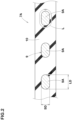
- FIG. 3 is a schematic diagram of one of the steel single wires 9A as viewed from the long diameter direction. As shown in FIG. 3 , each of the steel single wires 9A is formed wavy in at least one of, in the present embodiment both of, the long diameter direction and the short diameter direction in the cross-sectional shape.
- the steel single wires 9A configured as such moderate the rigidity of the belt layer 7, therefore, it is possible that the noise performance and the ride comfort performance of the tire 1 are improved.
- each of the steel single wires 9A has a wave pitch (P) of 3.0 to 10.0 mm.
- the wave pitch (P) is a length of one pitch in a longitudinal direction of the wavy steel single wire 9A. If the wave pitch (P) of the steel single wires 9A is smaller than 3.0 mm, the improvement effect of the tire 1 in the noise performance and the ride comfort performance may be small. If the wave pitch (P) of the steel single wires 9A is larger than 10.0 mm, the strength of the steel single wires 9A is decreased, which may affect the durability performance of the tire 1.
- the wave pitch (P) of the steel single wires 9A of the present embodiment is substantially constant along the longitudinal direction of the steel single wires 9A.
- the wave pitch (P) of the steel single wires 9A may vary in length along the longitudinal direction of the steel single wires 9A, for example.
- each of the steel single wires 9A has a wave height (H) of 0.05 to 0.15 mm. If the wave height (H) of the steel single wires 9A is smaller than 0.05 mm, the effect of improving the noise performance and the ride comfort performance of the tire 1 may be small. If the wave height (H) of the steel single wires 9A is greater than 0.15 mm, the strength of the steel single wires 9A is decreased, which may affect the durability performance of the tire 1.
- the tread portion 2 of the present invention includes a tread rubber 2A forming a tread ground contacting surface (2a).
- the tread rubber 2A has a complex elastic modulus ET* at 70°C of 4.5 to 10.0 MPa and a loss tangent tan ⁇ at 70 °C of 0.08 to 0.15.
- the complex elastic modulus ET* at 70 °C and the loss tangent tan ⁇ of the tread rubber 2A, as well as the topping rubber 10 described above, are the values measured by using a dynamic viscoelasticity measurement device (EPLEXOR series) manufactured by GABO QUALIMETER Testanlagen GmbH in accordance with Japanese Industrial Standard JIS-K6394 under the following conditions.
- EPLEXOR series dynamic viscoelasticity measurement device manufactured by GABO QUALIMETER Testanlagen GmbH in accordance with Japanese Industrial Standard JIS-K6394 under the following conditions.
- the tread rubber 2A configured as such suppresses heat generation during running and further improve the fuel efficiency of the tire 1 without affecting the noise performance, the ride comfort performance, and the durability performance. Therefore, it is possible that the tire 1 of the present embodiment further improve the fuel efficiency while maintaining good noise performance, good ride comfort performance, and good durability performance.
- a ratio (ET*/ES*) of the complex elastic modulus ET* of the tread rubber 2A to the complex elastic modulus ES* of the topping rubber 10 is 1.3 or less.
- the tread portion 2 configured as such helps to improve the noise performance, the ride comfort performance, the durability performance, and the fuel efficiency of the tire 1 in a good balance.
- Tires of size 175/70R13 having the tire meridian section shown in FIG. 1 were made by way of test according to the specification shown below. Tire strength, the noise performance, the ride comfort performance, the durability performance, and the fuel efficiency were evaluated by using the test tires. The manufacturing methods and the test methods for each test tire were as follows.
- each compounding content shown in Table 1 materials other than sulfur and the vulcanization accelerator were kneaded under the condition of 150 °C for 5 minutes by using a Banbury mixer to obtain a kneaded product. It should be noted that each compounding amount is a mass part.
- the steel wires shown in Table 2 and Table 3 were pulled out and arranged, and the obtained rubber composition for the belt was used to cover the top and bottom of the steel wires so that the total thickness was 0.95 mm. After vulcanization, the belt member was obtained by cutting out so that the steel cords were at 24 degrees with respect to the tire circumferential direction.
- test tires were poked with a protrusion and the energy required to burst the tires was measured.
- the results are indicated by an index based on Reference 1 being 100, wherein the larger the numerical value, the greater the required energy was, which shows higher tire strength.
- test tires were subjected to vibration on a shaker, and the time from when the vibration was stopped until the vibration was converged was measured.
- the results are indicated by an index based on Reference 1 being 100, wherein the larger the numerical value, the better the vibration convergence property is, which shows better ride comfort performance.
- test tires were mounted on a bench durability testing machine, and the running distance until the tire was damaged was measured.
- the results are indicated by an index based on Reference 1 being 100, wherein the larger the numerical value, the longer the running distance is, which shows better durability performance.
- test tires were mounted on a rolling resistance tester, and the rolling resistance was measured while the tires were run under load.
- the results are indicated by an index based on Reference 1 being 100, wherein the larger the numerical value, the smaller the rolling resistance is, which shows better fuel efficiency.
Landscapes
- Engineering & Computer Science (AREA)
- Mechanical Engineering (AREA)
- Tires In General (AREA)
Description
- The present invention relates to a tire provided with a belt layer in a tread portion.
- Conventionally, tires using belt cords made of steel single wires each having a flat cross-sectional shape in the belt layer have been known. For example,
JP 4467107 B2 JP 2001-080313 A - Further,
JP 2008-156418 A JP 2013-122038 A JP 2014-095017 A JP 2017-048351 A JP 2017-178994 A - The tire of
JP 4467107 B2 JP 4467107 B2 - The present invention has been made in view of the above, and a primary obj ect thereof is to provide a tire provided with a belt layer capable of improving the fuel efficiency while maintaining good noise performance, ride comfort performance, and durability performance.
- The present invention is a tire as defined in claim 1.
- In the tire of the present invention, it is preferred that the topping rubber has the loss tangent tanδ at 70 degrees Celsius in the range of from 0.04 to 0.09.
- In the tire of the present invention, it is preferred that the topping rubber has the loss tangent tanδ at 70 degrees Celsius in the range of from 0.04 to 0.06.
- In the tire of the present invention, it is preferred that the topping rubber has the complex elastic modulus ES* at 70 degrees Celsius in the range of from 14.0 to 20.0 MPa.
- In the tire of the present invention, it is preferred that each of the steel single wires has a ratio (LD/SD) of from 1.05 to 1.35 between a long diameter LD and a short diameter SD in a cross-sectional shape thereof.
- In the tire of the present invention, it is preferred that each of the steel single wires is formed wavy in at least one of a long diameter direction and a short diameter direction of the cross-sectional shape thereof, each of the steel single wires has a wave pitch (P) in the range of from 3.0 to 10.0 mm, and each of the steel single wires has a wave height (H) in the range of from 0.05 to 0.15 mm.
- In the tire of the present invention, it is preferred that the belt cords are arranged in the topping rubber so that a short diameter direction of the steel single wires is oriented along a thickness direction of the belt ply.
- In the tire of the present invention, it is preferred that the topping rubber contains a cobalt element, and a ratio (c/L) between a concentration (c) (ppm) of the cobalt element and an outer peripheral length (L) (mm) of each of the steel single wires in the cross-sectional shape thereof is in the range of from 350 to 1000 ppm/mm.
- In the tire of the present invention, the belt ply includes the belt cords made of the steel single wires having a flat cross-sectional shape, and the topping rubber covering the belt cords, the topping rubber has the complex elastic modulus ES* at 70 degrees Celsius in the range of from 8.0 to 20.0 MPa and the loss tangent tanδ at 70 degrees Celsius in the range of from 0.04 to 0.16, and the ratio (tanδ/ES*) between the loss tangent tanδ and the complex elastic modulus ES* (MPa) of the topping rubber is in the range of from 0.002 to 0.017.
- The topping rubber configured as such suppresses heat generation during running, therefore, it is possible that the fuel efficiency of the tire is improved without affecting the noise performance, the ride comfort performance, and the durability performance. Thereby, it is possible that the tire of the present invention improves the fuel efficiency while maintaining good noise performance, good ride comfort performance, and good durability performance.
-
-
FIG. 1 is a cross-sectional view showing a tire according to an embodiment of the present invention. -
FIG. 2 is a cross-sectional view of a belt ply. -
FIG. 3 is a schematic diagram of a single steel wire. - An embodiment of the present invention will now be described in conjunction with accompanying drawings.
-
FIG. 1 is a tire meridian section of a tire 1 passing through a rotational axis of the tire 1 in a standard state. The tire 1 of the present embodiment is suitable for use as a rubber pneumatic tire to be mounted on passenger cars and the like. It should be noted that the tire 1 is not limited to rubber pneumatic tires for passenger cars, but can be applied to a variety of tires, such as heavy-duty pneumatic tires, plastic pneumatic tires, and non-pneumatic tires not filled with pressurized air therein, for example. - Here, in the case where the tire 1 is a rubber pneumatic tire, the "standard state" is a state in which the tire 1 is mounted on a standard rim, inflated to a standard inner pressure, and loaded with no tire load. In the following, unless otherwise mentioned, the dimensions of various parts of the tire 1 are the values measured in this standard state.
- The "standard rim" is a wheel rim specified for the concerned tire by a standard included in a standardization system on which the tire is based, for example, the "normal wheel rim" in JATMA, "Design Rim" in TRA, and "Measuring Rim" in ETRTO.
- The "standard inner pressure" is air pressure specified for the concerned tire by a standard included in a standardization system on which the tire is based, for example, the maximum air pressure in JATMA, maximum value listed in the "TIRE LOAD LIMITS AT VARIOUS COLD INFLATION PRESSURES" table in TRA, and "INFLATION PRESSURE" in ETRTO.
- As shown in
FIG. 1 , the tire 1 of the present embodiment includes atread portion 2 extending annularly, a pair ofsidewall portions 3 extending on both sides of thetread portion 2, and a pair ofbead portions 4 extending in connection with thesidewall portions 3. The tire 1 of the present embodiment has atoroidal carcass 6 extending betweenbead cores 5 of the pair of thebead portions 4, and abelt layer 7 arranged radially outside thecarcass 6 and inside thetread portion 2. - The
carcass 6 includes at least one carcass ply, in the present embodiment onecarcass ply 6A. Thecarcass ply 6A includes carcass cords (not shown) arranged at an angle of 75 to 90 degrees with respect to a tire circumferential direction, for example. Organic fiber cords such as aromatic polyamide or rayon and the like can be employed as the carcass cords, for example. - The
carcass ply 6A includes a main body portion (6a) extending between the pair of thebead cores 5, and turned-up portions (6b) connected to the main body portion (6a) and each turned up from the inside to the outside in a tire axial direction around a respective one of thebead cores 5, for example. Abead apex rubber 8 extending outward in a tire radial direction from each of thebead cores 5 is disposed between the main body portion (6a) and each of the turned-up portions (6b) of thecarcass ply 6A, for example. - The
belt layer 7 includes at least one belt ply, in the present embodiment twobelt plies belt plies first belt ply 7A arranged radially inside and asecond belt ply 7B arranged radially outside thefirst belt ply 7A, for example. Thebelt layer 7 configured a such increases rigidity of thetread portion 2, therefore, it is possible that the durability performance of the tire 1 is improved. -
FIG. 2 is an enlarged cross-sectional view of thebelt ply 7A. InFIG. 2 , thebelt ply 7A is shown as an example, but the same structure can be used for thebelt ply 7B as well. As shown inFIG. 2 , at least one of thebelt plies belt cords 9 formed by steelsingle wires 9A having a flat cross-sectional shape and atopping rubber 10 covering thebelt cords 9. - It is preferred that the
topping rubber 10 has a complex elastic modulus ES* at 70 degrees Celsius in the range of from 8.0 to 20.0 MPa, and a loss tangent tanδ at 70 degrees Celsius in the range of from 0.04 to 0.16. Thetopping rubber 10 configured as such suppresses heat generation during running, therefore, it is possible that the fuel efficiency of the tire 1 is improved without affecting the noise performance, the ride comfort performance, and the durability performance. Thereby, it is possible that the tire 1 of the present embodiment improves the fuel efficiency while maintaining good noise performance, good ride comfort performance, and good durability performance. - Here, the complex elastic modulus ES* at 70°C and the loss tangent tanδ of the
topping rubber 10 were the values measured in accordance with Japanese Industrial Standard JIS-K6394 by using a dynamic viscoelasticity measurement device (EPLEXOR series) manufactured by GABO QUALIMETER Testanlagen GmbH under the following conditions. - initial strain: 10%
- amplitude of dynamic strain: ±1%
- frequency: 10Hz
- deformation mode: tensile
- measurement temperature: 70°C
- It is more preferred that the complex elastic modulus ES* of the
topping rubber 10 at 70°C is in the range of from 14.0 to 20.0 MPa. Thetopping rubber 10 configured as such suppresses the deformation of thebelt layer 7, therefore, it is possible that the durability performance of the tire 1 is improved. On the other hand, when the toppingrubber 10 has the complex elastic modulus ES* in the range of from 8.0 to 14.0 MPa at 70 degrees Celsius, it is possible that the noise performance and the ride comfort performance are improved. - The loss tangent tan δ at 70°C of the topping
rubber 10 is more preferably in the range of from 0.04 to 0.14, even more preferably from 0.04 to 0.09, and most preferably from 0.04 to 0.06. The toppingrubber 10 configured as such further suppresses the heat generation during running, therefore, it is possible that the fuel efficiency of the tire 1 is further improved without affecting the noise performance, the ride comfort performance, and the durability performance. - It is preferred that the topping
rubber 10 has a ratio (tanδ/ES*) of the loss tangent tanδ and the complex elastic modulus ES* (MPa) in the range of from 0.002 to 0.017. The toppingrubber 10 configured as such suppresses the heat generation during running, therefore, it is possible that the fuel efficiency of the tire 1 is improved without affecting the noise performance, the ride comfort performance, and the durability performance. Thereby, it is possible that the tire 1 of the present embodiment improves the fuel efficiency while maintaining good noise performance, good ride comfort performance, and good durability performance. - Examples of the rubber components used in the topping
rubber 10 include, for example, natural rubber (NR), isoprene-based rubber such as isoprene rubber (IR), and diene-based rubber such as butadiene rubber (BR), styrene-butadiene rubber (SBR), styrene-isoprene-butadiene rubber (SIBR), chloroprene rubber (CR), acrylonitrile butadiene rubber (NBR) and the like. For the toppingrubber 10, natural rubber (NR) or the combination of natural rubber (NR) and isoprene rubber (IR) is preferred from the point of view of the durability performance. - It is preferred that the topping
rubber 10 contains a cobalt element in the rubber. Examples of compounds containing a cobalt element include cobalt salts of organic acids such as cobalt stearate, cobalt naphthenate, cobalt neodecanoate, and cobalt boron trineodecanoate, and the like, for example. In the toppingrubber 10 configured as such, cross-linking withbelt cords 9 is promoted by the cobalt elements during vulcanization molding, therefore, it is possible that the adhesion of the toppingrubber 10 with thebelt cords 9 is improved. - It is preferred that the topping
rubber 10 contains carbon black. From the point of view of the durability performance, the content of the carbon black is preferably 10 mass parts or more, more preferably 40 mass parts or more, and even more preferably 50 mass parts or more per 100 mass parts of rubber component. On the other hand, from the point of view of heat generating property, the upper limit of the carbon black content is preferably 100 mass parts or less, and more preferably 70 mass parts or less. - Although not particularly limited, examples of the carbon black include furnace black (furnace carbon black) such as SAF, ISAF, HAF, MAF, FEF, SRF, GPF, APF, FF, CF, SCF, and ECF; acetylene black (acetylene carbon black); thermal black (thermal carbon black) such as FT and MT; channel black (channel carbon black) such as EPC, MPC, and CC; graphite, and the like. One of these may be used alone, or two or more may be used in combination.
- The nitrogen adsorption specific surface area (N2SA) of the carbon black is more than 30 m2/g and less than 250 m2/g, for example. The amount of dibutyl phthalate (DBP) absorption of carbon black is, for example, more than 50 ml/100 g and less than 250 ml/100 g, for example. It should be noted that the nitrogen adsorption specific surface area of the carbon black is measured according to ASTM D4820-93, and the DBP absorption is measured according to ASTM D2414-93.
- Although not particularly limited, examples of specific carbon black are N134, N110, N220, N234, N219, N339, N330, N326, N351, N550, N762, and the like. Commercial products can be used, for example, from Asahi Carbon Corporation, Cabot Japan Corporation, Tokai Carbon Corporation, Mitsubishi Chemical Corporation, Lion Corporation, Nippon Steel Carbon Corporation, Columbia Carbon Corporation, and others. One of these may be used alone, or two or more may be used in combination.
- It is preferred that the topping
rubber 10 also contains silica, if necessary. The BET specific surface area of the silica is preferably more than 140 m2/g, and more preferably more than 160 m2/g from the point of view of obtaining good durability performance. On the other hand, from the point of view of obtaining good fuel efficiency, the upper limit of the BET specific surface area of the silica is preferably less than 250 m2/g, and more preferably less than 220 m2/g. It should be noted that the BET specific surface area is the value of N2SA measured by the BET method according to ASTM D3037-93. - When silica is not used in combination with a silane coupling agent, the content of the silica with respect to 100 mass parts of rubber component is preferably 3 mass parts or more, and more preferably 5 mass parts or more. On the other hand, for the upper limit of the silica content when not used together with a silane coupling agent, 25 mass parts or less is preferable, and 15 mass parts or less is more preferable. Further, it is preferred that the upper limit of the silica content is 25 mass parts or more when used in combination with a silane coupling agent. On the other hand, for the upper limit of the silica content when used in combination with a silane coupling agent, 50 mass parts or less is preferable, 40 mass parts or less is more preferable, and 30 mass parts or less is even more preferable.
- Examples of the silica include fumed silica (anhydrous silica), wet silica (hydrous silica), and the like, for example. As for the silica, among these, wet silica is preferred because of its high silanol group content.
- Products from Degussa, Rhodia, Tosoh Silica Corporation, Solvay Japan Corporation, Tokuyama Corporation, and so on can be used as the silica, for example.
- As mentioned above, a silane coupling agent can also be used in conjunction with silica. Although not particularly limited, examples of the silane coupling agent include bis(3 -triethoxysilylpropyl)tetrasulfide, bis(2-triethoxysilylethyl)tetrasulfide, Bis(4-triethoxysilylbutyl)tetrasulfide, Bis(3-trimethoxysilylpropyl)tetrasulfide, Bis(2-trimethoxysilylethyl)tetrasulfide, Bis(2-triethoxysilylethyl)trisulfide, Bis(4-trimethoxysilylbutyl)trisulfide, Bis(3-triethoxysilylpropyl)disulfide, Bis(2-triethoxysilylethyl)disulfide, Bis(4-triethoxysilylbutyl)disulfide, Bis(3-triethoxysilylpropyl)disulfide, Bis(2-trimethoxysilylethyl) disulfide, Bis(4-triethoxysilylbutyl) disulfide, 3-Trimethoxysilylpropyl-N,N-dimethylthiocarbamoyl tetrasulfide, 2-Triethoxysilylethyl-N,N-dimethylthiocarbamoyl tetrasulfide, sulfides such as 3-Triethoxysilylpropyl methacrylate monosulfide and the like, 3-mercaptopropyltrimethoxysilane, 2-mercaptoethyltriethoxysilane, mercaptic compounds such as NXT and NXT-Z available from Momentive, Inc., vinyl triethoxysilane, vinyl compounds such as vinyltrimethoxysilane and the like, 3-aminopropyltriethoxysilane, amino compounds such as 3-aminopropyltrimethoxysilane and the like, γ-glycidoxypropyltriethoxysilane, glycidoxy compounds such as γ-glycidoxypropyltrimethoxysilane and the like, 3-Nitropropyltrimethoxysilane, nitro compounds such as 3-nitropropyltriethoxysilane and the like, 3-chloropropyltrimethoxysilane, chloro compounds such as 3-chloropropyltriethoxysilane and the like, for example. One of these may be used alone, or two or more may be used in combination.
- As for the silane coupling agent, products from Degussa, Momentive, Shin-Etsu Silicone, Tokyo Kasei Kogyo, Azumax, Toray Dow Coming, and others can be used, for example.
- The content of the silane coupling agent is more than 3 mass parts and less than 15 mass parts per 100 mass parts of silica, for example.
- In addition to carbon black and silica, the topping
rubber 10 may contain additional fillers commonly used in the tire industry, such as calcium carbonate, talc, alumina, clay, aluminum hydroxide, mica, and the like, for example. The amount of these contents is, for example, more than 0.1 mass part and less than 20.0 mass parts per 100 mass parts of the rubber component. - It is preferred that the topping
rubber 10 contains a curable resin component such as modified resorcinol resin, modified phenol resin, and the like. Thereby, it is possible that the adhesion to steel cords is improved without significantly degrading the heat generating property and elongation at rupture. - The content of the curable resin component is preferably 1 mass part or more, and more preferably 2 mass parts or more with respect to 100 mass parts of the rubber component, for example. On the other hand, for the upper limit of the content of the curable resin component, 10 mass parts or less is preferable, and 8 mass parts or less is more preferable.
- Examples of specific modified resorcinol resin include, for example, Sumicanol 620 (modified resorcinol resin) available from Taoka Chemical Industry, and examples of modified phenolic resins include, for example, PR12686 (cashew oil modified phenolic resin) available from Sumitomo Bakelite Co., Ltd.
- It is preferred that modified resorcinol resin also contains methylene donors as curing agents when using the modified resorcinol resin. Examples of methylene donors include hexamethylenetetramine (HMT), hexamethoxymethylol melamine (HMMM), hexamethylol melamine pentamethyl ether (HMMPME), and the like, for example, and it is preferred to include 5 mass parts or more, for example, about 15 mass parts, per 100 mass parts of curable resin component.
- As a specific methylene donor, Sumikanol 507 available from Taoka Chemical Co., Ltd., for example.
- From the point of view of processability (imparting adhesiveness), it is preferred that the topping
rubber 10 contains softening agents such as oil or resin components as necessary. The total content of these is preferably more than 0.5 mass parts and less than 10 mass parts per 100 mass parts of rubber component. - Examples of the oil include mineral oil (commonly referred to as process oil), vegetable oil, or mixtures thereof, for example. As mineral oil (process oil), paraffinic process oil, aromatic process oil, naphthenic process oil, and the like can be used, for example. Examples of vegetable oil include castor oil, cottonseed oil, linseed oil, rape seed oil, soybean oil, palm oil, coconut oil, peanut oil, rosin, pine oil, pine tar, tall oil, corn oil, rice oil, safflower oil, sesame oil, olive oil, sunflower oil, palm kernel oil, camellia oil, jojoba oil, macadamia nut oil, paulownia oil, and the like. One of these may be used alone, or two or more may be used in combination.
- As for the specific process oil (mineral oil), products from Idemitsu Kosan, Sankyo Petrochemical, Japan Energy, Orisoy, H&R, Hokoku Corporation, Showa Shell Sekiyu, Fuji Kosan Company, and the like can be used, for example.
- The resin component may be solid or liquid at room temperature, and examples of the specific resin component include, for example, rosin-based resins, styrene-based resins, coumarone-based resins, terpene-based resins, C5 resins, C9 resins, C5C9 resins, acrylic resins, and the like, and two or more of these may be used together in combination. The content of the resin component is preferably more than 2 mass parts and less than 45 mass parts, more preferably less than 30 mass parts per 100 mass parts of the rubber component.
- Rosin-based resins are mainly composed of rosin acid, which is obtained by processing pine resin. These rosin-based resins (rosins) can be classified according to whether they are modified or not, and can be classified into unmodified rosin (unmodified rosin) and rosin modified products (rosin derivatives). Examples of the unmodified rosin include tall rosin (also known as tall oil rosin), gum rosin, wood rosin, disproportionated rosin, polymerized rosin, hydrogenated rosin, other chemically modified rosins, and the like. Rosin modified products are modified versions of unmodified rosin, including rosin esters, unsaturated carboxylic acid modified rosin, unsaturated carboxylic acid modified rosin esters, amide compounds of rosin, amine salts of rosin, and the like.
- Styrene-based resins are polymers that use styrene-based monomer as the constituent monomer, such as polymers polymerized with styrene monomer as the main component (50 mass% or more). Specific examples of the styrene-based resins include single polymers in which styrene-based monomer is polymerized alone, copolymers in which two or more styrene monomers are copolymerized, as well as copolymers of styrene monomers and other monomers that can be copolymerized with styrene monomers. Specific examples of styrene-based monomer include styrene, o-methylstyrene, m-methylstyrene, p-methylstyrene, α-methylstyrene, p-methoxystyrene, p-tert-butylstyrene, p-phenylstyrene, o-chlorostyrene, m-chlorostyrene, p- chlorostyrene, and the like.
- Examples of other monomers include acrylonitriles, such as acrylonitrile and methacrylonitrile; acrylics; unsaturated carboxylic acids, such as methacrylic acid; unsaturated carboxylic esters, such as methyl acrylate and methyl methacrylate; dienes, such as chloroprene and butadiene isoprene; olefins, such as 1-butene and 1-pentene; α,β-unsaturated carboxylic acids, such as maleic anhydride, or acid anhydrides thereof; and others.
- Among the coumarone resins, coumarone indene resin is preferred. Coumaron-indene resin is a resin that contains coumarone and indene as the monomer components that make up the backbone (main chain) of the resin. In addition to coumarone and indene, examples of the monomer components in the backbone include styrene, α-methylstyrene, methylindene, vinyltoluene, and the like.
- The content of coumaronindane resin is more than 1.0 mass part and less than 50.0 mass parts per 100 mass parts of rubber component, for example.
- The hydroxyl group value (OH value) of coumaronindane resin is more than 15 mg KOH/g and less than 150 mg KOH/g, for example. It should be noted that the OH value is the amount of potassium hydroxide required to neutralize the acetic acid bonded to the hydroxyl group when acetylating 1g of resin, expressed in milligrams and measured by potentiometric titration method (JIS K 0070:1992).
- The softening point of coumaronindane resin is, for example, above 30°C and below 160°C. It should be noted that the softening point is the temperature at which the sphere drops when the softening point specified in JIS K 6220-1:2001 is measured by using a cyclic softening point measuring device.
- Examples of the terpene-based resin include polyterpenes, terpene phenols, and aromatic modified terpene resins. Polyterpene is a resin obtained by polymerizing terpene compounds and their hydrogenated products. Terpene compounds are hydrocarbons and their oxygen-containing derivatives represented by the composition of (C5H8)n, and are the compounds with a basic skeleton of terpenes classified as monoterpene (C10H16), sesquiterpene (C15H24), diterpene (C20H32), and so on. Examples of the terpene compounds include α-pinene, β-pinene, dipentene, limonene, myrcene, alloocimene, ocimene, α-feranthrene, α-terpinene, γ-terpinene, terpinolene, 1,8-cineole, 1,4-cineole, α-terpineol, β-terpineol, γ-terpineol, and the like, for example.
- Examples of polyterpenes include terpene resins such as α-pinene resin, β-pinene resin, limonene resin, dipentene resin, β-pinene/limonene resin, and the like, which are made from the terpene compounds described above, as well as hydrogenated terpene resins, which are hydrogenated to the terpene resins. Examples of the terpene phenol include a resin obtained by copolymerizing a terpene compound and a phenolic compound, and a resin obtained by hydrogenating the copolymerized resin. Specific examples of the terpene phenol include a terpene compound, a phenol-based compound, and a resin obtained by condensing formalin. It should be noted that examples of the phenol-based compound include phenol, bisphenol A, cresol, xylenol and the like, for example. Examples of the aromatic-modified terpene resin include a resin obtained by modifying a terpene resin with an aromatic compound, and a resin obtained by hydrogenating the above modified resin. It should be noted that the aromatic compound is not particularly limited as long as it is a compound having an aromatic ring, and examples of the aromatic compound include, for example, phenol compounds such as phenol, alkylphenol, alkoxyphenol, unsaturated hydrocarbon group-containing phenol, and the like; naphthol compounds such as naphthol, alkylnaphthol, alkoxynaphthol, and naphthol containing unsaturated hydrocarbon groups, and the like: styrene derivatives such as styrene, alkylstyrene, alkoxystyrene, styrenes containing unsaturated hydrocarbon groups; kumaron, inden and the like.
- The "C5 resin" refers to a resin obtained by polymerizing a C5 fraction. Examples of the C5 fraction include petroleum fractions having 4 to 5 carbon atoms such as cyclopentadiene, pentene, pentadiene, isoprene, and the like. As the C5 petroleum resin, a dicyclopentadiene resin (DCPD resin) is preferably used.
- The "C9 resin" refers to a resin obtained by polymerizing C9 fractions, and may be hydrogenated or modified. Examples of the C9 fractions include petroleum fractions having 8 to 10 carbon atoms such as vinyltoluene, alkylstyrene, indene, methyl indene, and the like. As a specific example, kumaron indene resin, kumaron resin, indene resin, and aromatic vinyl-based resin are preferably used, for example. As for aromatic vinyl resins, a monopolymer of α-methylstyrene or styrene or a copolymer of α-methylstyrene and styrene is preferred, and a copolymer of α-methylstyrene and styrene is more preferred because it is economical, easy to process, and has excellent heat generating property. As for aromatic vinyl resins, those commercially available from Kraton, Eastman Chemical, and so on can be used, for example.
- The term "C5C9 resin" refers to resins obtained by copolymerization of C5 and C9 fractions, which may be hydrogenated or modified. Examples of the C5 fraction and the C9 fraction include the above-mentioned petroleum fraction. As for the C5C9 resins, those commercially available from Tosoh Corporation, LUHUA, and so on can be used, for example.
- The acrylic resins are not particularly limited, but for example, a solvent-free acrylic resin can be used.
- Examples of the solvent-free acrylic resins include a (meth) acrylic resin synthesized by a high-temperature continuous polymerization method (high-temperature continuous lump polymerization method, i.e., the method described in
US Patent No. 4414370 ;JPS59-6207 JPH5-58005 JPH1-313522 US Patent No. 5010166 ; Toagosei Annual Report TREND2000, No. 3, p42-45; and the like) without using polymerization initiators, chain transfer agents, organic solvents, and the like, as auxiliary raw materials as much as possible. It should be noted that, in the present invention, (meth) acrylic means methacrylic and acrylic. - Examples of the monomer component constituting the acrylic resins include (meth) acrylic acid and (meth) acrylic acid derivatives such as (meth) acrylic acid ester (alkyl ester, aryl ester, aralkyl ester, and the like), (meth) acrylamide, (meth) acrylamide derivatives, and the like, for example.
- Further, as the monomer components constituting the acrylic resins, aromatic vinyls such as styrene, α-methylstyrene, vinyltoluene, vinylnaphthalene, divinylbenzene, trivinylbenzene, divinylnaphthalene and the like may be used together with (meth) acrylic acid and (meth) acrylic acid derivatives.
- The acrylic resins can be resins composed solely of (meth) acrylic components or resins containing components other than (meth) acrylic components. Further, the acrylic resins may have hydroxyl groups, carboxyl groups, silanol groups, and the like.
- Examples of the resin components include products available from Maruzen Petrochemical Co., Ltd., Sumitomo Bakelite Co., Ltd., Yasuhara Chemical Co., Ltd., Tosoh Corporation, Rutgers Chemicals GmbH, BASF SE, Arizona Chemical Company, LLC, Nitto Chemical Co., Ltd., Nippon Shokubai Co., Ltd., JX Energy Corporation, Arakawa Chemical Industries, Ltd., Taoka Chemical Co., Ltd., and the like, for example.
- It is preferred that the topping
rubber 10 contains an anti-aging agent. The content of the anti-aging agent is more than 1 mass part and less than 10 mass parts with respect to 100 parts by mass of the rubber component, for example. - Examples of the antiaging agent include, for example, naphthylamine-based anti-aging agents such as phenyl-α-naphthylamine, and the like; diphenylamine-based anti-aging agents such as octylated diphenylamine, 4,4'-bis (α, α'-dimethylbenzyl) diphenylamine, and the like; p-phenylenediamine-based anti-aging agents such as N-Isopropyl-N'-phenyl-p-phenylenediamine, N-(1,3-dimethylbutyl)-N'-phenyl-p-phenylenediamine, N,N'-di-2-naphthyl-p-phenylenediamine, and the like; quinoline-based anti-aging agents such as a polymer of 2,2,4-trimethyl-1,2-dihydroquinolin, and the like; monophenolic anti-aging agents such as 2,6-di-t-butyl-4-methylphenol, styrenated phenol, and the like; bis, tris, polyphenolic anti-aging agents such as tetrakis-[methylene-3-(3',5'-di-t-butyl-4'-hydroxyphenyl) propionate] methane, and the like. One of these may be used alone, or two or more may be used in combination.
- As the anti-aging agent, for example, products available from Seiko Chemical Co., Ltd., Sumitomo Chemical Co., Ltd., Ouchi Shinko Chemical Industrial Co., Ltd., FlexSys Inc., and the like can be used.
- The topping
rubber 10 may contain stearic acid. The content of the stearic acid is more than 0.5 parts by mass and less than 10.0 parts by mass with respect to 100 parts by mass of the rubber component, for example. As the stearic acid, conventionally known products can be used, and for example, products such as NOF Corporation, Kao Corporation, Fujifilm Wako Pure Chemical Corporation, Chiba Fatty Acid Co., Ltd., and the like can be used. - The topping rubber may contain zinc oxide. The content of the zinc oxide is, for example, more than 0.5 parts by mass and less than 15 parts by mass with respect to 100 parts by mass of the rubber component. As the zinc oxide, conventionally known products can be used, for example, products available from Mitsui Mining and Smelting Co., Ltd., Toho Zinc Co., Ltd., Hakusui Tech Co., Ltd., Seido Chemical Industry Co., Ltd., Sakai Chemical Industry Co., Ltd., and the like can be used.
- It is preferred that the topping
rubber 10 contains a cross-linking agent such as sulfur. The content of the cross-linking agent is more than 0.1 part by mass and less than 10.0 parts by mass with respect to 100 parts by mass of the rubber component, for example. - Examples of sulfur include powdered sulfur, precipitated sulfur, colloidal sulfur, insoluble sulfur, highly dispersible sulfur, and soluble sulfur, which are generally used in the rubber industry. One of these may be used alone, or two or more may be used in combination.
- It should be noted that, as the sulfur, products available from Tsurumi Chemical Industry Co., Ltd., Karuizawa Sulfur Co., Ltd., Shikoku Chemicals Corporation, FlexSys Inc., Nippon Kanryu Industry Co., Ltd., Hosoi Chemical Industry Co., Ltd., and the like can be used, for example.
- Examples of the cross-linking agent other than sulfur include vulcanizing agents containing sulfur atoms such as Tackirol V-200 available from Taoka Chemical Co., Ltd., Duralink HTS (1,6-hexamethylene-sodium dithiosulfate dihydrate) available from FlexSys Inc., KA9188 (1,6-bis (N, N'-dibenzylthiocarbamoyldithio) hexane) available from Lanxess AG, and the like; and organic peroxides such as dicumyl peroxide and the like, for example.
- It is preferred that the topping
rubber 10 contains a vulcanization accelerator. The content of the vulcanization accelerator is more than 0.3 parts by mass and less than 10.0 parts by mass with respect to 100 parts by mass of the rubber component, for example. - Examples of the vulcanization accelerator include thiazole-based vulcanization accelerators such as 2-mercaptobenzothiazole, di-2-benzothiazolyl disulfide, N-cyclohexyl-2-benzothiadylsulfenamide, and the like; thiuram-based vulcanization accelerators such as tetramethylthiuram disulfide (TMTD), tetrabenzylthiuram disulfide (TBzTD), tetrakis (2-ethylhexyl) thiuram disulfide (TOT-N), and the like; sulfenamide-based vulcanization accelerators such as N-cyclohexyl-2-benzothiazolesulfenamide, N-t-butyl-2-benzothiazolylsulfenamide, N-oxyethylene-2-benzothiazolesulfenamide, N-oxyethylene-2-benzothiazolesulfenamide, N, N'-diisopropyl-2-benzothiazolesulfenamide, and the like; guanidine-based vulcanization accelerators such as diphenylguanidine, dioltotrilguanidine, orthotrilbiguanidine, and the like. One of these may be used alone, or two or more may be used in combination.
- In addition to these components, the rubber composition for belts used in the topping
rubber 10 may further contain additives commonly used in the tire industry, such as fatty acid metal salts, carboxylic acid metal salts, organic peroxides, and the like, for example. The content of these additives is more than 0.1 part by mass and less than 200 parts by mass with respect to 100 parts by mass of the rubber component, for example. - It is preferred that a ratio (c/L) between a concentration (c) (ppm) of the cobalt element described above and an outer peripheral length (L) (mm) in the cross-sectional shape of each of the
steel single wires 9A is 350 to 1000 ppm/mm. Since the ratio (c/L) is 350 ppm/mm or more, it is possible that the adhesiveness with thebelt cords 9 is improved, therefore, it is possible that the durability performance of the tire 1 is improved. Since the ratio (c/L) is 1000 ppm/mm or less, the adhesive layer withbelt cords 9 is suppressed from becoming brittle, therefore, delamination is suppressed even if repeated deformation due to rotation of the tire 1 acts, thereby, it is possible that the durability performance of the tire 1 is improved. From this point of view, it is more preferred that the ratio (c/L) is 400 to 740 ppm/mm. - The
belt cords 9 in the present embodiment are arranged in the toppingrubber 10 so that the short diameter direction of thesteel single wires 9A is oriented along a thickness direction of the belt plies 7A and 7B. It is possible that thebelt cords 9 configured as such maintain the rigidity of thetread portion 2 while reducing the thickness of the belt plies 7A and 7B, therefore, thebelt cords 9 are helpful for achieving both the fuel efficiency and the durability performance due to the reduced weight of the tire 1. - It is preferred that each of the
steel single wires 9A has a ratio (LD/SD) of 1.05 to 1.35 between a long diameter LD and a short diameter SD in a cross-sectional shape thereof. If the ratio (LD/SD) of thesteel single wires 9A is smaller than 1.05, the rigidity of thebelt layer 7 becomes excessively high, therefore, the noise performance and the ride comfort performance of the tire 1 may not be improved. If the ratio (LD / SD) of thesteel single wires 9A is greater than 1.35, the strength of thesteel single wires 9A is decreased, which may affect the durability performance of the tire 1. - It is preferred that each of the
steel single wires 9A has the long diameter LD of 0.30 to 0.50 mm in the cross-sectional shape thereof. If the long diameter LD of each of thesteel single wires 9A is smaller than 0.30 mm, the strength of thesteel single wires 9A is decreased, which may affect the durability performance of the tire 1. If the long diameter LD of each of thesteel single wires 9A is larger than 0.50 mm, the rigidity of thebelt layer 7 becomes excessively high, which may affect the noise performance and the ride comfort performance of the tire 1. -
FIG. 3 is a schematic diagram of one of thesteel single wires 9A as viewed from the long diameter direction. As shown inFIG. 3 , each of thesteel single wires 9A is formed wavy in at least one of, in the present embodiment both of, the long diameter direction and the short diameter direction in the cross-sectional shape. Thesteel single wires 9A configured as such moderate the rigidity of thebelt layer 7, therefore, it is possible that the noise performance and the ride comfort performance of the tire 1 are improved. - It is preferred that each of the
steel single wires 9A has a wave pitch (P) of 3.0 to 10.0 mm. Here, the wave pitch (P) is a length of one pitch in a longitudinal direction of the wavy steelsingle wire 9A. If the wave pitch (P) of thesteel single wires 9A is smaller than 3.0 mm, the improvement effect of the tire 1 in the noise performance and the ride comfort performance may be small. If the wave pitch (P) of thesteel single wires 9A is larger than 10.0 mm, the strength of thesteel single wires 9A is decreased, which may affect the durability performance of the tire 1. - The wave pitch (P) of the
steel single wires 9A of the present embodiment is substantially constant along the longitudinal direction of thesteel single wires 9A. The wave pitch (P) of thesteel single wires 9A may vary in length along the longitudinal direction of thesteel single wires 9A, for example. - It is preferred that each of the
steel single wires 9A has a wave height (H) of 0.05 to 0.15 mm. If the wave height (H) of thesteel single wires 9A is smaller than 0.05 mm, the effect of improving the noise performance and the ride comfort performance of the tire 1 may be small. If the wave height (H) of thesteel single wires 9A is greater than 0.15 mm, the strength of thesteel single wires 9A is decreased, which may affect the durability performance of the tire 1. - As shown in
FIG. 1 , thetread portion 2 of the present invention includes atread rubber 2A forming a tread ground contacting surface (2a). Thetread rubber 2A has a complex elastic modulus ET* at 70°C of 4.5 to 10.0 MPa and a loss tangent tan δ at 70 °C of 0.08 to 0.15. - Here, the complex elastic modulus ET* at 70 °C and the loss tangent tan δ of the
tread rubber 2A, as well as the toppingrubber 10 described above, are the values measured by using a dynamic viscoelasticity measurement device (EPLEXOR series) manufactured by GABO QUALIMETER Testanlagen GmbH in accordance with Japanese Industrial Standard JIS-K6394 under the following conditions. - initial strain: 10%
- amplitude of dynamic strain: ±1%
- frequency: 10Hz
- deformation mode: tensile
- measurement temperature: 70°C
- It is possible that the
tread rubber 2A configured as such suppresses heat generation during running and further improve the fuel efficiency of the tire 1 without affecting the noise performance, the ride comfort performance, and the durability performance. Therefore, it is possible that the tire 1 of the present embodiment further improve the fuel efficiency while maintaining good noise performance, good ride comfort performance, and good durability performance. - It is preferred that a ratio (ET*/ES*) of the complex elastic modulus ET* of the
tread rubber 2A to the complex elastic modulus ES* of the toppingrubber 10 is 1.3 or less. Thetread portion 2 configured as such helps to improve the noise performance, the ride comfort performance, the durability performance, and the fuel efficiency of the tire 1 in a good balance. - While detailed description has been made of an especially preferred embodiment of the present invention, the present invention can be embodied in various forms without being limited to the illustrated embodiment but only by the scope of the invention defined by the appended claims.
- Tires of size 175/70R13 having the tire meridian section shown in
FIG. 1 were made by way of test according to the specification shown below. Tire strength, the noise performance, the ride comfort performance, the durability performance, and the fuel efficiency were evaluated by using the test tires. The manufacturing methods and the test methods for each test tire were as follows. - First, a rubber composition for the belt to be used for the topping rubber was manufactured.
- First, each of the compounding materials shown below was prepared.
-
- (i) Carbon black-1: Show Black N326 available from Cabot Japan K.K. (N2SA: 78m2/g)
- (ii) Carbon black-2: Show Black N550 available from Cabot Japan K.K. (N2SA: 42m2/g)
- (iii) Curable resin component-1: PR12686 available from Sumitomo Bakelite Co., Ltd. (Cashew oil-modified phenolic resin)
- (iv) Curable resin component-2: Sumikanol 620 available from Taoka Chemical Co., Ltd. (modified resorcin resin)
- (v) Curing agent: Sumikanol 507 available from Taoka Chemical Co., Ltd. (methylene donor/ Resin curing agent)
- (vi) Cobalt organic acid-1: COST available from DIC Corporation (cobalt content: 9.5% by mass)
- (vii) Cobalt organic acid-2: DICNATE NBC-2 available from DIC Corporation (Cobalt boron neodecanoate, cobalt content 22.5% by mass)
- (viii) Zinc Oxide: Aenka No. 1 available from Mitsui Mining and Smelting Co., Ltd.
- (ix) Anti-aging agent-1: Nocrac 6C available from Ouchi Shinko Chemical Industrial Co., Ltd. (N-Phenyl-N'-(1 ,3-dimethylbutyl)-p-phenylenediamine)
- (x) Anti-aging agent-1: Antage RD available from Kawaguchi Chemical Industry Co., Ltd. (2,2,4-trimethyl-1,2-dihydroquinoline)
- (xi) Oil: Process X-140 available from Japan Energy Corporation
- (xii) Crosslinking agent, vulcanization accelerator, and cross-linking aid
- Sulfur: Crystex HSOT20 available from FlexSys Inc. (insoluble sulfur containing 80% by mass of sulfur and 20% by mass of oil)
- Vulcanization accelerator: Nocceler DZ available from Ouchi Shinko Chemical Industrial Co., Ltd. (N, N-dicyclohexyl-2-benzothiazolyl sulphenamide)
- Crosslinking aid: Duralink HTS available from FlexSys Inc.
- According to each compounding content shown in Table 1, materials other than sulfur and the vulcanization accelerator were kneaded under the condition of 150 °C for 5 minutes by using a Banbury mixer to obtain a kneaded product. It should be noted that each compounding amount is a mass part.
- The formulation of the topping rubber is shown in Table 1.
Table 1 Formulation of Topping rubber A B C D E F G H I J K L M (a) Rubber component NR 100 100 100 100 100 100 100 100 100 100 100 100 100 (b) Compounding materials other than Rubber component (i) Carbon black-1 70 70 55 58 55 75 20 20 15 15 15 15 (ii) Carbon black-2 55 40 40 40 40 40 40 (iii) Curable resin component-1 6 3 (iv) Curable resin component-2 6 7 5 6 6 6 6 6 6 (v) Curing agent 2.5 1.5 3 3 2 2 2 2.5 2.5 2.5 2.5 (vi) Cobalt organic acid-1 1.94 1.83 1.77 1.46 1.78 1.79 1.95 1.21 0.1 (vii) Cobalt organic acid-2 1.29 0.77 0.7 0.56 0.82 (viii) Zinc Oxide 10 10 10 10 10 10 10 10 10 10 10 10 10 (ix) Anti-aging agent-1 0.5 0.5 0.5 0.5 0.5 0.5 0.5 0.5 0.5 0.5 0.5 0.5 0.5 (x) Anti-aging agent-2 1.5 1.5 1.5 1.5 1.5 1.5 1.5 1.5 1.5 1.5 1.5 1.5 1.5 (xi) Oil 2.5 2.8 0.6 0.6 0.6 0.6 0.4 1 1.6 1.8 1.9 2.2 1.8 (xii) Sulfur 5.5 5.5 7 7 7 7 7 7 7 7 7 7 7 (xii) Vulcanization accelerator 1 1 1 1 1.5 1.5 1.5 1.5 1.6 1.6 1.6 1.7 1.6 (xii) Crosslinking aid 1 1 1 1 1 1 1 1 1 1 1 Cobalt concentration [ppm] 955 900 900 900 900 900 900 600 1508 923 839 670 983 Complex elastic modulus ES* [MPa] 7.5 7.5 15 10 20 15 15 15 15 15 15 15 15 Loss tangent tanδ 0.16 0.16 0.08 0.08 0.08 0.05 0.16 0.08 0.08 0.08 0.08 0.08 0.08 - Next, sulfur and a vulcanization accelerator were added to the obtained kneaded product, and the mixture was kneaded under the condition of 80 °C for 5 minutes by using an open roll to obtain a rubber composition for the belt.
- The steel wires shown in Table 2 and Table 3 were pulled out and arranged, and the obtained rubber composition for the belt was used to cover the top and bottom of the steel wires so that the total thickness was 0.95 mm. After vulcanization, the belt member was obtained by cutting out so that the steel cords were at 24 degrees with respect to the tire circumferential direction.
- Then, together with other tire members, two layers of the belt members were attached to each other so that they crossed each other to form an unvulcanized tire, which was press-vulcanized under the condition of 170°C for 10 minutes to produce a test tire.
- The test tires were poked with a protrusion and the energy required to burst the tires was measured. The results are indicated by an index based on Reference 1 being 100, wherein the larger the numerical value, the greater the required energy was, which shows higher tire strength.
- Nose was measured while a test vehicle, which was a front-wheel drive small passenger car with the test tires mounted on all wheels, was driven on a road noise measurement road with only a test driver on the test vehicle. The results are indicated by an index based on Reference 1 being 100, wherein the larger the numerical value, the smaller the noise was, which shows better noise performance.
- The test tires were subjected to vibration on a shaker, and the time from when the vibration was stopped until the vibration was converged was measured. The results are indicated by an index based on Reference 1 being 100, wherein the larger the numerical value, the better the vibration convergence property is, which shows better ride comfort performance.
- The test tires were mounted on a bench durability testing machine, and the running distance until the tire was damaged was measured. The results are indicated by an index based on Reference 1 being 100, wherein the larger the numerical value, the longer the running distance is, which shows better durability performance.
- The test tires were mounted on a rolling resistance tester, and the rolling resistance was measured while the tires were run under load. The results are indicated by an index based on Reference 1 being 100, wherein the larger the numerical value, the smaller the rolling resistance is, which shows better fuel efficiency.
- The test results are shown in Table 2 and Table 3.
Table 2 Ref.1 Ref.2 Ex. 1 Ex.2 Ex.3 Ex.4 Ex.5 Ex.6 Ex.7 Formulation of Topping rubber A B C D E F G H I Complex elastic modulus ES* of Topping rubber [MPa] 7.5 7.5 15 10 20 15 15 15 15 Loss tangent tanδ of Topping rubber 0.16 0.16 0.08 0.08 0.08 0.05 0.16 0.08 0.08 Ratio (c/L) of Cobalt element concentration (c) [ppm] and cross-sectional outer peripheral length (L) [mm] of Steel single wire 555 555 555 555 555 555 555 370 930 Ratio (tanδ/ES*) of Loss tangent tanδ and Complex elastic modulus ES* [MPa] 0.021 0.021 0.005 0.008 0.004 0.003 0.011 0.005 0.005 Ratio of Long diameter LD/ Short diameter SD of Steel single wire 1 1.13 1.13 1.13 1.13 1.13 1.13 1.13 1.13 Long diameter LD of Steel single wire [mm] 0.43 0.43 0.43 0.43 0.43 0.43 0.43 0.43 0.43 Wave pitch (P) of Steel single wire [mm] 5 5 5 5 5 5 5 5 5 Wave height (H) of Steel single wire [mm] 0.1 0.1 0.1 0.1 0.1 0.1 0.1 0.1 0.1 Tire strength [index] 100 105 115 105 120 117 114 114 117 Noise performance [index] 100 95 110 115 108 111 120 111 112 Ride comfort performance [index] 100 98 110 116 108 110 122 112 109 Durability performance [index] 100 105 115 110 120 120 108 110 113 Fuel efficiency [index] 100 93 117 123 110 130 108 118 115 Table 3 Ex.8 Ex.9 Ex.10 Ex.11 Ex.12 Ex. 13 Ex.14 Ex.15 Formulation of Topping rubber J K L M C C C C Complex elastic modulus ES* of Topping rubber [MPa] 15 15 15 15 15 15 15 15 Loss tangent tanδ of Topping rubber 0.08 0.08 0.08 0.08 0.08 0.08 0.08 0.08 Ratio (c/L) of Cobalt element concentration (c) [ppm] and cross-sectional outer peripheral length (L) [mm] of Steel single wire 555 555 555 555 555 555 555 555 Ratio (tanδ/ES*) of Loss tangent tanδ and Complex elastic modulus ES* [MPa] 0.005 0.005 0.005 0.005 0.005 0.005 0.005 0.005 Long diameter LD/ Short diameter SD of Steel single wire 1.07 1.32 1.13 1.13 1.13 1.13 1.13 1.13 Long diameter LD of Steel single wire [mm] 0.43 0.43 0.32 0.47 0.43 0.43 0.43 0.43 Wave pitch (P) of Steel single wire [mm] 5 5 5 5 3.5 9 5 5 Wave height (H) of Steel single wire [mm] 0.1 0.1 0.1 0.1 0.1 0.1 0.07 0.12 Tire strength [index] 119 113 110 117 120 107 117 109 Noise performance [index] 108 119 123 105 108 120 109 118 Ride comfort performance [index] 107 118 124 108 108 123 107 117 Durability performance [index] 118 112 110 119 123 107 118 109 Fuel efficiency [index] 120 127 130 123 115 108 119 107 - From the test results, it was confirmed that the tires in Examples were capable of improving the fuel efficiency while maintaining good noise performance, good ride comfort performance, and good durability performance.
-
- 1
- tire
- 2
- tread portion
- 7
- belt layer
- 7A, 7B
- belt ply
- 9
- belt cord
- 9A
- steel single wire
- 10
- topping rubber
Claims (8)
- A tire (1) comprising a belt layer (7) arranged inside a tread portion (2), whereinthe belt layer (7) includes at least one belt ply (7A, 7B),the belt ply (7A, 7B) includes belt cords (9) made of steel single wires (9A) having a flat cross-sectional shape, and a topping rubber (10) covering the belt cords (9), wherein the tread portion (2) includes a tread rubber (2A) forming a tread ground contacting surface (2a),characterized in thatthe tread rubber (2A) has a complex elastic modulus ET* at 70 °C of 4.5 to 10.0 MPa and a loss tangent tan δ at 70 °C of 0.08 to 0.15, and in thatthe topping rubber (10) has a complex elastic modulus ES* at 70 degrees Celsius in the range of 8.0 to 20.0 MPa and a loss tangent tanδ at 70 degrees Celsius in the range of 0.04 to 0.16, wherein the complex elastic modulus ET*, the complex elastic modulus ES* and loss tangent tanδ are determined in accordance with JIS-K6394 under the conditions of initial strain 10%, amplitude of dynamic strain ±1%, frequency 10Hz and deformation mode tensile, anda ratio tanδ/ES* between the loss tangent tanδ and the complex elastic modulus ES* in MPa of the topping rubber (10) is in the range of 0.002 to 0.017.
- The tire (1) according to claim 1, wherein the topping rubber (10) has the loss tangent tanδ at 70 degrees Celsius in the range of 0.04 to 0.09.
- The tire (1) according to claim 1, wherein the topping rubber (10) has the loss tangent tanδ at 70 degrees Celsius in the range of 0.04 to 0.06.
- The tire according to any one of claims 1 to 3, wherein the topping rubber (10) has the complex elastic modulus ES* at 70 degrees Celsius in the range of 14.0 to 20.0 MPa.
- The tire (1) according to any one of claims 1 to 4, wherein each of the steel single wires (9A) has a ratio LD/SD of 1.05 to 1.35 between a long diameter LD and a short diameter SD in a cross-sectional shape thereof.
- The tire (1) according to any one of claims 1 to 5, whereineach of the steel single wires (9A) is formed wavy in at least one of a long diameter direction and a short diameter direction in the cross-sectional shape thereof,each of the steel single wires (9A) has a wave pitch (P) of 3.0 to 10.0 mm, andeach of the steel single wires (9A) has a wave height (H) of 0.05 to 0.15 mm.
- The tire (1) according to any one of claims 1 to 6, wherein the belt cords (9) are arranged in the topping rubber (10) so that a short diameter direction of the steel single wires (9A) is oriented along a thickness direction of the belt ply (7A, 7B).
- The tire (1) according to any one of claims 1 to 7, whereinthe topping rubber (10) contains a cobalt element, anda ratio c/L between a concentration c in ppm of the cobalt element and an outer peripheral length L in mm of each of the steel single wires (9A) in the cross-sectional shape thereof is in the range of 350 to 1000 ppm/mm.
Applications Claiming Priority (2)
| Application Number | Priority Date | Filing Date | Title |
|---|---|---|---|
| JP2019194501 | 2019-10-25 | ||
| PCT/JP2020/035738 WO2021079672A1 (en) | 2019-10-25 | 2020-09-23 | Tire |
Publications (3)
| Publication Number | Publication Date |
|---|---|
| EP4049856A1 EP4049856A1 (en) | 2022-08-31 |
| EP4049856A4 EP4049856A4 (en) | 2022-12-07 |
| EP4049856B1 true EP4049856B1 (en) | 2024-05-29 |
Family
ID=75620421
Family Applications (1)
| Application Number | Title | Priority Date | Filing Date |
|---|---|---|---|
| EP20880096.1A Active EP4049856B1 (en) | 2019-10-25 | 2020-09-23 | Tire |
Country Status (4)
| Country | Link |
|---|---|
| EP (1) | EP4049856B1 (en) |
| JP (1) | JP7687203B2 (en) |
| CN (1) | CN114502390A (en) |
| WO (1) | WO2021079672A1 (en) |
Families Citing this family (1)
| Publication number | Priority date | Publication date | Assignee | Title |
|---|---|---|---|---|
| CN118358291A (en) * | 2024-06-19 | 2024-07-19 | 山东大业股份有限公司 | Flat steel wire for tire belt ply and preparation process thereof |
Family Cites Families (14)
| Publication number | Priority date | Publication date | Assignee | Title |
|---|---|---|---|---|
| US4414370A (en) | 1981-01-09 | 1983-11-08 | S. C. Johnson & Son, Inc. | Process for continuous bulk copolymerization of vinyl monomers |
| JPS6061312A (en) * | 1983-09-16 | 1985-04-09 | Yokohama Rubber Co Ltd:The | Radial tire for passenger vehicle |
| US5010166A (en) | 1987-03-05 | 1991-04-23 | S. C. Johnson & Son, Inc. | Process and apparatus for producing polyol polymers and polyol polymers so produced |
| JP4467107B2 (en) * | 1999-09-17 | 2010-05-26 | 住友ゴム工業株式会社 | Pneumatic tire |
| US7543619B2 (en) * | 2005-12-29 | 2009-06-09 | Sumitomo Rubber Industries, Ltd. | Heavy duty tire |
| JP5041515B2 (en) * | 2006-12-13 | 2012-10-03 | 株式会社ブリヂストン | Pneumatic tire |
| JP5185528B2 (en) * | 2006-12-21 | 2013-04-17 | 住友ゴム工業株式会社 | Rubber composition for coating steel cord, and tire having belt or breaker obtained by coating steel cord with the same |
| JP4635041B2 (en) * | 2007-12-06 | 2011-02-16 | 住友ゴム工業株式会社 | Run flat tire |
| JP5406964B2 (en) * | 2011-11-08 | 2014-02-05 | 住友ゴム工業株式会社 | Rubber composition for tire cord covering, breaker edge strip, breaker cushion or cord adjacent strip, and pneumatic tire |
| JP5727989B2 (en) * | 2012-11-08 | 2015-06-03 | 住友ゴム工業株式会社 | Steel cord coating, steel cord adjacent strip or rubber composition for tie gum and pneumatic tire |
| JP6164236B2 (en) * | 2015-02-26 | 2017-07-19 | 横浜ゴム株式会社 | Pneumatic radial tire |
| JP2017048351A (en) | 2015-09-04 | 2017-03-09 | 横浜ゴム株式会社 | Pneumatic tire |
| JP6682949B2 (en) * | 2016-03-28 | 2020-04-15 | 住友ゴム工業株式会社 | Tires for passenger cars |
| CN109195811B (en) * | 2016-05-26 | 2021-06-15 | 株式会社普利司通 | tire |
-
2020
- 2020-09-23 EP EP20880096.1A patent/EP4049856B1/en active Active
- 2020-09-23 WO PCT/JP2020/035738 patent/WO2021079672A1/en not_active Ceased
- 2020-09-23 JP JP2021521443A patent/JP7687203B2/en active Active
- 2020-09-23 CN CN202080069928.9A patent/CN114502390A/en active Pending
Also Published As
| Publication number | Publication date |
|---|---|
| CN114502390A (en) | 2022-05-13 |
| JP7687203B2 (en) | 2025-06-03 |
| JPWO2021079672A1 (en) | 2021-04-29 |
| EP4049856A4 (en) | 2022-12-07 |
| WO2021079672A1 (en) | 2021-04-29 |
| EP4049856A1 (en) | 2022-08-31 |
Similar Documents
| Publication | Publication Date | Title |
|---|---|---|
| EP4166352B1 (en) | Pneumatic tire | |
| EP4169737B1 (en) | Tire | |
| EP4049856B1 (en) | Tire | |
| JP2024126537A (en) | tire | |
| JP2024126539A (en) | tire | |
| JP2024121697A (en) | tire | |
| EP4049855B1 (en) | Tire | |
| CN114714818A (en) | Pneumatic tire | |
| EP4130363B1 (en) | Tire cord and tire | |
| EP4197806B1 (en) | Tire | |
| EP4269132B1 (en) | Pneumatic tire | |
| EP4190597B1 (en) | Pneumatic tire | |
| JP7638474B2 (en) | Pneumatic tires | |
| JP2025006611A (en) | tire | |
| JP2025006612A (en) | tire | |
| JP2025006609A (en) | tire | |
| JP2025006610A (en) | tire | |
| JP2025007118A (en) | tire | |
| JP2025007119A (en) | tire | |
| JP2025006608A (en) | tire | |
| JP2025007121A (en) | tire | |
| JP2025007122A (en) | tire | |
| JP2024121698A (en) | tire | |
| JP2025007120A (en) | tire | |
| JP2024126538A (en) | tire |
Legal Events
| Date | Code | Title | Description |
|---|---|---|---|
| STAA | Information on the status of an ep patent application or granted ep patent |
Free format text: STATUS: THE INTERNATIONAL PUBLICATION HAS BEEN MADE |
|
| PUAI | Public reference made under article 153(3) epc to a published international application that has entered the european phase |
Free format text: ORIGINAL CODE: 0009012 |
|
| STAA | Information on the status of an ep patent application or granted ep patent |
Free format text: STATUS: REQUEST FOR EXAMINATION WAS MADE |
|
| 17P | Request for examination filed |
Effective date: 20220504 |
|
| AK | Designated contracting states |
Kind code of ref document: A1 Designated state(s): AL AT BE BG CH CY CZ DE DK EE ES FI FR GB GR HR HU IE IS IT LI LT LU LV MC MK MT NL NO PL PT RO RS SE SI SK SM TR |
|
| A4 | Supplementary search report drawn up and despatched |
Effective date: 20221109 |
|
| RIC1 | Information provided on ipc code assigned before grant |
Ipc: B60C 9/20 20060101ALI20221103BHEP Ipc: B60C 9/00 20060101ALI20221103BHEP Ipc: D07B 1/06 20060101ALI20221103BHEP Ipc: B60C 1/00 20060101AFI20221103BHEP |
|
| DAV | Request for validation of the european patent (deleted) | ||
| DAX | Request for extension of the european patent (deleted) | ||
| P01 | Opt-out of the competence of the unified patent court (upc) registered |
Effective date: 20230510 |
|
| GRAP | Despatch of communication of intention to grant a patent |
Free format text: ORIGINAL CODE: EPIDOSNIGR1 |
|
| STAA | Information on the status of an ep patent application or granted ep patent |
Free format text: STATUS: GRANT OF PATENT IS INTENDED |
|
| INTG | Intention to grant announced |
Effective date: 20231222 |
|
| GRAS | Grant fee paid |
Free format text: ORIGINAL CODE: EPIDOSNIGR3 |
|
| GRAA | (expected) grant |
Free format text: ORIGINAL CODE: 0009210 |
|
| STAA | Information on the status of an ep patent application or granted ep patent |
Free format text: STATUS: THE PATENT HAS BEEN GRANTED |
|
| AK | Designated contracting states |
Kind code of ref document: B1 Designated state(s): AL AT BE BG CH CY CZ DE DK EE ES FI FR GB GR HR HU IE IS IT LI LT LU LV MC MK MT NL NO PL PT RO RS SE SI SK SM TR |
|
| REG | Reference to a national code |
Ref country code: CH Ref legal event code: EP |
|
| REG | Reference to a national code |
Ref country code: IE Ref legal event code: FG4D |
|
| REG | Reference to a national code |
Ref country code: DE Ref legal event code: R096 Ref document number: 602020031819 Country of ref document: DE |
|
| REG | Reference to a national code |
Ref country code: LT Ref legal event code: MG9D |
|
| REG | Reference to a national code |
Ref country code: NL Ref legal event code: MP Effective date: 20240529 |
|
| PG25 | Lapsed in a contracting state [announced via postgrant information from national office to epo] |
Ref country code: IS Free format text: LAPSE BECAUSE OF FAILURE TO SUBMIT A TRANSLATION OF THE DESCRIPTION OR TO PAY THE FEE WITHIN THE PRESCRIBED TIME-LIMIT Effective date: 20240929 |
|
| PG25 | Lapsed in a contracting state [announced via postgrant information from national office to epo] |
Ref country code: BG Free format text: LAPSE BECAUSE OF FAILURE TO SUBMIT A TRANSLATION OF THE DESCRIPTION OR TO PAY THE FEE WITHIN THE PRESCRIBED TIME-LIMIT Effective date: 20240529 |
|
| PG25 | Lapsed in a contracting state [announced via postgrant information from national office to epo] |
Ref country code: HR Free format text: LAPSE BECAUSE OF FAILURE TO SUBMIT A TRANSLATION OF THE DESCRIPTION OR TO PAY THE FEE WITHIN THE PRESCRIBED TIME-LIMIT Effective date: 20240529 Ref country code: FI Free format text: LAPSE BECAUSE OF FAILURE TO SUBMIT A TRANSLATION OF THE DESCRIPTION OR TO PAY THE FEE WITHIN THE PRESCRIBED TIME-LIMIT Effective date: 20240529 |
|
| PG25 | Lapsed in a contracting state [announced via postgrant information from national office to epo] |
Ref country code: GR Free format text: LAPSE BECAUSE OF FAILURE TO SUBMIT A TRANSLATION OF THE DESCRIPTION OR TO PAY THE FEE WITHIN THE PRESCRIBED TIME-LIMIT Effective date: 20240830 |
|
| REG | Reference to a national code |
Ref country code: AT Ref legal event code: MK05 Ref document number: 1690332 Country of ref document: AT Kind code of ref document: T Effective date: 20240529 |
|
| PG25 | Lapsed in a contracting state [announced via postgrant information from national office to epo] |
Ref country code: ES Free format text: LAPSE BECAUSE OF FAILURE TO SUBMIT A TRANSLATION OF THE DESCRIPTION OR TO PAY THE FEE WITHIN THE PRESCRIBED TIME-LIMIT Effective date: 20240529 |
|
| PG25 | Lapsed in a contracting state [announced via postgrant information from national office to epo] |
Ref country code: AT Free format text: LAPSE BECAUSE OF FAILURE TO SUBMIT A TRANSLATION OF THE DESCRIPTION OR TO PAY THE FEE WITHIN THE PRESCRIBED TIME-LIMIT Effective date: 20240529 |
|
| PG25 | Lapsed in a contracting state [announced via postgrant information from national office to epo] |
Ref country code: PL Free format text: LAPSE BECAUSE OF FAILURE TO SUBMIT A TRANSLATION OF THE DESCRIPTION OR TO PAY THE FEE WITHIN THE PRESCRIBED TIME-LIMIT Effective date: 20240529 |
|
| PG25 | Lapsed in a contracting state [announced via postgrant information from national office to epo] |
Ref country code: LV Free format text: LAPSE BECAUSE OF FAILURE TO SUBMIT A TRANSLATION OF THE DESCRIPTION OR TO PAY THE FEE WITHIN THE PRESCRIBED TIME-LIMIT Effective date: 20240529 |
|
| PG25 | Lapsed in a contracting state [announced via postgrant information from national office to epo] |
Ref country code: PL Free format text: LAPSE BECAUSE OF FAILURE TO SUBMIT A TRANSLATION OF THE DESCRIPTION OR TO PAY THE FEE WITHIN THE PRESCRIBED TIME-LIMIT Effective date: 20240529 Ref country code: NO Free format text: LAPSE BECAUSE OF FAILURE TO SUBMIT A TRANSLATION OF THE DESCRIPTION OR TO PAY THE FEE WITHIN THE PRESCRIBED TIME-LIMIT Effective date: 20240829 Ref country code: LV Free format text: LAPSE BECAUSE OF FAILURE TO SUBMIT A TRANSLATION OF THE DESCRIPTION OR TO PAY THE FEE WITHIN THE PRESCRIBED TIME-LIMIT Effective date: 20240529 Ref country code: IS Free format text: LAPSE BECAUSE OF FAILURE TO SUBMIT A TRANSLATION OF THE DESCRIPTION OR TO PAY THE FEE WITHIN THE PRESCRIBED TIME-LIMIT Effective date: 20240929 Ref country code: HR Free format text: LAPSE BECAUSE OF FAILURE TO SUBMIT A TRANSLATION OF THE DESCRIPTION OR TO PAY THE FEE WITHIN THE PRESCRIBED TIME-LIMIT Effective date: 20240529 Ref country code: GR Free format text: LAPSE BECAUSE OF FAILURE TO SUBMIT A TRANSLATION OF THE DESCRIPTION OR TO PAY THE FEE WITHIN THE PRESCRIBED TIME-LIMIT Effective date: 20240830 Ref country code: FI Free format text: LAPSE BECAUSE OF FAILURE TO SUBMIT A TRANSLATION OF THE DESCRIPTION OR TO PAY THE FEE WITHIN THE PRESCRIBED TIME-LIMIT Effective date: 20240529 Ref country code: ES Free format text: LAPSE BECAUSE OF FAILURE TO SUBMIT A TRANSLATION OF THE DESCRIPTION OR TO PAY THE FEE WITHIN THE PRESCRIBED TIME-LIMIT Effective date: 20240529 Ref country code: BG Free format text: LAPSE BECAUSE OF FAILURE TO SUBMIT A TRANSLATION OF THE DESCRIPTION OR TO PAY THE FEE WITHIN THE PRESCRIBED TIME-LIMIT Effective date: 20240529 Ref country code: AT Free format text: LAPSE BECAUSE OF FAILURE TO SUBMIT A TRANSLATION OF THE DESCRIPTION OR TO PAY THE FEE WITHIN THE PRESCRIBED TIME-LIMIT Effective date: 20240529 Ref country code: RS Free format text: LAPSE BECAUSE OF FAILURE TO SUBMIT A TRANSLATION OF THE DESCRIPTION OR TO PAY THE FEE WITHIN THE PRESCRIBED TIME-LIMIT Effective date: 20240829 |
|
| PG25 | Lapsed in a contracting state [announced via postgrant information from national office to epo] |
Ref country code: NL Free format text: LAPSE BECAUSE OF FAILURE TO SUBMIT A TRANSLATION OF THE DESCRIPTION OR TO PAY THE FEE WITHIN THE PRESCRIBED TIME-LIMIT Effective date: 20240529 |
|
| PG25 | Lapsed in a contracting state [announced via postgrant information from national office to epo] |
Ref country code: NL Free format text: LAPSE BECAUSE OF FAILURE TO SUBMIT A TRANSLATION OF THE DESCRIPTION OR TO PAY THE FEE WITHIN THE PRESCRIBED TIME-LIMIT Effective date: 20240529 |
|
| PG25 | Lapsed in a contracting state [announced via postgrant information from national office to epo] |
Ref country code: DK Free format text: LAPSE BECAUSE OF FAILURE TO SUBMIT A TRANSLATION OF THE DESCRIPTION OR TO PAY THE FEE WITHIN THE PRESCRIBED TIME-LIMIT Effective date: 20240529 |
|
| PG25 | Lapsed in a contracting state [announced via postgrant information from national office to epo] |
Ref country code: EE Free format text: LAPSE BECAUSE OF FAILURE TO SUBMIT A TRANSLATION OF THE DESCRIPTION OR TO PAY THE FEE WITHIN THE PRESCRIBED TIME-LIMIT Effective date: 20240529 |
|
| PG25 | Lapsed in a contracting state [announced via postgrant information from national office to epo] |
Ref country code: CZ Free format text: LAPSE BECAUSE OF FAILURE TO SUBMIT A TRANSLATION OF THE DESCRIPTION OR TO PAY THE FEE WITHIN THE PRESCRIBED TIME-LIMIT Effective date: 20240529 |
|
| PG25 | Lapsed in a contracting state [announced via postgrant information from national office to epo] |
Ref country code: RO Free format text: LAPSE BECAUSE OF FAILURE TO SUBMIT A TRANSLATION OF THE DESCRIPTION OR TO PAY THE FEE WITHIN THE PRESCRIBED TIME-LIMIT Effective date: 20240529 Ref country code: SK Free format text: LAPSE BECAUSE OF FAILURE TO SUBMIT A TRANSLATION OF THE DESCRIPTION OR TO PAY THE FEE WITHIN THE PRESCRIBED TIME-LIMIT Effective date: 20240529 |
|
| PG25 | Lapsed in a contracting state [announced via postgrant information from national office to epo] |
Ref country code: SM Free format text: LAPSE BECAUSE OF FAILURE TO SUBMIT A TRANSLATION OF THE DESCRIPTION OR TO PAY THE FEE WITHIN THE PRESCRIBED TIME-LIMIT Effective date: 20240529 |
|
| PG25 | Lapsed in a contracting state [announced via postgrant information from national office to epo] |
Ref country code: SM Free format text: LAPSE BECAUSE OF FAILURE TO SUBMIT A TRANSLATION OF THE DESCRIPTION OR TO PAY THE FEE WITHIN THE PRESCRIBED TIME-LIMIT Effective date: 20240529 Ref country code: SK Free format text: LAPSE BECAUSE OF FAILURE TO SUBMIT A TRANSLATION OF THE DESCRIPTION OR TO PAY THE FEE WITHIN THE PRESCRIBED TIME-LIMIT Effective date: 20240529 Ref country code: RO Free format text: LAPSE BECAUSE OF FAILURE TO SUBMIT A TRANSLATION OF THE DESCRIPTION OR TO PAY THE FEE WITHIN THE PRESCRIBED TIME-LIMIT Effective date: 20240529 Ref country code: EE Free format text: LAPSE BECAUSE OF FAILURE TO SUBMIT A TRANSLATION OF THE DESCRIPTION OR TO PAY THE FEE WITHIN THE PRESCRIBED TIME-LIMIT Effective date: 20240529 Ref country code: DK Free format text: LAPSE BECAUSE OF FAILURE TO SUBMIT A TRANSLATION OF THE DESCRIPTION OR TO PAY THE FEE WITHIN THE PRESCRIBED TIME-LIMIT Effective date: 20240529 Ref country code: CZ Free format text: LAPSE BECAUSE OF FAILURE TO SUBMIT A TRANSLATION OF THE DESCRIPTION OR TO PAY THE FEE WITHIN THE PRESCRIBED TIME-LIMIT Effective date: 20240529 |
|
| PG25 | Lapsed in a contracting state [announced via postgrant information from national office to epo] |
Ref country code: IT Free format text: LAPSE BECAUSE OF FAILURE TO SUBMIT A TRANSLATION OF THE DESCRIPTION OR TO PAY THE FEE WITHIN THE PRESCRIBED TIME-LIMIT Effective date: 20240529 |
|
| REG | Reference to a national code |
Ref country code: DE Ref legal event code: R097 Ref document number: 602020031819 Country of ref document: DE |
|
| PLBE | No opposition filed within time limit |
Free format text: ORIGINAL CODE: 0009261 |
|
| STAA | Information on the status of an ep patent application or granted ep patent |
Free format text: STATUS: NO OPPOSITION FILED WITHIN TIME LIMIT |
|
| PG25 | Lapsed in a contracting state [announced via postgrant information from national office to epo] |
Ref country code: MC Free format text: LAPSE BECAUSE OF FAILURE TO SUBMIT A TRANSLATION OF THE DESCRIPTION OR TO PAY THE FEE WITHIN THE PRESCRIBED TIME-LIMIT Effective date: 20240529 Ref country code: SI Free format text: LAPSE BECAUSE OF FAILURE TO SUBMIT A TRANSLATION OF THE DESCRIPTION OR TO PAY THE FEE WITHIN THE PRESCRIBED TIME-LIMIT Effective date: 20240529 |
|
| REG | Reference to a national code |
Ref country code: CH Ref legal event code: PL |
|
| 26N | No opposition filed |
Effective date: 20250303 |
|
| PG25 | Lapsed in a contracting state [announced via postgrant information from national office to epo] |
Ref country code: LU Free format text: LAPSE BECAUSE OF NON-PAYMENT OF DUE FEES Effective date: 20240923 |
|
| GBPC | Gb: european patent ceased through non-payment of renewal fee |
Effective date: 20240923 |
|
| PG25 | Lapsed in a contracting state [announced via postgrant information from national office to epo] |
Ref country code: GB Free format text: LAPSE BECAUSE OF NON-PAYMENT OF DUE FEES Effective date: 20240923 |
|
| REG | Reference to a national code |
Ref country code: BE Ref legal event code: MM Effective date: 20240930 |
|
| PG25 | Lapsed in a contracting state [announced via postgrant information from national office to epo] |
Ref country code: BE Free format text: LAPSE BECAUSE OF NON-PAYMENT OF DUE FEES Effective date: 20240930 |
|
| PG25 | Lapsed in a contracting state [announced via postgrant information from national office to epo] |
Ref country code: CH Free format text: LAPSE BECAUSE OF NON-PAYMENT OF DUE FEES Effective date: 20240930 |
|
| PG25 | Lapsed in a contracting state [announced via postgrant information from national office to epo] |
Ref country code: IE Free format text: LAPSE BECAUSE OF NON-PAYMENT OF DUE FEES Effective date: 20240923 |
|
| PG25 | Lapsed in a contracting state [announced via postgrant information from national office to epo] |
Ref country code: SE Free format text: LAPSE BECAUSE OF FAILURE TO SUBMIT A TRANSLATION OF THE DESCRIPTION OR TO PAY THE FEE WITHIN THE PRESCRIBED TIME-LIMIT Effective date: 20240529 |
|
| PGFP | Annual fee paid to national office [announced via postgrant information from national office to epo] |
Ref country code: DE Payment date: 20250730 Year of fee payment: 6 |
|
| PGFP | Annual fee paid to national office [announced via postgrant information from national office to epo] |
Ref country code: FR Payment date: 20250808 Year of fee payment: 6 |
|
| PG25 | Lapsed in a contracting state [announced via postgrant information from national office to epo] |
Ref country code: PT Free format text: LAPSE BECAUSE OF NON-PAYMENT OF DUE FEES Effective date: 20240529 |
|
| PG25 | Lapsed in a contracting state [announced via postgrant information from national office to epo] |
Ref country code: CY Free format text: LAPSE BECAUSE OF FAILURE TO SUBMIT A TRANSLATION OF THE DESCRIPTION OR TO PAY THE FEE WITHIN THE PRESCRIBED TIME-LIMIT; INVALID AB INITIO Effective date: 20200923 |
|
| PG25 | Lapsed in a contracting state [announced via postgrant information from national office to epo] |
Ref country code: HU Free format text: LAPSE BECAUSE OF FAILURE TO SUBMIT A TRANSLATION OF THE DESCRIPTION OR TO PAY THE FEE WITHIN THE PRESCRIBED TIME-LIMIT; INVALID AB INITIO Effective date: 20200923 |