EP4047799B1 - Control method and controller for simo switching converters - Google Patents
Control method and controller for simo switching converters Download PDFInfo
- Publication number
- EP4047799B1 EP4047799B1 EP21290009.6A EP21290009A EP4047799B1 EP 4047799 B1 EP4047799 B1 EP 4047799B1 EP 21290009 A EP21290009 A EP 21290009A EP 4047799 B1 EP4047799 B1 EP 4047799B1
- Authority
- EP
- European Patent Office
- Prior art keywords
- output
- switching converter
- simo
- time
- single inductor
- Prior art date
- Legal status (The legal status is an assumption and is not a legal conclusion. Google has not performed a legal analysis and makes no representation as to the accuracy of the status listed.)
- Active
Links
Images






Classifications
-
- H—ELECTRICITY
- H02—GENERATION; CONVERSION OR DISTRIBUTION OF ELECTRIC POWER
- H02M—APPARATUS FOR CONVERSION BETWEEN AC AND AC, BETWEEN AC AND DC, OR BETWEEN DC AND DC, AND FOR USE WITH MAINS OR SIMILAR POWER SUPPLY SYSTEMS; CONVERSION OF DC OR AC INPUT POWER INTO SURGE OUTPUT POWER; CONTROL OR REGULATION THEREOF
- H02M1/00—Details of apparatus for conversion
-
- H—ELECTRICITY
- H02—GENERATION; CONVERSION OR DISTRIBUTION OF ELECTRIC POWER
- H02M—APPARATUS FOR CONVERSION BETWEEN AC AND AC, BETWEEN AC AND DC, OR BETWEEN DC AND DC, AND FOR USE WITH MAINS OR SIMILAR POWER SUPPLY SYSTEMS; CONVERSION OF DC OR AC INPUT POWER INTO SURGE OUTPUT POWER; CONTROL OR REGULATION THEREOF
- H02M1/00—Details of apparatus for conversion
- H02M1/0083—Converters characterised by their input or output configuration
- H02M1/009—Converters characterised by their input or output configuration having two or more independently controlled outputs
-
- H—ELECTRICITY
- H02—GENERATION; CONVERSION OR DISTRIBUTION OF ELECTRIC POWER
- H02J—ELECTRIC POWER NETWORKS; CIRCUIT ARRANGEMENTS OR SYSTEMS FOR SUPPLYING OR DISTRIBUTING ELECTRIC POWER; SYSTEMS FOR STORING ELECTRIC ENERGY
- H02J7/00—Circuit arrangements for charging or discharging batteries or for supplying loads from batteries
- H02J7/865—Battery or charger load switching, e.g. concurrent charging and load supply
-
- H—ELECTRICITY
- H02—GENERATION; CONVERSION OR DISTRIBUTION OF ELECTRIC POWER
- H02J—ELECTRIC POWER NETWORKS; CIRCUIT ARRANGEMENTS OR SYSTEMS FOR SUPPLYING OR DISTRIBUTING ELECTRIC POWER; SYSTEMS FOR STORING ELECTRIC ENERGY
- H02J7/00—Circuit arrangements for charging or discharging batteries or for supplying loads from batteries
- H02J7/90—Regulation of charging or discharging current or voltage
- H02J7/96—Regulation of charging or discharging current or voltage in response to battery voltage
-
- H—ELECTRICITY
- H02—GENERATION; CONVERSION OR DISTRIBUTION OF ELECTRIC POWER
- H02M—APPARATUS FOR CONVERSION BETWEEN AC AND AC, BETWEEN AC AND DC, OR BETWEEN DC AND DC, AND FOR USE WITH MAINS OR SIMILAR POWER SUPPLY SYSTEMS; CONVERSION OF DC OR AC INPUT POWER INTO SURGE OUTPUT POWER; CONTROL OR REGULATION THEREOF
- H02M3/00—Conversion of DC power input into DC power output
- H02M3/02—Conversion of DC power input into DC power output without intermediate conversion into AC
- H02M3/04—Conversion of DC power input into DC power output without intermediate conversion into AC by static converters
- H02M3/10—Conversion of DC power input into DC power output without intermediate conversion into AC by static converters using discharge tubes with control electrode or semiconductor devices with control electrode
- H02M3/145—Conversion of DC power input into DC power output without intermediate conversion into AC by static converters using discharge tubes with control electrode or semiconductor devices with control electrode using devices of a triode or transistor type requiring continuous application of a control signal
- H02M3/155—Conversion of DC power input into DC power output without intermediate conversion into AC by static converters using discharge tubes with control electrode or semiconductor devices with control electrode using devices of a triode or transistor type requiring continuous application of a control signal using semiconductor devices only
- H02M3/156—Conversion of DC power input into DC power output without intermediate conversion into AC by static converters using discharge tubes with control electrode or semiconductor devices with control electrode using devices of a triode or transistor type requiring continuous application of a control signal using semiconductor devices only with automatic control of output voltage or current, e.g. switching regulators
- H02M3/158—Conversion of DC power input into DC power output without intermediate conversion into AC by static converters using discharge tubes with control electrode or semiconductor devices with control electrode using devices of a triode or transistor type requiring continuous application of a control signal using semiconductor devices only with automatic control of output voltage or current, e.g. switching regulators including plural semiconductor devices as final control devices for a single load
-
- H—ELECTRICITY
- H02—GENERATION; CONVERSION OR DISTRIBUTION OF ELECTRIC POWER
- H02M—APPARATUS FOR CONVERSION BETWEEN AC AND AC, BETWEEN AC AND DC, OR BETWEEN DC AND DC, AND FOR USE WITH MAINS OR SIMILAR POWER SUPPLY SYSTEMS; CONVERSION OF DC OR AC INPUT POWER INTO SURGE OUTPUT POWER; CONTROL OR REGULATION THEREOF
- H02M3/00—Conversion of DC power input into DC power output
- H02M3/02—Conversion of DC power input into DC power output without intermediate conversion into AC
- H02M3/04—Conversion of DC power input into DC power output without intermediate conversion into AC by static converters
- H02M3/10—Conversion of DC power input into DC power output without intermediate conversion into AC by static converters using discharge tubes with control electrode or semiconductor devices with control electrode
- H02M3/145—Conversion of DC power input into DC power output without intermediate conversion into AC by static converters using discharge tubes with control electrode or semiconductor devices with control electrode using devices of a triode or transistor type requiring continuous application of a control signal
- H02M3/155—Conversion of DC power input into DC power output without intermediate conversion into AC by static converters using discharge tubes with control electrode or semiconductor devices with control electrode using devices of a triode or transistor type requiring continuous application of a control signal using semiconductor devices only
- H02M3/156—Conversion of DC power input into DC power output without intermediate conversion into AC by static converters using discharge tubes with control electrode or semiconductor devices with control electrode using devices of a triode or transistor type requiring continuous application of a control signal using semiconductor devices only with automatic control of output voltage or current, e.g. switching regulators
- H02M3/158—Conversion of DC power input into DC power output without intermediate conversion into AC by static converters using discharge tubes with control electrode or semiconductor devices with control electrode using devices of a triode or transistor type requiring continuous application of a control signal using semiconductor devices only with automatic control of output voltage or current, e.g. switching regulators including plural semiconductor devices as final control devices for a single load
- H02M3/1584—Conversion of DC power input into DC power output without intermediate conversion into AC by static converters using discharge tubes with control electrode or semiconductor devices with control electrode using devices of a triode or transistor type requiring continuous application of a control signal using semiconductor devices only with automatic control of output voltage or current, e.g. switching regulators including plural semiconductor devices as final control devices for a single load with a plurality of power processing stages connected in parallel
Definitions
- US 10,796,830 B1 describes a power controller, including power stages configured to receive input power and charge an inductor, the power stages including output power stages configured to output a first voltage and a second voltage, and feedback circuits to determine error signals of the first voltage and second voltage, a first loop configured to determine an amount of energy to be stored in the inductor using the error signals, and a second loop configured to determine a discharge of the inductor between the first voltage and the second voltage, wherein the second loop determines a moving average of at least one transition point between powering the first voltage and the second voltage.
- US2017187187A1 describes a SIMO converter with hysteresis window comparators for sensing an underdroop, and an Adaptive On-Time generator configured to change the ON time according to a counter value.
- a method of controlling a single inductor multiple output, SIMO, switching converter comprising (a) counting, for each output of the multiple outputs of the SIMO switching converter, a period of time during which an output voltage at the respective output is below a corresponding individual threshold value, (b) identifying that output among the multiple outputs of the SIMO switching converter for which the counted period of time is longest, and (c) connecting the identified output to the single inductor of the SIMO switching converter to supply current from the single inductor of the SIMO switching converter to the identified output in order to regulate the corresponding output voltage to a desired level, and resetting the counted period of time for the identified output to zero, such that other outputs in need of current supply can be selected next.
- This aspect is based on the idea that the voltage at each output of the SIMO switching converter is monitored relative to an individual (i.e., output specific) threshold value, and a period of time is counted during which the output voltage has been below the corresponding threshold value. The output for which the counted period of time is longest is then identified and supplied with current from the SIMO inductor in order to regulate the corresponding output voltage to a desired level. In other words, the output which has shown too low voltage output for the longest period of time is selected to be supplied next.
- counting may denote any way of counting or measuring a period of time, in particular by accumulating, integrating, adding, or incrementing values, amounts, numbers, or periods.
- the counter is not reset until it is assured that the voltage at the selected output has increased enough to exceed the corresponding threshold value, which may take several supply cycles to achieve.
- each output of the SIMO switching converter is coupled to a corresponding comparator adapted to provide a comparator output signal indicative of whether the corresponding output voltage is below the corresponding individual threshold value or not.
- the counting comprises synchronously incrementing the counted period of time for those outputs where the corresponding comparator output value indicates that the output voltage is below the corresponding individual threshold value.
- the counted periods of time are synchronously incremented for those outputs where the corresponding comparator output signals indicate that the output voltages are below the respective threshold values.
- the synchronous incrementing occurs with a predetermined clock frequency which exceeds a switching frequency of the SIMO switching converter.
- the predetermined clock frequency may in particular be several multiples of two times the switching frequency of the SIMO switching converter, such as at least 8 times the switching frequency of the SIMO switching converter, such as 32 times or 256 times the switching frequency of the SIMO switching converter.
- the synchronous incrementing comprises incrementing the counted period of time by a predetermined amount.
- the predetermined amount may in particular be equal to one such that the counted period of time is measured in clock cycles.
- the predetermined amount may be equal to the duration of one period of the clock signal.
- the predetermined amount may be equal to the actual duration of time where the output voltage is below its corresponding threshold value.
- one predetermined amount may be used for one output (or for more outputs) and another predetermined amount may be used for another output (or for other outputs).
- This is particularly useful in order to assure that the counted period of time increases more rapidly for one output (or for some outputs) than it does for another output (or for other outputs). In this way, one output (or a few outputs) that is (are) used to supply more important functions will be identified and supplied sooner than other outputs that supply less important functions.
- This may be implemented in several ways, e.g. by adding an additional value per counted clock cycle, by multiplying the counted number of clock cycles with a factor, or by applying weighting in any other way known to the skilled person.
- the term "counted period of time” does not necessarily reflect the actual amount of time such that if the "counted period of time” is equal for two outputs, one of the outputs may in reality have had a voltage below its threshold value for a shorter amount of time than the other one.
- current is supplied by the single inductor of the SIMO switching converter to the identified output until the single inductor is completely discharged.
- the SIMO switching converter is operated in so-called discontinuous conduction mode (DCM).
- DCM discontinuous conduction mode
- This is beneficial in order to avoid disturbances when switching from supplying one output with current to supplying another output with current from the single inductor.
- the above inductor current power scheme is called multiple charge, multiple discharge.
- current is supplied by the single inductor of the SIMO switching converter to the identified output until the single inductor current has decreased to a predetermined minimum current (above zero).
- a free wheel switch may be provided to maintain the inductor current close to the predetermined minimum current until the next charging/discharging of the single inductor.
- PCCM pseudo continuous conduction mode
- the method further comprises disconnecting the identified output from the single inductor and waiting for a predetermined waiting period of time before connecting a subsequently identified output to the single inductor to supply current to the subsequently identified output.
- the SIMO switching converter is a SIMO BUCK switching converter.
- At least one output is a high-priority output
- the method further comprising identifying the high-priority output instead of the output among the multiple outputs of the SIMO switching converter for which the counted period of time is longest if the voltage at the high-priority output is below the individual threshold value of the high-priority output. This may e.g., be achieved through an under voltage comparator masking the counting of the other outputs.
- the high-priority output is selected to be charged independently of whether longer periods of time has been counted for other outputs.
- the high-priority output needs to be supplied, it will be connected to the single inductor independently of the demands of other outputs.
- a controller for a single inductor multiple output, SIMO, switching converter comprising (a) a request management unit configured to count, for each output of the multiple outputs of the SIMO switching converter, a period of time during which an output voltage at the respective output is below a corresponding individual threshold value, (b) an arbitration logic unit configured to identify that output among the multiple outputs of the SIMO switching converter for which the counted period of time is longest, and (c) a finite state machine configured to connect the identified output to the single inductor of the SIMO switching converter to supply current from the single inductor of the SIMO switching converter to the identified output in order to regulate the corresponding output voltage to a desired level, wherein the request management unit is further configured to reset the counted period of time for the identified output to zero in response to a corresponding signal from the finite state machine, such that other outputs in need of current supply can be selected next.
- This aspect is essentially based on the same idea as the first aspect discussed above and provides a controller capable of implementing and performing the method according to the first aspect.
- the "request management unit”, the arbitration logic unit”, and the “finite state machine” denote functional units, which may or may not be separate entities.
- the functional units may in particular be implemented as software or hardware functional units or as functional units in an application specific integrated circuit (ASIC) or as part of a control circuit or module.
- ASIC application specific integrated circuit
- the request management unit is configured to synchronously increment the counted periods of time by a predetermined amount.
- the predetermined amount is individual for each output.
- one predetermined amount may be used for one output (or for more outputs) and another predetermined amount may be used for another output (or for other outputs).
- This is particularly useful in order to assure that the counted period of time increases more rapidly for one output (or for some outputs) than it does for another output (or for other outputs). In this way, one output (or a few outputs) that is (are) used to supply more important functions will be identified and supplied sooner than other outputs that supply less important functions.
- This may be implemented in several ways, e.g. by adding an additional value per counted clock cycle, by multiplying the counted number of clock cycles with a factor, or by applying weighting in any other way known to the skilled person.
- the term "counted period of time” does not necessarily reflect the actual amount of time such that if the "counted period of time” is equal for two outputs, one of the outputs may in reality have had a voltage below its threshold value for a shorter amount of time than the other one.
- current is supplied by the single inductor of the SIMO switching converter to the identified output until the single inductor is completely discharged.
- the finite state machine is configured to disconnect the identified output from the single inductor and wait for a predetermined waiting period of time before connecting a subsequently identified output to the single inductor to supply current to the subsequently identified output.
- the predetermined waiting period of time is applied before a subsequently identified output is connected to receive current from the single inductor. This further reduces the risk of disturbances, in particular so-called cross regulation issues between the outputs, when switching from the previously identified output to the next identified output.
- the SIMO switching converter is a SIMO BUCK switching converter.
- all outputs of the switching converter are supplied with a voltage that is lower than the (battery) voltage used to charge the single inductor.
- At least one output is a high-priority output
- the arbitration logic unit is configured to identify the high-priority output instead of the output among the multiple outputs of the SIMO switching converter for which the counted period of time is longest if the voltage at the high-priority output is below the individual threshold value of the high-priority output.
- the high-priority output is selected to be charged independently of whether longer periods of time has been counted for other outputs.
- the high-priority output needs to be supplied, it will be connected to the single inductor independently of the demands of other outputs.
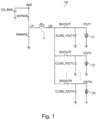
- FIG. 1 shows a circuit diagram of a SIMO switching converter 100 according to an exemplary embodiment.
- the SIMO switching converter 100 comprises two switches SWPMOS and SWNMOS arranged in series between supply terminal VBAT and ground.
- a first inductor terminal LX1 is provided at the connection between the two switches SWPMOS and SWNMOS.
- a decoupling capacitor CIN_SIMO is coupled between the supply terminal VBAT and ground.
- the inductor L of the SIMO switching converter 100 is coupled between the first inductor terminal LX1 and a second inductor terminal LX2.
- the latter is coupled to a plurality of switches SWVOUT1, SWVOUT2, ..., SWVOUTN which are operable to close a connection to a corresponding output terminal VOUT1, VOUT2, ..., VOUTN.
- Each output terminal VOUT1, VOUT2, ..., VOUTN is connected to a corresponding output capacitor CLOAD _VOUT1, CLOAD VOUT2, ..., CLOAD _VOUT2, and to a corresponding consumer C1, C2, ..., CN.
- the switches SWVOUT1, SWVOUT2, ..., SWVOUTN will be closed at a time such that current from the single inductor L will be supplied to only one of the output terminals VOUT1, VOUT2, ..., VOUTN at a time. It should be emphasized that care has to be taken to assure there is absolutely no overlap where both SWPMOS and SWNMOS are closed at the same time.
- SWVOUT1, SWVOUT2, ..., SWVOUTN no overlap may occur in the switching of SWVOUT1, SWVOUT2, ..., SWVOUTN, i.e. none of these switches can be closed at the same time.
- the single inductor L is charged by closing the switch SWPMOS while the switch SWNMOS is open.
- the single inductor L is discharged by opening the switch SWPMOS and closing the switch SWNMOS. When both switches SWPMOS and SWNMOS are open, no current will flow through the single inductor L.
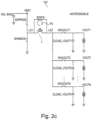
- Figure 2 shows circuit diagrams of SIMO switching converters according to exemplary embodiments operating in an idle state. More specifically, Figure 2a shows the SIMO switching converter 100 discussed above in conjunction with Figure 1 . As shown, all switches SWPMOS, SWNMOS, SWVOUT1, SWVOUT2, ..., SWVOUTN are open such that the converter is operating in an idle state, which is particularly useful between supply cycles to assure that one output does not disturb another output, as would, e.g., be the case if two outputs were connected simultaneously to the inductor L. Hence, this operating state is also referred to as a NOCROSS/IDLE state.
- Figure 2b shows a similar but slightly different SIMO switching converter 101 comprising an additional free wheel switch SWFW coupled between the second inductor terminal LX2 and ground.
- the additional switch SWFW makes it possible to discharge the single inductor L by closing both SWNMOS and SWFW such that the inductor current IL follows the current path P1.
- Figure 2c shows another implementation of the free wheel switch SWFW.
- the free wheel switch SWFW is arrange between the two inductor terminals LX1 and LX2. Hence, when the switch SWFW is closed, the inductor current IL will follow the loop-shaped current path P2.
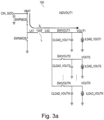
- Figure 3 shows circuit diagrams of a SIMO switching converter 100 according to an exemplary embodiment operating to supply an output. More specifically, Figure 3a shows the SIMO switching converter 100 in a state where the single inductor L is being charged and the inductor current IL is supplied to the first output terminal VOUT1. That is, the switches SWPMOS and SWVOUT1 are closed while the switches SWNMOS, SWVOUT2, ..., SWVOUTN are all open. As shown, the inductor current IL flows from the supply terminal VBAT through switch SWPMOS, through the single inductor L, through the switch SWVOUT1 and on towards the first output terminal VOUT1.
- the method 400 comprises a step of connecting the identified output to the single inductor of the SIMO switching converter to supply current from the single inductor of the SIMO switching converter to the identified output.
- the control method monitors the output voltages of the SIMO switching converter during operation and selects that output for which the counted period of time is longest to be supplied next.
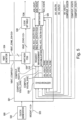
- FIG. 5 shows a block diagram of a SIMO switching converter 100 and controller 500 in accordance with an exemplary embodiment.
- the controller 500 is generally configured to control the SIMO switching converter 100 in accordance with the method 400 described above.
- the controller 500 generally comprises a request management unit 510, an arbitration logic unit 520, a finite state machine 530, a synchronizer 535, a driver circuit 540 (the driver circuit 540 includes circuitry for controlling dead time and for preventing overlaps), and a set of comparators 550.
- the request management unit 510, arbitration logic unit 520, finite state machine 530, and the synchronizer 535 are implemented in a digital block 501 which receives a fast clock signal from clock generator 502.
- the counted (or accumulated or integrated) values are sent to the arbitration logic unit 520 which identifies that particular output for which the counted value is largest and sends a corresponding signal to the finite state machine (FSM) 530.
- the FSM 530 provides control signals to the driver circuit 540 which controls the switches SWPMOS, SWNMOS, SWVOUT1, SWVOUT2, ..., SWVOUTN in order to connect the identified output to the single inductor L and to supply current while charging and discharging the inductor L as described above.
- the arbitration logic unit 520 also receives a weighting signal 525 which may indicate that additional weight is to be applied to one or more of the outputs in the sense that the corresponding counter value is multiplied or offset in comparison to the actually counter number of clock cycles.
- the controller 500 further comprises a zero current detector 532 for informing the FSM 530 when the single inductor L has been completely discharged.
- the FSM may use this information to assure an appropriate dead time between current supply cycles.
- the controller 500 further comprises a battery monitor 534 for monitoring the battery voltage VBAT, a monitoring FSM 536 for determining the level of voltage at the battery, and a look up table 538 for selecting a timing signal TON for the charging cycle of the inductor L.
- the purpose is to select, through the look up table 538, the most efficient timing signal TON according to the battery level in order to maximize the SIMO power efficiency.
Landscapes
- Engineering & Computer Science (AREA)
- Power Engineering (AREA)
- Dc-Dc Converters (AREA)
Description
- The present disclosure relates to the field of single inductor multiple output (SIMO) switching converters. More specifically, the present disclosure relates to a method of controlling a SIMO switching converter and to a controller for a SIMO switching converter.
- SIMO switching converters are widely used for supplying multiple consumers in electronic devices (e.g., low power applications in mobile devices, such as Bluetooth Low Energy, Internet of Things applications, medical applications, etc.) with appropriate voltages derived from a single voltage source. However, in some cases an insufficient voltage supply may occur for one (or more) consumer(s) while other consumers are being sufficiently supplied. Depending on the specific consumer such a lack of supply can be detrimental to the function of the entire device and in some cases even result in hazardous situations due to instability or shutdown of important functions.
- There may thus be a need for a way of avoiding the above-mentioned drawbacks of conventional SIMO switching converters, in particular to maintain adequate power supply to important or vital consumers.
-
US 10,796,830 B1 -
US 2014/0285014 A1 describes an apparatus that includes a single-inductor multiple-output (SIMO) direct current (DC-DC) converter circuit, with the SIMO DC-DC converter circuit having a set of output nodes. The apparatus also includes a panoptic dynamic voltage scaling (PDVS) circuit operatively coupled to the SIMO DC-DC converter circuit, where the PDVS circuit has a set of operational blocks with each operational block from the set of operational blocks drawing power from one supply voltage rail from a set of supply voltage rails. Additionally, each output node from the set of output nodes is uniquely associated with a supply voltage rail from the set of supply voltage rails. -
US2017187187A1 describes a SIMO converter with hysteresis window comparators for sensing an underdroop, and an Adaptive On-Time generator configured to change the ON time according to a counter value. - This need may be met by the subject matter according to the independent claims. Advantageous embodiments of the present disclosure are set forth in the dependent claims.
- According to a first aspect, there is provided a method of controlling a single inductor multiple output, SIMO, switching converter, the method comprising (a) counting, for each output of the multiple outputs of the SIMO switching converter, a period of time during which an output voltage at the respective output is below a corresponding individual threshold value, (b) identifying that output among the multiple outputs of the SIMO switching converter for which the counted period of time is longest, and (c) connecting the identified output to the single inductor of the SIMO switching converter to supply current from the single inductor of the SIMO switching converter to the identified output in order to regulate the corresponding output voltage to a desired level, and resetting the counted period of time for the identified output to zero, such that other outputs in need of current supply can be selected next.
- This aspect is based on the idea that the voltage at each output of the SIMO switching converter is monitored relative to an individual (i.e., output specific) threshold value, and a period of time is counted during which the output voltage has been below the corresponding threshold value. The output for which the counted period of time is longest is then identified and supplied with current from the SIMO inductor in order to regulate the corresponding output voltage to a desired level. In other words, the output which has shown too low voltage output for the longest period of time is selected to be supplied next.
- In the present context, the term "counting" may denote any way of counting or measuring a period of time, in particular by accumulating, integrating, adding, or incrementing values, amounts, numbers, or periods.
- In some cases, the counter is not reset until it is assured that the voltage at the selected output has increased enough to exceed the corresponding threshold value, which may take several supply cycles to achieve.
- According to a further embodiment, each output of the SIMO switching converter is coupled to a corresponding comparator adapted to provide a comparator output signal indicative of whether the corresponding output voltage is below the corresponding individual threshold value or not. Furthermore, the counting comprises synchronously incrementing the counted period of time for those outputs where the corresponding comparator output value indicates that the output voltage is below the corresponding individual threshold value.
- In other words, the counted periods of time are synchronously incremented for those outputs where the corresponding comparator output signals indicate that the output voltages are below the respective threshold values.
- According to a further embodiment, the synchronous incrementing occurs with a predetermined clock frequency which exceeds a switching frequency of the SIMO switching converter.
- The predetermined clock frequency may in particular be several multiples of two times the switching frequency of the SIMO switching converter, such as at least 8 times the switching frequency of the SIMO switching converter, such as 32 times or 256 times the switching frequency of the SIMO switching converter.
- By using a relatively high frequency as the predetermined clock frequency precise information regarding the state of the respective output voltages can be obtained.
- According to a further embodiment, the synchronous incrementing comprises incrementing the counted period of time by a predetermined amount.
- The predetermined amount may in particular be equal to one such that the counted period of time is measured in clock cycles. Alternatively, the predetermined amount may be equal to the duration of one period of the clock signal. As a further alternative, the predetermined amount may be equal to the actual duration of time where the output voltage is below its corresponding threshold value.
- According to a further embodiment, the predetermined amount is individual for each output.
- In other words, one predetermined amount may be used for one output (or for more outputs) and another predetermined amount may be used for another output (or for other outputs). This is particularly useful in order to assure that the counted period of time increases more rapidly for one output (or for some outputs) than it does for another output (or for other outputs). In this way, one output (or a few outputs) that is (are) used to supply more important functions will be identified and supplied sooner than other outputs that supply less important functions. This may be implemented in several ways, e.g. by adding an additional value per counted clock cycle, by multiplying the counted number of clock cycles with a factor, or by applying weighting in any other way known to the skilled person. It should be noted that as a result of the weighting, the term "counted period of time" does not necessarily reflect the actual amount of time such that if the "counted period of time" is equal for two outputs, one of the outputs may in reality have had a voltage below its threshold value for a shorter amount of time than the other one.
- According to a further embodiment, current is supplied by the single inductor of the SIMO switching converter to the identified output until the single inductor is completely discharged.
- In other words, the SIMO switching converter is operated in so-called discontinuous conduction mode (DCM). This is beneficial in order to avoid disturbances when switching from supplying one output with current to supplying another output with current from the single inductor. In addition, the above inductor current power scheme is called multiple charge, multiple discharge.
- In an alternative embodiment, current is supplied by the single inductor of the SIMO switching converter to the identified output until the single inductor current has decreased to a predetermined minimum current (above zero). A free wheel switch may be provided to maintain the inductor current close to the predetermined minimum current until the next charging/discharging of the single inductor. Thereby, the overall current level in the inductor is larger in comparison to the DCM operation described above. This is also referred to as a pseudo continuous conduction mode (PCCM).
- According to a further embodiment, the method further comprises disconnecting the identified output from the single inductor and waiting for a predetermined waiting period of time before connecting a subsequently identified output to the single inductor to supply current to the subsequently identified output.
- In other words, once the inductor current reaches zero and the identified output is disconnected from the single inductor, the predetermined waiting period of time is applied before a subsequently identified output is connected to receive current from the single inductor. This further reduces the risk of disturbances, in particular so-called cross regulation issues between the outputs, when switching from the previously identified output to the next identified output.
- According to a further embodiment, the SIMO switching converter is a SIMO BUCK switching converter.
- In other words, all outputs of the switching converter are supplied with a voltage that is lower than the (battery) voltage used to charge the single inductor.
- According to a further embodiment, at least one output is a high-priority output, the method further comprising identifying the high-priority output instead of the output among the multiple outputs of the SIMO switching converter for which the counted period of time is longest if the voltage at the high-priority output is below the individual threshold value of the high-priority output. This may e.g., be achieved through an under voltage comparator masking the counting of the other outputs.
- In this embodiment, if the voltage at the high-priority output is below the corresponding threshold value, the high-priority output is selected to be charged independently of whether longer periods of time has been counted for other outputs. Thus, as soon as the high-priority output needs to be supplied, it will be connected to the single inductor independently of the demands of other outputs.
- According to a second aspect, there is provided a controller for a single inductor multiple output, SIMO, switching converter, the controller comprising (a) a request management unit configured to count, for each output of the multiple outputs of the SIMO switching converter, a period of time during which an output voltage at the respective output is below a corresponding individual threshold value, (b) an arbitration logic unit configured to identify that output among the multiple outputs of the SIMO switching converter for which the counted period of time is longest, and (c) a finite state machine configured to connect the identified output to the single inductor of the SIMO switching converter to supply current from the single inductor of the SIMO switching converter to the identified output in order to regulate the corresponding output voltage to a desired level, wherein the request management unit is further configured to reset the counted period of time for the identified output to zero in response to a corresponding signal from the finite state machine, such that other outputs in need of current supply can be selected next.
- This aspect is essentially based on the same idea as the first aspect discussed above and provides a controller capable of implementing and performing the method according to the first aspect. It should be noted that the "request management unit", the arbitration logic unit", and the "finite state machine" denote functional units, which may or may not be separate entities. The functional units may in particular be implemented as software or hardware functional units or as functional units in an application specific integrated circuit (ASIC) or as part of a control circuit or module.
- In some cases, the counter is not reset until it is assured that the voltage at the selected output has increased enough to exceed the corresponding threshold value, which may take several supply cycles to achieve.
- According to a further embodiment, each output of the SIMO switching converter is coupled to a corresponding comparator adapted to provide a comparator output signal indicative of whether the corresponding output voltage is below the corresponding individual threshold value or not. Furthermore, the request management unit is further configured to synchronously increment the counted period of time for those outputs where the corresponding comparator output value indicates that the output voltage is below the corresponding individual threshold value.
- In other words, the counted periods of time are synchronously incremented for those outputs where the corresponding comparator output signals indicate that the output voltages are below the respective threshold values.
- According to a further embodiment, the request management unit is configured to synchronously increment the counted periods of time with a predetermined clock frequency which exceeds a switching frequency of the SIMO switching converter.
- The predetermined clock frequency may in particular be several multiples of two times the switching frequency of the SIMO switching converter, such as at least 8 times the switching frequency of the SIMO switching converter, such as 32 times or 256 times the switching frequency of the SIMO switching converter.
- By using a relatively high frequency as the predetermined clock frequency precise information regarding the state of the respective output voltages can be obtained.
- According to a further embodiment, the request management unit is configured to synchronously increment the counted periods of time by a predetermined amount.
- The predetermined amount may in particular be equal to one such that the counted period of time is measured in clock cycles. Alternatively, the predetermined amount may be equal to the duration of one period of the clock signal. As a further alternative, the predetermined amount may be equal to the actual duration of time where the output voltage is below its corresponding threshold value.
- According to a further embodiment, the predetermined amount is individual for each output.
- In other words, one predetermined amount may be used for one output (or for more outputs) and another predetermined amount may be used for another output (or for other outputs). This is particularly useful in order to assure that the counted period of time increases more rapidly for one output (or for some outputs) than it does for another output (or for other outputs). In this way, one output (or a few outputs) that is (are) used to supply more important functions will be identified and supplied sooner than other outputs that supply less important functions. This may be implemented in several ways, e.g. by adding an additional value per counted clock cycle, by multiplying the counted number of clock cycles with a factor, or by applying weighting in any other way known to the skilled person. It should be noted that as a result of the weighting, the term "counted period of time" does not necessarily reflect the actual amount of time such that if the "counted period of time" is equal for two outputs, one of the outputs may in reality have had a voltage below its threshold value for a shorter amount of time than the other one.
- According to a further embodiment, current is supplied by the single inductor of the SIMO switching converter to the identified output until the single inductor is completely discharged.
- In other words, the SIMO switching converter is operated in so-called discontinuous conduction mode (DCM). This is beneficial in order to avoid disturbances when switching from supplying one output with current to supplying another output with current from the single inductor. In addition, the above inductor current power scheme is called multiple charge, multiple discharge.
- According to a further embodiment, the finite state machine is configured to disconnect the identified output from the single inductor and wait for a predetermined waiting period of time before connecting a subsequently identified output to the single inductor to supply current to the subsequently identified output.
- In other words, once the inductor current reaches zero and the identified output is disconnected from the single inductor, the predetermined waiting period of time is applied before a subsequently identified output is connected to receive current from the single inductor. This further reduces the risk of disturbances, in particular so-called cross regulation issues between the outputs, when switching from the previously identified output to the next identified output.
- According to a further embodiment, the SIMO switching converter is a SIMO BUCK switching converter.
- In other words, all outputs of the switching converter are supplied with a voltage that is lower than the (battery) voltage used to charge the single inductor.
- According to a further embodiment, at least one output is a high-priority output, and wherein the arbitration logic unit is configured to identify the high-priority output instead of the output among the multiple outputs of the SIMO switching converter for which the counted period of time is longest if the voltage at the high-priority output is below the individual threshold value of the high-priority output.
- In this embodiment, if the voltage at the high-priority output is below the corresponding threshold value, the high-priority output is selected to be charged independently of whether longer periods of time has been counted for other outputs. Thus, as soon as the high-priority output needs to be supplied, it will be connected to the single inductor independently of the demands of other outputs.
- It should be noted that exemplary embodiments have been described with reference to different subject matters. In particular, some embodiments have been described with reference to method type claims whereas other embodiments have been described with reference to apparatus type claims. However, a person skilled in the art will gather from the above and the following description that, unless otherwise indicated, in addition to any combination of features belonging to one type of subject matter also any combination of features relating to different subject matters, in particular a combination of features of the method type claims and features of the apparatus type claims, is also disclosed with this document.
- The aspects defined above and further aspects of the present disclosure will be apparent from the examples of embodiment to be described hereinafter and are explained with reference to the examples of embodiment. Aspects of the present disclosure will be described in more detail hereinafter with reference to examples of embodiment to which the present disclosure is, however, not limited.
-
-
Figure 1 shows a circuit diagram of a SIMO switching converter according to an exemplary embodiment. -
Figure 2 shows circuit diagrams of SIMO switching converters according to exemplary embodiments operating in an idle state. -
Figure 3 shows circuit diagrams of a SIMO switching converter according to an exemplary embodiment operating to supply an output. -
Figure 4 shows a flow chart of a method of controlling a SIMO switching converter in accordance with an exemplary embodiment. -
Figure 5 shows a block diagram of a SIMO switching converter and controller in accordance with an exemplary embodiment. -
Figure 6 shows a functional block diagram of a SIMO switching converter controller according to an exemplary embodiment. -
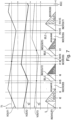
Figure 7 shows a timing diagram of controlling a SIMO switching converter in accordance with an exemplary embodiment. - The illustration in the drawing is schematic. It is noted that in different figures, similar or identical elements are provided with the same reference signs or with reference signs, which differ only within the first digit.
-
Figure 1 shows a circuit diagram of aSIMO switching converter 100 according to an exemplary embodiment. TheSIMO switching converter 100 comprises two switches SWPMOS and SWNMOS arranged in series between supply terminal VBAT and ground. A first inductor terminal LX1 is provided at the connection between the two switches SWPMOS and SWNMOS. A decoupling capacitor CIN_SIMO is coupled between the supply terminal VBAT and ground. The inductor L of theSIMO switching converter 100 is coupled between the first inductor terminal LX1 and a second inductor terminal LX2. The latter is coupled to a plurality of switches SWVOUT1, SWVOUT2, ..., SWVOUTN which are operable to close a connection to a corresponding output terminal VOUT1, VOUT2, ..., VOUTN. Each output terminal VOUT1, VOUT2, ..., VOUTN is connected to a corresponding output capacitor CLOAD _VOUT1, CLOAD VOUT2, ..., CLOAD _VOUT2, and to a corresponding consumer C1, C2, ..., CN. In operation, only one of the switches SWVOUT1, SWVOUT2, ..., SWVOUTN will be closed at a time such that current from the single inductor L will be supplied to only one of the output terminals VOUT1, VOUT2, ..., VOUTN at a time. It should be emphasized that care has to be taken to assure there is absolutely no overlap where both SWPMOS and SWNMOS are closed at the same time. Similarly, no overlap may occur in the switching of SWVOUT1, SWVOUT2, ..., SWVOUTN, i.e. none of these switches can be closed at the same time. The single inductor L is charged by closing the switch SWPMOS while the switch SWNMOS is open. Similarly, the single inductor L is discharged by opening the switch SWPMOS and closing the switch SWNMOS. When both switches SWPMOS and SWNMOS are open, no current will flow through the single inductor L. -
Figure 2 shows circuit diagrams of SIMO switching converters according to exemplary embodiments operating in an idle state. More specifically,Figure 2a shows theSIMO switching converter 100 discussed above in conjunction withFigure 1 . As shown, all switches SWPMOS, SWNMOS, SWVOUT1, SWVOUT2, ..., SWVOUTN are open such that the converter is operating in an idle state, which is particularly useful between supply cycles to assure that one output does not disturb another output, as would, e.g., be the case if two outputs were connected simultaneously to the inductor L. Hence, this operating state is also referred to as a NOCROSS/IDLE state.Figure 2b shows a similar but slightly differentSIMO switching converter 101 comprising an additional free wheel switch SWFW coupled between the second inductor terminal LX2 and ground. The additional switch SWFW makes it possible to discharge the single inductor L by closing both SWNMOS and SWFW such that the inductor current IL follows the current path P1.Figure 2c shows another implementation of the free wheel switch SWFW. In this example, the free wheel switch SWFW is arrange between the two inductor terminals LX1 and LX2. Hence, when the switch SWFW is closed, the inductor current IL will follow the loop-shaped current path P2. -
Figure 3 shows circuit diagrams of aSIMO switching converter 100 according to an exemplary embodiment operating to supply an output. More specifically,Figure 3a shows theSIMO switching converter 100 in a state where the single inductor L is being charged and the inductor current IL is supplied to the first output terminal VOUT1. That is, the switches SWPMOS and SWVOUT1 are closed while the switches SWNMOS, SWVOUT2, ..., SWVOUTN are all open. As shown, the inductor current IL flows from the supply terminal VBAT through switch SWPMOS, through the single inductor L, through the switch SWVOUT1 and on towards the first output terminal VOUT1.Figure 3b shows theSIMO switching converter 100 in a state where the single inductor L is being discharged while the inductor current is still being supplied to the first output terminal VOUT1. This state only differs from the charging state in that the switch SWPMOS is now open while the switch SWNMOS is closed instead. As shown, the inductor current IL now flows from ground through switch SWNMOS, through the single inductor L, through the switch SWVOUT1 and on towards the first output terminal VOUT1. Any of the other output terminals VOUT2, ..., VOUTN can be supplied in a similar manner by closing the corresponding switch SWVOUT2, ..., SWVOUTN and operating the switches SWPMOS and SWNMOS as shown inFigure 3a andFigure 3b . -
Figure 4 shows a flow chart of amethod 400 of controlling a SIMO switching converter, such as any of theSIMO switching converters Figures 1-3 , in accordance with an exemplary embodiment. At 410, the method comprises a step of counting, for each output of the multiple outputs VOUT1, VOUT2, ..., VOUTN of theSIMO switching converter method 400 comprises a step of identifying that output among the multiple outputs VOUT1, VOUT2, ..., VOUTN of the SIMO switching converter for which the counted period of time is longest. At 430, themethod 400 comprises a step of connecting the identified output to the single inductor of the SIMO switching converter to supply current from the single inductor of the SIMO switching converter to the identified output. In short, the control method monitors the output voltages of the SIMO switching converter during operation and selects that output for which the counted period of time is longest to be supplied next. -
Figure 5 shows a block diagram of aSIMO switching converter 100 andcontroller 500 in accordance with an exemplary embodiment. Thecontroller 500 is generally configured to control theSIMO switching converter 100 in accordance with themethod 400 described above. Thecontroller 500 generally comprises arequest management unit 510, anarbitration logic unit 520, afinite state machine 530, asynchronizer 535, a driver circuit 540 (thedriver circuit 540 includes circuitry for controlling dead time and for preventing overlaps), and a set ofcomparators 550. Therequest management unit 510,arbitration logic unit 520,finite state machine 530, and thesynchronizer 535 are implemented in adigital block 501 which receives a fast clock signal fromclock generator 502. The set of comparators comprises one comparator for each output VOUT1, VOUT2, ..., VOUTN of theSIMO switching converter 100 in order to compare each of the corresponding output voltages (which are fed back by respective feedback units) with a corresponding reference voltage VREF provided byreference voltage unit 552. The reference voltage VREF is preferably a vector comprising an individual threshold value for each output. The comparator output signals are sent to synchronizer 535 and the synchronized comparator signals are sent to therequest management unit 510 which counts a period of time (preferably as a number of clock cycles) for each of the multiple outputs of theSIMO switching converter 100 during which the corresponding output voltage has been below the corresponding threshold value. The counted (or accumulated or integrated) values are sent to thearbitration logic unit 520 which identifies that particular output for which the counted value is largest and sends a corresponding signal to the finite state machine (FSM) 530. TheFSM 530 provides control signals to thedriver circuit 540 which controls the switches SWPMOS, SWNMOS, SWVOUT1, SWVOUT2, ..., SWVOUTN in order to connect the identified output to the single inductor L and to supply current while charging and discharging the inductor L as described above. Thearbitration logic unit 520 also receives aweighting signal 525 which may indicate that additional weight is to be applied to one or more of the outputs in the sense that the corresponding counter value is multiplied or offset in comparison to the actually counter number of clock cycles. Thereby, priority may be given to some outputs in comparison to others. Furthermore, an additional set of comparators 555 (also referred to as under voltage comparators) may be used to overrule the counter-based arbitration result in case a particularly important output is below its corresponding threshold voltage. Thecontroller 500 further comprises a zerocurrent detector 532 for informing theFSM 530 when the single inductor L has been completely discharged. The FSM may use this information to assure an appropriate dead time between current supply cycles. In the shown embodiment, thecontroller 500 further comprises abattery monitor 534 for monitoring the battery voltage VBAT, amonitoring FSM 536 for determining the level of voltage at the battery, and a look up table 538 for selecting a timing signal TON for the charging cycle of the inductor L. Here, the purpose is to select, through the look up table 538, the most efficient timing signal TON according to the battery level in order to maximize the SIMO power efficiency. -
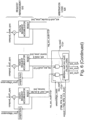
Figure 6 shows a functional block diagram 600 of a SIMOswitching converter controller 500 according to an exemplary embodiment as shown inFigure 5 and discussed above. The functional block diagram 600 comprises arequest management logic 610, anarbitration logic 620, and afinite state machine 630. Therequest management logic 610 receives the synchronized comparator signals and accumulates each of them until a reset signal is received. In the shown embodiment, a weighting factor is applied to the synchronized comparator signal before, during or after the counting (e.g., using accumulators) for each of the first output VOUT1 and the second output VOUT2. Each accumulating unit outputs a corresponding signal to thearbitration logic 620 which identifies the largest accumulated value and outputs corresponding acknowledgement signals ack_vout1, ack vout2, ..., ack_voutn to theFSM 630. In the shown embodiment, the comparator-based selection may be overruled by the n-th output, i.e. if the signal undervoltage_voutn indicates that the voltage at the n-th output is low, all other requests are masked. TheFSM 630 comprises five main states:
OFF is a state in which all switches are open. - IDLE is a state in which there is no inductor current IL and an acknowledge signal corresponding to a SIMO output request defines the next inductor current charge and discharge cycle.
- INDVOUTx is a state that corresponds to the inductor charge phase (x is the number of the SIMO switching converter output, i.e., an integer between 1 and N).
- VOUTx is a state that corresponds to the inductor discharge phase (x is the number of the SIMO switching converter output, i.e., an integer between 1 and N).
- NOCROSS is a state with a programmable duration in which there is no inductor current that serves to avoid unwanted cross regulation.
-
Figure 7 shows a timing diagram of controlling aSIMO switching converter 100 in accordance with an exemplary embodiment. More specifically,Figure 7 shows the various signals and parameters indicated inFigure 5 andFigure 6 in an example with three outputs with corresponding voltages VOUT1, VOUT2 and VOUT3. The corresponding threshold values or desired operating voltages are respectively indicated as T1, T2 and T3. The timing diagram begins at time t1 where VOUT1 is below its threshold value T1 and supply of this output begins by closing SWPMOS and keeping SWNMOS open such that the inductor L is being charged. Furthermore, SWVOUT1 is closed and SWVOUT2 and SWVOUT3 are kept open. The comparator signal COMPOUT_VOUT1 for VOUT1 is low and hence REQ_ACC_VOUT1 is incremented for each cycle of the fast clock CLK and ack_vout1 is high. This may in particular take place in an accumulator. After a predetermined charging time TON, VOUT1, SWPMOS is opened and SWNMOS is closed in order to discharge the inductor. At time t2, VOUT1 goes above the threshold value T1 and COMPOUT_VOUT1 therefore goes high. Shortly thereafter, at the next rising edge of CLK, the synchronized comparator signal compout vout1_sync goes high. At time t3, VOUT2 falls below T2 and as a result of the comparator signals COMPOUT_VOUT2 and compout_vout2_sync, REQ_ACC_VOUT2 starts incrementing with each clock cycle CLK. The NOCROSS period ends at time t4 and after a short IDLE period, the counter COMPOUT_VOUT1 for VOUT1 is reset and, as a result of REQ_ACC_VOUT2 being larger than both REQ_ACC_VOUT1 and REQ_ACC_VOUT3, supply of VOUT2 is initiated by turning SWPMOS and SWVOUT2 on at time t5. At the same time, i.e., at time t5, VOUT3 falls below T3 and REQ_ACC_VOUT3 starts incrementing with each clock cycle CLK. At time t6, VOUT2 goes above the threshold value T2 and COMPOUT_VOUT2 therefore goes high. Shortly thereafter, at the next rising edge of CLK, the synchronized comparator signal compout_vout2_sync goes high. The inductor discharge ends at time t7 and the NOCROSS period begins. At time t8, VOUT1 again goes below T1 and REQ_ACC_VOUT1 starts incrementing with each clock cycle CLK. The NOCROSS period ends at time t9 and the subsequent IDLE period ends at time t10 where supply of VOUT3 is initiated since REQ_ACC_VOUT3 is now larger than both REQ_ACC_VOUT1 and REQ_ACC_VOUT2. At time t11, VOUT goes above T3 and the counting stops. The following NOCROSS period ends at time t12 and the subsequent IDLE period ends at time t13 where supply of VOUT1 is again initiated as the corresponding counter REQ_ACC_VOUT1 has the highest value. At time t14, VOUT2 falls below T2 and REQ_ACC_VOUT2 starts incrementing. At time t15, VOUT1 goes above T1 and REQ_ACC_VOUT1 stops incrementing. - The control method and corresponding controller described herein allows efficient and reliable use of a SIMO switching converter to supply several consumers. Furthermore, the concept is capable of managing priorities between the SIMO outputs without sensing output current loads, and it effectively avoids cross regulation issues by maintaining a specified period of no inductor current before starting the next charge-discharge cycle of the inductor.
- It is noted that, unless otherwise indicated, the use of terms such as "upper", "lower", "left", and "right" refers solely to the orientation of the corresponding drawing.
- It is noted that the term "comprising" does not exclude other elements or steps and that the use of the articles "a" or "an" does not exclude a plurality. Also, elements described in association with different embodiments may be combined. It should also be noted that reference signs in the claims should not be construed as limiting the scope of the claims.
Claims (13)
- A method of controlling a single inductor multiple output, SIMO, switching converter (100, 101, 102), the method comprisingcounting (410), for each output (VOUT1, VOUT2, VOUTN) of the multiple outputs of the SIMO switching converter, a period of time during which an output voltage at the respective output is below a corresponding individual threshold value (VREF),identifying (420) that output among the multiple outputs of the SIMO switching converter for which the counted period of time is longest, andconnecting (430) the identified output to the single inductor (L) of the SIMO switching converter to supply current from the single inductor of the SIMO switching converter to the identified output in order to regulate the corresponding output voltage to a desired level, andresetting the counted period of time for the identified output to zero, such that other outputs (VOUT1, VOUT2, VOUTN) in need of current supply can be selected next.
- The method according to claim 1, wherein each output of the SIMO switching converter is coupled to a corresponding comparator (550) adapted to provide a comparator output signal (COMPOUT_VOUT1, COMPOUT_VOUT2, COMPOUT_VOUTN) indicative of whether the corresponding output voltage is below the corresponding individual threshold value or not, and wherein the counting comprises synchronously incrementing the counted period of time for those outputs where the corresponding comparator output value indicates that the output voltage is below the corresponding individual threshold value.
- The method according to claim 2, wherein the synchronous incrementing occurs with a predetermined clock frequency which exceeds a switching frequency of the SIMO switching converter.
- The method according to claim 2 or 3, wherein the synchronous incrementing comprises incrementing the counted period of time by a predetermined amount, in particular by a predetermined amount that is individual for each output.
- The method according to any one of claims 1 to 4, wherein current is supplied by the single inductor of the SIMO switching converter to the identified output until the single inductor is completely discharged.
- The method according to any one of claims 1 to 5, further comprising disconnecting the identified output from the single inductor and waiting for a predetermined waiting period of time before connecting a subsequently identified output to the single inductor to supply current to the subsequently identified output.
- The method according to any one of claims 1 to 6, wherein at least one output is a high-priority output, the method further comprising identifying the high-priority output instead of the output among the multiple outputs of the SIMO switching converter for which the counted period of time is longest if the voltage at the high-priority output is below the individual threshold value of the high-priority output.
- A controller for a single inductor multiple output, SIMO, switching converter (100, 101, 102), the controller comprisinga request management unit (610) configured to count, for each output (VOUT1, VOUT2, VOUTN) of the multiple outputs of the SIMO switching converter, a period of time during which an output voltage at the respective output is below a corresponding individual threshold value (VREF),an arbitration logic unit (620) configured to identify that output among the multiple outputs of the SIMO switching converter for which the counted period of time is longest, anda finite state machine (630) configured to connect the identified output to the single inductor (L) of the SIMO switching converter to supply current from the single inductor of the SIMO switching converter to the identified output in order to regulate the corresponding output voltage to a desired level,wherein the request management unit is further configured to reset the counted period of time for the identified output to zero in response to a corresponding signal from the finite state machine, such that other outputs (VOUT1, VOUT2, VOUTN) in need of current supply can be selected next.
- The controller according to claim 8, wherein each output of the SIMO switching converter is coupled to a corresponding comparator (550) adapted to provide a comparator output signal (COMPOUT_VOUT1, COMPOUT_VOUT2, COMPOUT_VOUTN) indicative of whether the corresponding output voltage is below the corresponding individual threshold value or not, and wherein the request management unit is further configured to synchronously increment the counted period of time for those outputs where the corresponding comparator output value indicates that the output voltage is below the corresponding individual threshold value.
- The controller according to claim 9, wherein the request management unit is configured to synchronously increment the counted periods of time with a predetermined clock frequency which exceeds a switching frequency of the SIMO switching converter, and/or wherein the request management unit is configured to synchronously increment the counted periods of time by a predetermined amount, in particular by a predetermined amount that is individual for each output.
- The controller according to any one of claims 8 to 10, wherein the finite state machine is configured to disconnect the identified output from the single inductor and wait for a predetermined waiting period of time before connecting a subsequently identified output to the single inductor to supply current to the subsequently identified output.
- The controller according to any one of claims 8 to 11, wherein the SIMO switching converter is a SIMO BUCK switching converter.
- The controller according to any one of claims 8 to 12, wherein at least one output is a high-priority output, and wherein the arbitration logic unit is configured to identify the high-priority output instead of the output among the multiple outputs of the SIMO switching converter for which the counted period of time is longest if the voltage at the high-priority output is below the individual threshold value of the high-priority output.
Priority Applications (3)
| Application Number | Priority Date | Filing Date | Title |
|---|---|---|---|
| EP21290009.6A EP4047799B1 (en) | 2021-02-23 | 2021-02-23 | Control method and controller for simo switching converters |
| CN202210011921.2A CN115037116A (en) | 2021-02-23 | 2022-01-05 | Control method and controller for SIMO switching converter |
| US17/651,689 US12126248B2 (en) | 2021-02-23 | 2022-02-18 | Control method and controller for SIMO switching converters |
Applications Claiming Priority (1)
| Application Number | Priority Date | Filing Date | Title |
|---|---|---|---|
| EP21290009.6A EP4047799B1 (en) | 2021-02-23 | 2021-02-23 | Control method and controller for simo switching converters |
Publications (2)
| Publication Number | Publication Date |
|---|---|
| EP4047799A1 EP4047799A1 (en) | 2022-08-24 |
| EP4047799B1 true EP4047799B1 (en) | 2025-07-02 |
Family
ID=75223218
Family Applications (1)
| Application Number | Title | Priority Date | Filing Date |
|---|---|---|---|
| EP21290009.6A Active EP4047799B1 (en) | 2021-02-23 | 2021-02-23 | Control method and controller for simo switching converters |
Country Status (3)
| Country | Link |
|---|---|
| US (1) | US12126248B2 (en) |
| EP (1) | EP4047799B1 (en) |
| CN (1) | CN115037116A (en) |
Citations (1)
| Publication number | Priority date | Publication date | Assignee | Title |
|---|---|---|---|---|
| US20170187187A1 (en) * | 2015-12-23 | 2017-06-29 | Intel Corporation | Multiple input single inductor multiple output regulator |
Family Cites Families (11)
| Publication number | Priority date | Publication date | Assignee | Title |
|---|---|---|---|---|
| US5617015A (en) * | 1995-06-07 | 1997-04-01 | Linear Technology Corporation | Multiple output regulator with time sequencing |
| JP2004503197A (en) | 2000-07-06 | 2004-01-29 | コーニンクレッカ フィリップス エレクトロニクス エヌ ヴィ | Multi-output DC / DC converter for PFM / PWM mode |
| JP2004518394A (en) * | 2001-01-17 | 2004-06-17 | コーニンクレッカ フィリップス エレクトロニクス エヌ ヴィ | Controlled multi-output DC / DC converter |
| US7432614B2 (en) | 2003-01-17 | 2008-10-07 | Hong Kong University Of Science And Technology | Single-inductor multiple-output switching converters in PCCM with freewheel switching |
| US8049472B2 (en) * | 2008-07-29 | 2011-11-01 | Cosmic Circuits Private Limited | Single inductor multiple output switching devices |
| US8624429B2 (en) | 2009-07-20 | 2014-01-07 | The Hong Kong University Of Science And Technology | Single-inductor-multiple-output regulator with auto-hopping control and the method of use |
| US9099919B2 (en) | 2011-05-09 | 2015-08-04 | The Hong Kong University Of Science And Technology | Single-inductor-multiple-output regulator with synchronized current mode hysteretic control |
| KR101284976B1 (en) | 2011-12-13 | 2013-07-15 | 고려대학교 산학협력단 | Single inductor multiple output(simo) dc-dc converter and control method thereof |
| KR101829519B1 (en) * | 2013-03-14 | 2018-02-14 | 유니버시티 오브 버지니아 패턴트 파운데이션 | Methods and apparatus for simo dc-dc converter |
| US9692296B1 (en) * | 2016-02-12 | 2017-06-27 | Texas Instruments Incorporated | Single-input-multiple-output (SIMO) DC-DC converters and SIMO DC-DC converter control circuits |
| EP3748833A1 (en) * | 2019-06-04 | 2020-12-09 | Nxp B.V. | Single inductor dual output control method |
-
2021
- 2021-02-23 EP EP21290009.6A patent/EP4047799B1/en active Active
-
2022
- 2022-01-05 CN CN202210011921.2A patent/CN115037116A/en active Pending
- 2022-02-18 US US17/651,689 patent/US12126248B2/en active Active
Patent Citations (1)
| Publication number | Priority date | Publication date | Assignee | Title |
|---|---|---|---|---|
| US20170187187A1 (en) * | 2015-12-23 | 2017-06-29 | Intel Corporation | Multiple input single inductor multiple output regulator |
Also Published As
| Publication number | Publication date |
|---|---|
| US20220271642A1 (en) | 2022-08-25 |
| EP4047799A1 (en) | 2022-08-24 |
| US12126248B2 (en) | 2024-10-22 |
| CN115037116A (en) | 2022-09-09 |
Similar Documents
| Publication | Publication Date | Title |
|---|---|---|
| EP3565097B1 (en) | Voltage converter, and control method therefor and voltage conversion system thereof | |
| US7570034B2 (en) | Step-up/down DC-DC converter | |
| US9099919B2 (en) | Single-inductor-multiple-output regulator with synchronized current mode hysteretic control | |
| CN107959421B (en) | BUCK-BOOST type direct current converter and control method thereof | |
| US10693376B2 (en) | Electronic converter and method of operating an electronic converter | |
| US12170479B2 (en) | Power management system and electronic device | |
| WO2009138505A1 (en) | Single inductor multiple output converter | |
| US10972003B2 (en) | Charge pump | |
| TWI810884B (en) | Dc-dc converter and control method thereof | |
| US20250183797A1 (en) | Systems and methods for controlling operation modes of dc-to-dc voltage converters | |
| US8674673B2 (en) | Switching power converter | |
| KR102741348B1 (en) | Uninterruptible power system | |
| CN105162325A (en) | Pulse frequency modulation circuit based on reference voltage comparison oscillator | |
| US9092048B1 (en) | Synchronized power delivery | |
| US20230070905A1 (en) | Simo power converter and control method thereof | |
| EP4047799B1 (en) | Control method and controller for simo switching converters | |
| Zhao et al. | DC-DC power conversions and system design considerations for battery operated system | |
| US9537390B2 (en) | Control circuit, control method, DC-DC converter and electronic device | |
| Mok | Single-inductor-multiple-output DC-DC converter design | |
| CN119070636A (en) | A DC-DC converter for converting an input voltage into at least two target output voltages | |
| Huang et al. | Single-inductor dual-output DC-DC converters with high light-load efficiency and minimized cross-regulation for portable devices | |
| CN113992011B (en) | Multi-phase switch converter cascade system and voltage conversion circuit thereof | |
| CN116760284A (en) | A DC-DC conversion circuit, converter, equipment and conversion control method | |
| CN117321875A (en) | Power conversion device for performing DC/DC conversion and energy storage system having the power conversion device | |
| US12494637B2 (en) | DCDC converters |
Legal Events
| Date | Code | Title | Description |
|---|---|---|---|
| PUAI | Public reference made under article 153(3) epc to a published international application that has entered the european phase |
Free format text: ORIGINAL CODE: 0009012 |
|
| STAA | Information on the status of an ep patent application or granted ep patent |
Free format text: STATUS: THE APPLICATION HAS BEEN PUBLISHED |
|
| AK | Designated contracting states |
Kind code of ref document: A1 Designated state(s): AL AT BE BG CH CY CZ DE DK EE ES FI FR GB GR HR HU IE IS IT LI LT LU LV MC MK MT NL NO PL PT RO RS SE SI SK SM TR |
|
| STAA | Information on the status of an ep patent application or granted ep patent |
Free format text: STATUS: REQUEST FOR EXAMINATION WAS MADE |
|
| 17P | Request for examination filed |
Effective date: 20230224 |
|
| RBV | Designated contracting states (corrected) |
Designated state(s): AL AT BE BG CH CY CZ DE DK EE ES FI FR GB GR HR HU IE IS IT LI LT LU LV MC MK MT NL NO PL PT RO RS SE SI SK SM TR |
|
| STAA | Information on the status of an ep patent application or granted ep patent |
Free format text: STATUS: EXAMINATION IS IN PROGRESS |
|
| 17Q | First examination report despatched |
Effective date: 20231218 |
|
| GRAP | Despatch of communication of intention to grant a patent |
Free format text: ORIGINAL CODE: EPIDOSNIGR1 |
|
| STAA | Information on the status of an ep patent application or granted ep patent |
Free format text: STATUS: GRANT OF PATENT IS INTENDED |
|
| INTG | Intention to grant announced |
Effective date: 20250411 |
|
| GRAS | Grant fee paid |
Free format text: ORIGINAL CODE: EPIDOSNIGR3 |
|
| GRAA | (expected) grant |
Free format text: ORIGINAL CODE: 0009210 |
|
| STAA | Information on the status of an ep patent application or granted ep patent |
Free format text: STATUS: THE PATENT HAS BEEN GRANTED |
|
| AK | Designated contracting states |
Kind code of ref document: B1 Designated state(s): AL AT BE BG CH CY CZ DE DK EE ES FI FR GB GR HR HU IE IS IT LI LT LU LV MC MK MT NL NO PL PT RO RS SE SI SK SM TR |
|
| REG | Reference to a national code |
Ref country code: GB Ref legal event code: FG4D |
|
| REG | Reference to a national code |
Ref country code: CH Ref legal event code: EP |
|
| REG | Reference to a national code |
Ref country code: DE Ref legal event code: R096 Ref document number: 602021033266 Country of ref document: DE |
|
| REG | Reference to a national code |
Ref country code: IE Ref legal event code: FG4D |
|
| REG | Reference to a national code |
Ref country code: NL Ref legal event code: MP Effective date: 20250702 |
|
| PG25 | Lapsed in a contracting state [announced via postgrant information from national office to epo] |
Ref country code: PT Free format text: LAPSE BECAUSE OF FAILURE TO SUBMIT A TRANSLATION OF THE DESCRIPTION OR TO PAY THE FEE WITHIN THE PRESCRIBED TIME-LIMIT Effective date: 20251103 |
|
| PG25 | Lapsed in a contracting state [announced via postgrant information from national office to epo] |
Ref country code: NL Free format text: LAPSE BECAUSE OF FAILURE TO SUBMIT A TRANSLATION OF THE DESCRIPTION OR TO PAY THE FEE WITHIN THE PRESCRIBED TIME-LIMIT Effective date: 20250702 |
|
| REG | Reference to a national code |
Ref country code: AT Ref legal event code: MK05 Ref document number: 1810423 Country of ref document: AT Kind code of ref document: T Effective date: 20250702 |
|
| PG25 | Lapsed in a contracting state [announced via postgrant information from national office to epo] |
Ref country code: IS Free format text: LAPSE BECAUSE OF FAILURE TO SUBMIT A TRANSLATION OF THE DESCRIPTION OR TO PAY THE FEE WITHIN THE PRESCRIBED TIME-LIMIT Effective date: 20251102 |
|
| PG25 | Lapsed in a contracting state [announced via postgrant information from national office to epo] |
Ref country code: NO Free format text: LAPSE BECAUSE OF FAILURE TO SUBMIT A TRANSLATION OF THE DESCRIPTION OR TO PAY THE FEE WITHIN THE PRESCRIBED TIME-LIMIT Effective date: 20251002 |
|
| REG | Reference to a national code |
Ref country code: LT Ref legal event code: MG9D |
|
| PG25 | Lapsed in a contracting state [announced via postgrant information from national office to epo] |
Ref country code: AT Free format text: LAPSE BECAUSE OF FAILURE TO SUBMIT A TRANSLATION OF THE DESCRIPTION OR TO PAY THE FEE WITHIN THE PRESCRIBED TIME-LIMIT Effective date: 20250702 |
|
| PG25 | Lapsed in a contracting state [announced via postgrant information from national office to epo] |
Ref country code: FI Free format text: LAPSE BECAUSE OF FAILURE TO SUBMIT A TRANSLATION OF THE DESCRIPTION OR TO PAY THE FEE WITHIN THE PRESCRIBED TIME-LIMIT Effective date: 20250702 |
|
| PG25 | Lapsed in a contracting state [announced via postgrant information from national office to epo] |
Ref country code: HR Free format text: LAPSE BECAUSE OF FAILURE TO SUBMIT A TRANSLATION OF THE DESCRIPTION OR TO PAY THE FEE WITHIN THE PRESCRIBED TIME-LIMIT Effective date: 20250702 |
|
| PG25 | Lapsed in a contracting state [announced via postgrant information from national office to epo] |
Ref country code: GR Free format text: LAPSE BECAUSE OF FAILURE TO SUBMIT A TRANSLATION OF THE DESCRIPTION OR TO PAY THE FEE WITHIN THE PRESCRIBED TIME-LIMIT Effective date: 20251003 |
|
| PG25 | Lapsed in a contracting state [announced via postgrant information from national office to epo] |
Ref country code: SE Free format text: LAPSE BECAUSE OF FAILURE TO SUBMIT A TRANSLATION OF THE DESCRIPTION OR TO PAY THE FEE WITHIN THE PRESCRIBED TIME-LIMIT Effective date: 20250702 Ref country code: CZ Free format text: LAPSE BECAUSE OF FAILURE TO SUBMIT A TRANSLATION OF THE DESCRIPTION OR TO PAY THE FEE WITHIN THE PRESCRIBED TIME-LIMIT Effective date: 20250702 |
|
| PG25 | Lapsed in a contracting state [announced via postgrant information from national office to epo] |
Ref country code: LV Free format text: LAPSE BECAUSE OF FAILURE TO SUBMIT A TRANSLATION OF THE DESCRIPTION OR TO PAY THE FEE WITHIN THE PRESCRIBED TIME-LIMIT Effective date: 20250702 |
|
| PG25 | Lapsed in a contracting state [announced via postgrant information from national office to epo] |
Ref country code: BG Free format text: LAPSE BECAUSE OF FAILURE TO SUBMIT A TRANSLATION OF THE DESCRIPTION OR TO PAY THE FEE WITHIN THE PRESCRIBED TIME-LIMIT Effective date: 20250702 Ref country code: PL Free format text: LAPSE BECAUSE OF FAILURE TO SUBMIT A TRANSLATION OF THE DESCRIPTION OR TO PAY THE FEE WITHIN THE PRESCRIBED TIME-LIMIT Effective date: 20250702 |
|
| PG25 | Lapsed in a contracting state [announced via postgrant information from national office to epo] |
Ref country code: RS Free format text: LAPSE BECAUSE OF FAILURE TO SUBMIT A TRANSLATION OF THE DESCRIPTION OR TO PAY THE FEE WITHIN THE PRESCRIBED TIME-LIMIT Effective date: 20251002 |
|
| PG25 | Lapsed in a contracting state [announced via postgrant information from national office to epo] |
Ref country code: ES Free format text: LAPSE BECAUSE OF FAILURE TO SUBMIT A TRANSLATION OF THE DESCRIPTION OR TO PAY THE FEE WITHIN THE PRESCRIBED TIME-LIMIT Effective date: 20250702 |
|
| PG25 | Lapsed in a contracting state [announced via postgrant information from national office to epo] |
Ref country code: SM Free format text: LAPSE BECAUSE OF FAILURE TO SUBMIT A TRANSLATION OF THE DESCRIPTION OR TO PAY THE FEE WITHIN THE PRESCRIBED TIME-LIMIT Effective date: 20250702 |
|
| PGFP | Annual fee paid to national office [announced via postgrant information from national office to epo] |
Ref country code: GB Payment date: 20260121 Year of fee payment: 6 |
|
| PG25 | Lapsed in a contracting state [announced via postgrant information from national office to epo] |
Ref country code: DK Free format text: LAPSE BECAUSE OF FAILURE TO SUBMIT A TRANSLATION OF THE DESCRIPTION OR TO PAY THE FEE WITHIN THE PRESCRIBED TIME-LIMIT Effective date: 20250702 |
|
| PGFP | Annual fee paid to national office [announced via postgrant information from national office to epo] |
Ref country code: DE Payment date: 20260121 Year of fee payment: 6 |
|
| PG25 | Lapsed in a contracting state [announced via postgrant information from national office to epo] |
Ref country code: IT Free format text: LAPSE BECAUSE OF FAILURE TO SUBMIT A TRANSLATION OF THE DESCRIPTION OR TO PAY THE FEE WITHIN THE PRESCRIBED TIME-LIMIT Effective date: 20250702 |
|
| PGFP | Annual fee paid to national office [announced via postgrant information from national office to epo] |
Ref country code: FR Payment date: 20260121 Year of fee payment: 6 |
|
| PG25 | Lapsed in a contracting state [announced via postgrant information from national office to epo] |
Ref country code: SK Free format text: LAPSE BECAUSE OF FAILURE TO SUBMIT A TRANSLATION OF THE DESCRIPTION OR TO PAY THE FEE WITHIN THE PRESCRIBED TIME-LIMIT Effective date: 20250702 Ref country code: EE Free format text: LAPSE BECAUSE OF FAILURE TO SUBMIT A TRANSLATION OF THE DESCRIPTION OR TO PAY THE FEE WITHIN THE PRESCRIBED TIME-LIMIT Effective date: 20250702 |