EP4047525A1 - Generating input data for a machine learning model - Google Patents
Generating input data for a machine learning model Download PDFInfo
- Publication number
- EP4047525A1 EP4047525A1 EP21157977.6A EP21157977A EP4047525A1 EP 4047525 A1 EP4047525 A1 EP 4047525A1 EP 21157977 A EP21157977 A EP 21157977A EP 4047525 A1 EP4047525 A1 EP 4047525A1
- Authority
- EP
- European Patent Office
- Prior art keywords
- date
- dates
- training
- embedding
- arrays
- Prior art date
- Legal status (The legal status is an assumption and is not a legal conclusion. Google has not performed a legal analysis and makes no representation as to the accuracy of the status listed.)
- Pending
Links
Images



Classifications
-
- G—PHYSICS
- G06—COMPUTING OR CALCULATING; COUNTING
- G06N—COMPUTING ARRANGEMENTS BASED ON SPECIFIC COMPUTATIONAL MODELS
- G06N3/00—Computing arrangements based on biological models
- G06N3/02—Neural networks
- G06N3/08—Learning methods
-
- G—PHYSICS
- G06—COMPUTING OR CALCULATING; COUNTING
- G06N—COMPUTING ARRANGEMENTS BASED ON SPECIFIC COMPUTATIONAL MODELS
- G06N3/00—Computing arrangements based on biological models
- G06N3/02—Neural networks
- G06N3/08—Learning methods
- G06N3/084—Backpropagation, e.g. using gradient descent
-
- G—PHYSICS
- G06—COMPUTING OR CALCULATING; COUNTING
- G06N—COMPUTING ARRANGEMENTS BASED ON SPECIFIC COMPUTATIONAL MODELS
- G06N3/00—Computing arrangements based on biological models
- G06N3/02—Neural networks
- G06N3/04—Architecture, e.g. interconnection topology
- G06N3/044—Recurrent networks, e.g. Hopfield networks
-
- G—PHYSICS
- G06—COMPUTING OR CALCULATING; COUNTING
- G06N—COMPUTING ARRANGEMENTS BASED ON SPECIFIC COMPUTATIONAL MODELS
- G06N3/00—Computing arrangements based on biological models
- G06N3/02—Neural networks
- G06N3/04—Architecture, e.g. interconnection topology
- G06N3/044—Recurrent networks, e.g. Hopfield networks
- G06N3/0442—Recurrent networks, e.g. Hopfield networks characterised by memory or gating, e.g. long short-term memory [LSTM] or gated recurrent units [GRU]
-
- G—PHYSICS
- G06—COMPUTING OR CALCULATING; COUNTING
- G06N—COMPUTING ARRANGEMENTS BASED ON SPECIFIC COMPUTATIONAL MODELS
- G06N3/00—Computing arrangements based on biological models
- G06N3/02—Neural networks
- G06N3/04—Architecture, e.g. interconnection topology
- G06N3/045—Combinations of networks
-
- G—PHYSICS
- G06—COMPUTING OR CALCULATING; COUNTING
- G06N—COMPUTING ARRANGEMENTS BASED ON SPECIFIC COMPUTATIONAL MODELS
- G06N3/00—Computing arrangements based on biological models
- G06N3/02—Neural networks
- G06N3/08—Learning methods
- G06N3/09—Supervised learning
-
- G—PHYSICS
- G06—COMPUTING OR CALCULATING; COUNTING
- G06Q—INFORMATION AND COMMUNICATION TECHNOLOGY [ICT] SPECIALLY ADAPTED FOR ADMINISTRATIVE, COMMERCIAL, FINANCIAL, MANAGERIAL OR SUPERVISORY PURPOSES; SYSTEMS OR METHODS SPECIALLY ADAPTED FOR ADMINISTRATIVE, COMMERCIAL, FINANCIAL, MANAGERIAL OR SUPERVISORY PURPOSES, NOT OTHERWISE PROVIDED FOR
- G06Q10/00—Administration; Management
- G06Q10/04—Forecasting or optimisation specially adapted for administrative or management purposes, e.g. linear programming or "cutting stock problem"
-
- G—PHYSICS
- G06—COMPUTING OR CALCULATING; COUNTING
- G06Q—INFORMATION AND COMMUNICATION TECHNOLOGY [ICT] SPECIALLY ADAPTED FOR ADMINISTRATIVE, COMMERCIAL, FINANCIAL, MANAGERIAL OR SUPERVISORY PURPOSES; SYSTEMS OR METHODS SPECIALLY ADAPTED FOR ADMINISTRATIVE, COMMERCIAL, FINANCIAL, MANAGERIAL OR SUPERVISORY PURPOSES, NOT OTHERWISE PROVIDED FOR
- G06Q40/00—Finance; Insurance; Tax strategies; Processing of corporate or income taxes
- G06Q40/02—Banking, e.g. interest calculation or account maintenance
-
- G—PHYSICS
- G06—COMPUTING OR CALCULATING; COUNTING
- G06Q—INFORMATION AND COMMUNICATION TECHNOLOGY [ICT] SPECIALLY ADAPTED FOR ADMINISTRATIVE, COMMERCIAL, FINANCIAL, MANAGERIAL OR SUPERVISORY PURPOSES; SYSTEMS OR METHODS SPECIALLY ADAPTED FOR ADMINISTRATIVE, COMMERCIAL, FINANCIAL, MANAGERIAL OR SUPERVISORY PURPOSES, NOT OTHERWISE PROVIDED FOR
- G06Q40/00—Finance; Insurance; Tax strategies; Processing of corporate or income taxes
- G06Q40/04—Trading; Exchange, e.g. stocks, commodities, derivatives or currency exchange
Definitions
- the present invention relates to generating input data for processing by a machine learning model.
- the invention has particular relevance to generating input data which encapsulates date-dependent information in a format suitable for processing by a machine learning model arranged to forecast time series data.
- Forecasting tasks typically involve processing time series data comprising evaluations of a metric or target outcome at a set of previous time points to train a forecasting model to predict values of the metric or target outcome at one or more future time points.
- the time points may correspond to dates, weeks, months or years, etc.
- forecasting tasks are treated as curve fitting problems in which a function or stochastic process is fitted to a set of time series data points, with time being treated as a sole input variable.
- the value of a metric is expected to be strongly affected by particular attributes of a date (or week, month, year etc.).
- models have been developed in which the time input is augmented with a set of manually-selected features that are expected to be salient to a forecasting task at hand.
- Suitable models include deep neural network models, which are well-suited to multi-dimensional inputs and can have a high learning capacity and tend to be less sensitive to outliers than curve fitting methods.
- Recurrent neural network (RNN) models allow data points to be processed sequentially, and the output of the model associated with a given time point can depend on a sequence of data points of indeterminate length.
- Figure 1 shows a set of date-dependent features F evaluated on four consecutive dates D1, D2, D3, D4.
- the set of features includes an integer feature taking values from 1 to 7 representing the day of the week, an integer feature taking values from 1 to 31 representing day of the month, an integer feature taking values from 1 to 12 representing the month of the year, and a large number of binary features (two of which are shown) taking values of 0 or 1 and each indicating whether or not the date is associated with a respective attribute (for example, whether the date corresponds to a weekend day and whether the date is a bank holiday in the United Kingdom).
- the features in the set are not necessarily independent of one another (for example, if the date falls on a Saturday, the date must also fall on a weekend day) and therefore the set of features includes a level of redundancy, but the features are nevertheless chosen to include any information which is expected to be salient to the forecasting task at hand.
- the date-related features are labelled to illustrate the semantic meaning of the features, but in practice the features would be represented by an unlabelled array of values, for example a vector. Due to the potentially large number of binary features, the arrays are likely to be high-dimensional (for example, including hundreds of entries) and sparse (because a significant proportion of the entries are expected to be zero).
- providing feature arrays of the type described above as inputs to a forecasting model can encourage the forecasting model to learn the influence of the corresponding features on the value of a metric.
- training a model to determine the influence of date-dependent features from such arrays is challenging from an implementation point of view and can place excessive demands on computational resources.
- the sparsity of the feature arrays leads to an optimisation surface in which a global optimum is challenging to determine.
- a forecasting model is likely to require a large volume of training data spanning a large temporal range in order to properly learn the influence of certain features.
- Such volumes of training data may not be available for a given forecasting task, or at least may not be available to an entity performing the forecasting task.
- the demands on computational resources for training the model are likely to be high due to the high dimensionality of the feature vectors and the nature of the optimisation surface.
- a computer-implemented method of training a data processing system to generate an embedding array having a first number of dimensions and representing information associated with a given date includes, for each training date of a set of training dates: receiving, for each of a respective sequence of dates including the training date, a respective input data array having a second number of dimensions greater than the first number of dimensions and representing values of a predetermined set of date-dependent features; receiving a target output value corresponding to an evaluation of a predetermined metric at the training date; and performing an update routine.
- the update routine includes: processing the respective input data array for each date in the respective sequence of dates using a first one or more layers of a neural network to generate an intermediate data array.
- the intermediate data array has the first number of dimensions.
- the update routine further includes processing the intermediate data array using a second one or more layers of the neural network to generate a network output value; determining an error between the network output value and the target output value; and updating values of a set of parameters of the neural network in a direction of a negative gradient of the determined error between the network output value and the target output value.
- the data processing system is arranged to generate the embedding array for the given date by processing a respective input data array for each of a given sequence of dates including the given date using the first one or more layers of the neural network.
- the time series data is leveraged to capture date-related information that may be pertinent to a downstream forecasting task.
- the time series data used to train the neural network will be confidential and accessible only to a first party, and the forecasting task will be performed by a second party which does not have access to the time series data.
- the above method provides a means by which the second party performing the forecasting task can take advantage of information contained within the time series data, without the need for either party to share confidential data.
- the embedding arrays generated using the method described above are by design lower-dimensional than the hand-crafted feature arrays used to generate the embedding arrays, and the embedding arrays are expected to be dense rather than sparse.
- the technical implementation issues discussed above in relation to the use of feature arrays as input data are thus mitigated by the above method, resulting in forecasting which, as well as being likely to produce more accurate results, places lower demands on computing resources including processors and memory.
- a data processing system comprising processing circuitry and memory circuitry.
- the memory circuitry holds machine readable instructions which, when executed by the processing circuitry, cause the data processing system to perform a method as described above.
- FIG. 2 shows schematically an example of a payment processing network 200 in which acquiring banks X, Y and Z accept, on behalf of respective merchants, payments from cardholders using payment cards associated with issuing banks A, B and C. Settlement of funds is effected between the acquiring banks X, Y and Z and the issuing banks A, B and C via a card scheme network.
- Each of the acquiring banks X, Y, Z maintains a respective acquiring bank system 202X, 202Y, 202Z, which includes one or more servers and other networked devices, along with an associated database 204X, 204Y, 204Z arranged to store data relating to transactions involving the acquiring bank X, Y, Z.
- each of the issuing banks A, B, C maintains a respective issuing bank system 206A, 206B, 206C and an associated database 208A, 208B, 208C for storing data relating to transactions involving the issuing bank A, B, C.
- each of the issuing bank systems 206A, 206B, 206C includes a respective forecasting system 209A, 209B, 209C arranged to process data stored in the corresponding database 208A, 208B, 208C, in order to make predictions relating to future transactions as will be explained in more detail hereafter.
- the card scheme network provider maintains a card scheme system 210 and associated database 212 for storing data associated with transactions involving the card scheme network.
- the number of transactions involving the card scheme network is greater than the number of transactions involving any one of the acquiring banks X, Y, Z or any of the issuing banks A, B, C, and as such the volume of transaction data stored by the card scheme database 212 will be higher than the volume of transaction data stored in the databases of any of the banks A, B, C, X, Y or Z.
- the data stored by each of the parties involved in the system of Figure 2 is confidential.
- data stored in the card scheme database 212 relating to transactions involving any one of the banks A, B, C, X, Y, Z cannot be shared with any of the banks A, B, C, X, Y, Z.
- the card scheme system 210 includes an embedding system 211.
- the embedding system 211 is arranged to process data stored in the card scheme database 212 to generate input data for provision to one or more of the issuing bank systems 206A, 206B, 206C, as will be explained in more detail hereafter.
- the embedding system 211 includes a network interface 302 for communicating with other components of the card scheme system 210 and the card scheme database 212 over a private network 304.
- the embedding system further includes memory circuitry 306, which in this example includes non-volatile storage in the form of a solid-state drive (SSD).
- SSD solid-state drive
- a data processing system may additionally or alternatively include a hard disk drive and/or removable storage devices.
- the memory circuitry 306 further includes working memory in the form of volatile random-access memory (RAM), in particular static random-access memory (SRAM) and dynamic random-access memory (DRAM).
- RAM volatile random-access memory
- SRAM static random-access memory
- DRAM dynamic random-access memory
- the embedding system 211 further includes processing circuitry, which in this example comprises a central processing unit (CPU) 308 and a neural network accelerator (NNA) 310.
- the NNA 310 also referred to as a neural processing unit (NPU), is a specialist processing unit with multiple processing nodes arranged for efficient parallelised implementation of neural network processing.
- the CPU 308 is arranged to send instructions to the NNA 310 in accordance with program code stored in the memory 306, causing the NNA 310 to process data stored in the memory 306 as will be described in more detail hereafter.
- data processing system may include additional or alternative processing circuitry, for example in the form of a graphics processing unit (GPU), a field programmable gate array (FPGAs), and/or an application-specific integrated circuit (ASIC).
- the embedding system 211 processes feature arrays comprising data-related features, along with time series data stored in the card scheme database 212, to generate embedding arrays for use as input data for the forecasting systems 209A, 209B, 209C operated by the issuing banks A, B, C.
- Figure 4 shows schematically the forecasting system 209A operated by the issuing bank A.
- the forecasting system 209A in this example is arranged to implement a neural-network based forecasting model, and as such has similar hardware components to the embedding system 211, including a network interface 402 for communicating with other components of the issuing bank system 206A and the associated database 208A, memory circuitry 406 and processing circuitry including a CPU 408 and a neural network accelerator 410.
- the forecasting systems 209B, 209C operated by the issuing banks B, C may be similarly arranged or may have different components, for example suitable for implementing different types of forecasting model.
- the forecasting system 209A processes embedding arrays generated by the embedding system 211, along with time series data stored in the database 208A, to generate predictions of values of one or more financial metrics of interest to the issuing bank A.
- Figure 5 shows an example of an end-to-end method of performing a forecasting task in accordance with the present disclosure.
- the first steps of the method are performed by the embedding system 211 of Figure 2 and 3 , and later steps are performed by the forecasting system 209A of issuing bank A.
- the embedding system 211 receives, at 502, time series data from the card scheme database 212.
- the time series data includes evaluations of one or more predetermined training metrics at a set of training dates. These evaluations are referred to hereafter as target output values.
- the target output values are based on transaction data relating to transactions between acquiring bank systems 202 and issuing bank systems 206, but in other contexts could be derived from transactions or events involving other parties or types of institution.
- training metrics include foreign exchange (forex, FX) net volume, FX buy volume, FX sell volume, cross-border (XB) transaction volume, or domestic transaction volume.
- the time series data may correspond to evaluations of a training metric for a specific industry or business domain (for example, the hotel industry, the restaurant industry, or e-commerce), in cases where embedding arrays are to be generated for a party involved in that industry or business domain.
- the time series data will typically correspond to dates spanning many days, for spanning several months or several years.
- the time series data should span a sufficient extent of time for date-dependent patterns to be present within the data, for example weekly, monthly and/or annual patterns, as well as phenomena relating to "special" dates such as bank holidays.
- the embedding system 211 receives, at 504, feature arrays corresponding to a set of dates including the training dates (and possibly other dates before, after or between the training dates).
- the features arrays may, for example, vectors with entries in an integer and/or binary number format indicating values of the date features.
- the feature arrays are likely to be sparse and possibly high-dimensional, and should be designed to include any feature which is expected to be relevant to a forecasting task of interest.
- the embedding system 211 processes, at 506, the received time series data and feature arrays to train a deep neural network model to generate embedding arrays.
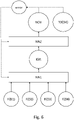
- Figure 6 shows an example of a suitable deep neural network architecture.
- the deep neural network includes a first set of layers NN1 arranged to process feature arrays for a sequence of dates to generate an intermediate data array.
- the first set of layers NN1 processes four feature arrays F(D1), F(D2), F(D3), F(D4) representing values of a set of date-dependent features for a sequence of consecutive dates D1, D2, D3, D4, and outputs an intermediate data array IDA.
- the first set of layers NN1 may be arranged to receive a fixed number of feature arrays simultaneously, or advantageously may have a recursive neural network (RNN) configuration for receiving an indeterminate number of feature arrays sequentially.
- RNN recursive neural network
- the neural network can learn the short-, medium- and long-term effect of date features on values of a training metric, without any a priori knowledge of such effects. Specific configurations for the first set of layers NN1 will be discussed in more detail hereinafter.
- the deep neural network of Figure 6 includes a second set of layers NN2 arranged to process the intermediate data array IDA generated by the first set of layers NN1 to generate a network output value NOV.
- the second set of layers NN2 may include one or more layers.
- the second set of layers NN2 includes multiple fully-connected layers, though it will be appreciated that other architectures may be used without departing from the scope of the invention.
- the output of the second set of layers NN2 is a single numerical value, but in other examples the output of the second set of layers may have multiple components.
- the network output value is compared with a target output value to determine an error between the network output value and the target output value.
- the network output value NOV is compared with a target output value TO(D4) which is an evaluation of a training metric at the date D4.
- the target output value is associated with the last date in the sequence of dates D1, D2, D3, D4.
- the target output value may correspond to a date other than the last date in a sequence, for example the first date or one of the middle dates.
- each of the components may be compared with a respective target output value corresponding to an evaluation of a respective different training metric at a given date.
- the determined error is backpropagated through the second set of layers NN2 and the first set of layers NN1 of the neural network to determine a gradient of the error with respect to parameters of the neural network (for example, connection weights and bias values).
- parameters of the neural network for example, connection weights and bias values.
- backpropagation through time may be used to determine the gradient of the error.
- the values of the parameters are updated in dependence on the determined gradient, using gradient descent or a variant thereof, such that the parameter values after the update would result in a lower error.
- the updating of the parameter values may be performed iteratively for the same training date until a stopping condition is satisfied (for example when a predetermined number of iterations has been performed, or when the error or the gradient of the error has decreased by a certain amount), or may be performed once for a given training date before moving onto a different training date.
- the resulting trained values of the network parameters are stored in the memory 306 of the embedding system 211, for use in generating embedding arrays as described below.
- the embedding system 211 receives, at 508, feature arrays corresponding to dates including a set of target dates (and possibly other dates before, after or between the target dates).
- the target dates are those relevant to a downstream forecasting task, for example because time series data is available to the forecasting party for those dates or because it is desired to forecast a given variable on those dates.
- the set of target dates may include at least some of the training dates used to train the neural network, and/or may include dates which are not included within the set of training dates.
- the set of target dates may include all of the dates in the previous period for which measurements of the quantity are available, as well as any dates in the upcoming period for which predictions are to be made.
- feature arrays for additional dates may also be received, for example sequences of consecutive dates which contain the target dates.
- the embedding system 211 processes, at 510, the feature arrays received at 408, using the first set of neural network layers NN1 with the trained values of the network parameters, to generate an embedding array for each of the target dates.
- the embedding arrays are dense, fixed-dimensional arrays that capture date-related information salient to the training metric on which the neural network is trained.
- the embedding arrays may, for example, have 8, 10, 12, 16, 32, or any other suitable number of dimensions.
- the first set of layers NN1 processes four feature arrays F(D5), F(D6), F(D7), F(D8) for a sequence of consecutive dates D5, D6, D7, D8, where D8 is a target date, and outputs an embedding array EA(D8) corresponding to the target date D8.
- the embedding array for a target date may depend on features not only of the target date, but also on features of other dates surrounding the target date.
- the embedding arrays may therefore contain information pertaining to relationships with surrounding dates, allowing the embedding arrays to capture information not contained within the feature arrays from which the embedding arrays are derived.
- the first set of neural network layers NN1 may have an RNN configuration arranged to receive feature arrays sequentially, in which case the first set of neural network layers may process feature arrays corresponding to any number of dates, including the target date, to generate the embedding array for the target date.
- the embedding arrays are transmitted, at 512, to the forecasting system 209A.
- the forecasting system 209A is operated by a different entity to that which operates the embedding system 211, and in this example the two entities are unwilling or unable to share confidential data with one another, including the time series data used to generate the embedding arrays.
- the embedding arrays contain no information from which values of the time series data could be inferred, so the confidentiality of the time series data is not compromised by the transmitting of the embedding arrays.
- the forecasting system 209A in this example is a component of the issuing bank system 206A, in other examples a forecasting system could be a component of an acquiring bank system or could be a separate system altogether.
- the embedding arrays are received by the forecasting system 209A at 514.
- the forecasting system 209A processes, at 516, the embedding arrays to train a forecasting model.
- the forecasting model may be, for example, a further neural network model or may be any other suitable type of model, for example a Gaussian process regression model, a linear regression model, a logistic regression model, and so on.
- an embedding array corresponding to a given date is associated with a time series data point corresponding to an evaluation of a forecasting metric on the given date.
- the forecasting model is then trained using supervised learning with the time series data points as targets.
- the forecasting model thereby learns to process an embedding array to generate an output value which is an accurate prediction of the forecasting metric on the date to which the embedding array corresponds.
- the exact training method will depend on the type of forecasting model. For example, where the forecasting model is implemented as a neural network, backpropagation of errors and gradient descent may be used to train the forecasting model. Where the forecasting model is a Bayesian model such as a Gaussian process model, maximum likelihood estimation, maximum a priori (MAP) estimation, and/or variational inference may be used to train the forecasting model. In some examples, a forecasting model may be trained to generate a prediction on the basis of a set of multiple embedding arrays corresponding to sequence of dates, for example using an RNN architecture.
- the forecasting system 209A processes, at 518, an embedding array corresponding to a given date, using the trained forecasting model, to predict a value of the forecasting metric on the given date. It will be appreciated that the resulting prediction takes into account not only the training data stored in the issuing bank database 212A, but also the date dependence of the training data stored in the card scheme database 212, without any confidential data having to be transferred between the systems. As explained above, the card scheme database 212 stores more transaction data than any other party in the payment processing network 200. Using embedding arrays based on this rich dataset as input data for a forecasting model is expected to lead to improved performance of the forecasting model, even when a relatively small volume of time series data is stored by the forecasting party.
- the method described above involves generating input date for a forecasting model based on training data comprising evaluations of a given training metric.
- separate instances of the neural network model may be trained using target values corresponding to different training metrics.
- the resulting embedding arrays generated by the different instances will generally encapsulate information relevant to the particular training metrics on which the respective instances are trained. For certain downstream forecasting tasks, it is expected that only particular embedding arrays will be relevant (those for which the corresponding training metric is expected to be relevant to the forecasting task). In other examples, multiple sets of embedding arrays may be relevant to a given forecasting task, or it may be unclear which set of embedding arrays will be relevant.
- multiple embedding arrays may be generated for each target date, each corresponding to a different training metric, and these embedding may then be combined to generate a combined embedding array for each target date.
- Combining the embedding arrays may include, for example, concatenating or interleaving the embedding arrays, pooling of feature values, or generating linear combinations of feature values. If the combined embedding arrays are used to train the forecasting model, the forecasting model may then learn to take into account information in any or all of the component embedding arrays.
- the first set of layers NN1 of the neural network for generating embedding arrays may be arranged in an RNN configuration.
- the RNN includes a long short-term memory (LSTM) unit having multiple layers or gates.
- An LSTM unit includes at least an input gate, an output gate and a forget gate, which together control the information that persists within the LSTM unit (the persisting information is referred to as a cell state).
- LSTM unit Various different arrangements of LSTM unit are known in the art, for example the peephole LSTM unit and the gated recurrent unit (GRU), and any of these may be used without departing from the scope of the present disclosure.
- LSTM networks may be trained using stateful training or stateless training. Compared with some other types of RNN architecture, LSTM units are adept at capturing long-term dependencies within data.
- the embedding arrays are provided to a remote system performing the forecasting task
- the generating of the embedding arrays and the performing of the forecasting task may be performed using a single system, or by systems operated by a single entity.
- data confidentiality is not an issue
- the generating of the embedding arrays still addresses the technical issues associated with the use of feature arrays as input data, and further provides a way to harness rich data associated with evaluations of one or more metrics to provide information for forecasting values of other metrics, for which such rich data may not be available.
- FIG. 2 involves issuing banks and acquiring banks in a payment processing network
- the methods described herein may be implemented for transactions between other financial institutions.
- FX volume data for currencies on either or both sides of the border may be used as training data (target output values) for generating suitable embedding arrays.
- embedding arrays may be generated using training data pertaining to a specific industry or business domain, such that the embedding arrays contain information specific to that industry or business domain and are therefore suitable to be provided to parties involved in that industry of business domain.
- the present method is not limited for use with financial transaction data, and may be applied to any situation in which time-series data is to be predicted or forecasted and in which time- or date-dependent features are expected to be relevant.
Landscapes
- Engineering & Computer Science (AREA)
- Theoretical Computer Science (AREA)
- Physics & Mathematics (AREA)
- General Physics & Mathematics (AREA)
- Software Systems (AREA)
- General Engineering & Computer Science (AREA)
- Biophysics (AREA)
- Computational Linguistics (AREA)
- Data Mining & Analysis (AREA)
- Evolutionary Computation (AREA)
- General Health & Medical Sciences (AREA)
- Molecular Biology (AREA)
- Computing Systems (AREA)
- Biomedical Technology (AREA)
- Artificial Intelligence (AREA)
- Mathematical Physics (AREA)
- Life Sciences & Earth Sciences (AREA)
- Health & Medical Sciences (AREA)
- Business, Economics & Management (AREA)
- Strategic Management (AREA)
- Economics (AREA)
- Finance (AREA)
- Accounting & Taxation (AREA)
- Development Economics (AREA)
- Marketing (AREA)
- General Business, Economics & Management (AREA)
- Human Resources & Organizations (AREA)
- Technology Law (AREA)
- Entrepreneurship & Innovation (AREA)
- Operations Research (AREA)
- Quality & Reliability (AREA)
- Tourism & Hospitality (AREA)
- Game Theory and Decision Science (AREA)
- Information Retrieval, Db Structures And Fs Structures Therefor (AREA)
- Management, Administration, Business Operations System, And Electronic Commerce (AREA)
Abstract
Description
- The present invention relates to generating input data for processing by a machine learning model. The invention has particular relevance to generating input data which encapsulates date-dependent information in a format suitable for processing by a machine learning model arranged to forecast time series data.
- Forecasting tasks typically involve processing time series data comprising evaluations of a metric or target outcome at a set of previous time points to train a forecasting model to predict values of the metric or target outcome at one or more future time points. Depending on the application, the time points may correspond to dates, weeks, months or years, etc. In some examples, forecasting tasks are treated as curve fitting problems in which a function or stochastic process is fitted to a set of time series data points, with time being treated as a sole input variable. In some forecasting tasks, the value of a metric is expected to be strongly affected by particular attributes of a date (or week, month, year etc.). For example, when forecasting a volume of financial transactions of a particular type taking place on a given date, it is likely to be relevant which day of the week the date falls on, whether that day is a weekend day, and whether the date corresponds to a public holiday. Although in principle a model which uses time as a sole input variable can be trained to account for such information (provided the model has sufficient learning capacity), in practice the volume of training data needed to train the model, and/or the time period over which the training data would need to be collected, can be prohibitive. Furthermore, forcing a model to infer patterns from data which could be easily anticipated a priori is not an efficient use of computational resources or time.
- In view of the above issues, models have been developed in which the time input is augmented with a set of manually-selected features that are expected to be salient to a forecasting task at hand. Suitable models include deep neural network models, which are well-suited to multi-dimensional inputs and can have a high learning capacity and tend to be less sensitive to outliers than curve fitting methods. Recurrent neural network (RNN) models allow data points to be processed sequentially, and the output of the model associated with a given time point can depend on a sequence of data points of indeterminate length.
Figure 1 shows a set of date-dependent features F evaluated on four consecutive dates D1, D2, D3, D4. In this example, the set of features includes an integer feature taking values from 1 to 7 representing the day of the week, an integer feature taking values from 1 to 31 representing day of the month, an integer feature taking values from 1 to 12 representing the month of the year, and a large number of binary features (two of which are shown) taking values of 0 or 1 and each indicating whether or not the date is associated with a respective attribute (for example, whether the date corresponds to a weekend day and whether the date is a bank holiday in the United Kingdom). The features in the set are not necessarily independent of one another (for example, if the date falls on a Saturday, the date must also fall on a weekend day) and therefore the set of features includes a level of redundancy, but the features are nevertheless chosen to include any information which is expected to be salient to the forecasting task at hand. InFigure 1 , the date-related features are labelled to illustrate the semantic meaning of the features, but in practice the features would be represented by an unlabelled array of values, for example a vector. Due to the potentially large number of binary features, the arrays are likely to be high-dimensional (for example, including hundreds of entries) and sparse (because a significant proportion of the entries are expected to be zero). - In principle, providing feature arrays of the type described above as inputs to a forecasting model can encourage the forecasting model to learn the influence of the corresponding features on the value of a metric. However, in practice, training a model to determine the influence of date-dependent features from such arrays is challenging from an implementation point of view and can place excessive demands on computational resources. In particular, the sparsity of the feature arrays leads to an optimisation surface in which a global optimum is challenging to determine. Furthermore, even if such feature arrays are used, a forecasting model is likely to require a large volume of training data spanning a large temporal range in order to properly learn the influence of certain features. Such volumes of training data may not be available for a given forecasting task, or at least may not be available to an entity performing the forecasting task. Finally, even if such training data is available, the demands on computational resources for training the model, both in terms of processing and memory, are likely to be high due to the high dimensionality of the feature vectors and the nature of the optimisation surface.
- According to a first aspect of the invention, there is provided a computer-implemented method of training a data processing system to generate an embedding array having a first number of dimensions and representing information associated with a given date. The method includes, for each training date of a set of training dates: receiving, for each of a respective sequence of dates including the training date, a respective input data array having a second number of dimensions greater than the first number of dimensions and representing values of a predetermined set of date-dependent features; receiving a target output value corresponding to an evaluation of a predetermined metric at the training date; and performing an update routine. The update routine includes: processing the respective input data array for each date in the respective sequence of dates using a first one or more layers of a neural network to generate an intermediate data array. The intermediate data array has the first number of dimensions. The update routine further includes processing the intermediate data array using a second one or more layers of the neural network to generate a network output value; determining an error between the network output value and the target output value; and updating values of a set of parameters of the neural network in a direction of a negative gradient of the determined error between the network output value and the target output value. When the update routine has been performed for each training date of the set of training dates, the data processing system is arranged to generate the embedding array for the given date by processing a respective input data array for each of a given sequence of dates including the given date using the first one or more layers of the neural network.
- By generating embedding arrays based on time series data consisting of evaluations of the predetermined metric at the set of training dates, the time series data is leveraged to capture date-related information that may be pertinent to a downstream forecasting task. In many situations, the time series data used to train the neural network will be confidential and accessible only to a first party, and the forecasting task will be performed by a second party which does not have access to the time series data. In these situations, the above method provides a means by which the second party performing the forecasting task can take advantage of information contained within the time series data, without the need for either party to share confidential data.
- The embedding arrays generated using the method described above are by design lower-dimensional than the hand-crafted feature arrays used to generate the embedding arrays, and the embedding arrays are expected to be dense rather than sparse. The technical implementation issues discussed above in relation to the use of feature arrays as input data are thus mitigated by the above method, resulting in forecasting which, as well as being likely to produce more accurate results, places lower demands on computing resources including processors and memory.
- According to a second aspect of the invention, there is provided a data processing system comprising processing circuitry and memory circuitry. The memory circuitry holds machine readable instructions which, when executed by the processing circuitry, cause the data processing system to perform a method as described above.
- Further features and advantages of the invention will become apparent from the following description of preferred embodiments of the invention, given by way of example only, which is made with reference to the accompanying drawings.
-
-
Figure 1 shows schematically a set of hand-selected date-dependent features for four consecutive dates; -
Figure 2 shows schematically a payment processing system arranged in accordance with present disclosure; -
Figure 3 shows schematically an example of a data processing system arranged to generate input data for a forecasting model; -
Figure 4 shows schematically an example of a data processing system arranged to forecast values of a metric using a forecasting model; -
Figure 5 is a flow diagram representing an example of a method for forecasting time series data in accordance with the present disclosure; -
Figure 6 shows schematically a neural network being trained to generate input data for a forecasting model in accordance with the present disclosure; -
Figure 7 shows schematically the neural network ofFigure 6 being used to generate input data in accordance with the present disclosure; -
Figure 8 shows an example of a recurrent neural network architecture suitable for use in the neural network ofFigures 6 and7 . -
Figure 2 shows schematically an example of apayment processing network 200 in which acquiring banks X, Y and Z accept, on behalf of respective merchants, payments from cardholders using payment cards associated with issuing banks A, B and C. Settlement of funds is effected between the acquiring banks X, Y and Z and the issuing banks A, B and C via a card scheme network. Each of the acquiring banks X, Y, Z maintains a respective acquiringbank system database bank system database bank systems respective forecasting system corresponding database card scheme system 210 and associateddatabase 212 for storing data associated with transactions involving the card scheme network. - It will be appreciated that the number of transactions involving the card scheme network is greater than the number of transactions involving any one of the acquiring banks X, Y, Z or any of the issuing banks A, B, C, and as such the volume of transaction data stored by the
card scheme database 212 will be higher than the volume of transaction data stored in the databases of any of the banks A, B, C, X, Y or Z. Furthermore, the data stored by each of the parties involved in the system ofFigure 2 is confidential. In particular, data stored in thecard scheme database 212 relating to transactions involving any one of the banks A, B, C, X, Y, Z cannot be shared with any of the banks A, B, C, X, Y, Z. It is therefore not straightforward for any party in the payment processing network (or any other party) to take advantage of the transaction data stored in thedatabase 212, for example for the purpose of forecasting future transaction volumes. Such forecasting is important, for example when forecasting liquidity volumes in order to eliminate "short cash" in which insufficient funds are available for settlement, and to mitigate "wasted cash" in which excess funds are held in an account. In order to be able to leverage the data stored in thecard scheme database 212 to assist with forecasting tasks performed by third parties (such as the issuing banks A, B, C), thecard scheme system 210 includes anembedding system 211. In this example, theembedding system 211 is arranged to process data stored in thecard scheme database 212 to generate input data for provision to one or more of the issuingbank systems - As shown in
Figure 3 , theembedding system 211 includes anetwork interface 302 for communicating with other components of thecard scheme system 210 and thecard scheme database 212 over aprivate network 304. The embedding system further includesmemory circuitry 306, which in this example includes non-volatile storage in the form of a solid-state drive (SSD). In other examples, a data processing system may additionally or alternatively include a hard disk drive and/or removable storage devices. Thememory circuitry 306 further includes working memory in the form of volatile random-access memory (RAM), in particular static random-access memory (SRAM) and dynamic random-access memory (DRAM). The embeddingsystem 211 further includes processing circuitry, which in this example comprises a central processing unit (CPU) 308 and a neural network accelerator (NNA) 310. TheNNA 310, also referred to as a neural processing unit (NPU), is a specialist processing unit with multiple processing nodes arranged for efficient parallelised implementation of neural network processing. TheCPU 308 is arranged to send instructions to theNNA 310 in accordance with program code stored in thememory 306, causing theNNA 310 to process data stored in thememory 306 as will be described in more detail hereafter. In other examples, data processing system may include additional or alternative processing circuitry, for example in the form of a graphics processing unit (GPU), a field programmable gate array (FPGAs), and/or an application-specific integrated circuit (ASIC). In use, the embeddingsystem 211 processes feature arrays comprising data-related features, along with time series data stored in thecard scheme database 212, to generate embedding arrays for use as input data for theforecasting systems -
Figure 4 shows schematically theforecasting system 209A operated by the issuing bank A. Theforecasting system 209A in this example is arranged to implement a neural-network based forecasting model, and as such has similar hardware components to the embeddingsystem 211, including anetwork interface 402 for communicating with other components of the issuingbank system 206A and the associateddatabase 208A,memory circuitry 406 and processing circuitry including aCPU 408 and aneural network accelerator 410. Theforecasting systems forecasting system 209A processes embedding arrays generated by the embeddingsystem 211, along with time series data stored in thedatabase 208A, to generate predictions of values of one or more financial metrics of interest to the issuing bank A. -
Figure 5 shows an example of an end-to-end method of performing a forecasting task in accordance with the present disclosure. The first steps of the method are performed by the embeddingsystem 211 ofFigure 2 and3 , and later steps are performed by theforecasting system 209A of issuing bank A. The embeddingsystem 211 receives, at 502, time series data from thecard scheme database 212. The time series data includes evaluations of one or more predetermined training metrics at a set of training dates. These evaluations are referred to hereafter as target output values. In the present example, the target output values are based on transaction data relating to transactions between acquiring bank systems 202 and issuing bank systems 206, but in other contexts could be derived from transactions or events involving other parties or types of institution. Examples of training metrics include foreign exchange (forex, FX) net volume, FX buy volume, FX sell volume, cross-border (XB) transaction volume, or domestic transaction volume. The time series data may correspond to evaluations of a training metric for a specific industry or business domain (for example, the hotel industry, the restaurant industry, or e-commerce), in cases where embedding arrays are to be generated for a party involved in that industry or business domain. The time series data will typically correspond to dates spanning many days, for spanning several months or several years. Advantageously, the time series data should span a sufficient extent of time for date-dependent patterns to be present within the data, for example weekly, monthly and/or annual patterns, as well as phenomena relating to "special" dates such as bank holidays. - The embedding
system 211 receives, at 504, feature arrays corresponding to a set of dates including the training dates (and possibly other dates before, after or between the training dates). The features arrays may, for example, vectors with entries in an integer and/or binary number format indicating values of the date features. As discussed above with reference toFigure 1 , the feature arrays are likely to be sparse and possibly high-dimensional, and should be designed to include any feature which is expected to be relevant to a forecasting task of interest. - The embedding
system 211 processes, at 506, the received time series data and feature arrays to train a deep neural network model to generate embedding arrays.Figure 6 shows an example of a suitable deep neural network architecture. The deep neural network includes a first set of layers NN1 arranged to process feature arrays for a sequence of dates to generate an intermediate data array. In the example shown, the first set of layers NN1 processes four feature arrays F(D1), F(D2), F(D3), F(D4) representing values of a set of date-dependent features for a sequence of consecutive dates D1, D2, D3, D4, and outputs an intermediate data array IDA. Depending on the specific network architecture, the first set of layers NN1 may be arranged to receive a fixed number of feature arrays simultaneously, or advantageously may have a recursive neural network (RNN) configuration for receiving an indeterminate number of feature arrays sequentially. By using a suitable RNN architecture for the first set of layers NN1, the neural network can learn the short-, medium- and long-term effect of date features on values of a training metric, without any a priori knowledge of such effects. Specific configurations for the first set of layers NN1 will be discussed in more detail hereinafter. - The deep neural network of
Figure 6 includes a second set of layers NN2 arranged to process the intermediate data array IDA generated by the first set of layers NN1 to generate a network output value NOV. The second set of layers NN2 may include one or more layers. In an example, the second set of layers NN2 includes multiple fully-connected layers, though it will be appreciated that other architectures may be used without departing from the scope of the invention. In this example, the output of the second set of layers NN2 is a single numerical value, but in other examples the output of the second set of layers may have multiple components. - During training, the network output value is compared with a target output value to determine an error between the network output value and the target output value. In the example shown, the network output value NOV is compared with a target output value TO(D4) which is an evaluation of a training metric at the date D4. In this example, the target output value is associated with the last date in the sequence of dates D1, D2, D3, D4. In other examples, the target output value may correspond to a date other than the last date in a sequence, for example the first date or one of the middle dates. In an example where the network output value has multiple components, each of the components may be compared with a respective target output value corresponding to an evaluation of a respective different training metric at a given date. The determined error is backpropagated through the second set of layers NN2 and the first set of layers NN1 of the neural network to determine a gradient of the error with respect to parameters of the neural network (for example, connection weights and bias values). In examples using an RNN architecture for the first set of layers NN1, backpropagation through time may be used to determine the gradient of the error. The values of the parameters are updated in dependence on the determined gradient, using gradient descent or a variant thereof, such that the parameter values after the update would result in a lower error. The updating of the parameter values may be performed iteratively for the same training date until a stopping condition is satisfied (for example when a predetermined number of iterations has been performed, or when the error or the gradient of the error has decreased by a certain amount), or may be performed once for a given training date before moving onto a different training date.
- When the above routine has been performed once or more for each training date of the set of training dates, the resulting trained values of the network parameters are stored in the
memory 306 of the embeddingsystem 211, for use in generating embedding arrays as described below. - The embedding
system 211 receives, at 508, feature arrays corresponding to dates including a set of target dates (and possibly other dates before, after or between the target dates). The target dates are those relevant to a downstream forecasting task, for example because time series data is available to the forecasting party for those dates or because it is desired to forecast a given variable on those dates. The set of target dates may include at least some of the training dates used to train the neural network, and/or may include dates which are not included within the set of training dates. For example, where a forecasting task involves predicting a quantity of interest for an upcoming period, based on time series data comprising measurements of said quantity of interest over a previous period, the set of target dates may include all of the dates in the previous period for which measurements of the quantity are available, as well as any dates in the upcoming period for which predictions are to be made. Depending on the spacing of the target dates, feature arrays for additional dates may also be received, for example sequences of consecutive dates which contain the target dates. - The embedding
system 211 processes, at 510, the feature arrays received at 408, using the first set of neural network layers NN1 with the trained values of the network parameters, to generate an embedding array for each of the target dates. The embedding arrays are dense, fixed-dimensional arrays that capture date-related information salient to the training metric on which the neural network is trained. The embedding arrays may, for example, have 8, 10, 12, 16, 32, or any other suitable number of dimensions. In the example ofFigure 7 , the first set of layers NN1 processes four feature arrays F(D5), F(D6), F(D7), F(D8) for a sequence of consecutive dates D5, D6, D7, D8, where D8 is a target date, and outputs an embedding array EA(D8) corresponding to the target date D8. The embedding array for a target date may depend on features not only of the target date, but also on features of other dates surrounding the target date. The embedding arrays may therefore contain information pertaining to relationships with surrounding dates, allowing the embedding arrays to capture information not contained within the feature arrays from which the embedding arrays are derived. As discussed above, the first set of neural network layers NN1 may have an RNN configuration arranged to receive feature arrays sequentially, in which case the first set of neural network layers may process feature arrays corresponding to any number of dates, including the target date, to generate the embedding array for the target date. - In the present example, once the embedding arrays have been generated for each of the target dates, the embedding arrays are transmitted, at 512, to the
forecasting system 209A. As explained above, theforecasting system 209A is operated by a different entity to that which operates the embeddingsystem 211, and in this example the two entities are unwilling or unable to share confidential data with one another, including the time series data used to generate the embedding arrays. Advantageously, the embedding arrays contain no information from which values of the time series data could be inferred, so the confidentiality of the time series data is not compromised by the transmitting of the embedding arrays. Although theforecasting system 209A in this example is a component of the issuingbank system 206A, in other examples a forecasting system could be a component of an acquiring bank system or could be a separate system altogether. - The embedding arrays are received by the
forecasting system 209A at 514. Theforecasting system 209A processes, at 516, the embedding arrays to train a forecasting model. The forecasting model may be, for example, a further neural network model or may be any other suitable type of model, for example a Gaussian process regression model, a linear regression model, a logistic regression model, and so on. During training, an embedding array corresponding to a given date is associated with a time series data point corresponding to an evaluation of a forecasting metric on the given date. The forecasting model is then trained using supervised learning with the time series data points as targets. The forecasting model thereby learns to process an embedding array to generate an output value which is an accurate prediction of the forecasting metric on the date to which the embedding array corresponds. The exact training method will depend on the type of forecasting model. For example, where the forecasting model is implemented as a neural network, backpropagation of errors and gradient descent may be used to train the forecasting model. Where the forecasting model is a Bayesian model such as a Gaussian process model, maximum likelihood estimation, maximum a priori (MAP) estimation, and/or variational inference may be used to train the forecasting model. In some examples, a forecasting model may be trained to generate a prediction on the basis of a set of multiple embedding arrays corresponding to sequence of dates, for example using an RNN architecture. - The
forecasting system 209A processes, at 518, an embedding array corresponding to a given date, using the trained forecasting model, to predict a value of the forecasting metric on the given date. It will be appreciated that the resulting prediction takes into account not only the training data stored in the issuing bank database 212A, but also the date dependence of the training data stored in thecard scheme database 212, without any confidential data having to be transferred between the systems. As explained above, thecard scheme database 212 stores more transaction data than any other party in thepayment processing network 200. Using embedding arrays based on this rich dataset as input data for a forecasting model is expected to lead to improved performance of the forecasting model, even when a relatively small volume of time series data is stored by the forecasting party. - The method described above involves generating input date for a forecasting model based on training data comprising evaluations of a given training metric. In some examples, separate instances of the neural network model may be trained using target values corresponding to different training metrics. The resulting embedding arrays generated by the different instances will generally encapsulate information relevant to the particular training metrics on which the respective instances are trained. For certain downstream forecasting tasks, it is expected that only particular embedding arrays will be relevant (those for which the corresponding training metric is expected to be relevant to the forecasting task). In other examples, multiple sets of embedding arrays may be relevant to a given forecasting task, or it may be unclear which set of embedding arrays will be relevant. In this case, multiple embedding arrays may be generated for each target date, each corresponding to a different training metric, and these embedding may then be combined to generate a combined embedding array for each target date. Combining the embedding arrays may include, for example, concatenating or interleaving the embedding arrays, pooling of feature values, or generating linear combinations of feature values. If the combined embedding arrays are used to train the forecasting model, the forecasting model may then learn to take into account information in any or all of the component embedding arrays.
- As mentioned above, the first set of layers NN1 of the neural network for generating embedding arrays may be arranged in an RNN configuration.
Figure 8 shows an example in which feature arrays xk for k = 1,2, ..., K corresponding to a sequence of dates Dk for k = 1,2, ..., K are processed sequentially by a set of layers f to generate an embedding array corresponding to the last date DK in the sequence. In this example, the output hk associated with date Dk depends on the feature array xk corresponding to the date Dk , and also on the output h k-1 associated with the previous date D k-1, such that hk = f(h k-1, xk ). The feature arrays are processed sequentially in chronological order, with information persisting in the network each time a new feature array is processed. When the feature arrays for the entire sequence of dates have been processed sequentially in this way, the output hK of the set of layers f is the embedding array for the date DK. In a specific example, the RNN includes a long short-term memory (LSTM) unit having multiple layers or gates. An LSTM unit includes at least an input gate, an output gate and a forget gate, which together control the information that persists within the LSTM unit (the persisting information is referred to as a cell state). Various different arrangements of LSTM unit are known in the art, for example the peephole LSTM unit and the gated recurrent unit (GRU), and any of these may be used without departing from the scope of the present disclosure. LSTM networks may be trained using stateful training or stateless training. Compared with some other types of RNN architecture, LSTM units are adept at capturing long-term dependencies within data. - The above embodiments are to be understood as illustrative examples of the invention. Further embodiments of the invention are envisaged. For example, although in the examples described above the embedding arrays are provided to a remote system performing the forecasting task, in another example the generating of the embedding arrays and the performing of the forecasting task may be performed using a single system, or by systems operated by a single entity. In this case, data confidentiality is not an issue, but the generating of the embedding arrays still addresses the technical issues associated with the use of feature arrays as input data, and further provides a way to harness rich data associated with evaluations of one or more metrics to provide information for forecasting values of other metrics, for which such rich data may not be available. Furthermore, although the example of
Figure 2 involves issuing banks and acquiring banks in a payment processing network, the methods described herein may be implemented for transactions between other financial institutions. For example, in the context of cross-border payments, it is advantageous for banks or financial institutions involved in such transaction be able to predict settlement payment volumes in advance in order to eliminate short cash and mitigate waste cash during prefunding. For example, FX volume data for currencies on either or both sides of the border may be used as training data (target output values) for generating suitable embedding arrays. As mentioned above, embedding arrays may be generated using training data pertaining to a specific industry or business domain, such that the embedding arrays contain information specific to that industry or business domain and are therefore suitable to be provided to parties involved in that industry of business domain. Finally, the present method is not limited for use with financial transaction data, and may be applied to any situation in which time-series data is to be predicted or forecasted and in which time- or date-dependent features are expected to be relevant. - It is to be understood that any feature described in relation to any one embodiment may be used alone, or in combination with other features described, and may also be used in combination with one or more features of any other of the embodiments, or any combination of any other of the embodiments. Furthermore, equivalents and modifications not described above may also be employed without departing from the scope of the invention, which is defined in the accompanying claims.
Claims (15)
- A computer-implemented method of training a data processing system to generate an embedding array having a first number of dimensions and representing information associated with a given date, the method comprising, for each training date of a set of training dates:receiving, for each of a respective sequence of dates including the training date, a respective input data array having a second number of dimensions greater than the first number of dimensions and representing values of a predetermined set of date-dependent features;receiving a target output value corresponding to an evaluation of a predetermined metric at the training date; andperforming an update routine comprising:processing the respective input data array for each date in the respective sequence of dates using a first one or more layers of a neural network to generate an intermediate data array, wherein the intermediate data array has the first number of dimensions;processing the intermediate data array using a second one or more layers of the neural network to generate a network output value;determining an error between the network output value and the target output value; andupdating values of a set of parameters of the neural network in a direction of a negative gradient of the determined error between the network output value and the target output value,whereby when the update routine has been performed for each training date of the set of training dates, the data processing system is arranged to generate the embedding array for the given date by processing a respective input data array for each of a given sequence of dates including the given date using the first one or more layers of the neural network.
- The method of claim 1, further comprising generating the embedding array for the given date by processing the respective input data array for each of the given sequence of dates including the given date using the first one or more layers of the neural network.
- The method of claim 1 or 2, wherein for each training date of the set of training dates, the training date is a last date in the respective sequence of training dates.
- The method of any preceding claim, wherein the first one or more layers of the deep neural network include one or more recurrent neural network layers.
- The method of claim 4, wherein the first one or more layers of the deep neural network includes at least one long short-term memory unit.
- The method of any preceding claim, wherein the given date is one of the training dates of the set of training dates.
- the method of any preceding date, wherein for each training date of the set of training dates, the target output value corresponds to an evaluation of a financial metric at the training date
- A method comprising:generating a plurality of embedding arrays for the given date using the method of any of claims 2 to 6 with respective different target output values corresponding to evaluations of respective different predetermined metrics at the training date; andcombining the plurality of embedding arrays for the given date into a combined embedding array for the given date.
- A method comprising generating a plurality of embedding arrays for respective different dates using the method of any of claims 2 to 8.
- The method of claim 9, further comprising processing the plurality of embedding arrays for the respective different dates, using supervised learning, to train a forecasting model to predict values of a date-dependent variable on a given target date, based on inputs including an embedding array for the given target date.
- The method of claim 9, further comprising transmitting the plurality of embedding arrays for the respective different dates to a remote computing system over a network.
- The method of claim 11, further comprising, at the remote system:receiving the plurality of embedding arrays for the respective different dates; andreceiving a set of training values corresponding to evaluations of a forecasting metric at past dates corresponding to a subset of the plurality of embedding arrays;processing the set of training dates and said subset of the plurality of embedding arrays using supervised learning to train a forecasting model to predict values of the forecasting metric on a given target date based on input data including an embedding array for the given target date; andprocessing one or more of the plurality of embedding arrays using the trained forecasting model to predict values of the forecasting metric on dates corresponding to said one or more of the plurality of embedding arrays.
- A data processing system comprising processing circuitry and memory circuitry, wherein the memory circuitry holds machine readable instructions which, when executed by the processing circuitry, cause the data processing system to, for each of a set of training dates:receive, for each of a respective sequence of dates including the training date, a respective input data array having a second number of dimensions greater than the first number of dimensions and representing values of a predetermined set of date-dependent features;receive a target output value corresponding to an evaluation of a predetermined metric at the training date; andperform an update routine comprising:processing the respective input data array for each date in the respective sequence of dates using a first one or more layers of a neural network to generate an intermediate data array, wherein the intermediate data array has the first number of dimensions;processing the intermediate data array using a second one or more layers of the neural network to generate a network output value;determining an error between the network output value and the target output value; andupdating values of a set of parameters of the neural network in a direction of a negative gradient of the determined error between the network output value and the target output value,whereby when the update routine has been performed for each training date of the set of training dates, the data processing system is arranged to generate an embedding array for a given date by processing a respective input data array for each of a given sequence of dates including the given date using the first one or more layers of the neural network.
- The data processing system of claim 13, further comprising a network interface, wherein the data processing system is arranged to generate a plurality of embedding arrays for respective different dates and transmit the generated plurality of embedding arrays to a remote computing system via the network interface.
- A computer program product comprising machine readable instructions which, when the executed by a data processing system, cause the data processing system to perform the method of any of claims 1 to 11.
Priority Applications (3)
| Application Number | Priority Date | Filing Date | Title |
|---|---|---|---|
| EP21157977.6A EP4047525A1 (en) | 2021-02-18 | 2021-02-18 | Generating input data for a machine learning model |
| US17/335,819 US12293286B2 (en) | 2021-02-18 | 2021-06-01 | Generating input data for a machine learning model |
| CN202210147929.1A CN114970804A (en) | 2021-02-18 | 2022-02-17 | Generating input data for a machine learning model |
Applications Claiming Priority (1)
| Application Number | Priority Date | Filing Date | Title |
|---|---|---|---|
| EP21157977.6A EP4047525A1 (en) | 2021-02-18 | 2021-02-18 | Generating input data for a machine learning model |
Publications (1)
| Publication Number | Publication Date |
|---|---|
| EP4047525A1 true EP4047525A1 (en) | 2022-08-24 |
Family
ID=74668771
Family Applications (1)
| Application Number | Title | Priority Date | Filing Date |
|---|---|---|---|
| EP21157977.6A Pending EP4047525A1 (en) | 2021-02-18 | 2021-02-18 | Generating input data for a machine learning model |
Country Status (3)
| Country | Link |
|---|---|
| US (1) | US12293286B2 (en) |
| EP (1) | EP4047525A1 (en) |
| CN (1) | CN114970804A (en) |
Families Citing this family (5)
| Publication number | Priority date | Publication date | Assignee | Title |
|---|---|---|---|---|
| US20230075453A1 (en) * | 2021-09-08 | 2023-03-09 | Humana Inc. | Generating machine learning based models for time series forecasting |
| US20230251933A1 (en) * | 2022-02-04 | 2023-08-10 | Kyndryl, Inc. | Predicting recovery point objective drifts |
| TWI888832B (en) * | 2023-05-11 | 2025-07-01 | 兆豐國際商業銀行股份有限公司 | Server managing change transfer based on time series model |
| US20250173547A1 (en) * | 2023-06-01 | 2025-05-29 | Visa International Service Association | Method, System, and Computer Program Product for Efficient Content-Based Time Series Retrieval |
| WO2026024858A1 (en) * | 2024-07-23 | 2026-01-29 | Strong Force Tp Portfolio 2022, Llc | Configured artificial intelligence systems and methods for software-defined vehicles |
Family Cites Families (13)
| Publication number | Priority date | Publication date | Assignee | Title |
|---|---|---|---|---|
| US9141916B1 (en) | 2012-06-29 | 2015-09-22 | Google Inc. | Using embedding functions with a deep network |
| WO2016145379A1 (en) * | 2015-03-12 | 2016-09-15 | William Marsh Rice University | Automated Compilation of Probabilistic Task Description into Executable Neural Network Specification |
| US10268752B2 (en) | 2015-12-21 | 2019-04-23 | Ebay Inc. | Automatic taxonomy mapping using sequence semantic embedding |
| US10936947B1 (en) * | 2017-01-26 | 2021-03-02 | Amazon Technologies, Inc. | Recurrent neural network-based artificial intelligence system for time series predictions |
| US10467509B2 (en) | 2017-02-14 | 2019-11-05 | Microsoft Technology Licensing, Llc | Computationally-efficient human-identifying smart assistant computer |
| US10726325B2 (en) * | 2017-04-13 | 2020-07-28 | Adobe Inc. | Facilitating machine-learning and data analysis by computing user-session representation vectors |
| WO2018201151A1 (en) * | 2017-04-28 | 2018-11-01 | Google Llc | Neural network optimizer search |
| US11355240B2 (en) * | 2017-09-26 | 2022-06-07 | Edge2020 LLC | Determination of health sciences recommendations |
| US20200082269A1 (en) * | 2018-09-12 | 2020-03-12 | Nvidia Corporation | Memory efficient neural networks |
| KR102608470B1 (en) | 2018-10-23 | 2023-12-01 | 삼성전자주식회사 | Data recognition device and method and training device and method |
| CN111277603B (en) * | 2020-02-03 | 2021-11-19 | 杭州迪普科技股份有限公司 | Unsupervised anomaly detection system and method |
| US11972861B2 (en) * | 2020-06-23 | 2024-04-30 | Alexandr TSIMERMAN | Machine learning model for allocation of resources |
| US11567812B2 (en) * | 2020-10-07 | 2023-01-31 | Dropbox, Inc. | Utilizing a natural language model to determine a predicted activity event based on a series of sequential tokens |
-
2021
- 2021-02-18 EP EP21157977.6A patent/EP4047525A1/en active Pending
- 2021-06-01 US US17/335,819 patent/US12293286B2/en active Active
-
2022
- 2022-02-17 CN CN202210147929.1A patent/CN114970804A/en active Pending
Non-Patent Citations (3)
| Title |
|---|
| BABAEV DMITRII DMITRI LB@GMAIL COM ET AL: "E.T.-RNN Applying Deep Learning to Credit Loan Applications", PROCEEDINGS OF THE 25TH ACM SIGKDD INTERNATIONAL CONFERENCE ON KNOWLEDGE DISCOVERY & DATA MINING , KDD '19, ACM PRESS, NEW YORK, NEW YORK, USA, 25 July 2019 (2019-07-25), pages 2183 - 2190, XP058466343, ISBN: 978-1-4503-6201-6, DOI: 10.1145/3292500.3330693 * |
| ONCHAROEN PISUT ET AL: "Deep Learning for Stock Market Prediction Using Event Embedding and Technical Indicators", 2018 5TH INTERNATIONAL CONFERENCE ON ADVANCED INFORMATICS: CONCEPT THEORY AND APPLICATIONS (ICAICTA), IEEE, 14 August 2018 (2018-08-14), pages 19 - 24, XP033450673, DOI: 10.1109/ICAICTA.2018.8541310 * |
| SOROUSH VOSOUGHI ET AL: "Tweet2Vec: Learning Tweet Embeddings Using Character-level CNN-LSTM Encoder-Decoder", ARXIV.ORG, CORNELL UNIVERSITY LIBRARY, 201 OLIN LIBRARY CORNELL UNIVERSITY ITHACA, NY 14853, 26 July 2016 (2016-07-26), XP080714846, DOI: 10.1145/2911451.2914762 * |
Also Published As
| Publication number | Publication date |
|---|---|
| CN114970804A (en) | 2022-08-30 |
| US20220261632A1 (en) | 2022-08-18 |
| US12293286B2 (en) | 2025-05-06 |
Similar Documents
| Publication | Publication Date | Title |
|---|---|---|
| US12293286B2 (en) | Generating input data for a machine learning model | |
| US12242961B2 (en) | Training method and system of neural network model and prediction method and system | |
| US11803793B2 (en) | Automated data forecasting using machine learning | |
| CA3197813A1 (en) | Machine-learning techniques involving monotonic recurrent neural networks | |
| CA3111245A1 (en) | Prediction of future occurrences of events using adaptively trained artificialintelligence processes and contextual data | |
| EP4109377A1 (en) | System, method and apparatus for modeling loan transitions | |
| US11810187B2 (en) | Hierarchical deep neural network forecasting of cashflows with linear algebraic constraints | |
| Jain et al. | Financial supervision and management system using Ml algorithm | |
| Patra et al. | Price prediction of cryptocurrency using a multi-layer gated recurrent unit network with multi features | |
| Choi et al. | Parallel architecture of CNN‐bidirectional LSTMs for implied volatility forecast | |
| Das et al. | Towards crafting optimal functional link artificial neural networks with RAO algorithms for stock closing prices prediction | |
| Ateeq et al. | A mechanism for bitcoin price forecasting using deep learning | |
| CN110634061A (en) | A capital demand forecasting method, device and terminal equipment | |
| US12554979B2 (en) | Adapting AI models from one domain to another | |
| Asad et al. | A long-short-term-memory based model for predicting ATM replenishment amount | |
| CN116800831A (en) | A business data push method, device, storage medium and processor | |
| Amberkhani et al. | Revolutionizing cryptocurrency price prediction: Advanced insights from machine learning, deep learning and hybrid models | |
| Griguta et al. | Automated data processing of bank statements for cash balance forecasting | |
| Faricha et al. | Comparison study of transfer function and artificial neural network for cash flow analysis at Bank Rakyat Indonesia | |
| Neelima et al. | Time Series Forecasting of the Microsoft Corporation Stock Price | |
| US11669898B2 (en) | System for estimating distance-to-default credit risk | |
| US12406173B2 (en) | Covariate processing with neural network execution blocks | |
| Roopa Devi et al. | Predicting and analysis the bitcoin price using various forecasting model | |
| Gupta et al. | Survey on stock price forecasting using regression analysis | |
| Wong | A 3D neural network for business forecasting |
Legal Events
| Date | Code | Title | Description |
|---|---|---|---|
| PUAI | Public reference made under article 153(3) epc to a published international application that has entered the european phase |
Free format text: ORIGINAL CODE: 0009012 |
|
| STAA | Information on the status of an ep patent application or granted ep patent |
Free format text: STATUS: THE APPLICATION HAS BEEN PUBLISHED |
|
| AK | Designated contracting states |
Kind code of ref document: A1 Designated state(s): AL AT BE BG CH CY CZ DE DK EE ES FI FR GB GR HR HU IE IS IT LI LT LU LV MC MK MT NL NO PL PT RO RS SE SI SK SM TR |
|
| STAA | Information on the status of an ep patent application or granted ep patent |
Free format text: STATUS: REQUEST FOR EXAMINATION WAS MADE |
|
| 17P | Request for examination filed |
Effective date: 20230224 |
|
| RBV | Designated contracting states (corrected) |
Designated state(s): AL AT BE BG CH CY CZ DE DK EE ES FI FR GB GR HR HU IE IS IT LI LT LU LV MC MK MT NL NO PL PT RO RS SE SI SK SM TR |
|
| P01 | Opt-out of the competence of the unified patent court (upc) registered |
Effective date: 20230511 |
|
| STAA | Information on the status of an ep patent application or granted ep patent |
Free format text: STATUS: EXAMINATION IS IN PROGRESS |
|
| 17Q | First examination report despatched |
Effective date: 20240729 |
|
| RIN1 | Information on inventor provided before grant (corrected) |
Inventor name: CAI, YIWEI Inventor name: CHEN, QINGGUO Inventor name: GEORGE, OLAWUNMI Inventor name: WU, PENG |