EP4047273B1 - Combustor for gas turbine engine and method of manufacture - Google Patents
Combustor for gas turbine engine and method of manufacture Download PDFInfo
- Publication number
- EP4047273B1 EP4047273B1 EP22154371.3A EP22154371A EP4047273B1 EP 4047273 B1 EP4047273 B1 EP 4047273B1 EP 22154371 A EP22154371 A EP 22154371A EP 4047273 B1 EP4047273 B1 EP 4047273B1
- Authority
- EP
- European Patent Office
- Prior art keywords
- wall
- wall segment
- segment
- combustor
- liner
- Prior art date
- Legal status (The legal status is an assumption and is not a legal conclusion. Google has not performed a legal analysis and makes no representation as to the accuracy of the status listed.)
- Active
Links
Images






Classifications
-
- F—MECHANICAL ENGINEERING; LIGHTING; HEATING; WEAPONS; BLASTING
- F02—COMBUSTION ENGINES; HOT-GAS OR COMBUSTION-PRODUCT ENGINE PLANTS
- F02C—GAS-TURBINE PLANTS; AIR INTAKES FOR JET-PROPULSION PLANTS; CONTROLLING FUEL SUPPLY IN AIR-BREATHING JET-PROPULSION PLANTS
- F02C7/00—Features, components parts, details or accessories, not provided for in, or of interest apart form groups F02C1/00 - F02C6/00; Air intakes for jet-propulsion plants
- F02C7/12—Cooling of plants
-
- F—MECHANICAL ENGINEERING; LIGHTING; HEATING; WEAPONS; BLASTING
- F23—COMBUSTION APPARATUS; COMBUSTION PROCESSES
- F23R—GENERATING COMBUSTION PRODUCTS OF HIGH PRESSURE OR HIGH VELOCITY, e.g. GAS-TURBINE COMBUSTION CHAMBERS
- F23R3/00—Continuous combustion chambers using liquid or gaseous fuel
- F23R3/002—Wall structures
-
- F—MECHANICAL ENGINEERING; LIGHTING; HEATING; WEAPONS; BLASTING
- F23—COMBUSTION APPARATUS; COMBUSTION PROCESSES
- F23R—GENERATING COMBUSTION PRODUCTS OF HIGH PRESSURE OR HIGH VELOCITY, e.g. GAS-TURBINE COMBUSTION CHAMBERS
- F23R3/00—Continuous combustion chambers using liquid or gaseous fuel
- F23R3/02—Continuous combustion chambers using liquid or gaseous fuel characterised by the air-flow or gas-flow configuration
- F23R3/04—Air inlet arrangements
- F23R3/10—Air inlet arrangements for primary air
-
- F—MECHANICAL ENGINEERING; LIGHTING; HEATING; WEAPONS; BLASTING
- F23—COMBUSTION APPARATUS; COMBUSTION PROCESSES
- F23R—GENERATING COMBUSTION PRODUCTS OF HIGH PRESSURE OR HIGH VELOCITY, e.g. GAS-TURBINE COMBUSTION CHAMBERS
- F23R3/00—Continuous combustion chambers using liquid or gaseous fuel
- F23R3/42—Continuous combustion chambers using liquid or gaseous fuel characterised by the arrangement or form of the flame tubes or combustion chambers
- F23R3/54—Reverse-flow combustion chambers
-
- F—MECHANICAL ENGINEERING; LIGHTING; HEATING; WEAPONS; BLASTING
- F05—INDEXING SCHEMES RELATING TO ENGINES OR PUMPS IN VARIOUS SUBCLASSES OF CLASSES F01-F04
- F05D—INDEXING SCHEME FOR ASPECTS RELATING TO NON-POSITIVE-DISPLACEMENT MACHINES OR ENGINES, GAS-TURBINES OR JET-PROPULSION PLANTS
- F05D2220/00—Application
- F05D2220/30—Application in turbines
- F05D2220/32—Application in turbines in gas turbines
-
- F—MECHANICAL ENGINEERING; LIGHTING; HEATING; WEAPONS; BLASTING
- F05—INDEXING SCHEMES RELATING TO ENGINES OR PUMPS IN VARIOUS SUBCLASSES OF CLASSES F01-F04
- F05D—INDEXING SCHEME FOR ASPECTS RELATING TO NON-POSITIVE-DISPLACEMENT MACHINES OR ENGINES, GAS-TURBINES OR JET-PROPULSION PLANTS
- F05D2230/00—Manufacture
- F05D2230/20—Manufacture essentially without removing material
- F05D2230/23—Manufacture essentially without removing material by permanently joining parts together
- F05D2230/232—Manufacture essentially without removing material by permanently joining parts together by welding
-
- F—MECHANICAL ENGINEERING; LIGHTING; HEATING; WEAPONS; BLASTING
- F05—INDEXING SCHEMES RELATING TO ENGINES OR PUMPS IN VARIOUS SUBCLASSES OF CLASSES F01-F04
- F05D—INDEXING SCHEME FOR ASPECTS RELATING TO NON-POSITIVE-DISPLACEMENT MACHINES OR ENGINES, GAS-TURBINES OR JET-PROPULSION PLANTS
- F05D2230/00—Manufacture
- F05D2230/30—Manufacture with deposition of material
- F05D2230/31—Layer deposition
-
- F—MECHANICAL ENGINEERING; LIGHTING; HEATING; WEAPONS; BLASTING
- F05—INDEXING SCHEMES RELATING TO ENGINES OR PUMPS IN VARIOUS SUBCLASSES OF CLASSES F01-F04
- F05D—INDEXING SCHEME FOR ASPECTS RELATING TO NON-POSITIVE-DISPLACEMENT MACHINES OR ENGINES, GAS-TURBINES OR JET-PROPULSION PLANTS
- F05D2240/00—Components
- F05D2240/35—Combustors or associated equipment
-
- F—MECHANICAL ENGINEERING; LIGHTING; HEATING; WEAPONS; BLASTING
- F23—COMBUSTION APPARATUS; COMBUSTION PROCESSES
- F23R—GENERATING COMBUSTION PRODUCTS OF HIGH PRESSURE OR HIGH VELOCITY, e.g. GAS-TURBINE COMBUSTION CHAMBERS
- F23R2900/00—Special features of, or arrangements for continuous combustion chambers; Combustion processes therefor
- F23R2900/00018—Manufacturing combustion chamber liners or subparts
-
- F—MECHANICAL ENGINEERING; LIGHTING; HEATING; WEAPONS; BLASTING
- F23—COMBUSTION APPARATUS; COMBUSTION PROCESSES
- F23R—GENERATING COMBUSTION PRODUCTS OF HIGH PRESSURE OR HIGH VELOCITY, e.g. GAS-TURBINE COMBUSTION CHAMBERS
- F23R2900/00—Special features of, or arrangements for continuous combustion chambers; Combustion processes therefor
- F23R2900/03042—Film cooled combustion chamber walls or domes
-
- Y—GENERAL TAGGING OF NEW TECHNOLOGICAL DEVELOPMENTS; GENERAL TAGGING OF CROSS-SECTIONAL TECHNOLOGIES SPANNING OVER SEVERAL SECTIONS OF THE IPC; TECHNICAL SUBJECTS COVERED BY FORMER USPC CROSS-REFERENCE ART COLLECTIONS [XRACs] AND DIGESTS
- Y02—TECHNOLOGIES OR APPLICATIONS FOR MITIGATION OR ADAPTATION AGAINST CLIMATE CHANGE
- Y02T—CLIMATE CHANGE MITIGATION TECHNOLOGIES RELATED TO TRANSPORTATION
- Y02T50/00—Aeronautics or air transport
- Y02T50/60—Efficient propulsion technologies, e.g. for aircraft
Definitions
- the present disclosure generally relates to combustors for use with engines, and more particularly relates to a combustor for a gas turbine engine and a method for manufacturing the combustor.
- Gas turbine engines may be employed to power various devices.
- a gas turbine engine may be employed to power a mobile platform, such as an aircraft.
- air is compressed in a compressor, and mixed with fuel and ignited in a combustor to generate hot combustion gases, which flow downstream into a turbine section for energy extraction.
- a gas turbine engine air is compressed in a compressor, and mixed with fuel and ignited in a combustor to generate hot combustion gases, which flow downstream into a turbine section for energy extraction.
- the combustor may include effusion cooling holes to assist in cooling the combustor.
- Certain effusion cooling holes include a complex geometry, which is not capable of being machined or cast into the combustor.
- a combustor for a gas turbine engine.
- the combustor includes an outer liner having a first end and a second end opposite the first end. The first end is interconnected to the second end by an outer liner wall composed of a plurality of outer wall segments.
- the combustor includes an inner liner having a first inner end and a second inner end opposite the first inner end. The second inner end is coupled to the second end of the outer liner, and the first inner end interconnected to the second inner end by an inner liner wall composed of a plurality of inner wall segments.
- Each of the outer liner wall and the inner liner wall cooperate to define a combustion chamber.
- the first wall segment of the plurality of outer wall segments is at the first end of the outer liner. At least one of the outer liner wall and the inner liner wall has a double wall, with an effusion cooling system defined between the double wall.
- the fourth angle is different than a fifth angle defined between the fourth wall segment and a fifth wall segment of the plurality of outer wall segments.
- the first wall segment, the second wall segment, the third wall segment, the fourth wall segment and the fifth wall segment are each integrally formed.
- the combustor includes a sixth wall segment, and the sixth wall segment cooperates with the inner liner to define a passageway to an outlet of the combustor.
- the plurality of inner wall segments includes a first inner wall segment and a second inner wall segment, and the second inner wall segment extends at a tenth angle relative to the first inner wall segment.
- the plurality of inner wall segments includes a third inner wall segment that extends at an eleventh angle relative to the second inner wall segment, and the eleventh angle is different than the tenth angle.
- the plurality of inner wall segments includes a fourth inner wall segment that extends at a twelfth angle relative to the third inner wall segment, and the twelfth angle is different than the tenth angle.
- the plurality of inner wall segments includes a fifth inner wall segment that extends at a thirteenth angle relative to the third inner wall segment, and the thirteenth angle is different than the twelfth angle.
- the third wall segment defines at least one fuel injector hole.
- the method includes forming an outer liner having a first end, a second end opposite the first end and an outer liner wall interconnecting the first end and the second end.
- the outer liner wall includes a plurality of wall segments.
- the method includes substantially concurrently with the forming of the outer liner, forming an inner liner nested within the outer liner wall, the inner liner having a first inner end and a second inner end opposite the first inner end.
- the method includes coupling the second inner end of the inner liner to the second end of the outer liner to define a combustion chamber.
- the method includes additively manufacturing the outer liner and the inner liner and the longitudinal axis of the combustor is coaxial with a build direction of the combustor during the additive manufacturing.
- the method includes forming an inner liner wall that interconnects the first inner end and the second inner end, and the inner liner wall includes a plurality of inner wall segments.
- the method includes welding the second inner end of the inner liner to the second end of the outer liner.
- the method includes forming the outer liner with a double wall and an effusion cooling system defined within the double wall.
- the method includes forming an additional wall segment and coupling the additional wall segment to the first wall segment of the outer liner.
- combustor is described herein as being used with a gas turbine engine onboard a mobile platform, such as a bus, motorcycle, train, motor vehicle, marine vessel, aircraft, rotorcraft and the like, the various teachings of the present disclosure can be used with a gas turbine engine on a stationary platform.
- a mobile platform such as a bus, motorcycle, train, motor vehicle, marine vessel, aircraft, rotorcraft and the like
- many alternative or additional functional relationships or physical connections may be present in an embodiment of the present disclosure.
- the figures shown herein depict an example with certain arrangements of elements, additional intervening elements, devices, features, or components may be present in an actual embodiment. It should also be understood that the drawings are merely illustrative and may not be drawn to scale.
- the combustor and the method according to the invention are defined in respectively claim 1 and claim 8.
- the term “axial” refers to a direction that is generally parallel to or coincident with an axis of rotation, axis of symmetry, or centerline of a component or components.
- the "axial" direction may refer to the direction that generally extends in parallel to the centerline between the opposite ends or faces.
- the term “axial” may be utilized with respect to components that are not cylindrical (or otherwise radially symmetric).
- the "axial" direction for a rectangular housing containing a rotating shaft may be viewed as a direction that is generally parallel to or coincident with the rotational axis of the shaft.
- radially may refer to a direction or a relationship of components with respect to a line extending outward from a shared centerline, axis, or similar reference, for example in a plane of a cylinder or disc that is perpendicular to the centerline or axis.
- components may be viewed as “radially” aligned even though one or both of the components may not be cylindrical (or otherwise radially symmetric).
- axial and radial (and any derivatives) may encompass directional relationships that are other than precisely aligned with (e.g., oblique to) the true axial and radial dimensions, provided the relationship is predominately in the respective nominal axial or radial direction.
- the term “transverse” denotes an axis that crosses another axis at an angle such that the axis and the other axis are neither substantially perpendicular nor substantially parallel.
- the terms “integrally formed” and “integral” mean one-piece and exclude brazing, fasteners, or the like for maintaining portions thereon in a fixed relationship as a single unit.
- the term “substantially” indicates within 10% of a given value or position to account for manufacturing tolerances.
- FIG. 1 a simplified cross-sectional view of an exemplary gas turbine engine 100 is shown with the remaining portion of the gas turbine engine 100 being axisymmetric about a longitudinal axis 170, which also comprises an axis of rotation for the gas turbine engine 100.
- the gas turbine engine 100 may be disposed in an engine case 110 and may include a fan section 120, a compressor section 130, a combustion section 140, a turbine section 150, and an exhaust section 160.
- the combustion section 140 includes a combustor 200, which is configured to be additively manufactured without requiring supports.
- the structure of the combustor 200 enables the combustor 200 to be additively manufactured, which enables an effusion cooling system 198 ( FIG. 4 ) to be defined in the combustor 200, thereby improving a cooling of the combustor 200 and increasing a life of the combustor 200 while reducing maintenance costs.
- the fan section 120 may include a fan 122, which draws in and accelerates at least a portion of the air into the compressor section 130.
- the compressor section 130 may include a series of compressors 132 that raise the pressure of the air directed from the fan 122.
- the compressors 132 then direct the compressed air into the combustion section 140.
- the compressed air may be directed from the compressors 132 into a plenum 133 surrounding a combustor 200 of the combustion section 140.
- the high pressure air is mixed with fuel and combusted in the combustor 200.
- the combusted air is then directed into the turbine section 150 via a turbine nozzle, for example.
- the turbine section 150 may include a series of turbines 152, which may be disposed in axial flow series.
- the combusted air from the combustion section 140 expands through and rotates the turbines 152 prior to being exhausted through the exhaust section 160.
- the turbines 152 rotate to drive equipment in the gas turbine engine 100 via concentrically disposed shafts or spools.
- the turbines 152 may drive the compressors 132 via one or more shafts 154.
- FIG. 1 depicts one exemplary configuration, and other embodiments may have alternate arrangements. It should be noted that the embodiments described herein are applicable to both commercial and military gas turbine engines and auxiliary power units. Moreover, as mentioned previously, exemplary embodiments may find beneficial uses in many industries, including aerospace and particularly in high performance aircraft, as well as automotive, marine and power generation.
- the combustor 200 is substantially symmetric about the longitudinal axis 170, and has a centerline C that is substantially coaxial with the longitudinal axis 170.
- the longitudinal axis 170 of the gas turbine engine 100 also defines a longitudinal axis for the combustor 200.
- the combustor 200 is a reverse flow combustor.
- the combustor 200 includes an outer liner 202 and an inner liner 204 that cooperate to define a combustion chamber 206.
- the outer liner 202 defines an outer perimeter or circumference of the combustor 200, while the inner liner 204 defines an inner perimeter or circumference of the combustor 200.
- the outer liner 202 includes a first outer end 210, a second outer end 212 opposite the first outer end 210, and an outer liner wall 214.
- the first outer end 210 is fluidly coupled to the turbine section 150 to direct the combustive gas flow from the combustor 200 to the turbine section 150.
- the second outer end 212 is upstream from the first outer end 210 in a direction of working fluid flow through the gas turbine engine 100, and is coupled to the inner liner 204 to enclose the combustion chamber 206.
- the outer liner wall 214 is shown in greater detail.
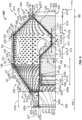
- the outer liner wall 214 is composed of a plurality of outer liner wall segments 216, including: a first wall segment 218, a second wall segment 220, a third wall segment 222, a fourth wall segment 224 and a fifth wall segment 226.
- a sixth wall segment 228 is connected to or formed with the first wall segment 218.
- Each of the first wall segment 218, the second wall segment 220, the third wall segment 222, the fourth wall segment 224, the fifth wall segment 226 and the sixth wall segment 228 have a double wall, with an inner wall 230 opposite an outer wall 232.
- the effusion cooling system 198 is defined between the inner wall 230 and the outer wall 232 and provides cooling for the combustor 200.
- the build direction BD extends in an axial direction A, and is perpendicular to a radial direction R.
- the build direction BD is substantially parallel to and coaxial with the longitudinal axis 170, and is substantially parallel to and coaxial with the centerline C of the combustor 200 ( FIG. 2 ).
- the first wall segment 218 is defined at the first outer end 210, and extends for a first distance D1.
- the first wall segment 218 has a first angle ⁇ 1 relative to the build direction BD. In this example, the first angle ⁇ 1 is about 90 degrees.
- the first wall segment 218 is connected to or integrally formed with the second wall segment 220 and is fixedly coupled to the sixth wall segment 228.
- the second wall segment 220 is connected to or integrally formed with the first wall segment 218 and the third wall segment 222.
- the second wall segment 220 extends for a second distance D2, which is different and greater than the first distance D1.
- the second distance D2 cooperates with the first wall segment 218 to define a passageway 234 between the outer liner 202 and the inner liner 204.
- the passageway 234 directs the combustive gas flow to exit the combustor 200 at an outlet 236 in fluid communication with the turbine section 150.
- the second wall segment 220 extends at a second angle ⁇ 2 relative to the build direction BD. In this example, second angle ⁇ 2 is about 45 degrees.
- the second wall segment 220 also extends at a second angle ⁇ 2 relative to the first wall segment 218. In this example, second angle ⁇ 2 is about 45 degrees.
- the third wall segment 222 is connected to or integrally formed with the second wall segment 220 and the fourth wall segment 224.
- the third wall segment 222 extends for a third distance D3, which is different and less than the second distance D2.
- the third distance D3 is predetermined to accommodate one or more fuel injector holes 238 and one or more quench holes 239.
- the fuel injector holes 238 receive a respective fuel injector (not shown).
- a single row of quench holes 239 is shown in FIG. 3 , although other arrangements may be provided.
- the fuel injector holes 238 are defined through the third wall segment 222 proximate the fourth wall segment 224. Stated another way, the fuel injector holes 238 are defined through the third wall segment 222 so as to be axially offset toward the fourth wall segment 224. The fuel injector holes 238 are defined so as to be spaced apart about the perimeter or circumference of the combustor 200 ( FIG. 2 ).
- the third wall segment 222 extends at a third angle ⁇ 3 relative to the build direction BD. In this example, the third angle ⁇ 3 is about 180 degrees.
- the third wall segment 222 also extends at a third angle ⁇ 3 relative to the second wall segment 220. In one example, the third angle ⁇ 3 is about 135 degrees.
- the fourth wall segment 224 is connected to or integrally formed with the third wall segment 222 and the fifth wall segment 226.
- the fourth wall segment 224 extends for a fourth distance D4, which is different and less than the second distance D2.
- the fourth wall segment 224 extends at a fourth angle ⁇ 4 relative to the build direction BD. In this example, the fourth angle ⁇ 4 is about 45 degrees.
- the fourth wall segment 224 also extends at a fourth angle ⁇ 4 relative to the third wall segment 222. In one example, the fourth angle ⁇ 4 is about 45 degrees.
- the fifth wall segment 226 is connected to or integrally formed with the fourth wall segment 224 and terminates at the second outer end 212 of the outer liner 202.
- the fifth wall segment 226 extends for a fifth distance D5, which is different and less than the second distance D2, the third distance D3 and the fourth distance D4.
- the fifth wall segment 226 extends at a fifth angle ⁇ 5 relative to the build direction BD. In this example, the fifth angle ⁇ 5 is about 180 degrees.
- the fifth wall segment 226 also extends at a fifth angle ⁇ 5 relative to the fourth wall segment 224. In one example, the fifth angle ⁇ 5 is about 135 degrees.
- the sixth wall segment 228 is connected to the first wall segment 218.
- the sixth wall segment 228 is fixedly coupled to the first wall segment 218 via welding.
- the sixth wall segment 228 extends includes a first sub-segment 228a that is coupled to the first wall segment 218 at the first outer end 210 of the outer liner 202, a second sub-segment 228b that extends radially inward from the first outer end 210 of the outer liner 202 and a third sub-segment 228c.
- the first sub-segment 228a of the sixth wall segment 228 extends for a sixth distance D6, which is different and greater than the first distance D1 and the fifth distance D5.
- the second sub-segment 228b of the sixth wall segment 228 extends for a seventh distance D7, which is different and less than the second distance D2, the third distance D3 and the fourth distance D4.
- the first sub-segment 228a of the sixth wall segment 228 extends at a sixth angle ⁇ 6 relative to the build direction BD. In this example, the sixth angle ⁇ 6 is about 90 degrees.
- the first sub-segment 228a also extends at a sixth angle ⁇ 6 relative to the first wall segment 218. In one example, the sixth angle ⁇ 6 is about 180 degrees.
- the second sub-segment 228b of the sixth wall segment 228 extends at a seventh angle ⁇ 7 relative to the build direction BD.
- the seventh angle ⁇ 7 is about 45 degrees.
- the second sub-segment 228b of the sixth wall segment 228 also extends at a seventh angle ⁇ 7 relative to the first sub-segment 228a. In one example, the seventh angle ⁇ 7 is about 45 degrees.
- the second sub-segment 228b of the sixth wall segment 228 cooperates with the inner liner 204 to define the passageway 234 to direct the combustive gas flow to the turbine section 150 ( FIG. 1 ).
- the third sub-segment 228c may be connected to or integrally formed with the second sub-segment 228b of the sixth wall segment 228 and terminates proximate a first inner end 300 of the inner liner 204.
- the third sub-segment 228c cooperates with the inner liner 204 to define the outlet 236.
- the third sub-segment 228c extends radially inward for an eighth distance D8, and overlaps with a portion of the inner liner 204 to define the outlet 236.
- the eighth distance D8 is different and less than the distances D1-D6.
- the third sub-segment 228c extends at an eighth angle ⁇ 8 relative to the build direction BD.
- the eighth angle ⁇ 8 is about 180 degrees.
- the third sub-segment 228c also extends at an eighth angle ⁇ 8 relative to the second sub-segment 228b of the sixth wall segment 228. In one example, the eighth angle ⁇ 8 is about 135 degrees.
- the outer liner 202 has the first wall segment 218 and the first sub-segment 228a that extends along a first axis A1, which is substantially perpendicular to the longitudinal axis 170.
- the second wall segment 220 extends along a second axis A2, which is transverse or oblique to the first axis A1 and the longitudinal axis 170.
- the third wall segment 222 extends along a third axis A3, which is substantially parallel to the longitudinal axis 170 and transverse to the second axis A2.
- the fourth wall segment 224 extends along a fourth axis A4, which is transverse or oblique to the second axis A2 and the longitudinal axis 170.
- the fifth wall segment 226 extends along a fifth axis A5, which is substantially parallel to the longitudinal axis 170 and transverse to the fourth axis A4.
- the first sub-segment 228a of the sixth wall segment 228 extends along a sixth axis A6, which is substantially parallel to the first axis A1 and substantially perpendicular to the longitudinal axis 170.
- the second sub-segment 228b of the sixth wall segment 228 extends along a seventh axis A7, which is transverse or oblique to the first axis A1 and the longitudinal axis 170.
- the third sub-segment 228c extends along an eighth axis A8, which is substantially parallel to the longitudinal axis 170 and transverse to the sixth axis A6.
- the axes A2, A4 and A6 are each transverse to the build direction BD, and the axes A3, A5 and A8 are each substantially parallel to the build direction BD.
- the axes A1 and A6 are each substantially perpendicular to the build direction BD.
- the outer liner 202 also has the first wall segment 218 that extends at the first angle ⁇ 1 relative to the build direction BD, which is different and greater than the second angle ⁇ 2 of the second wall segment 220.
- the second wall segment 220 also extends at the second angle ⁇ 2 relative to the first wall segment 218, which is different and less than the third angle ⁇ 3 defined between the second wall segment 220 and the third wall segment 222.
- the third wall segment 222 extends at the third angle ⁇ 3 relative to the build direction BD, which is different and greater than the second angle ⁇ 2 of the second wall segment 220 and the fourth angle ⁇ 4 of the fourth wall segment 224.
- the third wall segment 222 also extends at the fourth angle ⁇ 4 relative to the fourth wall segment 224, which is different and less than the fifth angle ⁇ 5 defined between the fourth wall segment 224 and the fifth wall segment 226.
- the second angle ⁇ 2 is substantially the same or the same as the fourth angle ⁇ 4.
- the fourth wall segment 224 extends at the fourth angle ⁇ 4 relative to the build direction BD, which is different and less than the fifth angle ⁇ 5 of the fifth wall segment 226.
- each of the wall segments 218, 220, 222, 224, 226, 228a, 228b and 228c associated with the outer liner wall 214 have the double wall, with an inner wall 230 opposite an outer wall 232 that defines an intervening cavity 248 between the inner wall 230 and the outer wall 232.
- the effusion cooling system 198 is defined between the inner wall 230 and the outer wall 232.
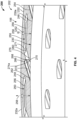
- the effusion cooling system 198 includes a plurality of pedestals 250, a plurality of impingement cooling holes 252 and a plurality of effusion cooling passages 254.
- the inner wall 230 is exposed to the hot combustive gas flow, and is a hot wall.
- the outer wall 232 is exposed to the air that flows into the plenum 133 and is a cold wall.
- the plurality of pedestals 250 and the plurality of impingement cooling holes 252 are substantially the same as the plurality of pedestals 306 and the plurality of impingement cooling holes 252 of commonly assigned U.S. Patent No. 10,775,044 , the relevant portion of which is incorporated herein by reference, the plurality of pedestals 250 and the plurality of impingement cooling holes 252 will not be discussed in great detail herein.
- each of the pedestals 250 is coupled to or integrally formed with an inner wall surface 230a of the inner wall 230 and an outer wall surface 232a of the outer wall 232, and extends through the intervening cavity 248.
- Each pedestal 250 is spaced apart from every other pedestal 250, and each has at least one exterior surface 256 facing the intervening cavity 248. That is, the pedestals 250 are discrete, and do not share exterior surfaces 256.
- Each pedestal 250 has a principal axis 258, and extends through the intervening cavity 248 about its principal axis 258. It will be appreciated that the pedestals 250 could be formed to have any one of numerous shapes.
- each pedestal 250 when taken along a cross section perpendicular to its principal axis 258, has a circular cross-sectional shape. In other embodiments, however, each pedestal 250, when taken along a cross section perpendicular to its principal axis 258, may have a non-circular cross-sectional shape, such as, for example, elliptical or any one of numerous polygonal shapes.
- Each of the impingement cooling holes 252 extends through the outer wall 232 to admit a flow of cooling air into the intervening cavity 248.
- Each of the effusion cooling passages 254 is associated with a different one of the plurality of pedestals 250, and each has an inlet 260 and an outlet 262.
- the inlet 260 of each effusion cooling passage 254 is defined proximate the exterior surface 256 of its associated pedestal 250, and the outlet 262 of each effusion cooling passage 254 is defined on the inner wall surface 230a of the inner wall 230.
- Each effusion cooling passage 254 is disposed at a predetermined angle ⁇ relative to the principal axis 258 of its associated pedestal 250.
- the predetermined angle ⁇ may vary, and in one example, is in the range of about 45 degrees to about 80 degrees.
- the principal axis 258 is defined at about 90 degrees (+/-20 degrees) relative to the inner wall surface 230a and the outer wall surface 232a.
- the effusion cooling passage 254 is substantially the same as the effusion cooling aperture 400 of commonly assigned U.S. Patent No. 10,895,157 , the relevant portion of which is incorporated herein by reference, the effusion cooling passages 254 will not be discussed in great detail herein.
- the outlet 262 of each of the effusion cooling passages 254 includes a recessed portion 266, which is a void area beginning at the inner wall surface 230a of the inner wall 230 and extending inwardly toward the outer wall 232.
- the recessed portion 266 includes a surface 268, which surrounds an exit opening 270.
- the exit opening 270 is fluidly coupled via a metering passage 271 to the inlet 260 to receive the cooling fluid from the intervening cavity 248.
- the cooling fluid from the intervening cavity 248 flows through the metering passage 271 exits into the recessed portion 266 at the outlet 262.
- the recessed portion 266 further includes an inward surface 272, which extends from the surface 268 to the inner wall surface 230a of the inner wall 230, at point P.
- the recessed portion 266 at the outlet 262 enables the pressurized air to diffuse and form a film of cooling fluid along the inner wall surface 230a of the inner wall 230.
- the inner wall surface 230a of the outer liner 202 is shown.
- the effusion cooling passages 254 may be defined so as to be spaced apart about the perimeter or circumference of the outer liner 202.
- the outlets 262 of the effusion cooling passages 254 are arranged to define a film of cooling fluid over the inner wall surface 230a of the outer liner 202 to provide cooling for the outer liner 202.
- the arrangement of the effusion cooling system 198 in FIG. 5 including the outlets 262 of the effusion cooling passages 254 is merely an example, and the effusion cooling system 198 may be arranged as needed to meet the predetermined cooling requirements for the combustor 200.
- the effusion cooling passages 254 also include an overhang portion 274 that extends axially over the recessed portion 266 beginning from the surface 268.
- the overhang portion 274 includes an outer surface 276, which is an extension of the inner wall surface 230a of the inner wall 230 as it extends over the recessed portion 266.
- the overhang portion 274 includes an inner surface 274a, which extends over the recessed portion 266. The overhang portion 274 protects the exit opening 270 from plugging when a thermal barrier coating is applied to the combustor 200.
- the inner liner 204 includes a first inner end 300, a second inner end 302 opposite the first inner end 300, and an inner liner wall 304.
- the first inner end 300 is fluidly coupled to the turbine section 150 to direct the combustive gas flow from the combustor 200 to the turbine section 150 ( FIG. 1 ).
- the second inner end 302 is upstream from the first inner end 300 in a direction of working fluid flow through the gas turbine engine 100, and is coupled to the outer liner 202 to enclose the combustion chamber 206.
- the inner liner wall 304 is shown in greater detail.
- the inner liner wall 304 is composed of a plurality of inner liner wall segments 310, including: a first inner wall segment 312, a second inner wall segment 314, a third inner wall segment 316, a fourth inner wall segment 318, a fifth inner wall segment 320 and a sixth inner wall segment 322.
- Each of the first inner wall segment 312, the second inner wall segment 314, the third inner wall segment 316, the fourth inner wall segment 318, the fifth inner wall segment 320 and the sixth inner wall segment 322 have a double wall, with the inner wall 230 opposite the outer wall 232.
- the double wall including the effusion cooling system 198 is the same between the outer liner 202 and the inner liner 204.
- the double wall and the effusion cooling system 198 associated with the inner liner 204 will not be discussed in detail herein.
- the inner wall surface 230a of the inner liner 204 is shown.
- the inner wall 230 of the inner liner 204 is opposite the outer wall 232 and defines the intervening cavity 248 between the inner wall 230 and the outer wall 232.
- the effusion cooling system 198 is defined between the inner wall 230 and the outer wall 232 of each of the first inner wall segment 312, a second inner wall segment 314, a third inner wall segment 316, a fourth inner wall segment 318, a fifth inner wall segment 320 and a sixth inner wall segment 322.
- the first inner wall segment 312 is defined at the first inner end 300, and extends for a ninth distance D9.
- the ninth distance D9 is predetermined such that the first inner wall segment 312 is spaced a distance apart from the first sub-segment 228a of the sixth wall segment 228 of the outer liner 202 to form the passageway 234.
- the first inner wall segment 312 extends along the ninth distance D9 so as to be opposite a portion of the second wall segment 220 and the third wall segment 222.
- the first inner wall segment 312 has a ninth angle ⁇ 9 relative to the build direction BD. In this example, the ninth angle ⁇ 9 is about 180 degrees.
- the first inner wall segment 312 is connected to or integrally formed with the second inner wall segment 314 and the sixth inner wall segment 322.
- the first inner wall segment 312 includes the one or more quench holes 239. A single row of quench holes 239 is shown, although other arrangements may be provided.
- the second inner wall segment 314 is connected to or integrally formed with the first inner wall segment 312 and the third inner wall segment 316.
- the second inner wall segment 314 extends for a tenth distance D10, which is different and less than the ninth distance D9.
- the second inner wall segment 314 extends at a tenth angle ⁇ 10 relative to the build direction BD. In this example, tenth angle ⁇ 10 is about 45 degrees.
- the second inner wall segment 314 also extends at a tenth angle ⁇ 10 relative to the first inner wall segment 312. In one example, the tenth angle ⁇ 10 is about 135 degrees.
- the third inner wall segment 316 is connected to or integrally formed with the second inner wall segment 314 and the fourth inner wall segment 318.
- the third inner wall segment 316 extends for an eleventh distance D11, which is different and less than the ninth distance D9 and the tenth distance D10.
- the eleventh distance D11 cooperates with the tenth distance D10 such that the second inner wall segment 314 and the third inner wall segment 316 are substantially opposite the fuel injector holes 238.
- the second inner wall segment 314 and the third inner wall segment 316 are substantially opposite a portion of the third wall segment 222.
- the third inner wall segment 316 extends at an eleventh angle ⁇ 11 relative to the build direction BD. In this example, the eleventh angle ⁇ 11 is about 180 degrees.
- the third inner wall segment 316 also extends at an eleventh angle ⁇ 11 relative to the second inner wall segment 314. In one example, the eleventh angle ⁇ 11 is about 45 degrees.
- the fourth inner wall segment 318 is connected to or integrally formed with the third inner wall segment 316 and the fifth inner wall segment 320.
- the fourth inner wall segment 318 extends for a twelfth distance D12, which is different and greater than the ninth distance D9 and the tenth distance D10.
- the twelfth distance D12 is about the same as the fourth distance D4, and the fourth inner wall segment 318 is substantially opposite the fourth wall segment 224 of the outer liner 202.
- the fourth inner wall segment 318 extends at a twelfth angle ⁇ 12 relative to the build direction BD. In this example, the twelfth angle ⁇ 12 is about 45 degrees.
- the fourth wall segment 224 also extends at a twelfth angle ⁇ 12 relative to the third inner wall segment 316. In one example, the twelfth angle ⁇ 12 is about 45 degrees.
- the fifth inner wall segment 320 is connected to or integrally formed with the fourth inner wall segment 318 and terminates at the second inner end 302 of the inner liner 204.
- the fifth inner wall segment 320 extends for a thirteenth distance D13, which is different and less than the ninth distance D9, the tenth distance D10, the eleventh distance D11 and the twelfth distance D12.
- the fifth inner wall segment 320 extends at a thirteenth angle ⁇ 13 relative to the build direction BD. In this example, the thirteenth angle ⁇ 13 is about 180 degrees.
- the fifth inner wall segment 320 also extends at a thirteenth angle ⁇ 13 relative to the fourth inner wall segment 318. In one example, the thirteenth angle ⁇ 13 is about 135 degrees.
- the fifth inner wall segment 320 extends for about the same length as the fifth wall segment 226 of the outer liner 202 to facilitate coupling or joining the inner liner 204 to the outer liner 202 at the respective second ends 302, 212.
- the sixth inner wall segment 322 is connected to or integrally formed with the first inner wall segment 312 and extends radially inward at the first inner end 300 of the inner liner 204.
- the sixth inner wall segment 322 extends for a fourteenth distance, which is different and less than the distances D8-D12.
- the sixth inner wall segment 322 extends at a fourteenth angle ⁇ 14 relative to the build direction BD. In this example, the fourteenth angle ⁇ 14 is about 90 degrees.
- the sixth inner wall segment 322 also extends at a fourteenth angle ⁇ 14 relative to the first inner wall segment 312. In one example, the fourteenth angle ⁇ 14 is about 90 degrees.
- the sixth inner wall segment 322 cooperates with the first wall segment 218 of the outer liner 202 to define the passageway 234 to direct the combustive gas flow to the turbine section 150 ( FIG. 1 ).
- the inner liner 204 has the first inner wall segment 312 that extends along a ninth axis A9, which is substantially parallel to the longitudinal axis 170.
- the second inner wall segment 314 extends along a tenth axis A10, which is transverse or oblique to the ninth axis A9 and the longitudinal axis 170.
- the third inner wall segment 316 extends along an eleventh axis A11, which is substantially parallel to the longitudinal axis 170 and transverse to the tenth axis A10.
- the fourth inner wall segment 318 extends along a twelfth axis A12, which is transverse or oblique to the eleventh axis A11 and the longitudinal axis 170.
- the fifth inner wall segment 320 extends along a thirteenth axis A13, which is substantially parallel to the longitudinal axis 170 and transverse to the eleventh axis A11.
- the sixth inner wall segment 322 extends along a fourteenth axis A14, which is substantially perpendicular to the ninth axis A9 and the longitudinal axis 170.
- the axes A10 and A12 are each transverse to the build direction BD, and the axes A9 and A13 are each substantially parallel to the build direction BD.
- the fourteenth axis A14 is substantially perpendicular to the build direction BD.
- the inner liner 204 also has the first inner wall segment 312 that extends at the ninth angle ⁇ 9 relative to the build direction BD, which is different and greater than the tenth angle ⁇ 10 of the second inner wall segment 314.
- the second inner wall segment 314 also extends at the tenth angle ⁇ 10 relative to the first inner wall segment 312, which is different and greater than the eleventh angle ⁇ 11 defined between the second inner wall segment 314 and the third inner wall segment 316.
- the third inner wall segment 316 extends at the eleventh angle ⁇ 11 relative to the build direction BD, which is different and greater than the tenth angle ⁇ 10 of the second inner wall segment 314 and the twelfth angle ⁇ 12 of the fourth inner wall segment 318.
- the third inner wall segment 316 also extends at the twelfth angle ⁇ 12 relative to the fourth inner wall segment 318, which is different and less than the thirteenth angle ⁇ 13 defined between the fourth inner wall segment 318 and the fifth inner wall segment 320.
- the fourth inner wall segment 318 extends at the twelfth angle ⁇ 12 relative to the build direction BD, which is different and less than the thirteenth angle ⁇ 13 of the fifth inner wall segment 320.
- the combustor 200 may be configured differently for use with a gas turbine engine.
- a combustor 400 for use with a gas turbine engine 402 is shown.
- the combustor 400 includes features that are substantially similar to or the same as the combustor 200 discussed with regard to FIGS. 1-6 , the same reference numerals will be used to denote the same or similar features.
- the gas turbine engine 402 is illustrated as a single spool engine. It should be noted that the use of a single spool engine is merely exemplary, as any number of spools can be employed.
- a tie-shaft 406 extends along an axis of rotation or longitudinal axis 440 of the gas turbine engine 402.
- the gas turbine engine 402 includes a compressor section 408, a combustion section 412, and a turbine section 410.
- the compressor section 408 includes one or more compressors 414, which are mounted to an upstream or forward end of the tie-shaft 406.
- the compressors 414 are in communication with a compressor section duct 416 to receive airflow from an intake section 417 of the gas turbine engine 402.
- the compressors 414 pressurize the air in the compressor section duct 416, and the compressor section duct 416 is in communication with the combustion section 412 to deliver the compressed air to a combustion chamber 418 of the combustion section 412.
- the compressed air may be directed from the compressors 132 into a plenum 433 surrounding a combustor 400 of the combustion section 412.
- the combustion section 412 includes the combustor 400, which defines a combustion chamber 506.
- the compressed air from the compressor section 408 is mixed with fuel and ignited to produce combustive gases in the combustor 400.
- the combustive gases are directed from the combustion chamber 418 to the turbine section 410.
- the turbine section 410 includes at least one radial or axial turbine, and in this example, includes a radial turbine 420, which is mounted to an opposing, aft end of the tie-shaft 406 as the turbine for the gas turbine engine 402.
- the turbine section 410 also includes a turbine nozzle 424, which is in fluid communication with the combustion section 412 to receive combustion gases from the combustion chamber 418.
- the turbine nozzle 424 directs the combustion gases through the radial turbine 420.
- the combustion gases drive rotation of the turbine, which in this example incudes the radial turbine 420, and the rotation of the turbine drives further rotation of the tie-shaft 406 and the compressors 414.
- the rotation of the rotating group provides power output, which may be utilized in a variety of different manners, depending upon whether the gas turbine engine 402 assumes the form of a turbofan, turboprop, turboshaft, turbojet engine, or an auxiliary power unit, to list but a few examples.
- the combustor 400 is substantially symmetric about the longitudinal axis 440, and has a centerline C that is substantially coaxial with the longitudinal axis 440.
- the longitudinal axis 440 also defines a longitudinal axis for the combustor 400.
- the combustor 400 is a reverse flow combustor.
- the combustor 400 includes an outer liner 502 and an inner liner 504 that cooperate to define the combustion chamber 506.
- the outer liner 502 defines an outer perimeter or circumference of the combustor 400, while the inner liner 504 defines an inner perimeter or circumference of the combustor 400.
- the outer liner 502 includes a first outer end 510, a second outer end 512 opposite the first outer end 510, and an outer liner wall 514.
- the first outer end 510 is fluidly coupled to the turbine section 150 to direct the combustive gas flow from the combustor 400 to the turbine section 150.
- the second outer end 512 is upstream from the first outer end 510 in a direction of working fluid flow through the gas turbine engine 402, and is coupled to the inner liner 504 to enclose the combustion chamber 506.
- the outer liner wall 514 is shown in greater detail.
- the outer liner wall 514 is composed of a plurality of outer liner wall segments 516, including: the first wall segment 218, the second wall segment 220, the third wall segment 222, the fourth wall segment 224 and the fifth wall segment 226.
- a sixth wall segment 528 is connected to the first wall segment 218.
- Each of the first wall segment 218, the second wall segment 220, the third wall segment 222, the fourth wall segment 224, the fifth wall segment 226 and the sixth wall segment 528 have the double wall, with the inner wall 230 opposite the outer wall 232.
- the effusion cooling system 198 is defined between the inner wall 230 and the outer wall 232 and provides cooling for the combustor 400.
- the build direction BD extends in the axial direction A, and is perpendicular to the radial direction R.
- the build direction BD is substantially parallel to and coaxial with the longitudinal axis 440, and is substantially parallel to and coaxial with the centerline C of the combustor 400 ( FIG. 8 ).
- the first wall segment 218 is defined at the first outer end 510, and extends for the first distance D1.
- the first wall segment 218 has the first angle ⁇ 1 relative to the build direction BD.
- the first wall segment 218 is connected to or integrally formed with the second wall segment 220 and is fixedly coupled to the sixth wall segment 528.
- the second wall segment 220 extends for the second distance D2.
- the second distance D2 cooperates with the first wall segment 218 to define a passageway 534 between the outer liner 502 and the inner liner 504.
- the passageway 534 directs the combustive gas flow to exit the combustor 400 at an outlet 536 in fluid communication with the turbine section 410.
- the second wall segment 220 extends at the second angle ⁇ 2 relative to the build direction BD.
- the second wall segment 220 also extends at the second angle ⁇ 2 relative to the first wall segment 218.
- the third wall segment 222 extends for the third distance D3.
- the third distance D3 is predetermined to accommodate the fuel injector holes 238 and the quench holes 239.
- the fuel injector holes 238 are defined through the third wall segment 222 so as to be axially offset toward the fourth wall segment 224.
- the fuel injector holes 238 are defined so as to be spaced apart about the perimeter or circumference of the combustor 400 ( FIG. 8 ).
- the third wall segment 222 extends at the third angle ⁇ 3 relative to the build direction BD.
- the third wall segment 222 also extends at the third angle ⁇ 3 relative to the second wall segment 220.
- the fourth wall segment 224 extends for the fourth distance D4.
- the fourth wall segment 224 extends at the fourth angle ⁇ 4 relative to the build direction BD.
- the fourth wall segment 224 also extends at the fourth angle ⁇ 4 relative to the third wall segment 222.
- the fifth wall segment 226 terminates at the second outer end 512 of the outer liner 502.
- the fifth wall segment 226 extends for the fifth distance D5.
- the fifth wall segment 226 extends at the fifth angle ⁇ 5 relative to the build direction BD.
- the fifth wall segment 226 also extends at the fifth angle ⁇ 5 relative to the fourth wall segment 224.
- the sixth wall segment 528 is connected to the first wall segment 218.
- the sixth wall segment 528 is fixedly coupled to the first wall segment 218 via welding.
- the sixth wall segment 528 extends includes a first sub-segment 528a that is coupled to the first wall segment 218 at the first outer end 510 of the outer liner 502, a second sub-segment 528b that extends axially outward inward from the first outer end 510 of the outer liner 502 and a third sub-segment 528c.
- the first sub-segment 528a of the sixth wall segment 528 extends for a distance DT5, which is different and less than the first distance D1 and the fifth distance D5.
- the second sub-segment 528b of the sixth wall segment 528 extends for a seventh distance DT6, which is different and greater than the first distance D1 and the fifth distance D5.
- the first sub-segment 528a of the sixth wall segment 528 extends at a sixth angle ⁇ T6 relative to the build direction BD.
- the sixth angle ⁇ T6 is about 90 degrees.
- the first sub-segment 528a also extends at a sixth angle ⁇ T6 relative to the first wall segment 218. In one example, the sixth angle ⁇ T6 is about 180 degrees.
- the second sub-segment 528b of the sixth wall segment 528 extends at a seventh angle ⁇ T7 relative to the build direction BD.
- the seventh angle ⁇ T7 is about 180 degrees.
- the second sub-segment 528b of the sixth wall segment 528 also extends at a seventh angle ⁇ T7 relative to the first sub-segment 528a. In one example, the seventh angle ⁇ T7 is about 90 degrees.
- the second sub-segment 528b of the sixth wall segment 528 cooperates with the inner liner 504 to define the passageway 534 to direct the combustive gas flow to the turbine section 410 ( FIG. 7 ).
- the third sub-segment 528c may be connected to or integrally formed with the second sub-segment 528b of the sixth wall segment 528.
- the third sub-segment 528c cooperates with the inner liner 504 to define the outlet 536.
- the third sub-segment 528c extends radially outward for an eighth distance DT8, and overlaps with a portion of the inner liner 504 to define the outlet 536.
- the eighth distance DT8 is different and less than the second distance D2, the third distance D3, the fourth distance D4 and the seventh distance DT7.
- the third sub-segment 528c extends at an eighth angle ⁇ T8 relative to the build direction BD.
- the eighth angle ⁇ T8 is about 90 degrees.
- the third sub-segment 528c also extends at an eighth angle ⁇ T8 relative to the second sub-segment 528b of the sixth wall segment 228. In one example, the eighth angle ⁇ T8 is about 90 degrees.
- the outer liner 502 has the first wall segment 218 and the first sub-segment 228a that extends along the first axis A1, which is substantially perpendicular to the longitudinal axis 440.
- the second wall segment 220 extends along the second axis A2, which is transverse or oblique to the first axis A1 and the longitudinal axis 440.
- the third wall segment 222 extends along the third axis A3, which is substantially parallel to the longitudinal axis 440 and transverse to the second axis A2.
- the fourth wall segment 224 extends along the fourth axis A4, which is transverse or oblique to the second axis A2 and the longitudinal axis 440.
- the fifth wall segment 226 extends along the fifth axis A5, which is substantially parallel to the longitudinal axis 440 and transverse to the fourth axis A4.
- the first sub-segment 528a of the sixth wall segment 528 extends along a sixth axis AT6, which is which is substantially parallel to the first axis A1 and substantially perpendicular to the longitudinal axis 440.
- the second sub-segment 528b of the sixth wall segment 528 extends along a seventh axis AT7, which is substantially perpendicular to the first axis A1 and substantially parallel to the longitudinal axis 440.
- the third sub-segment 528c extends along an eighth axis AT8, which is substantially parallel to the first axis A1 and substantially perpendicular to the longitudinal axis 440.
- the axes A2 and A4 are each transverse to the build direction BD, and the axes A3 and AT7 are each substantially parallel to the build direction BD.
- the axes A1, AT6 and AT8 are each substantially perpendicular to the build direction BD.
- the outer liner 502 also has the first wall segment 218 that extends at the first angle ⁇ 1 relative to the build direction BD, which is different and greater than the second angle ⁇ 2 of the second wall segment 220.
- the second wall segment 220 also extends at the second angle ⁇ 2 relative to the first wall segment 218, which is different and less than the third angle ⁇ 3 defined between the second wall segment 220 and the third wall segment 222.
- the third wall segment 222 extends at the third angle ⁇ 3 relative to the build direction BD, which is different and greater than the second angle ⁇ 2 of the second wall segment 220 and the fourth angle ⁇ 4 of the fourth wall segment 224.
- the third wall segment 222 also extends at the fourth angle ⁇ 4 relative to the fourth wall segment 224, which is different and less than the fifth angle ⁇ 5 defined between the fourth wall segment 224 and the fifth wall segment 226.
- the fourth wall segment 224 extends at the fourth angle ⁇ 4 relative to the build direction BD, which is different and less than the fifth angle ⁇ 5 of the fifth wall segment 226.
- each of the wall segments 218, 220, 222, 224, 226, 528a, 528b and 528c associated with the outer liner wall 514 have the double wall, with the inner wall 230 opposite the outer wall 232 that defines the intervening cavity 248 between the inner wall 230 and the outer wall 232.
- the double wall including the effusion cooling system 198 is the same between the outer liner 502 and the inner liner 504 of the combustor 400, and is the same between the outer liner 202 and the inner liner 204 of the combustor 200.
- the double wall and the effusion cooling system 198 associated with the outer liner 502 and the inner liner 504 will not be discussed in detail herein. Briefly, with reference to FIG.
- the inner wall surface 230a of the outer liner 502 is shown.
- the inner wall 230 is opposite the outer wall 232 defines the intervening cavity 248 between the inner wall 230 and the outer wall 232.
- the effusion cooling system 198 is defined between the inner wall 230 and the outer wall 232 of each of wall segments 218, 220, 222, 224, 226, 528a, 528b.
- the effusion cooling system 198 includes the plurality of pedestals 250, the plurality of impingement cooling holes 252 and the plurality of effusion cooling passages 254.
- the inner liner 504 includes a first inner end 600, a second inner end 602 opposite the first inner end 600, and an inner liner wall 604.
- the first inner end 600 is fluidly coupled to the turbine section 410 to direct the combustive gas flow from the combustor 400 to the turbine section 410 ( FIG. 7 ).
- the second inner end 602 is upstream from the first inner end 600 in a direction of working fluid flow through the gas turbine engine 402, and is coupled to the outer liner 502 to enclose the combustion chamber 506.
- the inner liner wall 604 is shown in greater detail.
- the inner liner wall 604 is composed of a plurality of inner liner wall segments 610, including: the first inner wall segment 312, the second inner wall segment 314, the third inner wall segment 316, the fourth inner wall segment 318, the fifth inner wall segment 320 and a sixth inner wall segment 622.
- Each of the first inner wall segment 312, the second inner wall segment 314, the third inner wall segment 316, the fourth inner wall segment 318, the fifth inner wall segment 320 and the sixth inner wall segment 322 have the double wall, with the inner wall 230 opposite the outer wall 232.
- the inner wall surface 230a of the inner liner 504 is the same as the inner wall surface 230a of the inner liner 204 shown in FIG. 6 , and as discussed, the double wall and the effusion cooling system 198 associated with the inner liner 504 will not be discussed in detail herein.
- the inner wall 230 opposite the outer wall 232 defines the intervening cavity 248 between the inner wall 230 and the outer wall 232.
- the effusion cooling system 198 is defined between the inner wall 230 and the outer wall 232 of each of the first inner wall segment 312, the second inner wall segment 314, the third inner wall segment 316, the fourth inner wall segment 318, the fifth inner wall segment 320 and a sixth inner wall segment 622.
- the first inner wall segment 312 is defined at the first inner end 600, and extends for the ninth distance D9.
- the ninth distance D9 is predetermined such that the first inner wall segment 312 is spaced a distance apart from the first sub-segment 228a of the sixth wall segment 228 of the outer liner 502 to form the passageway 534.
- the first inner wall segment 312 extends along the ninth distance D9 so as to be opposite a portion of the second wall segment 220 and the third wall segment 222.
- the first inner wall segment 312 has the ninth angle ⁇ 9 relative to the build direction BD.
- the first inner wall segment 312 is connected to or integrally formed with the second inner wall segment 314 and the sixth inner wall segment 622.
- the first inner wall segment 312 includes the one or more quench holes 239.
- the second inner wall segment 314 extends for the tenth distance D10.
- the second wall segment 220 extends at the tenth angle ⁇ 10 relative to the build direction BD.
- the second inner wall segment 314 also extends at the tenth angle ⁇ 10 relative to the first inner wall segment 312.
- the third inner wall segment 316 extends for the eleventh distance D11.
- the eleventh distance D11 cooperates with the tenth distance D10 such that the second inner wall segment 314 and the third inner wall segment 316 are substantially opposite the fuel injector holes 238.
- the third inner wall segment 316 extends at the eleventh angle ⁇ 11 relative to the build direction BD.
- the third inner wall segment 316 also extends at the eleventh angle ⁇ 11 relative to the second inner wall segment 314.
- the fourth inner wall segment 318 extends for the twelfth distance D12.
- the fourth inner wall segment 318 is substantially opposite the fourth wall segment 224 of the outer liner 502.
- the fourth inner wall segment 318 extends at the twelfth angle ⁇ 12 relative to the build direction BD.
- the fourth wall segment 224 also extends at the twelfth angle ⁇ 12 relative to the third inner wall segment 316.
- the fifth inner wall segment 320 extends for the thirteenth distance D13.
- the fifth inner wall segment 320 extends at the thirteenth angle ⁇ 13 relative to the build direction BD. In this example, the thirteenth angle ⁇ 13 is about 180 degrees.
- the fifth inner wall segment 320 also extends at the thirteenth angle ⁇ 13 relative to the fourth inner wall segment 318.
- the fifth inner wall segment 320 extends for about the same length as the fifth wall segment 226 of the outer liner 502 to facilitate coupling or joining the inner liner 504 to the outer liner 502 at the respective second ends 602,
- the sixth inner wall segment 622 is connected to or integrally formed with the first inner wall segment 312 and extends axially inward at the first inner end 600 of the inner liner 504.
- the sixth inner wall segment 622 extends for a fourteenth distance DT14, which is different and less than the distances D8-D12.
- the sixth inner wall segment 322 extends at a fourteenth angle ⁇ T14 relative to the build direction BD. In this example, the fourteenth angle ⁇ T14 is about 180 degrees.
- the sixth inner wall segment 622 is integrally formed with the first inner wall segment 312 such that the sixth inner wall segment 622 is substantially parallel to the first inner wall segment 312.
- the sixth inner wall segment 622 includes two radially inward extending flanges 622a, 622b, which assist in coupling the combustor 400 within the gas turbine engine 402.
- the inner liner 504 has the first inner wall segment 312 that extends along the ninth axis A9, which is substantially parallel to the longitudinal axis 440.
- the second inner wall segment 314 extends along the tenth axis A10, which is transverse or oblique to the ninth axis A9 and the longitudinal axis 440.
- the third inner wall segment 316 extends along the eleventh axis A11, which is substantially parallel to the longitudinal axis 440 and transverse to the tenth axis A10.
- the fourth inner wall segment 318 extends along the twelfth axis A12, which is transverse or oblique to the eleventh axis A11 and the longitudinal axis 440.
- the fifth inner wall segment 320 extends along the thirteenth axis A13, which is substantially parallel to the longitudinal axis 440 and transverse to the eleventh axis A11.
- the sixth inner wall segment 622 extends along a fourteenth axis AT14, which is substantially parallel to the ninth axis A9 and the longitudinal axis 440.
- the axes A10 and A12 are each transverse to the build direction BD, and the axes A9, AT14 and A13 are each substantially parallel to the build direction BD.
- the inner liner 504 also has the first inner wall segment 312 that extends at the ninth angle ⁇ 9 relative to the build direction BD, which is different and greater than the tenth angle ⁇ 10 of the second inner wall segment 314.
- the second inner wall segment 314 also extends at the tenth angle ⁇ 10 relative to the first inner wall segment 312, which is different and greater than the eleventh angle ⁇ 11 defined between the second inner wall segment 314 and the third inner wall segment 316.
- the third inner wall segment 316 extends at the eleventh angle ⁇ 11 relative to the build direction BD, which is different and greater than the tenth angle ⁇ 10 of the second inner wall segment 314 and the twelfth angle ⁇ 12 of the fourth inner wall segment 318.
- the third inner wall segment 316 also extends at the twelfth angle ⁇ 12 relative to the fourth inner wall segment 318, which is different and less than the thirteenth angle ⁇ 13 defined between the fourth inner wall segment 318 and the fifth inner wall segment 320.
- the fourth inner wall segment 318 extends at the twelfth angle ⁇ 12 relative to the build direction BD, which is different and less than the thirteenth angle ⁇ 13 of the fifth inner wall segment 320.
- a flowchart illustrates an exemplary method 700 for manufacturing the combustor 200, 400.
- the method begins at 702.
- the method proceeds with forming the outer liner 202, 502, and at 706, the method proceeds with forming the inner liner 204, 504 nested within the outer liner 202, 502. While identified as different blocks 704, 706, the method forms the inner liner 204, 504 substantially concurrently with the forming of the outer liner 202, 502 in a single build.
- the inner liner 204, 504 is formed substantially concurrently with the forming of the respective outer liner 202, 502 so as to be nested within the outer liner wall 214, 514 of the outer liner 202, 502.
- the inner liner 204, 504 and the respective outer liner 202, 502 are composed of a metal or metal alloy, including, but not limited to Haynes ® 282 alloy, Inconel 625 and Hastelloy ® -X.
- the inner liner 204, 504 and the respective outer liner 202, 502 are formed in a single build using additive manufacturing, including, but not limited to direct metal laser sintering (DMLS), laser powder bed fusion (L-PBF), electron powder bed fusion (E-PBF) or electron beam melting (EBM).
- DMLS direct metal laser sintering
- L-PBF laser powder bed fusion
- E-PBF electron powder bed fusion
- EBM electron beam melting
- the inner liner 204, 504 and the outer liner 202, 502 are each formed through additive manufacturing to include the outer liner wall 214, 514 and the inner liner wall 304, 604, respectively, with the double wall that includes the effusion cooling system 198.
- the inner liner 204, 504 may be removed from the outer liner 202, 502 and one or both of the inner liner 204, 504 and the outer liner 202, 502 may be subjected to additional processing.
- one or both of the inner liner 204, 504 and the respective outer liner 202, 502 may be subjected to stress relief, heat treatment, hot isostatic pressing (HIP), the application of one or more coatings, such as a thermal barrier coating as described in commonly assigned U.S. Patent No. 10,895,157 , previously incorporated herein by reference, and the like.
- the inner liner 204, 504 is coupled to the respective outer liner 202, 502 at the second ends 212, 512 to enclose the combustion chamber 206, 506.
- the second ends 212, 512 are coupled together via welding.
- an additional wall segment, such as the sixth wall segment 228, 528 is coupled to the first wall segment 218 of the respective outer liner 202, 502 via welding, for example.
- the sixth wall segment 228, 528 is composed of a metal or metal alloy, including, but not limited to Haynes ® 282 alloy, Inconel 625 and Hastelloy ® -X.
- the sixth wall segment 228, 528 is formed using additive manufacturing including, but not limited to direct metal laser sintering (DMLS), laser powder bed fusion (L-PBF), electron powder bed fusion (E-PBF) or electron beam melting (EBM).
- DMLS direct metal laser sintering
- L-PBF laser powder bed fusion
- E-PBF electron powder bed fusion
- EBM electron beam melting
- the sixth wall segment 228, 528 is described herein as being separately formed and coupled to the first wall segment 218, however, in other examples, the sixth wall segment 228, 528 may be integrally formed with the first wall segment 218 if desired.
- the manufacture of the combustor 200, 400 is complete, and the combustor 200, 400 may be installed in the respective gas turbine engine 100, 402.
- pressurized air from the compressor section 130, 430 is intermixed with fuel introduced through the fuel injectors and ignited by an igniter (not shown) to support initial combustion within the respective combustor 200, 400. Additional air for further combustion flows from the plenum 133, 433 into the combustion chamber 206, 506 through the quench holes 239. Air from the plenum 133, 433 also enters the impingement cooling holes 252, and flows through the effusion cooling passages 254 to generate a film of cooling fluid along the hot walls or inner wall surfaces 230a of the inner liner 204, 504 and the respective outer liner 202, 502.
- the structure of the combustor 200, 400 enables the combustor 200, 400 to be additively manufactured with the inner liner 204, 504 formed substantially concurrently with the forming of the outer liner 202, 502.
- the inner liner 204, 504 nested within the outer liner 202, 502 substantially concurrently, a single additive manufacturing process may be performed to produce a substantial majority of the combustor 200, 400, which reduces cost and manufacturing time.
- the effusion cooling system 198 FIG.
- the combustor 200, 400 may be defined in the double wall of both of the inner liner 204, 504 and the respective outer liner 202, 502, which improves cooling of the combustor 200, 400 and thereby increases a life of the combustor 200, 400 while reducing maintenance costs.
- the improved cooling of the combustor 200, 400 also enables the combustor 200, 400 to be used in higher temperature or high performance applications.
- the shape of the combustor 200, 400 enables the combustor 200, 400 to be additively manufactured without requiring supports or to be self-supporting during additive manufacturing.
- the shape or structure of the combustor 200, 400 also provides reduced parts and reduced leakage, as by additively manufacturing the inner liner 204, 504 and the outer liner 202, 502 to be one-piece or monolithic, additional parts and seals are not needed.
- the one-piece or monolithic inner liner 204, 504 and outer liner 202, 502 reduces a weight associated with the combustor 200, 400.
- the sixth wall segments 228, 528 also provide an improved interface for the turbine nozzle associated with the turbine section 150, 410.
Landscapes
- Engineering & Computer Science (AREA)
- Chemical & Material Sciences (AREA)
- Combustion & Propulsion (AREA)
- Mechanical Engineering (AREA)
- General Engineering & Computer Science (AREA)
- Turbine Rotor Nozzle Sealing (AREA)
Description
- The present disclosure generally relates to combustors for use with engines, and more particularly relates to a combustor for a gas turbine engine and a method for manufacturing the combustor.
- Gas turbine engines may be employed to power various devices. For example, a gas turbine engine may be employed to power a mobile platform, such as an aircraft. In a gas turbine engine, air is compressed in a compressor, and mixed with fuel and ignited in a combustor to generate hot combustion gases, which flow downstream into a turbine section for energy extraction. Due to the high temperatures in many gas turbine engine applications, it is desirable to regulate the operating temperature of certain engine components, particularly those within the mainstream hot gas flow path in order to prevent overheating. As such, it is desirable to cool the combustor components, to prevent or reduce adverse impact and extend useful life. In certain examples, the combustor may include effusion cooling holes to assist in cooling the combustor. Certain effusion cooling holes include a complex geometry, which is not capable of being machined or cast into the combustor.
- Accordingly, it is desirable to provide a combustor a method for manufacturing the combustor with the effusion cooling holes to provide improved cooling for the combustor. Furthermore, other desirable features and characteristics of the present invention will become apparent from the subsequent detailed description and the appended claims, taken in conjunction with the accompanying drawings and the foregoing technical field and background. A combustor according to the prior art is known from
US 2006/053797 A1 . - According to various embodiments, provided is a combustor for a gas turbine engine. The combustor includes an outer liner having a first end and a second end opposite the first end. The first end is interconnected to the second end by an outer liner wall composed of a plurality of outer wall segments. The combustor includes an inner liner having a first inner end and a second inner end opposite the first inner end. The second inner end is coupled to the second end of the outer liner, and the first inner end interconnected to the second inner end by an inner liner wall composed of a plurality of inner wall segments. Each of the outer liner wall and the inner liner wall cooperate to define a combustion chamber.
- The first wall segment of the plurality of outer wall segments is at the first end of the outer liner. At least one of the outer liner wall and the inner liner wall has a double wall, with an effusion cooling system defined between the double wall. The fourth angle is different than a fifth angle defined between the fourth wall segment and a fifth wall segment of the plurality of outer wall segments. The first wall segment, the second wall segment, the third wall segment, the fourth wall segment and the fifth wall segment are each integrally formed. The combustor includes a sixth wall segment, and the sixth wall segment cooperates with the inner liner to define a passageway to an outlet of the combustor.
- The plurality of inner wall segments includes a first inner wall segment and a second inner wall segment, and the second inner wall segment extends at a tenth angle relative to the first inner wall segment. The plurality of inner wall segments includes a third inner wall segment that extends at an eleventh angle relative to the second inner wall segment, and the eleventh angle is different than the tenth angle. The plurality of inner wall segments includes a fourth inner wall segment that extends at a twelfth angle relative to the third inner wall segment, and the twelfth angle is different than the tenth angle. The plurality of inner wall segments includes a fifth inner wall segment that extends at a thirteenth angle relative to the third inner wall segment, and the thirteenth angle is different than the twelfth angle. The third wall segment defines at least one fuel injector hole.
- Also provided according to various embodiments is a method of manufacturing a combustor for a gas turbine engine. The method includes forming an outer liner having a first end, a second end opposite the first end and an outer liner wall interconnecting the first end and the second end. The outer liner wall includes a plurality of wall segments. The method includes substantially concurrently with the forming of the outer liner, forming an inner liner nested within the outer liner wall, the inner liner having a first inner end and a second inner end opposite the first inner end. The method includes coupling the second inner end of the inner liner to the second end of the outer liner to define a combustion chamber.
- The method includes additively manufacturing the outer liner and the inner liner and the longitudinal axis of the combustor is coaxial with a build direction of the combustor during the additive manufacturing. The method includes forming an inner liner wall that interconnects the first inner end and the second inner end, and the inner liner wall includes a plurality of inner wall segments.
- The method includes welding the second inner end of the inner liner to the second end of the outer liner. The method includes forming the outer liner with a double wall and an effusion cooling system defined within the double wall. The method includes forming an additional wall segment and coupling the additional wall segment to the first wall segment of the outer liner.
- The exemplary embodiments will hereinafter be described in conjunction with the following drawing figures, wherein like numerals denote like elements, and wherein:
-
FIG. 1 is a schematic cross-sectional illustration of an engine, such as a gas turbine engine, which includes an exemplary combustor in accordance with the various teachings of the present disclosure; -
FIG. 2 is a perspective view of the combustor ofFIG. 1 ; -
FIG. 3 is a cross-sectional view of the combustor ofFIG. 2 , taken along line 3-3 ofFIG. 2 ; -
FIG. 4 is a detail cross-sectional view of a double wall and effusion cooling system associated with an outer liner of the combustor, taken at 4 onFIG. 3 ; -
FIG. 5 is a cross-sectional view of an inner wall surface of the outer liner, taken along line 5-5 ofFIG. 2 ; -
FIG. 6 is a cross-sectional view of an inner wall surface of an inner liner of the combustor, taken along line 6-6 ofFIG. 2 ; -
FIG. 7 is a schematic cross-sectional illustration of an engine, such as a gas turbine engine, which includes another exemplary combustor in accordance with the various teachings of the present disclosure; -
FIG. 8 is a perspective view of the combustor ofFIG. 7 ; -
FIG. 9 is a cross-sectional view of the combustor ofFIG. 8 , taken along line 9-9 ofFIG. 8 ; -
FIG. 10 is a cross-sectional view of an inner wall surface of the outer liner, taken along line 9-9 ofFIG. 8 ; and -
FIG. 11 is a flowchart illustrating an exemplary method of manufacturing the combustors ofFIGS. 1-10 in accordance with the various teachings of the present disclosure. - The following detailed description is merely exemplary in nature and is not intended to limit the application and uses. Furthermore, there is no intention to be bound by any expressed or implied theory presented in the preceding technical field, background, brief summary or the following detailed description. In addition, those skilled in the art will appreciate that embodiments of the present disclosure may be practiced in conjunction with any type of combustor, and that the example of a combustor for a gas turbine engine is merely one exemplary embodiment according to the present disclosure. In addition, while combustor is described herein as being used with a gas turbine engine onboard a mobile platform, such as a bus, motorcycle, train, motor vehicle, marine vessel, aircraft, rotorcraft and the like, the various teachings of the present disclosure can be used with a gas turbine engine on a stationary platform. Further, it should be noted that many alternative or additional functional relationships or physical connections may be present in an embodiment of the present disclosure. In addition, while the figures shown herein depict an example with certain arrangements of elements, additional intervening elements, devices, features, or components may be present in an actual embodiment. It should also be understood that the drawings are merely illustrative and may not be drawn to scale. The combustor and the method according to the invention are defined in respectively claim 1 and claim 8.
- As used herein, the term "axial" refers to a direction that is generally parallel to or coincident with an axis of rotation, axis of symmetry, or centerline of a component or components. For example, in a cylinder or disc with a centerline and generally circular ends or opposing faces, the "axial" direction may refer to the direction that generally extends in parallel to the centerline between the opposite ends or faces. In certain instances, the term "axial" may be utilized with respect to components that are not cylindrical (or otherwise radially symmetric). For example, the "axial" direction for a rectangular housing containing a rotating shaft may be viewed as a direction that is generally parallel to or coincident with the rotational axis of the shaft. Furthermore, the term "radially" as used herein may refer to a direction or a relationship of components with respect to a line extending outward from a shared centerline, axis, or similar reference, for example in a plane of a cylinder or disc that is perpendicular to the centerline or axis. In certain instances, components may be viewed as "radially" aligned even though one or both of the components may not be cylindrical (or otherwise radially symmetric). Furthermore, the terms "axial" and "radial" (and any derivatives) may encompass directional relationships that are other than precisely aligned with (e.g., oblique to) the true axial and radial dimensions, provided the relationship is predominately in the respective nominal axial or radial direction. As used herein, the term "transverse" denotes an axis that crosses another axis at an angle such that the axis and the other axis are neither substantially perpendicular nor substantially parallel. Also as used herein, the terms "integrally formed" and "integral" mean one-piece and exclude brazing, fasteners, or the like for maintaining portions thereon in a fixed relationship as a single unit. The term "substantially" indicates within 10% of a given value or position to account for manufacturing tolerances.
- With reference to
FIG. 1 , a simplified cross-sectional view of an exemplarygas turbine engine 100 is shown with the remaining portion of thegas turbine engine 100 being axisymmetric about alongitudinal axis 170, which also comprises an axis of rotation for thegas turbine engine 100. Thegas turbine engine 100 may be disposed in anengine case 110 and may include afan section 120, acompressor section 130, acombustion section 140, aturbine section 150, and anexhaust section 160. As will be discussed, thecombustion section 140 includes acombustor 200, which is configured to be additively manufactured without requiring supports. Generally, the structure of thecombustor 200 enables thecombustor 200 to be additively manufactured, which enables an effusion cooling system 198 (FIG. 4 ) to be defined in thecombustor 200, thereby improving a cooling of thecombustor 200 and increasing a life of thecombustor 200 while reducing maintenance costs. - With continued reference to
FIG. 1 , thefan section 120 may include afan 122, which draws in and accelerates at least a portion of the air into thecompressor section 130. Thecompressor section 130 may include a series ofcompressors 132 that raise the pressure of the air directed from thefan 122. Thecompressors 132 then direct the compressed air into thecombustion section 140. In one example, the compressed air may be directed from thecompressors 132 into aplenum 133 surrounding acombustor 200 of thecombustion section 140. In thecombustion section 140, the high pressure air is mixed with fuel and combusted in thecombustor 200. The combusted air is then directed into theturbine section 150 via a turbine nozzle, for example. - The
turbine section 150 may include a series ofturbines 152, which may be disposed in axial flow series. The combusted air from thecombustion section 140 expands through and rotates theturbines 152 prior to being exhausted through theexhaust section 160. In one embodiment, theturbines 152 rotate to drive equipment in thegas turbine engine 100 via concentrically disposed shafts or spools. For example, theturbines 152 may drive thecompressors 132 via one ormore shafts 154.FIG. 1 depicts one exemplary configuration, and other embodiments may have alternate arrangements. It should be noted that the embodiments described herein are applicable to both commercial and military gas turbine engines and auxiliary power units. Moreover, as mentioned previously, exemplary embodiments may find beneficial uses in many industries, including aerospace and particularly in high performance aircraft, as well as automotive, marine and power generation. - In this example, the
combustor 200 is substantially symmetric about thelongitudinal axis 170, and has a centerline C that is substantially coaxial with thelongitudinal axis 170. Thelongitudinal axis 170 of thegas turbine engine 100 also defines a longitudinal axis for thecombustor 200. In one example, thecombustor 200 is a reverse flow combustor. Thecombustor 200 includes anouter liner 202 and aninner liner 204 that cooperate to define acombustion chamber 206. Theouter liner 202 defines an outer perimeter or circumference of thecombustor 200, while theinner liner 204 defines an inner perimeter or circumference of thecombustor 200. In one example, theouter liner 202 includes a firstouter end 210, a secondouter end 212 opposite the firstouter end 210, and anouter liner wall 214. The firstouter end 210 is fluidly coupled to theturbine section 150 to direct the combustive gas flow from thecombustor 200 to theturbine section 150. The secondouter end 212 is upstream from the firstouter end 210 in a direction of working fluid flow through thegas turbine engine 100, and is coupled to theinner liner 204 to enclose thecombustion chamber 206. - With reference to
FIG. 3 , theouter liner wall 214 is shown in greater detail. In one example, theouter liner wall 214 is composed of a plurality of outerliner wall segments 216, including: afirst wall segment 218, asecond wall segment 220, athird wall segment 222, afourth wall segment 224 and afifth wall segment 226. In one example, asixth wall segment 228 is connected to or formed with thefirst wall segment 218. Each of thefirst wall segment 218, thesecond wall segment 220, thethird wall segment 222, thefourth wall segment 224, thefifth wall segment 226 and thesixth wall segment 228 have a double wall, with aninner wall 230 opposite anouter wall 232. As will be discussed, theeffusion cooling system 198 is defined between theinner wall 230 and theouter wall 232 and provides cooling for thecombustor 200. - The build direction BD extends in an axial direction A, and is perpendicular to a radial direction R. In this example, the build direction BD is substantially parallel to and coaxial with the
longitudinal axis 170, and is substantially parallel to and coaxial with the centerline C of the combustor 200 (FIG. 2 ). Thefirst wall segment 218 is defined at the firstouter end 210, and extends for a first distance D1. Thefirst wall segment 218 has a first angle α1 relative to the build direction BD. In this example, the first angle α1 is about 90 degrees. Thefirst wall segment 218 is connected to or integrally formed with thesecond wall segment 220 and is fixedly coupled to thesixth wall segment 228. - The
second wall segment 220 is connected to or integrally formed with thefirst wall segment 218 and thethird wall segment 222. Thesecond wall segment 220 extends for a second distance D2, which is different and greater than the first distance D1. The second distance D2 cooperates with thefirst wall segment 218 to define apassageway 234 between theouter liner 202 and theinner liner 204. Thepassageway 234 directs the combustive gas flow to exit thecombustor 200 at anoutlet 236 in fluid communication with theturbine section 150. Thesecond wall segment 220 extends at a second angle α2 relative to the build direction BD. In this example, second angle α2 is about 45 degrees. Thesecond wall segment 220 also extends at a second angle β2 relative to thefirst wall segment 218. In this example, second angle β2 is about 45 degrees. - The
third wall segment 222 is connected to or integrally formed with thesecond wall segment 220 and thefourth wall segment 224. Thethird wall segment 222 extends for a third distance D3, which is different and less than the second distance D2. The third distance D3 is predetermined to accommodate one or more fuel injector holes 238 and one or more quench holes 239. The fuel injector holes 238 receive a respective fuel injector (not shown). A single row of quenchholes 239 is shown inFIG. 3 , although other arrangements may be provided. - The fuel injector holes 238 are defined through the
third wall segment 222 proximate thefourth wall segment 224. Stated another way, the fuel injector holes 238 are defined through thethird wall segment 222 so as to be axially offset toward thefourth wall segment 224. The fuel injector holes 238 are defined so as to be spaced apart about the perimeter or circumference of the combustor 200 (FIG. 2 ). Thethird wall segment 222 extends at a third angle α3 relative to the build direction BD. In this example, the third angle α3 is about 180 degrees. Thethird wall segment 222 also extends at a third angle β3 relative to thesecond wall segment 220. In one example, the third angle β3 is about 135 degrees. - The
fourth wall segment 224 is connected to or integrally formed with thethird wall segment 222 and thefifth wall segment 226. Thefourth wall segment 224 extends for a fourth distance D4, which is different and less than the second distance D2. Thefourth wall segment 224 extends at a fourth angle α4 relative to the build direction BD. In this example, the fourth angle α4 is about 45 degrees. Thefourth wall segment 224 also extends at a fourth angle β4 relative to thethird wall segment 222. In one example, the fourth angle β4 is about 45 degrees. - The
fifth wall segment 226 is connected to or integrally formed with thefourth wall segment 224 and terminates at the secondouter end 212 of theouter liner 202. Thefifth wall segment 226 extends for a fifth distance D5, which is different and less than the second distance D2, the third distance D3 and the fourth distance D4. Thefifth wall segment 226 extends at a fifth angle α5 relative to the build direction BD. In this example, the fifth angle α5 is about 180 degrees. Thefifth wall segment 226 also extends at a fifth angle β5 relative to thefourth wall segment 224. In one example, the fifth angle β5 is about 135 degrees. - The
sixth wall segment 228 is connected to thefirst wall segment 218. In one example, thesixth wall segment 228 is fixedly coupled to thefirst wall segment 218 via welding. Thesixth wall segment 228 extends includes a first sub-segment 228a that is coupled to thefirst wall segment 218 at the firstouter end 210 of theouter liner 202, a second sub-segment 228b that extends radially inward from the firstouter end 210 of theouter liner 202 and a third sub-segment 228c. The first sub-segment 228a of thesixth wall segment 228 extends for a sixth distance D6, which is different and greater than the first distance D1 and the fifth distance D5. The second sub-segment 228b of thesixth wall segment 228 extends for a seventh distance D7, which is different and less than the second distance D2, the third distance D3 and the fourth distance D4. The first sub-segment 228a of thesixth wall segment 228 extends at a sixth angle α6 relative to the build direction BD. In this example, the sixth angle α6 is about 90 degrees. The first sub-segment 228a also extends at a sixth angle β6 relative to thefirst wall segment 218. In one example, the sixth angle β6 is about 180 degrees. - The second sub-segment 228b of the
sixth wall segment 228 extends at a seventh angle α7 relative to the build direction BD. In this example, the seventh angle α7 is about 45 degrees. The second sub-segment 228b of thesixth wall segment 228 also extends at a seventh angle β7 relative to the first sub-segment 228a. In one example, the seventh angle β7 is about 45 degrees. The second sub-segment 228b of thesixth wall segment 228 cooperates with theinner liner 204 to define thepassageway 234 to direct the combustive gas flow to the turbine section 150 (FIG. 1 ). - The third sub-segment 228c may be connected to or integrally formed with the second sub-segment 228b of the
sixth wall segment 228 and terminates proximate a firstinner end 300 of theinner liner 204. The third sub-segment 228c cooperates with theinner liner 204 to define theoutlet 236. In this example, the third sub-segment 228c extends radially inward for an eighth distance D8, and overlaps with a portion of theinner liner 204 to define theoutlet 236. The eighth distance D8 is different and less than the distances D1-D6. The third sub-segment 228c extends at an eighth angle α8 relative to the build direction BD. In this example, the eighth angle α8 is about 180 degrees. The third sub-segment 228c also extends at an eighth angle β8 relative to the second sub-segment 228b of thesixth wall segment 228. In one example, the eighth angle β8 is about 135 degrees. - Thus, in this example, the
outer liner 202 has thefirst wall segment 218 and the first sub-segment 228a that extends along a first axis A1, which is substantially perpendicular to thelongitudinal axis 170. Thesecond wall segment 220 extends along a second axis A2, which is transverse or oblique to the first axis A1 and thelongitudinal axis 170. Thethird wall segment 222 extends along a third axis A3, which is substantially parallel to thelongitudinal axis 170 and transverse to the second axis A2. Thefourth wall segment 224 extends along a fourth axis A4, which is transverse or oblique to the second axis A2 and thelongitudinal axis 170. Thefifth wall segment 226 extends along a fifth axis A5, which is substantially parallel to thelongitudinal axis 170 and transverse to the fourth axis A4. The first sub-segment 228a of thesixth wall segment 228 extends along a sixth axis A6, which is substantially parallel to the first axis A1 and substantially perpendicular to thelongitudinal axis 170. The second sub-segment 228b of thesixth wall segment 228 extends along a seventh axis A7, which is transverse or oblique to the first axis A1 and thelongitudinal axis 170. The third sub-segment 228c extends along an eighth axis A8, which is substantially parallel to thelongitudinal axis 170 and transverse to the sixth axis A6. The axes A2, A4 and A6 are each transverse to the build direction BD, and the axes A3, A5 and A8 are each substantially parallel to the build direction BD. The axes A1 and A6 are each substantially perpendicular to the build direction BD. - The
outer liner 202 also has thefirst wall segment 218 that extends at the first angle α1 relative to the build direction BD, which is different and greater than the second angle α2 of thesecond wall segment 220. Thesecond wall segment 220 also extends at the second angle β2 relative to thefirst wall segment 218, which is different and less than the third angle β3 defined between thesecond wall segment 220 and thethird wall segment 222. Thethird wall segment 222 extends at the third angle α3 relative to the build direction BD, which is different and greater than the second angle α2 of thesecond wall segment 220 and the fourth angle α4 of thefourth wall segment 224. Thethird wall segment 222 also extends at the fourth angle β4 relative to thefourth wall segment 224, which is different and less than the fifth angle β5 defined between thefourth wall segment 224 and thefifth wall segment 226. The second angle β2 is substantially the same or the same as the fourth angle β4. Thefourth wall segment 224 extends at the fourth angle α4 relative to the build direction BD, which is different and less than the fifth angle α5 of thefifth wall segment 226. - With reference to
FIG. 4 , a detail view of the double wall of theouter liner 202 is shown. As discussed, each of thewall segments outer liner wall 214 have the double wall, with aninner wall 230 opposite anouter wall 232 that defines an interveningcavity 248 between theinner wall 230 and theouter wall 232. As shown inFIG. 4 , theeffusion cooling system 198 is defined between theinner wall 230 and theouter wall 232. In this example, theeffusion cooling system 198 includes a plurality ofpedestals 250, a plurality of impingement cooling holes 252 and a plurality ofeffusion cooling passages 254. During use, theinner wall 230 is exposed to the hot combustive gas flow, and is a hot wall. Conversely, theouter wall 232 is exposed to the air that flows into theplenum 133 and is a cold wall. As each of the plurality ofpedestals 250 and the plurality of impingement cooling holes 252 are substantially the same as the plurality of pedestals 306 and the plurality of impingement cooling holes 252 of commonly assignedU.S. Patent No. 10,775,044 pedestals 250 and the plurality of impingement cooling holes 252 will not be discussed in great detail herein. - Briefly, each of the
pedestals 250 is coupled to or integrally formed with aninner wall surface 230a of theinner wall 230 and anouter wall surface 232a of theouter wall 232, and extends through the interveningcavity 248. Eachpedestal 250 is spaced apart from everyother pedestal 250, and each has at least oneexterior surface 256 facing the interveningcavity 248. That is, thepedestals 250 are discrete, and do not share exterior surfaces 256. Eachpedestal 250 has aprincipal axis 258, and extends through the interveningcavity 248 about itsprincipal axis 258. It will be appreciated that thepedestals 250 could be formed to have any one of numerous shapes. In this example, eachpedestal 250, when taken along a cross section perpendicular to itsprincipal axis 258, has a circular cross-sectional shape. In other embodiments, however, eachpedestal 250, when taken along a cross section perpendicular to itsprincipal axis 258, may have a non-circular cross-sectional shape, such as, for example, elliptical or any one of numerous polygonal shapes. Each of the impingement cooling holes 252 extends through theouter wall 232 to admit a flow of cooling air into the interveningcavity 248. - Each of the
effusion cooling passages 254 is associated with a different one of the plurality ofpedestals 250, and each has aninlet 260 and anoutlet 262. Theinlet 260 of eacheffusion cooling passage 254 is defined proximate theexterior surface 256 of its associatedpedestal 250, and theoutlet 262 of eacheffusion cooling passage 254 is defined on theinner wall surface 230a of theinner wall 230. Eacheffusion cooling passage 254 is disposed at a predetermined angle γ relative to theprincipal axis 258 of its associatedpedestal 250. The predetermined angle γ may vary, and in one example, is in the range of about 45 degrees to about 80 degrees. In one example, theprincipal axis 258 is defined at about 90 degrees (+/-20 degrees) relative to theinner wall surface 230a and theouter wall surface 232a. In one example, theeffusion cooling passage 254 is substantially the same as theeffusion cooling aperture 400 of commonly assignedU.S. Patent No. 10,895,157 effusion cooling passages 254 will not be discussed in great detail herein. In this example, theoutlet 262 of each of theeffusion cooling passages 254 includes a recessedportion 266, which is a void area beginning at theinner wall surface 230a of theinner wall 230 and extending inwardly toward theouter wall 232. The recessedportion 266 includes asurface 268, which surrounds anexit opening 270. Theexit opening 270 is fluidly coupled via ametering passage 271 to theinlet 260 to receive the cooling fluid from the interveningcavity 248. The cooling fluid from the interveningcavity 248 flows through themetering passage 271 exits into the recessedportion 266 at theoutlet 262. The recessedportion 266 further includes aninward surface 272, which extends from thesurface 268 to theinner wall surface 230a of theinner wall 230, at point P. The recessedportion 266 at theoutlet 262 enables the pressurized air to diffuse and form a film of cooling fluid along theinner wall surface 230a of theinner wall 230. - With reference to
FIG. 5 , theinner wall surface 230a of theouter liner 202 is shown. As depicted inFIG. 5 , theeffusion cooling passages 254 may be defined so as to be spaced apart about the perimeter or circumference of theouter liner 202. Generally, theoutlets 262 of theeffusion cooling passages 254 are arranged to define a film of cooling fluid over theinner wall surface 230a of theouter liner 202 to provide cooling for theouter liner 202. It should be noted that the arrangement of theeffusion cooling system 198 inFIG. 5 , including theoutlets 262 of theeffusion cooling passages 254 is merely an example, and theeffusion cooling system 198 may be arranged as needed to meet the predetermined cooling requirements for thecombustor 200. - With reference to
FIG. 4 , theeffusion cooling passages 254 also include an overhang portion 274 that extends axially over the recessedportion 266 beginning from thesurface 268. The overhang portion 274 includes anouter surface 276, which is an extension of theinner wall surface 230a of theinner wall 230 as it extends over the recessedportion 266. The overhang portion 274 includes aninner surface 274a, which extends over the recessedportion 266. The overhang portion 274 protects the exit opening 270 from plugging when a thermal barrier coating is applied to thecombustor 200. - With reference back to
FIG. 2 , theinner liner 204 includes a firstinner end 300, a secondinner end 302 opposite the firstinner end 300, and aninner liner wall 304. The firstinner end 300 is fluidly coupled to theturbine section 150 to direct the combustive gas flow from thecombustor 200 to the turbine section 150 (FIG. 1 ). The secondinner end 302 is upstream from the firstinner end 300 in a direction of working fluid flow through thegas turbine engine 100, and is coupled to theouter liner 202 to enclose thecombustion chamber 206. - With reference to
FIG. 3 , theinner liner wall 304 is shown in greater detail. In one example, theinner liner wall 304 is composed of a plurality of innerliner wall segments 310, including: a firstinner wall segment 312, a secondinner wall segment 314, a thirdinner wall segment 316, a fourthinner wall segment 318, a fifthinner wall segment 320 and a sixthinner wall segment 322. Each of the firstinner wall segment 312, the secondinner wall segment 314, the thirdinner wall segment 316, the fourthinner wall segment 318, the fifthinner wall segment 320 and the sixthinner wall segment 322 have a double wall, with theinner wall 230 opposite theouter wall 232. In this example, the double wall including theeffusion cooling system 198 is the same between theouter liner 202 and theinner liner 204. Thus, the double wall and theeffusion cooling system 198 associated with theinner liner 204 will not be discussed in detail herein. Briefly, with reference toFIG. 6 , theinner wall surface 230a of theinner liner 204 is shown. Theinner wall 230 of theinner liner 204 is opposite theouter wall 232 and defines the interveningcavity 248 between theinner wall 230 and theouter wall 232. Theeffusion cooling system 198 is defined between theinner wall 230 and theouter wall 232 of each of the firstinner wall segment 312, a secondinner wall segment 314, a thirdinner wall segment 316, a fourthinner wall segment 318, a fifthinner wall segment 320 and a sixthinner wall segment 322. - The first
inner wall segment 312 is defined at the firstinner end 300, and extends for a ninth distance D9. The ninth distance D9 is predetermined such that the firstinner wall segment 312 is spaced a distance apart from the first sub-segment 228a of thesixth wall segment 228 of theouter liner 202 to form thepassageway 234. The firstinner wall segment 312 extends along the ninth distance D9 so as to be opposite a portion of thesecond wall segment 220 and thethird wall segment 222. The firstinner wall segment 312 has a ninth angle α9 relative to the build direction BD. In this example, the ninth angle α9 is about 180 degrees. The firstinner wall segment 312 is connected to or integrally formed with the secondinner wall segment 314 and the sixthinner wall segment 322. The firstinner wall segment 312 includes the one or more quench holes 239. A single row of quenchholes 239 is shown, although other arrangements may be provided. - The second
inner wall segment 314 is connected to or integrally formed with the firstinner wall segment 312 and the thirdinner wall segment 316. The secondinner wall segment 314 extends for a tenth distance D10, which is different and less than the ninth distance D9. The secondinner wall segment 314 extends at a tenth angle α10 relative to the build direction BD. In this example, tenth angle α10 is about 45 degrees. The secondinner wall segment 314 also extends at a tenth angle β10 relative to the firstinner wall segment 312. In one example, the tenth angle β10 is about 135 degrees. - The third
inner wall segment 316 is connected to or integrally formed with the secondinner wall segment 314 and the fourthinner wall segment 318. The thirdinner wall segment 316 extends for an eleventh distance D11, which is different and less than the ninth distance D9 and the tenth distance D10. The eleventh distance D11 cooperates with the tenth distance D10 such that the secondinner wall segment 314 and the thirdinner wall segment 316 are substantially opposite the fuel injector holes 238. In this example, the secondinner wall segment 314 and the thirdinner wall segment 316 are substantially opposite a portion of thethird wall segment 222. The thirdinner wall segment 316 extends at an eleventh angle α11 relative to the build direction BD. In this example, the eleventh angle α11 is about 180 degrees. The thirdinner wall segment 316 also extends at an eleventh angle β11 relative to the secondinner wall segment 314. In one example, the eleventh angle β11 is about 45 degrees. - The fourth
inner wall segment 318 is connected to or integrally formed with the thirdinner wall segment 316 and the fifthinner wall segment 320. The fourthinner wall segment 318 extends for a twelfth distance D12, which is different and greater than the ninth distance D9 and the tenth distance D10. The twelfth distance D12 is about the same as the fourth distance D4, and the fourthinner wall segment 318 is substantially opposite thefourth wall segment 224 of theouter liner 202. The fourthinner wall segment 318 extends at a twelfth angle α12 relative to the build direction BD. In this example, the twelfth angle α12 is about 45 degrees. Thefourth wall segment 224 also extends at a twelfth angle β12 relative to the thirdinner wall segment 316. In one example, the twelfth angle β12 is about 45 degrees. - The fifth
inner wall segment 320 is connected to or integrally formed with the fourthinner wall segment 318 and terminates at the secondinner end 302 of theinner liner 204. The fifthinner wall segment 320 extends for a thirteenth distance D13, which is different and less than the ninth distance D9, the tenth distance D10, the eleventh distance D11 and the twelfth distance D12. The fifthinner wall segment 320 extends at a thirteenth angle α13 relative to the build direction BD. In this example, the thirteenth angle α13 is about 180 degrees. The fifthinner wall segment 320 also extends at a thirteenth angle β13 relative to the fourthinner wall segment 318. In one example, the thirteenth angle β13 is about 135 degrees. The fifthinner wall segment 320 extends for about the same length as thefifth wall segment 226 of theouter liner 202 to facilitate coupling or joining theinner liner 204 to theouter liner 202 at the respective second ends 302, 212. - The sixth
inner wall segment 322 is connected to or integrally formed with the firstinner wall segment 312 and extends radially inward at the firstinner end 300 of theinner liner 204. The sixthinner wall segment 322 extends for a fourteenth distance, which is different and less than the distances D8-D12. The sixthinner wall segment 322 extends at a fourteenth angle α14 relative to the build direction BD. In this example, the fourteenth angle α14 is about 90 degrees. The sixthinner wall segment 322 also extends at a fourteenth angle β14 relative to the firstinner wall segment 312. In one example, the fourteenth angle β14 is about 90 degrees. The sixthinner wall segment 322 cooperates with thefirst wall segment 218 of theouter liner 202 to define thepassageway 234 to direct the combustive gas flow to the turbine section 150 (FIG. 1 ). - Thus, in this example, the
inner liner 204 has the firstinner wall segment 312 that extends along a ninth axis A9, which is substantially parallel to thelongitudinal axis 170. The secondinner wall segment 314 extends along a tenth axis A10, which is transverse or oblique to the ninth axis A9 and thelongitudinal axis 170. The thirdinner wall segment 316 extends along an eleventh axis A11, which is substantially parallel to thelongitudinal axis 170 and transverse to the tenth axis A10. The fourthinner wall segment 318 extends along a twelfth axis A12, which is transverse or oblique to the eleventh axis A11 and thelongitudinal axis 170. The fifthinner wall segment 320 extends along a thirteenth axis A13, which is substantially parallel to thelongitudinal axis 170 and transverse to the eleventh axis A11. The sixthinner wall segment 322 extends along a fourteenth axis A14, which is substantially perpendicular to the ninth axis A9 and thelongitudinal axis 170. The axes A10 and A12 are each transverse to the build direction BD, and the axes A9 and A13 are each substantially parallel to the build direction BD. The fourteenth axis A14 is substantially perpendicular to the build direction BD. - The
inner liner 204 also has the firstinner wall segment 312 that extends at the ninth angle α9 relative to the build direction BD, which is different and greater than the tenth angle α10 of the secondinner wall segment 314. The secondinner wall segment 314 also extends at the tenth angle β10 relative to the firstinner wall segment 312, which is different and greater than the eleventh angle β11 defined between the secondinner wall segment 314 and the thirdinner wall segment 316. The thirdinner wall segment 316 extends at the eleventh angle α11 relative to the build direction BD, which is different and greater than the tenth angle α10 of the secondinner wall segment 314 and the twelfth angle α12 of the fourthinner wall segment 318. The thirdinner wall segment 316 also extends at the twelfth angle β12 relative to the fourthinner wall segment 318, which is different and less than the thirteenth angle β13 defined between the fourthinner wall segment 318 and the fifthinner wall segment 320. The fourthinner wall segment 318 extends at the twelfth angle α12 relative to the build direction BD, which is different and less than the thirteenth angle α13 of the fifthinner wall segment 320. - It should be noted that in other applications, the
combustor 200 may be configured differently for use with a gas turbine engine. For example, with reference toFIG. 7 , acombustor 400 for use with agas turbine engine 402 is shown. As thecombustor 400 includes features that are substantially similar to or the same as thecombustor 200 discussed with regard toFIGS. 1-6 , the same reference numerals will be used to denote the same or similar features. In the example shown inFIG. 7 , thegas turbine engine 402 is illustrated as a single spool engine. It should be noted that the use of a single spool engine is merely exemplary, as any number of spools can be employed. A tie-shaft 406 extends along an axis of rotation orlongitudinal axis 440 of thegas turbine engine 402. In this example, thegas turbine engine 402 includes acompressor section 408, a combustion section 412, and aturbine section 410. In certain examples, thecompressor section 408 includes one ormore compressors 414, which are mounted to an upstream or forward end of the tie-shaft 406. Thecompressors 414 are in communication with acompressor section duct 416 to receive airflow from anintake section 417 of thegas turbine engine 402. Thecompressors 414 pressurize the air in thecompressor section duct 416, and thecompressor section duct 416 is in communication with the combustion section 412 to deliver the compressed air to acombustion chamber 418 of the combustion section 412. In one example, the compressed air may be directed from thecompressors 132 into aplenum 433 surrounding acombustor 400 of the combustion section 412. - The combustion section 412 includes the
combustor 400, which defines acombustion chamber 506. The compressed air from thecompressor section 408 is mixed with fuel and ignited to produce combustive gases in thecombustor 400. The combustive gases are directed from thecombustion chamber 418 to theturbine section 410. Theturbine section 410 includes at least one radial or axial turbine, and in this example, includes a radial turbine 420, which is mounted to an opposing, aft end of the tie-shaft 406 as the turbine for thegas turbine engine 402. Theturbine section 410 also includes aturbine nozzle 424, which is in fluid communication with the combustion section 412 to receive combustion gases from thecombustion chamber 418. Theturbine nozzle 424 directs the combustion gases through the radial turbine 420. - The combustion gases drive rotation of the turbine, which in this example incudes the radial turbine 420, and the rotation of the turbine drives further rotation of the tie-
shaft 406 and thecompressors 414. The rotation of the rotating group provides power output, which may be utilized in a variety of different manners, depending upon whether thegas turbine engine 402 assumes the form of a turbofan, turboprop, turboshaft, turbojet engine, or an auxiliary power unit, to list but a few examples. - With reference to
FIG. 8 , thecombustor 400 is substantially symmetric about thelongitudinal axis 440, and has a centerline C that is substantially coaxial with thelongitudinal axis 440. Thelongitudinal axis 440 also defines a longitudinal axis for thecombustor 400. In one example, thecombustor 400 is a reverse flow combustor. Thecombustor 400 includes anouter liner 502 and aninner liner 504 that cooperate to define thecombustion chamber 506. Theouter liner 502 defines an outer perimeter or circumference of thecombustor 400, while theinner liner 504 defines an inner perimeter or circumference of thecombustor 400. In one example, theouter liner 502 includes a firstouter end 510, a secondouter end 512 opposite the firstouter end 510, and anouter liner wall 514. The firstouter end 510 is fluidly coupled to theturbine section 150 to direct the combustive gas flow from thecombustor 400 to theturbine section 150. The secondouter end 512 is upstream from the firstouter end 510 in a direction of working fluid flow through thegas turbine engine 402, and is coupled to theinner liner 504 to enclose thecombustion chamber 506. - With reference to
FIG. 9 , theouter liner wall 514 is shown in greater detail. In one example, theouter liner wall 514 is composed of a plurality of outerliner wall segments 516, including: thefirst wall segment 218, thesecond wall segment 220, thethird wall segment 222, thefourth wall segment 224 and thefifth wall segment 226. In one example, asixth wall segment 528 is connected to thefirst wall segment 218. Each of thefirst wall segment 218, thesecond wall segment 220, thethird wall segment 222, thefourth wall segment 224, thefifth wall segment 226 and thesixth wall segment 528 have the double wall, with theinner wall 230 opposite theouter wall 232. Theeffusion cooling system 198 is defined between theinner wall 230 and theouter wall 232 and provides cooling for thecombustor 400. - The build direction BD extends in the axial direction A, and is perpendicular to the radial direction R. In this example, the build direction BD is substantially parallel to and coaxial with the
longitudinal axis 440, and is substantially parallel to and coaxial with the centerline C of the combustor 400 (FIG. 8 ). Thefirst wall segment 218 is defined at the firstouter end 510, and extends for the first distance D1. Thefirst wall segment 218 has the first angle α1 relative to the build direction BD. Thefirst wall segment 218 is connected to or integrally formed with thesecond wall segment 220 and is fixedly coupled to thesixth wall segment 528. - The
second wall segment 220 extends for the second distance D2. The second distance D2 cooperates with thefirst wall segment 218 to define apassageway 534 between theouter liner 502 and theinner liner 504. Thepassageway 534 directs the combustive gas flow to exit thecombustor 400 at anoutlet 536 in fluid communication with theturbine section 410. Thesecond wall segment 220 extends at the second angle α2 relative to the build direction BD. Thesecond wall segment 220 also extends at the second angle β2 relative to thefirst wall segment 218. - The
third wall segment 222 extends for the third distance D3. The third distance D3 is predetermined to accommodate the fuel injector holes 238 and the quench holes 239. The fuel injector holes 238 are defined through thethird wall segment 222 so as to be axially offset toward thefourth wall segment 224. The fuel injector holes 238 are defined so as to be spaced apart about the perimeter or circumference of the combustor 400 (FIG. 8 ). Thethird wall segment 222 extends at the third angle α3 relative to the build direction BD. Thethird wall segment 222 also extends at the third angle β3 relative to thesecond wall segment 220. Thefourth wall segment 224 extends for the fourth distance D4. Thefourth wall segment 224 extends at the fourth angle α4 relative to the build direction BD. Thefourth wall segment 224 also extends at the fourth angle β4 relative to thethird wall segment 222. Thefifth wall segment 226 terminates at the secondouter end 512 of theouter liner 502. Thefifth wall segment 226 extends for the fifth distance D5. Thefifth wall segment 226 extends at the fifth angle α5 relative to the build direction BD. Thefifth wall segment 226 also extends at the fifth angle β5 relative to thefourth wall segment 224. - The
sixth wall segment 528 is connected to thefirst wall segment 218. In one example, thesixth wall segment 528 is fixedly coupled to thefirst wall segment 218 via welding. Thesixth wall segment 528 extends includes a first sub-segment 528a that is coupled to thefirst wall segment 218 at the firstouter end 510 of theouter liner 502, a second sub-segment 528b that extends axially outward inward from the firstouter end 510 of theouter liner 502 and a third sub-segment 528c. The first sub-segment 528a of thesixth wall segment 528 extends for a distance DT5, which is different and less than the first distance D1 and the fifth distance D5. The second sub-segment 528b of thesixth wall segment 528 extends for a seventh distance DT6, which is different and greater than the first distance D1 and the fifth distance D5. The first sub-segment 528a of thesixth wall segment 528 extends at a sixth angle αT6 relative to the build direction BD. In this example, the sixth angle αT6 is about 90 degrees. The first sub-segment 528a also extends at a sixth angle βT6 relative to thefirst wall segment 218. In one example, the sixth angle βT6 is about 180 degrees. - The second sub-segment 528b of the
sixth wall segment 528 extends at a seventh angle αT7 relative to the build direction BD. In this example, the seventh angle αT7 is about 180 degrees. The second sub-segment 528b of thesixth wall segment 528 also extends at a seventh angle βT7 relative to the first sub-segment 528a. In one example, the seventh angle βT7 is about 90 degrees. The second sub-segment 528b of thesixth wall segment 528 cooperates with theinner liner 504 to define thepassageway 534 to direct the combustive gas flow to the turbine section 410 (FIG. 7 ). - The third sub-segment 528c may be connected to or integrally formed with the second sub-segment 528b of the
sixth wall segment 528. The third sub-segment 528c cooperates with theinner liner 504 to define theoutlet 536. In this example, the third sub-segment 528c extends radially outward for an eighth distance DT8, and overlaps with a portion of theinner liner 504 to define theoutlet 536. The eighth distance DT8 is different and less than the second distance D2, the third distance D3, the fourth distance D4 and the seventh distance DT7. The third sub-segment 528c extends at an eighth angle αT8 relative to the build direction BD. In this example, the eighth angle αT8 is about 90 degrees. The third sub-segment 528c also extends at an eighth angle βT8 relative to the second sub-segment 528b of thesixth wall segment 228. In one example, the eighth angle βT8 is about 90 degrees. - Thus, in this example, the
outer liner 502 has thefirst wall segment 218 and the first sub-segment 228a that extends along the first axis A1, which is substantially perpendicular to thelongitudinal axis 440. Thesecond wall segment 220 extends along the second axis A2, which is transverse or oblique to the first axis A1 and thelongitudinal axis 440. Thethird wall segment 222 extends along the third axis A3, which is substantially parallel to thelongitudinal axis 440 and transverse to the second axis A2. Thefourth wall segment 224 extends along the fourth axis A4, which is transverse or oblique to the second axis A2 and thelongitudinal axis 440. Thefifth wall segment 226 extends along the fifth axis A5, which is substantially parallel to thelongitudinal axis 440 and transverse to the fourth axis A4. The first sub-segment 528a of thesixth wall segment 528 extends along a sixth axis AT6, which is which is substantially parallel to the first axis A1 and substantially perpendicular to thelongitudinal axis 440. The second sub-segment 528b of thesixth wall segment 528 extends along a seventh axis AT7, which is substantially perpendicular to the first axis A1 and substantially parallel to thelongitudinal axis 440. The third sub-segment 528c extends along an eighth axis AT8, which is substantially parallel to the first axis A1 and substantially perpendicular to thelongitudinal axis 440. The axes A2 and A4 are each transverse to the build direction BD, and the axes A3 and AT7 are each substantially parallel to the build direction BD. The axes A1, AT6 and AT8 are each substantially perpendicular to the build direction BD. - The
outer liner 502 also has thefirst wall segment 218 that extends at the first angle α1 relative to the build direction BD, which is different and greater than the second angle α2 of thesecond wall segment 220. Thesecond wall segment 220 also extends at the second angle β2 relative to thefirst wall segment 218, which is different and less than the third angle β3 defined between thesecond wall segment 220 and thethird wall segment 222. Thethird wall segment 222 extends at the third angle α3 relative to the build direction BD, which is different and greater than the second angle α2 of thesecond wall segment 220 and the fourth angle α4 of thefourth wall segment 224. Thethird wall segment 222 also extends at the fourth angle β4 relative to thefourth wall segment 224, which is different and less than the fifth angle β5 defined between thefourth wall segment 224 and thefifth wall segment 226. Thefourth wall segment 224 extends at the fourth angle α4 relative to the build direction BD, which is different and less than the fifth angle α5 of thefifth wall segment 226. - As discussed, each of the
wall segments outer liner wall 514 have the double wall, with theinner wall 230 opposite theouter wall 232 that defines the interveningcavity 248 between theinner wall 230 and theouter wall 232. In this example, the double wall including theeffusion cooling system 198 is the same between theouter liner 502 and theinner liner 504 of thecombustor 400, and is the same between theouter liner 202 and theinner liner 204 of thecombustor 200. Thus, the double wall and theeffusion cooling system 198 associated with theouter liner 502 and theinner liner 504 will not be discussed in detail herein. Briefly, with reference toFIG. 10 , theinner wall surface 230a of theouter liner 502 is shown. Theinner wall 230 is opposite theouter wall 232 defines the interveningcavity 248 between theinner wall 230 and theouter wall 232. Theeffusion cooling system 198 is defined between theinner wall 230 and theouter wall 232 of each ofwall segments FIG. 9 , theeffusion cooling system 198 includes the plurality ofpedestals 250, the plurality of impingement cooling holes 252 and the plurality ofeffusion cooling passages 254. - With reference back to
FIG. 8 , theinner liner 504 includes a firstinner end 600, a secondinner end 602 opposite the firstinner end 600, and aninner liner wall 604. The firstinner end 600 is fluidly coupled to theturbine section 410 to direct the combustive gas flow from thecombustor 400 to the turbine section 410 (FIG. 7 ). The secondinner end 602 is upstream from the firstinner end 600 in a direction of working fluid flow through thegas turbine engine 402, and is coupled to theouter liner 502 to enclose thecombustion chamber 506. - With reference to
FIG. 9 , theinner liner wall 604 is shown in greater detail. In one example, theinner liner wall 604 is composed of a plurality of innerliner wall segments 610, including: the firstinner wall segment 312, the secondinner wall segment 314, the thirdinner wall segment 316, the fourthinner wall segment 318, the fifthinner wall segment 320 and a sixthinner wall segment 622. Each of the firstinner wall segment 312, the secondinner wall segment 314, the thirdinner wall segment 316, the fourthinner wall segment 318, the fifthinner wall segment 320 and the sixthinner wall segment 322 have the double wall, with theinner wall 230 opposite theouter wall 232. It should be noted that theinner wall surface 230a of theinner liner 504 is the same as theinner wall surface 230a of theinner liner 204 shown inFIG. 6 , and as discussed, the double wall and theeffusion cooling system 198 associated with theinner liner 504 will not be discussed in detail herein. Briefly, theinner wall 230 opposite theouter wall 232 defines the interveningcavity 248 between theinner wall 230 and theouter wall 232. Theeffusion cooling system 198 is defined between theinner wall 230 and theouter wall 232 of each of the firstinner wall segment 312, the secondinner wall segment 314, the thirdinner wall segment 316, the fourthinner wall segment 318, the fifthinner wall segment 320 and a sixthinner wall segment 622. - The first
inner wall segment 312 is defined at the firstinner end 600, and extends for the ninth distance D9. The ninth distance D9 is predetermined such that the firstinner wall segment 312 is spaced a distance apart from the first sub-segment 228a of thesixth wall segment 228 of theouter liner 502 to form thepassageway 534. The firstinner wall segment 312 extends along the ninth distance D9 so as to be opposite a portion of thesecond wall segment 220 and thethird wall segment 222. The firstinner wall segment 312 has the ninth angle α9 relative to the build direction BD. The firstinner wall segment 312 is connected to or integrally formed with the secondinner wall segment 314 and the sixthinner wall segment 622. The firstinner wall segment 312 includes the one or more quench holes 239. - The second
inner wall segment 314 extends for the tenth distance D10. Thesecond wall segment 220 extends at the tenth angle α10 relative to the build direction BD. The secondinner wall segment 314 also extends at the tenth angle β10 relative to the firstinner wall segment 312. The thirdinner wall segment 316 extends for the eleventh distance D11. The eleventh distance D11 cooperates with the tenth distance D10 such that the secondinner wall segment 314 and the thirdinner wall segment 316 are substantially opposite the fuel injector holes 238. The thirdinner wall segment 316 extends at the eleventh angle α11 relative to the build direction BD. The thirdinner wall segment 316 also extends at the eleventh angle β11 relative to the secondinner wall segment 314. - The fourth
inner wall segment 318 extends for the twelfth distance D12. The fourthinner wall segment 318 is substantially opposite thefourth wall segment 224 of theouter liner 502. The fourthinner wall segment 318 extends at the twelfth angle α12 relative to the build direction BD. Thefourth wall segment 224 also extends at the twelfth angle β12 relative to the thirdinner wall segment 316. The fifthinner wall segment 320 extends for the thirteenth distance D13. The fifthinner wall segment 320 extends at the thirteenth angle α13 relative to the build direction BD. In this example, the thirteenth angle α13 is about 180 degrees. The fifthinner wall segment 320 also extends at the thirteenth angle β13 relative to the fourthinner wall segment 318. The fifthinner wall segment 320 extends for about the same length as thefifth wall segment 226 of theouter liner 502 to facilitate coupling or joining theinner liner 504 to theouter liner 502 at the respective second ends 602, 512. - The sixth
inner wall segment 622 is connected to or integrally formed with the firstinner wall segment 312 and extends axially inward at the firstinner end 600 of theinner liner 504. The sixthinner wall segment 622 extends for a fourteenth distance DT14, which is different and less than the distances D8-D12. The sixthinner wall segment 322 extends at a fourteenth angle αT14 relative to the build direction BD. In this example, the fourteenth angle αT14 is about 180 degrees. In one example the sixthinner wall segment 622 is integrally formed with the firstinner wall segment 312 such that the sixthinner wall segment 622 is substantially parallel to the firstinner wall segment 312. The sixthinner wall segment 622 includes two radially inward extendingflanges combustor 400 within thegas turbine engine 402. - Thus, in this example, the
inner liner 504 has the firstinner wall segment 312 that extends along the ninth axis A9, which is substantially parallel to thelongitudinal axis 440. The secondinner wall segment 314 extends along the tenth axis A10, which is transverse or oblique to the ninth axis A9 and thelongitudinal axis 440. The thirdinner wall segment 316 extends along the eleventh axis A11, which is substantially parallel to thelongitudinal axis 440 and transverse to the tenth axis A10. The fourthinner wall segment 318 extends along the twelfth axis A12, which is transverse or oblique to the eleventh axis A11 and thelongitudinal axis 440. The fifthinner wall segment 320 extends along the thirteenth axis A13, which is substantially parallel to thelongitudinal axis 440 and transverse to the eleventh axis A11. The sixthinner wall segment 622 extends along a fourteenth axis AT14, which is substantially parallel to the ninth axis A9 and thelongitudinal axis 440. The axes A10 and A12 are each transverse to the build direction BD, and the axes A9, AT14 and A13 are each substantially parallel to the build direction BD. - The
inner liner 504 also has the firstinner wall segment 312 that extends at the ninth angle α9 relative to the build direction BD, which is different and greater than the tenth angle α10 of the secondinner wall segment 314. The secondinner wall segment 314 also extends at the tenth angle β10 relative to the firstinner wall segment 312, which is different and greater than the eleventh angle β11 defined between the secondinner wall segment 314 and the thirdinner wall segment 316. The thirdinner wall segment 316 extends at the eleventh angle α11 relative to the build direction BD, which is different and greater than the tenth angle α10 of the secondinner wall segment 314 and the twelfth angle α12 of the fourthinner wall segment 318. The thirdinner wall segment 316 also extends at the twelfth angle β12 relative to the fourthinner wall segment 318, which is different and less than the thirteenth angle β13 defined between the fourthinner wall segment 318 and the fifthinner wall segment 320. The fourthinner wall segment 318 extends at the twelfth angle α12 relative to the build direction BD, which is different and less than the thirteenth angle α13 of the fifthinner wall segment 320. - With reference to
FIG. 11 , a flowchart illustrates anexemplary method 700 for manufacturing thecombustor outer liner inner liner outer liner different blocks inner liner outer liner inner liner outer liner outer liner wall outer liner inner liner outer liner inner liner outer liner inner liner outer liner outer liner wall inner liner wall effusion cooling system 198. - With the
inner liner outer liner wall outer liner inner liner outer liner inner liner outer liner inner liner outer liner U.S. Patent No. 10,895,157 inner liner outer liner combustion chamber sixth wall segment first wall segment 218 of the respectiveouter liner sixth wall segment sixth wall segment sixth wall segment first wall segment 218, however, in other examples, thesixth wall segment first wall segment 218 if desired. At 714, the manufacture of thecombustor combustor gas turbine engine - Once installed in the respective
gas turbine engine gas turbine engine compressor section 130, 430 is intermixed with fuel introduced through the fuel injectors and ignited by an igniter (not shown) to support initial combustion within therespective combustor plenum combustion chamber plenum effusion cooling passages 254 to generate a film of cooling fluid along the hot walls orinner wall surfaces 230a of theinner liner outer liner - Thus, the structure of the
combustor combustor inner liner outer liner inner liner outer liner combustor combustor FIG. 4 ) may be defined in the double wall of both of theinner liner outer liner combustor combustor combustor combustor combustor combustor combustor inner liner outer liner inner liner outer liner combustor sixth wall segments turbine section - In this document, relational terms such as first and second, and the like may be used solely to distinguish one entity or action from another entity or action without necessarily requiring or implying any actual such relationship or order between such entities or actions. Numerical ordinals such as "first," "second," "third," etc. simply denote different singles of a plurality and do not imply any order or sequence unless specifically defined by the claim language. The sequence of the text in any of the claims does not imply that process steps must be performed in a temporal or logical order according to such sequence unless it is specifically defined by the language of the claim. The process steps may be interchanged in any order without departing from the scope of the invention as long as such an interchange does not contradict the claim language and is not logically nonsensical.
- While at least one exemplary embodiment has been presented in the foregoing detailed description, it should be appreciated that a vast number of variations exist. It should also be appreciated that the exemplary embodiment or exemplary embodiments are only examples, and are not intended to limit the scope, applicability, or configuration of the disclosure in any way. Rather, the foregoing detailed description will provide those skilled in the art with a convenient road map for implementing the exemplary embodiment or exemplary embodiments. It should be understood that various changes can be made in the function and arrangement of elements without departing from the scope of the disclosure as set forth in the appended claims.
Claims (10)
- A combustor for a gas turbine engine, comprising:an outer liner (202, 502) having a first end and a second end opposite the first end, the first end interconnected to the second end by an outer liner wall (214, 514) composed of a plurality of outer wall segments, wherein the outer wall segments are straight; andan inner liner (204, 504) having a first inner end and a second inner end opposite the first inner end, the second inner end coupled to the second end of the outer liner, the first inner end interconnected to the second inner end by an inner liner wall (304, 604) composed of a plurality of inner wall segments, wherein the inner wall segments are straight,wherein each of the outer liner wall (214, 514) and the inner liner wall (304, 604) cooperate to define a combustion chamber (206, 506), and wherein the plurality of outer wall segments comprises a first wall segment (218) at the first end of the outer liner (202, 502), the first wall segment (218) extending at an angle of about 90 degrees relative to a build direction of the combustor, wherein the build direction extends in an axial direction A and is perpendicular to a radial direction R,a second wall segment (220) connected to or integrally formed with the first wall segment (218), the second wall segment extending at an angle of about 45 degrees relative to the build direction of the combustor, a third wall segment (222) connected to or integrally formed with the second wall segment (220), the third wall segment extending substantially parallel to the build direction of the combustor, a fourth wall segment (224) connected to or integrally formed with the third wall segment (222), the fourth wall segment extending at an angle of about 45 degrees relative to the build direction of the combustor, and a fifth wall segment (226) connected to or integrally formed with the further wall segment (224), the fifth wall segment extending substantially parallel to the build direction of the combustor and terminating at the second end (212) of the outer liner.
- The combustor of Claim 1, wherein at least one of the outer liner wall (214, 514) and the inner liner wall (304, 604) has a double wall, with an effusion cooling system (198) defined between the double wall.
- The combustor of Claim 1, wherein the first wall segment (218), the second wall segment (220), the third wall segment (222), the fourth wall segment (224) and the fifth wall segment (226) are each integrally formed.
- The combustor of Claim 3, further comprising a sixth wall segment (228), wherein the sixth wall segment (228) cooperates with the inner liner (204, 504) to define a passageway to an outlet (236) of the combustor.
- The combustor of Claim 1, wherein the plurality of inner wall segments includes a first inner wall segment (312), a second inner wall segment (314) and a third inner wall segment (316)..
- The combustor of Claim 5, wherein the plurality of inner wall segments includes a fourth inner wall segment (318) and a fifth inner wall segment (320).
- The combustor of Claim 1, wherein the third wall segment (222) defines at least one fuel injector hole (238).
- A method of manufacturing the combustor of any preceding claim, comprising:forming the outer liner (202, 502) having a first end, a second end opposite the first end and the outer liner wall (214, 514) interconnecting the first end and the second end;substantially concurrently with the forming of the outer liner, forming the inner liner (204, 504) nested within the outer liner wall; andcoupling the second inner end of the inner liner to the second end of the outer liner to define the combustion chamber (206, 506).
- The method of Claim 8, wherein the forming of the outer liner (202, 502) and the forming of the inner liner (204, 504) further comprises additively manufacturing the outer liner (202, 502) and the inner liner (204, 504), wherein the longitudinal axis of the combustor is coaxial with the build direction (BD) of the combustor during the additive manufacturing.
- The method of Claim 8, wherein the coupling the second inner end of the inner liner to the second end of the outer liner further comprises welding the second inner end of the inner liner to the second end of the outer liner.
Applications Claiming Priority (1)
| Application Number | Priority Date | Filing Date | Title |
|---|---|---|---|
| US17/178,418 US11549437B2 (en) | 2021-02-18 | 2021-02-18 | Combustor for gas turbine engine and method of manufacture |
Publications (2)
| Publication Number | Publication Date |
|---|---|
| EP4047273A1 EP4047273A1 (en) | 2022-08-24 |
| EP4047273B1 true EP4047273B1 (en) | 2024-11-20 |
Family
ID=80119226
Family Applications (1)
| Application Number | Title | Priority Date | Filing Date |
|---|---|---|---|
| EP22154371.3A Active EP4047273B1 (en) | 2021-02-18 | 2022-01-31 | Combustor for gas turbine engine and method of manufacture |
Country Status (2)
| Country | Link |
|---|---|
| US (1) | US11549437B2 (en) |
| EP (1) | EP4047273B1 (en) |
Families Citing this family (5)
| Publication number | Priority date | Publication date | Assignee | Title |
|---|---|---|---|---|
| US20250277585A1 (en) * | 2021-12-03 | 2025-09-04 | General Electric Company | Combustor size rating for a gas turbine engine using hydrogen fuel |
| US11619172B1 (en) * | 2022-03-01 | 2023-04-04 | General Electric Company | Detonation combustion systems |
| US20250230773A1 (en) * | 2024-01-17 | 2025-07-17 | Conocophillips Company | Systems, methods, and apparatuses of gas turbine cooling |
| WO2026002788A1 (en) * | 2024-06-28 | 2026-01-02 | Nuovo Pignone Tecnologie - S.R.L. | A liner for a turbomachine, combustor and turbomachine including same and manufacturing method |
| US12553608B1 (en) * | 2025-01-08 | 2026-02-17 | Pratt & Whitney Canada Corp. | Additively manufactured combustor liner v-band cooling ring |
Family Cites Families (24)
| Publication number | Priority date | Publication date | Assignee | Title |
|---|---|---|---|---|
| US4549402A (en) * | 1982-05-26 | 1985-10-29 | Pratt & Whitney Aircraft Of Canada Limited | Combustor for a gas turbine engine |
| US6079199A (en) * | 1998-06-03 | 2000-06-27 | Pratt & Whitney Canada Inc. | Double pass air impingement and air film cooling for gas turbine combustor walls |
| US7269958B2 (en) * | 2004-09-10 | 2007-09-18 | Pratt & Whitney Canada Corp. | Combustor exit duct |
| US20070245710A1 (en) * | 2006-04-21 | 2007-10-25 | Honeywell International, Inc. | Optimized configuration of a reverse flow combustion system for a gas turbine engine |
| US7628020B2 (en) * | 2006-05-26 | 2009-12-08 | Pratt & Whitney Canada Cororation | Combustor with improved swirl |
| US8171736B2 (en) * | 2007-01-30 | 2012-05-08 | Pratt & Whitney Canada Corp. | Combustor with chamfered dome |
| US8001793B2 (en) * | 2008-08-29 | 2011-08-23 | Pratt & Whitney Canada Corp. | Gas turbine engine reverse-flow combustor |
| US8904799B2 (en) * | 2009-05-25 | 2014-12-09 | Majed Toqan | Tangential combustor with vaneless turbine for use on gas turbine engines |
| US8572978B2 (en) * | 2009-10-02 | 2013-11-05 | Hamilton Sundstrand Corporation | Fuel injector and aerodynamic flow device |
| US9080770B2 (en) * | 2011-06-06 | 2015-07-14 | Honeywell International Inc. | Reverse-flow annular combustor for reduced emissions |
| US9657949B2 (en) | 2012-10-15 | 2017-05-23 | Pratt & Whitney Canada Corp. | Combustor skin assembly for gas turbine engine |
| US9400110B2 (en) * | 2012-10-19 | 2016-07-26 | Honeywell International Inc. | Reverse-flow annular combustor for reduced emissions |
| US9765968B2 (en) | 2013-01-23 | 2017-09-19 | Honeywell International Inc. | Combustors with complex shaped effusion holes |
| EP2971974A4 (en) | 2013-03-14 | 2016-04-13 | United Technologies Corp | Additive manufactured gas turbine engine combustor liner panel |
| US9625156B2 (en) * | 2013-10-30 | 2017-04-18 | Honeywell International Inc. | Gas turbine engines having fuel injector shrouds with interior ribs |
| US9410702B2 (en) | 2014-02-10 | 2016-08-09 | Honeywell International Inc. | Gas turbine engine combustors with effusion and impingement cooling and methods for manufacturing the same using additive manufacturing techniques |
| FR3017693B1 (en) * | 2014-02-19 | 2019-07-26 | Safran Helicopter Engines | TURBOMACHINE COMBUSTION CHAMBER |
| US10612403B2 (en) | 2014-08-07 | 2020-04-07 | Pratt & Whitney Canada Corp. | Combustor sliding joint |
| US20160230993A1 (en) | 2015-02-10 | 2016-08-11 | United Technologies Corporation | Combustor liner effusion cooling holes |
| US10337736B2 (en) * | 2015-07-24 | 2019-07-02 | Pratt & Whitney Canada Corp. | Gas turbine engine combustor and method of forming same |
| US11015529B2 (en) | 2016-12-23 | 2021-05-25 | General Electric Company | Feature based cooling using in wall contoured cooling passage |
| US10895157B2 (en) | 2017-04-24 | 2021-01-19 | Honeywell International Inc. | Gas turbine engine components with air-cooling features, and related methods of manufacturing the same |
| US10598380B2 (en) | 2017-09-21 | 2020-03-24 | General Electric Company | Canted combustor for gas turbine engine |
| US10775044B2 (en) | 2018-10-26 | 2020-09-15 | Honeywell International Inc. | Gas turbine engine dual-wall hot section structure |
-
2021
- 2021-02-18 US US17/178,418 patent/US11549437B2/en active Active
-
2022
- 2022-01-31 EP EP22154371.3A patent/EP4047273B1/en active Active
Also Published As
| Publication number | Publication date |
|---|---|
| US20220260016A1 (en) | 2022-08-18 |
| EP4047273A1 (en) | 2022-08-24 |
| US11549437B2 (en) | 2023-01-10 |
Similar Documents
| Publication | Publication Date | Title |
|---|---|---|
| EP4047273A1 (en) | Combustor for gas turbine engine and method of manufacture | |
| US11519604B2 (en) | Plug resistant effusion holes for gas turbine engine | |
| CN110582674B (en) | Combustion section of a gas turbine engine | |
| US6918743B2 (en) | Sheet metal turbine or compressor static shroud | |
| US20170114669A1 (en) | Structural case for aircraft gas turbine engine | |
| EP2868973A1 (en) | Gas turbine engines having fuel injector shrouds with interior ribs | |
| EP1217169A2 (en) | Cooled bolted joint for rotor disks | |
| US8092163B2 (en) | Turbine stator mount | |
| US11662096B2 (en) | Combustor swirler to pseudo-dome attachment and interface with a CMC dome | |
| US12196502B2 (en) | Heat exchanger having curved fluid passages for a gas turbine engine | |
| EP3643968B1 (en) | Gas turbine engine dual-wall hot section structure | |
| EP3441675B1 (en) | Gas turbine engine | |
| EP4089265A1 (en) | Coating occlusion resistant effusion cooling holes for gas turbine engine | |
| US10830433B2 (en) | Axial non-linear interface for combustor liner panels in a gas turbine combustor | |
| EP4328488B1 (en) | Gas turbine combustor with liner panel having a radiused gate | |
| US10690345B2 (en) | Combustor assemblies for use in turbine engines and methods of assembling same | |
| EP4506619B1 (en) | Combustor assembly | |
| US20140116056A1 (en) | Gas turbine diffuser with flow separator | |
| US12553608B1 (en) | Additively manufactured combustor liner v-band cooling ring |
Legal Events
| Date | Code | Title | Description |
|---|---|---|---|
| PUAI | Public reference made under article 153(3) epc to a published international application that has entered the european phase |
Free format text: ORIGINAL CODE: 0009012 |
|
| STAA | Information on the status of an ep patent application or granted ep patent |
Free format text: STATUS: THE APPLICATION HAS BEEN PUBLISHED |
|
| AK | Designated contracting states |
Kind code of ref document: A1 Designated state(s): AL AT BE BG CH CY CZ DE DK EE ES FI FR GB GR HR HU IE IS IT LI LT LU LV MC MK MT NL NO PL PT RO RS SE SI SK SM TR |
|
| STAA | Information on the status of an ep patent application or granted ep patent |
Free format text: STATUS: REQUEST FOR EXAMINATION WAS MADE |
|
| 17P | Request for examination filed |
Effective date: 20230216 |
|
| RBV | Designated contracting states (corrected) |
Designated state(s): AL AT BE BG CH CY CZ DE DK EE ES FI FR GB GR HR HU IE IS IT LI LT LU LV MC MK MT NL NO PL PT RO RS SE SI SK SM TR |
|
| P01 | Opt-out of the competence of the unified patent court (upc) registered |
Effective date: 20230421 |
|
| STAA | Information on the status of an ep patent application or granted ep patent |
Free format text: STATUS: EXAMINATION IS IN PROGRESS |
|
| 17Q | First examination report despatched |
Effective date: 20231204 |
|
| GRAP | Despatch of communication of intention to grant a patent |
Free format text: ORIGINAL CODE: EPIDOSNIGR1 |
|
| STAA | Information on the status of an ep patent application or granted ep patent |
Free format text: STATUS: GRANT OF PATENT IS INTENDED |
|
| INTG | Intention to grant announced |
Effective date: 20240702 |
|
| GRAS | Grant fee paid |
Free format text: ORIGINAL CODE: EPIDOSNIGR3 |
|
| GRAA | (expected) grant |
Free format text: ORIGINAL CODE: 0009210 |
|
| STAA | Information on the status of an ep patent application or granted ep patent |
Free format text: STATUS: THE PATENT HAS BEEN GRANTED |
|
| AK | Designated contracting states |
Kind code of ref document: B1 Designated state(s): AL AT BE BG CH CY CZ DE DK EE ES FI FR GB GR HR HU IE IS IT LI LT LU LV MC MK MT NL NO PL PT RO RS SE SI SK SM TR |
|
| REG | Reference to a national code |
Ref country code: GB Ref legal event code: FG4D |
|
| REG | Reference to a national code |
Ref country code: CH Ref legal event code: EP |
|
| REG | Reference to a national code |
Ref country code: DE Ref legal event code: R096 Ref document number: 602022007775 Country of ref document: DE |
|
| REG | Reference to a national code |
Ref country code: IE Ref legal event code: FG4D |
|
| REG | Reference to a national code |
Ref country code: LT Ref legal event code: MG9D |
|
| REG | Reference to a national code |
Ref country code: NL Ref legal event code: MP Effective date: 20241120 |
|
| PG25 | Lapsed in a contracting state [announced via postgrant information from national office to epo] |
Ref country code: HR Free format text: LAPSE BECAUSE OF FAILURE TO SUBMIT A TRANSLATION OF THE DESCRIPTION OR TO PAY THE FEE WITHIN THE PRESCRIBED TIME-LIMIT Effective date: 20241120 Ref country code: IS Free format text: LAPSE BECAUSE OF FAILURE TO SUBMIT A TRANSLATION OF THE DESCRIPTION OR TO PAY THE FEE WITHIN THE PRESCRIBED TIME-LIMIT Effective date: 20250320 Ref country code: PT Free format text: LAPSE BECAUSE OF FAILURE TO SUBMIT A TRANSLATION OF THE DESCRIPTION OR TO PAY THE FEE WITHIN THE PRESCRIBED TIME-LIMIT Effective date: 20250320 |
|
| PG25 | Lapsed in a contracting state [announced via postgrant information from national office to epo] |
Ref country code: FI Free format text: LAPSE BECAUSE OF FAILURE TO SUBMIT A TRANSLATION OF THE DESCRIPTION OR TO PAY THE FEE WITHIN THE PRESCRIBED TIME-LIMIT Effective date: 20241120 Ref country code: NL Free format text: LAPSE BECAUSE OF FAILURE TO SUBMIT A TRANSLATION OF THE DESCRIPTION OR TO PAY THE FEE WITHIN THE PRESCRIBED TIME-LIMIT Effective date: 20241120 |
|
| REG | Reference to a national code |
Ref country code: AT Ref legal event code: MK05 Ref document number: 1743871 Country of ref document: AT Kind code of ref document: T Effective date: 20241120 |
|
| PG25 | Lapsed in a contracting state [announced via postgrant information from national office to epo] |
Ref country code: BG Free format text: LAPSE BECAUSE OF FAILURE TO SUBMIT A TRANSLATION OF THE DESCRIPTION OR TO PAY THE FEE WITHIN THE PRESCRIBED TIME-LIMIT Effective date: 20241120 |
|
| PG25 | Lapsed in a contracting state [announced via postgrant information from national office to epo] |
Ref country code: ES Free format text: LAPSE BECAUSE OF FAILURE TO SUBMIT A TRANSLATION OF THE DESCRIPTION OR TO PAY THE FEE WITHIN THE PRESCRIBED TIME-LIMIT Effective date: 20241120 |
|
| PG25 | Lapsed in a contracting state [announced via postgrant information from national office to epo] |
Ref country code: NO Free format text: LAPSE BECAUSE OF FAILURE TO SUBMIT A TRANSLATION OF THE DESCRIPTION OR TO PAY THE FEE WITHIN THE PRESCRIBED TIME-LIMIT Effective date: 20250220 |
|
| PG25 | Lapsed in a contracting state [announced via postgrant information from national office to epo] |
Ref country code: LV Free format text: LAPSE BECAUSE OF FAILURE TO SUBMIT A TRANSLATION OF THE DESCRIPTION OR TO PAY THE FEE WITHIN THE PRESCRIBED TIME-LIMIT Effective date: 20241120 Ref country code: GR Free format text: LAPSE BECAUSE OF FAILURE TO SUBMIT A TRANSLATION OF THE DESCRIPTION OR TO PAY THE FEE WITHIN THE PRESCRIBED TIME-LIMIT Effective date: 20250221 Ref country code: AT Free format text: LAPSE BECAUSE OF FAILURE TO SUBMIT A TRANSLATION OF THE DESCRIPTION OR TO PAY THE FEE WITHIN THE PRESCRIBED TIME-LIMIT Effective date: 20241120 |
|
| PG25 | Lapsed in a contracting state [announced via postgrant information from national office to epo] |
Ref country code: PL Free format text: LAPSE BECAUSE OF FAILURE TO SUBMIT A TRANSLATION OF THE DESCRIPTION OR TO PAY THE FEE WITHIN THE PRESCRIBED TIME-LIMIT Effective date: 20241120 |
|
| PG25 | Lapsed in a contracting state [announced via postgrant information from national office to epo] |
Ref country code: RS Free format text: LAPSE BECAUSE OF FAILURE TO SUBMIT A TRANSLATION OF THE DESCRIPTION OR TO PAY THE FEE WITHIN THE PRESCRIBED TIME-LIMIT Effective date: 20250220 |
|
| PG25 | Lapsed in a contracting state [announced via postgrant information from national office to epo] |
Ref country code: SM Free format text: LAPSE BECAUSE OF FAILURE TO SUBMIT A TRANSLATION OF THE DESCRIPTION OR TO PAY THE FEE WITHIN THE PRESCRIBED TIME-LIMIT Effective date: 20241120 |
|
| PG25 | Lapsed in a contracting state [announced via postgrant information from national office to epo] |
Ref country code: DK Free format text: LAPSE BECAUSE OF FAILURE TO SUBMIT A TRANSLATION OF THE DESCRIPTION OR TO PAY THE FEE WITHIN THE PRESCRIBED TIME-LIMIT Effective date: 20241120 |
|
| PG25 | Lapsed in a contracting state [announced via postgrant information from national office to epo] |
Ref country code: EE Free format text: LAPSE BECAUSE OF FAILURE TO SUBMIT A TRANSLATION OF THE DESCRIPTION OR TO PAY THE FEE WITHIN THE PRESCRIBED TIME-LIMIT Effective date: 20241120 |
|
| PG25 | Lapsed in a contracting state [announced via postgrant information from national office to epo] |
Ref country code: RO Free format text: LAPSE BECAUSE OF FAILURE TO SUBMIT A TRANSLATION OF THE DESCRIPTION OR TO PAY THE FEE WITHIN THE PRESCRIBED TIME-LIMIT Effective date: 20241120 |
|
| PG25 | Lapsed in a contracting state [announced via postgrant information from national office to epo] |
Ref country code: SK Free format text: LAPSE BECAUSE OF FAILURE TO SUBMIT A TRANSLATION OF THE DESCRIPTION OR TO PAY THE FEE WITHIN THE PRESCRIBED TIME-LIMIT Effective date: 20241120 |
|
| PG25 | Lapsed in a contracting state [announced via postgrant information from national office to epo] |
Ref country code: CZ Free format text: LAPSE BECAUSE OF FAILURE TO SUBMIT A TRANSLATION OF THE DESCRIPTION OR TO PAY THE FEE WITHIN THE PRESCRIBED TIME-LIMIT Effective date: 20241120 |
|
| PG25 | Lapsed in a contracting state [announced via postgrant information from national office to epo] |
Ref country code: IT Free format text: LAPSE BECAUSE OF FAILURE TO SUBMIT A TRANSLATION OF THE DESCRIPTION OR TO PAY THE FEE WITHIN THE PRESCRIBED TIME-LIMIT Effective date: 20241120 |
|
| REG | Reference to a national code |
Ref country code: DE Ref legal event code: R119 Ref document number: 602022007775 Country of ref document: DE |
|
| REG | Reference to a national code |
Ref country code: CH Ref legal event code: PL |
|
| PG25 | Lapsed in a contracting state [announced via postgrant information from national office to epo] |
Ref country code: SE Free format text: LAPSE BECAUSE OF FAILURE TO SUBMIT A TRANSLATION OF THE DESCRIPTION OR TO PAY THE FEE WITHIN THE PRESCRIBED TIME-LIMIT Effective date: 20241120 |
|
| PG25 | Lapsed in a contracting state [announced via postgrant information from national office to epo] |
Ref country code: LU Free format text: LAPSE BECAUSE OF NON-PAYMENT OF DUE FEES Effective date: 20250131 Ref country code: MC Free format text: LAPSE BECAUSE OF FAILURE TO SUBMIT A TRANSLATION OF THE DESCRIPTION OR TO PAY THE FEE WITHIN THE PRESCRIBED TIME-LIMIT Effective date: 20241120 |
|
| PLBE | No opposition filed within time limit |
Free format text: ORIGINAL CODE: 0009261 |
|
| STAA | Information on the status of an ep patent application or granted ep patent |
Free format text: STATUS: NO OPPOSITION FILED WITHIN TIME LIMIT |
|
| PG25 | Lapsed in a contracting state [announced via postgrant information from national office to epo] |
Ref country code: DE Free format text: LAPSE BECAUSE OF NON-PAYMENT OF DUE FEES Effective date: 20250801 |
|
| PG25 | Lapsed in a contracting state [announced via postgrant information from national office to epo] |
Ref country code: BE Free format text: LAPSE BECAUSE OF NON-PAYMENT OF DUE FEES Effective date: 20250131 |
|
| PG25 | Lapsed in a contracting state [announced via postgrant information from national office to epo] |
Ref country code: CH Free format text: LAPSE BECAUSE OF NON-PAYMENT OF DUE FEES Effective date: 20250131 |
|
| 26N | No opposition filed |
Effective date: 20250821 |
|
| REG | Reference to a national code |
Ref country code: BE Ref legal event code: MM Effective date: 20250131 |
|
| PG25 | Lapsed in a contracting state [announced via postgrant information from national office to epo] |
Ref country code: IE Free format text: LAPSE BECAUSE OF NON-PAYMENT OF DUE FEES Effective date: 20250131 |
|
| PGFP | Annual fee paid to national office [announced via postgrant information from national office to epo] |
Ref country code: FR Payment date: 20260127 Year of fee payment: 5 |