EP4047046A1 - Resin composition and molded article - Google Patents
Resin composition and molded article Download PDFInfo
- Publication number
- EP4047046A1 EP4047046A1 EP20877112.1A EP20877112A EP4047046A1 EP 4047046 A1 EP4047046 A1 EP 4047046A1 EP 20877112 A EP20877112 A EP 20877112A EP 4047046 A1 EP4047046 A1 EP 4047046A1
- Authority
- EP
- European Patent Office
- Prior art keywords
- mass
- resin
- parts
- group
- resin composition
- Prior art date
- Legal status (The legal status is an assumption and is not a legal conclusion. Google has not performed a legal analysis and makes no representation as to the accuracy of the status listed.)
- Withdrawn
Links
- 239000011342 resin composition Substances 0.000 title claims abstract description 108
- VYPSYNLAJGMNEJ-UHFFFAOYSA-N Silicium dioxide Chemical compound O=[Si]=O VYPSYNLAJGMNEJ-UHFFFAOYSA-N 0.000 claims abstract description 90
- 229920005989 resin Polymers 0.000 claims abstract description 88
- 239000011347 resin Substances 0.000 claims abstract description 88
- -1 phosphite ester compound Chemical class 0.000 claims abstract description 85
- 239000002245 particle Substances 0.000 claims abstract description 75
- 229920001230 polyarylate Polymers 0.000 claims abstract description 62
- 229910052731 fluorine Inorganic materials 0.000 claims abstract description 57
- 125000001153 fluoro group Chemical group F* 0.000 claims abstract description 54
- 229920005668 polycarbonate resin Polymers 0.000 claims abstract description 54
- 239000004431 polycarbonate resin Substances 0.000 claims abstract description 54
- 229920000642 polymer Polymers 0.000 claims abstract description 50
- 125000000217 alkyl group Chemical group 0.000 claims description 69
- 125000004432 carbon atom Chemical group C* 0.000 claims description 46
- 125000001424 substituent group Chemical group 0.000 claims description 43
- 150000001875 compounds Chemical class 0.000 claims description 24
- OKTJSMMVPCPJKN-UHFFFAOYSA-N Carbon Chemical compound [C] OKTJSMMVPCPJKN-UHFFFAOYSA-N 0.000 claims description 17
- 239000002041 carbon nanotube Substances 0.000 claims description 14
- 229910021393 carbon nanotube Inorganic materials 0.000 claims description 14
- 125000004435 hydrogen atom Chemical group [H]* 0.000 claims description 13
- 125000002947 alkylene group Chemical group 0.000 claims description 12
- 229920001343 polytetrafluoroethylene Polymers 0.000 claims description 12
- 239000004810 polytetrafluoroethylene Substances 0.000 claims description 12
- 229920001577 copolymer Polymers 0.000 claims description 8
- 125000001033 ether group Chemical group 0.000 claims description 4
- 239000002033 PVDF binder Substances 0.000 claims description 3
- 229920000840 ethylene tetrafluoroethylene copolymer Polymers 0.000 claims description 3
- 229920002981 polyvinylidene fluoride Polymers 0.000 claims description 3
- 125000001183 hydrocarbyl group Chemical group 0.000 claims 1
- 238000000465 moulding Methods 0.000 abstract description 75
- 238000000034 method Methods 0.000 description 35
- 238000012360 testing method Methods 0.000 description 34
- 125000000999 tert-butyl group Chemical group [H]C([H])([H])C(*)(C([H])([H])[H])C([H])([H])[H] 0.000 description 24
- 239000000377 silicon dioxide Substances 0.000 description 18
- 230000000052 comparative effect Effects 0.000 description 15
- 239000000428 dust Substances 0.000 description 15
- 238000001746 injection moulding Methods 0.000 description 15
- IISBACLAFKSPIT-UHFFFAOYSA-N bisphenol A Chemical group C=1C=C(O)C=CC=1C(C)(C)C1=CC=C(O)C=C1 IISBACLAFKSPIT-UHFFFAOYSA-N 0.000 description 13
- 239000000178 monomer Substances 0.000 description 10
- 150000002430 hydrocarbons Chemical group 0.000 description 9
- 125000000959 isobutyl group Chemical group [H]C([H])([H])C([H])(C([H])([H])[H])C([H])([H])* 0.000 description 8
- 125000001449 isopropyl group Chemical group [H]C([H])([H])C([H])(*)C([H])([H])[H] 0.000 description 8
- 125000001570 methylene group Chemical group [H]C([H])([*:1])[*:2] 0.000 description 8
- 125000004108 n-butyl group Chemical group [H]C([H])([H])C([H])([H])C([H])([H])C([H])([H])* 0.000 description 8
- 125000004123 n-propyl group Chemical group [H]C([H])([H])C([H])([H])C([H])([H])* 0.000 description 8
- 125000002914 sec-butyl group Chemical group [H]C([H])([H])C([H])([H])C([H])(*)C([H])([H])[H] 0.000 description 8
- 239000003795 chemical substances by application Substances 0.000 description 7
- 238000000691 measurement method Methods 0.000 description 7
- 238000006116 polymerization reaction Methods 0.000 description 7
- 239000002994 raw material Substances 0.000 description 7
- 239000000126 substance Substances 0.000 description 7
- KKEYFWRCBNTPAC-UHFFFAOYSA-N Terephthalic acid Chemical compound OC(=O)C1=CC=C(C(O)=O)C=C1 KKEYFWRCBNTPAC-UHFFFAOYSA-N 0.000 description 6
- 125000001495 ethyl group Chemical group [H]C([H])([H])C([H])([H])* 0.000 description 6
- 125000002496 methyl group Chemical group [H]C([H])([H])* 0.000 description 6
- 239000008188 pellet Substances 0.000 description 6
- 125000001147 pentyl group Chemical group C(CCCC)* 0.000 description 6
- 125000001997 phenyl group Chemical group [H]C1=C([H])C([H])=C(*)C([H])=C1[H] 0.000 description 6
- 125000000094 2-phenylethyl group Chemical group [H]C1=C([H])C([H])=C(C([H])=C1[H])C([H])([H])C([H])([H])* 0.000 description 5
- 125000003118 aryl group Chemical group 0.000 description 5
- 235000014113 dietary fatty acids Nutrition 0.000 description 5
- 239000000194 fatty acid Substances 0.000 description 5
- 229930195729 fatty acid Natural products 0.000 description 5
- 238000004898 kneading Methods 0.000 description 5
- PNEYBMLMFCGWSK-UHFFFAOYSA-N aluminium oxide Inorganic materials [O-2].[O-2].[O-2].[Al+3].[Al+3] PNEYBMLMFCGWSK-UHFFFAOYSA-N 0.000 description 4
- 125000001797 benzyl group Chemical group [H]C1=C([H])C([H])=C(C([H])=C1[H])C([H])([H])* 0.000 description 4
- 239000002270 dispersing agent Substances 0.000 description 4
- QQVIHTHCMHWDBS-UHFFFAOYSA-N isophthalic acid Chemical compound OC(=O)C1=CC=CC(C(O)=O)=C1 QQVIHTHCMHWDBS-UHFFFAOYSA-N 0.000 description 4
- 238000004519 manufacturing process Methods 0.000 description 4
- 238000005259 measurement Methods 0.000 description 4
- 238000002844 melting Methods 0.000 description 4
- 230000008018 melting Effects 0.000 description 4
- 238000002156 mixing Methods 0.000 description 4
- 239000000203 mixture Substances 0.000 description 4
- 239000002048 multi walled nanotube Substances 0.000 description 4
- 239000004417 polycarbonate Substances 0.000 description 4
- 125000004079 stearyl group Chemical group [H]C([*])([H])C([H])([H])C([H])([H])C([H])([H])C([H])([H])C([H])([H])C([H])([H])C([H])([H])C([H])([H])C([H])([H])C([H])([H])C([H])([H])C([H])([H])C([H])([H])C([H])([H])C([H])([H])C([H])([H])C([H])([H])[H] 0.000 description 4
- VPWNQTHUCYMVMZ-UHFFFAOYSA-N 4,4'-sulfonyldiphenol Chemical class C1=CC(O)=CC=C1S(=O)(=O)C1=CC=C(O)C=C1 VPWNQTHUCYMVMZ-UHFFFAOYSA-N 0.000 description 3
- 229930185605 Bisphenol Natural products 0.000 description 3
- YCKRFDGAMUMZLT-UHFFFAOYSA-N Fluorine atom Chemical compound [F] YCKRFDGAMUMZLT-UHFFFAOYSA-N 0.000 description 3
- 229910000831 Steel Inorganic materials 0.000 description 3
- 230000008859 change Effects 0.000 description 3
- 125000005982 diphenylmethyl group Chemical group [H]C1=C([H])C([H])=C(C([H])=C1[H])C([H])(*)C1=C([H])C([H])=C([H])C([H])=C1[H] 0.000 description 3
- 238000009826 distribution Methods 0.000 description 3
- 230000000694 effects Effects 0.000 description 3
- 238000011156 evaluation Methods 0.000 description 3
- 238000001125 extrusion Methods 0.000 description 3
- 239000000945 filler Substances 0.000 description 3
- 238000007667 floating Methods 0.000 description 3
- 239000011737 fluorine Substances 0.000 description 3
- 229910002804 graphite Inorganic materials 0.000 description 3
- 239000010439 graphite Substances 0.000 description 3
- 238000003384 imaging method Methods 0.000 description 3
- 230000001771 impaired effect Effects 0.000 description 3
- 239000000463 material Substances 0.000 description 3
- 239000011159 matrix material Substances 0.000 description 3
- 230000007246 mechanism Effects 0.000 description 3
- 229920000515 polycarbonate Polymers 0.000 description 3
- 238000005476 soldering Methods 0.000 description 3
- 239000010959 steel Substances 0.000 description 3
- 239000000725 suspension Substances 0.000 description 3
- VEORPZCZECFIRK-UHFFFAOYSA-N 3,3',5,5'-tetrabromobisphenol A Chemical compound C=1C(Br)=C(O)C(Br)=CC=1C(C)(C)C1=CC(Br)=C(O)C(Br)=C1 VEORPZCZECFIRK-UHFFFAOYSA-N 0.000 description 2
- SSADPHQCUURWSW-UHFFFAOYSA-N 3,9-bis(2,6-ditert-butyl-4-methylphenoxy)-2,4,8,10-tetraoxa-3,9-diphosphaspiro[5.5]undecane Chemical compound CC(C)(C)C1=CC(C)=CC(C(C)(C)C)=C1OP1OCC2(COP(OC=3C(=CC(C)=CC=3C(C)(C)C)C(C)(C)C)OC2)CO1 SSADPHQCUURWSW-UHFFFAOYSA-N 0.000 description 2
- NZGQHKSLKRFZFL-UHFFFAOYSA-N 4-(4-hydroxyphenoxy)phenol Chemical compound C1=CC(O)=CC=C1OC1=CC=C(O)C=C1 NZGQHKSLKRFZFL-UHFFFAOYSA-N 0.000 description 2
- UMPGNGRIGSEMTC-UHFFFAOYSA-N 4-[1-(4-hydroxyphenyl)-3,3,5-trimethylcyclohexyl]phenol Chemical compound C1C(C)CC(C)(C)CC1(C=1C=CC(O)=CC=1)C1=CC=C(O)C=C1 UMPGNGRIGSEMTC-UHFFFAOYSA-N 0.000 description 2
- ODJUOZPKKHIEOZ-UHFFFAOYSA-N 4-[2-(4-hydroxy-3,5-dimethylphenyl)propan-2-yl]-2,6-dimethylphenol Chemical compound CC1=C(O)C(C)=CC(C(C)(C)C=2C=C(C)C(O)=C(C)C=2)=C1 ODJUOZPKKHIEOZ-UHFFFAOYSA-N 0.000 description 2
- SDDLEVPIDBLVHC-UHFFFAOYSA-N Bisphenol Z Chemical compound C1=CC(O)=CC=C1C1(C=2C=CC(O)=CC=2)CCCCC1 SDDLEVPIDBLVHC-UHFFFAOYSA-N 0.000 description 2
- RTZKZFJDLAIYFH-UHFFFAOYSA-N Diethyl ether Chemical compound CCOCC RTZKZFJDLAIYFH-UHFFFAOYSA-N 0.000 description 2
- 238000012695 Interfacial polymerization Methods 0.000 description 2
- GWEVSGVZZGPLCZ-UHFFFAOYSA-N Titan oxide Chemical compound O=[Ti]=O GWEVSGVZZGPLCZ-UHFFFAOYSA-N 0.000 description 2
- BGYHLZZASRKEJE-UHFFFAOYSA-N [3-[3-(3,5-ditert-butyl-4-hydroxyphenyl)propanoyloxy]-2,2-bis[3-(3,5-ditert-butyl-4-hydroxyphenyl)propanoyloxymethyl]propyl] 3-(3,5-ditert-butyl-4-hydroxyphenyl)propanoate Chemical compound CC(C)(C)C1=C(O)C(C(C)(C)C)=CC(CCC(=O)OCC(COC(=O)CCC=2C=C(C(O)=C(C=2)C(C)(C)C)C(C)(C)C)(COC(=O)CCC=2C=C(C(O)=C(C=2)C(C)(C)C)C(C)(C)C)COC(=O)CCC=2C=C(C(O)=C(C=2)C(C)(C)C)C(C)(C)C)=C1 BGYHLZZASRKEJE-UHFFFAOYSA-N 0.000 description 2
- 125000001204 arachidyl group Chemical group [H]C([*])([H])C([H])([H])C([H])([H])C([H])([H])C([H])([H])C([H])([H])C([H])([H])C([H])([H])C([H])([H])C([H])([H])C([H])([H])C([H])([H])C([H])([H])C([H])([H])C([H])([H])C([H])([H])C([H])([H])C([H])([H])C([H])([H])C([H])([H])[H] 0.000 description 2
- PXKLMJQFEQBVLD-UHFFFAOYSA-N bisphenol F Chemical compound C1=CC(O)=CC=C1CC1=CC=C(O)C=C1 PXKLMJQFEQBVLD-UHFFFAOYSA-N 0.000 description 2
- 229910052799 carbon Inorganic materials 0.000 description 2
- 125000005587 carbonate group Chemical group 0.000 description 2
- 229910052801 chlorine Inorganic materials 0.000 description 2
- 125000001309 chloro group Chemical group Cl* 0.000 description 2
- 239000000470 constituent Substances 0.000 description 2
- 238000007334 copolymerization reaction Methods 0.000 description 2
- 125000002704 decyl group Chemical group [H]C([H])([H])C([H])([H])C([H])([H])C([H])([H])C([H])([H])C([H])([H])C([H])([H])C([H])([H])C([H])([H])C([H])([H])* 0.000 description 2
- 125000003438 dodecyl group Chemical group [H]C([H])([H])C([H])([H])C([H])([H])C([H])([H])C([H])([H])C([H])([H])C([H])([H])C([H])([H])C([H])([H])C([H])([H])C([H])([H])C([H])([H])* 0.000 description 2
- 230000005611 electricity Effects 0.000 description 2
- 150000004665 fatty acids Chemical class 0.000 description 2
- 239000012634 fragment Substances 0.000 description 2
- 230000014759 maintenance of location Effects 0.000 description 2
- 125000002960 margaryl group Chemical group [H]C([*])([H])C([H])([H])C([H])([H])C([H])([H])C([H])([H])C([H])([H])C([H])([H])C([H])([H])C([H])([H])C([H])([H])C([H])([H])C([H])([H])C([H])([H])C([H])([H])C([H])([H])C([H])([H])C([H])([H])[H] 0.000 description 2
- 239000000155 melt Substances 0.000 description 2
- 125000001196 nonadecyl group Chemical group [H]C([*])([H])C([H])([H])C([H])([H])C([H])([H])C([H])([H])C([H])([H])C([H])([H])C([H])([H])C([H])([H])C([H])([H])C([H])([H])C([H])([H])C([H])([H])C([H])([H])C([H])([H])C([H])([H])C([H])([H])C([H])([H])C([H])([H])[H] 0.000 description 2
- 125000001400 nonyl group Chemical group [H]C([*])([H])C([H])([H])C([H])([H])C([H])([H])C([H])([H])C([H])([H])C([H])([H])C([H])([H])C([H])([H])[H] 0.000 description 2
- SSDSCDGVMJFTEQ-UHFFFAOYSA-N octadecyl 3-(3,5-ditert-butyl-4-hydroxyphenyl)propanoate Chemical compound CCCCCCCCCCCCCCCCCCOC(=O)CCC1=CC(C(C)(C)C)=C(O)C(C(C)(C)C)=C1 SSDSCDGVMJFTEQ-UHFFFAOYSA-N 0.000 description 2
- 125000000913 palmityl group Chemical group [H]C([*])([H])C([H])([H])C([H])([H])C([H])([H])C([H])([H])C([H])([H])C([H])([H])C([H])([H])C([H])([H])C([H])([H])C([H])([H])C([H])([H])C([H])([H])C([H])([H])C([H])([H])C([H])([H])[H] 0.000 description 2
- 238000005453 pelletization Methods 0.000 description 2
- 150000002989 phenols Chemical class 0.000 description 2
- 239000000049 pigment Substances 0.000 description 2
- 229920005862 polyol Polymers 0.000 description 2
- 239000000843 powder Substances 0.000 description 2
- 230000002265 prevention Effects 0.000 description 2
- 230000009467 reduction Effects 0.000 description 2
- 230000003068 static effect Effects 0.000 description 2
- 238000002230 thermal chemical vapour deposition Methods 0.000 description 2
- 238000005979 thermal decomposition reaction Methods 0.000 description 2
- 125000002948 undecyl group Chemical group [H]C([*])([H])C([H])([H])C([H])([H])C([H])([H])C([H])([H])C([H])([H])C([H])([H])C([H])([H])C([H])([H])C([H])([H])C([H])([H])[H] 0.000 description 2
- XLYOFNOQVPJJNP-UHFFFAOYSA-N water Substances O XLYOFNOQVPJJNP-UHFFFAOYSA-N 0.000 description 2
- BLTXWCKMNMYXEA-UHFFFAOYSA-N 1,1,2-trifluoro-2-(trifluoromethoxy)ethene Chemical compound FC(F)=C(F)OC(F)(F)F BLTXWCKMNMYXEA-UHFFFAOYSA-N 0.000 description 1
- BQCIDUSAKPWEOX-UHFFFAOYSA-N 1,1-Difluoroethene Chemical compound FC(F)=C BQCIDUSAKPWEOX-UHFFFAOYSA-N 0.000 description 1
- RGASRBUYZODJTG-UHFFFAOYSA-N 1,1-bis(2,4-ditert-butylphenyl)-2,2-bis(hydroxymethyl)propane-1,3-diol dihydroxyphosphanyl dihydrogen phosphite Chemical compound OP(O)OP(O)O.C(C)(C)(C)C1=C(C=CC(=C1)C(C)(C)C)C(O)(C(CO)(CO)CO)C1=C(C=C(C=C1)C(C)(C)C)C(C)(C)C RGASRBUYZODJTG-UHFFFAOYSA-N 0.000 description 1
- PHJMLWHPHSYYQI-UHFFFAOYSA-N 1,1-bis(2,6-ditert-butyl-4-ethylphenyl)-2,2-bis(hydroxymethyl)propane-1,3-diol dihydroxyphosphanyl dihydrogen phosphite Chemical compound OP(O)OP(O)O.C(C)(C)(C)C1=C(C(=CC(=C1)CC)C(C)(C)C)C(O)(C(CO)(CO)CO)C1=C(C=C(C=C1C(C)(C)C)CC)C(C)(C)C PHJMLWHPHSYYQI-UHFFFAOYSA-N 0.000 description 1
- RNFJDJUURJAICM-UHFFFAOYSA-N 2,2,4,4,6,6-hexaphenoxy-1,3,5-triaza-2$l^{5},4$l^{5},6$l^{5}-triphosphacyclohexa-1,3,5-triene Chemical compound N=1P(OC=2C=CC=CC=2)(OC=2C=CC=CC=2)=NP(OC=2C=CC=CC=2)(OC=2C=CC=CC=2)=NP=1(OC=1C=CC=CC=1)OC1=CC=CC=C1 RNFJDJUURJAICM-UHFFFAOYSA-N 0.000 description 1
- VESQWGARFWAICR-UHFFFAOYSA-N 2,2-dihydroxyoctadecanamide;ethene Chemical compound C=C.CCCCCCCCCCCCCCCCC(O)(O)C(N)=O VESQWGARFWAICR-UHFFFAOYSA-N 0.000 description 1
- WBWXVCMXGYSMQA-UHFFFAOYSA-N 3,9-bis[2,4-bis(2-phenylpropan-2-yl)phenoxy]-2,4,8,10-tetraoxa-3,9-diphosphaspiro[5.5]undecane Chemical compound C=1C=C(OP2OCC3(CO2)COP(OC=2C(=CC(=CC=2)C(C)(C)C=2C=CC=CC=2)C(C)(C)C=2C=CC=CC=2)OC3)C(C(C)(C)C=2C=CC=CC=2)=CC=1C(C)(C)C1=CC=CC=C1 WBWXVCMXGYSMQA-UHFFFAOYSA-N 0.000 description 1
- RXNYJUSEXLAVNQ-UHFFFAOYSA-N 4,4'-Dihydroxybenzophenone Chemical compound C1=CC(O)=CC=C1C(=O)C1=CC=C(O)C=C1 RXNYJUSEXLAVNQ-UHFFFAOYSA-N 0.000 description 1
- VWGKEVWFBOUAND-UHFFFAOYSA-N 4,4'-thiodiphenol Chemical compound C1=CC(O)=CC=C1SC1=CC=C(O)C=C1 VWGKEVWFBOUAND-UHFFFAOYSA-N 0.000 description 1
- XGKGITBBMXTKTE-UHFFFAOYSA-N 4-[(4-hydroxyphenyl)disulfanyl]phenol Chemical compound C1=CC(O)=CC=C1SSC1=CC=C(O)C=C1 XGKGITBBMXTKTE-UHFFFAOYSA-N 0.000 description 1
- BWCAVNWKMVHLFW-UHFFFAOYSA-N 4-[1-(4-hydroxy-3,5-dimethylphenyl)cyclohexyl]-2,6-dimethylphenol Chemical compound CC1=C(O)C(C)=CC(C2(CCCCC2)C=2C=C(C)C(O)=C(C)C=2)=C1 BWCAVNWKMVHLFW-UHFFFAOYSA-N 0.000 description 1
- BHWMWBACMSEDTE-UHFFFAOYSA-N 4-[1-(4-hydroxyphenyl)cyclododecyl]phenol Chemical compound C1=CC(O)=CC=C1C1(C=2C=CC(O)=CC=2)CCCCCCCCCCC1 BHWMWBACMSEDTE-UHFFFAOYSA-N 0.000 description 1
- ICYDRUIZSPKQOH-UHFFFAOYSA-N 4-[1-(4-hydroxyphenyl)decyl]phenol Chemical compound C=1C=C(O)C=CC=1C(CCCCCCCCC)C1=CC=C(O)C=C1 ICYDRUIZSPKQOH-UHFFFAOYSA-N 0.000 description 1
- WKBOTKDWSSQWDR-UHFFFAOYSA-N Bromine atom Chemical group [Br] WKBOTKDWSSQWDR-UHFFFAOYSA-N 0.000 description 1
- LFQSCWFLJHTTHZ-UHFFFAOYSA-N Ethanol Chemical compound CCO LFQSCWFLJHTTHZ-UHFFFAOYSA-N 0.000 description 1
- VGGSQFUCUMXWEO-UHFFFAOYSA-N Ethene Chemical compound C=C VGGSQFUCUMXWEO-UHFFFAOYSA-N 0.000 description 1
- 239000005977 Ethylene Substances 0.000 description 1
- 229920006358 Fluon Polymers 0.000 description 1
- 239000004609 Impact Modifier Substances 0.000 description 1
- FDBMBOYIVUGUSL-UHFFFAOYSA-N OP(O)OP(O)O.C(C)(C)(C)C1=C(C(=CC(=C1)C)C(C)(C)C)C(O)(C(CO)(CO)CO)C1=C(C=C(C=C1C(C)(C)C)C)C(C)(C)C Chemical compound OP(O)OP(O)O.C(C)(C)(C)C1=C(C(=CC(=C1)C)C(C)(C)C)C(O)(C(CO)(CO)CO)C1=C(C=C(C=C1C(C)(C)C)C)C(C)(C)C FDBMBOYIVUGUSL-UHFFFAOYSA-N 0.000 description 1
- QAEPIAHUOVJOOM-UHFFFAOYSA-N OP(O)OP(O)O.C(CCCCCCCC)C1=C(C=CC=C1)C(O)(C(CO)(CO)CO)C1=C(C=CC=C1)CCCCCCCCC Chemical compound OP(O)OP(O)O.C(CCCCCCCC)C1=C(C=CC=C1)C(O)(C(CO)(CO)CO)C1=C(C=CC=C1)CCCCCCCCC QAEPIAHUOVJOOM-UHFFFAOYSA-N 0.000 description 1
- CYTYCFOTNPOANT-UHFFFAOYSA-N Perchloroethylene Chemical group ClC(Cl)=C(Cl)Cl CYTYCFOTNPOANT-UHFFFAOYSA-N 0.000 description 1
- YGYAWVDWMABLBF-UHFFFAOYSA-N Phosgene Chemical compound ClC(Cl)=O YGYAWVDWMABLBF-UHFFFAOYSA-N 0.000 description 1
- XBDQKXXYIPTUBI-UHFFFAOYSA-M Propionate Chemical compound CCC([O-])=O XBDQKXXYIPTUBI-UHFFFAOYSA-M 0.000 description 1
- BLRPTPMANUNPDV-UHFFFAOYSA-N Silane Chemical compound [SiH4] BLRPTPMANUNPDV-UHFFFAOYSA-N 0.000 description 1
- XUIMIQQOPSSXEZ-UHFFFAOYSA-N Silicon Chemical compound [Si] XUIMIQQOPSSXEZ-UHFFFAOYSA-N 0.000 description 1
- KYPYTERUKNKOLP-UHFFFAOYSA-N Tetrachlorobisphenol A Chemical compound C=1C(Cl)=C(O)C(Cl)=CC=1C(C)(C)C1=CC(Cl)=C(O)C(Cl)=C1 KYPYTERUKNKOLP-UHFFFAOYSA-N 0.000 description 1
- 239000004699 Ultra-high molecular weight polyethylene Substances 0.000 description 1
- 229910021536 Zeolite Inorganic materials 0.000 description 1
- 238000009825 accumulation Methods 0.000 description 1
- 230000009471 action Effects 0.000 description 1
- 239000000654 additive Substances 0.000 description 1
- 239000003513 alkali Substances 0.000 description 1
- HSFWRNGVRCDJHI-UHFFFAOYSA-N alpha-acetylene Natural products C#C HSFWRNGVRCDJHI-UHFFFAOYSA-N 0.000 description 1
- 229910003481 amorphous carbon Inorganic materials 0.000 description 1
- 239000003963 antioxidant agent Substances 0.000 description 1
- 230000003078 antioxidant effect Effects 0.000 description 1
- 239000002216 antistatic agent Substances 0.000 description 1
- 238000001241 arc-discharge method Methods 0.000 description 1
- QVGXLLKOCUKJST-UHFFFAOYSA-N atomic oxygen Chemical compound [O] QVGXLLKOCUKJST-UHFFFAOYSA-N 0.000 description 1
- 230000005540 biological transmission Effects 0.000 description 1
- 238000000071 blow moulding Methods 0.000 description 1
- 150000001721 carbon Chemical group 0.000 description 1
- 239000006229 carbon black Substances 0.000 description 1
- 239000003054 catalyst Substances 0.000 description 1
- 238000004140 cleaning Methods 0.000 description 1
- 229920006026 co-polymeric resin Polymers 0.000 description 1
- 239000011248 coating agent Substances 0.000 description 1
- 238000000576 coating method Methods 0.000 description 1
- 238000009841 combustion method Methods 0.000 description 1
- 230000000295 complement effect Effects 0.000 description 1
- 230000008878 coupling Effects 0.000 description 1
- 238000010168 coupling process Methods 0.000 description 1
- 238000005859 coupling reaction Methods 0.000 description 1
- 238000005520 cutting process Methods 0.000 description 1
- 238000000354 decomposition reaction Methods 0.000 description 1
- 230000003247 decreasing effect Effects 0.000 description 1
- 238000011161 development Methods 0.000 description 1
- HNPSIPDUKPIQMN-UHFFFAOYSA-N dioxosilane;oxo(oxoalumanyloxy)alumane Chemical compound O=[Si]=O.O=[Al]O[Al]=O HNPSIPDUKPIQMN-UHFFFAOYSA-N 0.000 description 1
- ROORDVPLFPIABK-UHFFFAOYSA-N diphenyl carbonate Chemical compound C=1C=CC=CC=1OC(=O)OC1=CC=CC=C1 ROORDVPLFPIABK-UHFFFAOYSA-N 0.000 description 1
- 239000006185 dispersion Substances 0.000 description 1
- 229910001651 emery Inorganic materials 0.000 description 1
- 238000004945 emulsification Methods 0.000 description 1
- ZJOLCKGSXLIVAA-UHFFFAOYSA-N ethene;octadecanamide Chemical compound C=C.CCCCCCCCCCCCCCCCCC(N)=O.CCCCCCCCCCCCCCCCCC(N)=O ZJOLCKGSXLIVAA-UHFFFAOYSA-N 0.000 description 1
- 125000005677 ethinylene group Chemical group [*:2]C#C[*:1] 0.000 description 1
- 230000001747 exhibiting effect Effects 0.000 description 1
- 238000004880 explosion Methods 0.000 description 1
- 239000010419 fine particle Substances 0.000 description 1
- 239000003063 flame retardant Substances 0.000 description 1
- XUCNUKMRBVNAPB-UHFFFAOYSA-N fluoroethene Chemical compound FC=C XUCNUKMRBVNAPB-UHFFFAOYSA-N 0.000 description 1
- 125000005843 halogen group Chemical group 0.000 description 1
- 239000012760 heat stabilizer Substances 0.000 description 1
- 238000010438 heat treatment Methods 0.000 description 1
- 125000003187 heptyl group Chemical group [H]C([*])([H])C([H])([H])C([H])([H])C([H])([H])C([H])([H])C([H])([H])C([H])([H])[H] 0.000 description 1
- HCDGVLDPFQMKDK-UHFFFAOYSA-N hexafluoropropylene Chemical group FC(F)=C(F)C(F)(F)F HCDGVLDPFQMKDK-UHFFFAOYSA-N 0.000 description 1
- 125000004051 hexyl group Chemical group [H]C([H])([H])C([H])([H])C([H])([H])C([H])([H])C([H])([H])C([H])([H])* 0.000 description 1
- 230000007062 hydrolysis Effects 0.000 description 1
- 238000006460 hydrolysis reaction Methods 0.000 description 1
- 238000000608 laser ablation Methods 0.000 description 1
- 239000007788 liquid Substances 0.000 description 1
- 229910044991 metal oxide Inorganic materials 0.000 description 1
- 150000004706 metal oxides Chemical class 0.000 description 1
- 125000001421 myristyl group Chemical group [H]C([*])([H])C([H])([H])C([H])([H])C([H])([H])C([H])([H])C([H])([H])C([H])([H])C([H])([H])C([H])([H])C([H])([H])C([H])([H])C([H])([H])C([H])([H])C([H])([H])[H] 0.000 description 1
- 125000001624 naphthyl group Chemical group 0.000 description 1
- 125000002347 octyl group Chemical group [H]C([*])([H])C([H])([H])C([H])([H])C([H])([H])C([H])([H])C([H])([H])C([H])([H])C([H])([H])[H] 0.000 description 1
- 229910052760 oxygen Inorganic materials 0.000 description 1
- 239000001301 oxygen Substances 0.000 description 1
- NFHFRUOZVGFOOS-UHFFFAOYSA-N palladium;triphenylphosphane Chemical compound [Pd].C1=CC=CC=C1P(C=1C=CC=CC=1)C1=CC=CC=C1.C1=CC=CC=C1P(C=1C=CC=CC=1)C1=CC=CC=C1.C1=CC=CC=C1P(C=1C=CC=CC=1)C1=CC=CC=C1.C1=CC=CC=C1P(C=1C=CC=CC=1)C1=CC=CC=C1 NFHFRUOZVGFOOS-UHFFFAOYSA-N 0.000 description 1
- 125000002958 pentadecyl group Chemical group [H]C([*])([H])C([H])([H])C([H])([H])C([H])([H])C([H])([H])C([H])([H])C([H])([H])C([H])([H])C([H])([H])C([H])([H])C([H])([H])C([H])([H])C([H])([H])C([H])([H])C([H])([H])[H] 0.000 description 1
- WXZMFSXDPGVJKK-UHFFFAOYSA-N pentaerythritol Chemical compound OCC(CO)(CO)CO WXZMFSXDPGVJKK-UHFFFAOYSA-N 0.000 description 1
- 150000008301 phosphite esters Chemical class 0.000 description 1
- 229910052698 phosphorus Inorganic materials 0.000 description 1
- 239000011574 phosphorus Substances 0.000 description 1
- 238000005268 plasma chemical vapour deposition Methods 0.000 description 1
- 239000004033 plastic Substances 0.000 description 1
- 229920003023 plastic Polymers 0.000 description 1
- 230000000379 polymerizing effect Effects 0.000 description 1
- 239000002243 precursor Substances 0.000 description 1
- 238000002360 preparation method Methods 0.000 description 1
- QQONPFPTGQHPMA-UHFFFAOYSA-N propylene Natural products CC=C QQONPFPTGQHPMA-UHFFFAOYSA-N 0.000 description 1
- 125000004805 propylene group Chemical group [H]C([H])([H])C([H])([*:1])C([H])([H])[*:2] 0.000 description 1
- 238000010298 pulverizing process Methods 0.000 description 1
- 102200082816 rs34868397 Human genes 0.000 description 1
- 229930195734 saturated hydrocarbon Natural products 0.000 description 1
- 239000004065 semiconductor Substances 0.000 description 1
- 229910000077 silane Inorganic materials 0.000 description 1
- 239000011863 silicon-based powder Substances 0.000 description 1
- 239000002109 single walled nanotube Substances 0.000 description 1
- 238000005245 sintering Methods 0.000 description 1
- 238000002791 soaking Methods 0.000 description 1
- 238000003980 solgel method Methods 0.000 description 1
- 229910001220 stainless steel Inorganic materials 0.000 description 1
- 239000010935 stainless steel Substances 0.000 description 1
- 238000004381 surface treatment Methods 0.000 description 1
- BFKJFAAPBSQJPD-UHFFFAOYSA-N tetrafluoroethene Chemical group FC(F)=C(F)F BFKJFAAPBSQJPD-UHFFFAOYSA-N 0.000 description 1
- 125000002889 tridecyl group Chemical group [H]C([*])([H])C([H])([H])C([H])([H])C([H])([H])C([H])([H])C([H])([H])C([H])([H])C([H])([H])C([H])([H])C([H])([H])C([H])([H])C([H])([H])C([H])([H])[H] 0.000 description 1
- 125000002221 trityl group Chemical group [H]C1=C([H])C([H])=C([H])C([H])=C1C([*])(C1=C(C(=C(C(=C1[H])[H])[H])[H])[H])C1=C([H])C([H])=C([H])C([H])=C1[H] 0.000 description 1
- 229920000785 ultra high molecular weight polyethylene Polymers 0.000 description 1
- 239000011882 ultra-fine particle Substances 0.000 description 1
- 239000010457 zeolite Substances 0.000 description 1
Images
Classifications
-
- C—CHEMISTRY; METALLURGY
- C08—ORGANIC MACROMOLECULAR COMPOUNDS; THEIR PREPARATION OR CHEMICAL WORKING-UP; COMPOSITIONS BASED THEREON
- C08L—COMPOSITIONS OF MACROMOLECULAR COMPOUNDS
- C08L69/00—Compositions of polycarbonates; Compositions of derivatives of polycarbonates
-
- C—CHEMISTRY; METALLURGY
- C08—ORGANIC MACROMOLECULAR COMPOUNDS; THEIR PREPARATION OR CHEMICAL WORKING-UP; COMPOSITIONS BASED THEREON
- C08L—COMPOSITIONS OF MACROMOLECULAR COMPOUNDS
- C08L67/00—Compositions of polyesters obtained by reactions forming a carboxylic ester link in the main chain; Compositions of derivatives of such polymers
- C08L67/02—Polyesters derived from dicarboxylic acids and dihydroxy compounds
- C08L67/03—Polyesters derived from dicarboxylic acids and dihydroxy compounds the dicarboxylic acids and dihydroxy compounds having the carboxyl- and the hydroxy groups directly linked to aromatic rings
-
- C—CHEMISTRY; METALLURGY
- C08—ORGANIC MACROMOLECULAR COMPOUNDS; THEIR PREPARATION OR CHEMICAL WORKING-UP; COMPOSITIONS BASED THEREON
- C08K—Use of inorganic or non-macromolecular organic substances as compounding ingredients
- C08K3/00—Use of inorganic substances as compounding ingredients
- C08K3/02—Elements
- C08K3/04—Carbon
- C08K3/041—Carbon nanotubes
-
- C—CHEMISTRY; METALLURGY
- C08—ORGANIC MACROMOLECULAR COMPOUNDS; THEIR PREPARATION OR CHEMICAL WORKING-UP; COMPOSITIONS BASED THEREON
- C08K—Use of inorganic or non-macromolecular organic substances as compounding ingredients
- C08K5/00—Use of organic ingredients
- C08K5/04—Oxygen-containing compounds
- C08K5/13—Phenols; Phenolates
-
- C—CHEMISTRY; METALLURGY
- C08—ORGANIC MACROMOLECULAR COMPOUNDS; THEIR PREPARATION OR CHEMICAL WORKING-UP; COMPOSITIONS BASED THEREON
- C08L—COMPOSITIONS OF MACROMOLECULAR COMPOUNDS
- C08L27/00—Compositions of homopolymers or copolymers of compounds having one or more unsaturated aliphatic radicals, each having only one carbon-to-carbon double bond, and at least one being terminated by a halogen; Compositions of derivatives of such polymers
- C08L27/02—Compositions of homopolymers or copolymers of compounds having one or more unsaturated aliphatic radicals, each having only one carbon-to-carbon double bond, and at least one being terminated by a halogen; Compositions of derivatives of such polymers not modified by chemical after-treatment
- C08L27/12—Compositions of homopolymers or copolymers of compounds having one or more unsaturated aliphatic radicals, each having only one carbon-to-carbon double bond, and at least one being terminated by a halogen; Compositions of derivatives of such polymers not modified by chemical after-treatment containing fluorine atoms
-
- C—CHEMISTRY; METALLURGY
- C08—ORGANIC MACROMOLECULAR COMPOUNDS; THEIR PREPARATION OR CHEMICAL WORKING-UP; COMPOSITIONS BASED THEREON
- C08K—Use of inorganic or non-macromolecular organic substances as compounding ingredients
- C08K2201/00—Specific properties of additives
- C08K2201/002—Physical properties
- C08K2201/003—Additives being defined by their diameter
-
- C—CHEMISTRY; METALLURGY
- C08—ORGANIC MACROMOLECULAR COMPOUNDS; THEIR PREPARATION OR CHEMICAL WORKING-UP; COMPOSITIONS BASED THEREON
- C08K—Use of inorganic or non-macromolecular organic substances as compounding ingredients
- C08K2201/00—Specific properties of additives
- C08K2201/002—Physical properties
- C08K2201/005—Additives being defined by their particle size in general
-
- C—CHEMISTRY; METALLURGY
- C08—ORGANIC MACROMOLECULAR COMPOUNDS; THEIR PREPARATION OR CHEMICAL WORKING-UP; COMPOSITIONS BASED THEREON
- C08K—Use of inorganic or non-macromolecular organic substances as compounding ingredients
- C08K3/00—Use of inorganic substances as compounding ingredients
- C08K3/02—Elements
- C08K3/04—Carbon
-
- C—CHEMISTRY; METALLURGY
- C08—ORGANIC MACROMOLECULAR COMPOUNDS; THEIR PREPARATION OR CHEMICAL WORKING-UP; COMPOSITIONS BASED THEREON
- C08K—Use of inorganic or non-macromolecular organic substances as compounding ingredients
- C08K3/00—Use of inorganic substances as compounding ingredients
- C08K3/34—Silicon-containing compounds
- C08K3/36—Silica
-
- C—CHEMISTRY; METALLURGY
- C08—ORGANIC MACROMOLECULAR COMPOUNDS; THEIR PREPARATION OR CHEMICAL WORKING-UP; COMPOSITIONS BASED THEREON
- C08K—Use of inorganic or non-macromolecular organic substances as compounding ingredients
- C08K5/00—Use of organic ingredients
- C08K5/49—Phosphorus-containing compounds
- C08K5/51—Phosphorus bound to oxygen
- C08K5/52—Phosphorus bound to oxygen only
- C08K5/524—Esters of phosphorous acids, e.g. of H3PO3
- C08K5/526—Esters of phosphorous acids, e.g. of H3PO3 with hydroxyaryl compounds
-
- C—CHEMISTRY; METALLURGY
- C08—ORGANIC MACROMOLECULAR COMPOUNDS; THEIR PREPARATION OR CHEMICAL WORKING-UP; COMPOSITIONS BASED THEREON
- C08L—COMPOSITIONS OF MACROMOLECULAR COMPOUNDS
- C08L2201/00—Properties
- C08L2201/08—Stabilised against heat, light or radiation or oxydation
-
- C—CHEMISTRY; METALLURGY
- C08—ORGANIC MACROMOLECULAR COMPOUNDS; THEIR PREPARATION OR CHEMICAL WORKING-UP; COMPOSITIONS BASED THEREON
- C08L—COMPOSITIONS OF MACROMOLECULAR COMPOUNDS
- C08L2205/00—Polymer mixtures characterised by other features
- C08L2205/03—Polymer mixtures characterised by other features containing three or more polymers in a blend
Definitions
- the present invention relates to a resin composition and a molded product obtained by molding the resin composition.
- a camera module component having an imaging element such as a charge coupled device (CCD) and a complementary metal oxide semiconductor (CMOS) is used in a mobile phone, a game machine, a personal computer, an in-vehicle camera, a mobile phone terminal, and the like.
- CCD charge coupled device
- CMOS complementary metal oxide semiconductor
- a camera shake prevention mechanism, or the like of a camera module In an auto-focusing mechanism, a camera shake prevention mechanism, or the like of a camera module, a motor or the like in a lens is moved to perform focus adjustment and shake prevention.
- a mechanism When such a mechanism is incorporated in a camera module, rubbing, friction, and the like occur between camera module components or between a camera module component and other components, and thus a camera module component surface is required to have a small dynamic friction coefficient (sliding properties).
- the camera module component Even if the camera module component has excellent sliding properties, on an imaging element surface and a lens surface in the camera module a black flaw and a blot are easily generated even by slight dust, and the camera performance may be deteriorated. Specifically, the camera module components are scraped due to rubbing, friction, or the like between the camera module components or between the camera module component and the other components, and fine resin pieces or the like cause dust and adhere to the lens surface or accumulate between the camera module components, which hinders the operation of the mechanical component. For this reason, in a resin material constituting the camera module component, it is required that generation of fragments and dust during production and use is suppressed (dust-generating resistance property).
- soldering of electric wiring is generally performed on the camera module component.
- precision components such as a lens unit and an actuator constituting a camera module component are required to have excellent dimensional stability even when exposed to a soldering temperature (up to about 150°C).
- Patent Literature 1 a resin composition in which a baked polytetrafluoroethylene resin and a spherical silica are each contained in a specific amount with respect to a polyarylate resin and a polycarbonate resin in a specific ratio
- Patent Literature 2 a resin composition in which silica particles and a specific phosphite ester compound are each contained in a specific amount with respect to a polyarylate resin and a polycarbonate resin in a specific ratio
- Patent Literature 1 not only a molding stability is deteriorated, but also a sufficient dust-generating resistance property has failed to be obtained.
- the dust-generating resistance property specifically, under a more severe environment (for example, in an environment where rubbing occurs between components for a longer period of time), sufficient dust-generating resistance property has failed to be obtained.
- Patent Literature 2 under a more severe environment (for example, in an environment where rubbing occurs between components for a longer period of time), sufficient dust-generating resistance property has also failed to be obtained.
- An object of the present invention is to provide a resin composition, from which a molded product excellent in a dust-generating resistance property, heat-resisting properties, a dimensional stability, sliding properties, mechanical properties and external appearance properties can be molded and which is excellent in a molding stability, and a molded product which is obtained by molding the same.
- the present inventors have found that the above object can be achieved by using silica particles having a specific average particle diameter, fluorine atom-containing polymer particles having a specific average particle diameter, and a specific phosphite ester compound in a resin composition using a polyarylate resin and a polycarbonate resin in combination, and have reached the present invention.
- the gists of the present invention are as follows.
- the resin composition of the present invention is excellent in molding stability.
- the resin composition of the present invention can mold a molded product excellent in a dust-generating resistance property, heat-resisting properties, a dimensional stability, sliding properties, and external appearance properties.
- a molded product molded from the resin composition of the present invention is also excellent in mechanical strength, particularly flexural strength.
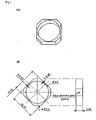
- FIG. 1 is a view for illustrating a test piece produced in Examples, (A) is a perspective view of the test piece, and (B) is a front view and a side view of the test piece.
- the resin composition of the present invention contains a polyarylate resin, a polycarbonate resin, silica particles, fluorine atom-containing polymer particles, and a phosphite ester compound.
- the polyarylate resin used in the present invention is a resin comprising an aromatic dicarboxylic acid residue unit and a bisphenol residue unit.
- a polyarylate raw material for introducing a bisphenol residue is a bisphenol.
- the bisphenols include, for example, 2,2-bis(4-hydroxyphenyl)propane (hereinafter referred to as "bisphenol A”), 2,2-bis(4- hydroxy-3,5-dimethylphenyl)propane, 2,2-bis(4-hydroxy-3,5-dibromophenyl)propane, 2,2-bis(4-hydroxy-3,5-dichlorophenyl)propane, 4,4'-dihydroxydiphenyl sulfone, 4,4'-dihydroxydiphenyl ether, 4,4'-dihydroxydiphenyl sulfide, 4,4'-dihydroxydiphenyl ketone, 4,4'-dihydroxydiphenylmethane, 1,1-bis(4-hydroxyphenyl)cyclohexane, and 1,1-bis(4-hydroxyphenyl)-3,3,5-trimethylcyclohexane.
- Preferred examples of a raw material for introducing an aromatic dicarboxylic acid residue include terephthalic acid and isophthalic acid.
- a polyarylate resin composition obtained by mixing and using both is particularly preferable in terms of melt processability and mechanical properties.
- a mixing ratio thereof (terephthalic acid/isophthalic acid) can be optionally selected, and is preferably in the range of 90/10 to 10/90 in terms of molar fraction, more preferably 70/30 to 30/70, still more preferably 60/40 to 40/60, and optimally 50/50.
- the molar fraction of the mixed terephthalic acid is less than 10 mol% or more than 90 mol%, it may be difficult to obtain a sufficient degree of polymerization in the case where polymerization is performed by an interfacial polymerization method.
- the polycarbonate resin used in the present invention is a resin comprising a bisphenol residue unit and a carbonate residue unit.
- Examples of the bisphenols as a raw material for introducing a bisphenol residue unit include, for example, bisphenol A, 2,2-bis(3,5-dibromo-4-hydroxyphenyl)propane, 2,2-bis(3,5-dimethyl-4-hydroxyphenyl)propane, 1,1-bis(4-hydroxyphenyl)cyclohexane, 1,1-bis(4-hydroxyphenyl)-3,3,5-trimethylcyclohexane, 1,1-bis(3,5-dimethyl-4-hydroxyphenyl)cyclohexane, 1,1-bis(4-hydroxyphenyl)decane, 1,4-bis(4-hydroxyphenyl)propane, 1,1-bis(4-hydroxyphenyl)cyclododecane, 4,4'-dihydroxydiphenyl ether, 4,4'-dithiodiphenol, 4,4'-dihydroxy-3,3'-dichlorodiphenyl ether, and 4,4'-dihydroxy-2,
- a carbonyl halide such as phosgene and a carbonate ester such as diphenyl carbonate can be used.
- a resin comprising a polyarylate resin and a polycarbonate resin may be produced by melt-kneading a polyarylate resin a simple substance and a polycarbonate resin as a simple substance, or a copolymer of a polyarylate resin and a polycarbonate resin may be used.
- the polymerization method of the polyarylate resin, the polymerization method of the polycarbonate resin, and the polymerization method of the copolymer resin of polyarylate and polycarbonate are not particularly limited by an interfacial polymerization method or a melt polymerization method as long as the object of the present invention is satisfied, and known methods may be used.
- the resin comprising the polyarylate resin and the polycarbonate resin preferably has a limiting viscosity of 0.40 to 0.60.
- the limiting viscosity exceeds 0.60, the melt viscosity increases, which makes injection molding difficult.
- the limiting viscosity is less than 0.40, the resulting molded product tends to have insufficient impact strength.
- Each of the polyarylate resin and the polycarbonate resin preferably has a limiting viscosity within the above range.
- the polyarylate resin and the polycarbonate resin are also commercially available.
- a mass ratio of the polyarylate resin and the polycarbonate resin is 25/75 to 92/8, and is preferably 25/75 to 70/30, more preferably 25/75 to 50/50, and still more preferably 25/75 to 40/60, from the viewpoint of further improving a dust-generating resistance property, molding stability, sliding properties, and external appearance properties.
- the ratio of the polyarylate resin is too small, the heat-resisting properties and the dimensional stability are deteriorated.
- the ratio of the polyarylate resin is too high, the fluidity is poor, so that molding becomes difficult.
- the dust-generating resistance property refers to a property of hardly causing falling off of a part of a molded product as fragments, dust, or the like at the time of assembling the molded product and of using the same.
- the dust-generating resistance property does not necessarily correlate with the sliding properties to be described later.
- a molded product having an excellent dust-generating resistance property does not necessarily have excellent sliding properties.
- a molded product having excellent sliding properties does not necessarily have an excellent dust-generating resistance property.
- the molding stability refers to a property of hardly reducing the molecular weight of the resin even by molding.
- the sliding properties are properties relating to smoothness of a surface of a molded product, and mean, for example, that a smaller dynamic friction coefficient gives better smoothness.
- the external appearance properties refer to properties of hardly floating fillers such as silica particles on a surface of a molded product, and when a molded product has black color, the surface of the molded product looks blacker.
- the dimensional stability refers to a property of hardly changing the dimension of a molded product even under a severe environment.
- Silica particles used in the present invention are not particularly limited as long as they are silica particles used as fillers in the field of plastics.
- silica particles spherical silica is preferably used from the viewpoint of further improving the dust-generating resistance property.
- the "spherical” refers to a shape exhibiting a maximum diameter/minimum diameter of 1 to 1.3, and particularly 1 to 1.2 in a photomicrograph.
- titania particles or alumina particles are used instead of silica particles, dimensional stability is deteriorated.
- a content of the silica particles is required to be 4 to 65 parts by mass with respect to 100 parts by mass of a total amount of the polyarylate resin and the polycarbonate resin, and is preferably in the range of 8 to 62 parts by mass, more preferably 8 to 50 parts by mass, still more preferably 8 to 40 parts by mass, and most preferably 8 to 30 parts by mass, from the viewpoint of further improving the dust-generating resistance property, the strength, the heat-resisting properties, the dimensional stability, the molding stability, the sliding properties, and the external appearance properties.
- the content is less than 4 parts by mass, the dimensional stability of the resin composition becomes insufficient.
- the content of the silica particles is preferably 4 to 50 parts by mass with respect to 100 parts by mass of a total amount of the polyarylate resin and the polycarbonate resin.
- an average particle diameter of the silica particles to be incorporated in the resin composition is defined by a particle size value corresponding to a weight accumulation of 50% when a particle size distribution is measured using a particle size distribution measuring apparatus such as a laser diffraction/scattering particle size distribution meter. This measurement is performed, for example, after silica particles are added to water or alcohol so as to have a measurement allowable concentration to prepare a suspension, and the suspension is dispersed by an ultrasonic disperser.
- the average particle diameter of the silica particles to be incorporated in the resin composition of the present invention is smaller, when the silica particles fall off from the resin composition to become dust, the function of a product formed of the resin composition is less likely to be inhibited. On the other hand, when the average particle diameter of the silica particles is too small, the silica particles float on the surface of the molded product and appear white, so that the external appearance properties are deteriorated.
- the average particle diameter of the silica particles is practically required to be 0.4 to 12 ⁇ m, particularly 0.5 to 10 ⁇ m, and is preferably 2 to 12 ⁇ m, more preferably 2 to 8 ⁇ m, and still more preferably 2 to 6 ⁇ m, from the viewpoint of further improving the dust-generating resistance property, the external appearance properties, and the molding stability.
- the average particle diameter exceeds 12 ⁇ m, for example, in the case of using the resin composition of the present invention in a camera lens component, silica falling off from the resin composition may inhibit imaging as dust.
- the average particle diameter of the silica particles exceeds 12 ⁇ m, the dimensional stability of a component using the resin composition of the present invention becomes insufficient.
- a method for producing the silica particles is not limited, and the silica particles can be produced by a known method. Examples thereof include a method in which a silica fine powder is put into high-temperature flame, melted, and fluidized, and when the fluidized silica becomes spherical utilizing surface tension, the spheres are rapidly cooled to produce silica particles.
- examples thereof include a method in which chemical flame is formed with an ignition burner in an atmosphere containing oxygen, a silicon powder is put into the chemical flame in such an amount that a dust cloud is formed, and explosion is caused to produce silica ultrafine particles; and a method in which alkoxysilane is hydrolyzed and aggregated under alkali to produce silica particles by a sol-gel method.
- silica particles may be subjected to surface treatment with a silane coupling treating agent.
- Silica particles are also commercially available.
- a dispersant may be used.
- the dispersant for example, a dispersant selected from the group consisting of fatty acid esters and derivatives thereof, fatty acid amides and derivatives thereof, and mixtures thereof can be used.
- the fatty acid amide include ethylene bishydroxystearic acid amide, ethylene bisstearic acid amide, and the like.
- An addition amount of the dispersant is desirably 0.01 to 0.5 parts by mass with respect to 100 parts by mass of the resin composition of the present invention.
- the fluorine atom-containing polymer particles used in the present invention are polymer particles containing a monomer containing a fluorine atom as a polymerization component.
- a method of polymerizing the fluorine atom-containing polymer particles either baking or unbaking may be used regardless of suspension or emulsification.
- the fluorine atom-containing polymer particles all the properties including dust-generating resistance property, strength, heat-resisting properties, dimensional stability, molding stability, sliding properties, and external appearance properties first become good.
- the fluorine atom-containing polymer may be a polymer containing only a fluorine atom-containing monomer, or may be a copolymer of a fluorine atom-containing monomer and a fluorine atom-free monomer not containing a fluorine atom.
- the fluorine atom-containing polymer is preferably a polymer containing only a fluorine atom-containing monomer from the viewpoint of further improving the dust-generating resistance property and the sliding properties.
- Examples of the fluorine atom-containing monomer include tetrafluoroethylene, vinylidene fluoride, perfluoromethyl vinyl ether, hexafluoropropylene, and vinyl fluoride.
- fluorine atom-free monomer examples include ethylene and propylene.
- a content ratio of the fluorine atom-containing monomer in the fluorine atom-containing polymer is usually 50 mol% or more, and from the viewpoint of further improving the dust-generating resistance property and the sliding properties, the content ratio is 70 mol% or more and 90 mol% or more.
- fluorine atom-containing polymer examples include polytetrafluoroethylene, polyvinylidene fluoride, tetrafluoroethylene-perfluoromethyl vinyl ether copolymer, tetrafluoroethylene-hexafluoropropylene copolymer, and tetrafluoroethylene-ethylene copolymer.
- polytetrafluoroethylene, and particularly low molecular weight polytetrafluoroethylene are preferable from the viewpoint of further improving the dust-generating resistance property, the strength, the heat-resisting properties, the dimensional stability, the molding stability, the sliding properties, and the external appearance properties.
- the low molecular weight polytetrafluoroethylene may contain a small amount of a copolymerization component (that is, a fluorine atom-free monomer).
- a content of the copolymerization component in the low molecular weight polytetrafluoroethylene is, for example, 2 mol% or less.
- the low molecular weight refers to a molecular weight as described later.
- An average particle diameter of the fluorine atom-containing polymer particles used in the present invention is 0.5 to 20 ⁇ m, and is preferably 0.5 to 10 ⁇ m, more preferably 1 to 8 ⁇ m, still more preferably 2 to 6 ⁇ m, and particularly preferably 3 to 6 ⁇ m, from the viewpoint of further improving the dust-generating resistance property, the molding stability, and the sliding properties.
- the average particle diameter of the fluorine atom-containing polymer is less than 0.5 ⁇ m, it may be difficult to impart the sliding properties to the resin composition, or the fluorine atom-containing polymer itself may cause dust generation.
- the average particle diameter exceeds 20 ⁇ m, the molding stability is impaired.
- the average particle diameter of the fluorine atom-containing polymer is an average particle diameter measured by a method in which a dispersion liquid dispersed in perchloroethylene is measured by a light transmission method.
- the average particle diameter of the fluorine atom-containing polymer is one in the resin composition, and the average particle diameter of the raw material used for producing the resin composition is usually maintained as it is even in the resin composition, and is also maintained in a molded product produced using the resin composition.
- a molecular weight of the fluorine atom-containing polymer is not particularly limited, and is preferably low from the viewpoint of further improving the dust-generating resistance property, the molding stability, and the sliding properties.
- the low molecular weight refers to a molecular weight having a number average molecular weight of several thousands to several hundreds of thousands, and is, for example, preferably 1 million or less, and more preferably 600,000 or less.
- the molecular weight a value measured by a differential scanning calorimeter (DSC method) is used.
- a melting point of the fluorine atom-containing polymer is not particularly limited, and is preferably 320°C or higher, and particularly preferably 325 to 335°C from the viewpoint of further improving the dust-generating resistance property, the molding stability, and the sliding properties.
- the melting point As the melting point, a value measured by a differential scanning calorimeter (DSC method) is used.
- the fluorine atom-containing polymer may be an unbaked product or a baked product. Baking refers to heating the fluorine atom-containing polymer to a temperature equal to or higher than the melting point thereof.
- the baked product is obtained by pulverizing after baking. By using the baked product, the dispersibility of the fluorine atom-containing polymer in the resin composition is improved.
- the fluorine atom-containing polymer is preferably an unbaked product from the viewpoint of further improving the dust-generating resistance property, the external appearance properties, and the sliding properties.
- the fluorine atom-containing polymer is also commercially available or can be produced by a known method.
- a content of the fluorine atom-containing polymer particles is 0.5 to 12 parts by mass with respect to 100 parts by mass of a total amount of the polyarylate resin and the polycarbonate resin, and is preferably 1.5 to 12 parts by mass, more preferably 2 to 12 parts by mass, still more preferably 2 to 8 parts by mass, and most preferably 3 to 6 parts by mass, from the viewpoint of further improving the dust-generating resistance property, the molding stability, and the sliding properties.
- the content is too small, the sliding properties and a dust-generating property are deteriorated, and when the content is too large, the molding stability is impaired.
- the fluorine atom-containing polymer may contain two or more kinds of fluorine atom-containing polymers having different monomer compositions, molecular weights, melting points, and/or the like. In that case, a total content thereof may be within the above range.
- a phosphite ester compound represented by a general formula (I) is used.
- the phosphite ester compound By using the phosphite ester compound, all the properties including dust-generating resistance property, strength, heat-resisting properties, dimensional stability, molding stability, sliding properties, and external appearance properties first become good.
- a phosphite ester compound not included in the phosphite ester compound is used, the molding stability and the dust-generating resistance property are deteriorated.
- m1 and m2 are each independently an integer of 0 to 5, and particularly, from the viewpoint of further improving the dust-generating resistance property, the strength, the heat-resisting properties, the dimensional stability, the molding stability, the sliding properties, and the external appearance properties, are preferably an integer of 1 to 5, and more preferably 1 to 3.
- R 1 and R 2 each independently represent an alkyl group having 1 to 12, preferably 1 to 10, more preferably 1 to 9, and still more preferably 1 to 5 carbon atoms.
- the alkyl group include a methyl group, an ethyl group, a n-propyl group, an isopropyl group, a n-butyl group, an isobutyl group, a sec-butyl group, a tert-butyl group, a pentyl group, a hexyl group, a heptyl group, an octyl group, a nonyl group, a decyl group, an undecyl group, and a lauryl group.
- the alkyl group may have a substituent.
- substituent of the alkyl group in R 1 and R 2 include an aryl group such as a phenyl group and a naphthyl (preferably a phenyl group); and a halogen atom such as a fluorine atom, a chlorine atom, and a bromine atom (preferably, a fluorine atom or a chlorine atom).
- a preferred substituent is an aryl group, and particularly a phenyl group.
- the alkyl group when the alkyl group has a substituent, the number of carbon atoms of the alkyl group does not include the number of carbon atoms of the substituent.
- Two or more R 1 s may be independently selected.
- Two or more R 2 s may be independently selected.
- R 1 and R 2 are each preferably an alkyl group having no substituent from the viewpoint of further improving the dust-generating resistance property, the strength, the heat-resisting properties, the dimensional stability, the molding stability, the sliding properties, and the external appearance properties.
- R 3 s each independently represent an alkylene group having 1 to 5 carbon atoms.
- R 3 s each independently preferably represent an alkylene group having 1 to 3 carbon atoms from the viewpoint of further improving the dust-generating resistance property, the strength, the heat-resisting properties, the dimensional stability, the molding stability, the sliding properties, and the external appearance properties.
- Examples of a preferred alkylene group in R 3 include a methylene group, a dimethylene group, and a triethylene group. Most preferred four R 3 s are each independently a methylene group or a dimethylene group, and particularly a methylene group simultaneously.
- phosphite ester compound represented by the above-mentioned general formula (I) a phosphite ester compound which is preferable from the viewpoint of the dust-generating resistance property, the heat-resisting properties, the dimensional stability, the external appearance properties, the molding stability, and the strength is a phosphite ester compound represented by a general formula (I-1).
- R 11 and R 14 are each independently a hydrogen atom or an alkyl group having 1 to 10 carbon atoms.
- R 11 and R 14 each independently preferably represent an alkyl group having 1 to 5 carbon atoms, and more preferably 1 to 4 carbon atoms, from the viewpoint of further improving the dust-generating resistance property, the strength, the heat-resisting properties, the dimensional stability, the molding stability, the sliding properties, and the external appearance properties.
- Specific examples of the alkyl group in R 11 and R 14 include an alkyl group having a predetermined number of carbon atoms, among the same specific examples as those of the alkyl group in R 1 and R 2 .
- the alkyl group may have a substituent.
- Examples of the substituent of the alkyl group in R 11 and R 14 include the same substituents as the substituents which the alkyl group in R 1 and R 2 may have.
- a preferred substituent of the alkyl group in R 11 and R 14 is an aryl group, and particularly a phenyl group.
- R 11 and R 14 when the alkyl group has a substituent, the number of carbon atoms of the alkyl group does not include the number of carbon atoms of the substituent.
- Specific examples of the alkyl group having a substituent in R 11 and R 14 include the same specific examples as those of the alkyl group having a substituent in R 1 and R 2 .
- Examples of a more preferred alkyl group in R 11 and R 14 include a methyl group, an ethyl group, a n-propyl group, an isopropyl group, a n-butyl group, an isobutyl group, a sec-butyl group, a tert-butyl group, a benzyl group, a phenethyl group, an ⁇ -methylbenzyl group, an ⁇ , ⁇ -dimethylbenzyl group, and a diphenylmethyl group.
- R 11 and R 14 are each independently or simultaneously a methyl group, an ethyl group, a n-propyl group, an isopropyl group, a n-butyl group, an isobutyl group, a sec-butyl group, a tert-butyl group, a benzyl group, a phenethyl group, an ⁇ -methylbenzyl group, an ⁇ , ⁇ -dimethylbenzyl group, or a diphenylmethyl group, and particularly preferable is a methyl group or an ⁇ , ⁇ -dimethylbenzyl group.
- an alkyl group preferably does not have a substituent, most preferred R 11 and R 14 are the same group, and particularly a methyl group simultaneously.
- R 12 and R 15 are each independently a hydrogen atom or an alkyl group having 1 to 10 carbon atoms.
- R 12 and R 15 each independently preferably represent an alkyl group having 1 to 5 carbon atoms, more preferably 2 to 5 carbon atoms, and still more preferably 3 to 5 carbon atoms, from the viewpoint of further improving the dust-generating resistance property, the strength, the heat-resisting properties, the dimensional stability, the molding stability, the sliding properties, and the external appearance properties.
- Specific examples of the alkyl group in R 12 and R 15 include an alkyl group having a predetermined number of carbon atoms, among the same specific examples as those of the alkyl group in R 1 and R 2 .
- the alkyl group may have a substituent.
- substituent of the alkyl group in R 12 and R 15 include the same substituents as the substituents which the alkyl group in R 1 and R 2 may have.
- a preferred substituent of the alkyl group in R 12 and R 15 is an aryl group, and particularly a phenyl group.
- R 12 and R 15 when the alkyl group has a substituent, the number of carbon atoms of the alkyl group does not include the number of carbon atoms of the substituent.
- Specific examples of the alkyl group having a substituent in R 12 and R 15 include the same specific examples as those of the alkyl group having a substituent in R 1 and R 2 .
- Examples of a more preferred alkyl group in R 12 and R 15 include an ethyl group, a n-propyl group, an isopropyl group, a n-butyl group, an isobutyl group, a sec-butyl group, a tert-butyl group, a pentyl group, a phenethyl group, an ⁇ -methylbenzyl group, and an ⁇ , ⁇ -dimethylbenzyl group.
- R 12 and R 15 are each independently or simultaneously an ethyl group, a n-propyl group, an isopropyl group, a n-butyl group, an isobutyl group, a sec-butyl group, a tert-butyl group, a pentyl group, a benzyl group, a phenethyl group, an ⁇ -methylbenzyl group, or an ⁇ , ⁇ -dimethylbenzyl group, and particularly preferable is a tert-butyl group or an ⁇ , ⁇ -dimethylbenzyl group.
- an alkyl group preferably does not have a substituent, most preferred R 12 and R 15 are the same group, and particularly a tert-butyl group simultaneously.
- R 13 and R 16 are each independently a hydrogen atom or an alkyl group having 1 to 10 carbon atoms.
- R 13 and R 16 each independently preferably represent a hydrogen atom or an alkyl group having 1 to 5 carbon atoms, and more preferably an alkyl group having 3 to 5 carbon atoms, from the viewpoint of further improving the dust-generating resistance property, the strength, the heat-resisting properties, the dimensional stability, the molding stability, the sliding properties, and the external appearance properties.
- Specific examples of the alkyl group in R 13 and R 16 include an alkyl group having a predetermined number of carbon atoms, among the same specific examples as those of the alkyl group in R 1 and R 2 .
- the alkyl group may have a substituent.
- substituent of the alkyl group in R 13 and R 16 include the same substituents as the substituents which the alkyl group in R 1 and R 2 may have.
- a preferred substituent of the alkyl group in R 13 and R 16 is an aryl group, and particularly a phenyl group.
- R 13 and R 16 when the alkyl group has a substituent, the number of carbon atoms of the alkyl group does not include the number of carbon atoms of the substituent.
- Specific examples of the alkyl group having a substituent in R 13 and R 16 include the same specific examples as those of the alkyl group having a substituent in R 1 and R 2 .
- Examples of a more preferred alkyl group in R 13 and R 16 include a n-propyl group, an isopropyl group, a n-butyl group, an isobutyl group, a sec-butyl group, a tert-butyl group, and a pentyl group. Still more preferred R 13 and R 16 are each independently or simultaneously a hydrogen atom, a n-propyl group, an isopropyl group, a n-butyl group, an isobutyl group, a sec-butyl group, a tert-butyl group, or a pentyl group, and particularly preferable is a hydrogen atom or a tert-butyl group.
- an alkyl group preferably does not have a substituent, most preferred R 13 and R 16 are the same group, and particularly a tert-butyl group simultaneously.
- phosphite ester compound represented by the general formula (I) include the following compounds:
- the phosphite ester compound is more preferably the compound (1-1-1) and/or the compound (1-1-6), and still more preferably the compound (1-1-1)).
- the phosphite ester compound represented by the general formula (I) is also commercially available or can be synthesized by a known method.
- the compound (I-1-1) is available, for example, as commercially available "PEP-36" made by ADEKA CORPORATION.
- the compound (I-1-6) is available, for example, as commercially available "Doverphos S-9228PC” made by Dover Chemical Corporation.
- a content of the phosphite ester compound represented by the general formula (I) is 0.008 to 1.2 parts by mass, and particularly 0.01 to 1 part by mass, with respect to 100 parts by mass of a total amount of the polyarylate resin and the polycarbonate resin, and is preferably 0.02 to 0.5 parts by mass, more preferably 0.03 to 0.5 parts by mass, and still more preferably 0.03 to 0.1 parts by mass, from the viewpoint of further improving the dust-generating resistance property, the strength, the heat-resisting properties, the dimensional stability, the molding stability, the sliding properties, and the external appearance properties.
- the content is too small or too large, the molding stability and the dust-generating resistance property are deteriorated.
- composition of the present invention may contain a phosphorus compound generated by decomposition (hydrolysis, thermal decomposition, or the like) of a phosphite ester.
- the resin composition of the present invention preferably further contains a hindered phenol compound represented by a general formula (II).
- a hindered phenol compound represented by a general formula (II) By containing such a hindered phenol compound, the molding stability and the dust-generating resistance property can be improved even more.
- X represents a hydrocarbon group or an ether group.
- the hydrocarbon group is a monovalent or tetravalent hydrocarbon group having 1 to 20 carbon atoms.
- Examples of the monovalent hydrocarbon group include alkyl groups having 10 to 20, preferably 15 to 20, and more preferably 16 to 18 carbon atoms.
- Examples of such alkyl group include, for example, a decyl group, a undecyl group, a lauryl group, a tridecyl group, a myristyl group, a pentadecyl group, a cetyl group, a heptadecyl group, a stearyl group, a nonadecyl group, and an eicosyl group.
- Examples of the tetravalent hydrocarbon group include a saturated hydrocarbon group having 1 to 2 carbon atoms, preferably a carbon atom.
- the ether group is a divalent group, specifically "-O-".
- Preferred X is a hydrocarbon group, particularly a monovalent or tetravalent hydrocarbon group.
- n is an integer of 1 or more, particularly 1 to 4, determined according to the valence of X.
- X is monovalent, n is 1.
- n is 2.
- n is 3.
- X is tetravalent, n is 4.
- R 21 and R 22 are each independently a hydrogen atom or an alkyl group having 1 to 9 carbon atoms.
- R 21 and R 22 each independently preferably represent an alkyl group having 1 to 5, and more preferably 3 to 5 carbon atoms.
- Examples of a more preferred alkyl group in R 21 and R 22 include a n-propyl group, an isopropyl group, a n-butyl group, an isobutyl group, a sec-butyl group, a tert-butyl group, and a pentyl group.
- Most preferred R 21 and R 22 are the same group, and particularly a tert-butyl group simultaneously.
- R 23 and R 24 each independently represent an alkylene group having 1 to 5 carbon atoms.
- R 23 and R 24 each independently preferably represent an alkylene group having 1 to 3 carbon atoms.
- Examples of a preferred alkylene group in R 23 and R 24 include a methylene group, a dimethylene group, and a triethylene group.
- Most preferred R 23 and R 24 are each independently a methylene group or a dimethylene group, and particularly a dimethylene group and a methylene group, respectively.
- a hindered phenol compound which is preferable from the viewpoint of further improving the molding stability and the dust-generating resistance property is a hindered phenol compound represented by general formulas (II-1) and (II-2), and particularly a hindered phenol compound represented by the general formula (II-1).
- R 21 and R 22 are the same as R 21 and R 22 in the formula (II), respectively.
- R 23 and R 24 are the same as R 23 and R 24 in the formula (II), respectively.
- R 21 and R 22 are the same as R 21 and R 22 in the formula (II), respectively.
- R 23 is the same as R 23 in the formula (II).
- examples of R 25 include alkyl groups having 11 to 25, preferably 16 to 23, and more preferably 16 to 20 carbon atoms.
- hindered phenol compound represented by the general formula (II) include the following compounds:
- the hindered phenol compound is more preferably the hindered phenol compound represented by the general formula (II-1), and particularly the compound (II-1-1).
- the hindered phenol compound represented by the general formula (II) is also commercially available or can be synthesized by a known method.
- the compound (II-1-1) is available, for example, as commercially available Irganox 1010 made by BASF SE.
- the compound (II-2-1) is available, for example, as commercially available Irganox 1076 made by BASF SE.
- a content of the hindered phenol compound represented by the general formula (II) is 0.01 to 1 part by mass with respect to 100 parts by mass of a total amount of the polyarylate resin and the polycarbonate resin, and is preferably 0.02 to 0.5 parts by mass, and more preferably 0.02 to 0.1 parts by mass, from the viewpoint of further improving the molding stability and the dust-generating resistance property.
- Two or more kinds of the hindered phenol compounds represented by the general formula (II) may be used in combination, and in that case, a total amount thereof may be within the above range.
- the resin composition of the present invention may further contain carbon nanotubes from the viewpoint of improving antistatic performance.
- the carbon nanotube is not particularly limited, and has a shape in which a graphite layer is rolled up to be cylindrical, and may be, for example, a single-walled carbon nanotube having a structure in which one graphite layer is rolled up, or a multi-walled carbon nanotube in which two or more graphite layers are rolled up.
- the carbon nanotube is preferably a multi-walled carbon nanotube.
- the containing of the carbon nanotubes in the resin composition leads to reduction of a surface resistivity of the resin composition, which makes it possible to prevent a molded body using the resin composition from being charged with static electricity and also to prevent adhesion of dust due to static electricity.
- the antistatic performance is not necessarily a property that the resin composition of the present invention should have, but is a property that the resin composition of the present invention may not have, and is a property that the resin composition of the present invention preferably has.
- the carbon nanotubes of the present invention can be generally produced by a laser ablation method, an arc discharge method, a thermal CVD method, a plasma CVD method, a combustion method, or the like, but the carbon nanotubes may be produced by any method.
- carbon nanotubes obtained by a method of preparation using zeolite as a carrier of a catalyst and acetylene as a raw material by a thermal CVD method are preferable as carbon nanotubes to be used in the present invention in that they are high-purity and well-graphitized multi-walled carbon nanotubes without being particularly purified although having amorphous carbon coating due to some thermal decomposition.
- the carbon nanotubes used in the present invention preferably have an average length of 5 to 100 ⁇ m, and more preferably 10 to 80 ⁇ m.
- the carbon nanotubes preferably have a diameter of 1 to 200 nm, and more preferably 3.5 to 150 nm.
- a content of the carbon nanotubes is preferably 0.5 to 15 parts by mass, more preferably 1 to 10 parts by mass, still more preferably 2 to 8 parts by mass, and particularly preferably 3 to 6 parts by mass, with respect to 100 parts by mass of a total amount of the polyarylate resin and the polycarbonate resin.
- the content of the carbon nanotubes is less than 0.1 parts by mass, it may be insufficient to sufficiently reduce the surface resistivity, and when the content exceeds 10 parts by mass, the effect of reducing the surface resistivity has already reached saturation, and the molding stability may become insufficient.
- a release agent a pigment, a dye, a weather-resistant agent, an antioxidant, a heat stabilizer, a flame retardant, an antistatic agent, an impact modifier, a sliding agent such as ultrahigh molecular weight polyethylene, and the like can be added to the resin composition of the present invention as long as the properties of the resin composition of the present invention are not impaired.
- the resin composition of the present invention preferably contains a release agent.
- the release agent include a fatty acid ester of a saturated aliphatic polyol.
- a method of producing the resin composition of the present invention is not particularly limited as long as each component is uniformly dispersed in the resin composition.
- examples thereof include a method in which a polyarylate resin, a polycarbonate resin, silica particles, fluorine atom-containing polymer particles, a phosphite ester compound, and other additives are uniformly blended using a tumbler or a Henschel mixer, and then melt-kneaded to be pelletized.
- a method of molding the resin composition of the present invention is not particularly limited, and examples thereof include an injection molding method, an extrusion molding method, a blow molding method, and a sintering molding method. Among them, an injection molding method is preferable because the effect of improving mechanical properties and moldability is high.
- An injection molding machine used for injection molding is not particularly limited, and examples thereof include a screw in-line type injection molding machine and a plunger type injection molding machine. A resin composition heat-melted in a cylinder of the injection molding machine is weighed every shot, injected into a die in a molten state, cooled and solidified in a predetermined shape, and then taken out as a molded product from the die.
- the molded product of the present invention can be produced by molding using the above-mentioned resin composition having a pellet shape.
- the molded product of the present invention may also be produced by kneading silica particles with the polyarylate resin and/or the polycarbonate resin in advance, and then further kneading the kneaded product with the remaining necessary components, followed by molding.
- the molded product of the present invention may also be produced by dry-blending the polyarylate resin, the polycarbonate resin, silica particles, fluorine atom-containing polymer particles, and the phosphite ester compound, and directly molding the dryblended product without being pelletized.
- the resin composition of the present invention is excellent in molding stability.
- a drop rate of the limiting viscosity of the molded product based on the limiting viscosity of the pellet is usually less than 10%, preferably less than 7%, and more preferably less than 4%.
- FIG. 1 is a view for illustrating a test piece, (A) is a perspective view of the test piece, and (B) is a front view and a side view of the test piece.
- a unit of the dimension in FIG. 1 is "mm".
- the molded product of the present invention is excellent in strength.
- the resin composition of the present invention is injection-molded at a resin temperature of 340°C and a molding cycle of 30 seconds to prepare a dumbbell test piece, and the flexural strength of the test piece is measured in accordance with JIS K 7171, the flexural strength is usually 82 MPa or more, preferably 92 MPa or more, and more preferably 102 MPa or more. A detailed measurement method will be shown in Examples.
- the molded product of the present invention is excellent in heat-resisting properties.
- the resin composition of the present invention is injection-molded at a resin temperature of 340°C and a molding cycle of 30 seconds to prepare a dumbbell test piece, and a temperature of deflection under load is measured at a load of 1.8 MPa in accordance with JIS K 7191-1 and K 7191-2
- the temperature of deflection under load is usually 148°C or higher, preferably 150°C or higher, and more preferably 152°C or higher.
- a detailed measurement method will be shown in Examples.
- the molded product of the present invention is excellent in dimensional stability.
- a rate of change in an inner diameter thereof is usually within a range of ⁇ 0.10, preferably within a range of ⁇ 0.08, and more preferably within a range of ⁇ 0.06.
- a detailed measurement method will be shown in Examples.
- the molded product of the present invention is excellent in dust-generating resistance property.
- the resin composition of the present invention is injection-molded at a resin temperature of 340°C and a molding cycle of 30 seconds to prepare a test piece shown in FIG. 1 , 100 test pieces are placed into a container, and vibration at 300 times/min is given thereto for 24 hours.
- a dust generation rate of the molded product is usually less than 0.10%, preferably less than 0.07%, and more preferably less than 0.04%.
- a detailed measurement method will be shown in Examples.
- the molded product of the present invention is excellent in external appearance properties.
- the resin composition of the present invention is injection-molded at a resin temperature of 340°C and a molding cycle of 30 seconds to prepare a test piece shown in FIG. 1 , and the surface appearance is visually observed, the surface is usually smooth, preferably smooth and does not appear white, and more preferably, there is no floating of silica particles, and the surface is smooth and does not appear white.
- a detailed evaluation method will be shown in Examples.
- the molded product of the present invention is excellent in sliding properties.
- the dynamic friction coefficient is usually 0.30 or less, preferably 0.27 or less, and more preferably 0.23 or less. A detailed measurement method will be shown in Examples.
- the molded product of the present invention is preferably excellent in antistatic performance.
- the surface resistivity is preferably 10 11 ⁇ or less, more preferably 10 10 ⁇ or less, and still more preferably 10 9 ⁇ or less. A detailed measurement method will be shown in Examples.
- the resin composition of the present invention is useful for production (molding) of a product in which dust generation is likely to be a problem, for example, a molded product such as a camera module component, a lens unit component, and an actuator component.
- the camera module component is a resin component constituting an electronic component having a camera function mounted in a mobile phone, a game machine, a personal computer, an in-vehicle camera, a mobile phone terminal, or the like.
- the lens unit component is a resin component constituting a lens unit of an electronic component having a camera function mounted in a mobile phone, a game machine, a personal computer, an in-vehicle camera, a mobile phone terminal, or the like.
- the lens unit component is one of the constituent components of the camera module component.
- the actuator component is a resin component constituting an actuator that controls movement or mechanical action in a mobile phone, a game machine, a personal computer, an in-vehicle camera, a mobile phone terminal, or the like.
- the actuator component is one of the constituent components of the camera module component.
- a resin composition was molded at a resin temperature of 340°C and a molding cycle of 30 seconds using an injection molding machine (made by TOSHIBA MACHINE CO., LTD., model number: EC100N II) to prepare a dumbbell test piece. Using the obtained test piece, measurement was performed in accordance with JIS K 7171. The strength was evaluated based on the flexural strength S by the following method.
- test piece obtained in (1) measurement was performed at a load of 1.8 MPa in accordance with JIS K 7191-1 and K 7191-2. From the viewpoint of required heat resistance at the time of soldering, when the temperature of deflection under load is 148 °C or higher, it is within a practically acceptable range.
- the heat-resisting properties were evaluated based on the temperature of deflection under load by the following method.
- a ring-shaped molded product having an outer diameter of 30 mm, an inner diameter of 26 mm, and a thickness of 2 mm was molded by injection molding (one side gate) at a resin temperature of 340°C and a molding cycle of 30 seconds. Thereafter, the inner diameter size was measured at multiple points with a high-precision two-dimensional measuring device (made by KEYENCE CORPORATION, model number: UM-8400) to determine an average inner diameter. Then, "-40°C ⁇ 1 hour” ⁇ "80°C ⁇ 1 hour” was defined as 1 cycle, and treatment was performed at a total of 30 cycles to determine a rate of change in the average inner diameter.
- a resin composition was molded at a resin temperature of 340°C and a molding cycle of 30 seconds using an injection molding machine (J35AD made by The Japan Steel Works, Ltd.) to prepare a test piece as shown in FIG. 1 .
- the surface appearance of the obtained test piece was visually judged according to the following criteria.
- a resin composition was molded at a resin temperature of 340°C and a molding cycle of 30 seconds using an injection molding machine (J35AD made by The Japan Steel Works, Ltd.) to prepare a test piece as shown in FIG. 1 .
- a resin composition was molded at a resin temperature of 340°C and a molding cycle of 30 seconds using an injection molding machine (made by TOSHIBA MACHINE CO., LTD., model number: EC100N II) to prepare a plate-shaped test piece (70 mm in length ⁇ 40 mm in width ⁇ 2 mmt in thickness).
- a dynamic friction coefficient was measured in accordance with JIS K 7218 A method using a Suzuki type continuous friction wear tester (model No. 283-S-PC made by YASUDA SEIKI SEISAKUSHO, LTD.) under conditions including a speed of 0.1 m/s and a load of 0.5 MPa.
- a sliding partner material (S45C ring, outer diameter ⁇ 25.6 mm, inner diameter ⁇ 20 mm, length 15 mm) was rotated with respect to the plate-shaped test piece.
- a dynamic friction coefficient of 0.3 or less was judged as "no problem in practical use”.
- a resin composition was molded at a resin temperature of 340°C and a molding cycle of 30 seconds using an injection molding machine (made by TOSHIBA MACHINE CO., LTD., model number: EC100N II) to prepare a disk test piece.
- a surface resistivity of the obtained test piece was measured using a digital ultra-high resistance/micro ammeter (R8340A made by Advantest Corporation).
- a surface resistivity of 10 11 ⁇ or less was defined as having antistatic performance. In order to suppress adhesion of dust on a molded body, the surface resistivity is preferably 10 11 ⁇ or less.
- Raw materials were melt-kneaded at a barrel temperature of 320°C and at a blending ratio shown in Tables 1 to 4 using a corotating twin screw extruder (made by TOSHIBA MACHINE CO., LTD., model number: TEM-37BS).
- a resin composition drawn in a strand form from a nozzle was cooled and solidified by soaking in a water bath, and after cutting with a pelletizer, the cut pieces of the resin composition were dried by hot air at 120°C for 12 hours to obtain a resin composition (pellet).
- compositions of the resin compositions obtained in Examples and Comparative Examples and the evaluation results thereof are shown in Tables 1 to 4.
- the resin compositions of Examples 13 to 18 were further excellent in antistatic performance.
- the resin composition of the present invention is useful for molding a camera module component, a lens unit component, and an actuator component used in a mobile phone, a game machine, a personal computer, an in-vehicle camera, a mobile phone terminal, and the like.
Landscapes
- Chemical & Material Sciences (AREA)
- Health & Medical Sciences (AREA)
- Chemical Kinetics & Catalysis (AREA)
- Medicinal Chemistry (AREA)
- Polymers & Plastics (AREA)
- Organic Chemistry (AREA)
- Engineering & Computer Science (AREA)
- Materials Engineering (AREA)
- Nanotechnology (AREA)
- Compositions Of Macromolecular Compounds (AREA)
Abstract
Description
- The present invention relates to a resin composition and a molded product obtained by molding the resin composition.
- A camera module component having an imaging element such as a charge coupled device (CCD) and a complementary metal oxide semiconductor (CMOS) is used in a mobile phone, a game machine, a personal computer, an in-vehicle camera, a mobile phone terminal, and the like. In recent years, miniaturization and high performance have been further promoted, and development of a small camera module component has been advanced.
- In an auto-focusing mechanism, a camera shake prevention mechanism, or the like of a camera module, a motor or the like in a lens is moved to perform focus adjustment and shake prevention. When such a mechanism is incorporated in a camera module, rubbing, friction, and the like occur between camera module components or between a camera module component and other components, and thus a camera module component surface is required to have a small dynamic friction coefficient (sliding properties).
- Even if the camera module component has excellent sliding properties, on an imaging element surface and a lens surface in the camera module a black flaw and a blot are easily generated even by slight dust, and the camera performance may be deteriorated. Specifically, the camera module components are scraped due to rubbing, friction, or the like between the camera module components or between the camera module component and the other components, and fine resin pieces or the like cause dust and adhere to the lens surface or accumulate between the camera module components, which hinders the operation of the mechanical component. For this reason, in a resin material constituting the camera module component, it is required that generation of fragments and dust during production and use is suppressed (dust-generating resistance property).
- In addition, soldering of electric wiring is generally performed on the camera module component. For this reason, precision components such as a lens unit and an actuator constituting a camera module component are required to have excellent dimensional stability even when exposed to a soldering temperature (up to about 150°C).
- Furthermore, small reduction in a molecular weight of a resin (molding stability) by molding is also required. Further, it is also required that a molded product has excellent mechanical strength. Further, it is also required that a surface of the molded product is smooth without having a filler such as silica floating thereon (external appearance properties).
- Therefore, a resin composition is known in which a baked polytetrafluoroethylene resin and a spherical silica are each contained in a specific amount with respect to a polyarylate resin and a polycarbonate resin in a specific ratio (Patent Literature 1).
- In addition, a resin composition is known in which silica particles and a specific phosphite ester compound are each contained in a specific amount with respect to a polyarylate resin and a polycarbonate resin in a specific ratio (Patent Literature 2).
-
- Patent Literature 1:
JP 2008-50488 A - Patent Literature 2:
WO 2017/204078 A1 - However, in the technique of Patent Literature 1, not only a molding stability is deteriorated, but also a sufficient dust-generating resistance property has failed to be obtained. In particular, regarding the dust-generating resistance property, specifically, under a more severe environment (for example, in an environment where rubbing occurs between components for a longer period of time), sufficient dust-generating resistance property has failed to be obtained.
- In the technique of
Patent Literature 2, under a more severe environment (for example, in an environment where rubbing occurs between components for a longer period of time), sufficient dust-generating resistance property has also failed to be obtained. - An object of the present invention is to provide a resin composition, from which a molded product excellent in a dust-generating resistance property, heat-resisting properties, a dimensional stability, sliding properties, mechanical properties and external appearance properties can be molded and which is excellent in a molding stability, and a molded product which is obtained by molding the same.
- As a result of intensive studies to solve the above problems, the present inventors have found that the above object can be achieved by using silica particles having a specific average particle diameter, fluorine atom-containing polymer particles having a specific average particle diameter, and a specific phosphite ester compound in a resin composition using a polyarylate resin and a polycarbonate resin in combination, and have reached the present invention.
- The gists of the present invention are as follows.
- <1> A resin composition comprising a polyarylate resin, a polycarbonate resin, silica particles having an average particle diameter of 0.4 to 12 µm, fluorine atom-containing polymer particles having an average particle diameter of 0.5 to 20 µm, and a phosphite ester compound represented by a general formula (I),
- wherein a mass ratio of the polyarylate resin and the polycarbonate resin is 25/75 to 92/8,
- a content of the silica particles is 4 to 65 parts by mass with respect to 100 parts by mass of a total amount of the polyarylate resin and the polycarbonate resin,
- a content of the fluorine atom-containing polymer particles is 0.5 to 12 parts by mass with respect to 100 parts by mass of a total amount of the polyarylate resin and the polycarbonate resin, and
- a content of the phosphite ester compound is 0.008 to 1.2 parts by mass with respect to 100 parts by mass of a total amount of the polyarylate resin and the polycarbonate resin:

- (wherein m1 and m2 are each independently an integer of 0 to 5;
- R1 and R2 each independently represent an alkyl group having 1 to 12 carbon atoms, which may have a substituent; and
- four R3s each independently represent an alkylene group having 1 to 5 carbon atoms).
- <2> The resin composition of <1>, wherein the resin composition further comprises carbon nanotubes in an amount of 0.5 to 15 parts by mass with respect to 100 parts by mass of a total amount of the polyarylate resin and the polycarbonate resin.
- <3> The resin composition of <1> or <2>, wherein the phosphite ester compound is a compound represented by a general formula (I-1):


- <4> The resin composition of any of <1> to <3>, wherein the resin composition further comprises a hindered phenol compound represented by a general formula (II) in an amount of 0.01 to 1 part by mass with respect to 100 parts by mass of a total amount of the polyarylate resin and the polycarbonate resin:

- (wherein X represents a hydrocarbon group or an ether group;
- n is an integer of 1 or more determined according to X;
- R21 and R22 each independently represent a hydrogen atom or an alkyl group having 1 to 9 carbon atoms; and
- R23 and R24 each independently represent an alkylene group having 1 to 5 carbon atoms).
- <5> The resin composition of any of <1> to <4>, wherein the fluorine atom-containing polymer particles are unbaked fluorine atom-containing polymer particles.
- <6> The resin composition of any of <1> to <5>, wherein the content of the silica particles is 4 to 50 parts by mass with respect to 100 parts by mass of a total amount of the polyarylate resin and the polycarbonate resin.
- <7> The resin composition of any of <1> to <4>, wherein
- the content of the silica particles is 8 to 62 parts by mass with respect to 100 parts by mass of a total amount of the polyarylate resin and the polycarbonate resin,
- the silica particles have an average particle diameter of 2 to 12 µm, and
- the fluorine atom-containing polymer particles are unbaked fluorine atom-containing polymer particles.
- <8> The resin composition of <7>, wherein
- the mass ratio of the polyarylate resin and the polycarbonate resin is 25/75 to 70/30,
- the content of the silica particles is 8 to 50 parts by mass with respect to 100 parts by mass of a total amount of the polyarylate resin and the polycarbonate resin,
- the silica particles have an average particle diameter of 2 to 8 µm,
- the content of the phosphite ester compound is 0.03 to 0.5 parts by mass with respect to 100 parts by mass of a total amount of the polyarylate resin and the polycarbonate resin, and
- in the phosphite ester compound, the m1 and the m2 are each independently an integer of 1 to 3, the R1 and the R2 each independently represent an alkyl group having 1 to 12 carbon atoms and no substituent, and the four R3s each independently represent an alkylene group having 1 to 3 carbon atoms.
- <9> The resin composition of any of <1> to <8>, wherein the fluorine atom-containing polymer is at least one kind of polymer selected from a group consisting of polytetrafluoroethylene, polyvinylidene fluoride, tetrafluoroethylene-perfluoromethyl vinyl ether copolymer, tetrafluoroethylene-hexafluoropropylene copolymer, and tetrafluoroethylene-ethylene copolymer.
- <10> A molded product comprising the resin composition of any of <1> to <9>.
- <11> The molded product of <10>, wherein the molded product is a camera module component.
- <12> The molded product of <10>, wherein the molded product is a lens unit component.
- <13> The molded product of <10>, wherein the molded product is an actuator component.
- The resin composition of the present invention is excellent in molding stability.
- The resin composition of the present invention can mold a molded product excellent in a dust-generating resistance property, heat-resisting properties, a dimensional stability, sliding properties, and external appearance properties.
- A molded product molded from the resin composition of the present invention is also excellent in mechanical strength, particularly flexural strength.
-
FIG. 1 is a view for illustrating a test piece produced in Examples, (A) is a perspective view of the test piece, and (B) is a front view and a side view of the test piece. - The resin composition of the present invention contains a polyarylate resin, a polycarbonate resin, silica particles, fluorine atom-containing polymer particles, and a phosphite ester compound.
- The polyarylate resin used in the present invention is a resin comprising an aromatic dicarboxylic acid residue unit and a bisphenol residue unit.
- A polyarylate raw material for introducing a bisphenol residue is a bisphenol. Specific examples of the bisphenols include, for example, 2,2-bis(4-hydroxyphenyl)propane (hereinafter referred to as "bisphenol A"), 2,2-bis(4- hydroxy-3,5-dimethylphenyl)propane, 2,2-bis(4-hydroxy-3,5-dibromophenyl)propane, 2,2-bis(4-hydroxy-3,5-dichlorophenyl)propane, 4,4'-dihydroxydiphenyl sulfone, 4,4'-dihydroxydiphenyl ether, 4,4'-dihydroxydiphenyl sulfide, 4,4'-dihydroxydiphenyl ketone, 4,4'-dihydroxydiphenylmethane, 1,1-bis(4-hydroxyphenyl)cyclohexane, and 1,1-bis(4-hydroxyphenyl)-3,3,5-trimethylcyclohexane. These compounds may be used alone or in combination of two or more thereof. In particular, bisphenol A is economically preferable.
- Preferred examples of a raw material for introducing an aromatic dicarboxylic acid residue include terephthalic acid and isophthalic acid. In the present invention, a polyarylate resin composition obtained by mixing and using both is particularly preferable in terms of melt processability and mechanical properties. A mixing ratio thereof (terephthalic acid/isophthalic acid) can be optionally selected, and is preferably in the range of 90/10 to 10/90 in terms of molar fraction, more preferably 70/30 to 30/70, still more preferably 60/40 to 40/60, and optimally 50/50. When the molar fraction of the mixed terephthalic acid is less than 10 mol% or more than 90 mol%, it may be difficult to obtain a sufficient degree of polymerization in the case where polymerization is performed by an interfacial polymerization method.
- The polycarbonate resin used in the present invention is a resin comprising a bisphenol residue unit and a carbonate residue unit.
- Examples of the bisphenols as a raw material for introducing a bisphenol residue unit include, for example, bisphenol A, 2,2-bis(3,5-dibromo-4-hydroxyphenyl)propane, 2,2-bis(3,5-dimethyl-4-hydroxyphenyl)propane, 1,1-bis(4-hydroxyphenyl)cyclohexane, 1,1-bis(4-hydroxyphenyl)-3,3,5-trimethylcyclohexane, 1,1-bis(3,5-dimethyl-4-hydroxyphenyl)cyclohexane, 1,1-bis(4-hydroxyphenyl)decane, 1,4-bis(4-hydroxyphenyl)propane, 1,1-bis(4-hydroxyphenyl)cyclododecane, 4,4'-dihydroxydiphenyl ether, 4,4'-dithiodiphenol, 4,4'-dihydroxy-3,3'-dichlorodiphenyl ether, and 4,4'-dihydroxy-2,5-dihydroxydiphenyl ether. These may be used alone or in combination of two or more thereof.
- As a precursor for introducing the carbonate residue unit, a carbonyl halide such as phosgene and a carbonate ester such as diphenyl carbonate can be used.
- In the present invention, a resin comprising a polyarylate resin and a polycarbonate resin may be produced by melt-kneading a polyarylate resin a simple substance and a polycarbonate resin as a simple substance, or a copolymer of a polyarylate resin and a polycarbonate resin may be used.
- The polymerization method of the polyarylate resin, the polymerization method of the polycarbonate resin, and the polymerization method of the copolymer resin of polyarylate and polycarbonate are not particularly limited by an interfacial polymerization method or a melt polymerization method as long as the object of the present invention is satisfied, and known methods may be used.
- In the present invention, the resin comprising the polyarylate resin and the polycarbonate resin preferably has a limiting viscosity of 0.40 to 0.60. When the limiting viscosity exceeds 0.60, the melt viscosity increases, which makes injection molding difficult. When the limiting viscosity is less than 0.40, the resulting molded product tends to have insufficient impact strength. Each of the polyarylate resin and the polycarbonate resin preferably has a limiting viscosity within the above range.
- The polyarylate resin and the polycarbonate resin are also commercially available.
- A mass ratio of the polyarylate resin and the polycarbonate resin (polyarylate/polycarbonate) is 25/75 to 92/8, and is preferably 25/75 to 70/30, more preferably 25/75 to 50/50, and still more preferably 25/75 to 40/60, from the viewpoint of further improving a dust-generating resistance property, molding stability, sliding properties, and external appearance properties. When the ratio of the polyarylate resin is too small, the heat-resisting properties and the dimensional stability are deteriorated. When the ratio of the polyarylate resin is too high, the fluidity is poor, so that molding becomes difficult.
- The dust-generating resistance property refers to a property of hardly causing falling off of a part of a molded product as fragments, dust, or the like at the time of assembling the molded product and of using the same. The dust-generating resistance property does not necessarily correlate with the sliding properties to be described later. For example, a molded product having an excellent dust-generating resistance property does not necessarily have excellent sliding properties. In contrast, for example, a molded product having excellent sliding properties does not necessarily have an excellent dust-generating resistance property.
- The molding stability refers to a property of hardly reducing the molecular weight of the resin even by molding.
- The sliding properties are properties relating to smoothness of a surface of a molded product, and mean, for example, that a smaller dynamic friction coefficient gives better smoothness.
- The external appearance properties refer to properties of hardly floating fillers such as silica particles on a surface of a molded product, and when a molded product has black color, the surface of the molded product looks blacker.
- The dimensional stability refers to a property of hardly changing the dimension of a molded product even under a severe environment.
- Silica particles used in the present invention are not particularly limited as long as they are silica particles used as fillers in the field of plastics. As the silica particles, spherical silica is preferably used from the viewpoint of further improving the dust-generating resistance property. The "spherical" refers to a shape exhibiting a maximum diameter/minimum diameter of 1 to 1.3, and particularly 1 to 1.2 in a photomicrograph. When other inorganic fine particles, for example, titania particles or alumina particles are used instead of silica particles, dimensional stability is deteriorated.
- A content of the silica particles is required to be 4 to 65 parts by mass with respect to 100 parts by mass of a total amount of the polyarylate resin and the polycarbonate resin, and is preferably in the range of 8 to 62 parts by mass, more preferably 8 to 50 parts by mass, still more preferably 8 to 40 parts by mass, and most preferably 8 to 30 parts by mass, from the viewpoint of further improving the dust-generating resistance property, the strength, the heat-resisting properties, the dimensional stability, the molding stability, the sliding properties, and the external appearance properties. When the content is less than 4 parts by mass, the dimensional stability of the resin composition becomes insufficient. When the content exceeds 65 parts by mass, an inconvenience is generated at the time of passing through a step upon production of the resin composition, such as pelletization by melt-kneading and extrusion becomes difficult. From the viewpoint of further improving the dust-generating resistance property alone, the content of the silica particles is preferably 4 to 50 parts by mass with respect to 100 parts by mass of a total amount of the polyarylate resin and the polycarbonate resin.
- In the present invention, an average particle diameter of the silica particles to be incorporated in the resin composition is defined by a particle size value corresponding to a weight accumulation of 50% when a particle size distribution is measured using a particle size distribution measuring apparatus such as a laser diffraction/scattering particle size distribution meter. This measurement is performed, for example, after silica particles are added to water or alcohol so as to have a measurement allowable concentration to prepare a suspension, and the suspension is dispersed by an ultrasonic disperser.
- As the average particle diameter of the silica particles to be incorporated in the resin composition of the present invention is smaller, when the silica particles fall off from the resin composition to become dust, the function of a product formed of the resin composition is less likely to be inhibited. On the other hand, when the average particle diameter of the silica particles is too small, the silica particles float on the surface of the molded product and appear white, so that the external appearance properties are deteriorated. Therefore, the average particle diameter of the silica particles is practically required to be 0.4 to 12 µm, particularly 0.5 to 10 µm, and is preferably 2 to 12 µm, more preferably 2 to 8 µm, and still more preferably 2 to 6 µm, from the viewpoint of further improving the dust-generating resistance property, the external appearance properties, and the molding stability. When the average particle diameter exceeds 12 µm, for example, in the case of using the resin composition of the present invention in a camera lens component, silica falling off from the resin composition may inhibit imaging as dust. When the average particle diameter of the silica particles exceeds 12 µm, the dimensional stability of a component using the resin composition of the present invention becomes insufficient.
- In the present invention, a method for producing the silica particles is not limited, and the silica particles can be produced by a known method. Examples thereof include a method in which a silica fine powder is put into high-temperature flame, melted, and fluidized, and when the fluidized silica becomes spherical utilizing surface tension, the spheres are rapidly cooled to produce silica particles. Alternatively, examples thereof include a method in which chemical flame is formed with an ignition burner in an atmosphere containing oxygen, a silicon powder is put into the chemical flame in such an amount that a dust cloud is formed, and explosion is caused to produce silica ultrafine particles; and a method in which alkoxysilane is hydrolyzed and aggregated under alkali to produce silica particles by a sol-gel method.
- In order to improve adhesiveness between silica particles and a resin matrix, silica particles may be subjected to surface treatment with a silane coupling treating agent.
- Silica particles are also commercially available.
- In order to disperse the silica particles in the resin matrix, a dispersant may be used. As the dispersant, for example, a dispersant selected from the group consisting of fatty acid esters and derivatives thereof, fatty acid amides and derivatives thereof, and mixtures thereof can be used. Examples of the fatty acid amide include ethylene bishydroxystearic acid amide, ethylene bisstearic acid amide, and the like. By uniformly dispersing silica in the resin matrix, a mold shrinkage ratio and a linear expansion coefficient are decreased, and the dimensional stability is further improved. An addition amount of the dispersant is desirably 0.01 to 0.5 parts by mass with respect to 100 parts by mass of the resin composition of the present invention.
- The fluorine atom-containing polymer particles used in the present invention are polymer particles containing a monomer containing a fluorine atom as a polymerization component. As a method of polymerizing the fluorine atom-containing polymer particles, either baking or unbaking may be used regardless of suspension or emulsification. By using the fluorine atom-containing polymer particles, all the properties including dust-generating resistance property, strength, heat-resisting properties, dimensional stability, molding stability, sliding properties, and external appearance properties first become good. The fluorine atom-containing polymer may be a polymer containing only a fluorine atom-containing monomer, or may be a copolymer of a fluorine atom-containing monomer and a fluorine atom-free monomer not containing a fluorine atom. The fluorine atom-containing polymer is preferably a polymer containing only a fluorine atom-containing monomer from the viewpoint of further improving the dust-generating resistance property and the sliding properties. Examples of the fluorine atom-containing monomer include tetrafluoroethylene, vinylidene fluoride, perfluoromethyl vinyl ether, hexafluoropropylene, and vinyl fluoride. Examples of the fluorine atom-free monomer include ethylene and propylene. A content ratio of the fluorine atom-containing monomer in the fluorine atom-containing polymer is usually 50 mol% or more, and from the viewpoint of further improving the dust-generating resistance property and the sliding properties, the content ratio is 70 mol% or more and 90 mol% or more.
- Specific examples of the fluorine atom-containing polymer include polytetrafluoroethylene, polyvinylidene fluoride, tetrafluoroethylene-perfluoromethyl vinyl ether copolymer, tetrafluoroethylene-hexafluoropropylene copolymer, and tetrafluoroethylene-ethylene copolymer. In the present invention, polytetrafluoroethylene, and particularly low molecular weight polytetrafluoroethylene are preferable from the viewpoint of further improving the dust-generating resistance property, the strength, the heat-resisting properties, the dimensional stability, the molding stability, the sliding properties, and the external appearance properties. The low molecular weight polytetrafluoroethylene may contain a small amount of a copolymerization component (that is, a fluorine atom-free monomer). A content of the copolymerization component in the low molecular weight polytetrafluoroethylene is, for example, 2 mol% or less. The low molecular weight refers to a molecular weight as described later.
- An average particle diameter of the fluorine atom-containing polymer particles used in the present invention is 0.5 to 20 µm, and is preferably 0.5 to 10 µm, more preferably 1 to 8 µm, still more preferably 2 to 6 µm, and particularly preferably 3 to 6 µm, from the viewpoint of further improving the dust-generating resistance property, the molding stability, and the sliding properties. When the average particle diameter of the fluorine atom-containing polymer is less than 0.5 µm, it may be difficult to impart the sliding properties to the resin composition, or the fluorine atom-containing polymer itself may cause dust generation. When the average particle diameter exceeds 20 µm, the molding stability is impaired.
- The average particle diameter of the fluorine atom-containing polymer is an average particle diameter measured by a method in which a dispersion liquid dispersed in perchloroethylene is measured by a light transmission method. The average particle diameter of the fluorine atom-containing polymer is one in the resin composition, and the average particle diameter of the raw material used for producing the resin composition is usually maintained as it is even in the resin composition, and is also maintained in a molded product produced using the resin composition.
- A molecular weight of the fluorine atom-containing polymer is not particularly limited, and is preferably low from the viewpoint of further improving the dust-generating resistance property, the molding stability, and the sliding properties. The low molecular weight refers to a molecular weight having a number average molecular weight of several thousands to several hundreds of thousands, and is, for example, preferably 1 million or less, and more preferably 600,000 or less.
- As the molecular weight, a value measured by a differential scanning calorimeter (DSC method) is used.
- A melting point of the fluorine atom-containing polymer is not particularly limited, and is preferably 320°C or higher, and particularly preferably 325 to 335°C from the viewpoint of further improving the dust-generating resistance property, the molding stability, and the sliding properties.
- As the melting point, a value measured by a differential scanning calorimeter (DSC method) is used.
- The fluorine atom-containing polymer may be an unbaked product or a baked product. Baking refers to heating the fluorine atom-containing polymer to a temperature equal to or higher than the melting point thereof. The baked product is obtained by pulverizing after baking. By using the baked product, the dispersibility of the fluorine atom-containing polymer in the resin composition is improved. The fluorine atom-containing polymer is preferably an unbaked product from the viewpoint of further improving the dust-generating resistance property, the external appearance properties, and the sliding properties.
- The fluorine atom-containing polymer is also commercially available or can be produced by a known method.
- A content of the fluorine atom-containing polymer particles is 0.5 to 12 parts by mass with respect to 100 parts by mass of a total amount of the polyarylate resin and the polycarbonate resin, and is preferably 1.5 to 12 parts by mass, more preferably 2 to 12 parts by mass, still more preferably 2 to 8 parts by mass, and most preferably 3 to 6 parts by mass, from the viewpoint of further improving the dust-generating resistance property, the molding stability, and the sliding properties. When the content is too small, the sliding properties and a dust-generating property are deteriorated, and when the content is too large, the molding stability is impaired. The fluorine atom-containing polymer may contain two or more kinds of fluorine atom-containing polymers having different monomer compositions, molecular weights, melting points, and/or the like. In that case, a total content thereof may be within the above range.
- In the present invention, a phosphite ester compound represented by a general formula (I) is used. By using the phosphite ester compound, all the properties including dust-generating resistance property, strength, heat-resisting properties, dimensional stability, molding stability, sliding properties, and external appearance properties first become good. When, instead of the phosphite ester compound represented by the general formula (I), a phosphite ester compound not included in the phosphite ester compound is used, the molding stability and the dust-generating resistance property are deteriorated.

- In the formula (I), m1 and m2 are each independently an integer of 0 to 5, and particularly, from the viewpoint of further improving the dust-generating resistance property, the strength, the heat-resisting properties, the dimensional stability, the molding stability, the sliding properties, and the external appearance properties, are preferably an integer of 1 to 5, and more preferably 1 to 3.
- R1 and R2 each independently represent an alkyl group having 1 to 12, preferably 1 to 10, more preferably 1 to 9, and still more preferably 1 to 5 carbon atoms. Examples of the alkyl group include a methyl group, an ethyl group, a n-propyl group, an isopropyl group, a n-butyl group, an isobutyl group, a sec-butyl group, a tert-butyl group, a pentyl group, a hexyl group, a heptyl group, an octyl group, a nonyl group, a decyl group, an undecyl group, and a lauryl group. In R1 and R2, the alkyl group may have a substituent. Examples of the substituent of the alkyl group in R1 and R2 include an aryl group such as a phenyl group and a naphthyl (preferably a phenyl group); and a halogen atom such as a fluorine atom, a chlorine atom, and a bromine atom (preferably, a fluorine atom or a chlorine atom). A preferred substituent is an aryl group, and particularly a phenyl group. In R1 and R2, when the alkyl group has a substituent, the number of carbon atoms of the alkyl group does not include the number of carbon atoms of the substituent. Specific examples of the alkyl group having a substituent in R1 and R2 include a benzyl group, a phenethyl group, an α-methylbenzyl group, an α,α-dimethylbenzyl group (= cumyl group), a diphenylmethyl group, a triphenylmethyl group, a mononaphthylmethyl group, a monofluoromethyl group, and a monochloromethyl group. Two or more R1s may be independently selected. Two or more R2s may be independently selected. R1 and R2 are each preferably an alkyl group having no substituent from the viewpoint of further improving the dust-generating resistance property, the strength, the heat-resisting properties, the dimensional stability, the molding stability, the sliding properties, and the external appearance properties.
- Four R3s each independently represent an alkylene group having 1 to 5 carbon atoms. Four R3s each independently preferably represent an alkylene group having 1 to 3 carbon atoms from the viewpoint of further improving the dust-generating resistance property, the strength, the heat-resisting properties, the dimensional stability, the molding stability, the sliding properties, and the external appearance properties. Examples of a preferred alkylene group in R3 include a methylene group, a dimethylene group, and a triethylene group. Most preferred four R3s are each independently a methylene group or a dimethylene group, and particularly a methylene group simultaneously.
- Among the phosphite ester compounds represented by the above-mentioned general formula (I), a phosphite ester compound which is preferable from the viewpoint of the dust-generating resistance property, the heat-resisting properties, the dimensional stability, the external appearance properties, the molding stability, and the strength is a phosphite ester compound represented by a general formula (I-1).

- In the formula (I-1), R11 and R14 are each independently a hydrogen atom or an alkyl group having 1 to 10 carbon atoms. R11 and R14 each independently preferably represent an alkyl group having 1 to 5 carbon atoms, and more preferably 1 to 4 carbon atoms, from the viewpoint of further improving the dust-generating resistance property, the strength, the heat-resisting properties, the dimensional stability, the molding stability, the sliding properties, and the external appearance properties. Specific examples of the alkyl group in R11 and R14 include an alkyl group having a predetermined number of carbon atoms, among the same specific examples as those of the alkyl group in R1 and R2. In R11 and R14, the alkyl group may have a substituent. Examples of the substituent of the alkyl group in R11 and R14 include the same substituents as the substituents which the alkyl group in R1 and R2 may have. A preferred substituent of the alkyl group in R11 and R14 is an aryl group, and particularly a phenyl group. In R11 and R14, when the alkyl group has a substituent, the number of carbon atoms of the alkyl group does not include the number of carbon atoms of the substituent. Specific examples of the alkyl group having a substituent in R11 and R14 include the same specific examples as those of the alkyl group having a substituent in R1 and R2. Examples of a more preferred alkyl group in R11 and R14 include a methyl group, an ethyl group, a n-propyl group, an isopropyl group, a n-butyl group, an isobutyl group, a sec-butyl group, a tert-butyl group, a benzyl group, a phenethyl group, an α-methylbenzyl group, an α,α-dimethylbenzyl group, and a diphenylmethyl group. Still more preferred R11 and R14 are each independently or simultaneously a methyl group, an ethyl group, a n-propyl group, an isopropyl group, a n-butyl group, an isobutyl group, a sec-butyl group, a tert-butyl group, a benzyl group, a phenethyl group, an α-methylbenzyl group, an α,α-dimethylbenzyl group, or a diphenylmethyl group, and particularly preferable is a methyl group or an α,α-dimethylbenzyl group. From the viewpoint of further improving the dust-generating resistance property, the strength, the heat-resisting properties, the dimensional stability, the molding stability, the sliding properties, and the external appearance properties, in R11 and R14, an alkyl group preferably does not have a substituent, most preferred R11 and R14 are the same group, and particularly a methyl group simultaneously.
- R12 and R15 are each independently a hydrogen atom or an alkyl group having 1 to 10 carbon atoms. R12 and R15 each independently preferably represent an alkyl group having 1 to 5 carbon atoms, more preferably 2 to 5 carbon atoms, and still more preferably 3 to 5 carbon atoms, from the viewpoint of further improving the dust-generating resistance property, the strength, the heat-resisting properties, the dimensional stability, the molding stability, the sliding properties, and the external appearance properties. Specific examples of the alkyl group in R12 and R15 include an alkyl group having a predetermined number of carbon atoms, among the same specific examples as those of the alkyl group in R1 and R2. In R12 and R15, the alkyl group may have a substituent. Examples of the substituent of the alkyl group in R12 and R15 include the same substituents as the substituents which the alkyl group in R1 and R2 may have. A preferred substituent of the alkyl group in R12 and R15 is an aryl group, and particularly a phenyl group. In R12 and R15, when the alkyl group has a substituent, the number of carbon atoms of the alkyl group does not include the number of carbon atoms of the substituent. Specific examples of the alkyl group having a substituent in R12 and R15 include the same specific examples as those of the alkyl group having a substituent in R1 and R2. Examples of a more preferred alkyl group in R12 and R15 include an ethyl group, a n-propyl group, an isopropyl group, a n-butyl group, an isobutyl group, a sec-butyl group, a tert-butyl group, a pentyl group, a phenethyl group, an α-methylbenzyl group, and an α,α-dimethylbenzyl group. Still more preferred R12 and R15 are each independently or simultaneously an ethyl group, a n-propyl group, an isopropyl group, a n-butyl group, an isobutyl group, a sec-butyl group, a tert-butyl group, a pentyl group, a benzyl group, a phenethyl group, an α-methylbenzyl group, or an α,α-dimethylbenzyl group, and particularly preferable is a tert-butyl group or an α,α-dimethylbenzyl group. From the viewpoint of further improving the dust-generating resistance property, the strength, the heat-resisting properties, the dimensional stability, the molding stability, the sliding properties, and the external appearance properties, in R12 and R15, an alkyl group preferably does not have a substituent, most preferred R12 and R15 are the same group, and particularly a tert-butyl group simultaneously.
- R13 and R16 are each independently a hydrogen atom or an alkyl group having 1 to 10 carbon atoms. R13 and R16 each independently preferably represent a hydrogen atom or an alkyl group having 1 to 5 carbon atoms, and more preferably an alkyl group having 3 to 5 carbon atoms, from the viewpoint of further improving the dust-generating resistance property, the strength, the heat-resisting properties, the dimensional stability, the molding stability, the sliding properties, and the external appearance properties. Specific examples of the alkyl group in R13 and R16 include an alkyl group having a predetermined number of carbon atoms, among the same specific examples as those of the alkyl group in R1 and R2. In R13 and R16, the alkyl group may have a substituent. Examples of the substituent of the alkyl group in R13 and R16 include the same substituents as the substituents which the alkyl group in R1 and R2 may have. A preferred substituent of the alkyl group in R13 and R16 is an aryl group, and particularly a phenyl group. In R13 and R16, when the alkyl group has a substituent, the number of carbon atoms of the alkyl group does not include the number of carbon atoms of the substituent. Specific examples of the alkyl group having a substituent in R13 and R16 include the same specific examples as those of the alkyl group having a substituent in R1 and R2. Examples of a more preferred alkyl group in R13 and R16 include a n-propyl group, an isopropyl group, a n-butyl group, an isobutyl group, a sec-butyl group, a tert-butyl group, and a pentyl group. Still more preferred R13 and R16 are each independently or simultaneously a hydrogen atom, a n-propyl group, an isopropyl group, a n-butyl group, an isobutyl group, a sec-butyl group, a tert-butyl group, or a pentyl group, and particularly preferable is a hydrogen atom or a tert-butyl group. From the viewpoint of further improving the dust-generating resistance property, the strength, the heat-resisting properties, the dimensional stability, the molding stability, the sliding properties, and the external appearance properties, in R13 and R16, an alkyl group preferably does not have a substituent, most preferred R13 and R16 are the same group, and particularly a tert-butyl group simultaneously.
- Specific examples of the phosphite ester compound represented by the general formula (I) include the following compounds:
- Compound (I-1-1): bis(2,6-di-t-butyl-4-methylphenyl)pentaerythritol-diphosphite; in the general formula (I-1), R11 = R14 = methyl group, R12 = R15 = tert-butyl group, R13 = R16 = tert-butyl group;
- Compound (I-1-2): bis(2,6-di-t-butyl-4-ethylphenyl)pentaerythritol-diphosphite; in the general formula (I-1), R11 = R14 = ethyl group, R12 = R15 = tert-butyl group, R13 = R16 = tert-butyl group;
- Compound (I-1-3): bis(2,4,6-tri-t-butylphenyl)spiropentaerythritol-diphosphite; in the general formula (I-1), R11 = R14 = tert-butyl group, R12 = R15 = tert-butyl group, R13 = R16 = tert-butyl group;
- Compound (1-1-4): bis(nonylphenyl)pentaerythritol diphosphite; in the general formula (I), m1 = m2 = 1, R1 = R2 = nonyl group, R3 = methylene group;
- Compound (I-1-5): bis(2,4-di-t-butylphenyl)pentaerythritol diphosphite; in the general formula (I-1), R11 = R14 = tert-butyl group, R12 = R15 = tert-butyl group, R13 = R16 = hydrogen atom; and
- Compound (1-1-6): bis(2,4-dicumylphenyl)pentaerythritol diphosphite; in the general formula (I-1), R11 = R14 = α,α-dimethylbenzyl group, R12 = R15 = α,α-dimethylbenzyl group, R13 = R16 = hydrogen atom.
- From the viewpoint of further improving the molding stability and the dust-generating resistance property, the phosphite ester compound is more preferably the compound (1-1-1) and/or the compound (1-1-6), and still more preferably the compound (1-1-1)).
- The phosphite ester compound represented by the general formula (I) is also commercially available or can be synthesized by a known method.
- The compound (I-1-1) is available, for example, as commercially available "PEP-36" made by ADEKA CORPORATION.
- The compound (I-1-6) is available, for example, as commercially available "Doverphos S-9228PC" made by Dover Chemical Corporation.
- A content of the phosphite ester compound represented by the general formula (I) is 0.008 to 1.2 parts by mass, and particularly 0.01 to 1 part by mass, with respect to 100 parts by mass of a total amount of the polyarylate resin and the polycarbonate resin, and is preferably 0.02 to 0.5 parts by mass, more preferably 0.03 to 0.5 parts by mass, and still more preferably 0.03 to 0.1 parts by mass, from the viewpoint of further improving the dust-generating resistance property, the strength, the heat-resisting properties, the dimensional stability, the molding stability, the sliding properties, and the external appearance properties. When the content is too small or too large, the molding stability and the dust-generating resistance property are deteriorated.
- Two or more kinds of the phosphite ester compounds represented by the general formula (I) may be used in combination, and in that case, a total amount thereof may be within the above range. Furthermore, the composition of the present invention may contain a phosphorus compound generated by decomposition (hydrolysis, thermal decomposition, or the like) of a phosphite ester.
- The resin composition of the present invention preferably further contains a hindered phenol compound represented by a general formula (II). By containing such a hindered phenol compound, the molding stability and the dust-generating resistance property can be improved even more.

- In the formula (II), X represents a hydrocarbon group or an ether group.
- The hydrocarbon group is a monovalent or tetravalent hydrocarbon group having 1 to 20 carbon atoms.
- Examples of the monovalent hydrocarbon group include alkyl groups having 10 to 20, preferably 15 to 20, and more preferably 16 to 18 carbon atoms. Examples of such alkyl group include, for example, a decyl group, a undecyl group, a lauryl group, a tridecyl group, a myristyl group, a pentadecyl group, a cetyl group, a heptadecyl group, a stearyl group, a nonadecyl group, and an eicosyl group.
- Examples of the tetravalent hydrocarbon group include a saturated hydrocarbon group having 1 to 2 carbon atoms, preferably a carbon atom.
- The ether group is a divalent group, specifically "-O-".
- Preferred X is a hydrocarbon group, particularly a monovalent or tetravalent hydrocarbon group.
- n is an integer of 1 or more, particularly 1 to 4, determined according to the valence of X. When X is monovalent, n is 1. When X is divalent, n is 2. When X is trivalent, n is 3. When X is tetravalent, n is 4.
- R21 and R22 are each independently a hydrogen atom or an alkyl group having 1 to 9 carbon atoms. R21 and R22 each independently preferably represent an alkyl group having 1 to 5, and more preferably 3 to 5 carbon atoms. Examples of a more preferred alkyl group in R21 and R22 include a n-propyl group, an isopropyl group, a n-butyl group, an isobutyl group, a sec-butyl group, a tert-butyl group, and a pentyl group. Most preferred R21 and R22 are the same group, and particularly a tert-butyl group simultaneously.
- R23 and R24 each independently represent an alkylene group having 1 to 5 carbon atoms. R23 and R24 each independently preferably represent an alkylene group having 1 to 3 carbon atoms. Examples of a preferred alkylene group in R23 and R24 include a methylene group, a dimethylene group, and a triethylene group. Most preferred R23 and R24 are each independently a methylene group or a dimethylene group, and particularly a dimethylene group and a methylene group, respectively.
- Among the hindered phenol compounds represented by the above-mentioned general formula (II), a hindered phenol compound which is preferable from the viewpoint of further improving the molding stability and the dust-generating resistance property is a hindered phenol compound represented by general formulas (II-1) and (II-2), and particularly a hindered phenol compound represented by the general formula (II-1).

- In the formula (II-1), R21 and R22 are the same as R21 and R22 in the formula (II), respectively.
- In the formula (II-1), R23 and R24 are the same as R23 and R24 in the formula (II), respectively.

- In the formula (II-2), R21 and R22 are the same as R21 and R22 in the formula (II), respectively.
- In the formula (II-2), R23 is the same as R23 in the formula (II).
- In the formula (II-2), examples of R25 include alkyl groups having 11 to 25, preferably 16 to 23, and more preferably 16 to 20 carbon atoms. Examples of a more preferred alkyl group include a cetyl group, a heptadecyl group, a stearyl group (= octadecyl group), a nonadecyl group, and an eicosyl group.
- Specific examples of the hindered phenol compound represented by the general formula (II) include the following compounds:
- Compound (II-1-1): pentaerythritol tetrakis[3-(3,5-di-t-butyl-4-hydroxyphenyl) propionate; in the general formula (II-1), R21 = R22 = tert-butyl group, R23 = dimethylene group, R24 = methylene group; and
- Compound (II-2-1): octadecyl-3-(3,5-di-t-butyl-4-hydroxyphenyl) propionate; in the general formula (II-2), R21 = R22 = tert-butyl group, R23 = dimethylene group, R25 = octadecyl group.
- From the viewpoint of further improving the molding stability and the dust-generating resistance property, the hindered phenol compound is more preferably the hindered phenol compound represented by the general formula (II-1), and particularly the compound (II-1-1).
- The hindered phenol compound represented by the general formula (II) is also commercially available or can be synthesized by a known method.
- The compound (II-1-1) is available, for example, as commercially available Irganox 1010 made by BASF SE.
- The compound (II-2-1) is available, for example, as commercially available Irganox 1076 made by BASF SE.
- A content of the hindered phenol compound represented by the general formula (II) is 0.01 to 1 part by mass with respect to 100 parts by mass of a total amount of the polyarylate resin and the polycarbonate resin, and is preferably 0.02 to 0.5 parts by mass, and more preferably 0.02 to 0.1 parts by mass, from the viewpoint of further improving the molding stability and the dust-generating resistance property.
- Two or more kinds of the hindered phenol compounds represented by the general formula (II) may be used in combination, and in that case, a total amount thereof may be within the above range.
- The resin composition of the present invention may further contain carbon nanotubes from the viewpoint of improving antistatic performance. The carbon nanotube is not particularly limited, and has a shape in which a graphite layer is rolled up to be cylindrical, and may be, for example, a single-walled carbon nanotube having a structure in which one graphite layer is rolled up, or a multi-walled carbon nanotube in which two or more graphite layers are rolled up. The carbon nanotube is preferably a multi-walled carbon nanotube. The containing of the carbon nanotubes in the resin composition leads to reduction of a surface resistivity of the resin composition, which makes it possible to prevent a molded body using the resin composition from being charged with static electricity and also to prevent adhesion of dust due to static electricity. The antistatic performance is not necessarily a property that the resin composition of the present invention should have, but is a property that the resin composition of the present invention may not have, and is a property that the resin composition of the present invention preferably has.
- The carbon nanotubes of the present invention can be generally produced by a laser ablation method, an arc discharge method, a thermal CVD method, a plasma CVD method, a combustion method, or the like, but the carbon nanotubes may be produced by any method. In particular, carbon nanotubes obtained by a method of preparation using zeolite as a carrier of a catalyst and acetylene as a raw material by a thermal CVD method are preferable as carbon nanotubes to be used in the present invention in that they are high-purity and well-graphitized multi-walled carbon nanotubes without being particularly purified although having amorphous carbon coating due to some thermal decomposition.
- The carbon nanotubes used in the present invention preferably have an average length of 5 to 100 µm, and more preferably 10 to 80 µm. In addition, the carbon nanotubes preferably have a diameter of 1 to 200 nm, and more preferably 3.5 to 150 nm.
- A content of the carbon nanotubes is preferably 0.5 to 15 parts by mass, more preferably 1 to 10 parts by mass, still more preferably 2 to 8 parts by mass, and particularly preferably 3 to 6 parts by mass, with respect to 100 parts by mass of a total amount of the polyarylate resin and the polycarbonate resin. When the content of the carbon nanotubes is less than 0.1 parts by mass, it may be insufficient to sufficiently reduce the surface resistivity, and when the content exceeds 10 parts by mass, the effect of reducing the surface resistivity has already reached saturation, and the molding stability may become insufficient.
- In addition to the above components, a release agent, a pigment, a dye, a weather-resistant agent, an antioxidant, a heat stabilizer, a flame retardant, an antistatic agent, an impact modifier, a sliding agent such as ultrahigh molecular weight polyethylene, and the like can be added to the resin composition of the present invention as long as the properties of the resin composition of the present invention are not impaired. The resin composition of the present invention preferably contains a release agent. Examples of the release agent include a fatty acid ester of a saturated aliphatic polyol.
- A method of producing the resin composition of the present invention is not particularly limited as long as each component is uniformly dispersed in the resin composition. Examples thereof include a method in which a polyarylate resin, a polycarbonate resin, silica particles, fluorine atom-containing polymer particles, a phosphite ester compound, and other additives are uniformly blended using a tumbler or a Henschel mixer, and then melt-kneaded to be pelletized.
- A method of molding the resin composition of the present invention is not particularly limited, and examples thereof include an injection molding method, an extrusion molding method, a blow molding method, and a sintering molding method. Among them, an injection molding method is preferable because the effect of improving mechanical properties and moldability is high. An injection molding machine used for injection molding is not particularly limited, and examples thereof include a screw in-line type injection molding machine and a plunger type injection molding machine. A resin composition heat-melted in a cylinder of the injection molding machine is weighed every shot, injected into a die in a molten state, cooled and solidified in a predetermined shape, and then taken out as a molded product from the die.
- The molded product of the present invention can be produced by molding using the above-mentioned resin composition having a pellet shape. The molded product of the present invention may also be produced by kneading silica particles with the polyarylate resin and/or the polycarbonate resin in advance, and then further kneading the kneaded product with the remaining necessary components, followed by molding. The molded product of the present invention may also be produced by dry-blending the polyarylate resin, the polycarbonate resin, silica particles, fluorine atom-containing polymer particles, and the phosphite ester compound, and directly molding the dryblended product without being pelletized.
- The resin composition of the present invention is excellent in molding stability. For example, when the resin composition (pellet) of the present invention is injection-molded at a resin temperature of 340°C and a molding cycle of 900 seconds to prepare a test piece shown in
FIG. 1 , a drop rate of the limiting viscosity of the molded product based on the limiting viscosity of the pellet is usually less than 10%, preferably less than 7%, and more preferably less than 4%. A detailed measurement method will be shown in Examples.FIG. 1 is a view for illustrating a test piece, (A) is a perspective view of the test piece, and (B) is a front view and a side view of the test piece. A unit of the dimension inFIG. 1 is "mm". - The molded product of the present invention is excellent in strength. For example, when the resin composition of the present invention is injection-molded at a resin temperature of 340°C and a molding cycle of 30 seconds to prepare a dumbbell test piece, and the flexural strength of the test piece is measured in accordance with JIS K 7171, the flexural strength is usually 82 MPa or more, preferably 92 MPa or more, and more preferably 102 MPa or more. A detailed measurement method will be shown in Examples.
- The molded product of the present invention is excellent in heat-resisting properties. For example, when the resin composition of the present invention is injection-molded at a resin temperature of 340°C and a molding cycle of 30 seconds to prepare a dumbbell test piece, and a temperature of deflection under load is measured at a load of 1.8 MPa in accordance with JIS K 7191-1 and K 7191-2, the temperature of deflection under load is usually 148°C or higher, preferably 150°C or higher, and more preferably 152°C or higher. A detailed measurement method will be shown in Examples.
- The molded product of the present invention is excellent in dimensional stability. For example, when the resin composition of the present invention is injection-molded at a resin temperature of 340°C and a molding cycle of 30 seconds to prepare a ring-shaped molded product, and retention under a low temperature environment and retention under a high temperature environment are repeated, a rate of change in an inner diameter thereof is usually within a range of ±0.10, preferably within a range of ±0.08, and more preferably within a range of ±0.06. A detailed measurement method will be shown in Examples.
- The molded product of the present invention is excellent in dust-generating resistance property. For example, the resin composition of the present invention is injection-molded at a resin temperature of 340°C and a molding cycle of 30 seconds to prepare a test piece shown in
FIG. 1 , 100 test pieces are placed into a container, and vibration at 300 times/min is given thereto for 24 hours. At this time, a dust generation rate of the molded product is usually less than 0.10%, preferably less than 0.07%, and more preferably less than 0.04%. A detailed measurement method will be shown in Examples. - The molded product of the present invention is excellent in external appearance properties. For example, when the resin composition of the present invention is injection-molded at a resin temperature of 340°C and a molding cycle of 30 seconds to prepare a test piece shown in
FIG. 1 , and the surface appearance is visually observed, the surface is usually smooth, preferably smooth and does not appear white, and more preferably, there is no floating of silica particles, and the surface is smooth and does not appear white. A detailed evaluation method will be shown in Examples. - The molded product of the present invention is excellent in sliding properties. For example, when the resin composition of the present invention is injection-molded at a resin temperature of 340°C and a molding cycle of 30 seconds to prepare a plate-shaped molded product, and a sliding partner material is rotated with respect to the plate-shaped molded product in accordance with JIS K7218 A method, the dynamic friction coefficient is usually 0.30 or less, preferably 0.27 or less, and more preferably 0.23 or less. A detailed measurement method will be shown in Examples.
- The molded product of the present invention is preferably excellent in antistatic performance. For example, when the resin composition of the present invention is injection-molded at a resin temperature of 340°C and a molding cycle of 30 seconds to prepare a molded product, the surface resistivity is preferably 1011 Ω or less, more preferably 1010 Ω or less, and still more preferably 109 Ω or less. A detailed measurement method will be shown in Examples.
- Since a molded product produced from the resin composition of the present invention has excellent dust-generating resistance property, the resin composition of the present invention is useful for production (molding) of a product in which dust generation is likely to be a problem, for example, a molded product such as a camera module component, a lens unit component, and an actuator component.
- The camera module component is a resin component constituting an electronic component having a camera function mounted in a mobile phone, a game machine, a personal computer, an in-vehicle camera, a mobile phone terminal, or the like.
- The lens unit component is a resin component constituting a lens unit of an electronic component having a camera function mounted in a mobile phone, a game machine, a personal computer, an in-vehicle camera, a mobile phone terminal, or the like. The lens unit component is one of the constituent components of the camera module component.
- The actuator component is a resin component constituting an actuator that controls movement or mechanical action in a mobile phone, a game machine, a personal computer, an in-vehicle camera, a mobile phone terminal, or the like. The actuator component is one of the constituent components of the camera module component.
- The present invention will be hereinafter specifically described with reference to Examples and Comparative Examples.
-
- Polyarylate resin; "U-powder" made by Unitika Ltd. (limiting viscosity 0.54):
- Polycarbonate resin; "SD POLYCA 200-13" made by Sumika Polycarbonate Ltd. (limiting viscosity 0.50):
- Silica 0.3; spherical silica, "SFP-20M" made by Denka Company Limited (average particle diameter 0.3 µm):
- Silica 0.5; spherical silica, "SC2500-SXJ" made by ADMATECHS Co., Ltd. (average particle diameter 0.5 µm):
- Silica 5.0; spherical silica, "FB-5SDC" made by Denka Company Limited (average particle diameter 5 µm):
- Silica 10; spherical silica, "FB-12D" made by Denka Company Limited (average particle diameter 10 µm):
- Silica 15; spherical silica, "FB-945" made by Denka Company Limited (average particle diameter 15 µm):
- Alumina 3.0; spherical alumina, "DAW-03" made by Denka Company Limited (average particle diameter 3 µm):
- Polytetrafluoroethylene particles 2.0: "LUBRON L-2" made by DAIKIN CORPORATION (
average particle diameter 2 µm) (unbaked product):- Polytetrafluoroethylene particles 5.0: "LUBRON L-5" made by DAIKIN CORPORATION (average particle diameter 5 µm) (unbaked product):
- Polytetrafluoroethylene particles 30: "Fluon L169J-S" made by AGC Inc. (average particle diameter 30 µm) (unbaked product):
- Baked polytetrafluoroethylene particles 4.5: "KTL-8N" made by Kitamura Limited (average particle diameter 4.5 µm):
- Multi-walled carbon nanotube; "K-NANOS-100T" made by Kumho Petrochemical Co., Ltd. (average length: 26 µm, diameter: 8 to 15 nm):
- Phosphite ester compound; "PEP-36" made by ADEKA CORPORATION; the above-mentioned compound (1-1-1):
- Phosphite ester compound; "Doverphos S-9228PC" made by Dover Chemical Corporation; the above-mentioned compound (I-1-6):
- Phosphite ester compound; "PEP-8" made by ADEKA CORPORATION; represented by the following chemical formula:
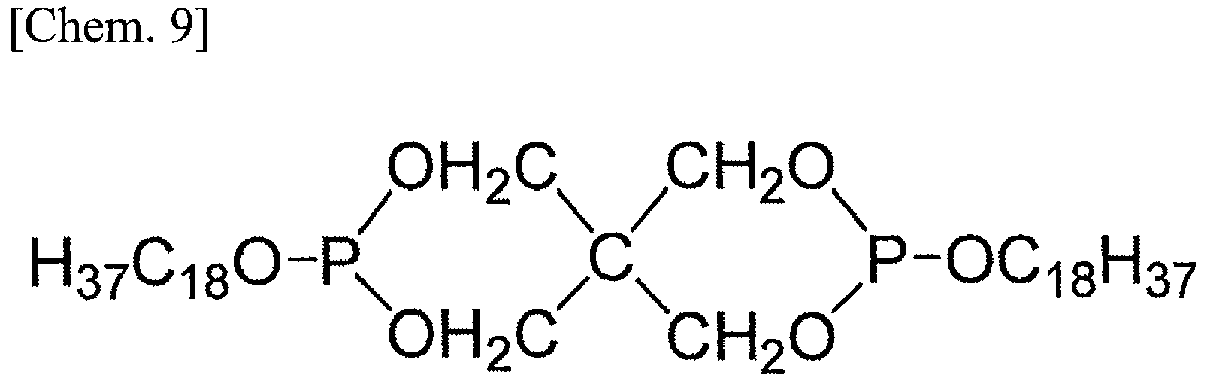
- Phosphite ester compound; "PEP-8" made by ADEKA CORPORATION; represented by the following chemical formula:
- Phosphite ester compound; "Doverphos S-9228PC" made by Dover Chemical Corporation; the above-mentioned compound (I-1-6):
- Phosphite ester compound; "PEP-36" made by ADEKA CORPORATION; the above-mentioned compound (1-1-1):
- Multi-walled carbon nanotube; "K-NANOS-100T" made by Kumho Petrochemical Co., Ltd. (average length: 26 µm, diameter: 8 to 15 nm):
- Baked polytetrafluoroethylene particles 4.5: "KTL-8N" made by Kitamura Limited (average particle diameter 4.5 µm):
- Polytetrafluoroethylene particles 30: "Fluon L169J-S" made by AGC Inc. (average particle diameter 30 µm) (unbaked product):
- Polytetrafluoroethylene particles 5.0: "LUBRON L-5" made by DAIKIN CORPORATION (average particle diameter 5 µm) (unbaked product):
- Polytetrafluoroethylene particles 2.0: "LUBRON L-2" made by DAIKIN CORPORATION (
- Alumina 3.0; spherical alumina, "DAW-03" made by Denka Company Limited (average particle diameter 3 µm):
- Silica 15; spherical silica, "FB-945" made by Denka Company Limited (average particle diameter 15 µm):
- Silica 10; spherical silica, "FB-12D" made by Denka Company Limited (average particle diameter 10 µm):
- Silica 5.0; spherical silica, "FB-5SDC" made by Denka Company Limited (average particle diameter 5 µm):
- Silica 0.5; spherical silica, "SC2500-SXJ" made by ADMATECHS Co., Ltd. (average particle diameter 0.5 µm):
- Silica 0.3; spherical silica, "SFP-20M" made by Denka Company Limited (average particle diameter 0.3 µm):
- Polycarbonate resin; "SD POLYCA 200-13" made by Sumika Polycarbonate Ltd. (limiting viscosity 0.50):
-
- Hindered phenol compound: "Irganox 1010" made by BASF SE; the above-mentioned compound (II-1-1):
- Release agent; "VPG-861" made by Emery Oleochemicals GmbH; fatty acid ester of saturated aliphatic polyol:
- Pigment; carbon black.
- Release agent; "VPG-861" made by Emery Oleochemicals GmbH; fatty acid ester of saturated aliphatic polyol:
- A resin composition was molded at a resin temperature of 340°C and a molding cycle of 30 seconds using an injection molding machine (made by TOSHIBA MACHINE CO., LTD., model number: EC100N II) to prepare a dumbbell test piece. Using the obtained test piece, measurement was performed in accordance with JIS K 7171. The strength was evaluated based on the flexural strength S by the following method.
- ⊙; 102 MPa ≤ S;
- ○; 92 MPa ≤ S < 102 MPa;
- △; 82 MPa ≤ S < 92 MPa; (no problem in practical use) and
- ×; S < 82 MPa.
- Using the test piece obtained in (1), measurement was performed at a load of 1.8 MPa in accordance with JIS K 7191-1 and K 7191-2. From the viewpoint of required heat resistance at the time of soldering, when the temperature of deflection under load is 148 °C or higher, it is within a practically acceptable range. The heat-resisting properties were evaluated based on the temperature of deflection under load by the following method.
- ⊙; 152°C or higher;
- ○: 150°C or higher and lower than 152°C;
- △: 148°C or higher and lower than 150°C; (no problem in practical use) and
- ×; Lower than 148°C
- Using the resin composition, a ring-shaped molded product having an outer diameter of 30 mm, an inner diameter of 26 mm, and a thickness of 2 mm was molded by injection molding (one side gate) at a resin temperature of 340°C and a molding cycle of 30 seconds. Thereafter, the inner diameter size was measured at multiple points with a high-precision two-dimensional measuring device (made by KEYENCE CORPORATION, model number: UM-8400) to determine an average inner diameter. Then, "-40°C × 1 hour" → "80°C × 1 hour" was defined as 1 cycle, and treatment was performed at a total of 30 cycles to determine a rate of change in the average inner diameter. Regarding this numerical value, a smaller value gave better dimensional stability, and when the value was within a range of ±0.10, it was determined that there was no practical problem in the dimensional stability. The dimensional stability was evaluated based on the rate of change by the following method.
- ⊙; ±0.06;
- ○; ±0.08;
- △; ±0.10; (no practical problem) and
- ×; Less than -0.1 or more than +0.1.
- A resin composition was molded at a resin temperature of 340°C and a molding cycle of 900 seconds using an injection molding machine (J35AD made by The Japan Steel Works, Ltd.) to prepare a test piece as shown in
FIG. 1 , and a drop rate of the limiting viscosity of the molded product was determined based on the following formula. Regarding this numerical value, a smaller value gave more excellent molding stability, and when the value was less than 10%, it was determined that there was no practical problem in the molding stability.
-
- ⊙; Less than 4%;
- ○; Less than 7%;
- △; Less than 10%; (no practical problem) and
- ×; 10% or more.
- A resin composition was molded at a resin temperature of 340°C and a molding cycle of 30 seconds using an injection molding machine (J35AD made by The Japan Steel Works, Ltd.) to prepare a test piece as shown in
FIG. 1 . The surface appearance of the obtained test piece was visually judged according to the following criteria. - ⊙: Silica particles do not float at all on the surface of the molded product and do not appear white, and the surface is completely smooth;
- ○: Silica particles slightly float on the surface of the molded product, but do not appear white, and the surface is smooth;
- △: Silica particles slightly float on the surface of the molded product, but only appear slightly white, and the surface is smooth (no practical problem); and
- ×: Silica particles float on the surface of the molded product and appear white, and the surface is not smooth.
- A resin composition was molded at a resin temperature of 340°C and a molding cycle of 30 seconds using an injection molding machine (J35AD made by The Japan Steel Works, Ltd.) to prepare a test piece as shown in
FIG. 1 . - Into a stainless steel container (inner diameter: 70 mm, height: 180 mm) were placed 100 test pieces, and the container was set in a shaker SA300 made by Yamato Scientific Co., Ltd., and vibration at 300 times/min was given thereto for 24 hours. After a lapse of 24 hours, a molded product was taken out from the container, and a dust generation rate was determined based on the following formula. Regarding this numerical value, a smaller value gave more excellent dust-generating resistance property, and when the value was less than 0.1%, it was determined that there was no practical problem in the dust-generating resistance property. A total mass of the 100 test pieces after the test is the mass after dust and the like attached to the surfaces are removed by air cleaning.

-
- ⊙; Less than 0.04%;
- ○; Less than 0.07%;
- △: Less than 0.10% (no problem in practical use); and
- ×; 0.10% or more.
- A resin composition was molded at a resin temperature of 340°C and a molding cycle of 30 seconds using an injection molding machine (made by TOSHIBA MACHINE CO., LTD., model number: EC100N II) to prepare a plate-shaped test piece (70 mm in length × 40 mm in width × 2 mmt in thickness).
- A dynamic friction coefficient was measured in accordance with JIS K 7218 A method using a Suzuki type continuous friction wear tester (model No. 283-S-PC made by YASUDA SEIKI SEISAKUSHO, LTD.) under conditions including a speed of 0.1 m/s and a load of 0.5 MPa. A sliding partner material (S45C ring, outer diameter ϕ 25.6 mm, inner diameter ϕ 20 mm, length 15 mm) was rotated with respect to the plate-shaped test piece. A dynamic friction coefficient of 0.3 or less was judged as "no problem in practical use".
-
- ⊙; 0.23 or less;
- ○; 0.27 or less;
- △; 0.30 or less (no problem in practical use) and
- ×; More than 0.30.
- A resin composition was molded at a resin temperature of 340°C and a molding cycle of 30 seconds using an injection molding machine (made by TOSHIBA MACHINE CO., LTD., model number: EC100N II) to prepare a disk test piece. A surface resistivity of the obtained test piece was measured using a digital ultra-high resistance/micro ammeter (R8340A made by Advantest Corporation). A surface resistivity of 1011 Ω or less was defined as having antistatic performance. In order to suppress adhesion of dust on a molded body, the surface resistivity is preferably 1011 Ω or less.
-
- ⊙; 109 Ω or less;
- ○; 1010 Ω or less;
- △; 1011 Ω or less; and
- ×; More than 1011 Ω.
- Raw materials were melt-kneaded at a barrel temperature of 320°C and at a blending ratio shown in Tables 1 to 4 using a corotating twin screw extruder (made by TOSHIBA MACHINE CO., LTD., model number: TEM-37BS). A resin composition drawn in a strand form from a nozzle was cooled and solidified by soaking in a water bath, and after cutting with a pelletizer, the cut pieces of the resin composition were dried by hot air at 120°C for 12 hours to obtain a resin composition (pellet).
- The compositions of the resin compositions obtained in Examples and Comparative Examples and the evaluation results thereof are shown in Tables 1 to 4.


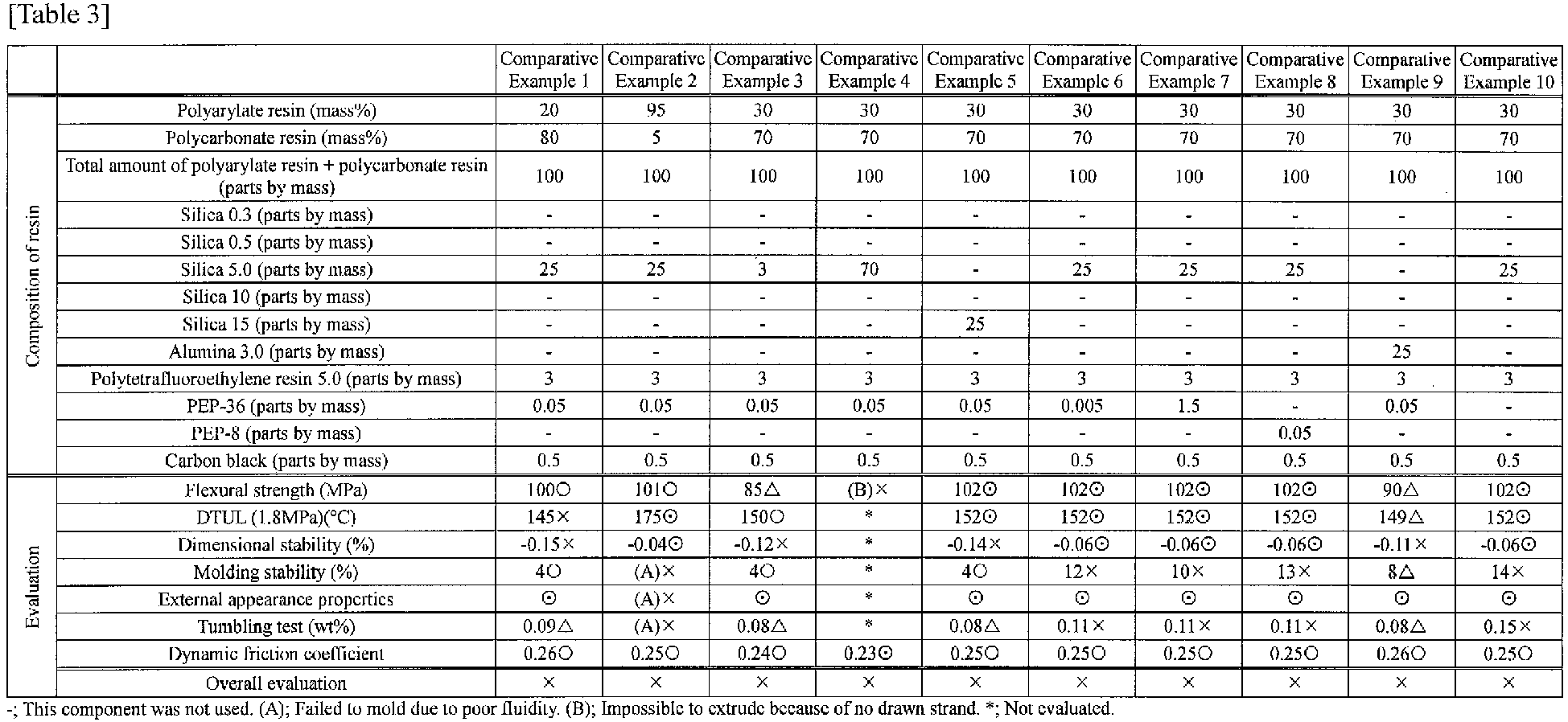

- All of the resin compositions of Example 1 to 19 were excellent in the dust-generating resistance property, the sliding properties, and the external appearance properties while being excellent in the strength, the heat-resisting properties, the dimensional stability, and the molding stability.
- The resin compositions of Examples 13 to 18 were further excellent in antistatic performance.
- In the resin composition of Comparative Example 1, with respect to the mass ratio of the polyarylate resin and the polycarbonate resin, since the ratio of the polyarylate resin was too low, the heat-resisting properties and the dimensional stability were deteriorated.
- In the resin composition of Comparative Example 2, with respect to the mass ratio of the polyarylate resin and the polycarbonate resin, since the ratio of the polyarylate resin was too high, the fluidity was poor, failing to mold the resin composition.
- In the resin composition of Comparative Example 3, since the content of silica particles was too small, the dimensional stability was deteriorated.
- In the resin composition of Comparative Example 4, since the content of silica particles was too large, pelletization by extrusion during melt-kneading became difficult.
- In the resin composition of Comparative Example 5, since the average particle diameter of silica particles was too large, the dimensional stability was deteriorated.
- In the resin compositions of Comparative Examples 6 and 7, since the content of the specific phosphite ester compound was too small or too large, the molding stability and the dust-generating resistance property were deteriorated.
- In the resin composition of Comparative Example 8, since the phosphite ester compound different in kind from the specific phosphite ester compound was used, the molding stability and the dust-generating resistance property were deteriorated.
- In the resin composition of Comparative Example 9, since alumina particles were contained instead of silica particles, the dimensional stability was deteriorated.
- In the resin compositions of Comparative Examples 10 and 14, since the specific phosphite ester compound was not contained, the molding stability and the dust-generating resistance property were deteriorated.
- In the resin composition of Comparative Example 11, since the fluorine atom-containing polymer particles were not used, the dust-generating resistance property and the sliding properties were deteriorated.
- In the resin composition of Comparative Example 12, since the content of the fluorine atom-containing polymer particles was too large, the molding stability was deteriorated.
- In the resin composition of Comparative Example 13, since the average particle diameter of the fluorine atom-containing polymer particles was too large, the molding stability was deteriorated.
- The resin composition of the present invention is useful for molding a camera module component, a lens unit component, and an actuator component used in a mobile phone, a game machine, a personal computer, an in-vehicle camera, a mobile phone terminal, and the like.
Claims (13)
- A resin composition comprising a polyarylate resin, a polycarbonate resin, silica particles having an average particle diameter of 0.4 to 12 µm, fluorine atom-containing polymer particles having an average particle diameter of 0.5 to 20 µm, and a phosphite ester compound represented by a general formula (I),wherein a mass ratio of the polyarylate resin and the polycarbonate resin is 25/75 to 92/8,a content of the silica particles is 4 to 65 parts by mass with respect to 100 parts by mass of a total amount of the polyarylate resin and the polycarbonate resin,a content of the fluorine atom-containing polymer particles is 0.5 to 12 parts by mass with respect to 100 parts by mass of a total amount of the polyarylate resin and the polycarbonate resin, anda content of the phosphite ester compound is 0.008 to 1.2 parts by mass with respect to 100 parts by mass of a total amount of the polyarylate resin and the polycarbonate resin:
 (wherein m1 and m2 are each independently an integer of 0 to 5;R1 and R2 each independently represent an alkyl group having 1 to 12 carbon atoms, which may have a substituent; andfour R3s each independently represent an alkylene group having 1 to 5 carbon atoms).
 - The resin composition of Claim 1, wherein the resin composition further comprises carbon nanotubes in an amount of 0.5 to 15 parts by mass with respect to 100 parts by mass of a total amount of the polyarylate resin and the polycarbonate resin.
- The resin composition of Claim 1 or 2, wherein the phosphite ester compound is a compound represented by a general formula (I-1):

- The resin composition of any of Claims 1 to 3, wherein the resin composition further comprises a hindered phenol compound represented by a general formula (II) in an amount of 0.01 to 1 part by mass with respect to 100 parts by mass of a total amount of the polyarylate resin and the polycarbonate resin:
 n is an integer of 1 or more determined according to X;R21 and R22 each independently represent a hydrogen atom or an alkyl group having 1 to 9 carbon atoms; andR23 and R24 each independently represent an alkylene group having 1 to 5 carbon atoms).
 - The resin composition of any of Claims 1 to 4, wherein the fluorine atom-containing polymer particles are unbaked fluorine atom-containing polymer particles.
- The resin composition of any of Claims 1 to 5, wherein the content of the silica particles is 4 to 50 parts by mass with respect to 100 parts by mass of a total amount of the polyarylate resin and the polycarbonate resin.
- The resin composition of any of Claims 1 to 4, whereinthe content of the silica particles is 8 to 62 parts by mass with respect to 100 parts by mass of a total amount of the polyarylate resin and the polycarbonate resin,the silica particles have an average particle diameter of 2 to 12 µm, andthe fluorine atom-containing polymer particles are unbaked fluorine atom-containing polymer particles.
- The resin composition of Claim 7, whereinthe mass ratio of the polyarylate resin and the polycarbonate resin is 25/75 to 70/30,the content of the silica particles is 8 to 50 parts by mass with respect to 100 parts by mass of a total amount of the polyarylate resin and the polycarbonate resin,the silica particles have an average particle diameter of 2 to 8 µm,the content of the phosphite ester compound is 0.03 to 0.5 parts by mass with respect to 100 parts by mass of a total amount of the polyarylate resin and the polycarbonate resin, andin the phosphite ester compound, the m1 and the m2 are each independently an integer of 1 to 3, the R1 and the R2 each independently represent an alkyl group having 1 to 12 carbon atoms and no substituent, and the four R3s each independently represent an alkylene group having 1 to 3 carbon atoms.
- The resin composition of any of Claims 1 to 8, wherein the fluorine atom-containing polymer is at least one kind of polymer selected from a group consisting of polytetrafluoroethylene, polyvinylidene fluoride, tetrafluoroethylene-perfluoromethyl vinyl ether copolymer, tetrafluoroethylene-hexafluoropropylene copolymer, and tetrafluoroethylene-ethylene copolymer.
- A molded product comprising the resin composition of any of Claims 1 to 9.
- The molded product of Claim 10, wherein the molded product is a camera module component.
- The molded product of Claim 10, wherein the molded product is a lens unit component.
- The molded product of Claim 10, wherein the molded product is an actuator component.
Applications Claiming Priority (2)
| Application Number | Priority Date | Filing Date | Title |
|---|---|---|---|
| JP2019189405 | 2019-10-16 | ||
| PCT/JP2020/038504 WO2021075405A1 (en) | 2019-10-16 | 2020-10-12 | Resin composition and molded article |
Publications (2)
| Publication Number | Publication Date |
|---|---|
| EP4047046A1 true EP4047046A1 (en) | 2022-08-24 |
| EP4047046A4 EP4047046A4 (en) | 2022-12-21 |
Family
ID=75538513
Family Applications (1)
| Application Number | Title | Priority Date | Filing Date |
|---|---|---|---|
| EP20877112.1A Withdrawn EP4047046A4 (en) | 2019-10-16 | 2020-10-12 | Resin composition and molded article |
Country Status (7)
| Country | Link |
|---|---|
| US (1) | US20240026151A1 (en) |
| EP (1) | EP4047046A4 (en) |
| JP (1) | JP7653710B2 (en) |
| KR (1) | KR20220084270A (en) |
| CN (1) | CN114555706B (en) |
| TW (1) | TWI850479B (en) |
| WO (1) | WO2021075405A1 (en) |
Family Cites Families (11)
| Publication number | Priority date | Publication date | Assignee | Title |
|---|---|---|---|---|
| JPH1087982A (en) * | 1996-09-09 | 1998-04-07 | Nippon G Ii Plast Kk | Molded article of aromatic polycarbonate excellent in noise and vibration suppressing property |
| WO2002081561A1 (en) * | 2001-04-04 | 2002-10-17 | Kaneka Corporation | Thermoplastic resin composition and elastomer composition |
| JP3898584B2 (en) * | 2002-07-03 | 2007-03-28 | ダイセル・デグサ株式会社 | Resin composition, composite using the same, and method for producing the same |
| JP4599211B2 (en) * | 2005-04-13 | 2010-12-15 | 出光興産株式会社 | Thermoplastic resin composition, process for producing the same, and molded article thereof |
| JP2007196516A (en) * | 2006-01-26 | 2007-08-09 | Unitika Ltd | Method for producing polyarylate resin composition |
| JP2008050488A (en) | 2006-08-25 | 2008-03-06 | Unitika Ltd | Resin composition and molded product obtained by molding the same |
| JP5057513B2 (en) * | 2007-09-06 | 2012-10-24 | 大日精化工業株式会社 | Carbon nanotube resin composition, carbon nanotube dispersion composition, method of using them, and article using them |
| JP5252713B2 (en) * | 2008-12-26 | 2013-07-31 | 旭化成ケミカルズ株式会社 | Molded body of aromatic polycarbonate resin composition |
| JP6275077B2 (en) * | 2014-12-08 | 2018-02-07 | 三菱エンジニアリングプラスチックス株式会社 | Polycarbonate resin composition |
| JP6761806B2 (en) * | 2015-08-31 | 2020-09-30 | 三菱瓦斯化学株式会社 | Flame-retardant polycarbonate resin composition, sheets and films using the same, and methods for producing them. |
| EP3467031B8 (en) * | 2016-05-24 | 2023-02-22 | Unitika Ltd. | Resin composition and molded article |
-
2020
- 2020-10-12 KR KR1020227004971A patent/KR20220084270A/en active Pending
- 2020-10-12 EP EP20877112.1A patent/EP4047046A4/en not_active Withdrawn
- 2020-10-12 CN CN202080072085.8A patent/CN114555706B/en active Active
- 2020-10-12 TW TW109135137A patent/TWI850479B/en active
- 2020-10-12 JP JP2021552379A patent/JP7653710B2/en active Active
- 2020-10-12 WO PCT/JP2020/038504 patent/WO2021075405A1/en not_active Ceased
- 2020-10-12 US US17/768,811 patent/US20240026151A1/en not_active Abandoned
Also Published As
| Publication number | Publication date |
|---|---|
| EP4047046A4 (en) | 2022-12-21 |
| KR20220084270A (en) | 2022-06-21 |
| JPWO2021075405A1 (en) | 2021-04-22 |
| WO2021075405A1 (en) | 2021-04-22 |
| US20240026151A1 (en) | 2024-01-25 |
| TWI850479B (en) | 2024-08-01 |
| JP7653710B2 (en) | 2025-03-31 |
| CN114555706B (en) | 2023-12-01 |
| CN114555706A (en) | 2022-05-27 |
| TW202122488A (en) | 2021-06-16 |
Similar Documents
| Publication | Publication Date | Title |
|---|---|---|
| JP5296622B2 (en) | Molded product comprising conductive resin composition | |
| CN109071932B (en) | Resin composition and molded article | |
| JP5592126B2 (en) | Molded product comprising conductive resin composition | |
| EP2149590B1 (en) | Sliding resin composition and molded article thereof | |
| US20220204757A1 (en) | Polycarbonate resin composition | |
| JP5679635B2 (en) | Molded product comprising conductive resin composition | |
| JP7653710B2 (en) | Resin composition and molded article | |
| JP5276765B2 (en) | Aromatic polycarbonate resin composition and molded article using the same | |
| JP5246646B2 (en) | Resin composition and molded product formed by molding the same | |
| US20240240014A1 (en) | Resin composition and molded body | |
| JP2008050488A (en) | Resin composition and molded product obtained by molding the same | |
| JP5050408B2 (en) | Resin modifier and thermoplastic resin mixture containing the same. | |
| WO2024004603A1 (en) | Thermoplastic resin composition, and molded product | |
| WO2026014469A1 (en) | Liquid crystal polyester composition and molded body | |
| JP5673408B2 (en) | Aromatic polycarbonate resin composition and molded article comprising the same | |
| JP2025167634A (en) | Resin composition, pellets, and molded products | |
| JP2025008470A (en) | Resin composition, pellets, and molded products | |
| HK1120536B (en) | Resin composition and molded article obtained by molding same | |
| JP2009263573A (en) | Antistatic resin composition and precision part formed by molding the same |
Legal Events
| Date | Code | Title | Description |
|---|---|---|---|
| STAA | Information on the status of an ep patent application or granted ep patent |
Free format text: STATUS: THE INTERNATIONAL PUBLICATION HAS BEEN MADE |
|
| PUAI | Public reference made under article 153(3) epc to a published international application that has entered the european phase |
Free format text: ORIGINAL CODE: 0009012 |
|
| STAA | Information on the status of an ep patent application or granted ep patent |
Free format text: STATUS: REQUEST FOR EXAMINATION WAS MADE |
|
| 17P | Request for examination filed |
Effective date: 20220511 |
|
| AK | Designated contracting states |
Kind code of ref document: A1 Designated state(s): AL AT BE BG CH CY CZ DE DK EE ES FI FR GB GR HR HU IE IS IT LI LT LU LV MC MK MT NL NO PL PT RO RS SE SI SK SM TR |
|
| A4 | Supplementary search report drawn up and despatched |
Effective date: 20221117 |
|
| RIC1 | Information provided on ipc code assigned before grant |
Ipc: C08K 3/36 20060101ALI20221114BHEP Ipc: C08K 3/04 20060101ALI20221114BHEP Ipc: C08L 69/00 20060101ALI20221114BHEP Ipc: C08L 67/03 20060101ALI20221114BHEP Ipc: C08L 27/12 20060101ALI20221114BHEP Ipc: C08K 5/526 20060101AFI20221114BHEP |
|
| DAV | Request for validation of the european patent (deleted) | ||
| DAX | Request for extension of the european patent (deleted) | ||
| STAA | Information on the status of an ep patent application or granted ep patent |
Free format text: STATUS: THE APPLICATION HAS BEEN WITHDRAWN |
|
| 18W | Application withdrawn |
Effective date: 20230721 |