EP4045040B1 - Nitrogen containing bicyclic compounds - Google Patents
Nitrogen containing bicyclic compounds Download PDFInfo
- Publication number
- EP4045040B1 EP4045040B1 EP20799842.8A EP20799842A EP4045040B1 EP 4045040 B1 EP4045040 B1 EP 4045040B1 EP 20799842 A EP20799842 A EP 20799842A EP 4045040 B1 EP4045040 B1 EP 4045040B1
- Authority
- EP
- European Patent Office
- Prior art keywords
- pyrrolidin
- octane
- diazabicyclo
- oxo
- sulfooxy
- Prior art date
- Legal status (The legal status is an assumption and is not a legal conclusion. Google has not performed a legal analysis and makes no representation as to the accuracy of the status listed.)
- Active
Links
Classifications
-
- C—CHEMISTRY; METALLURGY
- C07—ORGANIC CHEMISTRY
- C07D—HETEROCYCLIC COMPOUNDS
- C07D471/00—Heterocyclic compounds containing nitrogen atoms as the only ring hetero atoms in the condensed system, at least one ring being a six-membered ring with one nitrogen atom, not provided for by groups C07D451/00 - C07D463/00
- C07D471/02—Heterocyclic compounds containing nitrogen atoms as the only ring hetero atoms in the condensed system, at least one ring being a six-membered ring with one nitrogen atom, not provided for by groups C07D451/00 - C07D463/00 in which the condensed system contains two hetero rings
- C07D471/08—Bridged systems
-
- A—HUMAN NECESSITIES
- A61—MEDICAL OR VETERINARY SCIENCE; HYGIENE
- A61K—PREPARATIONS FOR MEDICAL, DENTAL OR TOILETRY PURPOSES
- A61K31/00—Medicinal preparations containing organic active ingredients
- A61K31/33—Heterocyclic compounds
- A61K31/395—Heterocyclic compounds having nitrogen as a ring hetero atom, e.g. guanethidine or rifamycins
- A61K31/435—Heterocyclic compounds having nitrogen as a ring hetero atom, e.g. guanethidine or rifamycins having six-membered rings with one nitrogen as the only ring hetero atom
- A61K31/439—Heterocyclic compounds having nitrogen as a ring hetero atom, e.g. guanethidine or rifamycins having six-membered rings with one nitrogen as the only ring hetero atom the ring forming part of a bridged ring system, e.g. quinuclidine
-
- A—HUMAN NECESSITIES
- A61—MEDICAL OR VETERINARY SCIENCE; HYGIENE
- A61K—PREPARATIONS FOR MEDICAL, DENTAL OR TOILETRY PURPOSES
- A61K31/00—Medicinal preparations containing organic active ingredients
- A61K31/33—Heterocyclic compounds
- A61K31/395—Heterocyclic compounds having nitrogen as a ring hetero atom, e.g. guanethidine or rifamycins
- A61K31/54—Heterocyclic compounds having nitrogen as a ring hetero atom, e.g. guanethidine or rifamycins having six-membered rings with at least one nitrogen and one sulfur as the ring hetero atoms, e.g. sulthiame
- A61K31/542—Heterocyclic compounds having nitrogen as a ring hetero atom, e.g. guanethidine or rifamycins having six-membered rings with at least one nitrogen and one sulfur as the ring hetero atoms, e.g. sulthiame ortho- or peri-condensed with heterocyclic ring systems
- A61K31/545—Compounds containing 5-thia-1-azabicyclo [4.2.0] octane ring systems, i.e. compounds containing a ring system of the formula:, e.g. cephalosporins, cefaclor, or cephalexine
- A61K31/546—Compounds containing 5-thia-1-azabicyclo [4.2.0] octane ring systems, i.e. compounds containing a ring system of the formula:, e.g. cephalosporins, cefaclor, or cephalexine containing further heterocyclic rings, e.g. cephalothin
-
- A—HUMAN NECESSITIES
- A61—MEDICAL OR VETERINARY SCIENCE; HYGIENE
- A61P—SPECIFIC THERAPEUTIC ACTIVITY OF CHEMICAL COMPOUNDS OR MEDICINAL PREPARATIONS
- A61P31/00—Antiinfectives, i.e. antibiotics, antiseptics, chemotherapeutics
- A61P31/04—Antibacterial agents
Definitions
- the invention relates to nitrogen containing bicyclic compounds, their preparation and their use in treating and/or preventing bacterial infections.
- WO2014/033560A1 WO2018/158619A1 and WO2017/098425A1 concern 1,6-diazabicyclo[3.2.1]octane-2-carboxamide derivatives for use in the treatment or prevention of bacterial infections.
- nitrogen containing bicyclic compounds and pharmaceutical compositions comprising these compounds.
- Methods for the preparation of these compounds are described.
- the compounds and pharmaceutical compositions comprising these compounds for use in the treatment and/or prevention of a bacterial infection in a subject are provided.
- compositions comprising a compound of Formula (I), or a stereoisomer or a pharmaceutically acceptable salt thereof.
- a compound of Formula (I) or a stereoisomer or a pharmaceutically acceptable salt thereof for use in the treatment or prevention of a bacterial infection in a subject, said method comprising administering to said subject the compound of Formula (I) or the stereoisomer or the pharmaceutically acceptable salt thereof.
- a pharmaceutical composition comprising a compound of Formula (I) or a stereoisomer or a pharmaceutically acceptable salt thereof for use in the treatment or prevention of a bacterial infection in a subject, said method comprising administering to said subject the pharmaceutical composition comprising the compound of Formula (I) or the stereoisomer or the pharmaceutically acceptable salt thereof.
- compositions comprising: (a) a compound of Formula (I), or a stereoisomer or a pharmaceutically acceptable salt thereof, and (b) at least one antibacterial agent or a pharmaceutically acceptable salt thereof.
- the inventors have surprisingly discovered certain nitrogen containing bicyclic compounds having antibacterial properties.
- C 1 -C 6 alkyl refers to branched or unbranched acyclic hydrocarbon radical with 1 to 6 carbon atoms.
- Typical examples of “C 1 -C 6 alkyl” include methyl, ethyl, n-propyl, iso-propyl, n-butyl, iso-butyl, tert-butyl, n-pentyl, isopentyl and n-hexyl.
- the "C 1 -C 6 alkyl” may be unsubstituted, or substituted with one or more substituents.
- cycloalkyl refers to three to seven member cyclic hydrocarbon radicals.
- the cycloalkyl group optionally incorporates one or more double or triple bonds, or a combination of double bonds and triple bonds, but which is not aromatic.
- Typical examples of cycloalkyl groups include cyclopropane, cyclobutane, cyclopentane, cyclohexane and cycloheptane.
- the cycloalkyl may be unsubstituted, or substituted with one or more substituents.
- heterocycloalkyl refers to four to seven member cycloalkyl group containing one or more heteroatoms selected from nitrogen, oxygen or sulfur.
- the heterocycloalkyl group optionally incorporates one or more double or triple bonds, or a combination of double bonds and triple bonds, but which is not aromatic.
- Typical examples of heterocycloalkyl groups include azetidine, pyrrolidine, 2-oxopyrrolidine, imidazolidin-2-one, piperidine, oxazine, thiazine, piperazine, morpholine, thiomorpholine, azapane and piperazin-2,3-dione.
- the heterocycloalkyl may be unsubstituted, or substituted with one or more substituents.
- substituents include C 1 -C 6 alkyl, halogen, CN, COOH, CONH 2 , OH, -NH 2 , -NHCOCH 3 , cycloalkyl, heterocycloalkyl, heteroaryl, aryl, urea, thiourea, guanidine, keto, oxime, O-alkyl, O-aryl, N-alkyl, N-aryl, SO-alkyl, SO-aryl, S-alkyl, S-aryl, SO 2 -alkyl, SO 2 -aryl, OSO 2 -alkyl, OSO 2 -aryl, COO-alkyl, COO-aryl, CON-alkyl, CON-aryl, NHCO-alkyl, NHCO-aryl, NHCON-alkyl, NHCON-aryl, NHCSN-
- aryl refers to a monocyclic or polycyclic aromatic hydrocarbon. Typical examples of aryl groups include phenyl, naphthyl, anthracenyl, fluorenyl and phenanthrenyl. The aryl group may be unsubstituted, or substituted with one or more substituents.
- heteroaryl refers to a monocyclic or polycyclic aromatic hydrocarbon group wherein one or more carbon atoms have been replaced with heteroatoms selected from nitrogen, oxygen and sulfur. If the heteroaryl group contains more than one heteroatom, the heteroatoms may be the same or different.
- heteroaryl groups include 1,2,4-oxadiazol, 1,3,4-oxadiazol, 1,3,4-thiadiazol, 1,2,3-triazol, 1,2,3,4-tetrazol, 1,3-oxazol, 1,3-thiazole, pyridine, pyrimidine, pyrazine, pyridazine, furan, pyrrol, thiophene, imidazole, pyrazole, benzofuran, benzothiophene, benzimidazole, benzoxazole, benzothiazole and thiazole.
- the heteroaryl group may be unsubstituted, or substituted with one or more substituents.
- stereoisomers refers to and includes compounds that have identical chemical constitution, but differ with regard to the arrangement of their atoms or groups in space.
- the compounds of Formula (I) contain asymmetric or chiral centres (including those marked with “*") and, therefore, exist in different stereoisomeric forms. It is intended, unless specified otherwise, that all stereoisomeric forms of the compounds of Formula (I) as well as mixtures thereof, including racemic mixtures, form part of the present invention.
- all geometric and positional isomers including cis and trans-forms as well as mixtures thereof, are also embraced within the scope of the invention.
- a reference to a compound is intended to cover its stereoisomers and a mixture of various stereoisomers.
- substitution is optional and therefore includes both unsubstituted and substituted atoms and moieties.
- a "substituted" atom or moiety indicates that any hydrogen on the designated atom or moiety can be replaced with a selection from the indicated substituent group, provided that the normal valence of the designated atom or moiety is not exceeded, and that the substitution results in a stable compound.
- pharmaceutically acceptable salt refers to one or more salts of a given compound which possesses the desired pharmacological activity of the free compound and which are neither biologically nor otherwise undesirable.
- pharmaceutically acceptable salts refer to and include those salts that are suitable for use in contact with the tissues of human and animals without undue toxicity, irritation, allergic response and the like, and are commensurate with a reasonable benefit/risk ratio.
- Pharmaceutically acceptable salts are well known in the art. For example, S. M. Berge, et al. (J. Pharmaceutical Sciences, 66: 1-19 (1977 )) describes various pharmaceutically acceptable salts in details.
- the compounds according to the invention contain basic (e.g. nitrogen atoms) as well as acid moieties (e.g. SO 3 H group).
- acidic salts formed with inorganic and/or organic acids
- basic salts formed with inorganic and/or organic bases.
- Such salts can be prepared using procedures described in the art.
- the basic moiety can be converted to its salt by treating a compound with a suitable amount of acid.
- suitable acids include hydrochloric acid, trifluoroacetic acid and methanesulphonic acid.
- the acid moiety may be converted into its salt by treating with a suitable base.
- Typical examples of such bases include sodium carbonate, sodium bicarbonate, potassium carbonate and potassium bicarbonate.
- each such functional group may be converted to a salt independently.
- one of the basic nitrogen can form salt with one acid while the other basic nitrogen can form salt with another acid.
- the compounds according to the invention contain both, acidic as well as basic moieties, and thus can form inner salts or corresponding zwitterions.
- infection or "bacterial infection” as used herein refers to and includes presence of bacteria, in or on a subject, which, if its growth were inhibited, would result in a benefit to the subject.
- infection in addition to referring to the presence of bacteria also refers to normal flora, which is not desirable.
- infection includes infection caused by bacteria.
- treat refers to administering a medicament, including a pharmaceutical composition, or one or more pharmaceutically active ingredients, for prophylactic and/or therapeutic purposes.
- prophylactic treatment refers to treating a subject who is not yet infected, but who is susceptible to, or otherwise at a risk of infection (preventing the bacterial infection).
- therapeutic treatment refers to administering treatment to a subject already suffering from infection.
- treat also refer to administering compositions or one or more of pharmaceutically active ingredients discussed herein, with or without additional pharmaceutically active or inert ingredients, in order to: (i) reduce or eliminate either a bacterial infection or one or more symptoms of the bacterial infection, or (ii) retard the progression of a bacterial infection or of one or more symptoms of the bacterial infection, or (iii) reduce the severity of a bacterial infection or of one or more symptoms of the bacterial infection, or (iv) suppress the clinical manifestation of a bacterial infection, or (v) suppress the manifestation of adverse symptoms of the bacterial infection.
- a therapeutically or pharmaceutically effective amount of an antibacterial agent or a pharmaceutical composition is the amount of the antibacterial agent or the pharmaceutical composition required to produce a desired therapeutic effect as may be judged by clinical trial results, model animal infection studies, and/or in vitro studies (e.g. in agar or broth media).
- the pharmaceutically effective amount depends on several factors, including but not limited to, the microorganism (e.g.
- a therapeutically or prophylactically effective amount is that amount which would be effective in preventing a microbial (e.g. bacterial) infection.
- the compounds and/or pharmaceutical compositions according to the invention are used in amounts that are effective in providing the desired therapeutic effect or result.
- administration includes delivery of a composition or one or more pharmaceutically active ingredients to a subject, including for example, by any appropriate methods, which serves to deliver the composition or its active ingredients or other pharmaceutically active ingredients to the site of the infection.
- the method of administration may vary depending on various factors, such as for example, the components of the pharmaceutical composition or the nature of the pharmaceutically active or inert ingredients, the site of the potential or actual infection, the microorganism involved, severity of the infection, age and physical condition of the subject and a like.
- Some examples of ways to administer a composition or a pharmaceutically active ingredient to a subject according to this invention include oral, intravenous, topical, intra-respiratory, intra-peritoneal, intra-muscular, parenteral, sublingual, transdermal, intranasal, aerosol, intra-ocular, intra-tracheal, intra-rectal, vaginal, gene gun, dermal patch, eye drop, ear drop or mouthwash.
- a pharmaceutical composition comprising more than one ingredient (active or inert)
- one of way of administering such composition is by admixing the ingredients (e.g. in the form of a suitable unit dosage form such as tablet, capsule, solution, powder and a like) and then administering the dosage form.
- the ingredients may also be administered separately (simultaneously or one after the other) as long as these ingredients reach beneficial therapeutic levels such that the composition as a whole provides a synergistic and/or the desired effect.
- growth refers to a growth of one or more microorganisms and includes reproduction or population expansion of the microorganism (e.g. bacteria).
- growth also includes maintenance of ongoing metabolic processes of a microorganism (e.g. bacteria), including processes that keep the microorganism alive.
- an antibacterial agent refers to the ability of the composition or the antibacterial agent to treat or prevent the microbial (e.g. bacterial) infection in a subject.
- antibacterial agent refers to any substance, compound or a combination of substances or a combination compounds capable of (i) inhibiting, reducing or preventing growth of bacteria; (ii) inhibiting or reducing ability of a bacteria to produce infection in a subject; or (iii) inhibiting or reducing ability of bacteria to multiply or remain infective in the environment.
- antibacterial agent also refers to compounds capable of decreasing infectivity or virulence of bacteria.
- beta-lactam antibacterial agent refers to compounds with antibacterial properties and containing a beta-lactam nucleus in their molecular structure.
- beta-lactamase refers to any enzyme or protein or any other substance that breaks down a beta-lactam ring.
- beta-lactamase includes enzymes that are produced by bacteria and have the ability to hydrolyse the beta-lactam ring in a beta-lactam compound, either partially or completely.
- beta-lactamase inhibitor refers to a compound capable of inhibiting activity of one or more beta-lactamase enzymes, either partially or completely.
- pharmaceutically inert ingredient or “carrier” or “excipient” refers to a compound or material used to facilitate administration of a compound, including for example, to increase the solubility of the compound.
- solid carriers include, starch, lactose, dicalcium phosphate, sucrose and kaolin.
- liquid carriers include sterile water, saline, buffers, non-ionic surfactants, and edible oils such as oil, peanut and sesame oils.
- various adjuvants commonly used in the art may be included. These and other such compounds are described in the literature, for example, in the Merck Index (Merck & Company, Rahway, N.J.). Considerations for inclusion of various components in pharmaceutical compositions are described, for example, in Gilman et al. (Eds.) (1990); Goodman and Gilman's: The Pharmacological Basis of Therapeutics, 8th Ed., Pergamon Press ..
- subject refers to a vertebrate or invertebrate, including a mammal.
- subject includes human, animal, a bird, a fish, or an amphibian. Typical examples of a “subject” include humans, cats, dogs, horses, sheep, bovine cows, pigs, lambs, rats, mice and guinea pigs.
- pharmaceutically acceptable derivative refers to and includes any pharmaceutically acceptable salt, pro-drugs, metabolites, esters, ethers, hydrates, polymorphs, solvates, complexes, enantiomers or adducts of a compound described herein which, upon administration to a subject, is capable of providing (directly or indirectly) the parent compound.
- antibacterial agent or a pharmaceutically acceptable derivative thereof includes all derivatives of the antibacterial agent (such as salt, pro-drugs, metabolites, esters, ethers, hydrates, polymorphs, solvates, complexes, enantiomers or adducts) which, upon administration to a subject, are capable of providing (directly or indirectly) the antibacterial compound.
- Typical examples of compounds according to the invention include:
- typical examples of compounds according to the invention include:
- the compounds of the invention can be prepared according to the general procedure given in Scheme 1 and Scheme 2. Individual stereoisomers can be prepared using appropriate starting materials and reagents. A person of skills in the art would appreciate that the described methods can be varied and/or optimized further to provide the desired and related compounds.
- a compound of Formula (XII) is reacted with a sodium salt of (2S, 5R)-6-benzyloxy-7-oxo-1,6-diaza-bicyclo [3.2.1] octane-2-carboxylic acid (XIII) to obtain a compound of Formula (XIV).
- the compound of Formula (XIV) is then converted into a compound of Formula (XV) in the presence of a suitable debenzylating agent.
- suitable debenzylating agents include hydrogen gas in the presence of a transition metal catalyst such as palladium on carbon.
- the compound of Formula (XV) is converted into a compound of Formula (XVI) in the presence of a suitable sulfonating agent.
- Typical examples of suitable sulfonating agents include sulfur trioxide dimethylformamide complex.
- the sulfonation reaction is followed by treatment with tetrabutylammonium acetate to obtain a compound of Formula (XVI).
- the compound of Formula (XVI) is converted into a compound of Formula (I) in the presence of a suitable de-protecting agent.
- suitable de-protecting agents include trifluoroacetic acid.
- intermediate compound (XVI) More specifically some compounds according to the invention were isolated as zwitterions, by treating intermediate compound (XVI) with trifluoroacetic acid, in a suitable solvent (such as dichloromethane, chloroform, or acetonitrile) at a temperature ranging from about -10°C to -15°C for about 1 to 14 hours, especially when A in intermediate compound (XVI) contained tert-butoxycarbonyl protected amine function.
- a suitable solvent such as dichloromethane, chloroform, or acetonitrile
- Some compounds according to the invention were isolated as zwitterions, by treating intermediate compound (XVI) with tetrabutyl ammonium fluoride followed by trifluoroacetic acid, in a suitable solvent, especially when A in intermediate compound (XVI) contained tert-butyldimethylsilyl (TBDMS) protected hydroxy function and tert-butoxycarbonyl (BOC) protected amine function.
- TDMS tert-butyldimethylsilyl
- BOC tert-butoxycarbonyl
- compositions comprising a compound of Formula (I), or a stereoisomer or a pharmaceutically acceptable salt thereof.
- compositions comprising a compound which is (2S,5R)-N- ⁇ [(2S,4R)-4-methylpyrrolidin-2-yl]methyloxy ⁇ -7-oxo-6-(sulfooxy)-1,6-diazabicyclo[3.2.1]octane-2-carboxamide, or a stereoisomer or a pharmaceutically acceptable salt thereof.
- compositions comprising a compound which is (2 S ,5 R )-N- ⁇ [(2 S ,4 S )-4-Methyl-pyrrolidin-2-yl]methyloxy ⁇ -7-oxo-6-(sulfooxy)-1,6-diazabicyclo[3.2.1]octane-2-carboxamide, or a stereoisomer or a pharmaceutically acceptable salt thereof.
- compositions comprising: (a) a compound of Formula (I), or a stereoisomer or a pharmaceutically acceptable salt thereof, and (b) at least one antibacterial agent or a pharmaceutically acceptable salt thereof.
- compositions comprising: (a) (2 S ,5 R )-N- ⁇ [(2 S ,4 R )-4-methylpyrrolidin-2-yl]methyloxy ⁇ -7-oxo-6-(sulfooxy)-1,6-diazabicyclo[3.2.1]octane-2-carboxamide, or a stereoisomer or a pharmaceutically acceptable salt thereof, and (b) at least one antibacterial agent or a pharmaceutically acceptable salt thereof.
- compositions comprising: (a) (2 S ,5 R )-N- ⁇ [(2 S ,4 S )-4-Methyl-pyrrolidin-2-yl]methyloxy ⁇ -7-oxo-6-(sulfooxy)-1,6-diazabicyclo[3.2.1]octane-2-carboxamide, or a stereoisomer or a pharmaceutically acceptable salt thereof, and (b) at least one antibacterial agent or a pharmaceutically acceptable salt thereof.
- compositions comprising: (a) (2S,5R)-N- ⁇ [(2S,4R)-4-methylpyrrolidin-2-yl]methyloxy ⁇ -7-oxo-6-(sulfooxy)-1,6-diazabicyclo[3.2.1]octane-2-carboxamide, or a stereoisomer or a pharmaceutically acceptable salt thereof, and (b) one or more of cefixime, cefpodoxime, ceftibuten, cefuroxime, or a pharmaceutically acceptable salt thereof.
- compositions comprising: (a) ((2 S ,5 R )-N- ⁇ [(2 S ,4 S )-4-Methyl-pyrrolidin-2-yl]methyloxy ⁇ -7-oxo-6-(sulfooxy)-1,6-diazabicyclo[3.2.1]octane-2-carboxamide, or a stereoisomer or a pharmaceutically acceptable salt thereof, and (b) one or more of cefixime, cefpodoxime, ceftibuten, cefuroxime, or a pharmaceutically acceptable salt thereof.
- compounds or pharmaceutical compositions according to the invention for use in the treatment or prevention of a bacterial infection in a subject, said method comprising administering to said subject, said compounds or pharmaceutical compositions.
- a compound of Formula (I), or a stereoisomer or a pharmaceutically acceptable salt thereof for use in the treatment or prevention of a bacterial infection in a subject, said method comprising administering to said subject the compound of Formula (I), or the stereoisomer or the pharmaceutically acceptable salt thereof.
- a pharmaceutical composition comprising a compound of Formula (I) or a stereoisomer or a pharmaceutically acceptable salt thereof for use in the treatment or prevention of a bacterial infection in a subject, said method comprising administering to said subject the pharmaceutical composition comprising the compound of Formula (I) or the stereoisomer or the pharmaceutically acceptable salt thereof.
- the compounds and/or the compositions according to the invention are used in treating or preventing bacterial infection.
- a compound which is (2 S ,5 R )-N- ⁇ [(2 S ,4 R )-4-methylpyrrolidin-2-yl]methyloxy ⁇ -7-oxo-6-(sulfooxy)-1,6-diazabicyclo[3.2.1]octane-2-carboxamide, or a stereoisomer or a pharmaceutically acceptable salt thereof, for use in the treatment or prevention of a bacterial infection is provided.
- a compound which is (2 S ,5 R )-N- ⁇ [(2 S ,4 S )-4-Methyl-pyrrolidin-2-yl]methyloxy ⁇ -7-oxo-6-(sulfooxy)-1,6-diazabicyclo[3.2.1]octane-2-carboxamide, or a stereoisomer or a pharmaceutically acceptable salt thereof, for use in the treatment or prevention of a bacterial infection is provided.
- a pharmaceutical composition comprising (2 S ,5 R )-N- ⁇ [(2 S ,4 R )-4-methylpyrrolidin-2-yl]methyloxy ⁇ -7-oxo-6-(sulfooxy)-1,6-diazabicyclo[3.2.1]octane-2-carboxamide, or a stereoisomer or a pharmaceutically acceptable salt thereof, for use in the treatment or prevention of a bacterial infection in a subject, said treatment or prevention comprising administering said pharmaceutical composition to said subject.
- a pharmaceutical composition comprising (2 S ,5 R )-N- ⁇ [(2 S ,4 S )-4-Methyl-pyrrolidin-2-yl]methyloxy ⁇ -7-oxo-6-(sulfooxy)-1,6-diazabicyclo[3.2.1]octane-2-carboxamide, or a stereoisomer or a pharmaceutically acceptable salt thereof, for use in the treatment or prevention of a bacterial infection in a subject, said treatment or prevention comprising administering said pharmaceutical composition to said subject.
- compositions and composition for use according to the invention use compounds of Formula (I) or a stereoisomer or a pharmaceutically acceptable salt thereof, in combination with at least one antibacterial agent or a pharmaceutically acceptable salt thereof.
- antibacterial agents can be used in combination with the compounds according to the invention.
- the antibacterial agents are often classified depending on their structure or mode of action.
- antibacterial agents include those belonging to a group of antibacterial agents such as Ansamycins, Carbacephems, Carbapenams, Carbapenems, Cephalosporins, Cephamycins, Cephems, Lincosamides, Lipopeptides, Macrolides, Ketolides, Monobactams, Nitrofurans, Oxacephems, Oxapenams, Oxazolidinones, Penams, Penems, Penicillins, Polypeptides, Quinolones, Sulfonamides and Tetracyclines.
- antibacterial agents such as Ansamycins, Carbacephems, Carbapenams, Carbapenems, Cephalosporins, Cephamycins, Cephems, Lincosamides, Lipopeptides, Macrolides, Ketolides, Monobactams, Nitrofurans, Oxacephems, Oxapenams, Oxazolidinones, Penams, Penems, Penicillins,
- the antibacterial agent is a beta-lactam antibacterial agent.
- beta-lactam antibacterial agents include those generally known as Carbacephems, Carbapenams, Carbapenems, Cephalosporins, Cephamycins, Cephems, Monobactams, Oxacephems, Oxapenams, Penams, Penems and Penicillins.
- antibacterial agents include cefacetrile, cefaclor, cefadroxil, cefalexin, cefaloglycin, cefalonium, cefaloridine, cefalotin, cefamandole, cefapirin, cefatrizine, cefazaflur, cefazedone, cefazolin, cefbuperazone, cefcapene, cefclidin, cefdaloxime, cefdinir, cefditoren, cefepime, cefetamet, cefixime, cefluprenam, cefmenoxime, cefmetazole, cefminox, cefodizime, cefonicid, cefoperazone, ceforanide, cefoselis, cefotaxime, cefotetan, cefotiam, cefovecin, cefoxitin, cefoxitin, cefozopran, cefpimizole, cefpir
- the antibacterial agent is at least one selected from cefaclor, cefadroxil, cefalexin, cefdinir, cefixime, cefpodoxime, cefprozil, cefradine, ceftibuten, cefuroxime, loracarbef or a pharmaceutically acceptable salt thereof.
- the antibacterial agent is at least one selected from cefpodoxime axetil, cefpodoxime proxetil, ceftibuten, cefuroxime, cefuroxime axetil, cefixime, or a pharmaceutically acceptable salt thereof.
- Aminoglycoside antibacterial agents include amikacin, gentamicin, kanamycin, neomycin, netilmicin, tobramycin, paromomycin, arbekacin, streptomycin, apramycin and plazomicin.
- Ansamycin antibacterial agents include geldanamycin and herbimycin.
- Carbapenem antibacterial agents include ertapenem, doripenem, imipenem, meropenem, panipenem, biapenem, tebipenem, lenapenem and tomopenem.
- Lincosamide antibacterial agents include clindamycin and lincomycin.
- Macrolide antibacterial agents include azithromycin, clarithromycin, dirithromycin, erythromycin, roxithromycin, troleandomycin, telithromycin, spectinomycin, solithromycin and nafithromycin.
- Monobactams antibacterial agents include aztreonam, tigemonam, carumonam, nocardicin A, LYS-228, AIC499, sulfanovan, monosulfactam 0073 and tabtoxin.
- Nitrofuran antibacterial agents include furazolidone and nitrofurantoin.
- Penicillin antibacterial agents include amoxicillin, ampicillin, azlocillin, carbenicillin, cloxacillin, dicloxacillin, flucloxacillin, mezlocillin, methicillin, nafcillin, oxacillin, penicillin g, penicillin v, piperacillin, temocillin and ticarcillin.
- Polypeptide antibacterial agents include bacitracin, colistin and polymyxin B.
- Typical examples of pleuromutilin antibiotic include lefamulin.
- Quinolone antibacterial agents include ciprofloxacin, enoxacin, gatifloxacin, levofloxacin, lomefloxacin, moxifloxacin, nalidixic acid, levonadifloxacin, norfloxacin, ofloxacin, trovafloxacin, grepafloxacin, sparfloxacin, temafloxacin, fleroxacin, pefloxacin and sitafloxacin.
- Sulfonamide antibacterial agents include mafenide, sulfonamidochrysoidine, sulfacetamide, sulfadiazine, sulfamethizole, sulfamethoxazole, sulfasalazine, sulfisoxazole and trimethoprim.
- Tetracycline antibacterial agents include demeclocycline, doxycycline, minocycline, oxytetracycline, tetracycline and tigecycline.
- Oxazolidinone antibacterial agents include tedizolid, linezolid, ranbezolid, torezolid, radezolid and (5 S )-N- ⁇ 3-[3,5-difluoro-4-(4-hydroxy-(4-methoxymethyl)-piperidin-1-yl)phenyl]-2-oxo-oxazolidin-5-ylmethyl ⁇ -acetamide.
- the compounds and pharmaceutical compositions as disclosed herein are useful in treating and/or preventing bacterial infections.
- the compounds and pharmaceutical compositions as disclosed herein are also effective in treating or preventing infections caused by bacteria that are considered to be less or not susceptible to one or more of known antibacterial agents or their known compositions.
- Some examples of such bacteria known to have developed resistance to various antibacterial agents include Acinetobacter, E. coli, Pseudomonas aeruginosa, Staphylococcus aureus, Enterobacter, Klebsiella and Citrobacter.
- infections that may be treated or prevented using the compounds and pharmaceutical compositions according to the invention include: skin and soft tissue infections, febrile neutropenia, urinary tract infection, intraabdominal infections, respiratory tract infections, pneumonia (nosocomial), bacteremia meningitis and surgical infections.
- the compounds and pharmaceutical compositions according to the invention are also effective in treating and/or preventing bacterial infections that are caused by bacteria producing one or more beta-lactamase enzymes.
- the ability of the compounds and pharmaceutical compositions according to the present invention to treat such resistant bacteria with typical beta-lactam antibiotics represents a significant improvement in the art.
- the compounds of Formula (I) or a stereoisomer or pharmaceutically acceptable salt thereof according to invention are also useful in increasing antibacterial effectiveness of an antibacterial agent in a subject.
- the antibacterial effectiveness of one or more antibacterial agents may be increased, for example, by co-administering said antibacterial agent or a pharmaceutically acceptable salt thereof with a compound of Formula (I) or a stereoisomer or a pharmaceutically acceptable salt thereof according to the invention.
- the compound of Formula (XIV) can be obtained by reacting a compound of Formula (XII) with sodium salt of (2S, 5 R )-6-benzyloxy-7-oxo-1,6-diazabicyclo [3.2.1] octane-2-carboxylic acid (XIII) in the presence of suitable reagents.
- suitable reagents include 1-hydroxybenzotriazole (HOBt), 1-ethyl-3-(3-dimethylaminopropyl)carbodiimide hydrochloride (EDC.HCl) and N-Methyl Morpholine (NMM).
- the compound of Formula (XIV) can be converted into a compound of Formula (XV) in the presence of a suitable debenzylating agent.
- suitable debenzylating agents include hydrogen gas in the presence of a transition metal catalyst such as palladium on carbon.
- the compound of Formula (XV) can be converted into a compound of Formula (XVI) in the presence of a suitable sulfonating agent followed by a treatment with tetrabutylammonium acetate.
- suitable sulfonating agents include sulfur trioxide dimethylformamide complex.
- the sulfonation reaction is followed by treatment with tetrabutylammonium acetate to obtain a compound of Formula (XVI).
- the compound of Formula (XVI) can be converted into a compound of Formula (I) in the presence of a suitable deprotecting agent.
- suitable deprotecting agents include trifluoroacetic acid.
- intermediate compound (XVI) More specifically some compounds according to the invention were isolated as zwitterions, by treating intermediate compound (XVI) with trifluoroacetic acid, in a suitable solvent (such as dichloromethane, chloroform, or acetonitrile) at a temperature ranging from about -10°C to -15°C for about 1 to 14 hours, especially when A in intermediate compound (XVI) contained tert-butoxycarbonyl protected amine function.
- a suitable solvent such as dichloromethane, chloroform, or acetonitrile
- Some compounds according to the invention were isolated as zwitterions, by treating intermediate compound (XVI) with tetrabutyl ammonium fluoride followed by trifluoroacetic acid, in a suitable solvent, especially when A in intermediate compound (XVI) contained tert-butyldimethylsilyl (TBDMS) protected hydroxy function and tert-butoxycarbonyl (BOC) protected amine function.
- TDMS tert-butyldimethylsilyl
- BOC tert-butoxycarbonyl
- Step 1 Synthesis of 1 -tert -butyl 2-methyl (2S, 4R)-4-[(methylsulfonyloxy) methyl]pyrrolidine-1,2-dicarboxylate (VIIa).
- reaction was monitored by Thin Layer Chromatography (TLC) (ethyl acetate: Hexane 1:1). After complete consumption of starting material, water (50 mL) was added to the reaction mixture and stirred further for 0.5 hour. The organic layer was separated, washed with water (20 mL) and dried over sodium sulphate. The solvent was evaporated under reduced pressure to obtain yellowish residue. The residue was dried under high vacuum and used as such for the next reaction without any further purification (6.5 g, yield 99%).
- TLC Thin Layer Chromatography
- Step-2 Synthesis of 1-tert-butyl 2-methyl (2S, 4R)-4-iodomethylpyrrolidine-1, 2-dicarboxylate (VIIIa).
- Step-3 Synthesis of 1-tert-butyl 2-methyl (2S, 4R)-4-methylpyrrolidine-1, 2-dicarboxylate (IXa).
- Step-4 Synthesis of tert -butyl (2S, 4R)-2-(hydroxymethyl)-4-methylpyrrolidine-1-carboxylate (Xa).
- Lithium aluminium hydride (0.849 g, 22.36 mmoles) was added under argon atmosphere. It was cooled up to -10 °C and tetrahydrofuran (25 mL) was added through addition funnel slowly. After stirring for 0.5 hour a solution of 1- tert -butyl 2-methyl (2 S ,4 R )-4-methylpyrrolidine-1,2-dicarboxylate (IXa) (4.94 g, 20.33 mmoles) in tetrahydrofuran (25 mL) was added to the mixture drop-wise. The reaction was monitored by Thin Layer Chromatography (TLC) (ethyl acetate: hexane 1:4).
- TLC Thin Layer Chromatography
- Step-5 Synthesis of tert -butyl (2S, 4 R )-2- ⁇ [(1,3-dioxo-1,3-dihydro-2 H -isoindol-2-yl)oxy]methyl ⁇ -4-methylpyrrolidine-1-carboxylate (XIa).
- Diisopropylazodicarboxylate (4.2 mL, 21.20 mmol) was added to a solution of tetrahydrofuran (40 mL) containing tert -butyl (2S, 4R)-2-(hydroxymethyl)-4-methylpyrrolidine-1-carboxylate (Xa) (3.8 g, 17.67 mmol), triphenylphosphine (5.55 g, 21.20 mmol), and N-hydroxy phthalimide (2.88 g, 17.67 mmol), under stirring, at room temperature (exothermic reaction, temperature controlled by ice water). After the addition, stirring continued for 4 hours at room temperature. Thin Layer Chromatography (TLC) at this stage indicates completion of reaction.
- TLC Thin Layer Chromatography
- Step-6 Synthesis of tert -butyl (2S,4R)-2-[(aminooxy)methyl]-4-methylpyrrolidine-1-carboxylate (XIIa).
- Step-7 Synthesis of (2S, 5 R )-6-benzyloxy- N - ⁇ [(2 S , 4R)-4-methylpyrrolidin-1-tertbutylcarboxylate]methoxy ⁇ -7-oxo-1,6-diazabicyclo[3 .2.1]octane-2-carboxamide (XIVa).
- N-(3-dimethylaminopropyl)-N'-ethylcarbodiimide hydrochloride (EDC.HCl, 3.86 g, 20.21 mmol), N-methylmorpholine (NMM, 1.83 mL, 13.47 mmol) and 1-Hydrxybenzotriazole (HOBT, 1.82 g, 13.47 mmol) were added successively to a stirred solution of sodium salt of (2S, 5 R )-6-benzyloxy-7-oxo-1,6-diazabicyclo [3.2.1] octane-2-carboxylic acid (XIII) (4.02 g, 13.47 mmol) in dimethylformamide (DMF, 40 ml) at 0°C.
- DMF dimethylformamide
- Step-8 Synthesis of (2 S ,5 R )-6-hydroxy- N - ⁇ [(2 S ,4 R )-4-methylpyrrolidin-1-tertbutylcarboxylate]methoxy ⁇ -7-oxo-1,6-diazabicyclo[3 .2.1]octane-2-carboxamide (XVa).
- Step-9 Synthesis of tetrabutyl ammonium salt of (2S, 5 R )-6-sulfooxy- N - ⁇ [(2S,4R)-4-methylpyrrolidin-1 -tertbutylcarboxylate]methoxy ⁇ -7-oxo-1,6-diazabicyclo[3.2.1]octane-2-carboxamide (XVIa).
- the dichloromethane extract was dried on anhydrous sodium sulfate and volatiles were removed under reduced pressure to obtain the crude product. This was purified by column chromatography using 60-120 mesh silica gel and elution v/v mixture of dichloromethane: methanol (10:1). The pure fractions were collected and the solvent evaporated to obtain tetrabutyl ammonium salt of (2S, 5R)-6-sulfooxy-N- ⁇ [(25,4A)-4-methylpyrrolidin-1 -tertbutylcarboxylate]methoxy ⁇ -7-oxo-1,6-diazabicyclo[3.2.1]octane-2-carboxamide (XVIa) (5.4 g, 83%).
- Step-10 Synthesis of (2S,5R)-N- ⁇ [(2S,4R)-4-methylpyrrolidin-2-yl]methyloxy ⁇ -7-oxo-6-(sulfooxy)-1,6-diazabicyclo[3.2.1]octane-2-carboxamide (Ia).
- Compound of Formula (Ib) was prepared according to the procedure described in Example 1, starting with 1-tert-butyl-2-methyl (2S, 4S)-4-methyl pyrrolidine-1, 2-dicarboxylate (compound (Xb)), in about 23% overall yield.
- MHA Molten Mueller Hinton Agar
- BD Bactet Bioltagar
- Appropriate suspensions from the freshly grown cultures were prepared in normal saline so that about 10 4 CFU/spot of the organism was delivered on to the drug containing agar plates using automated multipoint inoculator (Mast, UK).
- the plates were incubated in Biochemical oxygen demand (BOD) incubator at 37°C for 18 hours and then examined for growth. MICs were read as the lowest concentration of drug that completely inhibited bacterial growth.
- BOD Biochemical oxygen demand
- Table 2 depicts the antibacterial activity profile of compounds according to present invention against various multidrug resistant bacterial strains.
- antibacterial activity of compounds according to the invention was also investigated in combination with several antibacterial agents.
- antibacterial activity of the representative compounds of Formula (I) (Example 1 and Example 2) in combination with Ceftazidime and Cefixime are summarized in Table 3.
- Example 1 >32 1 1 0.5 0.5 1 4 0.5 0.5 1 1 1 1 0.5 0.5
- Example 2 >32 1 1 1 0.5 0.5 2 4 1 1 1 1 1 1 1 1 1 1
- Example 3 >32 1 1 0.5 0.5 2 4 0.5 0.5 1 1 1 0.5 0.5
- Example 4 >32 1 2 1 0.5 2 4 1 1 1 2 2 2 2 2
- Example 5 >32 1 2 1 1 2 4 1 1 1 1 1 1 1 1 1 1
- Example 6 >32 1 2 1 1 2 4 1 1 1 1 1 1 1 1 1 1
- Example 7 >32 1 2 1 1 2 4 1 1 1 2 2 1 1 1 1
- Example 8 >32 2 4 1 1 4 4 1 1 2 4 8 1 1 1
- Example 9 >32 4 4 2 2 8 4 2 4 2 4 2 2 2 2
- Example 10 >32 1 2 1 1 2 4 1 1 1 2 2 2 2 Table 3.
Landscapes
- Health & Medical Sciences (AREA)
- Chemical & Material Sciences (AREA)
- Organic Chemistry (AREA)
- Animal Behavior & Ethology (AREA)
- Veterinary Medicine (AREA)
- Public Health (AREA)
- Medicinal Chemistry (AREA)
- General Health & Medical Sciences (AREA)
- Pharmacology & Pharmacy (AREA)
- Life Sciences & Earth Sciences (AREA)
- Epidemiology (AREA)
- Oncology (AREA)
- Nuclear Medicine, Radiotherapy & Molecular Imaging (AREA)
- General Chemical & Material Sciences (AREA)
- Chemical Kinetics & Catalysis (AREA)
- Communicable Diseases (AREA)
- Pharmaceuticals Containing Other Organic And Inorganic Compounds (AREA)
- Nitrogen Condensed Heterocyclic Rings (AREA)
- Medicines That Contain Protein Lipid Enzymes And Other Medicines (AREA)
Description
- The invention relates to nitrogen containing bicyclic compounds, their preparation and their use in treating and/or preventing bacterial infections.
- The emergence of bacterial resistance to known antibacterial agents is becoming a major challenge in treating bacterial infections. One way forward to treat bacterial infections, and especially those caused by resistant bacteria, is to develop new antibacterial agents that can overcome the bacterial resistance. Coates et al. (Br. J. Pharmacol. 2007; 152(8), 1147-1154) have reviewed approaches to developing new antibiotics. However, the development of new antibacterial agents is a challenging task. For example, Gwynn et al. (Annals of the New York Academy of Sciences, 2010, 1213: 5-19) have reviewed the challenges in the discovery of antibacterial agents. Several antibacterial agents have been described in the prior art. However, there remains a need for potent antibacterial agents for use in treatment and/or prevention of bacterial infections, including those caused by bacteria that have acquired resistance to one or more of the known antibacterial agents. The inventors have surprisingly discovered certain nitrogen containing bicyclic compounds having antibacterial properties
-
WO2014/033560A1 ,WO2018/158619A1 andWO2017/098425A1 concern 1,6-diazabicyclo[3.2.1]octane-2-carboxamide derivatives for use in the treatment or prevention of bacterial infections. - Accordingly, there are provided nitrogen containing bicyclic compounds and pharmaceutical compositions comprising these compounds. Methods for the preparation of these compounds are described. Moreover, the compounds and pharmaceutical compositions comprising these compounds for use in the treatment and/or prevention of a bacterial infection in a subject are provided.
- In one general aspect, there is provided a compound of Formula (I), or a stereoisomer or a pharmaceutically acceptable salt thereof;

- B is selected from:
- (a) hydrogen,
- (b) halogen,
- (c) C1-C6 alkyl,
- (d) OR1,
- (e) NR1R2,
- (f) SH,
- (g) SRi,
- (h) SOR1,
- (i) SO2R1,
- (j) CHO,
- (k) COOR1,
- (l) CONR1R2,
- (m) CN,
- (n) heteroaryl,
- (o) heterocycloalkyl, or
- (p) NHC(=NH)NH2;
- R1 and R2 are each independently:
- (a) hydrogen,
- (b) C1-C6 alkyl, optionally substituted with one or more substituents independently selected from CN, halogen, OH, NH2, COOH, CONH2, SH, cycloalkyl, heterocycloalkyl, aryl,or heteroaryl,
- (c) three to seven membered cycloalkyl, optionally substituted with one or more substituents independently selected from CN, halogen, OH, NH2, COOH, CONH2, or SH,
- (d) three to seven membered heterocycloalkyl, optionally substituted with one or more substituents independently selected from CN, halogen, OH, NH2, COOH, CONH2, or SH,
- (e) six to fourteen membered aryl, optionally substituted with one or more substituents independently selected from CN, halogen, OH, NH2, COOH, CONH2, or SH, or
- (f) five to fourteen membered heteroaryl, optionally substituted with one or more substituents independently selected from CN, halogen, OH, NH2, COOH, CONH2, SH;
- M is selected from:
- (a) hydrogen,
- (b) C1-C6 alkyl, or
- (c) a pharmaceutically accepted salt forming cation independently selected from Na, K, or Ca.
- In another general aspect, there are provided pharmaceutical compositions comprising a compound of Formula (I), or a stereoisomer or a pharmaceutically acceptable salt thereof.
- In another general aspect, there is provided a compound of Formula (I) or a stereoisomer or a pharmaceutically acceptable salt thereof for use in the treatment or prevention of a bacterial infection in a subject, said method comprising administering to said subject the compound of Formula (I) or the stereoisomer or the pharmaceutically acceptable salt thereof.
- In yet another general aspect, there is provided a pharmaceutical composition comprising a compound of Formula (I) or a stereoisomer or a pharmaceutically acceptable salt thereof for use in the treatment or prevention of a bacterial infection in a subject, said method comprising administering to said subject the pharmaceutical composition comprising the compound of Formula (I) or the stereoisomer or the pharmaceutically acceptable salt thereof.
- In another general aspect, there are provided pharmaceutical compositions comprising: (a) a compound of Formula (I), or a stereoisomer or a pharmaceutically acceptable salt thereof, and (b) at least one antibacterial agent or a pharmaceutically acceptable salt thereof.
- The details of one or more embodiments of the invention are set forth in the description below. Other features, objects and advantages of the invention will be apparent from the following description including claims.
- Reference will now be made to the exemplary embodiments, and specific language will be used herein to describe the same. It must be noted that, as used in this specification and the appended claims, the singular forms "a," "an," and "the" include plural referents unless the content clearly dictates otherwise.
- The inventors have surprisingly discovered certain nitrogen containing bicyclic compounds having antibacterial properties.
- The term "C1-C6 alkyl" as used herein refers to branched or unbranched acyclic hydrocarbon radical with 1 to 6 carbon atoms. Typical examples of "C1-C6 alkyl" include methyl, ethyl, n-propyl, iso-propyl, n-butyl, iso-butyl, tert-butyl, n-pentyl, isopentyl and n-hexyl. The "C1-C6 alkyl" may be unsubstituted, or substituted with one or more substituents. Typical examples of such substituents include halogen, alkoxy, CN, COOH, CONH2, OH, -NH2, -NHCOCH3, cycloalkyl, heterocycloalkyl, heteroaryl, aryl, urea, thiourea, guanidine, keto, oxime, O-alkyl, O-aryl, N-alkyl, N-aryl, SO-alkyl, SO-aryl, S-alkyl, S-aryl, SO2-alkyl, SO2-aryl, OSO2-alkyl, OSO2-aryl, COO-alkyl, COO-aryl, CON-alkyl, CON-aryl, NHCO-alkyl, NHCO-aryl, NHCON-alkyl, NHCON-aryl, NHCSN-alkyl, NHC(=NH)NH2, NHCSN-aryl and (=N-O-alkyl).
- The term "cycloalkyl" as used herein refers to three to seven member cyclic hydrocarbon radicals. The cycloalkyl group optionally incorporates one or more double or triple bonds, or a combination of double bonds and triple bonds, but which is not aromatic. Typical examples of cycloalkyl groups include cyclopropane, cyclobutane, cyclopentane, cyclohexane and cycloheptane. The cycloalkyl may be unsubstituted, or substituted with one or more substituents. Typical examples of such substituents include C1-C6 alkyl, halogen, CN, COOH, CONH2, OH, -NH2, - NHCOCH3, cycloalkyl, heterocycloalkyl, heteroaryl, aryl, urea, thiourea, guanidine, keto, oxime, O-alkyl, O-aryl, N-alkyl, N-aryl, SO-alkyl, SO-aryl, S-alkyl, S-aryl, SO2-alkyl, SO2-aryl, OSO2-alkyl, OSOz-aryl COO-alkyl, COO-aryl, CON-alkyl, CON-aryl, NHCO-alkyl, NHCO-aryl, NHCON-alkyl NHCON-aryl, NHCSN-alkyl, NHC(=NH)NH2, NHCSN-aryl and (=N-O-alkyl).
- The term "heterocycloalkyl" as used herein refers to four to seven member cycloalkyl group containing one or more heteroatoms selected from nitrogen, oxygen or sulfur. The heterocycloalkyl group optionally incorporates one or more double or triple bonds, or a combination of double bonds and triple bonds, but which is not aromatic. Typical examples of heterocycloalkyl groups include azetidine, pyrrolidine, 2-oxopyrrolidine, imidazolidin-2-one, piperidine, oxazine, thiazine, piperazine, morpholine, thiomorpholine, azapane and piperazin-2,3-dione. The heterocycloalkyl may be unsubstituted, or substituted with one or more substituents. Typical examples of such substituents include C1-C6 alkyl, halogen, CN, COOH, CONH2, OH, -NH2, -NHCOCH3, cycloalkyl, heterocycloalkyl, heteroaryl, aryl, urea, thiourea, guanidine, keto, oxime, O-alkyl, O-aryl, N-alkyl, N-aryl, SO-alkyl, SO-aryl, S-alkyl, S-aryl, SO2-alkyl, SO2-aryl, OSO2-alkyl, OSO2-aryl, COO-alkyl, COO-aryl, CON-alkyl, CON-aryl, NHCO-alkyl, NHCO-aryl, NHCON-alkyl, NHCON-aryl, NHCSN-alkyl, NHC(=NH)NH2, NHCSN-aryl and (=N-O-alkyl).
- The term "aryl" as used herein refers to a monocyclic or polycyclic aromatic hydrocarbon. Typical examples of aryl groups include phenyl, naphthyl, anthracenyl, fluorenyl and phenanthrenyl. The aryl group may be unsubstituted, or substituted with one or more substituents. Typical examples of such substituents include C1-C6 alkyl, halogen, CN, COOH, CONH2, OH, -NH2, -NHCOCH3, cycloalkyl, heterocycloalkyl, heteroaryl, aryl, urea, thiourea, guanidine, keto, oxime, O-alkyl, O-aryl, N-alkyl, N-aryl, SO-alkyl, SO-aryl, S-alkyl, S-aryl, SO2-alkyl, SO2-aryl, OSO2-alkyl, OSO2-aryl, COO-alkyl, COO-aryl, CON-alkyl, CON-aryl, NHCO-alkyl, NHCO-aryl, NHCON-alkyl, NHCON-aryl, NHCSN-alkyl, NHCSN-aryl, NHC(=NH)NH2 and (=N-O-alkyl).
- The term "heteroaryl" as used herein refers to a monocyclic or polycyclic aromatic hydrocarbon group wherein one or more carbon atoms have been replaced with heteroatoms selected from nitrogen, oxygen and sulfur. If the heteroaryl group contains more than one heteroatom, the heteroatoms may be the same or different. Typical examples of heteroaryl groups include 1,2,4-oxadiazol, 1,3,4-oxadiazol, 1,3,4-thiadiazol, 1,2,3-triazol, 1,2,3,4-tetrazol, 1,3-oxazol, 1,3-thiazole, pyridine, pyrimidine, pyrazine, pyridazine, furan, pyrrol, thiophene, imidazole, pyrazole, benzofuran, benzothiophene, benzimidazole, benzoxazole, benzothiazole and thiazole. The heteroaryl group may be unsubstituted, or substituted with one or more substituents. Typical examples of such substituents include C1-C6 alkyl, halogen, CN, COOH, CONH2, OH, -NH2, -NHCOCH3, cycloalkyl, heterocycloalkyl, heteroaryl, aryl, urea, thiourea, guanidine, keto, oxime, O-alkyl, O-aryl, N-alkyl, N-aryl, SO-alkyl, SO-aryl, S-alkyl, S-aryl SO2-alkyl, SO2-aryl, OSO2-alkyl, OSO2-aryl, COO-alkyl, COO-aryl, CON-alkyl, CON-aryl, NHCO-alkyl, NHCO-aryl, NHCON-alkyl, NHCON-aryl, NHCSN-alkyl, NHC(=NH)NH2, NHCSN-aryl and (=N-O-alkyl).
- The term "stereoisomers" as used herein refers to and includes compounds that have identical chemical constitution, but differ with regard to the arrangement of their atoms or groups in space. The compounds of Formula (I) contain asymmetric or chiral centres (including those marked with "*") and, therefore, exist in different stereoisomeric forms. It is intended, unless specified otherwise, that all stereoisomeric forms of the compounds of Formula (I) as well as mixtures thereof, including racemic mixtures, form part of the present invention. In addition, all geometric and positional isomers (including cis and trans-forms) as well as mixtures thereof, are also embraced within the scope of the invention. In general, a reference to a compound is intended to cover its stereoisomers and a mixture of various stereoisomers.
- The term "optionally substituted" as used herein means that substitution is optional and therefore includes both unsubstituted and substituted atoms and moieties. A "substituted" atom or moiety indicates that any hydrogen on the designated atom or moiety can be replaced with a selection from the indicated substituent group, provided that the normal valence of the designated atom or moiety is not exceeded, and that the substitution results in a stable compound.
- The term "pharmaceutically acceptable salt" as used herein refers to one or more salts of a given compound which possesses the desired pharmacological activity of the free compound and which are neither biologically nor otherwise undesirable. In general, the "pharmaceutically acceptable salts" refer to and include those salts that are suitable for use in contact with the tissues of human and animals without undue toxicity, irritation, allergic response and the like, and are commensurate with a reasonable benefit/risk ratio. Pharmaceutically acceptable salts are well known in the art. For example, S. M. Berge, et al. (J. Pharmaceutical Sciences, 66: 1-19 (1977)) describes various pharmaceutically acceptable salts in details.
- In general, the compounds according to the invention contain basic (e.g. nitrogen atoms) as well as acid moieties (e.g. SO3H group). A person of skills in the art would appreciate that such compounds, therefore, can form acidic salts (formed with inorganic and/or organic acids), as well as basic salts (formed with inorganic and/or organic bases). Such salts can be prepared using procedures described in the art. For example, the basic moiety can be converted to its salt by treating a compound with a suitable amount of acid. Typical examples of such suitable acids include hydrochloric acid, trifluoroacetic acid and methanesulphonic acid. Alternatively, the acid moiety may be converted into its salt by treating with a suitable base. Typical examples of such bases include sodium carbonate, sodium bicarbonate, potassium carbonate and potassium bicarbonate. In case of compounds containing more than one functional group capable of being converted into salt, each such functional group may be converted to a salt independently. For example, in case of compounds containing two basic nitrogen atoms, one of the basic nitrogen can form salt with one acid while the other basic nitrogen can form salt with another acid. The compounds according to the invention contain both, acidic as well as basic moieties, and thus can form inner salts or corresponding zwitterions. In general, all pharmaceutically acceptable salt forms of compounds of Formula (I) according to invention including acid addition salts, base addition salts, zwitterions or the like are contemplated to be within the scope of the present invention and are generically referred to as pharmaceutically acceptable salts.
- The term "infection" or "bacterial infection" as used herein refers to and includes presence of bacteria, in or on a subject, which, if its growth were inhibited, would result in a benefit to the subject. As such, the term "infection" in addition to referring to the presence of bacteria also refers to normal flora, which is not desirable. The term "infection" includes infection caused by bacteria.
- The term "treat", "treating" or "treatment" as used herein refers to administering a medicament, including a pharmaceutical composition, or one or more pharmaceutically active ingredients, for prophylactic and/or therapeutic purposes. The term "prophylactic treatment" refers to treating a subject who is not yet infected, but who is susceptible to, or otherwise at a risk of infection (preventing the bacterial infection). The term "therapeutic treatment" refers to administering treatment to a subject already suffering from infection. The terms "treat", "treating" or "treatment" as used herein also refer to administering compositions or one or more of pharmaceutically active ingredients discussed herein, with or without additional pharmaceutically active or inert ingredients, in order to: (i) reduce or eliminate either a bacterial infection or one or more symptoms of the bacterial infection, or (ii) retard the progression of a bacterial infection or of one or more symptoms of the bacterial infection, or (iii) reduce the severity of a bacterial infection or of one or more symptoms of the bacterial infection, or (iv) suppress the clinical manifestation of a bacterial infection, or (v) suppress the manifestation of adverse symptoms of the bacterial infection.
- The term "pharmaceutically effective amount" or "therapeutically effective amount" or "effective amount" as used herein refers to an amount, which has a therapeutic effect or is the amount required to produce a therapeutic effect in a subject. For example, a therapeutically or pharmaceutically effective amount of an antibacterial agent or a pharmaceutical composition is the amount of the antibacterial agent or the pharmaceutical composition required to produce a desired therapeutic effect as may be judged by clinical trial results, model animal infection studies, and/or in vitro studies (e.g. in agar or broth media). The pharmaceutically effective amount depends on several factors, including but not limited to, the microorganism (e.g. bacteria) involved, characteristics of the subject (for example height, weight, sex, age and medical history), severity of infection and the particular type of the antibacterial agent used. For prophylactic treatments, a therapeutically or prophylactically effective amount is that amount which would be effective in preventing a microbial (e.g. bacterial) infection. The compounds and/or pharmaceutical compositions according to the invention are used in amounts that are effective in providing the desired therapeutic effect or result.
- The term "administration" or "administering" includes delivery of a composition or one or more pharmaceutically active ingredients to a subject, including for example, by any appropriate methods, which serves to deliver the composition or its active ingredients or other pharmaceutically active ingredients to the site of the infection. The method of administration may vary depending on various factors, such as for example, the components of the pharmaceutical composition or the nature of the pharmaceutically active or inert ingredients, the site of the potential or actual infection, the microorganism involved, severity of the infection, age and physical condition of the subject and a like. Some examples of ways to administer a composition or a pharmaceutically active ingredient to a subject according to this invention include oral, intravenous, topical, intra-respiratory, intra-peritoneal, intra-muscular, parenteral, sublingual, transdermal, intranasal, aerosol, intra-ocular, intra-tracheal, intra-rectal, vaginal, gene gun, dermal patch, eye drop, ear drop or mouthwash. In case of a pharmaceutical composition comprising more than one ingredient (active or inert), one of way of administering such composition is by admixing the ingredients (e.g. in the form of a suitable unit dosage form such as tablet, capsule, solution, powder and a like) and then administering the dosage form. Alternatively, the ingredients may also be administered separately (simultaneously or one after the other) as long as these ingredients reach beneficial therapeutic levels such that the composition as a whole provides a synergistic and/or the desired effect.
- The term "growth" as used herein refers to a growth of one or more microorganisms and includes reproduction or population expansion of the microorganism (e.g. bacteria). The term "growth" also includes maintenance of ongoing metabolic processes of a microorganism (e.g. bacteria), including processes that keep the microorganism alive.
- The term, "effectiveness" as used herein refers to ability of a treatment or a composition or one or more pharmaceutically active ingredients to produce a desired biological effect in a subject. For example, the term "antibacterial effectiveness" of a composition or an antibacterial agent refers to the ability of the composition or the antibacterial agent to treat or prevent the microbial (e.g. bacterial) infection in a subject.
- The term "synergistic" or "synergy" as used herein refers to the interaction of two or more agents so that their combined effect is greater than their individual effects.
- The term "antibacterial agent" as used herein refers to any substance, compound or a combination of substances or a combination compounds capable of (i) inhibiting, reducing or preventing growth of bacteria; (ii) inhibiting or reducing ability of a bacteria to produce infection in a subject; or (iii) inhibiting or reducing ability of bacteria to multiply or remain infective in the environment. The term "antibacterial agent" also refers to compounds capable of decreasing infectivity or virulence of bacteria.
- The term "beta-lactam antibacterial agent" as used herein refers to compounds with antibacterial properties and containing a beta-lactam nucleus in their molecular structure.
- The term "beta-lactamase" as used herein refers to any enzyme or protein or any other substance that breaks down a beta-lactam ring. The term "beta-lactamase" includes enzymes that are produced by bacteria and have the ability to hydrolyse the beta-lactam ring in a beta-lactam compound, either partially or completely.
- The term "beta-lactamase inhibitor" as used herein refers to a compound capable of inhibiting activity of one or more beta-lactamase enzymes, either partially or completely.
- The term "pharmaceutically inert ingredient" or "carrier" or "excipient" refers to a compound or material used to facilitate administration of a compound, including for example, to increase the solubility of the compound. Typical examples of solid carriers include, starch, lactose, dicalcium phosphate, sucrose and kaolin. Typical examples of liquid carriers include sterile water, saline, buffers, non-ionic surfactants, and edible oils such as oil, peanut and sesame oils. In addition, various adjuvants commonly used in the art may be included. These and other such compounds are described in the literature, for example, in the Merck Index (Merck & Company, Rahway, N.J.). Considerations for inclusion of various components in pharmaceutical compositions are described, for example, in Gilman et al. (Eds.) (1990); Goodman and Gilman's: The Pharmacological Basis of Therapeutics, 8th Ed., Pergamon Press..
- The term "subject" as used herein refers to a vertebrate or invertebrate, including a mammal. The term "subject" includes human, animal, a bird, a fish, or an amphibian. Typical examples of a "subject" include humans, cats, dogs, horses, sheep, bovine cows, pigs, lambs, rats, mice and guinea pigs.
- The term "pharmaceutically acceptable derivative" as used herein refers to and includes any pharmaceutically acceptable salt, pro-drugs, metabolites, esters, ethers, hydrates, polymorphs, solvates, complexes, enantiomers or adducts of a compound described herein which, upon administration to a subject, is capable of providing (directly or indirectly) the parent compound. For example, the term "antibacterial agent or a pharmaceutically acceptable derivative thereof" includes all derivatives of the antibacterial agent (such as salt, pro-drugs, metabolites, esters, ethers, hydrates, polymorphs, solvates, complexes, enantiomers or adducts) which, upon administration to a subject, are capable of providing (directly or indirectly) the antibacterial compound.
- In one general aspect, there is provided a compound of Formula (I), or a stereoisomer or a pharmaceutically acceptable salt thereof;

- B is selected from:
- (a) hydrogen,
- (b) halogen,
- (c) C1-C6 alkyl,
- (d) OR1,
- (e) NR1R2,
- (f) SH,
- (g) SRi,
- (h) SOR1,
- (i) SO2R1,
- (j) CHO,
- (k) COOR1,
- (l) CONR1R2,
- (m) CN,
- (n) heteroaryl,
- (o) heterocycloalkyl, or
- (p) NHC(=NH)NH2;
- R1 and R2 are each independently:
- (a) hydrogen,
- (b) C1-C6 alkyl, optionally substituted with one or more substituents independently selected from CN, halogen, OH, NH2, COOH, CONH2, SH, cycloalkyl, heterocycloalkyl, aryl,or heteroaryl,
- (c) three to seven membered cycloalkyl, optionally substituted with one or more substituents independently selected from CN, halogen, OH, NH2, COOH, CONH2, or SH,
- (d) three to seven membered heterocycloalkyl, optionally substituted with one or more substituents independently selected from CN, halogen, OH, NH2, COOH, CONH2, or SH,
- (e) six to fourteen membered aryl, optionally substituted with one or more substituents independently selected from CN, halogen, OH, NH2, COOH, CONH2, or SH, or
- (f) five to fourteen membered heteroaryl, optionally substituted with one or more substituents independently selected from CN, halogen, OH, NH2, COOH, CONH2, SH;
- M is selected from:
- (a) hydrogen,
- (b) C1-C6 alkyl, or
- (c) a pharmaceutically accepted salt forming cation independently selected from Na, K, or Ca.
- Typical examples of compounds according to the invention include:
- (2S,5R)-N-{[(2S,4R)-4-Methyl-pyrrolidin-2-yl]methyloxy}-7-oxo-6-(sulfooxy)-1,6-diazabicyclo[3.2.1]octane-2-carboxamide;
- (2S,5R)-N-{[(2S,4S)-4-Methyl-pyrrolidin-2-yl]methyloxy}-7-oxo-6-(sulfooxy)-1,6-diazabicyclo[3.2.1]octane-2-carboxamide;
- (2S,5R)-N-{[(2R,4S)-4-Methyl-pyrrolidin-2-yl]methyloxy}-7-oxo-6-(sulfooxy)-1,6-diazabicyclo[3.2.1]octane-2-carboxamide;
- (2S,5R)-N-{[(2R,4R)-4-Methyl-pyrrolidin-2-yl]methyloxy}-7-oxo-6-(sulfooxy)-1,6-diazabicyclo[3.2.1]octane-2-carboxamide;
- (2S,5R)-N-{[(2S,4R)-4-Hydroxymethyl-pyrrolidin-2-yl]methyloxy}-7-oxo-6-(sulfooxy)-1,6-diazabicyclo[3.2.1]octane-2-carboxamide;
- (2S,5R)-N-{[(2S,4S)-4-Hydroxymethyl-pyrrolidin-2-yl]methyloxy}-7-oxo-6-(sulfooxy)-1,6-diazabicyclo[3.2.1]octane-2-carboxamide;
- (2S,5R)-N-{[(2R,4S)-4-Hydroxymethyl-pyrrolidin-2-yl]methyloxy}-7-oxo-6-(sulfooxy)-1,6-diazabicyclo[3.2.1]octane-2-carboxamide;
- (2S,5R)-N-{[(2R,4R)-4-Hydroxymethyl-pyrrolidin-2-yl]methyloxy}-7-oxo-6-(sulfooxy)-1,6-diazabicyclo[3.2.1]octane-2-carboxamide;
- (2S,5R)-N-{[(2S,4R)-4-Aminomethyl-pyrrolidin-2-yl]methyloxy}-7-oxo-6-(sulfooxy) -1,6-diazabicyclo[3.2.1]octane-2-carboxamide trifluoroacetate salt;
- (2S,5R)-N-{[(2S,4S)-4-Aminomethyl-pyrrolidin-2-yl]methyloxy}-7-oxo-6-(sulfooxy)-1,6-diazabicyclo[3.2.1]octane-2-carboxamide trifluoroacetate salt;
- (2S,5R)-N-{[(2R,4S)-4-Aminomethyl-pyrrolidin-2-yl]methyloxy}-7-oxo-6-(sulfooxy)-1,6-diazabicyclo[3.2.1]octane-2-carboxamide trifluoroacetate salt;
- (2S,5R)-N-{[(2R,4R)-4-Aminomethyl-pyrrolidin-2-yl]methyloxy}-7-oxo-6-(sulfooxy) -1,6-diazabicyclo[3.2.1]octane-2-carboxamide trifluoroacetate salt;
- (2S,5R)-N-{[(2S,4R)-4-Cyanomethyl-pyrrolidin-2-yl]methyloxy}-7-oxo-6-(sulfooxy)-1,6-diazabicyclo[3.2.1]octane-2-carboxamide;
- (2S,5R)-N-{[(2S,4S)-4-Cyanomethyl-pyrrolidin-2-yl]methyloxy}-7-oxo-6-(sulfooxy)-1,6-diazabicyclo[3.2.1]octane-2-carboxamide;
- (2S,5R)-N-{[(2R,4S)-4-Cyanomethyl-pyrrolidin-2-yl]methyloxy}-7-oxo-6-(sulfooxy)-1,6-diazabicyclo[3.2.1]octane-2-carboxamide;
- (2S,5R)- N-{ [(2R,4R)-4-Cyanomethyl-pyrrolidin-2-yl]methyloxy }-7 -oxo-6-(sulfooxy)-1,6-diazabicyclo[3.2.1]octane-2-carboxamide;
- (2S,5R)-N-{[(2S,4R)-4-Fluoromethyl-pyrrolidin-2-yl]methyloxy}-7-oxo-6-(sulfooxy)-1,6-diazabicyclo[3.2.1]octane-2-carboxamide;
- (2S,5R)-N-{[(2S,4S)-4-Fluoromethyl-pyrrolidin-2-yl]methyloxy}-7-oxo-6-(sulfooxy)-1,6-diazabicyclo[3.2.1]octane-2-carboxamide;
- (2S,5R)-N-{[(2R,4S)-4-Fluoromethyl-pyrrolidin-2-yl]methyloxy}-7-oxo-6-(sulfooxy)-1,6-diazabicyclo[3.2.1]octane-2-carboxamide;
- (2S,5R)-N-{[(2R,4R)-4-Fluoromethyl-pyrrolidin-2-yl]methyloxy}-7-oxo-6-(sulfooxy)-1,6-diazabicyclo[3.2.1]octane-2-carboxamide;
- (2S,5R)-N-{[(2S,4R)-4-Chloromethyl-pyrrolidin-2-yl]methyloxy}-7-oxo-6-(sulfooxy)-1,6-diazabicyclo[3.2.1]octane-2-carboxamide;
- (2S,5R)-N-{[(2S,4S)-4-Chloromethyl-pyrrolidin-2-yl]methyloxy}-7-oxo-6-(sulfooxy)-1,6-diazabicyclo[3.2.1]octane-2-carboxamide;
- (2S,5R)-N-{[(2R,4S)-4-Chloromethyl-pyrrolidin-2-yl]methyloxy}-7-oxo-6-(sulfooxy)-1,6-diazabicyclo[3.2.1]octane-2-carboxamide;
- (2S,5R)-N-{[(2R,4R)-4-Chloromethyl-pyrrolidin-2-yl]methyloxy}-7-oxo-6-(sulfooxy)-1,6-diazabicyclo[3.2.1]octane-2-carboxamide;
- (2S,5R)-N-{[(2S,4S)-4-Mercaptomethyl-pyrrolidin-2-yl]methyloxy}-7-oxo-6-(sulfooxy)-1,6-diazabicyclo[3.2.1]octane-2-carboxamide;
- (2S,5R)- N-{ [(2S,4R)-4-Mercaptomethyl-pyrrolidin-2-yl]methyloxy }-7-oxo-6-(sulfooxy)-1,6-diazabicyclo[3.2.1]octane-2-carboxamide;
- (2S,5R)-N-{[(2R,4S)-4-Mercaptomethyl-pyrrolidin-2-yl]methyloxy}-7-oxo-6-(sulfooxy)-1,6-diazabicyclo[3.2.1]octane-2-carboxamide;
- (2S,5R)-N-{[(2R,4R)-4-Mercaptomethyl-pyrrolidin-2-yl]methyloxy}-7-oxo-6-(sulfooxy)-1,6-diazabicyclo[3.2.1]octane-2-carboxamide;
- (2S,5R)- N-{ [(2S,4R)-4-(Aziridin-1-ylmethyl)-pyrrolidin-2-yl]methyloxy}-7-oxo-6-(sulfooxy)-1,6-diazabicyclo[3.2.1]octane-2-carboxamide;
- (2S,5R)- N-{ [(2S,4R)-4-(Aziridin-1-ylmethyl)-pyrrolidin-2-yl]methyloxy}-7-oxo-6-(sulfooxy)-1,6-diazabicyclo[3.2.1]octane-2-carboxamide;
- (2S,5R)-N-{[(2R,4S)-4-(Aziridin-1-ylmethyl)-pyrrolidin-2-yl]methyloxy}-7-oxo-6-(sulfooxy)-1,6-diazabicyclo[3.2.1]octane-2-carboxamide;
- (2S,5R)-N-{ [(2R,4R)-4-(Aziridin-1-ylmethyl)-pyrrolidin-2-yl]methyloxy}-7-oxo-6-(sulfooxy)-1,6-diazabicyclo[3.2.1]octane-2-carboxamide;
- (2S,5R)-N-{[(2S,4R)-4-(Azetidin-1-ylmethyl)-pyrrolidin-2-yl]methyloxy}-7-oxo-6-(sulfooxy)-1,6-diazabicyclo[3.2.1]octane-2-carboxamide;
- (2S,5R)-N-{[(2S,4S)-4-(Azetidin-1-ylmethyl)-pyrrolidin-2-yl]methyloxy}-7-oxo-6-(sulfooxy)-1,6-diazabicyclo[3.2.1]octane-2-carboxamide;
- (2S,5R)-N-{[(2R,4S)-4-(Azetidin-1-ylmethyl)-pyrrolidin-2-yl]methyloxy}-7-oxo-6-(sulfooxy)-1,6-diazabicyclo[3.2.1]octane-2-carboxamide;
- (2S,5R)-N-{[(2R,4R)-4-(Azetidin-1-ylmethyl)-pyrrolidin-2-yl]methyloxy}-7-oxo-6-(sulfooxy)-1,6-diazabicyclo[3.2.1]octane-2-carboxamide;
- (2S,5R)-N-{ [(2S,4R)-4-(Pyrrolidin-1-ylmethyl)-pyrrolidin-2-yl]methyloxy}-7-oxo-6-(sulfooxy)-1,6-diazabicyclo[3.2.1]octane-2-carboxamide;
- (2S,5R)-N-{[(2S,4S)-4-(Pyrrolidin-1-ylmethyl)-pyrrolidin-2-yl]methyloxy}-7-oxo-6-(sulfooxy)-1,6-diazabicyclo[3.2.1]octane-2-carboxamide;
- (2S,5R)-N-{ [(2R,4S)-4-(Pyrrolidin-1-ylmethyl)-pyrrolidin-2-yl]methyloxy}-7-oxo-6-(sulfooxy)-1,6-diazabicyclo[3.2.1]octane-2-carboxamide;
- (2S,5R)-N-{[(2R,4R)-4-(Pyrrolidin-1-ylmethyl)-pyrrolidin-2-yl]methyloxy}-7-oxo-6-(sulfooxy)-1,6-diazabicyclo[3.2.1]octane-2-carboxamide;
- (2S,5R)-N-{[(2S,4R)-4-(Piperidin-1-ylmethyl)-pyrrolidin-2-yl]methyloxy}-7-oxo-6-(sulfooxy)-1,6-diazabicyclo[3.2.1]octane-2-carboxamide;
- (2S,5R)-N-{[(2S,4S)-4-(Piperidin-1-ylmethyl)-pyrrolidin-2-yl]methyloxy}-7-oxo-6-(sulfooxy)-1,6-diazabicyclo[3.2.1]octane-2-carboxamide;
- (2S,5R)-N-{[(2R,4S)-4-(Piperidin-1-ylmethyl)-pyrrolidin-2-yl]methyloxy}-7-oxo-6-(sulfooxy)-1,6-diazabicyclo[3.2.1]octane-2-carboxamide;
- (2S,5R)-N-{[(2R,4R)-4-(Piperidin-1-ylmethyl)-pyrrolidin-2-yl]methyloxy}-7-oxo-6-(sulfooxy)-1,6-diazabicyclo[3.2.1]octane-2-carboxamide;
- (2S,5R)-N-{[(2S,4R)-4-(Azepan-1-ylmethyl)-pyrrolidin-2-yl]methyloxy}-7-oxo-6-(sulfooxy)-1,6-diazabicyclo[3.2.1]octane-2-carboxamide;
- (2S,5R)-N-{[(2S,4S)-4-(Azepan-1-ylmethyl)-pyrrolidin-2-yl]methyloxy}-7-oxo-6-(sulfooxy)-1,6-diazabicyclo[3.2.1]octane-2-carboxamide;
- (2S,5R)-N-{[(2R,4S)-4-(Azepan-1-ylmethyl)-pyrrolidin-2-yl]methyloxy}-7-oxo-6-(sulfooxy)-1,6-diazabicyclo[3.2.1]octane-2-carboxamide;
- (2S,5R)-N-{[(2R,4R)-4-(Azepan-1-ylmethyl)-pyrrolidin-2-yl]methyloxy}-7-oxo-6-(sulfooxy)-1,6-diazabicyclo[3.2.1]octane-2-carboxamide;
- (2S,5R)-N-{[(2S,4R)-4-(Piperazin-1-ylmethyl)-pyrrolidin-2-yl]methyloxy}-7-oxo-6-(sulfooxy)-1,6-diazabicyclo[3.2.1]octane-2-carboxamide;
- (2S,5R)-N-{[(2S,4,S-4-(Piperazin-1-ylmethyl)-pyrrolidin-2-yl]methyloxy}-7-oxo-6-(sulfooxy)-1,6-diazabicyclo[3.2.1]octane-2-carboxamide;
- (2S,5R)-N-{[(2R,4S-4-(Piperazin-1-ylmethyl)-pyrrolidin-2-yl]methyloxy}-7-oxo-6-(sulfooxy)-1,6-diazabicyclo[3.2.1]octane-2-carboxamide;
- (2S,5R)-N-{[(2R,4R)-4-(Piperazin-1-ylmethyl)-pyrrolidin-2-yl]methyloxy}-7-oxo-6-(sulfooxy)-1,6-diazabicyclo[3.2.1]octane-2-carboxamide;
- (2S,5R)-N-{[(2S,4R)-4-(Morpholin-1-ylmethyl)-pyrrolidin-2-yl]methyloxy}-7-oxo-6-(sulfooxy)-1,6-diazabicyclo[3.2.1]octane-2-carboxamide;
- (2S,5R)-N-{[(2S,4S-4-(Morpholin-1-ylmethyl)-pyrrolidin-2-yl]methyloxy}-7-oxo-6-(sulfooxy)-1,6-diazabicyclo[3.2.1]octane-2-carboxamide;
- (2S,5R)-N-{[(2R,4S-4-(Morpholin-1-ylmethyl)-pyrrolidin-2-yl]methyloxy}-7-oxo-6-(sulfooxy)-1,6-diazabicyclo[3.2.1]octane-2-carboxamide;
- (2S,5R)-N-{[(2R,4R)-4-(Morpholin-1-ylmethyl)-pyrrolidin-2-yl]methyloxy}-7-oxo-6-(sulfooxy)-1,6-diazabicyclo[3.2.1]octane-2-carboxamide;
- (2S,SR)-N-{ [(2S,4R)-4-(Thiomorpholin-1-ylmethyl)-pyrrolidin-2-yl]methyloxy}-7-oxo-6-(sulfooxy)-1,6-diazabicyclo[3.2.1]octane-2-carboxamide;
- (2S,SR)-N-{[(2S,4S)-4-(Thiomorpholin-1-ylmethyl)-pyrrolidin-2-yl]methyloxy}-7-oxo-6-(sulfooxy)-1,6-diazabicyclo[3.2.1]octane-2-carboxamide;
- (2S,SR)-N-{[(2R,4S)-4-(Thiomorpholin-1-ylmethyl)-pyrrolidin-2-yl]methyloxy}-7-oxo-6-(sulfooxy)-1,6-diazabicyclo[3.2.1]octane-2-carboxamide;
- (2S,SR)-N-{[(2R,4R)-4-(Thiomorpholin-1-ylmethyl)-pyrrolidin-2-yl]methyloxy}-7-oxo-6-(sulfooxy)-1,6-diazabicyclo[3.2.1]octane-2-carboxamide;
- (2S,5R)-N-{[(2S,4R)-4-(1H-Pyrrol-1-ylmethyl)-pyrrolidin-2-yl]methyloxy}-7-oxo-6-(sulfooxy)-1,6-diazabicyclo[3.2.1]octane-2-carboxamide;
- (2S,5R)-N-{[(2S,4S)-4-(lH-Pyrrol-1-ylmethyl)-pyrrolidin-2-yl]methyloxy}-7-oxo-6-(sulfooxy)-1,6-diazabicyclo[3.2.1]octane-2-carboxamide;
- (2S,5R)-N-{[(2R,4S)-4-(1H-Pyrrol-1-ylmethyl)-pyrrolidin-2-yl]methyloxy}-7-oxo-6-(sulfooxy)-1,6-diazabicyclo[3.2.1]octane-2-carboxamide;
- (2S,5R)-N-{[(2R,4R)-4-(1H-Pyrrol-1-ylmethyl)-pyrrolidin-2-yl]methyloxy}-7-oxo-6-(sulfooxy)-1,6-diazabicyclo[3.2.1]octane-2-carboxamide;
- (2S,5R)-N-{[(2S,4R)-4-(1H-imidazol-1-ylmethyl)-pyrrolidin-2-yl]methyloxy}-7-oxo-6-(sulfooxy)-1,6-diazabicyclo[3.2.1]octane-2-carboxamide;
- (2S,5R)-N-{[(2S,4S-4-(1H-imidazol-1-ylmethyl)-pyrrolidin-2-yl]methyloxy}-7-oxo-6-(sulfooxy)-1,6-diazabicyclo[3.2.1]octane-2-carboxamide;
- (2S,5R)-N-{[(2R,4S-4-(1H-imidazol-1-ylmethyl)-pyrrolidin-2-yl]methyloxy}-7-oxo-6-(sulfooxy)-1,6-diazabicyclo[3.2.1]octane-2-carboxamide;
- (2S,5R)-N-{[(2R,4R)-4-(1H-imidazol-1-ylmethyl)-pyrrolidin-2-yl]methyloxy}-7-oxo-6-(sulfooxy)-1,6-diazabicyclo[3.2.1]octane-2-carboxamide;
- (2S,5R)-N-{[(2S,4R)-4-(1H-pyrazol-1-ylmethyl)-pyrrolidin-2-yl]methyloxy}-7-oxo-6-(sulfooxy)-1,6-diazabicyclo[3.2.1]octane-2-carboxamide;
- (2S,5R)-N-{[(2S,4S)-4-(1H-pyrazol-1-ylmethyl)-pyrrolidin-2-yl]methyloxy}-7-oxo-6-(sulfooxy)-1,6-diazabicyclo[3.2.1]octane-2-carboxamide;
- (2S,5R)-N-{[(2R,4S)-4-(1H-pyrazol-1-ylmethyl)-pyrrolidin-2-yl]methyloxy}-7-oxo-6-(sulfooxy)-1,6-diazabicyclo[3.2.1]octane-2-carboxamide;
- (2S,5R)-N-{[(2R,4R)-4-(1H-pyrazol-1-ylmethyl)-pyrrolidin-2-yl]methyloxy}-7-oxo-6-(sulfooxy)-1,6-diazabicyclo[3.2.1]octane-2-carboxamide;
- (2S,5R)-N-{[(2S,4R)-4-(1H-1,2,3-triazol-1-ylmethyl)-pyrrolidin-2-yl]methyloxy}-7-oxo-6-(sulfooxy)-1,6-diazabicyclo[3.2.1]octane-2-carboxamide;
- (2S,5R)-N-{[(2S,4S)-4-(1H-1,2,3-triazol-1-ylmethyl)-pyrrolidin-2-yl]methyloxy}-7-oxo-6-(sulfooxy)-1,6-diazabicyclo[3.2.1]octane-2-carboxamide;
- (2S,5R)-N-{[(2R,4S)-4-(1H-1,2,3-triazol-1-ylmethyl)-pyrrolidin-2-yl]methyloxy}-7-oxo-6-(sulfooxy)-1,6-diazabicyclo[3.2.1]octane-2-carboxamide;
- (2S,5R)-N-{[(2R,4R)-4-(1H-1,2,3-triazol-1-ylmethyl)-pyrrolidin-2-yl]methyloxy}-7-oxo-6-(sulfooxy)-1,6-diazabicyclo[3.2.1]octane-2-carboxamide;
- (2S,5R)-N-{[(2S,4R)-4-(1H-1,2,4-triazol-1-ylmethyl)-pyrrolidin-2-yl]methyloxy}-7-oxo-6-(sulfooxy)-1,6-diazabicyclo[3.2.1]octane-2-carboxamide;
- (2S,5R)-N-{[(2S,4S)-4-(1H-1,2,4-triazol-1-ylmethyl)-pyrrolidin-2-yl]methyloxy}-7-oxo-6-(sulfooxy)-1,6-diazabicyclo[3.2.1]octane-2-carboxamide;
- (2S,5R)-N-{[(2R,4S)-4-(1H-1,2,4-triazol-1-ylmethyl)-pyrrolidin-2-yl]methyloxy}-7-oxo-6-(sulfooxy)-1,6-diazabicyclo[3.2.1]octane-2-carboxamide;
- (2S,5R)-N-{[(2R,4R)-4-(1H-1,2,4-triazol-1-ylmethyl)-pyrrolidin-2-yl]methyloxy}-7-oxo-6-(sulfooxy)-1,6-diazabicyclo[3.2.1]octane-2-carboxamide;
- (2S,5R)-N-{[(2S,4R)-4-(1H-tetrazol-1-ylmethyl)-pyrrolidin-2-yl]methyloxy}-7-oxo-6-(sulfooxy)-1,6-diazabicyclo[3.2.1]octane-2-carboxamide;
- (2S,5R)-N-{[(2S,4S)-4-(1H-tetrazol-1-ylmethyl)-pyrrolidin-2-yl]methyloxy}-7-oxo-6-(sulfooxy)-1,6-diazabicyclo[3.2.1]octane-2-carboxamide;
- (2S,5R)-N-{[(2R,4S)-4-(1H-tetrazol-1-ylmethyl)-pyrrolidin-2-yl]methyloxy}-7-oxo-6-(sulfooxy)-1,6-diazabicyclo[3.2.1]octane-2-carboxamide;
- (2S,5R)-N-{[(2R,4R)-4-(1H-tetrazol-1-ylmethyl)-pyrrolidin-2-yl]methyloxy}-7-oxo-6-(sulfooxy)-1,6-diazabicyclo[3.2.1]octane-2-carboxamide;
- (2S,5R)-N-{[(2S,4R)-4-(2H-tetrazoly-2-ylmethyl)-pyrrolidin-2-yl]methyloxy}-7-oxo-6-(sulfooxy)-1,6-diazabicyclo[3.2.1]octane-2-carboxamide;
- (2S,5R)-N-{[(2S,4S)-4-(2H-tetrazol-2-ylmethyl)-pyrrolidin-2-yl]methyloxy}-7-oxo-6-(sulfooxy)-1,6-diazabicyclo[3.2.1]octane-2-carboxamide;
- (2S,5R)-N-{[(2R,4S)-4-(2H-tetrazol-2-ylmethyl)-pyrrolidin-2-yl]methyloxy}-7-oxo-6-(sulfooxy)-1,6-diazabicyclo[3.2.1]octane-2-carboxamide;
- (2S,5R)-N-{[(2R,4R)-4-(2H-tetrazol-2-ylmethyl)-pyrrolidin-2-yl]methyloxy}-7-oxo-6-(sulfooxy)-1,6-diazabicyclo[3.2.1]octane-2-carboxamide;
- 2S,5R)-N-{[(2S,4S)-4-Carbamimidomethyl-pyrrolidin-2-yl]methyloxy-7-oxo-6-(sulfooxy)-1,6-diazabicyclo[3.2.1]octane-2-carboxamide;
- (2S,5R)-N-{[(2S,4R)-4-Carbamimidomethyl-pyrrolidin-2-yl]methyloxy}-7-oxo-6-(sulfooxy)-1,6-diazabicyclo[3.2.1]octane-2-carboxamide;
- (2S,5R)-N-{[(2R,4S)-4-Carbamimidomethyl-pyrrolidin-2-yl]methyloxy}-7-oxo-6-(sulfooxy)-1,6-diazabicyclo[3.2.1]octane-2-carboxamide;
- (2S,5R)-N-{[(2R,4R)-4-Carbamimidomethyl-pyrrolidin-2-yl]methyloxy}-7-oxo-6-(sulfooxy)-1,6-diazabicyclo[3.2.1]octane-2-carboxamide;
- orastereoisomerorapharmaceuticallyacceptable salt thereof.
- In some embodiments, typical examples of compounds according to the invention include:
- Sodium salt of (2S,5R)-N-{[(2S,4R)-4-Methyl-pyrrolidin-2-yl]methyloxy}-7-oxo-6-(sulfooxy)-1,6-diazabicyclo[3.2.1]octane-2-carboxamide;
- Sodium salt of (2S,5R)-N-{[(2S,4S)-4-Methyl-pyrrolidin-2-yl]methyloxy}-7-oxo-6-(sulfooxy)-1,6-diazabicyclo[3.2.1]octane-2-carboxamide;
- Sodium salt of (2S,5R)-N-{[(2R,4S)-4-Methyl-pyrrolidin-2-yl]methyloxy}-7-oxo-6-(sulfooxy)-1,6-diazabicyclo[3.2.1]octane-2-carboxamide;
- Sodium salt of (2S,5R)-N-{[(2R,4R)-4-Methyl-pyrrolidin-2-yl]methyloxy}-7-oxo-6-(sulfooxy)-1,6-diazabicyclo[3.2.1]octane-2-carboxamide;
- Sodium salt of (2S,5R)-N-{[(2S,4R)-4-Hydroxymethyl-pyrrolidin-2-yl]methyloxyl-7-oxo-6-(sulfooxy)-1,6-diazabicyclo[3.2.1]octane-2-carboxamide;
- Sodium salt of (2S,5R)-N-{[(2S,4S)-4-Hydroxymethyl-pyrrolidin-2-yl]methyloxy}-7-oxo-6-(sulfooxy)-1,6-diazabicyclo[3.2.1]octane-2-carboxamide;
- Sodium salt of (2S,5R)-N-{[(2R,4S)-4-Hydroxymethyl-pyrrolidin-2-yl]methyloxyl-7-oxo-6-(sulfooxy)-1,6-diazabicyclo[3.2.1]octane-2-carboxamide;
- Sodium salt of (2S,5R)-N-{[(2R,4R)-4-Hydroxymethyl-pyrrolidin-2-yl]methyloxyl-7-oxo-6-(sulfooxy)-1,6-diazabicyclo[3.2.1]octane-2-carboxamide;
- Sodium salt of (2S,5R)-N-{[(2S,4R)-4-Aminomethyl-pyrrolidin-2-yl]methyloxyl-7-oxo-6-(sulfooxy)-1,6-diazabicyclo[3.2.1]octane-2-carboxamide trifluoroacetate salt;
- Sodium salt of (2S,5R)-N-{[(2S,4S)-4-Aminomethyl-pyrrolidin-2-yl]methyloxyl-7-oxo-6-(sulfooxy)-1,6-diazabicyclo[3.2.1]octane-2-carboxamide trifluoroacetate salt;
- Sodium salt of (2S,5R)-N-{[(2R,4S)-4-Aminomethyl-pyrrolidin-2-yl]methyloxyl-7-oxo-6-(sulfooxy)-1,6-diazabicyclo[3.2.1]octane-2-carboxamide trifluoroacetate salt;
- Sodium salt of (2S,5R)-N-{[(2R,4R)-4-Aminomethyl-pyrrolidin-2-yl]methyloxyl-7-oxo-6-(sulfooxy)-1,6-diazabicyclo[3.2.1]octane-2-carboxamide trifluoroacetate salt;
- Sodium salt of (2S,SR)-N- f [(2S,4R)-4-Cyanomethyl-pyrrolidin-2-yl]methyloxyl-7-oxo-6-(sulfooxy)-1,6-diazabicyclo[3.2.1]octane-2-carboxamide;
- Sodium salt of (2S,5R)-N-{[(2S,4S)-4-Cyanomethyl-pyrrolidin-2-yl]methyloxyl-7-oxo-6-(sulfooxy)-1,6-diazabicyclo[3.2.1]octane-2-carboxamide;
- Sodium salt of (2S,5R)-N-{[(2R, 4S)-4-Cyanomethyl-pyrrolidin-2-yl]methyloxy}-7-oxo-6-(sulfooxy)-1,6-diazabicyclo[3.2.1]octane-2-carboxamide;
- Sodium salt of (2S,SR)-N- f [(2R,4R)-4-Cyanomethyl-pyrrolidin-2-yl]methyloxy}-7-oxo-6-(sulfooxy)-1,6-diazabicyclo[3.2.1]octane-2-carboxamide;
- Sodium salt of (2S,5R)-N-{[(2S,4R)-4-Fluoromethyl-pyrrolidin-2-yl]methyloxyl-7-oxo-6-(sulfooxy)-1,6-diazabicyclo[3.2.1]octane-2-carboxamide;
- Sodium salt of (2S,5R)-N-{[(2S,4S)-4-Fluoromethyl-pyrrolidin-2-yl]methyloxy}-7-oxo-6-(sulfooxy)-1,6-diazabicyclo[3.2.1]octane-2-carboxamide;
- Sodium salt of (2S,5R)-N-{[(2R,4S)-4-Fluoromethyl-pyrrolidin-2-yl]methyloxy}-7-oxo-6-(sulfooxy)-1,6-diazabicyclo[3.2.1]octane-2-carboxamide;
- Sodium salt of (2S,5R)-N-{[(2R,4R)-4-Fluoromethyl-pyrrolidin-2-yl]methyloxy}-7-oxo-6-(sulfooxy)-1,6-diazabicyclo[3.2.1]octane-2-carboxamide;
- Sodium salt of (25,5A)-N-{[(25,4A)-4-Chloromethyl-pyrrolidin-2-yl]methyloxy}-7-oxo-6-(sulfooxy)-1,6-diazabicyclo[3.2.1]octane-2-carboxamide;
- Sodium salt of (2S,5R)-N-{[(2S,4S)-4-Chloromethyl-pyrrolidin-2-yllmethyloxyl-7-oxo-6-(sulfooxy)-1,6-diazabicyclo[3.2.1]octane-2-carboxamide;
- Sodium salt of (2S,5R)-N-{[(2R,4S)-4-Chloromethyl-pyrrolidin-2-yl]methyloxyl-7-oxo-6-(sulfooxy)-1,6-diazabicyclo[3.2.1]octane-2-carboxamide;
- Sodium salt of (2S,5R)-N-{[(2R,4R)-4-Chloromethyl-pyrrolidin-2-yl]methyloxyl-7-oxo-6-(sulfooxy)-1,6-diazabicyclo[3.2.1]octane-2-carboxamide;
- Sodium salt of (2S,SR)-N- f [(2S,4R)-4-Mercaptomethyl-pyrrolidin-2-yl]methyloxyl-7-oxo-6-(sulfooxy)-1,6-diazabicyclo[3.2.1]octane-2-carboxamide;
- Sodium salt of (2S,5R)-N-{[(2S,4S)-4-Mercaptomethyl-pyrrolidin-2-yl]methyloxy}-7-oxo-6-(sulfooxy)-1,6-diazabicyclo[3.2.1]octane-2-carboxamide;
- Sodium salt of (2S,5R)-N-{[(2R,4S)-4-Mercaptomethyl-pyrrolidin-2-yl]methyloxyl-7-oxo-6-(sulfooxy)-1,6-diazabicyclo[3.2.1]octane-2-carboxamide;
- Sodium salt of (25,5A)-N-{[(2A,4A)-4-Mercaptomethyl-pyrrolidin-2-yl]methyloxy}-7-oxo-6-(sulfooxy)-1,6-diazabicyclo[3.2.1]octane-2-carboxamide;
- Sodium salt of (2S,SR)-N- f [(2S,4R)-4-(Aziridin-1-ylmethyl)-pyrrolidin-2-yl]methyloxy}-7-oxo-6-(sulfooxy)-1,6-diazabicyclo[3.2.1]octane-2-carboxamide;
- Sodium salt of (2S,5R)-N-{[(2S,4S)-4-(Aziridin-1-ylmethyl)-pyrrolidin-2 yl]methyloxy}-7-oxo-6-(sulfooxy)-1,6-diazabicyclo[3.2.1]octane-2-carboxamide;
- Sodium salt of (2S,5R)-N-{[(2R,4S)-4-(Aziridin-1-ylmethyl)-pyrrolidin-2-yl]methyloxy}-7-oxo-6-(sulfooxy)-1,6-diazabicyclo[3.2.1]octane-2-carboxamide;
- Sodium salt of (2S,SR)-N- f [(2R,4R)-4-(Aziridin-1-ylmethyl)-pyrrolidin-2-yl]methyloxy}-7-oxo-6-(sulfooxy)-1,6-diazabicyclo[3.2.1]octane-2-carboxamide;
- Sodium salt of (2S,5R)-N-{[(2S,4R)-4-(Azetidin-1-ylmethyl)-pyrrolidin-2-yl]methyloxy}-7-oxo-6-(sulfooxy)-1,6-diazabicyclo[3.2.1]octane-2-carboxamide;
- Sodium salt of (2S,5R)-N-{[(2S,4S)-4-(Azetidin-1-ylmethyl)-pyrrolidin-2-yl]methyloxy}-7-oxo-6-(sulfooxy)-1,6-diazabicyclo[3.2.1]octane-2-carboxamide;
- Sodium salt of (2S,5R)-N-{[(2R,4S-4-(Azetidin-1-ylmethyl)-pyrrolidin-2-yl]methyloxy}-7-oxo-6-(sulfooxy)-1,6-diazabicyclo[3.2.1]octane-2-carboxamide;
- Sodium salt of (2S,5R)-N-{[(2R,4R)-4-(Azetidin-1-ylmethyl)-pyrrolidin-2-yl]methyloxy}-7-oxo-6-(sulfooxy)-1,6-diazabicyclo[3.2.1]octane-2-carboxamide;
- Sodium salt of (2S,5R)-N-{[(2S,4R)-4-(Pyrrolidin-1-ylmethyl)-pyrrolidin-2-yl]methyloxy}-7-oxo-6-(sulfooxy)-1,6-diazabicyclo[3.2.1]octane-2-carboxamide;
- Sodium salt of (2S,5R)-N-{[(2S,4S)-4-(Pyrrolidin-1-ylmethyl)-pyrrolidin-2-yl]methyloxy}-7-oxo-6-(sulfooxy)-1,6-diazabicyclo[3.2.1]octane-2-carboxamide;
- Sodium salt of (2S,5R)-N-{[(2R,4S)-4-(Pyrrolidin-1-ylmethyl)-pyrrolidin-2-yl]methyloxy}-7-oxo-6-(sulfooxy)-1,6-diazabicyclo[3.2.1]octane-2-carboxamide;
- Sodium salt of (2S,5R)-N-{[(2R,4R)-4-(Pyrrolidin-1-ylmethyl)-pyrrolidin-2-yl]methyloxy}-7-oxo-6-(sulfooxy)-1,6-diazabicyclo[3.2.1]octane-2-carboxamide;
- Sodium salt of (2S,5R)-N-{[(2S,4R)-4-(Piperidin-1-ylmethyl)-pyrrolidin-2-yl]methyloxy}-7-oxo-6-(sulfooxy)-1,6-diazabicyclo[3.2.1]octane-2-carboxamide;
- Sodium salt of (2S,5R)-N-{[(2S,4S)-4-(Piperidin-1-ylmethyl)-pyrrolidin-2-yl]methyloxy}-7-oxo-6-(sulfooxy)-1,6-diazabicyclo[3.2.1]octane-2-carboxamide;
- Sodium salt of (2S,5R)-N-{[(2R,4S)-4-(Piperidin-1-ylmethyl)-pyrrolidin-2-yl]methyloxy}-7-oxo-6-(sulfooxy)-1,6-diazabicyclo[3.2.1]octane-2-carboxamide;
- Sodium salt of (2S,5R)-N-{[(2R,4R)-4-(Piperidin-1-ylmethyl)-pyrrolidin-2-yl]methyloxy}-7-oxo-6-(sulfooxy)-1,6-diazabicyclo[3.2.1]octane-2-carboxamide;
- Sodium salt of (2S,5R)-N-{[(2S,4R)-4-(Azepan-1-ylmethyl)-pyrrolidin-2-yl]methyloxy}-7-oxo-6-(sulfooxy)-1,6-diazabicyclo[3.2.1]octane-2-carboxamide;
- Sodium salt of (2S,5R)-N-{[(2S,4S)-4-(Azepan-1-ylmethyl)-pyrrolidin-2-yl]methyloxy}-7-oxo-6-(sulfooxy)-1,6-diazabicyclo[3.2.1]octane-2-carboxamide;
- Sodium salt of (2S,5R)-N-{[(2R,4S)-4-(Azepan-1-ylmethyl)-pyrrolidin-2-yl]methyloxy}-7-oxo-6-(sulfooxy)-1,6-diazabicyclo[3.2.1]octane-2-carboxamide;
- Sodium salt of (2S,5R)-N-{[(2R,4R)-4-(Azepan-1-ylmethyl)-pyrrolidin-2-yl]methyloxy}-7-oxo-6-(sulfooxy)-1,6-diazabicyclo[3.2.1]octane-2-carboxamide;
- Sodium salt of (2S,5R)-N-{[(2S,4R)-4-(Piperazin-1-ylmethyl)-pyrrolidin-2-yl]methyloxy}-7-oxo-6-(sulfooxy)-1,6-diazabicyclo[3.2.1]octane-2-carboxamide;
- Sodium salt of (2S,5R)-N-{[(2S,4S)-4-(Piperazin-1-ylmethyl)-pyrrolidin-2-yl]methyloxy}-7-oxo-6-(sulfooxy)-1,6-diazabicyclo[3.2.1]octane-2-carboxamide;
- Sodium salt of (2S,5R)-N-{[(2R,4S-4-(Piperazin-1-ylmethyl)-pyrrolidin-2-yl]methyloxy}-7-oxo-6-(sulfooxy)-1,6-diazabicyclo[3.2.1]octane-2-carboxamide;
- Sodium salt of (2S,5R)-N-{[(2R,4R)-4-(Piperazin-1-ylmethyl)-pyrrolidin-2-yl]methyloxy}-7-oxo-6-(sulfooxy)-1,6-diazabicyclo[3.2.1]octane-2-carboxamide;
- Sodium salt of (2S,5R)-N-{[(2S,4R)-4-(Morpholin-1-ylmethyl)-pyrrolidin-2-yl]methyloxy}-7-oxo-6-(sulfooxy)-1,6-diazabicyclo[3.2.1]octane-2-carboxamide;
- Sodium salt of (2S,5R)-N-{[(2S,4S)-4-(Morpholin-1-ylmethyl)-pyrrolidin-2-yl]methyloxy}-7-oxo-6-(sulfooxy)-1,6-diazabicyclo[3.2.1]octane-2-carboxamide;
- Sodium salt of (2S,5R)-N-{[(2R,4S)-4-(Morpholin-1-ylmethyl)-pyrrolidin-2-yl]methyloxy}-7-oxo-6-(sulfooxy)-1,6-diazabicyclo[3.2.1]octane-2-carboxamide;
- Sodium salt of (2S,5R)-N-{[(2R,4R)-4-(Morpholin-1-ylmethyl)-pyrrolidin-2-yl]methyloxy}-7-oxo-6-(sulfooxy)-1,6-diazabicyclo[3.2.1]octane-2-carboxamide;
- Sodium salt of (2S,SR)-N- f [(2S,4R)-4-(Thiomorpholin-1-ylmethyl)-pyrrolidin-2-yl]methyloxy}-7-oxo-6-(sulfooxy)-1,6-diazabicyclo[3.2.1]octane-2-carboxamide;
- Sodium salt of (2S,5R)-N-{[(2S,4S)-4-(Thiomorpholin-1-ylmethyl)-pyrrolidin-2-yl]methyloxy}-7-oxo-6-(sulfooxy)-1,6-diazabicyclo[3.2.1]octane-2-carboxamide;
- Sodium salt of (2S,5R)-N-{[(2R,4S)-4-(Thiomorpholin-1-ylmethyl)-pyrrolidin-2-yl]methyloxy}-7-oxo-6-(sulfooxy)-1,6-diazabicyclo[3.2.1]octane-2-carboxamide;
- Sodium salt of (2S,5R)-N-{[(2R,4S)-4-(Thiomorpholin-1-ylmethyl)-pyrrolidin-2-yl]methyloxy}-7-oxo-6-(sulfooxy)-1,6-diazabicyclo[3.2.1]octane-2-carboxamide;
- Sodium salt of (2S,5R)-N-{[(2S,4R)-4-(1H-Pyrrol-1-ylmethyl)-pyrrolidin-2-yl]methyloxy}-7-oxo-6-(sulfooxy)-1,6-diazabicyclo[3.2.1]octane-2-carboxamide;
- Sodium salt of (2S,5R)-N-{[(2S,4S-4-(1H-Pyrrol-1-ylmethyl)-pyrrolidin-2-yl]methyloxy}-7-oxo-6-(sulfooxy)-1,6-diazabicyclo[3.2.1]octane-2-carboxamide;
- Sodium salt of (2S,5R)-N-{[(2R,4S-4-(1H-Pyrrol-1-ylmethyl)-pyrrolidin-2-yl]methyloxy}-7-oxo-6-(sulfooxy)-1,6-diazabicyclo[3.2.1]octane-2-carboxamide;
- Sodium salt of (2S,5R)-N-{[(2R,4R)-4-(1H-Pyrrol-1-ylmethyl)-pyrrolidin-2-yl]methyloxy}-7-oxo-6-(sulfooxy)-1,6-diazabicyclo[3.2.1]octane-2-carboxamide;
- Sodium salt of (2S,SR)-N- f [(2S,4R)-4-(1H-imidazol-1-ylmethyl)-pyrrolidin-2-yl]methyloxy}-7-oxo-6-(sulfooxy)-1,6-diazabicyclo[3.2.1]octane-2-carboxamide;
- Sodium salt of (2S,5R)-N-{[(2S,4S)-4-(1H-imidazol-1-ylmethyl)-pyrrolidin-2-yl]methyloxy}-7-oxo-6-(sulfooxy)-1,6-diazabicyclo[3.2.1]octane-2-carboxamide;
- Sodium salt of (2S,5R)-N-{[(2R,4S)-4-(1H-imidazol-1-ylmethyl)-pyrrolidin-2-yl]methyloxyl-7-oxo-6-(sulfooxy)-1,6-diazabicyclo[3.2.1]octane-2-carboxamide;
- Sodium salt of (2S,SR)-N- f [(2R,4R)-4-(1H-imidazol-1-ylmethyl)-pyrrolidin-2-yl]methyloxyl-7-oxo-6-(sulfooxy)-1,6-diazabicyclo[3.2.1]octane-2-carboxamide;
- Sodium salt of (2S,SR)-N- f [(2S,4R)-4-(1H-pyrazol-1-ylmethyl)-pyrrolidin-2-yl]methyloxyl-7-oxo-6-(sulfooxy)-1,6-diazabicyclo[3.2.1]octane-2-carboxamide;
- Sodium salt of (2S,5R)-N-{[(2S,4S)-4-(1H-pyrazol-1-ylmethyl)-pyrrolidin 2-yl]methyloxyl-7-oxo-6-(sulfooxy)-1,6-diazabicyclo[3.2.1]octane-2-carboxamide;
- Sodium salt of (2S,5R)-N-{[(2R,4S)-4-(1H-pyrazol-1-ylmethyl)-pyrrolidin-2-yl]methyloxyl-7-oxo-6-(sulfooxy)-1,6-diazabicyclo[3.2.1]octane-2-carboxamide;
- Sodium salt of (2S,SR)-N- f [(2R,4R)-4-(1H-pyrazol-1-ylmethyl)-pyrrolidin-2-yl]methyloxyl-7-oxo-6-(sulfooxy)-1,6-diazabicyclo[3.2.1]octane-2-carboxamide;
- Sodium salt of (2S,SR)-N- f [(2S,4R)-4-(1H-1,2,3-triazol-1-ylmethyl)-pyrrolidin-2-yl]methyloxy}-7-oxo-6-(sulfooxy)-1,6-diazabicyclo[3.2.1]octane-2-carboxamide;
- Sodium salt of (2S,5R)-N-{[(2S,4S)-4-(1H-1,2,3-triazol-1-ylmethyl)-pyrrolidin-2-yl]methyloxy}-7-oxo-6-(sulfooxy)-1,6-diazabicyclo[3.2.1]octane-2-carboxamide;
- Sodium salt of (2S,5R)-N-{[(2R,4S)-4-(1H-1,2,3-triazol-1-ylmethyl)-pyrrolidin-2-yl]methyloxy}-7-oxo-6-(sulfooxy)-1,6-diazabicyclo[3.2.1]octane-2-carboxamide;
- Sodium salt of (2S,SR)-N- f [(2R,4R)-4-(1H-1,2,3-triazol-1-ylmethyl)-pyrrolidin-2-yl]methyloxy}-7-oxo-6-(sulfooxy)-1,6-diazabicyclo[3.2.1]octane-2-carboxamide;
- Sodium salt of (2S,SR)-N- f [(2S,4R)-4-(1H-1,2,4-triazol-1-ylmethyl)-pyrrolidin-2-yl]methyloxy}-7-oxo-6-(sulfooxy)-1,6-diazabicyclo[3.2.1]octane-2-carboxamide;
- Sodium salt of (2S,5R)-N-{[(2S,4S)-4-(1H-1,2,4-triazol-1-ylmethyl)-pyrrolidin-2-yl]methyloxy}-7-oxo-6-(sulfooxy)-1,6-diazabicyclo[3.2.1]octane-2-carboxamide;
- Sodium salt of (2S,5R)-N-{[(2R,4S)-4-(1H-1,2,4-triazol-1-ylmethyl)-pyrrolidin-2-yl]methyloxy}-7-oxo-6-(sulfooxy)-1,6-diazabicyclo[3.2.1]octane-2-carboxamide;
- Sodium salt of (2S,SR)-N- f [(2R,4R)-4-(1H-1,2,4-triazol-1-ylmethyl)-pyrrolidin-2-yl]methyloxy}-7-oxo-6-(sulfooxy)-1,6-diazabicyclo[3.2.1]octane-2-carboxamide;
- Sodium salt of (2S,SR)-N- f [(2S,4R)-4-(1H-tetrazol-1-ylmethyl)-pyrrolidin-2-yl]methyloxy}-7-oxo-6-(sulfooxy)-1,6-diazabicyclo[3.2.1]octane-2-carboxamide;
- Sodium salt of (2S,5R)-N-{[(2S,4S)-4-(1H-tetrazol-1-ylmethyl)-pyrrolidin-2-yl]methyloxy}-7-oxo-6-(sulfooxy)-1,6-diazabicyclo[3.2.1]octane-2-carboxamide;
- Sodium salt of (2S,5R)-N-{[(2R,4S)-4-(1H-tetrazol-1-ylmethyl)-pyrrolidin-2-yl]methyloxy}-7-oxo-6-(sulfooxy)-1,6-diazabicyclo[3.2.1]octane-2-carboxamide;
- Sodium salt of (2S,SR)-N- f [(2R,4R)-4-(1H-tetrazol-1-ylmethyl)-pyrrolidin-2-yl]methyloxy}-7-oxo-6-(sulfooxy)-1,6-diazabicyclo[3.2.1]octane-2-carboxamide;
- Sodium salt of (2S,SR)-N- f [(2S,4R)-4-(2H-tetrazoly-2-ylmethyl)-pyrrolidin-2-yl]methyloxy}-7-oxo-6-(sulfooxy)-1,6-diazabicyclo[3.2.1]octane-2-carboxamide;
- Sodium salt of (2S,5R)-N-{[(2S,4S)-4-(2H-tetrazol-2-ylmethyl)-pyrrolidin-2-yl]methyloxy}-7-oxo-6-(sulfooxy)-1,6-diazabicyclo[3.2.1]octane-2-carboxamide;
- Sodium salt of (2S,5R)-N-{[(2R,4S)-4-(2H-tetrazol-2-ylmethyl)-pyrrolidin-2-yl]methyloxy}-7-oxo-6-(sulfooxy)-1,6-diazabicyclo[3.2.1]octane-2-carboxamide;
- Sodium salt of (2S,5R)-N-{[(2R,4R)-4-(2H-tetrazol-2-ylmethyl)-pyrrolidin-2-yl]methyloxy}-7-oxo-6-(sulfooxy)-1,6-diazabicyclo[3.2.1]octane-2-carboxamide;
- Sodium salt of (2S,5R)-N-{[(2S,4S)-4-Carbamimidomethyl-pyrrolidin-2-yl]methyloxy}-7-oxo-6-(sulfooxy)-1,6-diazabicyclo[3.2.1]octane-2-carboxamide;
- Sodium salt of (2S,5R)-N-{[(2S,4R)-4-Carbamimidomethyl-pyrrolidin-2-yl]methyloxy}-7-oxo-6-(sulfooxy)-1,6-diazabicyclo[3.2.1]octane-2-carboxamide;
- Sodium salt of (2S,5R)-N-{-[(2R,4S)-4-Carbamimidomethyl-pyrrolidin-2-yl]methyloxy}-7-oxo-6-(sulfooxy)-1,6-diazabicyclo[3.2.1]octane-2-carboxamide;
- Sodium salt of (2S,SR)-N- f [(2R,4R)-4-Carbamimidomethyl-pyrrolidin-2-yl]methyloxy}-7-oxo-6-(sulfooxy)-1,6-diazabicyclo[3.2.1]octane-2-carboxamide;
- The compounds of the invention can be prepared according to the general procedure given in Scheme 1 and Scheme 2. Individual stereoisomers can be prepared using appropriate starting materials and reagents. A person of skills in the art would appreciate that the described methods can be varied and/or optimized further to provide the desired and related compounds.


- Typically, a compound of Formula (XII) is reacted with a sodium salt of (2S, 5R)-6-benzyloxy-7-oxo-1,6-diaza-bicyclo [3.2.1] octane-2-carboxylic acid (XIII) to obtain a compound of Formula (XIV). The compound of Formula (XIV) is then converted into a compound of Formula (XV) in the presence of a suitable debenzylating agent. Typical examples of suitable debenzylating agents include hydrogen gas in the presence of a transition metal catalyst such as palladium on carbon. The compound of Formula (XV) is converted into a compound of Formula (XVI) in the presence of a suitable sulfonating agent. Typical examples of suitable sulfonating agents include sulfur trioxide dimethylformamide complex. The sulfonation reaction is followed by treatment with tetrabutylammonium acetate to obtain a compound of Formula (XVI). The compound of Formula (XVI) is converted into a compound of Formula (I) in the presence of a suitable de-protecting agent. Typical examples of suitable de-protecting agents include trifluoroacetic acid. A wide variety of other reagents which can bring about these functional transformations can also be used.
- More specifically some compounds according to the invention were isolated as zwitterions, by treating intermediate compound (XVI) with trifluoroacetic acid, in a suitable solvent (such as dichloromethane, chloroform, or acetonitrile) at a temperature ranging from about -10°C to -15°C for about 1 to 14 hours, especially when A in intermediate compound (XVI) contained tert-butoxycarbonyl protected amine function.
- Some compounds according to the invention were isolated as zwitterions, by treating intermediate compound (XVI) with tetrabutyl ammonium fluoride followed by trifluoroacetic acid, in a suitable solvent, especially when A in intermediate compound (XVI) contained tert-butyldimethylsilyl (TBDMS) protected hydroxy function and tert-butoxycarbonyl (BOC) protected amine function.
- Some other compounds according to the invention were isolated as a corresponding sodium salt, by passing intermediate compound (XVI) through appropriate sodium ion exchange resin in a tetrahydrofuran-water mixture followed by evaporation of the solvent under vacuum.
- In some embodiments, there are provided pharmaceutical compositions comprising a compound of Formula (I), or a stereoisomer or a pharmaceutically acceptable salt thereof.
- In some embodiments, there are provided pharmaceutical compositions comprising a compound which is (2S,5R)-N-{[(2S,4R)-4-methylpyrrolidin-2-yl]methyloxy}-7-oxo-6-(sulfooxy)-1,6-diazabicyclo[3.2.1]octane-2-carboxamide, or a stereoisomer or a pharmaceutically acceptable salt thereof.
- In some embodiments, there are provided pharmaceutical compositions comprising a compound which is (2S,5R)-N-{[(2S,4S)-4-Methyl-pyrrolidin-2-yl]methyloxy}-7-oxo-6-(sulfooxy)-1,6-diazabicyclo[3.2.1]octane-2-carboxamide, or a stereoisomer or a pharmaceutically acceptable salt thereof.
- In some embodiments, there are provided pharmaceutical compositions comprising: (a) a compound of Formula (I), or a stereoisomer or a pharmaceutically acceptable salt thereof, and (b) at least one antibacterial agent or a pharmaceutically acceptable salt thereof.
- In some embodiments, there are provided pharmaceutical compositions comprising: (a) (2S,5R)-N-{[(2S,4R)-4-methylpyrrolidin-2-yl]methyloxy}-7-oxo-6-(sulfooxy)-1,6-diazabicyclo[3.2.1]octane-2-carboxamide, or a stereoisomer or a pharmaceutically acceptable salt thereof, and (b) at least one antibacterial agent or a pharmaceutically acceptable salt thereof.
- In some embodiments, there are provided pharmaceutical compositions comprising: (a) (2S,5R)-N-{[(2S,4S)-4-Methyl-pyrrolidin-2-yl]methyloxy}-7-oxo-6-(sulfooxy)-1,6-diazabicyclo[3.2.1]octane-2-carboxamide, or a stereoisomer or a pharmaceutically acceptable salt thereof, and (b) at least one antibacterial agent or a pharmaceutically acceptable salt thereof.
- In some embodiments, there are provided pharmaceutical compositions comprising: (a) (2S,5R)-N-{[(2S,4R)-4-methylpyrrolidin-2-yl]methyloxy}-7-oxo-6-(sulfooxy)-1,6-diazabicyclo[3.2.1]octane-2-carboxamide, or a stereoisomer or a pharmaceutically acceptable salt thereof, and (b) one or more of cefixime, cefpodoxime, ceftibuten, cefuroxime, or a pharmaceutically acceptable salt thereof.
- In some embodiments, there are provided pharmaceutical compositions comprising: (a) ((2S,5R)-N-{[(2S,4S)-4-Methyl-pyrrolidin-2-yl]methyloxy}-7-oxo-6-(sulfooxy)-1,6-diazabicyclo[3.2.1]octane-2-carboxamide, or a stereoisomer or a pharmaceutically acceptable salt thereof, and (b) one or more of cefixime, cefpodoxime, ceftibuten, cefuroxime, or a pharmaceutically acceptable salt thereof.
- In some other embodiments, there are provided compounds or pharmaceutical compositions according to the invention for use in the treatment or prevention of a bacterial infection in a subject, said method comprising administering to said subject, said compounds or pharmaceutical compositions.
- In some other embodiments, there is provided a compound of Formula (I), or a stereoisomer or a pharmaceutically acceptable salt thereof for use in the treatment or prevention of a bacterial infection in a subject, said method comprising administering to said subject the compound of Formula (I), or the stereoisomer or the pharmaceutically acceptable salt thereof.
- In some embodiments, there is provided a pharmaceutical composition comprising a compound of Formula (I) or a stereoisomer or a pharmaceutically acceptable salt thereof for use in the treatment or prevention of a bacterial infection in a subject, said method comprising administering to said subject the pharmaceutical composition comprising the compound of Formula (I) or the stereoisomer or the pharmaceutically acceptable salt thereof.
- In some embodiments, the compounds and/or the compositions according to the invention are used in treating or preventing bacterial infection.
- In some embodiments, a compound which is (2S,5R)-N-{[(2S,4R)-4-methylpyrrolidin-2-yl]methyloxy}-7-oxo-6-(sulfooxy)-1,6-diazabicyclo[3.2.1]octane-2-carboxamide, or a stereoisomer or a pharmaceutically acceptable salt thereof, for use in the treatment or prevention of a bacterial infection is provided.
- In some embodiments, a compound which is (2S,5R)-N-{[(2S,4S)-4-Methyl-pyrrolidin-2-yl]methyloxy}-7-oxo-6-(sulfooxy)-1,6-diazabicyclo[3.2.1]octane-2-carboxamide, or a stereoisomer or a pharmaceutically acceptable salt thereof, for use in the treatment or prevention of a bacterial infection is provided.
- In some embodiments, there is provided a compound which is (2S,5R)-N-{[(2S,4R)-4-methylpyrrolidin-2-yl]methyloxy}-7-oxo-6-(sulfooxy)-1,6-diazabicyclo[3.2.1]octane-2-carboxamide, or a stereoisomer or a pharmaceutically acceptable salt thereof, for use in the treatment or prevention of a bacterial infection in a subject, said treatment or prevention comprising administering said compound to said subject.
- In some embodiments, there is provided a compound which is (2S,5R)-N-{[(2S,4S)-4-Methyl-pyrrolidin-2-yl]methyloxy}-7-oxo-6-(sulfooxy)-1,6-diazabicyclo[3.2.1]octane-2-carboxamide, or a stereoisomer or a pharmaceutically acceptable salt thereof, for use in the treatment or prevention of a bacterial infection in a subject, said treatment or prevention comprising administering said compound to said subject.
- In some embodiments, there is provided a pharmaceutical composition comprising (2S,5R)-N-{[(2S,4R)-4-methylpyrrolidin-2-yl]methyloxy}-7-oxo-6-(sulfooxy)-1,6-diazabicyclo[3.2.1]octane-2-carboxamide, or a stereoisomer or a pharmaceutically acceptable salt thereof, for use in the treatment or prevention of a bacterial infection in a subject, said treatment or prevention comprising administering said pharmaceutical composition to said subject.
- In some embodiments, there is provided a pharmaceutical composition comprising (2S,5R)-N-{[(2S,4S)-4-Methyl-pyrrolidin-2-yl]methyloxy}-7-oxo-6-(sulfooxy)-1,6-diazabicyclo[3.2.1]octane-2-carboxamide, or a stereoisomer or a pharmaceutically acceptable salt thereof, for use in the treatment or prevention of a bacterial infection in a subject, said treatment or prevention comprising administering said pharmaceutical composition to said subject.
- The compositions and composition for use according to the invention use compounds of Formula (I) or a stereoisomer or a pharmaceutically acceptable salt thereof, in combination with at least one antibacterial agent or a pharmaceutically acceptable salt thereof. A wide variety of antibacterial agents can be used in combination with the compounds according to the invention. The antibacterial agents are often classified depending on their structure or mode of action.
- Typical examples of antibacterial agents include those belonging to a group of antibacterial agents such as Ansamycins, Carbacephems, Carbapenams, Carbapenems, Cephalosporins, Cephamycins, Cephems, Lincosamides, Lipopeptides, Macrolides, Ketolides, Monobactams, Nitrofurans, Oxacephems, Oxapenams, Oxazolidinones, Penams, Penems, Penicillins, Polypeptides, Quinolones, Sulfonamides and Tetracyclines.
- In some embodiments, the antibacterial agent is a beta-lactam antibacterial agent.
- Typical examples of beta-lactam antibacterial agents include those generally known as Carbacephems, Carbapenams, Carbapenems, Cephalosporins, Cephamycins, Cephems, Monobactams, Oxacephems, Oxapenams, Penams, Penems and Penicillins.
- Typical examples of antibacterial agents include cefacetrile, cefaclor, cefadroxil, cefalexin, cefaloglycin, cefalonium, cefaloridine, cefalotin, cefamandole, cefapirin, cefatrizine, cefazaflur, cefazedone, cefazolin, cefbuperazone, cefcapene, cefclidin, cefdaloxime, cefdinir, cefditoren, cefepime, cefetamet, cefixime, cefluprenam, cefmenoxime, cefmetazole, cefminox, cefodizime, cefonicid, cefoperazone, ceforanide, cefoselis, cefotaxime, cefotetan, cefotiam, cefovecin, cefoxitin, cefoxitin, cefozopran, cefpimizole, cefpiramide, cefpirome, cefpodoxime, cefprozil, cefquinome, cefradine, cefroxadine, cefsulodin, ceftaroline, ceftazidime, cefteram, ceftezole, ceftibuten, ceftiofur, ceftiolene, ceftizoxime, ceftobiprole, ceftolozane, ceftriaxone, cefuroxime, cefuzonam, cephaloridine, cephradine, ceftolozane (CXA-101), cefiderocol, flomoxef, latamoxef, loracarbef and moxalactam.
- In some embodiments, the antibacterial agent is at least one selected from cefaclor, cefadroxil, cefalexin, cefdinir, cefixime, cefpodoxime, cefprozil, cefradine, ceftibuten, cefuroxime, loracarbef or a pharmaceutically acceptable salt thereof.
- In some embodiments, the antibacterial agent is at least one selected from cefpodoxime axetil, cefpodoxime proxetil, ceftibuten, cefuroxime, cefuroxime axetil, cefixime, or a pharmaceutically acceptable salt thereof.
- Typical examples of Aminoglycoside antibacterial agents include amikacin, gentamicin, kanamycin, neomycin, netilmicin, tobramycin, paromomycin, arbekacin, streptomycin, apramycin and plazomicin.
- Typical examples of Ansamycin antibacterial agents include geldanamycin and herbimycin.
- Typical examples of Carbapenem antibacterial agents include ertapenem, doripenem, imipenem, meropenem, panipenem, biapenem, tebipenem, lenapenem and tomopenem.
- Typical examples of Lincosamide antibacterial agents include clindamycin and lincomycin.
- Typical examples of Macrolide antibacterial agents include azithromycin, clarithromycin, dirithromycin, erythromycin, roxithromycin, troleandomycin, telithromycin, spectinomycin, solithromycin and nafithromycin.
- Typical examples of Monobactams antibacterial agents include aztreonam, tigemonam, carumonam, nocardicin A, LYS-228, AIC499, sulfazecin, monosulfactam 0073 and tabtoxin.
- Typical examples of Nitrofuran antibacterial agents include furazolidone and nitrofurantoin.
- Typical examples of Penicillin antibacterial agents include amoxicillin, ampicillin, azlocillin, carbenicillin, cloxacillin, dicloxacillin, flucloxacillin, mezlocillin, methicillin, nafcillin, oxacillin, penicillin g, penicillin v, piperacillin, temocillin and ticarcillin.
- Typical examples of Polypeptide antibacterial agents include bacitracin, colistin and polymyxin B.
- Typical examples of pleuromutilin antibiotic include lefamulin.
- Typical examples of Quinolone antibacterial agents include ciprofloxacin, enoxacin, gatifloxacin, levofloxacin, lomefloxacin, moxifloxacin, nalidixic acid, levonadifloxacin, norfloxacin, ofloxacin, trovafloxacin, grepafloxacin, sparfloxacin, temafloxacin, fleroxacin, pefloxacin and sitafloxacin.
- Typical examples of Sulfonamide antibacterial agents include mafenide, sulfonamidochrysoidine, sulfacetamide, sulfadiazine, sulfamethizole, sulfamethoxazole, sulfasalazine, sulfisoxazole and trimethoprim.
- Typical, examples of Tetracycline antibacterial agents include demeclocycline, doxycycline, minocycline, oxytetracycline, tetracycline and tigecycline.
- Typical examples of Oxazolidinone antibacterial agents include tedizolid, linezolid, ranbezolid, torezolid, radezolid and (5S)-N-{3-[3,5-difluoro-4-(4-hydroxy-(4-methoxymethyl)-piperidin-1-yl)phenyl]-2-oxo-oxazolidin-5-ylmethyl}-acetamide.
- In general, the compounds and pharmaceutical compositions as disclosed herein are useful in treating and/or preventing bacterial infections. Advantageously, the compounds and pharmaceutical compositions as disclosed herein are also effective in treating or preventing infections caused by bacteria that are considered to be less or not susceptible to one or more of known antibacterial agents or their known compositions. Some examples of such bacteria known to have developed resistance to various antibacterial agents include Acinetobacter, E. coli, Pseudomonas aeruginosa, Staphylococcus aureus, Enterobacter, Klebsiella and Citrobacter. Other examples of infections that may be treated or prevented using the compounds and pharmaceutical compositions according to the invention include: skin and soft tissue infections, febrile neutropenia, urinary tract infection, intraabdominal infections, respiratory tract infections, pneumonia (nosocomial), bacteremia meningitis and surgical infections.
- Surprisingly, the compounds and pharmaceutical compositions according to the invention are also effective in treating and/or preventing bacterial infections that are caused by bacteria producing one or more beta-lactamase enzymes. The ability of the compounds and pharmaceutical compositions according to the present invention to treat such resistant bacteria with typical beta-lactam antibiotics represents a significant improvement in the art.
- In general, the compounds of Formula (I) or a stereoisomer or pharmaceutically acceptable salt thereof according to invention are also useful in increasing antibacterial effectiveness of an antibacterial agent in a subject. The antibacterial effectiveness of one or more antibacterial agents may be increased, for example, by co-administering said antibacterial agent or a pharmaceutically acceptable salt thereof with a compound of Formula (I) or a stereoisomer or a pharmaceutically acceptable salt thereof according to the invention.
- A process for the preparation of a compound of Formula (I), or a stereoisomer or a pharmaceutically acceptable salt thereof is described;

- B is selected from:
- (a) hydrogen,
- (b) halogen,
- (c) C1-C6 alkyl,
- (d) OR1,
- (e) NR1R2,
- (f) SH,
- (g) SRi,
- (h) SOR1,
- (i) SO2R1,
- (j) CHO,
- (k) COOR1,
- (l) CONR1R2,
- (m) CN,
- (n) heteroaryl,
- (o) heterocycloalkyl, or
- (p) NHC(=NH)NH2;
- R1 and R2 are each independently:
- (a) hydrogen,
- (b) C1-C6 alkyl, optionally substituted with one or more substituents independently selected from CN, halogen, OH, NH2, COOH, CONH2, SH, cycloalkyl, heterocycloalkyl, aryl, or heteroaryl,
- (c) three to seven membered cycloalkyl, optionally substituted with one or more substituents independently selected from CN, halogen, OH, NH2, COOH, CONH2, or SH,
- (d) three to seven membered heterocycloalkyl, optionally substituted with one or more substituents independently selected from CN, halogen, OH, NH2, COOH, CONH2, or SH,
- (e) six to fourteen membered aryl, optionally substituted with one or more substituents independently selected from CN, halogen, OH, NH2, COOH, CONH2, or SH, or
- (f) five to fourteen membered heteroaryl, optionally substituted with one or more substituents independently selected from CN, halogen, OH, NH2, COOH, CONH2, SH;
- M is selected from:
- (a) hydrogen,
- (b) C1-C6 alkyl, or
- (c) a pharmaceutically accepted salt forming cation independently selected from Na, K, or Ca.
- Comprising:
- (a) reacting a compound of Formula (XII) with a compound of Formula (XIII) to obtain a compound of Formula (XIV);


- (b) converting a compound of Formula (XIV) into a compound of Formula (XV);

- (c) converting a compound of Formula (XV) into a compound of Formula (XVI); and

- (d) converting a compound of Formula (XVI) into a compound of Formula (I).
- The compound of Formula (XIV) can be obtained by reacting a compound of Formula (XII) with sodium salt of (2S, 5R)-6-benzyloxy-7-oxo-1,6-diazabicyclo [3.2.1] octane-2-carboxylic acid (XIII) in the presence of suitable reagents. Typical examples of these reagents include 1-hydroxybenzotriazole (HOBt), 1-ethyl-3-(3-dimethylaminopropyl)carbodiimide hydrochloride (EDC.HCl) and N-Methyl Morpholine (NMM).
- The compound of Formula (XIV) can be converted into a compound of Formula (XV) in the presence of a suitable debenzylating agent. Typical examples of suitable debenzylating agents include hydrogen gas in the presence of a transition metal catalyst such as palladium on carbon.
- The compound of Formula (XV) can be converted into a compound of Formula (XVI) in the presence of a suitable sulfonating agent followed by a treatment with tetrabutylammonium acetate. Typical examples of suitable sulfonating agents include sulfur trioxide dimethylformamide complex. The sulfonation reaction is followed by treatment with tetrabutylammonium acetate to obtain a compound of Formula (XVI).
- The compound of Formula (XVI) can be converted into a compound of Formula (I) in the presence of a suitable deprotecting agent. Typical examples of suitable deprotecting agents include trifluoroacetic acid.
- More specifically some compounds according to the invention were isolated as zwitterions, by treating intermediate compound (XVI) with trifluoroacetic acid, in a suitable solvent (such as dichloromethane, chloroform, or acetonitrile) at a temperature ranging from about -10°C to -15°C for about 1 to 14 hours, especially when A in intermediate compound (XVI) contained tert-butoxycarbonyl protected amine function.
- Some compounds according to the invention were isolated as zwitterions, by treating intermediate compound (XVI) with tetrabutyl ammonium fluoride followed by trifluoroacetic acid, in a suitable solvent, especially when A in intermediate compound (XVI) contained tert-butyldimethylsilyl (TBDMS) protected hydroxy function and tert-butoxycarbonyl (BOC) protected amine function.
- Some other compounds according to the invention were isolated as a corresponding sodium salt, by passing intermediate compound (XVI) through an appropriate sodium ion exchange resin in a tetrahydrofuran-water mixture followed by evaporation of the solvent under vacuum.
- While the present invention has been described above with particularity, the following examples provide further detail in connection with what are presently deemed to be the most practical and preferred embodiments of the invention.
-

- To a solution of 1-tert-butyl 2-methyl (2S,4R)-4-hydroxymethyl pyrrolidine-1,2-dicarboxylate (VIa) (5.0 g, 19.28 mmol; prepared by following similar procedures described in published PCT international application with
publication number WO 2013/075029A1 ) in 50 mL dichloromethane was added triethylamine (4.29 mL, 30.55 mmol) in one lot and the resulting solution was cooled up to -10°C. To this cooled solution methanesulfonyl chloride (2.65g, 23.13 mmol) was added drop-wise under stirring. The reaction was monitored by Thin Layer Chromatography (TLC) (ethyl acetate: Hexane 1:1). After complete consumption of starting material, water (50 mL) was added to the reaction mixture and stirred further for 0.5 hour. The organic layer was separated, washed with water (20 mL) and dried over sodium sulphate. The solvent was evaporated under reduced pressure to obtain yellowish residue. The residue was dried under high vacuum and used as such for the next reaction without any further purification (6.5 g, yield 99%). - Mass: 338.2 (M+H) for M.W: 337.39; M.F: C13H23NO7S
- To a solution of 1-tert-butyl 2-methyl (2S, 4R)-4-[(methylsulfonyloxy) methyl] pyrrolidine-1,2-dicarboxylate (VIIa) (6.50 g, 19.26 mmol) in acetone (65 mL) was added sodium iodide (7.65 g, 51.04 mmol), at 25°C. The reaction mixture was refluxed. The reaction was monitored by TLC (ethyl acetate: hexane 1:1). After complete consumption of starting material the reaction mixture was filtered under suction and the residue obtained was washed with additional acetone (20 mL). The combined filtrates were evaporated under reduced pressure and the residue obtained was dissolved in 100 ml of ethyl acetate. The ethyl acetate layer was washed with 100 ml, 5% aq. sodium thiosulphate solution followed by 50 ml saturated brine solution. The ethyl acetate layer was dried over sodium sulfate and the solvent evaporated under reduced pressure to obtain yellowish oil as residue. The residue was dried under high vacuum to obtain 1-tert-butyl 2-methyl (2S, 4R)-4-iodomethylpyrrolidine-1, 2-dicarboxylate (VIIIa) (6.0 g, yield 84.0%) and used as such in the next reaction without any further purification
- Mass: 370.5 (M+H) for M.W: 369.20; M.F: C12H20INO4
- To a solution of 1-tert-butyl 2-methyl (2S, 4R)-4-iodomethylpyrrolidine-1, 2-dicarboxylate (VIIIa) (6.0 g, 16.89 mmoles) in methanol (60 mL) was added 10% Pd/C (0.6 g). The solution was hydrogenated in 50 psi at 25-30°C and progress of the reaction was monitored by Thin Layer Chromatography (TLC) (ethyl acetate: hexane 1: 1). After complete consumption of starting material the reaction mixture was filtered through celite bed and the residue was washed with methanol (2 x10 mL). The solvent from combined filtrate was evaporated under reduced pressure to obtain 1-tert-butyl 2-methyl (2S, 4R)-4-methylpyrrolidine-1, 2-dicarboxylate (IXa) (2.5 g, 60.8%).
-
- Mass: 244.9 (M+H) for M.W: 243.31; M.F: C12H21NO4;
- 1H-NMR: (400MHz, CDCl3): δ 3.73 (s, 3 H), 3.48 (s, 1 H), 3.01-2.96 (m, 1H), 2.41 - 2.36 (m, 1 H), 2.26 - 2.21 (m, 1 H), 1.81-1.79 (m, 1 H), 1.59 - 1.51 (m, 1 H), 1.40 (s, 9H), 1.06 (s, 3H).
- To a clean dry flask Lithium aluminium hydride (0.849 g, 22.36 mmoles) was added under argon atmosphere. It was cooled up to -10 °C and tetrahydrofuran (25 mL) was added through addition funnel slowly. After stirring for 0.5 hour a solution of 1-tert-butyl 2-methyl (2S,4R)-4-methylpyrrolidine-1,2-dicarboxylate (IXa) (4.94 g, 20.33 mmoles) in tetrahydrofuran (25 mL) was added to the mixture drop-wise. The reaction was monitored by Thin Layer Chromatography (TLC) (ethyl acetate: hexane 1:4). After complete consumption of starting material, wet sodium sulfate was added slowly. The reaction mass was stirred at room temperature for four hours and filter through hyflo bed. The residue was washed with ethyl acetate (50 mL). The filtrate was evaporated under reduced pressure to remove all solvents. The concentrated mass was again diluted with ethyl acetate (50 mL) and the solution washed with saturated brine (20 mL). The organic layer was dried over sodium sulfate and evaporated under reduced pressure over rotavapor to obtain yellowish residue. The residue was dried in high vacuum to obtain tert-butyl (2S, 4R)-2-(hydroxymethyl)-4-methylpyrrolidine-1-carboxylate (Xa) (3.8 g, 87%) and used as such in next reaction without further purification.
-
- Mass: 215.9 (M+H) for M.W: 215.29; M.F: C11H21NO3;
- 1H-NMR: (500MHz, CDCl3): δ 4.55 (bs, 1 H), 4.06 (bs, 1 H), 3.63 - 3.60 (m, 2 H), 3.48 - 3.46 (m, 1 H), 2.97 - 2.93 (m, 1 H), 2.29 - 2.25 (m, 1 H), 1.69 - 1.64 (m, 2 H), 1.47 (s, 9 H), 1.02 (d, J= 5 Hz, 3 H).
- Diisopropylazodicarboxylate (4.2 mL, 21.20 mmol) was added to a solution of tetrahydrofuran (40 mL) containing tert-butyl (2S, 4R)-2-(hydroxymethyl)-4-methylpyrrolidine-1-carboxylate (Xa) (3.8 g, 17.67 mmol), triphenylphosphine (5.55 g, 21.20 mmol), and N-hydroxy phthalimide (2.88 g, 17.67 mmol), under stirring, at room temperature (exothermic reaction, temperature controlled by ice water). After the addition, stirring continued for 4 hours at room temperature. Thin Layer Chromatography (TLC) at this stage indicates completion of reaction. The resulting mixture was then concentrated under reduced pressure to yield oily residue, which was purified by column chromatography using silica gel (60-120 mesh size). Elution with a v/v ethyl acetate: hexane (1:3) mixture as an eluent and evaporation of the combined fractions gave tert-butyl (2S, 4R)-2-{[(1,3-dioxo-1,3-dihydro-2H-isoindol-2-yl)oxy]methyl}-4-methylpyrrolidine-1-carboxylate (XIa) (5.96 g, 92%), as an oil.
-
- Mass: 361.2 (M+H) for M.W: 360.40; M.F: C19H24N2O5;
- 1H-NMR: (400MHz, CDCl3): δ 7.84 - 7.75 (m, 4 H), 4.38 - 4.30 (m, 1 H), 4.17 - 3.95 (m, 2 H), 3.56 - 3.49 (m, 1 H), 2.92 - 2.83 (m, 1 H), 2.43 - 2.38 (m, 2 H), 1.74 - 1.69 (m, 1 H), 1.40 (s, 9 H), 1.09 (d, J= 8 Hz, 3 H).
- Hydrazine hydrate (1.24 mL, 24.83 mmol) was added to the solution of tert-butyl (2S,4R)-2-{[(1,3-dioxo-1,3-dihydro-2H-isoindol-2-yl)oxy]methyl}-4-methylpyrrolidine-1-carboxylate (XIa) (5.96 g, 16.55mmol) in dichloromethane (90 mL), under stirring, at room temperature. Stirring was continued further for 2 hour and the reaction was monitored by Thin Layer Chromatography (TLC) (ethyl acetate: hexane 1:3). After complete consumption of starting material the volatiles were removed under reduced pressure to obtain a yellowish residue. The residue was dried under reduced pressure (4 mmHg) to obtain tert-butyl (2S,4R)-2-[(aminooxy)methyl]-4-methylpyrrolidine-1-carboxylate (XIIa) (3.1 g, 82%) and used as such in the next reaction without further purification.
- Mass: 229.7 (M-H) for M.W: 230.30; M.F: C11H22N2O3;
- N-(3-dimethylaminopropyl)-N'-ethylcarbodiimide hydrochloride (EDC.HCl, 3.86 g, 20.21 mmol), N-methylmorpholine (NMM, 1.83 mL, 13.47 mmol) and 1-Hydrxybenzotriazole (HOBT, 1.82 g, 13.47 mmol) were added successively to a stirred solution of sodium salt of (2S, 5R)-6-benzyloxy-7-oxo-1,6-diazabicyclo [3.2.1] octane-2-carboxylic acid (XIII) (4.02 g, 13.47 mmol) in dimethylformamide (DMF, 40 ml) at 0°C. Compound (XIII) was prepared using the procedure disclosed in International Patent Application No PCT/IB2013/059264. To this cooled solution was further added a solution of compound (XIIa) (3.1 g, 13.47 mmol) in dimethylformamide (15 ml) at 0°C and the stirring was continued further for 16 hours at room temperature. The reaction mixture was poured into cold water (1 L) while stirring. The separated solid was filtered and further purified by column chromatography using silica gel (60-120 mesh). Elution with a v/v mixture of ethyl acetate: hexane (1:3) and evaporation of the solvent from the combined fractions gave the compound (XIVa) (5.06 g, 77%) as a white solid.
-
- Mass: 487.3 (M-H) for M.W: 488.59; M.F: C25H36N4O6;
- 1H-NMR: (400MHz, CDCl3): δ 10.22 (bs, 1 H), 7.43 - 7.37 (m, 5 H), 5.06 (d, J = 12.0 Hz, 1 H), 4.90 (d, J = 12.0 Hz, 1 H), 4.14 - 3.73 (m, 4 H), 3.49 - 3.45 (m, 1 H), 3.30 - 2.27 (m, 1 H), 3.05 - 3.02 (m, 1 H), 2.89 - 2.83 (m, 2 H), 2.31 - 2.27 (m, 2 H), 2.05 - 1.99 (m, 2 H), 1.84 - 1.80 (m, 2 H), 1.67 - 1.64 (m, 1 H), 1.45 (s, 9 H), 1.04 (d, J= 8 Hz, 3 H).
- A solution of compound (XIVa) (5.06 g, 10.37 mmoles) in methanol (40 mL) containing 10% palladium on carbon (1.69 g) was hydrogenated at 50 psi pressure at 25-30°C. The progress of the reaction was monitored by Thin Layer Chromatography (TLC) (ethyl acetate: hexane 1:1). After complete consumption of the starting material the reaction mixture was filtered through celite bed and the residue was washed with fresh methanol (2 x 20 mL). The combined filtrate was concentrated under reduced pressure to obtain compound (XVa) (3.55g, 86%). This was used as such for the next reaction.
- Mass: 397.3 (M-H) for M.W: 398.46; M.F: C18H30N4O6;
- Triethylamine (2.43 mL, 17.83 mmol) followed by pyridine sulphur trioxide complex (2.13 g, 13.36 mmol) was added to a solution of (2S,5R)-6-hydroxy-N-{[(2S,4R)-4-methylpyrrolidin-1-tertbutylcarboxylate]methoxy}-7-oxo-1,6-diazabicyclo[3.2.1]octane-2-carboxamide (XVa) (3.55 g, 8.91 mmol) in dichloromethane (35 mL) under stirring and argon atmosphere, at 25°C. Stirring was continued for 16 hour at 25°C. TLC indicates the completion of the reaction. The resulting mixture was filtered under suction and the residue washed with dichloromethane (25 mL). The combined filtrate was concentrated under reduced pressure to obtain the product as oil. A 0.5 M potassium hydrogen phosphate (KH2PO4) solution (150 mL) was added to the residual oil and stirred 0.5 hour at 25°C. The solution was washed with ethyl acetate (2 x 40 mL). The aqueous reaction mixture was taken in a flask and tetrabutyl ammonium hydrogen sulfate (3.62 g, 10.69mmol) was added to it under stirring. The reaction mixture was stirred for 0.5 hour and extracted with dichloromethane (2 x 70 mL). The dichloromethane extract was dried on anhydrous sodium sulfate and volatiles were removed under reduced pressure to obtain the crude product. This was purified by column chromatography using 60-120 mesh silica gel and elution v/v mixture of dichloromethane: methanol (10:1). The pure fractions were collected and the solvent evaporated to obtain tetrabutyl ammonium salt of (2S, 5R)-6-sulfooxy-N-{[(25,4A)-4-methylpyrrolidin-1 -tertbutylcarboxylate]methoxy } -7-oxo-1,6-diazabicyclo[3.2.1]octane-2-carboxamide (XVIa) (5.4 g, 83%).
-
- Mass: 477.3 (M-H) for M.W: 719.99; M.F: C34H65N5O9S;
- 1H-NMR: (400MHz, CDCl3): δ 10.27 (s, 1 H), 4.35 (s, 1 H), 4.16 - 4.15 (m, 1 H), 4.01 - 3.93 (m, 2 H), 3.91 - 3.79 (m, 1 H), 3.76 - 3.74 (m, 1 H), 3.48 - 3.37 (m, 1 H), 3.32 - 3.28 (m, 8 H), 2.92 - 2.88 (m, 2 H), 2.33 - 2.31 (m, 2 H), 2.20 -2.16 (m, 1 H), 1.92 - 1.84 (m, 1 H), 1.68 - 1.65 (m, 12 H), 1.48 - 1.42 (m, 16 H), 1.06 - 1.01 (m, 15 H)
- Compound (XVIa) (5.4 g, 7.4 mmol) was dissolved in dichloromethane (32 ml) and the solution was cooled to -15°C. Trifluoroacetic acid (21.6 ml) was added drop-wise to the solution at -10° to -15°C. The reaction was monitored by ES-MS analysis. The temperature of the solution was maintained at -10 to -5 °C for 1 hour. After completion of the reaction, hexane (250 ml) was added to the reaction mixture. The hexane layer was decanted and the oily residue was washed thoroughly by hexane (150 ml) and diethyl ether (250 ml). The solid residue formed was further washed with diethyl ether, acetonitrile and dichloromethane (80 ml each). The residue was dried under reduced pressure to obtain the product as a white solid, which was recrystallized using a mixture of isopropanol and water (7:1) to obtain the compound of formula (Ia) as a white solid (2.05 g, yield: 73%).
-
- Mass: 377.0 (M-H) for M.W: 378.41; M.F: C13H22N4O7S;
- 1H-NMR: (500MHz, DMSO-d6): δ 11.66 (s, 1 H), 8.87 (broad s, 2 H), 4.05 - 3.91 (m, 4 H), 3.83 (d, J = 5 Hz, 1 H), 3.38 - 3.36 (m, 1 H), 3.05 - 2.96 (m, 2 H), 2.75 (dd, J= 20 Hz, 10 Hz, 1 H), 2.38 - 2.34 (m, 1 H), 2.05 - 2.02 (m, 1H), 1.92 - 1.82 (m, 2 H), 1.77 - 1.65 (m, 3 H), 1.03 (d, J= 5 Hz, 3 H).
-

- Compound of Formula (Ib) was prepared according to the procedure described in Example 1, starting with 1-tert-butyl-2-methyl (2S, 4S)-4-methyl pyrrolidine-1, 2-dicarboxylate (compound (Xb)), in about 23% overall yield.

-
- Mass: 377.0 (M-H) for M.W: 378.41; M.F: C13H22N4O7S;
- 1H-NMR: (500MHz, DMSO-d6): δ 11.74 (s, 1 H), 8.82 (broad s, 2 H), 4.01 - 3.92 (m, 3 H), 3.82 - 3.77 (m, 2 H), 3.61 - 3.57 (m, 1 H), 3.33 (dd, J= 15 Hz, 10 Hz, 1H), 3.07 - 3.02 (m, 1 H), 2.97 - 2.94 (m, 1 H), 2.72 (t, J= 15 Hz, 1 H), 2.43 - 2.31 (m, 1 H), 2.19 - 2.13 (m, 1 H), 2.06 - 2.01 (m, 1 H), 1.90 - 1.85 (m, 1H), 1.75 - 1.63 (m, 3 H), 1.03 (d, J= 5 Hz, 3 H).
-

- Compound of Formula (Ic) was prepared according to the procedure described in Example 1, starting with 1-tert-butyl-2-methyl (2R, 4S)-4-methyl pyrrolidine-1, 2-dicarboxylate (compound (Xc)), in about 16.4% overall yield.

-
- Mass: 377.0 (M-H) for M.W: 378.41; M.F: C13H22N4O7S;
- 1H-NMR: (500MHz, DMSO-d6): δ 11.72 (s, 1 H), 8.96 (bs, 1H), 8.70 (bs, 1 H), 4.03 - 3.80 (m, 3H), 3.81 -3.80 (d, 1H), 3.43-3.37 (m, 2H), 3.05-2.98 (m, 2H), 2.75-2.73 (m, 1 H), 2.38-2.33 (m, 1 H), 2.08-2.07 (d, 2 H), 1.89-1.82 (m, 2H), 1.71-1.65 (m, 2H), 1.03-1.02 (d, 3H).
-

- Compound of Formula (Id) was prepared according to the procedure described in Example 1, starting with 1-tert-butyl-2-methyl (2R, 4R)-4-methyl pyrrolidine-1, 2-dicarboxylate (compound (Xd)), in about 20% overall yield.

-
- Mass: 377.0 (M-H) for M.W: 378.41; M.F: C13H22N4O7S;
- 1H-NMR: (500MHz, DMSO-d6): δ 11.73 (s, 1 H), 8.88 (bs, 1H), 8.75 (bs, 1 H), 4.03-3.97 (m, 2H), 3.81 -3.80 (d, 2H), 3.35-3.34 (m, 1H), 3.03-2.99 (m, 2H), 2.75-2.71 (m, 1 H), 2.30-2.29 (m, 1 H), 2.19-2.17 (m, 1H), 2.08 (s, 1H), 2.04-2.02 (m, 1H), 1.90-1.89 (m, 1H), 1.71-1.70 (m, 2H), 1.23-1.21 (m, 1H), 1.04-1.03 (d, 3H).
- The compounds of Examples 5 to 10 (Table 1) were prepared by following the procedures described in Example 1 and following the Scheme 1 and/or Scheme 2,
Table 1 Sr. Compound of Formula (I) Analysis 5 
1H-NMR: (400MHz, DMSO-d6): δ 11.73 (s, 1 H), 8.89 (bs, 1 H), 8.71 (bs, 1 H), 4.86 (bs, 1 H), 4.03 - 3.93 (m, 3 H), 3.84 - 3.79 (m, 2 H), 3.43 - 3.28 (m, 4 H), 3.06 - 2.96 (m, 3 H), 2.44 - 1.41 (m, 1 H), 2.13 - 2.03 (m, 2 H), 1.92 - 1.88 (m, 1 H), 1.75 - 1.68 (m, 2H). M.F: C13H22N4O8S; M.W: 394.41; Mass 393.40 (M-H) 6 
1H-NMR: (400MHz, DMSO-d6): δ 11.75 (s, 1 H), 8.93 (bs, 1 H), 8.70 (bs, 1 H), 4.83 (bs, 1 H), 4.08 - 3.89 (m, 5 H), 3.44 - 3.32 (m, 3 H), 3.18 - 2.96 (m, 3 H), 2.50 - 2.43 (m, 1 H), 2.05 - 1.64 (m, 6 H). M.F. C13H22N4O7S; M.W. 394.40; Mass: 393.3 (M-H) 7 
1H-NMR: (500MHz, DMSO-d6): δ 11.73 (s, 1H), 8.91 (bs, 1H), 8.70 (bs, 1H), 4.90-4.88 (t, 1H, J=5Hz), 4.03-4.00 (m, 2H), 3.94-3.90 (m, 1 H), 3.85-3.80 (m, 2H), 3.42-3.32 (m, 3H), 3.05-3.03 (m, 1H), 2.99-2.97 (m, 2H), 2.45-2.43 (m, 1H), 2.04-2.02 (m, 1H), 1.90-1.81 (m, 2H), 1.74-1.70 (m, 3H). M.F. C13H22N4O7S; M.W. 394.40; Mass: 393.3 (M-H) 8 
1H-NMR: (500MHz, DMSO-d6): δ 11.71 (s, 1H), 8.88 (bs, 1H), 8.69 (bs, 1H), 4.86 (s, 1H), 4.03-3.93 (m, 2H), 3.81-3.80 (m, 2H), 3.43-3.38 (m, 2H), 3.29-3.27 (m, 1H), 3.06-2.98 (m, 3H), 2.45-2.41 (m, 1H), 2.12-2.09 (m, 1H), 2.04-2.02 (m, 1H), 1.90-1.89 (m, 1 H), 1.73-1.68 (m, 2H), 1.36-1.30 (m, 2H). M.F. C13H22N4O7S; M.W. 394.40; Mass: 393.3 (M-H) 9 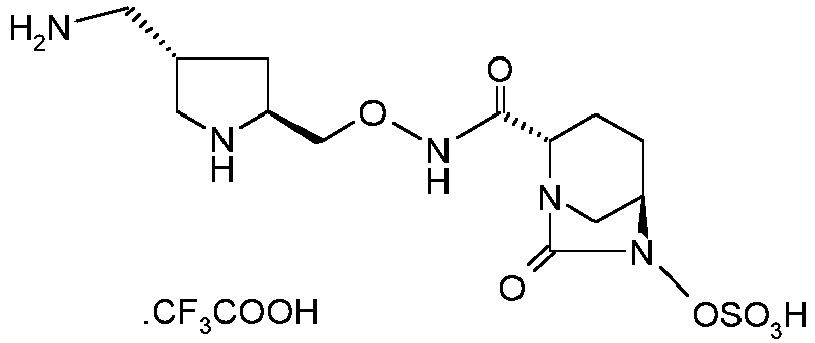
1H-NMR: (500MHz, DMSO-d6): δ 11.81 (bs, 1H), 9.03 (bs, 2H), 7.93 (bs, 2H), 4.03-3.98 (m, 3H, J=5Hz), 3.83-3.82 (m, 1H), 3.46-3.43 (m, 1 H), 3.03-2.92 (m, 5H), 2.51-2.50 (m, 1H), 2.27-2.23 (m, 1H), 2.08-2.03 (m, 2H), 1.88-1.86 (m, 1H), 1.72-1.70 (m, 2H), 1.42-1.36 (m, 2H). M.F: C13H23N5O7S.C2HF3O2; M.W: 507.44; Mass: 392.1 (M-H) 10 
1H-NMR: (500MHz, DMSO-d6): δ 11.78 (s, 1H), 9.05-8.82 (bs, 2H), 4.51-4.40 (d sym. m, J=50Hz, HF coupling 2H,), 4.03-4.02 (m, 2H), 4.01-4.00 (m, 1H), 3.88-3.87 (m, 1H), 3.83 (m, 1H), 3.45-3.44 (m, 1H), 3.04-2.99 (m, 2H), 2.75-2.71 (m, 1H), 2.07-2.02 (m, 1H), 1.88-1.84 (m, 3H), 1.72-1.70 (m, 2H). M.F: C13H21FN4O7S; M.W: 396.40; Mass: 395.0 (M-H) - The biological activity of representative compounds according to the invention against various bacterial strains was investigated. In a typical study, overnight grown bacterial cultures were diluted appropriately and inoculated on the agar media containing doubling dilutions of the test compounds. Observations for growth or no growth was performed after 16-20 hours of incubation at 35 ± 2°C in the ambient air. The overall procedure was performed as per Clinical and Laboratory Standards Institute (CLSI) recommendations, (Clinical and Laboratory Standards Institute (CLSI), Performance Standards for Antimicrobial Susceptibility Testing, 20th Informational Supplement, M07-A9, Volume 32, No. 2, 2012). Molten Mueller Hinton Agar (MHA) (BD, USA) containing serial dilutions of each antibacterial agent were poured on to the plates and allowed to solidify. Appropriate suspensions from the freshly grown cultures were prepared in normal saline so that about 104 CFU/spot of the organism was delivered on to the drug containing agar plates using automated multipoint inoculator (Mast, UK). The plates were incubated in Biochemical oxygen demand (BOD) incubator at 37°C for 18 hours and then examined for growth. MICs were read as the lowest concentration of drug that completely inhibited bacterial growth. The Table 2 depicts the antibacterial activity profile of compounds according to present invention against various multidrug resistant bacterial strains.
- The antibacterial activity of compounds according to the invention was also investigated in combination with several antibacterial agents. For example, antibacterial activity of the representative compounds of Formula (I) (Example 1 and Example 2) in combination with Ceftazidime and Cefixime are summarized in Table 3.
- As can be seen from Table 3, Ceftazidime, Cefixime and representative compounds of Formula (I) (Example 1 and Example 2) when used alone, did not exhibit significant antibacterial activity. However, surprisingly the representative compounds of Formula (I) (Example 1 and Example 2) in combination with Ceftazidime and Cefixime exhibited unusual and unexpected synergistic antibacterial effect against highly resistant bacterial strains.
Table 2. Antibacterial activity of representative compounds according to invention (expressed as MICs (mcg/ml)) Compounds KP ATCC 700603 E. coli 13351 E. coli 13352 E. coli 13353 E. coli M 36 E. coli 7 MP E. coli M 49 E. coli M 50 E. coli M 138 E. coli S 18 K. pneumoniae H 521 H 522 H 523 H 525 Example 1 >32 1 1 0.5 0.5 1 4 0.5 0.5 1 1 1 0.5 0.5 Example 2 >32 1 1 0.5 0.5 2 4 1 1 1 2 1 1 1 Example 3 >32 1 1 0.5 0.5 2 4 0.5 0.5 1 1 1 0.5 0.5 Example 4 >32 1 2 1 0.5 2 4 1 1 1 2 2 2 2 Example 5 >32 1 2 1 1 2 4 1 1 1 1 1 1 1 Example 6 >32 1 2 1 1 2 4 1 1 1 2 2 2 1 Example 7 >32 1 2 1 1 2 4 1 1 1 2 2 1 1 Example 8 >32 2 4 1 1 4 4 1 1 2 4 8 1 1 Example 9 >32 4 4 2 2 8 4 2 4 2 4 4 2 2 Example 10 >32 1 2 1 1 2 4 1 1 1 2 2 2 2 Table 3. Antibacterial activity of Ceftazidime and Cefixime in presence of representative compounds of the invention against various Multi Drug Resistant (MDR) Gram negative strains. Sr. Organism Strain Beta lactamase MIC (mg/L) Ceftazidime Cefixime Example 1 Example 2 Ceftazidime + Example 1 Ceftazidime + Example 2 Cefixime + Example 1 Cefixime + Example 2 1 K. pneumoniae B 77 NDM, ESBL >32 >32 >32 >32 0.5 2 1 2 2 K. pneumoniae B 88 NDM, ESBL >32 >32 >32 >32 0.5 1 2 1 3 K. pneumoniae NCTC 13443 NDM, ESBL >32 >32 >32 >32 4 4 4 4 4 K. pneumoniae S 465 OXA-181, ESBL >32 >32 >32 >32 1 2 1 2 5 K. pneumoniae NCTC 13439 VIM-1 >32 >32 >32 >32 0.5 1 1 1
Typical examples of compounds according to the invention include:


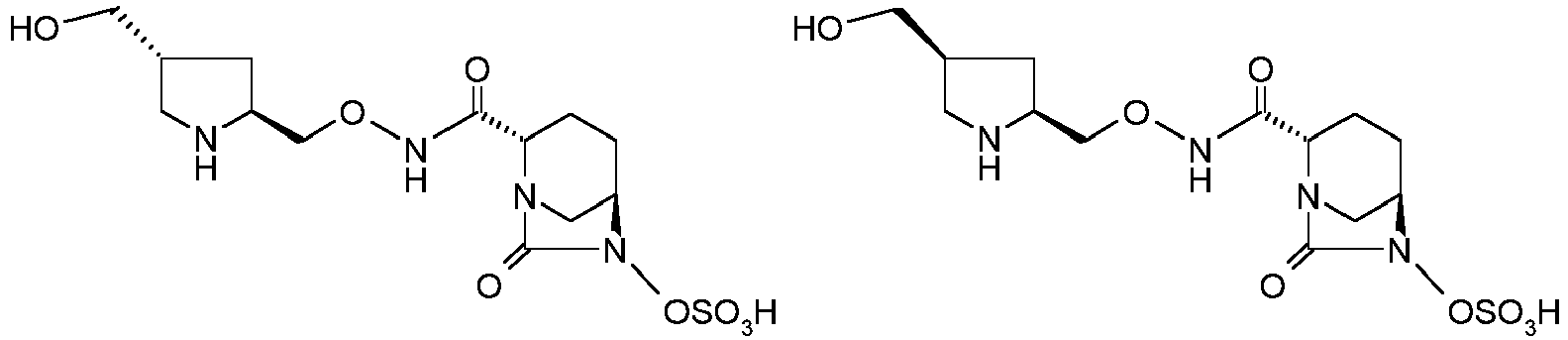


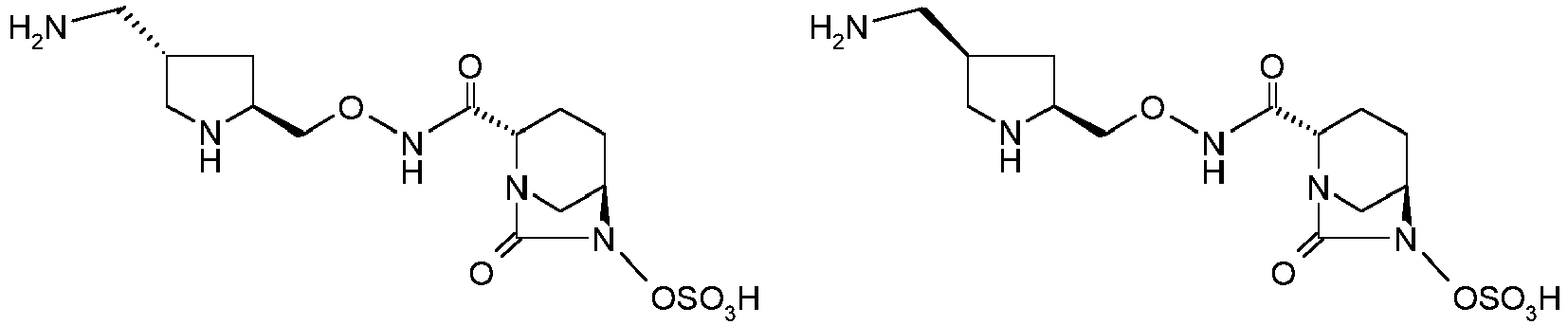


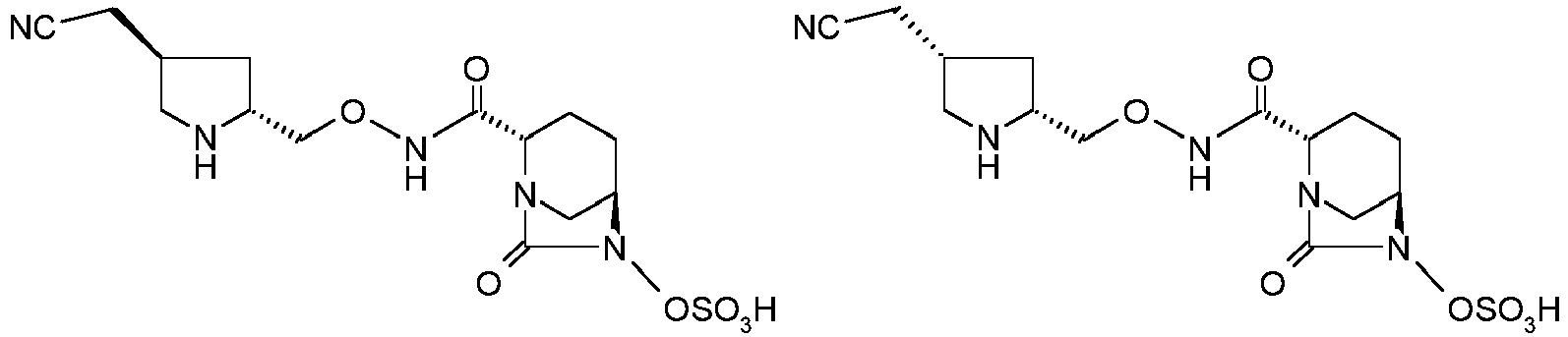


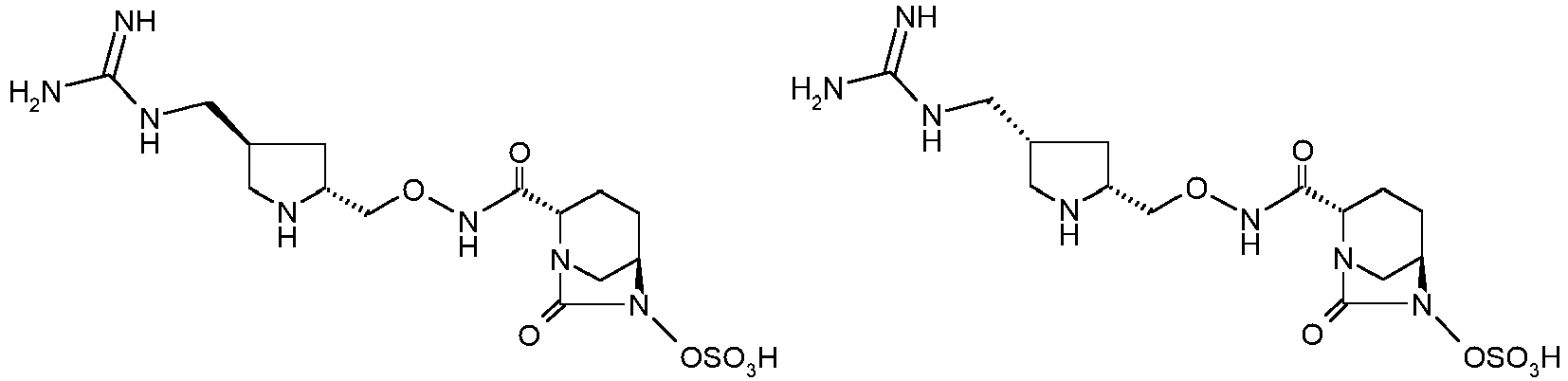
Claims (14)
- A compound of Formula (I), or a stereoisomer or a pharmaceutically acceptable salt thereof:
 B is selected from:(a) hydrogen,(b) halogen,(c) C1-C6 alkyl,(d) OR1,(e) NR1R2,(f) SH,(g) SR1,(h) SOR1,(i) SO2R1,(j) CHO,(k) COOR1,(l) CONR1R2,(m) CN,(n) heteroaryl,(o) heterocycloalkyl, or(P) NHC(=NH)NH2;R1 and R2 are each independently:(a) hydrogen,(b) C1-C6 alkyl, optionally substituted with one or more substituents independently selected from CN, halogen, OH, NH2, COOH, CONH2, SH, cycloalkyl, heterocycloalkyl, aryl, or heteroaryl,(c) three to seven membered cycloalkyl, optionally substituted with one or more substituents independently selected from CN, halogen, OH, NH2, COOH, CONH2, or SH,(d) three to seven membered heterocycloalkyl, optionally substituted with one or more substituents independently selected from CN, halogen, OH, NH2, COOH, CONH2, or SH,(e) six to fourteen membered aryl, optionally substituted with one or more substituents independently selected from CN, halogen, OH, NH2, COOH, CONH2, or SH, or(f) five to fourteen membered heteroaryl, optionally substituted with one or more substituents independently selected from CN, halogen, OH, NH2, COOH, CONH2, SH;M is selected from:(a) hydrogen,(b) C1-C6 alkyl, or(c) a pharmaceutically accepted salt forming cation independently selected from Na, K, or Ca.
 - The compound according to Claim 1, selected from:(2S,5R)-N-{[(2S,4R)-4-Methyl-pyrrolidin-2-yl]methyloxy}-7-oxo-6-(sulfooxy)-1,6-diazabicyclo[3.2.1]octane-2-carboxamide;(2S,5R)-N-{[(2S,4S)-4-Methyl-pyrrolidin-2-yl]methyloxy}-7-oxo-6-(sulfooxy)-1,6-diazabicyclo[3.2.1]octane-2-carboxamide;(2S,5R)-N-{[(2R,4S)-4-Methyl-pyrrolidin-2-yl]methyloxy}-7-oxo-6-(sulfooxy)-1,6-diazabicyclo[3.2.1]octane-2-carboxamide;(2S,5R)-N-{[(2R,4R)-4-Methyl-pyrrolidin-2-yl]methyloxy}-7-oxo-6-(sulfooxy)-1,6-diazabicyclo[3.2.1]octane-2-carboxamide;(2S,5R)-N-{[(2S,4R)-4-Hydroxymethyl-pyrrolidin-2-yl]methyloxy}-7-oxo-6-(sulfooxy)-1,6-diazabicyclo[3.2.1]octane-2-carboxamide;(2S,5R)-N-{[(2S,4S)-4-Hydroxymethyl-pyrrolidin-2-yl]methyloxy}-7-oxo-6-(sulfooxy)-1,6-diazabicyclo[3.2.1]octane-2-carboxamide;(2S,5R)-N-{[(2R,4S)-4-Hydroxymethyl-pyrrolidin-2-yl]methyloxy}-7-oxo-6-(sulfooxy)-1,6-diazabicyclo[3.2.1]octane-2-carboxamide;(2S,5R)-N-{[(2R,4R)-4-Hydroxymethyl-pyrrolidin-2-yl]methyloxy}-7-oxo-6-(sulfooxy)-1,6-diazabicyclo[3.2.1]octane-2-carboxamide;(2S,5R)-N-{[(2S,4R)-4-Aminomethyl-pyrrolidin-2-yl]methyloxy}-7-oxo-6-(sulfooxy) -1,6-diazabicyclo[3.2.1]octane-2-carboxamide trifluoroacetate salt;(2S,5R)-N-{[(2S,4S)-4-Aminomethyl-pyrrolidin-2-yl]methyloxyl-7-oxo-6-(sulfooxy)-1,6-diazabicyclo[3.2.1]octane-2-carboxamide trifluoroacetate salt;(2S,5R)-N-{[(2R,4S)-4-Aminomethyl-pyrrolidin-2-yl]methyloxy}-7-oxo-6-(sulfooxy)-1,6-diazabicyclo[3.2.1]octane-2-carboxamide trifluoroacetate salt;(2S,5R)-N-{[(2R,4R)-4-Aminomethyl-pyrrolidin-2-yl]methyloxy}-7-oxo-6-(sulfooxy) -1,6-diazabicyclo[3.2.1]octane-2-carboxamide trifluoroacetate salt;(2S,5R)-N-{[(2S,4R)-4-Cyanomethyl-pyrrolidin-2-yl]methyloxy}-7-oxo-6-(sulfooxy)-1,6-diazabicyclo[3.2.1]octane-2-carboxamide;(2S,5R)-N-{[(2S,4S)-4-Cyanomethyl-pyrrolidin-2-yl]methyloxy}-7-oxo-6-(sulfooxy)-1,6-diazabicyclo[3.2.1]octane-2-carboxamide;(2S,5R)-N-{[(2R,4S)-4-Cyanomethyl-pyrrolidin-2-yl]methyloxyl-7-oxo-6-(sulfooxy)-1,6-diazabicyclo[3.2.1]octane-2-carboxamide;(2S,5R)-N-{[(2R,4R)-4-Cyanomethyl-pyrrolidin-2-yl]methyloxy}-7-oxo-6-(sulfooxy)-1,6-diazabicyclo[3.2.1]octane-2-carboxamide;(2S,5R)-N-{[(2S,4R)-4-Fluoromethyl-pyrrolidin-2-yl]methyloxy}-7-oxo-6-(sulfooxy)-1,6-diazabicyclo[3.2.1]octane-2-carboxamide;(2S,5R)-N-{[(2S,4S)-4-Fluoromethyl-pyrrolidin-2-yl]methyloxyl-7-oxo-6-(sulfooxy)-1,6-diazabicyclo[3.2.1]octane-2-carboxamide;(2S,5R)-N-{[(2R,4S)-4-Fluoromethyl-pyrrolidin-2-yl]methyloxy}-7-oxo-6-(sulfooxy)-1,6-diazabicyclo[3.2.1]octane-2-carboxamide;(2S,5R)-N-{[(2R,4R)-4-Fluoromethyl-pyrrolidin-2-yl]methyloxy}-7-oxo-6-(sulfooxy)-1,6-diazabicyclo[3.2.1]octane-2-carboxamide;(2S,5R)-N-{[(2S,4R)-4-Chloromethyl-pyrrolidin-2-yl]methyloxy}-7-oxo-6-(sulfooxy)-1,6-diazabicyclo[3.2.1]octane-2-carboxamide;(2S,5R)-N-{[(2S,4S)-4-Chloromethyl-pyrrolidin-2-yl]methyloxy}-7-oxo-6-(sulfooxy)-1,6-diazabicyclo[3.2.1]octane-2-carboxamide;(2S,5R)-N-{[(2R,4S)-4-Chloromethyl-pyrrolidin-2-yl]methyloxy}-7-oxo-6-(sulfooxy)-1,6-diazabicyclo[3.2.1]octane-2-carboxamide;(2S,5R)-N-{[(2R,4R)-4-Chloromethyl-pyrrolidin-2-yl]methyloxy}-7-oxo-6-(sulfooxy)-1,6-diazabicyclo[3.2.1]octane-2-carboxamide;(2S,5R)-N-{[(2S,4S)-4-Mercaptomethyl-pyrrolidin-2-yl]methyloxy}-7-oxo-6-(sulfooxy)-1,6-diazabicyclo[3.2.1]octane-2-carboxamide;(2S,5R)-N-{[(2S,4R)-4-Mercaptomethyl-pyrrolidin-2-yl]methyloxy}-7-oxo-6-(sulfooxy)-1,6-diazabicyclo[3.2.1]octane-2-carboxamide;(2S,5R)-N-{[(2R,4S)-4-Mercaptomethyl-pyrrolidin-2-yl]methyloxy}-7-oxo-6-(sulfooxy)-1,6-diazabicyclo[3.2.1]octane-2-carboxamide;(2S,5R)-N-{[(2R,4R)-4-Mercaptomethyl-pyrrolidin-2-yl]methyloxy}-7-oxo-6-(sulfooxy)-1,6-diazabicyclo[3.2.1]octane-2-carboxamide;(2S,5R)-N-{[(2S,4R)-4-(Aziridin-1-ylmethyl)-pyrrolidin-2-yl]methyloxy}-7-oxo-6-(sulfooxy)-1,6-diazabicyclo[3.2.1]octane-2-carboxamide;(2S,5R)-N-{[(2S,4R)-4-(Aziridin-1-ylmethyl)-pyrrolidin-2-yl]methyloxy}-7-oxo-6-(sulfooxy)-1,6-diazabicyclo[3.2.1]octane-2-carboxamide;(2S,5R)-N-{[(2R,4S)-4-(Aziridin-1-ylmethyl)-pyrrolidin-2-yl]methyloxy}-7-oxo-6-(sulfooxy)-1,6-diazabicyclo[3.2.1]octane-2-carboxamide;(2S,5R)-N-{[(2R,4R)-4-(Aziridin-1-ylmethyl)-pyrrolidin-2-yl]methyloxy}-7-oxo-6-(sulfooxy)-1,6-diazabicyclo[3.2.1]octane-2-carboxamide;(2S,5R)-N-{[(2S,4R)-4-(Azetidin-1-ylmethyl)-pyrrolidin-2-yl]methyloxy}-7-oxo-6-(sulfooxy)-1,6-diazabicyclo[3.2.1]octane-2-carboxamide;(2S,5R)-N-{[(2S,4S)-4-(Azetidin-1-ylmethyl)-pyrrolidin-2-yl]methyloxy}-7-oxo-6-(sulfooxy)-1,6-diazabicyclo[3.2.1]octane-2-carboxamide;(2S,5R)-N-{[(2R,4S)-4-(Azetidin-1-ylmethyl)-pyrrolidin-2-yl]methyloxy}-7-oxo-6-(sulfooxy)-1,6-diazabicyclo[3.2.1]octane-2-carboxamide;(2S,5R)-N-{[(2R,4R)-4-(Azetidin-1-ylmethyl)-pyrrolidin-2-yl]methyloxy}-7-oxo-6-(sulfooxy)-1,6-diazabicyclo[3.2.1]octane-2-carboxamide;(2S,5R)-N-{[(2S,4R)-4-(Pyrrolidin-1-ylmethyl)-pyrrolidin-2-yl]methyloxy}-7-oxo-6-(sulfooxy)-1,6-diazabicyclo[3.2.1]octane-2-carboxamide;(2S,5R)-N-{[(2S,4S)-4-(Pyrrolidin-1-ylmethyl)-pyrrolidin-2-yl]methyloxy}-7-oxo-6-(sulfooxy)-1,6-diazabicyclo[3.2.1]octane-2-carboxamide;(2S,5R)-N-{[(2R,4S)-4-(Pyrrolidin-1-ylmethyl)-pyrrolidin-2-yl]methyloxy}-7-oxo-6-(sulfooxy)-1,6-diazabicyclo[3.2.1]octane-2-carboxamide;(2S,5R)-N-{[(2R,4R)-4-(Pyrrolidin-1-ylmethyl)-pyrrolidin-2-yl]methyloxy}-7-oxo-6-(sulfooxy)-1,6-diazabicyclo[3.2.1]octane-2-carboxamide;(2S,5R)-N-{[(2S,4R)-4-(Piperidin-1-ylmethyl)-pyrrolidin-2-yl]methyloxy}-7-oxo-6-(sulfooxy)-1,6-diazabicyclo[3.2.1]octane-2-carboxamide;(2S,5R)-N-{[(2S,4S)-4-(Piperidin-1-ylmethyl)-pyrrolidin-2-yl]methyloxy}-7-oxo-6-(sulfooxy)-1,6-diazabicyclo[3.2.1]octane-2-carboxamide;(2S,5R)-N-{[(2R,4S)-4-(Piperidin-1-ylmethyl)-pyrrolidin-2-yl]methyloxy}-7-oxo-6-(sulfooxy)-1,6-diazabicyclo[3.2.1]octane-2-carboxamide;(2S,5R)-N-{[(2R,4R)-4-(Piperidin-1-ylmethyl)-pyrrolidin-2-yl]methyloxy}-7-oxo-6-(sulfooxy)-1,6-diazabicyclo[3.2.1]octane-2-carboxamide;(2S,5R)-N-{[(2S,4R)-4-(Azepan-1-ylmethyl)-pyrrolidin-2-yl]methyloxy}-7-oxo-6-(sulfooxy)-1,6-diazabicyclo[3.2.1]octane-2-carboxamide;(2S,5R)-N-{[(2S,4S)-4-(Azepan-1-ylmethyl)-pyrrolidin-2-yl]methyloxy}-7-oxo-6-(sulfooxy)-1,6-diazabicyclo[3.2.1]octane-2-carboxamide;(2S,5R)-N-{[(2R,4S)-4-(Azepan-1-ylmethyl)-pyrrolidin-2-yl]methyloxy}-7-oxo-6-(sulfooxy)-1,6-diazabicyclo[3.2.1]octane-2-carboxamide;(2S,5R)-N-{[(2R,4R)-4-(Azepan-1-ylmethyl)-pyrrolidin-2-yl]methyloxy}-7-oxo-6-(sulfooxy)-1,6-diazabicyclo[3.2.1]octane-2-carboxamide;(2S,5R)-N-{[(2S,4R)-4-(Piperazin-1-ylmethyl)-pyrrolidin-2-yl]methyloxy}-7-oxo-6-(sulfooxy)-1,6-diazabicyclo[3.2.1]octane-2-carboxamide;(2S,5R)-N-{[(2S,4S)-4-(Piperazin-1-ylmethyl)-pyrrolidin-2-yl]methyloxy}-7-oxo-6-(sulfooxy)-1,6-diazabicyclo[3.2.1]octane-2-carboxamide;(2S,5R)-N-{[(2R,4S)-4-(Piperazin-1-ylmethyl)-pyrrolidin-2-yl]methyloxy}-7-oxo-6-(sulfooxy)-1,6-diazabicyclo[3.2.1]octane-2-carboxamide;(2S,5R)-N-{[(2R,4R)-4-(Piperazin-1-ylmethyl)-pyrrolidin-2-yl]methyloxy}-7-oxo-6-(sulfooxy)-1,6-diazabicyclo[3.2.1]octane-2-carboxamide;(2S,5R)-N-{[(2S,4R)-4-(Morpholin-1-ylmethyl)-pyrrolidin-2-yl]methyloxy}-7-oxo-6-(sulfooxy)-1,6-diazabicyclo[3.2.1]octane-2-carboxamide;(2S,5R)-N-{[(2S,4S)-4-(Morpholin-1-ylmethyl)-pyrrolidin-2-yl]methyloxy}-7-oxo-6-(sulfooxy)-1,6-diazabicyclo[3.2.1]octane-2-carboxamide;(2S,5R)-N-{[(2R,4S)-4-(Morpholin-1-ylmethyl)-pyrrolidin-2-yl]methyloxy}-7-oxo-6-(sulfooxy)-1,6-diazabicyclo[3.2.1]octane-2-carboxamide;(2S,5R)-N-{[(2R,4R)-4-(Morpholin-1-ylmethyl)-pyrrolidin-2-yl]methyloxy}-7-oxo-6-(sulfooxy)-1,6-diazabicyclo[3.2.1]octane-2-carboxamide;(2S,5R)-N-{[(2S,4R)-4-(Thiomorpholin-1-ylmethyl)-pyrrolidin-2-yl]methyloxy}-7-oxo-6-(sulfooxy)-1,6-diazabicyclo[3.2.1]octane-2-carboxamide;(2S,5R)-N-{[(2S,4S)-4-(Thiomorpholin-1-ylmethyl)-pyrrolidin-2-yl]methyloxy}-7-oxo-6-(sulfooxy)-1,6-diazabicyclo[3.2.1]octane-2-carboxamide;(2S,5R)-N-{[(2R,4S)-4-(Thiomorpholin-1-ylmethyl)-pyrrolidin-2-yl]methyloxy}-7-oxo-6-(sulfooxy)-1,6-diazabicyclo[3.2.1]octane-2-carboxamide;(2S,5R)-N-{[(2R,4R)-4-(Thiomorpholin-1-ylmethyl)-pyrrolidin-2-yl]methyloxy}-7-oxo-6-(sulfooxy)-1,6-diazabicyclo[3.2.1]octane-2-carboxamide;(2S,5R)-N-{[(2S,4R)-4-(1H-Pyrrol-1-ylmethyl)-pyrrolidin-2-yl]methyloxy}-7-oxo-6-(sulfooxy)-1,6-diazabicyclo[3.2.1]octane-2-carboxamide;(2S,5R)-N-{[(2S,4S)-4-(1H-Pyrrol-1-ylmethyl)-pyrrolidin-2-yl]methyloxy}-7-oxo-6-(sulfooxy)-1,6-diazabicyclo[3.2.1]octane-2-carboxamide;(2S,5R)-N-{[(2R,4S)-4-(1H-Pyrrol-1-ylmethyl)-pyrrolidin-2-yl]methyloxy}-7-oxo-6-(sulfooxy)-1,6-diazabicyclo[3.2.1]octane-2-carboxamide;(2S,5R)-N-{[(2R,4R)-4-(1H-Pyrrol-1-ylmethyl)-pyrrolidin-2-yl]methyloxy}-7-oxo-6-(sulfooxy)-1,6-diazabicyclo[3.2.1]octane-2-carboxamide;(2S,5R)-N-{[(2S,4R)-4-(1H-imidazol-1-ylmethyl)-pyrrolidin-2-yl]methyloxy}-7-oxo-6-(sulfooxy)-1,6-diazabicyclo[3.2.1]octane-2-carboxamide;(2S,5R)-N-{[(2S,4S)-4-(1H-imidazol-1-ylmethyl)-pyrrolidin-2-yl]methyloxy}-7-oxo-6-(sulfooxy)-1,6-diazabicyclo[3.2.1]octane-2-carboxamide;(2S,5R)-N-{[(2R,4S)-4-(1H-imidazol-1-ylmethyl)-pyrrolidin-2-yl]methyloxy}-7-oxo-6-(sulfooxy)-1,6-diazabicyclo[3.2.1]octane-2-carboxamide;(2S,5R)-N-{[(2R,4R)-4-(1H-imidazol-1-ylmethyl)-pyrrolidin-2-yl]methyloxy}-7-oxo-6-(sulfooxy)-1,6-diazabicyclo[3.2.1]octane-2-carboxamide;(2S,5R)-N-{[(2S,4R)-4-(1H-pyrazol-1-ylmethyl)-pyrrolidin-2-yl]methyloxy}-7-oxo-6-(sulfooxy)-1,6-diazabicyclo[3.2.1]octane-2-carboxamide;(2S,5R)-N-{[(2S,4S)-4-(1H-pyrazol-1-ylmethyl)-pyrrolidin-2-yl]methyloxy}-7-oxo-6-(sulfooxy)-1,6-diazabicyclo[3.2.1]octane-2-carboxamide;(2S,5R)-N-{[(2R,4S)-4-(1H-pyrazol-1-ylmethyl)-pyrrolidin-2-yl]methyloxy}-7-oxo-6-(sulfooxy)-1,6-diazabicyclo[3.2.1]octane-2-carboxamide;(2S,5R)-N-{[(2R,4R)-4-(1H-pyrazol-1-ylmethyl)-pyrrolidin-2-yl]methyloxy}-7-oxo-6-(sulfooxy)-1,6-diazabicyclo[3.2.1]octane-2-carboxamide;(2S,5R)-N-{[(2S,4R)-4-(1H-1,2,3-triazol-1-ylmethyl)-pyrrolidin-2-yl]methyloxy}-7-oxo-6-(sulfooxy)-1,6-diazabicyclo[3.2.1]octane-2-carboxamide;(2S,5R)-N-{[(2S,4S)-4-(1H-1,2,3-triazol-1-ylmethyl)-pyrrolidin-2-yl]methyloxy}-7-oxo-6-(sulfooxy)-1,6-diazabicyclo[3.2.1]octane-2-carboxamide;(2S,5R)-N-{[(2R,4S)-4-(1H-1,2,3-triazol-1-ylmethyl)-pyrrolidin-2-yl]methyloxy}-7-oxo-6-(sulfooxy)-1,6-diazabicyclo[3.2.1]octane-2-carboxamide;(2S,5R)-N-{[(2R,4R)-4-(1H-1,2,3-triazol-1-ylmethyl)-pyrrolidin-2-yl]methyloxy}-7-oxo-6-(sulfooxy)-1,6-diazabicyclo[3.2.1]octane-2-carboxamide;(2S,5R)-N-{[(2S,4R)-4-(1H-1,2,4-triazol-1-ylmethyl)-pyrrolidin-2-yl]methyloxy}-7-oxo-6-(sulfooxy)-1,6-diazabicyclo[3.2.1]octane-2-carboxamide;(2S,5R)-N-{[(2S,4S)-4-(1H-1,2,4-triazol-1-ylmethyl)-pyrrolidin-2-yl]methyloxy}-7-oxo-6-(sulfooxy)-1,6-diazabicyclo[3.2.1]octane-2-carboxamide;(2S,5R)-N-{[(2R,4S)-4-(1H-1,2,4-triazol-1-ylmethyl)-pyrrolidin-2-yl]methyloxy}-7-oxo-6-(sulfooxy)-1,6-diazabicyclo[3.2.1]octane-2-carboxamide;(2S,5R)-N-{[(2R,4R)-4-(1H-1,2,4-triazol-1-ylmethyl)-pyrrolidin-2-yl]methyloxy}-7-oxo-6-(sulfooxy)-1,6-diazabicyclo[3.2.1]octane-2-carboxamide;(2S,5R)-N-{[(2S,4R)-4-(1H-tetrazol-1-ylmethyl)-pyrrolidin-2-yl]methyloxy}-7-oxo-6-(sulfooxy)-1,6-diazabicyclo[3.2.1]octane-2-carboxamide;(2S,5R)-N-{[(2S,4S)-4-(1H-tetrazol-1-ylmethyl)-pyrrolidin-2-yl]methyloxy}-7-oxo-6-(sulfooxy)-1,6-diazabicyclo[3.2.1]octane-2-carboxamide;(2S,5R)-N-{[(2R,4S)-4-(1H-tetrazol-1-ylmethyl)-pyrrolidin-2-yl]methyloxy}-7-oxo-6-(sulfooxy)-1,6-diazabicyclo[3.2.1]octane-2-carboxamide;(2S,5R)-N-{[(2R,4R)-4-(1H-tetrazol-1-ylmethyl)-pyrrolidin-2-yl]methyloxy}-7-oxo-6-(sulfooxy)-1,6-diazabicyclo[3.2.1]octane-2-carboxamide;(2S,5R)-N-{[(2S,4R)-4-(2H-tetrazoly-2-ylmethyl)-pyrrolidin-2-yl]methyloxy}-7-oxo-6-(sulfooxy)-1,6-diazabicyclo[3.2.1]octane-2-carboxamide;(2S,5R)-N-{[(2S,4S)-4-(2H-tetrazol-2-ylmethyl)-pyrrolidin-2-yl]methyloxy}-7-oxo-6-(sulfooxy)-1,6-diazabicyclo[3.2.1]octane-2-carboxamide;(2S,5R)-N-{[(2R,4S)-4-(2H-tetrazol-2-ylmethyl)-pyrrolidin-2-yl]methyloxy}-7-oxo-6-(sulfooxy)-1,6-diazabicyclo[3.2.1]octane-2-carboxamide;(2S,5R)-N-{[(2R,4R)-4-(2H-tetrazol-2-ylmethyl)-pyrrolidin-2-yl]methyloxy}-7-oxo-6-(sulfooxy)-1,6-diazabicyclo[3.2.1]octane-2-carboxamide;(2S,5R)-N-{[(2S,4S)-4-Carbamimidomethyl-pyrrolidin-2-yl]methyloxy}-7-oxo-6-(sulfooxy)-1,6-diazabicyclo[3.2.1]octane-2-carboxamide;(2S,5R)-N-{[(2S,4R)-4-Carbamimidomethyl-pyrrolidin-2-yl]methyloxy}-7-oxo-6-(sulfooxy)-1,6-diazabicyclo[3.2.1]octane-2-carboxamide;(2S,5R)-N-{[(2R,4S)-4-Carbamimidomethyl-pyrrolidin-2-yl]methyloxy}-7-oxo-6-(sulfooxy)-1,6-diazabicyclo[3.2.1]octane-2-carboxamide;(2S,5R)-N-{[(2R,4R)-4-Carbamimidomethyl-pyrrolidin-2-yl]methyloxy}-7-oxo-6-(sulfooxy)-1,6-diazabicyclo[3.2.1]octane-2-carboxamide;or a stereoisomer or a pharmaceutically acceptable salt thereof.
- The compound according to Claim 1, selected from:Sodium salt of (2S,5R)-N-{[(2S,4R)-4-Methyl-pyrrolidin-2-yl]methyloxy}-7-oxo-6-(sulfooxy)-1,6-diazabicyclo[3.2.1]octane-2-carboxamide;Sodium salt of (2S,5R)-N-{[(2S,4S)-4-Methyl-pyrrolidin-2-yl]methyloxy}-7-oxo-6-(sulfooxy)-1,6-diazabicyclo[3.2.1]octane-2-carboxamide;Sodium salt of (2S,5R)-N-{[(2R,4S)-4-Methyl-pyrrolidin-2-yl]methyloxy}-7-oxo-6-(sulfooxy)-1,6-diazabicyclo[3.2.1]octane-2-carboxamide;Sodium salt of (2S,5R)-N-{[(2R,4R)-4-Methyl-pyrrolidin-2-yl]methyloxy}-7-oxo-6-(sulfooxy)-1,6-diazabicyclo[3.2.1]octane-2-carboxamide;Sodium salt of (2S,5R)-N-{[(2S,4R)-4-Hydroxymethyl-pyrrolidin-2-yl]methyloxy}-7-oxo-6-(sulfooxy)-1,6-diazabicyclo[3.2.1]octane-2-carboxamide;Sodium salt of (2S,5R)-N-{[(2S,4S)-4-Hydroxymethyl-pyrrolidin-2-yl]methyloxy}-7-oxo-6-(sulfooxy)-1,6-diazabicyclo[3.2.1]octane-2-carboxamide;Sodium salt of (2S,5R)-N-{[(2R,4S)-4-Hydroxymethyl-pyrrolidin-2-yl]methyloxy}-7-oxo-6-(sulfooxy)-1,6-diazabicyclo[3.2.1]octane-2-carboxamide;Sodium salt of (2S,5R)-N-{[(2R,4R)-4-Hydroxymethyl-pyrrolidin-2-yl]methyloxy}-7-oxo-6-(sulfooxy)-1,6-diazabicyclo[3.2.1]octane-2-carboxamide;Sodium salt of (2S,5R)-N-{[(2S,4R)-4-Aminomethyl-pyrrolidin-2-yl]methyloxy}-7-oxo-6-(sulfooxy)-1,6-diazabicyclo[3.2.1]octane-2-carboxamide trifluoroacetate salt;Sodium salt of (2S,5R)-N-{[(2S,4S)-4-Aminomethyl-pyrrolidin-2-yl]methyloxy}-7-oxo-6-(sulfooxy)-1,6-diazabicyclo[3.2.1]octane-2-carboxamide trifluoroacetate salt;Sodium salt of (2S,5R)-N-{[(2R,4S)-4-Aminomethyl-pyrrolidin-2-yl]methyloxy }-7-oxo-6-(sulfooxy)-1,6-diazabicyclo[3.2.1]octane-2-carboxamide trifluoroacetate salt;Sodium salt of (2S,5R)-N-{[(2R,4R)-4-Aminomethyl-pyrrolidin-2-yl]methyloxy }-7-oxo-6-(sulfooxy)-1,6-diazabicyclo[3.2.1]octane-2-carboxamide trifluoroacetate salt;Sodium salt of (2S,5R)-N-{[(2S,4R)-4-Cyanomethyl-pyrrolidin-2-yl]methyloxy}-7-oxo-6-(sulfooxy)-1,6-diazabicyclo[3.2.1]octane-2-carboxamide;Sodium salt of (2S,5R)-N-{[(2S,4S)-4-Cyanomethyl-pyrrolidin-2-yl]methyloxy}-7-oxo-6-(sulfooxy)-1,6-diazabicyclo[3.2.1]octane-2-carboxamide;Sodium salt of (2S,5R)-N-{[(2R,4S)-4-Cyanomethyl-pyrrolidin-2-yl]methyloxy}-7-oxo-6-(sulfooxy)-1,6-diazabicyclo[3.2.1]octane-2-carboxamide;Sodium salt of (2S,5R)-N-{[(2R,4R)-4-Cyanomethyl-pyrrolidin-2-yl]methyloxy}-7-oxo-6-(sulfooxy)-1,6-diazabicyclo[3.2.1]octane-2-carboxamide;Sodium salt of (2S,5R)-N-{[(2S,4R)-4-Fluoromethyl-pyrrolidin-2-yl]methyloxy}-7-oxo-6-(sulfooxy)-1,6-diazabicyclo[3.2.1]octane-2-carboxamide;Sodium salt of (2S,5R)-N-{[(2S,4S)-4-Fluoromethyl-pyrrolidin-2-yl]methyloxy}-7-oxo-6-(sulfooxy)-1,6-diazabicyclo[3.2.1]octane-2-carboxamide;Sodium salt of (2S,5R)-N-{[(2R,4S)-4-Fluoromethyl-pyrrolidin-2-yl]methyloxy}-7-oxo-6-(sulfooxy)-1,6-diazabicyclo[3.2.1]octane-2-carboxamide;Sodium salt of (2S,5R)-N-{[(2R,4R)-4-Fluoromethyl-pyrrolidin-2-yl]methyloxy}-7-oxo-6-(sulfooxy)-1,6-diazabicyclo[3.2.1]octane-2-carboxamide;Sodium salt of (2S,5R)-N-{[(2S,4R)-4-Chloromethyl-pyrrolidin-2-yl]methyloxy}-7-oxo-6-(sulfooxy)-1,6-diazabicyclo[3.2.1]octane-2-carboxamide;Sodium salt of (2S,5R)-N-{[(2S,4S)-4-Chloromethyl-pyrrolidin-2-yl]methyloxy}-7-oxo-6-(sulfooxy)-1,6-diazabicyclo[3.2.1]octane-2-carboxamide;Sodium salt of (2S,5R)-N-{[(2R,4S)-4-Chloromethyl-pyrrolidin-2-yl]methyloxy}-7-oxo-6-(sulfooxy)-1,6-diazabicyclo[3.2.1]octane-2-carboxamide;Sodium salt of (2S,5R)-N-{[(2R,4R)-4-Chloromethyl-pyrrolidin-2-yl]methyloxy}-7-oxo-6-(sulfooxy)-1,6-diazabicyclo[3.2.1]octane-2-carboxamide;Sodium salt of (2S,5R)-N-{[(2S,4R)-4-Mercaptomethyl-pyrrolidin-2-yl]methyloxy}-7-oxo-6-(sulfooxy)-1,6-diazabicyclo[3.2.1]octane-2-carboxamide;Sodium salt of (2S,5R)-N-{[(2S,4S)-4-Mercaptomethyl-pyrrolidin-2-yl]methyloxy}-7-oxo-6-(sulfooxy)-1,6-diazabicyclo[3.2.1]octane-2-carboxamide;Sodium salt of (2S,5R)-N-{[(2R,4S)-4-Mercaptomethyl-pyrrolidin-2-yl]methyloxy-7-oxo-6-(sulfooxy)-1,6-diazabicyclo[3.2.1]octane-2-carboxamide;Sodium salt of (2S,5R)-N-{[(2R,4R)-4-Mercaptomethyl-pyrrolidin-2-yl]methyloxy}-7-oxo-6-(sulfooxy)-1,6-diazabicyclo[3.2.1]octane-2-carboxamide;Sodium salt of (2S,5R)-N-{[(2S,4R)-4-(Aziridin-1-ylmethyl)-pyrrolidin-2-yl]methyloxy}-7-oxo-6-(sulfooxy)-1,6-diazabicyclo[3.2.1]octane-2-carboxamide;Sodium salt of -(2S,5R)-N-{[(2S,4S)-4-(Aziridin-1-ylmethyl)-pyrrolidin-2 yl]methyloxy}-7-oxo-6-(sulfooxy)-1,6-diazabicyclo[3.2.1]octane-2-carboxamide;Sodium salt of -(2S,5R)-N-{[(2R,4S)-4-(Aziridin-1-ylmethyl)-pyrrolidin-2 yl]methyloxy}-7-oxo-6-(sulfooxy)-1,6-diazabicyclo[3.2.1]octane-2-carboxamide;Sodium salt of (2S,5R)-N-{[(2R,4R)-4-(Aziridin-1-ylmethyl)-pyrrolidin-2-yl]methyloxy}-7-oxo-6-(sulfooxy)-1,6-diazabicyclo[3.2.1]octane-2-carboxamide;Sodium salt of (2S,5R)-N-{[(2S,4R)-4-(Azetidin-1-ylmethyl)-pyrrolidin-2-yl]methyloxy}-7-oxo-6-(sulfooxy)-1,6-diazabicyclo[3.2.1]octane-2-carboxamide;Sodium salt of (2S,5R)-N-{[(2S,4S)-4-(Azetidin-1-ylmethyl)-pyrrolidin-2-yl]methyloxy}-7-oxo-6-(sulfooxy)-1,6-diazabicyclo[3.2.1]octane-2-carboxamide;Sodium salt of (2S,5R)-N-{[(2R,4S)-4-(Azetidin-1-ylmethyl)-pyrrolidin-2-yl]methyloxy}-7-oxo-6-(sulfooxy)-1,6-diazabicyclo[3.2.1]octane-2-carboxamide;Sodium salt of (2S,5R)-N-{[(2R,4R)-4-(Azetidin-1-ylmethyl)-pyrrolidin-2-yl]methyloxy}-7-oxo-6-(sulfooxy)-1,6-diazabicyclo[3.2.1]octane-2-carboxamide;Sodium salt of (2S,5R)-N-{[(2S,4R)-4-(Pyrrolidin-1-ylmethyl)-pyrrolidin-2-yl]methyloxy}-7-oxo-6-(sulfooxy)-1,6-diazabicyclo[3.2.1]octane-2-carboxamide;Sodium salt of (2S,5R)-N-{[(2S,4S)-4-(Pyrrolidin-1-ylmethyl)-pyrrolidin-2-yl]methyloxy}-7-oxo-6-(sulfooxy)-1,6-diazabicyclo[3.2.1]octane-2-carboxamide;Sodium salt of (2S,5R)-N-{[(2R,4S)-4-(Pyrrolidin-1-ylmethyl)-pyrrolidin-2-yl]methyloxy}-7-oxo-6-(sulfooxy)-1,6-diazabicyclo[3.2.1]octane-2-carboxamide;Sodium salt of (2S,5R)-N-{[(2R,4R)-4-(Pyrrolidin-1-ylmethyl)-pyrrolidin-2-yl]methyloxy}-7-oxo-6-(sulfooxy)-1,6-diazabicyclo[3.2.1]octane-2-carboxamide;Sodium salt of (2S,5R)-N-{[(2S,4R)-4-(Piperidin-1-ylmethyl)-pyrrolidin-2-yl]methyloxy}-7-oxo-6-(sulfooxy)-1,6-diazabicyclo[3.2.1]octane-2-carboxamide;Sodium salt of (2S,5R)-N-{[(2S,4S)-4-(Piperidin-1-ylmethyl)-pyrrolidin-2-yl]methyloxy}-7-oxo-6-(sulfooxy)-1,6-diazabicyclo[3.2.1]octane-2-carboxamide;Sodium salt of (2S,5R)-N-{[(2R,4S)-4-(Piperidin-1-ylmethyl)-pyrrolidin-2-yl]methyloxy}-7-oxo-6-(sulfooxy)-1,6-diazabicyclo[3.2.1]octane-2-carboxamide;Sodium salt of (2S,5R)-N-{[(2R,4R)-4-(Piperidin-1-ylmethyl)-pyrrolidin-2-yl]methyloxy}-7-oxo-6-(sulfooxy)-1,6-diazabicyclo[3.2.1]octane-2-carboxamide;Sodium salt of (2S,5R)-N-{[(2S,4R)-4-(Azepan-1-ylmethyl)-pyrrolidin-2-yl]methyloxy}-7-oxo-6-(sulfooxy)-1,6-diazabicyclo[3.2.1]octane-2-carboxamide;Sodium salt of (2S,5R)-N-{[(2S,4S)-4-(Azepan-1-ylmethyl)-pyrrolidin-2-yl]methyloxy}-7-oxo-6-(sulfooxy)-1,6-diazabicyclo[3.2.1]octane-2-carboxamide;Sodium salt of (2S,5R)-N-{[(2R,4S)-4-(Azepan-1-ylmethyl)-pyrrolidin-2-yl]methyloxy}-7-oxo-6-(sulfooxy)-1,6-diazabicyclo[3.2.1]octane-2-carboxamide;Sodium salt of (2S,5R)-N-{[(2R,4R)-4-(Azepan-1-ylmethyl)-pyrrolidin-2-yl]methyloxy}-7-oxo-6-(sulfooxy)-1,6-diazabicyclo[3.2.1]octane-2-carboxamide;Sodium salt of (2S,5R)-N-{[(2S,4R)-4-(Piperazin-1-ylmethyl)-pyrrolidin-2-yl]methyloxy}-7-oxo-6-(sulfooxy)-1,6-diazabicyclo[3.2.1]octane-2-carboxamide;Sodium salt of (2S,5R)-N-{[(2S,4S)-4-(Piperazin-1-ylmethyl)-pyrrolidin-2-yl]methyloxy}-7-oxo-6-(sulfooxy)-1,6-diazabicyclo[3.2.1]octane-2-carboxamide;Sodium salt of (2S,5R)-N-{[(2R,4S)-4-(Piperazin-1-ylmethyl)-pyrrolidin-2-yl]methyloxy}-7-oxo-6-(sulfooxy)-1,6-diazabicyclo[3.2.1]octane-2-carboxamide;Sodium salt of (2S,5R)-N-{[(2R,4R)-4-(Piperazin-1-ylmethyl)-pyrrolidin-2-yl]methyloxy}-7-oxo-6-(sulfooxy)-1,6-diazabicyclo[3.2.1]octane-2-carboxamide;Sodium salt of (2S,5R)-N-{[(2S,4R)-4-(Morpholin-1-ylmethyl)-pyrrolidin-2-yl]methyloxy}-7-oxo-6-(sulfooxy)-1,6-diazabicyclo[3.2.1]octane-2-carboxamide;Sodium salt of (2S,5R)-N-{[(2S,4S)-4-(Morpholin-1-ylmethyl)-pyrrolidin-2-yl]methyloxy}-7-oxo-6-(sulfooxy)-1,6-diazabicyclo[3.2.1]octane-2-carboxamide;Sodium salt of (2S,5R)-N-{[(2R,4S)-4-(Morpholin-1-ylmethyl)-pyrrolidin-2-yl]methyloxy}-7-oxo-6-(sulfooxy)-1,6-diazabicyclo[3.2.1]octane-2-carboxamide;Sodium salt of (2S,5R)-N-{[(2R,4R)-4-(Morpholin-1-ylmethyl)-pyrrolidin-2-yl]methyloxy}-7-oxo-6-(sulfooxy)-1,6-diazabicyclo[3.2.1]octane-2-carboxamide;Sodium salt of (2S,5R)-N-{[(2S,4R)-4-(Thiomorpholin-1-ylmethyl)-pyrrolidin-2-yl]methyloxy}-7-oxo-6-(sulfooxy)-1,6-diazabicyclo[3.2.1]octane-2-carboxamide;Sodium salt of (2S,5R)-N-{[(2S,4S)-4-(Thiomorpholin-1-ylmethyl)-pyrrolidin-2-yl]methyloxy}-7-oxo-6-(sulfooxy)-1,6-diazabicyclo[3.2.1]octane-2-carboxamide;Sodium salt of (2S,5R)-N-{[(2R,4S)-4-(Thiomorpholin-1-ylmethyl)-pyrrolidin-2-yl]methyloxy}-7-oxo-6-(sulfooxy)-1,6-diazabicyclo[3.2.1]octane-2-carboxamide;Sodium salt of (2S,5R)-N-{[(2R,4S)-4-(Thiomorpholin-1-ylmethyl)-pyrrolidin-2-yl]methyloxy}-7-oxo-6-(sulfooxy)-1,6-diazabicyclo[3.2.1]octane-2-carboxamide;Sodium salt of (2S,5R)-N-{[(2S,4R)-4-(1H-Pyrrol-1-ylmethyl)-pyrrolidin-2-yl]methyloxy}-7-oxo-6-(sulfooxy)-1,6-diazabicyclo[3.2.1]octane-2-carboxamide;Sodium salt of (2S,5R)-N-{[(2S,4S)-4-(1H-Pyrrol-1-ylmethyl)-pyrrolidin-2-yl]methyloxy}-7-oxo-6-(sulfooxy)-1,6-diazabicyclo[3.2.1]octane-2-carboxamide;Sodium salt of (2S,5R)-N-{[(2R,4S)-4-(1H-Pyrrol-1-ylmethyl)-pyrrolidin-2-yl]methyloxy}-7-oxo-6-(sulfooxy)-1,6-diazabicyclo[3.2.1]octane-2-carboxamide;Sodium salt of (2S,5R)-N-{[(2R,4R)-4-(1H-Pyrrol-1-ylmethyl)-pyrrolidin-2-yl]methyloxy}-7-oxo-6-(sulfooxy)-1,6-diazabicyclo[3.2.1]octane-2-carboxamide;Sodium salt of (2S,5R)-N-{[(2S,4R)-4-(1H-imidazol-1-ylmethyl)-pyrrolidin-2-yl]methyloxy}-7-oxo-6-(sulfooxy)-1,6-diazabicyclo[3.2.1]octane-2-carboxamide;Sodium salt of (2S,5R)-N-{[(2S,4S)-4-(1H-imidazol-1-ylmethyl)-pyrrolidin-2-yl]methyloxy}-7-oxo-6-(sulfooxy)-1,6-diazabicyclo[3.2.1]octane-2-carboxamide;Sodium salt of (2S,5R)-N-{[(2R,4S)-4-(1H-imidazol-1-ylmethyl)-pyrrolidin-2-yl]methyloxy}-7-oxo-6-(sulfooxy)-1,6-diazabicyclo[3.2.1]octane-2-carboxamide;Sodium salt of (2S,5R)-N-{[(2R,4R)-4-(1H-imidazol-1-ylmethyl)-pyrrolidin-2-yl]methyloxy}-7-oxo-6-(sulfooxy)-1,6-diazabicyclo[3.2.1]octane-2-carboxamide;Sodium salt of (2S,5R)-N-{[(2S,4R)-4-(1H-pyrazol-1-ylmethyl)-pyrrolidin-2-yl]methyloxy}-7-oxo-6-(sulfooxy)-1,6-diazabicyclo[3.2.1]octane-2-carboxamide;Sodium salt of (2S,5R)-N-{[(2S,4S)-4-(1H-pyrazol-1-ylmethyl)-pyrrolidin-2-yl]methyloxy}-7-oxo-6-(sulfooxy)-1,6-diazabicyclo[3.2.1]octane-2-carboxamide;Sodium salt of (2S,5R)-N-{[(2R,4S)-4-(1H-pyrazol-1-ylmethyl)-pyrrolidin-2-yl]methyloxy}-7-oxo-6-(sulfooxy)-1,6-diazabicyclo[3.2.1]octane-2-carboxamide;Sodium salt of (2S,5R)-N-{[(2R,4R)-4-(1H-pyrazol-1-ylmethyl)-pyrrolidin-2-yl]methyloxy}-7-oxo-6-(sulfooxy)-1,6-diazabicyclo[3.2.1]octane-2-carboxamide;Sodium salt of (2S,5R)-N-{[(2S,4R)-4-(1H-1,2,3-triazol-1-ylmethyl)-pyrrolidin-2-yl]methyloxy}-7-oxo-6-(sulfooxy)-1,6-diazabicyclo[3.2.1]octane-2-carboxamide;Sodium salt of (2S,5R)-N-{[(2S,4S)-4-(1H-1,2,3-triazol-1-ylmethyl)-pyrrolidin-2-yl]methyloxy}-7-oxo-6-(sulfooxy)-1,6-diazabicyclo[3.2.1]octane-2-carboxamide;Sodium salt of (2S,5R)-N-{[(2R,4S)-4-(1H-1,2,3-triazol-1-ylmethyl)-pyrrolidin-2-yl]methyloxy}-7-oxo-6-(sulfooxy)-1,6-diazabicyclo[3.2.1]octane-2-carboxamide;Sodium salt of (2S,5R)-N-{[(2R,4R)-4-(1H-1,2,3-triazol-1-ylmethyl)-pyrrolidin-2-yl]methyloxy}-7-oxo-6-(sulfooxy)-1,6-diazabicyclo[3.2.1]octane-2-carboxamide;Sodium salt of (2S,5R)-N-{[(2S,4R)-4-(1H-1,2,4-triazol-1-ylmethyl)-pyrrolidin-2-yl]methyloxy}-7-oxo-6-(sulfooxy)-1,6-diazabicyclo[3.2.1]octane-2-carboxamide;Sodium salt of (2S,5R)-N-{[(2S,4S)-4-(1H-1,2,4-triazol-1-ylmethyl)-pyrrolidin-2-yl]methyloxy}-7-oxo-6-(sulfooxy)-1,6-diazabicyclo[3.2.1]octane-2-carboxamide;Sodium salt of (2S,5R)-N-{[(2R,4S)-4-(1H-1,2,4-triazol-1-ylmethyl)-pyrrolidin-2-yl]methyloxy}-7-oxo-6-(sulfooxy)-1,6-diazabicyclo[3.2.1]octane-2-carboxamide;Sodium salt of (2S,5R)-N-{[(2R,4R)-4-(1H-1,2,4-triazol-1-ylmethyl)-pyrrolidin-2-yl]methyloxy}-7-oxo-6-(sulfooxy)-1,6-diazabicyclo[3.2.1]octane-2-carboxamide;Sodium salt of (2S,5R)-N-{[(2S,4R)-4-(1H-tetrazol-1-ylmethyl)-pyrrolidin-2-yl]methyloxy}-7-oxo-6-(sulfooxy)-1,6-diazabicyclo[3.2.1]octane-2-carboxamide;Sodium salt of (2S,5R)-N-{[(2S,4S)-4-(1H-tetrazol-1-ylmethyl)-pyrrolidin-2-yl]methyloxy}-7-oxo-6-(sulfooxy)-1,6-diazabicyclo[3.2.1]octane-2-carboxamide;Sodium salt of (2S,5R)-N-{[(2R,4S)-4-(1H-tetrazol-1-ylmethyl)-pyrrolidin-2-yl]methyloxy}-7-oxo-6-(sulfooxy)-1,6-diazabicyclo[3.2.1]octane-2-carboxamide;Sodium salt of (2S,5R)-N-{[(2R,4R)-4-(1H-tetrazol-1-ylmethyl)-pyrrolidin-2-yl]methyloxy}-7-oxo-6-(sulfooxy)-1,6-diazabicyclo[3.2.1]octane-2-carboxamide;Sodium salt of (2S,5R)-N-{[(2S,4R)-4-(2H-tetrazoly-2-ylmethyl)-pyrrolidin-2-yl]methyloxy}-7-oxo-6-(sulfooxy)-1,6-diazabicyclo[3.2.1]octane-2-carboxamide;Sodium salt of (2S,5R)-N-{[(2S,4S)-4-(2H-tetrazol-2-ylmethyl)-pyrrolidin-2-yl]methyloxy}-7-oxo-6-(sulfooxy)-1,6-diazabicyclo[3.2.1]octane-2-carboxamide;Sodium salt of (2S,5R)-N-{[(2R,4S)-4-(2H-tetrazol-2-ylmethyl)-pyrrolidin-2-yl]methyloxy}-7-oxo-6-(sulfooxy)-1,6-diazabicyclo[3.2.1]octane-2-carboxamide;Sodium salt of (2S,5R)-N-{[(2R,4R)-4-(2H-tetrazol-2-ylmethyl)-pyrrolidin-2-yl]methyloxy}-7-oxo-6-(sulfooxy)-1,6-diazabicyclo[3.2.1]octane-2-carboxamide;Sodium salt of (2S,5R)-N-{[(2S,4S)-4-Carbamimidomethyl-pyrrolidin-2-yl]methyloxy}-7-oxo-6-(sulfooxy)-1,6-diazabicyclo[3.2.1]octane-2-carboxamide;Sodium salt of (2S,5R)-N-{[(2S,4R)-4-Carbamimidomethyl-pyrrolidin-2-yl]methyloxy}-7-oxo-6-(sulfooxy)-1,6-diazabicyclo[3.2.1]octane-2-carboxamide;Sodium salt of (2S,5R)-N-{[(2R,4S)-4-Carbamimidomethyl-pyrrolidin-2-yl]methyloxy}-7-oxo-6-(sulfooxy)-1,6-diazabicyclo[3.2.1]octane-2-carboxamide;Sodium salt of (2S,5R)-N-{[(2R,4R)-4-Carbamimidomethyl-pyrrolidin-2-yl]methyloxy}-7-oxo-6-(sulfooxy)-1,6-diazabicyclo[3.2.1]octane-2-carboxamide;or a stereoisomer thereof.
- The compound according to Claim 1, selected from:


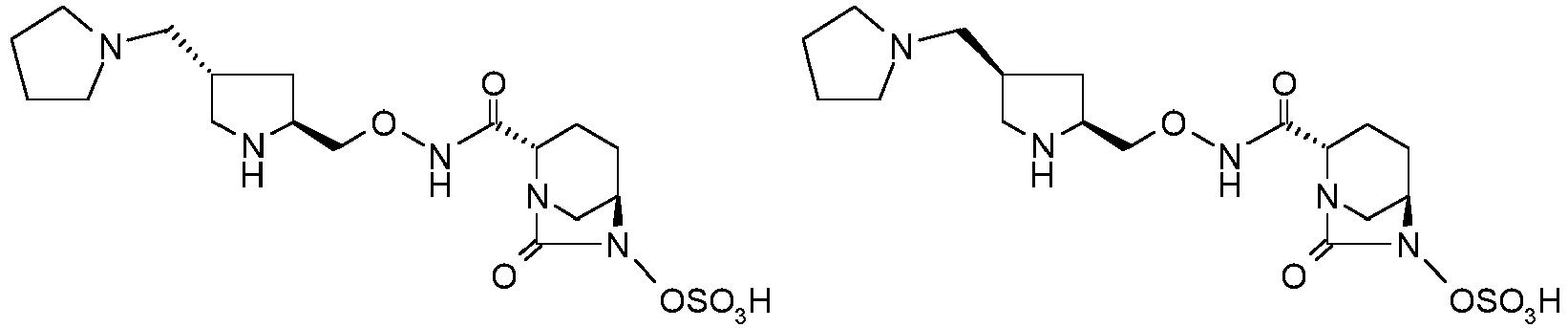


- A pharmaceutical composition comprising a compound according to any one of the claims 1 to 4.
- The pharmaceutical composition according to Claim 5, further comprising at least one antibacterial agent or a pharmaceutically acceptable salt thereof.
- The pharmaceutical composition according to Claim 6, wherein the antibacterial agent is a beta-lactam antibacterial agent.
- The pharmaceutical composition according to Claim 6, wherein the antibacterial agent is at least one selected from a group consisting of Ansamycin, Carbacephem, Carbapenam, Carbapenem, Cephalosporin, Cephamycin, Cephem, Lincosamide, Lipopeptide, Macrolide, Ketolide, Monobactam, Nitrofuran, Oxacephem, Oxapenam, Oxazolidinone, Penam, Penem, Penicillin, Polypeptide, Quinolone, Sulfonamide, or Tetracycline antibacterial agents.
- The pharmaceutical composition according to Claim 6, wherein the antibacterial agent is at least one selected from a group consisting of cefacetrile, cefaclor, cefadroxil, cefalexin, cefaloglycin, cefalonium, cefaloridine, cefalotin, cefamandole, cefapirin, cefatrizine, cefazaflur, cefazedone, cefazolin, cefbuperazone, cefcapene, cefclidin, cefdaloxime, cefdinir, cefditoren, cefepime, cefetamet, cefixime, cefluprenam, cefmenoxime, cefmetazole, cefminox, cefodizime, cefonicid, cefoperazone, ceforanide, cefoselis, cefotaxime, cefotetan, cefotiam, cefovecin, cefoxitin, cefoxitin, cefozopran, cefpimizole, cefpiramide, cefpirome, cefpodoxime, cefprozil, cefquinome, cefradine, cefroxadine, cefsulodin, ceftaroline, ceftazidime, cefteram, ceftezole, ceftibuten, ceftiofur, ceftiolene, ceftizoxime, ceftobiprole, ceftolozane, ceftriaxone, cefuroxime, cefuzonam, cephaloridine, cephradine, cefiderocol, flomoxef, latamoxef, loracarbef, moxalactam, or a pharmaceutically acceptable salt thereof.
- The pharmaceutical composition according to Claim 6, wherein the antibacterial agent is at least one selected from a group consisting of cefaclor, cefadroxil, cefalexin, cefdinir, cefixime, cefpirome, cefpodoxime, cefprozil, cefradine, ceftibuten, cefuroxime, loracarbef, or a pharmaceutically acceptable salt thereof.
- The pharmaceutical composition according to Claim 6, wherein the antibacterial agent is at least one selected from a group consisting of ertapenem, doripenem, imipenem, meropenem, panipenem, biapenem, tebipenem, lenapenem, tomopenem, or a pharmaceutically acceptable salt thereof.
- The pharmaceutical composition according to Claim 6, wherein the antibacterial agent is at least one selected from a group consisting of cefpodoxime axetil, cefpodoxime proxetil, ceftibuten, cefuroxime, cefuroxime axetil, cefixime, or a pharmaceutically acceptable salt thereof.
- The compound according to any one of the claims 1 to 4, for use in the treatment or prevention of a bacterial infection.
- The pharmaceutical composition according to any one of the claims 5 to 12, for use in the treatment or prevention of a bacterial infection.
Applications Claiming Priority (2)
| Application Number | Priority Date | Filing Date | Title |
|---|---|---|---|
| IN201921042452 | 2019-10-18 | ||
| PCT/IN2020/050890 WO2021074930A1 (en) | 2019-10-18 | 2020-10-18 | Nitrogen containing bicyclic compounds |
Publications (2)
| Publication Number | Publication Date |
|---|---|
| EP4045040A1 EP4045040A1 (en) | 2022-08-24 |
| EP4045040B1 true EP4045040B1 (en) | 2023-04-05 |
Family
ID=73038284
Family Applications (1)
| Application Number | Title | Priority Date | Filing Date |
|---|---|---|---|
| EP20799842.8A Active EP4045040B1 (en) | 2019-10-18 | 2020-10-18 | Nitrogen containing bicyclic compounds |
Country Status (16)
| Country | Link |
|---|---|
| US (1) | US11865108B2 (en) |
| EP (1) | EP4045040B1 (en) |
| JP (1) | JP7286879B2 (en) |
| KR (1) | KR102744037B1 (en) |
| CN (1) | CN114786671A (en) |
| AU (1) | AU2020366731A1 (en) |
| BR (1) | BR112021013607A2 (en) |
| CA (1) | CA3158337A1 (en) |
| DK (1) | DK4045040T3 (en) |
| ES (1) | ES2949216T3 (en) |
| HU (1) | HUE063116T2 (en) |
| MX (1) | MX2022004639A (en) |
| PL (1) | PL4045040T3 (en) |
| PT (1) | PT4045040T (en) |
| WO (1) | WO2021074930A1 (en) |
| ZA (1) | ZA202203970B (en) |
Family Cites Families (6)
| Publication number | Priority date | Publication date | Assignee | Title |
|---|---|---|---|---|
| PT2907816T (en) | 2011-11-16 | 2018-10-18 | Gilead Pharmasset Llc | Condensed imidazolylimidazoles as antiviral compounds |
| CA2881169C (en) * | 2012-08-25 | 2020-06-16 | Wockhardt Limited | 1,6-diazabicyclo [3,2,1]octan - 7 - one derivatives and their use in the treatment of bacterial infections |
| WO2014141132A1 (en) | 2013-03-14 | 2014-09-18 | Naeja Pharmaceutical Inc. | NEW HETEROCYCLIC COMPOUNDS AND THEIR USE AS ANTIBACTERIAL AGENTS AND β-LACTAMASE INHIBITORS |
| WO2017002089A1 (en) | 2015-07-02 | 2017-01-05 | Wockhardt Limited | Nitrogen containing bicyclic compounds and their use in treatment of bacterial infections |
| WO2017098425A1 (en) | 2015-12-11 | 2017-06-15 | Wockhardt Limited | 7-oxo-6-(sulfooxy)-1,6-diazabicyclo[3.2.1]octane-2-carboxamide containing compounds and their use in treating bacterial infections |
| JP7012924B2 (en) | 2017-03-02 | 2022-02-15 | ウォックハート リミテッド | Heterocyclic derivative as an antibacterial compound |
-
2020
- 2020-10-18 CN CN202080072345.1A patent/CN114786671A/en active Pending
- 2020-10-18 DK DK20799842.8T patent/DK4045040T3/en active
- 2020-10-18 WO PCT/IN2020/050890 patent/WO2021074930A1/en not_active Ceased
- 2020-10-18 CA CA3158337A patent/CA3158337A1/en active Pending
- 2020-10-18 EP EP20799842.8A patent/EP4045040B1/en active Active
- 2020-10-18 AU AU2020366731A patent/AU2020366731A1/en active Pending
- 2020-10-18 ES ES20799842T patent/ES2949216T3/en active Active
- 2020-10-18 BR BR112021013607A patent/BR112021013607A2/en unknown
- 2020-10-18 KR KR1020227014111A patent/KR102744037B1/en active Active
- 2020-10-18 US US17/769,338 patent/US11865108B2/en active Active
- 2020-10-18 PL PL20799842.8T patent/PL4045040T3/en unknown
- 2020-10-18 JP JP2022522933A patent/JP7286879B2/en active Active
- 2020-10-18 HU HUE20799842A patent/HUE063116T2/en unknown
- 2020-10-18 MX MX2022004639A patent/MX2022004639A/en unknown
- 2020-10-18 PT PT207998428T patent/PT4045040T/en unknown
-
2022
- 2022-04-07 ZA ZA2022/03970A patent/ZA202203970B/en unknown
Also Published As
| Publication number | Publication date |
|---|---|
| AU2020366731A1 (en) | 2022-04-21 |
| US11865108B2 (en) | 2024-01-09 |
| JP2022553002A (en) | 2022-12-21 |
| HUE063116T2 (en) | 2024-01-28 |
| BR112021013607A2 (en) | 2022-06-07 |
| CA3158337A1 (en) | 2021-04-22 |
| PT4045040T (en) | 2023-06-30 |
| ZA202203970B (en) | 2023-11-29 |
| KR102744037B1 (en) | 2024-12-17 |
| DK4045040T3 (en) | 2023-06-26 |
| CN114786671A (en) | 2022-07-22 |
| MX2022004639A (en) | 2022-05-24 |
| JP7286879B2 (en) | 2023-06-05 |
| PL4045040T3 (en) | 2023-08-14 |
| ES2949216T3 (en) | 2023-09-26 |
| WO2021074930A1 (en) | 2021-04-22 |
| EP4045040A1 (en) | 2022-08-24 |
| KR20220084064A (en) | 2022-06-21 |
| US20220378759A1 (en) | 2022-12-01 |
Similar Documents
| Publication | Publication Date | Title |
|---|---|---|
| EP2748165B1 (en) | 1,6-diazabicyclo[3,2,1]octan-7-one derivatives and their use in the treatment of bacterial infections. | |
| EP2961751B1 (en) | 1,6- diazabicyclo [3,2,1]octan- 7- one derivatives and their use in the treatment of bacterial infections | |
| US11865108B2 (en) | Nitrogen containing bicyclic compounds | |
| RU2835672C1 (en) | Nitrogen-containing bicyclic compounds | |
| US10500195B2 (en) | Antibacterial compounds | |
| WO2017216764A1 (en) | N-(alkanoyl)-7-oxo-6-sulfooxy-1,6-diazabicyclo[3.2.1]octane-2-carbonylhydrazide derivatives and their use as antibacterial agents | |
| NZ616542B2 (en) | 1,6-diazabicyclo[3,2,1]octan-7-one derivatives and their use in the treatment of bacterial infections | |
| WO2017216763A1 (en) | N-phenylalkoxy-7-oxo-6-sulfooxy-1,6-diazabicyclo[3.2.1]octane-2-carboxamide derivatives and their use as antibacterial agents | |
| NZ616959A (en) | 1,6- diazabicyclo [3,2,1] octan- 7 - one derivatives and their use in the treatment of bacterial infections | |
| NZ616959B2 (en) | 1,6- diazabicyclo [3,2,1] octan- 7 - one derivatives and their use in the treatment of bacterial infections |
Legal Events
| Date | Code | Title | Description |
|---|---|---|---|
| STAA | Information on the status of an ep patent application or granted ep patent |
Free format text: STATUS: UNKNOWN |
|
| STAA | Information on the status of an ep patent application or granted ep patent |
Free format text: STATUS: THE INTERNATIONAL PUBLICATION HAS BEEN MADE |
|
| PUAI | Public reference made under article 153(3) epc to a published international application that has entered the european phase |
Free format text: ORIGINAL CODE: 0009012 |
|
| STAA | Information on the status of an ep patent application or granted ep patent |
Free format text: STATUS: REQUEST FOR EXAMINATION WAS MADE |
|
| 17P | Request for examination filed |
Effective date: 20220513 |
|
| AK | Designated contracting states |
Kind code of ref document: A1 Designated state(s): AL AT BE BG CH CY CZ DE DK EE ES FI FR GB GR HR HU IE IS IT LI LT LU LV MC MK MT NL NO PL PT RO RS SE SI SK SM TR |
|
| GRAP | Despatch of communication of intention to grant a patent |
Free format text: ORIGINAL CODE: EPIDOSNIGR1 |
|
| STAA | Information on the status of an ep patent application or granted ep patent |
Free format text: STATUS: GRANT OF PATENT IS INTENDED |
|
| INTG | Intention to grant announced |
Effective date: 20221025 |
|
| DAV | Request for validation of the european patent (deleted) | ||
| DAX | Request for extension of the european patent (deleted) | ||
| GRAS | Grant fee paid |
Free format text: ORIGINAL CODE: EPIDOSNIGR3 |
|
| GRAA | (expected) grant |
Free format text: ORIGINAL CODE: 0009210 |
|
| STAA | Information on the status of an ep patent application or granted ep patent |
Free format text: STATUS: THE PATENT HAS BEEN GRANTED |
|
| AK | Designated contracting states |
Kind code of ref document: B1 Designated state(s): AL AT BE BG CH CY CZ DE DK EE ES FI FR GB GR HR HU IE IS IT LI LT LU LV MC MK MT NL NO PL PT RO RS SE SI SK SM TR |
|
| REG | Reference to a national code |
Ref country code: GB Ref legal event code: FG4D |
|
| REG | Reference to a national code |
Ref country code: CH Ref legal event code: EP |
|
| REG | Reference to a national code |
Ref country code: AT Ref legal event code: REF Ref document number: 1557744 Country of ref document: AT Kind code of ref document: T Effective date: 20230415 |
|
| REG | Reference to a national code |
Ref country code: DE Ref legal event code: R096 Ref document number: 602020009570 Country of ref document: DE |
|
| REG | Reference to a national code |
Ref country code: IE Ref legal event code: FG4D |
|
| REG | Reference to a national code |
Ref country code: DK Ref legal event code: T3 Effective date: 20230623 |
|
| REG | Reference to a national code |
Ref country code: PT Ref legal event code: SC4A Ref document number: 4045040 Country of ref document: PT Date of ref document: 20230630 Kind code of ref document: T Free format text: AVAILABILITY OF NATIONAL TRANSLATION Effective date: 20230623 |
|
| P01 | Opt-out of the competence of the unified patent court (upc) registered |
Effective date: 20230530 |
|
| REG | Reference to a national code |
Ref country code: SE Ref legal event code: TRGR |
|
| REG | Reference to a national code |
Ref country code: LT Ref legal event code: MG9D |
|
| REG | Reference to a national code |
Ref country code: NL Ref legal event code: FP |
|
| REG | Reference to a national code |
Ref country code: NO Ref legal event code: T2 Effective date: 20230405 |
|
| REG | Reference to a national code |
Ref country code: RO Ref legal event code: EPE |
|
| REG | Reference to a national code |
Ref country code: GR Ref legal event code: EP Ref document number: 20230400953 Country of ref document: GR Effective date: 20230808 |
|
| REG | Reference to a national code |
Ref country code: ES Ref legal event code: FG2A Ref document number: 2949216 Country of ref document: ES Kind code of ref document: T3 Effective date: 20230926 |
|
| PG25 | Lapsed in a contracting state [announced via postgrant information from national office to epo] |
Ref country code: RS Free format text: LAPSE BECAUSE OF FAILURE TO SUBMIT A TRANSLATION OF THE DESCRIPTION OR TO PAY THE FEE WITHIN THE PRESCRIBED TIME-LIMIT Effective date: 20230405 Ref country code: LV Free format text: LAPSE BECAUSE OF FAILURE TO SUBMIT A TRANSLATION OF THE DESCRIPTION OR TO PAY THE FEE WITHIN THE PRESCRIBED TIME-LIMIT Effective date: 20230405 Ref country code: LT Free format text: LAPSE BECAUSE OF FAILURE TO SUBMIT A TRANSLATION OF THE DESCRIPTION OR TO PAY THE FEE WITHIN THE PRESCRIBED TIME-LIMIT Effective date: 20230405 Ref country code: IS Free format text: LAPSE BECAUSE OF FAILURE TO SUBMIT A TRANSLATION OF THE DESCRIPTION OR TO PAY THE FEE WITHIN THE PRESCRIBED TIME-LIMIT Effective date: 20230805 Ref country code: HR Free format text: LAPSE BECAUSE OF FAILURE TO SUBMIT A TRANSLATION OF THE DESCRIPTION OR TO PAY THE FEE WITHIN THE PRESCRIBED TIME-LIMIT Effective date: 20230405 |
|
| PG25 | Lapsed in a contracting state [announced via postgrant information from national office to epo] |
Ref country code: FI Free format text: LAPSE BECAUSE OF FAILURE TO SUBMIT A TRANSLATION OF THE DESCRIPTION OR TO PAY THE FEE WITHIN THE PRESCRIBED TIME-LIMIT Effective date: 20230405 |
|
| REG | Reference to a national code |
Ref country code: DE Ref legal event code: R097 Ref document number: 602020009570 Country of ref document: DE |
|
| PG25 | Lapsed in a contracting state [announced via postgrant information from national office to epo] |
Ref country code: SK Free format text: LAPSE BECAUSE OF FAILURE TO SUBMIT A TRANSLATION OF THE DESCRIPTION OR TO PAY THE FEE WITHIN THE PRESCRIBED TIME-LIMIT Effective date: 20230405 |
|
| REG | Reference to a national code |
Ref country code: HU Ref legal event code: AG4A Ref document number: E063116 Country of ref document: HU |
|
| PG25 | Lapsed in a contracting state [announced via postgrant information from national office to epo] |
Ref country code: SM Free format text: LAPSE BECAUSE OF FAILURE TO SUBMIT A TRANSLATION OF THE DESCRIPTION OR TO PAY THE FEE WITHIN THE PRESCRIBED TIME-LIMIT Effective date: 20230405 Ref country code: SK Free format text: LAPSE BECAUSE OF FAILURE TO SUBMIT A TRANSLATION OF THE DESCRIPTION OR TO PAY THE FEE WITHIN THE PRESCRIBED TIME-LIMIT Effective date: 20230405 Ref country code: EE Free format text: LAPSE BECAUSE OF FAILURE TO SUBMIT A TRANSLATION OF THE DESCRIPTION OR TO PAY THE FEE WITHIN THE PRESCRIBED TIME-LIMIT Effective date: 20230405 |
|
| PLBE | No opposition filed within time limit |
Free format text: ORIGINAL CODE: 0009261 |
|
| STAA | Information on the status of an ep patent application or granted ep patent |
Free format text: STATUS: NO OPPOSITION FILED WITHIN TIME LIMIT |
|
| 26N | No opposition filed |
Effective date: 20240108 |
|
| PG25 | Lapsed in a contracting state [announced via postgrant information from national office to epo] |
Ref country code: SI Free format text: LAPSE BECAUSE OF FAILURE TO SUBMIT A TRANSLATION OF THE DESCRIPTION OR TO PAY THE FEE WITHIN THE PRESCRIBED TIME-LIMIT Effective date: 20230405 |
|
| PG25 | Lapsed in a contracting state [announced via postgrant information from national office to epo] |
Ref country code: SI Free format text: LAPSE BECAUSE OF FAILURE TO SUBMIT A TRANSLATION OF THE DESCRIPTION OR TO PAY THE FEE WITHIN THE PRESCRIBED TIME-LIMIT Effective date: 20230405 Ref country code: MC Free format text: LAPSE BECAUSE OF FAILURE TO SUBMIT A TRANSLATION OF THE DESCRIPTION OR TO PAY THE FEE WITHIN THE PRESCRIBED TIME-LIMIT Effective date: 20230405 |
|
| PG25 | Lapsed in a contracting state [announced via postgrant information from national office to epo] |
Ref country code: LU Free format text: LAPSE BECAUSE OF NON-PAYMENT OF DUE FEES Effective date: 20231018 |
|
| PG25 | Lapsed in a contracting state [announced via postgrant information from national office to epo] |
Ref country code: LU Free format text: LAPSE BECAUSE OF NON-PAYMENT OF DUE FEES Effective date: 20231018 |
|
| PG25 | Lapsed in a contracting state [announced via postgrant information from national office to epo] |
Ref country code: BG Free format text: LAPSE BECAUSE OF FAILURE TO SUBMIT A TRANSLATION OF THE DESCRIPTION OR TO PAY THE FEE WITHIN THE PRESCRIBED TIME-LIMIT Effective date: 20230405 |
|
| PG25 | Lapsed in a contracting state [announced via postgrant information from national office to epo] |
Ref country code: BG Free format text: LAPSE BECAUSE OF FAILURE TO SUBMIT A TRANSLATION OF THE DESCRIPTION OR TO PAY THE FEE WITHIN THE PRESCRIBED TIME-LIMIT Effective date: 20230405 |
|
| REG | Reference to a national code |
Ref country code: AT Ref legal event code: UEP Ref document number: 1557744 Country of ref document: AT Kind code of ref document: T Effective date: 20230405 |
|
| PG25 | Lapsed in a contracting state [announced via postgrant information from national office to epo] |
Ref country code: CY Free format text: LAPSE BECAUSE OF FAILURE TO SUBMIT A TRANSLATION OF THE DESCRIPTION OR TO PAY THE FEE WITHIN THE PRESCRIBED TIME-LIMIT; INVALID AB INITIO Effective date: 20201018 |
|
| PGFP | Annual fee paid to national office [announced via postgrant information from national office to epo] |
Ref country code: NL Payment date: 20250828 Year of fee payment: 6 |
|
| PGFP | Annual fee paid to national office [announced via postgrant information from national office to epo] |
Ref country code: PT Payment date: 20250929 Year of fee payment: 6 |
|
| PGFP | Annual fee paid to national office [announced via postgrant information from national office to epo] |
Ref country code: NO Payment date: 20250917 Year of fee payment: 6 Ref country code: GR Payment date: 20250925 Year of fee payment: 6 |
|
| PGFP | Annual fee paid to national office [announced via postgrant information from national office to epo] |
Ref country code: TR Payment date: 20250929 Year of fee payment: 6 |
|
| PGFP | Annual fee paid to national office [announced via postgrant information from national office to epo] |
Ref country code: IE Payment date: 20250917 Year of fee payment: 6 |
|
| PGFP | Annual fee paid to national office [announced via postgrant information from national office to epo] |
Ref country code: RO Payment date: 20250905 Year of fee payment: 6 |
|
| REG | Reference to a national code |
Ref country code: CH Ref legal event code: U11 Free format text: ST27 STATUS EVENT CODE: U-0-0-U10-U11 (AS PROVIDED BY THE NATIONAL OFFICE) Effective date: 20251101 |
|
| PGFP | Annual fee paid to national office [announced via postgrant information from national office to epo] |
Ref country code: HU Payment date: 20251013 Year of fee payment: 6 |
|
| PGFP | Annual fee paid to national office [announced via postgrant information from national office to epo] |
Ref country code: DE Payment date: 20251028 Year of fee payment: 6 |
|
| PGFP | Annual fee paid to national office [announced via postgrant information from national office to epo] |
Ref country code: GB Payment date: 20251023 Year of fee payment: 6 |
|
| PGFP | Annual fee paid to national office [announced via postgrant information from national office to epo] |
Ref country code: AT Payment date: 20250917 Year of fee payment: 6 |
|
| PGFP | Annual fee paid to national office [announced via postgrant information from national office to epo] |
Ref country code: DK Payment date: 20251024 Year of fee payment: 6 Ref country code: IT Payment date: 20251022 Year of fee payment: 6 |
|
| PGFP | Annual fee paid to national office [announced via postgrant information from national office to epo] |
Ref country code: FR Payment date: 20251027 Year of fee payment: 6 |
|
| PGFP | Annual fee paid to national office [announced via postgrant information from national office to epo] |
Ref country code: BE Payment date: 20251024 Year of fee payment: 6 |
|
| PGFP | Annual fee paid to national office [announced via postgrant information from national office to epo] |
Ref country code: CH Payment date: 20251101 Year of fee payment: 6 Ref country code: SE Payment date: 20251024 Year of fee payment: 6 |
|
| PGFP | Annual fee paid to national office [announced via postgrant information from national office to epo] |
Ref country code: CZ Payment date: 20251002 Year of fee payment: 6 |
|
| PGFP | Annual fee paid to national office [announced via postgrant information from national office to epo] |
Ref country code: PL Payment date: 20251013 Year of fee payment: 6 |
|
| PGFP | Annual fee paid to national office [announced via postgrant information from national office to epo] |
Ref country code: ES Payment date: 20251118 Year of fee payment: 6 |