EP4044636A1 - An ultra-wideband communication node and method for contention based ranging - Google Patents
An ultra-wideband communication node and method for contention based ranging Download PDFInfo
- Publication number
- EP4044636A1 EP4044636A1 EP21190509.6A EP21190509A EP4044636A1 EP 4044636 A1 EP4044636 A1 EP 4044636A1 EP 21190509 A EP21190509 A EP 21190509A EP 4044636 A1 EP4044636 A1 EP 4044636A1
- Authority
- EP
- European Patent Office
- Prior art keywords
- responder
- communication node
- communication
- nodes
- messages
- Prior art date
- Legal status (The legal status is an assumption and is not a legal conclusion. Google has not performed a legal analysis and makes no representation as to the accuracy of the status listed.)
- Granted
Links
Images



Classifications
-
- H—ELECTRICITY
- H04—ELECTRIC COMMUNICATION TECHNIQUE
- H04W—WIRELESS COMMUNICATION NETWORKS
- H04W12/00—Security arrangements; Authentication; Protecting privacy or anonymity
- H04W12/03—Protecting confidentiality, e.g. by encryption
- H04W12/037—Protecting confidentiality, e.g. by encryption of the control plane, e.g. signalling traffic
-
- H—ELECTRICITY
- H04—ELECTRIC COMMUNICATION TECHNIQUE
- H04W—WIRELESS COMMUNICATION NETWORKS
- H04W12/00—Security arrangements; Authentication; Protecting privacy or anonymity
- H04W12/04—Key management, e.g. using generic bootstrapping architecture [GBA]
- H04W12/041—Key generation or derivation
-
- H—ELECTRICITY
- H04—ELECTRIC COMMUNICATION TECHNIQUE
- H04L—TRANSMISSION OF DIGITAL INFORMATION, e.g. TELEGRAPHIC COMMUNICATION
- H04L63/00—Network architectures or network communication protocols for network security
- H04L63/04—Network architectures or network communication protocols for network security for providing a confidential data exchange among entities communicating through data packet networks
- H04L63/0428—Network architectures or network communication protocols for network security for providing a confidential data exchange among entities communicating through data packet networks wherein the data content is protected, e.g. by encrypting or encapsulating the payload
- H04L63/0435—Network architectures or network communication protocols for network security for providing a confidential data exchange among entities communicating through data packet networks wherein the data content is protected, e.g. by encrypting or encapsulating the payload wherein the sending and receiving network entities apply symmetric encryption, i.e. same key used for encryption and decryption
-
- H—ELECTRICITY
- H04—ELECTRIC COMMUNICATION TECHNIQUE
- H04L—TRANSMISSION OF DIGITAL INFORMATION, e.g. TELEGRAPHIC COMMUNICATION
- H04L63/00—Network architectures or network communication protocols for network security
- H04L63/08—Network architectures or network communication protocols for network security for authentication of entities
- H04L63/0869—Network architectures or network communication protocols for network security for authentication of entities for achieving mutual authentication
-
- H—ELECTRICITY
- H04—ELECTRIC COMMUNICATION TECHNIQUE
- H04L—TRANSMISSION OF DIGITAL INFORMATION, e.g. TELEGRAPHIC COMMUNICATION
- H04L9/00—Cryptographic mechanisms or cryptographic arrangements for secret or secure communications; Network security protocols
- H04L9/08—Key distribution or management, e.g. generation, sharing or updating, of cryptographic keys or passwords
- H04L9/0861—Generation of secret information including derivation or calculation of cryptographic keys or passwords
- H04L9/0866—Generation of secret information including derivation or calculation of cryptographic keys or passwords involving user or device identifiers, e.g. serial number, physical or biometrical information, DNA, hand-signature or measurable physical characteristics
-
- H—ELECTRICITY
- H04—ELECTRIC COMMUNICATION TECHNIQUE
- H04L—TRANSMISSION OF DIGITAL INFORMATION, e.g. TELEGRAPHIC COMMUNICATION
- H04L9/00—Cryptographic mechanisms or cryptographic arrangements for secret or secure communications; Network security protocols
- H04L9/08—Key distribution or management, e.g. generation, sharing or updating, of cryptographic keys or passwords
- H04L9/0861—Generation of secret information including derivation or calculation of cryptographic keys or passwords
- H04L9/0869—Generation of secret information including derivation or calculation of cryptographic keys or passwords involving random numbers or seeds
-
- H—ELECTRICITY
- H04—ELECTRIC COMMUNICATION TECHNIQUE
- H04W—WIRELESS COMMUNICATION NETWORKS
- H04W12/00—Security arrangements; Authentication; Protecting privacy or anonymity
- H04W12/04—Key management, e.g. using generic bootstrapping architecture [GBA]
- H04W12/043—Key management, e.g. using generic bootstrapping architecture [GBA] using a trusted network node as an anchor
- H04W12/0431—Key distribution or pre-distribution; Key agreement
-
- H—ELECTRICITY
- H04—ELECTRIC COMMUNICATION TECHNIQUE
- H04W—WIRELESS COMMUNICATION NETWORKS
- H04W12/00—Security arrangements; Authentication; Protecting privacy or anonymity
- H04W12/50—Secure pairing of devices
-
- H—ELECTRICITY
- H04—ELECTRIC COMMUNICATION TECHNIQUE
- H04W—WIRELESS COMMUNICATION NETWORKS
- H04W4/00—Services specially adapted for wireless communication networks; Facilities therefor
- H04W4/80—Services using short range communication, e.g. near-field communication [NFC], radio-frequency identification [RFID] or low energy communication
-
- H—ELECTRICITY
- H04—ELECTRIC COMMUNICATION TECHNIQUE
- H04L—TRANSMISSION OF DIGITAL INFORMATION, e.g. TELEGRAPHIC COMMUNICATION
- H04L2209/00—Additional information or applications relating to cryptographic mechanisms or cryptographic arrangements for secret or secure communication H04L9/00
- H04L2209/80—Wireless
Definitions
- the present disclosure relates to an ultra-wideband communication node. Furthermore, the present disclosure relates to a corresponding method of operating an ultra-wideband communication node, ultra-wideband communication system, and to a corresponding computer program.
- Ultra-wideband is a technology that uses a high signal bandwidth, in particular for transmitting digital data over a wide spectrum of frequency bands with very low power.
- ultra-wide band technology may use the frequency spectrum of 3.1 to 10.6 GHz and may feature a high-frequency bandwidth of more than 500 MHz and very short pulse signals, resulting in high data rates.
- the UWB technology enables a high data throughput for communication devices and a high precision for the localization of devices.
- an ultra-wideband, UWB, communication node comprising: a UWB communication unit configured to transmit one or more messages to a plurality of external responder nodes, the one or more messages comprising a ranging control message defining a contention period, and further configured to receive one or more responses from said responder nodes during said contention period, each response including a response payload; a processor unit configured to use a common cryptographic session key to encrypt said messages, wherein said common cryptographer session key is a key shared between the UWB communication node and all the external responder nodes; wherein the processing unit is further configured to use responder-specific session keys to decrypt the response payloads; wherein each individual one of said responder-specific cryptographic session keys is a unique key shared between the ultra-wideband communication node and one of the external responder nodes.
- the one or more messages generally includes a polling message subsequent to the ranging control message.
- the UWB communication node may use responder-specific session keys to encrypt further messages to the responder nodes.
- the processor unit is further configured to generate a random number, and at least one of the common cryptographic session key and each of said responder-specific cryptographic session keys is derived from the random number. Such prior distribution of a random number which is specific to one, or a group of, ranging sessions may enhance the security of the system.
- the processor unit is further configured to generate a respective medium access code, MAC, address for each of the external responder nodes, and wherein each of said responder-specific cryptographic sessions key is further derived from the respective MAC address.
- MAC medium access code
- the communication node further comprises a further communication unit which is configured to transmit an identifier of the communication node.
- the further communication unit may in particular use on so-called "out-of-band" communication such as BLE or Wi-Fi.
- the communication node is operable for a ranging session comprising transmission of said message and receipt of said response, wherein the further communication unit is further configured to transmit the random number and an identifier of the ranging session.
- the random number and identifier of the ranging session may be transmitted by the communications unit in the ranging control message broadcast advertisements.
- the communication node further comprises further comprising a secure element, wherein the common cryptographic session key and the responder-specific cryptographic session keys are stored in said secure element.
- a secure element is a particularly convenient way of storing sensitive information.
- an electronic secure element may be used as an alternative to a hardware secure element; in yet further embodiments, the sensitive information may be stored in the processing unit. In such embodiments a secure element may not be required.
- the ultra-wideband communication unit is further configured to receive identifiers from the external responder nodes, wherein said identifiers uniquely identify the external responder nodes, and wherein the processing unit is further configured to use the identifiers to retrieve responder-specific cryptographic session keys from the secure element.
- each identifier may be the respective MAC address of the responder node, although other identifies may be used as alternatives thereto.
- the MAC address or other identifier may be included in a header to the message response received from the respective responder node.
- the communication node may further comprise an authentication unit configured to perform a mutual authentication process with the external responder nodes.
- the messages and the responses may typically include scrambled timestamp sequences and payloads.
- the common cryptographic session key and the responder-specific cryptographic session keys may be usable for a single communication session or for a limited number of communication sessions.
- the processing unit is further configured: to generate a new common cryptographic session key and new responder-specific cryptographic session keys after one or more communication sessions have ended; and to share said new common cryptographic session key and new responder-specific cryptographic session keys with the responder nodes, wherein the new common cryptographic session key is shared with all the responder nodes and each new responder-specific cryptographic session key is shared with a specific one of said responder nodes.
- a communication system comprising the communication node as above and the plurality of responder nodes, wherein each one of said responder nodes is configured: to use the common cryptographic session key to decrypt messages received from the communication node; and to use the responder-specific cryptographic session key that has been shared with the respective responder node to encrypt responses to said messages and/or to decrypt further messages received from the communication node.
- the communication node is configured to carry out ranging operations with the responder nodes, and said ranging operations include one or more of said messages and one or more of said responses.
- a method of operating an ultra-wideband communication node comprising: transmitting, by an ultra-wideband communication unit comprised in the communication node, one or more messages to a plurality of external responder nodes and receiving, by said communication unit, one or more responses from said responder nodes; using, by a processing unit comprised in the communication node, a common cryptographic session key to encrypt said messages, wherein said common cryptographic session key is a key shared between the ultra-wideband communication node and all the external responder nodes; identifying, from each of said one or more responses, the respective responder node from which it was received, and using, by said processing unit, responder-specific cryptographic session keys to decrypt the responses and/or to encrypt further messages to the responder nodes, wherein each individual one of said responder-specific cryptographic session keys is a key shared between the ultra-wideband communication node and one of the external responder nodes.
- the method may further comprise transmitting, by a further communication unit comprised in the communication node, the common cryptographic session key and the responder-specific cryptographic session keys to the respective external responder nodes.
- the method includes identifying, by the processing unit comprised in the communication node, from a header to the response, a one of the plurality of external responder nodes from which each response is received prior to decrypting the respective response.
- a computer program comprising executable instructions which, when executed by a processing unit, cause said processing unit to perform the steps of the methods mentioned above.
- a computer program which when run on a computer, causes the computer to configure any apparatus, including a circuit, controller, sensor, filter, or device disclosed herein or perform any method disclosed herein.
- the computer program may be a software implementation, and the computer may be considered as any appropriate hardware, including a digital signal processor, a microcontroller, and an implementation in read only memory (ROM), erasable programmable read only memory (EPROM) or electronically erasable programmable read only memory (EEPROM), as non-limiting examples.
- the software implementation may be an assembly program.
- the computer program may be provided on a computer readable medium, which may be a physical computer readable medium, such as a disc or a memory device, or may be embodied as another non-transient signal.
- Ultra-wideband is a technology that uses a high signal bandwidth, in particular for transmitting digital data over a wide spectrum of frequency bands with very low power.
- ultra-wide band technology may use the frequency spectrum of 3.1 to 10.6 GHz and may feature a high-frequency bandwidth of more than 500 MHz and very short pulse signals, resulting in high data rates.
- the UWB technology enables a high data throughput for communication devices and a high precision for the localization of devices.
- UWB technology may also be used for supporting applications which are typically performed by technologies such as near field communication (NFC), for example for supporting the execution of transactions with another communication device (e.g., a payment terminal).
- NFC near field communication
- Examples of such transactions include payment transactions in a variety of stores, ticket validations or fare payments in the public transportation sector and authorisation of physical access (e.g. into a building).
- Such a transaction usually comprises an exchange of one or more commands (e.g., instructions) and responses (e.g., data) between two communication devices.
- a UWB communication device facilitates the localization of the communication counterparts if a communication technology such as Bluetooth low energy (BLE) or Wi-Fi is used for executing a transaction between the communication counterparts.
- BLE Bluetooth low energy
- Wi-Fi Wi-Fi
- UWB may be used to track the movement of the user, and if this movement implies the intention of the user to carry out the transaction (e.g., if the phone approaches the terminal in the expected manner) then the transaction may be concluded.
- an UWB ranging session involving a plurality of ranging operations to track the phone's movements is used as a complementary security feature, to compensate for the loss of security inherently caused by the larger-range technologies.
- a UWB communication device integrated in a mobile phone may perform a sequence of ranging operations with another UWB communication device integrated in a payment terminal or a transit gate, to increase the reliability and security of a transaction (e.g., to verify whether the phone is carried by a user who approaches the terminal or the gate).
- the transaction which is executed through an out-of-band communication channel (i.e., not through the UWB communication channel), may involve initial steps such as the identification, authentication and verification of access rights of the phone, and concluding steps such as the completion of the transaction and the confirmation by the terminal that the transaction has been concluded.
- the UWB ranging session is used to verify whether the phone approaches the terminal, which implies that the user has the intention to carry out the transaction.
- this intent is implicitly given by the technology, because the user needs to be in close proximity (10 cm) of the terminal.
- BLE the transaction is typically initiated while the user is many meters away from the terminal. Therefore, a UWB ranging session is executed to verify whether the user correctly approaches the terminal, and the transaction is concluded in dependence on the result of the UWB ranging session. The transaction is then carried out using the out-of-band communication channel (BLE).
- BLE out-of-band communication channel
- both the ranging operation and the transaction itself may be carried out in-band, i.e. through the UWB communication channel.
- the UWB devices may carry out functions which are typically carried out by NFC devices.
- An example of an application or use case is that of physical access control, for instance through the turnstiles or other access control points of a public mass transport system or a sports venue.
- One notable feature of such applications or use cases is that there may be expected to be many users and thus many mobile phones - which may also be referred to as responders - which may require to perform ranging activities with the same gate-control - which may also be referred to as initiators.
- responders which may require to perform ranging activities with the same gate-control - which may also be referred to as initiators.
- protocols have been developed across and among the relevant industrial users to allow such multiple ranging activities to occur at the same time.
- a controller or initiator device which would typically be the terminal reader or gate control, controls the sequence of the UWB communication, and allocates a particular time slots to each of the UWB controlees/responders, which would typically be phones.
- the controller may send out a broadcast message to all the phones. From the timing of this broadcast message, each phone or controlee/responder can determine when it should transmit its response. Interference between phones can thus be minimised.
- there needs to be a well-defined set of controlees each of which has its own time slot. In many applications the number and identities of the controlees which are in the vicinity of the controller may vary, and in particular many devices may be transitory.
- a further group of protocols have thus recently been developed to allow for a variable number of phones or controlees/responders.
- the controller is arranged to transmit a broadcast signal, following which any of the available controlees/responders may transmit a response, in any time slot within a predetermined period.
- Such protocols are typically referred to as contention based ranging, since it is possible that more than one controller/responder attempts to transmit its response in the same time slot.
- the protocols resolve the resulting contention between possible responses. Whereas the contention resolution adds to the complexity of such protocols, they are generally much more time efficient than the "one-slot-per-responder" multicast protocols.
- the present disclosure is directed at such contention based protocols, and methods, and devices and systems configured to implement them.
- a typical UWB ranging session includes one or more messages (i.e., commands) transmitted from a UWB communication node (which is also referred to as a "reader” herein) to one or more external UWB responder nodes (i.e., communication nodes which are external to the communication node), as well as one or more responses to those commands, which are transmitted back to the communication node by the responder nodes.
- messages and the responses to these messages should be protected by encryption.
- cryptographic session keys are used. That is to say, the communication node encrypts the messages using such a session key, and the responder nodes each decrypt the messages using the same or a corresponding session key (depending on whether symmetric or asymmetric cryptography is applied).
- the responder nodes encrypt the responses using the session key, and the communication node decrypts the responses using the same or a corresponding session key.
- a single shared cryptographic session key is used, i.e. a key which is shared between the communication node and all the responder nodes. This, however, creates a security risk, because each of the responder nodes that has access to the commonly shared key can impersonate any other responder node that makes use of the commonly shared key.
- an ultra-wideband communication node system and a corresponding method of operating an ultra-wideband communication node, which facilitate increasing the level of security in an ultra-wideband based communication system, in particular by reducing the probability that responder nodes will impersonate each other, and/or reducing the possibility of interference by third parties in the communication.
- Fig. 1 shows an illustrative embodiment of a UWB communication node 100.
- the UWB communication node 100 comprises a UWB communication unit 102 and a processing unit 104.
- the UWB communication unit 102 is configured to transmit one or more messages to a plurality of external responder nodes and to receive one or more responses from the responder nodes.
- the processing unit 104 is configured to use a common cryptographic session key to encrypt said messages, wherein said common cryptographic session key is a key shared between the ultra-wideband communication node and all the external responder nodes.
- the processing unit is configured to use responder-specific cryptographic session keys to decrypt the responses and/or to encrypt further messages to the responder nodes, wherein each individual one of said responder-specific session keys is a key shared between the ultra-wideband communication node and one of the external responder nodes.
- each responder node may encrypt its responses using a responder-specific session key
- the processing unit of the communication node may decrypt the responses using the responder-specific session key. Accordingly, since each response node uses a specific session key to encrypt its responses, the risk that other responder nodes can impersonate said responder node is reduced.
- a common cryptographic session key for transmitting messages to the responder nodes facilitates achieving an acceptable performance in terms of computing cost.
- the responder-specific session key may be used to protect specific messages (i.e., further messages) from the ultra-wideband communication node to the respective responder node. In this way, the risk that other responder nodes can impersonate said responder node is also reduced, while the use of a common cryptographic session key for transmitting the first message or messages to the responder nodes still facilitates achieving an acceptable performance in terms of computing cost.
- a responder node may use the responder-specific session key to encrypt its responses and/or to decrypt further messages from the communication node. If the responder node does not use the responder-specific session key to encrypt its responses, it may use the common cryptographic session key for this purpose.
- FIG. 2 this shows a communication system comprising a communication node such as that described in figure 1 .
- the figure shows a first UWB communication node 200, which comprises a UWB communication unit 202, and a processing unit 204.
- the UWB communication unit and processing unit may be the same as that shown in figure 1 at 102 and 104 respectively.
- the processing unit may be a host microcontroller unit or similar.
- the first communication node 200 may further include a further communication unit 206.
- the further communication unit 206 may be for instance a Bluetooth light energy (BLE) radio or a Wi-Fi radio, and facilitate communications which are "out-of-band" with respect to the UWB communications.
- BLE Bluetooth light energy
- the UWB communication node may further comprise a secure element 208.
- a secure element is a hardware device or part of a hardware device, which includes hardware-based, or physical, barriers against unauthorised access. Such barriers may include, for example, metal screening layers and/or other features intended to prevent unauthorised access to data stored in the secure.
- data may be stored directly in the processing unit 204, the data being protected for instance by encryption or obfuscation. In such embodiments a secure element may not be present.
- the first UWB communication node 200 acts as a controller or initiator according to various embodiments of the present disclosure.
- figure 2 shows one or more further UWB communication nodes 210.
- Each of these respective UWB communication nodes 210 is similar to the communication node 200 and comprises a respective UWB communication unit 212, along with a respective processing unit 214.
- each further UWB communication node 210 may comprise a respective communication unit 216 and/or a respective secure element 218.
- the or each of the further UWB communication nodes 210 acts as a controlee or responder according to various embodiments of the present disclosure.
- the or each further communication nodes 210 may transmit and receive signals respectively to and from the communications node 200 by means of the UWB communication unit 202 and further UWB communication unit or units 212 by communication channel 232.
- the or each further communication nodes 210 may transmit and/or receive signals to and from the communications node 200 by means of the further communication unit 206 and respective further communication unit or units 216 by communication channel 236.
- each of the controlee or responder UWB communication node 210 may not be required to transmit signals or information, but only to receive information from the controller or initiator UWB communication node 200.
- Such embodiments may be convenient since a two-way "out-of-band" communication channel or link 236 between the controller and responder may not be required.
- the controller or initiator transmits information to each of the further communication nodes 210, without requiring a response in that "out-of-band" communication channel: the out-of-band communication channel or link 236 in such embodiments need only be one way.
- a two-way link may be provided by the out-of-band communication channel link 236.
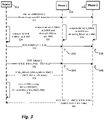
- the communication node is a reader 312, and the further communication nodes are two phones, being phone1 316 and phone2 318.
- the reader 312 acts as the controller/initiator; each of the two phones, phone one 316 and phone to 318 acts as controlee/responder.
- the reader 312 transmits, via the further communication unit 206, an out-of-band broadcast message or advertisement 322 which contains information to each of the phones.
- the broadcast message includes an identifier of the reader ("ReaderName").
- the broadcast message 322 may further includes a random number, to be used by each of the phones and the reader as described further hereinbelow.
- the broadcast measured 322 may further contain include an identifier of a ranging session ("Session ID", or "DATE"). This broadcast message may be described as an advertisement or "Advertise”.
- the further communication link 236 used may conform to a BLE protocol. In other embodiments, the further communication link 236 may conform to a Wi-Fi protocol, or other suitable out-of-band protocol.
- the responders do not require to acknowledge the out-of-band advertisements 322. In other embodiments, the responders may require to acknowledge the out-of-band advertisement 322.
- each of the reader 312 and phones 316 and 318 use the content of the out-of-band broadcast message 322 to derive session keys: in the case of the reader 312, the processing unit 204 computes a derived master session key (S_MKrnr) based on the random number.
- the processing unit 204 computes a derived master session key (S_MKrnr) based on the random number.
- S_MKrnr derived master session key
- each of the phones computes a responder-specific cryptographic session key: in the case of phone1 316, the phone computes, in its further processing unit 214, a derived responder-specific cryptographic session key (S_RK1rrnr) based on the random number, and its own unique identifier (MAC address).
- the phone computes, in its further processing unit 214, a derived responder-specific cryptographic session key (S_RK2rrnr) based on the random number, and its own unique identifier (MAC address).
- the unique identifier of each of the phones is already known to the reader at this stage of the process. In one or more embodiments, this is achieved by registering each phone with the reader in a provisioning step. During the registration process, the reader may assign the unique identifier or MAC address to each phone.
- this registration process may be undertaken when a particular user or subscriber registers, along with their phone, as a potential user of the mass transit system; a central server may store the details and in particular the unique identifier of the phone with each of the stations on the mass transit system, and share this information with the readers in each of the gates, such that the readers in each of the gates are aware of the MAC address of each registered phone.
- the registration process may involve assigning the user, along with their phone, as an authorised occupant or entrant to the building or apartment.
- a ranging session commences with the transmission, by the reader 312 of a ranging control message (RCM) 332.
- the ranging control message 332 includes a scrambled timestamp (STS) index.
- STS index identifies the session.
- STS index identifies the session.
- STS index identifies the session.
- STS index identifies the session.
- the ranging control message is intended for all phones 316, 318 within the vicinity of the reader.
- the structure and encryption of the ranging control message and subsequent messages and responses will be described in more detail hereinbelow with respect to figure 4 .
- phone1 316 receives the range control message 332, shown at moment A 336 in figure 3 , it can use the master cryptographic session key (S_MK), to decrypt the payload and header IE of the RCM. Furthermore, phone2 318 receives the range control message 332 at the same moment A indicated at 338 in its timeline of figure 3 , it can also use the master cryptographic session key (S_MK) to decrypt the payload and header IE of the RCM.
- S_MK master cryptographic session key
- Poll message 342 includes a scrambled timestamp STS, which is scrambled according to the session master key S_MKrnr. Poll message 342 further includes encrypted data (indicated in figure 3 as "ENC", including the session identifies STS_Index).
- ENC the session master key
- the poll message 342 is intended for all phones 316, 318 within the vicinity of the reader.
- the RCM message 332 defines therein a so-called contention period (CP). The timing and duration of the contention period CP may be protocol-specific, but generally follows immediately from the poll message 342.
- the poll message will conform to the SP1 or SP2 format according to the IEEE802.15.4 standard; according to SP1, the format is SFD and SYNC, followed by STS and Payload in that order; in SP2, the format is SFD and SYNC followed by Payload and STS in that (opposite) order.
- phone1 316 receives the poll message 342, shown at moment B 346 in figure 3 , it can use the Session ID (given by STS_INDEX) value, to decrypt the STS of the poll message. Furthermore, phone2 318 receives the poll message 342 at the same moment B indicated at 348 in its timeline of figure 3 , and it also can use the Session ID and STS_INDEX value, to decrypt the STS of the poll message.
- Session ID given by STS_INDEX
- Each of the phone 316, 318 may then send a response to the reader 312, during the contention period CP.
- Each phone is free to determine, on a random basis, which slot to use within the contention period.
- Shown in figure 3 is an example in which phone1 316 sends a response 356 early in the contention period.
- the response includes a scrambled timestamp STS, wherein the scrambling is based on the session master key S_MK rnr followed by data, which is encoded as indicated in figure 3 by "ENC".
- the encoded data includes two parts, as will be described in more detail hereinbelow.
- the first part is encoded according to the session master key S_MKrnr; the second part which includes a timestamp of the response is encoded using the response-specific session key S_RK1rnr.
- the reader On receipt of the response, it can be decoded into parts by the reader.
- the reader requires to know from which phone 316, 318 the message is sent, in order to determine the appropriate responder-specific cryptographic session key to used to decode the payload. However at the start of the receipt this is unknown to the reader.
- the reader therefore decodes the header which was encoded using the master session key, using the master session key, to determine the unique identifier (MAC address) of the phone.
- MAC address unique identifier
- the figure shows a first ranging control message structure 410, illustrating the structure of a range control message according to one or more embodiments.
- the range control message typically complies with the IEEE 802.15 standard.
- the message consists of a MAC header part and an encrypted header Information element (IE) and payload part.
- IE header Information element
- the MAC header part 412 comprises a source MAC address 416 of length eight octets (that is to say, eight 8-bit bytes), and a null or "missing" part 418 which is an indicator that a destination address is not present.
- This part 418 is shown as null in the present example, since the range control message broadcast is not targeted at any specific device so there is no specific destination MAC address.
- the control message will indicate, within a section "Destination PAN ID", the absence of a destination address: the poll message then does not have an empty or null section, and this results in a shorter message
- the encrypted header IE and payload part 414 similarly falls into two distinct parts: a first part 420 provides the header IE, which may include a vendor organisationally unique identifier (OUI), a session identifier such as "Session ID" or "DATE”, and the "STS Index”; a second part 422, that is to say the payload, defines the timing and duration of the contention period CP.
- a ranging control message is shown at 430.
- the overall structure is similar to that above in that the message has two parts, comprising a MAC header 412 and an encrypted header IE and payload 414.
- the MAC header 412 comprises a source MAC address part 416 and a null part 418 which is an indicator that a destination address is not present.
- the MAC header is longer, and includes an auxiliary header 432.
- the auxiliary header 432 consists of one or both of the random number and the Session ID.
- a ranging control message of this structure is particularly suited to embodiments in which there has not been previous communication or broadcast by the reader, of the random number used to generate session keys.
- this random number and or the session ID is provided to the phones 316, 318 by out-of-band communication such as BLE or Wi-Fi.
- the previously mentioned ranging control message 410 is applicable.
- the second part being the encrypted header IE and payload is similar to that for the range control message 410, in that it comprises an encrypted header IE 421 and a contention period definition 422.
- the auxiliary header is similar to the header in the ranging control message 410 except that, in the event that the session ID is included in the MAC header, it is not necessary to include it in the encrypted header IE.
- a benefit of the alternative ranging control message structure 430 is that the random number, and session ID, are available in a MAC header and thus are not fully encrypted. These pieces of information may thus be readily available to be used by the processor of the phone to derive the master session key in order to decode the encrypted payload data to identify the STS index and contention period CP.
- Shown at 450 is the structure of a poll message, sent by the controller/initiator as a broadcast message.
- the structure comprises source address header of length eight octets, followed by a packet which conforms to the IEEE 802.15.4 standard as an SP3 packet (that is to say a packet which conforms to STS configuration 3).
- the SP3 packet comprises thus comprises synchronisation bits (SYNC) 456, start of frame delimiter (SFD) 458, and scrambled timestamp (STS) 460.
- SYNC synchronisation bits
- SFD start of frame delimiter
- STS scrambled timestamp
- the session master key S_MKrnr is used to scramble the timestamp to provide STS in the poll message
- the figure 4 shows the message structure of a response 470 sent from one of the phones and received by the reader.
- the response consists of a MAC header part 472 and an encrypted header Information element ("IE") and payload part 474.
- IE header Information element
- the MAC header part 412 comprises an 8 octet source MAC address 416), and an 8 octet destination MAC address 476 (which is the same as the source MAC address of the reader).
- the encrypted header IE and payload part 474 similarly falls into two distinct parts: a first part 478 provides the header IE, which may include a vendor organisationally unique identifier (OUI), and a session identifier such as "Session ID”, "STS Index”, or "DATE”; a second part 480, that is to say the payload, is a timestamp (STS) of the response or reply.
- a first part 478 provides the header IE, which may include a vendor organisationally unique identifier (OUI), and a session identifier such as "Session ID”, "STS Index”, or “DATE”
- STS timestamp
- Fig. 5 illustrates a method of operating an ultra-wideband communication node.
- the method comprises, at step 502, transmitting, by an ultra-wideband communication unit comprised in the communication node, one or more messages to a plurality of external responder nodes and receiving, by said communication unit, one or more responses from said responder nodes.
- the method continues, at step 504 by using, by a processing unit comprised in the communication node, a common cryptographic session key to encrypt said messages, wherein said common cryptographic session key is a key shared between the ultra-wideband communication node and all the external responder nodes.
- the method further continues, at step 506, identifying, from each of said one or more responses, the respective responder node from which it was received.
- the method then continues, at step 508, using, by said processing unit, responder-specific cryptographic session keys to decrypt the responses and/or to encrypt further messages to the responder nodes, wherein each individual one of said responder-specific cryptographic session keys is a key shared between the ultra-wideband communication node and one of the external responder nodes.
- the ranging control method payload part is encrypted using the master cryptographic session key, and the payload part of the response from each phone is encrypted using the response-specific cryptographic session key (that is to say, the key is specific to one or more messages from that phone).
Landscapes
- Engineering & Computer Science (AREA)
- Computer Security & Cryptography (AREA)
- Computer Networks & Wireless Communication (AREA)
- Signal Processing (AREA)
- Computer Hardware Design (AREA)
- Computing Systems (AREA)
- General Engineering & Computer Science (AREA)
- Mobile Radio Communication Systems (AREA)
Abstract
Description
- The present disclosure relates to an ultra-wideband communication node. Furthermore, the present disclosure relates to a corresponding method of operating an ultra-wideband communication node, ultra-wideband communication system, and to a corresponding computer program.
- Ultra-wideband (UWB) is a technology that uses a high signal bandwidth, in particular for transmitting digital data over a wide spectrum of frequency bands with very low power. For example, ultra-wide band technology may use the frequency spectrum of 3.1 to 10.6 GHz and may feature a high-frequency bandwidth of more than 500 MHz and very short pulse signals, resulting in high data rates. The UWB technology enables a high data throughput for communication devices and a high precision for the localization of devices.
- According to a first aspect of the present disclosure there is provided an ultra-wideband, UWB, communication node comprising: a UWB communication unit configured to transmit one or more messages to a plurality of external responder nodes, the one or more messages comprising a ranging control message defining a contention period, and further configured to receive one or more responses from said responder nodes during said contention period, each response including a response payload; a processor unit configured to use a common cryptographic session key to encrypt said messages, wherein said common cryptographer session key is a key shared between the UWB communication node and all the external responder nodes; wherein the processing unit is further configured to use responder-specific session keys to decrypt the response payloads; wherein each individual one of said responder-specific cryptographic session keys is a unique key shared between the ultra-wideband communication node and one of the external responder nodes. The one or more messages generally includes a polling message subsequent to the ranging control message. The UWB communication node may use responder-specific session keys to encrypt further messages to the responder nodes. Thus, according to this aspect of the present disclosure, it may be possible to efficiently provide UWB ranging using contention based ranging with multiple responders.
- In one or more embodiments, the processor unit is further configured to generate a random number, and at least one of the common cryptographic session key and each of said responder-specific cryptographic session keys is derived from the random number. Such prior distribution of a random number which is specific to one, or a group of, ranging sessions may enhance the security of the system.
- In one or more embodiments the processor unit is further configured to generate a respective medium access code, MAC, address for each of the external responder nodes, and wherein each of said responder-specific cryptographic sessions key is further derived from the respective MAC address. Using the MAC address of an individual device may help to improve the security of the communication
- In one or more embodiments the communication node further comprises a further communication unit which is configured to transmit an identifier of the communication node. The further communication unit may in particular use on so-called "out-of-band" communication such as BLE or Wi-Fi.
- In one or more embodiments, the communication node is operable for a ranging session comprising transmission of said message and receipt of said response, wherein the further communication unit is further configured to transmit the random number and an identifier of the ranging session. In other embodiments, the random number and identifier of the ranging session may be transmitted by the communications unit in the ranging control message broadcast advertisements.
- In one or more embodiments, the communication node further comprises further comprising a secure element, wherein the common cryptographic session key and the responder-specific cryptographic session keys are stored in said secure element. A secure element is a particularly convenient way of storing sensitive information. In one or more other embodiments, an electronic secure element may be used as an alternative to a hardware secure element; in yet further embodiments, the sensitive information may be stored in the processing unit. In such embodiments a secure element may not be required.
- In one or more embodiments the ultra-wideband communication unit is further configured to receive identifiers from the external responder nodes, wherein said identifiers uniquely identify the external responder nodes, and wherein the processing unit is further configured to use the identifiers to retrieve responder-specific cryptographic session keys from the secure element. Typically, each identifier may be the respective MAC address of the responder node, although other identifies may be used as alternatives thereto. The MAC address or other identifier may be included in a header to the message response received from the respective responder node.
- In one or more embodiments, the communication node may further comprise an authentication unit configured to perform a mutual authentication process with the external responder nodes.
- The messages and the responses may typically include scrambled timestamp sequences and payloads.
- In one or more embodiments, the common cryptographic session key and the responder-specific cryptographic session keys may be usable for a single communication session or for a limited number of communication sessions.
- In one or more embodiments, the processing unit is further configured: to generate a new common cryptographic session key and new responder-specific cryptographic session keys after one or more communication sessions have ended; and to share said new common cryptographic session key and new responder-specific cryptographic session keys with the responder nodes, wherein the new common cryptographic session key is shared with all the responder nodes and each new responder-specific cryptographic session key is shared with a specific one of said responder nodes.
- According to a further aspect of the present disclosure, there is provided a communication system comprising the communication node as above and the plurality of responder nodes, wherein each one of said responder nodes is configured: to use the common cryptographic session key to decrypt messages received from the communication node; and to use the responder-specific cryptographic session key that has been shared with the respective responder node to encrypt responses to said messages and/or to decrypt further messages received from the communication node.
- In one or more embodiments the communication node is configured to carry out ranging operations with the responder nodes, and said ranging operations include one or more of said messages and one or more of said responses.
- According to a yet further aspect of the present disclosure, there is provided a method of operating an ultra-wideband communication node, comprising: transmitting, by an ultra-wideband communication unit comprised in the communication node, one or more messages to a plurality of external responder nodes and receiving, by said communication unit, one or more responses from said responder nodes; using, by a processing unit comprised in the communication node, a common cryptographic session key to encrypt said messages, wherein said common cryptographic session key is a key shared between the ultra-wideband communication node and all the external responder nodes; identifying, from each of said one or more responses, the respective responder node from which it was received, and using, by said processing unit, responder-specific cryptographic session keys to decrypt the responses and/or to encrypt further messages to the responder nodes, wherein each individual one of said responder-specific cryptographic session keys is a key shared between the ultra-wideband communication node and one of the external responder nodes.
- In one or more embodiments the method may further comprise transmitting, by a further communication unit comprised in the communication node, the common cryptographic session key and the responder-specific cryptographic session keys to the respective external responder nodes.
- In one or more embodiments, the method includes identifying, by the processing unit comprised in the communication node, from a header to the response, a one of the plurality of external responder nodes from which each response is received prior to decrypting the respective response.
- According to a yet further embodiments aspect of the present disclosure, there is provided a computer program comprising executable instructions which, when executed by a processing unit, cause said processing unit to perform the steps of the methods mentioned above. Thus, there may be provided a computer program, which when run on a computer, causes the computer to configure any apparatus, including a circuit, controller, sensor, filter, or device disclosed herein or perform any method disclosed herein. The computer program may be a software implementation, and the computer may be considered as any appropriate hardware, including a digital signal processor, a microcontroller, and an implementation in read only memory (ROM), erasable programmable read only memory (EPROM) or electronically erasable programmable read only memory (EEPROM), as non-limiting examples. The software implementation may be an assembly program.
- The computer program may be provided on a computer readable medium, which may be a physical computer readable medium, such as a disc or a memory device, or may be embodied as another non-transient signal.
- These and other aspects of the invention will be apparent from, and elucidated with reference to, the embodiments described hereinafter.
- Embodiments will be described, by way of example only, with reference to the drawings, in which
-
Fig. 1 shows an illustrative embodiment of a UWB communication node; -
Fig. 2 shows an illustrative embodiment of a UWB communication system; -
Fig. 3 shows an illustrative embodiment of a method of operating a UWB communication node; and -
Fig. 4 shows the structure of various packets associated with UWB ranging methods. - It should be noted that the Figures are diagrammatic and not drawn to scale. Relative dimensions and proportions of parts of these Figures have been shown exaggerated or reduced in size, for the sake of clarity and convenience in the drawings. The same reference signs are generally used to refer to corresponding or similar features in modified and different embodiments
- Ultra-wideband (UWB) is a technology that uses a high signal bandwidth, in particular for transmitting digital data over a wide spectrum of frequency bands with very low power. For example, ultra-wide band technology may use the frequency spectrum of 3.1 to 10.6 GHz and may feature a high-frequency bandwidth of more than 500 MHz and very short pulse signals, resulting in high data rates. The UWB technology enables a high data throughput for communication devices and a high precision for the localization of devices.
- UWB technology may also be used for supporting applications which are typically performed by technologies such as near field communication (NFC), for example for supporting the execution of transactions with another communication device (e.g., a payment terminal). Examples of such transactions include payment transactions in a variety of stores, ticket validations or fare payments in the public transportation sector and authorisation of physical access (e.g. into a building). Such a transaction usually comprises an exchange of one or more commands (e.g., instructions) and responses (e.g., data) between two communication devices. In such a scenario, a UWB communication device facilitates the localization of the communication counterparts if a communication technology such as Bluetooth low energy (BLE) or Wi-Fi is used for executing a transaction between the communication counterparts. These communication technologies have a larger range than NFC, and therefore the localization of the communication counterparts becomes important. In particular, when NFC is used for carrying out a transaction, the intent of a user is implicitly given because NFC can only be realized while the communication counterparts are in close proximity of each other. However, the intent of a user may not be clear if a larger-range communication technology is used. For example, a user may be within communication range of a payment terminal, such that a transaction might be initiated between his mobile phone and the terminal, but instead of approaching the terminal, the user leaves the store. In this case, the transaction might be executed while this was not intended. Thus, the system may not be sufficiently reliable and secure. In such a case, UWB may be used to track the movement of the user, and if this movement implies the intention of the user to carry out the transaction (e.g., if the phone approaches the terminal in the expected manner) then the transaction may be concluded. Thus, an UWB ranging session involving a plurality of ranging operations to track the phone's movements is used as a complementary security feature, to compensate for the loss of security inherently caused by the larger-range technologies.
- Thus, a UWB communication device integrated in a mobile phone may perform a sequence of ranging operations with another UWB communication device integrated in a payment terminal or a transit gate, to increase the reliability and security of a transaction (e.g., to verify whether the phone is carried by a user who approaches the terminal or the gate). The transaction, which is executed through an out-of-band communication channel (i.e., not through the UWB communication channel), may involve initial steps such as the identification, authentication and verification of access rights of the phone, and concluding steps such as the completion of the transaction and the confirmation by the terminal that the transaction has been concluded. The UWB ranging session is used to verify whether the phone approaches the terminal, which implies that the user has the intention to carry out the transaction. In typical NFC use cases, this intent is implicitly given by the technology, because the user needs to be in close proximity (10 cm) of the terminal. Using BLE, the transaction is typically initiated while the user is many meters away from the terminal. Therefore, a UWB ranging session is executed to verify whether the user correctly approaches the terminal, and the transaction is concluded in dependence on the result of the UWB ranging session. The transaction is then carried out using the out-of-band communication channel (BLE).
- Alternatively, both the ranging operation and the transaction itself may be carried out in-band, i.e. through the UWB communication channel. Thus, the UWB devices may carry out functions which are typically carried out by NFC devices. An example of an application or use case is that of physical access control, for instance through the turnstiles or other access control points of a public mass transport system or a sports venue. One notable feature of such applications or use cases is that there may be expected to be many users and thus many mobile phones - which may also be referred to as responders - which may require to perform ranging activities with the same gate-control - which may also be referred to as initiators. Recently, protocols have been developed across and among the relevant industrial users to allow such multiple ranging activities to occur at the same time. Such protocols fall generally into two types. According to a first group of protocols, which is sometimes referred to as multicast ranging, a controller or initiator device, which would typically be the terminal reader or gate control, controls the sequence of the UWB communication, and allocates a particular time slots to each of the UWB controlees/responders, which would typically be phones. Once the controller has established that the communication pattern, it may send out a broadcast message to all the phones. From the timing of this broadcast message, each phone or controlee/responder can determine when it should transmit its response. Interference between phones can thus be minimised. However it will be appreciated that according to such group of protocols, there needs to be a well-defined set of controlees, each of which has its own time slot. In many applications the number and identities of the controlees which are in the vicinity of the controller may vary, and in particular many devices may be transitory.
- A further group of protocols have thus recently been developed to allow for a variable number of phones or controlees/responders. In these protocols, the controller is arranged to transmit a broadcast signal, following which any of the available controlees/responders may transmit a response, in any time slot within a predetermined period. Such protocols are typically referred to as contention based ranging, since it is possible that more than one controller/responder attempts to transmit its response in the same time slot. The protocols resolve the resulting contention between possible responses. Whereas the contention resolution adds to the complexity of such protocols, they are generally much more time efficient than the "one-slot-per-responder" multicast protocols.
- The present disclosure is directed at such contention based protocols, and methods, and devices and systems configured to implement them.
- A typical UWB ranging session includes one or more messages (i.e., commands) transmitted from a UWB communication node (which is also referred to as a "reader" herein) to one or more external UWB responder nodes (i.e., communication nodes which are external to the communication node), as well as one or more responses to those commands, which are transmitted back to the communication node by the responder nodes. These messages and the responses to these messages should be protected by encryption. For this purpose, cryptographic session keys are used. That is to say, the communication node encrypts the messages using such a session key, and the responder nodes each decrypt the messages using the same or a corresponding session key (depending on whether symmetric or asymmetric cryptography is applied). Similarly, the responder nodes encrypt the responses using the session key, and the communication node decrypts the responses using the same or a corresponding session key. Typically, a single shared cryptographic session key is used, i.e. a key which is shared between the communication node and all the responder nodes. This, however, creates a security risk, because each of the responder nodes that has access to the commonly shared key can impersonate any other responder node that makes use of the commonly shared key.
- Now discussed are an ultra-wideband communication node, system and a corresponding method of operating an ultra-wideband communication node, which facilitate increasing the level of security in an ultra-wideband based communication system, in particular by reducing the probability that responder nodes will impersonate each other, and/or reducing the possibility of interference by third parties in the communication.
-
Fig. 1 shows an illustrative embodiment of aUWB communication node 100. TheUWB communication node 100 comprises aUWB communication unit 102 and aprocessing unit 104. TheUWB communication unit 102 is configured to transmit one or more messages to a plurality of external responder nodes and to receive one or more responses from the responder nodes. Theprocessing unit 104 is configured to use a common cryptographic session key to encrypt said messages, wherein said common cryptographic session key is a key shared between the ultra-wideband communication node and all the external responder nodes. Furthermore, the processing unit is configured to use responder-specific cryptographic session keys to decrypt the responses and/or to encrypt further messages to the responder nodes, wherein each individual one of said responder-specific session keys is a key shared between the ultra-wideband communication node and one of the external responder nodes. Thus, each responder node may encrypt its responses using a responder-specific session key, and the processing unit of the communication node may decrypt the responses using the responder-specific session key. Accordingly, since each response node uses a specific session key to encrypt its responses, the risk that other responder nodes can impersonate said responder node is reduced. Nevertheless, the use of a common cryptographic session key for transmitting messages to the responder nodes facilitates achieving an acceptable performance in terms of computing cost. Alternatively or in addition, the responder-specific session key may be used to protect specific messages (i.e., further messages) from the ultra-wideband communication node to the respective responder node. In this way, the risk that other responder nodes can impersonate said responder node is also reduced, while the use of a common cryptographic session key for transmitting the first message or messages to the responder nodes still facilitates achieving an acceptable performance in terms of computing cost. Thus, a responder node may use the responder-specific session key to encrypt its responses and/or to decrypt further messages from the communication node. If the responder node does not use the responder-specific session key to encrypt its responses, it may use the common cryptographic session key for this purpose. - Turning now to
Fig. 2 this shows a communication system comprising a communication node such as that described infigure 1 . The figure shows a firstUWB communication node 200, which comprises aUWB communication unit 202, and aprocessing unit 204. The UWB communication unit and processing unit may be the same as that shown infigure 1 at 102 and 104 respectively. In particular the processing unit may be a host microcontroller unit or similar. Thefirst communication node 200 may further include afurther communication unit 206. Thefurther communication unit 206 may be for instance a Bluetooth light energy (BLE) radio or a Wi-Fi radio, and facilitate communications which are "out-of-band" with respect to the UWB communications. Furthermore, according to one or more embodiments the UWB communication node may further comprise asecure element 208. As will be familiar to the skilled person, a secure element is a hardware device or part of a hardware device, which includes hardware-based, or physical, barriers against unauthorised access. Such barriers may include, for example, metal screening layers and/or other features intended to prevent unauthorised access to data stored in the secure. In other embodiments, data may be stored directly in theprocessing unit 204, the data being protected for instance by encryption or obfuscation. In such embodiments a secure element may not be present.
The firstUWB communication node 200 acts as a controller or initiator according to various embodiments of the present disclosure.
In addition tofirst communication node 200,figure 2 shows one or more furtherUWB communication nodes 210. Each of these respectiveUWB communication nodes 210 is similar to thecommunication node 200 and comprises a respectiveUWB communication unit 212, along with arespective processing unit 214. Furthermore, each furtherUWB communication node 210 may comprise arespective communication unit 216 and/or a respectivesecure element 218. The or each of the furtherUWB communication nodes 210 acts as a controlee or responder according to various embodiments of the present disclosure. The or eachfurther communication nodes 210 may transmit and receive signals respectively to and from thecommunications node 200 by means of theUWB communication unit 202 and further UWB communication unit orunits 212 bycommunication channel 232. Furthermore, the or eachfurther communication nodes 210 may transmit and/or receive signals to and from thecommunications node 200 by means of thefurther communication unit 206 and respective further communication unit orunits 216 bycommunication channel 236. - In one or more embodiments, as will be discussed in more detail hereinbelow, the
respective communication unit 212 of each of the controlee or responderUWB communication node 210 may not be required to transmit signals or information, but only to receive information from the controller or initiatorUWB communication node 200. Such embodiments may be convenient since a two-way "out-of-band" communication channel or link 236 between the controller and responder may not be required. In such embodiments, it may be sufficient that the controller or initiator transmits information to each of thefurther communication nodes 210, without requiring a response in that "out-of-band" communication channel: the out-of-band communication channel or link 236 in such embodiments need only be one way.
In other embodiments, a two-way link may be provided by the out-of-bandcommunication channel link 236. - Turning now to
Fig. 3 , this shows a method of operating a communication node according to one or more embodiments. In this example, the communication node is areader 312, and the further communication nodes are two phones, being phone1 316 andphone2 318. Thereader 312 acts as the controller/initiator; each of the two phones, phone one 316 and phone to 318 acts as controlee/responder. Prior to a contention based ranging session, thereader 312 transmits, via thefurther communication unit 206, an out-of-band broadcast message oradvertisement 322 which contains information to each of the phones. The broadcast message includes an identifier of the reader ("ReaderName"). Thebroadcast message 322 may further includes a random number, to be used by each of the phones and the reader as described further hereinbelow. The broadcast measured 322 may further contain include an identifier of a ranging session ("Session ID", or "DATE"). This broadcast message may be described as an advertisement or "Advertise". As shown infigure 3 , thefurther communication link 236 used, may conform to a BLE protocol. In other embodiments, thefurther communication link 236 may conform to a Wi-Fi protocol, or other suitable out-of-band protocol. According to the embodiment depicted infigure 3 , the responders do not require to acknowledge the out-of-band advertisements 322. In other embodiments, the responders may require to acknowledge the out-of-band advertisement 322. - As shown in
figure 3 , according to one or more embodiments, each of thereader 312 andphones band broadcast message 322 to derive session keys: in the case of thereader 312, theprocessing unit 204 computes a derived master session key (S_MKrnr) based on the random number. Each of thephone further processing unit 214, derived master session key (S_MKrnr) based on the random number. Furthermore, each of the phones computes a responder-specific cryptographic session key: in the case ofphone1 316, the phone computes, in itsfurther processing unit 214, a derived responder-specific cryptographic session key (S_RK1rrnr) based on the random number, and its own unique identifier (MAC address). Similarly, in the case ofphone2 318, the phone computes, in itsfurther processing unit 214, a derived responder-specific cryptographic session key (S_RK2rrnr) based on the random number, and its own unique identifier (MAC address). - At this point it should be noted that the unique identifier of each of the phones is already known to the reader at this stage of the process. In one or more embodiments, this is achieved by registering each phone with the reader in a provisioning step. During the registration process, the reader may assign the unique identifier or MAC address to each phone. Taking, as the first concrete example, embodiments for providing access to a mass transit system, this registration process may be undertaken when a particular user or subscriber registers, along with their phone, as a potential user of the mass transit system; a central server may store the details and in particular the unique identifier of the phone with each of the stations on the mass transit system, and share this information with the readers in each of the gates, such that the readers in each of the gates are aware of the MAC address of each registered phone. Taking a further concrete example, embodiments for providing access to a building or apartment, the registration process may involve assigning the user, along with their phone, as an authorised occupant or entrant to the building or apartment.
- Returning to the method shown in
figure 3 , a ranging session commences with the transmission, by thereader 312 of a ranging control message (RCM) 332. The rangingcontrol message 332 includes a scrambled timestamp (STS) index. STS index identifies the session. This, and the subsequent messages and responses, are transmitted and/or received by the respective device'sUWB communication unit phones figure 4 . - Once
phone1 316 receives therange control message 332, shown at moment A 336 infigure 3 , it can use the master cryptographic session key (S_MK), to decrypt the payload and header IE of the RCM. Furthermore,phone2 318 receives therange control message 332 at the same moment A indicated at 338 in its timeline offigure 3 , it can also use the master cryptographic session key (S_MK) to decrypt the payload and header IE of the RCM. - Subsequent to the ranging control message, the
reader 312 transmits apoll message 342.Poll message 342 includes a scrambled timestamp STS, which is scrambled according to the session master key S_MKrnr.Poll message 342 further includes encrypted data (indicated infigure 3 as "ENC", including the session identifies STS_Index). Thepoll message 342 is intended for allphones RCM message 332 defines therein a so-called contention period (CP). The timing and duration of the contention period CP may be protocol-specific, but generally follows immediately from thepoll message 342. Generally, the poll message will conform to the SP1 or SP2 format according to the IEEE802.15.4 standard; according to SP1, the format is SFD and SYNC, followed by STS and Payload in that order; in SP2, the format is SFD and SYNC followed by Payload and STS in that (opposite) order. - Once
phone1 316 receives thepoll message 342, shown atmoment B 346 infigure 3 , it can use the Session ID (given by STS_INDEX) value, to decrypt the STS of the poll message. Furthermore,phone2 318 receives thepoll message 342 at the same moment B indicated at 348 in its timeline offigure 3 , and it also can use the Session ID and STS_INDEX value, to decrypt the STS of the poll message. - Each of the
phone reader 312, during the contention period CP. Note that, in contrast to multicast ranging, there is no predetermined order of precedence of the responses. Each phone is free to determine, on a random basis, which slot to use within the contention period. Shown infigure 3 is an example in which phone1 316 sends aresponse 356 early in the contention period. The response includes a scrambled timestamp STS, wherein the scrambling is based on the session master key S_MK rnr followed by data, which is encoded as indicated infigure 3 by "ENC". The encoded data includes two parts, as will be described in more detail hereinbelow. The first part is encoded according to the session master key S_MKrnr; the second part which includes a timestamp of the response is encoded using the response-specific session key S_RK1rnr.
On receipt of the response, it can be decoded into parts by the reader. In particular the reader requires to know from whichphone - In passing it should be noted that this complexity - that is to say, having to first decode a first part of the message in order to determine from which responder it was received, prior to decoding the remainder of the message using the responder specific key - does not arise in the case of multicast ranging in which individual time slots are allocated to individual responders. In that scenario, the reader knows in advance from which responder to expect a response in any given time slot. The reader then can directly decrypt the payload of the response using the appropriate responder-specific cryptographic session key. Nonetheless, contention based ranging as disclosed herein will often be the preferred method, due to the significant time-saving potentially achieved thereby.
- Turning to
fig. 4 , this figure shows the structure of various of the messages and responses mentioned above and applicable to embodiments of the present disclosure. The figure shows a first rangingcontrol message structure 410, illustrating the structure of a range control message according to one or more embodiments. The range control message typically complies with the IEEE 802.15 standard. At the access layer level, the message consists of a MAC header part and an encrypted header Information element (IE) and payload part. Looking in more detail, theMAC header part 412 comprises asource MAC address 416 of length eight octets (that is to say, eight 8-bit bytes), and a null or "missing"part 418 which is an indicator that a destination address is not present. Thispart 418 is shown as null in the present example, since the range control message broadcast is not targeted at any specific device so there is no specific destination MAC address. As the skilled person will be aware, in general, the control message will indicate, within a section "Destination PAN ID", the absence of a destination address: the poll message then does not have an empty or null section, and this results in a shorter message The encrypted header IE andpayload part 414 similarly falls into two distinct parts: afirst part 420 provides the header IE, which may include a vendor organisationally unique identifier (OUI), a session identifier such as "Session ID" or "DATE", and the "STS Index"; asecond part 422, that is to say the payload, defines the timing and duration of the contention period CP. - An alternative structure of the ranging control message, according to one or more other embodiments, is shown at 430. The overall structure is similar to that above in that the message has two parts, comprising a
MAC header 412 and an encrypted header IE andpayload 414. Once again, theMAC header 412 comprises a sourceMAC address part 416 and anull part 418 which is an indicator that a destination address is not present. However in thisRCM message 430, the MAC header is longer, and includes anauxiliary header 432. Theauxiliary header 432 consists of one or both of the random number and the Session ID. A ranging control message of this structure is particularly suited to embodiments in which there has not been previous communication or broadcast by the reader, of the random number used to generate session keys. As ready mentioned above, in one or more embodiments this random number and or the session ID is provided to thephones control message 410 is applicable. In the alternative rangingcontrol message 430, the second part being the encrypted header IE and payload is similar to that for therange control message 410, in that it comprises anencrypted header IE 421 and acontention period definition 422. The auxiliary header is similar to the header in the rangingcontrol message 410 except that, in the event that the session ID is included in the MAC header, it is not necessary to include it in the encrypted header IE. A benefit of the alternative rangingcontrol message structure 430 is that the random number, and session ID, are available in a MAC header and thus are not fully encrypted. These pieces of information may thus be readily available to be used by the processor of the phone to derive the master session key in order to decode the encrypted payload data to identify the STS index and contention period CP. - Shown at 450 is the structure of a poll message, sent by the controller/initiator as a broadcast message. The structure comprises source address header of length eight octets, followed by a packet which conforms to the IEEE 802.15.4 standard as an SP3 packet (that is to say a packet which conforms to STS configuration 3). The SP3 packet comprises thus comprises synchronisation bits (SYNC) 456, start of frame delimiter (SFD) 458, and scrambled timestamp (STS) 460. The session master key S_MKrnr is used to scramble the timestamp to provide STS in the poll message
- Finally, the
figure 4 shows the message structure of aresponse 470 sent from one of the phones and received by the reader. The response consists of aMAC header part 472 and an encrypted header Information element ("IE") andpayload part 474. Looking in more detail, theMAC header part 412 comprises an 8 octet source MAC address 416), and an 8 octet destination MAC address 476 (which is the same as the source MAC address of the reader). The encrypted header IE andpayload part 474 similarly falls into two distinct parts: afirst part 478 provides the header IE, which may include a vendor organisationally unique identifier (OUI), and a session identifier such as "Session ID", "STS Index", or "DATE"; asecond part 480, that is to say the payload, is a timestamp (STS) of the response or reply. -
Fig. 5 illustrates a method of operating an ultra-wideband communication node.
The method comprises, atstep 502, transmitting, by an ultra-wideband communication unit comprised in the communication node, one or more messages to a plurality of external responder nodes and receiving, by said communication unit, one or more responses from said responder nodes. - The method continues, at
step 504 by using, by a processing unit comprised in the communication node, a common cryptographic session key to encrypt said messages, wherein said common cryptographic session key is a key shared between the ultra-wideband communication node and all the external responder nodes. The method further continues, atstep 506, identifying, from each of said one or more responses, the respective responder node from which it was received. The method then continues, atstep 508, using, by said processing unit, responder-specific cryptographic session keys to decrypt the responses and/or to encrypt further messages to the responder nodes, wherein each individual one of said responder-specific cryptographic session keys is a key shared between the ultra-wideband communication node and one of the external responder nodes. - From the above descriptions of the message content, it will be appreciated that the ranging control method payload part is encrypted using the master cryptographic session key, and the payload part of the response from each phone is encrypted using the response-specific cryptographic session key (that is to say, the key is specific to one or more messages from that phone).
- From reading the present disclosure, other variations and modifications will be apparent to the skilled person. Such variations and modifications may involve equivalent and other features which are already known in the art of UWB ranging, and which may be used instead of, or in addition to, features already described herein.
- Although the appended claims are directed to particular combinations of features, it should be understood that the scope of the disclosure of the present invention also includes any novel feature or any novel combination of features disclosed herein either explicitly or implicitly or any generalisation thereof, whether or not it relates to the same invention as presently claimed in any claim and whether or not it mitigates any or all of the same technical problems as does the present invention.
- Features which are described in the context of separate embodiments may also be provided in combination in a single embodiment. Conversely, various features which are, for brevity, described in the context of a single embodiment, may also be provided separately or in any suitable sub-combination. The applicant hereby gives notice that new claims may be formulated to such features and/or combinations of such features during the prosecution of the present application or of any further application derived therefrom.
- For the sake of completeness it is also stated that the term "comprising" does not exclude other elements or steps, the term "a" or "an" does not exclude a plurality, a single processor or other unit may fulfil the functions of several means recited in the claims and reference signs in the claims shall not be construed as limiting the scope of the claims.
-
- 100
- UWB communication node
- 102
- UWB communication unit
- 104
- processing unit
- 200
- first UWB communication node
- 202
- first UWB communication unit
- 204
- processing unit
- 206
- further communication unit
- 208
- secure element
- 210
- further UWB communication node
- 212
- UWB communication unit
- 214
- processing unit
- 216
- further communication unit
- 208
- secure element
- 232
- UW be communication channel
- 234
- BLE or Wi-Fi communication channel
- 312
- reader
- 316
- phone1
- 318
- phone2
- 322
- out of band broadcast message or advertisement
- 324
- compute master session key
- 326
- compute derived master session key and responder1 session key
- 328
- compute derived master session key and responder2 session key
- 332
- Ranging control message
- 342
- Poll message
- 354
- decryption of a response message
- 356
- ranging response message
- 410
- ranging control message structure
- 412
- MAC header
- 414
- encrypted header i.e. and payload
- 416
- Source MAC address
- 418
- Destination address not present indicator
- 420
- Header IE
- 421
- Alternative header IE
- 422
- Contention period, CP, definition
- 430
- Alternative ranging control message structure
- 432
- Auxiliary header
- 450
- Poll message structure
- 452
- Poll source address
- 454
- Poll SP3 packet
- 456
- start of frame the limiter, SFD
- 458
- synchronisation bits, SYNC
- 460
- scrambled timestamp, STS
- 470
- response message structure
- 472
- response MAC header
- 474
- response encrypted header IE and payload
- 476
- response destination MAC address
- 478
- header IE
- 480
- reply timestamp
Claims (15)
- An ultra-wideband, UWB, communication node comprising:a UWB communication unit configured to transmit one or more messages to a plurality of external responder nodes, the one or more messages comprising a ranging control message defining a contention period,and further configured to receive one or more responses from said responder nodes during said contention period, each response including a response payload;a processor unit configured to use a common cryptographic session key to encrypt said messages, wherein said common cryptographer session key is a key shared between the UWB communication node and all the external responder nodes;wherein the processing unit is further configured to use responder-specific session keys to decrypt the response payloads;wherein each individual one of said responder-specific cryptographic session keys is a unique key shared between the ultra-wideband communication node and one of the external responder nodes.
- The communication node of claim 1, wherein the processor unit is further configured to generate a random number,
and at least one of the common cryptographic session key and each of said responder-specific cryptographic session keys is derived from the random number. - The communication node of claim 1 or 2, wherein the processor unit is further configured to generate a respective medium access code, MAC, address for each of the external responder nodes, and wherein each of said responder-specific cryptographic sessions key is further derived from the respective MAC address.
- The communication node of any preceding claim further comprising a further communication unit which is configured to transmit an identifier of the communication node.
- The communication node of claim 4 when dependent on claim 2 and operable for a ranging session comprising transmission of said message and receipt of said response, wherein the further communication unit is further configured to transmit the random number and an identifier of the ranging session.
- The communication node of claim 2, wherein the further communication unit is a Bluetooth communication unit, a Wi-Fi communication unit or a cellular communication unit.
- The communication node of any preceding claim, further comprising a secure element, wherein the common cryptographic session key and the responder-specific cryptographic session keys are stored in said secure element.
- The communication node of any preceding claim, wherein the ultra-wideband communication unit is further configured to receive identifiers from the external responder nodes, wherein said identifiers uniquely identify the external responder nodes, and wherein the processing unit is further configured to use the identifiers to retrieve responder-specific cryptographic session keys from the secure element.
- The communication node of any preceding claim, further comprising an authentication unit configured to perform a mutual authentication process with the external responder nodes.
- The communication node of any preceding claim, wherein the messages and the responses include scrambled timestamp sequences and payloads.
- The communication node of any preceding claim, wherein the common cryptographic session key and the responder-specific cryptographic session keys are usable for a single communication session or for a limited number of communication sessions.
- The communication node of any preceding claim, wherein the processing unit is further configured:to generate a new common cryptographic session key and new responder-specific cryptographic session keys after one or more communication sessions have ended; andto share said new common cryptographic session key and new responder-specific cryptographic session keys with the responder nodes, wherein the new common cryptographic session key is shared with all the responder nodes and each new responder-specific cryptographic session key is shared with a specific one of said responder nodes.
- A communication system comprising the communication node of any preceding claim and the plurality of responder nodes, wherein each one of said responder nodes is configured:to use the common cryptographic session key to decrypt messages received from the communication node; andto use the responder-specific cryptographic session key that has been shared with the respective responder node to encrypt responses to said messages and/or to decrypt further messages received from the communication node.
- The communication system of claim 13, wherein the communication node is configured to carry out ranging operations with the responder nodes, and wherein said ranging operations include one or more of said messages and one or more of said responses.
- A method of operating an ultra-wideband communication node, comprising:transmitting, by an ultra-wideband communication unit comprised in the communication node, one or more messages to a plurality of external responder nodes and receiving, by said communication unit, one or more responses from said responder nodes;using, by a processing unit comprised in the communication node, a common cryptographic session key to encrypt said messages, wherein said common cryptographic session key is a key shared between the ultra-wideband communication node and all the external responder nodes;identifying, from each of said one or more responses, the respective responder node from which it was received, andusing, by said processing unit, responder-specific cryptographic session keys to decrypt the responses and/or to encrypt further messages to the responder nodes, wherein each individual one of said responder-specific cryptographic session keys is a key shared between the ultra-wideband communication node and one of the external responder nodes.
Applications Claiming Priority (1)
| Application Number | Priority Date | Filing Date | Title |
|---|---|---|---|
| IN202111005873 | 2021-02-11 |
Publications (2)
| Publication Number | Publication Date |
|---|---|
| EP4044636A1 true EP4044636A1 (en) | 2022-08-17 |
| EP4044636B1 EP4044636B1 (en) | 2025-10-08 |
Family
ID=77563875
Family Applications (1)
| Application Number | Title | Priority Date | Filing Date |
|---|---|---|---|
| EP21190509.6A Active EP4044636B1 (en) | 2021-02-11 | 2021-08-10 | An ultra-wideband communication node and method for contention based ranging |
Country Status (2)
| Country | Link |
|---|---|
| US (1) | US12137339B2 (en) |
| EP (1) | EP4044636B1 (en) |
Cited By (1)
| Publication number | Priority date | Publication date | Assignee | Title |
|---|---|---|---|---|
| EP4571544A1 (en) * | 2023-12-12 | 2025-06-18 | Nxp B.V. | System and method to control access of ultra-wideband (uwb) devices |
Families Citing this family (5)
| Publication number | Priority date | Publication date | Assignee | Title |
|---|---|---|---|---|
| US11785449B2 (en) * | 2021-09-30 | 2023-10-10 | Visa International Service Association | Secure on-demand ultra-wideband communication channels systems and methods |
| CN118631288A (en) * | 2023-03-09 | 2024-09-10 | 华为技术有限公司 | Communication method for UWB and related products |
| EP4710657A4 (en) * | 2023-06-15 | 2026-06-24 | Huawei Tech Co Ltd | COMMUNICATION METHOD AND ASSOCIATED DEVICE |
| CN121548948A (en) * | 2023-06-22 | 2026-02-17 | Lg 电子株式会社 | Method and apparatus for generating and manipulating privacy-preserving addresses in an ultra-wideband wireless network system |
| US20260101183A1 (en) * | 2024-10-04 | 2026-04-09 | Nxp B.V. | Authentication of multiple mobile devices by the same target device in an ultra-wideband system |
Citations (3)
| Publication number | Priority date | Publication date | Assignee | Title |
|---|---|---|---|---|
| US10486646B2 (en) * | 2017-09-29 | 2019-11-26 | Apple Inc. | Mobile device for communicating and ranging with access control system for automatic functionality |
| US20200182996A1 (en) * | 2018-12-07 | 2020-06-11 | Samsung Electronics Co., Ltd. | Method and device for transmitting and receiving data via uwb in wireless communication system |
| WO2020197221A1 (en) * | 2019-03-22 | 2020-10-01 | 삼성전자 주식회사 | Communication method and communication device |
Family Cites Families (6)
| Publication number | Priority date | Publication date | Assignee | Title |
|---|---|---|---|---|
| US4529870A (en) * | 1980-03-10 | 1985-07-16 | David Chaum | Cryptographic identification, financial transaction, and credential device |
| US20030070069A1 (en) * | 2001-10-10 | 2003-04-10 | Abhijit Belapurkar | Authentication module for an enterprise access management system |
| US20030204738A1 (en) * | 2002-04-30 | 2003-10-30 | Morgan Stephen Paul | System and method for secure distribution of digital content via a network |
| US9661080B2 (en) * | 2014-10-21 | 2017-05-23 | Helium Systems, Inc. | Systems and methods for smart device networking with an endpoint and a bridge |
| CN114730003B (en) * | 2019-12-06 | 2026-03-13 | 三星电子株式会社 | Operating methods and apparatus for transmitting/receiving data via ultra-wideband (UWB) |
| EP3910901B1 (en) | 2020-05-15 | 2025-03-05 | Nxp B.V. | Uwb communication node and operating method |
-
2021
- 2021-08-10 EP EP21190509.6A patent/EP4044636B1/en active Active
-
2022
- 2022-01-28 US US17/649,247 patent/US12137339B2/en active Active
Patent Citations (3)
| Publication number | Priority date | Publication date | Assignee | Title |
|---|---|---|---|---|
| US10486646B2 (en) * | 2017-09-29 | 2019-11-26 | Apple Inc. | Mobile device for communicating and ranging with access control system for automatic functionality |
| US20200182996A1 (en) * | 2018-12-07 | 2020-06-11 | Samsung Electronics Co., Ltd. | Method and device for transmitting and receiving data via uwb in wireless communication system |
| WO2020197221A1 (en) * | 2019-03-22 | 2020-10-01 | 삼성전자 주식회사 | Communication method and communication device |
Cited By (2)
| Publication number | Priority date | Publication date | Assignee | Title |
|---|---|---|---|---|
| EP4571544A1 (en) * | 2023-12-12 | 2025-06-18 | Nxp B.V. | System and method to control access of ultra-wideband (uwb) devices |
| US12621275B2 (en) | 2023-12-12 | 2026-05-05 | Nxp B.V. | System and method to control access of ultra-wideband (UWB) devices |
Also Published As
| Publication number | Publication date |
|---|---|
| US12137339B2 (en) | 2024-11-05 |
| US20220256338A1 (en) | 2022-08-11 |
| EP4044636B1 (en) | 2025-10-08 |
Similar Documents
| Publication | Publication Date | Title |
|---|---|---|
| US12137339B2 (en) | Ultra-wideband communication node and method for contention based ranging | |
| CN112291780B (en) | Identity obfuscation for wireless stations | |
| US7319757B2 (en) | Wireless communication device and method for over-the-air application service | |
| EP2850862B1 (en) | Secure paging | |
| EP3460503B1 (en) | Secure wireless ranging | |
| US20030014646A1 (en) | Scheme for authentication and dynamic key exchange | |
| US11736937B2 (en) | UWB communication node and operating method | |
| US8948378B2 (en) | Method and device for rekeying in a radio network link layer encryption system | |
| CN113228720B (en) | Method and apparatus for ensuring secure attachment in a size-constrained authentication protocol | |
| EP3073704A1 (en) | Method of data securing transmitted over bluetooth and transmitter device transmitting secured data over bluetooth | |
| EP3661243A1 (en) | Secure beacons | |
| US6611194B1 (en) | Method for inserting a service key in a terminal and devices for implementing said method | |
| US7523306B2 (en) | Simplified CCMP mode for a wireless local area network | |
| US20130288641A1 (en) | Wireless communication system providing the verification of the network identify | |
| KR20080050946A (en) | Illegal Access Point Detection Method | |
| US9008624B2 (en) | Method of authenticating a first and a second entity at a third entity | |
| US11019037B2 (en) | Security improvements in a wireless data exchange protocol | |
| JP2021193793A (en) | Cryptographic processing event for encrypting or decrypting data | |
| CN105007163A (en) | Pre-shared key (PSK) transmitting and acquiring methods and transmitting and acquiring devices | |
| JP2021193793A5 (en) | ||
| EP1946471B1 (en) | Method and system for secure communication | |
| EP3908950B1 (en) | Near field communication forum data exchange format (ndef) messages with authenticated encryption | |
| EP4525359B1 (en) | Method for transferring esim profile data | |
| CN120151839A (en) | System and method for controlling access to ultra-wideband (UWB) devices | |
| CN112703711B (en) | Methods for monitoring or tracking between mobile devices |
Legal Events
| Date | Code | Title | Description |
|---|---|---|---|
| PUAI | Public reference made under article 153(3) epc to a published international application that has entered the european phase |
Free format text: ORIGINAL CODE: 0009012 |
|
| STAA | Information on the status of an ep patent application or granted ep patent |
Free format text: STATUS: THE APPLICATION HAS BEEN PUBLISHED |
|
| AK | Designated contracting states |
Kind code of ref document: A1 Designated state(s): AL AT BE BG CH CY CZ DE DK EE ES FI FR GB GR HR HU IE IS IT LI LT LU LV MC MK MT NL NO PL PT RO RS SE SI SK SM TR |
|
| STAA | Information on the status of an ep patent application or granted ep patent |
Free format text: STATUS: REQUEST FOR EXAMINATION WAS MADE |
|
| 17P | Request for examination filed |
Effective date: 20230217 |
|
| RBV | Designated contracting states (corrected) |
Designated state(s): AL AT BE BG CH CY CZ DE DK EE ES FI FR GB GR HR HU IE IS IT LI LT LU LV MC MK MT NL NO PL PT RO RS SE SI SK SM TR |
|
| STAA | Information on the status of an ep patent application or granted ep patent |
Free format text: STATUS: EXAMINATION IS IN PROGRESS |
|
| 17Q | First examination report despatched |
Effective date: 20250204 |
|
| GRAP | Despatch of communication of intention to grant a patent |
Free format text: ORIGINAL CODE: EPIDOSNIGR1 |
|
| STAA | Information on the status of an ep patent application or granted ep patent |
Free format text: STATUS: GRANT OF PATENT IS INTENDED |
|
| INTG | Intention to grant announced |
Effective date: 20250612 |
|
| GRAS | Grant fee paid |
Free format text: ORIGINAL CODE: EPIDOSNIGR3 |
|
| GRAA | (expected) grant |
Free format text: ORIGINAL CODE: 0009210 |
|
| STAA | Information on the status of an ep patent application or granted ep patent |
Free format text: STATUS: THE PATENT HAS BEEN GRANTED |
|
| AK | Designated contracting states |
Kind code of ref document: B1 Designated state(s): AL AT BE BG CH CY CZ DE DK EE ES FI FR GB GR HR HU IE IS IT LI LT LU LV MC MK MT NL NO PL PT RO RS SE SI SK SM TR |
|
| REG | Reference to a national code |
Ref country code: GB Ref legal event code: FG4D Ref country code: CH Ref legal event code: F10 Free format text: ST27 STATUS EVENT CODE: U-0-0-F10-F00 (AS PROVIDED BY THE NATIONAL OFFICE) Effective date: 20251008 |
|
| REG | Reference to a national code |
Ref country code: IE Ref legal event code: FG4D |
|
| REG | Reference to a national code |
Ref country code: DE Ref legal event code: R096 Ref document number: 602021039948 Country of ref document: DE |
|
| REG | Reference to a national code |
Ref country code: NL Ref legal event code: MP Effective date: 20251008 |
|
| REG | Reference to a national code |
Ref country code: AT Ref legal event code: MK05 Ref document number: 1845908 Country of ref document: AT Kind code of ref document: T Effective date: 20251008 |
|
| PG25 | Lapsed in a contracting state [announced via postgrant information from national office to epo] |
Ref country code: NL Free format text: LAPSE BECAUSE OF FAILURE TO SUBMIT A TRANSLATION OF THE DESCRIPTION OR TO PAY THE FEE WITHIN THE PRESCRIBED TIME-LIMIT Effective date: 20251008 |
|
| PG25 | Lapsed in a contracting state [announced via postgrant information from national office to epo] |
Ref country code: ES Free format text: LAPSE BECAUSE OF FAILURE TO SUBMIT A TRANSLATION OF THE DESCRIPTION OR TO PAY THE FEE WITHIN THE PRESCRIBED TIME-LIMIT Effective date: 20251008 |
|
| REG | Reference to a national code |
Ref country code: LT Ref legal event code: MG9D |
|
| PG25 | Lapsed in a contracting state [announced via postgrant information from national office to epo] |
Ref country code: NO Free format text: LAPSE BECAUSE OF FAILURE TO SUBMIT A TRANSLATION OF THE DESCRIPTION OR TO PAY THE FEE WITHIN THE PRESCRIBED TIME-LIMIT Effective date: 20260108 |
|
| PG25 | Lapsed in a contracting state [announced via postgrant information from national office to epo] |
Ref country code: AT Free format text: LAPSE BECAUSE OF FAILURE TO SUBMIT A TRANSLATION OF THE DESCRIPTION OR TO PAY THE FEE WITHIN THE PRESCRIBED TIME-LIMIT Effective date: 20251008 Ref country code: HR Free format text: LAPSE BECAUSE OF FAILURE TO SUBMIT A TRANSLATION OF THE DESCRIPTION OR TO PAY THE FEE WITHIN THE PRESCRIBED TIME-LIMIT Effective date: 20251008 Ref country code: FI Free format text: LAPSE BECAUSE OF FAILURE TO SUBMIT A TRANSLATION OF THE DESCRIPTION OR TO PAY THE FEE WITHIN THE PRESCRIBED TIME-LIMIT Effective date: 20251008 |
|
| PG25 | Lapsed in a contracting state [announced via postgrant information from national office to epo] |
Ref country code: RS Free format text: LAPSE BECAUSE OF FAILURE TO SUBMIT A TRANSLATION OF THE DESCRIPTION OR TO PAY THE FEE WITHIN THE PRESCRIBED TIME-LIMIT Effective date: 20260108 |
|
| PG25 | Lapsed in a contracting state [announced via postgrant information from national office to epo] |
Ref country code: IS Free format text: LAPSE BECAUSE OF FAILURE TO SUBMIT A TRANSLATION OF THE DESCRIPTION OR TO PAY THE FEE WITHIN THE PRESCRIBED TIME-LIMIT Effective date: 20260208 |
|
| PG25 | Lapsed in a contracting state [announced via postgrant information from national office to epo] |
Ref country code: PT Free format text: LAPSE BECAUSE OF FAILURE TO SUBMIT A TRANSLATION OF THE DESCRIPTION OR TO PAY THE FEE WITHIN THE PRESCRIBED TIME-LIMIT Effective date: 20260209 |
|
| PG25 | Lapsed in a contracting state [announced via postgrant information from national office to epo] |
Ref country code: PL Free format text: LAPSE BECAUSE OF FAILURE TO SUBMIT A TRANSLATION OF THE DESCRIPTION OR TO PAY THE FEE WITHIN THE PRESCRIBED TIME-LIMIT Effective date: 20251008 |
|
| PG25 | Lapsed in a contracting state [announced via postgrant information from national office to epo] |
Ref country code: LV Free format text: LAPSE BECAUSE OF FAILURE TO SUBMIT A TRANSLATION OF THE DESCRIPTION OR TO PAY THE FEE WITHIN THE PRESCRIBED TIME-LIMIT Effective date: 20251008 |
|
| PG25 | Lapsed in a contracting state [announced via postgrant information from national office to epo] |
Ref country code: BG Free format text: LAPSE BECAUSE OF FAILURE TO SUBMIT A TRANSLATION OF THE DESCRIPTION OR TO PAY THE FEE WITHIN THE PRESCRIBED TIME-LIMIT Effective date: 20251008 |
|
| PG25 | Lapsed in a contracting state [announced via postgrant information from national office to epo] |
Ref country code: LT Free format text: LAPSE BECAUSE OF FAILURE TO SUBMIT A TRANSLATION OF THE DESCRIPTION OR TO PAY THE FEE WITHIN THE PRESCRIBED TIME-LIMIT Effective date: 20251008 |
|
| PG25 | Lapsed in a contracting state [announced via postgrant information from national office to epo] |
Ref country code: SM Free format text: LAPSE BECAUSE OF FAILURE TO SUBMIT A TRANSLATION OF THE DESCRIPTION OR TO PAY THE FEE WITHIN THE PRESCRIBED TIME-LIMIT Effective date: 20251008 |
|
| PG25 | Lapsed in a contracting state [announced via postgrant information from national office to epo] |
Ref country code: DK Free format text: LAPSE BECAUSE OF FAILURE TO SUBMIT A TRANSLATION OF THE DESCRIPTION OR TO PAY THE FEE WITHIN THE PRESCRIBED TIME-LIMIT Effective date: 20251008 |
|
| PG25 | Lapsed in a contracting state [announced via postgrant information from national office to epo] |
Ref country code: IT Free format text: LAPSE BECAUSE OF FAILURE TO SUBMIT A TRANSLATION OF THE DESCRIPTION OR TO PAY THE FEE WITHIN THE PRESCRIBED TIME-LIMIT Effective date: 20251008 |
|
| PG25 | Lapsed in a contracting state [announced via postgrant information from national office to epo] |
Ref country code: EE Free format text: LAPSE BECAUSE OF FAILURE TO SUBMIT A TRANSLATION OF THE DESCRIPTION OR TO PAY THE FEE WITHIN THE PRESCRIBED TIME-LIMIT Effective date: 20251008 |
|
| PG25 | Lapsed in a contracting state [announced via postgrant information from national office to epo] |
Ref country code: CZ Free format text: LAPSE BECAUSE OF FAILURE TO SUBMIT A TRANSLATION OF THE DESCRIPTION OR TO PAY THE FEE WITHIN THE PRESCRIBED TIME-LIMIT Effective date: 20251008 |
|
| PG25 | Lapsed in a contracting state [announced via postgrant information from national office to epo] |
Ref country code: SK Free format text: LAPSE BECAUSE OF FAILURE TO SUBMIT A TRANSLATION OF THE DESCRIPTION OR TO PAY THE FEE WITHIN THE PRESCRIBED TIME-LIMIT Effective date: 20251008 |
|
| PG25 | Lapsed in a contracting state [announced via postgrant information from national office to epo] |
Ref country code: SE Free format text: LAPSE BECAUSE OF FAILURE TO SUBMIT A TRANSLATION OF THE DESCRIPTION OR TO PAY THE FEE WITHIN THE PRESCRIBED TIME-LIMIT Effective date: 20251008 |
|
| PLBE | No opposition filed within time limit |
Free format text: ORIGINAL CODE: 0009261 |
|
| STAA | Information on the status of an ep patent application or granted ep patent |
Free format text: STATUS: NO OPPOSITION FILED WITHIN TIME LIMIT |