EP4044399B1 - Charging system - Google Patents
Charging system Download PDFInfo
- Publication number
- EP4044399B1 EP4044399B1 EP20874842.6A EP20874842A EP4044399B1 EP 4044399 B1 EP4044399 B1 EP 4044399B1 EP 20874842 A EP20874842 A EP 20874842A EP 4044399 B1 EP4044399 B1 EP 4044399B1
- Authority
- EP
- European Patent Office
- Prior art keywords
- charging system
- power
- kinetic energy
- power conversion
- electric power
- Prior art date
- Legal status (The legal status is an assumption and is not a legal conclusion. Google has not performed a legal analysis and makes no representation as to the accuracy of the status listed.)
- Active
Links
Images







Classifications
-
- B—PERFORMING OPERATIONS; TRANSPORTING
- B60—VEHICLES IN GENERAL
- B60L—PROPULSION OF ELECTRICALLY-PROPELLED VEHICLES; SUPPLYING ELECTRIC POWER FOR AUXILIARY EQUIPMENT OF ELECTRICALLY-PROPELLED VEHICLES; ELECTRODYNAMIC BRAKE SYSTEMS FOR VEHICLES IN GENERAL; MAGNETIC SUSPENSION OR LEVITATION FOR VEHICLES; MONITORING OPERATING VARIABLES OF ELECTRICALLY-PROPELLED VEHICLES; ELECTRIC SAFETY DEVICES FOR ELECTRICALLY-PROPELLED VEHICLES
- B60L53/00—Methods of charging batteries, specially adapted for electric vehicles; Charging stations or on-board charging equipment therefor; Exchange of energy storage elements in electric vehicles
- B60L53/50—Charging stations characterised by energy-storage or power-generation means
- B60L53/56—Mechanical storage means, e.g. fly wheels
-
- B—PERFORMING OPERATIONS; TRANSPORTING
- B60—VEHICLES IN GENERAL
- B60L—PROPULSION OF ELECTRICALLY-PROPELLED VEHICLES; SUPPLYING ELECTRIC POWER FOR AUXILIARY EQUIPMENT OF ELECTRICALLY-PROPELLED VEHICLES; ELECTRODYNAMIC BRAKE SYSTEMS FOR VEHICLES IN GENERAL; MAGNETIC SUSPENSION OR LEVITATION FOR VEHICLES; MONITORING OPERATING VARIABLES OF ELECTRICALLY-PROPELLED VEHICLES; ELECTRIC SAFETY DEVICES FOR ELECTRICALLY-PROPELLED VEHICLES
- B60L50/00—Electric propulsion with power supplied within the vehicle
- B60L50/50—Electric propulsion with power supplied within the vehicle using propulsion power supplied by batteries or fuel cells
- B60L50/60—Electric propulsion with power supplied within the vehicle using propulsion power supplied by batteries or fuel cells using power supplied by batteries
-
- B—PERFORMING OPERATIONS; TRANSPORTING
- B60—VEHICLES IN GENERAL
- B60L—PROPULSION OF ELECTRICALLY-PROPELLED VEHICLES; SUPPLYING ELECTRIC POWER FOR AUXILIARY EQUIPMENT OF ELECTRICALLY-PROPELLED VEHICLES; ELECTRODYNAMIC BRAKE SYSTEMS FOR VEHICLES IN GENERAL; MAGNETIC SUSPENSION OR LEVITATION FOR VEHICLES; MONITORING OPERATING VARIABLES OF ELECTRICALLY-PROPELLED VEHICLES; ELECTRIC SAFETY DEVICES FOR ELECTRICALLY-PROPELLED VEHICLES
- B60L53/00—Methods of charging batteries, specially adapted for electric vehicles; Charging stations or on-board charging equipment therefor; Exchange of energy storage elements in electric vehicles
- B60L53/10—Methods of charging batteries, specially adapted for electric vehicles; Charging stations or on-board charging equipment therefor; Exchange of energy storage elements in electric vehicles characterised by the energy transfer between the charging station and the vehicle
- B60L53/11—DC charging controlled by the charging station, e.g. mode 4
-
- B—PERFORMING OPERATIONS; TRANSPORTING
- B60—VEHICLES IN GENERAL
- B60L—PROPULSION OF ELECTRICALLY-PROPELLED VEHICLES; SUPPLYING ELECTRIC POWER FOR AUXILIARY EQUIPMENT OF ELECTRICALLY-PROPELLED VEHICLES; ELECTRODYNAMIC BRAKE SYSTEMS FOR VEHICLES IN GENERAL; MAGNETIC SUSPENSION OR LEVITATION FOR VEHICLES; MONITORING OPERATING VARIABLES OF ELECTRICALLY-PROPELLED VEHICLES; ELECTRIC SAFETY DEVICES FOR ELECTRICALLY-PROPELLED VEHICLES
- B60L53/00—Methods of charging batteries, specially adapted for electric vehicles; Charging stations or on-board charging equipment therefor; Exchange of energy storage elements in electric vehicles
- B60L53/10—Methods of charging batteries, specially adapted for electric vehicles; Charging stations or on-board charging equipment therefor; Exchange of energy storage elements in electric vehicles characterised by the energy transfer between the charging station and the vehicle
- B60L53/14—Conductive energy transfer
-
- B—PERFORMING OPERATIONS; TRANSPORTING
- B60—VEHICLES IN GENERAL
- B60L—PROPULSION OF ELECTRICALLY-PROPELLED VEHICLES; SUPPLYING ELECTRIC POWER FOR AUXILIARY EQUIPMENT OF ELECTRICALLY-PROPELLED VEHICLES; ELECTRODYNAMIC BRAKE SYSTEMS FOR VEHICLES IN GENERAL; MAGNETIC SUSPENSION OR LEVITATION FOR VEHICLES; MONITORING OPERATING VARIABLES OF ELECTRICALLY-PROPELLED VEHICLES; ELECTRIC SAFETY DEVICES FOR ELECTRICALLY-PROPELLED VEHICLES
- B60L53/00—Methods of charging batteries, specially adapted for electric vehicles; Charging stations or on-board charging equipment therefor; Exchange of energy storage elements in electric vehicles
- B60L53/50—Charging stations characterised by energy-storage or power-generation means
- B60L53/51—Photovoltaic means
-
- H—ELECTRICITY
- H02—GENERATION; CONVERSION OR DISTRIBUTION OF ELECTRIC POWER
- H02J—ELECTRIC POWER NETWORKS; CIRCUIT ARRANGEMENTS OR SYSTEMS FOR SUPPLYING OR DISTRIBUTING ELECTRIC POWER; SYSTEMS FOR STORING ELECTRIC ENERGY
- H02J15/00—Systems for storing electric energy specially adapted for power networks
- H02J15/30—Systems for storing electric energy specially adapted for power networks using storage of inertial or mechanical energy, e.g. using flywheels
-
- H—ELECTRICITY
- H02—GENERATION; CONVERSION OR DISTRIBUTION OF ELECTRIC POWER
- H02J—ELECTRIC POWER NETWORKS; CIRCUIT ARRANGEMENTS OR SYSTEMS FOR SUPPLYING OR DISTRIBUTING ELECTRIC POWER; SYSTEMS FOR STORING ELECTRIC ENERGY
- H02J7/00—Circuit arrangements for charging or discharging batteries or for supplying loads from batteries
- H02J7/14—Circuit arrangements for charging or discharging batteries or for supplying loads from batteries for charging batteries from dynamo-electric generators driven at varying speed, e.g. on vehicle
- H02J7/1415—Circuit arrangements for charging or discharging batteries or for supplying loads from batteries for charging batteries from dynamo-electric generators driven at varying speed, e.g. on vehicle with a generator driven by a prime mover other than the motor of a vehicle
-
- H—ELECTRICITY
- H02—GENERATION; CONVERSION OR DISTRIBUTION OF ELECTRIC POWER
- H02J—ELECTRIC POWER NETWORKS; CIRCUIT ARRANGEMENTS OR SYSTEMS FOR SUPPLYING OR DISTRIBUTING ELECTRIC POWER; SYSTEMS FOR STORING ELECTRIC ENERGY
- H02J7/00—Circuit arrangements for charging or discharging batteries or for supplying loads from batteries
- H02J7/14—Circuit arrangements for charging or discharging batteries or for supplying loads from batteries for charging batteries from dynamo-electric generators driven at varying speed, e.g. on vehicle
- H02J7/143—Circuit arrangements for charging or discharging batteries or for supplying loads from batteries for charging batteries from dynamo-electric generators driven at varying speed, e.g. on vehicle with multiple generators
-
- H—ELECTRICITY
- H02—GENERATION; CONVERSION OR DISTRIBUTION OF ELECTRIC POWER
- H02J—ELECTRIC POWER NETWORKS; CIRCUIT ARRANGEMENTS OR SYSTEMS FOR SUPPLYING OR DISTRIBUTING ELECTRIC POWER; SYSTEMS FOR STORING ELECTRIC ENERGY
- H02J7/00—Circuit arrangements for charging or discharging batteries or for supplying loads from batteries
- H02J7/14—Circuit arrangements for charging or discharging batteries or for supplying loads from batteries for charging batteries from dynamo-electric generators driven at varying speed, e.g. on vehicle
- H02J7/1469—Regulation of the charging current or voltage otherwise than by variation of field
- H02J7/1492—Regulation of the charging current or voltage otherwise than by variation of field by means of controlling devices between the generator output and the battery
-
- H—ELECTRICITY
- H02—GENERATION; CONVERSION OR DISTRIBUTION OF ELECTRIC POWER
- H02J—ELECTRIC POWER NETWORKS; CIRCUIT ARRANGEMENTS OR SYSTEMS FOR SUPPLYING OR DISTRIBUTING ELECTRIC POWER; SYSTEMS FOR STORING ELECTRIC ENERGY
- H02J7/00—Circuit arrangements for charging or discharging batteries or for supplying loads from batteries
- H02J7/32—Circuit arrangements for charging or discharging batteries or for supplying loads from batteries for charging batteries from a charging set comprising a non-electric prime mover rotating at constant speed
-
- H—ELECTRICITY
- H02—GENERATION; CONVERSION OR DISTRIBUTION OF ELECTRIC POWER
- H02J—ELECTRIC POWER NETWORKS; CIRCUIT ARRANGEMENTS OR SYSTEMS FOR SUPPLYING OR DISTRIBUTING ELECTRIC POWER; SYSTEMS FOR STORING ELECTRIC ENERGY
- H02J7/00—Circuit arrangements for charging or discharging batteries or for supplying loads from batteries
- H02J7/90—Regulation of charging or discharging current or voltage
- H02J7/933—Regulation of charging or discharging current or voltage the cycle being controlled or terminated in response to electric parameters
-
- H—ELECTRICITY
- H02—GENERATION; CONVERSION OR DISTRIBUTION OF ELECTRIC POWER
- H02M—APPARATUS FOR CONVERSION BETWEEN AC AND AC, BETWEEN AC AND DC, OR BETWEEN DC AND DC, AND FOR USE WITH MAINS OR SIMILAR POWER SUPPLY SYSTEMS; CONVERSION OF DC OR AC INPUT POWER INTO SURGE OUTPUT POWER; CONTROL OR REGULATION THEREOF
- H02M1/00—Details of apparatus for conversion
- H02M1/14—Arrangements for reducing ripples from DC input or output
- H02M1/15—Arrangements for reducing ripples from DC input or output using active elements
-
- B—PERFORMING OPERATIONS; TRANSPORTING
- B60—VEHICLES IN GENERAL
- B60L—PROPULSION OF ELECTRICALLY-PROPELLED VEHICLES; SUPPLYING ELECTRIC POWER FOR AUXILIARY EQUIPMENT OF ELECTRICALLY-PROPELLED VEHICLES; ELECTRODYNAMIC BRAKE SYSTEMS FOR VEHICLES IN GENERAL; MAGNETIC SUSPENSION OR LEVITATION FOR VEHICLES; MONITORING OPERATING VARIABLES OF ELECTRICALLY-PROPELLED VEHICLES; ELECTRIC SAFETY DEVICES FOR ELECTRICALLY-PROPELLED VEHICLES
- B60L2210/00—Converter types
- B60L2210/10—DC to DC converters
- B60L2210/14—Boost converters
-
- B—PERFORMING OPERATIONS; TRANSPORTING
- B60—VEHICLES IN GENERAL
- B60L—PROPULSION OF ELECTRICALLY-PROPELLED VEHICLES; SUPPLYING ELECTRIC POWER FOR AUXILIARY EQUIPMENT OF ELECTRICALLY-PROPELLED VEHICLES; ELECTRODYNAMIC BRAKE SYSTEMS FOR VEHICLES IN GENERAL; MAGNETIC SUSPENSION OR LEVITATION FOR VEHICLES; MONITORING OPERATING VARIABLES OF ELECTRICALLY-PROPELLED VEHICLES; ELECTRIC SAFETY DEVICES FOR ELECTRICALLY-PROPELLED VEHICLES
- B60L2210/00—Converter types
- B60L2210/20—AC to AC converters
-
- H—ELECTRICITY
- H02—GENERATION; CONVERSION OR DISTRIBUTION OF ELECTRIC POWER
- H02J—ELECTRIC POWER NETWORKS; CIRCUIT ARRANGEMENTS OR SYSTEMS FOR SUPPLYING OR DISTRIBUTING ELECTRIC POWER; SYSTEMS FOR STORING ELECTRIC ENERGY
- H02J2101/00—Supply or distribution of decentralised, dispersed or local electric power generation
- H02J2101/20—Dispersed power generation using renewable energy sources
- H02J2101/22—Solar energy
- H02J2101/24—Photovoltaics
-
- H—ELECTRICITY
- H02—GENERATION; CONVERSION OR DISTRIBUTION OF ELECTRIC POWER
- H02J—ELECTRIC POWER NETWORKS; CIRCUIT ARRANGEMENTS OR SYSTEMS FOR SUPPLYING OR DISTRIBUTING ELECTRIC POWER; SYSTEMS FOR STORING ELECTRIC ENERGY
- H02J2101/00—Supply or distribution of decentralised, dispersed or local electric power generation
- H02J2101/20—Dispersed power generation using renewable energy sources
- H02J2101/28—Wind energy
-
- H—ELECTRICITY
- H02—GENERATION; CONVERSION OR DISTRIBUTION OF ELECTRIC POWER
- H02J—ELECTRIC POWER NETWORKS; CIRCUIT ARRANGEMENTS OR SYSTEMS FOR SUPPLYING OR DISTRIBUTING ELECTRIC POWER; SYSTEMS FOR STORING ELECTRIC ENERGY
- H02J2105/00—Networks for supplying or distributing electric power characterised by their spatial reach or by the load
- H02J2105/30—Networks for supplying or distributing electric power characterised by their spatial reach or by the load the load networks being external to vehicles, i.e. exchanging power with vehicles
- H02J2105/33—Networks for supplying or distributing electric power characterised by their spatial reach or by the load the load networks being external to vehicles, i.e. exchanging power with vehicles exchanging power with road vehicles
- H02J2105/37—Networks for supplying or distributing electric power characterised by their spatial reach or by the load the load networks being external to vehicles, i.e. exchanging power with vehicles exchanging power with road vehicles exchanging power with electric vehicles [EV] or with hybrid electric vehicles [HEV]
-
- H—ELECTRICITY
- H02—GENERATION; CONVERSION OR DISTRIBUTION OF ELECTRIC POWER
- H02J—ELECTRIC POWER NETWORKS; CIRCUIT ARRANGEMENTS OR SYSTEMS FOR SUPPLYING OR DISTRIBUTING ELECTRIC POWER; SYSTEMS FOR STORING ELECTRIC ENERGY
- H02J3/00—Circuit arrangements for AC mains or AC distribution networks
- H02J3/38—Arrangements for feeding a single network from two or more generators or sources in parallel; Arrangements for feeding already energised networks from additional generators or sources in parallel
- H02J3/381—Dispersed generators
-
- Y—GENERAL TAGGING OF NEW TECHNOLOGICAL DEVELOPMENTS; GENERAL TAGGING OF CROSS-SECTIONAL TECHNOLOGIES SPANNING OVER SEVERAL SECTIONS OF THE IPC; TECHNICAL SUBJECTS COVERED BY FORMER USPC CROSS-REFERENCE ART COLLECTIONS [XRACs] AND DIGESTS
- Y02—TECHNOLOGIES OR APPLICATIONS FOR MITIGATION OR ADAPTATION AGAINST CLIMATE CHANGE
- Y02E—REDUCTION OF GREENHOUSE GAS [GHG] EMISSIONS, RELATED TO ENERGY GENERATION, TRANSMISSION OR DISTRIBUTION
- Y02E60/00—Enabling technologies; Technologies with a potential or indirect contribution to GHG emissions mitigation
- Y02E60/16—Mechanical energy storage, e.g. flywheels or pressurised fluids
-
- Y—GENERAL TAGGING OF NEW TECHNOLOGICAL DEVELOPMENTS; GENERAL TAGGING OF CROSS-SECTIONAL TECHNOLOGIES SPANNING OVER SEVERAL SECTIONS OF THE IPC; TECHNICAL SUBJECTS COVERED BY FORMER USPC CROSS-REFERENCE ART COLLECTIONS [XRACs] AND DIGESTS
- Y02—TECHNOLOGIES OR APPLICATIONS FOR MITIGATION OR ADAPTATION AGAINST CLIMATE CHANGE
- Y02T—CLIMATE CHANGE MITIGATION TECHNOLOGIES RELATED TO TRANSPORTATION
- Y02T10/00—Road transport of goods or passengers
- Y02T10/60—Other road transportation technologies with climate change mitigation effect
- Y02T10/70—Energy storage systems for electromobility, e.g. batteries
-
- Y—GENERAL TAGGING OF NEW TECHNOLOGICAL DEVELOPMENTS; GENERAL TAGGING OF CROSS-SECTIONAL TECHNOLOGIES SPANNING OVER SEVERAL SECTIONS OF THE IPC; TECHNICAL SUBJECTS COVERED BY FORMER USPC CROSS-REFERENCE ART COLLECTIONS [XRACs] AND DIGESTS
- Y02—TECHNOLOGIES OR APPLICATIONS FOR MITIGATION OR ADAPTATION AGAINST CLIMATE CHANGE
- Y02T—CLIMATE CHANGE MITIGATION TECHNOLOGIES RELATED TO TRANSPORTATION
- Y02T10/00—Road transport of goods or passengers
- Y02T10/60—Other road transportation technologies with climate change mitigation effect
- Y02T10/7072—Electromobility specific charging systems or methods for batteries, ultracapacitors, supercapacitors or double-layer capacitors
Definitions
- the present invention relates to a charging system for charging a power storage device mounted on a moving object.
- JP 1986-43735 U1 proposes to use a flywheel as an energy storage device to store kinetic energy instead of electrical energy.
- DE 10 2009 055 845 A discloses a charging system which charges a power storage device mounted on a moving object, comprising: an electric power conversion device configured to convert electric power supplied from a commercial power supply; a kinetic energy storage device configured to store kinetic energy; and a rotary electric machine that is electrically connected to the electric power conversion device and is mechanically connected to the kinetic energy storage device.
- WO 2018/078625 A2 shows a charging system according to the preamble of claim 1. There, each of the electrical storage units has a DC/AC converter.
- the present invention provides a charging system capable of efficiently charging in a limited space.
- the charging system can be miniaturized as compared with the case where the electric power conversion device is connected to each of the rotary electric machines.
- the plurality of rotary electric machines can be appropriately controlled by the phase matching control.
- the rotor phases can be made uniform even when the rotor phases are different in the plurality of rotary electric machines.
- the electric power supplied from the commercial power supply has a voltage of 100 V or more and 500 V or less. Therefore, no special power receiving facility such as a high-voltage power receiving facility (cubicle) is required and the site for introducing the charging system can be small. As a result, the introduction cost can be suppressed.
- a high-voltage power receiving facility cubicle
- a highly versatile electric power conversion device can be used.
- the phase matching control can be easily performed.
- the current peak can be lowered, and thus the cost increase of the boost converter can be suppressed.
- auxiliary power source such as a solar cell is electrically connected to the electric power conversion device, natural energy can be effectively utilized.
- a charging system 10 is a charging system that charges a battery BAT mounted on a vehicle V, which is a moving object.
- vehicle V may be a vehicle equipped with the battery BAT and is, for example, a hybrid vehicle, a plug-in hybrid vehicle, an electric vehicle, or a fuel cell vehicle.
- the charging system 10 includes an inverter 11 that converts electric power supplied from a commercial power supply PS, a flywheel 12 that stores kinetic energy, a motor generator 13 that is electrically connected to the inverter 11 and is mechanically connected to the flywheel 12, a quick charger 14 that is electrically connected to the motor generator 13 and supplies electric power to the battery BAT of the vehicle V, and a control device 16 that controls the inverter 11 and the quick charger 14.
- the flywheel 12 and the motor generator 13 form a kinetic energy storage unit 15.
- a voltage of the electric power supplied from the commercial power supply PS (hereinafter, referred to as "introduced electric power") is preferably an AC voltage of 100 V or more and 500 V or less and is, for example, a three-phase three-wire AC 200 V
- a dedicated power receiving facility such as a high-voltage power receiving facility (cubicle)
- a special power receiving facility such as a high-voltage power receiving facility (cubicle)
- the voltage of the introduced electric power is low, a large site for installing a high-voltage power receiving facility (cubicle) is not required, and thus an introduction cost can be suppressed.
- a high-voltage power receiving facility (cubicle) capable of receiving an AC voltage of 6,600 V and receiving an electric power of 100 kW to 500 kW may be installed.
- the inverter 11 includes a first power conversion unit INV1 which converts the three-phase AC power (hereinafter, sometimes referred to as a first three-phase AC power), which is the introduced electric power, into DC power and a second power conversion unit INV2 which converts the DC power converted by the first power conversion unit INV1 into a three-phase AC power (hereinafter, sometimes referred to as a second three-phase AC power) different from the first three-phase AC power, which is suitable for driving the motor generator 13.
- the first power conversion unit INV1 and the second power conversion unit INV2 have the same structure and are connected in series to each other with a first smoothing capacitor 21 interposed therebetween.
- Each of the first power conversion unit INV1 and the second power conversion unit INV2 includes a bridge circuit formed of a plurality of bridge-connected switching elements.
- the switching element is a transistor such as an Insulated Gate Bipolar Transistor (IGBT) or a Metal Oxide Semi-conductor Field Effect Transistor (MOSFET).
- IGBT Insulated Gate Bipolar Transistor
- MOSFET Metal Oxide Semi-conductor Field Effect Transistor
- paired high-side arm and low-side arm U-phase transistors UH and UL, paired high-side arm and low-side arm V-phase transistors VH and VL, and paired high-side arm and low-side arm W-phase transistors WH and WL are respectively bridge-connected.
- Respective transistors UH, VH, and WH of the high side arm have collectors connected to positive electrode terminals PI to form a high side arm.
- each positive electrode terminal PI of the high side arm is connected to a positive electrode connection line 50p.
- Respective transistors UL, VL, and WL of the low side arm have emitters connected to negative electrode terminals NI to form a low side arm.
- each negative electrode terminal NI of the low side arm is connected to a negative electrode connection line 50n.
- the emitters of respective transistors UH, VH, and WH of the high side arm are connected to the collectors of respective transistors UL, VL, and WL of the low side arm at connection points TI.
- connection point TI In each phase of the first power conversion unit INV1, the connection point TI is connected to the commercial power supply PS by a first connection line 51. In each phase of the second power conversion unit INV2, the connection point TI is connected to the motor generator 13 by a second connection line 52.
- the bridge circuit includes a diode connected between the collector and the emitter of respective transistors UH, UL, VH, VL, WH, and WL so as to be in a forward direction from the emitter to the collector.
- Each of the first power conversion unit INV1 and the second power conversion unit INV2 switches ON (conduction) and OFF (disconnection) of each phase transistor pair based on a gate signal which is a switching command input to a gate of each of the transistors UH, VH, WH, UL, VL, and WL.
- the first power conversion unit INV1 converts the first three-phase AC power input from the commercial power supply PS into DC power
- the second power conversion unit INV2 converts the DC power input from the first power conversion unit INV1 into the second three-phase AC power.
- the first smoothing capacitor 21 smoothes voltage fluctuation generated by an ON and OFF switching operation of each of the transistors UH, UL, VH, VL, WH, and WL of each of the first power conversion unit INV1 and the second power conversion unit INV2.
- the motor generator 13 is a three-phase AC type motor generator. During energy filling, the flywheel 12 is rotated by power running drive using the electric power input from the inverter 11. Further, during battery charging, kinetic energy of the flywheel 12 is converted into electric energy by regenerative drive and electric power is supplied to the quick charger 14.
- the quick charger 14 includes a third power conversion unit INV3 which converts the three-phase AC power generated by the motor generator 13 into DC power, a fourth power conversion unit INV4 which converts the DC power converted by the third power conversion unit INV3 into single-phase AC power, a high-frequency transformer 31 which transforms the single-phase AC power input from the fourth power conversion unit INV4, and a fifth power conversion unit INV5 which converts the single-phase AC power input from the high-frequency transformer 31 into DC power.
- a second smoothing capacitor 32 is provided between the third power conversion unit INV3 and the fourth power conversion unit INV4 and a third smoothing capacitor 33 is provided on a downstream side of the fifth power conversion unit INV5.
- the fourth power conversion unit INV4, the high frequency transformer 31, and the fifth power conversion unit INV5 form a boost converter 17 which boosts the electric power supplied from the motor generator 13 during battery charging.
- control device 16 By controlling the switching of the first power conversion unit INV1 and the second power conversion unit INV2 of the inverter 11 and controlling the switching of the third power conversion unit INV3, the fourth power conversion unit INV4, and the fifth power conversion unit INV5 of the quick charger 14, the control device 16 performs energy filling of the flywheel 12 and performs charging of the battery BAT mounted on the vehicle V
- the charging system 10 configured in such a way can be installed in a car dealer, a convenience store, a supermarket, or the like.
- the flywheel 12 stores kinetic energy until the flywheel 12 is fully filled by power running driving the motor generator 13 which receives the electric power supplied from the commercial power supply PS via the inverter 11.
- the charging system 10 having the flywheel 12 in a fully filled state can be recognized by a user (driver) of the vehicle V through a mobile terminal such as a car navigation system or a smartphone.
- a mobile terminal such as a car navigation system or a smartphone.
- one charging station may be provided with two charging systems 10 or three or more charging systems 10.
- the user can charge the battery BAT mounted on the vehicle V by stopping at one of the nearby charging systems 10 in the fully filled states. As a result, it is possible to shorten or eliminate the waiting time.
- Each charging system 10 may be capable of supplying the energy required to charge the battery BAT for one vehicle.
- the vehicle V is an electric vehicle having a cruising range of 500 km.
- the electric energy amount of the battery BAT needs to be about 50 kWh.
- the output of the quick charger 14 is 3 MW, charging of the electric vehicle can be achieved in about one minute as similar to that of an existing gasoline vehicle until the charging is completed.
- the output of the inverter 11 is about 50 kW, it may be sufficient to have a space of 0.5 m 3 as an installation space of the inverter 11.
- the energy storage capacity of the flywheel 12 when the energy storage capacity of the flywheel 12 is 50 kWh, it may be sufficient to have a space of 1.4 m 3 as an installation space of the flywheel 12. Further, when the output of the quick charger 14 is 3 MW, it may be sufficient to have a space of 3 m 3 as an installation space of the quick charger 14. When the output of the inverter 11 is 50 kW, the flywheel 12 having an energy storage capacity of 50 kWh can be fully filled in about sixty minutes.
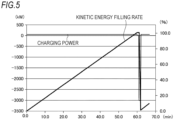
- FIG. 5 is a graph illustrating changes in the charging power (kW: left vertical axis) of the quick charger 14 and the kinetic energy filling rate (%: right vertical axis) of the flywheel 12 with respect to time (min: horizontal axis) when it is assumed that the voltage of the introduced electric power is AC 200 V, the output of the inverter 11 is 50 kW, the output of the quick charger 14 is 3 MW, and the energy storage capacity of the flywheel 12 is 50 kWh.
- the introduced electric power is a low voltage, it takes a predetermined time to fully fill the flywheel 12 with the kinetic energy, but the charging is completed in an extremely short time. Therefore, the user can charge the vehicle V in the similar time as that of an existing gasoline vehicle. It is not preferable to completely stop the flywheel 12 during charging, and for example, it is preferable to complete charging when the kinetic energy filling rate reaches 3% to 5%.
- the degree of freedom of installation is high and many charging stations can be provided to users.
- a solar cell 40 is electrically connected to the inverter 11 as an auxiliary power source in the charging system 10 of the first example.
- the same configuration as that of the charging system 10 of the first example is designated by the same reference numerals and letters and the description thereof will be omitted.
- the charging system 10 of the present example is configured such that the solar cell 40 is electrically connected to the inverter 11 as an auxiliary power source via an auxiliary power source inverter 41 and the electric power generated by the solar cell 40 can be used as needed.
- the auxiliary power source inverter 41 converts the DC power generated by the solar cell 40 into three-phase AC power.
- the solid arrow indicates AC power
- the dotted arrow indicates DC power (the same applies to FIG. 9 ).
- the flywheel 12 when the flywheel 12 is not fully filled, as illustrated in FIG. 7A , in addition to the electric power supplied from the commercial power supply PS, the electric power generated by the solar cell 40 is supplied to the motor generator 13 via the inverter 11, and then the motor generator 13 which receives these electric powers is driven by power running to store kinetic energy in the flywheel 12 until the flywheel 12 is fully filled.
- the flywheel 12 when the flywheel 12 is fully filled, as illustrated in FIG. 7B , the electric power generated by the solar cell 40 can be sold via a power supply path of the commercial power supply PS.
- the auxiliary power source is not limited to the solar cell 40, but may be wind power generation, geothermal power generation, wave power generation, or the like.
- a charging system 10 of an embodiment of the present invention will be described with reference to FIG. 8 .
- one kinetic energy storage unit 15 composed of the flywheel 12 and the motor generator 13 is provided.
- a plurality of kinetic energy storage units 15 are provided between the inverter 11 and the quick charger 14.
- a plurality of (for example, eight) motor generators 13 are electrically connected each other, and electrically connected in parallel between the inverter 11 and the quick charger 14.
- Each motor generator 13 forms the kinetic energy storage unit 15 and the flywheel 12 is connected to each motor generator 13.
- a phase matching control in which direct current is passed through all the motor generators 13 for a predetermined time is performed in advance.
- FIGS. 10 to 12 illustrate a case where n (n is an integer of one or more) motor generators 13 are electrically connected each other, and electrically connected to the inverter 11 in parallel.
- M/Gn is an n-th motor generator 13.
- n-R is an R-phase coil of the n-th motor generator 13
- n-S is an S-phase coil of the n-th motor generator 13
- n-T is a T-phase coil of the n-th motor generator 13.
- the three phases of the three-phase AC power are the R phase, the S phase, and the T phase, which are synonymous with the U phase, the V phase, and the W phase in FIG. 2 .
- Phase matching control is not limited to the case where DC energization is executed for the remaining two phases of the three phases when any one of the three phases is zero phase and DC energization may be executed for all three phases.
- all the flywheels 12 can be filled with kinetic energy by supplying AC power to all the motor generators 13.
- the inductance of the boost converter 17 during charging changes depending on the number of motor generators 13.
- the effective current value becomes n times and the inductance becomes 1 / n, so that the peak value of the ripple current becomes n times. Therefore, since the current peak is the sum of the effective current value and the peak value of the ripple current (hereinafter, simply referred to as the ripple current), the current peak becomes n times as the number n of the motor generators 13 increases.
- the ripple current is the sum of the effective current value and the peak value of the ripple current (hereinafter, simply referred to as the ripple current)
- the current peak becomes n times as the number n of the motor generators 13 increases.
- the current peak becomes large, it is necessary to use a component having a high withstand voltage, which leads to an increase in cost of the boost converter 17.
- FIG. 15 is a graph illustrating a relationship between the number of motor generators 13, and the current peak and ripple current.
- FIG. 13 illustrates the current when the control device 16 controls the boost converter 17 at a constant switching frequency regardless of the number of motor generators 13 electrically connected in parallel to the quick charger 14.
- 1 to 8 indicate the number of motor generators 13.
- the up and down of the current value is caused by the up and down of the ripple current, and the current peak is a value when the ripple current takes a peak value. From FIG. 13 , when the switching frequency is set to a constant value regardless of the number of motor generators 13, the effective current value increases as the number of motor generators 13 increases, and further, the ripple current also increases as the number of motor generators 13 increases, and thus the current peak increases.
- FIG. 14 illustrates the current peak when the boost converter 17 is controlled in a set switching cycle by appropriately setting the switching frequency according to the number of motor generators 13 electrically connected in parallel to the quick charger 14.
- the switching frequency is set so that the ripple current becomes a constant value regardless of the number of motor generators 13.
- the effective current value increases as the number of motor generators 13 increases, the current peak becomes smaller because the ripple current is a constant value.
- the ripple current does not have to be a constant value and the switching frequency may be set so that the ripple current is equal to or less than a predetermined value.
- the current peak can be lowered by the control device 16 switching the switching frequency of the boost converter 17 so that the ripple current becomes equal to or less than a predetermined value according to the number of motor generators 13. As a result, it is possible to suppress the cost increase of the boost converter 17.
- the boost converter 17 can be operated in a predetermined switching cycle and the number of motor generators 13 can be acquired from a gradient of the input and output voltage and current of the boost converter 17.
- a relationship between the gradient of the input and output voltage and current of the boost converter 17 and the number of motor generators 13 may be measured in advance and stored as a table, or may be calculated as appropriate.
- the control device 16 may acquire the number of motor generators 13 from the gradient of the input and output voltage and current of the boost converter 17 and may switch the switching frequency based on the acquired number of motor generators 13. Also, the control device 16 may switch the switching frequency directly from the gradient of the input and output voltage and current of the boost converter 17.
- FIG. 15 illustrates the current peak and ripple current when the switching cycle is constant (fixed frequency) and the current peak and ripple current when the switching cycle is switched (variable frequency).
- the current peak of the boost converter 17 can be suppressed by switching the switching frequency based on the number of motor generators 13.
- one set of the inverter 11, the kinetic energy storage unit 15, and the quick charger 14 (hereinafter, the one set of the inverter 11, the kinetic energy storage unit 15, and the quick charger 14 may be referred to as a charging unit 18) is configured to be able to supply the energy required to charge the battery BAT for one vehicle.
- three sets of the charging units 18 are configured to be able to supply the energy required to charge the battery BAT for one vehicle.
- each of the inverter 11, the kinetic energy storage unit 15, and the quick charger 14 can be miniaturized.
- the vehicle is exemplified as a moving object, but the moving object is not limited to this and the moving object may be a flying object. Therefore, a power storage device mounted on the moving object may be a power storage device mounted on the flying obj ect.
Landscapes
- Engineering & Computer Science (AREA)
- Power Engineering (AREA)
- Transportation (AREA)
- Mechanical Engineering (AREA)
- Life Sciences & Earth Sciences (AREA)
- Sustainable Development (AREA)
- Sustainable Energy (AREA)
- Charge And Discharge Circuits For Batteries Or The Like (AREA)
- Electric Propulsion And Braking For Vehicles (AREA)
Description
- The present invention relates to a charging system for charging a power storage device mounted on a moving object.
- In recent years, electric vehicles equipped with a large-capacity battery have been developed. Although such an electric vehicle has a long cruising range, it has a problem that it takes a long time to charge. Therefore, development on quick charging is underway.
- When high-voltage power (for example, 6,600V) is drawn from a commercial power source in order to implement quick charging, a high-voltage power receiving facility (cubicle) is required, which is a heavy burden in terms of size and cost. Moreover, when it is attempted to store energy equivalent to that of an existing gas station with electric power, a required site becomes very large, which is not realistic.
- Therefore,
JP 1986-43735 U1 -
DE 10 2009 055 845 A discloses a charging system which charges a power storage device mounted on a moving object, comprising: an electric power conversion device configured to convert electric power supplied from a commercial power supply; a kinetic energy storage device configured to store kinetic energy; and a rotary electric machine that is electrically connected to the electric power conversion device and is mechanically connected to the kinetic energy storage device. -
WO 2018/078625 A2 shows a charging system according to the preamble ofclaim 1. There, each of the electrical storage units has a DC/AC converter. - However, there is room for improvement when trying to use the one described in
JP 1986-43735 U1 - The present invention provides a charging system capable of efficiently charging in a limited space.
- According to an aspect of the present invention, there is provided a charging system according to
claim 1. - According to the features of
claim 1, by storing the electric power supplied from the commercial power supply as kinetic energy in the kinetic energy storage device, it is possible to store energy appropriately in a limited space as compared with the case of storing electrical energy. As a result, the power storage device mounted on the vehicle can be efficiently charged. - According to the features of
claim 1, since a plurality of rotary electric machines are connected in parallel to the electric power conversion device, the charging system can be miniaturized as compared with the case where the electric power conversion device is connected to each of the rotary electric machines. - According to the features of
claim 1, even when the plurality of rotary electric machines are connected in parallel to the electric power conversion device, the plurality of rotary electric machines can be appropriately controlled by the phase matching control. - According to the further features of
claim 1, the rotor phases can be made uniform even when the rotor phases are different in the plurality of rotary electric machines. - According to the features of
claim 2, the electric power supplied from the commercial power supply has a voltage of 100 V or more and 500 V or less. Therefore, no special power receiving facility such as a high-voltage power receiving facility (cubicle) is required and the site for introducing the charging system can be small. As a result, the introduction cost can be suppressed. - According to the features of
claim 3, a highly versatile electric power conversion device can be used. - According to the features of
claim 4, by intermittently applying torque to each phase, a gentle reaction force acts on the rotor when the torque is released, and thus the phase matching operation of the rotor is promoted. - According to the features of
claim 5, the phase matching control can be easily performed. - According to the features of
claim 6, the current peak can be lowered, and thus the cost increase of the boost converter can be suppressed. - According to the features of
claim 7, since the auxiliary power source such as a solar cell is electrically connected to the electric power conversion device, natural energy can be effectively utilized. -
-
FIG. 1 is a functional block diagram of a charging system according to a first example not covered by the claims. -
FIG. 2 is an electric circuit diagram of a first power conversion device ofFIG. 1 . -
FIG. 3 is an electric circuit diagram of a second power conversion device ofFIG. 1 . -
FIG. 4 is a functional block diagram of a charging station provided with a plurality of charging systems ofFIG. 1 . -
FIG. 5 is a graph illustrating changes in charging power and kinetic energy filling rate of a flywheel with respect to time in the charging system ofFIG. 1 . -
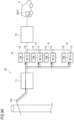
FIG. 6 is a functional block diagram of a charging system according to a second example not covered by the claims. -
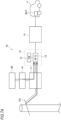
FIG. 7A is a diagram illustrating an electric flow when a kinetic energy filling rate of a flywheel is less than full filling in the charging system ofFIG. 6 . -
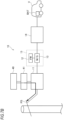
FIG. 7B is a diagram illustrating an electric flow when the kinetic energy filling rate of the flywheel is fully filled in the charging system ofFIG. 6 . -
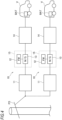
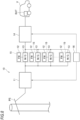
FIG. 8 is a functional block diagram of a charging system according to an embodiment of the present invention. -
FIG. 9A is a diagram illustrating an electric flow during phase matching control in the charging system ofFIG. 8 . -
FIG. 9B is a diagram illustrating an electric flow when a kinetic energy filling rate of a flywheel is less than full filling in the charging system ofFIG. 8 . -
FIG. 10 is a diagram illustrating phases of a plurality of motor generators before and after the phase matching control ofFIG. 8 . -
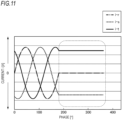
FIG. 11 is a graph illustrating an energizing method of the phase matching control ofFIG. 8 . -
FIG. 12 is a graph for more specifically illustrating the energizing method ofFIG. 11 . -
FIG. 13 is a graph illustrating a relationship between the number of motor generators and a current peak value at a predetermined frequency (fixed frequency). -
FIG. 14 is a graph illustrating a relationship between the number of motor generators and the current peak value at a frequency (variable frequency) appropriately set according to the number of motor generators. -
FIG. 15 is a graph illustrating a difference in current peak and ripple current when a switching cycle is constant (fixed frequency) and when the switching cycle is switched (variable frequency). -
FIG. 16 is a functional block diagram of a charging system according to a third example not covered by the claims. - Hereinafter, examples not covered by the claims and embodiments of a charging system of the present invention will be described with reference to the drawings.
- As illustrated in
FIG. 1 , acharging system 10 is a charging system that charges a battery BAT mounted on a vehicle V, which is a moving object. The vehicle V may be a vehicle equipped with the battery BAT and is, for example, a hybrid vehicle, a plug-in hybrid vehicle, an electric vehicle, or a fuel cell vehicle. - The
charging system 10 includes aninverter 11 that converts electric power supplied from a commercial power supply PS, aflywheel 12 that stores kinetic energy, amotor generator 13 that is electrically connected to theinverter 11 and is mechanically connected to theflywheel 12, aquick charger 14 that is electrically connected to themotor generator 13 and supplies electric power to the battery BAT of the vehicle V, and acontrol device 16 that controls theinverter 11 and thequick charger 14. Theflywheel 12 and themotor generator 13 form a kineticenergy storage unit 15. - A voltage of the electric power supplied from the commercial power supply PS (hereinafter, referred to as "introduced electric power") is preferably an AC voltage of 100 V or more and 500 V or less and is, for example, a three-phase three-wire AC 200 V When the voltage of the introduced electric power is high, a dedicated power receiving facility such as a high-voltage power receiving facility (cubicle) is required, but when the voltage of the introduced electric power is low, a special power receiving facility such as a high-voltage power receiving facility (cubicle) is not required. In addition, when the voltage of the introduced electric power is low, a large site for installing a high-voltage power receiving facility (cubicle) is not required, and thus an introduction cost can be suppressed. When the site has a margin, a high-voltage power receiving facility (cubicle) capable of receiving an AC voltage of 6,600 V and receiving an electric power of 100 kW to 500 kW may be installed.
- As illustrated in
FIG. 2 , theinverter 11 includes a first power conversion unit INV1 which converts the three-phase AC power (hereinafter, sometimes referred to as a first three-phase AC power), which is the introduced electric power, into DC power and a second power conversion unit INV2 which converts the DC power converted by the first power conversion unit INV1 into a three-phase AC power (hereinafter, sometimes referred to as a second three-phase AC power) different from the first three-phase AC power, which is suitable for driving themotor generator 13. The first power conversion unit INV1 and the second power conversion unit INV2 have the same structure and are connected in series to each other with afirst smoothing capacitor 21 interposed therebetween. - Each of the first power conversion unit INV1 and the second power conversion unit INV2 includes a bridge circuit formed of a plurality of bridge-connected switching elements. For example, the switching element is a transistor such as an Insulated Gate Bipolar Transistor (IGBT) or a Metal Oxide Semi-conductor Field Effect Transistor (MOSFET). For example, in the bridge circuit, paired high-side arm and low-side arm U-phase transistors UH and UL, paired high-side arm and low-side arm V-phase transistors VH and VL, and paired high-side arm and low-side arm W-phase transistors WH and WL are respectively bridge-connected.
- Respective transistors UH, VH, and WH of the high side arm have collectors connected to positive electrode terminals PI to form a high side arm. In each phase, each positive electrode terminal PI of the high side arm is connected to a positive
electrode connection line 50p. - Respective transistors UL, VL, and WL of the low side arm have emitters connected to negative electrode terminals NI to form a low side arm. In each phase, each negative electrode terminal NI of the low side arm is connected to a negative
electrode connection line 50n. - In each phase, the emitters of respective transistors UH, VH, and WH of the high side arm are connected to the collectors of respective transistors UL, VL, and WL of the low side arm at connection points TI.
- In each phase of the first power conversion unit INV1, the connection point TI is connected to the commercial power supply PS by a
first connection line 51. In each phase of the second power conversion unit INV2, the connection point TI is connected to themotor generator 13 by asecond connection line 52. - The bridge circuit includes a diode connected between the collector and the emitter of respective transistors UH, UL, VH, VL, WH, and WL so as to be in a forward direction from the emitter to the collector.
- Each of the first power conversion unit INV1 and the second power conversion unit INV2 switches ON (conduction) and OFF (disconnection) of each phase transistor pair based on a gate signal which is a switching command input to a gate of each of the transistors UH, VH, WH, UL, VL, and WL. The first power conversion unit INV1 converts the first three-phase AC power input from the commercial power supply PS into DC power, and the second power conversion unit INV2 converts the DC power input from the first power conversion unit INV1 into the second three-phase AC power.
- The
first smoothing capacitor 21 smoothes voltage fluctuation generated by an ON and OFF switching operation of each of the transistors UH, UL, VH, VL, WH, and WL of each of the first power conversion unit INV1 and the second power conversion unit INV2. - The
motor generator 13 is a three-phase AC type motor generator. During energy filling, theflywheel 12 is rotated by power running drive using the electric power input from theinverter 11. Further, during battery charging, kinetic energy of theflywheel 12 is converted into electric energy by regenerative drive and electric power is supplied to thequick charger 14. - As illustrated in
FIG. 3 , thequick charger 14 includes a third power conversion unit INV3 which converts the three-phase AC power generated by themotor generator 13 into DC power, a fourth power conversion unit INV4 which converts the DC power converted by the third power conversion unit INV3 into single-phase AC power, a high-frequency transformer 31 which transforms the single-phase AC power input from the fourth power conversion unit INV4, and a fifth power conversion unit INV5 which converts the single-phase AC power input from the high-frequency transformer 31 into DC power. Asecond smoothing capacitor 32 is provided between the third power conversion unit INV3 and the fourth power conversion unit INV4 and athird smoothing capacitor 33 is provided on a downstream side of the fifth power conversion unit INV5. The fourth power conversion unit INV4, thehigh frequency transformer 31, and the fifth power conversion unit INV5 form aboost converter 17 which boosts the electric power supplied from themotor generator 13 during battery charging. - By controlling the switching of the first power conversion unit INV1 and the second power conversion unit INV2 of the
inverter 11 and controlling the switching of the third power conversion unit INV3, the fourth power conversion unit INV4, and the fifth power conversion unit INV5 of thequick charger 14, thecontrol device 16 performs energy filling of theflywheel 12 and performs charging of the battery BAT mounted on the vehicle V - The charging
system 10 configured in such a way can be installed in a car dealer, a convenience store, a supermarket, or the like. Theflywheel 12 stores kinetic energy until theflywheel 12 is fully filled by power running driving themotor generator 13 which receives the electric power supplied from the commercial power supply PS via theinverter 11. The chargingsystem 10 having theflywheel 12 in a fully filled state can be recognized by a user (driver) of the vehicle V through a mobile terminal such as a car navigation system or a smartphone. As illustrated inFIG. 4 , one charging station may be provided with two chargingsystems 10 or three ormore charging systems 10. When the vehicle V needs to be charged, the user can charge the battery BAT mounted on the vehicle V by stopping at one of thenearby charging systems 10 in the fully filled states. As a result, it is possible to shorten or eliminate the waiting time. - Each charging
system 10 may be capable of supplying the energy required to charge the battery BAT for one vehicle. Here, it is assumed that the vehicle V is an electric vehicle having a cruising range of 500 km. In order to secure the cruising range of 500 km, the electric energy amount of the battery BAT needs to be about 50 kWh. When it is assumed that the output of thequick charger 14 is 3 MW, charging of the electric vehicle can be achieved in about one minute as similar to that of an existing gasoline vehicle until the charging is completed. When the output of theinverter 11 is about 50 kW, it may be sufficient to have a space of 0.5 m3 as an installation space of theinverter 11. Also, when the energy storage capacity of theflywheel 12 is 50 kWh, it may be sufficient to have a space of 1.4 m3 as an installation space of theflywheel 12. Further, when the output of thequick charger 14 is 3 MW, it may be sufficient to have a space of 3 m3 as an installation space of thequick charger 14. When the output of theinverter 11 is 50 kW, theflywheel 12 having an energy storage capacity of 50 kWh can be fully filled in about sixty minutes. -
FIG. 5 is a graph illustrating changes in the charging power (kW: left vertical axis) of thequick charger 14 and the kinetic energy filling rate (%: right vertical axis) of theflywheel 12 with respect to time (min: horizontal axis) when it is assumed that the voltage of the introduced electric power is AC 200 V, the output of theinverter 11 is 50 kW, the output of thequick charger 14 is 3 MW, and the energy storage capacity of theflywheel 12 is 50 kWh. - According to
FIG. 5 , since the introduced electric power is a low voltage, it takes a predetermined time to fully fill theflywheel 12 with the kinetic energy, but the charging is completed in an extremely short time. Therefore, the user can charge the vehicle V in the similar time as that of an existing gasoline vehicle. It is not preferable to completely stop theflywheel 12 during charging, and for example, it is preferable to complete charging when the kinetic energy filling rate reaches 3% to 5%. - As described above, according to the charging
system 10 of the present embodiment, since a relatively small space is sufficient for installation, the degree of freedom of installation is high and many charging stations can be provided to users. - Next, a charging
system 10 of a second example on will be described with reference toFIG. 6 . - In the charging
system 10 of the second example, asolar cell 40 is electrically connected to theinverter 11 as an auxiliary power source in the chargingsystem 10 of the first example. In the present example and other examples and embodiments described below, the same configuration as that of the chargingsystem 10 of the first example is designated by the same reference numerals and letters and the description thereof will be omitted. - The charging
system 10 of the present example is configured such that thesolar cell 40 is electrically connected to theinverter 11 as an auxiliary power source via an auxiliarypower source inverter 41 and the electric power generated by thesolar cell 40 can be used as needed. The auxiliarypower source inverter 41 converts the DC power generated by thesolar cell 40 into three-phase AC power. InFIGS. 7A and7B , the solid arrow indicates AC power and the dotted arrow indicates DC power (the same applies toFIG. 9 ). - Specifically, when the
flywheel 12 is not fully filled, as illustrated inFIG. 7A , in addition to the electric power supplied from the commercial power supply PS, the electric power generated by thesolar cell 40 is supplied to themotor generator 13 via theinverter 11, and then themotor generator 13 which receives these electric powers is driven by power running to store kinetic energy in theflywheel 12 until theflywheel 12 is fully filled. On the other hand, when theflywheel 12 is fully filled, as illustrated inFIG. 7B , the electric power generated by thesolar cell 40 can be sold via a power supply path of the commercial power supply PS. As a result, the natural energy can be effectively utilized and the economic burden on an operator of the chargingsystem 10 can be reduced. The auxiliary power source is not limited to thesolar cell 40, but may be wind power generation, geothermal power generation, wave power generation, or the like. - Next, a charging
system 10 of an embodiment of the present invention will be described with reference toFIG. 8 . In the chargingsystem 10 of the first example, one kineticenergy storage unit 15 composed of theflywheel 12 and themotor generator 13 is provided. However, in the chargingsystem 10 of the embodiment, a plurality of kineticenergy storage units 15 are provided between theinverter 11 and thequick charger 14. - More specifically, in the charging
system 10 of the present embodiment, a plurality of (for example, eight)motor generators 13 are electrically connected each other, and electrically connected in parallel between theinverter 11 and thequick charger 14. Eachmotor generator 13 forms the kineticenergy storage unit 15 and theflywheel 12 is connected to eachmotor generator 13. When driving the plurality ofmotor generators 13 with oneinverter 11, it is necessary to match phases of all themotor generators 13. Therefore, before driving all themotor generators 13, as illustrated inFIG. 9A , a phase matching control in which direct current is passed through all themotor generators 13 for a predetermined time is performed in advance. By the phase matching control, all themotor generators 13 can be drawn to any position, and as a result, the phases of all themotor generators 13 can be matched. - Here, the phase matching control will be described more specifically with reference to
FIGS. 10 to 12. FIGS. 10 to 12 illustrate a case where n (n is an integer of one or more)motor generators 13 are electrically connected each other, and electrically connected to theinverter 11 in parallel. M/Gn is an n-th motor generator 13. Also, n-R is an R-phase coil of the n-th motor generator 13, n-S is an S-phase coil of the n-th motor generator 13, and n-T is a T-phase coil of the n-th motor generator 13. InFIGS. 10 to 12 , the three phases of the three-phase AC power are the R phase, the S phase, and the T phase, which are synonymous with the U phase, the V phase, and the W phase inFIG. 2 . - As illustrated on the left side of
FIG. 10 , when the rotor phases of the motor generators 13 (M/G1, M/G2, ... M/Gn) are different, even when the alternating current output from theinverter 11 is energized as it is, rotors of respective motor generators 13 (M/G1, M/G2, ... M/Gn) do not rotate appropriately. Therefore, as illustrated inFIG. 11 , an instantaneous value (in the example ofFIG. 11 , the value at the zero phase of the R phase current) of the three-phase alternating current is applied to the S phase and the T phase with direct current. In this case, as illustrated inFIG. 12 , it is preferable to intermittently execute DC energization by repeating energization (ON) and stop (OFF) for a predetermined period. By intermittently applying torque to at least a part of the phases in such a way, a gentle reaction force acts on the rotor when the torque is released, and thus the phase matching operation of the rotor is promoted. Phase matching control is not limited to the case where DC energization is executed for the remaining two phases of the three phases when any one of the three phases is zero phase and DC energization may be executed for all three phases. - After the phase matching operation illustrated on the right side of
FIG. 10 is completed, as illustrated inFIGS. 9B and12 , all theflywheels 12 can be filled with kinetic energy by supplying AC power to all themotor generators 13. - When a plurality of
motor generators 13 are electrically connected each other and electrically connecter to thequick charger 14 in parallel, the inductance of theboost converter 17 during charging changes depending on the number ofmotor generators 13. When the number n of themotor generators 13 increases, the effective current value becomes n times and the inductance becomes 1 / n, so that the peak value of the ripple current becomes n times. Therefore, since the current peak is the sum of the effective current value and the peak value of the ripple current (hereinafter, simply referred to as the ripple current), the current peak becomes n times as the number n of themotor generators 13 increases. When the current peak becomes large, it is necessary to use a component having a high withstand voltage, which leads to an increase in cost of theboost converter 17. - For example, assuming a situation where 1 to 8
motor generators 13 can be connected, when the voltage is constant, the time for which the current rises in one ON time is 1 to 8 times, and thus the ripple current is also 1 to 8 times.FIG. 15 is a graph illustrating a relationship between the number ofmotor generators 13, and the current peak and ripple current. - Here, it is preferable that the
control device 16 variably controls a switching cycle of theboost converter 17.FIG. 13 illustrates the current when thecontrol device 16 controls theboost converter 17 at a constant switching frequency regardless of the number ofmotor generators 13 electrically connected in parallel to thequick charger 14. In thefigure, 1 to 8 indicate the number ofmotor generators 13. Further, the up and down of the current value is caused by the up and down of the ripple current, and the current peak is a value when the ripple current takes a peak value. FromFIG. 13 , when the switching frequency is set to a constant value regardless of the number ofmotor generators 13, the effective current value increases as the number ofmotor generators 13 increases, and further, the ripple current also increases as the number ofmotor generators 13 increases, and thus the current peak increases. - On the other hand,
FIG. 14 illustrates the current peak when theboost converter 17 is controlled in a set switching cycle by appropriately setting the switching frequency according to the number ofmotor generators 13 electrically connected in parallel to thequick charger 14. In an example ofFIG. 14 , the switching frequency is set so that the ripple current becomes a constant value regardless of the number ofmotor generators 13. According to this, although the effective current value increases as the number ofmotor generators 13 increases, the current peak becomes smaller because the ripple current is a constant value. The ripple current does not have to be a constant value and the switching frequency may be set so that the ripple current is equal to or less than a predetermined value. - In such a way, the current peak can be lowered by the
control device 16 switching the switching frequency of theboost converter 17 so that the ripple current becomes equal to or less than a predetermined value according to the number ofmotor generators 13. As a result, it is possible to suppress the cost increase of theboost converter 17. - When the
control device 16 does not know the number ofmotor generators 13 electrically connected in parallel to thequick charger 14 at the start of operation of theboost converter 17, theboost converter 17 can be operated in a predetermined switching cycle and the number ofmotor generators 13 can be acquired from a gradient of the input and output voltage and current of theboost converter 17. A relationship between the gradient of the input and output voltage and current of theboost converter 17 and the number ofmotor generators 13 may be measured in advance and stored as a table, or may be calculated as appropriate. - The
control device 16 may acquire the number ofmotor generators 13 from the gradient of the input and output voltage and current of theboost converter 17 and may switch the switching frequency based on the acquired number ofmotor generators 13. Also, thecontrol device 16 may switch the switching frequency directly from the gradient of the input and output voltage and current of theboost converter 17. -
FIG. 15 illustrates the current peak and ripple current when the switching cycle is constant (fixed frequency) and the current peak and ripple current when the switching cycle is switched (variable frequency). As is clear fromFIG. 15 , the current peak of theboost converter 17 can be suppressed by switching the switching frequency based on the number ofmotor generators 13. - Next, a charging
system 10 of a third example will be described with reference toFIG. 16 . - In the charging
system 10 of the first example, one set of theinverter 11, the kineticenergy storage unit 15, and the quick charger 14 (hereinafter, the one set of theinverter 11, the kineticenergy storage unit 15, and thequick charger 14 may be referred to as a charging unit 18) is configured to be able to supply the energy required to charge the battery BAT for one vehicle. However, in the chargingsystem 10 of the third example, three sets of the chargingunits 18 are configured to be able to supply the energy required to charge the battery BAT for one vehicle. As a result, each of theinverter 11, the kineticenergy storage unit 15, and thequick charger 14 can be miniaturized. It is clear that a person skilled in the art can come up with various modifications to the embodiments within the scope of the claims and it is understood that they also naturally belong to the technical scope of the present invention. - For example, the vehicle is exemplified as a moving object, but the moving object is not limited to this and the moving object may be a flying object. Therefore, a power storage device mounted on the moving object may be a power storage device mounted on the flying obj ect.
Claims (7)
- A charging system (10) configured to charge a power storage device (BAT) mounted on a moving object (V), comprising:an electric power conversion device (11) configured to convert electric power supplied from a commercial power supply (PS);a control device (16) configured to control the electric power conversion device (11);a kinetic energy storage device (12) configured to store kinetic energy; anda rotary electric machine (13) that is electrically connected to the electric power conversion device and is mechanically connected to the kinetic energy storage device, whereinthe kinetic energy storage device and the rotary electric machine are configured to form a kinetic energy storage unit (15),the charging system has a plurality of the kinetic energy storage units (15), anda plurality of the rotary electric machines (13) are electrically connected to each otherand electrically connected to the electric power conversion device (12) in parallel, characterized in that the control device (16) is configured to perform phase matching control for matching rotational phases of rotors of the plurality of rotary electric machines (13) before starting storage of kinetic energy of the kinetic energy storage device by the plurality of rotary electric machines, and the phase matching control is performed so that at least a part of a plurality of phases is energized with direct current.
- The charging system according to claim 1, wherein
a voltage of the electric power supplied from the commercial power supply is 100 V or more and 500 V or less. - The charging system according to claim 1 or 2, wherein
the electric power conversion device (11) includes a first electric power conversion unit (INV1) for converting a firstAC power supplied from the commercial power supply into DC power and a second electric power conversion unit (INV2) for converting the DC power into a second AC power different from the first AC power. - The charging system according to claim 1, wherein
the phase matching control is configured to intermittently execute the DC energization. - The charging system according to claim 1 or 4, whereinthe plurality of rotary electric machines (13) are three-phase AC rotary electric machines, andwhen any one of three phases is zero phase, the phase matching control is configured to execute the DC energization to the remaining two phases of the three phases.
- The charging system according to any one of claims 1 to 5, further comprising:a boost converter (17) that is electrically connected to the plurality of rotary electric machines (13) in parallel and is configured to boost voltage supplied from the plurality of rotary electric machines,wherein the control device (16) is configured to variably control switching frequency of the boost converter (17).
- The charging system according to any one of claims 1 to 6, wherein
an auxiliary power source (40) is electrically connected to the electric power conversion device (11).
Applications Claiming Priority (2)
| Application Number | Priority Date | Filing Date | Title |
|---|---|---|---|
| JP2019184710 | 2019-10-07 | ||
| PCT/JP2020/037854 WO2021070815A1 (en) | 2019-10-07 | 2020-10-06 | Charging system |
Publications (3)
| Publication Number | Publication Date |
|---|---|
| EP4044399A1 EP4044399A1 (en) | 2022-08-17 |
| EP4044399A4 EP4044399A4 (en) | 2023-01-18 |
| EP4044399B1 true EP4044399B1 (en) | 2024-11-20 |
Family
ID=75437474
Family Applications (1)
| Application Number | Title | Priority Date | Filing Date |
|---|---|---|---|
| EP20874842.6A Active EP4044399B1 (en) | 2019-10-07 | 2020-10-06 | Charging system |
Country Status (6)
| Country | Link |
|---|---|
| US (1) | US12286024B2 (en) |
| EP (1) | EP4044399B1 (en) |
| JP (1) | JP7672985B2 (en) |
| CN (1) | CN114502420A (en) |
| ES (1) | ES2999364T3 (en) |
| WO (1) | WO2021070815A1 (en) |
Families Citing this family (1)
| Publication number | Priority date | Publication date | Assignee | Title |
|---|---|---|---|---|
| US12533978B2 (en) * | 2022-09-23 | 2026-01-27 | GM Global Technology Operations LLC | Power-densifying charging station |
Family Cites Families (17)
| Publication number | Priority date | Publication date | Assignee | Title |
|---|---|---|---|---|
| JPS6143735U (en) | 1984-08-21 | 1986-03-22 | トヨタ自動車株式会社 | Battery charging device for electric vehicles |
| JP4367391B2 (en) * | 2005-09-01 | 2009-11-18 | トヨタ自動車株式会社 | Charge control device and electric vehicle |
| JP4144646B1 (en) * | 2007-02-20 | 2008-09-03 | トヨタ自動車株式会社 | Electric vehicle, vehicle charging device, and vehicle charging system |
| JP5333457B2 (en) * | 2008-12-09 | 2013-11-06 | トヨタ自動車株式会社 | Vehicle charging system |
| DE102009055845A1 (en) * | 2009-11-26 | 2011-06-01 | Schaeffler Technologies Gmbh & Co. Kg | Charging station for electrically powered vehicles |
| JP5257430B2 (en) * | 2010-09-21 | 2013-08-07 | 株式会社デンソー | Vehicle power supply control device |
| US8760003B2 (en) | 2010-08-02 | 2014-06-24 | Denso Corporation | Vehicle-use power supply control apparatus and control apparatus for controlling electric rotating machine mounted on vehicle as main engine |
| JP5177274B1 (en) * | 2011-10-31 | 2013-04-03 | トヨタ自動車株式会社 | Charge / discharge connector and vehicle capable of charge / discharge via the charge / discharge connector |
| US20140312839A1 (en) * | 2013-04-19 | 2014-10-23 | Honda Motor Co., Ltd. | System and method for electric vehicle charging analysis and feedback |
| CN106134029B (en) | 2014-04-16 | 2018-09-25 | 三菱电机株式会社 | Vehicle charger |
| JP2016012992A (en) * | 2014-06-30 | 2016-01-21 | サンケン電気株式会社 | Fly wheel power storage device |
| JP6330229B2 (en) * | 2014-10-28 | 2018-05-30 | 本田技研工業株式会社 | Charge / discharge system |
| WO2016209698A1 (en) * | 2015-06-26 | 2016-12-29 | Amber Kinetics, Inc. | Switching fabric for energy storage and power conversion |
| WO2018204964A1 (en) * | 2017-05-08 | 2018-11-15 | Invertedpowder Pty Ltd | A vehicle charging station |
| CA3079939A1 (en) * | 2016-10-30 | 2018-05-03 | Chakratec Ltd. | System and method for a station providing grid support |
| US10011178B1 (en) * | 2017-06-08 | 2018-07-03 | Ford Global Technologies, Llc | DC inverter having reduced switching loss and reduced voltage spikes |
| JP7129196B2 (en) | 2018-04-04 | 2022-09-01 | キヤノン株式会社 | IMAGING DEVICE, CONTROL METHOD AND PROGRAM THEREOF |
-
2020
- 2020-10-06 CN CN202080069415.8A patent/CN114502420A/en active Pending
- 2020-10-06 EP EP20874842.6A patent/EP4044399B1/en active Active
- 2020-10-06 US US17/766,110 patent/US12286024B2/en active Active
- 2020-10-06 JP JP2021551662A patent/JP7672985B2/en active Active
- 2020-10-06 WO PCT/JP2020/037854 patent/WO2021070815A1/en not_active Ceased
- 2020-10-06 ES ES20874842T patent/ES2999364T3/en active Active
Also Published As
| Publication number | Publication date |
|---|---|
| ES2999364T3 (en) | 2025-02-25 |
| JP7672985B2 (en) | 2025-05-08 |
| EP4044399A1 (en) | 2022-08-17 |
| JPWO2021070815A1 (en) | 2021-04-15 |
| US12286024B2 (en) | 2025-04-29 |
| US20220348099A1 (en) | 2022-11-03 |
| EP4044399A4 (en) | 2023-01-18 |
| CN114502420A (en) | 2022-05-13 |
| WO2021070815A1 (en) | 2021-04-15 |
Similar Documents
| Publication | Publication Date | Title |
|---|---|---|
| US11799292B2 (en) | On-board bidirectional AC fast charger for electric vehicles | |
| KR102586914B1 (en) | Power converting apparatus for charging vehicle battery and Method for controlling the same | |
| JP5556677B2 (en) | Battery charging circuit | |
| EP3628109B1 (en) | Systems and methods for an on-board fast charger | |
| KR102598413B1 (en) | Movable power generating system of vehicle and Method thereof | |
| KR20120125886A (en) | integrated module of inverter and charger circuit | |
| US11207985B2 (en) | Power supply device | |
| JPS5961402A (en) | Charger for battery driven vehicle | |
| JP2018102070A (en) | Power converter | |
| KR102332054B1 (en) | Apparatus for charging battery of vehicle | |
| JP2020005389A (en) | Power supply system | |
| EP4497624A1 (en) | In-vehicle charging device | |
| US9457683B2 (en) | Method for discharging at least one capacitor of an electric circuit | |
| EP2937969B1 (en) | Power supply apparatus | |
| US20190308606A1 (en) | Drive system and drive control method | |
| EP4044399B1 (en) | Charging system | |
| CN204392134U (en) | A kind of novel electrical system | |
| KR101958596B1 (en) | Circulation charging system for electric vehicle | |
| KR20190065814A (en) | Integrated charger for electric vehicle | |
| JP4151575B2 (en) | Power converter | |
| KR20130095082A (en) | Electric vehicle and operating method of the same | |
| CN119261598B (en) | Alternating-current charge-discharge system for vehicle and control method for alternating-current charge-discharge | |
| KR102745380B1 (en) | Charging system for electric vehicles | |
| JP7559617B2 (en) | Power Supplies | |
| JP2024115455A (en) | On-board charging equipment |
Legal Events
| Date | Code | Title | Description |
|---|---|---|---|
| STAA | Information on the status of an ep patent application or granted ep patent |
Free format text: STATUS: THE INTERNATIONAL PUBLICATION HAS BEEN MADE |
|
| PUAI | Public reference made under article 153(3) epc to a published international application that has entered the european phase |
Free format text: ORIGINAL CODE: 0009012 |
|
| STAA | Information on the status of an ep patent application or granted ep patent |
Free format text: STATUS: REQUEST FOR EXAMINATION WAS MADE |
|
| 17P | Request for examination filed |
Effective date: 20220405 |
|
| AK | Designated contracting states |
Kind code of ref document: A1 Designated state(s): AL AT BE BG CH CY CZ DE DK EE ES FI FR GB GR HR HU IE IS IT LI LT LU LV MC MK MT NL NO PL PT RO RS SE SI SK SM TR |
|
| DAV | Request for validation of the european patent (deleted) | ||
| DAX | Request for extension of the european patent (deleted) | ||
| A4 | Supplementary search report drawn up and despatched |
Effective date: 20221219 |
|
| RIC1 | Information provided on ipc code assigned before grant |
Ipc: H02J 3/38 20060101ALN20221213BHEP Ipc: B60L 53/56 20190101ALI20221213BHEP Ipc: B60L 53/51 20190101ALI20221213BHEP Ipc: B60L 53/14 20190101ALI20221213BHEP Ipc: B60L 53/10 20190101ALI20221213BHEP Ipc: B60L 50/60 20190101ALI20221213BHEP Ipc: H02J 7/32 20060101ALI20221213BHEP Ipc: H02J 7/14 20060101ALI20221213BHEP Ipc: H02J 15/00 20060101AFI20221213BHEP |
|
| STAA | Information on the status of an ep patent application or granted ep patent |
Free format text: STATUS: EXAMINATION IS IN PROGRESS |
|
| 17Q | First examination report despatched |
Effective date: 20231109 |
|
| RIC1 | Information provided on ipc code assigned before grant |
Ipc: H02J 3/38 20060101ALN20240508BHEP Ipc: B60L 53/56 20190101ALI20240508BHEP Ipc: B60L 53/51 20190101ALI20240508BHEP Ipc: B60L 53/14 20190101ALI20240508BHEP Ipc: B60L 53/10 20190101ALI20240508BHEP Ipc: B60L 50/60 20190101ALI20240508BHEP Ipc: H02J 7/32 20060101ALI20240508BHEP Ipc: H02J 7/14 20060101ALI20240508BHEP Ipc: H02J 15/00 20060101AFI20240508BHEP |
|
| GRAP | Despatch of communication of intention to grant a patent |
Free format text: ORIGINAL CODE: EPIDOSNIGR1 |
|
| STAA | Information on the status of an ep patent application or granted ep patent |
Free format text: STATUS: GRANT OF PATENT IS INTENDED |
|
| INTG | Intention to grant announced |
Effective date: 20240617 |
|
| GRAS | Grant fee paid |
Free format text: ORIGINAL CODE: EPIDOSNIGR3 |
|
| GRAA | (expected) grant |
Free format text: ORIGINAL CODE: 0009210 |
|
| STAA | Information on the status of an ep patent application or granted ep patent |
Free format text: STATUS: THE PATENT HAS BEEN GRANTED |
|
| AK | Designated contracting states |
Kind code of ref document: B1 Designated state(s): AL AT BE BG CH CY CZ DE DK EE ES FI FR GB GR HR HU IE IS IT LI LT LU LV MC MK MT NL NO PL PT RO RS SE SI SK SM TR |
|
| REG | Reference to a national code |
Ref country code: GB Ref legal event code: FG4D |
|
| REG | Reference to a national code |
Ref country code: CH Ref legal event code: EP |
|
| REG | Reference to a national code |
Ref country code: DE Ref legal event code: R096 Ref document number: 602020041842 Country of ref document: DE |
|
| REG | Reference to a national code |
Ref country code: IE Ref legal event code: FG4D |
|
| REG | Reference to a national code |
Ref country code: ES Ref legal event code: FG2A Ref document number: 2999364 Country of ref document: ES Kind code of ref document: T3 Effective date: 20250225 |
|
| REG | Reference to a national code |
Ref country code: LT Ref legal event code: MG9D |
|
| REG | Reference to a national code |
Ref country code: NL Ref legal event code: MP Effective date: 20241120 |
|
| PG25 | Lapsed in a contracting state [announced via postgrant information from national office to epo] |
Ref country code: PT Free format text: LAPSE BECAUSE OF FAILURE TO SUBMIT A TRANSLATION OF THE DESCRIPTION OR TO PAY THE FEE WITHIN THE PRESCRIBED TIME-LIMIT Effective date: 20250320 Ref country code: HR Free format text: LAPSE BECAUSE OF FAILURE TO SUBMIT A TRANSLATION OF THE DESCRIPTION OR TO PAY THE FEE WITHIN THE PRESCRIBED TIME-LIMIT Effective date: 20241120 Ref country code: IS Free format text: LAPSE BECAUSE OF FAILURE TO SUBMIT A TRANSLATION OF THE DESCRIPTION OR TO PAY THE FEE WITHIN THE PRESCRIBED TIME-LIMIT Effective date: 20250320 |
|
| PG25 | Lapsed in a contracting state [announced via postgrant information from national office to epo] |
Ref country code: NL Free format text: LAPSE BECAUSE OF FAILURE TO SUBMIT A TRANSLATION OF THE DESCRIPTION OR TO PAY THE FEE WITHIN THE PRESCRIBED TIME-LIMIT Effective date: 20241120 Ref country code: FI Free format text: LAPSE BECAUSE OF FAILURE TO SUBMIT A TRANSLATION OF THE DESCRIPTION OR TO PAY THE FEE WITHIN THE PRESCRIBED TIME-LIMIT Effective date: 20241120 |
|
| REG | Reference to a national code |
Ref country code: AT Ref legal event code: MK05 Ref document number: 1744470 Country of ref document: AT Kind code of ref document: T Effective date: 20241120 |
|
| PG25 | Lapsed in a contracting state [announced via postgrant information from national office to epo] |
Ref country code: BG Free format text: LAPSE BECAUSE OF FAILURE TO SUBMIT A TRANSLATION OF THE DESCRIPTION OR TO PAY THE FEE WITHIN THE PRESCRIBED TIME-LIMIT Effective date: 20241120 |
|
| PG25 | Lapsed in a contracting state [announced via postgrant information from national office to epo] |
Ref country code: NO Free format text: LAPSE BECAUSE OF FAILURE TO SUBMIT A TRANSLATION OF THE DESCRIPTION OR TO PAY THE FEE WITHIN THE PRESCRIBED TIME-LIMIT Effective date: 20250220 |
|
| PG25 | Lapsed in a contracting state [announced via postgrant information from national office to epo] |
Ref country code: LV Free format text: LAPSE BECAUSE OF FAILURE TO SUBMIT A TRANSLATION OF THE DESCRIPTION OR TO PAY THE FEE WITHIN THE PRESCRIBED TIME-LIMIT Effective date: 20241120 Ref country code: GR Free format text: LAPSE BECAUSE OF FAILURE TO SUBMIT A TRANSLATION OF THE DESCRIPTION OR TO PAY THE FEE WITHIN THE PRESCRIBED TIME-LIMIT Effective date: 20250221 Ref country code: AT Free format text: LAPSE BECAUSE OF FAILURE TO SUBMIT A TRANSLATION OF THE DESCRIPTION OR TO PAY THE FEE WITHIN THE PRESCRIBED TIME-LIMIT Effective date: 20241120 |
|
| PG25 | Lapsed in a contracting state [announced via postgrant information from national office to epo] |
Ref country code: PL Free format text: LAPSE BECAUSE OF FAILURE TO SUBMIT A TRANSLATION OF THE DESCRIPTION OR TO PAY THE FEE WITHIN THE PRESCRIBED TIME-LIMIT Effective date: 20241120 |
|
| PG25 | Lapsed in a contracting state [announced via postgrant information from national office to epo] |
Ref country code: RS Free format text: LAPSE BECAUSE OF FAILURE TO SUBMIT A TRANSLATION OF THE DESCRIPTION OR TO PAY THE FEE WITHIN THE PRESCRIBED TIME-LIMIT Effective date: 20250220 |
|
| PG25 | Lapsed in a contracting state [announced via postgrant information from national office to epo] |
Ref country code: SM Free format text: LAPSE BECAUSE OF FAILURE TO SUBMIT A TRANSLATION OF THE DESCRIPTION OR TO PAY THE FEE WITHIN THE PRESCRIBED TIME-LIMIT Effective date: 20241120 |
|
| PG25 | Lapsed in a contracting state [announced via postgrant information from national office to epo] |
Ref country code: DK Free format text: LAPSE BECAUSE OF FAILURE TO SUBMIT A TRANSLATION OF THE DESCRIPTION OR TO PAY THE FEE WITHIN THE PRESCRIBED TIME-LIMIT Effective date: 20241120 |
|
| PG25 | Lapsed in a contracting state [announced via postgrant information from national office to epo] |
Ref country code: EE Free format text: LAPSE BECAUSE OF FAILURE TO SUBMIT A TRANSLATION OF THE DESCRIPTION OR TO PAY THE FEE WITHIN THE PRESCRIBED TIME-LIMIT Effective date: 20241120 |
|
| RAP4 | Party data changed (patent owner data changed or rights of a patent transferred) |
Owner name: HONDA MOTOR CO., LTD. |
|
| PG25 | Lapsed in a contracting state [announced via postgrant information from national office to epo] |
Ref country code: RO Free format text: LAPSE BECAUSE OF FAILURE TO SUBMIT A TRANSLATION OF THE DESCRIPTION OR TO PAY THE FEE WITHIN THE PRESCRIBED TIME-LIMIT Effective date: 20241120 |
|
| PG25 | Lapsed in a contracting state [announced via postgrant information from national office to epo] |
Ref country code: SK Free format text: LAPSE BECAUSE OF FAILURE TO SUBMIT A TRANSLATION OF THE DESCRIPTION OR TO PAY THE FEE WITHIN THE PRESCRIBED TIME-LIMIT Effective date: 20241120 |
|
| PG25 | Lapsed in a contracting state [announced via postgrant information from national office to epo] |
Ref country code: CZ Free format text: LAPSE BECAUSE OF FAILURE TO SUBMIT A TRANSLATION OF THE DESCRIPTION OR TO PAY THE FEE WITHIN THE PRESCRIBED TIME-LIMIT Effective date: 20241120 |
|
| PG25 | Lapsed in a contracting state [announced via postgrant information from national office to epo] |
Ref country code: IT Free format text: LAPSE BECAUSE OF FAILURE TO SUBMIT A TRANSLATION OF THE DESCRIPTION OR TO PAY THE FEE WITHIN THE PRESCRIBED TIME-LIMIT Effective date: 20241120 |
|
| REG | Reference to a national code |
Ref country code: DE Ref legal event code: R097 Ref document number: 602020041842 Country of ref document: DE |
|
| PG25 | Lapsed in a contracting state [announced via postgrant information from national office to epo] |
Ref country code: SE Free format text: LAPSE BECAUSE OF FAILURE TO SUBMIT A TRANSLATION OF THE DESCRIPTION OR TO PAY THE FEE WITHIN THE PRESCRIBED TIME-LIMIT Effective date: 20241120 |
|
| PLBE | No opposition filed within time limit |
Free format text: ORIGINAL CODE: 0009261 |
|
| STAA | Information on the status of an ep patent application or granted ep patent |
Free format text: STATUS: NO OPPOSITION FILED WITHIN TIME LIMIT |
|
| 26N | No opposition filed |
Effective date: 20250821 |
|
| REG | Reference to a national code |
Ref country code: CH Ref legal event code: U11 Free format text: ST27 STATUS EVENT CODE: U-0-0-U10-U11 (AS PROVIDED BY THE NATIONAL OFFICE) Effective date: 20251101 |
|
| PGFP | Annual fee paid to national office [announced via postgrant information from national office to epo] |
Ref country code: GB Payment date: 20251022 Year of fee payment: 6 |
|
| PGFP | Annual fee paid to national office [announced via postgrant information from national office to epo] |
Ref country code: CH Payment date: 20251101 Year of fee payment: 6 |
|
| PGFP | Annual fee paid to national office [announced via postgrant information from national office to epo] |
Ref country code: ES Payment date: 20251216 Year of fee payment: 6 |