EP4043830B1 - Apparatus for measuring position in pipe - Google Patents
Apparatus for measuring position in pipe Download PDFInfo
- Publication number
- EP4043830B1 EP4043830B1 EP20936073.4A EP20936073A EP4043830B1 EP 4043830 B1 EP4043830 B1 EP 4043830B1 EP 20936073 A EP20936073 A EP 20936073A EP 4043830 B1 EP4043830 B1 EP 4043830B1
- Authority
- EP
- European Patent Office
- Prior art keywords
- lens
- pipe
- elastic members
- measuring
- light
- Prior art date
- Legal status (The legal status is an assumption and is not a legal conclusion. Google has not performed a legal analysis and makes no representation as to the accuracy of the status listed.)
- Active
Links
Images




Classifications
-
- G—PHYSICS
- G01—MEASURING; TESTING
- G01D—MEASURING NOT SPECIALLY ADAPTED FOR A SPECIFIC VARIABLE; ARRANGEMENTS FOR MEASURING TWO OR MORE VARIABLES NOT COVERED IN A SINGLE OTHER SUBCLASS; TARIFF METERING APPARATUS; MEASURING OR TESTING NOT OTHERWISE PROVIDED FOR
- G01D5/00—Mechanical means for transferring the output of a sensing member; Means for converting the output of a sensing member to another variable where the form or nature of the sensing member does not constrain the means for converting; Transducers not specially adapted for a specific variable
- G01D5/26—Mechanical means for transferring the output of a sensing member; Means for converting the output of a sensing member to another variable where the form or nature of the sensing member does not constrain the means for converting; Transducers not specially adapted for a specific variable characterised by optical transfer means, i.e. using infrared, visible, or ultraviolet light
- G01D5/264—Mechanical constructional elements therefor ; Mechanical adjustment thereof
-
- G—PHYSICS
- G01—MEASURING; TESTING
- G01C—MEASURING DISTANCES, LEVELS OR BEARINGS; SURVEYING; NAVIGATION; GYROSCOPIC INSTRUMENTS; PHOTOGRAMMETRY OR VIDEOGRAMMETRY
- G01C21/00—Navigation; Navigational instruments not provided for in groups G01C1/00 - G01C19/00
- G01C21/10—Navigation; Navigational instruments not provided for in groups G01C1/00 - G01C19/00 by using measurements of speed or acceleration
- G01C21/12—Navigation; Navigational instruments not provided for in groups G01C1/00 - G01C19/00 by using measurements of speed or acceleration executed aboard the object being navigated; Dead reckoning
- G01C21/14—Navigation; Navigational instruments not provided for in groups G01C1/00 - G01C19/00 by using measurements of speed or acceleration executed aboard the object being navigated; Dead reckoning by recording the course traversed by the object
-
- G—PHYSICS
- G01—MEASURING; TESTING
- G01C—MEASURING DISTANCES, LEVELS OR BEARINGS; SURVEYING; NAVIGATION; GYROSCOPIC INSTRUMENTS; PHOTOGRAMMETRY OR VIDEOGRAMMETRY
- G01C22/00—Measuring distance traversed on the ground by vehicles, persons, animals or other moving solid bodies, e.g. using odometers, using pedometers
-
- F—MECHANICAL ENGINEERING; LIGHTING; HEATING; WEAPONS; BLASTING
- F16—ENGINEERING ELEMENTS AND UNITS; GENERAL MEASURES FOR PRODUCING AND MAINTAINING EFFECTIVE FUNCTIONING OF MACHINES OR INSTALLATIONS; THERMAL INSULATION IN GENERAL
- F16L—PIPES; JOINTS OR FITTINGS FOR PIPES; SUPPORTS FOR PIPES, CABLES OR PROTECTIVE TUBING; MEANS FOR THERMAL INSULATION IN GENERAL
- F16L55/00—Devices or appurtenances for use in, or in connection with, pipes or pipe systems
- F16L55/26—Pigs or moles, i.e. devices movable in a pipe or conduit with or without self-contained propulsion means
- F16L55/48—Indicating the position of the pig or mole in the pipe or conduit
Definitions
- Embodiments disclosed in the present disclosure relate to a technique for measuring a position of a moving body moving inside a pipe.
- Dead reckoning which is mainly used for self-contained navigation, uses an inertial navigation system, which is a navigation system for calculating a position relative to an initial position based on a moving distance, a moving direction, or the like, determined using an encoder-type odometer, compass, gyroscope, acceleration sensor, or the like, mainly attached to the moving body.
- the encoder-type odometer measures the movement of a wheel in close contact with the pipe to calculate a moving distance; however, errors may occur due to wheel slippage occurring when the moving body changes directions, the attitude of the moving body, the shape of the pipe, irregularities on the inner surface of the pipe, welding parts, pipe contact parts and areas, wheel wear and circumference measurement errors, odometer tooth resolution, or the like.
- an optical engine-type odometer using a pipe surface image generated by an image sensor is a non-contact type odometer, which shows the best performance in terms of reliability, restrictions in use, the amount of calculation for position estimation, or the like.
- the optical engine-type odometer acquires an image of the inner surface of a pipe with the image sensor, and then measures a moving distance and a moving direction by using a motion vector detected between successive images.
- wheel slippage and wear which are the biggest cause of error of the encoder-type odometer, do not occur; however, a moving distance estimation error occurs due to a change in the distance between the image sensor and the inner surface of the pipe caused by irregularities or the like while the moving body is traveling,
- Embodiments disclosed in the present disclosure are to provide an apparatus for measuring a position of a moving body moving inside a pipe.
- An apparatus for measuring a position includes a light source emitting light to an inner surface of a pipe, a first lens receiving reflected light from which light emitted by the light source is reflected by the inner surface and converting the reflected light into parallel light parallel to an optical axis, a second lens disposed on an optical path of the parallel light and converting the parallel light into a convergent refracted light, an image sensor disposed on an optical path of the refracted light, one or more elastic members disposed between the first lens and the second lens, and a plurality of wheels that are coupled to a side surface of the first lens and are in close contact with the inner surface to be rotated by movement of the moving body.
- the one or more elastic members may be compressed or relaxed by a force applied to at least one of the plurality of wheels on the inner surface with the movement of the moving body.
- a distance between the first lens and a second lens may vary depending on the compression or relaxation of the one or more elastic members, and a distance between the inner surface and the first lens and a distance between the second lens and the image sensor may be invariant with respect to the compression or relaxation of the one or more elastic members.
- the apparatus may further include a first body portion accommodating the first lens and the one or more elastic members, and a second body portion accommodating the second lens and the image sensor.
- One end of each of the one or more elastic members may be fixed on an inner side of the first body portion, and the other end of each of the one or more elastic members may move in a direction parallel to the optical axis with movement of the first lens by the force applied to the at least one of the plurality of wheels.
- the apparatus may further include one or more force-torque sensors measuring a force applied to each of the one or more elastic members.
- the first lens may be a telecentric lens.
- the second lens may be a convex lens for converging the parallel light to a focal point between the second lens and the image sensor.
- Each of the plurality of wheels may be a wheel encoder.
- an image of a certain size may be imaged on the imaging surface of an image sensor regardless of the distance between the image sensor and the inner surface of the pipe, and thus it is possible to minimize errors that may occur due to irregularities in the pipe when the position of a moving body is measured by using the image of the inner surface of the pipe generated by the image sensor.
- FIG. 1 is a view exemplarily illustrating a moving body equipped with a position measuring apparatus according to an embodiment.
- a moving body 200 includes a position measuring apparatus 100 on one side, and is a device configured to move inside a pipe 300.
- the pipe 300 may be, for example, a pipe in which a gas pipe, a water supply pipe, and a cable such as a communication cable is embedded, but is not necessarily limited to a pipe for a specific purpose.
- the moving body 200 is for cleaning or inspecting the inside of the pipe 300 while moving inside the pipe 300, and may be, for example, a mobile robot configured to move inside the pipe with an independent power source therein or by using power provided by an external power source.
- the moving body 200 is not necessarily limited to the mobile robot, and as long as it can move inside the pipe 300, it is not necessarily limited to a specific type or purpose device.
- FIG. 2 is a view showing a structure of a position measuring apparatus 100 according to a first embodiment
- FIG. 3 is a view showing a structure of a position measuring apparatus 100 according to a second embodiment
- FIG. 4 is a view showing a cross-section of the position measuring apparatus 100 shown in FIG. 1 or FIG. 2 when viewed from an inner surface 301 of the pipe 300.
- the position measuring apparatus 100 includes one or more light sources 101, a first lens 102, a second lens 103, an image sensor 104, and a plurality of wheels 105, one or more elastic members 106, a first body portion 107, and a second body portion 108.
- One or more light sources 101 emit light toward the inner surface 301 of the pipe 300.
- the one or more light sources 101 may be disposed around an incident surface of the first lens 102 as shown in FIG. 3 and configured to emit light toward the inner surface 301 of the pipe 300.
- the position where the one or more light sources 101 are disposed and the number of the one or more light sources 101 are not necessarily limited to the example shown in FIG. 4 and may vary depending on embodiments.
- the one or more light sources 101 may be, for example, light emitting diodes (LEDs), but are not necessarily limited to a specific type of light source.
- LEDs light emitting diodes
- the first lens 102 converts reflected light, which the light emitted by one or more light sources 101 is reflected from the inner surface 301 of the pipe 300 and is incident thereon, into parallel light parallel to an optical axis A and emits the parallel light.
- the first lens 102 may be, for example, a telecentric lens in which an entrance pupil is located at an infinite distance, such as a telecentric f-theta lens.
- the second lens 103 is disposed on an optical path of parallel light emitted from the first lens 102, converts the parallel light emitted from the first lens 102 into convergent refracted light and emits it.
- the second lens 103 may be, for example, a lens having a positive refractive power, such as a convex lens.
- the parallel light emitted from the first lens 102 is incident on the second lens 103, and the parallel light incident on the second lens 103 is converted into refracted light that converges at a focal point f between the second lens 103 and the image sensor 104 to be imaged on the imaging surface of the image sensor 104.
- the image sensor 104 is disposed on an optical path of the refracted light emitted from the second lens 103, and converts the refracted light emitted from the second lens 103 and imaged on the imaging surface of the image sensor 104 into an electrical signal, thereby generating an image corresponding to the inner surface 301 of the pipe 300.
- the image sensor 104 may be, for example, a charged coupled device (CCD) sensor or a complementary metal oxide semiconductor (CMOS) sensor, but is not necessarily limited to a specific type of image sensor.
- CCD charged coupled device
- CMOS complementary metal oxide semiconductor
- Each of the plurality of wheels 105 is coupled to a side surface of the first lens 102 and is in close contact with the inner surface 301 of the pipe 300 to be rotated by the movement of the moving body 200.
- the plurality of wheels 105 may be a pair of wheels coupled to opposite side surfaces of the first lens 102.
- the plurality of wheels 105 are configured to be in close contact with the inner surface 301 of the pipe 300 by the force of one or more elastic members 106 pushing the first lens 102 and be rotated around a rotation axis perpendicular to the optical axis A with the movement of the moving body 200.
- the one or more elastic members 106 are each disposed between the first lens 102 and the second lens 103.
- the one or more elastic members 106 may be, for example, an elastic body having elasticity such as a compression spring, but are not necessarily limited to a specific type of elastic body.
- the first body portion 107 accommodates the first lens 102 and the one or more elastic members 106.
- each of the elastic members 106 is disposed such that one end thereof is fixed to an inner side of the first body portion 107 and the other end moves in a direction parallel to the optical axis A with the movement of the first lens 102. That is, each of the elastic members 106 is compressed or relaxed as the first lens 102 moves in the direction parallel to the optical axis A.
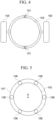
- FIG. 5 is a view showing an example of a cross-section of the first body portion 107 of the position measuring apparatus 100 according to the first embodiment shown in FIG. 1 when cut in a direction perpendicular to the optical axis A.
- a plurality of elastic members 106 may be accommodated in the first body portion 107, and each of the elastic members 106 may be disposed at certain intervals along the edge of an emission surface of the first lens 102 so as not to invade the optical path of the parallel light emitted from the first lens 102.
- FIG. 6 is a view showing an example of a cross-section of the first body portion 107 of the position measuring apparatus 100 according to the second embodiment shown in FIG. 3 when cut in a direction perpendicular to an optical axis A.
- One elastic member 106 may be accommodated in the first body portion 107 as in the example shown in FIG. 6 .
- the elastic member 106 may be a compression spring in the form of a coil of which an inner diameter D1 is greater than a diameter D2 of the emission surface of the first lens 102 so as not to invade the optical path of the parallel light emitted from the first lens 102.
- the second body portion 108 accommodates the second lens 103 and the image sensor 104 therein.
- the second lens 103 and the image sensor 104 may be disposed in the second body portion 108 such that a distance H3 on the optical axis A is fixed to a constant value.
- an opening may be formed between the first body portion 107 and the second body portion 108 in a direction perpendicular to the optical axis A, through which parallel light emitted from the first lens 102 may be incident on the second lens 103.
- the force acting from the moving body 200 in the direction of the inner surface 301 of the pipe 300 may fluctuate, and accordingly, the force acting on the plurality of wheels 105 at the inner surface 301 of the pipe 300 also fluctuates.
- the force acting on the plurality of wheels 105 is transmitted to one or more elastic members 106 through the first lens 102 to which the plurality of wheels 105 are coupled.
- the one or more elastic members 106 are compressed or relaxed to change the length of the one or more elastic members 106 in the direction of the optical axis A, and as a result, the first lens 102 moves along the optical axis A inside the first body portion 107.
- a distance H1 between the inner surface 301 of the pipe 300 and the first lens 102 and a distance H3 between the second lens 103 and the image sensor 104 are maintained in a fixed state; however, a distance H2 between the first lens 102 and the second lens 103 is changed according to compression or relaxation of one or more elastic members 106.
- the light emitted from the first lens 102 and incident on the second lens 103 is parallel light parallel to the optical axis A, and thus when the distance H1 with the first lens 102 and the distance H3 between the second lens 103 and the image sensor 104 are maintained in the fixed state, the size of the image to be imaged on the imaging surface of the image sensor 104 does not change even if the distance H2 between the first lens 102 and the second lens 103 changes. Therefore, the image sensor 104 generates an image of the same size regardless of the change in the distance between the moving body 200 and the inner surface 301 of the pipe 300.
- the position of the moving body 200 may be determined based on the image generated by the image sensor 104.
- the position of the moving body 200 may be determined depending on a moving distance and a moving direction of the moving body 200 determined based on a motion vector extracted from each of images continuously generated by the image sensor 104.
- the size of the image to be imaged on the imaging surface of the image sensor 104 is maintained regardless of the change in the distance between the image sensor 104 and the surface of the pipe 300, and thus an error that may occur due to the change in the size of the image when the moving distance and the moving direction of the moving body 200 are determined may be minimized.
- the plurality of wheels 105 may be wheel encoders.
- the position of the moving body 200 may be determined based on the moving distance and the moving direction measured based on the image and the moving distance measured by the wheel encoder.
- FIG. 7 is a view showing a structure of a position measuring apparatus 100 according to a third embodiment
- FIG. 8 is a view showing a structure of a position measuring apparatus 100 according to a fourth embodiment.
- the position measuring apparatus 100 may further include one or more force-torque sensors 109 that measure the force applied to the one or more elastic members 106.
- the one or more force-torque sensors 109 may be disposed between an inner side of the first body portion 109 and the one or more elastic members 106, respectively, to measure the force applied to each of the one or more elastic members 106 with the change in the distance between the moving body 200 and the inner surface 301 of the pipe 300.
- the value measured by each of the force-torque sensors 109 may be used for calculating the distance between the moving body 200 and the inner surface 301 of the pipe 300.
- various information related to the inner shape of the pipe 300 or the wear degree of each of the plurality of wheels 105 may be generated based on the difference in the magnitude of the force measured by each of the force-torque sensors 109.
- the magnitude of the force applied to each of the plurality of wheels 105 when the moving body 200 passes the irregularities varies depending on the height, width and position of the irregularities.
- the force applied to each of the one or more elastic members 106 also varies depending on the difference in the force applied to each wheel 105, it is possible to estimate the position, height, and area of the irregularities based on the change and magnitude difference in the force measured by each of the force-torque sensors 109.
Landscapes
- Physics & Mathematics (AREA)
- General Physics & Mathematics (AREA)
- Engineering & Computer Science (AREA)
- Radar, Positioning & Navigation (AREA)
- Remote Sensing (AREA)
- Automation & Control Theory (AREA)
- Length Measuring Devices By Optical Means (AREA)
- Length Measuring Devices With Unspecified Measuring Means (AREA)
- Spectroscopy & Molecular Physics (AREA)
Description
- Embodiments disclosed in the present disclosure relate to a technique for measuring a position of a moving body moving inside a pipe.
- Apparatuses operating inside pipes where GPS signals do not reach use self-contained navigation to estimate their current position. Dead reckoning, which is mainly used for self-contained navigation, uses an inertial navigation system, which is a navigation system for calculating a position relative to an initial position based on a moving distance, a moving direction, or the like, determined using an encoder-type odometer, compass, gyroscope, acceleration sensor, or the like, mainly attached to the moving body.
- The encoder-type odometer measures the movement of a wheel in close contact with the pipe to calculate a moving distance; however, errors may occur due to wheel slippage occurring when the moving body changes directions, the attitude of the moving body, the shape of the pipe, irregularities on the inner surface of the pipe, welding parts, pipe contact parts and areas, wheel wear and circumference measurement errors, odometer tooth resolution, or the like.
- Meanwhile, an optical engine-type odometer using a pipe surface image generated by an image sensor is a non-contact type odometer, which shows the best performance in terms of reliability, restrictions in use, the amount of calculation for position estimation, or the like. The optical engine-type odometer acquires an image of the inner surface of a pipe with the image sensor, and then measures a moving distance and a moving direction by using a motion vector detected between successive images. In the optical engine-type odometer, wheel slippage and wear, which are the biggest cause of error of the encoder-type odometer, do not occur; however, a moving distance estimation error occurs due to a change in the distance between the image sensor and the inner surface of the pipe caused by irregularities or the like while the moving body is traveling,
- Examples of known devices in the prior art are the following:
-
US 2010/211354 A1 discloses an apparatus for inspecting pipes comprising a body with wheels and optical odometers each comprising a light source, lenses and a detector. -
WO 2012/165825 A2 discloses an apparatus for 3D-mapping the internal surface of a pipeline, comprising an optical odometer for measuring the distance travelled by the apparatus in the pipe.KR 10-1258078 B1 -
KR 10-1945508 B1 -
KR 10-1936018 B1 KR10-2020-0123360 A -
US 2019/200823 A1 discloses a home robot (e.g. a vacuum cleaner) which comprises a sensor for detecting ground height differences. The distance sensor comprises a light source, a CCD sensor and a lens. - Embodiments disclosed in the present disclosure are to provide an apparatus for measuring a position of a moving body moving inside a pipe.
- An apparatus for measuring a position according to the invention is defined in claim 1, and includes a light source emitting light to an inner surface of a pipe, a first lens receiving reflected light from which light emitted by the light source is reflected by the inner surface and converting the reflected light into parallel light parallel to an optical axis, a second lens disposed on an optical path of the parallel light and converting the parallel light into a convergent refracted light, an image sensor disposed on an optical path of the refracted light, one or more elastic members disposed between the first lens and the second lens, and a plurality of wheels that are coupled to a side surface of the first lens and are in close contact with the inner surface to be rotated by movement of the moving body.
- The one or more elastic members may be compressed or relaxed by a force applied to at least one of the plurality of wheels on the inner surface with the movement of the moving body.
- A distance between the first lens and a second lens may vary depending on the compression or relaxation of the one or more elastic members, and a distance between the inner surface and the first lens and a distance between the second lens and the image sensor may be invariant with respect to the compression or relaxation of the one or more elastic members.
- The apparatus may further include a first body portion accommodating the first lens and the one or more elastic members, and a second body portion accommodating the second lens and the image sensor.
- One end of each of the one or more elastic members may be fixed on an inner side of the first body portion, and the other end of each of the one or more elastic members may move in a direction parallel to the optical axis with movement of the first lens by the force applied to the at least one of the plurality of wheels.
- The apparatus may further include one or more force-torque sensors measuring a force applied to each of the one or more elastic members.
- The first lens may be a telecentric lens.
- The second lens may be a convex lens for converging the parallel light to a focal point between the second lens and the image sensor.
- Each of the plurality of wheels may be a wheel encoder.
- According to the disclosed embodiments, an image of a certain size may be imaged on the imaging surface of an image sensor regardless of the distance between the image sensor and the inner surface of the pipe, and thus it is possible to minimize errors that may occur due to irregularities in the pipe when the position of a moving body is measured by using the image of the inner surface of the pipe generated by the image sensor.
-
-
FIG. 1 is a view exemplarily illustrating a moving body equipped with a position measuring apparatus according to an embodiment. -
FIG. 2 is a view showing a structure of a position measuring apparatus (100) according to a first embodiment. -
FIG. 3 is a view showing a structure of a position measuring apparatus (100) according to a second embodiment. -
FIG. 4 is a view showing a cross-section of the position measuring apparatus (100) shown inFIG. 1 orFIG. 2 when viewed from an inner surface (301) of a pipe (300). -
FIG. 5 is a view showing an example of a cross-section of a first body portion (107) of the position measuring apparatus (100) according to the first embodiment shown inFIG. 1 when cut in a direction perpendicular to an optical axis (A). -
FIG. 6 is a view showing an example of a cross-section of a first body portion (107) of the position measuring apparatus (100) according to the second embodiment shown inFIG. 2 when cut in a direction perpendicular to an optical axis (A). -
FIG. 7 is a view showing a structure of a position measuring apparatus (100) according to a third embodiment. -
FIG. 8 is a view showing a structure of a position measuring apparatus (100) according to a fourth embodiment. - Hereinafter, specific embodiments of the present disclosure will be described with reference to the accompanying drawings. The following detailed description is provided to assist in a comprehensive understanding of the methods, devices and/or systems described herein. However, the detailed description is only for illustrative purposes and the present disclosure is not limited thereto.
- In describing the embodiments of the present disclosure, when it is determined that detailed descriptions of known technology related to the present disclosure may unnecessarily obscure the gist of the present disclosure, the detailed descriptions thereof will be omitted. The terms used below are defined in consideration of functions in the present disclosure, but may be changed depending on the customary practice or the intention of a user or operator. Thus, the definitions should be determined based on the overall content of the present specification. The terms used herein are only for describing the embodiments of the present disclosure, and should not be construed as limitative. Unless expressly used otherwise, a singular form includes a plural form. In the present description, the terms "including", "comprising", "having", and the like are used to indicate certain characteristics, numbers, steps, operations, elements, and a portion or combination thereof, but should not be interpreted to preclude one or more other characteristics, numbers, steps, operations, elements, and a portion or combination thereof.
-
FIG. 1 is a view exemplarily illustrating a moving body equipped with a position measuring apparatus according to an embodiment. - Referring to
FIG. 1 , a movingbody 200 according to an embodiment includes aposition measuring apparatus 100 on one side, and is a device configured to move inside apipe 300. In this case, thepipe 300 may be, for example, a pipe in which a gas pipe, a water supply pipe, and a cable such as a communication cable is embedded, but is not necessarily limited to a pipe for a specific purpose. - Meanwhile, according to an embodiment, the moving
body 200 is for cleaning or inspecting the inside of thepipe 300 while moving inside thepipe 300, and may be, for example, a mobile robot configured to move inside the pipe with an independent power source therein or by using power provided by an external power source. However, the movingbody 200 is not necessarily limited to the mobile robot, and as long as it can move inside thepipe 300, it is not necessarily limited to a specific type or purpose device. -
FIG. 2 is a view showing a structure of aposition measuring apparatus 100 according to a first embodiment,FIG. 3 is a view showing a structure of aposition measuring apparatus 100 according to a second embodiment, andFIG. 4 is a view showing a cross-section of theposition measuring apparatus 100 shown inFIG. 1 orFIG. 2 when viewed from aninner surface 301 of thepipe 300. - Referring to
FIGS. 2 to 4 , theposition measuring apparatus 100 includes one ormore light sources 101, afirst lens 102, asecond lens 103, animage sensor 104, and a plurality ofwheels 105, one or moreelastic members 106, afirst body portion 107, and asecond body portion 108. - One or more
light sources 101 emit light toward theinner surface 301 of thepipe 300. - According to an embodiment, the one or
more light sources 101 may be disposed around an incident surface of thefirst lens 102 as shown inFIG. 3 and configured to emit light toward theinner surface 301 of thepipe 300. However, the position where the one ormore light sources 101 are disposed and the number of the one ormore light sources 101 are not necessarily limited to the example shown inFIG. 4 and may vary depending on embodiments. - In addition, according to an embodiment, the one or
more light sources 101 may be, for example, light emitting diodes (LEDs), but are not necessarily limited to a specific type of light source. - The
first lens 102 converts reflected light, which the light emitted by one ormore light sources 101 is reflected from theinner surface 301 of thepipe 300 and is incident thereon, into parallel light parallel to an optical axis A and emits the parallel light. - According to an embodiment, the
first lens 102 may be, for example, a telecentric lens in which an entrance pupil is located at an infinite distance, such as a telecentric f-theta lens. - The
second lens 103 is disposed on an optical path of parallel light emitted from thefirst lens 102, converts the parallel light emitted from thefirst lens 102 into convergent refracted light and emits it. - According to an embodiment, the
second lens 103 may be, for example, a lens having a positive refractive power, such as a convex lens. - Specifically, the parallel light emitted from the
first lens 102 is incident on thesecond lens 103, and the parallel light incident on thesecond lens 103 is converted into refracted light that converges at a focal point f between thesecond lens 103 and theimage sensor 104 to be imaged on the imaging surface of theimage sensor 104. - The
image sensor 104 is disposed on an optical path of the refracted light emitted from thesecond lens 103, and converts the refracted light emitted from thesecond lens 103 and imaged on the imaging surface of theimage sensor 104 into an electrical signal, thereby generating an image corresponding to theinner surface 301 of thepipe 300. - According to an embodiment, the
image sensor 104 may be, for example, a charged coupled device (CCD) sensor or a complementary metal oxide semiconductor (CMOS) sensor, but is not necessarily limited to a specific type of image sensor. - Each of the plurality of
wheels 105 is coupled to a side surface of thefirst lens 102 and is in close contact with theinner surface 301 of thepipe 300 to be rotated by the movement of the movingbody 200. - Specifically, the plurality of
wheels 105 may be a pair of wheels coupled to opposite side surfaces of thefirst lens 102. - Meanwhile, the plurality of
wheels 105 are configured to be in close contact with theinner surface 301 of thepipe 300 by the force of one or moreelastic members 106 pushing thefirst lens 102 and be rotated around a rotation axis perpendicular to the optical axis A with the movement of the movingbody 200. - The one or more
elastic members 106 are each disposed between thefirst lens 102 and thesecond lens 103. - According to an embodiment, the one or more
elastic members 106 may be, for example, an elastic body having elasticity such as a compression spring, but are not necessarily limited to a specific type of elastic body. - The
first body portion 107 accommodates thefirst lens 102 and the one or moreelastic members 106. - In this case, each of the
elastic members 106 is disposed such that one end thereof is fixed to an inner side of thefirst body portion 107 and the other end moves in a direction parallel to the optical axis A with the movement of thefirst lens 102. That is, each of theelastic members 106 is compressed or relaxed as thefirst lens 102 moves in the direction parallel to the optical axis A. - Meanwhile,
FIG. 5 is a view showing an example of a cross-section of thefirst body portion 107 of theposition measuring apparatus 100 according to the first embodiment shown inFIG. 1 when cut in a direction perpendicular to the optical axis A. - As in the example shown in
FIG. 5 , a plurality ofelastic members 106 may be accommodated in thefirst body portion 107, and each of theelastic members 106 may be disposed at certain intervals along the edge of an emission surface of thefirst lens 102 so as not to invade the optical path of the parallel light emitted from thefirst lens 102. -
FIG. 6 is a view showing an example of a cross-section of thefirst body portion 107 of theposition measuring apparatus 100 according to the second embodiment shown inFIG. 3 when cut in a direction perpendicular to an optical axis A. - One
elastic member 106 may be accommodated in thefirst body portion 107 as in the example shown inFIG. 6 . In this case, theelastic member 106 may be a compression spring in the form of a coil of which an inner diameter D1 is greater than a diameter D2 of the emission surface of thefirst lens 102 so as not to invade the optical path of the parallel light emitted from thefirst lens 102. - The
second body portion 108 accommodates thesecond lens 103 and theimage sensor 104 therein. Specifically, thesecond lens 103 and theimage sensor 104 may be disposed in thesecond body portion 108 such that a distance H3 on the optical axis A is fixed to a constant value. - Meanwhile, an opening may be formed between the
first body portion 107 and thesecond body portion 108 in a direction perpendicular to the optical axis A, through which parallel light emitted from thefirst lens 102 may be incident on thesecond lens 103. - Meanwhile, when the moving
body 200 moves along a curved path inside thepipe 300 or crosses the irregularities existing inside thepipe 300, the force acting from the movingbody 200 in the direction of theinner surface 301 of thepipe 300 may fluctuate, and accordingly, the force acting on the plurality ofwheels 105 at theinner surface 301 of thepipe 300 also fluctuates. In this case, the force acting on the plurality ofwheels 105 is transmitted to one or moreelastic members 106 through thefirst lens 102 to which the plurality ofwheels 105 are coupled. Thereby, the one or moreelastic members 106 are compressed or relaxed to change the length of the one or moreelastic members 106 in the direction of the optical axis A, and as a result, thefirst lens 102 moves along the optical axis A inside thefirst body portion 107. - That is, a distance H1 between the
inner surface 301 of thepipe 300 and thefirst lens 102 and a distance H3 between thesecond lens 103 and theimage sensor 104 are maintained in a fixed state; however, a distance H2 between thefirst lens 102 and thesecond lens 103 is changed according to compression or relaxation of one or moreelastic members 106. - However, as described above, the light emitted from the
first lens 102 and incident on thesecond lens 103 is parallel light parallel to the optical axis A, and thus when the distance H1 with thefirst lens 102 and the distance H3 between thesecond lens 103 and theimage sensor 104 are maintained in the fixed state, the size of the image to be imaged on the imaging surface of theimage sensor 104 does not change even if the distance H2 between thefirst lens 102 and thesecond lens 103 changes. Therefore, theimage sensor 104 generates an image of the same size regardless of the change in the distance between the movingbody 200 and theinner surface 301 of thepipe 300. - Meanwhile, according to an embodiment, the position of the moving
body 200 may be determined based on the image generated by theimage sensor 104. For example, the position of the movingbody 200 may be determined depending on a moving distance and a moving direction of the movingbody 200 determined based on a motion vector extracted from each of images continuously generated by theimage sensor 104. In this case, as described above, the size of the image to be imaged on the imaging surface of theimage sensor 104 is maintained regardless of the change in the distance between theimage sensor 104 and the surface of thepipe 300, and thus an error that may occur due to the change in the size of the image when the moving distance and the moving direction of the movingbody 200 are determined may be minimized. - Meanwhile, according to an embodiment, the plurality of
wheels 105 may be wheel encoders. In this case, the position of the movingbody 200 may be determined based on the moving distance and the moving direction measured based on the image and the moving distance measured by the wheel encoder. -
FIG. 7 is a view showing a structure of aposition measuring apparatus 100 according to a third embodiment, andFIG. 8 is a view showing a structure of aposition measuring apparatus 100 according to a fourth embodiment. - As in the example shown in
FIGS. 7 and8 , theposition measuring apparatus 100 may further include one or more force-torque sensors 109 that measure the force applied to the one or moreelastic members 106. - Specifically, the one or more force-
torque sensors 109 may be disposed between an inner side of thefirst body portion 109 and the one or moreelastic members 106, respectively, to measure the force applied to each of the one or moreelastic members 106 with the change in the distance between the movingbody 200 and theinner surface 301 of thepipe 300. - Meanwhile, according to an embodiment, the value measured by each of the force-
torque sensors 109 may be used for calculating the distance between the movingbody 200 and theinner surface 301 of thepipe 300. In addition, when a plurality of force-torque sensors 109 are disposed, various information related to the inner shape of thepipe 300 or the wear degree of each of the plurality ofwheels 105 may be generated based on the difference in the magnitude of the force measured by each of the force-torque sensors 109. - For example, when there are irregularities inside the
pipe 300, the magnitude of the force applied to each of the plurality ofwheels 105 when the movingbody 200 passes the irregularities varies depending on the height, width and position of the irregularities. In this case, since the force applied to each of the one or moreelastic members 106 also varies depending on the difference in the force applied to eachwheel 105, it is possible to estimate the position, height, and area of the irregularities based on the change and magnitude difference in the force measured by each of the force-torque sensors 109. - Although the present invention has been described in detail through the representative embodiments as above, those skilled in the art will understand that various modifications may be made thereto without departing from the scope of the present invention which is defined by the appended claims. Therefore, the scope of rights of the present disclosure should not be limited to the described embodiments, but should be defined by the claims set forth below
Claims (9)
- An apparatus configured to be provided in a moving body for measuring a position of said moving body moving inside a pipe, the apparatus comprising:a light source (101) configured to emit light to an inner surface of the pipe;a first lens (102) configured to receive reflected light from the light emitted by the light source (101) which is reflected by the inner surface of the pipe and to convert the reflected light into parallel light parallel to an optical axis;a second lens (103) disposed on an optical path of the parallel light and configured to convert the parallel light into a convergent refracted light;an image sensor (104) disposed on an optical path of the refracted light;one or more elastic members (106) disposed between the first lens (102) and the second lens (103); anda plurality of wheels (105) that are coupled to a side surface of the first lens (102) and are configured to be in close contact with the inner surface of the pipe to be rotated by movement of the moving body.
- The apparatus for measuring a position of claim 1, wherein the one or more elastic members (106) are configured to be compressed or relaxed by a force applied to at least one of the plurality of wheels (105) on the inner surface with the movement of the moving body.
- The apparatus for measuring a position of claim 2, wherein a distance between the first lens (102) and the second lens (103) varies depending on the compression or relaxation of the one or more elastic members (106), and a distance between the inner surface and the first lens (102) and a distance between the second lens (103) and the image sensor (104) are invariant with respect to the compression or relaxation of the one or more elastic members (106).
- The apparatus for measuring a position of claim 3, further comprising:a first body portion (107) accommodating the first lens (102) and the one or more elastic members (106); anda second body portion (108) accommodating the second lens (103) and the image sensor (104).
- The apparatus for measuring a position of claim 4, wherein one end of each of the one or more elastic members (106) is fixed on an inner side of the first body portion (107), and the other end of each of the one or more elastic members (106) moves in a direction parallel to the optical axis with movement of the first lens (102) by the force applied to the at least one of the plurality of wheels (105).
- The apparatus for measuring a position of claim 1, further comprising one or more force-torque sensors for measuring a force applied to each of the one or more elastic members (106).
- The apparatus for measuring a position of claim 1, wherein the first lens (102) is a telecentric lens.
- The apparatus for measuring a position of claim 1, wherein the second lens (103) is a convex lens for converging the parallel light to a focal point between the second lens (103) and the image sensor (104).
- The apparatus for measuring a position of claim 1, wherein each of the plurality of wheels (105) is a wheel encoder.
Applications Claiming Priority (2)
| Application Number | Priority Date | Filing Date | Title |
|---|---|---|---|
| KR1020200184969A KR102299127B1 (en) | 2020-12-28 | 2020-12-28 | Apparatus for measuring position in a pipe |
| PCT/KR2020/019342 WO2022145523A1 (en) | 2020-12-28 | 2020-12-29 | Apparatus for measuring position in pipe |
Publications (3)
| Publication Number | Publication Date |
|---|---|
| EP4043830A1 EP4043830A1 (en) | 2022-08-17 |
| EP4043830A4 EP4043830A4 (en) | 2023-01-04 |
| EP4043830B1 true EP4043830B1 (en) | 2024-02-28 |
Family
ID=77782670
Family Applications (1)
| Application Number | Title | Priority Date | Filing Date |
|---|---|---|---|
| EP20936073.4A Active EP4043830B1 (en) | 2020-12-28 | 2020-12-29 | Apparatus for measuring position in pipe |
Country Status (5)
| Country | Link |
|---|---|
| US (1) | US11761796B2 (en) |
| EP (1) | EP4043830B1 (en) |
| JP (1) | JP7264541B2 (en) |
| KR (1) | KR102299127B1 (en) |
| WO (1) | WO2022145523A1 (en) |
Families Citing this family (3)
| Publication number | Priority date | Publication date | Assignee | Title |
|---|---|---|---|---|
| GB2618387B (en) * | 2022-05-06 | 2024-12-18 | Darkvision Tech Inc | Advanced optical imaging of tubulars |
| DE102022205189A1 (en) * | 2022-05-24 | 2023-11-30 | Envirobot GmbH & Co. KG | System and method for cleaning and/or inspecting a pipeline |
| US20250130572A1 (en) * | 2023-10-23 | 2025-04-24 | BrightAI Corporation | Systems and associated methods for multimodal feature detection of an environment |
Family Cites Families (16)
| Publication number | Priority date | Publication date | Assignee | Title |
|---|---|---|---|---|
| US6931149B2 (en) * | 2002-04-19 | 2005-08-16 | Norsk Elektro Optikk A/S | Pipeline internal inspection device and method |
| US7181985B2 (en) * | 2005-05-27 | 2007-02-27 | Breval Technical Services Limited | Conduit inspection apparatus and method |
| DE202006017076U1 (en) * | 2006-11-08 | 2007-01-04 | Fraunhofer-Gesellschaft zur Förderung der angewandten Forschung e.V. | Device for inspection of a pipeline |
| EP2167995A2 (en) * | 2007-07-19 | 2010-03-31 | Water Resources Engineering Corporation | Apparatus for acquiring 3-dimensional geomatical information of underground pipes and noncontact odometer using optical flow sensor and using the same |
| NO333307B1 (en) * | 2008-11-24 | 2013-04-29 | Statoil Asa | Apparatus and method for optical measurement of the thickness of any deposit of material on the interior wall of a structure |
| KR101041780B1 (en) | 2009-01-14 | 2011-06-17 | 한국건설기술연구원 | Underground pipeline location information acquisition device |
| KR101258078B1 (en) * | 2011-04-01 | 2013-05-06 | 한국해양대학교 산학협력단 | Inspecting apparatus for pipelines |
| KR20120133482A (en) * | 2011-05-31 | 2012-12-11 | 수자원기술 주식회사 | Floating type pipeline probe |
| US9176052B2 (en) * | 2012-09-14 | 2015-11-03 | Halliburton Energy Services, Inc. | Systems and methods for inspecting and monitoring a pipeline |
| US9744670B2 (en) | 2014-11-26 | 2017-08-29 | Irobot Corporation | Systems and methods for use of optical odometry sensors in a mobile robot |
| CA2915855C (en) * | 2014-12-19 | 2019-04-16 | Institut National D'optique | Device for optical profilometry with conical light beams |
| KR101945508B1 (en) * | 2017-07-27 | 2019-02-08 | 한국광기술원 | apparatus for internal inspection of pipe |
| CN108553027B (en) * | 2018-01-04 | 2024-09-27 | 深圳飞鼠动力科技有限公司 | Mobile Robots |
| WO2019178311A1 (en) * | 2018-03-15 | 2019-09-19 | Redzone Robotics, Inc. | Image processing techniques for multi-sensor inspection of pipe interiors |
| KR101936018B1 (en) * | 2018-06-26 | 2019-01-07 | 우리종합기술(주) | Method for inspecting pipeline using exploration unit and pipeline inspection system supporting the same |
| KR102287494B1 (en) * | 2019-04-19 | 2021-08-10 | 주식회사 준성이엔알 | Robot system for inspecting inside pipe |
-
2020
- 2020-12-28 KR KR1020200184969A patent/KR102299127B1/en active Active
- 2020-12-29 US US17/298,758 patent/US11761796B2/en active Active
- 2020-12-29 WO PCT/KR2020/019342 patent/WO2022145523A1/en not_active Ceased
- 2020-12-29 JP JP2021575470A patent/JP7264541B2/en active Active
- 2020-12-29 EP EP20936073.4A patent/EP4043830B1/en active Active
Also Published As
| Publication number | Publication date |
|---|---|
| US11761796B2 (en) | 2023-09-19 |
| EP4043830A1 (en) | 2022-08-17 |
| EP4043830A4 (en) | 2023-01-04 |
| JP7264541B2 (en) | 2023-04-25 |
| JP2023512128A (en) | 2023-03-24 |
| KR102299127B1 (en) | 2021-09-06 |
| US20220404177A1 (en) | 2022-12-22 |
| WO2022145523A1 (en) | 2022-07-07 |
Similar Documents
| Publication | Publication Date | Title |
|---|---|---|
| EP4043830B1 (en) | Apparatus for measuring position in pipe | |
| US10048064B2 (en) | Optical three dimensional scanners and methods of use thereof | |
| JP2010534824A (en) | 3D geographic information acquisition device for underground pipes | |
| EP3213104B1 (en) | Underwater positioning system | |
| US10054422B2 (en) | Coordinate measuring device | |
| EP1362979A2 (en) | Pig for measuring the shape of a pipeline | |
| US8552362B2 (en) | System and method for linear and angular measurements of a moving object | |
| AU715084B2 (en) | Optic position sensor | |
| JP5754833B2 (en) | Inner diameter measuring device | |
| Bonarini et al. | A kinematic-independent dead-reckoning sensor for indoor mobile robotics | |
| CN101595364A (en) | Position detection system for contactless interference detection of position of target object and scanning system equipped therewith | |
| US9696143B2 (en) | Device for optical profilometry with conical light beams | |
| US20170038203A1 (en) | Self-propelled device and distance detector thereof | |
| CN1979091A (en) | Optical measuring system | |
| KR20240018503A (en) | Position measuring device and position measuring method | |
| US20250353178A1 (en) | Humanoid robot comprising articulated legs with wheels or tracks | |
| Demetriou | A Survey of Sensors for Localization of Unmanned Ground Vehicles (UGVs). | |
| CN111656133A (en) | Sensor device for distance offset measurement | |
| Bonarini et al. | Dead reckoning for mobile robots using two optical mice | |
| US12461533B2 (en) | Method for determining a distance between a cleaning robot and an obstacle | |
| RU2528033C2 (en) | Device for diagnostics of condition of inner surface of pipes | |
| KR101868963B1 (en) | Structure to the one direction over the distance by using the detected light | |
| KR20120133482A (en) | Floating type pipeline probe | |
| WO1998003771A1 (en) | Excavation direction detecting apparatus and method | |
| JP6500452B2 (en) | Position measurement device |
Legal Events
| Date | Code | Title | Description |
|---|---|---|---|
| STAA | Information on the status of an ep patent application or granted ep patent |
Free format text: STATUS: UNKNOWN |
|
| STAA | Information on the status of an ep patent application or granted ep patent |
Free format text: STATUS: THE INTERNATIONAL PUBLICATION HAS BEEN MADE |
|
| PUAI | Public reference made under article 153(3) epc to a published international application that has entered the european phase |
Free format text: ORIGINAL CODE: 0009012 |
|
| STAA | Information on the status of an ep patent application or granted ep patent |
Free format text: STATUS: REQUEST FOR EXAMINATION WAS MADE |
|
| 17P | Request for examination filed |
Effective date: 20211122 |
|
| AK | Designated contracting states |
Kind code of ref document: A1 Designated state(s): AL AT BE BG CH CY CZ DE DK EE ES FI FR GB GR HR HU IE IS IT LI LT LU LV MC MK MT NL NO PL PT RO RS SE SI SK SM TR |
|
| REG | Reference to a national code |
Ref country code: DE Ref legal event code: R079 Free format text: PREVIOUS MAIN CLASS: G01C0021160000 Ipc: G01D0005260000 Ref document number: 602020026622 Country of ref document: DE |
|
| A4 | Supplementary search report drawn up and despatched |
Effective date: 20221205 |
|
| RIC1 | Information provided on ipc code assigned before grant |
Ipc: G01C 21/12 20060101ALI20221129BHEP Ipc: G01C 22/00 20060101ALI20221129BHEP Ipc: G01L 1/04 20060101ALI20221129BHEP Ipc: F16L 55/48 20060101ALI20221129BHEP Ipc: G01D 5/26 20060101AFI20221129BHEP |
|
| GRAP | Despatch of communication of intention to grant a patent |
Free format text: ORIGINAL CODE: EPIDOSNIGR1 |
|
| STAA | Information on the status of an ep patent application or granted ep patent |
Free format text: STATUS: GRANT OF PATENT IS INTENDED |
|
| DAV | Request for validation of the european patent (deleted) | ||
| DAX | Request for extension of the european patent (deleted) | ||
| INTG | Intention to grant announced |
Effective date: 20231020 |
|
| GRAS | Grant fee paid |
Free format text: ORIGINAL CODE: EPIDOSNIGR3 |
|
| GRAA | (expected) grant |
Free format text: ORIGINAL CODE: 0009210 |
|
| STAA | Information on the status of an ep patent application or granted ep patent |
Free format text: STATUS: THE PATENT HAS BEEN GRANTED |
|
| AK | Designated contracting states |
Kind code of ref document: B1 Designated state(s): AL AT BE BG CH CY CZ DE DK EE ES FI FR GB GR HR HU IE IS IT LI LT LU LV MC MK MT NL NO PL PT RO RS SE SI SK SM TR |
|
| REG | Reference to a national code |
Ref country code: GB Ref legal event code: FG4D |
|
| REG | Reference to a national code |
Ref country code: CH Ref legal event code: EP |
|
| REG | Reference to a national code |
Ref country code: DE Ref legal event code: R096 Ref document number: 602020026622 Country of ref document: DE |
|
| REG | Reference to a national code |
Ref country code: IE Ref legal event code: FG4D |
|
| REG | Reference to a national code |
Ref country code: LT Ref legal event code: MG9D |
|
| PG25 | Lapsed in a contracting state [announced via postgrant information from national office to epo] |
Ref country code: IS Free format text: LAPSE BECAUSE OF FAILURE TO SUBMIT A TRANSLATION OF THE DESCRIPTION OR TO PAY THE FEE WITHIN THE PRESCRIBED TIME-LIMIT Effective date: 20240628 |
|
| REG | Reference to a national code |
Ref country code: NL Ref legal event code: MP Effective date: 20240228 |
|
| PG25 | Lapsed in a contracting state [announced via postgrant information from national office to epo] |
Ref country code: LT Free format text: LAPSE BECAUSE OF FAILURE TO SUBMIT A TRANSLATION OF THE DESCRIPTION OR TO PAY THE FEE WITHIN THE PRESCRIBED TIME-LIMIT Effective date: 20240228 |
|
| PG25 | Lapsed in a contracting state [announced via postgrant information from national office to epo] |
Ref country code: GR Free format text: LAPSE BECAUSE OF FAILURE TO SUBMIT A TRANSLATION OF THE DESCRIPTION OR TO PAY THE FEE WITHIN THE PRESCRIBED TIME-LIMIT Effective date: 20240529 |
|
| PG25 | Lapsed in a contracting state [announced via postgrant information from national office to epo] |
Ref country code: HR Free format text: LAPSE BECAUSE OF FAILURE TO SUBMIT A TRANSLATION OF THE DESCRIPTION OR TO PAY THE FEE WITHIN THE PRESCRIBED TIME-LIMIT Effective date: 20240228 Ref country code: RS Free format text: LAPSE BECAUSE OF FAILURE TO SUBMIT A TRANSLATION OF THE DESCRIPTION OR TO PAY THE FEE WITHIN THE PRESCRIBED TIME-LIMIT Effective date: 20240528 Ref country code: NL Free format text: LAPSE BECAUSE OF FAILURE TO SUBMIT A TRANSLATION OF THE DESCRIPTION OR TO PAY THE FEE WITHIN THE PRESCRIBED TIME-LIMIT Effective date: 20240228 |
|
| PG25 | Lapsed in a contracting state [announced via postgrant information from national office to epo] |
Ref country code: ES Free format text: LAPSE BECAUSE OF FAILURE TO SUBMIT A TRANSLATION OF THE DESCRIPTION OR TO PAY THE FEE WITHIN THE PRESCRIBED TIME-LIMIT Effective date: 20240228 |
|
| PG25 | Lapsed in a contracting state [announced via postgrant information from national office to epo] |
Ref country code: RS Free format text: LAPSE BECAUSE OF FAILURE TO SUBMIT A TRANSLATION OF THE DESCRIPTION OR TO PAY THE FEE WITHIN THE PRESCRIBED TIME-LIMIT Effective date: 20240528 Ref country code: NO Free format text: LAPSE BECAUSE OF FAILURE TO SUBMIT A TRANSLATION OF THE DESCRIPTION OR TO PAY THE FEE WITHIN THE PRESCRIBED TIME-LIMIT Effective date: 20240528 Ref country code: NL Free format text: LAPSE BECAUSE OF FAILURE TO SUBMIT A TRANSLATION OF THE DESCRIPTION OR TO PAY THE FEE WITHIN THE PRESCRIBED TIME-LIMIT Effective date: 20240228 Ref country code: LT Free format text: LAPSE BECAUSE OF FAILURE TO SUBMIT A TRANSLATION OF THE DESCRIPTION OR TO PAY THE FEE WITHIN THE PRESCRIBED TIME-LIMIT Effective date: 20240228 Ref country code: IS Free format text: LAPSE BECAUSE OF FAILURE TO SUBMIT A TRANSLATION OF THE DESCRIPTION OR TO PAY THE FEE WITHIN THE PRESCRIBED TIME-LIMIT Effective date: 20240628 Ref country code: HR Free format text: LAPSE BECAUSE OF FAILURE TO SUBMIT A TRANSLATION OF THE DESCRIPTION OR TO PAY THE FEE WITHIN THE PRESCRIBED TIME-LIMIT Effective date: 20240228 Ref country code: GR Free format text: LAPSE BECAUSE OF FAILURE TO SUBMIT A TRANSLATION OF THE DESCRIPTION OR TO PAY THE FEE WITHIN THE PRESCRIBED TIME-LIMIT Effective date: 20240529 Ref country code: FI Free format text: LAPSE BECAUSE OF FAILURE TO SUBMIT A TRANSLATION OF THE DESCRIPTION OR TO PAY THE FEE WITHIN THE PRESCRIBED TIME-LIMIT Effective date: 20240228 Ref country code: ES Free format text: LAPSE BECAUSE OF FAILURE TO SUBMIT A TRANSLATION OF THE DESCRIPTION OR TO PAY THE FEE WITHIN THE PRESCRIBED TIME-LIMIT Effective date: 20240228 Ref country code: BG Free format text: LAPSE BECAUSE OF FAILURE TO SUBMIT A TRANSLATION OF THE DESCRIPTION OR TO PAY THE FEE WITHIN THE PRESCRIBED TIME-LIMIT Effective date: 20240228 |
|
| PG25 | Lapsed in a contracting state [announced via postgrant information from national office to epo] |
Ref country code: PL Free format text: LAPSE BECAUSE OF FAILURE TO SUBMIT A TRANSLATION OF THE DESCRIPTION OR TO PAY THE FEE WITHIN THE PRESCRIBED TIME-LIMIT Effective date: 20240228 Ref country code: PT Free format text: LAPSE BECAUSE OF FAILURE TO SUBMIT A TRANSLATION OF THE DESCRIPTION OR TO PAY THE FEE WITHIN THE PRESCRIBED TIME-LIMIT Effective date: 20240628 |
|
| REG | Reference to a national code |
Ref country code: AT Ref legal event code: MK05 Ref document number: 1661635 Country of ref document: AT Kind code of ref document: T Effective date: 20240228 |
|
| PG25 | Lapsed in a contracting state [announced via postgrant information from national office to epo] |
Ref country code: SE Free format text: LAPSE BECAUSE OF FAILURE TO SUBMIT A TRANSLATION OF THE DESCRIPTION OR TO PAY THE FEE WITHIN THE PRESCRIBED TIME-LIMIT Effective date: 20240228 Ref country code: PT Free format text: LAPSE BECAUSE OF FAILURE TO SUBMIT A TRANSLATION OF THE DESCRIPTION OR TO PAY THE FEE WITHIN THE PRESCRIBED TIME-LIMIT Effective date: 20240628 Ref country code: PL Free format text: LAPSE BECAUSE OF FAILURE TO SUBMIT A TRANSLATION OF THE DESCRIPTION OR TO PAY THE FEE WITHIN THE PRESCRIBED TIME-LIMIT Effective date: 20240228 Ref country code: LV Free format text: LAPSE BECAUSE OF FAILURE TO SUBMIT A TRANSLATION OF THE DESCRIPTION OR TO PAY THE FEE WITHIN THE PRESCRIBED TIME-LIMIT Effective date: 20240228 |
|
| PG25 | Lapsed in a contracting state [announced via postgrant information from national office to epo] |
Ref country code: DK Free format text: LAPSE BECAUSE OF FAILURE TO SUBMIT A TRANSLATION OF THE DESCRIPTION OR TO PAY THE FEE WITHIN THE PRESCRIBED TIME-LIMIT Effective date: 20240228 |
|
| PG25 | Lapsed in a contracting state [announced via postgrant information from national office to epo] |
Ref country code: SM Free format text: LAPSE BECAUSE OF FAILURE TO SUBMIT A TRANSLATION OF THE DESCRIPTION OR TO PAY THE FEE WITHIN THE PRESCRIBED TIME-LIMIT Effective date: 20240228 |
|
| PG25 | Lapsed in a contracting state [announced via postgrant information from national office to epo] |
Ref country code: CZ Free format text: LAPSE BECAUSE OF FAILURE TO SUBMIT A TRANSLATION OF THE DESCRIPTION OR TO PAY THE FEE WITHIN THE PRESCRIBED TIME-LIMIT Effective date: 20240228 Ref country code: EE Free format text: LAPSE BECAUSE OF FAILURE TO SUBMIT A TRANSLATION OF THE DESCRIPTION OR TO PAY THE FEE WITHIN THE PRESCRIBED TIME-LIMIT Effective date: 20240228 |
|
| PG25 | Lapsed in a contracting state [announced via postgrant information from national office to epo] |
Ref country code: AT Free format text: LAPSE BECAUSE OF FAILURE TO SUBMIT A TRANSLATION OF THE DESCRIPTION OR TO PAY THE FEE WITHIN THE PRESCRIBED TIME-LIMIT Effective date: 20240228 |
|
| PG25 | Lapsed in a contracting state [announced via postgrant information from national office to epo] |
Ref country code: SK Free format text: LAPSE BECAUSE OF FAILURE TO SUBMIT A TRANSLATION OF THE DESCRIPTION OR TO PAY THE FEE WITHIN THE PRESCRIBED TIME-LIMIT Effective date: 20240228 |
|
| PG25 | Lapsed in a contracting state [announced via postgrant information from national office to epo] |
Ref country code: SM Free format text: LAPSE BECAUSE OF FAILURE TO SUBMIT A TRANSLATION OF THE DESCRIPTION OR TO PAY THE FEE WITHIN THE PRESCRIBED TIME-LIMIT Effective date: 20240228 Ref country code: SK Free format text: LAPSE BECAUSE OF FAILURE TO SUBMIT A TRANSLATION OF THE DESCRIPTION OR TO PAY THE FEE WITHIN THE PRESCRIBED TIME-LIMIT Effective date: 20240228 Ref country code: RO Free format text: LAPSE BECAUSE OF FAILURE TO SUBMIT A TRANSLATION OF THE DESCRIPTION OR TO PAY THE FEE WITHIN THE PRESCRIBED TIME-LIMIT Effective date: 20240228 Ref country code: EE Free format text: LAPSE BECAUSE OF FAILURE TO SUBMIT A TRANSLATION OF THE DESCRIPTION OR TO PAY THE FEE WITHIN THE PRESCRIBED TIME-LIMIT Effective date: 20240228 Ref country code: DK Free format text: LAPSE BECAUSE OF FAILURE TO SUBMIT A TRANSLATION OF THE DESCRIPTION OR TO PAY THE FEE WITHIN THE PRESCRIBED TIME-LIMIT Effective date: 20240228 Ref country code: CZ Free format text: LAPSE BECAUSE OF FAILURE TO SUBMIT A TRANSLATION OF THE DESCRIPTION OR TO PAY THE FEE WITHIN THE PRESCRIBED TIME-LIMIT Effective date: 20240228 Ref country code: AT Free format text: LAPSE BECAUSE OF FAILURE TO SUBMIT A TRANSLATION OF THE DESCRIPTION OR TO PAY THE FEE WITHIN THE PRESCRIBED TIME-LIMIT Effective date: 20240228 |
|
| REG | Reference to a national code |
Ref country code: DE Ref legal event code: R097 Ref document number: 602020026622 Country of ref document: DE |
|
| PG25 | Lapsed in a contracting state [announced via postgrant information from national office to epo] |
Ref country code: IT Free format text: LAPSE BECAUSE OF FAILURE TO SUBMIT A TRANSLATION OF THE DESCRIPTION OR TO PAY THE FEE WITHIN THE PRESCRIBED TIME-LIMIT Effective date: 20240228 |
|
| PG25 | Lapsed in a contracting state [announced via postgrant information from national office to epo] |
Ref country code: IT Free format text: LAPSE BECAUSE OF FAILURE TO SUBMIT A TRANSLATION OF THE DESCRIPTION OR TO PAY THE FEE WITHIN THE PRESCRIBED TIME-LIMIT Effective date: 20240228 |
|
| PLBE | No opposition filed within time limit |
Free format text: ORIGINAL CODE: 0009261 |
|
| STAA | Information on the status of an ep patent application or granted ep patent |
Free format text: STATUS: NO OPPOSITION FILED WITHIN TIME LIMIT |
|
| 26N | No opposition filed |
Effective date: 20241129 |
|
| PG25 | Lapsed in a contracting state [announced via postgrant information from national office to epo] |
Ref country code: SI Free format text: LAPSE BECAUSE OF FAILURE TO SUBMIT A TRANSLATION OF THE DESCRIPTION OR TO PAY THE FEE WITHIN THE PRESCRIBED TIME-LIMIT Effective date: 20240228 |
|
| PG25 | Lapsed in a contracting state [announced via postgrant information from national office to epo] |
Ref country code: MC Free format text: LAPSE BECAUSE OF FAILURE TO SUBMIT A TRANSLATION OF THE DESCRIPTION OR TO PAY THE FEE WITHIN THE PRESCRIBED TIME-LIMIT Effective date: 20240228 |
|
| REG | Reference to a national code |
Ref country code: CH Ref legal event code: PL |
|
| PG25 | Lapsed in a contracting state [announced via postgrant information from national office to epo] |
Ref country code: LU Free format text: LAPSE BECAUSE OF NON-PAYMENT OF DUE FEES Effective date: 20241229 |
|
| GBPC | Gb: european patent ceased through non-payment of renewal fee |
Effective date: 20241229 |
|
| REG | Reference to a national code |
Ref country code: BE Ref legal event code: MM Effective date: 20241231 |
|
| PG25 | Lapsed in a contracting state [announced via postgrant information from national office to epo] |
Ref country code: BE Free format text: LAPSE BECAUSE OF NON-PAYMENT OF DUE FEES Effective date: 20241231 Ref country code: GB Free format text: LAPSE BECAUSE OF NON-PAYMENT OF DUE FEES Effective date: 20241229 |
|
| PGFP | Annual fee paid to national office [announced via postgrant information from national office to epo] |
Ref country code: FR Payment date: 20250925 Year of fee payment: 6 |
|
| PG25 | Lapsed in a contracting state [announced via postgrant information from national office to epo] |
Ref country code: CH Free format text: LAPSE BECAUSE OF NON-PAYMENT OF DUE FEES Effective date: 20241231 |
|
| PG25 | Lapsed in a contracting state [announced via postgrant information from national office to epo] |
Ref country code: IE Free format text: LAPSE BECAUSE OF NON-PAYMENT OF DUE FEES Effective date: 20241229 |
|
| PGFP | Annual fee paid to national office [announced via postgrant information from national office to epo] |
Ref country code: DE Payment date: 20250922 Year of fee payment: 6 |