EP4043702B1 - A system for operating a cylinder valve assembly for an internal combustion engine - Google Patents
A system for operating a cylinder valve assembly for an internal combustion engine Download PDFInfo
- Publication number
- EP4043702B1 EP4043702B1 EP22155573.3A EP22155573A EP4043702B1 EP 4043702 B1 EP4043702 B1 EP 4043702B1 EP 22155573 A EP22155573 A EP 22155573A EP 4043702 B1 EP4043702 B1 EP 4043702B1
- Authority
- EP
- European Patent Office
- Prior art keywords
- locking element
- seat
- rocker arm
- condition
- plunger
- Prior art date
- Legal status (The legal status is an assumption and is not a legal conclusion. Google has not performed a legal analysis and makes no representation as to the accuracy of the status listed.)
- Active
Links
Images


Classifications
-
- F—MECHANICAL ENGINEERING; LIGHTING; HEATING; WEAPONS; BLASTING
- F01—MACHINES OR ENGINES IN GENERAL; ENGINE PLANTS IN GENERAL; STEAM ENGINES
- F01L—CYCLICALLY OPERATING VALVES FOR MACHINES OR ENGINES
- F01L1/00—Valve-gear or valve arrangements, e.g. lift-valve gear
- F01L1/12—Transmitting gear between valve drive and valve
-
- F—MECHANICAL ENGINEERING; LIGHTING; HEATING; WEAPONS; BLASTING
- F01—MACHINES OR ENGINES IN GENERAL; ENGINE PLANTS IN GENERAL; STEAM ENGINES
- F01L—CYCLICALLY OPERATING VALVES FOR MACHINES OR ENGINES
- F01L1/00—Valve-gear or valve arrangements, e.g. lift-valve gear
- F01L1/12—Transmitting gear between valve drive and valve
- F01L1/14—Tappets; Push rods
- F01L1/143—Tappets; Push rods for use with overhead camshafts
-
- F—MECHANICAL ENGINEERING; LIGHTING; HEATING; WEAPONS; BLASTING
- F01—MACHINES OR ENGINES IN GENERAL; ENGINE PLANTS IN GENERAL; STEAM ENGINES
- F01L—CYCLICALLY OPERATING VALVES FOR MACHINES OR ENGINES
- F01L1/00—Valve-gear or valve arrangements, e.g. lift-valve gear
- F01L1/12—Transmitting gear between valve drive and valve
- F01L1/18—Rocking arms or levers
- F01L1/181—Centre pivot rocking arms
-
- F—MECHANICAL ENGINEERING; LIGHTING; HEATING; WEAPONS; BLASTING
- F01—MACHINES OR ENGINES IN GENERAL; ENGINE PLANTS IN GENERAL; STEAM ENGINES
- F01L—CYCLICALLY OPERATING VALVES FOR MACHINES OR ENGINES
- F01L1/00—Valve-gear or valve arrangements, e.g. lift-valve gear
- F01L1/20—Adjusting or compensating clearance
- F01L1/22—Adjusting or compensating clearance automatically, e.g. mechanically
- F01L1/24—Adjusting or compensating clearance automatically, e.g. mechanically by fluid means, e.g. hydraulically
- F01L1/2411—Adjusting or compensating clearance automatically, e.g. mechanically by fluid means, e.g. hydraulically by means of a hydraulic adjusting device located between the valve stem and rocker arm
-
- F—MECHANICAL ENGINEERING; LIGHTING; HEATING; WEAPONS; BLASTING
- F01—MACHINES OR ENGINES IN GENERAL; ENGINE PLANTS IN GENERAL; STEAM ENGINES
- F01L—CYCLICALLY OPERATING VALVES FOR MACHINES OR ENGINES
- F01L1/00—Valve-gear or valve arrangements, e.g. lift-valve gear
- F01L1/26—Valve-gear or valve arrangements, e.g. lift-valve gear characterised by the provision of two or more valves operated simultaneously by same transmitting-gear; peculiar to machines or engines with more than two lift-valves per cylinder
-
- F—MECHANICAL ENGINEERING; LIGHTING; HEATING; WEAPONS; BLASTING
- F01—MACHINES OR ENGINES IN GENERAL; ENGINE PLANTS IN GENERAL; STEAM ENGINES
- F01L—CYCLICALLY OPERATING VALVES FOR MACHINES OR ENGINES
- F01L13/00—Modifications of valve-gear to facilitate reversing, braking, starting, changing compression ratio, or other specific operations
- F01L13/0005—Deactivating valves
-
- F—MECHANICAL ENGINEERING; LIGHTING; HEATING; WEAPONS; BLASTING
- F01—MACHINES OR ENGINES IN GENERAL; ENGINE PLANTS IN GENERAL; STEAM ENGINES
- F01L—CYCLICALLY OPERATING VALVES FOR MACHINES OR ENGINES
- F01L13/00—Modifications of valve-gear to facilitate reversing, braking, starting, changing compression ratio, or other specific operations
- F01L13/06—Modifications of valve-gear to facilitate reversing, braking, starting, changing compression ratio, or other specific operations for braking
-
- F—MECHANICAL ENGINEERING; LIGHTING; HEATING; WEAPONS; BLASTING
- F01—MACHINES OR ENGINES IN GENERAL; ENGINE PLANTS IN GENERAL; STEAM ENGINES
- F01L—CYCLICALLY OPERATING VALVES FOR MACHINES OR ENGINES
- F01L1/00—Valve-gear or valve arrangements, e.g. lift-valve gear
- F01L1/20—Adjusting or compensating clearance
- F01L1/22—Adjusting or compensating clearance automatically, e.g. mechanically
- F01L1/24—Adjusting or compensating clearance automatically, e.g. mechanically by fluid means, e.g. hydraulically
- F01L2001/2444—Details relating to the hydraulic feeding circuit, e.g. lifter oil manifold assembly [LOMA]
-
- F—MECHANICAL ENGINEERING; LIGHTING; HEATING; WEAPONS; BLASTING
- F01—MACHINES OR ENGINES IN GENERAL; ENGINE PLANTS IN GENERAL; STEAM ENGINES
- F01L—CYCLICALLY OPERATING VALVES FOR MACHINES OR ENGINES
- F01L1/00—Valve-gear or valve arrangements, e.g. lift-valve gear
- F01L1/46—Component parts, details, or accessories, not provided for in preceding subgroups
- F01L2001/467—Lost motion springs
-
- F—MECHANICAL ENGINEERING; LIGHTING; HEATING; WEAPONS; BLASTING
- F01—MACHINES OR ENGINES IN GENERAL; ENGINE PLANTS IN GENERAL; STEAM ENGINES
- F01L—CYCLICALLY OPERATING VALVES FOR MACHINES OR ENGINES
- F01L2810/00—Arrangements solving specific problems in relation with valve gears
- F01L2810/02—Lubrication
-
- F—MECHANICAL ENGINEERING; LIGHTING; HEATING; WEAPONS; BLASTING
- F02—COMBUSTION ENGINES; HOT-GAS OR COMBUSTION-PRODUCT ENGINE PLANTS
- F02D—CONTROLLING COMBUSTION ENGINES
- F02D13/00—Controlling the engine output power by varying inlet or exhaust valve operating characteristics, e.g. timing
- F02D13/02—Controlling the engine output power by varying inlet or exhaust valve operating characteristics, e.g. timing during engine operation
- F02D13/06—Cutting-out cylinders
Definitions
- the present invention relates to an auxiliary valve motion employing disablement of main Valve events, in particular in the field of large displacement internal combustion engines for trucks and work vehicles.
- Cylinder deactivation is an efficient measure to realise thermal management and improve fuel consumption at low loads.
- CDA is realised by deactivating the valve lifts and fuelling of some or all cylinders.
- HLA hydraulic lash adjusting
- Efficient engine braking systems require also the deactivation of the valve lift profiles implemented for fired operation.
- the deactivation of the valve lift profiles is usually not crank angle synchronised per cylinder, which means the valve can close from any position. This can lead to extreme seating velocities and engine durability problems.
- US2014251266 discloses a deactivation mechanism disposed within a main valve train capable to disable conveyance of main valve events from a main valve motion source to a valve via the main valve train.
- a rocker arm is arranged to swing over a rocker shaft.
- This shaft is provided with an oil passage to supply a rocker arm duct in any rocker arm positions.
- the rocker arm duct supplies a lost motion assembly arranged on the bridge of two exhaust valves.
- the lost motion assembly includes an outer plunger arranged in a valve bridge opening/casing and arranged to be pushed downwards by the rocker arm through an inner plunger, arranged in a bore of the outer plunger.
- the outer plunger has a side opening extending through the outer plunger wall for receiving a wedge lock pin or ball.
- the inner plunger includes one or more recesses shaped to securely receive the one or more wedge lock pins or ball when the inner plunger is pushed downward against an inner plunger spring IPS interposed between the bottom of the bore of the outer plunger and the inner plunger.
- the central opening of the valve bridge also includes one or more recesses for receiving the one or more wedge lock pins or ball in a manner that permits the wedge lock pins or ball to lock the outer plunger and the exhaust valve bridge together, as shown in figure 1 .
- the outer plunger spring may bias the outer plunger upward in the central opening of the valve bridge.
- the inner plunger spring may bias the inner plunger upward in outer plunger bore.
- valve actuation motion applied by the lost motion assembly does not move the valve bridge body downward to actuate the exhaust valves. Instead, this downward motion causes the outer plunger to slide downward within the central opening of the valve bridge body against the bias of the outer plunger spring, whose bias force is less relevant than the exhaust valve springs one.
- the hydraulic oil can be pressurized while the hump of the cam is forcing the rocker arm to push the lost motion assembly with the result that valves are immediately closed impacting against their seats. Means, the valves close uncontrolled starting from any valve lift, which can cause very high seating velocities.
- a solution to avoid this problem is to synchronize the pressurization of the oil in such a way to disconnect the outer plunger from valve bridge only when the rocker arm is in released condition, namely when it is contacting the base circumference of the cam corresponding to no valve lift, namely, valve closed.
- This synchronization should be carried independently for each of the deactivated/braked cylinders.
- US10851682B2 from Jacobs discloses various configurations for locking a bridge piston to a bridge housing including substantially cylindrical locking pins that may be housed within a substantially cylindrical receptacles defined by a transverse bore in the bridge piston and actuated hydraulically.
- the main object of the present invention to provide an auxiliary valve motions employing disablement of main valve events, which overcomes the above problems/drawbacks.
- the aim of the present invention is to design a system with an intrinsic mechanical fail-safe cylinder deactivation system, which does on depend any kind of synchronization and prevents high valve seating velocities.
- the basic idea of the present idea is to cause the sliding of the "locking element" through oil pressure.
- an oil duct which communicate the recess in the body of the valve bridge with the bore of the outer plunger.
- cut forces generate friction forces which oppose the sliding of the locking element, therefore, the disconnection of the outer plunger from the valve bridge body is permitted only when the rocker arm is in released condition.
- the present invention does not find application only in the solution disclosed in US2014251266 , but in any application where the lost motion assembly implements a latch pin corresponding to the locking element of the present invention.
- the solution is based on the pressurization of a latch pin seat which forces the pin to unlock the reciprocal movement of two components and the conformation of the pin itself such that
- second element does not imply the presence of a "first element”, first, second, etc.. are used only for improving the clarity of the description and they should not be interpreted in a limiting way.
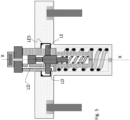
- Figure 2 discloses a preferred embodiment of the invention.
- the valve bridge VB and the lost motion assembly LMA while the remaining components, such as, rocker arm, camshaft, adjusting screw can be similar to those disclosed in US2014251266 and in general are not relevant for the understanding of the present invention.
- valve stems VS are only partially disclosed because they are not relevant.
- valve assembly VAS the set of valve bridge and/or the valve(s) are labelled as valve assembly VAS.
- the lost motion assembly LMA includes an outer plunger OP and an inner plunger IP arranged inside a bore in the outer plunger, such that the inner plunger can slide in the bore according to the X axis.
- the rocker arm (not disclosed in figure 2 ) exerts its action, pushing downwards the swivel foot SFO arranged on the top of the outer plunger OP.
- the inner plunger is encapsulated in the outer plunger and the swivel foot, which closes the outer plunger as a plug or cap.
- a first duct is disposed to permit pressurized oil to reach the inner bore, so as to push downwards the inner plunger IP against its bias spring IPS.
- the inner plunger IP is provided with at least a recess IPR and the outer plunger has a passing through opening where a locking element LE is arranged and capable to slide transversally with respect to the X axis.
- the outer plunge differently from US2014251266 , includes a lateral duct LD communicating the inner bore of the outer plunger with at least one seat LES of the locking element LE defined in the valve bridge body. This lateral duct is arranged to pressurize the locking element seat in such a way to force the locking element to leave its seat by disengaging the outer plunger from the valve bridge.
- the locking element LE has the shape of prism, such as a cylinder or a parallepiped, or the like and the end walls EW of the locking element(S) seat LES are substantially transversal to the sliding axis.
- figures 3 and 4 are disclosed two opposite conditions: according to figure 3 the locking element LE contacts the end wall EW while, according to figure 4 the locking element is in an intermediate condition with respect to the opposite walls leading LW and end wall EW.
- the first situation, on figure 3 is typical while the rocker arm pushes the swivel foot SF, thus the outer plunger spring OPS is compressed, and the locking element LE contacts the end wall EW transferring the rocker arm force from the outer plunger to the valve bridge.
- the second situation, on figure 4 is typical while the rocker arm is released and the spring OPS is expanded pushing upwards the outer plunger, and the locking element is substantially free to move in case the inner plunger is depressed.
- FIGS 3 and 4 disclose also the force exchanged in both the situations with the following labels:
- Figures 2 and 4 disclose different embodiments of the lateral duct LD: according to the solution of figure 2 , the lateral duct is always connected with the seat LES and the pressurized oil is free to reach the seat as the lost motion assembly is pressurized.
- figure 5 discloses a lateral duct with its outflow arranged between the locking element and outer plunger spring such that the outflow communicate with the seat LS only when the spring OPS is expanded.
- the wedge angle of the lock pin of US2014251266 is about 45°, thus the reciprocal contact of the wedge with the seat in the valve bridge develops a sliding force that here cannot be developed due to the transversal orientation of the contacting faces of the locking element and of the end wall EW with respect to the X axis.
- the inner plunger Under the force of the inner plunger spring IPS moves upwards and its recess IPR is shaped to force locking element to slide in the locking condition. Therefore, while the locking motion, towards the locking condition of the locking element, is caused by a mechanical interference, the unlocking motion, towards the unlocking condition of the locking element is essentially caused by the pressure.
- the system of the present invention includes
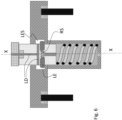
- the inner plunger could be optional, indeed, the return of the locking element in the locking condition can be achieved by a return spring RS which directly pushes the locking element outside the outer plunger towards the seat in the valve bridge.
- a return spring pushes a couple of locking elements.
- the cavity inside the outer plunger, where the return spring and the recesses are defined is isolated from the oil ducts LD in order to avoid pressurization of the cavity itself with a consequent generation of an additional pressure force directed as the return spring action.
- the lost motion assembly switches in the lost condition only when the rocker arm is released, this means that there is no risk for a sudden and uncontrolled closing of the valves.
- Figure 5 discloses a slightly different solution with respect to the one of figure 2 .
- the seat has an end wall EW and a leading wall LW opposite to the end wall, such that the locking element contacts the end wall when the rocker arm is in active condition and contacts the leading wall when the rocker arm is in released condition, due to the spring OPS interposed between the outer plunger and the valve bridge VB.
- the seat and the locking element are configured to define a play between the locking element and the end and leading walls and wherein the lateral duct LD is arranged in the outer plunger in such a way to communicate with the seat only when the rocker arm is released and the locking element contacts the leading wall LW.
- the seat LES can include a ramp portion or any possible distancing element arranged to assure a certain clearance between the locking element and the side wall of the seat, so that at the pressurization of the seat, the locking element is ready to be pushed towards the inner plunger recess.
- said seat LES and said locking element (s) are shaped such that an action exerted on the outer plunger according to said direction X transversal to the locking element movement causes a force interaction between the recess and locking element which is circa parallel to said direction X transversal to the locking element movement. Therefore, no inward movement toward the unlocking condition can be caused by the interaction of the seat LES and the locking element LE. On the contrary, only the pressurization of the duct produces the release.
- the inner plunger is arranged to close said first duct (LD) when the locking element is in said unlocking condition, such that a pressurization first aims to lower the inner plunger and then to pressurize the first duct (LD).
- This succession of movements it particularly beneficial because the pressurization force is exerted to win first the frictions to lower the inner plunger and then to move the locking elements in the unlocked condition within the recess of the inner plunger.
Landscapes
- Engineering & Computer Science (AREA)
- Mechanical Engineering (AREA)
- General Engineering & Computer Science (AREA)
- Valve Device For Special Equipments (AREA)
- Valve-Gear Or Valve Arrangements (AREA)
Description
- The present invention relates to an auxiliary valve motion employing disablement of main Valve events, in particular in the field of large displacement internal combustion engines for trucks and work vehicles.
- Cylinder deactivation (CDA) is an efficient measure to realise thermal management and improve fuel consumption at low loads. CDA is realised by deactivating the valve lifts and fuelling of some or all cylinders.
- This is usually done by interrupting the connection of cam and valve. Very common are hydraulic lash adjusting (HLA) elements which can collapse or elements within the valve train which can open the connection (e.g. at the valve bridge). All these systems can lead to very high valve seating velocity, if the connection from cam to valve is interrupted during a period of large valve lift.
- Efficient engine braking systems (e.g. 2-stroke) require also the deactivation of the valve lift profiles implemented for fired operation. The deactivation of the valve lift profiles is usually not crank angle synchronised per cylinder, which means the valve can close from any position. This can lead to extreme seating velocities and engine durability problems.
-
US2014251266 discloses a deactivation mechanism disposed within a main valve train capable to disable conveyance of main valve events from a main valve motion source to a valve via the main valve train. - Here, a rocker arm is arranged to swing over a rocker shaft. This shaft is provided with an oil passage to supply a rocker arm duct in any rocker arm positions. The rocker arm duct supplies a lost motion assembly arranged on the bridge of two exhaust valves.
- The lost motion assembly includes an outer plunger arranged in a valve bridge opening/casing and arranged to be pushed downwards by the rocker arm through an inner plunger, arranged in a bore of the outer plunger.
- The outer plunger has a side opening extending through the outer plunger wall for receiving a wedge lock pin or ball. The inner plunger includes one or more recesses shaped to securely receive the one or more wedge lock pins or ball when the inner plunger is pushed downward against an inner plunger spring IPS interposed between the bottom of the bore of the outer plunger and the inner plunger. The central opening of the valve bridge also includes one or more recesses for receiving the one or more wedge lock pins or ball in a manner that permits the wedge lock pins or ball to lock the outer plunger and the exhaust valve bridge together, as shown in
figure 1 . The outer plunger spring may bias the outer plunger upward in the central opening of the valve bridge. The inner plunger spring may bias the inner plunger upward in outer plunger bore. - When hydraulic oil is pressurized through the rocker arm, the inner plunger is pushed downwards, therefore, its recess permits the one or more wedge lock pins or balls to decouple or unlock the outer plunger from the valve bridge body. As a result, during this "unlocked" state, valve actuation motion applied by the lost motion assembly does not move the valve bridge body downward to actuate the exhaust valves. Instead, this downward motion causes the outer plunger to slide downward within the central opening of the valve bridge body against the bias of the outer plunger spring, whose bias force is less relevant than the exhaust valve springs one.
- The hydraulic oil can be pressurized while the hump of the cam is forcing the rocker arm to push the lost motion assembly with the result that valves are immediately closed impacting against their seats. Means, the valves close uncontrolled starting from any valve lift, which can cause very high seating velocities.
- A solution to avoid this problem is to synchronize the pressurization of the oil in such a way to disconnect the outer plunger from valve bridge only when the rocker arm is in released condition, namely when it is contacting the base circumference of the cam corresponding to no valve lift, namely, valve closed.
- This synchronization should be carried independently for each of the deactivated/braked cylinders.
-
US10851682B2 - At high rotation speed, it is difficult to obtain a satisfactory synchronization. In addition, the hydraulic circuit should be complicated due to the implementation of a fast solenoid valve for each cylinder, while usually 1 solenoid is used for 2 or 3 cylinders.
- The main object of the present invention to provide an auxiliary valve motions employing disablement of main valve events, which overcomes the above problems/drawbacks.
- The aim of the present invention is to design a system with an intrinsic mechanical fail-safe cylinder deactivation system, which does on depend any kind of synchronization and prevents high valve seating velocities.
- The description of
US2014251266 does not remark the role of the seat in the valve bridge body for the wedge lock pin or ball. Such seat is shaped in such a way to transform the axial force of the rocker arm on the outer plunger in a transversal force which naturally induces the ball or wedge to move transversally toward the inner plunger recess by disconnecting the outer plunger from the valve bridge body. For convenience, the wedge or ball is whereinafter called as "locking element". - The basic idea of the present idea is to cause the sliding of the "locking element" through oil pressure. In particular, an oil duct which communicate the recess in the body of the valve bridge with the bore of the outer plunger. In addition, while in
US2014251266 the sliding of the locking element is caused by the transmission of cut forces from the outer plunger to the valve bridge body, according to the present invention, such cut forces generate friction forces which oppose the sliding of the locking element, therefore, the disconnection of the outer plunger from the valve bridge body is permitted only when the rocker arm is in released condition. - Even if the present invention shares similar components of
US2014251266 , such as oil connections or wedge lock pin, their interaction is completely changed by achieving an intrinsic safe switching from the normal/fired actuation to the braking/deactivation condition. - The present solution finds application in CDA systems, which are either on or off as disclosed in
US2014251266 , with no intermediate states. - Advantageously, no electronic system is implemented to synchronize the lost motion activation, which, according to the present invention happens naturally within one revolution of the camshaft.
- The present invention does not find application only in the solution disclosed in
US2014251266 , but in any application where the lost motion assembly implements a latch pin corresponding to the locking element of the present invention. - Indeed, here, the solution is based on the pressurization of a latch pin seat which forces the pin to unlock the reciprocal movement of two components and the conformation of the pin itself such that
- not to cooperate with its seat in the sliding movement and
- to develop frictions contrasting its sliding toward its unlocking condition.
- These and further objects are achieved by means of the attached claims, which describe preferred embodiments of the invention, forming an integral part of the present description.
- The invention will become fully clear from the following detailed description, given by way of a mere exemplifying and non limiting example, to be read with reference to the attached drawing figures, wherein:
-
Fig. 1 shows the lost motion system disclosed inUS2014251266 ; -
Fig. 2 discloses the modification of such assembly in order to render such solution one of the possible embodiments of the present invention; -
Figs. 3 and 4 disclose a detail of the system according tofigure 2 ; -
Figs. 5 and6 disclose further embodiments of the present invention based on the one offigure 2 . - The same reference numerals and letters in the figures designate the same or functionally equivalent parts.
- According to the present invention, the term "second element" does not imply the presence of a "first element", first, second, etc.. are used only for improving the clarity of the description and they should not be interpreted in a limiting way.
-
Figure 2 discloses a preferred embodiment of the invention. In particular such figure focus on the valve bridge VB and the lost motion assembly LMA, while the remaining components, such as, rocker arm, camshaft, adjusting screw can be similar to those disclosed inUS2014251266 and in general are not relevant for the understanding of the present invention. - The valve stems VS are only partially disclosed because they are not relevant. For convenience the set of valve bridge and/or the valve(s) are labelled as valve assembly VAS.
- As for
US2014251266 the lost motion assembly LMA includes an outer plunger OP and an inner plunger IP arranged inside a bore in the outer plunger, such that the inner plunger can slide in the bore according to the X axis. - According to the same X axis, the rocker arm (not disclosed in
figure 2 ) exerts its action, pushing downwards the swivel foot SFO arranged on the top of the outer plunger OP. - In other words, the inner plunger is encapsulated in the outer plunger and the swivel foot, which closes the outer plunger as a plug or cap.
- Along with the swivel foot a first duct is disposed to permit pressurized oil to reach the inner bore, so as to push downwards the inner plunger IP against its bias spring IPS.
- As in
US2014251266 , the inner plunger IP is provided with at least a recess IPR and the outer plunger has a passing through opening where a locking element LE is arranged and capable to slide transversally with respect to the X axis. The outer plunge, differently fromUS2014251266 , includes a lateral duct LD communicating the inner bore of the outer plunger with at least one seat LES of the locking element LE defined in the valve bridge body. This lateral duct is arranged to pressurize the locking element seat in such a way to force the locking element to leave its seat by disengaging the outer plunger from the valve bridge. - According to the invention, the locking element LE has the shape of prism, such as a cylinder or a parallepiped, or the like and the end walls EW of the locking element(S) seat LES are substantially transversal to the sliding axis. In
figures 3 and 4 are disclosed two opposite conditions: according tofigure 3 the locking element LE contacts the end wall EW while, according tofigure 4 the locking element is in an intermediate condition with respect to the opposite walls leading LW and end wall EW. - The first situation, on
figure 3 , is typical while the rocker arm pushes the swivel foot SF, thus the outer plunger spring OPS is compressed, and the locking element LE contacts the end wall EW transferring the rocker arm force from the outer plunger to the valve bridge. - The second situation, on
figure 4 , is typical while the rocker arm is released and the spring OPS is expanded pushing upwards the outer plunger, and the locking element is substantially free to move in case the inner plunger is depressed. -
Figures 3 and 4 disclose also the force exchanged in both the situations with the following labels: - RAF: rocker arm force
- RF: Reaction force between the locking element and the end wall EW,
- PF: pressure force
- FF: friction force caused by the reaction force RF.
- According to the present invention, when the rocker arm pushes against the swivel foot, see
figure 3 , PF < FF, therefore, the locking element remains still and the lost motion assembly remains fixedly connected with the valve bridge, while when the rocker arm is released, seefigure 4 , PF is not balanced by any friction force and the locking element is permitted to slide transversally in the recess IPR of the inner plunger disconnecting the lost motion assembly from the valve bridge. - It is clear that the pressurization of the lost motion assembly, while rocker arm is released, causes in succession:
- Downwards moving of inner plunger,
- Unlocking of the lost motion assembly from valve bridge due to locking element sliding.
-
Figures 2 and4 disclose different embodiments of the lateral duct LD: according to the solution offigure 2 , the lateral duct is always connected with the seat LES and the pressurized oil is free to reach the seat as the lost motion assembly is pressurized. In contrast,figure 5 discloses a lateral duct with its outflow arranged between the locking element and outer plunger spring such that the outflow communicate with the seat LS only when the spring OPS is expanded. - When a fast solenoid valve pressurizes the lost motion assembly, as in
US2014251266 , the inner plunger moves downwards compressing the spring IPS, thus the recess IPR face the locking element and the latter can slide inside such recess IPR only in case the force balance is positive, in the sense that the pressure force PF is larger than any opposite force, such as a friction force. - In particular, the wedge angle of the lock pin of
US2014251266 is about 45°, thus the reciprocal contact of the wedge with the seat in the valve bridge develops a sliding force that here cannot be developed due to the transversal orientation of the contacting faces of the locking element and of the end wall EW with respect to the X axis. - When the pressurization falls, the inner plunger, under the force of the inner plunger spring IPS moves upwards and its recess IPR is shaped to force locking element to slide in the locking condition. Therefore, while the locking motion, towards the locking condition of the locking element, is caused by a mechanical interference, the unlocking motion, towards the unlocking condition of the locking element is essentially caused by the pressure.
- Here the term "essentially" should be understood as follows: in order to render easier the understanding of the invention, the end wall EW is presented as perfectly transversal to the X axis. The interface end wall/locking element can produce a transversal force
- either in favor of the sliding of the locking element towards the unlocking condition
- or in favor of the braking of the locking element towards the unlocking condition.
- What is really relevant, according to the present invention, is that the force caused by the pressurization of the seat LES exceed any opposing force only when the rocker arm is released.
- Therefore, the system of the present invention includes
- a main event motion source configured to provide main event valve motions to a valve assembly, for example the camshaft of
figure 1 ; - a main rocker arm operatively connected to the main event motion source, for example the rocker arm of
figure 1 , in such a way to assume an active condition at main event and a released condition between two consecutive main events; - a lost motion assembly LMA operatively connected to the valve of the combustion engine cylinder to the main rocker arm;
- a locking condition with a first portion disposed in a corresponding seat (LES) of the valve assembly and a second portion disposed in a passing through opening of the outer plunger,
- an unlocking condition where the locking element is completely inside the outer plunger,
- Not according to the appended claims, the inner plunger could be optional, indeed, the return of the locking element in the locking condition can be achieved by a return spring RS which directly pushes the locking element outside the outer plunger towards the seat in the valve bridge. An example of such embodiment not according to the appended claims is disclosed on
figure 6 . In particular, a return spring pushes a couple of locking elements. - In this case, the cavity inside the outer plunger, where the return spring and the recesses are defined is isolated from the oil ducts LD in order to avoid pressurization of the cavity itself with a consequent generation of an additional pressure force directed as the return spring action.
- Also in this case, in the balance of the forces not only the frictions and the pressure, also the return spring force should be considered.
- Thanks to the present invention the lost motion assembly switches in the lost condition only when the rocker arm is released, this means that there is no risk for a sudden and uncontrolled closing of the valves.
-
Figure 5 discloses a slightly different solution with respect to the one offigure 2 . - This solution is based on the fact that the seat has an end wall EW and a leading wall LW opposite to the end wall, such that the locking element contacts the end wall when the rocker arm is in active condition and contacts the leading wall when the rocker arm is in released condition, due to the spring OPS interposed between the outer plunger and the valve bridge VB. More in particular, the seat and the locking element are configured to define a play between the locking element and the end and leading walls and wherein the lateral duct LD is arranged in the outer plunger in such a way to communicate with the seat only when the rocker arm is released and the locking element contacts the leading wall LW.
- The seat LES can include a ramp portion or any possible distancing element arranged to assure a certain clearance between the locking element and the side wall of the seat, so that at the pressurization of the seat, the locking element is ready to be pushed towards the inner plunger recess. It will be apparent to those skilled in the art that specific details need not be employed, that example embodiments may be embodied in many different forms and that neither should be construed to limit the scope of the disclosure. In some example embodiments, well known processes, well-known device structures, and well known technologies are not described in detail.
- According to a preferred embodiment of the invention, said seat LES and said locking element (s) are shaped such that an action exerted on the outer plunger according to said direction X transversal to the locking element movement causes a force interaction between the recess and locking element which is circa parallel to said direction X transversal to the locking element movement. Therefore, no inward movement toward the unlocking condition can be caused by the interaction of the seat LES and the locking element LE. On the contrary, only the pressurization of the duct produces the release.
- Preferably, the inner plunger is arranged to close said first duct (LD) when the locking element is in said unlocking condition, such that a pressurization first aims to lower the inner plunger and then to pressurize the first duct (LD). This succession of movements it particularly beneficial because the pressurization force is exerted to win first the frictions to lower the inner plunger and then to move the locking elements in the unlocked condition within the recess of the inner plunger.
- Many changes, modifications, variations and other uses and applications of the subject invention will become apparent to those skilled in the art after considering the specification and the accompanying drawings which disclose preferred embodiments thereof as described in the appended claims.
- The features disclosed in the prior art background are introduced only in order to better understand the invention and not as a declaration about the existence of known prior art. In addition, said features define the context of the present invention, thus such features shall be considered in common with the detailed description.
- Further implementation details will not be described, as the man skilled in the art is able to carry out the invention starting from the teaching of the above description.
Claims (10)
- A system for operating a cylinder valve assembly for an internal combustion engine comprising:- a main event motion source configured to provide main event valve motions to the valve assembly,- a main rocker arm operatively connected to the main event motion source, in such a way to assume an active condition at main event and a released condition,- a lost motion assembly (LMA) operatively associated to the valve assembly (VB),wherein the lost motion assembly includes an outer plunger (OP) arranged to receive a main rocker arm action and to transmit such action to the valve assembly through a locking element (LE), wherein the locking element is arranged to assume- a locking condition with a first portion disposed in a corresponding seat (LES) of the valve assembly and a second portion disposed in a passing through opening of the outer plunger,- an unlocking condition where the locking element is completely outside the seat (LES) of the valve assembly,wherein the outer plunger includes a first duct (LD) to convey a hydraulic medium, arranged to pressurize the seat (LES) and wherein the lost motion assembly is realized such that sliding force exerted on the locking element by the corresponding seat pressurization exceeds frictions developed between the locking element and the corresponding seat only when the rocker arm is in released condition, wherein the locking element is forced to return in the locking condition by a first spring (IPS, RS) acting directly or indirectly to the locking element, wherein said outer plunger includes a bore (B) to which an inner plunger (IP) is associated and charged by said first spring (IPS) according to a direction (X) transversal to the locking element movement between the locking and unlocking condition and wherein the inner plunger includes a recess (IPR) to receive the locking element to assume said unlocking condition and wherein said recess is shaped to force the locking element to assume said locking condition when a reciprocal movement of the inner plunger with respect to the outer plunger is caused by said first spring (IPS), the system being characterized in that said inner plunger is suitable to be actuated by pressure generated by a second duct (CD) suitable to convey the hydraulic medium, such that to push the inner plunger against said first spring (IPS) and in that, said first duct and said second duct are reciprocally communicating so that, when pressurization happens, the inner plunger lowers compressing the first spring (IPS) and facing the recess (IPR) to the locking element, such that the locking member slides in the recess causing the unlocking condition.
- System according to claim 1, wherein the seat (LES) and said locking element are shaped such that an action exerted on the outer plunger according to said direction (X) transversal to the locking element movement causes a force interaction between the seat and locking element circa parallel to said direction (X) transversal to the locking element movement.
- System according to claim 1 or 2, wherein said first spring (RS) in interposed between a couple of locking elements.
- System according to claim 1, wherein said inner plunger is arranged to close said first duct (LD) when said locking element is in said unlocking condition, such that a pressurization first lowers the inner plunger and then pressurizes said first duct (LD).
- System according to any of the previous claims 1 - 4, wherein the seat has an end wall (EW) and a leading wall (LW) opposite to the end wall, such that the locking element contacts the end wall when the rocker arm is in active condition and is in an intermediate position between the end and leading walls when the rocker arm is in released condition, due to a second spring (OPS) interposed between the outer plunger and the valve assembly (VB).
- System according to claim 1, wherein said first duct (LD) is arranged in the outer plunger in such a way to communicate with the seat only when the rocker arm is released and the locking element is in said intermediate position.
- System according to any one of the previous claims, wherein said valve assembly includes a valve bridge and at least two valves associated to the valve bridge in such a way the valve bridge is capable to lift the at least two valves at the same time.
- System according to claim 7, wherein said valve bridge includes a central seat (CS) arranged to receive the lost motion assembly, wherein a development axis of the central seat (CS) is parallel or coaxial with a direction defined by said action transmission from the rocker arm and the lost motion assembly.
- System according to any one of the previous claims 1 - 8, wherein the rocker arm includes a third duct to convey the hydraulic oil to the first and second ducts through a swivel foot (SF) arranged on the top of the outer plunger (OP).
- Internal combustion engine including a cylinder, a piston and a head associated to the cylinder and at least a valve assembly to selectively open and close the head and a system for operating the valve assembly according to any one of claims 1 - 9.
Applications Claiming Priority (1)
| Application Number | Priority Date | Filing Date | Title |
|---|---|---|---|
| IT102021000002960A IT202100002960A1 (en) | 2021-02-10 | 2021-02-10 | A SYSTEM FOR OPERATING A VALVE GROUP OF A CYLINDER OF AN INTERNAL COMBUSTION ENGINE |
Publications (2)
| Publication Number | Publication Date |
|---|---|
| EP4043702A1 EP4043702A1 (en) | 2022-08-17 |
| EP4043702B1 true EP4043702B1 (en) | 2025-05-14 |
Family
ID=75539847
Family Applications (1)
| Application Number | Title | Priority Date | Filing Date |
|---|---|---|---|
| EP22155573.3A Active EP4043702B1 (en) | 2021-02-10 | 2022-02-08 | A system for operating a cylinder valve assembly for an internal combustion engine |
Country Status (2)
| Country | Link |
|---|---|
| EP (1) | EP4043702B1 (en) |
| IT (1) | IT202100002960A1 (en) |
Families Citing this family (2)
| Publication number | Priority date | Publication date | Assignee | Title |
|---|---|---|---|---|
| DE102022200993A1 (en) | 2022-01-31 | 2023-08-03 | Mahle International Gmbh | Switching bridge for a valve drive of an internal combustion engine |
| CN116044539B (en) * | 2022-12-30 | 2025-07-08 | 中国重汽集团济南动力有限公司 | Auxiliary braking system and engine |
Family Cites Families (4)
| Publication number | Priority date | Publication date | Assignee | Title |
|---|---|---|---|---|
| US9790824B2 (en) * | 2010-07-27 | 2017-10-17 | Jacobs Vehicle Systems, Inc. | Lost motion valve actuation systems with locking elements including wedge locking elements |
| US20140251266A1 (en) | 2011-07-27 | 2014-09-11 | Jacobs Vehicle Systems, Inc. | Auxiliary Valve Motions Employing Disablement of Main Valve Events and/or Coupling of Adjacent Rocker Arms |
| US10851682B2 (en) * | 2018-06-29 | 2020-12-01 | Jacobs Vehicle Systems, Inc. | Engine valve actuation systems with lost motion valve train components, including collapsing valve bridges with locking pins |
| KR102546519B1 (en) * | 2018-12-07 | 2023-06-21 | 자콥스 비히클 시스템즈, 인코포레이티드. | A valve actuation system comprising two rocker arms and a collapsing mechanism |
-
2021
- 2021-02-10 IT IT102021000002960A patent/IT202100002960A1/en unknown
-
2022
- 2022-02-08 EP EP22155573.3A patent/EP4043702B1/en active Active
Also Published As
| Publication number | Publication date |
|---|---|
| EP4043702A1 (en) | 2022-08-17 |
| IT202100002960A1 (en) | 2022-08-10 |
Similar Documents
| Publication | Publication Date | Title |
|---|---|---|
| JP6887440B2 (en) | Rocker arm assembly | |
| JP4541733B2 (en) | 2-stage valve lift and valve deactivation | |
| KR101501039B1 (en) | Dedicated rocker arm engine brake | |
| EP2462321B1 (en) | Lost motion valve control apparatus | |
| CN115151711B (en) | Rocker assembly, compliant bladder, actuator and support structure | |
| EP2191106B1 (en) | Device for actuating the decompression engine brake in an internal combustion engine provided with hydraulic tappets | |
| EP4043702B1 (en) | A system for operating a cylinder valve assembly for an internal combustion engine | |
| KR101683445B1 (en) | Intra-cylinder auxiliary actuation of engine valves through selective discontinuation of main valve events | |
| EP2734713B1 (en) | Valve actuation mechanism and automotive vehicle comprising such a valve actuation mechanism | |
| CN102918236B (en) | For the compression braking system of motor | |
| US12188384B2 (en) | Latching pin assembly and deactivating rocker arm assembly | |
| EP2171224B1 (en) | Exhaust valve mechanism for an internal combustion engine | |
| WO2014145544A1 (en) | Compression relief brake reset mechanism | |
| KR102837832B1 (en) | Rocker control of loss-of-motion engine valve actuation system | |
| US10634019B2 (en) | Rocker arm control systems | |
| EP4086438B1 (en) | A valve train for operating a cylinder valve assembly for an internal combustion engine | |
| US7827958B2 (en) | Gas exchange valve actuating device | |
| WO2020088798A1 (en) | Bleeder type engine brake with hydraulic-mechanical actuation and lash adjustment | |
| WO2019008445A1 (en) | Engine valve lifters | |
| US6223706B1 (en) | Tappet for the valve gear of an internal combustion engine | |
| JP2009138742A (en) | Valve operating system of variable displacement engine | |
| KR102681271B1 (en) | Finger followers for lobe transition and single source lost motion | |
| CN210178434U (en) | Hydraulic direct-driven auxiliary brake rocker arm structure | |
| EP0302288A1 (en) | Disengageable valve drive means | |
| EP0396154B1 (en) | Valve disabling mechanism for an internal combustion engine |
Legal Events
| Date | Code | Title | Description |
|---|---|---|---|
| PUAI | Public reference made under article 153(3) epc to a published international application that has entered the european phase |
Free format text: ORIGINAL CODE: 0009012 |
|
| STAA | Information on the status of an ep patent application or granted ep patent |
Free format text: STATUS: THE APPLICATION HAS BEEN PUBLISHED |
|
| AK | Designated contracting states |
Kind code of ref document: A1 Designated state(s): AL AT BE BG CH CY CZ DE DK EE ES FI FR GB GR HR HU IE IS IT LI LT LU LV MC MK MT NL NO PL PT RO RS SE SI SK SM TR |
|
| STAA | Information on the status of an ep patent application or granted ep patent |
Free format text: STATUS: REQUEST FOR EXAMINATION WAS MADE |
|
| 17P | Request for examination filed |
Effective date: 20230118 |
|
| RBV | Designated contracting states (corrected) |
Designated state(s): AL AT BE BG CH CY CZ DE DK EE ES FI FR GB GR HR HU IE IS IT LI LT LU LV MC MK MT NL NO PL PT RO RS SE SI SK SM TR |
|
| STAA | Information on the status of an ep patent application or granted ep patent |
Free format text: STATUS: EXAMINATION IS IN PROGRESS |
|
| 17Q | First examination report despatched |
Effective date: 20241028 |
|
| GRAP | Despatch of communication of intention to grant a patent |
Free format text: ORIGINAL CODE: EPIDOSNIGR1 |
|
| STAA | Information on the status of an ep patent application or granted ep patent |
Free format text: STATUS: GRANT OF PATENT IS INTENDED |
|
| INTG | Intention to grant announced |
Effective date: 20241219 |
|
| GRAS | Grant fee paid |
Free format text: ORIGINAL CODE: EPIDOSNIGR3 |
|
| GRAJ | Information related to disapproval of communication of intention to grant by the applicant or resumption of examination proceedings by the epo deleted |
Free format text: ORIGINAL CODE: EPIDOSDIGR1 |
|
| GRAL | Information related to payment of fee for publishing/printing deleted |
Free format text: ORIGINAL CODE: EPIDOSDIGR3 |
|
| STAA | Information on the status of an ep patent application or granted ep patent |
Free format text: STATUS: EXAMINATION IS IN PROGRESS |
|
| INTC | Intention to grant announced (deleted) | ||
| GRAP | Despatch of communication of intention to grant a patent |
Free format text: ORIGINAL CODE: EPIDOSNIGR1 |
|
| STAA | Information on the status of an ep patent application or granted ep patent |
Free format text: STATUS: GRANT OF PATENT IS INTENDED |
|
| GRAA | (expected) grant |
Free format text: ORIGINAL CODE: 0009210 |
|
| STAA | Information on the status of an ep patent application or granted ep patent |
Free format text: STATUS: THE PATENT HAS BEEN GRANTED |
|
| INTG | Intention to grant announced |
Effective date: 20250404 |
|
| AK | Designated contracting states |
Kind code of ref document: B1 Designated state(s): AL AT BE BG CH CY CZ DE DK EE ES FI FR GB GR HR HU IE IS IT LI LT LU LV MC MK MT NL NO PL PT RO RS SE SI SK SM TR |
|
| REG | Reference to a national code |
Ref country code: GB Ref legal event code: FG4D |
|
| REG | Reference to a national code |
Ref country code: CH Ref legal event code: EP |
|
| REG | Reference to a national code |
Ref country code: IE Ref legal event code: FG4D |
|
| REG | Reference to a national code |
Ref country code: DE Ref legal event code: R096 Ref document number: 602022014507 Country of ref document: DE |
|
| P01 | Opt-out of the competence of the unified patent court (upc) registered |
Free format text: CASE NUMBER: APP_24216/2025 Effective date: 20250521 |
|
| REG | Reference to a national code |
Ref country code: NL Ref legal event code: MP Effective date: 20250514 |
|
| PG25 | Lapsed in a contracting state [announced via postgrant information from national office to epo] |
Ref country code: PT Free format text: LAPSE BECAUSE OF FAILURE TO SUBMIT A TRANSLATION OF THE DESCRIPTION OR TO PAY THE FEE WITHIN THE PRESCRIBED TIME-LIMIT Effective date: 20250915 Ref country code: ES Free format text: LAPSE BECAUSE OF FAILURE TO SUBMIT A TRANSLATION OF THE DESCRIPTION OR TO PAY THE FEE WITHIN THE PRESCRIBED TIME-LIMIT Effective date: 20250514 Ref country code: FI Free format text: LAPSE BECAUSE OF FAILURE TO SUBMIT A TRANSLATION OF THE DESCRIPTION OR TO PAY THE FEE WITHIN THE PRESCRIBED TIME-LIMIT Effective date: 20250514 |
|
| REG | Reference to a national code |
Ref country code: LT Ref legal event code: MG9D |
|
| PG25 | Lapsed in a contracting state [announced via postgrant information from national office to epo] |
Ref country code: GR Free format text: LAPSE BECAUSE OF FAILURE TO SUBMIT A TRANSLATION OF THE DESCRIPTION OR TO PAY THE FEE WITHIN THE PRESCRIBED TIME-LIMIT Effective date: 20250815 Ref country code: NO Free format text: LAPSE BECAUSE OF FAILURE TO SUBMIT A TRANSLATION OF THE DESCRIPTION OR TO PAY THE FEE WITHIN THE PRESCRIBED TIME-LIMIT Effective date: 20250814 |
|
| PG25 | Lapsed in a contracting state [announced via postgrant information from national office to epo] |
Ref country code: PL Free format text: LAPSE BECAUSE OF FAILURE TO SUBMIT A TRANSLATION OF THE DESCRIPTION OR TO PAY THE FEE WITHIN THE PRESCRIBED TIME-LIMIT Effective date: 20250514 Ref country code: NL Free format text: LAPSE BECAUSE OF FAILURE TO SUBMIT A TRANSLATION OF THE DESCRIPTION OR TO PAY THE FEE WITHIN THE PRESCRIBED TIME-LIMIT Effective date: 20250514 |
|
| REG | Reference to a national code |
Ref country code: AT Ref legal event code: MK05 Ref document number: 1794926 Country of ref document: AT Kind code of ref document: T Effective date: 20250514 |
|
| PG25 | Lapsed in a contracting state [announced via postgrant information from national office to epo] |
Ref country code: BG Free format text: LAPSE BECAUSE OF FAILURE TO SUBMIT A TRANSLATION OF THE DESCRIPTION OR TO PAY THE FEE WITHIN THE PRESCRIBED TIME-LIMIT Effective date: 20250514 |
|
| PG25 | Lapsed in a contracting state [announced via postgrant information from national office to epo] |
Ref country code: HR Free format text: LAPSE BECAUSE OF FAILURE TO SUBMIT A TRANSLATION OF THE DESCRIPTION OR TO PAY THE FEE WITHIN THE PRESCRIBED TIME-LIMIT Effective date: 20250514 |
|
| PG25 | Lapsed in a contracting state [announced via postgrant information from national office to epo] |
Ref country code: AT Free format text: LAPSE BECAUSE OF FAILURE TO SUBMIT A TRANSLATION OF THE DESCRIPTION OR TO PAY THE FEE WITHIN THE PRESCRIBED TIME-LIMIT Effective date: 20250514 |
|
| PG25 | Lapsed in a contracting state [announced via postgrant information from national office to epo] |
Ref country code: RS Free format text: LAPSE BECAUSE OF FAILURE TO SUBMIT A TRANSLATION OF THE DESCRIPTION OR TO PAY THE FEE WITHIN THE PRESCRIBED TIME-LIMIT Effective date: 20250814 |
|
| PG25 | Lapsed in a contracting state [announced via postgrant information from national office to epo] |
Ref country code: IS Free format text: LAPSE BECAUSE OF FAILURE TO SUBMIT A TRANSLATION OF THE DESCRIPTION OR TO PAY THE FEE WITHIN THE PRESCRIBED TIME-LIMIT Effective date: 20250914 |
|
| PG25 | Lapsed in a contracting state [announced via postgrant information from national office to epo] |
Ref country code: LV Free format text: LAPSE BECAUSE OF FAILURE TO SUBMIT A TRANSLATION OF THE DESCRIPTION OR TO PAY THE FEE WITHIN THE PRESCRIBED TIME-LIMIT Effective date: 20250514 |
|
| PG25 | Lapsed in a contracting state [announced via postgrant information from national office to epo] |
Ref country code: SM Free format text: LAPSE BECAUSE OF FAILURE TO SUBMIT A TRANSLATION OF THE DESCRIPTION OR TO PAY THE FEE WITHIN THE PRESCRIBED TIME-LIMIT Effective date: 20250514 Ref country code: DK Free format text: LAPSE BECAUSE OF FAILURE TO SUBMIT A TRANSLATION OF THE DESCRIPTION OR TO PAY THE FEE WITHIN THE PRESCRIBED TIME-LIMIT Effective date: 20250514 |
|
| PG25 | Lapsed in a contracting state [announced via postgrant information from national office to epo] |
Ref country code: CZ Free format text: LAPSE BECAUSE OF FAILURE TO SUBMIT A TRANSLATION OF THE DESCRIPTION OR TO PAY THE FEE WITHIN THE PRESCRIBED TIME-LIMIT Effective date: 20250514 |
|
| PG25 | Lapsed in a contracting state [announced via postgrant information from national office to epo] |
Ref country code: EE Free format text: LAPSE BECAUSE OF FAILURE TO SUBMIT A TRANSLATION OF THE DESCRIPTION OR TO PAY THE FEE WITHIN THE PRESCRIBED TIME-LIMIT Effective date: 20250514 |
|
| PG25 | Lapsed in a contracting state [announced via postgrant information from national office to epo] |
Ref country code: SK Free format text: LAPSE BECAUSE OF FAILURE TO SUBMIT A TRANSLATION OF THE DESCRIPTION OR TO PAY THE FEE WITHIN THE PRESCRIBED TIME-LIMIT Effective date: 20250514 |
|
| REG | Reference to a national code |
Ref country code: DE Ref legal event code: R097 Ref document number: 602022014507 Country of ref document: DE |
|
| PLBE | No opposition filed within time limit |
Free format text: ORIGINAL CODE: 0009261 |
|
| STAA | Information on the status of an ep patent application or granted ep patent |
Free format text: STATUS: NO OPPOSITION FILED WITHIN TIME LIMIT |
|
| REG | Reference to a national code |
Ref country code: CH Ref legal event code: L10 Free format text: ST27 STATUS EVENT CODE: U-0-0-L10-L00 (AS PROVIDED BY THE NATIONAL OFFICE) Effective date: 20260325 |
|
| PGFP | Annual fee paid to national office [announced via postgrant information from national office to epo] |
Ref country code: DE Payment date: 20260303 Year of fee payment: 5 |
|
| PGFP | Annual fee paid to national office [announced via postgrant information from national office to epo] |
Ref country code: IT Payment date: 20260227 Year of fee payment: 5 |
|
| PGFP | Annual fee paid to national office [announced via postgrant information from national office to epo] |
Ref country code: FR Payment date: 20260225 Year of fee payment: 5 |
|
| 26N | No opposition filed |
Effective date: 20260217 |