EP4043401A1 - Electrode active material for alkali metal battery, and electrode and alkali metal battery including same - Google Patents
Electrode active material for alkali metal battery, and electrode and alkali metal battery including same Download PDFInfo
- Publication number
- EP4043401A1 EP4043401A1 EP20873568.8A EP20873568A EP4043401A1 EP 4043401 A1 EP4043401 A1 EP 4043401A1 EP 20873568 A EP20873568 A EP 20873568A EP 4043401 A1 EP4043401 A1 EP 4043401A1
- Authority
- EP
- European Patent Office
- Prior art keywords
- electrode
- active material
- electrode active
- charge
- alkali metal
- Prior art date
- Legal status (The legal status is an assumption and is not a legal conclusion. Google has not performed a legal analysis and makes no representation as to the accuracy of the status listed.)
- Pending
Links
- 239000007772 electrode material Substances 0.000 title claims abstract description 97
- 229910052783 alkali metal Inorganic materials 0.000 title claims abstract description 44
- 150000001340 alkali metals Chemical class 0.000 title claims abstract description 43
- -1 CO3 Inorganic materials 0.000 claims abstract description 19
- 229910052744 lithium Inorganic materials 0.000 claims abstract description 18
- 229910052720 vanadium Inorganic materials 0.000 claims abstract description 12
- 229910052794 bromium Inorganic materials 0.000 claims abstract description 11
- 229910052801 chlorine Inorganic materials 0.000 claims abstract description 11
- 229910052740 iodine Inorganic materials 0.000 claims abstract description 11
- 229910052750 molybdenum Inorganic materials 0.000 claims abstract description 7
- 229910052758 niobium Inorganic materials 0.000 claims abstract description 7
- 229910052719 titanium Inorganic materials 0.000 claims abstract description 7
- 229910052721 tungsten Inorganic materials 0.000 claims abstract description 7
- 229910001914 chlorine tetroxide Inorganic materials 0.000 claims abstract description 6
- 229910052804 chromium Inorganic materials 0.000 claims abstract description 6
- 229910052731 fluorine Inorganic materials 0.000 claims abstract description 6
- 229910052735 hafnium Inorganic materials 0.000 claims abstract description 6
- VLTRZXGMWDSKGL-UHFFFAOYSA-M perchlorate Chemical compound [O-]Cl(=O)(=O)=O VLTRZXGMWDSKGL-UHFFFAOYSA-M 0.000 claims abstract description 6
- 229910052715 tantalum Inorganic materials 0.000 claims abstract description 6
- 229910052726 zirconium Inorganic materials 0.000 claims abstract description 6
- 229910018928 (FSO2)2N Inorganic materials 0.000 claims abstract description 5
- 239000007784 solid electrolyte Substances 0.000 claims description 47
- 229910001216 Li2S Inorganic materials 0.000 claims description 34
- 239000003792 electrolyte Substances 0.000 claims description 19
- 229910052708 sodium Inorganic materials 0.000 abstract description 14
- 238000007599 discharging Methods 0.000 description 29
- 239000011734 sodium Substances 0.000 description 21
- INHCSSUBVCNVSK-UHFFFAOYSA-L lithium sulfate Chemical compound [Li+].[Li+].[O-]S([O-])(=O)=O INHCSSUBVCNVSK-UHFFFAOYSA-L 0.000 description 14
- 238000005259 measurement Methods 0.000 description 13
- 238000002441 X-ray diffraction Methods 0.000 description 12
- 239000004020 conductor Substances 0.000 description 10
- 239000002241 glass-ceramic Substances 0.000 description 10
- 239000007774 positive electrode material Substances 0.000 description 10
- 238000003825 pressing Methods 0.000 description 10
- 239000000463 material Substances 0.000 description 9
- 229910003002 lithium salt Inorganic materials 0.000 description 8
- 159000000002 lithium salts Chemical class 0.000 description 8
- 239000000203 mixture Substances 0.000 description 8
- 238000004833 X-ray photoelectron spectroscopy Methods 0.000 description 7
- 239000011230 binding agent Substances 0.000 description 7
- 150000002500 ions Chemical class 0.000 description 7
- 238000004519 manufacturing process Methods 0.000 description 7
- 229910052751 metal Inorganic materials 0.000 description 7
- 239000002184 metal Substances 0.000 description 7
- 239000008188 pellet Substances 0.000 description 7
- 125000004434 sulfur atom Chemical group 0.000 description 6
- RTZKZFJDLAIYFH-UHFFFAOYSA-N Diethyl ether Chemical compound CCOCC RTZKZFJDLAIYFH-UHFFFAOYSA-N 0.000 description 5
- 230000007423 decrease Effects 0.000 description 5
- 239000011521 glass Substances 0.000 description 5
- 238000000034 method Methods 0.000 description 5
- 239000011255 nonaqueous electrolyte Substances 0.000 description 5
- 239000000843 powder Substances 0.000 description 5
- 239000002994 raw material Substances 0.000 description 5
- 125000004429 atom Chemical group 0.000 description 4
- VDQVEACBQKUUSU-UHFFFAOYSA-M disodium;sulfanide Chemical compound [Na+].[Na+].[SH-] VDQVEACBQKUUSU-UHFFFAOYSA-M 0.000 description 4
- AMXOYNBUYSYVKV-UHFFFAOYSA-M lithium bromide Chemical compound [Li+].[Br-] AMXOYNBUYSYVKV-UHFFFAOYSA-M 0.000 description 4
- KWGKDLIKAYFUFQ-UHFFFAOYSA-M lithium chloride Chemical compound [Li+].[Cl-] KWGKDLIKAYFUFQ-UHFFFAOYSA-M 0.000 description 4
- 239000007773 negative electrode material Substances 0.000 description 4
- 229910052979 sodium sulfide Inorganic materials 0.000 description 4
- 229910052717 sulfur Inorganic materials 0.000 description 4
- WEVYAHXRMPXWCK-UHFFFAOYSA-N Acetonitrile Chemical compound CC#N WEVYAHXRMPXWCK-UHFFFAOYSA-N 0.000 description 3
- OKTJSMMVPCPJKN-UHFFFAOYSA-N Carbon Chemical compound [C] OKTJSMMVPCPJKN-UHFFFAOYSA-N 0.000 description 3
- WHXSMMKQMYFTQS-UHFFFAOYSA-N Lithium Chemical compound [Li] WHXSMMKQMYFTQS-UHFFFAOYSA-N 0.000 description 3
- HBBGRARXTFLTSG-UHFFFAOYSA-N Lithium ion Chemical compound [Li+] HBBGRARXTFLTSG-UHFFFAOYSA-N 0.000 description 3
- ZMXDDKWLCZADIW-UHFFFAOYSA-N N,N-Dimethylformamide Chemical compound CN(C)C=O ZMXDDKWLCZADIW-UHFFFAOYSA-N 0.000 description 3
- 229910019142 PO4 Inorganic materials 0.000 description 3
- NINIDFKCEFEMDL-UHFFFAOYSA-N Sulfur Chemical compound [S] NINIDFKCEFEMDL-UHFFFAOYSA-N 0.000 description 3
- 239000011149 active material Substances 0.000 description 3
- 229910045601 alloy Inorganic materials 0.000 description 3
- 239000000956 alloy Substances 0.000 description 3
- 150000001450 anions Chemical class 0.000 description 3
- 229910052787 antimony Inorganic materials 0.000 description 3
- 239000012752 auxiliary agent Substances 0.000 description 3
- JFDZBHWFFUWGJE-UHFFFAOYSA-N benzonitrile Chemical compound N#CC1=CC=CC=C1 JFDZBHWFFUWGJE-UHFFFAOYSA-N 0.000 description 3
- 230000000052 comparative effect Effects 0.000 description 3
- 230000000694 effects Effects 0.000 description 3
- 229910001416 lithium ion Inorganic materials 0.000 description 3
- 229910052760 oxygen Inorganic materials 0.000 description 3
- 229920001021 polysulfide Polymers 0.000 description 3
- 239000005077 polysulfide Substances 0.000 description 3
- 150000008117 polysulfides Polymers 0.000 description 3
- 238000001144 powder X-ray diffraction data Methods 0.000 description 3
- 239000002904 solvent Substances 0.000 description 3
- 239000010935 stainless steel Substances 0.000 description 3
- 229910001220 stainless steel Inorganic materials 0.000 description 3
- 239000000126 substance Substances 0.000 description 3
- HXJUTPCZVOIRIF-UHFFFAOYSA-N sulfolane Chemical class O=S1(=O)CCCC1 HXJUTPCZVOIRIF-UHFFFAOYSA-N 0.000 description 3
- 239000011593 sulfur Substances 0.000 description 3
- 229910052723 transition metal Inorganic materials 0.000 description 3
- 150000003624 transition metals Chemical class 0.000 description 3
- YEJRWHAVMIAJKC-UHFFFAOYSA-N 4-Butyrolactone Chemical compound O=C1CCCO1 YEJRWHAVMIAJKC-UHFFFAOYSA-N 0.000 description 2
- XKRFYHLGVUSROY-UHFFFAOYSA-N Argon Chemical compound [Ar] XKRFYHLGVUSROY-UHFFFAOYSA-N 0.000 description 2
- IJGRMHOSHXDMSA-UHFFFAOYSA-N Atomic nitrogen Chemical compound N#N IJGRMHOSHXDMSA-UHFFFAOYSA-N 0.000 description 2
- XTHFKEDIFFGKHM-UHFFFAOYSA-N Dimethoxyethane Chemical compound COCCOC XTHFKEDIFFGKHM-UHFFFAOYSA-N 0.000 description 2
- IAZDPXIOMUYVGZ-UHFFFAOYSA-N Dimethylsulphoxide Chemical compound CS(C)=O IAZDPXIOMUYVGZ-UHFFFAOYSA-N 0.000 description 2
- 229910008029 Li-In Inorganic materials 0.000 description 2
- 229910001367 Li3V2(PO4)3 Inorganic materials 0.000 description 2
- 229910011469 Li4/3Ti5/3O4 Inorganic materials 0.000 description 2
- 229910003327 LiNbO3 Inorganic materials 0.000 description 2
- 229910013028 LiVS2 Inorganic materials 0.000 description 2
- 229910006670 Li—In Inorganic materials 0.000 description 2
- 229910000528 Na alloy Inorganic materials 0.000 description 2
- 229910020657 Na3V2(PO4)3 Inorganic materials 0.000 description 2
- 229910003378 NaNbO3 Inorganic materials 0.000 description 2
- 239000002033 PVDF binder Substances 0.000 description 2
- 239000004698 Polyethylene Substances 0.000 description 2
- 229910001128 Sn alloy Inorganic materials 0.000 description 2
- UCKMPCXJQFINFW-UHFFFAOYSA-N Sulphide Chemical compound [S-2] UCKMPCXJQFINFW-UHFFFAOYSA-N 0.000 description 2
- WYURNTSHIVDZCO-UHFFFAOYSA-N Tetrahydrofuran Chemical compound C1CCOC1 WYURNTSHIVDZCO-UHFFFAOYSA-N 0.000 description 2
- 229910009864 Ti5/3O4 Inorganic materials 0.000 description 2
- 229910009866 Ti5O12 Inorganic materials 0.000 description 2
- 229910003092 TiS2 Inorganic materials 0.000 description 2
- MCMNRKCIXSYSNV-UHFFFAOYSA-N Zirconium dioxide Chemical compound O=[Zr]=O MCMNRKCIXSYSNV-UHFFFAOYSA-N 0.000 description 2
- 229910052782 aluminium Inorganic materials 0.000 description 2
- PNEYBMLMFCGWSK-UHFFFAOYSA-N aluminium oxide Inorganic materials [O-2].[O-2].[O-2].[Al+3].[Al+3] PNEYBMLMFCGWSK-UHFFFAOYSA-N 0.000 description 2
- 238000004458 analytical method Methods 0.000 description 2
- QVGXLLKOCUKJST-UHFFFAOYSA-N atomic oxygen Chemical compound [O] QVGXLLKOCUKJST-UHFFFAOYSA-N 0.000 description 2
- 239000002134 carbon nanofiber Substances 0.000 description 2
- 239000011248 coating agent Substances 0.000 description 2
- 238000000576 coating method Methods 0.000 description 2
- 230000000536 complexating effect Effects 0.000 description 2
- 150000001875 compounds Chemical class 0.000 description 2
- 229910052593 corundum Inorganic materials 0.000 description 2
- 239000013078 crystal Substances 0.000 description 2
- 150000002170 ethers Chemical class 0.000 description 2
- 239000011888 foil Substances 0.000 description 2
- 230000009477 glass transition Effects 0.000 description 2
- 239000010439 graphite Substances 0.000 description 2
- 229910002804 graphite Inorganic materials 0.000 description 2
- 229910021385 hard carbon Inorganic materials 0.000 description 2
- 229910052738 indium Inorganic materials 0.000 description 2
- HSZCZNFXUDYRKD-UHFFFAOYSA-M lithium iodide Inorganic materials [Li+].[I-] HSZCZNFXUDYRKD-UHFFFAOYSA-M 0.000 description 2
- 150000002739 metals Chemical class 0.000 description 2
- TZIHFWKZFHZASV-UHFFFAOYSA-N methyl formate Chemical compound COC=O TZIHFWKZFHZASV-UHFFFAOYSA-N 0.000 description 2
- 229910052953 millerite Inorganic materials 0.000 description 2
- 229910052757 nitrogen Inorganic materials 0.000 description 2
- 239000001301 oxygen Substances 0.000 description 2
- 229910052698 phosphorus Inorganic materials 0.000 description 2
- 229920000573 polyethylene Polymers 0.000 description 2
- 229920002981 polyvinylidene fluoride Polymers 0.000 description 2
- MUPJWXCPTRQOKY-UHFFFAOYSA-N sodium;niobium(5+);oxygen(2-) Chemical compound [O-2].[O-2].[O-2].[Na+].[Nb+5] MUPJWXCPTRQOKY-UHFFFAOYSA-N 0.000 description 2
- 239000007787 solid Substances 0.000 description 2
- 229910052718 tin Inorganic materials 0.000 description 2
- QHGNHLZPVBIIPX-UHFFFAOYSA-N tin(II) oxide Inorganic materials [Sn]=O QHGNHLZPVBIIPX-UHFFFAOYSA-N 0.000 description 2
- 229910000314 transition metal oxide Inorganic materials 0.000 description 2
- 229910001845 yogo sapphire Inorganic materials 0.000 description 2
- WSLDOOZREJYCGB-UHFFFAOYSA-N 1,2-Dichloroethane Chemical compound ClCCCl WSLDOOZREJYCGB-UHFFFAOYSA-N 0.000 description 1
- LZDKZFUFMNSQCJ-UHFFFAOYSA-N 1,2-diethoxyethane Chemical compound CCOCCOCC LZDKZFUFMNSQCJ-UHFFFAOYSA-N 0.000 description 1
- VAYTZRYEBVHVLE-UHFFFAOYSA-N 1,3-dioxol-2-one Chemical compound O=C1OC=CO1 VAYTZRYEBVHVLE-UHFFFAOYSA-N 0.000 description 1
- WNXJIVFYUVYPPR-UHFFFAOYSA-N 1,3-dioxolane Chemical compound C1COCO1 WNXJIVFYUVYPPR-UHFFFAOYSA-N 0.000 description 1
- RYHBNJHYFVUHQT-UHFFFAOYSA-N 1,4-Dioxane Chemical compound C1COCCO1 RYHBNJHYFVUHQT-UHFFFAOYSA-N 0.000 description 1
- JWUJQDFVADABEY-UHFFFAOYSA-N 2-methyltetrahydrofuran Chemical compound CC1CCCO1 JWUJQDFVADABEY-UHFFFAOYSA-N 0.000 description 1
- PPDFQRAASCRJAH-UHFFFAOYSA-N 2-methylthiolane 1,1-dioxide Chemical compound CC1CCCS1(=O)=O PPDFQRAASCRJAH-UHFFFAOYSA-N 0.000 description 1
- SBUOHGKIOVRDKY-UHFFFAOYSA-N 4-methyl-1,3-dioxolane Chemical compound CC1COCO1 SBUOHGKIOVRDKY-UHFFFAOYSA-N 0.000 description 1
- 229910017048 AsF6 Inorganic materials 0.000 description 1
- 229910015186 B2S3 Inorganic materials 0.000 description 1
- 229910015898 BF4 Inorganic materials 0.000 description 1
- 229910002919 BO3 Inorganic materials 0.000 description 1
- 239000004215 Carbon black (E152) Substances 0.000 description 1
- OIFBSDVPJOWBCH-UHFFFAOYSA-N Diethyl carbonate Chemical compound CCOC(=O)OCC OIFBSDVPJOWBCH-UHFFFAOYSA-N 0.000 description 1
- KMTRUDSVKNLOMY-UHFFFAOYSA-N Ethylene carbonate Chemical compound O=C1OCCO1 KMTRUDSVKNLOMY-UHFFFAOYSA-N 0.000 description 1
- 229910005228 Ga2S3 Inorganic materials 0.000 description 1
- 229910005842 GeS2 Inorganic materials 0.000 description 1
- 101001109518 Homo sapiens N-acetylneuraminate lyase Proteins 0.000 description 1
- DGAQECJNVWCQMB-PUAWFVPOSA-M Ilexoside XXIX Chemical compound C[C@@H]1CC[C@@]2(CC[C@@]3(C(=CC[C@H]4[C@]3(CC[C@@H]5[C@@]4(CC[C@@H](C5(C)C)OS(=O)(=O)[O-])C)C)[C@@H]2[C@]1(C)O)C)C(=O)O[C@H]6[C@@H]([C@H]([C@@H]([C@H](O6)CO)O)O)O.[Na+] DGAQECJNVWCQMB-PUAWFVPOSA-M 0.000 description 1
- NTIZESTWPVYFNL-UHFFFAOYSA-N Methyl isobutyl ketone Chemical compound CC(C)CC(C)=O NTIZESTWPVYFNL-UHFFFAOYSA-N 0.000 description 1
- UIHCLUNTQKBZGK-UHFFFAOYSA-N Methyl isobutyl ketone Natural products CCC(C)C(C)=O UIHCLUNTQKBZGK-UHFFFAOYSA-N 0.000 description 1
- 229910014351 N(SO2F)2 Inorganic materials 0.000 description 1
- 102100022686 N-acetylneuraminate lyase Human genes 0.000 description 1
- 229910002651 NO3 Inorganic materials 0.000 description 1
- 239000000020 Nitrocellulose Substances 0.000 description 1
- 239000004677 Nylon Substances 0.000 description 1
- 229910021188 PF6 Inorganic materials 0.000 description 1
- RFFFKMOABOFIDF-UHFFFAOYSA-N Pentanenitrile Chemical compound CCCCC#N RFFFKMOABOFIDF-UHFFFAOYSA-N 0.000 description 1
- 239000004743 Polypropylene Substances 0.000 description 1
- 239000004372 Polyvinyl alcohol Substances 0.000 description 1
- 238000003991 Rietveld refinement Methods 0.000 description 1
- 229910006130 SO4 Inorganic materials 0.000 description 1
- 229910020343 SiS2 Inorganic materials 0.000 description 1
- FKNQFGJONOIPTF-UHFFFAOYSA-N Sodium cation Chemical compound [Na+] FKNQFGJONOIPTF-UHFFFAOYSA-N 0.000 description 1
- 229910000831 Steel Inorganic materials 0.000 description 1
- 239000006230 acetylene black Substances 0.000 description 1
- 150000001408 amides Chemical class 0.000 description 1
- 150000001412 amines Chemical class 0.000 description 1
- 238000005280 amorphization Methods 0.000 description 1
- 229910052786 argon Inorganic materials 0.000 description 1
- 239000012300 argon atmosphere Substances 0.000 description 1
- 229910052785 arsenic Inorganic materials 0.000 description 1
- 229910021383 artificial graphite Inorganic materials 0.000 description 1
- 239000012298 atmosphere Substances 0.000 description 1
- 239000002585 base Substances 0.000 description 1
- 229910052796 boron Inorganic materials 0.000 description 1
- 229910010277 boron hydride Inorganic materials 0.000 description 1
- KVNRLNFWIYMESJ-UHFFFAOYSA-N butyronitrile Chemical compound CCCC#N KVNRLNFWIYMESJ-UHFFFAOYSA-N 0.000 description 1
- 239000006229 carbon black Substances 0.000 description 1
- 150000004649 carbonic acid derivatives Chemical class 0.000 description 1
- 229920002301 cellulose acetate Polymers 0.000 description 1
- 230000005591 charge neutralization Effects 0.000 description 1
- 150000008280 chlorinated hydrocarbons Chemical class 0.000 description 1
- 239000002131 composite material Substances 0.000 description 1
- 238000012790 confirmation Methods 0.000 description 1
- 239000000356 contaminant Substances 0.000 description 1
- 229910052802 copper Inorganic materials 0.000 description 1
- IEJIGPNLZYLLBP-UHFFFAOYSA-N dimethyl carbonate Chemical compound COC(=O)OC IEJIGPNLZYLLBP-UHFFFAOYSA-N 0.000 description 1
- 150000002148 esters Chemical class 0.000 description 1
- 238000005530 etching Methods 0.000 description 1
- JBTWLSYIZRCDFO-UHFFFAOYSA-N ethyl methyl carbonate Chemical compound CCOC(=O)OC JBTWLSYIZRCDFO-UHFFFAOYSA-N 0.000 description 1
- 229910052733 gallium Inorganic materials 0.000 description 1
- 229910052732 germanium Inorganic materials 0.000 description 1
- 150000004820 halides Chemical class 0.000 description 1
- 238000010438 heat treatment Methods 0.000 description 1
- 229930195733 hydrocarbon Natural products 0.000 description 1
- 150000002430 hydrocarbons Chemical class 0.000 description 1
- 229910052742 iron Inorganic materials 0.000 description 1
- 150000002576 ketones Chemical class 0.000 description 1
- 150000002596 lactones Chemical class 0.000 description 1
- 239000011244 liquid electrolyte Substances 0.000 description 1
- 229910001386 lithium phosphate Inorganic materials 0.000 description 1
- 238000002156 mixing Methods 0.000 description 1
- 238000000465 moulding Methods 0.000 description 1
- 229910021382 natural graphite Inorganic materials 0.000 description 1
- 230000003472 neutralizing effect Effects 0.000 description 1
- 229910052759 nickel Inorganic materials 0.000 description 1
- 150000002825 nitriles Chemical class 0.000 description 1
- 229920001220 nitrocellulos Polymers 0.000 description 1
- 229920001778 nylon Polymers 0.000 description 1
- RVTZCBVAJQQJTK-UHFFFAOYSA-N oxygen(2-);zirconium(4+) Chemical compound [O-2].[O-2].[Zr+4] RVTZCBVAJQQJTK-UHFFFAOYSA-N 0.000 description 1
- 229910052763 palladium Inorganic materials 0.000 description 1
- 229920003229 poly(methyl methacrylate) Polymers 0.000 description 1
- 229920002492 poly(sulfone) Polymers 0.000 description 1
- 229920002239 polyacrylonitrile Polymers 0.000 description 1
- 229920001083 polybutene Polymers 0.000 description 1
- 229920000642 polymer Polymers 0.000 description 1
- 229920006254 polymer film Polymers 0.000 description 1
- 239000004926 polymethyl methacrylate Substances 0.000 description 1
- 229920000098 polyolefin Polymers 0.000 description 1
- 229920001155 polypropylene Polymers 0.000 description 1
- 239000004810 polytetrafluoroethylene Substances 0.000 description 1
- 229920001343 polytetrafluoroethylene Polymers 0.000 description 1
- 229920002689 polyvinyl acetate Polymers 0.000 description 1
- 239000011118 polyvinyl acetate Substances 0.000 description 1
- 229920002451 polyvinyl alcohol Polymers 0.000 description 1
- 238000010248 power generation Methods 0.000 description 1
- FVSKHRXBFJPNKK-UHFFFAOYSA-N propionitrile Chemical compound CCC#N FVSKHRXBFJPNKK-UHFFFAOYSA-N 0.000 description 1
- RUOJZAUFBMNUDX-UHFFFAOYSA-N propylene carbonate Chemical compound CC1COC(=O)O1 RUOJZAUFBMNUDX-UHFFFAOYSA-N 0.000 description 1
- 230000002441 reversible effect Effects 0.000 description 1
- 229910052707 ruthenium Inorganic materials 0.000 description 1
- 150000003839 salts Chemical class 0.000 description 1
- 229910052710 silicon Inorganic materials 0.000 description 1
- 229910001415 sodium ion Inorganic materials 0.000 description 1
- 159000000000 sodium salts Chemical class 0.000 description 1
- 239000000243 solution Substances 0.000 description 1
- 239000010959 steel Substances 0.000 description 1
- 238000001308 synthesis method Methods 0.000 description 1
- YLQBMQCUIZJEEH-UHFFFAOYSA-N tetrahydrofuran Natural products C=1C=COC=1 YLQBMQCUIZJEEH-UHFFFAOYSA-N 0.000 description 1
- 238000004627 transmission electron microscopy Methods 0.000 description 1
- DQWPFSLDHJDLRL-UHFFFAOYSA-N triethyl phosphate Chemical compound CCOP(=O)(OCC)OCC DQWPFSLDHJDLRL-UHFFFAOYSA-N 0.000 description 1
- TWQULNDIKKJZPH-UHFFFAOYSA-K trilithium;phosphate Chemical compound [Li+].[Li+].[Li+].[O-]P([O-])([O-])=O TWQULNDIKKJZPH-UHFFFAOYSA-K 0.000 description 1
- WVLBCYQITXONBZ-UHFFFAOYSA-N trimethyl phosphate Chemical compound COP(=O)(OC)OC WVLBCYQITXONBZ-UHFFFAOYSA-N 0.000 description 1
- RYFMWSXOAZQYPI-UHFFFAOYSA-K trisodium phosphate Chemical compound [Na+].[Na+].[Na+].[O-]P([O-])([O-])=O RYFMWSXOAZQYPI-UHFFFAOYSA-K 0.000 description 1
- 229910000406 trisodium phosphate Inorganic materials 0.000 description 1
- LEONUFNNVUYDNQ-UHFFFAOYSA-N vanadium atom Chemical compound [V] LEONUFNNVUYDNQ-UHFFFAOYSA-N 0.000 description 1
- XLYOFNOQVPJJNP-UHFFFAOYSA-N water Substances O XLYOFNOQVPJJNP-UHFFFAOYSA-N 0.000 description 1
- 238000005303 weighing Methods 0.000 description 1
- 229910001928 zirconium oxide Inorganic materials 0.000 description 1
Images









Classifications
-
- H—ELECTRICITY
- H01—ELECTRIC ELEMENTS
- H01M—PROCESSES OR MEANS, e.g. BATTERIES, FOR THE DIRECT CONVERSION OF CHEMICAL ENERGY INTO ELECTRICAL ENERGY
- H01M4/00—Electrodes
- H01M4/02—Electrodes composed of, or comprising, active material
- H01M4/36—Selection of substances as active materials, active masses, active liquids
- H01M4/58—Selection of substances as active materials, active masses, active liquids of inorganic compounds other than oxides or hydroxides, e.g. sulfides, selenides, tellurides, halogenides or LiCoFy; of polyanionic structures, e.g. phosphates, silicates or borates
- H01M4/581—Chalcogenides or intercalation compounds thereof
- H01M4/5815—Sulfides
-
- C—CHEMISTRY; METALLURGY
- C01—INORGANIC CHEMISTRY
- C01G—COMPOUNDS CONTAINING METALS NOT COVERED BY SUBCLASSES C01D OR C01F
- C01G31/00—Compounds of vanadium
- C01G31/006—Compounds containing vanadium, with or without oxygen or hydrogen, and containing two or more other elements
-
- H—ELECTRICITY
- H01—ELECTRIC ELEMENTS
- H01M—PROCESSES OR MEANS, e.g. BATTERIES, FOR THE DIRECT CONVERSION OF CHEMICAL ENERGY INTO ELECTRICAL ENERGY
- H01M10/00—Secondary cells; Manufacture thereof
- H01M10/05—Accumulators with non-aqueous electrolyte
- H01M10/052—Li-accumulators
-
- H—ELECTRICITY
- H01—ELECTRIC ELEMENTS
- H01M—PROCESSES OR MEANS, e.g. BATTERIES, FOR THE DIRECT CONVERSION OF CHEMICAL ENERGY INTO ELECTRICAL ENERGY
- H01M10/00—Secondary cells; Manufacture thereof
- H01M10/05—Accumulators with non-aqueous electrolyte
- H01M10/052—Li-accumulators
- H01M10/0525—Rocking-chair batteries, i.e. batteries with lithium insertion or intercalation in both electrodes; Lithium-ion batteries
-
- H—ELECTRICITY
- H01—ELECTRIC ELEMENTS
- H01M—PROCESSES OR MEANS, e.g. BATTERIES, FOR THE DIRECT CONVERSION OF CHEMICAL ENERGY INTO ELECTRICAL ENERGY
- H01M10/00—Secondary cells; Manufacture thereof
- H01M10/05—Accumulators with non-aqueous electrolyte
- H01M10/054—Accumulators with insertion or intercalation of metals other than lithium, e.g. with magnesium or aluminium
-
- H—ELECTRICITY
- H01—ELECTRIC ELEMENTS
- H01M—PROCESSES OR MEANS, e.g. BATTERIES, FOR THE DIRECT CONVERSION OF CHEMICAL ENERGY INTO ELECTRICAL ENERGY
- H01M10/00—Secondary cells; Manufacture thereof
- H01M10/05—Accumulators with non-aqueous electrolyte
- H01M10/056—Accumulators with non-aqueous electrolyte characterised by the materials used as electrolytes, e.g. mixed inorganic/organic electrolytes
- H01M10/0561—Accumulators with non-aqueous electrolyte characterised by the materials used as electrolytes, e.g. mixed inorganic/organic electrolytes the electrolyte being constituted of inorganic materials only
- H01M10/0562—Solid materials
-
- H—ELECTRICITY
- H01—ELECTRIC ELEMENTS
- H01M—PROCESSES OR MEANS, e.g. BATTERIES, FOR THE DIRECT CONVERSION OF CHEMICAL ENERGY INTO ELECTRICAL ENERGY
- H01M4/00—Electrodes
- H01M4/02—Electrodes composed of, or comprising, active material
- H01M4/13—Electrodes for accumulators with non-aqueous electrolyte, e.g. for lithium-accumulators; Processes of manufacture thereof
- H01M4/136—Electrodes based on inorganic compounds other than oxides or hydroxides, e.g. sulfides, selenides, tellurides, halogenides or LiCoFy
-
- H—ELECTRICITY
- H01—ELECTRIC ELEMENTS
- H01M—PROCESSES OR MEANS, e.g. BATTERIES, FOR THE DIRECT CONVERSION OF CHEMICAL ENERGY INTO ELECTRICAL ENERGY
- H01M4/00—Electrodes
- H01M4/02—Electrodes composed of, or comprising, active material
- H01M4/36—Selection of substances as active materials, active masses, active liquids
- H01M4/48—Selection of substances as active materials, active masses, active liquids of inorganic oxides or hydroxides
- H01M4/485—Selection of substances as active materials, active masses, active liquids of inorganic oxides or hydroxides of mixed oxides or hydroxides for inserting or intercalating light metals, e.g. LiTi2O4 or LiTi2OxFy
-
- H—ELECTRICITY
- H01—ELECTRIC ELEMENTS
- H01M—PROCESSES OR MEANS, e.g. BATTERIES, FOR THE DIRECT CONVERSION OF CHEMICAL ENERGY INTO ELECTRICAL ENERGY
- H01M4/00—Electrodes
- H01M4/02—Electrodes composed of, or comprising, active material
- H01M4/36—Selection of substances as active materials, active masses, active liquids
- H01M4/58—Selection of substances as active materials, active masses, active liquids of inorganic compounds other than oxides or hydroxides, e.g. sulfides, selenides, tellurides, halogenides or LiCoFy; of polyanionic structures, e.g. phosphates, silicates or borates
-
- H—ELECTRICITY
- H01—ELECTRIC ELEMENTS
- H01M—PROCESSES OR MEANS, e.g. BATTERIES, FOR THE DIRECT CONVERSION OF CHEMICAL ENERGY INTO ELECTRICAL ENERGY
- H01M4/00—Electrodes
- H01M4/02—Electrodes composed of, or comprising, active material
- H01M4/36—Selection of substances as active materials, active masses, active liquids
- H01M4/58—Selection of substances as active materials, active masses, active liquids of inorganic compounds other than oxides or hydroxides, e.g. sulfides, selenides, tellurides, halogenides or LiCoFy; of polyanionic structures, e.g. phosphates, silicates or borates
- H01M4/582—Halogenides
-
- H—ELECTRICITY
- H01—ELECTRIC ELEMENTS
- H01M—PROCESSES OR MEANS, e.g. BATTERIES, FOR THE DIRECT CONVERSION OF CHEMICAL ENERGY INTO ELECTRICAL ENERGY
- H01M4/00—Electrodes
- H01M4/02—Electrodes composed of, or comprising, active material
- H01M4/36—Selection of substances as active materials, active masses, active liquids
- H01M4/58—Selection of substances as active materials, active masses, active liquids of inorganic compounds other than oxides or hydroxides, e.g. sulfides, selenides, tellurides, halogenides or LiCoFy; of polyanionic structures, e.g. phosphates, silicates or borates
- H01M4/5825—Oxygenated metallic salts or polyanionic structures, e.g. borates, phosphates, silicates, olivines
-
- C—CHEMISTRY; METALLURGY
- C01—INORGANIC CHEMISTRY
- C01P—INDEXING SCHEME RELATING TO STRUCTURAL AND PHYSICAL ASPECTS OF SOLID INORGANIC COMPOUNDS
- C01P2002/00—Crystal-structural characteristics
- C01P2002/70—Crystal-structural characteristics defined by measured X-ray, neutron or electron diffraction data
- C01P2002/72—Crystal-structural characteristics defined by measured X-ray, neutron or electron diffraction data by d-values or two theta-values, e.g. as X-ray diagram
-
- C—CHEMISTRY; METALLURGY
- C01—INORGANIC CHEMISTRY
- C01P—INDEXING SCHEME RELATING TO STRUCTURAL AND PHYSICAL ASPECTS OF SOLID INORGANIC COMPOUNDS
- C01P2002/00—Crystal-structural characteristics
- C01P2002/80—Crystal-structural characteristics defined by measured data other than those specified in group C01P2002/70
- C01P2002/85—Crystal-structural characteristics defined by measured data other than those specified in group C01P2002/70 by XPS, EDX or EDAX data
-
- H—ELECTRICITY
- H01—ELECTRIC ELEMENTS
- H01M—PROCESSES OR MEANS, e.g. BATTERIES, FOR THE DIRECT CONVERSION OF CHEMICAL ENERGY INTO ELECTRICAL ENERGY
- H01M4/00—Electrodes
- H01M4/02—Electrodes composed of, or comprising, active material
- H01M2004/026—Electrodes composed of, or comprising, active material characterised by the polarity
- H01M2004/027—Negative electrodes
-
- H—ELECTRICITY
- H01—ELECTRIC ELEMENTS
- H01M—PROCESSES OR MEANS, e.g. BATTERIES, FOR THE DIRECT CONVERSION OF CHEMICAL ENERGY INTO ELECTRICAL ENERGY
- H01M4/00—Electrodes
- H01M4/02—Electrodes composed of, or comprising, active material
- H01M2004/026—Electrodes composed of, or comprising, active material characterised by the polarity
- H01M2004/028—Positive electrodes
-
- H—ELECTRICITY
- H01—ELECTRIC ELEMENTS
- H01M—PROCESSES OR MEANS, e.g. BATTERIES, FOR THE DIRECT CONVERSION OF CHEMICAL ENERGY INTO ELECTRICAL ENERGY
- H01M2300/00—Electrolytes
- H01M2300/0017—Non-aqueous electrolytes
- H01M2300/0065—Solid electrolytes
- H01M2300/0068—Solid electrolytes inorganic
-
- H—ELECTRICITY
- H01—ELECTRIC ELEMENTS
- H01M—PROCESSES OR MEANS, e.g. BATTERIES, FOR THE DIRECT CONVERSION OF CHEMICAL ENERGY INTO ELECTRICAL ENERGY
- H01M2300/00—Electrolytes
- H01M2300/0017—Non-aqueous electrolytes
- H01M2300/0065—Solid electrolytes
- H01M2300/0068—Solid electrolytes inorganic
- H01M2300/008—Halides
-
- Y—GENERAL TAGGING OF NEW TECHNOLOGICAL DEVELOPMENTS; GENERAL TAGGING OF CROSS-SECTIONAL TECHNOLOGIES SPANNING OVER SEVERAL SECTIONS OF THE IPC; TECHNICAL SUBJECTS COVERED BY FORMER USPC CROSS-REFERENCE ART COLLECTIONS [XRACs] AND DIGESTS
- Y02—TECHNOLOGIES OR APPLICATIONS FOR MITIGATION OR ADAPTATION AGAINST CLIMATE CHANGE
- Y02E—REDUCTION OF GREENHOUSE GAS [GHG] EMISSIONS, RELATED TO ENERGY GENERATION, TRANSMISSION OR DISTRIBUTION
- Y02E60/00—Enabling technologies; Technologies with a potential or indirect contribution to GHG emissions mitigation
- Y02E60/10—Energy storage using batteries
-
- Y—GENERAL TAGGING OF NEW TECHNOLOGICAL DEVELOPMENTS; GENERAL TAGGING OF CROSS-SECTIONAL TECHNOLOGIES SPANNING OVER SEVERAL SECTIONS OF THE IPC; TECHNICAL SUBJECTS COVERED BY FORMER USPC CROSS-REFERENCE ART COLLECTIONS [XRACs] AND DIGESTS
- Y02—TECHNOLOGIES OR APPLICATIONS FOR MITIGATION OR ADAPTATION AGAINST CLIMATE CHANGE
- Y02P—CLIMATE CHANGE MITIGATION TECHNOLOGIES IN THE PRODUCTION OR PROCESSING OF GOODS
- Y02P20/00—Technologies relating to chemical industry
- Y02P20/10—Process efficiency
- Y02P20/133—Renewable energy sources, e.g. sunlight
Definitions
- the present invention relates to an electrode active material for an alkali metal battery, and an electrode and an alkali metal battery including the same. Specifically, the present invention relates to an electrode active material capable of providing an alkali metal battery having a long charge/discharge life and a high capacity, an electrode including the same, and an alkali metal battery having a long charge/discharge life and a high capacity including the same.
- a lithium-ion battery and an all-solid-state battery are comprising a positive electrode layer, an electrolyte layer, and a negative electrode layer.
- a positive electrode active material included in the positive electrode (active material) of the all-solid-state battery International Publication No.
- Patent Literature 1 has proposed a positive electrode active material for an all-solid-state secondary battery represented by A 2 S•AX (wherein A is an alkali metal and X is selected from I, Br, Cl, F, BF 4 , BH 4 , SO 4 , BO 3 , PO 4 , O, Se, N, P, As, Sb, PF 6 , AsF 6 , ClO 4 , NO 3 , CO 3 , CF 3 SO 3 , CF 3 COO, N(SO 2 F) 2 , and N(CF 3 SO 2 ) 2 ).
- A is an alkali metal and X is selected from I, Br, Cl, F, BF 4 , BH 4 , SO 4 , BO 3 , PO 4 , O, Se, N, P, As, Sb, PF 6 , AsF 6 , ClO 4 , NO 3 , CO 3 , CF 3 SO 3 , CF 3 COO, N(SO 2 F) 2 , and N(CF 3 SO
- the above positive electrode active material has low conductivity, it is required to be mixed with a solid electrolyte or a conductive auxiliary agent.
- the mixing improves the conductivity, while lowering the amount of the positive electrode active material in the positive electrode and therefore there was a problem that the capacity is reduced.
- Non-Patent Literature 1 reports that charging and discharging can be performed by using Li 2 S-V 2 S 3 -S(Li 3 VS 4 ) as a positive electrode active material without being mixed with a solid electrolyte or a conductive auxiliary agent.
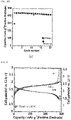
- Non-Patent Literature 1 describes the charge/discharge curves shown in FIG. 1 . As can be seen from FIG. 1 , the capacity decreases after every cycle. Therefore, this electrode active material is still insufficient in charge/discharge life and capacity, and it has been desired to provide an electrode active material that can provide an alkali metal battery having a longer charge/discharge life and a higher capacity.
- an alkali metal battery with a longer charge/discharge life and a higher capacity can be provided by including a certain transition metal and a certain anion component by including in an electrode active material containing sulfur, and have arrived at the present invention.
- an electrode active material for an alkali metal battery represented by the following formula: A a1 MSa 2 X a3 wherein A is selected from Li and Na; M is selected from V, Nb, Ta, Ti, Zr, Hf, Cr, Mo, and W which are group 4 to 6 elements; X is selected from F, Cl, Br, I, CO 3 , SO 3 , SO 4 , NO 3 , BH 4 , BF 4 , PF 6 , ClO 4 , CF 3 SO 3 , (CF 3 SO 2 ) 2 N, (C 2 F 5 SO 2 ) 2 N, (FSO 2 ) 2 N, and [B(C 2 O 4 ) 2 ]; a1 is 1 to 9; a2 is 2 to 6; a3 is 0 to 1; when a1 is 3 and a3 is 0, a2 is not 4; and when M does not include V, a3 > 0.
- an electrode for an alkali metal battery containing the electrode active material.
- an alkali metal battery including a positive electrode, a negative electrode, and an electrolyte layer positioned between the positive electrode and the negative electrode, wherein the electrode, i.e., the positive electrode or the negative electrode or both of the positive and negative electrodes, contains the electrode active material.
- the present invention can provide an electrode active material that can provide an alkaline metal battery having a longer charge/discharge life and a higher capacity.
- the present invention can provide an electrode active material that can provide an alkaline metal battery having an even longer charge/discharge life and an even higher capacity when having any one of the following configurations:
- the electrode active material of the present invention relates to an active material to be contained in an electrode of an alkali metal battery.
- the alkali metal battery is not particularly limited as long as it is a battery in which an alkali metal such as Li or Na is exchanged between the positive electrode and the negative electrode as a mobile ion during charging and discharging.
- the alkali metal battery include an ion battery, such as a lithium ion battery or a sodium ion battery, in which an electrolyte layer contains a nonaqueous electrolyte solution, an all-solid-state battery, such as an all-solid-state lithium battery or an all-solid-state sodium battery, in which a solid electrolyte layer is used as an electrolyte layer.
- the alkali metal battery may be a primary battery or a secondary battery, but is preferably a secondary battery because the electrode active material of the present invention has an effect of extending the charge/discharge life.
- the electrode active material is represented by the following formula: A a1 MSa 2 X a3 wherein A is selected from Li and Na. From the viewpoint of further improving the capacity, A is preferably Li.
- M is selected from the group of transition metals V, Nb, Ta, Ti, Zr, Hf, Cr, Mo, and W. From the viewpoint of further improving the capacity, M preferably includes V or Nb.
- X is selected from the group of anion components F, Cl, Br, I, CO 3 , SO 3 , SO 4 , NO 3 , BH 4 , BF 4 , PF 6 , ClO 4 , CF 3 SO 3 , (CF 3 SO 2 ) 2 N, (C 2 F 5 SO 2 ) 2 N, (FSO 2 ) 2 N, and [B(C 2 O 4 ) 2 ].
- X is preferably selected from Cl, Br, I, and SO 4 .
- a1 is 1 to 9, a2 is 2 to 6, and a3 is 0 to 1 (when a1 is 3 and a3 is 0, a2 is not 4, and when M does not include V, a3 > 0).
- a1, a2, and a3 are molar ratios whose ranges vary according to the valences of M and X. Further, the value of a1 varies according to charging/discharging. When a1 is less than 1, the initial charge capacity is low and the negative electrode needs to contain Li. When a1 is larger than 9, the material becomes an antifluorite Li 2 S-based material, and the electronic conductivity may be lowered.
- a2 When a2 is less than 2, the capacity in higher potential areas is reduced because the capacity due to sulfur redox is not available.
- a2 When a2 is larger than 6, the electronic conductivity may be lowered.
- a3 When a3 is larger than 1, the ionic conductivity may be improved, but the electronic conductivity and the theoretical capacity are lowered.
- a1 is preferably 2 to 4
- a2 is preferably 3 to 5
- a3 is preferably larger than 0, and more preferably 0.05 to 0.6.
- a1 in the formula may be any numerical range within the range of 1 to 9, and can be, for example, a range defined by any combination of upper and lower limits selected from the values of 1.0, 1.5, 2.0, 2.5, 3.0, 3.5, 4.0, 4.5, 5.0, 5.5, 6.0, 6.5, 7.0, 7.5, 8.0, 8.5, and 9.0.
- a2 in the formula may be any numerical range within the range of 2 to 6, and can be, for example, a range defined by any combination of upper and lower limits selected from the values of 2.0, 2.5, 3.0, 3.5, 4.0, 4.5, 5.0, 5.5, and 6.0.
- a3 in the formula may be any numerical range within the range of 0 to 1, and can be, for example, a range defined by any combination of upper and lower limits selected from the values of 0.01, 0.025, 0.05, 0.1, 0.15, 0.2, 0.25, 0.3, 0.35, 0.4, 0.45, 0.5, 0.55, 0.6, 0.65, 0.7, 0.75, 0.8, 0.85, 0.9, 0.95, 0.99, and 1.0.
- the electrode active material may be represented by the following formula: A a1 MSa 2 X a3 (wherein A is selected from Li and Na, M is selected from group 4 to 6 elements (V, Nb, Ta, Ti, Zr, Hf, Cr, Mo, and W), X is selected from F, Cl, Br, I, CO 3 , SO 4 , NO 3 , BH 4 , BF 4 , PF 6 , ClO 4 , CF 3 SO 3 , (CF 3 SO 2 ) 2 N, (C 2 F 5 SO 2 ) 2 N, (FSO 2 ) 2 N, and [B(C 2 O 4 ) 2 ], a1 is 1 to 9, a2 is 2 to 6, and a3 is 0 ⁇ a3 ⁇ 1).
- the electrode active material may be represented by the following formula: A a1 MS a2 (wherein A is selected from Li and Na, M is selected from group 4 to 6 elements (V, Nb, Ta, Ti, Zr, Hf, Cr, Mo, and W), a1 is 1 to 9, and a2 is 2 to 6).
- an electrode active material represented by (Li 2 S) b1 -(V 2 S 3 ) b2 -(Li c X) b3 is more preferable.
- b1, b2, and b3 are molar ratios.
- c is 1 to 2, and is a molar ratio whose range varies according to the valence of X.
- c may be any numerical range within the range of 1 to 2, and can be, for example, a range defined by any combination of upper and lower limits selected from the values of 1.0, 1.1, 1.2, 1.3, 1.4, 1.5, 1.6, 1.7, 1.8, 1.9, and 2.0.
- b1/b2 is 1 to 9, and b3/b2 is preferably 0.1 to 1.5.
- b1/b2 is less than 1, the material cost may increase due to an increase in vanadium content.
- b1/b2 is larger than 9, the electronic conductivity may be lowered.
- b1/b2 is less than 1, the initial charge capacity decreases because the lithium content decreases.
- b3/b2 is less than 0.1, the effect of adding the Li c X component may not be sufficiently obtained.
- b3/b2 is larger than 1.5, the theoretical capacity decreases.
- b1/b2 may be any numerical range within the range 1 to 9, and can be, for example, a range defined by any combination of upper and lower limits selected from the values of 1.0, 1.5, 2.0, 2.5, 3.0, 3.5, 4.0, 4.5, 5.0, 5.5, 6.0, 6.5, 7.0, 7.5, 8.0, 8.5, and 9.0.
- b3/b2 may be any numerical range within the range of 0.1 to 1.5, and can be, for example, a range defined by any combination of upper and lower limits selected from the values of 0.1, 0.15, 0.2, 0.3, 0.4, 0.5, 0.6, 0.7, 0.8, 0.9, 1.0, 1.1, 1.2, 1.3, 1.4, and 1.5.
- b1/b2 is preferably 1.5 to 4.5, more preferably 2 to 4, and even more preferably 2.5 to 3.5.
- b3/b2 is preferably 0.1 to 1.0, and more preferably 0.15 to 0.8.
- the peak corresponding to Li 2 S at around a 2 ⁇ degree of 28° in the X-ray diffraction (XRD) using CuK ⁇ rays preferably shows a full width at half maximum of 0.1° or more.
- the electrode active material with this half width can have a lower crystallinity.
- the method for producing the electrode active material is not particularly limited as long as the raw materials can be complexed.
- the raw materials include mixtures of a sulfide of an alkali metal, a sulfide of a transition metal such as V, and a salt of an alkali metal with an anion component.
- a mechanochemical treatment is preferable from the viewpoint of being able to synthesize a nonstoichiometric compound and/or being obtain a low crystalline compound.
- the mechanochemical treatment is not particularly limited with respect to the treatment apparatus and treatment conditions as long as the components can be homogeneously reacted or complexed with each other.
- a ball mill can be usually used. Ball mills are preferable because large mechanical energy can be obtained. Among ball mills, a planetary ball mill is preferable because the pot rotates on its own axis and the base plate revolves in the opposite direction to the rotation so that high impact energy can be efficiently generated.
- the treatment conditions can be appropriately set according to the treatment apparatus to be used. For example, when a ball mill is used, the higher the rotational speed and/or the longer the treatment time, the more homogeneously the raw materials can be mixed. Specifically, when a planetary ball mill is used, the conditions one, for example, a rotation speed of 50 to 600 rotations per minute, a treatment time of 0.1 to 100 hours, and 1 to 100 kWh per kg of raw materials. In order to prevent the alkali metal salt of the raw material from reacting with water or oxygen, it is preferable that the treatment is carried out within a glove box or the like in an inert atmosphere (for example, an argon atmosphere) having a moisture concentration of 1000 ppm or less and an oxygen concentration of 1000 ppm or less.
- an inert atmosphere for example, an argon atmosphere
- an electrode active material can be obtained.
- the electrode may be made of only an electrode active material, or may be a mixture of an electrode active material with a binder, a conductive material, an electrolyte, or the like.
- the electrode for an alkali metal battery of the present invention contains an electrode active material.
- the electrode active material of the present invention has sufficiently high ionic conductivity and electronic conductivity by itself. Therefore, the amount of a solid electrolyte and/or a conductive material which is contained in the conventional electrode, can be reduced, or the use of such a solid electrolyte and/or a conductive material may be eliminated. As a result, the percentage of the electrode active material in the electrode can be increased; therefore, an alkali metal battery having a higher capacity can be provided.
- the percentage of the electrode active material in the electrode is not particularly limited, but it is preferable that the electrode contains the electrode active material as a main component.
- containing as a main component means that the percentage of the electrode active material in the electrode is 50 mass% or more of the total components constituting the electrode.
- the percentage of the electrode active material in the electrode is preferably 60 mass% or more, more preferably 70 mass% or more, more preferably 80 mass% or more, more preferably 90 mass% or more, more preferably 95 mass% or more, more preferably 97 mass% or more, more preferably 98 mass% or more, more preferably 99 mass% or more, and most preferably 100 mass%.
- the use of a solid electrolyte and/or a conductive material is not excluded, and these may be used as necessary.
- binder examples include polyvinylidene fluoride, polytetrafluoroethylene, polyvinyl alcohol, polyvinyl acetate, polymethyl methacrylate, polyethylene, and the like.
- the binder can be contained in an amount of 40 parts by mass or less per 100 parts by weight of the electrode active material in the electrode, and is preferably 30 parts by weight or less, more preferably 20 parts by weight or less, more preferably 10 parts by weight or less, more preferably 5 parts by weight or less, more preferably 3 parts by weight or less, and more preferably 1 part by weight or less.
- Examples of the conductive material include natural graphite, artificial graphite, acetylene black, Ketchen black, Denka black, carbon black, vapor-grown carbon fiber (VGCF), and the like.
- the conductive material can be contained in an amount of 40 parts by weight or less per 100 parts by weight of the electrode active material in the electrode, and is preferably 30 parts by weight or less, more preferably 20 parts by weight or less, more preferably 10 parts by weight or less, more preferably 5 parts by weight or less, more preferably 3 parts by weight or less, and more preferably 1 part by weight or less.
- solid electrolyte examples include the electrolyte used in the solid electrolyte layer described below in the section of alkali metal battery.
- the electrode active material of the present invention may be added as necessary.
- examples of the another electrode active material include A 4 Ti 5 O 12 , ACoO 2 , AMnO 2 , AVO 2 , ACrO 2 , ANiO 2 , A 2 NiMn 3 O 8 , ANi 1/3 Co 1/3 Mni 1/3 O 2 , S, A 2 S, FeS, TiS 2 , AFeO 2 , A 3 V 2 (PO 4 ) 3 , AMn 2 O 4 , and the like (A is Li or Na).
- the electrode active material may be coated with a material such as LiNbO 3 , NaNbO 3 , Al 2 O 3 , or NiS.
- the coating may have ever or uneven thickness, but has preferably even thickness.
- examples of the another electrode active material include metals such as Li, Na, In, Sn, and Sb, Na alloys, graphite, hard carbon, various transition metal oxides such as Li 4/3 Ti 5/3 O 4 , Li 3 V 2 (PO 4 ) 3 , Na 4/3 Ti 5/3 O 4 , Na 3 V 2 (PO 4 ) 3 , and SnO, and the like.
- the another electrode active material can be contained in an amount of 40 parts by weight or less per 100 parts by weight of the electrode active material in the electrode, and is preferably 30 parts by weight or less, more preferably 20 parts by weight or less, more preferably 10 parts by weight or less, more preferably 5 parts by weight or less, more preferably 3 parts by weight or less, and more preferably 1 part by weight or less.
- the electrode can be obtained in the form of a pellet by, for example, pressing an electrode active material, optionally mixed with a binder, a conductive material, an electrolyte or the like.
- the electrode used for the alkali metal battery is the electrode of the present invention described above.
- the electrode of the present invention can be used as a positive electrode, a negative electrode, or positive and negative electrodes (however, the compositions thereof are different from each other).
- the negative electrode is not particularly limited as long as an alkali metal such as Li or Na can be exchanged as a mobile ion between the positive electrode and the negative electrode during charging/discharging, and the positive electrode may be used in combination with a negative electrode other than the negative electrode of the present invention.
- the positive electrode is not particularly limited as long as an alkali metal such as Li or Na can be exchanged as a mobile ion between the positive electrode and the negative electrode during charging/discharging, and the negative electrode may be used in combination with a positive electrode other than the positive electrode of the present invention.
- Examples of the positive electrode active material used for the positive electrode other than the positive electrode of the present invention include A 4 Ti 5 O 12 , ACoO 2 , AMnO 2 , AVO 2 , ACrO 2 , ANiO 2 , A 2 NiMn 3 O 8 , ANi 1/3 Co 1/3 Mni /3 O 2 , S, A 2 S, FeS, TiS 2 , AFeO 2 , A 3 V 2 (PO 4 ) 3 , AMn 2 O4, and the like (A is Li or Na).
- the positive electrode active material may be coated with a material such as LiNbO 3 , NaNbO 3 , Al 2 O 3 , or NiS. The coating may have even or uneven thickness but has preferably even thickness.
- Examples of the negative electrode active material used for the negative electrode other than the negative electrode of the present invention include metals such as Li, Na, In, Sn, and Sb, Na alloys, graphite, hard carbon, various transition metal oxides such as Li 4/3 Ti 5/3 O 4 , Li 3 V 2 (PO 4 ) 3 , Na 4/3 Ti 5/3 O 4 , Na 3 V 2 (PO 4 ) 3 , and SnO, and the like.
- the positive electrode and the negative electrode may be made of only an electrode active material, or may be a mixture of an electrode active material with a binder, a conductive material, an electrolyte, or the like. These negative electrode active materials or positive electrode active materials may be used alone or in combination of two or more.
- any of those listed above in the section of electrode can be used.
- the electrode can be obtained in the form of a pellet by, for example, pressing an electrode active material, optionally mixed with a binder, a conductive material, an electrolyte or the like.
- an electrode active material optionally mixed with a binder, a conductive material, an electrolyte or the like.
- a metal sheet (foil) made of a metal or an alloy thereof is used as the negative electrode active material, it can be used as it is.
- the positive and/or negative electrode may be further combined with a current collector to form a composite.
- the material, shape, and the like of the current collector are not particularly limited as long as it can be combined with the positive electrode and/or the negative electrode and can function as a current collector.
- the shape of the current collector may be like an even alloy plate or a shape having a hole.
- the current collector may also be in the form of a foil, a sheet, or a film.
- Examples of the material of the current collector include Ni, Cu, Ti, Fe, Co, Ge, Cr, Mo, W, Ru, Pd, Al, stainless steel, steel, and the like. These materials may be used alone or in combination of two or more.
- the kind of material constituting the electrolyte layer used for an alkaline metal battery varies depending on whether the layer contains a nonaqueous electrolyte solution or is all solid, in other words, depending on whether the layer is a nonaqueous electrolyte layer or an all-solid electrolyte layer.
- the electrolyte layer can be composed of a mixture of a known electrolyte and a nonaqueous solvent.
- Examples of the electrolyte include AClO 4 , APF 6 , ABF 4 , ACF 3 SO 3 , AAsF 6 , AB(C 6 H 5 ) 4 , ACl, ABr, CH 3 SO 3 A, CF 3 SO 3 A, AN(SO 2 CF 3 ) 2 , AN(SO 2 C 2 F 5 ) 2 , AC(SO 2 CF 3 ) 3 , AN(SO 3 CF 3 ) 2 , and the like (A is Li or Na).
- the nonaqueous solvent is not particularly limited, and examples thereof include carbonates, ethers, ketones, sulfolane compounds, lactones, nitriles, chlorinated hydrocarbons, ethers, amines, esters, amides, phosphoric acid ester compounds, and the like.
- Typical examples of these are 1,2-dimethoxyethane, 1,2-diethoxyethane, tetrahydrofuran, 2-methyltetrahydrofuran, ethylene carbonate, vinylene carbonate, methylformate, dimethylsulfoxide, propylene carbonate, acetonitrile, ⁇ -butyrolactone, dimethylformamide, dimethyl carbonate, diethyl carbonate, sulfolane, ethylmethyl carbonate, 1,4-dioxane, 4-methyl-2-pentanone, 1,3-dioxolane, 4-methyl-1,3-dioxolane, diethyl ether, sulfolane, methyl sulfolane, propionitrile, benzonitrile, butyronitrile, valeronitrile, 1,2-dichloroethane, trimethyl phosphate, triethyl phosphate, and the like. These can be used alone or in combination of two or more.
- the solid electrolyte constituting the solid electrolyte layer is not particularly limited, and any solid electrolyte normally used in all-solid-state batteries can be used.
- the solid electrolyte include a solid electrolyte represented by A 2 S•N x S y (A is Li or Na, N is selected from P, Si, Ge, B, Al, and Ga, and x and y are integers that give a stoichiometric ratio according to the kind of M).
- Specific examples of N x S y include P 2 S 5 , SiS 2 , GeS 2 , B 2 S 3 , Al 2 S 3 , Ga 2 S 3 , and the like. These specific N x S y may be used alone or in combination of two or more. Among these, P 2 S 5 is particularly preferred.
- the molar ratio of A 2 S to N x S y is preferably 50:50 to 90:10, more preferably 67:33 to 80:20, and even more preferably 70:30 to 80:20.
- the solid electrolyte may contain, in addition to A 2 S•N x S y , other solid electrolytes such as various lithium salts including lithium halide Li 3 PO 4 and the like, sodium salts including sodium halide, Na 3 PO 4 and the like.
- the solid electrolyte may be in a glass state, a glass ceramic state, or crystalline.
- the glass state means a substantially noncrystalline state.
- the substantially noncrystalline state includes, the 100% noncrystalline state as well as a state where crystalline solid electrolyte is finely dispersed in noncrystalline solid electrolyte.
- the glass ceramic state means a state generated as a result of heating a solid electrolyte in the glass state to a temperature equal to or higher than the glass transition point.
- the solid electrolyte in the glass ceramic state may be in a state in which a crystalline phase is dispersed in a glass amorphous phase.
- the percentage of the crystalline phase in the whole glass ceramics may be 50 mass% or more, 60 mass% or more, 70 mass% or more, or 80 mass% or more.
- the percentage of the crystalline phase can be determined by transmission electron microscopy, crystal structure analysis by the Rietveld method, or the like.
- the solid electrolyte in the glass ceramic state may have no glass transition point that was present in the corresponding solid electrolyte in the glass state.
- the solid electrolyte can be formed into a solid electrolyte layer, for example, by being pressed so as to have a predetermined thickness.
- the pressure of the press may be selected from the pressures in a range of 50 to 2000 MPa.
- the solid electrolyte may be composed of one kind or a mixture of a plurality of kinds.
- the percentage of A 2 S•N x S y in the solid electrolyte layer is preferably 80 mass% or more, preferably 85 mass% or more, more preferably 90 mass% or more, more preferably 95 mass% or more, more preferably 97 mass% or more, and more preferably 99 mass% or more.
- the thickness of the solid electrolyte layer is not particularly limited, but is preferably 5 to 1000 ⁇ m, more preferably 5 to 500 ⁇ m, more preferably 5 to 200 ⁇ m, more preferably 5 to 100 ⁇ m, more preferably 10 to 100 ⁇ m, and more preferably 10 to 50 ⁇ m.
- the solid electrolyte layer can be obtained, for example, by pressing solid electrolyte powder.
- the present invention also provides a method for manufacturing an alkali metal battery using the electrode active material of the present invention.
- an ion battery can be obtained by introducing into a battery can, a positive electrode and a negative electrode, and pouring a mixture of an electrolyte and a nonaqueous solvent.
- a separator may be used between the positive electrode and the negative electrode.
- a separator made of a polyolefin polymer such as nylon, cellulose acetate, nitrocellulose, polysulfone, polyacrylonitrile, polyvinylidene fluoride, polypropylene, polyethylene, or polybutene, can be used.
- Positive electrodes, separators, and negative electrodes may be stacked.
- An all-solid-state battery can be obtained, for example, by stacking and pressing a positive electrode, a solid electrolyte layer, and a negative electrode to obtain a cell and fixing the cell to a container.
- XPS K-Alpha X-ray photoelectron spectroscopy
- the measurement area was about 400 ⁇ m 2 , an Ar + neutralizing gun was used for charge neutralization, and Ar ion was used for etching. Charge was corrected with reference to the surface contaminants (hydrocarbon, CHS, 284.7 ev) of the sample.
- Li 2 S and V 2 S 3 were weighed to have molar ratios of 93:7, 90:10, 81:19, 75:25, 70:30, 68:32, 67:33, and 59:41, and put into a planetary ball mill. After mechanochemical treatment using the planetary ball mill, eight kinds of electrode active materials were obtained.
- Pulverisette P-7 manufactured by Fritsch was used, in which a 45 ml pot contains 500 balls (about 90g) having a diameter of 4 mm, and the pot and the balls are made of ZrO 2 .
- the mechanochemical treatment was performed for 80 hours in a dry argon glove box at room temperature at a rotational speed of 510 rpm with a feed amount of 0.3 to 0.5g.
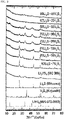
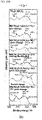
- FIG. 2 shows powder XRD patterns of the eight kinds of electrode active materials. XRD patterns of Li 2 S, V 2 S 3 , and LiVS 2 are also shown in the lower part of FIG. 2 .
- the electronic conductivity was measured for the electrodes containing Li 2 S and V 2 S 3 in molar ratios of 81:19, 75:25, 70:30, 68:32, 67:33, and 59:41, and all of them exhibited a high conductivity of 10 -1 S cm -1 or more, which is above the upper measurement limit of the instrument.
- the electrode with a high Li 2 S content in a molar ratio of 90:10 exhibited a relatively low electronic conductivity of 4.6 ⁇ 10 -7 S cm -1 .
- the electronic conductivity of the one with the ratio of 93:7 was 10 -7 S cm -1 or less.
- the sample for electronic conductivity measurement was a powder mold obtained by subjecting 80 mg of the obtained electrode active material powder to uniaxial press molding at room temperature (25°C) and 360 MPa.
- An all-solid-state battery was manufactured using each of the above-described electrodes as the positive electrode, and the initial charge/discharge curve of the battery was measured.
- the measurement conditions were that the obtained secondary battery (cell) was charged and discharged for one cycle at a current density of 0.13 mA/cm 2 at 25°C.
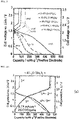
- the results are shown in FIG. 3 .
- the vertical axis on the left side shows the voltage with respect to the Li-In counter electrode.
- the initial charge capacity and initial discharge capacity are shown in Table 1.
- Each all-solid-state battery was manufactured as follows.
- Li 2 S purity: 99.9% or more; manufactured by Idemitsu Kosan Co., Ltd.
- P 2 S 5 purity: 99%; manufactured by Aldrich
- the SE was obtained.
- Pulverisette P-7 manufactured by Fritsch was used, in which a 45 ml pot contains 500 balls having a diameter of 4 mm, and the pot and the balls are made of zirconium oxide.
- the dry mechanochemical treatment was performed for 10 hours in a dry nitrogen glove box at room temperature at a rotational speed of 510 rpm. This synthesis method was performed in accordance with the description of Experimental in Akitoshi Hayashi et al., Journal of Non-Crystalline Solids 356 (2010) 2670-2673 .
- An all-solid-state battery was obtained by stacking, as the negative electrode, a Li-In alloy on the above-described stack of the positive electrode layer and the electrolyte layer, sandwiching the stack with stainless steel current collectors, and pressing again (at a pressure of 120 MPa).
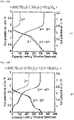
- FIGS. 4A to 4C show measurement results of charge/discharge curves up to five cycles for three kinds of electrodes containing Li 2 S and V 2 S 3 in molar ratios of 67:33, 70:30, and 75:25.
- the charge capacities and discharge capacities at the first to fifth cycles are shown in Table 2.
- the measurement conditions were that the obtained secondary battery (cell) was charged and discharged at a current density of 0.13 mA/cm 2 at 25°C.
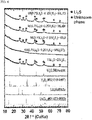
- FIG. 6 shows powder XRD patterns of the four kinds of electrode active materials. XRD patterns of Li 2 S, V 2 S 3 , and LiVS 2 are also shown in the lower part of FIG. 6 .
- the numbers in the figure represent the powder diffraction database JCPDS card numbers.
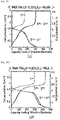
- FIGS. 7B to 7E All-solid-state batteries were manufactured in the same manner as in Example 1 except that the above four kinds of positive electrodes were used, and the charge/discharge curves of the batteries were measured up to 5 cycles under the same conditions as in Example 1. The results are shown in FIGS. 7B to 7E .
- FIG. 7A shows the same data as FIG. 4B , which is shown here again for reference.
- the charge capacities and discharge capacities at the first to fifth cycles Table 3, as well as the ionic conductivities of powder molds of the respective electrode active materials are shown in.
- the charge/discharge curve of the battery was measured up to 20 cycles under the same conditions as in Example 1. The results are shown in FIG. 8A .
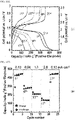
- FIG. 8B shows a change over cycles in the charge/discharge capacity of the positive electrode. From FIGS. 8A and 8B , it can be seen that the charge/discharge curve hardly changes even after 20 cycles.
- the charge/discharge curve of the above-described all-solid-state battery was measured up to 10 cycles with the charge/discharge capacity limited to 280 mAhg -1 under the same conditions as in Example 1. The results are shown in FIG. 9 . It can be seen from FIG. 9 that even if the charge/discharge capacity is limited, the charge/discharge curve does not change significantly. It can also be read from the decrease in the charge potential and the increase in the discharge potential that the performance is improved by repeating charging/discharging.
- the charge/discharge curve of the above-described all-solid-state battery was measured under the same conditions as in Example 1 except that the current density was 0.13 mA/cm 2 for 1 st to 5 th cycles, 0.64 mA/cm 2 for 6 th to 10 th cycles, 1.3 for 11 th to 15 th cycles, 2.3 for 16 th to 20 th cycles, and 0.13 for 21 st to 25 th cycles.
- FIG. 10A shows a change over cycles in the charge/discharge capacity of the positive electrode. It can be seen from FIGS. 10A and 10B that charging/discharging can be performed even at a high current density. Further, since the tendency of the charge/discharge capacity of the electrode is almost the same before and after charging/discharging at a high current density, it can be seen that the electrode active material is resistant to structural changes even under severe charge/discharge conditions.
- 54LI 3 PS 4 •46LiI used as the SE was produced by putting LI 3 PS 4 and LiI into a planetary ball mill and subjecting them to a mechanochemical treatment as in the above-described method for SE production.
- the all-solid-state battery was manufactured in the same manner as in Example 1 except that 90(0.75Li 2 S•0.25V 2 S 3 )•10LiI was used as the electrode active material and 54LI 3 PS 4 •46LiI was used as the SE.
- the charge/discharge curve of the obtained all-solid-state battery was measured under the same conditions as in Example 1 except that the current density was 0.13 mA/cm 2 for 1 st to 5 th cycles, 0.64 mA/cm 2 for 6 th to 10 th cycles, 1.30 mA/cm 2 for 11 th to 15 th cycles, 2.60 mA/cm2 for 16 th to 20 th cycles, and 0.13 mA/cm 2 after 20 cycles.
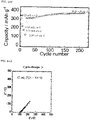
- FIG. 10C shows a change over cycles in the measured charge/discharge capacity of the positive electrode.
- FIG. 10C shows that the charge/discharge capacity exceeding 300 mAhg -1 is maintained even after 200 cycles, and that the fluctuation of the charge/discharge capacity between charge/discharge cycles is small, so that the all-solid-state battery using the electrode active material of the present invention has a stable charge/discharge capacity.
- FIGS. 11A to 11C First, pre-charge, post-charge, and post-discharge impedance plots of an all-solid-state battery using 90(0.75Li 2 S•0.25V 2 S 3 )•10LiI at a current density of 0.13 mA/cm 2 are shown in FIGS. 11A to 11C respectively. It can be seen from FIGS. 11A to 11C that the resistance of the electrode active material is reduced after the first discharging. This is presumably because the gaps (interfaces) formed at the time of manufacturing the electrode is reduced through charging/discharging since the electrode active material is relatively soft.
- An all-solid-state battery was manufactured in the same manner as in Example 2 except that the molar ratio of Li 2 S, V 2 S 3 , LiI, and Li 2 SO 4 was changed to 56:24:10:10, and the charge/discharge curve of the battery was measured up to five times under the same conditions as in Example 1. The results are shown in FIGS. 14A and 14B . The charge capacities and discharge capacities of the first to fifth cycles are shown in Table 5.
- An electrode active material (Li 3 VS 4 ) and an electrode were obtained in the same manner as in Example 1 except that Li 2 S, V 2 S 3 , and S were weighed to have a molar ratio of 50:17:33.
- two kinds of electrode active materials 90Li 3 VS 4 •10LiI and 90Li 3 VS 4 •10Li 2 SO 4
- a positive electrode was obtained in the same manner as in Example 2 except that Li 2 S, V 2 S 3 , S, and a lithium salt (LiI or Li 2 SO 4 ) were weighed to have a molar ratio of 45:15:30:10.
- an electrode active material 80Li 3 VS 4 •20Li 2 SO 4
- a positive electrode 80Li 3 VS 4 •20Li 2 SO 4
- Li 2 S, V 2 S 3 , S, and a lithium salt Li 2 SO 4
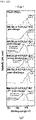
- FIGS. 15A and 15B show XRD patterns of these four kinds of electrode active materials. XRD patterns of Li 2 S, V 2 S 3 , LiI, and Li 2 SO 4 are also shown in the lower parts of FIGS. 15A and 15B .
- the charge/discharge curves were measured up to two cycles in the same manner as in Example 1 except that the four kinds of electrode active materials were used. The results are shown in FIGS. 16A to 16D .
- the charge capacities and discharge capacities of the first and second cycles are shown in Table 6.
- Electrode active material 75Na 2 S•25V 2 S 3 was obtained in the same manner as in Example 1 except that Na 2 S (Nagano Co., Ltd.) and V 2 S 3 were weighed to have a molar ratio of 75.0:25.0.
- Electrode active material 90(0.75Na 2 S•0.25V 2 S 3 )•10NaI was obtained in the same manner as in Example 1 except that Na 2 S, V 2 S 3 , and NaI (Sigma-Aldrich) were weighed to have a molar ratio of 67.5:22.5:10.
- FIG. 17 shows powder XRD patterns of these electrode active materials. An XRD pattern of Na 2 S is also shown in the lower part of FIG. 17 for comparison.
- the ionic conductivity of the obtained electrode active material was measured by manufacturing a cell for ionic conductivity measurement.
- the cell for ionic conductivity measurement was manufactured as follows.
- a pellet was obtained by pressing 40 mg of produced 75Na 2 S•25V 2 S 3 at a pressure of 100 MPa for 1 minute using a uniaxial hydraulic press. Forty milligrams of Na 3 PS 4 glass ceramic solid electrolyte was attached to both sides of the pellet and pressed at a pressure of 370 MPa for 3 minutes. After pressing, 30 mg of a Na-Sn alloy was stacked on Na 3 PS 4 glass ceramic solid electrolyte at both ends, sandwiched between stainless steel collectors, and pressed again (at a pressure of 100 MPa) to manufacture a cell for ionic conductivity measurement.
- the Na 3 PS 4 glass ceramic solid electrolyte used was produced by weighing 1g of Na 2 S and P 2 S 5 to have a molar ratio of 75:25, putting it into a planetary ball mill, and subjecting it to a mechanochemical treatment.
- a cell using 90(0.75Na 2 S•0.25V 2 S 3 )•10NaIinstead of 75Na 2 S•25V 2 S 3 was also manufactured.
- the ionic conductivity was measured using the two kinds of manufactured cells.
- the obtained 75Na 2 S•25V 2 S 3 was mixed with a Na 3 PS 4 glass ceramic solid electrolyte to have a weight ratio of 7:3.
- a pellet (positive electrode) having a diameter of 10 mm and a thickness of about 0.05 mm was obtained.
- An all-solid-state battery was manufactured in the same manner as in Example 1 except that this positive electrode, a Na 3 PS 4 glass ceramic solid electrolyte as the solid electrolyte, and a Na-Sn alloy as the negative electrode were used.
- the initial charge/discharge curves of the two kinds of manufactured all-solid-state batteries were measured.
- the battery measurement conditions were the same as those in Example 1 except that charging/discharging was performed at 60 °C.
- the results of the measurements are shown in FIGS. 18 and 19 , respectively.
- FIGS. 18 and 19 show that both all-solid-state batteries have a charge/discharge capacity of 200 mAhg -1 or more.
Landscapes
- Chemical & Material Sciences (AREA)
- Chemical Kinetics & Catalysis (AREA)
- Electrochemistry (AREA)
- General Chemical & Material Sciences (AREA)
- Inorganic Chemistry (AREA)
- Engineering & Computer Science (AREA)
- Manufacturing & Machinery (AREA)
- Materials Engineering (AREA)
- Organic Chemistry (AREA)
- Crystallography & Structural Chemistry (AREA)
- Physics & Mathematics (AREA)
- Condensed Matter Physics & Semiconductors (AREA)
- General Physics & Mathematics (AREA)
- Battery Electrode And Active Subsutance (AREA)
- Secondary Cells (AREA)
Abstract
Description
- The present invention relates to an electrode active material for an alkali metal battery, and an electrode and an alkali metal battery including the same. Specifically, the present invention relates to an electrode active material capable of providing an alkali metal battery having a long charge/discharge life and a high capacity, an electrode including the same, and an alkali metal battery having a long charge/discharge life and a high capacity including the same.
- In recent years, there has been an increasing demand for lithium-ion batteries for storing electric power in vehicles, such as electric vehicles and hybrid vehicles, and power generation apparatus, such as solar batteries and wind power generators.
- Further, from the viewpoint of ensuring safety, all-solid-state batteries, which use a solid electrolyte layer instead of a liquid electrolyte layer, have been actively studied.
- Here, a lithium-ion battery and an all-solid-state battery are comprising a positive electrode layer, an electrolyte layer, and a negative electrode layer. As a positive electrode active material included in the positive electrode (active material) of the all-solid-state battery, International Publication No.
WO2016/063877 (Patent Literature 1), for example, has proposed a positive electrode active material for an all-solid-state secondary battery represented by A2S•AX (wherein A is an alkali metal and X is selected from I, Br, Cl, F, BF4, BH4, SO4, BO3, PO4, O, Se, N, P, As, Sb, PF6, AsF6, ClO4, NO3, CO3, CF3SO3, CF3COO, N(SO2F)2, and N(CF3SO2)2). - Since the above positive electrode active material has low conductivity, it is required to be mixed with a solid electrolyte or a conductive auxiliary agent. The mixing improves the conductivity, while lowering the amount of the positive electrode active material in the positive electrode and therefore there was a problem that the capacity is reduced.
- In order to solve the above problem, a positive electrode active material having sufficient conductivity without being mixed with a solid electrolyte or a conductive auxiliary agent has been proposed in Hayashi, Tatsumisago, et al. Annual Meeting of the Chemical Society of Japan. (2017) (Non-Patent Literature 1). Non-Patent Literature 1 reports that charging and discharging can be performed by using Li2S-V2S3-S(Li3VS4) as a positive electrode active material without being mixed with a solid electrolyte or a conductive auxiliary agent.
- [PL1] International Publication No.
WO2016/063877 - [NPL1] Hayashi, Tatsumisago, et al. Annual Meeting of the Chemical Society of Japan. (2017)
- Non-Patent
Literature 1 describes the charge/discharge curves shown inFIG. 1 . As can be seen fromFIG. 1 , the capacity decreases after every cycle. Therefore, this electrode active material is still insufficient in charge/discharge life and capacity, and it has been desired to provide an electrode active material that can provide an alkali metal battery having a longer charge/discharge life and a higher capacity. - Based on the concept that ionic conductivity and electronic conductivity can be further improved by adding the role of an electrolyte to the active material, the inventors of the present invention have found that an alkali metal battery with a longer charge/discharge life and a higher capacity can be provided by including a certain transition metal and a certain anion component by including in an electrode active material containing sulfur, and have arrived at the present invention.
- Thus, according to the present invention, there is provided an electrode active material for an alkali metal battery, represented by the following formula: Aa1MSa2Xa3
wherein A is selected from Li and Na; M is selected from V, Nb, Ta, Ti, Zr, Hf, Cr, Mo, and W which are group 4 to 6 elements; X is selected from F, Cl, Br, I, CO3, SO3, SO4, NO3, BH4, BF4, PF6, ClO4, CF3SO3, (CF3SO2)2N, (C2F5SO2)2N, (FSO2)2N, and [B(C2O4)2]; a1 is 1 to 9; a2 is 2 to 6; a3 is 0 to 1; when a1 is 3 and a3 is 0, a2 is not 4; and when M does not include V, a3 > 0. - Further, according to the present invention, there is provided an electrode for an alkali metal battery containing the electrode active material.
- Moreover, according to the present invention, there is provided an alkali metal battery including a positive electrode, a negative electrode, and an electrolyte layer positioned between the positive electrode and the negative electrode, wherein the electrode, i.e., the positive electrode or the negative electrode or both of the positive and negative electrodes, contains the electrode active material.
- The present invention can provide an electrode active material that can provide an alkaline metal battery having a longer charge/discharge life and a higher capacity.
- In addition, the present invention can provide an electrode active material that can provide an alkaline metal battery having an even longer charge/discharge life and an even higher capacity when having any one of the following configurations:
- (1) A is Li, M is V, and X is selected from Cl, Br, I, and SO4;
- (2) Formula: Aa1MSa2Xa3 is represented by (Li2S)b1-(V2S3)b2-(LicX)b3 (where b1/b2 is 1 to 9, b3/b2 is 0.1 to 1.5, and c is 1 to 2).
- (3) A is Na, M is V, and X is selected from Cl, Br, I, and SO4.
- (4) The alkali metal battery is an all-solid-state battery.
- (5) The alkali metal battery includes a positive electrode, a negative electrode, and a solid electrolyte layer positioned between the positive electrode and the negative electrode, wherein the electrodes contain no solid electrolyte.
-
- [
FIG. 1 ]
FIG. 1 shows charge/discharge curves described inNon-Patent Literature 1. - [
FIG. 2 ]
FIG. 2 shows XRD patterns of electrode active materials of Example 1. - [
FIG. 3 ]
FIG. 3 shows initial charge/discharge curves of all-solid-state batteries of Example 1. - [
FIG. 4A ]
FIG. 4A shows charge/discharge curves of an all-solid-state battery using an electrode composed of an electrode active material containing Li2S and V2S3 in a molar ratio of 67:33. - [
FIG. 4B ]
FIG. 4B shows charge-discharge curves of an all-solid-state battery using an electrode composed of an electrode active material containing Li2S and V2S3 in a molar ratio of 70:30. - [
FIG. 4C ]
FIG. 4C shows charge/discharge curves of an all-solid-state battery using an electrode composed of an electrode active material containing Li2S and V2S3 in a molar ratio of 75:25. - [
FIG. 5A ]
FIG. 5A shows charge/discharge curves of the all-solid-state battery using an electrode composed of the electrode active material containing Li2S and V2S3 in a molar ratio of 67:33 in the case where charging/discharging cycle was started from the charged state. - [
FIG. 5B ]
FIG. 5B shows charge/discharge curves of the all-solid-state battery using an electrode composed of the electrode active material containing Li2S and V2S3 in a molar ratio of 67:33 in the case where charging/discharging cycle was started from the discharged state. - [
FIG. 6 ]
FIG. 6 shows XRD patterns of electrode active materials of Example 2. - [
FIG. 7A ]
FIG. 7A shows charge/discharge curves of an all-solid-state battery using an electrode composed of an electrode active material containing Li2S and V2S3 in a molar ratio of 75:25. - [
FIG. 7B ]
FIG. 7B shows charge/discharge curves of an all-solid-state battery using an electrode composed of 90(0.75Li2S•0.25V2S3)•10LiCl. - [
FIG. 7C ]
FIG. 7C shows charge/discharge curves of an all-solid-state battery using an electrode composed of 90(0.75Li2S•0.25V2S3)•10LiBr. - [
FIG. 7D ]
FIG. 7D shows charge/discharge curves of an all-solid-state battery using an electrode composed of 90(0.75Li2S•0.25V2S3)•10LiI. - [
FIG. 7E ]
FIG. 7E shows charge/discharge curves of an all-solid-state battery using an electrode composed of 90(0.75Li2S•0.25V2S3)•10Li2SO4. - [
FIG. 8A ]
FIG. 8A shows charge/discharge curves of an all-solid-state battery using an electrode composed of 90(0.75Li2S•0.25V2S3)•10LiI. - [
FIG. 8B ]
FIG. 8B shows a change over cycles of the all-solid-state battery using the electrode composed of 90(0.75Li2S•0.25V2S3)•10LiI. - [
FIG. 9 ]
FIG. 9 shows charge/discharge curves of an all-solid-state battery using an electrode composed of 90(0.75Li2S•0.25V2S3)•10LiI when the charge/discharge capacity was limited. - [
FIG. 10A ]
FIG. 10A is a graph showing charge/discharge curves of an all-solid-state battery using an electrode composed of 90(0.75Li2S•0.25V2S3)•10LiI in the case where charging/discharging was performed at varying current density. - [
FIG. 10B ]
FIG. 10B is a graph showing a change over cycles of the all-solid-state battery using an electrode composed of 90(0.75Li2S•0.25V2S3)•10LiI in the case where charging/discharging was performed at varying current densities. - [
FIG. 10C ]
FIG. 10C is a graph showing a change over cycles of the all-solid-state battery using an electrode composed of 90(0.75Li2S•0.25V2S3)•10LiI and using 54Li3PS4•46LiI as a solid electrolyte in the case where charging/discharging was performed at varying current densities. - [
FIG. 11A ]
FIG. 11A shows an impedance plot of the all-solid-state battery using an electrode composed of 90(0.75Li2S•0.25V2S3)•10LiI. - [
FIG. 11B ]
FIG. 11B shows an impedance plot of the all-solid-state battery using an electrode composed of 90(0.75Li2S•0.25V2S3)•10LiI. - [
FIG. 11C ]
FIG. 11C shows an impedance plot of the all-solid-state battery using an electrode composed of 90(0.75Li2S•0.25V2S3)•10LiI. - [
FIG. 12A ]
FIG. 12A shows XPS plots of the 2p orbitals of the S atoms in electrode active materials of Example 2. - [
FIG. 12B ]
FIG. 12B shows XPS plots of the 2p orbitals of the V atoms in the electrode active materials of Example 2. - [
FIG. 13 ]
FIG. 13 shows charge/discharge curves of an all-solid-state battery using an electrode composed of 90(0.70Li2S·0.30V2S3)·10LiI. - [
FIG. 14A ]
FIG. 14A shows charge/discharge curves of an all-solid-state battery using an electrode composed of 90(0.70Li2S•0.30V2S3)•10Li2SO4. - [
FIG. 14B ]
FIG. 14B shows charge/discharge curves of an all-solid-state battery using an electrode composed of 80(0.70Li2S•0.30V2S3)•10LiI•10Li2SO4. - [
FIG. 15A ]
FIG. 15A shows XRD patterns of electrode active materials of Example 5. - [
FIG. 15B ]
FIG. 15B shows XRD patterns of electrode active materials of Example 5. - [
FIG. 16A ]
FIG. 16A shows charge/discharge curves of an all-solid-state battery using an electrode composed of Li3VS4. - [
FIG. 16B ]
FIG. 16B shows charge/discharge curves of an all-solid-state battery using an electrode composed of 90Li3VS4•10LiI. - [
FIG. 16C ]
FIG. 16C shows charge/discharge curves of an all-solid-state battery using an electrode composed of 90Li3VS4•10Li2SO4. - [
FIG. 16D ]
FIG. 16D shows charge/discharge curves of an all-solid-state battery using an electrode composed of 80Li3VS4•20Li2SO4. - [
FIG. 17 ]
FIG. 17 shows XRD patterns of electrode active materials of Example 6. - [
FIG. 18 ]
FIG. 18 shows a charge/discharge capacity of an all-solid-state battery using an electrode composed of 75Na2S•25V2S3. - [
FIG. 19 ]
FIG. 19 shows a charge/discharge capacity of an all-solid-state battery using an electrode composed of 90(0.75Na2S•25V2S3)•10NaI. - The electrode active material of the present invention relates to an active material to be contained in an electrode of an alkali metal battery. Here, the alkali metal battery is not particularly limited as long as it is a battery in which an alkali metal such as Li or Na is exchanged between the positive electrode and the negative electrode as a mobile ion during charging and discharging. Examples of the alkali metal battery include an ion battery, such as a lithium ion battery or a sodium ion battery, in which an electrolyte layer contains a nonaqueous electrolyte solution, an all-solid-state battery, such as an all-solid-state lithium battery or an all-solid-state sodium battery, in which a solid electrolyte layer is used as an electrolyte layer. The alkali metal battery may be a primary battery or a secondary battery, but is preferably a secondary battery because the electrode active material of the present invention has an effect of extending the charge/discharge life.
- The electrode active material is represented by the following formula: Aa1MSa2Xa3
wherein A is selected from Li and Na. From the viewpoint of further improving the capacity, A is preferably Li. - M is selected from the group of transition metals V, Nb, Ta, Ti, Zr, Hf, Cr, Mo, and W. From the viewpoint of further improving the capacity, M preferably includes V or Nb.
- X is selected from the group of anion components F, Cl, Br, I, CO3, SO3, SO4, NO3, BH4, BF4, PF6, ClO4, CF3SO3, (CF3SO2)2N, (C2F5SO2)2N, (FSO2)2N, and [B(C2O4)2]. From the viewpoint of further improving the capacity, X is preferably selected from Cl, Br, I, and SO4.
- a1 is 1 to 9, a2 is 2 to 6, and a3 is 0 to 1 (when a1 is 3 and a3 is 0, a2 is not 4, and when M does not include V, a3 > 0). a1, a2, and a3 are molar ratios whose ranges vary according to the valences of M and X. Further, the value of a1 varies according to charging/discharging. When a1 is less than 1, the initial charge capacity is low and the negative electrode needs to contain Li. When a1 is larger than 9, the material becomes an antifluorite Li2S-based material, and the electronic conductivity may be lowered. When a2 is less than 2, the capacity in higher potential areas is reduced because the capacity due to sulfur redox is not available. When a2 is larger than 6, the electronic conductivity may be lowered. When a3 is larger than 1, the ionic conductivity may be improved, but the electronic conductivity and the theoretical capacity are lowered. a1 is preferably 2 to 4, a2 is preferably 3 to 5, a3 is preferably larger than 0, and more preferably 0.05 to 0.6.
- a1 in the formula may be any numerical range within the range of 1 to 9, and can be, for example, a range defined by any combination of upper and lower limits selected from the values of 1.0, 1.5, 2.0, 2.5, 3.0, 3.5, 4.0, 4.5, 5.0, 5.5, 6.0, 6.5, 7.0, 7.5, 8.0, 8.5, and 9.0.
- a2 in the formula may be any numerical range within the range of 2 to 6, and can be, for example, a range defined by any combination of upper and lower limits selected from the values of 2.0, 2.5, 3.0, 3.5, 4.0, 4.5, 5.0, 5.5, and 6.0.
- a3 in the formula may be any numerical range within the range of 0 to 1, and can be, for example, a range defined by any combination of upper and lower limits selected from the values of 0.01, 0.025, 0.05, 0.1, 0.15, 0.2, 0.25, 0.3, 0.35, 0.4, 0.45, 0.5, 0.55, 0.6, 0.65, 0.7, 0.75, 0.8, 0.85, 0.9, 0.95, 0.99, and 1.0.
- In one embodiment, the electrode active material may be represented by the following formula:
Aa1MSa2Xa3
(wherein A is selected from Li and Na, M is selected from group 4 to 6 elements (V, Nb, Ta, Ti, Zr, Hf, Cr, Mo, and W), X is selected from F, Cl, Br, I, CO3, SO4, NO3, BH4, BF4, PF6, ClO4, CF3SO3, (CF3SO2)2N, (C2F5SO2)2N, (FSO2)2N, and [B(C2O4)2], a1 is 1 to 9, a2 is 2 to 6, and a3 is 0<a3≤1). - In another embodiment, a3 in the above formula is 0. Namely, the electrode active material may be represented by the following formula:
Aa1MSa2
(wherein A is selected from Li and Na, M is selected from group 4 to 6 elements (V, Nb, Ta, Ti, Zr, Hf, Cr, Mo, and W), a1 is 1 to 9, and a2 is 2 to 6). - Among the electrode active materials represented by Aa1MSa2Xa3, an electrode active material represented by (Li2S)b1-(V2S3)b2-(LicX)b3 is more preferable. b1, b2, and b3 are molar ratios. c is 1 to 2, and is a molar ratio whose range varies according to the valence of X.
- c may be any numerical range within the range of 1 to 2, and can be, for example, a range defined by any combination of upper and lower limits selected from the values of 1.0, 1.1, 1.2, 1.3, 1.4, 1.5, 1.6, 1.7, 1.8, 1.9, and 2.0.
- b1/b2 is 1 to 9, and b3/b2 is preferably 0.1 to 1.5. When b1/b2 is less than 1, the material cost may increase due to an increase in vanadium content. When b1/b2 is larger than 9, the electronic conductivity may be lowered. When b1/b2 is less than 1, the initial charge capacity decreases because the lithium content decreases. When b3/b2 is less than 0.1, the effect of adding the LicX component may not be sufficiently obtained. When b3/b2 is larger than 1.5, the theoretical capacity decreases.
- b1/b2 may be any numerical range within the
range 1 to 9, and can be, for example, a range defined by any combination of upper and lower limits selected from the values of 1.0, 1.5, 2.0, 2.5, 3.0, 3.5, 4.0, 4.5, 5.0, 5.5, 6.0, 6.5, 7.0, 7.5, 8.0, 8.5, and 9.0. - b3/b2 may be any numerical range within the range of 0.1 to 1.5, and can be, for example, a range defined by any combination of upper and lower limits selected from the values of 0.1, 0.15, 0.2, 0.3, 0.4, 0.5, 0.6, 0.7, 0.8, 0.9, 1.0, 1.1, 1.2, 1.3, 1.4, and 1.5.
- From the viewpoint of the balance among electronic conductivity, ionic conductivity, initial charge capacity, reversible capacity, and charge/discharge life, b1/b2 is preferably 1.5 to 4.5, more preferably 2 to 4, and even more preferably 2.5 to 3.5. b3/b2 is preferably 0.1 to 1.0, and more preferably 0.15 to 0.8.
- For the electrode active material, when A is Li, the peak corresponding to Li2S at around a 2θ degree of 28° in the X-ray diffraction (XRD) using CuKα rays preferably shows a full width at half maximum of 0.1° or more. The electrode active material with this half width can have a lower crystallinity.
- The method for producing the electrode active material is not particularly limited as long as the raw materials can be complexed. Examples of the raw materials include mixtures of a sulfide of an alkali metal, a sulfide of a transition metal such as V, and a salt of an alkali metal with an anion component.
- As the complexing method, a mechanochemical treatment is preferable from the viewpoint of being able to synthesize a nonstoichiometric compound and/or being obtain a low crystalline compound.
- The mechanochemical treatment is not particularly limited with respect to the treatment apparatus and treatment conditions as long as the components can be homogeneously reacted or complexed with each other.
- As the treatment apparatus, a ball mill can be usually used. Ball mills are preferable because large mechanical energy can be obtained. Among ball mills, a planetary ball mill is preferable because the pot rotates on its own axis and the base plate revolves in the opposite direction to the rotation so that high impact energy can be efficiently generated.
- The treatment conditions can be appropriately set according to the treatment apparatus to be used. For example, when a ball mill is used, the higher the rotational speed and/or the longer the treatment time, the more homogeneously the raw materials can be mixed. Specifically, when a planetary ball mill is used, the conditions one, for example, a rotation speed of 50 to 600 rotations per minute, a treatment time of 0.1 to 100 hours, and 1 to 100 kWh per kg of raw materials. In order to prevent the alkali metal salt of the raw material from reacting with water or oxygen, it is preferable that the treatment is carried out within a glove box or the like in an inert atmosphere (for example, an argon atmosphere) having a moisture concentration of 1000 ppm or less and an oxygen concentration of 1000 ppm or less.
- By the above-described mechanochemical treatment, an electrode active material can be obtained.
- The electrode may be made of only an electrode active material, or may be a mixture of an electrode active material with a binder, a conductive material, an electrolyte, or the like.
- The electrode for an alkali metal battery of the present invention contains an electrode active material. The electrode active material of the present invention has sufficiently high ionic conductivity and electronic conductivity by itself. Therefore, the amount of a solid electrolyte and/or a conductive material which is contained in the conventional electrode, can be reduced, or the use of such a solid electrolyte and/or a conductive material may be eliminated. As a result, the percentage of the electrode active material in the electrode can be increased; therefore, an alkali metal battery having a higher capacity can be provided. The percentage of the electrode active material in the electrode is not particularly limited, but it is preferable that the electrode contains the electrode active material as a main component. Here, containing as a main component means that the percentage of the electrode active material in the electrode is 50 mass% or more of the total components constituting the electrode. The percentage of the electrode active material in the electrode is preferably 60 mass% or more, more preferably 70 mass% or more, more preferably 80 mass% or more, more preferably 90 mass% or more, more preferably 95 mass% or more, more preferably 97 mass% or more, more preferably 98 mass% or more, more preferably 99 mass% or more, and most preferably 100 mass%. However, the use of a solid electrolyte and/or a conductive material is not excluded, and these may be used as necessary.
- Examples of the binder include polyvinylidene fluoride, polytetrafluoroethylene, polyvinyl alcohol, polyvinyl acetate, polymethyl methacrylate, polyethylene, and the like.
- The binder can be contained in an amount of 40 parts by mass or less per 100 parts by weight of the electrode active material in the electrode, and is preferably 30 parts by weight or less, more preferably 20 parts by weight or less, more preferably 10 parts by weight or less, more preferably 5 parts by weight or less, more preferably 3 parts by weight or less, and more preferably 1 part by weight or less.
- Examples of the conductive material include natural graphite, artificial graphite, acetylene black, Ketchen black, Denka black, carbon black, vapor-grown carbon fiber (VGCF), and the like.
- The conductive material can be contained in an amount of 40 parts by weight or less per 100 parts by weight of the electrode active material in the electrode, and is preferably 30 parts by weight or less, more preferably 20 parts by weight or less, more preferably 10 parts by weight or less, more preferably 5 parts by weight or less, more preferably 3 parts by weight or less, and more preferably 1 part by weight or less.
- Examples of the solid electrolyte include the electrolyte used in the solid electrolyte layer described below in the section of alkali metal battery.
- In addition to the electrode active material of the present invention, another electrode active material may be added as necessary. When the electrode active material of the present invention is used as a positive electrode active material, examples of the another electrode active material include A4Ti5O12, ACoO2, AMnO2, AVO2, ACrO2, ANiO2, A2NiMn3O8, ANi1/3Co1/3Mni1/3O2, S, A2S, FeS, TiS2, AFeO2, A3V2(PO4)3, AMn2O4, and the like (A is Li or Na). The electrode active material may be coated with a material such as LiNbO3, NaNbO3, Al2O3, or NiS. The coating may have ever or uneven thickness, but has preferably even thickness. When the electrode active material of the present invention is used as a negative electrode active material, examples of the another electrode active material include metals such as Li, Na, In, Sn, and Sb, Na alloys, graphite, hard carbon, various transition metal oxides such as Li4/3Ti5/3O4, Li3V2(PO4)3, Na4/3Ti5/3O4, Na3V2(PO4)3, and SnO, and the like.
- The another electrode active material can be contained in an amount of 40 parts by weight or less per 100 parts by weight of the electrode active material in the electrode, and is preferably 30 parts by weight or less, more preferably 20 parts by weight or less, more preferably 10 parts by weight or less, more preferably 5 parts by weight or less, more preferably 3 parts by weight or less, and more preferably 1 part by weight or less.
- The electrode can be obtained in the form of a pellet by, for example, pressing an electrode active material, optionally mixed with a binder, a conductive material, an electrolyte or the like.
- The electrode used for the alkali metal battery is the electrode of the present invention described above. The electrode of the present invention can be used as a positive electrode, a negative electrode, or positive and negative electrodes (however, the compositions thereof are different from each other).
- When the electrode of the present invention is used as a positive electrode, the negative electrode is not particularly limited as long as an alkali metal such as Li or Na can be exchanged as a mobile ion between the positive electrode and the negative electrode during charging/discharging, and the positive electrode may be used in combination with a negative electrode other than the negative electrode of the present invention. When the electrode of the present invention is used as a negative electrode, the positive electrode is not particularly limited as long as an alkali metal such as Li or Na can be exchanged as a mobile ion between the positive electrode and the negative electrode during charging/discharging, and the negative electrode may be used in combination with a positive electrode other than the positive electrode of the present invention.
- Examples of the positive electrode active material used for the positive electrode other than the positive electrode of the present invention include A4Ti5O12, ACoO2, AMnO2, AVO2, ACrO2, ANiO2, A2NiMn3O8, ANi1/3Co1/3Mni/3O2, S, A2S, FeS, TiS2, AFeO2, A3V2(PO4)3, AMn2O4, and the like (A is Li or Na). The positive electrode active material may be coated with a material such as LiNbO3, NaNbO3, Al2O3, or NiS. The coating may have even or uneven thickness but has preferably even thickness.
- Examples of the negative electrode active material used for the negative electrode other than the negative electrode of the present invention include metals such as Li, Na, In, Sn, and Sb, Na alloys, graphite, hard carbon, various transition metal oxides such as Li4/3Ti5/3O4, Li3V2(PO4)3, Na4/3Ti5/3O4, Na3V2(PO4)3, and SnO, and the like.
- The positive electrode and the negative electrode may be made of only an electrode active material, or may be a mixture of an electrode active material with a binder, a conductive material, an electrolyte, or the like. These negative electrode active materials or positive electrode active materials may be used alone or in combination of two or more.
- As the binder, the conductive material, and the electrolyte, any of those listed above in the section of electrode can be used.
- The electrode can be obtained in the form of a pellet by, for example, pressing an electrode active material, optionally mixed with a binder, a conductive material, an electrolyte or the like. When a metal sheet (foil) made of a metal or an alloy thereof is used as the negative electrode active material, it can be used as it is.
- The positive and/or negative electrode may be further combined with a current collector to form a composite.
- The material, shape, and the like of the current collector are not particularly limited as long as it can be combined with the positive electrode and/or the negative electrode and can function as a current collector. The shape of the current collector may be like an even alloy plate or a shape having a hole. The current collector may also be in the form of a foil, a sheet, or a film.
- Examples of the material of the current collector include Ni, Cu, Ti, Fe, Co, Ge, Cr, Mo, W, Ru, Pd, Al, stainless steel, steel, and the like. These materials may be used alone or in combination of two or more.
- The kind of material constituting the electrolyte layer used for an alkaline metal battery varies depending on whether the layer contains a nonaqueous electrolyte solution or is all solid, in other words, depending on whether the layer is a nonaqueous electrolyte layer or an all-solid electrolyte layer.
- The electrolyte layer can be composed of a mixture of a known electrolyte and a nonaqueous solvent.
- Examples of the electrolyte include AClO4, APF6, ABF4, ACF3SO3, AAsF6, AB(C6H5)4, ACl, ABr, CH3SO3A, CF3SO3A, AN(SO2CF3)2, AN(SO2C2F5)2, AC(SO2CF3)3, AN(SO3CF3)2, and the like (A is Li or Na).
- The nonaqueous solvent is not particularly limited, and examples thereof include carbonates, ethers, ketones, sulfolane compounds, lactones, nitriles, chlorinated hydrocarbons, ethers, amines, esters, amides, phosphoric acid ester compounds, and the like. Typical examples of these are 1,2-dimethoxyethane, 1,2-diethoxyethane, tetrahydrofuran, 2-methyltetrahydrofuran, ethylene carbonate, vinylene carbonate, methylformate, dimethylsulfoxide, propylene carbonate, acetonitrile, γ-butyrolactone, dimethylformamide, dimethyl carbonate, diethyl carbonate, sulfolane, ethylmethyl carbonate, 1,4-dioxane, 4-methyl-2-pentanone, 1,3-dioxolane, 4-methyl-1,3-dioxolane, diethyl ether, sulfolane, methyl sulfolane, propionitrile, benzonitrile, butyronitrile, valeronitrile, 1,2-dichloroethane, trimethyl phosphate, triethyl phosphate, and the like. These can be used alone or in combination of two or more.
- The solid electrolyte constituting the solid electrolyte layer is not particularly limited, and any solid electrolyte normally used in all-solid-state batteries can be used. Examples of the solid electrolyte include a solid electrolyte represented by A2S•NxSy (A is Li or Na, N is selected from P, Si, Ge, B, Al, and Ga, and x and y are integers that give a stoichiometric ratio according to the kind of M). Specific examples of NxSy include P2S5, SiS2, GeS2, B2S3, Al2S3, Ga2S3, and the like. These specific NxSy may be used alone or in combination of two or more. Among these, P2S5 is particularly preferred.
- Further, the molar ratio of A2S to NxSy is preferably 50:50 to 90:10, more preferably 67:33 to 80:20, and even more preferably 70:30 to 80:20.
- The solid electrolyte may contain, in addition to A2S•NxSy, other solid electrolytes such as various lithium salts including lithium halide Li3PO4 and the like, sodium salts including sodium halide, Na3PO4 and the like.
- The solid electrolyte may be in a glass state, a glass ceramic state, or crystalline. The glass state means a substantially noncrystalline state. Here, the substantially noncrystalline state includes, the 100% noncrystalline state as well as a state where crystalline solid electrolyte is finely dispersed in noncrystalline solid electrolyte. The glass ceramic state means a state generated as a result of heating a solid electrolyte in the glass state to a temperature equal to or higher than the glass transition point.
- The solid electrolyte in the glass ceramic state may be in a state in which a crystalline phase is dispersed in a glass amorphous phase. The percentage of the crystalline phase in the whole glass ceramics may be 50 mass% or more, 60 mass% or more, 70 mass% or more, or 80 mass% or more. The percentage of the crystalline phase can be determined by transmission electron microscopy, crystal structure analysis by the Rietveld method, or the like.
- Furthermore, the solid electrolyte in the glass ceramic state may have no glass transition point that was present in the corresponding solid electrolyte in the glass state.
- The solid electrolyte can be formed into a solid electrolyte layer, for example, by being pressed so as to have a predetermined thickness. The pressure of the press may be selected from the pressures in a range of 50 to 2000 MPa.
- The solid electrolyte may be composed of one kind or a mixture of a plurality of kinds.
- The percentage of A2S•NxSy in the solid electrolyte layer is preferably 80 mass% or more, preferably 85 mass% or more, more preferably 90 mass% or more, more preferably 95 mass% or more, more preferably 97 mass% or more, and more preferably 99 mass% or more. The thickness of the solid electrolyte layer is not particularly limited, but is preferably 5 to 1000 µm, more preferably 5 to 500 µm, more preferably 5 to 200 µm, more preferably 5 to 100 µm, more preferably 10 to 100 µm, and more preferably 10 to 50 µm. The solid electrolyte layer can be obtained, for example, by pressing solid electrolyte powder.
- The present invention also provides a method for manufacturing an alkali metal battery using the electrode active material of the present invention.
- When a nonaqueous electrolyte layer is used, an ion battery can be obtained by introducing into a battery can, a positive electrode and a negative electrode, and pouring a mixture of an electrolyte and a nonaqueous solvent.
- A separator may be used between the positive electrode and the negative electrode. In this case, it is preferable to use a microporous polymer film. Specifically, a separator made of a polyolefin polymer, such as nylon, cellulose acetate, nitrocellulose, polysulfone, polyacrylonitrile, polyvinylidene fluoride, polypropylene, polyethylene, or polybutene, can be used. Positive electrodes, separators, and negative electrodes may be stacked.
- An all-solid-state battery can be obtained, for example, by stacking and pressing a positive electrode, a solid electrolyte layer, and a negative electrode to obtain a cell and fixing the cell to a container.
- Hereinafter, the present invention will be described in more detail by way of Examples and Comparative Examples, but the present invention is not limited thereto. In the following Examples and Comparative Examples, Li2S manufactured by Mitsuwa Chemicals Co., Ltd. (purity>99.9%), V2S3 manufactured by Kojundo Chemical Lab. Co., Ltd. (purity>99.9%), and LiCl, LiBr, LiI, and Li2SO4 manufactured by Aldrich (purity>99.999%) were used.
- In the following Examples and Comparative Examples, ionic conductivity and electronic conductivity were measured using a potentiogalvanostat Solartron 1287A and an impedance analyzer 1260A manufactured by Solartron Analytical. Structural analyses were performed with CuKα rays in the range of 2θ = 10° to 90° using, as an X-ray diffractometer, a fully automatic multi-purpose X-ray diffractometer SmartLab manufactured by Rigaku Corporation. XPS measurements were performed with a K-Alpha X-ray photoelectron spectroscopy (XPS) system manufactured by Thermo Fisher Scientific using monochromatic Al-Kα (1486.6 eV) X-rays. The measurement area was about 400 µm2, an Ar+ neutralizing gun was used for charge neutralization, and Ar ion was used for etching. Charge was corrected with reference to the surface contaminants (hydrocarbon, CHS, 284.7 ev) of the sample.
- Li2S and V2S3 were weighed to have molar ratios of 93:7, 90:10, 81:19, 75:25, 70:30, 68:32, 67:33, and 59:41, and put into a planetary ball mill. After mechanochemical treatment using the planetary ball mill, eight kinds of electrode active materials were obtained.
- As the planetary ball mill, Pulverisette P-7 manufactured by Fritsch was used, in which a 45 ml pot contains 500 balls (about 90g) having a diameter of 4 mm, and the pot and the balls are made of ZrO2. The mechanochemical treatment was performed for 80 hours in a dry argon glove box at room temperature at a rotational speed of 510 rpm with a feed amount of 0.3 to 0.5g.
FIG. 2 shows powder XRD patterns of the eight kinds of electrode active materials. XRD patterns of Li2S, V2S3, and LiVS2 are also shown in the lower part ofFIG. 2 . The electronic conductivity was measured for the electrodes containing Li2S and V2S3 in molar ratios of 81:19, 75:25, 70:30, 68:32, 67:33, and 59:41, and all of them exhibited a high conductivity of 10-1 S cm-1 or more, which is above the upper measurement limit of the instrument. On the other hand, the electrode with a high Li2S content in a molar ratio of 90:10 exhibited a relatively low electronic conductivity of 4.6×10⁻⁷ S cm-1. The electronic conductivity of the one with the ratio of 93:7 was 10-7 S cm-1 or less. From this fact, it can be seen that even the one with the ratio of 90:10 is improved in the electronic conductivity as a result of complexing with V2S3. The sample for electronic conductivity measurement was a powder mold obtained by subjecting 80 mg of the obtained electrode active material powder to uniaxial press molding at room temperature (25°C) and 360 MPa. - An all-solid-state battery was manufactured using each of the above-described electrodes as the positive electrode, and the initial charge/discharge curve of the battery was measured. The measurement conditions were that the obtained secondary battery (cell) was charged and discharged for one cycle at a current density of 0.13 mA/cm2 at 25°C. The results are shown in
FIG. 3 . InFIG. 3 , the vertical axis on the left side shows the voltage with respect to the Li-In counter electrode. The initial charge capacity and initial discharge capacity are shown in Table 1.[Table 1] Li2S:V2S3 (molar ratio) Initial charge capacity (mAh g-1) Initial discharge capacity (mAh g-1) 67:33 66 522 70:30 146 374 75:25 94 230 81:19 93 249 90:10 1 115 - Each all-solid-state battery was manufactured as follows.
- By pressing (at a pressure of 360 MPa) 3 mg of the obtained electrode active material and 80 mg of a solid electrolyte (hereinafter referred to as SE) composed of Li2S•P2S5 (in a molar ratio of Li2S and P2S5 of 75:25), a double-layer pellet of a positive electrode layer and an SE layer having a diameter of 10 mm and a thickness of about 0.7 mm, was obtained. No SE is mixed in the positive electrode layer. The SE used was synthesized by the following method.
- One gram of Li2S (purity: 99.9% or more; manufactured by Idemitsu Kosan Co., Ltd.) and P2S5 (purity: 99%; manufactured by Aldrich) was weighed at a molar ratio of 75:25 and put into a planetary ball mill. After mechanochemical treatment, the SE was obtained. As the planetary ball mill, Pulverisette P-7 manufactured by Fritsch was used, in which a 45 ml pot contains 500 balls having a diameter of 4 mm, and the pot and the balls are made of zirconium oxide. The dry mechanochemical treatment was performed for 10 hours in a dry nitrogen glove box at room temperature at a rotational speed of 510 rpm. This synthesis method was performed in accordance with the description of Experimental in Akitoshi Hayashi et al., Journal of Non-Crystalline Solids 356 (2010) 2670-2673.
- An all-solid-state battery was obtained by stacking, as the negative electrode, a Li-In alloy on the above-described stack of the positive electrode layer and the electrolyte layer, sandwiching the stack with stainless steel current collectors, and pressing again (at a pressure of 120 MPa).
-
FIGS. 4A to 4C show measurement results of charge/discharge curves up to five cycles for three kinds of electrodes containing Li2S and V2S3 in molar ratios of 67:33, 70:30, and 75:25. The charge capacities and discharge capacities at the first to fifth cycles are shown in Table 2. The measurement conditions were that the obtained secondary battery (cell) was charged and discharged at a current density of 0.13 mA/cm2 at 25°C.[Table 2] Li2S:V2S3 (molar ratio) Capacity (mAh g-1) First Second Third Fourth Fifth 67:33 Charge 66 535 526 522 519 Discharge 522 521 522 520 517 70:30 Charge 146 357 344 331 320 Discharge 374 351 378 326 316 75:25 Charge 94 227 220 213 208 Discharge 230 223 217 211 206 - From
FIGS. 4A to 4C and Table 2, it can be seen that the charge/discharge curves hardly change over cycles, and the batteries are resistant to repeated charging/discharging. - For the all-solid-state battery using the electrode containing Li2S and V2S3 in a molar ratio of 67:33, it was confirmed whether the charge/discharge curves were different between the case where charging/discharging was started from the charged state and the case where charging/discharging was started from the discharged state. The confirmation results are shown in
FIGS. 5A (started from the charged state) andFIG. 5B (started from the discharged state). FromFIGS. 5A and 5B , it can be inferred that there is no significant change in the crystal structure of the electrode active material between the changed state and the discharged state because the charge/discharge curve hardly changes regardless of which state the charge/discharge is started from. - In the same manner as in Example 1 except that Li2S, V2S3, and a lithium salt (LiX: LiCl, LiBr, LiI, or Li2SO4) were weighed to have a molar ratio of 67.5:22.5:10, four kinds of electrode active materials (90(0.75Li2S•0.25V2S3)•10LiCl, 90(0.75Li2S•0.25V2S3)•10LiBr, 90(0.75Li2S•0.25V2S3)•10LiI, and 90(0.75Li2S•0.25V2S3)•10Li2SO4 were obtained.
FIG. 6 shows powder XRD patterns of the four kinds of electrode active materials. XRD patterns of Li2S, V2S3, and LiVS2 are also shown in the lower part ofFIG. 6 . The numbers in the figure represent the powder diffraction database JCPDS card numbers. - Four kinds of pellets (positive electrodes) with a diameter of 10 mm and a thickness of about 0.05 mm were obtained by pressing 10 mg of the obtained electrode active materials (at a pressure of 360 MPa).
- All-solid-state batteries were manufactured in the same manner as in Example 1 except that the above four kinds of positive electrodes were used, and the charge/discharge curves of the batteries were measured up to 5 cycles under the same conditions as in Example 1. The results are shown in
FIGS. 7B to 7E .FIG. 7A shows the same data asFIG. 4B , which is shown here again for reference. The charge capacities and discharge capacities at the first to fifth cycles Table 3, as well as the ionic conductivities of powder molds of the respective electrode active materials are shown in.[Table 3] Molar ratio Capacity (mAh g-1) Ionic conductivities (S cm-1) First Second Third Fourth Fifth 75Li2S·25V2S3 Charge 94 227 220 213 208 3.5 × 10⁻⁵ Discharge 230 223 217 211 206 90(0.75Li2S · 0.25V2S3) ·10LiCl Charge 151 279 271 265 259 6.3 × 10⁻⁴ Discharge 290 283 275 269 262 90(0.75Li2S · 0.25V2S3) • 10LiBr Charge 165 314 307 304 302 6.4 × 10⁻⁴ Discharge 318 321 311 307 304 90(0.75Li2S . 0.25V2S3) ·10LiI Charge 294 434 444 448 450 7.1 × 10⁻⁴ Discharge 432 442 445 448 450 90(0.75Li2S . 0.25V2S3) ·10Li2SO4 Charge 172 338 335 334 332 2.6 × 10⁻⁴ Discharge 346 339 337 334 332 - From comparison of
FIG. 7A , andFIGS. 7B-7E , and from Table 3, it can be seen that the charge/discharge curves hardly change over cycles, and the batteries are resistant to repeated charging/discharging. From comparison ofFIG. 7A andFIGS. 7B to 7E , it can be seen that the charge/discharge capacity can be improved by the electrode active material further containing a lithium salt. - For the all-solid-state battery using 90(0.75Li2S•0.25V2S3)•10LiI, the charge/discharge curve of the battery was measured up to 20 cycles under the same conditions as in Example 1. The results are shown in
FIG. 8A .FIG. 8B shows a change over cycles in the charge/discharge capacity of the positive electrode. FromFIGS. 8A and8B , it can be seen that the charge/discharge curve hardly changes even after 20 cycles. - The charge/discharge curve of the above-described all-solid-state battery was measured up to 10 cycles with the charge/discharge capacity limited to 280 mAhg-1 under the same conditions as in Example 1. The results are shown in
FIG. 9 . It can be seen fromFIG. 9 that even if the charge/discharge capacity is limited, the charge/discharge curve does not change significantly. It can also be read from the decrease in the charge potential and the increase in the discharge potential that the performance is improved by repeating charging/discharging. - The charge/discharge curve of the above-described all-solid-state battery was measured under the same conditions as in Example 1 except that the current density was 0.13 mA/cm2 for 1st to 5th cycles, 0.64 mA/cm2 for 6th to 10th cycles, 1.3 for 11th to 15th cycles, 2.3 for 16th to 20th cycles, and 0.13 for 21st to 25th cycles. The results are shown in
FIG. 10A. FIG. 10B shows a change over cycles in the charge/discharge capacity of the positive electrode. It can be seen fromFIGS. 10A and 10B that charging/discharging can be performed even at a high current density. Further, since the tendency of the charge/discharge capacity of the electrode is almost the same before and after charging/discharging at a high current density, it can be seen that the electrode active material is resistant to structural changes even under severe charge/discharge conditions. - As another measurement example, in an all-solid-state battery prepared using 90(0.75Li2S•0.25V2S3)•10LiI as the electrode active material and 54LI3PS4•46LiI (molar ratio) as the SE, the change over cycles in the charge/discharge capacity of the positive electrode was measured.
- 54LI3PS4•46LiI used as the SE was produced by putting LI3PS4 and LiI into a planetary ball mill and subjecting them to a mechanochemical treatment as in the above-described method for SE production. The all-solid-state battery was manufactured in the same manner as in Example 1 except that 90(0.75Li2S•0.25V2S3)•10LiI was used as the electrode active material and 54LI3PS4•46LiI was used as the SE.
- The charge/discharge curve of the obtained all-solid-state battery was measured under the same conditions as in Example 1 except that the current density was 0.13 mA/cm2 for 1st to 5th cycles, 0.64 mA/cm2 for 6th to 10th cycles, 1.30 mA/cm2 for 11th to 15th cycles, 2.60 mA/cm2 for 16th to 20th cycles, and 0.13 mA/cm2 after 20 cycles.
-
FIG. 10C shows a change over cycles in the measured charge/discharge capacity of the positive electrode.FIG. 10C shows that the charge/discharge capacity exceeding 300 mAhg-1 is maintained even after 200 cycles, and that the fluctuation of the charge/discharge capacity between charge/discharge cycles is small, so that the all-solid-state battery using the electrode active material of the present invention has a stable charge/discharge capacity. - First, pre-charge, post-charge, and post-discharge impedance plots of an all-solid-state battery using 90(0.75Li2S•0.25V2S3)•10LiI at a current density of 0.13 mA/cm2 are shown in
FIGS. 11A to 11C respectively. It can be seen fromFIGS. 11A to 11C that the resistance of the electrode active material is reduced after the first discharging. This is presumably because the gaps (interfaces) formed at the time of manufacturing the electrode is reduced through charging/discharging since the electrode active material is relatively soft. - For the above-described all-solid-state battery, in order to examine the change in the structure of the electrode active material due to charging/discharging, the changes in the 2p orbital of an S atom and the 2p orbital of a V atom in the electrode were observed with the plots obtained by XPS. Observations were made at five points: before charging, after first charging, discharging to around 1.2V (during discharging: discharging to the same level as the charge capacity), after complete discharging, and after second charging. Further, in order to confirm the change in the structure due to the addition of LiI, the changes in the 2p orbital of an S atom and the 2p orbital of a V atom in the electrode before charging in the all-solid-state battery using 75Li2S•25V2S3 were observed with the plots obtained by XPS. The results are shown in
FIGS. 12A and12B . FromFIGS. 12A and12B , the following can be inferred. - (1) Comparison between the profiles of the 2p orbitals of 90(0.75Li2S•0.25V2S3)•10LiI and 75Li2S•25V2S3 before charging shows that the electronic states of S and V are hardly changed by the addition of Lil.
- (2) From the profile of the 2p orbital of an S atom, it can be seen that polysulfide is produced by charging. It can also be seen that the amount of polysulfide is larger after the second charging than after the first charging.
- (3) In the profile of the 2p orbital of an S atom, no peak corresponding to polysulfide is observed during discharging. A peak suggesting that Li2S is being generated can be seen.
- (4) From the profile of the 2p orbital of an S atom, it can be seen that when the battery is fully discharged, there will be only S(S2-) in an oxidized state similar to Li2S. This indicates that sulfur redox is occurring, which contributes to the increase in capacity.
- (5) From the profiles of the 2p orbitals of a V atom before charging, after the first charging, and after the second charging, it can be seen that each peak is slightly shifted to the high energy side by charging. From this shift, it is inferred that V is oxidized by charging.
- An all-solid-state battery was manufactured in the same manner as in Example 2 except that the molar ratio of Li2S and V2S3 was changed to 0.70:0.30, and the charge/discharge curve of the battery was measured up to five cycles under the same conditions as in Example 1. The results are shown in
FIG. 13 . The charge capacities and discharge capacities of the first to fifth cycles are shown in Table 4.[Table 4] Molar ratio Capacity (mAh g-1) First Second Third Fourth Fifth 90(0.70Li2S·0.30V2S3)·10LiI Charge 234 348 345 342 340 Discharge 388 367 353 350 348 - From
FIG. 13 and Table 4, it can be seen that the charge/discharge curve hardly changes over cycles, and the battery is resistant to repeated charging/discharging. - An all-solid-state battery was manufactured in the same manner as in Example 2 except that the molar ratio of Li2S, V2S3, LiI, and Li2SO4 was changed to 56:24:10:10, and the charge/discharge curve of the battery was measured up to five times under the same conditions as in Example 1. The results are shown in
FIGS. 14A and 14B . The charge capacities and discharge capacities of the first to fifth cycles are shown in Table 5.[Table 5] Molar ratio Capacity (mAh g-1) First Second Third Fourth Fifth 90(0.70Li2S-0.30V2S3) ·10Li2SO4 Charge 107 442 445 446 446 Discharge 429 444 446 446 446 80(0.70Li2S·0.30V2S3) ·10LiI·10Li2SO4 Charge 234 391 394 395 396 Discharge 407 405 404 403 402 - From
FIGS. 14A and 14B and Table 5, it can be seen that the charge/discharge curve hardly changes over cycles, and the battery is resistant to repeated charging/discharging. - An electrode active material (Li3VS4) and an electrode were obtained in the same manner as in Example 1 except that Li2S, V2S3, and S were weighed to have a molar ratio of 50:17:33.
- Further, two kinds of electrode active materials (90Li3VS4•10LiI and 90Li3VS4•10Li2SO4) and a positive electrode were obtained in the same manner as in Example 2 except that Li2S, V2S3, S, and a lithium salt (LiI or Li2SO4) were weighed to have a molar ratio of 45:15:30:10.
- In addition, an electrode active material (80Li3VS4•20Li2SO4) and a positive electrode were obtained in the same manner as in Example 2 except that Li2S, V2S3, S, and a lithium salt (Li2SO4) were weighed to have a molar ratio of 40:13.6:26.4:20.
-
FIGS. 15A and15B show XRD patterns of these four kinds of electrode active materials. XRD patterns of Li2S, V2S3, LiI, and Li2SO4 are also shown in the lower parts ofFIGS. 15A and15B . - From
FIGS. 15A and15B , it can be seen that the addition of either of the lithium salts does not significantly change the XRD patterns from that of Li3VS4. Further, since the peak corresponding to Li2S is slightly broadened, it can be seen that amorphization is caused by the addition of ether of the lithium salts. - The charge/discharge curves were measured up to two cycles in the same manner as in Example 1 except that the four kinds of electrode active materials were used. The results are shown in
FIGS. 16A to 16D . The charge capacities and discharge capacities of the first and second cycles are shown in Table 6.[Table 6] Molar ratio Capacity (mAh g-1) First Second Third Fourth Fifth Li3VS4 Charge 80 359 - - - Discharge 432 357 - - - 90Li3VS4 · 10LiI Charge 223 554 556 557 563 Discharge 563 554 554 555 546 90Li3VS4 · 10Li2SO4 Charge 93 334 342 314 292 Discharge 383 368 343 314 292 80Li3VS4 · 20Li2SO4 Charge 101 377 - - - Discharge 387 376 - - - - From
FIGS. 16A to 16D and Table 6, it can be seen that the charge/discharge curves hardly change over cycles because of the addition of either of the lithium salts to Li3VS4, and batteries resistant to repeated charging/discharging can be obtained. FromFIGS. 16B ,16C , and16D , it can be seen that LiI can improve the initial charge capacity more than Li2SO4. - Electrode active material 75Na2S•25V2S3 was obtained in the same manner as in Example 1 except that Na2S (Nagano Co., Ltd.) and V2S3 were weighed to have a molar ratio of 75.0:25.0. Electrode active material 90(0.75Na2S•0.25V2S3)•10NaI was obtained in the same manner as in Example 1 except that Na2S, V2S3, and NaI (Sigma-Aldrich) were weighed to have a molar ratio of 67.5:22.5:10.
FIG. 17 shows powder XRD patterns of these electrode active materials. An XRD pattern of Na2S is also shown in the lower part ofFIG. 17 for comparison. - The ionic conductivity of the obtained electrode active material was measured by manufacturing a cell for ionic conductivity measurement. The cell for ionic conductivity measurement was manufactured as follows.
- A pellet was obtained by pressing 40 mg of produced 75Na2S•25V2S3 at a pressure of 100 MPa for 1 minute using a uniaxial hydraulic press. Forty milligrams of Na3PS4 glass ceramic solid electrolyte was attached to both sides of the pellet and pressed at a pressure of 370 MPa for 3 minutes. After pressing, 30 mg of a Na-Sn alloy was stacked on Na3PS4 glass ceramic solid electrolyte at both ends, sandwiched between stainless steel collectors, and pressed again (at a pressure of 100 MPa) to manufacture a cell for ionic conductivity measurement. The Na3PS4 glass ceramic solid electrolyte used was produced by weighing 1g of Na2S and P2S5 to have a molar ratio of 75:25, putting it into a planetary ball mill, and subjecting it to a mechanochemical treatment. A cell using 90(0.75Na2S•0.25V2S3)•10NaIinstead of 75Na2S•25V2S3 was also manufactured.
- The ionic conductivity was measured using the two kinds of manufactured cells. As a result of the measurement, the ionic conductivity of the cell using Na3VS3 was σNa = 4.2 × 10⁻⁶ S cm-1, and that of the cell using 90(0.75Na2S•0.25V2S3)•10NaI was σNa = 5.4 × 10⁻⁶ S cm-1.
- The obtained 75Na2S•25V2S3 was mixed with a Na3PS4 glass ceramic solid electrolyte to have a weight ratio of 7:3. By pressing 10 mg of this mixture (at a pressure of 360 MPa), a pellet (positive electrode) having a diameter of 10 mm and a thickness of about 0.05 mm was obtained.
- An all-solid-state battery was manufactured in the same manner as in Example 1 except that this positive electrode, a Na3PS4 glass ceramic solid electrolyte as the solid electrolyte, and a Na-Sn alloy as the negative electrode were used. An all-solid-state battery using 90(0.75Na2S•0.25V2S3)•10NaIinstead of 75Na2S•25V2S3 was also manufactured.
- The initial charge/discharge curves of the two kinds of manufactured all-solid-state batteries were measured. The battery measurement conditions were the same as those in Example 1 except that charging/discharging was performed at 60 °C. The results of the measurements are shown in
FIGS. 18 and19 , respectively.FIGS. 18 and19 show that both all-solid-state batteries have a charge/discharge capacity of 200 mAhg-1 or more.
Claims (9)
- An electrode active material for an alkali metal battery,
represented by formula:
Aa1MSa2Xa3
wherein A is selected from Li and Na, M is selected from group 4 to 6 elements (V, Nb, Ta, Ti, Zr, Hf, Cr, Mo, and W), X is selected from F, Cl, Br, I, CO3, SO4, NO3, BH4, BF4, PF6, ClO4, CF3SO3, (CF3SO2)2N, (C2F5SO2)2N, (FSO2)2N, and [B(C2O4)2], a1 is 1 to 9, a2 is 2 to 6, and a3 is 0<a3≤1. - The electrode active material for an alkali metal battery according to claim 1, wherein A comprises Li, M comprises V, and X comprises one selected from Cl, Br, I, and SO4.
- The electrode active material for an alkali metal battery according to claim 1 or 2, wherein the formula: Aa1MSa2Xa3 is represented by (Li2S)b1-(V2S3)b2-(LicX)b3, wherein b1/b2 is 1 to 9, b3/b2 is 0.1 to 1.5, and c is 1 to 2.
- The electrode active material for an alkali metal battery according to claim 1, wherein A comprises Na, M comprises V, and X comprises one selected from Cl, Br, I, and SO4.
- The electrode active material for an alkali metal battery according to any one of claims 1 to 4, wherein the alkali metal battery is an all-solid-state battery.
- The electrode active material for an alkali metal battery according to any one of claims 1 to 5, wherein the alkali metal battery comprises a positive electrode, a negative electrode, and a solid electrolyte layer positioned between the positive electrode and the negative electrode, and the positive electrode contains no solid electrolyte.
- An electrode for an alkali metal battery comprising the electrode active material according to any one of claims 1 to 6.
- An alkali metal battery comprisinga positive electrode, a negative electrode, and an electrolyte layer positioned between the positive electrode and the negative electrode,wherein the positive electrode or the negative electrode or both of the positive and negative electrodes comprise the electrode active material according to any one of claims 1 to 6.
- The alkali metal battery according to claim 8, wherein the electrolyte layer comprises a solid electrolyte layer.
Applications Claiming Priority (2)
| Application Number | Priority Date | Filing Date | Title |
|---|---|---|---|
| JP2019186875 | 2019-10-10 | ||
| PCT/JP2020/038342 WO2021070944A1 (en) | 2019-10-10 | 2020-10-09 | Electrode active material for alkali metal battery, and electrode and alkali metal battery including same |
Publications (2)
| Publication Number | Publication Date |
|---|---|
| EP4043401A1 true EP4043401A1 (en) | 2022-08-17 |
| EP4043401A4 EP4043401A4 (en) | 2023-11-22 |
Family
ID=75438182
Family Applications (1)
| Application Number | Title | Priority Date | Filing Date |
|---|---|---|---|
| EP20873568.8A Pending EP4043401A4 (en) | 2019-10-10 | 2020-10-09 | ACTIVE ELECTRODE MATERIAL FOR ALKALINE METAL BATTERIES, ELECTRODE AND ALKALINE METAL BATTERY THEREFROM |
Country Status (5)
| Country | Link |
|---|---|
| US (2) | US20230042928A1 (en) |
| EP (1) | EP4043401A4 (en) |
| JP (1) | JP7681314B2 (en) |
| CN (1) | CN114503309A (en) |
| WO (1) | WO2021070944A1 (en) |
Families Citing this family (1)
| Publication number | Priority date | Publication date | Assignee | Title |
|---|---|---|---|---|
| WO2025183086A1 (en) * | 2024-02-29 | 2025-09-04 | 公立大学法人大阪 | Sulfide |
Family Cites Families (7)
| Publication number | Priority date | Publication date | Assignee | Title |
|---|---|---|---|---|
| US10269465B2 (en) * | 2013-10-04 | 2019-04-23 | National Institute Of Advanced Industrial Science And Technology | Amorphous (lithium) niobium sulfide or (lithium) titanium niobium sulfide |
| JP6427312B2 (en) * | 2013-10-07 | 2018-11-21 | 古河機械金属株式会社 | Positive electrode active material for lithium ion battery, positive electrode material for lithium ion battery, positive electrode for lithium ion battery, lithium ion battery and method for producing positive electrode active material for lithium ion battery |
| JP6466065B2 (en) | 2014-02-03 | 2019-02-06 | 古河機械金属株式会社 | Positive electrode material, positive electrode, and lithium ion battery |
| CN106663789A (en) * | 2014-06-06 | 2017-05-10 | 罗伯特·博世有限公司 | Cathode materials for lithium-sulfur-batteries |
| JP6356020B2 (en) * | 2014-09-11 | 2018-07-11 | 古河機械金属株式会社 | Positive electrode active material for lithium ion battery, positive electrode material, positive electrode, and lithium ion battery |
| JP6529508B2 (en) | 2014-10-22 | 2019-06-12 | 国立研究開発法人科学技術振興機構 | Positive electrode for all solid secondary battery, manufacturing method thereof and all solid secondary battery |
| JP7281195B2 (en) * | 2017-11-10 | 2023-05-25 | 公立大学法人大阪 | Solid electrolyte for all-solid-state sodium battery and all-solid-state sodium battery |
-
2020
- 2020-10-09 EP EP20873568.8A patent/EP4043401A4/en active Pending
- 2020-10-09 CN CN202080070621.0A patent/CN114503309A/en active Pending
- 2020-10-09 US US17/767,732 patent/US20230042928A1/en not_active Abandoned
- 2020-10-09 WO PCT/JP2020/038342 patent/WO2021070944A1/en not_active Ceased
- 2020-10-09 JP JP2021551727A patent/JP7681314B2/en active Active
-
2025
- 2025-09-11 US US19/326,315 patent/US20260011728A1/en active Pending
Also Published As
| Publication number | Publication date |
|---|---|
| US20230042928A1 (en) | 2023-02-09 |
| WO2021070944A1 (en) | 2021-04-15 |
| US20260011728A1 (en) | 2026-01-08 |
| CN114503309A (en) | 2022-05-13 |
| EP4043401A4 (en) | 2023-11-22 |
| JPWO2021070944A1 (en) | 2021-04-15 |
| JP7681314B2 (en) | 2025-05-22 |
Similar Documents
| Publication | Publication Date | Title |
|---|---|---|
| US11081687B2 (en) | Positive-electrode active material and battery including positive-electrode active material | |
| Criado et al. | Effect of chromium doping on Na3V2 (PO4) 2F3@ C as promising positive electrode for sodium-ion batteries | |
| US10854876B2 (en) | Positive electrode active material and battery using positive electrode active material | |
| US11557760B2 (en) | Positive-electrode active material containing lithium composite oxide, and battery including the same | |
| AU2005333201B8 (en) | Bismuth fluoride based nanocomposites as electrode materials | |
| EP3595058A1 (en) | Positive electrode active material and battery | |
| US11605814B2 (en) | Positive-electrode active material containing lithium composite oxide, and battery including the same | |
| US20200006749A1 (en) | Positive-electrode active material containing lithium composite oxide, and battery including the same | |
| KR20170142410A (en) | Composite cathode active material for lithium battery, cathode for lithium battery including the same, and lithium battery including the cathode | |
| KR20150006283A (en) | Positive electrode active material, preparing method thereof, positive electrode including the same, and lithium secondary battery employing the positive electrode | |
| Wang et al. | Reaction mechanisms of NASICON-type Na4MnV (PO4) 3/C as a cathode for sodium-ion batteries | |
| US20260011728A1 (en) | Electrode active material for alkali metal battery, and electrode and alkali metal battery including same | |
| EP4498453A1 (en) | Electrode binder, electrode, lithium ion secondary battery, and method for producing electrode | |
| KR20240128664A (en) | Negative electrode material for rechargeable lithium ion battery, method for manufacturing the same and method for using the same | |
| US20240356028A1 (en) | Solid-state lithium-ion conductor and methods of manufacture thereof | |
| CN101223661A (en) | Preparation method of lithium ion battery anode | |
| US12206091B2 (en) | Lithium molybdate anode material | |
| US11600855B2 (en) | Solid-state electrolyte, solid-state battery including the electrolyte, and method of making the same | |
| EP4490107B1 (en) | Electrode material | |
| US20230100540A1 (en) | Solid solution, electrode active material, electrode and secondary battery | |
| US11876225B2 (en) | Solid-state lithium-ion conductor and methods of manufacture thereof | |
| EP4704209A1 (en) | Nonaqueous electrolytic liquid and nonaqueous electrolyte secondary battery |
Legal Events
| Date | Code | Title | Description |
|---|---|---|---|
| STAA | Information on the status of an ep patent application or granted ep patent |
Free format text: STATUS: THE INTERNATIONAL PUBLICATION HAS BEEN MADE |
|
| PUAI | Public reference made under article 153(3) epc to a published international application that has entered the european phase |
Free format text: ORIGINAL CODE: 0009012 |
|
| STAA | Information on the status of an ep patent application or granted ep patent |
Free format text: STATUS: REQUEST FOR EXAMINATION WAS MADE |
|
| 17P | Request for examination filed |
Effective date: 20220502 |
|
| AK | Designated contracting states |
Kind code of ref document: A1 Designated state(s): AL AT BE BG CH CY CZ DE DK EE ES FI FR GB GR HR HU IE IS IT LI LT LU LV MC MK MT NL NO PL PT RO RS SE SI SK SM TR |
|
| DAV | Request for validation of the european patent (deleted) | ||
| DAX | Request for extension of the european patent (deleted) | ||
| A4 | Supplementary search report drawn up and despatched |
Effective date: 20231019 |
|
| RIC1 | Information provided on ipc code assigned before grant |
Ipc: H01M 10/0525 20100101ALI20231013BHEP Ipc: H01M 4/485 20100101ALI20231013BHEP Ipc: H01M 4/136 20100101ALI20231013BHEP Ipc: H01M 10/0562 20100101ALI20231013BHEP Ipc: H01M 10/054 20100101ALI20231013BHEP Ipc: H01M 10/052 20100101ALI20231013BHEP Ipc: H01M 4/58 20100101ALI20231013BHEP Ipc: C01G 31/00 20060101AFI20231013BHEP |