EP4040336A1 - Classifying a video stream using a self-attention-based machine-learning model - Google Patents
Classifying a video stream using a self-attention-based machine-learning model Download PDFInfo
- Publication number
- EP4040336A1 EP4040336A1 EP22151253.6A EP22151253A EP4040336A1 EP 4040336 A1 EP4040336 A1 EP 4040336A1 EP 22151253 A EP22151253 A EP 22151253A EP 4040336 A1 EP4040336 A1 EP 4040336A1
- Authority
- EP
- European Patent Office
- Prior art keywords
- attention
- embedding
- video frames
- patches
- generated
- Prior art date
- Legal status (The legal status is an assumption and is not a legal conclusion. Google has not performed a legal analysis and makes no representation as to the accuracy of the status listed.)
- Withdrawn
Links
Images


Classifications
-
- G—PHYSICS
- G06—COMPUTING OR CALCULATING; COUNTING
- G06V—IMAGE OR VIDEO RECOGNITION OR UNDERSTANDING
- G06V20/00—Scenes; Scene-specific elements
- G06V20/40—Scenes; Scene-specific elements in video content
- G06V20/46—Extracting features or characteristics from the video content, e.g. video fingerprints, representative shots or key frames
-
- G—PHYSICS
- G06—COMPUTING OR CALCULATING; COUNTING
- G06V—IMAGE OR VIDEO RECOGNITION OR UNDERSTANDING
- G06V20/00—Scenes; Scene-specific elements
- G06V20/40—Scenes; Scene-specific elements in video content
- G06V20/41—Higher-level, semantic clustering, classification or understanding of video scenes, e.g. detection, labelling or Markovian modelling of sport events or news items
-
- G—PHYSICS
- G06—COMPUTING OR CALCULATING; COUNTING
- G06N—COMPUTING ARRANGEMENTS BASED ON SPECIFIC COMPUTATIONAL MODELS
- G06N3/00—Computing arrangements based on biological models
- G06N3/02—Neural networks
- G06N3/04—Architecture, e.g. interconnection topology
- G06N3/045—Combinations of networks
-
- G—PHYSICS
- G06—COMPUTING OR CALCULATING; COUNTING
- G06F—ELECTRIC DIGITAL DATA PROCESSING
- G06F18/00—Pattern recognition
- G06F18/20—Analysing
- G06F18/21—Design or setup of recognition systems or techniques; Extraction of features in feature space; Blind source separation
-
- G—PHYSICS
- G06—COMPUTING OR CALCULATING; COUNTING
- G06F—ELECTRIC DIGITAL DATA PROCESSING
- G06F18/00—Pattern recognition
- G06F18/20—Analysing
- G06F18/21—Design or setup of recognition systems or techniques; Extraction of features in feature space; Blind source separation
- G06F18/213—Feature extraction, e.g. by transforming the feature space; Summarisation; Mappings, e.g. subspace methods
- G06F18/2134—Feature extraction, e.g. by transforming the feature space; Summarisation; Mappings, e.g. subspace methods based on separation criteria, e.g. independent component analysis
- G06F18/21345—Feature extraction, e.g. by transforming the feature space; Summarisation; Mappings, e.g. subspace methods based on separation criteria, e.g. independent component analysis enforcing sparsity or involving a domain transformation
-
- G—PHYSICS
- G06—COMPUTING OR CALCULATING; COUNTING
- G06N—COMPUTING ARRANGEMENTS BASED ON SPECIFIC COMPUTATIONAL MODELS
- G06N20/00—Machine learning
-
- G—PHYSICS
- G06—COMPUTING OR CALCULATING; COUNTING
- G06N—COMPUTING ARRANGEMENTS BASED ON SPECIFIC COMPUTATIONAL MODELS
- G06N3/00—Computing arrangements based on biological models
- G06N3/02—Neural networks
- G06N3/08—Learning methods
-
- G—PHYSICS
- G06—COMPUTING OR CALCULATING; COUNTING
- G06V—IMAGE OR VIDEO RECOGNITION OR UNDERSTANDING
- G06V10/00—Arrangements for image or video recognition or understanding
- G06V10/40—Extraction of image or video features
- G06V10/50—Extraction of image or video features by performing operations within image blocks; by using histograms, e.g. histogram of oriented gradients [HoG]; by summing image-intensity values; Projection analysis
-
- G—PHYSICS
- G06—COMPUTING OR CALCULATING; COUNTING
- G06V—IMAGE OR VIDEO RECOGNITION OR UNDERSTANDING
- G06V10/00—Arrangements for image or video recognition or understanding
- G06V10/40—Extraction of image or video features
- G06V10/56—Extraction of image or video features relating to colour
-
- G—PHYSICS
- G06—COMPUTING OR CALCULATING; COUNTING
- G06V—IMAGE OR VIDEO RECOGNITION OR UNDERSTANDING
- G06V10/00—Arrangements for image or video recognition or understanding
- G06V10/70—Arrangements for image or video recognition or understanding using pattern recognition or machine learning
- G06V10/74—Image or video pattern matching; Proximity measures in feature spaces
- G06V10/75—Organisation of the matching processes, e.g. simultaneous or sequential comparisons of image or video features; Coarse-fine approaches, e.g. multi-scale approaches; using context analysis; Selection of dictionaries
- G06V10/751—Comparing pixel values or logical combinations thereof, or feature values having positional relevance, e.g. template matching
-
- G—PHYSICS
- G06—COMPUTING OR CALCULATING; COUNTING
- G06V—IMAGE OR VIDEO RECOGNITION OR UNDERSTANDING
- G06V10/00—Arrangements for image or video recognition or understanding
- G06V10/70—Arrangements for image or video recognition or understanding using pattern recognition or machine learning
- G06V10/77—Processing image or video features in feature spaces; using data integration or data reduction, e.g. principal component analysis [PCA] or independent component analysis [ICA] or self-organising maps [SOM]; Blind source separation
- G06V10/7715—Feature extraction, e.g. by transforming the feature space, e.g. multi-dimensional scaling [MDS]; Mappings, e.g. subspace methods
-
- G—PHYSICS
- G06—COMPUTING OR CALCULATING; COUNTING
- G06V—IMAGE OR VIDEO RECOGNITION OR UNDERSTANDING
- G06V10/00—Arrangements for image or video recognition or understanding
- G06V10/70—Arrangements for image or video recognition or understanding using pattern recognition or machine learning
- G06V10/82—Arrangements for image or video recognition or understanding using pattern recognition or machine learning using neural networks
-
- G—PHYSICS
- G06—COMPUTING OR CALCULATING; COUNTING
- G06V—IMAGE OR VIDEO RECOGNITION OR UNDERSTANDING
- G06V20/00—Scenes; Scene-specific elements
- G06V20/40—Scenes; Scene-specific elements in video content
- G06V20/48—Matching video sequences
-
- G—PHYSICS
- G06—COMPUTING OR CALCULATING; COUNTING
- G06V—IMAGE OR VIDEO RECOGNITION OR UNDERSTANDING
- G06V10/00—Arrangements for image or video recognition or understanding
- G06V10/70—Arrangements for image or video recognition or understanding using pattern recognition or machine learning
- G06V10/74—Image or video pattern matching; Proximity measures in feature spaces
- G06V10/75—Organisation of the matching processes, e.g. simultaneous or sequential comparisons of image or video features; Coarse-fine approaches, e.g. multi-scale approaches; using context analysis; Selection of dictionaries
- G06V10/759—Region-based matching
Definitions
- This disclosure generally relates to machine-learning technologies, and in particular relates to classifying a video stream using a machine-learning model.
- ANNs Artificial neural networks
- Ns neural networks
- An ANN is based on a collection of connected units or nodes called artificial neurons, which loosely model the neurons in a biological brain.
- Each connection like the synapses in a biological brain, can transmit a signal to other neurons.
- An artificial neuron that receives a signal then processes it and can signal neurons connected to it.
- the "signal" at a connection is a real number, and the output of each neuron is computed by some non-linear function of the sum of its inputs.
- the connections are called edges. Neurons and edges typically have a weight that adjusts as learning proceeds. The weight increases or decreases the strength of the signal at a connection.
- Neurons may have a threshold such that a signal is sent only if the aggregate signal crosses that threshold.
- neurons are aggregated into layers. Different layers may perform different transformations on their inputs. Signals travel from the first layer (the input layer), to the last layer (the output layer), possibly after traversing the layers multiple times.
- Generative Adversarial Networks are a type of the ANNs that generate new data, such as a new image, based on input data.
- Particular embodiments described herein relate to systems and methods for classifying a stream of video frames using a self-attention-based machine-learning model, such as a Transformer network.
- the classification may be done based on the context of the stream of video frames.
- two-dimensional or three-dimensional convolutions have been considered as the core operators for spatiotemporal feature learning.
- Convolutional models have a few inherent limitations for video analysis.
- strong inductive biases e.g., local connectivity and translation equivariance
- those strong inductive biases may limit the expressivity of the model in settings where large amount of data is available and "all" can be learned from examples.
- a self-attention-based machine-learning model may impose less restrictive inductive biases.
- the self-attention-based machine-learning model may be used for a broader tasks and be better suited to modern big-data regimes where there is less need for strong inductive priors.
- convolutional kernels are specifically designed to capture short-range spatiotemporal information, the convolutional kernels cannot model dependencies that extend beyond the receptive field. While deep stacks of convolutions naturally extend the receptive field, these strategies are inherently limited in capturing long-range dependencies by means of aggregation of shorter-range information.
- the self-attention mechanism can be applied to capture both local as well as global long-range dependencies by directly comparing feature activations at all space-time locations, much beyond the receptive field of traditional convolutional filters.
- the self-attention-based machine-learning model may be faster in both training and inference compared to CNNs.
- the self-attention-based machine-learning model follows a radically different design.
- the self-attention-based machine-learning model achieves accuracy comparable, and in some cases superior, to the state-of-the-art in this field.
- Experiment results show that the proposed self-attention-based machine-learning model may be used for long-range modeling of videos spanning many minutes.
- a computing device may access a stream of F video frames.
- Each of the F video frames may comprise N patches that are non-overlapping and of an identical size.
- the computing device may generate an initial embedding vector corresponding to each of the N ⁇ F patches in the F video frames.
- the computing device may create a color embedding vector by multiplying color information of the patch with a color information embedding matrix, and add a positional embedding vector to the color embedding vector.
- the color information embedding matrix may be trained during a training procedure.
- the positional embedding vector may be trained during the training procedure.
- the computing device may provide the generated N ⁇ F initial embedding vectors to a self-attention-based machine-learning model as input.
- the self-attention-based machine-learning model may be a Transformer network.
- the self-attention-based machine-learning model may comprise L serial encoding blocks.
- the computing device may generate an embedding vector corresponding to a particular patch in the particular video frame at encoding block l of the L encoding blocks based on embedding vectors generated at a preceding encoding block of the L encoding blocks. For generating embedding vectors at a first encoding block of the L encoding blocks, the computing device may use the initial embedding vectors.
- the computing device may (1) compute a temporal attention based on comparisons between the embedding vector corresponding to the particular patch generated at encoding block l -1 of the L encoding blocks and embedding vectors corresponding to one or more patches in one or more other video frames generated at encoding block l -1 and (2) compute a spatial attention based on comparisons between the embedding vector corresponding to the particular patch generated at encoding block l -1 and embedding vectors corresponding to one or more other patches in the particular video frame generated at encoding block l -1.
- the one or more patches in the one or more other video frames may comprise one or more patches at a spatial location of the particular patch in their corresponding video frames.
- the L encoding blocks may be multi-headed.
- the computing device may generate an embedding vector corresponding to the particular patch based on the computed temporal attention and the computed spatial attention.
- the computing device may process the computed temporal attention and the computed spatial attention using a multilayer perceptron (MLP).
- MLP multilayer perceptron
- the computing device may generate a classification embedding by taking a layer normalization on one or more of embedding vectors generated at a last encoding block of the L encoding blocks.
- the computing device may determine a class of the stream of video frames based on the generated classification embedding. To determine the class of the stream of video frames, the computing device may process the classification embedding using an MLP.
- a method comprising, by a computing device: accessing a stream of F video frames, wherein each of the F video frames comprises N patches that are non-overlapping; generating, for each of the N ⁇ F patches in the F video frames, an initial embedding vector; generating a classification embedding by processing the generated N ⁇ F initial embedding vectors using a self-attention-based machine-learning model that computes a temporal attention and a spatial attention for each of the N ⁇ F patches, wherein the temporal attention and the spatial attention of a particular patch in a particular video frame of the F video frames are computed by comparing information associated with the particular patch with information associated with (1) patches in other video frames of the F video frames and (2) other patches in the particular video frame; and determining a class of the stream of video frames based on the generated classification embedding.
- the generated N ⁇ F initial embedding vectors are provided to the self-attention-based machine-learning model as input, wherein the self-attention-based machine-learning model comprises L serial encoding blocks.
- the computing device generates embedding vectors corresponding to the N ⁇ F patches at each block of the L encoding blocks based on embedding vectors generated at a preceding block of the L encoding blocks.
- generating an embedding vector corresponding to the particular patch in the particular video frame at block 1 of the L encoding blocks comprises: computing a temporal attention based on comparisons between the embedding vector corresponding to the particular patch generated at block 1-1 of the L encoding blocks and embedding vectors corresponding to the patches in the other video frames generated at block 1-1; computing a spatial attention based on comparisons between the embedding vector corresponding to the particular patch generated at block 1-1 and embedding vectors corresponding to the other patches in the particular video frame generated at block 1-1; and generating an embedding vector corresponding to the particular patch based on the computed temporal attention and the computed spatial attention.
- the patches in the other video frames comprises patches at a spatial location of the particular patch in their corresponding video frames.
- generating the embedding vector corresponding to the particular patch based on the computed temporal attention and the computed spatial attention comprises processing the computed temporal attention and the computed spatial attention using a multilayer perceptron (MLP).
- MLP multilayer perceptron
- the classification embedding is generated by taking a layer normalization on one or more of embedding vectors generated at a last block of the L encoding blocks.
- the L encoding blocks are multi-headed.
- determining a class of the stream of video frames comprises processing the classification embedding using an MLP.
- generating an initial embedding vector corresponding to a patch comprises: creating a color embedding vector by multiplying color information of the patch with a color information embedding matrix; and adding a positional embedding vector to the color embedding vector.
- the color information embedding matrix is trained during a training procedure, and wherein the positional embedding vector is trained during the training procedure.
- the self-attention-based machine-learning model is a Transformer network.
- one or more computer-readable non-transitory storage media embodying software that is operable when executed to: access a stream of F video frames, wherein each of the F video frames comprises N patches that are non-overlapping; generate, for each of the N ⁇ F patches in the F video frames, an initial embedding vector; generate a classification embedding by processing the generated N ⁇ F initial embedding vectors using a self-attention-based machine-learning model that computes a temporal attention and a spatial attention for each of the N ⁇ F patches, wherein the temporal attention and the spatial attention of a particular patch in a particular video frame of the F video frames are computed by comparing information associated with the particular patch with information associated with (1) patches in other video frames of the F video frames and (2) other patches in the particular video frame; and determine a class of the stream of video frames based on the generated classification embedding.
- the generated N ⁇ F initial embedding vectors are provided to the self-attention-based machine-learning model as input, wherein the self-attention-based machine-learning model comprises L serial encoding blocks.
- the computing device generates embedding vectors corresponding to the N ⁇ F patches at each block of the L encoding blocks based on embedding vectors generated at a preceding block of the L encoding blocks.
- generating an embedding vector corresponding to the particular patch in the particular video frame at block 1 of the L encoding blocks comprises: computing a temporal attention based on comparisons between the embedding vector corresponding to the particular patch generated at block 1-1 of the L encoding blocks and embedding vectors corresponding to the patches in the other video frames generated at block 1-1; computing a spatial attention based on comparisons between the embedding vector corresponding to the particular patch generated at block 1-1 and embedding vectors corresponding to the other patches in the particular video frame generated at block 1-1; and generating an embedding vector corresponding to the particular patch based on the computed temporal attention and the computed spatial attention.
- the patches in the other video frames comprises patches at a spatial location of the particular patch in their corresponding video frames.
- generating the embedding vector corresponding to the particular patch based on the computed temporal attention and the computed spatial attention comprises processing the computed temporal attention and the computed spatial attention using a multilayer perceptron (MLP).
- MLP multilayer perceptron
- the classification embedding is generated by taking a layer normalization on one or more of embedding vectors generated at a last block of the L encoding blocks.
- a system comprising: one or more processors; and a non-transitory memory coupled to the processors comprising instructions executable by the processors, the processors operable when executing the instructions to: access a stream of F video frames, wherein each of the F video frames comprises N patches that are non-overlapping; generate, for each of the N ⁇ F patches in the F video frames, an initial embedding vector; generate a classification embedding by processing the generated N ⁇ F initial embedding vectors using a self-attention-based machine-learning model that computes a temporal attention and a spatial attention for each of the N ⁇ F patches, wherein the temporal attention and the spatial attention of a particular patch in a particular video frame of the F video frames are computed by comparing information associated with the particular patch with information associated with (1) patches in other video frames of the F video frames and (2) other patches in the particular video frame; and determine a class of the stream of video frames based on the generated classification embedding.
- Embodiments disclosed herein are only examples, and the scope of this disclosure is not limited to them. Particular embodiments may include all, some, or none of the components, elements, features, functions, operations, or steps of the embodiments disclosed herein.
- Embodiments according to the invention are in particular disclosed in the attached claims directed to a method, a storage medium, a system and a computer program product, wherein any feature mentioned in one claim category, e.g. method, can be claimed in another claim category, e.g. system, as well.
- the dependencies or references back in the attached claims are chosen for formal reasons only.
- any subject matter resulting from a deliberate reference back to any previous claims can be claimed as well, so that any combination of claims and the features thereof are disclosed and can be claimed regardless of the dependencies chosen in the attached claims.
- the subject-matter which can be claimed comprises not only the combinations of features as set out in the attached claims but also any other combination of features in the claims, wherein each feature mentioned in the claims can be combined with any other feature or combination of other features in the claims.
- any of the embodiments and features described or depicted herein can be claimed in a separate claim and/or in any combination with any embodiment or feature described or depicted herein or with any of the features of the attached claims.
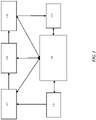
- FIG. 1 illustrates an example system architecture for classifying a stream of a video frames using a self-attention-based machine-learning model.
- a computing device 101 may access a stream of F video frames 110. Each of the video frames 110 may comprise non-overlapping and identical-sized N patches.
- the computing device 101 may generate an initial embedding vector 115 for each of the N ⁇ F patches.
- the computing device 101 may provide the generated initial embedding vectors 115 to a self-attention-based machine-learning model 105.
- the self-attention-based machine-learning model 105 may comprise an encoder with L serial encoding blocks.
- the computing device 101 may generate a layer-specific embedding vector corresponding to each of the N ⁇ F patches by computing a temporal attention and a spatial attention for the patch based on embedding vectors generated at a previous encoding block.
- the self-attention-based machine-learning model 105 may produce a classification embedding 120 based on one or more of embedding vectors generated at a last encoding block of the L encoding blocks.
- the computing device 101 may determine a class 130 of the stream of video frames 110 based on the generated classification embedding 120.
- the computing device 101 may access a stream of F video frames 110.
- Each of the F video frames 110 may comprise N patches that are non-overlapping and of an identical size.
- the computing device 101 may sample F video frames 110 from a longer stream of video frames.
- Each frame may comprise Red, Green and Blue (RGB) channels.
- RGB Red, Green and Blue
- a size of a frame may be H ⁇ W.
- this disclosure describes accessing a stream of video frames, each comprising N patches in a particular manner, this disclosure contemplates accessing a stream of video frames, each comprising N patches in any suitable manner.
- the computing device 101 may generate an initial embedding vector 115 corresponding to each of the N ⁇ F patches in the F video frames.
- the computing device may create a color embedding vector by multiplying color information of the patch with a color information embedding matrix, and add a positional embedding vector to the color embedding vector.
- the color information embedding matrix may be trained during a training procedure.
- the positional embedding vector may be trained during the training procedure.
- the computing device 101 may add a special learnable vector z 0,0 0 ⁇ R D representing the embedding of the classification token in the first position of the sequence.
- An encoding of the classification token in a final encoding block may be taken as the global representation of the stream of video frames 110 and may be used for classification.
- the computing device 101 may provide the generated N ⁇ F initial embedding vectors 115 to the self-attention-based machine-learning model 105 as input.
- the self-attention-based machine-learning model 105 may be a Transformer network.
- the self-attention-based machine-learning model 105 may comprise L serial encoding blocks.
- FIG.2 illustrates an example logical architecture of a self-attention-based machine-learning model.
- the self-attention-based machine-learning model 105 may comprise L serial encoding blocks.
- Encoding block l of the L encoding blocks may access layer-specific embedding vectors z ( l -1) generated by encoding block l -1 of the L encoding blocks and generate layer-specific embedding vectors z ( l ) based on accessed embedding vectors z ( l -1) .
- the self-attention-based machine-learning model 105 may also comprise an MLP may predict a class of the stream of video frames 110 based on a classification embedding 120.
- the computing device 101 may generate an embedding vector corresponding to a particular patch in the particular video frame at encoding block / of the L encoding blocks based on embedding vectors generated at a preceding encoding block of the L encoding blocks. For generating embedding vectors at a first encoding block of the L encoding blocks, the computing device may use the initial embedding vectors. As an example and not by way of limitation, illustrated in FIG. 2 , the computing device 101 may provide the generated N ⁇ F initial embedding vectors 115 to a first encoding block 105-1 of the self-attention-based machine-learning model 105.
- the first encoding block 105-1 may generate layer-specific embedding vectors z (1) corresponding to the N ⁇ F patches based on the accessed initial embedding vectors 115.
- the generated layer-specific embedding vectors z (1) may be provided to a second encoding block 105-2.
- the second encoding block 105-2 may generate layer-specific embedding vectors z (2) corresponding to the N ⁇ F patches based on the accessed embedding vectors z (1) .
- a last encoding block 105- L may receive embedding vectors z ( L -1) generated by a preceding encoding block.
- the last encoding block 105- L may generate layer-specific embedding vectors z ( L ) corresponding to the N ⁇ F patches based on the accessed embedding vectors z ( L -1) .
- this disclosure describes generating layer-specific embedding vectors corresponding to the N ⁇ F patches in a particular manner, this disclosure contemplates generating layer-specific embedding vectors corresponding to the N ⁇ F patches in any suitable manner.
- the L encoding blocks may be multi-headed.
- Self-attention weights may be computed via dot-product.
- the computing device 101 may compute a joint space-time attention for query patch ( p, t ).
- attention is computed over one dimension only (e.g., spatial-only or temporal-only), the computation may be significantly reduced.
- the computing device 101 may (1) compute a temporal attention based on comparisons between the embedding vector corresponding to the particular patch generated at encoding block l -1 of the L encoding blocks and embedding vectors corresponding to one or more patches in one or more other video frames generated at encoding block l -1 and (2) compute a spatial attention based on comparisons between the embedding vector corresponding to the particular patch generated at encoding block l -1 and embedding vectors corresponding to one or more other patches in the particular video frame generated at encoding block l -1.
- the one or more patches in the one or more other video frames may comprise one or more patches at a spatial location of the particular patch in their corresponding video frames.
- FIGs 3A-3C illustrate example space-time self-attention schemes.
- the computing device 101 computes an embedding vector z p t l corresponding to a patch 301 of frame t, which is indicated by dark dots.
- the patches 303 indicated by vertical stripes are used for computing either a spatial attention or a temporal attention for the patch 301.
- the empty patches 305 are not used for computing either the spatial attention or the temporal attention for the patch 301.
- FIG. 3A illustrates a space attention only scheme, where the temporal attention is not calculated.
- FIG. 3A illustrates a joint space-time attention scheme.
- a spatiotemporal attention may be calculated based on comparisons between the embedding vector z p t l ⁇ 1 corresponding to the patch 301 generated at encoding block l -1 and embedding vectors z p ′ t l ⁇ 1 corresponding to other patches 303 in the frame t and embedding vectors z p ′ t ′ l ⁇ 1 corresponding to patches 303 in the frame t + ⁇ and the frame t - ⁇ generated at encoding block l -1.
- this scheme is computationally expensive.
- a more efficient scheme for spatiotemporal attention named "divided space-time attention" is illustrated in FIG.
- new key/query/value vectors may be obtained from z ′ p t 1 time and spatial attention is then computed using an above equation for ⁇ p t 1 a space .
- the resulting vector z ′ p t 1 space is passed to the MLP to compute the final encoding z p t 1 of the patch ( p, t )at block / .
- distinct query/key/value matrices W Q time l a , W K time l a , W V time l a and W Q space l a , W K space , l a , W V space l a may be trained over the time and space dimensions.
- the computing device 101 may compute the spatial attention before the temporal attention within each block.
- this disclosure describes computing divided space-time attention at each block of the L encoding blocks in a particular manner, this disclosure contemplates computing divided space-time attention at each block of the L encoding blocks in any suitable manner.
- the computing device 101 may generate an embedding vector z p t 1 corresponding to the particular patch based on the computed temporal attention and the computed spatial attention at block / of the L encoding blocks.
- the computing device 101 may process the computed temporal attention and the computed spatial attention using a 1-hidden-layer MLP.
- FIG. 4 illustrates an example logic diagram for an encoding block.
- the embedding vectors z ( l -1) 401 generated by block l -1 of the L encoding block may be provided to block l of the L encoding blocks.
- the computing device 101 may compute a time attention for each patch using the equation for ⁇ p t l a time .
- the computing device 101 may compute z ′ p ,t l time for each patch by combining the embedding vector z p t l ⁇ 1 401 with the output of the time attention at 410.
- the computing device 101 may compute a space attention for each patch using the equation for ⁇ p t l a space .
- the computing device 101 may compute z ′ p t l space by combining z ′ p ,t l time computed at 415 with the output of the space attention at 420.
- the computing device 101 may compute MLP LN z ′ p ,t l space using a 1-hidden-layer MLP.
- the computing device 101 may generate an embedding vector z p ,t l 402 for each patch by combining z ′ p t l space with the output of 435.
- the computing device 101 may generate a classification embedding 120 by taking a layer normalization on one or more of embedding vectors generated at a last encoding block of the L encoding blocks.
- the computing device 101 may take a layer normalization on the embedding vector z 0,0 L corresponding to the classification token generated at the last block of the L embedding block to generate the classification embedding 120.
- the embedding vector z 0,0 L corresponding to the classification token in the last encoding block may be taken as the global representation of the stream of video frames 110 and may be used for classification.
- the computing device 101 may determine a class 130 of the stream of video frames 110 based on the generated classification embedding 120. To determine the class of the stream of video frames, the computing device may process the classification embedding using a 1-hidden-layer MLP 105A of the self-attention-based machine-learning model 105.
- this disclosure describes determining a class of a stream of video frames based on a generated classification embedding in a particular manner, this disclosure contemplates determining a class of a stream of video frames based on a generated classification embedding in any suitable manner.
- FIG. 5 illustrates an example method 500 for classifying a stream of video frames using a self-attention-based machine-learning model.
- the method may begin at step 510, where the computing device 101 may access a stream of F video frames. Each of the F video frames may comprise N patches that are non-overlapping.
- the computing device 101 may generating an initial embedding vector for each of the N ⁇ F patches in the F video frames.
- the computing device 101 may generate a classification embedding by processing the generated N ⁇ F initial embedding vectors using a self-attention-based machine-learning model that computes a temporal attention and a spatial attention for each of the N ⁇ F patches.
- the temporal attention and the spatial attention of a particular patch in a particular video frame of the F video frames may be computed by comparing information associated with the particular patch with information associated with (1) patches in other video frames of the F video frames and (2) other patches in the particular video frame.
- the computing device 101 may determine a class of the stream of video frames based on the generated classification embedding. Particular embodiments may repeat one or more steps of the method of FIG. 5 , where appropriate.
- this disclosure describes and illustrates an example method for classifying a stream of video frames using a self-attention-based machine-learning model including the particular steps of the method of FIG. 5
- this disclosure contemplates any suitable method for classifying a stream of video frames using a self-attention-based machine-learning model including any suitable steps, which may include all, some, or none of the steps of the method of FIG. 5 , where appropriate.
- this disclosure describes and illustrates particular components, devices, or systems carrying out particular steps of the method of FIG. 5
- this disclosure contemplates any suitable combination of any suitable components, devices, or systems carrying out any suitable steps of the method of FIG. 5 .
- FIG. 6 illustrates an example computer system 600.
- one or more computer systems 600 perform one or more steps of one or more methods described or illustrated herein.
- one or more computer systems 600 provide functionality described or illustrated herein.
- software running on one or more computer systems 600 performs one or more steps of one or more methods described or illustrated herein or provides functionality described or illustrated herein.
- Particular embodiments include one or more portions of one or more computer systems 600.
- reference to a computer system may encompass a computing device, and vice versa, where appropriate.
- reference to a computer system may encompass one or more computer systems, where appropriate.
- computer system 600 may be an embedded computer system, a system-on-chip (SOC), a single-board computer system (SBC) (such as, for example, a computer-on-module (COM) or system-on-module (SOM)), a desktop computer system, a laptop or notebook computer system, an interactive kiosk, a mainframe, a mesh of computer systems, a mobile telephone, a personal digital assistant (PDA), a server, a tablet computer system, or a combination of two or more of these.
- SOC system-on-chip
- SBC single-board computer system
- COM computer-on-module
- SOM system-on-module
- computer system 600 may include one or more computer systems 600; be unitary or distributed; span multiple locations; span multiple machines; span multiple data centers; or reside in a cloud, which may include one or more cloud components in one or more networks.
- one or more computer systems 600 may perform without substantial spatial or temporal limitation one or more steps of one or more methods described or illustrated herein.
- one or more computer systems 600 may perform in real time or in batch mode one or more steps of one or more methods described or illustrated herein.
- One or more computer systems 600 may perform at different times or at different locations one or more steps of one or more methods described or illustrated herein, where appropriate.
- computer system 600 includes a processor 602, memory 604, storage 606, an input/output (I/O) interface 608, a communication interface 610, and a bus 612.
- I/O input/output
- this disclosure describes and illustrates a particular computer system having a particular number of particular components in a particular arrangement, this disclosure contemplates any suitable computer system having any suitable number of any suitable components in any suitable arrangement.
- processor 602 includes hardware for executing instructions, such as those making up a computer program.
- processor 602 may retrieve (or fetch) the instructions from an internal register, an internal cache, memory 604, or storage 606; decode and execute them; and then write one or more results to an internal register, an internal cache, memory 604, or storage 606.
- processor 602 may include one or more internal caches for data, instructions, or addresses. This disclosure contemplates processor 602 including any suitable number of any suitable internal caches, where appropriate.
- processor 602 may include one or more instruction caches, one or more data caches, and one or more translation lookaside buffers (TLBs).
- TLBs translation lookaside buffers
- Instructions in the instruction caches may be copies of instructions in memory 604 or storage 606, and the instruction caches may speed up retrieval of those instructions by processor 602.
- Data in the data caches may be copies of data in memory 604 or storage 606 for instructions executing at processor 602 to operate on; the results of previous instructions executed at processor 602 for access by subsequent instructions executing at processor 602 or for writing to memory 604 or storage 606; or other suitable data.
- the data caches may speed up read or write operations by processor 602.
- the TLBs may speed up virtual-address translation for processor 602.
- processor 602 may include one or more internal registers for data, instructions, or addresses. This disclosure contemplates processor 602 including any suitable number of any suitable internal registers, where appropriate. Where appropriate, processor 602 may include one or more arithmetic logic units (ALUs); be a multi-core processor; or include one or more processors 602. Although this disclosure describes and illustrates a particular processor, this disclosure contemplates any suitable processor.
- ALUs
- memory 604 includes main memory for storing instructions for processor 602 to execute or data for processor 602 to operate on.
- computer system 600 may load instructions from storage 606 or another source (such as, for example, another computer system 600) to memory 604.
- Processor 602 may then load the instructions from memory 604 to an internal register or internal cache.
- processor 602 may retrieve the instructions from the internal register or internal cache and decode them.
- processor 602 may write one or more results (which may be intermediate or final results) to the internal register or internal cache.
- Processor 602 may then write one or more of those results to memory 604.
- processor 602 executes only instructions in one or more internal registers or internal caches or in memory 604 (as opposed to storage 606 or elsewhere) and operates only on data in one or more internal registers or internal caches or in memory 604 (as opposed to storage 606 or elsewhere).
- One or more memory buses (which may each include an address bus and a data bus) may couple processor 602 to memory 604.
- Bus 612 may include one or more memory buses, as described below.
- one or more memory management units reside between processor 602 and memory 604 and facilitate accesses to memory 604 requested by processor 602.
- memory 604 includes random access memory (RAM). This RAM may be volatile memory, where appropriate.
- this RAM may be dynamic RAM (DRAM) or static RAM (SRAM). Moreover, where appropriate, this RAM may be single-ported or multi-ported RAM.
- This disclosure contemplates any suitable RAM Memory 604 may include one or more memories 604, where appropriate. Although this disclosure describes and illustrates particular memory, this disclosure contemplates any suitable memory.
- storage 606 includes mass storage for data or instructions.
- storage 606 may include a hard disk drive (HDD), a floppy disk drive, flash memory, an optical disc, a magneto-optical disc, magnetic tape, or a Universal Serial Bus (USB) drive or a combination of two or more of these.
- Storage 606 may include removable or non-removable (or fixed) media, where appropriate.
- Storage 606 may be internal or external to computer system 600, where appropriate.
- storage 606 is non-volatile, solid-state memory.
- storage 606 includes read-only memory (ROM).
- this ROM may be mask-programmed ROM, programmable ROM (PROM), erasable PROM (EPROM), electrically erasable PROM (EEPROM), electrically alterable ROM (EAROM), or flash memory or a combination of two or more of these.
- This disclosure contemplates mass storage 606 taking any suitable physical form.
- Storage 606 may include one or more storage control units facilitating communication between processor 602 and storage 606, where appropriate.
- storage 606 may include one or more storages 606.
- this disclosure describes and illustrates particular storage, this disclosure contemplates any suitable storage.
- I/O interface 608 includes hardware, software, or both, providing one or more interfaces for communication between computer system 600 and one or more I/O devices.
- Computer system 600 may include one or more of these I/O devices, where appropriate.
- One or more of these I/O devices may enable communication between a person and computer system 600.
- an I/O device may include a keyboard, keypad, microphone, monitor, mouse, printer, scanner, speaker, still camera, stylus, tablet, touch screen, trackball, video camera, another suitable I/O device or a combination of two or more of these.
- An I/O device may include one or more sensors. This disclosure contemplates any suitable I/O devices and any suitable I/O interfaces 608 for them.
- I/O interface 608 may include one or more device or software drivers enabling processor 602 to drive one or more of these I/O devices.
- I/O interface 608 may include one or more I/O interfaces 608, where appropriate. Although this disclosure describes and illustrates a particular I/O interface, this disclosure contemplates any suitable I/O interface.
- communication interface 610 includes hardware, software, or both providing one or more interfaces for communication (such as, for example, packet-based communication) between computer system 600 and one or more other computer systems 600 or one or more networks.
- communication interface 610 may include a network interface controller (NIC) or network adapter for communicating with an Ethernet or other wire-based network or a wireless NIC (WNIC) or wireless adapter for communicating with a wireless network, such as a WI-FI network.
- NIC network interface controller
- WNIC wireless NIC
- WI-FI network wireless network
- computer system 600 may communicate with an ad hoc network, a personal area network (PAN), a local area network (LAN), a wide area network (WAN), a metropolitan area network (MAN), or one or more portions of the Internet or a combination of two or more of these.
- PAN personal area network
- LAN local area network
- WAN wide area network
- MAN metropolitan area network
- computer system 600 may communicate with a wireless PAN (WPAN) (such as, for example, a BLUETOOTH WPAN), a WI-FI network, a WI-MAX network, a cellular telephone network (such as, for example, a Global System for Mobile Communications (GSM) network), or other suitable wireless network or a combination of two or more of these.
- WPAN wireless PAN
- WI-FI wireless personal area network
- WI-MAX wireless personal area network
- WI-MAX wireless personal area network
- cellular telephone network such as, for example, a Global System for Mobile Communications (GSM) network
- GSM Global System
- bus 612 includes hardware, software, or both coupling components of computer system 600 to each other.
- bus 612 may include an Accelerated Graphics Port (AGP) or other graphics bus, an Enhanced Industry Standard Architecture (EISA) bus, a front-side bus (FSB), a HYPERTRANSPORT (HT) interconnect, an Industry Standard Architecture (ISA) bus, an INFINIBAND interconnect, a low-pin-count (LPC) bus, a memory bus, a Micro Channel Architecture (MCA) bus, a Peripheral Component Interconnect (PCI) bus, a PCI-Express (PCIe) bus, a serial advanced technology attachment (SATA) bus, a Video Electronics Standards Association local (VLB) bus, or another suitable bus or a combination of two or more of these.
- Bus 612 may include one or more buses 612, where appropriate.
- a computer-readable non-transitory storage medium or media may include one or more semiconductor-based or other integrated circuits (ICs) (such, as for example, field-programmable gate arrays (FPGAs) or application-specific ICs (ASICs)), hard disk drives (HDDs), hybrid hard drives (HHDs), optical discs, optical disc drives (ODDs), magneto-optical discs, magneto-optical drives, floppy diskettes, floppy disk drives (FDDs), magnetic tapes, solid-state drives (SSDs), RAM-drives, SECURE DIGITAL cards or drives, any other suitable computer-readable non-transitory storage media, or any suitable combination of two or more of these, where appropriate.
- ICs such, as for example, field-programmable gate arrays (FPGAs) or application-specific ICs (ASICs)
- HDDs hard disk drives
- HHDs hybrid hard drives
- ODDs optical disc drives
- magneto-optical discs magneto-optical drives
- references in the appended claims to an apparatus or system or a component of an apparatus or system being adapted to, arranged to, capable of, configured to, enabled to, operable to, or operative to perform a particular function encompasses that apparatus, system, component, whether or not it or that particular function is activated, turned on, or unlocked, as long as that apparatus, system, or component is so adapted, arranged, capable, configured, enabled, operable, or operative. Additionally, although this disclosure describes or illustrates particular embodiments as providing particular advantages, particular embodiments may provide none, some, or all of these advantages.
Landscapes
- Engineering & Computer Science (AREA)
- Theoretical Computer Science (AREA)
- Physics & Mathematics (AREA)
- General Physics & Mathematics (AREA)
- Software Systems (AREA)
- Computer Vision & Pattern Recognition (AREA)
- Multimedia (AREA)
- Evolutionary Computation (AREA)
- Artificial Intelligence (AREA)
- Data Mining & Analysis (AREA)
- Computing Systems (AREA)
- General Engineering & Computer Science (AREA)
- Health & Medical Sciences (AREA)
- General Health & Medical Sciences (AREA)
- Medical Informatics (AREA)
- Life Sciences & Earth Sciences (AREA)
- Computational Linguistics (AREA)
- Mathematical Physics (AREA)
- Databases & Information Systems (AREA)
- Evolutionary Biology (AREA)
- Bioinformatics & Computational Biology (AREA)
- Bioinformatics & Cheminformatics (AREA)
- Molecular Biology (AREA)
- Biophysics (AREA)
- Biomedical Technology (AREA)
- Image Analysis (AREA)
- Compression Or Coding Systems Of Tv Signals (AREA)
- Information Retrieval, Db Structures And Fs Structures Therefor (AREA)
- Two-Way Televisions, Distribution Of Moving Picture Or The Like (AREA)
Abstract
In one embodiment, a method includes accessing a stream of F video frames, where each of the F video frames includes N patches that are non-overlapping, generating an initial embedding vector for each of the N × F patches in the F video frames, generating a classification embedding by processing the generated N × F initial embedding vectors using a self-attention-based machinelearning model that computes a temporal attention and a spatial attention for each of the N × F patches, and determining a class of the stream of video frames based on the generated classification embedding.
Description
- This disclosure generally relates to machine-learning technologies, and in particular relates to classifying a video stream using a machine-learning model.
- Artificial neural networks (ANNs), usually simply called neural networks (NNs), are computing systems vaguely inspired by the biological neural networks that constitute animal brains. An ANN is based on a collection of connected units or nodes called artificial neurons, which loosely model the neurons in a biological brain. Each connection, like the synapses in a biological brain, can transmit a signal to other neurons. An artificial neuron that receives a signal then processes it and can signal neurons connected to it. The "signal" at a connection is a real number, and the output of each neuron is computed by some non-linear function of the sum of its inputs. The connections are called edges. Neurons and edges typically have a weight that adjusts as learning proceeds. The weight increases or decreases the strength of the signal at a connection. Neurons may have a threshold such that a signal is sent only if the aggregate signal crosses that threshold. Typically, neurons are aggregated into layers. Different layers may perform different transformations on their inputs. Signals travel from the first layer (the input layer), to the last layer (the output layer), possibly after traversing the layers multiple times. Generative Adversarial Networks (GANs) are a type of the ANNs that generate new data, such as a new image, based on input data.
- Particular embodiments described herein relate to systems and methods for classifying a stream of video frames using a self-attention-based machine-learning model, such as a Transformer network. The classification may be done based on the context of the stream of video frames. For various video processing tasks, two-dimensional or three-dimensional convolutions have been considered as the core operators for spatiotemporal feature learning. Convolutional models have a few inherent limitations for video analysis. First, while their strong inductive biases (e.g., local connectivity and translation equivariance) are undoubtedly beneficial on small training sets, those strong inductive biases may limit the expressivity of the model in settings where large amount of data is available and "all" can be learned from examples. Compared to convolutional neural networks (CNNs), a self-attention-based machine-learning model may impose less restrictive inductive biases. The self-attention-based machine-learning model may be used for a broader tasks and be better suited to modern big-data regimes where there is less need for strong inductive priors. Second, while convolutional kernels are specifically designed to capture short-range spatiotemporal information, the convolutional kernels cannot model dependencies that extend beyond the receptive field. While deep stacks of convolutions naturally extend the receptive field, these strategies are inherently limited in capturing long-range dependencies by means of aggregation of shorter-range information. Conversely, the self-attention mechanism can be applied to capture both local as well as global long-range dependencies by directly comparing feature activations at all space-time locations, much beyond the receptive field of traditional convolutional filters. Finally, despite the advances in GPU hardware acceleration, training deep CNNs remains very costly, especially when applied to high-resolution and long videos. The self-attention-based machine-learning model may be faster in both training and inference compared to CNNs. Compared to the established paradigm of convolution-based video architecture, the self-attention-based machine-learning model follows a radically different design. Yet, the self-attention-based machine-learning model achieves accuracy comparable, and in some cases superior, to the state-of-the-art in this field. Experiment results show that the proposed self-attention-based machine-learning model may be used for long-range modeling of videos spanning many minutes.
- In particular embodiments, a computing device may access a stream of F video frames. Each of the F video frames may comprise N patches that are non-overlapping and of an identical size. The computing device may generate an initial embedding vector corresponding to each of the N × F patches in the F video frames. To generate an initial embedding vector corresponding to a patch, the computing device may create a color embedding vector by multiplying color information of the patch with a color information embedding matrix, and add a positional embedding vector to the color embedding vector. The color information embedding matrix may be trained during a training procedure. The positional embedding vector may be trained during the training procedure. The computing device may provide the generated N × F initial embedding vectors to a self-attention-based machine-learning model as input. In particular embodiments, the self-attention-based machine-learning model may be a Transformer network. The self-attention-based machine-learning model may comprise L serial encoding blocks. The computing device may generate an embedding vector corresponding to a particular patch in the particular video frame at encoding block l of the L encoding blocks based on embedding vectors generated at a preceding encoding block of the L encoding blocks. For generating embedding vectors at a first encoding block of the L encoding blocks, the computing device may use the initial embedding vectors. To generate an embedding vector corresponding to the particular patch in the particular video frame at encoding block l of the L encoding blocks, the computing device may (1) compute a temporal attention based on comparisons between the embedding vector corresponding to the particular patch generated at encoding block l-1 of the L encoding blocks and embedding vectors corresponding to one or more patches in one or more other video frames generated at encoding block l-1 and (2) compute a spatial attention based on comparisons between the embedding vector corresponding to the particular patch generated at encoding block l-1 and embedding vectors corresponding to one or more other patches in the particular video frame generated at encoding block l-1. In particular embodiments, the one or more patches in the one or more other video frames may comprise one or more patches at a spatial location of the particular patch in their corresponding video frames. In particular embodiments, the L encoding blocks may be multi-headed. The computing device may generate an embedding vector corresponding to the particular patch based on the computed temporal attention and the computed spatial attention. To generate the embedding vector corresponding to the particular patch based on the computed temporal attention and the computed spatial attention, the computing device may process the computed temporal attention and the computed spatial attention using a multilayer perceptron (MLP). The computing device may generate a classification embedding by taking a layer normalization on one or more of embedding vectors generated at a last encoding block of the L encoding blocks. The computing device may determine a class of the stream of video frames based on the generated classification embedding. To determine the class of the stream of video frames, the computing device may process the classification embedding using an MLP.
- In accordance with a first aspect of the present disclosure, there is provided a method comprising, by a computing device: accessing a stream of F video frames, wherein each of the F video frames comprises N patches that are non-overlapping; generating, for each of the N × F patches in the F video frames, an initial embedding vector; generating a classification embedding by processing the generated N × F initial embedding vectors using a self-attention-based machine-learning model that computes a temporal attention and a spatial attention for each of the N × F patches, wherein the temporal attention and the spatial attention of a particular patch in a particular video frame of the F video frames are computed by comparing information associated with the particular patch with information associated with (1) patches in other video frames of the F video frames and (2) other patches in the particular video frame; and determining a class of the stream of video frames based on the generated classification embedding.
- In some embodiments, the generated N × F initial embedding vectors are provided to the self-attention-based machine-learning model as input, wherein the self-attention-based machine-learning model comprises L serial encoding blocks.
- In some embodiments, the computing device generates embedding vectors corresponding to the N × F patches at each block of the L encoding blocks based on embedding vectors generated at a preceding block of the L encoding blocks.
- In some embodiments, generating an embedding vector corresponding to the particular patch in the particular video frame at
block 1 of the L encoding blocks comprises: computing a temporal attention based on comparisons between the embedding vector corresponding to the particular patch generated at block 1-1 of the L encoding blocks and embedding vectors corresponding to the patches in the other video frames generated at block 1-1; computing a spatial attention based on comparisons between the embedding vector corresponding to the particular patch generated at block 1-1 and embedding vectors corresponding to the other patches in the particular video frame generated at block 1-1; and generating an embedding vector corresponding to the particular patch based on the computed temporal attention and the computed spatial attention. - In some embodiments, the patches in the other video frames comprises patches at a spatial location of the particular patch in their corresponding video frames.
- In some embodiments, generating the embedding vector corresponding to the particular patch based on the computed temporal attention and the computed spatial attention comprises processing the computed temporal attention and the computed spatial attention using a multilayer perceptron (MLP).
- In some embodiments, the classification embedding is generated by taking a layer normalization on one or more of embedding vectors generated at a last block of the L encoding blocks.
- In some embodiments, the L encoding blocks are multi-headed.
- In some embodiments, determining a class of the stream of video frames comprises processing the classification embedding using an MLP.
- In some embodiments, generating an initial embedding vector corresponding to a patch comprises: creating a color embedding vector by multiplying color information of the patch with a color information embedding matrix; and adding a positional embedding vector to the color embedding vector.
- In some embodiments, the color information embedding matrix is trained during a training procedure, and wherein the positional embedding vector is trained during the training procedure.
- In some embodiments, the self-attention-based machine-learning model is a Transformer network.
- In accordance with a second aspect of the present disclosure, there is provided one or more computer-readable non-transitory storage media embodying software that is operable when executed to: access a stream of F video frames, wherein each of the F video frames comprises N patches that are non-overlapping; generate, for each of the N × F patches in the F video frames, an initial embedding vector; generate a classification embedding by processing the generated N × F initial embedding vectors using a self-attention-based machine-learning model that computes a temporal attention and a spatial attention for each of the N × F patches, wherein the temporal attention and the spatial attention of a particular patch in a particular video frame of the F video frames are computed by comparing information associated with the particular patch with information associated with (1) patches in other video frames of the F video frames and (2) other patches in the particular video frame; and determine a class of the stream of video frames based on the generated classification embedding.
- In some embodiments, the generated N × F initial embedding vectors are provided to the self-attention-based machine-learning model as input, wherein the self-attention-based machine-learning model comprises L serial encoding blocks.
- In some embodiments, the computing device generates embedding vectors corresponding to the N × F patches at each block of the L encoding blocks based on embedding vectors generated at a preceding block of the L encoding blocks.
- In some embodiments, generating an embedding vector corresponding to the particular patch in the particular video frame at
block 1 of the L encoding blocks comprises: computing a temporal attention based on comparisons between the embedding vector corresponding to the particular patch generated at block 1-1 of the L encoding blocks and embedding vectors corresponding to the patches in the other video frames generated at block 1-1; computing a spatial attention based on comparisons between the embedding vector corresponding to the particular patch generated at block 1-1 and embedding vectors corresponding to the other patches in the particular video frame generated at block 1-1; and generating an embedding vector corresponding to the particular patch based on the computed temporal attention and the computed spatial attention. - In some embodiments, the patches in the other video frames comprises patches at a spatial location of the particular patch in their corresponding video frames.
- In some embodiments, generating the embedding vector corresponding to the particular patch based on the computed temporal attention and the computed spatial attention comprises processing the computed temporal attention and the computed spatial attention using a multilayer perceptron (MLP).
- In some embodiments, the classification embedding is generated by taking a layer normalization on one or more of embedding vectors generated at a last block of the L encoding blocks.
- In accordance with a third aspect of the present disclosure, there is provided A system comprising: one or more processors; and a non-transitory memory coupled to the processors comprising instructions executable by the processors, the processors operable when executing the instructions to: access a stream of F video frames, wherein each of the F video frames comprises N patches that are non-overlapping; generate, for each of the N × F patches in the F video frames, an initial embedding vector; generate a classification embedding by processing the generated N × F initial embedding vectors using a self-attention-based machine-learning model that computes a temporal attention and a spatial attention for each of the N × F patches, wherein the temporal attention and the spatial attention of a particular patch in a particular video frame of the F video frames are computed by comparing information associated with the particular patch with information associated with (1) patches in other video frames of the F video frames and (2) other patches in the particular video frame; and determine a class of the stream of video frames based on the generated classification embedding.
- The embodiments disclosed herein are only examples, and the scope of this disclosure is not limited to them. Particular embodiments may include all, some, or none of the components, elements, features, functions, operations, or steps of the embodiments disclosed herein. Embodiments according to the invention are in particular disclosed in the attached claims directed to a method, a storage medium, a system and a computer program product, wherein any feature mentioned in one claim category, e.g. method, can be claimed in another claim category, e.g. system, as well. The dependencies or references back in the attached claims are chosen for formal reasons only. However any subject matter resulting from a deliberate reference back to any previous claims (in particular multiple dependencies) can be claimed as well, so that any combination of claims and the features thereof are disclosed and can be claimed regardless of the dependencies chosen in the attached claims. The subject-matter which can be claimed comprises not only the combinations of features as set out in the attached claims but also any other combination of features in the claims, wherein each feature mentioned in the claims can be combined with any other feature or combination of other features in the claims. Furthermore, any of the embodiments and features described or depicted herein can be claimed in a separate claim and/or in any combination with any embodiment or feature described or depicted herein or with any of the features of the attached claims.
- It will be appreciated that any features described herein as being suitable for incorporation into one or more aspects or embodiments of the present disclosure are intended to be generalizable across any and all aspects and embodiments of the present disclosure. Other aspects of the present disclosure can be understood by those skilled in the art in light of the description, the claims, and the drawings of the present disclosure. The foregoing general description and the following detailed description are exemplary and explanatory only and are not restrictive of the claims
-
-
FIG. 1 illustrates an example system architecture for classifying a stream of a video frames using a self-attention-based machine-learning model. -
FIG.2 illustrates an example logical architecture of a self-attention-based machine-learning model. -
FIGs 3A-3C illustrate example space-time self-attention schemes. -
FIG. 4 illustrates an example logic diagram for an encoding block. -
FIG. 5 illustrates an example method for classifying a stream of video frames using a self-attention-based machine-learning model. -
FIG. 6 illustrates an example computer system. -
FIG. 1 illustrates an example system architecture for classifying a stream of a video frames using a self-attention-based machine-learning model. Acomputing device 101 may access a stream of F video frames 110. Each of the video frames 110 may comprise non-overlapping and identical-sized N patches. Thecomputing device 101 may generate an initial embeddingvector 115 for each of the N × F patches. Thecomputing device 101 may provide the generated initial embeddingvectors 115 to a self-attention-based machine-learning model 105. The self-attention-based machine-learning model 105 may comprise an encoder with L serial encoding blocks. At each encoding block of the L encoding blocks, thecomputing device 101 may generate a layer-specific embedding vector corresponding to each of the N × F patches by computing a temporal attention and a spatial attention for the patch based on embedding vectors generated at a previous encoding block. The self-attention-based machine-learning model 105 may produce a classification embedding 120 based on one or more of embedding vectors generated at a last encoding block of the L encoding blocks. Thecomputing device 101 may determine aclass 130 of the stream of video frames 110 based on the generated classification embedding 120. Although this disclosure describes classifying a stream of video frames using a self-attention-based machine-learning model in a particular manner, this disclosure contemplates classifying a stream of video frames using a self-attention-based machine-learning model in any suitable manner. - In particular embodiments, the
computing device 101 may access a stream of F video frames 110. Each of the F video frames 110 may comprise N patches that are non-overlapping and of an identical size. As an example and not by way of limitation, thecomputing device 101 may sample F video frames 110 from a longer stream of video frames. Each frame may comprise Red, Green and Blue (RGB) channels. A size of a frame may be H × W. Thecomputing device 101 may decompose each frame into N non-overlapping patches, each of size P × P, such that the N patches span the entire frame, i.e., N = HW / P2. Although this disclosure describes accessing a stream of video frames, each comprising N patches in a particular manner, this disclosure contemplates accessing a stream of video frames, each comprising N patches in any suitable manner. - In particular embodiments, the
computing device 101 may generate an initial embeddingvector 115 corresponding to each of the N × F patches in the F video frames. To generate an initial embeddingvector 115 corresponding to a patch, the computing device may create a color embedding vector by multiplying color information of the patch with a color information embedding matrix, and add a positional embedding vector to the color embedding vector. The color information embedding matrix may be trained during a training procedure. The positional embedding vector may be trained during the training procedure. As an example and not by way of limitation, thecomputing device 101 may flatten the N × F patches into vectors

computing device 101 may linearly map each patch x (p,t) into an embedding vector


learning model 105 as input. In particular embodiments, thecomputing device 101 may add a speciallearnable vector 
- In particular embodiments, the
computing device 101 may provide the generated N × Finitial embedding vectors 115 to the self-attention-based machine-learning model 105 as input. In particular embodiments, the self-attention-based machine-learning model 105 may be a Transformer network. The self-attention-based machine-learning model 105 may comprise L serial encoding blocks.FIG.2 illustrates an example logical architecture of a self-attention-based machine-learning model. The self-attention-based machine-learning model 105 may comprise L serial encoding blocks. Encoding block l of the L encoding blocks may access layer-specific embedding vectors z (l-1) generated by encoding block l-1 of the L encoding blocks and generate layer-specific embedding vectors z (l) based on accessed embedding vectors z (l-1). The self-attention-based machine-learning model 105 may also comprise an MLP may predict a class of the stream of video frames 110 based on a classification embedding 120. Although this disclosure describes a particular architecture of the self-attention-based machine-learning model, this disclosure contemplates any suitable architecture of the self-attention-based machine-learning model. - In particular embodiments, the
computing device 101 may generate an embedding vector corresponding to a particular patch in the particular video frame at encoding block / of the L encoding blocks based on embedding vectors generated at a preceding encoding block of the L encoding blocks. For generating embedding vectors at a first encoding block of the L encoding blocks, the computing device may use the initial embedding vectors. As an example and not by way of limitation, illustrated inFIG. 2 , thecomputing device 101 may provide the generated N × Finitial embedding vectors 115 to a first encoding block 105-1 of the self-attention-based machine-learning model 105. The first encoding block 105-1 may generate layer-specific embedding vectors z (1) corresponding to the N × F patches based on the accessed initial embeddingvectors 115. The generated layer-specific embedding vectors z (1) may be provided to a second encoding block 105-2. The second encoding block 105-2 may generate layer-specific embedding vectors z (2) corresponding to the N × F patches based on the accessed embedding vectors z (1). A last encoding block 105-L may receive embedding vectors z (L-1) generated by a preceding encoding block. The last encoding block 105-L may generate layer-specific embedding vectors z (L) corresponding to the N × F patches based on the accessed embedding vectors z (L-1). Although this disclosure describes generating layer-specific embedding vectors corresponding to the N × F patches in a particular manner, this disclosure contemplates generating layer-specific embedding vectors corresponding to the N × F patches in any suitable manner. - In particular embodiments, the
computing device 101 may compute a query/key/value vector for each patch at block l from the representation


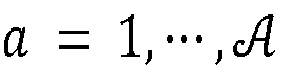 denotes the total number of attention heads. The latent dimensionality for each attention head is set to

computing device 101 may compute a joint space-time attention for query patch (p, t). The self-attention weights


- In particular embodiments, to generate an embedding vector corresponding to the particular patch in the particular video frame at encoding block l of the L encoding blocks, the
computing device 101 may (1) compute a temporal attention based on comparisons between the embedding vector corresponding to the particular patch generated at encoding block l-1 of the L encoding blocks and embedding vectors corresponding to one or more patches in one or more other video frames generated at encoding block l-1 and (2) compute a spatial attention based on comparisons between the embedding vector corresponding to the particular patch generated at encoding block l-1 and embedding vectors corresponding to one or more other patches in the particular video frame generated at encoding block l-1. In particular embodiments, the one or more patches in the one or more other video frames may comprise one or more patches at a spatial location of the particular patch in their corresponding video frames.FIGs 3A-3C illustrate example space-time self-attention schemes. In the examples illustrated inFIGs. 3A-3C , thecomputing device 101 computes an embedding vector
patch 301 of frame t, which is indicated by dark dots. Thepatches 303 indicated by vertical stripes are used for computing either a spatial attention or a temporal attention for thepatch 301. Theempty patches 305 are not used for computing either the spatial attention or the temporal attention for thepatch 301.FIG. 3A illustrates a space attention only scheme, where the temporal attention is not calculated. This scheme was known prior to the invention disclosed in this application. The space attention only scheme illustrated inFIG. 3A neglects to capture temporal dependencies across frames. The experiment results show that this approach leads to degraded classification accuracy compared to full spatiotemporal attention.FIG. 3B illustrates a joint space-time attention scheme. In this scheme, a spatiotemporal attention may be calculated based on comparisons between the embedding vector
patch 301 generated at encoding block l-1 and embedding vectors
other patches 303 in the frame t and embedding vectors
patches 303 in the frame t + δ and the frame t-δ generated at encoding block l-1. As discussed before, this scheme is computationally expensive. A more efficient scheme for spatiotemporal attention, named "divided space-time attention", is illustrated inFIG. 3C , where temporal attention and spatial attention are separately applied one after the other. For divided attention, within each block /, thecomputing device 101 may first compute a temporal attention by comparing each patch (p, t) with all the patches at the same spatial location in the other frames: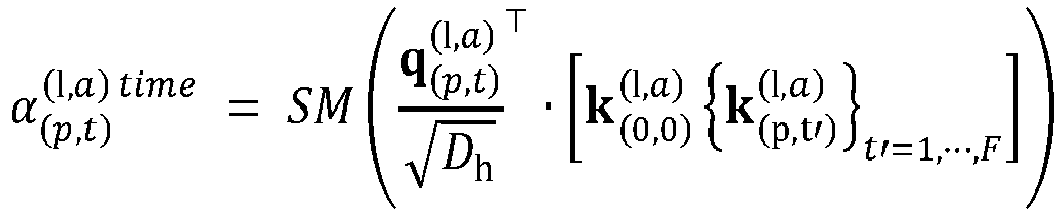


FIG 3B may perform (NF + 1) comparisons per patch, the divided attention scheme may only require (N + F + 2) comparisons per patch. The experiment results show that this space-time factorization is not only more efficient but it also leads to improved classification accuracy. In particular embodiments, thecomputing device 101 may compute the spatial attention before the temporal attention within each block. Although this disclosure describes computing divided space-time attention at each block of the L encoding blocks in a particular manner, this disclosure contemplates computing divided space-time attention at each block of the L encoding blocks in any suitable manner. - In particular embodiments, the
computing device 101 may generate an embedding vector

computing device 101 may process the computed temporal attention and the computed spatial attention using a 1-hidden-layer MLP.FIG. 4 illustrates an example logic diagram for an encoding block. The embeddingvectors z (l-1) 401 generated by block l-1 of the L encoding block may be provided to block l of the L encoding blocks. At 410, thecomputing device 101 may compute a time attention for each patch using the equation for
computing device 101 may compute

computing device 101 may compute a space attention for each patch using the equation for
computing device 101 may compute

computing device 101 may compute
computing device 101 may generate an embedding vector

- In particular embodiments, the
computing device 101 may generate a classification embedding 120 by taking a layer normalization on one or more of embedding vectors generated at a last encoding block of the L encoding blocks. As an example and not by way of limitation, thecomputing device 101 may take a layer normalization on the embeddingvector 
vector 
- In particular embodiments, the
computing device 101 may determine aclass 130 of the stream of video frames 110 based on the generated classification embedding 120. To determine the class of the stream of video frames, the computing device may process the classification embedding using a 1-hidden-layer MLP 105A of the self-attention-based machine-learning model 105. Although this disclosure describes determining a class of a stream of video frames based on a generated classification embedding in a particular manner, this disclosure contemplates determining a class of a stream of video frames based on a generated classification embedding in any suitable manner. -
FIG. 5 illustrates anexample method 500 for classifying a stream of video frames using a self-attention-based machine-learning model. The method may begin atstep 510, where thecomputing device 101 may access a stream of F video frames. Each of the F video frames may comprise N patches that are non-overlapping. Atstep 520, thecomputing device 101 may generating an initial embedding vector for each of the N × F patches in the F video frames. Atstep 530, thecomputing device 101 may generate a classification embedding by processing the generated N × F initial embedding vectors using a self-attention-based machine-learning model that computes a temporal attention and a spatial attention for each of the N × F patches. The temporal attention and the spatial attention of a particular patch in a particular video frame of the F video frames may be computed by comparing information associated with the particular patch with information associated with (1) patches in other video frames of the F video frames and (2) other patches in the particular video frame. Atstep 540, thecomputing device 101 may determine a class of the stream of video frames based on the generated classification embedding. Particular embodiments may repeat one or more steps of the method ofFIG. 5 , where appropriate. Although this disclosure describes and illustrates particular steps of the method ofFIG. 5 as occurring in a particular order, this disclosure contemplates any suitable steps of the method ofFIG. 5 occurring in any suitable order. Moreover, although this disclosure describes and illustrates an example method for classifying a stream of video frames using a self-attention-based machine-learning model including the particular steps of the method ofFIG. 5 , this disclosure contemplates any suitable method for classifying a stream of video frames using a self-attention-based machine-learning model including any suitable steps, which may include all, some, or none of the steps of the method ofFIG. 5 , where appropriate. Furthermore, although this disclosure describes and illustrates particular components, devices, or systems carrying out particular steps of the method ofFIG. 5 , this disclosure contemplates any suitable combination of any suitable components, devices, or systems carrying out any suitable steps of the method ofFIG. 5 . -
FIG. 6 illustrates anexample computer system 600. In particular embodiments, one ormore computer systems 600 perform one or more steps of one or more methods described or illustrated herein. In particular embodiments, one ormore computer systems 600 provide functionality described or illustrated herein. In particular embodiments, software running on one ormore computer systems 600 performs one or more steps of one or more methods described or illustrated herein or provides functionality described or illustrated herein. Particular embodiments include one or more portions of one ormore computer systems 600. Herein, reference to a computer system may encompass a computing device, and vice versa, where appropriate. Moreover, reference to a computer system may encompass one or more computer systems, where appropriate. - This disclosure contemplates any suitable number of
computer systems 600. This disclosure contemplatescomputer system 600 taking any suitable physical form. As example and not by way of limitation,computer system 600 may be an embedded computer system, a system-on-chip (SOC), a single-board computer system (SBC) (such as, for example, a computer-on-module (COM) or system-on-module (SOM)), a desktop computer system, a laptop or notebook computer system, an interactive kiosk, a mainframe, a mesh of computer systems, a mobile telephone, a personal digital assistant (PDA), a server, a tablet computer system, or a combination of two or more of these. Where appropriate,computer system 600 may include one ormore computer systems 600; be unitary or distributed; span multiple locations; span multiple machines; span multiple data centers; or reside in a cloud, which may include one or more cloud components in one or more networks. Where appropriate, one ormore computer systems 600 may perform without substantial spatial or temporal limitation one or more steps of one or more methods described or illustrated herein. As an example and not by way of limitation, one ormore computer systems 600 may perform in real time or in batch mode one or more steps of one or more methods described or illustrated herein. One ormore computer systems 600 may perform at different times or at different locations one or more steps of one or more methods described or illustrated herein, where appropriate. - In particular embodiments,
computer system 600 includes aprocessor 602,memory 604,storage 606, an input/output (I/O)interface 608, acommunication interface 610, and abus 612. Although this disclosure describes and illustrates a particular computer system having a particular number of particular components in a particular arrangement, this disclosure contemplates any suitable computer system having any suitable number of any suitable components in any suitable arrangement. - In particular embodiments,
processor 602 includes hardware for executing instructions, such as those making up a computer program. As an example and not by way of limitation, to execute instructions,processor 602 may retrieve (or fetch) the instructions from an internal register, an internal cache,memory 604, orstorage 606; decode and execute them; and then write one or more results to an internal register, an internal cache,memory 604, orstorage 606. In particular embodiments,processor 602 may include one or more internal caches for data, instructions, or addresses. This disclosure contemplatesprocessor 602 including any suitable number of any suitable internal caches, where appropriate. As an example and not by way of limitation,processor 602 may include one or more instruction caches, one or more data caches, and one or more translation lookaside buffers (TLBs). Instructions in the instruction caches may be copies of instructions inmemory 604 orstorage 606, and the instruction caches may speed up retrieval of those instructions byprocessor 602. Data in the data caches may be copies of data inmemory 604 orstorage 606 for instructions executing atprocessor 602 to operate on; the results of previous instructions executed atprocessor 602 for access by subsequent instructions executing atprocessor 602 or for writing tomemory 604 orstorage 606; or other suitable data. The data caches may speed up read or write operations byprocessor 602. The TLBs may speed up virtual-address translation forprocessor 602. In particular embodiments,processor 602 may include one or more internal registers for data, instructions, or addresses. This disclosure contemplatesprocessor 602 including any suitable number of any suitable internal registers, where appropriate. Where appropriate,processor 602 may include one or more arithmetic logic units (ALUs); be a multi-core processor; or include one ormore processors 602. Although this disclosure describes and illustrates a particular processor, this disclosure contemplates any suitable processor. - In particular embodiments,
memory 604 includes main memory for storing instructions forprocessor 602 to execute or data forprocessor 602 to operate on. As an example and not by way of limitation,computer system 600 may load instructions fromstorage 606 or another source (such as, for example, another computer system 600) tomemory 604.Processor 602 may then load the instructions frommemory 604 to an internal register or internal cache. To execute the instructions,processor 602 may retrieve the instructions from the internal register or internal cache and decode them. During or after execution of the instructions,processor 602 may write one or more results (which may be intermediate or final results) to the internal register or internal cache.Processor 602 may then write one or more of those results tomemory 604. In particular embodiments,processor 602 executes only instructions in one or more internal registers or internal caches or in memory 604 (as opposed tostorage 606 or elsewhere) and operates only on data in one or more internal registers or internal caches or in memory 604 (as opposed tostorage 606 or elsewhere). One or more memory buses (which may each include an address bus and a data bus) may coupleprocessor 602 tomemory 604.Bus 612 may include one or more memory buses, as described below. In particular embodiments, one or more memory management units (MMUs) reside betweenprocessor 602 andmemory 604 and facilitate accesses tomemory 604 requested byprocessor 602. In particular embodiments,memory 604 includes random access memory (RAM). This RAM may be volatile memory, where appropriate. Where appropriate, this RAM may be dynamic RAM (DRAM) or static RAM (SRAM). Moreover, where appropriate, this RAM may be single-ported or multi-ported RAM. This disclosure contemplates anysuitable RAM Memory 604 may include one ormore memories 604, where appropriate. Although this disclosure describes and illustrates particular memory, this disclosure contemplates any suitable memory. - In particular embodiments,
storage 606 includes mass storage for data or instructions. As an example and not by way of limitation,storage 606 may include a hard disk drive (HDD), a floppy disk drive, flash memory, an optical disc, a magneto-optical disc, magnetic tape, or a Universal Serial Bus (USB) drive or a combination of two or more of these.Storage 606 may include removable or non-removable (or fixed) media, where appropriate.Storage 606 may be internal or external tocomputer system 600, where appropriate. In particular embodiments,storage 606 is non-volatile, solid-state memory. In particular embodiments,storage 606 includes read-only memory (ROM). Where appropriate, this ROM may be mask-programmed ROM, programmable ROM (PROM), erasable PROM (EPROM), electrically erasable PROM (EEPROM), electrically alterable ROM (EAROM), or flash memory or a combination of two or more of these. This disclosure contemplatesmass storage 606 taking any suitable physical form.Storage 606 may include one or more storage control units facilitating communication betweenprocessor 602 andstorage 606, where appropriate. Where appropriate,storage 606 may include one ormore storages 606. Although this disclosure describes and illustrates particular storage, this disclosure contemplates any suitable storage. - In particular embodiments, I/
O interface 608 includes hardware, software, or both, providing one or more interfaces for communication betweencomputer system 600 and one or more I/O devices.Computer system 600 may include one or more of these I/O devices, where appropriate. One or more of these I/O devices may enable communication between a person andcomputer system 600. As an example and not by way of limitation, an I/O device may include a keyboard, keypad, microphone, monitor, mouse, printer, scanner, speaker, still camera, stylus, tablet, touch screen, trackball, video camera, another suitable I/O device or a combination of two or more of these. An I/O device may include one or more sensors. This disclosure contemplates any suitable I/O devices and any suitable I/O interfaces 608 for them. Where appropriate, I/O interface 608 may include one or more device or softwaredrivers enabling processor 602 to drive one or more of these I/O devices. I/O interface 608 may include one or more I/O interfaces 608, where appropriate. Although this disclosure describes and illustrates a particular I/O interface, this disclosure contemplates any suitable I/O interface. - In particular embodiments,
communication interface 610 includes hardware, software, or both providing one or more interfaces for communication (such as, for example, packet-based communication) betweencomputer system 600 and one or moreother computer systems 600 or one or more networks. As an example and not by way of limitation,communication interface 610 may include a network interface controller (NIC) or network adapter for communicating with an Ethernet or other wire-based network or a wireless NIC (WNIC) or wireless adapter for communicating with a wireless network, such as a WI-FI network. This disclosure contemplates any suitable network and anysuitable communication interface 610 for it. As an example and not by way of limitation,computer system 600 may communicate with an ad hoc network, a personal area network (PAN), a local area network (LAN), a wide area network (WAN), a metropolitan area network (MAN), or one or more portions of the Internet or a combination of two or more of these. One or more portions of one or more of these networks may be wired or wireless. As an example,computer system 600 may communicate with a wireless PAN (WPAN) (such as, for example, a BLUETOOTH WPAN), a WI-FI network, a WI-MAX network, a cellular telephone network (such as, for example, a Global System for Mobile Communications (GSM) network), or other suitable wireless network or a combination of two or more of these.Computer system 600 may include anysuitable communication interface 610 for any of these networks, where appropriate.Communication interface 610 may include one ormore communication interfaces 610, where appropriate. Although this disclosure describes and illustrates a particular communication interface, this disclosure contemplates any suitable communication interface. - In particular embodiments,
bus 612 includes hardware, software, or both coupling components ofcomputer system 600 to each other. As an example and not by way of limitation,bus 612 may include an Accelerated Graphics Port (AGP) or other graphics bus, an Enhanced Industry Standard Architecture (EISA) bus, a front-side bus (FSB), a HYPERTRANSPORT (HT) interconnect, an Industry Standard Architecture (ISA) bus, an INFINIBAND interconnect, a low-pin-count (LPC) bus, a memory bus, a Micro Channel Architecture (MCA) bus, a Peripheral Component Interconnect (PCI) bus, a PCI-Express (PCIe) bus, a serial advanced technology attachment (SATA) bus, a Video Electronics Standards Association local (VLB) bus, or another suitable bus or a combination of two or more of these.Bus 612 may include one ormore buses 612, where appropriate. Although this disclosure describes and illustrates a particular bus, this disclosure contemplates any suitable bus or interconnect. - Herein, a computer-readable non-transitory storage medium or media may include one or more semiconductor-based or other integrated circuits (ICs) (such, as for example, field-programmable gate arrays (FPGAs) or application-specific ICs (ASICs)), hard disk drives (HDDs), hybrid hard drives (HHDs), optical discs, optical disc drives (ODDs), magneto-optical discs, magneto-optical drives, floppy diskettes, floppy disk drives (FDDs), magnetic tapes, solid-state drives (SSDs), RAM-drives, SECURE DIGITAL cards or drives, any other suitable computer-readable non-transitory storage media, or any suitable combination of two or more of these, where appropriate. A computer-readable non-transitory storage medium may be volatile, non-volatile, or a combination of volatile and non-volatile, where appropriate.
- Herein, "or" is inclusive and not exclusive, unless expressly indicated otherwise or indicated otherwise by context. Therefore, herein, "A or B" means "A, B, or both," unless expressly indicated otherwise or indicated otherwise by context. Moreover, "and" is both joint and several, unless expressly indicated otherwise or indicated otherwise by context. Therefore, herein, "A and B" means "A and B, jointly or severally," unless expressly indicated otherwise or indicated otherwise by context.
- The scope of this disclosure encompasses all changes, substitutions, variations, alterations, and modifications to the example embodiments described or illustrated herein that a person having ordinary skill in the art would comprehend. The scope of this disclosure is not limited to the example embodiments described or illustrated herein. Moreover, although this disclosure describes and illustrates respective embodiments herein as including particular components, elements, feature, functions, operations, or steps, any of these embodiments may include any combination or permutation of any of the components, elements, features, functions, operations, or steps described or illustrated anywhere herein that a person having ordinary skill in the art would comprehend. Furthermore, reference in the appended claims to an apparatus or system or a component of an apparatus or system being adapted to, arranged to, capable of, configured to, enabled to, operable to, or operative to perform a particular function encompasses that apparatus, system, component, whether or not it or that particular function is activated, turned on, or unlocked, as long as that apparatus, system, or component is so adapted, arranged, capable, configured, enabled, operable, or operative. Additionally, although this disclosure describes or illustrates particular embodiments as providing particular advantages, particular embodiments may provide none, some, or all of these advantages.
Claims (15)
- A method comprising, by a computing device:accessing a stream of F video frames, wherein each of the F video frames comprises N patches that are non-overlapping;generating, for each of the N × F patches in the F video frames, an initial embedding vector;generating a classification embedding by processing the generated N × F initial embedding vectors using a self-attention-based machine-learning model that computes a temporal attention and a spatial attention for each of the N × F patches, wherein the temporal attention and the spatial attention of a particular patch in a particular video frame of the F video frames are computed by comparing information associated with the particular patch with information associated with (1) patches in other video frames of the F video frames and (2) other patches in the particular video frame; anddetermining a class of the stream of video frames based on the generated classification embedding.
- The method of Claim 1, wherein the generated N × F initial embedding vectors are provided to the self-attention-based machine-learning model as input, wherein the self-attention-based machine-learning model comprises L serial encoding blocks.
- The method of Claim 2, wherein the computing device generates embedding vectors corresponding to the N × F patches at each block of the L encoding blocks based on embedding vectors generated at a preceding block of the L encoding blocks.
- The method of Claim 3, wherein generating an embedding vector corresponding to the particular patch in the particular video frame at block l of the L encoding blocks comprises:computing a temporal attention based on comparisons between the embedding vector corresponding to the particular patch generated at block l-1 of the L encoding blocks and embedding vectors corresponding to the patches in the other video frames generated at block l-1;computing a spatial attention based on comparisons between the embedding vector corresponding to the particular patch generated at block l-1 and embedding vectors corresponding to the other patches in the particular video frame generated at block l-1; andgenerating an embedding vector corresponding to the particular patch based on the computed temporal attention and the computed spatial attention.
- The method of Claim 4, wherein the patches in the other video frames comprises patches at a spatial location of the particular patch in their corresponding video frames; or preferably wherein generating the embedding vector corresponding to the particular patch based on the computed temporal attention and the computed spatial attention comprises processing the computed temporal attention and the computed spatial attention using a multilayer perceptron (MLP).
- The method of any of Claims 3 to 5, wherein the classification embedding is generated by taking a layer normalization on one or more of embedding vectors generated at a last block of the L encoding blocks; or preferably wherein the L encoding blocks are multi-headed.
- The method of any preceding Claim, wherein determining a class of the stream of video frames comprises processing the classification embedding using an MLP.
- The method of any preceding Claim, wherein generating an initial embedding vector corresponding to a patch comprises:creating a color embedding vector by multiplying color information of the patch with a color information embedding matrix; andadding a positional embedding vector to the color embedding vector; and preferably wherein the color information embedding matrix is trained during a training procedure, and wherein the positional embedding vector is trained during the training procedure.
- The method of any preceding Claim, wherein the self-attention-based machine-learning model is a Transformer network.
- One or more computer-readable non-transitory storage media embodying software that is operable when executed to:access a stream of F video frames, wherein each of the F video frames comprises N patches that are non-overlapping;generate, for each of the N × F patches in the F video frames, an initial embedding vector;generate a classification embedding by processing the generated N × F initial embedding vectors using a self-attention-based machine-learning model that computes a temporal attention and a spatial attention for each of the N × F patches, wherein the temporal attention and the spatial attention of a particular patch in a particular video frame of the F video frames are computed by comparing information associated with the particular patch with information associated with (1) patches in other video frames of the F video frames and (2) other patches in the particular video frame; anddetermine a class of the stream of video frames based on the generated classification embedding.
- The media of Claim 10, wherein the generated N × F initial embedding vectors are provided to the self-attention-based machine-learning model as input, wherein the self-attention-based machine-learning model comprises L serial encoding blocks; and preferably wherein the computing device generates embedding vectors corresponding to the N × F patches at each block of the L encoding blocks based on embedding vectors generated at a preceding block of the L encoding blocks.; and preferably wherein generating an embedding vector corresponding to the particular patch in the particular video frame at block l of the L encoding blocks comprises:computing a temporal attention based on comparisons between the embedding vector corresponding to the particular patch generated at block l-1 of the L encoding blocks and embedding vectors corresponding to the patches in the other video frames generated at block l-1;computing a spatial attention based on comparisons between the embedding vector corresponding to the particular patch generated at block l-1 and embedding vectors corresponding to the other patches in the particular video frame generated at block l-1; andgenerating an embedding vector corresponding to the particular patch based on the computed temporal attention and the computed spatial attention.
- The media of Claim 11, wherein the patches in the other video frames comprises patches at a spatial location of the particular patch in their corresponding video frames.
- The media of Claim 11, wherein generating the embedding vector corresponding to the particular patch based on the computed temporal attention and the computed spatial attention comprises processing the computed temporal attention and the computed spatial attention using a multilayer perceptron (MLP).
- The media of Claim 11, wherein the classification embedding is generated by taking a layer normalization on one or more of embedding vectors generated at a last block of the L encoding blocks.
- A system comprising: one or more processors; and a non-transitory memory coupled to the processors comprising instructions executable by the processors, the processors operable when executing the instructions to:access a stream of F video frames, wherein each of the F video frames comprises N patches that are non-overlapping;generate, for each of the N × F patches in the F video frames, an initial embedding vector;generate a classification embedding by processing the generated N × F initial embedding vectors using a self-attention-based machine-learning model that computes a temporal attention and a spatial attention for each of the N × F patches, wherein the temporal attention and the spatial attention of a particular patch in a particular video frame of the F video frames are computed by comparing information associated with the particular patch with information associated with (1) patches in other video frames of the F video frames and (2) other patches in the particular video frame; anddetermine a class of the stream of video frames based on the generated classification embedding.
Applications Claiming Priority (2)
| Application Number | Priority Date | Filing Date | Title |
|---|---|---|---|
| US202163147137P | 2021-02-08 | 2021-02-08 | |
| US17/461,755 US12080067B2 (en) | 2021-02-08 | 2021-08-30 | Classifying a video stream using a self-attention-based machine-learning model |
Publications (1)
| Publication Number | Publication Date |
|---|---|
| EP4040336A1 true EP4040336A1 (en) | 2022-08-10 |
Family
ID=79602149
Family Applications (1)
| Application Number | Title | Priority Date | Filing Date |
|---|---|---|---|
| EP22151253.6A Withdrawn EP4040336A1 (en) | 2021-02-08 | 2022-01-13 | Classifying a video stream using a self-attention-based machine-learning model |
Country Status (3)
| Country | Link |
|---|---|
| US (1) | US12080067B2 (en) |
| EP (1) | EP4040336A1 (en) |
| CN (1) | CN114913446A (en) |
Cited By (1)
| Publication number | Priority date | Publication date | Assignee | Title |
|---|---|---|---|---|
| CN116310973A (en) * | 2023-02-28 | 2023-06-23 | 深圳市优必选科技股份有限公司 | Video frame feature extraction method, device, readable storage medium and terminal equipment |
Families Citing this family (7)
| Publication number | Priority date | Publication date | Assignee | Title |
|---|---|---|---|---|
| US12112538B2 (en) * | 2021-07-08 | 2024-10-08 | Google Llc | Systems and methods for improved video understanding |
| US20230237805A1 (en) * | 2022-01-24 | 2023-07-27 | Nec Laboratories America, Inc. | Video classifier |
| CN117315056B (en) * | 2023-11-27 | 2024-03-19 | 支付宝(杭州)信息技术有限公司 | Video editing method and device |
| US20260010729A1 (en) * | 2023-12-12 | 2026-01-08 | AtomBeam Technologies Inc. | Dynamic Latent Space Adaptation Based on Spatiotemporal Kernal Context for Multiscale Rendering |
| US20260105260A1 (en) * | 2024-05-23 | 2026-04-16 | AtomBeam Technologies Inc. | Accretion Disk and Gravitational Hardening Models for Layered Cognitive Manifolds in Persistent Cognitive Machines |
| CN118839726B (en) * | 2024-09-24 | 2024-12-17 | 深圳市欧冶半导体有限公司 | Processing method, apparatus, device, medium and program product for neural network model |
| CN119559561B (en) * | 2025-01-27 | 2025-04-08 | 长沙理工大学 | Fire coal working condition identification method and system based on flame video multi-scale attention |
Citations (2)
| Publication number | Priority date | Publication date | Assignee | Title |
|---|---|---|---|---|
| US10699129B1 (en) * | 2019-11-15 | 2020-06-30 | Fudan University | System and method for video captioning |
| US20200372058A1 (en) * | 2018-11-30 | 2020-11-26 | Sony Interactive Entertainment Inc. | System and method for converting image data into a natural language description |
Family Cites Families (7)
| Publication number | Priority date | Publication date | Assignee | Title |
|---|---|---|---|---|
| CN107330362B (en) * | 2017-05-25 | 2020-10-09 | 北京大学 | Video classification method based on space-time attention |
| CN107463609B (en) * | 2017-06-27 | 2020-06-19 | 浙江大学 | A method for video question answering using a hierarchical spatiotemporal attention encoder-decoder network mechanism |
| US11080835B2 (en) * | 2019-01-09 | 2021-08-03 | Disney Enterprises, Inc. | Pixel error detection system |
| CN111026915B (en) * | 2019-11-25 | 2023-09-15 | Oppo广东移动通信有限公司 | Video classification method, video classification device, storage medium and electronic equipment |
| CN111539884B (en) * | 2020-04-21 | 2023-08-15 | 温州大学 | Neural network video deblurring method based on multi-attention mechanism fusion |
| CN112232164B (en) * | 2020-10-10 | 2024-08-06 | 腾讯科技(深圳)有限公司 | Video classification method and device |
| WO2022164668A1 (en) * | 2021-02-01 | 2022-08-04 | Microsoft Technology Licensing, Llc | Natural language source code search using using neural transformers |
-
2021
- 2021-08-30 US US17/461,755 patent/US12080067B2/en active Active
-
2022
- 2022-01-13 EP EP22151253.6A patent/EP4040336A1/en not_active Withdrawn
- 2022-01-25 CN CN202210089802.9A patent/CN114913446A/en active Pending
Patent Citations (2)
| Publication number | Priority date | Publication date | Assignee | Title |
|---|---|---|---|---|
| US20200372058A1 (en) * | 2018-11-30 | 2020-11-26 | Sony Interactive Entertainment Inc. | System and method for converting image data into a natural language description |
| US10699129B1 (en) * | 2019-11-15 | 2020-06-30 | Fudan University | System and method for video captioning |
Non-Patent Citations (5)
| Title |
|---|
| ALEXEY DOSOVITSKIY ET AL: "An Image is Worth 16x16 Words: Transformers for Image Recognition at Scale", ARXIV.ORG, CORNELL UNIVERSITY LIBRARY, 201 OLIN LIBRARY CORNELL UNIVERSITY ITHACA, NY 14853, 22 October 2020 (2020-10-22), XP081793537 * |
| HAOXING LIN ET AL: "Spatial-Temporal Self-Attention Network for Flow Prediction", ARXIV.ORG, CORNELL UNIVERSITY LIBRARY, 201 OLIN LIBRARY CORNELL UNIVERSITY ITHACA, NY 14853, 13 December 2019 (2019-12-13), XP081559887 * |
| WU XIAN ET AL: "Hierarchically Structured Transformer Networks for Fine-Grained Spatial Event Forecasting", PROCEEDINGS OF THE 28TH ACM JOINT MEETING ON EUROPEAN SOFTWARE ENGINEERING CONFERENCE AND SYMPOSIUM ON THE FOUNDATIONS OF SOFTWARE ENGINEERING, ACM, NEW YORK, NY, USA, 20 April 2020 (2020-04-20), pages 2320 - 2330, XP058638822, ISBN: 978-1-4503-7043-1, DOI: 10.1145/3366423.3380296 * |
| YUANDONG WANG ET AL: "Passenger Mobility Prediction via Representation Learning for Dynamic Directed and Weighted Graph", ARXIV.ORG, CORNELL UNIVERSITY LIBRARY, 201 OLIN LIBRARY CORNELL UNIVERSITY ITHACA, NY 14853, 4 January 2021 (2021-01-04), XP081851712 * |
| ZHANG JUNCHAO ET AL: "Video Captioning With Object-Aware Spatio-Temporal Correlation and Aggregation", IEEE TRANSACTIONS ON IMAGE PROCESSING, IEEE, USA, vol. 29, 27 April 2020 (2020-04-27), pages 6209 - 6222, XP011786970, ISSN: 1057-7149, [retrieved on 20200506], DOI: 10.1109/TIP.2020.2988435 * |
Cited By (1)
| Publication number | Priority date | Publication date | Assignee | Title |
|---|---|---|---|---|
| CN116310973A (en) * | 2023-02-28 | 2023-06-23 | 深圳市优必选科技股份有限公司 | Video frame feature extraction method, device, readable storage medium and terminal equipment |
Also Published As
| Publication number | Publication date |
|---|---|
| CN114913446A (en) | 2022-08-16 |
| US20220253633A1 (en) | 2022-08-11 |
| US12080067B2 (en) | 2024-09-03 |
Similar Documents
| Publication | Publication Date | Title |
|---|---|---|
| EP4040336A1 (en) | Classifying a video stream using a self-attention-based machine-learning model | |
| US10319076B2 (en) | Producing higher-quality samples of natural images | |
| US11062502B2 (en) | Three-dimensional modeling volume for rendering images | |
| US11651540B2 (en) | Learning a realistic and animatable full body human avatar from monocular video | |
| US11373352B1 (en) | Motion transfer using machine-learning models | |
| US10706350B1 (en) | Video analysis using convolutional networks | |
| US20240169541A1 (en) | Amodal instance segmentation using diffusion models | |
| US11854203B1 (en) | Context-aware human generation in an image | |
| US20220198617A1 (en) | Altering a facial identity in a video stream | |
| US20220101098A1 (en) | Dynamically Selecting Neural Networks for Detecting Predetermined Features | |
| US20240273742A1 (en) | Depth completion using image and sparse depth inputs | |
| CN121033083B (en) | A method, system, terminal, and storage medium for gastric tumor image segmentation based on a hybrid model. | |
| Tomar | A critical evaluation of activation functions for autoencoder neural networks | |
| US20240020844A1 (en) | Feature conditioned output transformer for generalizable semantic segmentation | |
| KR20220055553A (en) | Method for analyzing thickness of cortical region | |
| US20240412534A1 (en) | Determining a road profile based on image data and point-cloud data | |
| US20260073577A1 (en) | Enhancing map data | |
| US20260073212A1 (en) | Hybrid forward-backward model training | |
| US12519626B2 (en) | Joint watermarking of neural network weights and output | |
| US20250021855A1 (en) | Quantum Neural Network Systems and Methods Using Quantum Embedding | |
| US20250021856A1 (en) | Quantum Neural Network Systems and Methods Using Cross Entropy | |
| US20260099673A1 (en) | Memory-efficient draft machine learning model | |
| US20250225278A1 (en) | Preventing unauthorized fine-tuning of machine learning models | |
| CN116797825B (en) | Anchor self-learning-based target detection method | |
| US20250094781A1 (en) | Multi-task gating for machine learning systems |
Legal Events
| Date | Code | Title | Description |
|---|---|---|---|
| PUAI | Public reference made under article 153(3) epc to a published international application that has entered the european phase |
Free format text: ORIGINAL CODE: 0009012 |
|
| STAA | Information on the status of an ep patent application or granted ep patent |
Free format text: STATUS: THE APPLICATION HAS BEEN PUBLISHED |
|
| AK | Designated contracting states |
Kind code of ref document: A1 Designated state(s): AL AT BE BG CH CY CZ DE DK EE ES FI FR GB GR HR HU IE IS IT LI LT LU LV MC MK MT NL NO PL PT RO RS SE SI SK SM TR |
|
| STAA | Information on the status of an ep patent application or granted ep patent |
Free format text: STATUS: THE APPLICATION IS DEEMED TO BE WITHDRAWN |
|
| 18D | Application deemed to be withdrawn |
Effective date: 20230211 |